EP1431291A1 - 1-Aryl-4-cyano-3-cyclopropylpyrazole derivatives as ectoparasiticidal agents - Google Patents
1-Aryl-4-cyano-3-cyclopropylpyrazole derivatives as ectoparasiticidal agents Download PDFInfo
- Publication number
- EP1431291A1 EP1431291A1 EP03257833A EP03257833A EP1431291A1 EP 1431291 A1 EP1431291 A1 EP 1431291A1 EP 03257833 A EP03257833 A EP 03257833A EP 03257833 A EP03257833 A EP 03257833A EP 1431291 A1 EP1431291 A1 EP 1431291A1
- Authority
- EP
- European Patent Office
- Prior art keywords
- dichloro
- carbonitrile
- pyrazole
- phenyl
- trifluoromethyl
- Prior art date
- Legal status (The legal status is an assumption and is not a legal conclusion. Google has not performed a legal analysis and makes no representation as to the accuracy of the status listed.)
- Withdrawn
Links
- 230000001984 ectoparasiticidal effect Effects 0.000 title description 4
- 150000001875 compounds Chemical class 0.000 claims abstract description 101
- 239000000203 mixture Substances 0.000 claims abstract description 40
- 241001465754 Metazoa Species 0.000 claims abstract description 39
- 229910052736 halogen Inorganic materials 0.000 claims abstract description 30
- 238000000034 method Methods 0.000 claims abstract description 26
- 125000004169 (C1-C6) alkyl group Chemical group 0.000 claims abstract description 22
- 125000003118 aryl group Chemical group 0.000 claims abstract description 22
- 125000005843 halogen group Chemical group 0.000 claims abstract description 20
- 125000001072 heteroaryl group Chemical group 0.000 claims abstract description 20
- 150000002367 halogens Chemical class 0.000 claims abstract description 15
- 125000000882 C2-C6 alkenyl group Chemical group 0.000 claims abstract description 13
- 125000003601 C2-C6 alkynyl group Chemical group 0.000 claims abstract description 13
- 125000004178 (C1-C4) alkyl group Chemical group 0.000 claims abstract description 7
- 230000002265 prevention Effects 0.000 claims abstract description 7
- 244000045947 parasite Species 0.000 claims abstract description 6
- 125000005842 heteroatom Chemical group 0.000 claims abstract description 4
- 229910052760 oxygen Inorganic materials 0.000 claims abstract description 4
- 229910052717 sulfur Inorganic materials 0.000 claims abstract description 4
- 125000004765 (C1-C4) haloalkyl group Chemical group 0.000 claims abstract description 3
- 125000000171 (C1-C6) haloalkyl group Chemical group 0.000 claims abstract description 3
- 125000004429 atom Chemical group 0.000 claims abstract description 3
- 229910052757 nitrogen Inorganic materials 0.000 claims abstract description 3
- 125000001997 phenyl group Chemical group [H]C1=C([H])C([H])=C(*)C([H])=C1[H] 0.000 claims description 17
- -1 cyclopropanecarbonyl Chemical group 0.000 claims description 16
- 241000238876 Acari Species 0.000 claims description 14
- 244000078703 ectoparasite Species 0.000 claims description 14
- 241000257226 Muscidae Species 0.000 claims description 13
- 241000255925 Diptera Species 0.000 claims description 12
- 206010061217 Infestation Diseases 0.000 claims description 10
- 239000004540 pour-on Substances 0.000 claims description 10
- FCNMBLOMICAJDE-UHFFFAOYSA-N 3-(2,2-dichloro-1-methylcyclopropyl)-1-[2,6-dichloro-4-(trifluoromethyl)phenyl]pyrazole-4-carbonitrile Chemical compound N=1N(C=2C(=CC(=CC=2Cl)C(F)(F)F)Cl)C=C(C#N)C=1C1(C)CC1(Cl)Cl FCNMBLOMICAJDE-UHFFFAOYSA-N 0.000 claims description 9
- 208000015181 infectious disease Diseases 0.000 claims description 9
- 241001494479 Pecora Species 0.000 claims description 8
- 241000283690 Bos taurus Species 0.000 claims description 7
- 125000001188 haloalkyl group Chemical group 0.000 claims description 7
- YSRJNQNDZFEQIT-UHFFFAOYSA-N 5-chloro-3-(2,2-dichloro-1-methylcyclopropyl)-1-[2,6-dichloro-4-(trifluoromethyl)phenyl]pyrazole-4-carbonitrile Chemical compound N=1N(C=2C(=CC(=CC=2Cl)C(F)(F)F)Cl)C(Cl)=C(C#N)C=1C1(C)CC1(Cl)Cl YSRJNQNDZFEQIT-UHFFFAOYSA-N 0.000 claims description 6
- 241000283707 Capra Species 0.000 claims description 6
- 241001674048 Phthiraptera Species 0.000 claims description 6
- JHIVVAPYMSGYDF-UHFFFAOYSA-N cyclohexanone Chemical compound O=C1CCCCC1 JHIVVAPYMSGYDF-UHFFFAOYSA-N 0.000 claims description 6
- 125000002496 methyl group Chemical group [H]C([H])([H])* 0.000 claims description 6
- DEXLSUBTNZIIBI-UHFFFAOYSA-N 3-(2,2-dibromo-1-methylcyclopropyl)-1-(2,4,6-trichlorophenyl)pyrazole-4-carbonitrile Chemical compound N=1N(C=2C(=CC(Cl)=CC=2Cl)Cl)C=C(C#N)C=1C1(C)CC1(Br)Br DEXLSUBTNZIIBI-UHFFFAOYSA-N 0.000 claims description 5
- XKPXLDQHOUXVJK-UHFFFAOYSA-N 3-(2,2-dibromo-1-methylcyclopropyl)-1-[2,6-dichloro-4-(trifluoromethyl)phenyl]pyrazole-4-carbonitrile Chemical compound N=1N(C=2C(=CC(=CC=2Cl)C(F)(F)F)Cl)C=C(C#N)C=1C1(C)CC1(Br)Br XKPXLDQHOUXVJK-UHFFFAOYSA-N 0.000 claims description 5
- KBEOIPSXELFPGT-UHFFFAOYSA-N 3-(2,2-dichloro-1,3-dimethylcyclopropyl)-1-[2,6-dichloro-4-(trifluoromethyl)phenyl]pyrazole-4-carbonitrile Chemical compound CC1C(Cl)(Cl)C1(C)C1=NN(C=2C(=CC(=CC=2Cl)C(F)(F)F)Cl)C=C1C#N KBEOIPSXELFPGT-UHFFFAOYSA-N 0.000 claims description 5
- QFWIFSOAMQRJRL-UHFFFAOYSA-N 3-(2,2-dichloro-1-methylcyclopropyl)-1-(2,4,6-trichlorophenyl)pyrazole-4-carbonitrile Chemical compound N=1N(C=2C(=CC(Cl)=CC=2Cl)Cl)C=C(C#N)C=1C1(C)CC1(Cl)Cl QFWIFSOAMQRJRL-UHFFFAOYSA-N 0.000 claims description 5
- OVFJKIHFOXZMSU-UHFFFAOYSA-N 3-(2,2-dichloro-1-methylcyclopropyl)-1-[2,6-dichloro-4-(trifluoromethyl)phenyl]-5-(dimethylamino)pyrazole-4-carbonitrile Chemical compound CN(C)C1=C(C#N)C(C2(C)C(C2)(Cl)Cl)=NN1C1=C(Cl)C=C(C(F)(F)F)C=C1Cl OVFJKIHFOXZMSU-UHFFFAOYSA-N 0.000 claims description 5
- DENFAKMLDCPDHQ-UHFFFAOYSA-N 3-(2,2-dichloro-1-methylcyclopropyl)-1-[2,6-dichloro-4-(trifluoromethyl)phenyl]-5-iodopyrazole-4-carbonitrile Chemical compound N=1N(C=2C(=CC(=CC=2Cl)C(F)(F)F)Cl)C(I)=C(C#N)C=1C1(C)CC1(Cl)Cl DENFAKMLDCPDHQ-UHFFFAOYSA-N 0.000 claims description 5
- IJQRRZFKNQLMRY-UHFFFAOYSA-N 3-(2,2-dichloro-1-methylcyclopropyl)-1-[2,6-dichloro-4-(trifluoromethyl)phenyl]-5-nitropyrazole-4-carbonitrile Chemical compound N=1N(C=2C(=CC(=CC=2Cl)C(F)(F)F)Cl)C([N+]([O-])=O)=C(C#N)C=1C1(C)CC1(Cl)Cl IJQRRZFKNQLMRY-UHFFFAOYSA-N 0.000 claims description 5
- DAOXYWIJRNLQBZ-UHFFFAOYSA-N 5-amino-3-(2,2-dichloro-1-methylcyclopropyl)-1-(2,4,6-trichlorophenyl)pyrazole-4-carbonitrile Chemical compound N=1N(C=2C(=CC(Cl)=CC=2Cl)Cl)C(N)=C(C#N)C=1C1(C)CC1(Cl)Cl DAOXYWIJRNLQBZ-UHFFFAOYSA-N 0.000 claims description 5
- FBSAVVYYUBSLSI-UHFFFAOYSA-N 5-bromo-3-(2,2-dibromo-1-methylcyclopropyl)-1-[2,6-dichloro-4-(trifluoromethyl)phenyl]pyrazole-4-carbonitrile Chemical compound N=1N(C=2C(=CC(=CC=2Cl)C(F)(F)F)Cl)C(Br)=C(C#N)C=1C1(C)CC1(Br)Br FBSAVVYYUBSLSI-UHFFFAOYSA-N 0.000 claims description 5
- RBEYJQLYBPEUOI-UHFFFAOYSA-N 5-bromo-3-(2,2-dichloro-1-methylcyclopropyl)-1-(2,4,6-trichlorophenyl)pyrazole-4-carbonitrile Chemical compound N=1N(C=2C(=CC(Cl)=CC=2Cl)Cl)C(Br)=C(C#N)C=1C1(C)CC1(Cl)Cl RBEYJQLYBPEUOI-UHFFFAOYSA-N 0.000 claims description 5
- QCSWJGFCVYBWIG-UHFFFAOYSA-N 5-bromo-3-(2,2-dichloro-1-methylcyclopropyl)-1-[2,6-dichloro-4-(trifluoromethyl)phenyl]pyrazole-4-carbonitrile Chemical compound N=1N(C=2C(=CC(=CC=2Cl)C(F)(F)F)Cl)C(Br)=C(C#N)C=1C1(C)CC1(Cl)Cl QCSWJGFCVYBWIG-UHFFFAOYSA-N 0.000 claims description 5
- YTUZWVNMCLTOLL-UHFFFAOYSA-N 5-chloro-3-(2,2-dichloro-1-methylcyclopropyl)-1-(2,4,6-trichlorophenyl)pyrazole-4-carbonitrile Chemical compound N=1N(C=2C(=CC(Cl)=CC=2Cl)Cl)C(Cl)=C(C#N)C=1C1(C)CC1(Cl)Cl YTUZWVNMCLTOLL-UHFFFAOYSA-N 0.000 claims description 5
- 241000272517 Anseriformes Species 0.000 claims description 5
- QOSMNYMQXIVWKY-UHFFFAOYSA-N Propyl levulinate Chemical compound CCCOC(=O)CCC(C)=O QOSMNYMQXIVWKY-UHFFFAOYSA-N 0.000 claims description 5
- 229910052801 chlorine Inorganic materials 0.000 claims description 5
- ABOAAXGGNZGSGU-UHFFFAOYSA-N methyl n-[4-cyano-5-(2,2-dichloro-1-methylcyclopropyl)-2-[2,6-dichloro-4-(trifluoromethyl)phenyl]pyrazol-3-yl]methanimidate Chemical compound COC=NC1=C(C#N)C(C2(C)C(C2)(Cl)Cl)=NN1C1=C(Cl)C=C(C(F)(F)F)C=C1Cl ABOAAXGGNZGSGU-UHFFFAOYSA-N 0.000 claims description 5
- 235000015112 vegetable and seed oil Nutrition 0.000 claims description 5
- 239000008158 vegetable oil Substances 0.000 claims description 5
- 241000283073 Equus caballus Species 0.000 claims description 4
- 150000001338 aliphatic hydrocarbons Chemical class 0.000 claims description 4
- 150000004945 aromatic hydrocarbons Chemical class 0.000 claims description 4
- 239000003937 drug carrier Substances 0.000 claims description 4
- 235000010446 mineral oil Nutrition 0.000 claims description 4
- 239000002480 mineral oil Substances 0.000 claims description 4
- 150000003839 salts Chemical class 0.000 claims description 4
- 150000005846 sugar alcohols Polymers 0.000 claims description 4
- 241000030939 Bubalus bubalis Species 0.000 claims description 3
- 241000257161 Calliphoridae Species 0.000 claims description 3
- 241000283014 Dama Species 0.000 claims description 3
- 241000283074 Equus asinus Species 0.000 claims description 3
- 241000287828 Gallus gallus Species 0.000 claims description 3
- CTQNGGLPUBDAKN-UHFFFAOYSA-N O-Xylene Chemical compound CC1=CC=CC=C1C CTQNGGLPUBDAKN-UHFFFAOYSA-N 0.000 claims description 3
- 241000283973 Oryctolagus cuniculus Species 0.000 claims description 3
- 241000283011 Rangifer Species 0.000 claims description 3
- 229910052794 bromium Inorganic materials 0.000 claims description 3
- 229910052739 hydrogen Inorganic materials 0.000 claims description 3
- 239000004551 spreading oil Substances 0.000 claims description 3
- 239000008096 xylene Substances 0.000 claims description 3
- 230000037396 body weight Effects 0.000 claims description 2
- VYSYLLYOTJZIFR-UHFFFAOYSA-N ethyl n-[4-cyano-5-(2,2-dichloro-1-methylcyclopropyl)-2-[2,6-dichloro-4-(trifluoromethyl)phenyl]pyrazol-3-yl]methanimidate Chemical compound CCOC=NC1=C(C#N)C(C2(C)C(C2)(Cl)Cl)=NN1C1=C(Cl)C=C(C(F)(F)F)C=C1Cl VYSYLLYOTJZIFR-UHFFFAOYSA-N 0.000 claims description 2
- 125000002023 trifluoromethyl group Chemical group FC(F)(F)* 0.000 claims description 2
- 241000272525 Anas platyrhynchos Species 0.000 claims 1
- 241000282836 Camelus dromedarius Species 0.000 claims 1
- 241000700112 Chinchilla Species 0.000 claims 1
- 241000772415 Neovison vison Species 0.000 claims 1
- 241000009328 Perro Species 0.000 claims 1
- 241000282330 Procyon lotor Species 0.000 claims 1
- 238000012360 testing method Methods 0.000 description 12
- 238000009472 formulation Methods 0.000 description 10
- RTZKZFJDLAIYFH-UHFFFAOYSA-N Diethyl ether Chemical compound CCOCC RTZKZFJDLAIYFH-UHFFFAOYSA-N 0.000 description 8
- WYURNTSHIVDZCO-UHFFFAOYSA-N Tetrahydrofuran Chemical compound C1CCOC1 WYURNTSHIVDZCO-UHFFFAOYSA-N 0.000 description 8
- CSCPPACGZOOCGX-UHFFFAOYSA-N Acetone Chemical compound CC(C)=O CSCPPACGZOOCGX-UHFFFAOYSA-N 0.000 description 6
- YXFVVABEGXRONW-UHFFFAOYSA-N Toluene Chemical compound CC1=CC=CC=C1 YXFVVABEGXRONW-UHFFFAOYSA-N 0.000 description 6
- 239000003085 diluting agent Substances 0.000 description 6
- 238000011156 evaluation Methods 0.000 description 6
- VLKZOEOYAKHREP-UHFFFAOYSA-N n-Hexane Chemical class CCCCCC VLKZOEOYAKHREP-UHFFFAOYSA-N 0.000 description 6
- LPXPTNMVRIOKMN-UHFFFAOYSA-M sodium nitrite Chemical compound [Na+].[O-]N=O LPXPTNMVRIOKMN-UHFFFAOYSA-M 0.000 description 6
- 238000004458 analytical method Methods 0.000 description 5
- 201000010099 disease Diseases 0.000 description 5
- 208000037265 diseases, disorders, signs and symptoms Diseases 0.000 description 5
- 230000000694 effects Effects 0.000 description 5
- 239000000543 intermediate Substances 0.000 description 5
- 238000002360 preparation method Methods 0.000 description 5
- 239000000047 product Substances 0.000 description 5
- 239000000243 solution Substances 0.000 description 5
- 230000003595 spectral effect Effects 0.000 description 5
- 239000000126 substance Substances 0.000 description 5
- 125000001424 substituent group Chemical group 0.000 description 5
- 238000011282 treatment Methods 0.000 description 5
- 241000238421 Arthropoda Species 0.000 description 4
- 241000322476 Bovicola bovis Species 0.000 description 4
- 241001113967 Bovicola ovis Species 0.000 description 4
- 241000258924 Ctenocephalides felis Species 0.000 description 4
- 241001480824 Dermacentor Species 0.000 description 4
- 241000670091 Haematopinus suis Species 0.000 description 4
- 241001608644 Hippoboscidae Species 0.000 description 4
- 241001113946 Linognathus vituli Species 0.000 description 4
- 241000771994 Melophagus ovinus Species 0.000 description 4
- 241000061220 Werneckiella equi Species 0.000 description 4
- 125000000753 cycloalkyl group Chemical group 0.000 description 4
- 235000014113 dietary fatty acids Nutrition 0.000 description 4
- 239000000194 fatty acid Substances 0.000 description 4
- 229930195729 fatty acid Natural products 0.000 description 4
- 244000144972 livestock Species 0.000 description 4
- 239000007787 solid Substances 0.000 description 4
- 239000007921 spray Substances 0.000 description 4
- 239000004094 surface-active agent Substances 0.000 description 4
- FYSNRJHAOHDILO-UHFFFAOYSA-N thionyl chloride Chemical compound ClS(Cl)=O FYSNRJHAOHDILO-UHFFFAOYSA-N 0.000 description 4
- BIUUWIKPBYWKEQ-UHFFFAOYSA-N 2,2-dichloro-1-methylcyclopropane-1-carboxylic acid Chemical compound OC(=O)C1(C)CC1(Cl)Cl BIUUWIKPBYWKEQ-UHFFFAOYSA-N 0.000 description 3
- ZWEHNKRNPOVVGH-UHFFFAOYSA-N 2-Butanone Chemical compound CCC(C)=O ZWEHNKRNPOVVGH-UHFFFAOYSA-N 0.000 description 3
- 241000283086 Equidae Species 0.000 description 3
- 241000238631 Hexapoda Species 0.000 description 3
- KFZMGEQAYNKOFK-UHFFFAOYSA-N Isopropanol Chemical compound CC(C)O KFZMGEQAYNKOFK-UHFFFAOYSA-N 0.000 description 3
- 241000920471 Lucilia caesar Species 0.000 description 3
- DNIAPMSPPWPWGF-UHFFFAOYSA-N Propylene glycol Chemical compound CC(O)CO DNIAPMSPPWPWGF-UHFFFAOYSA-N 0.000 description 3
- 241000258242 Siphonaptera Species 0.000 description 3
- 241000607479 Yersinia pestis Species 0.000 description 3
- 239000012954 diazonium Substances 0.000 description 3
- 150000001989 diazonium salts Chemical class 0.000 description 3
- 125000004438 haloalkoxy group Chemical group 0.000 description 3
- 230000004048 modification Effects 0.000 description 3
- 238000012986 modification Methods 0.000 description 3
- 239000003921 oil Substances 0.000 description 3
- 235000019198 oils Nutrition 0.000 description 3
- 238000003892 spreading Methods 0.000 description 3
- XLYOFNOQVPJJNP-UHFFFAOYSA-N water Substances O XLYOFNOQVPJJNP-UHFFFAOYSA-N 0.000 description 3
- KCIAEPDECXSDRU-UHFFFAOYSA-N 5-amino-3-(2,2-dichloro-1-methylcyclopropyl)-1-[2,6-dichloro-4-(trifluoromethyl)phenyl]pyrazole-4-carbonitrile Chemical compound N=1N(C=2C(=CC(=CC=2Cl)C(F)(F)F)Cl)C(N)=C(C#N)C=1C1(C)CC1(Cl)Cl KCIAEPDECXSDRU-UHFFFAOYSA-N 0.000 description 2
- 241000238679 Amblyomma Species 0.000 description 2
- 241000282832 Camelidae Species 0.000 description 2
- 241000282472 Canis lupus familiaris Species 0.000 description 2
- WWZKQHOCKIZLMA-UHFFFAOYSA-N Caprylic acid Natural products CCCCCCCC(O)=O WWZKQHOCKIZLMA-UHFFFAOYSA-N 0.000 description 2
- 241000700114 Chinchillidae Species 0.000 description 2
- 229910021592 Copper(II) chloride Inorganic materials 0.000 description 2
- 241000490513 Ctenocephalides canis Species 0.000 description 2
- YMWUJEATGCHHMB-UHFFFAOYSA-N Dichloromethane Chemical compound ClCCl YMWUJEATGCHHMB-UHFFFAOYSA-N 0.000 description 2
- LFQSCWFLJHTTHZ-UHFFFAOYSA-N Ethanol Chemical compound CCO LFQSCWFLJHTTHZ-UHFFFAOYSA-N 0.000 description 2
- 241000282326 Felis catus Species 0.000 description 2
- 241000257324 Glossina <genus> Species 0.000 description 2
- 241001480796 Haemaphysalis Species 0.000 description 2
- 241000790936 Haematopinidae Species 0.000 description 2
- 241000875835 Haematopinus asini Species 0.000 description 2
- 241001480803 Hyalomma Species 0.000 description 2
- OAKJQQAXSVQMHS-UHFFFAOYSA-N Hydrazine Chemical compound NN OAKJQQAXSVQMHS-UHFFFAOYSA-N 0.000 description 2
- VEXZGXHMUGYJMC-UHFFFAOYSA-N Hydrochloric acid Chemical compound Cl VEXZGXHMUGYJMC-UHFFFAOYSA-N 0.000 description 2
- 241000238681 Ixodes Species 0.000 description 2
- 241001232872 Leptopsyllidae Species 0.000 description 2
- 241001113971 Linognathidae Species 0.000 description 2
- 241001113970 Linognathus Species 0.000 description 2
- 241000238745 Musca autumnalis Species 0.000 description 2
- 241000282339 Mustela Species 0.000 description 2
- 239000007832 Na2SO4 Substances 0.000 description 2
- 241000286209 Phasianidae Species 0.000 description 2
- 241000282335 Procyon Species 0.000 description 2
- 241000258921 Pulicidae Species 0.000 description 2
- 241001481703 Rhipicephalus <genus> Species 0.000 description 2
- 241001481704 Rhipicephalus appendiculatus Species 0.000 description 2
- 241000238680 Rhipicephalus microplus Species 0.000 description 2
- VYPSYNLAJGMNEJ-UHFFFAOYSA-N Silicium dioxide Chemical compound O=[Si]=O VYPSYNLAJGMNEJ-UHFFFAOYSA-N 0.000 description 2
- PMZURENOXWZQFD-UHFFFAOYSA-L Sodium Sulfate Chemical compound [Na+].[Na+].[O-]S([O-])(=O)=O PMZURENOXWZQFD-UHFFFAOYSA-L 0.000 description 2
- 241001494115 Stomoxys calcitrans Species 0.000 description 2
- 241000282887 Suidae Species 0.000 description 2
- 241001495077 Trichodectidae Species 0.000 description 2
- CIUQDSCDWFSTQR-UHFFFAOYSA-N [C]1=CC=CC=C1 Chemical compound [C]1=CC=CC=C1 CIUQDSCDWFSTQR-UHFFFAOYSA-N 0.000 description 2
- 125000000217 alkyl group Chemical group 0.000 description 2
- 150000001408 amides Chemical class 0.000 description 2
- 238000003556 assay Methods 0.000 description 2
- 230000009286 beneficial effect Effects 0.000 description 2
- 239000003795 chemical substances by application Substances 0.000 description 2
- 235000013330 chicken meat Nutrition 0.000 description 2
- ORTQZVOHEJQUHG-UHFFFAOYSA-L copper(II) chloride Chemical compound Cl[Cu]Cl ORTQZVOHEJQUHG-UHFFFAOYSA-L 0.000 description 2
- 239000002285 corn oil Substances 0.000 description 2
- 235000005687 corn oil Nutrition 0.000 description 2
- YMGUBTXCNDTFJI-UHFFFAOYSA-N cyclopropanecarboxylic acid Chemical compound OC(=O)C1CC1 YMGUBTXCNDTFJI-UHFFFAOYSA-N 0.000 description 2
- 238000011161 development Methods 0.000 description 2
- 238000010586 diagram Methods 0.000 description 2
- 239000003814 drug Substances 0.000 description 2
- 239000003480 eluent Substances 0.000 description 2
- 235000019441 ethanol Nutrition 0.000 description 2
- 150000004665 fatty acids Chemical class 0.000 description 2
- 150000002191 fatty alcohols Chemical class 0.000 description 2
- 238000003818 flash chromatography Methods 0.000 description 2
- 229910052731 fluorine Inorganic materials 0.000 description 2
- 239000011521 glass Substances 0.000 description 2
- 125000000623 heterocyclic group Chemical group 0.000 description 2
- 229910052740 iodine Inorganic materials 0.000 description 2
- 238000012423 maintenance Methods 0.000 description 2
- 238000004519 manufacturing process Methods 0.000 description 2
- CSDTZUBPSYWZDX-UHFFFAOYSA-N n-pentyl nitrite Chemical compound CCCCCON=O CSDTZUBPSYWZDX-UHFFFAOYSA-N 0.000 description 2
- 125000000449 nitro group Chemical group [O-][N+](*)=O 0.000 description 2
- 239000012074 organic phase Substances 0.000 description 2
- 239000012071 phase Substances 0.000 description 2
- 150000003141 primary amines Chemical class 0.000 description 2
- 125000002924 primary amino group Chemical group [H]N([H])* 0.000 description 2
- 230000005180 public health Effects 0.000 description 2
- 150000003335 secondary amines Chemical class 0.000 description 2
- 239000000741 silica gel Substances 0.000 description 2
- 229910002027 silica gel Inorganic materials 0.000 description 2
- 229910052938 sodium sulfate Inorganic materials 0.000 description 2
- 239000004544 spot-on Substances 0.000 description 2
- 238000010561 standard procedure Methods 0.000 description 2
- 239000013598 vector Substances 0.000 description 2
- QWOZZTWBWQMEPD-UHFFFAOYSA-N 1-(2-ethoxypropoxy)propan-2-ol Chemical compound CCOC(C)COCC(C)O QWOZZTWBWQMEPD-UHFFFAOYSA-N 0.000 description 1
- JXPDNDHCMMOJPC-UHFFFAOYSA-N 2-hydroxybutanedinitrile Chemical compound N#CC(O)CC#N JXPDNDHCMMOJPC-UHFFFAOYSA-N 0.000 description 1
- FPQQSJJWHUJYPU-UHFFFAOYSA-N 3-(dimethylamino)propyliminomethylidene-ethylazanium;chloride Chemical compound Cl.CCN=C=NCCCN(C)C FPQQSJJWHUJYPU-UHFFFAOYSA-N 0.000 description 1
- QYTOVDUGOVSKOC-UHFFFAOYSA-N 3-cyclopropyl-1-phenylpyrazole-4-carbonitrile Chemical class N#CC1=CN(C=2C=CC=CC=2)N=C1C1CC1 QYTOVDUGOVSKOC-UHFFFAOYSA-N 0.000 description 1
- HIQIXEFWDLTDED-UHFFFAOYSA-N 4-hydroxy-1-piperidin-4-ylpyrrolidin-2-one Chemical compound O=C1CC(O)CN1C1CCNCC1 HIQIXEFWDLTDED-UHFFFAOYSA-N 0.000 description 1
- HBAQYPYDRFILMT-UHFFFAOYSA-N 8-[3-(1-cyclopropylpyrazol-4-yl)-1H-pyrazolo[4,3-d]pyrimidin-5-yl]-3-methyl-3,8-diazabicyclo[3.2.1]octan-2-one Chemical class C1(CC1)N1N=CC(=C1)C1=NNC2=C1N=C(N=C2)N1C2C(N(CC1CC2)C)=O HBAQYPYDRFILMT-UHFFFAOYSA-N 0.000 description 1
- 238000007045 Balz-Schiemann reaction Methods 0.000 description 1
- 241000282324 Felis Species 0.000 description 1
- 241000736227 Lucilia sericata Species 0.000 description 1
- NTIZESTWPVYFNL-UHFFFAOYSA-N Methyl isobutyl ketone Chemical compound CC(C)CC(C)=O NTIZESTWPVYFNL-UHFFFAOYSA-N 0.000 description 1
- UIHCLUNTQKBZGK-UHFFFAOYSA-N Methyl isobutyl ketone Natural products CCC(C)C(C)=O UIHCLUNTQKBZGK-UHFFFAOYSA-N 0.000 description 1
- 238000005481 NMR spectroscopy Methods 0.000 description 1
- 235000019483 Peanut oil Nutrition 0.000 description 1
- 235000019486 Sunflower oil Nutrition 0.000 description 1
- FYOWOHMZNWQLFG-UHFFFAOYSA-N [2,6-dichloro-4-(trifluoromethyl)phenyl]hydrazine Chemical compound NNC1=C(Cl)C=C(C(F)(F)F)C=C1Cl FYOWOHMZNWQLFG-UHFFFAOYSA-N 0.000 description 1
- 230000009102 absorption Effects 0.000 description 1
- 238000010521 absorption reaction Methods 0.000 description 1
- 239000002253 acid Substances 0.000 description 1
- 230000009418 agronomic effect Effects 0.000 description 1
- 150000001298 alcohols Chemical class 0.000 description 1
- 239000012670 alkaline solution Substances 0.000 description 1
- 125000003545 alkoxy group Chemical group 0.000 description 1
- 125000004453 alkoxycarbonyl group Chemical group 0.000 description 1
- 125000003282 alkyl amino group Chemical group 0.000 description 1
- 125000004644 alkyl sulfinyl group Chemical group 0.000 description 1
- 125000004390 alkyl sulfonyl group Chemical group 0.000 description 1
- 125000004414 alkyl thio group Chemical group 0.000 description 1
- 230000029936 alkylation Effects 0.000 description 1
- 238000005804 alkylation reaction Methods 0.000 description 1
- 229960003116 amyl nitrite Drugs 0.000 description 1
- 239000005557 antagonist Substances 0.000 description 1
- 125000002178 anthracenyl group Chemical group C1(=CC=CC2=CC3=CC=CC=C3C=C12)* 0.000 description 1
- 239000002518 antifoaming agent Substances 0.000 description 1
- 125000003943 azolyl group Chemical group 0.000 description 1
- 125000004603 benzisoxazolyl group Chemical group O1N=C(C2=C1C=CC=C2)* 0.000 description 1
- 125000000499 benzofuranyl group Chemical group O1C(=CC2=C1C=CC=C2)* 0.000 description 1
- 125000004196 benzothienyl group Chemical group S1C(=CC2=C1C=CC=C2)* 0.000 description 1
- 125000000051 benzyloxy group Chemical group [H]C1=C([H])C([H])=C(C([H])=C1[H])C([H])([H])O* 0.000 description 1
- 238000004166 bioassay Methods 0.000 description 1
- 230000004071 biological effect Effects 0.000 description 1
- 239000012888 bovine serum Substances 0.000 description 1
- 239000012267 brine Substances 0.000 description 1
- 125000003917 carbamoyl group Chemical group [H]N([H])C(*)=O 0.000 description 1
- 125000001589 carboacyl group Chemical group 0.000 description 1
- 125000002837 carbocyclic group Chemical group 0.000 description 1
- 125000004432 carbon atom Chemical group C* 0.000 description 1
- 125000003178 carboxy group Chemical group [H]OC(*)=O 0.000 description 1
- 150000001732 carboxylic acid derivatives Chemical class 0.000 description 1
- 239000000969 carrier Substances 0.000 description 1
- 238000006243 chemical reaction Methods 0.000 description 1
- 239000012320 chlorinating reagent Substances 0.000 description 1
- 235000012343 cottonseed oil Nutrition 0.000 description 1
- 239000002385 cottonseed oil Substances 0.000 description 1
- 125000004093 cyano group Chemical group *C#N 0.000 description 1
- 125000004367 cycloalkylaryl group Chemical group 0.000 description 1
- 230000009615 deamination Effects 0.000 description 1
- 238000006481 deamination reaction Methods 0.000 description 1
- 238000001212 derivatisation Methods 0.000 description 1
- 125000004663 dialkyl amino group Chemical group 0.000 description 1
- SZXQTJUDPRGNJN-UHFFFAOYSA-N dipropylene glycol Chemical compound OCCCOCCCO SZXQTJUDPRGNJN-UHFFFAOYSA-N 0.000 description 1
- 239000004495 emulsifiable concentrate Substances 0.000 description 1
- 230000001804 emulsifying effect Effects 0.000 description 1
- 150000002081 enamines Chemical class 0.000 description 1
- 230000007613 environmental effect Effects 0.000 description 1
- 150000002148 esters Chemical class 0.000 description 1
- 239000012065 filter cake Substances 0.000 description 1
- 230000009969 flowable effect Effects 0.000 description 1
- 239000011737 fluorine Substances 0.000 description 1
- 125000001153 fluoro group Chemical group F* 0.000 description 1
- 125000002485 formyl group Chemical group [H]C(*)=O 0.000 description 1
- 125000002541 furyl group Chemical group 0.000 description 1
- 150000002334 glycols Chemical class 0.000 description 1
- 230000036541 health Effects 0.000 description 1
- 150000002400 hexanoic acid esters Chemical class 0.000 description 1
- 229930195733 hydrocarbon Natural products 0.000 description 1
- 150000002430 hydrocarbons Chemical class 0.000 description 1
- 125000002883 imidazolyl group Chemical group 0.000 description 1
- 150000003949 imides Chemical class 0.000 description 1
- 125000001041 indolyl group Chemical group 0.000 description 1
- 238000002347 injection Methods 0.000 description 1
- 239000007924 injection Substances 0.000 description 1
- 150000002500 ions Chemical class 0.000 description 1
- 230000007794 irritation Effects 0.000 description 1
- 238000002955 isolation Methods 0.000 description 1
- XUGNVMKQXJXZCD-UHFFFAOYSA-N isopropyl palmitate Chemical compound CCCCCCCCCCCCCCCC(=O)OC(C)C XUGNVMKQXJXZCD-UHFFFAOYSA-N 0.000 description 1
- 125000002183 isoquinolinyl group Chemical group C1(=NC=CC2=CC=CC=C12)* 0.000 description 1
- 150000002576 ketones Chemical class 0.000 description 1
- 239000006210 lotion Substances 0.000 description 1
- CUONGYYJJVDODC-UHFFFAOYSA-N malononitrile Chemical compound N#CCC#N CUONGYYJJVDODC-UHFFFAOYSA-N 0.000 description 1
- 235000013372 meat Nutrition 0.000 description 1
- 229940043265 methyl isobutyl ketone Drugs 0.000 description 1
- 125000001624 naphthyl group Chemical group 0.000 description 1
- 230000007935 neutral effect Effects 0.000 description 1
- 231100000252 nontoxic Toxicity 0.000 description 1
- 230000003000 nontoxic effect Effects 0.000 description 1
- 239000004006 olive oil Substances 0.000 description 1
- 235000008390 olive oil Nutrition 0.000 description 1
- 125000002971 oxazolyl group Chemical group 0.000 description 1
- 208000029380 parasitic ectoparasitic infectious disease Diseases 0.000 description 1
- 239000000312 peanut oil Substances 0.000 description 1
- 230000002688 persistence Effects 0.000 description 1
- WVDDGKGOMKODPV-ZQBYOMGUSA-N phenyl(114C)methanol Chemical compound O[14CH2]C1=CC=CC=C1 WVDDGKGOMKODPV-ZQBYOMGUSA-N 0.000 description 1
- HKOOXMFOFWEVGF-UHFFFAOYSA-N phenylhydrazine Chemical compound NNC1=CC=CC=C1 HKOOXMFOFWEVGF-UHFFFAOYSA-N 0.000 description 1
- 229940067157 phenylhydrazine Drugs 0.000 description 1
- 230000004962 physiological condition Effects 0.000 description 1
- 239000000843 powder Substances 0.000 description 1
- 239000000651 prodrug Substances 0.000 description 1
- 229940002612 prodrug Drugs 0.000 description 1
- 125000000168 pyrrolyl group Chemical group 0.000 description 1
- 125000002943 quinolinyl group Chemical group N1=C(C=CC2=CC=CC=C12)* 0.000 description 1
- 238000010992 reflux Methods 0.000 description 1
- 239000011347 resin Substances 0.000 description 1
- 229920005989 resin Polymers 0.000 description 1
- 229920006395 saturated elastomer Polymers 0.000 description 1
- 238000000926 separation method Methods 0.000 description 1
- 210000002966 serum Anatomy 0.000 description 1
- 235000010288 sodium nitrite Nutrition 0.000 description 1
- HPALAKNZSZLMCH-UHFFFAOYSA-M sodium;chloride;hydrate Chemical compound O.[Na+].[Cl-] HPALAKNZSZLMCH-UHFFFAOYSA-M 0.000 description 1
- 239000002904 solvent Substances 0.000 description 1
- 239000003549 soybean oil Substances 0.000 description 1
- 235000012424 soybean oil Nutrition 0.000 description 1
- 239000012258 stirred mixture Substances 0.000 description 1
- 239000000758 substrate Substances 0.000 description 1
- 239000002600 sunflower oil Substances 0.000 description 1
- 150000003512 tertiary amines Chemical class 0.000 description 1
- YLQBMQCUIZJEEH-UHFFFAOYSA-N tetrahydrofuran Natural products C=1C=COC=1 YLQBMQCUIZJEEH-UHFFFAOYSA-N 0.000 description 1
- 125000000335 thiazolyl group Chemical group 0.000 description 1
- 125000001544 thienyl group Chemical group 0.000 description 1
- 230000000699 topical effect Effects 0.000 description 1
- 150000003626 triacylglycerols Chemical class 0.000 description 1
- 239000004563 wettable powder Substances 0.000 description 1
Classifications
-
- C—CHEMISTRY; METALLURGY
- C07—ORGANIC CHEMISTRY
- C07D—HETEROCYCLIC COMPOUNDS
- C07D233/00—Heterocyclic compounds containing 1,3-diazole or hydrogenated 1,3-diazole rings, not condensed with other rings
- C07D233/54—Heterocyclic compounds containing 1,3-diazole or hydrogenated 1,3-diazole rings, not condensed with other rings having two double bonds between ring members or between ring members and non-ring members
- C07D233/56—Heterocyclic compounds containing 1,3-diazole or hydrogenated 1,3-diazole rings, not condensed with other rings having two double bonds between ring members or between ring members and non-ring members with only hydrogen atoms or radicals containing only hydrogen and carbon atoms, attached to ring carbon atoms
- C07D233/61—Heterocyclic compounds containing 1,3-diazole or hydrogenated 1,3-diazole rings, not condensed with other rings having two double bonds between ring members or between ring members and non-ring members with only hydrogen atoms or radicals containing only hydrogen and carbon atoms, attached to ring carbon atoms with hydrocarbon radicals, substituted by nitrogen atoms not forming part of a nitro radical, attached to ring nitrogen atoms
-
- A—HUMAN NECESSITIES
- A01—AGRICULTURE; FORESTRY; ANIMAL HUSBANDRY; HUNTING; TRAPPING; FISHING
- A01N—PRESERVATION OF BODIES OF HUMANS OR ANIMALS OR PLANTS OR PARTS THEREOF; BIOCIDES, e.g. AS DISINFECTANTS, AS PESTICIDES OR AS HERBICIDES; PEST REPELLANTS OR ATTRACTANTS; PLANT GROWTH REGULATORS
- A01N43/00—Biocides, pest repellants or attractants, or plant growth regulators containing heterocyclic compounds
- A01N43/48—Biocides, pest repellants or attractants, or plant growth regulators containing heterocyclic compounds having rings with two nitrogen atoms as the only ring hetero atoms
- A01N43/56—1,2-Diazoles; Hydrogenated 1,2-diazoles
-
- A—HUMAN NECESSITIES
- A61—MEDICAL OR VETERINARY SCIENCE; HYGIENE
- A61K—PREPARATIONS FOR MEDICAL, DENTAL OR TOILETRY PURPOSES
- A61K31/00—Medicinal preparations containing organic active ingredients
- A61K31/33—Heterocyclic compounds
- A61K31/395—Heterocyclic compounds having nitrogen as a ring hetero atom, e.g. guanethidine or rifamycins
- A61K31/41—Heterocyclic compounds having nitrogen as a ring hetero atom, e.g. guanethidine or rifamycins having five-membered rings with two or more ring hetero atoms, at least one of which being nitrogen, e.g. tetrazole
- A61K31/4164—1,3-Diazoles
-
- A—HUMAN NECESSITIES
- A61—MEDICAL OR VETERINARY SCIENCE; HYGIENE
- A61P—SPECIFIC THERAPEUTIC ACTIVITY OF CHEMICAL COMPOUNDS OR MEDICINAL PREPARATIONS
- A61P13/00—Drugs for disorders of the urinary system
- A61P13/08—Drugs for disorders of the urinary system of the prostate
-
- A—HUMAN NECESSITIES
- A61—MEDICAL OR VETERINARY SCIENCE; HYGIENE
- A61P—SPECIFIC THERAPEUTIC ACTIVITY OF CHEMICAL COMPOUNDS OR MEDICINAL PREPARATIONS
- A61P15/00—Drugs for genital or sexual disorders; Contraceptives
- A61P15/04—Drugs for genital or sexual disorders; Contraceptives for inducing labour or abortion; Uterotonics
-
- A—HUMAN NECESSITIES
- A61—MEDICAL OR VETERINARY SCIENCE; HYGIENE
- A61P—SPECIFIC THERAPEUTIC ACTIVITY OF CHEMICAL COMPOUNDS OR MEDICINAL PREPARATIONS
- A61P15/00—Drugs for genital or sexual disorders; Contraceptives
- A61P15/08—Drugs for genital or sexual disorders; Contraceptives for gonadal disorders or for enhancing fertility, e.g. inducers of ovulation or of spermatogenesis
-
- A—HUMAN NECESSITIES
- A61—MEDICAL OR VETERINARY SCIENCE; HYGIENE
- A61P—SPECIFIC THERAPEUTIC ACTIVITY OF CHEMICAL COMPOUNDS OR MEDICINAL PREPARATIONS
- A61P15/00—Drugs for genital or sexual disorders; Contraceptives
- A61P15/14—Drugs for genital or sexual disorders; Contraceptives for lactation disorders, e.g. galactorrhoea
-
- A—HUMAN NECESSITIES
- A61—MEDICAL OR VETERINARY SCIENCE; HYGIENE
- A61P—SPECIFIC THERAPEUTIC ACTIVITY OF CHEMICAL COMPOUNDS OR MEDICINAL PREPARATIONS
- A61P33/00—Antiparasitic agents
- A61P33/10—Anthelmintics
-
- A—HUMAN NECESSITIES
- A61—MEDICAL OR VETERINARY SCIENCE; HYGIENE
- A61P—SPECIFIC THERAPEUTIC ACTIVITY OF CHEMICAL COMPOUNDS OR MEDICINAL PREPARATIONS
- A61P33/00—Antiparasitic agents
- A61P33/14—Ectoparasiticides, e.g. scabicides
-
- A—HUMAN NECESSITIES
- A61—MEDICAL OR VETERINARY SCIENCE; HYGIENE
- A61P—SPECIFIC THERAPEUTIC ACTIVITY OF CHEMICAL COMPOUNDS OR MEDICINAL PREPARATIONS
- A61P35/00—Antineoplastic agents
-
- A—HUMAN NECESSITIES
- A61—MEDICAL OR VETERINARY SCIENCE; HYGIENE
- A61P—SPECIFIC THERAPEUTIC ACTIVITY OF CHEMICAL COMPOUNDS OR MEDICINAL PREPARATIONS
- A61P43/00—Drugs for specific purposes, not provided for in groups A61P1/00-A61P41/00
-
- A—HUMAN NECESSITIES
- A61—MEDICAL OR VETERINARY SCIENCE; HYGIENE
- A61P—SPECIFIC THERAPEUTIC ACTIVITY OF CHEMICAL COMPOUNDS OR MEDICINAL PREPARATIONS
- A61P5/00—Drugs for disorders of the endocrine system
- A61P5/24—Drugs for disorders of the endocrine system of the sex hormones
- A61P5/32—Antioestrogens
-
- C—CHEMISTRY; METALLURGY
- C07—ORGANIC CHEMISTRY
- C07D—HETEROCYCLIC COMPOUNDS
- C07D231/00—Heterocyclic compounds containing 1,2-diazole or hydrogenated 1,2-diazole rings
- C07D231/02—Heterocyclic compounds containing 1,2-diazole or hydrogenated 1,2-diazole rings not condensed with other rings
- C07D231/10—Heterocyclic compounds containing 1,2-diazole or hydrogenated 1,2-diazole rings not condensed with other rings having two or three double bonds between ring members or between ring members and non-ring members
- C07D231/14—Heterocyclic compounds containing 1,2-diazole or hydrogenated 1,2-diazole rings not condensed with other rings having two or three double bonds between ring members or between ring members and non-ring members with hetero atoms or with carbon atoms having three bonds to hetero atoms with at the most one bond to halogen, e.g. ester or nitrile radicals, directly attached to ring carbon atoms
-
- C—CHEMISTRY; METALLURGY
- C07—ORGANIC CHEMISTRY
- C07D—HETEROCYCLIC COMPOUNDS
- C07D231/00—Heterocyclic compounds containing 1,2-diazole or hydrogenated 1,2-diazole rings
- C07D231/02—Heterocyclic compounds containing 1,2-diazole or hydrogenated 1,2-diazole rings not condensed with other rings
- C07D231/10—Heterocyclic compounds containing 1,2-diazole or hydrogenated 1,2-diazole rings not condensed with other rings having two or three double bonds between ring members or between ring members and non-ring members
- C07D231/14—Heterocyclic compounds containing 1,2-diazole or hydrogenated 1,2-diazole rings not condensed with other rings having two or three double bonds between ring members or between ring members and non-ring members with hetero atoms or with carbon atoms having three bonds to hetero atoms with at the most one bond to halogen, e.g. ester or nitrile radicals, directly attached to ring carbon atoms
- C07D231/16—Halogen atoms or nitro radicals
-
- C—CHEMISTRY; METALLURGY
- C07—ORGANIC CHEMISTRY
- C07D—HETEROCYCLIC COMPOUNDS
- C07D231/00—Heterocyclic compounds containing 1,2-diazole or hydrogenated 1,2-diazole rings
- C07D231/02—Heterocyclic compounds containing 1,2-diazole or hydrogenated 1,2-diazole rings not condensed with other rings
- C07D231/10—Heterocyclic compounds containing 1,2-diazole or hydrogenated 1,2-diazole rings not condensed with other rings having two or three double bonds between ring members or between ring members and non-ring members
- C07D231/14—Heterocyclic compounds containing 1,2-diazole or hydrogenated 1,2-diazole rings not condensed with other rings having two or three double bonds between ring members or between ring members and non-ring members with hetero atoms or with carbon atoms having three bonds to hetero atoms with at the most one bond to halogen, e.g. ester or nitrile radicals, directly attached to ring carbon atoms
- C07D231/38—Nitrogen atoms
-
- C—CHEMISTRY; METALLURGY
- C07—ORGANIC CHEMISTRY
- C07D—HETEROCYCLIC COMPOUNDS
- C07D231/00—Heterocyclic compounds containing 1,2-diazole or hydrogenated 1,2-diazole rings
- C07D231/02—Heterocyclic compounds containing 1,2-diazole or hydrogenated 1,2-diazole rings not condensed with other rings
- C07D231/10—Heterocyclic compounds containing 1,2-diazole or hydrogenated 1,2-diazole rings not condensed with other rings having two or three double bonds between ring members or between ring members and non-ring members
- C07D231/14—Heterocyclic compounds containing 1,2-diazole or hydrogenated 1,2-diazole rings not condensed with other rings having two or three double bonds between ring members or between ring members and non-ring members with hetero atoms or with carbon atoms having three bonds to hetero atoms with at the most one bond to halogen, e.g. ester or nitrile radicals, directly attached to ring carbon atoms
- C07D231/38—Nitrogen atoms
- C07D231/40—Acylated on said nitrogen atom
-
- C—CHEMISTRY; METALLURGY
- C07—ORGANIC CHEMISTRY
- C07D—HETEROCYCLIC COMPOUNDS
- C07D233/00—Heterocyclic compounds containing 1,3-diazole or hydrogenated 1,3-diazole rings, not condensed with other rings
- C07D233/54—Heterocyclic compounds containing 1,3-diazole or hydrogenated 1,3-diazole rings, not condensed with other rings having two double bonds between ring members or between ring members and non-ring members
Definitions
- the present invention is directed to novel compounds and compositions useful in preventing and treating ectoparasiticidal infestation, and more particularly, to new carbonitrile compounds and formulations which are highly efficacious in controlling external parasites in both companion animals and livestock.
- Important agronomic and companion animals such as cattle, sheep, horses, goats, pigs, camels, water buffalo, donkeys, rabbits, fallow deer, reindeer, minks, chinchillas, raccoons, chickens, geese, turkeys, ducks, dogs, cats or the like are prone to attack and infestation by biting and sucking ectoparasitic insects such as Diptera, Muscidae, Acarina or Siphonaptera.
- Diptera Muscidae such as Musca autumnalis (face flies), Haemtobia irritans (horn flies) Stomoxys calcitrans (stable flies), heel flies, tsetse flies, blow flies or the like are breeders of filth and vectors of disease and are serious pests of animals such as cattle, horses and sheep, and, Diptera: Hippoboscidae (louse flies) such as Melophagus ovinus (sheep ked), which is a serious parasite of sheep are problematic in animal production.
- Muscidae such as Musca autumnalis (face flies), Haemtobia irritans (horn flies) Stomoxys calcitrans (stable flies), heel flies, tsetse flies, blow flies or the like are breeders of filth and vectors of disease and are serious pests of animals such as cattle, horses and sheep
- Diptera Hippoboscid
- Acarina including ticks, e.g., Ixodes spp., Boophilus microplus, Amblyomma spp., Hyalomma spp., Rhipicephalus spp., e.g, Rhipecephalus sanguineus, Rhipicephalus appendiculatus, Haemaphysalis spp., Dermacentor spp., e.g. Dermacentor variablis or the like are serious pests and vectors of disease for man and domestic or companion animals.
- Trichodectidae such as Bovicola bovis (important cattle-biting louse), B. ovis (sheep-biting louse) or B. equi (horsebiting louse); Haematopinidae such as Haematopinus suis (hog louse), or H. asini (horse sucking louse); Linognathidae such as Linognathus stenopsis (goat sucking louse) or L. vituli (long-nosed cattle louse); or the like.
- Trichodectidae such as Bovicola bovis (important cattle-biting louse), B. ovis (sheep-biting louse) or B. equi (horsebiting louse); Haematopinidae such as Haematopinus suis (hog louse), or H. asini (horse sucking louse); Lino
- Pulicidae such as Archaeopsylln ⁇ ae (cat and dog fleas), Spilopsyll ⁇ nae (rabbit fleas), or the like.
- the present invention provides a compound of formula I or a pharmaceutically acceptable salt thereof, wherein
- the present invention also provides a compound of formula I as set forth above, but with the further proviso that R 3 , R 4 , R 5 and R 6 are not all -H, unless R 1 is halogen.
- the present invention also provides a method for the prevention, amelioration or control of ectoparasitic infection or infestation in a homeothermic animal which comprises providing to a homeothermic animal in need thereof a prophylactically, therapeutically or pharmaceutically effective amount of a compound of formula I.
- This invention also provides a composition which comprises a pharmaceutically acceptable carrier and an ectoparasiticidally effective amount of a compound of formula I.
- the invention further provides a composition and method for treating ectoparasitic infection which utilizes the compound of formula I above, with the further proviso that R 3 , R 4 , R 5 and R 6 are not all -H, unless R 1 is halogen.
- the present invention provides an N-phenyl-3-cyclopropylpyrazole-4-carbonitrile of formula I, above.
- “compounds of formula I” includes all the embodiments thereof hereinafter described. Surprisingly, it has now been found that compounds of formula I may be useful in the fields of veterinary medicine and livestock husbandry and in the maintenance of public health against ectoparasites and their infection or infestation.
- halogen designates F, Cl, Br or I
- heteroaryl designates a C 5 -C 10 aromatic ring system containing 1, 2 or 3 heteroatoms, which may be the same or different, selected from N, O or S.
- heteroaryl ring systems include pyrrolyl, azolyl, oxazolyl, thiazolyl, imidazolyl, furyl, thienyl, quinolinyl, isoquinolinyl, indolyl, benzothienyl, benzofuranyl, benzisoxazolyl and the like.
- aryl designates a carbocyclic aromatic ring system such as phenyl, naphthyl, anthracenyl or the like.
- haloalkyl designates a C n H 2n+1 group having from one to 2n+1 halogen atoms which may be the same or different and the term haloalkoxy as used herein designates an OC n H 2n+1 group having from one to 2n+1 halogen atoms which may be the same or different.
- substituents include halogen atoms, nitro, cyano, thiocyanato, cyanato, hydroxyl, alkyl, alkanediyl, haloalkyl, alkoxy, haloalkoxy, amino, alkylamino, dialkylamino, formyl, alkoxycarbonyl, carboxyl, alkanoyl, alkylthio, alkylsulphinyl, alkylsulphonyl, carbamoyl, alkylamido, phenyl, phenoxy, benzyl, benzyloxy, heterocyclyl or cycloalkyl groups, preferably halogen atoms or lower haloalkyl or lower haloalkoxy groups.
- substituents may be present, preferably 1 or 2.
- alkyl substituent group this may be linear or branched and may contain up to 12, preferably up to 6, more preferably up to 4 carbon atoms.
- Optionally substituted C 1 -C 6 alkyl includes methyl substituted by C 2 - C 6 alkanediyl, i.e. includes C 3 - C 7 cycloalkyl.
- Compounds of the invention may exist as one or more stereoisomers.
- the various stereoisomers include enantiomers, diastereomers, atropisomers and geometric isomers.
- one stereoisomer may be more active or may exhibit beneficial effects when enriched relative to the other stereoisomer(s) or when separated from the other stereoisomer(s). Additionally, the skilled artisan knows how to separate, enrich or selectively prepare said stereoisomers.
- the present invention comprises compounds of Formula I, the stereoisomers thereof and the tautomers thereof.
- the compounds of the invention may be present as a mixture of stereoisomers, individual stereoisomers, or as an optically active or enantiomerically pure form.
- Compounds of formula I may exist in one or more tautomeric forms that may give rise to geometric isomers around the tautomeric double bond.
- tautomers often exist in equilibrium with one another. As these tautomers interconvert under environmental and physiological conditions, they provide the same useful biological effects.
- the present invention includes mixtures of such tautomers as well as the individual tautomers of compounds of formula I.
- Preferred compounds of the invention include compounds of formula I wherein R is halogen or haloalkyl. Another group of preferred compounds are those formula I compounds wherein R 1 is H, halogen or NR 9 R 10 . A further group of preferred compounds are those of formula I wherein R 5 and R 6 are H.
- More preferred compounds of the invention include formula I compounds wherein R is halogen or haloaklyl; n is 3; and R 2 is H, halogen, methyl or optionally substituted phenyl.
- Another group of more preferred compounds are those of formula I wherein R is Cl or CF 3 ; n is 3; R 2 is Cl or CH 3 ; and R 1 is H or Cl.
- Especially preferred compounds include those having the formula I set forth above, but with the further proviso that R 3 , R 4 , R 5 and R 6 are not all -H, unless R 1 is halogen.
- Exemplary of some of the preferred compounds of the invention are 5-chloro-3-(2,2-dichloro-1 methylcyclopropyl)-1-[2,6-dichloro-4-(trifluoromethyl)phenyl]-1H-pyrazole-4-carbonitrile; 3-(2,2-dichloro-1-methylcyclopropyl)-1-[2,6-dichloro-4-(trifluoromethyl)phenyl]-1H-pyrazole-4-carbonitrile; 3-(2,2-dichloro-1-methylcyclopropyl)-1-(2,4,6-trichlorophenyl)-1H-pyrazole-4-carbonitrile; 3-(2,2-dichloro-1,3-dimethylcyclopropyl)-1-[2,6-dichloro-4-(trifluoromethyl)phenyl]-1H-pyrazole-4-carbonitrile; 3-(2,2-dibromo-1-methylcyclopropyl)-1-[2,6-dichloro-4-(triflu
- compounds of formula I may be prepared using conventional synthetic techniques and, if required, standard separation and isolation techniques.
- compounds of formula I wherein R 1 is NH 2 (la) may be prepared by reacting a phenyl hydrazine of formula II with a cyclopropylcarboxylic acid of formula III to give the intermediate of formula IV; reacting the formula IV intermediate with a chlorinating agent such as thionyl chloride to give the chloroenamine of formula V; and reacting the formula V enamine with malononitrile to give the desired product of formula la.
- a chlorinating agent such as thionyl chloride
- the compounds of formula la may be used as chemical intermediates to prepare the other compounds having formula I using standard derivatization procedures.
- the compounds having formula la may be used to prepare the other compounds having formula I in which R 1 is NR 9 R 10 by standard methods of converting primary amines into secondary amines and tertiary amines, for example, by standard alkylation procedures.
- R 9 and R 10 are preferably independently selected from H and C 1 -C 6 alkyl.
- the compounds of formula I in which R 1 is NR 9 R 10 may be recovered in the form of their free bases or in the form of their pharmaceutically acceptable acid addition salts.
- R 10 being an optionally substituted C 1 -C 4 alkyl group
- R 10 being an optionally substituted C 1 -C 4 alkyl group
- R 1 is NR 11 COR 12
- Such methods may use reactive derivatives of the carboxylic acid R 12 CO 2 H where R 12 is as defined above.
- R 12 is preferably C 1 -C 6 alkyl or C 3 -C 7 cycloalkyl.
- the compounds of formula la may be used as chemical intermediates to prepare the compounds having formula I in which R 1 is halogen or nitro via diazonium salts as intermediates.
- the compounds having formula I in which R 1 is nitro may be prepared in known manner by treatment of diazonium salts with sodium nitrite in the presence of cuprous ions in neutral or alkaline solution.
- the compounds having formula I in which R 1 is fluorine may be prepared via diazonium salts by the Balz-Schiemann reaction.
- the other compounds of formula I wherein R 1 is halogen (Ib) may be prepared by reacting the formula la compound with, in the case wherein the halogen is Cl, concentrated HCl, NaNO 2 and CuCl 2 . This reaction is shown in flow diagram II wherein Hal represents Cl, Br or I.
- Compounds of formula I wherein R 1 is H may be prepared using conventional deamination techniques such as reacting a compound of formula la with amylnitrite or n-pentylnitrite, as described in EP 303118.
- an N-phenyl-3-cyclopropylpyrazole-4-carbonitrile compound of formula I may be used to effectively control, prevent or ameliorate infection and infestation of ectoparasites on homeothermic animals, such as cattle, sheep, horses, goats, pigs, camels, water buffalo, donkeys, rabbits, fallow deer, reindeer, minks, chinchillas, raccoons, chickens, geese, turkeys, ducks, dogs, cats and the like.
- Ectoparasites against which a compound of Formula I is useful include biting and sucking ectoparasitic insects such as Diptera, Muscidae, Acarina or Siphonáptera, in particular, Diptera: Muscidae such as Musca autumnalis (face flies), Haemtobia irritans (horn flies) Stomoxys calcitrans (stable flies), heel flies, tsetse flies, blow flies and the like; Diptera: Hippoboscidae (louse flies) such as Melophagus ovinus (sheep ked); Acarina, including ticks, e.g., Ixodes spp., Boophilus microplus, Amblyomma spp., Hyalomma spp., Rhipicephalus spp., e.g, Rhipecephalus sanguineus, Rhipicephalus appendiculatus, Haem
- Trichodectidae such as Bovicola bovis (important cattle-biting louse), B. ovis (sheep-biting louse), B. equi (horsebiting louse), Haematopinidae such as Haematopinus suis (hog louse), and H. asini (horse sucking louse), Linognathidae such as Linognathus stenopsis (goat sucking louse) and L.
- Trichodectidae such as Bovicola bovis (important cattle-biting louse), B. ovis (sheep-biting louse), B. equi (horsebiting louse), Haematopinidae such as Haematopinus suis (hog louse), and H. asini (horse sucking louse), Linognathidae such as Linognathus stenopsis (goat suc
- vituli long-nosed cattle louse
- Siphonáptera families including Pulicidae such as Archaeopsylln ⁇ ae (cat and dog fleas), Spilopsyll ⁇ nae (rabbit fleas), and the like.
- the present invention provides a method for the prevention, amelioration or control of ectoparasitic infection or infestation in a homeothermic animal which comprises providing to a homeothermic animal in need thereof a prophylactically, therapeutically or pharmaceutically effective amount of a compound of formula I as described hereinabove.
- providing designates either directly administering or applying such a compound or substance, or administering or applying a prodrug, derivative or analog which forms an equivalent amount of the compound or substance at the locus of administration or application or within the body of the target ectoparasite.
- Protection of homeothermic animals from the infestation of ectoparasites, particularly of the orders Diptera, Acarina, Phthiraptera or Siphonáptera may be achieved by the application or administration of a prophylactically, therapeutically or pharmaceutically effective amount of a compound of formula I.
- the formula I compound may be applied to the animal as a dip, spray, pour-on, spot-on, ear tag, collar, medallion, backrubber, oiler, dustbag, powder, lotion, parenteral injection, or the like, preferably as a topical application such as a spray, pour-on or spot-on.
- the effective amount of the formula I N-phenyl-3-cyclopropylpyrazole-4-carbonitrile compound to be used in the method of invention will vary according to the specific compound used, the mode of application used, the identity of the ectoparasite to be controlled, the degree of infestation, the extent of the ectoparasitic insect population, the nature of the target host, the weather conditions or the like. Effective dosages in the practice of this invention typically will range from 0.1 mg/kg to 100 mg/kg, preferably about 1.0 mg/kg to 50 mg/kg based on body weight. Naturally, quantities greater than the effective amounts of the formula I compound may be administered, but are not required for the protection of the target animal from the ectoparasite.
- the present invention also provides a veterinary composition which comprises a pharmaceutically acceptable carrier and an ectoparasiticidally effective amount of a compound of formula I.
- the composition of the invention may be formulated as an aqueous dip for animals such as cattle, sheep, goats or the like or the inventive composition may be prepared as a wettable powder, emulsifiable concentrate, aqueous flowable or the like, which are dispersed in a suitable solvent and applied as sprays to the fur or hide of the animals.
- Such sprays usually contain about 0.1ppm to 5000ppm and preferably about 0.5ppm to 1000ppm of the active formula I compound. Also preferred is a range of about 0.2 ppm to 20.0 ppm.
- the compounds of formula I may also be prepared as pour-on formulations and poured on the backs of the animals such as cattle, sheep or companion animals to protect them against infestation by arthropod ectoparasites.
- the pour-on compositions of the invention are generally prepared by dissolving, suspending or emulsifying the formula I compound in a suitable nontoxic pharmaceutically acceptable diluent for pour-on administration.
- the diluent must be compatible with the ectoparasiticidal compound and should not be a source of irritation or damage to the animal's skin or hair.
- Such diluents include mono and polyhydric alcohols, vegetable oils, spreading oils, aliphatic and aromatic hydrocarbons, lower alkyl ketones, esters and fatty acids; such diluents are well-known in the art. Those skilled in the art will readily be able to identify suitable diluents for use in this invention.
- a pour-on formulation comprises about 0.5% to 30% by weight of the compound of formula I, about 0.5 to 30% by weight of a spreading oil, 30% to 60% by weight of an aliphatic or aromatic hydrocarbon, mono or polyhydric alcohol, lower alkyl ketone or mixtures thereof and 0% to 20% by weight of a vegetable or mineral oil.
- a more preferred embodiment thereof comprises about 10% to 25% by weight of the compound of formula I, about 20 to 30% by weight of a spreading oil, 40% to 50% by weight of an aliphatic or aromatic hydrocarbon, mono or polyhydric alcohol, lower alkyl ketone or mixtures thereof and 5% to 15% by weight of a vegetable or mineral oil.
- a pour-on formulation comprises 45% by weight of xylene, 25% by weight of cyclohexanone, 15% by weight of said antagonist compound, 10% by weight of corn oil or mineral oil and 5% by weight of other pharmaceutically acceptable diluents such as surfactants, spreading agent, antifoam agents or the like.
- fatty acids fatty acid esters, triglycerides and fatty alcohols including: isopropyl myristate, capryl/caproic acid esters of saturated (C 12 -C 18 ) fatty alcohols with waxy fatty acid esters, isopropyl palmitate and the like.
- Useful alcohols, glycols and ketones in the practice of this invention include: ethyl alcohol, isopropyl alcohol, propylene glycol, dipropylene glycol, benzyl alcohol, dipropylene glycol monoethyl ether, cyclohexanone, methylethyl ketone, methylisobutyl ketone, N-butoxybutylethoxyethanol and the like.
- the vegetable oils that may be utilized in these formulations include: corn oil, olive oil, peanut oil, sunflower oil, cottonseed oil, soybean oil, and the like.
- Hydrocarbons that can be used in the formulation of this invention include: xylene, toluene, and the like.
- Surfactants may also be utilized in the formulations if desired. Those skilled in the art will readily be able to determine which surfactants known in the art will be suitable in the practice of this invention, and will understand how to incorporate such surfactants into formulations of this invention.
- test compound against Ctenocephatides felis , adult cat fleas
- a coated, glass vial assay a solution of test compound in acetone is allowed to dry on the interior surface of a 20 mL vial.
- Ten unfed adult cat fleas are added to the treated vial and mortality is assessed periodically for up to 48h. All treatments are replicated 2 times. The data are averaged. The results are shown in Table II. Test Compound (Ex. No.) Conc.
- test compound against Rhipacephalus sanguineus , adult ticks
- a coated glass vial assay a solution of test compound in acetone is allowed to dry on the interior surface of a 20 mL vial.
- Five unfed adult ticks are added to the treated vial and mortality is assessed periodically for up to 48h. All treatments are replicated 2 times. The data are averaged. The results are shown in Table III. Test Compound (Ex. No.) Conc.
- test compound The efficacy of a test compound against newly emerged larvae of Lucilia sericata , blowfly, is evaluated using a treated paper/serum bioassay.
- a solution of test compound in acetone is applied to a filter paper disc and the disc is allowed to dry.
- Bovine serum and about 20 newly emerged blowfly larvae are added to the treated paper disc and the mortality is assessed at 24h and 48h. The data are averaged. The results are shown in Table IV. Test Compound (Ex. No.) Conc.
- Tables II, III and IV show considerable efficacy for the compounds of the invention. Those compounds displaying zero activity at all tested levels will need to be tested at higher doses to ascertain their effective concentrations.
Landscapes
- Chemical & Material Sciences (AREA)
- Organic Chemistry (AREA)
- Health & Medical Sciences (AREA)
- Life Sciences & Earth Sciences (AREA)
- General Health & Medical Sciences (AREA)
- Veterinary Medicine (AREA)
- Medicinal Chemistry (AREA)
- Pharmacology & Pharmacy (AREA)
- Animal Behavior & Ethology (AREA)
- Public Health (AREA)
- General Chemical & Material Sciences (AREA)
- Nuclear Medicine, Radiotherapy & Molecular Imaging (AREA)
- Chemical Kinetics & Catalysis (AREA)
- Engineering & Computer Science (AREA)
- Bioinformatics & Cheminformatics (AREA)
- Reproductive Health (AREA)
- Endocrinology (AREA)
- Gynecology & Obstetrics (AREA)
- Pregnancy & Childbirth (AREA)
- Wood Science & Technology (AREA)
- Environmental Sciences (AREA)
- Zoology (AREA)
- Agronomy & Crop Science (AREA)
- Pest Control & Pesticides (AREA)
- Plant Pathology (AREA)
- Dentistry (AREA)
- Tropical Medicine & Parasitology (AREA)
- Diabetes (AREA)
- Epidemiology (AREA)
- Urology & Nephrology (AREA)
- Pharmaceuticals Containing Other Organic And Inorganic Compounds (AREA)
- Acyclic And Carbocyclic Compounds In Medicinal Compositions (AREA)
- Plural Heterocyclic Compounds (AREA)
- Medicines That Contain Protein Lipid Enzymes And Other Medicines (AREA)
- Enzymes And Modification Thereof (AREA)
- Medicinal Preparation (AREA)
Abstract

- R
- is halogen, OR7, SOmR8, NO2, CN, C1-C6haloalkyl or an optionally substituted C1-C6alkyl group;
- n
- is 0 or an integer of 1, 2 or 3;
- m
- is 0 or an integer of 1 or 2;
- R1
- is H, halogen, NO2, NR9R10, NR11COR12, NCHNR9R10 or NCHOR13;
- R2, R3, R4, R5 and R6
- are each independently H, halogen or a C1-C4alkyl, aryl or heteroaryl group each optionally substituted;
- R7
- is H or a C1-C6alkyl, C2-C6alkenyl, C2-C6alkynyl, aryl or heteroaryl group each optionally substituted;
- R8
- is a C1-C6alkyl, C2-C6alkenyl, C2-C6alkynyl, aryl or heteroaryl group, each optionally substituted;
- R9 and R10
- are each independently H, C1-C4haloalkyl or a C1-C6alkyl, C2-C6alkenyl, C2-C6alkynyl, aryl or heteroaryl group each optionally substituted or R9 and R10 may be taken together with the atom to which they are attached to form a 5- to 7-membered ring optionally containing 1 or 2 additional heteroatoms selected from O, N or S;
- R11
- is H, COR12 or an optionally substituted C1-C4alkyl group;
- R12
- is a C1-C6alkyl, C2-C6alkenyl, C2-C6alkynyl, aryl or heteroaryl group each optionally substituted; and
- R13
- is H or a C1-C6alkyl, aryl or heteroaryl group each optionally substituted;
Description
- The present invention is directed to novel compounds and compositions useful in preventing and treating ectoparasiticidal infestation, and more particularly, to new carbonitrile compounds and formulations which are highly efficacious in controlling external parasites in both companion animals and livestock.
- Virtually all commercial and most companion animals are affected by ectoparasites. The outcome associated with ectoparasitism in said animals is generally clinical disease and subclinical conditions that decrease performance. Arthropods, such as Phthiraptera (lice) and Diptera (flies), are among the most economically important ectoparasites in animal production. Arthropods, such as Siphonáptera (fleas) and Acarina (ticks) are highly pesteriferous to companion animals and humans and are significant carriers of disease. Ectoparasitic infection and infestation not only seriously effect the economies of raising meat-producing animals but are also a source of great concern for companion animals and humans. New, economic alternative methods and compositions for the prevention, treatment and control of ectoparasites in warm-blooded animals are constantly being sought.
- Important agronomic and companion animals such as cattle, sheep, horses, goats, pigs, camels, water buffalo, donkeys, rabbits, fallow deer, reindeer, minks, chinchillas, raccoons, chickens, geese, turkeys, ducks, dogs, cats or the like are prone to attack and infestation by biting and sucking ectoparasitic insects such as Diptera, Muscidae, Acarina or Siphonaptera. In particular, Diptera: Muscidae such as Musca autumnalis (face flies), Haemtobia irritans (horn flies) Stomoxys calcitrans (stable flies), heel flies, tsetse flies, blow flies or the like are breeders of filth and vectors of disease and are serious pests of animals such as cattle, horses and sheep, and, Diptera: Hippoboscidae (louse flies) such as Melophagus ovinus (sheep ked), which is a serious parasite of sheep are problematic in animal production.
- Acarina, including ticks, e.g., Ixodes spp., Boophilus microplus, Amblyomma spp., Hyalomma spp., Rhipicephalus spp., e.g, Rhipecephalus sanguineus, Rhipicephalus appendiculatus, Haemaphysalis spp., Dermacentor spp., e.g. Dermacentor variablis or the like are serious pests and vectors of disease for man and domestic or companion animals.
- Among the Phthiraptera families known to be parasites of animals are: Trichodectidae such as Bovicola bovis (important cattle-biting louse), B. ovis (sheep-biting louse) or B. equi (horsebiting louse); Haematopinidae such as Haematopinus suis (hog louse), or H. asini (horse sucking louse); Linognathidae such as Linognathus stenopsis (goat sucking louse) or L. vituli (long-nosed cattle louse); or the like.
- Among the Siphonáptera families known to infest companion animals is Pulicidae such as Archaeopsyllnìae (cat and dog fleas), Spilopsyllìnae (rabbit fleas), or the like.
- The animal health care industry has developed a formidable arsenal of compositions to treat and prevent ectoparasitic infection. Unfortunately, many compounds have lost considerable efficacy over time due to the development of resistant strains of parasites, as well as other factors. What is therefore needed in the art are new compounds and formulations which can be utilized in the ongoing battle to maintain livestock and companion animals free of disease-bearing pests.
- The present invention provides a compound of formula Ior a pharmaceutically acceptable salt thereof, wherein

- R
- is halogen, OR7, SOmR8, NO2, CN, C1-C6haloalkyl or an optionally substituted C1-C6alkyl group;
- n
- is 0 or an integer of 1, 2 or 3;
- m
- is 0 or an integer of 1 or 2;
- R1
- is H, halogen, NO2, NR9R10, NR11COR12, NCHNR9R10 or NCHOR13;
- R2, R3, R4, R5 and R6
- are each independently H, halogen or a C1-C4alkyl, aryl or heteroaryl group each optionally substituted;
- R7
- is H or a C1-C6alkyl, C2-C6alkenyl, C2-C6alkynyl, aryl or heteroaryl group each optionally substituted;
- R8
- is a C1-C6alkyl, C2-C6alkenyl, C2-C6alkynyl, aryl or heteroaryl group each optionally substituted;
- R9 and R10
- are each independently H, C1-C4haloalkyl or a C1-C6alkyl, C2-C6alkenyl, C2-C6alkynyl, aryl or heteroaryl group each optionally substituted or R9 and R10 may be taken together with the atom to which they are attached to form a 5- to 7-membered ring optionally containing 1 or 2 additional heteroatoms selected from O, N or S;
- R11
- is H, COR12 or an optionally substituted C1-C4alkyl group;
- R12
- is a C1-C6alkyl, C2-C6alkenyl, C2-C6alkynyl, aryl or heteroaryl group each optionally substituted (including C3 - C7 cycloalkyl); and
- R13
- is H or a C1-C6alkyl, aryl or heteroaryl group each optionally substituted; and
- The present invention also provides a compound of formula I as set forth above, but with the further proviso that R3, R4, R5 and R6 are not all -H, unless R1 is halogen.
- The present invention also provides a method for the prevention, amelioration or control of ectoparasitic infection or infestation in a homeothermic animal which comprises providing to a homeothermic animal in need thereof a prophylactically, therapeutically or pharmaceutically effective amount of a compound of formula I.
- This invention also provides a composition which comprises a pharmaceutically acceptable carrier and an ectoparasiticidally effective amount of a compound of formula I.
- The invention further provides a composition and method for treating ectoparasitic infection which utilizes the compound of formula I above, with the further proviso that R3, R4, R5 and R6 are not all -H, unless R1 is halogen.
- It is an object of the present invention to provide compounds which are useful for veterinary medicine and livestock husbandry and in the maintenance of public health against arthropods which are ectoparasites upon homeothermic animals.
- It is another object of this invention to provide an effective method for the prevention, treatment or control of ectoparasitic infection or infestation in homeothermic animals.
- It is also an object of this invention to provide an ectoparasiticidal composition suitable for use on animals and humans.
- Further objects and features of the invention will become apparent from the detailed description set forth herein.
- The present invention provides an N-phenyl-3-cyclopropylpyrazole-4-carbonitrile of formula I, above. Unless otherwise specified, "compounds of formula I" includes all the embodiments thereof hereinafter described. Surprisingly, it has now been found that compounds of formula I may be useful in the fields of veterinary medicine and livestock husbandry and in the maintenance of public health against ectoparasites and their infection or infestation.
- As used in this specification and the appended claims, the term halogen designates F, Cl, Br or I, and the term heteroaryl designates a C5-C10 aromatic ring system containing 1, 2 or 3 heteroatoms, which may be the same or different, selected from N, O or S. Such heteroaryl ring systems include pyrrolyl, azolyl, oxazolyl, thiazolyl, imidazolyl, furyl, thienyl, quinolinyl, isoquinolinyl, indolyl, benzothienyl, benzofuranyl, benzisoxazolyl and the like. The term aryl designates a carbocyclic aromatic ring system such as phenyl, naphthyl, anthracenyl or the like. The term haloalkyl as used herein designates a CnH2n+1 group having from one to 2n+1 halogen atoms which may be the same or different and the term haloalkoxy as used herein designates an OCnH2n+1 group having from one to 2n+1 halogen atoms which may be the same or different.
- In the specification and claims, when the terms C1-C6alkyl, C2-C6alkenyl, C2-C6alkynyl, C3-C7cycloalkyl, aryl or heteroaryl are designated as being optionally substituted, the substituent groups which are optionally present may be one or more of those customarily employed in the development of veterinary or pharmaceutical compounds or the modification of such compounds to influence their structure/activity, persistence, absorption, stability or other beneficial property. Specific examples of such substituents include halogen atoms, nitro, cyano, thiocyanato, cyanato, hydroxyl, alkyl, alkanediyl, haloalkyl, alkoxy, haloalkoxy, amino, alkylamino, dialkylamino, formyl, alkoxycarbonyl, carboxyl, alkanoyl, alkylthio, alkylsulphinyl, alkylsulphonyl, carbamoyl, alkylamido, phenyl, phenoxy, benzyl, benzyloxy, heterocyclyl or cycloalkyl groups, preferably halogen atoms or lower haloalkyl or lower haloalkoxy groups. Typically, 0-3 substituents may be present, preferably 1 or 2. When any of the foregoing substituents represents or contains an alkyl substituent group, this may be linear or branched and may contain up to 12, preferably up to 6, more preferably up to 4 carbon atoms. Optionally substituted C1-C6 alkyl includes methyl substituted by C2 - C6 alkanediyl, i.e. includes C3 - C7 cycloalkyl.
- Compounds of the invention may exist as one or more stereoisomers. The various stereoisomers include enantiomers, diastereomers, atropisomers and geometric isomers. One skilled in the art will appreciate that one stereoisomer may be more active or may exhibit beneficial effects when enriched relative to the other stereoisomer(s) or when separated from the other stereoisomer(s). Additionally, the skilled artisan knows how to separate, enrich or selectively prepare said stereoisomers. Accordingly, the present invention comprises compounds of Formula I, the stereoisomers thereof and the tautomers thereof. The compounds of the invention may be present as a mixture of stereoisomers, individual stereoisomers, or as an optically active or enantiomerically pure form.
- Compounds of formula I may exist in one or more tautomeric forms that may give rise to geometric isomers around the tautomeric double bond. One skilled in the art will recognize that said tautomers often exist in equilibrium with one another. As these tautomers interconvert under environmental and physiological conditions, they provide the same useful biological effects. The present invention includes mixtures of such tautomers as well as the individual tautomers of compounds of formula I.
- Preferred compounds of the invention include compounds of formula I wherein R is halogen or haloalkyl. Another group of preferred compounds are those formula I compounds wherein R1 is H, halogen or NR9R10. A further group of preferred compounds are those of formula I wherein R5 and R6 are H.
- More preferred compounds of the invention include formula I compounds wherein R is halogen or haloaklyl; n is 3; and R2 is H, halogen, methyl or optionally substituted phenyl. Another group of more preferred compounds are those of formula I wherein R is Cl or CF3; n is 3; R2 is Cl or CH3; and R1 is H or Cl.
- Especially preferred compounds include those having the formula I set forth above, but with the further proviso that R3, R4, R5 and R6 are not all -H, unless R1 is halogen.
- Exemplary of some of the preferred compounds of the invention are
5-chloro-3-(2,2-dichloro-1 methylcyclopropyl)-1-[2,6-dichloro-4-(trifluoromethyl)phenyl]-1H-pyrazole-4-carbonitrile;
3-(2,2-dichloro-1-methylcyclopropyl)-1-[2,6-dichloro-4-(trifluoromethyl)phenyl]-1H-pyrazole-4-carbonitrile;
3-(2,2-dichloro-1-methylcyclopropyl)-1-(2,4,6-trichlorophenyl)-1H-pyrazole-4-carbonitrile;
3-(2,2-dichloro-1,3-dimethylcyclopropyl)-1-[2,6-dichloro-4-(trifluoromethyl)phenyl]-1H-pyrazole-4-carbonitrile;
3-(2,2-dibromo-1-methylcyclopropyl)-1-[2,6-dichloro-4-(trifluoromethyl)phenyl]-1H-pyrazole-4-carbonitrile;
3-(2,2-dibromo-1-methylcyclopropyl)-1-(2,4,6-trichlorophenyl)-1H-pyrazole-4-carbonitrile;
3-(2,2-dichloro-1-methylcyclopropyl)-1-[2,6-dichloro-4-(trifluoromethyl)phenyl]-1H-pyrazole-4-carbonitrile;
5-chloro-3-(2,2-dibromo-1-methylcyclopropyl)-1-[2,6-dichloro-4-(trifluoromethyl)phenyl-1H-pyrazole-4-carbonitrile;
5-amino-3-(2,2-dibromo-1-methylcyclopropyl)-1-[2,6-dichloro-4-(trifluoromethyl)phenyl-1 H-pyrazole-4-carbonitrile;
5-bromo-3-(2,2-dibromo-1-methylcyclopropyl)-1-[2,6-dichloro-4-(trifluoromethyl)phenyl]-1H-pyrazole-4-carbonitrile;
5-amino-3-(2,2-dichloro-1-methylcyclopropyl)-1-(2,4,6-trichlorophenyl)-1H-pyrazole-4-carbonitrile;
5-chloro-3-cyclopropyl-1--[2,6-dichloro-4-(trifluoromethyl)phenyl-1 H-pyrazole-4-carbonitrile;
5-chloro-3-(2,2-dichloro-1-methylcyclopropyl)-1-(2,4,6-trichlorophenyl)-1H-pyrazole-4-carbonitrile;
5-bromo-3-(2,2-dichloro-1-methylcyclopropyl)-1-(2,4,6-trichlorophenyl)-1H-pyrazole-4-carbonitrile;
5-bromo-3-(2,2-dichloro-1-methylcyclopropyl)-1-[2,6-dichloro-4-(trifluoromethyl)phenyl]-1H-pyrazole-4-carbonitrile;
3-(2,2-dichloro-1-methylcyclopropyl)-1-[2,6-dichloro-4-(trifluoromethyl)phenyl]-5-nitro-1 H-pyrazole-4-carbonitrile;
3-(2,2-dichloro-1-methylcyclopropyl)-1-[2,6-dichloro-4-(trifluoromethyl)phenyl]-5-iodo-1 H-pyrazole-4-carbonitrile;
3-(2,2-dichloro-1-methylcyclopropyl)-1-[2,6-dichloro-4-(trifluoromethyl)phenyl]-5-(dimethylamino)-1 H-pyrazole-4-carbonitrile;
3-(2,2-dichloro-1-methylcyclopyrazol)-1-[2,6-dichloro-4-(trifluoromethyl)phenyl]-5-(diethylamino)-1H-pyrazole-4-carbonitrile;
5-[(cyclopropanecarbonyl)amino-]-3-(2,2-dichloro-1 methylcyclopropyl)-1-[2,6-dichloro-4-(trifluoromethyl)phenyl]-1H-pyrazole-4-carbonitrile;
N-{4-cyano-5-(2,2-dichloro-1-methyl-cyclopropyl)-2-[2,6-dichloro-4-(trifluoromethyl)-phenyl]-2H-pyrazol-3-yl}-formimidic acid methyl ester;
N-{4-cyano-5-(2,2-dichloro-1-methyl-cyclopropyl)-2-[2,6-dichloro-4-(trifluoromethyl)-phenyl]-2-H-pyrazol-3-yl}-formimidic acid propyl ester;
N-{4-cyano-5-(2,2-dichloro-1-methyl-cyclopropyl)-2-[2,6-dichloro-4-(trifluoromethyl)-phenyl]-2H-pyrazol-3-yl}-formimidic acid ethyl ester;
the stereoisomers thereof or the tautomers thereof. - Compounds of formula I may be prepared using conventional synthetic techniques and, if required, standard separation and isolation techniques. In one preferred embodiment of the method of this invention, compounds of formula I wherein R1 is NH2 (la) may be prepared by reacting a phenyl hydrazine of formula II with a cyclopropylcarboxylic acid of formula III to give the intermediate of formula IV; reacting the formula IV intermediate with a chlorinating agent such as thionyl chloride to give the chloroenamine of formula V; and reacting the formula V enamine with malononitrile to give the desired product of formula la. This method is shown in flow diagram I.

- The compounds of formula la may be used as chemical intermediates to prepare the other compounds having formula I using standard derivatization procedures. For instance, the compounds having formula la may be used to prepare the other compounds having formula I in which R1 is NR9R10 by standard methods of converting primary amines into secondary amines and tertiary amines, for example, by standard alkylation procedures. In the compounds having formula I in which R1 is NR9R10, R9 and R10 are preferably independently selected from H and C1-C6alkyl. The compounds of formula I in which R1 is NR9R10 (including the compounds having formula la) may be recovered in the form of their free bases or in the form of their pharmaceutically acceptable acid addition salts. The compounds of formula la and those having formula I in which R1 is NHR10, R10 being an optionally substituted C1-C4alkyl group, may be used to prepare the compounds having formula I in which R1 is NR11COR12 by standard methods of converting primary amines into amides and imides and secondary amines into amides. Such methods may use reactive derivatives of the carboxylic acid R12CO2H where R12 is as defined above. R12 is preferably C1-C6 alkyl or C3-C7 cycloalkyl. Similarly to the aforesaid derivitization, using formula la as substrate and employing the procedures described in US 5,814,652 or Journal of Heterocyclic Chemistry, 2000, 37, 1617, compounds of formula I wherein R1 is NCHOR13 or NCHNR9R10, respectively, may be prepared.
- The compounds of formula la may be used as chemical intermediates to prepare the compounds having formula I in which R1 is halogen or nitro via diazonium salts as intermediates. For instance, the compounds having formula I in which R1 is nitro may be prepared in known manner by treatment of diazonium salts with sodium nitrite in the presence of cuprous ions in neutral or alkaline solution. The compounds having formula I in which R1 is fluorine may be prepared via diazonium salts by the Balz-Schiemann reaction. The other compounds of formula I wherein R1 is halogen (Ib) may be prepared by reacting the formula la compound with, in the case wherein the halogen is Cl, concentrated HCl, NaNO2 and CuCl2. This reaction is shown in flow diagram II wherein Hal represents Cl, Br or I.
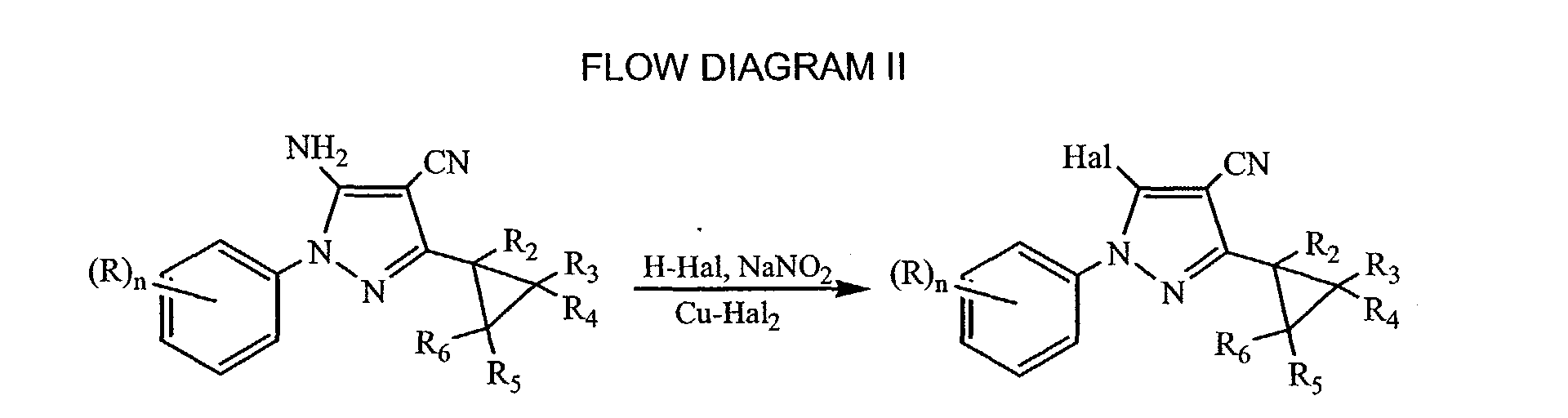
- Compounds of formula I wherein R1 is H may be prepared using conventional deamination techniques such as reacting a compound of formula la with amylnitrite or n-pentylnitrite, as described in EP 303118.
- Advantageously, it has now been found that an N-phenyl-3-cyclopropylpyrazole-4-carbonitrile compound of formula I may be used to effectively control, prevent or ameliorate infection and infestation of ectoparasites on homeothermic animals, such as cattle, sheep, horses, goats, pigs, camels, water buffalo, donkeys, rabbits, fallow deer, reindeer, minks, chinchillas, raccoons, chickens, geese, turkeys, ducks, dogs, cats and the like.
- Ectoparasites against which a compound of Formula I is useful include biting and sucking ectoparasitic insects such as Diptera, Muscidae, Acarina or Siphonáptera, in particular, Diptera: Muscidae such as Musca autumnalis (face flies), Haemtobia irritans (horn flies) Stomoxys calcitrans (stable flies), heel flies, tsetse flies, blow flies and the like; Diptera: Hippoboscidae (louse flies) such as Melophagus ovinus (sheep ked); Acarina, including ticks, e.g., Ixodes spp., Boophilus microplus, Amblyomma spp., Hyalomma spp., Rhipicephalus spp., e.g, Rhipecephalus sanguineus, Rhipicephalus appendiculatus, Haemaphysalis spp., Dermacentor spp., e.g. Dermacentor variables, and the like; the Phthiraptera families, including Trichodectidae such as Bovicola bovis (important cattle-biting louse), B. ovis (sheep-biting louse), B. equi (horsebiting louse), Haematopinidae such as Haematopinus suis (hog louse), and H. asini (horse sucking louse), Linognathidae such as Linognathus stenopsis (goat sucking louse) and L. vituli (long-nosed cattle louse), and the like; and the Siphonáptera families, including Pulicidae such as Archaeopsyllnìae (cat and dog fleas), Spilopsyllìnae (rabbit fleas), and the like.
- Accordingly, the present invention provides a method for the prevention, amelioration or control of ectoparasitic infection or infestation in a homeothermic animal which comprises providing to a homeothermic animal in need thereof a prophylactically, therapeutically or pharmaceutically effective amount of a compound of formula I as described hereinabove.
- The term "providing" as used herein with respect to providing a compound or substance embraced by the invention, designates either directly administering or applying such a compound or substance, or administering or applying a prodrug, derivative or analog which forms an equivalent amount of the compound or substance at the locus of administration or application or within the body of the target ectoparasite.
- Protection of homeothermic animals from the infestation of ectoparasites, particularly of the orders Diptera, Acarina, Phthiraptera or Siphonáptera may be achieved by the application or administration of a prophylactically, therapeutically or pharmaceutically effective amount of a compound of formula I. In actual practice, the formula I compound may be applied to the animal as a dip, spray, pour-on, spot-on, ear tag, collar, medallion, backrubber, oiler, dustbag, powder, lotion, parenteral injection, or the like, preferably as a topical application such as a spray, pour-on or spot-on.
- The effective amount of the formula I N-phenyl-3-cyclopropylpyrazole-4-carbonitrile compound to be used in the method of invention will vary according to the specific compound used, the mode of application used, the identity of the ectoparasite to be controlled, the degree of infestation, the extent of the ectoparasitic insect population, the nature of the target host, the weather conditions or the like. Effective dosages in the practice of this invention typically will range from 0.1 mg/kg to 100 mg/kg, preferably about 1.0 mg/kg to 50 mg/kg based on body weight. Naturally, quantities greater than the effective amounts of the formula I compound may be administered, but are not required for the protection of the target animal from the ectoparasite.
- The present invention also provides a veterinary composition which comprises a pharmaceutically acceptable carrier and an ectoparasiticidally effective amount of a compound of formula I. The composition of the invention may be formulated as an aqueous dip for animals such as cattle, sheep, goats or the like or the inventive composition may be prepared as a wettable powder, emulsifiable concentrate, aqueous flowable or the like, which are dispersed in a suitable solvent and applied as sprays to the fur or hide of the animals. Such sprays usually contain about 0.1ppm to 5000ppm and preferably about 0.5ppm to 1000ppm of the active formula I compound. Also preferred is a range of about 0.2 ppm to 20.0 ppm.
- Advantageously, the compounds of formula I may also be prepared as pour-on formulations and poured on the backs of the animals such as cattle, sheep or companion animals to protect them against infestation by arthropod ectoparasites. The pour-on compositions of the invention are generally prepared by dissolving, suspending or emulsifying the formula I compound in a suitable nontoxic pharmaceutically acceptable diluent for pour-on administration. The diluent must be compatible with the ectoparasiticidal compound and should not be a source of irritation or damage to the animal's skin or hair. Such diluents include mono and polyhydric alcohols, vegetable oils, spreading oils, aliphatic and aromatic hydrocarbons, lower alkyl ketones, esters and fatty acids; such diluents are well-known in the art. Those skilled in the art will readily be able to identify suitable diluents for use in this invention.
- In one embodiment of this invention, a pour-on formulation comprises about 0.5% to 30% by weight of the compound of formula I, about 0.5 to 30% by weight of a spreading oil, 30% to 60% by weight of an aliphatic or aromatic hydrocarbon, mono or polyhydric alcohol, lower alkyl ketone or mixtures thereof and 0% to 20% by weight of a vegetable or mineral oil. A more preferred embodiment thereof comprises about 10% to 25% by weight of the compound of formula I, about 20 to 30% by weight of a spreading oil, 40% to 50% by weight of an aliphatic or aromatic hydrocarbon, mono or polyhydric alcohol, lower alkyl ketone or mixtures thereof and 5% to 15% by weight of a vegetable or mineral oil.
- In another embodiment of this invention, a pour-on formulation comprises 45% by weight of xylene, 25% by weight of cyclohexanone, 15% by weight of said antagonist compound, 10% by weight of corn oil or mineral oil and 5% by weight of other pharmaceutically acceptable diluents such as surfactants, spreading agent, antifoam agents or the like.
- Among the spreading oils that can be utilized in pour-on formulations of this invention are fatty acids, fatty acid esters, triglycerides and fatty alcohols including: isopropyl myristate, capryl/caproic acid esters of saturated (C12 -C18) fatty alcohols with waxy fatty acid esters, isopropyl palmitate and the like.
- Useful alcohols, glycols and ketones in the practice of this invention include: ethyl alcohol, isopropyl alcohol, propylene glycol, dipropylene glycol, benzyl alcohol, dipropylene glycol monoethyl ether, cyclohexanone, methylethyl ketone, methylisobutyl ketone, N-butoxybutylethoxyethanol and the like. Also, the vegetable oils that may be utilized in these formulations include: corn oil, olive oil, peanut oil, sunflower oil, cottonseed oil, soybean oil, and the like. Hydrocarbons that can be used in the formulation of this invention include: xylene, toluene, and the like.
- Surfactants may also be utilized in the formulations if desired. Those skilled in the art will readily be able to determine which surfactants known in the art will be suitable in the practice of this invention, and will understand how to incorporate such surfactants into formulations of this invention.
- In order to present a more clear understanding of the invention, the following specific examples are set forth below. These examples are merely illustrative and are not to be understood as limiting the scope and underlying principles of the invention in any way. Indeed, various modifications of the invention, in addition to those illustrated and described herein, will become apparent to persons skilled in the art from the following examples and the foregoing description. Such modifications are also intended to fall within the scope of the appended claims. The terms HNMR and THF designate proton nuclear magnetic resonance and tetrahydrofuran, respectively. Unless otherwise noted, all parts are parts by weight.
-
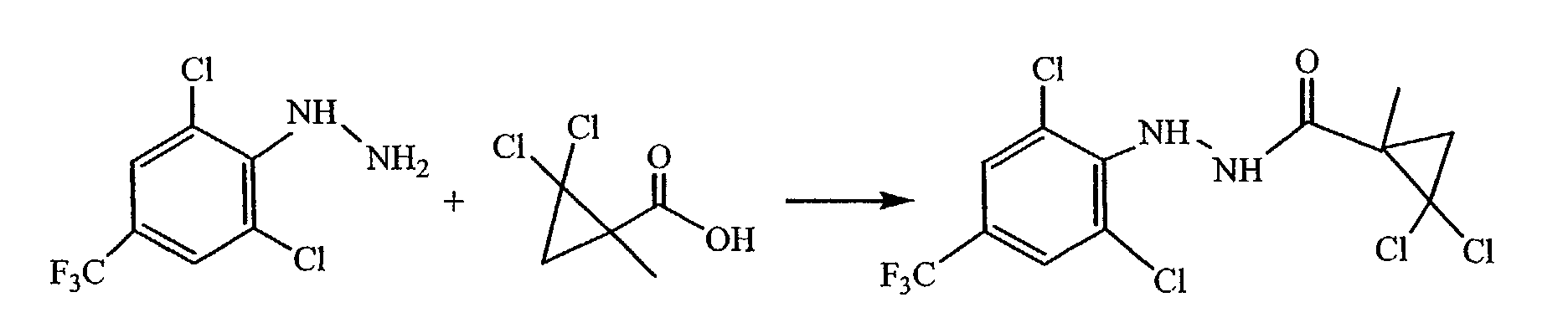
- A mixture of 2,6-dichloro-4-(trifluoromethyl)phenyl hydrazine (25 g, 102 mmol) and 2,2-dichloro-1-methylcyclopropylcarboxylic acid (17 g, 102 mmol) in CH2Cl2 is treated portion-wise over a 15 min. period with 1-[3-(dimethylamino)propyl]-3-ethylcarbodiimide hydrochloride (20 g, 102 mmol), stirred at room temperature for 18h, diluted with water, stirred for 0.5h and filtered. SThe filtercake is dried, washed with 1:1 mixture of ether:hexanes and dried in vacuo to afford the title product as a white solid, 33 g (82% yield), mp 174-175°C, identified by HNMR and mass spectral analyses.
-

- A stirred mixture of 2,2-dichloro-1-methylcyclopropyl carboxylic acid, N'-[2,6-dichloro-4-(trifluoromethyl)phenyl]hydrazide (9.4 g, 23.7 mmol) in toluene is treated dropwise with thionyl chloride (7.0 mL, 95 mmol), heated at reflux temperature for 3h, cooled to room temperature and concentrated in vacuo. The resultant oil residue is purified through a short bed of silica gel using hexanes as eluent to afford the title product as a tan solid, 9.1 g (93% yield), identified by HNMR and mass spectral analyses.
-

- A solution of malonitrile (7.23 mL, 115 mmol) in THF is treated with NaH
- (2.30 g, 57.5 mmol), cooled to 0°C, treated with a solution of [Ex. 2] (9.10 g, 23 mmol) in THF over a 0.5h period, stirred at 0°C for 1 h, warmed to 20°C, stirred for 0.5h and diluted with water and ether. The phases are separated. The organic phase is washed with brine, dried over Na2SO4 and concentrated in vacuo. The resultant residue is purified by flash chromatography (silica gel, 40% ether in hexanes as eluent) to afford the title product as a white solid, 6.15 g (60% yield), mp >200°C, identified by HNMR and mass spectral analyses.
-
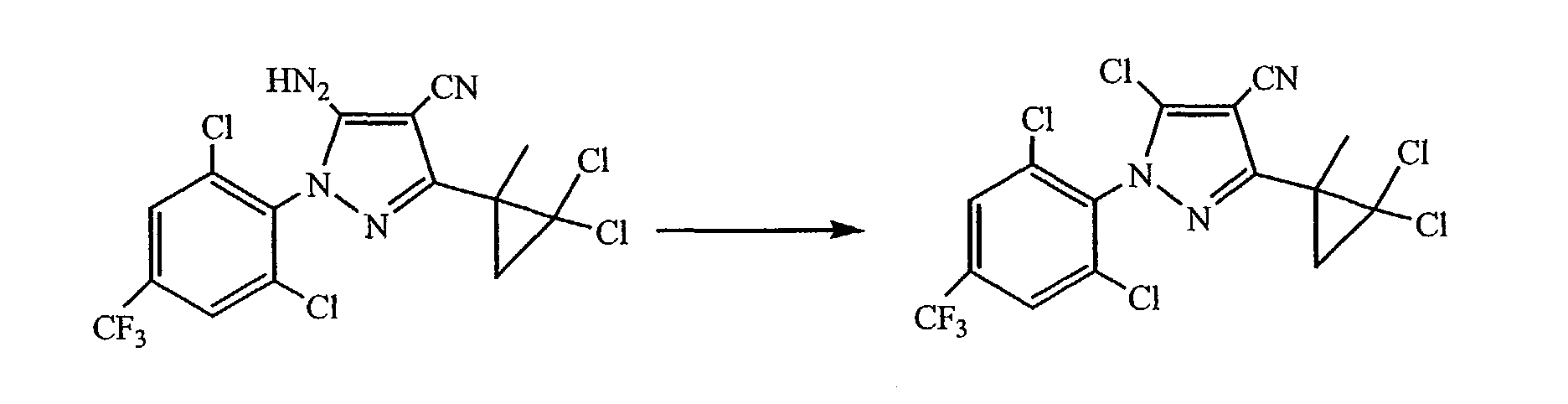
- A mixture of 5-Amino-3-(2,2-dichloro-1-methylcyclopropyl)-1-[2,6-dichloro-4-(trifluoromethyl)phenyl]-1H-pyrazole-4-carbonitrile (5.00 g, 11.3 mmol) in concentrated HCl (30 mL) at 0°C is treated portion-wise with NaNO2 (7.80 g, 113 mmol) over a 15 min. period, stirred for 1 h at 0°C, treated with CuCl2 (2.24 g, 22.6 mmol), heated slowly to 55°C, stirred at 55°C for 1h, cooled to room temperature and decanted. The remaining solid is dispersed in a mixture of water and ether. The phases are separated. The organic phase is dried over Na2SO4 and concentrated in vacuo. The resultant residue is purified by flash chromatography to afford the title product as a red resin, 3.40 g (65% yield), identified by HNMR and mass spectral analyses.
-
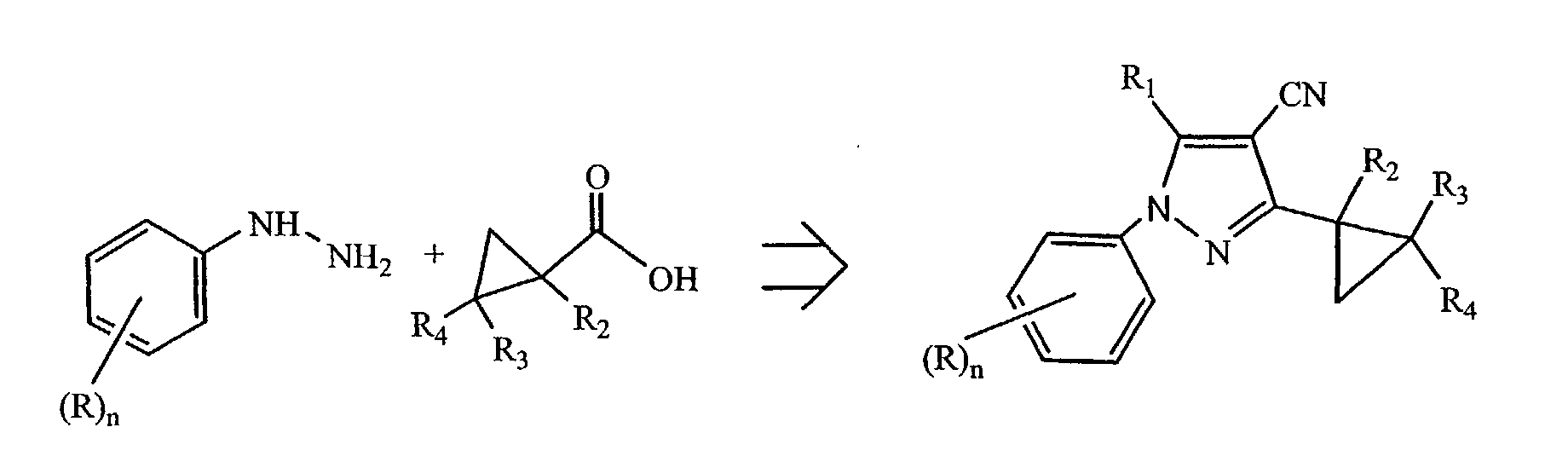
- Using essentially the same procedures described in the foregoing Examples 1-4 and employing the appropriate hydrazine and cyclopropylcarboxylic acid, the compounds shown in Table I are obtained and identified by HNMR and mass spectral analyses.
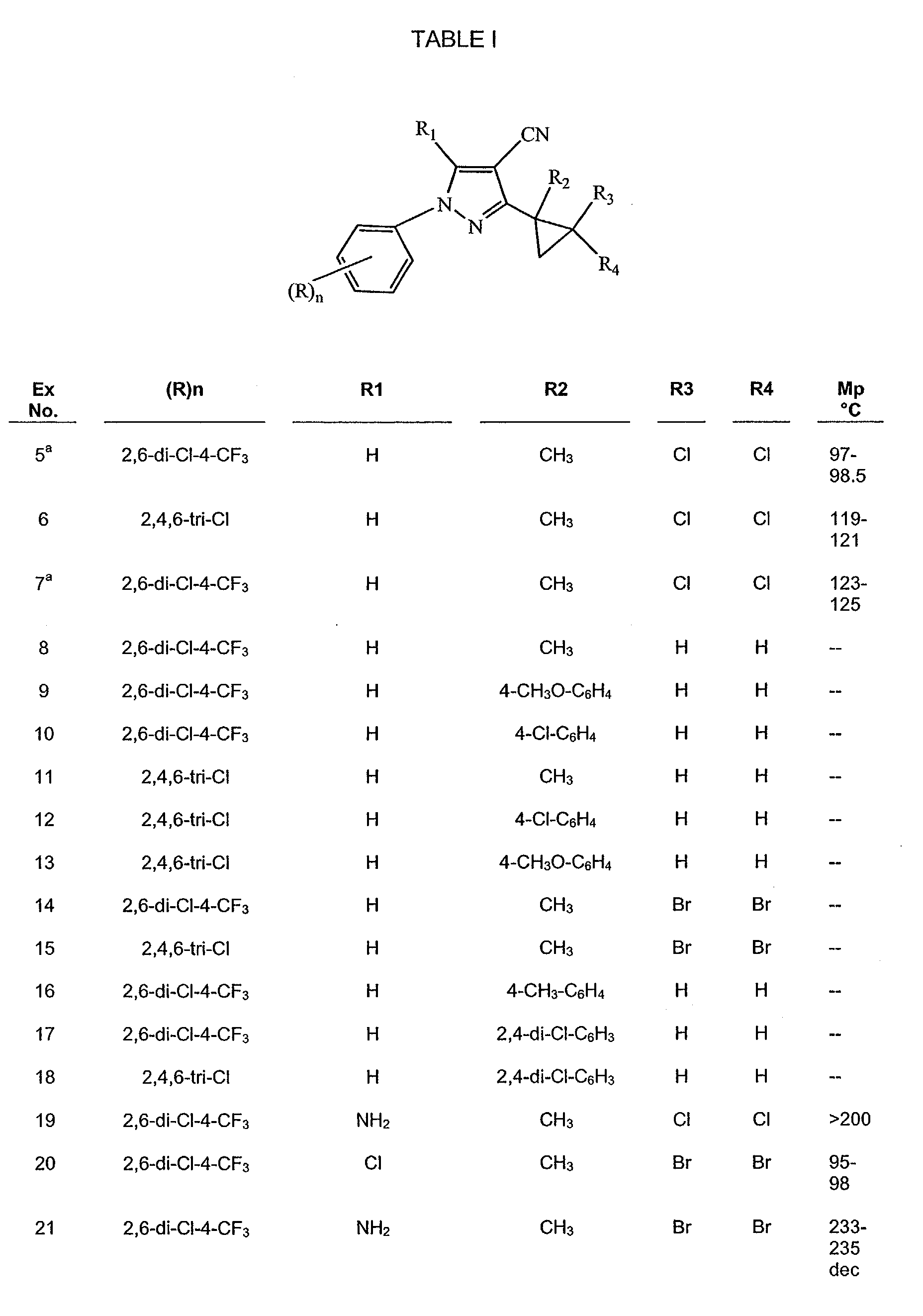


- The contact activity of a test compound against Ctenocephatides felis, adult cat fleas, is evaluated in a coated, glass vial assay. In this evaluation, a solution of test compound in acetone is allowed to dry on the interior surface of a 20 mL vial. Ten unfed adult cat fleas are added to the treated vial and mortality is assessed periodically for up to 48h. All treatments are replicated 2 times. The data are averaged. The results are shown in Table II.
Test Compound (Ex. No.) Conc. (ug/cm2) % Mortality 4h 24h 4 2 100 100 4 0.2 60 100 4 0.002 20 100 5 2 0 33 7 2 0 100 14 2 10 100 15 2 10 80 19 2 0 10 20 2 20 100 21 2 0 0 22 2 0 100 26 2 100 100 27 2 10 100 28 2 0 10 29 2 50 100 29 0.2 20 100 29 0.02 10 100 30 2 0 100 31 2 20 100 32 2 0 100 33 2 20 100 37 2 10 100 39 2 0 70 40 2 0 100 Standard 2 30 100 Standard 0.2 10 100 Standard 0.02 0 100 Control 0 0 0 - The contact activity of a test compound against Rhipacephalus sanguineus, adult ticks, is evaluated in a coated glass vial assay. In this evaluation, a solution of test compound in acetone is allowed to dry on the interior surface of a 20 mL vial. Five unfed adult ticks are added to the treated vial and mortality is assessed periodically for up to 48h. All treatments are replicated 2 times. The data are averaged. The results are shown in Table III.
Test
Compound (Ex. No.)Conc. (ug/cm2) % Mortality 4h 24h 4 7.80 60 100 4 0.78 60 100 7 7.80 10 80 7 0.78 0 10 14 7.80 50 80 14 0.78 40 40 19 7.80 40 70 19 0.78 0 20 20 7.80 20 50 20 0.78 0 20 21 7.80 0 40 21 0.78 10 10 22 7.80 0 60 22 0.78 20 30 29 7.80 20 60 29 0.78 0 40 31 7.80 50 50 31 0.78 10 20 32 7.80 0 30 32 0.78 0 60 Standard 7.80 100 100 Standard 0.78 90 100 Control 0 0 3 - The efficacy of a test compound against newly emerged larvae of Lucilia sericata, blowfly, is evaluated using a treated paper/serum bioassay. In this evaluation, a solution of test compound in acetone is applied to a filter paper disc and the disc is allowed to dry. Bovine serum and about 20 newly emerged blowfly larvae are added to the treated paper disc and the mortality is assessed at 24h and 48h. The data are averaged. The results are shown in Table IV.
Test
Compound (Ex. No.)Conc. (ppm) % Mortality 24h 48h 4 20.0 100 100 4 2.0 100 100 4 0.2 100 100 6 20.0 70 70 6 1.0 10 10 7 20.0 77 90 7 2.0 0 0 9 20.0 0 0 10 20.0 0 0 11 20.0 0 0 13 20.0 0 0 14 20.0 95 100 14 2.0 100 100 14 0.2 50 50 15 20.0 90 90 15 2.0 95 95 15 0.2 0 0 17 20.0 0 0 18 20.0 0 0 19 20.0 75 95 19 2.0 100 100 19 0.2 0 0 20 20.0 100 100 20 2.0 100 100 20 0.2 0 0 21 20.0 90 100 21 2.0 95 100 21 0.2 0 0 22 20.0 100 100 22 2.0 100 100 22 0.2 0 0 24 10.0 0 0 25 20.0 5 5 25 10.0 0 0 26 20.0 97 97 26 10.0 0 50 26 2.0 0 0 27 20.0 100 100 27 2.0 100 100 27 0.2 0 0 28 20.0 100 100 28 2.0 95 100 28 0.2 0 0 29 20.0 100 100 29 2.0 100 100 29 0.2 15 15 30 20.0 20 20 30 10.0 10 50 31 20.0 97 100 31 2.0 95 100 31 0.2 0 0 32 20.0 91 96 32 2.0 0 0 32 0.2 0 0 33 20.0 100 100 33 2.0 90 90 33 0.2 0 0 34 20.0 0 0 35 20.0 0 0 36 20.0 10 10 36 10.0 0 -- 37 20.0 100 100 37 2.0 0 0 38 20.0 0 0 39 20.0 100 100 39 2.0 70 70 39 0.2 0 0 40 20.0 100 100 40 2.0 0 0 Standard 20.0 100 100 Standard 2.0 100 100 Standard 0.2 0 100 Control 0 0 0 - Tables II, III and IV show considerable efficacy for the compounds of the invention. Those compounds displaying zero activity at all tested levels will need to be tested at higher doses to ascertain their effective concentrations.
Claims (29)
- A compound of formula Ior a pharmaceutically acceptable salt thereof, wherein

- R
- is halogen, OR7, SOmR8, NO2, CN, C1-C6haloalkyl or an optionally substituted C1-C6alkyl group;
- n
- is 0 or an integer of 1, 2 or 3;
- m
- is 0 or an integer of 1 or 2;
- R1
- is H, halogen, NO2, NR9R10, NR11COR12, NCHNR9R10 or NCHOR13;
- R2, R3, R4, R5 and R6
- are each independently H, halogen or a C1-C4alkyl, aryl or heteroaryl group each optionally substituted;
- R7
- is H or a C1-C6alkyl, C2-C6alkenyl, C2-C6alkynyl, aryl or heteroaryl group each optionally substituted;
- R8
- is a C1-C6alkyl, C2-C6alkenyl, C2-C6alkynyl, aryl or heteroaryl group, each optionally substituted;
- R9 and R10
- are each independently H, C1-C4haloalkyl or a C1-C6alkyl, C2-C6alkenyl, C2-C6alkynyl, aryl or heteroaryl group each optionally substituted or R9 and R10 may be taken together with the atom to which they are attached to form a 5- to 7-membered ring optionally containing 1 or 2 additional heteroatoms selected from O, N or S;
- R11
- is H, COR12 or an optionally substituted C1-C4alkyl group;
- R12
- is a C1-C6alkyl, C2-C6alkenyl, C2-C6alkynyl, aryl or heteroaryl group each optionally substituted; and
- R13
- is H or a C1-C6alkyl, aryl or heteroaryl group each optionally substituted;
- The compound according to claim 1 wherein formula I has the proviso that R3, R4, R5 and R6 are not all -H, unless R1 is halogen.
- The compound according to claim 2 wherein R is halogen or haloalkyl.
- The compound according to claim 2 wherein R1 is H, halogen or NR9R10.
- The compound according to claim 1 wherein R5 and R6 are H.
- The compound according to claim 3 wherein R2 is H, halogen, methyl or an optionally substituted phenyl group.
- The compound according to claim 6 wherein R1 is H or Cl.
- The compound according to claim 7 wherein R is halogen or CF3 and n is 3.
- The compound according to claim 8 wherein R2 is Cl or methyl and R3 and R4 are each independently H, Cl or Br.
- The compound according to claim 2 wherein said compound is selected from the group consisting of:the stereoisomers thereof; and the tautomers thereof; or a pharmaceutically acceptable salt thereof.5-chloro-3-(2,2-dichloro-1 methylcyclopropyl)-1-[2,6-dichloro-4-(trifluoromethyl)phenyl]-1H-pyrazole-4-carbonitrile;3-(2,2-dichloro-1-methylcyclopropyl)-1-[2,6-dichloro-4-(trifluoromethyl)phenyl]-1H-pyrazole-4-carbonitrile;3-(2,2-dichloro-1-methylcyclopropyl)-1-(2,4,6-trichlorophenyl)-1H-pyrazole-4-carbonitrile;3-(2,2-dichloro-1,3-dimethylcyclopropyl)-1-[2,6-dichloro-4-(trifluoromethyl)phenyl]-1H-pyrazole-4-carbonitrile;3-(2,2-dibromo-1-methylcyclopropyl)-1-[2,6-dichloro-4-(trifluoromethyl)phenyl]-1H-pyrazole-4-carbonitrile;3-(2,2-dibromo-1-methylcyclopropyl)-1-(2,4,6-trichlorophenyl)-1H-pyrazole-4-carbonitrile;3-(2,2-dichloro-1-methylcyclopropyl)-1-[2,6-dichloro-4-(trifluoromethyl)phenyl]-1H-pyrazole-4-carbonitrile;5-chloro-3-(2,2-dibromo-1-methylcyclopropyl)-1-[2,6-dichloro-4-(trifluoromethyl)phenyl-1 H-pyrazole-4-carbonitrile;5-amino-3-(2,2-dibromo-1-methylcyclopropyl)-1-[2,6-dichloro-4-(trifluoromethyl)phenyl-1 H-pyrazole-4-carbonitrile;5-bromo-3-(2,2-dibromo-1-methylcyclopropyl)-1-[2,6-dichloro-4-(trifluoromethyl)phenyl]-1H-pyrazole-4-carbonitrile;5-amino-3-(2,2-dichloro-1-methylcyclopropyl)-1-(2,4,6-trichlorophenyl)-1H-pyrazole-4-carbonitrile;5-chloro-3-cyclopropyl-1--[2,6-dichloro-4-(trifluoromethyl)phenyl-1 H-pyrazole-4-carbonitrile;5-chloro-3-(2,2-dichloro-1-methylcyclopropyl)-1-(2,4,6-trichlorophenyl)-1H-pyrazole-4-carbonitrile;5-bromo-3-(2,2-dichloro-1-methylcyclopropyl)-1-(2,4,6-trichlorophenyl)-1H-pyrazole-4-carbonitrile;5-bromo-3-(2,2-dichloro-1-methylcyclopropyl)-1-[2,6-dichloro-4-(trifluoromethyl)phenyl]-1H-pyrazole-4-carbonitrile;3-(2,2-dichloro-1-methylcyclopropyl)-1-[2,6-dichloro-4-(trifluoromethyl)phenyl]-5-nitro-1 H-pyrazole-4-carbonitrile;3-(2,2-dichloro-1-methylcyclopropyl)-1-[2,6-dichloro-4-(trifluoromethyl)phenyl]-5-iodo-1 H-pyrazole-4-carbonitrile;3-(2,2-dichloro-1-methylcyclopropyl)-1-[2,6-dichloro-4-(trifluoromethyl)phenyl]-5-(dimethylamino)-1 H-pyrazole-4-carbonitrile;3-(2,2-dichloro-1-methylcyclopyrazol)-1-[2,6-dichloro-4-(trifluoromethyl)phenyl]-5-(diethylamino)-1H-pyrazole-4-carbonitrile;5-[(cyclopropanecarbonyl)amino-]-3-(2,2-dichloro-1 methylcyclopropyl)-1-[2,6-dichloro-4-(trifluoromethyl)phenyl]-1H-pyrazole-4-carbonitrile;N-{4-cyano-5-(2,2-dichloro-1-methyl-cyclopropyl)-2-[2,6-dichloro-4-(trifluoromethyl)-phenyl]-2H-pyrazol-3-yl}-formimidic acid methyl ester;N-{4-cyano-5-(2,2-dichloro-1-methyl-cyclopropyl)-2-[2,6-dichloro-4-(trifluoromethyl)-phenyl]-2-H-pyrazol-3-yl}-formimidic acid propyl ester;N-{4-cyano-5-(2,2-dichloro-1-methyl-cyclopropyl)-2-[2,6-dichloro-4-(trifluoromethyl)-phenyl]-2H-pyrazol-3-yl}-formimidic acid ethyl ester;
- A method for the prevention, amelioration or control of ectoparasitic infection or infestation in a homeothermic animal which comprises providing to a homeothermic animal in need thereof a prophylactically, therapeutically or pharmaceutically effective amount of a compound of formula I according to claim 1.
- The method according to claim 11 wherein the formula I has the proviso that R3, R4, R5 and R6 are not all -H, unless R1 is halogen.
- The method according to claim 12 wherein R is halogen or haloalkyl and n is 3.
- The method according to claim 13 wherein R5 and R6 are H.
- The method according to claim 14 wherein R2 is H, halogen, methyl or an optionally substituted phenyl group.
- The method according to claim 12 wherein the ectoparasite is selected from the group consisting of Diptera; Muscidae; Acarina; and Siphonáptera.
- The method according to claim 16 wherein the ectoparasite is selected from the group consisting of fleas; ticks; lice; blow flies; face flies and horn flies.
- The method according to claim 16 wherein the homeothermic animal is selected from the group consisting of cattle; sheep; horse; goat; pig; camel; water buffalo; donkey; rabbit; fallow deer; reindeer; mink; chinchilla; raccoon; chicken; geese; turkey; duck; dog and cat.
- The method according to claim 17 wherein the homeothermic animal is selected from the group consisting of cattle, sheep, horse, dog, and cat.
- A veterinary pour-on composition which comprises: a spreading oil; an aliphatic or aromatic hydrocarbon, mono or polyhydric alcohol, a C1-C10 alkyl ketone, or a mixture thereof; and an ectoparasiticidally effective amount of a compound of formula I according to claim 1.
- The composition according to claim 20 wherein formula I has the proviso that R3, R4, R5 and R6 are not all -H, unless R1 is halogen.
- The composition according to claim 21 wherein R is halogen or haloalkyl and n is 3.
- The composition according to claim 22 wherein said compound is selected from the group consisting of:the stereoisomers thereof; and the tautomers thereof.5-chloro-3-(2,2-dichloro-1 methylcyclopropyl)-1-[2,6-dichloro-4-(trifluoromethyl)phenyl]-1H-pyrazole-4-carbonitrile;3-(2,2-dichloro-1-methylcyclopropyl)-1-[2,6-dichloro-4-(trifluoromethyl)phenyl]-1H-pyrazole-4-carbonitrile;3-(2,2-dichloro-1-methylcyclopropyl)-1-(2,4,6-trichlorophenyl)-1H-pyrazole-4-carbonitrile;3-(2,2-dichloro-1,3-dimethylcyclopropyl)-1-[2,6-dichloro-4-(trifluoromethyl)phenyl]-1H-pyrazole-4-carbonitrile;3-(2,2-dibromo-1-methylcyclopropyl)-1-[2,6-dichloro-4-(trifluoromethyl)phenyl]-1H-pyrazole-4-carbonitrile;3-(2,2-dibromo-1-methylcyclopropyl)-1-(2,4,6-trichlorophenyl)-1H-pyrazole-4-carbonitrile;3-(2,2-dichloro-1-methylcyclopropyl)-1-[2,6-dichloro-4-(trifluoromethyl)phenyl]-1H-pyrazole-4-carbonitrile;5-chloro-3-(2,2-dibromo-1-methylcyclopropyl)-1-[2,6-dichloro-4-(trifluoromethyl)phenyl-1 H-pyrazole-4-carbonitrile;5-amino-3-(2,2-dibromo-1-methylcyclopropyl)-1-[2,6-dichloro-4-(trifluoromethyl)phenyl-1 H-pyrazole-4-carbonitrile;5-bromo-3-(2,2-dibromo-1-methylcyclopropyl)-1-[2,6-dichloro-4-(trifluoromethyl)phenyl]-1H-pyrazole-4-carbonitrile;5-amino-3-(2,2-dichloro-1-methylcyclopropyl)-1-(2,4,6-trichlorophenyl)-1H-pyrazole-4-carbonitrile;5-chloro-3-cyclopropyl-1--[2,6-dichloro-4-(trifluoromethyl)phenyl-1 H-pyrazole-4-carbonitrile;5-chloro-3-(2,2-dichloro-1-methylcyclopropyl)-1-(2,4,6-trichlorophenyl)-1H-pyrazole-4-carbonitrile;5-bromo-3-(2,2-dichloro-1-methylcyclopropyl)-1-(2,4,6-trichlorophenyl)-1H-pyrazole-4-carbonitrile;5-bromo-3-(2,2-dichloro-1-methylcyclopropyl)-1-[2, 6-dichloro-4-(trifluoromethyl)phenyl]-1H-pyrazole-4-carbonitrile;3-(2,2-dichloro-1-methylcyclopropyl)-1-[2,6-dichloro-4-(trifluoromethyl)phenyl]-5-nitro-1 H-pyrazole-4-carbonitrile;3-(2,2-dichloro-1-methylcyclopropyl)-1-[2,6-dichloro-4-(trifluoromethyl)phenyl]-5-iodo-1 H-pyrazole-4-carbonitrile;3-(2,2-dichloro-1-methylcyclopropyl)-1-[2,6-dichloro-4-(trifluoromethyl)phenyl]-5-(dimethylamino)-1 H-pyrazole-4-carbonitrile;3-(2,2-dichloro-1-methylcyclopyrazol)-1-[2,6-dichloro-4-(trifluoromethyl)phenyl]-5-(diethylamino)-1 H-pyrazole-4-carbonitrile;5-[(cyclopropanecarbonyl)amino-]-3-(2,2-dichloro-1 methylcyclopropyl)-1-[2,6-dichloro-4-(trifluoromethyl)phenyl]-1H-pyrazole-4-carbonitrile;N-{4-cyano-5-(2,2-dichloro-1-methyl-cyclopropyl)-2-[2,6-dichloro-4-(trifluoromethyl)-phenyl]-2H-pyrazol-3-yl}-formimidic acid methyl ester;N-{4-cyano-5-(2,2-dichloro-1-methyl-cyclopropyl)-2-[2,6-dichloro-4-(trifluoromethyl)-phenyl]-2-H-pyrazol-3-yl}-formimidic acid propyl ester;N-{4-cyano-5-(2,2-dichloro-1-methyl-cyclopropyl)-2-[2,6-dichloro-4-(trifluoromethyl)-phenyl]-2-H-pyrazol-3-yl}-formimidic acid ethyl ester;
- A veterinary pour-on composition which comprises: approximately 40-50% by weight xylene; approximately 20-30% by weight cyclohexanone; approximately 5-15% vegetable or mineral oil or a combination thereof; and approximately 10-25% of a compound selected from the group consisting of:the stereoisomers thereof; and the tautomers thereof.5-chloro-3-(2,2-dichloro-1 methylcyclopropyl)-1-[2,6-dichloro-4-(trifluoromethyl)phenyl]-1H-pyrazole-4-carbonitrile;3-(2,2-dichloro-1-methylcyclopropyl)-1-[2,6-dichloro-4-(trifluoromethyl)phenyl]-1H-pyrazole-4-carbonitrile;3-(2,2-dichloro-1-methylcyclopropyl)-1-(2,4,6-trichlorophenyl)-1H-pyrazole-4-carbonitrile;3-(2,2-dichloro-1,3-dimethylcyclopropyl)-1-[2,6-dichloro-4-(trifluoromethyl)phenyl]-1H-pyrazole-4-carbonitrile;3-(2,2-dibromo-1-methylcyclopropyl)-1-[2,6-dichloro-4-(trifluoromethyl)phenyl]-1H-pyrazole-4-carbonitrile;3-(2,2-dibromo-1-methylcyclopropyl)-1-(2,4,6-trichlorophenyl)-1H-pyrazole-4-carbonitrile;3-(2,2-dichloro-1-methylcyclopropyl)-1-[2,6-dichloro-4-(trifluoromethyl)phenyl]-1H-pyrazole-4-carbonitrile;5-chloro-3-(2,2-dibromo-1-methylcyclopropyl)-1-[2,6-dichloro-4-(trifluoromethyl)phenyl-1 H-pyrazole-4-carbonitrile;5-amino-3-(2,2-dibromo-1-methylcyclopropyl)-1-[2,6-dichloro-4-(trifluoromethyl)phenyl-1 H-pyrazole-4-carbonitrile;5-bromo-3-(2,2-dibromo-1-methylcyclopropyl)-1-[2,6-dichloro-4-(trifluoromethyl)phenyl]-1H-pyrazole-4-carbonitrile;5-amino-3-(2,2-dichloro-1-methylcyclopropyl)-1-(2,4,6-trichlorophenyl)-1H-pyrazole-4-carbonitrile;5-chloro-3-cyclopropyl-1--[2,6-dichloro-4-(trifluoromethyl)phenyl-1H-pyrazole-4-carbonitrile;5-chloro-3-(2,2-dichloro-1-methylcyclopropyl)-1-(2,4,6-trichlorophenyl)-1H-pyrazole-4-carbonitrile;5-bromo-3-(2,2-dichloro-1-methylcyclopropyl)-1-(2,4,6-trichlorophenyl)-1H-pyrazole-4-carbonitrile;5-bromo-3-(2,2-dichloro-1-methylcyclopropyl)-1-[2,6-dichloro-4-(trifluoromethyl)phenyl]-1H-pyrazole-4-carbonitrile;3-(2,2-dichloro-1-methylcyclopropyl)-1-[2,6-dichloro-4-(trifluoromethyl)phenyl]-5-nitro-1 H-pyrazole-4-carbonitrile;3-(2,2-dichloro-1-methylcyclopropyl)-1-[2,6-dichloro-4-(trifluoromethyl)phenyl]-5-iodo-1 H-pyrazole-4-carbonitrile;3-(2,2-dichloro-1-methylcyclopropyl)-1-[2,6-dichloro-4-(trifluoromethyl)phenyl]-5-(dimethylamino)-1 H-pyrazole-4-carbonitrile;3-(2,2-dichloro-1-methylcyclopyrazol)-1-[2,6-dichloro-4-(trifluoromethyl)phenyl]-5-(diethylamino)-1 H-pyrazole-4-carbonitrile;5-[(cyclopropanecarbonyl)amino-]-3-(2,2-dichloro-1methylcyclopropyl)-1-[2,6-dichloro-4-(trifluoromethyl)phenyl]-1H-pyrazole-4-carbonitrile;N-{4-cyano-5-(2,2-dichloro-1-methyl-cyclopropyl)-2-[2,6-dichloro-4-(trifluoromethyl)-phenyl]-2H-pyrazol-3-yl}-formimidic acid methyl ester;N-{4-cyano-5-(2,2-dichloro-1-methyl-cyclopropyl)-2-[2,6-dichloro-4-(trifluoromethyl)-phenyl]-2-H-pyrazol-3-yl}-formimidic acid propyl ester;N-{4-cyano-5-(2,2-dichloro-1-methyl-cyclopropyl)-2-[2,6-dichloro-4-(trifluoromethyl)-phenyl]-2-H-pyrazol-3-yl}-formimidic acid ethyl ester;
- The composition according to claim 24 wherein an effective dosage of said compound is within the range of about 0.1 mg/kg to 100 mg/kg of animal body weight.
- A veterinary composition which comprises a pharmaceutically acceptable carrier and about 0.1 ppm to 5000 ppm of a compound selected from the group consisting of:the stereoisomers thereof; and the tautomers thereof.5-chloro-3-(2,2-dichloro-1 methylcyclopropyl)-1-[2,6-dichloro-4-(trifluoromethyl)phenyl]-1H-pyrazole-4-carbonitrile;3-(2,2-dichloro-1-methylcyclopropyl)-1-[2,6-dichloro-4-(trifluoromethyl)phenyl]-1H-pyrazole-4-carbonitrile;3-(2,2-dichloro-1-methylcyclopropyl)-1-(2,4,6-trichlorophenyl)-1H-pyrazole-4-carbonitrile;3-(2,2-dichloro-1,3-dimethylcyclopropyl)-1-[2,6-dichloro-4-(trifluoromethyl)phenyl]-1H-pyrazole-4-carbonitrile;3-(2,2-dibromo-1-methylcyclopropyl)-1-[2,6-dichloro-4-(trifluoromethyl)phenyl]-1H-pyrazole-4-carbonitrile;3-(2,2-dibromo-1-methylcyclopropyl)-1-(2,4,6-trichlorophenyl)-1H-pyrazole-4-carbonitrile;3-(2,2-dichloro-1-methyleyclopropyl)-1-[2,6-dichloro-4-(trifluoromethyl)phenyl]-1H-pyrazole-4-carbonitrile;5-chloro-3-(2,2-dibromo-1-methylcyclopropyl)-1-[2,6-dichloro-4-(trifluoromethyl)phenyl-1H-pyrazole-4-carbonitrile;5-amino-3-(2,2-dibromo-1-methylcyclopropyl)-1-[2,6-dichloro-4-(trifluoromethyl)phenyl-1 H-pyrazole-4-carbonitrile;5-bromo-3-(2,2-dibromo-1-methylcyclopropyl)-1-[2,6-dichloro-4-(trifluoromethyl)phenyl]-1H-pyrazole-4-carbonitrile;5-amino-3-(2,2-dichloro-1-methylcyclopropyl)-1-(2,4,6-trichlorophenyl)-1H-pyrazole-4-carbonitrile;5-chloro-3-cyclopropyl-1--[2,6-dichloro-4-(trifluoromethyl)phenyl-1H-pyrazole-4-carbonitrile;5-chloro-3-(2,2-dichloro-1-methylcyclopropyl)-1-(2,4,6-trichlorophenyl)-1H-pyrazole-4-carbonitrile;5-bromo-3-(2,2-dichloro-1-methylcyclopropyl)-1-(2,4,6-trichlorophenyl)-1H-pyrazole-4-carbonitrile;5-bromo-3-(2,2-dichloro-1-methylcyclopropyl)-1-[2,6-dichloro-4-(trifluoromethyl)phenyl]-1H-pyrazole-4-carbonitrile;3-(2,2-dichloro-1-methylcyclopropyl)-1-[2,6-dichloro-4-(trifluoromethyl)phenyl]-5-nitro-1 H-pyrazole-4-carbonitrile;3-(2,2-dichloro-1-methylcyclopropyl)-1-[2,6-dichloro-4-(trifluoromethyl)phenyl]-5-iodo-1 H-pyrazole-4-carbonitrile;3-(2,2-dichloro-1-methylcyclopropyl)-1-[2,6-dichloro-4-(trifluoromethyl)phenyl]-5-(dimethylamino)-1H-pyrazole-4-carbonitrile;3-(2,2-dichloro-1-methylcyclopyrazol)-1-[2,6-dichloro-4-(trifluoromethyl)phenyl]-5-(diethylamino)-1 H-pyrazole-4-carbonitrile;5-[(cyclopropanecarbonyl)amino-]-3-(2,2-dichloro-1methylcyclopropyl)-1-[2,6-dichloro-4-(trifluoromethyl)phenyl]-1H-pyrazole-4-carbonitrile;N-{4-cyano-5-(2,2-dichloro-1-methyl-cyclopropyl)-2-[2,6-dichloro-4-(trifluoromethyl)-phenyl]-2H-pyrazol-3-yl}-formimidic acid methyl ester;N-{4-cyano-5-(2,2-dichloro-1-methyl-cyclopropyl)-2-[2,6-dichloro-4-(trifluoromethyl)-phenyl]-2-H-pyrazol-3-yl}-formimidic acid propyl ester;N-{4-cyano-5-(2,2-dichloro-1-methyl-cyclopropyl)-2-[2,6-dichloro-4-(trifluoromethyl)-phenyl]-2-H-pyrazol-3-yl}-formimidic acid ethyl ester;
- The composition according to claim 26 which comprises about 0.5 ppm to 1000 ppm of said compound.
- The composition according to claim 27 which comprises about 0.2 ppm to 20 ppm of said compound.
- A composition for the prevention, amelioration or control of external parasites on animals and humans comprising a pharmaceutically acceptable carrier and an ectoparasiticidally effective amount of a compound as claimed in claim 1.
Applications Claiming Priority (3)
| Application Number | Priority Date | Filing Date | Title |
|---|---|---|---|
| US43384102P | 2002-12-16 | 2002-12-16 | |
| US433841P | 2002-12-16 | ||
| EP02293107A EP1431292A1 (en) | 2002-12-16 | 2002-12-16 | 1-N-phenylamino-1H-imidazole derivatives as aromatase inhibitors |
Publications (1)
| Publication Number | Publication Date |
|---|---|
| EP1431291A1 true EP1431291A1 (en) | 2004-06-23 |
Family
ID=42041569
Family Applications (2)
| Application Number | Title | Priority Date | Filing Date |
|---|---|---|---|
| EP03257833A Withdrawn EP1431291A1 (en) | 2002-12-16 | 2003-12-12 | 1-Aryl-4-cyano-3-cyclopropylpyrazole derivatives as ectoparasiticidal agents |
| EP03795984A Expired - Lifetime EP1572665B1 (en) | 2002-12-16 | 2003-12-15 | 1-n-phenylamino-1h-imidazole derivatives as aromatase inhibitors |
Family Applications After (1)
| Application Number | Title | Priority Date | Filing Date |
|---|---|---|---|
| EP03795984A Expired - Lifetime EP1572665B1 (en) | 2002-12-16 | 2003-12-15 | 1-n-phenylamino-1h-imidazole derivatives as aromatase inhibitors |
Country Status (22)
| Country | Link |
|---|---|
| EP (2) | EP1431291A1 (en) |
| JP (2) | JP2004196795A (en) |
| KR (1) | KR20050084299A (en) |
| CN (1) | CN100390151C (en) |
| AT (1) | ATE325102T1 (en) |
| AU (2) | AU2003298259B2 (en) |
| BR (1) | BR0317339A (en) |
| CA (1) | CA2510175C (en) |
| CY (1) | CY1106317T1 (en) |
| DE (1) | DE60305069T2 (en) |
| DK (1) | DK1572665T3 (en) |
| ES (1) | ES2264032T3 (en) |
| MA (1) | MA27502A1 (en) |
| MX (2) | MXPA03011500A (en) |
| NO (1) | NO330337B1 (en) |
| NZ (1) | NZ540643A (en) |
| PL (1) | PL377095A1 (en) |
| PT (1) | PT1572665E (en) |
| RU (1) | RU2327691C2 (en) |
| SI (1) | SI1572665T1 (en) |
| UA (1) | UA80307C2 (en) |
| ZA (1) | ZA200504570B (en) |
Families Citing this family (5)
| Publication number | Priority date | Publication date | Assignee | Title |
|---|---|---|---|---|
| RU2365586C2 (en) * | 2003-12-15 | 2009-08-27 | Лаборатуар Терамекс | 1-n-phenylamino-1h-imidazol derivatives and pharmaceutical compositions containing them |
| US20060288955A1 (en) * | 2005-05-24 | 2006-12-28 | Wyeth | Device and method for controlling insects |
| TWI368505B (en) * | 2005-05-24 | 2012-07-21 | Wyeth Corp | Versatile high load concentrate compositions for control of ecto-parasites |
| AR078947A1 (en) * | 2009-11-11 | 2011-12-14 | Bayer Cropscience Ag | DIAZINIL-PIRAZOLILO COMPOUNDS AND SAME PREPARATION PROCESSES |
| CN103275013A (en) * | 2013-05-27 | 2013-09-04 | 云南大学 | Novel nitrogenous heterocycle sulfamide derivative type aromatizing enzyme inhibitor and preparation method thereof |
Citations (4)
| Publication number | Priority date | Publication date | Assignee | Title |
|---|---|---|---|---|
| EP0234119A1 (en) * | 1985-12-20 | 1987-09-02 | Rhone-Poulenc Agrochimie | Pesticidal method using N-phenylpyrazoles |
| US5232940A (en) * | 1985-12-20 | 1993-08-03 | Hatton Leslie R | Derivatives of N-phenylpyrazoles |
| US6372774B1 (en) * | 1985-12-20 | 2002-04-16 | Rhone-Poulenc Agriculture Ltd. | Derivatives of N-phenylpyrazoles |
| WO2003029222A1 (en) * | 2001-09-25 | 2003-04-10 | Basf Aktiengesellschaft | Insecticidal and acaricidal 3-substituted pyrazoles |
Family Cites Families (7)
| Publication number | Priority date | Publication date | Assignee | Title |
|---|---|---|---|---|
| US4749713A (en) * | 1986-03-07 | 1988-06-07 | Ciba-Geigy Corporation | Alpha-heterocycle substituted tolunitriles |
| US5071861A (en) * | 1986-03-07 | 1991-12-10 | Ciba-Geigy Corporation | Alpha-heterocycle substituted tolunitriles |
| DK59888A (en) * | 1987-03-20 | 1988-09-21 | Hoffmann La Roche | imidazole |
| JP2500849B2 (en) * | 1991-09-02 | 1996-05-29 | 山之内製薬株式会社 | Triazolyl-substituted tertiary amino compound or salt thereof |
| EP0641785B1 (en) * | 1991-09-02 | 1999-10-27 | Yamanouchi Pharmaceutical Co. Ltd. | Triazolylated tertiary amine compound or salt thereof |
| GB2273704B (en) * | 1992-12-16 | 1997-01-22 | Orion Yhtymae Oy | Triazolyl diaryl selective aromatase inhibiting compounds |
| GB9409882D0 (en) * | 1994-05-18 | 1994-07-06 | Sandoz Ltd | Organic compounds |
-
2003
- 2003-12-09 JP JP2003410499A patent/JP2004196795A/en active Pending
- 2003-12-11 MX MXPA03011500A patent/MXPA03011500A/en not_active Application Discontinuation
- 2003-12-12 EP EP03257833A patent/EP1431291A1/en not_active Withdrawn
- 2003-12-15 EP EP03795984A patent/EP1572665B1/en not_active Expired - Lifetime
- 2003-12-15 ES ES03795984T patent/ES2264032T3/en not_active Expired - Lifetime
- 2003-12-15 KR KR1020057010903A patent/KR20050084299A/en not_active Ceased
- 2003-12-15 CN CNB2003801051015A patent/CN100390151C/en not_active Expired - Fee Related
- 2003-12-15 DK DK03795984T patent/DK1572665T3/en active
- 2003-12-15 CA CA2510175A patent/CA2510175C/en not_active Expired - Fee Related
- 2003-12-15 BR BR0317339-9A patent/BR0317339A/en not_active Application Discontinuation
- 2003-12-15 DE DE60305069T patent/DE60305069T2/en not_active Expired - Lifetime
- 2003-12-15 AU AU2003298259A patent/AU2003298259B2/en not_active Ceased
- 2003-12-15 JP JP2004560486A patent/JP2006511546A/en active Pending
- 2003-12-15 MX MXPA05006530A patent/MXPA05006530A/en active IP Right Grant
- 2003-12-15 SI SI200330353T patent/SI1572665T1/en unknown
- 2003-12-15 PT PT03795984T patent/PT1572665E/en unknown
- 2003-12-15 UA UAA200505912A patent/UA80307C2/en unknown
- 2003-12-15 NZ NZ540643A patent/NZ540643A/en not_active IP Right Cessation
- 2003-12-15 RU RU2005122469/04A patent/RU2327691C2/en not_active IP Right Cessation
- 2003-12-15 AT AT03795984T patent/ATE325102T1/en active
- 2003-12-15 PL PL377095A patent/PL377095A1/en not_active Application Discontinuation
- 2003-12-15 AU AU2003268835A patent/AU2003268835A1/en not_active Abandoned
-
2005
- 2005-06-03 ZA ZA200504570A patent/ZA200504570B/en unknown
- 2005-06-08 NO NO20052780A patent/NO330337B1/en not_active IP Right Cessation
- 2005-06-22 MA MA28355A patent/MA27502A1/en unknown
-
2006
- 2006-07-06 CY CY20061100935T patent/CY1106317T1/en unknown
Patent Citations (4)
| Publication number | Priority date | Publication date | Assignee | Title |
|---|---|---|---|---|
| EP0234119A1 (en) * | 1985-12-20 | 1987-09-02 | Rhone-Poulenc Agrochimie | Pesticidal method using N-phenylpyrazoles |
| US5232940A (en) * | 1985-12-20 | 1993-08-03 | Hatton Leslie R | Derivatives of N-phenylpyrazoles |
| US6372774B1 (en) * | 1985-12-20 | 2002-04-16 | Rhone-Poulenc Agriculture Ltd. | Derivatives of N-phenylpyrazoles |
| WO2003029222A1 (en) * | 2001-09-25 | 2003-04-10 | Basf Aktiengesellschaft | Insecticidal and acaricidal 3-substituted pyrazoles |
Also Published As
| Publication number | Publication date |
|---|---|
| NZ540643A (en) | 2007-11-30 |
| BR0317339A (en) | 2005-11-08 |
| SI1572665T1 (en) | 2006-10-31 |
| AU2003268835A1 (en) | 2004-07-01 |
| MXPA03011500A (en) | 2004-09-10 |
| AU2003298259A1 (en) | 2004-07-09 |
| DE60305069T2 (en) | 2006-12-07 |
| PL377095A1 (en) | 2006-01-23 |
| ZA200504570B (en) | 2006-08-30 |
| RU2005122469A (en) | 2006-02-27 |
| UA80307C2 (en) | 2007-09-10 |
| ES2264032T3 (en) | 2006-12-16 |
| JP2006511546A (en) | 2006-04-06 |
| AU2003298259B2 (en) | 2009-04-02 |
| MA27502A1 (en) | 2005-08-01 |
| EP1572665B1 (en) | 2006-05-03 |
| NO330337B1 (en) | 2011-03-28 |
| CN1720235A (en) | 2006-01-11 |
| HK1083218A1 (en) | 2006-06-30 |
| KR20050084299A (en) | 2005-08-26 |
| PT1572665E (en) | 2006-09-29 |
| ATE325102T1 (en) | 2006-06-15 |
| DE60305069D1 (en) | 2006-06-08 |
| NO20052780L (en) | 2005-06-08 |
| CY1106317T1 (en) | 2011-10-12 |
| CA2510175C (en) | 2011-07-05 |
| MXPA05006530A (en) | 2006-02-17 |
| CN100390151C (en) | 2008-05-28 |
| RU2327691C2 (en) | 2008-06-27 |
| EP1572665A2 (en) | 2005-09-14 |
| CA2510175A1 (en) | 2004-07-01 |
| DK1572665T3 (en) | 2006-08-28 |
| JP2004196795A (en) | 2004-07-15 |
Similar Documents
| Publication | Publication Date | Title |
|---|---|---|
| JP2870650B2 (en) | N-phenylpyrazole derivative | |
| DE3650042T2 (en) | Pesticidal process using N-phenylpyrazoles. | |
| DE3856585T2 (en) | N-phenylpyrazole | |
| AU676343B2 (en) | Pesticidal 1-arylpyrroles | |
| JP6233855B2 (en) | Substituted azines as insecticides | |
| CZ228399A3 (en) | Pesticide 1-arylpyrazole compounds, method of use thereof, and compositions containing them | |
| US6518266B1 (en) | 1- Aryl-3-thioalkyl pyrazoles, the synthesis thereof and the use thereof as insecticides | |
| KR101110579B1 (en) | Use of neuronal sodium channel antagonists to control in vitro parasites in constant temperature animals | |
| US20040122075A1 (en) | N-phenyl-3-cyclopropylpyrazole-4-carbonitriles as ectoparasiticidal agents | |
| PT87698B (en) | PROCESS FOR THE PREPARATION OF N-PHENYL-PYRAZOLE DERIVATIVES | |
| CN106470972B (en) | New sulfonylaminobenzamide compounds | |
| JP2002518301A (en) | Composition to keep parasites away | |
| CN101495462A (en) | Pyrimidine derivatives and their use as pesticides | |
| JP3432522B2 (en) | Pyrazole, a parasiticide | |
| HRP20010437A2 (en) | Control of arthropods in animals | |
| SK14572001A3 (en) | (s)-enantiomer enriched fipronil composition and method for killing pests | |
| JP2002518298A (en) | Composition for keeping pests away | |
| AU2003268835A1 (en) | Ectoparasiticidal agents | |
| DD298782A5 (en) | N-phenylpyrazole DERIVATIVES | |
| AU2010320817B2 (en) | Amidoacetonitrile compounds having pesticidal activity | |
| CN102123588B (en) | Substituted imidazole combinations | |
| EP0557732A1 (en) | Methods and compositions for protecting animals against attack and infestation by helminth, acarid and anthropod endo- and ectoparasites | |
| JP6140373B2 (en) | New compounds | |
| US6506784B1 (en) | Use of 1,3-substituted pyrazol-5-yl sulfonates as pesticides | |
| JPH07500612A (en) | benzimidazole anthelmintic |
Legal Events
| Date | Code | Title | Description |
|---|---|---|---|
| PUAI | Public reference made under article 153(3) epc to a published international application that has entered the european phase |
Free format text: ORIGINAL CODE: 0009012 |
|
| AK | Designated contracting states |
Kind code of ref document: A1 Designated state(s): AT BE BG CH CY CZ DE DK EE ES FI FR GB GR HU IE IT LI LU MC NL PT RO SE SI SK TR |
|
| AX | Request for extension of the european patent |
Extension state: AL LT LV MK |
|
| 17P | Request for examination filed |
Effective date: 20040705 |
|
| AKX | Designation fees paid |
Designated state(s): AT BE BG CH CY CZ DE DK EE ES FI FR GB GR HU IE IT LI LU MC NL PT RO SE SI SK TR |
|
| AXX | Extension fees paid |
Extension state: LV Payment date: 20040705 Extension state: LT Payment date: 20040705 Extension state: AL Payment date: 20040705 |
|
| STAA | Information on the status of an ep patent application or granted ep patent |
Free format text: STATUS: THE APPLICATION IS DEEMED TO BE WITHDRAWN |
|
| 18D | Application deemed to be withdrawn |
Effective date: 20060701 |