EP1430016B1 - 3,4,5-trimethoxy phenyl-based ester compound and preparation method thereof and whitening cosmetic composition containing the same - Google Patents
3,4,5-trimethoxy phenyl-based ester compound and preparation method thereof and whitening cosmetic composition containing the same Download PDFInfo
- Publication number
- EP1430016B1 EP1430016B1 EP02799504A EP02799504A EP1430016B1 EP 1430016 B1 EP1430016 B1 EP 1430016B1 EP 02799504 A EP02799504 A EP 02799504A EP 02799504 A EP02799504 A EP 02799504A EP 1430016 B1 EP1430016 B1 EP 1430016B1
- Authority
- EP
- European Patent Office
- Prior art keywords
- acid
- ester compounds
- trimethoxy
- whitening
- cosmetic composition
- Prior art date
- Legal status (The legal status is an assumption and is not a legal conclusion. Google has not performed a legal analysis and makes no representation as to the accuracy of the status listed.)
- Expired - Lifetime
Links
- 0 C*c1cc(*C(O*)=O)cc(C2*C2)c1* Chemical compound C*c1cc(*C(O*)=O)cc(C2*C2)c1* 0.000 description 2
Classifications
-
- A—HUMAN NECESSITIES
- A61—MEDICAL OR VETERINARY SCIENCE; HYGIENE
- A61Q—SPECIFIC USE OF COSMETICS OR SIMILAR TOILETRY PREPARATIONS
- A61Q19/00—Preparations for care of the skin
- A61Q19/02—Preparations for care of the skin for chemically bleaching or whitening the skin
-
- C—CHEMISTRY; METALLURGY
- C07—ORGANIC CHEMISTRY
- C07C—ACYCLIC OR CARBOCYCLIC COMPOUNDS
- C07C69/00—Esters of carboxylic acids; Esters of carbonic or haloformic acids
- C07C69/66—Esters of carboxylic acids having esterified carboxylic groups bound to acyclic carbon atoms and having any of the groups OH, O—metal, —CHO, keto, ether, acyloxy, groups, groups, or in the acid moiety
- C07C69/67—Esters of carboxylic acids having esterified carboxylic groups bound to acyclic carbon atoms and having any of the groups OH, O—metal, —CHO, keto, ether, acyloxy, groups, groups, or in the acid moiety of saturated acids
- C07C69/708—Ethers
-
- A—HUMAN NECESSITIES
- A61—MEDICAL OR VETERINARY SCIENCE; HYGIENE
- A61K—PREPARATIONS FOR MEDICAL, DENTAL OR TOILETRY PURPOSES
- A61K8/00—Cosmetics or similar toiletry preparations
- A61K8/18—Cosmetics or similar toiletry preparations characterised by the composition
- A61K8/30—Cosmetics or similar toiletry preparations characterised by the composition containing organic compounds
- A61K8/33—Cosmetics or similar toiletry preparations characterised by the composition containing organic compounds containing oxygen
- A61K8/37—Esters of carboxylic acids
-
- C—CHEMISTRY; METALLURGY
- C07—ORGANIC CHEMISTRY
- C07C—ACYCLIC OR CARBOCYCLIC COMPOUNDS
- C07C69/00—Esters of carboxylic acids; Esters of carbonic or haloformic acids
- C07C69/66—Esters of carboxylic acids having esterified carboxylic groups bound to acyclic carbon atoms and having any of the groups OH, O—metal, —CHO, keto, ether, acyloxy, groups, groups, or in the acid moiety
- C07C69/73—Esters of carboxylic acids having esterified carboxylic groups bound to acyclic carbon atoms and having any of the groups OH, O—metal, —CHO, keto, ether, acyloxy, groups, groups, or in the acid moiety of unsaturated acids
- C07C69/734—Ethers
Definitions
- the color of a person's skin is determined by the amount of melanin, carotene, hemoglobin or the like, and among them, the melanin is the most important component.
- Melanin is synthesized in a melanocyte that exists in a basal stratum of skin (epidermis) and transferred to tissues or keratinocytes to reveal the color of the skin.
- the melanin that exists in an epidermis which is in the outer position of skin, blocks and absorbs the ultraviolet rays to protect the inner skin organs under the dermis as well as removes free radicals generated in tissues to protect proteins and genes of the tissue.
- the process of synthesizing a melanin is a kind of polymerization oxidation reaction that uses tyrosine or DOPA as a substrate and uses tyrosinase as an enzyme.
- tyrosine or DOPA tyrosine
- tyrosinase tyrosinase
- polyoxy phenol compounds such as phenol, catechol and resorcinol, kojic acid, tocopherol, ascorbic acid and hydroquinone or the like are known.
- these materials show the anti-melanin effects by inhibiting the activities of the enzymes, and therefore, also show stimuli or toxicity to the skin in addition to the merit of inhibiting the activities of the enzymes.
- hydroxy phenol compounds have such problems as being easily converted to quinone by tyrosinase to cause a harmful toxicity to the tissues.
- the compounds that have anti-oxidation activities have the problems that they are not stable in the cosmetic formulation and easily change colors or denaturalize odors.
- the present inventors have studied to solve the problems of conventional whitening cosmetics that show stimuli and toxicity to skin, and to enhance the stability of whitening components in the cosmetic formulation. As one solution to the problem, the present inventors have studied to find compounds that can inhibit the synthesis of melanin and show whitening effects without depending on the anti-oxidation activity.
- the present inventors focused on gallic acid esters that are prepared from a kind of trihydroxy phenyl compound, gallic acid, and have various and differently positioned hydroxy groups, and also studied whitening effect and toxicity influenced by the position and number of the hydroxy groups in the gallic acid esters. As a result, the present inventors found that gallic acid esters having a protected tri-hydroxy group show excellent whitening effect. In addition, it was proved that whitening effect was obtained only when the compounds connected by ester bonds are thymol or carvacrol.
- the present inventors prepared ester compounds by reacting 3,4,5-trimethoxy cinnamic acid with thymol or carvacrol, and examined their whitening effects. As a result, the present inventors finally found that these esters have excellent effects of inhibiting the melanin synthesis without showing anti-oxidation activities.
- esters do not show cell toxicity, denaturalization of colors or odors and instability that conventional whitening agents belonging to anti-oxidation agents show, and when applied to skin, they do not show stimuli, deterioration or denaturalization.
- Another object of the present invention is to provide a whitening cosmetic composition containing the ester compounds.
- Said ester compounds may be prepared by reacting 3,4,5-trimethoxy cinnamic acid with thymol or carvacrol, by a method of esterification such as dehydration reaction method using acid catalyst, acid halogenation method, acid anhydride method or active ester method.
- the present invention provides a whitening cosmetic composition containing at least one of the ester compounds with an amount of 0.01 ⁇ 20wt% to the total weight of the cosmetic composition.
- ester compounds of the invention derived from 3,4,5-trimethoxy cinnamic acid may be prepared by the following four methods. That is, the methods for preparing ester compounds from 3,4,5-trimethoxy cinnamic acid may comprise the followings;
- 3,4,5-trimethoxy cinnamic acid is reacted with 1,3-dicyclohexylcarbodiimide under the presence of base to prepare active esters, and the active esters are reacted with thymol or carvacrol to obtain ester compounds.
- the equivalent ratio of 1,3-dicyclohexylcarbodiimide : thymol or carvacrol is preferably 1:1 ⁇ 1:3.
- Bases that can be used in this method comprise inorganic bases such as sodium hydroxide, potassium hydroxide or potassium carbonate and organic bases such as pyridine or triethylamine; preferably, organic bases are better.
- Solvents comprise dichloromethane, chloroform or carbon tetrachloride.
- ester compounds derived from 3,4,5-trimethoxy cinnamic acid which are represented by Formula 1 and prepared by the above methods comprise, for example; (E)-2-isopropyl-5 -methylphenyl 3-(3,4,5-trimethoxyphcayl) acrylate; (E)-5-isoprapyl-2-methylphenyl 3-(3,4,5-trimethoxyphenyl) acrylate.
- the ester compounds derived from 3,4,5-trimethoxy cinnamic acid which are represented by Formula 1 and prepared by the above methods, may be used as an active component in a whitening cosmetic composition.
- the amount of the ester compounds in the whitening cosmetic composition is controlled considering the whitening effect and stability of formulation, and a preferable amount is 0.01 ⁇ 20.0 wt% to the total amount of the cosmetic composition.
- the formulation of the cosmetics is not restricted, and may be cream, lotion, toilet lotion, skin conditioner, massage cream or essence.
- the cosmetic composition of the present invention may contain other preferable components according to the type of the formulation, and a person skilled in the art may easily take other components and control the amounts to be added.
- conventional whitening components may be added together with the ester compounds derived from 3,4,5-trimethoxy cinnamic acid.
- the kinds and amounts of the additionally added whitening components are well known to a person skilled in the art.
- ester compounds derived from 3,4,5-trimethoxy cinnamic acid of the present invention is described more specifically with reference to the examples.
- scope of the present invention is not restricted thereto.
- the generation of melanin in the cell when the compounds of Examples 2, 3 were added was measured by the Dooley method.
- the cells Mel-Ab cells that are originated from pigment cells (melanocytes) of C57BL/6 were used. The cells were cultured in a DMEM culture medium containing 10% of bovine placental serum, 100nM of 12-O-tetradecanoyl phobol-13-acetate, and 1nM of cholera toxin, under the condition of 37°C and 5% CO 2 .
- the above cultured Mel-Ab cells were isolated by 0.25% of trypsin-EDTA, and the same amounts of cells (1 ⁇ 10 5 cells/well) were planted to 24-well plates respectively and cultured. From the second day, the culture medium was replaced with other culture medium further containing 10ppm of the ester compounds prepared in the Examples 2, 3, for three days.
- ester compounds of Examples 2, 3 which are derived from 3,4,5-trimethoxy cinnamic acid have excellent ability to inhibit the generation of melanin in the cell.
- UVB ultraviolet rays B
- the ester compounds of Examples 2, 3 showed more increases in the brightness of skin compared with that of a conventional whitening agent, kojic acid, which proves that the ester compounds of the present invention have excellent whitening effects.
- cream formulations were prepared as shown in Table 3. After weighing and mixing the components of each group A, B and C respectively, the components of group A were added to the mixture of group B and first emulsified in a homomixer, then the components of group C were added thereto and second emulsified, then followed by stirring and cooling to obtain the desired product.
- "Form.” means “formulation”
- “Comp.” means "comparative”.
- the Formulations 2, 3 containing the ester compounds of the present invention and Comparative Formulation 1 containing conventional whitening agent (kojic acid) were applied on the faces of eighty (80) volunteers, who have a problem of pigmentation such as freckles on the face, once in the morning and once in the evening for three (3) months.
- kojic acid conventional whitening agent
- Irritation Index of an animal skin ( ⁇ maximum value of erythema index + ⁇ maximum value of edema index ) / number of animals
- Radiation Toxicity Index ( Irritation Index of an animal skin in an area of UV radiation ) - ( Irritation Index of an animal skin in an area UV non - radiation ) [Table 7] Material Radiation Toxicity Index Determination Example 2 0 Radiation Non-Toxic Example 3 0 Radiation Non-Toxic
- Reverse mutation test using Salmonella Typhimurium TA98, TA100 was performed according to a conventional method. Under the condition of using the compounds of the present invention, test samples showed negative, and mutation was not induced.
- the cosmetic composition of the present invention has an average irritation reaction value of 0 ⁇ 0.83, which is less than that of the non-irritation standard value "1.0", and therefore, the cosmetic composition of the present invention is very safe for use.
- ester compounds of the present invention derived from 3,4,5-trimethoxy cinnamic acid can inhibit the generation of melanin, and the cosmetic composition containing the ester compounds can improve the pigmentation in the skin and shows whitening effect without irritation or toxicity, and therefore they can be used for whitening cosmetics.
Landscapes
- Health & Medical Sciences (AREA)
- Organic Chemistry (AREA)
- Chemical & Material Sciences (AREA)
- Life Sciences & Earth Sciences (AREA)
- Veterinary Medicine (AREA)
- Animal Behavior & Ethology (AREA)
- General Health & Medical Sciences (AREA)
- Public Health (AREA)
- Epidemiology (AREA)
- Birds (AREA)
- Emergency Medicine (AREA)
- Dermatology (AREA)
- Cosmetics (AREA)
- Organic Low-Molecular-Weight Compounds And Preparation Thereof (AREA)
- Acyclic And Carbocyclic Compounds In Medicinal Compositions (AREA)
- Low-Molecular Organic Synthesis Reactions Using Catalysts (AREA)
Description
- The present invention relates to ester compounds derived from 3,4,5-trimethoxy cinnamate represented by Formula 1, and to a whitening cosmetic composition containing the same.

- The color of a person's skin is determined by the amount of melanin, carotene, hemoglobin or the like, and among them, the melanin is the most important component. Melanin is synthesized in a melanocyte that exists in a basal stratum of skin (epidermis) and transferred to tissues or keratinocytes to reveal the color of the skin. The melanin that exists in an epidermis, which is in the outer position of skin, blocks and absorbs the ultraviolet rays to protect the inner skin organs under the dermis as well as removes free radicals generated in tissues to protect proteins and genes of the tissue.
- However, the melanin generated by the stimulus of the inner or outer stress is not easily removed and remains until removed by keratinization of the skin, because melanin is very stable. Therefore, the over-generated melanin is an important source of trouble to make freckles or liver spots. The process of synthesizing a melanin is a kind of polymerization oxidation reaction that uses tyrosine or DOPA as a substrate and uses tyrosinase as an enzyme. When the amount of free radicals increases or inflammation reaction appears in the skin, or when ultraviolet rays hurt the skin, the synthesis of melanin increases.
- As materials to inhibit or prevent melanin, polyoxy phenol compounds such as phenol, catechol and resorcinol, kojic acid, tocopherol, ascorbic acid and hydroquinone or the like are known. However, these materials show the anti-melanin effects by inhibiting the activities of the enzymes, and therefore, also show stimuli or toxicity to the skin in addition to the merit of inhibiting the activities of the enzymes.
- In particular, hydroxy phenol compounds have such problems as being easily converted to quinone by tyrosinase to cause a harmful toxicity to the tissues.
- In addition, the compounds that have anti-oxidation activities have the problems that they are not stable in the cosmetic formulation and easily change colors or denaturalize odors.
- Document
KR-A-2001 037 325 - The compounds disclosed in said document do not include any linker group R1 as the claimed compounds.
- Therefore, the present inventors have studied to solve the problems of conventional whitening cosmetics that show stimuli and toxicity to skin, and to enhance the stability of whitening components in the cosmetic formulation. As one solution to the problem, the present inventors have studied to find compounds that can inhibit the synthesis of melanin and show whitening effects without depending on the anti-oxidation activity.
- For this, the present inventors focused on gallic acid esters that are prepared from a kind of trihydroxy phenyl compound, gallic acid, and have various and differently positioned hydroxy groups, and also studied whitening effect and toxicity influenced by the position and number of the hydroxy groups in the gallic acid esters. As a result, the present inventors found that gallic acid esters having a protected tri-hydroxy group show excellent whitening effect. In addition, it was proved that whitening effect was obtained only when the compounds connected by ester bonds are thymol or carvacrol.
- Based on the above studies, the present inventors prepared ester compounds by reacting 3,4,5-trimethoxy cinnamic acid with thymol or carvacrol, and examined their whitening effects. As a result, the present inventors finally found that these esters have excellent effects of inhibiting the melanin synthesis without showing anti-oxidation activities.
- In addition, they also found that these esters do not show cell toxicity, denaturalization of colors or odors and instability that conventional whitening agents belonging to anti-oxidation agents show, and when applied to skin, they do not show stimuli, deterioration or denaturalization.
- An object of the present invention is to provide ester compounds derived from 3,4,5-trimethoxy cinnamic acid represented by Formula 1.

- Another object of the present invention is to provide a whitening cosmetic composition containing the ester compounds.
- To accomplish the above object, the present invention provides ester compounds represented by Formula 1.
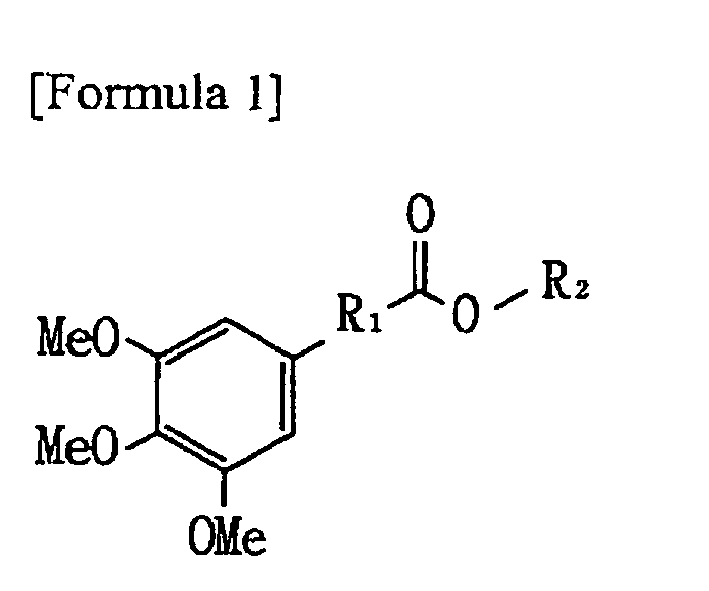
- Said ester compounds may be prepared by reacting 3,4,5-trimethoxy cinnamic acid with thymol or carvacrol, by a method of esterification such as dehydration reaction method using acid catalyst, acid halogenation method, acid anhydride method or active ester method.
- Further, the present invention provides a whitening cosmetic composition containing at least one of the ester compounds with an amount of 0.01∼20wt% to the total weight of the cosmetic composition.
- Hereinafter, the present invention is described in detail.
- The ester compounds of the invention derived from 3,4,5-trimethoxy cinnamic acid may be prepared by the following four methods. That is, the methods for preparing ester compounds from 3,4,5-trimethoxy cinnamic acid may comprise the followings;
- (A) "Acid catalyst dehydration method", that is, reacting 3,4,5-trimethoxy cinnamic acid with thymol or carvacrol under the presence of an acid catalyst to obtain ester compounds;
- (B) "Acid halogenation method", that is, after halogenating 3,4,5-trimethoxy cinnamic acid, then reacting it with thymol or carvacrol under the presence of base to obtain ester compounds;
- (C) "acid anhydride method", that is, preparing anhydrous compounds (acid anhydrides) of 3,4,5-trimethoxy cinnamic acid, then reacting the above acid anhydrides with thymol or carvacrol to make ester compounds; or
- (D) "active ester method", that is, reacting 3,4,5-trimethoxy cinnamic acid with 1,3-dicyclohexylcarbodiimide (DCC) to prepare active ester and reacting it with thymol or carvacrol under the presence of base to make ester compounds.
- The methods of preparing the esters are described with reference to the Reaction Formulas.
- (A) Acid catalyst dehydration reaction method

In this method, ester compounds are obtained by reacting 3,4,5-trimethoxy cinnamic acid with thymol or carvacrol under the presence of acid catalyst, and then dehydrating the above obtained product. Acids that can be used in this method comprise sulfuric acid, hydrochloric acid, paratoluene sulfonic acid or the like, and the solvents that can be used comprise toluene, benzene, or the like. - (B) Acid halogenation method

In this method, 3,4,5-trimethoxy cinnamic acid is halogenated by thionyl chlorides, then the acid chloride is reacted with thymol or carvacrol under the presence of a base in an orgamic solvent to obtain ester compounds. Organic solvents that can be used in this method comprise dichloromethane, chloroform, carbon tetrachloride, or the like. - (C) Acid anhydride method

In this method, 3,4,5-trimethoxy cinnamic acid is reacted with benzene sulfonyl chloride to prepare acid anhydrides as intermediates, and the intermediates are reacted with thymol or carvacrol to obtain ester compounds. - (D) Active ester method

- In this method, 3,4,5-trimethoxy cinnamic acid is reacted with 1,3-dicyclohexylcarbodiimide under the presence of base to prepare active esters, and the active esters are reacted with thymol or carvacrol to obtain ester compounds. Wherein, the equivalent ratio of 1,3-dicyclohexylcarbodiimide : thymol or carvacrol is preferably 1:1∼1:3.
- When the above equivalent ratio is less than 1:1, the amount of desired product is small, and when the equivalent ratio is more than 1:3, there is a problem that remaining thymol or carvacrol not reacted should be removed. Bases that can be used in this method comprise inorganic bases such as sodium hydroxide, potassium hydroxide or potassium carbonate and organic bases such as pyridine or triethylamine; preferably, organic bases are better. Solvents comprise dichloromethane, chloroform or carbon tetrachloride.
- The ester compounds derived from 3,4,5-trimethoxy cinnamic acid which are represented by Formula 1 and prepared by the above methods comprise, for example;
(E)-2-isopropyl-5 -methylphenyl 3-(3,4,5-trimethoxyphcayl) acrylate;
(E)-5-isoprapyl-2-methylphenyl 3-(3,4,5-trimethoxyphenyl) acrylate. - The ester compounds derived from 3,4,5-trimethoxy cinnamic acid which are represented by Formula 1 and prepared by the above methods, may be used as an active component in a whitening cosmetic composition. The amount of the ester compounds in the whitening cosmetic composition is controlled considering the whitening effect and stability of formulation, and a preferable amount is 0.01∼20.0 wt% to the total amount of the cosmetic composition. The formulation of the cosmetics is not restricted, and may be cream, lotion, toilet lotion, skin conditioner, massage cream or essence.
- The cosmetic composition of the present invention may contain other preferable components according to the type of the formulation, and a person skilled in the art may easily take other components and control the amounts to be added. For a more enhanced whitening effect, conventional whitening components may be added together with the ester compounds derived from 3,4,5-trimethoxy cinnamic acid. The kinds and amounts of the additionally added whitening components are well known to a person skilled in the art.
- Hereinafter, the preparation and the use of the ester compounds derived from 3,4,5-trimethoxy cinnamic acid of the present invention is described more specifically with reference to the examples. However, the scope of the present invention is not restricted thereto.
- 3,4,5-trimethoxy phenyl acetic acid (9.5g, 0.042mol) and thymol (6.3g, 0.042 mol) were dissolved in 200mℓ of toluene, and a catalytic amount of paratoluene sulfonic acid was added then refluxed for 5 hours. After the reaction was completed, reaction solution was condensed, and 500mℓ of ethyl acetate was added to dissolve the condensed reaction mixture. The resultant was washed with distilled water twice, dried with anhydrous sodium sulfate, then filtered and condensed, and finally proceeded to column chromatography to obtain 10.5g (Yield=70%) of white solid state of the object product.
TLC (ethyl acetate : hexane = 1:2) Rf = 0.52
1H NMR (CDCl3, δ ) : 7.18(d,1H,J = 7.8Hz), 7.01(d,1H,J = 7.8Hz), 6.81(s,1H), 6.22(s,2H), 3.86(s,6H), 3.85(s,3H), 3.79(s,2H), 2.80(m,1H), 2.29(s,3H),1.08(d,6H,J=6.9Hz). - 3,4,5-trimethoxy phenyl acetic acid (9.5g, 0.042mol) was added slowly to the thionyl chloride (15g, 0.126mol) cooled to 0°C , and warmed to room temperature, then stirred for 3 hours. Residual thionyl chloride was distilled out to obtain 3,4,5-trimethoxy phenyl acetic acid chloride (10.3 g, 0.042mol). Thymol (6.3g, 0.042mol) and triethylamine (6.4g, 0.063mol) were dissolved in 200mℓ of dichloromethane and stirred, and then the above 3,4,5-trimethoxy phenyl acetic acid chloride (10.3g) dissolved in 50mℓ of dichloromethane was added thereto drop by drop. After the reaction was completed, reaction solution was condensed, and 500mℓ of ethyl acetate was added to dissolve the reaction mixture. The resultant was washed with distilled water twice, dried with anhydrous sodium sulfate, then filtered and condensed, and finally proceeded to column chromatography to obtain 9.0g (Yield=60%) of white solid state of the object product.
TLC (ethyl acetate : hexane = 1:2) Rf= 0.52
1H NMR(CDCl3, δ ) : 7.18(d,1H,J = 7.8Hz), 7.01(d,1H,J = 7.8Hz), 6.81(s,1H), 6.22(s,2H), 3.86(s,6H), 3.85(s,3H), 3.79(s,2H), 2.80(m,1H), 2.29(s,3H), 1.08(d,6H,J = 6.9Hz). - 3,4,5-trimethoxy phenyl acetic acid (9.5g, 0.042mol) was dissolved in pyridine and stirred while adding benzene sulfonyl chloride (7.4g, 0.042mol) drop by drop at 0°C. After 3 hours of stirring, thymol (6.3g, 0.042 mol) dissolved in pyridine was added drop by drop. After the reaction was completed, pyridine was distilled out, and 500mℓ of ethyl acetate was added to dissolve the reaction mixture. The resultant was washed with distilled water twice, dried with anhydrous sodium sulfate, then filtered and condensed, and finally proceeded to column chromatography to obtain 12.7g (Yield=85%) of white solid state of the object product.
TLC (ethyl acetate : hexane = 1:2) Rf= 0.52
1H NMR (CDCl3, δ ) : 7.18(d,1H,J = 7.8Hz), 7.01(d,1H,J = 7.8Hz), 6.81(s,1H), 6.22(s,2H), 3.86(s,6H), 3.85(s,3H), 3.79(s,2H), 2.80(m,1H), 2.29(s,3H), 1.08(d,6H,J = 6.9Hz). - 3,4,5-trimethoxy phenyl acetic acid (9.5g, 0.042mol) and 1,3-dicyclohexylcarboimide (DCC) (8.6g, 0.042mol) were dissolved in 200mℓ of dichloromethane, and stirred for 2 hours, then thymol (6.3g, 0.042mol) and triethylamine (6.4g, 0.063mol) were added together. After 4 hours of stirring, the reaction solution was condensed, and 500mℓ of ethyl acetate was added to dissolve the reaction mixture. The resultant was washed with distilled water twice, dried with anhydrous sodium sulfate, then filtered and condensed, and finally proceeded to column chromatography to obtain 10.5g (Yield=70%) of white solid state of the object product.
TLC (ethyl acetate : hexane = 1:2) Rf = 0.52
1H NMR(CDCl3, δ ) : 7.18(d,1H,J = 7.8Hz), 7.01(d,1H,J = 7.8Hz), 6.81(s,1H), 6.22(s,2H), 3.86(s,6H), 3.85(s,3H), 3.79(s,2H), 2.80(m,1H), 2.29(s,3H), 1.08(d,6H,J = 6.9Hz). - Same procedure as described in Method C of Example 1 was performed except that carvacrol was used instead of thymol, and 10.1g (Yield=70%) of white solid state of the object product was obtained.
TLC (ethyl acetate : hexane = 1:2) Rf= 0.47
1H NMR(CDCl3, δ ) : 7.15(d,1H,J = 7.8Hz), 7.00(d,1H,J = 7.8Hz), 6.83(s,1H), 6.63(s,2H), 3.87(s,6H), 3.85(s,3H), 3.80(s,2H), 2.83(m,1H), 2.01(s,3H), 1.22(d,6H,J = 6.9Hz). - Same procedure as described in Method C of Example 1 was performed except that 3,4,5-trimethoxy cinnamic acid was used instead of 3,4,5-trimethoxy phenyl acetic acid, and 12g (Yield=76%) of white solid state of the object product was obtained.
TLC (ethyl acetate : hexane = 1:4) Rf= 0.50
1H NMR(CDCl3, δ ) : 7.81(d,1H,J = 15.9Hz), 7.22(d,1H,J = 7.5Hz), 7.07(d,1H,J = 7.5Hz), 6.88(s,1H), 6.83(s,2H), 6.71(d,1H,J = 15.9Hz), 3.91(s,3H), 3.90(s,6H), 3.01(m,1H), 2.33(s,3H), 1.21(d,6H,J = 6.9Hz). - Same procedure as described in Method C of Example 1 was performed except that 3,4,5-trimethoxy cinnamic acid was used instead of 3,4,5-trimethoxy phenyl acetic acid, and except that carvacrol was used instead of thymol. As a result, 13g (Yield=82%) of white solid state of the object product was obtained.
TLC (ethyl acetate : hexane = 1:4) Rf = 0.51
1H NMR(CDCl3, δ ) : 7.82(d,1H,J = 15.9Hz), 7.20(d,1H,J = 7.5Hz), 7.03(d,1H,J =7 .5Hz), 6.94(s,1H), 6.82(s,2H), 6.71(d,1H,J = 15.9Hz), 3.91(s,3H), 3.90(s,6H), 2.92(m,1H), 2.18(s,3H), 1.25(d,6HJ= 6.9Hz). - The generation of melanin in the cell when the compounds of Examples 2, 3 were added was measured by the Dooley method. As the cells, Mel-Ab cells that are originated from pigment cells (melanocytes) of C57BL/6 were used. The cells were cultured in a DMEM culture medium containing 10% of bovine placental serum, 100nM of 12-O-tetradecanoyl phobol-13-acetate, and 1nM of cholera toxin, under the condition of 37°C and 5% CO2. The above cultured Mel-Ab cells were isolated by 0.25% of trypsin-EDTA, and the same amounts of cells (1×10⁵cells/well) were planted to 24-well plates respectively and cultured. From the second day, the culture medium was replaced with other culture medium further containing 10ppm of the ester compounds prepared in the Examples 2, 3, for three days.
- For reference, tests and measurements were performed for kojic acid that is a well known whitening agent, and for 3,4,5-trimethoxy phenylacetic acid, 3,4,5-trimethoxy cinnamic acid, 3,4,5-trimethoxy hydrocinnamic acid, thymol and carvacrol, repectively.
- After five days, IN of NaOH was treated to the cell cultured wells to dissolve out the melanin generated in the cells. The amount of melanin was measured by measuring the absorbance at 400nm, and the melanin generation ratio (%) was calculated by comparing with those from the cells cultured in a culture medium not containing any compound of the present invention. The results are shown in Table 1.
[Table 1] Material added to culture medium Melanin generation ratio (%) Kojic acid 88.0 3,4,5-trimethoxy phenylacetic acid 95.8 3,4,5-trimethoxy cinnamic acid 96.3 3,4,5-trimethoxy hydrocinnamic acid 92.5 Thymol 94.5 Carvacrol 91.5 Example 2 45.6 Example 3 58.9 - As shown in Table 1, the ester compounds of Examples 2, 3 which are derived from 3,4,5-trimethoxy cinnamic acid have excellent ability to inhibit the generation of melanin in the cell.
- The brachia of twelve (12) healthy volunteers (males) were attached with opaque tape having 1.5cm diameter holes, and then irradiated with UVB (ultraviolet rays B) in 1.5∼2 times the intensity of the minimum amount to form erythema for each volunteer, to induce pigmentation. After irradiating the UVB, 1% diluted solutions of the ester compounds of Examples 2, 3 (solvent was 1,3-butyleneglycol:ethanol = 7:3) were applied on the above treated brachia for ten (10) weeks (the above 1% diluted solution was not applied on one brachium), and the colors of the skins thereof were measured by Chromameter CR2002 (manufactured by Minolta; Japan) per every one week. The difference of "L", that is, "Δ L", the amount of the increase of brightness of skin compared with those not applied with diluted solution, was measured. For reference, measurements for the cases that 3% kojic acid and vehicle (solvent) were applied were performed. The results are shown in Table 2.
[Table 2] Materilal Increase of brightness of skin (Δ L) Vehicle 0.50 ±0.15 Kojic acid 0.99 ±0.11 Example 2 1.38 ±0.11 Example 3 1.22 ±0.18 - As shown in table 2, the ester compounds of Examples 2, 3 showed more increases in the brightness of skin compared with that of a conventional whitening agent, kojic acid, which proves that the ester compounds of the present invention have excellent whitening effects.
- To evaluate the clinical whitening effects of formulations containing the ester compounds of the present invention, cream formulations were prepared as shown in Table 3. After weighing and mixing the components of each group A, B and C respectively, the components of group A were added to the mixture of group B and first emulsified in a homomixer, then the components of group C were added thereto and second emulsified, then followed by stirring and cooling to obtain the desired product. In the followings, "Form." means "formulation" and "Comp." means "comparative".
[Table 3] Component Wt% Form. 2 Form. 3 Comp. Form. 1 Control Form. (A) Stearyl alcohol 10.0 10.0 10.0 .10.0 Polysolbate 60 1.2 1.2 1.2 1.2 Sorbitan Cesquioleate 0.6 0.6 0.6 0.6 Fluid Paraffin 10.0 10.0 10.0 10.0 Squalene 5.0 5.0 5.0 5.0 Preservative 0.2 0.2 0.2 0.2 Triethanol amine 0.2 0.2 0.2 0.2 (B) Glycerin 5.0 5.0 5.0 5.0 Ethanol 2.0 2.0 2.0 2.0 Distilled water to 100 to 100 to 100 to 100 (C) Carboxyvinyl polymer 0.2 0.2 0.2 0.2 Example 2 - - 1.0 - - - - - Example 3 - - - 1.0 - - - - Kojic acid - - - - - - 1.0 - Fragrance q.s. q.s. q.s. q.s. q.s. q.s. q.s. q.s. - The Formulations 2, 3 containing the ester compounds of the present invention and Comparative Formulation 1 containing conventional whitening agent (kojic acid) were applied on the faces of eighty (80) volunteers, who have a problem of pigmentation such as freckles on the face, once in the morning and once in the evening for three (3) months. As for a control group, same test was performed by using the formulation containing only solvents.
- After using the formulations, measurement was performed according to the standards for measuring improvement of pigmentation. The average values of each group comprising ten (10) volunteers are shown in Table 4.
- Excellent (3): Pigmentation was seldom detected.
- Good (2): Pigmentation was faded away a lot.
- Better than normal (1): Pigmentation was faded away.
- No effect (0): Pigmentation was not faded away.
- As shown in Table 4, it is proved that the ester compounds of the present invention have excellent whitening effects.
- The hairs on the backs of two (2) healthy male rabbits were removed. After making areas of 2.5cm x 2.5cm on the left and right sides of the back of each rabbit, nothing was applied on the left area of the back as control area, and 1% diluted solutions of the ester compounds of Examples 2, 3 (solvent was 1,3-butyleneglycol:ethanol = 7:3) were applied on the right area of the back of the rabbits with an amount of 0.5mℓ, one compound for each rabbit respectively. Irritations such as erythema, rash or edema were measured 24 hours and 72 hours after the application. The evaluation was graded according to "Standard for toxicity of pharmaceuticals et al" as shown in Table 5. In addition, the degree of irritation was determined according to the conventional "P.I.I." (Primary Irritation Index) of Draize, and the results are shown in Table 6.
[Table 5] Degree of skin irritation point 1) Formation of erythema and rash No erythema 0 Mild erythema (not noticeable with the naked eyes) 1 Clear erythema 2 Middle level of intense erythema 3 Dark red intense erythema and rash 4 2) Formulation of edema No edema 0 Mild edema (not noticeable by the naked eyes) 1 Clear edema (clearly distinguished) 2 Middle level of intense edema (swelling about 1mm) 3 Intense edema 4 (swelling more than 1mm and the swelling is extended to outer area ) [Table 6] Material P.I.I. Determination Example 2 0.375 No irritation Example 3 0.350 No irritation - From the results of table 6, it is proved that the ester compounds of the Examples 2, 3 do not have irritation.
- The hairs on the backs of ten (10) guinea pigs were removed. After fixing the pigs, the back was divided into six (6) areas each having 2.0cm x 2.0cm area, three (3) areas on the left side and three (3) on the right side. Right side areas were control areas prevented from being radiated, and left side areas were radiation areas. 1% (w/v) diluted solutions of ester compounds of Examples 1∼6 were applied thereto with an equal amount of 50µℓ respectively, while using vehicle (1,3-butyleneglycol:ethanol = 7:3) as a negative control; and using 0.1% 8-MOP(methoxypsoralene) as a positive control. After 30 minutes later, left sides of the back of the pig was shielded from light by aluminum foil, and UVA(320∼380nm) was radiated from 10cm distant with an final energy of 15J/cm2 by using ultraviolet radiation device (waldmann). The skin of the guinea pig was observed after 24, 48 and 72 hours later. The irritation was graded as shown in table 5 with 0∼4 grades according to the intensity of the erythema and edema, and the sum was calculated. In the evaluation, the maximum value of the measurement that performed after 24, 48 and 72 hours later was chosen, and then the Irritation Index of an animal skin was calculated according to mathematical formula 1, and finally, the Radiation Toxicity Index was calculated according to mathematical Formula 2.


[Table 7] Material Radiation Toxicity Index Determination Example 2 0 Radiation Non-Toxic Example 3 0 Radiation Non-Toxic - From the results of Table 7, it is proved that the ester compounds of the Examples 2, 3 do not have radiation toxicity because they have zero (0) grade of Radiation Toxicity Index.
- Reverse mutation test using Salmonella Typhimurium TA98, TA100 was performed according to a conventional method. Under the condition of using the compounds of the present invention, test samples showed negative, and mutation was not induced.
- Thirty (30) male and female volunteers with average age of 24.8 who had an experience of skin irritation underwent the following test according to CTFA Guideline (The Cosmetic, Toiletry and Fragrance Association, Inc. Washington, D.C. 20036, 1991). Each of the ester compounds of Examples 2, 3 were dissolved in a patch base shown in Table 8 to be 1% concentration respectively, to prepare test samples. 20µℓ of each test sample was dropped in a Finn Chamber to make a patch, and the patch was attached to antebrachial skin (test region) and fixed with micro tape. The patch was attached for 24 hours, and after removing the patch, the test region was checked with marking pen, and then the region was observed after 1 and 24 hours. The irritation reaction in the skin was evaluated as shown in Table 9, and the results are shown in Table 10.
[Table 8] Component CTFA Content Oil and wax Gylceryl stearate 1.50 Squalene 7.00 Mineral oil 7.00 Cetyl alcohol 1.20 surfactant Sorbitan stearate 0.30 Polysolbate 60 1.00 Thickner Carbomer 0.12 Polyol Glycerin 10.00 Water Distilled water To 100 [Table 9] Grade Mark Standard of determination 0 - No visible reactions 1 ± Mild erythema 2 + Intense erythema 3 ++ Intense erythema with edema 4 +++ Intense erythema with edema & vesicle [Table 10] Material The number of volunteers having reaction Average reaction (n=30) 24 hours later 48 hours later - ± + ++ +++ - ± + ++ +++ Example 2 30 0 0 0 0 30 0 0 0 0 0.00 Example 3 29 1 0 0 0 30 0 0 0 0 0.42 
- As shown in Table 10, the cosmetic composition of the present invention has an average irritation reaction value of 0∼0.83, which is less than that of the non-irritation standard value "1.0", and therefore, the cosmetic composition of the present invention is very safe for use.
- As seen above, ester compounds of the present invention derived from 3,4,5-trimethoxy cinnamic acid can inhibit the generation of melanin, and the cosmetic composition containing the ester compounds can improve the pigmentation in the skin and shows whitening effect without irritation or toxicity, and therefore they can be used for whitening cosmetics.
| Material | Average value of whitening |
| Solvent (vehicle) | 0.4 ±0.12 |
| Comp. Formulation 1 | 1.4 ±0.21 |
| Formulation 2 | 2.0 ±0.13 |
| Formulation 3 | 1.7 ±0.17 |
Claims (2)
- An ester compound represented by the following formula 1 :

- A whitening cosmetic composition comprising at least one ester compound of claim 1 with an amount of 0.01∼20 wt% to total amount of the cosmetic composition.
Applications Claiming Priority (3)
| Application Number | Priority Date | Filing Date | Title |
|---|---|---|---|
| KR10-2001-0059048A KR100457949B1 (en) | 2001-09-24 | 2001-09-24 | Ester compound of 3,4,5-trimethoxy phenylacetic acid, 3,4,5-trimethoxy cinnamic acid or 3,4,5-trimethoxy hydrocinnamic acid and preparation method thereof, and whitening cosmetic composition containing said compound |
| KR2001059048 | 2001-09-24 | ||
| PCT/KR2002/001793 WO2003027055A1 (en) | 2001-09-24 | 2002-09-23 | 3,4,5-trimethoxy phenyl-based ester compound and preparation method thereof and whitening cosmetic composition containing the same |
Publications (3)
| Publication Number | Publication Date |
|---|---|
| EP1430016A1 EP1430016A1 (en) | 2004-06-23 |
| EP1430016A4 EP1430016A4 (en) | 2006-01-11 |
| EP1430016B1 true EP1430016B1 (en) | 2008-12-17 |
Family
ID=19714612
Family Applications (1)
| Application Number | Title | Priority Date | Filing Date |
|---|---|---|---|
| EP02799504A Expired - Lifetime EP1430016B1 (en) | 2001-09-24 | 2002-09-23 | 3,4,5-trimethoxy phenyl-based ester compound and preparation method thereof and whitening cosmetic composition containing the same |
Country Status (6)
| Country | Link |
|---|---|
| US (1) | US7517911B2 (en) |
| EP (1) | EP1430016B1 (en) |
| JP (1) | JP4268872B2 (en) |
| KR (1) | KR100457949B1 (en) |
| CN (1) | CN1239466C (en) |
| WO (1) | WO2003027055A1 (en) |
Cited By (1)
| Publication number | Priority date | Publication date | Assignee | Title |
|---|---|---|---|---|
| US10385011B2 (en) | 2015-03-31 | 2019-08-20 | Amorepacific Corporation | Benzoic acid amide compound |
Families Citing this family (14)
| Publication number | Priority date | Publication date | Assignee | Title |
|---|---|---|---|---|
| KR100883870B1 (en) * | 2003-04-24 | 2009-02-17 | (주)아모레퍼시픽 | Polymer capsule containing 3,4,5-trimethoxy cinnamic acid thymol ester and preparation method thereof, and cosmetic composition containing same |
| EP1604643A1 (en) * | 2004-06-03 | 2005-12-14 | Cognis France, S.A.S. | Cosmetic use of derivatives of 3-Phenylpropionic acid |
| EP1967175A1 (en) * | 2007-03-06 | 2008-09-10 | Cognis IP Management GmbH | Use of derivatives of sinapinic acid and compositions comprising such derivatives |
| KR102066108B1 (en) * | 2013-11-29 | 2020-01-15 | (주)아모레퍼시픽 | Cosmetic compositions containing two kinds of compounds comprising phenyl rings |
| KR101754826B1 (en) | 2015-07-20 | 2017-07-06 | 주식회사 앤코스메슈 | Whitening functional ingredients made from cinnamic acid |
| KR102068635B1 (en) | 2016-10-26 | 2020-01-21 | (주)아모레퍼시픽 | 3,4,5-Trimethoxy cinnamic acid derivatives, preparation method thereof, and skin whithening composition comprising the same |
| KR102040900B1 (en) * | 2017-09-29 | 2019-11-06 | (주)아모레퍼시픽 | A composition containing trimethoxy phenyl compound for promoting adipocyte differentiation or adiponectin production |
| JP7328480B2 (en) * | 2018-09-14 | 2023-08-17 | 株式会社applause Pharma | Tyrosine-tyrosinase reaction inhibitor |
| KR102633917B1 (en) | 2019-05-30 | 2024-02-06 | (주)아모레퍼시픽 | Composition for reinforcing skin elasticity |
| KR102634821B1 (en) | 2019-05-30 | 2024-02-07 | (주)아모레퍼시픽 | Composition for reinforcing skin barrier |
| CN110776972B (en) * | 2019-11-08 | 2021-10-26 | 宝鸡文理学院 | Synthetic ester lubricating oil base oil based on green renewable resources |
| KR20220017018A (en) | 2020-08-03 | 2022-02-11 | (주)아모레퍼시픽 | Composition for relieving itch or irritation of the skin comprising thymol trimethoxycinnamate |
| CN112878047B (en) * | 2021-01-19 | 2022-09-27 | 吴江市宇源织造印染有限公司 | Ultraviolet absorbent and application thereof in fabric finishing |
| KR20250085289A (en) | 2023-12-05 | 2025-06-12 | (주)아모레퍼시픽 | Composition for promoting hair sprouting or hair growth containing a thymol ester-based compound |
Family Cites Families (10)
| Publication number | Priority date | Publication date | Assignee | Title |
|---|---|---|---|---|
| US4426536A (en) * | 1982-06-14 | 1984-01-17 | Eli Lilly And Company | Synthesis of phenylacetic acid esters |
| GB2141626B (en) * | 1983-04-25 | 1987-01-28 | Kao Corp | Cinnamic acid derivatives for lightening melanin pigmentation of skin |
| DK174054B1 (en) * | 1986-01-15 | 2002-05-13 | Hoffmann La Roche | Process for the purification of 2-ethylhexyl-p-methoxycinnamic acid ester |
| JPH049355A (en) * | 1990-04-02 | 1992-01-14 | Shiseido Co Ltd | Cinnamic acid derivative, uv absorber and dermatic external drug containing the same |
| DE4402403A1 (en) * | 1994-01-27 | 1995-08-03 | Bayer Ag | Process for the preparation of substituted phenylacetic acid derivatives and new intermediates |
| JPH08283137A (en) * | 1995-04-12 | 1996-10-29 | Kao Corp | Whitening cosmetics |
| JPH09249544A (en) * | 1996-03-18 | 1997-09-22 | Snow Brand Milk Prod Co Ltd | Beautifully whitening agent |
| KR100294946B1 (en) * | 1998-08-07 | 2001-07-12 | 서경배 | Gallic acid derivatives and whitening cosmetic compositions containing the same |
| KR100335340B1 (en) * | 1999-10-15 | 2002-05-06 | 서경배 | Gallic acid ester compound and preparation method thereof and whitening cosmetic composition containing it |
| WO2005019162A1 (en) * | 2003-08-26 | 2005-03-03 | Amorepacific Corporation | Hydroxamic acid derivatives and the method for preparing thereof |
-
2001
- 2001-09-24 KR KR10-2001-0059048A patent/KR100457949B1/en not_active Expired - Lifetime
-
2002
- 2002-09-23 WO PCT/KR2002/001793 patent/WO2003027055A1/en not_active Ceased
- 2002-09-23 JP JP2003530646A patent/JP4268872B2/en not_active Expired - Fee Related
- 2002-09-23 CN CNB028185579A patent/CN1239466C/en not_active Expired - Lifetime
- 2002-09-23 EP EP02799504A patent/EP1430016B1/en not_active Expired - Lifetime
- 2002-09-23 US US10/490,280 patent/US7517911B2/en not_active Expired - Lifetime
Cited By (1)
| Publication number | Priority date | Publication date | Assignee | Title |
|---|---|---|---|---|
| US10385011B2 (en) | 2015-03-31 | 2019-08-20 | Amorepacific Corporation | Benzoic acid amide compound |
Also Published As
| Publication number | Publication date |
|---|---|
| JP4268872B2 (en) | 2009-05-27 |
| US20060167093A1 (en) | 2006-07-27 |
| CN1239466C (en) | 2006-02-01 |
| CN1556786A (en) | 2004-12-22 |
| WO2003027055A1 (en) | 2003-04-03 |
| EP1430016A4 (en) | 2006-01-11 |
| US7517911B2 (en) | 2009-04-14 |
| KR20030026062A (en) | 2003-03-31 |
| EP1430016A1 (en) | 2004-06-23 |
| JP2005503430A (en) | 2005-02-03 |
| KR100457949B1 (en) | 2004-11-18 |
Similar Documents
| Publication | Publication Date | Title |
|---|---|---|
| US7517911B2 (en) | 3,4,5-trimethoxy phenyl-based ester compound and preparation method thereof and whitening cosmetic composition containing the same | |
| KR101823036B1 (en) | Inhibitor of melanin synthesis and the cosmetic composition containing the same | |
| FI89592B (en) | Solchyddsfoereningar, dessa innehaollande kompositioner velt foerfarande | |
| US3177120A (en) | Stable cosmetic preparations containing dihydroxy acetone | |
| JPS60109544A (en) | Novel chalcone derivative and ultraviolet light absorber containing it | |
| FI89708B (en) | CHROMOFORHALTIGA SOLSKYDDSFOERENINGAR, DESSA INNEHAOLLANDE SOLSKYDDSKOMPOSITIONER OCH FOERFARANDE FOER KOSMETISKT SKYDDANDE AV HUDEN MOT UV-STRAOLNING | |
| KR19990023885A (en) | Use of Oxamate Derivatives as Decolorants | |
| US20120258063A1 (en) | Preventing or ameliorating agent for pigmentation | |
| EP1596818B1 (en) | Cosmetic composition with a whitening effect, method for the production and use thereof | |
| JP3340935B2 (en) | Melanin production inhibitor and whitening cosmetic | |
| Lowe et al. | Evaluation of sunscreen protection by measurement of epidermal DNA synthesis | |
| AU675902B2 (en) | Photocleavable metal-chelating agents and compositions containing them | |
| KR980009262A (en) | Novel derivatives of kojic acid and their use as depigmentants | |
| JP2986966B2 (en) | Melanin production inhibitor | |
| US4981680A (en) | P-hydroxycinnamamide derivatives and melanin inhibitor comprising the same | |
| JP3236130B2 (en) | Melanin production inhibitor and external preparation for skin | |
| KR100851044B1 (en) | 3,5-dihydroxy benzamide derivative having a whitening effect, and a cosmetic composition containing the same | |
| KR101002432B1 (en) | Resveratrol derivative, preparation method thereof, and cosmetic composition comprising same | |
| JP3447804B2 (en) | Benzal malonate derivative having organosilicon group, method for producing the same, ultraviolet absorber and cosmetic containing the same | |
| US6309626B1 (en) | Sunscreen composition | |
| KR102852940B1 (en) | Skin whitening composition comprising 1,3-dioctyloxybenzene as an actve agent | |
| KR100335340B1 (en) | Gallic acid ester compound and preparation method thereof and whitening cosmetic composition containing it | |
| JPH0977651A (en) | Whitening cosmetics | |
| JP2000239143A (en) | Skin cosmetic | |
| JP3192499B2 (en) | Melanin production inhibitor and external preparation for skin |
Legal Events
| Date | Code | Title | Description |
|---|---|---|---|
| PUAI | Public reference made under article 153(3) epc to a published international application that has entered the european phase |
Free format text: ORIGINAL CODE: 0009012 |
|
| 17P | Request for examination filed |
Effective date: 20040312 |
|
| AK | Designated contracting states |
Kind code of ref document: A1 Designated state(s): FR |
|
| RIC1 | Information provided on ipc code assigned before grant |
Ipc: C07C 69/734 19800101AFI20051114BHEP Ipc: A61K 7/48 19740701ALI20051114BHEP |
|
| A4 | Supplementary search report drawn up and despatched |
Effective date: 20051125 |
|
| 17Q | First examination report despatched |
Effective date: 20060331 |
|
| GRAP | Despatch of communication of intention to grant a patent |
Free format text: ORIGINAL CODE: EPIDOSNIGR1 |
|
| RIC1 | Information provided on ipc code assigned before grant |
Ipc: A61Q 19/02 20060101ALI20080602BHEP Ipc: A61K 8/37 20060101ALI20080602BHEP Ipc: C07C 69/734 20060101AFI20080602BHEP |
|
| GRAS | Grant fee paid |
Free format text: ORIGINAL CODE: EPIDOSNIGR3 |
|
| GRAA | (expected) grant |
Free format text: ORIGINAL CODE: 0009210 |
|
| AK | Designated contracting states |
Kind code of ref document: B1 Designated state(s): FR |
|
| PLBE | No opposition filed within time limit |
Free format text: ORIGINAL CODE: 0009261 |
|
| STAA | Information on the status of an ep patent application or granted ep patent |
Free format text: STATUS: NO OPPOSITION FILED WITHIN TIME LIMIT |
|
| 26N | No opposition filed |
Effective date: 20090918 |
|
| REG | Reference to a national code |
Ref country code: FR Ref legal event code: PLFP Year of fee payment: 15 |
|
| REG | Reference to a national code |
Ref country code: FR Ref legal event code: PLFP Year of fee payment: 16 |
|
| REG | Reference to a national code |
Ref country code: FR Ref legal event code: PLFP Year of fee payment: 17 |
|
| PGFP | Annual fee paid to national office [announced via postgrant information from national office to epo] |
Ref country code: FR Payment date: 20210625 Year of fee payment: 20 |