EP1429380A1 - Container for precision substrate - Google Patents
Container for precision substrate Download PDFInfo
- Publication number
- EP1429380A1 EP1429380A1 EP02760759A EP02760759A EP1429380A1 EP 1429380 A1 EP1429380 A1 EP 1429380A1 EP 02760759 A EP02760759 A EP 02760759A EP 02760759 A EP02760759 A EP 02760759A EP 1429380 A1 EP1429380 A1 EP 1429380A1
- Authority
- EP
- European Patent Office
- Prior art keywords
- container
- precision substrate
- alicyclic structure
- polymer
- containing alicyclic
- Prior art date
- Legal status (The legal status is an assumption and is not a legal conclusion. Google has not performed a legal analysis and makes no representation as to the accuracy of the status listed.)
- Withdrawn
Links
Images
Classifications
-
- H—ELECTRICITY
- H10—SEMICONDUCTOR DEVICES; ELECTRIC SOLID-STATE DEVICES NOT OTHERWISE PROVIDED FOR
- H10P—GENERIC PROCESSES OR APPARATUS FOR THE MANUFACTURE OR TREATMENT OF DEVICES COVERED BY CLASS H10
- H10P72/00—Handling or holding of wafers, substrates or devices during manufacture or treatment thereof
- H10P72/10—Handling or holding of wafers, substrates or devices during manufacture or treatment thereof using carriers specially adapted therefor, e.g. front opening unified pods [FOUP]
- H10P72/12—Vertical boat type carrier whereby the substrates are horizontally supported, e.g. comprising rod-shaped elements
-
- H—ELECTRICITY
- H10—SEMICONDUCTOR DEVICES; ELECTRIC SOLID-STATE DEVICES NOT OTHERWISE PROVIDED FOR
- H10P—GENERIC PROCESSES OR APPARATUS FOR THE MANUFACTURE OR TREATMENT OF DEVICES COVERED BY CLASS H10
- H10P72/00—Handling or holding of wafers, substrates or devices during manufacture or treatment thereof
- H10P72/10—Handling or holding of wafers, substrates or devices during manufacture or treatment thereof using carriers specially adapted therefor, e.g. front opening unified pods [FOUP]
- H10P72/12—Vertical boat type carrier whereby the substrates are horizontally supported, e.g. comprising rod-shaped elements
- H10P72/123—Vertical boat type carrier whereby the substrates are horizontally supported, e.g. comprising rod-shaped elements characterised by a material, a roughness, a coating or the like
-
- H—ELECTRICITY
- H10—SEMICONDUCTOR DEVICES; ELECTRIC SOLID-STATE DEVICES NOT OTHERWISE PROVIDED FOR
- H10P—GENERIC PROCESSES OR APPARATUS FOR THE MANUFACTURE OR TREATMENT OF DEVICES COVERED BY CLASS H10
- H10P72/00—Handling or holding of wafers, substrates or devices during manufacture or treatment thereof
- H10P72/10—Handling or holding of wafers, substrates or devices during manufacture or treatment thereof using carriers specially adapted therefor, e.g. front opening unified pods [FOUP]
- H10P72/13—Horizontal boat type carrier whereby the substrates are vertically supported, e.g. comprising rod-shaped elements
-
- H—ELECTRICITY
- H10—SEMICONDUCTOR DEVICES; ELECTRIC SOLID-STATE DEVICES NOT OTHERWISE PROVIDED FOR
- H10P—GENERIC PROCESSES OR APPARATUS FOR THE MANUFACTURE OR TREATMENT OF DEVICES COVERED BY CLASS H10
- H10P72/00—Handling or holding of wafers, substrates or devices during manufacture or treatment thereof
- H10P72/10—Handling or holding of wafers, substrates or devices during manufacture or treatment thereof using carriers specially adapted therefor, e.g. front opening unified pods [FOUP]
- H10P72/13—Horizontal boat type carrier whereby the substrates are vertically supported, e.g. comprising rod-shaped elements
- H10P72/135—Horizontal boat type carrier whereby the substrates are vertically supported, e.g. comprising rod-shaped elements characterised by a material, a roughness, a coating or the like
-
- H—ELECTRICITY
- H10—SEMICONDUCTOR DEVICES; ELECTRIC SOLID-STATE DEVICES NOT OTHERWISE PROVIDED FOR
- H10P—GENERIC PROCESSES OR APPARATUS FOR THE MANUFACTURE OR TREATMENT OF DEVICES COVERED BY CLASS H10
- H10P72/00—Handling or holding of wafers, substrates or devices during manufacture or treatment thereof
- H10P72/10—Handling or holding of wafers, substrates or devices during manufacture or treatment thereof using carriers specially adapted therefor, e.g. front opening unified pods [FOUP]
- H10P72/14—Vertical carrier comprising wall type elements whereby the substrates are horizontally supported, e.g. comprising sidewalls
-
- H—ELECTRICITY
- H10—SEMICONDUCTOR DEVICES; ELECTRIC SOLID-STATE DEVICES NOT OTHERWISE PROVIDED FOR
- H10P—GENERIC PROCESSES OR APPARATUS FOR THE MANUFACTURE OR TREATMENT OF DEVICES COVERED BY CLASS H10
- H10P72/00—Handling or holding of wafers, substrates or devices during manufacture or treatment thereof
- H10P72/10—Handling or holding of wafers, substrates or devices during manufacture or treatment thereof using carriers specially adapted therefor, e.g. front opening unified pods [FOUP]
- H10P72/14—Vertical carrier comprising wall type elements whereby the substrates are horizontally supported, e.g. comprising sidewalls
- H10P72/145—Vertical carrier comprising wall type elements whereby the substrates are horizontally supported, e.g. comprising sidewalls characterised by a material, a roughness, a coating or the like
-
- H—ELECTRICITY
- H10—SEMICONDUCTOR DEVICES; ELECTRIC SOLID-STATE DEVICES NOT OTHERWISE PROVIDED FOR
- H10P—GENERIC PROCESSES OR APPARATUS FOR THE MANUFACTURE OR TREATMENT OF DEVICES COVERED BY CLASS H10
- H10P72/00—Handling or holding of wafers, substrates or devices during manufacture or treatment thereof
- H10P72/10—Handling or holding of wafers, substrates or devices during manufacture or treatment thereof using carriers specially adapted therefor, e.g. front opening unified pods [FOUP]
- H10P72/15—Horizontal carrier comprising wall type elements whereby the substrates are vertically supported, e.g. comprising sidewalls
-
- H—ELECTRICITY
- H10—SEMICONDUCTOR DEVICES; ELECTRIC SOLID-STATE DEVICES NOT OTHERWISE PROVIDED FOR
- H10P—GENERIC PROCESSES OR APPARATUS FOR THE MANUFACTURE OR TREATMENT OF DEVICES COVERED BY CLASS H10
- H10P72/00—Handling or holding of wafers, substrates or devices during manufacture or treatment thereof
- H10P72/10—Handling or holding of wafers, substrates or devices during manufacture or treatment thereof using carriers specially adapted therefor, e.g. front opening unified pods [FOUP]
- H10P72/15—Horizontal carrier comprising wall type elements whereby the substrates are vertically supported, e.g. comprising sidewalls
- H10P72/155—Horizontal carrier comprising wall type elements whereby the substrates are vertically supported, e.g. comprising sidewalls characterised by a material, a roughness, a coating or the like
-
- H—ELECTRICITY
- H10—SEMICONDUCTOR DEVICES; ELECTRIC SOLID-STATE DEVICES NOT OTHERWISE PROVIDED FOR
- H10P—GENERIC PROCESSES OR APPARATUS FOR THE MANUFACTURE OR TREATMENT OF DEVICES COVERED BY CLASS H10
- H10P72/00—Handling or holding of wafers, substrates or devices during manufacture or treatment thereof
- H10P72/10—Handling or holding of wafers, substrates or devices during manufacture or treatment thereof using carriers specially adapted therefor, e.g. front opening unified pods [FOUP]
- H10P72/19—Handling or holding of wafers, substrates or devices during manufacture or treatment thereof using carriers specially adapted therefor, e.g. front opening unified pods [FOUP] closed carriers
- H10P72/1902—Handling or holding of wafers, substrates or devices during manufacture or treatment thereof using carriers specially adapted therefor, e.g. front opening unified pods [FOUP] closed carriers specially adapted for a single substrate
-
- H—ELECTRICITY
- H10—SEMICONDUCTOR DEVICES; ELECTRIC SOLID-STATE DEVICES NOT OTHERWISE PROVIDED FOR
- H10P—GENERIC PROCESSES OR APPARATUS FOR THE MANUFACTURE OR TREATMENT OF DEVICES COVERED BY CLASS H10
- H10P72/00—Handling or holding of wafers, substrates or devices during manufacture or treatment thereof
- H10P72/10—Handling or holding of wafers, substrates or devices during manufacture or treatment thereof using carriers specially adapted therefor, e.g. front opening unified pods [FOUP]
- H10P72/19—Handling or holding of wafers, substrates or devices during manufacture or treatment thereof using carriers specially adapted therefor, e.g. front opening unified pods [FOUP] closed carriers
- H10P72/1906—Handling or holding of wafers, substrates or devices during manufacture or treatment thereof using carriers specially adapted therefor, e.g. front opening unified pods [FOUP] closed carriers specially adapted for containing masks, reticles or pellicles
-
- H—ELECTRICITY
- H10—SEMICONDUCTOR DEVICES; ELECTRIC SOLID-STATE DEVICES NOT OTHERWISE PROVIDED FOR
- H10P—GENERIC PROCESSES OR APPARATUS FOR THE MANUFACTURE OR TREATMENT OF DEVICES COVERED BY CLASS H10
- H10P72/00—Handling or holding of wafers, substrates or devices during manufacture or treatment thereof
- H10P72/10—Handling or holding of wafers, substrates or devices during manufacture or treatment thereof using carriers specially adapted therefor, e.g. front opening unified pods [FOUP]
- H10P72/19—Handling or holding of wafers, substrates or devices during manufacture or treatment thereof using carriers specially adapted therefor, e.g. front opening unified pods [FOUP] closed carriers
- H10P72/1922—Handling or holding of wafers, substrates or devices during manufacture or treatment thereof using carriers specially adapted therefor, e.g. front opening unified pods [FOUP] closed carriers characterised by the construction of the closed carrier
-
- Y—GENERAL TAGGING OF NEW TECHNOLOGICAL DEVELOPMENTS; GENERAL TAGGING OF CROSS-SECTIONAL TECHNOLOGIES SPANNING OVER SEVERAL SECTIONS OF THE IPC; TECHNICAL SUBJECTS COVERED BY FORMER USPC CROSS-REFERENCE ART COLLECTIONS [XRACs] AND DIGESTS
- Y10—TECHNICAL SUBJECTS COVERED BY FORMER USPC
- Y10T—TECHNICAL SUBJECTS COVERED BY FORMER US CLASSIFICATION
- Y10T428/00—Stock material or miscellaneous articles
- Y10T428/13—Hollow or container type article [e.g., tube, vase, etc.]
-
- Y—GENERAL TAGGING OF NEW TECHNOLOGICAL DEVELOPMENTS; GENERAL TAGGING OF CROSS-SECTIONAL TECHNOLOGIES SPANNING OVER SEVERAL SECTIONS OF THE IPC; TECHNICAL SUBJECTS COVERED BY FORMER USPC CROSS-REFERENCE ART COLLECTIONS [XRACs] AND DIGESTS
- Y10—TECHNICAL SUBJECTS COVERED BY FORMER USPC
- Y10T—TECHNICAL SUBJECTS COVERED BY FORMER US CLASSIFICATION
- Y10T428/00—Stock material or miscellaneous articles
- Y10T428/13—Hollow or container type article [e.g., tube, vase, etc.]
- Y10T428/1303—Paper containing [e.g., paperboard, cardboard, fiberboard, etc.]
-
- Y—GENERAL TAGGING OF NEW TECHNOLOGICAL DEVELOPMENTS; GENERAL TAGGING OF CROSS-SECTIONAL TECHNOLOGIES SPANNING OVER SEVERAL SECTIONS OF THE IPC; TECHNICAL SUBJECTS COVERED BY FORMER USPC CROSS-REFERENCE ART COLLECTIONS [XRACs] AND DIGESTS
- Y10—TECHNICAL SUBJECTS COVERED BY FORMER USPC
- Y10T—TECHNICAL SUBJECTS COVERED BY FORMER US CLASSIFICATION
- Y10T428/00—Stock material or miscellaneous articles
- Y10T428/13—Hollow or container type article [e.g., tube, vase, etc.]
- Y10T428/1352—Polymer or resin containing [i.e., natural or synthetic]
-
- Y—GENERAL TAGGING OF NEW TECHNOLOGICAL DEVELOPMENTS; GENERAL TAGGING OF CROSS-SECTIONAL TECHNOLOGIES SPANNING OVER SEVERAL SECTIONS OF THE IPC; TECHNICAL SUBJECTS COVERED BY FORMER USPC CROSS-REFERENCE ART COLLECTIONS [XRACs] AND DIGESTS
- Y10—TECHNICAL SUBJECTS COVERED BY FORMER USPC
- Y10T—TECHNICAL SUBJECTS COVERED BY FORMER US CLASSIFICATION
- Y10T428/00—Stock material or miscellaneous articles
- Y10T428/13—Hollow or container type article [e.g., tube, vase, etc.]
- Y10T428/1352—Polymer or resin containing [i.e., natural or synthetic]
- Y10T428/1355—Elemental metal containing [e.g., substrate, foil, film, coating, etc.]
- Y10T428/1359—Three or more layers [continuous layer]
-
- Y—GENERAL TAGGING OF NEW TECHNOLOGICAL DEVELOPMENTS; GENERAL TAGGING OF CROSS-SECTIONAL TECHNOLOGIES SPANNING OVER SEVERAL SECTIONS OF THE IPC; TECHNICAL SUBJECTS COVERED BY FORMER USPC CROSS-REFERENCE ART COLLECTIONS [XRACs] AND DIGESTS
- Y10—TECHNICAL SUBJECTS COVERED BY FORMER USPC
- Y10T—TECHNICAL SUBJECTS COVERED BY FORMER US CLASSIFICATION
- Y10T428/00—Stock material or miscellaneous articles
- Y10T428/13—Hollow or container type article [e.g., tube, vase, etc.]
- Y10T428/1352—Polymer or resin containing [i.e., natural or synthetic]
- Y10T428/1386—Natural or synthetic rubber or rubber-like compound containing
-
- Y—GENERAL TAGGING OF NEW TECHNOLOGICAL DEVELOPMENTS; GENERAL TAGGING OF CROSS-SECTIONAL TECHNOLOGIES SPANNING OVER SEVERAL SECTIONS OF THE IPC; TECHNICAL SUBJECTS COVERED BY FORMER USPC CROSS-REFERENCE ART COLLECTIONS [XRACs] AND DIGESTS
- Y10—TECHNICAL SUBJECTS COVERED BY FORMER USPC
- Y10T—TECHNICAL SUBJECTS COVERED BY FORMER US CLASSIFICATION
- Y10T428/00—Stock material or miscellaneous articles
- Y10T428/13—Hollow or container type article [e.g., tube, vase, etc.]
- Y10T428/1352—Polymer or resin containing [i.e., natural or synthetic]
- Y10T428/139—Open-ended, self-supporting conduit, cylinder, or tube-type article
Definitions
- the present invention relates to a container for precision substrate used for storing and carrying a precision substrate, such as a wafer substrate for producing a semiconductor, a mask plate, a photomask, a magnetic disk substrate and a liquid crystal display substrate, a production method of components of the container for precision substrate and a storing method of a precision substrate by using the container for precision substrate.
- a precision substrate such as a wafer substrate for producing a semiconductor, a mask plate, a photomask, a magnetic disk substrate and a liquid crystal display substrate
- a production method of components of the container for precision substrate and a storing method of a precision substrate by using the container for precision substrate.
- a container an inside thereof is in a reduced pressure or vacuum state, is required to be highly airtight and pressure tight, moreover, not to emit water, organic substances and other contaminating substances from the container itself.
- a metal container is known as a container satisfying the demands.
- thermoplastic resin generally releases water and organic substances, however, it is known that a container made by a cyclic olefin resin gives small contamination on its contents (the Japanese Unexamined Patent Publication No. 11-74337).
- An object of the present invention is to provide a container for precision substrate capable of satisfying requirements of low contamination, a process for producing components of the container for precision substrate, and a process for storing a precision substrate by using the container for precision substrate.
- the present inventors have been committed themselves to study for attaining the above objects, found that an adhesion amount of contaminating substances becomes remarkably small even stored or carried, etc. for a long time when keeping a precision substrate in a container produced by a certain part made by molding a thermoplastic resin, which releases not more than a specific amount of water and organic compounds when being under specific conditions, and completed the present invention based on the knowledge.
- a container for precision substrate having one or more component formed by molding a thermoplastic resin, characterized in that said component satisfies characteristics [1] and [2] below.
- thermoplastic resin is a polymer resin containing alicyclic structure.
- the polymer resin containing alicyclic structure includes 30 to 100 wt% of repeating units originating from a monomer containing alicyclic structure.
- the polymer resin containing alicyclic structure is a ring-opening (co)polymer of a norbornene based monomer or a hydride of the polymer.
- the polymer resin containing alicyclic structure has a polymerization conversion rate of 95 wt% or more.
- the polymer resin containing alicyclic structure has weight average molecular weight (Mw) of 5,000 to 500,000, and the weight average molecular weight is a value in a polyisoprene conversion measured by a gel permeation chromatography (GPC) of a hexane solution (a toluene solution when the polymer resin does not dissolve).
- Mw weight average molecular weight
- GPC gel permeation chromatography
- the polymer resin containing alicyclic structure includes 0.15 wt% or less of carbon-carbon-double bond with respect to a total amount of all carbon-carbon bonds.
- the polymer resin containing alicyclic structure has a melt index of 0.1 to 30 g/ 10 min., and the melt index is a value measured at 230°C based on the JIS-K7210.
- the polymer resin containing alicyclic structure has a melt index of 2 to 100 g/ 10 min., and the melt index is a value measured at 280°C based on the JIS-K7210.
- a process for producing a container for precision substrate characterized by producing a component of a container for precision substrate by using a molding material including a preliminarily dried polymer resin containing alicyclic structure.
- the preliminary drying of a polymer resin containing alicyclic structure is preformed under a condition of a temperature lower than a glass transition temperature of the polymer resin containing alicyclic structure by 5°C to 80°C for 2 hours or longer but not longer than 10 hours.
- a molding material stored by being sealed with nitrogen is used.
- a component of a container for precision substrate is produced by using a polymer resin containing alicyclic structure having a melt index of 0.1 to 30 g/ 10 min., wherein the melt index is a value measured at 230°C based on the JIS-K7210, and performing injection molding under a condition below.
- a component of a container for precision substrate is produced with a molding material including a polymer resin containing alicyclic structure having a melt index of 2 to 100 g/ 10 min., wherein the melt index is a value measured at 280°C based on the JIS-K7210, and performing injection molding under a condition below.
- Resin temperature when molding 220 to 330°C
- Retention time of molten resin in cylinder 1 hour or shorter
- a process for storing a precision substrate characterized by using any one of the above container for precision substrate and making inside the container a vacuum state for storing the precision substrate.
- a container for precision substrate comprising a container body having an opening portion and capable of housing a precision substrate inside, and a container cap capable of forming a closed space between said container body and itself by covering the opening portion of the container body and jointing is used, and a step of placing a precision substrate inside said container body; a step of reducing a pressure of an atmosphere wherein the container body housing the precision substrate is placed from a normal pressure to a vacuum state; a step of covering an opening portion of the container body after pressure reducing with said container cap and storing the precision substrate in the container in an airtight state; and a step of bringing an atmosphere wherein the container storing the precision substrate is placed to a normal pressure, are included.
- the container for precision substrate according to the present invention can be used for storing and carrying a variety of precision substrates, such as a wafer substrate for producing a semiconductor (wafer substrate, etc. under processing a silicon wafer substrate and integrated circuit chip), a mask plate, a photomask, a magnetic disk substrate, and a liquid crystal display substrate, etc.
- the container for precision substrate according to the present invention satisfies demands for low contamination and does not contaminate precision substrates stored therein, so that a defective fraction of electronic devices produced by using the substrates can be made widely small.
- a container for precision substrate according to the present invention is composed of at least two components which can be divided at least to two. It has the configuration that, after placing a precision substrate in at least one component among at least two components, the precision substrate can be stored in a closed space obtained by putting the rest of the components together.
- a container for precision substrate comprises at least a first component having an opening portion and being capable of holding a precision substrate inside, and a second component capable of forming a closed space with the first component by covering and jointing with the opening portion of the first component.
- the first component normally has the largest capacity in the present invention and configures the container body.
- the second component is capable of forming a closed space by covering and jointing with the opening portion of the container body and configures a container cap.
- the container body has an opening portion for , holding a precision substrate.
- a shape of the container body is not particularly limited, and may be any of a cylinder shape, a bowl shape, a dish shape and a prism shape, etc. Note that a cylinder shape and a prism shape are preferable to hold a plurality of precision substrates (mainly circular plates and rectangular plates). In this case, a side wall of the container body may be vertical, widened or narrowed from the container bottom. Also, in the container body, the opening portion has a flange portion for being put together with a container cap.
- a shape of the container cap is not particularly limited as far as it can cover and joint with the opening portion of the container body, but a plate shape, a bowl shape or a dish shape is preferable. Note that when the container cap is a bowl shape or a dish shape, the precision substrate may be also held in the container cap.
- a positional relationship of the container body and the container cap is not particularly limited and may be, for example, a relationship of placing a precision substrate on the back side of the container cap and cover from above with the container body.
- the opening portion and a joining face with the container cap of the container body preferably have the configuration of keeping inside the container airtight by tight contact (for example, configuration of contacting a plane with a plane).
- the container for precision substrate according to the present invention further comprise a third component for making the two tightly contact.
- a part for sealing jointing faces of the opening portion of the container body and the container cap (a gasket, a packing, an O-ring, etc.), and a part for tightly jointing the container body and the container cap (a clamp, a clip and other cramping jigs), etc. may be mentioned.
- the part for sealing the jointing faces of the container body and the container cap is preferably configured by a flexible resin, thermoplastic elastomer, rubber, etc.
- a capacity of the closed space (a precision substrate housing portion) formed by the container body and the container cap is normally 0.2 to 300 liters, preferably 1 to 150 liters, more preferably 3 to 50 liters.
- both of the container body and the container cap explained above (both correspond to the components of the present invention) satisfy characteristics [1] and [2] below.
- the released water amount per 1 cm 2 of the surface area of the components exceeds 30 ppb, for example, when a silicon wafer substrate is stored in the container, a natural oxidation film is generated on the surface of the wafer substrate, so an insulation defect or other defects are liable to arise when a semiconductor element is produced with the wafer substrate.
- the released organic amount per 1g of the weight of the components exceeds 150 ng, the released organics easily adhere to the silicon wafer substrate, and yields and reliability of production decline.
- a measuring method of the released water amount will be explained.
- a test piece is cut out from a part immediately after molding or from a part subjected to ultrasonic cleaning with ultrapure water for 10 minutes, subjected to precision cleaning by purging with high purity nitrogen, stored in a clean room after molding, and stored. Cutting of the test piece and storage of the cut test piece are performed under an environment of a relative humidity of 20 to 85%, preferably 35 to 60% in order to prevent adsorption or absorption of water from the environment.
- the test piece is cut to have a longest length of 50 to 300 mm when measured in a random direction and a surface area of 5 to 200 cm 2 including the cut faces.
- the released water amount of the test piece is measured.
- the measurement of the released water amount is obtained by leaving the test piece in an air flow of a super high purity argon gas having an impurity concentration of 1 ppb or less and a flow speed of 1.2 L/min. at a temperature of 25°C to keep it contact the high purity argon gas, and measured a water amount in the argon gas by an atmospheric pressure ionization mass spectrometer (hereinafter, abbreviated to "API-MS”) after 300 minutes.
- API-MS atmospheric pressure ionization mass spectrometer
- a method of measuring a released organic amount will be explained. Conditions of producing a test piece' is the same as that of the test piece used in measuring a released water amount explained above. Note that the test piece is cut to have a longest length of 50 to 300 mm when measured in a random direction and a weight of 0.5 to 20 g. Next, a released organic amount of the test piece is measured. Measurement of a released organic amount is made on the test piece by using a thermal desorption gas chromatography: a mass spectrometer (TDS-GC-MS) at 100°C for 300 minutes. Note that the cut test piece is stored in a class 100 clean room and normally subjected to measurement within 48 hours, preferably 24 hours, from molding or precision cleaning of the part.
- TDS-GC-MS mass spectrometer
- Organics to be released into the air are composed of
- the container body and container cap explained above are preferably formed by molding a thermoplastic resin.
- thermoplastic resin which can be used in the present invention is not particularly limited as far as the above components made as its molded items has a quality on a released water amount and released organic amount explained above, and the molded item can be made to be transparent.
- thermoplastic resin a polymer resin containing alicyclic structure, polycarbonate, polybutylene terephthalate, polyethylene terephthalate, polyethylene naphthalate, polyimide, polymethyl methacrylate, polyetheretherketone, polyphenylene sulfide, polyphenyl ether, polysulfine, polyimide, polyethylene and polypropylene, etc. may be mentioned. Among them, a polymer resin containing alicyclic structure is preferable.
- a polymer resin containing alicyclic structure which can be used in the present invention indicates a polymer being a resin containing 20 wt% or more of repeating units originating from a monomer containing alicyclic structure.
- an alicyclic structure monocyclic and polycyclic (condensed polycyclic, cross-linked cyclic, and polycyclic combining the two, etc.) may be mentioned.
- the number of carbon atoms composing an alicyclic structure is not particularly limited, but is normally 4 to 30, preferably 5 to 20, more preferably 5 to 15. When the number of carbons in the alicyclic structure is in the above range, it is preferable because characteristics, such as mechanical strength, heat resistance and moldablility, are highly balanced.
- a containing ratio of repeating units originating from a monomer containing alicyclic structure in the polymer resin containing alicyclic structure is normally 20 to 100 wt%, preferably 30 to 100 wt%.
- the ratio of repeating units originating from a monomer containing alicyclic structure is excessively small, it is not preferable because heat resistance becomes poor.
- a remaining portion other than the repeating units originating from a monomer containing alicyclic structure in the polymer resin containing alicyclic structure is suitably selected in accordance with a use object.
- a polymer resin containing alicyclic structure As a polymer resin containing alicyclic structure, a norbornene based polymer, monocyclic cycloalkene based polymer and a vinyl cycloalkane based polymer, etc. are mentioned.
- a norbornene based polymer is a polymer obtained by performing addition (co)polymerization or ring-opening (co)polymerization on a norbornene based monomer and hydrogenating an unsaturated bond portion thereof in accordance with need.
- a monocyclic cycloalkene polymer is a polymer obtained by performing addition (co)polymerization on a monocyclic cycloalkene monomer or an alicyclic conjugated diene monomer and hydrogenating an unsaturated bond portion thereof in accordance with need.
- a vinyl cycloalkane based monomer is a polymer of vinyl cycloalkane; a hydrogenate of an unsaturated bond portion of a copolymer of a polymer of vinyl cycloalkane or vinyl cycloalkane and other monomer which can be copolymerized with vinyl cycloalkene; and a hydrogenate of an aromatic ring and olefin unsaturated bond portion of a copolymer of an aromatic vinyl based polymer or an aromatic vinyl compound and other monomer which can be copolymerized.
- a ring-opening (co)polymer of a norbornene based monomer and a hydrate thereof are preferable, and those containing as a (co)polymerization component a norbornene based monomer not having a norbornane ring are more preferable.
- a norbornene based monomer a monocyclic cycloalkene, alicyclic conjugated diene and vinyl cycloalkene will be also referred to as "a monomer containing alicyclic structure”.
- norbornene based monomers not having a norbornane ring norbornene based monomers having a norbornane ring, monocyclic cycloalkene, alicyclic conjugated diene and vinyl alicyclic carbon hydrides, etc. may be mentioned.
- bicyclo[2.2.1]hept-2-ene (common name: norbornene), 5-methyl-bicyclo[2.2.1]hept-2-ene, 5,5-dimethyl-bicyclo[2.2.1]hept-2-ene, 5-ethyl-bicyclo[2.2.1]hept-2-ene, 5-butyl-bicyclo[2.2.1]hept-2-ene, 5-hexyl-bicyclo[2.2.1]hept-2-ene, 5-octyl-bicyclo[2.2.1]hept-2-ene, 5-octadecyl-bicyclo[2.2.1]hept-2-ene, 5-ethylidene-bicyclo[2.2.1]hept-2-ene, 5-methylidene-bicyclo[2.2.1]hept-2-ene, 5-vinyl-bicyclo[2.2.1]hept-2-ene, 5-propenyl-bic
- tetracyclo[4.4.0.1 2,5 .1 7,10 ]dodeca-3-ene (common name: tetracyclododecene), 8-methyl-tetracyclo[4.4.0.1 2,5 .1 7,10 ]dodeca-3-ene, 8-ethyltetracyclo[4.4.0.1 2,5 .1 7,10 ]dodeca-3-ene, 8-methylidene-tetracyclo[4.4.0.1 2,5 .1 7,10 ]dodeca-3-ene, 8-ethylidene-tetracyclo[4.4.0.1 2,5 .1 7,10 ]dodeca-3-ene, 8-vinyl-tetracyclo[4.4.0.1 2,5 .1 7,10 ]dodeca-3-ene, 8-propenyl-tetracyclo[4.4.0.1 2,5 .1 7,
- cycloalkene As a monocyclic cycloalkene, cyclobutene, cyclopentene, cyclohexene, 3,4-dimethylcyclopentene, 3-methylcyclohexene, 2-(2-methylbutyl)-1-cyclohexene, cyclooctene, 3a,5,6,7a-tetrahydro-4,7-methano-1H-indene, cycloheptene, etc. may be mentioned.
- cyclopentadiene cyclohexadiene, etc. may be mentioned.
- vinyl cycloalkene vinyl cycloalkane
- vinyl cycloalkene vinyl cyclopentene, 2-methyl-4-vinylcyclopentene, vinyl cyclohexene, etc.
- vinyl cycloalkane vinyl cyclopentane, 2-methyl-4-vinyl cyclopentane, vinyl cyclohexane, vinyl cyclooctane, etc. may be mentioned.
- aromatic vinyl compound styrene, ⁇ -methylstyrene, divinyl benzene, vinyl naphthalene, vinyl toluene, etc. may be mentioned.
- the above monomers containing alicyclici structure and aromatic vinyl compounds may be used alone or in combination of two or more kinds.
- a polymer resin containing alicyclic structure which can be used in the present invention may also be what obtained by copolymerizing the above monomer containing alicyclic structure or/and aromatic vinyl component and other monomer which can be copolymerized with a monomer containing alicyclic structure or an aromatic vinyl compound.
- monomer which can be copolymerized with a monomer containing alicyclic structure or an aromatic vinyl compound ethylene, propylene, 1-butene, 1-pentene, 1-hexene; 3-methyl-1-butene, 3-methyl-1-pentene, 3-ethyl-1-pentene, 4-methyl-1-pentene, 4-methyl-1-hexene, 4,4-dimethyl-1-hexene, 4,4-dimethyl-1-pentene, 4-ethyl-1-hexene, 3-ethyl-1-hexene, 1-octene, 1-decene, 1-dodecene, 1-tetradecene, 1-hexadecene, 1-octadecene, 1-eicosen and other chain olefin; 1,4-hexadiene, 4-methyl-1,4-hexadiene, 5-methyl-1, 4-hexadiene, 1,7-octadiene and other unconjugated
- a polymer resin containing alicyclic structure which can be used in the present invention may include a polar group.
- a ratio of repeating units containing a polar group, such as a hydroxyl group, a carboxyl group, an alkoxyl group, an epoxy group, a glycidyl group, an oxycarbonyl group, a carbonyl group, an amide group, an ester group and an acid anhydride group, in all repeating units composing the polymer resin containing alicyclic structure is normally 50 wt% or less, preferably 30 wt% or less, more preferably 10 wt% or less.
- a polymerization method of a polymer resin containing alicyclic structure and a hydrogenation method performed in accordance with need are not particularly limited and may be performed by following well known methods.
- a ring-opening polymer of a norbornene based monomer and monocyclic cycloalkane can be normally obtained by performing ring-opening polymerization in a solvent at a polymerization temperature of -50°C to 100°C under a polymerization pressure of 0 to 5 MPa by using as a ring-opening polymerization catalyst ruthenium, rhodium, palladium, osmium, iridium, platinum and other metal halides; a catalyst composed of a nitrite or an acetylacetone compound and a reducing agent; or a catalyst composed of titanium, vanadium, zirconium, tungsten, molybdenum and other metal halides or an acetylacetone compound and an organic aluminum compound as a cocatalyst.
- ruthenium, rhodium, palladium, osmium, iridium, platinum and other metal halides a catalyst composed of a nitrite
- An addition copolymer of an addition polymer of a norbornene based monomer and a mono cycloalkene or a monomer which can be copolymerized with these can be obtained by a method of copolymerizing, for example, a monomer component in the presence of a catalyst composed of titanium, zirconium or vanadium compound and an organic aluminum compound as a cocatalyst normally at a polymerization temperature of -50°C to 100°C under a polymerization pressure of 0 to 5 MPa.
- a catalyst composed of titanium, zirconium or vanadium compound and an organic aluminum compound as a cocatalyst normally at a polymerization temperature of -50°C to 100°C under a polymerization pressure of 0 to 5 MPa.
- a polymerization reaction of an aromatic vinyl compound, vinyl cycloalkene or vinyl cycloalkane may be made by any of well known methods, such as radical polymerization, an anionic polymerization and cationic polymerization, but anionic polymerization is preferable because there are tendencies that molecular weight of a polymer becomes small in cationic polymerization and molecular weight distribution becomes broad in radical polymerization, so mechanical strength of a molded item declines. Also, any of suspension polymerization, solution polymerization and block polymerization may be used. Among these polymers, an aromatic vinyl compound homopolymer, a hydride of a random and block copolymer containing 50 wt% or more of an aromatic vinyl compound unit are preferable. Styrene hydride homopolymer may be any of isotactic, syndiotactic and atactic.
- a radical initiator such as azobisisobutyronitrile, benzoil peroxide
- a polymerization catalyst when performing radical polym+erization, a radical initiator, such as azobisisobutyronitrile, benzoil peroxide, as a polymerization catalyst, and when performing cationic polymerization, BF 3 , BF 6 , etc. may be used as a polymerization catalyst.
- n-butyl lithium, 1,4-dilithiobutane and other organic alkali metals may be used as a polymerization catalyst in an organic solvent.
- dibutylether, triethylamine or other Lewis base is added for obtaining a polymer having a narrow molecular weight distribution.
- a carbon hydride based solvent is preferable and, as those not undermining the polymerization solvent, for example, n-pentane, n-hexane, isooctane, and other fatty acid carbon hydrides; cyclopentane, cyclohexane, decalin and other alicyclic carbon hydrides; benzene, toluene and other aromatic carbon hydrides; and tetrahydrofuran, dioxane and other ethers; etc. may be mentioned.
- a use amount of an organic solvent is an amount by which a monomer concentration becomes normally 1 to 40 wt%, preferably 10 to 30 wt%.
- Anionic polymerization is performed normally at -70 to 150°C, preferably -50 to 120°C.
- a polymerization time is normally 0.01 to 20 hours, preferably 0.1 to 10 hours.
- Polymerization of alicyclic conjugated diene can be performed by well known methods, for example, described in the Japanese Unexamined Patent Publication No. 6-136057 and No. 7-258318.
- a polymer resin containing alicyclic structure which can be used in the present invention has a polymerization conversion rate of normally 95 wt% or more, preferably 97 wt% or more, more preferably 99 wt% or more. When the polymerization conversion rate is too low, it is liable that an unreacted monomer is released form a molded item.
- a polymer resin containing alicyclic structure which can be used in the present invention is preferably obtained by hydrogenating carbon-carbon double bond of a ring, main chain and side chain after polymerization reaction. Specifically, it is preferable to perform hydrogenation, so that a containing ratio of carbon-carbon double bond with respect to the total amount of all carbon-carbon bond in the polymer resin containing alicyclic structure becomes normally 0.15 wt% or less, preferably 0.07 wt% or less, more preferably 0.02 wt% or less.
- a polymer resin containing alicyclic structure obtained by hydrogenating carbon-carbon double bond in the polymer is hardly deteriorated by oxidization and hardly releases organic substances, so that it easily contributes to attain the object of the present invention.
- a reaction temperature, a hydrogen partial pressure, a reaction time and a reaction solution concentration are suitably set to be optimal ranges in accordance with a kind of polymer to be hydrogenated.
- a method of bringing a polymer solution contact a hydrogenation catalyst may be either of a method of adding a certain amount of a hydrogenation catalyst to the polymer solution and mixing in the presence of hydrogen in a reactor, and a method of letting the polymer solution and hydrogen passing through a fixed bed type reactor filled with a hydrogenation catalyst.
- the reaction is made by using 0.01 to 50 parts by weight of a hydrogenation catalyst per 100 parts by weight of a polymer at a reaction temperature of 25 to 300°C and a hydrogen partial pressure of 0.5 to 10 MPa for a reaction time of 0.5 to 20 hours with respect to 1 to 30 wt% organic solvent solution of a polymer containing alicyclic structure.
- a hydrogenation catalyst is not particularly limited and a general hydrogenation catalyst can be used.
- a homogeneous catalyst obtained by combining nickel, cobalt or other metal compound with organic aluminum or organic lithium is preferable.
- a carrier such as an active carbon, diatomaceus earth and magnesia, is used in accordance with need.
- a use amount of a hydrogen catalyst is an amount by which a catalyst component becomes normally 0.03 to 50 parts by weight per 100 parts by weight of a polymer to be hydrogenated.
- Volatile components such as a solvent, are removed from a solution after polymerization when hydrogenation reaction is not performed after polymerization reaction of a polymer resin containing alicyclic structure, and from a solution obtained by filtrating a reaction solution after completing hydrogenation reaction to separate a hydrogenation catalyst when hydrogenation reaction is performed after polymerization.
- a coagulation method is a method of depositing a polymer by mixing a polymer solution with a poor solvent of the polymer.
- a poor solvent for example, ethyl alcohol, n-propyl alcohol, isopropyl alcohol and other alcohols; acetone, methylethylketone and other ketones; polar solvents of ethyl acetate, butyl acetate and other esters may be mentioned.
- the direct drying method is a method of removing a solvent by heating a polymer solution under a reduced pressure.
- This method can be performed by using a well known device, such as a centrifugal thin film continuous evaporation drier, a scraping face heat exchange type continuous reactor type drier, and a high viscosity reactor device.
- a degree of vacuum and a temperature are suitably selected in accordance with a device and not limited.
- the pressure at that time is normally 10 kPa or less, preferably 3 kPa or less, and a heating temperature is normally 260°C or more, preferably 280°C or more.
- a polymer resin containing alicyclic structure which can be used in the present invention has weight average molecular weight (Mw) of normally 5,000 to 500,000, preferably 8,000 to 200,000, more preferably 10,000 to 100,000.
- the weight average molecular weight in this case is a value in a polyisoprene conversion measured by the gel permeation chromatography (GPC) of a hexane solution (a toluene solution in the case the polymer resin does not dissolve).
- a polymer resin containing alicyclic structure which can be used in the present invention has a glass transition temperature (Tg) measured by a differential scanning calorimeter (DSC) at a temperature rising rate of 10°C/min. of normally 50 to 300°C, preferably 60 to 200°C, more preferably 70 to 160°C.
- Tg glass transition temperature measured by a differential scanning calorimeter (DSC) at a temperature rising rate of 10°C/min. of normally 50 to 300°C, preferably 60 to 200°C, more preferably 70 to 160°C.
- a polymer resin containing alicyclic structure which can be used in the present invention has a melt index measured at a temperature of 230°C based on the JIS-K7210 of normally 0.1 to 30 g / 10 min., preferably 0.1 to 10 g / 10 min., more preferably 0.1 to 5 g / 10 min. Also, the melt index measured at a temperature of 280°C based on the JIS-K7210 is normally 2 to 100 g / 10 min., preferably 3 to 50 g / 10 min., more preferably 5 to 30 g / 10 min.
- melt index of a polymer resin containing alicyclic structure is in the above range, molding can be performed at a relatively low temperature, moreover, since molten fluidity is favorable, partial temperature rising at molding is hard to occur, so that generation of low molecular component along with decomposition and deterioration of the resin can be prevented.
- a thermal plastic resin which can be used in the present invention can be blended with a rubbery polymer.
- a rubbery polymer is a polymer having a Tg of 40°C or lower. Rubber and thermal plastic elastomer are included in a rubbery polymer.
- Mooney viscosity (ML 1+4 : 100°C) of a rubbery polymer is suitably selected in accordance with a use object, but is normally 5 to 300.
- ethylene-propylene rubber and other ethylene- ⁇ -olefin based rubbers ethylene- ⁇ -olefin-polyene copolymer rubber
- ethylene-methylmethacrylate, ethylene-butyl acrylate and other ethylene-unsaturated carboxylate ester copolymers ethyl acrylate, butyl acrylate, hexyl acrylate, acrylic 2-ethylhexyl, lauryl acrylate and other alkyl acrylate ester based polymer
- rubbery polymers ethylene- ⁇ -olefin based rubber, conjugated diene based rubber, an aromatic vinyl-conjugated diene based block copolymer and polyester based thermoplastic elastomer, etc. are preferable. These rubbery polymers may be used alone or in combination of two or more kinds.
- a compounding amount of a rubbery polymer is normally 1 to 50 parts by weight, preferably 3 to 30 parts by weight with respect to 100 parts by weight of a thermoplastic resin.
- thermoplastic resin is a polymer resin containing alicyclic structure
- mechanical strength can be improved also by compounding a small amount of other thermoplastic resin in a range of not undermining the capability.
- other thermoplastic resin as such, for example, low-density polyethylene, high-density polyethylene, linear low-density polyethylene, ultra low-density polyethylene, an ethylene-ethyl acrylate copolymer, a ethylene-vinyl acetate copolymer, polypropylene and other ⁇ -olefin based resins; polystyrene, syndiotactic polystyrene, impact polystyrene (HIPS), a styrene-acrylonitrile copolymer (AS resin), styrene-acrylonitrile-butadiene copolymer (ABS), styrene-methyl methacrylate-butadiene copolymer (MBS) and other aromatic vinyl based resins
- thermoplastic resins may be mentioned. Among these, ⁇ -olefin based resin and an aromatic vinyl based resin are preferable. These thermoplastic resins may be used alone or in combination of two or more kinds, and the compounding amount is not particularly limited as far as it is in a range of not undermining the effect of the present invention.
- thermoplastic resin which can be used in the present invention may be suitably blended with a variety of compounding agents, such as an antioxidant, an ultraviolet absorbent, a weather resistant stabilizer, and an antistatic agent, in accordance with need.
- compounding agents such as an antioxidant, an ultraviolet absorbent, a weather resistant stabilizer, and an antistatic agent, in accordance with need.
- a phenol based antioxidant As an antioxidant, a phenol based antioxidant, a phosphorus based antioxidant, and a sulfur based antioxidant, etc. may be mentioned. Among these, a phenol based antioxidant, particularly, alkyl-substituted phenol based antioxidant is preferable. Since these antioxidants can prevent coloring and a strength decline of a molded item due to deterioration by oxidization at the time of molding without deteriorating transparency and low water absorbing property of a thermoplastic resin, they are particularly important as compounding agents.
- phenol based antioxidant for example, octadecyl-3-(3,5-di-t-butyl-4-hydroxyphenyl)propionate, 2,2'-methylene-bis(4-methyl-6-t-butylphenol), 1,1,3-tris(2-methyl-4-hydroxy-5-t-butylphenyl)butane, 1,3,5-trimethyl-2,4,6-tris(3,5-di-t-butyl-4-hydroxybenzil)benzene, tetrakismethylene-3-(3',5'-di-t-butyl-4'-hydroxyphenyl propionate)methane [that is, pentaerythrityl-tetrakis3-(3,5-di-t-butyl-4-hydroxyphenyl propionate)] and other alkyl-substituted phenol based compounds; 2-t-butyl-6-(3-t-butyl-2-hydroxy-5-methylbenzil)-4-
- phosphorus based antioxidant for example, triphenyl phosphate, diphenyl isodecyl phosphate, phenyl diisodecyl phosphate, tris(nonyl phenyl)phosphate, tris(dinonyl phenyl)phosphate, tris(2,4-di-t-butyl phenyl)phosphate and other monophosphite based compounds; 4,4'-butylidene-bis(3-methyl-6-t-butylphenyl-di-tridecyl phosphate) and other diphosphite based compounds; etc. may be mentioned.
- sulfur antioxidant for example, dilauryl-3,3-thiodipropionate, dimyristyl 3,3'-thiodipropionate, distearyl-3,3-thiodipropionate, laurylstearyl-3,3-thiopropionate, etc. may be mentioned.
- antioxidants may be used alone or in combination of two or more kinds, and the compounding amount is suitably selected but is normally 0.001 to 5 parts by weight, preferably 0.01 to 1 part by weight with respect to 100 parts by weight of a thermoplastic resin.
- 2,2,6,6-tetramethyl-4-piperidyl benzoate bis(2,2,6,6-tetramethyl-4-piperidyl)sebacate, bis(1,2,2,6,6-pentamethyl-4-piperidyl)-2-(3,5-di-t-butyl-4-hydroxybenzil)-2-n-butylmalonate and other hindered amine based compounds
- 2,4-di-t-butylphenyl-3,5-di-t-butyl-4-hydroxybenzoate, hexadecyl-3,5-di-t-butyl-4-hydroxybenzoate and other benzoate compounds; etc. may be mentioned.
- ultraviolet ray absorbents and weather resistant stabilizers may be used alone or in combination of two or more kinds.
- An amount of ultraviolet ray absorbents and weather resistant stabilizers is normally in a range of 0.001 to 5 parts by weight, preferably 0.01 to 2 parts by weight with respect to 100 parts by weight of a thermoplastic resin.
- stearyl alcohol behenyl alcohol and other long-chain alkyl alcohol; alkyl sulphonic acid sodium, alkyl sulphonic acid phosphonium salt; glycerin stearate ester and other fatty acid esters; hydroxylamine based compounds; alkyl phosphate amine; polyoxyethylene alkylamine; alkyldiethanolamide; a polyoxyethylene-polyoxypropylene block copolymer; an organic boron based surfactant; cation surfactant, amorphous carbon, tin oxide powder, antimonial tin oxide powder, etc. may be mentioned.
- An amount of an antistatic agent is normally in a range of 0.1 to 50 parts by weight with respect to 100 parts by weight of a thermoplastic resin.
- thermoplastic resin which can be used in the present invention can be furthermore blended with a light stabilizer, near infrared ray absorbent, colorant, pigment and other coloring agents, lubricant, plasticizer, antiblocking agent, fluorescent brightening agent, deodorizer, organic or inorganic filler, dross-linking agent, and vulcanizing agent, etc. as other compounding agents in accordance with need.
- a light stabilizer near infrared ray absorbent
- colorant pigment and other coloring agents
- lubricant plasticizer
- antiblocking agent fluorescent brightening agent
- deodorizer organic or inorganic filler
- dross-linking agent dross-linking agent
- vulcanizing agent etc.
- a container for precision substrate according to the present invention is, for example, composed of components of a container body and a container cap explained above, and in the explanation below, an example of a process for producing the components will be described.
- a molding material (a molding resin composition) is prepared.
- the molding material may be composed only of the above explained thermoplastic resin, but is normally prepared by mixing with the above compounding components.
- a condition of the preliminary drying is normally at a temperature lower than a glass transition temperature of the thermoplastic resin by 5°C to 80°C, preferably by 1°C 0 to 50°C, for 2 hours or longer but not longer than 10 hours, preferably 4 hours or longer and not longer than 8 hours.
- scorch of resin is suppressed when molding and a color tone of a molded item becomes transparent and colorless, which is preferable.
- the preliminary drying brings a large effect when the thermoplastic resin is a polymer resin containing alicyclic structure.
- Preparation of the molding material is normally performed by melting and kneading the components at 160 to 350°C by using a well known kneader, Banbury mixer, extruding machine or roll, etc. After the melting and kneading, it is normally molded to be a pellet form. Pellets are produced, after melting and kneading the molding material by an extruding machine, by extruding in strands having a diameter of 1 to 5 mm and cutting the strands by a pelletizer to be a length of 2 to 15 mm after cooling.
- a component is molded.
- a molding method of a component an injection molding, extruding blow molding, injection blow molding, multilayer blow molding, connection blow molding, double-wall blow molding, drawing blow molding, vacuum molding, rotary molding, press molding and molten extruding molding, etc. may be mentioned.
- injection molding is preferable.
- a resin temperature at the time of injection molding is normally 220 to 330°C, preferably 230 to 320°C, more preferably 240 to 300°C when the thermoplastic resin included in the molding material is a polymer resin containing alicyclic structure.
- a cylinder retention time of a molten resin is normally 1 hour or shorter, preferably 30 minutes or shorter, more preferably 10 minutes or shorter.
- the molding material after preparation is preferably stored, for example, in a stainless container sealed with nitrogen.
- a method of simply housing the precision substrate in a container body under a normal pressure, then, covering with the container cap may be applied, but a method of making inside the container vacuum state for storing so as not to pollute the precision substrate with suspended substances in the air is preferable.
- Making inside the container vacuum state to store the precision substrate can be performed, for example, by after reducing a pressure in a room where the container body housing the precision substrate is placed from a normal pressure to a vacuum state, putting a cap on the container body, then, bringing the room back to the normal pressure.
- the container for precision substrate according to the present invention has at least one component made by molding a thermoplastic resin having an extremely small released amount of water and organics as explained above. Therefore, on the precision substrate housed inside the container according to the present invention, adsorption of water and organics during storage is suppressed. Accordingly, for example, defects are reduced in semiconductor silicon wafer substrates and semiconductor elements molded by using the substrates and the yield is improved. For example, a capacitor produced by using a silicon wafer substrate housed and stored in the container for precision substrate according to the present invention has almost no defect due to being polluted by water and organics.
- thermoplastic resin parts composing the container for precision substrate according to the present invention are not particularly limited and may be those produced from other thermoplastic resins, thermal curing resins, metals, glasses and ceramics, etc.
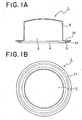
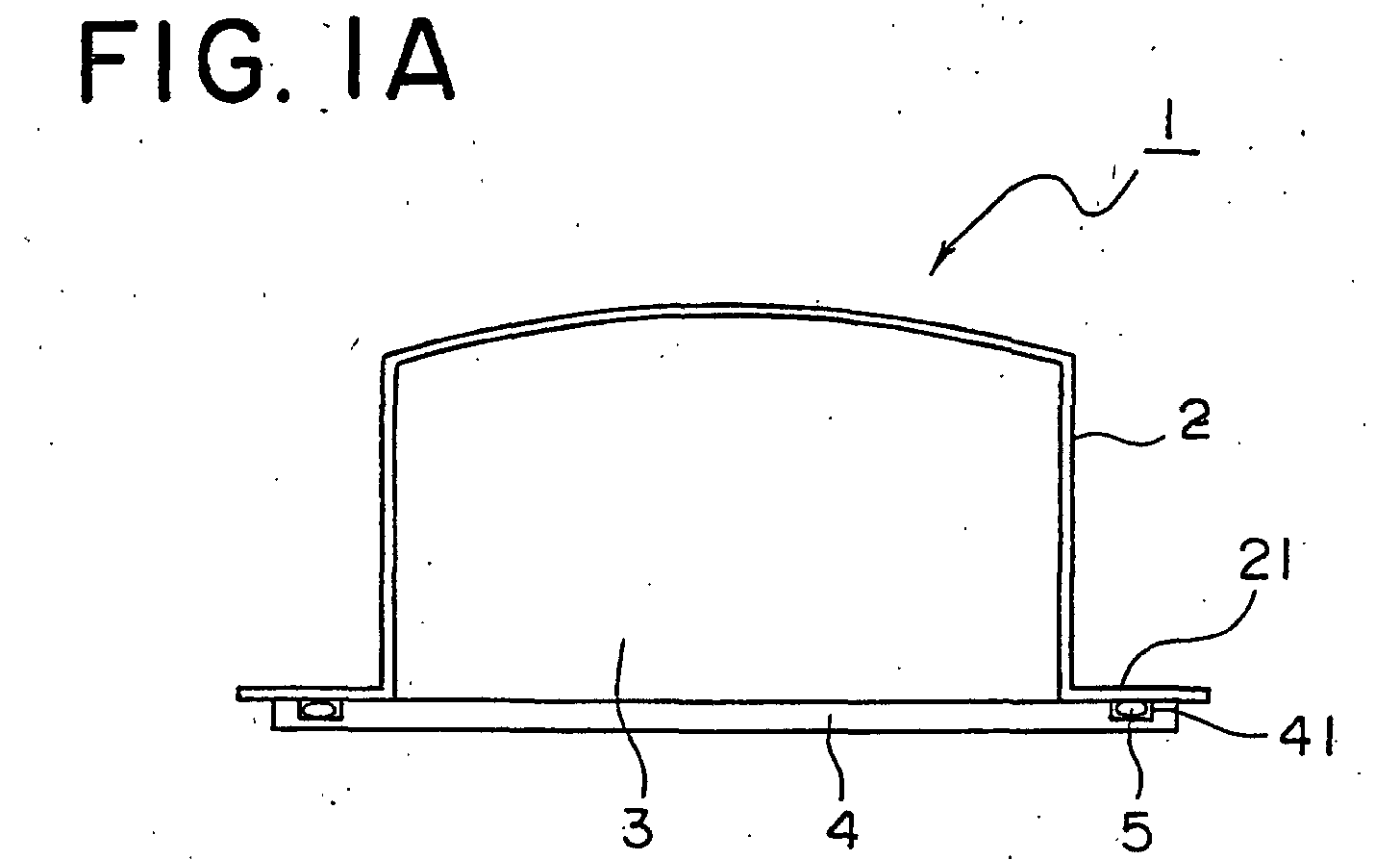
- a container for precision substrate 1 has a container body 2 (a first component) made by a polymer resin containing alicyclic structure.
- the container body 2 has a hollow portion 3 for housing a precision substrate.
- the hollow portion 3 forms a closed space by the container body 2 and a container cap 4 (second component) made by a metal (for example, aluminum and stainless, etc.) for jointing at a flange portion 21 of the container body.
- a flange portion of the container cap 4 is formed a trench 41, and an O-ring 5 made by a rubbery polymer is arranged inside the trench 41.
- an inner diameter of the hollow portion 3 of the container body 2 is preferably 150 to 300 mm.
- a height of the center of the hollow portion 3 is preferably 50 to 300 mm.
- a height of a sidewall of the hollow portion 3 is preferably 40 to 280 mm.
- a thickness of the sidewall of the hollow portion 3 is preferably 2 to 15 mm.
- a molding material is prepared.
- the molding material is obtained by melting and kneading a preliminarily dried polymer containing alicyclic structure and various compounding components, and made to be pellets.
- the palletized molding material is subjected to injection molding and the container body 2 is obtained.
- the base is slid to one direction along the joint portion of the container body 2, and the container cap 4 (a flat plate having a trench for an O-ring at a joint portion with the container body 2) is slid to the other direction (the opposite direction from the sliding direction of the base) along the joint portion at the same time, so as to be replaced from the base.
- the container cap 4 a flat plate having a trench for an O-ring at a joint portion with the container body 2
- the room wherein the container 1 is placed is brought back to the normal pressure. Since the container body 2 and the container cap 4 are kept to be airtight by the O-ring 5 of the flange portion, the hollow portion 3 is kept to be vacuum state even when the outside of the container 1 becomes an atmospheric pressure.
- the precision substrate can be stored in a vacuum state.
- the container for precision substrate 1 comprises a container body 2 made by a polymer resin containing alicyclic structure which releases an extremely small amount of water and organics. Therefore, adsorption of water and organics during storage is suppressed on the precision substrate housed in the hollow portion 3. Accordingly, defects are reduced and the yield is improved, for example, in silicon wafer substrates for producing semiconductors and semiconductor elements molded by using the substrates.
- the a container body 2 made by a polymer resin containing alicyclic structure is light as having a specific weight of about 1, and is transparent, so that the storage condition of a precision substrate inside can be clearly observed and process management is easy.
- An MOS capacitor was produced by following steps below in order.
- a MOS capacitor produced by the above method was stored in the container at 25°C at 100 torr for 48 hours. Next, a constant current stress was applied to the MOS capacitor under the condition below (time of applying the current stress was gradually changed). An amount of injected charges was obtained from a time of applying the current stress, and breakdown probability for the injection charge amount was plotted to form an analytical curve, and an injection charge amount of attaining breakdown probability of 50% is obtained.
- Gate Area 1 ⁇ 10 -4 cm 2 (0.1 mm ⁇ 0.1 mm) Stress Condition: injecting electrons by 0.1 A/cm 2 from gate electrode to substrate side Oxidization Film Thickness of Sample: 5.0 nm
- Measuring Device MX-1100A made by Vector Semiconductor Co., Ltd.
- Measurement Portion LCR meter, HP4284A (20 Hz to 1 MHz) Power Source Portion: Switching controller, HP4156A Computer: HP382
- the obtained polymer reaction solution was moved to a pressure resistant hydrogenation reactor, added with 5 parts of diatomaceus earth carrying nickel catalyst (G-96D, nickel carrying rate was 58 wt% made by Nissan Girdler Co., Ltd.) and 100 parts of cyclohexane to brought to react at 150°C under a hydrogen pressure of 4.4 MPa for 8 hours.
- the reaction solution was subjected to pressure filtration (Funda filter made by Ishikawajima-Harima Heavy Industries Co., Ltd.) under a pressure of 0.25 MPa by using a Radiorite #500 as a filter bed to remove the hydrogenation catalyst and obtain a transparent solution without color.
- the above solution was added with 0.05 part of antioxidant pentaerythritol tetrakis[3-(3,5-di-t-butyl-4-hydroxyphenyl)propionate] (Irganox made by Chiba-Geigy) with respect to 100 parts of the hydrogenated polymer. Then, the solution was filtrated by a metal fiber filter (pore size of 3 ⁇ m made by Nichidai Corporation) and a zeta plus filter 30H (pore size of 0.5 to 1 ⁇ m made by Quno Corporation) successively, furthermore, filtrated by a metal fiber filter (pore size of 0.4 ⁇ m made by Nichidai Corporation) to remove fine solid content.
- a metal fiber filter pore size of 3 ⁇ m made by Nichidai Corporation
- a zeta plus filter 30H pore size of 0.5 to 1 ⁇ m made by Quno Corporation
- cyclohexane as a solvent and low molecular weight components which become a cause of generating an organic gas are removed from the solution by using a cylinder shaped concentration drier (made by Hitachi Ltd.) to recover a DCP-ETD ring-opening polymer hydride.
- Removing of the solvent and low molecular weight components were performed by divided two steps.
- Condition of concentration was a temperature of 260°C under a pressure of 13.4 kPa (100 Torr) in the first step and a temperature of 270°C under a pressure of 0.7 kPa (5 Torr) in the second step.
- the ring-opening polymer hydride wherein the solvent and low molecular weight components were removed was extruded in a molten state from a die directly connected to the concentration device in a class 1000 clean room, cooled with water, cut by a pelletizer (OSP-2 made by Osada S.S.) and recovered in pellets.
- the Mw of the obtained hydrogenated DCP-TCD-MTF ring-opening polymer was 31,000, a ratio of the number of double bond with respect to the number of all carbon-carbon bond was 0.02%, a content of repeating unit not having norbornane ring structure in the polymer was 89%, and the glass transition temperature was 101°C.
- the melt index was 4.2 g / 10 min. at 230°C and 17.8 g / 10 min. at 280°C.
- the Mw of the obtained hydrogenated DCP-ETD ring-opening polymer was 34,000, a ratio of the number of double bond with respect to the number of all carbon-carbon bond was 0.02%, a content ratio of repeating unit not having norbornane ring structure in the polymer was 67%, and the glass transition temperature was 140°C.
- the melt index was 12.1 g / 10 min. at 230°C and 47.5 g / 10 min. at 280°C.
- a stainless steel polymerization device provided with a mixer which was sufficiently dried and substituted with nitrogen, 320 parts of anhydrous cyclohexane, 37.5 parts of styrene, and 0.38 part of dibutyl ether were put, then 0.36 part of n-butyl lithium solution (15% containing hexane solution) was added while mixing at 60°C to start polymerization reaction.
- the Mw of the obtained hydrogenated St-(St/Ip-St block copolymer was 84,900, the Mw/Mn was 1.20, a ratio of the number of double bond with respect to the number of all carbon-carbon bond was 0.14%, the glass transition temperature was 127°C, the melt index was 7.2 g / 10 min. at 230°C and 11.3 g / 10 min. at 280°C.
- pellets of hydrogenated DCP-TCD-MTF ring-opening polymer were obtained.
- the Mw of the obtained hydrogenated DCP-TCD-MTF ring-opening polymer was 58,000, the Tg was 142°C, a ratio of the number of double bond was 0.09%, a content ratio of a repeating unit not having norbornane ring structure in the polymer was the same as that in the polymer containing alicyclic structure A, and the melt index was 0.08 g / 10 min. at 230°C and 0.5 g / 10 min. at 280°C.
- pellets of hydrogenated DCP-TCD-MTF ring-opening polymer were obtained.
- the Mw of the obtained hydrogenated DCP-TCD-MTF ring-opening polymer was 24,000, the Tg was 137°C, a ratio of the number of double bond was 0.02%, a content of a repeating unit not having norbornane ring structure in the polymer was the same as that in the polymer containing alicyclic structure A, and the melt index was 34.8 g / 10 min. at 230°C and 125 g / 10 min. at 280°C.
- thermoplastic resin molded item contains water by an amount that a released amount in an air flow of an ultra high purity argon gas at 25°C having an impurity concentration of 1 ppb or less and a flow amount of 1.2 L/min. after 300 minutes is 30 ppb or less per a surface area of 1 cm 2 of the thermoplastic resin made component, and organics by an amount that an accumulated amount to be released into the air at 100°C for 300 minutes is 150 ng or less per weight 1 g of the thermoplastic resin made member, organic adsorption amount on silicon wafers was small, so that capacitors produced by using the wafers had remarkably preferable dielectric breakdown characteristics (examples 1 to 5).
- a member with a released water amount or released organic amount exceeding the above ranges exhibited a large organic adsorption amount on the silicon wafer and brought poor dielectric breakdown characteristics of a capacitor (comparison examples 1 and 2).
Landscapes
- Packaging Frangible Articles (AREA)
- Container, Conveyance, Adherence, Positioning, Of Wafer (AREA)
- Polyoxymethylene Polymers And Polymers With Carbon-To-Carbon Bonds (AREA)
- Treatments Of Macromolecular Shaped Articles (AREA)
- Manufacture Of Macromolecular Shaped Articles (AREA)
Abstract
A container for precision substrate having one or
more component formed by molding a thermoplastic resin,
characterized in that the component satisfies
characteristics [1] and [2] below. [1] When being
brought to contact ultra high purity argon gas (impurity
concentration: 1 ppb or less) at 25°C having a flow rate
of 1.2 L/min., a water amount in said argon gas after
300 minutes is 30 ppb or less per a surface area 1 cm2 of
the component. [2] When being placed in the air at 100°C,
an increase amount of organics in the air in 300 minutes
is 150 ng or less per weight 1 g of the component.
According to the container, demands for low
contamination can be satisfied.
Description
The present invention relates to a container for
precision substrate used for storing and carrying a
precision substrate, such as a wafer substrate for
producing a semiconductor, a mask plate, a photomask, a
magnetic disk substrate and a liquid crystal display
substrate, a production method of components of the
container for precision substrate and a storing method of
a precision substrate by using the container for
precision substrate.
In a field of a semiconductor chip, a liquid
crystal display device and other electronic devices,
along with the devices getting highly integrated, a
decline of quality caused by fine particles (even a size
of 0.1 µm or so matters), water and organic substances,
etc. being mixed therein in the production procedure has
been a major matter. Therefore, storage and carrying of a
silicon wafer substrate, liquid crystal display substrate
and other precision substrates used for producing the
devices have to be under an environment where the above
contaminating substances are reduced as much as possible.
Thus, a process for storing and carrying these
precision substrates by keeping them in an airtight
container wherein the inside is highly cleaned to be in a
state of being isolated from an outside environment is
used.
Also, to prevent fine particles and other
contaminating substances from adhering to a precision
substrate housed in the container, inside the container
was filled with a clean air or an inert gas, however,
demands for less contamination have become furthermore
stronger in recent years, so a method of making the
inside a vacuum or reduced pressure state has been
proposed. A container, an inside thereof is in a reduced
pressure or vacuum state, is required to be highly
airtight and pressure tight, moreover, not to emit water,
organic substances and other contaminating substances
from the container itself. A metal container is known as
a container satisfying the demands.
However, a metal container is heavy, a precision
substrate inside cannot be observed, and the production
cost is high. Thus, studies have been pursued for
obtaining a container satisfying the above demands by
using a thermoplastic resin.
A molded item of a thermoplastic resin generally
releases water and organic substances, however, it is
known that a container made by a cyclic olefin resin
gives small contamination on its contents (the Japanese
Unexamined Patent Publication No. 11-74337).
However, even the technique described in this
publication is insufficient to deal with the recent
demands for less contamination.
An object of the present invention is to provide a
container for precision substrate capable of satisfying
requirements of low contamination, a process for
producing components of the container for precision
substrate, and a process for storing a precision
substrate by using the container for precision substrate.
The present inventors have been committed
themselves to study for attaining the above objects,
found that an adhesion amount of contaminating substances
becomes remarkably small even stored or carried, etc. for
a long time when keeping a precision substrate in a
container produced by a certain part made by molding a
thermoplastic resin, which releases not more than a
specific amount of water and organic compounds when being
under specific conditions, and completed the present
invention based on the knowledge.
Namely, according to the present invention, there
is provided a container for precision substrate having
one or more component formed by molding a thermoplastic
resin, characterized in that said component satisfies
characteristics [1] and [2] below.
Preferably, a thermoplastic resin is a polymer
resin containing alicyclic structure.
Preferably, the polymer resin containing alicyclic
structure includes 30 to 100 wt% of repeating units
originating from a monomer containing alicyclic structure.
Preferably, the polymer resin containing alicyclic
structure is a ring-opening (co)polymer of a norbornene
based monomer or a hydride of the polymer.
Preferably, the polymer resin containing alicyclic
structure has a polymerization conversion rate of 95 wt%
or more.
Preferably, the polymer resin containing alicyclic
structure has weight average molecular weight (Mw) of
5,000 to 500,000, and the weight average molecular weight
is a value in a polyisoprene conversion measured by a gel
permeation chromatography (GPC) of a hexane solution (a
toluene solution when the polymer resin does not
dissolve).
Preferably, the polymer resin containing alicyclic
structure includes 0.15 wt% or less of carbon-carbon-double
bond with respect to a total amount of all carbon-carbon
bonds.
Preferably, the polymer resin containing alicyclic
structure has a melt index of 0.1 to 30 g/ 10 min., and
the melt index is a value measured at 230°C based on the
JIS-K7210.
Preferably, the polymer resin containing alicyclic
structure has a melt index of 2 to 100 g/ 10 min., and
the melt index is a value measured at 280°C based on the
JIS-K7210.
According to the present invention, there is
provided a process for producing a container for
precision substrate, characterized by producing a
component of a container for precision substrate by using
a molding material including a preliminarily dried
polymer resin containing alicyclic structure.
Preferably, the preliminary drying of a polymer
resin containing alicyclic structure is preformed under a
condition of a temperature lower than a glass transition
temperature of the polymer resin containing alicyclic
structure by 5°C to 80°C for 2 hours or longer but not
longer than 10 hours.
Preferably, a molding material stored by being
sealed with nitrogen is used.
Preferably, a component of a container for
precision substrate is produced by using a polymer resin
containing alicyclic structure having a melt index of 0.1
to 30 g/ 10 min., wherein the melt index is a value
measured at 230°C based on the JIS-K7210, and performing
injection molding under a condition below.
Resin temperature when molding: 220 to 330°C
Retention time of molten resin in cylinder: 1 hour or shorter
Resin temperature when molding: 220 to 330°C
Retention time of molten resin in cylinder: 1 hour or shorter
Preferably, a component of a container for
precision substrate is produced with a molding material
including a polymer resin containing alicyclic structure
having a melt index of 2 to 100 g/ 10 min., wherein the
melt index is a value measured at 280°C based on the JIS-K7210,
and performing injection molding under a condition
below.
Resin temperature when molding: 220 to 330°C
Retention time of molten resin in cylinder: 1 hour or shorter
Resin temperature when molding: 220 to 330°C
Retention time of molten resin in cylinder: 1 hour or shorter
According to the present invention, there is
provided a process for storing a precision substrate,
characterized by using any one of the above container for
precision substrate and making inside the container a
vacuum state for storing the precision substrate.
Preferably, a container for precision substrate
comprising a container body having an opening portion and
capable of housing a precision substrate inside, and
a container cap capable of forming a closed space between said container body and itself by covering the opening portion of the container body and jointing is used, and
a step of placing a precision substrate inside said container body;
a step of reducing a pressure of an atmosphere wherein the container body housing the precision substrate is placed from a normal pressure to a vacuum state;
a step of covering an opening portion of the container body after pressure reducing with said container cap and storing the precision substrate in the container in an airtight state; and
a step of bringing an atmosphere wherein the container storing the precision substrate is placed to a normal pressure, are included.
a container cap capable of forming a closed space between said container body and itself by covering the opening portion of the container body and jointing is used, and
a step of placing a precision substrate inside said container body;
a step of reducing a pressure of an atmosphere wherein the container body housing the precision substrate is placed from a normal pressure to a vacuum state;
a step of covering an opening portion of the container body after pressure reducing with said container cap and storing the precision substrate in the container in an airtight state; and
a step of bringing an atmosphere wherein the container storing the precision substrate is placed to a normal pressure, are included.
The container for precision substrate according to
the present invention can be used for storing and
carrying a variety of precision substrates, such as a
wafer substrate for producing a semiconductor (wafer
substrate, etc. under processing a silicon wafer
substrate and integrated circuit chip), a mask plate, a
photomask, a magnetic disk substrate, and a liquid
crystal display substrate, etc.
The container for precision substrate according to
the present invention satisfies demands for low
contamination and does not contaminate precision
substrates stored therein, so that a defective fraction
of electronic devices produced by using the substrates
can be made widely small.
According to the process for producing components
of the container for precision substrate according to the
present invention, components of the container for
precision substrate of the present invention explained
above can be produced efficiently.
According to the storing method of a precision
substrate according to the present invention,
contamination on the precision substrate by suspended
substances in the air can be effectively prevented.
A container for precision substrate according to
the present invention is composed of at least two
components which can be divided at least to two. It has
the configuration that, after placing a precision
substrate in at least one component among at least two
components, the precision substrate can be stored in a
closed space obtained by putting the rest of the
components together.
Namely, a container for precision substrate
according to the present invention comprises at least a
first component having an opening portion and being
capable of holding a precision substrate inside, and a
second component capable of forming a closed space with
the first component by covering and jointing with the
opening portion of the first component.
The first component normally has the largest
capacity in the present invention and configures the
container body. The second component is capable of
forming a closed space by covering and jointing with the
opening portion of the container body and configures a
container cap.
The container body has an opening portion for ,
holding a precision substrate. A shape of the container
body is not particularly limited, and may be any of a
cylinder shape, a bowl shape, a dish shape and a prism
shape, etc. Note that a cylinder shape and a prism shape
are preferable to hold a plurality of precision
substrates (mainly circular plates and rectangular
plates). In this case, a side wall of the container body
may be vertical, widened or narrowed from the container
bottom. Also, in the container body, the opening portion
has a flange portion for being put together with a
container cap.
A shape of the container cap is not particularly
limited as far as it can cover and joint with the opening
portion of the container body, but a plate shape, a bowl
shape or a dish shape is preferable. Note that when the
container cap is a bowl shape or a dish shape, the
precision substrate may be also held in the container cap.
A positional relationship of the container body and
the container cap is not particularly limited and may be,
for example, a relationship of placing a precision
substrate on the back side of the container cap and cover
from above with the container body.
The opening portion and a joining face with the
container cap of the container body preferably have the
configuration of keeping inside the container airtight by
tight contact (for example, configuration of contacting a
plane with a plane).
Preferably, other than the above container body and
the container cap, the container for precision substrate
according to the present invention further comprise a
third component for making the two tightly contact.
Specifically, a part for sealing jointing faces of the
opening portion of the container body and the container
cap (a gasket, a packing, an O-ring, etc.), and a part
for tightly jointing the container body and the container
cap (a clamp, a clip and other cramping jigs), etc. may
be mentioned. The part for sealing the jointing faces of
the container body and the container cap is preferably
configured by a flexible resin, thermoplastic elastomer,
rubber, etc.
A capacity of the closed space (a precision
substrate housing portion) formed by the container body
and the container cap is normally 0.2 to 300 liters,
preferably 1 to 150 liters, more preferably 3 to 50
liters.
In the present invention, preferably, both of the
container body and the container cap explained above
(both correspond to the components of the present
invention) satisfy characteristics [1] and [2] below.
When the released water amount per 1 cm2 of the
surface area of the components exceeds 30 ppb, for
example, when a silicon wafer substrate is stored in the
container, a natural oxidation film is generated on the
surface of the wafer substrate, so an insulation defect
or other defects are liable to arise when a semiconductor
element is produced with the wafer substrate. When the
released organic amount per 1g of the weight of the
components exceeds 150 ng, the released organics easily
adhere to the silicon wafer substrate, and yields and
reliability of production decline.
A measuring method of the released water amount
will be explained. First, a test piece is cut out from a
part immediately after molding or from a part subjected
to ultrasonic cleaning with ultrapure water for 10
minutes, subjected to precision cleaning by purging with
high purity nitrogen, stored in a clean room after
molding, and stored. Cutting of the test piece and
storage of the cut test piece are performed under an
environment of a relative humidity of 20 to 85%,
preferably 35 to 60% in order to prevent adsorption or
absorption of water from the environment. The test piece
is cut to have a longest length of 50 to 300 mm when
measured in a random direction and a surface area of 5
to 200 cm2 including the cut faces. Next, the released
water amount of the test piece is measured. The
measurement of the released water amount is obtained by
leaving the test piece in an air flow of a super high
purity argon gas having an impurity concentration of 1
ppb or less and a flow speed of 1.2 L/min. at a
temperature of 25°C to keep it contact the high purity
argon gas, and measured a water amount in the argon gas
by an atmospheric pressure ionization mass spectrometer
(hereinafter, abbreviated to "API-MS") after 300 minutes.
Note that when a container part of a test piece is stored
under a low humidity environment for a long time, water
is released from the test piece before the test and a
correct measurement value cannot be obtained. Thus, time
from molding of a part or precision cleaning to the
measurement is normally within 48 hours, preferably
within 24 hours.
A method of measuring a released organic amount
will be explained. Conditions of producing a test piece'
is the same as that of the test piece used in measuring a
released water amount explained above. Note that the test
piece is cut to have a longest length of 50 to 300 mm
when measured in a random direction and a weight of 0.5
to 20 g. Next, a released organic amount of the test
piece is measured. Measurement of a released organic
amount is made on the test piece by using a thermal
desorption gas chromatography: a mass spectrometer (TDS-GC-MS)
at 100°C for 300 minutes. Note that the cut test
piece is stored in a class 100 clean room and normally
subjected to measurement within 48 hours, preferably 24
hours, from molding or precision cleaning of the part.
Organics to be released into the air are composed
of
In the present invention, the container body and
container cap explained above are preferably formed by
molding a thermoplastic resin.
A thermoplastic resin which can be used in the
present invention is not particularly limited as far as
the above components made as its molded items has a
quality on a released water amount and released organic
amount explained above, and the molded item can be made
to be transparent.
As such a thermoplastic resin, a polymer resin
containing alicyclic structure, polycarbonate,
polybutylene terephthalate, polyethylene terephthalate,
polyethylene naphthalate, polyimide, polymethyl
methacrylate, polyetheretherketone, polyphenylene sulfide,
polyphenyl ether, polysulfine, polyimide, polyethylene
and polypropylene, etc. may be mentioned. Among them, a
polymer resin containing alicyclic structure is
preferable.
A polymer resin containing alicyclic structure
which can be used in the present invention indicates a
polymer being a resin containing 20 wt% or more of
repeating units originating from a monomer containing
alicyclic structure.
As an alicyclic structure, monocyclic and
polycyclic (condensed polycyclic, cross-linked cyclic,
and polycyclic combining the two, etc.) may be mentioned.
The number of carbon atoms composing an alicyclic
structure is not particularly limited, but is normally 4
to 30, preferably 5 to 20, more preferably 5 to 15. When
the number of carbons in the alicyclic structure is in
the above range, it is preferable because characteristics,
such as mechanical strength, heat resistance and
moldablility, are highly balanced.
A containing ratio of repeating units originating
from a monomer containing alicyclic structure in the
polymer resin containing alicyclic structure is normally
20 to 100 wt%, preferably 30 to 100 wt%. When the ratio
of repeating units originating from a monomer containing
alicyclic structure is excessively small, it is not
preferable because heat resistance becomes poor.
A remaining portion other than the repeating units
originating from a monomer containing alicyclic structure
in the polymer resin containing alicyclic structure is
suitably selected in accordance with a use object.
As a polymer resin containing alicyclic structure,
a norbornene based polymer, monocyclic cycloalkene based
polymer and a vinyl cycloalkane based polymer, etc. are
mentioned.
A norbornene based polymer is a polymer obtained by
performing addition (co)polymerization or ring-opening
(co)polymerization on a norbornene based monomer and
hydrogenating an unsaturated bond portion thereof in
accordance with need.
A monocyclic cycloalkene polymer is a polymer
obtained by performing addition (co)polymerization on a
monocyclic cycloalkene monomer or an alicyclic conjugated
diene monomer and hydrogenating an unsaturated bond
portion thereof in accordance with need.
A vinyl cycloalkane based monomer is a polymer of
vinyl cycloalkane; a hydrogenate of an unsaturated bond
portion of a copolymer of a polymer of vinyl cycloalkane
or vinyl cycloalkane and other monomer which can be
copolymerized with vinyl cycloalkene; and a hydrogenate
of an aromatic ring and olefin unsaturated bond portion
of a copolymer of an aromatic vinyl based polymer or an
aromatic vinyl compound and other monomer which can be
copolymerized.
Among them, a ring-opening (co)polymer of a
norbornene based monomer and a hydrate thereof are
preferable, and those containing as a (co)polymerization
component a norbornene based monomer not having a
norbornane ring are more preferable.
Note that, in the explanation below, a norbornene
based monomer, a monocyclic cycloalkene, alicyclic
conjugated diene and vinyl cycloalkene will be also
referred to as "a monomer containing alicyclic structure".
As a monomer containing alicyclic structure,
norbornene based monomers not having a norbornane ring,
norbornene based monomers having a norbornane ring,
monocyclic cycloalkene, alicyclic conjugated diene and
vinyl alicyclic carbon hydrides, etc. may be mentioned.
As a norbornene based monomer not having a
norbornane ring, bicyclo[2.2.1]hept-2-ene (common name:
norbornene), 5-methyl-bicyclo[2.2.1]hept-2-ene, 5,5-dimethyl-bicyclo[2.2.1]hept-2-ene,
5-ethyl-bicyclo[2.2.1]hept-2-ene,
5-butyl-bicyclo[2.2.1]hept-2-ene,
5-hexyl-bicyclo[2.2.1]hept-2-ene, 5-octyl-bicyclo[2.2.1]hept-2-ene,
5-octadecyl-bicyclo[2.2.1]hept-2-ene,
5-ethylidene-bicyclo[2.2.1]hept-2-ene, 5-methylidene-bicyclo[2.2.1]hept-2-ene,
5-vinyl-bicyclo[2.2.1]hept-2-ene,
5-propenyl-bicyclo[2.2.1]hept-2-ene, 5-methoxycarbonyl-bicyclo[2.2.1]hept-2-ene, 5-cyano-bicyclo[2.2.1]hept-2-ene, 5-methyl-5-methoxycarbonyl-bicyclo[2.2.1]hept-2-ene, 5-ethoxycarbonyl-bicyclo[2.2.1]hept-2-ene, bicyclo[2.2.1]hept-5-enyl-2-methylpropionate, bicyclo[2.2.1]hept-5-enyl-2-methyl octanate,
bicyclo[2.2.1]hept-2-ene-5, 6-dicarboxylic anhydride, 5-hydroxymethyl bicyclo[2.2.1]hept-2-ene, 5,6-di(hydroxymethyl)-bicyclo[2.2.1]hept-2-ene, 5-hydroxy-i-propyl bicyclo[2.2.1]hept-2-ene, 5,6-dicarboxy-bicyclo[2.2.1]hept-2-ene, bicyclo[2.2.1]hept-2-ene-5,6-dicarboxylic acid imide, 5-cyclopontyl-bicyclo[2.2.1]hept-2-ene, 5-cyclohexyl-bicyclo[2.2.1]hept-2-ene, 5-cyclohexenyl-bicyclo[2.2.1]hept-2-ene, 5-phenyl-bicyclo[2.2.1]hept-2-ene,
tricyclo[4.3.0.12,5]deca-3,7-diene (common name: dicyclopentadiene), tricyclo[4.3.0.12,5]deca-3-ene, tricyclo[4.4.0.12,5]undeca-3,7-diene, tricyclo[4.4.0.12,5]undeca-3,8-diene, tricyclo[4.4.0.12,5]undeca-3-ene, 7,8-benzotricyclo[4.3.0.12,5]deca-3-ene (alias: 1,4-methano-1,4,4a,9a-tetrahydrofluorene), 8,9-benzotricyclo[4.4.0.12,5]undeca-3-ene (alias: 1,4-methano-1,4,4a,5,10,10a-hexahydroanthoracene), etc. may be mentioned.
5-propenyl-bicyclo[2.2.1]hept-2-ene, 5-methoxycarbonyl-bicyclo[2.2.1]hept-2-ene, 5-cyano-bicyclo[2.2.1]hept-2-ene, 5-methyl-5-methoxycarbonyl-bicyclo[2.2.1]hept-2-ene, 5-ethoxycarbonyl-bicyclo[2.2.1]hept-2-ene, bicyclo[2.2.1]hept-5-enyl-2-methylpropionate, bicyclo[2.2.1]hept-5-enyl-2-methyl octanate,
bicyclo[2.2.1]hept-2-ene-5, 6-dicarboxylic anhydride, 5-hydroxymethyl bicyclo[2.2.1]hept-2-ene, 5,6-di(hydroxymethyl)-bicyclo[2.2.1]hept-2-ene, 5-hydroxy-i-propyl bicyclo[2.2.1]hept-2-ene, 5,6-dicarboxy-bicyclo[2.2.1]hept-2-ene, bicyclo[2.2.1]hept-2-ene-5,6-dicarboxylic acid imide, 5-cyclopontyl-bicyclo[2.2.1]hept-2-ene, 5-cyclohexyl-bicyclo[2.2.1]hept-2-ene, 5-cyclohexenyl-bicyclo[2.2.1]hept-2-ene, 5-phenyl-bicyclo[2.2.1]hept-2-ene,
tricyclo[4.3.0.12,5]deca-3,7-diene (common name: dicyclopentadiene), tricyclo[4.3.0.12,5]deca-3-ene, tricyclo[4.4.0.12,5]undeca-3,7-diene, tricyclo[4.4.0.12,5]undeca-3,8-diene, tricyclo[4.4.0.12,5]undeca-3-ene, 7,8-benzotricyclo[4.3.0.12,5]deca-3-ene (alias: 1,4-methano-1,4,4a,9a-tetrahydrofluorene), 8,9-benzotricyclo[4.4.0.12,5]undeca-3-ene (alias: 1,4-methano-1,4,4a,5,10,10a-hexahydroanthoracene), etc. may be mentioned.
As a norbornene based monomer having a norbornane
ring, tetracyclo[4.4.0.12,5.17,10]dodeca-3-ene (common
name: tetracyclododecene), 8-methyl-tetracyclo[4.4.0.12,5.17,10]dodeca-3-ene,
8-ethyltetracyclo[4.4.0.12,5.17,10]dodeca-3-ene,
8-methylidene-tetracyclo[4.4.0.12,5.17,10]dodeca-3-ene,
8-ethylidene-tetracyclo[4.4.0.12,5.17,10]dodeca-3-ene,
8-vinyl-tetracyclo[4.4.0.12,5.17,10]dodeca-3-ene,
8-propenyl-tetracyclo[4.4.0.12,5.17,10]dodeca-3-ene,
8-methoxycarbonyl-tetracyclo[4.4.0.12,5.17,10]dodeca-3-ene,
8-methyl-8-methoxycarbonyl-tetracyclo[4.4.0.12,5.17,10]dodeca-3-ene,
8-hydroxymethyl-tetracyclo[4.4.0.12,5.17,10]dodeca-3-ene,
8-carboxy-tetracyclo[4.4.0.12,5.17,10]dodeca-3-ene,
8-cyclopentyl-tetracyclo [4.4.0.12,5.17,10]dodeca-3-ene, 8-cyclohexyl-tetracyclo[4.4.0.12,5.17,10]dodeca-3-ene, 8-cyclohexenyl-tetracyclo[4.4.0.12,5.17,10]dodeca-3-ene, 8-phenyl-tetracyclo[4.4.0.12,5.17,10]dodeca-3-ene, penthacyclo[6.5.1.13,6.02,7.09,13]pentadeca-3,10-diene, pentacyclo[7.4.0.13,6.110,13.02,7]pentadeca-4,11-diene, etc. may be mentioned.
8-cyclopentyl-tetracyclo [4.4.0.12,5.17,10]dodeca-3-ene, 8-cyclohexyl-tetracyclo[4.4.0.12,5.17,10]dodeca-3-ene, 8-cyclohexenyl-tetracyclo[4.4.0.12,5.17,10]dodeca-3-ene, 8-phenyl-tetracyclo[4.4.0.12,5.17,10]dodeca-3-ene, penthacyclo[6.5.1.13,6.02,7.09,13]pentadeca-3,10-diene, pentacyclo[7.4.0.13,6.110,13.02,7]pentadeca-4,11-diene, etc. may be mentioned.
As a monocyclic cycloalkene, cyclobutene,
cyclopentene, cyclohexene, 3,4-dimethylcyclopentene, 3-methylcyclohexene,
2-(2-methylbutyl)-1-cyclohexene,
cyclooctene, 3a,5,6,7a-tetrahydro-4,7-methano-1H-indene,
cycloheptene, etc. may be mentioned.
As an alicyclic conjugated diene, cyclopentadiene,
cyclohexadiene, etc. may be mentioned.
As a vinyl alicyclic carbon hydride, vinyl
cycloalkene, vinyl cycloalkane may be mentioned. As vinyl
cycloalkene, vinyl cyclopentene, 2-methyl-4-vinylcyclopentene,
vinyl cyclohexene, etc. may be
mentioned. As vinyl cycloalkane, vinyl cyclopentane, 2-methyl-4-vinyl
cyclopentane, vinyl cyclohexane, vinyl
cyclooctane, etc. may be mentioned.
As an aromatic vinyl compound, styrene, α-methylstyrene,
divinyl benzene, vinyl naphthalene, vinyl
toluene, etc. may be mentioned.
The above monomers containing alicyclici structure
and aromatic vinyl compounds may be used alone or in
combination of two or more kinds.
A polymer resin containing alicyclic structure
which can be used in the present invention may also be
what obtained by copolymerizing the above monomer
containing alicyclic structure or/and aromatic vinyl
component and other monomer which can be copolymerized
with a monomer containing alicyclic structure or an
aromatic vinyl compound.
As other monomer which can be copolymerized with a
monomer containing alicyclic structure or an aromatic
vinyl compound, ethylene, propylene, 1-butene, 1-pentene,
1-hexene; 3-methyl-1-butene, 3-methyl-1-pentene, 3-ethyl-1-pentene,
4-methyl-1-pentene, 4-methyl-1-hexene, 4,4-dimethyl-1-hexene,
4,4-dimethyl-1-pentene, 4-ethyl-1-hexene,
3-ethyl-1-hexene, 1-octene, 1-decene, 1-dodecene,
1-tetradecene, 1-hexadecene, 1-octadecene, 1-eicosen and
other chain olefin; 1,4-hexadiene, 4-methyl-1,4-hexadiene,
5-methyl-1, 4-hexadiene, 1,7-octadiene and other
unconjugated dienes; etc. may be mentioned. These
monomers may be used alone or in combination of two or
more kinds.
A polymer resin containing alicyclic structure
which can be used in the present invention may include a
polar group. A ratio of repeating units containing a
polar group, such as a hydroxyl group, a carboxyl group,
an alkoxyl group, an epoxy group, a glycidyl group, an
oxycarbonyl group, a carbonyl group, an amide group, an
ester group and an acid anhydride group, in all repeating
units composing the polymer resin containing alicyclic
structure is normally 50 wt% or less, preferably 30 wt%
or less, more preferably 10 wt% or less. When the ratio
of the repeating units containing a polar group in the
all repeating units of the polymer resin containing
alicyclic structure is too large, water released from a
molded item is liable to increase.
A polymerization method of a polymer resin
containing alicyclic structure and a hydrogenation method
performed in accordance with need are not particularly
limited and may be performed by following well known
methods.
A ring-opening polymer of a norbornene based
monomer and monocyclic cycloalkane can be normally
obtained by performing ring-opening polymerization in a
solvent at a polymerization temperature of -50°C to 100°C
under a polymerization pressure of 0 to 5 MPa by using as
a ring-opening polymerization catalyst ruthenium, rhodium,
palladium, osmium, iridium, platinum and other metal
halides; a catalyst composed of a nitrite or an
acetylacetone compound and a reducing agent; or a
catalyst composed of titanium, vanadium, zirconium,
tungsten, molybdenum and other metal halides or an
acetylacetone compound and an organic aluminum compound
as a cocatalyst.
An addition copolymer of an addition polymer of a
norbornene based monomer and a mono cycloalkene or a
monomer which can be copolymerized with these can be
obtained by a method of copolymerizing, for example, a
monomer component in the presence of a catalyst composed
of titanium, zirconium or vanadium compound and an
organic aluminum compound as a cocatalyst normally at a
polymerization temperature of -50°C to 100°C under a
polymerization pressure of 0 to 5 MPa.
A polymerization reaction of an aromatic vinyl
compound, vinyl cycloalkene or vinyl cycloalkane may be
made by any of well known methods, such as radical
polymerization, an anionic polymerization and cationic
polymerization, but anionic polymerization is preferable
because there are tendencies that molecular weight of a
polymer becomes small in cationic polymerization and
molecular weight distribution becomes broad in radical
polymerization, so mechanical strength of a molded item
declines. Also, any of suspension polymerization,
solution polymerization and block polymerization may be
used. Among these polymers, an aromatic vinyl compound
homopolymer, a hydride of a random and block copolymer
containing 50 wt% or more of an aromatic vinyl compound
unit are preferable. Styrene hydride homopolymer may be
any of isotactic, syndiotactic and atactic.
When performing radical polym+erization, a radical
initiator, such as azobisisobutyronitrile, benzoil
peroxide, as a polymerization catalyst, and when
performing cationic polymerization, BF3, BF6, etc. may be
used as a polymerization catalyst.
In anionic polymerization, specifically, n-butyl
lithium, 1,4-dilithiobutane and other organic alkali
metals may be used as a polymerization catalyst in an
organic solvent. On an object of securing mechanical
strength and heat resistance, dibutylether, triethylamine
or other Lewis base is added for obtaining a polymer
having a narrow molecular weight distribution.
When successively performing hydrogenation
reaction of a polymer after polymerization reaction, it
is preferable for successively performing the steps when
the polymerization reaction is solution polymerization
for polymerizing in an organic solvent.
As an organic solvent used for anionic
polymerization, a carbon hydride based solvent is
preferable and, as those not undermining the
polymerization solvent, for example, n-pentane, n-hexane,
isooctane, and other fatty acid carbon hydrides;
cyclopentane, cyclohexane, decalin and other alicyclic
carbon hydrides; benzene, toluene and other aromatic
carbon hydrides; and tetrahydrofuran, dioxane and other
ethers; etc. may be mentioned. A use amount of an organic
solvent is an amount by which a monomer concentration
becomes normally 1 to 40 wt%, preferably 10 to 30 wt%.
Anionic polymerization is performed normally at
-70 to 150°C, preferably -50 to 120°C. A polymerization
time is normally 0.01 to 20 hours, preferably 0.1 to 10
hours.
Polymerization of alicyclic conjugated diene can
be performed by well known methods, for example,
described in the Japanese Unexamined Patent Publication
No. 6-136057 and No. 7-258318.
A polymer resin containing alicyclic structure
which can be used in the present invention has a
polymerization conversion rate of normally 95 wt% or more,
preferably 97 wt% or more, more preferably 99 wt% or more.
When the polymerization conversion rate is too low, it is
liable that an unreacted monomer is released form a
molded item.
A polymer resin containing alicyclic structure
which can be used in the present invention is preferably
obtained by hydrogenating carbon-carbon double bond of a
ring, main chain and side chain after polymerization
reaction. Specifically, it is preferable to perform
hydrogenation, so that a containing ratio of carbon-carbon
double bond with respect to the total amount of
all carbon-carbon bond in the polymer resin containing
alicyclic structure becomes normally 0.15 wt% or less,
preferably 0.07 wt% or less, more preferably 0.02 wt% or
less. A polymer resin containing alicyclic structure
obtained by hydrogenating carbon-carbon double bond in
the polymer is hardly deteriorated by oxidization and
hardly releases organic substances, so that it easily
contributes to attain the object of the present invention.
In the hydrogenation reaction, a reaction
temperature, a hydrogen partial pressure, a reaction time
and a reaction solution concentration are suitably set to
be optimal ranges in accordance with a kind of polymer to
be hydrogenated. A method of bringing a polymer solution
contact a hydrogenation catalyst may be either of a
method of adding a certain amount of a hydrogenation
catalyst to the polymer solution and mixing in the
presence of hydrogen in a reactor, and a method of
letting the polymer solution and hydrogen passing through
a fixed bed type reactor filled with a hydrogenation
catalyst. In either cases, the reaction is made by using
0.01 to 50 parts by weight of a hydrogenation catalyst
per 100 parts by weight of a polymer at a reaction
temperature of 25 to 300°C and a hydrogen partial
pressure of 0.5 to 10 MPa for a reaction time of 0.5 to
20 hours with respect to 1 to 30 wt% organic solvent
solution of a polymer containing alicyclic structure.
A hydrogenation catalyst is not particularly
limited and a general hydrogenation catalyst can be used.
For example, a homogeneous catalyst obtained by combining
nickel, cobalt or other metal compound with organic
aluminum or organic lithium is preferable. A carrier,
such as an active carbon, diatomaceus earth and magnesia,
is used in accordance with need. A use amount of a
hydrogen catalyst is an amount by which a catalyst
component becomes normally 0.03 to 50 parts by weight per
100 parts by weight of a polymer to be hydrogenated.
Volatile components, such as a solvent, are
removed from a solution after polymerization when
hydrogenation reaction is not performed after
polymerization reaction of a polymer resin containing
alicyclic structure, and from a solution obtained by
filtrating a reaction solution after completing
hydrogenation reaction to separate a hydrogenation
catalyst when hydrogenation reaction is performed after
polymerization.
As a method of removing the solvent and other
volatile components, coagulation method, direct drying
method and other well known methods can be applied.
A coagulation method is a method of depositing a
polymer by mixing a polymer solution with a poor solvent
of the polymer. As a poor solvent, for example, ethyl
alcohol, n-propyl alcohol, isopropyl alcohol and other
alcohols; acetone, methylethylketone and other ketones;
polar solvents of ethyl acetate, butyl acetate and other
esters may be mentioned. After the solid-liquid
separation by coagulation, small blocks of the polymer
(crams) are dried by heating to remove the solvent.
The direct drying method is a method of removing a
solvent by heating a polymer solution under a reduced
pressure. This method can be performed by using a well
known device, such as a centrifugal thin film continuous
evaporation drier, a scraping face heat exchange type
continuous reactor type drier, and a high viscosity
reactor device. A degree of vacuum and a temperature are
suitably selected in accordance with a device and not
limited.
After removing a solvent by coagulation and direct
drying, it is preferable to furthermore dry by heating
under a reduced pressure. The pressure at that time is
normally 10 kPa or less, preferably 3 kPa or less, and a
heating temperature is normally 260°C or more, preferably
280°C or more. When drying under such conditions, almost
no unreacted monomer and solvent are left in the polymer,
so that organics to be released from a molded item
becomes less.
A polymer resin containing alicyclic structure
which can be used in the present invention has weight
average molecular weight (Mw) of normally 5,000 to
500,000, preferably 8,000 to 200,000, more preferably
10,000 to 100,000. The weight average molecular weight in
this case is a value in a polyisoprene conversion
measured by the gel permeation chromatography (GPC) of a
hexane solution (a toluene solution in the case the
polymer resin does not dissolve).
A polymer resin containing alicyclic structure
which can be used in the present invention has a glass
transition temperature (Tg) measured by a differential
scanning calorimeter (DSC) at a temperature rising rate
of 10°C/min. of normally 50 to 300°C, preferably 60 to
200°C, more preferably 70 to 160°C.
A polymer resin containing alicyclic structure
which can be used in the present invention has a melt
index measured at a temperature of 230°C based on the
JIS-K7210 of normally 0.1 to 30 g / 10 min., preferably
0.1 to 10 g / 10 min., more preferably 0.1 to 5 g / 10
min. Also, the melt index measured at a temperature of
280°C based on the JIS-K7210 is normally 2 to 100 g / 10
min., preferably 3 to 50 g / 10 min., more preferably 5
to 30 g / 10 min. When the melt index of a polymer resin
containing alicyclic structure is in the above range,
molding can be performed at a relatively low temperature,
moreover, since molten fluidity is favorable, partial
temperature rising at molding is hard to occur, so that
generation of low molecular component along with
decomposition and deterioration of the resin can be
prevented.
A thermal plastic resin which can be used in the
present invention can be blended with a rubbery polymer.
Here, a rubbery polymer is a polymer having a Tg of 40°C
or lower. Rubber and thermal plastic elastomer are
included in a rubbery polymer. When there are two or more
glass transition temperatures like a block copolymer,
those having the lowest glass transition temperature of
40°C or less can be used as a rubbery polymer in the
present invention. Mooney viscosity (ML1+4: 100°C) of a
rubbery polymer is suitably selected in accordance with a
use object, but is normally 5 to 300.
As a rubbery polymer which can be blended,
ethylene-propylene rubber and other ethylene-α-olefin
based rubbers; ethylene-α-olefin-polyene copolymer
rubber; ethylene-methylmethacrylate, ethylene-butyl
acrylate and other ethylene-unsaturated carboxylate ester
copolymers; ethyl acrylate, butyl acrylate, hexyl
acrylate, acrylic 2-ethylhexyl, lauryl acrylate and other
alkyl acrylate ester based polymer; polybutadiene, low
crystalline polybutadiene, polyisoprene, a random
copolymer of styrene and butadiene or isoprene,
acrylonitryle-butadiene copolymer, a butadiene-isoprene
copolymer, butadiene-(metha)alkyl acrylate ester
copolymer, a butadiene-(metha)alkyl acrylate ester-acrylonitryle
copolymer, a butadiene-(metha)alkyl
acrylate ester-acrylonitrile-styrene copolymer, a
butylene-isoprene copolymer and other conjugated diene
based rubbers; a styrene-butadiene block copolymer, a
styrene hydroxide-butadiene block copolymer, a styrene
hydroxide-butadiene random copolymer, a styrene-isoprene
block copolymer, a styrene hydroxide-isoprene block
copolymer and other aromatic vinyl-conjugated diene based
block copolymer; styrene graft ethylene-propylene
elastomer; a polyethylene
terephthalate·poly(tetramethylene oxide)glycol block
copolymer, a polyethylene
terephthalate/isophthalate·poly(tetramethylene
oxide)·glycol block copolymer, a polybutylene
terephthalate/isophthalate·poly(tetramethylene
oxide)glycol block copolymer, a polybutylene
terephthalate/decanedicarboxylate·poly(tetramethylene
oxide)glycol block copolymer and other polyester based
thermoplastic elastomers; an ethylene based ionomer; etc.
may be mentioned. Among these rubbery polymers, ethylene-α-olefin
based rubber, conjugated diene based rubber, an
aromatic vinyl-conjugated diene based block copolymer and
polyester based thermoplastic elastomer, etc. are
preferable. These rubbery polymers may be used alone or
in combination of two or more kinds.
In the present invention, when a rubbery polymer
is compounded in a thermoplastic resin, mechanical
strength, such as impact strength, of a molded item
(component) is improved, and the effect is particularly
large in a polymer resin containing alicyclic structure.
A compounding amount of a rubbery polymer is normally 1
to 50 parts by weight, preferably 3 to 30 parts by weight
with respect to 100 parts by weight of a thermoplastic
resin.
When the thermoplastic resin is a polymer resin
containing alicyclic structure, mechanical strength can
be improved also by compounding a small amount of other
thermoplastic resin in a range of not undermining the
capability. As other thermoplastic resin as such, for
example, low-density polyethylene, high-density
polyethylene, linear low-density polyethylene, ultra low-density
polyethylene, an ethylene-ethyl acrylate
copolymer, a ethylene-vinyl acetate copolymer,
polypropylene and other α-olefin based resins;
polystyrene, syndiotactic polystyrene, impact polystyrene
(HIPS), a styrene-acrylonitrile copolymer (AS resin),
styrene-acrylonitrile-butadiene copolymer (ABS), styrene-methyl
methacrylate-butadiene copolymer (MBS) and other
aromatic vinyl based resins; polymethyl methacrylate,
polyvinyl chloride, polyvinylidene chloride,
polyphenylene sulfide, polyphenylene ether, polyamide,
polyester, polycarbonate, cellulose triacetate,
polyetherimide, polyimide, polyacrylate, polysulfone,
polyether sulfone, etc. may be mentioned. Among these, α-olefin
based resin and an aromatic vinyl based resin are
preferable. These thermoplastic resins may be used alone
or in combination of two or more kinds, and the
compounding amount is not particularly limited as far as
it is in a range of not undermining the effect of the
present invention.
A thermoplastic resin which can be used in the
present invention may be suitably blended with a variety
of compounding agents, such as an antioxidant, an
ultraviolet absorbent, a weather resistant stabilizer,
and an antistatic agent, in accordance with need.
As an antioxidant, a phenol based antioxidant, a
phosphorus based antioxidant, and a sulfur based
antioxidant, etc. may be mentioned. Among these, a phenol
based antioxidant, particularly, alkyl-substituted phenol
based antioxidant is preferable. Since these antioxidants
can prevent coloring and a strength decline of a molded
item due to deterioration by oxidization at the time of
molding without deteriorating transparency and low water
absorbing property of a thermoplastic resin, they are
particularly important as compounding agents.
As a phenol based antioxidant, for example,
octadecyl-3-(3,5-di-t-butyl-4-hydroxyphenyl)propionate,
2,2'-methylene-bis(4-methyl-6-t-butylphenol), 1,1,3-tris(2-methyl-4-hydroxy-5-t-butylphenyl)butane,
1,3,5-trimethyl-2,4,6-tris(3,5-di-t-butyl-4-hydroxybenzil)benzene,
tetrakismethylene-3-(3',5'-di-t-butyl-4'-hydroxyphenyl
propionate)methane [that is,
pentaerythrityl-tetrakis3-(3,5-di-t-butyl-4-hydroxyphenyl
propionate)] and other alkyl-substituted phenol based
compounds; 2-t-butyl-6-(3-t-butyl-2-hydroxy-5-methylbenzil)-4-methylphenyl
acrylate, 2,4-di-t-amyl-6-{1-(3,S-di-t-amyl-2-hydroxyphenyl)ethyl}phenyl
acrylate
and other acrylate based compounds; 6-(4-hydroxy-3,5-di-t-butylanilino)-2,4-bisoctylthio-1,3,5-triazine,
4-bisoctylthio-1,3,5-triazine
and other phenol based
compounds containing triazine group; etc. may be
mentioned.
As a phosphorus based antioxidant, for example,
triphenyl phosphate, diphenyl isodecyl phosphate, phenyl
diisodecyl phosphate, tris(nonyl phenyl)phosphate,
tris(dinonyl phenyl)phosphate, tris(2,4-di-t-butyl
phenyl)phosphate and other monophosphite based compounds;
4,4'-butylidene-bis(3-methyl-6-t-butylphenyl-di-tridecyl
phosphate) and other diphosphite based compounds; etc.
may be mentioned.
As a sulfur antioxidant, for example, dilauryl-3,3-thiodipropionate,
dimyristyl 3,3'-thiodipropionate,
distearyl-3,3-thiodipropionate, laurylstearyl-3,3-thiopropionate,
etc. may be mentioned.
These antioxidants may be used alone or in
combination of two or more kinds, and the compounding
amount is suitably selected but is normally 0.001 to 5
parts by weight, preferably 0.01 to 1 part by weight with
respect to 100 parts by weight of a thermoplastic resin.
As an ultraviolet ray absorbent and weather
resistant stabilizer, for example, 2,2,6,6-tetramethyl-4-piperidyl
benzoate, bis(2,2,6,6-tetramethyl-4-piperidyl)sebacate,
bis(1,2,2,6,6-pentamethyl-4-piperidyl)-2-(3,5-di-t-butyl-4-hydroxybenzil)-2-n-butylmalonate
and other hindered amine based compounds;
2-(2-hydroxy-5-methylphenyl)benzotriazole, 2-(3-t-butyl-2-hydroxy-5-methylphenyl)-5-chlorobenzotriazole
and other
benzotriazole based compounds; 2,4-di-t-butylphenyl-3,5-di-t-butyl-4-hydroxybenzoate,
hexadecyl-3,5-di-t-butyl-4-hydroxybenzoate
and other benzoate compounds; etc. may be
mentioned.
These ultraviolet ray absorbents and weather
resistant stabilizers may be used alone or in combination
of two or more kinds. An amount of ultraviolet ray
absorbents and weather resistant stabilizers is normally
in a range of 0.001 to 5 parts by weight, preferably 0.01
to 2 parts by weight with respect to 100 parts by weight
of a thermoplastic resin.
As an antistatic agent, stearyl alcohol, behenyl
alcohol and other long-chain alkyl alcohol; alkyl
sulphonic acid sodium, alkyl sulphonic acid phosphonium
salt; glycerin stearate ester and other fatty acid
esters; hydroxylamine based compounds; alkyl phosphate
amine; polyoxyethylene alkylamine; alkyldiethanolamide; a
polyoxyethylene-polyoxypropylene block copolymer; an
organic boron based surfactant; cation surfactant,
amorphous carbon, tin oxide powder, antimonial tin oxide
powder, etc. may be mentioned.
An amount of an antistatic agent is normally in a
range of 0.1 to 50 parts by weight with respect to 100
parts by weight of a thermoplastic resin.
A thermoplastic resin which can be used in the
present invention can be furthermore blended with a light
stabilizer, near infrared ray absorbent, colorant,
pigment and other coloring agents, lubricant, plasticizer,
antiblocking agent, fluorescent brightening agent,
deodorizer, organic or inorganic filler, dross-linking
agent, and vulcanizing agent, etc. as other compounding
agents in accordance with need. These can be used alone
or in combination of two or more kinds, and the
compounding amount is suitably selected in a range of not
undermining the object of the present invention.
A container for precision substrate according to
the present invention is, for example, composed of
components of a container body and a container cap
explained above, and in the explanation below, an example
of a process for producing the components will be
described.
First, a molding material (a molding resin
composition) is prepared. The molding material may be
composed only of the above explained thermoplastic resin,
but is normally prepared by mixing with the above
compounding components. Prior to the preparation of the
molding material, it is preferable to dry the
thermoplastic resin preliminarily. A condition of the
preliminary drying is normally at a temperature lower
than a glass transition temperature of the thermoplastic
resin by 5°C to 80°C, preferably by 1°C 0 to 50°C, for 2
hours or longer but not longer than 10 hours, preferably
4 hours or longer and not longer than 8 hours. When the
preliminary drying is performed under the condition,
scorch of resin is suppressed when molding and a color
tone of a molded item becomes transparent and colorless,
which is preferable. The preliminary drying brings a
large effect when the thermoplastic resin is a polymer
resin containing alicyclic structure.
Preparation of the molding material is normally
performed by melting and kneading the components at 160
to 350°C by using a well known kneader, Banbury mixer,
extruding machine or roll, etc. After the melting and
kneading, it is normally molded to be a pellet form.
Pellets are produced, after melting and kneading the
molding material by an extruding machine, by extruding in
strands having a diameter of 1 to 5 mm and cutting the
strands by a pelletizer to be a length of 2 to 15 mm
after cooling.
Next, by using the prepared molding material, a
component is molded. As a molding method of a component,
an injection molding, extruding blow molding, injection
blow molding, multilayer blow molding, connection blow
molding, double-wall blow molding, drawing blow molding,
vacuum molding, rotary molding, press molding and molten
extruding molding, etc. may be mentioned. Among these,
injection molding is preferable. A resin temperature at
the time of injection molding is normally 220 to 330°C,
preferably 230 to 320°C, more preferably 240 to 300°C
when the thermoplastic resin included in the molding
material is a polymer resin containing alicyclic
structure. A cylinder retention time of a molten resin is
normally 1 hour or shorter, preferably 30 minutes or
shorter, more preferably 10 minutes or shorter. When
injection molding is performed under a condition of the
above range, thermal decomposition (deterioration) of the
resin is less and generation of low molecular weight
organics is suppressed.
Note that a certain time is taken from the
preparation of the molding material until being provided
for molding in some cases. In such cases, the molding
material after preparation is preferably stored, for
example, in a stainless container sealed with nitrogen.
By storing the prepared molding material in sealed
nitrogen, mixing of water and organics from an
environment to the prepared molding material is prevented,
moreover, a loss of transparency and blanching of a
molded item (component) to be obtained are not caused, so
that preferable appearance can be obtained.
As a process for storing a precision substrate by
using a container for precision substrate according to
the present invention, a method of simply housing the
precision substrate in a container body under a normal
pressure, then, covering with the container cap may be
applied, but a method of making inside the container
vacuum state for storing so as not to pollute the
precision substrate with suspended substances in the air
is preferable. Making inside the container vacuum state
to store the precision substrate can be performed, for
example, by after reducing a pressure in a room where the
container body housing the precision substrate is placed
from a normal pressure to a vacuum state, putting a cap
on the container body, then, bringing the room back to
the normal pressure.
The container for precision substrate according to
the present invention has at least one component made by
molding a thermoplastic resin having an extremely small
released amount of water and organics as explained above.
Therefore, on the precision substrate housed inside the
container according to the present invention, adsorption
of water and organics during storage is suppressed.
Accordingly, for example, defects are reduced in
semiconductor silicon wafer substrates and semiconductor
elements molded by using the substrates and the yield is
improved. For example, a capacitor produced by using a
silicon wafer substrate housed and stored in the
container for precision substrate according to the
present invention has almost no defect due to being
polluted by water and organics.
Components other than thermoplastic resin parts
composing the container for precision substrate according
to the present invention are not particularly limited and
may be those produced from other thermoplastic resins,
thermal curing resins, metals, glasses and ceramics, etc.
Next, a container for precision substrate
according to the present invention will be explained
based on an embodiment shown in drawings.
As shown in FIG. 1A and FIG. 1B, a container for
precision substrate 1 according to the present embodiment
has a container body 2 (a first component) made by a
polymer resin containing alicyclic structure.
The container body 2 has a hollow portion 3 for
housing a precision substrate. The hollow portion 3 forms
a closed space by the container body 2 and a container
cap 4 (second component) made by a metal (for example,
aluminum and stainless, etc.) for jointing at a flange
portion 21 of the container body. A flange portion of the
container cap 4 is formed a trench 41, and an O-ring 5
made by a rubbery polymer is arranged inside the trench
41.
In the present embodiment, an inner diameter of
the hollow portion 3 of the container body 2 is
preferably 150 to 300 mm. A height of the center of the
hollow portion 3 is preferably 50 to 300 mm. A height of
a sidewall of the hollow portion 3 is preferably 40 to
280 mm. Also, a thickness of the sidewall of the hollow
portion 3 is preferably 2 to 15 mm.
Next, an example of a process for producing a
container body 2 of the container for precision substrate
1 will be explained. First, a molding material is
prepared. The molding material is obtained by melting and
kneading a preliminarily dried polymer containing
alicyclic structure and various compounding components,
and made to be pellets. Next, the palletized molding
material is subjected to injection molding and the
container body 2 is obtained.
Next, an example of a process for storing a
precision substrate by using the container for precision
substrate 1 will be explained.
First, in a state that a plate shaped base (not
shown) mounted with a precision substrate is covered with
the container body 2 of the container for precision
substrate 1 according to the present embodiment, a
pressure is reduced in the room wherein the container 1
is placed. Soon, inside the room and the hollow portion 3
become a vacuum state. It becomes a vacuum state because
there is not an O-ring at a joint portion of the
container body 2 and the base and it is not airtight.
Next, the base is slid to one direction along the
joint portion of the container body 2, and the container
cap 4 (a flat plate having a trench for an O-ring at a
joint portion with the container body 2) is slid to the
other direction (the opposite direction from the sliding
direction of the base) along the joint portion at the
same time, so as to be replaced from the base.
Next, the room wherein the container 1 is placed
is brought back to the normal pressure. Since the
container body 2 and the container cap 4 are kept to be
airtight by the O-ring 5 of the flange portion, the
hollow portion 3 is kept to be vacuum state even when the
outside of the container 1 becomes an atmospheric
pressure.
As explained above, by using the container for
precision substrate 1, the precision substrate can be
stored in a vacuum state.
The container for precision substrate 1 according
to the present embodiment comprises a container body 2
made by a polymer resin containing alicyclic structure
which releases an extremely small amount of water and
organics. Therefore, adsorption of water and organics
during storage is suppressed on the precision substrate
housed in the hollow portion 3. Accordingly, defects are
reduced and the yield is improved, for example, in
silicon wafer substrates for producing semiconductors and
semiconductor elements molded by using the substrates.
Also, the a container body 2 made by a polymer
resin containing alicyclic structure is light as having a
specific weight of about 1, and is transparent, so that
the storage condition of a precision substrate inside can
be clearly observed and process management is easy.
Below, examples and comparative examples will be
given for specifically explaining the present invention.
Note that a "part" and "%" in examples are on weight
basis unless otherwise mentioned.
An MOS capacitor was produced by following steps
below in order.
A MOS capacitor produced by the above method was
stored in the container at 25°C at 100 torr for 48 hours.
Next, a constant current stress was applied to the MOS
capacitor under the condition below (time of applying the
current stress was gradually changed). An amount of
injected charges was obtained from a time of applying the
current stress, and breakdown probability for the
injection charge amount was plotted to form an analytical
curve, and an injection charge amount of attaining
breakdown probability of 50% is obtained.
Gate Area: 1 × 10⁻⁴ cm2 (0.1 mm × 0.1 mm)
Stress Condition: injecting electrons by 0.1 A/cm2 from gate electrode to substrate side
Oxidization Film Thickness of Sample: 5.0 nm
Stress Condition: injecting electrons by 0.1 A/cm2 from gate electrode to substrate side
Oxidization Film Thickness of Sample: 5.0 nm
Measuring Device: MX-1100A made by Vector
Semiconductor Co., Ltd.
Measurement Portion: LCR meter, HP4284A (20 Hz to
1 MHz)
Power Source Portion: Switching controller, HP4156A
Computer: HP382
Power Source Portion: Switching controller, HP4156A
Computer: HP382
In a reactor of a nitrogen atmosphere at the room
temperature, 250 parts of dehydrated cyclohexane was put,
and 0.84 part of 1-hexene, 0.06 part of dibutyl ether and
0.11 part of triisobutyl aluminum were furthermore put to
be mixed, then, while keeping at 45°C, 38 parts of
tricyclo[4.3.0.12,5]deca-3-diene (hereinafter, abbreviated
to DCP), 35 parts of tetracyclo[4.4.0.12,5.17,10]dodeca-3-ene
(hereinafter, abbreviated to TCD), 27 parts of 7,8-benzotricyclo[4.3.0.12,5]deca-3-ene
(hereinafter,
abbreviated to MTF), and 15 parts of 0.7% toluene
solution of tungsten hexachloride were continuously added
over 2 hours to perform polymerization. The
polymerization conversion rate was 100%.
The obtained polymer reaction solution was moved
to a pressure resistant hydrogenation reactor, added with
5 parts of diatomaceus earth carrying nickel catalyst (G-96D,
nickel carrying rate was 58 wt% made by Nissan
Girdler Co., Ltd.) and 100 parts of cyclohexane to
brought to react at 150°C under a hydrogen pressure of
4.4 MPa for 8 hours. The reaction solution was subjected
to pressure filtration (Funda filter made by
Ishikawajima-Harima Heavy Industries Co., Ltd.) under a
pressure of 0.25 MPa by using a Radiorite #500 as a
filter bed to remove the hydrogenation catalyst and
obtain a transparent solution without color.
The above solution was added with 0.05 part of
antioxidant pentaerythritol tetrakis[3-(3,5-di-t-butyl-4-hydroxyphenyl)propionate]
(Irganox made by Chiba-Geigy)
with respect to 100 parts of the hydrogenated polymer.
Then, the solution was filtrated by a metal fiber filter
(pore size of 3 µm made by Nichidai Corporation) and a
zeta plus filter 30H (pore size of 0.5 to 1 µm made by
Quno Corporation) successively, furthermore, filtrated by
a metal fiber filter (pore size of 0.4 µm made by
Nichidai Corporation) to remove fine solid content.
Next, cyclohexane as a solvent and low molecular
weight components which become a cause of generating an
organic gas are removed from the solution by using a
cylinder shaped concentration drier (made by Hitachi
Ltd.) to recover a DCP-ETD ring-opening polymer hydride.
Removing of the solvent and low molecular weight
components were performed by divided two steps. Condition
of concentration was a temperature of 260°C under a
pressure of 13.4 kPa (100 Torr) in the first step and a
temperature of 270°C under a pressure of 0.7 kPa (5 Torr)
in the second step. The ring-opening polymer hydride
wherein the solvent and low molecular weight components
were removed was extruded in a molten state from a die
directly connected to the concentration device in a class
1000 clean room, cooled with water, cut by a pelletizer
(OSP-2 made by Osada S.S.) and recovered in pellets. The
Mw of the obtained hydrogenated DCP-TCD-MTF ring-opening
polymer was 31,000, a ratio of the number of double bond
with respect to the number of all carbon-carbon bond was
0.02%, a content of repeating unit not having norbornane
ring structure in the polymer was 89%, and the glass
transition temperature was 101°C. The melt index was 4.2
g / 10 min. at 230°C and 17.8 g / 10 min. at 280°C.
Other than using 85 parts of DCP and 15 parts of
8-ethyl-tetracyclo[4.4.0.12,5.17,10]dodeca-3-ene
(hereinafter, abbreviated to ETD) instead of 38 parts of
DCP, 35 parts of TCD and 27 parts of MTF in the polymer
production example 1, and changing the temperature of the
first step of removing (concentrating) the solvent and
low molecular weight components to 280°C and that in the
second step to 280°C, pellets of a hydrogenated DCP-ETD
ring-opening polymer was obtained in the same way as in
the polymer production example 1. The Mw of the obtained
hydrogenated DCP-ETD ring-opening polymer was 34,000, a
ratio of the number of double bond with respect to the
number of all carbon-carbon bond was 0.02%, a content
ratio of repeating unit not having norbornane ring
structure in the polymer was 67%, and the glass
transition temperature was 140°C. The melt index was 12.1
g / 10 min. at 230°C and 47.5 g / 10 min. at 280°C.
In a stainless steel polymerization device
provided with a mixer which was sufficiently dried and
substituted with nitrogen, 320 parts of anhydrous
cyclohexane, 37.5 parts of styrene, and 0.38 part of
dibutyl ether were put, then 0.36 part of n-butyl lithium
solution (15% containing hexane solution) was added while
mixing at 60°C to start polymerization reaction. After 1
hour of polymerization reaction, 20 parts of a mixed
monomer composed of 8 parts of styrene and 12 parts of
isoprene was added to the reaction solution to perform
polymerization reaction for 1 more hour, 37.5 parts of
styrene was furthermore added to react for one hour, then,
0.2 part of isopropyl alcohol was added to the reaction
solution to stop the reaction.
As a result, a solution of a triblock copolymer of
St-(St/Ip)-St having a block containing a repeating unit
originating from styrene (hereinafter, abbreviated to
"St") and a block containing a repeating unit originating
from styrene and isoprene (hereinafter, abbreviated to
"St/Ip") was obtained.
Next, 400 parts of the polymer reaction solution
was moved to a pressure resistant reactor provided with a
mixer, 10 parts of silica-alumina carrying nickel
catalyst (E22U made by Nikki Chemical Co. Ltd.) was added
as a hydrogenation catalyst and mixed. Inside the reactor
was substituted with a hydrogen gas, furthermore,
hydrogen was supplied while mixing the solution, the
temperature was kept at 160°C, and reaction was made for
8 hours under a pressure of 4.5 MPa so as to perform
hydrogenation also on an aromatic ring.
In the same way as in the polymer production
example 1 after the step of removing the hydrogenation
solvent, pellets of a hydrogenated St-(St/Ip)-St block
copolymer were obtained.
The Mw of the obtained hydrogenated St-(St/Ip-St
block copolymer was 84,900, the Mw/Mn was 1.20, a ratio
of the number of double bond with respect to the number
of all carbon-carbon bond was 0.14%, the glass transition
temperature was 127°C, the melt index was 7.2 g / 10 min.
at 230°C and 11.3 g / 10 min. at 280°C.
Other than changing to 0.20 part of 1-hexene, the
temperature of the first step of removing (concentrating)
the solvent and low molecular weight components to 300°C
and that of the second step to 310°C, in the same way as
in the polymer production example 1, pellets of
hydrogenated DCP-TCD-MTF ring-opening polymer were
obtained. The Mw of the obtained hydrogenated DCP-TCD-MTF
ring-opening polymer was 58,000, the Tg was 142°C, a
ratio of the number of double bond was 0.09%, a content
ratio of a repeating unit not having norbornane ring
structure in the polymer was the same as that in the
polymer containing alicyclic structure A, and the melt
index was 0.08 g / 10 min. at 230°C and 0.5 g / 10 min.
at 280°C.
Other than changing to 1.20 parts of 1-hexene, in
the same way as in the polymer production example 1,
pellets of hydrogenated DCP-TCD-MTF ring-opening polymer
were obtained. The Mw of the obtained hydrogenated DCP-TCD-MTF
ring-opening polymer was 24,000, the Tg was 137°C,
a ratio of the number of double bond was 0.02%, a content
of a repeating unit not having norbornane ring structure
in the polymer was the same as that in the polymer
containing alicyclic structure A, and the melt index was
34.8 g / 10 min. at 230°C and 125 g / 10 min. at 280°C.
After storing polymer containing alicyclic
structure pellets A in a stainless container by sealing
with nitrogen from immediately after producing the
pellets for one week, they were preliminarily dried at
110°C for 4 hours by using a hot air ventilation drier.
By using the pellets, injection molding was performed by
using an injection molding device at a molten temperature
of the resin of 280°C, a cylinder retention time of 3
minutes, a primary injection pressure of 98.1 MPa, and a
secondary injection pressure of 78.4 MPa, so that a
container body having a shape shown in FIG. 1 (an inner
diameter of the hollow portion was 280 mm, a height of
the center of the hollow portion was 200 mm, a height of
the sidewall was 180 mm, and a thickness of the sidewall
was 5 mm) was molded. The melt index measurement values
of the pellets and results of measuring a released water
amount, a released organic amount, an organic adsorption
amount and an injected charge amount at 50% breakdown of
a capacitor by using a plate are shown in Table 1.
Other than using the pellets after storing in a
polyethylene bag without being sealed with nitrogen, in
the same way as in the example 1, a container body was
obtained by injection molding. The results of evaluating
in the same way as in the example 1 are shown in Table 1.
Other than using as a polymer the polymer
containing alicyclic structure B, and changing the
preliminary drying temperature to 90°C and the molten
resin temperature at the time of injection molding to
250°C, a container body was obtained in the same way as
in the example 1. The results of evaluating in the same
way as in the example 1 are shown in Table 1.
Other than using as a polymer the polymer
containing alicyclic structure C, a container body was
obtained by injection molding in the same way as in the
example 1. The results of evaluating in the same way as
in the example 1 are shown in Table 1.
Other than using the pellets after preliminarily
drying at a temperature of 80°C for 2 hours, a container
body was obtained by injection molding in the same way as
in the example 1. The results of evaluating in the same
way as in the example 1 are shown in Table 1.
Other than using pellets of a polymer D instead of
using pellets of the polymer containing alicyclic
structure A, and changing the molten temperature of the
resin at the time of injection molding to 350°C and the
cylinder retention time to 90 minutes, a container body
was obtained in the same way as in the example 1. The
results of evaluating in the same way as in the example 1
are shown in Table 1.
Other than using pellets of the polymer E instead
of using pellets of the polymer containing alicyclic
structure A and changing the molten resin temperature at
the time of injection molding to 215°C, a container body
was obtained in the same way as in the example 1. The
results of evaluating in the same way as in the example 1
are shown in Table 1.
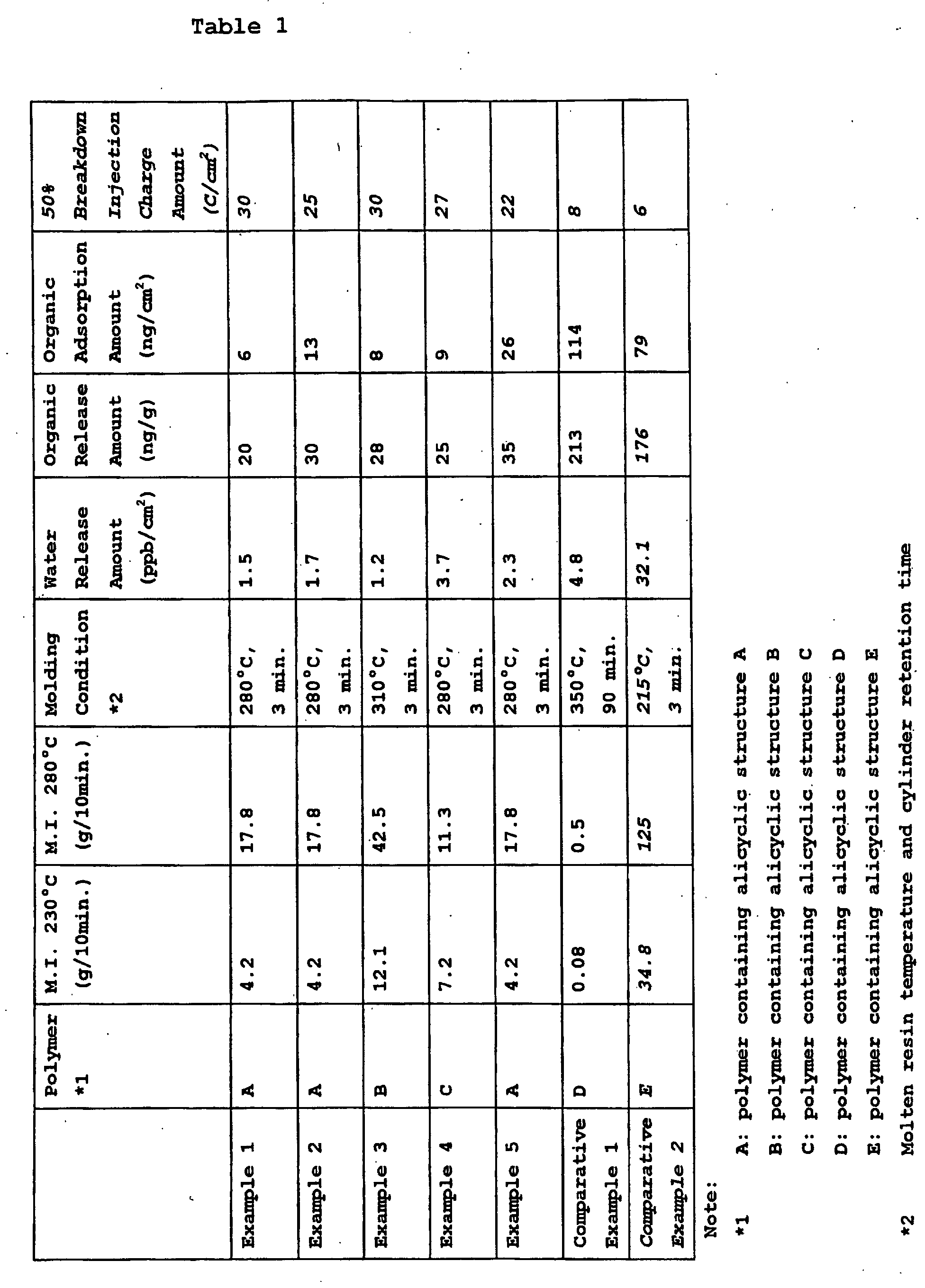
As shown in Table 1, when a thermoplastic resin
molded item contains water by an amount that a released
amount in an air flow of an ultra high purity argon gas
at 25°C having an impurity concentration of 1 ppb or
less and a flow amount of 1.2 L/min. after 300 minutes
is 30 ppb or less per a surface area of 1 cm2 of the
thermoplastic resin made component, and organics by an
amount that an accumulated amount to be released into
the air at 100°C for 300 minutes is 150 ng or less per
weight 1 g of the thermoplastic resin made member,
organic adsorption amount on silicon wafers was small,
so that capacitors produced by using the wafers had
remarkably preferable dielectric breakdown
characteristics (examples 1 to 5).
Among them, when comparing examples 1, 2 and 5
using the same polymer A, in the case of performing
preliminary drying before producing pellets in a higher
temperature range than a glass transition temperature of
the polymer by 5 to 80°C (comparing example 1 with
example 5) and the case of storing the pellets by being
sealed with nitrogen (comparing the example 1 and the
example 2), all of the released water amount, released
organic amount and organic adsorption amount became less
and the 50% breakdown charge injection amount was also
increased.
A member with a released water amount or released
organic amount exceeding the above ranges exhibited a
large organic adsorption amount on the silicon wafer and
brought poor dielectric breakdown characteristics of a
capacitor (comparison examples 1 and 2).
Claims (17)
- A container for precision substrate having one or more component formed by molding a thermoplastic resin, characterized in that said component satisfies characteristics [1] and [2] below.[1] When being brought to contact ultra high purity argon gas (impurity concentration: 1 ppb or less) at 25°C having a flow rate of 1.2 L/min., a water amount in said argon gas after 300 minutes is 30 ppb or less per a surface area 1 cm2 of the component.[2] When being placed in the air at 100°C, an increase amount of organics in the air in 300 minutes is 150 ng or less per weight 1 g of the component.
- The container for precision substrate as set forth in claim 1, wherein the thermoplastic resin is a polymer resin containing alicyclic structure.
- The container for precision substrate as set forth in claim 2, wherein the polymer resin containing alicyclic structure includes 30 to 100 wt% of repeating units originating from a monomer containing alicyclic structure.
- The container for precision substrate as set forth in claim 2, wherein the polymer resin containing alicyclic structure is a ring-opening (co)polymer of a norbornene based monomer or a hydride of the polymer.
- The container for precision substrate as set forth in claim 2, wherein the polymer resin containing alicyclic structure has a polymerization conversion rate of 95 wt% or more.
- The container for precision substrate as set forth in claim 2, wherein the polymer resin containing alicyclic structure has weight average molecular weight (Mw) of 5,000 to 500,000, and the weight average molecular weight is a value in a polyisoprene conversion measured by a gel permeation chromatography (GPC) of a hexane solution (a toluene solution when the polymer resin does not dissolve).
- The container for precision substrate as set forth in claim 2, wherein the polymer resin containing alicyclic structure includes 0.15 wt% or less of carbon-carbon-double bond with respect to a total amount of all carbon-carbon bond.
- The container for precision substrate as set forth in claim 2, wherein the polymer resin containing alicyclic structure has a melt index of 0.1 to 30 g/ 10 min., and the melt index is a value measured at 230°C based on the JIS-K7210.
- The container for precision substrate as set forth in claim 2, wherein the polymer resin containing alicyclic structure has a melt index of 2 to 100 g/ 10 min., and the melt index is a value measured at 280°C based on the JIS-K7210.
- A process for producing a container for precision substrate, characterized by producing a component of a container for precision substrate by using a molding material including a preliminarily dried polymer resin containing alicyclic structure.
- The process for producing a component of a container for precision substrate as set forth in claim 10, wherein the preliminary drying of a polymer resin containing alicyclic structure is preformed under a condition of a temperature lower than a glass transition temperature of the polymer resin containing alicyclic structure by 5°C to 80°C for 2 hours or longer but not longer than 10 hours.
- The process for producing a component of a container for precision substrate as set forth in claim 10 or 11, using a molding material stored by being sealed with nitrogen.
- The process for producing a component of a container for precision substrate as set forth in claim 10 or 11, for producing a component of a container for precision substrate by using a polymer resin containing alicyclic structure having a melt index of 0.1 to 30 g/10 min., wherein the melt index is a value measured at 230°C based on the JIS-K7210, and performing injection molding under a condition below.
Resin temperature when molding: 220 to 330°C
Retention time of molten resin in cylinder: 1 hour or shorter - The process for producing a component of a container for precision substrate as set forth in claim 10 or 11, for producing a component of a container for precision substrate with a molding material including a polymer resin containing alicyclic structure having a melt index of 2 to 100 g/ 10 min., wherein the melt index is a value measured at 280°C based on the JIS-K7210, and performing injection molding under a condition below.
Resin temperature when molding: 220 to 330°C
Retention time of molten resin in cylinder: 1 hour or shorter - A process for storing a precision substrate, characterized by using the container for precision substrate as set forth in claim 1 and making inside the container a vacuum state for storing the precision substrate.
- The process for storing a precision substrate as set forth in claim 15, by using a container for precision substrate comprising a container body having an opening portion and capable of housing a precision substrate inside, and
a container cap capable of forming a closed space between said container body and itself by covering the opening portion of the container body and jointing, including:a step of placing a precision substrate inside said container body;a step of reducing a pressure of an atmosphere wherein the container body housing the precision substrate is placed from a normal pressure to a vacuum state;a step of covering an opening portion of the container body after pressure reducing with said container cap and storing the precision substrate in the container in an airtight state; anda step of bringing an atmosphere wherein the container storing the precision substrate is placed to a normal pressure. - The process for storing a precision substrate as set forth in claim 15 or 16, for using a wafer substrate for producing a semiconductor as a precision substrate.
Applications Claiming Priority (3)
| Application Number | Priority Date | Filing Date | Title |
|---|---|---|---|
| JP2001257460 | 2001-08-28 | ||
| JP2001257460 | 2001-08-28 | ||
| PCT/JP2002/008652 WO2003021665A1 (en) | 2001-08-28 | 2002-08-28 | Container for precision substrate |
Publications (2)
| Publication Number | Publication Date |
|---|---|
| EP1429380A1 true EP1429380A1 (en) | 2004-06-16 |
| EP1429380A4 EP1429380A4 (en) | 2009-07-15 |
Family
ID=19085116
Family Applications (1)
| Application Number | Title | Priority Date | Filing Date |
|---|---|---|---|
| EP02760759A Withdrawn EP1429380A4 (en) | 2001-08-28 | 2002-08-28 | CONTAINER FOR PRECISION SUBSTRATE |
Country Status (4)
| Country | Link |
|---|---|
| US (1) | US7781035B2 (en) |
| EP (1) | EP1429380A4 (en) |
| JP (1) | JP4470017B2 (en) |
| WO (1) | WO2003021665A1 (en) |
Cited By (1)
| Publication number | Priority date | Publication date | Assignee | Title |
|---|---|---|---|---|
| EP2453473A4 (en) * | 2009-07-09 | 2014-07-30 | Shinetsu Polymer Co | SUBSTRATE STORAGE CONTAINER |
Families Citing this family (12)
| Publication number | Priority date | Publication date | Assignee | Title |
|---|---|---|---|---|
| JP4675601B2 (en) * | 2003-11-18 | 2011-04-27 | 株式会社 ネットプラスチック | Sealed container for large precision sheet products and semi-finished products |
| JP5613981B2 (en) * | 2006-08-31 | 2014-10-29 | 日本ゼオン株式会社 | Norbornene-based ring-opening polymer hydride, resin composition and molded article |
| JP2008130982A (en) * | 2006-11-24 | 2008-06-05 | Sumitomo Electric Ind Ltd | Member provided in wafer storage container and manufacturing method thereof |
| JP2008141131A (en) * | 2006-12-05 | 2008-06-19 | Shin Etsu Polymer Co Ltd | Wafer transport case |
| EP2226059B1 (en) * | 2007-12-20 | 2015-02-18 | Hosokawa Yoko Co., Ltd. | Multilayered body for medical containers and medical container |
| US10655219B1 (en) * | 2009-04-14 | 2020-05-19 | Goodrich Corporation | Containment structure for creating composite structures |
| US10689753B1 (en) * | 2009-04-21 | 2020-06-23 | Goodrich Corporation | System having a cooling element for densifying a substrate |
| US20160216603A1 (en) * | 2013-09-11 | 2016-07-28 | Shin-Etsu Polymer Co., Ltd. | Container for storing photomask blanks |
| US9470394B2 (en) * | 2014-11-24 | 2016-10-18 | Cree, Inc. | LED light fixture including optical member with in-situ-formed gasket and method of manufacture |
| JP6339490B2 (en) * | 2014-12-17 | 2018-06-06 | 信越化学工業株式会社 | CZ silicon single crystal manufacturing method |
| JP6869101B2 (en) * | 2017-05-12 | 2021-05-12 | 株式会社ダイセル | Adhesive layer forming device, semiconductor chip manufacturing line, and manufacturing method of laminate |
| KR102673842B1 (en) * | 2021-10-27 | 2024-06-10 | (주)코스탯아이앤씨 | Electromagnetic interference shielding tray for accommodating semiconductor device and method of manufacturing the same |
Family Cites Families (15)
| Publication number | Priority date | Publication date | Assignee | Title |
|---|---|---|---|---|
| JP2816864B2 (en) * | 1989-07-07 | 1998-10-27 | 大塚化学株式会社 | Transfer wafer basket and storage case |
| JP2977274B2 (en) * | 1989-12-26 | 1999-11-15 | 日本ゼオン株式会社 | Molding materials and articles |
| JP3223328B2 (en) | 1992-04-23 | 2001-10-29 | 株式会社岡村製作所 | Continuous bag feeding method |
| TW318861B (en) * | 1994-08-16 | 1997-11-01 | Mitsui Toatsu Chemicals | |
| JPH08288377A (en) * | 1995-04-18 | 1996-11-01 | Sony Corp | Wafer container |
| EP1006134B1 (en) * | 1997-08-19 | 2003-10-15 | Nippon Zeon Co., Ltd. | Norbornene polymer and process for the preparation thereof |
| JPH1174337A (en) * | 1997-08-28 | 1999-03-16 | Nippon Zeon Co Ltd | Thermoplastic container |
| JPH11163115A (en) * | 1997-11-28 | 1999-06-18 | Shin Etsu Polymer Co Ltd | Wafer-retaining member and wafer housing container incorporated in the same |
| JPH11307622A (en) * | 1998-04-17 | 1999-11-05 | Komatsu Ltd | Semiconductor wafer packaging container |
| JP3282584B2 (en) * | 1998-06-02 | 2002-05-13 | 信越ポリマー株式会社 | Storage container for precision parts |
| JP2000007085A (en) * | 1998-06-15 | 2000-01-11 | Sumika Chemical Analysis Service Ltd | Container for storage and transportation |
| JP3995346B2 (en) * | 1998-08-26 | 2007-10-24 | 帝人化成株式会社 | Polycarbonate resin for thin plate container |
| JP2000143833A (en) * | 1998-11-11 | 2000-05-26 | Chisso Corp | Molded article made of olefin resin composition |
| JP2001192458A (en) * | 2000-01-06 | 2001-07-17 | Nippon Zeon Co Ltd | Method for preserving alicyclic structure-containing polymer resin |
| JP2001200143A (en) * | 2000-01-20 | 2001-07-24 | Nippon Zeon Co Ltd | Light reflector and resin composition |
-
2002
- 2002-08-28 EP EP02760759A patent/EP1429380A4/en not_active Withdrawn
- 2002-08-28 JP JP2003525903A patent/JP4470017B2/en not_active Expired - Lifetime
- 2002-08-28 WO PCT/JP2002/008652 patent/WO2003021665A1/en not_active Ceased
- 2002-08-28 US US10/487,840 patent/US7781035B2/en not_active Expired - Fee Related
Cited By (1)
| Publication number | Priority date | Publication date | Assignee | Title |
|---|---|---|---|---|
| EP2453473A4 (en) * | 2009-07-09 | 2014-07-30 | Shinetsu Polymer Co | SUBSTRATE STORAGE CONTAINER |
Also Published As
| Publication number | Publication date |
|---|---|
| US20040224110A1 (en) | 2004-11-11 |
| WO2003021665A1 (en) | 2003-03-13 |
| JP4470017B2 (en) | 2010-06-02 |
| JPWO2003021665A1 (en) | 2004-12-24 |
| EP1429380A4 (en) | 2009-07-15 |
| US7781035B2 (en) | 2010-08-24 |
Similar Documents
| Publication | Publication Date | Title |
|---|---|---|
| JP4292361B2 (en) | Precision substrate protective film | |
| US7781035B2 (en) | Container for precision substrate | |
| US6682797B1 (en) | Contamination resistant cyclic olefin container | |
| EP2305729B1 (en) | Hydrogenated norbornene-based ring-opening polymerization polymer, resin composition, and molded object | |
| CN103237857B (en) | Adhesive film for organic electrolyte accumulator devices | |
| JPWO1999009085A1 (en) | Norbornene polymer and method for producing the same | |
| JPH10139865A (en) | Norbornene-based polymer and method for producing the same | |
| US20050256248A1 (en) | Alicyclic structure containing polymer resin composition and formed article | |
| JPH11291247A (en) | Method for reusing alicyclic structure-containing polymer resin molded article | |
| JP4761021B2 (en) | Resin mold for curable resin and method for producing cured resin molding | |
| JP2000219725A (en) | Norbornene-based polymer hydrogenated product and composition thereof | |
| EP4286463A1 (en) | Method for reusing resin molded articles | |
| TW202534113A (en) | Thermoplastic polyolefin film | |
| JP5849765B2 (en) | A method for producing a resin composition for a covering material for a power transmission cable. | |
| JP3928316B2 (en) | Resin composition and molded body | |
| CN108026376B (en) | Microporous film, separator and secondary battery | |
| JP3712089B2 (en) | Epoxy group-containing norbornene polymer | |
| JP4393035B2 (en) | Piping | |
| JPH10219045A (en) | Resin molding | |
| JP2004087864A (en) | Window material | |
| JP2006241204A (en) | Ternary norbornene polymer excellent in strength when attached to sebum and method for producing the same | |
| JP2001316455A (en) | Method for producing alicyclic structure-containing polymer and molded article | |
| JP2000154238A (en) | Molded container and method for producing the same | |
| JP2005342927A (en) | Manufacturing method of resin mold and cured resin molded body | |
| JP2012201779A (en) | Resin composition and covering material for power transmission cable |
Legal Events
| Date | Code | Title | Description |
|---|---|---|---|
| PUAI | Public reference made under article 153(3) epc to a published international application that has entered the european phase |
Free format text: ORIGINAL CODE: 0009012 |
|
| 17P | Request for examination filed |
Effective date: 20040316 |
|
| AK | Designated contracting states |
Kind code of ref document: A1 Designated state(s): AT BE BG CH CY CZ DE DK EE ES FI FR GB GR IE IT LI LU MC NL PT SE SK TR |
|
| A4 | Supplementary search report drawn up and despatched |
Effective date: 20090616 |
|
| RIC1 | Information provided on ipc code assigned before grant |
Ipc: H01L 21/00 20060101AFI20090609BHEP |
|
| STAA | Information on the status of an ep patent application or granted ep patent |
Free format text: STATUS: THE APPLICATION IS DEEMED TO BE WITHDRAWN |
|
| 18D | Application deemed to be withdrawn |
Effective date: 20090915 |