EP1429021A2 - Gate driver ASIC for an automotive starter/alternator - Google Patents
Gate driver ASIC for an automotive starter/alternator Download PDFInfo
- Publication number
- EP1429021A2 EP1429021A2 EP03028829A EP03028829A EP1429021A2 EP 1429021 A2 EP1429021 A2 EP 1429021A2 EP 03028829 A EP03028829 A EP 03028829A EP 03028829 A EP03028829 A EP 03028829A EP 1429021 A2 EP1429021 A2 EP 1429021A2
- Authority
- EP
- European Patent Office
- Prior art keywords
- starter
- control
- alternator
- asic
- bridge
- Prior art date
- Legal status (The legal status is an assumption and is not a legal conclusion. Google has not performed a legal analysis and makes no representation as to the accuracy of the status listed.)
- Withdrawn
Links
- 239000007858 starting material Substances 0.000 title claims abstract description 65
- 238000001514 detection method Methods 0.000 description 4
- 238000010586 diagram Methods 0.000 description 4
- 230000005284 excitation Effects 0.000 description 2
- 239000000758 substrate Substances 0.000 description 2
- 238000004804 winding Methods 0.000 description 2
- 230000000712 assembly Effects 0.000 description 1
- 238000000429 assembly Methods 0.000 description 1
- 238000005259 measurement Methods 0.000 description 1
- 238000000034 method Methods 0.000 description 1
- 238000012986 modification Methods 0.000 description 1
- 230000004048 modification Effects 0.000 description 1
- 230000001360 synchronised effect Effects 0.000 description 1
Images

Classifications
-
- H—ELECTRICITY
- H02—GENERATION; CONVERSION OR DISTRIBUTION OF ELECTRIC POWER
- H02M—APPARATUS FOR CONVERSION BETWEEN AC AND AC, BETWEEN AC AND DC, OR BETWEEN DC AND DC, AND FOR USE WITH MAINS OR SIMILAR POWER SUPPLY SYSTEMS; CONVERSION OF DC OR AC INPUT POWER INTO SURGE OUTPUT POWER; CONTROL OR REGULATION THEREOF
- H02M7/00—Conversion of AC power input into DC power output; Conversion of DC power input into AC power output
- H02M7/42—Conversion of DC power input into AC power output without possibility of reversal
- H02M7/44—Conversion of DC power input into AC power output without possibility of reversal by static converters
- H02M7/48—Conversion of DC power input into AC power output without possibility of reversal by static converters using discharge tubes with control electrode or semiconductor devices with control electrode
- H02M7/53—Conversion of DC power input into AC power output without possibility of reversal by static converters using discharge tubes with control electrode or semiconductor devices with control electrode using devices of a triode or transistor type requiring continuous application of a control signal
- H02M7/537—Conversion of DC power input into AC power output without possibility of reversal by static converters using discharge tubes with control electrode or semiconductor devices with control electrode using devices of a triode or transistor type requiring continuous application of a control signal using semiconductor devices only, e.g. single switched pulse inverters
- H02M7/538—Conversion of DC power input into AC power output without possibility of reversal by static converters using discharge tubes with control electrode or semiconductor devices with control electrode using devices of a triode or transistor type requiring continuous application of a control signal using semiconductor devices only, e.g. single switched pulse inverters in a push-pull configuration
-
- F—MECHANICAL ENGINEERING; LIGHTING; HEATING; WEAPONS; BLASTING
- F02—COMBUSTION ENGINES; HOT-GAS OR COMBUSTION-PRODUCT ENGINE PLANTS
- F02N—STARTING OF COMBUSTION ENGINES; STARTING AIDS FOR SUCH ENGINES, NOT OTHERWISE PROVIDED FOR
- F02N11/00—Starting of engines by means of electric motors
- F02N11/04—Starting of engines by means of electric motors the motors being associated with current generators
-
- F—MECHANICAL ENGINEERING; LIGHTING; HEATING; WEAPONS; BLASTING
- F02—COMBUSTION ENGINES; HOT-GAS OR COMBUSTION-PRODUCT ENGINE PLANTS
- F02N—STARTING OF COMBUSTION ENGINES; STARTING AIDS FOR SUCH ENGINES, NOT OTHERWISE PROVIDED FOR
- F02N11/00—Starting of engines by means of electric motors
- F02N11/08—Circuits specially adapted for starting of engines
- F02N11/0859—Circuits specially adapted for starting of engines specially adapted to the type of the starter motor or integrated into it
-
- F—MECHANICAL ENGINEERING; LIGHTING; HEATING; WEAPONS; BLASTING
- F02—COMBUSTION ENGINES; HOT-GAS OR COMBUSTION-PRODUCT ENGINE PLANTS
- F02N—STARTING OF COMBUSTION ENGINES; STARTING AIDS FOR SUCH ENGINES, NOT OTHERWISE PROVIDED FOR
- F02N11/00—Starting of engines by means of electric motors
- F02N11/08—Circuits specially adapted for starting of engines
- F02N11/087—Details of the switching means in starting circuits, e.g. relays or electronic switches
-
- H—ELECTRICITY
- H02—GENERATION; CONVERSION OR DISTRIBUTION OF ELECTRIC POWER
- H02P—CONTROL OR REGULATION OF ELECTRIC MOTORS, ELECTRIC GENERATORS OR DYNAMO-ELECTRIC CONVERTERS; CONTROLLING TRANSFORMERS, REACTORS OR CHOKE COILS
- H02P9/00—Arrangements for controlling electric generators for the purpose of obtaining a desired output
- H02P9/14—Arrangements for controlling electric generators for the purpose of obtaining a desired output by variation of field
- H02P9/26—Arrangements for controlling electric generators for the purpose of obtaining a desired output by variation of field using discharge tubes or semiconductor devices
- H02P9/30—Arrangements for controlling electric generators for the purpose of obtaining a desired output by variation of field using discharge tubes or semiconductor devices using semiconductor devices
- H02P9/305—Arrangements for controlling electric generators for the purpose of obtaining a desired output by variation of field using discharge tubes or semiconductor devices using semiconductor devices controlling voltage
-
- F—MECHANICAL ENGINEERING; LIGHTING; HEATING; WEAPONS; BLASTING
- F02—COMBUSTION ENGINES; HOT-GAS OR COMBUSTION-PRODUCT ENGINE PLANTS
- F02D—CONTROLLING COMBUSTION ENGINES
- F02D41/00—Electrical control of supply of combustible mixture or its constituents
- F02D41/20—Output circuits, e.g. for controlling currents in command coils
- F02D2041/2068—Output circuits, e.g. for controlling currents in command coils characterised by the circuit design or special circuit elements
- F02D2041/2075—Type of transistors or particular use thereof
-
- F—MECHANICAL ENGINEERING; LIGHTING; HEATING; WEAPONS; BLASTING
- F02—COMBUSTION ENGINES; HOT-GAS OR COMBUSTION-PRODUCT ENGINE PLANTS
- F02D—CONTROLLING COMBUSTION ENGINES
- F02D41/00—Electrical control of supply of combustible mixture or its constituents
- F02D41/24—Electrical control of supply of combustible mixture or its constituents characterised by the use of digital means
- F02D41/26—Electrical control of supply of combustible mixture or its constituents characterised by the use of digital means using computer, e.g. microprocessor
- F02D41/266—Electrical control of supply of combustible mixture or its constituents characterised by the use of digital means using computer, e.g. microprocessor the computer being backed-up or assisted by another circuit, e.g. analogue
-
- F—MECHANICAL ENGINEERING; LIGHTING; HEATING; WEAPONS; BLASTING
- F02—COMBUSTION ENGINES; HOT-GAS OR COMBUSTION-PRODUCT ENGINE PLANTS
- F02N—STARTING OF COMBUSTION ENGINES; STARTING AIDS FOR SUCH ENGINES, NOT OTHERWISE PROVIDED FOR
- F02N11/00—Starting of engines by means of electric motors
- F02N11/08—Circuits specially adapted for starting of engines
-
- F—MECHANICAL ENGINEERING; LIGHTING; HEATING; WEAPONS; BLASTING
- F02—COMBUSTION ENGINES; HOT-GAS OR COMBUSTION-PRODUCT ENGINE PLANTS
- F02N—STARTING OF COMBUSTION ENGINES; STARTING AIDS FOR SUCH ENGINES, NOT OTHERWISE PROVIDED FOR
- F02N11/00—Starting of engines by means of electric motors
- F02N11/08—Circuits specially adapted for starting of engines
- F02N11/087—Details of the switching means in starting circuits, e.g. relays or electronic switches
- F02N2011/0874—Details of the switching means in starting circuits, e.g. relays or electronic switches characterised by said switch being an electronic switch
-
- F—MECHANICAL ENGINEERING; LIGHTING; HEATING; WEAPONS; BLASTING
- F02—COMBUSTION ENGINES; HOT-GAS OR COMBUSTION-PRODUCT ENGINE PLANTS
- F02N—STARTING OF COMBUSTION ENGINES; STARTING AIDS FOR SUCH ENGINES, NOT OTHERWISE PROVIDED FOR
- F02N11/00—Starting of engines by means of electric motors
- F02N11/08—Circuits specially adapted for starting of engines
- F02N2011/0881—Components of the circuit not provided for by previous groups
- F02N2011/0896—Inverters for electric machines, e.g. starter-generators
-
- H—ELECTRICITY
- H02—GENERATION; CONVERSION OR DISTRIBUTION OF ELECTRIC POWER
- H02P—CONTROL OR REGULATION OF ELECTRIC MOTORS, ELECTRIC GENERATORS OR DYNAMO-ELECTRIC CONVERTERS; CONTROLLING TRANSFORMERS, REACTORS OR CHOKE COILS
- H02P2101/00—Special adaptation of control arrangements for generators
- H02P2101/45—Special adaptation of control arrangements for generators for motor vehicles, e.g. car alternators
Definitions
- This invention relates to automotive starter alternators and more specifically relates to a novel application specific integrated circuit (ASIC) for a starter/alternator.
- ASIC application specific integrated circuit
- Automotive starter alternators are well known and employ a power supply which contains a three phase bridge made of MOSgated devices such as power MOSFETs and/or IGBTs.
- MOSgated devices such as power MOSFETs and/or IGBTs.
- the gates of these MOSGATED devices are suitably controlled by various control circuits, under the influence of a motor drive controller.
- the controls for the MOSgated devices have included numerous segregated circuit assemblies, many of which are implemented on separate Printed Circuit Boards (PCBs) in separate wire harnesses.
- PCBs Printed Circuit Boards
- the system includes a starter/alternator machine; a three phase MOSgate control inverter/bridge electrically coupled to the starter/alternator machine, the three phase MOSgate control inverter/bridge including bridge connected MOSgated devices; a control ASIC electrically coupled to the bridge connected MOSgated devices of the three phase MOSgate control inverter/bridge, the control ASIC including all control circuitry required to control the starter/alternator machine; and a motor drive circuit electrically coupled to the control ASIC.
- the control ASIC is capable of operating in a variety of modes. These modes may include, for example, "a starter mode,” in which the control ASIC drives the bridge connected MOSgated devices of a three phase MOSgate control inverter/bridge 115, such that gate-to-source voltages of the bridge connected MOSgated devices are held for a duration of a start-up sequence.
- the variety of modes may also include, for example, an "alternator mode,” in which the control ASIC drives the bridge connected MOSgated devices of the three phase MOSgate control inverter/bridge to rectify an alternating voltage from the starter/alternator machine.
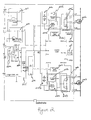
- FIG. 1 is a block diagram of a starter/alternator system employing a novel control ASIC according to the present invention.
- FIG. 2 is a block diagram of a novel control ASIC according to the present invention.
- Starter/alternator system 100 is configured to start an automotive vehicle engine 205 and to charge an automobile battery 210.
- Starter/alternator system 100 includes a starter/alternator machine 110, a three phase MOSgate control inverter/bridge 115 electrically coupled to starter/alternator machine 110, a novel control ASIC 130 electrically coupled to three phase MOSgate control inverter/bridge 115, and a motor drive circuit 120 electrically coupled to novel control ASIC 130.
- engine 205 is operated by the starter/alternator machine 110, which is driven, in turn, by the output of the three phase MOSgate control inverter/bridge 115 in a conventional manner.
- Novel ASIC 130 responds to input control signals from motor drive circuit 120, which receives feedback signals 125a, 125b from the output of three phase MOSgate control inverter/bridge 115 and starter/alternator machine 110.
- Novel ASIC 130 is capable of machine winding and excitation field grounding when the automobile engine is stopped and of measuring the temperature of the substrate of novel ASIC 130.
- Novel ASIC 130 may also be provided with an additional high side driver for field transistor, and may be designed to operate in a variety of different voltage networks (e.g., 12V and 42V systems) in a wide operating temperature range (e.g., -40°C to 165°C).
- voltage networks e.g., 12V and 42V systems
- a wide operating temperature range e.g., -40°C to 165°C.
- Novel ASIC 130 is configured to operate in various operating modes.
- novel ASIC 130 is configured to operate in a "starter mode," in which novel ASIC 130 drives three phase MOSgate control inverter/bridge 115, such that the gate-to-source voltages of the bridge connected MOSgated devices (not shown) of three phase MOSgate control inverter/bridge 115 are held for the duration of the start-up sequence.
- starter mode in which novel ASIC 130 drives three phase MOSgate control inverter/bridge 115, such that the gate-to-source voltages of the bridge connected MOSgated devices (not shown) of three phase MOSgate control inverter/bridge 115 are held for the duration of the start-up sequence.
- the "starter mode" of operation may be initiated, for example, by an external microprocessor.
- novel ASIC 130 may be provided with a control input (e.g., input #2 in the table below) configured to receive a "starter mode" signal from the external microprocessor input (when the car engine is to be cranked).
- a control input e.g., input #2 in the table below
- starter mode may be initiated by asserting and/or deasserting one or more other input signals (e.g., at least one input signal IN,..., IN6 in the table below).
- starter mode novel ASIC 130 helps.
- novel ASIC 130 is also configured to operate in an "alternator mode,” in which novel ASIC 130 drives the gate nodes of the bridge connected MOSgated devices (not shown) of three phase MOSgate control inverter/bridge 115 to rectify the alternating voltage from starter/alternator machine 110. Similar to “starter mode,” “alternator mode” may be initiated, for example, by an external microprocessor.
- the "starter mode" control input (e.g., input #2 in the table below) connected to the external microprocessor may be used to ''toggle'' between “starter mode” and “alternator mode” (e.g., logic “0” for “starter mode,” and logic “1” for “alternator mode,” or vice versa).
- "alternator mode” may be initiated by asserting and/or deasserting one or more other input signals (e.g., at least one input signal IN,..., IN6 in the table below).
- “alternator mode” is initiated by tying to ground all input signals (e.g., IN,..., IN6 of #1 in the table below).
- Novel ASIC 130 should also be capable of providing controlled avalanche (through a zener from Drain to Gate) during a load dump condition.
- novel ASIC 130 includes an electrical pin layout as described in the table below: I/Q # Type Name Description I 1' Logic IN,..., IN6 Q1,..., Q6 inputs I 2 Logic S/A TOGGLE Toggles between starter and alternator mode I 3 Logic WG Grounds machine windings and excitation field I 4 Analog D1, D3, D5, S1/D2, S3/D4, S5/D6, S2, S4, S6 Drain and source voltage for all MOSFETs. Used to turn on/off the MOSFETs in alternator mode. I 5 Power Vcc, gnd Power pins ⁇ 6 Gate signal G1,..., G6 Gate voltage ⁇ 7 Gate signal S1,..., S6 Source voltage (these could be combined with signals above) ⁇ 8 Analog T Substrate temperature
- novel ASIC 130 is coupled to the gate nodes of MOSgated devices 205a, 205b of three phase MOSgate control inverter/bridge 115 for driving MOSgated devices 205a; 205b in at least one mode, for example, a "starter mode” and an "alternator mode,” as described above.
- Novel ASIC 130 includes a standby logic and pass circuit 210 electrically coupled to an ALG input and Vcc; a missing ALG error detection and power supply circuit 220 electrically coupled to Vcc and ground; a control logic circuit 240 electrically coupled to missing ALG error detection and power supply circuit 220; high-side and low-side voltage regulator circuits 215a, 215b electrically coupled to standby logic and pass circuit 210; high-side and low-side Vds linear control circuits 225a, 225b electrically coupled to high-side and low-side voltage regulator circuits 215a, 215b, respectively; high-side and low-side starter mode pre-driver circuits 230a, 230b electrically coupled to high-side and low-side voltage regulator circuits 215a, 215b, respectively; high-side and low-side output driver circuits 245a, 245b electrically coupled to high-side and low-side voltage regulator circuits 215a,215b, high-side and low-side Vds linear control circuits
Landscapes
- Engineering & Computer Science (AREA)
- Chemical & Material Sciences (AREA)
- Combustion & Propulsion (AREA)
- Mechanical Engineering (AREA)
- General Engineering & Computer Science (AREA)
- Power Engineering (AREA)
- Control Of Eletrric Generators (AREA)
- Control Of Ac Motors In General (AREA)
Abstract
Description
- This application is based on and claims the benefit of U.S. Provisional Application No. 60/433,472 filed on December 13, 2002, entitled GATE DRIVER ASIC FOR AN AUTOMOTIVE STARTER/ALTERNATOR, the entire contents of which are expressly incorporated herein by reference.
- This invention relates to automotive starter alternators and more specifically relates to a novel application specific integrated circuit (ASIC) for a starter/alternator.
- Automotive starter alternators are well known and employ a power supply which contains a three phase bridge made of MOSgated devices such as power MOSFETs and/or IGBTs. The gates of these MOSGATED devices are suitably controlled by various control circuits, under the influence of a motor drive controller. Until now, the controls for the MOSgated devices have included numerous segregated circuit assemblies, many of which are implemented on separate Printed Circuit Boards (PCBs) in separate wire harnesses.
- It is an object of the present invention to overcome the disadvantages of the prior art by providing a starter/alternator system for an engine and a battery of an automobile, which employs a novel control ASIC including all control "intelligence" (i.e., control circuitry) required to control a starter/alternator machine. More specifically, the system includes a starter/alternator machine; a three phase MOSgate control inverter/bridge electrically coupled to the starter/alternator machine, the three phase MOSgate control inverter/bridge including bridge connected MOSgated devices; a control ASIC electrically coupled to the bridge connected MOSgated devices of the three phase MOSgate control inverter/bridge, the control ASIC including all control circuitry required to control the starter/alternator machine; and a motor drive circuit electrically coupled to the control ASIC.
- In accordance with an example embodiment of the present invention, the control ASIC is capable of operating in a variety of modes. These modes may include, for example, "a starter mode," in which the control ASIC drives the bridge connected MOSgated devices of a three phase MOSgate control inverter/
bridge 115, such that gate-to-source voltages of the bridge connected MOSgated devices are held for a duration of a start-up sequence. The variety of modes may also include, for example, an "alternator mode," in which the control ASIC drives the bridge connected MOSgated devices of the three phase MOSgate control inverter/bridge to rectify an alternating voltage from the starter/alternator machine. - Figure 1 is a block diagram of a starter/alternator system employing a novel control ASIC according to the present invention.
- Figure 2 is a block diagram of a novel control ASIC according to the present invention.
- Referring to the Figure, there is seen a block diagram of a starter/
alternator system 100 according to the present invention. Starter/alternator system 100 is configured to start an automotive vehicle engine 205 and to charge anautomobile battery 210. Starter/alternator system 100 includes a starter/alternator machine 110, a three phase MOSgate control inverter/bridge 115 electrically coupled to starter/alternator machine 110, anovel control ASIC 130 electrically coupled to three phase MOSgate control inverter/bridge 115, and amotor drive circuit 120 electrically coupled to novel control ASIC 130. In operation, engine 205 is operated by the starter/alternator machine 110, which is driven, in turn, by the output of the three phase MOSgate control inverter/bridge 115 in a conventional manner. - In accordance with the present invention, however, the bridge connected MOSgated devices (not shown) of three phase MOSgate control inverter/
bridge 115 are switched under the control of a single novel ASIC 130, in which resides all control "intelligence" (i.e., control circuitry) required to control starter/alternator machine 110. Novel ASIC 130 responds to input control signals frommotor drive circuit 120, which receives feedback signals 125a, 125b from the output of three phase MOSgate control inverter/bridge 115 and starter/alternator machine 110. Novel ASIC 130 is capable of machine winding and excitation field grounding when the automobile engine is stopped and of measuring the temperature of the substrate of novel ASIC 130. Novel ASIC 130 may also be provided with an additional high side driver for field transistor, and may be designed to operate in a variety of different voltage networks (e.g., 12V and 42V systems) in a wide operating temperature range (e.g., -40°C to 165°C). - Novel ASIC 130 is configured to operate in various operating modes. In accordance with one embodiment of the present invention, novel ASIC 130 is configured to operate in a "starter mode," in which novel ASIC 130 drives three phase MOSgate control inverter/
bridge 115, such that the gate-to-source voltages of the bridge connected MOSgated devices (not shown) of three phase MOSgate control inverter/bridge 115 are held for the duration of the start-up sequence. This may be accomplished, for example, using a bootstrap and/or charge pump technique. The "starter mode" of operation may be initiated, for example, by an external microprocessor. For this purpose, novel ASIC 130 may be provided with a control input (e.g., input #2 in the table below) configured to receive a "starter mode" signal from the external microprocessor input (when the car engine is to be cranked). Alternatively. "starter mode" may be initiated by asserting and/or deasserting one or more other input signals (e.g., at least one input signal IN,..., IN6 in the table below). In "starter mode," novel ASIC 130 helps. - In accordance with another example embodiment of the present invention, novel ASIC 130 is also configured to operate in an "alternator mode," in which novel ASIC 130 drives the gate nodes of the bridge connected MOSgated devices (not shown) of three phase MOSgate control inverter/
bridge 115 to rectify the alternating voltage from starter/alternator machine 110. Similar to "starter mode," "alternator mode" may be initiated, for example, by an external microprocessor. For this purpose, the "starter mode" control input (e.g., input #2 in the table below) connected to the external microprocessor may be used to ''toggle'' between "starter mode" and "alternator mode" (e.g., logic "0" for "starter mode," and logic "1" for "alternator mode," or vice versa). Alternatively, "alternator mode" may be initiated by asserting and/or deasserting one or more other input signals (e.g., at least one input signal IN,..., IN6 in the table below). For example, in accordance with another example embodiment of the present invention, "alternator mode" is initiated by tying to ground all input signals (e.g., IN,..., IN6 of #1 in the table below). In "alternator mode," novel ASIC 130 should be capable of synchronous rectification either by a Vds sensing scheme (e.g., turn on MOSFETs at Vds<Vo (typically Vo= -400mV) and then turnoff MOSFETs based on phase voltage measurements). Novel ASIC 130 should also be capable of providing controlled avalanche (through a zener from Drain to Gate) during a load dump condition. - In accordance with another example embodiment of the present invention, novel ASIC 130 includes an electrical pin layout as described in the table below:
I/Q # Type Name Description I 1' Logic IN,..., IN6 Q1,..., Q6 inputs I 2 Logic S/A TOGGLE Toggles between starter and alternator mode I 3 Logic WG Grounds machine windings and excitation field I 4 Analog D1, D3, D5, S1/D2, S3/D4, S5/D6, S2, S4, S6 Drain and source voltage for all MOSFETs. Used to turn on/off the MOSFETs in alternator mode. I 5 Power Vcc, gnd Power pins ○ 6 Gate signal G1,..., G6 Gate voltage ○ 7 Gate signal S1,..., S6 Source voltage (these could be combined with signals above) ○ 8 Analog T Substrate temperature - Referring now to Figure 2, there is seen a block diagram of an exemplary novel ASIC 130 according to the present invention. As shown in Figure 2, novel ASIC 130 is coupled to the gate nodes of MOSgated devices 205a, 205b of three phase MOSgate control inverter/
bridge 115 for driving MOSgated devices 205a; 205b in at least one mode, for example, a "starter mode" and an "alternator mode," as described above. Novel ASIC 130 includes a standby logic andpass circuit 210 electrically coupled to an ALG input and Vcc; a missing ALG error detection andpower supply circuit 220 electrically coupled to Vcc and ground; a control logic circuit 240 electrically coupled to missing ALG error detection andpower supply circuit 220; high-side and low-side voltage regulator circuits 215a, 215b electrically coupled to standby logic andpass circuit 210; high-side and low-side Vdslinear control circuits 225a, 225b electrically coupled to high-side and low-side voltage regulator circuits 215a, 215b, respectively; high-side and low-side starter mode pre-driver circuits 230a, 230b electrically coupled to high-side and low-side voltage regulator circuits 215a, 215b, respectively; high-side and low-sideoutput driver circuits 245a, 245b electrically coupled to high-side and low-side voltage regulator circuits 215a,215b, high-side and low-side Vdslinear control circuits 225a, 225b, and high-side and low-side starter mode pre-driver circuits 230a, 230b, respectively; high-side and low-side low phasesignal detection circuit 235a, 235b electrically coupled to high-side and low-side voltage regulator circuits 215a, 215b, high-side and low-side Vdslinear control circuits 225a, 225b, high-side and low-sideoutput driver circuits 245a, 245b, and high-side and low-side starter mode pre-driver circuits 230a, 230b, respectively; high-side and low-side shortcircuit detection circuits 250a, 250b electrically coupled to high-side and low-sideoutput driver circuits 245a, 245b, respectively, and to control logic circuit 240; an over-temperaturecircuit 255 electrically coupled to control logic circuit 240; input/output stage circuits 260a, 260b electrically coupled to VD and SC control inputs; alever shifting circuit 265 electrically coupled to input/output stage circuits 260a, 260b and to a ground input; and anon-overlap circuit 270 electrically coupled to lever shiftingcircuit 265 and high-side and low-side starter mode pre-driver circuits 230a, 230b. - Although the present invention has been described in relation to particular embodiments thereof, many other variations and modifications and other uses will become apparent to those skilled in the art. It is preferred, therefore, that the present invention be limited not by the specific disclosure herein.
Claims (13)
- A starter/alternator system for an engine and a battery of an automobile, comprising:a starter/alternator machine;a three phase MOSgate control inverter/bridge electrically coupled to the starter/alternator machine, the three phase MOSgate control inverter/bridge including bridge connected MOSgated devices;a control ASIC electrically coupled to the bridge connected MOSgated devices of the three phase MOSgate control inverter/bridge, the control ASIC including all control circuitry required to control the starter/alternator machine; anda motor drive circuit electrically coupled to the control ASIC.
- The starter/alternator system of claim 1, wherein the motor drive circuit includes feedback inputs electrically coupled to respective feedback signals.
- The starter/alternator system of claim 2, wherein the feedback signals include a first feedback signal generated by the three phase MOSgate control inverter/bridge and a second feedback signal generated by the starter/alternator machine.
- The starter/alternator system of claim 1, wherein the control ASIC is capable of operating in a plurality of different voltage networks.
- The starter/alternator system of claim 4, wherein the plurality of different voltage networks include a 12 volt voltage network and a 42 volt voltage network.
- The starter/alternator system of claim 1, wherein the control ASIC is capable of operating in a wide operating temperature range.
- The starter/alternator system of claim 6, wherein the temperature range is -40°C to 165°C.
- The starter/alternator system of claim 1, wherein the control ASIC is capable of operating in a plurality of modes.
- The starter/alternator system of claim 8, wherein the plurality of modes include a starter mode, the control ASIC driving the bridge connected MOSgated devices of three phase MOSgate control inverter/bridge in the starter mode, such that gate-to-source voltages of the bridge connected MOSgated devices are held for a duration of a start-up sequence.
- The starter/alternator system of claim 9, wherein the control ASIC includes at least one control input, the starter mode of the control ASIC being initiated by the assertion of the at least one control input.
- The starter/alternator system of claim 8, wherein the plurality of modes include an alternator mode, the control ASIC driving the bridge connected MOSgated devices of three phase MOSgate control inverter/bridge in the alternator mode to rectify an alternating voltage from the starter/alternator machine.
- The starter/alternator system of claim 9, wherein the control ASIC includes at least one control input, the alternator mode of the control ASIC being initiated by the assertion of the at least one control input.
- A control ASIC for use in a starter/alternator system for an engine and a battery of an automobile, the control ASIC comprising:an ASIC configured to electrically coupled to bridge connected MOSgated devices of a three phase MOSgate control inverter/bridge of the starter/alternator system, the control ASIC including all control circuitry required to control a starter/alternator machine of the starter/alternator system.
Applications Claiming Priority (2)
| Application Number | Priority Date | Filing Date | Title |
|---|---|---|---|
| US43347202P | 2002-12-13 | 2002-12-13 | |
| US433472P | 2002-12-13 |
Publications (2)
| Publication Number | Publication Date |
|---|---|
| EP1429021A2 true EP1429021A2 (en) | 2004-06-16 |
| EP1429021A3 EP1429021A3 (en) | 2006-05-24 |
Family
ID=32326663
Family Applications (1)
| Application Number | Title | Priority Date | Filing Date |
|---|---|---|---|
| EP03028829A Withdrawn EP1429021A3 (en) | 2002-12-13 | 2003-12-15 | Gate driver ASIC for an automotive starter/alternator |
Country Status (3)
| Country | Link |
|---|---|
| US (2) | US20040178752A1 (en) |
| EP (1) | EP1429021A3 (en) |
| JP (1) | JP2004215497A (en) |
Cited By (1)
| Publication number | Priority date | Publication date | Assignee | Title |
|---|---|---|---|---|
| FR2881295A1 (en) * | 2005-01-26 | 2006-07-28 | Valeo Equip Electr Moteur | Reversible rotating machine e.g. alternator-starter, operation managing method for motor vehicle, involves high level and low level managing of machine by control unit exchanging hardware information via wired connections with power module |
Families Citing this family (33)
| Publication number | Priority date | Publication date | Assignee | Title |
|---|---|---|---|---|
| US8432893B2 (en) * | 2002-03-26 | 2013-04-30 | Interdigital Technology Corporation | RLAN wireless telecommunication system with RAN IP gateway and methods |
| US7061130B1 (en) * | 2004-02-03 | 2006-06-13 | Dana Corporation | Method of determining transition from starter to alternator function by monitoring starter/alternator motor phase voltage or current |
| US7135784B2 (en) * | 2004-07-26 | 2006-11-14 | General Motors Corporation | Fast torque control of a belted alternator starter |
| US7675882B2 (en) * | 2005-02-01 | 2010-03-09 | Exs, Inc. | Hierarchical mesh network for wireless access |
| US8963377B2 (en) | 2012-01-09 | 2015-02-24 | Eagle Harbor Technologies Inc. | Efficient IGBT switching |
| US9655221B2 (en) | 2013-08-19 | 2017-05-16 | Eagle Harbor Technologies, Inc. | High frequency, repetitive, compact toroid-generation for radiation production |
| US10978955B2 (en) | 2014-02-28 | 2021-04-13 | Eagle Harbor Technologies, Inc. | Nanosecond pulser bias compensation |
| US11539352B2 (en) | 2013-11-14 | 2022-12-27 | Eagle Harbor Technologies, Inc. | Transformer resonant converter |
| WO2015073921A1 (en) | 2013-11-14 | 2015-05-21 | Eagle Harbor Technologies, Inc. | This disclosure relates generally to a high voltage nanosecond pulser. |
| US10892140B2 (en) | 2018-07-27 | 2021-01-12 | Eagle Harbor Technologies, Inc. | Nanosecond pulser bias compensation |
| US10020800B2 (en) | 2013-11-14 | 2018-07-10 | Eagle Harbor Technologies, Inc. | High voltage nanosecond pulser with variable pulse width and pulse repetition frequency |
| US10790816B2 (en) | 2014-01-27 | 2020-09-29 | Eagle Harbor Technologies, Inc. | Solid-state replacement for tube-based modulators |
| WO2015131199A1 (en) | 2014-02-28 | 2015-09-03 | Eagle Harbor Technologies, Inc. | Galvanically isolated output variable pulse generator disclosure |
| US10483089B2 (en) | 2014-02-28 | 2019-11-19 | Eagle Harbor Technologies, Inc. | High voltage resistive output stage circuit |
| US11542927B2 (en) | 2015-05-04 | 2023-01-03 | Eagle Harbor Technologies, Inc. | Low pressure dielectric barrier discharge plasma thruster |
| US10903047B2 (en) | 2018-07-27 | 2021-01-26 | Eagle Harbor Technologies, Inc. | Precise plasma control system |
| US11430635B2 (en) | 2018-07-27 | 2022-08-30 | Eagle Harbor Technologies, Inc. | Precise plasma control system |
| US11227745B2 (en) | 2018-08-10 | 2022-01-18 | Eagle Harbor Technologies, Inc. | Plasma sheath control for RF plasma reactors |
| US11004660B2 (en) | 2018-11-30 | 2021-05-11 | Eagle Harbor Technologies, Inc. | Variable output impedance RF generator |
| WO2018148182A1 (en) | 2017-02-07 | 2018-08-16 | Eagle Harbor Technologies, Inc. | Transformer resonant converter |
| JP6902167B2 (en) | 2017-08-25 | 2021-07-14 | イーグル ハーバー テクノロジーズ, インク.Eagle Harbor Technologies, Inc. | Generation of arbitrary waveforms using nanosecond pulses |
| US11810761B2 (en) | 2018-07-27 | 2023-11-07 | Eagle Harbor Technologies, Inc. | Nanosecond pulser ADC system |
| US10607814B2 (en) | 2018-08-10 | 2020-03-31 | Eagle Harbor Technologies, Inc. | High voltage switch with isolated power |
| US11532457B2 (en) | 2018-07-27 | 2022-12-20 | Eagle Harbor Technologies, Inc. | Precise plasma control system |
| US11302518B2 (en) | 2018-07-27 | 2022-04-12 | Eagle Harbor Technologies, Inc. | Efficient energy recovery in a nanosecond pulser circuit |
| US11222767B2 (en) | 2018-07-27 | 2022-01-11 | Eagle Harbor Technologies, Inc. | Nanosecond pulser bias compensation |
| US12456604B2 (en) | 2019-12-24 | 2025-10-28 | Eagle Harbor Technologies, Inc. | Nanosecond pulser RF isolation for plasma systems |
| TWI783203B (en) | 2019-01-08 | 2022-11-11 | 美商鷹港科技股份有限公司 | A nanosecond pulser circuit |
| TWI778449B (en) | 2019-11-15 | 2022-09-21 | 美商鷹港科技股份有限公司 | High voltage pulsing circuit |
| EP4486072A3 (en) | 2019-12-24 | 2025-04-09 | Eagle Harbor Technologies, Inc. | Nanosecond pulser rf isolation for plasma systems |
| US11967484B2 (en) | 2020-07-09 | 2024-04-23 | Eagle Harbor Technologies, Inc. | Ion current droop compensation |
| US11824542B1 (en) | 2022-06-29 | 2023-11-21 | Eagle Harbor Technologies, Inc. | Bipolar high voltage pulser |
| JP7833099B2 (en) | 2022-09-29 | 2026-03-18 | イーグル ハーバー テクノロジーズ,インク. | High-voltage plasma control |
Family Cites Families (6)
| Publication number | Priority date | Publication date | Assignee | Title |
|---|---|---|---|---|
| JP3374491B2 (en) * | 1993-12-24 | 2003-02-04 | 株式会社デンソー | Electric generator for vehicle |
| JP3414310B2 (en) * | 1998-09-25 | 2003-06-09 | トヨタ自動車株式会社 | Engine start control device |
| JP3456158B2 (en) * | 1999-01-11 | 2003-10-14 | 国産電機株式会社 | Starter generator for internal combustion engine |
| JP3410056B2 (en) * | 1999-11-19 | 2003-05-26 | トヨタ自動車株式会社 | Vehicle engine start control device |
| JP4040241B2 (en) * | 2000-08-03 | 2008-01-30 | トヨタ自動車株式会社 | Vehicle control device |
| JP3454245B2 (en) * | 2000-10-26 | 2003-10-06 | トヨタ自動車株式会社 | Vehicle start control device |
-
2003
- 2003-12-12 US US10/734,475 patent/US20040178752A1/en not_active Abandoned
- 2003-12-15 US US10/737,264 patent/US6897574B2/en not_active Expired - Lifetime
- 2003-12-15 EP EP03028829A patent/EP1429021A3/en not_active Withdrawn
- 2003-12-15 JP JP2003417344A patent/JP2004215497A/en active Pending
Non-Patent Citations (1)
| Title |
|---|
| None |
Cited By (3)
| Publication number | Priority date | Publication date | Assignee | Title |
|---|---|---|---|---|
| FR2881295A1 (en) * | 2005-01-26 | 2006-07-28 | Valeo Equip Electr Moteur | Reversible rotating machine e.g. alternator-starter, operation managing method for motor vehicle, involves high level and low level managing of machine by control unit exchanging hardware information via wired connections with power module |
| WO2006079700A1 (en) * | 2005-01-26 | 2006-08-03 | Valeo Equipements Electriques Moteur | Method for operating a motor vehicle alternator-starter |
| US7742855B2 (en) | 2005-01-26 | 2010-06-22 | Valeo Equipements Electriques Moteur | Method for operating a motor vehicle alternator-starter |
Also Published As
| Publication number | Publication date |
|---|---|
| JP2004215497A (en) | 2004-07-29 |
| US6897574B2 (en) | 2005-05-24 |
| EP1429021A3 (en) | 2006-05-24 |
| US20040178752A1 (en) | 2004-09-16 |
| US20040189219A1 (en) | 2004-09-30 |
Similar Documents
| Publication | Publication Date | Title |
|---|---|---|
| EP1429021A2 (en) | Gate driver ASIC for an automotive starter/alternator | |
| US20250047094A1 (en) | Power control device | |
| US8063613B2 (en) | Power converter driver with split power supply | |
| US11923833B2 (en) | Switch driving device | |
| CN110383655B (en) | Driving device of semiconductor switch | |
| CN102227875A (en) | Electric isolation type switching element driving device and control method thereof | |
| US5216587A (en) | Inverter | |
| KR20080021792A (en) | Driving circuit | |
| JP2006314154A (en) | Power converter | |
| US11349303B2 (en) | Power module with integrated surge voltage limiting element | |
| US20200235723A1 (en) | Power device driving apparatus | |
| JP4388573B2 (en) | Rotating electrical machine for vehicle | |
| JP4556926B2 (en) | Vehicle power generation control device | |
| EP3744002B1 (en) | Controlling a high-side switching element using a bootstrap capacitor | |
| GB2356755A (en) | A processor-clocked charge pump for a 42 volt high-side MOSFET switch | |
| US11990826B2 (en) | Power electronics device and method for supplying electrical voltage to a driver circuit of a power semiconductor switch | |
| KR0137028B1 (en) | Dc brushless motor control circuit arrangement | |
| US11750085B2 (en) | Electric device | |
| WO2023026943A1 (en) | Power supply device | |
| JP2004282963A (en) | Electric power steering device | |
| JP2002223589A (en) | Motor controller for battery fork lift truck | |
| CN108028612B (en) | Inverter device for electric vehicle | |
| JP2003033038A (en) | Rectifier for vehicle generator | |
| GB2356504A (en) | A high side FET switch with a charge pump driven by a relatively low voltage CMOS inverter | |
| JP6903597B2 (en) | Load drive circuit |
Legal Events
| Date | Code | Title | Description |
|---|---|---|---|
| PUAI | Public reference made under article 153(3) epc to a published international application that has entered the european phase |
Free format text: ORIGINAL CODE: 0009012 |
|
| AK | Designated contracting states |
Kind code of ref document: A2 Designated state(s): AT BE BG CH CY CZ DE DK EE ES FI FR GB GR HU IE IT LI LU MC NL PT RO SE SI SK TR |
|
| AX | Request for extension of the european patent |
Extension state: AL LT LV MK |
|
| PUAL | Search report despatched |
Free format text: ORIGINAL CODE: 0009013 |
|
| AK | Designated contracting states |
Kind code of ref document: A3 Designated state(s): AT BE BG CH CY CZ DE DK EE ES FI FR GB GR HU IE IT LI LU MC NL PT RO SE SI SK TR |
|
| AX | Request for extension of the european patent |
Extension state: AL LT LV MK |
|
| 17P | Request for examination filed |
Effective date: 20061014 |
|
| 17Q | First examination report despatched |
Effective date: 20061130 |
|
| AKX | Designation fees paid |
Designated state(s): AT BE BG CH CY CZ DE DK EE ES FI FR GB GR HU IE IT LI LU MC NL PT RO SE SI SK TR |
|
| STAA | Information on the status of an ep patent application or granted ep patent |
Free format text: STATUS: THE APPLICATION HAS BEEN WITHDRAWN |
|
| 18W | Application withdrawn |
Effective date: 20091006 |