EP1428874A2 - Lipase variant - Google Patents
Lipase variant Download PDFInfo
- Publication number
- EP1428874A2 EP1428874A2 EP03024829A EP03024829A EP1428874A2 EP 1428874 A2 EP1428874 A2 EP 1428874A2 EP 03024829 A EP03024829 A EP 03024829A EP 03024829 A EP03024829 A EP 03024829A EP 1428874 A2 EP1428874 A2 EP 1428874A2
- Authority
- EP
- European Patent Office
- Prior art keywords
- lipase
- neutral
- amino acid
- negative
- substitution
- Prior art date
- Legal status (The legal status is an assumption and is not a legal conclusion. Google has not performed a legal analysis and makes no representation as to the accuracy of the status listed.)
- Granted
Links
- 102000004882 Lipase Human genes 0.000 title claims abstract description 80
- 108090001060 Lipase Proteins 0.000 title claims abstract description 80
- 239000004367 Lipase Substances 0.000 title claims abstract description 79
- 235000019421 lipase Nutrition 0.000 title claims abstract description 79
- 150000001413 amino acids Chemical class 0.000 claims abstract description 54
- 239000003599 detergent Substances 0.000 claims abstract description 41
- 238000006467 substitution reaction Methods 0.000 claims abstract description 37
- 108090000765 processed proteins & peptides Proteins 0.000 claims abstract description 21
- 241000223258 Thermomyces lanuginosus Species 0.000 claims abstract description 9
- 210000004899 c-terminal region Anatomy 0.000 claims abstract description 8
- 230000007935 neutral effect Effects 0.000 claims description 35
- 239000000203 mixture Substances 0.000 claims description 29
- 239000004094 surface-active agent Substances 0.000 claims description 15
- 239000003945 anionic surfactant Substances 0.000 claims description 10
- 125000003275 alpha amino acid group Chemical group 0.000 claims description 8
- 108091028043 Nucleic acid sequence Proteins 0.000 claims description 7
- 238000000034 method Methods 0.000 claims description 6
- 239000002736 nonionic surfactant Substances 0.000 claims description 6
- 210000004027 cell Anatomy 0.000 claims description 5
- 239000013604 expression vector Substances 0.000 claims description 5
- 230000002209 hydrophobic effect Effects 0.000 claims description 5
- XLYOFNOQVPJJNP-UHFFFAOYSA-N water Substances O XLYOFNOQVPJJNP-UHFFFAOYSA-N 0.000 claims description 5
- 239000005711 Benzoic acid Substances 0.000 claims description 3
- 238000004519 manufacturing process Methods 0.000 claims description 3
- 229920001184 polypeptide Polymers 0.000 claims description 3
- 102000004196 processed proteins & peptides Human genes 0.000 claims description 3
- 102220080275 rs797045512 Human genes 0.000 claims description 3
- 238000012258 culturing Methods 0.000 claims description 2
- 102200011324 rs1557006239 Human genes 0.000 claims description 2
- 102220052839 rs73113102 Human genes 0.000 claims description 2
- 235000001014 amino acid Nutrition 0.000 description 44
- -1 optical brighteners Substances 0.000 description 19
- 102000004190 Enzymes Human genes 0.000 description 12
- 108090000790 Enzymes Proteins 0.000 description 12
- 125000000217 alkyl group Chemical group 0.000 description 10
- 125000000129 anionic group Chemical group 0.000 description 8
- 239000000654 additive Substances 0.000 description 5
- 230000000996 additive effect Effects 0.000 description 5
- 125000002768 hydroxyalkyl group Chemical group 0.000 description 5
- 150000001768 cations Chemical class 0.000 description 4
- 229910052700 potassium Inorganic materials 0.000 description 4
- 238000005406 washing Methods 0.000 description 4
- QGZKDVFQNNGYKY-UHFFFAOYSA-O Ammonium Chemical compound [NH4+] QGZKDVFQNNGYKY-UHFFFAOYSA-O 0.000 description 3
- 229920000742 Cotton Polymers 0.000 description 3
- IAYPIBMASNFSPL-UHFFFAOYSA-N Ethylene oxide Chemical compound C1CO1 IAYPIBMASNFSPL-UHFFFAOYSA-N 0.000 description 3
- DGAQECJNVWCQMB-PUAWFVPOSA-M Ilexoside XXIX Chemical compound C[C@@H]1CC[C@@]2(CC[C@@]3(C(=CC[C@H]4[C@]3(CC[C@@H]5[C@@]4(CC[C@@H](C5(C)C)OS(=O)(=O)[O-])C)C)[C@@H]2[C@]1(C)O)C)C(=O)O[C@H]6[C@@H]([C@H]([C@@H]([C@H](O6)CO)O)O)O.[Na+] DGAQECJNVWCQMB-PUAWFVPOSA-M 0.000 description 3
- ZLMJMSJWJFRBEC-UHFFFAOYSA-N Potassium Chemical compound [K] ZLMJMSJWJFRBEC-UHFFFAOYSA-N 0.000 description 3
- ZMANZCXQSJIPKH-UHFFFAOYSA-N Triethylamine Chemical compound CCN(CC)CC ZMANZCXQSJIPKH-UHFFFAOYSA-N 0.000 description 3
- 239000002253 acid Substances 0.000 description 3
- 150000007513 acids Chemical class 0.000 description 3
- 125000004432 carbon atom Chemical group C* 0.000 description 3
- 125000001301 ethoxy group Chemical group [H]C([H])([H])C([H])([H])O* 0.000 description 3
- 239000011591 potassium Substances 0.000 description 3
- 150000003839 salts Chemical class 0.000 description 3
- 229910052708 sodium Inorganic materials 0.000 description 3
- 239000011734 sodium Substances 0.000 description 3
- 150000003467 sulfuric acid derivatives Chemical class 0.000 description 3
- LFQSCWFLJHTTHZ-UHFFFAOYSA-N Ethanol Chemical compound CCO LFQSCWFLJHTTHZ-UHFFFAOYSA-N 0.000 description 2
- QUSNBJAOOMFDIB-UHFFFAOYSA-N Ethylamine Chemical compound CCN QUSNBJAOOMFDIB-UHFFFAOYSA-N 0.000 description 2
- WHXSMMKQMYFTQS-UHFFFAOYSA-N Lithium Chemical compound [Li] WHXSMMKQMYFTQS-UHFFFAOYSA-N 0.000 description 2
- 229920003171 Poly (ethylene oxide) Polymers 0.000 description 2
- 150000004996 alkyl benzenes Chemical class 0.000 description 2
- 150000008051 alkyl sulfates Chemical class 0.000 description 2
- 150000003863 ammonium salts Chemical class 0.000 description 2
- 239000011575 calcium Substances 0.000 description 2
- 239000003795 chemical substances by application Substances 0.000 description 2
- 239000007859 condensation product Substances 0.000 description 2
- 125000000118 dimethyl group Chemical group [H]C([H])([H])* 0.000 description 2
- 230000000694 effects Effects 0.000 description 2
- 239000007788 liquid Substances 0.000 description 2
- 229910052744 lithium Inorganic materials 0.000 description 2
- 239000011777 magnesium Substances 0.000 description 2
- 239000000047 product Substances 0.000 description 2
- 102200121669 rs104894915 Human genes 0.000 description 2
- 102220070978 rs794728761 Human genes 0.000 description 2
- 239000002689 soil Substances 0.000 description 2
- 239000004753 textile Substances 0.000 description 2
- DNIAPMSPPWPWGF-GSVOUGTGSA-N (R)-(-)-Propylene glycol Chemical compound C[C@@H](O)CO DNIAPMSPPWPWGF-GSVOUGTGSA-N 0.000 description 1
- FWMNVWWHGCHHJJ-SKKKGAJSSA-N 4-amino-1-[(2r)-6-amino-2-[[(2r)-2-[[(2r)-2-[[(2r)-2-amino-3-phenylpropanoyl]amino]-3-phenylpropanoyl]amino]-4-methylpentanoyl]amino]hexanoyl]piperidine-4-carboxylic acid Chemical compound C([C@H](C(=O)N[C@H](CC(C)C)C(=O)N[C@H](CCCCN)C(=O)N1CCC(N)(CC1)C(O)=O)NC(=O)[C@H](N)CC=1C=CC=CC=1)C1=CC=CC=C1 FWMNVWWHGCHHJJ-SKKKGAJSSA-N 0.000 description 1
- OYPRJOBELJOOCE-UHFFFAOYSA-N Calcium Chemical compound [Ca] OYPRJOBELJOOCE-UHFFFAOYSA-N 0.000 description 1
- FYYHWMGAXLPEAU-UHFFFAOYSA-N Magnesium Chemical compound [Mg] FYYHWMGAXLPEAU-UHFFFAOYSA-N 0.000 description 1
- ISWSIDIOOBJBQZ-UHFFFAOYSA-N Phenol Chemical compound OC1=CC=CC=C1 ISWSIDIOOBJBQZ-UHFFFAOYSA-N 0.000 description 1
- 239000004902 Softening Agent Substances 0.000 description 1
- 239000003082 abrasive agent Substances 0.000 description 1
- 229910052783 alkali metal Inorganic materials 0.000 description 1
- 229910052784 alkaline earth metal Inorganic materials 0.000 description 1
- 150000003973 alkyl amines Chemical class 0.000 description 1
- 230000000844 anti-bacterial effect Effects 0.000 description 1
- 239000007864 aqueous solution Substances 0.000 description 1
- 239000003899 bactericide agent Substances 0.000 description 1
- 229940077388 benzenesulfonate Drugs 0.000 description 1
- 229910052791 calcium Inorganic materials 0.000 description 1
- 229910052799 carbon Inorganic materials 0.000 description 1
- 125000002091 cationic group Chemical group 0.000 description 1
- 238000004140 cleaning Methods 0.000 description 1
- 239000003086 colorant Substances 0.000 description 1
- 238000004590 computer program Methods 0.000 description 1
- 235000018417 cysteine Nutrition 0.000 description 1
- XUJNEKJLAYXESH-UHFFFAOYSA-N cysteine Natural products SCC(N)C(O)=O XUJNEKJLAYXESH-UHFFFAOYSA-N 0.000 description 1
- 235000014113 dietary fatty acids Nutrition 0.000 description 1
- HPNMFZURTQLUMO-UHFFFAOYSA-N diethylamine Chemical compound CCNCC HPNMFZURTQLUMO-UHFFFAOYSA-N 0.000 description 1
- 238000004851 dishwashing Methods 0.000 description 1
- 238000001035 drying Methods 0.000 description 1
- 238000010410 dusting Methods 0.000 description 1
- 239000004744 fabric Substances 0.000 description 1
- 239000002979 fabric softener Substances 0.000 description 1
- 229930195729 fatty acid Natural products 0.000 description 1
- 239000000194 fatty acid Substances 0.000 description 1
- 150000004665 fatty acids Chemical class 0.000 description 1
- 239000000499 gel Substances 0.000 description 1
- 239000008187 granular material Substances 0.000 description 1
- 239000003112 inhibitor Substances 0.000 description 1
- 230000002401 inhibitory effect Effects 0.000 description 1
- 150000002632 lipids Chemical class 0.000 description 1
- 230000002366 lipolytic effect Effects 0.000 description 1
- 229910052749 magnesium Inorganic materials 0.000 description 1
- 238000012423 maintenance Methods 0.000 description 1
- 229910052751 metal Inorganic materials 0.000 description 1
- 239000002184 metal Substances 0.000 description 1
- 238000012986 modification Methods 0.000 description 1
- 230000004048 modification Effects 0.000 description 1
- 230000035772 mutation Effects 0.000 description 1
- 230000003287 optical effect Effects 0.000 description 1
- 239000006072 paste Substances 0.000 description 1
- 239000002304 perfume Substances 0.000 description 1
- 229920000233 poly(alkylene oxides) Polymers 0.000 description 1
- 229920000728 polyester Polymers 0.000 description 1
- 125000002572 propoxy group Chemical group [*]OC([H])([H])C(C([H])([H])[H])([H])[H] 0.000 description 1
- 102220235006 rs1131691186 Human genes 0.000 description 1
- 102200088402 rs121908653 Human genes 0.000 description 1
- 102200003390 rs142609245 Human genes 0.000 description 1
- 239000002002 slurry Substances 0.000 description 1
- 239000000344 soap Substances 0.000 description 1
- 239000000243 solution Substances 0.000 description 1
- 238000006277 sulfonation reaction Methods 0.000 description 1
- 239000000375 suspending agent Substances 0.000 description 1
- QEMXHQIAXOOASZ-UHFFFAOYSA-N tetramethylammonium Chemical compound C[N+](C)(C)C QEMXHQIAXOOASZ-UHFFFAOYSA-N 0.000 description 1
- 239000002888 zwitterionic surfactant Substances 0.000 description 1
Classifications
-
- C—CHEMISTRY; METALLURGY
- C11—ANIMAL OR VEGETABLE OILS, FATS, FATTY SUBSTANCES OR WAXES; FATTY ACIDS THEREFROM; DETERGENTS; CANDLES
- C11D—DETERGENT COMPOSITIONS; USE OF SINGLE SUBSTANCES AS DETERGENTS; SOAP OR SOAP-MAKING; RESIN SOAPS; RECOVERY OF GLYCEROL
- C11D3/00—Other compounding ingredients of detergent compositions covered in group C11D1/00
- C11D3/16—Organic compounds
- C11D3/38—Products with no well-defined composition, e.g. natural products
- C11D3/386—Preparations containing enzymes, e.g. protease or amylase
- C11D3/38627—Preparations containing enzymes, e.g. protease or amylase containing lipase
-
- C—CHEMISTRY; METALLURGY
- C12—BIOCHEMISTRY; BEER; SPIRITS; WINE; VINEGAR; MICROBIOLOGY; ENZYMOLOGY; MUTATION OR GENETIC ENGINEERING
- C12N—MICROORGANISMS OR ENZYMES; COMPOSITIONS THEREOF; PROPAGATING, PRESERVING, OR MAINTAINING MICROORGANISMS; MUTATION OR GENETIC ENGINEERING; CULTURE MEDIA
- C12N9/00—Enzymes; Proenzymes; Compositions thereof; Processes for preparing, activating, inhibiting, separating or purifying enzymes
- C12N9/14—Hydrolases (3)
- C12N9/16—Hydrolases (3) acting on ester bonds (3.1)
- C12N9/18—Carboxylic ester hydrolases (3.1.1)
- C12N9/20—Triglyceride splitting, e.g. by means of lipase
Definitions
- the present invention relates to lipase variants suited for use in detergent compositions. More particularly, the invention relates to variants of the wild-type lipase from Humicola lanuginosa strain DSM 4109 showing a first-wash effect.
- lipases have been used as detergent enzymes to remove lipid or fatty stains from clothes and other textiles, particularly a lipase derived from Humicola lanuginosa (EP 258 068 and EP 305 216) sold under the tradename Lipolase ® (product of Novo Nordisk A/S).
- WO 92/05249, WO 94/25577, WO 95/22615, WO 97/04079 and WO 97/07202 disclose variants of the H. lanuginosa lipase having improved properties for detergent purposes.
- WO 97/04079 discloses variants having a peptide addition (extension) at the N-terminal and/or the C-terminal.
- WO 97/07202 discloses lipase variants with "first wash performance" which are capable of removing substantial amounts of lard from a lard stained swatch in a one-cycle wash.
- the present invention relates to such novel lipases.
- Lipolase wild-type Humicola lanuginosa lipase
- the lipases may further provide additional benefits, such as whiteness maintenance and dingy cleanup.
- the variants should comprise one or more substitutions with positive amino acids near the N-terminal in the three-dimensional structure.
- the variants should further comprise a peptide addition at the C-terminal and/or should meet certain limitations on electrically charged amino acids at positions 90-101 and 210.
- the invention provides a lipase which is a polypeptide having an amino acid sequence which:
- the reference lipase used in this invention is the wild-type lipase derived from Humicola lanuginosa strain DSM 4109. It is described in EP 258 068 and EP 305 216 and has the amino acid sequence shown in positions 1-269 of SEQ ID NO: 2 of US 5,869,438. In this specification, the reference lipase is also referred to as Lipolase.
- the lipase of the invention comprises one or more (e.g. 2-4, particularly two) substitutions of an electrically neutral or negatively charged amino acid near E1 or Q249 with a positively charged amino acid, preferably R.
- substitution is at the surface of the three-dimensional structure within 15 A of E1 or Q249, e.g. at any of positions 1-11, 90, 95, 169, 171-175, 192-211, 213-226, 228-258, 260-262.
- substitution may be within 10 A of E1 or Q249, e.g. at any of positions 1-7, 10, 175, 195, 197-202, 204-206, 209, 215, 219-224, 230-239, 242-254.
- substitution may be within 15 A of E1, e.g. at any of positions 1-11, 169, 171, 192-199, 217-225, 228-240, 243-247, 249, 261-262.
- substitution is most preferably within 10 A of E1, e.g. at any of positions 1-7, 10, 219-224 and 230-239.
- substitutions are S3R, S224R, P229R, T231 R, N233R, D234R and T244R.
- the lipase may comprise a peptide addition attached to C-terminal L269.
- the peptide addition improves the first-wash performance in a variety of detergents.
- the peptide addition preferably consists of 1-5 amino acids, e.g. 2, 3 or 4 amino acids.
- the amino acids of the peptide addition will be numbered 270, 271, etc.
- the peptide addition may consist of electrically neutral (e.g. hydrophobic) amino acids, e.g. PGL or PG.
- the lipase peptide addition consists of neutral (e.g. hydrophobic) amino acids and the amino acid C, and the lipase comprises substitution of an amino acid with C at a suitable location so as to form a disulfide bridge with the C of the peptide addition. Examples are:
- the lipase of the invention preferably meets certain limitations on electrically charged amino acids at positions 90-101 and 210. Lipases meeting the charge limitations are particularly effective in a detergent with high content of anionic.
- amino acid 210 may be negative.
- E210 may be unchanged or it may have the substitution E210D/C/Y, particularly E210D.
- the lipase may comprise a negatively charged amino acid at any of positions 90-101 (particularly 94-101), e.g. at position D96 and/or E99.
- the lipase may comprise a neutral or negative amino acid at position N94, i.e. N94(neutral or negative), e.g. N94N/D/E.
- the lipase may have a negative or neutral net electric charge in the region 90-101 (particularly 94-101), i.e. the number of negative amino acids is equal to or greater than the number of positive amino acids.
- the region may be unchanged from Lipolase, having two negative amino acids (D96 and E99) and one positive (K98), and having a neutral amino acid at position 94 (N94), or the region may be modified by one or more substitutions.
- N94, N96 and E99 may have a negative or unchanged electric charge.
- all three amino acids may be unchanged or may be changed by a conservative or negative substitution, i.e. N94(neutral or negative), D(negative) and E99(negative).
- N94D/E and D96E are examples of the three and may be substituted so as to increase the electric charge, i.e. N94(positive), D96(neutral or positive) or E99 (neutral or positive).
- N94K/R, D96I/L/N/S/W or E99N/Q/K/R/H are examples of the three amino acids.
- substitution of a neutral with a negative amino acid may improve the performance in an anionic detergent.
- substitution of a neutral amino acid with a positive amino acid may provide a variant lipase with good performance both in an anionic detergent and in an anionic/non-ionic detergent (a detergent with e.g. 40-70 % anionic out of total surfactant).
- a substitution Q249R/K/H may improve the performance both in anionic and in anionic/non-ionic detergent, and that a substitution of R209 with a neutral or negative amino acid (e.g. R209P/S) may improve the performance in anionic detergent.
- the lipase may optionally comprise the substitution G91A.
- the lipase may optionally comprise substitutions of one or more additional amino acids. Such substitutions may, e.g., be made according to principles known in the art, e.g. substitutions described in WO 92/05249, WO 94/25577, WO 95/22615, WO 97/04079 and WO 97/07202.
- a lipase variant with good first-wash performance may be obtained by modifying Lipolase as follows. Substitutions in parentheses are optional.
- T231R indicates a substitution of T in position 231 with R.
- PGL or 270P+ 271 G+ 272L indicates the peptide addition PGL attached to the C-terminal (L269).
- amino acids are classified as negatively charged, positively charged or electrically neutral according to their electric charge at pH 10, which is typical of the detergent of the invention.
- negative amino acids are E, D, C (cysteine) and Y, particularly E and D.
- Positive amino acids are R, K and H, particularly R and K.
- Neutral amino acids are G, A, V, L, I, P, F, W, S, T, M, N, Q and C when forming part of a disulfide bridge.
- a substitution with another amino acid in the same group is termed a conservative substitution.
- the neutral amino acids may be divided into hydrophobic (G, A, V, L, I, P, F, W and C as part of a disulfide bridge) and hydrophilic (S, T, M, N, Q).
- the lipase variant of the of the invention has an amino acid identity of at least 90 % (preferably more than 95 % or more than 98 %) with Lipolase.
- the degree of identity may be suitably determined by means of computer programs known in the art, such as GAP provided in the GCG program package (Program Manual for the Wisconsin Package, Version 8, August 1994, Genetics Computer Group, 575 Science Drive, Madison, Wisconsin, USA 53711) (Needleman, S.B. and Wunsch, C.D., (1970), Journal of Molecular Biology, 48, 443-45), using GAP with the following settings for polypeptide sequence comparison: GAP creation penalty of 3.0 and GAP extension penalty of 0.1.
- the invention provides a DNA sequence encoding the lipase of the invention, an expression vector harboring the DNA sequence, and a transformed host cell containing the DNA sequence or the expression vector. These may be obtained by methods known in the art.
- the invention also provides a method of producing the lipase by culturing the transformed host cell under conditions conducive for the production of the lipase and recovering the lipase from the resulting broth.
- the method may be practiced according to principles known in the art.
- the lipase may typically be used as an additive in a detergent composition.
- This additive is conveniently formulated as a non-dusting granulate, a stabilized liquid, a slurry or a protected enzyme.
- the additive may be prepared by methods known in the art.
- the detergent compositions of the invention may for example, be formulated as hand and machine laundry detergent compositions including laundry additive compositions and compositions suitable for use in the pretreatment of stained fabrics, rinse added fabric softener compositions, and compositions for use in general household hard surface cleaning operations and dishwashing operations.
- the detergent composition of the invention comprises the lipase of the invention and a surfactant. Additionally, it may optionally comprise a builder, another enzyme, a suds suppresser, a softening agent, a dye-transfer inhibiting agent and other components conventionally used in detergents such as soil-suspending agents, soil-releasing agents, optical brighteners, abrasives, bactericides, tarnish inhibitors, coloring agents, and/or encapsulated or non-encapsulated perfumes.
- the detergent composition according to the invention can be in liquid, paste, gels, bars or granular forms.
- the pH (measured in aqueous solution at use concentration) will usually be neutral or alkaline, e.g. in the range of 7-11, particularly 9-11.
- Granular compositions according to the present invention can also be in "compact form", i.e. they may have a relatively higher density than conventional granular detergents, i.e. form 550 to 950 g/l.
- the lipase of the invention is normally incorporated in the detergent composition at a level from 0.00001% to 2% of enzyme protein by weight of the composition, preferably at a level from 0.0001% to 1% of enzyme protein by weight of the composition, more preferably at a level from 0.001% to 0.5% of enzyme protein by weight of the composition, even more preferably at a level from 0.01% to 0.2% of enzyme protein by weight of the composition.
- the detergent composition of the invention may comprise the lipase in an amount corresponding to 10-50,000 LU per gram of detergent, preferably 20-5,000 LU/g, e.g. 100-1000 LU/g.
- the detergent may be dissolved in water to produce a wash liquor containing lipolytic enzyme in an amount corresponding to 25-15,000 LU per liter of wash liquor, particularly 100 - 5000 LU/I, e.g. 300-2000 LU/I.
- the amount of lipase protein may be 0.001-10 mg per gram of detergent or 0.001-100 mg per liter of wash liquor.
- the lipase of the invention may be incorporated in the detergent compositions described in WO 97/04079, WO 97/07202, WO 97/41212, PCT/DK WO 98/08939 and WO 97/43375.
- the surfactant system may comprise nonionic, anionic, cationic, ampholytic, and/or zwitterionic surfactants.
- the lipase variants of the invention are particularly suited for detergents comprising of a combination of anionic and nonionic surfactant with 70-100 % by weight of anionic surfactant and 0-30 % by weight of nonionic, particularly 80-100 % of anionic surfactant and 0-20 % nonionic.
- some preferred lipases of the invention are also suited for detergents comprising 40-70 % anionic and 30-60 % non-ionic surfactant.
- the surfactant is typically present at a level from 0.1% to 60% by weight, e.g. 1% to 40%, particularly 10-40 %. preferably from about 3% to about 20% by weight.
- Preferred anionic surfactants include alkyl sulfate, alkyl ethoxy sulfate, linear alkyl benzene sulfonate and mixtures of these.
- the alkyl sulfate surfactants are water soluble salts or acids of the formula ROSO 3 M wherein R preferably is a C 10 -C 24 hydrocarbyl, preferably an alkyl or hydroxyalkyl having a C 10 -C 20 alkyl component, more preferably a C 12 -C 18 alkyl or hydroxyalkyl, and M is H or a cation, e.g., an alkali metal cation (e.g. sodium, potassium, lithium), or ammonium or substituted ammonium.
- R preferably is a C 10 -C 24 hydrocarbyl, preferably an alkyl or hydroxyalkyl having a C 10 -C 20 alkyl component, more preferably a C 12 -C 18 alkyl or hydroxyalkyl
- M is H or a cation, e.g., an alkali metal cation (e.g. sodium, potassium, lithium), or ammonium or substituted ammonium.
- Alkylbenzene sulfonates are suitable, especially linear (straight-chain) alkyl benzene sulfonates (LAS) wherein the alkyl group preferably contains from 10 to 18 carbon atoms.
- LAS linear (straight-chain) alkyl benzene sulfonates
- Suitable anionic surfactants include alkyl alkoxylated sulfates which are water soluble salts or acids of the formula RO(A) m SO 3 M wherein R is an unsubstituted C 10 -C- 24 alkyl or hydroxyalkyl group having a C 10 -C 24 alkyl component, preferably a C 12 -C 20 alkyl or hydroxyalkyl, more preferably C 12 -C 18 alkyl or hydroxyalkyl, A is an ethoxy or propoxy unit, m is greater than zero, typically between about 0.5 and about 6, more preferably between about 0.5 and about 3, and M is H or a cation which can be, for example, a metal cation (e.g., sodium, potassium, lithium, calcium, magnesium, etc.), ammonium or substituted-ammonium cation.
- R is an unsubstituted C 10 -C- 24 alkyl or hydroxyalkyl group having a C 10 -C 24 al
- Alkyl ethoxylated sulfates as well as alkyl propoxylated sulfates are contemplated herein.
- Specific examples of substituted ammonium cations include methyl-, dimethyl, trimethyl-ammonium cations and quaternary ammonium cations such as tetramethylammonium and dimethyl piperdinium cations and those derived from alkylamines such as ethylamine, diethylamine, triethylamine, mixtures thereof, and the like.
- anionic surfactants include salts (including, for example, sodium, potassium, ammonium, and substituted ammonium salts such as mono- di- and triethanolamine salts) of soap, C 8 -C 22 primary or secondary alkanesulfonates, C 8 -C 24 olefinsulfonates, sulfonated polycarboxylic acids prepared by sulfonation of the pyrolyzed product of alkaline earth metal citrates.
- salts including, for example, sodium, potassium, ammonium, and substituted ammonium salts such as mono- di- and triethanolamine salts
- C 8 -C 22 primary or secondary alkanesulfonates C 8 -C 24 olefinsulfonates
- sulfonated polycarboxylic acids prepared by sulfonation of the pyrolyzed product of alkaline earth metal citrates.
- the surfactant may comprise polyalkylene oxide (e.g. polyethylene oxide) condensates of alkyl phenols.
- the alkyl group may contain from about 6 to about 14 carbon atoms, in a straight chain or branched-chain.
- the ethylene oxide may be present in an amount equal to from about 2 to about 25 moles per mole of alkyl phenol.
- the surfactant may also comprise condensation products of primary and secondary aliphatic alcohols with about 1 to about 25 moles of ethylene oxide.
- the alkyl chain of the aliphatic alcohol can either be straight or branched, and generally contains from about 8 to about 22 carbon atoms.
- nonionic surfactant may comprise polyethylene oxide condensates of alkyl phenols, condensation products of primary and secondary aliphatic alcohols with from about 1 to about 25 moles of ethylene oxide, alkylpolysaccharides, and mixtures hereof. Most preferred are C 8 -C 14 alkyl phenol ethoxylates having from 3 to 15 ethoxy groups and C 8 -C 18 alcohol ethoxylates (preferably C 10 avg.) having from 2 to 10 ethoxy groups, and mixtures thereof.
- Preferred nonionic surfactants are alcohol ethoxylate, alcohol phenol ethoxylate, polyhydroxy fatty acid amide, alkyl polyglucoside and mixtures of these.
- a commercial US detergent with a high content of anionic surfactant was heated to inactivate the enzymes already present, and was used at 1.4 g/l in a Tergot-o-meter TM laboratory washing machine.
- the water hardness was 6°dH (Ca:Mg 2:1), and the washing conditions were 1 cycle at 30°C for 12 minutes, followed by over-night drying on filter paper.
- the lipase variant was added at dosages of 6400 and 12800 LU/I. Double determinations were made in two separate washes (same TOM).
- the following three types of textile swatches tested were: Lard/Sudan Red on cotton Style 400, freshly prepared; wfk 20-LS Lipstick on polyester/cotton; and wfk 10-LS lipstick on cotton.
- the soil removal was evaluated by measuring the remission at 460 nm after the first washing cycle, and the results were expressed as ⁇ R by subtracting the remission of a blank without enzyme.
Landscapes
- Chemical & Material Sciences (AREA)
- Life Sciences & Earth Sciences (AREA)
- Organic Chemistry (AREA)
- Engineering & Computer Science (AREA)
- Health & Medical Sciences (AREA)
- Wood Science & Technology (AREA)
- Bioinformatics & Cheminformatics (AREA)
- Genetics & Genomics (AREA)
- Zoology (AREA)
- Chemical Kinetics & Catalysis (AREA)
- Oil, Petroleum & Natural Gas (AREA)
- Biomedical Technology (AREA)
- Biotechnology (AREA)
- Molecular Biology (AREA)
- Microbiology (AREA)
- Medicinal Chemistry (AREA)
- Biochemistry (AREA)
- General Engineering & Computer Science (AREA)
- General Health & Medical Sciences (AREA)
- Detergent Compositions (AREA)
- Enzymes And Modification Thereof (AREA)
- Micro-Organisms Or Cultivation Processes Thereof (AREA)
Abstract
Description
- The present invention relates to lipase variants suited for use in detergent compositions. More particularly, the invention relates to variants of the wild-type lipase from Humicola lanuginosa strain DSM 4109 showing a first-wash effect.
- For a number of years, lipases have been used as detergent enzymes to remove lipid or fatty stains from clothes and other textiles, particularly a lipase derived from Humicola lanuginosa (EP 258 068 and EP 305 216) sold under the tradename Lipolase ® (product of Novo Nordisk A/S).
- WO 92/05249, WO 94/25577, WO 95/22615, WO 97/04079 and WO 97/07202 disclose variants of the H. lanuginosa lipase having improved properties for detergent purposes. Thus, WO 97/04079 discloses variants having a peptide addition (extension) at the N-terminal and/or the C-terminal. WO 97/07202 discloses lipase variants with "first wash performance" which are capable of removing substantial amounts of lard from a lard stained swatch in a one-cycle wash.
- There is an ever existing need for providing novel lipases with improved washing properties in a variety of commercial detergents. The present invention relates to such novel lipases.
- The inventors have found that certain variants of Lipolase (wild-type Humicola lanuginosa lipase) have a particularly good first-wash performance in a detergent solution. The lipases may further provide additional benefits, such as whiteness maintenance and dingy cleanup.
- The inventors found that the variants should comprise one or more substitutions with positive amino acids near the N-terminal in the three-dimensional structure. The variants should further comprise a peptide addition at the C-terminal and/or should meet certain limitations on electrically charged amino acids at positions 90-101 and 210.
- Accordingly, the invention provides a lipase which is a polypeptide having an amino acid sequence which:
- a) has at least 90 % identity with the wild-type lipase derived from Humicola lanuginosa strain DSM 4109;
- b) compared to said wild-type lipase, comprises a substitution of an electrically neutral or negatively charged amino acid at the surface of the three-dimensional structure within 15 Å of E1 or Q249 with a positively charged amino acid; and
- c) comprises a peptide addition at the C-terminal; and/or
- d) meets the following limitations:
- i) comprises a negative amino acid in position E210 of said wild-type lipase;
- ii) comprises a negatively charged amino acid in the region corresponding to positions 90-101 of said wild-type lipase; and
- iii) comprises a neutral or negative amino acid at a position corresponding to N94 of said wild-type lipase and/or has a negative or neutral net electric charge in the region corresponding to positions 90-101 of said wild-type lipase.
-
- The reference lipase used in this invention is the wild-type lipase derived from Humicola lanuginosa strain DSM 4109. It is described in EP 258 068 and EP 305 216 and has the amino acid sequence shown in positions 1-269 of SEQ ID NO: 2 of US 5,869,438. In this specification, the reference lipase is also referred to as Lipolase.
- The lipase of the invention comprises one or more (e.g. 2-4, particularly two) substitutions of an electrically neutral or negatively charged amino acid near E1 or Q249 with a positively charged amino acid, preferably R.
- The substitution is at the surface of the three-dimensional structure within 15 A of E1 or Q249, e.g. at any of positions 1-11, 90, 95, 169, 171-175, 192-211, 213-226, 228-258, 260-262.
- The substitution may be within 10 A of E1 or Q249, e.g. at any of positions 1-7, 10, 175, 195, 197-202, 204-206, 209, 215, 219-224, 230-239, 242-254.
- The substitution may be within 15 A of E1, e.g. at any of positions 1-11, 169, 171, 192-199, 217-225, 228-240, 243-247, 249, 261-262.
- The substitution is most preferably within 10 A of E1, e.g. at any of positions 1-7, 10, 219-224 and 230-239.
- Thus, some preferred substitutions are S3R, S224R, P229R, T231 R, N233R, D234R and T244R.
- The lipase may comprise a peptide addition attached to C-terminal L269. The peptide addition improves the first-wash performance in a variety of detergents.
- The peptide addition preferably consists of 1-5 amino acids, e.g. 2, 3 or 4 amino acids. The amino acids of the peptide addition will be numbered 270, 271, etc.
- The peptide addition may consist of electrically neutral (e.g. hydrophobic) amino acids, e.g. PGL or PG. In an alternative embodiment, the lipase peptide addition consists of neutral (e.g. hydrophobic) amino acids and the amino acid C, and the lipase comprises substitution of an amino acid with C at a suitable location so as to form a disulfide bridge with the C of the peptide addition. Examples are:
- 270C linked to G23C or T37C
- 271 C linked to K24C, T37C, N26C or R81 C
- 272C linked to D27C, T35C, E56C, T64C or R81 C.
-
- The lipase of the invention preferably meets certain limitations on electrically charged amino acids at positions 90-101 and 210. Lipases meeting the charge limitations are particularly effective in a detergent with high content of anionic.
- Thus, amino acid 210 may be negative. E210 may be unchanged or it may have the substitution E210D/C/Y, particularly E210D.
- The lipase may comprise a negatively charged amino acid at any of positions 90-101 (particularly 94-101), e.g. at position D96 and/or E99.
- Further, the lipase may comprise a neutral or negative amino acid at position N94, i.e. N94(neutral or negative), e.g. N94N/D/E.
- Also, the lipase may have a negative or neutral net electric charge in the region 90-101 (particularly 94-101), i.e. the number of negative amino acids is equal to or greater than the number of positive amino acids. Thus, the region may be unchanged from Lipolase, having two negative amino acids (D96 and E99) and one positive (K98), and having a neutral amino acid at position 94 (N94), or the region may be modified by one or more substitutions.
- Alternatively, two of the three amino acids N94, N96 and E99 may have a negative or unchanged electric charge. Thus, all three amino acids may be unchanged or may be changed by a conservative or negative substitution, i.e. N94(neutral or negative), D(negative) and E99(negative). Examples are N94D/E and D96E. Also, one of the three may be substituted so as to increase the electric charge, i.e. N94(positive), D96(neutral or positive) or E99 (neutral or positive). Examples are N94K/R, D96I/L/N/S/W or E99N/Q/K/R/H.
- The substitution of a neutral with a negative amino acid (N94D/E), may improve the performance in an anionic detergent. The substitution of a neutral amino acid with a positive amino acid (N94K/R) may provide a variant lipase with good performance both in an anionic detergent and in an anionic/non-ionic detergent (a detergent with e.g. 40-70 % anionic out of total surfactant).
- The inventors have found that a substitution Q249R/K/H may improve the performance both in anionic and in anionic/non-ionic detergent, and that a substitution of R209 with a neutral or negative amino acid (e.g. R209P/S) may improve the performance in anionic detergent. The lipase may optionally comprise the substitution G91A.
- The lipase may optionally comprise substitutions of one or more additional amino acids. Such substitutions may, e.g., be made according to principles known in the art, e.g. substitutions described in WO 92/05249, WO 94/25577, WO 95/22615, WO 97/04079 and WO 97/07202.
- A lipase variant with good first-wash performance may be obtained by modifying Lipolase as follows. Substitutions in parentheses are optional.


- The nomenclature used herein for defining mutations is essentially as described in WO 92/05249. Thus, T231R indicates a substitution of T in position 231 with R. PGL or 270P+ 271 G+ 272L indicates the peptide addition PGL attached to the C-terminal (L269).
- In this specification, amino acids are classified as negatively charged, positively charged or electrically neutral according to their electric charge at pH 10, which is typical of the detergent of the invention. Thus, negative amino acids are E, D, C (cysteine) and Y, particularly E and D. Positive amino acids are R, K and H, particularly R and K. Neutral amino acids are G, A, V, L, I, P, F, W, S, T, M, N, Q and C when forming part of a disulfide bridge. A substitution with another amino acid in the same group (negative, positive or neutral) is termed a conservative substitution.
- The neutral amino acids may be divided into hydrophobic (G, A, V, L, I, P, F, W and C as part of a disulfide bridge) and hydrophilic (S, T, M, N, Q).
- The lipase variant of the of the invention has an amino acid identity of at least 90 % (preferably more than 95 % or more than 98 %) with Lipolase.
- The degree of identity may be suitably determined by means of computer programs known in the art, such as GAP provided in the GCG program package (Program Manual for the Wisconsin Package, Version 8, August 1994, Genetics Computer Group, 575 Science Drive, Madison, Wisconsin, USA 53711) (Needleman, S.B. and Wunsch, C.D., (1970), Journal of Molecular Biology, 48, 443-45), using GAP with the following settings for polypeptide sequence comparison: GAP creation penalty of 3.0 and GAP extension penalty of 0.1.
- The invention provides a DNA sequence encoding the lipase of the invention, an expression vector harboring the DNA sequence, and a transformed host cell containing the DNA sequence or the expression vector. These may be obtained by methods known in the art.
- The invention also provides a method of producing the lipase by culturing the transformed host cell under conditions conducive for the production of the lipase and recovering the lipase from the resulting broth. The method may be practiced according to principles known in the art.
- According to the invention, the lipase may typically be used as an additive in a detergent composition. This additive is conveniently formulated as a non-dusting granulate, a stabilized liquid, a slurry or a protected enzyme. The additive may be prepared by methods known in the art.
- The detergent compositions of the invention may for example, be formulated as hand and machine laundry detergent compositions including laundry additive compositions and compositions suitable for use in the pretreatment of stained fabrics, rinse added fabric softener compositions, and compositions for use in general household hard surface cleaning operations and dishwashing operations.
- The detergent composition of the invention comprises the lipase of the invention and a surfactant. Additionally, it may optionally comprise a builder, another enzyme, a suds suppresser, a softening agent, a dye-transfer inhibiting agent and other components conventionally used in detergents such as soil-suspending agents, soil-releasing agents, optical brighteners, abrasives, bactericides, tarnish inhibitors, coloring agents, and/or encapsulated or non-encapsulated perfumes.
- The detergent composition according to the invention can be in liquid, paste, gels, bars or granular forms. The pH (measured in aqueous solution at use concentration) will usually be neutral or alkaline, e.g. in the range of 7-11, particularly 9-11. Granular compositions according to the present invention can also be in "compact form", i.e. they may have a relatively higher density than conventional granular detergents, i.e. form 550 to 950 g/l.
- The lipase of the invention, or optionally another enzyme incorporated in the detergent composition, is normally incorporated in the detergent composition at a level from 0.00001% to 2% of enzyme protein by weight of the composition, preferably at a level from 0.0001% to 1% of enzyme protein by weight of the composition, more preferably at a level from 0.001% to 0.5% of enzyme protein by weight of the composition, even more preferably at a level from 0.01% to 0.2% of enzyme protein by weight of the composition.
- The detergent composition of the invention may comprise the lipase in an amount corresponding to 10-50,000 LU per gram of detergent, preferably 20-5,000 LU/g, e.g. 100-1000 LU/g. The detergent may be dissolved in water to produce a wash liquor containing lipolytic enzyme in an amount corresponding to 25-15,000 LU per liter of wash liquor, particularly 100 - 5000 LU/I, e.g. 300-2000 LU/I. The amount of lipase protein may be 0.001-10 mg per gram of detergent or 0.001-100 mg per liter of wash liquor.
- More specifically, the lipase of the invention may be incorporated in the detergent compositions described in WO 97/04079, WO 97/07202, WO 97/41212, PCT/DK WO 98/08939 and WO 97/43375.
- The surfactant system may comprise nonionic, anionic, cationic, ampholytic, and/or zwitterionic surfactants. As described above, the lipase variants of the invention are particularly suited for detergents comprising of a combination of anionic and nonionic surfactant with 70-100 % by weight of anionic surfactant and 0-30 % by weight of nonionic, particularly 80-100 % of anionic surfactant and 0-20 % nonionic. As further described, some preferred lipases of the invention are also suited for detergents comprising 40-70 % anionic and 30-60 % non-ionic surfactant.
- The surfactant is typically present at a level from 0.1% to 60% by weight, e.g. 1% to 40%, particularly 10-40 %. preferably from about 3% to about 20% by weight. Some examples of surfactants are described below.
- Preferred anionic surfactants include alkyl sulfate, alkyl ethoxy sulfate, linear alkyl benzene sulfonate and mixtures of these.
- The alkyl sulfate surfactants are water soluble salts or acids of the formula ROSO3M wherein R preferably is a C10-C24 hydrocarbyl, preferably an alkyl or hydroxyalkyl having a C10-C20 alkyl component, more preferably a C12-C18 alkyl or hydroxyalkyl, and M is H or a cation, e.g., an alkali metal cation (e.g. sodium, potassium, lithium), or ammonium or substituted ammonium.
- Alkylbenzene sulfonates are suitable, especially linear (straight-chain) alkyl benzene sulfonates (LAS) wherein the alkyl group preferably contains from 10 to 18 carbon atoms.
- Suitable anionic surfactants include alkyl alkoxylated sulfates which are water soluble salts or acids of the formula RO(A)mSO3M wherein R is an unsubstituted C10-C-24 alkyl or hydroxyalkyl group having a C10-C24 alkyl component, preferably a C12-C20 alkyl or hydroxyalkyl, more preferably C12-C18 alkyl or hydroxyalkyl, A is an ethoxy or propoxy unit, m is greater than zero, typically between about 0.5 and about 6, more preferably between about 0.5 and about 3, and M is H or a cation which can be, for example, a metal cation (e.g., sodium, potassium, lithium, calcium, magnesium, etc.), ammonium or substituted-ammonium cation. Alkyl ethoxylated sulfates as well as alkyl propoxylated sulfates are contemplated herein. Specific examples of substituted ammonium cations include methyl-, dimethyl, trimethyl-ammonium cations and quaternary ammonium cations such as tetramethylammonium and dimethyl piperdinium cations and those derived from alkylamines such as ethylamine, diethylamine, triethylamine, mixtures thereof, and the like.
- Other anionic surfactants include salts (including, for example, sodium, potassium, ammonium, and substituted ammonium salts such as mono- di- and triethanolamine salts) of soap, C8-C22 primary or secondary alkanesulfonates, C8-C24 olefinsulfonates, sulfonated polycarboxylic acids prepared by sulfonation of the pyrolyzed product of alkaline earth metal citrates.
- The surfactant may comprise polyalkylene oxide (e.g. polyethylene oxide) condensates of alkyl phenols. The alkyl group may contain from about 6 to about 14 carbon atoms, in a straight chain or branched-chain. The ethylene oxide may be present in an amount equal to from about 2 to about 25 moles per mole of alkyl phenol.
- The surfactant may also comprise condensation products of primary and secondary aliphatic alcohols with about 1 to about 25 moles of ethylene oxide. The alkyl chain of the aliphatic alcohol can either be straight or branched, and generally contains from about 8 to about 22 carbon atoms.
- Further, the nonionic surfactant may comprise polyethylene oxide condensates of alkyl phenols, condensation products of primary and secondary aliphatic alcohols with from about 1 to about 25 moles of ethylene oxide, alkylpolysaccharides, and mixtures hereof. Most preferred are C8-C14 alkyl phenol ethoxylates having from 3 to 15 ethoxy groups and C8-C18 alcohol ethoxylates (preferably C10 avg.) having from 2 to 10 ethoxy groups, and mixtures thereof.
- Preferred nonionic surfactants are alcohol ethoxylate, alcohol phenol ethoxylate, polyhydroxy fatty acid amide, alkyl polyglucoside and mixtures of these.
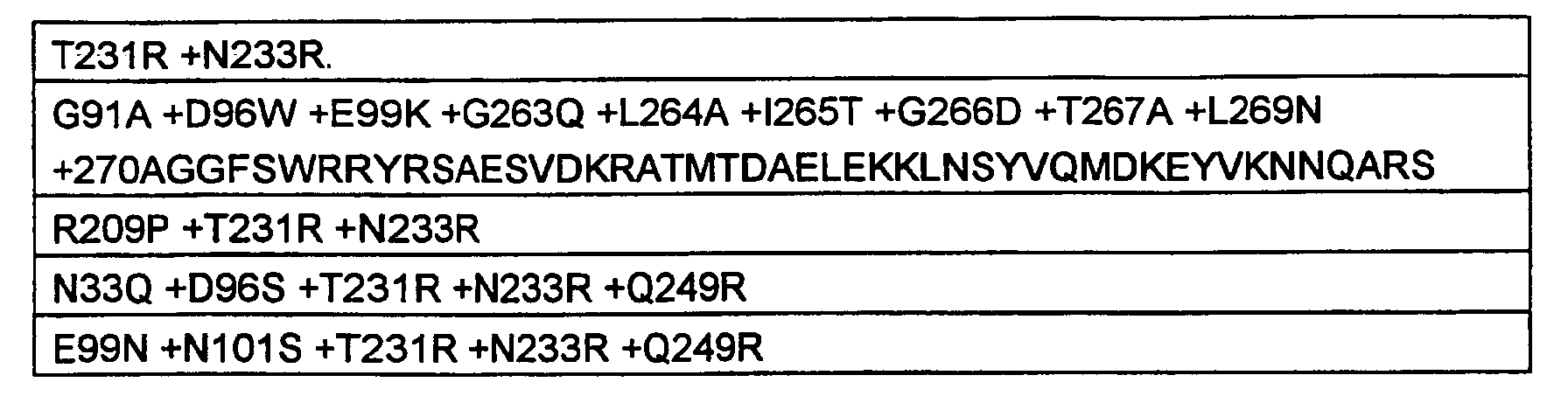
- The following 5 variants according to the invention were prepared and tested with 3 types of soiled swatches, and the parent lipase was included for comparison:
- A commercial US detergent with a high content of anionic surfactant was heated to inactivate the enzymes already present, and was used at 1.4 g/l in a Tergot-o-meter ™ laboratory washing machine. The water hardness was 6°dH (Ca:Mg 2:1), and the washing conditions were 1 cycle at 30°C for 12 minutes, followed by over-night drying on filter paper. The lipase variant was added at dosages of 6400 and 12800 LU/I. Double determinations were made in two separate washes (same TOM).
- The following three types of textile swatches tested were: Lard/Sudan Red on cotton Style 400, freshly prepared; wfk 20-LS Lipstick on polyester/cotton; and wfk 10-LS lipstick on cotton. The soil removal was evaluated by measuring the remission at 460 nm after the first washing cycle, and the results were expressed as ΔR by subtracting the remission of a blank without enzyme.
- The results were that each variant at each dosage showed an improved first-wash performance on each type of soiled swatch (ΔR of 5 to 13), whereas the parent enzyme had essentially no effect (ΔR = 0 ± 2) under the same conditions.
Claims (21)
- A lipase which is a polypeptide having an amino acid sequence which:a) has at least 90 % identity with the wild-type lipase derived from Humicola lanuginosa strain DSM 4109;b) compared to said wild-type lipase, comprises a substitution of an electrically neutral or negatively charged amino acid at the surface of the three-dimensional structure within 15 Å of E1 or Q249 with a positively charged amino acid; andc) comprises a peptide addition at the C-terminal; and/ord) meets the following limitations:i) comprises a negative amino acid in position E210 of said wild-type lipase;ii) comprises a negatively charged amino acid in the region corresponding to positions 90-101 of said wild-type lipase; andiii) comprises a neutral or negative amino acid at a position corresponding to N94 of said wild-type lipase and/or has a negative or neutral net electric charge in the region corresponding to positions 90-101 of said wild-type lipase.
- The lipase of claim 1 wherein said substitution is within 10 Å of E1 or Q249.
- The lipase of claim 1 or 2 wherein said substitution is within 15 Å (preferably 10 Å) of E1.
- The lipase of any preceding claim which comprises 2-4 (preferably two) of said substitutions.
- The lipase of any preceding claim which comprises a substitution of an electrically neutral or negatively charged amino acid within 10 Å of E1 with R.
- The lipase of any preceding claim which comprises a substitution of amino acid S3, S224, P229, T231, N233, D234 or T244 with a positively charged amino acid, preferably R.
- The lipase of any preceding claim wherein the peptide addition consists of 1-5 amino acids.
- The lipase of any preceding claim wherein the peptide addition consists of electrically neutral (preferably hydrophobic) amino acids, and is most preferably PGL or PG.
- The lipase of any of claims 1-7 wherein the peptide addition consists of neutral (preferably hydrophobic) amino acids and C, and the lipase further comprises substitution of an amino acid with C so as to form a disulfide bridge with the C of the peptide addition.
- The lipase of any preceding claim which comprises amino acids with negative or unchanged electric charge in at least two of positions N94, D96 and E99 of said wild-type lipase.
- The lipase of any preceding claim which comprises a substitution G91A, N94D/E/K/R, D96E/I/L/N/S/W, E99N/Q/K/R/H, N101S, R209P/S or Q249R/K/H.
- The lipase of any preceding claim which comprises one of the following sets of substitutions, optionally combined with Q249R/K/H and/or K98X:a) G91G/A/S/T + N94(neutral or negative) + D96D/E/C/Y + E99E/D/C/Y,b) G91G/A/S/T + N94(neutral or negative) + D96D/E/C/Y + E99N + N101S,c) G91G/A/S/T + N94R/K/H + D96D/E/C/Y + E99E/D/C/Y,d) G91G/A/S/T + N94(neutral or negative) + D96(neutral or positive) + E99E/D/C/Y, ore) G91G/A/S/T + N94(neutral or negative) + D96D/E/C/Y + E99(neutral or positive).
- The lipase of any of claims 1-11 which comprises one of the following sets of substitutions, optionally combined with R209(neutral or negative):a) E99R/K/H + Q249R/K/H,b) N94R/K/H + Q249R/K/H, orc) D96(neutral or positive) + Q249R/K/H.
- A detergent composition comprising a surfactant and the lipase of any of claims 1-13.
- The detergent composition of the preceding claim wherein the surfactant comprises anionic surfactant in an amount of more than 70 % by weight of the total surfactant.
- The detergent composition of claim 14, wherein the surfactant comprises anionic surfactant in an amount of 40-70 % by weight and nonionic surfactant in an amount of 30-60 % by weight of the total surfactant, and the lipase is the lipase of claim 8 or 9.
- The detergent composition of any of claims 14-16 which comprises 10-40 % by weight surfactant, preferably comprises 40-70 % builder, and preferably has a pH of 9-11 when dissolved in water at 0.5-5 g/l.
- A DNA sequence encoding the lipase of any of claims 1-13.
- An expression vector harboring the DNA sequence of the preceding claim.
- A transformed host cell containing the DNA sequence of claim 18 or the expression vector of claim 19.
- A method of producing the lipase of any of claims 1-13 which method comprises culturing the transformed host cell of claim 20 under conditions conducive for the production of the lipase and recovering the lipase from the resulting broth.
Priority Applications (3)
| Application Number | Priority Date | Filing Date | Title |
|---|---|---|---|
| EP10180769.1A EP2277999B1 (en) | 1999-03-31 | 2000-03-30 | Lipase variant |
| EP10180782A EP2278000A1 (en) | 1999-03-31 | 2000-03-30 | Lipase variant |
| DK10180769.1T DK2277999T3 (en) | 1999-03-31 | 2000-03-30 | Lipase variant |
Applications Claiming Priority (3)
| Application Number | Priority Date | Filing Date | Title |
|---|---|---|---|
| DK44199 | 1999-03-31 | ||
| DKPA199900441 | 1999-03-31 | ||
| EP00912423A EP1171581A1 (en) | 1999-03-31 | 2000-03-30 | Lipase variant |
Related Parent Applications (2)
| Application Number | Title | Priority Date | Filing Date |
|---|---|---|---|
| EP00912423.1 Division | 2000-03-30 | ||
| EP00912423A Division EP1171581A1 (en) | 1999-03-31 | 2000-03-30 | Lipase variant |
Related Child Applications (3)
| Application Number | Title | Priority Date | Filing Date |
|---|---|---|---|
| EP10180769.1A Division EP2277999B1 (en) | 1999-03-31 | 2000-03-30 | Lipase variant |
| EP10180769.1 Division-Into | 2010-09-28 | ||
| EP10180782.4 Division-Into | 2010-09-28 |
Publications (3)
| Publication Number | Publication Date |
|---|---|
| EP1428874A2 true EP1428874A2 (en) | 2004-06-16 |
| EP1428874A3 EP1428874A3 (en) | 2004-07-14 |
| EP1428874B1 EP1428874B1 (en) | 2013-12-18 |
Family
ID=8093585
Family Applications (3)
| Application Number | Title | Priority Date | Filing Date |
|---|---|---|---|
| EP10180782A Withdrawn EP2278000A1 (en) | 1999-03-31 | 2000-03-30 | Lipase variant |
| EP10180769.1A Expired - Lifetime EP2277999B1 (en) | 1999-03-31 | 2000-03-30 | Lipase variant |
| EP03024829.8A Expired - Lifetime EP1428874B1 (en) | 1999-03-31 | 2000-03-30 | Lipase variant |
Family Applications Before (2)
| Application Number | Title | Priority Date | Filing Date |
|---|---|---|---|
| EP10180782A Withdrawn EP2278000A1 (en) | 1999-03-31 | 2000-03-30 | Lipase variant |
| EP10180769.1A Expired - Lifetime EP2277999B1 (en) | 1999-03-31 | 2000-03-30 | Lipase variant |
Country Status (6)
| Country | Link |
|---|---|
| EP (3) | EP2278000A1 (en) |
| CN (1) | CN100455663C (en) |
| BR (1) | BRPI0009396B1 (en) |
| CA (1) | CA2366843A1 (en) |
| DK (2) | DK1428874T3 (en) |
| ES (2) | ES2498823T3 (en) |
Cited By (4)
| Publication number | Priority date | Publication date | Assignee | Title |
|---|---|---|---|---|
| WO2006084470A3 (en) * | 2005-02-10 | 2007-03-01 | Novozymes As | Enzymatic enantioselective ester or amide hydrolysis or synthesis |
| WO2006136159A3 (en) * | 2005-06-24 | 2007-04-12 | Novozymes As | Lipases for pharmaceutical use |
| WO2008079685A3 (en) * | 2006-12-21 | 2008-11-06 | Novozymes As | Lipase variants for pharmaceutical use |
| AU2013200626B2 (en) * | 2006-12-21 | 2015-03-05 | Novozymes A/S | Lipase variants for pharmaceutical use |
Families Citing this family (9)
| Publication number | Priority date | Publication date | Assignee | Title |
|---|---|---|---|---|
| ES2629332T3 (en) * | 2006-01-23 | 2017-08-08 | Novozymes A/S | Lipase variants |
| BRPI0909707A2 (en) * | 2008-02-29 | 2015-08-25 | Procter & Gamble | Detergent composition comprising lipase. |
| MX2012006616A (en) | 2009-12-09 | 2012-06-21 | Procter & Gamble | Fabric and home care products. |
| US9809787B2 (en) * | 2011-12-29 | 2017-11-07 | Novozymes A/S | Detergent compositions comprising lipase |
| DK3211074T3 (en) * | 2012-02-03 | 2020-06-02 | Novozymes As | LIPASE VARIETIES AND POLYNUCLEOTIDES CODING THEM |
| CN110093330B (en) * | 2012-10-12 | 2023-11-28 | 丹尼斯科美国公司 | Compositions and methods comprising lipolytic enzyme variants |
| ES2797725T3 (en) * | 2014-12-22 | 2020-12-03 | Novozymes As | Detergent Compositions, Lipase Variants, and Polynucleotides Encoding The Same |
| EP3320089B1 (en) * | 2015-07-06 | 2021-06-16 | Novozymes A/S | Lipase variants and polynucleotides encoding same |
| JP2020519288A (en) * | 2017-05-12 | 2020-07-02 | ビーエーエスエフ ソシエタス・ヨーロピアBasf Se | How to use lipase enzyme for washing |
Citations (11)
| Publication number | Priority date | Publication date | Assignee | Title |
|---|---|---|---|---|
| EP0258068A2 (en) | 1986-08-29 | 1988-03-02 | Novo Nordisk A/S | Enzymatic detergent additive |
| EP0305216A1 (en) | 1987-08-28 | 1989-03-01 | Novo Nordisk A/S | Recombinant Humicola lipase and process for the production of recombinant humicola lipases |
| WO1992005249A1 (en) | 1990-09-13 | 1992-04-02 | Novo Nordisk A/S | Lipase variants |
| WO1994025577A1 (en) | 1993-04-23 | 1994-11-10 | Novo Nordisk A/S | Lipase variants |
| WO1995022615A1 (en) | 1994-02-22 | 1995-08-24 | Novo Nordisk A/S | A method of preparing a variant of a lipolytic enzyme |
| WO1997004079A1 (en) | 1995-07-14 | 1997-02-06 | Novo Nordisk A/S | A modified enzyme with lipolytic activity |
| WO1997007202A1 (en) | 1995-08-11 | 1997-02-27 | Novo Nordisk A/S | Novel lipolytic enzymes |
| WO1997041212A1 (en) | 1996-04-25 | 1997-11-06 | Novo Nordisk A/S | Alkaline lipolytic enzyme |
| WO1997043375A1 (en) | 1996-05-15 | 1997-11-20 | The Procter & Gamble Company | Detergent compositions comprising specific lipolytic enzyme and a specific surfactant system |
| WO1998008939A1 (en) | 1996-08-27 | 1998-03-05 | Novo Nordisk A/S | Novel lipolytic enzymes |
| US5869438A (en) | 1990-09-13 | 1999-02-09 | Novo Nordisk A/S | Lipase variants |
Family Cites Families (5)
| Publication number | Priority date | Publication date | Assignee | Title |
|---|---|---|---|---|
| JP3715328B2 (en) * | 1992-09-21 | 2005-11-09 | 株式会社東芝 | Data processing device |
| BR9509729A (en) * | 1994-11-18 | 1997-09-30 | Procter & Gamble | Detergent compositions containing lipase and protease |
| AU3247699A (en) * | 1998-02-17 | 1999-09-06 | Novo Nordisk A/S | Lipase variant |
| EP1131416B1 (en) * | 1998-11-27 | 2009-09-02 | Novozymes A/S | Lipolytic enzyme variants |
| DK2295556T3 (en) * | 2002-01-16 | 2015-01-26 | Novozymes As | Lipolytic Enzyme Variants and Method of Preparation thereof. |
-
2000
- 2000-03-30 EP EP10180782A patent/EP2278000A1/en not_active Withdrawn
- 2000-03-30 EP EP10180769.1A patent/EP2277999B1/en not_active Expired - Lifetime
- 2000-03-30 BR BRPI0009396-3A patent/BRPI0009396B1/en active IP Right Grant
- 2000-03-30 CN CNB008059500A patent/CN100455663C/en not_active Expired - Lifetime
- 2000-03-30 CA CA002366843A patent/CA2366843A1/en not_active Abandoned
- 2000-03-30 EP EP03024829.8A patent/EP1428874B1/en not_active Expired - Lifetime
- 2000-03-30 DK DK03024829.8T patent/DK1428874T3/en active
- 2000-03-30 ES ES10180769.1T patent/ES2498823T3/en not_active Expired - Lifetime
- 2000-03-30 DK DK10180769.1T patent/DK2277999T3/en active
- 2000-03-30 ES ES03024829.8T patent/ES2445330T3/en not_active Expired - Lifetime
Patent Citations (11)
| Publication number | Priority date | Publication date | Assignee | Title |
|---|---|---|---|---|
| EP0258068A2 (en) | 1986-08-29 | 1988-03-02 | Novo Nordisk A/S | Enzymatic detergent additive |
| EP0305216A1 (en) | 1987-08-28 | 1989-03-01 | Novo Nordisk A/S | Recombinant Humicola lipase and process for the production of recombinant humicola lipases |
| WO1992005249A1 (en) | 1990-09-13 | 1992-04-02 | Novo Nordisk A/S | Lipase variants |
| US5869438A (en) | 1990-09-13 | 1999-02-09 | Novo Nordisk A/S | Lipase variants |
| WO1994025577A1 (en) | 1993-04-23 | 1994-11-10 | Novo Nordisk A/S | Lipase variants |
| WO1995022615A1 (en) | 1994-02-22 | 1995-08-24 | Novo Nordisk A/S | A method of preparing a variant of a lipolytic enzyme |
| WO1997004079A1 (en) | 1995-07-14 | 1997-02-06 | Novo Nordisk A/S | A modified enzyme with lipolytic activity |
| WO1997007202A1 (en) | 1995-08-11 | 1997-02-27 | Novo Nordisk A/S | Novel lipolytic enzymes |
| WO1997041212A1 (en) | 1996-04-25 | 1997-11-06 | Novo Nordisk A/S | Alkaline lipolytic enzyme |
| WO1997043375A1 (en) | 1996-05-15 | 1997-11-20 | The Procter & Gamble Company | Detergent compositions comprising specific lipolytic enzyme and a specific surfactant system |
| WO1998008939A1 (en) | 1996-08-27 | 1998-03-05 | Novo Nordisk A/S | Novel lipolytic enzymes |
Non-Patent Citations (1)
| Title |
|---|
| NEEDLEMAN, S.B.; WUNSCH, C.D., JOURNAL OF MOLECULAR BIOLOGY, vol. 48, 1970, pages 443 - 45 |
Cited By (8)
| Publication number | Priority date | Publication date | Assignee | Title |
|---|---|---|---|---|
| WO2006084470A3 (en) * | 2005-02-10 | 2007-03-01 | Novozymes As | Enzymatic enantioselective ester or amide hydrolysis or synthesis |
| WO2006136159A3 (en) * | 2005-06-24 | 2007-04-12 | Novozymes As | Lipases for pharmaceutical use |
| WO2008079685A3 (en) * | 2006-12-21 | 2008-11-06 | Novozymes As | Lipase variants for pharmaceutical use |
| US8273348B2 (en) | 2006-12-21 | 2012-09-25 | Novozymes A/S | Lipase variants for pharmaceutical use |
| AU2013200626B2 (en) * | 2006-12-21 | 2015-03-05 | Novozymes A/S | Lipase variants for pharmaceutical use |
| US9029115B2 (en) | 2006-12-21 | 2015-05-12 | Novozymes A/S | Lipase variants for pharmaceutical use |
| EP2455462B1 (en) * | 2006-12-21 | 2016-03-16 | Novozymes A/S | Lipase variants for pharmaceutical use |
| US9539311B2 (en) | 2006-12-21 | 2017-01-10 | Novozymes A/S | Lipase variants for pharmaceutical use |
Also Published As
| Publication number | Publication date |
|---|---|
| EP2277999A1 (en) | 2011-01-26 |
| DK2277999T3 (en) | 2014-09-22 |
| BR0009396A (en) | 2002-01-08 |
| CA2366843A1 (en) | 2000-10-12 |
| EP1428874B1 (en) | 2013-12-18 |
| CN1409760A (en) | 2003-04-09 |
| BRPI0009396B1 (en) | 2021-01-05 |
| ES2445330T3 (en) | 2014-03-03 |
| DK1428874T3 (en) | 2014-03-10 |
| CN100455663C (en) | 2009-01-28 |
| ES2498823T3 (en) | 2014-09-25 |
| EP2277999B1 (en) | 2014-07-02 |
| EP1428874A3 (en) | 2004-07-14 |
| EP2278000A1 (en) | 2011-01-26 |
Similar Documents
| Publication | Publication Date | Title |
|---|---|---|
| US6939702B1 (en) | Lipase variant | |
| US6624129B1 (en) | Lipase variant | |
| US7157263B2 (en) | Lipase variants | |
| EP1185630B1 (en) | Chemically modified lipolytic enzyme | |
| RU2394879C2 (en) | Polymer-containing detergent compositions and use thereof | |
| US20090192066A1 (en) | Detergent compositions | |
| EP1428874B1 (en) | Lipase variant | |
| US20080214425A1 (en) | Detergent Compositions | |
| KR20070103764A (en) | Detergent composition | |
| CN101432411B (en) | Detergent compositions | |
| US20070197423A1 (en) | Detergent compositions |
Legal Events
| Date | Code | Title | Description |
|---|---|---|---|
| PUAI | Public reference made under article 153(3) epc to a published international application that has entered the european phase |
Free format text: ORIGINAL CODE: 0009012 |
|
| PUAL | Search report despatched |
Free format text: ORIGINAL CODE: 0009013 |
|
| AC | Divisional application: reference to earlier application |
Ref document number: 1171581 Country of ref document: EP Kind code of ref document: P |
|
| AK | Designated contracting states |
Kind code of ref document: A2 Designated state(s): AT BE CH CY DE DK ES FI FR GB GR IE IT LI LU MC NL PT SE |
|
| AK | Designated contracting states |
Kind code of ref document: A3 Designated state(s): AT BE CH CY DE DK ES FI FR GB GR IE IT LI LU MC NL PT SE |
|
| RIC1 | Information provided on ipc code assigned before grant |
Ipc: 7C 12N 5/10 B Ipc: 7C 11D 3/386 B Ipc: 7C 12N 9/20 A |
|
| 17P | Request for examination filed |
Effective date: 20050114 |
|
| AKX | Designation fees paid |
Designated state(s): AT BE CH CY DE DK ES FI FR GB GR IE IT LI LU MC NL PT SE |
|
| 17Q | First examination report despatched |
Effective date: 20070911 |
|
| GRAP | Despatch of communication of intention to grant a patent |
Free format text: ORIGINAL CODE: EPIDOSNIGR1 |
|
| INTG | Intention to grant announced |
Effective date: 20130725 |
|
| GRAS | Grant fee paid |
Free format text: ORIGINAL CODE: EPIDOSNIGR3 |
|
| GRAA | (expected) grant |
Free format text: ORIGINAL CODE: 0009210 |
|
| AC | Divisional application: reference to earlier application |
Ref document number: 1171581 Country of ref document: EP Kind code of ref document: P |
|
| AK | Designated contracting states |
Kind code of ref document: B1 Designated state(s): AT BE CH CY DE DK ES FI FR GB GR IE IT LI LU MC NL PT SE |
|
| REG | Reference to a national code |
Ref country code: GB Ref legal event code: FG4D |
|
| REG | Reference to a national code |
Ref country code: CH Ref legal event code: EP |
|
| REG | Reference to a national code |
Ref country code: AT Ref legal event code: REF Ref document number: 645658 Country of ref document: AT Kind code of ref document: T Effective date: 20140115 |
|
| REG | Reference to a national code |
Ref country code: IE Ref legal event code: FG4D |
|
| REG | Reference to a national code |
Ref country code: DE Ref legal event code: R096 Ref document number: 60048379 Country of ref document: DE Effective date: 20140206 |
|
| REG | Reference to a national code |
Ref country code: ES Ref legal event code: FG2A Ref document number: 2445330 Country of ref document: ES Kind code of ref document: T3 Effective date: 20140303 |
|
| REG | Reference to a national code |
Ref country code: NL Ref legal event code: T3 |
|
| REG | Reference to a national code |
Ref country code: DK Ref legal event code: T3 Effective date: 20140306 |
|
| PG25 | Lapsed in a contracting state [announced via postgrant information from national office to epo] |
Ref country code: SE Free format text: LAPSE BECAUSE OF FAILURE TO SUBMIT A TRANSLATION OF THE DESCRIPTION OR TO PAY THE FEE WITHIN THE PRESCRIBED TIME-LIMIT Effective date: 20131218 |
|
| REG | Reference to a national code |
Ref country code: AT Ref legal event code: MK05 Ref document number: 645658 Country of ref document: AT Kind code of ref document: T Effective date: 20131218 |
|
| PG25 | Lapsed in a contracting state [announced via postgrant information from national office to epo] |
Ref country code: CY Free format text: LAPSE BECAUSE OF FAILURE TO SUBMIT A TRANSLATION OF THE DESCRIPTION OR TO PAY THE FEE WITHIN THE PRESCRIBED TIME-LIMIT Effective date: 20131218 Ref country code: AT Free format text: LAPSE BECAUSE OF FAILURE TO SUBMIT A TRANSLATION OF THE DESCRIPTION OR TO PAY THE FEE WITHIN THE PRESCRIBED TIME-LIMIT Effective date: 20131218 Ref country code: PT Free format text: LAPSE BECAUSE OF FAILURE TO SUBMIT A TRANSLATION OF THE DESCRIPTION OR TO PAY THE FEE WITHIN THE PRESCRIBED TIME-LIMIT Effective date: 20140418 |
|
| REG | Reference to a national code |
Ref country code: DE Ref legal event code: R097 Ref document number: 60048379 Country of ref document: DE |
|
| PLBE | No opposition filed within time limit |
Free format text: ORIGINAL CODE: 0009261 |
|
| STAA | Information on the status of an ep patent application or granted ep patent |
Free format text: STATUS: NO OPPOSITION FILED WITHIN TIME LIMIT |
|
| PG25 | Lapsed in a contracting state [announced via postgrant information from national office to epo] |
Ref country code: LU Free format text: LAPSE BECAUSE OF FAILURE TO SUBMIT A TRANSLATION OF THE DESCRIPTION OR TO PAY THE FEE WITHIN THE PRESCRIBED TIME-LIMIT Effective date: 20140330 |
|
| REG | Reference to a national code |
Ref country code: CH Ref legal event code: PL |
|
| 26N | No opposition filed |
Effective date: 20140919 |
|
| REG | Reference to a national code |
Ref country code: IE Ref legal event code: MM4A Ref country code: DE Ref legal event code: R097 Ref document number: 60048379 Country of ref document: DE Effective date: 20140919 |
|
| PG25 | Lapsed in a contracting state [announced via postgrant information from national office to epo] |
Ref country code: IE Free format text: LAPSE BECAUSE OF NON-PAYMENT OF DUE FEES Effective date: 20140330 Ref country code: CH Free format text: LAPSE BECAUSE OF NON-PAYMENT OF DUE FEES Effective date: 20140331 Ref country code: LI Free format text: LAPSE BECAUSE OF NON-PAYMENT OF DUE FEES Effective date: 20140331 |
|
| REG | Reference to a national code |
Ref country code: FR Ref legal event code: PLFP Year of fee payment: 17 |
|
| PG25 | Lapsed in a contracting state [announced via postgrant information from national office to epo] |
Ref country code: MC Free format text: LAPSE BECAUSE OF FAILURE TO SUBMIT A TRANSLATION OF THE DESCRIPTION OR TO PAY THE FEE WITHIN THE PRESCRIBED TIME-LIMIT Effective date: 20131218 |
|
| PG25 | Lapsed in a contracting state [announced via postgrant information from national office to epo] |
Ref country code: GR Free format text: LAPSE BECAUSE OF FAILURE TO SUBMIT A TRANSLATION OF THE DESCRIPTION OR TO PAY THE FEE WITHIN THE PRESCRIBED TIME-LIMIT Effective date: 20140319 |
|
| REG | Reference to a national code |
Ref country code: FR Ref legal event code: PLFP Year of fee payment: 18 |
|
| REG | Reference to a national code |
Ref country code: FR Ref legal event code: PLFP Year of fee payment: 19 |
|
| PGFP | Annual fee paid to national office [announced via postgrant information from national office to epo] |
Ref country code: IT Payment date: 20190322 Year of fee payment: 20 Ref country code: FR Payment date: 20190325 Year of fee payment: 20 Ref country code: DE Payment date: 20190327 Year of fee payment: 20 Ref country code: FI Payment date: 20190327 Year of fee payment: 20 |
|
| PGFP | Annual fee paid to national office [announced via postgrant information from national office to epo] |
Ref country code: DK Payment date: 20190327 Year of fee payment: 20 Ref country code: NL Payment date: 20190326 Year of fee payment: 20 Ref country code: BE Payment date: 20190327 Year of fee payment: 20 |
|
| PGFP | Annual fee paid to national office [announced via postgrant information from national office to epo] |
Ref country code: ES Payment date: 20190401 Year of fee payment: 20 |
|
| PGFP | Annual fee paid to national office [announced via postgrant information from national office to epo] |
Ref country code: GB Payment date: 20190404 Year of fee payment: 20 |
|
| REG | Reference to a national code |
Ref country code: DE Ref legal event code: R071 Ref document number: 60048379 Country of ref document: DE |
|
| REG | Reference to a national code |
Ref country code: NL Ref legal event code: MK Effective date: 20200329 |
|
| REG | Reference to a national code |
Ref country code: DK Ref legal event code: EUP Expiry date: 20200330 |
|
| REG | Reference to a national code |
Ref country code: GB Ref legal event code: PE20 Expiry date: 20200329 |
|
| PG25 | Lapsed in a contracting state [announced via postgrant information from national office to epo] |
Ref country code: GB Free format text: LAPSE BECAUSE OF EXPIRATION OF PROTECTION Effective date: 20200329 |
|
| REG | Reference to a national code |
Ref country code: BE Ref legal event code: MK Effective date: 20200330 |
|
| REG | Reference to a national code |
Ref country code: FI Ref legal event code: MAE |
|
| REG | Reference to a national code |
Ref country code: ES Ref legal event code: FD2A Effective date: 20200904 |
|
| PG25 | Lapsed in a contracting state [announced via postgrant information from national office to epo] |
Ref country code: ES Free format text: LAPSE BECAUSE OF EXPIRATION OF PROTECTION Effective date: 20200331 |