EP1428853A1 - Propylene polymer composition with improved balance of mechanical and optical properties - Google Patents
Propylene polymer composition with improved balance of mechanical and optical properties Download PDFInfo
- Publication number
- EP1428853A1 EP1428853A1 EP02027393A EP02027393A EP1428853A1 EP 1428853 A1 EP1428853 A1 EP 1428853A1 EP 02027393 A EP02027393 A EP 02027393A EP 02027393 A EP02027393 A EP 02027393A EP 1428853 A1 EP1428853 A1 EP 1428853A1
- Authority
- EP
- European Patent Office
- Prior art keywords
- comonomer
- mol
- propylene
- phase
- polymer composition
- Prior art date
- Legal status (The legal status is an assumption and is not a legal conclusion. Google has not performed a legal analysis and makes no representation as to the accuracy of the status listed.)
- Withdrawn
Links
- 0 CCC(CC)(N)OP1(Oc2c(*)cc(*)cc2*c2cc(*)cc(*)c2O1)=O Chemical compound CCC(CC)(N)OP1(Oc2c(*)cc(*)cc2*c2cc(*)cc(*)c2O1)=O 0.000 description 1
Images


Classifications
-
- C—CHEMISTRY; METALLURGY
- C08—ORGANIC MACROMOLECULAR COMPOUNDS; THEIR PREPARATION OR CHEMICAL WORKING-UP; COMPOSITIONS BASED THEREON
- C08F—MACROMOLECULAR COMPOUNDS OBTAINED BY REACTIONS ONLY INVOLVING CARBON-TO-CARBON UNSATURATED BONDS
- C08F210/00—Copolymers of unsaturated aliphatic hydrocarbons having only one carbon-to-carbon double bond
- C08F210/04—Monomers containing three or four carbon atoms
- C08F210/06—Propene
-
- C—CHEMISTRY; METALLURGY
- C08—ORGANIC MACROMOLECULAR COMPOUNDS; THEIR PREPARATION OR CHEMICAL WORKING-UP; COMPOSITIONS BASED THEREON
- C08F—MACROMOLECULAR COMPOUNDS OBTAINED BY REACTIONS ONLY INVOLVING CARBON-TO-CARBON UNSATURATED BONDS
- C08F297/00—Macromolecular compounds obtained by successively polymerising different monomer systems using a catalyst of the ionic or coordination type without deactivating the intermediate polymer
- C08F297/06—Macromolecular compounds obtained by successively polymerising different monomer systems using a catalyst of the ionic or coordination type without deactivating the intermediate polymer using a catalyst of the coordination type
- C08F297/08—Macromolecular compounds obtained by successively polymerising different monomer systems using a catalyst of the ionic or coordination type without deactivating the intermediate polymer using a catalyst of the coordination type polymerising mono-olefins
- C08F297/083—Macromolecular compounds obtained by successively polymerising different monomer systems using a catalyst of the ionic or coordination type without deactivating the intermediate polymer using a catalyst of the coordination type polymerising mono-olefins the monomers being ethylene or propylene
-
- C—CHEMISTRY; METALLURGY
- C08—ORGANIC MACROMOLECULAR COMPOUNDS; THEIR PREPARATION OR CHEMICAL WORKING-UP; COMPOSITIONS BASED THEREON
- C08L—COMPOSITIONS OF MACROMOLECULAR COMPOUNDS
- C08L23/00—Compositions of homopolymers or copolymers of unsaturated aliphatic hydrocarbons having only one carbon-to-carbon double bond; Compositions of derivatives of such polymers
- C08L23/02—Compositions of homopolymers or copolymers of unsaturated aliphatic hydrocarbons having only one carbon-to-carbon double bond; Compositions of derivatives of such polymers not modified by chemical after-treatment
- C08L23/10—Homopolymers or copolymers of propene
- C08L23/14—Copolymers of propene
-
- C—CHEMISTRY; METALLURGY
- C08—ORGANIC MACROMOLECULAR COMPOUNDS; THEIR PREPARATION OR CHEMICAL WORKING-UP; COMPOSITIONS BASED THEREON
- C08L—COMPOSITIONS OF MACROMOLECULAR COMPOUNDS
- C08L2205/00—Polymer mixtures characterised by other features
- C08L2205/02—Polymer mixtures characterised by other features containing two or more polymers of the same C08L -group
-
- C—CHEMISTRY; METALLURGY
- C08—ORGANIC MACROMOLECULAR COMPOUNDS; THEIR PREPARATION OR CHEMICAL WORKING-UP; COMPOSITIONS BASED THEREON
- C08L—COMPOSITIONS OF MACROMOLECULAR COMPOUNDS
- C08L2205/00—Polymer mixtures characterised by other features
- C08L2205/22—Mixtures comprising a continuous polymer matrix in which are dispersed crosslinked particles of another polymer
-
- C—CHEMISTRY; METALLURGY
- C08—ORGANIC MACROMOLECULAR COMPOUNDS; THEIR PREPARATION OR CHEMICAL WORKING-UP; COMPOSITIONS BASED THEREON
- C08L—COMPOSITIONS OF MACROMOLECULAR COMPOUNDS
- C08L23/00—Compositions of homopolymers or copolymers of unsaturated aliphatic hydrocarbons having only one carbon-to-carbon double bond; Compositions of derivatives of such polymers
- C08L23/02—Compositions of homopolymers or copolymers of unsaturated aliphatic hydrocarbons having only one carbon-to-carbon double bond; Compositions of derivatives of such polymers not modified by chemical after-treatment
- C08L23/16—Ethylene-propylene or ethylene-propylene-diene copolymers
-
- C—CHEMISTRY; METALLURGY
- C08—ORGANIC MACROMOLECULAR COMPOUNDS; THEIR PREPARATION OR CHEMICAL WORKING-UP; COMPOSITIONS BASED THEREON
- C08L—COMPOSITIONS OF MACROMOLECULAR COMPOUNDS
- C08L2308/00—Chemical blending or stepwise polymerisation process with the same catalyst
-
- C—CHEMISTRY; METALLURGY
- C08—ORGANIC MACROMOLECULAR COMPOUNDS; THEIR PREPARATION OR CHEMICAL WORKING-UP; COMPOSITIONS BASED THEREON
- C08L—COMPOSITIONS OF MACROMOLECULAR COMPOUNDS
- C08L2314/00—Polymer mixtures characterised by way of preparation
- C08L2314/02—Ziegler natta catalyst
Definitions
- the invention relates to a propylene polymer composition comprising a random propylene copolymer, having an improved balance of mechanical and optical properties, especially very good softness, transparency, and impact strength. More particularly, the invention relates to a propylene polymer composition comprising a random propylene copolymer, having a total comonomer content ⁇ 12.0 mol% and having an improved balance of softness, transparency and low-temperature impact strength. The present invention also relates to a process for the production of such a polymer composition.
- the propylene polymer composition to which the invention relates comprises a random propylene copolymer, the comonomer being ethylene and/or one or more C 4 -C 10 ⁇ -olefins, having a total comonomer content ⁇ 12.0 mol%, preferably ⁇ 15.0 mol%, the random propylene copolymer comprising at least two distinct phases.
- Soft polypropylenes have been a development target for several years. Optimally, these materials should combine a number of properties, which are difficult to achieve simultaneously, especially a melting point above 100 °C (or, for sterilisation applications, above 120 °C) with good transparency and a certain low-temperature impact strength.
- the application areas for such materials are wide and are determined by those current polymers which are intended to be replaced, like plasticised poly(vinyl chloride) (s-PVC) styrene elastomers (e.g. styrene-ethylene-butene-styrene block copolymers, SEBS) or thermoplastic poly(urethanes) (TPU).
- s-PVC plasticised poly(vinyl chloride)
- SEBS styrene-ethylene-butene-styrene block copolymers
- TPU thermoplastic poly(urethanes)
- the object of the present invention has been achieved by a propylene polymer composition
- a propylene polymer composition comprising a random propylene copolymer, the comonomer being ethylene and/or one or more C 4 -C 10 ⁇ -olefins, having a total comonomer content ⁇ 12 mol%, preferably ⁇ 15 mol%, the random propylene copolymer comprising at least two distinct phases, where the at least two phases are forming a co-continuous interpenetrating network structure, determined with Transmission Electron Microscopy after contrasting with RuO 4 .
- Such network structures are defined for example by Sperling (in: D. Klempner, L.H.sperling and L.A. Utracki (Eds.) Interpenetrating Polymer Networks, ACS, Washington DC 1994, pages 3-38).
- Such systems exhibit a dual phase continuity, where two polymers in the system are continuous on a microscopic scale. It has been found, that a random propylene copolymer with high comonomer content which comprises at least two phases forming a co-continuous interpenetrating network structure is able to have the desired properties. Due to a partial miscibility of the components in the molten stage the co-continuous morphology is formed parallel to the solidification process by spinodal decomposition.
- novel propylene polymer compositions do not have a "classic" heterophasic structure, which is characterised by just one continuous phase with a second embedded distinct discontinuous phase.
- novel propylene polymer compositions have a heterophasic structure which is characterised by two continuous phases, which are structured in the nanometer-range. As a consequence of the very fine-structured morphology and the low difference in refractive index between the phases the novel propylene polymer compositions retain their transparency up to very high comonomer contents. Phase morphologies have been previously identified in the toughened composite resin art as comprising four distinct types.
- a homogeneous morphology is defined essentially as lacking identifiable structures at a certain magnification.
- a particulate morphology is defined as specks of a discontinuous phase surrounded by a larger continuous phase (e.g. a "classic" heterophasic copolymer, where the discontinuous phase normally has an additional heterogeneity and is separated into typically two phases of different crystallinity, which are mostly referred to as polyethylene phase and ethylene-propylene-rubber phase).
- Phase inverted morphology is defined as islands of a discontinuous phase in a smaller continuous phase.
- the co-continuous morphology is characterised by the presence of at least two phases with microscopic continuity.
- One or both of the phases may additionally exist in a minor fraction as dispersed particles in the respective other phase.
- one or more additional phases may exist in this form.
- phase morphologies are defined at comparable magnifications and comparable microscopic techniques relating both to preparation and image acquisition, and that at some magnifications the above distinctions may be less clear.
- transmission electron micrographs (TEM) with magnifications of 10.000 to 30.000 acquired after contrasting the specimen with RuO 4 to improve the distinction between phases of different crystallinity were found to be suitable.
- the random propylene copolymers of the invention have a comonomer content of ⁇ 12 mol%, preferably of ⁇ 15 mol%, still more preferably of ⁇ 18 mol%. Higher comonomer contents are - as a rule of thumb - more preferred for softer products.
- the random propylene copolymer comprises
- the upper limit of the overall comonomer content is about 50 mol%, preferably about 45 mol%.
- the random propylene copolymer comprises
- the first phase A of the inventive propylene copolymers comprises a semicrystalline phase, containing 2 - 15 mol%, preferably 2 - 12 mol% comonomer.
- the second phase B of the inventive propylene copolymers comprises an elastomeric phase, containing 20 - 70 mol%, preferably 25 - 65 mol% comonomer.
- the propylene copolymer of which the first phase of the inventive random copolymer is comprised may be a binary copolymer or may be comprised of more than two comonomers, e.g. be a terpolymer.
- the propylene copolymer of which the second phase of the inventive random copolymer is comprised may also be a binary copolymer or may be comprised of more than two comonomers, e.g. be a terpolymer.
- the comonomers are ethylene, 1-butene, 1-pentene, 4-methyl-1-pentene, 1-hexene, 1-heptene or 1-octene. Preferred are ethene and/or 1-butene.
- Examples for the propylene copolymer of the first phase are propylene/ethylene, propylene/butene and propylene/ethylene/butene polymers.
- Examples for the propylene copolymer of the second phase are propylene/ethylene and propylene/ethylene/butene polymers.
- comonomer is ethylene.
- first as well as the second phase is comprised of a binary copolymer with ethylene as the comonomer.
- the polymer composition of the present invention exhibits at least one melting point > 130 °C (DSC), the melting point being associated to a melting enthalpy of ⁇ 20 J/g.
- the polymer compositions usually exhibit at least two different melting points.
- the melting point > 130 °C usually is associated with the first phase, i.e. with the phase having the lower comonomer content.
- This melting point is associated to a melting enthalpy of ⁇ 20 J/g, preferably ⁇ 25 J/g, with higher melting enthalpies indicating higher crystallinities of the phase.
- Some embodiments exhibit more than one melting point, for example two melting points.
- the second melting point which is associated with the second phase, is usually smaller than that of the first phase and being associated with a melting enthalpy which is smaller than that of the melting point of the first phase, thereby indicating higher comonomer contents and smaller crystallinities of the second phase.
- the random propylene copolymer of the propylene polymer composition of the present invention has a total amount of fully randomised comonomer of ⁇ 9.0 mol%, preferably of ⁇ 10.0 mol%.
- fully randomised means those comonomer units occurring in groups no larger than two consecutive comonomer units. For example, in a linear propylene copolymer the consecutive occurrence of three or more comonomer units would not be considered as “fully randomised” with respect to the comonomer units.
- the propylene polymer composition of the present invention comprises a blend of at least two random propylene copolymers. It is in some cases possible to tailor the properties of the propylene polymer composition by compounding two or more random propylene copolymers (each having at least two distinct phases forming a co-continuous interpenetrating network).
- the result of compounding two of these random copolymers may for example be a propylene polymer composition comprising two distinct phases forming a co-continuous interpenetrating network and a third, discontinuous phase.
- the propylene polymer composition of the present invention therefore comprises at least one further phase, the further phase being discontinuous.
- the propylene polymer composition of the present invention may comprise one or more clarifying and/or ⁇ -nucleating agents. Some embodiments of the invention may contain clarifyers and/or ⁇ -nucleating agents in order to achieve the desired level of transparency.
- ⁇ -nucleating agents employable herein, and various ⁇ -nucleating agents conventionally known can be used. Of the various ⁇ -nucleating agents, those represented by the following formulae and those explicitly mentioned are considered particularly suitable.
- R1 is oxygen, sulphur or a hydrocarbon group of 1 to 10 carbon atoms
- each of R2 and R3 is hydrogen or a hydrocarbon group of 1 to 10 carbon atoms
- R2 and R3 may be the same or different from each other
- two of R2, two of R3, or R2 and R3 may be bonded together to form a ring
- M is a monovalent to trivalent metal atom
- n is an integer from 1 to 3.
- sodium-2,2'-methylene-bis(4,6-di-t-butylphenyl)phosphate is preferred.
- R4 is hydrogen or a hydrocarbon group of 1 to 10 carbon atoms
- M is a monovalent to trivalent metal atom
- n is an integer of 1 to 3.
- nucleating agents represented by the above formula include sodium-bis(4-t-butylphenyl)phosphate, sodium-bis(4-methylphenyl)phosphate, sodium-bis(4-ethylphenyl)phosphate, sodium-bis(4-i-propylphenyl) phosphate, sodium-bis(4-t-octylphenyl)phosphate, potassium-bis(4-t-butylphenyl)phosphate, calcium-bis(4-t-butylpheyl) phosphate, magnesium-bis(4-t-butylpheyl)phosphate, lithium-bis(4-t-butylpheyl)phosphate and aluminium-bis(4-t-butylpheyl)phosphate.
- each of R5 and R6 is hydrogen or a hydrocarbon group of 1 to 10 carbon atoms; R5 and R6 may be the same or different from each other.
- nucleating agents represented by the above formula include 1,3,2,4-dibenzylidenesorbitol, 1,3-benzylidene-2,4-p-methylbenzylidenesorbitol, 1,3-benzylidene-2,4-p-ethylbenzylidenesorbitol, 1,3-p-methylbenzylidene-2,4-benzylidenesorbitol, 1,3-p-ethylbenzylidene-2,4-benzylidenesorbitol, 1,3-p-methylbenzylidene-2,4-p-ethylbenzylidenesorbitol, 1,3-p-ethylbenzylidene-2,4-p-methylbenzylidenesorbitol, 1,3,2,4-di(p-methylbenzylidene)sorbitol, 1,3,2,4-di(p-ethylbenzylidene)sorbitol, 1,3,2,4-di(p-eth
- 1,3,2,4-dibenzylidenesorbitol 1,3,2,4-di(p-methylbenzylidene)sorbitol, 1,3,2,4-di(p-ethylbenzylidene)sorbitol, 1,3-p-chlorobenzylidene-2,4-p-methylbenzylidenesorbitol, 1,3,2,4-di(p-chlorobenzylidene)sorbitol and 1,3,2,4-di(3',4'-dimethylbenzylidene)sorbitol are preferred.
- nucleating agents such as metallic salts of aromatic carboxylic acids and metallic salts of aliphatic carboxylic acids. Specific examples thereof include sodium benzoate, aluminium benzoate, aluminium p-t-butylbenzoate, sodium adipate, sodium thiophenecarboxylate and sodium pyrrolecarboxylate.
- any one or mixtures of two or more of the above mentioned ⁇ -nucleating agents may also be used.
- 1,3,2,4-di(3',4'-dimethylbenzylidene)sorbitol is particularly preferred.
- a still further ⁇ -nucleating agent, which is also among those which are particularly preferred and which has not been mentioned above, is commercially available from Asahi Denka Kogyo (Japan) under the name "ADK STAB NA21E".
- the ⁇ -nucleating agent is used in an amount of 0.001 to 10 wt%, preferably 0.01 to 5 wt%, more preferably 0.01 to 1 wt%.
- ⁇ -nucleating agents By using one or more of the above-mentioned ⁇ -nucleating agents in the aforementioned amounts it is possible to obtain propylene polymer compositions having very good transparency while still maintaining the improved balance of softness, transparency and low-temperature impact strength.
- a further advantage of the application of such nucleating agents is the possibility to increase the processing speed, for example by reducing the cycle time in an injection moulding process.
- This object is achieved by a process comprising polymerisation of propylene with a comonomer, the comonomer being ethylene and/or one or more C 4 -C 10 ⁇ -olefins, in the presence of a catalyst in a gas polymerisation process, where the amounts of propylene and comonomer being fed to the gas polymerisation process are chosen in order to adjust a comonomer-content of the random propylene copolymer of ⁇ 12 mol%, preferably of ⁇ 15 mol%, still more preferably of ⁇ 18 mol% and where the catalyst is selected from the class of Ziegler-Natta-type catalysts and where the temperature in the gas polymerisation process is > 75 °C and the pressure in the gas polymerisation process is > 2.0 MPa.
- a high isotacticity Ziegler-Natta type catalyst with a strong internal donor (e.g. di-alkyl-phthalate based) and an average particle size of 25 to 90 ⁇ m (e.g. Borealis BHC01P) has to be used to allow sufficient crystallinity in the more crystalline part of the polymer.
- a seeding bed material consisting essentially of polypropylene has to be used in a quantity of 5 - 35 wt% of the final polymer quantity, and a constant comonomer stream has to be used to optimise the random incorporation.
- the seeding bed material is normally already present and the constant comonomer feed normally given as well.
- the process for preparing the random propylene polymers is in its basic embodiment a single step process, comprising a single gas polymerisation step.
- the gas phase polymerisation is preceded by a bulk phase polymerisation.
- the result of the bulk phase polymerisation preceding the gas phase polymerisation may be a homopolymer. Since however the product of the subsequent gas phase polymerisation as described above is a polymer having at least two distinct phases forming a co-continuous interpenetrating network, this product is considered to be a random propylene copolymer for the purpose of the present invention.
- the invention also encompasses an article comprising a propylene polymer composition according to the invention as described herein before.
- Such articles preferably are films, especially cast film and oriented films, e.g. BOPP films, injection moulded thin-walled parts, blow moulded hollow bodies and injection stretch blow moulded hollow bodies.
- films especially cast film and oriented films, e.g. BOPP films, injection moulded thin-walled parts, blow moulded hollow bodies and injection stretch blow moulded hollow bodies.
- the concerned polymers have been produced via 1-step gas phase polymerisation or 2-step bulk/gas phase polymerisation in a 20 litre autoclave with special geometry and equipped with double helical stirring device.
- Catalyst complex used is BHC01P (Borealis; solid, high isotacticity Ziegler/Natta type catalyst supported on magnesium dichloride with a di-alkyl-phthalate internal donor and an average particle size in the range of from 40 to 80 ⁇ m in combination with Triethylaluminium (TEAL; Aldrich) as cocatalyst (used as 1-molar hexane solution), and donor Dicyclopentyldimethoxysilane (Wacker) used as 0.3-molar hexane solution.
- TEAL Triethylaluminium
- Wacker Dicyclopentyldimethoxysilane
- 1-step gas phase polymerisation is started by dosing the catalyst complex (mixing TEAL and donor for 5 min and reacting this solution with solid catalyst component for an additional 5 min) with liquid propylene to the reactor filled with 250 g pelletised polypropylene (from earlier runs without stabilisers, but adjusted with high density filler for easier separation of reactor product by flotation; pellets purified by vacuuming and nitrogen spilling at 135 °C; enables satisfying bed conditions in the early stage of gas phase polymerisation), ⁇ 600 g liquid propylene, adequate amount of H 2 for achieving the aspired MFR and ethylene flow of 0.3 nl/min.
- the catalyst complex mixtureing TEAL and donor for 5 min and reacting this solution with solid catalyst component for an additional 5 min
- liquid propylene to the reactor filled with 250 g pelletised polypropylene (from earlier runs without stabilisers, but adjusted with high density filler for easier separation of reactor product by flotation; pellets purified by vacuuming and nitrogen spilling at 135 °C; enables
- the temperature controller is set to temperature of bulk polymerisation and constant ethylene flow is adjusted to achieve aspired ethylene concentration in bulk product.
- temperature control is set to gas phase polymerisation temperature and monomers are flashed down to ⁇ 1.5 MPa total pressure to achieve gas phase conditions controlling in parallel ethylene flow.
- ethylene flow is adjusted to reach target ethylene content in gas phase part of product.
- predetermined residence time to adjust mass ratio of bulk and gas phase part of product, polymerisation is stopped by flashing and cooling.
- Reactor products are pelletised via TSE16 extruder (PRISM) and additivated with 0.2 % Irganox B225, 0.1 % Ca-stearate and 0.06 % glycerine monostearate. All samples have been nucleated with 1,3,2,4-di(3',4'-dimethylbenzylidene)sorbitol.
- PRISM TSE16 extruder
- Prepolymerisation was performed in 20 l reactor filled with 250 g pelletised polypropylene, 850 g liquid propylene, 24 nl H2 and ⁇ 0.35 nl/min ethylene flow at 23 °C. After 7 minutes temperature control is set to 95 °C. When the temperature reaches 50 °C the constant ethylene flow is increased to 4.5 nl/min and propylene dosing in parallel is set to arrive and hold 3.9 MPa at 95 °C. After 60 min residence time polymerisation resulted in 1683 g of polymer. Catalyst activity was 54.8 kg/g cat ⁇ h.
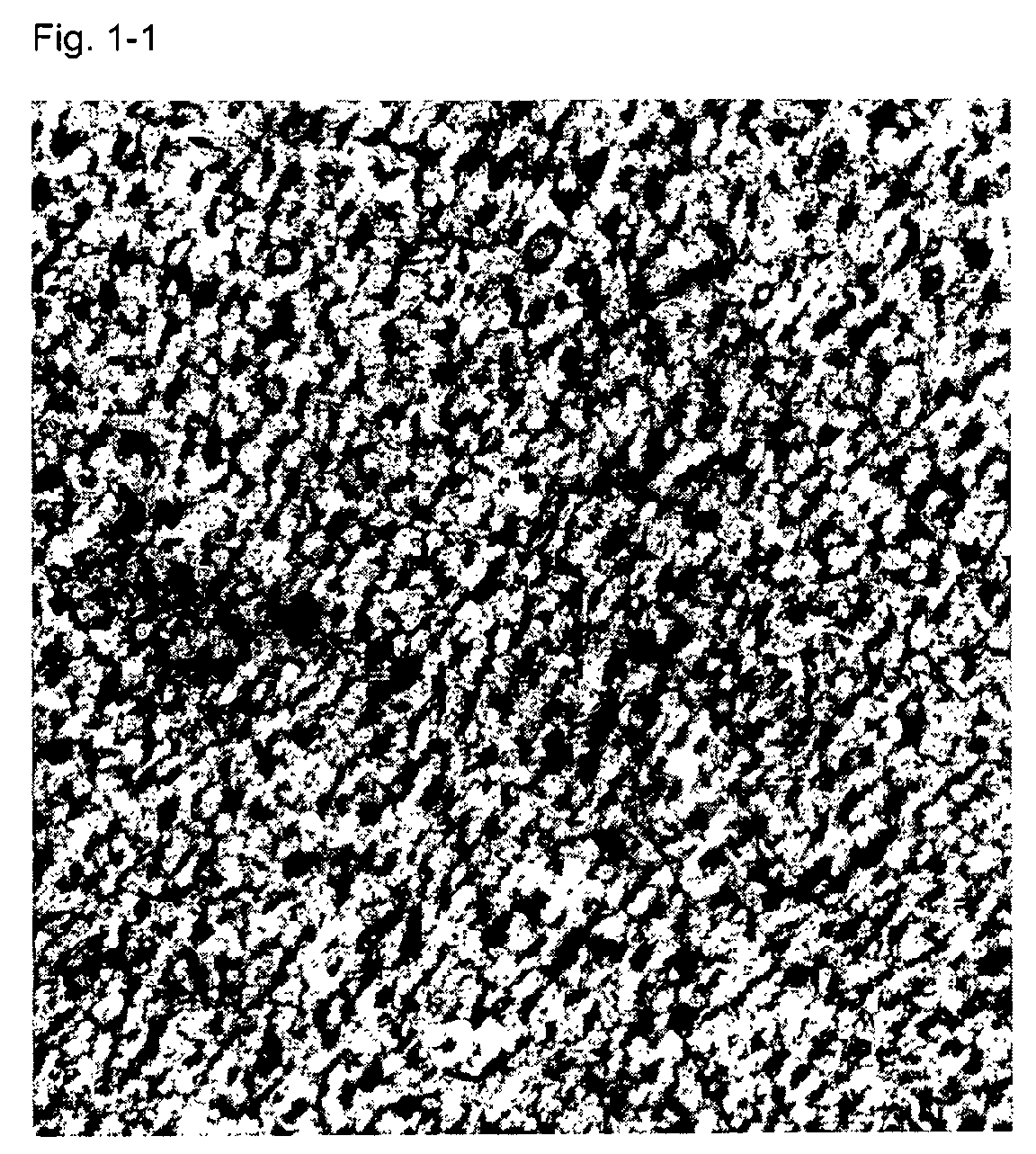
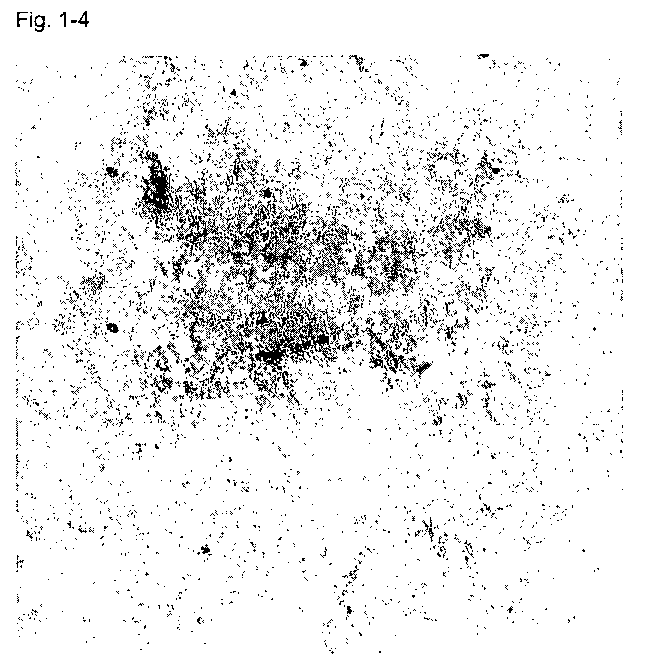
- TEM photographs of the polymer sample treated with RuO 4 for marking zones of different crystallinity with a magnification of 21000 show two different continuous phases structured in the nanometer-range having different crystallinity. This is quite different to standard random copolymers with ethylene contents ⁇ 12 mol%, which do not show two continuous phases, but only one continuous phase at lower ethylene contents or one continuous phase with a second embedded distinct discontinuous phase consisting of EPR at higher ethylene contents.
- Gas phase products were prepared according to example 1, but at a polymerisation temperature of 75 °C and at a different ethylene dosing/total pressure.
- Flexural modulus according to ISO 178 is 273 MPa
- notched impact strength according to ISO 179/1eA (-20 °C) is 1.9 kJ/m 2 and tensile test showed elongation at break (-20 °C) of 168 %.
- Haze of 2 mm plates is 17.9 %.
- TEM photographs of the nucleated polymer sample treated with RuO 4 for marking zones of different crystallinity with a magnification of 21000 show two different continuous phases structured in the nanometer-range with different crystallinity (white crystalline lamellae and a grey zone of lower crystallinity) and a low concentration of finely dispersed rubber phase (dark grey to black droplets).
- the two continuous zones correlate with two melting points of DSC curve at 141 °C and 104 °C.
- Flexural modulus according to ISO 178 is 69 MPa
- notched impact strength according to ISO 179/1eA (-20 °C) is 71.9 kJ/m 2 and tensile test showed elongation at break (-20 °C) of 245 %.
- Haze of 2 mm plates is 27.8 %.
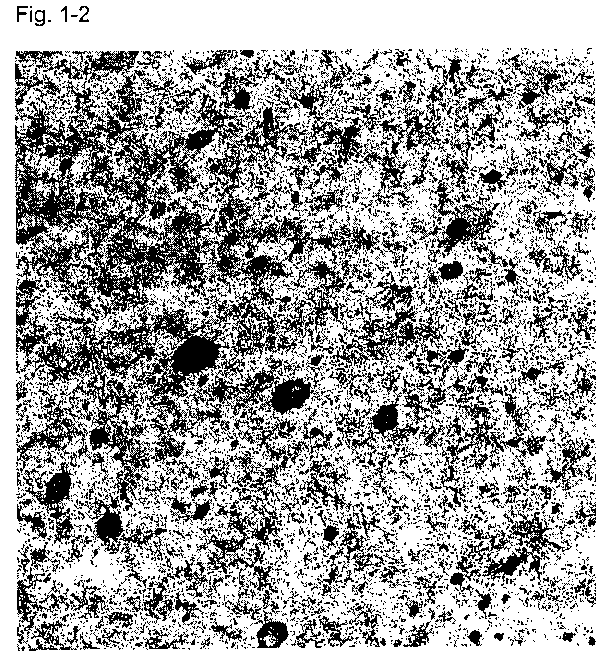
- TEM photographs of the nucleated polymer sample treated with RuO 4 for marking zones of different crystallinity with a magnification of 21000 show two different continuous phases structured in the nanometer-range with different crystallinity (white crystalline lamellae and a grey zone of lower crystallinity) and a higher concentration of coarsely dispersed rubber phase (dark grey to black droplets).
- Altrix 3021 is a masterbatch of 5 wt% di-t-butyl-peroxide produced by adsorption on polypropylene powder.
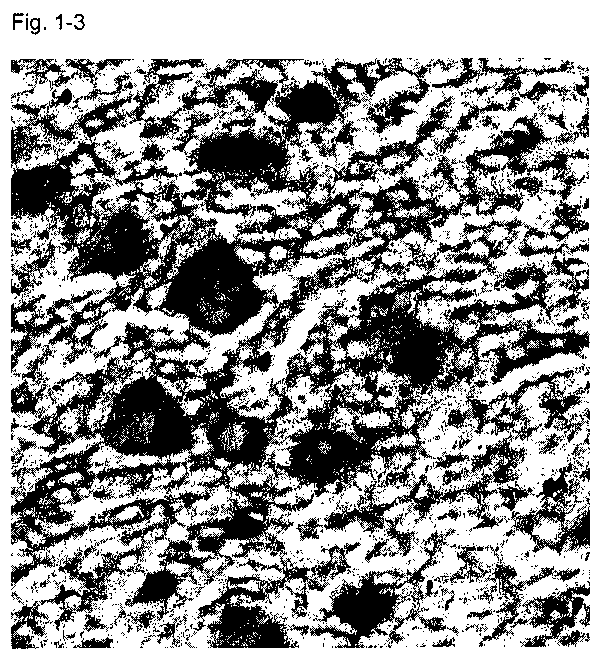
- TEM photographs of the nucleated compounded polymer sample treated with RuO 4 for marking zones of different crystallinity with a magnification of 21000 show two different continuous phases structured in the nanometer-range with different crystallinity (white crystalline lamellae and a grey zone of low crystallinity) and also a low concentration of finely dispersed rubber phase (dark grey to black droplets).
- the two continuous zones of different crystallinity correlate with DSC melting curve showing two peaks with melting point of 141 °C and 100 °C.
- Prepolymerisation is done in a 20 I autoclave - filled with 350 g pelletised polypropylene, 800 g liquid propylene and 24 nl H 2 - for 6 min at 30 °C without dosing ethylene.
- the free flowing reactor product was separated from bed polymer by flotation, additivated as described above and pelletised using Altrix 3021 for visbreaking.
- Flexural modulus according to ISO 178 is 48 MPa and notched impact strength according to ISO 179/1eA(-20 °C) is 102.5 kJ/m 2 .
- At -20 °C tensile modulus is 327 MPa and strain at break 184 %.
- Haze of 2 mm plates is 57.1 %.
- TEM photographs of the polymer sample treated with RuO 4 for marking zones of different crystallinity with a magnification of 21000 show three different phases, two of them continuous ones, structured in the nanometer-range with different crystallinity and the third one an EPR-rubber phase as distinct particles like those known from standard heterophasic copolymers.
- the polymer of comparative example 4 (Borealis RD226CF) is a commercially available propylene-ethylene random copolymer produced with a 4th generation Ziegler-Natta type catalyst in a liquid phase polymerisation process without diluent, which is visbroken to the final MFR after the polymerisation process.
- the polymer of comparative example 5 (Softflex SD233CF from Borealis) is a commercially available propylene-ethylene heterophasic copolymer with a random copolymer matrix phase and a finely dispersed reactor-made elastomer phase produced in a sequential polymerisation process in liquid phase and gas phase, using a 4th generation Ziegler-Natta type catalyst. This grade is only additivated and pelletised after the polymerisation.
- Xylene solubles were determined at 23 °C according to ISO 6427. Xylene solubles are defined as the percent by weight that stays in solution after the polymer sample is dissolved in hot xylene and the solution is allowed to cool to 23 °C. XCS largely correlates to the rubber content of the heterophasic polymer.
- the melt flow rates were measured with a load of 2.16 kg at 230 °C.
- the melt flow rate is that quantity of polymer in grams which the test apparatus standardised to ISO 1133 extrudes within 10 minutes at a temperature of 230 °C under a load of 2.16 kg.
- the flexural test was carried out according to the method of ISO 178 by using injection moulded test specimens as described in EN ISO 1873-2 (80 x 10 x 4 mm).
- the Charpy notched impact strength was determined according to ISO 179 / 1eA at 23 °C and at -20 °C by using injection moulded test specimens as described in EN ISO 1873-2 (80 x 10 x 4 mm).
- the tests are carried out in accordance with ISO 6721-2 on specimens of 60x10x1 mm cut from compression moulded plaques.
- a temperature range of at least -100 to +150 °C is covered, using a heating rate of 1 °C/min.
- the storage modulus G' and the tangent of the loss angle tan( ⁇ ) are the primary results of the tests; from tan( ⁇ ) the temperatures - peak position and peak broadness - of the various mobility transitions in the systems, which can be attributed to the phases present, can be determined.
- the haze (or optical turbidity) of the materials is determined on injection moulded plaques of 60x60x2 mm with white light and a limiting scattering angle of 2.5°.
- a higher haze value means a lower transparency of the respective sample.
- the micrographs are acquired in transmission on specimens contrasted with ruthenium tetroxide (RuO 4 ).
- Injection moulded specimens identical to the ones used for flexural testing are cut perpendicular to the moulding direction into two equal parts, one of which is trimmed into a pyramid shape at the cut end.
- a flat surface is produced with a glass knife.
- the specimen is stained by gaseous RuO 4 .
- the continuous Ru layer formed at the surface is removed by ultramicrotomy with a diamond knife, which is then also used to produce the cuts for the microscope with a thickness of 50-100 nm.
- Magnifications of 10.000 to 30.000 have been found to be suitable to judge the phase morphology in terms of the existence of a co-continuous interpenetrating network structure.
- the actual magnification depends upon the scale of the co-continuous interpenetrating network structure.
- a Philips 300 TEM instrument was used in combination with photographic recording of the micrographs.
- a direct recording of the image with a CCD camera in a digital form can be used.
- the existence of a co-continuous morphology can be determined from the resulting picture by checking the possibility to draw a continuous path within two of the existing phases from one edge of the recorded image to the opposing edge. In critical or limiting cases a contrast enhancement of the primary image may be necessary.
- the content of isolated, i.e. fully randomised, ethylene is calculated with a peak deconvolution method from the FTIR spectra of the respective polymers, using the peak at 733 cm -1 as characteristic for the concentration of ethylene with more than 3 CH 2 groups and the peak at 721 cm -1 as characteristic for the concentration of fully randomised ethylene.
Landscapes
- Chemical & Material Sciences (AREA)
- Health & Medical Sciences (AREA)
- Chemical Kinetics & Catalysis (AREA)
- Medicinal Chemistry (AREA)
- Polymers & Plastics (AREA)
- Organic Chemistry (AREA)
- Inorganic Chemistry (AREA)
- Addition Polymer Or Copolymer, Post-Treatments, Or Chemical Modifications (AREA)
- Compositions Of Macromolecular Compounds (AREA)
Abstract
Description
More particularly, the invention relates to a propylene polymer composition comprising a random propylene copolymer, having a total comonomer content ≥ 12.0 mol% and having an improved balance of softness, transparency and low-temperature impact strength. The present invention also relates to a process for the production of such a polymer composition.
It has been found, that a random propylene copolymer with high comonomer content which comprises at least two phases forming a co-continuous interpenetrating network structure is able to have the desired properties. Due to a partial miscibility of the components in the molten stage the co-continuous morphology is formed parallel to the solidification process by spinodal decomposition. This also allows to combine a partially elastic behaviour in the solid phase with a fully viscous behaviour in the melt phase.
The novel propylene polymer compositions do not have a "classic" heterophasic structure, which is characterised by just one continuous phase with a second embedded distinct discontinuous phase. The novel propylene polymer compositions have a heterophasic structure which is characterised by two continuous phases, which are structured in the nanometer-range. As a consequence of the very fine-structured morphology and the low difference in refractive index between the phases the novel propylene polymer compositions retain their transparency up to very high comonomer contents.
Phase morphologies have been previously identified in the toughened composite resin art as comprising four distinct types. These definitions are also valid for the technical field of the present invention. These types, identified by microscopic techniques, are homogeneous, particulate, phase inverted, and co-continuous. A homogeneous morphology is defined essentially as lacking identifiable structures at a certain magnification. A particulate morphology is defined as specks of a discontinuous phase surrounded by a larger continuous phase (e.g. a "classic" heterophasic copolymer, where the discontinuous phase normally has an additional heterogeneity and is separated into typically two phases of different crystallinity, which are mostly referred to as polyethylene phase and ethylene-propylene-rubber phase). Phase inverted morphology is defined as islands of a discontinuous phase in a smaller continuous phase. The co-continuous morphology is characterised by the presence of at least two phases with microscopic continuity. One or both of the phases may additionally exist in a minor fraction as dispersed particles in the respective other phase. Moreover, one or more additional phases may exist in this form. As those skilled in the art appreciate, phase morphologies are defined at comparable magnifications and comparable microscopic techniques relating both to preparation and image acquisition, and that at some magnifications the above distinctions may be less clear. For the present invention, transmission electron micrographs (TEM) with magnifications of 10.000 to 30.000 acquired after contrasting the specimen with RuO4 to improve the distinction between phases of different crystallinity were found to be suitable. Other electron microscopy techniques possible are scanning electron microscopy (SEM) on similarly contrasted or plasma etched specimens with analogous magnification. SEM on fracture surfaces or scanning (atomic) force microscopy (AFM) on cut surfaces are less well suited for this purpose.
The random propylene copolymers of the invention have a comonomer content of ≥ 12 mol%, preferably of ≥ 15 mol%, still more preferably of ≥ 18 mol%. Higher comonomer contents are - as a rule of thumb - more preferred for softer products.
The second phase B of the inventive propylene copolymers comprises an elastomeric phase, containing 20 - 70 mol%, preferably 25 - 65 mol% comonomer.
The propylene copolymer of which the first phase of the inventive random copolymer is comprised may be a binary copolymer or may be comprised of more than two comonomers, e.g. be a terpolymer.
The propylene copolymer of which the second phase of the inventive random copolymer is comprised may also be a binary copolymer or may be comprised of more than two comonomers, e.g. be a terpolymer.
Examples of the comonomers are ethylene, 1-butene, 1-pentene, 4-methyl-1-pentene, 1-hexene, 1-heptene or 1-octene. Preferred are ethene and/or 1-butene.
Examples for the propylene copolymer of the first phase are propylene/ethylene, propylene/butene and propylene/ethylene/butene polymers.
Examples for the propylene copolymer of the second phase are propylene/ethylene and propylene/ethylene/butene polymers.
According to a preferred embodiment the first as well as the second phase is comprised of a binary copolymer with ethylene as the comonomer.
Some embodiments exhibit more than one melting point, for example two melting points. The second melting point, which is associated with the second phase, is usually smaller than that of the first phase and being associated with a melting enthalpy which is smaller than that of the melting point of the first phase, thereby indicating higher comonomer contents and smaller crystallinities of the second phase.
In this regard, "fully randomised" means those comonomer units occurring in groups no larger than two consecutive comonomer units. For example, in a linear propylene copolymer the consecutive occurrence of three or more comonomer units would not be considered as "fully randomised" with respect to the comonomer units. Accordingly, the following sequence of ethylene (E) monomer units in a propylene (P) chain would not be considered as "fully randomised" according to the above definition: -P-E-E-E-P-. However, all of the ethylene monomer units of the following sequence would meet the above requirement as to full randomisation: -P-E-P-P-E-E-P-E-P-.
It is in some cases possible to tailor the properties of the propylene polymer composition by compounding two or more random propylene copolymers (each having at least two distinct phases forming a co-continuous interpenetrating network). The result of compounding two of these random copolymers may for example be a propylene polymer composition comprising two distinct phases forming a co-continuous interpenetrating network and a third, discontinuous phase.
Some embodiments of the invention may contain clarifyers and/or α-nucleating agents in order to achieve the desired level of transparency.

Of these, sodium-2,2'-methylene-bis(4,6-di-t-butylphenyl)phosphate is preferred.
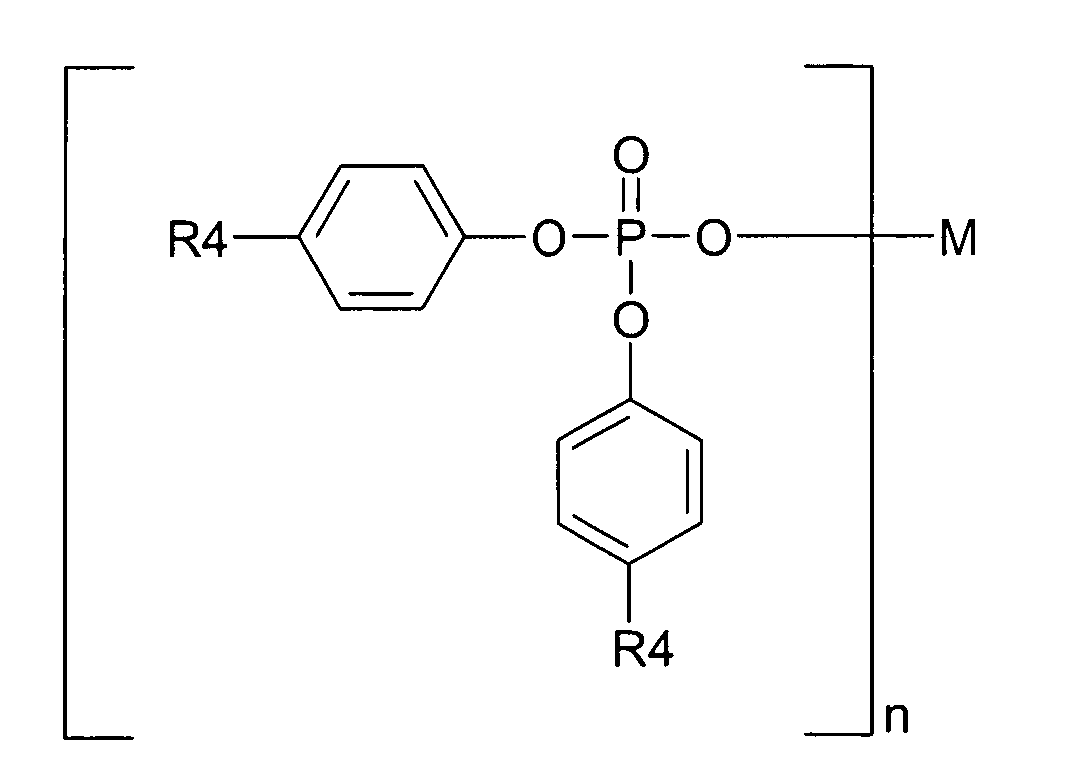
Of these, sodium-bis(4-t-butylphenyl)phosphate is preferred.
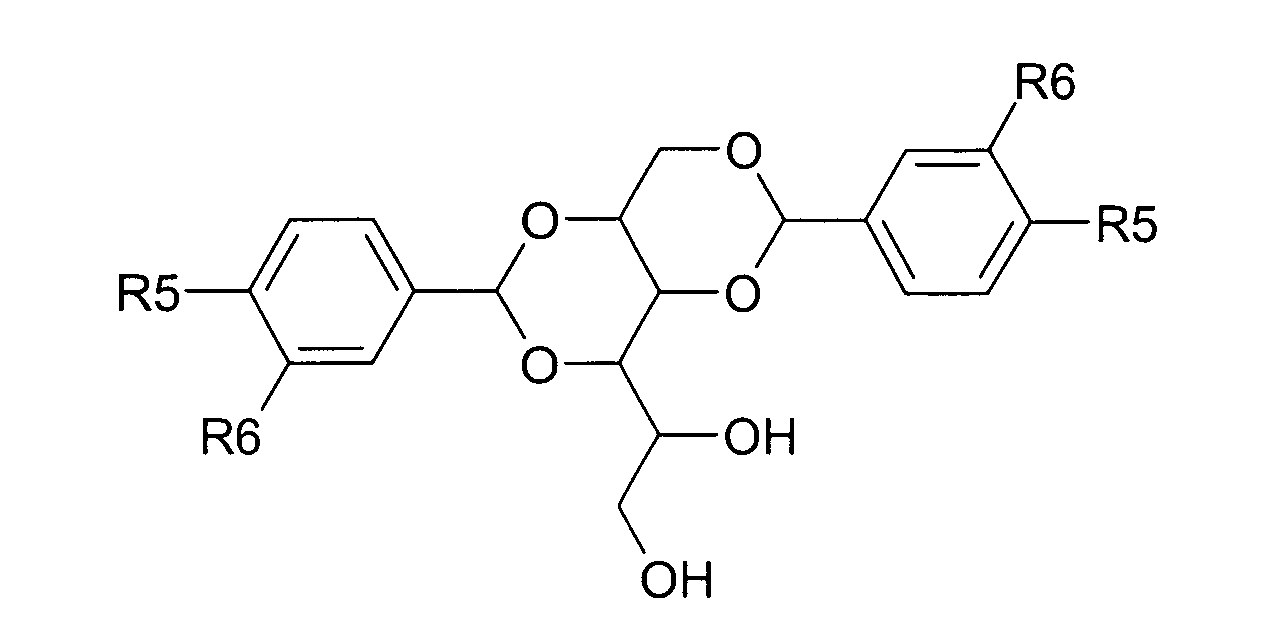
Specific examples of the nucleating agents represented by the above formula include 1,3,2,4-dibenzylidenesorbitol, 1,3-benzylidene-2,4-p-methylbenzylidenesorbitol, 1,3-benzylidene-2,4-p-ethylbenzylidenesorbitol, 1,3-p-methylbenzylidene-2,4-benzylidenesorbitol, 1,3-p-ethylbenzylidene-2,4-benzylidenesorbitol, 1,3-p-methylbenzylidene-2,4-p-ethylbenzylidenesorbitol, 1,3-p-ethylbenzylidene-2,4-p-methylbenzylidenesorbitol, 1,3,2,4-di(p-methylbenzylidene)sorbitol, 1,3,2,4-di(p-ethylbenzylidene)sorbitol, 1,3,2,4-di(p-n-propylbenzylidene)sorbitol, 1,3,2,4-di(p-i-propylbenzylidene)sorbitol, 1,3,2,4-di(p-n-butylbenzylidene)sorbitol, 1,3,2,4-di(p-s-butylbenzylidene)sorbitol, 1,3,2,4-di(p-t-butylbenzylidene)sorbitol, 1,3,2,4-di(2',4'-dimethylbenzylidene)sorbitol, 1 ,3,2,4-di(3',4'-dimethylbenzylidene)sorbitol, 1,3,2,4-di(p-methoxybenzylidene)sorbitol, 1,3,2,4-di(p-ethoxybenzylidene)sorbitol, 1,3-benzylidene-2,4-p-chlorobenzylidenesorbitol, 1,3-p-chlorobenzylidene-2,4-benzylidenesorbitol, 1,3-p-chlorobenzylidene-2,4-p-methylbenzylidenesorbitol, 1,3-p-chlorobenzylidene-2,4-p-ethylbenzylidenesorbitol, 1,3-p-methylbenzylidene-2,4-p-chlorobenzylidenesorbitol, 1,3-p-ethylbenzylidene-2,4-p-chlorobenzylidenesorbitol and 1,3,2,4-di(p-chlorobenzylidene)sorbitol. Mixtures of two or more of these nucleating agents are also employable.
Also employable are other nucleating agents such as metallic salts of aromatic carboxylic acids and metallic salts of aliphatic carboxylic acids. Specific examples thereof include sodium benzoate, aluminium benzoate, aluminium p-t-butylbenzoate, sodium adipate, sodium thiophenecarboxylate and sodium pyrrolecarboxylate.
Of the above-mentioned α-nucleating agents 1,3,2,4-di(3',4'-dimethylbenzylidene)sorbitol is particularly preferred.
A still further α-nucleating agent, which is also among those which are particularly preferred and which has not been mentioned above, is commercially available from Asahi Denka Kogyo (Japan) under the name "ADK STAB NA21E".
This object is achieved by a process comprising polymerisation of propylene with a comonomer, the comonomer being ethylene and/or one or more C4-C10 α-olefins, in the presence of a catalyst in a gas polymerisation process, where the amounts of propylene and comonomer being fed to the gas polymerisation process are chosen in order to adjust a comonomer-content of the random propylene copolymer of ≥ 12 mol%, preferably of ≥ 15 mol%, still more preferably of ≥ 18 mol% and where the catalyst is selected from the class of Ziegler-Natta-type catalysts and where the temperature in the gas polymerisation process is > 75 °C and the pressure in the gas polymerisation process is > 2.0 MPa.
The process for preparing the random propylene polymers is in its basic embodiment a single step process, comprising a single gas polymerisation step.
The result of the bulk phase polymerisation preceding the gas phase polymerisation may be a homopolymer. Since however the product of the subsequent gas phase polymerisation as described above is a polymer having at least two distinct phases forming a co-continuous interpenetrating network, this product is considered to be a random propylene copolymer for the purpose of the present invention.
In case of 2-step (bulk/gas phase) polymerisation the catalyst complex (preparation as above) is spilled with liquid propylene into the reactor filled with about 600 g propylene, adequate amount of H2 for achieving aspired MFR and ethylene flow of 0.3nl/min. After a short period of prepolymerisation the temperature controller is set to temperature of bulk polymerisation and constant ethylene flow is adjusted to achieve aspired ethylene concentration in bulk product. After predefined residence time in bulk polymerisation temperature control is set to gas phase polymerisation temperature and monomers are flashed down to ∼1.5 MPa total pressure to achieve gas phase conditions controlling in parallel ethylene flow. After dosing in additional H2 for achieving the target MFR, ethylene flow is adjusted to reach target ethylene content in gas phase part of product. After predetermined residence time to adjust mass ratio of bulk and gas phase part of product, polymerisation is stopped by flashing and cooling.
Reactor products are pelletised via TSE16 extruder (PRISM) and additivated with 0.2 % Irganox B225, 0.1 % Ca-stearate and 0.06 % glycerine monostearate. All samples have been nucleated with 1,3,2,4-di(3',4'-dimethylbenzylidene)sorbitol.
After 7 minutes temperature control is set to 95 °C. When the temperature reaches 50 °C the constant ethylene flow is increased to 4.5 nl/min and propylene dosing in parallel is set to arrive and hold 3.9 MPa at 95 °C. After 60 min residence time polymerisation resulted in 1683 g of polymer. Catalyst activity was 54.8 kg/gcat·h.
Gas phase products were prepared according to example 1, but at a polymerisation temperature of 75 °C and at a different ethylene dosing/total pressure.
Characterisation resulted in 13.0 mol% ethylene content, MFR = 6.9 g/10 min (230 °C, 2.16 kg) and xylene solubles of 40.1 wt%. The content of isolated (i.e. fully randomised) ethylene is 9.4 mol%. Glass transition temperature Tg is -9.0 °C. Flexural modulus according to ISO 178 is 273 MPa, notched impact strength according to ISO 179/1eA (-20 °C) is 1.9 kJ/m2 and tensile test showed elongation at break (-20 °C) of 168 %. Haze of 2 mm plates is 17.9 %. TEM photographs of the nucleated polymer sample treated with RuO4 for marking zones of different crystallinity with a magnification of 21000 show two different continuous phases structured in the nanometer-range with different crystallinity (white crystalline lamellae and a grey zone of lower crystallinity) and a low concentration of finely dispersed rubber phase (dark grey to black droplets). The two continuous zones correlate with two melting points of DSC curve at 141 °C and 104 °C.
Characterisation resulted in 18.0 mol% ethylene content, MFR = 6.5 g/10 min (230 °C, 2.16 kg) and xylene solubles of 70.5 wt%. The content of isolated (fully randomised) ethylene is 12.2 mol%. Glass transition temperature is -17 °C. Flexural modulus according to ISO 178 is 69 MPa, notched impact strength according to ISO 179/1eA (-20 °C) is 71.9 kJ/m2 and tensile test showed elongation at break (-20 °C) of 245 %. Haze of 2 mm plates is 27.8 %. TEM photographs of the nucleated polymer sample treated with RuO4 for marking zones of different crystallinity with a magnification of 21000 show two different continuous phases structured in the nanometer-range with different crystallinity (white crystalline lamellae and a grey zone of lower crystallinity) and a higher concentration of coarsely dispersed rubber phase (dark grey to black droplets). The two continuous zones correlate with two melting points of DSC-curve at 142 °C and 87 °C.
Gas phase polymerisation products 2a and 2b were mixed and pelletised using Altrix 3021 for visbreaking. Altrix 3021 is a masterbatch of 5 wt% di-t-butyl-peroxide produced by adsorption on polypropylene powder.
The results of the above examples are summarised in the table below:
| Examples | Comparative Examples | |||||||
| 1 | 2a | 2b | 2 | 3 | 4 | 5 | ||
| MFR (230°C/2,16kg) | g/10min | 3.5 | 6.9 | 6.5 | 7.5 | 8.1 | 8.0 | 8.1 |
| Total C2 content | mol% | 19.1 | 13 | 18 | 15.1 | 20.3 | 5.5 | 24 |
| C2 (phase 1) | mol% | 5.5 | 7.3 | 6.8 | 6.6 | 2.7 | - | - |
| amount (phase 1) | wt% | 46 | 54 | 60 | 52 | 59.0 | - | - |
| C2 (phase 2) | mol% | 30.5 | 18.5 | 28.7 | 24 | 47.0 | - | - |
| amount (phase 2) | wt% | 54 | 46 | 40 | 49 | 41.0 | - | - |
| Tg (DMTA) | °C | -21 | -9 | -17 | -14.5 | -28.5 | -6 | - 7,5 |
| Delta Tg (DMTA) | °C | 65.5 | 55 | 60 | 62 | 67 | 45 | 50 |
| Flex. Modulus MD | MPa | 73 | 273 | 69 | 161 | 48 | 960 | 460 |
| Charpy NIS +23°C | kJ/m2 | n.b. | 66.2 | 48 | 55 | n.b.*** | 5.4 | 45 |
| Charpy NIS -20°C | kJ/m2 | 88 | 1.9 | 71.9 | 5.0 | 102 | 1.2 | 4.5 |
| Haze | % | 31 | 17.9 | 27.8 | 21 | 57 | 85 | 90.0 |
| Tm/Hm1 (DSC) | °C/J/g | 80/29 | 104/10 | 87/8 | 100/44 | -/- | -/- | 113/1 |
| Tm / Hm 2 (DSC) | °C / J/g | 145 / 36 | 141 / 45 | 142/28 | 141 / 53 | 160/30 | 146/96 | 142/60 |
The existence of a co-continuous morphology can be determined from the resulting picture by checking the possibility to draw a continuous path within two of the existing phases from one edge of the recorded image to the opposing edge. In critical or limiting cases a contrast enhancement of the primary image may be necessary.
Claims (14)
- A propylene polymer composition comprising a random propylene copolymer, the comonomer being ethylene and/or one or more C4-C10 α-olefins, having a total comonomer content ≥ 12 mol%, preferably ≥ 15 mol%, the random propylene copolymer comprising at least two distinct phases,
where the at least two phases are forming a co-continuous interpenetrating network structure, determined with Transmission Electron Microscopy after contrasting with RuO4. - Propylene polymer composition according to claim 1, characterised in that the random propylene copolymer comprises(A) 30 - 70 wt% of a first phase containing 2 - 15 mol% comonomer and(B) 70 - 30 wt% of a second phase containing 20 - 70 mol% comonomer.
- Propylene polymer composition according to claim 2, characterised in that the random propylene-α-olefin copolymer comprises(A) 40 - 60 wt% of a first phase containing 2 - 12 mol% comonomer and(B) 55 - 45 wt% of a second phase containing 25 - 65 mol% comonomer.
- Propylene polymer composition according to one of claims 1 to 3, characterised in that the comonomer is ethylene.
- Propylene polymer composition according to one of claims 1 to 4, characterised in it exhibits at least one melting point > 130 °C (DSC), the melting point being associated to a melting enthalpy of ≥ 20 J/g.
- Propylene polymer composition according to one of claims 1 to 5, characterised in that the random propylene copolymer has a total amount of fully randomised comonomer of ≥ 9.0 mol%, preferably of ≥ 10.0 mol%.
- Propylene polymer composition according to one of claims 1 to 6, characterised in that it comprises a blend of at least two random propylene copolymers.
- Propylene polymer composition according to one of claims 1 to 7, characterised in that it comprises at least one further phase, the further phase being discontinuous.
- Propylene polymer composition according to one of claims 1 to 8, characterised in that it comprises one or more clarifying and/or α-nucleating agents.
- A process for preparing a random propylene copolymer comprising polymerisation of propylene with a comonomer, the comonomer being ethylene and/or one or more C4-C10 α-olefins, in the presence of a catalyst in a gas polymerisation process, where the amounts of propylene and comonomer being fed to the gas polymerisation process are chosen in order to adjust a comonomer-content of the random propylene copolymer of ≥ 12 mol%, preferably of ≥ 15 mol% and where the catalyst is selected from the class of Ziegler-Natta-type catalysts and where the temperature in the gas polymerisation process is ≥ 75 °C and the pressure in the gas polymerisation process is > 2.0 MPa.
- Process according to claim 10, characterised in that the gas phase polymerisation is preceded by a bulk phase polymerisation.
- Process according to claim 11, characterised in that the bulk phase polymerisation is operated at a temperature of < 75 °C.
- Process according to one of claims 10 to 12, characterised in that the comonomer is ethylene.
- An article comprising a propylene polymer composition according to any one of claims 1 to 9.
Priority Applications (2)
| Application Number | Priority Date | Filing Date | Title |
|---|---|---|---|
| EP02027393A EP1428853A1 (en) | 2002-12-09 | 2002-12-09 | Propylene polymer composition with improved balance of mechanical and optical properties |
| EP03027260A EP1428854A1 (en) | 2002-12-09 | 2003-11-28 | Propylene polymer composition with improved balance of mechanical and optical properties |
Applications Claiming Priority (1)
| Application Number | Priority Date | Filing Date | Title |
|---|---|---|---|
| EP02027393A EP1428853A1 (en) | 2002-12-09 | 2002-12-09 | Propylene polymer composition with improved balance of mechanical and optical properties |
Publications (1)
| Publication Number | Publication Date |
|---|---|
| EP1428853A1 true EP1428853A1 (en) | 2004-06-16 |
Family
ID=32319551
Family Applications (1)
| Application Number | Title | Priority Date | Filing Date |
|---|---|---|---|
| EP02027393A Withdrawn EP1428853A1 (en) | 2002-12-09 | 2002-12-09 | Propylene polymer composition with improved balance of mechanical and optical properties |
Country Status (1)
| Country | Link |
|---|---|
| EP (1) | EP1428853A1 (en) |
Cited By (8)
| Publication number | Priority date | Publication date | Assignee | Title |
|---|---|---|---|---|
| EP1681315A1 (en) * | 2005-01-14 | 2006-07-19 | Borealis Polymers Oy | Heterophasic polymer composition and process for its preparation |
| WO2006082144A1 (en) * | 2005-02-03 | 2006-08-10 | Basell Poliolefine Italia S.R.L. | Propylene polymer composition for injection molding |
| US8063160B2 (en) | 2005-05-12 | 2011-11-22 | Basell Poliolefine Italia, s.r.l. | Propylene-ethylene copolymers and process for their preparation |
| US8076429B2 (en) | 2009-03-11 | 2011-12-13 | Lummus Novolen Technology Gmbh | Supertransparent high impact strength random block copolymer |
| US9145495B2 (en) | 2005-07-01 | 2015-09-29 | Basell Poliolefine Italia S.R.L. | Propylene polymers having broad molecular weight distribution |
| EP2867297B1 (en) | 2012-06-29 | 2017-08-09 | Sika Technology AG | Polymer blend comprising propylene-based elastomer and polypropylene random copolymer |
| EP2006314B2 (en) † | 2006-03-29 | 2019-07-31 | Mitsui Chemicals, Inc. | Propylene random block copolymer, resin compositions containing the copolymer, and moldings of both |
| EP3412692B1 (en) | 2013-05-29 | 2020-07-01 | Abu Dhabi Polymers Co. Ltd (Borouge) Llc. | Bimodal polypropylene for cast films wherein the polypropylene comprises two fractions which differ in the comonomer content |
Citations (5)
| Publication number | Priority date | Publication date | Assignee | Title |
|---|---|---|---|---|
| WO1998039385A1 (en) * | 1997-03-07 | 1998-09-11 | Dupont Dow Elastomers L.L.C. | Elastomer compositions having improved abrasion resistance, coefficient of friction and hot green strength |
| EP0969043A1 (en) * | 1998-07-01 | 2000-01-05 | Advanced Elastomer Systems, L.P. | Modification of thermoplastic vulcanizates using random propylene copolymers |
| US6242525B1 (en) * | 1997-11-06 | 2001-06-05 | Borealis Gmbh | Thermoplastic elastomers of high strength and elasticity and of good dyeability and polymer blends of high strength produced therefrom |
| DE19983451T1 (en) * | 1998-08-21 | 2001-07-12 | Chisso Corp | Polypropylene film and multi-layer polypropylene films |
| EP1211289A1 (en) * | 2000-11-29 | 2002-06-05 | Borealis GmbH | Polyolefin compositions with improved properties |
-
2002
- 2002-12-09 EP EP02027393A patent/EP1428853A1/en not_active Withdrawn
Patent Citations (5)
| Publication number | Priority date | Publication date | Assignee | Title |
|---|---|---|---|---|
| WO1998039385A1 (en) * | 1997-03-07 | 1998-09-11 | Dupont Dow Elastomers L.L.C. | Elastomer compositions having improved abrasion resistance, coefficient of friction and hot green strength |
| US6242525B1 (en) * | 1997-11-06 | 2001-06-05 | Borealis Gmbh | Thermoplastic elastomers of high strength and elasticity and of good dyeability and polymer blends of high strength produced therefrom |
| EP0969043A1 (en) * | 1998-07-01 | 2000-01-05 | Advanced Elastomer Systems, L.P. | Modification of thermoplastic vulcanizates using random propylene copolymers |
| DE19983451T1 (en) * | 1998-08-21 | 2001-07-12 | Chisso Corp | Polypropylene film and multi-layer polypropylene films |
| EP1211289A1 (en) * | 2000-11-29 | 2002-06-05 | Borealis GmbH | Polyolefin compositions with improved properties |
Cited By (14)
| Publication number | Priority date | Publication date | Assignee | Title |
|---|---|---|---|---|
| US8394893B2 (en) | 2005-01-14 | 2013-03-12 | Borealis Polymers Oy | Heterophasic polymer composition and process for its preparation |
| WO2006074930A1 (en) * | 2005-01-14 | 2006-07-20 | Borealis Polymers Oy | Heterophasic polymer composition and process for its preparation |
| EA012419B1 (en) * | 2005-01-14 | 2009-10-30 | Бореалис Полимерз Ой | Heterophasic polymer composition and process for its preparation |
| EP1681315A1 (en) * | 2005-01-14 | 2006-07-19 | Borealis Polymers Oy | Heterophasic polymer composition and process for its preparation |
| WO2006082144A1 (en) * | 2005-02-03 | 2006-08-10 | Basell Poliolefine Italia S.R.L. | Propylene polymer composition for injection molding |
| US7816466B2 (en) | 2005-02-03 | 2010-10-19 | Basell Poliolefine Italia S.R.L. | Propylene polymer composition for injection molding |
| US8063160B2 (en) | 2005-05-12 | 2011-11-22 | Basell Poliolefine Italia, s.r.l. | Propylene-ethylene copolymers and process for their preparation |
| US9145495B2 (en) | 2005-07-01 | 2015-09-29 | Basell Poliolefine Italia S.R.L. | Propylene polymers having broad molecular weight distribution |
| EP2006314B2 (en) † | 2006-03-29 | 2019-07-31 | Mitsui Chemicals, Inc. | Propylene random block copolymer, resin compositions containing the copolymer, and moldings of both |
| US8138251B2 (en) | 2009-03-11 | 2012-03-20 | Lummus Novolen Technology Gmbh | Supertransparent high impact strength random block copolymer |
| US8076429B2 (en) | 2009-03-11 | 2011-12-13 | Lummus Novolen Technology Gmbh | Supertransparent high impact strength random block copolymer |
| EP2867297B1 (en) | 2012-06-29 | 2017-08-09 | Sika Technology AG | Polymer blend comprising propylene-based elastomer and polypropylene random copolymer |
| EP3412692B1 (en) | 2013-05-29 | 2020-07-01 | Abu Dhabi Polymers Co. Ltd (Borouge) Llc. | Bimodal polypropylene for cast films wherein the polypropylene comprises two fractions which differ in the comonomer content |
| EP3412692B2 (en) † | 2013-05-29 | 2023-09-27 | Abu Dhabi Polymers Co. Ltd (Borouge) Llc. | Bimodal polypropylene for cast films wherein the polypropylene comprises two fractions which differ in the comonomer content |
Similar Documents
| Publication | Publication Date | Title |
|---|---|---|
| EP1963424B1 (en) | Polypropylene composition comprising a propylene homopolymer component | |
| EP2174980B1 (en) | High flowable heterophasic polypropylene | |
| EP1801156B1 (en) | Polyolefin compositions | |
| EP2731988B1 (en) | High flow polyolefin composition with low shrinkage and clte | |
| EP2454298B1 (en) | Polypropylene impact copolymers having high melt flow and izod ductility | |
| EP2638108B1 (en) | Soft heterophasic propylene copolymers | |
| EP2084223B1 (en) | Polyolefin compositions | |
| EP2599829B1 (en) | Polyolefin composition with reduced occurrence of flow marks | |
| EP1801157B1 (en) | Polypropylene composition comprising a propylene copolymer component | |
| EP2212381A1 (en) | Improved glass fiber reinforced polypropylene | |
| WO2009124753A1 (en) | Low emission polymer composition | |
| EP2014714A1 (en) | Heterophasic polyolefin composition | |
| WO2006053661A1 (en) | Novel propylene polymer compositions | |
| GB2206886A (en) | Impact resistant olefin polymer compositions | |
| CN108350241A (en) | High fluidity TPO compositions with excellent low-temperature impact | |
| US5856400A (en) | Polypropylene resin composition | |
| EP1428854A1 (en) | Propylene polymer composition with improved balance of mechanical and optical properties | |
| EP1477525B1 (en) | Polyolefin composition | |
| CN103748160A (en) | Propylene impact copolymers with good optical properties | |
| KR101499274B1 (en) | Soft polyolefin compositions with improved processability | |
| EP3694922B1 (en) | Multimodal random heterophasic polypropylene composition | |
| US10907035B2 (en) | Propylene resin composition and injection-molded article thereof | |
| JPH0971712A (en) | Propylene polymer composition for automobile interior materials | |
| WO2026008753A1 (en) | Polypropylene composition | |
| WO2026008754A1 (en) | Polypropylene composition |
Legal Events
| Date | Code | Title | Description |
|---|---|---|---|
| PUAI | Public reference made under article 153(3) epc to a published international application that has entered the european phase |
Free format text: ORIGINAL CODE: 0009012 |
|
| AK | Designated contracting states |
Kind code of ref document: A1 Designated state(s): AT BE BG CH CY CZ DE DK EE ES FI FR GB GR IE IT LI LU MC NL PT SE SI SK TR |
|
| AX | Request for extension of the european patent |
Extension state: AL LT LV MK RO |
|
| AKX | Designation fees paid | ||
| REG | Reference to a national code |
Ref country code: DE Ref legal event code: 8566 |
|
| STAA | Information on the status of an ep patent application or granted ep patent |
Free format text: STATUS: THE APPLICATION IS DEEMED TO BE WITHDRAWN |
|
| 18D | Application deemed to be withdrawn |
Effective date: 20041217 |
|
| RIC1 | Information provided on ipc code assigned before grant |
Ipc: C08F 297/08 20060101ALI20111020BHEP Ipc: C08L 23/16 20060101ALI20111020BHEP Ipc: C08L 23/14 20060101AFI20111020BHEP |