EP1428038B1 - Procede de traitement des signaux d'une antenne lineaire remorquee - Google Patents
Procede de traitement des signaux d'une antenne lineaire remorquee Download PDFInfo
- Publication number
- EP1428038B1 EP1428038B1 EP02796299A EP02796299A EP1428038B1 EP 1428038 B1 EP1428038 B1 EP 1428038B1 EP 02796299 A EP02796299 A EP 02796299A EP 02796299 A EP02796299 A EP 02796299A EP 1428038 B1 EP1428038 B1 EP 1428038B1
- Authority
- EP
- European Patent Office
- Prior art keywords
- channels
- antenna
- antennas
- sub
- hydrophones
- Prior art date
- Legal status (The legal status is an assumption and is not a legal conclusion. Google has not performed a legal analysis and makes no representation as to the accuracy of the status listed.)
- Expired - Lifetime
Links
Images

Classifications
-
- G—PHYSICS
- G01—MEASURING; TESTING
- G01S—RADIO DIRECTION-FINDING; RADIO NAVIGATION; DETERMINING DISTANCE OR VELOCITY BY USE OF RADIO WAVES; LOCATING OR PRESENCE-DETECTING BY USE OF THE REFLECTION OR RERADIATION OF RADIO WAVES; ANALOGOUS ARRANGEMENTS USING OTHER WAVES
- G01S3/00—Direction-finders for determining the direction from which infrasonic, sonic, ultrasonic or electromagnetic waves, or particle emission, not having a directional significance, are being received
- G01S3/80—Direction-finders for determining the direction from which infrasonic, sonic, ultrasonic or electromagnetic waves, or particle emission, not having a directional significance, are being received using ultrasonic, sonic or infrasonic waves
- G01S3/802—Systems for determining direction or deviation from predetermined direction
- G01S3/805—Systems for determining direction or deviation from predetermined direction using adjustment of real or effective orientation of directivity characteristics of a transducer or transducer system to give a desired condition of signal derived from that transducer or transducer system, e.g. to give a maximum or minimum signal
-
- G—PHYSICS
- G01—MEASURING; TESTING
- G01S—RADIO DIRECTION-FINDING; RADIO NAVIGATION; DETERMINING DISTANCE OR VELOCITY BY USE OF RADIO WAVES; LOCATING OR PRESENCE-DETECTING BY USE OF THE REFLECTION OR RERADIATION OF RADIO WAVES; ANALOGOUS ARRANGEMENTS USING OTHER WAVES
- G01S15/00—Systems using the reflection or reradiation of acoustic waves, e.g. sonar systems
- G01S15/02—Systems using the reflection or reradiation of acoustic waves, e.g. sonar systems using reflection of acoustic waves
- G01S15/04—Systems determining presence of a target
-
- G—PHYSICS
- G01—MEASURING; TESTING
- G01S—RADIO DIRECTION-FINDING; RADIO NAVIGATION; DETERMINING DISTANCE OR VELOCITY BY USE OF RADIO WAVES; LOCATING OR PRESENCE-DETECTING BY USE OF THE REFLECTION OR RERADIATION OF RADIO WAVES; ANALOGOUS ARRANGEMENTS USING OTHER WAVES
- G01S3/00—Direction-finders for determining the direction from which infrasonic, sonic, ultrasonic or electromagnetic waves, or particle emission, not having a directional significance, are being received
- G01S3/80—Direction-finders for determining the direction from which infrasonic, sonic, ultrasonic or electromagnetic waves, or particle emission, not having a directional significance, are being received using ultrasonic, sonic or infrasonic waves
- G01S3/802—Systems for determining direction or deviation from predetermined direction
- G01S3/808—Systems for determining direction or deviation from predetermined direction using transducers spaced apart and measuring phase or time difference between signals therefrom, i.e. path-difference systems
-
- G—PHYSICS
- G01—MEASURING; TESTING
- G01V—GEOPHYSICS; GRAVITATIONAL MEASUREMENTS; DETECTING MASSES OR OBJECTS; TAGS
- G01V1/00—Seismology; Seismic or acoustic prospecting or detecting
- G01V1/16—Receiving elements for seismic signals; Arrangements or adaptations of receiving elements
- G01V1/20—Arrangements of receiving elements, e.g. geophone pattern
- G01V1/201—Constructional details of seismic cables, e.g. streamers
Definitions
- the present invention relates to signal processing methods of a towed linear antenna.
- it makes it possible to remove right-left ambiguity on such an antenna when it is activated, that is to say that it operates in reception of echoes produced from the emissions of an active sonar.
- the invention proposes a method for processing the signals of a towed linear antenna, in particular for removing right-left ambiguity, this antenna comprising a set of multiplets of hydrophones each comprising n ⁇ 3 hydrophones distributed in a section. right of the longitudinal axis of the antenna, mainly characterized in that the angle of roll of each multiplet is measured with respect to the vertical, which is synthesized from the signals of the hydrophones and this angle of rolling p ⁇ 3 linear sub-antennas, that we form M v bearing channels with each sub-antenna and that we form 2 adaptive right-to-left channels from the p sub-antennas for each direction corresponding to each channel deposit.
- a coherent treatment is used to form the M bearing channels.
- the inverse interspectral matrix ⁇ -1 is estimated on N + 1 temporal samples and A + 1 Doppler channels, and then two phase shift vectors d d and d g associated with the right channels are determined. and left for each bearing path and channels V d and V g are determined from these vectors and this inverse matrix.
- inclinometers are used to determine the roll angles.
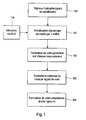
- the treatment method according to the invention comprises 4 step modules, as shown in FIG.
- the sampled hydrophonic signals of all the hydrophone multiplets of the antenna in a first preliminary module 100, as well as the roll angles R measured in a second preliminary module 110 at each multiplet (or only a few) by means of a servo sensor, for example an inclinometer, with respect to the vertical, as defined in FIG. 2, are applied to a first module 101.
- the processing carried out in this module 101 consists in forming, from the n hydrophones of each multiplet and the indication of their roll angle R, p imaginary hydrophones having a fixed angular position independent of the multiplet considered, so as to reconstruct p linear antennas to obtain a dynamic stabilization in roll of the whole of the antenna.
- the hydrophone signals are spatially interpolated according to a known technique.
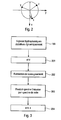
- the steps 102 and 103 for forming channel tracks on each sub-antenna and coherent processing of each channel signal are implemented in the frequency domain in 4 step modules, as shown in FIG. 3. These calculation steps are known from the prior art.
- the coherent treatment is a multicopy treatment known from the prior art for example in the French patent published under No. 2,687,226.
- the dynamically stabilized hydrophonic signals in the module 101 are converted from the space time into the frequency space by a Fast Fourier Transform (FFT) module. 201. Then, in known manner, a formation of bearing paths in a module 202 is carried out, then the product of the conjugated spectra of the doppler emission signal by the spectrum of each channel in a module 203. A module 204 of inverse FFT finally allows to obtain the coherently processed channel signals corresponding to those delivered by the module 103.
- FFT Fast Fourier Transform
- a module 104 an adaptive channel formation is performed on each bearing channel obtained at the output of step 103.
- V I (m, t, ⁇ ) The output signal of the channel m of the linear antenna I (1 I I ⁇ 3) at the instant t will be noted V I (m, t, ⁇ ), and V (m, t, ⁇ ) will designate the column vector consisting of the 3 components V 1 , V 2 , V 3 for the deposit m at time t, with a "doppler" ⁇ .
- the "doppler" ⁇ is defined as the Doppler shift 2 ⁇ V ⁇ VS or V represents the vector resulting from the radial velocities of the transmitter and the receiver, C being the speed of sound in the water. Its range of variation is between 2 values of ⁇ corresponding to extreme speeds.
- a recovery time of 50% is carried out.
- the estimation requires about 1.5 p to 2p independent observations and thus takes place over a very short time allowing the processing of adapt to the variations of the environment (noise or reverberation) and also to take into account the echo to reject it in the lanes of direction opposite to its direction of arrival.
- the inverse matrix ⁇ -1 (m, t, ⁇ ) is calculated by a known direct method.
- the left and right channels V g and V d are formed , as explained below in the case of a triplet.
- FIG. 5 represents, in this case of the triplet, the notation used: a is the radius of the triplet; ⁇ and ⁇ are the angles that correspond to the pointing direction of a channel when it is formed.
- the two channels V g and V d are formed by first calculating the two phase shift vectors d d and d g associated with the right and left channels for each channel in the field.
- V boy Wut m ⁇ t ⁇ ⁇ d boy Wut + m ⁇ ⁇ ⁇ - 1 m ⁇ t ⁇ ⁇ d boy Wut + m ⁇ ⁇ ⁇ - 1 m ⁇ t ⁇ ⁇ ⁇ d boy Wut ⁇ m ⁇ V ⁇ m ⁇ t ⁇ ⁇
- V d m ⁇ t ⁇ ⁇ d d + m ⁇ ⁇ ⁇ - 1 m ⁇ t ⁇ ⁇ d d + m ⁇ ⁇ ⁇ - 1 m ⁇ t ⁇ ⁇ ⁇ d d ⁇ m ⁇ V ⁇ m ⁇ t ⁇ ⁇ ⁇
- the process builds a conventional channel and a noise reference having a zero in the set direction, and then coherently subtracts the signal reference signal from the conventional channel.
Landscapes
- Physics & Mathematics (AREA)
- Engineering & Computer Science (AREA)
- Remote Sensing (AREA)
- General Physics & Mathematics (AREA)
- Radar, Positioning & Navigation (AREA)
- Life Sciences & Earth Sciences (AREA)
- Acoustics & Sound (AREA)
- Environmental & Geological Engineering (AREA)
- Geology (AREA)
- General Life Sciences & Earth Sciences (AREA)
- Geophysics (AREA)
- Computer Networks & Wireless Communication (AREA)
- Measurement Of Velocity Or Position Using Acoustic Or Ultrasonic Waves (AREA)
- Bridges Or Land Bridges (AREA)
- Variable-Direction Aerials And Aerial Arrays (AREA)
- Apparatus For Radiation Diagnosis (AREA)
- Investigating Or Analyzing Materials By The Use Of Ultrasonic Waves (AREA)
- Static Random-Access Memory (AREA)
- Geophysics And Detection Of Objects (AREA)
Description
- La présente invention se rapporte aux procédés de traitement des signaux d'une antenne linéaire remorquée. Elle permet notamment de lever l'ambiguïté droite-gauche sur une telle antenne lorsqu'elle est activée, c'est-à-dire qu'elle fonctionne en réception des échos produits à partir des émissions d'un sonar actif.
- Pour lever cette ambiguïté, on connaît, en particulier du brevet
français n° 89 11 749 2 651 950 et délivré le 17 avril 1992 - Pour obtenir un lever d'ambiguïté satisfaisant en utilisant cette technique, il est nécessaire que les "triplets" d'hydrophones, plus généralement les n-multiplets", soient alignés de façon à constituer un ensemble de 3 (n) sous-antennes linéaires. On est alors amené à assurer cette linéarité à l'aide de liaisons rigides entre les triplets, ce qui présente l'inconvénient de ne bien fonctionner que pour des antennes pas trop longues. Or on cherche de plus en plus à diminuer la fréquence de travail pour augmenter la portée. Une telle diminution conduit à augmenter la longueur des antennes dans des proportions telles que la linéarité des sous-antennes devient de plus en plus difficile à contrôler.
- En outre, comme le diamètre de l'antenne est petit devant la longueur d'onde, la création d'un zéro conduit à des pertes de signal d'autant plus grandes que la fréquence est plus basse, en particulier lorsque le bruit dominant est décorrélé entre hydrophones d'un même triplet, ce qui représente un deuxième inconvénient très sérieux.
- Le traitement selon l'invention permet de remédier à ces inconvénients notamment :
- en s'affranchissant des effets de rotation des triplets (n-multiplets) les uns par rapport aux autres,
- en assurant un gain entre la formation de voie d'une antenne et la formation de voie droite-gauche, quelles que soient les conditions de bruit dominant.
- Pour cela, l'invention propose un procédé de traitement des signaux d'une antenne linéaire remorquée, notamment pour lever l'ambiguïté droite-gauche, cette antenne comprenant un ensemble de multiplets d'hydrophones comportant chacun n≥3 hydrophones répartis dans une section droite de l'axe longitudinal de l'antenne, principalement caractérisé en ce que l'on mesure l'angle de roulis de chaque multiplet par rapport à la verticale, que l'on synthétise à partir des signaux des hydrophones et de cet angle de roulis p ≥3 sous-antennes linéaires, que l'on forme Mv voies de gisement avec chaque sous-antenne et que l'on forme 2 voies droite-gauche adaptatives à partir des p sous-antennes pour chaque direction correspondant à chaque voie de gisement.
- Selon une autre caractéristique, on utilise un traitement cohérent pour former les M voies de gisement.
- Selon une autre caractéristique, pour former les voies droite-gauche on estime la matrice interspectrale inverse Γ̂-1 sur N+1 échantillons temporels et A+1 canaux doppler, puis on détermine deux vecteurs de déphasage dd et dg associés aux voies droite et gauche pour chaque voie de gisement et on détermine les voies Vd et Vg à partir de ces vecteurs et de cette matrice inverse.
- Selon une autre caractéristique, on utilise des inclinomètres pour déterminer les angles de roulis.
- Selon une autre caractérisitique, n= p = 3.
- D'autres particularités et avantages de l'invention apparaîtront clairement dans la description suivante, faite à titre d'exemple non limitatif en regard des figures annexées qui représentent :
- la figure 1, un synoptique du procédé selon l'invention;
- la figure 2, un graphique de définition de l'angle de roulis utilisé dans les calculs;
- la figure 3, un synoptique développé des étapes 102 et 103 de la figure 1;
- la figure 4, un synoptique développé de l'étape 104 de la figure 1; et
- la figure 5, un graphique de définition des autres angles utilisés dans les calculs.
- Le procédé de traitement selon l'invention comporte 4 modules d'étapes, comme représenté sur la figure 1.
- Les signaux hydrophoniques échantillonnés de l'ensemble des multiplets d'hydrophones de l'antenne dans un premier module préliminaire 100, ainsi que les angles de roulis R mesurés dans un deuxième module préliminaire 110 au niveau de chaque multiplet (ou de quelques uns seulement) au moyen d'un capteur de servitude, par exemple un inclinomètre, par rapport à la verticale, tels que définis sur la figure 2, sont appliqués à un premier module 101.
- Le traitement effectué dans ce module 101 consiste à former à partir des n hydrophones de chaque multiplet et de l'indication de leur angle de roulis R, p hydrophones fictifs ayant une position angulaire fixe indépendante du multiplet considéré, de façon à reconstituer p antennes linéaires pour obtenir une stabilisation dynamique en roulis de l'ensemble de l'antenne.
- Pour cela, les signaux des hydrophones sont interpolés spatialement selon une technique connue. Suivant une réalisation préférée, n=3 et p = 3, ce qui correspond au cas de l'antenne triple bien connue en elle-même. Les étapes 102 et 103 de formation de voies gisement sur chaque sous-antenne et de traitement cohérent de chaque signal de voie sont mises en ceuvre dans le domaine fréquentiel en 4 modules d' étapes, comme représenté sur la figure 3. Ces étapes de calcul sont connues de l'art antérieur.
- Dans le cas où le code émis est sensible au doppler, le traitement cohérent est un traitement multicopies connu de l'art antérieur par exemple dans le brevet francais publié sous le n° 2 687 226.
- De manière résumée, les signaux hydrophoniques stabilisés dynamiquement dans le module 101 sont convertis de l'espace temps dans l'espace fréquence par un module de transformation de Fourrier rapide (FFT) 201. On effectue ensuite de manière connue une formation de voies en gisement dans un module 202, puis le produit des spectres conjugués du signal d'émission dopplérisé par le spectre de chaque voie dans un module 203. Un module 204 de FFT inverse permet enfin d'obtenir les signaux de voies traités de manière cohérente, correspondant à ceux délivrés par le module 103.
- Dans un module 104, on effectue une formation de voie adaptative sur chaque voie gisement obtenue en sortie de l'étape 103.
- Les voies gisement sont alors réparties en fonctions du cosinus du gisement variant de -1 à +1 : si u désigne le cosinus du gisement, les directions de pointage vérifient la relation

- Le signal de sortie de la voie m de l'antenne linéaire I (1≤ I ≤3) à l'instant t sera noté VI(m,t,α), et
V (m,t,α) désignera le vecteur colonne constitué des 3 composantes V1, V2, V3 pour le gisement m à l'instant t, avec un "doppler " α. - Le "doppler" α est défini comme étant le décalage doppler

V représente le vecteur résultant des vitesses radiales de l'émetteur et du récepteur, C étant la célérité du son dans l'eau. Sa plage de variation est comprise entre 2 valeurs de α correspondant à des vitesses extrêmes. De manière connue, un canal doppler a une largeur
- Le module 104 se compose de 3 modules de sous-étape qui sont représentés sur la figure 4 :
- une estimation 401 de la matrice interspectrale ;
- une inversion 402 de la matrice interspectrale ;
- une formation 403 des 2 voies droite-gauche.
- Dans le module 401, on estime la matrice interspectrale Γ̂(m,t,α) par moyennage sur N+1 échantillons temporels, et sur A + 1 canaux doppler en appliquant la formule :

- La matrice V̂(m,t,α) ayant une dimension faible (p), l'estimation requiert de l'ordre de 1,5 p à 2p observations indépendantes et donc s'effectue sur un temps très court permettant au traitement de s'adapter aux variations de l'environnement (bruit ou réverbération) et aussi de prendre en compte l'écho pour le rejeter dans les voies de direction opposées à sa direction d'arrivée.
- Dans le module 402, on calcule la matrice inverse Γ̂-1(m,t,α) par une méthode directe connue.
- Enfin, dans le module 403, on forme les voies gauche et droite Vg et Vd , de la manière explicitée ci-dessous dans le cas d'un triplet.
- La figure 5 représente, dans ce cas du triplet, les notations utilisées : a est le rayon du triplet; θ et φ sont les angles qui correspondent à la direction de pointage d'une voie lorsqu'elle est formée.
- Pour cela, dans le module 403, on forme les 2 voies Vg et Vd en calculant d'abord les 2 vecteurs de déphasages dd et dg associés aux voies droite et gauche pour chaque voie en gisement.
- Pour un pointage dans le plan horizontal, soit φ = 0, ces 2 vecteurs sont donnés par les équations ci-dessous :


où fo est la fréquence d'émission. - On forme ensuite les voies Vg et Vd en appliquant les équations suivantes :
- Pour la voie gauche :

- Pour la voie droite :
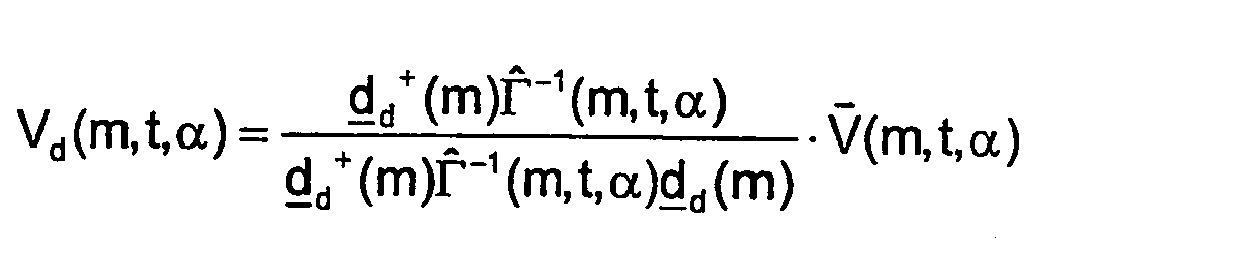
- Pour une direction de consigne donnée, le traitement construit une voie conventionnelle et une référence de bruit ayant un zéro dans la direction de consigne, puis il vient soustraire de manière cohérente le signal de référence du signal de la voie conventionnelle.
- Il en résulte que :
- dans la direction de la cible : celle-ci est exclue de la référence de bruit, et le traitement produit un meilleur gain par rapport au bruit ambiant
- dans la direction ambiguë, la cible est prise en compte dans la référence de bruit, et est soustraite comme un brouilleur, procurant ainsi une réjection droite/gauche. Ceci est possible parce que l'écho provenant de la cible a un niveau suffisant grâce au traitement cohérent effectué avant la formation des voies Vg, Vd, et aussi parce que la durée d'estimation de la matrice est plus courte que la durée de l'écho.
Claims (5)
- Procédé de traitement des signaux d'une antenne linéaire remorquée, notamment pour lever l'ambiguïté droite-gauche, cette antenne comprenant un ensemble de multiplets d'hydrophones comportant chacun n≥3 hydrophones répartis dans une section droite de l'axe longitudinal de l'antenne, l'angle de roulis de chaque multiplet étant mesuré (110) par rapport à la verticale, caractérisé en ce que l'on synthétise (101) à partir des signaux (100) des hydrophones et de cet angle de roulis p ≥3 sous-antennes linéaires, que l'on forme (102) M voies de gisement avec chaque sous-antenne et que l'on forme 2 voies droite-gauche adaptatives à partir des p sous-antennes pour chaque direction correspondant à chaque voie de gisement.
- Procédé selon la revendication 1, caractérisé en ce qu'on utilise un traitement cohérent (103) pour former les M voies de gisement.
- Procédé selon l'une quelconque des revendications 1 ou 2, caractérisé en ce que pour former les voies droite-gauche on estime la matrice interspectrale inverse Γ̂-1 sur N+1 échantillons temporels et A+1 anaux doppler (401,402), puis on détermine (403) deux vecteurs de déphasage dd et dg associés aux voies droite et gauche pour chaque voie de gisement et on détermine les voies Vd et Vg à partir de ces vecteurs et de cette matrice inverse.
- Procédé selon l'une quelconque des revendications 1 à 3, caractérisé en ce que l'on utilise des inclinomètres pour déterminer les angles de roulis.
- Procédé selon l'une quelconque des revendications 1 à 4, caractérisé en ce que n= p = 3.
Applications Claiming Priority (3)
| Application Number | Priority Date | Filing Date | Title |
|---|---|---|---|
| FR0111106A FR2828936B1 (fr) | 2001-08-24 | 2001-08-24 | Procede de traitement des signaux d'une antenne lineaire remorquee |
| FR0111106 | 2001-08-24 | ||
| PCT/FR2002/002909 WO2003019224A1 (fr) | 2001-08-24 | 2002-08-20 | Procede de traitement des signaux d'une antenne lineaire remorquee |
Publications (2)
| Publication Number | Publication Date |
|---|---|
| EP1428038A1 EP1428038A1 (fr) | 2004-06-16 |
| EP1428038B1 true EP1428038B1 (fr) | 2007-06-20 |
Family
ID=8866730
Family Applications (1)
| Application Number | Title | Priority Date | Filing Date |
|---|---|---|---|
| EP02796299A Expired - Lifetime EP1428038B1 (fr) | 2001-08-24 | 2002-08-20 | Procede de traitement des signaux d'une antenne lineaire remorquee |
Country Status (9)
| Country | Link |
|---|---|
| US (1) | US7075858B2 (fr) |
| EP (1) | EP1428038B1 (fr) |
| KR (1) | KR100943868B1 (fr) |
| AT (1) | ATE365336T1 (fr) |
| AU (1) | AU2002356154B2 (fr) |
| DE (1) | DE60220806T2 (fr) |
| FR (1) | FR2828936B1 (fr) |
| NO (1) | NO336797B1 (fr) |
| WO (1) | WO2003019224A1 (fr) |
Families Citing this family (9)
| Publication number | Priority date | Publication date | Assignee | Title |
|---|---|---|---|---|
| KR100585714B1 (ko) * | 2003-05-26 | 2006-06-07 | 엘지전자 주식회사 | 기지국 원형배열안테나의 신호원 서칭장치 및 방법 |
| GB2410551B (en) | 2004-01-30 | 2006-06-14 | Westerngeco Ltd | Marine seismic acquisition system |
| FR2882506B1 (fr) | 2005-02-25 | 2007-05-18 | Oreal | Procede de maquillage au moyen d'un applicateur vibrant |
| FR2900504B1 (fr) * | 2006-04-26 | 2009-11-20 | Thales Sa | Procede pour optimiser l'alimentation d'une antenne lineaire d'emission remorquee pour emettre en mode omnidirectionnel. |
| FR2909457B1 (fr) * | 2006-12-01 | 2009-01-23 | Thales Sa | Procede d'elimination de sources fantomes pour un sonar passif comportant plusieurs antennes lineaires. |
| FR2959067B1 (fr) * | 2010-04-16 | 2012-04-06 | Thales Sa | Traitement adaptatif de formation de voies pour sonar actif |
| EP2541283B1 (fr) * | 2011-06-29 | 2016-08-17 | Sercel | Procédé et dispositif pour estimer la vitesse du son acoustique sous-marine dans un réseau de noeuds acoustiques |
| KR101523278B1 (ko) * | 2013-10-29 | 2015-05-27 | 국방과학연구소 | 다수의 무지향성 하이드로폰을 이용한 벡터 빔형성 방법 |
| CN104133477B (zh) * | 2014-04-17 | 2016-10-26 | 中国航空工业集团公司沈阳飞机设计研究所 | 一种可以实现瞬态抑制的调效控制律指令控制方法 |
Family Cites Families (3)
| Publication number | Priority date | Publication date | Assignee | Title |
|---|---|---|---|---|
| FR2651950B1 (fr) * | 1989-09-08 | 1992-04-17 | Thomson Csf | Antenne hydrophonique lineaire et dispositif electronique de levee d'ambiguite droite-gauche associe a cette antenne. |
| FR2685848B1 (fr) * | 1991-12-26 | 1994-02-25 | Thomson Csf | Antenne acoustique lineaire. |
| FR2727765B1 (fr) * | 1994-12-06 | 1997-01-10 | Thomson Csf | Procede de reception avec levee d'ambiguite pour une antenne acoustique lineaire remorquee |
-
2001
- 2001-08-24 FR FR0111106A patent/FR2828936B1/fr not_active Expired - Fee Related
-
2002
- 2002-08-20 EP EP02796299A patent/EP1428038B1/fr not_active Expired - Lifetime
- 2002-08-20 US US10/487,451 patent/US7075858B2/en not_active Expired - Lifetime
- 2002-08-20 WO PCT/FR2002/002909 patent/WO2003019224A1/fr not_active Ceased
- 2002-08-20 DE DE60220806T patent/DE60220806T2/de not_active Expired - Lifetime
- 2002-08-20 AU AU2002356154A patent/AU2002356154B2/en not_active Ceased
- 2002-08-20 AT AT02796299T patent/ATE365336T1/de not_active IP Right Cessation
- 2002-08-20 NO NO20041229A patent/NO336797B1/no not_active IP Right Cessation
- 2002-08-20 KR KR1020047002679A patent/KR100943868B1/ko not_active Expired - Fee Related
Also Published As
| Publication number | Publication date |
|---|---|
| US20040240317A1 (en) | 2004-12-02 |
| ATE365336T1 (de) | 2007-07-15 |
| WO2003019224A1 (fr) | 2003-03-06 |
| EP1428038A1 (fr) | 2004-06-16 |
| DE60220806T2 (de) | 2008-03-06 |
| NO336797B1 (no) | 2015-11-02 |
| DE60220806D1 (de) | 2007-08-02 |
| FR2828936B1 (fr) | 2003-12-05 |
| KR100943868B1 (ko) | 2010-02-24 |
| US7075858B2 (en) | 2006-07-11 |
| NO20041229L (no) | 2004-03-24 |
| AU2002356154B2 (en) | 2007-11-22 |
| KR20040036731A (ko) | 2004-04-30 |
| FR2828936A1 (fr) | 2003-02-28 |
Similar Documents
| Publication | Publication Date | Title |
|---|---|---|
| FR2859538A1 (fr) | Systeme de radar a ondes de surface | |
| EP2287633B1 (fr) | Radar de détection de cibles aériennes équipant un aéronef notamment pour l'évitement d'obstacles en vol | |
| EP0416992A1 (fr) | Antenne hydrophonique linéaire et dispositif électronique de levée d'ambiguité droite-gauche associé À cette antenne | |
| WO2003019224A1 (fr) | Procede de traitement des signaux d'une antenne lineaire remorquee | |
| EP0916965B1 (fr) | Procédé d'attenuation du fouillis issu des lobes de reflexion d'une antenne radar | |
| FR2652164A1 (fr) | Procede de formation de voies pour sonar, notamment pour sonar remorque. | |
| CA1157131A (fr) | Methode pour la teledetection de l'etat de la mer et dispositif pour sa mise en oeuvre | |
| EP0580695B1 (fr) | Procede de compensation du mouvement de l'antenne pour un sonar | |
| EP0237404A1 (fr) | Procédé de traitement des signaux somme et différence d'un radar du type monopulse, en vue d'estimer la phase parasite introduite entre ces signaux par les circuits hyperfréquence de formation des voies somme et différence | |
| EP4330722B1 (fr) | Système radar et procédé associé pour optimiser l'élimination de fouillis radar | |
| EP1099958B1 (fr) | Procédés et dispositifs associés de détermination de la forme d'une antenne linéaire et de lever d'ambiguité conique | |
| EP1855125B1 (fr) | Procédé de filtrage des signaux de brouillage pour une antenne mobile multivoie | |
| EP1540371B1 (fr) | Antenne sonar synthetique | |
| EP0628172B1 (fr) | Procede de stabilisation et de formation de voies pour sonar et sonar pour sa mise en oeuvre | |
| BE1032131B1 (fr) | Un système radar de surveillance des déformations à ouverture réelle basé sur PMCW-MIMO | |
| EP1354218A1 (fr) | Antenne sonar synthetique interferometrique | |
| EP1522871B1 (fr) | Radar à formation de voies d'écartométrie synthétiques | |
| EP1245965A1 (fr) | Procédé et système de détection, notamment radar à réseau d'émission et réception et à formation de faisceau par le calcul | |
| FR2714734A1 (fr) | Procédé de localisation acoustique d'un véhicule remorqué par un bateau. | |
| EP0626073A1 (fr) | Procede de detection de cible sous-marine avec diversite de frequence. | |
| FR2591754A1 (fr) | Procede passif d'evaluation de grandeurs d'etats d'une cible en mouvement rayonnant des impulsions sonores dans l'eau | |
| WO2015078895A1 (fr) | Systeme et procede de localisation d'emissions sonar interceptees |
Legal Events
| Date | Code | Title | Description |
|---|---|---|---|
| PUAI | Public reference made under article 153(3) epc to a published international application that has entered the european phase |
Free format text: ORIGINAL CODE: 0009012 |
|
| 17P | Request for examination filed |
Effective date: 20040324 |
|
| AK | Designated contracting states |
Kind code of ref document: A1 Designated state(s): AT BE BG CH CY CZ DE DK EE ES FI FR GB GR IE IT LI LU MC NL PT SE SK TR |
|
| AX | Request for extension of the european patent |
Extension state: AL LT LV MK RO SI |
|
| GRAP | Despatch of communication of intention to grant a patent |
Free format text: ORIGINAL CODE: EPIDOSNIGR1 |
|
| GRAS | Grant fee paid |
Free format text: ORIGINAL CODE: EPIDOSNIGR3 |
|
| GRAA | (expected) grant |
Free format text: ORIGINAL CODE: 0009210 |
|
| AK | Designated contracting states |
Kind code of ref document: B1 Designated state(s): AT BE BG CH CY CZ DE DK EE ES FI FR GB GR IE IT LI LU MC NL PT SE SK TR |
|
| REG | Reference to a national code |
Ref country code: GB Ref legal event code: FG4D Free format text: NOT ENGLISH |
|
| REG | Reference to a national code |
Ref country code: CH Ref legal event code: EP |
|
| REG | Reference to a national code |
Ref country code: IE Ref legal event code: FG4D Free format text: LANGUAGE OF EP DOCUMENT: FRENCH |
|
| REF | Corresponds to: |
Ref document number: 60220806 Country of ref document: DE Date of ref document: 20070802 Kind code of ref document: P |
|
| PG25 | Lapsed in a contracting state [announced via postgrant information from national office to epo] |
Ref country code: SE Free format text: LAPSE BECAUSE OF FAILURE TO SUBMIT A TRANSLATION OF THE DESCRIPTION OR TO PAY THE FEE WITHIN THE PRESCRIBED TIME-LIMIT Effective date: 20070920 |
|
| GBT | Gb: translation of ep patent filed (gb section 77(6)(a)/1977) |
Effective date: 20070919 |
|
| REG | Reference to a national code |
Ref country code: GR Ref legal event code: EP Ref document number: 20070402854 Country of ref document: GR |
|
| PG25 | Lapsed in a contracting state [announced via postgrant information from national office to epo] |
Ref country code: AT Free format text: LAPSE BECAUSE OF FAILURE TO SUBMIT A TRANSLATION OF THE DESCRIPTION OR TO PAY THE FEE WITHIN THE PRESCRIBED TIME-LIMIT Effective date: 20070620 |
|
| REG | Reference to a national code |
Ref country code: IE Ref legal event code: FD4D |
|
| PG25 | Lapsed in a contracting state [announced via postgrant information from national office to epo] |
Ref country code: IE Free format text: LAPSE BECAUSE OF FAILURE TO SUBMIT A TRANSLATION OF THE DESCRIPTION OR TO PAY THE FEE WITHIN THE PRESCRIBED TIME-LIMIT Effective date: 20070620 Ref country code: PT Free format text: LAPSE BECAUSE OF FAILURE TO SUBMIT A TRANSLATION OF THE DESCRIPTION OR TO PAY THE FEE WITHIN THE PRESCRIBED TIME-LIMIT Effective date: 20071120 Ref country code: CZ Free format text: LAPSE BECAUSE OF FAILURE TO SUBMIT A TRANSLATION OF THE DESCRIPTION OR TO PAY THE FEE WITHIN THE PRESCRIBED TIME-LIMIT Effective date: 20070620 Ref country code: ES Free format text: LAPSE BECAUSE OF FAILURE TO SUBMIT A TRANSLATION OF THE DESCRIPTION OR TO PAY THE FEE WITHIN THE PRESCRIBED TIME-LIMIT Effective date: 20071001 Ref country code: BG Free format text: LAPSE BECAUSE OF FAILURE TO SUBMIT A TRANSLATION OF THE DESCRIPTION OR TO PAY THE FEE WITHIN THE PRESCRIBED TIME-LIMIT Effective date: 20070920 |
|
| BERE | Be: lapsed |
Owner name: THALES Effective date: 20070831 |
|
| PG25 | Lapsed in a contracting state [announced via postgrant information from national office to epo] |
Ref country code: SK Free format text: LAPSE BECAUSE OF FAILURE TO SUBMIT A TRANSLATION OF THE DESCRIPTION OR TO PAY THE FEE WITHIN THE PRESCRIBED TIME-LIMIT Effective date: 20070620 |
|
| REG | Reference to a national code |
Ref country code: CH Ref legal event code: PL |
|
| PLBE | No opposition filed within time limit |
Free format text: ORIGINAL CODE: 0009261 |
|
| STAA | Information on the status of an ep patent application or granted ep patent |
Free format text: STATUS: NO OPPOSITION FILED WITHIN TIME LIMIT |
|
| PG25 | Lapsed in a contracting state [announced via postgrant information from national office to epo] |
Ref country code: CH Free format text: LAPSE BECAUSE OF NON-PAYMENT OF DUE FEES Effective date: 20070831 Ref country code: DK Free format text: LAPSE BECAUSE OF FAILURE TO SUBMIT A TRANSLATION OF THE DESCRIPTION OR TO PAY THE FEE WITHIN THE PRESCRIBED TIME-LIMIT Effective date: 20070620 Ref country code: MC Free format text: LAPSE BECAUSE OF NON-PAYMENT OF DUE FEES Effective date: 20070831 Ref country code: LI Free format text: LAPSE BECAUSE OF NON-PAYMENT OF DUE FEES Effective date: 20070831 |
|
| 26N | No opposition filed |
Effective date: 20080325 |
|
| PG25 | Lapsed in a contracting state [announced via postgrant information from national office to epo] |
Ref country code: BE Free format text: LAPSE BECAUSE OF NON-PAYMENT OF DUE FEES Effective date: 20070831 |
|
| PG25 | Lapsed in a contracting state [announced via postgrant information from national office to epo] |
Ref country code: EE Free format text: LAPSE BECAUSE OF FAILURE TO SUBMIT A TRANSLATION OF THE DESCRIPTION OR TO PAY THE FEE WITHIN THE PRESCRIBED TIME-LIMIT Effective date: 20070620 |
|
| PG25 | Lapsed in a contracting state [announced via postgrant information from national office to epo] |
Ref country code: FI Free format text: LAPSE BECAUSE OF FAILURE TO SUBMIT A TRANSLATION OF THE DESCRIPTION OR TO PAY THE FEE WITHIN THE PRESCRIBED TIME-LIMIT Effective date: 20070620 |
|
| PG25 | Lapsed in a contracting state [announced via postgrant information from national office to epo] |
Ref country code: CY Free format text: LAPSE BECAUSE OF FAILURE TO SUBMIT A TRANSLATION OF THE DESCRIPTION OR TO PAY THE FEE WITHIN THE PRESCRIBED TIME-LIMIT Effective date: 20070620 |
|
| PG25 | Lapsed in a contracting state [announced via postgrant information from national office to epo] |
Ref country code: LU Free format text: LAPSE BECAUSE OF NON-PAYMENT OF DUE FEES Effective date: 20070820 |
|
| REG | Reference to a national code |
Ref country code: FR Ref legal event code: PLFP Year of fee payment: 15 |
|
| REG | Reference to a national code |
Ref country code: FR Ref legal event code: PLFP Year of fee payment: 16 |
|
| PGFP | Annual fee paid to national office [announced via postgrant information from national office to epo] |
Ref country code: GR Payment date: 20170728 Year of fee payment: 16 |
|
| REG | Reference to a national code |
Ref country code: FR Ref legal event code: PLFP Year of fee payment: 17 |
|
| PG25 | Lapsed in a contracting state [announced via postgrant information from national office to epo] |
Ref country code: GR Free format text: LAPSE BECAUSE OF NON-PAYMENT OF DUE FEES Effective date: 20190307 |
|
| PGFP | Annual fee paid to national office [announced via postgrant information from national office to epo] |
Ref country code: NL Payment date: 20190814 Year of fee payment: 18 |
|
| PGFP | Annual fee paid to national office [announced via postgrant information from national office to epo] |
Ref country code: TR Payment date: 20190807 Year of fee payment: 18 Ref country code: IT Payment date: 20190821 Year of fee payment: 18 |
|
| REG | Reference to a national code |
Ref country code: NL Ref legal event code: MM Effective date: 20200901 |
|
| PG25 | Lapsed in a contracting state [announced via postgrant information from national office to epo] |
Ref country code: NL Free format text: LAPSE BECAUSE OF NON-PAYMENT OF DUE FEES Effective date: 20200901 |
|
| PGFP | Annual fee paid to national office [announced via postgrant information from national office to epo] |
Ref country code: FR Payment date: 20210727 Year of fee payment: 20 |
|
| PGFP | Annual fee paid to national office [announced via postgrant information from national office to epo] |
Ref country code: DE Payment date: 20210720 Year of fee payment: 20 Ref country code: GB Payment date: 20210721 Year of fee payment: 20 |
|
| PG25 | Lapsed in a contracting state [announced via postgrant information from national office to epo] |
Ref country code: IT Free format text: LAPSE BECAUSE OF NON-PAYMENT OF DUE FEES Effective date: 20200820 |
|
| PG25 | Lapsed in a contracting state [announced via postgrant information from national office to epo] |
Ref country code: TR Free format text: LAPSE BECAUSE OF NON-PAYMENT OF DUE FEES Effective date: 20200820 |
|
| REG | Reference to a national code |
Ref country code: DE Ref legal event code: R071 Ref document number: 60220806 Country of ref document: DE |
|
| REG | Reference to a national code |
Ref country code: GB Ref legal event code: PE20 Expiry date: 20220819 |
|
| PG25 | Lapsed in a contracting state [announced via postgrant information from national office to epo] |
Ref country code: GB Free format text: LAPSE BECAUSE OF EXPIRATION OF PROTECTION Effective date: 20220819 |
|
| P01 | Opt-out of the competence of the unified patent court (upc) registered |
Effective date: 20230606 |