EP1427154A1 - Procédé de contrôle d'une mémoire tampon de paquets de données, et dispositif correspondant - Google Patents
Procédé de contrôle d'une mémoire tampon de paquets de données, et dispositif correspondant Download PDFInfo
- Publication number
- EP1427154A1 EP1427154A1 EP03292738A EP03292738A EP1427154A1 EP 1427154 A1 EP1427154 A1 EP 1427154A1 EP 03292738 A EP03292738 A EP 03292738A EP 03292738 A EP03292738 A EP 03292738A EP 1427154 A1 EP1427154 A1 EP 1427154A1
- Authority
- EP
- European Patent Office
- Prior art keywords
- burst
- packets
- fifo
- buffer memory
- signal
- Prior art date
- Legal status (The legal status is an assumption and is not a legal conclusion. Google has not performed a legal analysis and makes no representation as to the accuracy of the status listed.)
- Granted
Links
- 238000000034 method Methods 0.000 title claims description 62
- 238000001514 detection method Methods 0.000 claims abstract description 19
- 230000004044 response Effects 0.000 claims abstract description 3
- 238000012217 deletion Methods 0.000 claims description 25
- 230000037430 deletion Effects 0.000 claims description 25
- 230000036961 partial effect Effects 0.000 claims description 19
- 238000012545 processing Methods 0.000 claims description 17
- 230000000694 effects Effects 0.000 claims description 10
- 230000006399 behavior Effects 0.000 claims description 6
- 230000006870 function Effects 0.000 claims description 4
- 230000008569 process Effects 0.000 claims description 3
- 238000011156 evaluation Methods 0.000 claims description 2
- 230000005540 biological transmission Effects 0.000 description 19
- 238000004891 communication Methods 0.000 description 17
- 230000007246 mechanism Effects 0.000 description 16
- 238000006467 substitution reaction Methods 0.000 description 15
- 238000007726 management method Methods 0.000 description 14
- 230000001629 suppression Effects 0.000 description 9
- 230000005236 sound signal Effects 0.000 description 6
- 230000001934 delay Effects 0.000 description 3
- 238000010586 diagram Methods 0.000 description 3
- 238000004519 manufacturing process Methods 0.000 description 3
- 230000000717 retained effect Effects 0.000 description 3
- 238000012360 testing method Methods 0.000 description 3
- 230000003044 adaptive effect Effects 0.000 description 2
- 230000008901 benefit Effects 0.000 description 2
- 230000015556 catabolic process Effects 0.000 description 2
- 238000012937 correction Methods 0.000 description 2
- 230000006378 damage Effects 0.000 description 2
- 238000006731 degradation reaction Methods 0.000 description 2
- 230000003111 delayed effect Effects 0.000 description 2
- 230000002452 interceptive effect Effects 0.000 description 2
- 230000001360 synchronised effect Effects 0.000 description 2
- 230000002123 temporal effect Effects 0.000 description 2
- 230000007704 transition Effects 0.000 description 2
- 241001415961 Gaviidae Species 0.000 description 1
- 238000009825 accumulation Methods 0.000 description 1
- 230000006978 adaptation Effects 0.000 description 1
- 230000004075 alteration Effects 0.000 description 1
- 238000013459 approach Methods 0.000 description 1
- 238000004364 calculation method Methods 0.000 description 1
- 230000006835 compression Effects 0.000 description 1
- 238000007906 compression Methods 0.000 description 1
- 239000000470 constituent Substances 0.000 description 1
- 230000006837 decompression Effects 0.000 description 1
- 230000001419 dependent effect Effects 0.000 description 1
- 238000013461 design Methods 0.000 description 1
- 230000006866 deterioration Effects 0.000 description 1
- 230000002045 lasting effect Effects 0.000 description 1
- 230000000670 limiting effect Effects 0.000 description 1
- 230000014759 maintenance of location Effects 0.000 description 1
- ZRHANBBTXQZFSP-UHFFFAOYSA-M potassium;4-amino-3,5,6-trichloropyridine-2-carboxylate Chemical compound [K+].NC1=C(Cl)C(Cl)=NC(C([O-])=O)=C1Cl ZRHANBBTXQZFSP-UHFFFAOYSA-M 0.000 description 1
- 238000011084 recovery Methods 0.000 description 1
- 230000009467 reduction Effects 0.000 description 1
- 230000002829 reductive effect Effects 0.000 description 1
- 238000012552 review Methods 0.000 description 1
- 230000033764 rhythmic process Effects 0.000 description 1
- 238000005070 sampling Methods 0.000 description 1
- 229920006395 saturated elastomer Polymers 0.000 description 1
- 238000009738 saturating Methods 0.000 description 1
- 239000013589 supplement Substances 0.000 description 1
- 238000011144 upstream manufacturing Methods 0.000 description 1
Images







Classifications
-
- H—ELECTRICITY
- H04—ELECTRIC COMMUNICATION TECHNIQUE
- H04L—TRANSMISSION OF DIGITAL INFORMATION, e.g. TELEGRAPHIC COMMUNICATION
- H04L49/00—Packet switching elements
- H04L49/90—Buffering arrangements
- H04L49/9084—Reactions to storage capacity overflow
- H04L49/9089—Reactions to storage capacity overflow replacing packets in a storage arrangement, e.g. pushout
- H04L49/9094—Arrangements for simultaneous transmit and receive, e.g. simultaneous reading/writing from/to the storage element
-
- H—ELECTRICITY
- H04—ELECTRIC COMMUNICATION TECHNIQUE
- H04L—TRANSMISSION OF DIGITAL INFORMATION, e.g. TELEGRAPHIC COMMUNICATION
- H04L49/00—Packet switching elements
- H04L49/90—Buffering arrangements
-
- H—ELECTRICITY
- H04—ELECTRIC COMMUNICATION TECHNIQUE
- H04L—TRANSMISSION OF DIGITAL INFORMATION, e.g. TELEGRAPHIC COMMUNICATION
- H04L49/00—Packet switching elements
- H04L49/90—Buffering arrangements
- H04L49/9023—Buffering arrangements for implementing a jitter-buffer
Definitions
- the present invention relates to techniques for processing time constrained signals received via links asynchronous.
- IP Internet protocol
- the invention is particularly applicable in all equipment receiving streams (audio, video, and / or data) consisting of packets sent regularly and provided with a memory organized in first in first out mode (FIFO, to take into account) of the network jitter phenomenon.
- FIFO first in first out mode
- VOIP voice over IP
- UDP User Datagram Protocol
- two terminals in communication using the speech coder G.723.1 standardized by the International Telecommunication Union (ITU-T) typically exchange 24 bytes of audio data every 30 milliseconds.
- the invention supplements or adapts conventional management mechanisms of FIFOs already in use.
- the invention is particularly aimed at interactive applications of the type voice communication for example, but may also have an interest in less interactive applications such as reading in transit ( "Streaming").
- Network jitter In any asynchronous packet communication, the network introduces a fixed delay as well as a variable delay called "network jitter". The reception of packets passing through the network is delayed compared to their instant of emission. The fixed delay, if it remains low, is not the most restrictive. Its effect is essentially felt as posing a problem of interactivity in communication. Network jitter is more bothersome because it leads on the one hand to holes (lack of signal to be returned, the package arriving too late) and on the other hand, at other times a overabundance of packets to be returned (simultaneous arrival of several packets bursts), which can introduce an additional delay harmful to the interactivity of communication, for example in the case of VOIP.
- a mechanism must therefore be introduced at reception to manage to some extent these variations in transmission delay. This mechanism is to be placed at the receiver and not at the transmitter, because the latter sends packets periodically, the variations being introduced by the asynchronous network. Since this network cannot be controlled neither by the transmitter nor by the receiver, it is necessary to adapt to its non-deterministic and unpredictable behavior.
- the mechanism generally used to control the phenomenon of jitter is the implementation of a FIFO which compensates for delays packets received at the return system.
- Packets may be received in an order other than the one in which they were issued. This phenomenon, called “imbalance”, is due to the fact that the transmitted packets circulate independently on the IP networks. However, it is a relatively rare phenomenon on the Internet (probability of the order of 0.01%).
- the real-time protocols used allow, thanks to a sequence number assigned to each packet, to put them in the correct order upon receipt, or destroy the unbalanced packets if their restitution time is exceeded. It's the case in particular the RTP protocol (“Real Time Protocol”) described in RFC 1889 and 1890 ("Request For Comments”) published in January 1996 by the IETF ("Internet Engineering Task Force”).
- the FIFO mentioned above can be found in different places within the reception chain.
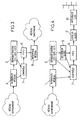
- FIGS 1 and 2 show a VOIP type receiver with a network interface 1, usually consisting of a modem or card network, connected to a module 2 implementing IP, UDP and RTP protocols for receive IP packets and extract their content (operation of "Depacketization").
- This content is subject to a speech decoder 3 corresponding to the encoder (G.723.1 or other) used by the transmitter and operating the digital decompression of the audio signal. Speech is finally restored by means of a sound card 4 provided with a restitution buffer and a loudspeaker 5.
- FIFO 6 is located between the depacketizing module 2 and the decoder 3. In the illustrated configuration in FIG. 2, it is located between the decoder 3 and the sound card 4. This FIFO 6 is associated with a control module 7 which implements the algorithms of compensation for network jitter.
- Figures 3 and 4 illustrate other possible environments of the Jitter 6 FIFO, elsewhere than in a receiver restoring the transmitted speech. In practice, the possible configurations are very numerous.
- the diagram in Figure 3 does not include an audio decoder. he corresponds for example to a gateway placed between the asynchronous network IP type and a synchronous network.
- the information flow read in FIFO 6 is supplied to network interface 8 which formats it for transmission over the synchronous network.
- the example of equipment shown in Figure 4 provides a function transcoding, for example between G.723.1 compression on the network asynchronous and higher speed coding such as G.711 on a local network (LAN, "Local Area Network").
- Jitter 6 FIFO can be placed after the G.723.1 type 3 decoder, as shown, or before.
- the flow decoded audio read in FIFO 6 is recoded by coder 9 of type G.711 then supplied to the LAN interface circuit 10.
- the position of the FIFO can have an influence on its management. Indeed, in the case of VOIP for example, when the FIFO is placed before the decoder (figure 1 or 3), the algorithm cannot access the signal itself because it only has an encoded version of the parameters characterizing the signal. When the FIFO is placed after the decoder (figure 2 or 4), it is then possible to adapt the management of the FIFO to the decoded signal it contains.
- One of the first jitter management techniques that was proposed consists of using a fixed threshold: when the FIFO is full and that a packet arrives, this one cannot be integrated into the FIFO what entails its destruction. It is then the size of the FIFO which imposes the maximum delay it can absorb. It is also this size which makes it possible to define the compromise interactivity / loss.
- Network jitter can take relatively high values (for example example 300 ms). If the FIFO is sized to be able to absorb a lower maximum jitter, so when a packet's jitter exceeds this limit, the restitution system detects an absence of packet, and must compensate for the lack of signal by generating a piece of signal replacement corresponding to a package (to simplify the expression, we will say that it generates a replacement or substitution package for the package missing, even if the precise mechanism used does not generally include the actual production of a package). This absence of package is therefore managed in the same way as a packet loss in the network. Signal duration stored in FIFO is therefore an important parameter for interactivity and quality of communication. Too large a FIFO reduces interactivity but preserves quality, too small FIFO improves interactivity but can degrade quality by involving the too frequent generation of packets of replacement.
- This saturation phenomenon is managed by management mechanisms of FIFO mentioned above, either by no longer allowing to write in FIFO when is full, either by performing a partial or global emptying of the FIFO for be able to continue writing.
- the FIFO is full at the end of the burst, and introduces therefore a maximum delay in communication.
- the FIPO's fill rate is dependent on the size of the burst and that of the FIFO. Indeed, let's take the example of a burst of size just less than 2 times the size of the FIFO. Upon receipt of the first part of this burst in the FIFO, it is emptied of it, and therefore the second part is placed entirely in the FIFO. We are then finds in a state close to the first case, with a maximum delay in communication. If on the contrary the size of the burst had been equal or little larger than the size of the FIFO, it would have been drained towards the end reception of this burst and would then be empty, i.e. in a state where the less delay for the next packet causes a problem. Indeed, this little delay then requires the generation of a replacement packet, with the resulting alteration in quality, while valid packets come just to be deleted.
- An object of the present invention is to limit the inevitable degradation quality due to the network jitter phenomenon, and in particular to limit the impact of the strong disturbances caused by the network.
- the invention thus provides a method for processing packets of digital data received, containing description data of successive time segments of a signal flow to be restored, in which one stores in a buffer elements obtained from received packets, and deliver in first in - first out mode items stored in the buffer.
- a packet burst fulfilling a burst size condition on the basis of a reception delay evaluated in response to the reception of a first burst packet, and check the contents of the buffer by holding account of the detection of the burst fulfilling said size condition.
- a signal “segment” can be understood here as corresponding to a time interval of a continuous signal in time such as an audio signal or video (it can for example consist of one or more consecutive frames a speech, motion picture encoder, etc.).
- the signal “segment” can also be understood as corresponding to regularly produced data by a data source (for example samples of measures taken periodically, images, ). In either case, these segments are generally produced on a regular or near-regular basis by a remote transmitter.
- the method applies a specific treatment to bursts of excessive size, or "excessive bursts", based on a detection of these.
- the detection of an excessive burst is done using an estimate of burst size, resulting from the delay in receiving its first packet, for determine whether or not the burst that is arriving can be considered as normal. A normal burst (not meeting the size requirement) will then be processed normally in FIFO.
- the size condition can be expressed by a threshold to be defined by the user or the process environment.
- This threshold fixed or adaptive, is limited to a value corresponding to the size of the FIFO. He may have lower values depending on the application and the support network.
- the same VOIP application could use a lower threshold in the context of a transmission over a private network than in the context of a transmission over a jitter network and stronger disturbances such as the Internet.
- This threshold could possibly be dynamically adapted depending on the behavior of the network. However, it will generally fairly high, because the classification of a gust as excessive gust must correspond to a strong and occasional disturbance of the network.
- the current or normal disturbances must be managed by the normal jitter FIFO control mechanisms, including choice of an adapted size of the FIFO.
- the estimation of the burst size takes place upon arrival of the first burst packet. This allows immediately initiate the appropriate burst processing. In the case where to delete packages, the deletion can take place before these packets are not placed in the FIFO, which avoids disturbing it.
- a certain number of information allow to estimate the size of a burst, in particular information obtained by the RTP protocol, namely the sequence number and / or the timestamp.
- the invention based on a detection of these large bursts, solves this problem using different techniques of actions and deletions of constituent packages excessive gust. These deletions may depend on the position of FIFO (for example before or after the speech decoder).
- System design can provide a relationship between FIFO and the restitution system to consider packet deletions in according to their content. Sometimes we can settle for a partial reading of the packet (with partial decoding, for example to obtain audio gain signal, voicing information, ...) to select wisely packages to be deleted. Positioning of the FIFO after the decoder of speech simplifies the removal of packages based on their content.
- the invention is described below in its non-limiting application to the Voice over IP (VOIP) transmission using RTP protocol at the ends to manage the time aspects of transmission over the asynchronous network. It will be noted that the principles described are transposable to other applications transmission over asynchronous networks. The following process can be implemented in any of the configurations illustrated by Figures 1 to 4, or in any other appropriate configuration.
- VOIP Voice over IP
- ⁇ the period of transmission of IP / UDP / RTP packets by the transmitter and CR ⁇ the reception capacity on the network, that is to say the number of packets that the receiver can receive during a period of time ⁇ .
- the duration ⁇ considered here for the management of the jitter FIFO corresponds to the period ⁇ , to simplify the description of the invention, the network reception capacity therefore being expressed by CR ⁇ .
- this management can also be based on the duration L of the basic frame of the coder-decoder (a packet which can contain several frames), or even on a local notion of "receiving frame" corresponding to a block read in FIFO.
- the transmitted IP packets contain fixed length audio signal frames sent periodically.
- the estimated jitter w n is greater than about 2 ⁇ or 3 ⁇ , the classical behavior of an IP-type network means that we can expect to receive a burst.
- the VAD / DTX / CNG mechanism is based on a voice activity detection algorithm (VAD) which stops the emission of the signal when it contains only noise (silence) and resumes this emission at the beginning of word.
- VAD voice activity detection algorithm
- the last frame transmitted before an interruption is specific: it is a so-called SID ("Silence Identifier") frame indicating the transition to silent mode. If the receiver knows that it is in silent mode, the packet n previously considered corresponds to the speech recovery packet, and therefore the reception time T n is not to be related to the time T n-1 , because an undetermined time ⁇ corresponding to the length of the noise zone separates them. Likewise, if the discontinuous transmission is implemented without an SID frame, the reception time T n is not to be directly related to the time T n-1 .
- the receiver When such a VAD / DTX / CNG mechanism is activated or can be activated, the receiver has been informed of this when the call was established, or it automatically takes this possibility into account.
- the jitter w p can be estimated as follows as soon as p> n-1:
- FIG. 5 is a flowchart showing an example of processing that jitter 6 FIFO control module 7 can apply to detect a possible excessive burst on receipt of an IP / UDP / RTP packet.
- the reception 11 of the packet is signaled by the depacketizing module 2 which notes the sequence number p and the ES timestamp present in this packet as well as the time of reception T, and address these three parameters p, ES, T to the control module 7.
- Module 7 keeps in memory the values p '(n-1), ES' (ES n-1 ) and T '(T n-1 ) of these three parameters which were noted on arrival of the previous packet (except unbalanced packages).
- the sequence numbers p and p ' are compared in step 12. If p ⁇ p' (case 2 / above), the module 7 applies the normal management mode of the jitter FIFO 6 (step 13), that is to say, for example, that it controls the recording of the packet at the appropriate location of the FIFO, except in the event of excessive disequilibration in which case it destroys the packet.
- the burst size B can then be estimated in step 16 according to formula (2).
- the detection of excessive burst proper results from test 17 where the estimated burst size B is compared to the threshold SBE. If the threshold is not reached, normal management 13 of the FIFO is applied, that is to say for example that the module 7 controls the recording of the packet at the appropriate location of the FIFO. If B> SBE in test 17, the burst is detected as being excessive (step 18) and the control module 7 enters a management mode adapted to these excessive bursts.
- detecting excessive bursts may be supported by the indication from the network interface 1 of the presence of several packets to be processed during the time interval ⁇ .
- the burst packets can be received almost simultaneously, that is to say for a period of time less than ⁇ , or received over several periods ⁇ .
- This reception depends on the speed of the IP routers, but also on the reception capacity CR ⁇ of the network interface 1. This information is generally not known by the application. The routers' reception speed cannot be used anyway, because we cannot know which router (s) is causing the delay.
- Such an estimate of CR ⁇ is approximate. It is reduced if the number of B packets constituting the burst is less than the actual reception capacity of the network interface. This is why we seek the maximum of the Mb values observed during the communication, in order to best approach this reception capacity CR ⁇ .
- the control module 7 therefore observes the number Mb of packets received during the time ⁇ following the detection of an excessive burst, and it will take as new value of CR ⁇ (for the following burst) the maximum between Mb and the previous value of CR ⁇ .
- This reception capacity information makes it possible to determine in step 19 the number Nb ⁇ of periods ⁇ necessary for the complete reception of the packets of the current burst: where ⁇ x ⁇ denotes the integer equal to or immediately greater than x.
- the transmitter delivers as many additional packets which, if things happen normally, will be received immediately after the complete arrival of the burst.
- a first possibility consists in globally destroying the B packets of the burst. This solution is relatively radical because useful signal can be contained in these B consecutive packets.
- a second possibility consists in destroying the first k packets of the burst, or the last k.
- the number k ⁇ B is then chosen so that the resumption of the communication takes place with a minimum delay, fixed by a target value S FIFO .
- Another proposed solution consists in detecting the end of a word, keep the signal until then and delete the rest. This solution allows keep a piece of consistent information contained in the burst.
- the target value S FIFO corresponds to the number of packets which it is desired to have in the FIFO at the end of the processing of the excessive burst, that is to say at the time when it is expected that the network returns to a normal mode of operation after the strong disturbance which caused the excessive burst.
- the target value S FIFO can be fixed or adaptive and determined according to the type of application and the behavior of the network.
- One possibility is to set it equal to the average filling of the FIFO, estimated in phases where the network only generates disturbances normal (no excessive burst, management mode of step 13).
- the general objective is to drop at least B - S FIFO packets from the burst detected as excessive.
- B> CR ⁇ the resumption of the normal state of the network occurs from the following period ⁇ , and under these conditions the resumption is done with S FIFO packets in FIFO 6.
- the processing of the burst will spread over Nb ⁇ periods during which sound will have to be restored.
- real sound would be restored, the removal of B - S FIFO packets making it possible to keep Nb ⁇ packets to be played during the reception of the burst, as well as S FIFO packets to ensure the desired state of the FIFO at the end of the burst.
- the Nb ⁇ packets are to be drawn from the first packets of the burst up to the amount of CR ⁇ packets. If Nb ⁇ > CR ⁇ , this operation must be repeated as many times as necessary in the following period (s) pour to avoid the generation of substitution packets.
- the preferred treatment 21 is that in which the properties of the signal contained in the burst. However, if access to this information is not possible or too complex, we may prefer a technique that allows to avoid having to generate substitution packets.
- One way to overcome this is to provide an intermediate FIFO buffer of S packet FIFOs upstream of the jitter FIFO, which is dragged over the ideal area to be finally stored in the jitter FIFO depending on whether or not these are detected. phenomena of discontinuous transmission, loss and imbalance.
- the first valid S FIFO packets are then placed in the intermediate buffer, and the information of the packets of the burst is continued to be read, by shifting the decision to delete the packets from S FIFO packets.
- the first packet of the burst is deleted if it is found that the (S FIFO +1) -th packet is indeed present in the burst, and so on until the last S FIFO packets of the burst.
- the total suppression technique can be used when a large burst is received during one or more read intervals in the jitter FIFO 6.
- Two cases corresponding to examples 1 and 2 can to present oneself.
- Example 1 Total deletion, with CR ⁇ ⁇ B
- CR ⁇ ⁇ B is generally most likely when using a direct connection at network interface 1, for example using a 10 Mbit / s Ethernet network card (IEEE 802.3).
- a packet then makes 48 bytes for coding the audio signal + 40 bytes of IP / UDP / RTP header + 26 bytes of IEEE 802.3 header, or 912 bits.
- All of the burst packets will therefore be received in a single cycle of the read clock in the FIFO.
- the deletion will be immediate.
- the packet received first after the burst can be placed in the jitter FIFO 6 by the control module 7 and the communication will continue.
- CR ⁇ ⁇ B is typically encountered when the network interface 1 includes a modem. Most current modems allow a connection at 56 kbit / s, which limits the choice of voice coders / decoders to relatively low bit rates.
- a packet is 48 bytes long for coding the audio signal + 40 bytes from the IP / UDP / RTP header, ie 704 bits.
- This value N TC is a minimum since the conditions prevailing in the asynchronous network can still delay the arrival of the Nb ⁇ packets transmitted after the burst.
- Example 3 Partial deletion of B - S FIFO first packets, with CR ⁇ ⁇ B
- Example 5 Partial deletion of the B - S FIFO first packets, with CR ⁇ ⁇ B and CR ⁇ ⁇ L FIFO
- the size of the burst seen from the receiver is increased by the number substitution packets generated during the arrival of the burst.
- the number of packets to be dropped is finally B + N PG - S FIFO , and the number of packets retained from the burst is S FIFO - N PG .
- the reception capacity CR ⁇ can be either less than or greater than the size L FIFO of the jitter FIFO 6.
- the packets received in the first clock cycle can be stored in the FIFO without saturating the latter, and a frame can then be restored. In the following cycles, the FIFO filling rate will not make it possible to keep all of the packets received;
- L FIFO An insufficient value of L FIFO can lead to saturation of the FIFO after the first clock cycle following the start of the burst. Certain packets belonging to the burst can then be deleted in addition to the desired B-S FIFO deletions. A signal break of (B - S FIFO ) . ⁇ seconds occurs at the end of reception of the burst packets.
- This adaptation places the suppressed part of the excessive burst of in order to prevent the FIFO 6 from finding itself empty during the processing of the burst, when there is a plethora of packets.
- Example 7 Partial deletion of the B - S FIFO first packets, with L FIFO ⁇ CR ⁇ ⁇ B
- the value of B - S FIFO can be greater than CR ⁇ .
- Example 8 Partial deletion of the B - S FIFO last packets, with L FIFO ⁇ CR ⁇ ⁇ B
- the number B - S FIFO of packets to be deleted can here be chosen more easily, and so as not to have to generate replacement packets for the clock cycle (s) following the start of reception of the burst.
- the choice between one of these techniques can result from a configuration equipment with jitter FIFO. It can also adapt to wishes expressed by a user and / or the evolution of the behavior of the network.
- control 7 choose which of the burst packets it is wise to keep, in order to avoid irregularities due to deletion brutal signal or drop packets based on their content.
- One possible solution for selecting the packets to keep consists in using a VAD making it possible to preferentially remove noise frames, or at least frames having a greater probability than the others of containing noise.
- the number of signal frames dropped is chosen to keep a number of useful signal frames less than or equal to the equivalent of S FIFO packets. If not, useful signal frames will also have to be deleted.
- the VAD relates to the signal which occurred just before the white corresponding to the accumulation of the burst in the network. If we know that this signal represents noise (silence), we favor a method of deletion at the start of the burst (example 3, 5 or 7), because it is likely that the silence continues a little at the start of the burst. If, on the other hand, we detect speech just before the burst, we prefer a deletion method at the end of burst (example 4, 6 or 8) to reduce the risk of cutting the end of a sentence.
- the advantage of this realization is that, the VAD being carried out a posteriori, it no immediate detection is required upon arrival of burst packets.
- the signal coding data contains information about silence / speech state
- VAD information can be extracted from received packets without necessarily having to decode the signal. But this is generally not the case. Access to VAD information therefore requires that the power of calculation available is sufficient to allow at least partial decoding frames received before writing them to the jitter FIFO.
- the packets of ranks n + 3, n + 4 and n + 5, marked with the symbol (S) do not contain a signa! useful according to a VAD algorithm implemented in the decoder 3. It may be that the number of packets to be dropped is not sufficient, and a saturation of the FIFO may occur. It is therefore advisable to delete enough packets, if necessary among those containing useful signal.
Landscapes
- Engineering & Computer Science (AREA)
- Computer Networks & Wireless Communication (AREA)
- Signal Processing (AREA)
- Data Exchanges In Wide-Area Networks (AREA)
- Communication Control (AREA)
Abstract
Description
- les figures 1 à 4 sont des schémas synoptiques d'équipements où l'invention trouve application;
- la figure 5 est un organigramme illustrant une réalisation de la détection et de l'évaluation de rafales excessives selon l'invention; et
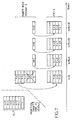
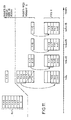
- les figures 6 à 13 sont des diagrammes temporels illustrant diverses techniques de suppression de paquets utilisables conformément à l'invention.
- de la transmission discontinue, qui engendre des périodes sans signal transmis, notamment en présence de mécanismes de VAD/DTX/CNG ("Voice Activity Detection / Discontinous Transmission / Comfort Noise Generation");
- des cas de perte de paquets; et
- des déséquencements éventuels.


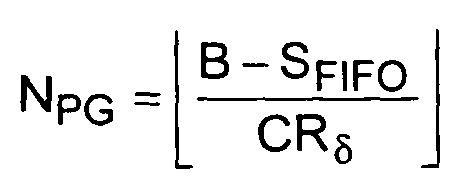
- lorsque la rafale excessive est détectée, le module de contrôle 7 évalue
qui représente, en nombre de paquets, la quantité de signal qui pourrait manquer à cause de l'état vide de la FIFO 6 au cours du traitement de la rafale si la partie supprimée était placée au début de la rafale détectée;
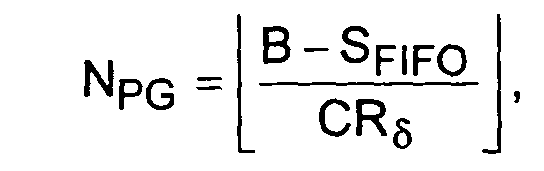
- si NPG = 0, les B - SFIFO premiers paquets de la rafale sont supprimés;
- si NPG = 1, un des CRδ premiers paquets de la rafale est conservé pour restituer dans la première période δ un signal qui a effectivement été émis de préférence à un signal de substitution. Le paquet conservé peut notamment être le premier (ce qui revient à garder le paquet n à la place du paquet de substitution TC dans l'illustration de la figure 9). Les B - SFIFO paquets suivants (n+1, n+2 et n+3 dans l'illustration de la figure 9) sont alors supprimés;
- si NPG > 1, on conserve NPG paquets parmi les B - SFIFO premiers paquets de la rafale, dont au moins un des CRδ premiers paquets. Une possibilité est de conserver les NPG premiers paquets de la rafale (si NPG ≤ LFIFO) et de supprimer les B - SFIFO paquets suivants. Une autre possibilité est de conserver le premier des CRδ paquets reçus au cours de chacune des NPG périodes δ suivant la détection de la rafale excessive.
Claims (23)
- Procédé de traitement de paquets de données numériques reçus, contenant des données de description de segments temporels successifs d'un flux de signal à restituer, dans lequel on enregistre dans une mémoire tampon (6) des éléments obtenus à partir des paquets reçus, et on délivre en mode premier entré - premier sorti des éléments enregistrés dans la mémoire tampon, caractérisé en ce qu'on détecte a priori une rafale de paquets remplissant une condition de taille de rafale, sur la base d'un retard de réception évalué en réponse à la réception d'un premier paquet de la rafale, et en ce qu'on contrôle le contenu de la mémoire tampon en tenant compte de la détection de la rafale remplissant ladite condition de taille.
- Procédé selon la revendication 1, dans lequel on évalue une taille de rafale (B) à l'arrivée d'un paquet, et la condition de taille est exprimée par une valeur de seuil à laquelle est comparée la taille de rafale évaluée.
- Procédé selon la revendication 2, dans lequel le seuil est sélectionné en prenant en compte un type d'application et/ou le type du réseau et son comportement.
- Procédé selon la revendication 2 ou 3, dans lequel l'évaluation de la taille de rafale est basée sur des paramètres comprenant l'instant d'arrivée des paquets.
- Procédé selon la revendication 4, dans lequel les paramètres sur lesquels est basée l'évaluation de la taille de rafale comprennent en outre des paramètres inclus dans les paquets.
- Procédé selon la revendication 5, dans lequel lesdits paramètres inclus dans les paquets comprennent un numéro de séquence et/ou une estampille temporelle inclus dans des paquets du protocole RTP.
- Procédé selon l'une quelconque des revendications précédentes, dans lequel le contrôle du contenu de la mémoire tampon (6) comprend la prise en compte d'une valeur cible (SFIFO) pour le remplissage de la mémoire tampon à la fin du traitement de la rafale détectée.
- Procédé selon la revendication 7, dans lequel on détermine la valeur cible (SFIFO) en fonction du remplissage de la mémoire tampon (6) dans des phases où il n'est pas détecté de rafales remplissant la condition de taille et/ou en fonction de l'application.
- Procédé selon l'une quelconque des revendications précédentes, dans lequel le contrôle du contenu de la mémoire tampon (6) comprend la prise en compte d'une capacité de réception de paquets (CRδ) par un équipement incorporant la mémoire tampon.
- Procédé selon la revendication 9, dans lequel on estime la capacité de réception de paquets (CRδ) comme un maximum des nombres de paquets reçus pendant une durée déterminée suivant chaque détection d'une rafale remplissant ladite condition de taille.
- Procédé selon l'une quelconque des revendications précédentes, dans lequel le contrôle du contenu de la mémoire tampon (6) comprend la suppression d'au moins certains des éléments obtenus à partir des paquets de la rafale détectée, avant l'enregistrement desdits éléments dans la mémoire tampon.
- Procédé selon la revendication 11, dans lequel on supprime tous les éléments obtenus à partir des paquets de la rafale détectée sans les enregistrer dans la mémoire tampon (6).
- Procédé selon la revendication 11, dans lequel on supprime une partie seulement des éléments obtenus à partir des paquets de la rafale détectée sans les enregistrer dans la mémoire tampon (6).
- Procédé selon la revendication 13, dans lequel on évalue la taille (B) de la rafale remplissant la condition de taille, et la partie supprimée représente une quantité de signal correspondant sensiblement à la différence entre une quantité de signal correspondant à la taille de rafale évaluée et une quantité de signal correspondant à une valeur cible (SFIFO) pour le remplissage de la mémoire tampon à la fin de la rafale détectée.
- Procédé selon la revendication 13 ou 14, dans lequel la partie supprimée est placée au début de la rafale détectée.
- Procédé selon la revendication 13 ou 14, dans lequel la partie supprimée est placée à la fin de la rafale détectée.
- Procédé selon la revendication 13 ou 14, dans lequel la partie supprimée est placée dans la rafale détectée en fonction d'une information d'activité du signal à restituer.
- Procédé selon la revendication 17, dans lequel l'information d'activité du signal à restituer est obtenue après un décodage au moins partiel du contenu des paquets.
- Procédé selon la revendication 13 ou 14, dans lequel la partie supprimée est placée de façon à éviter que la mémoire tampon (6) se trouve vide au cours du traitement de la rafale.
- Procédé selon la revendication 19, dans lequel on évalue une quantité de signal qui pourrait manquer à cause d'un état vide de la mémoire tampon (6) au cours du traitement de la rafale si la partie supprimée était placée au début de la rafale détectée, et lorsque la quantité évaluée est non nulle, on place ladite partie dans la rafale détectée de façon à enregistrer dans la mémoire tampon des éléments obtenus à partir d'au moins un paquet reçu au début de la rafale détectée et représentant une quantité de signal au moins égale à la quantité évaluée.
- Procédé selon l'une quelconque des revendications précédentes, dans lequel les éléments enregistrés dans la mémoire tampon (6) comprennent des données de codage du signal extraites des paquets reçus.
- Procédé selon l'une quelconque des revendications 1 à 20, dans lequel les éléments enregistrés dans la mémoire tampon (6) comprennent des segments temporels du flux de signal à restituer, obtenus par décodage du contenu des paquets reçus.
- Dispositif de réception de paquets de données numériques représentatifs de segments temporels successifs d'un signal à restituer, comprenant une mémoire tampon (6) organisée en mode premier entré - premier sorti pour recevoir des éléments obtenus à partir des paquets reçus, et des moyens pour contrôler le contenu de la mémoire tampon conformément à un procédé selon l'une quelconque des revendications précédentes.
Applications Claiming Priority (2)
| Application Number | Priority Date | Filing Date | Title |
|---|---|---|---|
| FR0215207 | 2002-12-03 | ||
| FR0215207A FR2848049B1 (fr) | 2002-12-03 | 2002-12-03 | Procede de traitement de paquets de donnees recus sur des reseaux asynchrones, et dispositif pour la mise en oeuvre du procede |
Publications (2)
| Publication Number | Publication Date |
|---|---|
| EP1427154A1 true EP1427154A1 (fr) | 2004-06-09 |
| EP1427154B1 EP1427154B1 (fr) | 2005-03-16 |
Family
ID=32309959
Family Applications (1)
| Application Number | Title | Priority Date | Filing Date |
|---|---|---|---|
| EP03292738A Expired - Lifetime EP1427154B1 (fr) | 2002-12-03 | 2003-11-03 | Procédé de contrôle d'une mémoire tampon de paquets de données, et dispositif correspondant |
Country Status (7)
| Country | Link |
|---|---|
| US (1) | US7313149B2 (fr) |
| EP (1) | EP1427154B1 (fr) |
| JP (1) | JP4490082B2 (fr) |
| AT (1) | ATE291315T1 (fr) |
| DE (1) | DE60300391T2 (fr) |
| ES (1) | ES2239301T3 (fr) |
| FR (1) | FR2848049B1 (fr) |
Cited By (1)
| Publication number | Priority date | Publication date | Assignee | Title |
|---|---|---|---|---|
| WO2009128753A1 (fr) | 2008-04-17 | 2009-10-22 | Telefonaktiebolaget Lm Ericsson (Publ) | Mesure et estimation d'interactivité conversationnelle pour multimédia en temps réel |
Families Citing this family (5)
| Publication number | Priority date | Publication date | Assignee | Title |
|---|---|---|---|---|
| US7535841B1 (en) * | 2003-05-14 | 2009-05-19 | Nortel Networks Limited | Flow-rate-regulated burst switches |
| EP1619834B1 (fr) * | 2004-07-23 | 2007-01-17 | Siemens Aktiengesellschaft | Procédé de transmission des paquets de données entre noeuds d' un réseau de communication |
| US7817643B2 (en) * | 2004-09-14 | 2010-10-19 | Maksim Azarov | System and method for varying the scheduling of real time protocol (RTP) packets |
| US7660286B2 (en) * | 2006-02-03 | 2010-02-09 | Broadcom Corporation | Jitter management for packet data network backhaul of call data |
| WO2014006507A2 (fr) * | 2012-07-02 | 2014-01-09 | Marvell Israel (M.I.S.L.) Ltd. | Systèmes et procédés de fourniture de données dupliquées de mémoires à des clients de traitement |
Family Cites Families (2)
| Publication number | Priority date | Publication date | Assignee | Title |
|---|---|---|---|---|
| US5812528A (en) * | 1995-11-17 | 1998-09-22 | Telecommunications Techniques Corporation | Measuring round trip time in ATM network virtual connections |
| DE69735527D1 (de) * | 1997-05-02 | 2006-05-11 | Lsi Logic Corp | Digitales Verfahren zur adaptiven Taktrückgewinnung |
-
2002
- 2002-12-03 FR FR0215207A patent/FR2848049B1/fr not_active Expired - Fee Related
-
2003
- 2003-11-03 AT AT03292738T patent/ATE291315T1/de not_active IP Right Cessation
- 2003-11-03 EP EP03292738A patent/EP1427154B1/fr not_active Expired - Lifetime
- 2003-11-03 ES ES03292738T patent/ES2239301T3/es not_active Expired - Lifetime
- 2003-11-03 DE DE60300391T patent/DE60300391T2/de not_active Expired - Lifetime
- 2003-11-05 US US10/702,019 patent/US7313149B2/en not_active Expired - Fee Related
- 2003-12-01 JP JP2003402188A patent/JP4490082B2/ja not_active Expired - Fee Related
Non-Patent Citations (2)
| Title |
|---|
| ROZENSHINE-KEMELMACHER: "ATM Traffic Analysis: Burst Scale Probability Function", ITC-CSCC 2002 PROCEEDINGS, 16 July 2002 (2002-07-16) - 19 July 2002 (2002-07-19), pages 1 - 4, XP002251166, Retrieved from the Internet <URL:http://www.kmutt.ac.th/itc2002/CD/pdf/18_07_45/TA2_OB/1.pdf> [retrieved on 20030813] * |
| TANENBAUM: "Computer networks", 31 August 2002, XP002270794 * |
Cited By (2)
| Publication number | Priority date | Publication date | Assignee | Title |
|---|---|---|---|---|
| WO2009128753A1 (fr) | 2008-04-17 | 2009-10-22 | Telefonaktiebolaget Lm Ericsson (Publ) | Mesure et estimation d'interactivité conversationnelle pour multimédia en temps réel |
| US8665737B2 (en) | 2008-04-17 | 2014-03-04 | Telefonaktiebolaget L M Ericsson (Publ) | Conversational interactivity measurement and estimation for real-time media |
Also Published As
| Publication number | Publication date |
|---|---|
| EP1427154B1 (fr) | 2005-03-16 |
| DE60300391D1 (de) | 2005-04-21 |
| JP4490082B2 (ja) | 2010-06-23 |
| FR2848049A1 (fr) | 2004-06-04 |
| FR2848049B1 (fr) | 2005-02-18 |
| ES2239301T3 (es) | 2005-09-16 |
| US7313149B2 (en) | 2007-12-25 |
| JP2004187295A (ja) | 2004-07-02 |
| ATE291315T1 (de) | 2005-04-15 |
| US20040146060A1 (en) | 2004-07-29 |
| DE60300391T2 (de) | 2006-04-13 |
Similar Documents
| Publication | Publication Date | Title |
|---|---|---|
| WO2019234338A1 (fr) | Adaptation de débit d'une session de communication en voix sur ip | |
| EP2724486B1 (fr) | Retransmission de données perdues entre un émetteur et un récepteur | |
| EP3692696B1 (fr) | Signalisation d'une requête d'adaptation d'une session de communication en voix sur ip | |
| EP1096827A1 (fr) | Procédé de mise en conformité à un contrat de trafic d'un flux de paquets d'un réseau de transport de paquets à longueur variable | |
| EP1649677B1 (fr) | Procedes et dispositifs d'evaluation de delais de transmission et de traitement d'un signal de parole recu dans un terminal relie a un reseau de paquets | |
| WO2008155257A1 (fr) | Procédé de régulation de la gigue de transmission au sein d'un terminal de réception | |
| EP0162174A1 (fr) | Dispositif tampon utilisé dans un réseau de transmission de la voix | |
| EP1545032A2 (fr) | Procédé et dispositif de synchronisation d'horloges d'encodeurs et décodeurs numeriques | |
| FR2908576A1 (fr) | Procede,dispositif et application logicielle d'ordonnancement d'une transmission de paquets d'un flux de donnees | |
| EP1427154B1 (fr) | Procédé de contrôle d'une mémoire tampon de paquets de données, et dispositif correspondant | |
| FR2946820A1 (fr) | Procede de transmission de donnees et dispositif associe. | |
| EP1908259B1 (fr) | Appareil et procede d'estimation du taux de remplissage des tampons d'entree de clients d'une distribution de contenu temps reel | |
| FR2804813A1 (fr) | Procede de codage facilitant la restitution sonore des signaux de parole numerises transmis a un terminal d'abonne lors d'une communication telephonique par transmission de paquets et equipement mettant en oeuvre ce procede | |
| FR2998125A1 (fr) | Procede de transmission de paquets de donnees entre deux modules de communication ainsi que module emetteur et module recepteur | |
| EP1326398A1 (fr) | Système de transmission de paquets | |
| EP1834489A1 (fr) | Procede et dispositif de codage video | |
| EP1192833B1 (fr) | Procede pour la gestion du decodage et de la restitution d'un signal sonore dans un systeme de transmission asynchrone | |
| FR2941110A1 (fr) | Procede et dispositif de prediction d'un etat de pertes d'un reseau de communication | |
| JP2007104569A (ja) | データ受信装置 | |
| EP1245099A1 (fr) | Dispositif de reception de paquets | |
| FR2916925A1 (fr) | Procede et dispositif de tamponnage de paquets de donnees transmis via une communication plesiochrone. | |
| FR3059185A1 (fr) | Procede et circuit de dectection de congestion | |
| WO2011077039A1 (fr) | Procede de communication vocale par paquets de données avec differents niveaux de protection | |
| WO2007101962A1 (fr) | Mécanisme de régulation multicouches du débit d'un flux de données tcp dans un réseau haut débit ethernet full duplex | |
| FR2737368A1 (fr) | Procede et dispositif de synchronisation d'horloge d'encodeurs et decodeurs numeriques |
Legal Events
| Date | Code | Title | Description |
|---|---|---|---|
| PUAI | Public reference made under article 153(3) epc to a published international application that has entered the european phase |
Free format text: ORIGINAL CODE: 0009012 |
|
| AK | Designated contracting states |
Kind code of ref document: A1 Designated state(s): AT BE BG CH CY CZ DE DK EE ES FI FR GB GR HU IE IT LI LU MC NL PT RO SE SI SK TR |
|
| AX | Request for extension of the european patent |
Extension state: AL LT LV MK |
|
| 17P | Request for examination filed |
Effective date: 20040714 |
|
| GRAP | Despatch of communication of intention to grant a patent |
Free format text: ORIGINAL CODE: EPIDOSNIGR1 |
|
| GRAS | Grant fee paid |
Free format text: ORIGINAL CODE: EPIDOSNIGR3 |
|
| GRAA | (expected) grant |
Free format text: ORIGINAL CODE: 0009210 |
|
| AKX | Designation fees paid |
Designated state(s): AT BE BG CH CY CZ DE DK EE ES FI FR GB GR HU IE IT LI LU MC NL PT RO SE SI SK TR |
|
| AK | Designated contracting states |
Kind code of ref document: B1 Designated state(s): AT BE BG CH CY CZ DE DK EE ES FI FR GB GR HU IE IT LI LU MC NL PT RO SE SI SK TR |
|
| PG25 | Lapsed in a contracting state [announced via postgrant information from national office to epo] |
Ref country code: TR Free format text: LAPSE BECAUSE OF FAILURE TO SUBMIT A TRANSLATION OF THE DESCRIPTION OR TO PAY THE FEE WITHIN THE PRESCRIBED TIME-LIMIT Effective date: 20050316 Ref country code: IE Free format text: LAPSE BECAUSE OF FAILURE TO SUBMIT A TRANSLATION OF THE DESCRIPTION OR TO PAY THE FEE WITHIN THE PRESCRIBED TIME-LIMIT Effective date: 20050316 Ref country code: RO Free format text: LAPSE BECAUSE OF FAILURE TO SUBMIT A TRANSLATION OF THE DESCRIPTION OR TO PAY THE FEE WITHIN THE PRESCRIBED TIME-LIMIT Effective date: 20050316 Ref country code: CZ Free format text: LAPSE BECAUSE OF FAILURE TO SUBMIT A TRANSLATION OF THE DESCRIPTION OR TO PAY THE FEE WITHIN THE PRESCRIBED TIME-LIMIT Effective date: 20050316 Ref country code: EE Free format text: LAPSE BECAUSE OF FAILURE TO SUBMIT A TRANSLATION OF THE DESCRIPTION OR TO PAY THE FEE WITHIN THE PRESCRIBED TIME-LIMIT Effective date: 20050316 Ref country code: AT Free format text: LAPSE BECAUSE OF FAILURE TO SUBMIT A TRANSLATION OF THE DESCRIPTION OR TO PAY THE FEE WITHIN THE PRESCRIBED TIME-LIMIT Effective date: 20050316 Ref country code: SI Free format text: LAPSE BECAUSE OF FAILURE TO SUBMIT A TRANSLATION OF THE DESCRIPTION OR TO PAY THE FEE WITHIN THE PRESCRIBED TIME-LIMIT Effective date: 20050316 Ref country code: NL Free format text: LAPSE BECAUSE OF FAILURE TO SUBMIT A TRANSLATION OF THE DESCRIPTION OR TO PAY THE FEE WITHIN THE PRESCRIBED TIME-LIMIT Effective date: 20050316 Ref country code: SK Free format text: LAPSE BECAUSE OF FAILURE TO SUBMIT A TRANSLATION OF THE DESCRIPTION OR TO PAY THE FEE WITHIN THE PRESCRIBED TIME-LIMIT Effective date: 20050316 Ref country code: FI Free format text: LAPSE BECAUSE OF FAILURE TO SUBMIT A TRANSLATION OF THE DESCRIPTION OR TO PAY THE FEE WITHIN THE PRESCRIBED TIME-LIMIT Effective date: 20050316 |
|
| REG | Reference to a national code |
Ref country code: GB Ref legal event code: FG4D Free format text: NOT ENGLISH |
|
| REG | Reference to a national code |
Ref country code: CH Ref legal event code: EP |
|
| REG | Reference to a national code |
Ref country code: IE Ref legal event code: FG4D Free format text: FRENCH |
|
| REF | Corresponds to: |
Ref document number: 60300391 Country of ref document: DE Date of ref document: 20050421 Kind code of ref document: P |
|
| PG25 | Lapsed in a contracting state [announced via postgrant information from national office to epo] |
Ref country code: GR Free format text: LAPSE BECAUSE OF FAILURE TO SUBMIT A TRANSLATION OF THE DESCRIPTION OR TO PAY THE FEE WITHIN THE PRESCRIBED TIME-LIMIT Effective date: 20050616 Ref country code: DK Free format text: LAPSE BECAUSE OF FAILURE TO SUBMIT A TRANSLATION OF THE DESCRIPTION OR TO PAY THE FEE WITHIN THE PRESCRIBED TIME-LIMIT Effective date: 20050616 Ref country code: BG Free format text: LAPSE BECAUSE OF FAILURE TO SUBMIT A TRANSLATION OF THE DESCRIPTION OR TO PAY THE FEE WITHIN THE PRESCRIBED TIME-LIMIT Effective date: 20050616 |
|
| PG25 | Lapsed in a contracting state [announced via postgrant information from national office to epo] |
Ref country code: HU Free format text: LAPSE BECAUSE OF FAILURE TO SUBMIT A TRANSLATION OF THE DESCRIPTION OR TO PAY THE FEE WITHIN THE PRESCRIBED TIME-LIMIT Effective date: 20050617 |
|
| REG | Reference to a national code |
Ref country code: SE Ref legal event code: TRGR |
|
| GBT | Gb: translation of ep patent filed (gb section 77(6)(a)/1977) |
Effective date: 20050613 |
|
| NLV1 | Nl: lapsed or annulled due to failure to fulfill the requirements of art. 29p and 29m of the patents act | ||
| PG25 | Lapsed in a contracting state [announced via postgrant information from national office to epo] |
Ref country code: PT Free format text: LAPSE BECAUSE OF FAILURE TO SUBMIT A TRANSLATION OF THE DESCRIPTION OR TO PAY THE FEE WITHIN THE PRESCRIBED TIME-LIMIT Effective date: 20050907 |
|
| REG | Reference to a national code |
Ref country code: ES Ref legal event code: FG2A Ref document number: 2239301 Country of ref document: ES Kind code of ref document: T3 |
|
| REG | Reference to a national code |
Ref country code: IE Ref legal event code: FD4D |
|
| PG25 | Lapsed in a contracting state [announced via postgrant information from national office to epo] |
Ref country code: CY Free format text: LAPSE BECAUSE OF FAILURE TO SUBMIT A TRANSLATION OF THE DESCRIPTION OR TO PAY THE FEE WITHIN THE PRESCRIBED TIME-LIMIT Effective date: 20051103 |
|
| PG25 | Lapsed in a contracting state [announced via postgrant information from national office to epo] |
Ref country code: MC Free format text: LAPSE BECAUSE OF NON-PAYMENT OF DUE FEES Effective date: 20051130 Ref country code: BE Free format text: LAPSE BECAUSE OF NON-PAYMENT OF DUE FEES Effective date: 20051130 Ref country code: LU Free format text: LAPSE BECAUSE OF NON-PAYMENT OF DUE FEES Effective date: 20051130 |
|
| PLBE | No opposition filed within time limit |
Free format text: ORIGINAL CODE: 0009261 |
|
| STAA | Information on the status of an ep patent application or granted ep patent |
Free format text: STATUS: NO OPPOSITION FILED WITHIN TIME LIMIT |
|
| 26N | No opposition filed |
Effective date: 20051219 |
|
| BERE | Be: lapsed |
Owner name: FRANCE TELECOM Effective date: 20051130 |
|
| PG25 | Lapsed in a contracting state [announced via postgrant information from national office to epo] |
Ref country code: CH Free format text: LAPSE BECAUSE OF NON-PAYMENT OF DUE FEES Effective date: 20071130 Ref country code: LI Free format text: LAPSE BECAUSE OF NON-PAYMENT OF DUE FEES Effective date: 20071130 |
|
| REG | Reference to a national code |
Ref country code: CH Ref legal event code: PL |
|
| PGFP | Annual fee paid to national office [announced via postgrant information from national office to epo] |
Ref country code: FR Payment date: 20101217 Year of fee payment: 8 |
|
| PGFP | Annual fee paid to national office [announced via postgrant information from national office to epo] |
Ref country code: DE Payment date: 20101025 Year of fee payment: 8 |
|
| PGFP | Annual fee paid to national office [announced via postgrant information from national office to epo] |
Ref country code: IT Payment date: 20101104 Year of fee payment: 8 Ref country code: SE Payment date: 20101025 Year of fee payment: 8 Ref country code: GB Payment date: 20101026 Year of fee payment: 8 |
|
| PGFP | Annual fee paid to national office [announced via postgrant information from national office to epo] |
Ref country code: ES Payment date: 20101124 Year of fee payment: 8 |
|
| REG | Reference to a national code |
Ref country code: SE Ref legal event code: EUG |
|
| GBPC | Gb: european patent ceased through non-payment of renewal fee |
Effective date: 20111103 |
|
| REG | Reference to a national code |
Ref country code: FR Ref legal event code: ST Effective date: 20120731 |
|
| PG25 | Lapsed in a contracting state [announced via postgrant information from national office to epo] |
Ref country code: IT Free format text: LAPSE BECAUSE OF NON-PAYMENT OF DUE FEES Effective date: 20111103 |
|
| REG | Reference to a national code |
Ref country code: DE Ref legal event code: R119 Ref document number: 60300391 Country of ref document: DE Effective date: 20120601 |
|
| PG25 | Lapsed in a contracting state [announced via postgrant information from national office to epo] |
Ref country code: GB Free format text: LAPSE BECAUSE OF NON-PAYMENT OF DUE FEES Effective date: 20111103 Ref country code: SE Free format text: LAPSE BECAUSE OF NON-PAYMENT OF DUE FEES Effective date: 20111104 |
|
| PG25 | Lapsed in a contracting state [announced via postgrant information from national office to epo] |
Ref country code: FR Free format text: LAPSE BECAUSE OF NON-PAYMENT OF DUE FEES Effective date: 20111130 |
|
| REG | Reference to a national code |
Ref country code: ES Ref legal event code: FD2A Effective date: 20130605 |
|
| PG25 | Lapsed in a contracting state [announced via postgrant information from national office to epo] |
Ref country code: DE Free format text: LAPSE BECAUSE OF NON-PAYMENT OF DUE FEES Effective date: 20120601 |
|
| PG25 | Lapsed in a contracting state [announced via postgrant information from national office to epo] |
Ref country code: ES Free format text: LAPSE BECAUSE OF NON-PAYMENT OF DUE FEES Effective date: 20111104 |