EP1426200A2 - Cured applique or label with protective film on arcuate sidewall or tread of pneumatic tire - Google Patents
Cured applique or label with protective film on arcuate sidewall or tread of pneumatic tire Download PDFInfo
- Publication number
- EP1426200A2 EP1426200A2 EP03104369A EP03104369A EP1426200A2 EP 1426200 A2 EP1426200 A2 EP 1426200A2 EP 03104369 A EP03104369 A EP 03104369A EP 03104369 A EP03104369 A EP 03104369A EP 1426200 A2 EP1426200 A2 EP 1426200A2
- Authority
- EP
- European Patent Office
- Prior art keywords
- tire
- applique
- cured
- tread
- rubber
- Prior art date
- Legal status (The legal status is an assumption and is not a legal conclusion. Google has not performed a legal analysis and makes no representation as to the accuracy of the status listed.)
- Withdrawn
Links
Images

Classifications
-
- G—PHYSICS
- G09—EDUCATION; CRYPTOGRAPHY; DISPLAY; ADVERTISING; SEALS
- G09F—DISPLAYING; ADVERTISING; SIGNS; LABELS OR NAME-PLATES; SEALS
- G09F3/00—Labels, tag tickets, or similar identification or indication means; Seals; Postage or like stamps
- G09F3/02—Forms or constructions
- G09F3/0297—Forms or constructions including a machine-readable marking, e.g. a bar code
-
- B—PERFORMING OPERATIONS; TRANSPORTING
- B60—VEHICLES IN GENERAL
- B60C—VEHICLE TYRES; TYRE INFLATION; TYRE CHANGING; CONNECTING VALVES TO INFLATABLE ELASTIC BODIES IN GENERAL; DEVICES OR ARRANGEMENTS RELATED TO TYRES
- B60C13/00—Tyre sidewalls; Protecting, decorating, marking, or the like, thereof
- B60C13/001—Decorating, marking or the like
-
- G—PHYSICS
- G09—EDUCATION; CRYPTOGRAPHY; DISPLAY; ADVERTISING; SEALS
- G09F—DISPLAYING; ADVERTISING; SIGNS; LABELS OR NAME-PLATES; SEALS
- G09F3/00—Labels, tag tickets, or similar identification or indication means; Seals; Postage or like stamps
- G09F3/04—Labels, tag tickets, or similar identification or indication means; Seals; Postage or like stamps to be fastened or secured by the material of the label itself, e.g. by thermo-adhesion
-
- B—PERFORMING OPERATIONS; TRANSPORTING
- B29—WORKING OF PLASTICS; WORKING OF SUBSTANCES IN A PLASTIC STATE IN GENERAL
- B29C—SHAPING OR JOINING OF PLASTICS; SHAPING OF MATERIAL IN A PLASTIC STATE, NOT OTHERWISE PROVIDED FOR; AFTER-TREATMENT OF THE SHAPED PRODUCTS, e.g. REPAIRING
- B29C37/00—Component parts, details, accessories or auxiliary operations, not covered by group B29C33/00 or B29C35/00
- B29C2037/80—Identifying, e.g. coding, dating, marking, numbering
-
- B—PERFORMING OPERATIONS; TRANSPORTING
- B29—WORKING OF PLASTICS; WORKING OF SUBSTANCES IN A PLASTIC STATE IN GENERAL
- B29D—PRODUCING PARTICULAR ARTICLES FROM PLASTICS OR FROM SUBSTANCES IN A PLASTIC STATE
- B29D30/00—Producing pneumatic or solid tyres or parts thereof
- B29D30/06—Pneumatic tyres or parts thereof (e.g. produced by casting, moulding, compression moulding, injection moulding, centrifugal casting)
- B29D30/72—Side-walls
- B29D2030/726—Decorating or marking the sidewalls before tyre vulcanization
-
- B—PERFORMING OPERATIONS; TRANSPORTING
- B29—WORKING OF PLASTICS; WORKING OF SUBSTANCES IN A PLASTIC STATE IN GENERAL
- B29L—INDEXING SCHEME ASSOCIATED WITH SUBCLASS B29C, RELATING TO PARTICULAR ARTICLES
- B29L2031/00—Other particular articles
- B29L2031/744—Labels, badges, e.g. marker sleeves
Definitions
- This invention relates to a rubber applique such as a decorative design, identifying label or machine readable bar code on a label ("bar code label”), non-removably incorporated into either the exterior arcuate convex surface of a rubber sidewall of a pneumatic tire with a tread having a road-contacting surface of lugs and valleys, or in the tread's "footprint", which tire is removed from a curing mold with a protective film firmly adhered to the surface of the applique.
- the applique is substantially laminar and pale in color, the pale color being visually distinct from and in contrast to black, which is the usual color of the tire's sidewall and tread.
- applique it is essential that the entire applique be clearly visible after the tire is cured.
- surface of the printed bar code whether on a label or on a logo, be protected as if it never was in contact with release agent sprayed on the inner surface of the mold ("tire paint").
- a preferred tire paint currently in use is an aqueous paint formulated to provide necessary adhesion and air bleed to minimize trapped air, for "tread-over-sidewall” tire construction.
- the surface of the twice-cured uncontaminated applique whether from black tire paint or contaminants from the sidewall's black rubber, is referred to as a "virgin surface" and it may be printable; when printed, the printed matter is thermally stable at a temperature at which the tire is cured.
- thermally stable is meant that there is essentially no degradation of the substrate which is printed.
- the most effective method of providing an applique embedded in the sidewall comprises curing a cured rubber bar code label adjacent the bead of the tire, this being a location subjected to minimal expansion during cure.
- embedded is meant that the surface of the applique is coplanar with the surface of the contiguous rubber.
- the bar code in a "near-bead location” cannot be read because the vertical lines and spaces are obscured by the periphery of the rim of the wheel on which the tire is mounted. This inability results from the typical bar code label being relatively small, usually a rectangular label no greater than about 2.5 cm wide and 5 cm long, and the flange of the wheel near the rim being about as wide as the bar code.
- a bar code label on the tread of a tire allows it to be identified even when the tread carrying the bar code is in the middle of a vertical stack of tires.
- a paper or plastic bar code label is adhesively secured on the surface of a lug of the tread anywhere near the center (circumferential), that is, in the footprint of the tire, but only after the tire is cured, so that the label is not embedded in the cured rubber. It is impractical to adhesively secure the label to the surface of a valley between lugs. Though the function of such a paper or plastic bar code is temporary, it must be kept in mind that its sole function is to identify the tire before it is installed.
- Staining sufficient to cause an error of 5% or more when the imprinted code is read is unacceptable; moreover substantially error-free reading, that is, better than 95% accuracy, is required over a period of at least six months after an imprinted bar code label is cured onto a tire.
- Such staining is exacerbated by an applique which is porous or which develops microscopic cracks. Therefore it is essential that the modulus of the cured pale rubber substantially match the modulus of the rubber article being cured, so as to conform in the mold without cracking.
- substantially match is meant that the modulus of the applique is closer than ⁇ 100% that of the rubber in which it is secured (before curing the tire) or embedded (after curing the tire), preferably closer than ⁇ 50% not only after both, applique and are co-cured, but also before, that is, on the portion of the green carcass on which the applique is to be adhered.
- the applique Since the applique is to be thin, less than 1 mm thick, and a bar code imprinted on it is to be successfully read over a period of at least six months, preferably over the life of the tire, a zone within the applique near its lower surface is to function as a barrier against antiozonants and aromatic oils in the carcass. Therefore the applique is to be filled with enough of a pale, preferably white, inert particulate material such as titanium dioxide, to provide a legible bar code and to help minimize staining, but not so much as to interfere with providing a substantial match of moduli.
- a pale, preferably white, inert particulate material such as titanium dioxide
- the protective film remain secured to the "virgin" or printed surface of the applique sufficiently well that, if the film is removable, a force of at least 10 Newtons, preferably more than 30 Newtons but less than will tear the film, is required to remove the protective film.
- a small, substantially fully pre-cured, bar code label which is machine-readable despite the cured label being on a tire which has been expanded in a curing press, without cracking the label and without any visually observable distortion so that incidence of failure to read the bar code is less than 5%, preferably less than 2%, and most preferably less than 1%; and to locate the bar code label in the sidewall, or on a lug and/or in the valley between lugs of the tread.
- non-self-supporting adhering to the applique's surface without an adhesive, and uniformly covering it so as to be effective against contamination by tire paint which coats the cured applique during curing of the tire, and against ambient contaminants and hazards after the tire is cured; and if the protective film is removable, and it is desired to remove the protective film, then it should be removable integrally, that is, without tearing into pieces.
- non-self-supporting is meant that the film requires a supporting surface to maintain its integrity.
- US-A- 5,824,397 teaches a light-colored base layer of co-curable rubber which is laser-inscribable and which can have a transparent protective covering, preferably of polyester, polyamide, perfluorinated polymers or polyimide.
- Such compounds are a logical choice as they are routinely used as release agents.
- Dispersions of polyurethane have been used in a variety of coating applications.
- US-A- 6,093,271 teaches that a water-borne polyurethane dispersion, "among a variety of clear coating compositions", provides a transparent coating to protect a white or colored sidewall on a cured tire.
- All carcasses of pneumatic green tires are built as a series of layers of flexible high modulus cords encased in a low modulus rubber; the cords in each layer are oriented in a chosen path or direction and substantially equispaced and parallel.
- the carcass When the carcass is cured, it expands, forcing the carcass against the indentations in the curing mold to form the tread, and all components are co-cured so as to provide a substantially cohesive bond between one and another.
- Expansion upon curing of a radial ply tire is small, in the range from about 5% to 20% greater than the size of the green carcass; but expansion of a bias ply tire may range from 30% to 100% or more.
- the expansion of the sidewall during the formation of its arcuate convex geometry is in the range from 5% to 20% depending upon the structure of the tire.
- the cured applique is required to be sufficiently biaxially extensible and flexible so that it conforms to the arcuate surface of an expanded sidewall, or the crenelated surface of a tread, without being loosened or dislodged during cure and during operation of the tire.
- a release agent normally coats the entire inner surface of the curing mold.
- the applique is provided with a self-adherent, protective film of thermally stable, thermally expansible, synthetic resinous compound which protects the printed and/or colored surface of the applique under the film.
- the virgin surface includes a bar code, it can be read through the protective film.
- a cured pale rubber applique preferably from 0.1 mm to 1 mm thick, containing sufficient pale-colored particulate pigment such as titanium dioxide or other inorganic compounds to minimize staining of the applique by contaminants from the rubber or a vulcanizable adhesive securing the applique to black rubber, remains flexible enough, and allows itself to be non-removably embedded in a cured black rubber article, in particular a pneumatic tire, and vulcanized into either the sidewall, or, the tread.
- the applique When the applique is secured to the green tire, its virgin upper surface is vertically spaced apart from the immediately surrounding rubber; the virgin surface is protected by a flexible synthetic resinous polymeric film which may be a self-supporting polyamide film from 10 ⁇ m to less than 50 ⁇ m thick, or a non-self-supporting polyurethane film from 5 ⁇ m to less than 25.4 ⁇ m; the protective film remains adhered to the surface of the applique even after the cured tire is removed from the mold in more than 95% of all tires; both the cured applique and the protective film are thermally stable; the applique is also dynamically stable so that when a bar code is provided in the virgin surface, the bar code may be successfully read through the protective film which has been heated to curing temperature, typically 150°C.
- dynamically stable is meant that the cured applique expands less than about 10% during curing of the tire.
- pore-free is meant that the film has no pores large enough to allow tire paint to permeate the film.
- the lower surface of the label is calendered to a layer of vulcanizable adhesive having about the same thickness 0.1 mm to 1 mm as the applique, preferably from 200 ⁇ m to 500 ⁇ m thick, which may be coated with a cement or solvent-containing layer from 5 ⁇ m to 25 ⁇ m thick, and secured to the sidewall of a green tire, the label symmetrically disposed about an expandable portion of the tire, expandable at least 5%, such as the circumferential centerline of the sidewall, or the tread.
- the tire is then placed in a curing mold, covered with tire paint and cured at about 150°C, and because both the label and its protective film are unconfined except by the interior surface of the mold, each is free to move with the hot flow of sidewall or tread rubber as directed by the forces in the hot curing mold.
- the film Upon the tire being removed from the mold, the film remains non-removably adhered to the surface of the label which, despite being expanded at least 5%, is essentially distortion-free, and free of lines due to cracking of its surface.
- disortion-free is meant that the bar code is successfully read by a commercially available scanner.
- a bar code label from 0.20 mm to 0.50 mm thick is preferably formed from a "white rubber" composition filled with from 5% to 20% titanium dioxide pigment.
- the bar code label Upon being essentially fully cured the bar code label has a 300% modulus of preferably less than 3 MPa, more preferably less than 1 MPa (at 300% elongation). It is matched to a cured sidewall compound having a 300% modulus of preferably less than 5 MPa, more preferably less than 3 MPa.
- the bar code label is coated with a non-self-supporting film described above, and adhered with a vulcanizable contact adhesive to the sidewall. When adhered, the bar code label is typically symmetrically disposed longitudinally about the sidewall's circumferential centerline.
- the sidewall is then covered with tire paint and cured in a mold at about 150°C.
- the film remains non-removably adhered to the surface of the bar code label.
- the code was "successfully read”. Thicker labels tend to crack, resulting in errors when reading the bar code.
- the bar code label coated with the non-self-supporting film described above, is stitched into the a green tread, symmetrically disposed transversely about the tread's circumferential centerline, preferably at right angle thereto.
- the tread and tire are covered with tire paint and cured in a mold at about 175°C. Upon the tire being removed from the mold, the film remains non-removably adhered to the surface of the bar code label; and the code was "successfully read".
- the cured label When a logo and/or bar code label is protected with a self-supporting film of nylon, such as 6,6-nylon or 6-nylon, when the tire is cured, it requires a force of at least 10 Newtons to remove the film; depending upon whether the cured label is to be co-cured in the sidewall or the tread, the cured label has a matching modulus, typically lower than 2 MPa at 300% elongation; when co-cured in the sidewall the label is spaced apart at least 2.5 cm from the inner periphery of the bead of the tire, and preferably symmetrically embedded longitudinally about the sidewall's circumferential centerline, so that its printed surface is coplanar with the adjacent sidewall surface and the bar code may be read accurately on more than 95% of tires; when co-cured in the tread the cured label is placed in a groove between lugs.
- the 300% modulus is given because a measurement at 100% elongation or less is insufficiently informative even if measured with reasonable accuracy.
- the method of co-curing an applique on a green rubber article comprises, preparing a laminar applique less than 20 mils thick of predominantly natural rubber containing from 15% to 70% of pale inorganic pigment such as titanium dioxide, calcium carbonate and zinc oxide, optionally imprinted with a bar code; curing the applique so as to crosslink to at least an 80% level as determined by a Mooney cure meter; coating the upper surface of the applique with a protective self-supporting film of a polyamide less than 2 mil thick, or a non-self-supporting film of polyurethane less than 25.4 ⁇ m, 0.0254 mm thick; applying a vulcanizable adhesive to the lower surface of the applique; adhesively securing the applique to the article at a chosen location on an expandable surface of the green article; curing the article in a curing mold; and, removing a cured article from the mold with the protective film adhering to the surface of the applique free from visually observable surface cracks.
- the article is
- the applique containing up to 50% titanium dioxide pigment is formed from predominantly natural rubber (cis-polyisoprene), preferably more than 75% natural rubber, to ensure that upon curing it has a modulus substantially matched to that of the rubber in which it is embedded, so that it is biaxially extensible at least 10% in each direction. Such extensibility fails to interfere with the accuracy of the reading of the bar code. If a bar code label, it is imprinted with a bar code before the label is cured.
- the upper surface of the label is coated with a light-permeable polyamide film having an area greater than the label, self-adhered to the label's surface.
- the lower surface of the label is coated with a vulcanizable rubber-based adhesive with a curing agent, e.g. a cementless adhesive disclosed in US-A-5,503,940 and the adhesive (referred to as "black adhesive"), when cured, has a modulus which is substantially matched to that of the rubber to which the label is adhered.
- the self-supporting film remains adhered to the label's surface which is coplanar with that of the sidewall, or that portion of tread immediately adjacent the label's edges.
- the upper surface of the label is coated with a polyurethane non-self-supporting film derived from either a two-component solvent-borne polyurethane, or, from an aqueous dispersion which is typically a one-component, fully-reacted, predominantly linear polymer modified with hydrophilic groups, which latter dispersion is preferred for environmentally sensitive users.
- the polyurethane film may also be derived from aqueous blocked polyisocyanates and crosslinking agents.
- Such polyurethane dispersions include the reaction product of polyisocyanates, typically aliphatic polyisocyanates, and polyether or polyester polyols. Dispersing agents are added as separate components or may be reacted with the polyurethane. Ionic groups (e.g., anionic and cationic), or, nonionic groups e.g. poly(ethylene oxide) may be attached to the polyurethane to make it dispersible in water. A variety of additives including adhesion promoters may also be added to the urethane dispersion. The polyurethane particles coalesce into a film upon drying.
- the water and solvent resistance of the film may be enhanced by crosslinking, e.g. with a carbodiimide, or, an alkoxylated melamine formaldehyde resin.
- a carbodiimide or, an alkoxylated melamine formaldehyde resin.
- Ucarlnk® XL-29SE available from Union Carbide, Danbury Conn. is a multifunctional carbodiimide crosslinker.
- Sancure® 89 is a modified melamine crosslinker available from the Noveon Inc., Brecksville, Ohio.
- Carboxylic acid functionality present in many anionic modified polyurethanes may be crosslinked with a polyfunctional aziridine. As the wet coating is heated to elevated temperatures, crosslinking occurs through the reaction of the methoxylated melamine resin with the urea or urethane groups in the polymer.
- the vulcanizable adhesive typically predominantly polyisoprene, is essentially free of an anitozonant and an aromatic oil but typically contains a reinforcing agent such as carbon black, so that the cured adhesive layer functions as an additional barrier (in conjunction with titanium dioxide in the applique) to staining ingredients from within the tire's carcass.
- the rubber of the applique is both thermally and dimensionally stable under curing conditions; the polymeric film is thermally stable under curing conditions, but expands as required after the tire is placed in the curing mold.
- a conventional toroidal green tire carcass referred to generally by reference numeral 10, having an applique 11 establishing the manufacturer's identity, the applique simultaneously functioning as a bar code label imprinted with a bar code 12.
- the applique 11 is stitched into the sidewall 13, and protected by a transparent film not visible in the drawing.
- the innermost portion of the applique, nearest bead 14 of the tire is about 2.5 cm from the inner periphery of the bead, and the outermost portion extends into the shoulder 15 of the carcass 10.
- the applique 11 is located about midway between the bead and the shoulder of the tire.
- a separate bar code label 16 may also be provided at another location midway between the bead and the shoulder of the tire.
- the virgin upper surface of the applique is vertically spaced apart from that of contiguous rubber of the tire by the thickness of the applique and the vulcanizable adhesive on the applique's lower surface.
- the applique is embedded in the location chosen. Labels on the tread 17 are not shown in this Fig 1.
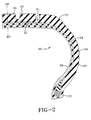
- FIG 2 there is schematically shown a partial cross-section of a conventional cured toroidal rigid breaker, radial ply tire carcass, referred to generally by reference numeral 20, comprising a circumferential tread 21, spaced beads 22 and connecting sidewall portions 23 extending between the tread and beads, to form a conventional radial tire.
- the carcass 20 includes a casing 24 in which the cords or filaments are disposed in a substantially radial direction giving a 90° bias or crown angle in relation to the axis of rotation of the tire.
- a breaker or belt of several plies 25 of cords are fitted on top of the casing, under the tread, and laid at various crown angles, two of the layers having a low crown angle of the order of 20°.
- the inner surface of the casing is lined with a rubber inner liner 26 which is substantially gas-impermeable.
- the components of the tire are assembled on a tire-building drum, the inner liner being the first component positioned on the drum.
- one or more generally rectangular bar code labels 31, 32, 33 are stitched into the tread at various orientations relative to the longitudinal y-axis, which is at right angle to the axis of rotation (x-axis) of the tire; one bar code label 34 is stitched into the sidewall.
- the labels 31-33 are embedded generally perpendicular to the x-axis, while label 34 is parallel to it.
- a major portion of at least one of the bar code labels will lie in a valley between lugs of the tread, as does label 31, to be readable even when the lugs are essentially worn out.
- Such placement so that the label is substantially symmetrically disposed about the circumferential centerline of the valley to be formed when a substantially laminar strip of green tread is cured, is achieved by back-locating the location of the label in the strip of green tread after its opposed ends are smoothly spliced together on a tire-building drum; marking the centerline with a light beam; coating the lower surface of the label with a vulcanizable adhesive; adhesively securing the label symmetrically about the centerline, and, removing the green tire after its construction is completed.
- the label is secured with its longitudinal axis either at right angles to the rotational axis of the tire; or, with its longitudinal axis parallel to the rotational axis of the tire.
- label 32 is embedded partially in a valley and may be read even after the lugs are partially worn down.
- Label 33 is on the surface of a lug and legibility of the code will not survive operation of the tire.
- Label 34 being in the central zone of the sidewall will be legible as long as the portion of the sidewall on which it is secured, is not destroyed. All embedded bar code labels may be read with a standard hand-held bar code scanner such as a PowerScan® RF Bar Code Scanner available from PSC, Inc., Eugene, OR. 97402.
- bar code labels 31-34 Prior to the bar code labels 31-34 being stitched into the sidewall, they are sprayed with a waterborne polyurethane commercially available as Sancure 776, optionally further crosslinked, and dried to form a film having a thickness in the range from greater than about 2 ⁇ m to less than 25.4 ⁇ m, 0.0254 mm (1 mil).
- a waterborne polyurethane commercially available as Sancure 776
- one or more of the strips fails to remain on the label when the cure is completed.
- Non-self-supporting protective film
- a 30% titanium dioxide-filled 100% cis-polyisoprene label is coated with the following:
- the bar code labels (4 - 6) were readily legible by a commercially available bar code scanner such as the Powerscan, a HHP 3800 LR-12 or HHP 3870 LX-A2 with 100% accuracy both before the green tires were cured, and after they were cured.
Landscapes
- Engineering & Computer Science (AREA)
- Physics & Mathematics (AREA)
- General Physics & Mathematics (AREA)
- Theoretical Computer Science (AREA)
- Mechanical Engineering (AREA)
- Tires In General (AREA)
- Heating, Cooling, Or Curing Plastics Or The Like In General (AREA)
- Tyre Moulding (AREA)
Abstract
Description
| Material | 50% mod (MPa) | 300% mod (MPa) | Tensile (MPa) | Elong. % |
| Mylar® film | 176.7 | 246.9 | 61.6 | |
| Applique, green | 1.59 | 2.44 | 2.52 | 320 |
| Applique, cured | 1.28 | 1.87 | 4.75 | 940 |
| Adhesive on ap'ue | 1.42 | 2.97 | 12.70 | 1287 |
| Cured adhesive on ap'ue | 0.86 | 2.24 | 12.82 | 1193 |
| Black sidewall, green | 0.20 | 0.17 | 0.18 | 1680 |
| Black sidewall, cured | 0.94 | 2.57 | 14.03 | 990 |
Claims (11)
- A green pneumatic rubber tire (10) comprising
a generally toroidal shaped carcass (20) with a circumferential tread (21) overlying plural belts, spaced-apart beads (22) and connecting sidewall portions (13, 23) extending between the tread (21) and beads (22) which together provide the carcass (20) with an interior surface, and
a pale essentially fully cured laminar rubber applique (1, 16, 31, 32, 33, 34) less than 1 mm thick, having a virgin upper surface vertically spaced apart from that of contiguous rubber of the tire (10), adhesively secured with a vulcanizable adhesive on the tire's exterior surface at a location radially spaced-apart from the tire's bead (14), the adhesive being essentially free of an antiozonant and an aromatic oil, and the location being chosen from "in the sidewall" and from "in the tread's footprint";
a flexible protective film secured to the exterior surface of the applique (11, 16, 31, 32, 33, 34), the protective film requiring a force of at least 10 Newtons to remove it from the applique, but less force than will tear the film; the protective film being chosen from a non-self-supporting polyurethane film less than 0.0254 mm thick, and a self-supporting polyamide film less than 50 µm thick dimensionally and thermally stable at a temperature in the range from 121 °C to 200°C. - The tire of claim 1 wherein the applique (11, 16, 31, 32, 33, 34) is a printable label no greater than about 2.5 cm wide and 5 cm long, more than 80% crosslinked, the sidewall (13, 23) having a modulus lower than 5 MPa at 300% elongation, and the location chosen has rubber with a modulus substantially matched ±100% to that of the label.
- The tire of claim 1 or 2 wherein the applique (11, 16, 31, 32, 33, 34) and the vulcanizable adhesive each have a thickness in the range from 0.1 mm to 1 mm thick, the location chosen has rubber with a modulus substantially matched ±100% to that of the applique (11, 16, 31, 32, 33, 34), the self-supporting film is 6,6-nylon and/or the non-self-supporting film is derived from a dispersion of polyurethane.
- The tire of at least one of the previous claims wherein the applique (11, 16, 31, 32, 33, 34) is a bar code label (12, 16, 31, 32, 33, 34) printed with a bar code and secured on the tread (21), and the combination of (i) a zone near the applique's interior surface and (ii) the vulcanizable adhesive in contact with the black sidewall (31, 23), is substantially impermeable to staining ingredients migrating from the rubber sidewall (13, 23).
- A method of locating a substantially laminar applique (11, 16, 31, 32, 33, 34) having upper and lower surfaces in a chosen location on a tread (21) to be formed in a green tire (10), the method comprising
back-locating a circumferential centerline of a groove between lugs to be formed in a substantially laminar strip of green tread stock opposed ends of which strip are smoothly spliced together on a tire-building drum;
marking the centerline with a light beam;
coating the lower surface of the applique (11, 16, 31, 32, 33, 34) with a vulcanizable adhesive,
adhesively securing the applique (11, 16, 31, 32, 33, 34) substantially symmetrically about the centerline; and,
removing the green tire after its construction is completed. - The method of claim 5 wherein the applique (11, 16, 31, 32, 33, 34) is secured with its longitudinal axis at right angles to the rotational axis of the tire (10).
- A vulcanized pneumatic rubber tire (10) having a generally toroidal shaped carcass (20) with a circumferential tread (21) overlying plural belts, spaced-apart beads (22) and connecting sidewall portions (13, 23) extending between the tread (21) and beads (22) which together provide the carcass (20) with an interior surface, and
a pale essentially fully cured laminar rubber applique (11, 16, 31, 32, 33, 34) having a virgin surface non-removably co-cured and embedded into the surface of the tire (10) at a location radially spaced-apart from the tire bead (14), said location chosen from "in the sidewall" and from "in the tread's footprint", the applique (11, 16, 31, 32, 33, 34) having an exterior visible surface and an interior surface in adhesively co-cured contact with black rubber of the tire (10);
a flexible protective film remaining self-adhesively secured to the exterior surface of the applique (11, 16, 31, 32, 33, 34), both prior to the tire (10) being cured and after the tire (10) is removed from a mold in which the tire (10) is cured, the protective film requiring a force of at least 10 Newtons to remove it from the applique;
the protective film being chosen from a non-self-supporting polyurethane film less than 0.0254 mm thick, and a self-supporting polyamide film less than 50 µm thick which is thermally and dynamically stable at a temperature in the range from 121°C to 200°C in a curing mold without being torn so as to maintain the virgin surface. - The tire of claim 7 wherein the applique (11, 16, 31, 32, 33, 34) is a printable label no greater than about 2.5 cm wide and 5 cm long, more than 80% crosslinked, having a modulus lower than 5 MPa at 300% elongation, both prior to, and after the tire (10) is cured, and the virgin surface is imprinted with a bar code.
- The tire of claim 7 or 8 wherein the self-supporting film is 6,6-nylon or the non-self-supporting film is less than 25.4 µm thick and derived from a dispersion of polyurethane.
- A method for co-curing an applique (11, 16, 31, 32, 33, 34) in a chosen location on a green rubber tire's exterior surface, comprising,
applying a vulcanizable adhesive to the lower surface of a cured laminar applique of predominantly natural rubber, less than 0.508 mm thick, containing from 15% to 50% of titanium dioxide pigment, and crosslinked to a level of at least 80% as determined by a Mooney cure meter,
coating the upper surface of the applique with a protective film selected from a self-supporting polyamide film less than 50 µm thick, and a non-self-supporting film of polyurethane less than 25.4 µm thick;
adhesively securing the cured applique (11, 16, 31, 32, 33, 34) in the chosen location of the exterior surface;
expanding the tire (10) at least 5% and curing it in a curing mold; and, removing a cured tire (10) from the mold with the protective film adhering to the surface of the applique (11, 16, 31, 32, 33, 34) which is embedded therein. - A vulcanized pneumatic rubber tire (10) having a generally toroidal shaped carcass (20) with a circumferential tread (21) overlying plural belts, spaced-apart beads (22) and connecting sidewall portions (13, 23) extending between the tread (21) and beads (22) which together provide the carcass (20) with an interior surface, and
a pale essentially fully cured laminar rubber applique (11, 16, 31, 32, 33, 34) having a virgin surface co-cured and embedded into the surface of the tire (10) at a location radially spaced-apart from the tire bead (14), said location chosen from "in the sidewall" and from "in the tread's footprint", the applique (11, 16, 31, 32, 33, 34) having an exterior visible surface and an interior surface in adhesively co-cured contact with black rubber of the tire (10);
a flexible protective film secured to the exterior surface of the applique (11, 16, 31, 32, 33, 34), both prior to the tire (10) being cured;
the protective film being chosen from a polyurethane film less than 0.0254 mm thick, and a polyamide film less than 50 µm thick.
Applications Claiming Priority (2)
| Application Number | Priority Date | Filing Date | Title |
|---|---|---|---|
| US10/308,798 US7153381B2 (en) | 1999-07-30 | 2002-12-03 | Cured applique or label with protective film on arcuate sidewall or tread of pneumatic tire |
| US308798 | 2002-12-03 |
Publications (2)
| Publication Number | Publication Date |
|---|---|
| EP1426200A2 true EP1426200A2 (en) | 2004-06-09 |
| EP1426200A3 EP1426200A3 (en) | 2004-10-13 |
Family
ID=32312231
Family Applications (1)
| Application Number | Title | Priority Date | Filing Date |
|---|---|---|---|
| EP03104369A Withdrawn EP1426200A3 (en) | 2002-12-03 | 2003-11-25 | Cured applique or label with protective film on arcuate sidewall or tread of pneumatic tire |
Country Status (2)
| Country | Link |
|---|---|
| US (1) | US7153381B2 (en) |
| EP (1) | EP1426200A3 (en) |
Cited By (3)
| Publication number | Priority date | Publication date | Assignee | Title |
|---|---|---|---|---|
| EP2165824A1 (en) | 2008-08-29 | 2010-03-24 | The Goodyear Tire & Rubber Company | Film to keep tire surface clean and simultaneously prime for better adheson of balance pad |
| US11207926B2 (en) * | 2017-10-04 | 2021-12-28 | The Yokohama Rubber Co., Ltd. | Pneumatic tire |
| US12023963B2 (en) | 2018-04-19 | 2024-07-02 | The Yokohama Rubber Co., Ltd. | Pneumatic tire |
Families Citing this family (47)
| Publication number | Priority date | Publication date | Assignee | Title |
|---|---|---|---|---|
| US7083695B2 (en) * | 2002-12-19 | 2006-08-01 | The Goodyear Tire & Rubber Company | Tires with non-black tread grooves |
| WO2005042243A1 (en) * | 2003-10-31 | 2005-05-12 | Pirelli Pneumatici S.P.A. | An expandable bladder for tyre-curing apparatuses, a manufacturing method thereof, and a process for manufacturing tyres for vehicle wheels |
| CA2517822C (en) * | 2004-09-06 | 2009-10-27 | Honda Motor Co., Ltd. | Seat mount structure for saddle ride vehicle |
| WO2006046259A1 (en) * | 2004-10-27 | 2006-05-04 | Pirelli Tyre S.P.A. | Pneumatic tyre for vehicle, method and apparatus for its manufacture |
| US7387144B2 (en) * | 2005-02-25 | 2008-06-17 | Bridgestone Firestone North American Tire, Llc | Tire having a textured marking and method of making same |
| WO2007121473A1 (en) * | 2006-04-18 | 2007-10-25 | Treadfx Llc | Production of a tire with printable thermoplastic organic polymer |
| US7462391B2 (en) * | 2006-05-17 | 2008-12-09 | The Goodyear Tire & Rubber Company | Multi-layered veneer for a tire sidewall |
| USD544435S1 (en) * | 2006-06-16 | 2007-06-12 | Bridgestone Firestone North American Tire, Llc | Tire sidewall |
| US7900847B2 (en) * | 2007-01-18 | 2011-03-08 | Target Brands, Inc. | Barcodes with graphical elements |
| US20100092716A1 (en) * | 2008-10-14 | 2010-04-15 | Spychalsky Joseph J | Label with adhesive surface |
| US20100154946A1 (en) * | 2008-12-18 | 2010-06-24 | Ramendra Nath Majumdar | Tire tread strip and method of preparation |
| US20110079332A1 (en) * | 2009-08-31 | 2011-04-07 | Tire Tatoo, Inc. | Tire having pvc identifiable element attached to a surface thereto |
| US20110308704A1 (en) * | 2010-06-21 | 2011-12-22 | Paul Harry Sandstrom | Method for making pneumatic tire with foam noise damper |
| US20110308706A1 (en) * | 2010-06-21 | 2011-12-22 | The Goodyear Tire & Rubber Company | Method for making pneumatic tire with foam noise damper |
| CN106274107A (en) | 2011-04-18 | 2017-01-04 | 英格朗公司 | Polymerization component and the method for labeled polymer component |
| US9358091B2 (en) | 2011-04-18 | 2016-06-07 | Inguran, Llc | Two-dimensional bar codes in assisted reproductive technologies |
| WO2013006562A1 (en) * | 2011-07-05 | 2013-01-10 | Tire Tattoo, Inc. | Tire label |
| US8869854B2 (en) | 2011-11-21 | 2014-10-28 | The Goodyear Tire & Rubber Company | Tire with label |
| FR2984226B1 (en) * | 2011-12-16 | 2014-06-20 | Michelin Soc Tech | METHOD FOR MANUFACTURING A TIRE TREAD FOR TIRES |
| DE112013001206T5 (en) * | 2012-02-29 | 2014-11-13 | Firestone Industrial Products Company, Llc | Change indicator, elastomer article and method |
| US10062310B2 (en) * | 2012-04-05 | 2018-08-28 | Arcelik Anonim Sirketi | Household appliance comprising a logo and a logo coating method |
| US9027615B2 (en) * | 2012-09-12 | 2015-05-12 | The Goodyear Tire & Rubber Company | Tire tread with groove reinforcement |
| US20140174615A1 (en) * | 2012-12-21 | 2014-06-26 | Bridgestone Americas Tire Operations, Llc | TBR Based Implement Tire |
| KR20150127709A (en) * | 2013-03-15 | 2015-11-17 | 브리지스톤 반닥, 엘엘씨 | Methods for retreading tires employing tread composites made with dry-transfer cement composite |
| JP5576969B1 (en) * | 2013-06-24 | 2014-08-20 | 株式会社ブリヂストン | tire |
| CN105530834B (en) | 2013-08-13 | 2018-03-16 | 高露洁-棕榄公司 | Oral care implement |
| AR098435A1 (en) * | 2013-12-17 | 2016-05-26 | Pirelli | A METHOD FOR CONTROLLING THE QUALITY OF A TIRE FOR VEHICLE WHEELS |
| US9574115B2 (en) * | 2014-08-01 | 2017-02-21 | Yuh-Jye Uang | Rubber laminate |
| MX2017004059A (en) | 2014-09-29 | 2017-08-28 | Avery Dennison Corp | Tire tracking rfid label. |
| WO2016076242A1 (en) * | 2014-11-12 | 2016-05-19 | 横浜ゴム株式会社 | Pneumatic tire and vehicle |
| WO2016109088A1 (en) | 2014-12-30 | 2016-07-07 | Bridgestone Americas Tire Operations, Llc | Method and apparatus for utilizing preprinted labels and appliqués on a tire |
| CN104589929B (en) * | 2014-12-31 | 2016-09-28 | 周宏宝 | A kind of tire with sidewall mark and preparation method thereof |
| US9454707B1 (en) | 2015-10-29 | 2016-09-27 | Roger Tracy | System and method for reading a tire code and obtaining tire-related information |
| US10427463B2 (en) | 2016-11-16 | 2019-10-01 | The Goodyear Tire & Rubber Company | Pneumatic tire having a dual layer tread |
| DE102017208869B4 (en) * | 2017-05-24 | 2022-03-03 | Bayerische Motoren Werke Aktiengesellschaft | Process for marking a fiber-reinforced plastic component and the use of an RTM tool to carry out the process |
| CN112041178A (en) * | 2018-04-25 | 2020-12-04 | 横滨橡胶株式会社 | Pneumatic tire |
| IT201800006206A1 (en) * | 2018-06-11 | 2019-12-11 | TIRE FOR VEHICLE WHEELS | |
| EP3844213A1 (en) | 2018-08-30 | 2021-07-07 | Pirelli Tyre S.p.A. | Tyre for vehicle wheels |
| US10919348B2 (en) | 2018-09-05 | 2021-02-16 | The Goodyear Tire & Rubber Company | Tire with RFID locator |
| US20220305749A1 (en) * | 2019-05-31 | 2022-09-29 | Pirelli Tyre S.P.A. | Process and apparatus for producing tyres for vehicle wheels |
| US11037219B2 (en) * | 2019-06-28 | 2021-06-15 | The Goodyear Tire & Rubber Company | Interactive tire wall and purchase method |
| EP4214696A4 (en) * | 2020-09-15 | 2025-01-15 | Sport Maska Inc. | Namebar printer assembly for sporting equipment |
| USD1000372S1 (en) * | 2021-04-19 | 2023-10-03 | Continental Reifen Deutschland Gmbh | Sidewall of a tire with graphic symbol |
| USD999722S1 (en) * | 2021-04-19 | 2023-09-26 | Continental Reifen Deutschland Gmbh | Sidewall of a tire with graphic symbol |
| USD1001726S1 (en) * | 2021-04-19 | 2023-10-17 | Continental Reifen Deustschland Gmbh | Sidewall of a tire with graphic symbol |
| USD1000371S1 (en) * | 2021-04-19 | 2023-10-03 | Continental Reifen Deutschland Gmbh | Sidewall of a tire with graphic symbol |
| IT202100032090A1 (en) * | 2021-12-22 | 2023-06-22 | Pirelli | PROCESS AND LABELING SYSTEM OF A GREEN BICYCLE TIRE |
Family Cites Families (11)
| Publication number | Priority date | Publication date | Assignee | Title |
|---|---|---|---|---|
| ZA873899B (en) | 1986-06-17 | 1987-11-26 | The Firestone Tire & Rubber Company | Premolded tire sidewall appliques and process for applying same |
| US5380391A (en) * | 1993-03-08 | 1995-01-10 | Mahn, Jr.; John | Heat activated transfer for elastomeric materials |
| US5993961A (en) * | 1995-06-07 | 1999-11-30 | Avery Dennison Corporation | Use of pressure-sensitive adhesive as a barrier coating |
| CA2209466A1 (en) * | 1995-05-23 | 1998-05-29 | The Goodyear Tire & Rubber Company | Tires with dyed indicia |
| DE19526695C2 (en) | 1995-07-21 | 2000-05-25 | Continental Ag | Plate-shaped vulcanette made of a rubber mixture, process for its preparation and its use |
| DE19531332C2 (en) | 1995-08-25 | 1998-07-16 | Beiersdorf Ag | Use of labels for marking rubber parts, in particular tires |
| US6235376B1 (en) * | 1996-11-06 | 2001-05-22 | Bridgestone Corporation | Display label and method for forming display label |
| US6224958B1 (en) * | 1998-04-22 | 2001-05-01 | Specialty Adhesive Film Co. | Method of marking elastomeric articles with bar codes and article therefore |
| US6235363B1 (en) * | 1998-05-06 | 2001-05-22 | Avery Dennison Corporation | Composite construction containing barrier layer |
| US6221453B1 (en) * | 1999-03-02 | 2001-04-24 | The Goodyear Tire & Rubber Company | Harmonic label for marking of tires |
| CA2311960C (en) * | 1999-07-30 | 2009-12-22 | The Goodyear Tire & Rubber Company | Permanent tamper resistant bar code labels for tires |
-
2002
- 2002-12-03 US US10/308,798 patent/US7153381B2/en not_active Expired - Fee Related
-
2003
- 2003-11-25 EP EP03104369A patent/EP1426200A3/en not_active Withdrawn
Cited By (6)
| Publication number | Priority date | Publication date | Assignee | Title |
|---|---|---|---|---|
| EP2165824A1 (en) | 2008-08-29 | 2010-03-24 | The Goodyear Tire & Rubber Company | Film to keep tire surface clean and simultaneously prime for better adheson of balance pad |
| US8776851B2 (en) | 2008-08-29 | 2014-07-15 | The Goodyear Tire & Rubber Company | Film to keep tire surface clean and simultaneously prime for better adhesion of balance pad |
| US9630457B2 (en) | 2008-08-29 | 2017-04-25 | The Goodyear Tire & Rubber Company | Film to keep tire surface clean and simultaneously prime for better adhesion of balance pad |
| US10632799B2 (en) | 2008-08-29 | 2020-04-28 | The Goodyear Tire & Rubber Company | Film to keep tire surface clean and simultaneously prime for better adhesion of balance pad |
| US11207926B2 (en) * | 2017-10-04 | 2021-12-28 | The Yokohama Rubber Co., Ltd. | Pneumatic tire |
| US12023963B2 (en) | 2018-04-19 | 2024-07-02 | The Yokohama Rubber Co., Ltd. | Pneumatic tire |
Also Published As
| Publication number | Publication date |
|---|---|
| EP1426200A3 (en) | 2004-10-13 |
| US7153381B2 (en) | 2006-12-26 |
| US20060016543A9 (en) | 2006-01-26 |
| US20040103974A1 (en) | 2004-06-03 |
Similar Documents
| Publication | Publication Date | Title |
|---|---|---|
| EP1426200A2 (en) | Cured applique or label with protective film on arcuate sidewall or tread of pneumatic tire | |
| US7332047B2 (en) | Adherent, removable barrier film for tire carcass | |
| CA2311960C (en) | Permanent tamper resistant bar code labels for tires | |
| US11021021B1 (en) | RFID tag secured to a tire | |
| EP3206895B1 (en) | Tire having embedded electronic device affixed with adhesive | |
| EP1762373B1 (en) | Method for protecting tire innerliner using thermoformable film coated with pressure-sensitive adhesive | |
| CA2653022A1 (en) | Production of a tire with printable thermoplastic organic polymer | |
| US20110146860A1 (en) | Pneumatic tire with built-in innermost adhesive layer and post cure applied sealant | |
| US7083695B2 (en) | Tires with non-black tread grooves | |
| CN107000347B (en) | Method for producing a tire with auxiliary parts and tire with auxiliary parts | |
| WO2009058420A1 (en) | Polyurethaneurea system | |
| US20030211273A1 (en) | Tire identification label | |
| US6391134B1 (en) | Tire with sidewall having integral applique over spaced apart scuff resistant ribs | |
| CN100532142C (en) | Tyre and method for marking at least one portion of the surface of a tyre | |
| US6224958B1 (en) | Method of marking elastomeric articles with bar codes and article therefore | |
| EP0873887B1 (en) | Process for marking tyres using a water-based composition | |
| US20080264541A1 (en) | Polyurethaneurea system | |
| KR102463584B1 (en) | A pneumatic tire with indicator groove | |
| JP4484262B2 (en) | Attaching the tire label | |
| JPH04163034A (en) | How to manufacture tires with symbols on the inside | |
| EP0691223B1 (en) | Making a rubber product with a precisely located applique preferable protected by scuff ribs | |
| CA2121938C (en) | Making a tire with a precisely located label or printing | |
| JPH08216285A (en) | Pneumatic tire and its manufacture | |
| EP3177466B1 (en) | Pneumatic tire having sidewall cover layer | |
| JP2024087427A (en) | Tire manufacturing method and manufacturing system |
Legal Events
| Date | Code | Title | Description |
|---|---|---|---|
| PUAI | Public reference made under article 153(3) epc to a published international application that has entered the european phase |
Free format text: ORIGINAL CODE: 0009012 |
|
| AK | Designated contracting states |
Kind code of ref document: A2 Designated state(s): AT BE BG CH CY CZ DE DK EE ES FI FR GB GR HU IE IT LI LU MC NL PT RO SE SI SK TR |
|
| AX | Request for extension of the european patent |
Extension state: AL LT LV MK |
|
| RIC1 | Information provided on ipc code assigned before grant |
Ipc: 7B 29D 30/72 B Ipc: 7B 60C 13/00 A |
|
| PUAL | Search report despatched |
Free format text: ORIGINAL CODE: 0009013 |
|
| AK | Designated contracting states |
Kind code of ref document: A3 Designated state(s): AT BE BG CH CY CZ DE DK EE ES FI FR GB GR HU IE IT LI LU MC NL PT RO SE SI SK TR |
|
| AX | Request for extension of the european patent |
Extension state: AL LT LV MK |
|
| 17P | Request for examination filed |
Effective date: 20050413 |
|
| AKX | Designation fees paid |
Designated state(s): DE FR GB |
|
| GRAP | Despatch of communication of intention to grant a patent |
Free format text: ORIGINAL CODE: EPIDOSNIGR1 |
|
| STAA | Information on the status of an ep patent application or granted ep patent |
Free format text: STATUS: THE APPLICATION IS DEEMED TO BE WITHDRAWN |
|
| 18D | Application deemed to be withdrawn |
Effective date: 20090603 |