EP1424607A1 - Dry toner - Google Patents
Dry toner Download PDFInfo
- Publication number
- EP1424607A1 EP1424607A1 EP03027289A EP03027289A EP1424607A1 EP 1424607 A1 EP1424607 A1 EP 1424607A1 EP 03027289 A EP03027289 A EP 03027289A EP 03027289 A EP03027289 A EP 03027289A EP 1424607 A1 EP1424607 A1 EP 1424607A1
- Authority
- EP
- European Patent Office
- Prior art keywords
- toner
- particle diameter
- image
- polyester
- dry
- Prior art date
- Legal status (The legal status is an assumption and is not a legal conclusion. Google has not performed a legal analysis and makes no representation as to the accuracy of the status listed.)
- Granted
Links
- 239000002245 particle Substances 0.000 claims abstract description 154
- 229920000728 polyester Polymers 0.000 claims abstract description 124
- 238000000034 method Methods 0.000 claims abstract description 88
- 239000011230 binding agent Substances 0.000 claims abstract description 81
- 229920005989 resin Polymers 0.000 claims abstract description 44
- 239000011347 resin Substances 0.000 claims abstract description 44
- 239000000203 mixture Substances 0.000 claims abstract description 36
- 239000007788 liquid Substances 0.000 claims abstract description 31
- 239000006229 carbon black Substances 0.000 claims abstract description 22
- 239000003086 colorant Substances 0.000 claims abstract description 20
- 239000003960 organic solvent Substances 0.000 claims abstract description 13
- 239000002253 acid Substances 0.000 claims description 37
- 230000008569 process Effects 0.000 claims description 33
- 108091008695 photoreceptors Proteins 0.000 claims description 30
- 239000006185 dispersion Substances 0.000 claims description 26
- 238000004519 manufacturing process Methods 0.000 claims description 23
- 229920001225 polyester resin Polymers 0.000 claims description 20
- 239000004645 polyester resin Substances 0.000 claims description 20
- 238000012546 transfer Methods 0.000 claims description 18
- 239000012736 aqueous medium Substances 0.000 claims description 14
- 150000001875 compounds Chemical class 0.000 claims description 13
- 238000004140 cleaning Methods 0.000 claims description 12
- 239000002609 medium Substances 0.000 claims description 10
- 239000004594 Masterbatch (MB) Substances 0.000 claims description 8
- 230000009477 glass transition Effects 0.000 claims description 8
- 125000004435 hydrogen atom Chemical class [H]* 0.000 claims description 7
- 239000001257 hydrogen Substances 0.000 claims description 6
- 229910052739 hydrogen Inorganic materials 0.000 claims description 6
- 238000001035 drying Methods 0.000 claims description 5
- 238000005406 washing Methods 0.000 claims description 5
- XEKOWRVHYACXOJ-UHFFFAOYSA-N Ethyl acetate Chemical compound CCOC(C)=O XEKOWRVHYACXOJ-UHFFFAOYSA-N 0.000 description 74
- ZWEHNKRNPOVVGH-UHFFFAOYSA-N 2-Butanone Chemical compound CCC(C)=O ZWEHNKRNPOVVGH-UHFFFAOYSA-N 0.000 description 66
- -1 hydrogen compound Chemical class 0.000 description 41
- 239000002904 solvent Substances 0.000 description 33
- IISBACLAFKSPIT-UHFFFAOYSA-N bisphenol A Chemical compound C=1C=C(O)C=CC=1C(C)(C)C1=CC=C(O)C=C1 IISBACLAFKSPIT-UHFFFAOYSA-N 0.000 description 29
- 235000019439 ethyl acetate Nutrition 0.000 description 25
- 239000000463 material Substances 0.000 description 25
- 239000003795 chemical substances by application Substances 0.000 description 23
- 150000003077 polyols Chemical class 0.000 description 21
- 238000004898 kneading Methods 0.000 description 20
- 125000002887 hydroxy group Chemical group [H]O* 0.000 description 19
- YXFVVABEGXRONW-UHFFFAOYSA-N Toluene Chemical compound CC1=CC=CC=C1 YXFVVABEGXRONW-UHFFFAOYSA-N 0.000 description 18
- XSQUKJJJFZCRTK-UHFFFAOYSA-N Urea Natural products NC(N)=O XSQUKJJJFZCRTK-UHFFFAOYSA-N 0.000 description 18
- 150000007513 acids Chemical class 0.000 description 18
- 235000019241 carbon black Nutrition 0.000 description 18
- 239000000843 powder Substances 0.000 description 18
- 230000002829 reductive effect Effects 0.000 description 18
- 150000001412 amines Chemical class 0.000 description 17
- 238000006243 chemical reaction Methods 0.000 description 17
- 239000001993 wax Substances 0.000 description 16
- 230000015572 biosynthetic process Effects 0.000 description 15
- 230000000052 comparative effect Effects 0.000 description 15
- 239000000470 constituent Substances 0.000 description 15
- IAYPIBMASNFSPL-UHFFFAOYSA-N Ethylene oxide Chemical compound C1CO1 IAYPIBMASNFSPL-UHFFFAOYSA-N 0.000 description 12
- KKEYFWRCBNTPAC-UHFFFAOYSA-N Terephthalic acid Chemical compound OC(=O)C1=CC=C(C(O)=O)C=C1 KKEYFWRCBNTPAC-UHFFFAOYSA-N 0.000 description 12
- 230000001276 controlling effect Effects 0.000 description 12
- IQPQWNKOIGAROB-UHFFFAOYSA-N isocyanate group Chemical group [N-]=C=O IQPQWNKOIGAROB-UHFFFAOYSA-N 0.000 description 12
- QQVIHTHCMHWDBS-UHFFFAOYSA-N isophthalic acid Chemical compound OC(=O)C1=CC=CC(C(O)=O)=C1 QQVIHTHCMHWDBS-UHFFFAOYSA-N 0.000 description 12
- 239000004202 carbamide Substances 0.000 description 11
- VYPSYNLAJGMNEJ-UHFFFAOYSA-N Silicium dioxide Chemical compound O=[Si]=O VYPSYNLAJGMNEJ-UHFFFAOYSA-N 0.000 description 10
- 238000002156 mixing Methods 0.000 description 10
- 238000006068 polycondensation reaction Methods 0.000 description 10
- 239000005056 polyisocyanate Substances 0.000 description 10
- 229920001228 polyisocyanate Polymers 0.000 description 10
- 229920005862 polyol Polymers 0.000 description 10
- 238000010298 pulverizing process Methods 0.000 description 10
- 150000003839 salts Chemical class 0.000 description 10
- 238000003786 synthesis reaction Methods 0.000 description 10
- XLYOFNOQVPJJNP-UHFFFAOYSA-N water Substances O XLYOFNOQVPJJNP-UHFFFAOYSA-N 0.000 description 10
- CSCPPACGZOOCGX-UHFFFAOYSA-N Acetone Chemical compound CC(C)=O CSCPPACGZOOCGX-UHFFFAOYSA-N 0.000 description 9
- 229910052751 metal Inorganic materials 0.000 description 9
- 239000002184 metal Substances 0.000 description 9
- IJGRMHOSHXDMSA-UHFFFAOYSA-N Atomic nitrogen Chemical compound N#N IJGRMHOSHXDMSA-UHFFFAOYSA-N 0.000 description 8
- LYCAIKOWRPUZTN-UHFFFAOYSA-N Ethylene glycol Chemical compound OCCO LYCAIKOWRPUZTN-UHFFFAOYSA-N 0.000 description 8
- OFOBLEOULBTSOW-UHFFFAOYSA-N Malonic acid Chemical compound OC(=O)CC(O)=O OFOBLEOULBTSOW-UHFFFAOYSA-N 0.000 description 8
- 150000002009 diols Chemical class 0.000 description 8
- 239000000654 additive Substances 0.000 description 7
- 125000002947 alkylene group Chemical group 0.000 description 7
- 238000009826 distribution Methods 0.000 description 7
- 150000002148 esters Chemical class 0.000 description 7
- 239000010419 fine particle Substances 0.000 description 7
- 238000002844 melting Methods 0.000 description 7
- 230000008018 melting Effects 0.000 description 7
- 239000000178 monomer Substances 0.000 description 7
- 229920000642 polymer Polymers 0.000 description 7
- 150000003242 quaternary ammonium salts Chemical class 0.000 description 7
- YMWUJEATGCHHMB-UHFFFAOYSA-N Dichloromethane Chemical compound ClCCl YMWUJEATGCHHMB-UHFFFAOYSA-N 0.000 description 6
- JOYRKODLDBILNP-UHFFFAOYSA-N Ethyl urethane Chemical compound CCOC(N)=O JOYRKODLDBILNP-UHFFFAOYSA-N 0.000 description 6
- VZCYOOQTPOCHFL-OWOJBTEDSA-N Fumaric acid Chemical compound OC(=O)\C=C\C(O)=O VZCYOOQTPOCHFL-OWOJBTEDSA-N 0.000 description 6
- ZMXDDKWLCZADIW-UHFFFAOYSA-N N,N-Dimethylformamide Chemical compound CN(C)C=O ZMXDDKWLCZADIW-UHFFFAOYSA-N 0.000 description 6
- PPBRXRYQALVLMV-UHFFFAOYSA-N Styrene Chemical compound C=CC1=CC=CC=C1 PPBRXRYQALVLMV-UHFFFAOYSA-N 0.000 description 6
- WYURNTSHIVDZCO-UHFFFAOYSA-N Tetrahydrofuran Chemical class C1CCOC1 WYURNTSHIVDZCO-UHFFFAOYSA-N 0.000 description 6
- 125000004432 carbon atom Chemical group C* 0.000 description 6
- 239000002270 dispersing agent Substances 0.000 description 6
- 229910052757 nitrogen Inorganic materials 0.000 description 6
- 239000003921 oil Substances 0.000 description 6
- 238000010008 shearing Methods 0.000 description 6
- 239000004793 Polystyrene Substances 0.000 description 5
- 230000000996 additive effect Effects 0.000 description 5
- 150000001408 amides Chemical class 0.000 description 5
- 239000001506 calcium phosphate Substances 0.000 description 5
- 125000003178 carboxy group Chemical group [H]OC(*)=O 0.000 description 5
- 238000001816 cooling Methods 0.000 description 5
- 229920001577 copolymer Polymers 0.000 description 5
- 230000006866 deterioration Effects 0.000 description 5
- JGFBRKRYDCGYKD-UHFFFAOYSA-N dibutyl(oxo)tin Chemical compound CCCC[Sn](=O)CCCC JGFBRKRYDCGYKD-UHFFFAOYSA-N 0.000 description 5
- 125000000524 functional group Chemical group 0.000 description 5
- 230000002209 hydrophobic effect Effects 0.000 description 5
- 230000001788 irregular Effects 0.000 description 5
- 229920002223 polystyrene Polymers 0.000 description 5
- OGIDPMRJRNCKJF-UHFFFAOYSA-N titanium oxide Inorganic materials [Ti]=O OGIDPMRJRNCKJF-UHFFFAOYSA-N 0.000 description 5
- VZCYOOQTPOCHFL-UHFFFAOYSA-N trans-butenedioic acid Natural products OC(=O)C=CC(O)=O VZCYOOQTPOCHFL-UHFFFAOYSA-N 0.000 description 5
- QORWJWZARLRLPR-UHFFFAOYSA-H tricalcium bis(phosphate) Chemical compound [Ca+2].[Ca+2].[Ca+2].[O-]P([O-])([O-])=O.[O-]P([O-])([O-])=O QORWJWZARLRLPR-UHFFFAOYSA-H 0.000 description 5
- VTYYLEPIZMXCLO-UHFFFAOYSA-L Calcium carbonate Chemical compound [Ca+2].[O-]C([O-])=O VTYYLEPIZMXCLO-UHFFFAOYSA-L 0.000 description 4
- HEDRZPFGACZZDS-UHFFFAOYSA-N Chloroform Chemical compound ClC(Cl)Cl HEDRZPFGACZZDS-UHFFFAOYSA-N 0.000 description 4
- OKKJLVBELUTLKV-UHFFFAOYSA-N Methanol Chemical compound OC OKKJLVBELUTLKV-UHFFFAOYSA-N 0.000 description 4
- ISWSIDIOOBJBQZ-UHFFFAOYSA-N Phenol Natural products OC1=CC=CC=C1 ISWSIDIOOBJBQZ-UHFFFAOYSA-N 0.000 description 4
- 229920003171 Poly (ethylene oxide) Polymers 0.000 description 4
- GWEVSGVZZGPLCZ-UHFFFAOYSA-N Titan oxide Chemical compound O=[Ti]=O GWEVSGVZZGPLCZ-UHFFFAOYSA-N 0.000 description 4
- 150000001413 amino acids Chemical class 0.000 description 4
- 125000003277 amino group Chemical group 0.000 description 4
- 229910000389 calcium phosphate Inorganic materials 0.000 description 4
- 235000011010 calcium phosphates Nutrition 0.000 description 4
- 239000000969 carrier Substances 0.000 description 4
- 239000003054 catalyst Substances 0.000 description 4
- JQVDAXLFBXTEQA-UHFFFAOYSA-N dibutylamine Chemical compound CCCCNCCCC JQVDAXLFBXTEQA-UHFFFAOYSA-N 0.000 description 4
- 239000000975 dye Substances 0.000 description 4
- 125000003709 fluoroalkyl group Chemical group 0.000 description 4
- 150000002576 ketones Chemical class 0.000 description 4
- 125000005010 perfluoroalkyl group Chemical group 0.000 description 4
- 239000012071 phase Substances 0.000 description 4
- 230000001105 regulatory effect Effects 0.000 description 4
- YGSDEFSMJLZEOE-UHFFFAOYSA-N salicylic acid Chemical class OC(=O)C1=CC=CC=C1O YGSDEFSMJLZEOE-UHFFFAOYSA-N 0.000 description 4
- 239000000377 silicon dioxide Substances 0.000 description 4
- 229920002050 silicone resin Polymers 0.000 description 4
- 238000003756 stirring Methods 0.000 description 4
- 239000000126 substance Substances 0.000 description 4
- VZGDMQKNWNREIO-UHFFFAOYSA-N tetrachloromethane Chemical compound ClC(Cl)(Cl)Cl VZGDMQKNWNREIO-UHFFFAOYSA-N 0.000 description 4
- ARCGXLSVLAOJQL-UHFFFAOYSA-N trimellitic acid Chemical compound OC(=O)C1=CC=C(C(O)=O)C(C(O)=O)=C1 ARCGXLSVLAOJQL-UHFFFAOYSA-N 0.000 description 4
- UBOXGVDOUJQMTN-UHFFFAOYSA-N 1,1,2-trichloroethane Chemical compound ClCC(Cl)Cl UBOXGVDOUJQMTN-UHFFFAOYSA-N 0.000 description 3
- RNLHGQLZWXBQNY-UHFFFAOYSA-N 3-(aminomethyl)-3,5,5-trimethylcyclohexan-1-amine Chemical compound CC1(C)CC(N)CC(C)(CN)C1 RNLHGQLZWXBQNY-UHFFFAOYSA-N 0.000 description 3
- VPWNQTHUCYMVMZ-UHFFFAOYSA-N 4,4'-sulfonyldiphenol Chemical compound C1=CC(O)=CC=C1S(=O)(=O)C1=CC=C(O)C=C1 VPWNQTHUCYMVMZ-UHFFFAOYSA-N 0.000 description 3
- UHOVQNZJYSORNB-UHFFFAOYSA-N Benzene Chemical compound C1=CC=CC=C1 UHOVQNZJYSORNB-UHFFFAOYSA-N 0.000 description 3
- DGAQECJNVWCQMB-PUAWFVPOSA-M Ilexoside XXIX Chemical compound C[C@@H]1CC[C@@]2(CC[C@@]3(C(=CC[C@H]4[C@]3(CC[C@@H]5[C@@]4(CC[C@@H](C5(C)C)OS(=O)(=O)[O-])C)C)[C@@H]2[C@]1(C)O)C)C(=O)O[C@H]6[C@@H]([C@H]([C@@H]([C@H](O6)CO)O)O)O.[Na+] DGAQECJNVWCQMB-PUAWFVPOSA-M 0.000 description 3
- NTIZESTWPVYFNL-UHFFFAOYSA-N Methyl isobutyl ketone Chemical compound CC(C)CC(C)=O NTIZESTWPVYFNL-UHFFFAOYSA-N 0.000 description 3
- UIHCLUNTQKBZGK-UHFFFAOYSA-N Methyl isobutyl ketone Natural products CCC(C)C(C)=O UIHCLUNTQKBZGK-UHFFFAOYSA-N 0.000 description 3
- CTQNGGLPUBDAKN-UHFFFAOYSA-N O-Xylene Chemical compound CC1=CC=CC=C1C CTQNGGLPUBDAKN-UHFFFAOYSA-N 0.000 description 3
- GOOHAUXETOMSMM-UHFFFAOYSA-N Propylene oxide Chemical class CC1CO1 GOOHAUXETOMSMM-UHFFFAOYSA-N 0.000 description 3
- 239000006087 Silane Coupling Agent Substances 0.000 description 3
- NIXOWILDQLNWCW-UHFFFAOYSA-N acrylic acid group Chemical group C(C=C)(=O)O NIXOWILDQLNWCW-UHFFFAOYSA-N 0.000 description 3
- 150000001414 amino alcohols Chemical class 0.000 description 3
- 238000009835 boiling Methods 0.000 description 3
- 125000002915 carbonyl group Chemical group [*:2]C([*:1])=O 0.000 description 3
- 239000011248 coating agent Substances 0.000 description 3
- 238000000576 coating method Methods 0.000 description 3
- 239000000084 colloidal system Substances 0.000 description 3
- 239000011162 core material Substances 0.000 description 3
- 238000004132 cross linking Methods 0.000 description 3
- 230000007423 decrease Effects 0.000 description 3
- 150000004985 diamines Chemical class 0.000 description 3
- 150000001991 dicarboxylic acids Chemical class 0.000 description 3
- MTHSVFCYNBDYFN-UHFFFAOYSA-N diethylene glycol Chemical compound OCCOCCO MTHSVFCYNBDYFN-UHFFFAOYSA-N 0.000 description 3
- 239000000839 emulsion Substances 0.000 description 3
- 239000001530 fumaric acid Substances 0.000 description 3
- 230000004927 fusion Effects 0.000 description 3
- XYJRXVWERLGGKC-UHFFFAOYSA-D pentacalcium;hydroxide;triphosphate Chemical compound [OH-].[Ca+2].[Ca+2].[Ca+2].[Ca+2].[Ca+2].[O-]P([O-])([O-])=O.[O-]P([O-])([O-])=O.[O-]P([O-])([O-])=O XYJRXVWERLGGKC-UHFFFAOYSA-D 0.000 description 3
- 229920000768 polyamine Polymers 0.000 description 3
- 235000013824 polyphenols Nutrition 0.000 description 3
- 239000000047 product Substances 0.000 description 3
- 239000011734 sodium Substances 0.000 description 3
- 229910052708 sodium Inorganic materials 0.000 description 3
- 239000004094 surface-active agent Substances 0.000 description 3
- RSPCKAHMRANGJZ-UHFFFAOYSA-N thiohydroxylamine Chemical class SN RSPCKAHMRANGJZ-UHFFFAOYSA-N 0.000 description 3
- 239000008096 xylene Substances 0.000 description 3
- WSLDOOZREJYCGB-UHFFFAOYSA-N 1,2-Dichloroethane Chemical compound ClCCCl WSLDOOZREJYCGB-UHFFFAOYSA-N 0.000 description 2
- HZAXFHJVJLSVMW-UHFFFAOYSA-N 2-Aminoethan-1-ol Chemical compound NCCO HZAXFHJVJLSVMW-UHFFFAOYSA-N 0.000 description 2
- GZVHEAJQGPRDLQ-UHFFFAOYSA-N 6-phenyl-1,3,5-triazine-2,4-diamine Chemical compound NC1=NC(N)=NC(C=2C=CC=CC=2)=N1 GZVHEAJQGPRDLQ-UHFFFAOYSA-N 0.000 description 2
- HRPVXLWXLXDGHG-UHFFFAOYSA-N Acrylamide Chemical class NC(=O)C=C HRPVXLWXLXDGHG-UHFFFAOYSA-N 0.000 description 2
- 229930185605 Bisphenol Natural products 0.000 description 2
- CURLTUGMZLYLDI-UHFFFAOYSA-N Carbon dioxide Chemical compound O=C=O CURLTUGMZLYLDI-UHFFFAOYSA-N 0.000 description 2
- RTZKZFJDLAIYFH-UHFFFAOYSA-N Diethyl ether Chemical compound CCOCC RTZKZFJDLAIYFH-UHFFFAOYSA-N 0.000 description 2
- IMROMDMJAWUWLK-UHFFFAOYSA-N Ethenol Chemical compound OC=C IMROMDMJAWUWLK-UHFFFAOYSA-N 0.000 description 2
- PEDCQBHIVMGVHV-UHFFFAOYSA-N Glycerine Chemical compound OCC(O)CO PEDCQBHIVMGVHV-UHFFFAOYSA-N 0.000 description 2
- VEXZGXHMUGYJMC-UHFFFAOYSA-N Hydrochloric acid Chemical compound Cl VEXZGXHMUGYJMC-UHFFFAOYSA-N 0.000 description 2
- XEEYBQQBJWHFJM-UHFFFAOYSA-N Iron Chemical compound [Fe] XEEYBQQBJWHFJM-UHFFFAOYSA-N 0.000 description 2
- 239000005058 Isophorone diisocyanate Substances 0.000 description 2
- KFZMGEQAYNKOFK-UHFFFAOYSA-N Isopropanol Chemical compound CC(C)O KFZMGEQAYNKOFK-UHFFFAOYSA-N 0.000 description 2
- OAICVXFJPJFONN-UHFFFAOYSA-N Phosphorus Chemical compound [P] OAICVXFJPJFONN-UHFFFAOYSA-N 0.000 description 2
- LGRFSURHDFAFJT-UHFFFAOYSA-N Phthalic anhydride Natural products C1=CC=C2C(=O)OC(=O)C2=C1 LGRFSURHDFAFJT-UHFFFAOYSA-N 0.000 description 2
- DNIAPMSPPWPWGF-UHFFFAOYSA-N Propylene glycol Chemical compound CC(O)CO DNIAPMSPPWPWGF-UHFFFAOYSA-N 0.000 description 2
- JUJWROOIHBZHMG-UHFFFAOYSA-N Pyridine Chemical class C1=CC=NC=C1 JUJWROOIHBZHMG-UHFFFAOYSA-N 0.000 description 2
- RTAQQCXQSZGOHL-UHFFFAOYSA-N Titanium Chemical compound [Ti] RTAQQCXQSZGOHL-UHFFFAOYSA-N 0.000 description 2
- 229920001807 Urea-formaldehyde Polymers 0.000 description 2
- XLOMVQKBTHCTTD-UHFFFAOYSA-N Zinc monoxide Chemical compound [Zn]=O XLOMVQKBTHCTTD-UHFFFAOYSA-N 0.000 description 2
- SMLXTTLNOGQHHB-UHFFFAOYSA-N [3-docosanoyloxy-2,2-bis(docosanoyloxymethyl)propyl] docosanoate Chemical compound CCCCCCCCCCCCCCCCCCCCCC(=O)OCC(COC(=O)CCCCCCCCCCCCCCCCCCCCC)(COC(=O)CCCCCCCCCCCCCCCCCCCCC)COC(=O)CCCCCCCCCCCCCCCCCCCCC SMLXTTLNOGQHHB-UHFFFAOYSA-N 0.000 description 2
- WNLRTRBMVRJNCN-UHFFFAOYSA-N adipic acid Chemical compound OC(=O)CCCCC(O)=O WNLRTRBMVRJNCN-UHFFFAOYSA-N 0.000 description 2
- 235000001014 amino acid Nutrition 0.000 description 2
- 239000003945 anionic surfactant Substances 0.000 description 2
- 229940053200 antiepileptics fatty acid derivative Drugs 0.000 description 2
- ADCOVFLJGNWWNZ-UHFFFAOYSA-N antimony trioxide Chemical compound O=[Sb]O[Sb]=O ADCOVFLJGNWWNZ-UHFFFAOYSA-N 0.000 description 2
- 239000003849 aromatic solvent Substances 0.000 description 2
- 125000003118 aryl group Chemical group 0.000 description 2
- TZCXTZWJZNENPQ-UHFFFAOYSA-L barium sulfate Chemical compound [Ba+2].[O-]S([O-])(=O)=O TZCXTZWJZNENPQ-UHFFFAOYSA-L 0.000 description 2
- UREZNYTWGJKWBI-UHFFFAOYSA-M benzethonium chloride Chemical compound [Cl-].C1=CC(C(C)(C)CC(C)(C)C)=CC=C1OCCOCC[N+](C)(C)CC1=CC=CC=C1 UREZNYTWGJKWBI-UHFFFAOYSA-M 0.000 description 2
- PXKLMJQFEQBVLD-UHFFFAOYSA-N bisphenol F Chemical compound C1=CC(O)=CC=C1CC1=CC=C(O)C=C1 PXKLMJQFEQBVLD-UHFFFAOYSA-N 0.000 description 2
- 230000000903 blocking effect Effects 0.000 description 2
- HQABUPZFAYXKJW-UHFFFAOYSA-N butan-1-amine Chemical compound CCCCN HQABUPZFAYXKJW-UHFFFAOYSA-N 0.000 description 2
- WERYXYBDKMZEQL-UHFFFAOYSA-N butane-1,4-diol Chemical compound OCCCCO WERYXYBDKMZEQL-UHFFFAOYSA-N 0.000 description 2
- JHIWVOJDXOSYLW-UHFFFAOYSA-N butyl 2,2-difluorocyclopropane-1-carboxylate Chemical compound CCCCOC(=O)C1CC1(F)F JHIWVOJDXOSYLW-UHFFFAOYSA-N 0.000 description 2
- 229910000019 calcium carbonate Inorganic materials 0.000 description 2
- 239000003093 cationic surfactant Substances 0.000 description 2
- 230000008859 change Effects 0.000 description 2
- 239000007795 chemical reaction product Substances 0.000 description 2
- 239000011362 coarse particle Substances 0.000 description 2
- 150000004696 coordination complex Chemical class 0.000 description 2
- 239000007822 coupling agent Substances 0.000 description 2
- 235000014113 dietary fatty acids Nutrition 0.000 description 2
- FJKIXWOMBXYWOQ-UHFFFAOYSA-N ethenoxyethane Chemical compound CCOC=C FJKIXWOMBXYWOQ-UHFFFAOYSA-N 0.000 description 2
- 150000002170 ethers Chemical class 0.000 description 2
- 239000000194 fatty acid Substances 0.000 description 2
- 229930195729 fatty acid Natural products 0.000 description 2
- 150000004665 fatty acids Chemical class 0.000 description 2
- 229910052731 fluorine Inorganic materials 0.000 description 2
- 239000007789 gas Substances 0.000 description 2
- 238000010438 heat treatment Methods 0.000 description 2
- NAQMVNRVTILPCV-UHFFFAOYSA-N hexane-1,6-diamine Chemical compound NCCCCCCN NAQMVNRVTILPCV-UHFFFAOYSA-N 0.000 description 2
- 229910052588 hydroxylapatite Inorganic materials 0.000 description 2
- MTNDZQHUAFNZQY-UHFFFAOYSA-N imidazoline Chemical compound C1CN=CN1 MTNDZQHUAFNZQY-UHFFFAOYSA-N 0.000 description 2
- NIMLQBUJDJZYEJ-UHFFFAOYSA-N isophorone diisocyanate Chemical compound CC1(C)CC(N=C=O)CC(C)(CN=C=O)C1 NIMLQBUJDJZYEJ-UHFFFAOYSA-N 0.000 description 2
- 125000005647 linker group Chemical group 0.000 description 2
- VZCYOOQTPOCHFL-UPHRSURJSA-N maleic acid Chemical compound OC(=O)\C=C/C(O)=O VZCYOOQTPOCHFL-UPHRSURJSA-N 0.000 description 2
- 239000011976 maleic acid Substances 0.000 description 2
- NUKZAGXMHTUAFE-UHFFFAOYSA-N methyl hexanoate Chemical compound CCCCCC(=O)OC NUKZAGXMHTUAFE-UHFFFAOYSA-N 0.000 description 2
- 125000000896 monocarboxylic acid group Chemical group 0.000 description 2
- 125000004433 nitrogen atom Chemical group N* 0.000 description 2
- 229920003986 novolac Polymers 0.000 description 2
- FJKROLUGYXJWQN-UHFFFAOYSA-N papa-hydroxy-benzoic acid Natural products OC(=O)C1=CC=C(O)C=C1 FJKROLUGYXJWQN-UHFFFAOYSA-N 0.000 description 2
- 239000008188 pellet Substances 0.000 description 2
- XNGIFLGASWRNHJ-UHFFFAOYSA-N phthalic acid Chemical compound OC(=O)C1=CC=CC=C1C(O)=O XNGIFLGASWRNHJ-UHFFFAOYSA-N 0.000 description 2
- 239000000049 pigment Substances 0.000 description 2
- 229920003229 poly(methyl methacrylate) Polymers 0.000 description 2
- 239000004926 polymethyl methacrylate Substances 0.000 description 2
- 150000008442 polyphenolic compounds Chemical class 0.000 description 2
- 229920001451 polypropylene glycol Polymers 0.000 description 2
- YPFDHNVEDLHUCE-UHFFFAOYSA-N propane-1,3-diol Chemical compound OCCCO YPFDHNVEDLHUCE-UHFFFAOYSA-N 0.000 description 2
- KIDHWZJUCRJVML-UHFFFAOYSA-N putrescine Chemical compound NCCCCN KIDHWZJUCRJVML-UHFFFAOYSA-N 0.000 description 2
- CYIDZMCFTVVTJO-UHFFFAOYSA-N pyromellitic acid Chemical compound OC(=O)C1=CC(C(O)=O)=C(C(O)=O)C=C1C(O)=O CYIDZMCFTVVTJO-UHFFFAOYSA-N 0.000 description 2
- 230000035484 reaction time Effects 0.000 description 2
- 229960004889 salicylic acid Drugs 0.000 description 2
- CXMXRPHRNRROMY-UHFFFAOYSA-N sebacic acid Chemical compound OC(=O)CCCCCCCCC(O)=O CXMXRPHRNRROMY-UHFFFAOYSA-N 0.000 description 2
- 229920002545 silicone oil Polymers 0.000 description 2
- 239000007921 spray Substances 0.000 description 2
- 238000001694 spray drying Methods 0.000 description 2
- 238000003860 storage Methods 0.000 description 2
- BDHFUVZGWQCTTF-UHFFFAOYSA-M sulfonate Chemical compound [O-]S(=O)=O BDHFUVZGWQCTTF-UHFFFAOYSA-M 0.000 description 2
- 238000010557 suspension polymerization reaction Methods 0.000 description 2
- BFKJFAAPBSQJPD-UHFFFAOYSA-N tetrafluoroethene Chemical group FC(F)=C(F)F BFKJFAAPBSQJPD-UHFFFAOYSA-N 0.000 description 2
- YLQBMQCUIZJEEH-UHFFFAOYSA-N tetrahydrofuran Natural products C=1C=COC=1 YLQBMQCUIZJEEH-UHFFFAOYSA-N 0.000 description 2
- 125000003396 thiol group Chemical group [H]S* 0.000 description 2
- 229910001887 tin oxide Inorganic materials 0.000 description 2
- DVKJHBMWWAPEIU-UHFFFAOYSA-N toluene 2,4-diisocyanate Chemical compound CC1=CC=C(N=C=O)C=C1N=C=O DVKJHBMWWAPEIU-UHFFFAOYSA-N 0.000 description 2
- AAAQKTZKLRYKHR-UHFFFAOYSA-N triphenylmethane Chemical compound C1=CC=CC=C1C(C=1C=CC=CC=1)C1=CC=CC=C1 AAAQKTZKLRYKHR-UHFFFAOYSA-N 0.000 description 2
- WFKWXMTUELFFGS-UHFFFAOYSA-N tungsten Chemical compound [W] WFKWXMTUELFFGS-UHFFFAOYSA-N 0.000 description 2
- 229910052721 tungsten Inorganic materials 0.000 description 2
- 239000010937 tungsten Substances 0.000 description 2
- 229920002554 vinyl polymer Polymers 0.000 description 2
- 235000014692 zinc oxide Nutrition 0.000 description 2
- 229910000859 α-Fe Inorganic materials 0.000 description 2
- DDKMFQGAZVMXQV-UHFFFAOYSA-N (3-chloro-2-hydroxypropyl) 2-methylprop-2-enoate Chemical compound CC(=C)C(=O)OCC(O)CCl DDKMFQGAZVMXQV-UHFFFAOYSA-N 0.000 description 1
- POTYORUTRLSAGZ-UHFFFAOYSA-N (3-chloro-2-hydroxypropyl) prop-2-enoate Chemical compound ClCC(O)COC(=O)C=C POTYORUTRLSAGZ-UHFFFAOYSA-N 0.000 description 1
- BQCIDUSAKPWEOX-UHFFFAOYSA-N 1,1-Difluoroethene Chemical compound FC(F)=C BQCIDUSAKPWEOX-UHFFFAOYSA-N 0.000 description 1
- DMBUODUULYCPAK-UHFFFAOYSA-N 1,3-bis(docosanoyloxy)propan-2-yl docosanoate Chemical compound CCCCCCCCCCCCCCCCCCCCCC(=O)OCC(OC(=O)CCCCCCCCCCCCCCCCCCCCC)COC(=O)CCCCCCCCCCCCCCCCCCCCC DMBUODUULYCPAK-UHFFFAOYSA-N 0.000 description 1
- OVBFMUAFNIIQAL-UHFFFAOYSA-N 1,4-diisocyanatobutane Chemical compound O=C=NCCCCN=C=O OVBFMUAFNIIQAL-UHFFFAOYSA-N 0.000 description 1
- OVGRCEFMXPHEBL-UHFFFAOYSA-N 1-ethenoxypropane Chemical compound CCCOC=C OVGRCEFMXPHEBL-UHFFFAOYSA-N 0.000 description 1
- OSSNTDFYBPYIEC-UHFFFAOYSA-N 1-ethenylimidazole Chemical compound C=CN1C=CN=C1 OSSNTDFYBPYIEC-UHFFFAOYSA-N 0.000 description 1
- PWQBMPPTYBJUJE-UHFFFAOYSA-N 18-octadecanoyloxyoctadecyl octadecanoate Chemical compound CCCCCCCCCCCCCCCCCC(=O)OCCCCCCCCCCCCCCCCCCOC(=O)CCCCCCCCCCCCCCCCC PWQBMPPTYBJUJE-UHFFFAOYSA-N 0.000 description 1
- VILCJCGEZXAXTO-UHFFFAOYSA-N 2,2,2-tetramine Chemical compound NCCNCCNCCN VILCJCGEZXAXTO-UHFFFAOYSA-N 0.000 description 1
- PISLZQACAJMAIO-UHFFFAOYSA-N 2,4-diethyl-6-methylbenzene-1,3-diamine Chemical compound CCC1=CC(C)=C(N)C(CC)=C1N PISLZQACAJMAIO-UHFFFAOYSA-N 0.000 description 1
- GUJIFUOBRWBJQZ-UHFFFAOYSA-N 2-(2-hydroxyethoxy)ethanol;2-methylprop-2-enoic acid Chemical class CC(=C)C(O)=O.OCCOCCO GUJIFUOBRWBJQZ-UHFFFAOYSA-N 0.000 description 1
- SMZOUWXMTYCWNB-UHFFFAOYSA-N 2-(2-methoxy-5-methylphenyl)ethanamine Chemical compound COC1=CC=C(C)C=C1CCN SMZOUWXMTYCWNB-UHFFFAOYSA-N 0.000 description 1
- JAHNSTQSQJOJLO-UHFFFAOYSA-N 2-(3-fluorophenyl)-1h-imidazole Chemical compound FC1=CC=CC(C=2NC=CN=2)=C1 JAHNSTQSQJOJLO-UHFFFAOYSA-N 0.000 description 1
- XNWFRZJHXBZDAG-UHFFFAOYSA-N 2-METHOXYETHANOL Chemical compound COCCO XNWFRZJHXBZDAG-UHFFFAOYSA-N 0.000 description 1
- PTFSLTXIXFNFSI-UHFFFAOYSA-N 2-[bis(2-aminoethyl)amino]tetradecanoic acid Chemical compound CCCCCCCCCCCCC(C(O)=O)N(CCN)CCN PTFSLTXIXFNFSI-UHFFFAOYSA-N 0.000 description 1
- RTHZICFVEFQDCR-UHFFFAOYSA-N 2-[bis[2-(octylamino)ethyl]amino]acetic acid Chemical compound CCCCCCCCNCCN(CC(O)=O)CCNCCCCCCCC RTHZICFVEFQDCR-UHFFFAOYSA-N 0.000 description 1
- MWGATWIBSKHFMR-UHFFFAOYSA-N 2-anilinoethanol Chemical compound OCCNC1=CC=CC=C1 MWGATWIBSKHFMR-UHFFFAOYSA-N 0.000 description 1
- IJVRPNIWWODHHA-UHFFFAOYSA-N 2-cyanoprop-2-enoic acid Chemical compound OC(=O)C(=C)C#N IJVRPNIWWODHHA-UHFFFAOYSA-N 0.000 description 1
- OMIGHNLMNHATMP-UHFFFAOYSA-N 2-hydroxyethyl prop-2-enoate Chemical compound OCCOC(=O)C=C OMIGHNLMNHATMP-UHFFFAOYSA-N 0.000 description 1
- VHSHLMUCYSAUQU-UHFFFAOYSA-N 2-hydroxypropyl methacrylate Chemical compound CC(O)COC(=O)C(C)=C VHSHLMUCYSAUQU-UHFFFAOYSA-N 0.000 description 1
- GWZMWHWAWHPNHN-UHFFFAOYSA-N 2-hydroxypropyl prop-2-enoate Chemical compound CC(O)COC(=O)C=C GWZMWHWAWHPNHN-UHFFFAOYSA-N 0.000 description 1
- QTWJRLJHJPIABL-UHFFFAOYSA-N 2-methylphenol;3-methylphenol;4-methylphenol Chemical compound CC1=CC=C(O)C=C1.CC1=CC=CC(O)=C1.CC1=CC=CC=C1O QTWJRLJHJPIABL-UHFFFAOYSA-N 0.000 description 1
- 125000003504 2-oxazolinyl group Chemical class O1C(=NCC1)* 0.000 description 1
- KGIGUEBEKRSTEW-UHFFFAOYSA-N 2-vinylpyridine Chemical compound C=CC1=CC=CC=N1 KGIGUEBEKRSTEW-UHFFFAOYSA-N 0.000 description 1
- TZUBWGMDFVLGGT-UHFFFAOYSA-N 3,3-dichloroprop-1-enyl acetate Chemical compound CC(=O)OC=CC(Cl)Cl TZUBWGMDFVLGGT-UHFFFAOYSA-N 0.000 description 1
- IYGAMTQMILRCCI-UHFFFAOYSA-N 3-aminopropane-1-thiol Chemical compound NCCCS IYGAMTQMILRCCI-UHFFFAOYSA-N 0.000 description 1
- GNSFRPWPOGYVLO-UHFFFAOYSA-N 3-hydroxypropyl 2-methylprop-2-enoate Chemical compound CC(=C)C(=O)OCCCO GNSFRPWPOGYVLO-UHFFFAOYSA-N 0.000 description 1
- QZPSOSOOLFHYRR-UHFFFAOYSA-N 3-hydroxypropyl prop-2-enoate Chemical compound OCCCOC(=O)C=C QZPSOSOOLFHYRR-UHFFFAOYSA-N 0.000 description 1
- UPMLOUAZCHDJJD-UHFFFAOYSA-N 4,4'-Diphenylmethane Diisocyanate Chemical compound C1=CC(N=C=O)=CC=C1CC1=CC=C(N=C=O)C=C1 UPMLOUAZCHDJJD-UHFFFAOYSA-N 0.000 description 1
- YBRVSVVVWCFQMG-UHFFFAOYSA-N 4,4'-diaminodiphenylmethane Chemical compound C1=CC(N)=CC=C1CC1=CC=C(N)C=C1 YBRVSVVVWCFQMG-UHFFFAOYSA-N 0.000 description 1
- IGSBHTZEJMPDSZ-UHFFFAOYSA-N 4-[(4-amino-3-methylcyclohexyl)methyl]-2-methylcyclohexan-1-amine Chemical compound C1CC(N)C(C)CC1CC1CC(C)C(N)CC1 IGSBHTZEJMPDSZ-UHFFFAOYSA-N 0.000 description 1
- SLXKOJJOQWFEFD-UHFFFAOYSA-N 6-aminohexanoic acid Chemical compound NCCCCCC(O)=O SLXKOJJOQWFEFD-UHFFFAOYSA-N 0.000 description 1
- 239000004925 Acrylic resin Substances 0.000 description 1
- 229920000178 Acrylic resin Polymers 0.000 description 1
- NOWKCMXCCJGMRR-UHFFFAOYSA-N Aziridine Chemical compound C1CN1 NOWKCMXCCJGMRR-UHFFFAOYSA-N 0.000 description 1
- 238000004438 BET method Methods 0.000 description 1
- KWIUHFFTVRNATP-UHFFFAOYSA-N Betaine Natural products C[N+](C)(C)CC([O-])=O KWIUHFFTVRNATP-UHFFFAOYSA-N 0.000 description 1
- ZOXJGFHDIHLPTG-UHFFFAOYSA-N Boron Chemical compound [B] ZOXJGFHDIHLPTG-UHFFFAOYSA-N 0.000 description 1
- VYZAMTAEIAYCRO-UHFFFAOYSA-N Chromium Chemical compound [Cr] VYZAMTAEIAYCRO-UHFFFAOYSA-N 0.000 description 1
- FBPFZTCFMRRESA-FSIIMWSLSA-N D-Glucitol Natural products OC[C@H](O)[C@H](O)[C@@H](O)[C@H](O)CO FBPFZTCFMRRESA-FSIIMWSLSA-N 0.000 description 1
- FBPFZTCFMRRESA-JGWLITMVSA-N D-glucitol Chemical compound OC[C@H](O)[C@@H](O)[C@H](O)[C@H](O)CO FBPFZTCFMRRESA-JGWLITMVSA-N 0.000 description 1
- RPNUMPOLZDHAAY-UHFFFAOYSA-N Diethylenetriamine Chemical compound NCCNCCN RPNUMPOLZDHAAY-UHFFFAOYSA-N 0.000 description 1
- QXNVGIXVLWOKEQ-UHFFFAOYSA-N Disodium Chemical compound [Na][Na] QXNVGIXVLWOKEQ-UHFFFAOYSA-N 0.000 description 1
- 239000004129 EU approved improving agent Substances 0.000 description 1
- LFQSCWFLJHTTHZ-UHFFFAOYSA-N Ethanol Chemical compound CCO LFQSCWFLJHTTHZ-UHFFFAOYSA-N 0.000 description 1
- PIICEJLVQHRZGT-UHFFFAOYSA-N Ethylenediamine Chemical compound NCCN PIICEJLVQHRZGT-UHFFFAOYSA-N 0.000 description 1
- YCKRFDGAMUMZLT-UHFFFAOYSA-N Fluorine atom Chemical compound [F] YCKRFDGAMUMZLT-UHFFFAOYSA-N 0.000 description 1
- DHMQDGOQFOQNFH-UHFFFAOYSA-N Glycine Natural products NCC(O)=O DHMQDGOQFOQNFH-UHFFFAOYSA-N 0.000 description 1
- 239000005057 Hexamethylene diisocyanate Substances 0.000 description 1
- UFHFLCQGNIYNRP-UHFFFAOYSA-N Hydrogen Chemical compound [H][H] UFHFLCQGNIYNRP-UHFFFAOYSA-N 0.000 description 1
- 239000004354 Hydroxyethyl cellulose Substances 0.000 description 1
- WOBHKFSMXKNTIM-UHFFFAOYSA-N Hydroxyethyl methacrylate Chemical compound CC(=C)C(=O)OCCO WOBHKFSMXKNTIM-UHFFFAOYSA-N 0.000 description 1
- 229920001479 Hydroxyethyl methyl cellulose Polymers 0.000 description 1
- AVXURJPOCDRRFD-UHFFFAOYSA-N Hydroxylamine Chemical compound ON AVXURJPOCDRRFD-UHFFFAOYSA-N 0.000 description 1
- 229920002153 Hydroxypropyl cellulose Polymers 0.000 description 1
- QNAYBMKLOCPYGJ-REOHCLBHSA-N L-alanine Chemical compound C[C@H](N)C(O)=O QNAYBMKLOCPYGJ-REOHCLBHSA-N 0.000 description 1
- FYYHWMGAXLPEAU-UHFFFAOYSA-N Magnesium Chemical compound [Mg] FYYHWMGAXLPEAU-UHFFFAOYSA-N 0.000 description 1
- 229920000877 Melamine resin Polymers 0.000 description 1
- CERQOIWHTDAKMF-UHFFFAOYSA-N Methacrylic acid Chemical compound CC(=C)C(O)=O CERQOIWHTDAKMF-UHFFFAOYSA-N 0.000 description 1
- ZOKXTWBITQBERF-UHFFFAOYSA-N Molybdenum Chemical compound [Mo] ZOKXTWBITQBERF-UHFFFAOYSA-N 0.000 description 1
- KWIUHFFTVRNATP-UHFFFAOYSA-O N,N,N-trimethylglycinium Chemical compound C[N+](C)(C)CC(O)=O KWIUHFFTVRNATP-UHFFFAOYSA-O 0.000 description 1
- FXHOOIRPVKKKFG-UHFFFAOYSA-N N,N-Dimethylacetamide Chemical compound CN(C)C(C)=O FXHOOIRPVKKKFG-UHFFFAOYSA-N 0.000 description 1
- JLTDJTHDQAWBAV-UHFFFAOYSA-N N,N-dimethylaniline Chemical compound CN(C)C1=CC=CC=C1 JLTDJTHDQAWBAV-UHFFFAOYSA-N 0.000 description 1
- CNCOEDDPFOAUMB-UHFFFAOYSA-N N-Methylolacrylamide Chemical compound OCNC(=O)C=C CNCOEDDPFOAUMB-UHFFFAOYSA-N 0.000 description 1
- WHNWPMSKXPGLAX-UHFFFAOYSA-N N-Vinyl-2-pyrrolidone Chemical compound C=CN1CCCC1=O WHNWPMSKXPGLAX-UHFFFAOYSA-N 0.000 description 1
- DMNFCGJODXQTNG-UHFFFAOYSA-N N-docosyldocosan-1-amine ethane-1,2-diamine Chemical compound NCCN.CCCCCCCCCCCCCCCCCCCCCCNCCCCCCCCCCCCCCCCCCCCCC DMNFCGJODXQTNG-UHFFFAOYSA-N 0.000 description 1
- RMXRHYHHOUJQIW-NSHDSACASA-N N[C@@H](CCC(=O)OS(=O)(=O)CCCCCCCC)C(=O)OF Chemical compound N[C@@H](CCC(=O)OS(=O)(=O)CCCCCCCC)C(=O)OF RMXRHYHHOUJQIW-NSHDSACASA-N 0.000 description 1
- 239000002033 PVDF binder Substances 0.000 description 1
- 239000004698 Polyethylene Substances 0.000 description 1
- 239000002202 Polyethylene glycol Substances 0.000 description 1
- 239000004743 Polypropylene Substances 0.000 description 1
- 239000004372 Polyvinyl alcohol Substances 0.000 description 1
- 239000006004 Quartz sand Substances 0.000 description 1
- NRCMAYZCPIVABH-UHFFFAOYSA-N Quinacridone Chemical compound N1C2=CC=CC=C2C(=O)C2=C1C=C1C(=O)C3=CC=CC=C3NC1=C2 NRCMAYZCPIVABH-UHFFFAOYSA-N 0.000 description 1
- 229910052581 Si3N4 Inorganic materials 0.000 description 1
- 235000021355 Stearic acid Nutrition 0.000 description 1
- KDYFGRWQOYBRFD-UHFFFAOYSA-N Succinic acid Natural products OC(=O)CCC(O)=O KDYFGRWQOYBRFD-UHFFFAOYSA-N 0.000 description 1
- 239000004809 Teflon Substances 0.000 description 1
- 229920006362 Teflon® Polymers 0.000 description 1
- XSTXAVWGXDQKEL-UHFFFAOYSA-N Trichloroethylene Chemical group ClC=C(Cl)Cl XSTXAVWGXDQKEL-UHFFFAOYSA-N 0.000 description 1
- ZJCCRDAZUWHFQH-UHFFFAOYSA-N Trimethylolpropane Chemical compound CCC(CO)(CO)CO ZJCCRDAZUWHFQH-UHFFFAOYSA-N 0.000 description 1
- WGLPBDUCMAPZCE-UHFFFAOYSA-N Trioxochromium Chemical compound O=[Cr](=O)=O WGLPBDUCMAPZCE-UHFFFAOYSA-N 0.000 description 1
- XTXRWKRVRITETP-UHFFFAOYSA-N Vinyl acetate Chemical compound CC(=O)OC=C XTXRWKRVRITETP-UHFFFAOYSA-N 0.000 description 1
- RXQSOCRPNINZCJ-UHFFFAOYSA-N [2,2-bis(acetyloxymethyl)-3-docosanoyloxypropyl] docosanoate Chemical compound CCCCCCCCCCCCCCCCCCCCCC(=O)OCC(COC(C)=O)(COC(C)=O)COC(=O)CCCCCCCCCCCCCCCCCCCCC RXQSOCRPNINZCJ-UHFFFAOYSA-N 0.000 description 1
- YIMQCDZDWXUDCA-UHFFFAOYSA-N [4-(hydroxymethyl)cyclohexyl]methanol Chemical compound OCC1CCC(CO)CC1 YIMQCDZDWXUDCA-UHFFFAOYSA-N 0.000 description 1
- UKLDJPRMSDWDSL-UHFFFAOYSA-L [dibutyl(dodecanoyloxy)stannyl] dodecanoate Chemical compound CCCCCCCCCCCC(=O)O[Sn](CCCC)(CCCC)OC(=O)CCCCCCCCCCC UKLDJPRMSDWDSL-UHFFFAOYSA-L 0.000 description 1
- XQBCVRSTVUHIGH-UHFFFAOYSA-L [dodecanoyloxy(dioctyl)stannyl] dodecanoate Chemical compound CCCCCCCCCCCC(=O)O[Sn](CCCCCCCC)(CCCCCCCC)OC(=O)CCCCCCCCCCC XQBCVRSTVUHIGH-UHFFFAOYSA-L 0.000 description 1
- 150000008065 acid anhydrides Chemical class 0.000 description 1
- 125000005396 acrylic acid ester group Chemical group 0.000 description 1
- HFBMWMNUJJDEQZ-UHFFFAOYSA-N acryloyl chloride Chemical compound ClC(=O)C=C HFBMWMNUJJDEQZ-UHFFFAOYSA-N 0.000 description 1
- 239000012190 activator Substances 0.000 description 1
- 239000001361 adipic acid Substances 0.000 description 1
- 235000011037 adipic acid Nutrition 0.000 description 1
- 230000002411 adverse Effects 0.000 description 1
- 239000003570 air Substances 0.000 description 1
- 235000004279 alanine Nutrition 0.000 description 1
- 150000001298 alcohols Chemical class 0.000 description 1
- 125000002723 alicyclic group Chemical group 0.000 description 1
- 125000001931 aliphatic group Chemical group 0.000 description 1
- 239000003513 alkali Substances 0.000 description 1
- 125000005262 alkoxyamine group Chemical group 0.000 description 1
- 125000005907 alkyl ester group Chemical group 0.000 description 1
- 125000000217 alkyl group Chemical group 0.000 description 1
- 125000005211 alkyl trimethyl ammonium group Chemical group 0.000 description 1
- 229910052782 aluminium Inorganic materials 0.000 description 1
- XAGFODPZIPBFFR-UHFFFAOYSA-N aluminium Chemical compound [Al] XAGFODPZIPBFFR-UHFFFAOYSA-N 0.000 description 1
- PNEYBMLMFCGWSK-UHFFFAOYSA-N aluminium oxide Inorganic materials [O-2].[O-2].[O-2].[Al+3].[Al+3] PNEYBMLMFCGWSK-UHFFFAOYSA-N 0.000 description 1
- 229920003180 amino resin Polymers 0.000 description 1
- 229960002684 aminocaproic acid Drugs 0.000 description 1
- 150000003863 ammonium salts Chemical class 0.000 description 1
- 239000008346 aqueous phase Substances 0.000 description 1
- 150000004984 aromatic diamines Chemical class 0.000 description 1
- YOALFLHFSFEMLP-UHFFFAOYSA-N azane;2,2,3,3,4,4,5,5,6,6,7,7,8,8,8-pentadecafluorooctanoic acid Chemical compound [NH4+].[O-]C(=O)C(F)(F)C(F)(F)C(F)(F)C(F)(F)C(F)(F)C(F)(F)C(F)(F)F YOALFLHFSFEMLP-UHFFFAOYSA-N 0.000 description 1
- 239000000987 azo dye Substances 0.000 description 1
- 125000000751 azo group Chemical group [*]N=N[*] 0.000 description 1
- 229910002113 barium titanate Inorganic materials 0.000 description 1
- JRPBQTZRNDNNOP-UHFFFAOYSA-N barium titanate Chemical compound [Ba+2].[Ba+2].[O-][Ti]([O-])([O-])[O-] JRPBQTZRNDNNOP-UHFFFAOYSA-N 0.000 description 1
- AYJRCSIUFZENHW-DEQYMQKBSA-L barium(2+);oxomethanediolate Chemical compound [Ba+2].[O-][14C]([O-])=O AYJRCSIUFZENHW-DEQYMQKBSA-L 0.000 description 1
- 230000004888 barrier function Effects 0.000 description 1
- 238000010923 batch production Methods 0.000 description 1
- 125000005501 benzalkonium group Chemical class 0.000 description 1
- 229960003872 benzethonium Drugs 0.000 description 1
- 229960001950 benzethonium chloride Drugs 0.000 description 1
- WGQKYBSKWIADBV-UHFFFAOYSA-N benzylamine Chemical class NCC1=CC=CC=C1 WGQKYBSKWIADBV-UHFFFAOYSA-N 0.000 description 1
- UCMIRNVEIXFBKS-UHFFFAOYSA-N beta-alanine Chemical compound NCCC(O)=O UCMIRNVEIXFBKS-UHFFFAOYSA-N 0.000 description 1
- 229960003237 betaine Drugs 0.000 description 1
- 229910052796 boron Inorganic materials 0.000 description 1
- KDYFGRWQOYBRFD-NUQCWPJISA-N butanedioic acid Chemical compound O[14C](=O)CC[14C](O)=O KDYFGRWQOYBRFD-NUQCWPJISA-N 0.000 description 1
- CJZGTCYPCWQAJB-UHFFFAOYSA-L calcium stearate Chemical compound [Ca+2].CCCCCCCCCCCCCCCCCC([O-])=O.CCCCCCCCCCCCCCCCCC([O-])=O CJZGTCYPCWQAJB-UHFFFAOYSA-L 0.000 description 1
- 235000013539 calcium stearate Nutrition 0.000 description 1
- 239000008116 calcium stearate Substances 0.000 description 1
- AOWKSNWVBZGMTJ-UHFFFAOYSA-N calcium titanate Chemical compound [Ca+2].[O-][Ti]([O-])=O AOWKSNWVBZGMTJ-UHFFFAOYSA-N 0.000 description 1
- 239000001569 carbon dioxide Substances 0.000 description 1
- 229910002092 carbon dioxide Inorganic materials 0.000 description 1
- 150000001735 carboxylic acids Chemical class 0.000 description 1
- 239000004203 carnauba wax Substances 0.000 description 1
- 235000013869 carnauba wax Nutrition 0.000 description 1
- 239000012876 carrier material Substances 0.000 description 1
- 239000001913 cellulose Substances 0.000 description 1
- 229920002678 cellulose Polymers 0.000 description 1
- 229910000420 cerium oxide Inorganic materials 0.000 description 1
- 239000013522 chelant Substances 0.000 description 1
- 150000001805 chlorine compounds Chemical class 0.000 description 1
- MVPPADPHJFYWMZ-UHFFFAOYSA-N chlorobenzene Chemical compound ClC1=CC=CC=C1 MVPPADPHJFYWMZ-UHFFFAOYSA-N 0.000 description 1
- 229910000423 chromium oxide Inorganic materials 0.000 description 1
- 239000004927 clay Substances 0.000 description 1
- 239000008119 colloidal silica Substances 0.000 description 1
- 238000004040 coloring Methods 0.000 description 1
- 239000000567 combustion gas Substances 0.000 description 1
- 239000007859 condensation product Substances 0.000 description 1
- 238000007334 copolymerization reaction Methods 0.000 description 1
- 229930003836 cresol Natural products 0.000 description 1
- LDHQCZJRKDOVOX-NSCUHMNNSA-N crotonic acid Chemical compound C\C=C\C(O)=O LDHQCZJRKDOVOX-NSCUHMNNSA-N 0.000 description 1
- YMHQVDAATAEZLO-UHFFFAOYSA-N cyclohexane-1,1-diamine Chemical compound NC1(N)CCCCC1 YMHQVDAATAEZLO-UHFFFAOYSA-N 0.000 description 1
- UFULAYFCSOUIOV-UHFFFAOYSA-N cysteamine Chemical compound NCCS UFULAYFCSOUIOV-UHFFFAOYSA-N 0.000 description 1
- 230000003247 decreasing effect Effects 0.000 description 1
- 238000011161 development Methods 0.000 description 1
- 238000010586 diagram Methods 0.000 description 1
- HPNMFZURTQLUMO-UHFFFAOYSA-N diethylamine Chemical compound CCNCC HPNMFZURTQLUMO-UHFFFAOYSA-N 0.000 description 1
- GKGXKPRVOZNVPQ-UHFFFAOYSA-N diisocyanatomethylcyclohexane Chemical compound O=C=NC(N=C=O)C1CCCCC1 GKGXKPRVOZNVPQ-UHFFFAOYSA-N 0.000 description 1
- 229940113088 dimethylacetamide Drugs 0.000 description 1
- XHSDDKAGJYJAQM-ULDVOPSXSA-N dioctadecyl (e)-but-2-enedioate Chemical compound CCCCCCCCCCCCCCCCCCOC(=O)\C=C\C(=O)OCCCCCCCCCCCCCCCCCC XHSDDKAGJYJAQM-ULDVOPSXSA-N 0.000 description 1
- SZXQTJUDPRGNJN-UHFFFAOYSA-N dipropylene glycol Chemical compound OCCCOCCCO SZXQTJUDPRGNJN-UHFFFAOYSA-N 0.000 description 1
- 238000007599 discharging Methods 0.000 description 1
- 238000012674 dispersion polymerization Methods 0.000 description 1
- 238000004090 dissolution Methods 0.000 description 1
- 238000004821 distillation Methods 0.000 description 1
- LFIRBDQBXLXQHY-UHFFFAOYSA-N docosanoic acid;2-ethyl-2-(hydroxymethyl)propane-1,3-diol Chemical compound CCC(CO)(CO)CO.CCCCCCCCCCCCCCCCCCCCCC(O)=O.CCCCCCCCCCCCCCCCCCCCCC(O)=O.CCCCCCCCCCCCCCCCCCCCCC(O)=O LFIRBDQBXLXQHY-UHFFFAOYSA-N 0.000 description 1
- JRBPAEWTRLWTQC-UHFFFAOYSA-N dodecylamine Chemical compound CCCCCCCCCCCCN JRBPAEWTRLWTQC-UHFFFAOYSA-N 0.000 description 1
- KWKXNDCHNDYVRT-UHFFFAOYSA-N dodecylbenzene Chemical compound CCCCCCCCCCCCC1=CC=CC=C1 KWKXNDCHNDYVRT-UHFFFAOYSA-N 0.000 description 1
- 238000004043 dyeing Methods 0.000 description 1
- 238000004945 emulsification Methods 0.000 description 1
- 230000001804 emulsifying effect Effects 0.000 description 1
- 238000010556 emulsion polymerization method Methods 0.000 description 1
- 238000007720 emulsion polymerization reaction Methods 0.000 description 1
- 125000003700 epoxy group Chemical group 0.000 description 1
- 239000003822 epoxy resin Substances 0.000 description 1
- 230000032050 esterification Effects 0.000 description 1
- 238000005886 esterification reaction Methods 0.000 description 1
- 229940031098 ethanolamine Drugs 0.000 description 1
- MEGHWIAOTJPCHQ-UHFFFAOYSA-N ethenyl butanoate Chemical compound CCCC(=O)OC=C MEGHWIAOTJPCHQ-UHFFFAOYSA-N 0.000 description 1
- UIWXSTHGICQLQT-UHFFFAOYSA-N ethenyl propanoate Chemical compound CCC(=O)OC=C UIWXSTHGICQLQT-UHFFFAOYSA-N 0.000 description 1
- ZJXZSIYSNXKHEA-UHFFFAOYSA-N ethyl dihydrogen phosphate Chemical class CCOP(O)(O)=O ZJXZSIYSNXKHEA-UHFFFAOYSA-N 0.000 description 1
- 125000004494 ethyl ester group Chemical group 0.000 description 1
- 238000011156 evaluation Methods 0.000 description 1
- 238000001914 filtration Methods 0.000 description 1
- 239000011737 fluorine Substances 0.000 description 1
- 125000001153 fluoro group Chemical group F* 0.000 description 1
- 235000011187 glycerol Nutrition 0.000 description 1
- 150000008282 halocarbons Chemical class 0.000 description 1
- LNEPOXFFQSENCJ-UHFFFAOYSA-N haloperidol Chemical compound C1CC(O)(C=2C=CC(Cl)=CC=2)CCN1CCCC(=O)C1=CC=C(F)C=C1 LNEPOXFFQSENCJ-UHFFFAOYSA-N 0.000 description 1
- RBTKNAXYKSUFRK-UHFFFAOYSA-N heliogen blue Chemical compound [Cu].[N-]1C2=C(C=CC=C3)C3=C1N=C([N-]1)C3=CC=CC=C3C1=NC([N-]1)=C(C=CC=C3)C3=C1N=C([N-]1)C3=CC=CC=C3C1=N2 RBTKNAXYKSUFRK-UHFFFAOYSA-N 0.000 description 1
- KCNOEZOXGYXXQU-UHFFFAOYSA-N heptatriacontan-19-one Chemical class CCCCCCCCCCCCCCCCCCC(=O)CCCCCCCCCCCCCCCCCC KCNOEZOXGYXXQU-UHFFFAOYSA-N 0.000 description 1
- 125000000623 heterocyclic group Chemical group 0.000 description 1
- RRAMGCGOFNQTLD-UHFFFAOYSA-N hexamethylene diisocyanate Chemical compound O=C=NCCCCCCN=C=O RRAMGCGOFNQTLD-UHFFFAOYSA-N 0.000 description 1
- XXMIOPMDWAUFGU-UHFFFAOYSA-N hexane-1,6-diol Chemical compound OCCCCCCO XXMIOPMDWAUFGU-UHFFFAOYSA-N 0.000 description 1
- 229920001519 homopolymer Polymers 0.000 description 1
- 238000009396 hybridization Methods 0.000 description 1
- 229930195733 hydrocarbon Natural products 0.000 description 1
- 150000002430 hydrocarbons Chemical class 0.000 description 1
- WGCNASOHLSPBMP-UHFFFAOYSA-N hydroxyacetaldehyde Natural products OCC=O WGCNASOHLSPBMP-UHFFFAOYSA-N 0.000 description 1
- 235000019447 hydroxyethyl cellulose Nutrition 0.000 description 1
- 239000001863 hydroxypropyl cellulose Substances 0.000 description 1
- 235000010977 hydroxypropyl cellulose Nutrition 0.000 description 1
- 230000006872 improvement Effects 0.000 description 1
- 239000002563 ionic surfactant Substances 0.000 description 1
- 150000002500 ions Chemical group 0.000 description 1
- 229910052742 iron Inorganic materials 0.000 description 1
- SZVJSHCCFOBDDC-UHFFFAOYSA-N iron(II,III) oxide Inorganic materials O=[Fe]O[Fe]O[Fe]=O SZVJSHCCFOBDDC-UHFFFAOYSA-N 0.000 description 1
- JEIPFZHSYJVQDO-UHFFFAOYSA-N iron(III) oxide Inorganic materials O=[Fe]O[Fe]=O JEIPFZHSYJVQDO-UHFFFAOYSA-N 0.000 description 1
- 230000001678 irradiating effect Effects 0.000 description 1
- 239000012948 isocyanate Substances 0.000 description 1
- 150000002513 isocyanates Chemical class 0.000 description 1
- 239000004571 lime Substances 0.000 description 1
- 230000000670 limiting effect Effects 0.000 description 1
- 229910052749 magnesium Inorganic materials 0.000 description 1
- 239000011777 magnesium Substances 0.000 description 1
- 239000000395 magnesium oxide Substances 0.000 description 1
- CPLXHLVBOLITMK-UHFFFAOYSA-N magnesium oxide Inorganic materials [Mg]=O CPLXHLVBOLITMK-UHFFFAOYSA-N 0.000 description 1
- AXZKOIWUVFPNLO-UHFFFAOYSA-N magnesium;oxygen(2-) Chemical compound [O-2].[Mg+2] AXZKOIWUVFPNLO-UHFFFAOYSA-N 0.000 description 1
- FPYJFEHAWHCUMM-UHFFFAOYSA-N maleic anhydride Chemical compound O=C1OC(=O)C=C1 FPYJFEHAWHCUMM-UHFFFAOYSA-N 0.000 description 1
- 238000005259 measurement Methods 0.000 description 1
- 150000002736 metal compounds Chemical class 0.000 description 1
- FQPSGWSUVKBHSU-UHFFFAOYSA-N methacrylamide Chemical compound CC(=C)C(N)=O FQPSGWSUVKBHSU-UHFFFAOYSA-N 0.000 description 1
- 125000005397 methacrylic acid ester group Chemical group 0.000 description 1
- VHRYZQNGTZXDNX-UHFFFAOYSA-N methacryloyl chloride Chemical compound CC(=C)C(Cl)=O VHRYZQNGTZXDNX-UHFFFAOYSA-N 0.000 description 1
- 229920000609 methyl cellulose Polymers 0.000 description 1
- 150000004702 methyl esters Chemical class 0.000 description 1
- XJRBAMWJDBPFIM-UHFFFAOYSA-N methyl vinyl ether Chemical compound COC=C XJRBAMWJDBPFIM-UHFFFAOYSA-N 0.000 description 1
- 239000001923 methylcellulose Substances 0.000 description 1
- 235000010981 methylcellulose Nutrition 0.000 description 1
- LVHBHZANLOWSRM-UHFFFAOYSA-N methylenebutanedioic acid Natural products OC(=O)CC(=C)C(O)=O LVHBHZANLOWSRM-UHFFFAOYSA-N 0.000 description 1
- 239000010445 mica Substances 0.000 description 1
- 229910052618 mica group Inorganic materials 0.000 description 1
- 230000004048 modification Effects 0.000 description 1
- 238000012986 modification Methods 0.000 description 1
- 229910052750 molybdenum Inorganic materials 0.000 description 1
- 239000011733 molybdenum Substances 0.000 description 1
- VLAPMBHFAWRUQP-UHFFFAOYSA-L molybdic acid Chemical compound O[Mo](O)(=O)=O VLAPMBHFAWRUQP-UHFFFAOYSA-L 0.000 description 1
- 239000012170 montan wax Substances 0.000 description 1
- 239000004570 mortar (masonry) Substances 0.000 description 1
- OMNKZBIFPJNNIO-UHFFFAOYSA-N n-(2-methyl-4-oxopentan-2-yl)prop-2-enamide Chemical compound CC(=O)CC(C)(C)NC(=O)C=C OMNKZBIFPJNNIO-UHFFFAOYSA-N 0.000 description 1
- DNTMQTKDNSEIFO-UHFFFAOYSA-N n-(hydroxymethyl)-2-methylprop-2-enamide Chemical compound CC(=C)C(=O)NCO DNTMQTKDNSEIFO-UHFFFAOYSA-N 0.000 description 1
- KYTZHLUVELPASH-UHFFFAOYSA-N naphthalene-1,2-dicarboxylic acid Chemical compound C1=CC=CC2=C(C(O)=O)C(C(=O)O)=CC=C21 KYTZHLUVELPASH-UHFFFAOYSA-N 0.000 description 1
- 238000006386 neutralization reaction Methods 0.000 description 1
- 239000002736 nonionic surfactant Substances 0.000 description 1
- 229920001778 nylon Polymers 0.000 description 1
- QIQXTHQIDYTFRH-UHFFFAOYSA-N octadecanoic acid Chemical compound CCCCCCCCCCCCCCCCCC(O)=O QIQXTHQIDYTFRH-UHFFFAOYSA-N 0.000 description 1
- OQCDKBAXFALNLD-UHFFFAOYSA-N octadecanoic acid Natural products CCCCCCCC(C)CCCCCCCCC(O)=O OQCDKBAXFALNLD-UHFFFAOYSA-N 0.000 description 1
- 150000002923 oximes Chemical class 0.000 description 1
- BMMGVYCKOGBVEV-UHFFFAOYSA-N oxo(oxoceriooxy)cerium Chemical compound [Ce]=O.O=[Ce]=O BMMGVYCKOGBVEV-UHFFFAOYSA-N 0.000 description 1
- SOQBVABWOPYFQZ-UHFFFAOYSA-N oxygen(2-);titanium(4+) Chemical class [O-2].[O-2].[Ti+4] SOQBVABWOPYFQZ-UHFFFAOYSA-N 0.000 description 1
- RVTZCBVAJQQJTK-UHFFFAOYSA-N oxygen(2-);zirconium(4+) Chemical compound [O-2].[O-2].[Zr+4] RVTZCBVAJQQJTK-UHFFFAOYSA-N 0.000 description 1
- 239000012188 paraffin wax Substances 0.000 description 1
- 235000019809 paraffin wax Nutrition 0.000 description 1
- WXZMFSXDPGVJKK-UHFFFAOYSA-N pentaerythritol Chemical compound OCC(CO)(CO)CO WXZMFSXDPGVJKK-UHFFFAOYSA-N 0.000 description 1
- 150000002978 peroxides Chemical class 0.000 description 1
- 125000002080 perylenyl group Chemical group C1(=CC=C2C=CC=C3C4=CC=CC5=CC=CC(C1=C23)=C45)* 0.000 description 1
- CSHWQDPOILHKBI-UHFFFAOYSA-N peryrene Natural products C1=CC(C2=CC=CC=3C2=C2C=CC=3)=C3C2=CC=CC3=C1 CSHWQDPOILHKBI-UHFFFAOYSA-N 0.000 description 1
- 235000019271 petrolatum Nutrition 0.000 description 1
- 150000002989 phenols Chemical class 0.000 description 1
- 150000004986 phenylenediamines Chemical class 0.000 description 1
- 150000003014 phosphoric acid esters Chemical class 0.000 description 1
- 229920002037 poly(vinyl butyral) polymer Polymers 0.000 description 1
- 229920006122 polyamide resin Polymers 0.000 description 1
- 229920001707 polybutylene terephthalate Polymers 0.000 description 1
- 229920005668 polycarbonate resin Polymers 0.000 description 1
- 239000004431 polycarbonate resin Substances 0.000 description 1
- 229920000647 polyepoxide Polymers 0.000 description 1
- 229920000573 polyethylene Polymers 0.000 description 1
- 229920001223 polyethylene glycol Polymers 0.000 description 1
- 229920013716 polyethylene resin Polymers 0.000 description 1
- 229920000139 polyethylene terephthalate Polymers 0.000 description 1
- 239000005020 polyethylene terephthalate Substances 0.000 description 1
- 229920000098 polyolefin Polymers 0.000 description 1
- 229920005672 polyolefin resin Polymers 0.000 description 1
- 229920001155 polypropylene Polymers 0.000 description 1
- 229920001296 polysiloxane Polymers 0.000 description 1
- 229920005990 polystyrene resin Polymers 0.000 description 1
- 229920000909 polytetrahydrofuran Polymers 0.000 description 1
- 229920002689 polyvinyl acetate Polymers 0.000 description 1
- 239000011118 polyvinyl acetate Substances 0.000 description 1
- 229920002451 polyvinyl alcohol Polymers 0.000 description 1
- 229920000915 polyvinyl chloride Polymers 0.000 description 1
- 239000004800 polyvinyl chloride Substances 0.000 description 1
- 229920002620 polyvinyl fluoride Polymers 0.000 description 1
- 229920000131 polyvinylidene Polymers 0.000 description 1
- 229920002981 polyvinylidene fluoride Polymers 0.000 description 1
- OSIVISXRDMXJQR-UHFFFAOYSA-M potassium;2-[ethyl(1,1,2,2,3,3,4,4,5,5,6,6,7,7,8,8,8-heptadecafluorooctylsulfonyl)amino]acetate Chemical compound [K+].[O-]C(=O)CN(CC)S(=O)(=O)C(F)(F)C(F)(F)C(F)(F)C(F)(F)C(F)(F)C(F)(F)C(F)(F)C(F)(F)F OSIVISXRDMXJQR-UHFFFAOYSA-M 0.000 description 1
- 238000002360 preparation method Methods 0.000 description 1
- 238000003825 pressing Methods 0.000 description 1
- 150000003139 primary aliphatic amines Chemical class 0.000 description 1
- 239000011164 primary particle Substances 0.000 description 1
- 230000001681 protective effect Effects 0.000 description 1
- 125000001453 quaternary ammonium group Chemical group 0.000 description 1
- 238000010526 radical polymerization reaction Methods 0.000 description 1
- 239000000376 reactant Substances 0.000 description 1
- 239000001022 rhodamine dye Substances 0.000 description 1
- 229940058287 salicylic acid derivative anticestodals Drugs 0.000 description 1
- 150000003872 salicylic acid derivatives Chemical class 0.000 description 1
- 150000005619 secondary aliphatic amines Chemical class 0.000 description 1
- 238000004904 shortening Methods 0.000 description 1
- FZHAPNGMFPVSLP-UHFFFAOYSA-N silanamine Chemical compound [SiH3]N FZHAPNGMFPVSLP-UHFFFAOYSA-N 0.000 description 1
- HBMJWWWQQXIZIP-UHFFFAOYSA-N silicon carbide Chemical compound [Si+]#[C-] HBMJWWWQQXIZIP-UHFFFAOYSA-N 0.000 description 1
- 229910010271 silicon carbide Inorganic materials 0.000 description 1
- HQVNEWCFYHHQES-UHFFFAOYSA-N silicon nitride Chemical compound N12[Si]34N5[Si]62N3[Si]51N64 HQVNEWCFYHHQES-UHFFFAOYSA-N 0.000 description 1
- 238000006884 silylation reaction Methods 0.000 description 1
- 239000000344 soap Substances 0.000 description 1
- 239000000600 sorbitol Substances 0.000 description 1
- 239000003381 stabilizer Substances 0.000 description 1
- 239000008117 stearic acid Substances 0.000 description 1
- VEALVRVVWBQVSL-UHFFFAOYSA-N strontium titanate Chemical compound [Sr+2].[O-][Ti]([O-])=O VEALVRVVWBQVSL-UHFFFAOYSA-N 0.000 description 1
- 229920001909 styrene-acrylic polymer Polymers 0.000 description 1
- 150000005846 sugar alcohols Polymers 0.000 description 1
- 125000001273 sulfonato group Chemical group [O-]S(*)(=O)=O 0.000 description 1
- 150000003460 sulfonic acids Chemical class 0.000 description 1
- 239000000725 suspension Substances 0.000 description 1
- 229920001897 terpolymer Polymers 0.000 description 1
- 150000003510 tertiary aliphatic amines Chemical class 0.000 description 1
- 238000012360 testing method Methods 0.000 description 1
- 229920001187 thermosetting polymer Polymers 0.000 description 1
- XOLBLPGZBRYERU-UHFFFAOYSA-N tin dioxide Chemical compound O=[Sn]=O XOLBLPGZBRYERU-UHFFFAOYSA-N 0.000 description 1
- QHGNHLZPVBIIPX-UHFFFAOYSA-N tin(ii) oxide Chemical class [Sn]=O QHGNHLZPVBIIPX-UHFFFAOYSA-N 0.000 description 1
- LDHQCZJRKDOVOX-UHFFFAOYSA-N trans-crotonic acid Natural products CC=CC(O)=O LDHQCZJRKDOVOX-UHFFFAOYSA-N 0.000 description 1
- 229910000391 tricalcium phosphate Inorganic materials 0.000 description 1
- 235000019731 tricalcium phosphate Nutrition 0.000 description 1
- 229940078499 tricalcium phosphate Drugs 0.000 description 1
- 229960001124 trientine Drugs 0.000 description 1
- ZIBGPFATKBEMQZ-UHFFFAOYSA-N triethylene glycol Chemical compound OCCOCCOCCO ZIBGPFATKBEMQZ-UHFFFAOYSA-N 0.000 description 1
- SRPWOOOHEPICQU-UHFFFAOYSA-N trimellitic anhydride Chemical compound OC(=O)C1=CC=C2C(=O)OC(=O)C2=C1 SRPWOOOHEPICQU-UHFFFAOYSA-N 0.000 description 1
- QXJQHYBHAIHNGG-UHFFFAOYSA-N trimethylolethane Chemical compound OCC(C)(CO)CO QXJQHYBHAIHNGG-UHFFFAOYSA-N 0.000 description 1
- UCCYOMWTNBHGGY-UHFFFAOYSA-N trioctadecyl benzene-1,2,4-tricarboxylate Chemical compound CCCCCCCCCCCCCCCCCCOC(=O)C1=CC=C(C(=O)OCCCCCCCCCCCCCCCCCC)C(C(=O)OCCCCCCCCCCCCCCCCCC)=C1 UCCYOMWTNBHGGY-UHFFFAOYSA-N 0.000 description 1
- 125000000391 vinyl group Chemical group [H]C([*])=C([H])[H] 0.000 description 1
- 230000000007 visual effect Effects 0.000 description 1
- 239000002699 waste material Substances 0.000 description 1
- 239000011787 zinc oxide Substances 0.000 description 1
- XOOUIPVCVHRTMJ-UHFFFAOYSA-L zinc stearate Chemical compound [Zn+2].CCCCCCCCCCCCCCCCCC([O-])=O.CCCCCCCCCCCCCCCCCC([O-])=O XOOUIPVCVHRTMJ-UHFFFAOYSA-L 0.000 description 1
- RNWHGQJWIACOKP-UHFFFAOYSA-N zinc;oxygen(2-) Chemical class [O-2].[Zn+2] RNWHGQJWIACOKP-UHFFFAOYSA-N 0.000 description 1
- 229910001928 zirconium oxide Inorganic materials 0.000 description 1
- 239000004711 α-olefin Substances 0.000 description 1
Images

Classifications
-
- G—PHYSICS
- G03—PHOTOGRAPHY; CINEMATOGRAPHY; ANALOGOUS TECHNIQUES USING WAVES OTHER THAN OPTICAL WAVES; ELECTROGRAPHY; HOLOGRAPHY
- G03G—ELECTROGRAPHY; ELECTROPHOTOGRAPHY; MAGNETOGRAPHY
- G03G9/00—Developers
- G03G9/08—Developers with toner particles
- G03G9/0802—Preparation methods
- G03G9/0804—Preparation methods whereby the components are brought together in a liquid dispersing medium
-
- G—PHYSICS
- G03—PHOTOGRAPHY; CINEMATOGRAPHY; ANALOGOUS TECHNIQUES USING WAVES OTHER THAN OPTICAL WAVES; ELECTROGRAPHY; HOLOGRAPHY
- G03G—ELECTROGRAPHY; ELECTROPHOTOGRAPHY; MAGNETOGRAPHY
- G03G9/00—Developers
- G03G9/08—Developers with toner particles
- G03G9/0819—Developers with toner particles characterised by the dimensions of the particles
-
- G—PHYSICS
- G03—PHOTOGRAPHY; CINEMATOGRAPHY; ANALOGOUS TECHNIQUES USING WAVES OTHER THAN OPTICAL WAVES; ELECTROGRAPHY; HOLOGRAPHY
- G03G—ELECTROGRAPHY; ELECTROPHOTOGRAPHY; MAGNETOGRAPHY
- G03G9/00—Developers
- G03G9/08—Developers with toner particles
- G03G9/087—Binders for toner particles
- G03G9/08742—Binders for toner particles comprising macromolecular compounds obtained otherwise than by reactions only involving carbon-to-carbon unsaturated bonds
- G03G9/08755—Polyesters
-
- G—PHYSICS
- G03—PHOTOGRAPHY; CINEMATOGRAPHY; ANALOGOUS TECHNIQUES USING WAVES OTHER THAN OPTICAL WAVES; ELECTROGRAPHY; HOLOGRAPHY
- G03G—ELECTROGRAPHY; ELECTROPHOTOGRAPHY; MAGNETOGRAPHY
- G03G9/00—Developers
- G03G9/08—Developers with toner particles
- G03G9/09—Colouring agents for toner particles
- G03G9/0902—Inorganic compounds
- G03G9/0904—Carbon black
Definitions
- the present invention relates to a dry toner for developing an electrostatic image in electrophotography, electrostatic recording, electrostatic printing and the like, a developer including the dry toner, and a process cartridge, an image forming method using the developer and an image forming apparatus using the developer. More particularly the present invention relates to a dry toner for use in copiers, laser printers and plain-paper facsimile machines and so on which use a direct or indirect electrophotographic development method, a developer, and a process cartridge, an image forming method and an image forming apparatus using the toner.
- Electrostatic latent images which are formed on an image bearing member using a method such as electrophotography, electrostatic recording and electrostatic printing are developed with a toner to be visualized.
- visual images are typically formed as follows:
- a developer for developing an electrostatic image formed on the surface carrying a latent image thereon there are known a two component developer containing a carrier and a toner, and a single component toner requiring no carrier (a magnetic toner and a non-magnetic toner).
- Conventional dry toners for use in electrophotography, electrostatic recording and electrostatic printing are typically prepared by fusing/kneading toner binders such as styrene-containing resins and polyesters with a colorant and so on followed by finely pulverizing.
- toner binders such as styrene-containing resins and polyesters with a colorant and so on followed by finely pulverizing.
- toners are fixed by heating and fusing with a heat roll after the toners are developed and transferred onto a medium such as paper.
- a heat roll When the temperature of the heat roll is too high during fixing, the toner is excessively fused and adhered to the heat roll too much, resulting in occurrence of a hot offset problem.
- the temperature of the heat roll is too low to sufficiently fuse the toner, there is a problem in that the toner is inadequately fused and thereby fixing is insufficient.
- a toner is desired which has a high hot offset temperature (i.e., high hot offset resistance) and has a low fixing temperature (i.e., good fixability at a low fixing temperature).
- the toner is required to be heatproof so as not to cause blocking when the toner is in storage and is used at an atmospheric temperature in the device in which the toner is installed.
- Toner particle diameters become smaller and smaller in order to improve images to have high quality and high resolution.
- a toner which is manufactured by an ordinary kneading and pulverization method has an irregular shape. Such a toner is fractured in a machine when the toner is stirred with a carrier or contacts with a developing roller, a toner furnishing roller, a layer regulating blade and a triboelectrical charging blade. Therefore extremely fine particles are generated and the fluidizer on the surface of the toner is buried in the toner, resulting in deterioration of image qualities.
- fluidity of the toner is so bad that a large amount of fluidizer has to be included therein, and the toner has a large volume when the toner is filled in a toner container, which is a barrier to miniaturization.
- the following toners have been proposed particularly for improving high temperature resistance.
- a toner including a polyester as a toner binder which is partially cross-linked by multifunctional monomers is proposed in published unexamined Japanese Patent Application No. (hereinafter referred to as JOP.) 57-109825 and (2) a toner including a urethane modified polyester as a toner binder is proposed in JOP. 7-101318.
- a full color toner prepared by granulating fine polyester particles and fine wax particles is proposed in JOP. 7-56390 in order to reduce the amount of an oil which is applied to a heat roll.
- the toners disclosed in (1) to (3) have such insufficient fluidity and transferability that it is very difficult to obtain quality images even when the toners have a small particle. Further, the toners disclosed in (1) and (2) are not suitable for practical use because of not having a good combination of high temperature preservability and low temperature fixability and because of producing images having unsatisfactory gloss when used as a full color toner. In addition, the toner disclosed in (3) is insufficient in low temperature fixability and further is not satisfactory in the light of hot offset resistance for oil-free fixing. The toners disclosed in (4) and (5) have improved fluidity and transferability. However, the toner disclosed in (4) requires large fixing energy due to its insufficient low temperature fixability.
- the toner disclosed in (5) is superior in low temperature fixability but insufficient in hot offset resistance so that it is inevitable to apply oil to a heat roll when the toner is used as a full-color toner.
- the toner disclosed in (6) can produce images having high gloss while having good releasability when used as a full-color toner because viscoelasticity of the toner can be adjusted by using a polyester elongated by urea bonding.
- the toner disclosed in (6) is effective in preventing images so-called electrostatic offset in that toner images scatters or adheres to a fixing roller when the fixing roller is statically charged.
- the toner disclosed in (6) can reduce a chance of such toner scattering or adhesion due to electrical neutralization between positive chargeability created by the urea bonding portions of the polyester resin and weak negative-chargeability of the polyester resin per se.
- the toner has the advantages mentioned above, the toner is fractured in an image forming apparatus when the toner is stirred with a carrier or contacts with a developing roller, a toner furnishing roller, a toner layer regulating blade and a triboelectrically charging blade. Thereby, extremely fine particles tend to be generated and a fluidizer on the surface of the toner is buried in the toner. This results in deterioration of image qualities and a shortening of toner life.
- an object of the present invention is to provide a dry toner having a small particle diameter, a high electric resistance, a long life and being excellent in powder fluidity, transferability, high temperature resistance, low temperature fixability and hot offset resistance.
- Another object of the present invention is to provide a developer using the dry toner, a process cartridge, and an image forming method and apparatus which can produce images having good low temperature fixability and hot offset resistance for a long period of time.
- a dry toner which is prepared by a method including the steps of dissolving or dispersing a toner composition in an organic solvent to prepare a toner composition liquid and second dispersing the toner composition liquid in an aqueous liquid including a binder resin containing a modified polyester (i) and a colorant including a carbon black having a pH not greater than 7.
- the toner has a volume average particle diameter (Dv) is from 3 to 7 ⁇ m and a ratio of the volume average particle diameter (Dv) to a number average particle diameter (Dp) is from 1.00 to 1.25.
- the toner composition mentioned above include a prepolymer and the modified polyester (i) mentioned above be formed by the prepolymer in the dissolving or dispersing process and the second dispersing process mentioned above.
- the colorant mentioned above be a master batch in which the carbon black is dispersed in a resin.
- the resin included in the master batch be a polyester resin.
- the toner binder preferably contains the modified polyester (i) and an unmodified polyester (ii) , wherein a weight ratio (i)/(ii) is from 5/95 to 80/20.
- the unmodified polyester (ii) preferably has an acid value of from 1 to 15 mgKOH/g
- the unmodified polyester (ii) preferably has a peak molecular weight of from 1000 to 30000.
- the unmodified polyester (ii) preferably has a glass transition temperature (Tg) of from 35 to 55 °C.
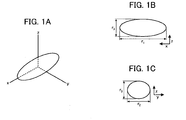
- the dry toner preferably has a spindle shape with a ratio (r2/r1) of the minor axis particle diameter (r2) to the major axis particle diameter (r1) being from 0.5 to 0.8 and a ratio (r3/r2) of the thickness (r3) to the minor axis particle diameter (r2) being from 0.7 to 1.0.
- a method for manufacturing a toner composition containing toner particles includes the steps of dissolving or dispersing a composition at least containing a modified polyester resin (i) capable of reacting with an active hydrogen, a colorant, and a compound having an active hydrogen, in an organic solvent to prepare an oil phase liquid; dispersing the oil phase liquid in an aqueous medium to prepare a dispersion; removing at least the organic solvent in the dispersion to prepare the toner particles; washing the toner particles; and drying the toner particles.
- a modified polyester resin i
- a developer containing the dry toner is provided.
- a toner container containing the dry toner is provided.
- a process cartridge including a photoreceptor and at least one of a charger configured to charge the photoreceptor, a developing device configured to develop a latent electrostatic image on the photoreceptor with the dry toner and a cleaning device configured to remove a residual toner on the photoreceptor is provided.
- an image forming method which includes the steps of developing a latent electrostatic image on an image carrier with the developer mentioned above to form a toner image on the image carrier; and transferring the toner image on a transfer medium optionally via an intermediate transfer medium.
- an image forming apparatus which contains an image carrier configured to carry a latent electrostatic image thereon; and a developing device configured to develop the latent electrostatic image with the developer mentioned above to form a toner image on the image carrier.
- the present invention is a dry toner which is obtained by dissolving or dispersing a toner material composition in an organic solvent to prepare a toner material liquid and then dispersing the toner material liquid in an aqueous liquid.
- the dry toner at least contains a modified polyester (i) and carbon black which serves as a colorant and has a pH of not greater than 7, and preferably from 2 to 6.
- the pH of carbon black is measured according to JIS Z8802.
- the toner has an average volume particle diameter (Dv) of from 3 to 7 ⁇ m and a ratio (Dv/Dp) of the average volume particle diameter (Dv) to the number average particle diameter (Dp), is from 1.00 to 1.25, and preferably from 1.05 to 1.25.
- This toner has a high electric resistance and is excellent in powder fluidity, transferability, high temperature resistance, low temperature fixability and hot offset resistance.
- the variance in the particle diameter of the toner in the developer is small and the developability of the toner is good and stable at repeated stirring over a long period of time in the developing unit.
- the variance in the particle diameter of the toner is small and filming of the toner on a developing roller and fusion bonding of the toner onto a member such as a blade for regulating the thickness of the toner layer hardly occur. Therefore, good and stable developability and images are obtained for an extended use (stirring) of a developing unit.
- a toner having a small particle diameter is advantageous to obtain high definition and high quality images, but is disadvantageous in transferability and cleaning properties.
- a toner having a volume average particle diameter below the range of the present invention is used in a two component developer, the toner tends to be fusion bonded to the surface of the carrier as stirring repeats for a long period of time and therefore charging ability of the carrier degrades.
- filming of the toner on a developing roller and fusion bonding of the toner onto a member such as a blade for regulating the thickness of the toner layer tend to occur.
- a toner having a ratio of volume average particle diameter to number average particle diameter less than 1.05, and especially less than 1. 00, is preferable because of having good stability and uniform charge quantity.
- the yield of such a toner is extremely poor when the toner is produced, resulting in increase of costs.
- the toner prepared from the manufacturing method for use in the present invention in which a toner material composition is dissolved or dispersed in an organic solvent to prepare a toner material liquid and the toner material liquid is further dispersed in an aqueous liquid, apparently has a small particle diameter with a sharp particle diameter distribution.
- a colorant in the toner especially carbon black, is insufficiently dispersed compared with a toner prepared by kneading and pulverization. It has been found from studies on the problem solving that a carbon black having a pH not greater than 7, and preferably of from 2 to 6, has a good dispersiblity even after the carbon black is dispersed in an organic solvent. A toner having a high electric resistance with excellent fluidity and transferability is thus obtained.
- Dispersibility of a carbon black in a toner can be improved by using a master batch in which the carbon black is dispersed in a resin in advance.
- the dry toner according to the present invention have a spindle shape.
- the toner When a toner has an irregular or flat shape, the toner easily causes the following problems due to its poor fluidity.
- the resultant images have background fouling because triboelectric charging is not smoothly performed.
- the resultant image when developing a fine dot of a latent image, the resultant image has poor reproduction because the toner particles do not have a dense and uniform configuration.
- transfer efficiency is inferior because the toner is hardly affected by lines of electric force.
- the toner When a toner has a substantially spherical shape, the toner excessively reacts against external forces because of having too good fluidity. This causes a problem in that the toner particles easily scatter around a dot at the time of developing and transferring. Also spherical toners easily roll on a photoreceptor and sneak between the photoreceptor and a cleaning member,'which often leads to poor cleaning performance.
- Fluidity of the spindle shaped toner of the present invention is so properly adjusted that triboelectric charging is smoothly performed, resulting in formation of images with no background fouling. Therefore minute dots can orderly be developed with the toner and the toner image is efficiently transferred, resulting in superior dot reproduction.
- the proper fluidity prevents toner scattering at this time.
- a spindle shaped toner has a limited number of axes, around which the toner particle revolves, compared with a spherical toner particle. Therefore, a poor cleaning performance caused by toner particles sneaking under a cleaning member rarely occurs.
- the toner of the present invention preferably has a spindle shape having a ratio (r2/r1) of from 0.5 to 0.8, wherein r2 is the minor axis particle diameter and r1 is the major axis particle diameter, and a ratio (r3/r2) of from 0.7 to 1.0, wherein r3 is the thickness thereof and r2 is the minor axis particle diameter.
- ratio (r2/r1) is not greater than 0.5, cleaning performance is good since the toner shape is away from being spherical. However, the toner tends to have poor dot representation and transfer efficiency, resulting in formation of low quality images.
- the ratio (r2/r1) is greater than 0.8, the toner shape is nearer to a spherical shape, and therefore the toner tends to provide especially bad cleaning performance in a low temperature/humidity environment.
- the toner shape is near to a flat form so that toner scattering hardly occurs as in the case of a toner having an irregular shape but a high transfer rate cannot be obtained unlike the case of a toner having a spherical shape.
- the ratio (r3/r2) of thickness to minor axis particle diameter is 1.0
- the toner particle revolves around the major axis thereof.
- the toner has a spindle shape with the ratio (r3/r2) of 1.0, the toner shape is not irregular, flat or spherical. Therefore, the toner can have all the advantages of both shapes, i.e., a good combination of triboelectric charging, dot reproduction, transfer efficiency, toner scattering avoidability and cleanability.
- the particle dimensions, r1, r2 and r3 of a toner can be determined by taking photos of the toner particles using a scanning electron microscope (SEM) while observing the toners from different angles.
- SEM scanning electron microscope
- the modified polyesters for use as a binder resin of the dry toner of the present invention are polyesters which have functional groups other than the functional groups contained in acid and alcohol monomer units or bonding groups other than the ester bonding group, or polyesters with which a resin component different from those of the polyesters is bonded by covalent bonding or ionic bonding.
- polyester resins having an end which is formed by a bonding other than ester bonding.
- Such polyester resins can be prepared, for example, by incorporating a functional group such as isocyanate groups, which can react with acid groups and hydroxyl groups, at the end of a polyester and reacting the functional group with an active hydrogen compound to perform a modification or elongation reaction.
- polyesters can be bonded with each other.
- the thus prepared urea modified polyesters, urethane modified polyesters and so on, can also be perfectly used as the modified polyesters.
- polyesters are prepared by introducing a reactive group such as double bond within the main chain of a polyester resin and performing a radical polymerization reaction thereon to graft a component having C-C bonding or bridging double bonds to each other such as styrene modified polyesters, acrylic modified polyesters can also be used as the modified polyester.
- polyester resins which have a different resin unit within the main chain thereof through copolymerization or polyester resins which are prepared by reacting an end of a polyester with a carboxyl group or a hydroxyl group are used as the modified polyester.
- modified polyester which is copolymerized with a silicone resin having ends which are modified by a carboxyl group, a hydroxyl group, an epoxy group or a mercapto group (e.g., silicone modified polyesters).
- a polystyrene graft modified polyester (i) is obtained, for example, as follows. (1) The following components are placed in a reacting container having a condenser, a stirrer and a nitrogen introducing tube and reacted for 8 hours at 230 °C under normal pressure. Adduct of bisphenol A with 2 moles of ethylene oxide 724 Isophthalic acid 200 Fumaric acid 70 Dibutyl tin oxide 2 (2) The reaction is further performed for 5 hours under a reduced pressure of from 10 to 15 mmHg. (3) Subsequent to cooling down to 160 °C, 32 parts of phthalic anhydride are added thereto to perform a reaction for 2 hours.
- polystyrene graft modified polyester (i) having an average molecular weight of 92000 is prepared.
- a urea modified polyester (i) include a reactant of a polyester prepolymer (A) having an isocyanate group with amine (B).
- Specific examples of the polyester prepolymer (A) having an isocyanate group include polyesters prepared by reacting an active hydrogen group of a polycondensation compound of a polyol (1) and a polycarboxylic acid (2) with a polyisocyanate (3).
- Specific examples of the active hydrogen group contained in the polyesters mentioned above include a hydroxyl groups (alcohol hydroxyl groups and phenol hydroxyl groups), amino groups, carboxylic groups and mercapto groups. Among the groups, alcohol hydroxyl groups are preferable.
- polyol (1) examples are diols (1-1) and polyols (1-2) having at least 3 hydroxyl groups. Only diols (1-1) or combinations of diols (1-1) with a small quantity of polyols (1-2) are preferable as the polyol (1).
- diols (1-1) are alkylene glycols (e.g., ethylene glycol, 1,2-propylene glycol, 1,3-propylene glycol, 1,4-butane diol and 1,6-hexan diol), alkylene ether glycol (e.g., diethylene glycol, triethylene glycol, dipropylene glycol, polyethylene glycol, polypropylene glycol, and polytetra methylene ether glycol), alicyclic diols (e.g., 1,4-cyclo hexane dimethanol, hydrogen added bisphenol A, and bisphenol groups (bisphenol A, bisphenol F and bisphenol S), adducts of the alicyclic diols mentioned above with alkylene oxides (e.g., ethylene oxides, propylene oxides, butylene oxides), and the bisphenols mentioned above with alkylene oxides (e.g., ethylene oxides, propylene oxides and butylene oxides) .
- alkylene glycols having 2 to 12 carbon atoms and adducts of bisphenol groups with alkylene oxides are preferable, and adducts of bisphenol groups with alkylene oxides and combinations of adducts of bisphenols with alkylene oxides and alkylene glycols having 2 to 12 carbon atoms are especially preferable.
- polyols (1-2) having at least 3 hydroxyl groups include aliphatic alcohols having 3 or more hydroxyl groups (e.g., glycerine, trimethylol ethane, trimethylol propane, pentaerythritol and sorbitol), polyphenols having at least 3 hydroxyl groups (e.g., trisphenol PA, phenol novolak and cresol novolak) and adducts of polyphenols having at least 3 hydroxyl groups with the alkylene oxides mentioned above.
- aliphatic alcohols having 3 or more hydroxyl groups e.g., glycerine, trimethylol ethane, trimethylol propane, pentaerythritol and sorbitol
- polyphenols having at least 3 hydroxyl groups e.g., trisphenol PA, phenol novolak and cresol novolak
- polycarboxylic acid (2) examples are dicarboxylic acids (2-1) and polycarboxylic acids (2-2) having at least 3 hydroxyl groups, and only dicarboxylic acids (2-1) and combinations of dicarboxylic acids (2-1) with a small quantity of polycarboxylic acids (2-2) are preferable as the polycarboxylic acid (2).
- dicarboxylic acid (2-1) examples include alkylene dicarboxylic acid (e.g., succinic acid, adipic acid and sebacic acid), alkenylene dicarboxylic acid (e.g., maleic acid and fumaric acid) , aromatic dicarboxylic acid (e.g., phthalic acid, isophthalic acid, terephthalic acid and naphthalene dicarboxylic acid).
- alkenylene dicarboxylic acids having 4 to 20 carbon atoms and the aromatic dicarboxylic acids having 8 to 20 carbon atoms are preferable.
- polycarboxylic acids (2-2) having at least 3 hydroxyl groups include aromatic polycarboxylic acid having 9 to 12 carbon atoms (e.g., trimellitic acid and pyromellitic acid).
- the polycarboxylic acids (2) can be obtained by reacting acid anhydrides or lower alkyl esters (e.g., methyl esters, ethyl esters and isopropyl esters) of the above-mentioned with the polyols (1).
- the mixing ratio of the polyol (1) to the polydicarboxylic acid (2) i.e., the equivalent ratio ([ OH] /[ COOH] ) of a hydroxyl group [ OH] to a carboxyl group [ COOH] , is normally from 2/1 to 1/1, preferably from 1.5/1 to 1/1, and more preferably from 1.3/1 to 1.02/1.
- polyisocyanate (3) examples include aliphatic polyisocyanates (e.g., tetramethylene diisocyanate, hexamethylene diisocyanate and 2,6-diisocyanate methylcaproate); alicyclic polyisocyanates (e.g., isophorone diisocyanate and cyclohexyl methane diisocyanate); aromatic diisocyanates (e.g., tolylene diisocyanate and diphenylmethane diisocyanate); aromatic aliphatic diisocyanates (e.g., ⁇ , ⁇ , ⁇ ', ⁇ '-tetramethyl xylylene diisocyanate); isocyanurates; and blocked polyisocyanates in which the polyisocyanates mentioned above are blocked with phenol derivatives, oximes or caprolactams. These compounds can be used alone or in combination.
- aliphatic polyisocyanates e.g., tetram
- the mixing ratio of the polyisocyanate (3) to the polyester i. e. , the equivalent ratio ([ NCO] /[ OH] ) of an isocyanate group [ NCO] to a hydroxyl group [ OH] of a polyester having hydroxyl groups, is normally from 5/1 to 1/1, preferably from 4/1 to 1.2/1, and more preferably from 2.5/1 to 1.5/1.
- the [ NCO] /[ OH] ratio is greater than 5, the low temperature fixability of the toner tends to deteriorate.
- the equivalent ratio of [ NCO] /[ OH] is less than 1, the urea content in the resultant modified polyesters decreases and thereby the hot-offset resistance of the toner tends to deteriorate.
- the content of the constitutional component, which is obtained from the polyisocyanate (3) , in the prepolymer (A) having an isocyanate group at its end portion is from 0.5 to 40 % by weight, preferably from 1 to 30 % by weight and more preferably from 2 to 20 % by weight.
- the content is less than 0.5 % by weight, the hot offset resistance of the toner tends to deteriorate and in addition it is hard for the toner to have good heat resistance and low temperature fixability.
- the content is greater than 40 % by weight, the low temperature fixability of the toner tends to deteriorate.
- the number of isocyanate groups included in the prepolymer (A) per molecule is normally not less than 1, preferably from 1.5 to 3, and more preferably from 1.8 to 2. 5.
- the number of isocyanate groups is less than 1 per molecule, the molecular weight of the modified polyester tends to decrease and thereby the hot offset resistance tends to deteriorate.
- amine (B) examples include diamines (B1), polyamines (B2) having three or more amino groups, amino alcohols (B3), amino mercaptans (B4), amino acids (B5) and blocked amines (B6) in which the amines (B1-B5) mentioned above are blocked.
- diamines (B1) include aromatic diamines (e.g., phenylene diamine, diethyltoluene diamine and 4,4'-diaminodiphenyl methane); alicyclic diamines (e.g., 4,4'-diamino-3,3'-dimethyldicyclohexyl methane, diaminocyclohexane and isophoron diamine); aliphatic diamines (e.g., ethylene diamine, tetramethylene diamine and hexamethylene diamine); etc.
- polyamines (B2) having three or more amino groups include diethylene triamine, triethylene tetramine.
- amino alcohols (B3) include ethanol amine and hydroxyethyl aniline.
- amino mercaptan (B4) include aminoethyl mercaptan and aminopropyl mercaptan.
- amino acids (B5) include amino propionic acid and amino caproic acid.
- Specific examples of the blocked amines (B6) of B1 to B5 include ketimine compounds which are prepared by reacting one of the amines B1-B5 mentioned above with a ketone such as acetone, methyl ethyl ketone and methyl isobutyl ketone; oxazoline compounds, etc.
- B1 and a mixture of B1 and a small quantity of B2 are preferable.
- the molecular weight of the modified polyesters can be controlled using an elongation anticatalyst, if desired.
- elongation anticatalyst examples include monoamines (e.g., diethyl amine, dibutyl amine, butyl amine and lauryl amine), and blocked amines (i.e., ketimine compounds) prepared by blocking the monoamines mentioned above.
- monoamines e.g., diethyl amine, dibutyl amine, butyl amine and lauryl amine
- blocked amines i.e., ketimine compounds
- the mixing ratio of the amines (B) to the prepolymer (A), i.e., the equivalent ratio ([ NCO] /[ NHx] ) of the isocyanate group [ NCO] contained in the prepolymer (A) to the amino group [ NHx] contained in the amines (B), is normally from 1/2 to 2/1, preferably from 1.5/1 to 1/1.5 and more preferably from 1.2/1 to 1/1.2.
- the mixing ratio is greater than 2 or less than 1/2, the molecular weight of the resultant urea-modified polyester (i) decreases, resulting in deterioration of the hot offset resistance of the resultant toner.
- the modified polyester (i) can include a urethane linkage as well as a urea linkage.
- the molar ratio (urea/urethane) of the urea linkage to the urethane linkage is from 100/0 to 10/90, preferably from 80/20 to 20/80 and more preferably from 60/40 to 30/70.
- the hot offset resistance of the resultant toner deteriorates.
- the modified polyester (i) can be prepared, for example, by a method such as one-shot methods or prepolymer methods.
- the weight average molecular weight of the modified polyester (i) is not less than 10,000, preferably from 20,000 to 10,000,000 and more preferably from 30,000 to 1,000,000. When the weight average molecular weight is less than 10,000, the hot offset resistance of the resultant toner deteriorates.
- the number average molecular weight of the modified polyester (i) is not particularly limited if the weight average molecular weight mentioned above is allowed.
- the number average molecular weight is normally not less than 20000, preferably from 1000 to 10000 and more preferably from 2000 to 8000.
- the number average molecular weight is greater than 20000, low temperature fixability of the resultant toner deteriorates and in addition gloss properties thereof also deteriorate when the toner is used in a full color device.
- the unmodified polyester (ii) can be contained as a binder resin in combination with the modified polyester (i).
- the combined use of (i) and (ii) can improve low temperature fixability and therefore is preferable to the use of (i) alone.
- Specific examples of the unmodified polyester (ii) include polycondensation products of polyol (1) and polycarboxylic acid (2) as mentioned above for use in the polyester constituents of the modified polyester (i) mentioned above. It is preferable that (i) and (ii) be at least partially mixed with each other in the light of low temperature fixability and hot offset resistance. Therefore, it is preferable, but not mandatory, that the unmodified polyester (ii) have a similar composition to that of the polyesters of (i).
- the weight ratio of (i) / (ii) is normally from 5/95 to 80/20, preferably from 5/95 to 30/70, more preferably from 5/95 to 25/75 and even more preferably from 7/93 to 20/80.
- content of the modified polyester (i) is less than 5% by weight, the hot offset resistance of the toner tends to deteriorate and in addition it is hard for the toner to have both the high temperature preservability and low temperature fixability.
- the peak molecular weight of the unmodified polyester (ii) is normally from 1000 to 30000, preferably from 1500 to 10000 and more preferably from 2000 to 8000. When the peak molecular weight is less than 1000, the high temperature preservability deteriorates. When the peak molecular weight is greater than 10000, the low temperature fixability deteriorates.
- the hydroxyl group value of the unmodified polyester (ii) is preferably not less than 5 mgKOH/g, more preferably from 10 to 120 mgKOH/g and even more preferably 20 to 80 mgKOH/g. When the hydroxyl group value of the unmodified polyester (ii) is less than 5 mgKOH/g, it is hard for the toner to have both the high temperature preservability and low temperature fixability.
- the acid value of the unmodified polyester (ii) is normally from 1 to 30 mgKOH/g, preferably from 5 to 20 mgKOH/g and more preferably from 1 to 15 mgKOH/g.
- the modified polyester (i) of the present invention has a glass transition temperature (Tg) of from 50 to 70 °C, and preferably from 55 to 65 °C.
- Tg glass transition temperature
- the glass transition temperature of the unmodified polyester (ii) is preferably from 35 to 55 °C.
- the unmodified polyester (ii) has a glass transition temperature lower than 35 °C, the toner may be blocked when the toner is stored in a high temperature environment.
- fixability becomes insufficient and the minimum fixable fixing temperature may increase.
- the dry toner of the present invention can have a good high temperature preservability even when the toner has a relatively low glass transition temperature compared with known toners formed of polyesters.
- the toner of the present invention preferably has a storage modulus of elasticity of 10,000 dyne/cm 2 at a temperature (TG') not lower than 100 °C, and more preferably from 110 to 200 °C when measured at a frequency of 20 Hz.
- TG' temperature not lower than 100 °C
- the toner has poor hot offset resistance.
- the toner of the present invention preferably has a viscosity of 1000 poise at a temperature (T ⁇ ) not higher than 180 °C, and more preferably from 90 to 160 °C.
- T ⁇ is higher than 180 °C, the low temperature fixability of the toner deteriorates.
- the temperature TG' of the toner is preferably higher than the temperature T ⁇ , i.e., the difference between TG' and T ⁇ (TG' -T ⁇ ) is preferably not less than 0 °C. More preferably, the difference is not less than 10 °C and even more preferably not less than 20 °C. There is no upper limit to the difference.
- the difference (TG' - T ⁇ ) is preferably from 0 to 100 °C, more preferably from 10 to 90 °C, and even more preferably from 20 to 80 °C.
- the toner of the present invention can include a wax as well as a toner binder and a colorant.
- Known waxes for use in conventional toners can be used in the toner of the present invention.
- Suitable releasing agents include polyolefin waxes (e.g., polyethylene waxes and polypropylene waxes); hydrocarbons having a long chain (e.g., paraffin waxes and SASOL waxes); and waxes having a carbonyl group.
- polyolefin waxes e.g., polyethylene waxes and polypropylene waxes
- hydrocarbons having a long chain e.g., paraffin waxes and SASOL waxes
- waxes having a carbonyl group are preferably used for the toner of the present invention.
- waxes including a carbonyl group-including polyalkanoic acid esters such as carnauba waxes, montan waxes, trimethylolpropane tribehenate, pentaerythritol tetrabehenate, pentaerythritol diacetate dibehenate, glycerin tribehenate, and 1,18-octadecanediol distearate; polyalkanol esters such as tristearyl trimellitate, and distearyl maleate; polyalkanoic acid amides such as ethylenediamine dibehenylamide; polyalkylamides such as trimellitic acid tristearylamide; dialkyl ketone such as distearyl ketones; etc.
- polyalkanoic acid esters such as carnauba waxes, montan waxes, trimethylolpropane tribehenate, pentaerythritol tetrabehenate, pentaerythritol
- the waxes for use in the present invention normally have a melting point of from 40 to 160 °C, preferably from 50 to 120 °C and more preferably from 60 to 90 °C. Waxes having a melting point lower than 40 °C adversely affect high temperature preservability and waxes having a melting point higher than 160 °C tend to cause cold offset when fixed at a low temperature.
- the wax preferably has a melting viscosity of from 5 to 1000 cps, and more preferably from 10 to 100 cps, at the temperature 20 °C higher than the melting point thereof. Waxes having a melting viscosity higher than 1000 cps deteriorates hot offset resistance and low temperature fixability.
- the content of a wax contained in the toner is normally from 0 to 40% by weight and preferably from 3 to 30% by weight.
- the toner of the present invention optionally includes a charge controlling agent.
- charge controlling agents can be used for the toner of the present invention.
- Specific examples of the charge controlling agents include nigrosine dyes, triphenyl methane dyes, metal compounds dyes including chrome, chelate compounds of molybdic acid, Rhodamine dyes, alkoxyamines, quaternary ammonium salts (including fluorine-modified quaternary ammonium salts), alkylamides, phosphor and compounds including phosphor, tungsten and compounds including tungsten, fluorine-containing activators, metal salts of salicylic acid, metal salts of salicylic acid derivatives, etc.
- charge controlling agents include BONTRON 03 (nigrosine dyes), BONTRON P-51 (quaternary ammonium salt), BONTRON E-82 (metal complex of oxynaphthoic acid), BONTRON S-34 (azo dyes containing a metal) , BONTRON E-84 (metal complex of salicylic acid) , and BONTRON E-89 (phenolic condensation product), which are manufactured by Orient Chemical Industries Co., Ltd.; TP-302 and TP-415 (molybdenum complex of quaternary ammonium salt), which are manufactured by Hodogaya Chemical Co.; Ltd.; COPY CHARGE PSY VP2038 (quaternary ammonium salt), COPY BLUE PR (triphenyl methane derivative), COPY CHARGE NEG VP2036 and COPY CHARGE NX VP434 (quaternary ammonium salt), which are manufactured by Hoechst AG; LRA-901, and LR-147 (boronol
- the content of charge controlling agents in the toner of the present invention depends on the kind of the toner binder resin used, whether other additives are used, and the toner manufacturing method used (including the dispersing method) and therefore there is no specific limitation thereto.
- the charge controlling agent be used in an amount of from 0.1 to 10 parts by weight per 100 parts by weight of the binder resin and more preferably of from 0.2 to 5 parts by weight.
- the amount is greater than 10 parts by weight, the toner is so excessively charged that electrostatic attraction force between the toner and a developing roller increases, resulting in deterioration of fluidity of the developer and deterioration of image density.
- charge controlling agents and releasing agents can be fused and kneaded with a master batch and a resin and certainly be added when dissolved and dispersed in an organic solvent.
- inorganic particulates can be preferably added thereto.
- Such inorganic particulates preferably have a primary particle diameter of from 5 nm to 2 ⁇ m and more preferably of from 5 nm to 500 nm.
- a specific surface area thereof be from 20 to 500 m 2 /g when measured by a BET method.
- the content of the inorganic particulates in the toner is preferably from 0.01% to 5.0% by weight, and more preferably from 0.01% to 2.0% by weight, based on the total weight of the toner.
- inorganic particulates include silica, alumina, titanium oxide, barium titanate, magnesium titanate, calcium titanate, strontium titanate, zinc oxide, tin oxide, quartz sand, clay, mica, sand-lime, diatom earth, chromium oxide, cerium oxide, red iron oxide, antimony trioxide, magnesium oxide, zirconium oxide, barium sulfate, barium carbonate, calcium carbonate, silicon carbide, silicon nitride, etc.
- particulate polymers which are prepared by a method such as soap free emulsion polymerization, suspension polymerization or dispersion polymerization
- particulate polycondensation compounds e.g., silicone resins, benzoguanamine resins and nylons
- thermosetting resins can also be used.
- Suitable surfactants for use in the hydrophobizing treatment include silane coupling agents, silylation agents, silane coupling agents having a fluorinated alkyl group, organic titanate coupling agents, aluminum coupling agents, silicone oils, modified silicone oils, etc.
- the toner can optionally include a cleanability improving agent to easily remove toner particles which remain on an image carrier such as a photoreceptor and a first transfer medium after a toner image is transferred.
- a cleanability improving agent to easily remove toner particles which remain on an image carrier such as a photoreceptor and a first transfer medium after a toner image is transferred.
- cleanability improving agents include fatty acids and their metal salts such as stearic acid, zinc stearate, and calcium stearate; and particulate polymers such as polymethyl methacrylate and polystyrene, which are manufactured by a method such as soap-free emulsion polymerization methods.
- particulate polymers preferably have a relatively sharp particle diameter distribution and a volume average particle diameter of from 0.01 to 1 ⁇ m.
- the toner binders can be manufactured, for example, by the following method:
- a solvent can be optionally used for the reaction of the polyester with polyisocyanate (3) and the reaction of the polymer (A) with the amine (B).
- Suitable solvents are aromatic solvents such as toluene and xylene; ketones such as acetone, methyl ethyl ketone and methyl isobutyl ketone; esters such as acetic ether; amides such as dimethyl formamide and dimethyl acetamide; and ethers such as tetrahydrofuran which are inactive to isocyanate (3).
- the unmodified polyester (ii) When the unmodified polyester (ii) is contained, the unmodified polyester (ii) is prepared in the method similar to that for the polyester having a hydroxyl group.
- the unmodified polyester (ii) is dissolved in the resultant solution of (i) mentioned above to be mixed.
- the dry toner can be manufactured by the following method, but the manufacturing method is not limited thereto.
- the powder mixer In the process of mixing the external additive, a conventional powder mixer is used. It is preferable that the powder mixer be equipped with a jacket and the like to adjust the internal temperatures thereof. In order to change stresses on the external additive, the external additive may be added in separate times or step by step.
- mixing facilities include v-type mixers, rocking mixers, Loedige Mixers, Nauta mixers and Henschel mixers.
- a mechanical pulverization method including the steps of: (1) fusing/kneading the toner constituents consisting of a toner binder and a colorant, (2) finely pulverizing the kneaded toner constituents and (3) mechanically rounding the finely pulverized toner constituents using a hybridizer and MECHANOFUSION; a spray drying method including the steps of: dissolving and dispersing toner constituents including at least a binder resin and a colorant in a solvent which can dissolve the toner binder; and removing the solvent using a spray drying device; and a method including the steps of: heating toner constituents in an aqueous medium.
- the rounding methods are not limited thereto.
- Suitable aqueous media for use in the method of manufacturing the toner of the present invention include water and mixtures of water and a solvent which can be mixed with water.
- a solvent include alcohols (e.g., methanol, isopropanol and ethylene glycol), dimethylformamide, tetrahydrofuran, cellosolves (e.g., methyl cellosolve), lower ketones (e.g., acetone and methyl ethyl ketone), etc.
- Toner particles can be prepared by reacting a dispersion element including the prepolymer (A) having an isocyanate group with an amine (B) in an aqueous medium or by dispersing the modified polyester (i) which is prepared in advance in an aqueous medium.
- a method in which toner constituents including the modified polyester (i) or the prepolymer (A) are added in an aqueous medium and dispersed by a shearing force is preferably used.
- the prepolymer (A) and other toner components such as a colorant, a colorant master batch, a releasing agent, a charge controlling agent and an unmodified polyester resin (ii) can be mixed in an aqueous medium when forming a dispersion element, it is preferable that the toner materials be mixed first and then the mixture be added and dispersed in an aqueous medium.
- the other toner materials such as a colorant, a releasing agent and a charge controlling agent are not necessarily mixed at the time of forming particles in an aqueous medium but can be added after particles are formed.
- a colorant can be added by a method in which particles including no colorant are dyed by a known dyeing method.
- dispersion method There is no particular restriction for the dispersion method.
- Low speed shearing methods, high speed shearing methods, friction methods, high pressure jet methods, ultrasonic methods, etc. can be used.
- high speed shearing methods are preferable because particles having a particle diameter of from 2 ⁇ m to 20 ⁇ m can be easily prepared.
- the rotation speed is typically from 1000 to 30000 rpm, and preferably from 5000 to 20000 rpm.
- the dispersion time is also not particularly limited, but is typically from 0.1 to 5 minutes for a batch production method.
- the temperature in the dispersion process is typically from 0 to 150 °C (under pressure), and preferably from 40 to 98 °C.
- the dispersion process is preferably performed at a high temperature in the light of dispersion because a dispersion element including the modified polyester (i) or the prepolymer (A) has a low viscosity at a high temperature.
- the amount of the aqueous medium is normally from 50 to 2000 parts by weight and preferably from 100 to 1000 parts by weight per 100 parts by weight of toner material including the modified polyester (i) or the prepolymer (A).
- toner material including the modified polyester (i) or the prepolymer (A).
- Dispersants can be used if necessary. It is preferable to use a dispersant because the toner can have a sharp particle diameter distribution and can be dispersed well.
- dispersants which are used for emulsifying and dispersing an oil phase liquid, in which toner constituents are dispersed, in an aqueous phase liquid, include anionic surfactants such as alkylbenzene sulfonic acid salts, ⁇ -olefin sulfonic acid salts, and phosphoric acid esters; cationic surfactants such as amine salts (e.g., alkyl amine salts, aminoalcohol fatty acid derivatives, polyamine fatty acid derivatives and imidazoline), and quaternary ammonium salts (e.g., alkyltrimethyl ammonium salts, dialkyldimethyl ammonium salts, alkyldimethyl benzyl ammonium salts, pyridinium salts, alkyl isoquinolinium salts and benzethonium chloride) ; nonionic surfactants such as fatty acid amide derivatives, polyhydric alcohol derivatives; and ampholytic surfact
- a surfactant having a fluoroalkyl group is effective even in an extremely small amount.
- anionic surfactants having a fluoroalkyl group include fluoroalkyl carboxylic acids having 2 to 10 carbon atoms and their metal salts, disodium perfluoro octanesulfonyl glutamate, sodium 3- ⁇ omega-fluoroalkyl (C6-C11) oxy ⁇ -1-alkyl (C3-C4) sulfonate, sodium 3- ⁇ omega-fluoroalkanoyl(C6-C8)-N-ethylamino ⁇ -1-propan esulfonate, fluoroalkyl(C11-C20) carboxylic acids and their metal salts, perfluoroalkylcarboxylic (C7-C13) acids and their metal salts, perfluoroalkyl(C4-C12)sulfonate and their metal salts, perfluorooctanesul
- Specific examples of the marketed products of such surfactants include SURFLON S-111, S-112 and S-113, which are manufactured by Asahi Glass Co., Ltd.; FRORARD FC-93, FC-95, FC-98 and FC-129, which are manufactured by Sumitomo 3M Ltd.; UNIDYNE DS-101 and DS-102, which are manufactured by Daikin Industries, Ltd.; MEGAFACE F-110, F-120, F-113, F-191, F-812 and F-833, which are manufactured by Dainippon Ink and Chemicals, Inc.; ECTOP EF-102, 103, 104, 105, 112, 123A, 123B, 306A, 501, 201 and 204, which are manufactured by Tohchem Products Co., Ltd.; and FUTARGENT F-100 and F150, which are manufactured by Neos.
- cationic surfactants include primary, secondary and tertiary aliphatic amines having a fluoroalkyl group, aliphatic quaternary ammonium salts such as perfluoroalkyl(C6-C10)sulfoneamidepropyltrimethylammo nium salts, benzalkonium salts, benzetonium chloride, pyridinium salts, imidazolinium salts.
- Specific examples of the marketed products thereof include SURFLON S-121 (from Asahi Glass Co., Ltd.); FRORARD FC-135 (from Sumitomo 3M Ltd.); UNIDYNE DS-202 (from Daikin Industries, Ltd.); MEGAFACE F-150 and F-824 (from Dainippon Ink and Chemicals, Inc.); ECTOP EF-132 (from Tohchem Products Co., Ltd.); FUTARGENT F-300 (from Neos); etc.
- inorganic dispersants which are hardly soluble in water, such as tricalcium phosphate, calcium carbonate, titanium oxide, colloidal silica, and hydroxyapatite can also be used.
- protection colloids include homopolymers and copolymers prepared using monomers such as acids (e.g., acrylic acid, methacrylic acid, ⁇ -cyanoacrylic acid, ⁇ -cyanomethacrylic acid, itaconic acid, crotonic acid, fumaric acid, maleic acid and maleic anhydride), acrylic monomers having a hydroxyl group (e.g., ⁇ -hydroxyethyl acrylate, ⁇ -hydroxyethyl methacrylate, ⁇ -hydroxypropyl acrylate, ⁇ -hydroxypropyl methacrylate, ⁇ -hydroxypropyl acrylate, ⁇ -hydroxypropyl methacrylate, 3-chloro-2-hydroxypropyl acrylate, 3-chloro-2-hydroxypropyl methacrylate, diethyleneglycolmonoacrylic acid esters, diethyleneglycol monomethacrylic acid esters, glycerinmon
- polymers such as polyoxyethylene compounds (e.g., polyoxyethylene, polyoxypropylene, polyoxyethylenealkyl amines, polyoxypropylenealkyl amines, polyoxyethylenealkyl amides, polyoxypropylenealkyl amides, polyoxyethylene nonylphenyl ethers, polyoxyethylene laurylphenyl ethers, polyoxyethylene stearylphenyl esters, and polyoxyethylene nonylphenyl esters); and cellulose compounds such as methyl cellulose, hydroxyethyl cellulose and hydroxypropyl cellulose, can also be used as the polymeric protective colloid.
- polyoxyethylene compounds e.g., polyoxyethylene, polyoxypropylene, polyoxyethylenealkyl amines, polyoxypropylenealkyl amines, polyoxyethylenealkyl amides, polyoxypropylenealkyl amides, polyoxyethylene nonylphenyl ethers, polyoxyethylene laurylphenyl ethers, polyoxy
- a method in which the emulsion is gradually heated to perfectly evaporate the organic solvent included in the drops of the oil phase liquid can be used.
- a method in which the emulsion is sprayed in a dry environment to remove the nonaqueous solvent in the droplets, resulting in formation of toner particles, and thereafter water in the dispersion is evaporated can be used.
- Specific examples of such a dry environment include gases of air, nitrogen, carbon dioxide, combustion gas, etc. It is preferable that those gases be heated to a temperature not lower than the boiling point of the solvent having the highest boiling point among the solvents used in the emulsion.
- Toner particles having desired properties can be rapidly prepared by performing this treatment using a spray dryer, a belt dryer, a rotary kiln, or the like.
- the resultant toner particles are preferably mixed with an acid such as hydrochloric acid to dissolve calcium phosphate, followed by washing with water to remove calcium phosphate from the toner particles.
- an acid such as hydrochloric acid
- calcium phosphate can be removed using a zymolytic method.
- the resultant particles are preferably washed after the particles are subjected to an elongation and/or a crosslinking reaction to impart good chargeability to the particles.
- a solvent which dissolves the modified polyester (i) or the prepolymer (A) can be added. It is preferable to use such a solvent to allow the resultant toner to have a sharp particle diameter distribution. Volatile solvents having a boiling point lower than 100 °C are preferably used as the solvent because such solvents can be removed with ease after the particles are formed.
- Such a solvent include toluene, xylene, benzene, carbon tetrachloride, methylene chloride, 1,2-dichloroethane, 1,1,2-trichloroethane, trichloroethylene, chloroform, monochlorobenzene, dichloroethylidene, methyl acetate, ethyl acetate, methyl ethyl ketone, methyl isobutyl ketone.
- solvents can be used alone or in combination.
- aromatic solvents such as toluene and xylene
- halogenated hydrocarbons such as methylene chloride, 1,2-dichloroethane, chloroform, and carbon tetrachloride are preferably used.
- the addition amount of such a solvent is from 0 to 300 parts by weight, preferably from 0 to 100 parts by weight and more preferably from 25 to 70 parts by weight, per 100 parts by weight of the prepolymer (A) used.
- the solvent is removed upon application of heat thereto under a normal or reduced pressure after the particles are subjected to an extension treatment and/or a crosslinking treatment.
- the reaction time of extension and/or crosslinking is determined depending on the reacting property of the isocyanate structure the prepolymer (A) with the amine (B) used, but the reaction time is generally from 10 minutes to 40 hours, and preferably 2 hours to 24 hours.
- the reaction temperature is generally from 0 to 150 °C and preferably from 40 to 98 °C.
- known catalysts can optionally be used. Specific examples of the catalysts include dibutyltin laurate and dioctyltin laurate.
- the resultant toner has a wide particle diameter distribution at the time of emulsification dispersion and the wide particle diameter distribution is maintained during a washing and drying treatment, it is possible to prepare a toner having a desired particle diameter distribution by classifying the produced toner.
- Fine particles can be removed from the toner by classification using a cyclone, a decanter or a device using a centrifugal force while the toner is in a liquid. It is also possible to classify a toner which is obtained by drying the dispersion. However classification in a liquid is preferable in the light of efficiency. The thus obtained unwanted fine particles and coarse particles can be returned to the kneading process to form particles again even when those fine particles and coarse particles are wet.
- the thus obtained toner powder can be mixed with fine particles of other materials such as a releasing agent, a charge controlling agent, a fluidizer agent and a colorant. These materials can be fixed and fused on the surface of the toner powder by a mechanical impact on the powder mixture in order to prevent the particles from detaching from the toner particles.
- Specific examples of the method include a method of making an impact on a mixture with a blade rotating at a high speed and another method of colliding particles against each other or complex particles against a collision board.
- Such mechanical impact applicators include ONG MILL (manufactured by Hosokawa Micron Co., Ltd.), modified I TYPE MILL in which the air pressure for pulverizing is reduced (manufactured by Nippon Pneumatic Mfg. Co., Ltd.), HYBRIDIZATION SYSTEM (manufactured by Nara Machine Co., Ltd.), KRYPTRON SYSTEM (manufactured by Kawasaki Heavy Industries, Ltd.), and automatic mortars.
- ONG MILL manufactured by Hosokawa Micron Co., Ltd.
- modified I TYPE MILL in which the air pressure for pulverizing is reduced manufactured by Nippon Pneumatic Mfg. Co., Ltd.
- HYBRIDIZATION SYSTEM manufactured by Nara Machine Co., Ltd.
- KRYPTRON SYSTEM manufactured by Kawasaki Heavy Industries, Ltd.
- automatic mortars automatic mortars.
- the toner of the present invention can be used for a two component developer in which the toner is mixed with a magnetic carrier.
- the weight ratio (T/C) of the toner (T) to the carrier (C) is preferably from 1/100 to 10/100.
- Suitable carriers for use in such two component developers include known carrier materials such as iron powders, ferrite powders, magnetite powders, magnetic resin carriers, which have a particle diameter of from about 20 ⁇ m to about 200 ⁇ m.
- carrier materials such as iron powders, ferrite powders, magnetite powders, magnetic resin carriers, which have a particle diameter of from about 20 ⁇ m to about 200 ⁇ m.
- the surface of the carriers may be coated with a resin.
- Such resins to be coated on the carriers include amino resins such as urea-formaldehyde resins, melamine resins, benzoguanamine resins, urea resins, and polyamide resins, and epoxy resins.
- polyvinyl or polyvinylidene resins such as acrylic resins, polymethylmethacrylate resins, polyacrylonitirile resins, polyvinyl acetate resins, polyvinyl alcohol resins, polyvinyl butyral resins, polystyrene resins, styrene-acrylic copolymers, halogenated olefin resins such as polyvinyl chloride resins, polyester resins such as polyethyleneterephthalate resins and polybutyleneterephthalate resins, polycarbonate resins, polyethylene resins, polyvinyl fluoride resins, polyvinylidene fluoride resins, polytrifluoroethylene resins, polyhexafluoropropylene resins,
- an electroconductive powder may be included in the coating resin.
- electroconductive powders include metal powders, carbon blacks, titanium oxides, tin oxides, and zinc oxides.
- the average particle diameter of such electroconductive powders is preferably not greater than 1 ⁇ m. When the particle diameter is greater than 1 ⁇ m, it is hard to control the resistance thereof.
- the toner of the present invention can also be used as a single component magnetic developer or a single component non-magnetic developer, which does not use a carrier.
- Fig. 2 is a schematic view illustrating the cross section of an embodiment of the process cartridge of the present invention.
- Numeral 21 denotes a process cartridge.
- the process cartridge 21 includes a photoreceptor 22 serving as an image bearing member bearing an electrostatic latent image thereon, a charger 23 which charges the photoreceptor 22, a developing roller 24 serving as a member of a developing device which develops the electrostatic latent image on the photoreceptor 22 with the developer of the present invention to form a toner image on the photoreceptor 22, and a cleaning blade 25 which serves as a cleaner and which removes toner particles remaining on the surface of the photoreceptor 22 after the toner image on the photoreceptor 22 is transferred onto a receiving material (not shown).
- the process cartridge is not limited to the process cartridge 21 illustrated in Fig. 2. Any process cartridges including at least an image bearing member and a developing device including the toner of the present invention can be used as the process cartridge of the present invention.
- the process cartridge of the present invention is detachably set in an image forming apparatus.
- the photoreceptor 22 is rotated at a predetermined rotation speed.
- the photoreceptor 22 is charged with the charger 23 and thereby the photoreceptor 22 is uniformly charged positively or negatively.
- an image irradiating device (not shown) irradiates the charged surface of the photoreceptor 22 with light using a method such as slit irradiation methods and laser beam irradiation methods, resulting in formation of electrostatic latent image on the photoreceptor 22.
- the thus prepared electrostatic latent image is developed by the developing roller 24 bearing the developer of the present invention thereon, resulting in formation of a toner image on the photoreceptor 22.
- the toner image is then transferred onto a receiving material (not shown) which is timely fed by a feeding device (not shown) to a transfer position between the photoreceptor 22 and a transfer device (not shown).
- the toner image formed on the receiving material is then separated from the photoreceptor 22 and fixed by a heat/pressure fixing device (not shown) including a fixing roller.
- the fixed image is discharged from the image forming apparatus. Thus, a hard copy is produced.
- the surface of the photoreceptor 22 is cleaned by the cleaning blade 25 to remove toner remaining on the photoreceptor 22, followed by discharging, to be ready for the next image forming operation.
- an ethyl acetate/methyl ethyl ketone solution of the toner binder (1) was obtained. A portion of the solution was dried under a reduced pressure to isolate the toner binder (1).
- the toner binder (1) had a Tg of 62 °C and an acid value of 10 mgKOH/g.
- the toner binder (2) has a peak molecular weight of 5000, a Tg of 62 °C and an acid value of 10 mgKOH/g.
- the toner (2) of the present invention was obtained in the same manner as in Example 1 except that the temperature of dissolution and dispersion was changed to 50 °C.
- the mother particle of the toner had a volume average particle diameter (Dv) of 5.4 ⁇ m, a number average particle diameter (Dp) of 4.6 ⁇ m and Dv/Dp of 1.17. The results were shown in Table 1.
- a toner was prepared in the same manner as in Example 1 except that carbon black having a PH of 8.5 was used instead of the carbon black used in Example 1.
- the obtained comparative toner (1) had a volume average particle diameter of 6 ⁇ m.
- the mother toner particles had a volume average particle diameter (Dv) of 6.2 ⁇ m, a number average particle diameter (Dp) of 5.1 ⁇ m and Dv/Dp of 1.22. The results were shown in Table 1. Toner No.
- the urea-modified polyester (1) and 970 parts of the unmodified polyester (a) were dissolved and mixed in 2000 parts of a mixture solvent of ethyl acetate/methyl ethyl ketone (1/1) and thus an ethyl acetate/methyl ethyl ketone solution of a toner binder (3) was obtained. A portion of the solution was dried under a reduced pressure to isolate the toner binder (3).
- the toner binder (3) had a peak molecular weight of 5000, a Tg of 62 °C and an acid value of 10 mgKOH/g.
- a toner (3) according to the present invention was obtained in the same manner as in Example 2 except that the toner binder (2) was replaced by the toner binder (3) and the addition amount of carbon black was changed to 8 parts.
- the mother toner particles had a volume average particle diameter (Dv) of 5.7 ⁇ m, a number average particle diameter (Dp) of 4.8 ⁇ m and Dv/Dp of 1.19. The results were shown in Table 2.
- the urea-modified polyester (1) and 500 parts of the unmodified polyester (a) were dissolved and mixed in 2000 parts of a mixture solvent of ethyl acetate/methyl ethyl ketone (1/1) and thus an ethyl acetate/methyl ethyl ketone solution of a toner binder (4) was obtained.
- a portion of the solution was dried under a reduced pressure to isolate the toner binder (4).
- the toner binder (4) had a peak molecular weight of 5000, a Tg of 62 °C and an acid value of 10 mgKOH/g.
- a toner (4) according to the present invention was obtained in the same manner as in Example 1 except that the toner binder (1) in Example 1 was replaced by the toner binder (4) and the addition amount of carbon black was changed to 8 parts.
- the mother toner particles had a volume average particle diameter (Dv) of 6.5 ⁇ m, a number average particle diameter (Dp) of 5. 5 pm and Dv/Dp of 1. 18. The results were shown in Table 2.
- the comparative toner binder (2) had a Tg of 58 °C.
- a toner was obtained using 100 parts of the comparative toner binder (2) and 8 parts of carbon black having a pH of 0.6 according to the following method. Preparatory mixing was performed using a Henschel mixer followed by kneading with a continuous kneading machine. Then the mixture was finely pulverized using a jet mill and classified by an air separator to obtain mother toner particles. Further 100 parts of the mother toner particle, 0.5 parts of hydrophobic silica and 0.5 parts of hydrophobic titanium oxide were mixed with a Henschel mixer and thus a comparative toner (2) was obtained.
- the mother toner particles had a volume average particle diameter (Dv) of 7.0 ⁇ m, a number average particle diameter (Dp) of 5.2 ⁇ m and Dv/Dp of 1.35.
- Dv volume average particle diameter
- Dp number average particle diameter
- Dv/Dp Dv/Dp of 1.35.
- Table 2 Toner No. Fluidity Minimum fixing temperature Hot offset Volume resistivity Amount of charge (- ⁇ c/g) At start After 30000 prints Example 3 0.41 120 °C 230 °C 11.2 20 18 Example 4 0.42 120 °C 230 °C 11.1 21 19 Comparative Example 2 0.30 130 °C 220 °C 19 19 10
- the urea-modified polyester (1) and 250 parts of the unmodified polyester (a) were dissolved and mixed in 2000 parts of a mixture solvent of ethyl acetate/methyl ethyl ketone (1/1) and thus an ethyl acetate/methyl ethyl ketone solution of a toner binder (5) was obtained. A portion of the solution was dried under a reduced pressure to isolate the toner binder (5).
- the toner binder (5) had a peak molecular weight of 5000, a Tg of 62 °C and an acid value of 10 mgKOH/g.
- a toner was obtained in the same manner as in Example 1 except that the toner binder (1) was replaced with the toner binder (5) .
- the mother toner particles had a volume average particle diameter (Dv) of 4.4 ⁇ m, a number average particle diameter (Dp) of 3.6 ⁇ m and Dv/Dp of 1.22. The results were shown in Table 3.
- the urea-modified polyester (1) and 150 parts of the unmodified polyester (a) were dissolved and mixed in 2000 parts of a mixture solvent of ethyl acetate/methyl ethyl ketone (1/1) and thus an ethyl acetate/methyl ethyl ketone solution of a toner binder (6) was obtained. A portion of the solution was dried under a reduced pressure to isolate the toner binder (6).
- the toner binder (6) had a peak molecular weight of 5000, a Tg of 62 °C and an acid value of 10 mgKOH/g.
- a toner was obtained in the same manner as in Example 1 except that the toner binder (1) was replaced with the toner binder (6).
- the mother toner particles had a volume average particle diameter (Dv) of 5.8 ⁇ m, a number average particle diameter (Dp) of 4.8 ⁇ m and Dv/Dp of 1.21. The results were shown in Table 3.
- Example 5 a comparative toner material liquid was obtained. Then the procedure for preparation of the toner in Example 5 was repeated except that the toner material liquid was replaced with the comparative toner material liquid prepared above.
- the mother toner particles had a volume average particle diameter (Dv) of 6.5 ⁇ m, a number average particle diameter (Dp) of 5.1 ⁇ m and Dv/Dp of 1.27.
- Dv volume average particle diameter
- Dp number average particle diameter
- Dv/Dp 1.27.
- Table 3 Toner No. Fluidity Minimum fixing temperature Hot offset Volume resistivity Amount of charge (- ⁇ c/g) At start After 30000 prints Example 5 0.41 150 °C 230 °C 10.9 20 19
- Example 6 0.42 145 °C 230 °C 10.8 22
- Comparative Example 3 0.31 130 °C 160 °C 10.7 20 10
- a toner (7) was obtained in the same manner as in Example 1 except that the toner binder (1) was replaced with the toner binder (7).
- the mother toner particles had a volume average particle diameter (Dv) of 6.4 ⁇ m, a number average particle diameter (Dp) of 5.4 ⁇ m and Dv/Dp of 1.19. The results were shown in Table 4.
- a toner (8) was obtained in the same manner as in Example 1 except that the toner binder (1) was replaced with the toner binder (8).
- the mother toner particles had a volume average particle diameter (Dv) of 5.6 ⁇ m, a number average particle diameter (Dp) of 4.9 ⁇ m and Dv/Dp of 1.14. The results were shown in Table 4.
- a toner (9) was obtained in the same manner as in Example 1 except that the toner binder (1) was replaced with the toner binder (9).
- the mother toner particles of the obtained toner had a volume average particle diameter (Dv) of 6.7 ⁇ m, a number average particle diameter (Dp) of 6.2 ⁇ m and Dv/Dp of 1.08.
- the results were shown in Table 4.
- Example 8 0.40 150 °C 230 °C 10.7 21
- Example 9 0.36 150 °C 230 °C 10.9 25 26
- the particle diameter (i.e., volume average particle diameter and number average particle diameter) of a toner was measured with a particle diameter measuring instrument, COULTER COUNTER TA II , manufactured by Coulter Electronics, Inc.
- Core material Spherical ferrite particle having an average particle diameter of 50 ⁇ m.
- Coating liquid A toluene solution of a silicone resin in which an amino silane coupling agent was dispersed.
- the coating liquid was spray-coated to the core material in a heated state.
- the coated carrier was baked and then cooled down.
- a film resin having an average thickness of 0.2 ⁇ m was formed on the core material.
- a coated carrier was prepared.
- the amount of charge of a developer was measured by a blow-off method using an electrometer.
- the developer was installed in PRETER 650 from Ricoh Co., Ltd., and the amount of charge thereof was measured after 30000 prints.
- the amount of charge of the developer preferably falls within the range of from about 15 to about 25 (pc/g) in absolute figure.
- Hot offset temperature was defined as a minimum temperature of the fixing roll above which hot offset occurred.
- a copying test was performed using a paper TYPE 6200 manufactured by Ricoh Co., Ltd. and a copier MF-200 from Ricoh Co., Ltd. which is modified such that a TEFLON roller is used as a fixing roller while changing the fixing temperature:
- the minimum fixing temperature was defined as a temperature of the fixing roller above which the image density remaining ratio was not less than 70%.
- a dry toner which has a small diameter and high electric resistance and is excellent in fluidity, transferability, high temperature preservability, low temperature fixability and hot offset resistance.
- a developer using the dry toner, and an image forming method and apparatus which can produce images having good low temperature fixability and hot offset resistance for a long period of time can be provided.
- a process cartridge using the dry toner mentioned above which can produce quality images can also be provided.
Landscapes
- Physics & Mathematics (AREA)
- General Physics & Mathematics (AREA)
- Chemical & Material Sciences (AREA)
- Chemical Kinetics & Catalysis (AREA)
- Spectroscopy & Molecular Physics (AREA)
- Inorganic Chemistry (AREA)
- Developing Agents For Electrophotography (AREA)
Abstract
Description
- The present invention relates to a dry toner for developing an electrostatic image in electrophotography, electrostatic recording, electrostatic printing and the like, a developer including the dry toner, and a process cartridge, an image forming method using the developer and an image forming apparatus using the developer. More particularly the present invention relates to a dry toner for use in copiers, laser printers and plain-paper facsimile machines and so on which use a direct or indirect electrophotographic development method, a developer, and a process cartridge, an image forming method and an image forming apparatus using the toner.
- Electrostatic latent images, which are formed on an image bearing member using a method such as electrophotography, electrostatic recording and electrostatic printing are developed with a toner to be visualized.
- For example, visual images are typically formed as follows:
- (1) a latent electrostatic image is formed on an image bearing member such as photoreceptors (latent image forming process);
- (2) the latent electrostatic image is developed with a developer including a toner to form a toner image on the image bearing member (developing process);
- (3) the toner image is transferred onto a receiving material, such as paper, optionally via an intermediate transfer medium (transfer process);
- (4) the toner image on the receiving material is fixed upon application of heat, etc. to form a hard copy (fixing process).
-
- As a developer for developing an electrostatic image formed on the surface carrying a latent image thereon, there are known a two component developer containing a carrier and a toner, and a single component toner requiring no carrier (a magnetic toner and a non-magnetic toner).
- Conventional dry toners for use in electrophotography, electrostatic recording and electrostatic printing are typically prepared by fusing/kneading toner binders such as styrene-containing resins and polyesters with a colorant and so on followed by finely pulverizing.
- These toners are fixed by heating and fusing with a heat roll after the toners are developed and transferred onto a medium such as paper. When the temperature of the heat roll is too high during fixing, the toner is excessively fused and adhered to the heat roll too much, resulting in occurrence of a hot offset problem. When the temperature of the heat roll is too low to sufficiently fuse the toner, there is a problem in that the toner is inadequately fused and thereby fixing is insufficient. In the light of saving energy and miniaturizing devices such as copiers, a toner is desired which has a high hot offset temperature (i.e., high hot offset resistance) and has a low fixing temperature (i.e., good fixability at a low fixing temperature). In addition, the toner is required to be heatproof so as not to cause blocking when the toner is in storage and is used at an atmospheric temperature in the device in which the toner is installed.
- Toner particle diameters become smaller and smaller in order to improve images to have high quality and high resolution. However, a toner which is manufactured by an ordinary kneading and pulverization method has an irregular shape. Such a toner is fractured in a machine when the toner is stirred with a carrier or contacts with a developing roller, a toner furnishing roller, a layer regulating blade and a triboelectrical charging blade. Therefore extremely fine particles are generated and the fluidizer on the surface of the toner is buried in the toner, resulting in deterioration of image qualities. In addition, due to its irregular shape, fluidity of the toner is so bad that a large amount of fluidizer has to be included therein, and the toner has a large volume when the toner is filled in a toner container, which is a barrier to miniaturization.
- Furthermore, since the process for transferring toner images from a photoreceptor to an intermediate transfer medium or a transfer medium becomes complicated, problems occur such as image omission due to poor transferability stemming from irregularity in shape of pulverized toners and an increase of toner consumption to compensate the image omission.
- Therefore, there is an increasing demand for further improvement in transfer efficiency in order to reduce the amount of toner consumption, obtain high definition images without omission and lower running cost. If transfer efficiency is extremely excellent, it is unnecessary for an image forming apparatus to have a cleaning unit removing untransferred toner from a photoreceptor or a transferring medium. At the same time, there are other merits such as miniaturization of machines, low running cost and no waste toner. In order to avoid the problems arisen from irregularity in shape of the toner, various kinds of spherical toners have been proposed.
- Among the toners, the following toners have been proposed particularly for improving high temperature resistance. For example, (1) a toner including a polyester as a toner binder which is partially cross-linked by multifunctional monomers is proposed in published unexamined Japanese Patent Application No. (hereinafter referred to as JOP.) 57-109825 and (2) a toner including a urethane modified polyester as a toner binder is proposed in JOP. 7-101318. In addition, (3) a full color toner prepared by granulating fine polyester particles and fine wax particles is proposed in JOP. 7-56390 in order to reduce the amount of an oil which is applied to a heat roll.
- Further, in order to improve powder fluidity and transferability of a toner having a small particle, there have been proposed: (4) a toner polymerized by suspension polymerization after dispersing a vinyl monomer composition including a colorant, a polar resin and a releasing agent in water (JOP. 9-43909); and (5) a spherical toner obtained by granulating a toner, which includes a polyester resin and is dispersed in a solvent, in water (JOP. 9-34167).
- In addition, there is disclosed (6) a substantially spherical dry toner made of a polyester resin which is modified by urea bonding in JOP. 11-133666.
- However, the toners disclosed in (1) to (3) have such insufficient fluidity and transferability that it is very difficult to obtain quality images even when the toners have a small particle. Further, the toners disclosed in (1) and (2) are not suitable for practical use because of not having a good combination of high temperature preservability and low temperature fixability and because of producing images having unsatisfactory gloss when used as a full color toner. In addition, the toner disclosed in (3) is insufficient in low temperature fixability and further is not satisfactory in the light of hot offset resistance for oil-free fixing. The toners disclosed in (4) and (5) have improved fluidity and transferability. However, the toner disclosed in (4) requires large fixing energy due to its insufficient low temperature fixability. This problem is apparent especially when the toner is used as a full-color toner. The toner disclosed in (5) is superior in low temperature fixability but insufficient in hot offset resistance so that it is inevitable to apply oil to a heat roll when the toner is used as a full-color toner.
- The toner disclosed in (6) can produce images having high gloss while having good releasability when used as a full-color toner because viscoelasticity of the toner can be adjusted by using a polyester elongated by urea bonding. Especially the toner disclosed in (6) is effective in preventing images so-called electrostatic offset in that toner images scatters or adheres to a fixing roller when the fixing roller is statically charged. The toner disclosed in (6) can reduce a chance of such toner scattering or adhesion due to electrical neutralization between positive chargeability created by the urea bonding portions of the polyester resin and weak negative-chargeability of the polyester resin per se.
- Although the toner has the advantages mentioned above, the toner is fractured in an image forming apparatus when the toner is stirred with a carrier or contacts with a developing roller, a toner furnishing roller, a toner layer regulating blade and a triboelectrically charging blade. Thereby, extremely fine particles tend to be generated and a fluidizer on the surface of the toner is buried in the toner. This results in deterioration of image qualities and a shortening of toner life.
- Because of these reasons, a need exists for a dry toner having a small particle diameter, a high electric resistance, a long life and being excellent in powder fluidity, transferability and high temperature resistance.
- Accordingly, an object of the present invention is to provide a dry toner having a small particle diameter, a high electric resistance, a long life and being excellent in powder fluidity, transferability, high temperature resistance, low temperature fixability and hot offset resistance.
- Another object of the present invention is to provide a developer using the dry toner, a process cartridge, and an image forming method and apparatus which can produce images having good low temperature fixability and hot offset resistance for a long period of time.
- Briefly these objects and other objects of the present invention as hereinafter will become more readily apparent can be attained by a dry toner which is prepared by a method including the steps of dissolving or dispersing a toner composition in an organic solvent to prepare a toner composition liquid and second dispersing the toner composition liquid in an aqueous liquid including a binder resin containing a modified polyester (i) and a colorant including a carbon black having a pH not greater than 7. The toner has a volume average particle diameter (Dv) is from 3 to 7 µm and a ratio of the volume average particle diameter (Dv) to a number average particle diameter (Dp) is from 1.00 to 1.25.
- It is preferable that the toner composition mentioned above include a prepolymer and the modified polyester (i) mentioned above be formed by the prepolymer in the dissolving or dispersing process and the second dispersing process mentioned above.
- It is also preferable that the colorant mentioned above be a master batch in which the carbon black is dispersed in a resin.
- Further, it is preferable that the resin included in the master batch be a polyester resin.
- The toner binder preferably contains the modified polyester (i) and an unmodified polyester (ii) , wherein a weight ratio (i)/(ii) is from 5/95 to 80/20.
- The unmodified polyester (ii) preferably has an acid value of from 1 to 15 mgKOH/g
- In addition, the unmodified polyester (ii) preferably has a peak molecular weight of from 1000 to 30000.
- Further, the unmodified polyester (ii) preferably has a glass transition temperature (Tg) of from 35 to 55 °C.
- The dry toner preferably has a spindle shape with a ratio (r2/r1) of the minor axis particle diameter (r2) to the major axis particle diameter (r1) being from 0.5 to 0.8 and a ratio (r3/r2) of the thickness (r3) to the minor axis particle diameter (r2) being from 0.7 to 1.0.
- As another aspect of the present invention, a method for manufacturing a toner composition containing toner particles is provided, which includes the steps of dissolving or dispersing a composition at least containing a modified polyester resin (i) capable of reacting with an active hydrogen, a colorant, and a compound having an active hydrogen, in an organic solvent to prepare an oil phase liquid; dispersing the oil phase liquid in an aqueous medium to prepare a dispersion; removing at least the organic solvent in the dispersion to prepare the toner particles; washing the toner particles; and drying the toner particles.
- As yet another aspect of the present invention, a developer containing the dry toner is provided.
- As yet another aspect of the present invention, a toner container containing the dry toner is provided.
- As yet another aspect of the present invention, a process cartridge including a photoreceptor and at least one of a charger configured to charge the photoreceptor, a developing device configured to develop a latent electrostatic image on the photoreceptor with the dry toner and a cleaning device configured to remove a residual toner on the photoreceptor is provided.
- As yet another aspect of the present invention, an image forming method is provided, which includes the steps of developing a latent electrostatic image on an image carrier with the developer mentioned above to form a toner image on the image carrier; and transferring the toner image on a transfer medium optionally via an intermediate transfer medium.
- As yet another aspect of the present invention, an image forming apparatus is provided which contains an image carrier configured to carry a latent electrostatic image thereon; and a developing device configured to develop the latent electrostatic image with the developer mentioned above to form a toner image on the image carrier.
- These and other objects, features and advantages of the present invention will become apparent upon consideration of the following description of the preferred embodiments of the present invention taken in conjunction with the accompanying drawings.
- Various other objects, features and attendant advantages of the present invention will be more fully appreciated as the same becomes better understood from the detailed description when considered in connection with the accompanying drawings in which like reference characters designate like corresponding parts throughout and wherein:
- Figs. 1 (A) to 1 (C) are diagrams for explaining the major axis particle diameter (r1), the minor axis particle diameter (r2) and the thickness of the toner particle of an embodiment of the toner of the present invention.
- Fig. 2 is a schematic view illustrating the cross section of an embodiment of the process cartridge of the present invention.
-
- The present invention will be described in detail below.
- The present invention is a dry toner which is obtained by dissolving or dispersing a toner material composition in an organic solvent to prepare a toner material liquid and then dispersing the toner material liquid in an aqueous liquid. The dry toner at least contains a modified polyester (i) and carbon black which serves as a colorant and has a pH of not greater than 7, and preferably from 2 to 6. The pH of carbon black is measured according to JIS Z8802. The toner has an average volume particle diameter (Dv) of from 3 to 7 µm and a ratio (Dv/Dp) of the average volume particle diameter (Dv) to the number average particle diameter (Dp), is from 1.00 to 1.25, and preferably from 1.05 to 1.25. This toner has a high electric resistance and is excellent in powder fluidity, transferability, high temperature resistance, low temperature fixability and hot offset resistance.
- When a two component developer including the toner is used for a long period of time while the toner is replenished, the variance in the particle diameter of the toner in the developer is small and the developability of the toner is good and stable at repeated stirring over a long period of time in the developing unit. When the toner is used as a single component developer while replenished, the variance in the particle diameter of the toner is small and filming of the toner on a developing roller and fusion bonding of the toner onto a member such as a blade for regulating the thickness of the toner layer hardly occur. Therefore, good and stable developability and images are obtained for an extended use (stirring) of a developing unit.
- It is generally said that a toner having a small particle diameter is advantageous to obtain high definition and high quality images, but is disadvantageous in transferability and cleaning properties. When a toner having a volume average particle diameter below the range of the present invention is used in a two component developer, the toner tends to be fusion bonded to the surface of the carrier as stirring repeats for a long period of time and therefore charging ability of the carrier degrades. In the case of a single component developer having too small a volume average particle diameter, filming of the toner on a developing roller and fusion bonding of the toner onto a member such as a blade for regulating the thickness of the toner layer tend to occur.
- The same is true for a toner including fine particles at a high content.
- On the contrary, when a toner having a large particle diameter above the range of the present invention is used, it is difficult to produce high definition and high quality images. In addition, when the toner is used while replenished, the variance in the toner particle diameter often becomes large. It is also found that this applies to the case of a toner having a ratio of volume average particle diameter to number average particle diameter greater than 1.25.
- A toner having a ratio of volume average particle diameter to number average particle diameter less than 1.05, and especially less than 1. 00, is preferable because of having good stability and uniform charge quantity. However, the yield of such a toner is extremely poor when the toner is produced, resulting in increase of costs.
- It is apparent that the toner prepared from the manufacturing method for use in the present invention, in which a toner material composition is dissolved or dispersed in an organic solvent to prepare a toner material liquid and the toner material liquid is further dispersed in an aqueous liquid, apparently has a small particle diameter with a sharp particle diameter distribution. However, a colorant in the toner, especially carbon black, is insufficiently dispersed compared with a toner prepared by kneading and pulverization. It has been found from studies on the problem solving that a carbon black having a pH not greater than 7, and preferably of from 2 to 6, has a good dispersiblity even after the carbon black is dispersed in an organic solvent. A toner having a high electric resistance with excellent fluidity and transferability is thus obtained.
- Dispersibility of a carbon black in a toner can be improved by using a master batch in which the carbon black is dispersed in a resin in advance.
- Further, it is found that, when a polyester resin is used as the resin in the master batch, dispersibility of the carbon black in the toner is improved.
- A preferred example of the dry toner of the present invention will be described next.
- It is preferable that the dry toner according to the present invention have a spindle shape.
- When a toner has an irregular or flat shape, the toner easily causes the following problems due to its poor fluidity. The resultant images have background fouling because triboelectric charging is not smoothly performed. In addition, when developing a fine dot of a latent image, the resultant image has poor reproduction because the toner particles do not have a dense and uniform configuration. Further, when toner images are transferred by an electrostatic transfer method, transfer efficiency is inferior because the toner is hardly affected by lines of electric force.
- When a toner has a substantially spherical shape, the toner excessively reacts against external forces because of having too good fluidity. This causes a problem in that the toner particles easily scatter around a dot at the time of developing and transferring. Also spherical toners easily roll on a photoreceptor and sneak between the photoreceptor and a cleaning member,'which often leads to poor cleaning performance.
- Fluidity of the spindle shaped toner of the present invention is so properly adjusted that triboelectric charging is smoothly performed, resulting in formation of images with no background fouling. Therefore minute dots can orderly be developed with the toner and the toner image is efficiently transferred, resulting in superior dot reproduction. In addition, the proper fluidity prevents toner scattering at this time. In general, a spindle shaped toner has a limited number of axes, around which the toner particle revolves, compared with a spherical toner particle. Therefore, a poor cleaning performance caused by toner particles sneaking under a cleaning member rarely occurs.
- The toner shape will be described with reference to Figs. 1 (a) to 1 (c).
- The toner of the present invention preferably has a spindle shape having a ratio (r2/r1) of from 0.5 to 0.8, wherein r2 is the minor axis particle diameter and r1 is the major axis particle diameter, and a ratio (r3/r2) of from 0.7 to 1.0, wherein r3 is the thickness thereof and r2 is the minor axis particle diameter. When the ratio (r2/r1) is not greater than 0.5, cleaning performance is good since the toner shape is away from being spherical. However, the toner tends to have poor dot representation and transfer efficiency, resulting in formation of low quality images. In contrast, when the ratio (r2/r1) is greater than 0.8, the toner shape is nearer to a spherical shape, and therefore the toner tends to provide especially bad cleaning performance in a low temperature/humidity environment.
- In addition, when the ratio (r3/r2) is not greater than 0.7, the toner shape is near to a flat form so that toner scattering hardly occurs as in the case of a toner having an irregular shape but a high transfer rate cannot be obtained unlike the case of a toner having a spherical shape. Especially when the ratio (r3/r2) of thickness to minor axis particle diameter is 1.0, the toner particle revolves around the major axis thereof. When a toner has a spindle shape with the ratio (r3/r2) of 1.0, the toner shape is not irregular, flat or spherical. Therefore, the toner can have all the advantages of both shapes, i.e., a good combination of triboelectric charging, dot reproduction, transfer efficiency, toner scattering avoidability and cleanability.
- The particle dimensions, r1, r2 and r3 of a toner can be determined by taking photos of the toner particles using a scanning electron microscope (SEM) while observing the toners from different angles.
- The modified polyesters for use as a binder resin of the dry toner of the present invention are polyesters which have functional groups other than the functional groups contained in acid and alcohol monomer units or bonding groups other than the ester bonding group, or polyesters with which a resin component different from those of the polyesters is bonded by covalent bonding or ionic bonding.
- Specific examples thereof include polyester resins having an end which is formed by a bonding other than ester bonding. Such polyester resins can be prepared, for example, by incorporating a functional group such as isocyanate groups, which can react with acid groups and hydroxyl groups, at the end of a polyester and reacting the functional group with an active hydrogen compound to perform a modification or elongation reaction.
- Further, by using a compound having a plurality of active hydrogen atoms, ends of polyesters can be bonded with each other. The thus prepared urea modified polyesters, urethane modified polyesters and so on, can also be perfectly used as the modified polyesters.
- Besides, polyesters are prepared by introducing a reactive group such as double bond within the main chain of a polyester resin and performing a radical polymerization reaction thereon to graft a component having C-C bonding or bridging double bonds to each other such as styrene modified polyesters, acrylic modified polyesters can also be used as the modified polyester.
- Also polyester resins which have a different resin unit within the main chain thereof through copolymerization or polyester resins which are prepared by reacting an end of a polyester with a carboxyl group or a hydroxyl group are used as the modified polyester.
- Specific examples thereof include a modified polyester which is copolymerized with a silicone resin having ends which are modified by a carboxyl group, a hydroxyl group, an epoxy group or a mercapto group (e.g., silicone modified polyesters).
- Specific examples will be described as follows.
- A polystyrene graft modified polyester (i) is obtained, for example, as follows.
(1) The following components are placed in a reacting container having a condenser, a stirrer and a nitrogen introducing tube and reacted for 8 hours at 230 °C under normal pressure. Adduct of bisphenol A with 2 moles of ethylene oxide 724 Isophthalic acid 200 Fumaric acid 70 Dibutyl tin oxide 2 (2) The reaction is further performed for 5 hours under a reduced pressure of from 10 to 15 mmHg. (3) Subsequent to cooling down to 160 °C, 32 parts of phthalic anhydride are added thereto to perform a reaction for 2 hours. (4) Subsequent to cooling down to 80 °C, 200 parts of styrene, 1 part of benzoil peroxide and 0.5 parts of dimethyl aniline are reacted with the reaction product in ethyl acetate to perform a reaction for 2 hours. (5) Ethyl acetate is removed from the reaction product by distillation. - Thus a polystyrene graft modified polyester (i) having an average molecular weight of 92000 is prepared.
- Specific examples of a urea modified polyester (i) include a reactant of a polyester prepolymer (A) having an isocyanate group with amine (B). Specific examples of the polyester prepolymer (A) having an isocyanate group include polyesters prepared by reacting an active hydrogen group of a polycondensation compound of a polyol (1) and a polycarboxylic acid (2) with a polyisocyanate (3). Specific examples of the active hydrogen group contained in the polyesters mentioned above include a hydroxyl groups (alcohol hydroxyl groups and phenol hydroxyl groups), amino groups, carboxylic groups and mercapto groups. Among the groups, alcohol hydroxyl groups are preferable.
- Specific examples of the polyol (1) are diols (1-1) and polyols (1-2) having at least 3 hydroxyl groups. Only diols (1-1) or combinations of diols (1-1) with a small quantity of polyols (1-2) are preferable as the polyol (1). Specific examples of the diols (1-1) are alkylene glycols (e.g., ethylene glycol, 1,2-propylene glycol, 1,3-propylene glycol, 1,4-butane diol and 1,6-hexan diol), alkylene ether glycol (e.g., diethylene glycol, triethylene glycol, dipropylene glycol, polyethylene glycol, polypropylene glycol, and polytetra methylene ether glycol), alicyclic diols (e.g., 1,4-cyclo hexane dimethanol, hydrogen added bisphenol A, and bisphenol groups (bisphenol A, bisphenol F and bisphenol S), adducts of the alicyclic diols mentioned above with alkylene oxides (e.g., ethylene oxides, propylene oxides, butylene oxides), and the bisphenols mentioned above with alkylene oxides (e.g., ethylene oxides, propylene oxides and butylene oxides) . Among the groups, alkylene glycols having 2 to 12 carbon atoms and adducts of bisphenol groups with alkylene oxides are preferable, and adducts of bisphenol groups with alkylene oxides and combinations of adducts of bisphenols with alkylene oxides and alkylene glycols having 2 to 12 carbon atoms are especially preferable. Specific examples of the polyols (1-2) having at least 3 hydroxyl groups include aliphatic alcohols having 3 or more hydroxyl groups (e.g., glycerine, trimethylol ethane, trimethylol propane, pentaerythritol and sorbitol), polyphenols having at least 3 hydroxyl groups (e.g., trisphenol PA, phenol novolak and cresol novolak) and adducts of polyphenols having at least 3 hydroxyl groups with the alkylene oxides mentioned above.
- Specific examples of the polycarboxylic acid (2) are dicarboxylic acids (2-1) and polycarboxylic acids (2-2) having at least 3 hydroxyl groups, and only dicarboxylic acids (2-1) and combinations of dicarboxylic acids (2-1) with a small quantity of polycarboxylic acids (2-2) are preferable as the polycarboxylic acid (2). Specific examples of dicarboxylic acid (2-1) include alkylene dicarboxylic acid (e.g., succinic acid, adipic acid and sebacic acid), alkenylene dicarboxylic acid (e.g., maleic acid and fumaric acid) , aromatic dicarboxylic acid (e.g., phthalic acid, isophthalic acid, terephthalic acid and naphthalene dicarboxylic acid). Among the acids, the alkenylene dicarboxylic acids having 4 to 20 carbon atoms and the aromatic dicarboxylic acids having 8 to 20 carbon atoms are preferable. Specific examples of polycarboxylic acids (2-2) having at least 3 hydroxyl groups include aromatic polycarboxylic acid having 9 to 12 carbon atoms (e.g., trimellitic acid and pyromellitic acid). In addition, the polycarboxylic acids (2) can be obtained by reacting acid anhydrides or lower alkyl esters (e.g., methyl esters, ethyl esters and isopropyl esters) of the above-mentioned with the polyols (1).
- The mixing ratio of the polyol (1) to the polydicarboxylic acid (2), i.e., the equivalent ratio ([ OH] /[ COOH] ) of a hydroxyl group [ OH] to a carboxyl group [ COOH] , is normally from 2/1 to 1/1, preferably from 1.5/1 to 1/1, and more preferably from 1.3/1 to 1.02/1.
- Specific examples of the polyisocyanate (3) include aliphatic polyisocyanates (e.g., tetramethylene diisocyanate, hexamethylene diisocyanate and 2,6-diisocyanate methylcaproate); alicyclic polyisocyanates (e.g., isophorone diisocyanate and cyclohexyl methane diisocyanate); aromatic diisocyanates (e.g., tolylene diisocyanate and diphenylmethane diisocyanate); aromatic aliphatic diisocyanates (e.g., α, α, α', α'-tetramethyl xylylene diisocyanate); isocyanurates; and blocked polyisocyanates in which the polyisocyanates mentioned above are blocked with phenol derivatives, oximes or caprolactams. These compounds can be used alone or in combination.
- The mixing ratio of the polyisocyanate (3) to the polyester, i. e. , the equivalent ratio ([ NCO] /[ OH] ) of an isocyanate group [ NCO] to a hydroxyl group [ OH] of a polyester having hydroxyl groups, is normally from 5/1 to 1/1, preferably from 4/1 to 1.2/1, and more preferably from 2.5/1 to 1.5/1. When the [ NCO] /[ OH] ratio is greater than 5, the low temperature fixability of the toner tends to deteriorate. When the equivalent ratio of [ NCO] /[ OH] is less than 1, the urea content in the resultant modified polyesters decreases and thereby the hot-offset resistance of the toner tends to deteriorate.
- The content of the constitutional component, which is obtained from the polyisocyanate (3) , in the prepolymer (A) having an isocyanate group at its end portion is from 0.5 to 40 % by weight, preferably from 1 to 30 % by weight and more preferably from 2 to 20 % by weight. When the content is less than 0.5 % by weight, the hot offset resistance of the toner tends to deteriorate and in addition it is hard for the toner to have good heat resistance and low temperature fixability. In contrast, when the content is greater than 40 % by weight, the low temperature fixability of the toner tends to deteriorate.
- The number of isocyanate groups included in the prepolymer (A) per molecule is normally not less than 1, preferably from 1.5 to 3, and more preferably from 1.8 to 2. 5. When the number of isocyanate groups is less than 1 per molecule, the molecular weight of the modified polyester tends to decrease and thereby the hot offset resistance tends to deteriorate.
- Specific examples of the amine (B) include diamines (B1), polyamines (B2) having three or more amino groups, amino alcohols (B3), amino mercaptans (B4), amino acids (B5) and blocked amines (B6) in which the amines (B1-B5) mentioned above are blocked. Specific examples of the diamines (B1) include aromatic diamines (e.g., phenylene diamine, diethyltoluene diamine and 4,4'-diaminodiphenyl methane); alicyclic diamines (e.g., 4,4'-diamino-3,3'-dimethyldicyclohexyl methane, diaminocyclohexane and isophoron diamine); aliphatic diamines (e.g., ethylene diamine, tetramethylene diamine and hexamethylene diamine); etc. Specific examples of the polyamines (B2) having three or more amino groups include diethylene triamine, triethylene tetramine.
- Specific examples of the amino alcohols (B3) include ethanol amine and hydroxyethyl aniline.
Specific examples of the amino mercaptan (B4) include aminoethyl mercaptan and aminopropyl mercaptan.
Specific examples of the amino acids (B5) include amino propionic acid and amino caproic acid. Specific examples of the blocked amines (B6) of B1 to B5 include ketimine compounds which are prepared by reacting one of the amines B1-B5 mentioned above with a ketone such as acetone, methyl ethyl ketone and methyl isobutyl ketone; oxazoline compounds, etc. Among these amines (B) , B1 and a mixture of B1 and a small quantity of B2 are preferable. - The molecular weight of the modified polyesters can be controlled using an elongation anticatalyst, if desired.
- Specific examples of the elongation anticatalyst include monoamines (e.g., diethyl amine, dibutyl amine, butyl amine and lauryl amine), and blocked amines (i.e., ketimine compounds) prepared by blocking the monoamines mentioned above.
- The mixing ratio of the amines (B) to the prepolymer (A), i.e., the equivalent ratio ([ NCO] /[ NHx] ) of the isocyanate group [ NCO] contained in the prepolymer (A) to the amino group [ NHx] contained in the amines (B), is normally from 1/2 to 2/1, preferably from 1.5/1 to 1/1.5 and more preferably from 1.2/1 to 1/1.2. When the mixing ratio is greater than 2 or less than 1/2, the molecular weight of the resultant urea-modified polyester (i) decreases, resulting in deterioration of the hot offset resistance of the resultant toner.
- In the present invention, the modified polyester (i) can include a urethane linkage as well as a urea linkage. The molar ratio (urea/urethane) of the urea linkage to the urethane linkage is from 100/0 to 10/90, preferably from 80/20 to 20/80 and more preferably from 60/40 to 30/70. When the content of the urea bonding is less than 10%, the hot offset resistance of the resultant toner deteriorates.
- The modified polyester (i) can be prepared, for example, by a method such as one-shot methods or prepolymer methods. The weight average molecular weight of the modified polyester (i) is not less than 10,000, preferably from 20,000 to 10,000,000 and more preferably from 30,000 to 1,000,000. When the weight average molecular weight is less than 10,000, the hot offset resistance of the resultant toner deteriorates. When an unmodified polyester (ii) described later is used in combination with the modified polyester (i), the number average molecular weight of the modified polyester (i) is not particularly limited if the weight average molecular weight mentioned above is allowed. When the modified polyester (i) is used alone, the number average molecular weight is normally not less than 20000, preferably from 1000 to 10000 and more preferably from 2000 to 8000. When the number average molecular weight is greater than 20000, low temperature fixability of the resultant toner deteriorates and in addition gloss properties thereof also deteriorate when the toner is used in a full color device.
- In the present invention, not only can the modified polyester (i) mentioned above be used alone as a toner binder constituent, but also the unmodified polyester (ii) can be contained as a binder resin in combination with the modified polyester (i). The combined use of (i) and (ii) can improve low temperature fixability and therefore is preferable to the use of (i) alone. Specific Examples of the unmodified polyester (ii) include polycondensation products of polyol (1) and polycarboxylic acid (2) as mentioned above for use in the polyester constituents of the modified polyester (i) mentioned above. It is preferable that (i) and (ii) be at least partially mixed with each other in the light of low temperature fixability and hot offset resistance. Therefore, it is preferable, but not mandatory, that the unmodified polyester (ii) have a similar composition to that of the polyesters of (i).
- The weight ratio of (i) / (ii) is normally from 5/95 to 80/20, preferably from 5/95 to 30/70, more preferably from 5/95 to 25/75 and even more preferably from 7/93 to 20/80. When the content of the modified polyester (i) is less than 5% by weight, the hot offset resistance of the toner tends to deteriorate and in addition it is hard for the toner to have both the high temperature preservability and low temperature fixability.
- The peak molecular weight of the unmodified polyester (ii) is normally from 1000 to 30000, preferably from 1500 to 10000 and more preferably from 2000 to 8000. When the peak molecular weight is less than 1000, the high temperature preservability deteriorates. When the peak molecular weight is greater than 10000, the low temperature fixability deteriorates. The hydroxyl group value of the unmodified polyester (ii) is preferably not less than 5 mgKOH/g, more preferably from 10 to 120 mgKOH/g and even more preferably 20 to 80 mgKOH/g. When the hydroxyl group value of the unmodified polyester (ii) is less than 5 mgKOH/g, it is hard for the toner to have both the high temperature preservability and low temperature fixability. The acid value of the unmodified polyester (ii) is normally from 1 to 30 mgKOH/g, preferably from 5 to 20 mgKOH/g and more preferably from 1 to 15 mgKOH/g. By adding the unmodified polyester (ii) having such an acid value, the resultant toner tends to be negatively charged.
- The modified polyester (i) of the present invention has a glass transition temperature (Tg) of from 50 to 70 °C, and preferably from 55 to 65 °C. When the glass transition temperature is lower than 50 °C, the high temperature preservability of the toner deteriorates. When the glass transition temperature is higher than 70 °C, the low temperature fixability becomes insufficient. In addition, the glass transition temperature of the unmodified polyester (ii) is preferably from 35 to 55 °C. When the unmodified polyester (ii) has a glass transition temperature lower than 35 °C, the toner may be blocked when the toner is stored in a high temperature environment. When the toner is stored at a temperature higher than 55 °C, fixability becomes insufficient and the minimum fixable fixing temperature may increase.
- Since an unmodified polyester resin coexists with a modified polyester resin, the dry toner of the present invention can have a good high temperature preservability even when the toner has a relatively low glass transition temperature compared with known toners formed of polyesters.
- The toner of the present invention preferably has a storage modulus of elasticity of 10,000 dyne/cm2 at a temperature (TG') not lower than 100 °C, and more preferably from 110 to 200 °C when measured at a frequency of 20 Hz. When the temperature TG' is lower than 100 °C, the toner has poor hot offset resistance. In addition, the toner of the present invention preferably has a viscosity of 1000 poise at a temperature (Tη) not higher than 180 °C, and more preferably from 90 to 160 °C. When the temperature Tη is higher than 180 °C, the low temperature fixability of the toner deteriorates. Namely, in view of compatibility between low temperature fixability and hot offset resistance, the temperature TG' of the toner is preferably higher than the temperature Tη, i.e., the difference between TG' and Tη (TG' -Tη) is preferably not less than 0 °C. More preferably, the difference is not less than 10 °C and even more preferably not less than 20 °C. There is no upper limit to the difference. However, in view of compatibility between high temperature preservability and low temperature fixability, the difference (TG' - Tη) is preferably from 0 to 100 °C, more preferably from 10 to 90 °C, and even more preferably from 20 to 80 °C.
- The toner of the present invention can include a wax as well as a toner binder and a colorant. Known waxes for use in conventional toners can be used in the toner of the present invention.
- Suitable releasing agents include polyolefin waxes (e.g., polyethylene waxes and polypropylene waxes); hydrocarbons having a long chain (e.g., paraffin waxes and SASOL waxes); and waxes having a carbonyl group. Among these materials, waxes having a carbonyl group are preferably used for the toner of the present invention.
- Specific examples of the waxes including a carbonyl group-including polyalkanoic acid esters such as carnauba waxes, montan waxes, trimethylolpropane tribehenate, pentaerythritol tetrabehenate, pentaerythritol diacetate dibehenate, glycerin tribehenate, and 1,18-octadecanediol distearate; polyalkanol esters such as tristearyl trimellitate, and distearyl maleate; polyalkanoic acid amides such as ethylenediamine dibehenylamide; polyalkylamides such as trimellitic acid tristearylamide; dialkyl ketone such as distearyl ketones; etc. Among these materials, polyalkanoic acid esters are preferable. The waxes for use in the present invention normally have a melting point of from 40 to 160 °C, preferably from 50 to 120 °C and more preferably from 60 to 90 °C. Waxes having a melting point lower than 40 °C adversely affect high temperature preservability and waxes having a melting point higher than 160 °C tend to cause cold offset when fixed at a low temperature. In addition; the wax preferably has a melting viscosity of from 5 to 1000 cps, and more preferably from 10 to 100 cps, at the temperature 20 °C higher than the melting point thereof. Waxes having a melting viscosity higher than 1000 cps deteriorates hot offset resistance and low temperature fixability.
- The content of a wax contained in the toner is normally from 0 to 40% by weight and preferably from 3 to 30% by weight.
- The toner of the present invention optionally includes a charge controlling agent. Known charge controlling agents can be used for the toner of the present invention. Specific examples of the charge controlling agents include nigrosine dyes, triphenyl methane dyes, metal compounds dyes including chrome, chelate compounds of molybdic acid, Rhodamine dyes, alkoxyamines, quaternary ammonium salts (including fluorine-modified quaternary ammonium salts), alkylamides, phosphor and compounds including phosphor, tungsten and compounds including tungsten, fluorine-containing activators, metal salts of salicylic acid, metal salts of salicylic acid derivatives, etc.
- Specific examples of the charge controlling agents include BONTRON 03 (nigrosine dyes), BONTRON P-51 (quaternary ammonium salt), BONTRON E-82 (metal complex of oxynaphthoic acid), BONTRON S-34 (azo dyes containing a metal) , BONTRON E-84 (metal complex of salicylic acid) , and BONTRON E-89 (phenolic condensation product), which are manufactured by Orient Chemical Industries Co., Ltd.; TP-302 and TP-415 (molybdenum complex of quaternary ammonium salt), which are manufactured by Hodogaya Chemical Co.; Ltd.; COPY CHARGE PSY VP2038 (quaternary ammonium salt), COPY BLUE PR (triphenyl methane derivative), COPY CHARGE NEG VP2036 and COPY CHARGE NX VP434 (quaternary ammonium salt), which are manufactured by Hoechst AG; LRA-901, and LR-147 (boron complex), which are manufactured by Japan Carlit Co., Ltd.; copper phthalocyanine, perylene, quinacridone, azo pigments, and polymers having a functional group such as a sulfonate group, a carboxyl group, a quaternary ammonium group, etc.
- The content of charge controlling agents in the toner of the present invention depends on the kind of the toner binder resin used, whether other additives are used, and the toner manufacturing method used (including the dispersing method) and therefore there is no specific limitation thereto. However, it is preferable that the charge controlling agent be used in an amount of from 0.1 to 10 parts by weight per 100 parts by weight of the binder resin and more preferably of from 0.2 to 5 parts by weight. When the amount is greater than 10 parts by weight, the toner is so excessively charged that electrostatic attraction force between the toner and a developing roller increases, resulting in deterioration of fluidity of the developer and deterioration of image density.
- These charge controlling agents and releasing agents can be fused and kneaded with a master batch and a resin and certainly be added when dissolved and dispersed in an organic solvent.
- In order to improve fluidity, developability and chargeability of the toner coloring particles (mother toner particles), inorganic particulates can be preferably added thereto. Such inorganic particulates preferably have a primary particle diameter of from 5 nm to 2 µm and more preferably of from 5 nm to 500 nm. In addition, it is preferable that a specific surface area thereof be from 20 to 500 m2/g when measured by a BET method. The content of the inorganic particulates in the toner is preferably from 0.01% to 5.0% by weight, and more preferably from 0.01% to 2.0% by weight, based on the total weight of the toner.
- Specific examples of such inorganic particulates include silica, alumina, titanium oxide, barium titanate, magnesium titanate, calcium titanate, strontium titanate, zinc oxide, tin oxide, quartz sand, clay, mica, sand-lime, diatom earth, chromium oxide, cerium oxide, red iron oxide, antimony trioxide, magnesium oxide, zirconium oxide, barium sulfate, barium carbonate, calcium carbonate, silicon carbide, silicon nitride, etc.
- Other than the above, particulate polymers (which are prepared by a method such as soap free emulsion polymerization, suspension polymerization or dispersion polymerization), such as copolymers of polystyrene, methacrylic acid esters and acrylic acid esters, particulate polycondensation compounds (e.g., silicone resins, benzoguanamine resins and nylons), and polymers of thermosetting resins can also be used.
- When such external additives (fluidizers) are surface treated to improve hydrophobicity, good fluidity and chargeability can be maintained even in a high humidity environment. Suitable surfactants for use in the hydrophobizing treatment include silane coupling agents, silylation agents, silane coupling agents having a fluorinated alkyl group, organic titanate coupling agents, aluminum coupling agents, silicone oils, modified silicone oils, etc.
- The toner can optionally include a cleanability improving agent to easily remove toner particles which remain on an image carrier such as a photoreceptor and a first transfer medium after a toner image is transferred.
- Specific examples of such cleanability improving agents include fatty acids and their metal salts such as stearic acid, zinc stearate, and calcium stearate; and particulate polymers such as polymethyl methacrylate and polystyrene, which are manufactured by a method such as soap-free emulsion polymerization methods. Such particulate polymers preferably have a relatively sharp particle diameter distribution and a volume average particle diameter of from 0.01 to 1 µm.
- An example of a method for manufacturing the dry toner of the present invention will be described. The toner binders can be manufactured, for example, by the following method:
- (1) Heat polyol (1) and polycarbonic acid (2) to 150 to 280 °C in the presence of a known esterification catalyst such as tetra butoxy titanate and dibutyl tin oxide.
- (2) Remove the generated water while decreasing the pressure if necessary to obtain a polyester having a hydroxyl group.
- (3) React the polyester with polyisocyanate (3) at temperatures in the range of from 40 to 140 °C to obtain a prepolymer (A) having an isocyanate group.
- (4) React the prepolymer (A) with amine (B) at temperatures in the range of from 0 to 140 °C to obtain modified polyester (i).
-
- A solvent can be optionally used for the reaction of the polyester with polyisocyanate (3) and the reaction of the polymer (A) with the amine (B).
- Suitable solvents are aromatic solvents such as toluene and xylene; ketones such as acetone, methyl ethyl ketone and methyl isobutyl ketone; esters such as acetic ether; amides such as dimethyl formamide and dimethyl acetamide; and ethers such as tetrahydrofuran which are inactive to isocyanate (3).
- When the unmodified polyester (ii) is contained, the unmodified polyester (ii) is prepared in the method similar to that for the polyester having a hydroxyl group. The unmodified polyester (ii) is dissolved in the resultant solution of (i) mentioned above to be mixed.
- The dry toner can be manufactured by the following method, but the manufacturing method is not limited thereto.
-
- (1) Toner constituents such as a binder resin including the modified polyester resin (i), a charge controlling agent and a pigment are mechanically mixed. A typical mixer having a revolving blade can be used under the normal condition. There is no restriction in this mixing process.
- (2) After the mixing process, the mixture is set in a kneading machine for fusing and kneading. As fusing and kneading machine, continuous kneading machines such as one-shaft kneading machines and two-shaft kneading machines, and batch type kneading machines such as roll mills can be used. It is important that fusing and kneading be performed in such a way that the molecular chains of the binder resin are not sheared. Specifically, the temperature for fusing and kneading is preferably determined while taking into consideration the softening point of the toner binder resin. When the fusing and kneading temperature is too low relative to the softening point, excessive shearing occurs. In contrast when the fusing and kneading temperature is too high, dispersion does not proceed.
- (3) After the fusing and kneading process mentioned above, pulverize the kneaded toner constituents. In this pulverization process, it is preferable to roughly pulverize the kneaded toner constituents followed by fine pulverizing. In this process, the kneaded toner constituent is pulverized by hitting the kneaded toner constituents against a collision board in a jet air stream or by passing through a narrow gap between a rotor which mechanically revolves and a stator.
- (4) After the pulverization process, the pulverized toner constituents are classified in an air stream using a centrifugal force, etc. to prepare toner particles (i.e., mother particles) having a predetermined particle diameter, for example, such as an average particle diameter of from 5 to 20 µm. In addition, when preparing a toner, an inorganic particulate (i.e., an external additive) such as the hydrophobic silica particulate mentioned above can be optionally added to the thus manufactured toner particles to improve fluidity, preservability, developability and transferability of the toner.
-
- In the process of mixing the external additive, a conventional powder mixer is used. It is preferable that the powder mixer be equipped with a jacket and the like to adjust the internal temperatures thereof. In order to change stresses on the external additive, the external additive may be added in separate times or step by step.
- It is also possible to change stress by varying the number of rotation, tumbling speed, and mixing time and temperature. For example, a method in which a strong stress is first applied and then a relatively weak stress is applied, or vice versa can be used.
- Specific examples of mixing facilities include v-type mixers, rocking mixers, Loedige Mixers, Nauta mixers and Henschel mixers.
- There are methods for rounding the obtained toner particles as follows: a mechanical pulverization method including the steps of: (1) fusing/kneading the toner constituents consisting of a toner binder and a colorant, (2) finely pulverizing the kneaded toner constituents and (3) mechanically rounding the finely pulverized toner constituents using a hybridizer and MECHANOFUSION; a spray drying method including the steps of: dissolving and dispersing toner constituents including at least a binder resin and a colorant in a solvent which can dissolve the toner binder; and removing the solvent using a spray drying device; and a method including the steps of: heating toner constituents in an aqueous medium. However the rounding methods are not limited thereto.
- Suitable aqueous media for use in the method of manufacturing the toner of the present invention include water and mixtures of water and a solvent which can be mixed with water. Specific examples of such a solvent include alcohols (e.g., methanol, isopropanol and ethylene glycol), dimethylformamide, tetrahydrofuran, cellosolves (e.g., methyl cellosolve), lower ketones (e.g., acetone and methyl ethyl ketone), etc.
- Toner particles can be prepared by reacting a dispersion element including the prepolymer (A) having an isocyanate group with an amine (B) in an aqueous medium or by dispersing the modified polyester (i) which is prepared in advance in an aqueous medium. In order to stably disperse the polyester (i) or the prepolymer (A) in an aqueous medium, a method in which toner constituents including the modified polyester (i) or the prepolymer (A) are added in an aqueous medium and dispersed by a shearing force is preferably used. Although the prepolymer (A) and other toner components (hereinafter referred to as toner materials) such as a colorant, a colorant master batch, a releasing agent, a charge controlling agent and an unmodified polyester resin (ii) can be mixed in an aqueous medium when forming a dispersion element, it is preferable that the toner materials be mixed first and then the mixture be added and dispersed in an aqueous medium. Besides, in the present invention, the other toner materials such as a colorant, a releasing agent and a charge controlling agent are not necessarily mixed at the time of forming particles in an aqueous medium but can be added after particles are formed. For example, a colorant can be added by a method in which particles including no colorant are dyed by a known dyeing method.
- There is no particular restriction for the dispersion method. Low speed shearing methods, high speed shearing methods, friction methods, high pressure jet methods, ultrasonic methods, etc. can be used. Among these methods, high speed shearing methods are preferable because particles having a particle diameter of from 2 µm to 20 µm can be easily prepared.
- When a high speed shearing type dispersion machine is used, there is no particular limit to the rotation speed thereof, but the rotation speed is typically from 1000 to 30000 rpm, and preferably from 5000 to 20000 rpm. The dispersion time is also not particularly limited, but is typically from 0.1 to 5 minutes for a batch production method. The temperature in the dispersion process is typically from 0 to 150 °C (under pressure), and preferably from 40 to 98 °C. The dispersion process is preferably performed at a high temperature in the light of dispersion because a dispersion element including the modified polyester (i) or the prepolymer (A) has a low viscosity at a high temperature.
- The amount of the aqueous medium is normally from 50 to 2000 parts by weight and preferably from 100 to 1000 parts by weight per 100 parts by weight of toner material including the modified polyester (i) or the prepolymer (A). When the amount of the aqueous medium is too small, the toner materials do not disperse well and thereby toner particles having a predetermined particle diameter cannot be obtained. When the amount is too large, the manufacturing cost increases. Dispersants can be used if necessary. It is preferable to use a dispersant because the toner can have a sharp particle diameter distribution and can be dispersed well.
- Specific examples of the dispersants which are used for emulsifying and dispersing an oil phase liquid, in which toner constituents are dispersed, in an aqueous phase liquid, include anionic surfactants such as alkylbenzene sulfonic acid salts, α-olefin sulfonic acid salts, and phosphoric acid esters; cationic surfactants such as amine salts (e.g., alkyl amine salts, aminoalcohol fatty acid derivatives, polyamine fatty acid derivatives and imidazoline), and quaternary ammonium salts (e.g., alkyltrimethyl ammonium salts, dialkyldimethyl ammonium salts, alkyldimethyl benzyl ammonium salts, pyridinium salts, alkyl isoquinolinium salts and benzethonium chloride) ; nonionic surfactants such as fatty acid amide derivatives, polyhydric alcohol derivatives; and ampholytic surfactants such as alanine, dodecyldi(aminoethyl)glycine, di(octylaminoethyl)glycin, and N-alkyl-N,N-dimethylammonium betaine.
- A surfactant having a fluoroalkyl group is effective even in an extremely small amount. Specific examples of anionic surfactants having a fluoroalkyl group include fluoroalkyl carboxylic acids having 2 to 10 carbon atoms and their metal salts, disodium perfluoro octanesulfonyl glutamate, sodium 3-{omega-fluoroalkyl (C6-C11) oxy}-1-alkyl (C3-C4) sulfonate, sodium 3-{omega-fluoroalkanoyl(C6-C8)-N-ethylamino}-1-propan esulfonate, fluoroalkyl(C11-C20) carboxylic acids and their metal salts, perfluoroalkylcarboxylic (C7-C13) acids and their metal salts, perfluoroalkyl(C4-C12)sulfonate and their metal salts, perfluorooctanesulfonic acid diethanol amides, N-propyl-N-(2-hydroxyethyl)perfluorooctanesulfone amide, perfluoroalkyl(C6-C10)sulfoneamidepropyltrimethylammo nium salts, salts of perfluoroalkyl(C6-C10)-N-ethylsulfonyl glycin, monoperfluoroalkyl(C6-C16)ethylphosphate esters, etc.
- Specific examples of the marketed products of such surfactants include SURFLON S-111, S-112 and S-113, which are manufactured by Asahi Glass Co., Ltd.; FRORARD FC-93, FC-95, FC-98 and FC-129, which are manufactured by Sumitomo 3M Ltd.; UNIDYNE DS-101 and DS-102, which are manufactured by Daikin Industries, Ltd.; MEGAFACE F-110, F-120, F-113, F-191, F-812 and F-833, which are manufactured by Dainippon Ink and Chemicals, Inc.; ECTOP EF-102, 103, 104, 105, 112, 123A, 123B, 306A, 501, 201 and 204, which are manufactured by Tohchem Products Co., Ltd.; and FUTARGENT F-100 and F150, which are manufactured by Neos.
- Specific examples of the cationic surfactants include primary, secondary and tertiary aliphatic amines having a fluoroalkyl group, aliphatic quaternary ammonium salts such as perfluoroalkyl(C6-C10)sulfoneamidepropyltrimethylammo nium salts, benzalkonium salts, benzetonium chloride, pyridinium salts, imidazolinium salts. Specific examples of the marketed products thereof include SURFLON S-121 (from Asahi Glass Co., Ltd.); FRORARD FC-135 (from Sumitomo 3M Ltd.); UNIDYNE DS-202 (from Daikin Industries, Ltd.); MEGAFACE F-150 and F-824 (from Dainippon Ink and Chemicals, Inc.); ECTOP EF-132 (from Tohchem Products Co., Ltd.); FUTARGENT F-300 (from Neos); etc.
- In addition, inorganic dispersants, which are hardly soluble in water, such as tricalcium phosphate, calcium carbonate, titanium oxide, colloidal silica, and hydroxyapatite can also be used.
- Further, it is possible to stabilize dispersion droplets using a polymeric protection colloid. Specific examples of such protection colloids include homopolymers and copolymers prepared using monomers such as acids (e.g., acrylic acid, methacrylic acid, α-cyanoacrylic acid, α-cyanomethacrylic acid, itaconic acid, crotonic acid, fumaric acid, maleic acid and maleic anhydride), acrylic monomers having a hydroxyl group (e.g., β-hydroxyethyl acrylate, β-hydroxyethyl methacrylate, β-hydroxypropyl acrylate, β-hydroxypropyl methacrylate, γ-hydroxypropyl acrylate, γ-hydroxypropyl methacrylate, 3-chloro-2-hydroxypropyl acrylate, 3-chloro-2-hydroxypropyl methacrylate, diethyleneglycolmonoacrylic acid esters, diethyleneglycol monomethacrylic acid esters, glycerinmonoacrylic acid esters, N-methylolacrylamide and N-methylolmethacrylamide), vinyl alcohol and its ethers (e.g., vinyl methyl ether, vinyl ethyl ether and vinyl propyl ether), esters of vinyl alcohol with a compound having a carboxyl group (i.e., vinyl acetate, vinyl propionate and vinyl butyrate); acrylic amides (e.g, acrylamide, methacrylamide and diacetoneacrylamide) and their methylol compounds, acid chlorides (e.g., acrylic acid chloride and methacrylic acid chloride), and monomers and copolymers having a nitrogen atom or an heterocyclic ring having a nitrogen atom (e.g., vinyl pyridine, vinyl pyrrolidone, vinyl imidazole and ethylene imine).
- In addition, polymers such as polyoxyethylene compounds (e.g., polyoxyethylene, polyoxypropylene, polyoxyethylenealkyl amines, polyoxypropylenealkyl amines, polyoxyethylenealkyl amides, polyoxypropylenealkyl amides, polyoxyethylene nonylphenyl ethers, polyoxyethylene laurylphenyl ethers, polyoxyethylene stearylphenyl esters, and polyoxyethylene nonylphenyl esters); and cellulose compounds such as methyl cellulose, hydroxyethyl cellulose and hydroxypropyl cellulose, can also be used as the polymeric protective colloid.
- In order to remove an organic solvent from the thus prepared emulsified dispersion, a method in which the emulsion is gradually heated to perfectly evaporate the organic solvent included in the drops of the oil phase liquid can be used. Alternatively, a method in which the emulsion is sprayed in a dry environment to remove the nonaqueous solvent in the droplets, resulting in formation of toner particles, and thereafter water in the dispersion is evaporated, can be used. Specific examples of such a dry environment include gases of air, nitrogen, carbon dioxide, combustion gas, etc. It is preferable that those gases be heated to a temperature not lower than the boiling point of the solvent having the highest boiling point among the solvents used in the emulsion. Toner particles having desired properties can be rapidly prepared by performing this treatment using a spray dryer, a belt dryer, a rotary kiln, or the like.
- When compounds such as calcium phosphate which are soluble in an acid or alkali are used as a dispersion stabilizer, the resultant toner particles are preferably mixed with an acid such as hydrochloric acid to dissolve calcium phosphate, followed by washing with water to remove calcium phosphate from the toner particles. In addition, calcium phosphate can be removed using a zymolytic method.
- When a dispersant is used, the resultant particles are preferably washed after the particles are subjected to an elongation and/or a crosslinking reaction to impart good chargeability to the particles.
- Further, in order to reduce the viscosity of the dispersion of the toner materials, a solvent which dissolves the modified polyester (i) or the prepolymer (A) can be added. It is preferable to use such a solvent to allow the resultant toner to have a sharp particle diameter distribution. Volatile solvents having a boiling point lower than 100 °C are preferably used as the solvent because such solvents can be removed with ease after the particles are formed.
- Specific examples of such a solvent include toluene, xylene, benzene, carbon tetrachloride, methylene chloride, 1,2-dichloroethane, 1,1,2-trichloroethane, trichloroethylene, chloroform, monochlorobenzene, dichloroethylidene, methyl acetate, ethyl acetate, methyl ethyl ketone, methyl isobutyl ketone. These solvents can be used alone or in combination. Among these solvents, aromatic solvents such as toluene and xylene; and halogenated hydrocarbons such as methylene chloride, 1,2-dichloroethane, chloroform, and carbon tetrachloride are preferably used.
- The addition amount of such a solvent is from 0 to 300 parts by weight, preferably from 0 to 100 parts by weight and more preferably from 25 to 70 parts by weight, per 100 parts by weight of the prepolymer (A) used. When such a solvent is used to prepare a particle dispersion, the solvent is removed upon application of heat thereto under a normal or reduced pressure after the particles are subjected to an extension treatment and/or a crosslinking treatment.
- The reaction time of extension and/or crosslinking is determined depending on the reacting property of the isocyanate structure the prepolymer (A) with the amine (B) used, but the reaction time is generally from 10 minutes to 40 hours, and preferably 2 hours to 24 hours. The reaction temperature is generally from 0 to 150 °C and preferably from 40 to 98 °C. In addition, known catalysts can optionally be used. Specific examples of the catalysts include dibutyltin laurate and dioctyltin laurate.
- When the resultant toner has a wide particle diameter distribution at the time of emulsification dispersion and the wide particle diameter distribution is maintained during a washing and drying treatment, it is possible to prepare a toner having a desired particle diameter distribution by classifying the produced toner.
- Fine particles can be removed from the toner by classification using a cyclone, a decanter or a device using a centrifugal force while the toner is in a liquid. It is also possible to classify a toner which is obtained by drying the dispersion. However classification in a liquid is preferable in the light of efficiency. The thus obtained unwanted fine particles and coarse particles can be returned to the kneading process to form particles again even when those fine particles and coarse particles are wet.
- It is preferable to remove the used dispersant from the obtained dispersion liquid as much as possible at the same time of the classification mentioned above.
- The thus obtained toner powder can be mixed with fine particles of other materials such as a releasing agent, a charge controlling agent, a fluidizer agent and a colorant. These materials can be fixed and fused on the surface of the toner powder by a mechanical impact on the powder mixture in order to prevent the particles from detaching from the toner particles.
- Specific examples of the method: include a method of making an impact on a mixture with a blade rotating at a high speed and another method of colliding particles against each other or complex particles against a collision board.
- Specific examples of such mechanical impact applicators include ONG MILL (manufactured by Hosokawa Micron Co., Ltd.), modified I TYPE MILL in which the air pressure for pulverizing is reduced (manufactured by Nippon Pneumatic Mfg. Co., Ltd.), HYBRIDIZATION SYSTEM (manufactured by Nara Machine Co., Ltd.), KRYPTRON SYSTEM (manufactured by Kawasaki Heavy Industries, Ltd.), and automatic mortars.
- The toner of the present invention can be used for a two component developer in which the toner is mixed with a magnetic carrier. The weight ratio (T/C) of the toner (T) to the carrier (C) is preferably from 1/100 to 10/100.
- Suitable carriers for use in such two component developers include known carrier materials such as iron powders, ferrite powders, magnetite powders, magnetic resin carriers, which have a particle diameter of from about 20 µm to about 200 µm. The surface of the carriers may be coated with a resin.
- Specific examples of such resins to be coated on the carriers include amino resins such as urea-formaldehyde resins, melamine resins, benzoguanamine resins, urea resins, and polyamide resins, and epoxy resins. In addition, polyvinyl or polyvinylidene resins such as acrylic resins, polymethylmethacrylate resins, polyacrylonitirile resins, polyvinyl acetate resins, polyvinyl alcohol resins, polyvinyl butyral resins, polystyrene resins, styrene-acrylic copolymers, halogenated olefin resins such as polyvinyl chloride resins, polyester resins such as polyethyleneterephthalate resins and polybutyleneterephthalate resins, polycarbonate resins, polyethylene resins, polyvinyl fluoride resins, polyvinylidene fluoride resins, polytrifluoroethylene resins, polyhexafluoropropylene resins, vinylidenefluoride-acrylate copolymers, vinylidenefluoride-vinylfluoride copolymers, fluoroterpolymers such as terpolymer of tetrafluoroethylene, vinylidenefluoride and other monomers including no fluorine atom, and silicone resins.
- If desired, an electroconductive powder may be included in the coating resin. Specific examples of such electroconductive powders include metal powders, carbon blacks, titanium oxides, tin oxides, and zinc oxides. The average particle diameter of such electroconductive powders is preferably not greater than 1 µm. When the particle diameter is greater than 1 µm, it is hard to control the resistance thereof.
- The toner of the present invention can also be used as a single component magnetic developer or a single component non-magnetic developer, which does not use a carrier.
- Fig. 2 is a schematic view illustrating the cross section of an embodiment of the process cartridge of the present invention.
Numeral 21 denotes a process cartridge. Theprocess cartridge 21 includes aphotoreceptor 22 serving as an image bearing member bearing an electrostatic latent image thereon, acharger 23 which charges thephotoreceptor 22, a developingroller 24 serving as a member of a developing device which develops the electrostatic latent image on thephotoreceptor 22 with the developer of the present invention to form a toner image on thephotoreceptor 22, and acleaning blade 25 which serves as a cleaner and which removes toner particles remaining on the surface of thephotoreceptor 22 after the toner image on thephotoreceptor 22 is transferred onto a receiving material (not shown). - The process cartridge is not limited to the
process cartridge 21 illustrated in Fig. 2. Any process cartridges including at least an image bearing member and a developing device including the toner of the present invention can be used as the process cartridge of the present invention. - The process cartridge of the present invention is detachably set in an image forming apparatus. In the image forming apparatus in which the process cartridge is set, the
photoreceptor 22 is rotated at a predetermined rotation speed. Thephotoreceptor 22 is charged with thecharger 23 and thereby thephotoreceptor 22 is uniformly charged positively or negatively. Then an image irradiating device (not shown) irradiates the charged surface of thephotoreceptor 22 with light using a method such as slit irradiation methods and laser beam irradiation methods, resulting in formation of electrostatic latent image on thephotoreceptor 22. - The thus prepared electrostatic latent image is developed by the developing
roller 24 bearing the developer of the present invention thereon, resulting in formation of a toner image on thephotoreceptor 22. The toner image is then transferred onto a receiving material (not shown) which is timely fed by a feeding device (not shown) to a transfer position between thephotoreceptor 22 and a transfer device (not shown). - The toner image formed on the receiving material is then separated from the
photoreceptor 22 and fixed by a heat/pressure fixing device (not shown) including a fixing roller. The fixed image is discharged from the image forming apparatus. Thus, a hard copy is produced. - The surface of the
photoreceptor 22 is cleaned by thecleaning blade 25 to remove toner remaining on thephotoreceptor 22, followed by discharging, to be ready for the next image forming operation. - Having generally described this invention, further understanding can be obtained by reference to certain specific examples which are provided herein for the purpose of illustration only and are not intended to be limiting. In the descriptions in the following examples, the numbers represent weight ratios in parts, unless otherwise specified.
- The following components were contained in a reaction container having a condenser, a stirrer and a nitrogen introducing tube and reacted for 8 hours at 230 °C under normal pressure.
Adduct of bisphenol A with 2 moles of ethylene oxide 724 Isophthalic acid 276 Dibutyl tin oxide 2 - Then the reaction was further continued for 5 hours under a reduced pressure of from 10 to 15 mmHg.
Subsequent to cooling down to 160 °C, 32 parts of phthalic anhydride were added thereto to perform a reaction for 2 hours. Subsequent to cooling down to 80 °C, 188 parts of isophorone diisocyanate were added thereto in ethyl acetate to react for 2 hours. Thus, a prepolymer (1) containing an isocyanate group was prepared. Then 267 parts of the prepolymer (1) and 14 parts of isophorone diamine were reacted for 2 hours at 50 °C. Thus, a urea-modified polyester (1) was prepared. The urea-modified polyester (1) had a weight average molecular weight of 64000. - Similarly, 724 parts of adduct of bisphenol A with 2 mole ethylene oxide and 276 parts of terephthalic acid were reacted for 8 hours at 230 °C under normal pressure to perform polycondensation. Then the reaction was further continued for 5 hours under a reduced pressure of from 10 to 15 mmHg. Thus an unmodified polyester (a) was obtained. The unmodified polyester (a) had a peak molecular weight of 5000. Two hundred parts of the urea-modified polyester (1) and 800 parts of the unmodified polyester (a) were dissolved and mixed in 2000 parts of a mixture solvent of ethyl acetate/methyl ethyl ketone (1/1). Thus, an ethyl acetate/methyl ethyl ketone solution of the toner binder (1) was obtained. A portion of the solution was dried under a reduced pressure to isolate the toner binder (1). The toner binder (1) had a Tg of 62 °C and an acid value of 10 mgKOH/g.
- The following components were contained in a beaker and stirred at 60 °C by a TK type HOMOMIXER at 12000 rpm to be uniformly dissolved and dispersed.
Ethyl acetate/methyl ethyl ketone solution of the toner binder (1) mentioned above 240 Pentaerythritol tetrabehenate (melting point of 81 °C, fusing viscosity of 25 cps) 20 Carbon black (PH of 4.5) 10 - Further, 706 parts of ion exchanged water, 294 parts of 10% hydroxyapatite suspension (SUPERTITE 10 from Nippon Chemical Industrial Co., Ltd) and 0.2 parts of dodecyl benzene sulphonic sodium were contained in a beaker to prepare a dispersion. The dispersion was heated to 60 °C, and then stirred with a TK HOMOMIXER at 12000 rpm. Then adding the toner material liquid prepared above was added thereto. After stirring for 10 minutes, the mixture was moved to a flask having a stirrer and a thermometer and heated to 98 °C to remove the solvent therein. After filtering, washing and drying, the resultant powder was subjected to air separating. Thus mother toner particles were obtained with a volume average particle diameter (Dv) of 6.1 µm, a number average particle diameter (Dp) of 5.2 µm, Dv/Dp of 1.17 and volume resistivity of 10.6 (LogΩcm).
- Further, 100 parts of the mother toner particles, 0.5 parts of a hydrophobic silica and 0.5 parts of a hydrophobic titanium oxide were mixed with a Henschel mixer and thus the toner (1) of the present invention was obtained. The results were shown in Table 1.
- The following components were subjected to polycondensation in the same way as in Example 1.
Adduct of bisphenol A with 2 moles of ethylene oxide 334 Adduct of bisphenol A with 2 moles of propylene oxide 334 Isophthalic acid 274 Trimellitic acid anhydride 20 - Then 154 parts of isophoron diisocyanate were added and reacted to obtain a prepolymer (2). Further, 213 parts of the prepolymer (2), 9.5 parts of isophoron diamine and 0.5 parts of dibutyl amine were reacted in the same way as in Example 1 and thus a urea-modified polyester (2) having a weight average molecular weight of 79000 was obtained. Two hundred parts of the urea-modified polyester (2) and 800 parts of the unmodified polyester (a) were dissolved and mixed in 2000 parts of a mixture solvent of ethyl acetate/methyl ethyl ketone (1/1) and thus an ethyl acetate solution of the toner binder (2) was obtained. A portion of the solution was dried under a reduced pressure to isolate the toner binder (2). The toner binder (2) has a peak molecular weight of 5000, a Tg of 62 °C and an acid value of 10 mgKOH/g.
- The toner (2) of the present invention was obtained in the same manner as in Example 1 except that the temperature of dissolution and dispersion was changed to 50 °C. The mother particle of the toner had a volume average particle diameter (Dv) of 5.4 µm, a number average particle diameter (Dp) of 4.6 µm and Dv/Dp of 1.17. The results were shown in Table 1.
- The same toner binder as in Example 1 was used.
- A toner was prepared in the same manner as in Example 1 except that carbon black having a PH of 8.5 was used instead of the carbon black used in Example 1. The obtained comparative toner (1) had a volume average particle diameter of 6 µm. The mother toner particles had a volume average particle diameter (Dv) of 6.2 µm, a number average particle diameter (Dp) of 5.1 µm and Dv/Dp of 1.22. The results were shown in Table 1.
Toner No. Fluidity Minimum fixing temperature Hot offset Volume resistivity Amount of charge (-µc/g) At start After 30000 prints Example 1 0.41 135 °C 220 °C 10.7 22 20 Example 2 0.40 145 °C Not lower than 230 °C 10.8 21 19 Comparative Example 1 0.39 130 °C 220 °C 9.6 16 8 - Thirty parts of the urea-modified polyester (1) and 970 parts of the unmodified polyester (a) were dissolved and mixed in 2000 parts of a mixture solvent of ethyl acetate/methyl ethyl ketone (1/1) and thus an ethyl acetate/methyl ethyl ketone solution of a toner binder (3) was obtained. A portion of the solution was dried under a reduced pressure to isolate the toner binder (3). The toner binder (3) had a peak molecular weight of 5000, a Tg of 62 °C and an acid value of 10 mgKOH/g.
- A toner (3) according to the present invention was obtained in the same manner as in Example 2 except that the toner binder (2) was replaced by the toner binder (3) and the addition amount of carbon black was changed to 8 parts. The mother toner particles had a volume average particle diameter (Dv) of 5.7 µm, a number average particle diameter (Dp) of 4.8 µm and Dv/Dp of 1.19. The results were shown in Table 2.
- Five hundred parts of the urea-modified polyester (1) and 500 parts of the unmodified polyester (a) were dissolved and mixed in 2000 parts of a mixture solvent of ethyl acetate/methyl ethyl ketone (1/1) and thus an ethyl acetate/methyl ethyl ketone solution of a toner binder (4) was obtained. A portion of the solution was dried under a reduced pressure to isolate the toner binder (4). The toner binder (4) had a peak molecular weight of 5000, a Tg of 62 °C and an acid value of 10 mgKOH/g.
- A toner (4) according to the present invention was obtained in the same manner as in Example 1 except that the toner binder (1) in Example 1 was replaced by the toner binder (4) and the addition amount of carbon black was changed to 8 parts. The mother toner particles had a volume average particle diameter (Dv) of 6.5 µm, a number average particle diameter (Dp) of 5. 5 pm and Dv/Dp of 1. 18. The results were shown in Table 2.
- The following components were placed in a reaction container having a condenser, a stirrer and a nitrogen introducing tube and reacted for 8 hours at 230 °C under normal pressure.
Adduct of bisphenol A with 2 moles of ethylene oxide 343 Isophthalic acid 166 Dibutyl tin oxide 2 - Then the reaction was further continued for 5 hours under a reduced pressure of from 10 to 15 mmHg.
Subsequent to cooling down to 80 °C, 14 parts of toluene diisocyanate were added thereto in the presence of toluene and reacted for 5 hours at 110 °C. After the solvent thereof was removed, a urethane modified polyester having a molecular weight of 98000 was obtained. Similar to Example 1, 363 parts of adduct of 2 mole ethylene oxide with bisphenol A and 166 parts of isophthalic acid were subjected to polycondensation. Thus, an unmodified polyester having a peak molecular weight of 3800 and an acid value of 7 mgKOH/g was obtained. Three hundred and fifty parts of the urethane-modified polyester and 650 parts of the unmodified polyester mentioned above were dissolved and mixed in toluene. After removing the solvent thereof, a comparative toner binder (2) was obtained. The comparative toner binder (2) had a Tg of 58 °C. - A toner was obtained using 100 parts of the comparative toner binder (2) and 8 parts of carbon black having a pH of 0.6 according to the following method. Preparatory mixing was performed using a Henschel mixer followed by kneading with a continuous kneading machine. Then the mixture was finely pulverized using a jet mill and classified by an air separator to obtain mother toner particles. Further 100 parts of the mother toner particle, 0.5 parts of hydrophobic silica and 0.5 parts of hydrophobic titanium oxide were mixed with a Henschel mixer and thus a comparative toner (2) was obtained. The mother toner particles had a volume average particle diameter (Dv) of 7.0 µm, a number average particle diameter (Dp) of 5.2 µm and Dv/Dp of 1.35. The results were shown in Table 2.
Toner No. Fluidity Minimum fixing temperature Hot offset Volume resistivity Amount of charge (-µc/g) At start After 30000 prints Example 3 0.41 120 °C 230 °C 11.2 20 18 Example 4 0.42 120 °C 230 °C 11.1 21 19 Comparative Example 2 0.30 130 °C 220 °C 19 19 10 - Seven hundred and fifty parts of the urea-modified polyester (1) and 250 parts of the unmodified polyester (a) were dissolved and mixed in 2000 parts of a mixture solvent of ethyl acetate/methyl ethyl ketone (1/1) and thus an ethyl acetate/methyl ethyl ketone solution of a toner binder (5) was obtained. A portion of the solution was dried under a reduced pressure to isolate the toner binder (5). The toner binder (5) had a peak molecular weight of 5000, a Tg of 62 °C and an acid value of 10 mgKOH/g.
- A toner was obtained in the same manner as in Example 1 except that the toner binder (1) was replaced with the toner binder (5) . The mother toner particles had a volume average particle diameter (Dv) of 4.4 µm, a number average particle diameter (Dp) of 3.6 µm and Dv/Dp of 1.22. The results were shown in Table 3.
- Eight hundred and fifty parts of the urea-modified polyester (1) and 150 parts of the unmodified polyester (a) were dissolved and mixed in 2000 parts of a mixture solvent of ethyl acetate/methyl ethyl ketone (1/1) and thus an ethyl acetate/methyl ethyl ketone solution of a toner binder (6) was obtained. A portion of the solution was dried under a reduced pressure to isolate the toner binder (6). The toner binder (6) had a peak molecular weight of 5000, a Tg of 62 °C and an acid value of 10 mgKOH/g.
- A toner was obtained in the same manner as in Example 1 except that the toner binder (1) was replaced with the toner binder (6). The mother toner particles had a volume average particle diameter (Dv) of 5.8 µm, a number average particle diameter (Dp) of 4.8 µm and Dv/Dp of 1.21. The results were shown in Table 3.
- Three hundred and fifty four parts of adduct of bisphenol A with 2 moles of ethylene oxide and 166 parts of terephthalic acid were reacted to perform polycondensation using 2 parts of dibutyl tin oxide as a catalyst. Thus, a comparative toner binder (3) having a peak molecular weight of 12000, a Tg of 62 °C and an acid value of 10 mgKOH/g was obtained.
- The following components were contained in a beaker and stirred at 50 °C by a TK HOMOMIXER at 12000 rpm to be uniformly dissolved and dispersed.
Comparative toner binder (3) mentioned above 100 Ethyl acetate 200 Carbon black (pH of 7.5) 10 - Thus a comparative toner material liquid was obtained. Then the procedure for preparation of the toner in Example 5 was repeated except that the toner material liquid was replaced with the comparative toner material liquid prepared above. The mother toner particles had a volume average particle diameter (Dv) of 6.5 µm, a number average particle diameter (Dp) of 5.1 µm and Dv/Dp of 1.27. The results were shown in Table 3.
Toner No. Fluidity Minimum fixing temperature Hot offset Volume resistivity Amount of charge (-µc/g) At start After 30000 prints Example 5 0.41 150 °C 230 °C 10.9 20 19 Example 6 0.42 145 °C 230 °C 10.8 22 18 Comparative Example 3 0.31 130 °C 160 °C 10.7 20 10 - The following components were reacted to perform polycondensation for 2 hours at 230 °C under normal pressure.
Adduct of 2 moles of ethylene oxide with bisphenol A 724 Terephthalic acid 276 - Then the reaction was further continued for 5 hours under a reduced pressure of from 10 to 15 mmHg and thus an unmodified polyester (b) having a peak molecular weight of 800 was obtained. Two hundred parts of the urea-modified polyester (1) and 800 parts of the unmodified polyester (b) were dissolved and mixed in 2000 parts of a mixture solvent of ethyl acetate/methyl ethyl ketone (1/1) and thus an ethyl acetate/methyl ethyl ketone (1/1) solution of a toner binder (7) was obtained. A portion of the solution was dried under a reduced pressure to isolate the toner binder (7). The toner binder (7) had a Tg of 45 °C.
- A toner (7) was obtained in the same manner as in Example 1 except that the toner binder (1) was replaced with the toner binder (7). The mother toner particles had a volume average particle diameter (Dv) of 6.4 µm, a number average particle diameter (Dp) of 5.4 µm and Dv/Dp of 1.19. The results were shown in Table 4.
- The following components were reacted to perform polycondensation for 4 hours at 230 °C under normal pressure.
Adduct of 2 moles of ethylene oxide with bisphenol A 724 Terephthalic acid 276 - Then the reaction was further continued for 5 hours under a reduced pressure of from 10 to 15 mmHg and thus an unmodified polyester (c) having a peak molecular weight of 2000 was obtained. Two hundred parts of the urea-modified polyester (1) and 800 parts of the unmodified polyester (c) were dissolved and mixed in 2000 parts of a mixture solvent of ethyl acetate/methyl ethyl ketone (1/1) and thus an ethyl acetate/methyl ethyl ketone (1/1) solution of a toner binder (8) was obtained. A portion of the solution was dried under a reduced pressure to isolate the toner binder (8). The toner binder (8) had a Tg of 52 °C.
- A toner (8) was obtained in the same manner as in Example 1 except that the toner binder (1) was replaced with the toner binder (8). The mother toner particles had a volume average particle diameter (Dv) of 5.6 µm, a number average particle diameter (Dp) of 4.9 µm and Dv/Dp of 1.14. The results were shown in Table 4.
- The following components were reacted to perform polycondensation for 10 hours at 230 °C under normal pressure.
Adduct of bisphenol A with 2 moles of ethylene oxide 724 Terephthalic acid 276 - Then the reaction was further continued for 5 hours under a reduced pressure of from 10 to 15 mmHg and thus an unmodified polyester (d) having a peak molecular weight of 30000 was obtained. Two hundred parts of the urea-modified polyester (1) and 800 parts of the unmodified polyester (d) were dissolved and mixed in 2000 parts of a mixture solvent of ethyl acetate/methyl ethyl ketone (1/1) and thus an ethyl acetate/methyl ethyl ketone (1/1) solution of a toner binder (9) was obtained. A portion of the solution was dried under a reduced pressure to isolate the toner binder (9). The toner binder (9) had a Tg of 69 °C.
- A toner (9) was obtained in the same manner as in Example 1 except that the toner binder (1) was replaced with the toner binder (9). The mother toner particles of the obtained toner had a volume average particle diameter (Dv) of 6.7 µm, a number average particle diameter (Dp) of 6.2 µm and Dv/Dp of 1.08. The results were shown in Table 4.
Toner No. Fluidity Minimum fixing temperature Hot offset Volume resistivity Amount of charge (-µc/g) At start After 30000 prints Example 7 0.40 140 °C 220 °C 10.8 23 21 Example 8 0.40 150 °C 230 °C 10.7 21 19 Example 9 0.36 150 °C 230 °C 10.9 25 26 - The particle diameter (i.e., volume average particle diameter and number average particle diameter) of a toner was measured with a particle diameter measuring instrument, COULTER COUNTER TA II, manufactured by Coulter Electronics, Inc.
- Bulk density of a toner was measured with a powder tester, manufactured by Hosokawa Micron Ltd. The larger bulk density a toner has, the better fluidity the toner has.
- Five parts of a toner and 95 parts of the carrier described below were mixed with a blender for 10 minutes to obtain a developer.
- Core material: Spherical ferrite particle having an average particle diameter of 50 µm.
- Coating liquid: A toluene solution of a silicone resin in which an amino silane coupling agent was dispersed.
- The coating liquid was spray-coated to the core material in a heated state. The coated carrier was baked and then cooled down. Thus a film resin having an average thickness of 0.2 µm was formed on the core material. Thus a coated carrier was prepared.
- The amount of charge of a developer was measured by a blow-off method using an electrometer. In addition, the developer was installed in PRETER 650 from Ricoh Co., Ltd., and the amount of charge thereof was measured after 30000 prints.
- In order to produce good images without background fouling caused by reversely charged toner particles, the amount of charge of the developer preferably falls within the range of from about 15 to about 25 (pc/g) in absolute figure.
- Each toner was placed in a commercial color copier (PRETER 550 from Ricoh Co., Ltd.) to produce images while changing the fixing temperature. The produced images were visually observed to determine whether hot offset occurs.
Hot offset temperature was defined as a minimum temperature of the fixing roll above which hot offset occurred. - A copying test was performed using a paper TYPE 6200 manufactured by Ricoh Co., Ltd. and a copier MF-200 from Ricoh Co., Ltd. which is modified such that a TEFLON roller is used as a fixing roller while changing the fixing temperature: Produced images were rubbed to determine the image density remaining ratio defined by the following equation: Image density remaining ratio = IDa/IDb, wherein IDa and IDb represent the image densities of an image after and before the rubbing, respectively. The minimum fixing temperature was defined as a temperature of the fixing roller above which the image density remaining ratio was not less than 70%.
-
- (1) A toner pellet was prepared by a method in which 3 grams of a toner are contained in a cylinder having an inside diameter of 4 cm and pressed at 6t/cm2 for 1 minute using an electric pressing machine, manufactured by Maekawa Testing Co., Ltd.
- (2) Volume resistivity of the pellet was measured using a dielectric loss measuring device, i.e., TR-10C type, manufactured by Ando Electric Co., Ltd.
-
- Frequency: 1 KHz
Ratio: 1 X 1/109 - Volume resistivity [log (Ωcm) = log { (A x 100)/Ratio x (R-R0) x t}, wherein t represents a thickness of the sample in mm, A represents an effective electrode area in cm2, R0 represent a conductance at zero adjustment in S, and R represents a conductance at measurement in S.
- According to the present invention, a dry toner can be provided which has a small diameter and high electric resistance and is excellent in fluidity, transferability, high temperature preservability, low temperature fixability and hot offset resistance.
- In addition, a developer using the dry toner, and an image forming method and apparatus which can produce images having good low temperature fixability and hot offset resistance for a long period of time can be provided.
- Further, a process cartridge using the dry toner mentioned above which can produce quality images can also be provided.
- This document claims priority and contains subject matter related to Japanese Patent Application No. JP 2002-347478, filed on November 29, 2002.
Claims (17)
- A dry toner comprising toner particles comprising:wherein the toner has a volume average particle diameter (Dv) of from 3 to 7 µm and a ratio (Dv/Dp) of volume average particle diameter (Dv) to number average particle diameter (Dp) of from 1.00 to 1.25.a binder resin comprising a modified polyester resin (i); anda colorant comprising a carbon black, wherein the carbon black has a pH not greater than 7,
- The dry toner according to Claim 1, wherein the dry toner is prepared by a method comprising:(a) dissolving or dispersing a toner composition in an organic solvent to prepare a toner composition liquid; and(b) dispersing the toner composition liquid in an aqueous liquid.
- The dry toner according to Claim 2, wherein the toner composition comprises a prepolymer and wherein the modified polyester (i) is formed by the prepolymer in the dissolving or dispersing step (a) and the dispersing step (b) .
- The dry toner according to any one of Claims 1 to 3, wherein the colorant is a master batch in which the carbon black is dispersed in a resin.
- The dry toner according to Claim 4, wherein the resin included in the master batch is a polyester resin.
- The dry toner according to any one of Claims 1 to 5, wherein the binder resin further comprises an unmodified polyester (ii), wherein the weight ratio (i/ii) of the modified polyester' (i) to the unmodified polyester (ii) is from 5/95 to 80/20.
- The dry toner according to Claim 6, wherein the unmodified polyester (ii) has an acid value of from 1 to 15 mgKOH/g.
- The dry toner according to Claim 6 or 7, wherein the unmodified polyester (ii) has a peak molecular weight of from 1000 to 30000.
- The dry toner according to any one of Claims 6 to 8, wherein the unmodified polyester (ii) has a glass transition temperature (Tg) of from 35 to 55 °C.
- The dry toner according to any one of Claims 1 to 9, wherein the toner has a spindle shape.
- The dry toner according to Claim 10, wherein the spindle form has a ratio (r2/r1) of the minor axis particle diameter (r2) to the major axis particle diameter (r1) of from 0.5 to 0.8 and has a ratio (r3/r1) of the thickness (r3) to the minor axis particle diameter (r2) of from 0.7 to 1.0.
- A method for manufacturing a toner composition comprising toner particles, comprising:dissolving or dispersing a composition, which comprises at least a modified polyester resin (i) capable of reacting with an active hydrogen, a colorant, and a compound having an active hydrogen, in an organic solvent to prepare an oil phase liquid;dispersing the oil phase liquid in an aqueous medium to prepare a dispersion;removing at least the organic solvent in the dispersion to prepare the toner particles;washing the toner particles; anddrying the toner particles.
- A developer containing a dry toner according to any one of Claims 1 to 11.
- A toner container containing a dry toner according to any one of Claims 1 to 11.
- A process cartridge (21) comprising:a photoreceptor (22);at least one of a charger (23) configured to charge the photoreceptor (22);a developing device (24) configured to develop a latent electrostatic image on the photoreceptor (22) with a toner according to any one of Claims 1 to 11; anda cleaning device (25) configured to remove a residual toner on the photoreceptor (22).
- An image forming method, comprising:developing a latent electrostatic image on an image carrier with the developer according to Claim 13 to form a toner image on the image carrier; andtransferring the toner image on a transfer medium optionally via an intermediate transfer medium.
- An image forming apparatus, comprising:an image carrier configured to carry a latent electrostatic image thereon; anda developing device configured to develop the latent electrostatic image with the developer according to Claim 13 to form a toner image on the image carrier.
Applications Claiming Priority (2)
| Application Number | Priority Date | Filing Date | Title |
|---|---|---|---|
| JP2002347478 | 2002-11-29 | ||
| JP2002347478A JP2004184434A (en) | 2002-11-29 | 2002-11-29 | Dry toner |
Publications (2)
| Publication Number | Publication Date |
|---|---|
| EP1424607A1 true EP1424607A1 (en) | 2004-06-02 |
| EP1424607B1 EP1424607B1 (en) | 2008-08-06 |
Family
ID=32290485
Family Applications (1)
| Application Number | Title | Priority Date | Filing Date |
|---|---|---|---|
| EP03027289A Expired - Lifetime EP1424607B1 (en) | 2002-11-29 | 2003-11-28 | Dry toner |
Country Status (4)
| Country | Link |
|---|---|
| US (1) | US7303847B2 (en) |
| EP (1) | EP1424607B1 (en) |
| JP (1) | JP2004184434A (en) |
| DE (1) | DE60322651D1 (en) |
Cited By (2)
| Publication number | Priority date | Publication date | Assignee | Title |
|---|---|---|---|---|
| EP1898263A1 (en) * | 2006-09-06 | 2008-03-12 | Samsung Electronics Co., Ltd. | Toner composition and method of preparation |
| CN103865244A (en) * | 2014-03-27 | 2014-06-18 | 沈太英 | Polyester plastic for cables and preparation method thereof |
Families Citing this family (42)
| Publication number | Priority date | Publication date | Assignee | Title |
|---|---|---|---|---|
| US20030096185A1 (en) * | 2001-09-21 | 2003-05-22 | Hiroshi Yamashita | Dry toner, method for manufacturing the same, image forming apparatus, and image forming method |
| ES2258184T5 (en) * | 2002-06-28 | 2014-10-29 | Ricoh Company, Ltd. | Toner to reveal a latent electrostatic image, reservoir containing the same, developer using it, procedure to reveal using it, imaging procedure using it, imaging device using it and cartridge for imaging procedure that uses the same |
| US7024141B2 (en) * | 2002-12-13 | 2006-04-04 | Ricoh Company, Ltd. | Developing device and process cartridge for an image forming apparatus |
| DE602004015547D1 (en) * | 2003-10-08 | 2008-09-18 | Ricoh Kk | Toner and developer, and an image forming method and apparatus wherein the developer is used |
| US7642032B2 (en) * | 2003-10-22 | 2010-01-05 | Ricoh Company, Limited | Toner, developer, image forming apparatus and image forming method |
| US20050164112A1 (en) * | 2003-12-22 | 2005-07-28 | Masahiro Ohki | Toner for forming image, developer including the toner, method for preparing the toner, and image forming method and apparatus and process cartridge using the toner |
| JP2006030249A (en) * | 2004-07-12 | 2006-02-02 | Ricoh Co Ltd | Fixing apparatus and image forming apparatus |
| JP4557639B2 (en) * | 2004-08-27 | 2010-10-06 | 株式会社リコー | Image forming toner and method for producing the same |
| JP4347174B2 (en) * | 2004-09-15 | 2009-10-21 | 株式会社リコー | Toner and image forming method using the same |
| JP4541814B2 (en) * | 2004-09-17 | 2010-09-08 | 株式会社リコー | Toner, method for producing the same, and image forming method |
| US7932007B2 (en) * | 2004-09-21 | 2011-04-26 | Ricoh Company, Ltd. | Toner and method for producing the same, and image-forming method using the same |
| JP2006154412A (en) * | 2004-11-30 | 2006-06-15 | Ricoh Co Ltd | Image forming apparatus |
| US7550245B2 (en) | 2004-12-28 | 2009-06-23 | Ricoh Company, Ltd. | Toner and production method of the same, and image forming method |
| US8043780B2 (en) * | 2005-01-11 | 2011-10-25 | Ricoh Company, Ltd. | Toner, and developer, developing apparatus, process cartridge, image forming apparatus and image forming method |
| JP4628269B2 (en) * | 2005-09-05 | 2011-02-09 | 株式会社リコー | Yellow toner for image formation and developer for developing electrostatic latent image using the same |
| JP4711406B2 (en) * | 2005-09-15 | 2011-06-29 | 株式会社リコー | Toner for developing electrostatic image and image forming method using the same |
| JP4536628B2 (en) * | 2005-09-16 | 2010-09-01 | 株式会社リコー | Image forming apparatus, process cartridge, and image forming method |
| JP2007156334A (en) * | 2005-12-08 | 2007-06-21 | Ricoh Co Ltd | Development device |
| US7943280B2 (en) * | 2006-03-15 | 2011-05-17 | Ricoh Company, Ltd. | Toner containing a laminar inorganic mineral in which part or all of the ions present between layers are modified by organic ions |
| DE602007010365D1 (en) * | 2006-03-17 | 2010-12-23 | Ricoh Co Ltd | Toner, process cartridge, and imaging process |
| US8043778B2 (en) * | 2006-09-15 | 2011-10-25 | Ricoh Company Limited | Toner, method for preparing the toner, and image forming apparatus using the toner |
| EP1903403B1 (en) * | 2006-09-19 | 2015-11-04 | Ricoh Company, Ltd. | Image forming apparatus and process cartridge |
| JP4817389B2 (en) * | 2007-01-15 | 2011-11-16 | 株式会社リコー | Image forming apparatus, process cartridge, image forming method, and electrophotographic developer |
| US7939235B2 (en) * | 2007-03-16 | 2011-05-10 | Ricoh Company Limited | Image formation method |
| JP2008262171A (en) * | 2007-03-19 | 2008-10-30 | Ricoh Co Ltd | Toner for developing electrostatic image, image forming apparatus and process cartridge |
| JP4866278B2 (en) | 2007-03-19 | 2012-02-01 | 株式会社リコー | Toner, developer, toner container, process cartridge, image forming method, and image forming apparatus |
| JP5224114B2 (en) * | 2007-09-13 | 2013-07-03 | 株式会社リコー | Image forming apparatus and image forming method |
| US8178276B2 (en) * | 2008-03-07 | 2012-05-15 | Ricoh Company Limited | Method of manufacturing toner |
| JP5030825B2 (en) * | 2008-03-12 | 2012-09-19 | 株式会社リコー | Dry toner and developing device, process cartridge, image forming apparatus and image forming method using the same |
| JP5157733B2 (en) | 2008-08-05 | 2013-03-06 | 株式会社リコー | Toner, developer, toner container, process cartridge, and image forming method |
| JP5241402B2 (en) | 2008-09-24 | 2013-07-17 | 株式会社リコー | Resin particles, toner, and image forming method and process cartridge using the same |
| JP2010078925A (en) | 2008-09-26 | 2010-04-08 | Ricoh Co Ltd | Magenta toner for developing electrostatic charge image |
| JP2010262170A (en) * | 2009-05-08 | 2010-11-18 | Ricoh Co Ltd | Toner for developing electrostatic image and method for producing toner for developing electrostatic image |
| JP2012103680A (en) | 2010-10-14 | 2012-05-31 | Ricoh Co Ltd | Toner and manufacturing method thereof |
| JP6865525B2 (en) | 2015-01-05 | 2021-04-28 | 株式会社リコー | Toner, toner accommodating unit and image forming apparatus |
| JP6520471B2 (en) | 2015-06-29 | 2019-05-29 | 株式会社リコー | Toner, developer, developer containing unit and image forming apparatus |
| US12306580B2 (en) | 2020-08-14 | 2025-05-20 | Ricoh Company, Ltd. | Toner and production method thereof, and toner stored unit, image forming apparatus, and image forming method |
| JP7593007B2 (en) | 2020-08-19 | 2024-12-03 | 株式会社リコー | Toner and its manufacturing method, image forming apparatus, and image forming method |
| JP7581961B2 (en) | 2021-02-26 | 2024-11-13 | 株式会社リコー | Toner, developer, toner storage unit, image forming apparatus, and image forming method |
| JP7721976B2 (en) | 2021-06-18 | 2025-08-13 | 株式会社リコー | Image forming apparatus and image forming method |
| JP2023010382A (en) | 2021-07-09 | 2023-01-20 | 株式会社リコー | TONER, DEVELOPER, TONER CONTAINING UNIT, IMAGE FORMING APPARATUS, AND IMAGE FORMING METHOD |
| JP2023108582A (en) | 2022-01-25 | 2023-08-04 | 株式会社リコー | Toner, developer, toner storage unit, image forming apparatus, image forming method, and toner manufacturing method |
Citations (3)
| Publication number | Priority date | Publication date | Assignee | Title |
|---|---|---|---|---|
| US5738966A (en) * | 1995-12-15 | 1998-04-14 | Fuji Xerox Co., Ltd. | Non-magnetic one-component developer and image forming process |
| EP1205813A1 (en) * | 2000-11-08 | 2002-05-15 | Ricoh Company, Ltd. | Toner for dry developing |
| EP1243976A2 (en) * | 2001-03-19 | 2002-09-25 | Ricoh Company, Ltd. | Dry toner and image forming method using same |
Family Cites Families (40)
| Publication number | Priority date | Publication date | Assignee | Title |
|---|---|---|---|---|
| JPS57109825A (en) | 1980-12-26 | 1982-07-08 | Kao Corp | Preparation of novel polyester resin |
| JPH0535166A (en) * | 1991-07-31 | 1993-02-12 | Canon Inc | Image forming device |
| JP2727276B2 (en) * | 1992-03-31 | 1998-03-11 | 三洋化成工業株式会社 | Carbon black dispersion aid, masterbatch, toner manufacturing method |
| JP3650137B2 (en) * | 1992-12-02 | 2005-05-18 | 三菱化学株式会社 | Toner for electrostatic image development |
| US5418108A (en) | 1993-06-25 | 1995-05-23 | Xerox Corporation | Toner emulsion aggregation process |
| JP3326703B2 (en) | 1993-08-10 | 2002-09-24 | 株式会社リコー | Oilless color toner |
| JPH07175259A (en) * | 1993-11-02 | 1995-07-14 | Ricoh Co Ltd | Image forming material and image fading prevention method |
| JP3332721B2 (en) | 1995-05-22 | 2002-10-07 | キヤノン株式会社 | Toner for developing electrostatic images |
| JP3596104B2 (en) | 1995-07-14 | 2004-12-02 | 富士ゼロックス株式会社 | Electrostatic charge developing toner and method for producing the same |
| JP3869950B2 (en) * | 1997-09-05 | 2007-01-17 | キヤノン株式会社 | Toner and image forming method |
| CN100388124C (en) * | 1997-10-31 | 2008-05-14 | 三洋化成工业株式会社 | Toners and Toner Binders |
| JP3762076B2 (en) * | 1997-10-31 | 2006-03-29 | 三洋化成工業株式会社 | Dry toner |
| JP3762077B2 (en) * | 1997-10-31 | 2006-03-29 | 三洋化成工業株式会社 | Toner binder |
| JP3762079B2 (en) * | 1997-11-17 | 2006-03-29 | 三洋化成工業株式会社 | Dry toner and its production method |
| JP3762075B2 (en) * | 1997-10-31 | 2006-03-29 | 三洋化成工業株式会社 | Dry toner |
| JP3762078B2 (en) * | 1997-11-17 | 2006-03-29 | 三洋化成工業株式会社 | Dry toner and its production method |
| JP3241003B2 (en) * | 1998-09-03 | 2001-12-25 | 富士ゼロックス株式会社 | Toner for electrostatic charge development, method for producing the same, developer, and image forming method |
| JP4033252B2 (en) * | 1998-12-02 | 2008-01-16 | コニカミノルタホールディングス株式会社 | Toner for developing electrostatic image, method for producing the same, and image forming method |
| JP4089995B2 (en) * | 1999-05-28 | 2008-05-28 | コニカミノルタホールディングス株式会社 | Toner for developing electrostatic image, method for producing the same, and image forming method |
| US6395443B2 (en) | 1999-11-29 | 2002-05-28 | Ricoh Company, Ltd. | Toner for developing electrostatic image and process of preparing same |
| JP2001201887A (en) * | 2000-01-14 | 2001-07-27 | Fuji Xerox Co Ltd | Electrostatic charge image developing toner, two- component developer and image-forming method |
| EP1283236B1 (en) | 2000-02-16 | 2011-08-10 | Sanyo Chemical Industries, Ltd. | Resin dispersions having uniform particle diameters, resin particles and processes for producing both |
| JP3455523B2 (en) * | 2000-02-16 | 2003-10-14 | 三洋化成工業株式会社 | Resin particles having a uniform particle size and method for producing the same |
| JP4573962B2 (en) * | 2000-08-02 | 2010-11-04 | キヤノン株式会社 | Image forming apparatus, open-cell foam roller, and process cartridge |
| JP4360589B2 (en) | 2000-10-20 | 2009-11-11 | 株式会社リコー | Two-component developer, image forming apparatus using the same, and image forming method |
| JP4209597B2 (en) * | 2000-12-19 | 2009-01-14 | 株式会社リコー | Toner for developing electrostatic image, latent image carrier, and image forming method and apparatus using the same |
| US6824945B2 (en) * | 2001-01-05 | 2004-11-30 | Ricoh Company, Ltd. | Electrophotographic toner |
| JP2002221812A (en) * | 2001-01-25 | 2002-08-09 | Konica Corp | Electrophotographic toner particles, image processing method, image forming method and image forming device |
| EP1239334B1 (en) | 2001-03-08 | 2011-05-11 | Ricoh Company, Ltd. | Toner composition |
| JP2002287421A (en) * | 2001-03-22 | 2002-10-03 | Ricoh Co Ltd | Method for producing a toner, a master batch pigment, a color toner, a method of manufacturing a color toner, an image forming method and image forming apparatus |
| JP3631468B2 (en) * | 2001-03-26 | 2005-03-23 | 株式会社リコー | Color toner and method for producing the same |
| JP2002287400A (en) * | 2001-03-27 | 2002-10-03 | Ricoh Co Ltd | Dry toner, method of manufacturing the toner, and image forming apparatus using the toner |
| US6887636B2 (en) * | 2001-05-31 | 2005-05-03 | Ricoh Company, Ltd. | Toner for two-component developer, image forming method and device for developing electrostatic latent image |
| DE60233024D1 (en) * | 2001-09-17 | 2009-09-03 | Ricoh Kk | dry toner |
| JP3917396B2 (en) * | 2001-09-27 | 2007-05-23 | 花王株式会社 | Two-component developer |
| DE60225103T2 (en) * | 2001-11-02 | 2009-02-26 | Ricoh Co., Ltd. | Toner, process for its preparation, and its image-forming method and apparatus containing the toner |
| EP1308790B2 (en) * | 2001-11-02 | 2015-05-27 | Ricoh Company, Ltd. | Toner for developing electrostatic image, developer including the toner, container containing the toner, and developing method using the toner |
| JP2003149950A (en) * | 2001-11-09 | 2003-05-21 | Fuji Xerox Co Ltd | Image forming device |
| JP4300036B2 (en) * | 2002-08-26 | 2009-07-22 | 株式会社リコー | Toner and image forming apparatus |
| JP4358574B2 (en) * | 2002-11-19 | 2009-11-04 | 株式会社リコー | Dry toner, image forming method, and image forming apparatus |
-
2002
- 2002-11-29 JP JP2002347478A patent/JP2004184434A/en active Pending
-
2003
- 2003-11-28 EP EP03027289A patent/EP1424607B1/en not_active Expired - Lifetime
- 2003-11-28 DE DE60322651T patent/DE60322651D1/en not_active Expired - Lifetime
- 2003-12-01 US US10/724,150 patent/US7303847B2/en not_active Expired - Lifetime
Patent Citations (3)
| Publication number | Priority date | Publication date | Assignee | Title |
|---|---|---|---|---|
| US5738966A (en) * | 1995-12-15 | 1998-04-14 | Fuji Xerox Co., Ltd. | Non-magnetic one-component developer and image forming process |
| EP1205813A1 (en) * | 2000-11-08 | 2002-05-15 | Ricoh Company, Ltd. | Toner for dry developing |
| EP1243976A2 (en) * | 2001-03-19 | 2002-09-25 | Ricoh Company, Ltd. | Dry toner and image forming method using same |
Cited By (3)
| Publication number | Priority date | Publication date | Assignee | Title |
|---|---|---|---|---|
| EP1898263A1 (en) * | 2006-09-06 | 2008-03-12 | Samsung Electronics Co., Ltd. | Toner composition and method of preparation |
| CN103865244A (en) * | 2014-03-27 | 2014-06-18 | 沈太英 | Polyester plastic for cables and preparation method thereof |
| CN103865244B (en) * | 2014-03-27 | 2015-09-09 | 国网上海市电力公司 | A kind of cable polyester plastics and preparation method thereof |
Also Published As
| Publication number | Publication date |
|---|---|
| EP1424607B1 (en) | 2008-08-06 |
| US20040157146A1 (en) | 2004-08-12 |
| JP2004184434A (en) | 2004-07-02 |
| DE60322651D1 (en) | 2008-09-18 |
| US7303847B2 (en) | 2007-12-04 |
Similar Documents
| Publication | Publication Date | Title |
|---|---|---|
| US7303847B2 (en) | Dry toner | |
| US8268526B2 (en) | Toner, developer and image forming apparatus | |
| US6947692B2 (en) | Image forming method and apparatus | |
| US7005223B2 (en) | Toner composition and method for manufacturing the toner composition | |
| US7419756B2 (en) | Dry toner, method for manufacturing the same, image forming apparatus, and image forming method | |
| US7378213B2 (en) | Image forming process and image forming apparatus | |
| EP1426828A2 (en) | Dry toner and process cartridge, image forming process and apparatus using the same | |
| JP3631468B2 (en) | Color toner and method for producing the same | |
| EP1424603B1 (en) | Toner and image forming apparatus using the toner | |
| JP5344367B2 (en) | Cyan toner | |
| JP2004037516A (en) | Toner for developing electrostatic images | |
| JP3686059B2 (en) | Toner and method and apparatus for forming an image using the toner | |
| JP4490193B2 (en) | Image forming apparatus | |
| JP2004004414A (en) | Dry toner | |
| JP4646318B2 (en) | Magenta toner | |
| JP4189991B2 (en) | Toner for electrophotography | |
| JP4024242B2 (en) | Toner and method and apparatus for forming an image using the toner | |
| JP4632447B2 (en) | Toner manufacturing method and toner | |
| JP4286116B2 (en) | Image forming toner, developer, and image forming apparatus | |
| JP2005010744A (en) | Toner for electrostatic image development, developer and image forming apparatus | |
| JP2004252387A (en) | Electrophotographic toner, manufacturing method and image forming method | |
| JP2004226580A (en) | Toner for electrophotography and production method | |
| JP3977371B2 (en) | Toner and method and apparatus for forming an image using the toner | |
| JP2004004450A (en) | Dry toner | |
| JP2005062902A5 (en) |
Legal Events
| Date | Code | Title | Description |
|---|---|---|---|
| PUAI | Public reference made under article 153(3) epc to a published international application that has entered the european phase |
Free format text: ORIGINAL CODE: 0009012 |
|
| AK | Designated contracting states |
Kind code of ref document: A1 Designated state(s): AT BE BG CH CY CZ DE DK EE ES FI FR GB GR HU IE IT LI LU MC NL PT RO SE SI SK TR |
|
| AX | Request for extension of the european patent |
Extension state: AL LT LV MK |
|
| 17P | Request for examination filed |
Effective date: 20041202 |
|
| AKX | Designation fees paid |
Designated state(s): DE ES FR GB IT NL |
|
| 17Q | First examination report despatched |
Effective date: 20070213 |
|
| GRAP | Despatch of communication of intention to grant a patent |
Free format text: ORIGINAL CODE: EPIDOSNIGR1 |
|
| GRAS | Grant fee paid |
Free format text: ORIGINAL CODE: EPIDOSNIGR3 |
|
| GRAA | (expected) grant |
Free format text: ORIGINAL CODE: 0009210 |
|
| AK | Designated contracting states |
Kind code of ref document: B1 Designated state(s): DE ES FR GB IT NL |
|
| REG | Reference to a national code |
Ref country code: GB Ref legal event code: FG4D |
|
| REF | Corresponds to: |
Ref document number: 60322651 Country of ref document: DE Date of ref document: 20080918 Kind code of ref document: P |
|
| PG25 | Lapsed in a contracting state [announced via postgrant information from national office to epo] |
Ref country code: NL Free format text: LAPSE BECAUSE OF FAILURE TO SUBMIT A TRANSLATION OF THE DESCRIPTION OR TO PAY THE FEE WITHIN THE PRESCRIBED TIME-LIMIT Effective date: 20080806 Ref country code: ES Free format text: LAPSE BECAUSE OF FAILURE TO SUBMIT A TRANSLATION OF THE DESCRIPTION OR TO PAY THE FEE WITHIN THE PRESCRIBED TIME-LIMIT Effective date: 20081117 |
|
| PLBE | No opposition filed within time limit |
Free format text: ORIGINAL CODE: 0009261 |
|
| STAA | Information on the status of an ep patent application or granted ep patent |
Free format text: STATUS: NO OPPOSITION FILED WITHIN TIME LIMIT |
|
| 26N | No opposition filed |
Effective date: 20090507 |
|
| PG25 | Lapsed in a contracting state [announced via postgrant information from national office to epo] |
Ref country code: IT Free format text: LAPSE BECAUSE OF FAILURE TO SUBMIT A TRANSLATION OF THE DESCRIPTION OR TO PAY THE FEE WITHIN THE PRESCRIBED TIME-LIMIT Effective date: 20080806 |
|
| REG | Reference to a national code |
Ref country code: DE Ref legal event code: R082 Ref document number: 60322651 Country of ref document: DE Representative=s name: MEISSNER, BOLTE & PARTNER GBR, DE Ref country code: DE Ref legal event code: R082 Ref document number: 60322651 Country of ref document: DE Representative=s name: MEISSNER BOLTE PATENTANWAELTE RECHTSANWAELTE P, DE |
|
| REG | Reference to a national code |
Ref country code: DE Ref legal event code: R082 Ref document number: 60322651 Country of ref document: DE Representative=s name: MEISSNER, BOLTE & PARTNER GBR, DE |
|
| REG | Reference to a national code |
Ref country code: FR Ref legal event code: PLFP Year of fee payment: 13 |
|
| REG | Reference to a national code |
Ref country code: FR Ref legal event code: PLFP Year of fee payment: 14 |
|
| REG | Reference to a national code |
Ref country code: FR Ref legal event code: PLFP Year of fee payment: 15 |
|
| PGFP | Annual fee paid to national office [announced via postgrant information from national office to epo] |
Ref country code: GB Payment date: 20221125 Year of fee payment: 20 Ref country code: FR Payment date: 20221128 Year of fee payment: 20 Ref country code: DE Payment date: 20221123 Year of fee payment: 20 |
|
| P01 | Opt-out of the competence of the unified patent court (upc) registered |
Effective date: 20230522 |
|
| REG | Reference to a national code |
Ref country code: DE Ref legal event code: R071 Ref document number: 60322651 Country of ref document: DE |
|
| REG | Reference to a national code |
Ref country code: GB Ref legal event code: PE20 Expiry date: 20231127 |
|
| PG25 | Lapsed in a contracting state [announced via postgrant information from national office to epo] |
Ref country code: GB Free format text: LAPSE BECAUSE OF EXPIRATION OF PROTECTION Effective date: 20231127 |
|
| PG25 | Lapsed in a contracting state [announced via postgrant information from national office to epo] |
Ref country code: GB Free format text: LAPSE BECAUSE OF EXPIRATION OF PROTECTION Effective date: 20231127 |