EP1423398B1 - Novel phosphite compounds and novel phosphite metal complexes - Google Patents
Novel phosphite compounds and novel phosphite metal complexes Download PDFInfo
- Publication number
- EP1423398B1 EP1423398B1 EP02758461A EP02758461A EP1423398B1 EP 1423398 B1 EP1423398 B1 EP 1423398B1 EP 02758461 A EP02758461 A EP 02758461A EP 02758461 A EP02758461 A EP 02758461A EP 1423398 B1 EP1423398 B1 EP 1423398B1
- Authority
- EP
- European Patent Office
- Prior art keywords
- aliphatic
- aromatic
- mixed
- phosphite
- alicyclic
- Prior art date
- Legal status (The legal status is an assumption and is not a legal conclusion. Google has not performed a legal analysis and makes no representation as to the accuracy of the status listed.)
- Expired - Lifetime
Links
- 229910052751 metal Inorganic materials 0.000 title claims abstract description 29
- 239000002184 metal Substances 0.000 title claims abstract description 29
- OJMIONKXNSYLSR-UHFFFAOYSA-N phosphorous acid Chemical class OP(O)O OJMIONKXNSYLSR-UHFFFAOYSA-N 0.000 title claims description 45
- 125000003118 aryl group Chemical group 0.000 claims abstract description 35
- 150000001336 alkenes Chemical class 0.000 claims abstract description 32
- 125000001931 aliphatic group Chemical group 0.000 claims abstract description 30
- 125000001072 heteroaryl group Chemical group 0.000 claims abstract description 28
- 125000002723 alicyclic group Chemical group 0.000 claims abstract description 21
- 125000000623 heterocyclic group Chemical group 0.000 claims abstract description 21
- 150000001875 compounds Chemical class 0.000 claims abstract description 10
- 229910052739 hydrogen Inorganic materials 0.000 claims abstract description 10
- 238000000034 method Methods 0.000 claims abstract description 9
- 125000000217 alkyl group Chemical group 0.000 claims abstract description 7
- 229910002091 carbon monoxide Inorganic materials 0.000 claims abstract description 6
- QGZKDVFQNNGYKY-UHFFFAOYSA-O Ammonium Chemical compound [NH4+] QGZKDVFQNNGYKY-UHFFFAOYSA-O 0.000 claims abstract description 5
- UGFAIRIUMAVXCW-UHFFFAOYSA-N Carbon monoxide Chemical compound [O+]#[C-] UGFAIRIUMAVXCW-UHFFFAOYSA-N 0.000 claims abstract description 5
- 125000003342 alkenyl group Chemical group 0.000 claims abstract description 4
- 125000003710 aryl alkyl group Chemical group 0.000 claims abstract description 4
- 125000000753 cycloalkyl group Chemical group 0.000 claims abstract description 4
- 239000001257 hydrogen Substances 0.000 claims abstract description 4
- 238000004519 manufacturing process Methods 0.000 claims abstract 4
- 150000005673 monoalkenes Chemical class 0.000 claims abstract 3
- -1 phosphonium ion Chemical class 0.000 claims description 42
- 239000003446 ligand Substances 0.000 claims description 37
- 125000004432 carbon atom Chemical group C* 0.000 claims description 34
- 238000007037 hydroformylation reaction Methods 0.000 claims description 32
- 239000004215 Carbon black (E152) Substances 0.000 claims description 24
- 229930195733 hydrocarbon Natural products 0.000 claims description 24
- 239000010948 rhodium Substances 0.000 claims description 20
- AQSJGOWTSHOLKH-UHFFFAOYSA-N phosphite(3-) Chemical class [O-]P([O-])[O-] AQSJGOWTSHOLKH-UHFFFAOYSA-N 0.000 claims description 19
- 229910052794 bromium Inorganic materials 0.000 claims description 17
- 229910052740 iodine Inorganic materials 0.000 claims description 17
- 239000000203 mixture Substances 0.000 claims description 16
- 229910052703 rhodium Inorganic materials 0.000 claims description 16
- 229910052801 chlorine Inorganic materials 0.000 claims description 15
- MHOVAHRLVXNVSD-UHFFFAOYSA-N rhodium atom Chemical compound [Rh] MHOVAHRLVXNVSD-UHFFFAOYSA-N 0.000 claims description 15
- 229910052731 fluorine Inorganic materials 0.000 claims description 14
- 238000006555 catalytic reaction Methods 0.000 claims description 7
- 229910052698 phosphorus Inorganic materials 0.000 claims description 7
- 239000011574 phosphorus Substances 0.000 claims description 7
- BASFCYQUMIYNBI-UHFFFAOYSA-N platinum Chemical compound [Pt] BASFCYQUMIYNBI-UHFFFAOYSA-N 0.000 claims description 6
- OAICVXFJPJFONN-UHFFFAOYSA-N Phosphorus Chemical compound [P] OAICVXFJPJFONN-UHFFFAOYSA-N 0.000 claims description 5
- 239000002585 base Substances 0.000 claims description 5
- 229910017052 cobalt Inorganic materials 0.000 claims description 5
- 239000010941 cobalt Substances 0.000 claims description 5
- GUTLYIVDDKVIGB-UHFFFAOYSA-N cobalt atom Chemical compound [Co] GUTLYIVDDKVIGB-UHFFFAOYSA-N 0.000 claims description 5
- 125000004435 hydrogen atom Chemical group [H]* 0.000 claims description 5
- 230000000737 periodic effect Effects 0.000 claims description 5
- KDLHZDBZIXYQEI-UHFFFAOYSA-N Palladium Chemical compound [Pd] KDLHZDBZIXYQEI-UHFFFAOYSA-N 0.000 claims description 4
- 239000002253 acid Substances 0.000 claims description 4
- 150000001338 aliphatic hydrocarbons Chemical class 0.000 claims description 4
- FAIAAWCVCHQXDN-UHFFFAOYSA-N phosphorus trichloride Chemical compound ClP(Cl)Cl FAIAAWCVCHQXDN-UHFFFAOYSA-N 0.000 claims description 4
- LFQSCWFLJHTTHZ-UHFFFAOYSA-N Ethanol Chemical compound CCO LFQSCWFLJHTTHZ-UHFFFAOYSA-N 0.000 claims description 3
- KJTLSVCANCCWHF-UHFFFAOYSA-N Ruthenium Chemical compound [Ru] KJTLSVCANCCWHF-UHFFFAOYSA-N 0.000 claims description 3
- 150000002390 heteroarenes Chemical class 0.000 claims description 3
- 229910052697 platinum Inorganic materials 0.000 claims description 3
- 229910052707 ruthenium Inorganic materials 0.000 claims description 3
- 229910052763 palladium Inorganic materials 0.000 claims description 2
- 229910001413 alkali metal ion Inorganic materials 0.000 claims 2
- 229910001420 alkaline earth metal ion Inorganic materials 0.000 claims 2
- 229910020667 PBr3 Inorganic materials 0.000 claims 1
- IPNPIHIZVLFAFP-UHFFFAOYSA-N phosphorus tribromide Chemical compound BrP(Br)Br IPNPIHIZVLFAFP-UHFFFAOYSA-N 0.000 claims 1
- XEEYBQQBJWHFJM-UHFFFAOYSA-N Iron Chemical compound [Fe] XEEYBQQBJWHFJM-UHFFFAOYSA-N 0.000 abstract description 31
- UFHFLCQGNIYNRP-UHFFFAOYSA-N Hydrogen Chemical compound [H][H] UFHFLCQGNIYNRP-UHFFFAOYSA-N 0.000 abstract description 3
- JCUFXZQUWAFYQC-UHFFFAOYSA-N 1,3,2-benzodioxaphosphinin-4-one Chemical class C1=CC=C2C(=O)OPOC2=C1 JCUFXZQUWAFYQC-UHFFFAOYSA-N 0.000 abstract 2
- 239000003513 alkali Substances 0.000 abstract 1
- 125000001475 halogen functional group Chemical group 0.000 abstract 1
- 150000002736 metal compounds Chemical class 0.000 abstract 1
- XYFCBTPGUUZFHI-UHFFFAOYSA-O phosphonium Chemical compound [PH4+] XYFCBTPGUUZFHI-UHFFFAOYSA-O 0.000 abstract 1
- KWKAKUADMBZCLK-UHFFFAOYSA-N 1-octene Chemical compound CCCCCCC=C KWKAKUADMBZCLK-UHFFFAOYSA-N 0.000 description 25
- 239000003054 catalyst Substances 0.000 description 25
- YXFVVABEGXRONW-UHFFFAOYSA-N Toluene Chemical compound CC1=CC=CC=C1 YXFVVABEGXRONW-UHFFFAOYSA-N 0.000 description 21
- 238000006243 chemical reaction Methods 0.000 description 19
- 238000003786 synthesis reaction Methods 0.000 description 17
- 230000015572 biosynthetic process Effects 0.000 description 16
- QQONPFPTGQHPMA-UHFFFAOYSA-N Propene Chemical compound CC=C QQONPFPTGQHPMA-UHFFFAOYSA-N 0.000 description 14
- WYURNTSHIVDZCO-UHFFFAOYSA-N Tetrahydrofuran Chemical compound C1CCOC1 WYURNTSHIVDZCO-UHFFFAOYSA-N 0.000 description 14
- 239000007789 gas Substances 0.000 description 14
- VLKZOEOYAKHREP-UHFFFAOYSA-N n-Hexane Chemical compound CCCCCC VLKZOEOYAKHREP-UHFFFAOYSA-N 0.000 description 14
- 239000000243 solution Substances 0.000 description 14
- 239000002904 solvent Substances 0.000 description 14
- TVMXDCGIABBOFY-UHFFFAOYSA-N n-Octanol Natural products CCCCCCCC TVMXDCGIABBOFY-UHFFFAOYSA-N 0.000 description 12
- JRZJOMJEPLMPRA-UHFFFAOYSA-N olefin Natural products CCCCCCCC=C JRZJOMJEPLMPRA-UHFFFAOYSA-N 0.000 description 12
- 239000000047 product Substances 0.000 description 11
- 150000003254 radicals Chemical class 0.000 description 10
- MZRVEZGGRBJDDB-UHFFFAOYSA-N N-Butyllithium Chemical compound [Li]CCCC MZRVEZGGRBJDDB-UHFFFAOYSA-N 0.000 description 8
- 239000000460 chlorine Substances 0.000 description 8
- VXNZUUAINFGPBY-UHFFFAOYSA-N 1-Butene Chemical compound CCC=C VXNZUUAINFGPBY-UHFFFAOYSA-N 0.000 description 7
- IAQRGUVFOMOMEM-UHFFFAOYSA-N but-2-ene Chemical compound CC=CC IAQRGUVFOMOMEM-UHFFFAOYSA-N 0.000 description 7
- 239000011541 reaction mixture Substances 0.000 description 7
- RIOQSEWOXXDEQQ-UHFFFAOYSA-N triphenylphosphine Chemical compound C1=CC=CC=C1P(C=1C=CC=CC=1)C1=CC=CC=C1 RIOQSEWOXXDEQQ-UHFFFAOYSA-N 0.000 description 7
- XYFCBTPGUUZFHI-UHFFFAOYSA-N Phosphine Chemical compound P XYFCBTPGUUZFHI-UHFFFAOYSA-N 0.000 description 6
- 150000001298 alcohols Chemical class 0.000 description 6
- 125000002485 formyl group Chemical class [H]C(*)=O 0.000 description 6
- 229940126062 Compound A Drugs 0.000 description 5
- NLDMNSXOCDLTTB-UHFFFAOYSA-N Heterophylliin A Natural products O1C2COC(=O)C3=CC(O)=C(O)C(O)=C3C3=C(O)C(O)=C(O)C=C3C(=O)OC2C(OC(=O)C=2C=C(O)C(O)=C(O)C=2)C(O)C1OC(=O)C1=CC(O)=C(O)C(O)=C1 NLDMNSXOCDLTTB-UHFFFAOYSA-N 0.000 description 5
- 150000002739 metals Chemical class 0.000 description 5
- 0 *c(c(*)c1*)c(*)c2c1OP(*)OC2=O Chemical compound *c(c(*)c1*)c(*)c2c1OP(*)OC2=O 0.000 description 4
- LIKMAJRDDDTEIG-UHFFFAOYSA-N 1-hexene Chemical compound CCCCC=C LIKMAJRDDDTEIG-UHFFFAOYSA-N 0.000 description 4
- XKRFYHLGVUSROY-UHFFFAOYSA-N Argon Chemical compound [Ar] XKRFYHLGVUSROY-UHFFFAOYSA-N 0.000 description 4
- KAKZBPTYRLMSJV-UHFFFAOYSA-N Butadiene Chemical compound C=CC=C KAKZBPTYRLMSJV-UHFFFAOYSA-N 0.000 description 4
- VQTUBCCKSQIDNK-UHFFFAOYSA-N Isobutene Chemical compound CC(C)=C VQTUBCCKSQIDNK-UHFFFAOYSA-N 0.000 description 4
- BZLVMXJERCGZMT-UHFFFAOYSA-N Methyl tert-butyl ether Chemical compound COC(C)(C)C BZLVMXJERCGZMT-UHFFFAOYSA-N 0.000 description 4
- SECXISVLQFMRJM-UHFFFAOYSA-N N-Methylpyrrolidone Chemical compound CN1CCCC1=O SECXISVLQFMRJM-UHFFFAOYSA-N 0.000 description 4
- PXHVJJICTQNCMI-UHFFFAOYSA-N Nickel Chemical compound [Ni] PXHVJJICTQNCMI-UHFFFAOYSA-N 0.000 description 4
- CUJRVFIICFDLGR-UHFFFAOYSA-N acetylacetonate Chemical compound CC(=O)[CH-]C(C)=O CUJRVFIICFDLGR-UHFFFAOYSA-N 0.000 description 4
- 230000003197 catalytic effect Effects 0.000 description 4
- 238000007172 homogeneous catalysis Methods 0.000 description 4
- XRBCRPZXSCBRTK-UHFFFAOYSA-N phosphonous acid Chemical class OPO XRBCRPZXSCBRTK-UHFFFAOYSA-N 0.000 description 4
- YGSDEFSMJLZEOE-UHFFFAOYSA-N salicylic acid Chemical compound OC(=O)C1=CC=CC=C1O YGSDEFSMJLZEOE-UHFFFAOYSA-N 0.000 description 4
- XTTGYFREQJCEML-UHFFFAOYSA-N tributyl phosphite Chemical compound CCCCOP(OCCCC)OCCCC XTTGYFREQJCEML-UHFFFAOYSA-N 0.000 description 4
- 239000004711 α-olefin Substances 0.000 description 4
- ZGEGCLOFRBLKSE-UHFFFAOYSA-N 1-Heptene Chemical compound CCCCCC=C ZGEGCLOFRBLKSE-UHFFFAOYSA-N 0.000 description 3
- UPHOPMSGKZNELG-UHFFFAOYSA-N 2-hydroxynaphthalene-1-carboxylic acid Chemical compound C1=CC=C2C(C(=O)O)=C(O)C=CC2=C1 UPHOPMSGKZNELG-UHFFFAOYSA-N 0.000 description 3
- RTZKZFJDLAIYFH-UHFFFAOYSA-N Diethyl ether Chemical compound CCOCC RTZKZFJDLAIYFH-UHFFFAOYSA-N 0.000 description 3
- ZMANZCXQSJIPKH-UHFFFAOYSA-N Triethylamine Chemical compound CCN(CC)CC ZMANZCXQSJIPKH-UHFFFAOYSA-N 0.000 description 3
- 150000001805 chlorine compounds Chemical class 0.000 description 3
- 125000001309 chloro group Chemical group Cl* 0.000 description 3
- 238000002451 electron ionisation mass spectrometry Methods 0.000 description 3
- 238000001914 filtration Methods 0.000 description 3
- 125000005843 halogen group Chemical group 0.000 description 3
- YWAKXRMUMFPDSH-UHFFFAOYSA-N pentene Chemical compound CCCC=C YWAKXRMUMFPDSH-UHFFFAOYSA-N 0.000 description 3
- 150000003003 phosphines Chemical class 0.000 description 3
- 229910000073 phosphorus hydride Inorganic materials 0.000 description 3
- 239000007858 starting material Substances 0.000 description 3
- 125000000383 tetramethylene group Chemical group [H]C([H])([*:1])C([H])([H])C([H])([H])C([H])([H])[*:2] 0.000 description 3
- HVLLSGMXQDNUAL-UHFFFAOYSA-N triphenyl phosphite Chemical compound C=1C=CC=CC=1OP(OC=1C=CC=CC=1)OC1=CC=CC=C1 HVLLSGMXQDNUAL-UHFFFAOYSA-N 0.000 description 3
- QOPBTFMUVTXWFF-UHFFFAOYSA-N tripropyl phosphite Chemical compound CCCOP(OCCC)OCCC QOPBTFMUVTXWFF-UHFFFAOYSA-N 0.000 description 3
- COIOYMYWGDAQPM-UHFFFAOYSA-N tris(2-methylphenyl)phosphane Chemical compound CC1=CC=CC=C1P(C=1C(=CC=CC=1)C)C1=CC=CC=C1C COIOYMYWGDAQPM-UHFFFAOYSA-N 0.000 description 3
- BWHDROKFUHTORW-UHFFFAOYSA-N tritert-butylphosphane Chemical compound CC(C)(C)P(C(C)(C)C)C(C)(C)C BWHDROKFUHTORW-UHFFFAOYSA-N 0.000 description 3
- ICKWICRCANNIBI-UHFFFAOYSA-N 2,4-di-tert-butylphenol Chemical compound CC(C)(C)C1=CC=C(O)C(C(C)(C)C)=C1 ICKWICRCANNIBI-UHFFFAOYSA-N 0.000 description 2
- RYPKRALMXUUNKS-UHFFFAOYSA-N 2-Hexene Natural products CCCC=CC RYPKRALMXUUNKS-UHFFFAOYSA-N 0.000 description 2
- MHNNAWXXUZQSNM-UHFFFAOYSA-N 2-methylbut-1-ene Chemical compound CCC(C)=C MHNNAWXXUZQSNM-UHFFFAOYSA-N 0.000 description 2
- GNETVOUSGGAEDK-UHFFFAOYSA-N 4-bis[4-(dimethylamino)phenyl]phosphanyl-n,n-dimethylaniline Chemical compound C1=CC(N(C)C)=CC=C1P(C=1C=CC(=CC=1)N(C)C)C1=CC=C(N(C)C)C=C1 GNETVOUSGGAEDK-UHFFFAOYSA-N 0.000 description 2
- OFBQJSOFQDEBGM-UHFFFAOYSA-N Pentane Chemical compound CCCCC OFBQJSOFQDEBGM-UHFFFAOYSA-N 0.000 description 2
- JKIJEFPNVSHHEI-UHFFFAOYSA-N Phenol, 2,4-bis(1,1-dimethylethyl)-, phosphite (3:1) Chemical compound CC(C)(C)C1=CC(C(C)(C)C)=CC=C1OP(OC=1C(=CC(=CC=1)C(C)(C)C)C(C)(C)C)OC1=CC=C(C(C)(C)C)C=C1C(C)(C)C JKIJEFPNVSHHEI-UHFFFAOYSA-N 0.000 description 2
- JUJWROOIHBZHMG-UHFFFAOYSA-N Pyridine Chemical compound C1=CC=NC=C1 JUJWROOIHBZHMG-UHFFFAOYSA-N 0.000 description 2
- 229910052783 alkali metal Inorganic materials 0.000 description 2
- 150000001340 alkali metals Chemical class 0.000 description 2
- 229910052784 alkaline earth metal Inorganic materials 0.000 description 2
- 150000001342 alkaline earth metals Chemical class 0.000 description 2
- 229910052786 argon Inorganic materials 0.000 description 2
- 239000012300 argon atmosphere Substances 0.000 description 2
- 150000005840 aryl radicals Chemical class 0.000 description 2
- LLEMOWNGBBNAJR-UHFFFAOYSA-N biphenyl-2-ol Chemical compound OC1=CC=CC=C1C1=CC=CC=C1 LLEMOWNGBBNAJR-UHFFFAOYSA-N 0.000 description 2
- 238000009835 boiling Methods 0.000 description 2
- 229910052799 carbon Inorganic materials 0.000 description 2
- 239000012018 catalyst precursor Substances 0.000 description 2
- NSSMTQDEWVTEKN-UHFFFAOYSA-N diethoxy(methyl)phosphane Chemical compound CCOP(C)OCC NSSMTQDEWVTEKN-UHFFFAOYSA-N 0.000 description 2
- 238000006471 dimerization reaction Methods 0.000 description 2
- LMZLQYYLELWCCW-UHFFFAOYSA-N dimethoxy(phenyl)phosphane Chemical compound COP(OC)C1=CC=CC=C1 LMZLQYYLELWCCW-UHFFFAOYSA-N 0.000 description 2
- XNMQEEKYCVKGBD-UHFFFAOYSA-N dimethylacetylene Natural products CC#CC XNMQEEKYCVKGBD-UHFFFAOYSA-N 0.000 description 2
- QXKPLZDCTKREIA-UHFFFAOYSA-N diphenoxy(phenyl)phosphane Chemical compound C=1C=CC=CC=1OP(C=1C=CC=CC=1)OC1=CC=CC=C1 QXKPLZDCTKREIA-UHFFFAOYSA-N 0.000 description 2
- 230000000694 effects Effects 0.000 description 2
- 238000000921 elemental analysis Methods 0.000 description 2
- 238000002474 experimental method Methods 0.000 description 2
- 239000000706 filtrate Substances 0.000 description 2
- XAVQZBGEXVFCJI-UHFFFAOYSA-M lithium;phenoxide Chemical compound [Li+].[O-]C1=CC=CC=C1 XAVQZBGEXVFCJI-UHFFFAOYSA-M 0.000 description 2
- AFFLGGQVNFXPEV-UHFFFAOYSA-N n-decene Natural products CCCCCCCCC=C AFFLGGQVNFXPEV-UHFFFAOYSA-N 0.000 description 2
- 229910052759 nickel Inorganic materials 0.000 description 2
- 238000006384 oligomerization reaction Methods 0.000 description 2
- FJKROLUGYXJWQN-UHFFFAOYSA-N papa-hydroxy-benzoic acid Natural products OC(=O)C1=CC=C(O)C=C1 FJKROLUGYXJWQN-UHFFFAOYSA-N 0.000 description 2
- QMMOXUPEWRXHJS-UHFFFAOYSA-N pentene-2 Natural products CCC=CC QMMOXUPEWRXHJS-UHFFFAOYSA-N 0.000 description 2
- 125000005538 phosphinite group Chemical group 0.000 description 2
- 150000003018 phosphorus compounds Chemical class 0.000 description 2
- 238000002360 preparation method Methods 0.000 description 2
- APVDIAOSUXFJNU-UHFFFAOYSA-N rhodium(3+) phosphite Chemical class [Rh+3].[O-]P([O-])[O-] APVDIAOSUXFJNU-UHFFFAOYSA-N 0.000 description 2
- 229960004889 salicylic acid Drugs 0.000 description 2
- 150000003839 salts Chemical class 0.000 description 2
- 238000003756 stirring Methods 0.000 description 2
- 229910052723 transition metal Inorganic materials 0.000 description 2
- TUQOTMZNTHZOKS-UHFFFAOYSA-N tributylphosphine Chemical compound CCCCP(CCCC)CCCC TUQOTMZNTHZOKS-UHFFFAOYSA-N 0.000 description 2
- WLPUWLXVBWGYMZ-UHFFFAOYSA-N tricyclohexylphosphine Chemical compound C1CCCCC1P(C1CCCCC1)C1CCCCC1 WLPUWLXVBWGYMZ-UHFFFAOYSA-N 0.000 description 2
- DHWBYAACHDUFAT-UHFFFAOYSA-N tricyclopentylphosphane Chemical compound C1CCCC1P(C1CCCC1)C1CCCC1 DHWBYAACHDUFAT-UHFFFAOYSA-N 0.000 description 2
- BDZBKCUKTQZUTL-UHFFFAOYSA-N triethyl phosphite Chemical compound CCOP(OCC)OCC BDZBKCUKTQZUTL-UHFFFAOYSA-N 0.000 description 2
- RXJKFRMDXUJTEX-UHFFFAOYSA-N triethylphosphine Chemical compound CCP(CC)CC RXJKFRMDXUJTEX-UHFFFAOYSA-N 0.000 description 2
- 238000005829 trimerization reaction Methods 0.000 description 2
- CYTQBVOFDCPGCX-UHFFFAOYSA-N trimethyl phosphite Chemical compound COP(OC)OC CYTQBVOFDCPGCX-UHFFFAOYSA-N 0.000 description 2
- DMEUUKUNSVFYAA-UHFFFAOYSA-N trinaphthalen-1-ylphosphane Chemical compound C1=CC=C2C(P(C=3C4=CC=CC=C4C=CC=3)C=3C4=CC=CC=C4C=CC=3)=CC=CC2=C1 DMEUUKUNSVFYAA-UHFFFAOYSA-N 0.000 description 2
- ILLOBGFGKYTZRO-UHFFFAOYSA-N tris(2-ethylhexyl) phosphite Chemical compound CCCCC(CC)COP(OCC(CC)CCCC)OCC(CC)CCCC ILLOBGFGKYTZRO-UHFFFAOYSA-N 0.000 description 2
- MHDLYQWLYLNKDL-UHFFFAOYSA-N tris(2-tert-butyl-4-methoxyphenyl) phosphite Chemical compound CC(C)(C)C1=CC(OC)=CC=C1OP(OC=1C(=CC(OC)=CC=1)C(C)(C)C)OC1=CC=C(OC)C=C1C(C)(C)C MHDLYQWLYLNKDL-UHFFFAOYSA-N 0.000 description 2
- HBYRZSMDBQVSHO-UHFFFAOYSA-N tris(2-tert-butyl-4-methylphenyl) phosphite Chemical compound CC(C)(C)C1=CC(C)=CC=C1OP(OC=1C(=CC(C)=CC=1)C(C)(C)C)OC1=CC=C(C)C=C1C(C)(C)C HBYRZSMDBQVSHO-UHFFFAOYSA-N 0.000 description 2
- LFNXCUNDYSYVJY-UHFFFAOYSA-N tris(3-methylphenyl)phosphane Chemical compound CC1=CC=CC(P(C=2C=C(C)C=CC=2)C=2C=C(C)C=CC=2)=C1 LFNXCUNDYSYVJY-UHFFFAOYSA-N 0.000 description 2
- UYUUAUOYLFIRJG-UHFFFAOYSA-N tris(4-methoxyphenyl)phosphane Chemical compound C1=CC(OC)=CC=C1P(C=1C=CC(OC)=CC=1)C1=CC=C(OC)C=C1 UYUUAUOYLFIRJG-UHFFFAOYSA-N 0.000 description 2
- WXAZIUYTQHYBFW-UHFFFAOYSA-N tris(4-methylphenyl)phosphane Chemical compound C1=CC(C)=CC=C1P(C=1C=CC(C)=CC=1)C1=CC=C(C)C=C1 WXAZIUYTQHYBFW-UHFFFAOYSA-N 0.000 description 2
- NZIQBDROTUFRHZ-UHFFFAOYSA-N tritert-butyl phosphite Chemical compound CC(C)(C)OP(OC(C)(C)C)OC(C)(C)C NZIQBDROTUFRHZ-UHFFFAOYSA-N 0.000 description 2
- NOOLISFMXDJSKH-UTLUCORTSA-N (+)-Neomenthol Chemical compound CC(C)[C@@H]1CC[C@@H](C)C[C@@H]1O NOOLISFMXDJSKH-UTLUCORTSA-N 0.000 description 1
- POILWHVDKZOXJZ-ONEGZZNKSA-M (E)-4-oxopent-2-en-2-olate Chemical compound C\C([O-])=C/C(C)=O POILWHVDKZOXJZ-ONEGZZNKSA-M 0.000 description 1
- POILWHVDKZOXJZ-ARJAWSKDSA-M (z)-4-oxopent-2-en-2-olate Chemical compound C\C([O-])=C\C(C)=O POILWHVDKZOXJZ-ARJAWSKDSA-M 0.000 description 1
- VYXHVRARDIDEHS-UHFFFAOYSA-N 1,5-cyclooctadiene Chemical compound C1CC=CCCC=C1 VYXHVRARDIDEHS-UHFFFAOYSA-N 0.000 description 1
- 239000004912 1,5-cyclooctadiene Substances 0.000 description 1
- CRSBERNSMYQZNG-UHFFFAOYSA-N 1-dodecene Chemical class CCCCCCCCCCC=C CRSBERNSMYQZNG-UHFFFAOYSA-N 0.000 description 1
- GQEZCXVZFLOKMC-UHFFFAOYSA-N 1-hexadecene Chemical class CCCCCCCCCCCCCCC=C GQEZCXVZFLOKMC-UHFFFAOYSA-N 0.000 description 1
- HFDVRLIODXPAHB-UHFFFAOYSA-N 1-tetradecene Chemical class CCCCCCCCCCCCC=C HFDVRLIODXPAHB-UHFFFAOYSA-N 0.000 description 1
- BVOITXUNGDUXRW-UHFFFAOYSA-N 2-chloro-1,3,2-benzodioxaphosphinin-4-one Chemical compound C1=CC=C2OP(Cl)OC(=O)C2=C1 BVOITXUNGDUXRW-UHFFFAOYSA-N 0.000 description 1
- BKOOMYPCSUNDGP-UHFFFAOYSA-N 2-methylbut-2-ene Chemical compound CC=C(C)C BKOOMYPCSUNDGP-UHFFFAOYSA-N 0.000 description 1
- RCBGGJURENJHKV-UHFFFAOYSA-N 2-methylhept-1-ene Chemical compound CCCCCC(C)=C RCBGGJURENJHKV-UHFFFAOYSA-N 0.000 description 1
- IRUDSQHLKGNCGF-UHFFFAOYSA-N 2-methylhex-1-ene Chemical compound CCCCC(C)=C IRUDSQHLKGNCGF-UHFFFAOYSA-N 0.000 description 1
- FBEDQPGLIKZGIN-UHFFFAOYSA-N 2-methyloct-1-ene Chemical class CCCCCCC(C)=C FBEDQPGLIKZGIN-UHFFFAOYSA-N 0.000 description 1
- 229940061334 2-phenylphenol Drugs 0.000 description 1
- QDMFTFWKTYXBIW-UHFFFAOYSA-N 3-Methyl-1-heptene Chemical compound CCCCC(C)C=C QDMFTFWKTYXBIW-UHFFFAOYSA-N 0.000 description 1
- ZQDPJFUHLCOCRG-UHFFFAOYSA-N 3-hexene Chemical compound CCC=CCC ZQDPJFUHLCOCRG-UHFFFAOYSA-N 0.000 description 1
- YHQXBTXEYZIYOV-UHFFFAOYSA-N 3-methylbut-1-ene Chemical compound CC(C)C=C YHQXBTXEYZIYOV-UHFFFAOYSA-N 0.000 description 1
- XTVRLCUJHGUXCP-UHFFFAOYSA-N 3-methyleneheptane Chemical compound CCCCC(=C)CC XTVRLCUJHGUXCP-UHFFFAOYSA-N 0.000 description 1
- RITONZMLZWYPHW-UHFFFAOYSA-N 3-methylhex-1-ene Chemical compound CCCC(C)C=C RITONZMLZWYPHW-UHFFFAOYSA-N 0.000 description 1
- XZJZVNABSFJYOK-UHFFFAOYSA-N 3-methylidenenonane Chemical compound CCCCCCC(=C)CC XZJZVNABSFJYOK-UHFFFAOYSA-N 0.000 description 1
- GLUPFQMLFXGTNL-UHFFFAOYSA-N 3-methyloct-1-ene Chemical class CCCCCC(C)C=C GLUPFQMLFXGTNL-UHFFFAOYSA-N 0.000 description 1
- VYZAMTAEIAYCRO-UHFFFAOYSA-N Chromium Chemical compound [Cr] VYZAMTAEIAYCRO-UHFFFAOYSA-N 0.000 description 1
- OKSUCCKLAIZTQH-UHFFFAOYSA-N Cl[P] Chemical compound Cl[P] OKSUCCKLAIZTQH-UHFFFAOYSA-N 0.000 description 1
- NOOLISFMXDJSKH-UHFFFAOYSA-N DL-menthol Natural products CC(C)C1CCC(C)CC1O NOOLISFMXDJSKH-UHFFFAOYSA-N 0.000 description 1
- VGGSQFUCUMXWEO-UHFFFAOYSA-N Ethene Chemical compound C=C VGGSQFUCUMXWEO-UHFFFAOYSA-N 0.000 description 1
- ZOKXTWBITQBERF-UHFFFAOYSA-N Molybdenum Chemical compound [Mo] ZOKXTWBITQBERF-UHFFFAOYSA-N 0.000 description 1
- LFVCJCFKZYNIIQ-UHFFFAOYSA-N O=C1OP(Oc(cccc2)c2-c2ccccc2)Oc2ccccc12 Chemical compound O=C1OP(Oc(cccc2)c2-c2ccccc2)Oc2ccccc12 LFVCJCFKZYNIIQ-UHFFFAOYSA-N 0.000 description 1
- WPZGUHYJOLVJPP-UHFFFAOYSA-N O=C1OP(Oc2ccccc2)Oc(c(-c2ccccc2)c2)c1cc2-c1ccccc1 Chemical compound O=C1OP(Oc2ccccc2)Oc(c(-c2ccccc2)c2)c1cc2-c1ccccc1 WPZGUHYJOLVJPP-UHFFFAOYSA-N 0.000 description 1
- LGHPHBIVYLZSHV-UHFFFAOYSA-N O=C1OP(Oc2ccccc2)Oc2c1cccc2-c1ccccc1 Chemical compound O=C1OP(Oc2ccccc2)Oc2c1cccc2-c1ccccc1 LGHPHBIVYLZSHV-UHFFFAOYSA-N 0.000 description 1
- 238000004639 Schlenk technique Methods 0.000 description 1
- KEAYESYHFKHZAL-UHFFFAOYSA-N Sodium Chemical compound [Na] KEAYESYHFKHZAL-UHFFFAOYSA-N 0.000 description 1
- 239000007983 Tris buffer Substances 0.000 description 1
- 150000007513 acids Chemical class 0.000 description 1
- 125000002252 acyl group Chemical group 0.000 description 1
- 150000004945 aromatic hydrocarbons Chemical class 0.000 description 1
- QVGXLLKOCUKJST-UHFFFAOYSA-N atomic oxygen Chemical group [O] QVGXLLKOCUKJST-UHFFFAOYSA-N 0.000 description 1
- 238000007630 basic procedure Methods 0.000 description 1
- 125000003236 benzoyl group Chemical group [H]C1=C([H])C([H])=C(C([H])=C1[H])C(*)=O 0.000 description 1
- 238000005810 carbonylation reaction Methods 0.000 description 1
- 239000007795 chemical reaction product Substances 0.000 description 1
- 239000003795 chemical substances by application Substances 0.000 description 1
- 229910052804 chromium Inorganic materials 0.000 description 1
- 239000011651 chromium Substances 0.000 description 1
- IAQRGUVFOMOMEM-ARJAWSKDSA-N cis-but-2-ene Chemical compound C\C=C/C IAQRGUVFOMOMEM-ARJAWSKDSA-N 0.000 description 1
- 150000001869 cobalt compounds Chemical class 0.000 description 1
- 230000000536 complexating effect Effects 0.000 description 1
- 238000010668 complexation reaction Methods 0.000 description 1
- 238000007796 conventional method Methods 0.000 description 1
- 125000004122 cyclic group Chemical group 0.000 description 1
- 239000002274 desiccant Substances 0.000 description 1
- 239000000539 dimer Substances 0.000 description 1
- 238000004821 distillation Methods 0.000 description 1
- 238000007700 distillative separation Methods 0.000 description 1
- 230000002708 enhancing effect Effects 0.000 description 1
- 150000002170 ethers Chemical class 0.000 description 1
- JCRCPEDXAHDCAJ-UHFFFAOYSA-N ethoxy(diphenyl)phosphane Chemical compound C=1C=CC=CC=1P(OCC)C1=CC=CC=C1 JCRCPEDXAHDCAJ-UHFFFAOYSA-N 0.000 description 1
- 239000011552 falling film Substances 0.000 description 1
- KBEIWBNDABGZBE-UHFFFAOYSA-N formaldehyde;phosphorous acid Chemical compound O=C.OP(O)O KBEIWBNDABGZBE-UHFFFAOYSA-N 0.000 description 1
- 238000005194 fractionation Methods 0.000 description 1
- 238000004817 gas chromatography Methods 0.000 description 1
- 238000005669 hydrocyanation reaction Methods 0.000 description 1
- 239000012433 hydrogen halide Substances 0.000 description 1
- 229910000039 hydrogen halide Inorganic materials 0.000 description 1
- 238000005984 hydrogenation reaction Methods 0.000 description 1
- 230000007062 hydrolysis Effects 0.000 description 1
- 238000006460 hydrolysis reaction Methods 0.000 description 1
- 238000011065 in-situ storage Methods 0.000 description 1
- 239000011261 inert gas Substances 0.000 description 1
- 229910052741 iridium Inorganic materials 0.000 description 1
- GKOZUEZYRPOHIO-UHFFFAOYSA-N iridium atom Chemical compound [Ir] GKOZUEZYRPOHIO-UHFFFAOYSA-N 0.000 description 1
- 229910052742 iron Inorganic materials 0.000 description 1
- JILPJDVXYVTZDQ-UHFFFAOYSA-N lithium methoxide Chemical compound [Li+].[O-]C JILPJDVXYVTZDQ-UHFFFAOYSA-N 0.000 description 1
- 238000012423 maintenance Methods 0.000 description 1
- 238000005259 measurement Methods 0.000 description 1
- 229940041616 menthol Drugs 0.000 description 1
- 238000005649 metathesis reaction Methods 0.000 description 1
- OAADXJFIBNEPLY-UHFFFAOYSA-N methoxy(diphenyl)phosphane Chemical compound C=1C=CC=CC=1P(OC)C1=CC=CC=C1 OAADXJFIBNEPLY-UHFFFAOYSA-N 0.000 description 1
- 229910052750 molybdenum Inorganic materials 0.000 description 1
- 239000011733 molybdenum Substances 0.000 description 1
- IHDGDXHKTFMWSW-UHFFFAOYSA-K nonanoate;rhodium(3+) Chemical compound [Rh+3].CCCCCCCCC([O-])=O.CCCCCCCCC([O-])=O.CCCCCCCCC([O-])=O IHDGDXHKTFMWSW-UHFFFAOYSA-K 0.000 description 1
- HDKCVDHYIIKWFM-UHFFFAOYSA-K octanoate;rhodium(3+) Chemical compound [Rh+3].CCCCCCCC([O-])=O.CCCCCCCC([O-])=O.CCCCCCCC([O-])=O HDKCVDHYIIKWFM-UHFFFAOYSA-K 0.000 description 1
- 239000003960 organic solvent Substances 0.000 description 1
- 150000002902 organometallic compounds Chemical class 0.000 description 1
- 235000010292 orthophenyl phenol Nutrition 0.000 description 1
- 229910052762 osmium Inorganic materials 0.000 description 1
- SYQBFIAQOQZEGI-UHFFFAOYSA-N osmium atom Chemical compound [Os] SYQBFIAQOQZEGI-UHFFFAOYSA-N 0.000 description 1
- UPDNYUVJHQABBS-UHFFFAOYSA-N phenoxy(diphenyl)phosphane Chemical compound C=1C=CC=CC=1OP(C=1C=CC=CC=1)C1=CC=CC=C1 UPDNYUVJHQABBS-UHFFFAOYSA-N 0.000 description 1
- 239000004033 plastic Substances 0.000 description 1
- 229920003023 plastic Polymers 0.000 description 1
- 239000002243 precursor Substances 0.000 description 1
- 239000003586 protic polar solvent Substances 0.000 description 1
- UMJSCPRVCHMLSP-UHFFFAOYSA-N pyridine Natural products COC1=CC=CN=C1 UMJSCPRVCHMLSP-UHFFFAOYSA-N 0.000 description 1
- 238000010992 reflux Methods 0.000 description 1
- 238000012552 review Methods 0.000 description 1
- 150000003283 rhodium Chemical class 0.000 description 1
- 150000003284 rhodium compounds Chemical class 0.000 description 1
- SVOOVMQUISJERI-UHFFFAOYSA-K rhodium(3+);triacetate Chemical compound [Rh+3].CC([O-])=O.CC([O-])=O.CC([O-])=O SVOOVMQUISJERI-UHFFFAOYSA-K 0.000 description 1
- VXNYVYJABGOSBX-UHFFFAOYSA-N rhodium(3+);trinitrate Chemical compound [Rh+3].[O-][N+]([O-])=O.[O-][N+]([O-])=O.[O-][N+]([O-])=O VXNYVYJABGOSBX-UHFFFAOYSA-N 0.000 description 1
- SONJTKJMTWTJCT-UHFFFAOYSA-K rhodium(iii) chloride Chemical compound [Cl-].[Cl-].[Cl-].[Rh+3] SONJTKJMTWTJCT-UHFFFAOYSA-K 0.000 description 1
- 230000035945 sensitivity Effects 0.000 description 1
- 238000000926 separation method Methods 0.000 description 1
- 229910000104 sodium hydride Inorganic materials 0.000 description 1
- 239000012312 sodium hydride Substances 0.000 description 1
- 239000007787 solid Substances 0.000 description 1
- 239000003381 stabilizer Substances 0.000 description 1
- 230000000087 stabilizing effect Effects 0.000 description 1
- 150000003512 tertiary amines Chemical class 0.000 description 1
- YLQBMQCUIZJEEH-UHFFFAOYSA-N tetrahydrofuran Natural products C=1C=COC=1 YLQBMQCUIZJEEH-UHFFFAOYSA-N 0.000 description 1
- 239000010409 thin film Substances 0.000 description 1
- IAQRGUVFOMOMEM-ONEGZZNKSA-N trans-but-2-ene Chemical compound C\C=C\C IAQRGUVFOMOMEM-ONEGZZNKSA-N 0.000 description 1
- 150000003624 transition metals Chemical class 0.000 description 1
- IFXORIIYQORRMJ-UHFFFAOYSA-N tribenzylphosphane Chemical compound C=1C=CC=CC=1CP(CC=1C=CC=CC=1)CC1=CC=CC=C1 IFXORIIYQORRMJ-UHFFFAOYSA-N 0.000 description 1
- 239000013638 trimer Substances 0.000 description 1
- SJHCUXCOGGKFAI-UHFFFAOYSA-N tripropan-2-yl phosphite Chemical compound CC(C)OP(OC(C)C)OC(C)C SJHCUXCOGGKFAI-UHFFFAOYSA-N 0.000 description 1
- LENZDBCJOHFCAS-UHFFFAOYSA-N tris Chemical compound OCC(N)(CO)CO LENZDBCJOHFCAS-UHFFFAOYSA-N 0.000 description 1
- FEVFLQDDNUQKRY-UHFFFAOYSA-N tris(4-methylphenyl) phosphite Chemical compound C1=CC(C)=CC=C1OP(OC=1C=CC(C)=CC=1)OC1=CC=C(C)C=C1 FEVFLQDDNUQKRY-UHFFFAOYSA-N 0.000 description 1
- WFKWXMTUELFFGS-UHFFFAOYSA-N tungsten Chemical compound [W] WFKWXMTUELFFGS-UHFFFAOYSA-N 0.000 description 1
- 229910052721 tungsten Inorganic materials 0.000 description 1
- 239000010937 tungsten Substances 0.000 description 1
- 238000010792 warming Methods 0.000 description 1
- 238000010626 work up procedure Methods 0.000 description 1
Classifications
-
- C—CHEMISTRY; METALLURGY
- C07—ORGANIC CHEMISTRY
- C07F—ACYCLIC, CARBOCYCLIC OR HETEROCYCLIC COMPOUNDS CONTAINING ELEMENTS OTHER THAN CARBON, HYDROGEN, HALOGEN, OXYGEN, NITROGEN, SULFUR, SELENIUM OR TELLURIUM
- C07F9/00—Compounds containing elements of Groups 5 or 15 of the Periodic Table
- C07F9/02—Phosphorus compounds
- C07F9/547—Heterocyclic compounds, e.g. containing phosphorus as a ring hetero atom
- C07F9/6564—Heterocyclic compounds, e.g. containing phosphorus as a ring hetero atom having phosphorus atoms, with or without nitrogen, oxygen, sulfur, selenium or tellurium atoms, as ring hetero atoms
- C07F9/6571—Heterocyclic compounds, e.g. containing phosphorus as a ring hetero atom having phosphorus atoms, with or without nitrogen, oxygen, sulfur, selenium or tellurium atoms, as ring hetero atoms having phosphorus and oxygen atoms as the only ring hetero atoms
- C07F9/6574—Esters of oxyacids of phosphorus
-
- C—CHEMISTRY; METALLURGY
- C07—ORGANIC CHEMISTRY
- C07F—ACYCLIC, CARBOCYCLIC OR HETEROCYCLIC COMPOUNDS CONTAINING ELEMENTS OTHER THAN CARBON, HYDROGEN, HALOGEN, OXYGEN, NITROGEN, SULFUR, SELENIUM OR TELLURIUM
- C07F9/00—Compounds containing elements of Groups 5 or 15 of the Periodic Table
- C07F9/02—Phosphorus compounds
- C07F9/547—Heterocyclic compounds, e.g. containing phosphorus as a ring hetero atom
- C07F9/6564—Heterocyclic compounds, e.g. containing phosphorus as a ring hetero atom having phosphorus atoms, with or without nitrogen, oxygen, sulfur, selenium or tellurium atoms, as ring hetero atoms
- C07F9/6571—Heterocyclic compounds, e.g. containing phosphorus as a ring hetero atom having phosphorus atoms, with or without nitrogen, oxygen, sulfur, selenium or tellurium atoms, as ring hetero atoms having phosphorus and oxygen atoms as the only ring hetero atoms
- C07F9/6574—Esters of oxyacids of phosphorus
- C07F9/65744—Esters of oxyacids of phosphorus condensed with carbocyclic or heterocyclic rings or ring systems
-
- C—CHEMISTRY; METALLURGY
- C07—ORGANIC CHEMISTRY
- C07C—ACYCLIC OR CARBOCYCLIC COMPOUNDS
- C07C45/00—Preparation of compounds having >C = O groups bound only to carbon or hydrogen atoms; Preparation of chelates of such compounds
- C07C45/49—Preparation of compounds having >C = O groups bound only to carbon or hydrogen atoms; Preparation of chelates of such compounds by reaction with carbon monoxide
- C07C45/50—Preparation of compounds having >C = O groups bound only to carbon or hydrogen atoms; Preparation of chelates of such compounds by reaction with carbon monoxide by oxo-reactions
-
- C—CHEMISTRY; METALLURGY
- C07—ORGANIC CHEMISTRY
- C07F—ACYCLIC, CARBOCYCLIC OR HETEROCYCLIC COMPOUNDS CONTAINING ELEMENTS OTHER THAN CARBON, HYDROGEN, HALOGEN, OXYGEN, NITROGEN, SULFUR, SELENIUM OR TELLURIUM
- C07F15/00—Compounds containing elements of Groups 8, 9, 10 or 18 of the Periodic Table
- C07F15/0006—Compounds containing elements of Groups 8, 9, 10 or 18 of the Periodic Table compounds of the platinum group
- C07F15/0073—Rhodium compounds
Definitions
- the present invention relates to novel phosphite compounds and new phosphite metal complexes, as well as their use in catalytic reactions.
- hydroformylation The reactions between olefin compounds. Carbon monoxide and hydrogen in the presence of a catalyst to the C-atom richer aldehydes is known as hydroformylation (0xation).
- the catalysts used in these reactions are often compounds of the transition metals of the 8th to 10th group of the Periodic Table of the Elements, in particular compounds of rhodium and cobalt.
- the hydroformylation with rhodium compounds usually offers the advantage of higher selectivity compared to catalysis with cobalt compounds and is thus usually more economical.
- complexes are mostly used which consist of rhodium and preferably of trivalent phosphorus compounds as ligands.
- ligands are, for example, compounds from the classes of phosphines, phosphites and phosphonites.
- a review of hydroformylation of olefins can be found in B. CORNILS, W.A. HERRMANN. "Applied Homogeneous Catalysis with Organometallic Compounds", Vol. 1 & 2. VCH. Weinheim, New York, 1996.
- Each catalyst system (cobalt or rhodium) has its specific advantages. Depending on the feedstock and target product, different catalyst systems are used. When working with rhodium and triphenylphosphine, ⁇ -olefins can be hydroformylated at lower pressures. The phosphorus-containing ligand is usually used in excess triphenylphosphine, where a high ligand / rhodium ratio is required to increase the selectivity of the reaction to the commercially desirable n-aldehyde product.
- US-A-4,694,109 and US-A-4,879,416 relate to bisphosphine ligands and their use in the hydroformylation of olefins at low synthesis gas pressures. Especially in the hydroformylation of propene, ligands of this type achieve high activities and high n / i selectivities.
- WO-A-95/30680 describes bidentate phosphine ligands and their use in catalysis, including in hydroformylation reactions.
- Ferrocene-bridged bisphosphines are disclosed, for example, in US-A-4,169,861, US-A-4,201,714 and US-A-4,193,943 as ligands for hydroformylations.
- Rhodium-monophosphite complexes are suitable catalysts for the hydroformylation of branched olefins having internal double bonds, but the selectivity for terminally hydroformylated compounds is low.
- From EP-A-0 155 508 the use of bisarylene substituted monophosphites in the rhodium catalyzed hydroformylation of sterically hindered olefins, e.g. B. isobutene known.
- Rhodium-phosphite complexes catalyze the hydroformylation of linear olefins with terminal and internal double bonds, predominantly terminally hydroformylated products being formed, whereas branched olefins with internal double bonds are converted only to a small extent.
- These phosphites when coordinated to a transition metal center, provide catalysts of enhanced activity, but the service life of these catalyst systems is unsatisfactory, among other reasons because of the hydrolysis sensitivity of the phosphite ligands.
- phosphites mentioned are good complexing ligands for rhodium hydroformylation catalysts, it is desirable to find other readily preparable phosphites for further enhancing their effectiveness in, for example, hydroformylation.
- Phosphites with salicylic acid building blocks according to formula ⁇ where R alkyl, aryl, aralkyl, alkenyl. Cycloalkyl, acyl, COPh have been described in patents JP 06025493, JP 2000038487 and JP 10081801 as stabilizers for plastics. PA Kirpichnikov et al. show the stabilizing properties of phosphites with salicylic acid building blocks in the Russian journal Vysokomol. Soedin., Ser. B (1970). 12 (3). 189-192.
- R 9 and R 10 are independently selected from H, monovalent substituted or unsubstituted aliphatic and aromatic hydrocarbon radicals having from 1 to 25 carbon atoms, and M is an alkali metal, formally half an alkaline earth metal, ammonium or phosphonium ion, or adjacent radicals R 1 to R 4 together form a fused substituted or unsubstituted aromatic, heteroaromatic, aliphatic, mixed aromatic-aliphatic or mixed heteroaromatic-ali
- phosphite metal complexes containing a metal of the 4th, 5th, 6th, 7th, 8th, 9th or 10th group of the Periodic Table of the Elements and one or more of the phosphites according to formula I, wherein R l is selected from monovalent unsubstituted aliphatic, alicyclic, mixed aliphatic-alicyclic, mixed aliphatic-aromatic, heterocyclic, and mixed aliphatic-heterocyclic hydrocarbon radicals having 1 to 50 carbon atoms or monovalent aromatic and heteroaromatic hydrocarbon radicals having 1 to 50 carbon atoms which is unsubstituted or at least one radical selected from aliphatic, alicyclic, aromatic, heteroaromatic, mixed aliphatic-alicyclic, mixed aliphatic-aromatic, heterocyclic, mixed aliphatic-heterocyclic hydrocarbon radicals having from 1 to 25 carbon atoms.
- R 1 , R 2 , R 3 , and R 4 are each independently selected from monovalent substituted or unsubstituted aliphatic, alicyclic, aromatic, heteroaromatic, mixed aliphatic-alicyclic, mixed aliphatic-aromatic, heterocyclic, mixed aliphatic-heterocyclic hydrocarbon radicals of 1 to 50 carbon atoms.
- R 9 and R 10 are independently selected from H, monovalent substituted or unsubstituted aliphatic and aromatic hydrocarbon radicals having from 1 to 25 carbon atoms, and M is an alkali metal, formally one-half alkaline earth metal, ammonium or phosphonium ion, or adjacent radicals R 1 to R 4 together form a fused substituted or unsubstituted aromatic, heteroaromatic, aliphatic, mixed aromatic-aliphatic or mixed heteroaromatic-
- the present invention is preferably based on the use of the phosphites or the phosphite metal complexes in homogeneous catalysis, in particular hydroformylation of olefins.
- the invention also relates to a process for the hydroformylation of olefins.
- Another aspect of the present invention are the above-mentioned phosphite metal complexes.
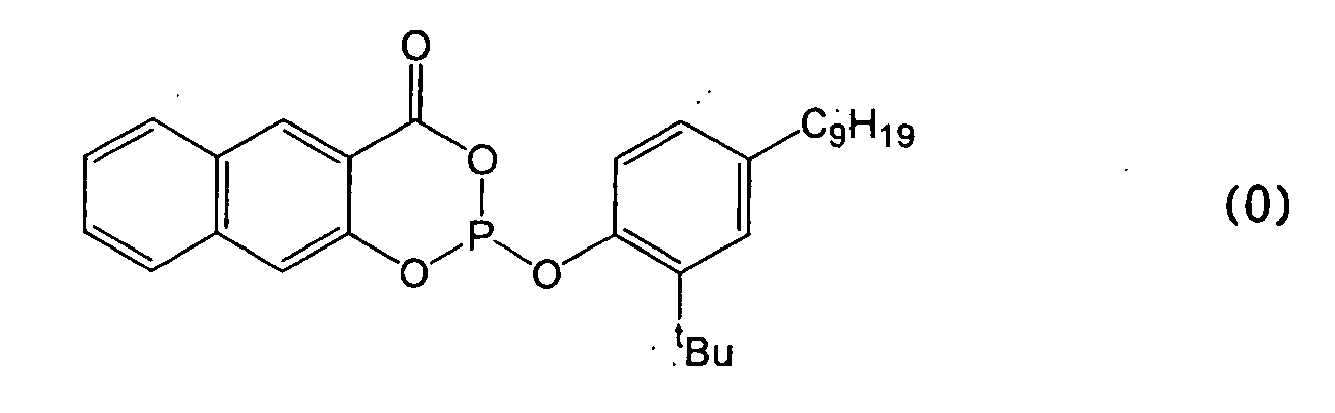
- phosphite ligands according to formula I for use according to the invention are:
- the phosphites according to the invention for use can be prepared by a series of reactions of phosphorus halides with alcohols and / or ⁇ -hydroxyarylcarboxylic acids in which halogen atoms on the phosphorus are exchanged for oxygen groups.
- the basic procedure is illustrated by way of example on a route to compounds according to the general formula I:
- an ⁇ -hydroxyarylcarboxylic acid with a phosphorus trihalide PX 3 such as PCl 3 , PBr 3 and PJ 3 , preferably phosphorus trichloride PCl 3 , in the presence of a base, which is preferably used in equivalent or catalytic amounts, to a Halogenendioxaphosphorinon ( 1) implemented.
- a phosphorus trihalide PX 3 such as PCl 3 , PBr 3 and PJ 3
- a base which is preferably used in equivalent or catalytic amounts
- the radicals R 1 to R 4 and R 1 have the meanings given above. Since the alcohols used and their secondary products are often solid, the reactions are generally carried out in solvents. Solvents used are non-protic solvents which react neither with the alcohols nor with the phosphorus compounds. Suitable solvents are, for example, tetrahydrofuran, ethers such as diethyl ether or MTBE (methyl tert-butyl ether) or aromatic hydrocarbons such as toluene.
- the phosphites are suitable ligands for the complexation of metals of the 4th, 5th, 6th, 7th, 8th, 9th or 10th group of the Periodic Table of the Elements.
- the complexes may contain one or more phosphite ligands and optionally further ligands and are suitable as catalysts, preferably in homogeneous catalysis.
- suitable metals are rhodium, cobalt. Iridium, nickel, palladium, platinum. Iron. Ruthenium, osmium, chromium, molybdenum and tungsten.
- the resulting complexes are used as catalysts for hydroformylation-carbonylation, hydrogenation and hydrocyanation reactions, particularly preferred are rhodium, cobalt, nickel, platinum and ruthenium.
- rhodium for example, rhodium carbonyls, rhodium nitrate, rhodium chloride.
- Rh (CO) 2 (acac) (acac acetylacetonate), rhodium acetate, rhodium octanoate or rhodium nonanoate.
- the active catalyst species for homogeneous catalysis such as in the hydroformylation upon contact with synthesis gas a carbonyl hydride phosphite complex.
- the phosphites and optionally other ligands may be added in free form together with the catalyst metal (as a salt or complex) to the reaction mixture to generate the active catalyst species in situ.
- a phosphite metal complex, the o. G. Phosphite ligands and the catalyst metal contains to use as a precursor for the actual catalytically active complex.
- These phosphite metal complexes are prepared by reacting the corresponding catalyst metal of groups 4 to 10 in elemental form or in the form of a chemical compound with the phosphite ligand.
- ligands phosphorus ligands, preferably phosphines.
- Bisphosphites, phosphonites or phosphinites are used.
- phosphinite ligands are described inter alia in US-A-5,710,344. WO-A-95 / 06,627th US-A-5,360,938 or JP-A-07-082281.
- the phosphites or phosphite metal complexes can be used in processes for the hydroformylation of olefins, preferably having 2 to 25 carbon atoms, to the corresponding aldehydes.
- phosphite complexes with metals of the 8th subgroup are preferably used as the catalyst precursor.
- Fresh phosphite ligand can be added to the reaction at any time to keep the concentration of free ligand constant.
- the concentration of the metal in the reaction mixture is in the range of 1 ppm to 1000 ppm, preferably in the range of 5 ppm to 300 ppm, based on the total weight of the reaction mixture.
- the reaction temperatures for a hydroformylation process with the phosphites or phosphite metal complexes according to the invention as catalyst are preferably between 40 ° C and 180 ° C and more preferably between 75 ° C and 140 ° C.
- the pressures at which the hydroformylation proceeds are preferably from 1 to 300 bar of synthesis gas and more preferably from 10 to 64 bar.
- the molar ratio between hydrogen and carbon monoxide (H 2 / CO) in the synthesis gas is preferably 10/1 to 1/10, and more preferably 1/1 to 2/1.
- the catalyst or the ligand is homogeneously dissolved in the hydroformylation mixture consisting of starting materials (olefins and synthesis gas) and products (aldehydes, alcohols, high boilers formed in the process).
- a solvent can additionally be used.
- the phosphites according to the invention Due to their relatively high molecular weight, the phosphites according to the invention have a low volatility. They can therefore be easily separated from the more volatile reaction products. They are sufficiently soluble in common organic solvents.
- 2-Methylbutene-1, 2-methylbutene-2, 3-methylbutene-1 C 6 olefins such as 1-hexene, 2-hexene. 3-hexene, the C 6 olefin mixture (dipropene) obtained in the dimerization of propene: C 7 olefins such as 1-heptene, further n-heptene. 2-methyl-1-hexene.
- C 8 olefins such as 1-octene, further n-octenes, 2-methylheptene, 3-methylheptene, 5-methylheptene-2, 6-methylheptene-2, 2-ethylhexene-1, which are incorporated herein by reference isomeric C 8 olefin mixture (dibutene) derived from the dimerization of butenes: C 9 olefins such as 1-nonene, further n-nonenes, 2-methyloctenes.
- 3-Methyloctenes the C 9 olefin mixture (tripropene) obtained in the trimerization of propene: C 10 olefins such as n-decene.
- 2-ethyl-1-octene C 12 olefins such as n-dodecenes, the C 12 olefin mixture (tetrapropene or tributene) obtained in the tetramerization of propene or the trimerization of butenes.
- C 14 olefins such as n-tetradecenes
- C 16 olefins such as n-hexadecenes
- the resulting in the tetramerization of butenes C 16 -Olefingemisch (tetrabutene) as well as by co-oligomerization of olefins with different C number (preferably 2 to 4) prepared olefin mixtures optionally after distillative separation into fractions having the same or similar C number.
- olefins or olefin mixtures which are produced by Fischer-Tropsch synthesis, and also olefins which are obtained by oligomerization of ethene or which are accessible via metathesis reactions or telomerization reactions.
- Preferred starting materials are generally ⁇ -olefins such as propene, 1-butene, 2-butene, 1-hexene, 1-octene, and dimers and trimers of butene (dibutene, di-n-butene, di-isobutene, tributene).
- the hydroformylation can be carried out continuously or batchwise.
- Examples of technical designs are stirred tanks, bubble columns, Jet nozzle reactors, tubular reactors, or loop reactors, which may be partially cascaded and / or internally incorporated.
- the reaction can take place continuously or in several stages.
- the separation of the resulting aldehyde compounds and the catalyst can be carried out by a conventional method such as fractionation. Technically, this can be done for example via a distillation, a falling film evaporator or a thin film evaporator. This is especially true when the catalyst is dissolved in a high boiling solvent dissolved from the lower boiling products.
- the separated catalyst solution can be used for further hydroformylation.
- lower olefins eg propene, butene, pentene
- Chloro compound A (2-chloro-4H-1,3,2-benzodioxaphosphorin-4-one) was obtained from Aldrich. Tauf Wegn related and used as delivered. Chlorine compound B
- the yield is to be understood as the total yield of C 9 aldehydes.
- N-selectivity refers to the ratio of terminal to internally hydroformylated C 9 aldehydes.
Landscapes
- Chemical & Material Sciences (AREA)
- Organic Chemistry (AREA)
- Chemical Kinetics & Catalysis (AREA)
- Health & Medical Sciences (AREA)
- Life Sciences & Earth Sciences (AREA)
- Biochemistry (AREA)
- General Health & Medical Sciences (AREA)
- Molecular Biology (AREA)
- Organic Low-Molecular-Weight Compounds And Preparation Thereof (AREA)
- Low-Molecular Organic Synthesis Reactions Using Catalysts (AREA)
- Catalysts (AREA)
Abstract
Description
Die vorliegende Erfindung betrifft neue Phosphitverbindungen und neue Phosphitmetallkomplexe, sowie deren Verwendung in katalytischen Reaktionen.The present invention relates to novel phosphite compounds and new phosphite metal complexes, as well as their use in catalytic reactions.
Die Reaktionen zwischen Olefinverbindungen. Kohlenmonoxid und Wasserstoff in Gegenwart eines Katalysators zu den um ein C-Atom reicheren Aldehyden ist als Hydroformylierung (0xierung) bekannt. Als Katalysatoren in diesen Reaktionen werden häufig Verbindungen der Übergangsmetalle der 8. bis 10. Gruppe des Periodensystems der Elemente verwendet, insbesondere Verbindungen des Rhodiums und des Kobalts. Die Hydroformylierung mit Rhodiumverbindungen bietet im Vergleich zur Katalyse mit Kobaltverbindungen in der Regel den Vorteil höherer Selektivität und ist damit meistens wirtschaftlicher. Bei der durch Rhodium katalysierten Hydroformylierung werden zumeist Komplexe eingesetzt, die aus Rhodium und bevorzugt aus trivalenten Phosphorverbindungen als Liganden bestehen. Bekannte Liganden sind beispielsweise Verbindungen aus den Klassen der Phosphine, Phosphite und Phosphonite. Eine Übersicht über Hydroformylierung von Olefinen findet sich in B. CORNILS, W. A. HERRMANN. "Applied Homogeneous Catalysis with Organometallic Compounds", Vol. 1&2. VCH. Weinheim, New York, 1996.The reactions between olefin compounds. Carbon monoxide and hydrogen in the presence of a catalyst to the C-atom richer aldehydes is known as hydroformylation (0xation). The catalysts used in these reactions are often compounds of the transition metals of the 8th to 10th group of the Periodic Table of the Elements, in particular compounds of rhodium and cobalt. The hydroformylation with rhodium compounds usually offers the advantage of higher selectivity compared to catalysis with cobalt compounds and is thus usually more economical. In the case of rhodium-catalyzed hydroformylation, complexes are mostly used which consist of rhodium and preferably of trivalent phosphorus compounds as ligands. Known ligands are, for example, compounds from the classes of phosphines, phosphites and phosphonites. A review of hydroformylation of olefins can be found in B. CORNILS, W.A. HERRMANN. "Applied Homogeneous Catalysis with Organometallic Compounds", Vol. 1 & 2. VCH. Weinheim, New York, 1996.
Jedes Katalysatorsystem (Kobalt oder Rhodium) hat seine spezifischen Vorzüge. Je nach Einsatzstoff und Zielprodukt werden unterschiedliche Katalysatorsysteme verwendet. Arbeitet man mit Rhodium und Triphenylphosphin, lassen sich α-Olefine bei niedrigeren Drücken hydroformylieren. Als phosphorhaltiger Ligand wird in der Regel Triphenylphosphin im Überschuss verwendet, wobei ein hohes Ligand/Rhodium-Verhältnis erforderlich ist, um die Selektivität der Reaktion zum kommerziell erwünschten n-Aldehydprodukt zu erhöhen.Each catalyst system (cobalt or rhodium) has its specific advantages. Depending on the feedstock and target product, different catalyst systems are used. When working with rhodium and triphenylphosphine, α-olefins can be hydroformylated at lower pressures. The phosphorus-containing ligand is usually used in excess triphenylphosphine, where a high ligand / rhodium ratio is required to increase the selectivity of the reaction to the commercially desirable n-aldehyde product.
US-A-4,694,109 und US-A-4,879,416 betreffen Bisphosphinliganden und ihren Einsatz in der Hydroformylierung von Olefinen bei niedrigen Synthesegasdrücken. Besonders bei der Hydroformylierung von Propen werden mit Liganden dieses Typs hohe Aktivitäten und hohe n/i-Selektivitäten erreicht.US-A-4,694,109 and US-A-4,879,416 relate to bisphosphine ligands and their use in the hydroformylation of olefins at low synthesis gas pressures. Especially in the hydroformylation of propene, ligands of this type achieve high activities and high n / i selectivities.
In WO-A-95/30680 werden zweizähnige Phosphinliganden und ihr Einsatz in der Katalyse, unter anderem auch in Hydroformylierungsreaktionen, beschrieben.WO-A-95/30680 describes bidentate phosphine ligands and their use in catalysis, including in hydroformylation reactions.
Ferrocenverbrückte Bisphosphine werden beispielsweise in US-A-4,169,861, US-A-4,201,714 und US-A-4,193,943 als Liganden für Hydroformylierungen offenbart.Ferrocene-bridged bisphosphines are disclosed, for example, in US-A-4,169,861, US-A-4,201,714 and US-A-4,193,943 as ligands for hydroformylations.
Der Nachteil von zweizähnigen Phosphinliganden ist die relativ aufwendige Herstellung. Daher ist es oftmals nicht rentabel, solche Systeme in technischen Prozessen einzusetzen.The disadvantage of bidentate phosphine ligands is the relatively expensive preparation. Therefore, it is often not profitable to use such systems in technical processes.
Rhodium-Monophosphit-Komplexe sind geeignete Katalysatoren für die Hydroformylierung von verzweigten Olefinen mit innenständigen Doppelbindungen, jedoch ist die Selektivität für endständig hydroformylierte Verbindungen gering. Aus EP-A-0 155 508 ist die Verwendung von bisarylensubstituierten Monophosphiten bei der rhodiumkatalysierten Hydroformylierung von sterisch gehinderten Olefinen, z. B. Isobuten bekannt.Rhodium-monophosphite complexes are suitable catalysts for the hydroformylation of branched olefins having internal double bonds, but the selectivity for terminally hydroformylated compounds is low. From EP-A-0 155 508 the use of bisarylene substituted monophosphites in the rhodium catalyzed hydroformylation of sterically hindered olefins, e.g. B. isobutene known.
Rhodium-Phosphit-Komplexe katalysieren die Hydroformylierung von linearen Olefinen mit end- und innenständigen Doppelbindungen, wobei überwiegend endständig hydroformylierte Produkte entstehen, dagegen werden verzweigte Olefine mit innenständigen Doppelbindungen nur in geringem Maße umgesetzt. Diese Phosphite ergeben bei ihrer Koordination an ein Übergangsmetallzentrum Katalysatoren von gesteigerter Aktivität, doch ist das Standzeitverhalten dieser Katalysatorsysteme, unter anderem wegen der Hydrolyseempfindlichkeit der Phosphitliganden, unbefriedigend. Durch den Einsatz von substituierten Bisaryldiolen als Edukte für die Phosphitliganden, wie in EP-A-0 214 622 oder EP-A-0 472 071 beschrieben, konnten erhebliche Verbesserungen erreicht werden.Rhodium-phosphite complexes catalyze the hydroformylation of linear olefins with terminal and internal double bonds, predominantly terminally hydroformylated products being formed, whereas branched olefins with internal double bonds are converted only to a small extent. These phosphites, when coordinated to a transition metal center, provide catalysts of enhanced activity, but the service life of these catalyst systems is unsatisfactory, among other reasons because of the hydrolysis sensitivity of the phosphite ligands. The use of substituted bisaryldiols as starting materials for the phosphite ligands, as described in EP-A-0 214 622 or EP-A-0 472 071, considerable improvements could be achieved.
Der Literatur zufolge sind die Rhodiumkomplexe dieser Liganden äußerst aktive Hydroformylierungskatalysatoren für α-Olefine. In US-A-4,668,651, US-A-4,748,261 und US-A-4,885,401 werden Polyphosphitliganden beschrieben, mit denen α-Olefine, aber auch 2-Buten mit hoher Selektivität zu den terminal hydroformylierten Produkten umgesetzt werden können. In US-A-5,312,996 werden zweizähnige Liganden dieses Typs auch zur Hydroformylierung von Butadien eingesetzt.According to the literature, the rhodium complexes of these ligands are highly active hydroformylation catalysts for α-olefins. US Pat. No. 4,668,651, US Pat. No. 4,748,261 and US Pat. No. 4,885,401 describe polyphosphite ligands with which α-olefins, but also 2-butene, can be converted with high selectivity to the terminally hydroformylated products. In US-A-5,312,996 bidentate ligands of this type are also used for the hydroformylation of butadiene.
Obgleich die genannten Phosphite gute Komplexliganden für Rhodium-Hydroformylierungskatalysatoren sind, ist es wünschenswert, weitere leicht herstellbare Phosphite zur weiteren Verbesserung ihrer Wirksamkeit beispielsweise in der Hydroformylierung aufzufinden.Although the phosphites mentioned are good complexing ligands for rhodium hydroformylation catalysts, it is desirable to find other readily preparable phosphites for further enhancing their effectiveness in, for example, hydroformylation.
Phosphite mit Salicylsäure-Bausteinen gemäß Formel Δ
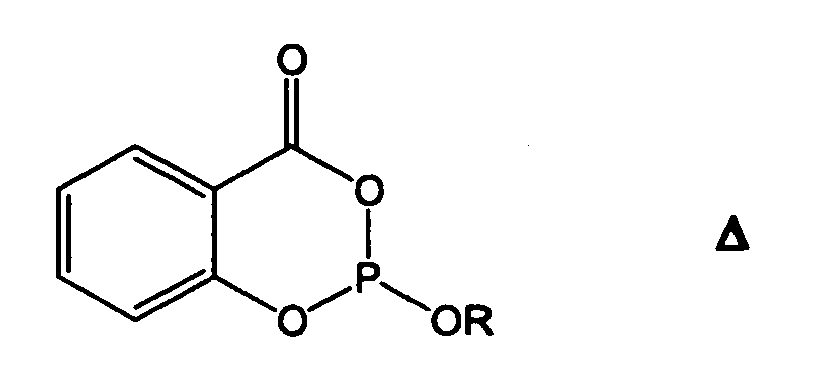
P. A. Kirpichnikov et al. zeigen die stabilisierenden Eigenschaften von Phosphiten mit Salicylsäure-Bausteinen im russischen Journal Vysokomol. Soedin., Ser. B (1970). 12 (3). 189-192.Phosphites with salicylic acid building blocks according to formula Δ
PA Kirpichnikov et al. show the stabilizing properties of phosphites with salicylic acid building blocks in the Russian journal Vysokomol. Soedin., Ser. B (1970). 12 (3). 189-192.
Es wurde überraschend gefunden, dass Phosphite gemäß Formel I

oder benachbarte Reste R1 bis R4 zusammen ein kondensiertes substituiertes oder unsubstituiertes aromatisches, heteroaromatisches, aliphatisches, gemischt aromatisch-aliphatisches oder gemischt heteroaromatisch-aliphatisches Ringsystem ausbilden;
und k = 0 ist,
wobei wenn R1, R3, R3 und R4 jeweils ein H-Atom sind und k = 0 ist, R1 keine Alkyl-, Aryl-, Aralkyl-, Alkenyl-, oder Cycloalkylgruppe ist, oder gemäß der Formeln


or adjacent radicals R 1 to R 4 together form a fused substituted or unsubstituted aromatic, heteroaromatic, aliphatic, mixed aromatic-aliphatic or mixed heteroaromatic-aliphatic ring system;
and k = 0,
wherein when R 1 , R 3 , R 3 and R 4 are each an H atom and k = 0, R 1 is not an alkyl, aryl, aralkyl, alkenyl, or cycloalkyl group, or according to the formulas
Ebenfalls wurde gefunden, dass Phosphitmetallkomplexe, enthaltend ein Metall der 4., 5., 6., 7., 8., 9. oder 10. Gruppe des Periodensystems der Elemente und ein oder mehrere der Phosphite gemäß Formel I,

R1, R2, R3, und R4 jeweils unabhängig voneinander ausgewählt sind aus einwertigen substituierten oder unsubstituierten aliphatischen, alicyclischen, aromatischen, heteroaromatischen, gemischt aliphatisch-alicyclischen, gemischt aliphatisch-aromatischen, heterocyclischen, gemischt aliphatisch-heterocyclischen Kohlenwasserstoffresten mit 1 bis 50 Kohlenstoffatomen.H, F, Cl , Br, I, -CF3, -CH2(CF2)jCF3 mit j = 0 - 9, -OR9, -COR9, -CO2R9, -CO2M, -SR9, -SO2R9, -SOR9, -SO3R9, -SO3M, -SO2NR9R10, -NR9R10, -N=CR9R10, wobei R9 und R10 unabhängig voneinander aus H, einwertigen substituierten oder unsubstituierten aliphatischen und aromatischen Kohlenwasserstoffresten mit 1 bis 25 Kohlenstoffatomen ausgewählt sind und M ein Alkalimetall-, formal ein halbes Erdalkalimetall-, Ammonium- oder Phosphoniumion ist,
oder benachbarte Reste R1 bis R4 zusammen ein kondensiertes substituiertes oder unsubstituiertes aromatisches, heteroaromatisches, aliphatisches, gemischt aromatisch-aliphatisches oder gemischt heteroaromatisch-aliphatisches Ringsystem ausbilden; und k = 0 ist, in der Katalyse verwendet werden können.R 1 , R 2 , R 3 , and R 4 are each independently selected from monovalent substituted or unsubstituted aliphatic, alicyclic, aromatic, heteroaromatic, mixed aliphatic-alicyclic, mixed aliphatic-aromatic, heterocyclic, mixed aliphatic-heterocyclic hydrocarbon radicals of 1 to 50 carbon atoms. H, F, Cl, Br, I, -CF 3 , -CH 2 (CF 2 ) j CF 3 with j = 0-9, -OR 9 , -COR 9 , -CO 2 R 9 , -CO 2 M, -SR 9 , -SO 2 R 9 , -SOR 9 , -SO 3 R 9 , -SO 3 M, -SO 2 NR 9 R 10 , -NR 9 R 10 , -N = CR 9 R 10 , wherein R 9 and R 10 are independently selected from H, monovalent substituted or unsubstituted aliphatic and aromatic hydrocarbon radicals having from 1 to 25 carbon atoms, and M is an alkali metal, formally one-half alkaline earth metal, ammonium or phosphonium ion,
or adjacent radicals R 1 to R 4 together form a fused substituted or unsubstituted aromatic, heteroaromatic, aliphatic, mixed aromatic-aliphatic or mixed heteroaromatic-aliphatic ring system; and k = 0, can be used in catalysis.
Die vorliegende Erfindung ist vorzugsweise auf die Verwendung der Phosphite bzw. der Phosphitmetallkomplexe in der homogenen Katalyse, insbesondere bei der Hydroformylierung von Olefinen, gerichtet. Die Erfindung betrifft auch ein Verfahren zur Hydroformylierung von Olefinen.The present invention is preferably based on the use of the phosphites or the phosphite metal complexes in homogeneous catalysis, in particular hydroformylation of olefins. The invention also relates to a process for the hydroformylation of olefins.
Ein weiterer Aspekt der vorliegenden Erfindung sind die oben genannten Phosphitmetallkomplexe.Another aspect of the present invention are the above-mentioned phosphite metal complexes.
In einem bevorzugten Phosphit ist der Rest Rl ausgewählt aus Aromaten oder Heteroaromaten, die ankondensierte aromatische, heteroaromatische und/oder aliphatische Ringe aufweisen, die unsubstituiert oder mit mindestens einem Rest, ausgewählt aus aliphatischen, alicyclischen, aromatischen, heteroaromatischen, gemischt aliphatisch-alicyclischen, gemischt aliphatisch-aromatischen, heterocyclischen, gemischt aliphatisch heterocyclischen Kohlenwasserstoffresten mit 1 bis 25 Kohlenstoffatomen, F, Cl, Br, I, -CF3, -CH2(CF2)jCF3 mit j = 0 - 9, -OR9, -COR9, -CO2R9, -CO2M, -SR9, -SO2R9, -SOR9, -SO3R9, -SO3M, -SO2NR9R10, -NR9R10, oder -N=CR9R10, substituiert sind, wobei R9, R10 und M wie zuvor definiert sind. Weiterhin ist es bevorzugt, ein Phosphit zu verwenden, dessen Reste R1 bis R4 zusammen ein kondensiertes aromatisches, heteroaromatisches, aliphatisches, gemischt aromatisch-aliphatisches oder gemischt heteroaromatisch-aliphatisches Ringsystem ausbilden, das unsubstituiert ist oder mit mindestens einem Rest, ausgewählt aus aliphatischen, alicyclischen, aromatischen, heteroaromatischen, gemischt aliphatisch-alicyclischen, gemischt aliphatisch-aromatischen, heterocyclischen, gemischt aliphatisch-heterocyclischen Kohlenwasserstoffresten mit 1 bis 50 Kohlenstoffatomen, F, C1. Br, I, -CF3, -CH2(CF2)jCF3 mit j = 0 - 9. -OR9. -COR9. -CO2R9, -CO2M, -SR9, -SO2R9, -SOR9, -SO3R9, -SO3M. -SO2NR9R10. -NR9R10, oder -N=CR9R10. substituiert ist, wobei R9, R10 und M wie zuvor definiert sind.In a preferred phosphite, the radical R 1 is selected from aromatics or heteroaromatics having fused aromatic, heteroaromatic and / or aliphatic rings which are unsubstituted or having at least one radical selected from aliphatic, alicyclic, aromatic, heteroaromatic, mixed aliphatic-alicyclic, mixed aliphatic-aromatic, heterocyclic, mixed aliphatic heterocyclic hydrocarbon radicals having 1 to 25 carbon atoms, F, Cl, Br, I, -CF 3 , -CH 2 (CF 2 ) j CF 3 with j = 0-9, -OR 9 , -COR 9 , -CO 2 R 9 , -CO 2 M, -SR 9 , -SO 2 R 9 , -SOR 9 , -SO 3 R 9 , -SO 3 M, -SO 2 NR 9 R 10 , -NR 9 R 10 , or -N = CR 9 R 10 , wherein R 9 , R 10 and M are as previously defined. Furthermore, it is preferred to use a phosphite whose radicals R 1 to R 4 together form a fused aromatic, heteroaromatic, aliphatic, mixed aromatic-aliphatic or mixed heteroaromatic-aliphatic ring system which is unsubstituted or at least one radical selected from aliphatic , alicyclic, aromatic, heteroaromatic, mixed aliphatic-alicyclic, mixed aliphatic-aromatic, heterocyclic, mixed aliphatic-heterocyclic hydrocarbon radicals having 1 to 50 carbon atoms, F, C1. Br, I, -CF 3 , -CH 2 (CF 2 ) j CF 3 with j = 0 - 9. -OR 9 . COR 9 . -CO 2 R 9 , -CO 2 M, -SR 9 , -SO 2 R 9 , -SOR 9 , -SO 3 R 9 , -SO 3 M. -SO 2 NR 9 R 10 . -NR 9 R 10 , or -N = CR 9 R 10 . is substituted, wherein R 9 , R 10 and M are as defined above.
Repräsentative Phosphitliganden gemäß der Formel I zur erfindungsgemäßen Verwendung sind:


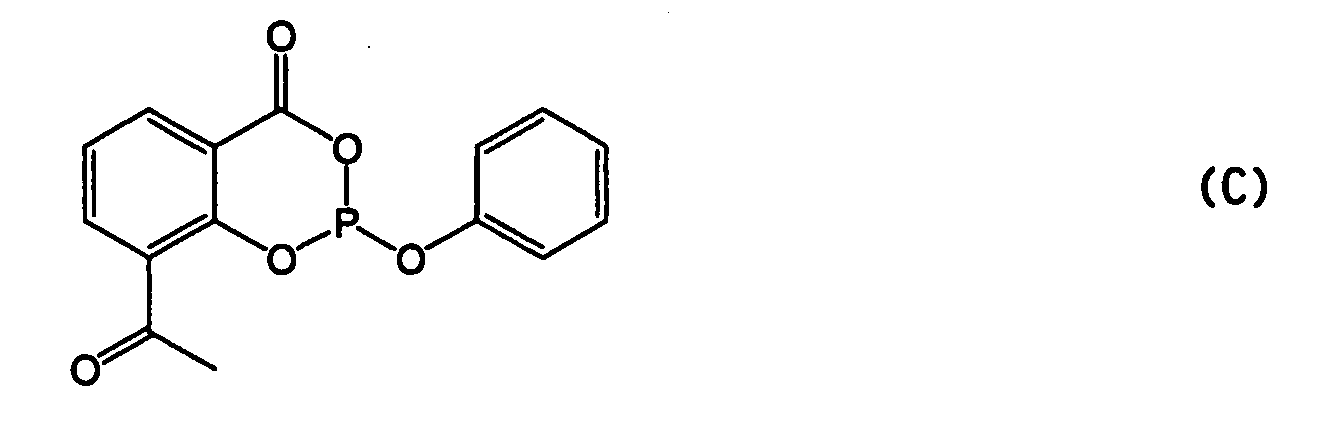


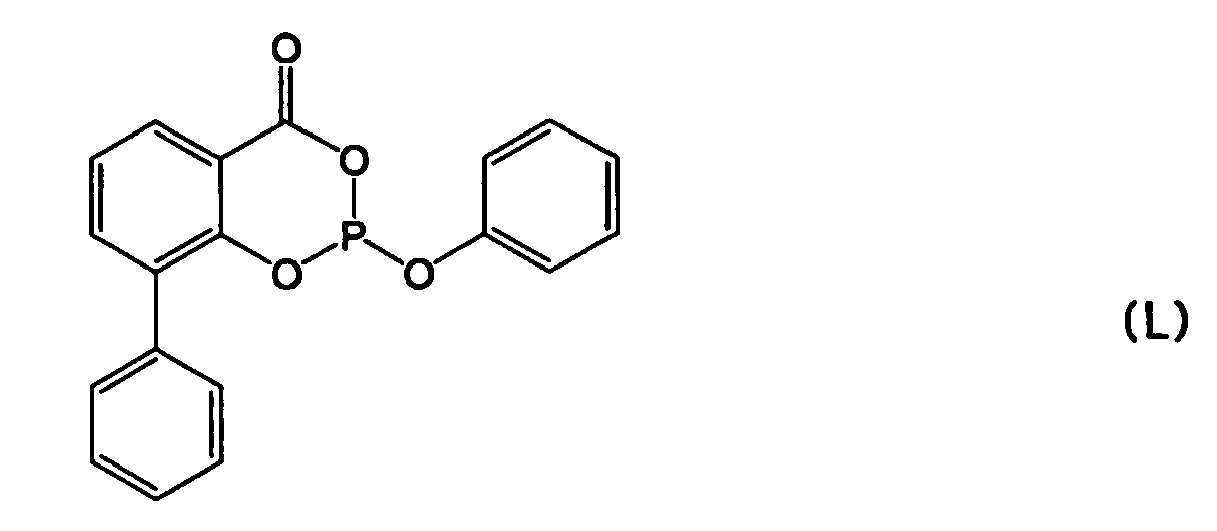

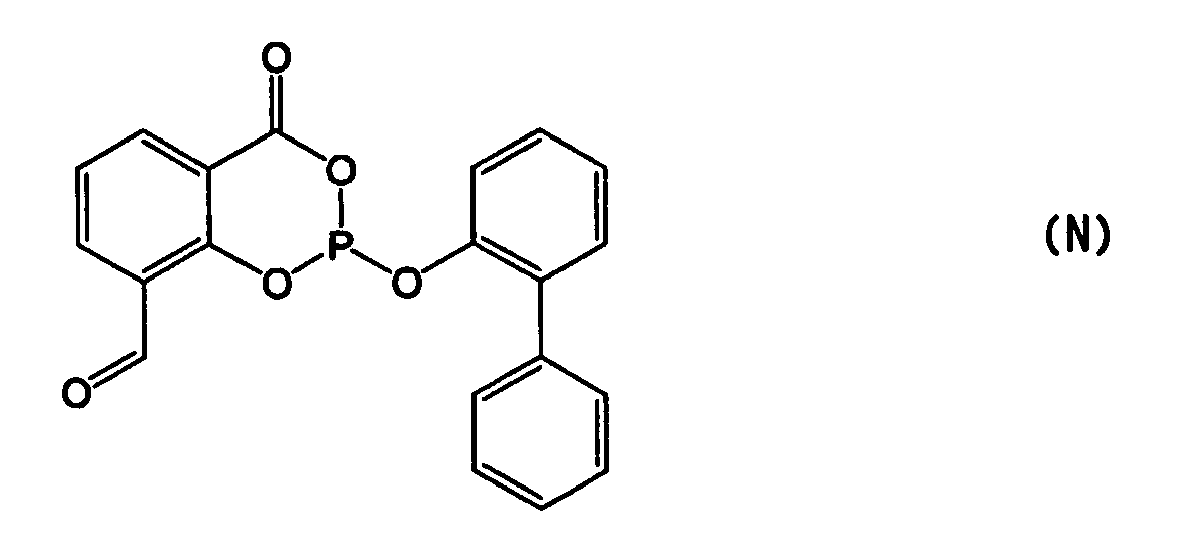
Die erfindungsgemäßen Phosphite zur Verwendung können durch eine Folge von Reaktionen von Phosphorhalogeniden mit Alkoholen und/oder α-Hydroxyarylcarbonsäuren, bei denen Halogenatome am Phosphor gegen Sauerstoffgruppen ausgetauscht werden, hergestellt werden. Das grundsätzliche Vorgehen wird beispielhaft an einem Weg zu Verbindungen gemäß der allgemeinen Formel I illustriert:The phosphites according to the invention for use can be prepared by a series of reactions of phosphorus halides with alcohols and / or α-hydroxyarylcarboxylic acids in which halogen atoms on the phosphorus are exchanged for oxygen groups. The basic procedure is illustrated by way of example on a route to compounds according to the general formula I:
In einem ersten Schritt wird eine α-Hydroxyarylcarbonsäure mit einem Phosphortrihalogenid PX3, wie etwa PCl3, PBr3 und PJ3, vorzugsweise Phosphortrichlorid PCl3, in Gegenwart einer Base, die vorzugsweise in äquivalenten oder katalytischen Mengen eingesetzt wird, zu einem Halogendioxaphosphorinon (1) umgesetzt.

In einem zweiten Reaktionsschritt wird aus dem Halogendioxaphosphorinon (1) durch Reaktion mit einem Alkohol HO-Rl in Gegenwart einer Base, die vorzugsweise in äquivalenten oder katalytischen Mengen eingesetzt wird, das gewünschte Phosphit gemäß Formel (I) erhalten, in dem Rl = R" ist. Im Falle der Umsetzung mit einem Alkohol ist k in dem Phosphit gemäß Formel (I) gleich 0.

Die Reste R1 bis R4 und Rl haben die zuvor angegebenen Bedeutungen. Da die eingesetzten Alkohole und ihre Folgeprodukte häufig fest sind, werden die Umsetzungen im Allgemeinen in Lösungsmitteln durchgeführt. Als Solventien werden nichtprotische Lösungsmittel, die weder mit den Alkoholen noch mit den Phosphorverbindungen reagieren, verwendet. Geeignete Lösungsmittel sind beispielsweise Tetrahydrofuran, Ether wie Diethylether oder MTBE (Methyl-tertiärbutylether) oder aromatische Kohlenwasserstoffe wie Toluol.The radicals R 1 to R 4 and R 1 have the meanings given above. Since the alcohols used and their secondary products are often solid, the reactions are generally carried out in solvents. Solvents used are non-protic solvents which react neither with the alcohols nor with the phosphorus compounds. Suitable solvents are, for example, tetrahydrofuran, ethers such as diethyl ether or MTBE (methyl tert-butyl ether) or aromatic hydrocarbons such as toluene.
Bei der Umsetzung von Phosphorhalogeniden mit Alkoholen entsteht Halogenwasserstoff, der durch zugegebene Basen in äquivalenten oder in katalytischen Mengen gebunden wird. Beispielsweise werden dafür tertiäre Amine, wie Triethylamin, Pyridin oder N-Methylpyrrolidinon, eingesetzt. Teilweise ist es auch sinnvoll, die Alkohole vor der Reaktion in Metallalkoholate zu überführen, zum Beispiel durch Reaktion mit Natriumhydrid oder Butyllithium.In the reaction of phosphorus halides with alcohols produces hydrogen halide, which is bound by added bases in equivalent or in catalytic amounts. For example, for tertiary amines, such as triethylamine, pyridine or N-methylpyrrolidinone used. In some cases, it is also useful to convert the alcohols into metal alcoholates before the reaction, for example by reaction with sodium hydride or butyllithium.
Die Phosphite sind geeignete Liganden zur Komplexierung von Metallen der 4., 5., 6., 7., 8., 9. oder 10. Gruppe des Periodensystems der Elemente. Die Komplexe können ein oder mehrere Phosphitliganden und gegebenenfalls weitere Liganden enthalten und sind als Katalysatoren geeignet, vorzugsweise bei der homogenen Katalyse. Beispiele für geeignete Metalle sind Rhodium, Kobalt. Iridium, Nickel, Palladium, Platin. Eisen. Ruthenium, Osmium, Chrom, Molybdän und Wolfram. Insbesondere mit Metallen der 8., 9. oder 10. Gruppe können die resultierenden Komplexe als Katalysatoren für Hydroformylierungs-Carbonylierungs-, Hydrierungs- und Hydrocyanierungsreaktionen verwendet werden, besonders bevorzugt sind Rhodium, Kobalt, Nickel, Platin und Ruthenium. Beispielsweise ergeben sich in Hydroformylierungsreaktionen besonders bei Einsatz von Rhodium als Katalysatormetall hohe katalytische Aktivitäten. Die Katalysatormetalle kommen in Form von Salzen oder Komplexen zum Einsatz, im Falle von Rhodium z.B. Rhodiumcarbonyle, Rhodiumnitrat, Rhodiumchlorid. Rh(CO)2(acac) (acac = Acetylacetonat), Rhodiumacetat, Rhodiumoctanoat oder Rhodiumnonanoat.The phosphites are suitable ligands for the complexation of metals of the 4th, 5th, 6th, 7th, 8th, 9th or 10th group of the Periodic Table of the Elements. The complexes may contain one or more phosphite ligands and optionally further ligands and are suitable as catalysts, preferably in homogeneous catalysis. Examples of suitable metals are rhodium, cobalt. Iridium, nickel, palladium, platinum. Iron. Ruthenium, osmium, chromium, molybdenum and tungsten. Especially with metals of the 8th, 9th or 10th group the resulting complexes are used as catalysts for hydroformylation-carbonylation, hydrogenation and hydrocyanation reactions, particularly preferred are rhodium, cobalt, nickel, platinum and ruthenium. For example, in hydroformylation reactions, especially when rhodium is used as the catalyst metal, high catalytic activities result. The catalyst metals are used in the form of salts or complexes, in the case of rhodium, for example, rhodium carbonyls, rhodium nitrate, rhodium chloride. Rh (CO) 2 (acac) (acac = acetylacetonate), rhodium acetate, rhodium octanoate or rhodium nonanoate.
Aus den Phosphitliganden und dem Katalysatormetall bildet sich unter Reaktionsbedingungen die aktive Katalysatorspezies für die homogene Katalyse, etwa bei der Hydroformylierung bei Kontakt mit Synthesegas ein Carbonylhydridphosphit-Komplex. Die Phosphite und gegebenenfalls weitere Liganden können in freier Form zusammen mit dem Katalysatormetall (als Salz oder Komplex) in die Reaktionsmischung gegeben werden, um die aktive Katalysatorspezies in situ zu erzeugen. Es ist weiterhin auch möglich, einen Phosphitmetallkomplex, der die o. g. Phosphitliganden und das Katalysatormetall enthält, als Precursor für den eigentlichen katalytisch aktiven Komplex einzusetzen. Diese Phosphitmetallkomplexe werden hergestellt, indem man man das entsprechende Katalysatormetall der 4. bis 10. Gruppe in elementarer Form oder in Form einer chemischen Verbindung mit dem Phosphitliganden umsetzt.From the phosphite ligands and the catalyst metal forms under reaction conditions, the active catalyst species for homogeneous catalysis, such as in the hydroformylation upon contact with synthesis gas a carbonyl hydride phosphite complex. The phosphites and optionally other ligands may be added in free form together with the catalyst metal (as a salt or complex) to the reaction mixture to generate the active catalyst species in situ. It is also possible, a phosphite metal complex, the o. G. Phosphite ligands and the catalyst metal contains to use as a precursor for the actual catalytically active complex. These phosphite metal complexes are prepared by reacting the corresponding catalyst metal of groups 4 to 10 in elemental form or in the form of a chemical compound with the phosphite ligand.
Als zusätzliche, im Reaktionsgemisch vorhandene Liganden können phosphorhaltige Liganden, vorzugsweise Phosphine. Bisphosphite, Phosphonite oder Phosphinite eingesetzt werden.As additional, present in the reaction mixture ligands phosphorus ligands, preferably phosphines. Bisphosphites, phosphonites or phosphinites are used.
Beispiele für solche Liganden sind:
- Phosphine: Triphenylphosphin, Tris(p-tolyl)phosphin, Tris(m-tolyl)phosphin, Tris(o-tolyl)phosphin, Tris(p-methoxyphenyl)phosphin. Tris(p-dimethylaminophenyl)phosphin, Tricyclohexylphosphin, Tricyclopentylphosphin, Triethylphosphin, Tri-(1-naphthyl)phosphin, Tribenzylphosphin, Tri-n-butylphosphin, Tri-t-butylphosphin.
- Phosphite: Trimethylphosphit, Triethylphosphit, Tri-n-propylphosphit, Tri-i-propylphosphit, Tri-n-butylphosphit, Tri-i-butylphosphit, Tri-t-butylphosphit, Tris(2-ethylhexyl)phosphit, Triphenylphosphit, Tris(2.4-di-t-butylphenyl)phosphit, Tris(2-t-butyl-4-methoxyphenyl)phosphit, Tris(2-t-butyl-4-methylphenyl)phosphit, Tris(p-kresyl)phosphit. Außerdem sind sterisch gehinderte Phosphitliganden, wie sie unter anderem in EP-A-155 508, US-A-4, 668,651, US-A-4,748,261, US-A-4,769,498, US-A-4,774,361, US-A-4,835,299, US-A-4,885,401, US-A-5,059,710, US-A-5,113,022, US-A-5,179,055, US-A-5,260,491, US-A-5,264,616, US-A-5,288,918, US-A-5,360,938, EP-A-472 071, EP-A-518 241 und WO-A-97/20795 beschrieben werden, geeignete Liganden.
- Phosphonite: Methyldiethoxyphosphin. Phenyldimethoxyphosphin, Phenyldiphenoxyphosphin, 2-Phenoxy-2H-di benz[c,e][1,2]oxaphosphori n und dessen Derivate, in denen die Wasserstoffatome ganz oder teilweise durch Alkyl- und/oder Arylreste oder Halogenatome ersetzt sind und Liganden, die in W0-A-98/43935. JP-A-09-268152 und DE-A-198 10 794 und in den deutschen Patentanmeldungen DE-A-199 54 721 und DE-A-199 54 510 beschrieben sind.
- Phosphines: triphenylphosphine, tris (p-tolyl) phosphine, tris (m-tolyl) phosphine, tris (o-tolyl) phosphine, tris (p-methoxyphenyl) phosphine. Tris (p-dimethylaminophenyl) phosphine, tricyclohexylphosphine, tricyclopentylphosphine, Triethylphosphine, tri (1-naphthyl) phosphine, tribenzylphosphine, tri-n-butylphosphine, tri-t-butylphosphine.
- Phosphites: trimethyl phosphite, triethyl phosphite, tri-n-propyl phosphite, tri-i-propyl phosphite, tri-n-butyl phosphite, tri-i-butyl phosphite, tri-t-butyl phosphite, tris (2-ethylhexyl) phosphite, triphenyl phosphite, tris (2.4- di-t-butylphenyl) phosphite, tris (2-t-butyl-4-methoxyphenyl) phosphite, tris (2-t-butyl-4-methylphenyl) phosphite, tris (p-cresyl) phosphite. Also included are sterically hindered phosphite ligands as described, inter alia, in EP-A-155508, US-A-4,668,651, US-A-4,748,261, US-A-4,769,498, US-A-4,774,361, US-A-4,835,299, US Pat. Nos. 4,885,401, 5,059,710, 5,113,022, 5,179,055, 5,260,491, 5,264,616, 5,288,918, 5,360,938, EP-A A-472,071, EP-A-518,241 and WO-A-97/20795 describe suitable ligands.
- Phosphonites: methyldiethoxyphosphine. Phenyldimethoxyphosphine, phenyldiphenoxyphosphine, 2-phenoxy-2H-di-benz [c, e] [1,2] oxaphosphoric acid and its derivatives in which the hydrogen atoms are wholly or partly replaced by alkyl and / or aryl radicals or halogen atoms and ligands which in W0-A-98/43935. JP-A-09-268152 and DE-A-198 10 794 and in the German patent applications DE-A-199 54 721 and DE-A-199 54 510 are described.
Gängige Phosphinitliganden sind unter anderem in US-A-5.710.344. WO-A-95/06627. US-A-5,360,938 oder JP-A-07-082281 beschrieben. Beispiele hierfür sind Diphenyl(phenoxy)phosphin und dessen Derivate, in denen die Wasserstoffatome ganz oder teilweise durch Alkyl- und/oder Arylreste oder Halogenatome ersetzt sind, Diphenyl(methoxy)phosphin und Diphenyl(ethoxy)phosphin.Common phosphinite ligands are described inter alia in US-A-5,710,344. WO-A-95 / 06,627th US-A-5,360,938 or JP-A-07-082281. Examples of these are diphenyl (phenoxy) phosphine and its derivatives in which the hydrogen atoms are wholly or partly replaced by alkyl and / or aryl radicals or halogen atoms, diphenyl (methoxy) phosphine and diphenyl (ethoxy) phosphine.
Die Phosphite bzw. Phosphitmetallkomplexe können in Verfahren zur Hydroformylierung von Olefinen, bevorzugt mit 2 bis 25 Kohlenstoffatomen, zu den entsprechenden Aldehyden eingesetzt werden. Hierbei werden bevorzugt Phosphitkomplexe mit Metallen der 8. Nebengruppe als Katalysator-Vorläufer verwendet.The phosphites or phosphite metal complexes can be used in processes for the hydroformylation of olefins, preferably having 2 to 25 carbon atoms, to the corresponding aldehydes. Here, phosphite complexes with metals of the 8th subgroup are preferably used as the catalyst precursor.
Im Allgemeinen werden 1 bis 500 mol, vorzugsweise 1 bis 200 mol, bevorzugter 2 bis 50 mol des erfindungsgemäßen Phosphits pro mol Metall der 8. Nebengruppe eingesetzt.In general, 1 to 500 mol, preferably 1 to 200 mol, more preferably 2 to 50 mol of the phosphite according to the invention are used per mol of metal of the 8th subgroup.
Frischer Phosphitligand kann zu jedem Zeitpunkt der Reaktion zugesetzt werden, um die Konzentration an freiem Liganden konstant zu halten.Fresh phosphite ligand can be added to the reaction at any time to keep the concentration of free ligand constant.
Die Konzentration des Metalls im Reaktionsgemisch liegt im Bereich von 1 ppm bis 1000 ppm, vorzugsweise im Bereich von 5 ppm bis 300 ppm, bezogen auf das Gesamtgewicht der Reaktionsmischung.The concentration of the metal in the reaction mixture is in the range of 1 ppm to 1000 ppm, preferably in the range of 5 ppm to 300 ppm, based on the total weight of the reaction mixture.
Die mit den erfindungsgemäßen Phosphiten bzw. den entsprechenden Metallkomplexen durchgeführten Hydroformylierungsreaktionen erfolgten nach bekannten Vorschriften, wie z. B. in J. FALBE, "New Syntheses with Carbon Monoxide". Springer Verlag, Berlin, Heidelberg, New York, Seite 95 ff., (1980) beschrieben. Die Olefinverbindung(en) wird (werden) in Gegenwart des Katalysators mit einem Gemisch aus CO und H2 (Synthesegas) zu den um ein C-Atom reicheren Aldehyden umgesetzt.The hydroformylation reactions carried out with the phosphites according to the invention or the corresponding metal complexes were carried out according to known regulations, such as. In J. FALBE, "New Syntheses with Carbon Monoxides". Springer Verlag, Berlin, Heidelberg, New York, page 95 et seq., (1980). The olefin compound (s) is (are) reacted in the presence of the catalyst with a mixture of CO and H 2 (synthesis gas) to the one carbon atom richer aldehydes.
Die Reaktionstemperaturen für ein Hydroformylierungsverfahren mit den erfindungsgemäßen Phosphiten bzw. Phosphitmetallkomplexen als Katalysator liegen vorzugsweise zwischen 40 °C und 180 °C und bevorzugter zwischen 75 °C und 140 °C. Die Drücke, unter denen die Hydroformylierung abläuft, betragen vorzugsweise 1 - 300 bar Synthesegas und bevorzugter 10 - 64 bar. Das Molverhältnis zwischen Wasserstoff und Kohlenmonoxid (H2/CO) im Synthesegas beträgt vorzugsweise 10/1 bis 1/10 und bevorzugter 1/1 bis 2/1.The reaction temperatures for a hydroformylation process with the phosphites or phosphite metal complexes according to the invention as catalyst are preferably between 40 ° C and 180 ° C and more preferably between 75 ° C and 140 ° C. The pressures at which the hydroformylation proceeds are preferably from 1 to 300 bar of synthesis gas and more preferably from 10 to 64 bar. The molar ratio between hydrogen and carbon monoxide (H 2 / CO) in the synthesis gas is preferably 10/1 to 1/10, and more preferably 1/1 to 2/1.
Der Katalysator bzw. der Ligand ist homogen im Hydroformylierungsgemisch, bestehend aus Edukten (Olefinen und Synthesegas) und Produkten (Aldehyden, Alkoholen, im Prozess gebildete Hochsieder), gelöst. Optional kann zusätzlich ein Lösungsmittel verwendet werden.The catalyst or the ligand is homogeneously dissolved in the hydroformylation mixture consisting of starting materials (olefins and synthesis gas) and products (aldehydes, alcohols, high boilers formed in the process). Optionally, a solvent can additionally be used.
Aufgrund ihres relativ hohen Molekulargewichtes besitzen die erfindungsgemäßen Phosphite eine geringe Flüchtigkeit. Sie können daher einfach von den leichter flüchtigen Reaktionsprodukten abgetrennt werden. Sie sind in den gängigen organischen Solventien ausreichend gut löslich.Due to their relatively high molecular weight, the phosphites according to the invention have a low volatility. They can therefore be easily separated from the more volatile reaction products. They are sufficiently soluble in common organic solvents.
Die Edukte für die Hydroformylierung sind Olefine oder Gemische von Olefinen mit 2 bis 25 Kohlenstoffatomen mit end- oder innenständiger C=C-Doppelbindung. Sie können geradkettig, verzweigt oder von cyclischer Struktur sein und auch mehrere olefinisch ungesättigte Gruppen aufweisen. Beispiele sind Propen: 1-Buten, cis-2-Buten, trans-2-Buten. Isobuten, Butadien. Mischungen der C4-Olefine: C5-Olefine wie 1-Penten, 2-Penten. 2-Methylbuten-1, 2-Methylbuten-2, 3-Methylbuten-1: C6-Olefine wie 1-Hexen, 2-Hexen. 3-Hexen, das bei der Dimerisierung von Propen anfallende C6-Olefingemisch (Dipropen): C7-Olefine wie 1-Hepten, weitere n-Heptene. 2- Methyl-1-hexen. 3-Methyl-1-hexen: C8-Olefine wie 1-Octen, weitere n-Octene, 2-Methylheptene, 3-Methylheptene, 5-Methylhepten-2, 6-Methylhepten-2, 2-Ethylhexen-1, das bei der Dimerisierung von Butenen anfallende isomere C8-Olefingemisch (Dibuten): C9-Olefine wie 1-Nonen, weitere n-Nonene, 2-Methyloctene. 3-Methyloctene, das bei der Trimerisierung von Propen anfallende C9-Olefingemisch (Tripropen): C10-Olefine wie n-Decene. 2-Ethyl-1-octen: C12-Olefine wie n-Dodecene, das bei der Tetramerisierung von Propen oder der Trimerisierung von Butenen anfallende C12-Olefingemisch (Tetrapropen oder Tributen). C14-Olefine wie n-Tetradecene, C16-Olefine wie n-Hexadecene, das bei der Tetramerisierung von Butenen anfallende C16-Olefingemisch (Tetrabuten) sowie durch Cooligomerisierung von Olefinen mit unterschiedlicher C-Zahl (bevorzugt 2 bis 4) hergestellte Olefingemische, gegebenenfalls nach destillativer Trennung in Fraktionen mit gleicher oder ähnlicher C-Zahl. Ebenfalls können-Olefine oder Olefingemische, die durch Fischer-Tropsch-Synthese erzeugt werden, eingesetzt werden, sowie Olefine, die durch Oligomerisierung von Ethen erhalten werden oder die über Methathesereaktionen oder Telomerisationsreaktion zugänglich sind.The educts for the hydroformylation are olefins or mixtures of olefins having 2 to 25 carbon atoms with terminal or internal C = C double bond. They may be straight-chain, branched or of cyclic structure and also have several olefinically unsaturated groups. Examples are propene: 1-butene, cis-2-butene, trans-2-butene. Isobutene, butadiene. Mixtures of C 4 olefins: C 5 olefins such as 1-pentene, 2-pentene. 2-Methylbutene-1, 2-methylbutene-2, 3-methylbutene-1: C 6 olefins such as 1-hexene, 2-hexene. 3-hexene, the C 6 olefin mixture (dipropene) obtained in the dimerization of propene: C 7 olefins such as 1-heptene, further n-heptene. 2-methyl-1-hexene. 3-methyl-1-hexene: C 8 olefins such as 1-octene, further n-octenes, 2-methylheptene, 3-methylheptene, 5-methylheptene-2, 6-methylheptene-2, 2-ethylhexene-1, which are incorporated herein by reference isomeric C 8 olefin mixture (dibutene) derived from the dimerization of butenes: C 9 olefins such as 1-nonene, further n-nonenes, 2-methyloctenes. 3-Methyloctenes, the C 9 olefin mixture (tripropene) obtained in the trimerization of propene: C 10 olefins such as n-decene. 2-ethyl-1-octene: C 12 olefins such as n-dodecenes, the C 12 olefin mixture (tetrapropene or tributene) obtained in the tetramerization of propene or the trimerization of butenes. C 14 olefins such as n-tetradecenes, C 16 olefins such as n-hexadecenes, the resulting in the tetramerization of butenes C 16 -Olefingemisch (tetrabutene) as well as by co-oligomerization of olefins with different C number (preferably 2 to 4) prepared olefin mixtures optionally after distillative separation into fractions having the same or similar C number. It is also possible to use olefins or olefin mixtures which are produced by Fischer-Tropsch synthesis, and also olefins which are obtained by oligomerization of ethene or which are accessible via metathesis reactions or telomerization reactions.
Bevorzugte Edukte sind allgemein α-Olefine wie Propen, 1-Buten, 2-Buten, 1-Hexen, 1-Octen, sowie Dimere und Trimere des Butens (Dibuten, Di-n-buten. Di-iso-buten. Tributen).Preferred starting materials are generally α-olefins such as propene, 1-butene, 2-butene, 1-hexene, 1-octene, and dimers and trimers of butene (dibutene, di-n-butene, di-isobutene, tributene).
Die Hydroformylierung kann kontinuierlich oder diskflntinuierlich durchgeführt werden. Beispiele für technische Ausführungen sind Rührkessel, Blasensäulen, Strahldüsenreaktoren, Rohrreaktoren, oder Schlaufenreaktoren, die zum Teil kaskadiert und/oder mit Einbauten versehen sein können.The hydroformylation can be carried out continuously or batchwise. Examples of technical designs are stirred tanks, bubble columns, Jet nozzle reactors, tubular reactors, or loop reactors, which may be partially cascaded and / or internally incorporated.
Die Reaktion kann durchgehend oder in mehreren Stufen erfolgen. Die Trennung der entstandenen Aldehydverbindungen und des Katalysators kann durch eine herkömmliche Methode, wie Fraktionierung, durchgeführt werden. Technisch kann dies beispielsweise über eine Destillation, über einen Fallfilmverdampfer oder einen Dünnschichtverdampfer erfolgen. Die gilt besonders, wenn der Katalysator in einem hochsiedenden Lösungsmittel gelöst von den niedriger siedenden Produkten abgetrennt wird. Die abgetrennte Katalysatorlösung kann für weitere Hydroformylierungen verwendet werden. Bei Einsatz niederer Olefine (z. B. Propen, Buten, Penten) ist auch ein Austrag der Produkte aus dem Reaktor über die Gasphase möglich.The reaction can take place continuously or in several stages. The separation of the resulting aldehyde compounds and the catalyst can be carried out by a conventional method such as fractionation. Technically, this can be done for example via a distillation, a falling film evaporator or a thin film evaporator. This is especially true when the catalyst is dissolved in a high boiling solvent dissolved from the lower boiling products. The separated catalyst solution can be used for further hydroformylation. When using lower olefins (eg propene, butene, pentene) it is also possible to discharge the products from the reactor via the gas phase.
Die folgenden Beispiele veranschaulichen die vorliegende Erfindung.The following examples illustrate the present invention.
Bei allen Beispielen wurde mit Standard-Schlenk-Technik unter Schutzgas gearbeitet. Die Lösungsmittel wurden vor Gebrauch über geeigneten Trocknungsmitteln getrocknet.All examples were carried out using standard Schlenk technique under inert gas. The solvents were dried over suitable desiccants before use.

Chlorverbindung A (2-Chlor-4H-1,3,2-benzodioxaphosphorin-4-on) wurde von Fa. Aldrich. Taufkirchen bezogen und verwendet wie geliefert. Chlorverbindung B

Die Darstellung der Chlorverbindung B erfolgte ausgehend von 2-Hydroxy-1-naphthalincarbonsäure in Anlehnung an BE 667036. Farbwerke Hoechst AG, 1966 :Chem. Abstr. 65 (1966) 13741d. Die nachfolgende Synthesebeschreibung verdeutlicht das Vorgehen:The preparation of the chlorine compound B was carried out starting from 2-hydroxy-1-naphthalenecarboxylic acid on the basis of BE 667036. Farbwerke Hoechst AG, 1966 : Chem. Abstr. 65 (1966) 13741d. The following synthesis description clarifies the procedure:
In einem sekurierten 250 ml Schlenkrohr werden 9.22 g (0.049 mol) 2-Hydroxy-1-naphthalincarbonsäure, 200 ml getrocknetes Toluol und 0.48 g (0.005 mol) N-Methyl-2-pyrrolidinon vorgelegt. Zu dieser Mischung wird unter Rühren langsam 10.14 g (0.073 mol) Phosphortrichlorid zugegeben. Nach Anschluß des Schlenkrohres an eine Abgasleitung mit einem Gasdurchflußmesser wird die Reaktionsmischung vorsichtig auf 95 °C erhitzt und 5 h bei dieser Temperatur gehalten. Zur Aufarbeitung wird die Reaktionsmischung filtriert und das Lösemittel des Filtrats im Vakuum entfernt.
Ausbeute : 11.01 g (44.6 mmol), entsprechend 91.0 % der Theorie.
31P-NMR (Toluol-D8) : δ 150.9 ppm9.22 g (0.049 mol) of 2-hydroxy-1-naphthalenecarboxylic acid, 200 ml of dried toluene and 0.48 g (0.005 mol) of N-methyl-2-pyrrolidinone are introduced into a 250 ml Schlenk tube. To this mixture is slowly added with stirring 10.14 g (0.073 mol) of phosphorus trichloride. After connecting the Schlenk tube to an exhaust gas line with a Gasdurchflußmesser the reaction mixture is carefully heated to 95 ° C and held at this temperature for 5 h. For workup, the reaction mixture is filtered and the solvent of the filtrate is removed in vacuo.
Yield: 11.01 g (44.6 mmol), corresponding to 91.0% of theory.
31 P-NMR (toluene-D 8 ): δ 150.9 ppm

4.5 g 2,4-Di-tert-butylphenol (21.81 mmol) werden in 100 ml THF gelöst. Zu dieser Lösung tropft man bei -20°C 13.6 ml einer 1.6 mmol Lösung von n-Butyllithium in Hexan (21.81 mmol). Die erhaltene Lithiumphenolatlösung wird bei 0°C langsam zu 32.8 ml einer 0.665 M Lösung der Chlorverbindung A (21.81 mmol) in THF gegeben und die resultierende Mischung anschließend 1 h am Rückfluß gekocht. Nach Entfernen des Lösungsmittels im Vakuum erfolgt die Zugabe von 100 ml Hexan und Filtration. Entfernen des Lösungsmittels im Vakuum ergibt ein öliges Produkt.4.5 g of 2,4-di- tert- butylphenol (21.81 mmol) are dissolved in 100 ml of THF. To this solution is added dropwise at -20 ° C 13.6 ml of a 1.6 mmol solution of n- butyllithium in hexane (21.81 mmol). The resulting lithium phenolate solution is added slowly at 0 ° C. to 32.8 ml of a 0.665 M solution of the chloro compound A (21.81 mmol) in THF, and the resulting mixture is subsequently refluxed for 1 h. After removal of the solvent in vacuo, the addition of 100 ml of hexane and filtration. Removal of the solvent in vacuo gives an oily product.
Ausbeute : 6.58 g (17.669 mmol), entsprechend 81.2 % der Theorie
Elementaranalyse (ber. für C21H25O4P : M = 372.39 g/Mol C 68.05 (67.73) : H 6.96 (6.77) : P 7.98 (8.32) %
31P-NMR (Toluol-D8) : δ 119.8 ppm. EI-MS (70 eV) : 372 (38 %, M'), 357 (100 %)Yield: 6.58 g (17.669 mmol), corresponding to 81.2% of theory
Elemental analysis (calcd. For C 21 H 25 O 4 P: M = 372.39 g / mol C 68.05 (67.73): H 6.96 (6.77): P 7.98 (8.32)%
31 P-NMR (toluene-D 8 ): δ 119.8 ppm. EI-MS (70 eV): 372 (38%, M '), 357 (100%)
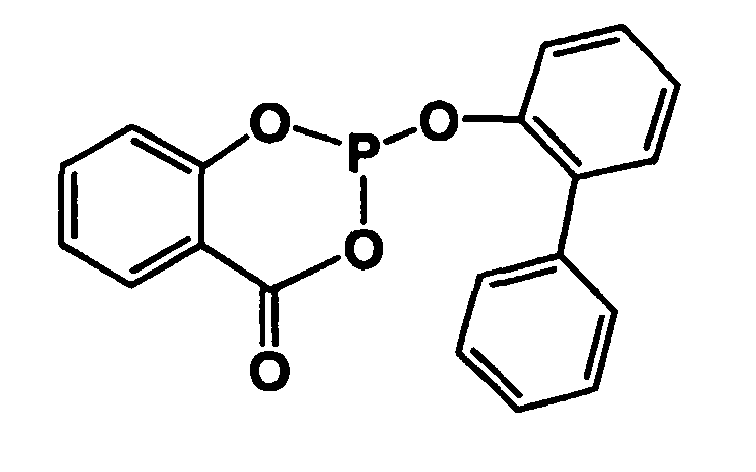
3.617 g 2-Phenylphenol (21.25 mmol) werden in 100 ml THF gelöst. Zu dieser Lösung tropft man bei -20°C 13.28 ml einer 1.6 M Lösung von n-Butyllithium in Hexan (21.25 mmol). Die erhaltene Lithiumphenolatlösung wird bei 0°C langsam zu 32.0 ml einer 0.665 M Lösung der Chlorverbindung A (21.25 mmol) in THF gegeben und die resultierende Mischung anschließend 1 h am Rückfluß gekocht. Nach Entfernen des Lösungsmittels im Vakuum erfolgt die Zugabe von 80 ml Toluol und Filtration. Das Filtrat wird im Vakuum vollständig vom Lösungsmittel befreit. Es wird ein öliges Produkt erhalten.3,617 g of 2-phenylphenol (21.25 mmol) are dissolved in 100 ml of THF. To this solution is added dropwise at -20 ° C 13.28 ml of a 1.6 M solution of n- butyllithium in hexane (21.25 mmol). The resulting lithium phenolate solution is added slowly at 0 ° C. to 32.0 ml of a 0.665 M solution of the chloro compound A (21.25 mmol) in THF, and the resulting mixture is subsequently refluxed for 1 h. After removal of the solvent in vacuo, the addition of 80 ml of toluene and filtration. The filtrate is completely freed of solvent in vacuo. It will get an oily product.
Ausbeute : 5.80 g (17.24 mmol). entsprechend 81.7 % der Theorie
Elementaranalyse (ber. für C19H13O4P , M = 336.28 g/Mol ) : C 68.24 (67.86) : H 4.02 (3.90) ; P 9.66 (9.21) %
31P-NMR (CD2Cl2) : δ 118.4 ppm. EI-MS (70 eV) : 335 (42 %, M+). 167 (100 %. M+- OC6H4-O-C6H5)Yield: 5.80 g (17.24 mmol). according to 81.7% of the theory
Elemental analysis (calcd. For C 19 H 13 O 4 P, M = 336.28 g / mol): C, 68.24 (67.86): H 4.02 (3.90); P 9.66 (9.21)%
31 P NMR (CD 2 Cl 2 ): δ 118.4 ppm. EI-MS (70 eV): 335 (42%, M + ). 167 (100% M + - OC 6 H 4 -OC 6 H 5 )

4.155 g Menthol (26.59 mmol) werden in THF (100 ml) gelöst und unter Argon bei -20 °C mit 16.6 ml einer 1.6 M Lösung von n-Butyllithium in n-Hexan (26.59 mmol) versetzt. Die Lithiummenthylatlösung wird nach Erwärmen auf Raumtemperatur zu einer auf 0 °C gekühlten Lösung von 5.385 g der Chlorphosphorverbindung A (26.59 mmol) in THF (30 ml) gegeben. Die Reaktionsmischung wird abschließend 1 h am Rückfluss erhitzt, im Vakuum zur Trockne eingeengt und in 100 ml Hexan aufgenommen. Filtration und Entfernen des Lösungsmittels im Vakuum ergeben das Produkt als hellgelbes Öl.
Ausbeute : 6.48 g (20.1 mmol) entsprechend 75 % der Theorie.
31P-NMR (CD2Cl2) : δ 127.4 ppm . EI-MS (70 eV) m/e = 323 (2 %. M ++H) : 167 (33 %) : 138 (92 %) : 83 (100 %).
Hydroformylierung von 1-Octen und Di-n-Buten unter Verwendung der Phosphitverbindungen (A). (J) und (D)4.155 g of menthol (26.59 mmol) are dissolved in THF (100 ml) and treated under argon at -20 ° C with 16.6 ml of a 1.6 M solution of n-butyllithium in n-hexane (26.59 mmol). The lithium methylate solution, after warming to room temperature, is added to a solution of 5,385 g of the chlorophosphorus compound A (26.59 mmol) in THF (30 ml) cooled to 0 ° C. The reaction mixture is finally heated for 1 h at reflux, concentrated in vacuo to dryness and taken up in 100 ml of hexane. Filtration and removal of the solvent in vacuo give the product as a pale yellow oil.
Yield: 6.48 g (20.1 mmol) corresponding to 75% of theory.
31 P-NMR (CD 2 Cl 2 ): δ 127.4 ppm. EI-MS (70 eV) m / e = 323 (2% M + + H): 167 (33%): 138 (92%): 83 (100%).
Hydroformylation of 1-octene and di-n-butene using the phosphite compounds (A). (J) and (D)
Die Hydroformylierungsversuche wurden in einem mit Druckkonstanthaltung, Gasflussmessung. Begasungsrührer und Druckpipette ausgestatteten 200 ml Autoklaven der Fa. Buddeberg, Mannheim, durchgeführt. In dem Autoklaven wurden unter Argonatmosphäre 10 ml einer Lösung des Rhodiums in Form von [Rh(1,5-cyclooctadien)acac] (acac = Acetylacetonat-Anion) (0,604 mM bei 1-Octen bzw. 6,04 mM bei Di-n-Buten) als Katalysatorvorstufe mit der entsprechenden Menge der in Toluol gelösten Phosphitverbindungen gemischt und mit Toluol auf 41 ml aufgefüllt. In die Druckpipette wurden 15 ml 1-0cten bzw. Di-n-Buten eingespeist. Nach Austausch der Argonatmosphäre durch Spülen mit Synthesegas (CO/H2 1:1) wurde das Rhodium-Ligand-Gemisch unter Rühren (1500 U/min) bei einem Synthesegasdruck von 30-33 bar bei 1-Octen bzw. 11-13 bar bei Di-n-Buten auf 100 °C bei 1-0cten bzw. 120°C bei Di-n-Buten aufgeheizt. Bei Erreichen der gewünschten Reaktionstemperatur wurde der Synthesegasdruck auf 50 bar bei 1-0kten bzw. 20 bar bei Di-n-Buten erhöht und Olefin zugegeben. Die Reaktion wurde bei konstantem Druck (Nachdruckregler der Fa. Bronkhorst (NL)) über 3 h bei 1-Okten bzw. 6 h bei Di-n-Buten geführt. Der Autoklav wurde nach Ablauf der Versuchszeit auf Raumtemperatur abgekühlt. entspannt und mit Argon gespült. Jeweils 1 ml der Autoklavenlösung bei 1-Okten bzw. 2 ml bei Di-n-Buten wurden mit 5 ml n-Pentan versetzt und gaschromatographisch analysiert.
Versuchsparameter für 1-Octen:
Rhodiumkonzentration = 14 ppm, Verhältnis Rh : Ligand : 1-Octen = 1 : 10 : 15700: T= 100 °C. p= 50 bar Synthesegas (CO/H2 = 1 : 1), t= 3 h. Lösungsmittel : Toluol
Versuchsparameter für Di-n-Buten :
Rhodiumkonzentration = 140 ppm. Verhältnis Rh : Ligand : Di-n-Buten = 1 : 10 : 1570: T= 130°C, p= 20 bar Synthesegas (CO/H2 = 1 : 1). t=
6 h. Lösungsmittel : Toluol
Experimental parameters for 1-octene:
Rhodium concentration = 14 ppm, ratio Rh: ligand: 1-octene = 1: 10: 15700: T = 100 ° C. p = 50 bar synthesis gas (CO / H 2 = 1: 1), t = 3 h. Solvent: toluene
Experimental parameters for di-n-butene:
Rhodium concentration = 140 ppm. Ratio Rh: ligand: di-n-butene = 1: 10: 1570: T = 130 ° C, p = 20 bar synthesis gas (CO / H 2 = 1: 1). t =
6 h. Solvent: toluene
Unter der Ausbeute ist die Gesamtausbeute an C9-Aldehyden zu verstehen. Mit n-Selektivität wird das Verhältnis von endständig zu innenständig hydroformylierten C9-Aldehyden bezeichnet.The yield is to be understood as the total yield of C 9 aldehydes. N-selectivity refers to the ratio of terminal to internally hydroformylated C 9 aldehydes.
Claims (14)
- A phosphite of the formula I

R1, R2, R3 and R4 are each selected independently from among monovalent substituted or unsubstituted aliphatic, alicyclic, aromatic, heteroaromatic, mixed aliphatic-alicyclic, mixed aliphatic-aromatic, heterocyclic, mixed aliphatic-heterocyclic hydrocarbon radicals having from 1 to 50 carbon atoms, H, F, Cl, Br, I, -CF3, -CH2 (CF2)jCF3 where j = 0-9, -OR9, -COR9, -CO2R9, -CO2M, -SR9, -SO2R9, -SOR9, -SO3R9, -SO3M, -SO2NR9R10, -NR9R10, -N=CR9R10, where R9 and R10 are selected independently from among H, monovalent substituted or unsubstituted aliphatic and aromatic hydrocarbon radicals having from 1 to 25 carbon atoms and M is an alkali metal ion, formally half an alkaline earth metal ion, an ammonium ion or phosphonium ion,
or adjacent radicals R1 to R4 together form a fused substituted or unsubstituted aromatic, heteroaromatic, aliphatic, mixed aromatic-aliphatic or mixed heteroaromatic-aliphatic ring system;
and k = 0,
characterized in that
when R1, R2, R3 and R4 are each an H atom and k = 0, R' is not an alkyl, aryl, aralkyl, alkenyl or cycloalkyl group,
or formula A, E, F, G, M or 0


- A phosphite according to claim 1, wherein the radical R' of the phosphite is selected from among aromatics and heteroaromatics which have fused-on aromatic, heteroaromatic and/or aliphatic rings which are unsubstituted or substituted by at least one radical selected from among aliphatic, alicyclic, aromatic, heteroaromatic, mixed aliphatic-alicyclic, mixed aliphatic-aromatic, heterocyclic, mixed aliphatic-heterocyclic hydrocarbon radicals having from 1 to 25 carbon atoms, F, Cl, Br, I, -CF3, -CH2 (CF2)jCF3 where j = 0-9, -OR9, -COR9, -CO2R9, -CO2M, -SR9, -SO2R9, -SOR9, -SO3R9, -SO3M, -SO2NR9R10, -NR9R10 or -N=CR9R10, where R9, R10 and M are as defined in claim 1.
- A phosphite according to either of claims 1 and 2, wherein adjacent radicals R1 to R4 of the phosphite together form a fused aromatic, heteroaromatic, aliphatic, mixed aromatic-aliphatic or mixed heteroaromatic-aliphatic ring system which is unsubstituted or is substituted by at least one radical selected from among aliphatic, alicyclic, aromatic, heteroaromatic, mixed aliphatic-alicyclic, mixed aliphatic-aromatic, heterocyclic, mixed aliphatic-heterocyclic hydrocarbon radicals having from 1 to 50 carbon atoms, F, Cl, Br, I, -CF3, -CH2(CF2)jCF3 where j = 0-9, -OR9, -COR9, -CO2R9, -CO2M, -SR9, -SO2R9, -SOR9, -SO3R9, -SO3M, -SO2NR9R10, -NR9R10 or -N=CR9R10, where R9, R10 and M are as defined in claim 1.
- A phosphite-metal complex containing a metal of group 4, 5, 6, 7, 8, 9 or 10 of the Periodic Table of the Elements and one or more phosphites of the formula I

R1, R2, R3 and R4 are each selected independently from among monovalent substituted or unsubstituted aliphatic, alicyclic, aromatic, heteroaromatic, mixed aliphatic-alicyclic, mixed aliphatic-aromatic, heterocyclic, mixed aliphatic-heterocyclic hydrocarbon radicals having from 1 to 50 carbon atoms, H, F, Cl, Br, I, -CF3, -CH2(CF2)jCF3 where j = 0-9, -OR9, -COR9, -CO2R9, -CO2M, -SR9, -SO2R9, -SOR9, -SO3R9, -SO3M, -SO2NR9R10, -NR9R10, -N=CR9R10, where R9 and R10 are selected independently from among H, monovalent substituted or unsubstituted aliphatic and aromatic hydrocarbon radicals having from 1 to 25 carbon atoms and M is an alkali metal ion, formally half an alkaline earth metal ion, an ammonium ion or phosphonium ion,
or adjacent radicals R1 to R4 together form a fused substituted or unsubstituted aromatic, heteroaromatic, aliphatic, mixed aromatic-aliphatic or mixed heteroaromatic-aliphatic ring system; and k = 0. - A phosphite-metal complex according to claim 4, wherein the radical R' of the phosphite is selected from among aromatics and heteroaromatics which have fused-on aromatic, heteroaromatic and/or aliphatic rings which are unsubstituted or substituted by at least one radical selected from among aliphatic, alicyclic, aromatic, heteroaromatic, mixed aliphatic-alicyclic, mixed aliphatic-aromatic, heterocyclic, mixed aliphatic-heterocyclic hydrocarbon radicals having from 1 to 25 carbon atoms, F, Cl, Br, I, -CF3, -CH2(CF2)jCF3 where j = 0-9, -OR9, -COR9, -CO2R9, -CO2M, -SR9, -SO2R9, -SOR9, -SO3R9, -SO3M, -SO2NR9R10, -NR9R10 or -N=CR9R10, where R9, R10 and M are as defined in claim 1.
- A phosphite-metal complex according to either of claims 4 and 5, wherein adjacent radicals R1 to R4 of the phosphite together form a fused aromatic, heteroaromatic, aliphatic, mixed aromatic-aliphatic or mixed heteroaromatic-aliphatic ring system which is unsubstituted or is substituted by at least one radical selected from among aliphatic, alicyclic, aromatic, heteroaromatic, mixed aliphatic-alicyclic, mixed aliphatic-aromatic, heterocyclic, mixed aliphatic-heterocyclic hydrocarbon radicals having from 1 to 50 carbon atoms, F, Cl, Br, I, -CF3, -CH2(CF2)jCF3 where j = 0-9, -OR9, -COR9, -CO2R9, -CO2M, -SR9, -SO2R9, -SOR9, -SO3R9, -SO3M, -SO2NR9R10 or -NR9R10, -N=CR9R10, where R9, R10 and M are defined as in claim 1.
- A phosphite metal complex according to any one of claims 4 to 6, wherein the metal is rhodium, platinum, palladium, cobalt or ruthenium.
- The use of a phosphite as defined in any one of claims 4 to 6 or a phosphite-metal complex according to any one of claims 4 to 7 in catalysis.
- The use of a phosphite as defined in any one of claims 4 to 6 or a phosphite-metal complex according to any one of claims 4 to 7 in homogenous catalysis.
- The use of a phosphite as defined in any one of claims 4 to 6 or a phosphite metal complex according to any one of claims 4 to 7 in a process for the hydroformylation of olefins.
- The use according to claim 10, wherein further phosphorus-containing ligands are present.
- A process for the hydroformylation of olefins, which comprises reacting a monoolefin or monoolefin mixture with a mixture of carbon monoxide and hydrogen, in the presence of a phosphite as defined in any one of claims 4 to 6 or a phosphite-metal complex according to any one of claims 4 to 7.
- A process for preparing a phosphite according to any of claims 1 to 3, which comprises
reacting an α-hydroxyarylcarboxylic acid of the formula (1)

an alcohol HO-R' to give a phosphite of the formula (I) in which k = 0,
where R1 to R9 and R' are as defined in claim 1. - A process for preparing a phosphite-metal complex according to any one of claims 4 to 7, which comprises reacting a metal of group 4, 5, 6, 7, 8, 9 or 10 of the Periodic Table in elemental form or in the form of a chemical compound with a phosphite as defined in any one of claims 4 to 6.
Priority Applications (1)
| Application Number | Priority Date | Filing Date | Title |
|---|---|---|---|
| EP05105175A EP1586577B1 (en) | 2001-08-16 | 2002-08-13 | Novel phosphite compounds and novel phosphite metal complexes |
Applications Claiming Priority (3)
| Application Number | Priority Date | Filing Date | Title |
|---|---|---|---|
| DE10140086A DE10140086A1 (en) | 2001-08-16 | 2001-08-16 | New phosphite compounds and new phosphite metal complexes |
| DE10140086 | 2001-08-16 | ||
| PCT/EP2002/009050 WO2003016321A2 (en) | 2001-08-16 | 2002-08-13 | Novel phosphite compounds and novel phosphite metal complexes |
Related Child Applications (1)
| Application Number | Title | Priority Date | Filing Date |
|---|---|---|---|
| EP05105175A Division EP1586577B1 (en) | 2001-08-16 | 2002-08-13 | Novel phosphite compounds and novel phosphite metal complexes |
Publications (2)
| Publication Number | Publication Date |
|---|---|
| EP1423398A2 EP1423398A2 (en) | 2004-06-02 |
| EP1423398B1 true EP1423398B1 (en) | 2006-05-17 |
Family
ID=7695544
Family Applications (2)
| Application Number | Title | Priority Date | Filing Date |
|---|---|---|---|
| EP02758461A Expired - Lifetime EP1423398B1 (en) | 2001-08-16 | 2002-08-13 | Novel phosphite compounds and novel phosphite metal complexes |
| EP05105175A Expired - Lifetime EP1586577B1 (en) | 2001-08-16 | 2002-08-13 | Novel phosphite compounds and novel phosphite metal complexes |
Family Applications After (1)
| Application Number | Title | Priority Date | Filing Date |
|---|---|---|---|
| EP05105175A Expired - Lifetime EP1586577B1 (en) | 2001-08-16 | 2002-08-13 | Novel phosphite compounds and novel phosphite metal complexes |
Country Status (10)
| Country | Link |
|---|---|
| US (1) | US7161020B2 (en) |
| EP (2) | EP1423398B1 (en) |
| JP (1) | JP4292076B2 (en) |
| KR (1) | KR100852124B1 (en) |
| CN (1) | CN100343262C (en) |
| AT (2) | ATE326474T1 (en) |
| DE (3) | DE10140086A1 (en) |
| ES (2) | ES2271934T3 (en) |
| MX (1) | MXPA04001350A (en) |
| WO (1) | WO2003016321A2 (en) |
Families Citing this family (34)
| Publication number | Priority date | Publication date | Assignee | Title |
|---|---|---|---|---|
| DE10058383A1 (en) * | 2000-11-24 | 2002-05-29 | Oxeno Olefinchemie Gmbh | New phosphinin compounds and their metal complexes |
| AU2002327859B2 (en) * | 2001-09-26 | 2007-08-09 | Evonik Degussa Gmbh | Phthalic acid alkylester mixtures with controlled viscosity |
| DE10149348A1 (en) | 2001-10-06 | 2003-04-10 | Oxeno Olefinchemie Gmbh | Production of higher alpha-olefins, useful for copolymer production, includes telomerizing a conjugated diene with a nucleophile in the presence of a palladium carbene complex catalyst |
| DE10220801A1 (en) * | 2002-05-10 | 2003-11-20 | Oxeno Olefinchemie Gmbh | Process for the rhodium-catalyzed hydroformylation of olefins while reducing the rhodium loss |
| DE10223593A1 (en) * | 2002-05-27 | 2003-12-11 | Degussa | Hydroxydiphosphines and their use in catalysis |
| DE10225565A1 (en) | 2002-06-10 | 2003-12-18 | Oxeno Olefinchemie Gmbh | Supported catalyst, for the hydrogenation of aromatic compounds to the corresponding alicyclic compounds, contains at least one Group 8 metal and has an average pore diameter of 25-50 nm and a specific surface area of greater than 30 m2/g |
| RU2336261C2 (en) | 2002-08-31 | 2008-10-20 | Оксено Олефинхеми Гмбх | Method of catalitic hydrophormilation of higher olefines in presence of cyclic ethers of carbonic acid |
| BR0313866A (en) * | 2002-08-31 | 2005-07-05 | Oxeno Olefinchemie Gmbh | Process for hydroformylation of olefinically unsaturated compounds, especially olefins in the presence of cyclic carbonic acid esters |
| FR2847898A1 (en) * | 2002-12-02 | 2004-06-04 | Rhodia Polyamide Intermediates | Hydrocyanation of ethylenically unsaturated hydrocarbon compounds comprises reaction with hydrogen cyanide using a catalyst comprising a transition metal and an organophosphorus ligand |
| DE10257499A1 (en) | 2002-12-10 | 2004-07-01 | Oxeno Olefinchemie Gmbh | Process for the preparation of 1-olefins by catalytic cleavage of 1-alkoxyalkanes |
| DE10329042A1 (en) * | 2003-06-27 | 2005-01-13 | Oxeno Olefinchemie Gmbh | Process for the preparation of 1-octene from crack C4 |
| DE10359628A1 (en) * | 2003-12-18 | 2005-07-21 | Oxeno Olefinchemie Gmbh | Catalyst and process for the preparation of 1-olefins from 2-hydroxyalkanes |
| DE10360771A1 (en) * | 2003-12-23 | 2005-07-28 | Oxeno Olefinchemie Gmbh | Process for the preparation of trivalent organophosphorus compounds |
| DE10360772A1 (en) * | 2003-12-23 | 2005-07-28 | Oxeno Olefinchemie Gmbh | Process for the preparation of organoacyl phosphites |
| DE102004033410A1 (en) * | 2004-02-14 | 2005-09-01 | Oxeno Olefinchemie Gmbh | Preparation of higher olefins from lower olefins, useful to form alcohols and/or aldehydes, comprises hydroformylation of olefin to aldehyde, hydrogenation of the aldehyde to alcohol, removal of water and extraction |
| DE102004013514A1 (en) * | 2004-03-19 | 2005-10-06 | Oxeno Olefinchemie Gmbh | Process for the hydroformylation of olefins in the presence of novel organophosphorus compounds |
| DE102004021128A1 (en) * | 2004-04-29 | 2005-11-24 | Oxeno Olefinchemie Gmbh | Apparatus and method for the continuous reaction of a liquid with a gas on a solid catalyst |
| DE102005036039A1 (en) | 2004-08-28 | 2006-03-02 | Oxeno Olefinchemie Gmbh | Process for the preparation of 2,7-octadienyl derivatives |
| DE102004063673A1 (en) * | 2004-12-31 | 2006-07-13 | Oxeno Olefinchemie Gmbh | Process for the continuous catalytic hydrogenation of hydrogenatable compounds on solid, fixed-bed catalysts with a hydrogen-containing gas |
| DE102005014055A1 (en) * | 2005-03-23 | 2006-09-28 | Degussa Ag | Unsymmetrically substituted phospholane catalysts |
| DE102005035816A1 (en) * | 2005-07-30 | 2007-02-01 | Oxeno Olefinchemie Gmbh | Catalyst, useful for hydrogenating ester containing aldehyde mixture to their corresponding alcohols, comprises an aluminum oxide as substrate and nickel and/or cobalt as hydrogenation active component |
| DE102005042464A1 (en) * | 2005-09-07 | 2007-03-08 | Oxeno Olefinchemie Gmbh | Carbonylation process with the addition of sterically hindered secondary amines |
| DE102006034442A1 (en) * | 2006-07-26 | 2008-01-31 | Oxeno Olefinchemie Gmbh | Catalyst precursor for a Rh complex catalyst |
| DE102006058682A1 (en) * | 2006-12-13 | 2008-06-19 | Evonik Oxeno Gmbh | Bisphosphite ligands for transition metal-catalyzed hydroformylation |
| DE102007006442A1 (en) | 2007-02-05 | 2008-08-07 | Evonik Oxeno Gmbh | Mixture of diesters of Dianhydrohexitolderivaten with carboxylic acids of the empirical formula C8H17COOH, process for preparing these diesters and use of these mixtures |
| DE102007023514A1 (en) | 2007-05-18 | 2008-11-20 | Evonik Oxeno Gmbh | Stable catalyst precursor of Rh complex catalysts |
| DE102008002188A1 (en) * | 2008-06-03 | 2009-12-10 | Evonik Oxeno Gmbh | Process for the separation of 1-butene from C4-containing hydrocarbon streams by hydroformylation |
| US8049041B2 (en) * | 2008-06-27 | 2011-11-01 | Chemtura Corporation | Phosphite stabilizer for lubricating base stocks and thermoplastic polymers |
| DE102009001225A1 (en) | 2009-02-27 | 2010-09-02 | Evonik Oxeno Gmbh | Process for the enrichment of a homogeneous catalyst from a process stream |
| DE102009028975A1 (en) | 2009-08-28 | 2011-03-03 | Evonik Oxeno Gmbh | Ester derivatives of 2,5-furandicarboxylic acid and their use as plasticizers |
| DE102009029050A1 (en) | 2009-08-31 | 2011-03-03 | Evonik Oxeno Gmbh | Organophosphorus compounds based on tetraphenol (TP) -substituted structures |
| DE102011085883A1 (en) | 2011-11-08 | 2013-05-08 | Evonik Oxeno Gmbh | New organophosphorus compounds based on anthracentriol |
| DE102014209533A1 (en) * | 2014-05-20 | 2015-12-17 | Evonik Degussa Gmbh | Mixtures of monophosphite ligand and their use to catalyze a hydroformylation reaction |
| EP3029056B1 (en) | 2014-12-04 | 2018-11-07 | Evonik Degussa GmbH | Bis-phosphites with an asymmetric biaryl central component |
Family Cites Families (8)
| Publication number | Priority date | Publication date | Assignee | Title |
|---|---|---|---|---|
| DE1292144B (en) * | 1964-11-07 | 1969-04-10 | Dynamit Nobel Ag | Process for the preparation of 2-ª ‰ chloroalkyl esters of 4-oxo-5,6-benz-1,3,2-dioxaphosphorinane |
| US4599206A (en) | 1984-02-17 | 1986-07-08 | Union Carbide Corporation | Transition metal complex catalyzed reactions |
| US4885401A (en) | 1985-09-05 | 1989-12-05 | Union Carbide Corporation | Bis-phosphite compounds |
| US4668651A (en) | 1985-09-05 | 1987-05-26 | Union Carbide Corporation | Transition metal complex catalyzed processes |
| US4748261A (en) | 1985-09-05 | 1988-05-31 | Union Carbide Corporation | Bis-phosphite compounds |
| DE4026406A1 (en) | 1990-08-21 | 1992-02-27 | Basf Ag | RHODIUM HYDROFORMYLATION CATALYSTS WITH BIS-PHOSPHITE LIGANDS |
| US5312996A (en) | 1992-06-29 | 1994-05-17 | Union Carbide Chemicals & Plastics Technology Corporation | Hydroformylation process for producing 1,6-hexanedials |
| DE10053272A1 (en) | 2000-10-27 | 2002-05-08 | Oxeno Olefinchemie Gmbh | New bisphosphite compounds and their metal complexes |
-
2001
- 2001-08-16 DE DE10140086A patent/DE10140086A1/en not_active Withdrawn
-
2002
- 2002-08-13 EP EP02758461A patent/EP1423398B1/en not_active Expired - Lifetime
- 2002-08-13 AT AT02758461T patent/ATE326474T1/en not_active IP Right Cessation
- 2002-08-13 AT AT05105175T patent/ATE341557T1/en not_active IP Right Cessation
- 2002-08-13 DE DE50208369T patent/DE50208369D1/en not_active Expired - Lifetime
- 2002-08-13 JP JP2003521243A patent/JP4292076B2/en not_active Expired - Fee Related
- 2002-08-13 CN CNB028160568A patent/CN100343262C/en not_active Expired - Fee Related
- 2002-08-13 MX MXPA04001350A patent/MXPA04001350A/en active IP Right Grant
- 2002-08-13 ES ES05105175T patent/ES2271934T3/en not_active Expired - Lifetime
- 2002-08-13 DE DE50206829T patent/DE50206829D1/en not_active Expired - Lifetime
- 2002-08-13 WO PCT/EP2002/009050 patent/WO2003016321A2/en not_active Ceased
- 2002-08-13 ES ES02758461T patent/ES2261712T3/en not_active Expired - Lifetime
- 2002-08-13 KR KR1020047002179A patent/KR100852124B1/en not_active Expired - Fee Related
- 2002-08-13 US US10/485,811 patent/US7161020B2/en not_active Expired - Fee Related
- 2002-08-13 EP EP05105175A patent/EP1586577B1/en not_active Expired - Lifetime
Also Published As
| Publication number | Publication date |
|---|---|
| EP1586577A1 (en) | 2005-10-19 |
| ATE326474T1 (en) | 2006-06-15 |
| DE10140086A1 (en) | 2003-02-27 |
| CN1543470A (en) | 2004-11-03 |
| US20040236133A1 (en) | 2004-11-25 |
| DE50208369D1 (en) | 2006-11-16 |
| MXPA04001350A (en) | 2004-05-05 |
| DE50206829D1 (en) | 2006-06-22 |
| WO2003016321A2 (en) | 2003-02-27 |
| EP1423398A2 (en) | 2004-06-02 |
| JP4292076B2 (en) | 2009-07-08 |
| ES2261712T3 (en) | 2006-11-16 |
| ATE341557T1 (en) | 2006-10-15 |
| US7161020B2 (en) | 2007-01-09 |
| WO2003016321A3 (en) | 2003-11-06 |
| JP2005500385A (en) | 2005-01-06 |
| CN100343262C (en) | 2007-10-17 |
| ES2271934T3 (en) | 2007-04-16 |
| KR20040030078A (en) | 2004-04-08 |
| KR100852124B1 (en) | 2008-08-13 |
| EP1586577B1 (en) | 2006-10-04 |
Similar Documents
| Publication | Publication Date | Title |
|---|---|---|
| EP1586577B1 (en) | Novel phosphite compounds and novel phosphite metal complexes | |
| EP1417212B1 (en) | NOVEL PHOSPHITE COMPOUNDS AND Rh-COMPLEXES THEREOF | |
| EP1201675B1 (en) | Bisphosphites and Metal Complexes thereof | |
| EP1209164B1 (en) | Novel phosphinine compounds and their metal complexes | |
| EP2091958B1 (en) | Bisphosphite ligands for hydroformylation catalyzed by transition metals | |
| EP1294731B1 (en) | Bisphosphite compounds, the metal complexes thereof and the use of said compounds and complexes in olefin hydroformylation | |
| EP1924357B1 (en) | Carbonylation method by adding secondary sterically hindered amines | |
| EP1532094A1 (en) | Method for the hydroformylation of olefinically unsaturated compounds, especially olefins, in the presence of cyclic carbonic acid esters | |
| DE102004013514A1 (en) | Process for the hydroformylation of olefins in the presence of novel organophosphorus compounds | |
| EP2043780A1 (en) | Catalyst precursor for an rh complex catalyst | |
| EP1163051B1 (en) | Catalyst comprising a rhodium complex based on a phosphinamidite ligand and its use for hydroformylation | |
| EP2147007A1 (en) | Stable catalyst precursor of rh complex catalysts | |
| WO2003016322A1 (en) | Novel bisphosphite compounds and the metal complexes thereof | |
| EP3816171A1 (en) | Novel phosphacyclic phosphites | |
| DE102013219512A1 (en) | Mixture useful as a catalyst for hydroformylating an unsaturated compound or its mixture, comprises bisphosphite compounds which are not identical | |
| EP3296303A1 (en) | Monophosphites with methylene-bridged diphenol and diphenylphenyl remnant |
Legal Events
| Date | Code | Title | Description |
|---|---|---|---|
| PUAI | Public reference made under article 153(3) epc to a published international application that has entered the european phase |
Free format text: ORIGINAL CODE: 0009012 |
|
| 17P | Request for examination filed |
Effective date: 20031212 |
|
| AK | Designated contracting states |
Kind code of ref document: A2 Designated state(s): AT BE BG CH CY CZ DE DK EE ES FI FR GB GR IE IT LI LU MC NL PT SE SK TR |
|
| AX | Request for extension of the european patent |
Extension state: AL LT LV MK RO SI |
|
| RIN1 | Information on inventor provided before grant (corrected) |
Inventor name: BORGMANN, CORNELIA Inventor name: HESS, DIETER Inventor name: SELENT, DETLEF,DR. Inventor name: WIESE, KLAUS-DIETHER Inventor name: BOERNER, ARMIN |
|
| 17Q | First examination report despatched |
Effective date: 20050429 |
|
| GRAP | Despatch of communication of intention to grant a patent |
Free format text: ORIGINAL CODE: EPIDOSNIGR1 |
|
| GRAS | Grant fee paid |
Free format text: ORIGINAL CODE: EPIDOSNIGR3 |
|
| GRAA | (expected) grant |
Free format text: ORIGINAL CODE: 0009210 |
|
| AK | Designated contracting states |
Kind code of ref document: B1 Designated state(s): AT BE BG CH CY CZ DE DK EE ES FI FR GB GR IE IT LI LU MC NL PT SE SK TR |
|
| PG25 | Lapsed in a contracting state [announced via postgrant information from national office to epo] |
Ref country code: IE Free format text: LAPSE BECAUSE OF FAILURE TO SUBMIT A TRANSLATION OF THE DESCRIPTION OR TO PAY THE FEE WITHIN THE PRESCRIBED TIME-LIMIT Effective date: 20060517 Ref country code: SK Free format text: LAPSE BECAUSE OF FAILURE TO SUBMIT A TRANSLATION OF THE DESCRIPTION OR TO PAY THE FEE WITHIN THE PRESCRIBED TIME-LIMIT Effective date: 20060517 |
|
| REG | Reference to a national code |
Ref country code: GB Ref legal event code: FG4D Free format text: NOT ENGLISH |
|
| REG | Reference to a national code |
Ref country code: CH Ref legal event code: NV Representative=s name: SCHMAUDER & PARTNER AG PATENTANWALTSBUERO Ref country code: CH Ref legal event code: EP |
|
| REG | Reference to a national code |
Ref country code: IE Ref legal event code: FG4D Free format text: LANGUAGE OF EP DOCUMENT: GERMAN |
|
| REF | Corresponds to: |
Ref document number: 50206829 Country of ref document: DE Date of ref document: 20060622 Kind code of ref document: P |
|
| GBT | Gb: translation of ep patent filed (gb section 77(6)(a)/1977) |
Effective date: 20060616 |
|
| REG | Reference to a national code |
Ref country code: SE Ref legal event code: TRGR |
|
| PGFP | Annual fee paid to national office [announced via postgrant information from national office to epo] |
Ref country code: CH Payment date: 20060815 Year of fee payment: 5 |
|
| PGFP | Annual fee paid to national office [announced via postgrant information from national office to epo] |
Ref country code: AT Payment date: 20060816 Year of fee payment: 5 |
|
| PG25 | Lapsed in a contracting state [announced via postgrant information from national office to epo] |
Ref country code: DK Free format text: LAPSE BECAUSE OF FAILURE TO SUBMIT A TRANSLATION OF THE DESCRIPTION OR TO PAY THE FEE WITHIN THE PRESCRIBED TIME-LIMIT Effective date: 20060817 |
|
| PG25 | Lapsed in a contracting state [announced via postgrant information from national office to epo] |
Ref country code: MC Free format text: LAPSE BECAUSE OF NON-PAYMENT OF DUE FEES Effective date: 20060831 |
|
| PG25 | Lapsed in a contracting state [announced via postgrant information from national office to epo] |
Ref country code: PT Free format text: LAPSE BECAUSE OF FAILURE TO SUBMIT A TRANSLATION OF THE DESCRIPTION OR TO PAY THE FEE WITHIN THE PRESCRIBED TIME-LIMIT Effective date: 20061017 |
|
| REG | Reference to a national code |
Ref country code: ES Ref legal event code: FG2A Ref document number: 2261712 Country of ref document: ES Kind code of ref document: T3 |
|
| ET | Fr: translation filed | ||
| REG | Reference to a national code |
Ref country code: IE Ref legal event code: FD4D |
|
| PLBE | No opposition filed within time limit |
Free format text: ORIGINAL CODE: 0009261 |
|
| STAA | Information on the status of an ep patent application or granted ep patent |
Free format text: STATUS: NO OPPOSITION FILED WITHIN TIME LIMIT |
|
| 26N | No opposition filed |
Effective date: 20070220 |
|
| REG | Reference to a national code |
Ref country code: CH Ref legal event code: PL |
|
| PG25 | Lapsed in a contracting state [announced via postgrant information from national office to epo] |
Ref country code: CH Free format text: LAPSE BECAUSE OF NON-PAYMENT OF DUE FEES Effective date: 20070831 Ref country code: GR Free format text: LAPSE BECAUSE OF FAILURE TO SUBMIT A TRANSLATION OF THE DESCRIPTION OR TO PAY THE FEE WITHIN THE PRESCRIBED TIME-LIMIT Effective date: 20060818 Ref country code: LI Free format text: LAPSE BECAUSE OF NON-PAYMENT OF DUE FEES Effective date: 20070831 |
|
| PGFP | Annual fee paid to national office [announced via postgrant information from national office to epo] |
Ref country code: CZ Payment date: 20060808 Year of fee payment: 5 |
|
| PG25 | Lapsed in a contracting state [announced via postgrant information from national office to epo] |
Ref country code: CZ Free format text: LAPSE BECAUSE OF NON-PAYMENT OF DUE FEES Effective date: 20070813 |
|
| PG25 | Lapsed in a contracting state [announced via postgrant information from national office to epo] |
Ref country code: AT Free format text: LAPSE BECAUSE OF NON-PAYMENT OF DUE FEES Effective date: 20070813 Ref country code: EE Free format text: LAPSE BECAUSE OF FAILURE TO SUBMIT A TRANSLATION OF THE DESCRIPTION OR TO PAY THE FEE WITHIN THE PRESCRIBED TIME-LIMIT Effective date: 20060517 Ref country code: BG Free format text: LAPSE BECAUSE OF FAILURE TO SUBMIT A TRANSLATION OF THE DESCRIPTION OR TO PAY THE FEE WITHIN THE PRESCRIBED TIME-LIMIT Effective date: 20060817 |
|
| PG25 | Lapsed in a contracting state [announced via postgrant information from national office to epo] |
Ref country code: TR Free format text: LAPSE BECAUSE OF FAILURE TO SUBMIT A TRANSLATION OF THE DESCRIPTION OR TO PAY THE FEE WITHIN THE PRESCRIBED TIME-LIMIT Effective date: 20060517 Ref country code: LU Free format text: LAPSE BECAUSE OF NON-PAYMENT OF DUE FEES Effective date: 20060813 |
|
| PG25 | Lapsed in a contracting state [announced via postgrant information from national office to epo] |
Ref country code: CY Free format text: LAPSE BECAUSE OF FAILURE TO SUBMIT A TRANSLATION OF THE DESCRIPTION OR TO PAY THE FEE WITHIN THE PRESCRIBED TIME-LIMIT Effective date: 20060517 |
|
| NLT1 | Nl: modifications of names registered in virtue of documents presented to the patent office pursuant to art. 16 a, paragraph 1 |
Owner name: EVONIK OXENO GMBH |
|
| REG | Reference to a national code |
Ref country code: FR Ref legal event code: CD |
|
| PGFP | Annual fee paid to national office [announced via postgrant information from national office to epo] |
Ref country code: ES Payment date: 20100825 Year of fee payment: 9 Ref country code: NL Payment date: 20100813 Year of fee payment: 9 |
|
| PGFP | Annual fee paid to national office [announced via postgrant information from national office to epo] |
Ref country code: DE Payment date: 20100823 Year of fee payment: 9 Ref country code: FI Payment date: 20100812 Year of fee payment: 9 Ref country code: FR Payment date: 20100901 Year of fee payment: 9 Ref country code: IT Payment date: 20100824 Year of fee payment: 9 Ref country code: SE Payment date: 20100812 Year of fee payment: 9 |
|
| PGFP | Annual fee paid to national office [announced via postgrant information from national office to epo] |
Ref country code: GB Payment date: 20100819 Year of fee payment: 9 |
|
| PGFP | Annual fee paid to national office [announced via postgrant information from national office to epo] |
Ref country code: BE Payment date: 20100810 Year of fee payment: 9 |
|
| BERE | Be: lapsed |
Owner name: EVONIK OXENO G.M.B.H. Effective date: 20110831 |
|
| REG | Reference to a national code |
Ref country code: NL Ref legal event code: V1 Effective date: 20120301 |
|
| REG | Reference to a national code |
Ref country code: SE Ref legal event code: EUG |
|
| GBPC | Gb: european patent ceased through non-payment of renewal fee |
Effective date: 20110813 |
|
| REG | Reference to a national code |
Ref country code: FR Ref legal event code: ST Effective date: 20120430 |
|
| PG25 | Lapsed in a contracting state [announced via postgrant information from national office to epo] |
Ref country code: FI Free format text: LAPSE BECAUSE OF NON-PAYMENT OF DUE FEES Effective date: 20110813 Ref country code: NL Free format text: LAPSE BECAUSE OF NON-PAYMENT OF DUE FEES Effective date: 20120301 Ref country code: IT Free format text: LAPSE BECAUSE OF NON-PAYMENT OF DUE FEES Effective date: 20110813 Ref country code: BE Free format text: LAPSE BECAUSE OF NON-PAYMENT OF DUE FEES Effective date: 20110831 |
|
| REG | Reference to a national code |
Ref country code: DE Ref legal event code: R119 Ref document number: 50206829 Country of ref document: DE Effective date: 20120301 |
|
| PG25 | Lapsed in a contracting state [announced via postgrant information from national office to epo] |
Ref country code: GB Free format text: LAPSE BECAUSE OF NON-PAYMENT OF DUE FEES Effective date: 20110813 Ref country code: FR Free format text: LAPSE BECAUSE OF NON-PAYMENT OF DUE FEES Effective date: 20110831 |
|
| REG | Reference to a national code |
Ref country code: ES Ref legal event code: FD2A Effective date: 20121207 |
|
| PG25 | Lapsed in a contracting state [announced via postgrant information from national office to epo] |
Ref country code: ES Free format text: LAPSE BECAUSE OF NON-PAYMENT OF DUE FEES Effective date: 20110814 |
|
| PG25 | Lapsed in a contracting state [announced via postgrant information from national office to epo] |
Ref country code: SE Free format text: LAPSE BECAUSE OF NON-PAYMENT OF DUE FEES Effective date: 20110814 |
|
| PG25 | Lapsed in a contracting state [announced via postgrant information from national office to epo] |
Ref country code: DE Free format text: LAPSE BECAUSE OF NON-PAYMENT OF DUE FEES Effective date: 20120301 |