EP1423137B1 - Lipopeptide stereoisomers, methods for preparing same, and useful intermediates - Google Patents
Lipopeptide stereoisomers, methods for preparing same, and useful intermediates Download PDFInfo
- Publication number
- EP1423137B1 EP1423137B1 EP02789158A EP02789158A EP1423137B1 EP 1423137 B1 EP1423137 B1 EP 1423137B1 EP 02789158 A EP02789158 A EP 02789158A EP 02789158 A EP02789158 A EP 02789158A EP 1423137 B1 EP1423137 B1 EP 1423137B1
- Authority
- EP
- European Patent Office
- Prior art keywords
- compound
- acylating
- group
- terminal
- protecting group
- Prior art date
- Legal status (The legal status is an assumption and is not a legal conclusion. Google has not performed a legal analysis and makes no representation as to the accuracy of the status listed.)
- Expired - Lifetime
Links
- 0 C*(C)C(N[C@@](Cc1c[n]c2c1cccc2)C(OCc1ccccc1)=O)=O Chemical compound C*(C)C(N[C@@](Cc1c[n]c2c1cccc2)C(OCc1ccccc1)=O)=O 0.000 description 14
- TYQYRKDGHAPZRF-INIZCTEOSA-N N[C@@H](Cc1c[nH]c2c1cccc2)C(OCc1ccccc1)=O Chemical compound N[C@@H](Cc1c[nH]c2c1cccc2)C(OCc1ccccc1)=O TYQYRKDGHAPZRF-INIZCTEOSA-N 0.000 description 1
Classifications
-
- C—CHEMISTRY; METALLURGY
- C07—ORGANIC CHEMISTRY
- C07K—PEPTIDES
- C07K7/00—Peptides having 5 to 20 amino acids in a fully defined sequence; Derivatives thereof
- C07K7/50—Cyclic peptides containing at least one abnormal peptide link
-
- C—CHEMISTRY; METALLURGY
- C07—ORGANIC CHEMISTRY
- C07K—PEPTIDES
- C07K7/00—Peptides having 5 to 20 amino acids in a fully defined sequence; Derivatives thereof
- C07K7/04—Linear peptides containing only normal peptide links
- C07K7/08—Linear peptides containing only normal peptide links having 12 to 20 amino acids
-
- A—HUMAN NECESSITIES
- A61—MEDICAL OR VETERINARY SCIENCE; HYGIENE
- A61K—PREPARATIONS FOR MEDICAL, DENTAL OR TOILETRY PURPOSES
- A61K38/00—Medicinal preparations containing peptides
- A61K38/04—Peptides having up to 20 amino acids in a fully defined sequence; Derivatives thereof
- A61K38/15—Depsipeptides; Derivatives thereof
-
- A—HUMAN NECESSITIES
- A61—MEDICAL OR VETERINARY SCIENCE; HYGIENE
- A61P—SPECIFIC THERAPEUTIC ACTIVITY OF CHEMICAL COMPOUNDS OR MEDICINAL PREPARATIONS
- A61P31/00—Antiinfectives, i.e. antibiotics, antiseptics, chemotherapeutics
- A61P31/04—Antibacterial agents
-
- C—CHEMISTRY; METALLURGY
- C07—ORGANIC CHEMISTRY
- C07K—PEPTIDES
- C07K11/00—Depsipeptides having up to 20 amino acids in a fully defined sequence; Derivatives thereof
- C07K11/02—Depsipeptides having up to 20 amino acids in a fully defined sequence; Derivatives thereof cyclic, e.g. valinomycins ; Derivatives thereof
-
- C—CHEMISTRY; METALLURGY
- C07—ORGANIC CHEMISTRY
- C07K—PEPTIDES
- C07K7/00—Peptides having 5 to 20 amino acids in a fully defined sequence; Derivatives thereof
- C07K7/64—Cyclic peptides containing only normal peptide links
-
- Y—GENERAL TAGGING OF NEW TECHNOLOGICAL DEVELOPMENTS; GENERAL TAGGING OF CROSS-SECTIONAL TECHNOLOGIES SPANNING OVER SEVERAL SECTIONS OF THE IPC; TECHNICAL SUBJECTS COVERED BY FORMER USPC CROSS-REFERENCE ART COLLECTIONS [XRACs] AND DIGESTS
- Y02—TECHNOLOGIES OR APPLICATIONS FOR MITIGATION OR ADAPTATION AGAINST CLIMATE CHANGE
- Y02P—CLIMATE CHANGE MITIGATION TECHNOLOGIES IN THE PRODUCTION OR PROCESSING OF GOODS
- Y02P20/00—Technologies relating to chemical industry
- Y02P20/50—Improvements relating to the production of bulk chemicals
- Y02P20/55—Design of synthesis routes, e.g. reducing the use of auxiliary or protecting groups
Definitions
- the present invention relates to a process for preparing daptomycin and novel daptomycin stereoisomoeric compounds.
- the invention also relates to novel daptomycin stereoisomeric compounds, pharmaceutical compositions of these compounds and methods of using these compounds as antibacterial agents.
- a class of compounds which have shown potential as useful antibiotics includes the A-21978C lipopeptides described in, for example, United States Patents RE 32,333 ; RE 32,455 ; RE 32,311 ; RE 32,310 ; 4,482,487 ; 4,537,717 ; and 5,912,226 and United States Patent Applications 09/738,742 ; 09/737,908 ; and 09/739,535 filed December 15,2000 .
- Daptomycin a member of the A-21978C lipopeptides, is described by Baltz in Biotechnology of Antibiotics, 2nd Ed., ed. W.R. Strohl (New York: Marcel Dekker, Inc.),1997, pp. 415-435 .
- Daptomycin also referred to as LY 146032, has an n-decanoyl side chain linked to the N-terminal tryptophan of a three-amino acid chain, which is linked to a cyclic 10-amino acid peptide.
- the reported structure (see, e.g., United States Patent 4,537,717 ) of daptomycin is shown below:
- Daptomycin has potent bactericidal activity in vitro and in vivo against clinically relevant gram-positive bacteria that cause serious and life-threatening diseases. These bacteria include resistant pathogens, such as vancomycin-resistant enterococci (VRE), methicillin-resistant Staphylococcus aureus (MRSA), glycopeptide intermediate susceptible Staphylococcus aureus (GISA), coagulase-negative staphylococci (CNS), and penicillin-resistant Streptococcus pneumoniae (PRSP), for which there are few therapeutic alternatives.
- VRE vancomycin-resistant enterococci
- MRSA methicillin-resistant Staphylococcus aureus
- GISA glycopeptide intermediate susceptible Staphylococcus aureus
- CNS coagulase-negative staphylococci
- PRSP penicillin-resistant Streptococcus pneumoniae
- novel synthetic antibacterial agents would be expected to be useful to treat not only "natural” pathogens, but also intermediate drug resistant and drug resistant pathogens because the pathogen has never been exposed to the novel antibacterial agent New antibacterial agents may exhibit differential effectiveness against different types of pathogens.
- daptomycin processes for the production, of daptomycin involve the fermentation of Streptomyces roseosporus resulting in the formation of daptomycin as a single stereoisomer (see, for example, United States Patents RE 32,333 ; RE 32,455 ; RE 32,311 ; 4,482,487 ; 4,537,717 ; 4,800,157 , 4,874,943 ; 4,985,243 and 5,912,226 ).
- Stereoisomers of daptomycin and processes for the production of these stereoisomers have not been reported. New processes that allow for the preparation of a variety of daptomycin stereoisomeric compounds would therefore be advantageous.
- the present invention provides stereoisomeric compounds, and methods of preparing such stereoisomeric compounds, as well as intermediates useful for preparing such stereoisomeric compounds.
- the invention provides the following stereoisomer compound: where R 1 is alkyl.
- the invention provides methods of prepaying daptomycin and daptomycin stereoisomeric compounds.
- the invention provides a method for the preparation of a compound having the structure: where R 1 is alkyl. This method includes the steps of acylating a destryptophan compound having the structure: to obtain an omithine amino protected compound having the structure: where R 5 is an omithine protecting group, R 6 is hydrido or an asparagine protecting group, and removing the omithine protecting group and, when present, the asparagine protecting group, to obtain the compound having the structure:
- the method includes acylating the destryptophan compound with an acylating compound having the structure: where X 2 is an activating group.
- the method includes acylating the destryptophan compound with an acylating compound having the structure: where X 3 is an activating group, to obtain a Fmoc-protected terminal tryptophanyl compound, removing the Fmoc group of the Fmoc-protected terminal tryptophanyl compound to obtain a terminal tryptophanyl compound, and then acylating the terminal tryptophanyl compound with an acylating compound having the structure: where X 4 is an activating group.
- the invention provides a method for the preparation of a compound having the structure: where R 1 is alkyl. This method includes the steps of:
- the method includes acylating the desasparagine compound with an acylating compound having the structure:
- the method include acylating the desasparagine compound with an acylating compound having the structure: where X 1 is an activating group, to obtain an Fmoc-protected terminal asparaginyl compound, removing the Fmoc group of the Fmoc-protected terminal asparaginyl compound to obtain a terminal asparaginyl compound, and then acylating the terminal asparaginyl compound with an acylating compound having the structure: where X 2 is an activating group.
- the method includes acylating the desasparagine compound with an acylating compound having the structure: where X 1 is an activating group, to obtain a Fmoc-protected terminal asparaginyl compound, removing the Fmoc group of the Fmoc-protected terminal asparaginyl compound to obtain a terminal asparaginyl compound, and acylating the terminal asparaginyl compound with an acylating compound having the structure: where X 3 is an activating group, to obtain a Fmoc-protected terminal tryptophanyl compound, removing the Fmoc group of the Fmoc-protected terminal tryptophanyl compound to obtain a terminal tryptophanyl compound, and acylating the terminal tryptophanyl compound with an acylating compound having the structure: where X 4 is an activating group.
- the method of the invention includes the step of removing an asparagine residue from a destryptophan compound having the structure: to obtain the desasparagine compound.
- the method of the invention includes the step of removing a tryptophan residue from a deacylated compound having the structure: to obtain the destryptophan compound.
- the invention provides intermediates useful for the preparation of daptomycin and daptomycin stereoisomeric compounds.
- the invention provides the following intermediate compounds: where R 5 is an omithine protecting group.
- the invention features pharmaceutical compositions including one or more daptomycin stereoisomeric compounds.
- the invention also provides methods of using such compositions.
- hydro denotes a single hydrogen atom (H).
- halo is defined herein as a bromo, chloro, fluoro or iodo radical.
- alkyl is defined herein as a linear or branched, saturated radical having one to about twenty carbon atoms unless otherwise specified.
- Preferred alkyl radicals are "higher alkyl” radicals having from about nine carbon atoms to about fifteen carbon atoms.
- Preferred alky groups are 7-methylnonyl, 9-methyldecyl, 9-methylundecyl, nonyl, and decyl.
- aryl or "aryl ring” denotes aromatic radicals in a single or fused carbocyclic ring system, having from five to fourteen ring members. In a preferred embodiment, the ring system has from six to ten ring members. One or more hydrogen atoms may also be replaced by a halo or nitro substituent group.
- aryloxy denotes oxy-containing radicals substituted with an aryl group. Examples include, without limitation, phenloxy, and pentafluorophenyloxy.
- amino acid side chain denotes any side chain (R group) from a naturally-occurring or synthetic amino acid.
- amino protecting group refers to any chemical compound that may be used to prevent an amino group on a molecule from undergoing a chemical reaction while chemical change occurs elsewhere in the molecule. Numerous amino protecting groups are known to those skilled in the art and examples can be found in " Protective Groups in Organic Synthesis” by Theodora W. Greene, John Wiley and Sons, New York, 1981 , hereafter “Greene,” incorporated herein by reference.
- amino protecting groups include pthalimido, trichloroacetyl, STA-base, bezyloxycarbonyl, t-butoxycarbonyl, t-amyloxycarbonyl, isobomyloxycarbonyl, adamantyloxycarbonyl, chlorobenzyloxycarbonyl, nitrobenzyloxycarbonyl or the like.
- Preferred amino carbamate protecting groups include allyloxycarbonyl (alloc), carbobenzyloxy (CBZ), and tert- butoxycarbonyl protecting groups. Examples of carbamate amino protecting groups can be found in Greene and include but are not limited to, bezyloxycarbonyl, tert- butoxycarbonyl, t-amyloxycarbonyl, isobomyloxycarbonyl, adamantyloxycarbonyl, chlorobenzyloxycarbonyl, nitrobenzyloxycarbonyl or the like.
- Preferred carbamate amino protecting groups are allyloxycarbonyl (alloc), carbobenzyloxy (CBZ), and tert -butoxycarbonyl protecting groups (BOC).
- activating group denotes a group that, when adjacent to a carbonyl group, activates the carbonyl group to attack by a nucleophilic amine, resulting in the loss of the activating group and the formation of an amide bond.
- activating groups are well known in the art and include aryloxy, acyloxy, imidazolyl, Preferred activating groups are aryloxy groups.
- a most preferred activating group is pentafluorophenloxy.
- Daptomycin stereoisomeric compound is used herein to refer to and compound of Formula II, in which one or more chiral centers differs in absolute stereochemistry from daptomycin.
- the group "Fmoc” is a 9-fluorenylmethoxycarbonyl group.
- the group trityl is a triphenylmethyl group.
- the present invention provides a process for preparing compounds of Formula II:
- the process in accordance with one aspect of the invention, includes the steps of:
- the process of the invention includes the steps of:
- the process in a third aspect of the invention, includes the steps of:
- the salts of the compounds of the invention include acid addition salts and base addition salts.
- pharmaceutically acceptable salts embraces salts commonly used to form alkali metal salts and to form addition salts of free acids or free bases. The nature of the salt is not critical, provided that it is pharmaceutically-acceptable.
- Suitable pharmaceutically acceptable acid addition salts of the compounds of the invention may be prepared from an inorganic acid or an organic acid. Examples of such inorganic acids include, without limitation, hydrochloric, hydrobromic, hydroiodic, nitric, carbonic, sulfuric and phosphoric acid.
- Appropriate organic acids may be selected from aliphatic, cyloaliphatic, aromatic, arylaliphatic, heterocyclic, carboxylic and sulfonic classes of organic acids, examples of which include, without limitation, formic, acetic, propionic, succinic, glycolic, gluconic, maleic, embonic (pamoic), methanesulfonic, ethanesulfonic, 2-hydroxyethanesulfonic, pantothenic, benzenesulfonic, toluenesulfonic, sulfanilic, mesylic, cyclohexylaminosulfonic, stearic, algenic, ⁇ -hydroxybutytic, malonic, galactic, and galacturonic acid.
- Suitable pharmaceutically-acceptable base addition salts of compounds of the invention include, but are not limited to, metallic salts made from aluminum, calcium, lithium, magnesium, potassium, sodium and zinc or organic salts made from N,N'-dibenzylethylenediamine, chloroprocaine, choline, diethanolamine, ethylenediamine, N-methylglucamine, lysine and procaine. All of these salts may be prepared by conventional means from the corresponding compound of the invention by treating, for example, the compound of the invention with the appropriate acid or base.
- Corterin compounds of the invention can possess one or more asymmetric carbon atoms and are then capable of existing in the form of optical isomers as well as in the form of racemic or non-racemic mixtures thereof.
- Said compounds of the invention can be utilized in the present invention as a single isomer or as a mixture of stereochemical isomeric forms.
- Diastereoisomers, i.e., nonsuperimposable stereochemical isomers can be separated by conventional means such as chromatography, distillation, crystallization or sublimation.
- the optical isomers can be obtained by resolution of the racemic mixtures according to conventional processes, for example by formation of diastereoisomeric salts by treatment with an optically active acid or base.
- Examples of appropriate acids include, without limitation, tartaric, diacetyltartaric, dibenzoyltartaric, ditoluoyltartaric and camphorsulfonic acid.
- the mixture of diastereomers can be separated by crystallization followed by liberation of the optically active bases from the optically active salts.
- An alternative process for separation of optical isomers includes the use of a chiral chromatography column optimally chosen to maximize the separation of the enantiomers.
- Still another method involves synthesis of covalent diastereoisomeric molecules by reacting compounds of the invention with an optically pure acid in an activated form or an optically pure isocyanate.
- the synthesized diastereoisomers can be separated by conventional means such as chromatography, distillation, crystallization or sublimation, and then hydrolyzed to obtain the enantiomerically pure compound.
- the optically active compounds of the invention can likewise be obtained by utilizing optically active starting materials. These isomers may be in the form of a free acid, a free base, an ester or a salt.
- the invention also includes isolated compounds.
- An isolated compound refers to a compound which represents at least 10%, preferably at least 20%, more preferably at least 50% and most preferably at least 80% of the compound present in the mixture.
- the compound, a pharmaceutically acceptable salt thereof or a pharmaceutical composition comprising the compound exhibits a detectable (i.e. statistically significant) antimicrobial activity when tested in conventional biological assays such as those described herein.
- the present invention provides an efficient method for preparing stereoisomers of lipopeptides, particularly daptomycin stereoisomeric compounds.
- the present invention allows for the efficient preparation of both racemic mixtures of compounds, as well as unique compounds of defined stereochemistry.
- This process comprises providing one or more A21978C derivatives of the Formula III (step(a)).
- Compounds of Formula III can be obtained by methods disclosed in United States Patents RE 32,333 ; RE 32,455 ; RE 32,311 ; 4,482,487 ; 4,537,717 ; 4,800,157 , 4,874,843 ; 4,885,243 and 5,912,226 , each of which is incorporated herein by reference in its entirety.
- R 1 is 7-methylnonyl, 9-methyldecyl, 9-methylundecyl, nonyl, decyl or mixtures thereof.
- R 1 is nonyl.
- R 1 is n-nonyl.
- compound III is daptomycin.
- the ornithine amine of the A21978C derivative of Formula III is treated with an amino protecting group to give an ornithine amino protected A21978C compound of Formula V (step (b)), wherein R 1 is as previously defined and R 5 is an amino protecting group.
- R 5 is a carbamate amino protecting group.
- Preferred carbamate amino protecting groups of the invention are benryloxycarbonyl, tert -butoxycarbonyl and allyloxycarbonyl. The most preferred carbamate amino protecting group is allylyoxycarbonyl.
- the ornithine amino protected A21978C compound of Formula V is then treated with a deacylating agent to form a terminal amino A21978C compound of Formula VI (step(c)).
- Enzymatic deacylating agents are suitable deacylating agents for use in the present invention.
- an enzyme which is useful for deacylation of a compound of Formula V is produced by certain microorganisms of the family Actinoplanaceae.
- Actinoplanes philippinensis Actinoplanes armeniacus , Actinoplanes utahensis, Actinoplanes missouriensis, Spirillospora albida, Streptosporiangium roseum, Streptosporangiun vulgare , Streptosporangium roseum var hollandernsi, Streptosporangium album, Streptosporangium viridialbum, Amorphosporangium auranticolor, Ampullariella reguloris, Ampullariella campanulata, Ampullariella lobata, Ampullariella digitata, Pilimelia terevasa, Pimelia anulata, Planomonospora parontospora, Planomonospora venezuelensis , Planobispora longispora, Planobispora rosea, Dactylosporangium aurantiacum, and
- Preferred sources of the decylation enzyme are Actinoplanes utahensi : NRRL 12052; Actinoplanes missouriensis NRRL 12053; Actinoplanes sp .: NRRL8122, Actinoplanes sp.: NRRL 12065, Streptosporsngium roseum var hollandernsis: NRRL 12064, Actinoplanes utahenis ATCC 14539 and Actinoplanes missouriensis ATCC. 14538.
- the more preferred source of deacylation enzyme is the species Actinoplanes utahensi .
- deacylation enzyme is one produced from recombinant Streptomyces lividans , which expresses the Actinoplanes utahenis deacylation enzyme as described in J. Ind. Microbiol. Biotechnol. 2000, 24(3) 173-180 . This enzyme is also known as echinocandin B deacylase or ECB deacylase.
- Suitable methods for enzymatic deacylation of compounds of Formula V can be found in United States Patent 4,524,135 ; 4,537,717 ; 4,482,487 ; RE 32,310 , and RE 32,311 .
- Removal of the tryptophan amino acid residue from the terminal ammo A21978C compound of Formula VI leads to the formation of the compound of Formula VII (step(d)).
- Methods for removal of the tryptophan amino acid residue are known to those skilled in the art.
- a preferred method for removal of the tryptophan amino acid residue is under standard Edman degradation conditions.
- the Edman degradation can be carried out under a variety of conditions.
- the isothiocyanate reacts with the amine under neutral to mildly basic (pH ⁇ 9.5) conditions in solvents such as tetrahydrofuran, N, N'-dimethylformamide, dichloromethane, dioxane or ethanol.
- solvents such as tetrahydrofuran, N, N'-dimethylformamide, dichloromethane, dioxane or ethanol.
- isothiocyanates can be used (see K. K. Han et al. Biochemie 1977, 59: 557-576 .
- the thiourea peptide (the compound of Formula XI) formed upon reaction of the thioisocyanate with a compound of Formula VI is treated under acidic conditions to provide a compound of Formula VII.
- a compound of Formula XI is treated with trifluoroacetic acid to give the compound of Formula VII (Scheme III).
- R 7 is alkyl, aryl, 2-pyridyl or 3-pyridyl.
- R 7 is phenyl, n-decyl, nonyl or octyl.
- R 7 is n-decyl.
- Step(e) Removal of the asparagine amino acid residue from the compound of Formula VII, leads to the formation of the desasparagine compound of Formula VIII (step(e)).
- Methods for removal of the asparagine amino acid residue are known to those skilled in the art.
- the asparagine amino acid residue is removed under Edman degradation conditions ( vide supra ).
- the thiourea peptide (the compound of Formula XII) formed upon reaction of the thioisocyanate with a compound of Formula VII is treated under acidic conditions to provide desasparagine compound of Formula VIII.
- a compound of Formula XII is treated with trifluoroacetic acid to give the compound of Formula VIII (Scheme IV).
- R 11 is alkyl, aryl 2-pyridyl or 3-pyridyl.
- R 11 is phenyl, n-decyl, nonyl or octyl.
- R 11 is n-decyl.
- Acylation of the desasparagine compound of Formula VIII with an activated compound of Formula IX results in the formation of acylated compound of Formula X (step(f)).
- Acylation reactions are well known to those skilled in the art. Acylation of complex molecules such as daptomycin and related lipopeptides can be found in United States Patents 4,399,067 ; 4,482,487 ; and 4,537,717 .
- the substituent X on the acylating compound of Formula IX is an aryloxy group. In a more preferred embodiment, the substituent X is pentafluorophenoxy.
- Compounds of Formula IX can be prepared from the corresponding peptide upon treatment with an activating agent such as an anhydride, a chloroformate, pentafluorophenol/dicyclohexylcarbodiimide, N',N'-carbonyldiimidazole, hydroxybenzotriazole or N-hydroxysuccinimide.
- an activating agent such as an anhydride, a chloroformate, pentafluorophenol/dicyclohexylcarbodiimide, N',N'-carbonyldiimidazole, hydroxybenzotriazole or N-hydroxysuccinimide.
- an activating agent such as an anhydride, a chloroformate, pentafluorophenol/dicyclohexylcarbodiimide, N',N'-carbonyldiimidazole, hydroxybenzotriazole or N-hydroxysuccinimide.
- Tatchell New York: John Wiley and Sons, Inc.
- 1989 pp750-763 and Introduction to Organic Chemistry, 2nd Ed. by A. Streitwieser, Jr. and C.H. Heathcock (New York: MacMillan Publishing Co., Inc.), pp 954-962 .
- Other methods for the preparation of peptides of the present invention involve synthesis on a solid support. Specific examples of such procedures are detailed in the examples herein.
- R 6 is an asparagine amino protecting group
- both the asparagine amino protecting group and the ornithine amino protecting group are removed to obtain a, compound of Formula II. Removal of these protecting groups can be accomplished in either a one step or a two step procedure, depending on the choice of amino protecting group employed in the first step of the process.
- a one step procedure may be used when the ornithine amino protecting group, R 5 , is removed under conditions in which the asparagine amino protecting group is also removed, or vice versa .
- R 5 the ornithine amino protecting group
- a two step procedure for removing asparagine amino protecting group and the ornithine amino protecting group, R 6 and R 5 , respectively, may be used when the ornithine amino protecting group is removed under one set of conditions, while the asparagine amino protecting group is removed under a different set of conditions.
- a step-wise approach may be employed, such that one amino protecting group is removed in a first step, and the other amino protecting group is removed in a second step.
- a trityl group may be removed in the first step to give a compound of Formula XVIII, then a carbamate amino protecting group can be removed in the second step to give a compound of Formula II.
- the carbamate amino protecting group can be removed in the first step to give a compound of Formula XIX, and then the trityl protecting group can be removed in the second step to give the compound of Formula II (SchemeV).
- the desasparagine compound of Formula VIII is acylated with a compound of Formula XX to give the Fmoc protected terminal asparaginyl compound of Formula XXI (step(f)).
- the acylation may be performed as previously described.
- the compound of Formula XX is readily available via activation of commercially available trityl protected N-Fmoc-asparagine using methods as discussed previously.
- X 1 is an aryloxy group.
- X 1 is pentafluorophenyloxy.
- the Fmoc protecting group of the Fmoc protected terminal asparaginyl compound of Formula XXI is removed to afford the terminal asparaginyl compound of Formula XXII according to procedures described in Greene (step(g)).
- the terminal asparaginyl compound of Formula XXII is acylated with a compound of Formula XXIII to give the acylated compound of Formula X (step(b)).
- the acylation reaction can be performed as described previously.
- the compound of the Formula XXIII is readily available via (a) acylation of tryptophan followed by activation as described previously or (b) acylation of a tryptophan ester (e.g. methyl-, ethyl-, t -butyl-, allyl-, or benzyl ester), followed by hydrolysis then activation as described previously.
- X 2 is an aryloxy group.
- X 2 is pentafluorophenyloxy.
- Compounds of the Formula XXIII may be obtained and used in the acylation reaction as a single enantiomer.
- the terminal asparaginyl compound of Formula XXII undergoes an acylation reaction with a compound of the Formula XXIV to give a Fmoc protected terminal tryptophan compound of Formula XXV(step(h)).
- the acylation reaction is performed as previously described.
- the compound of Formula XXIV is readily available via activation of commercially available N-Fmoc-tryptophan.
- X 3 is an aryloxy group.
- X 3 is a pentafluorphenoxy.
- Compounds of the Formula XXIV may be obtained and used in the acylation reaction as a single enantiomer.
- the Fmoc protecting group of the Fmoc protected terminal tryptophanyl compound of Formula XXV is removed to afford the terminal tryptophan compound of Formula XXVI (step(i)) according to procedures described in Greene.
- the terminal tryptophanyl compound of Formula XXVI is then acylated as previously described, with a compound of Formula XXVII to give the acylated compound of Formula X (step(j)).
- the compound of Formula XXVII is readily available via activation of decanoic acid.
- X 4 is an aryloxy group.
- X 4 is a pentafluorophenoxy group.
- step (k) The compound of Formula X is then converted to a compound of Formula II as described previously (step (k)).
- the present invention provides daptomycin stereoisomeric compounds, and pharmaceutically acceptable salts thereof.
- daptomycin has thirteen chiral centers:
- the present invention allows for the absolute configuration at positions 1 and 2 to be varied based on the choice of acylating agents (for example, compounds of the Formulas IX, XX, XXIII, and XXIV).
- acylating agents for example, compounds of the Formulas IX, XX, XXIII, and XXIV.
- the present invention provides daptomycin stereoisomeric compounds of the Formula: and pharmaceutically-acceptable salts thereof.
- the daptomycin stereoisomeric compound includes the following:
- the present invention also provides intermediates useful in the methods of the invention.
- Intermediates of the present invention include compounds having the structure: and where R 5 is an ornithine protecting group and R 6 is hydrido or an asparagine protecting group, R 5 is preferably allyloxycarbonyl, carbobenzyloxycarbonyl or tert- butoxycarbonyl; most preferably, R 5 is allyloxycarbonyl.
- R 5 is an ornithine amino protecting group.
- R 5 is allyloxycarbonyl, carbobenzyloxycarbonyl or tert- butoxycarbonyl. In a most preferred embodiment, R 5 is allyloxycarbonyl.
- R 5 is an ornithine amino protecting group.
- R 5 is allyloxycarbonyl, carbobenzyloxycarbonyl or tert- butoxycarbonyl. In a most preferred embodiment, R 5 is allyloxycarbonyl.
- the present invention also provides pharmaceutical compositions or formulations comprising daptomycin stereoisomeric compounds or salts thereof.
- Such pharmaceutical compositions or formulations may include one or more daptomycin stereoisomeric compounds, as well as daptomycin itself.
- the preparation methods of the present invention allow for any desired proportion of daptomycin stereoisomeric compounds and/or daptomycin in pharmaceutical compositions or formulations of the invention.
- Daptomycin stereoisomeric compounds can be formulated for oral, intravenous, intramuscular, subcutaneous or parenteral administration for the therapeutic or prophylactic treatment of diseases, particularly bacterial infections.
- daptomycin stereoisomeric compounds of this invention can be mixed with conventional pharmaceutical carriers and excipients and used in the form of tablets, capsules, elixirs, suspensions, syrups, wafers and the like.
- Such compositions containing a compound of this invention will contain from about 0.1 to about 99% by weight of the active compound, and more generally from about 10 to about 30%.
- compositions or formulations of the invention can be delivered using controlled (e.g., capsules) or sustained release delivery systems (e.g., bioerodable matrices).
- sustained release delivery systems e.g., bioerodable matrices.
- Exemplary delayed release delivery systems for drug delivery that are suitable for administration of the compositions of the invention (preferably of Formula II) are described in U.S. Patent Nos. 4,452,775 ; 5,239,660 ; and 3,854,480 .
- compositions of the present invention comprise one or more compounds of the invention, in association with one or more nontoxic, pharmaceutically-acceptable carriers and/or diluents and/or adjuvants and/or excipients, collectively referred to herein as "carrier” materials, and, if desired, other active ingredients.
- carrier materials
- the compositions may contain common carriers and excipients, such as corn starch or gelatin, lactose, sucrose, microcrystalline cellulose, kaolin, mannitol, dicalcium phosphate, sodium chloride and alginic acid.
- the compositions may contain croscarmellose sodium, microcrystalline cellulose, corn starch, sodium starch glycolate and alginic acid.
- Tablet binders that can be included are acacia, methylcellulose, sodium carboxymethylcellulose, polyvinylpyrrolidone (Povidone), hydroxypropyl methylcellulose, sucrose, starch and ethylcellulose.
- Lubricants that can be used include magnesium stearate or other metallic stearates, stearic acid, silicone fluid, talc, waxes, oils and colloidal silica.
- Flavoring agents such as peppermint, oil of wintergreen, cherry flavoring or the like can also be used. It may also be desirable to add a coloring agent to make the dosage form more aesthetic in appearance or to help identify the product.
- the pharmaceutical compositions are in the form of, for example, a tablet, capsule, suspension or liquid.
- the pharmaceutical composition is preferably made in the form of a dosage unit containing a therapeutically-effective amount of the active ingredient. Examples of such dosage units are tablets and capsules.
- the tablets and capsules which can contain, in addition to the active ingredient, conventional carriers such as binding agents, for example, acacia gum, gelatin, polyvinylpyrrolidone, sorbitol, or tragacanth; fillers, for example, calcium phosphate, glycine, lactose, maize-starch, sorbitol, or sucrose; lubricants, for example, magnesium stearate, polyethylene glycol, silica, or talc; disintegrants, for example, potato starch, flavoring or coloring agents, or acceptable wetting agents.
- binding agents for example, acacia gum, gelatin, polyvinylpyrrolidone, sorbitol, or tragacanth
- fillers for example, calcium phosphate, glycine, lactose, maize-starch, sorbitol, or sucrose
- lubricants for example, magnesium stearate, polyethylene glycol, silica, or talc
- disintegrants
- Oral liquid preparations generally are in the form of aqueous or oily solutions, suspensions, emulsions, syrups or elixirs may contain conventional additives such as suspending agents, emulsifying agents, non-aqueous agents, preservatives, coloring agents and flavoring agents.
- additives for liquid preparations include acacia, almond oil, ethyl alcohol, fractionated coconut oil, gelatin, glucose syrup, glycerin, hydrogenated edible fats, lecithin, methyl cellulose, methyl or propyl para-hydroxybenzoate, propylene glycol, sorbitol, or sorbic acid.
- a daptomycin stereoisomeric compound of the invention can be dissolved or suspended in any of the commonly used intravenous fluids and administered by infusion.
- Intravenous fluids include, without limitation, physiological saline or Ringer's solution.
- Intravenous administration may be accomplished by using, without limitation, syringe, minipump or intravenous line.
- Formulations for parenteral administration can be in the form of aqueous or non-aqueous isotonic sterile injection solutions or suspensions. These solutions or suspensions can be prepared from sterile powders or granules having one or more of the carriers mentioned for use in the formulations for oral administration.
- the compounds can be dissolved in polyethylene glycol, propylene glycol, ethanol, corn oil, benzyl alcohol, sodium chloride, and/or various buffers.
- a sterile formulation including a daptomycin stereoisomeric compound or a suitable soluble salt form of the compound, for example the hydrochloride salt can be dissolved and administered in a pharmaceutical diluent such as Water-for-Injection (WFI), physiological saline or 5% glucose.
- WFI Water-for-Injection
- a suitable insoluble form of the compound may be prepared and administered as a suspension in an aqueous base or a pharmaceutically acceptable oil base, e.g., an ester of a long chain fatty acid such as ethyl oleate.
- a dose of an intravenous, intramuscular or parental formulation of a daptomycin stereoisomeric compound may be adminstered as a bolus or by slow infusion.
- a bolus is a dose that is administered in less than 30 minutes. In a preferred embodiment, a bolus is administered in less than 15 or less than 10 minutes. In a more preferred embodiment, a bolus is administered in less than 5 minutes. In an even more preferred embodiment, a bolus is administered in one minute or less.
- An infusion is a dose that is administered at a rate of 30 minutes or greater. In a preferred embodiment, the infusion is one hour or greater. In another embodiment, the infusion is substantially constant.
- the compounds of the present invention can also be prepared in suitable forms to be applied to the skin, or mucus membranes of the nose and throat, and can take the form of creams, ointments, liquid sprays or inhalants, lozenges, or throat paints.
- suitable forms can include chemical compounds such as dimethylsulfoxide (DMSO) to facilitate surface penetration of the active ingredient.
- DMSO dimethylsulfoxide
- the compounds of the present invention can be presented in liquid or semi-liquid form formulated in hydrophobic or hydrophilic bases as ointments, creams, lotions, paints or powders.
- the compounds of the present invention can be administered in the form of suppositories admixed with conventional carriers such as cocoa butter, wax or other glyceride.
- the compounds of the present invention can be in powder form for reconstitution in the appropriate pharmaceutically acceptable carrier at the time of delivery.
- the unit dosage form of the compound can be a solution of the compound or preferably a salt thereof in a suitable diluent in sterile, hermetically sealed ampoules or sterile syringes.
- the concentration of the compound in the unit dosage may vary, e.g. from about 1 percent to about 50 percent, depending on the compound used and its solubility and the dose desired by the physician.
- each dosage unit preferably contains from 1-500 mg of the active material.
- the dosage employed preferably ranges from 5 mg to 10 g, per day, depending on the route and frequency of administration.
- the invention provides a method for inhibiting the growth of microorganisms, preferably bacteria, comprising contacting said organisms with a composition of the invention, under conditions which permit entry of the compound into said organism and into said microorganism.
- a composition of the invention under conditions which permit entry of the compound into said organism and into said microorganism.
- This method involves contacting a microbial cell with a therapeutically-effective amount of a composition of the invention, either in vivo or in vitro .
- the novel compositions disclosed herein are placed in a pharmaceutically acceptable carrier and are delivered to a recipient subject (preferably a human) in accordance with known methods of drug delivery.
- a recipient subject preferably a human
- the methods of the invention for delivering the compositions of the invention in vivo utilize art-recognized protocols for delivering the agent with the only substantial procedural modification being the substitution of the compounds of the invention for the drugs in the art-recognized protocols.
- the methods for using the claimed composition for treating cells in culture utilize art-recognized protocols for treating cell cultures with antibacterial agent(s) with the only substantial procedural modification being the substitution of the compounds of the invention for the agents used in the art-recognized protocols.
- the invention provides a use of the compositions of the invention for the preparation of a pharmacentical composition for treating an infection, especially those caused by gram-positive bacteria, in a subject with a therapeutically-effective amount of a composition of the present invention.
- a composition of the present invention for the preparation of a pharmacentical composition for treating an infection, especially those caused by gram-positive bacteria, in a subject with a therapeutically-effective amount of a composition of the present invention.
- Exemplary procedures for delivering an antibacterial agent are described in U.S. Patent No. 5,041,567, issued to Rogers and in PCT patent application number EP94/02552 (publication no. WO 95/05384 ),.
- therapeutically-effective amount means an amount of a composition of the present invention that prevents the onset, alleviates the symptoms, or stops the progression of a bacterial infection.
- treating is defined as administering, to a subject, a therapeutically-effective amount of a compound of the invention both to prevent the occurrence of an infection and to control or eliminate an infection.
- subject as described herein, is defined as a mammal, a plant or a cell culture. In a preferred embodiment, a subject is a human or other animal patient.
- the method comprises administering to the subject an effective dose of a composition of this invention.
- An effective dose is generally between about 0.1 and about 100 mg/kg of a composition of the invention.
- a preferred dose is from about 0.1 to about 50 mg/kg of a composition containing a daptomycin stereoisomeric compound or pharmaceutically acceptable salt thereof.
- a more preferred dose is from about 1 to 25 mg/kg of a composition containing a daptomycin stereoisomeric compound or pharmaceutically acceptable salt thereof.
- An effective dose for cell culture is usually between 0.1 and 1000 ⁇ g/mL, more preferably between 0.1 and 200 ⁇ g/mL.
- a composition containing a daptomycin stereoisomeric compound of the invention can be administered as a single daily dose or in multiple doses per day.
- the treatment regime may require administration over extended periods of time, e.g., for several days or for from two to four weeks.
- the amount per administered dose or the total amount administered will depend on such factors as the nature and severity of the infection, the age and general health of the patient, the tolerance of the patient to the compound and the microorganism or microorganisms involved in the infection.
- a method of administration to a patient of daptomycin is disclosed in United States Serial No. 09/406,568, filed September 24,1999 , which claims the benefit of U.S. Provisional Application Nos. 60/101,828, filed September 25, 1998 , and 60/125,750, filed March 24, 1999 .
- a composition containing a daptomycin stereoisomeric compound according to this invention may also be administered in the diet or feed of a patient or animal. If administered as part of a total dietary intake, the amount of compound employed can be less than 1% by weight of the diet and preferably no more than 0.5% by weight
- the diet for animals can be normal foodstuffs to which the compound can be added or it can be added to a premix.
- the methods of the present invention provide administering a composition containing a daptomycin stereoisomeric compound to a subject in need thereof in an amount that is efficacious in reducing or eliminating the bacterial infection.
- the composition may be administered orally, parenterally, by inhalation, topically, rectally, nasally, buccally, vaginally, or by an implanted reservoir, external pump or catheter.
- the composition may be prepared for opthalmic or aerosolized uses.
- the compositions of the present invention can be administered as an aerosol for the treatment of pneumonia or other lung-based infections.
- a preferred aerosol delivery vehicle is an anhydrous or dry powder inhaler.
- compositions containing a daptomycin stereoisomeric compound also may be directly injected or administered into an abscess, ventricle or joint.
- Parenteral administration includes subcutaneous, intravenous, intramuscular, intra-articular, intra-synovial, cisternal, intrathecal, intrahepatic, intralesional and intracranial injection or infusion.
- compositions containing a daptomycin stereoisomeric compound are administered intravenously, subcutaneously or orally.
- the composition may be administered in a nutrient medium.
- the use of the instant invention may be to treat a subject having a bacterial infection in which the infection is caused or exacerbated by any type of bacteria, particularly gram-positive bacteria.
- a composition containing a daptomycin stereoisomeric compound is administered to a patient according to the methods of this invention.
- the bacterial infection may be caused or exacerbated by gram-positive bacteria.
- gram-positive bacteria include, but are not limited to, methicillin-susceptible and methicillin-resistant staphylococci (including Staphylococcus aureus, S. epidemidis, S. haentolyticus, S. hominis, S.
- glycopeptide intermediary- susceptible S. aureus GISA
- penicillin-susceptible and penicillin-resistant streptococci including Streptococcus pneumoniae, S. pyogenes, S. agalactiae, S. avium, S. bovis, S. lactis, S. sangius and Streptococci Group C , Streptococci Group G and viridans streptococci
- enterococci including vancomycin-susceptible and vancomycin-resistant strains such as Enterococcus faecalis and E. faecium ), Clostridium difficile, C.
- the antibacterial activity of daptomycin stereoisomeric compounds of Formula II against classically “resistant” strains is comparable to that against classically “susceptible” strains in in vitro experiments.
- the minimum inhibitory concentration (MIC) value for daptomycin stereoisomeric compounds according to this invention against susceptible strains is typically the same as or lower than that of vancomycin.
- a composition containing a daptomycin stereoisomeric compound is administered according to the methods of this invention to a patient who exhibits a bacterial infection that is resistant to other compounds, including vancomycin or daptomycin.
- lipopeptide compounds exhibits rapid, concentration-dependent bactericidal activity against gram-positive organisms.
- a composition containing a daptomycin stereoisomeric compound is administered to a patient in need of rapidly acting antibiotic therapy.
- the administration methods of the instant invention may be used for any bacterial infection of any organ or tissue in the body.
- the bacterial infection is caused by gram-positive bacteria.
- organs or tissue include, without limitation, skeletal muscle, skin, bloodstream, kidneys, heart, lung and bone.
- the method of the invention may be used to treat, without limitation, skin and soft tissue infections, bacteremia and urinary tract infections.
- the uses of the invention may be to treat respiratory infections, such as otitis media, sinusitis, chronic bronchitis and pneumonia, including pneumonia caused by drug-resistant S . pneumoniae or H. influenzae .
- the uses of the invention also may be to treat mixed infections that comprise different types of gram-positive bacteria, or which comprise both gram-positive and gram-negative bacteria.
- infections include intra-abdominal infections and obstetrical/gynecological infections.
- the uses of the invention also may be to treat an infection including, without limitation, endocarditis, nephritis, septic arthritis, intra-abdominal sepsis, bone and joint infections, and osteomyelitis.
- any of the above-described conditions may be treated using a composition containing a daptomycin stereoisomeric compound.
- the uses of the instant invention may also be practiced while concurrently administering one or more other antimicrobial agents, such as antibacterial agents (antibiotics) or antifungal agents.
- antimicrobial agents such as antibacterial agents (antibiotics) or antifungal agents.
- the use may be practiced by administering a composition containing a daptomycin stereoisomeric compound and another lipopeptide compound, such as daptomycin or any other lipopeptide compound.
- the administration methods of the invention include coadministration of antifungal or other antibacterial agents.
- Antibacterial agents and classes thereof that may be co-administered with daptomycin stereoisomeric compounds or other lipopeptide antibiotics include, without limitation, penicillins and related drugs, carbapenems, cephaloporins and related drugs, aminoglycosides, bacitracin, gramicidin, mupirocin, chloramphenicol, thiamphenicol, fusidate sodium, lincomycin, clindamycin, macrolides, novobiocin, polymyxins, rifamycins, spectinomycin, tetracyclines, vancomycin, teicoplanin, streptogramins, anti-folate agents including sulfonamides, trimethoprim and its combinations and pyrimethamine, synthetic antibacterials including nitrofurans, methenamine mandelate and methenamine hippurate, nitroimidazoles,
- Antifungal agents that may be co-administered with daptomycin stereoisomeric compounds or other lipopeptide antibiotic include, without limitation, Caspofonne, Voriconazole, Sertaconazole, IB-367, FK-463, LY-303366, Such-56592, Sitafloxacin, DB-289 polyenes, such as Amphotericin, Nystatin, Primaricin; azoles, such as Fluconazole, Itraconazole, and Ketoconazole; allylamines, such as Naftifine and Terbinafine; and anti-metabolites such as Flucytosine.
- Fostel et al. Drug Discovery Today 5:25-32 (2000 ).
- Fostel et aL discloses antifungal compounds including Corynecandin, Mer-WF3010, Fusacandins, Artrichitin/LL 15G256, Sordarins, Cispentacin, Azoxybacillin, Aureobasidin and Khafrefungin.
- compositions containing a daptomycin stereoisomeric compound may be administered according to methods of the invention until the bacterial infection is eradicated or reduced.
- a composition containing a daptomycin stereoisomeric compound is administered for a period of time from 2 days to 6 months.
- a composition containing a daptomycin stereoisomeric compound is administered for 7 to 56 days.
- a composition containing a daptomycin stereisomeric compound is administered for 7 to 28 days.
- a daptomycin stereoisomeric compound is administered for 7 to 14 days.
- Compositions containing a daptomycin stereoisomeric compound may be administered for a longer or shorter time period if it is so desired.
- daptomycin was hydrolyzed and run on an HPLC system equipped with a column for separating L and D amino acid residues. This data suggested the presence of both L-Asp and D-Asp residues; however, the results did not suggest the presence of a racemic mixture for the remaining residues of daptomycin. Because complete hydrolysis of daptomycin may cause racemization of the amino acids present, further analysis was performed to confirm these preliminary results.
- daptomycin obtained from S. roseosporus was hydrolyzed at ambient temperature with lithium to produce an open-ringed molecule, daptomycin lactone. This hydrolysis was followed by enzymatic digestion with Asp-N for 16 hours at 37 °C, resulting in the two peptides (a "ring” peptide (left) and a “tail” peptide (right)) shown above.
- synthetic peptides were prepared, one having a D-Asp residue, the other having a L-Asp residue. HPLC analysis confirmed that the cleaved "tail” peptide contains a D-Asp residue, thus confirming that daptomycin contains D-Asp in the peptide tail.
- the resin (0.2 mmol) was shaken with 20% piperidine in 1-methyl-2-pyrrolidinone (6 ml) for 5 mins. The resin was filtered and shaken with 20% piperidine in 1-methyl-2-pyrrolidinone (6 ml) for 40 mins. The resin was then filtered and washed with 1-methyl-2-pyrrolidinone (3 x 6 ml), methanol (3 x 6 ml), and 1-methyl-2-pyrrolidinone (3 x 6 ml). Reaction completion was determined by a positive (blue) Kaiser test.
- N-Fmoc protected-L-tryptophan in 1-methyl-2-pyrrolidinone was coupled to the commercially available trityl protected-L-asparagine 2-chlorotrityl resin (Advanced ChemTech: Louisville, Kentucky) according to the general procedure A above to give resin N.
- the tryptophan Fmoc protecting group was then removed from resin N using general procedure B above to give resin O.
- Decanoic acid in 1-methyl-2-pyrrolidinone was coupled to resin O using general procedure A above.
- the resin was then washed with dry dichloromethane (2 x 6 ml), and air dried overnight to give resin P.
- Resin P was treated with dry dichloromethane:trifluoroethanol: acetic acid 18:6:6 (30 ml) for 3.5 hours at room temperature.
- the resin was filtered, washed with of 1:1 dry dichloromethane:trifluoroethanol (20 ml), and the combined filtrates were evaporated The residue was then repeatedly dissolved and evaporated from hexane to give Q as a colorless foam (1.1 g).
- a preparation of deacylase enzyme was produced from recombinant Streptomyces lividans , which expresses the Actinoplanes utahensis deacylase enzyme.
- the enzyme in aqueous ethylene glycol (10 ml) was added to a solution of compound Z (15 g in water; 1.9 L) at pH 8.
- the reaction mixture was stirred at room temperature for 18 hours and the pH was adjusted to 8 using 1 M sodium hydroxide.
- the reaction mixture was poured on to Bondesil 40 ⁇ M C8 resin (400 g) that had been prewashed with methanol (1 L) and water (1 L).
- the product was eluted with 20% acetonitrile in water (1 L) and freeze-dried to give compound AA as a yellow solid (9.1 g).
- compound EE (0.1 g) was added compound R (0.85 g) in dry N, N'-dimethylformamide (1.0 ml). The reaction mixture was stirred at room temperature for 18 hours before being evaporated to dryness. The residue was triturated with diethylether (5 ml) to give compound FF as a yellow powder (0.144 g). To compound FF (0.144 g) in 0.5 M hydrochloric acid (1.0 ml) and 1, 4-dioxane (3.0 ml) was added N-methylmorpholine (0.1 ml) followed by tetrakis-(triphenylphosphine)palladium(0) (0.1 g).
- MIC minimum inhibitory concentration
- the mouse protection test is an industry standard for measuring the efficacy of a test compound in vivo [for examples of this model see J. J. Clement, et al., Antimicrobial Agents and Chemotherapy, 38 (5), 1071-1078, (1994 )]. As exemplified below, this test is used to demonstrate the in vivo efficacy of the compounds of the present invention against bacteria.
- the in vivo antibacterial activity is established by infecting female CD-1 mice (Charles River Lab, MA) weighing 19-23 g intraperitoneally with Methicillin Resistant S. aureus (MRSA) inoculum.
- MRSA Methicillin Resistant S. aureus
- the inoculum is prepared from Methicillin Resistant S. aureus (ATCC 43300).
- the MRSA inoculum is cultured in Mueller-Hinton (MH) broth at 37° C for 18 hours.
- MH Mueller-Hinton
- the optical density at 600 nm (OD 600 ) is determined for a 1:10 dilution of the overnight culture.
- Bacteria (8 x 10 8 cfu) is added to 20 ml of phosphate buffered saline (Sigma P-0261) containing 5 % hog gastric mucin (Sigma M-2378). All animals are injected with 0.5 ml of the inoculum, equivalent to 2 x 10 7 cfu/mouse, which is the dose causing ⁇ 100% death of the animals without treatment.
- Group 6 animals receive test compound sc at 10 mg/kg (or the highest therapeutic dose of a given compound) only for monitoring acute toxicity. These injections are repeated once at 4 hours after the inoculation for the respective groups. The injection volume at each time is 10 ml per kilogram of body weight The 50% protective dose (PD 50 ) is calculated on the basis of the number of mice surviving 7 days after inoculation.
- PD 50 50% protective dose
Landscapes
- Chemical & Material Sciences (AREA)
- Health & Medical Sciences (AREA)
- Organic Chemistry (AREA)
- Life Sciences & Earth Sciences (AREA)
- General Health & Medical Sciences (AREA)
- Medicinal Chemistry (AREA)
- Proteomics, Peptides & Aminoacids (AREA)
- Molecular Biology (AREA)
- Genetics & Genomics (AREA)
- Biophysics (AREA)
- Biochemistry (AREA)
- Veterinary Medicine (AREA)
- Animal Behavior & Ethology (AREA)
- Public Health (AREA)
- Pharmacology & Pharmacy (AREA)
- Epidemiology (AREA)
- Gastroenterology & Hepatology (AREA)
- Bioinformatics & Cheminformatics (AREA)
- Immunology (AREA)
- Engineering & Computer Science (AREA)
- Chemical Kinetics & Catalysis (AREA)
- General Chemical & Material Sciences (AREA)
- Nuclear Medicine, Radiotherapy & Molecular Imaging (AREA)
- Oncology (AREA)
- Communicable Diseases (AREA)
- Peptides Or Proteins (AREA)
- Medicines That Contain Protein Lipid Enzymes And Other Medicines (AREA)
- Pharmaceuticals Containing Other Organic And Inorganic Compounds (AREA)
- Preparation Of Compounds By Using Micro-Organisms (AREA)
- Organic Low-Molecular-Weight Compounds And Preparation Thereof (AREA)
- Acyclic And Carbocyclic Compounds In Medicinal Compositions (AREA)
Abstract
Description
- The present invention relates to a process for preparing daptomycin and novel daptomycin stereoisomoeric compounds. The invention also relates to novel daptomycin stereoisomeric compounds, pharmaceutical compositions of these compounds and methods of using these compounds as antibacterial agents.
- The rapid increase in the incidence of gram-positive infections -including those caused by resistant bacteria - has sparked renewed interest in the development of novel classes of antibiotics. A class of compounds which have shown potential as useful antibiotics includes the A-21978C lipopeptides described in, for example, United States Patents
RE 32,333 ;RE 32,455 ;RE 32,311 ;RE 32,310 ;4,482,487 ;4,537,717 ; and5,912,226 and United States Patent Applications09/738,742 09/737,908 09/739,535 filed December 15,2000 - Daptomycin, a member of the A-21978C lipopeptides, is described by Baltz in Biotechnology of Antibiotics, 2nd Ed., ed. W.R. Strohl (New York: Marcel Dekker, Inc.),1997, pp. 415-435. Daptomycin, also referred to as LY 146032, has an n-decanoyl side chain linked to the N-terminal tryptophan of a three-amino acid chain, which is linked to a cyclic 10-amino acid peptide. The reported structure (see, e.g., United States Patent
4,537,717 ) of daptomycin is shown below:
- Daptomycin has potent bactericidal activity in vitro and in vivo against clinically relevant gram-positive bacteria that cause serious and life-threatening diseases. These bacteria include resistant pathogens, such as vancomycin-resistant enterococci (VRE), methicillin-resistant Staphylococcus aureus (MRSA), glycopeptide intermediate susceptible Staphylococcus aureus (GISA), coagulase-negative staphylococci (CNS), and penicillin-resistant Streptococcus pneumoniae (PRSP), for which there are few therapeutic alternatives. See, e.g., Tally et art. 1999, Exp. Opin. Invest. Drugs 8:1223-1238.
- Despite the promise that existing antibacterial agents have shown, the need for novel antibiotics continues. Many pathogens have been repeatedly exposed to commonly-used antibiotics. This exposure has led to the selection of variant antibacterial strains resistant to a broad spectrum of antibiotics. The loss of potency and effectiveness of an antibiotic caused by resistant mechanisms renders the antibiotic ineffective and consequently can lead to some life-threatening infections that are virtually untreatable. As new antibiotics come to market pathogens may develop resistance or intermediate resistance to these new drugs, effectively creating a need for a stream of new antibacterial agents to combat these emerging strains. In addition compounds that exhibit bactericidal activity offer advantages over present bacteriostatic compounds. Thus, novel synthetic antibacterial agents would be expected to be useful to treat not only "natural" pathogens, but also intermediate drug resistant and drug resistant pathogens because the pathogen has never been exposed to the novel antibacterial agent New antibacterial agents may exhibit differential effectiveness against different types of pathogens.
- Known processes for the production, of daptomycin involve the fermentation of Streptomyces roseosporus resulting in the formation of daptomycin as a single stereoisomer (see, for example, United States Patents
RE 32,333 ;RE 32,455 ;RE 32,311 ;4,482,487 ;4,537,717 ;4,800,157 ,4,874,943 ;4,985,243 and5,912,226 ). Stereoisomers of daptomycin and processes for the production of these stereoisomers have not been reported. New processes that allow for the preparation of a variety of daptomycin stereoisomeric compounds would therefore be advantageous. - The present invention provides stereoisomeric compounds, and methods of preparing such stereoisomeric compounds, as well as intermediates useful for preparing such stereoisomeric compounds.
- In one embodiment, the invention provides the following stereoisomer compound:

- In another embodiment, the invention provides methods of prepaying daptomycin and daptomycin stereoisomeric compounds. In particular, the invention provides a method for the preparation of a compound having the structure:

acylating a destryptophan compound having the structure:


- In another aspect of this embodiment, the method includes acylating the destryptophan compound with an acylating compound having the structure:

- In a further aspect of this embodiment, the method includes acylating the destryptophan compound with an acylating compound having the structure:


- In another embodiment, the invention provides a method for the preparation of a compound having the structure:
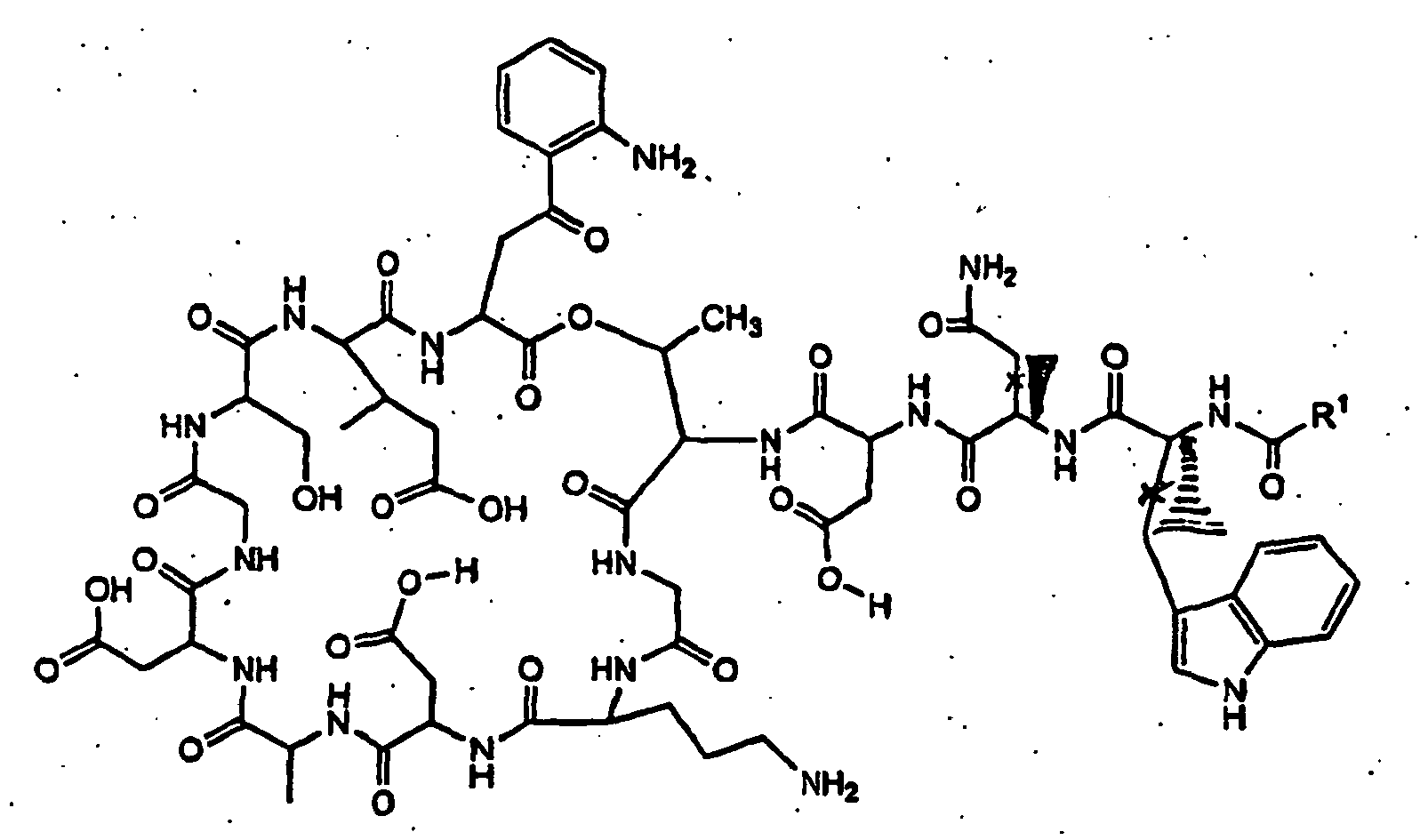
- acylating a desasparagine compound having the structure:
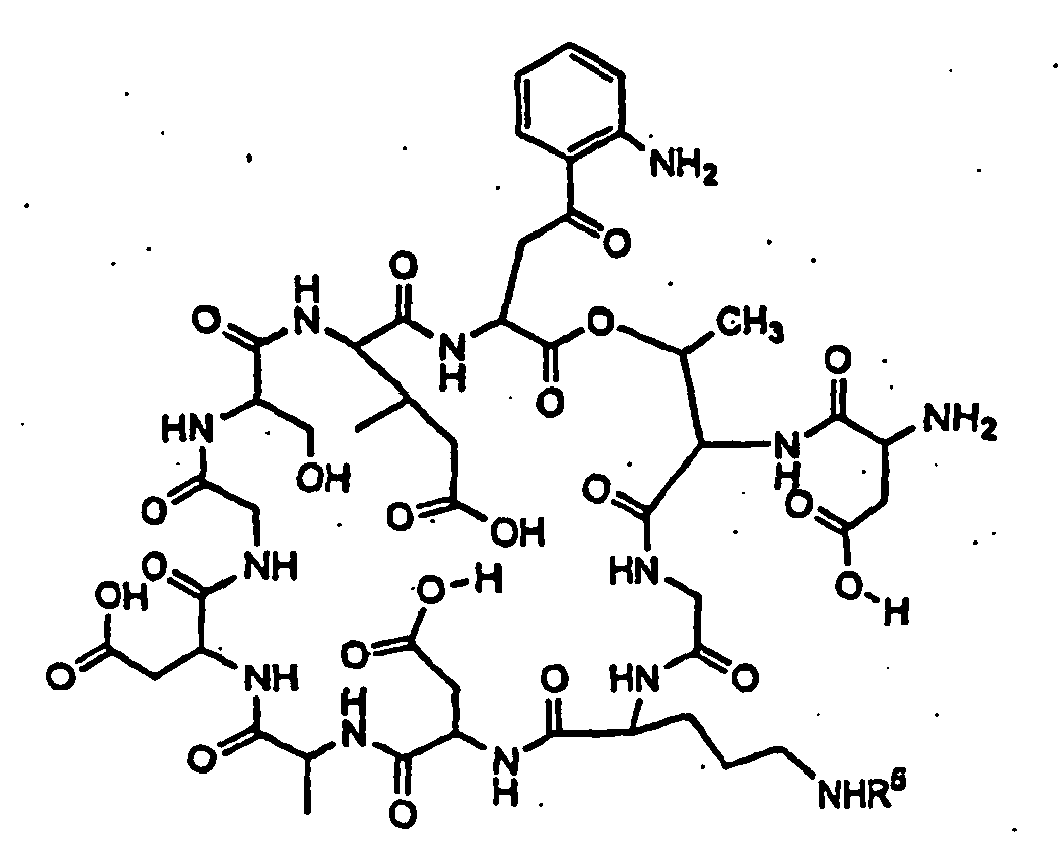
- to obtain an omithine amino protected compound having the structure:


- In another aspect of this embodiment, the method includes acylating the desasparagine compound with an acylating compound having the structure:

- In yet another aspect of this embodiment, the method include acylating the desasparagine compound with an acylating compound having the structure:


- In still another aspect of this embodiment, the method includes acylating the desasparagine compound with an acylating compound having the structure:


- In another embodiment, the method of the invention includes the step of removing an asparagine residue from a destryptophan compound having the structure:

- In a further embodiment, the method of the invention includes the step of removing a tryptophan residue from a deacylated compound having the structure:

- In other embodiments, the invention provides intermediates useful for the preparation of daptomycin and daptomycin stereoisomeric compounds. The invention provides the following intermediate compounds:
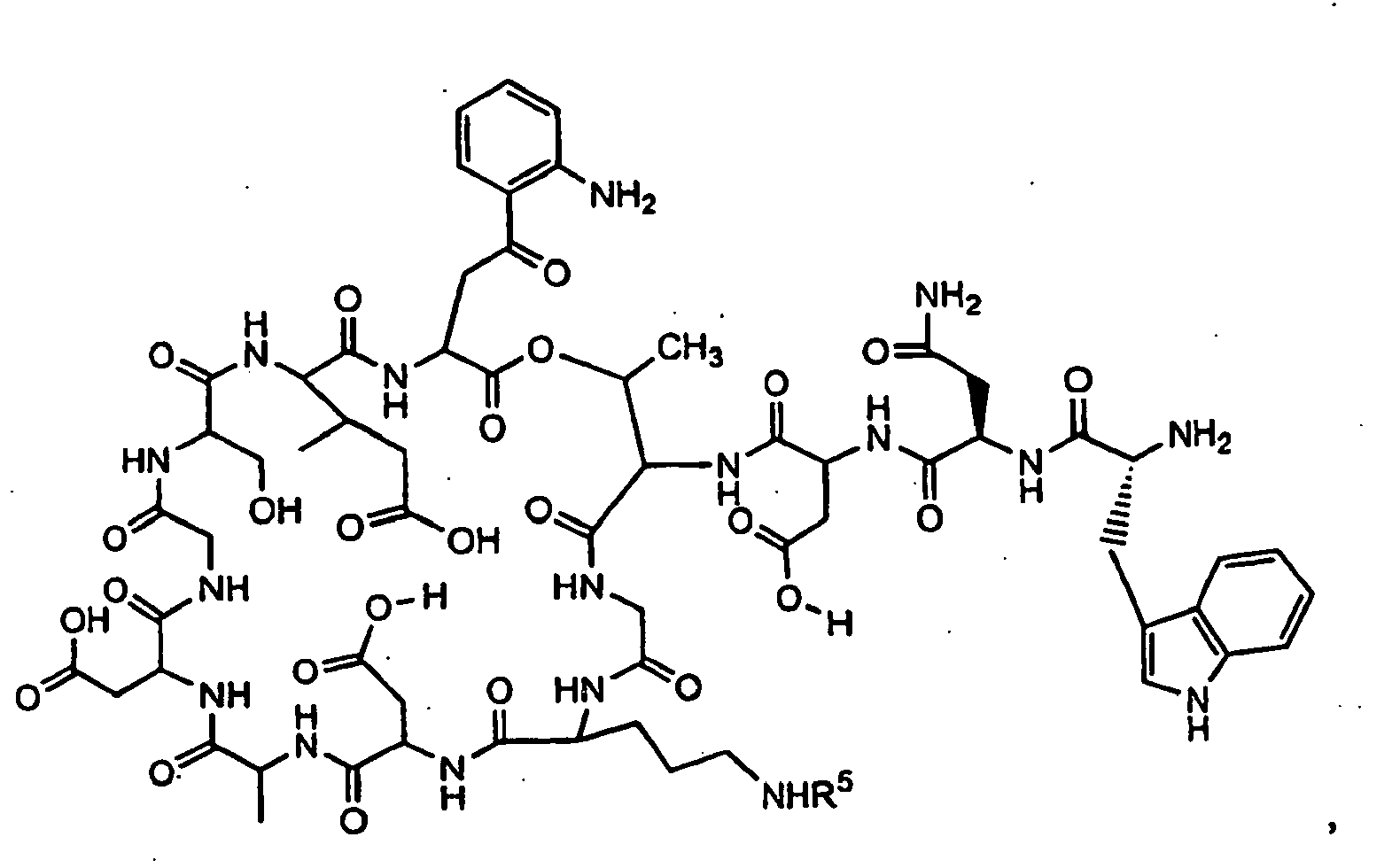


- In yet other embodiments, the invention features pharmaceutical compositions including one or more daptomycin stereoisomeric compounds. The invention also provides methods of using such compositions.
- Molecular descriptive terms, when used in this application, have their common meaning unless otherwise specified.
- The term "hydrido" denotes a single hydrogen atom (H).
- The term "halo" is defined herein as a bromo, chloro, fluoro or iodo radical.
- The term "alkyl" is defined herein as a linear or branched, saturated radical having one to about twenty carbon atoms unless otherwise specified. Preferred alkyl radicals are "higher alkyl" radicals having from about nine carbon atoms to about fifteen carbon atoms. Preferred alky groups are 7-methylnonyl, 9-methyldecyl, 9-methylundecyl, nonyl, and decyl.
- The term "aryl" or "aryl ring" denotes aromatic radicals in a single or fused carbocyclic ring system, having from five to fourteen ring members. In a preferred embodiment, the ring system has from six to ten ring members. One or more hydrogen atoms may also be replaced by a halo or nitro substituent group.
- The term "aryloxy" denotes oxy-containing radicals substituted with an aryl group. Examples include, without limitation, phenloxy, and pentafluorophenyloxy.
- The term "amino acid side chain" denotes any side chain (R group) from a naturally-occurring or synthetic amino acid.
- The term "amino protecting group" refers to any chemical compound that may be used to prevent an amino group on a molecule from undergoing a chemical reaction while chemical change occurs elsewhere in the molecule. Numerous amino protecting groups are known to those skilled in the art and examples can be found in "Protective Groups in Organic Synthesis" by Theodora W. Greene, John Wiley and Sons, New York, 1981, hereafter "Greene," incorporated herein by reference. Examples of amino protecting groups include pthalimido, trichloroacetyl, STA-base, bezyloxycarbonyl, t-butoxycarbonyl, t-amyloxycarbonyl, isobomyloxycarbonyl, adamantyloxycarbonyl, chlorobenzyloxycarbonyl, nitrobenzyloxycarbonyl or the like.
- A "carbamate amino protecting group" which, when bound to an amino group, forms a carbamate, is a preferred amino protecting group. Preferred amino carbamate protecting groups include allyloxycarbonyl (alloc), carbobenzyloxy (CBZ), and tert-butoxycarbonyl protecting groups. Examples of carbamate amino protecting groups can be found in Greene and include but are not limited to, bezyloxycarbonyl, tert-butoxycarbonyl, t-amyloxycarbonyl, isobomyloxycarbonyl, adamantyloxycarbonyl, chlorobenzyloxycarbonyl, nitrobenzyloxycarbonyl or the like. Preferred carbamate amino protecting groups are allyloxycarbonyl (alloc), carbobenzyloxy (CBZ), and tert-butoxycarbonyl protecting groups (BOC).
- The term "activating group" denotes a group that, when adjacent to a carbonyl group, activates the carbonyl group to attack by a nucleophilic amine, resulting in the loss of the activating group and the formation of an amide bond. Such activating groups are well known in the art and include aryloxy, acyloxy, imidazolyl,

- "Daptomycin stereoisomeric compound" is used herein to refer to and compound of Formula II, in which one or more chiral centers differs in absolute stereochemistry from daptomycin.
- The group "Fmoc" is a 9-fluorenylmethoxycarbonyl group.
- The group trityl is a triphenylmethyl group.
- In one embodiment, the present invention provides a process for preparing compounds of Formula II:

- The process, in accordance with one aspect of the invention, includes the steps of:
- (a) providing one or more A-21978C derivative of the Formula III

- (b) treating the ornithine amine of a compound of Formula III with a carbamate amino protecting group to obtain an orninthine amino-protected A21978C compound;
- (c) treating the orninthine amino-protected A21978C compound obtained in (b) with a deacylating agent to obtain a terminal amino A 21978C compound;
- (d) removing the tryptophan amino acid residue of the terminal amino A 21978C compound obtained in (c) to obtain a compound;
- (e) removing the asparagine amino acid residue of the destryptophan compound obtained in (d) to obtain a desasparagine compound;
- (f) acylating the desasparagine compound of (e) with a compound of the Formula IV:

to obtain an acylated compound; and removing the ornithine carbamate amino protecting group from the acylated compound to give the compound of Formula II; or - (g) acylating the desasparagine compound of (e) with a compound of the Formula V:

- In a second aspect, the process of the invention includes the steps of:
- (a) providing one or more A-21978C derivative of the Formula III

- (b) treating the ornithine amino of a compound of Formula III with an amino protecting group to obtain an orninthine amino-protected A21978C compound;
- (c) treating the orninthine amino-protected A21978C compound obtained in (b) with a deacylating agent to obtain a terminal amino A 21978C compound;
- (d) removing the tryptophan amino acid residue of the terminal amino A 21978C compound obtained in (c) to obtain a destryptophan compound;
- (e) removing the asparagine amino acid residue of the destryptophan compound obtained in (d) to obtain a desasparagine compound;
- (f) acylating the desasparagine compound of (e) with a compound of the Formula VI:

- (g) removing the Fmoc group of the Fmoc-protreted terminal asparaginyl compound of (f) selectively over the ornithine carbamate amino-protecting group to give a terminal asparaginyl compound;
- (h) acylating the terminal asparaginyl compound of (g) with a compound of the Formula VII:

- (i) removing the ornithine carbamate- and trityl- amino protecting groups from the acylated compound to give the compound of Formula II.
- The process, in a third aspect of the invention; includes the steps of:
- (a) providing one or more A-21978C derivative of the Formula III

- (b) treating the ornithine amino of a compound of Formula III with a carbamate amino-protecting group to obtain an orninthine amino-protected A21978C compound;
- (c) treating the orninthine amino-protected A21978C compound obtained in (b) with a deacylating agent to obtain a terminal amino A 21978C compound;
- (d) removing the tryptophan amino acid residue of the terminal amino A 21978C compound obtained in (c) to obtain a destryptophan compound;
- (e) removing the asparagine amino acid residue of the destryptophan compound obtained in (d) to obtain a desasparagine compound;
- (f) acylating the desasparagine compound of (e) with a compound of the Formula:

to give an Fmoc protected terminal asparaginyl compound; - (g) removing the Fmoc group of the Fmoc-protected terminal asparaginyl compound of (f) selectively over the ornithine carbamate-amino protecting group to give the terminal asparaginyl compound;
- (h) acylating the terminal asparaginyl compound of (g) with a compound of the Formula

to give the protected Fmoc terminal trytophanyl compound; - (i) removing the Fmoc group of the Fmoc-protected terminal tryptophanyl compound of (h) selectively over the ornithine carbamate amino protecting group to give the terminal trytophanyl compound;
- (j) acylating the terminal tryptophanyl compound of (i) with a compound of the Formula

to obtain an acylated compound; and - (k) removing the ornithine carbamate amino and trityl protecting group from the acylated compound of (j) to give the compound of Formula II.
- The salts of the compounds of the invention include acid addition salts and base addition salts. The term "pharmaceutically acceptable salts" embraces salts commonly used to form alkali metal salts and to form addition salts of free acids or free bases. The nature of the salt is not critical, provided that it is pharmaceutically-acceptable. Suitable pharmaceutically acceptable acid addition salts of the compounds of the invention may be prepared from an inorganic acid or an organic acid. Examples of such inorganic acids include, without limitation, hydrochloric, hydrobromic, hydroiodic, nitric, carbonic, sulfuric and phosphoric acid. Appropriate organic acids may be selected from aliphatic, cyloaliphatic, aromatic, arylaliphatic, heterocyclic, carboxylic and sulfonic classes of organic acids, examples of which include, without limitation, formic, acetic, propionic, succinic, glycolic, gluconic, maleic, embonic (pamoic), methanesulfonic, ethanesulfonic, 2-hydroxyethanesulfonic, pantothenic, benzenesulfonic, toluenesulfonic, sulfanilic, mesylic, cyclohexylaminosulfonic, stearic, algenic, β-hydroxybutytic, malonic, galactic, and galacturonic acid. Suitable pharmaceutically-acceptable base addition salts of compounds of the invention include, but are not limited to, metallic salts made from aluminum, calcium, lithium, magnesium, potassium, sodium and zinc or organic salts made from N,N'-dibenzylethylenediamine, chloroprocaine, choline, diethanolamine, ethylenediamine, N-methylglucamine, lysine and procaine. All of these salts may be prepared by conventional means from the corresponding compound of the invention by treating, for example, the compound of the invention with the appropriate acid or base.
- Corterin compounds of the invention can possess one or more asymmetric carbon atoms and are then capable of existing in the form of optical isomers as well as in the form of racemic or non-racemic mixtures thereof. Said compounds of the invention can be utilized in the present invention as a single isomer or as a mixture of stereochemical isomeric forms. Diastereoisomers, i.e., nonsuperimposable stereochemical isomers, can be separated by conventional means such as chromatography, distillation, crystallization or sublimation. The optical isomers can be obtained by resolution of the racemic mixtures according to conventional processes, for example by formation of diastereoisomeric salts by treatment with an optically active acid or base. Examples of appropriate acids include, without limitation, tartaric, diacetyltartaric, dibenzoyltartaric, ditoluoyltartaric and camphorsulfonic acid. The mixture of diastereomers can be separated by crystallization followed by liberation of the optically active bases from the optically active salts. An alternative process for separation of optical isomers includes the use of a chiral chromatography column optimally chosen to maximize the separation of the enantiomers. Still another method involves synthesis of covalent diastereoisomeric molecules by reacting compounds of the invention with an optically pure acid in an activated form or an optically pure isocyanate. The synthesized diastereoisomers can be separated by conventional means such as chromatography, distillation, crystallization or sublimation, and then hydrolyzed to obtain the enantiomerically pure compound. The optically active compounds of the invention can likewise be obtained by utilizing optically active starting materials. These isomers may be in the form of a free acid, a free base, an ester or a salt.
- The invention also includes isolated compounds. An isolated compound refers to a compound which represents at least 10%, preferably at least 20%, more preferably at least 50% and most preferably at least 80% of the compound present in the mixture. In a preferred embodiment, the compound, a pharmaceutically acceptable salt thereof or a pharmaceutical composition comprising the compound exhibits a detectable (i.e. statistically significant) antimicrobial activity when tested in conventional biological assays such as those described herein.
- Prior to applicant's invention herein, only a single diastereomer of daptomycin had been reported (Formula I). Previous reports have concluded that the terminal tryptophan residue and the asparagine residue of daptomycin are both in the (L)-configuration. Applicants now have surprisingly found that the configuration of the asparagine residue of daptomycin had been previously misassigned and that the asparagine residue of daptomycin is actually in the (D)-configuration.
- Based on applicant's discovery of the stereochemistry of the asparagine residue of daptomycin, the stereochemistry of the compound known as daptomycin can be accurately described by Formula IV:

- All reported processes for the production of daptomycin have resulted in the formation of daptomycin as a single stereoisomer of Formula IV, rather than Formula I, as previously assigned. Similarly, there has been no reported preparation, isolation, or testing of the compound of Formula I, or, for that matter, stereoisomers of daptomycin other than the single isomer of Formula IV. Processes for the production of individual daptomycin stereoisomeric compounds are have not been previously reported.
- The present invention provides an efficient method for preparing stereoisomers of lipopeptides, particularly daptomycin stereoisomeric compounds. The present invention allows for the efficient preparation of both racemic mixtures of compounds, as well as unique compounds of defined stereochemistry.
- One process for the preparation of a compound of Formula II is illustrated in Scheme I.


- This process, in accordance with one aspect of the invention, comprises providing one or more A21978C derivatives of the Formula III (step(a)). Compounds of Formula III can be obtained by methods disclosed in United States Patents
RE 32,333 ;RE 32,455 ;RE 32,311 ;4,482,487 ;4,537,717 ;4,800,157 ,4,874,843 ;4,885,243 and5,912,226 , each of which is incorporated herein by reference in its entirety. In preferred embodiments of the invention, R1 is 7-methylnonyl, 9-methyldecyl, 9-methylundecyl, nonyl, decyl or mixtures thereof. In a more preferred embodiment R1 is nonyl. In an even more preferred embodiment R1 is n-nonyl. In the most preferred embodiment of the invention, compound III is daptomycin. - The ornithine amine of the A21978C derivative of Formula III is treated with an amino protecting group to give an ornithine amino protected A21978C compound of Formula V (step (b)), wherein R1 is as previously defined and R5 is an amino protecting group. Preferably, R5 is a carbamate amino protecting group.
- Methods of protecting the ornithine amine of daptomycin and related lipopeptides can be found in United States Patents
RE 32,310 ;RE 32,311 ;4,482,487 ;4,524,135 ; and4,537,717 . Preferred carbamate amino protecting groups of the invention are benryloxycarbonyl, tert-butoxycarbonyl and allyloxycarbonyl. The most preferred carbamate amino protecting group is allylyoxycarbonyl. - The ornithine amino protected A21978C compound of Formula V is then treated with a deacylating agent to form a terminal amino A21978C compound of Formula VI (step(c)). Enzymatic deacylating agents are suitable deacylating agents for use in the present invention. For example, an enzyme which is useful for deacylation of a compound of Formula V is produced by certain microorganisms of the family Actinoplanaceae. Some of these known species and varieties of this family include Actinoplanes philippinensis, Actinoplanes armeniacus, Actinoplanes utahensis, Actinoplanes missouriensis, Spirillospora albida, Streptosporiangium roseum, Streptosporangiun vulgare, Streptosporangium roseum var hollandensi, Streptosporangium album, Streptosporangium viridialbum, Amorphosporangium auranticolor, Ampullariella reguloris, Ampullariella campanulata, Ampullariella lobata, Ampullariella digitata, Pilimelia terevasa, Pimelia anulata, Planomonospora parontospora, Planomonospora venezuelensis, Planobispora longispora, Planobispora rosea, Dactylosporangium aurantiacum, and Dactylosporangium thailandende. Any natural and artificial variant or mutant obtained from the Actinoplanacea and which produce the enzyme may be used in this invention.
- Preferred sources of the decylation enzyme are Actinoplanes utahensi: NRRL 12052; Actinoplanes missouriensis NRRL 12053; Actinoplanes sp.: NRRL8122, Actinoplanes sp.: NRRL 12065, Streptosporsngium roseum var hollandensis: NRRL 12064, Actinoplanes utahenis ATCC 14539 and Actinoplanes missouriensis ATCC. 14538. The more preferred source of deacylation enzyme is the species Actinoplanes utahensi. The most preferred source of deacylation enzyme is one produced from recombinant Streptomyces lividans, which expresses the Actinoplanes utahenis deacylation enzyme as described in J. Ind. Microbiol. Biotechnol. 2000, 24(3) 173-180. This enzyme is also known as echinocandin B deacylase or ECB deacylase.
-
- Removal of the tryptophan amino acid residue from the terminal ammo A21978C compound of Formula VI, leads to the formation of the compound of Formula VII (step(d)). Methods for removal of the tryptophan amino acid residue are known to those skilled in the art. A preferred method for removal of the tryptophan amino acid residue is under standard Edman degradation conditions.
- The Edman degradation is a well-established reaction known to those skilled in the art (see, for example, P. Edman. 1950, Acta Chem. Scan. 4: 283-93 and P. Edman, 1956, Acta Chem Scan 10: 761-768). In this reaction, the terminal NH2 group of a peptide reacts with an isothiocycanate to form a thiourea derivative of the peptide. Upon treatment with acid or base, the thiourea peptide undergoes a cyclization reaction, giving a thiohydantoin and a shorter peptide (see Scheme II).

- The Edman degradation can be carried out under a variety of conditions. In the first step of the Edman degradation, the isothiocyanate reacts with the amine under neutral to mildly basic (pH <9.5) conditions in solvents such as tetrahydrofuran, N, N'-dimethylformamide, dichloromethane, dioxane or ethanol. A variety of isothiocyanates can be used (see K. K. Han et al. Biochemie 1977, 59: 557-576.
- Subsequent cyclization and cleavage can be accomplished under a variety of conditions. Typically, anhydrous trifluoroacetic acid, heptafluorobutyric acid (see, for example, W. F. Brandt et al., 1976, Z. Physiol. Chem. 357: 1505-1508) or concentrated hydrochloric acid (see, for example, G. E. Tarr, 1977, Methods in Enzymology , 47: 335-337) are used. Mild basic conditions such as triethylamine or N, N-dimethylallyamine/acetic acid (pH ∼9) can also be used (see G.C. Barrett et al., 1985, Tetrahedron Letters 26(36): 4375-4378). For a review of this reaction see K.K. Han, 1985, Int. J. Biochem 17(4): 429-445.
- In a preferred embodiment, the thiourea peptide (the compound of Formula XI) formed upon reaction of the thioisocyanate with a compound of Formula VI is treated under acidic conditions to provide a compound of Formula VII. In a more preferred embodiment of the invention, a compound of Formula XI is treated with trifluoroacetic acid to give the compound of Formula VII (Scheme III).

- Removal of the asparagine amino acid residue from the compound of Formula VII, leads to the formation of the desasparagine compound of Formula VIII (step(e)). Methods for removal of the asparagine amino acid residue are known to those skilled in the art. Preferably, the asparagine amino acid residue is removed under Edman degradation conditions (vide supra).
- In a preferred embodiment, the thiourea peptide (the compound of Formula XII) formed upon reaction of the thioisocyanate with a compound of Formula VII is treated under acidic conditions to provide desasparagine compound of Formula VIII. In a preferred embodiment of the invention, a compound of Formula XII is treated with trifluoroacetic acid to give the compound of Formula VIII (Scheme IV).

- Acylation of the desasparagine compound of Formula VIII with an activated compound of Formula IX results in the formation of acylated compound of Formula X (step(f)). Acylation reactions are well known to those skilled in the art. Acylation of complex molecules such as daptomycin and related lipopeptides can be found in United States Patents
4,399,067 ;4,482,487 ; and4,537,717 . - In a preferred embodiment, the substituent X on the acylating compound of Formula IX is an aryloxy group. In a more preferred embodiment, the substituent X is pentafluorophenoxy.
- Compounds of Formula IX can be prepared from the corresponding peptide upon treatment with an activating agent such as an anhydride, a chloroformate, pentafluorophenol/dicyclohexylcarbodiimide, N',N'-carbonyldiimidazole, hydroxybenzotriazole or N-hydroxysuccinimide. These peptides can be prepared by any standard peptide procedure. For an overview of standard peptide formation procedures, see Vogel's Textbook of Practical Organic Chemistry, 5th Ed., eds. B.S. Furniss, A.J. Hannaford; P.W.G. Smith; A.R. Tatchell (New York: John Wiley and Sons, Inc.), 1989, pp750-763 and Introduction to Organic Chemistry, 2nd Ed. by A. Streitwieser, Jr. and C.H. Heathcock (New York: MacMillan Publishing Co., Inc.), pp 954-962. Other methods for the preparation of peptides of the present invention involve synthesis on a solid support. Specific examples of such procedures are detailed in the examples herein.
- Thus, using these procedures, a variety of stereoisomeric compounds of Formula IX are readily available. Compounds of Formula IX may be obtained and used in the acylation reaction as a single diastereomer. In a preferred embodiment of the invention, the asparagine residue of a compound of Formula IX is in the D configuration. In a preferred embodiment of the invention, the tryptophan residue of the compound of Formula IX is in the D-configuration. Preferred compounds of Formula IX are

- Removal of the protecting group(s) from the acylated compound of Formula X results in the formation of the compound of Formula II. When R6 is hydrido, only the ornithine protecting group needs to be removed. Removal of the ornithine amino protecting group can be accomplished according to procedures described in Greene. As one skilled in the art will recognize, the choice of amino protecting group employed in the first step of the process will dictate the reagents and procedures used in removing that amino protecting group.
- When R6 is an asparagine amino protecting group, both the asparagine amino protecting group and the ornithine amino protecting group are removed to obtain a, compound of Formula II. Removal of these protecting groups can be accomplished in either a one step or a two step procedure, depending on the choice of amino protecting group employed in the first step of the process.
- As one skilled in the art will recognize, a one step procedure may be used when the ornithine amino protecting group, R5, is removed under conditions in which the asparagine amino protecting group is also removed, or vice versa. For example, because a trityl protecting group can be removed under acidic conditions, other amino protecting groups that are removed under acidic conditions are removed concurrently upon treatment with acid.
- A two step procedure for removing asparagine amino protecting group and the ornithine amino protecting group, R6 and R5, respectively, may be used when the ornithine amino protecting group is removed under one set of conditions, while the asparagine amino protecting group is removed under a different set of conditions. In these cases, a step-wise approach may be employed, such that one amino protecting group is removed in a first step, and the other amino protecting group is removed in a second step. For example, a trityl group may be removed in the first step to give a compound of Formula XVIII, then a carbamate amino protecting group can be removed in the second step to give a compound of Formula II. Alternatively the carbamate amino protecting group can be removed in the first step to give a compound of Formula XIX, and then the trityl protecting group can be removed in the second step to give the compound of Formula II (SchemeV).


- The process of the invention, in a second aspect, is outlined in Scheme VI. In this process, the transformation of a compound of Formula VIII, from step (e) above, to a compound of Formula X, may be conducted in three steps.


- The desasparagine compound of Formula VIII is acylated with a compound of Formula XX to give the Fmoc protected terminal asparaginyl compound of Formula XXI (step(f)). The acylation may be performed as previously described.
- For example, the compound of Formula XX is readily available via activation of commercially available trityl protected N-Fmoc-asparagine using methods as discussed previously. In a preferred embodiment of the invention, X1 is an aryloxy group. In a more preferred embodiment of the invention, X1 is pentafluorophenyloxy.
- Compounds of the Formula XX may be obtained and used in the acylation reaction as a single enantiomer.
- The Fmoc protecting group of the Fmoc protected terminal asparaginyl compound of Formula XXI is removed to afford the terminal asparaginyl compound of Formula XXII according to procedures described in Greene (step(g)).
- The terminal asparaginyl compound of Formula XXII is acylated with a compound of Formula XXIII to give the acylated compound of Formula X (step(b)). The acylation reaction can be performed as described previously. The compound of the Formula XXIII is readily available via (a) acylation of tryptophan followed by activation as described previously or (b) acylation of a tryptophan ester (e.g. methyl-, ethyl-, t-butyl-, allyl-, or benzyl ester), followed by hydrolysis then activation as described previously. In a preferred embodiment of the invention, X2 is an aryloxy group. In a more preferred embodiment of the invention. X2 is pentafluorophenyloxy. Compounds of the Formula XXIII may be obtained and used in the acylation reaction as a single enantiomer.
- The compound of the Formula X is then converted to the compound of Formula II as previously described (step(i)).
- The process of the invention, in a third aspect, it outlined in Scheme VII. In this process, the transformation of a compound of Formula VIII to a compound of Formula X may be conducted in five steps.


- In this process, the terminal asparaginyl compound of Formula XXII, from step (g) above, undergoes an acylation reaction with a compound of the Formula XXIV to give a Fmoc protected terminal tryptophan compound of Formula XXV(step(h)). The acylation reaction is performed as previously described. The compound of Formula XXIV is readily available via activation of commercially available N-Fmoc-tryptophan. In a preferred embodiment of the invention, X3 is an aryloxy group. In a more preferred embodiment, X3 is a pentafluorphenoxy. Compounds of the Formula XXIV may be obtained and used in the acylation reaction as a single enantiomer.
- The Fmoc protecting group of the Fmoc protected terminal tryptophanyl compound of Formula XXV is removed to afford the terminal tryptophan compound of Formula XXVI (step(i)) according to procedures described in Greene.
- The terminal tryptophanyl compound of Formula XXVI is then acylated as previously described, with a compound of Formula XXVII to give the acylated compound of Formula X (step(j)). The compound of Formula XXVII is readily available via activation of decanoic acid. In a preferred embodiment of the invention, X4 is an aryloxy group. In a more preferred embodiment, X4 is a pentafluorophenoxy group.
- The compound of Formula X is then converted to a compound of Formula II as described previously (step (k)).
- According to another embodiment, the present invention provides daptomycin stereoisomeric compounds, and pharmaceutically acceptable salts thereof. As shown below, daptomycin has thirteen chiral centers:

- The present invention allows for the absolute configuration at positions 1 and 2 to be varied based on the choice of acylating agents (for example, compounds of the Formulas IX, XX, XXIII, and XXIV).
- The present invention provides daptomycin stereoisomeric compounds of the Formula:
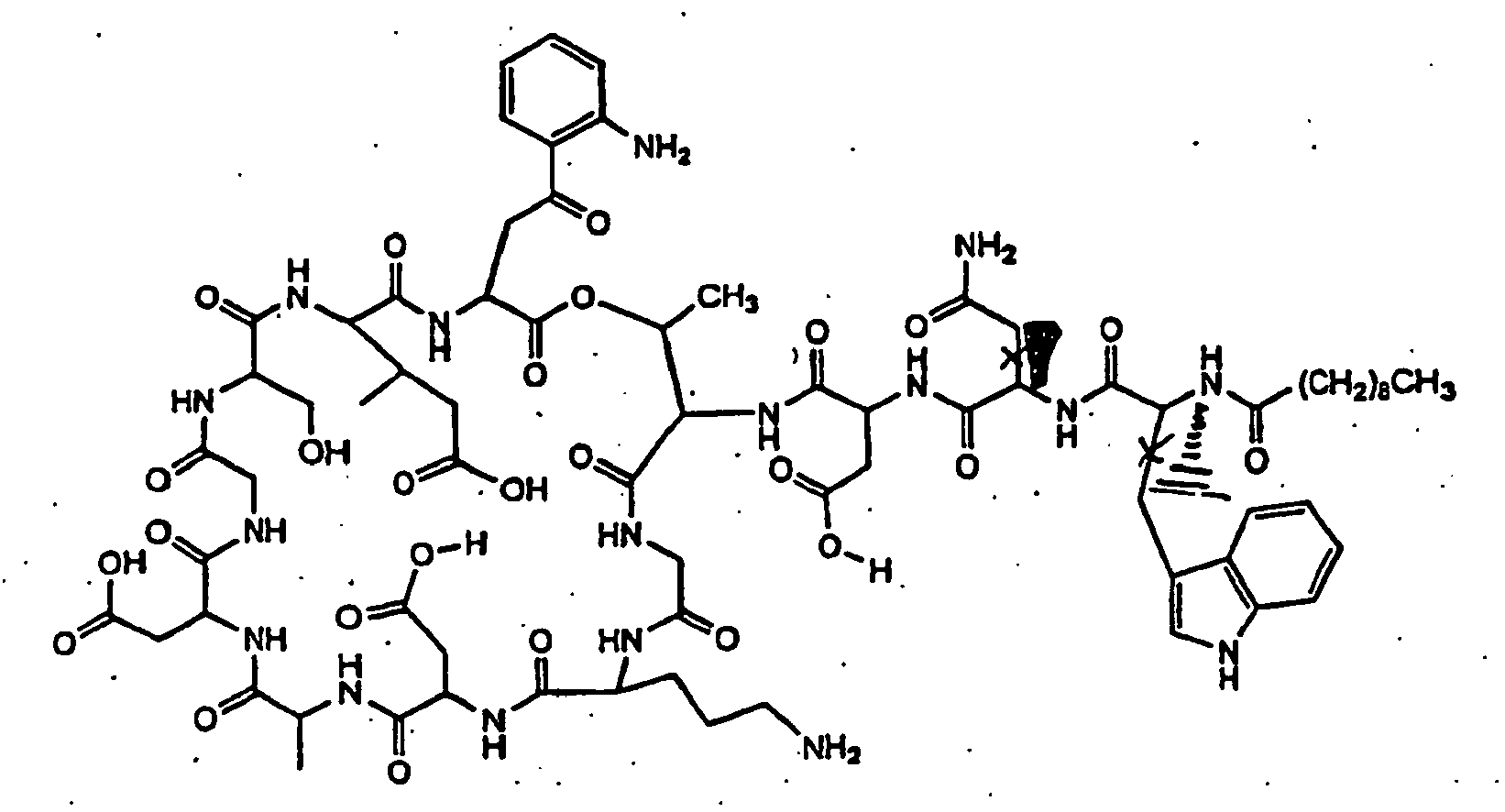
- In more preferred embodiments of the invention, the daptomycin stereoisomeric compound includes the following:

- The present invention also provides intermediates useful in the methods of the invention. Intermediates of the present invention include compounds having the structure:


where R5 is an ornithine protecting group and R6 is hydrido or an asparagine protecting group, R5 is preferably allyloxycarbonyl, carbobenzyloxycarbonyl or tert-butoxycarbonyl; most preferably, R5 is allyloxycarbonyl. - Compounds of the Formula VII are particularly useful as intermediates for the preparation of the compounds of Formula II.

- The present invention also provides compounds of the Formula VIII that are particularly useful as intermediates for the preparation of the compounds of Formula II.

- The present invention also provides pharmaceutical compositions or formulations comprising daptomycin stereoisomeric compounds or salts thereof. Such pharmaceutical compositions or formulations may include one or more daptomycin stereoisomeric compounds, as well as daptomycin itself. The preparation methods of the present invention allow for any desired proportion of daptomycin stereoisomeric compounds and/or daptomycin in pharmaceutical compositions or formulations of the invention.
- Daptomycin stereoisomeric compounds, or pharmaceutically acceptable salts thereof, can be formulated for oral, intravenous, intramuscular, subcutaneous or parenteral administration for the therapeutic or prophylactic treatment of diseases, particularly bacterial infections. For oral or parenteral administration, daptomycin stereoisomeric compounds of this invention can be mixed with conventional pharmaceutical carriers and excipients and used in the form of tablets, capsules, elixirs, suspensions, syrups, wafers and the like. Such compositions containing a compound of this invention will contain from about 0.1 to about 99% by weight of the active compound, and more generally from about 10 to about 30%.
- The pharmaceutical preparations disclosed herein are prepared in accordance with standard procedures and are administered at dosages that are selected to reduce, prevent or eliminate the infection (See, e. g., Remington's Pharmaceutical Sciences, Mack Publishing Company, Easton, PA and Goodman and Gliman's The Pharmaceutical Basis of Therapeutics, Pergamon Press, New York, NY, for a general description of the methods for administering various antimicrobial agents for human therapy). The pharmaceutical compositions or formulations of the invention can be delivered using controlled (e.g., capsules) or sustained release delivery systems (e.g., bioerodable matrices). Exemplary delayed release delivery systems for drug delivery that are suitable for administration of the compositions of the invention (preferably of Formula II) are described in
U.S. Patent Nos. 4,452,775 ;5,239,660 ; and3,854,480 . - The pharmaceutically-acceptable compositions of the present invention comprise one or more compounds of the invention, in association with one or more nontoxic, pharmaceutically-acceptable carriers and/or diluents and/or adjuvants and/or excipients, collectively referred to herein as "carrier" materials, and, if desired, other active ingredients. The compositions may contain common carriers and excipients, such as corn starch or gelatin, lactose, sucrose, microcrystalline cellulose, kaolin, mannitol, dicalcium phosphate, sodium chloride and alginic acid. The compositions may contain croscarmellose sodium, microcrystalline cellulose, corn starch, sodium starch glycolate and alginic acid.
- Tablet binders that can be included are acacia, methylcellulose, sodium carboxymethylcellulose, polyvinylpyrrolidone (Povidone), hydroxypropyl methylcellulose, sucrose, starch and ethylcellulose.
- Lubricants that can be used include magnesium stearate or other metallic stearates, stearic acid, silicone fluid, talc, waxes, oils and colloidal silica.
- Flavoring agents such as peppermint, oil of wintergreen, cherry flavoring or the like can also be used. It may also be desirable to add a coloring agent to make the dosage form more aesthetic in appearance or to help identify the product.
- For oral use, solid formulations such as tablets and capsules are particularly useful. Sustained release or enterically coated preparations may also be devised. For pediatric and geriatric applications, suspensions, syrups and chewable tablets are especially suitable. For oral administration, the pharmaceutical compositions are in the form of, for example, a tablet, capsule, suspension or liquid. The pharmaceutical composition is preferably made in the form of a dosage unit containing a therapeutically-effective amount of the active ingredient. Examples of such dosage units are tablets and capsules. For therapeutic purposes, the tablets and capsules which can contain, in addition to the active ingredient, conventional carriers such as binding agents, for example, acacia gum, gelatin, polyvinylpyrrolidone, sorbitol, or tragacanth; fillers, for example, calcium phosphate, glycine, lactose, maize-starch, sorbitol, or sucrose; lubricants, for example, magnesium stearate, polyethylene glycol, silica, or talc; disintegrants, for example, potato starch, flavoring or coloring agents, or acceptable wetting agents. Oral liquid preparations generally are in the form of aqueous or oily solutions, suspensions, emulsions, syrups or elixirs may contain conventional additives such as suspending agents, emulsifying agents, non-aqueous agents, preservatives, coloring agents and flavoring agents. Examples of additives for liquid preparations include acacia, almond oil, ethyl alcohol, fractionated coconut oil, gelatin, glucose syrup, glycerin, hydrogenated edible fats, lecithin, methyl cellulose, methyl or propyl para-hydroxybenzoate, propylene glycol, sorbitol, or sorbic acid.
- For intravenous (IV) use, a daptomycin stereoisomeric compound of the invention can be dissolved or suspended in any of the commonly used intravenous fluids and administered by infusion. Intravenous fluids include, without limitation, physiological saline or Ringer's solution. Intravenous administration may be accomplished by using, without limitation, syringe, minipump or intravenous line.
- Formulations for parenteral administration can be in the form of aqueous or non-aqueous isotonic sterile injection solutions or suspensions. These solutions or suspensions can be prepared from sterile powders or granules having one or more of the carriers mentioned for use in the formulations for oral administration. The compounds can be dissolved in polyethylene glycol, propylene glycol, ethanol, corn oil, benzyl alcohol, sodium chloride, and/or various buffers.
- For intramuscular preparations, a sterile formulation including a daptomycin stereoisomeric compound or a suitable soluble salt form of the compound, for example the hydrochloride salt, can be dissolved and administered in a pharmaceutical diluent such as Water-for-Injection (WFI), physiological saline or 5% glucose. A suitable insoluble form of the compound may be prepared and administered as a suspension in an aqueous base or a pharmaceutically acceptable oil base, e.g., an ester of a long chain fatty acid such as ethyl oleate.
- A dose of an intravenous, intramuscular or parental formulation of a daptomycin stereoisomeric compound may be adminstered as a bolus or by slow infusion. A bolus is a dose that is administered in less than 30 minutes. In a preferred embodiment, a bolus is administered in less than 15 or less than 10 minutes. In a more preferred embodiment, a bolus is administered in less than 5 minutes. In an even more preferred embodiment, a bolus is administered in one minute or less. An infusion is a dose that is administered at a rate of 30 minutes or greater. In a preferred embodiment, the infusion is one hour or greater. In another embodiment, the infusion is substantially constant.
- For topical use the compounds of the present invention can also be prepared in suitable forms to be applied to the skin, or mucus membranes of the nose and throat, and can take the form of creams, ointments, liquid sprays or inhalants, lozenges, or throat paints. Such topical formulations further can include chemical compounds such as dimethylsulfoxide (DMSO) to facilitate surface penetration of the active ingredient.
- For application to the eyes or ears, the compounds of the present invention can be presented in liquid or semi-liquid form formulated in hydrophobic or hydrophilic bases as ointments, creams, lotions, paints or powders.
- For rectal administration the compounds of the present invention can be administered in the form of suppositories admixed with conventional carriers such as cocoa butter, wax or other glyceride.
- Alternatively, the compounds of the present invention can be in powder form for reconstitution in the appropriate pharmaceutically acceptable carrier at the time of delivery. In another embodiment, the unit dosage form of the compound can be a solution of the compound or preferably a salt thereof in a suitable diluent in sterile, hermetically sealed ampoules or sterile syringes. The concentration of the compound in the unit dosage may vary, e.g. from about 1 percent to about 50 percent, depending on the compound used and its solubility and the dose desired by the physician. If the compositions contain dosage units, each dosage unit preferably contains from 1-500 mg of the active material. For adult human treatment, the dosage employed preferably ranges from 5 mg to 10 g, per day, depending on the route and frequency of administration.
- In another aspect, the invention provides a method for inhibiting the growth of microorganisms, preferably bacteria, comprising contacting said organisms with a composition of the invention, under conditions which permit entry of the compound into said organism and into said microorganism. Such conditions are known to one skilled in the art and are exemplified in the Examples. This method involves contacting a microbial cell with a therapeutically-effective amount of a composition of the invention, either in vivo or in vitro.
- According to this aspect of the invention, the novel compositions disclosed herein are placed in a pharmaceutically acceptable carrier and are delivered to a recipient subject (preferably a human) in accordance with known methods of drug delivery. In general, the methods of the invention for delivering the compositions of the invention in vivo utilize art-recognized protocols for delivering the agent with the only substantial procedural modification being the substitution of the compounds of the invention for the drugs in the art-recognized protocols. Likewise, the methods for using the claimed composition for treating cells in culture, for example, to eliminate or reduce the level of bacterial contamination of a cell culture, utilize art-recognized protocols for treating cell cultures with antibacterial agent(s) with the only substantial procedural modification being the substitution of the compounds of the invention for the agents used in the art-recognized protocols.
- In one embodiment, the invention provides a use of the compositions of the invention for the preparation of a pharmacentical composition for treating an infection, especially those caused by gram-positive bacteria, in a subject with a therapeutically-effective amount of a composition of the present invention. Exemplary procedures for delivering an antibacterial agent are described in
U.S. Patent No. 5,041,567, issued to Rogers and inPCT patent application number EP94/02552 (publication no.WO 95/05384 - The method comprises administering to the subject an effective dose of a composition of this invention. An effective dose is generally between about 0.1 and about 100 mg/kg of a composition of the invention. A preferred dose is from about 0.1 to about 50 mg/kg of a composition containing a daptomycin stereoisomeric compound or pharmaceutically acceptable salt thereof. A more preferred dose is from about 1 to 25 mg/kg of a composition containing a daptomycin stereoisomeric compound or pharmaceutically acceptable salt thereof. An effective dose for cell culture is usually between 0.1 and 1000 µg/mL, more preferably between 0.1 and 200 µg/mL.
- A composition containing a daptomycin stereoisomeric compound of the invention can be administered as a single daily dose or in multiple doses per day. The treatment regime may require administration over extended periods of time, e.g., for several days or for from two to four weeks. The amount per administered dose or the total amount administered will depend on such factors as the nature and severity of the infection, the age and general health of the patient, the tolerance of the patient to the compound and the microorganism or microorganisms involved in the infection. A method of administration to a patient of daptomycin is disclosed in United States Serial No.
09/406,568, filed September 24,1999 U.S. Provisional Application Nos. 60/101,828, filed September 25, 1998 60/125,750, filed March 24, 1999 - A composition containing a daptomycin stereoisomeric compound according to this invention may also be administered in the diet or feed of a patient or animal. If administered as part of a total dietary intake, the amount of compound employed can be less than 1% by weight of the diet and preferably no more than 0.5% by weight The diet for animals can be normal foodstuffs to which the compound can be added or it can be added to a premix.
- The methods of the present invention provide administering a composition containing a daptomycin stereoisomeric compound to a subject in need thereof in an amount that is efficacious in reducing or eliminating the bacterial infection. The composition may be administered orally, parenterally, by inhalation, topically, rectally, nasally, buccally, vaginally, or by an implanted reservoir, external pump or catheter. The composition may be prepared for opthalmic or aerosolized uses. The compositions of the present invention can be administered as an aerosol for the treatment of pneumonia or other lung-based infections. A preferred aerosol delivery vehicle is an anhydrous or dry powder inhaler. Compositions containing a daptomycin stereoisomeric compound also may be directly injected or administered into an abscess, ventricle or joint. Parenteral administration includes subcutaneous, intravenous, intramuscular, intra-articular, intra-synovial, cisternal, intrathecal, intrahepatic, intralesional and intracranial injection or infusion. In a preferred embodiment, compositions containing a daptomycin stereoisomeric compound are administered intravenously, subcutaneously or orally. In a preferred embodiment for administering a composition of the invention to a cell culture, the composition may be administered in a nutrient medium.
- The use of the instant invention may be to treat a subject having a bacterial infection in which the infection is caused or exacerbated by any type of bacteria, particularly gram-positive bacteria. In one embodiments, a composition containing a daptomycin stereoisomeric compound is administered to a patient according to the methods of this invention. In a preferred embodiment, the bacterial infection may be caused or exacerbated by gram-positive bacteria. These gram-positive bacteria include, but are not limited to, methicillin-susceptible and methicillin-resistant staphylococci (including Staphylococcus aureus, S. epidemidis, S. haentolyticus, S. hominis, S. saprophyticus, and coagulase-negative staphylococci), glycopeptide intermediary- susceptible S. aureus (GISA), penicillin-susceptible and penicillin-resistant streptococci (including Streptococcus pneumoniae, S. pyogenes, S. agalactiae, S. avium, S. bovis, S. lactis, S. sangius and Streptococci Group C, Streptococci Group G and viridans streptococci), enterococci (including vancomycin-susceptible and vancomycin-resistant strains such as Enterococcus faecalis and E. faecium), Clostridium difficile, C. clostridiiforme, C. innocuum, C. perfringens, C. ramosum, Haemophilus influenzae, Listeria monocytogenes, Corynebacterium jeikeium, Bifidobacterium spp., Eubacterium aerofaciens, E. lentum, Lactobacillus acidophilus, L. casei, L. plantarum, Lactococcus spp., Leuconostoc spp., Pediococcus, Peptostreptococcus anaerobius, P. asaccarolyticus, P. magnus, P. micros, P. prevotii, P. productus, Propionibacterium acnes, Actinomyces spp., Moraxella spp. (including M. catarrhalis) and Escherichia spp. (including E. coli).
- In a preferred embodiment, the antibacterial activity of daptomycin stereoisomeric compounds of Formula II against classically "resistant" strains is comparable to that against classically "susceptible" strains in in vitro experiments. In another preferred embodiment, the minimum inhibitory concentration (MIC) value for daptomycin stereoisomeric compounds according to this invention against susceptible strains is typically the same as or lower than that of vancomycin. Thus, in a preferred embodiment, a composition containing a daptomycin stereoisomeric compound is administered according to the methods of this invention to a patient who exhibits a bacterial infection that is resistant to other compounds, including vancomycin or daptomycin. In addition, unlike glycopeptide antibiotics, lipopeptide compounds exhibits rapid, concentration-dependent bactericidal activity against gram-positive organisms. Thus, in a preferred embodiment, a composition containing a daptomycin stereoisomeric compound is administered to a patient in need of rapidly acting antibiotic therapy.
- The administration methods of the instant invention may be used for any bacterial infection of any organ or tissue in the body. In a preferred embodiment, the bacterial infection is caused by gram-positive bacteria. These organs or tissue include, without limitation, skeletal muscle, skin, bloodstream, kidneys, heart, lung and bone. The method of the invention may be used to treat, without limitation, skin and soft tissue infections, bacteremia and urinary tract infections. The uses of the invention may be to treat respiratory infections, such as otitis media, sinusitis, chronic bronchitis and pneumonia, including pneumonia caused by drug-resistant S. pneumoniae or H. influenzae. The uses of the invention also may be to treat mixed infections that comprise different types of gram-positive bacteria, or which comprise both gram-positive and gram-negative bacteria. These types of infections include intra-abdominal infections and obstetrical/gynecological infections. The uses of the invention also may be to treat an infection including, without limitation, endocarditis, nephritis, septic arthritis, intra-abdominal sepsis, bone and joint infections, and osteomyelitis. In a preferred embodiment, any of the above-described conditions may be treated using a composition containing a daptomycin stereoisomeric compound.
- The uses of the instant invention may also be practiced while concurrently administering one or more other antimicrobial agents, such as antibacterial agents (antibiotics) or antifungal agents. As described above, the use may be practiced by administering a composition containing a daptomycin stereoisomeric compound and another lipopeptide compound, such as daptomycin or any other lipopeptide compound.
- In one embodiment, the administration methods of the invention include coadministration of antifungal or other antibacterial agents. Antibacterial agents and classes thereof that may be co-administered with daptomycin stereoisomeric compounds or other lipopeptide antibiotics include, without limitation, penicillins and related drugs, carbapenems, cephaloporins and related drugs, aminoglycosides, bacitracin, gramicidin, mupirocin, chloramphenicol, thiamphenicol, fusidate sodium, lincomycin, clindamycin, macrolides, novobiocin, polymyxins, rifamycins, spectinomycin, tetracyclines, vancomycin, teicoplanin, streptogramins, anti-folate agents including sulfonamides, trimethoprim and its combinations and pyrimethamine, synthetic antibacterials including nitrofurans, methenamine mandelate and methenamine hippurate, nitroimidazoles, quinolones, fluoroquinolones, isoniazid, ethambutol, pyrazinamide, para-aminosalicylic acid (PAS), cycloserine, capreomycin, ethionamide, prothionamide, thiacetazone, viomycin, everninomycin, glycopeptide, glycylcylcline, ketolides, oxazolidinone; imipenen, amikacin, netilmicin, fosfomycin, gentamicin, ceftriaxone, Ziracin, LY 333328, CL 331002, HMR 3647, Zyvox, Synercid, Aztreonam, and Metronidazole, Epiroprim, OCA-983, GV-143253, Sanfetrinem sodium, CS-834, Biapenem, A-99058.1, A-165600, A-179796, KA 159, Dynemicin A, DX8739, DU 6681; Cefluprenam, ER 35786, Cefoselis, Sanfetrinem celexetil, HGP-31, Cefpirome, HMR-3647, RU-59863, Mersacidin, KP 736, Rifalazil; AM 1732, MEN 10700, Lenapenem, BO 2502A, NE-1530, PR 39, K130, OPC 20000, OPC 2045, Veneprim, PD 138312, PD 140248, CP 111905, Sulopenem, ritipenam acoxyl, RO-65-5788, Cyclothialidine, Sch-40832, SEP-132613, micacocidin A, SB-275833, SR-15402, SUN A0026, TOC 39, carumonam, Cefozopran, Cefetamet pivoxil, and T 3811.
- Antifungal agents that may be co-administered with daptomycin stereoisomeric compounds or other lipopeptide antibiotic include, without limitation, Caspofungen, Voriconazole, Sertaconazole, IB-367, FK-463, LY-303366, Such-56592, Sitafloxacin, DB-289 polyenes, such as Amphotericin, Nystatin, Primaricin; azoles, such as Fluconazole, Itraconazole, and Ketoconazole; allylamines, such as Naftifine and Terbinafine; and anti-metabolites such as Flucytosine. Other antifungal agents include without limitation, those disclosed in Fostel et al., Drug Discovery Today 5:25-32 (2000). Fostel et aL discloses antifungal compounds including Corynecandin, Mer-WF3010, Fusacandins, Artrichitin/LL 15G256, Sordarins, Cispentacin, Azoxybacillin, Aureobasidin and Khafrefungin.
- Compositions containing a daptomycin stereoisomeric compound may be administered according to methods of the invention until the bacterial infection is eradicated or reduced. In one embodiment, a composition containing a daptomycin stereoisomeric compound is administered for a period of time from 2 days to 6 months. In a preferred embodiment, a composition containing a daptomycin stereoisomeric compound is administered for 7 to 56 days. In a more preferred embodiment, a composition containing a daptomycin stereisomeric compound is administered for 7 to 28 days. In an even more preferred embodiment, a daptomycin stereoisomeric compound is administered for 7 to 14 days. Compositions containing a daptomycin stereoisomeric compound may be administered for a longer or shorter time period if it is so desired.
- As a preliminary study, daptomycin was hydrolyzed and run on an HPLC system equipped with a column for separating L and D amino acid residues. This data suggested the presence of both L-Asp and D-Asp residues; however, the results did not suggest the presence of a racemic mixture for the remaining residues of daptomycin. Because complete hydrolysis of daptomycin may cause racemization of the amino acids present, further analysis was performed to confirm these preliminary results.
- The following approach was used to cleave daptomycin into the two peptides shown:

- Briefly, daptomycin obtained from S. roseosporus was hydrolyzed at ambient temperature with lithium to produce an open-ringed molecule, daptomycin lactone. This hydrolysis was followed by enzymatic digestion with Asp-N for 16 hours at 37 °C, resulting in the two peptides (a "ring" peptide (left) and a "tail" peptide (right)) shown above. To confirm the absolute stereochemical configuration of the Asp residue of the "tail" peptide, synthetic peptides were prepared, one having a D-Asp residue, the other having a L-Asp residue. HPLC analysis confirmed that the cleaved "tail" peptide contains a D-Asp residue, thus confirming that daptomycin contains D-Asp in the peptide tail.
-


-

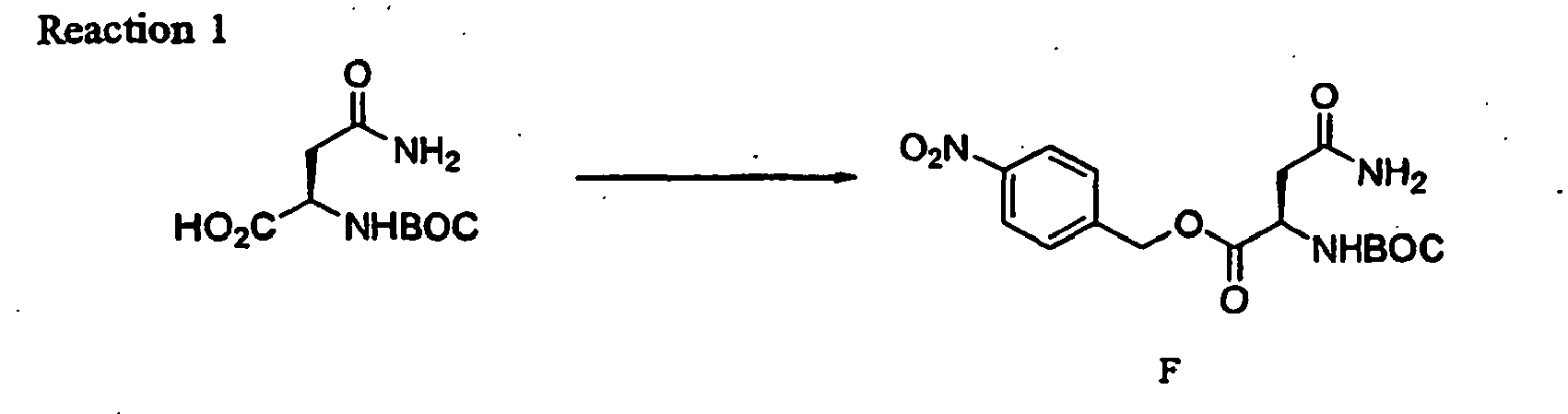


-

- A 0.5 M solution of the acid (2 ml) was added to 0.2 mmol of resin. To this mixture a 0.5 M solution of 1-hydroxybenzotriazole (2 ml), and a 0.5 M solution of 1,3-diisopropylcarbodiimide (2 ml) were added and the mixture was shaken for 90 mins at room temperature. The resin was then filtered and washed with 1-methyl-2-pyrrolidinone (3 x 6 ml), methanol (3 x 6 ml), and 1-methyl-2-pyrrolidinone (3 x 6 ml). Reaction completion was determined by a negative (yellow) Kaiser test. If the test remained positive the coupling procedure was repeated until negative.
- The resin (0.2 mmol) was shaken with 20% piperidine in 1-methyl-2-pyrrolidinone (6 ml) for 5 mins. The resin was filtered and shaken with 20% piperidine in 1-methyl-2-pyrrolidinone (6 ml) for 40 mins. The resin was then filtered and washed with 1-methyl-2-pyrrolidinone (3 x 6 ml), methanol (3 x 6 ml), and 1-methyl-2-pyrrolidinone (3 x 6 ml). Reaction completion was determined by a positive (blue) Kaiser test.


-


Compound U was obtained by repeating reactions 1-5 as for the synthesis of compound R by substituting resin M from reaction 1 with resin T obtained from reaction 2 above.
Using Examples 1-4 above, compounds V, W, X and Y can be prepared in a similar manner: - (a) Substituting D-tryptophan ester (e.g. methyl- or-ally- ester) for L-tryptophan t-butyl ester hydrochloride in Example 1 will produce compound V.

- (b) Substituting D-tryptophan ester (e.g. methyl- or-ally- ester) for L-tryptophan benzyl ester in Example 2 will produce compound W.

- (c) Substituting D-tryptophan ester (e.g. methyl- or-ally- ester) for Fmoc protected-L-tryptophan in Example 3 will produce compound X.

- (d) Substituting D-tryptophan ester (e.g. methyl- or-ally- ester) for Fmoc protected-L-tryptophan in Example 4 will produce compound Y.

-

-

-


-


-


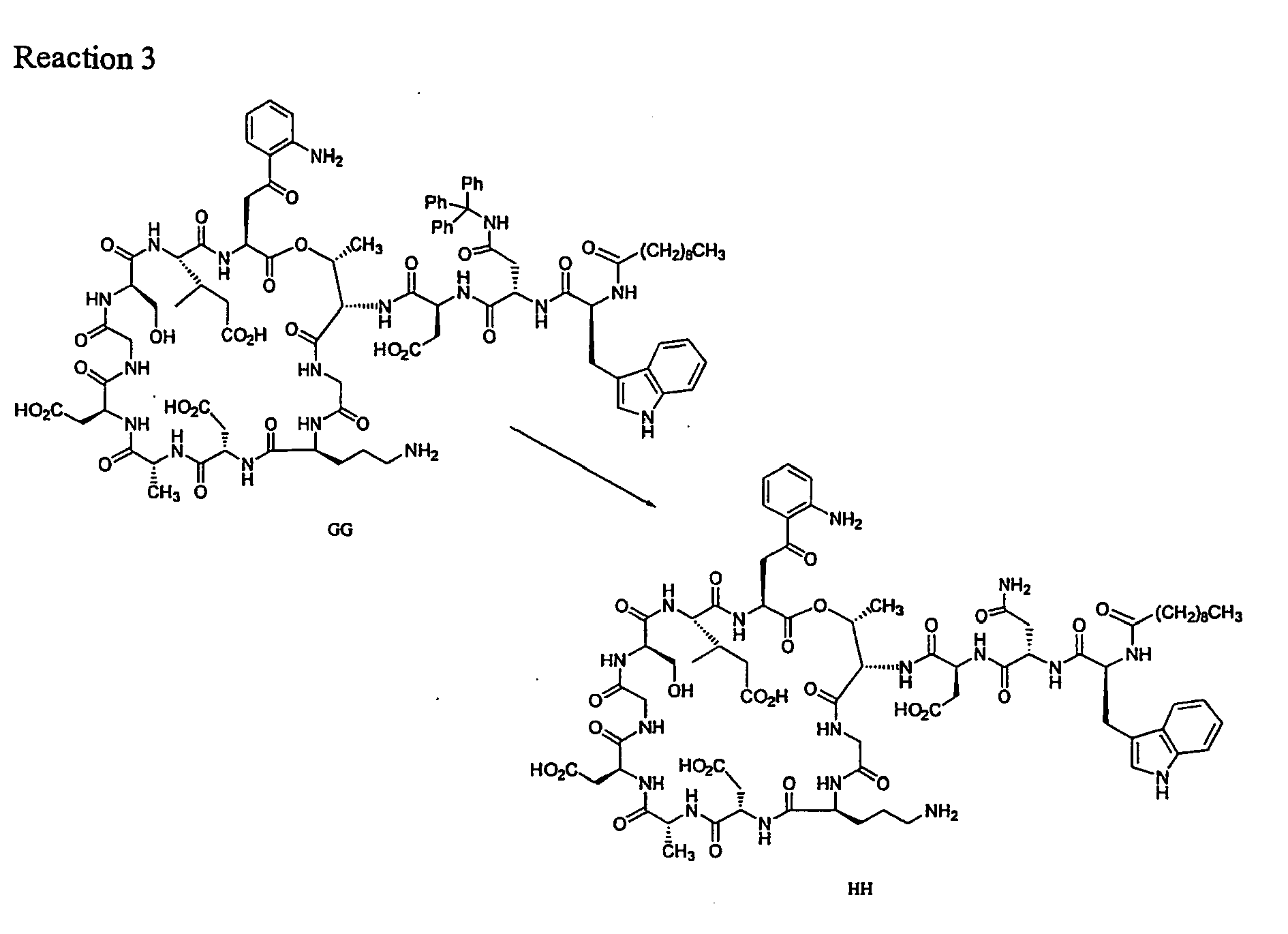
-


- Compounds according to Formula II were tested for antimicrobial activity against a panel of organisms according to standard procedures described by the National Committee for Clinical Laboratory Standards (NCCLS document M7-A5, Vol. 20, No. 2, 2000) except that all testing was performed at 37°C. Compounds were dissolved in 100% dimethyl sulfoxide and were diluted to the final reaction concentration (0.1 µg/mL-100 µg/mL) in microbial growth media. In all cases the final concentration of dimethyl sulfoxide incubated with cells is less than or equal to 1%. For minimum inhibitory concentration (MIC) calculations, 2-fold dilutions of compounds were added to wells of a microtiter plate containing 5x10⁴ bacteria cells in a final volume of 100 µL of media (Mueller-Hinton Broth supplemented with 50 mg/L Ca2+). The optical densities (OD) of the bacterial cells, which measures bacterial cell growth and proliferation, were measured using a commercial plate reader. The MIC value is defined as the lowest compound concentration inhibiting growth of the test organism. The MIC (in µg/ml) value of representative compounds of the present invention are listed in Table I.
Table I Compound
#MIC
(µg/ml)
S. aureusMIC
(µg/ml)
E. faecalisHH 6.25 100 Daptomycin 0.78 6.26 - The mouse protection test is an industry standard for measuring the efficacy of a test compound in vivo [for examples of this model see J. J. Clement, et al., Antimicrobial Agents and Chemotherapy, 38 (5), 1071-1078, (1994)]. As exemplified below, this test is used to demonstrate the in vivo efficacy of the compounds of the present invention against bacteria.
- The in vivo antibacterial activity is established by infecting female CD-1 mice (Charles River Lab, MA) weighing 19-23 g intraperitoneally with Methicillin Resistant S. aureus (MRSA) inoculum. The inoculum is prepared from Methicillin Resistant S. aureus (ATCC 43300). The MRSA inoculum is cultured in Mueller-Hinton (MH) broth at 37° C for 18 hours. The optical density at 600 nm (OD600) is determined for a 1:10 dilution of the overnight culture. Bacteria (8 x 10⁸ cfu) is added to 20 ml of phosphate buffered saline (Sigma P-0261) containing 5 % hog gastric mucin (Sigma M-2378). All animals are injected with 0.5 ml of the inoculum, equivalent to 2 x 10⁷ cfu/mouse, which is the dose causing ∼100% death of the animals without treatment.
- The test compound is dissolved in 10.0 ml of 50mM phosphate buffer to give a solution of 1 mg/ml (pH = 7.0). This solution is serially diluted with vehicle by 4-fold (1.5 ml to 6.0 ml) to give 025, 0.063 and 0.016 mg/ml solutions. All the solutions are filtered with 0.2 m Nalgene syringe filter. Immediately after the bacterial inoculation, group 1 animals are subcutaneously (sc) injected with buffer (no test compound) and groups 2 to 5 were given test compound sc at 10.0, 2.5, 0.63, and 0.16 mg/kg, respectively. Group 6 animals receive test compound sc at 10 mg/kg (or the highest therapeutic dose of a given compound) only for monitoring acute toxicity. These injections are repeated once at 4 hours after the inoculation for the respective groups. The injection volume at each time is 10 ml per kilogram of body weight The 50% protective dose (PD50) is calculated on the basis of the number of mice surviving 7 days after inoculation.
Claims (21)
- A method for the preparation of a compound having the structure:
 acylating a destryptophan compound having the structure:
 to obtain an ornithine amino protected compound having the structure:

- The method of claim 1, wherein the acylating step comprises the step of acylating the destryptophan compound with an acylating compound having the structure:

- The method of claim 1, wherein the acylating step comprises the steps of acylating the destryptophan compound with a first acylating compound having the structure:

acylating the terminal tryptophanyl compound with a second acylating compound having the structure:
- A method for the preparation of a compound having the structure:
 acylating a desasparagine compound having the structure:
 to obtain an ornithine amino protected compound having the structure:
 removing the ornithine protecting group and, when present, the asparagine protecting group, to obtain the compound having the structure:
- The method of claim 1 or claim 4, wherein R1 is 7-methylnonyl, 9-methyldecyl, 9-methylundecyl, nonyl, or decyl.
- The method of claim 1 or claim 4, wherein R5 is allyloxycarbonyl, carbobenzyloxycarbonyl or tert-butoxycarbonyl.
- The method of claim 1 or claim 4, wherein R6 is trityl.
- The method of claim 4, wherein the acylating step comprises acylating the desasparagine compound with an acylating compound having the structure:

- The method of claim 4, wherein the acylating step comprises the steps of:acylating the desasparagine compound with a first acylating compound having the structure:
 acylating the terminal asparaginyl compound with a second acylating compound having the structure:
- The method of claim 4, wherein the acylating step comprises the steps of:acylating the desasparagine compound with a first acylating compound having the structure:
 acylating the terminal asparaginyl compound with a second acylating compound having the structure:
 acylating the terminal tryptophanyl compound with a third acylating compound having the structure:
- The method of claim 4, further comprising the step of removing an asparagine residue from a destryptophan compound having the structure:

- The method of claim 11, further comprising the step of removing a tryptophan residue from a deacylated compound having the structure:

- The method of claim 1, further comprising the step of removing a tryptophan residue from a deacylated compound having the structure:

- The method of claim 13, further comprising the step of deacylating an ornithine protected compound having the structure:

- The method of claim 14, further comprising the step of protecting the ornithine amine group of a compound having the structure:

- A compound having the following structure:
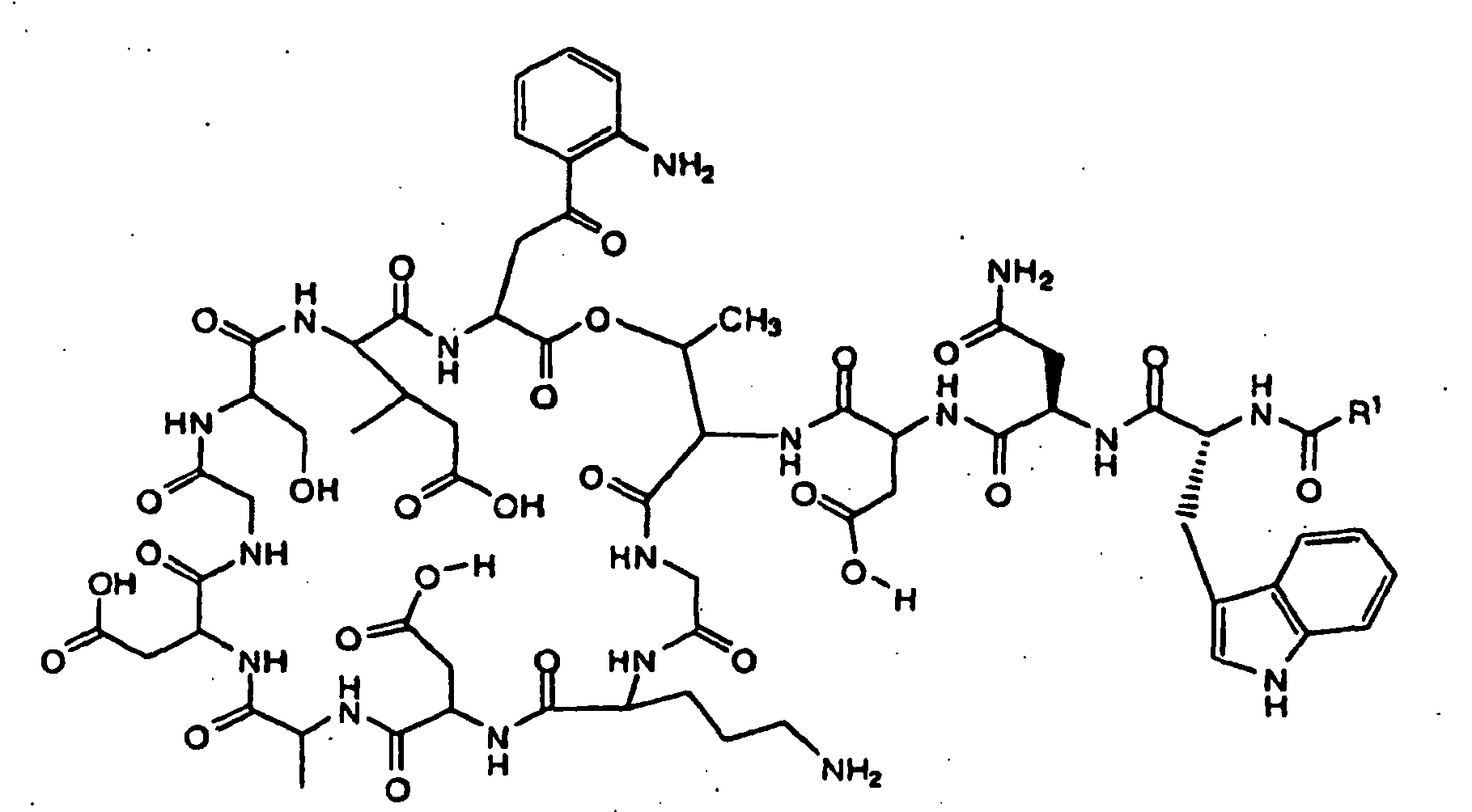
- The compound of claim 16, wherein R1 is 7-methylnonyl, 9-methyldecyl, 9-methylundecyl, nonyl, or decyl.
- A compound having the following structure:
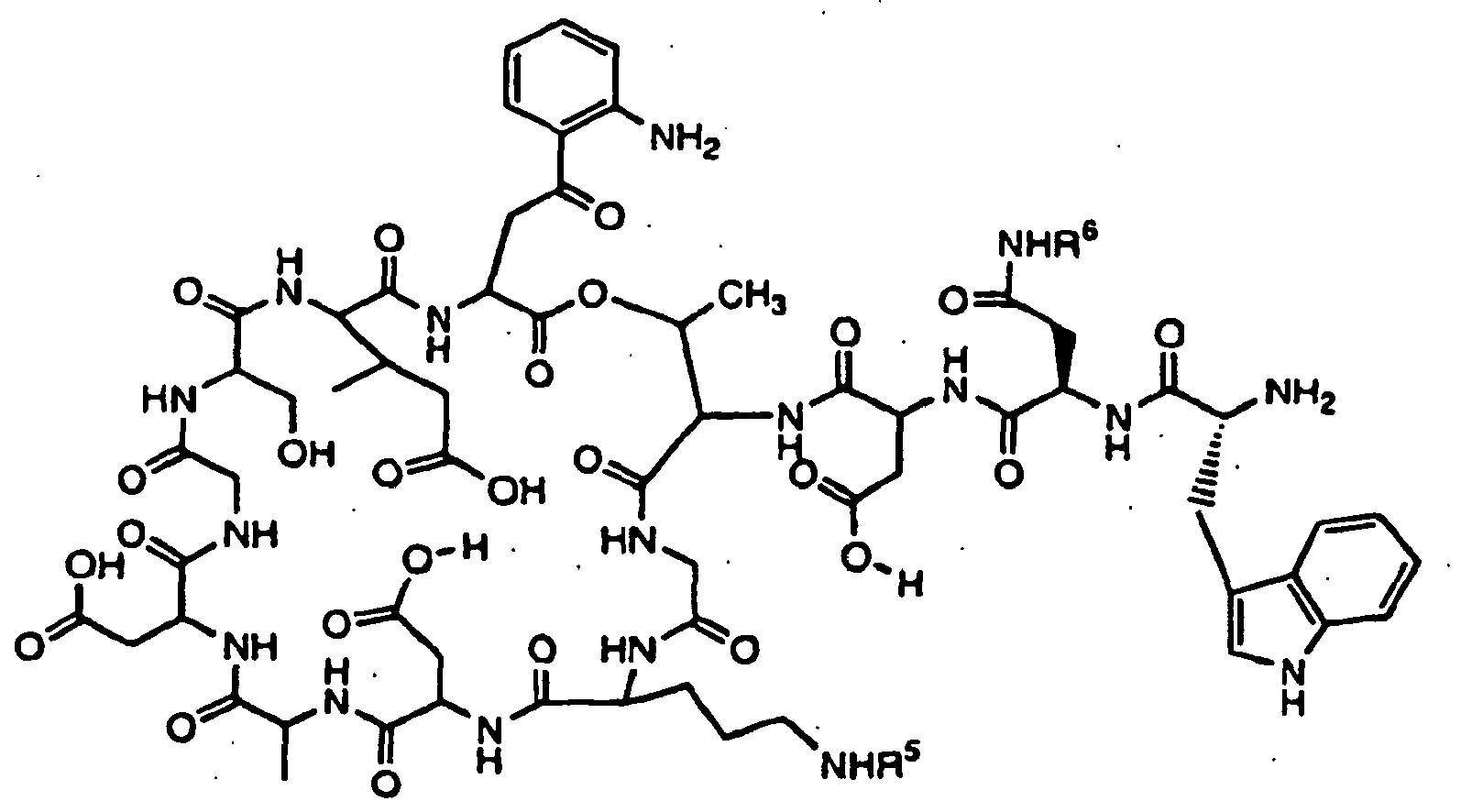
- A compound having the following structure:


- A compound having the following structure:

- The the compound of claim 18, 19 or 20, wherein R5 is allyloxycarbonyl, carbobenzyloxycarbonyl or tert-butoxycarbonyl.
Applications Claiming Priority (3)
| Application Number | Priority Date | Filing Date | Title |
|---|---|---|---|
| US31031301P | 2001-08-06 | 2001-08-06 | |
| US310313P | 2001-08-06 | ||
| PCT/US2002/025106 WO2003017924A2 (en) | 2001-08-06 | 2002-08-06 | Lipopeptide stereoisomers, methods for preparing same, and useful intermediates |
Publications (3)
| Publication Number | Publication Date |
|---|---|
| EP1423137A2 EP1423137A2 (en) | 2004-06-02 |
| EP1423137A4 EP1423137A4 (en) | 2005-11-30 |
| EP1423137B1 true EP1423137B1 (en) | 2009-04-29 |
Family
ID=23201948
Family Applications (2)
| Application Number | Title | Priority Date | Filing Date |
|---|---|---|---|
| EP02789158A Expired - Lifetime EP1423137B1 (en) | 2001-08-06 | 2002-08-06 | Lipopeptide stereoisomers, methods for preparing same, and useful intermediates |
| EP02761255A Withdrawn EP1423414A4 (en) | 2001-08-06 | 2002-08-06 | NOVEL DEPSIPEPTIDES AND PROCESS FOR THEIR PREPARATION |
Family Applications After (1)
| Application Number | Title | Priority Date | Filing Date |
|---|---|---|---|
| EP02761255A Withdrawn EP1423414A4 (en) | 2001-08-06 | 2002-08-06 | NOVEL DEPSIPEPTIDES AND PROCESS FOR THEIR PREPARATION |
Country Status (15)
| Country | Link |
|---|---|
| US (5) | US20030083240A1 (en) |
| EP (2) | EP1423137B1 (en) |
| JP (1) | JP2005531486A (en) |
| KR (1) | KR20040022233A (en) |
| CN (1) | CN100352836C (en) |
| AT (1) | ATE430160T1 (en) |
| AU (1) | AU2002353775A1 (en) |
| BR (1) | BR0211761A (en) |
| CA (2) | CA2456761A1 (en) |
| DE (1) | DE60232158D1 (en) |
| IL (1) | IL160171A0 (en) |
| NZ (1) | NZ531493A (en) |
| RU (1) | RU2348647C2 (en) |
| WO (2) | WO2003017924A2 (en) |
| ZA (1) | ZA200400928B (en) |
Families Citing this family (22)
| Publication number | Priority date | Publication date | Assignee | Title |
|---|---|---|---|---|
| WO2003017924A2 (en) * | 2001-08-06 | 2003-03-06 | Cubist Pharmaceuticals, Inc. | Lipopeptide stereoisomers, methods for preparing same, and useful intermediates |
| US6767718B2 (en) * | 2002-05-10 | 2004-07-27 | Biosource Pharm, Inc. | Lipodepsipeptide antibiotics and methods of preparation |
| US7671011B2 (en) * | 2003-06-19 | 2010-03-02 | Yeda Research & Development Co. Ltd. | Antimicrobial and anticancer lipopeptides |
| US20060004185A1 (en) | 2004-07-01 | 2006-01-05 | Leese Richard A | Peptide antibiotics and peptide intermediates for their prepartion |
| RU2007121705A (en) * | 2004-11-12 | 2008-12-20 | Кьюбист Фармасьютикалз | ANTI-INFECTIOUS LIPOPEPTIDES |
| KR20070089996A (en) * | 2004-12-06 | 2007-09-04 | 더 리전트 오브 더 유니버시티 오브 캘리포니아 | How to improve the structure and function of the arterioles |
| NZ580951A (en) * | 2005-04-29 | 2011-06-30 | Cubist Pharm Inc | Therapeutic compositions |
| CN102014897B (en) * | 2008-04-21 | 2015-08-05 | 西格纳姆生物科学公司 | Compound, compositions and its preparation method |
| NZ594019A (en) | 2008-12-22 | 2013-08-30 | Cubist Pharm Inc | Novel antibacterial agents for the treatment of gram positive infections |
| WO2010075416A1 (en) | 2008-12-23 | 2010-07-01 | Biosource Pharm, Inc. | Antibiotic compositions for the treatment of gram negative infections |
| CN101899094B (en) * | 2009-06-01 | 2012-11-21 | 安徽丰原发酵技术工程研究有限公司 | Preparation method of high-purity Daptomycin |
| KR101013755B1 (en) * | 2010-02-02 | 2011-02-14 | 주식회사 삼광산전 | LED module power supply converter for constant output |
| US8415307B1 (en) | 2010-06-23 | 2013-04-09 | Biosource Pharm, Inc. | Antibiotic compositions for the treatment of gram negative infections |
| CN102351775B (en) * | 2011-09-14 | 2013-10-09 | 佛山普正医药科技有限公司 | Preparation method of levo-5-hydroxytryptophan |
| WO2013059610A1 (en) | 2011-10-20 | 2013-04-25 | Trius Therapeutics, Inc. | Therapeutic combination of daptomycin and protein synthesis inhibitor antibiotic, and methods of use |
| CA2890933C (en) * | 2012-12-03 | 2021-06-08 | Novobiotic Pharmaceuticals, Llc | Novel depsipeptide and uses thereof |
| JP6634197B2 (en) * | 2013-05-08 | 2020-01-22 | 株式会社ゲノム創薬研究所 | Method for producing cyclic peptide compound using solid-phase resin |
| WO2015172047A1 (en) * | 2014-05-08 | 2015-11-12 | Merck Sharp & Dohme Corp. | Cyclic peptide compounds and related methods, salts and compositions |
| KR101671325B1 (en) * | 2015-01-09 | 2016-11-02 | 한국생명공학연구원 | Novel cyclic depsipeptide-based compound, separation method thereof, and antibacterial pharmaceutical composition containing the same as an active ingredient |
| US11667674B2 (en) * | 2016-04-08 | 2023-06-06 | Versitech Limited | Antibacterial cyclic lipopeptides |
| US10072045B1 (en) | 2017-06-26 | 2018-09-11 | Ramapo Pharmaceuticals, Inc. | Antibacterial lipopeptides and methods for their preparation and use |
| US11643438B2 (en) | 2018-07-20 | 2023-05-09 | The Board Of Regents Of The University Of Oklahoma | Antimicrobial peptides and methods of use |
Family Cites Families (30)
| Publication number | Priority date | Publication date | Assignee | Title |
|---|---|---|---|---|
| USRE32455E (en) | 1978-10-16 | 1987-07-07 | Eli Lilly And Company | A-21978 antibiotics and process for their production |
| USRE32333E (en) * | 1978-10-16 | 1987-01-20 | Eli Lilly And Company | A-21978 Antibiotics and process for their production |
| US4537717A (en) * | 1982-05-21 | 1985-08-27 | Eli Lilly And Company | Derivatives of A-21978C cyclic peptides |
| US4524135A (en) | 1982-05-21 | 1985-06-18 | Eli Lilly And Company | A-21978C cyclic peptides |
| US4482487A (en) | 1982-05-21 | 1984-11-13 | Eli Lilly And Company | A-21978C cyclic peptides |
| USRE32311E (en) | 1982-05-21 | 1986-12-16 | Eli Lilly And Company | Derivatives of A-21978C cyclic peptides |
| USRE32310E (en) * | 1982-05-21 | 1986-12-16 | Eli Lilly And Company | Derivatives of A-21978C cyclic peptides |
| US4399067A (en) | 1982-05-21 | 1983-08-16 | Eli Lilly And Company | Derivatives of A-21978C cyclic peptides |
| US4885243A (en) | 1984-10-09 | 1989-12-05 | Eli Lilly And Company | Process for producing A-21978C derivatives |
| US4800157A (en) * | 1985-09-09 | 1989-01-24 | Eli Lilly And Company | Process for producing the A-21978C antibiotics |
| US4874843A (en) * | 1987-12-03 | 1989-10-17 | Eli Lilly And Company | Chromatographic purification process |
| ZA883887B (en) * | 1987-06-10 | 1990-02-28 | Lilly Co Eli | Chromatographic purification process |
| US5039789A (en) * | 1988-04-11 | 1991-08-13 | Eli Lilly And Company | A54145 cyclic peptides |
| US4994270A (en) * | 1988-04-11 | 1991-02-19 | Eli Lilly And Company | A54145 antibiotics and process for their production |
| US5028590A (en) * | 1988-04-11 | 1991-07-02 | Eli Lilly And Company | Derivatives of A54145 cyclic peptides |
| US4977083A (en) * | 1988-04-11 | 1990-12-11 | Eli Lilly And Company | Processes for preparing A54145 compounds |
| IL98349A (en) | 1990-06-07 | 1995-05-26 | Lilly Co Eli | Lipopeptide deacylase |
| CA2131389A1 (en) * | 1992-03-02 | 1993-09-16 | John M. Maraganore | Thrombin receptor antagonists |
| US5378804A (en) * | 1993-03-16 | 1995-01-03 | Merck & Co., Inc. | Aza cyclohexapeptide compounds |
| DE4411025A1 (en) | 1994-03-30 | 1995-10-05 | Hoechst Ag | New lipopeptide A1437 derivs. with modified acyl gp. |
| US6010861A (en) * | 1994-08-03 | 2000-01-04 | Dgi Biotechnologies, Llc | Target specific screens and their use for discovering small organic molecular pharmacophores |
| ATE544851T1 (en) | 1996-03-08 | 2012-02-15 | Astellas Pharma Inc | METHOD FOR DEACYLATION OF CYCLIC LIPOPEPTIDES |
| US5958728A (en) * | 1996-11-18 | 1999-09-28 | Novo Nordiskbiotech, Inc. | Methods for producing polypeptides in mutants of bacillus cells |
| US20010041346A1 (en) | 1999-07-14 | 2001-11-15 | Michael E. Mendelsohn | Method for assaying compounds affecting smooth muscle contractile state |
| BR0017026A (en) | 1999-12-15 | 2003-01-07 | Cubist Pharm Inc | Lipeptides as antibacterial agents |
| IL150224A0 (en) | 1999-12-15 | 2002-12-01 | Cubist Pharm Inc | Lipopeptides and pharmaceutical compositions containing the same |
| CN1423656A (en) | 1999-12-15 | 2003-06-11 | 卡比斯特制药公司 | Lipopeptides as antibacterial agents |
| US6696412B1 (en) | 2000-01-20 | 2004-02-24 | Cubist Pharmaceuticals, Inc. | High purity lipopeptides, Lipopeptide micelles and processes for preparing same |
| US6750199B2 (en) * | 2000-07-17 | 2004-06-15 | Micrologix Biotech Inc. | Antimicrobial sulfonamide derivatives of lipopeptide antibiotics |
| WO2003017924A2 (en) * | 2001-08-06 | 2003-03-06 | Cubist Pharmaceuticals, Inc. | Lipopeptide stereoisomers, methods for preparing same, and useful intermediates |
-
2002
- 2002-08-06 WO PCT/US2002/025106 patent/WO2003017924A2/en not_active Ceased
- 2002-08-06 US US10/213,389 patent/US20030083240A1/en not_active Abandoned
- 2002-08-06 EP EP02789158A patent/EP1423137B1/en not_active Expired - Lifetime
- 2002-08-06 IL IL16017102A patent/IL160171A0/en unknown
- 2002-08-06 AU AU2002353775A patent/AU2002353775A1/en not_active Abandoned
- 2002-08-06 RU RU2004106630/04A patent/RU2348647C2/en not_active IP Right Cessation
- 2002-08-06 US US10/213,218 patent/US7262268B2/en not_active Expired - Fee Related
- 2002-08-06 WO PCT/US2002/024896 patent/WO2003014147A1/en not_active Ceased
- 2002-08-06 JP JP2003519096A patent/JP2005531486A/en active Pending
- 2002-08-06 EP EP02761255A patent/EP1423414A4/en not_active Withdrawn
- 2002-08-06 DE DE60232158T patent/DE60232158D1/en not_active Expired - Fee Related
- 2002-08-06 KR KR10-2004-7001758A patent/KR20040022233A/en not_active Ceased
- 2002-08-06 BR BRPI0211761-4A patent/BR0211761A/en not_active IP Right Cessation
- 2002-08-06 CA CA002456761A patent/CA2456761A1/en not_active Abandoned
- 2002-08-06 NZ NZ531493A patent/NZ531493A/en not_active IP Right Cessation
- 2002-08-06 AT AT02789158T patent/ATE430160T1/en not_active IP Right Cessation
- 2002-08-06 CA CA002456323A patent/CA2456323A1/en not_active Abandoned
- 2002-08-06 CN CNB028174658A patent/CN100352836C/en not_active Expired - Fee Related
-
2004
- 2004-02-04 ZA ZA200400928A patent/ZA200400928B/en unknown
-
2006
- 2006-04-28 US US11/414,762 patent/US20060194714A1/en not_active Abandoned
- 2006-06-06 US US11/448,066 patent/US7335726B2/en not_active Expired - Fee Related
-
2008
- 2008-01-30 US US12/022,470 patent/US20080119395A1/en not_active Abandoned
Non-Patent Citations (1)
| Title |
|---|
| MIAO ET AL.: "Daptomycin biosyntesis in Streptomyces reseosporus: cloning and analysis of the gene cluster and revision of the peptide stereochemistry", MICROBIOLOGY, vol. 151, 2005, pages 1507 - 523 * |
Also Published As
| Publication number | Publication date |
|---|---|
| US7335726B2 (en) | 2008-02-26 |
| CA2456761A1 (en) | 2003-02-20 |
| ZA200400928B (en) | 2005-05-04 |
| WO2003014147A1 (en) | 2003-02-20 |
| WO2003017924A2 (en) | 2003-03-06 |
| EP1423414A4 (en) | 2005-11-30 |
| IL160171A0 (en) | 2004-07-25 |
| JP2005531486A (en) | 2005-10-20 |
| CN100352836C (en) | 2007-12-05 |
| WO2003017924A3 (en) | 2004-03-04 |
| US20080119395A1 (en) | 2008-05-22 |
| US20030083240A1 (en) | 2003-05-01 |
| CN1551887A (en) | 2004-12-01 |
| RU2004106630A (en) | 2005-06-27 |
| US20060194714A1 (en) | 2006-08-31 |
| EP1423414A1 (en) | 2004-06-02 |
| EP1423137A4 (en) | 2005-11-30 |
| US20060223983A1 (en) | 2006-10-05 |
| KR20040022233A (en) | 2004-03-11 |
| US20030096948A1 (en) | 2003-05-22 |
| US7262268B2 (en) | 2007-08-28 |
| AU2002353775A1 (en) | 2003-03-10 |
| EP1423137A2 (en) | 2004-06-02 |
| NZ531493A (en) | 2006-03-31 |
| RU2348647C2 (en) | 2009-03-10 |
| BR0211761A (en) | 2007-01-09 |
| ATE430160T1 (en) | 2009-05-15 |
| CA2456323A1 (en) | 2003-03-06 |
| DE60232158D1 (en) | 2009-06-10 |
Similar Documents
| Publication | Publication Date | Title |
|---|---|---|
| US20080119395A1 (en) | Novel Depsipeptides and Process for Preparing Same | |
| US6794490B2 (en) | Lipopeptides as antibacterial agents | |
| AU784755B2 (en) | Daptomycin Analogs as antibacterial agents | |
| US20040067878A1 (en) | Novel lipopeptides as antibacterial agents | |
| EP1932853A1 (en) | Novel depsipeptides and process for preparing same | |
| AU2002326534A1 (en) | Novel depsipeptides and process for preparing same | |
| HK1112926A (en) | Daptomycin analogs as antibacterial agents | |
| HK1155465A (en) | Daptomycin analogs as antibacterial agents | |
| HK1156040A (en) | Lipopeptides as antibacterial agents | |
| CA2587848A1 (en) | Antiinfective lipopeptides |
Legal Events
| Date | Code | Title | Description |
|---|---|---|---|
| PUAI | Public reference made under article 153(3) epc to a published international application that has entered the european phase |
Free format text: ORIGINAL CODE: 0009012 |
|
| 17P | Request for examination filed |
Effective date: 20040304 |
|
| AK | Designated contracting states |
Kind code of ref document: A2 Designated state(s): AT BE BG CH CY CZ DE DK EE ES FI FR GB GR IE IT LI LU MC NL PT SE SK TR |
|
| AX | Request for extension of the european patent |
Extension state: AL LT LV MK RO SI |
|
| A4 | Supplementary search report drawn up and despatched |
Effective date: 20051017 |
|
| RIC1 | Information provided on ipc code assigned before grant |
Ipc: 7C 07K 7/50 A |
|
| 17Q | First examination report despatched |
Effective date: 20060119 |
|
| GRAP | Despatch of communication of intention to grant a patent |
Free format text: ORIGINAL CODE: EPIDOSNIGR1 |
|
| GRAS | Grant fee paid |
Free format text: ORIGINAL CODE: EPIDOSNIGR3 |
|
| GRAA | (expected) grant |
Free format text: ORIGINAL CODE: 0009210 |
|
| AK | Designated contracting states |
Kind code of ref document: B1 Designated state(s): AT BE BG CH CY CZ DE DK EE ES FI FR GB GR IE IT LI LU MC NL PT SE SK TR |
|
| REG | Reference to a national code |
Ref country code: GB Ref legal event code: FG4D |
|
| REG | Reference to a national code |
Ref country code: CH Ref legal event code: EP |
|
| REF | Corresponds to: |
Ref document number: 60232158 Country of ref document: DE Date of ref document: 20090610 Kind code of ref document: P |
|
| REG | Reference to a national code |
Ref country code: IE Ref legal event code: FG4D |
|
| NLV1 | Nl: lapsed or annulled due to failure to fulfill the requirements of art. 29p and 29m of the patents act | ||
| PG25 | Lapsed in a contracting state [announced via postgrant information from national office to epo] |
Ref country code: PT Free format text: LAPSE BECAUSE OF FAILURE TO SUBMIT A TRANSLATION OF THE DESCRIPTION OR TO PAY THE FEE WITHIN THE PRESCRIBED TIME-LIMIT Effective date: 20090829 Ref country code: FI Free format text: LAPSE BECAUSE OF FAILURE TO SUBMIT A TRANSLATION OF THE DESCRIPTION OR TO PAY THE FEE WITHIN THE PRESCRIBED TIME-LIMIT Effective date: 20090429 Ref country code: ES Free format text: LAPSE BECAUSE OF FAILURE TO SUBMIT A TRANSLATION OF THE DESCRIPTION OR TO PAY THE FEE WITHIN THE PRESCRIBED TIME-LIMIT Effective date: 20090809 Ref country code: AT Free format text: LAPSE BECAUSE OF FAILURE TO SUBMIT A TRANSLATION OF THE DESCRIPTION OR TO PAY THE FEE WITHIN THE PRESCRIBED TIME-LIMIT Effective date: 20090429 |
|
| PG25 | Lapsed in a contracting state [announced via postgrant information from national office to epo] |
Ref country code: SE Free format text: LAPSE BECAUSE OF FAILURE TO SUBMIT A TRANSLATION OF THE DESCRIPTION OR TO PAY THE FEE WITHIN THE PRESCRIBED TIME-LIMIT Effective date: 20090729 Ref country code: NL Free format text: LAPSE BECAUSE OF FAILURE TO SUBMIT A TRANSLATION OF THE DESCRIPTION OR TO PAY THE FEE WITHIN THE PRESCRIBED TIME-LIMIT Effective date: 20090429 |
|
| PG25 | Lapsed in a contracting state [announced via postgrant information from national office to epo] |
Ref country code: DK Free format text: LAPSE BECAUSE OF FAILURE TO SUBMIT A TRANSLATION OF THE DESCRIPTION OR TO PAY THE FEE WITHIN THE PRESCRIBED TIME-LIMIT Effective date: 20090429 Ref country code: EE Free format text: LAPSE BECAUSE OF FAILURE TO SUBMIT A TRANSLATION OF THE DESCRIPTION OR TO PAY THE FEE WITHIN THE PRESCRIBED TIME-LIMIT Effective date: 20090429 Ref country code: CZ Free format text: LAPSE BECAUSE OF FAILURE TO SUBMIT A TRANSLATION OF THE DESCRIPTION OR TO PAY THE FEE WITHIN THE PRESCRIBED TIME-LIMIT Effective date: 20090429 |
|
| PG25 | Lapsed in a contracting state [announced via postgrant information from national office to epo] |
Ref country code: BE Free format text: LAPSE BECAUSE OF FAILURE TO SUBMIT A TRANSLATION OF THE DESCRIPTION OR TO PAY THE FEE WITHIN THE PRESCRIBED TIME-LIMIT Effective date: 20090429 Ref country code: SK Free format text: LAPSE BECAUSE OF FAILURE TO SUBMIT A TRANSLATION OF THE DESCRIPTION OR TO PAY THE FEE WITHIN THE PRESCRIBED TIME-LIMIT Effective date: 20090429 |
|
| PLBE | No opposition filed within time limit |
Free format text: ORIGINAL CODE: 0009261 |
|
| STAA | Information on the status of an ep patent application or granted ep patent |
Free format text: STATUS: NO OPPOSITION FILED WITHIN TIME LIMIT |
|
| PG25 | Lapsed in a contracting state [announced via postgrant information from national office to epo] |
Ref country code: BG Free format text: LAPSE BECAUSE OF FAILURE TO SUBMIT A TRANSLATION OF THE DESCRIPTION OR TO PAY THE FEE WITHIN THE PRESCRIBED TIME-LIMIT Effective date: 20090729 Ref country code: MC Free format text: LAPSE BECAUSE OF NON-PAYMENT OF DUE FEES Effective date: 20090831 |
|
| REG | Reference to a national code |
Ref country code: CH Ref legal event code: PL |
|
| 26N | No opposition filed |
Effective date: 20100201 |
|
| GBPC | Gb: european patent ceased through non-payment of renewal fee |
Effective date: 20090806 |
|
| PG25 | Lapsed in a contracting state [announced via postgrant information from national office to epo] |
Ref country code: LI Free format text: LAPSE BECAUSE OF NON-PAYMENT OF DUE FEES Effective date: 20090831 Ref country code: CH Free format text: LAPSE BECAUSE OF NON-PAYMENT OF DUE FEES Effective date: 20090831 |
|
| REG | Reference to a national code |
Ref country code: FR Ref legal event code: ST Effective date: 20100430 |
|
| REG | Reference to a national code |
Ref country code: IE Ref legal event code: MM4A |
|
| PG25 | Lapsed in a contracting state [announced via postgrant information from national office to epo] |
Ref country code: FR Free format text: LAPSE BECAUSE OF NON-PAYMENT OF DUE FEES Effective date: 20090831 Ref country code: IE Free format text: LAPSE BECAUSE OF NON-PAYMENT OF DUE FEES Effective date: 20090806 Ref country code: DE Free format text: LAPSE BECAUSE OF NON-PAYMENT OF DUE FEES Effective date: 20100302 |
|
| PG25 | Lapsed in a contracting state [announced via postgrant information from national office to epo] |
Ref country code: GR Free format text: LAPSE BECAUSE OF FAILURE TO SUBMIT A TRANSLATION OF THE DESCRIPTION OR TO PAY THE FEE WITHIN THE PRESCRIBED TIME-LIMIT Effective date: 20090730 |
|
| PG25 | Lapsed in a contracting state [announced via postgrant information from national office to epo] |
Ref country code: GB Free format text: LAPSE BECAUSE OF NON-PAYMENT OF DUE FEES Effective date: 20090806 |
|
| PG25 | Lapsed in a contracting state [announced via postgrant information from national office to epo] |
Ref country code: IT Free format text: LAPSE BECAUSE OF FAILURE TO SUBMIT A TRANSLATION OF THE DESCRIPTION OR TO PAY THE FEE WITHIN THE PRESCRIBED TIME-LIMIT Effective date: 20090429 |
|
| PG25 | Lapsed in a contracting state [announced via postgrant information from national office to epo] |
Ref country code: LU Free format text: LAPSE BECAUSE OF NON-PAYMENT OF DUE FEES Effective date: 20090806 |
|
| PG25 | Lapsed in a contracting state [announced via postgrant information from national office to epo] |
Ref country code: TR Free format text: LAPSE BECAUSE OF FAILURE TO SUBMIT A TRANSLATION OF THE DESCRIPTION OR TO PAY THE FEE WITHIN THE PRESCRIBED TIME-LIMIT Effective date: 20090429 |
|
| PG25 | Lapsed in a contracting state [announced via postgrant information from national office to epo] |
Ref country code: CY Free format text: LAPSE BECAUSE OF FAILURE TO SUBMIT A TRANSLATION OF THE DESCRIPTION OR TO PAY THE FEE WITHIN THE PRESCRIBED TIME-LIMIT Effective date: 20090429 |