EP1422913B1 - Portable information terminal equipment - Google Patents
Portable information terminal equipment Download PDFInfo
- Publication number
- EP1422913B1 EP1422913B1 EP03090373A EP03090373A EP1422913B1 EP 1422913 B1 EP1422913 B1 EP 1422913B1 EP 03090373 A EP03090373 A EP 03090373A EP 03090373 A EP03090373 A EP 03090373A EP 1422913 B1 EP1422913 B1 EP 1422913B1
- Authority
- EP
- European Patent Office
- Prior art keywords
- units
- call
- equipment
- open
- controller
- Prior art date
- Legal status (The legal status is an assumption and is not a legal conclusion. Google has not performed a legal analysis and makes no representation as to the accuracy of the status listed.)
- Expired - Lifetime
Links
Images




Classifications
-
- G—PHYSICS
- G08—SIGNALLING
- G08B—SIGNALLING SYSTEMS, e.g. PERSONAL CALLING SYSTEMS; ORDER TELEGRAPHS; ALARM SYSTEMS
- G08B6/00—Tactile signalling systems, e.g. tactile personal calling systems
-
- H—ELECTRICITY
- H04—ELECTRIC COMMUNICATION TECHNIQUE
- H04M—TELEPHONIC COMMUNICATION
- H04M1/00—Substation equipment, e.g. for use by subscribers
- H04M1/02—Constructional features of telephone sets
- H04M1/0202—Portable telephone sets, e.g. cordless phones, mobile phones or bar type handsets
- H04M1/0206—Portable telephones comprising a plurality of mechanically joined movable body parts, e.g. hinged housings
- H04M1/0208—Portable telephones comprising a plurality of mechanically joined movable body parts, e.g. hinged housings characterized by the relative motions of the body parts
- H04M1/0214—Foldable telephones, i.e. with body parts pivoting to an open position around an axis parallel to the plane they define in closed position
-
- H—ELECTRICITY
- H04—ELECTRIC COMMUNICATION TECHNIQUE
- H04M—TELEPHONIC COMMUNICATION
- H04M1/00—Substation equipment, e.g. for use by subscribers
- H04M1/02—Constructional features of telephone sets
- H04M1/0202—Portable telephone sets, e.g. cordless phones, mobile phones or bar type handsets
- H04M1/0206—Portable telephones comprising a plurality of mechanically joined movable body parts, e.g. hinged housings
- H04M1/0208—Portable telephones comprising a plurality of mechanically joined movable body parts, e.g. hinged housings characterized by the relative motions of the body parts
- H04M1/0225—Rotatable telephones, i.e. the body parts pivoting to an open position around an axis perpendicular to the plane they define in closed position
-
- H—ELECTRICITY
- H04—ELECTRIC COMMUNICATION TECHNIQUE
- H04M—TELEPHONIC COMMUNICATION
- H04M1/00—Substation equipment, e.g. for use by subscribers
- H04M1/02—Constructional features of telephone sets
- H04M1/0202—Portable telephone sets, e.g. cordless phones, mobile phones or bar type handsets
- H04M1/0206—Portable telephones comprising a plurality of mechanically joined movable body parts, e.g. hinged housings
- H04M1/0208—Portable telephones comprising a plurality of mechanically joined movable body parts, e.g. hinged housings characterized by the relative motions of the body parts
- H04M1/0235—Slidable or telescopic telephones, i.e. with a relative translation movement of the body parts; Telephones using a combination of translation and other relative motions of the body parts
-
- H—ELECTRICITY
- H04—ELECTRIC COMMUNICATION TECHNIQUE
- H04M—TELEPHONIC COMMUNICATION
- H04M1/00—Substation equipment, e.g. for use by subscribers
- H04M1/02—Constructional features of telephone sets
- H04M1/0202—Portable telephone sets, e.g. cordless phones, mobile phones or bar type handsets
- H04M1/0206—Portable telephones comprising a plurality of mechanically joined movable body parts, e.g. hinged housings
- H04M1/0241—Portable telephones comprising a plurality of mechanically joined movable body parts, e.g. hinged housings using relative motion of the body parts to change the operational status of the telephone set, e.g. switching on/off, answering incoming call
- H04M1/0243—Portable telephones comprising a plurality of mechanically joined movable body parts, e.g. hinged housings using relative motion of the body parts to change the operational status of the telephone set, e.g. switching on/off, answering incoming call using the relative angle between housings
-
- H—ELECTRICITY
- H04—ELECTRIC COMMUNICATION TECHNIQUE
- H04M—TELEPHONIC COMMUNICATION
- H04M1/00—Substation equipment, e.g. for use by subscribers
- H04M1/02—Constructional features of telephone sets
- H04M1/0202—Portable telephone sets, e.g. cordless phones, mobile phones or bar type handsets
- H04M1/0206—Portable telephones comprising a plurality of mechanically joined movable body parts, e.g. hinged housings
- H04M1/0241—Portable telephones comprising a plurality of mechanically joined movable body parts, e.g. hinged housings using relative motion of the body parts to change the operational status of the telephone set, e.g. switching on/off, answering incoming call
- H04M1/0245—Portable telephones comprising a plurality of mechanically joined movable body parts, e.g. hinged housings using relative motion of the body parts to change the operational status of the telephone set, e.g. switching on/off, answering incoming call using open/close detection
-
- H—ELECTRICITY
- H04—ELECTRIC COMMUNICATION TECHNIQUE
- H04M—TELEPHONIC COMMUNICATION
- H04M1/00—Substation equipment, e.g. for use by subscribers
- H04M1/57—Arrangements for indicating or recording the number of the calling subscriber at the called subscriber's set
-
- H—ELECTRICITY
- H04—ELECTRIC COMMUNICATION TECHNIQUE
- H04M—TELEPHONIC COMMUNICATION
- H04M1/00—Substation equipment, e.g. for use by subscribers
- H04M1/72—Mobile telephones; Cordless telephones, i.e. devices for establishing wireless links to base stations without route selection
- H04M1/724—User interfaces specially adapted for cordless or mobile telephones
- H04M1/72403—User interfaces specially adapted for cordless or mobile telephones with means for local support of applications that increase the functionality
- H04M1/7243—User interfaces specially adapted for cordless or mobile telephones with means for local support of applications that increase the functionality with interactive means for internal management of messages
-
- H—ELECTRICITY
- H04—ELECTRIC COMMUNICATION TECHNIQUE
- H04M—TELEPHONIC COMMUNICATION
- H04M2250/00—Details of telephonic subscriber devices
- H04M2250/12—Details of telephonic subscriber devices including a sensor for measuring a physical value, e.g. temperature or motion
Definitions
- the present invention relates to portable information terminal equipment comprising two units coupled to one another such as a folding cellular phone.
- Folding cellular phones have been in widespread use.
- a general folding cellular phone comprises an upper unit having a display, etc. and a lower unit having an operating section, etc., which are rotationally connected to each other with a hinge so as to be foldable (openable and closable).
- a folding cellular phone provided with a hinge driving mechanism.
- the folding cellular phone has a built-in hinge driving mechanism including a motor and the like to enable the opening/ closing or rotational movement of the upper and lower units round the axis of a hinge unit.
- the aforementioned folding cellular phone with a hinge driving mechanism has a switch to drive the motor for opening/ closing the upper and lower units so that a user can open/ close the units at the flip of the switch.
- the functions of the folding cellular phone have not been fully developed, and the cellular phone is insufficient in usability and the like. Much the same is true for various portable information terminals, having two bodies (units) connected to one another by means other than a hinge.
- portable information terminal equipment such as a folding cellular phone informs a user of the receipt of a call or an e-mail message, etc. in a prescribed manner, as for example by a ring tone, flashing lights, vibrations, and a display of characters or images.
- folding portable communication equipment having an upper body and a lower body, which are immediately opened when receiving a transmission in Japanese Patent Application laid open No. 2002-281116 .
- a control means controls a drive means to open the upper and lower bodies.
- the folding portable communication equipment does not perform the informing process at the time of reception in cooperation with the drive means to improve usability.
- Patent Application GB 2 350 516 A discloses a telephone handset comprising a stationary element and a plurality of movable elements, at least two of the movable elements being movable, relative to the stationary element, between a closed position when the phone is not in use, and an open position when the phone is in use, respectively, whereby moving one of the elements between its closed and open positions causes another of the elements to move between its closed and open positions automatically.
- the movable parts may be linked by pulleys, rack and pinion, rollers and friction surfaces or electrical means.
- portable information terminal equipment comprising: two units; a connecting section for connecting the two units with each other for relative movement; a connecting section driving mechanism for changing the relative positions of the two units to open/ close the units; and a controller for controlling the connecting section driving mechanism to move either or both the units so that they are located in prescribed relative positions when receiving a call or a message based on information about the sender of the call or the message (sender information) and/ or the received message (received message information) to thereby inform a user of the receipt of the call or the message.
- examples of the connecting section include, but are not limited to a hinge unit, a slide structure and a rotative connector.
- the controller provides open/ close operation control so that the two units are located in prescribed relative positions when an incoming call is not answered or acknowledged.
- the portable information terminal equipment further comprises a detector for detecting the placed condition of the equipment, and the controller provides open/ close operation control based on the placed condition of the equipment detected by the detector.
- the detector detects the placed or actual/present condition of the portable information terminal equipment, as for example that the equipment is laid on a desk in closed condition.
- the detector detects the placed or actual/present condition of the portable information terminal equipment, as for example that the equipment is laid on a desk in closed condition.
- the portable information terminal equipment further comprises a setting interface for registering user settings with respect to the sender information, received message information and the relative positions of the two units, and the controller provides open/ close operation control in a manner so as to change the relative positions of the units when receiving a call or a message based on the user settings.
- the portable information terminal equipment is provided with means for allowing each user to register settings with respect to the association between each sender or the type of a received message (priority) and the relative positions of the two units.
- each user registers with respect to the association between each sender or the type of a received message (priority) and the relative positions of the two units.
- the two units repeatedly open/ close at prescribed intervals under the control of the controller.
- the portable information terminal equipment further comprises a battery state detector for detecting whether or not a battery, which is a power supply for driving the equipment, is being charged and/ or the remaining amount of charge in the battery, and the controller effects control of the connecting section driving mechanism based on the result of the detection by the battery state detector.
- the two units when an incoming call is not answered or acknowledged, are arranged in prescribed relative positions according to the number of unacknowledged calls (unattended receipt of calls) from the same sender during a prescribed time period under the control of the controller.
- the connecting section has a slide structure including slide rails set on one of the units and slide parts set on the other unit in sliding engagement with the slide rails, and the connecting section driving mechanism changes the relative positions of the two units by sliding the unit having the slide parts along the slide rails.
- the connecting section rotatably supports the two units on a rotation axis substantially perpendicular to a display surface, and the connecting section driving mechanism changes the relative positions of the two units by rotating either or both the units on the rotation axis.
- portable information terminal equipment comprising: upper and lower units coupled to one another by a hinge unit; a hinge driving mechanism for changing the relative positions of the upper and lower units by rotating either or both the units; and a controller for controlling the hinge driving mechanism to move (open/ close or rotate) the upper and/ or lower unit(s) so that they are located at a prescribed angle to each other when receiving a call or a message to thereby inform a user of the receipt of the call or the message.
- the upper and lower units are automatically arranged in prescribed positions so that they are located at a prescribed angle to each other on receipt of a call or a message, which enables a user to be informed of the receipt of the call or the message.
- portable information terminal equipment comprising: upper and lower units coupled to one another by a hinge unit; a hinge driving mechanism for changing the relative positions of the upper and lower units by rotating either or both the units; and a controller for controlling the hinge driving mechanism to move (open/ close or rotate) the upper and/ or lower unit(s) so that they are located at a prescribed angle to each other when receiving a call or a message based on information about the sender of the call or the message (sender information) and/ or the received message (received message information) to thereby inform a user of the receipt of the call or the message.
- the controller provides open/ close (rotation) operation control so that the upper and lower units are located at a prescribed angle to each other when an incoming call is not answered or acknowledged.
- the portable information terminal equipment further comprises a detector for detecting the placed condition of the equipment, and the controller provides open/ close (rotation) operation control based on the placed condition of the equipment detected by the detector.
- the detector detects the placed or present condition of the portable information terminal equipment, as for example that the equipment is laid on a desk in closed condition.
- the detector detects the placed or present condition of the portable information terminal equipment, as for example that the equipment is laid on a desk in closed condition.
- the portable information terminal equipment further comprises a setting interface for registering user settings with respect to open/ close positions (angles formed between the upper and lower units) associated with the sender information and/ or received message information, and the controller controls the hinge driving mechanism in a manner so as to change the angle formed between the upper and lower units when receiving a call or a message based on the user settings.
- the portable information terminal equipment is provided with means for allowing each user to register settings with respect to the association between each sender or the type of a received message (priority) and the open/ close position.
- each user it is possible to inform a user of the receipt of a call or a message by moving either or both the upper and lower units according to individual settings determined by the user so that they are located at a prescribed angle to each other.
- the upper and lower units repeatedly open/ close at prescribed intervals under the control of the controller.
- the two units are arranged in prescribed relative positions when receiving a call or a message to thereby inform a user of the receipt of the call or the message.
- the two units are arranged in prescribed relative positions when receiving a call or a message to thereby inform a user of the receipt of the call or the message.
- the two units are arranged in prescribed relative positions so as to be open. Consequently, it is possible to inform a user of the receipt of the call or the message effectively making use of a speaker and a display located on the inside surface (display surface) of the upper unit.
- the folding cellular phone according to Fig. 1 is provided with a hinge driving mechanism to enable the opening/ closing movement of upper and lower units through one-touch operation.
- the upper and lower units of the folding cellular phone automatically open/ close or rotate when receiving a call, a message or the like to inform a user of the receipt of the call or the message, thereby improving the usability and convenience of users.
- the hinge driving mechanism rotates the upper and/ or lower units so as to unfold the body.
- the hinge driving mechanism may rotate (open/ close) the upper and/ or lower units when receiving a call, a message, etc. based on information about the sender of the call or the message (sender information) and/ or the received message (received message information).
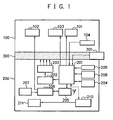
- the folding cellular phone with a hinge driving mechanism comprises an upper unit 100, a lower unit 200 and a hinge unit 300.
- the hinge unit 3 00 rotatably connects the edges of the upper unit 100 and the lower unit 200.
- the upper unit 100 has electrical interconnection with the lower unit 200 via FPC, etc. running through the hinge unit 300.
- the upper unit 100 includes a display 101, a speaker 102, an informing speaker 103 and a light sensor 104.
- the display 101, speaker 102, and informing speaker 103 are disposed on the display surface (inside surface) of the upper unit 100, and the light sensor 104 is disposed on the reverse (outside surface).
- the display 101 includes a liquid crystal display (LCD) having a rectangular shape, and displays a wide variety of information and images such as incoming call information.
- the speaker 102 outputs the voice of a calling party during a conversation on the folding cellular phone.
- the informing speaker 103 outputs, for example, a melody signaling an incoming call.
- the light sensor 104 is a unit for detecting the placed condition of the folding cellular phone. More specifically, the light sensor 104 detects whether or not the folding cellular phone is placed on a horizontal plane such as the top of a desk to determine if it is possible or appropriate to open/ close the upper unit 100 and the lower unit 200. Incidentally, other sensors may be used for detecting the placed condition of the folding cellular phone, the light sensor being given only as an example.
- the lower unit 200 includes a controller 201, a motor drive circuit 202, a motor 203, a memory 204, a radio section 205, a transmission/ reception circuit 206, a microphone 207, an operation/ input section 208, a light sensor 209, a battery state detector 210, and a battery 211.
- the operation/ input section 208 and the microphone 207 are disposed on the operation surface (inside surface) of the lower unit 200, and the light sensor 209 is disposed on the reverse (outside surface).
- the operation/ input section 208 is provided with operation keys and switches or buttons as an interface for inputting data or information to use various functions available in the folding cellular phone.
- a user inputs sender information and received message information, registers user settings with respect to the relative positions of the upper and lower units, and switches informing modes with the operation/ input section 208. Examples of informing modes include, but are not limited to call/ mail receive informing mode, battery state informing mode and unacknowledged call informing mode.
- the microphone 207 is a voice input section used when talking on the folding cellular phone.
- the light sensor 209 disposed on the reverse surface of the lower unit 200 is a sensor for detecting the placed condition of the folding cellular phone as with the light sensor 104 of the upper unit 100.
- the controller 201 judges the placed condition of the folding cellular phone based on the result of detection by the light sensors 104 and 209.
- the battery 211 which is a power supply for driving the folding cellular phone, is oriented in the battery chamber in a prescribed direction.
- the controller 201, motor drive circuit 202, motor 203, memory 204, radio section 205, transmission/ reception circuit 206, and battery state detector 210 are disposed inside the lower unit 200.
- the controller 201 controls the respective sections of the folding cellular phone.
- the display 101, informing speaker 103, light sensor 104, motor drive circuit 202, memory 204, radio section 205, operation/ input section 208, light sensor 209, battery state detector 210, an open/ close switch 301 and the like are connected to the controller 201.
- the radio section 205 is a circuit for transmitting/ receiving radio signals to/ from radio base stations via a communications antenna to carry out processes such as the detection of receipt of an incoming call or data (an e-mail message, etc.).
- the transmission/ reception circuit 206 transmits/ receives audio signals to/ from radio base stations during a conversation on the folding cellular phone.
- the transmission/ reception circuit 206 converts voice input through the microphone 207 into voice signals.
- the transmission/ reception circuit 206 converts voice signals into voice, and outputs the voice through the speaker 102.
- the memory 204 stores various information and data such as information on settings for the folding cellular phone, telephone directory information and received messages. Besides, the memory 204 stores sender information for identifying the sender of a call or a message on receipt of the call or the message, priorities of received messages, specific keywords and the like as setting information. The memory 204 also stores user setting information for controlling the opening/ closing movement of the upper and lower units.
- the user setting information includes open/ close positions or rotation angles (angles formed between the upper and lower units) with respect to, for example, each sender or priorities of received messages registered by a user.
- the open/ close switch 301 is located, for example, on the edge of the hinge unit 300.
- a user can open/ close the upper unit 100 and the lower unit 200 at the flip of the open/ close switch 301.
- the motor 203 serving as a hinge driving mechanism and other mechanisms bring the hinge unit 300 to open/ close the upper unit 100 and the lower unit 200 when the open/ close switch 301 is pushed or switched ON/ OFF.
- the motor 203 connected to the motor drive circuit 202 produces a driving force which is applied to an open/ close mechanism (not shown) of the hinge unit 300 to open/ close the upper unit 100 and the lower unit 200.
- the motor drive circuit 202 drives the motor 203 in response to switching operation by the open/ close switch 301 or an instruction from the controller 201 at the time of reception.
- the hinge unit 300 opens/ closes the upper unit 100 and the lower unit 200.
- the hinge unit 300 changes the relative positions of the upper unit 100 and the lower unit 200 (the angle formed between the upper and lower units) or the posture (open/ closed condition) of the folding cellular phone.
- While the motor drive circuit 202 and the motor 203 are disposed inside the lower unit 200 in Fig. 1 , they may be set in the hinge unit 300.
- the battery state detector 210 detects whether or not the battery 211 is being charged and/ or the remaining amount of charge in the battery 211.
- the battery state may be detected in a well known manner.
- the controller 201 controls the motor drive circuit 202 based on whether or not the battery 211 is being charged or the remaining amount of charge in the battery 211 detected by the battery state detector 210 to thereby control the open/ close operation of the hinge unit 300 driven by the motor 203.
- the controller 201 controls the motor drive circuit 202 according to the number of unacknowledged calls (unattended receipt of calls) from the same sender during a prescribed period of time so that the upper unit 100 and the lower unit 200 are located in prescribed relative positions (at a prescribed angle to each other).
- the motor drive circuit 202 drives the motor 203 depending on informing modes under the control of the controller 201 on receipt of a call or a message. Consequently, a driving force is applied to the open/ close mechanism of the hinge unit 300, and the unit 300 opens/ closes (rotates) the upper unit 100 and the lower unit 200 to change the posture of the folding cellular phone. Thus, a user can be informed of the receipt of the call or the message.
- the folding cellular phone may perform conventional informing processes, such as ringing, light emitting, message or image display and the like, in combination with the open/ close or rotative operation.
- the folding cellular phone informs a user of the receipt of a call or a message by opening/ closing the upper unit 100 and the lower unit 200 so that they are located at a prescribed angle to each other based on the sender information and/ or the received message information. That is, the folding cellular phone varies the angle formed between the upper unit 100 and the lower unit 200 according to senders and/ or the types or contents of received messages, which are identifiable by information obtained from incoming calls or received messages. In other words, when the folding cellular phone receives a call from a specific sender, the upper unit 100 and the lower unit 200 are arranged to form an angle associated with the sender therebetween.
- the cellular phone determines whether or not to change the angle formed between the upper unit 100 and the lower unit 200 based on the detection of its placed condition by the light sensors 104 and 209. Concretely, if he folding cellular phone is placed on a desk in closed condition (the upper unit forms an angle of 0° with the lower unit), when receiving a call from a specific sender, the cellular phone informs a user of the receipt of the call by opening the upper unit 100 and the lower unit 200 so that they are located at a prescribed angle, for example, 90° to each other as well as by a ringing tone and information display on the display 101.
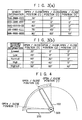
- Setting information such as the open/ close operation setting information shown in Fig. 3 , for controlling the opening/ closing or rotational movement of the upper and lower units on receipt of a call or a message is previously registered with the folding cellular phone of this embodiment. Angles formed between the upper and lower units on receipt of respective calls or messages are determined as the open/ close operation setting information.
- the folding cellular phone may be provided with a prescribed setting interface for allowing a user to make the open/ close operation settings. In this case, the user registers the open/ close operation settings through the setting interface.
- Fig. 3 (a) when receiving a call or a message from a sender included in this table (from a sender who is identified as one of sender numbers "AAA-BBB-CCC" to "MMM-NNN-OOO"), the upper and lower units are opened/ closed so that they form the angle indicated by the open/ close position associated with the sender to inform a user of the receipt of the call or the message.
- the folding cellular phone opens/ closes the upper and lower units so that they form the angle associated with the priority of the received message.
- the upper and lower units are arranged at a greater angle to each other when receiving a message having higher priority.
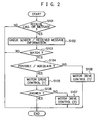
- the open/ close position (1), (2) and (1)' correspond to three types of motor drive control (1), (2) and (1)' shown in the flowchart of Fig. 2 , respectively.
- Tthis is to vary open/ close operation control according to the conditions of the folding cellular phone, such as the placed condition of the cellular phone detected by the light sensors 104 and 209, answering condition (whether or not a user has answered a call) and the like.
- angles formed between the upper unit 100 and the lower unit 200 are shown as the open/ close positions (1), (2) and (1)'.
- the open/ close positions for controlling the opening/ closing movement of the upper and lower units may be set to arbitrary angles, or may be selected from predetermined patterns, as for example those shown in Fig. 3 .
- the upper unit 100 and the lower unit 200 are provided with the light sensors 104 and 209, respectively, on their reverse surfaces exposed to outside when the folding cellular phone is folded.
- the light sensor 104 on the reverse of the upper unit 100 detects "light”
- the light sensor 209 on the reverse of the lower unit 200 detects "dark”
- the battery state detector 210 detects whether or not the battery 211 is being charged and/ or the remaining amount of charge in the battery 211.
- the controller 201 controls the motor drive circuit 202 based on the detection result to control the open/ close mechanism of the hinge unit 300 driven by the motor 203. Thus, a user can be informed as to whether or not the battery 211 is being charged and/ or the remaining amount of charge in the battery 211.
- Setting information such as the open/ close operation setting information shown in Fig. 6 , for determining the movement of the upper and lower units in the informing process is registered with the folding cellular phone in advance as in call/ mail receive informing mode described previously in connection with Fig. 3 .
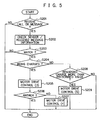
- tree types of open/ close position (3) to (5) correspond to three types of motor drive control (3) to (5) shown in the flowchart of Fig. 5 , respectively.
- the upper unit 100 and the lower unit 200 are arranged in prescribed relative positions according to the number of unacknowledged calls (unattended receipt of calls) from the same sender during a prescribed time period under the control of the controller 201.
- a user can be informed of the presence of unacknowledged calls and the number of unacknowledged calls.
- Setting information such as the open/ close operation setting information shown in Fig. 8 , for determining the movement of the upper and lower units in the informing process is registered with the folding cellular phone in advance as in call/ mail receive informing mode described previously in connection with Fig. 3 .
- three types of open/ close position (6) to (8) correspond to three types of motor drive control (6) to (8) shown in the flowchart of Fig. 7 , respectively.
- the placed condition of the folding cellular phone may be detected without using light sensors and without providing sensors on both the upper unit 100 and the lower unit 200.
- the radio section 205 detects the receipt of a call or a message, and informs the controller 201 about the detection (step S101, Yes).
- the controller 201 checks, for example, the sender number of the call or the message as the sender information and/ or the priority of the message as the received message information (step S102). Subsequently, the controller 201 matches the information obtained from the received call or message with the registered sender information and/ or received message information (open/ close operation setting information) stored in the memory 204 (step S 103).
- step S103, No When the information obtained from the received call or message does not match any of, for example, sender numbers (sender information) and/ or priorities (received message information) stored in the memory 204, that is, when open/ close operation is not required to inform a user of the receipt of the call or the message from the sender (step S103, No), normal informing processes are performed.
- the information obtained from the received call or message matches the sender information and/ or received message information stored in the memory 204, that is, when open/ close operation is required to inform a user of the receipt of the call or the message from the sender (step S 103, Yes)
- the following motor drive control (open/ close operation - informing control) process is carried out.
- the light sensors 104 and 209 detect whether or not the folding cellular phone is placed on a substantially horizontal plane such as the top of a desk. Having determined to perform open/ close operation - informing control process by checking the sender/ received message information, the controller 201 determines if it is possible or appropriate to open/ close the upper unit 100 and the lower unit 200 based on the output of the light sensors 104 and 209 (step S104). Thus, the type of motor drive control is determined (open/ close position (1) or (1)' is selected) based on judgments about the sender/ received message information and the placed condition of the folding cellular phone made at steps S103 and S 104.
- step S104 When the controller 201 has determined that the folding cellular phone is placed on a substantially horizontal plane such as a desk or the like (step S104, Yes), motor drive control (1) is to be executed. When the controller 201 has determined that it is impossible or inappropriate to open/ close the upper unit 100 and the lower unit 200 (step S104, No), motor drive control (1)' is to be executed.
- the controller 201 controls the motor drive circuit 202 and the motor 203 based on the setting information as shown in Fig. 3 so that the upper unit 100 and the lower unit 200 are located in prescribed relative positions or at a prescribed angle to each other (step S105 or S108).
- visual and acoustic informing processes are also performed through the display 101 and the informing speaker 103. That is, the display 101 on the upper unit 100 displays the sender information or the like and the informing speaker 103 outputs the ring tone.
- step S 106, No motor drive control (2) is to be executed.
- the controller 201 controls the motor drive circuit 202 and the motor 203 so that the upper unit 100 and the lower unit 200 are located in prescribed relative positions or at a prescribed angle (open/ close position (2)) to each other (step S107). Thereby, it is possible to inform the user as to the presence of the unacknowledged call by the angle formed between the upper unit 100 and the lower unit 200.
- FIG. 4 An example of open/ close operation control will be explained referring to Fig. 4 .
- the upper unit 100 and the lower unit 200 are opened so as to be at an angle of about 90° (open/ close position (1)) to each other.
- the upper and lower units are arranged at an angle of from 0° to 10° (open/ close position (1)') to each other.
- the upper and lower units are opened at an angle of about 90° (open/ close position (1)) to each other, in the case where the user has not answered the call and motor drive control (2) is executed, the upper and lower units are closed so as to be at an angle of about 60° (open/ close position (2)) to each other to inform the user about the unanswered call.
- the radio section 205 detects the receipt of a call or a message, and informs the controller 201 about the detection (step S201, Yes).
- the controller 201 checks, for example, the sender number of the call or the message as the sender information and/ or the priority of the message as the received message information (step S202). Subsequently, the controller 201 matches the information obtained from the received call or message with the registered sender information and/ or received message information (open/ close operation setting information) stored in the memory 204 (step S203).
- step S203, No When the information obtained from the received call or message does not match any of, for example, sender numbers (sender information) and/ or priorities (received message information) stored in the memory 204, that is, when open/ close operation is not required to inform a user of the receipt of the call or the message from the sender (step S203, No), normal informing processes are performed.
- the information obtained from the received call or message matches the sender information and/ or received message information stored in the memory 204, that is, when open/ close operation is required to inform a user of the receipt of the call or the message from the sender (step S203, Yes)
- the following motor drive control (open/ close operation - informing control) process is carried out.
- the battery state detector 210 detects whether or not the battery 211 is being charged and/ or the remaining amount of charge in the battery 211. Having determined to perform open/ close operation - informing control process by checking the sender/ received message information, the controller 201 determines whether or not the battery 211 is being charged based on the detection result or output from the battery state detector 210 (step S204). When the battery 211 is not being charged, the controller 201 compares the remaining amount of charge in the battery 211 with a predetermined value for judging whether it is possible or appropriate to open/ close the upper unit 100 and the lower unit 200 (step S208).
- the type of motor drive control is determined (open/ close position (3) or (5) is selected) based on judgments about the sender/ received message information and the battery state made at steps S203, S204 and S208.
- the controller 201 controls the motor drive circuit 202 and the motor 203 (step S205 or S209).
- step S204 When the battery 211 of the folding cellular phone is being charged (step S204, Yes), and the user does not answer or acknowledge the call (step S206, No), motor drive control (4) is to be executed. Accordingly, the controller 201 controls the motor drive circuit 202 and the motor 203 so that the upper unit 100 and the lower unit 200 are located in prescribed relative positions or at a prescribed angle (open/ close position (4)) to each other (step S207). Thereby, it is possible to inform the user as to the presence of the unacknowledged call by the angle formed between the upper and lower units.
- the radio section 205 detects the receipt of a call, and informs the controller 201 about the detection (step S301, Yes).
- the controller 201 checks, for example, the sender number of the call as the sender information (step S302), and matches the sender information obtained from the received call with the registered sender information stored in the memory 204 (step S303).
- step S303, No When the information obtained from the received call does not match any of, for example, sender numbers (sender information) stored in the memory 204, that is, when open/ close operation is not required to inform a user of the receipt of the call from the sender (step S303, No), normal informing processes are performed.
- the controller 201 determines whether or not the last call within, for example, 6 hours was an unacknowledged call based on an incoming call history stored in the memory 204.
- step 304, Yes the following motor drive control (open/ close operation - informing control) process is carried out.
- step S305 When the last call was an unacknowledged call, the number of unacknowledged calls from the same sender during a prescribed time period (e.g. 6 hours) is counted with reference to the incoming call history stored in the memory 204 (step S305). In Fig. 7 , when the number of unacknowledged calls is less than 3, motor drive control (6) is to be executed. On the other hand, when there are 3 or more unacknowledged calls, motor drive control (7) is to be executed (steps 5306 and S307).
- a prescribed time period e.g. 6 hours
- step S307 when the user does not answer the call at step S307 (step S308, No), motor drive control (8) is to be executed. Accordingly, the controller 201 controls the motor drive circuit 202 and the motor 203 so that the upper unit 100 and the lower unit 200 are located in prescribed relative positions or at a prescribed angle (open/ close position (8)) to each other (step S309). Thereby, it is possible to inform the user as to the presence of the unacknowledged call by the angle formed between the upper and lower units.
- the user may set an arbitrary number as the threshold.
- the time for counting the number of unacknowledged calls from a specific sender is not limited to 6 hours, and the user may set an arbitrary period of time as the count time.
- the upper unit 100 and the lower unit 200 just move into prescribed relative positions so as to be opened/ closed at a prescribed angle to each other according to setting information, and stay therein.
- the upper and lower units may be repeatedly opened/ closed or rotated prescribed degrees back and forth at prescribed intervals during the informing period.
- the received message information detected by the folding cellular phone is not limited to the priorities of received messages.
- the received message information may be previously specified keywords contained in mail addresses of senders, messages and/ or titles of messages. In this case, open/ close operation can be controlled according to the keywords.
- the placed condition of the cellular phone is detected by sensors, and open/ close operation is performed based on the detection result.
- a user may also switch between normal mode and mode for performing open/ close operation by prescribed input. This allows a user to place the folding cellular phone on a desk or the like as needed and switch modes from normal mode to mode for performing open/ close operation by the input.
- the folding cellular phone may further include a function for stopping open/ close operation when detecting a prescribed reactive force which cause an obstruction to the opening/ closing movement of the upper and lower units. With this function, it is possible to prevent an undesired failure and a malfunction due to such obstruction.
- the present invention can be applied to general portable information terminal equipment, such as PDA (Personal Digital Assistant), which is provided with a radio communication function and comprised of upper and lower units rotatably coupled to one another by a connecting section driven by a connecting section driving mechanism.
- PDA Personal Digital Assistant
- the present invention is applicable to a sliding cellular phone as shown in Figs. 9 and 10 in similar fashion.
- Fig. 9 is an exterior view of a sliding cellular phone with its upper unit 400 and lower unit 500 being open.
- Fig. 10 is an exterior view of the sliding cellular phone in closed condition.
- the sliding cellular phone is provided with a slide structure 600 including slide parts 610 set on the sides of the upper unit 400 and slide rails 620 set on the sides of the lower unit 500 in sliding engagement with the slide parts 610.
- the upper unit 400 and the lower unit 500 are slidably connected to each other by the slide structure 600.
- open/ close positions registered as setting information are set by the distance that the upper unit 400 or lower unit 500 is to be moved as shown in Fig. 11 .
- a controller controls a motor to slide the slide parts 610 along the slide rails 620 a predetermined distance so that the upper unit 400 and the lower unit 500 are arranged in prescribed relative positions. Thereby, a user can be informed of the receipt of the call or the message.
- Fig. 12 is a side view of the sliding cellular phone showing examples of open/ close positions in the sliding movements.
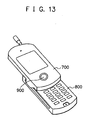
- the present invention is applicable to a turning cellular phone shown in Figs. 13 and 14 in similar fashion, which reflect a turning cellular phone in open condition and in closed condition, respectively.
- the turning cellular phone comprises an upper unit 700, a lower unit 800 and a rotative connector 900 that rotatably supports the upper unit 700 and lower unit 800 on a rotation axis substantially perpendicular to a display surface.
- the upper unit 700 and the lower unit 800 are rotatably connected to each other by the rotative connector 900.
- Fig. 15 shows the application of the present invention to the turning cellular phone, open/ close positions registered as setting information are provided by the angle formed between the upper unit 700 and the lower unit 800 when they are rotated on the axis substantially perpendicular to a display surface.
- a controller When receiving a call or a message, a controller controls a motor to rotate the upper unit 700 and/ or the lower unit 800 on the rotative connector 900 so that they are located at a prescribed angle to each other. Thereby, a user can be informed of the receipt of the call or the message.
- Fig. 16 is an overhead view of the turning cellular phone showing examples of open/ close positions in the rotational movements.
Landscapes
- Engineering & Computer Science (AREA)
- Signal Processing (AREA)
- Physics & Mathematics (AREA)
- General Physics & Mathematics (AREA)
- Telephone Function (AREA)
- Telephone Set Structure (AREA)
- Mobile Radio Communication Systems (AREA)
Description
- The present invention relates to portable information terminal equipment comprising two units coupled to one another such as a folding cellular phone.
- Folding cellular phones have been in widespread use. A general folding cellular phone comprises an upper unit having a display, etc. and a lower unit having an operating section, etc., which are rotationally connected to each other with a hinge so as to be foldable (openable and closable). Besides, there has been proposed a folding cellular phone provided with a hinge driving mechanism. The folding cellular phone has a built-in hinge driving mechanism including a motor and the like to enable the opening/ closing or rotational movement of the upper and lower units round the axis of a hinge unit.
- The aforementioned folding cellular phone with a hinge driving mechanism has a switch to drive the motor for opening/ closing the upper and lower units so that a user can open/ close the units at the flip of the switch. However, the functions of the folding cellular phone have not been fully developed, and the cellular phone is insufficient in usability and the like. Much the same is true for various portable information terminals, having two bodies (units) connected to one another by means other than a hinge.
- On the other hand, portable information terminal equipment such as a folding cellular phone informs a user of the receipt of a call or an e-mail message, etc. in a prescribed manner, as for example by a ring tone, flashing lights, vibrations, and a display of characters or images.
- There is found folding portable communication equipment having an upper body and a lower body, which are immediately opened when receiving a transmission in
Japanese Patent Application laid open No. 2002-281116 -
Patent Application GB 2 350 516 A - It is therefore an object of the invention to provide
- portable information terminal equipment comprising: two units; a connecting section for connecting the two units with each other for relative movement; a connecting section driving mechanism for changing the relative positions of the two units to open/ close the units; and a controller for controlling the connecting section driving mechanism to move either or both the units so that they are located in prescribed relative positions when receiving a call or a message based on information about the sender of the call or the message (sender information) and/ or the received message (received message information) to thereby inform a user of the receipt of the call or the message.
- With this construction, it is possible to automatically arrange the two units in prescribed relative positions on receipt of a call or a message according to the sender information (sender address, etc.) and/ or received message information (priority, specific keyword, etc.).
- Incidentally, examples of the connecting section include, but are not limited to a hinge unit, a slide structure and a rotative connector.
- In accordance with a first aspect, the controller provides open/ close operation control so that the two units are located in prescribed relative positions when an incoming call is not answered or acknowledged.
- With this construction, it is possible to indicate an unacknowledged call by moving the two units into prescribed relative positions.
- In accordance with a second aspect, the portable information terminal equipment further comprises a detector for detecting the placed condition of the equipment, and the controller provides open/ close operation control based on the placed condition of the equipment detected by the detector.
- In this construction, the detector detects the placed or actual/present condition of the portable information terminal equipment, as for example that the equipment is laid on a desk in closed condition. Thus, it is possible to automatically arrange the two units in prescribed relative positions according to the placed condition of the portable information terminal equipment.
- In accordance with a third aspect, the portable information terminal equipment further comprises a setting interface for registering user settings with respect to the sender information, received message information and the relative positions of the two units, and the controller provides open/ close operation control in a manner so as to change the relative positions of the units when receiving a call or a message based on the user settings.
- In this construction, the portable information terminal equipment is provided with means for allowing each user to register settings with respect to the association between each sender or the type of a received message (priority) and the relative positions of the two units. Thus, it is possible to inform a user of the receipt of a call or a message by arranging the two units in prescribed relative positions according to individual settings determined by the user.
- In accordance with a fourth aspect, the two units repeatedly open/ close at prescribed intervals under the control of the controller.
- With this construction, it is possible to inform a user of the receipt of a call or a message not only by arranging the two units in prescribed relative positions but also by making the two units repeatedly open/ close (move to and from the prescribed relative positions) during the informing period.
- In accordance with a fifth aspect, the portable information terminal equipment further comprises a battery state detector for detecting whether or not a battery, which is a power supply for driving the equipment, is being charged and/ or the remaining amount of charge in the battery, and the controller effects control of the connecting section driving mechanism based on the result of the detection by the battery state detector.
- With this construction, it is possible to control the connecting section driving mechanism based on whether or not a battery is being charged and the remaining amount of charge in the battery.
- In accordance with an sixth aspect, when an incoming call is not answered or acknowledged, the two units are arranged in prescribed relative positions according to the number of unacknowledged calls (unattended receipt of calls) from the same sender during a prescribed time period under the control of the controller.
- With this construction, it is possible to indicate unacknowledged calls according to the number of unacknowledged calls from the same sender during a prescribed time period.
- In accordance with a seventh aspect, the connecting section has a slide structure including slide rails set on one of the units and slide parts set on the other unit in sliding engagement with the slide rails, and the connecting section driving mechanism changes the relative positions of the two units by sliding the unit having the slide parts along the slide rails.
- In accordance with a eighth aspect, the connecting section rotatably supports the two units on a rotation axis substantially perpendicular to a display surface, and the connecting section driving mechanism changes the relative positions of the two units by rotating either or both the units on the rotation axis.
- In accordance with an ninth aspect, there is provided portable information terminal equipment comprising: upper and lower units coupled to one another by a hinge unit; a hinge driving mechanism for changing the relative positions of the upper and lower units by rotating either or both the units; and a controller for controlling the hinge driving mechanism to move (open/ close or rotate) the upper and/ or lower unit(s) so that they are located at a prescribed angle to each other when receiving a call or a message to thereby inform a user of the receipt of the call or the message.
- In this construction, the upper and lower units are automatically arranged in prescribed positions so that they are located at a prescribed angle to each other on receipt of a call or a message, which enables a user to be informed of the receipt of the call or the message.
- In accordance with a tenth aspect, there is provided portable information terminal equipment comprising: upper and lower units coupled to one another by a hinge unit; a hinge driving mechanism for changing the relative positions of the upper and lower units by rotating either or both the units; and a controller for controlling the hinge driving mechanism to move (open/ close or rotate) the upper and/ or lower unit(s) so that they are located at a prescribed angle to each other when receiving a call or a message based on information about the sender of the call or the message (sender information) and/ or the received message (received message information) to thereby inform a user of the receipt of the call or the message.
- With this construction, it is possible to automatically arrange the upper and lower units in prescribed positions according to the sender information (sender address, etc.) and/ or received message information (priority, specific keyword, etc.) on receipt of a call or a message so that they are located at a prescribed angle to each other.
- In accordance with a eleventh aspect, the controller provides open/ close (rotation) operation control so that the upper and lower units are located at a prescribed angle to each other when an incoming call is not answered or acknowledged.
- With this construction, it is possible to indicate an unacknowledged call by automatically moving either or both the upper and lower units so that they are located at a prescribed angle to each other.
- In accordance with a twelfth aspect, the portable information terminal equipment further comprises a detector for detecting the placed condition of the equipment, and the controller provides open/ close (rotation) operation control based on the placed condition of the equipment detected by the detector.
- In this construction, the detector detects the placed or present condition of the portable information terminal equipment, as for example that the equipment is laid on a desk in closed condition. Thus, it is possible to automatically move either or both the upper and lower units according to the placed condition of the portable information terminal equipment so that they are located at a prescribed angle to each other.
- In accordance with a thirteenth aspect, the portable information terminal equipment further comprises a setting interface for registering user settings with respect to open/ close positions (angles formed between the upper and lower units) associated with the sender information and/ or received message information, and the controller controls the hinge driving mechanism in a manner so as to change the angle formed between the upper and lower units when receiving a call or a message based on the user settings.
- In this construction, the portable information terminal equipment is provided with means for allowing each user to register settings with respect to the association between each sender or the type of a received message (priority) and the open/ close position. Thus, it is possible to inform a user of the receipt of a call or a message by moving either or both the upper and lower units according to individual settings determined by the user so that they are located at a prescribed angle to each other.
- In accordance with a fourteenth aspect, the upper and lower units repeatedly open/ close at prescribed intervals under the control of the controller.
- With this construction, it is possible to inform a user of the receipt of a call or a message not only by rotating the upper and lower units so that they are located at a prescribed angle to each other but also by repeatedly opening/ closing the units (by repeatedly rotating the units by prescribed degrees back and forth) during the informing period.
- As set forth hereinabove, in accordance with the present invention, the two units are arranged in prescribed relative positions when receiving a call or a message to thereby inform a user of the receipt of the call or the message. Thus, it is possible to improve the usability for and convenience of the user.
- Moreover, even if the portable information terminal equipment is folded when receiving a call or a message, the two units are arranged in prescribed relative positions so as to be open. Consequently, it is possible to inform a user of the receipt of the call or the message effectively making use of a speaker and a display located on the inside surface (display surface) of the upper unit.
- Further objects and features of the present invention will become more apparent from the consideration of the following detailed description taken in conjunction with the accompanying drawings in which:
-
Fig. 1 is a block diagram showing the configuration of a folding cellular phone with a hinge driving mechanism according to an embodiment of the invention; -
Fig. 2 is a flowchart for explaining the operation of the folding cellular phone with a hinge driving mechanism depicted inFig. 1 in call/ mail receive informing mode; -
Fig. 3 shows examples of open/ close operation setting information for the folding cellular phone depicted inFig. 1 in call/ mail receive informing mode, in whichFig. 3(a) is a table showing an association between sender information and open/ close positions (open/ close angles) andFig. 3(b) is a table of the association between received message information and open/ close positions; -
Fig. 4 is a side view of the folding cellular phone with the driving mechanism ofFig. 1 showing examples of open/ close positions; -
Fig. 5 is a flowchart for explaining the operation of the folding cellular phone with a hinge driving mechanism depicted inFig. 1 in battery state informing mode; -
Fig. 6 shows examples of open/ close operation setting information for the folding cellular phone depicted inFig. 1 in battery state informing mode; -
Fig. 7 is a flowchart for explaining the operation of the folding cellular phone with a hinge driving mechanism depicted inFig. 1 in unacknowledged call informing mode; -
Fig. 8 shows examples of open/ close operation setting information for the folding cellular phone depicted inFig. 1 in unacknowledged call informing mode; -
Fig. 9 is an exterior view of a sliding cellular phone in open condition according to an embodiment of the invention; -
Fig. 10 is an exterior view of the sliding cellular phone depicted inFig. 9 in closed condition; -
Fig. 11 shows examples of open/ close operation setting information for the sliding cellular phone depicted inFig. 9 in call/ mail receive informing mode; -
Fig. 12 is a side view of the sliding cellular phone depicted inFig. 9 showing examples of open/ close positions; -
Fig. 13 is an exterior view of a turning cellular phone in open condition according to an embodiment of the invention; -
Fig. 14 is an exterior view of the turning cellular phone depicted inFig. 13 in closed condition; -
Fig. 15 shows examples of open/ close operation setting information for the turning cellular phone depicted inFig. 13 in call/ mail receive informing mode; and -
Fig. 16 is an overhead view of the turning cellular phone depicted inFig. 13 showing examples of open/ close positions. - Referring to the drawings, preferred embodiments of the invention will be described in detail.
- First, a case will be described in which the invention is applied to a folding cellular phone with a hinge driving mechanism.
- The folding cellular phone according to
Fig. 1 is provided with a hinge driving mechanism to enable the opening/ closing movement of upper and lower units through one-touch operation. The upper and lower units of the folding cellular phone automatically open/ close or rotate when receiving a call, a message or the like to inform a user of the receipt of the call or the message, thereby improving the usability and convenience of users. In the case, for example, where the folding cellular phone receives a transmission when its body is in folded condition, the hinge driving mechanism rotates the upper and/ or lower units so as to unfold the body. Thus, a user is informed as to the receipt of the transmission. The hinge driving mechanism may rotate (open/ close) the upper and/ or lower units when receiving a call, a message, etc. based on information about the sender of the call or the message (sender information) and/ or the received message (received message information). - As can be seen in
Fig. 1 , the folding cellular phone with a hinge driving mechanism comprises anupper unit 100, alower unit 200 and ahinge unit 300. Thehinge unit 3 00 rotatably connects the edges of theupper unit 100 and thelower unit 200. Theupper unit 100 has electrical interconnection with thelower unit 200 via FPC, etc. running through thehinge unit 300. - The
upper unit 100 includes adisplay 101, aspeaker 102, an informingspeaker 103 and alight sensor 104. Thedisplay 101,speaker 102, and informingspeaker 103 are disposed on the display surface (inside surface) of theupper unit 100, and thelight sensor 104 is disposed on the reverse (outside surface). - The
display 101 includes a liquid crystal display (LCD) having a rectangular shape, and displays a wide variety of information and images such as incoming call information. Thespeaker 102 outputs the voice of a calling party during a conversation on the folding cellular phone. The informingspeaker 103 outputs, for example, a melody signaling an incoming call. - The
light sensor 104 is a unit for detecting the placed condition of the folding cellular phone. More specifically, thelight sensor 104 detects whether or not the folding cellular phone is placed on a horizontal plane such as the top of a desk to determine if it is possible or appropriate to open/ close theupper unit 100 and thelower unit 200. Incidentally, other sensors may be used for detecting the placed condition of the folding cellular phone, the light sensor being given only as an example. - The
lower unit 200 includes acontroller 201, amotor drive circuit 202, amotor 203, amemory 204, aradio section 205, a transmission/reception circuit 206, amicrophone 207, an operation/input section 208, alight sensor 209, abattery state detector 210, and a battery 211. - The operation/
input section 208 and themicrophone 207 are disposed on the operation surface (inside surface) of thelower unit 200, and thelight sensor 209 is disposed on the reverse (outside surface). - The operation/
input section 208 is provided with operation keys and switches or buttons as an interface for inputting data or information to use various functions available in the folding cellular phone. A user inputs sender information and received message information, registers user settings with respect to the relative positions of the upper and lower units, and switches informing modes with the operation/input section 208. Examples of informing modes include, but are not limited to call/ mail receive informing mode, battery state informing mode and unacknowledged call informing mode. - The
microphone 207 is a voice input section used when talking on the folding cellular phone. - The
light sensor 209 disposed on the reverse surface of thelower unit 200 is a sensor for detecting the placed condition of the folding cellular phone as with thelight sensor 104 of theupper unit 100. Thecontroller 201 judges the placed condition of the folding cellular phone based on the result of detection by thelight sensors - Besides, there is a battery chamber (not shown) for accommodating the battery 211 on the reverse surface of the
lower unit 200. The battery 211, which is a power supply for driving the folding cellular phone, is oriented in the battery chamber in a prescribed direction. - The
controller 201,motor drive circuit 202,motor 203,memory 204,radio section 205, transmission/reception circuit 206, andbattery state detector 210 are disposed inside thelower unit 200. - The
controller 201 controls the respective sections of the folding cellular phone. Thedisplay 101, informingspeaker 103,light sensor 104,motor drive circuit 202,memory 204,radio section 205, operation/input section 208,light sensor 209,battery state detector 210, an open/close switch 301 and the like are connected to thecontroller 201. - The
radio section 205 is a circuit for transmitting/ receiving radio signals to/ from radio base stations via a communications antenna to carry out processes such as the detection of receipt of an incoming call or data (an e-mail message, etc.). The transmission/reception circuit 206 transmits/ receives audio signals to/ from radio base stations during a conversation on the folding cellular phone. The transmission/reception circuit 206 converts voice input through themicrophone 207 into voice signals. In addition, the transmission/reception circuit 206 converts voice signals into voice, and outputs the voice through thespeaker 102. - The
memory 204 stores various information and data such as information on settings for the folding cellular phone, telephone directory information and received messages. Besides, thememory 204 stores sender information for identifying the sender of a call or a message on receipt of the call or the message, priorities of received messages, specific keywords and the like as setting information. Thememory 204 also stores user setting information for controlling the opening/ closing movement of the upper and lower units. The user setting information includes open/ close positions or rotation angles (angles formed between the upper and lower units) with respect to, for example, each sender or priorities of received messages registered by a user. - The open/
close switch 301 is located, for example, on the edge of thehinge unit 300. A user can open/ close theupper unit 100 and thelower unit 200 at the flip of the open/close switch 301. Normally, themotor 203 serving as a hinge driving mechanism and other mechanisms bring thehinge unit 300 to open/ close theupper unit 100 and thelower unit 200 when the open/close switch 301 is pushed or switched ON/ OFF. - The
motor 203 connected to themotor drive circuit 202 produces a driving force which is applied to an open/ close mechanism (not shown) of thehinge unit 300 to open/ close theupper unit 100 and thelower unit 200. Themotor drive circuit 202 drives themotor 203 in response to switching operation by the open/close switch 301 or an instruction from thecontroller 201 at the time of reception. When a driving force is applied to the open/ close mechanism of thehinge unit 300, thehinge unit 300 opens/ closes theupper unit 100 and thelower unit 200. In other words, thehinge unit 300 changes the relative positions of theupper unit 100 and the lower unit 200 (the angle formed between the upper and lower units) or the posture (open/ closed condition) of the folding cellular phone. - While the
motor drive circuit 202 and themotor 203 are disposed inside thelower unit 200 inFig. 1 , they may be set in thehinge unit 300. - The
battery state detector 210 detects whether or not the battery 211 is being charged and/ or the remaining amount of charge in the battery 211. The battery state may be detected in a well known manner. - When the folding cellular phone is set in battery state informing mode, the
controller 201 controls themotor drive circuit 202 based on whether or not the battery 211 is being charged or the remaining amount of charge in the battery 211 detected by thebattery state detector 210 to thereby control the open/ close operation of thehinge unit 300 driven by themotor 203. - In addition, if the folding cellular phone is set in unacknowledged call informing mode, when an incoming call is not answered or acknowledged, the
controller 201 controls themotor drive circuit 202 according to the number of unacknowledged calls (unattended receipt of calls) from the same sender during a prescribed period of time so that theupper unit 100 and thelower unit 200 are located in prescribed relative positions (at a prescribed angle to each other). - With the above-described basic construction, in the folding cellular phone according to the embodiment of the present invention, the
motor drive circuit 202 drives themotor 203 depending on informing modes under the control of thecontroller 201 on receipt of a call or a message. Consequently, a driving force is applied to the open/ close mechanism of thehinge unit 300, and theunit 300 opens/ closes (rotates) theupper unit 100 and thelower unit 200 to change the posture of the folding cellular phone. Thus, a user can be informed of the receipt of the call or the message. The folding cellular phone may perform conventional informing processes, such as ringing, light emitting, message or image display and the like, in combination with the open/ close or rotative operation. - In call/ mail receive informing mode, the folding cellular phone informs a user of the receipt of a call or a message by opening/ closing the
upper unit 100 and thelower unit 200 so that they are located at a prescribed angle to each other based on the sender information and/ or the received message information. That is, the folding cellular phone varies the angle formed between theupper unit 100 and thelower unit 200 according to senders and/ or the types or contents of received messages, which are identifiable by information obtained from incoming calls or received messages. In other words, when the folding cellular phone receives a call from a specific sender, theupper unit 100 and thelower unit 200 are arranged to form an angle associated with the sender therebetween. Besides, it is determined whether or not to change the angle formed between theupper unit 100 and thelower unit 200 based on the detection of its placed condition by thelight sensors upper unit 100 and thelower unit 200 so that they are located at a prescribed angle, for example, 90° to each other as well as by a ringing tone and information display on thedisplay 101. - Setting information, such as the open/ close operation setting information shown in
Fig. 3 , for controlling the opening/ closing or rotational movement of the upper and lower units on receipt of a call or a message is previously registered with the folding cellular phone of this embodiment. Angles formed between the upper and lower units on receipt of respective calls or messages are determined as the open/ close operation setting information. The folding cellular phone may be provided with a prescribed setting interface for allowing a user to make the open/ close operation settings. In this case, the user registers the open/ close operation settings through the setting interface. - Referring to
Fig. 3 (a) , when receiving a call or a message from a sender included in this table (from a sender who is identified as one of sender numbers "AAA-BBB-CCC" to "MMM-NNN-OOO"), the upper and lower units are opened/ closed so that they form the angle indicated by the open/ close position associated with the sender to inform a user of the receipt of the call or the message. Besides, regardingFig. 3(b) and referring to the priority information of a received message such as an e-mail message and associations between priorities (Lowest to Highest) and open/ close positions shown in this table, the folding cellular phone opens/ closes the upper and lower units so that they form the angle associated with the priority of the received message. According to the settings shown inFig. 3(b) , the upper and lower units are arranged at a greater angle to each other when receiving a message having higher priority. - Three types of open/ close position (1), (2) and (1)' are given in the tables. The open/ close position (1), (2) and (1)' correspond to three types of motor drive control (1), (2) and (1)' shown in the flowchart of
Fig. 2 , respectively. Tthis is to vary open/ close operation control according to the conditions of the folding cellular phone, such as the placed condition of the cellular phone detected by thelight sensors - In
Fig. 4 , angles formed between theupper unit 100 and thelower unit 200 are shown as the open/ close positions (1), (2) and (1)'. - The open/ close positions for controlling the opening/ closing movement of the upper and lower units may be set to arbitrary angles, or may be selected from predetermined patterns, as for example those shown in
Fig. 3 . - There may be several methods for detecting the placed condition of the folding cellular phone by sensors. For example, it is assumed that the
upper unit 100 and thelower unit 200 are provided with thelight sensors light sensor 104 on the reverse of theupper unit 100 detects "light", while thelight sensor 209 on the reverse of thelower unit 200 detects "dark", it may be determined that the folding cellular phone is placed on a substantially horizontal plane such as a desk or the like. - When the folding cellular phone is set in battery state informing mode, the
battery state detector 210 detects whether or not the battery 211 is being charged and/ or the remaining amount of charge in the battery 211. Thecontroller 201 controls themotor drive circuit 202 based on the detection result to control the open/ close mechanism of thehinge unit 300 driven by themotor 203. Thus, a user can be informed as to whether or not the battery 211 is being charged and/ or the remaining amount of charge in the battery 211. - Setting information, such as the open/ close operation setting information shown in
Fig. 6 , for determining the movement of the upper and lower units in the informing process is registered with the folding cellular phone in advance as in call/ mail receive informing mode described previously in connection withFig. 3 . InFig. 6 , tree types of open/ close position (3) to (5) correspond to three types of motor drive control (3) to (5) shown in the flowchart ofFig. 5 , respectively. - When the folding cellular phone is set in unacknowledged call informing mode and an incoming call is not answered or acknowledged, the
upper unit 100 and thelower unit 200 are arranged in prescribed relative positions according to the number of unacknowledged calls (unattended receipt of calls) from the same sender during a prescribed time period under the control of thecontroller 201. Thus, a user can be informed of the presence of unacknowledged calls and the number of unacknowledged calls. - Setting information, such as the open/ close operation setting information shown in
Fig. 8 , for determining the movement of the upper and lower units in the informing process is registered with the folding cellular phone in advance as in call/ mail receive informing mode described previously in connection withFig. 3 . InFig. 8 , three types of open/ close position (6) to (8) correspond to three types of motor drive control (6) to (8) shown in the flowchart ofFig. 7 , respectively. - Incidentally, the placed condition of the folding cellular phone may be detected without using light sensors and without providing sensors on both the
upper unit 100 and thelower unit 200. - In the following, the operation of the folding cellular phone with a hinge driving mechanism in call/ mail receive informing mode referring to
Figs. 2 to 4 , will be described. - In the folding cellular phone according to the embodiment of the present invention, first, the
radio section 205 detects the receipt of a call or a message, and informs thecontroller 201 about the detection (step S101, Yes). Next, thecontroller 201 checks, for example, the sender number of the call or the message as the sender information and/ or the priority of the message as the received message information (step S102). Subsequently, thecontroller 201 matches the information obtained from the received call or message with the registered sender information and/ or received message information (open/ close operation setting information) stored in the memory 204 (step S 103). When the information obtained from the received call or message does not match any of, for example, sender numbers (sender information) and/ or priorities (received message information) stored in thememory 204, that is, when open/ close operation is not required to inform a user of the receipt of the call or the message from the sender (step S103, No), normal informing processes are performed. When the information obtained from the received call or message matches the sender information and/ or received message information stored in thememory 204, that is, when open/ close operation is required to inform a user of the receipt of the call or the message from the sender (stepS 103, Yes), the following motor drive control (open/ close operation - informing control) process is carried out. - The
light sensors controller 201 determines if it is possible or appropriate to open/ close theupper unit 100 and thelower unit 200 based on the output of thelight sensors 104 and 209 (step S104). Thus, the type of motor drive control is determined (open/ close position (1) or (1)' is selected) based on judgments about the sender/ received message information and the placed condition of the folding cellular phone made at steps S103 andS 104. When thecontroller 201 has determined that the folding cellular phone is placed on a substantially horizontal plane such as a desk or the like (step S104, Yes), motor drive control (1) is to be executed. When thecontroller 201 has determined that it is impossible or inappropriate to open/ close theupper unit 100 and the lower unit 200 (step S104, No), motor drive control (1)' is to be executed. - Depending on the selected open/ close position (open/ close position (1) or (1)'), the
controller 201 controls themotor drive circuit 202 and themotor 203 based on the setting information as shown inFig. 3 so that theupper unit 100 and thelower unit 200 are located in prescribed relative positions or at a prescribed angle to each other (step S105 or S108). Besides, visual and acoustic informing processes are also performed through thedisplay 101 and the informingspeaker 103. That is, thedisplay 101 on theupper unit 100 displays the sender information or the like and the informingspeaker 103 outputs the ring tone. - When the folding cellular phone is placed on a substantially horizontal plane such as a desk, and the user does not answer or acknowledge the call (step S 106, No), motor drive control (2) is to be executed. Accordingly, the
controller 201 controls themotor drive circuit 202 and themotor 203 so that theupper unit 100 and thelower unit 200 are located in prescribed relative positions or at a prescribed angle (open/ close position (2)) to each other (step S107). Thereby, it is possible to inform the user as to the presence of the unacknowledged call by the angle formed between theupper unit 100 and thelower unit 200. - An example of open/ close operation control will be explained referring to
Fig. 4 . When it is determined that the folding cellular phone is placed on a desk in closed condition and motor drive control (1) is executed, theupper unit 100 and thelower unit 200 are opened so as to be at an angle of about 90° (open/ close position (1)) to each other. When the folding cellular phone is not placed on a desk and motor drive control (1)' is executed, the upper and lower units are arranged at an angle of from 0° to 10° (open/ close position (1)') to each other. After the upper and lower units are opened at an angle of about 90° (open/ close position (1)) to each other, in the case where the user has not answered the call and motor drive control (2) is executed, the upper and lower units are closed so as to be at an angle of about 60° (open/ close position (2)) to each other to inform the user about the unanswered call. - In the following, a description will be made of the operation of the folding cellular phone with a hinge driving mechanism in battery state informing mode referring to
Figs. 5 and6 . - In the folding cellular phone according to the embodiment of the present invention, first, the
radio section 205 detects the receipt of a call or a message, and informs thecontroller 201 about the detection (step S201, Yes). Next, thecontroller 201 checks, for example, the sender number of the call or the message as the sender information and/ or the priority of the message as the received message information (step S202). Subsequently, thecontroller 201 matches the information obtained from the received call or message with the registered sender information and/ or received message information (open/ close operation setting information) stored in the memory 204 (step S203). - When the information obtained from the received call or message does not match any of, for example, sender numbers (sender information) and/ or priorities (received message information) stored in the
memory 204, that is, when open/ close operation is not required to inform a user of the receipt of the call or the message from the sender (step S203, No), normal informing processes are performed. When the information obtained from the received call or message matches the sender information and/ or received message information stored in thememory 204, that is, when open/ close operation is required to inform a user of the receipt of the call or the message from the sender (step S203, Yes), the following motor drive control (open/ close operation - informing control) process is carried out. - The
battery state detector 210 detects whether or not the battery 211 is being charged and/ or the remaining amount of charge in the battery 211. Having determined to perform open/ close operation - informing control process by checking the sender/ received message information, thecontroller 201 determines whether or not the battery 211 is being charged based on the detection result or output from the battery state detector 210 (step S204). When the battery 211 is not being charged, thecontroller 201 compares the remaining amount of charge in the battery 211 with a predetermined value for judging whether it is possible or appropriate to open/ close theupper unit 100 and the lower unit 200 (step S208). - Thus, the type of motor drive control is determined (open/ close position (3) or (5) is selected) based on judgments about the sender/ received message information and the battery state made at steps S203, S204 and S208.
- Depending on the selected open/ close position (open/ close position (3) or (5)), the
controller 201 controls themotor drive circuit 202 and the motor 203 (step S205 or S209). - When the battery 211 of the folding cellular phone is being charged (step S204, Yes), and the user does not answer or acknowledge the call (step S206, No), motor drive control (4) is to be executed. Accordingly, the
controller 201 controls themotor drive circuit 202 and themotor 203 so that theupper unit 100 and thelower unit 200 are located in prescribed relative positions or at a prescribed angle (open/ close position (4)) to each other (step S207). Thereby, it is possible to inform the user as to the presence of the unacknowledged call by the angle formed between the upper and lower units. - In the following, a description will be made of the operation of the folding cellular phone with a hinge driving mechanism in unacknowledged call informing mode referring to
Figs. 7 and8 . - In the folding cellular phone according to the embodiment of the invention, first, the
radio section 205 detects the receipt of a call, and informs thecontroller 201 about the detection (step S301, Yes). Next, thecontroller 201 checks, for example, the sender number of the call as the sender information (step S302), and matches the sender information obtained from the received call with the registered sender information stored in the memory 204 (step S303). - When the information obtained from the received call does not match any of, for example, sender numbers (sender information) stored in the
memory 204, that is, when open/ close operation is not required to inform a user of the receipt of the call from the sender (step S303, No), normal informing processes are performed. When the information obtained from the received call matches the sender information stored in thememory 204, that is, when open/ close operation is required to inform a user of the receipt of the call from the sender (step S303, Yes), thecontroller 201 determines whether or not the last call within, for example, 6 hours was an unacknowledged call based on an incoming call history stored in thememory 204. When the last call was an unacknowledged call (step 304, Yes), the following motor drive control (open/ close operation - informing control) process is carried out. - When the last call was an unacknowledged call, the number of unacknowledged calls from the same sender during a prescribed time period (e.g. 6 hours) is counted with reference to the incoming call history stored in the memory 204 (step S305). In
Fig. 7 , when the number of unacknowledged calls is less than 3, motor drive control (6) is to be executed. On the other hand, when there are 3 or more unacknowledged calls, motor drive control (7) is to be executed (steps 5306 and S307). - Additionally, when the user does not answer the call at step S307 (step S308, No), motor drive control (8) is to be executed. Accordingly, the
controller 201 controls themotor drive circuit 202 and themotor 203 so that theupper unit 100 and thelower unit 200 are located in prescribed relative positions or at a prescribed angle (open/ close position (8)) to each other (step S309). Thereby, it is possible to inform the user as to the presence of the unacknowledged call by the angle formed between the upper and lower units. - While the number of unacknowledged calls or the threshold that determines the type of motor drive control is 3 in
Fig. 7 , the user may set an arbitrary number as the threshold. - Besides, the time for counting the number of unacknowledged calls from a specific sender is not limited to 6 hours, and the user may set an arbitrary period of time as the count time.
- In the above-mentioned informing operation of the folding cellular phone in each informing mode, the
upper unit 100 and thelower unit 200 just move into prescribed relative positions so as to be opened/ closed at a prescribed angle to each other according to setting information, and stay therein. However, the upper and lower units may be repeatedly opened/ closed or rotated prescribed degrees back and forth at prescribed intervals during the informing period. - Further, the received message information detected by the folding cellular phone is not limited to the priorities of received messages. The received message information may be previously specified keywords contained in mail addresses of senders, messages and/ or titles of messages. In this case, open/ close operation can be controlled according to the keywords.
- In the above-described embodiment, the placed condition of the cellular phone is detected by sensors, and open/ close operation is performed based on the detection result. However, a user may also switch between normal mode and mode for performing open/ close operation by prescribed input. This allows a user to place the folding cellular phone on a desk or the like as needed and switch modes from normal mode to mode for performing open/ close operation by the input.
- The folding cellular phone may further include a function for stopping open/ close operation when detecting a prescribed reactive force which cause an obstruction to the opening/ closing movement of the upper and lower units. With this function, it is possible to prevent an undesired failure and a malfunction due to such obstruction.
- While the folding cellular phone is taken as an example in the above-described embodiment, the present invention can be applied to general portable information terminal equipment, such as PDA (Personal Digital Assistant), which is provided with a radio communication function and comprised of upper and lower units rotatably coupled to one another by a connecting section driven by a connecting section driving mechanism.
- For example, the present invention is applicable to a sliding cellular phone as shown in
Figs. 9 and10 in similar fashion. -
Fig. 9 is an exterior view of a sliding cellular phone with itsupper unit 400 andlower unit 500 being open.Fig. 10 is an exterior view of the sliding cellular phone in closed condition. - The sliding cellular phone is provided with a
slide structure 600 includingslide parts 610 set on the sides of theupper unit 400 andslide rails 620 set on the sides of thelower unit 500 in sliding engagement with theslide parts 610. Theupper unit 400 and thelower unit 500 are slidably connected to each other by theslide structure 600. - When the invention is applied to the sliding cellular phone, open/ close positions registered as setting information are set by the distance that the
upper unit 400 orlower unit 500 is to be moved as shown inFig. 11 . - When receiving a call or a message, a controller controls a motor to slide the
slide parts 610 along the slide rails 620 a predetermined distance so that theupper unit 400 and thelower unit 500 are arranged in prescribed relative positions. Thereby, a user can be informed of the receipt of the call or the message. -
Fig. 12 is a side view of the sliding cellular phone showing examples of open/ close positions in the sliding movements. - Besides, the present invention is applicable to a turning cellular phone shown in
Figs. 13 and14 in similar fashion, which reflect a turning cellular phone in open condition and in closed condition, respectively. - The turning cellular phone comprises an
upper unit 700, alower unit 800 and arotative connector 900 that rotatably supports theupper unit 700 andlower unit 800 on a rotation axis substantially perpendicular to a display surface. Theupper unit 700 and thelower unit 800 are rotatably connected to each other by therotative connector 900. -
Fig. 15 shows the application of the present invention to the turning cellular phone, open/ close positions registered as setting information are provided by the angle formed between theupper unit 700 and thelower unit 800 when they are rotated on the axis substantially perpendicular to a display surface. - When receiving a call or a message, a controller controls a motor to rotate the
upper unit 700 and/ or thelower unit 800 on therotative connector 900 so that they are located at a prescribed angle to each other. Thereby, a user can be informed of the receipt of the call or the message. -
Fig. 16 is an overhead view of the turning cellular phone showing examples of open/ close positions in the rotational movements. - While the invention has been described with reference to the particular illustrative embodiment, it is not to be restricted by the embodiment but only by the appended claims.
Claims (14)
- Portable information terminal equipment comprising:two units (100, 200);a connecting section (300) for connecting the two units (100, 200) with each other for relative movement;a connecting section driving mechanism (203) for changing the relative positions of the two units (100, 200) to open/ close the units (100, 200);characterized by
a controller (201) for controlling the connecting section driving mechanism (203) to move either or both the units (100, 200) so that they are located in prescribed relative positions when receiving a call or a message based on information about the sender of the call or the message and/ or the received message to thereby inform a user of the receipt of the call or the message. - Equipment as claimed in claim 1, wherein the controller (201) provides open/ close operation control so that the two units (100, 200) are located in prescribed relative positions when an incoming call is not answered.
- Equipment as claimed in anyone of claims 1 or 2, further comprising a detector (104) for detecting the placed condition of the equipment, wherein:the controller (201) provides open/ close operation control based on the placed condition of the equipment detected by the detector (104).
- Equipment as claimed in anyone of claims 1 to 3, further comprising a setting interface (208) for registering user settings with respect to the sender information, received message information and the relative positions of the two units (100, 200), wherein:the controller (201) controls the connecting section driving mechanism (203) in a manner so as to change the relative positions of the units (100, 200) when receiving a call or a message based on the user settings.
- Equipment as claimed in anyone of claims 1 to 4, wherein the two units (100, 200) repeatedly open/ close at prescribed intervals under the control of the controller (201).
- Equipment as claimed in anyone of claims 1 to 5, further comprising a battery state detector (210) for detecting whether or not a battery (211), which is a power supply for driving the equipment, is being charged and/ or the remaining amount of charge in the battery (211), wherein:the controller (201) controls the connecting section driving mechanism (203) based on the result of the detection by the battery state detector (210).
- Equipment as claimed in anyone of claims 1 to 6, wherein, when an incoming call is not answered, the two units (100, 200) are arranged in prescribed relative positions according to the number of unanswered calls from the same sender during a prescribed time period under the control of the controller (201).
- Equipment claimed in anyone of claims 1 to 7, wherein:the connecting section (300) has a slide structure including slide rails (620) set on one of the units (100, 200) and slide parts (610) set on the other unit in sliding engagement with the slide rail (620); andthe connecting section driving mechanism (203) changes the relative positions of the two units (100, 200) by sliding the unit having the slide parts along the slide rails.
- Equipment as claimed in anyone of claims I to 8, wherein:the connecting section (300) rotatably supports the two units (100, 200) on a rotation axis (900) substantially perpendicular to a display surface; andthe connecting section driving mechanism (203) changes the relative positions of the two units by rotating at least one of the units on the rotation axis (900).
- Equipment as claimed in claim 1, wherein:the two units are formed as upper and lower units (100, 200),the upper and lower units (100, 200) are coupled to one another by a hinge unit (300), which forms the connecting section (300);the connecting section driving mechanism (203) is formed as a hinge driving mechanism (203) for changing the relative positions of the upper and lower units (100, 200) by rotating either or both the units (100, 200); anda controller (201) is adapted for controlling the hinge driving mechanism (203) to rotate either or both the units (100, 200) so that they are located at a prescribed angle to each other when receiving a call or a message based on information about the sender of the call or the message and/ or the received message to thereby inform a user of the receipt of the call or the message.
- Equipment as claimed in claim 10, wherein the controller (201) provides open/ close operation control so that the upper and lower units (100, 200) are located at a prescribed angle to each other when an incoming call is not acknowledged.
- Equipment as claimed in claims 10 or 11, further comprising a detector (104) for detecting the placed condition of the equipment, wherein:the controller (201) provides open/ close operation control based on the placed condition of the equipment detected by the detector (104).
- Equipment as claimed in anyone of claims 10 to 12, further comprising a setting interface (208) for registering user settings with respect to open/ close positions associated with the sender information and/ or received message information, wherein:the controller (201) controls the hinge driving mechanism (203) in a manner so as to change the angle formed between the upper and lower units (100, 200) when receiving a call or a message based on the user settings.
- Equipment as claimed in anyone of claims 10 to 13, wherein the upper and lower units (100, 200) repeatedly open/ close at prescribed intervals under the control of the controller (201).
Applications Claiming Priority (4)
| Application Number | Priority Date | Filing Date | Title |
|---|---|---|---|
| JP2002316655 | 2002-10-30 | ||
| JP2002316655 | 2002-10-30 | ||
| JP2003303568A JP4125653B2 (en) | 2002-10-30 | 2003-08-27 | Portable information terminal device |
| JP2003303568 | 2003-08-27 |
Publications (3)
| Publication Number | Publication Date |
|---|---|
| EP1422913A2 EP1422913A2 (en) | 2004-05-26 |
| EP1422913A3 EP1422913A3 (en) | 2006-02-01 |
| EP1422913B1 true EP1422913B1 (en) | 2011-09-14 |
Family
ID=32232656
Family Applications (1)
| Application Number | Title | Priority Date | Filing Date |
|---|---|---|---|
| EP03090373A Expired - Lifetime EP1422913B1 (en) | 2002-10-30 | 2003-10-30 | Portable information terminal equipment |
Country Status (4)
| Country | Link |
|---|---|
| US (4) | US7136686B2 (en) |
| EP (1) | EP1422913B1 (en) |
| JP (1) | JP4125653B2 (en) |
| CN (2) | CN100454925C (en) |
Families Citing this family (36)
| Publication number | Priority date | Publication date | Assignee | Title |
|---|---|---|---|---|
| US7529571B2 (en) * | 2003-09-03 | 2009-05-05 | Samsung Electronics Co., Ltd. | Sliding/hinge apparatus for sliding/rotating type mobile terminals |
| US8155718B2 (en) * | 2003-09-03 | 2012-04-10 | Samsung Electronics Co., Ltd. | Sliding/hinge apparatus for sliding/rotating type mobile terminals |
| USD539773S1 (en) * | 2003-12-11 | 2007-04-03 | Samsung Electronics Co. | Portable telephone |
| KR100616544B1 (en) * | 2004-04-30 | 2006-08-29 | 삼성전기주식회사 | Slide type mobile communication terminal and its automatic driving method |
| US20050282595A1 (en) * | 2004-06-21 | 2005-12-22 | Spence Michael F | Communication device including one or more electrical control buttons in an upper housing part |
| JP4403398B2 (en) * | 2004-09-08 | 2010-01-27 | ソニー株式会社 | Information processing apparatus, information processing method, and program |
| WO2006051580A1 (en) * | 2004-11-09 | 2006-05-18 | Matsushita Electric Industrial Co., Ltd. | Folding portable telephone |
| TWI253895B (en) * | 2005-01-28 | 2006-04-21 | Benq Corp | Sliding and rotation complex mechanism of a handheld communication device |
| JP2007036636A (en) * | 2005-07-27 | 2007-02-08 | Nec Saitama Ltd | Portable telephone terminal |
| US20070060219A1 (en) * | 2005-09-09 | 2007-03-15 | Hung-Chih Lin | Sliding shell |
| JP2007104275A (en) * | 2005-10-04 | 2007-04-19 | Nec Corp | Freely rotatable mobile communication apparatus, and freely rotatable mobile phone |
| US7660609B2 (en) | 2005-12-07 | 2010-02-09 | Sony Ericsson Mobile Communications Ab | Persistent tactile event notification |
| USD555132S1 (en) * | 2006-05-15 | 2007-11-13 | Samsung Electronics Co., Ltd. | Mobile phone |
| USD555131S1 (en) * | 2006-05-15 | 2007-11-13 | Samsung Electronics Co., Ltd. | Mobile phone |
| JP4583392B2 (en) * | 2007-02-19 | 2010-11-17 | 京セラ株式会社 | Control method of mobile terminal |
| CN101641944A (en) * | 2007-04-10 | 2010-02-03 | 诺基亚公司 | Improvements in or relating to electronic equipment |
| US20080252476A1 (en) * | 2007-04-12 | 2008-10-16 | Motorola, Inc. | Closeable communications device and method for automatically opening such a device |
| JP2009111878A (en) * | 2007-10-31 | 2009-05-21 | Fujifilm Corp | Portable device and imaging device |
| US20090312000A1 (en) * | 2008-06-13 | 2009-12-17 | Sony Ericsson Mobile Communicatins Ab | Environment responsive mobile communication device operation |
| US20100007510A1 (en) * | 2008-07-14 | 2010-01-14 | Sony Ericsson Mobile Communications Ab | Communication device with orientation indication of receipt of communication signal |
| US8400065B2 (en) | 2008-09-02 | 2013-03-19 | Research In Motion Limited | Dual light sensors on a portable electronic device |
| TWM356326U (en) * | 2008-12-26 | 2009-05-01 | Inventec Appliances Corp | Cellular phone |
| CN101833354B (en) * | 2009-03-13 | 2013-07-31 | 鸿富锦精密工业(深圳)有限公司 | Rotary control system and rotary control method |
| USD615055S1 (en) * | 2009-06-09 | 2010-05-04 | Samsung Electronics Co., Ltd. | Mobile phone |
| EP2315186B1 (en) * | 2009-10-26 | 2016-09-21 | Lg Electronics Inc. | Mobile terminal with flexible body for inputting a signal upon bending said body |
| US8320961B2 (en) * | 2009-12-30 | 2012-11-27 | Nokia Corporation | Apparatus for a tangible interface |
| USD645835S1 (en) * | 2010-09-03 | 2011-09-27 | Samsung Electronics Co., Ltd. | Mobile phone |
| USD645012S1 (en) * | 2010-09-09 | 2011-09-13 | Samsung Electronics Co., Ltd. | Mobile phone |
| USD644197S1 (en) * | 2010-09-15 | 2011-08-30 | Samsung Electronics Co., Ltd. | Mobile phone |
| US8504114B1 (en) * | 2010-12-03 | 2013-08-06 | Google Inc. | Intelligent notifications with dynamic escalations |
| US20130082840A1 (en) * | 2011-10-03 | 2013-04-04 | Research In Motion Limited | Method and Apparatus Pertaining to Automatically Moving a Component that Comprises a Part of a Portable Electronic Device |
| TW201435547A (en) * | 2013-03-07 | 2014-09-16 | Hon Hai Prec Ind Co Ltd | Electronic device |
| US9736280B2 (en) * | 2014-12-08 | 2017-08-15 | Telefonaktiebolaget Lm Ericsson (Publ) | Apparatus and method for facilitating a user grasping a hand-held device |
| WO2017061210A1 (en) * | 2015-10-07 | 2017-04-13 | シャープ株式会社 | Notification control device and method for controlling notification control device |
| TW201939808A (en) * | 2018-03-02 | 2019-10-01 | 和碩聯合科技股份有限公司 | Antenna power adjustment method |
| CN118675409A (en) * | 2023-03-15 | 2024-09-20 | 摩托罗拉移动有限责任公司 | Thermal relief for rollable screen devices |
Family Cites Families (28)
| Publication number | Priority date | Publication date | Assignee | Title |
|---|---|---|---|---|
| JP2689880B2 (en) | 1993-12-28 | 1997-12-10 | 日本電気株式会社 | Mobile phone |
| JPH07288860A (en) | 1994-04-18 | 1995-10-31 | Canon Inc | Mobile phone |
| JP2595932B2 (en) | 1994-05-18 | 1997-04-02 | 日本電気株式会社 | Portable radio |
| JPH11187087A (en) | 1997-12-17 | 1999-07-09 | Toshiba Corp | Communication equipment with incoming call vibrator function |
| US6020878A (en) * | 1998-06-01 | 2000-02-01 | Motorola, Inc. | Selective call radio with hinged touchpad |
| WO2000041138A1 (en) * | 1998-12-28 | 2000-07-13 | Fujitsu Limited | Three-dimensional skeleton data error absorber |
| JP2000253113A (en) * | 1999-02-26 | 2000-09-14 | Hitachi Ltd | Information communication terminal equipment |
| JP4203782B2 (en) * | 1999-05-19 | 2009-01-07 | ソニー株式会社 | Information processing apparatus and battery |
| GB2350516A (en) * | 1999-05-26 | 2000-11-29 | Ericsson Telefon Ab L M | Telephone handset with at least two movable elements whose motion is linked or is initiated by pushbutton or incoming call |
| JP2001045124A (en) * | 1999-07-30 | 2001-02-16 | Sony Corp | Information terminal |
| JP2001203791A (en) * | 2000-01-18 | 2001-07-27 | Strawberry Corporation:Kk | Opening/closing structure of flip attached to portable telephone set |
| JP3530475B2 (en) * | 2000-09-25 | 2004-05-24 | 三洋電機株式会社 | Foldable communication terminal device and information display method |
| US6714403B2 (en) * | 2000-11-22 | 2004-03-30 | Alps Electric Co., Ltd. | Foldable keyboard input device |
| KR100369653B1 (en) | 2001-02-16 | 2003-01-30 | 삼성전자 주식회사 | Method and apparatus for controlling opening/closing of sub-body in automatically and manually folded portable mobile terminal |
| JP2002271464A (en) | 2001-03-07 | 2002-09-20 | Etsuko Takahashi | Folding portable telephone reporting arrival of radio waves by opening and shutting operation |
| JP2002281116A (en) | 2001-03-16 | 2002-09-27 | Nec Access Technica Ltd | Foldable portable communication apparatus |
| US6907276B2 (en) * | 2001-03-21 | 2005-06-14 | Nec Corporation | Mobile communication terminal with external display unit |
| JP4071452B2 (en) * | 2001-04-13 | 2008-04-02 | 松下電器産業株式会社 | Portable radio |
| US6842627B2 (en) * | 2001-05-18 | 2005-01-11 | Nokia Mobile Phones Limited | Portable electronic device multipart housing electrical connection |
| JP3686845B2 (en) * | 2001-05-21 | 2005-08-24 | 埼玉日本電気株式会社 | Folding mobile phone |
| JP4496669B2 (en) * | 2001-05-24 | 2010-07-07 | 日本電気株式会社 | Wireless portable terminal device |
| JP2003008695A (en) * | 2001-06-25 | 2003-01-10 | Pioneer Electronic Corp | Personal digital assistant |
| JP3729161B2 (en) * | 2001-08-07 | 2005-12-21 | カシオ計算機株式会社 | Target position search apparatus, target position search method and program |
| JP2003174495A (en) * | 2001-09-28 | 2003-06-20 | Nec Corp | Folding portable information terminal |
| KR100403370B1 (en) * | 2001-09-29 | 2003-11-01 | 삼성전자주식회사 | User's interfacing unit for pda/telephone combination device |
| JP2003244293A (en) * | 2002-02-14 | 2003-08-29 | Nec Corp | Foldable personal digital assistant |
| JP2003298698A (en) * | 2002-03-29 | 2003-10-17 | Nec Corp | Folding portable information terminal |
| US7292879B2 (en) | 2002-12-27 | 2007-11-06 | Matorola, Inc. | Method and apparatus of alerting a user of a mobile electronic device |
-
2003
- 2003-08-27 JP JP2003303568A patent/JP4125653B2/en not_active Expired - Fee Related
- 2003-10-27 CN CNB2003101043843A patent/CN100454925C/en not_active Expired - Fee Related
- 2003-10-27 CN CN2007100920916A patent/CN101030989B/en not_active Expired - Fee Related
- 2003-10-28 US US10/693,920 patent/US7136686B2/en not_active Expired - Fee Related
- 2003-10-30 EP EP03090373A patent/EP1422913B1/en not_active Expired - Lifetime
-
2006
- 2006-10-10 US US11/544,589 patent/US7756555B2/en not_active Expired - Fee Related
-
2010
- 2010-05-13 US US12/779,352 patent/US8041406B2/en not_active Expired - Fee Related
-
2011
- 2011-09-19 US US13/235,849 patent/US8442599B2/en not_active Expired - Fee Related
Also Published As
| Publication number | Publication date |
|---|---|
| US20120028689A1 (en) | 2012-02-02 |
| US20070032263A1 (en) | 2007-02-08 |
| JP2004173233A (en) | 2004-06-17 |
| CN1499807A (en) | 2004-05-26 |
| US7756555B2 (en) | 2010-07-13 |
| CN101030989B (en) | 2011-03-30 |
| CN100454925C (en) | 2009-01-21 |
| EP1422913A2 (en) | 2004-05-26 |
| EP1422913A3 (en) | 2006-02-01 |
| US8041406B2 (en) | 2011-10-18 |
| JP4125653B2 (en) | 2008-07-30 |
| US8442599B2 (en) | 2013-05-14 |
| US7136686B2 (en) | 2006-11-14 |
| CN101030989A (en) | 2007-09-05 |
| US20100222114A1 (en) | 2010-09-02 |
| US20040259609A1 (en) | 2004-12-23 |
Similar Documents
| Publication | Publication Date | Title |
|---|---|---|
| US8041406B2 (en) | Portable information terminal equipment | |
| KR100703351B1 (en) | Swing type mobile device | |
| CN100463463C (en) | Portable communication terminal device | |
| JP2002152346A (en) | Folding type portable communication terminal equipment | |
| JP4860057B2 (en) | Communication terminal device | |
| US7321789B2 (en) | Folding information processor | |
| EP1519544A2 (en) | Sliding-type portable wireless terminal and method for controlling sliding movement in in the same | |
| US20040235540A1 (en) | Portable terminal unit | |
| EP1345389B1 (en) | Folding-type radio terminal, conversation start method and conversation start program | |
| EP1659700B1 (en) | Mobile communication terminal and operating method thereof | |
| JP4029902B2 (en) | Portable information terminal device | |
| JP2003333139A (en) | Foldable portable information terminal | |
| KR100405141B1 (en) | Apparatus and method for driving a LCD of mobile handset | |
| KR100594000B1 (en) | Mobile communication terminal for changing operation mode based on open direction of folder | |
| JP2004312631A (en) | Foldable portable telephone set | |
| KR200376791Y1 (en) | Sliding folder-type mobile terminal | |
| JP3680777B2 (en) | Mobile phone | |
| JP2006074248A (en) | Mobile device | |
| JP4151847B2 (en) | Mobile communication terminal and receiver operation control method | |
| JP2001333167A (en) | Flip phone | |
| JP4152244B2 (en) | Communication device | |
| KR20040026203A (en) | Portable phone for folder | |
| JP2005210516A (en) | Portable communication terminal | |
| KR200330186Y1 (en) | Display Protection Structure of mobile phone of folder type | |
| JP2006087128A (en) | Folding-type portable telephone |
Legal Events
| Date | Code | Title | Description |
|---|---|---|---|
| PUAI | Public reference made under article 153(3) epc to a published international application that has entered the european phase |
Free format text: ORIGINAL CODE: 0009012 |
|
| AK | Designated contracting states |
Kind code of ref document: A2 Designated state(s): AT BE BG CH CY CZ DE DK EE ES FI FR GB GR HU IE IT LI LU MC NL PT RO SE SI SK TR |
|
| AX | Request for extension of the european patent |
Extension state: AL LT LV MK |
|
| PUAL | Search report despatched |
Free format text: ORIGINAL CODE: 0009013 |
|
| AK | Designated contracting states |
Kind code of ref document: A3 Designated state(s): AT BE BG CH CY CZ DE DK EE ES FI FR GB GR HU IE IT LI LU MC NL PT RO SE SI SK TR |
|
| AX | Request for extension of the european patent |
Extension state: AL LT LV MK |
|
| 17P | Request for examination filed |
Effective date: 20060131 |
|
| AKX | Designation fees paid |
Designated state(s): DE FR GB IT |
|
| 17Q | First examination report despatched |
Effective date: 20100908 |
|
| GRAP | Despatch of communication of intention to grant a patent |
Free format text: ORIGINAL CODE: EPIDOSNIGR1 |
|
| GRAS | Grant fee paid |
Free format text: ORIGINAL CODE: EPIDOSNIGR3 |
|
| GRAA | (expected) grant |
Free format text: ORIGINAL CODE: 0009210 |
|
| AK | Designated contracting states |
Kind code of ref document: B1 Designated state(s): DE FR GB IT |
|
| REG | Reference to a national code |
Ref country code: GB Ref legal event code: FG4D |
|
| REG | Reference to a national code |
Ref country code: DE Ref legal event code: R096 Ref document number: 60338340 Country of ref document: DE Effective date: 20111103 |
|
| PG25 | Lapsed in a contracting state [announced via postgrant information from national office to epo] |
Ref country code: IT Free format text: LAPSE BECAUSE OF FAILURE TO SUBMIT A TRANSLATION OF THE DESCRIPTION OR TO PAY THE FEE WITHIN THE PRESCRIBED TIME-LIMIT Effective date: 20110914 |
|
| PLBE | No opposition filed within time limit |
Free format text: ORIGINAL CODE: 0009261 |
|
| STAA | Information on the status of an ep patent application or granted ep patent |
Free format text: STATUS: NO OPPOSITION FILED WITHIN TIME LIMIT |
|
| 26N | No opposition filed |
Effective date: 20120615 |
|
| REG | Reference to a national code |
Ref country code: DE Ref legal event code: R097 Ref document number: 60338340 Country of ref document: DE Effective date: 20120615 |
|
| REG | Reference to a national code |
Ref country code: GB Ref legal event code: 732E Free format text: REGISTERED BETWEEN 20130103 AND 20130109 |
|
| PGFP | Annual fee paid to national office [announced via postgrant information from national office to epo] |
Ref country code: FR Payment date: 20121018 Year of fee payment: 10 Ref country code: DE Payment date: 20121024 Year of fee payment: 10 |
|
| REG | Reference to a national code |
Ref country code: FR Ref legal event code: TP Owner name: WARREN & LEWIS INVESTMENT CORPORATION, US Effective date: 20130102 |
|
| PGFP | Annual fee paid to national office [announced via postgrant information from national office to epo] |
Ref country code: GB Payment date: 20121024 Year of fee payment: 10 |
|
| REG | Reference to a national code |
Ref country code: DE Ref legal event code: R081 Ref document number: 60338340 Country of ref document: DE Owner name: WARREN & LEWIS INVESTMENT CORPORATION, US Free format text: FORMER OWNER: NEC CORP., TOKYO, JP Effective date: 20110915 Ref country code: DE Ref legal event code: R081 Ref document number: 60338340 Country of ref document: DE Owner name: WARREN & LEWIS INVESTMENT CORPORATION, US Free format text: FORMER OWNER: NEC CORPORATION, MINATO-KU, JP Effective date: 20130912 Ref country code: DE Ref legal event code: R082 Ref document number: 60338340 Country of ref document: DE Representative=s name: STORK BAMBERGER PATENTANWAELTE, DE Effective date: 20130912 Ref country code: DE Ref legal event code: R081 Ref document number: 60338340 Country of ref document: DE Owner name: WARREN & LEWIS INVESTMENT CORPORATION, FALLS C, US Free format text: FORMER OWNER: NEC CORP., TOKYO, JP Effective date: 20110915 Ref country code: DE Ref legal event code: R081 Ref document number: 60338340 Country of ref document: DE Owner name: WARREN & LEWIS INVESTMENT CORPORATION, FALLS C, US Free format text: FORMER OWNER: NEC CORPORATION, MINATO-KU, TOKYO 108-8001, JP Effective date: 20130912 Ref country code: DE Ref legal event code: R081 Ref document number: 60338340 Country of ref document: DE Owner name: WARREN & LEWIS INVESTMENT CORPORATION, FALLS C, US Free format text: FORMER OWNER: NEC CORPORATION, TOKYO, JP Effective date: 20130912 Ref country code: DE Ref legal event code: R082 Ref document number: 60338340 Country of ref document: DE Representative=s name: STORK BAMBERGER PATENTANWAELTE PARTMBB, DE Effective date: 20130912 |
|
| GBPC | Gb: european patent ceased through non-payment of renewal fee |
Effective date: 20131030 |
|
| REG | Reference to a national code |
Ref country code: DE Ref legal event code: R119 Ref document number: 60338340 Country of ref document: DE Effective date: 20140501 |
|
| PG25 | Lapsed in a contracting state [announced via postgrant information from national office to epo] |
Ref country code: GB Free format text: LAPSE BECAUSE OF NON-PAYMENT OF DUE FEES Effective date: 20131030 |
|
| REG | Reference to a national code |
Ref country code: FR Ref legal event code: ST Effective date: 20140630 |
|
| PG25 | Lapsed in a contracting state [announced via postgrant information from national office to epo] |
Ref country code: FR Free format text: LAPSE BECAUSE OF NON-PAYMENT OF DUE FEES Effective date: 20131031 Ref country code: DE Free format text: LAPSE BECAUSE OF NON-PAYMENT OF DUE FEES Effective date: 20140501 |