EP1421925B1 - Topsheet of absorbent article - Google Patents
Topsheet of absorbent article Download PDFInfo
- Publication number
- EP1421925B1 EP1421925B1 EP03026087A EP03026087A EP1421925B1 EP 1421925 B1 EP1421925 B1 EP 1421925B1 EP 03026087 A EP03026087 A EP 03026087A EP 03026087 A EP03026087 A EP 03026087A EP 1421925 B1 EP1421925 B1 EP 1421925B1
- Authority
- EP
- European Patent Office
- Prior art keywords
- nonwoven fabric
- protrusions
- fiber
- layer
- self
- Prior art date
- Legal status (The legal status is an assumption and is not a legal conclusion. Google has not performed a legal analysis and makes no representation as to the accuracy of the status listed.)
- Expired - Lifetime
Links
- 230000002745 absorbent Effects 0.000 title claims description 38
- 239000002250 absorbent Substances 0.000 title claims description 38
- 239000000835 fiber Substances 0.000 claims description 140
- 239000000463 material Substances 0.000 claims description 58
- 239000004745 nonwoven fabric Substances 0.000 claims description 55
- 238000002788 crimping Methods 0.000 claims description 38
- 238000004049 embossing Methods 0.000 claims description 16
- 230000004927 fusion Effects 0.000 claims description 16
- 238000000034 method Methods 0.000 claims description 10
- 239000010410 layer Substances 0.000 description 70
- 230000006835 compression Effects 0.000 description 13
- 238000007906 compression Methods 0.000 description 13
- 239000007788 liquid Substances 0.000 description 10
- 238000011084 recovery Methods 0.000 description 9
- -1 polypropylene Polymers 0.000 description 7
- 238000010438 heat treatment Methods 0.000 description 6
- 239000008280 blood Substances 0.000 description 5
- 210000004369 blood Anatomy 0.000 description 5
- 230000000052 comparative effect Effects 0.000 description 5
- 230000015572 biosynthetic process Effects 0.000 description 4
- 239000004698 Polyethylene Substances 0.000 description 3
- 239000000470 constituent Substances 0.000 description 3
- 229910003460 diamond Inorganic materials 0.000 description 3
- 239000010432 diamond Substances 0.000 description 3
- 230000000694 effects Effects 0.000 description 3
- 229920000573 polyethylene Polymers 0.000 description 3
- 238000002360 preparation method Methods 0.000 description 3
- 239000004743 Polypropylene Substances 0.000 description 2
- 239000003795 chemical substances by application Substances 0.000 description 2
- 229920005674 ethylene-propylene random copolymer Polymers 0.000 description 2
- 230000001747 exhibiting effect Effects 0.000 description 2
- 239000004744 fabric Substances 0.000 description 2
- 238000002844 melting Methods 0.000 description 2
- 230000008018 melting Effects 0.000 description 2
- 239000000203 mixture Substances 0.000 description 2
- 229920000139 polyethylene terephthalate Polymers 0.000 description 2
- 239000005020 polyethylene terephthalate Substances 0.000 description 2
- 229920001155 polypropylene Polymers 0.000 description 2
- 230000000452 restraining effect Effects 0.000 description 2
- 229920001169 thermoplastic Polymers 0.000 description 2
- 229920000178 Acrylic resin Polymers 0.000 description 1
- 239000004925 Acrylic resin Substances 0.000 description 1
- 229920003043 Cellulose fiber Polymers 0.000 description 1
- 229920000742 Cotton Polymers 0.000 description 1
- 229920001410 Microfiber Polymers 0.000 description 1
- AFCARXCZXQIEQB-UHFFFAOYSA-N N-[3-oxo-3-(2,4,6,7-tetrahydrotriazolo[4,5-c]pyridin-5-yl)propyl]-2-[[3-(trifluoromethoxy)phenyl]methylamino]pyrimidine-5-carboxamide Chemical compound O=C(CCNC(=O)C=1C=NC(=NC=1)NCC1=CC(=CC=C1)OC(F)(F)F)N1CC2=C(CC1)NN=N2 AFCARXCZXQIEQB-UHFFFAOYSA-N 0.000 description 1
- 229920000297 Rayon Polymers 0.000 description 1
- 238000007664 blowing Methods 0.000 description 1
- 238000009960 carding Methods 0.000 description 1
- 238000004140 cleaning Methods 0.000 description 1
- 230000001419 dependent effect Effects 0.000 description 1
- 238000006073 displacement reaction Methods 0.000 description 1
- 239000000428 dust Substances 0.000 description 1
- 238000011156 evaluation Methods 0.000 description 1
- 239000002657 fibrous material Substances 0.000 description 1
- 230000010354 integration Effects 0.000 description 1
- 230000001678 irradiating effect Effects 0.000 description 1
- 238000005259 measurement Methods 0.000 description 1
- 239000003658 microfiber Substances 0.000 description 1
- 238000012986 modification Methods 0.000 description 1
- 230000004048 modification Effects 0.000 description 1
- 239000002964 rayon Substances 0.000 description 1
- 229920005989 resin Polymers 0.000 description 1
- 239000011347 resin Substances 0.000 description 1
- 239000002356 single layer Substances 0.000 description 1
- 238000009751 slip forming Methods 0.000 description 1
- 239000004753 textile Substances 0.000 description 1
- 238000005303 weighing Methods 0.000 description 1
- 230000004584 weight gain Effects 0.000 description 1
- 235000019786 weight gain Nutrition 0.000 description 1
Images

Classifications
-
- A—HUMAN NECESSITIES
- A61—MEDICAL OR VETERINARY SCIENCE; HYGIENE
- A61F—FILTERS IMPLANTABLE INTO BLOOD VESSELS; PROSTHESES; DEVICES PROVIDING PATENCY TO, OR PREVENTING COLLAPSING OF, TUBULAR STRUCTURES OF THE BODY, e.g. STENTS; ORTHOPAEDIC, NURSING OR CONTRACEPTIVE DEVICES; FOMENTATION; TREATMENT OR PROTECTION OF EYES OR EARS; BANDAGES, DRESSINGS OR ABSORBENT PADS; FIRST-AID KITS
- A61F13/00—Bandages or dressings; Absorbent pads
- A61F13/15—Absorbent pads, e.g. sanitary towels, swabs or tampons for external or internal application to the body; Supporting or fastening means therefor; Tampon applicators
- A61F13/51—Absorbent pads, e.g. sanitary towels, swabs or tampons for external or internal application to the body; Supporting or fastening means therefor; Tampon applicators characterised by the outer layers of the pads
- A61F13/511—Topsheet, i.e. the permeable cover or layer facing the skin
-
- D—TEXTILES; PAPER
- D04—BRAIDING; LACE-MAKING; KNITTING; TRIMMINGS; NON-WOVEN FABRICS
- D04H—MAKING TEXTILE FABRICS, e.g. FROM FIBRES OR FILAMENTARY MATERIAL; FABRICS MADE BY SUCH PROCESSES OR APPARATUS, e.g. FELTS, NON-WOVEN FABRICS; COTTON-WOOL; WADDING ; NON-WOVEN FABRICS FROM STAPLE FIBRES, FILAMENTS OR YARNS, BONDED WITH AT LEAST ONE WEB-LIKE MATERIAL DURING THEIR CONSOLIDATION
- D04H5/00—Non woven fabrics formed of mixtures of relatively short fibres and yarns or like filamentary material of substantial length
- D04H5/06—Non woven fabrics formed of mixtures of relatively short fibres and yarns or like filamentary material of substantial length strengthened or consolidated by welding-together thermoplastic fibres, filaments, or yarns
-
- A—HUMAN NECESSITIES
- A61—MEDICAL OR VETERINARY SCIENCE; HYGIENE
- A61F—FILTERS IMPLANTABLE INTO BLOOD VESSELS; PROSTHESES; DEVICES PROVIDING PATENCY TO, OR PREVENTING COLLAPSING OF, TUBULAR STRUCTURES OF THE BODY, e.g. STENTS; ORTHOPAEDIC, NURSING OR CONTRACEPTIVE DEVICES; FOMENTATION; TREATMENT OR PROTECTION OF EYES OR EARS; BANDAGES, DRESSINGS OR ABSORBENT PADS; FIRST-AID KITS
- A61F13/00—Bandages or dressings; Absorbent pads
- A61F13/15—Absorbent pads, e.g. sanitary towels, swabs or tampons for external or internal application to the body; Supporting or fastening means therefor; Tampon applicators
- A61F13/51—Absorbent pads, e.g. sanitary towels, swabs or tampons for external or internal application to the body; Supporting or fastening means therefor; Tampon applicators characterised by the outer layers of the pads
- A61F13/511—Topsheet, i.e. the permeable cover or layer facing the skin
- A61F13/51104—Topsheet, i.e. the permeable cover or layer facing the skin the top sheet having a three-dimensional cross-section, e.g. corrugations, embossments, recesses or projections
-
- D—TEXTILES; PAPER
- D04—BRAIDING; LACE-MAKING; KNITTING; TRIMMINGS; NON-WOVEN FABRICS
- D04H—MAKING TEXTILE FABRICS, e.g. FROM FIBRES OR FILAMENTARY MATERIAL; FABRICS MADE BY SUCH PROCESSES OR APPARATUS, e.g. FELTS, NON-WOVEN FABRICS; COTTON-WOOL; WADDING ; NON-WOVEN FABRICS FROM STAPLE FIBRES, FILAMENTS OR YARNS, BONDED WITH AT LEAST ONE WEB-LIKE MATERIAL DURING THEIR CONSOLIDATION
- D04H1/00—Non-woven fabrics formed wholly or mainly of staple fibres or like relatively short fibres
- D04H1/40—Non-woven fabrics formed wholly or mainly of staple fibres or like relatively short fibres from fleeces or layers composed of fibres without existing or potential cohesive properties
- D04H1/54—Non-woven fabrics formed wholly or mainly of staple fibres or like relatively short fibres from fleeces or layers composed of fibres without existing or potential cohesive properties by welding together the fibres, e.g. by partially melting or dissolving
- D04H1/542—Adhesive fibres
-
- D—TEXTILES; PAPER
- D04—BRAIDING; LACE-MAKING; KNITTING; TRIMMINGS; NON-WOVEN FABRICS
- D04H—MAKING TEXTILE FABRICS, e.g. FROM FIBRES OR FILAMENTARY MATERIAL; FABRICS MADE BY SUCH PROCESSES OR APPARATUS, e.g. FELTS, NON-WOVEN FABRICS; COTTON-WOOL; WADDING ; NON-WOVEN FABRICS FROM STAPLE FIBRES, FILAMENTS OR YARNS, BONDED WITH AT LEAST ONE WEB-LIKE MATERIAL DURING THEIR CONSOLIDATION
- D04H1/00—Non-woven fabrics formed wholly or mainly of staple fibres or like relatively short fibres
- D04H1/40—Non-woven fabrics formed wholly or mainly of staple fibres or like relatively short fibres from fleeces or layers composed of fibres without existing or potential cohesive properties
- D04H1/54—Non-woven fabrics formed wholly or mainly of staple fibres or like relatively short fibres from fleeces or layers composed of fibres without existing or potential cohesive properties by welding together the fibres, e.g. by partially melting or dissolving
- D04H1/559—Non-woven fabrics formed wholly or mainly of staple fibres or like relatively short fibres from fleeces or layers composed of fibres without existing or potential cohesive properties by welding together the fibres, e.g. by partially melting or dissolving the fibres being within layered webs
-
- D—TEXTILES; PAPER
- D04—BRAIDING; LACE-MAKING; KNITTING; TRIMMINGS; NON-WOVEN FABRICS
- D04H—MAKING TEXTILE FABRICS, e.g. FROM FIBRES OR FILAMENTARY MATERIAL; FABRICS MADE BY SUCH PROCESSES OR APPARATUS, e.g. FELTS, NON-WOVEN FABRICS; COTTON-WOOL; WADDING ; NON-WOVEN FABRICS FROM STAPLE FIBRES, FILAMENTS OR YARNS, BONDED WITH AT LEAST ONE WEB-LIKE MATERIAL DURING THEIR CONSOLIDATION
- D04H3/00—Non-woven fabrics formed wholly or mainly of yarns or like filamentary material of substantial length
- D04H3/08—Non-woven fabrics formed wholly or mainly of yarns or like filamentary material of substantial length characterised by the method of strengthening or consolidating
- D04H3/14—Non-woven fabrics formed wholly or mainly of yarns or like filamentary material of substantial length characterised by the method of strengthening or consolidating with bonds between thermoplastic yarns or filaments produced by welding
-
- Y—GENERAL TAGGING OF NEW TECHNOLOGICAL DEVELOPMENTS; GENERAL TAGGING OF CROSS-SECTIONAL TECHNOLOGIES SPANNING OVER SEVERAL SECTIONS OF THE IPC; TECHNICAL SUBJECTS COVERED BY FORMER USPC CROSS-REFERENCE ART COLLECTIONS [XRACs] AND DIGESTS
- Y10—TECHNICAL SUBJECTS COVERED BY FORMER USPC
- Y10T—TECHNICAL SUBJECTS COVERED BY FORMER US CLASSIFICATION
- Y10T428/00—Stock material or miscellaneous articles
- Y10T428/24—Structurally defined web or sheet [e.g., overall dimension, etc.]
- Y10T428/24479—Structurally defined web or sheet [e.g., overall dimension, etc.] including variation in thickness
-
- Y—GENERAL TAGGING OF NEW TECHNOLOGICAL DEVELOPMENTS; GENERAL TAGGING OF CROSS-SECTIONAL TECHNOLOGIES SPANNING OVER SEVERAL SECTIONS OF THE IPC; TECHNICAL SUBJECTS COVERED BY FORMER USPC CROSS-REFERENCE ART COLLECTIONS [XRACs] AND DIGESTS
- Y10—TECHNICAL SUBJECTS COVERED BY FORMER USPC
- Y10T—TECHNICAL SUBJECTS COVERED BY FORMER US CLASSIFICATION
- Y10T428/00—Stock material or miscellaneous articles
- Y10T428/24—Structurally defined web or sheet [e.g., overall dimension, etc.]
- Y10T428/24479—Structurally defined web or sheet [e.g., overall dimension, etc.] including variation in thickness
- Y10T428/24595—Structurally defined web or sheet [e.g., overall dimension, etc.] including variation in thickness and varying density
-
- Y—GENERAL TAGGING OF NEW TECHNOLOGICAL DEVELOPMENTS; GENERAL TAGGING OF CROSS-SECTIONAL TECHNOLOGIES SPANNING OVER SEVERAL SECTIONS OF THE IPC; TECHNICAL SUBJECTS COVERED BY FORMER USPC CROSS-REFERENCE ART COLLECTIONS [XRACs] AND DIGESTS
- Y10—TECHNICAL SUBJECTS COVERED BY FORMER USPC
- Y10T—TECHNICAL SUBJECTS COVERED BY FORMER US CLASSIFICATION
- Y10T428/00—Stock material or miscellaneous articles
- Y10T428/24—Structurally defined web or sheet [e.g., overall dimension, etc.]
- Y10T428/24479—Structurally defined web or sheet [e.g., overall dimension, etc.] including variation in thickness
- Y10T428/24595—Structurally defined web or sheet [e.g., overall dimension, etc.] including variation in thickness and varying density
- Y10T428/24603—Fiber containing component
-
- Y—GENERAL TAGGING OF NEW TECHNOLOGICAL DEVELOPMENTS; GENERAL TAGGING OF CROSS-SECTIONAL TECHNOLOGIES SPANNING OVER SEVERAL SECTIONS OF THE IPC; TECHNICAL SUBJECTS COVERED BY FORMER USPC CROSS-REFERENCE ART COLLECTIONS [XRACs] AND DIGESTS
- Y10—TECHNICAL SUBJECTS COVERED BY FORMER USPC
- Y10T—TECHNICAL SUBJECTS COVERED BY FORMER US CLASSIFICATION
- Y10T428/00—Stock material or miscellaneous articles
- Y10T428/24—Structurally defined web or sheet [e.g., overall dimension, etc.]
- Y10T428/24479—Structurally defined web or sheet [e.g., overall dimension, etc.] including variation in thickness
- Y10T428/24612—Composite web or sheet
Definitions
- the present invention relates to a topsheet and other fibrous sheets used in absorbent articles such as sanitary napkins and disposable diapers. More particularly, it relates to a topsheet and fibrous sheets of an absorbent article which prevent wet-back of once absorbed liquid and easily conform to a wearer's movement.
- JP-A-2002-187228 a bulky sheet exhibiting elastomeric behavior and breathability as a whole which contains a first layer and a second layer adjacent to the first layer, the first and the second layers being partially bonded together at joints in a prescribed pattern, the first layer having a three-dimensional shape between joints, and the second layer being made of a material exhibiting elastomeric behavior.
- the bulky sheet referred to above shows sufficient recovery when extended in the planar direction and sufficient deformation when compressed in the thickness direction. Accordingly, this bulky sheet is fit for use as a topsheet of absorbent articles, such as sanitary napkins and disposable diapers. To cope with the requirements for these absorbent articles which are getting stricter, there still is a demand for a topsheet therefor with higher performance in terms of, e.g., resistance against wet-back of once absorbed liquid and conformability to a wearer's movement
- a bulky sheet material having three-dimensional protrusions comprising a first layer and a second layer adjacent to the first layer, the first layer and the second layer being partly joined together at joints in a prescribed pattern, wherein the first layer has a number of raised portions which are located among the joints and the second layer comprises a material which exhibits elastomeric behaviour.
- GB-A-2 031 039 describes an embossed nonwoven fabric comprised of a mat of microfibres useful for wiping dust from surfaces.
- the working face of the fabric is embossed to a limited degree to provide integration of the normally fragile nonwoven fabric web yet not interfere with its cleaning ability.
- CH-A-498 234 describes a method for creating a sheet of deformable textile fibrous material wherein the sheet is passed between a pair of rigid rolls rotating in opposite directions, each roll being engraved with the pattern of lands and grooves and at least one of the rolls being heating.
- EP-A-0 423 395 discloses a liner for a floppy disk comprising a partially thermocompression-bonded nonwoven fabric.
- the present invention relates to a fibrous sheet for an absorbent article as defined in claim 1.
- the present invention also relates to a process of producing a fibrous sheet as defined in claim 6.
- the present invention relates to a topsheet and other fibrous sheets of absorbent articles which prevent liquid wet-back and easily conform to a wearer's movement.
- Fig. 1 is a perspective view of a topsheet of the absorbent article (referred to as simply a topsheet hereinafter) according to an embodiment of the present invention
- Fig. 2 is a cross-sectional view of the topsheet shown in Fig. 1.
- the topsheet 10 shown in Fig. 1 is a double-layered nonwoven fabric having an upper fiber layer 1 and a lower fiber layer 2 adjacent thereto.
- the upper fiber layer 1 is made of a fiber aggregate.
- the lower fiber layer 2 is made of a fiber aggregate different from that of the upper fiber layer 1 in kind and/or composition of constituent fibers.
- the upper fiber layer 1 and the lower fiber layer 2 are partially joined by a plurality of heat fusion joints 3 formed by embossing. In other words, the upper fiber layer 1 and the lower fiber layer 2 are not entirely bonded together over their whole area.
- the term "upper” as in “upper (fiber) layer” or “upper side” of the topsheet 10 is intended to mean the side that is to face a wearer's body when fabricated into an absorbent article. Accordingly, the term “lower” as in “lower (fiber) layer” or “lower side” means the side that is to face an absorbent member of the absorbent article.
- the heat fusion joints 3, each having a circular dot shape, are discretely arranged to form a diamond lattice pattern as a whole.
- the individual joints 3 are densified parts having a smaller thickness and a higher density than other parts of the topsheet 10.
- the upper fiber layer 1 and the lower fiber layer 2 are united in their thickness direction by the heat fusion joints 3.
- the individual joints 3 may have an arbitrary shape, such as a circular dot as adapted in this embodiment, an elliptic shape, a triangular shape, a rectangular shape or a combination thereof.
- the joints 3 may be continuously formed to make a line pattern, such as a pattern of straight lines or curved lines.
- the total area ratio of the joints 3 to the area of the topsheet 10 (total area ratio of the joints 3 per unit area of the topsheet 10) is, while subject to variation according to the use of the topsheet 10, preferably 4 to 35%, more preferably 5 to 30%, in order to assure bonding between the two fiber layers 1 and 2 while allowing the constituent fibers to rise to form the protrusions with sufficient height for bulkiness.
- the total area ratio of the joints 3 before heat shrinkage is preferably 2 to 15%, more preferably 5 to 10%.
- the constituent fibers protrude in the thickness direction of the nonwoven fabric between joints 3 to provide a great number of protrusions 4a on the upper side and many protrusions 4b on the lower side of the nonwoven fabric as well.
- the protrusions 4a formed on the upper side (hereinafter referred to as upper protrusions 4a) are mainly made of the upper fiber layer 1.
- the protrusions 4b formed on the lower side (hereinafter referred to as lower protrusions 4b) are mainly made of the lower fiber layer 2.
- the topsheet 10 has a plurality of closed parts each surrounded by the joints 3 arranged in a diamond lattice shape, and the upper fiber layer 1 and the lower fiber layer 2 in each of these parts protrude upward and downward to form the upper protrusions 4a and the lower protrusions 4b, respectively, as depicted in Fig. 2. Accordingly, when seen from above, the topsheet 10 has the individual upper protrusions 4a and the individual lower protrusions 4b at the same positions.
- the upper and lower protrusions 4a and 4b each have a dome shape. Each dome is filled with fibers constituting the respective layers.
- the joints 3 are depressions relatively with respect to the upper and lower protrusions 4a and 4b.
- the topsheet 10 is bulky as a whole with a plurality of protrusions and depressions on both sides.
- the height h1 of the upper protrusions 4a is larger than the height h2 of the lower protrusions 4b.
- the height h1 of the upper protrusions 4a is about 0.3 to 5 mm
- the height h2 of the lower protrusions 4b is about 0.1 to 3 mm.
- the lower protrusions 4b have their base (for example, the parts near the joints 3) extended or projected in the planar direction of the topsheet 10 to form an overhanging projection 5 (hereinafter referred to as an overhang 5).
- the overhang 5 is formed around the whole circumference of each lower protrusion 4b when seen from below. Accordingly, each lower protrusion 4b depicts a nearly inverted letter " ⁇ " in its cross-sectional view.
- the overhang 5 extends in the planar direction, sheltering part of the joints 3. Fibers in the overhang 5 are predominantly oriented in the thickness direction of the topsheet 10 along the outer contour of the lower protrusion 4b, which can be confirmed under microscopic observation.
- the topsheet 10 when disposed on an absorbent member and fabricated into an absorbent article, provides a certain space between the lower surface of the topsheet 10 and the upper surface of the absorbent member. Therefore, liquid once absorbed by the absorbent member hardly wets back.
- the overhangs 5 of the lower protrusions 4b show resistance against compression to help the topsheet 10 keep its thickness, which ensures reduction of wet-back.
- the overhangs 5 extend so as to shelter part of the densified and hard joints 3, they exhibit increased resistance to compression and thereby reducing wet-back to the topsheet 10.
- the fibers in the overhangs 5 are orientated in the thickness direction of the nonwoven fabric mainly along the contour of the lower protrusions 4b, which assures increased resistance against compression to prevent wet-back.
- the topsheet 10 of the present embodiment exhibits high conformability to a wearer's movement. As a result, an absorbent article having the topsheet 10 hardly shifts out of place while worn.
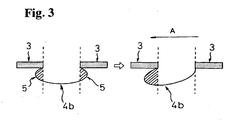
- each lower protrusion 4b has the overhang 5 around its base to make an inverted letter " ⁇ " as previously stated, it has freedom of movement in the horizontal direction as illustrated in Fig. 3 (movement in the direction A).
- the lower protrusions 4b are therefore capable of moving independently of the upper protrusions 4a. When a wearer moves, the upper protrusions 4a are kept in place, while the lower protrusions 4b are capable of moving following the wearer's movement independently of the positions of the upper protrusions 4a.
- the absorbent article having the topsheet 10 is prevented from shifting out of place while being worn.
- the lower fiber layer 2 contains self-crimping fiber which has been crimped, namely, crimped fiber as described later
- the lower fiber layer 2 exhibits extensibility and contractibility and thereby shows high recovery after stretch in the planar direction.
- the topsheet 10 as a whole shows high recovery when stretched in the planar direction. Accordingly, the absorbent article having the topsheet 10 satisfactorily conforms to a wearer's movement with an improved fit and thereby prevents leakage effectively.
- the topsheet 10 of the present embodiment is highly bulky because of the numerous protrusions 4a and 4b formed on both sides and shows excellent deformation to compression and recovery from compression.
- the lower fiber layer 2 contains crimped fiber as referred to above
- the lower fiber layer 2 is extensible and contractible.
- Such an extensible and contractible lower fiber layer 2 extends and contracts freely following a wearer's movement while minimizing deformation of the upper fiber layer 1.
- the topsheet 10 has an extremely comfortable texture, and the absorbent article having the topsheet 10 gives a wearer comfortable feel.
- the lower fiber layer 2 of the topsheet 10 contains self-crimping fiber in a helically crimped state.
- the self-crimping fiber suitably has a fineness of about 1 to 7 dtex.
- the self-crimping fiber includes conjugate fibers consisting of two thermoplastic polymers having different shrinkage percentages in an eccentric sheath/core configuration or a side-by-side configuration. Examples of such self-crimping conjugate fibers are given in JP-A- 9-296325 and Japanese Patent 2759331.
- the two thermoplastic polymers having different shrinkage percentages include a combination of an ethylene-propylene random copolymer and polypropylene.
- a preferred content of the crimped fiber in the lower fiber layer 2 is 50% by weight or more, particularly 70 to 90% by weight, from the standpoint of formation of the upper protrusions 4a, the lower protrusions 4b, and the overhangs 5.
- the lower fiber layer 2 may be made solely of the crimped fiber.
- the other fiber which may constitute the lower fiber layer 2 in combination with the crimped fiber includes thermally fusible fiber which has substantially no heat shrinkability at or below the temperature causing the self-crimping fiber to start self-crimping (hereinafter referred to as a "self-crimping starting temperature").
- Such fibers include thermally fusible fiber which has heat shrinkability but does not substantially shrink at the self-crimping starting temperature of the self-crimping fiber and thermally fusible fiber which has substantially no heat shrinkability.
- thermally fusible fibers will hereinafter be inclusively referred to as "thermally fusible non-shrinking fiber”.
- the crimped fibers be not fusion-bonded not only to each other but to other fibers present in the lower protrusions 4b so that the fibers in the lower protrusions 4b have high freedom to assure the freedom of the lower protrusions 4b in horizontal movement (see Fig. 3).
- the upper fiber layer 1 contains thermally fusible non-shrinking fiber.
- the upper fiber layer 1 is made up of thermally fusible conjugate fiber of sheath/core or side-by-side configuration.
- the upper fiber layer 1 may further contain the crimped fiber used in the lower fiber layer 2.
- Use of crimped fiber in the upper fiber layer 1 improves recovery of the upper protrusions 4a from compression and recovery of the topsheet 10 from planar extension.
- a preferred content of the crimped fiber in the upper fiber layer 1 is 3 to 50% by weight, more preferably 10 to 30% by weight.
- the lower fiber layer 2 prefferably has been rendered hydrophilic to ensure smooth liquid passage. It is also preferred for the upper fiber layer 1 to have been rendered hydrophilic similarly.
- the lower fiber layer 2 desirably has higher hydrophilicity than the upper fiber layer 1 so as to prevent wet-back. Hydrophilization can be effected by, for example, applying a hydrophilizing agent to the fiber surface or incorporating a hydrophilizing agent into the fiber.
- water-absorbing fiber e.g., cellulose fiber, cotton or rayon
- the upper fiber layer 1 preferably has a basis weight of 10 to 100 g/m 2 , more preferably 20 to 60 g/m 2 .
- the lower fiber layer 2 preferably has a basis weight of 10 to 100 g/m 2 , more preferably 20 to 60 g/m 2 .
- an upper layer-forming material an upper fiber layer before shrinkage
- a lower layer-forming material having a greater basis weight than the upper layer-forming material thereby to facilitate formation of the lower protrusions 4b.
- a preferred basis weight of the lower layer-forming material is 5 to 50 g/m 2 , more preferably 10 to 30 g/m 2 .
- the topsheet 10 Having a relatively low fiber density in the upper protrusions 4a, the topsheet 10 exhibits sufficient deformability when compressed in the thickness direction.
- the topsheet 10 has an apparent density of 0.005 to 0.05 g/cm 3 , more preferably 0.01 to 0.05 g/cm 3 , under a load of 0.5 cN/cm 2 so that it may feel bulky enough and exhibit compressive deformability to give a soft feel.
- the topsheet 10 it is also preferred for the topsheet 10 to have an apparent density of 0.04 to 0.1 g/cm 3 , more preferably 0.05 to 0.08 g/cm 3 , under a load of 50 cN/cm 2 so that it may have sufficient strength for retaining the three-dimensional contour of its protrusions.
- the load of 0.5 cN/cm 2 is almost equal to the pressure imposed to an absorbent article fitted to a wearer's body, and the load of 50 cN/cm 2 is almost equal to the wearer's body pressure imposed to an absorbent article.
- the apparent density of the topsheet 10 under load of 0.5 cN/cm 2 or 50 cN/cm 2 is calculated by dividing the basis weight by the thickness under the respective load as measured by the method described below.
- a preferred thickness of the topsheet 10 is, while dependent on the intended use, 0.5 to 5 mm, more preferably 1 to 3 mm, at 0.5 cN/cm 2 and 0.2 to 3 mm, more preferably 0.5 to 2 mm, at 50 cN/cm 2 .
- the thickness under a load of 0.5 cN/cm 2 or 50 cN/cm 2 is measured with a compression tester KES-FB3 supplied by Kato Tech Co., Ltd.
- the KES-FB3 compression tester is designed to give a compression-recovery load to a specimen (e.g., fabric or film) by putting down and then lifting a 2 cm 2 disk indenter and to record a load-displacement hysteresis loop for a compression-recovery cycle, from which thickness, compression work, recovery and other data are obtained.
- a 2.5 cm-side square specimen cut out of a topsheet is set on the receiver of the tester.
- the indenter is moved down at a speed of 0.02 mm/sec to apply a compression load to the specimen.
- the distance between the indenter and the receiver which corresponds to the thickness of the specimen, is measured when the compression load reaches 0.5 cN/cm 2 or 50 cN/cm 2 .
- the topsheet 10 having a compressive deformation percentage within the above range exhibits improved conformability to a wearer's body contour or movement and an improved texture when used as a member of an absorbent article.
- the topsheet 10 preferably has a basis weight of 20 to 200 g/m 2 , more preferably 40 to 150 g/m 2 .
- the basis weight is determined by weighing a cut piece of the topsheet 10 having a size of 50 mm by 50 mm or larger by means of an electronic balance having a minimum readability of 1 mg and calculating the weight per square meter.
- the upper layer-forming material 1 includes a web or nonwoven fabric containing thermally fusible non-shrinking fiber.
- thermally fusible non-shrinking fiber or, if desired, a mixture of thermally fusible non-shrinking fiber and self-crimping fiber is carded into a web, which can be used as an upper layer-forming material 1.
- the carded web may be made into an air-through nonwoven fabric by an air-through heat treatment, which is also useful as an upper layer-forming material 1.
- a web containing 50% by weight or more of self-crimping fiber is preferably used as a lower layer-forming material 2 so as to form lower protrusions 4b and overhangs 5.
- Use of a nonwoven fabric in place of a web can make it difficult to form lower protrusions 4b and overhangs 5.
- the upper layer-forming material 1 and the lower layer-forming material 2 are superposed on each other and subjected to embossing to obtain a nonwoven fabric composed of the two materials partially joined at the heat fusion joints 3.
- Embossing can be carried out by means of a pair of rolls (i.e., an engraved roll and a smooth roll) heated to prescribed temperatures or an ultrasonic embossing machine. Whichever apparatus is used, the nonwoven fabric is embossed from the side of the lower layer-forming material 2 containing the self-crimping fiber. That is, where a pair of heated rolls are used, the lower layer-forming material 2 is brought into contact with the engraved roll, and the upper layer-forming material 1 with the smooth roll.
- the lower layer-forming material 2 is brought into contact with an ultrasonic horn.
- the self-crimping fibers of the lower layer-forming material 2 which are near the heat fusion joints 3 are preliminarily crimped and gathered around the joints 3.
- the embossing temperature i.e., the temperature of the embossing member of the apparatus in contact with the lower layer-forming material 2 should be sufficiently high.
- the embossing temperature is higher than the self-crimping starting temperature of the self-crimping fiber by 5 to 30°C, preferably by 5 to 20°C.
- the self-crimping fiber is important for helping the lower layer-forming material 2 form the lower protrusions 4b and the overhangs 5 on subsequent heat shrinkage and for controlling the fiber orientation in the overhangs 5.
- the member of the embossing apparatus which comes into contact with the upper layer-forming material 1 does not need to have such high temperature.
- a temperature that assists formation of the heat fusion joints 3 would be sufficient.
- a recommended temperature of this member ranges from the melting point of the thermally fusible non-shrinking fiber contained in the upper layer-forming material 1 to a temperature higher than that melting point by about 10 to 20°C.
- the resulting nonwoven fabric is then heat treated at or above the self-crimping starting temperature of the self-crimping fiber.
- the heat treatment is carried out by, for example, blowing hot air through the nonwoven fabric or irradiating the nonwoven fabric with infrared rays.
- the lower layer-forming material 2 shrinks between the joints 3, whereas the upper layer-forming material 1 does not.
- the upper layer-forming material 1 protrudes in the thickness direction to form a plurality of upper protrusions 4a synchronously with the shrinkage of the lower layer-forming material 2.
- Non-shrinking of the upper layer-forming material 1 serves as resistance against shrinkage of the lower layer-forming material 2.
- the lower layer-forming material 2 does not completely shrink in the planar direction but protrudes in the thickness direction to form lower protrusions 4b. Where the basis weight of the lower layer-forming material 2 falls within the above-recited range, formation of the lower protrusions 4b would be easier.
- the self-crimping fibers near the joints 3 preliminarily self-crimp and gather around the joints 3.
- the preliminarily crimped fibers gathering around the joints 3 are further crimped and, at the same time, shifted along the contour of the protrusion while being oriented in the thickness direction of the nonwoven fabric. It follows that the base of each lower protrusion 4b projects in the planar direction of the nonwoven fabric to form an overhang 5.
- the nonwoven fabric may be held by restraining means, such as a pin tenter, during the heat treatment.
- restraining means such as a pin tenter
- the degree of shrinkage of the nonwoven fabric is preferably 30 to 80%, more preferably 30 to 60%, in terms of area shrinkage percentage.
- An absorbent article having the thus prepared topsheet 10 hardly wets back and gives a wearer a dry and comfortable feel. Highly conformable to a wearer's movement, the absorbent article hardly shifts out of place and therefore prevents leakage.
- the topsheet of the embodiment is made of a double-layered nonwoven fabric
- the topsheet of the invention can be made of a nonwoven fabric having a single layer structure or a multilayer structure composed of three or more layers.
- a web comprising self-crimping fiber and thermally fusible non-shrinking fiber is embossed to form heat fusion joints and then heat-treated to crimp the self-crimping fiber.
- the embossing temperature on one side of the web is set higher than that on the other side.
- the topsheet 10 described above can be used as a fibrous sheet other than a topsheet in an absorbent article.
- it is useful as an intermediate fibrous sheet, so called “intermediate sheet” or “sub-layer sheet”, disposed between a topsheet and an absorbent member.
- the fibrous sheet of the present invention is used with its upper fiber layer 1 facing the topsheet side, and the lower fiber layer 2 facing the absorbent member.
- the resulting absorbent article exhibits satisfactory absorptivity and reduced wet-back.
- Sheath/core conjugate fiber NBF-SH (available from Daiwabo Co., Ltd.; core: polyethylene terephthalate; sheath: polyethylene; core/sheath weight ratio: 5/5; fineness: 2.2 dtex; fiber length: 51 mm) was carded into a web, which was heat-treated at 120°C in an air-through system to prepare an air-through nonwoven fabric having a basis weight of 20 g/m 2 , which was used as an upper layer-forming material.
- Self-crimping fiber (available from Daiwabo Co., Ltd.; thermally shrinkable sheath/core conjugate fiber having an ethylene-propylene random copolymer core and a polypropylene sheath; fineness: 2.2 dtex; self-crimping starting temperature: 90°C) was carded into a web having a basis weight of 20 g/m 2 , which was used as a lower layer-forming material.
- the upper layer-forming nonwoven fabric and the lower layer-forming web prepared in (1) and (2) above were superposed on each other and passed through a heat embossing machine composed of an engraved roll and a smooth roll to join them with the lower layer-forming web in contact with the engraved roll so that embossing was conducted from the side of the lower layer-forming web.
- the engraved roll and the smooth roll were set at 175°C and 125°C, respectively.
- the engraved roll had projections each having a circular shape with an emboss area of 0.047 cm 2 arrayed at a pitch of 7 mm in both the MD and the TD and a pitch of 5 mm in the direction forming 45° with the MD and the CD to make a diamond lattice pattern as a whole.
- the total emboss area ratio of the resulting nonwoven fabric was 7.2%.
- the four sides of the resulting nonwoven fabric were fixed on the pins of a pin tenter adjusted to the size to which the nonwoven fabric was to shrink so that the nonwoven fabric might not overshrink than designed.
- the nonwoven fabric as caught on the pin tenter was heat treated in a hot air dryer set at 130°C for 1 to 3 minutes to obtain a topsheet having a basis weight of 80 g/m 2 .
- the area shrinkage percentage by this heat treatment is shown in Table 1.
- the resulting topsheet had protrusions on both the upper fiber layer side and the lower fiber layer side and overhangs at the base of each lower protrusion as shown in Fig. 2. On observing under an electron microscope, it was confirmed that the fibers constituting the lower protrusions were not fusion bonded and that the fibers in the overhangs were oriented predominantly in the thickness direction of the sheet along the contour of the lower protrusions.
- Thermally fusible non-shrinking fiber and self-crimping fiber were mixed at a weight ratio of 85:15.
- the mixed fiber was carded into a web.
- the web was heat treated at 120°C in an air-through system to obtain an air-through nonwoven fabric having a basis weight of 20 g/m 2 .
- a topsheet having the structure shown in Fig. 2 was prepared in the same manner as in Example 1, except for using the above-prepared nonwoven fabric as an upper layer-forming material.
- the resulting topsheet had a basis weight of 80 g/m 2 .
- On observing under an electron microscope it was confirmed that the fibers constituting the lower protrusions were not fusion bonded and that the fibers in the overhangs were oriented predominantly in the thickness direction of the sheet along the contour of the lower protrusions.
- a topsheet having the structure shown in Fig. 2 was prepared in the same manner as in Example 1, except for changing the basis weight of the upper layer-forming material to 15 g/m 2 and that of the lower layer-forming material to 35 g/m 2 .
- the resulting topsheet had a basis weight of 100 g/m 2 .
- a topsheet having the structure shown in Fig. 2 was prepared in the same manner as in Example 1, except for changing the basis weight of the upper layer-forming material to 16 g/m 2 and that of the lower layer-forming material to 16 g/m 2 .
- the resulting topsheet had a basis weight of 65 g/m 2 .
- a carded web prepared from self-crimping fiber was passed through a heat embossing machine composed of an engraved roll (set at 145°C) and a smooth roll to obtain a heat-embossed nonwoven fabric having a basis weight of 20 g/m 2 .
- the engraved roll had projections each having a circular dot shape with an emboss area of 0.0055 cm 2 regularly arrayed at an interval of 1.4 mm in both the MD and the TD.
- the total emboss area ratio of the resulting nonwoven fabric was 28%.
- a topsheet was prepared in the same manner as in Example 3, except for using the above-prepared heat-embossed nonwoven fabric as a lower layer-forming material.
- the resulting topsheet had a basis weight of 60 g/m 2 .
- the topsheet had neither lower protrusions nor overhangs.
- the topsheet of a commercially available sanitary napkin, Whyr® Sarasara Cushion Slim with no wings (Laurier UN-f) available from Kao Corp. was removed and evaluated.
- the topsheet was a nonwoven fabric produced by carding sheath/core conjugate fiber NBF-SH (available from Daiwabo Co., Ltd.; core: polyethylene terephthalate; sheath: polyethylene; core/sheath weight ratio: 5/5; fineness: 2.2 dtex; fiber length: 51 mm) into a web and heat-embossing the web.
- the basis weight of the nonwoven fabric was 25 g/m 2 .
- the nonwoven fabric had perforations.
- the topsheet of a commercially available sanitary napkin Whisper TM (Whisper Wga1-a) available from The Procter & Gamble Company was removed and evaluated.
- the topsheet was a perforated polyethylene film to which heat-embossed nonwoven fabric was fixed.
- topsheets prepared in Examples and Comparative Examples were microscopically observed to measure the thickness of the upper protrusions (h1) and of the lower protrusions (h2).
- the apparent density and thickness of the topsheets were measured under loads of 0.5 cN/cm 2 and 50 cN/cm 2 in accordance with the method described supra.
- the topsheets were evaluated in terms of thickness deformation under unit load (gf/cm 2 ), wet-back under pressure, and liquid spread area in accordance with the methods described infra. The results obtained are shown in Table 1.
- a 2.5 cm-side square specimen cut out of a topsheet was set in a compression tester KES-FB3 supplied by Kato Tech Co., Ltd. (the mechanism of measurement has been described).
- the indenter was moved down at a speed of 0.02 mm/sec to apply a compression load to the specimen until the load reached 50 gf/cm 2 .
- the thicknesses of the specimen at 10 gf/cm 2 (t1) and at 0.5 gf/cm 2 (t2) were measured.
- the difference between t2 and t1 (mm) was divided by 10 to obtain a thickness deformation per gf/cm 2 .
- the thickness deformation thus calculated is a measure of compressibility under a relatively low pressure of 10 gf/cm 2 , i.e., softness of the topsheet.
- the absorbent member was taken out of Whyr UN-f described supra. Three grams of defibrinated horse blood (available from Nippon Biotest Lab.) was poured into the isolated absorbent member. An 80 mm wide and 100 mm long topsheet was superposed on the upper side of the absorbent member with its lower fiber layer facing down. An acrylic resin plate large enough to cover the entire area of the topsheet was put thereon to give a load of 50 g/cm 2 . Three minutes later, the resin plate was removed, and any blood adhered to the plate was completely wiped off with filter paper (available from Toyo Roshi Kaisha, Ltd.) whose weight had previously been measured. The filter paper having absorbed blood was weighed again. The weight gain of the filter paper was taken as wet-back.
- the topsheet of a commercially available sanitary napkin Whyr UN-f was stripped and replaced with a 70 mm wide and 100 mm long topsheet to be tested.
- the resulting sanitary napkin was stuck to the crotch portion of a sanitary garment (Laurier® Standard shorts, available from Kao Corp.).
- the sanitary garment with the sanitary napkin was put on a movable female body model. After the model was operated to take a walking movement for 1 minute, 3 g of defibrinated horse blood was poured into the napkin at a rate of 2 g/15 sec, and the model was operated to take the same walking movement for an additional 30 minute period. The napkin was removed, and the blood spread area on the topsheet was measured with an image analyzer.
- the spread area is a measure for positional shift of the napkin due to a wearer's movement.
- TABLE 1 Example Comparative Example 1 2 3 4 1 2 3 Basis weight (g/m 2 ) Upper layer-forming material 20 20 15 16 15 - - Lower layer-forming material 20 20 35 16 20 - - Topsheet (after shrinkage) 80 80 100 65 60 25* 25* Upper protrusion height h1 (mm) 1.7 1.7 1.8 1.6 1.9 0.42 0.50 Lower protrusion height h2 (mm) 0.9 0.9 1.2 0.8 0.45 - - Topsheet thickness at 0.5 cN/cm 2 (mm) 2.6 2.6 3 2.4 2.4 0.42 0.5 Density at 0.5 cN/cm 2 (g/cm 3 ) 0.031 0.031 0.033 0.027 0.027 - - Topsheet thickness at 50 cN/cm 2 (mm) 1.4 1.4 1.3 1.2 0.5 - - Density at 50 cN/cm 2
- the topsheet's other fibrous sheets of the present invention for use in absorbent articles prevents wet-back and is capable of following a wearer's movement. Therefore, an absorbent article having these sheets of the present invention gives a wearer a dry and comfortable feel with reduced wet-back and is kept in place while worn to cause little leakage.
Landscapes
- Engineering & Computer Science (AREA)
- Health & Medical Sciences (AREA)
- Textile Engineering (AREA)
- Vascular Medicine (AREA)
- Biomedical Technology (AREA)
- Heart & Thoracic Surgery (AREA)
- Epidemiology (AREA)
- Life Sciences & Earth Sciences (AREA)
- Animal Behavior & Ethology (AREA)
- General Health & Medical Sciences (AREA)
- Public Health (AREA)
- Veterinary Medicine (AREA)
- Absorbent Articles And Supports Therefor (AREA)
- Nonwoven Fabrics (AREA)
- Orthopedics, Nursing, And Contraception (AREA)
Description
- The present invention relates to a topsheet and other fibrous sheets used in absorbent articles such as sanitary napkins and disposable diapers. More particularly, it relates to a topsheet and fibrous sheets of an absorbent article which prevent wet-back of once absorbed liquid and easily conform to a wearer's movement.
- Assignee has proposed in JP-A-2002-187228 a bulky sheet exhibiting elastomeric behavior and breathability as a whole which contains a first layer and a second layer adjacent to the first layer, the first and the second layers being partially bonded together at joints in a prescribed pattern, the first layer having a three-dimensional shape between joints, and the second layer being made of a material exhibiting elastomeric behavior.
- The bulky sheet referred to above shows sufficient recovery when extended in the planar direction and sufficient deformation when compressed in the thickness direction. Accordingly, this bulky sheet is fit for use as a topsheet of absorbent articles, such as sanitary napkins and disposable diapers. To cope with the requirements for these absorbent articles which are getting stricter, there still is a demand for a topsheet therefor with higher performance in terms of, e.g., resistance against wet-back of once absorbed liquid and conformability to a wearer's movement
- In EP-A-1 209 271, a bulky sheet material having three-dimensional protrusions is disclosed, the sheet material comprising a first layer and a second layer adjacent to the first layer, the first layer and the second layer being partly joined together at joints in a prescribed pattern, wherein the first layer has a number of raised portions which are located among the joints and the second layer comprises a material which exhibits elastomeric behaviour.
- GB-A-2 031 039 describes an embossed nonwoven fabric comprised of a mat of microfibres useful for wiping dust from surfaces. The working face of the fabric is embossed to a limited degree to provide integration of the normally fragile nonwoven fabric web yet not interfere with its cleaning ability.
- CH-A-498 234 describes a method for creating a sheet of deformable textile fibrous material wherein the sheet is passed between a pair of rigid rolls rotating in opposite directions, each roll being engraved with the pattern of lands and grooves and at least one of the rolls being heating.
- EP-A-0 423 395 discloses a liner for a floppy disk comprising a partially thermocompression-bonded nonwoven fabric.
- The present invention relates to a fibrous sheet for an absorbent article as defined in
claim 1. - The present invention also relates to a process of producing a fibrous sheet as defined in claim 6.
- While the specification concludes with claims particularly pointing out and distinctly claiming the subject matter which is regarded as forming the present invention, it is believed that the present invention will be better understood from the following description which is taken in conjuction with the accompanying drawings, in which like designations are used to designate substantilly identical elements, and in which:
- Fig. 1 is a perspective view of a topsheet according to an embodiment of the present invention;
- Fig. 2 is a cross-sectional view of the topsheet shown in Fig. 1; and
- Fig. 3 is a schematic view illustrating movement in the horizontal direction of the topsheet of Fig. 1.
- The present invention relates to a topsheet and other fibrous sheets of absorbent articles which prevent liquid wet-back and easily conform to a wearer's movement.
- The present invention will be explained based on the preferred embodiments with reference to the accompanying drawings. Fig. 1 is a perspective view of a topsheet of the absorbent article (referred to as simply a topsheet hereinafter) according to an embodiment of the present invention, and Fig. 2 is a cross-sectional view of the topsheet shown in Fig. 1.
- The
topsheet 10 shown in Fig. 1 is a double-layered nonwoven fabric having anupper fiber layer 1 and alower fiber layer 2 adjacent thereto. Theupper fiber layer 1 is made of a fiber aggregate. Thelower fiber layer 2 is made of a fiber aggregate different from that of theupper fiber layer 1 in kind and/or composition of constituent fibers. Theupper fiber layer 1 and thelower fiber layer 2 are partially joined by a plurality ofheat fusion joints 3 formed by embossing. In other words, theupper fiber layer 1 and thelower fiber layer 2 are not entirely bonded together over their whole area. The term "upper" as in "upper (fiber) layer" or "upper side" of thetopsheet 10 is intended to mean the side that is to face a wearer's body when fabricated into an absorbent article. Accordingly, the term "lower" as in "lower (fiber) layer" or "lower side" means the side that is to face an absorbent member of the absorbent article. - The
heat fusion joints 3, each having a circular dot shape, are discretely arranged to form a diamond lattice pattern as a whole. Theindividual joints 3 are densified parts having a smaller thickness and a higher density than other parts of thetopsheet 10. Theupper fiber layer 1 and thelower fiber layer 2 are united in their thickness direction by theheat fusion joints 3. Theindividual joints 3 may have an arbitrary shape, such as a circular dot as adapted in this embodiment, an elliptic shape, a triangular shape, a rectangular shape or a combination thereof. Thejoints 3 may be continuously formed to make a line pattern, such as a pattern of straight lines or curved lines. - The total area ratio of the
joints 3 to the area of the topsheet 10 (total area ratio of thejoints 3 per unit area of the topsheet 10) is, while subject to variation according to the use of thetopsheet 10, preferably 4 to 35%, more preferably 5 to 30%, in order to assure bonding between the twofiber layers topsheet 10 is produced in accordance with the process hereinafter described, the total area ratio of thejoints 3 before heat shrinkage is preferably 2 to 15%, more preferably 5 to 10%. - In the
topsheet 10 made of nonwoven fabric, the constituent fibers protrude in the thickness direction of the nonwoven fabric betweenjoints 3 to provide a great number ofprotrusions 4a on the upper side andmany protrusions 4b on the lower side of the nonwoven fabric as well. Theprotrusions 4a formed on the upper side (hereinafter referred to asupper protrusions 4a) are mainly made of theupper fiber layer 1. Theprotrusions 4b formed on the lower side (hereinafter referred to aslower protrusions 4b) are mainly made of thelower fiber layer 2. Thetopsheet 10 according to the embodiment has a plurality of closed parts each surrounded by thejoints 3 arranged in a diamond lattice shape, and theupper fiber layer 1 and thelower fiber layer 2 in each of these parts protrude upward and downward to form theupper protrusions 4a and thelower protrusions 4b, respectively, as depicted in Fig. 2. Accordingly, when seen from above, thetopsheet 10 has the individualupper protrusions 4a and the individuallower protrusions 4b at the same positions. The upper andlower protrusions joints 3 are depressions relatively with respect to the upper andlower protrusions topsheet 10 is bulky as a whole with a plurality of protrusions and depressions on both sides. - As illustrated in Fig. 2, with the plane containing the
joints 3 taken as a reference plane, the height h1 of theupper protrusions 4a is larger than the height h2 of thelower protrusions 4b. Preferably, the height h1 of theupper protrusions 4a is about 0.3 to 5 mm, while the height h2 of thelower protrusions 4b is about 0.1 to 3 mm. With this configuration, thetopsheet 10 provides an absorbent article that gives a wearer comfort and hardly causes wet-back of once absorbed liquid. The height of theprotrusions topsheet 10 under a microscope. - As shown in Fig. 2, the
lower protrusions 4b have their base (for example, the parts near the joints 3) extended or projected in the planar direction of thetopsheet 10 to form an overhanging projection 5 (hereinafter referred to as an overhang 5). Theoverhang 5 is formed around the whole circumference of eachlower protrusion 4b when seen from below. Accordingly, eachlower protrusion 4b depicts a nearly inverted letter "Ω" in its cross-sectional view. Theoverhang 5 extends in the planar direction, sheltering part of thejoints 3. Fibers in theoverhang 5 are predominantly oriented in the thickness direction of thetopsheet 10 along the outer contour of thelower protrusion 4b, which can be confirmed under microscopic observation. - Having the
lower protrusions 4b, thetopsheet 10, when disposed on an absorbent member and fabricated into an absorbent article, provides a certain space between the lower surface of thetopsheet 10 and the upper surface of the absorbent member. Therefore, liquid once absorbed by the absorbent member hardly wets back. In particular, when thetopsheet 10 is pressed under a wearer's body pressure while worn, theoverhangs 5 of thelower protrusions 4b show resistance against compression to help thetopsheet 10 keep its thickness, which ensures reduction of wet-back. Furthermore, since theoverhangs 5 extend so as to shelter part of the densified andhard joints 3, they exhibit increased resistance to compression and thereby reducing wet-back to thetopsheet 10. Additionally, the fibers in theoverhangs 5 are orientated in the thickness direction of the nonwoven fabric mainly along the contour of thelower protrusions 4b, which assures increased resistance against compression to prevent wet-back. - Besides the effect in reducing wet-back, the
topsheet 10 of the present embodiment exhibits high conformability to a wearer's movement. As a result, an absorbent article having thetopsheet 10 hardly shifts out of place while worn. In detail, since eachlower protrusion 4b has theoverhang 5 around its base to make an inverted letter "Ω" as previously stated, it has freedom of movement in the horizontal direction as illustrated in Fig. 3 (movement in the direction A). Thelower protrusions 4b are therefore capable of moving independently of theupper protrusions 4a. When a wearer moves, theupper protrusions 4a are kept in place, while thelower protrusions 4b are capable of moving following the wearer's movement independently of the positions of theupper protrusions 4a. As a result, the absorbent article having thetopsheet 10 is prevented from shifting out of place while being worn. Where thelower fiber layer 2 contains self-crimping fiber which has been crimped, namely, crimped fiber as described later, thelower fiber layer 2 exhibits extensibility and contractibility and thereby shows high recovery after stretch in the planar direction. This means that thetopsheet 10 as a whole shows high recovery when stretched in the planar direction. Accordingly, the absorbent article having thetopsheet 10 satisfactorily conforms to a wearer's movement with an improved fit and thereby prevents leakage effectively. - In addition to the above-mentioned effects, the
topsheet 10 of the present embodiment is highly bulky because of thenumerous protrusions lower fiber layer 2 contains crimped fiber as referred to above, thelower fiber layer 2 is extensible and contractible. Such an extensible and contractiblelower fiber layer 2 extends and contracts freely following a wearer's movement while minimizing deformation of theupper fiber layer 1. Thus, thetopsheet 10 has an extremely comfortable texture, and the absorbent article having thetopsheet 10 gives a wearer comfortable feel. - The
lower fiber layer 2 of thetopsheet 10 according to the present embodiment contains self-crimping fiber in a helically crimped state. The self-crimping fiber suitably has a fineness of about 1 to 7 dtex. The self-crimping fiber includes conjugate fibers consisting of two thermoplastic polymers having different shrinkage percentages in an eccentric sheath/core configuration or a side-by-side configuration. Examples of such self-crimping conjugate fibers are given in JP-A- 9-296325 and Japanese Patent 2759331. The two thermoplastic polymers having different shrinkage percentages include a combination of an ethylene-propylene random copolymer and polypropylene. A preferred content of the crimped fiber in thelower fiber layer 2 is 50% by weight or more, particularly 70 to 90% by weight, from the standpoint of formation of theupper protrusions 4a, thelower protrusions 4b, and theoverhangs 5. Thelower fiber layer 2 may be made solely of the crimped fiber. The other fiber which may constitute thelower fiber layer 2 in combination with the crimped fiber includes thermally fusible fiber which has substantially no heat shrinkability at or below the temperature causing the self-crimping fiber to start self-crimping (hereinafter referred to as a "self-crimping starting temperature"). Such fibers include thermally fusible fiber which has heat shrinkability but does not substantially shrink at the self-crimping starting temperature of the self-crimping fiber and thermally fusible fiber which has substantially no heat shrinkability. These thermally fusible fibers will hereinafter be inclusively referred to as "thermally fusible non-shrinking fiber". - In the
lower protrusions 4b formed of thelower fiber layer 2, it is preferred that the crimped fibers be not fusion-bonded not only to each other but to other fibers present in thelower protrusions 4b so that the fibers in thelower protrusions 4b have high freedom to assure the freedom of thelower protrusions 4b in horizontal movement (see Fig. 3). - The
upper fiber layer 1 contains thermally fusible non-shrinking fiber. Preferably, theupper fiber layer 1 is made up of thermally fusible conjugate fiber of sheath/core or side-by-side configuration. Theupper fiber layer 1 may further contain the crimped fiber used in thelower fiber layer 2. Use of crimped fiber in theupper fiber layer 1 improves recovery of theupper protrusions 4a from compression and recovery of thetopsheet 10 from planar extension. For obtaining these effects, a preferred content of the crimped fiber in theupper fiber layer 1 is 3 to 50% by weight, more preferably 10 to 30% by weight. - It is preferred for the
lower fiber layer 2 to have been rendered hydrophilic to ensure smooth liquid passage. It is also preferred for theupper fiber layer 1 to have been rendered hydrophilic similarly. Thelower fiber layer 2 desirably has higher hydrophilicity than theupper fiber layer 1 so as to prevent wet-back. Hydrophilization can be effected by, for example, applying a hydrophilizing agent to the fiber surface or incorporating a hydrophilizing agent into the fiber. In order to make thelower fiber layer 2 more hydrophilic than theupper fiber layer 1, water-absorbing fiber (e.g., cellulose fiber, cotton or rayon) may be mixed into thelower fiber layer 2. - The
upper fiber layer 1 preferably has a basis weight of 10 to 100 g/m2, more preferably 20 to 60 g/m2. Thelower fiber layer 2 preferably has a basis weight of 10 to 100 g/m2, more preferably 20 to 60 g/m2. Where thetopsheet 10 is produced by the process described later, it is preferred to use an upper layer-forming material (an upper fiber layer before shrinkage) having a basis weight of 5 to 50 g/m2, particularly 10 to 30 g/m2. On the other hand, it is preferred to use a lower layer-forming material (a lower fiber layer before shrinkage) having a greater basis weight than the upper layer-forming material thereby to facilitate formation of thelower protrusions 4b. A preferred basis weight of the lower layer-forming material is 5 to 50 g/m2, more preferably 10 to 30 g/m2. - Having a relatively low fiber density in the
upper protrusions 4a, thetopsheet 10 exhibits sufficient deformability when compressed in the thickness direction. Preferably, thetopsheet 10 has an apparent density of 0.005 to 0.05 g/cm3, more preferably 0.01 to 0.05 g/cm3, under a load of 0.5 cN/cm2 so that it may feel bulky enough and exhibit compressive deformability to give a soft feel. It is also preferred for thetopsheet 10 to have an apparent density of 0.04 to 0.1 g/cm3, more preferably 0.05 to 0.08 g/cm3, under a load of 50 cN/cm2 so that it may have sufficient strength for retaining the three-dimensional contour of its protrusions. The load of 0.5 cN/cm2 is almost equal to the pressure imposed to an absorbent article fitted to a wearer's body, and the load of 50 cN/cm2 is almost equal to the wearer's body pressure imposed to an absorbent article. - The apparent density of the
topsheet 10 under load of 0.5 cN/cm2 or 50 cN/cm2 is calculated by dividing the basis weight by the thickness under the respective load as measured by the method described below. - From the standpoint of bulkiness and compressive deformability, a preferred thickness of the
topsheet 10 is, while dependent on the intended use, 0.5 to 5 mm, more preferably 1 to 3 mm, at 0.5 cN/cm2 and 0.2 to 3 mm, more preferably 0.5 to 2 mm, at 50 cN/cm2. - The thickness under a load of 0.5 cN/cm2 or 50 cN/cm2 is measured with a compression tester KES-FB3 supplied by Kato Tech Co., Ltd. The KES-FB3 compression tester is designed to give a compression-recovery load to a specimen (e.g., fabric or film) by putting down and then lifting a 2 cm2 disk indenter and to record a load-displacement hysteresis loop for a compression-recovery cycle, from which thickness, compression work, recovery and other data are obtained. A 2.5 cm-side square specimen cut out of a topsheet is set on the receiver of the tester. The indenter is moved down at a speed of 0.02 mm/sec to apply a compression load to the specimen. The distance between the indenter and the receiver, which corresponds to the thickness of the specimen, is measured when the compression load reaches 0.5 cN/cm2 or 50 cN/cm2.
- The
topsheet 10 preferably has a compressive deformation percentage of 30 to 85%, more preferably 40 to 70%, the compressive deformation percentage being calculated from the thickness at 0.5 cN/cm2 (T1) and the thickness at 50 cN/cm2 (T2) according to equation (1):
- The
topsheet 10 having a compressive deformation percentage within the above range exhibits improved conformability to a wearer's body contour or movement and an improved texture when used as a member of an absorbent article. - In order to exhibit sufficient compressive deformability and bulkiness, the
topsheet 10 preferably has a basis weight of 20 to 200 g/m2, more preferably 40 to 150 g/m2. The basis weight is determined by weighing a cut piece of thetopsheet 10 having a size of 50 mm by 50 mm or larger by means of an electronic balance having a minimum readability of 1 mg and calculating the weight per square meter. - A preferred process for producing the
topsheet 10 of the present embodiment will be described. An upper layer-formingmaterial 1 and a lower layer-formingmaterial 2 are prepared. The upper layer-formingmaterial 1 includes a web or nonwoven fabric containing thermally fusible non-shrinking fiber. For example, thermally fusible non-shrinking fiber or, if desired, a mixture of thermally fusible non-shrinking fiber and self-crimping fiber is carded into a web, which can be used as an upper layer-formingmaterial 1. The carded web may be made into an air-through nonwoven fabric by an air-through heat treatment, which is also useful as an upper layer-formingmaterial 1. A web containing 50% by weight or more of self-crimping fiber is preferably used as a lower layer-formingmaterial 2 so as to formlower protrusions 4b and overhangs 5. Use of a nonwoven fabric in place of a web can make it difficult to formlower protrusions 4b and overhangs 5. - The upper layer-forming
material 1 and the lower layer-formingmaterial 2 are superposed on each other and subjected to embossing to obtain a nonwoven fabric composed of the two materials partially joined at the heat fusion joints 3. Embossing can be carried out by means of a pair of rolls (i.e., an engraved roll and a smooth roll) heated to prescribed temperatures or an ultrasonic embossing machine. Whichever apparatus is used, the nonwoven fabric is embossed from the side of the lower layer-formingmaterial 2 containing the self-crimping fiber. That is, where a pair of heated rolls are used, the lower layer-formingmaterial 2 is brought into contact with the engraved roll, and the upper layer-formingmaterial 1 with the smooth roll. Where an ultrasonic embossing machine is used, the lower layer-formingmaterial 2 is brought into contact with an ultrasonic horn. By so doing, the self-crimping fibers of the lower layer-formingmaterial 2 which are near theheat fusion joints 3 are preliminarily crimped and gathered around thejoints 3. In order to effectively conduct preliminary crimping of the self-crimping fiber, the embossing temperature, i.e., the temperature of the embossing member of the apparatus in contact with the lower layer-formingmaterial 2 should be sufficiently high. Preferably, the embossing temperature is higher than the self-crimping starting temperature of the self-crimping fiber by 5 to 30°C, preferably by 5 to 20°C. To preliminarily crimp the self-crimping fiber is important for helping the lower layer-formingmaterial 2 form thelower protrusions 4b and theoverhangs 5 on subsequent heat shrinkage and for controlling the fiber orientation in theoverhangs 5. - On the other hand, the member of the embossing apparatus which comes into contact with the upper layer-forming
material 1 does not need to have such high temperature. A temperature that assists formation of theheat fusion joints 3 would be sufficient. A recommended temperature of this member ranges from the melting point of the thermally fusible non-shrinking fiber contained in the upper layer-formingmaterial 1 to a temperature higher than that melting point by about 10 to 20°C. - The resulting nonwoven fabric is then heat treated at or above the self-crimping starting temperature of the self-crimping fiber. The heat treatment is carried out by, for example, blowing hot air through the nonwoven fabric or irradiating the nonwoven fabric with infrared rays. By heat treatment, the lower layer-forming
material 2 shrinks between thejoints 3, whereas the upper layer-formingmaterial 1 does not. As a result, the upper layer-formingmaterial 1 protrudes in the thickness direction to form a plurality ofupper protrusions 4a synchronously with the shrinkage of the lower layer-formingmaterial 2. Non-shrinking of the upper layer-formingmaterial 1 serves as resistance against shrinkage of the lower layer-formingmaterial 2. That is, the lower layer-formingmaterial 2 does not completely shrink in the planar direction but protrudes in the thickness direction to formlower protrusions 4b. Where the basis weight of the lower layer-formingmaterial 2 falls within the above-recited range, formation of thelower protrusions 4b would be easier. - As stated previously, when the upper layer-forming
material 1 and the lower layer-formingmaterial 2 are partially bonded by embossing from the side of the lower layer-formingmaterial 2, the self-crimping fibers near thejoints 3 preliminarily self-crimp and gather around thejoints 3. When the lower layer-formingmaterial 2 shrinks and protrudes in this state, the preliminarily crimped fibers gathering around thejoints 3 are further crimped and, at the same time, shifted along the contour of the protrusion while being oriented in the thickness direction of the nonwoven fabric. It follows that the base of eachlower protrusion 4b projects in the planar direction of the nonwoven fabric to form anoverhang 5. - In order to control the degree of shrinkage of the lower layer-forming
material 2 to successfully form thelower protrusions 4b and theoverhangs 5, the nonwoven fabric may be held by restraining means, such as a pin tenter, during the heat treatment. In this case, because the lower layer-formingmaterial 2 shrinks almost isotropically in its planar direction, it is preferable that the whole periphery of the nonwoven fabric be held by the restraining means. The degree of shrinkage of the nonwoven fabric is preferably 30 to 80%, more preferably 30 to 60%, in terms of area shrinkage percentage. The area shrinkage percentage is represented by equation (2):
where So is the original area before shrinkage; and S, is the area after shrinkage. - An absorbent article having the thus prepared
topsheet 10 hardly wets back and gives a wearer a dry and comfortable feel. Highly conformable to a wearer's movement, the absorbent article hardly shifts out of place and therefore prevents leakage. - The present invention is not limited to the above-described embodiment. While the topsheet of the embodiment is made of a double-layered nonwoven fabric, the topsheet of the invention can be made of a nonwoven fabric having a single layer structure or a multilayer structure composed of three or more layers. In making the topsheet of a single-layered nonwoven fabric, a web comprising self-crimping fiber and thermally fusible non-shrinking fiber is embossed to form heat fusion joints and then heat-treated to crimp the self-crimping fiber. In this case, the embossing temperature on one side of the web is set higher than that on the other side.
- The
topsheet 10 described above can be used as a fibrous sheet other than a topsheet in an absorbent article. For instance, it is useful as an intermediate fibrous sheet, so called "intermediate sheet" or "sub-layer sheet", disposed between a topsheet and an absorbent member. In this application, the fibrous sheet of the present invention is used with itsupper fiber layer 1 facing the topsheet side, and thelower fiber layer 2 facing the absorbent member. The resulting absorbent article exhibits satisfactory absorptivity and reduced wet-back. - The present invention will now be illustrated in greater detail with reference to Examples. The following Examples are presented as being exemplary of the present invention and should not be considered as limiting.
- Sheath/core conjugate fiber NBF-SH (available from Daiwabo Co., Ltd.; core: polyethylene terephthalate; sheath: polyethylene; core/sheath weight ratio: 5/5; fineness: 2.2 dtex; fiber length: 51 mm) was carded into a web, which was heat-treated at 120°C in an air-through system to prepare an air-through nonwoven fabric having a basis weight of 20 g/m2, which was used as an upper layer-forming material.
- Self-crimping fiber (available from Daiwabo Co., Ltd.; thermally shrinkable sheath/core conjugate fiber having an ethylene-propylene random copolymer core and a polypropylene sheath; fineness: 2.2 dtex; self-crimping starting temperature: 90°C) was carded into a web having a basis weight of 20 g/m2, which was used as a lower layer-forming material.
- The upper layer-forming nonwoven fabric and the lower layer-forming web prepared in (1) and (2) above were superposed on each other and passed through a heat embossing machine composed of an engraved roll and a smooth roll to join them with the lower layer-forming web in contact with the engraved roll so that embossing was conducted from the side of the lower layer-forming web. The engraved roll and the smooth roll were set at 175°C and 125°C, respectively. The engraved roll had projections each having a circular shape with an emboss area of 0.047 cm2 arrayed at a pitch of 7 mm in both the MD and the TD and a pitch of 5 mm in the direction forming 45° with the MD and the CD to make a diamond lattice pattern as a whole. The total emboss area ratio of the resulting nonwoven fabric was 7.2%.
- The four sides of the resulting nonwoven fabric were fixed on the pins of a pin tenter adjusted to the size to which the nonwoven fabric was to shrink so that the nonwoven fabric might not overshrink than designed. The nonwoven fabric as caught on the pin tenter was heat treated in a hot air dryer set at 130°C for 1 to 3 minutes to obtain a topsheet having a basis weight of 80 g/m2. The area shrinkage percentage by this heat treatment is shown in Table 1. The resulting topsheet had protrusions on both the upper fiber layer side and the lower fiber layer side and overhangs at the base of each lower protrusion as shown in Fig. 2. On observing under an electron microscope, it was confirmed that the fibers constituting the lower protrusions were not fusion bonded and that the fibers in the overhangs were oriented predominantly in the thickness direction of the sheet along the contour of the lower protrusions.
- Thermally fusible non-shrinking fiber and self-crimping fiber were mixed at a weight ratio of 85:15. The mixed fiber was carded into a web. The web was heat treated at 120°C in an air-through system to obtain an air-through nonwoven fabric having a basis weight of 20 g/m2. A topsheet having the structure shown in Fig. 2 was prepared in the same manner as in Example 1, except for using the above-prepared nonwoven fabric as an upper layer-forming material. The resulting topsheet had a basis weight of 80 g/m2. On observing under an electron microscope, it was confirmed that the fibers constituting the lower protrusions were not fusion bonded and that the fibers in the overhangs were oriented predominantly in the thickness direction of the sheet along the contour of the lower protrusions.
- A topsheet having the structure shown in Fig. 2 was prepared in the same manner as in Example 1, except for changing the basis weight of the upper layer-forming material to 15 g/m2 and that of the lower layer-forming material to 35 g/m2. The resulting topsheet had a basis weight of 100 g/m2. On observing under an electron microscope, it was confirmed that the fibers constituting the lower protrusions were not fusion bonded and that the fibers in the overhangs were oriented predominantly in the thickness direction of the sheet along the contour of the lower protrusions.
- A topsheet having the structure shown in Fig. 2 was prepared in the same manner as in Example 1, except for changing the basis weight of the upper layer-forming material to 16 g/m2 and that of the lower layer-forming material to 16 g/m2. The resulting topsheet had a basis weight of 65 g/m2. On observing under an electron microscope, it was confirmed that the fibers constituting the lower protrusions were not fusion bonded and that the fibers in the overhangs were oriented predominantly in the thickness direction of the sheet along the contour of the lower protrusions.
- A carded web prepared from self-crimping fiber was passed through a heat embossing machine composed of an engraved roll (set at 145°C) and a smooth roll to obtain a heat-embossed nonwoven fabric having a basis weight of 20 g/m2. The engraved roll had projections each having a circular dot shape with an emboss area of 0.0055 cm2 regularly arrayed at an interval of 1.4 mm in both the MD and the TD. The total emboss area ratio of the resulting nonwoven fabric was 28%. A topsheet was prepared in the same manner as in Example 3, except for using the above-prepared heat-embossed nonwoven fabric as a lower layer-forming material. The resulting topsheet had a basis weight of 60 g/m2. The topsheet had neither lower protrusions nor overhangs.
- The topsheet of a commercially available sanitary napkin, Laurier® Sarasara Cushion Slim with no wings (Laurier UN-f) available from Kao Corp. was removed and evaluated. The topsheet was a nonwoven fabric produced by carding sheath/core conjugate fiber NBF-SH (available from Daiwabo Co., Ltd.; core: polyethylene terephthalate; sheath: polyethylene; core/sheath weight ratio: 5/5; fineness: 2.2 dtex; fiber length: 51 mm) into a web and heat-embossing the web. The basis weight of the nonwoven fabric was 25 g/m2. The nonwoven fabric had perforations.
- The topsheet of a commercially available sanitary napkin Whisper™ (Whisper Wga1-a) available from The Procter & Gamble Company was removed and evaluated. The topsheet was a perforated polyethylene film to which heat-embossed nonwoven fabric was fixed.
- The topsheets prepared in Examples and Comparative Examples were microscopically observed to measure the thickness of the upper protrusions (h1) and of the lower protrusions (h2). The apparent density and thickness of the topsheets were measured under loads of 0.5 cN/cm2 and 50 cN/cm2 in accordance with the method described supra. Furthermore, the topsheets were evaluated in terms of thickness deformation under unit load (gf/cm2), wet-back under pressure, and liquid spread area in accordance with the methods described infra. The results obtained are shown in Table 1.
- A 2.5 cm-side square specimen cut out of a topsheet was set in a compression tester KES-FB3 supplied by Kato Tech Co., Ltd. (the mechanism of measurement has been described). The indenter was moved down at a speed of 0.02 mm/sec to apply a compression load to the specimen until the load reached 50 gf/cm2. The thicknesses of the specimen at 10 gf/cm2 (t1) and at 0.5 gf/cm2 (t2) were measured. The difference between t2 and t1 (mm) was divided by 10 to obtain a thickness deformation per gf/cm2. The thickness deformation thus calculated is a measure of compressibility under a relatively low pressure of 10 gf/cm2, i.e., softness of the topsheet.
- The absorbent member was taken out of Laurier UN-f described supra. Three grams of defibrinated horse blood (available from Nippon Biotest Lab.) was poured into the isolated absorbent member. An 80 mm wide and 100 mm long topsheet was superposed on the upper side of the absorbent member with its lower fiber layer facing down. An acrylic resin plate large enough to cover the entire area of the topsheet was put thereon to give a load of 50 g/cm2. Three minutes later, the resin plate was removed, and any blood adhered to the plate was completely wiped off with filter paper (available from Toyo Roshi Kaisha, Ltd.) whose weight had previously been measured. The filter paper having absorbed blood was weighed again. The weight gain of the filter paper was taken as wet-back.
- The topsheet of a commercially available sanitary napkin Laurier UN-f was stripped and replaced with a 70 mm wide and 100 mm long topsheet to be tested. The resulting sanitary napkin was stuck to the crotch portion of a sanitary garment (Laurier® Standard shorts, available from Kao Corp.). The sanitary garment with the sanitary napkin was put on a movable female body model. After the model was operated to take a walking movement for 1 minute, 3 g of defibrinated horse blood was poured into the napkin at a rate of 2 g/15 sec, and the model was operated to take the same walking movement for an additional 30 minute period. The napkin was removed, and the blood spread area on the topsheet was measured with an image analyzer. The spread area is a measure for positional shift of the napkin due to a wearer's movement.
TABLE 1 Example Comparative Example 1 2 3 4 1 2 3 Basis weight (g/m2) Upper layer-forming material 20 20 15 16 15 - - Lower layer-forming material 20 20 35 16 20 - - Topsheet (after shrinkage) 80 80 100 65 60 25* 25* Upper protrusion height h1 (mm) 1.7 1.7 1.8 1.6 1.9 0.42 0.50 Lower protrusion height h2 (mm) 0.9 0.9 1.2 0.8 0.45 - - Topsheet thickness at 0.5 cN/cm2 (mm) 2.6 2.6 3 2.4 2.4 0.42 0.5 Density at 0.5 cN/cm2 (g/cm3) 0.031 0.031 0.033 0.027 0.027 - - Topsheet thickness at 50 cN/cm2 (mm) 1.4 1.4 1.3 1.2 0.5 - - Density at 50 cN/cm2 (g/cm3) 0.057 0.057 0.077 0.052 0.13 - - Area shrinkage percentage (%) 46 46 57 50 79 - - Thickness deformation [mm/(gf/cm2)] 0.08 0.07 0.08 0.08 0.08 0.05 0.01 Wet-back (mg) 0.5 0.5 0.5 0.8 2.5 5.0 2.0 Liquid spread area (cm2) 6 6 7 7 13 23 17 * Not shrunken - As is clearly seen from the results in Table 1, all the topsheets of the Examples are soft and have reduced wet-back. It is also seen that these topsheets suppress the spread of absorbed liquid, which proves that the lower fiber layer follows the movement of a wearer.
- As described above, the topsheet's other fibrous sheets of the present invention for use in absorbent articles prevents wet-back and is capable of following a wearer's movement. Therefore, an absorbent article having these sheets of the present invention gives a wearer a dry and comfortable feel with reduced wet-back and is kept in place while worn to cause little leakage.
- The invention having been thus described, it will be obvious that the same may be varied in many ways. Such variations are not to be regarded as a departure from the scope of the invention, and all such modifications as would be obvious to one skilled in the art are intended to be included within the scope of the following claims.
- This application claims the priority of Japanese Patent Application No. 2002-334527 filed November 19, 2002.
Claims (6)
- A fibrous sheet for an absorbent article which comprises a nonwoven fabric having a plurality of heat fusion joints (3), the nonwoven fabric has an upper layer and a lower layer adjacent to the upper layer, the upper layer being intended to face a wearer's body and the lower layer being intended to face an absorbent member of the absorbent article, the fibers constituting the nonwoven fabric protruding in a thickness direction of the nonwoven fabric between the heat fusion joints to form a plurality of protrusions (4a,4b) on both the upper and the lower sides of the nonwoven fabric, the protrusions (4a) formed on an upper side of the nonwoven fabric are made of the upper layer, and the protrusions (4b) formed on a lower side of the nonwoven fabric are made of the lower layer, the lower layer contains 50% by weight or more of self-crimping fiber which has been crimped, and the upper layer contains thermally fusible fiber which has no heat shrinkability or does not shrink at or below the self-crimping starting temperature of the self-crimping fiber, characterized by a base of the individual protrusions (4b) formed on the lower side projecting in a planar direction of the nonwoven fabric.
- The sheet according to claim 1, where in the protrusions (4b) formed on the lower side have the shape of an inverted Ω in its cross-sectional view.
- The sheet according to claim 1 or 2, wherein in the protrusions (46) made of the lower layer, the self-crimping fibers which has been crimped are free from each other without being fusion bonded.
- The sheet according to claim 1, 2 or 3, wherein the height of the protrusions (4a) formed on the upper side of the nonwoven fabric is larger than that of the protrusions (4b) formed on the lower side of the nonwoven fabric.
- The sheet according to any one of claims 1 to 4, wherein the sheet is a top sheet for an absorbent article.
- A process of producing a fibrous sheet according to claim 1, which process comprises:superposing an upper layer-forming material containing the thermally fusible fiber which has no heat shrinkability or does not shrink at or below the self-crimping starting temperature of the self-crimping fiber and a lower layer-forming material containing 50% by weight or more of the self-crimping fiber on each other,embossing the two materials from the lower layer-forming material side to form a plurality of heat fusion joints (1) by which the two materials are partially joined into a nonwoven fabric and simultaneously to preliminarily crimp part of the self-crimping fiber of the lower layer-forming material that is present around the individual heat fusion joints, andthermally treating the nonwoven fabric at or above the self-crimping starting temperature of the self-crimping fiber to shrink the lower layer-forming material thereby to make the upper and the lower layer-forming materials protrude in the thickness direction of the nonwoven fabric to form a plurality of protrusions (4a,4b) on both sides while making the base of the individual protrusions (4b) on the lower side of the nonwoven fabric project in the planar direction of the nonwoven fabric.
Applications Claiming Priority (2)
| Application Number | Priority Date | Filing Date | Title |
|---|---|---|---|
| JP2002334527A JP3868892B2 (en) | 2002-11-19 | 2002-11-19 | Absorbent article surface sheet |
| JP2002334527 | 2002-11-19 |
Publications (2)
| Publication Number | Publication Date |
|---|---|
| EP1421925A1 EP1421925A1 (en) | 2004-05-26 |
| EP1421925B1 true EP1421925B1 (en) | 2006-10-25 |
Family
ID=32212051
Family Applications (1)
| Application Number | Title | Priority Date | Filing Date |
|---|---|---|---|
| EP03026087A Expired - Lifetime EP1421925B1 (en) | 2002-11-19 | 2003-11-12 | Topsheet of absorbent article |
Country Status (7)
| Country | Link |
|---|---|
| US (1) | US7267860B2 (en) |
| EP (1) | EP1421925B1 (en) |
| JP (1) | JP3868892B2 (en) |
| KR (1) | KR101083231B1 (en) |
| CN (1) | CN100348793C (en) |
| DE (1) | DE60309268T2 (en) |
| TW (1) | TWI297050B (en) |
Families Citing this family (54)
| Publication number | Priority date | Publication date | Assignee | Title |
|---|---|---|---|---|
| US7507459B2 (en) | 2002-12-20 | 2009-03-24 | The Procter & Gamble Company | Compression resistant nonwovens |
| JP3989468B2 (en) * | 2004-06-14 | 2007-10-10 | 花王株式会社 | Three-dimensional shaped non-woven fabric |
| JP4949236B2 (en) * | 2004-06-21 | 2012-06-06 | ザ プロクター アンド ギャンブル カンパニー | Compression resistance nonwoven fabric |
| WO2006011167A1 (en) * | 2004-07-29 | 2006-02-02 | Orlandi, S.P.A. | Method for manufacturing particularly soft and three dimensional nonwoven and nonwoven thus obtained |
| US20060128247A1 (en) | 2004-12-14 | 2006-06-15 | Kimberly-Clark Worldwide, Inc. | Embossed nonwoven fabric |
| US20060135923A1 (en) * | 2004-12-20 | 2006-06-22 | Boggs Lavada C | Nonwoven fabrics for use in personal care products |
| JP4526026B2 (en) * | 2005-02-23 | 2010-08-18 | 花王株式会社 | Absorbent article, packaging structure |
| CA2599313A1 (en) * | 2005-03-04 | 2006-09-08 | Sca Hygiene Products Ab | An absorbent article comprising a liquid transfer layer |
| JP4889273B2 (en) * | 2005-10-05 | 2012-03-07 | 花王株式会社 | Surface sheet |
| JP4566109B2 (en) * | 2005-10-06 | 2010-10-20 | 花王株式会社 | Panty liner |
| JP4549254B2 (en) * | 2005-08-02 | 2010-09-22 | 花王株式会社 | Absorbent articles |
| WO2009028236A1 (en) * | 2007-08-28 | 2009-03-05 | Kao Corporation | Shaped sheet and absorbent article utilizing the same |
| JP5180617B2 (en) * | 2008-02-29 | 2013-04-10 | 花王株式会社 | Functional sheet |
| JP5441356B2 (en) | 2008-05-15 | 2014-03-12 | ユニ・チャーム株式会社 | Top sheet for absorbent article, method for producing the same, and absorbent article using the same |
| JP5401177B2 (en) * | 2009-06-04 | 2014-01-29 | 花王株式会社 | Absorbent articles |
| US20110162989A1 (en) * | 2010-01-06 | 2011-07-07 | Ducker Paul M | Ultra thin laminate with particulates in dense packages |
| JP5842353B2 (en) * | 2010-04-13 | 2016-01-13 | Jnc株式会社 | Bulky nonwoven fabric |
| JP4996766B2 (en) * | 2010-11-30 | 2012-08-08 | ユニ・チャーム株式会社 | Liquid-permeable sheet and method for producing the same |
| US9327473B2 (en) | 2012-10-31 | 2016-05-03 | Kimberly-Clark Worldwide, Inc. | Fluid-entangled laminate webs having hollow projections and a process and apparatus for making the same |
| US9480609B2 (en) | 2012-10-31 | 2016-11-01 | Kimberly-Clark Worldwide, Inc. | Absorbent article with a fluid-entangled body facing material including a plurality of hollow projections |
| US10070999B2 (en) | 2012-10-31 | 2018-09-11 | Kimberly-Clark Worldwide, Inc. | Absorbent article |
| US9480608B2 (en) | 2012-10-31 | 2016-11-01 | Kimberly-Clark Worldwide, Inc. | Absorbent article with a fluid-entangled body facing material including a plurality of hollow projections |
| US9474660B2 (en) | 2012-10-31 | 2016-10-25 | Kimberly-Clark Worldwide, Inc. | Absorbent article with a fluid-entangled body facing material including a plurality of hollow projections |
| JP5748818B2 (en) * | 2013-09-28 | 2015-07-15 | 大王製紙株式会社 | Disposable diaper manufacturing method |
| JP6005019B2 (en) * | 2013-09-30 | 2016-10-12 | 大王製紙株式会社 | Absorbent articles |
| CN106061454A (en) | 2014-03-06 | 2016-10-26 | 宝洁公司 | 3D base |
| US10195092B2 (en) * | 2014-03-06 | 2019-02-05 | The Procter & Gamble Company | Multi-component topsheets |
| US10285874B2 (en) * | 2014-03-06 | 2019-05-14 | The Procter & Gamble Company | Multi-component topsheets |
| JP6581337B2 (en) * | 2014-09-03 | 2019-09-25 | 大王製紙株式会社 | Absorbent articles |
| US10064766B2 (en) | 2014-09-12 | 2018-09-04 | The Procter & Gamble Company | Nonwoven material having discrete three-dimensional deformations that are configured to collapse in a controlled manner |
| US20160074248A1 (en) | 2014-09-12 | 2016-03-17 | The Procter & Gamble Company | Absorbent article comprising a topsheet/acquisition layer laminate |
| US10500826B2 (en) | 2014-09-12 | 2019-12-10 | The Procter & Gamble Company | Method of making nonwoven material having discrete three-dimensional deformations with wide base openings |
| JP2017527709A (en) | 2014-09-12 | 2017-09-21 | ザ プロクター アンド ギャンブル カンパニー | Non-woven material having a discontinuous three-dimensional deformation with a wide base opening that is base bonded to an additional layer |
| JP6158992B2 (en) * | 2015-08-17 | 2017-07-05 | 大王製紙株式会社 | Absorbent articles |
| US10973702B2 (en) | 2015-08-26 | 2021-04-13 | The Procter & Gamble Company | Absorbent articles having three dimensional substrates and indicia |
| DE112016005325T5 (en) * | 2015-11-20 | 2018-10-25 | Kao Corporation | Absorbent article |
| DE102016001807A1 (en) | 2016-02-17 | 2017-08-17 | Carl Freudenberg Kg | Nonwoven fabric with embossed net pattern |
| EP3216434A1 (en) | 2016-03-08 | 2017-09-13 | The Procter and Gamble Company | Absorbent article comprising a topsheet/acquisition web laminate |
| EP3478235B1 (en) | 2016-07-01 | 2020-10-14 | The Procter and Gamble Company | Absorbent articles with improved topsheet dryness |
| AU2017401502B2 (en) | 2017-02-28 | 2023-02-02 | Kimberly-Clark Worldwide, Inc. | Process for making fluid-entangled laminate webs with hollow projections and apertures |
| CN110312495A (en) | 2017-03-30 | 2019-10-08 | 金伯利-克拉克环球有限公司 | Opening area is combined in absorbent article |
| JP6726135B2 (en) | 2017-06-15 | 2020-07-22 | ユニ・チャーム株式会社 | Absorbent sheet for pets |
| JP6776209B2 (en) * | 2017-06-15 | 2020-10-28 | ユニ・チャーム株式会社 | Absorbent sheet for pets |
| CN112771221A (en) * | 2018-09-28 | 2021-05-07 | 东丽株式会社 | Spun-bonded non-woven fabric |
| MX2021006001A (en) | 2018-11-30 | 2021-07-06 | Kimberly Clark Co | Three-dimensional nonwoven materials and methods of manufacturing thereof. |
| WO2020131291A1 (en) | 2018-12-20 | 2020-06-25 | The Procter & Gamble Company | Bonded laminate including a formed nonwoven substrate |
| CN113260343A (en) | 2019-02-15 | 2021-08-13 | 易希提卫生与保健公司 | Absorbent article |
| MY209865A (en) | 2019-02-15 | 2025-08-08 | Essity Hygiene & Health Ab | Absorbent article with embossed surface layer |
| CN110051476A (en) * | 2019-04-19 | 2019-07-26 | 泉州市泰迪新材料科技有限公司 | A kind of preparation method of the paper diaper with concave-convex type bottom |
| CN110804805A (en) * | 2019-12-03 | 2020-02-18 | 英氏控股集团股份有限公司 | Fixed-point consolidation double-layer 3D fabric and manufacturing process thereof |
| JP7588316B2 (en) * | 2020-03-16 | 2024-11-22 | パナソニックIpマネジメント株式会社 | Fiber mesh sheet, its manufacturing method, and cell culture chip using the fiber mesh sheet |
| JP7532229B2 (en) * | 2020-11-30 | 2024-08-13 | ユニ・チャーム株式会社 | Absorbent articles |
| JP7240475B2 (en) * | 2020-12-17 | 2023-03-15 | 花王株式会社 | Package and its manufacturing method |
| US20250073093A1 (en) * | 2023-09-01 | 2025-03-06 | The Procter & Gamble Company | Low caliper feminine hygiene pad with textured topsheet |
Family Cites Families (8)
| Publication number | Priority date | Publication date | Assignee | Title |
|---|---|---|---|---|
| US3507943A (en) * | 1965-10-04 | 1970-04-21 | Kendall & Co | Method for rolling nonwoven fabrics |
| CA1109654A (en) * | 1978-08-21 | 1981-09-29 | Minnesota Mining And Manufacturing Company | Embossed dust mop having embossed, nonwoven fabric cleaning element |
| JP2727242B2 (en) * | 1989-10-18 | 1998-03-11 | 三菱レイヨン株式会社 | Floppy disk jacket liner |
| US5817394A (en) | 1993-11-08 | 1998-10-06 | Kimberly-Clark Corporation | Fibrous laminated web and method and apparatus for making the same and absorbent articles incorporating the same |
| KR100370309B1 (en) * | 1994-04-29 | 2003-06-19 | 멕네일-피피시, 인코포레이티드 | Absorbent hygiene products for women and manufacturing method thereof |
| JP3609361B2 (en) * | 2000-10-12 | 2005-01-12 | 花王株式会社 | Three-dimensional sheet material |
| KR100665456B1 (en) * | 2000-10-12 | 2007-01-04 | 가오가부시끼가이샤 | Solid sheet material with three-dimensional protrusions |
| JP3611838B2 (en) | 2001-12-28 | 2005-01-19 | 花王株式会社 | Top sheet for absorbent articles |
-
2002
- 2002-11-19 JP JP2002334527A patent/JP3868892B2/en not_active Expired - Fee Related
-
2003
- 2003-11-12 EP EP03026087A patent/EP1421925B1/en not_active Expired - Lifetime
- 2003-11-12 DE DE60309268T patent/DE60309268T2/en not_active Expired - Lifetime
- 2003-11-17 CN CNB2003101161498A patent/CN100348793C/en not_active Expired - Lifetime
- 2003-11-18 TW TW092132292A patent/TWI297050B/en not_active IP Right Cessation
- 2003-11-18 KR KR1020030081802A patent/KR101083231B1/en not_active Expired - Fee Related
- 2003-11-19 US US10/715,460 patent/US7267860B2/en not_active Expired - Fee Related
Also Published As
| Publication number | Publication date |
|---|---|
| US20040142151A1 (en) | 2004-07-22 |
| KR101083231B1 (en) | 2011-11-14 |
| KR20040044166A (en) | 2004-05-27 |
| CN100348793C (en) | 2007-11-14 |
| US7267860B2 (en) | 2007-09-11 |
| EP1421925A1 (en) | 2004-05-26 |
| JP2004166849A (en) | 2004-06-17 |
| JP3868892B2 (en) | 2007-01-17 |
| TWI297050B (en) | 2008-05-21 |
| DE60309268T2 (en) | 2007-02-15 |
| DE60309268D1 (en) | 2006-12-07 |
| TW200424384A (en) | 2004-11-16 |
| CN1502736A (en) | 2004-06-09 |
Similar Documents
| Publication | Publication Date | Title |
|---|---|---|
| EP1421925B1 (en) | Topsheet of absorbent article | |
| EP1338262B1 (en) | Topsheet for absorbent article | |
| EP1323400B1 (en) | Topsheet for absorbent article | |
| EP1340848B1 (en) | Bulky sheet material having three-dimensional protrusions | |
| US7303808B2 (en) | Bulky sheet material having three-dimensional protrusions | |
| EP1209271B1 (en) | Bulky sheet material having three-dimensional protrusions | |
| EP1754816B1 (en) | Nonwoven fabric and process of producing the same | |
| EP1283028B1 (en) | Topsheet for absorbent article | |
| EP1572053B1 (en) | Method and Apparatus for the manufacture of an apertured material for use in absorbant articles | |
| JP3877682B2 (en) | Top sheet for absorbent articles | |
| JP2019044319A (en) | Nonwoven fabric | |
| EP1346712B1 (en) | Absorbent article | |
| WO1999065673A1 (en) | Thermally apertured nonwoven laminates for wipes and coverstock for hygenic articles | |
| JP2002065736A (en) | Absorptive article used with surface layer having continuous filament and method of manufacturing for the same | |
| JP2011135943A (en) | Disposable diaper | |
| JP2004202890A (en) | 3D sheet material | |
| JP2022174632A (en) | Nonwoven fabric and absorbent article containing this as a constituent member | |
| JP7612524B2 (en) | Nonwoven | |
| JP7754683B2 (en) | Nonwoven fabric and its manufacturing method | |
| JP5225449B2 (en) | Nonwoven fabric and method for producing the same | |
| KR20080061283A (en) | Surface sheet for absorbent article and its manufacturing method |
Legal Events
| Date | Code | Title | Description |
|---|---|---|---|
| PUAI | Public reference made under article 153(3) epc to a published international application that has entered the european phase |
Free format text: ORIGINAL CODE: 0009012 |
|
| AK | Designated contracting states |
Kind code of ref document: A1 Designated state(s): AT BE BG CH CY CZ DE DK EE ES FI FR GB GR HU IE IT LI LU MC NL PT RO SE SI SK TR |
|
| AX | Request for extension of the european patent |
Extension state: AL LT LV MK |
|
| 17P | Request for examination filed |
Effective date: 20040812 |
|
| AKX | Designation fees paid |
Designated state(s): DE GB SE |
|
| 17Q | First examination report despatched |
Effective date: 20050506 |
|
| GRAP | Despatch of communication of intention to grant a patent |
Free format text: ORIGINAL CODE: EPIDOSNIGR1 |
|
| GRAS | Grant fee paid |
Free format text: ORIGINAL CODE: EPIDOSNIGR3 |
|
| GRAA | (expected) grant |
Free format text: ORIGINAL CODE: 0009210 |
|
| AK | Designated contracting states |
Kind code of ref document: B1 Designated state(s): DE GB SE |
|
| REG | Reference to a national code |
Ref country code: GB Ref legal event code: FG4D |
|
| REF | Corresponds to: |
Ref document number: 60309268 Country of ref document: DE Date of ref document: 20061207 Kind code of ref document: P |
|
| REG | Reference to a national code |
Ref country code: SE Ref legal event code: TRGR |
|
| PLBE | No opposition filed within time limit |
Free format text: ORIGINAL CODE: 0009261 |
|
| STAA | Information on the status of an ep patent application or granted ep patent |
Free format text: STATUS: NO OPPOSITION FILED WITHIN TIME LIMIT |
|
| 26N | No opposition filed |
Effective date: 20070726 |
|
| PGFP | Annual fee paid to national office [announced via postgrant information from national office to epo] |
Ref country code: DE Payment date: 20141105 Year of fee payment: 12 Ref country code: SE Payment date: 20141111 Year of fee payment: 12 Ref country code: GB Payment date: 20141112 Year of fee payment: 12 |
|
| REG | Reference to a national code |
Ref country code: DE Ref legal event code: R119 Ref document number: 60309268 Country of ref document: DE |
|
| GBPC | Gb: european patent ceased through non-payment of renewal fee |
Effective date: 20151112 |
|
| PG25 | Lapsed in a contracting state [announced via postgrant information from national office to epo] |
Ref country code: SE Free format text: LAPSE BECAUSE OF NON-PAYMENT OF DUE FEES Effective date: 20151113 |
|
| PG25 | Lapsed in a contracting state [announced via postgrant information from national office to epo] |
Ref country code: GB Free format text: LAPSE BECAUSE OF NON-PAYMENT OF DUE FEES Effective date: 20151112 Ref country code: DE Free format text: LAPSE BECAUSE OF NON-PAYMENT OF DUE FEES Effective date: 20160601 |