TECHNICAL FIELD
The present invention relates to a method for producing
surface-treated inorganic particles, which comprises treating
the surface of an inorganic matter by kneading a system containing
inorganic particles and a treating agent using a kneader, and
surface-treated inorganic particles.
BACKGROUND ART
As a method for surface treatment of inorganic particles,
there have hitherto been employed (1) a solvent method comprising
dissolving a treating agent in an organic solvent containing water,
or water and an optional solvent for hydrolysis, and mixing
inorganic particles and the treating agent in the solvent while
agitating using an agitator, and (2) a spray method comprising
directly spraying a treating agent, or a treating agent diluted
with a solvent while vigorously agitating.
According to the method (1), it requires a long time and
much cost to treat a large amount of the solvent. Particularly,
in case inorganic particles are made of a swellable layered
material, it becomes difficult to mixing while agitating because
of an increase in viscosity of the system, and thus the proportion
of inorganic particles must be decreased so as to enable agitation,
resulting in poor productivity.
The method (2) is excellent in treatment of the solvent and
productivity as compared with the method (1), but is insufficient
in quality because of non-uniform surface treatment.
Layered materials, which are inorganic particles such as
talc and mica, have widely been used as fillers or reinforcers
for the purpose of improving rigidity, mechanical properties, and
physical properties such as heat deformation properties of
polyester and polyamide resins. It is generally said that the
effect is more effective as the layered materials are dispersed
more uniformly and finely. With regard to a swellable layered
material among layered materials, a technique of intercalating
a polymeric compound (intercalant polymer) such as polyvinyl
pyrrolidone into layers of the layered material to form an
intercalation compound (Japanese Unexamined Patent Publication
(Kokai) No. 9-118518) is disclosed as a technique capable of
easily dispersing the layered material by making it easier to
exfoliate layers. However, the above invention is insufficient
in the effect of finely dispersing the swellable layered material
in polyester and polyamide resins, and therefore an improvement
has been required.
DISCLOSURE OF THE INVENTION
Thus, an object of the present invention is to solve the
above problems of the prior art and to provide a method for
producing surface-treated inorganic particles, which does not
require a large amount of a solvent and may not impair quality
of the surface treatment, and also achieves high productivity.
Another object of the present invention is to solve the above
problems and to provide a surface-treated layered material which
can be dispersed more uniformly, as a reinforcer or modifier for
polyester and polyamide resins, as compared with a layered
material of the prior art.
The present invention is directed to a method for producing
surface-treated inorganic particles, which comprises the step of
kneading a system containing inorganic particles and a treating
agent.
The system further preferably contains a solvent.
The solvent is preferably water or a polar solvent
containing water.
The inorganic particles preferably comprise a layered
material.
The layered material is preferably a swellable layered
material.
The layered material is preferably a layered silicate.
Also the present invention is directed to surface-treated
inorganic particles comprising a polyether compound and inorganic
particles whose surface is treated with said polyether compound,
wherein said polyether compound satisfies at least one condition
of these conditions: (a) said polyether compound has a cyclic
hydrocarbon group, and (b) said polyether compound has a hydroxyl
value of 30 mg KOH/g or less.
The polyether compound is preferably a compound having a
unit represented by the following general formula (1):
wherein -A- represents -O-, -S-, -SO-, -SO
2-, -CO-, an alkylene
group having 1 to 20 carbon atoms, or an alkylidene group having
6 to 20 carbon atoms, R
1, R
2, R
3, R
4, R
5, R
6, R
7 and R
8 may be the
same or different and each represents a hydrogen atom, a halogen
atom, or a monovalent hydrocarbon group having 1 to 5 carbon atoms,
in the main chain.
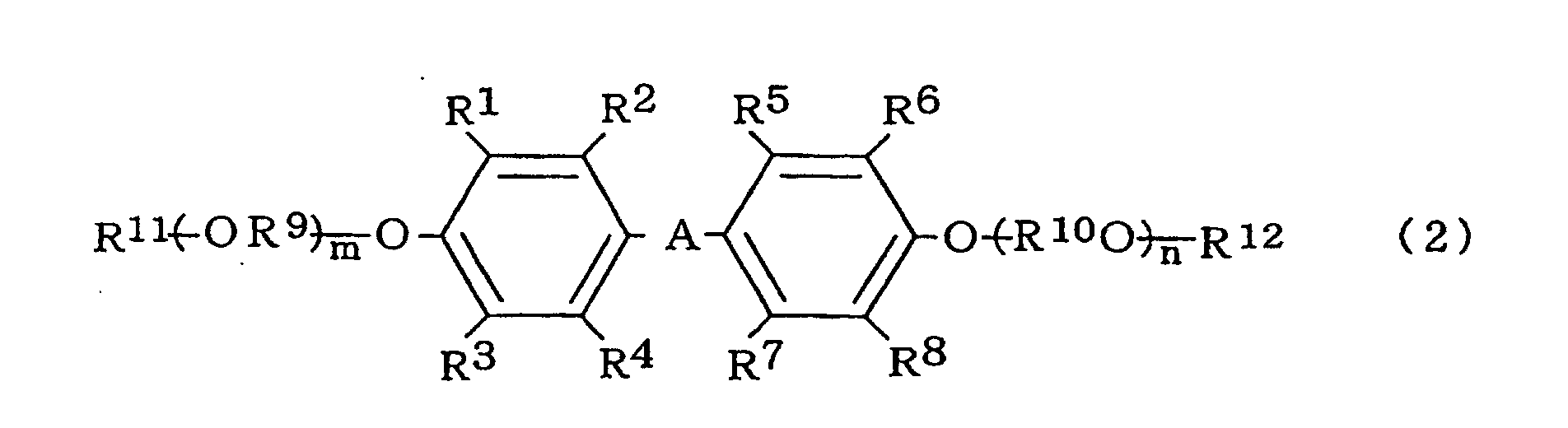
The polyether compound is preferably represented by the
following general formula (2):
wherein -A- represents -O-, -S-, -SO-, -SO
2-, -CO-, an alkylene
group having 1 to 20 carbon atoms, or an alkylidene group having
6 to 20 carbon atoms, R
1, R
2, R
3, R
4, R
5, R
6, R
7 and R
8 may be the
same or different and each represents a hydrogen atom, a halogen
atom, or a monovalent hydrocarbon group having 1 to 5 carbon atoms,
R
9 and R
10 may be the same or different and each represents a
divalent hydrocarbon group having 1 to 5 carbon atoms, R
11 and
R
12 may be the same or different and each represents a hydrogen
atom or a monovalent hydrocarbon group having 1 to 20 carbon atoms,
and m and n represent a repeating unit number of an oxyalkylene
unit and also satisfy the following relation: 2 ≦ m + n ≦ 50.
Also the present invention is directed to surface-treated
inorganic particles obtained by the method comprising the step
of kneading a system containing inorganic particles and a treating
agent.
Furthermore, the present invention is directed to a
surface-treated layered material obtained by the method
comprising the step of kneading a system containing a layered
material and a treating agent.
BEST MODE FOR CARRYING OUT THE INVENTION
In the present invention, a system containing inorganic
particles and a treating agent is preferably kneaded by using a
kneader.
As the kneader, a conventionally known kneader can be used
and examples thereof include batch-wise and continuous kneaders.
Examples of the batch-wise kneader include open type roll,
close type Bunbary kneader, kneader type kneader and mill type
kneader.
Although any batch-wise kneader can be used, a roll is
preferable because it suppresses heat generation and can be easily
replaced in case of producing various kinds of products, a Bunbary
kneader is preferable in view of efficient mixing and productivity,
and a kneader type kneader is preferable in view of low cost of
equipment. Among these batch-wise kneaders, a Bunbary kneader
is particularly preferable.
When using the Bunbary kneader, a rotor is appropriately
replaced by a rotor having different shape according to the
purposes. In view of efficient mixing, a two-blade standard type
rotor and a four-blade swirling flow type rotor are preferable.
When a filling ratio of the system containing inorganic
particles and a treating agent to be kneaded is too small, it
becomes difficult to apply a pressure, and therefore a kneading
rate decreases. On the other hand, when the filling ratio is too
large, the unkneaded portion remains. Therefore, the filling
ratio preferably accounts for about 70 to 80% of the capacity of
the kneader, though it varies depending on the viscosity of the
material to be filled.
Examples of the continuous kneader include single-screw
rotary kneader, twin-screw rotary kneader, single-screw kneader,
twin-screw kneader and multi-screw kneader.
Among the rotary kneaders, a two-blade rotor is preferable
to suppress heat generation, while a three-blade rotor is
preferable when high pressure is required to efficiently treat
inorganic particles. An engaging type rotor is preferable when
an adhesive material is used or replacement is often conducted.
The screw kneader means a so-called kneading extruder. The
kneading extruder is operated by varying the conditions such as
configuration of screw, configuration of barrel, and screw
revolution. A kneading disk is preferably used to increase
treating efficiency by applying a high pressure to the material.
A rotor segment is preferable to apply a pressure while
suppressing heat generation.
When using a continuous kneader, the treating time depends
on pitch between screw segments, screw revolution, or L/D of screw
or barrel. When the treatment requires a long time, it is required
to knead for a long time while applying a high pressure. In that
case, preferably, the pitch between segments is decreased as small
as possible and a three-threaded screw is used. The screw
revolution is preferably 100 rpm or higher, more preferably 150
rpm or higher, and most preferably 200 rpm or higher. L/D is
preferably 5 or greater, more preferably 7 or greater, and most
preferably 10 or greater.
The order and position of the addition of the inorganic
particles, treating agent and solvent vary depending on the
purposes of adding the treating agent and solvent. For example,
the following method is used, in addition to a method of
simultaneously adding inorganic particles, a treating agent and
an optionally used solvent.
In case inorganic particles are treated after scattering
an aggregate of inorganic particles into primary particles, there
can be employed a method of sufficiently dispersing inorganic
particles and a solvent while kneading and adding a treating agent,
followed by kneading.
In case self-reaction of the treating agent may occur, a
method of adding the treating agent through several ports can be
employed.
In case a hydrolyzable group of the treating agent has a
relation with the treating reaction, like a silane compound, or
the treating agent requires a reaction initiator, there can be
employed a method of dispersing the inorganic particles and
treating agent while kneading and adding a reaction initiator.
Examples of the inorganic particles used in the present
invention include, but are not limited to, conventionally known
inorganic particles made of layered materials such as
montmorillonite, metal hydroxides such as magnesium hydroxide,
metal oxides such as silica and alumina, carbonate compounds such
as calcium carbonate and barium carbonate, sulfate compounds such
as calcium sulfate and barium sulfate, carbon black, wood flour
and the like. Among these inorganic particles, a layered material,
especially swellable layered material, is preferable in view of
the effect due to the treating agent.
Examples of the layered material include at least one kind
selected from the group consisting of silicates, phosphates such
as zirconium phosphate, titanates such as potassium titanate,
tungstates such as sodium tungstate, uranates such as sodium
uranate, vanadates such as potassium vanadate, molybdates such
as magnesium molybdate, niobates such as potassium niobate, and
graphite. Among these layered materials, a layered silicate is
preferably used in view of availability and handling properties.
The swellable layered material means a layered material
having the nature capable of swelling in water, a polar solvent
soluble with water at an arbitrary ratio, or a mixed solvent of
water and a polar solvent.
The layered silicate is formed of a tetrahedral crystalline
sheet mainly made of silicon oxide and an octahedral crystalline
sheet mainly made of metal hydroxide. Examples thereof include
smectite clay and swellable mica.
The smectite clay is a natural or synthetic clay represented
by the following general formula (3):
X1 0.2-0.6Y1 2-3Z1 4O10(OH)2·nH2O
wherein X1 represents at least one kind selected from the group
consisting of K, Na, 1/2Ca and 1/2Mg, Y1 represents at least one
kind selected from the group consisting or Mg, Fe, Mn, Ni, Zn,
Li, Al and Cr, and Z1 represents at least one kind selected from
the group consisting of Si and Al, H2O represents a water molecule
which binds with an intercalated ion, and n markedly varies
depending on the intercalated ion and the relative humidity.
Specific examples of the smectite clay include
montmorillonite, beidellite, nontronite, saponite, iron
saponite, hectorite, sauconite, stevensite, bentonite,
substitution products or derivatives thereof, and mixtures
thereof. The basal spacing of the smectite clay in an initial
aggregate state is from about 10 to 17 Å and the average particle
size of the smectite clay in an aggregate state is from about 1000
to 1000000 A.
The swellable mica is a natural or synthetic mica
represented by the following general formula (4):
X2 0.5-1.0Y2 2-3(Z2 4O10) (F, OH)2
wherein X2 represents at least one kind selected from the group
consisting of Li, Na, K, Rb, Ca, Ba and Sr, Y2 represents at least
one kind selected from the group consisting of Mg, Fe, Ni, Mn,
Al and Li, Z2 represents at least one kind selected from the group
consisting of Si, Ge, Al, Fe and B.
The swellable mica has the nature capable of swelling in
water, a polar solvent soluble with water at an arbitrary ratio,
or a mixed solvent of water and a polar solvent. Examples of the
swellable mica include lithium type teniolite, sodium type
teniolite, lithium type tetrasilicon mica and sodium type
tetrasilicon mica, substitution products and derivatives thereof,
and mixtures thereof. The basal spacing of the smectite mica in
an initial aggregate state is from about 10 to 17 Å and the average
particle size of the smectite mica in an aggregate state is from
about 1000 to 1000000 Å.
Some swellable micas have a structure similar to that of
vermiculites and such vermiculite equivalents may also be used
as the swellable mica.
The vermiculite equivalents have two types: a trioctahedron
type and dioctahedron type, and are represented by the following
general formula (5):
(Mg,Fe,Al)2-3(Si4-xAlx)O10(OH)2·(M+,M2+ 1/2)xnH2O
wherein M represents an exchangeable cation of an alkaline metal
or alkaline earth metal such as Na and Mg, x represents 0.6 to
0.9, and n represents 3.5 to 5. The basal spacing of the
vermiculites in an initial aggregate state is from about 10 to
17 Å and the average particle size of the vermiculites in an
aggregate state is from about 1000 to 5000000 Å.
The crystal structure of the layered silicate is preferably
a structure with a high purity wherein layers are stratified
regularly in the c-axis direction. However, a so-called mixed
layer mineral wherein the crystal cycle is disturbed to allow a
plurality of types of crystal structures to be mixed may also be
used.
These layered silicates may be used alone, or two or more
kinds of them may be used in combination.
Among these layered materials, montmorillonite, bentonite,
hectorite, and swellable mica having an intercalated sodium ion
are preferable in view of the effect of improving dispersibility
and heat resistance during molding of the resulting resin, and
physical properties such as surface gloss.
The treating agent used in the present invention is not
specifically limited and a known treating agent can be used.
Examples of the treating agent include silane compounds
containing silane, polyether compounds having a polyether chain,
titanate compounds containing titanium, organic onium salt
compounds having an ammonium ion and a phosphonium ion, and
water-soluble polymers such as polyvinyl alcohol and polyvinyl
pyrrolidone.
The silane compound to be used may be any arbitrary silane
compound represented by the following general formula (6):
YnSiX4-n
wherein n represents an integer of 0 to 3, Y represents an
optionally substituted hydrocarbon group having 1 to 25 carbon
atoms, and X represents a hydrolyzable group and/or a hydroxyl
group.
In case the hydrocarbon group having 1 to 25 carbon atoms
in the general formula (6) has a substituent, examples of the
substituent include a group which binds through an ester bond,
a group which binds through an ether bond, an epoxy group, an amino
group, a carboxyl group, a group having a carbonyl group at the
end, an amide group, a mercapto group, a group which binds through
a sulfonyl bond, a group which binds through a sulfinyl bond, a
nitro group, a nitroso group, a nitrile group, a halogen atom,
and a hydroxyl group. The hydrocarbon group may be substituted
with at least one kind among these substituents, or may be
substituted with two or more kinds thereof.
X is hydrolyzable group and/or a hydroxyl group, the
hydrolyzable group being at least one type selected from the group
consisting of an alkoxy group, alkenyloxy group, a ketoxime group,
an acyloxy group, an amino group, an aminoxy group, an amido group,
and a halogen atom.
In the general formula (6), in case n or (4 - n) is 2 or
more, n Y(s) and (4 - n) X(s) may be the same or different.
In the general formula (6), examples of the compound wherein
Y is a hydrocarbon group having 1 to 25 carbon atoms include a
compound having a linear long-chain alkyl group such as
decyltrimethoxysilane; a compound having a lower alkyl group such
as methyltrimethoxysilane, a compound having an unsaturated
hydrocarbon group such as 2-hexenyltrimethoxysilane, a compound
having an alkyl group with a side chain such as 2-ethylhexyltrimethoxysilane,
a compound having a phenyl group such
as phenyltriethoxysilane, a compound having a naphthyl group such
as 3-â-naphthylpropyltrimethoxysilane, and a compound having an
aralkyl group such as p-vinylbenzyltrimethoxysilane.
Examples of a compound wherein Y is especially a vinyl group
among the hydrocarbon groups having 1 to 25 carbon atoms include
vinyltrimethoxysilane, vinyltrichlorosilane and
vinyltriacetoxysilane.
Examples of a compound wherein Y is a group having a group
substituted with a group which binds through an ester bond include
ã-methacryloxypropyltrimethoxy silane.
Examples of a compound wherein Y is a group having a group
substituted with a group which binds through an ester bond include
ã-polyoxyethylenepropyltrimethoxysilane and 2-ethoxyethyltrimethoxysilane.
Examples of a compound wherein Y is a group substituted with
an epoxy group include ã-glycidoxypropyltrimethoxysilane.
Examples of a compound wherein Y is a group substituted with
an amino group include ã-aminopropyltrimethoxysilane, ã-(2-aminoethyl)aminopropyltrimethoxysilane
and ã-anilinopropyltrimethoxysilane.
Examples of a compound wherein Y is a group substituted with
a group having a carbonyl group at the end include ã-ureidopropyltriethoxysilane.
Examples of a compound wherein Y is a group substituted with
a mercapto group include ã-mercaptopropyltrimethoxysilane.
Examples of a compound wherein Y is a group substituted with
a halogen atom include ã-chloropropyltriethoxysilane.
Examples of a compound wherein Y is a group substituted with
a sulfonyl group include ã-phenylsulfonylpropyltrimethoxysilane.
Examples of a compound wherein Y is a group substituted with
a sulfinyl group include ã-phenylsulfinylpropyltrimethoxysilane.
Examples of a compound wherein Y is a group substituted with
a nitro group include ã-nitropropyltriethoxysilane.
Examples of a compound wherein Y is a group substituted with
a nitroso group include ã-nitrosopropyltriethoxysilane.
Examples of a compound wherein Y is a group substituted with
a nitryl group include ã-cyanoethyltriethoxysilane and ã-cyanopropyltriethoxysilane.
Examples of a compound wherein Y is a group substituted with
a carboxyl group include ã-(4-carboxyphenyl)propyltrimethoxysilane.
In addition, a silane compound wherein Y is a group having
a hydroxyl group can also be used. Examples thereof include
N,N-di(2-hydroxyethyl)amino-3-propyltriethoxysilane. The
hydroxyl group may be in the form of a silanol group (SiOH).
Substitution products or derivatives of the silane compound
may also be used. These silane compounds may be used alone, or
two or more kinds of them can be used in combination.
The polyether compound used as the treating agent means a
compound wherein the main chain is polyoxyalkylene such as
polyoxyethylene or polyoxyethylene-polyoxypropylene copolymer,
the number of repeating units being from about 2 to 100.
The polyether compound may have arbitrary substituent in
the side chain and/or the main chain as far as the thermoplastic
resin and inorganic particles are not adversely affected.
Examples of the substituent include a hydrocarbon group,
a group which binds through an ester bond, an epoxy group, an amino
group, a carboxyl group, a group having a carbonyl group at the
end, an amide group, a mercapto group, a group which binds through
a sulfonyl bond, a group which binds through a sulfinyl bond, a
nitro group, a nitroso group, a nitrile group, a Si atom-containing
functional group capable of forming a Si-O- bond such
as an alkoxysiliyl group or a silanol group, a halogen atom, and
a hydroxyl group. The polyether compound may be substituted with
at least one kind among these substituents, or may be substituted
with two or more kinds thereof.
The hydrocarbon group as used herein includes a linear or
branched (i.e., having a side chain), saturated or unsaturated,
monovalent or multivalent aliphatic hydrocarbon group, an
alicyclic hydrocarbon group and an aromatic hydrocarbon group.
Examples of the hydrocarbon group include an alkyl group, an
alkenyl group, an alkynyl group, a cycloalkyl group, a phenyl
group and a naphthyl group. The "alkyl group" as used herein is
intended to include a multivalent hydrocarbon group such as an
"alkylene group" unless otherwise specified. Likewise, the
alkenyl group, the alkynyl group, the cycloalkyl group, the phenyl
group and the naphthyl group include an alkenylene group, an
alkynylene group, a cycloalkylene group, a phenylene group and
a naphthylene group.
A composition ratio of the substituent in the polyether
compound is not specifically limited, but is preferably selected
so that the polyether compound is soluble in water, or a polar
solvent containing water. Specifically, the solubility in 100
g of water at room temperature is 1 g or more, preferably 2 g or
more, more preferably 5 g or more, still more preferably 10 g of
more, and particularly preferably 20 g or more.
Examples of the polar solvent include alcohols such as
methanol, ethanol and isopropanol; glycols such as ethylene
glycol, propylene glycol and 1,4-butanediol; ketones such as
acetone and methyl ethyl ketone; ethers such as diethyl ether and
tetrahydrofuran; amide compounds such as N,N-dimethylformamide
and N,N-dimethylacetamide; and other solvents such as pyridine,
dimethyl sulfoxide and N-methyl pyrrolidone. Also carbonic acid
diesters such as dimethyl carbonate and diethyl carbonate can be
used. These polar solvents may be alone, or two or more kinds
of them may be used in combination.
Specific examples of the polyether compound used in the
present invention include polyethylene glycol, polypropylene
glycol, polytetramethylene glycol, polyethylene glycol-polypropylene
glycol, polyethylene glycol-polytetramethylene
glycol, polyethylene glycol monomethyl ether, polyethylene
glycol dimethyl ether, polyethylene glycol monoethyl ether,
polyethylene glycol diethyl ether, polyethylene glycol monoallyl
ether, polyethylene glycol diallyl ether, polyethylene glycol
monophenyl ether, polyethylene glycol diphenyl ether,
polyethylene glycol octylphenyl ether, polyethylene glycol
methylethyl ether, polyethylene glycol methylallyl ether,
polyethylene glycol glyceryl ether, polyethylene glycol
monomethacrylate, polyethylene glycol monoacrylate,
polypropylene glycol monomethacrylate, polypropylene glycol
monoacrylate, polyethylene glycol-polypropylene glycol
monomethacrylate, polyethylene glycol-polypropylene glycol
monoacrylate, polyethylene glycol-polytetramethylene glycol
monomethacrylate, polyethylene glycol-polytetramethylene
glycol monoacrylate, methoxypolyethylene glycol
monomethacrylate, methoxypolyethylene glycol monoacrylate,
octoxypolyethylene glycol-polypropylene glycol
monomethacrylate, octoxypolyethylene glycol-polypropylene
glycol monoacrylate, lauroxypolyethylene glycol
monomethacrylate, lauroxypolyethylene glycol monoacrylate,
stearoxypolyethylene glycol monomethacrylate,
stearoxypolyethylene glycol monoacrylate, allyloxypolyethylene
glycol monomethacrylate, allyloxypolyethylene glycol
monoacrylate, nonylphenoxypolyethylene glycol monomethacrylate,
nonylphenoxypolyethylene glycol monoacrylate, polyethylene
glycol dimethacrylate, polyethylene glycol diacrylate,
polyethylene glycol-polytetramethylene glycol dimethacrylate,
polyethylene glycol-polytetramethylene glycol diacrylate,
bis(polyethylene glycol)butylamine, bis(polyethylene
glycol)octylamine, polyethylene glycol bisphenol A ether,
polyethylene glycol-polypropylene glycol bisphenol A ether,
ethylene oxide-modified bisphenol A dimethacrylate, ethylene
oxide-modified bisphenol A diacrylate, ethylene oxide-propylene
oxide-modified bisphenol A dimethacrylate, polyethylene glycol
diglycidyl ether, polyethylene glycol ureidopropyl ether,
polyethylene glycol mercaptopropyl ether, polyethylene glycol
phenylsulfonylpropyl ether, polyethylene glycol
phenylsulfinylpropyl ether, polyethylene glycol nitropropyl
ether, polyethylene glycol nitrosopropyl ether, polyethylene
glycol cyanoethyl ether, and polyethylene glycol cyanoethyl ether.
These polyether compounds may be alone, or two or more kinds of
them may be used in combination.
The present invention is directed to a layered material
treated with a polyether compound which satisfies at least one
condition of these conditions: (a) the polyether compound has a
cyclic hydrocarbon group, and (b) the polyether compound has a
hydroxyl value of 30 mg KOH/g or less, among the above polyether
compounds. When the polyether compound satisfies either
condition, it is made possible to disperse the layered material
in the resin, uniformly and finely.
The polyether compound having a cyclic hydrocarbon group
is intended to mean a compound having a cyclic hydrocarbon group
in the side chain and/or the main chain of a polyoxyalkylene
compound such as polyoxyethylene or polyoxyethylene-polyoxypropylene
copolymer. Specific examples thereof include
polyethylene glycol having a bisphenol A unit in the main chain
and polypropylene glycol having a bisphenol A unit in the main
chain. When the polyether compound has a cyclic hydrocarbon group,
the effect of finely dispersing in a thermoplastic resin such as
polyester resin may be improved. Also the thermal stability is
less likely to be impaired. The cyclic hydrocarbon group means
an aromatic hydrocarbon group and/or an alicyclic hydrocarbon
group and examples thereof include a phenyl group, a naphthyl
group and a cycloalkyl group. The "phenyl group" as used herein
is intended to include a polyvalent cyclic hydrocarbon group such
as a "phenylene group" unless otherwise specified. Likewise, the
naphthyl group and the cycloalkyl group include a naphthylene
group and a cycloalkylene group. Among the cyclic hydrocarbon
groups, an aromatic hydrocarbon group is preferable in view of
stability and dispersibility of the layered material.
A polyether compound having a hydroxyl value of 30 mg KOH/g
or less includes, for example, polyethylene glycol whose end is
blocked with an alkoxy group. The hydroxyl value of the polyether
compound is preferably 28 mg KOH/g or less, more preferably 25
mg KOH/g or less, still more preferably 23 mg KOH/g or less, and
particularly preferably 20 mg KOH/g or less. When the hydroxyl
value is more than 30 mg KOH/g, the molecular weight of the
thermoplastic polyester resin decreases, thus lowering the
strength and the toughness of the resin composition.
A method for measurement of the hydroxyl value is not
specifically limited and an arbitrary method can be used. For
example, 1 g of a polyether compound used in the present invention
is acetylated with acetyl chloride, acetic anhydride or glacial
acetic acid. Then, the acetylated polyether compound is
hydrolyzed, that is, saponified with an alkali compound such as
sodium hydroxide and the amount (mg) of potassium hydroxide
required to neutralize acetic acid produced by the hydrolysis is
taken as a hydroxyl value.
Among these polyether compounds, a polyether compound
having a unit represented by the following general formula (1):
wherein -A- represents -O-, -S-, -SO-, -SO
2-, -CO-, an alkylene
group having 1 to 20 carbon atoms, or an alkylidene group having
6 to 20 carbon atoms, R
1, R
2, R
3, R
4, R
5, R
6, R
7 and R
8 may be the
same or different and each represents a hydrogen atom, a halogen
atom, or a monovalent hydrocarbon group having 1 to 5 carbon atoms,
in the main chain, is preferably used in view of thermal stability
and dispersibility of the layered material. The substituent -A-
is preferably -C(CH
3)
2- or -CH
2- in view of availability. R
1, R
2,
R
3, R
4, R
5, R
6, R
7 and R
8 are preferably groups selected from a
hydrogen atom, a methyl group and an ethyl group in view of
availability.
A polyether compound represented by the following general
formula (2):
wherein -A- represents -O-, -S-, -SO-, -SO
2-, -CO-, an alkylene
group having 1 to 20 carbon atoms, or an alkylidene group having
6 to 20 carbon atoms, R
1, R
2, R
3, R
4, R
5, R
6, R
7 and R
8 may be the
same or different and each represents a hydrogen atom, a halogen
atom, or a monovalent hydrocarbon group having 1 to 5 carbon atoms,
R
9 and R
10 may be the same or different and each represents a
divalent hydrocarbon group having 1 to 5 carbon atoms, R
11 and
R
12 may be the same or different and each represents a hydrogen
atom or a monovalent hydrocarbon group having 1 to 20 carbon atoms,
and m and n represent a repeating unit number of an oxyalkylene
unit and also satisfy the following relation: 2 ≦ m + n ≦ 50,
is used particularly preferably in view of thermal stability,
dispersibility of the layered material, and availability. The
substituent -A- is preferably -C(CH
3)
2-, -CH
2- or -CH(C
6H
5)- in view
of availability. R
1, R
2, R
3, R
4, R
5, R
6, R
7 and R
8 are preferably
groups selected from a hydrogen atom, a methyl group and an ethyl
group in view of availability. R
9 and R
10 are preferably an
ethylene group and/or a propylene group in view of availability.
R
11 and R
12 are preferably groups selected from a hydrogen atom,
a methyl group and an ethyl group in view of availability. (m
+ n) preferably satisfies the following relation: 2 ≦ m + n ≦
50. More preferably, (m + n) satisfies the following relation:
2 ≦ m + n ≦ 30. When (m + n) is less than 2, the dispersibility
of the layered material in the resin may deteriorate. On the other
hand, when (m + n) exceeds 50, the thermal stability may
deteriorate. m is preferably from 1 to 15 in view of availability,
dispersibility of the layered material, and thermal stability.
n is preferably from 1 to 15 in view of availability,
dispersibility of the layered material, and thermal stability.
Examples of the titanate compound include monoalkoxy type
titanate treating agents represented by the general formula (7),
such as isopropyltrisisostearoyl titanate, isopropyltris-n-dodecylbenzenesulfonyl
titanate and
isopropyldimethacrylisostearoyl titanate; chelete type titanate
treating agents represented by the general formula (8), such as
bis(dioctylpyrophosphate)-oxyacetate titanate,
bis(dioctylpyrophosphate)-ethylene titanate and
dicumylphenyloxyacetate titanate; coordinated type titanate
treating agents represented by the general formula (9), such as
tetraisopropyl-bis(dioctylphosphite) titanate and tetraoctyl-bis(ditridecyl
phosphite) titanate; and substitution products or
derivatives thereof. These titanate compounds may be used alone,
or two or more kinds of them may be used in combination.
i-Pro―Ti―(OR1)3
(i-Pro)4―Ti·[P(OR3)2OH]2 The organic onium salt compound is a conventionally known
onium salt containing anions such as onium ion and halogen ion.
Typical examples of the onium ion include an ammonium ion, a
phosphonium ion, a sulfonium ion, and an onium ion originating
from a heteroaromatic ring. Among these, the ammonium ion, the
phosphonium ion, and the onium ion originating from a
heteroaromatic ring are preferably used in view of availability
and stability.
Examples of the ammonium ion include ions of alkyl ammoniums
such as dodecyl ammonium, hexadecyl ammonium, octadecyl ammonium,
methyldodecyl ammonium, butyldodecyl ammonium, methyloctadecyl
ammonium, dimethyloctylammonium, dimethyldodecyl ammonium,
dimethylhexadecyl ammonium, dimethyloctadecyl ammonium,
trimethyldodecyl ammonium, triethyltetradecyl ammonium,
tributylhexadecyl ammonium, dimethyldidodecyl ammonium,
diethylditetradecyl ammonium, dibutyldihexadecyl ammonium and
tridecyl methylammonium; ammoniums having a phenyl group, such
as dimethylphenyl ammonium, diphenyldodecyl ammonium,
diphenyloctadecyl ammonium, methylbenzyldidodecyl ammonium and
dibenzyldihexadecyl ammonium; ammoniums having a hydrophilic
group, such as [PEG] ammonium (hereinafter [PEG] represents a
polyethylene glycol chain), methyl [PEG] ammonium, dodecyl [PEG]
ammonium, hexadecyl [PEG] ammonium, dimethyl [PEG] ammonium,
methyldodecyl [PEG] ammonium, methyloctadecyl [PEG] ammonium,
methylbis [PEG] ammonium, dodecyl bis [PEG] ammonium and hexadecyl
bis [PEG] ammonium; ammoniums of á-amino acid, such as glycine,
alanine, valine, leucine, isoleucine, phenyl alanine, tyrosine,
threonine, serine, bronine, triptophan, methionine, cystine,
cysteine, asparagine, aspartic acid, glutamine, glutaminic acid,
lysine, arginine and histidine; and ammoniums of ω-amino acid,
such as 6-aminocaproic acid, 8-aminooctanoic acid, .10-aminodecanoic
acid, 11-aminoundecanoic acid and 12-aminododecanoic
acid.
Examples of the phosphonium ion include ions of alkyl
phosphoniums such as tetrabutyl phosphonium, tetraoctyl
phosphonium, trimethyldecyl phosphonium, trimethyldodecyl
phosphonium, trimethylhexadecyl phosphonium,
trimethyloctadecyl phosphonium, tributyldodecyl phosphonium,
tributylhexadecyl phosphonium and tributyloctadecyl phosphonium,
and [PEG] phosphonium, methyl [PEG] phosphonium, dodecyl [PEG]
phosphonium, hexadecyl [PEG] phosphonium, dimethyl [PEG]
phosphonium, methyldodecyl [PEG] phosphonium, methyloctadecyl
[PEG] phosphonium, methylbis [PEG] phosphonium, dodecylbis [PEG]
phosphonium and hexadecylbis [PEG] phosphonium.
Examples of the sulfonium ion include ions of tridodecyl
sulfonium and didodecyltetradecyl sulfonium.
Examples of the onium ion originating from heteroaromatic
ring include ions of pyridinium, methyl pyridinium, dimethyl
pyridinium, 2-phenylpyridinium, 2-aminopyridinium, nicotinium,
onium of nicotineamide, quinolinium and isoquinolinium.
Substitution products or derivatives of the onium salt can
also be used. These onium salts can be used alone, or two or more
kinds of them can be used in combination.
Examples of the water-soluble polymer include, but are not
limited to, polyvinyl alcohol, polyethylene glycol, sodium
polyacrylate, polyvinyl pyrrolidone, polyacrylic acid ester,
polyacrylamide, oligosaccharide such as disaccharide or
trisaccharide, cellulose processed natural polymer and starch
processed natural polymer. These water-soluble polymers may be
substituted as far as water solubility is not impaired. In
addition to the above compounds, starch, mannan, seaweed,
vegetable mucilage, mucilage originating from microorganism,
natural polymeric compound such as protein, and polymeric
compound such as polyvinylimine or ethylene-vinyl alcohol
copolymer can also be used.
The surface-treated layered material of the present
invention can be produced in the following manner.
When using a solvent, inorganic particles and a solvent are
mixed while agitating, first. The agitation method is not
specifically limited. For example, agitation is conducted using
a conventionally known wet agitator. Examples of the wet agitator
include a high-speed agitator capable of agitation by high-speed
revolution of an agitating blade, wet mills for wet-pulverizing
samples in the clearance between a rotor applied with a high shear
force and a stator, mechanical wet pulverizers employing a hard
medium, wet collision pulverizers for colliding samples at high
speed using jet nozzles, and a wet ultrasonic pulverizer using
an ultrasonic wave. Among these wet agitators, the wet mill is
preferable. In case of efficiently mixing, the revolution during
agitation is controlled to 1000 rpm or higher, preferably 1500
rpm or higher, and more preferably 2000 rpm or higher. The upper
limit of the revolution is 25000 rpm. Even if the revolution is
higher than 25000 rpm, the effect of agitation may not enhance.
It is also possible to efficiently mix by controlling the shear
rate to 500 (1/s) or higher, preferably 1000 (1/s) or higher, and
more preferably 1500 (1/s) or higher. The upper limit of the shear
rate is about 500000 (1/s). Even if the shear rate is higher than
500000 (1/s), the effect of agitation may not increase. The time
required to mixing is from 1 to 10 minutes. The treating agent
is added and sufficiently mixed while agitating for additional
5 to 60 minutes. The mixture is dried while heating, or
freeze-dried, and then optionally powdered. Alternatively, a
spray-drying method is preferably used.
The solvent used in the present invention is not
specifically limited but means, for example, water, a polar
solvent soluble with water at an arbitrary ratio, or a mixed
solvent of water and a polar solvent. Among these solvents, water
is preferable because it is easy to treat in the step of drying
a dispersion medium.
Examples of the polar solvent include alcohols such as
methanol, ethanol and isopropanol; glycols such as ethylene
glycol, propylene glycol and 1,4-butanediol; ketones such as
acetone and methyl ethyl ketone; ethers such as diethyl ether and
tetrahydrofuran; amide compounds such as N,N-dimethylformamide
and N,N-dimethylacetamide; and other solvents such as pyridine,
dimethyl sulfoxide, methylcellosolve, 2-pyrrolidone and N-methyl
pyrrolidone. Also carbonic acid diesters such as dimethyl
carbonate and diethyl carbonate can be used. These polar solvents
may be alone, or two or more kinds of them may be used in
combination.
The amount of the treating agent can be adjusted so that
affinity between inorganic particles and the resin to be used,
and dispersibility of the inorganic particles in the resin molded
product are sufficiently enhanced. If necessary, plural kinds
of treating agents each having a different functional group can
be used in combination. Therefore, the amount of the treating
agent is not limited to a specific numerical value. The lower
limit of the amount of the treating agent is preferably 0.1 parts
by weight, more preferably 0.2 parts by weight, still more
preferably 0.3 parts by weight, particularly preferably 0.4 parts
by weight, and most preferably 0.5 parts by weight, based on 100
parts by weight of the inorganic particles. The upper limit of
the amount of the treating agent is preferably 200 parts by weight,
more preferably 180 parts by weight, still more preferably 160
parts by weight, particularly preferably 140 parts by weight, and
most preferably 120 parts by weight, based on 100 parts by weight
of the inorganic particles. When the lower limit of the amount
of the treating agent is smaller than 0.1 parts by weight, the
effect of finely dispersing the inorganic particles may decrease.
Even if the amount of the treating agent is larger than 200 parts
by weight, the effect of finely dispersing the inorganic particles
may not increase.
The completion of the surface treatment of the inorganic
particles by the treating method of the present invention can be
confirmed by a conventionally known analytical method. For
example, the following method can be employed in case a silane
compound represented by the above general formula (6) is
introduced into the surface of the inorganic particles.
First, the surface-treated inorganic particles are washed
with an organic solvent such as tetrahydrofuran or chloroform to
remove the silane compound which simply adsorbs to the
surface-treated inorganic particles. After washing, the
surface-treated inorganic particles are powdered with a mortar
and the like and dried. The resulting surface-treated inorganic
particles are sufficiently mixed with a window material such as
powdered potassium bromide (KBr) at a predetermined ratio and the
mixture is compressed into tablets. Then, an absorption band
assigned to the silane compound is measured by a transmission
method using Fourier transform infrared spectrum (FT-IR). If an
accurate measurement is desired or the amount of silane compound
is small, sufficiently dried powdered surface-treated inorganic
particles are desirably measured by a diffuse reflectance
infrared spectroscopy (DRIFT) as they are.
In case the inorganic particles are made of a swellable
layered material and are treated with a silane compound, an
organic onium salt compound, a polyether compound, a water-soluble
polymer or the like, the basal spacing of the swellable
layered material before and after the surface treatment is
measured. After sufficiently drying the surface-treated
inorganic particles of the present invention the basal spacing
can be confirmed by a small angle X-ray diffraction (SAXS) method.
According to this method, the peak angle value of the x-ray
diffraction assigned to the (001) plane of the surface-treated
swellable layered inorganic compound is measured by SAXS, and the
Bragg equation is calculated using the resultant peak angle value,
to obtain the basal spacing. The initial basal spacing of the
swellable layered material before the treatment is also measured
in the same manner. These basal spacings are compared with each
other to confirm the expansion of the basal spacing.
The surface-treated layered material of the present
invention can be used as a reinforcer capable of enhancing the
rigidity and heat resistance of polymeric material having a polar
group, such as thermoplastic polyester resin, polycarbonate resin,
polyamide resin, polyallylate resin, polyacetal resin,
polyphenylene sulfide resin, acrylonitrile-styrene copolymer
and polysulfone resin. Hereinafter the resin mixed with the
reinforcer is referred to as a resin composition.
The thermoplastic polyester resin means a conventionally
known arbitrary thermoplastic polyester resin obtained by
reacting an acid component composed mainly of a dicarboxylic acid
compound and/or an ester-forming derivative of dicarboxylic acid
with a diol component composed mainly of a diol compound and/or
an ester-forming derivative of a diol compound. Specific
examples of the thermoplastic polyester resin include
polyethylene terephthalate, polypropylene terephthalate,
polybutylene terephthalate, polyhexamethylene terephthalate,
polycyclohexane-1,4-dimethyl terephthalate, neopentyl
terephthalate, polyethylene isophthalate, polyethylene
naphthalate, polybutylene naphthalate, polyhexamethylene
naphthalate, or copolymerized polyesters thereof. These
thermoplastic polyester resins may be used alone, or two or more
kinds of them may be used in combination. Regarding the molecular
weight of the thermoplastic polyester resin, logarithmic
viscosity measured at 25°C using a mixed solvent of phenol and
tetrachloroethane (weight ratio: 5/5) is from 0.3 to 2.0 (dl/g).
When the logarithmic viscosity is smaller than 0.3 (dl/g), the
strength of the resulting resin molded product may decrease. On
the other hand, when the logarithmic viscosity is larger than 2.0
(dl/g), flow moldability upon molding may be impaired.
The polyamide resin used in the present invention means a
polymer which has an amide bond (-NHCO-) in the main chain and
can be melted while heating. Specific examples thereof include
polytetramethylene adipamide (nylon 46), polycaprolactam (nylon
6), polyhexamethylene adipamide (nylon 66), polytetramethylene
sebacamide (nylon 610), polyhexamethylene dodecamide (nylon 612),
polyundecanolactam (nylon 11), polydodecanolactam (nylon 12),
polyundecamethylene adipamide (116); polyamides obtained from
terephthalic acid and/or isophthalic acid, adipic acid and
hexamethylenediamine, such as polytrimethylhexamethylene
terephthalamide (TMHT), polyhexamethylene terephthlamide (nylon
6T) and polyhexamethylene isophthalamide (nylon 61);
polybis(4-aminocyclohexyl)methane dedecamide (nylon dimethyl
PACM12), polymethaxysilylene adipamide (nylon MXD6),
polyundecamethylene terephthalamide (nylon 11T),
polyundecamethylene hexahydroterephthalamide (nylon 11TH),
copolymerized polyamide containing 1,3-phenylenedioxydiacetic
acid as a copolymer component, and copolymerized polyamide
containing a dimerized fatty acid as a copolymer component. The
polyamide resin may be a linear polyamide resin or (semi)aromatic
polyamide resins. These polyamide resins may be used alone, or
two or more kinds of them may be used in combination. The
molecular weight of the polyamide resin is not specifically
limited, but the relative viscosity measured at 25°C in 98%
concentrated sulfuric acid is preferably within a range from 0.5
to 5.0. When the logarithmic viscosity is smaller than 0.5,
mechanical properties and impact resistance of the resulting
resin molded product may deteriorate. On the other hand, when
the logarithmic viscosity is larger than 5.0, the flow
processability upon molding may deteriorate.
The polyacetal resin used in the present invention is a
polymer composed mainly of a repeating unit having an oxyalkylene
structure represented by the general formula: -(O-CHR)n- wherein
R represents a hydrogen atom or a hydrocarbon group having 1 to
5 carbon atoms, and n represents a natural number. Specific
examples thereof include a polyoxymethylene homopolymer, and a
copolymer having a monomer unit of ethylene oxide, 1, 3-dioxolane
or 1, 4-butanediol, in addition to an oxymethylene group as a main
repeating unit. The method of producing a polyacetal resin is
not specifically limited and the polyacetal resin is usually
produced by ring-opening polymerization of trioxane. Also a
copolymer can be used and those obtained by crosslinking or graft
modification by a known method can be used. These polyacetal
resins may be used alone, or two or more kinds of them may be used
in combination. The molecular weight is not specifically limited
and a melt index (MI) measured at 190°C in compliance with ASTM
D1238-89E is usually within a range from 1 to 25. When MI is
smaller than 1, the processability may be impaired. On the other
hand, when MI is larger than 25, physical properties may become
poor.
The poltarylene sulfide resin used in the present invention
is a polymer wherein an aromatic residue binds through a thioether
bond, and can be melted while heating. The main chain structure
of the resin includes, for example, polyphenylene sulfide and
polyphenylene sulfide sulfone, and these poltarylene sulfide
resins may be used alone, or two or more kinds of them may be used
in combination. The molecular weight of the polyarylene sulfide
resin is not specifically limited and a weight average molecular
weight is usually within a range from 10000 to 500000. When the
weight average molecular weight is smaller than 10000, physical
properties may become poor. On the other hand, when the weight
average molecular weight is larger than 500000, the
processability may be impaired.
The polycarbonate resin used in the present invention is
not specifically limited, and a conventionally known arbitrary
polycarbonate resin obtained by the reaction of a bisphenol
compound and phosgene, or the reaction of a bisphenol compound
and a carbonic acid diester is used. Specific examples thereof
include 2,2-bis(4-hydroxyphenyl)propane type polycarbonate
resin, 2,2-bis(3,5-dimethyl-4-hydroxyphenyl)propane type
polycarbonate, 1,1-bis(4-hydroxyphenyl)cyclohexane type
polycarbonate, 4,4'-dihydroxyphenyl ether type polycarbonate,
4,4'-dihydroxydiphenylsulfide type polycarbonate, 4,4'-dihydroxydiphenylsulfone
type polycarbonate, bis(4-hydroxyphenyl)ketone
type polycarbonate and 1,4-bis(4-hydroxyphenylsulfonyl)benzene.
These poltarylene sulfide
resins may be used alone, or two or more kinds of them may be used
in combination. The polycarbonate resins may be used alone, or
two or more kinds of polycarbonate resins having different
components, ratios and/or molecular weights may be used in
combination. In view of the strength, mechanical properties and
cost, a bisphenol A type polycarbonate is preferable. The
molecular weight of the polycarbonate (PC) resin is not
specifically limited and a viscosity average molecular weight
(Mv) is within a range from 10000 to 200000. When the viscosity
average molecular weight is smaller than 10000, physical
properties may become poor. On the other hand, when the viscosity
average molecular weight is larger than 200000, the
processability may be impaired.
The polyallylate resin used in the present invention is not
specifically limited and is a known polyallylate resin obtained
by reacting acid component (hereinafter referred to as an aromatic
dicarboxylic acid) composed mainly of an aromatic dicarboxylic
acid compound and/or an ester-forming derivative of an aromatic
dicarboxylic acid with a diphenol component (hereinafter referred
to as diphenol) composed mainly of a diphenol compound and/or an
ester-forming derivative of a diphenol compound. Specific
examples of the polyallylate resin include polyallylate (for
example, manufactured by UNITIKA LTD. under the trade name of U
polymer) obtained by the reaction of terephthalic acid and
2,2-bis(4-hydroxyphenyl)propane("bisphenol A"); polyallylate
(for example, manufactured by Du Pont Co. under the trade name
of Aliron) obtained by the reaction of isophthalic acid and
2,2-bis(4-hydroxyphenyl)propane; polyallylate obtained by the
reaction of a mixture of terephthalic acid and isophthalic acid,
and 2,2-bis(4-hydroxyphenyl)propane; polyallylate obtained by
the reaction of a mixture of terephthalic acid and isophthalic
acid and a mixture of 2,2-bis(4-hydroxyphenyl)propane and
1,1-bis(4{hydroxyphenyl)-3,3,5-trimethylcyclohexane;
polyallylate obtained by the reaction of a mixture of isophthalic
acid and 2,5-naphthalenedicarboxylic acid, 2,2-bis(4-hydroxyphenyl)propane;
polyallylate obtained by the reaction of
a mixture of isophthalic acid and 2,5-naphthalenedicarboxylic
acid and a mixture of 2,2-bis(4-hydroxyphenyl)propane and
1,1-bis(4-hydroxyphenyl)-3,3,5-tri-methylcyclohexane; and a
polyallylate resin produced by using two or more kinds of aromatic
dicarboxylic acids and/or diphenols used in the production of
these resins. These polyallylate resins can be used alone, or
two or more kinds of the polyallylate resins having different
compositions or components can be used in combination. The
molecular weight of the polyallylate resin is not specifically
limited and a weight average molecular weight (Mw) measured at
25° C in chloroform is usually within a range from 25000 to 80000.
When Mw is smaller than 25000, physical properties may become poor.
On the other hand, when Mw is larger than 80000, the processability
may be impaired.
The surface-treated inorganic particles of the present
invention can be finely dispersed in the resin, thereby making
it possible to exert various effects. Moreover, anisotropy is
suppressed as compared with a fiber reinforcer which has commonly
been used, heretofore. In the fiber-reinforced material, fibers
are fractured during recycling and physical properties
deteriorate, while the surface-treated inorganic particles of the
present invention are excellent in recycling properties because
the particles are not fractured and physical properties do not
deteriorate. Examples of the other effect include an effect of
enhancing stability by suppressing warp, shrinkage during molding
and linear expansion coefficient, an effect of imparting barrier
properties, and an effect of improving moldability by increasing
a crystallization rate of a crystalline resin.
The method of finely dispersing the surface-treated
inorganic particles of the present invention is not specifically
limited. For example, there can be used a method of melt-kneading
a resin and a surface-treated layered material using various
common kneaders. Examples of the kneader include single-screw
extruder, twin-screw extruder, roll, Banbury mixer and kneader.
Among these kneaders, a kneader having high shear efficiency is
preferable. The resin and the surface-treated inorganic
particles of the present invention may be simultaneously charged
in the above kneader and melt-kneaded. Alternatively, the
surface-treated inorganic particles of the present invention may
be added to the resin, which was previously melted, followed by
melt-kneading.
The surface-treated inorganic particles obtained by the
present invention can be utilized in various fields as reinforcers,
dimensional stability-imparting agents and heat resistance-imparting
agents for various resins for injection molding,
reinforcers and gas barrier properties-imparting agents for film
and bottle products, and viscosity adjustors for organic solvents
and paints, because they are subjected to a surface treatment very
efficiently and uniformly.
The surface-treated inorganic particles of the present
invention can be preferably used for automobile parts, parts for
appliances, daily necessities, packaging material, and other
industrial materials, because various features can be imparted
by mixing with resins.
The present invention will be described in detail by way
of examples, but the present invention is not limited by the
examples.
Principal raw materials used in the following Examples and
Comparative Examples are summarized below. Unless otherwise
specified, these raw materials are not purified.
(Raw materials)
Inorganic particles
A-1: Montmorillonite (manufactured by Kunimine Industries Co.,
Ltd. under the trade name of Kunipia F, basal spacing = 13 Å)
A-2: Swellable mica (manufactured by CO-OP Chemical Co., Ltd.
under the trade name of SOMASIF ME100, basal spacing = 12 Å)
A-3: Natural talc (manufactured by NIPPON TALC CO., LTD. under
the trade name of MICRO ACE K-1)
Fibrous reinforcers
A-4: Glass fiber (manufactured by Nippon Electric Glass Co. , Ltd.
under the trade name of T-195H)
Treating agents
B-1: Polyether compound (polyethylene glycol having a bisphenol
A unit in the main chain, manufactured by TOHO Chemical Industry
Co., LTD. under the trade name of Bisol 18EN, hydroxyl value =
110 mg KOH/g, m = 9, n = 9 in the general formula (2))
B-2: Polyether compound (manufactured by NOF CORPORATION under
the trade name of UnioxMM500, hydroxyl value = 2.8 mg KOH/g, having
a methoxy group)
B-3: Silane compound (manufactured by Nippon Unicar Co., Ltd.
under the trade name of A1120)
B-4: Organic onium salt compound (manufactured by Lion
Corporation under the trade name of Esocard C25)
B-5: Polyvinyl pyrrolidone (manufactured by Wako Pure Chemical
Industries, Ltd.)
Resins
C-1: Polyethylene terephthalate resin (manufactured by Kanebo Ltd.
under the trade name of Bellpet EFG70, logarithmic viscosity
measured at 25°C using a mixed solvent of phenol and
tetrachloroethane (weight ratio: 5/5): 0.73 (dl/g))
C-2: Polybutylene terephthalate resin (manufactured by KOLON Co.
under the trade name of KP210, logarithmic viscosity measured at
25° C using a mixed solvent of phenol and tetrachloroethane (weight
ratio: 5/5): 0.82 (dl/g))
C-3: Polyamide 6 (manufactured by Toray Industries Inc. under the
trade name of Amilane CM1026, relative viscosity measured at 25° C
in 98% concentrated sulfuric acid: 3.0)
C-4: Polyacetal (manufactured by Polyplastics Co. under the trade
name of Duracone M90-44, melt index measured under the conditions
of a temperature of 190°C and a load of 2.16 kg: 9.0 g/10 min)
The evaluation methods in the Examples and Comparative
Examples are summarized below.
(Basal spacing)
A basal spacing of a surface-treated layered material was
measured by an X-ray generator (manufactured by Rigaku Denki Co. ,
Ltd. under the trade name of RU-200B) using a target Cuká ray and
an Ni filter under the conditions of a voltage of 40 kV, a current
of 200 mA, a scanning angle 2è of 0.2 to 16.0° , and a step angle
of 0.02°.
The basal spacing was calculated by calculating the Bragg
equation using the actual peak angle value of the small angle X-ray
diffraction. When the confirmation of the peak angle value of
the small angle X-ray diffraction is difficult, it was considered
that the layers had been sufficiently exfoliated to substantially
lose the crystallinity as described above, or that the
confirmation was difficult since the peak angle value was about
0.8° or less, giving the evaluation result of the basal spacing
of greater than 100 Å.
(FT-IR)
About 1 mg of a surface-treated compound and about 200 mg
of KBr powder were sufficiently mixed using a mortar. A KBr disk
for measurement was produced from the resultant mixture using a
desk press. The measurement was then performed by a transmission
method using an infrared spectroscope (manufactured by Shimadzu
Corporation under the trade name of 8100M). An MCT detector
cooled by liquid nitrogen was used as a detector with a resolving
power of 4 cm-1 and scans of 100 times.
(Ash content)
The ash content was measured in compliance with JIS K7052.
(Measurement of dispersion state)
An ultra-thin section having a thickness of 50 to 100 µm
of a resin composition was used. Using a transmission electron
microscope (manufactured by JEOL, Ltd. under the trade name of
JEM-1200EX), a dispersion state of a reinforcer such as layered
material was observed at a magnification of × 40,000 to × 1,000,000
at an acceleration voltage of 80 kV and a microphotograph was taken.
In the resulting TEM photograph, an arbitrary region wherein 100
or more dispersion particles are present was selected and the
number of dispersed particles (value [N]) was measured. The
larger the value [N], the particles are dispersed more finely.
The value [N] was measured in the following manner. First, the
number of particles of the layered material present in the
selected region is determined on the TEM image. Separately, the
ash content of the resin composition originating from the layered
material is measured by the above method. The number of particles
was divided by the ash content and then calculated in terms of
an area of 100 µm2, and the resulting value was taken as the value
[N]. In case the dispersed particles are not suited for
observation using TEM because of too large size, the value [N]
was determined in the same manner as described above using an
optical microscope (manufactured by OLYMPUS CORPORATION under the
trade name of BH-2). If necessary, samples were melted at 250
to 270° C using a hot stage THM600 manufactured by LINKAM Co. and
then the state of the dispersed particles was measured in a molten
state.
(Warp)
A resin composition was dried and then injection-molded
into plate specimens each measuring about 120 mm × 120 mm × 1
mm in thickness under the conditions of a mold temperature of 120° C
and a resin temperature of 250 to 280°C. Each of the plate
specimens was placed on the plane and, after pressing down one
corner among four corners of the specimen, a largest value of the
distance from the plane (warp) among the residual three corners
was measured using a caliper. In the same manner, the measurement
was conducted with regard for other corners and the resulting
values of warp were averaged.
(Flexural characteristics)
A resin composition was dried and then injection-molded
into specimens each measuring about 120 mm × 120 mm × 3 mm in
thickness at a resin temperature of 250 to 270° C using an injection
molding machine under a clamp pressure of 80 t. Specimens each
measuring about 12.7 mm × 120 mm × 3 mm in thickness were cut
from the resulting molded product in the direction corresponding
to the resin flow (MD direction) and the direction vertical to
the direction corresponding to the resin flow (TD direction) and
the flexural elastic modulus was measured in compliance with ASTM
D-790. The larger the value, the better the flexural elastic
modulus. The smaller a difference in the value between MD and
TD directions, more less anisotropy exists.
(Crystallization temperature and Crystallinity)
Crystallization temperature and crystallinity were
measured at a heating rate of 10° C/min using DSC220C manufactured
by Seiko Instruments Inc.
Example 1
As a kneader, a KRC kneader manufactured by KURIMOTO, LTD.
was used. 100 Parts by weight (hereinafter described as "parts" )
of inorganic particles A-2 and 100 parts of deionized water were
simultaneously charged in the KRC kneader and then kneaded at a
revolution of 200 rpm. 30 Parts of a treating agent B-1 was
charged through a charging port, followed by kneading. The time
of inorganic particles retained in the KRC kneader, that is, the
time of a kneading treatment was about 40 seconds. The kneaded
mixture was dried in an oven and then pulverized using a hammer
mill to obtain treated inorganic particles as powders. The
surface state and basal spacing of the resulting inorganic
particles were determined. The results are shown in Table 1.
Comparative Example 1
Using a wet agitator, a trial of mixing deionized water and
inorganic particles A-2 was made according to the same composition
as in Example 1. However, the treatment could not be conducted
because agitation was made impossible.
Comparative Example 2
The same wet agitator as in Comparative Example 1 was used.
100 Parts of inorganic particles A-2 and 1000 parts of deionized
water were agitated at a higher dilution ratio than that of
Comparative Example 1. A treating agent B-1 was added, followed
by agitation for additional 15 minutes. In the same manner as
in Example 1, the kneaded mixture was dried, pulverized and then
evaluated. According to the above method, the same functional
group as in Example 1 was detected in the inorganic particles A-2
and the basal spacing was expanded similarly. Although the
inorganic particles were subjected to a surface treatment, a large
amount of water was used during agitation, and therefore the
hydration and drying process required 40 hours, resulting in poor
productivity.
Comparative Example 3
As a device capable of agitation even in case of a small
ratio of water, a ribbon blender was used. First, deionized water
and inorganic particles A-1 were mixed according to the same
composition as in Example 1. After mixing for 30 minutes, a
treating agent B-1 was added, followed by agitation for additional
30 minutes. The total time required for treating was 60 minutes.
The kneaded mixture was dried and then pulverized to form a product
as powders. Although the drying time was short and the same as
in Example 1, various results were obtained, for example, no
functional group is detected, a change in basal spacing is not
recognized after the treatment or, if any, the basal spacing is
smaller than that of inorganic particles obtained in Example 1.
According to the device such as ribbon blender which has no
kneading action, the inorganic particles are not uniformly
dispersed even when subjected to a treatment for a long time.
| | Example | Comparative Examples |
| | 1 | 1 | 2 | 3 |
| Deionized water (Parts) | 100 | 100 | 1000 | 100 |
| Inorganic particles A-2 (Parts) | 100 | 100 | 100 | 100 |
| Treating agent B-1 (Parts) | 30 | 30 | 30 | 30 |
| Ash content (% by weight) | 76.9 | - | 76.8 | 42.5 - 98.1 |
| Treating time (second) | About 40 | impossible to agitate | 1500 | 3600 |
| Drying time (hour) | 3.5 | - | 40 | 3.5 |
| Basal spacing before treatment () | 12 | - | 12 | 12 |
| Basal spacing after treatment () | 32 | - | 32 | 12 - 36 |
| Functional group detected after treatment | Ether bond, Ethylene group, Benzene ring, Hydroxyl group | | Ether bond, Ethylene group, Benzene ring, Hydroxyl group | Ether bond, Ethylene group, Benzene ring, Hydroxyl group |
Using inorganic particles and treating agents at weight
ratios shown in Table 2, inorganic particles were treated by a
kneader in the same manner as in Example 1. The results are shown
in Table 2.
| | Examples |
| | 2 | 3 | 4 |
| Deionized water (Parts) | 100 | 1000 | 100 |
| Inorganic particles A-1 (Parts) | 100 | 100 |
| Inorganic particles A-2 (Parts) | | | 100 |
| Treating agent B-3 (Parts) | 50 |
| Treating agent B-4 (Parts) | | 50 |
| Treating agent B-5 (Parts) | | | 30 |
| Ash content(% by weight) | 63.2 | 62.8 | 76.8 |
| Treating time (second) | About 40 | About 40 | About 40 |
| Drying time (hour) | 3.5 | 3.5 | 3.5 |
| Basal spacing before treatment () | 13 | 13 | 12 |
| Basal spacing after treatment () | 30 | 41 | 32 |
| Functional group detected after treatment | Amino group, Methylene group, Ether group | Methylene group, Ether group | Vinyl group, Methylene group |
To show the effect of the surface-treated inorganic
particles obtained in the method of Example 1, the following test
was conducted.
100 parts of a thermoplastic polyester resin C-1 and 13 parts
of inorganic particles obtained in Example 1 were melt-kneaded
by a twin-screw extruder (manufactured by The Japan Steel Works,
LTD. under the trade name of TEX44) and then pelletized.
The resulting pellets were dried at 130° C for 4 hours and
injection-molded into specimens each measuring about 10 mm × 100
mm × 6 mm using an injection molding machine (manufactured by
TOSHIBA MACHINE CO., Ltd. under the trade name of IS-75E) under
a clamp pressure of 75 t, and then the deflection temperature under
load (ASTM D-648), the flexural strength and the flexural elastic
modulus (ASTM D-790) were measured. Separately, the pellets were
injection-molded into specimens each measuring about 120 mm ×
120 mm × 2 mm, and then the shrinkage rate during molding was
measured and the center line average roughness was measured by
using a surface roughness meter (manufactured by TOKYO SEIMITSU
CO. , LTD. under the trade name of Surfcom 1500A. The results are
shown in Table 3.
Comparative Example 4
In the same manner as in Example 5, except that inorganic
particles obtained in Comparative Example 3 were used in place
of inorganic particles obtained in Example 1, the evaluation was
conducted. The results are shown in Table 3.
As is apparent from Table 3, the resin composition produced
by kneading the inorganic particles obtained in the present
invention with the thermoplastic resin is excellent in mechanical
properties, heat resistance and shrinkage during molding without
impairing surface appearance.
| | Example Comparative Example |
| | 5 | 4 |
| Polyester resin | Parts by weight | 100 | 100 |
| Inorganic particles obtained in Example 1 | Parts by weight | 13 |
| Inorganic particles obtained in Comparative Example 3 | Parts by weight | | 13 |
| Ash content | % by weight | 8.5 | 8.5 |
| Flexural strength | MPa | 125 | 110 |
| Flexural elastic modulus | MPa | 5650 | 3910 |
| Deflection temperature under load | °C | 195 | 174 |
| Shrinkage rate | % | 0.9 | 1.5 |
| Center line average roughness | nm | 21 | 368 |
The surface-treated layered material of the present
invention was produced by the method different from that of
Example 1.
Deionized water and a layered material were mixed while
agitating for 5 minutes using a wet mill (colloid mill,
manufactured by Nippon Seiki Co., Ltd., revolution: 3000 to 5000
rpm, shear rate: 2000 to 3000 (1/s)) to form a slurry. A polyether
compound was added and the slurry was treated with the polyether
compound while mixing for 15 to 30 minutes. The mixture was dried
and then formed into powders by pulverization to obtain
surface-treated layered materials (M-1 to M-4) treated with the
polyether compound of the present invention. A weight ratio of
raw materials used is shown in Table 4. The basal spacing and
the functional group present in the surface of the resulting
surface-treated layered materials were evaluated. The results
are summarized in Table 4.
| Examples | 6 | 7 | 8 | 9 |
| Surface-treated layered material | M-1 | M-2 | M-3 | M-4 |
| Deionized water | Parts by weight | 100 | 100 | 100 | 100 |
| Layered material A-1 | 5 |
| Layered material A-2 | | 10 | 10 | 10 |
| Polyether compound B-1 | 3 | 2 | 5 |
| Polyether compound B-2 | | | | 5 |
| Basal spacing | Å | 28 | 24 | 35 | 23 |
| Results of IR analysis | | Ether bond, Benzene ring, Hydroxyl group, Methyl group, Methylene group | Ether bond, Benzene ring, Hydroxyl group, Methyl group, Methylene group | Ether bond, Benzene ring, Hydroxyl group, Methyl group, Methylene group | Ether bond, Methyl group, Methylene group |
As is apparent from Table 4, the polyether compound is
present on the surface of the layered material, thereby expanding
the basal spacing, and thus a surface-treated layered material
of the present invention is obtained.
Example 10
To show the effect of the surface-treated layered material
produced in Example 7, the following test was conducted. The
resin and the surface-treated layered material of the present
invention were simultaneously charged in a twin-screw extruder
(manufactured by The Japan Steel Works, LTD. under the trade name
of TEX44) at a weight ratio shown in Table 5 and then melt-kneaded
to obtain a resin composition. The flexural elastic modulus in
MD and TD directions and warp of the resulting resin composition
were evaluated. The results are shown in Table 5.
Comparative Examples 5 to 7
A resin C-1, and a mixture of the resin C-1 and inorganic
particles A-3 or a fibrous reinforcer A-4 were respectively
melt-kneaded by a twin-screw extruder (manufactured by The Japan
Steel Works, LTD. under the trade name of TEX44) to obtain resin
compositions and the resulting resin compositions were evaluated.
The results are shown in Table 5.
| | Example 10 | Comparative Examples |
| | | 5 | 6 | 7 |
| Resin C-1 | Parts by weight | 100 | 100 | 100 | 100 |
| Surface-treated layered material M-2 | 12 |
| Inorganic particles A-3 | | | 10 |
| Inorganic particles A-4 | | | | 10 |
| Ash content | % by weight | 8.9 | 0 | 9.8 | 9.8 |
| Number of dispersed particles [N] | | 82 | 0 | 5 | 1 |
| Flexural elastic modulus MD | MPa | 5680 | 2980 | 3490 | 5840 |
| Flexural elastic modulus TD | 5660 | 3010 | 3510 | 3650 |
| Warp | mm | 1.2 | deformed | 1.2 | 25 |
As is apparent from Table 5, the surface-treated layered
material of the present invention is dispersed uniformly and
finely in the resin and therefore has an isotropic reinforcing
effect and an effect of suppressing warp. The system containing
the inorganic particles A-3 is insufficient in the reinforcing
effect. The system containing the inorganic particles A-4 exerts
an anisotropic reinforcing effect and is therefore insufficient
in dimensional stability because of significant warp.
Example 11
To show the effect of the surface-treated layered material,
the following test was conducted. The resin and the surface-treated
layered material of the present invention were
simultaneously charged in a twin-screw extruder (manufactured by
The Japan Steel Works, LTD. under the trade name of TEX44) at a
weight ratio shown in Table 6 and then melt-kneaded to obtain a
resin composition. The crystallization temperature upon heating
and cooling and the crystallinity of the resulting resin
composition were evaluated. The results are shown in Table 6.
Comparative Examples 8 to 9
A resin C-1 and inorganic particles A-3 were melt-kneaded
by a twin-screw extruder to obtain resin compositions and the
resulting resin compositions were evaluated in the same manner
as in Example 11. The results are shown in Table 6.
| | Example 11 | Comparative Examples |
| | | 8 | 9 |
| Resin C-1 | Parts by weight | 100 | 100 | 100 |
| Surface treatment layered material M-2 | 4 |
| Inorganic particles A-3 | | | 4 |
| Ash content | % by weight | 3.3 | 0.0 | 3.8 |
| Number of dispersed particles [N] | | 86 | 0 | 4 |
| Crystallization temperature upon heating | 0C | 208 | 180 | 195 |
| Crystallization temperature upon cooling | 103 | 145 | 134 |
| Crystallinity | % | 38.6 | 25.6 | 33.5 |
As is apparent from Table 6, the crystallization rate and
the crystallinity of the resin are enhanced when the surface-treated
layered material of the present invention is finely
dispersed, and thus the moldability is improved.
Examples 12 to 14 and Comparative Examples 10 to 12
To show the effect of the surface-treated layered material
of the present invention, the following test was conducted. The
resin and the surface-treated layered material of the present
invention or inorganic particles A-3 were charged at a weight
ratio shown in Table 7 and then melt-kneaded to obtain
compositions. The flexural elastic modulus in MD and TD
directions and warp of the resulting compositions were evaluated.
The results are shown in Table 7.
| | Examples | Comparative Examples |
| | 12 | 13 | 14 | 10 | 11 | 12 |
| Resin C-2 | Parts by weight | 100 | | | 100 |
| Resin C-3 | | 100 | | | 100 |
| Resin C-4 | | | 100 | | | 100 |
| Surface treatment layered material M-2 | 12 | | 12 |
| Surface treatment layered material M-3 | | 15 |
| Inorganic particles A-3 | | | | 10 | 10 | 10 |
| Ash content | % by weight | 8.9 | 8.7 | 8.9 | 9.8 | 9.7 | 9.7 |
| Number of dispersed particles [N] | | 80 | 73 | 78 | 4 | 4 | 4 |
| Flexural elastic modulus MD | MPa | 5340 | 5120 | 4880 | 3040 | 2990 | 2840 |
| Flexural elastic modulus TD | 5330 | 5090 | 4850 | 3050 | 3040 | 2860 |
| Warp | mm | 1.5 | 2.1 | 2.2 | 2.5 | 5.1 | 5.9 |
As is apparent from Table 7, the surface-treated layered
materials are uniformly dispersed in other various resins, and
thus an isotropic reinforcing reinforcing effect is obtained and
also warp is suppressed.
INDUSTRAIL APPLICABILITY
As described above in detail, inorganic particles having
uniform treated surface can be produced in a short time with high
efficiency by treating a system containing inorganic particles
and a treating agent using a kneader.
The surface-treated inorganic particles can be utilized in
various fields as reinforcers, dimensional stability-imparting
agents and heat resistance-imparting agents for various resins
for injection molding, reinforcers and gas barrier
properties-imparting agents for film and bottle products, and
viscosity adjustors for organic solvents and paints without
impairing surface appearance of a resin composition.
Furthermore, the inorganic particles are dispersed
uniformly and finely when incorporated into polyester and
polyamide resins. As a result, an isotropic reinforcing effect,
an effect of suppressing warp, and another effect such as
crystallization accelerating effect can be exerted. The resin
composition thus obtained can be used for various purposes.