EP1419770A1 - Apo ai expression accelerating agent - Google Patents
Apo ai expression accelerating agent Download PDFInfo
- Publication number
- EP1419770A1 EP1419770A1 EP01958448A EP01958448A EP1419770A1 EP 1419770 A1 EP1419770 A1 EP 1419770A1 EP 01958448 A EP01958448 A EP 01958448A EP 01958448 A EP01958448 A EP 01958448A EP 1419770 A1 EP1419770 A1 EP 1419770A1
- Authority
- EP
- European Patent Office
- Prior art keywords
- optionally substituted
- lower alkyl
- compound
- pharmaceutical composition
- oxadiazole
- Prior art date
- Legal status (The legal status is an assumption and is not a legal conclusion. Google has not performed a legal analysis and makes no representation as to the accuracy of the status listed.)
- Withdrawn
Links
Classifications
-
- C—CHEMISTRY; METALLURGY
- C07—ORGANIC CHEMISTRY
- C07D—HETEROCYCLIC COMPOUNDS
- C07D231/00—Heterocyclic compounds containing 1,2-diazole or hydrogenated 1,2-diazole rings
- C07D231/02—Heterocyclic compounds containing 1,2-diazole or hydrogenated 1,2-diazole rings not condensed with other rings
- C07D231/10—Heterocyclic compounds containing 1,2-diazole or hydrogenated 1,2-diazole rings not condensed with other rings having two or three double bonds between ring members or between ring members and non-ring members
- C07D231/12—Heterocyclic compounds containing 1,2-diazole or hydrogenated 1,2-diazole rings not condensed with other rings having two or three double bonds between ring members or between ring members and non-ring members with only hydrogen atoms, hydrocarbon or substituted hydrocarbon radicals, directly attached to ring carbon atoms
-
- A—HUMAN NECESSITIES
- A61—MEDICAL OR VETERINARY SCIENCE; HYGIENE
- A61K—PREPARATIONS FOR MEDICAL, DENTAL OR TOILETRY PURPOSES
- A61K31/00—Medicinal preparations containing organic active ingredients
- A61K31/33—Heterocyclic compounds
- A61K31/335—Heterocyclic compounds having oxygen as the only ring hetero atom, e.g. fungichromin
- A61K31/35—Heterocyclic compounds having oxygen as the only ring hetero atom, e.g. fungichromin having six-membered rings with one oxygen as the only ring hetero atom
- A61K31/351—Heterocyclic compounds having oxygen as the only ring hetero atom, e.g. fungichromin having six-membered rings with one oxygen as the only ring hetero atom not condensed with another ring
-
- A—HUMAN NECESSITIES
- A61—MEDICAL OR VETERINARY SCIENCE; HYGIENE
- A61K—PREPARATIONS FOR MEDICAL, DENTAL OR TOILETRY PURPOSES
- A61K31/00—Medicinal preparations containing organic active ingredients
- A61K31/33—Heterocyclic compounds
- A61K31/38—Heterocyclic compounds having sulfur as a ring hetero atom
- A61K31/381—Heterocyclic compounds having sulfur as a ring hetero atom having five-membered rings
-
- A—HUMAN NECESSITIES
- A61—MEDICAL OR VETERINARY SCIENCE; HYGIENE
- A61K—PREPARATIONS FOR MEDICAL, DENTAL OR TOILETRY PURPOSES
- A61K31/00—Medicinal preparations containing organic active ingredients
- A61K31/33—Heterocyclic compounds
- A61K31/395—Heterocyclic compounds having nitrogen as a ring hetero atom, e.g. guanethidine or rifamycins
- A61K31/40—Heterocyclic compounds having nitrogen as a ring hetero atom, e.g. guanethidine or rifamycins having five-membered rings with one nitrogen as the only ring hetero atom, e.g. sulpiride, succinimide, tolmetin, buflomedil
-
- A—HUMAN NECESSITIES
- A61—MEDICAL OR VETERINARY SCIENCE; HYGIENE
- A61K—PREPARATIONS FOR MEDICAL, DENTAL OR TOILETRY PURPOSES
- A61K31/00—Medicinal preparations containing organic active ingredients
- A61K31/33—Heterocyclic compounds
- A61K31/395—Heterocyclic compounds having nitrogen as a ring hetero atom, e.g. guanethidine or rifamycins
- A61K31/40—Heterocyclic compounds having nitrogen as a ring hetero atom, e.g. guanethidine or rifamycins having five-membered rings with one nitrogen as the only ring hetero atom, e.g. sulpiride, succinimide, tolmetin, buflomedil
- A61K31/4025—Heterocyclic compounds having nitrogen as a ring hetero atom, e.g. guanethidine or rifamycins having five-membered rings with one nitrogen as the only ring hetero atom, e.g. sulpiride, succinimide, tolmetin, buflomedil not condensed and containing further heterocyclic rings, e.g. cromakalim
-
- A—HUMAN NECESSITIES
- A61—MEDICAL OR VETERINARY SCIENCE; HYGIENE
- A61K—PREPARATIONS FOR MEDICAL, DENTAL OR TOILETRY PURPOSES
- A61K31/00—Medicinal preparations containing organic active ingredients
- A61K31/33—Heterocyclic compounds
- A61K31/395—Heterocyclic compounds having nitrogen as a ring hetero atom, e.g. guanethidine or rifamycins
- A61K31/41—Heterocyclic compounds having nitrogen as a ring hetero atom, e.g. guanethidine or rifamycins having five-membered rings with two or more ring hetero atoms, at least one of which being nitrogen, e.g. tetrazole
-
- A—HUMAN NECESSITIES
- A61—MEDICAL OR VETERINARY SCIENCE; HYGIENE
- A61K—PREPARATIONS FOR MEDICAL, DENTAL OR TOILETRY PURPOSES
- A61K31/00—Medicinal preparations containing organic active ingredients
- A61K31/33—Heterocyclic compounds
- A61K31/395—Heterocyclic compounds having nitrogen as a ring hetero atom, e.g. guanethidine or rifamycins
- A61K31/41—Heterocyclic compounds having nitrogen as a ring hetero atom, e.g. guanethidine or rifamycins having five-membered rings with two or more ring hetero atoms, at least one of which being nitrogen, e.g. tetrazole
- A61K31/415—1,2-Diazoles
-
- A—HUMAN NECESSITIES
- A61—MEDICAL OR VETERINARY SCIENCE; HYGIENE
- A61K—PREPARATIONS FOR MEDICAL, DENTAL OR TOILETRY PURPOSES
- A61K31/00—Medicinal preparations containing organic active ingredients
- A61K31/33—Heterocyclic compounds
- A61K31/395—Heterocyclic compounds having nitrogen as a ring hetero atom, e.g. guanethidine or rifamycins
- A61K31/41—Heterocyclic compounds having nitrogen as a ring hetero atom, e.g. guanethidine or rifamycins having five-membered rings with two or more ring hetero atoms, at least one of which being nitrogen, e.g. tetrazole
- A61K31/4164—1,3-Diazoles
-
- A—HUMAN NECESSITIES
- A61—MEDICAL OR VETERINARY SCIENCE; HYGIENE
- A61K—PREPARATIONS FOR MEDICAL, DENTAL OR TOILETRY PURPOSES
- A61K31/00—Medicinal preparations containing organic active ingredients
- A61K31/33—Heterocyclic compounds
- A61K31/395—Heterocyclic compounds having nitrogen as a ring hetero atom, e.g. guanethidine or rifamycins
- A61K31/41—Heterocyclic compounds having nitrogen as a ring hetero atom, e.g. guanethidine or rifamycins having five-membered rings with two or more ring hetero atoms, at least one of which being nitrogen, e.g. tetrazole
- A61K31/4164—1,3-Diazoles
- A61K31/4178—1,3-Diazoles not condensed 1,3-diazoles and containing further heterocyclic rings, e.g. pilocarpine, nitrofurantoin
-
- A—HUMAN NECESSITIES
- A61—MEDICAL OR VETERINARY SCIENCE; HYGIENE
- A61K—PREPARATIONS FOR MEDICAL, DENTAL OR TOILETRY PURPOSES
- A61K31/00—Medicinal preparations containing organic active ingredients
- A61K31/33—Heterocyclic compounds
- A61K31/395—Heterocyclic compounds having nitrogen as a ring hetero atom, e.g. guanethidine or rifamycins
- A61K31/41—Heterocyclic compounds having nitrogen as a ring hetero atom, e.g. guanethidine or rifamycins having five-membered rings with two or more ring hetero atoms, at least one of which being nitrogen, e.g. tetrazole
- A61K31/42—Oxazoles
-
- A—HUMAN NECESSITIES
- A61—MEDICAL OR VETERINARY SCIENCE; HYGIENE
- A61K—PREPARATIONS FOR MEDICAL, DENTAL OR TOILETRY PURPOSES
- A61K31/00—Medicinal preparations containing organic active ingredients
- A61K31/33—Heterocyclic compounds
- A61K31/395—Heterocyclic compounds having nitrogen as a ring hetero atom, e.g. guanethidine or rifamycins
- A61K31/41—Heterocyclic compounds having nitrogen as a ring hetero atom, e.g. guanethidine or rifamycins having five-membered rings with two or more ring hetero atoms, at least one of which being nitrogen, e.g. tetrazole
- A61K31/42—Oxazoles
- A61K31/421—1,3-Oxazoles, e.g. pemoline, trimethadione
-
- A—HUMAN NECESSITIES
- A61—MEDICAL OR VETERINARY SCIENCE; HYGIENE
- A61K—PREPARATIONS FOR MEDICAL, DENTAL OR TOILETRY PURPOSES
- A61K31/00—Medicinal preparations containing organic active ingredients
- A61K31/33—Heterocyclic compounds
- A61K31/395—Heterocyclic compounds having nitrogen as a ring hetero atom, e.g. guanethidine or rifamycins
- A61K31/41—Heterocyclic compounds having nitrogen as a ring hetero atom, e.g. guanethidine or rifamycins having five-membered rings with two or more ring hetero atoms, at least one of which being nitrogen, e.g. tetrazole
- A61K31/42—Oxazoles
- A61K31/422—Oxazoles not condensed and containing further heterocyclic rings
-
- A—HUMAN NECESSITIES
- A61—MEDICAL OR VETERINARY SCIENCE; HYGIENE
- A61K—PREPARATIONS FOR MEDICAL, DENTAL OR TOILETRY PURPOSES
- A61K31/00—Medicinal preparations containing organic active ingredients
- A61K31/33—Heterocyclic compounds
- A61K31/395—Heterocyclic compounds having nitrogen as a ring hetero atom, e.g. guanethidine or rifamycins
- A61K31/41—Heterocyclic compounds having nitrogen as a ring hetero atom, e.g. guanethidine or rifamycins having five-membered rings with two or more ring hetero atoms, at least one of which being nitrogen, e.g. tetrazole
- A61K31/425—Thiazoles
-
- A—HUMAN NECESSITIES
- A61—MEDICAL OR VETERINARY SCIENCE; HYGIENE
- A61K—PREPARATIONS FOR MEDICAL, DENTAL OR TOILETRY PURPOSES
- A61K31/00—Medicinal preparations containing organic active ingredients
- A61K31/33—Heterocyclic compounds
- A61K31/395—Heterocyclic compounds having nitrogen as a ring hetero atom, e.g. guanethidine or rifamycins
- A61K31/41—Heterocyclic compounds having nitrogen as a ring hetero atom, e.g. guanethidine or rifamycins having five-membered rings with two or more ring hetero atoms, at least one of which being nitrogen, e.g. tetrazole
- A61K31/425—Thiazoles
- A61K31/426—1,3-Thiazoles
-
- A—HUMAN NECESSITIES
- A61—MEDICAL OR VETERINARY SCIENCE; HYGIENE
- A61K—PREPARATIONS FOR MEDICAL, DENTAL OR TOILETRY PURPOSES
- A61K31/00—Medicinal preparations containing organic active ingredients
- A61K31/33—Heterocyclic compounds
- A61K31/395—Heterocyclic compounds having nitrogen as a ring hetero atom, e.g. guanethidine or rifamycins
- A61K31/41—Heterocyclic compounds having nitrogen as a ring hetero atom, e.g. guanethidine or rifamycins having five-membered rings with two or more ring hetero atoms, at least one of which being nitrogen, e.g. tetrazole
- A61K31/425—Thiazoles
- A61K31/427—Thiazoles not condensed and containing further heterocyclic rings
-
- A—HUMAN NECESSITIES
- A61—MEDICAL OR VETERINARY SCIENCE; HYGIENE
- A61K—PREPARATIONS FOR MEDICAL, DENTAL OR TOILETRY PURPOSES
- A61K31/00—Medicinal preparations containing organic active ingredients
- A61K31/33—Heterocyclic compounds
- A61K31/395—Heterocyclic compounds having nitrogen as a ring hetero atom, e.g. guanethidine or rifamycins
- A61K31/41—Heterocyclic compounds having nitrogen as a ring hetero atom, e.g. guanethidine or rifamycins having five-membered rings with two or more ring hetero atoms, at least one of which being nitrogen, e.g. tetrazole
- A61K31/433—Thidiazoles
-
- A—HUMAN NECESSITIES
- A61—MEDICAL OR VETERINARY SCIENCE; HYGIENE
- A61K—PREPARATIONS FOR MEDICAL, DENTAL OR TOILETRY PURPOSES
- A61K31/00—Medicinal preparations containing organic active ingredients
- A61K31/33—Heterocyclic compounds
- A61K31/395—Heterocyclic compounds having nitrogen as a ring hetero atom, e.g. guanethidine or rifamycins
- A61K31/435—Heterocyclic compounds having nitrogen as a ring hetero atom, e.g. guanethidine or rifamycins having six-membered rings with one nitrogen as the only ring hetero atom
- A61K31/44—Non condensed pyridines; Hydrogenated derivatives thereof
- A61K31/4427—Non condensed pyridines; Hydrogenated derivatives thereof containing further heterocyclic ring systems
- A61K31/4436—Non condensed pyridines; Hydrogenated derivatives thereof containing further heterocyclic ring systems containing a heterocyclic ring having sulfur as a ring hetero atom
-
- A—HUMAN NECESSITIES
- A61—MEDICAL OR VETERINARY SCIENCE; HYGIENE
- A61K—PREPARATIONS FOR MEDICAL, DENTAL OR TOILETRY PURPOSES
- A61K31/00—Medicinal preparations containing organic active ingredients
- A61K31/33—Heterocyclic compounds
- A61K31/395—Heterocyclic compounds having nitrogen as a ring hetero atom, e.g. guanethidine or rifamycins
- A61K31/435—Heterocyclic compounds having nitrogen as a ring hetero atom, e.g. guanethidine or rifamycins having six-membered rings with one nitrogen as the only ring hetero atom
- A61K31/44—Non condensed pyridines; Hydrogenated derivatives thereof
- A61K31/4427—Non condensed pyridines; Hydrogenated derivatives thereof containing further heterocyclic ring systems
- A61K31/4439—Non condensed pyridines; Hydrogenated derivatives thereof containing further heterocyclic ring systems containing a five-membered ring with nitrogen as a ring hetero atom, e.g. omeprazole
-
- A—HUMAN NECESSITIES
- A61—MEDICAL OR VETERINARY SCIENCE; HYGIENE
- A61K—PREPARATIONS FOR MEDICAL, DENTAL OR TOILETRY PURPOSES
- A61K31/00—Medicinal preparations containing organic active ingredients
- A61K31/33—Heterocyclic compounds
- A61K31/395—Heterocyclic compounds having nitrogen as a ring hetero atom, e.g. guanethidine or rifamycins
- A61K31/435—Heterocyclic compounds having nitrogen as a ring hetero atom, e.g. guanethidine or rifamycins having six-membered rings with one nitrogen as the only ring hetero atom
- A61K31/44—Non condensed pyridines; Hydrogenated derivatives thereof
- A61K31/445—Non condensed piperidines, e.g. piperocaine
- A61K31/4523—Non condensed piperidines, e.g. piperocaine containing further heterocyclic ring systems
- A61K31/454—Non condensed piperidines, e.g. piperocaine containing further heterocyclic ring systems containing a five-membered ring with nitrogen as a ring hetero atom, e.g. pimozide, domperidone
-
- A—HUMAN NECESSITIES
- A61—MEDICAL OR VETERINARY SCIENCE; HYGIENE
- A61K—PREPARATIONS FOR MEDICAL, DENTAL OR TOILETRY PURPOSES
- A61K31/00—Medicinal preparations containing organic active ingredients
- A61K31/33—Heterocyclic compounds
- A61K31/395—Heterocyclic compounds having nitrogen as a ring hetero atom, e.g. guanethidine or rifamycins
- A61K31/495—Heterocyclic compounds having nitrogen as a ring hetero atom, e.g. guanethidine or rifamycins having six-membered rings with two or more nitrogen atoms as the only ring heteroatoms, e.g. piperazine or tetrazines
- A61K31/50—Pyridazines; Hydrogenated pyridazines
- A61K31/501—Pyridazines; Hydrogenated pyridazines not condensed and containing further heterocyclic rings
-
- A—HUMAN NECESSITIES
- A61—MEDICAL OR VETERINARY SCIENCE; HYGIENE
- A61K—PREPARATIONS FOR MEDICAL, DENTAL OR TOILETRY PURPOSES
- A61K31/00—Medicinal preparations containing organic active ingredients
- A61K31/33—Heterocyclic compounds
- A61K31/395—Heterocyclic compounds having nitrogen as a ring hetero atom, e.g. guanethidine or rifamycins
- A61K31/495—Heterocyclic compounds having nitrogen as a ring hetero atom, e.g. guanethidine or rifamycins having six-membered rings with two or more nitrogen atoms as the only ring heteroatoms, e.g. piperazine or tetrazines
- A61K31/505—Pyrimidines; Hydrogenated pyrimidines, e.g. trimethoprim
- A61K31/506—Pyrimidines; Hydrogenated pyrimidines, e.g. trimethoprim not condensed and containing further heterocyclic rings
-
- A—HUMAN NECESSITIES
- A61—MEDICAL OR VETERINARY SCIENCE; HYGIENE
- A61K—PREPARATIONS FOR MEDICAL, DENTAL OR TOILETRY PURPOSES
- A61K31/00—Medicinal preparations containing organic active ingredients
- A61K31/33—Heterocyclic compounds
- A61K31/395—Heterocyclic compounds having nitrogen as a ring hetero atom, e.g. guanethidine or rifamycins
- A61K31/535—Heterocyclic compounds having nitrogen as a ring hetero atom, e.g. guanethidine or rifamycins having six-membered rings with at least one nitrogen and one oxygen as the ring hetero atoms, e.g. 1,2-oxazines
- A61K31/5375—1,4-Oxazines, e.g. morpholine
- A61K31/5377—1,4-Oxazines, e.g. morpholine not condensed and containing further heterocyclic rings, e.g. timolol
-
- A—HUMAN NECESSITIES
- A61—MEDICAL OR VETERINARY SCIENCE; HYGIENE
- A61P—SPECIFIC THERAPEUTIC ACTIVITY OF CHEMICAL COMPOUNDS OR MEDICINAL PREPARATIONS
- A61P3/00—Drugs for disorders of the metabolism
- A61P3/06—Antihyperlipidemics
-
- A—HUMAN NECESSITIES
- A61—MEDICAL OR VETERINARY SCIENCE; HYGIENE
- A61P—SPECIFIC THERAPEUTIC ACTIVITY OF CHEMICAL COMPOUNDS OR MEDICINAL PREPARATIONS
- A61P43/00—Drugs for specific purposes, not provided for in groups A61P1/00-A61P41/00
-
- A—HUMAN NECESSITIES
- A61—MEDICAL OR VETERINARY SCIENCE; HYGIENE
- A61P—SPECIFIC THERAPEUTIC ACTIVITY OF CHEMICAL COMPOUNDS OR MEDICINAL PREPARATIONS
- A61P9/00—Drugs for disorders of the cardiovascular system
- A61P9/10—Drugs for disorders of the cardiovascular system for treating ischaemic or atherosclerotic diseases, e.g. antianginal drugs, coronary vasodilators, drugs for myocardial infarction, retinopathy, cerebrovascula insufficiency, renal arteriosclerosis
-
- C—CHEMISTRY; METALLURGY
- C07—ORGANIC CHEMISTRY
- C07D—HETEROCYCLIC COMPOUNDS
- C07D271/00—Heterocyclic compounds containing five-membered rings having two nitrogen atoms and one oxygen atom as the only ring hetero atoms
- C07D271/02—Heterocyclic compounds containing five-membered rings having two nitrogen atoms and one oxygen atom as the only ring hetero atoms not condensed with other rings
- C07D271/06—1,2,4-Oxadiazoles; Hydrogenated 1,2,4-oxadiazoles
-
- C—CHEMISTRY; METALLURGY
- C07—ORGANIC CHEMISTRY
- C07D—HETEROCYCLIC COMPOUNDS
- C07D271/00—Heterocyclic compounds containing five-membered rings having two nitrogen atoms and one oxygen atom as the only ring hetero atoms
- C07D271/02—Heterocyclic compounds containing five-membered rings having two nitrogen atoms and one oxygen atom as the only ring hetero atoms not condensed with other rings
- C07D271/10—1,3,4-Oxadiazoles; Hydrogenated 1,3,4-oxadiazoles
- C07D271/107—1,3,4-Oxadiazoles; Hydrogenated 1,3,4-oxadiazoles with two aryl or substituted aryl radicals attached in positions 2 and 5
-
- C—CHEMISTRY; METALLURGY
- C07—ORGANIC CHEMISTRY
- C07D—HETEROCYCLIC COMPOUNDS
- C07D277/00—Heterocyclic compounds containing 1,3-thiazole or hydrogenated 1,3-thiazole rings
- C07D277/02—Heterocyclic compounds containing 1,3-thiazole or hydrogenated 1,3-thiazole rings not condensed with other rings
- C07D277/20—Heterocyclic compounds containing 1,3-thiazole or hydrogenated 1,3-thiazole rings not condensed with other rings having two or three double bonds between ring members or between ring members and non-ring members
- C07D277/22—Heterocyclic compounds containing 1,3-thiazole or hydrogenated 1,3-thiazole rings not condensed with other rings having two or three double bonds between ring members or between ring members and non-ring members with only hydrogen atoms, hydrocarbon or substituted hydrocarbon radicals, directly attached to ring carbon atoms
- C07D277/24—Radicals substituted by oxygen atoms
-
- C—CHEMISTRY; METALLURGY
- C07—ORGANIC CHEMISTRY
- C07D—HETEROCYCLIC COMPOUNDS
- C07D405/00—Heterocyclic compounds containing both one or more hetero rings having oxygen atoms as the only ring hetero atoms, and one or more rings having nitrogen as the only ring hetero atom
- C07D405/02—Heterocyclic compounds containing both one or more hetero rings having oxygen atoms as the only ring hetero atoms, and one or more rings having nitrogen as the only ring hetero atom containing two hetero rings
- C07D405/04—Heterocyclic compounds containing both one or more hetero rings having oxygen atoms as the only ring hetero atoms, and one or more rings having nitrogen as the only ring hetero atom containing two hetero rings directly linked by a ring-member-to-ring-member bond
-
- C—CHEMISTRY; METALLURGY
- C07—ORGANIC CHEMISTRY
- C07D—HETEROCYCLIC COMPOUNDS
- C07D413/00—Heterocyclic compounds containing two or more hetero rings, at least one ring having nitrogen and oxygen atoms as the only ring hetero atoms
- C07D413/02—Heterocyclic compounds containing two or more hetero rings, at least one ring having nitrogen and oxygen atoms as the only ring hetero atoms containing two hetero rings
- C07D413/04—Heterocyclic compounds containing two or more hetero rings, at least one ring having nitrogen and oxygen atoms as the only ring hetero atoms containing two hetero rings directly linked by a ring-member-to-ring-member bond
-
- C—CHEMISTRY; METALLURGY
- C07—ORGANIC CHEMISTRY
- C07D—HETEROCYCLIC COMPOUNDS
- C07D413/00—Heterocyclic compounds containing two or more hetero rings, at least one ring having nitrogen and oxygen atoms as the only ring hetero atoms
- C07D413/02—Heterocyclic compounds containing two or more hetero rings, at least one ring having nitrogen and oxygen atoms as the only ring hetero atoms containing two hetero rings
- C07D413/06—Heterocyclic compounds containing two or more hetero rings, at least one ring having nitrogen and oxygen atoms as the only ring hetero atoms containing two hetero rings linked by a carbon chain containing only aliphatic carbon atoms
-
- C—CHEMISTRY; METALLURGY
- C07—ORGANIC CHEMISTRY
- C07D—HETEROCYCLIC COMPOUNDS
- C07D417/00—Heterocyclic compounds containing two or more hetero rings, at least one ring having nitrogen and sulfur atoms as the only ring hetero atoms, not provided for by group C07D415/00
- C07D417/02—Heterocyclic compounds containing two or more hetero rings, at least one ring having nitrogen and sulfur atoms as the only ring hetero atoms, not provided for by group C07D415/00 containing two hetero rings
- C07D417/04—Heterocyclic compounds containing two or more hetero rings, at least one ring having nitrogen and sulfur atoms as the only ring hetero atoms, not provided for by group C07D415/00 containing two hetero rings directly linked by a ring-member-to-ring-member bond
Definitions
- This invention relates to a pharmaceutical composition for preventing and/or treating arteriosclerotic diseases or blood lipid disorders, and specifically to a pharmaceutical composition for enhancing the expression of apoAI.
- Cholesterol is well known as a main etiologic factor for arteriosclerosis that causes severe heart diseases. Especially, increased levels of serum low density lipoprotein (LDL) are believed to be a definite risk factor for coronary heart diseases (CHDs). Remedies for decreasing the level of LDL-cholesterol (LDL-C) in plasma by use of statins have been shown to be clinically effective in preventing the onset of CHDs and improving the conditions of CHDs and survivals in patients suffering from hypercholesterolemia. However, about 40 % of CHDs patients have a normal level of LDL-C, and are not always cured effectively by remedies for decreasing the level of LDL-C. On the other hand, it has been known that a half of CHDs patients having a normal level of LDL-C shows a lower level of high density lipoprotein (HDL) cholesterol (HDL-C).
- HDL high density lipoprotein
- HDL plays an important role in reverse cholesterol transport system that is known as a biological mechanism to transfer an excess cholesterol in cells back to liver so as to maintain the level of cholesterol in living bodies normally.
- Lipoproteins such as HDL is mainly comprised of lipids and proteins called apoprotein, and HDL comprises an apoprotein as referred to apolipoprotein AI (hereinafter, made up by apoAI) as a main component.
- apoprotein AI apolipoprotein AI
- FCs free cholesterols
- phospholipids in peripheral cells are extracted by free apoAI to form lipoproteins called pre ⁇ -HDL(s).
- the excess FCs integrated in the pre ⁇ -HDLs are transformed into cholesteryl esters (CEs) by lecithin : cholesterol acyl transferase (LCAT), while the pre ⁇ -HDLs increase in their particle size to mature into spherical HDLs (HDL3s).
- LCAT cholesterol acyl transferase
- the matured HDLs are classified into diverse subfractions based on the density, and these particles further grow up them to form HDL2(s).
- CEs are continuously transferred into VLD and LDL by means of cholesteryl ester-transporter protein (CETP). Those lipoproteins that integrate CEs are finally taken into the liver via receptors.
- apoAI is regenerated, and again interacts with peripheral cells to repeat the extracting of cholesterols and the regeneration of pre ⁇ -HDLs.
- HDL plays a central role in reverse cholesterol transport system and is a defensive factor of arteriosclerosis. It is expected that agents that promote the HDL functions would be clinically effective as medicaments for treating arteriosclerotic diseases. Accordingly, researches and developments of screening for agents that enhance in the level of HDL in plasma have been conducted via various approaches.
- apoAI a main component of HDL.
- increased level of HDL does not necessarily correlate with the level of apoAI, it is apparent in view of the role of apoAI in reverse cholesterol transport system that the increased level of apoAI is directly responsible for the promotion of the HDL functions.
- the mRNA level of apoAI in liver correlates closely to the levels of apoAI protein and HDL in blood (Dueland S, France D, Wang SL, Trawick JD, and Davis RA, J. Lipid Res.
- agents that activate apoAI would be candidates for medicaments of blood lipid disorders, arteriosclerotic diseases, and other diverse diseases involving HDL.
- the present invention is directed to pharmaceutical compositions for enhancing excellently the expression of apoAI.
- the invention provides
- halogen as used herein includes fluorine, chlorine, bromine and iodine.
- lower alkyl refers to a straight or branched chain alkyl comprising 1 to 6 carbon atoms, preferably 1 to 3 carbon atoms.
- Examples of the lower alkyl include methyl, ethyl, n-propyl, isopropyl, n-butyl, isobutyl, sec-butyl, tert-butyl, n-pentyl, isopentyl, neopentyl, hexyl, isohexyl, and the like.
- lower alkyl that may be optionally substituted includes a lower alkyl, of which any position may be substituted by one or more substituents.
- the substituent may be a halogen, a hydroxy, a lower alkoxy, an aryl, an acyl, an acyloxy, a carboxy, a lower alkoxycarbonyl, an amino, a lower alkylamino, a nitro, a heteroaryl, and the like.
- Alkyl moiety of "lower alkoxy”, “lower alkylthio” or “lower alkylamino” is similar to the “lower alkyl" as described above.
- lower alkylenedioxy specifically includes methylenedioxy and ethylenedioxy.
- Lower alkyl moiety of "lower alkoxycarbonyl” is similar to the “lower alkyl” as described above, and substituent of “lower alkoxycarbonyl that may be optionally substituted” is similar to the substituent of "lower alkyl that may be optionally substituted” as described above.
- acyl as used herein includes an aroyl and an aliphatic acyl containing 1 to 7 carbon atoms.
- aroyl refers to a group wherein an aryl or a heteroaryl group is bound to a carbonyl group.
- examples of the acyl are formyl, acetyl, propionyl, butyryl, isobutyryl, valery, pivaloyl, hexanoyl, acryloyl, propiolyl, methacryloyl, crotonoyl, benzoyl and the like.
- acetyl and benzoyl are exemplified.
- Substituent of "acyl that may be optionally substituted” is similar to the substituent of the "lower alkyl that may be optionally substituted” as described above.
- Aroyl may be substituted by a lower alkyl.
- Acyl may be substituted at one or more positions by such a substituent.
- amino that may be optionally substituted refers to an unsubstituted, mono-substituted, or di-substituted amino.
- substituents include the substituents of the "lower alkyl that may be optionally substituted” as described above, and a lower alkyl.
- an unsubstituted amino, a lower alkylamino, a di-lower alkylamino, a benzylamino, and an acylamino are exemplified.
- Substituent of "carbamonyl that may be optionally substituted” is similar to the substituent of the "lower alkyl that may be optionally substituted” as described above.
- an unsubstituted carbamoyl and a di-lower alkylcarbamoyl are exemplified.
- cycloalkyl refers to an aliphatic cyclic carbon ring group containing 3 to 10 carbon atoms, preferably 3 to 6 carbon atoms. This includes cyclopropyl, cyclobutyl, cyclopentyl, cyclohexyl, cycloheptyl, cyclooctyl, cyclononyl, cyclodecyl, and the like.
- aryl as used herein includes, for example, phenyl, naphthyl, indanyl, indenyl, and anthryl. Phenyl and naphthyl are preferable, and phenyl is most preferable.
- heteroaryl refers to a monocyclic and bicyclic aromatic heterocyclic ring group containing one or more hetero atoms selected from the group consisting of N, S and O within its ring.
- heteroaryl include a monocyclic group, e.g., pyrrolyl, imidazolyl, pyrazolyl, pyridyl, pyridazinyl, pyrimidyl, pyrazinyl, triazolyl, triazinyl, tetrazolyl, isoxazolyl, oxazolyl, oxadiazolyl, isothiazolyl, thiazolyl, thiadiazolyl, furyl, thienyl, and the like; as well as a bicyclic ring group, e.g., indolyl, isoindolyl, indolizinyl, benzimidazolyl, indazolyl, c
- pyrrolyl imidazolyl, pyrazolyl, pyridyl, pyrimidyl, pyrazinyl, triazolyl, tetrazolyl, isoxazolyl, oxazolyl, oxadiazolyl, isothiazolyl, thiazolyl, thiadiazolyl, furyl, thienyl, indolyl, benzoxazolyl, benzofuryl, benzothienyl, and the like.
- heterocyclic ring refers to the "heteroaryl” as described above, as well as a monocyclic or bicyclic non-aromatic ring group containing one or more hetero atoms selected from the group consisting of N, S and O within its ring.
- non-aromatic heterocyclic ring examples include a monocyclic group dioxanyl, dioxazinyl, dioxolanyl, dioxolyl, dithiazinyl, imidazolidinyl, imidazolinyl, morpholyl, morpholino, oxazinyl, oxadiazyl, furazanyl, oxathianyl, oxathiazinyl, oxathiolanyl, oxazolidinyl, oxazolinyl, piperazinyl, piperidinyl, pyranyl, pyrazolidinyl, pyrazolinyl, pyrrolidinyl, pyrrolinyl, tetrahydropyranyl, thiadiazolidinyl, thianyl, thiazinyl, thiadiazinyl, thiiranyl, thioranyl, and the like; as well
- Substituents of "aryl that may be optionally substituted” and "heterocyclic ring that may be optionally substituted” in A 1 and A 2 include a halogen; a hydroxy; a lower alkyl optionally substituted by a halogen, a hydroxy or a lower alkoxy; a lower alkoxy optionally substituted by a halogen, a hydroxy, a carboxy or a lower alkoxycarbonyl; a lower alkenyl optionally substituted by a halogen, a hydroxy, a carboxy, a lower alkoxycarbonyl or a phenyl; a lower alkenyloxy optionally substituted by a halogen or a hydroxy; a mercapto; a lower alkylthio; a cycloalkyl optionally substituted by a halogen, a hydroxy or a lower alkyl; an acyl optionally substituted by a lower alkyl; an acy
- the compounds according to the invention include pharmaceutically acceptable, producible salts.
- pharmaceutically acceptable salts include a salt with an inorganic acid e.g. those with hydrochloric acid, sulfuric acid, nitric acid, phosphoric acid, or the like; a salt with an organic acid e.g. those with p-toluenesulfonic acid, methanesulfonic acid, oxalic acid, citric acid, or the like; a salt with an organic base e.g. ammonium, trimethylammonium, triethylammonium, or the like; a salt with an alkaline metal e.g.
- alkyl halide e.g., methyl iodide, ethyl iodide or the like
- salt with an alkaline earth metal e.g., calcium or magnesium, or the like.
- the compounds according to the invention may form solvates as coordinated with a suitable organic solvent and/or water. Hydrates are preferable.
- the compounds according to the invention also include prodrugs.
- a “prodrug” is a derivative of a compound according to the invention comprising a chemically or metabolically cleavable group. In the course of metabolism in the body, a prodrug shows a pharmacological activity as a result of conversion to the compounds according to the invention. Method for selecting and producing suitable prodrug derivatives are described in, e.g. "Design of Prodrugs, Elsevier, Amsterdam (1985)".
- Prodrugs of a compound according to the invention having a carboxy are exemplified by an ester derivative produced by condensing the carboxy group with a suitable alcohol, e.g., COORA wherein RA is a lower alkyl, a lower alkenyl or an aryl, each of which may be optionally substituted in which the substituent may be a hydroxy, an acyloxy, a carboxy, a sulfonic acid, an amino, a lower alkylamino, or the like; and alternatively by an amide derivative produced by reacting the carboxy and a suitable amine, e.g., CONRBRC wherein RB is a hydrogen, a lower alkyl, or the like; and RC is a hydrogen, a lower alkyl, an amino, a hydroxy, or the like.
- a suitable alcohol e.g., COORA
- RA is a lower alkyl, a lower alkenyl or an aryl, each of
- Prodrugs of a compound according to the invention having a hydroxy are exemplified by an acyloxy derivative produced by reacting the hydroxy group and a suitable acyl halide or a suitable acid anhydride, e.g., -OCORA wherein RA is as defined above.
- Prodrugs of a compound according to the invention having an amino are exemplified by an amide derivative produced by reacting the amino group and a suitable acid halide or a suitable mixed anhydride compound, e.g., NHCORA, and NHCOORA wherein RA is as defined above.
- a suitable acid halide or a suitable mixed anhydride compound e.g., NHCORA, and NHCOORA wherein RA is as defined above.
- compound (I) according to the invention when compound (I) according to the invention has an asymmetric carbon atom, then the invention encompasses a racemic mixture, both of enantiomers, and all of diastereomers.
- compound (I) according to the invention has a double bond, the invention may include both of geometric isomers resulting from possible arrangements of its substituents.
- More preferable compounds having one group: A 1 and one group: A 2 are those of formula (I) wherein Z is a single bond; and a combination of the 5-membered ring comprising Y 1 , Y 2 , Y 3 , Y 4 and Y 5 , and A 1 and A 2 , i.e., (Y, A) is as follows:
- preferable compounds are 123TA14-2, 123TD45-6, 124OD35-12, 124OD35-13, 124OD35-14, 124OD35-15, 124TA35-17, 124TD35-6, 134OD25-9, 134OD25-10, 134OD25-11, 134OD25-12, 134OD25-13, 134OD25-14, 134OD25-15, 134OD25-16, 134OD25-17, 134OD25-18, 134OD25-19, 134OD25-20, 134OD25-21, 134OD25-22, 134OD25-23, 134OD25-24, 134OD25-25, 134OD25-26, 134OD25-27, 134OD25-28, 134OD25-29, 134OD25-30, 134OD25-31, 134OD25-32, 134OD25-33, 134OD25-34, 134OD25-35, 134OD25-36, 134OD25-37, 134OD25-38, 134OD25-
- More preferable compounds are 123TA14-2, 124OD35-12, 124OD35-13, 124OD35-14, 124OD35-15, 124TA35-17, 124TD35-6, 134OD25-9, 134OD25-10, 134OD25-11, 134OD25-12, 134OD25-13, 134OD25-14, 134OD25-15, 134OD25-16, 134OD25-17, 134OD25-19, 134OD25-20, 134OD25-23, 134OD25-25, 134OD25-27, 134OD25-28, 134OD25-30, 134OD25-32, 134OD25-33, 134OD25-34, 134OD25-35, 134OD25-36, 134OD25-37, 134OD25-38, 134OD25-40, 134OD25-41, 134OD25-42, 134OD25-43, 134OD25-46, 134OD25-49, 134TD25-1, 134TD25-2, 134TD25-4,
- the compound (I) according to the invention can be synthesized as follows. They can be synthesized by the method described in the literatures given in Tables 1 to 28 or are commercially available. Otherwise, they may be synthesized by the following processes.
- Pyrazole derivative (PZ35) is prepared by heating 1,3-diketone (1) and hydrazine in a solvent. Alcohol may be used as a solvent, and the reaction may be conducted at a temperature between room temperature and a reflux temperature of the solvent.
- Hal is a halogen and the other symbols are as defined above.
- Chloroacetophenone (2) is converted to aminoacetophenone (4) by the method of e.g. Synthesis, 112 (1990) or Tetrahedron Lett., 30, 5285 (1989).
- Compound (4) is acylated with acid halide and treated with phosphorus oxychloride, polyphosphoric acid, phosphorus trichloride, dimethyldichlorosilane, or the like in the absence or presence of a solvent, e.g., acetonitrile, dimethylformamide, toluene, or the like at a temperature between room temperature and reflux temperature of the solvent to give a cyclized product, oxazole (OX25).
- a solvent e.g., acetonitrile, dimethylformamide, toluene, or the like
- X is a halogen or toluenesulfonyloxy (hereinafter referred to OTs), and the other symbols are as defined above.
- 2-halo-acetophenone (2) e.g., 2-bromoacetophenone
- thioamide (7) in a solvent e.g. alcohol, dimethylformamide, or the like, at a temperature between room temperature and reflux temperature of the solvent to give a thiazole derivative (TZ24) having A 1 and A 2 at positions 2 and 4, respectively.
- ketoamide (6) is treated with Lawson reagent in a solvent e.g. benzene, toluene, xylene, dioxane, or the like at a temperature between room temperature and reflux temperature of the reaction solvent to give a thiazole derivative (TZ25) having A 1 and A 2 at positions 2 and 5, respectively.
- a solvent e.g. benzene, toluene, xylene, dioxane, or the like
- amidoxime (9) is treated with nitrile (8) in the presence of zinc chloride in a solvent e.g. ethyl acetate, butyl acetate, or the like at a temperature between room temperature and reflux temperature of the solvent to give 1,2,4-oxadiazole (124OD35).
- a solvent e.g. ethyl acetate, butyl acetate, or the like at a temperature between room temperature and reflux temperature of the solvent to give 1,2,4-oxadiazole (124OD35).
- Hal is a halogen
- n is 0 or 1
- the other symbols are as defined above.
- Method B follows the method of e.g. Synthesis, 946 (1979). In the presence of a base, phenyltrichloromethane (12) and hydrazide (13) are heated under reflux in alcohol solvent to give 134OD25.
- the base may be sodium carbonate, pyridine, or the like
- the solvent may be alcohol, e.g. methanol, ethanol, or the like.
- the uncyclized intermediate (14) When the uncyclized intermediate (14) remains, it can be converted into 134OD25 e.g. by heating with an acid catalyst e.g. p-toluenesulfonic acid in a solvent e.g. dimethylformamide at 130 °C.
- an acid catalyst e.g. p-toluenesulfonic acid
- a solvent e.g. dimethylformamide at 130 °C.
- tetrazole (15) and acid chloride (16) or acid anhydride (17) are heated at a temperature between 50 to 150 °C in the absence or presence of a solvent, e.g., acetonitrile, dimethylformamide, pyridine, toluene, or the like to synthesize 134OD25.
- a solvent e.g., acetonitrile, dimethylformamide, pyridine, toluene, or the like.
- the starting tetrazole (15) is commercially available or produced by the method of e.g. J.Org.Chem., 58 , 4139 (1993).
- the intermediate (18) is obtained by the method of e.g. Khim Geterotsikl. Soedin., 333 (1996).
- the cyclization of (18) is carried out as in Step 3 of method A.
- 1,3,4-oxadiazole (134OD25) and thiourea in tetrahydrofuran solvent are heated at 100 to 150 °C to give 124TA35.
- Hal is a halogen and the other symbols are as defined above.
- the intermediate (18) is treated with phosphorus pentasulfide by the method of e.g. J. Prakt. Chem., 322, 933 (1980) to give 1,3,4-thiadiazole (134TD25).
- R is a lower alkyl and the other symbols are as defined above.
- oxime (24) (prepared conventionally from the corresponding ketone) is treated with n-butyllitium in THF under ice cooling to form dianion. This is condensed with ester (25), followed by acid treatment to give isoxazole (IX35).
- compositions of the invention (which enhance the expression of apoAI) activate a reverse cholesterol transport activity of HDL, an anti-inflammatory activity and an anti-coagulant activity, or the like.
- the compositions are useful for preventing and/or treating blood lipid disorders, arteriosclerotic diseases and coronary artery diseases caused by decreased level of HDL in plasma, as well as various cardiovascular diseases concomitant with them.
- Blood lipid disorders specifically include conditions of lowered level of serum HDL, hypercholesteremia, hypertriglyceridemia, or the like; "arteriosclerotic diseases” specifically include arteriosclerosis, or the like; “coronary artery diseases” specifically include myocardial infarction, ischaemic heart diseases, cardiac incompetence, or the like.
- Various cardiovascular diseases concomitant with the above diseases" to be treated with the pharmaceutical compositions of the invention include hyperuricemia, corneal opacity, cerebrovascular disease, hereditary HDL deficiencies (Tangier disease, fish-eye disease), or the like.
- compositions of the invention may be administered orally or parenterally.
- oral routes the compositions may be formulated conventionally into usual dosage forms such as tablets, tablets, granules, powders, capsules, pills, solutions, syrups, buccals, sublinguals, or the like before administration.
- parenteral administration the compositions may be conventionally formulated into usual dosage forms such as injections, e.g., intramuscular or intravenous injections, suppositories; transdermal patches, inhalation, or the like.
- a therapeutically effective amount of a compound according to the invention may be admixed with various suitable pharmaceutical additives such as excipient, binding agent, wetting agent, disintegrating agent, lubricant, diluent, or the like to give pharmaceutical compositions, if necessary.
- suitable pharmaceutical additives such as excipient, binding agent, wetting agent, disintegrating agent, lubricant, diluent, or the like.
- the ingredients are sterilized together with a suitable carrier to formulate the composition.
- the excipients include lactose, sucrose, glucose, starch, calcium carbonate, crystalline cellulose, or the like;
- the binding agents include methyl cellulose, carboxymethylcellulose, hydroxypropylcellulose, gelatine, polyvinyl pyrrolidone, or the like;
- the disintegrating agents include carboxymethylcellulose, sodium carboxymethyl cellulose, starch, sodium alginate, algae powder, sodium lauryl sulfate, or the like;
- the lubricants include talc, magnesium stearate or Macrogol, or the like.
- Base materials of the suppository may be for example cacao butter, Macrogol, methylcellulose, or the like.
- Solutions, emulsions or suspensions for injection may comprise a solubilizing agent, a suspending agent, an emulsifying agent, a stabilizing agent, a preserving agent, an isotonic agent, or the like as usually used.
- Compositions for oral administration may comprise a flavoring agent, an aromatic agent, or the like.
- Dose or therapeutically effective amount of the compounds according to the invention for enhancing the expression of apoAI is preferably determined considering age and body weight of patients, sort and severity of diseases to be treated, route of administration, or the like.
- the dose range is usually 1 to 100 mg/kg/day, preferably 5 to 30 mg/kg/day.
- the dose range is usually 0.1 to 10 mg/kg/day, preferably 1 to 5 mg/kg/day.
- the dosage unit may be administered to a subject once or several times per day.
- the crude intermediate were stirred with p-toluenesulfonic acid hydrate (0.761g, 4.00 mmol) in dry dimethylformamide (20 mL) at 130 °C for 2 hours.
- the reaction mixture was added to an aqueous saturated sodium hydrogen carbonate and extracted with ethyl acetate.
- the organic layer was washed with water and brine, and dried over anhydrous magnesium sulfate.
- the solvent was evaporated in vacuo .
- the reaction mixture was added to an aqueous saturated sodium hydrogen carbonate and the mixture was extracted with ethyl acetate. The organic layer was washed with water and brine and dried over anhydrous magnesium sulfate. The solvent was evaporated in vacuo . The residue was purified by silica gel chromatography eluting with ethyl acetate - chloroform (1: 15) and recrystallization from ethyl acetate - hexane gave 134OD25-15 as pale yellow prisms (422 mg, 15.9 %). m.p. 135-140 °C.
- the eluent (2.529g) still contained an uncyclized intermediate, which was mixed with p-toluenesulfonic acid hydrate (0.395 g, 2.08 mmol) and dry toluene (25 mL), and the mixture was heated under reflux for 30 minutes.
- the reaction mixture was added to an aqueous saturated sodium hydrogen carbonate and extracted with ethyl acetate.
- the ethyl acetate layer was washed with water and brine, dried over anhydrous magnesium sulfate and the solvent was evaporated in vacuo .
- reaction mixture was poured into ice, made alkaline with sodium hydrogen carbonate, and extracted with ether.
- This mixture was again purified by silica gel chromatography (90g, toluene) to give colorless crystals (480 mg), which were further recrystallized from acetone - hexane to obtain IX35-9 as colorless crystals. m.p. 36-37 °C.
- the promoter region of the gene encoding human apoAI was isolated and ligated upstream the structure gene of firefly luciferase to construct a reporter plasmid.
- the reporter plasmid and a marker plasmid conferring the neomycin resistance were co-infected to cell lines derived from human hepatoma, HepG2 cells, and the cell lines were incubated in a selection medium comprising DMEM medium containing 10 % fetal calf serum supplemented with G418 (Final concentration: 0.7 mg/mL, Gibco) to give established strains that stably express the reporter molecule.
- the strains were seeded to a 96-well culture plates at a density of 50,000 cells per well, and incubated for 48 hours at 37 °C under 5% carbon dioxide. Then, a solution of the compounds according to the invention in DMSO was added to the wells at a final concentration of 0 to 10 ⁇ g/mL. After further incubation for 24 hours, the cells were added with a luciferase assay reagent (Piccagene LT 7.5 registered trade mark, Toyo Ink, KK), and the luciferase activity was determined using a luminometer (MicroBetaTM TRILUX, 1 sec/well, Wallac).
- Table 31 shows that the compounds according to the invention can promote the function of the gene encoding human apoAI, thus indicating enhancement of the expression of apoAI.
- the ingredients were mixed thoroughly, compressed, powdered, granulated and sieved to give a granule formulation.
- the compounds according to the invention have an activity for enhancing the expression of apoAI.
- the compounds according to the invention are very useful as pharmaceutical compositions for preventing and/or treating blood lipid disorders, arteriosclerotic diseases, or coronary artery diseases.
Landscapes
- Health & Medical Sciences (AREA)
- Chemical & Material Sciences (AREA)
- Organic Chemistry (AREA)
- Medicinal Chemistry (AREA)
- Pharmacology & Pharmacy (AREA)
- Life Sciences & Earth Sciences (AREA)
- Animal Behavior & Ethology (AREA)
- General Health & Medical Sciences (AREA)
- Public Health (AREA)
- Veterinary Medicine (AREA)
- Epidemiology (AREA)
- Bioinformatics & Cheminformatics (AREA)
- Engineering & Computer Science (AREA)
- Chemical Kinetics & Catalysis (AREA)
- General Chemical & Material Sciences (AREA)
- Nuclear Medicine, Radiotherapy & Molecular Imaging (AREA)
- Urology & Nephrology (AREA)
- Vascular Medicine (AREA)
- Cardiology (AREA)
- Heart & Thoracic Surgery (AREA)
- Diabetes (AREA)
- Hematology (AREA)
- Obesity (AREA)
- Pharmaceuticals Containing Other Organic And Inorganic Compounds (AREA)
Abstract
Pharmaceutical compositions for enhancing the expression of
apoAI are provided.
Pharmaceutical compositions for enhancing the expression of
apoAI which comprises a compound of formula (I):
 in which Y1 is O, S or NR1; Y2, Y3, Y4 and Y5 are CR2 or N; CR3 or N; CR4
or N; and CR5 or N, respectively; R1 is A1, -Z-A2, a hydrogen, a lower
alkyl and the like; R2, R3, R4 and R5 are A1, -Z-A2, a hydrogen, a halogen,
and like; -Z- is a single bond, -CR6=CR7-, and the like; R6 and R7 are a
hydrogen or a lower alkyl; and A1 and A2 are an aryl, a heterocyclic ring,
and the like; are disclosed.
in which Y1 is O, S or NR1; Y2, Y3, Y4 and Y5 are CR2 or N; CR3 or N; CR4
or N; and CR5 or N, respectively; R1 is A1, -Z-A2, a hydrogen, a lower
alkyl and the like; R2, R3, R4 and R5 are A1, -Z-A2, a hydrogen, a halogen,
and like; -Z- is a single bond, -CR6=CR7-, and the like; R6 and R7 are a
hydrogen or a lower alkyl; and A1 and A2 are an aryl, a heterocyclic ring,
and the like; are disclosed.
Description
This invention relates to a pharmaceutical composition for
preventing and/or treating arteriosclerotic diseases or blood lipid
disorders, and specifically to a pharmaceutical composition for
enhancing the expression of apoAI.
Cholesterol is well known as a main etiologic factor for
arteriosclerosis that causes severe heart diseases. Especially,
increased levels of serum low density lipoprotein (LDL) are believed to
be a definite risk factor for coronary heart diseases (CHDs). Remedies
for decreasing the level of LDL-cholesterol (LDL-C) in plasma by use of
statins have been shown to be clinically effective in preventing the
onset of CHDs and improving the conditions of CHDs and survivals in
patients suffering from hypercholesterolemia. However, about 40 % of
CHDs patients have a normal level of LDL-C, and are not always cured
effectively by remedies for decreasing the level of LDL-C. On the other
hand, it has been known that a half of CHDs patients having a normal
level of LDL-C shows a lower level of high density lipoprotein (HDL)
cholesterol (HDL-C).
Epidemiological trials in Europe and the U.S. such as
Framingham studies and MRFIT (Multiple Risk Factor Intervention
Trial) have reported that incidence of coronary heart diseases is higher
when the level of HDL-C is lower. Other reports show that patients
having only a lower level of HDL-C with normal levels of total
cholesterol and triglyceride increased in a risk of arteriosclerosis.
Those suggest that a low level of serum HDL-C (less than 35 to
40mg/dl) should be an independent risk factor of CHD, and the risk of
complications in coronary artery diseases rapidly increases.
HDL plays an important role in reverse cholesterol transport
system that is known as a biological mechanism to transfer an excess
cholesterol in cells back to liver so as to maintain the level of
cholesterol in living bodies normally.
Lipoproteins such as HDL is mainly comprised of lipids and
proteins called apoprotein, and HDL comprises an apoprotein as
referred to apolipoprotein AI (hereinafter, made up by apoAI) as a main
component.
Excess free cholesterols (FCs) and phospholipids in peripheral
cells are extracted by free apoAI to form lipoproteins called preβ-HDL(s).
The excess FCs integrated in the preβ-HDLs are transformed
into cholesteryl esters (CEs) by lecithin : cholesterol acyl transferase
(LCAT), while the preβ-HDLs increase in their particle size to mature
into spherical HDLs (HDL3s). The matured HDLs are classified into
diverse subfractions based on the density, and these particles further
grow up them to form HDL2(s). CEs are continuously transferred into
VLD and LDL by means of cholesteryl ester-transporter protein
(CETP). Those lipoproteins that integrate CEs are finally taken into
the liver via receptors. During the course, apoAI is regenerated, and
again interacts with peripheral cells to repeat the extracting of
cholesterols and the regeneration of preβ-HDLs.
It has been well understood that HDL plays a central role in
reverse cholesterol transport system and is a defensive factor of
arteriosclerosis. It is expected that agents that promote the HDL
functions would be clinically effective as medicaments for treating
arteriosclerotic diseases. Accordingly, researches and developments of
screening for agents that enhance in the level of HDL in plasma have
been conducted via various approaches.
Among the possible approaches, one of the most likely effective
approaches is to enhance the serum level of apoAI, a main component
of HDL. Although increased level of HDL does not necessarily correlate
with the level of apoAI, it is apparent in view of the role of apoAI in
reverse cholesterol transport system that the increased level of apoAI is
directly responsible for the promotion of the HDL functions. Actually,
it has been shown that the mRNA level of apoAI in liver correlates
closely to the levels of apoAI protein and HDL in blood (Dueland S,
France D, Wang SL, Trawick JD, and Davis RA, J. Lipid Res. 38:1445-53
(1997), "Cholesterol 7alpha-hydroxylase influences the expression of
hepatic apoA-I in two inbred mouse strains displaying different
susceptibilities to atherosclerosis and in hepatoma cells.").
Accordingly, it would be believed that the increase in the expression
level of apoAI gene could elevate the serum level of apoAl, and
consequently improve the HDL functions, leading to the activation of
reverse cholesterol transport system. Actually, it has been shown that
apoAI-transgenic mice and rabbit pathologic models administered with
apoAI exhibit anti-arteriosclerosis activities (Rubin E.M., Krauss R.M.,
Spangler E. A., Verstuyft J. G., and Clift S. M., Nature 353, 265-267
(1991), "Inhibition of early atherogenesis in transgenic mice by human
apolipoprotein AI."; Plump A.S., Scott C.J., Breslow J.L., Proc. Natl.
Acad. Sci. USA., 91, 9607-9611 (1994), "Human apolipoprotein A-I
gene expression increases high density lipoprotein and suppress
atherosclerosis in the apolipoprotein E-deficient mouse. "; Miyazaki A.,
Sakuma S., Morikawa W., Takiue T., Miake F., Terano T., Sakai M.,
Hakamata H., Sakamoto Y., et al., Arterioscler. Thromb. Vasc. Biol. 15,
1882-1888 (1995) "Intravenous injection of rabbit apolipoprotein A-I
inhibits the progression of atherosclerosis in cholesterol-fed
rabbits.").
Taking into account those facts, the inventors of the present
application believe that agents that activate apoAI would be candidates
for medicaments of blood lipid disorders, arteriosclerotic diseases, and
other diverse diseases involving HDL.
Compounds that elevate HDL are described in W097/19931,
WO97/19932, US5599829, and EP796874, whereas compounds that
increase apoAI are described in Japanese Patent Publication (kokai) No.
221959/1993, Japanese Patent Publication (kokai) No. 291094/1996,
and W097/09048. However, those compounds are different from the
compounds according to the present invention in terms of their
chemical structure.
The present invention is directed to pharmaceutical
compositions for enhancing excellently the expression of apoAI.
Specifically, the invention provides

Y1 is O, S or NR1;
Y2 is CR2 or N;
Y3 is CR3 or N;
Y4 is CR4 or N;
Y5 is CR5 or N;
R1 is A1, -Z-A2, a hydrogen, a lower alkyl that may be optionally substituted, an acyl that may be optionally substituted, an amino that may be optionally substituted, a lower alkoxycarbonyl that may be optionally substituted, or a carbamoyl that may be optionally substituted;
R2, R3, R4 and R5 are independently A1, -Z-A2, a hydrogen, a halogen, a hydroxy, a lower alkyl that may be optionally substituted, a lower alkoxy that may be optionally substituted, a nitro, an acyl that may be optionally substituted, an amino that may be optionally substituted, a mercapto, a lower alkylthio that may be optionally substituted, a carboxy, a lower alkoxycarbonyl that may be optionally substituted, or a carbamoyl that may be optionally substituted;
A1 and A2 are independently a cycloalkyl that may be optionally substituted, an aryl that may be optionally substituted, or a heterocyclic ring that may be optionally substituted;
-Z- is a single bond, -CR6=CR7-, or -N-, wherein R6 and R7 are independently a hydrogen or a lower alkyl;
provided that at least one selected from Y1, Y2, Y3, Y4, and Y5 has A1, and any one of the others has -Z-A2; a prodrug thereof, a pharmaceutically acceptable salt or solvate of them;
When a compound according to the invention has two or more
substituents: A1, then they may be the same or different each other.
The term "halogen" as used herein includes fluorine, chlorine,
bromine and iodine.
The term "lower alkyl" as used herein refers to a straight or
branched chain alkyl comprising 1 to 6 carbon atoms, preferably 1 to 3
carbon atoms. Examples of the lower alkyl include methyl, ethyl, n-propyl,
isopropyl, n-butyl, isobutyl, sec-butyl, tert-butyl, n-pentyl,
isopentyl, neopentyl, hexyl, isohexyl, and the like.
The term "lower alkyl that may be optionally substituted" as
used herein includes a lower alkyl, of which any position may be
substituted by one or more substituents. The substituent may be a
halogen, a hydroxy, a lower alkoxy, an aryl, an acyl, an acyloxy, a
carboxy, a lower alkoxycarbonyl, an amino, a lower alkylamino, a nitro,
a heteroaryl, and the like.
Alkyl moiety of "lower alkoxy", "lower alkylthio" or "lower
alkylamino" is similar to the "lower alkyl" as described above.
Substituent in "lower alkoxy that may be optionally
substituted" and "lower alkylthio that may be optionally substituted" is
similar to the substituent of "lower alkyl that may be optionally
substituted" as described above.
The term "lower alkylenedioxy" specifically includes
methylenedioxy and ethylenedioxy.
Lower alkyl moiety of "lower alkoxycarbonyl" is similar to the
"lower alkyl" as described above, and substituent of "lower
alkoxycarbonyl that may be optionally substituted" is similar to the
substituent of "lower alkyl that may be optionally substituted" as
described above.
The term "acyl" as used herein includes an aroyl and an
aliphatic acyl containing 1 to 7 carbon atoms. Here, "aroyl" refers to a
group wherein an aryl or a heteroaryl group is bound to a carbonyl
group. Examples of the acyl are formyl, acetyl, propionyl, butyryl,
isobutyryl, valery, pivaloyl, hexanoyl, acryloyl, propiolyl, methacryloyl,
crotonoyl, benzoyl and the like. Preferably, acetyl and benzoyl are
exemplified.
Substituent of "acyl that may be optionally substituted" is
similar to the substituent of the "lower alkyl that may be optionally
substituted" as described above. Aroyl may be substituted by a lower
alkyl. Acyl may be substituted at one or more positions by such a
substituent.
Acyl moiety of "acyloxy" is similar to the "acyl" as described
above.
The term "amino that may be optionally substituted" as used
herein refers to an unsubstituted, mono-substituted, or di-substituted
amino. Examples of the substituents include the substituents of the
"lower alkyl that may be optionally substituted" as described above,
and a lower alkyl. Preferably, an unsubstituted amino, a lower
alkylamino, a di-lower alkylamino, a benzylamino, and an acylamino
are exemplified.
Substituent of "carbamonyl that may be optionally substituted"
is similar to the substituent of the "lower alkyl that may be optionally
substituted" as described above. Preferably, an unsubstituted
carbamoyl and a di-lower alkylcarbamoyl are exemplified.
The term "cycloalkyl" as used herein refers to an aliphatic
cyclic carbon ring group containing 3 to 10 carbon atoms, preferably 3
to 6 carbon atoms. This includes cyclopropyl, cyclobutyl, cyclopentyl,
cyclohexyl, cycloheptyl, cyclooctyl, cyclononyl, cyclodecyl, and the like.
Substituent of "cycloalkyl that may be optionally substituted"
is similar to the substituent of the "lower alkyl that may be optionally
substituted" as described above.
The term "aryl" as used herein includes, for example, phenyl,
naphthyl, indanyl, indenyl, and anthryl. Phenyl and naphthyl are
preferable, and phenyl is most preferable.
The term "heteroaryl" as used herein refers to a monocyclic and
bicyclic aromatic heterocyclic ring group containing one or more hetero
atoms selected from the group consisting of N, S and O within its
ring. Examples of the heteroaryl include a monocyclic group, e.g.,
pyrrolyl, imidazolyl, pyrazolyl, pyridyl, pyridazinyl, pyrimidyl, pyrazinyl,
triazolyl, triazinyl, tetrazolyl, isoxazolyl, oxazolyl, oxadiazolyl,
isothiazolyl, thiazolyl, thiadiazolyl, furyl, thienyl, and the like; as well
as a bicyclic ring group, e.g., indolyl, isoindolyl, indolizinyl,
benzimidazolyl, indazolyl, cinnolinyl, phthalazinyl, benzoxazolyl,
benzisoxazolyl, benzoxadiazolyl, benzothiazolyl, benzisothiazolyl,
benzothiadiazolyl, benzofuryl, isobenzofuryl, benzothienyl,
benzotriazolyl, imidazopyridyl, triazolopyridyl, imidazothiazolyl,
pyrazinopiridazinyl, quinazolinyl, quinolinyl, isoquinolinyl, quinoxalinyl,
purinyl, pteridinyl, naphthylidinyl, pyrazinopyridazinyl, and the like.
Preferably, pyrrolyl, imidazolyl, pyrazolyl, pyridyl, pyrimidyl, pyrazinyl,
triazolyl, tetrazolyl, isoxazolyl, oxazolyl, oxadiazolyl, isothiazolyl,
thiazolyl, thiadiazolyl, furyl, thienyl, indolyl, benzoxazolyl, benzofuryl,
benzothienyl, and the like.
The term "heterocyclic ring" refers to the "heteroaryl" as
described above, as well as a monocyclic or bicyclic non-aromatic ring
group containing one or more hetero atoms selected from the group
consisting of N, S and O within its ring. Examples of the non-aromatic
heterocyclic ring include a monocyclic group dioxanyl, dioxazinyl,
dioxolanyl, dioxolyl, dithiazinyl, imidazolidinyl, imidazolinyl, morpholyl,
morpholino, oxazinyl, oxadiazyl, furazanyl, oxathianyl, oxathiazinyl,
oxathiolanyl, oxazolidinyl, oxazolinyl, piperazinyl, piperidinyl, pyranyl,
pyrazolidinyl, pyrazolinyl, pyrrolidinyl, pyrrolinyl, tetrahydropyranyl,
thiadiazolidinyl, thianyl, thiazinyl, thiadiazinyl, thiiranyl, thioranyl, and
the like; as well as a bicyclic group chromanyl, 2H-chromenyl,
coumarinyl, coumaranonyl, 1,3-dioxaindanyl, indolinyl, isoindolinyl,
dihydroquinolyl, dihydroisoquinolyl, tetrahydroquinolyl,
tetrahydroisoquinolyl, 6,7-dihydro-5H-[1]-pyrimidinyl, benzothiazinyl,
tetrahydroquinoxalyl, cyclo-pentenopyridinyl, 4,5,6,7-tetrahydro-1H-indolyl,
4-oxochromenyl, 3,4-dihydro-2H-benzo[1,4]oxazinyl and
pyrrolidinyl, and the like.
Substituents of "aryl that may be optionally substituted" and
"heterocyclic ring that may be optionally substituted" in A1 and A2
include a halogen; a hydroxy; a lower alkyl optionally substituted by a
halogen, a hydroxy or a lower alkoxy; a lower alkoxy optionally
substituted by a halogen, a hydroxy, a carboxy or a lower
alkoxycarbonyl; a lower alkenyl optionally substituted by a halogen, a
hydroxy, a carboxy, a lower alkoxycarbonyl or a phenyl; a lower
alkenyloxy optionally substituted by a halogen or a hydroxy; a
mercapto; a lower alkylthio; a cycloalkyl optionally substituted by a
halogen, a hydroxy or a lower alkyl; an acyl optionally substituted by a
lower alkyl; an acyloxy; a carboxy; a lower alkoxycarbonyl; a lower
alkenyloxycarbonyl; an amino optionally substituted by a lower alkyl or
an acyl; a hydrazino; a carbamoyl optionally substituted by a lower
alkyl; a lower alkylsulfonyl; a nitro; a cyano; an aryl optionally
substituted by a halogen, a hydroxy, a lower alkyl or a lower alkoxy; a
heterocyclic ring; a phenoxy optionally substituted by a halogen, a
hydroxy or a lower alkyl; a monocyclic heteroaryloxy; a phenylamino
optionally substituted by a halogen, a hydroxy or a lower alkyl; an oxo;
and a lower alkylenedioxy; and the like. Such the substituents may be
bound at one or more arbitrary positions.
The compounds according to the invention include
pharmaceutically acceptable, producible salts. Examples of the
"pharmaceutically acceptable salts" include a salt with an inorganic
acid e.g. those with hydrochloric acid, sulfuric acid, nitric acid,
phosphoric acid, or the like; a salt with an organic acid e.g. those with
p-toluenesulfonic acid, methanesulfonic acid, oxalic acid, citric acid, or
the like; a salt with an organic base e.g. ammonium,
trimethylammonium, triethylammonium, or the like; a salt with an
alkaline metal e.g. sodium or potassium, or the like; a quaternary salt
with alkyl halide e.g., methyl iodide, ethyl iodide or the like; and a salt
with an alkaline earth metal e.g., calcium or magnesium, or the like.
The compounds according to the invention may form solvates
as coordinated with a suitable organic solvent and/or water. Hydrates
are preferable.
The compounds according to the invention also include
prodrugs. In the context of the invention, a "prodrug" is a derivative of
a compound according to the invention comprising a chemically or
metabolically cleavable group. In the course of metabolism in the body,
a prodrug shows a pharmacological activity as a result of conversion to
the compounds according to the invention. Method for selecting and
producing suitable prodrug derivatives are described in, e.g. "Design of
Prodrugs, Elsevier, Amsterdam (1985)".
Prodrugs of a compound according to the invention having a
carboxy are exemplified by an ester derivative produced by condensing
the carboxy group with a suitable alcohol, e.g., COORA wherein RA is a
lower alkyl, a lower alkenyl or an aryl, each of which may be optionally
substituted in which the substituent may be a hydroxy, an acyloxy, a
carboxy, a sulfonic acid, an amino, a lower alkylamino, or the like; and
alternatively by an amide derivative produced by reacting the carboxy
and a suitable amine, e.g., CONRBRC wherein RB is a hydrogen, a
lower alkyl, or the like; and RC is a hydrogen, a lower alkyl, an amino,
a hydroxy, or the like.
Prodrugs of a compound according to the invention having a
hydroxy are exemplified by an acyloxy derivative produced by reacting
the hydroxy group and a suitable acyl halide or a suitable acid
anhydride, e.g., -OCORA wherein RA is as defined above.
Prodrugs of a compound according to the invention having an
amino are exemplified by an amide derivative produced by reacting the
amino group and a suitable acid halide or a suitable mixed anhydride
compound, e.g., NHCORA, and NHCOORA wherein RA is as defined
above.
When compound (I) according to the invention has an
asymmetric carbon atom, then the invention encompasses a racemic
mixture, both of enantiomers, and all of diastereomers. When
compound (I) according to the invention has a double bond, the
invention may include both of geometric isomers resulting from
possible arrangements of its substituents.
Although all of the compounds according to the invention have
an activity for enhancing the expression of apoAI, the following
compounds that comprise one group: A1 and one group: A2 can be
listed as preferable compounds.
More preferable compounds having one group: A1 and one
group: A2 are those of formula (I) wherein Z is a single bond; and a
combination of the 5-membered ring comprising Y1, Y2, Y3, Y4 and Y5,
and A1 and A2, i.e., (Y, A) is as follows:
Some illustrative examples of compound (I) according to the
invention are shown in Tables below.

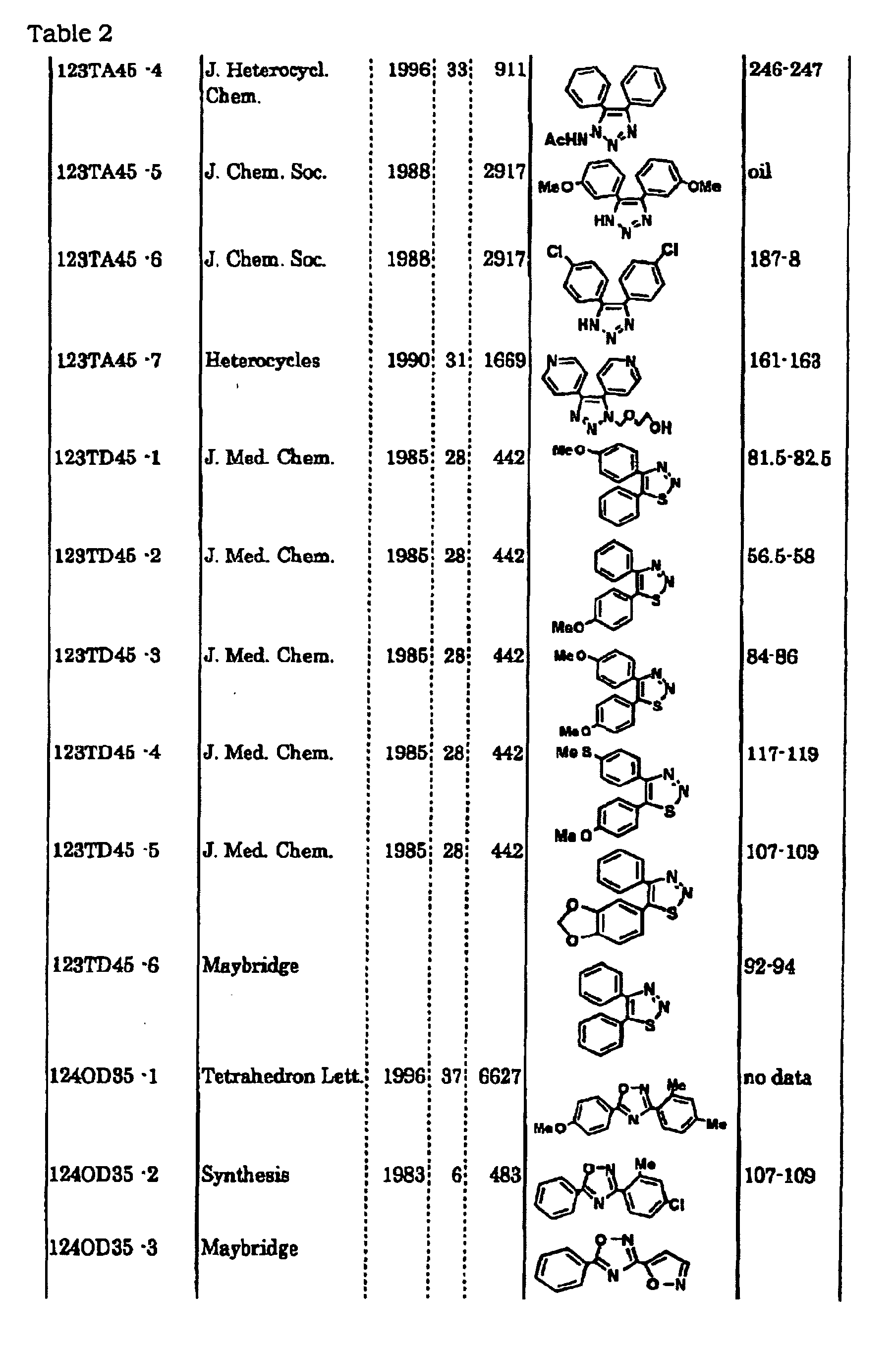


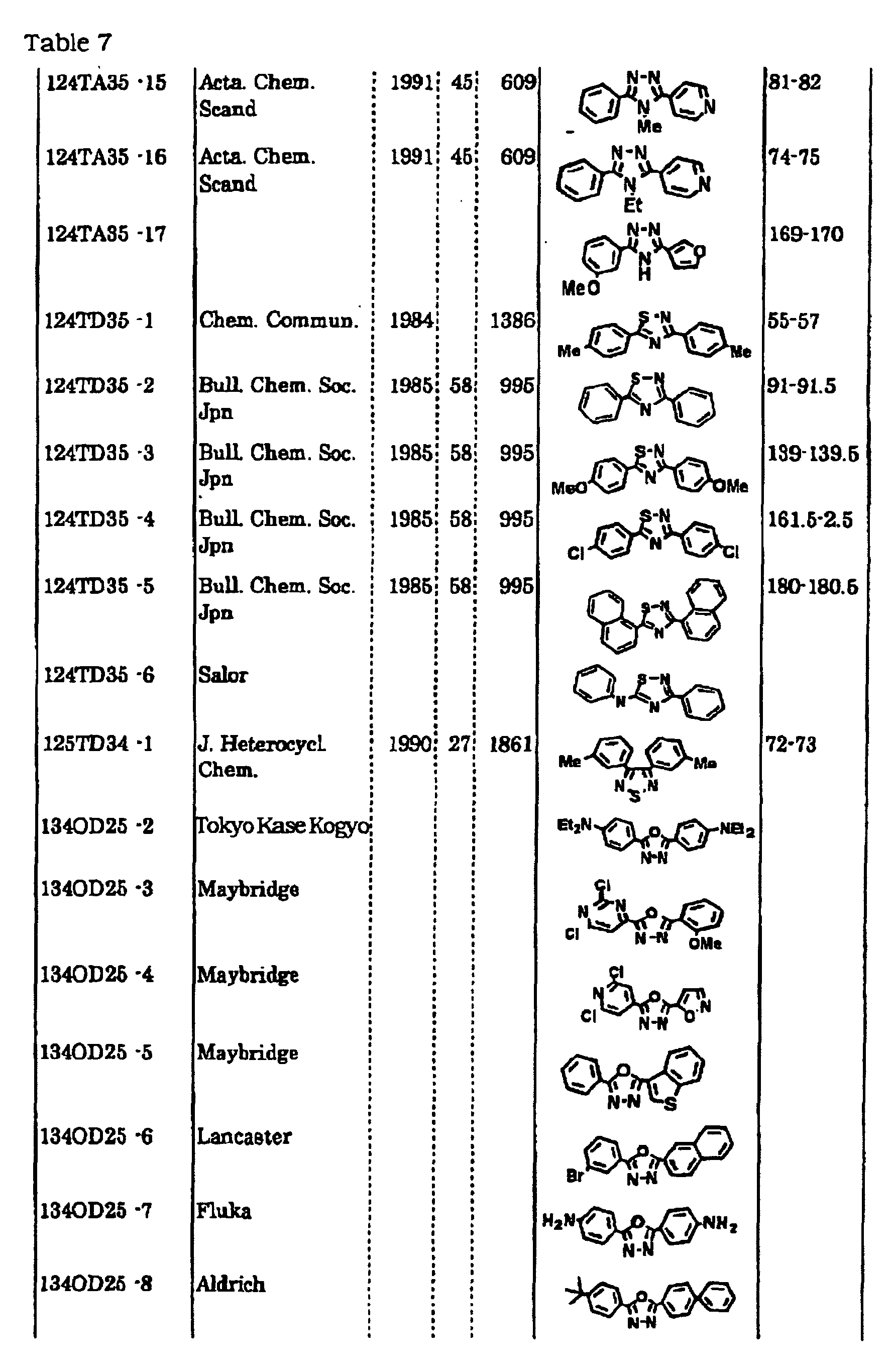

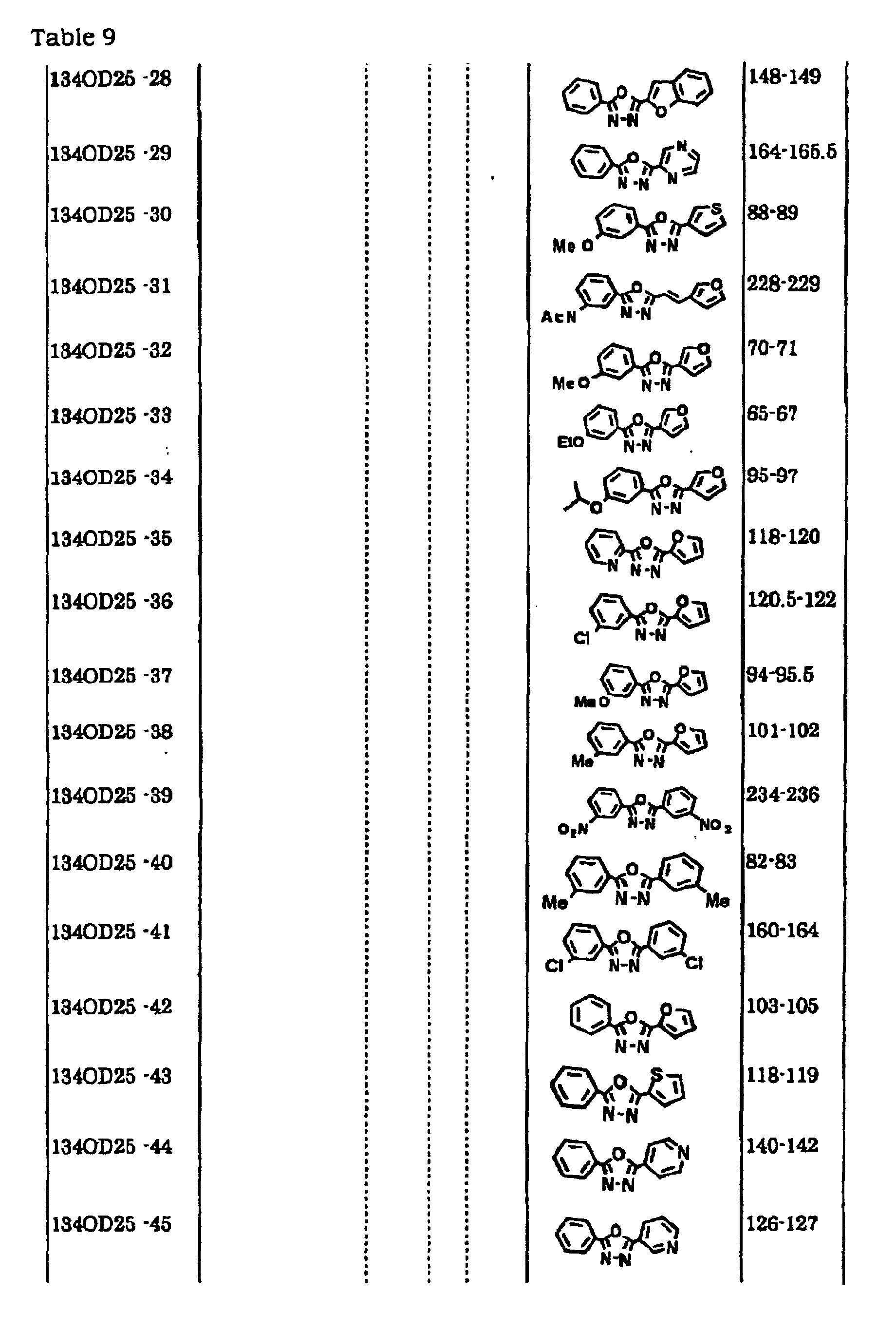
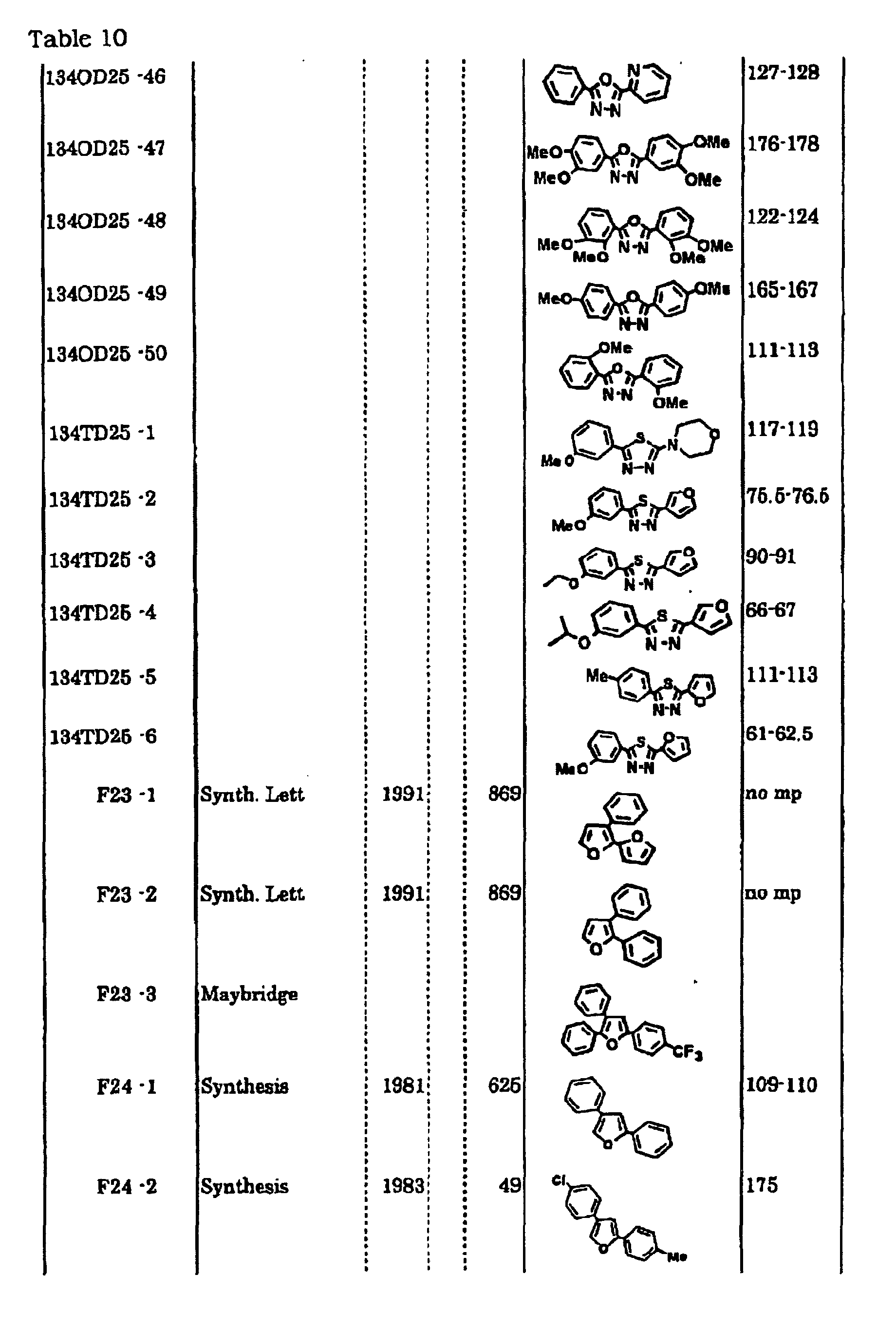

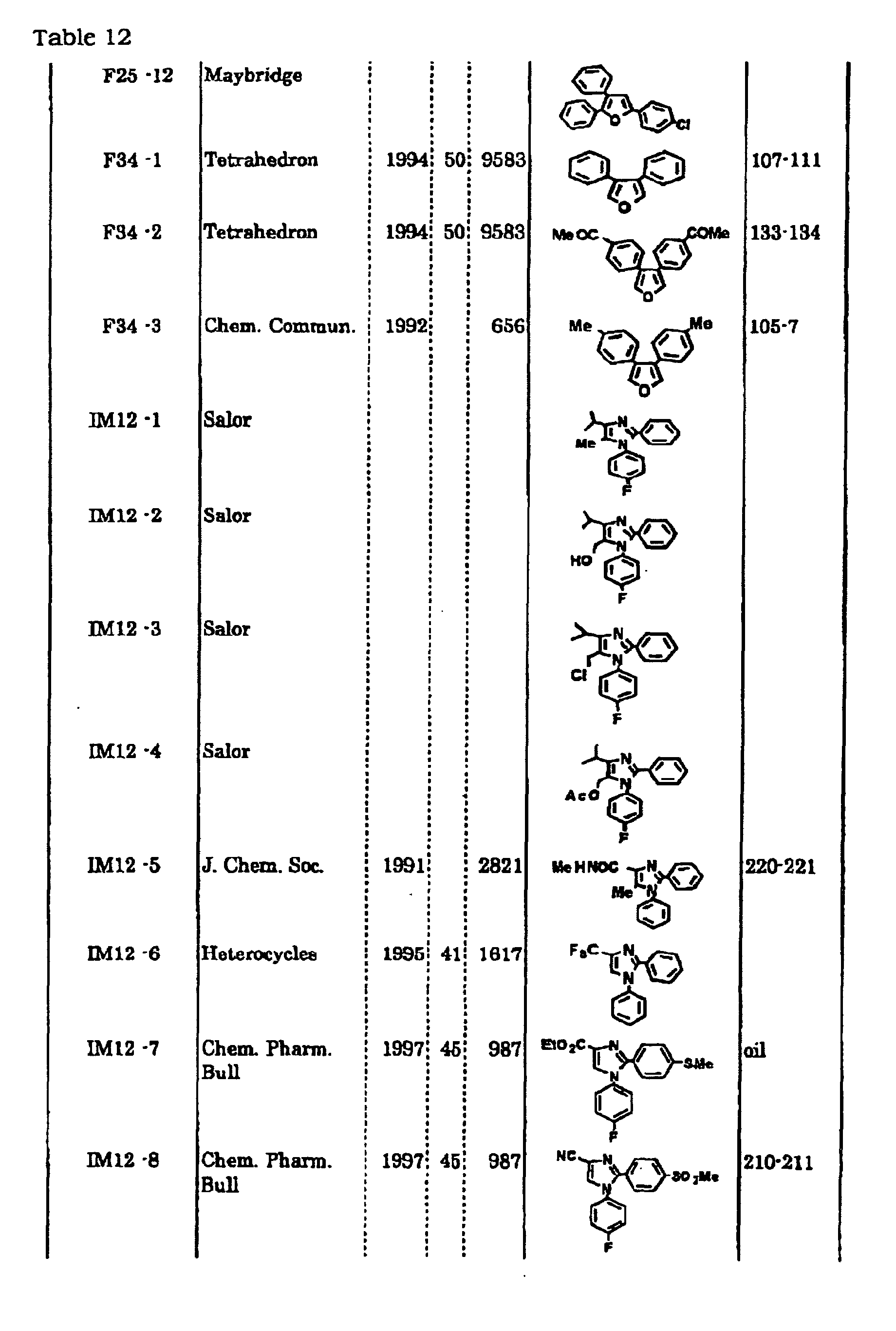
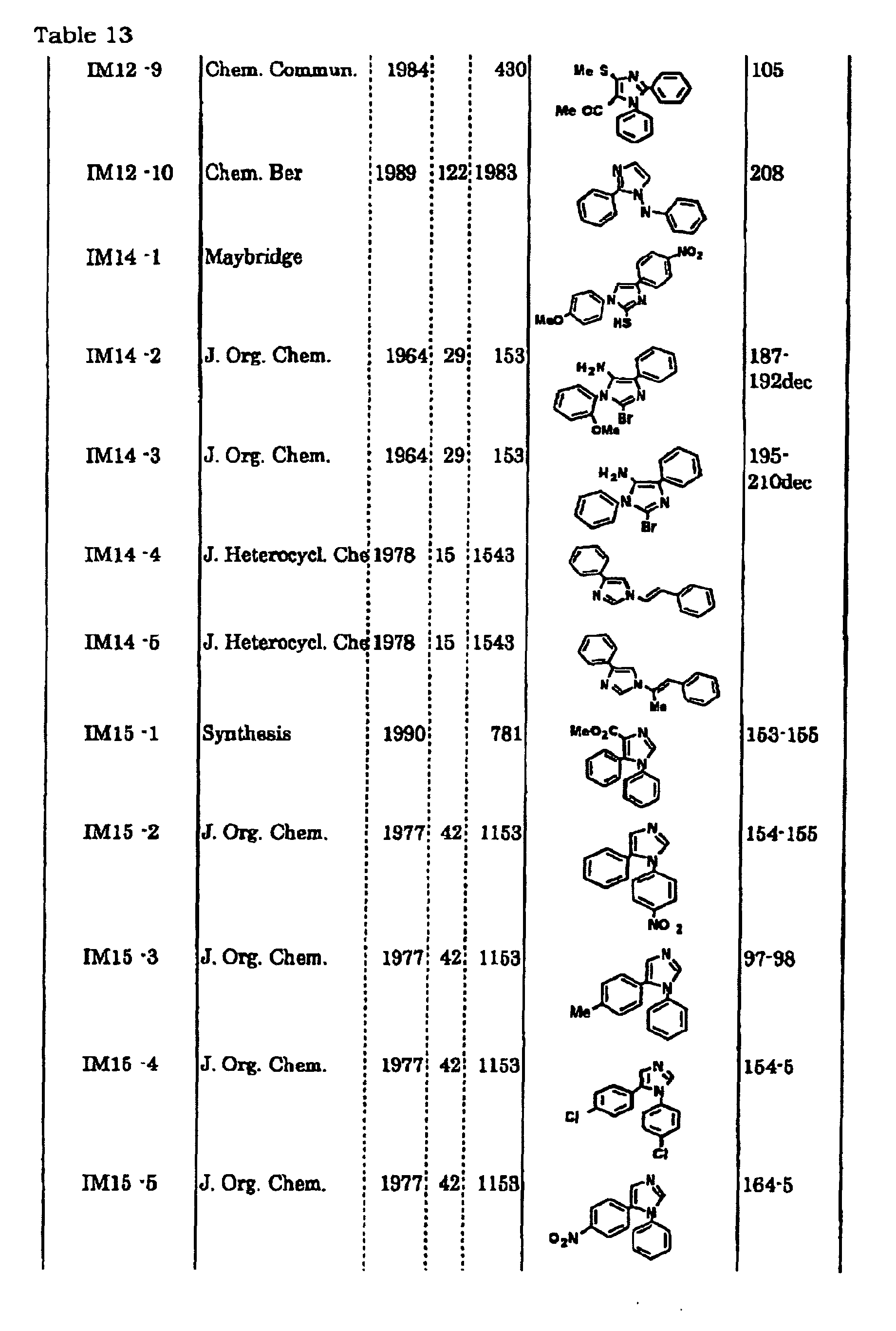


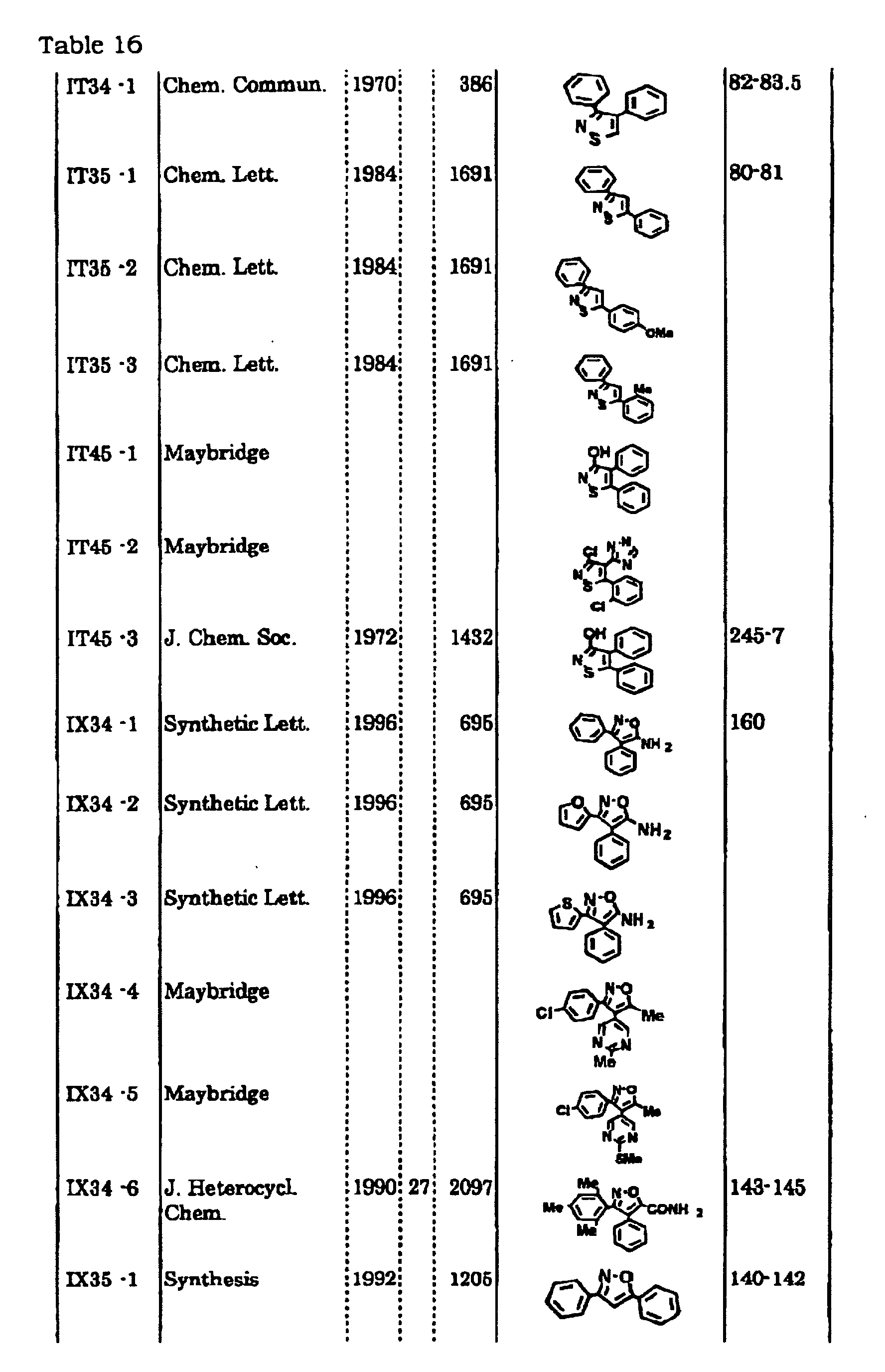


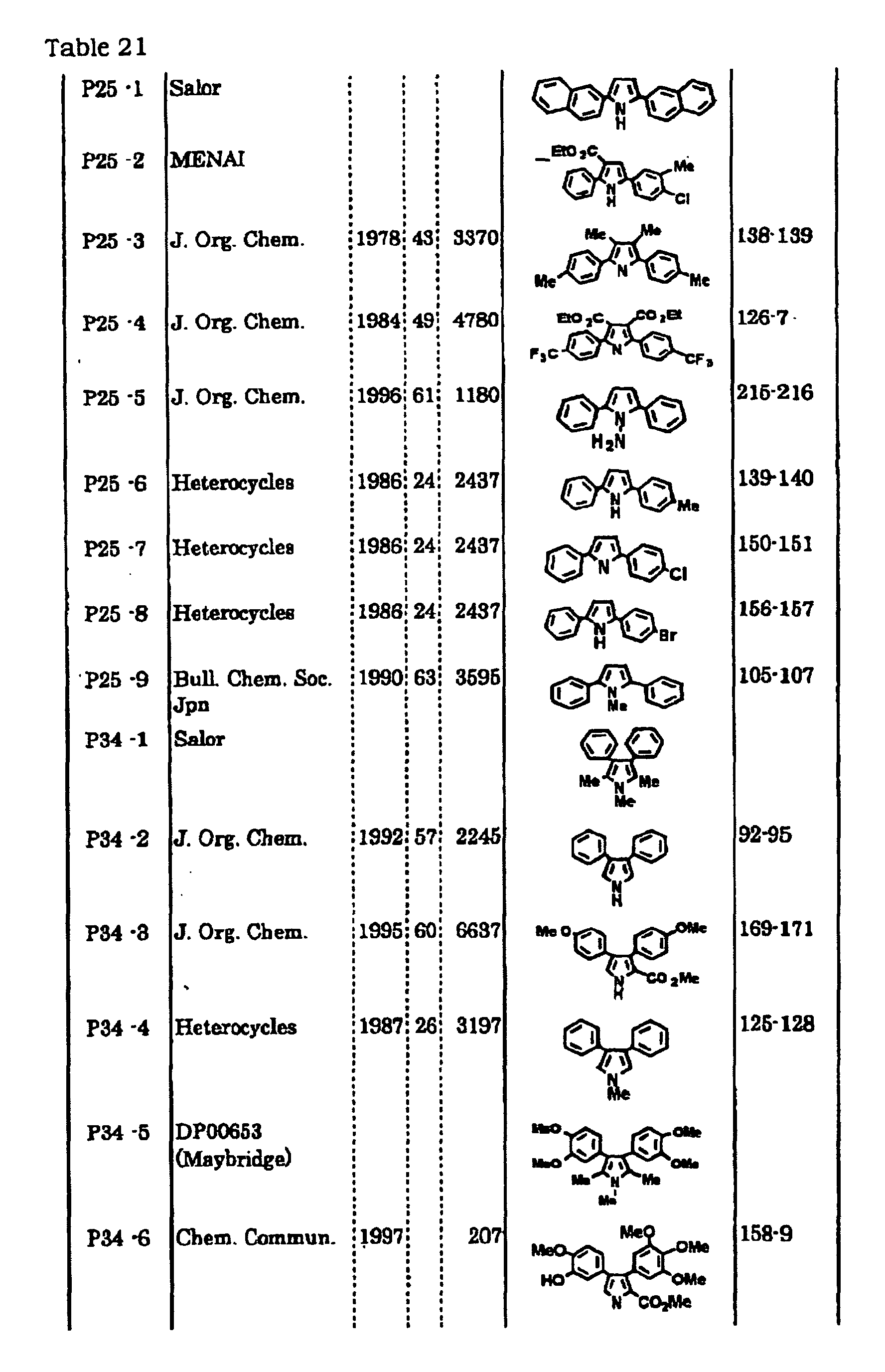

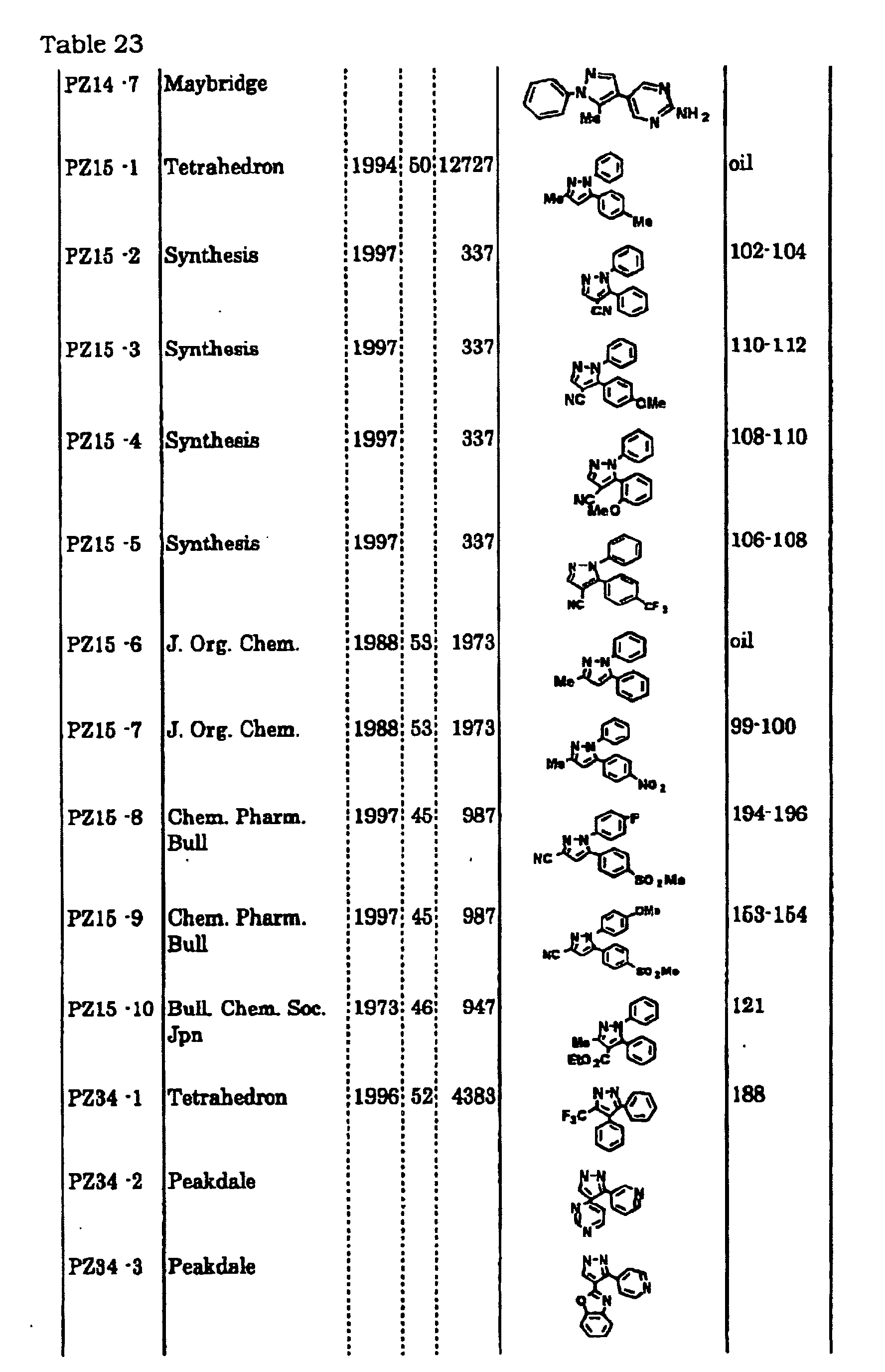


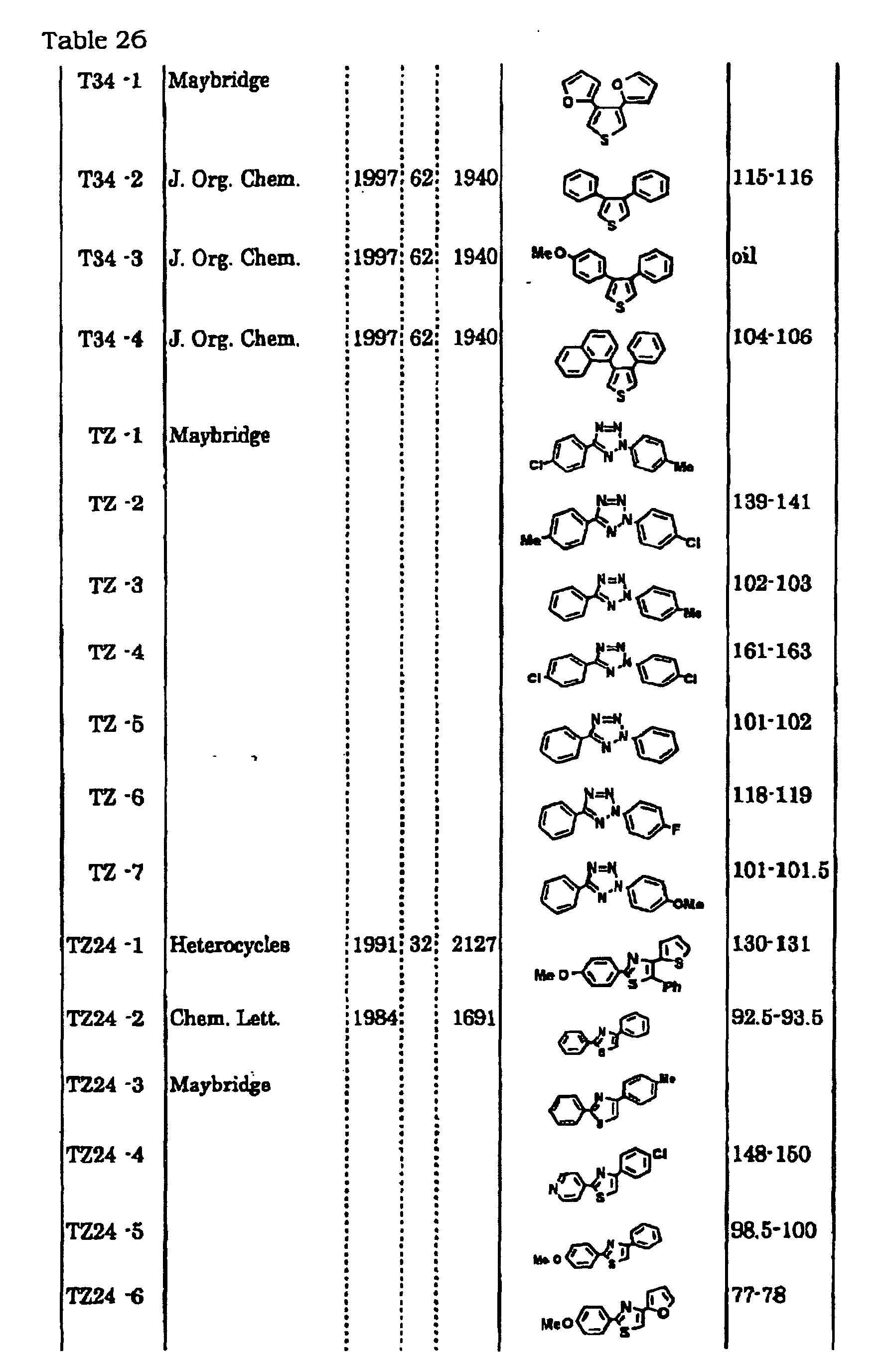

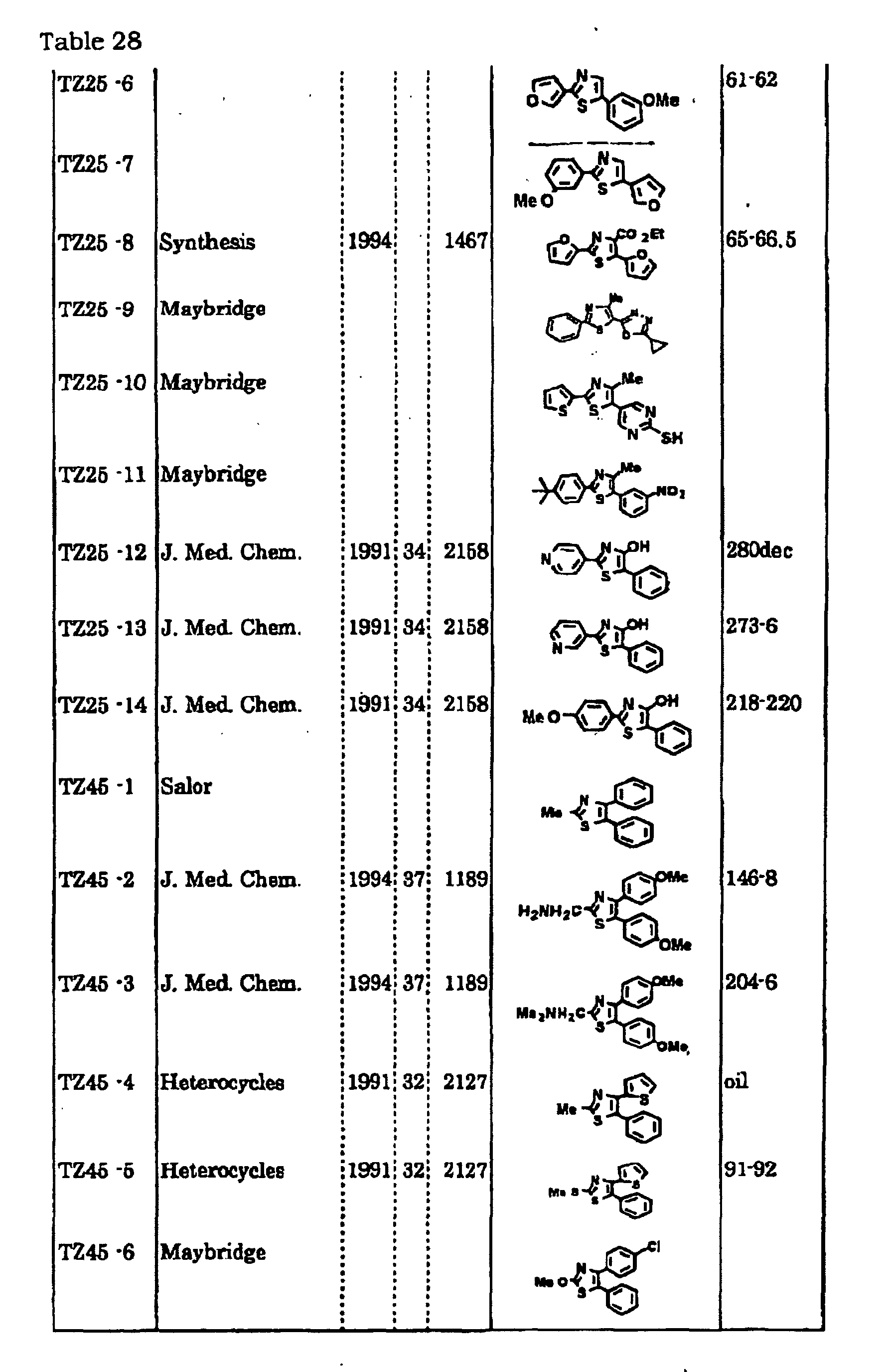
In the Tables, preferable compounds are 123TA14-2, 123TD45-6,
124OD35-12, 124OD35-13, 124OD35-14, 124OD35-15, 124TA35-17,
124TD35-6, 134OD25-9, 134OD25-10, 134OD25-11, 134OD25-12,
134OD25-13, 134OD25-14, 134OD25-15, 134OD25-16, 134OD25-17,
134OD25-18, 134OD25-19, 134OD25-20, 134OD25-21, 134OD25-22,
134OD25-23, 134OD25-24, 134OD25-25, 134OD25-26, 134OD25-27,
134OD25-28, 134OD25-29, 134OD25-30, 134OD25-31, 134OD25-32,
134OD25-33, 134OD25-34, 134OD25-35, 134OD25-36, 134OD25-37,
134OD25-38, 134OD25-39, 134OD25-40, 134OD25-41, 134OD25-42,
134OD25-43, 134OD25-44, 134OD25-45, 134OD25-46, 134OD25-47,
134OD25-48, 134OD25-49, 134OD25-50, 134TD25-2, 134TD25-3,
134TD25-4, 134TD25-5, 134TD25-6, F25-10, IM45-12, IM45-16, IX35-1,
IX35-8, IX35-9, OX24-5, OX24-7, OX24-8, OX25-1, OX25-2, PZ35-4,
PZ35-5, PZ35-6, T25-1, TZ-1, TZ-2, TZ-3 , TZ-4, TZ-5, TZ-6, TZ-7,
TZ24-2, TZ24-3, TZ24-4, TZ24-5, TZ24-6, TZ24-7, TZ24-8, TZ24-9,
TZ24-11 , TZ24-12, TZ24-13, TZ24-14, TZ24-15, TZ24-16, TZ24-17,
TZ24-18, TZ24-19, TZ24-20, TZ25-2, and TZ25-6.
More preferable compounds are 123TA14-2, 124OD35-12,
124OD35-13, 124OD35-14, 124OD35-15, 124TA35-17, 124TD35-6,
134OD25-9, 134OD25-10, 134OD25-11, 134OD25-12, 134OD25-13,
134OD25-14, 134OD25-15, 134OD25-16, 134OD25-17, 134OD25-19,
134OD25-20, 134OD25-23, 134OD25-25, 134OD25-27, 134OD25-28,
134OD25-30, 134OD25-32, 134OD25-33, 134OD25-34, 134OD25-35,
134OD25-36, 134OD25-37, 134OD25-38, 134OD25-40, 134OD25-41,
134OD25-42, 134OD25-43, 134OD25-46, 134OD25-49, 134TD25-1,
134TD25-2, 134TD25-4, 134TD25-5, 134TD25-6, F25-10, IX35-1,
IX35-12, IX35-13, IX35-8, IX35-9, OX24-5, OX24-7, OX24-8, OX25-1,
OX25-2, PZ35-4, PZ35-5, PZ35-6, TZ-1, TZ-2, TZ-3, TZ-4, TZ-5, TZ-6,
TZ-7, TZ24-2, TZ24-3, TZ24-5, TZ24-6, TZ24-7, TZ24-9, TZ24-11,
TZ24-12, TZ24-13, TZ24-14, TZ24-16, TZ25-2, and TZ25-6.
Even more preferable compounds are 123TA14-2, 124OD35-12,
124OD35-15, 124OD35-13, 124TD35-6, 134OD25-9, 134OD25-10,
134OD25-11, 134OD25-15, 134OD25-14, 134OD25-23, 134OD25-28,
134OD25-27, 134OD25-32, 134OD25-40, 134OD25-46, 134TD25-1,
134TD25-4, 134TD25-5, F25-10, IX35-1, IX35-8, IX35-9, IX35-13,
OX24-5, OX24-8, PZ35-4, PZ35-5, TZ-1, TZ-2, TZ-3, TZ-4, TZ-7, TZ24-3,
TZ24-6, and TZ24-11.
The compound (I) according to the invention can be synthesized
as follows. They can be synthesized by the method described in the
literatures given in Tables 1 to 28 or are commercially available.
Otherwise, they may be synthesized by the following processes.

Pyrazole derivative (PZ35) is prepared by heating 1,3-diketone
(1) and hydrazine in a solvent. Alcohol may be used as a solvent, and
the reaction may be conducted at a temperature between room
temperature and a reflux temperature of the solvent.

Chloroacetophenone (2) is converted to aminoacetophenone (4)
by the method of e.g. Synthesis, 112 (1990) or Tetrahedron Lett., 30,
5285 (1989). Compound (4) is acylated with acid halide and treated
with phosphorus oxychloride, polyphosphoric acid, phosphorus
trichloride, dimethyldichlorosilane, or the like in the absence or
presence of a solvent, e.g., acetonitrile, dimethylformamide, toluene, or
the like at a temperature between room temperature and reflux
temperature of the solvent to give a cyclized product, oxazole (OX25).

According to the method of e.g. J. Heterocycl. Chem., 28, 673
(1991), 2-halo-acetophenone (2) (e.g., 2-bromoacetophenone) is treated
with thioamide (7) in a solvent e.g. alcohol, dimethylformamide, or the
like, at a temperature between room temperature and reflux
temperature of the solvent to give a thiazole derivative (TZ24) having A1
and A2 at positions 2 and 4, respectively.
Alternatively, acetophenone is converted to a corresponding
tosylate (2: X=OTs) by the method of e.g. Synth. Commun., 28, 2371
(1998), which is then treated with thioamide (7) in a solvent e.g.
dichloromethane, methanol, ethanol, or the like at a temperature
between room temperature and reflux temperature of the solvent to give
the same.
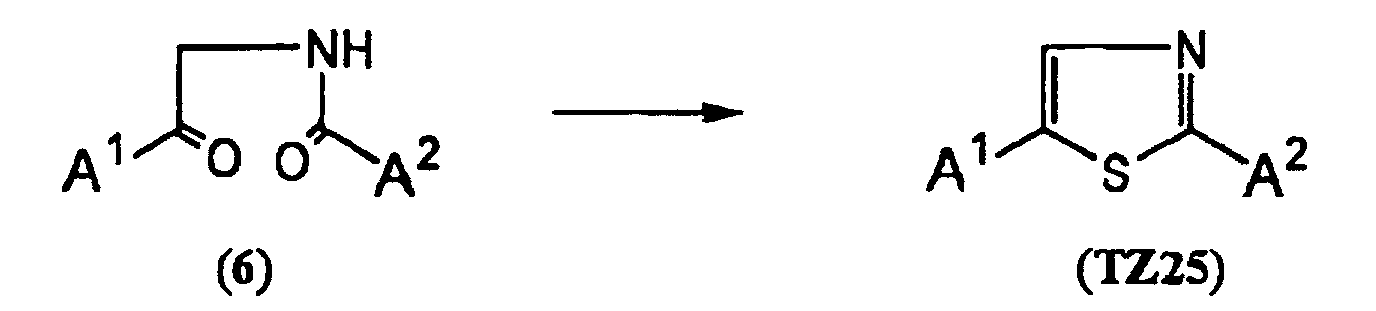 in which the symbols are as defined above.
According to the method of e.g. Collect. Czech. Chem, 58, 2720
(1993), ketoamide (6) is treated with Lawson reagent in a solvent e.g.
benzene, toluene, xylene, dioxane, or the like at a temperature between
room temperature and reflux temperature of the reaction solvent to give
a thiazole derivative (TZ25) having A1 and A2 at positions 2 and 5,
respectively.
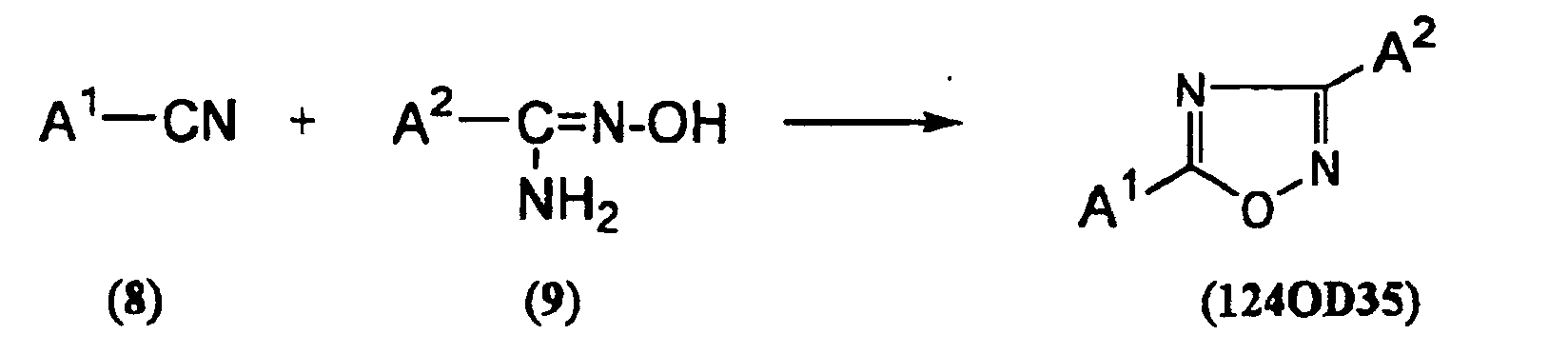
According to the method of e.g. Tetrahedron 46, 3941 (1990),
amidoxime (9) is treated with nitrile (8) in the presence of zinc chloride
in a solvent e.g. ethyl acetate, butyl acetate, or the like at a
temperature between room temperature and reflux temperature of the
solvent to give 1,2,4-oxadiazole (124OD35).
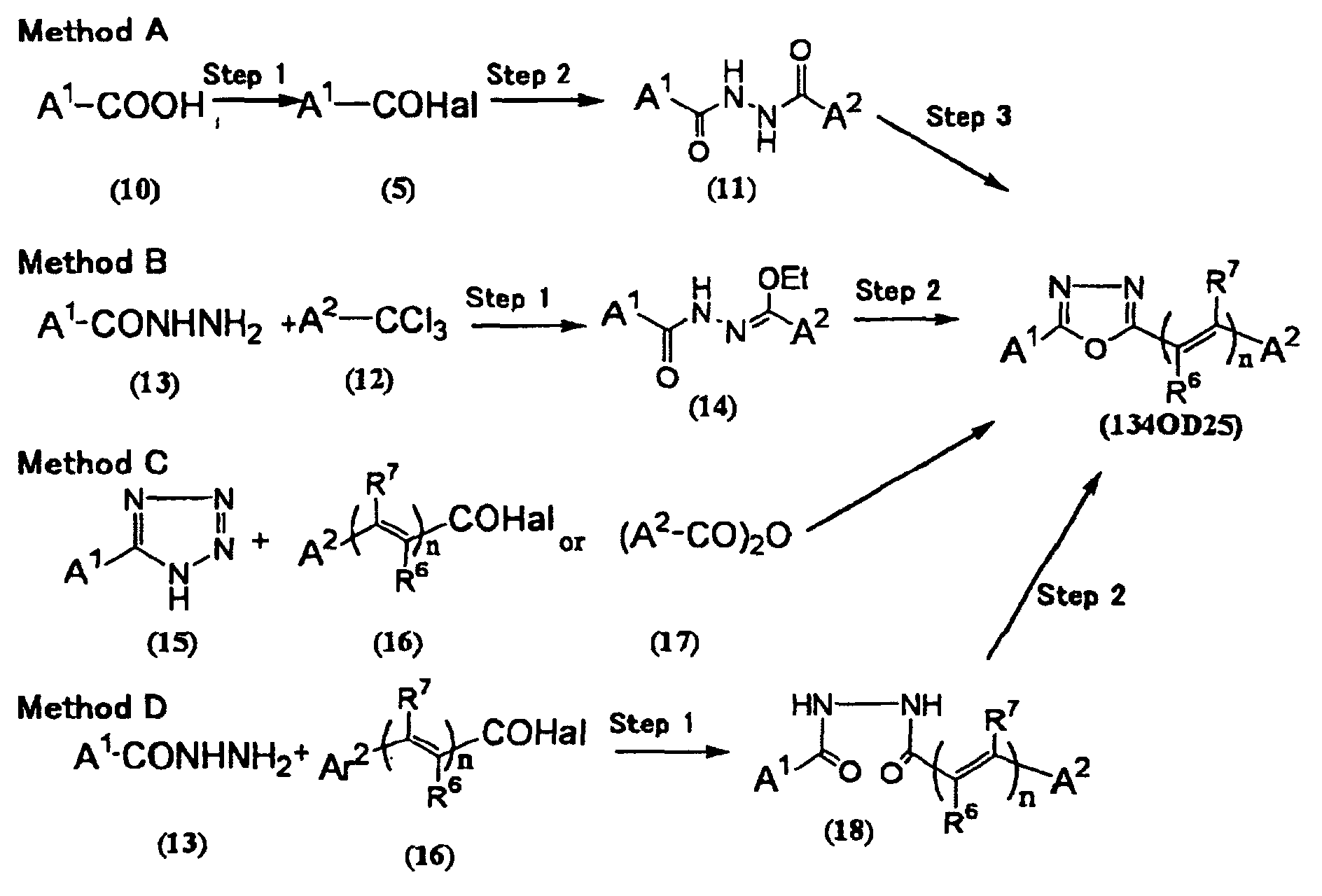
According to the method of, e.g. J. Org. Chem., 58, 2628 (1993),
compound (134OD25) can be synthesized.
Method B follows the method of e.g. Synthesis, 946 (1979). In
the presence of a base, phenyltrichloromethane (12) and hydrazide (13)
are heated under reflux in alcohol solvent to give 134OD25.
In this reaction, the base may be sodium carbonate, pyridine,
or the like, and the solvent may be alcohol, e.g. methanol, ethanol, or
the like.
When the uncyclized intermediate (14) remains, it can be
converted into 134OD25 e.g. by heating with an acid catalyst e.g. p-toluenesulfonic
acid in a solvent e.g. dimethylformamide at 130 °C.
According to the method of e.g. J. Gen. Chem. USSR., 1125
(1992), tetrazole (15) and acid chloride (16) or acid anhydride (17) are
heated at a temperature between 50 to 150 °C in the absence or
presence of a solvent, e.g., acetonitrile, dimethylformamide, pyridine,
toluene, or the like to synthesize 134OD25. The starting tetrazole (15)
is commercially available or produced by the method of e.g.
J.Org.Chem., 58 , 4139 (1993).
The intermediate (18) is obtained by the method of e.g. Khim
Geterotsikl. Soedin., 333 (1996). The cyclization of (18) is carried out
as in Step 3 of method A.
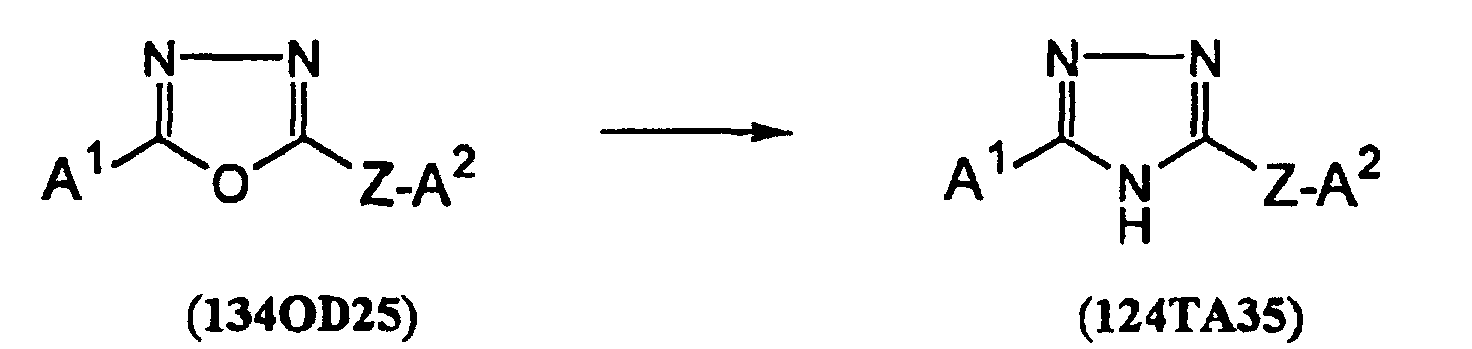
In a sealed tube, 1,3,4-oxadiazole (134OD25) and thiourea in
tetrahydrofuran solvent are heated at 100 to 150 °C to give 124TA35.
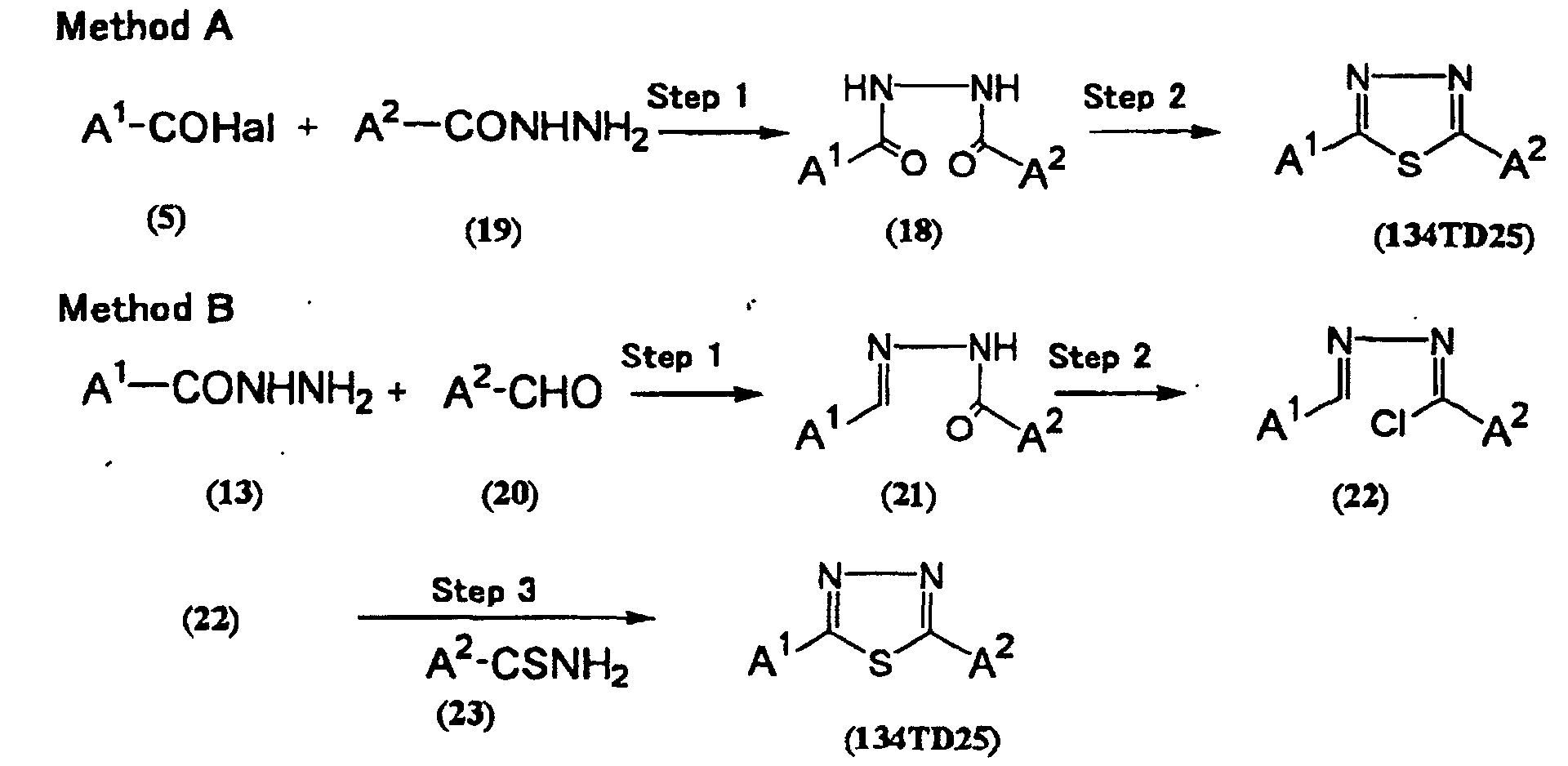
The intermediate (18) is treated with phosphorus pentasulfide
by the method of e.g. J. Prakt. Chem., 322, 933 (1980) to give 1,3,4-thiadiazole
(134TD25).
According to the method of e.g. J. Chem. Soc. C, 1986 (1971)
or J. Chem.Soc. Perkin Trans 1, 9, 1987 (1982), the intermediate (22) is
prepared. This is then cyclized with thioamide (23) to give 1,3,4-thiadiazole
(134TD25).
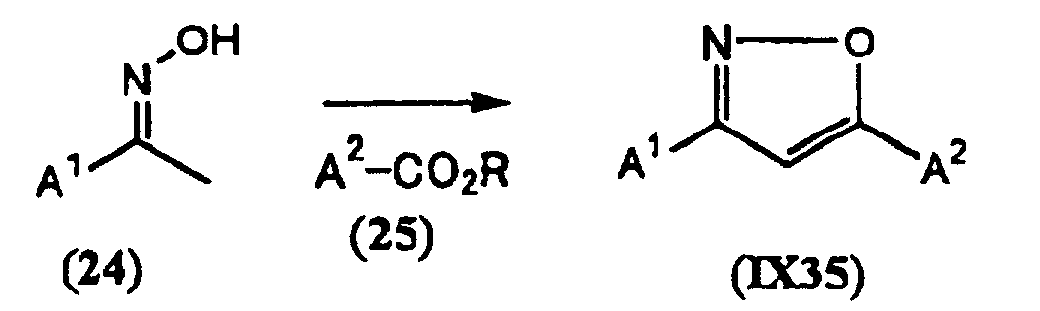
As described in e.g. Organic Synthesis Col. Vol. 6, 278 (1988),
oxime (24) (prepared conventionally from the corresponding ketone) is
treated with n-butyllitium in THF under ice cooling to form dianion.
This is condensed with ester (25), followed by acid treatment to give
isoxazole (IX35).
Pharmaceutical compositions of the invention (which enhance
the expression of apoAI) activate a reverse cholesterol transport activity
of HDL, an anti-inflammatory activity and an anti-coagulant activity, or
the like. As a result, the compositions are useful for preventing
and/or treating blood lipid disorders, arteriosclerotic diseases and
coronary artery diseases caused by decreased level of HDL in plasma,
as well as various cardiovascular diseases concomitant with them.
"Blood lipid disorders" specifically include conditions of lowered level of
serum HDL, hypercholesteremia, hypertriglyceridemia, or the like;
"arteriosclerotic diseases" specifically include arteriosclerosis, or the
like; "coronary artery diseases" specifically include myocardial
infarction, ischaemic heart diseases, cardiac incompetence, or the
like. "Various cardiovascular diseases concomitant with the above
diseases" to be treated with the pharmaceutical compositions of the
invention include hyperuricemia, corneal opacity, cerebrovascular
disease, hereditary HDL deficiencies (Tangier disease, fish-eye disease),
or the like.
The compositions of the invention may be administered orally
or parenterally. For oral routes, the compositions may be formulated
conventionally into usual dosage forms such as tablets, tablets,
granules, powders, capsules, pills, solutions, syrups, buccals,
sublinguals, or the like before administration. For parenteral
administration, the compositions may be conventionally formulated
into usual dosage forms such as injections, e.g., intramuscular or
intravenous injections, suppositories; transdermal patches, inhalation,
or the like.
A therapeutically effective amount of a compound according to
the invention may be admixed with various suitable pharmaceutical
additives such as excipient, binding agent, wetting agent, disintegrating
agent, lubricant, diluent, or the like to give pharmaceutical
compositions, if necessary. In the case of injections, the ingredients
are sterilized together with a suitable carrier to formulate the
composition.
More specifically, the excipients include lactose, sucrose,
glucose, starch, calcium carbonate, crystalline cellulose, or the like; the
binding agents include methyl cellulose, carboxymethylcellulose,
hydroxypropylcellulose, gelatine, polyvinyl pyrrolidone, or the like; the
disintegrating agents include carboxymethylcellulose, sodium
carboxymethyl cellulose, starch, sodium alginate, algae powder, sodium
lauryl sulfate, or the like; the lubricants include talc, magnesium
stearate or Macrogol, or the like. Base materials of the suppository
may be for example cacao butter, Macrogol, methylcellulose, or the
like. Solutions, emulsions or suspensions for injection may comprise
a solubilizing agent, a suspending agent, an emulsifying agent, a
stabilizing agent, a preserving agent, an isotonic agent, or the like as
usually used. Compositions for oral administration may comprise a
flavoring agent, an aromatic agent, or the like.
Dose or therapeutically effective amount of the compounds
according to the invention for enhancing the expression of apoAI is
preferably determined considering age and body weight of patients, sort
and severity of diseases to be treated, route of administration, or the
like. In the case of oral administration to an adult, the dose range is
usually 1 to 100 mg/kg/day, preferably 5 to 30 mg/kg/day. In the
case of parenteral administration, the dose differs largely depending on
the route of administration, but the dose range is usually 0.1 to 10
mg/kg/day, preferably 1 to 5 mg/kg/day. The dosage unit may be
administered to a subject once or several times per day.
Following references and examples are presented for purpose of
further illustration of the invention, and they are not intended to limit
the scope of the invention in any respect.

A suspension of 2-brom-3'-methoxyacetophenone (2.291 g,
10.00 mmol), and sodium diformylimide (1.102 g, 11.60 mmol ) in
acetonitrile (5 mL) was stirred for 2 hours at room temperature and
further stirred at 60 °C for 2 hours. Insoluble material in the reaction
mixture was removed by filtration and the filtrate was concentrated in
vacuo. Without purification, the residue was treated with 5 %
hydrochloric acid - ethanol (25 mL), and the mixture was allowed to
stand for 24 hours at room temperature. After evaporation of the
solvent from the reaction mixture in vacuo, the resulting crystals were
separated and washed successively with isopropyl ether and ethyl
acetate to give crude crystals 4-1 (1.869 g, 92.7 %).
NMR (DMSO, d-6): 3.85 (3H, s), 4.59 (2H, s), 7.27-7.35 (1H, m), 7.45-7.56 (2H, m), 7.58-7.65 (1H, m), 8.42 (3H, br).
NMR (DMSO, d-6): 3.85 (3H, s), 4.59 (2H, s), 7.27-7.35 (1H, m), 7.45-7.56 (2H, m), 7.58-7.65 (1H, m), 8.42 (3H, br).

A mixture of furan-3-carboxylic acid (11.21g, 10.0 mmol ) and
thionyl chloride (14.5 mL, 20.0 mmol) was stirred at 40 °C for 2 hours
30 minutes. The reaction product was purified by distillation under
reduced pressure to give 3-furoyl chloride 5-1 (11.89g, 91.0 %) as
colorless crystals (Caution: compound 5-1 is a potent irritant).
b.p. 68 - 72 °C (3325 Pa)
b.p. 68 - 72 °C (3325 Pa)

To a solution of compound 4-1 (1.008g, 5.00 mmol ) in pyridine
(4 mL) was added 5-1 (0.685g, 5.25 mmol ) dropwise under ice
cooling. The mixture was stirred at the same temperature for 3 hours
and then at room temperature for 2 hours. After the solvent was
evaporated in vacuo, ice and aqueous saturated sodium hydrogen
carbonate were added and the mixture was extracted with ethyl
acetate. The organic layer was washed with water and saturated brine,
dried over anhydrous magnesium sulfate, and the solvent was
evaporated in vacuo. The resulting crude crystals were recrystallized
from ethyl acetate - hexane to give pale yellow prisms 6-1 (970 mg,
74.8 %).
m.p. 86-88 °C.
Elemental analysis: Calculated for C14H13NO4-0.1H2O: C, 64.41; H, 5.10; N, 5.37: Found: C, 64.50; H, 4.99; N, 5.45.
NMR (CDCl3): 3.88 (3H, s), 4.90 (2H, d, J=4.2), 6.73 (1H, dd, J=0.9 and 2.1), 6.90 (1H, br), 7.15-7.22 (1H, m), 7.43 (1H, t, J=7.8), 7.48 (1H, t, J=1.8), 7.53 (1H, t, J=1.8), 7.61 (1H, d, J=7.5), 8.00-8.05 (1H, m).
m.p. 86-88 °C.
Elemental analysis: Calculated for C14H13NO4-0.1H2O: C, 64.41; H, 5.10; N, 5.37: Found: C, 64.50; H, 4.99; N, 5.45.
NMR (CDCl3): 3.88 (3H, s), 4.90 (2H, d, J=4.2), 6.73 (1H, dd, J=0.9 and 2.1), 6.90 (1H, br), 7.15-7.22 (1H, m), 7.43 (1H, t, J=7.8), 7.48 (1H, t, J=1.8), 7.53 (1H, t, J=1.8), 7.61 (1H, d, J=7.5), 8.00-8.05 (1H, m).

To a solution of 2-furoylhydrazide (2.522 g, 20.00 mmol) in
ethanol (20 mL) was added dropwise m-anisaldehyde (2.43 mL, 19.97
mmol) at room temperature. After the mixture was stirred for 4 hours,
it was allowed to stand overnight. The crystals precipitated from the
reaction mixture were collected and washed with 95 % ethanol to give
colorless prisms 21-1 (4.436 g, 90.8 %).
m.p. 156-157 °C.
Elemental analysis: Calculated for C13H12N2O3: C, 63.93; H, 4.95; N, 11.47: Found: C, 63.69; H, 4.98; N, 11.41.
NMR (CDCl3): 3.87 (3H, s), 6.58 (1H, dd, J=1.5 and 3.3), 6.94-7.01 (1H, m), 7.24-7.44 (4H, m) 7.47-7.57 (1H, m), 8.24 (1H, s), 9.39 (1H, br).
m.p. 156-157 °C.
Elemental analysis: Calculated for C13H12N2O3: C, 63.93; H, 4.95; N, 11.47: Found: C, 63.69; H, 4.98; N, 11.41.
NMR (CDCl3): 3.87 (3H, s), 6.58 (1H, dd, J=1.5 and 3.3), 6.94-7.01 (1H, m), 7.24-7.44 (4H, m) 7.47-7.57 (1H, m), 8.24 (1H, s), 9.39 (1H, br).

To 3-aminobenzonitrile (2.50, 21.16 mmol) was added acetic
anhydride (10 mL, 105.98 mmol) at room temperature, and the mixture
was stirred at the same temperature for 1 hour. The remaining
reagent was evaporated in vacuo. To the residue was added saturated
aqueous sodium hydrogen carbonate and the aqueous layer was
extracted with ethyl acetate. The organic layer was washed with water,
dried over anhydrous magnesium sulfate and the solvent was
evaporated in vacuo. The residue was washed with isopropyl ether to
give pale brown crystals (3.266 g, 96.3 %).
m.p. 120-123 °C.
Elemental analysis: Calculated for C9H8N2O: C, 67.49; H, 5.03; N, 17.49: Found: C, 67.47; H, 5.01; N, 17.57.
NMR (CDCl3): 2.21 (3H, s), 7.35-7.47 (3H, m), 7.67-7.75 (1H, m), 7.92 (1H, br).
m.p. 120-123 °C.
Elemental analysis: Calculated for C9H8N2O: C, 67.49; H, 5.03; N, 17.49: Found: C, 67.47; H, 5.01; N, 17.57.
NMR (CDCl3): 2.21 (3H, s), 7.35-7.47 (3H, m), 7.67-7.75 (1H, m), 7.92 (1H, br).

To a solution of 3-acetamidobenzonitrile (2.883 g, 18.00 mmol)
in toluene (36 mL) were added trimethylsilyl azide (4.8 mL, 36.16 mmol)
and di-n-butyltin oxide (0.448 g, 1.80 mmol), and the mixture was
heated under reflux for 16 hours. The solvent was evaporated in vacuo,
the residue was mixed with methanol, and the mixture was evaporated
again in vacuo. The residue was extracted with saturated aqueous
sodium hydrogen carbonate (1.81 g, 21.55 mmol) and the aqueous
layer was washed with ethyl acetate. The alkaline aqueous solution
was acidified with hydrochloric acid. The precipitated crystals were
collected by filtration and washed with ethanol to give compound 15-1
(2.033 g, 55.6 %).
m.p. 250-260 °C (dec).
Elemental analysis: Calculated for C9H9N5O: C, 53.20; H, 4.46; N, 34.46: Found: C, 53.25; H, 4.40; N, 33.52
NMR (DMSO, d-6): 2.09 (3H, s), 5.20 (1H, t, J=7.8), 7.62-7.78 (2H, m), 8.39 (1H, t, J=1.8), 10.20 (1H, s).
m.p. 250-260 °C (dec).
Elemental analysis: Calculated for C9H9N5O: C, 53.20; H, 4.46; N, 34.46: Found: C, 53.25; H, 4.40; N, 33.52
NMR (DMSO, d-6): 2.09 (3H, s), 5.20 (1H, t, J=7.8), 7.62-7.78 (2H, m), 8.39 (1H, t, J=1.8), 10.20 (1H, s).

m-Toluic acid (10.89 g, 80.0 mmol) was treated with thionyl
chloride (18.0 mL, 248.1 mmol) at 40 °C for 3 hours. Excess thionyl
chloride was evaporated in vacuo. To a solution of crude m-toluic acid
chloride in dry dichloromethane (44 mL) was added dropwise hydrazine
monohydrate (11.5 mL, 237.08 mmol) at room temperature over 1 hour
30 minutes, and the mixture was stirred for 1 hour. The reaction
mixture was added to water, and precipitated crystals were collected by
filtration and washed with water and methanol to give colorless
powdery crystals 11-1 (10.06g, 93.8 %).
m.p. 220-223 °C.
Elemental analysis: Calculated for C16H16N2O2: C, 71.62; H, 6.01; N, 10.44: Found: C, 71.27; H, 5.77; N, 10.61
NMR (DMSO, d-6): 2.39 (6H, s), 7.37-7.45 (4H, m), 7.68-7.78 (4H, m), 10.29 (2H, br)
m.p. 220-223 °C.
Elemental analysis: Calculated for C16H16N2O2: C, 71.62; H, 6.01; N, 10.44: Found: C, 71.27; H, 5.77; N, 10.61
NMR (DMSO, d-6): 2.39 (6H, s), 7.37-7.45 (4H, m), 7.68-7.78 (4H, m), 10.29 (2H, br)

To a solution of m-anisic acid hydrazide (1.255 g, 7.552 mmol)
in pyridine (4 mL) was added compound 5-1 (1.035g, 7.929 mmol)
dropwise under ice cooling and the mixture was stirred at the same
temperature for 4 hours, and then for 12 hours at room temperature.
The solvent was evaporated in vacuo and precipitated crystals were
washed with ethyl acetate and then isopropyl ether, and recrystallized
from isopropanol to give colorless needles 18-1 (1.578 g, 80.3 %).
m.p. 211-212 °C.
Elemental analysis: Calculated for C13H12N2O4-0.5H2O: C, 57.99; H, 4.87; N, 10.40: Found: C, 57.79; H, 4.83; N, 10.61.
NMR (DMSO, d-6): 3.82 (3H, s), 6.93 (1H, d, J=1.8), 7.11-7.23 (1H, m), 7.38-7.56 (3H, m), 7.80 (1H, d, J=1.8), 8.30 (1H, d, J=0.9), 10.23 (1H, br), 10.42 (1H, br).
m.p. 211-212 °C.
Elemental analysis: Calculated for C13H12N2O4-0.5H2O: C, 57.99; H, 4.87; N, 10.40: Found: C, 57.79; H, 4.83; N, 10.61.
NMR (DMSO, d-6): 3.82 (3H, s), 6.93 (1H, d, J=1.8), 7.11-7.23 (1H, m), 7.38-7.56 (3H, m), 7.80 (1H, d, J=1.8), 8.30 (1H, d, J=0.9), 10.23 (1H, br), 10.42 (1H, br).
A mixture of 3-methoxyacetophenone (10 g), hydroxylamine
hydrochloride (5.1 g), aqueous 4M-sodium hydroxide (18 mL), water (30
mL) and ethanol (50 mL) was heated at reflux for 2 hours. The solvent
was removed in vacuo and resulting aqueous layer was extracted with
ether. The organic layer was washed with water and brine and dried
over anhydrous sodium sulfate. The solvent was evaporated in
vacuo. Resulting oily substance was azeotropically dried two times
with toluene and the residue was used in following steps without
further purification.
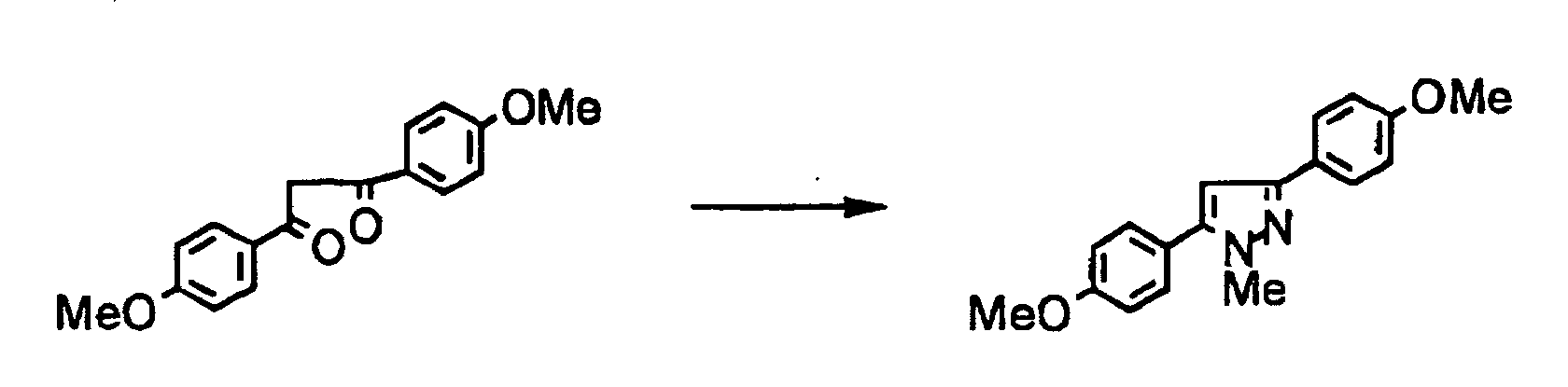
To a solution of 1,3-bis(4-methoxyphenyl)-1,3-propanedione
(14.2 g, 5.0 mmol) in ethanol (10 mL) were added sodium hydrogen
carbonate (1.68 g, 20.0 mmol) and methyl hydrazine sulfate (1.44 g,
10.0 mmol), and the mixture was heated at reflux for 3 hours. The
solvent was evaporated in vacuo from the reaction mixture and residue
was dissolved in chloroform. The organic layer was washed with water
and brine, dried over anhydrous magnesium sulfate, and the solvent
was evaporated in vacuo. The residue was recrystallized from
methanol to give colorless prisms PZ35-4 (1.42 g, 96.6 %).
m.p. 107-108 °C.
m.p. 107-108 °C.

A suspension of compound 6-1 (778 mg, 3.00 mmol ) in
phosphorus oxychloride (7.8 mL, 83.68 mmol) was stirred at 100 °C for
1 hour. Phosphorus oxychloride was removed in vacuo. The residue
was mixed with ice, and the mixture was neutralized with aqueous
concentrated ammonia, and extracted with ethyl acetate. The extracts
were washed with water and brine, and dried over anhydrous
magnesium sulfate, and the solvent was evaporated in vacuo. The
residue was purified by silica gel chromatography (ethyl acetate -
hexane = 1:3) followed by recrystallization from isopropyl ether to give
pale yellow prisms OX25-2 (662 mg, 85.9 %).
m.p. 88-90 °C.
m.p. 88-90 °C.

A suspension of α-bromoacetophenone (3.981 g, 20.00 mmol),
4-methoxythiobenzamide (3.345 g; 20.00 mmol) and dry ethanol (40
mL) was stirred at 50 °C for 2 hours. The solvent was evaporated in
vacuo, the residue was mixed with ice, and the mixture was made
weakly basic with 4N-sodium hydroxide and the aqueous layer was
extracted with ethyl acetate. The organic layer was washed with water
and saturated brine and dried over anhydrous magnesium sulfate.
The solvent was evaporated in vacuo. The residue was purified by
silica gel chromatography (chloroform), and recrystallization from ethyl
acetate - hexane gave pale yellow prisms TZ24-5 (4.786 g, 89.5%).
m.p. 98.5-100 °C.
m.p. 98.5-100 °C.

A suspension of 2-acetylfuran (0.661 g, 6.00 mmol) and
hydroxy(tosyloxy)iodo-benzene (Koser's Reagent, 2.35 g, 6.00 mmol) in
dry dichloromethane (12 mL) was stirred at room temperature for 16
hours. The solvent was evaporated in vacuo. To the residues were
added 4-methoxythiobenzamide (1.00 g, 6.00 mmol) and dry ethanol
(24 mL), and the mixture was heated at reflux for 4 hours. The solvent
was evaporated in vacuo, water was added to the residue, and the
mixture was extracted with ether. The ether layer was washed with
water and brine, and was dried over anhydrous magnesium sulfate.
The solvent was evaporated in vacuo. The residue was purified by
silica gel chromatography (toluene) to give crude crystals, which were
recrystallized from isopropyl ether - hexane giving TZ24-6 as pale
brown crystals (668 mg, 43.4 %).
mp. 77 - 78 °C.
mp. 77 - 78 °C.

A suspension of compound 6-1 (1.063g, 4.00 mmol) and
Lawson reagent (2. 10g, 5.19 mmol) in dry xylene (20 mL) was heated
under reflux for 1 hour 30 minutes. The reaction mixture was mixed
with aqueous saturated sodium hydrogen carbonate and extracted with
ethyl acetate. The organic layer was washed with water and brine,
dried over anhydrous magnesium sulfate, and the solvent was
evaporated in vacuo. The residue was purified by chromatography on
neutral alumina followed by silica gel eluted with ethyl acetate - hexane
(1:4). Recrystallization from isopropyl ether gave TZ25-6 as pale
brown prisms (681 mg, 66.1 %).
m.p. 61-62 °C.
m.p. 61-62 °C.

To a suspension of benzamidoxime (9.04 g, 66.40 mmol), zinc
chloride (27.15 g, 199.22 mmol) and butyl acetate (68 mL) were added
anisnitrile 8-1 (8.84 g, 66.39 mmol) and hydrogen chloride-ethyl
acetate solution (4M, 17.1 mL, 68.40 mmol), and the mixture was
heated under reflux at 130 °C for 3 hours. The reaction mixture was
mixed with ice and the mixture was extracted with ethyl acetate. The
extract was washed with water and brine, and dried over anhydrous
magnesium sulfate. The solvent was evaporated in vacuo. The
residue was subjected to silica gel chromatography and the fractions
were eluted with ethyl acetate - hexane (1:9) to give 124OD35-12. This
was recrystallized from isopropyl ether to give colorless prisms (3.779 g,
22.6 %).
m.p. 97-98 °C.
m.p. 97-98 °C.

A mixture of compound 11-1 (5.37g, 20.01 mmol) and
phosphorus oxychloride (18.7 mL, 200.6mmol) was stirred at 130 °C
for 30 minutes. After evaporating phosphorus oxychloride in vacuo,
the residue was mixed with ice, neutralized with aqueous ammonia,
and the mixture was extracted with chloroform. The chloroform layer
was washed with water and brine, and dried over anhydrous
magnesium sulfate. The solvent was evaporated in vacuo. The
residue was purified by silica gel chromatography (chloroform) and
then recrystallized from ethyl acetate - hexane to give colorless prisms
134OD25-40 (2.996 g, 59.8 %).
m.p. 82-83 °C.
m.p. 82-83 °C.

A suspension of phenyltrichloromethane (7.82 g, 40.00
mmol),α-picolininic acid hydrazide (5.48 g, 39.96 mmol) and sodium
carbonate (4.02 g, 37.93 mmol) in dry ethanol (100 mL) was heated at
reflux for 6 hours. After filtrating inorganic material off from the
reaction mixture, the solvent was evaporated in vacuo. The residue
was added to an aqueous saturated sodium hydrogen carbonate and
the mixture was extracted with ethyl acetate. The ethyl acetate layer
was washed with water and brine, dried over anhydrous magnesium
sulfate, and the solvent was evaporated in vacuo.
The crude intermediate were stirred with p-toluenesulfonic acid
hydrate (0.761g, 4.00 mmol) in dry dimethylformamide (20 mL) at 130
°C for 2 hours. The reaction mixture was added to an aqueous
saturated sodium hydrogen carbonate and extracted with ethyl
acetate. The organic layer was washed with water and brine, and
dried over anhydrous magnesium sulfate. The solvent was evaporated
in vacuo. The residue was purified by chromatography over neutral
alumina and then silica gel (hexane - chloroform = 1:4).
Recrystallization from ethyl acetate - hexane gave 134OD25-46 as colorless prisms (3.036 g, 36.1 %).
m.p. 127-128 °C.
Recrystallization from ethyl acetate - hexane gave 134OD25-46 as colorless prisms (3.036 g, 36.1 %).
m.p. 127-128 °C.

To a suspension of 4-dimethylaminophenylcarboxylic acid
(1.652 g, 10.00 mmol), dry dimethylformamide (0.039 mL, 0.05 mmol)
and dry dichloromethane (5 mL) was dropwise added oxalyl chloride
(1.05 mL, 12.04 mmol) at room temperature over 10 minutes. The
mixture was stirred for 1 hour, and the solvent was evaporated in
vacuo. To the reaction product were added dry pyridine (0.81 mL,
10.01 mmol), dry acetonitrile (5 mL) and 5-phenyltetrazole (1.462 g,
10.00 mmol) and the mixture was heated under reflux for 2 hours 30
minutes. The reaction mixture was added to an aqueous saturated
sodium hydrogen carbonate and the mixture was extracted with ethyl
acetate. The organic layer was washed with water and brine and dried
over anhydrous magnesium sulfate. The solvent was evaporated in
vacuo. The residue was purified by silica gel chromatography eluting
with ethyl acetate - chloroform (1: 15) and recrystallization from ethyl
acetate - hexane gave 134OD25-15 as pale yellow prisms (422 mg,
15.9 %).
m.p. 135-140 °C.
m.p. 135-140 °C.

A suspension of 3-(2-furyl)acrylic acid (1.381 g, 10.00 mmol),
thionyl chloride (0.80 mL, 11.03 mmol ), dimethylformamide (0.039 mL,
0.50 mmol) and acetonitrile (1.4 mL) was stirred at room temperature
for 3 hours. The product was immediately mixed with 5-phenyltetrazole
(1.462 g, 10.00 mmol), and the mixture was stirred at
room temperature for 1 hour and at 100 °C for 3 hours. The reaction
mixture was added to an aqueous saturated sodium hydrogen
carbonate and extracted with ethyl acetate. The organic layer was
washed with water and brine, dried over anhydrous magnesium sulfate,
and the solvent was evaporated in vacuo. The residue was purified by
silica gel chromatography (ethyl acetate - hexane = 1:3) and
recrystallization from 95 % ethanol gave pale yellow prisms 134OD25-23
(653 mg, 27.4 %).
m.p. 131-132 °C.
m.p. 131-132 °C.
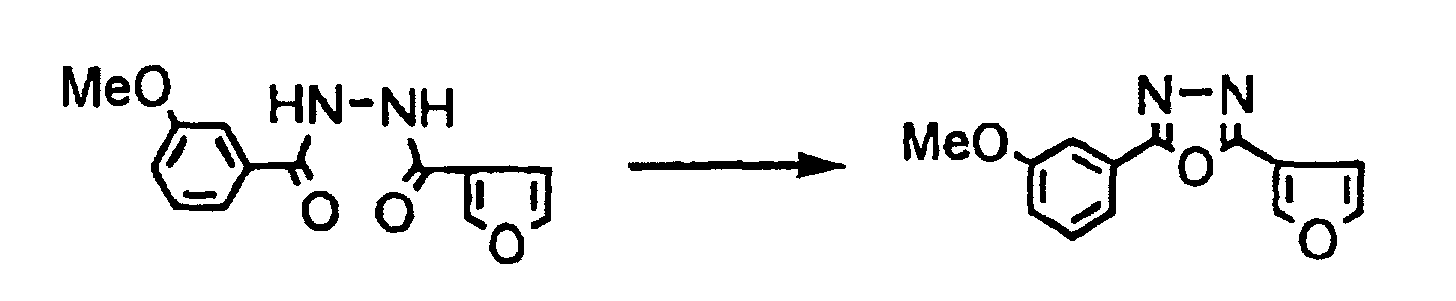
A suspension of compound 18-1 (5.04g, 19.37 mmol ) and
phosphorus oxychloride (18.0 mL, 193.11m mmol) was stirred at 100
°C for 1 hour 30 minutes. After removal of phosphorus oxychloride in
vacuo, the residue was added to ice, neutralized with aqueous
concentrated ammonia, and extracted with ethyl acetate. The organic
layer was washed with water and saturated brine, and dried over
anhydrous magnesium sulfate, and the solvent was evaporated in
vacuo. The residue was purified by silica gel chromatography and
compound 134OD25-32 was obtained with ethyl acetate - hexane
(1:3). The resulting crude crystals were recrystallized from isopropyl
ether to give compound 134OD25-32 as colorless prisms (4.34g,
92.5 %).
m.p. 70-71 °C.
m.p. 70-71 °C.

A suspension of compound 134OD25-32 (1.211 mg, 5.00
mmol) and thiourea (1.00 g, 13.14 mmol) in tetrahydrofuran (5 mL) was
heated at 150 °C for 24 hours in a sealed tube. The reaction mixture
was added to an aqueous saturated sodium hydrogen carbonate and
extracted with ethyl acetate. The extract was washed with water and
brine, dried over anhydrous magnesium sulfate, and the solvent was
evaporated in vacuo. The residue was purified by silica gel
chromatography. Elution with ethyl acetate - hexane (1:1) followed by
recrystallization from ethyl acetate gave 124TA35-17 (471 mg,
39.1 %).
m.p. 169-171 °C.
m.p. 169-171 °C.

A suspension of compound 18-1 (1.562g, 6.00 mmol) and
phosphorus pentasulfide (1.80 g, 8.10 mmol) in dry pyridine (12 mL)
was stirred at 100 °C for 9 hours. After the solvent was removed in
vacuo, the residue was mixed with ice, made weakly alkaline with 4M-sodium
hydroxide, and extracted with ethyl acetate. The organic layer
was washed with water and brine, and dried over anhydrous
magnesium sulfate, and the solvent was evaporated in vacuo. The
residue was purified by silica gel chromatography and eluted with ethyl
acetate. The eluent (2.529g) still contained an uncyclized intermediate,
which was mixed with p-toluenesulfonic acid hydrate (0.395 g, 2.08
mmol) and dry toluene (25 mL), and the mixture was heated under
reflux for 30 minutes. The reaction mixture was added to an aqueous
saturated sodium hydrogen carbonate and extracted with ethyl
acetate. The ethyl acetate layer was washed with water and brine,
dried over anhydrous magnesium sulfate and the solvent was
evaporated in vacuo. The residue was purified by silica gel
chromatography (ethyl acetate - hexane = 1:3) and recrystallization
from 95 % ethanol gave compound 134TD25-2 (0.820g, 52.9 %).
m.p. 75.5-76.5 °C.
m.p. 75.5-76.5 °C.

A suspension of compound 21-1 (2.931g, 12.00 mmol) and
thionyl chloride (1.04 mL, 14.34 mmol) in benzene (12 mL) was heated
under reflux for 6 hours. The solvent was evaporated in vacuo, and
the residue was treated with hot petroleum ether. Only the soluble
portion was taken up and the solvent was evaporated in vacuo. The
resulting crude product (1.521 g) and 4-methylthiobenzamide (0.875 g,
5.786 mmol) were dissolved in dry ethanol (20 mL) and the solution
was stirred at room temperature for 30 hours. The solvent was
removed in vacuo from reaction mixture. The residue was purified by
silica gel chromatography (ethyl acetate - hexane = 1:5) and
recrystallization from 95 % ethanol gave compound 134TD25-5 (670
mg, 23.0 %).
m.p. 111-113 °C.
m.p. 111-113 °C.

To a solution of 1-(3-methoxyphenyl)ethanone oxime (1.65 g,
0.01 mol) in THF (55 mL) was added dropwise a solution of n-butyllithium
(1.6M-in hexane, 14 mL) under ice cooling. After stirring
at the same temperature for 30 minutes, a solution of ethyl furan-3-carboxylate
(0.7g, 5 mmol) in THF (10 mL) was added slowly. After
stirring for 1 hour at ice bath temperature, 5N-hydrochloric acid (18
mL) was added in one portion, and the mixture was heated at reflux for
1 hour. After cooling, the reaction mixture was poured into ice, made
alkaline with sodium hydrogen carbonate, and extracted with ether.
The reaction product was purified by silica gel chromatography (82 g,
ethyl acetate - hexane = 1:4) to give a mixture mainly containing
compound IX35-9. This mixture was again purified by silica gel
chromatography (90g, toluene) to give colorless crystals (480 mg),
which were further recrystallized from acetone - hexane to obtain IX35-9
as colorless crystals.
m.p. 36-37 °C.
m.p. 36-37 °C.
Other compounds (I) were synthesized in a similar manner.
Their physiological constants are listed below:


The promoter region of the gene encoding human apoAI was
isolated and ligated upstream the structure gene of firefly luciferase to
construct a reporter plasmid. The reporter plasmid and a marker
plasmid conferring the neomycin resistance were co-infected to cell
lines derived from human hepatoma, HepG2 cells, and the cell lines
were incubated in a selection medium comprising DMEM medium
containing 10 % fetal calf serum supplemented with G418 (Final
concentration: 0.7 mg/mL, Gibco) to give established strains that
stably express the reporter molecule. The strains were seeded to a 96-well
culture plates at a density of 50,000 cells per well, and incubated
for 48 hours at 37 °C under 5% carbon dioxide. Then, a solution of
the compounds according to the invention in DMSO was added to the
wells at a final concentration of 0 to 10 µg/mL. After further
incubation for 24 hours, the cells were added with a luciferase assay
reagent (Piccagene LT 7.5 registered trade mark, Toyo Ink, KK), and the
luciferase activity was determined using a luminometer (MicroBetaTM
TRILUX, 1 sec/well, Wallac). The concentration of the compounds,
which intensified the luciferase activity twice compared to that of
control (DMSO without any compound of the invention added) was set
as the minimal effective dose (MED). The results are shown in Table
31.
| Compound | MED (µM) |
| 123TA14-2 | 0.59 |
| 124OD35-12 | 0.07 |
| 124OD35-15 | 0.18 |
| 124OD35-13 | 0.7 |
| 124TD35-6 | 0.93 |
| 134OD25-9 | 0.22 |
| 134OD25-10 | 0.91 |
| 134OD25-11 | 0.74 |
| 134OD25-15 | 0.27 |
| 134OD25-14 | 0.56 |
| 134OD25-23 | 0.82 |
| 134OD25-28 | 1.1 |
| 134OD25-27 | 2.4 |
| 134OD25-32 | 2.8 |
| 134OD25-34 | 1.5 |
| 134OD25-40 | 0.17 |
| 134OD25-46 | 0.37 |
| 134TD25-1 | 0.89 |
| 134TD25-4 | 0.58 |
| 134TD25-5 | 0.98 |
| F25-10 | 2.5 |
| IX35-1 | 0.75 |
| IX35-8 | 0.5 |
| IX35-9 | 0.53 |
| OX24-5 | 0.32 |
| OX24-8 | 2.9 |
| PZ35-4 | 0.41 |
| PZ35-5 | 1.5 |
| TZ-1 | 0.33 |
| TZ-2 | 0.42 |
| TZ-3 | 0.2 |
| TZ-4 | 0.53 |
| TZ-7 | 0.22 |
| TZ24-3 | 0.45 |
| TZ24-5 | 3.7 |
| TZ24-6 | 1.2 |
| TZ24-11 | 1.2 |
Table 31 shows that the compounds according to the invention
can promote the function of the gene encoding human apoAI, thus
indicating enhancement of the expression of apoAI.
| Formulation 1 tablets | |
| compound (134OD25-32) | 15 mg |
| starch | 15 mg |
| lactose | 15 mg |
| crystalline cellulose | 19 mg |
| polyvinyl alcohol | 3 mg |
| distilled water | 30 mL |
| calcium stearate | 3 mg |
The ingredients other than calcium stearate were mixed
uniformly, powdered, granulated, and dried to give granules of a
suitable size. Then the calcium stearate was added and the materials
were compressed to give a tablet formulation.
| Formulation 2 Capsules | |
| compound (134OD25-40) | 10 mg |
| magnesium stearate | 10 mg |
| lactose | 80 mg |
The ingredients were homogeneously mixed to give powder or
fine particles to give a powder formulation. This was filled in capsules
to give a capsule formulation.
| Formulation 3 Granules | |
| compound (124OD35-12) | 30 g |
| lactose | 265 g |
| magnesium stearate | 5 g |
The ingredients were mixed thoroughly, compressed, powdered,
granulated and sieved to give a granule formulation.
As is apparent from the experiment as described above, the
compounds according to the invention have an activity for enhancing
the expression of apoAI. Thus, the compounds according to the
invention are very useful as pharmaceutical compositions for
preventing and/or treating blood lipid disorders, arteriosclerotic
diseases, or coronary artery diseases.
Claims (12)
- A pharmaceutical composition for enhancing the expression of apoAI, which comprises a compound of formula (I):in which

Y1 is O, S or NR1;
Y2 is CR2 or N;
Y3 is CR3 or N;
Y4 is CR4 or N;
Y5 is CR5 or N;
R1 is A1, -Z-A2, a hydrogen, a lower alkyl that may be optionally substituted, an acyl that may be optionally substituted, an amino that may be optionally substituted, a lower alkoxycarbonyl that may be optionally substituted, or a carbamoyl that may be optionally substituted;
R2, R3, R4 and R5 are independently A1, -Z-A2, a hydrogen, a halogen, a hydroxy, a lower alkyl that may be optionally substituted, a lower alkoxy that may be optionally substituted, a nitro, an acyl that may be optionally substituted, an amino that may be optionally substituted, a mercapto, a lower alkylthio that may be optionally substituted, a carboxy, a lower alkoxycarbonyl that may be optionally substituted, or a carbamoyl that may be optionally substituted;
A1 and A2 are independently a cycloalkyl that may be optionally substituted, an aryl that may be optionally substituted, or a heterocyclic ring that may be optionally substituted;
-Z- is a single bond, -CR6=CR7-, or -N-, wherein R6 and R7 are independently a hydrogen or a lower alkyl;
provided that at least one selected from Y1, Y2, Y3, Y4, and Y5 has A1, and any one of the others has -Z-A2; a prodrug thereof, a pharmaceutically acceptable salt or solvate of them. - The pharmaceutical composition according to claim 1, in which the 5-membered ring consisting of Y1, Y2, Y3, Y4, and Y5 has a nucleus selected from a group consisting of 1,2,3-triazole, 1,2,4-triazole, 1,2,3-thiadiazole, 1,2,4-thiadiazole, 1,2,5-thiadiazole, 1,3,4-thiadiazole, 1,2,3-oxadiazole, 1,2,4-oxadiazole, 1,2,5-oxadiazole, 1,3,4-oxadiazole, pyrazole, tetrazole, oxazole, isoxazole, thiazole, isothiazole, pyrrole, furan and thiophene.
- The pharmaceutical composition according to claim 2, in which the 5-membered ring consisting of Y1, Y2, Y3, Y4, and Y5 has a nucleus selected from a group consisting of 1,2,3-triazole, 1,2,4-triazole, 1,2,4-thiadiazole, 1,3,4-thiadiazole, 1,2,4-oxadiazole, 1,3,4-oxadiazole, pyrazole, tetrazole, oxazole, isoxazole, thiazole, furan, and thiophene.
- The pharmaceutical composition according to any one of claims 1 to 3, in which A1 and A2 are independently a phenyl, a pyridyl, a pyrazinyl, a furyl, a thienyl, a thiazolyl, a pyrazolyl, a isoxazolyl, a benzofuryl, or an indolyl, each of which may be optionally substituted.
- The pharmaceutical composition according to claim 4, in which A1 and A2 are independently a phenyl that may be optionally substituted by a halogen, a hydroxy, a lower alkyl, a lower alkoxy, a lower alkylthio, an amino that may be optionally substituted by a lower alkyl, a phenyl, a styryl or a heteroaryl; a thiazolyl that may be optionally substituted by a lower alkyl; a pyrazolyl that may be optionally substituted by a lower alkyl; an unsubstituted pyridyl; an unsubstituted indolyl; an unsubstituted benzofuryl; an unsubstituted thienyl; or an unsubstituted furyl.
- The pharmaceutical composition according to any one of claims 1 to 5, in which Z is a single bond.
- The pharmaceutical composition according to any one of claims 1 to 6, in which Y1 is O, S or NR1, R1 is a lower alkyl that may be optionally substituted, or an amino that may be optionally substituted; and, among Y2, Y3, Y4 and Y5, one or two is (are) independently CA1, one is CA2, and the others are independently CH or N.
- The pharmaceutical composition according to any one of claims 1 to 7, which is used for prevention and/ or treatment of blood lipid disorders, arteriosclerotic diseases or coronary artery diseases.
- A method of enhancing the expression of apoAI, which comprises administrating a therapeutically effective amount of a compound of formula (I) as defined in claim 1, a prodrug thereof, a pharmaceutically acceptable salt or solvate of them to a patient expected to enhance the expression of apoAI.
- A method of treatment and/or prevention of blood lipid disorders, arteriosclerotic diseases or coronary artery diseases, which comprises administrating a therapeutically effective amount of a compound of formula (I) as defined in claim 1, a prodrug thereof, a pharmaceutically acceptable salt or solvate of them to a patient suspected to have blood lipid disorders, arteriosclerotic diseases or coronary artery diseases.
- Use of a compound of formula (I) as defined in claim 1, a prodrug thereof, a pharmaceutically acceptable salt or solvate of them for the manufacturing a medicament of enhancing the expression of apoAI.
- Use of a compound of formula (I) as defined in claim 1, a prodrug thereof, a pharmaceutically acceptable salt or solvate of them for the manufacturing a medicament of treatment and/or prevention of blood lipid disorders, arteriosclerotic diseases or coronary artery diseases.
Applications Claiming Priority (1)
| Application Number | Priority Date | Filing Date | Title |
|---|---|---|---|
| PCT/JP2001/007238 WO2003018008A1 (en) | 2000-02-25 | 2001-08-24 | Apo ai expression accelerating agent |
Publications (2)
| Publication Number | Publication Date |
|---|---|
| EP1419770A1 true EP1419770A1 (en) | 2004-05-19 |
| EP1419770A4 EP1419770A4 (en) | 2005-08-03 |
Family
ID=32170764
Family Applications (1)
| Application Number | Title | Priority Date | Filing Date |
|---|---|---|---|
| EP01958448A Withdrawn EP1419770A4 (en) | 2001-08-24 | 2001-08-24 | Apo ai expression accelerating agent |
Country Status (3)
| Country | Link |
|---|---|
| US (1) | US20040248950A1 (en) |
| EP (1) | EP1419770A4 (en) |
| WO (1) | WO2003018008A1 (en) |
Cited By (3)
| Publication number | Priority date | Publication date | Assignee | Title |
|---|---|---|---|---|
| WO2005123686A1 (en) * | 2004-06-09 | 2005-12-29 | Avanir Pharmaceuticals | Heterocyclic derivatives for treatment of hyperlipidemia and related diseases |
| US9125410B2 (en) | 2007-08-13 | 2015-09-08 | Monsanto Technology Llc | Compositions and methods for controlling nematodes |
| US9426995B2 (en) | 2009-02-10 | 2016-08-30 | Monsanto Technology Llc | Compositions and methods for controlling nematodes |
Families Citing this family (26)
| Publication number | Priority date | Publication date | Assignee | Title |
|---|---|---|---|---|
| JP2005502143A (en) * | 2001-08-29 | 2005-01-20 | 東京エレクトロン株式会社 | Facility monitor |
| US8124625B2 (en) * | 2001-09-14 | 2012-02-28 | Shionogi & Co., Ltd. | Method of enhancing the expression of apolipoprotein AI using olefin derivatives |
| US20040033480A1 (en) * | 2002-08-15 | 2004-02-19 | Wong Norman C.W. | Use of resveratrol to regulate expression of apolipoprotein A1 |
| EP1398029A1 (en) * | 2002-09-10 | 2004-03-17 | LION Bioscience AG | NR3B1 nuclear receptor binding 3-substituted pyrazole derivatives |
| US7449486B2 (en) | 2004-10-19 | 2008-11-11 | Array Biopharma Inc. | Mitotic kinesin inhibitors and methods of use thereof |
| UA95907C2 (en) | 2005-05-02 | 2011-09-26 | Эррей Биофарма Инк. | Mitotic kinesin inhibitors and methods of use thereof |
| JP5368792B2 (en) * | 2005-07-29 | 2013-12-18 | レスバーロジックス コーポレイション | Pharmaceutical compositions for the prevention and treatment of complex diseases and their delivery by insertable medical devices |
| EP2081918A2 (en) * | 2006-10-03 | 2009-07-29 | Array Biopharma, Inc. | Mitotic kinesin inhibitors and methods of use thereof |
| DK2118074T3 (en) * | 2007-02-01 | 2014-03-10 | Resverlogix Corp | Compounds for the prevention and treatment of cardiovascular diseases |
| AU2013203836B2 (en) * | 2007-08-13 | 2016-02-25 | Monsanto Technology Llc | Compositions and methods for controlling nematodes |
| WO2009102761A1 (en) * | 2008-02-12 | 2009-08-20 | Bristol-Myers Squibb Company | 1,2,3-triazoles as 11-beta hydroxysteroid dehydrogenase type i inhibitors |
| KR101629356B1 (en) | 2008-06-26 | 2016-06-13 | 리스버로직스 코퍼레이션 | Methods of preparing quinazolinone derivatives |
| NZ594332A (en) | 2009-01-08 | 2013-09-27 | Resverlogix Corp | Compounds for the prevention and treatment of cardiovascular disease |
| KR101709492B1 (en) | 2009-03-18 | 2017-02-23 | 리스버로직스 코퍼레이션 | Novel anti-inflammatory agents |
| US9757368B2 (en) | 2009-04-22 | 2017-09-12 | Resverlogix Corp. | Anti-inflammatory agents |
| MX343930B (en) | 2010-09-02 | 2016-11-28 | Monsanto Technology Llc | New compositions and methods for controlling nematode pests. |
| RU2640115C2 (en) | 2011-11-01 | 2017-12-26 | Ресверлоджикс Корп. | Pharmaceutical compositions of substituted quinazolinones |
| US9073878B2 (en) | 2012-11-21 | 2015-07-07 | Zenith Epigenetics Corp. | Cyclic amines as bromodomain inhibitors |
| WO2014080291A2 (en) | 2012-11-21 | 2014-05-30 | Rvx Therapeutics Inc. | Biaryl derivatives as bromodomain inhibitors |
| US9271978B2 (en) | 2012-12-21 | 2016-03-01 | Zenith Epigenetics Corp. | Heterocyclic compounds as bromodomain inhibitors |
| EP2938342A4 (en) | 2012-12-28 | 2016-06-15 | Univ Arkansas | INDOLE COMPOUNDS FOR USE IN THE TREATMENT OF INFLAMMATION AND CANCER |
| US9173401B2 (en) | 2013-03-15 | 2015-11-03 | Monsanto Technology Llc | N-,C-disubstituted azoles and compositions and methods for controlling nematode pests |
| SG11201508054UA (en) | 2013-04-19 | 2015-11-27 | Univ Arkansas | Combretastatin analogs |
| AU2015240880A1 (en) | 2014-03-31 | 2016-09-15 | Bioventures, Llc | Disubstituted triazole analogs |
| US10111885B2 (en) | 2015-03-13 | 2018-10-30 | Resverlogix Corp. | Compositions and therapeutic methods for the treatment of complement-associated diseases |
| US12552763B2 (en) | 2017-02-02 | 2026-02-17 | Bioventures, Llc | Methods of protecting against neurodegeneration |
Family Cites Families (15)
| Publication number | Priority date | Publication date | Assignee | Title |
|---|---|---|---|---|
| JPS53119866A (en) * | 1977-03-25 | 1978-10-19 | Yoshitomi Pharmaceut Ind Ltd | 5-aryloxy-oxazoleakanoic acid derivatives and their preparation |
| US4829081A (en) | 1986-01-07 | 1989-05-09 | Sandoz Pharm. Corp. | Analogs of mevalonolactone and derivatives thereof |
| CA2107196A1 (en) * | 1992-09-29 | 1994-03-30 | Mitsubishi Chemical Corporation | Carboxamide derivatives |
| TW381092B (en) * | 1995-07-07 | 2000-02-01 | Otsuka Pharma Co Ltd | Novel benzimidazole derivatives for use in treating arteriosclerotic diseases |
| US5599829A (en) * | 1995-11-28 | 1997-02-04 | American Home Products Corporation | 2-(substituted sulfanyl)-3,5-dihydro-imidazol-4-one derivatives for increasing HDL cholesterol levels |
| DE19610817A1 (en) * | 1996-03-19 | 1997-09-25 | Basf Ag | Process for the preparation of polymers containing peroxycarboxyl groups |
| US6514977B1 (en) * | 1997-05-22 | 2003-02-04 | G.D. Searle & Company | Substituted pyrazoles as p38 kinase inhibitors |
| AR037061A1 (en) * | 1997-05-22 | 2004-10-20 | Searle & Co | COMPOSITE DERIVED FROM REPLACED PIRAZOL, PROCESSES TO PREPARE SUCH COMPOUND, PHARMACEUTICAL COMPOSITION CONTAINING IT AND ITS USE IN THE PREPARATION OF MEDICINES |
| WO2000015213A1 (en) * | 1998-09-11 | 2000-03-23 | Shionogi & Co., Ltd. | Remedal or preventive agent for congestive heart failure |
| WO2000051998A1 (en) * | 1999-03-02 | 2000-09-08 | Boehringer Ingelheim Pharmaceuticals, Inc. | Compounds useful as reversible inhibitors of cathepsin s |
| JP2001131151A (en) | 1999-11-02 | 2001-05-15 | Shionogi & Co Ltd | New use of olefin derivative |
| HUP0300157A3 (en) * | 1999-12-03 | 2006-01-30 | Pfizer Prod Inc | Anti-inflammatory and analgesic heterocyclo-alkylsulfonyl pyrazole derivatives, process for their preparation and pharmaceutical compounds containing them |
| US6569885B1 (en) | 1999-12-23 | 2003-05-27 | Icos Corporation | Cyclic AMP-specific phosphodiesterase inhibitors |
| WO2001056993A2 (en) * | 2000-02-05 | 2001-08-09 | Vertex Pharmaceuticals Incorporated | Pyrazole compositions useful as inhibitors of erk |
| JP2001233767A (en) * | 2000-02-25 | 2001-08-28 | Shionogi & Co Ltd | Apo AI expression enhancer |
-
2001
- 2001-08-24 WO PCT/JP2001/007238 patent/WO2003018008A1/en not_active Ceased
- 2001-08-24 EP EP01958448A patent/EP1419770A4/en not_active Withdrawn
- 2001-08-24 US US10/487,599 patent/US20040248950A1/en not_active Abandoned
Cited By (9)
| Publication number | Priority date | Publication date | Assignee | Title |
|---|---|---|---|---|
| WO2005123686A1 (en) * | 2004-06-09 | 2005-12-29 | Avanir Pharmaceuticals | Heterocyclic derivatives for treatment of hyperlipidemia and related diseases |
| US9125410B2 (en) | 2007-08-13 | 2015-09-08 | Monsanto Technology Llc | Compositions and methods for controlling nematodes |
| US9420788B2 (en) | 2007-08-13 | 2016-08-23 | Monsanto Technology Llc | Compositions and methods for controlling nematodes |
| US9642364B2 (en) | 2007-08-13 | 2017-05-09 | Monsanto Technology Llc | Compositions and methods for controlling nematodes |
| US10112930B2 (en) | 2007-08-13 | 2018-10-30 | Monsanto Technology Llc | Compositions and methods for controlling nematodes |
| US10375958B2 (en) | 2007-08-13 | 2019-08-13 | Monsanto Technology Llc | Compositions and methods for controlling nematodes |
| US10827753B2 (en) | 2007-08-13 | 2020-11-10 | Monsanto Technology Llc | Compositions and methods for controlling nematodes |
| US9426995B2 (en) | 2009-02-10 | 2016-08-30 | Monsanto Technology Llc | Compositions and methods for controlling nematodes |
| US9820486B2 (en) | 2009-02-10 | 2017-11-21 | Monsanto Technology Llc | Compositions and methods for controlling nematodes |
Also Published As
| Publication number | Publication date |
|---|---|
| EP1419770A4 (en) | 2005-08-03 |
| WO2003018008A1 (en) | 2003-03-06 |
| US20040248950A1 (en) | 2004-12-09 |
Similar Documents
| Publication | Publication Date | Title |
|---|---|---|
| US20040248950A1 (en) | Apo ai expression accelerating agent | |
| KR100933652B1 (en) | Activator of Peroxysome Proliferative Responsive Receptor δ | |
| EP2484669B1 (en) | Phenol derivatives | |
| CN104718213B (en) | 5, 5-heteroaromatic anti-infective compounds | |
| JP2024123097A (en) | Androgen receptor modulators and methods of use thereof | |
| KR101223820B1 (en) | Carbazole derivative, solvate thereof, or pharmaceutically acceptable salt thereof | |
| EP2650287B9 (en) | Thiazole Derivative and use thereof as VAP-1 Inhibitor | |
| CZ246394A3 (en) | Quinoline derivatives as leukotriene antagonists, pharmaceutical preparations containing thereof and their use | |
| CA2433573A1 (en) | Alkanoic acid derivatives, process for their production and use thereof | |
| EP3441389B1 (en) | Pyrazole-oxazolidinone compound for anti-hepatitis b virus | |
| PT1689726E (en) | 5-(benz- (z) -ylidene) -thiazolidin-4-one derivatives as immunosuppressant agents | |
| JP2007511538A (en) | Thiazoles and oxazoles useful as modulators of ATP binding cassette transporters | |
| EA012704B1 (en) | Novel pharmaceutical compounds | |
| KR20080034436A (en) | Thiazole Derivatives and Analogs Used to Treat Cancer | |
| JP2002506033A (en) | Vitronectin receptor antagonist | |
| WO2003090869A1 (en) | Lxr modulators | |
| ZA200407709B (en) | Novel chalcone derivatives and uses thereof. | |
| JP2001233767A (en) | Apo AI expression enhancer | |
| EP1713799A2 (en) | Compounds and compositions as lxr modulators | |
| EP0316790A1 (en) | Rhodanine derivatives, a process for their preparation, pharmaceutical compositions and their use | |
| EP1897880A1 (en) | 1,3-benzothiazinone derivative and use thereof | |
| WO2001005402A1 (en) | Preventive and therapeutic agents for cancer | |
| AU2006299671A1 (en) | Substituted quinolines as inhibitors of leukotriene biosynthesis | |
| EP1844776B1 (en) | Agent for prevention/treatment of disease caused by acyclovir-resistant herpesvirus | |
| JP4395647B2 (en) | Phosphonic acid diester derivatives |
Legal Events
| Date | Code | Title | Description |
|---|---|---|---|
| PUAI | Public reference made under article 153(3) epc to a published international application that has entered the european phase |
Free format text: ORIGINAL CODE: 0009012 |
|
| 17P | Request for examination filed |
Effective date: 20040224 |
|
| AK | Designated contracting states |
Kind code of ref document: A1 Designated state(s): AT BE CH CY DE DK ES FI FR GB GR IE IT LI LU MC NL PT SE TR |
|
| AX | Request for extension of the european patent |
Extension state: AL LT LV MK RO SI |
|
| A4 | Supplementary search report drawn up and despatched |
Effective date: 20050617 |
|
| 17Q | First examination report despatched |
Effective date: 20060301 |
|
| STAA | Information on the status of an ep patent application or granted ep patent |
Free format text: STATUS: THE APPLICATION IS DEEMED TO BE WITHDRAWN |
|
| 18D | Application deemed to be withdrawn |
Effective date: 20120131 |