EP1419167B1 - 1-(2,5'-anhydro-lyxofuranosyl) thymine zur synthese von radiomarkierten fluor-3' deoxynucleotiden - Google Patents
1-(2,5'-anhydro-lyxofuranosyl) thymine zur synthese von radiomarkierten fluor-3' deoxynucleotiden Download PDFInfo
- Publication number
- EP1419167B1 EP1419167B1 EP02796259A EP02796259A EP1419167B1 EP 1419167 B1 EP1419167 B1 EP 1419167B1 EP 02796259 A EP02796259 A EP 02796259A EP 02796259 A EP02796259 A EP 02796259A EP 1419167 B1 EP1419167 B1 EP 1419167B1
- Authority
- EP
- European Patent Office
- Prior art keywords
- sub
- lyxofuranosyl
- anhydro
- synthesis
- compound
- Prior art date
- Legal status (The legal status is an assumption and is not a legal conclusion. Google has not performed a legal analysis and makes no representation as to the accuracy of the status listed.)
- Expired - Lifetime
Links
Classifications
-
- C—CHEMISTRY; METALLURGY
- C07—ORGANIC CHEMISTRY
- C07D—HETEROCYCLIC COMPOUNDS
- C07D498/00—Heterocyclic compounds containing in the condensed system at least one hetero ring having nitrogen and oxygen atoms as the only ring hetero atoms
- C07D498/12—Heterocyclic compounds containing in the condensed system at least one hetero ring having nitrogen and oxygen atoms as the only ring hetero atoms in which the condensed system contains three hetero rings
- C07D498/18—Bridged systems
-
- C—CHEMISTRY; METALLURGY
- C07—ORGANIC CHEMISTRY
- C07H—SUGARS; DERIVATIVES THEREOF; NUCLEOSIDES; NUCLEOTIDES; NUCLEIC ACIDS
- C07H19/00—Compounds containing a hetero ring sharing one ring hetero atom with a saccharide radical; Nucleosides; Mononucleotides; Anhydro-derivatives thereof
- C07H19/02—Compounds containing a hetero ring sharing one ring hetero atom with a saccharide radical; Nucleosides; Mononucleotides; Anhydro-derivatives thereof sharing nitrogen
- C07H19/04—Heterocyclic radicals containing only nitrogen atoms as ring hetero atom
- C07H19/06—Pyrimidine radicals
-
- Y—GENERAL TAGGING OF NEW TECHNOLOGICAL DEVELOPMENTS; GENERAL TAGGING OF CROSS-SECTIONAL TECHNOLOGIES SPANNING OVER SEVERAL SECTIONS OF THE IPC; TECHNICAL SUBJECTS COVERED BY FORMER USPC CROSS-REFERENCE ART COLLECTIONS [XRACs] AND DIGESTS
- Y02—TECHNOLOGIES OR APPLICATIONS FOR MITIGATION OR ADAPTATION AGAINST CLIMATE CHANGE
- Y02P—CLIMATE CHANGE MITIGATION TECHNOLOGIES IN THE PRODUCTION OR PROCESSING OF GOODS
- Y02P20/00—Technologies relating to chemical industry
- Y02P20/50—Improvements relating to the production of bulk chemicals
- Y02P20/55—Design of synthesis routes, e.g. reducing the use of auxiliary or protecting groups
Definitions
- the invention relates to compounds which are suitable as markable precursors for the preparation of in particular 3 '- [ 18 F] fluoro-3'-deoxynucleotides, processes for their preparation and their use for the synthesis of in particular 3' - [ 18 F] fluorine 3'-deoxynucleotides.
- PET positron emission tomography
- 3'-deoxynucleotides can be used which at the 3'-position a positron-emitting Radionukild, z. B. 18 F, has.
- an example of such a labeled compound is 3 '- [ 18 F] fluoro-3'-deoxythymidine ([ 18 F] FLT), which accumulates in rapidly dividing cells such as those found in tumors In this way, for example, tumors, especially in the brain but also in the body trunk, can be localized or, during therapy, the response to a treatment can be assessed or its optimization can be initiated.
- [ 18 F] FLT 3 '- [ 18 F] fluoro-3'-deoxythymidine
- Machulla et al. in J. Radioanal . Nucl . Chem., 2000, 243 , 843-846 and Wodarski et al. in J. Labeled Cpd Radiopharm, 2000, 43 , 1211-1218 describe the synthesis of label scavengers for the production of [ 18 F] FLT, but using extreme reaction conditions, for example reaction temperatures of about 160 ° C, and using DMSO as solvent. This allows a conversion of the synthesis to commercially available synthesis modules, if at all limited. Furthermore, DMSO is very difficult to remove as a high-boiling solvent.
- R is Br, J or R 1 -SO 3 , wherein R 1 represents an unsubstituted or substituted C 1 -C 5 alkyl or an unsubstituted or substituted phenyl;
- X is O or NR ", where R" is a conventional protecting group for N, and
- R ' is hydrogen, halogen, such as F, CI or Br, each substituted or unsubstituted C 1 -C 7 alkyl, such as methyl or ethyl, C 2 -C 7 alkenyl or C 2 -C 7 alkynyl.
- Conventional protective groups in the sense of the present invention are those Organic residues that carry amino functions temporarily against the attack of reagents can be protected. Those skilled in the art are such conventional amino-protecting groups known. These are, for example, the benzyloxycarbonyl, the tert-butoxycarbonyl, the 9-fluorenylmethoxycarbonyl, the triphenylmethyl or nitrobenzenesulfenyl Gnuppe.
- the substituents present on the C 1 -C 7 -alkyl, C 2 -C 7 -alkenyl or C 2 -C 7 -alkynyl may be halogens such as F, Cl, Br, NO 2 , Ph 3 Sn, Bu 3 Sn, Me 3 Sn, Ph 3 Si, Bu 3 Si and / or Me 3 Si act.
- R represents R 1 -SO 3 , wherein R 1 may be an unsubstituted or substituted C 1 -C 5 alkyl.
- R 1 may be an unsubstituted or substituted C 1 -C 5 alkyl.
- An example of an unsubstituted C 1 -C 5 -alkyl is methyl, ie R 1 -SO 3 comprises methanesulfonyl.
- the substituent on the C 1 -C 5 -alkyl is preferably an electron-withdrawing group in order that the radical R is a good leaving group.
- electron-withdrawing groups are halogens, such as F, Cl, Br and I, and NO 2 , with fluorine being particularly suitable because of the favorable electron-withdrawing property.
- 1H-atom can be up to all of the H atoms of the alkyl radical may be replaced by an electron-withdrawing substituent, which may be chosen independently.
- a particularly preferred representative of the substituted C 1 -C 5 -alkyl radical is CF 3 , ie R 1 -SO 3 comprises trifluoromethanesulfonyl, which represents a particularly good leaving group.
- the radical R 1 may be an unsubstituted or a substituted phenyl.
- the phenyl may have one or more substituents, which may be the same or different.
- the substituents can be in the o, m and / or p position to the SO 3 radical.
- suitable substituents are C 1 -C 5 -alkyl radicals, such as methyl, or electron-withdrawing groups, in particular halogens, such as F, Cl, Br and I, and also the NO 2 group, whereby the radical R represents a good leaving group.
- Preferred substituted phenyl radicals R 1 -SO 3 include 4-nitrophenylsulfonyl or p-toluenesulfonyl, which are particularly good leaving groups.
- Particularly preferred compound of the invention are 1- (3'-O-mesyl-2,5'-anhydro- ⁇ -Dlyxofuranosyl) thymine, 1- (3'- O -mesyl-2,5'-anhydro- ⁇ -D-lyxofuonosyl ) uridine and 1- (3'- O- mesyl-2,5'anhydro- ⁇ -D-lyxofuranosyl) cytidine.
- the compound [ 18 F] FLT used in positron emission tomography or other 3'-deoxynucleotide labeled at 3'-position with a positron-emitting radionuclide can be prepared in a simple and fast manner .
- the compounds of the invention are precursors for the synthesis of proliferation marker, such as [ 18 F] FLT, available due to the intramolecular protection of non-derivatizing functional groups (5'- O and 3- N position) in the hydrolysis to the target molecule z.
- B. ([ 18 F] FLT) do not release toxic products from the deprotection.
- the anhydro structure introduced in the compounds according to the invention replaces the otherwise necessary use of protective groups in positions N 3 and 5 '.
- the intramolecular protection of those functional groups that are not to be derivatized is not described in this compilation. This intramolecular protection completely prevents the formation of cleaved protecting group products in the basic hydrolysis of the anhydro structure, which arise in the previous methods during the hydrolysis of the precursor compound in equimolar amount.
- the present invention further provides a process for the preparation of the compound of the formula (1) according to the invention, in which a compound of the formula (2) in which X and R 'are as defined above, the radical R is introduced, wherein R has the above meanings.
- R can, depending on the chemical nature of R, in a conventional manner respectively. Such methods are known to the person skilled in the art; he knows this necessary Reaction conditions, chemicals and equipment.
- R 1 -SO 2 can be introduced into the compound of the invention by reacting the compound (2) with R 1 -SO 2 Hal, wherein R 1 is as defined above and Hal is a halogen, especially chlorine.
- R 1 -SO 2 Hal are methanesulfonyl chloride, 4-Nitrophenylsulfonytchlocid, p-toluenesulfonyl chloride and trifluoromethanesulfonyl chloride. This reaction can be conveniently carried out at a moderate temperature.
- As the solvent dry pyridine or a dry mixture of triethylamine / dichloromethane can be used.
- the compound of the formula (2) can be initially charged in the solvent and the compound of the formula R 1 -SO 2 Hal added thereto.
- the isolation and purification of the compound of the invention can be carried out in the usual manner.
- the solvent removed under reduced pressure and the crude product be purified by chromatography, for example on silica gel.
- the compound of formula (2) may be derived from thymidine, uridine or cytidine by formation intramolecular ether formation, introduction of the protecting group R and configuration reversal getting produced. These reactions are known in the art, d. H. he knows this necessary Reaction conditions, chemicals and equipment.
- a synthesis route for the compound according to the invention, starting from thymidine, is summarized below, wherein the process according to the invention represents the last step. This process can also be used analogously for the preparation of the compound according to the invention starting from uridine or cytidine.
- the radical R has the above meanings.
- the radical R has the above meanings.
- the synthesis route of 1 to the invention Connection includes eight stages. These include the introduction of the trityl and acetyl protecting groups and the configuration reversal known from the literature.
- the inventive method has a number of advantages. For example, commercially available reagents which are available quickly and inexpensively are used as starting materials or solvents. Furthermore, common laboratory practices are used, such as reaction at room temperature, carrying out the reactions with conventional stirrers, use of inert gas and chromatographic methods for the isolation and purification of products.
- the reaction temperature in the process according to the invention is low, so that no expensive devices for heating are required.
- the solvents used in the process according to the invention are generally low-boiling and can thus be easily separated. Furthermore, solvents can be used in the process according to the invention, such as acetonitrile, which, in comparison with DMSO, less disturb the separation by means of HPLC.
- the method according to the invention can be automated, so that it is favorable for radiation protection reasons, since the radiation exposure and the contamination of humans is kept as low as possible.
- compounds which have been used in positron emission tomography and labeled with a positron-emitting radionuclide in a simple and rapid manner eg. B.
- [ 18 F] FLT can be produced, which are available in high yield and high purity.
- the inventive method is compared to other methods competitive synthesis in terms of yield and purity of z. For example, [ 18 F] FLT is given and is superior with regard to the formation of toxic hydrolysis products.
- the present invention further relates to the use of the compound according to the invention for the insertion of a nucleophile at 3'-position.
- Nucleophiles are "brain-seeking" particles, such as anions, carbanions or Lewis bases, which attack an electrophilic compound. These nucleophiles may be positron-emitting radionuclides.
- An example of a nucleophile is 18 F. The preparation of [ 18 F] FLT is described below to illustrate this insertion. On the basis of this information the person skilled in the art is able to include other nucleophiles in the compound according to the invention.
- the compound of the present invention can be protected with [ 18 F] fluoride in an organic solvent, especially acetonitrile, in the presence of a base such as potassium carbonate and a macrocyclic neutral ligand such as Kryptofix® 222 from Merck to that protected by the anhydro structure [ 18 F] FLT are reacted, which is hydrolyzed.
- the use according to the invention it is in a surprisingly simple and fast way under mild conditions in good yields and in high purity, it is possible to insert nucleophiles, in particular to produce proliferation marker.
- This manufacturing process is automatable, d. H. a device can be constructed with which this procedure is carried out automatically can be. For radiation protection reasons, this is preferred since the radiation exposure and human contamination is low in a fully automated process.
- the Prolifation marker is available in high purity when starting from the inventive When compound is synthesized, it can be either costly or costly to the patient Purification steps are administered without being undesirable by any impurities Effects occur in the patient. Due to the high yield in which the proliferation marker can be made available in a radiosynthesis sufficient amount of marker to to examine several patients.
- Example 1 Synthesis of the compound 1- (3'- O- mesyl-2,5'-anhydro- ⁇ -D-lyxofuranosyl) thymine according to the invention
- the [ 18 F] fluoride provided the Scanditronix "MC 32 MI” cyclotron of the German Cancer Research Center (DKFZ, Heidelberg, Germany) via the 18 O ( p , n) 18 F reaction using a [ 18 O] water target.
- the [ 18 F] fluoride was separated with a CHROMAFIX®-30 PS-HCO 3 'cartridge (Macherey-Nagel, Düren, Germany) and treated with 0.2 ml of 0.05 M 2 CO 3 solution as aqueous potassium [ 18 F ] fluoride solution eluted.
- Thymidine (1) (5.15 g, 21.26 mmol) is dissolved in 100 ml of dry pyridine and under inert gas with Trityl chloride (7.02 g, 25.18 mmol) was stirred at reflux for 30 minutes.
- the reaction mixture is Carefully poured into 1.5 l of ice water and a further 30 min. touched.
- the precipitate formed becomes aspirated.
- the majority of the residual moisture is by twice azeotropic drying with Ethanol removed on a rotary evaporator. Subsequently, the solid under Oelpumpenvakuum dried.
Landscapes
- Chemical & Material Sciences (AREA)
- Organic Chemistry (AREA)
- Health & Medical Sciences (AREA)
- Life Sciences & Earth Sciences (AREA)
- Engineering & Computer Science (AREA)
- Biochemistry (AREA)
- Biotechnology (AREA)
- General Health & Medical Sciences (AREA)
- Genetics & Genomics (AREA)
- Molecular Biology (AREA)
- Saccharide Compounds (AREA)
- Pharmaceuticals Containing Other Organic And Inorganic Compounds (AREA)
Description


R für Br, J oder R1-SO3, wobei R1 ein unsubstituiertes oder substituiertes C1-C5-Alkyl oder ein unsubstituiertes oder substituiertes Phenyl bedeutet;
X für O oder NR", wobei R" eine übliche Schutzgruppe für N bedeutet, und
R' für Wasserstoff, Halogen, wie F, CI oder Br, jeweils substituiertes oder unsubstituiertes C1-C7-Alkyl, wie Methyl oder Ethyl, C2-C7-Alkenyl oder C2-C7-Alkinyl steht.


Analytische HPLC Komponenten: Radioaktivitätsdetektor: BIOSCAN Typ, flowcount A' mit Diode (Macarthur, NW, Washington, DC). Säule: ,LUNA, (250 x 4,6 mm, 5 µ; C18); Phenomenex, (Torrance; CA, USA). Bedingungen: isokratisch; Ethanol/Wasser = 7,5/92,5 (v/v); Fluß: 1 ml/min.
Ausbeute an (3): 20,0 g; (41,275 mmol; 63,2% d. Th.)
Nach Einrotieren der entsprechenden Fraktionen verbleibt ein schwach gelber, schaumiger Feststoff. Ausbeute an (4): 7,96 g; (28,00 mmol; 70 % d. Th.)
Nach Einrotieren der entsprechenden Fraktionen verbleibt ein braunes Öl.
Ausbeute an (5): 7,3 g; (18,52 mmol; 65,8 % d. Th.)
Ausbeute an (6): 7,3 g; (18,52 mmol; 65,8 % d. Th.)
Nach Entfernung des Lösungsmittels und Trocknung am Hochvakuum verbleiben 2,24 g braunes Öl. Ausbeute an (7): 2,24 g; (8,41 mmol; 64,3 % d. Th.)
Nach Entfernung des Lösungsmittels und Trocknung am Hochvakkuum verbleiben 1,7 g beiger, amorpher Feststoff.
Ausbeute an (8): 1,7 g; (7,58 mmol; 73,7% d. Th.)
Ausbeute an (9): 270,4 mg; (0,894 mmol; 12,2 % d. Th.; MG: = 302,3 g)
Claims (8)
- Verbindung der Formel (1)in der
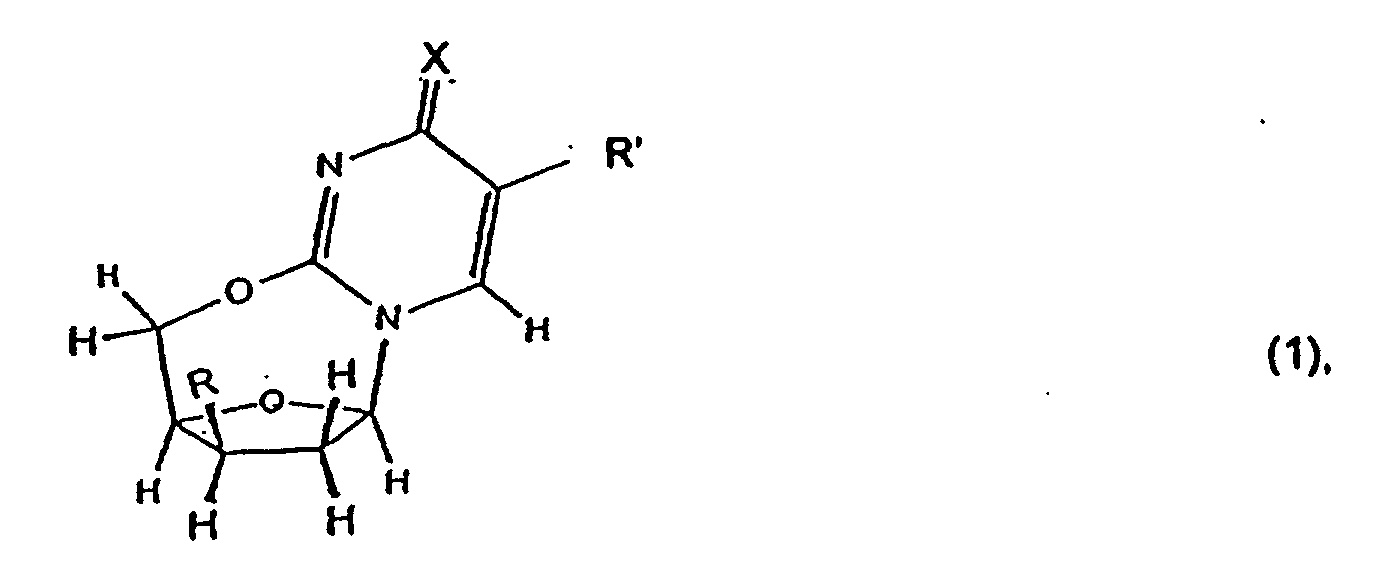
R für Br, J oder R1-SO3, wobei R1 ein unsubstituiertes oder substituiertes C1-C5-Alkyl oder ein unsubstituiertes oder substituiertes Phenyl bedeutet;
X für O oder NR", wobei R" eine übliche Schutzgruppe für N bedeutet, und
R1 für Wasserstoff, Halogen, jeweils substituiertes oder unsubstituiertes C1-C7-Alkyl, C2-C7-Alkenyl oder C2-C7-Alkinyl steht. - Verbindung nach Anspruch 1, wobei der Substituent am C1-C5-Alkyl eine elektronenziehende Gruppe ist.
- Verbindung nach Anspruch 1, wobei der Substituent am Phenyl ein C1-C5-Alkyl oder eine elektronenziehende Gruppe ist.
- Verbindung nach einem der vorhergehenden Ansprüche, wobei R1-SO3 Methansulfonyl, 4-Nitrophenylsulfonyl, p-Toluensulfonyl oder Trifluormethansulfonyl umfaßt.
- Verbindung nach einem der vorhergehenden Ansprüche, die 1-(3'-O-Mesyl-2,5'-anhydro-β-D-lyxofuranosyl)thymin, 1-(3'-O-mesyl-2,5'-anhydro-β-D-lyxofuranosyl)uridin oder 1-(3'-O-mesyl-2,5'-anhydro-β-D-lyxofuranosyl)cytidin ist.
- Verfahren zur Herstellung der Verbindung nach einem der Ansprüche 1 bis 5, wobei in eine Verbindung der Formel (2)in der X und R' wie vorstehend definiert sind, der Rest R eingeführt wird, wobei R die vorstehenden Bedeutungen hat.

- Verwendung der Verbindung nach einem der Ansprüche 1 bis 5 zur Einfügung eines Nucleophils an 3'-Position.
- Verwendung nach Anspruch 9, wobei das Nucleophil 18F- ist.
Applications Claiming Priority (3)
| Application Number | Priority Date | Filing Date | Title |
|---|---|---|---|
| DE10141300 | 2001-08-23 | ||
| DE10141300A DE10141300A1 (de) | 2001-08-23 | 2001-08-23 | Markierungsfähige Verbindungen zur einfachen Synthese von 3'-[·18·F]Fluor-3'-deoxythymidin und Verfahren zu deren Herstellung |
| PCT/EP2002/009361 WO2003018599A1 (de) | 2001-08-23 | 2002-08-21 | 1-(2,5'-anhydro-lyxofuranosyl) thymine zur synthese von radiomarkierten flour-3 deoxynucleotiden |
Publications (2)
| Publication Number | Publication Date |
|---|---|
| EP1419167A1 EP1419167A1 (de) | 2004-05-19 |
| EP1419167B1 true EP1419167B1 (de) | 2005-02-16 |
Family
ID=7696335
Family Applications (1)
| Application Number | Title | Priority Date | Filing Date |
|---|---|---|---|
| EP02796259A Expired - Lifetime EP1419167B1 (de) | 2001-08-23 | 2002-08-21 | 1-(2,5'-anhydro-lyxofuranosyl) thymine zur synthese von radiomarkierten fluor-3' deoxynucleotiden |
Country Status (7)
| Country | Link |
|---|---|
| US (1) | US7145000B2 (de) |
| EP (1) | EP1419167B1 (de) |
| AT (1) | ATE289316T1 (de) |
| DE (2) | DE10141300A1 (de) |
| DK (1) | DK1419167T3 (de) |
| ES (1) | ES2236616T3 (de) |
| WO (1) | WO2003018599A1 (de) |
-
2001
- 2001-08-23 DE DE10141300A patent/DE10141300A1/de not_active Withdrawn
-
2002
- 2002-08-21 WO PCT/EP2002/009361 patent/WO2003018599A1/de not_active Ceased
- 2002-08-21 AT AT02796259T patent/ATE289316T1/de not_active IP Right Cessation
- 2002-08-21 DE DE50202288T patent/DE50202288D1/de not_active Expired - Fee Related
- 2002-08-21 ES ES02796259T patent/ES2236616T3/es not_active Expired - Lifetime
- 2002-08-21 DK DK02796259T patent/DK1419167T3/da active
- 2002-08-21 US US10/487,480 patent/US7145000B2/en not_active Expired - Fee Related
- 2002-08-21 EP EP02796259A patent/EP1419167B1/de not_active Expired - Lifetime
Also Published As
| Publication number | Publication date |
|---|---|
| DE10141300A1 (de) | 2003-03-13 |
| ES2236616T3 (es) | 2005-07-16 |
| US7145000B2 (en) | 2006-12-05 |
| EP1419167A1 (de) | 2004-05-19 |
| US20050143338A1 (en) | 2005-06-30 |
| DE50202288D1 (de) | 2005-03-24 |
| WO2003018599A1 (de) | 2003-03-06 |
| ATE289316T1 (de) | 2005-03-15 |
| DK1419167T3 (da) | 2005-06-13 |
Similar Documents
| Publication | Publication Date | Title |
|---|---|---|
| EP0797580B1 (de) | Nucleosid-derivate mit photolabilen schutzgruppen | |
| EP0152459A1 (de) | Verfahren zur herstellung von oligonucleotiden. | |
| ES2704951T3 (es) | Compuesto precursor de marcaje radioactivo y método para producir un compuesto marcado con flúor radioactivo utilizando el compuesto precursor | |
| AU2019256465A1 (en) | 4'-thio-nucleotide and -nucleoside prodrugs for the treatment of cancer | |
| EP0901501B1 (de) | Nucleosid-derivate mit photolabilen schutzgruppen | |
| DE3390162T1 (de) | Desoxyuridinderivate, Verfahren zu ihrer Herstellung und ihre Verwendung als Pharmazeutika | |
| JP5715823B2 (ja) | マークされたプリン誘導体の製造方法、該プリン誘導体、およびその使用 | |
| DE4311023A1 (de) | Bifunktionelle chalkogenatom-unterbrochene Chelatbildner von Typ XN¶1¶S¶1¶O¶1¶ für radioaktive Isotope, deren Metallkomplexe sowie ihre Verwendung in Diagnostik und Therapie, diese enthaltende pharmazeutische Mittel und Verfahren zu ihrer Herstellung | |
| DE102019116986A1 (de) | Deuterierte 7-(3-(4-(2-([18F]Fluor)ethoxy)phenyl)propyl)-2-(furan-2-yl)-7H-pyrazolo[4,3-e][1,2,4]triazolo[1,5-c]pyrimidin-5-amin-Derivate | |
| US7160537B2 (en) | Method for preparing radiolabeled thymidine having low chromophoric byproducts | |
| EP1355915B1 (de) | Markierungsfähige verbindungen zur einfachen synthese von 3'-[18f]fluor-3'-deoxythymidin und verfahren zu deren herstellung | |
| EP1401851B1 (de) | Zweistufige schutzgruppen für die synthese von biopolymeren | |
| WO2003018599A1 (de) | 1-(2,5'-anhydro-lyxofuranosyl) thymine zur synthese von radiomarkierten flour-3 deoxynucleotiden | |
| DE19952113A1 (de) | Nucleosid-Derivate mit photolabilen Schutzgruppen | |
| CN103819524B (zh) | 3’-氟取代嘌呤核苷类似物、其制备方法及其应用 | |
| DE19949237B4 (de) | Vorstufenverbindung für Radiodiagnostika und Verfahren zu ihrer Herstellung | |
| EP1923382A1 (de) | [F-18] markierte L-Glutaminsäure, [F-18] markiertes Glutamin, ihre Derivate und ihre Verwendung sowie Verfahren zu ihrer Herstellung | |
| WO2005058246A2 (en) | Method for preparing radiolabeled thymidine | |
| JPS61109719A (ja) | 抗腫瘍活性増強剤 | |
| DE102005019452A1 (de) | Neues Verfahren zur Durchführung der Positronen-Emissions-Tomographie (PET) mittels 18F-haltigen Nukleosiden | |
| US20090075917A1 (en) | Deuterium-enriched telithromycin | |
| DE2310302A1 (de) | 0 hoch 2,2'-anhydro-1-(beta-darabinofuranosyl)-cytosinderivate und verfahren zu ihrer herstellung |
Legal Events
| Date | Code | Title | Description |
|---|---|---|---|
| PUAI | Public reference made under article 153(3) epc to a published international application that has entered the european phase |
Free format text: ORIGINAL CODE: 0009012 |
|
| 17P | Request for examination filed |
Effective date: 20040209 |
|
| AK | Designated contracting states |
Kind code of ref document: A1 Designated state(s): AT BE BG CH CY CZ DE DK EE ES FI FR GB GR IE IT LI LU MC NL PT SE TR |
|
| AX | Request for extension of the european patent |
Extension state: AL LT LV MK RO SI |
|
| GRAP | Despatch of communication of intention to grant a patent |
Free format text: ORIGINAL CODE: EPIDOSNIGR1 |
|
| GRAS | Grant fee paid |
Free format text: ORIGINAL CODE: EPIDOSNIGR3 |
|
| GRAA | (expected) grant |
Free format text: ORIGINAL CODE: 0009210 |
|
| RTI1 | Title (correction) |
Free format text: 1-(2,5'-ANHYDRO-LYXOFURANOSYL) THYMINES FOR THE SYNTHESIS OF RADIOMARKED FLUORO-3' DEOXYNUCLEOTIDES |
|
| AK | Designated contracting states |
Kind code of ref document: B1 Designated state(s): AT BE BG CH CY CZ DE DK EE ES FI FR GB GR IE IT LI LU MC NL PT SE TR |
|
| PG25 | Lapsed in a contracting state [announced via postgrant information from national office to epo] |
Ref country code: CZ Free format text: LAPSE BECAUSE OF FAILURE TO SUBMIT A TRANSLATION OF THE DESCRIPTION OR TO PAY THE FEE WITHIN THE PRESCRIBED TIME-LIMIT Effective date: 20050216 Ref country code: EE Free format text: LAPSE BECAUSE OF FAILURE TO SUBMIT A TRANSLATION OF THE DESCRIPTION OR TO PAY THE FEE WITHIN THE PRESCRIBED TIME-LIMIT Effective date: 20050216 Ref country code: BG Free format text: LAPSE BECAUSE OF FAILURE TO SUBMIT A TRANSLATION OF THE DESCRIPTION OR TO PAY THE FEE WITHIN THE PRESCRIBED TIME-LIMIT Effective date: 20050216 Ref country code: TR Free format text: LAPSE BECAUSE OF FAILURE TO SUBMIT A TRANSLATION OF THE DESCRIPTION OR TO PAY THE FEE WITHIN THE PRESCRIBED TIME-LIMIT Effective date: 20050216 Ref country code: IE Free format text: LAPSE BECAUSE OF FAILURE TO SUBMIT A TRANSLATION OF THE DESCRIPTION OR TO PAY THE FEE WITHIN THE PRESCRIBED TIME-LIMIT Effective date: 20050216 |
|
| REG | Reference to a national code |
Ref country code: GB Ref legal event code: FG4D Free format text: NOT ENGLISH |
|
| REG | Reference to a national code |
Ref country code: CH Ref legal event code: EP |
|
| REG | Reference to a national code |
Ref country code: CH Ref legal event code: NV Representative=s name: KELLER & PARTNER PATENTANWAELTE AG |
|
| REG | Reference to a national code |
Ref country code: IE Ref legal event code: FG4D Free format text: GERMAN |
|
| REF | Corresponds to: |
Ref document number: 50202288 Country of ref document: DE Date of ref document: 20050324 Kind code of ref document: P |
|
| PG25 | Lapsed in a contracting state [announced via postgrant information from national office to epo] |
Ref country code: GR Free format text: LAPSE BECAUSE OF FAILURE TO SUBMIT A TRANSLATION OF THE DESCRIPTION OR TO PAY THE FEE WITHIN THE PRESCRIBED TIME-LIMIT Effective date: 20050516 |
|
| REG | Reference to a national code |
Ref country code: SE Ref legal event code: TRGR |
|
| REG | Reference to a national code |
Ref country code: DK Ref legal event code: T3 |
|
| GBT | Gb: translation of ep patent filed (gb section 77(6)(a)/1977) |
Effective date: 20050523 |
|
| REG | Reference to a national code |
Ref country code: ES Ref legal event code: FG2A Ref document number: 2236616 Country of ref document: ES Kind code of ref document: T3 |
|
| PG25 | Lapsed in a contracting state [announced via postgrant information from national office to epo] |
Ref country code: PT Free format text: LAPSE BECAUSE OF FAILURE TO SUBMIT A TRANSLATION OF THE DESCRIPTION OR TO PAY THE FEE WITHIN THE PRESCRIBED TIME-LIMIT Effective date: 20050804 |
|
| PG25 | Lapsed in a contracting state [announced via postgrant information from national office to epo] |
Ref country code: LU Free format text: LAPSE BECAUSE OF NON-PAYMENT OF DUE FEES Effective date: 20050821 Ref country code: CY Free format text: LAPSE BECAUSE OF FAILURE TO SUBMIT A TRANSLATION OF THE DESCRIPTION OR TO PAY THE FEE WITHIN THE PRESCRIBED TIME-LIMIT Effective date: 20050821 |
|
| PG25 | Lapsed in a contracting state [announced via postgrant information from national office to epo] |
Ref country code: MC Free format text: LAPSE BECAUSE OF NON-PAYMENT OF DUE FEES Effective date: 20050831 |
|
| REG | Reference to a national code |
Ref country code: IE Ref legal event code: FD4D |
|
| PLBE | No opposition filed within time limit |
Free format text: ORIGINAL CODE: 0009261 |
|
| STAA | Information on the status of an ep patent application or granted ep patent |
Free format text: STATUS: NO OPPOSITION FILED WITHIN TIME LIMIT |
|
| 26N | No opposition filed |
Effective date: 20051117 |
|
| ET | Fr: translation filed | ||
| PGFP | Annual fee paid to national office [announced via postgrant information from national office to epo] |
Ref country code: DK Payment date: 20070815 Year of fee payment: 6 |
|
| PGFP | Annual fee paid to national office [announced via postgrant information from national office to epo] |
Ref country code: DE Payment date: 20070822 Year of fee payment: 6 |
|
| PGFP | Annual fee paid to national office [announced via postgrant information from national office to epo] |
Ref country code: ES Payment date: 20070830 Year of fee payment: 6 |
|
| PGFP | Annual fee paid to national office [announced via postgrant information from national office to epo] |
Ref country code: AT Payment date: 20070816 Year of fee payment: 6 Ref country code: CH Payment date: 20070815 Year of fee payment: 6 Ref country code: FI Payment date: 20070816 Year of fee payment: 6 |
|
| PGFP | Annual fee paid to national office [announced via postgrant information from national office to epo] |
Ref country code: GB Payment date: 20070823 Year of fee payment: 6 |
|
| PGFP | Annual fee paid to national office [announced via postgrant information from national office to epo] |
Ref country code: BE Payment date: 20070905 Year of fee payment: 6 Ref country code: IT Payment date: 20070823 Year of fee payment: 6 Ref country code: NL Payment date: 20070814 Year of fee payment: 6 Ref country code: SE Payment date: 20070815 Year of fee payment: 6 |
|
| PGFP | Annual fee paid to national office [announced via postgrant information from national office to epo] |
Ref country code: FR Payment date: 20070812 Year of fee payment: 6 |
|
| REG | Reference to a national code |
Ref country code: DK Ref legal event code: EBP |
|
| REG | Reference to a national code |
Ref country code: CH Ref legal event code: PL |
|
| EUG | Se: european patent has lapsed | ||
| GBPC | Gb: european patent ceased through non-payment of renewal fee |
Effective date: 20080821 |
|
| PG25 | Lapsed in a contracting state [announced via postgrant information from national office to epo] |
Ref country code: AT Free format text: LAPSE BECAUSE OF NON-PAYMENT OF DUE FEES Effective date: 20080821 |
|
| NLV4 | Nl: lapsed or anulled due to non-payment of the annual fee |
Effective date: 20090301 |
|
| PG25 | Lapsed in a contracting state [announced via postgrant information from national office to epo] |
Ref country code: FI Free format text: LAPSE BECAUSE OF NON-PAYMENT OF DUE FEES Effective date: 20080821 Ref country code: NL Free format text: LAPSE BECAUSE OF NON-PAYMENT OF DUE FEES Effective date: 20090301 |
|
| REG | Reference to a national code |
Ref country code: FR Ref legal event code: ST Effective date: 20090430 |
|
| PG25 | Lapsed in a contracting state [announced via postgrant information from national office to epo] |
Ref country code: LI Free format text: LAPSE BECAUSE OF NON-PAYMENT OF DUE FEES Effective date: 20080831 Ref country code: CH Free format text: LAPSE BECAUSE OF NON-PAYMENT OF DUE FEES Effective date: 20080831 |
|
| PG25 | Lapsed in a contracting state [announced via postgrant information from national office to epo] |
Ref country code: DK Free format text: LAPSE BECAUSE OF NON-PAYMENT OF DUE FEES Effective date: 20080831 Ref country code: BE Free format text: LAPSE BECAUSE OF NON-PAYMENT OF DUE FEES Effective date: 20080831 |
|
| PG25 | Lapsed in a contracting state [announced via postgrant information from national office to epo] |
Ref country code: FR Free format text: LAPSE BECAUSE OF NON-PAYMENT OF DUE FEES Effective date: 20080901 Ref country code: DE Free format text: LAPSE BECAUSE OF NON-PAYMENT OF DUE FEES Effective date: 20090303 Ref country code: IT Free format text: LAPSE BECAUSE OF NON-PAYMENT OF DUE FEES Effective date: 20080821 |
|
| REG | Reference to a national code |
Ref country code: ES Ref legal event code: FD2A Effective date: 20080822 |
|
| PG25 | Lapsed in a contracting state [announced via postgrant information from national office to epo] |
Ref country code: GB Free format text: LAPSE BECAUSE OF NON-PAYMENT OF DUE FEES Effective date: 20080821 |
|
| PG25 | Lapsed in a contracting state [announced via postgrant information from national office to epo] |
Ref country code: ES Free format text: LAPSE BECAUSE OF NON-PAYMENT OF DUE FEES Effective date: 20080822 |
|
| PG25 | Lapsed in a contracting state [announced via postgrant information from national office to epo] |
Ref country code: SE Free format text: LAPSE BECAUSE OF NON-PAYMENT OF DUE FEES Effective date: 20080822 |