EP1418697A1 - Turbo decoder with circular redundancy code signature comparison for a receiving unit of a wireless communication system and method - Google Patents
Turbo decoder with circular redundancy code signature comparison for a receiving unit of a wireless communication system and method Download PDFInfo
- Publication number
- EP1418697A1 EP1418697A1 EP04001115A EP04001115A EP1418697A1 EP 1418697 A1 EP1418697 A1 EP 1418697A1 EP 04001115 A EP04001115 A EP 04001115A EP 04001115 A EP04001115 A EP 04001115A EP 1418697 A1 EP1418697 A1 EP 1418697A1
- Authority
- EP
- European Patent Office
- Prior art keywords
- decoder
- signature
- iteration
- code
- data
- Prior art date
- Legal status (The legal status is an assumption and is not a legal conclusion. Google has not performed a legal analysis and makes no representation as to the accuracy of the status listed.)
- Withdrawn
Links
- 238000004891 communication Methods 0.000 title claims abstract description 16
- 238000000034 method Methods 0.000 title claims abstract description 13
- 230000006870 function Effects 0.000 claims description 3
- 238000001514 detection method Methods 0.000 description 2
- 239000000654 additive Substances 0.000 description 1
- 230000000996 additive effect Effects 0.000 description 1
- 125000004122 cyclic group Chemical group 0.000 description 1
- 238000010586 diagram Methods 0.000 description 1
Images
Classifications
-
- H—ELECTRICITY
- H03—ELECTRONIC CIRCUITRY
- H03M—CODING; DECODING; CODE CONVERSION IN GENERAL
- H03M13/00—Coding, decoding or code conversion, for error detection or error correction; Coding theory basic assumptions; Coding bounds; Error probability evaluation methods; Channel models; Simulation or testing of codes
- H03M13/37—Decoding methods or techniques, not specific to the particular type of coding provided for in groups H03M13/03 - H03M13/35
-
- H—ELECTRICITY
- H04—ELECTRIC COMMUNICATION TECHNIQUE
- H04L—TRANSMISSION OF DIGITAL INFORMATION, e.g. TELEGRAPHIC COMMUNICATION
- H04L1/00—Arrangements for detecting or preventing errors in the information received
- H04L1/004—Arrangements for detecting or preventing errors in the information received by using forward error control
- H04L1/0045—Arrangements at the receiver end
- H04L1/0047—Decoding adapted to other signal detection operation
- H04L1/005—Iterative decoding, including iteration between signal detection and decoding operation
- H04L1/0051—Stopping criteria
-
- H—ELECTRICITY
- H03—ELECTRONIC CIRCUITRY
- H03M—CODING; DECODING; CODE CONVERSION IN GENERAL
- H03M13/00—Coding, decoding or code conversion, for error detection or error correction; Coding theory basic assumptions; Coding bounds; Error probability evaluation methods; Channel models; Simulation or testing of codes
- H03M13/29—Coding, decoding or code conversion, for error detection or error correction; Coding theory basic assumptions; Coding bounds; Error probability evaluation methods; Channel models; Simulation or testing of codes combining two or more codes or code structures, e.g. product codes, generalised product codes, concatenated codes, inner and outer codes
- H03M13/2957—Turbo codes and decoding
-
- H—ELECTRICITY
- H03—ELECTRONIC CIRCUITRY
- H03M—CODING; DECODING; CODE CONVERSION IN GENERAL
- H03M13/00—Coding, decoding or code conversion, for error detection or error correction; Coding theory basic assumptions; Coding bounds; Error probability evaluation methods; Channel models; Simulation or testing of codes
- H03M13/29—Coding, decoding or code conversion, for error detection or error correction; Coding theory basic assumptions; Coding bounds; Error probability evaluation methods; Channel models; Simulation or testing of codes combining two or more codes or code structures, e.g. product codes, generalised product codes, concatenated codes, inner and outer codes
- H03M13/2957—Turbo codes and decoding
- H03M13/2975—Judging correct decoding, e.g. iteration stopping criteria
-
- H—ELECTRICITY
- H03—ELECTRONIC CIRCUITRY
- H03M—CODING; DECODING; CODE CONVERSION IN GENERAL
- H03M13/00—Coding, decoding or code conversion, for error detection or error correction; Coding theory basic assumptions; Coding bounds; Error probability evaluation methods; Channel models; Simulation or testing of codes
- H03M13/65—Purpose and implementation aspects
- H03M13/6577—Representation or format of variables, register sizes or word-lengths and quantization
- H03M13/6588—Compression or short representation of variables
-
- H—ELECTRICITY
- H04—ELECTRIC COMMUNICATION TECHNIQUE
- H04L—TRANSMISSION OF DIGITAL INFORMATION, e.g. TELEGRAPHIC COMMUNICATION
- H04L1/00—Arrangements for detecting or preventing errors in the information received
- H04L1/004—Arrangements for detecting or preventing errors in the information received by using forward error control
- H04L1/0056—Systems characterized by the type of code used
- H04L1/0064—Concatenated codes
- H04L1/0066—Parallel concatenated codes
-
- H—ELECTRICITY
- H03—ELECTRONIC CIRCUITRY
- H03M—CODING; DECODING; CODE CONVERSION IN GENERAL
- H03M13/00—Coding, decoding or code conversion, for error detection or error correction; Coding theory basic assumptions; Coding bounds; Error probability evaluation methods; Channel models; Simulation or testing of codes
- H03M13/03—Error detection or forward error correction by redundancy in data representation, i.e. code words containing more digits than the source words
- H03M13/05—Error detection or forward error correction by redundancy in data representation, i.e. code words containing more digits than the source words using block codes, i.e. a predetermined number of check bits joined to a predetermined number of information bits
- H03M13/09—Error detection only, e.g. using cyclic redundancy check [CRC] codes or single parity bit
Definitions
- the present invention relates to communications systems which use error correcting for received communication signals and, in particular, to such systems which utilize iterative turbo decoder systems.
- Turbo codes are a form of error correcting codes that yield performance near the Shannon limit for performance in an Additive While Gaussian Noise (AWGN) channel in a wireless communication system, such as time division duplex using code division multiple access (TDD/CDMA). Decoders for these codes utilize an iterative algorithm which gives an improved estimate of the transmitted data at each iteration.
- AWGN Additive While Gaussian Noise
- Decoders can be implemented in hardware or software, but in either case the number of iterations used drives the requirement for processing resources, including the processing throughput required to achieve the desired data rate, power consumed in decoding, and the amount of hardware needed in a hardware implementation.
- Another strategy is to use a stopping rule to dynamically determine when decoding can be terminated without significantly effecting performance.
- the simplest stopping rule is the hard-decision-aided (HDA) criteria.
- HDA hard-decision-aided
- decoding is terminated when two successive iterations yield the same results. There are no changes in the hard decisions between iterations.
- Implementation of this rule for a coded block of N bits requires N memory locations to store the results of the previous implementation, as well as comparison of the previous N bit result to the current N bit result.
- a typical turbo decoder may produce turbo decoder estimate data having in excess of 5,000 bits of information for each iteration. Accordingly, the implementation of a conventional stopping rule requires an additional memory allocation in excess of 5,000 bits to store a first code iteration for comparison with a next code iteration in order to determine whether the same results have been produced.
- the inventor has recognized that it would be desirable to provide an improved turbo decoder which can more efficiently implement a stopping rule with a lesser requirement for additional memory.
- An iterative turbo decoder for a receiving unit of a wireless communication system and method for error correcting received communication signal data are provided.
- the decoder recursively evaluates signal data for a selected number of iterations.
- decoder circuitry During each iteration, decoder circuitry produces a new estimate of the transmitted data block, also called the extrinsics.
- a decoder data memory stores the extrinsics generated for one decoding iteration.
- Signature code generating circuitry generates code signatures corresponding to each new estimate of the transmitted data block for each decoder iteration.
- the code signatures are preferably at least 20 times smaller than the data which they represent and for practical purposes will normally be at least 100 times smaller.
- a relatively small code signature memory stores the code signature corresponding to turbo decoder estimate data generated for one decoding iteration.
- a comparator is operatively associated with the signature code circuitry and decoder circuitry.
- the comparator compares a generated code signature for a new estimate of the transmitted data block being produced and stored for a present decoder iteration with the contents of the signature memory, If the comparison reflects equality, the decoder circuitry ceases iteration processing. If the comparison reflects inequality, the generated code signature is stored in the signature memory where it is available for comparison relative to a code signature for a next decoder iteration.
- the comparator may be used to store the generated code in the signature register. As an alternative, the comparator may simply access the signature register before the signature code generator outputs the new signature code. This permits the signature code generator to output the new signature code to both the comparator and to the signature register, as indicated in phantom, which eliminates the need for the comparator to perform a store operation to the signature code register.
- the comparator is operatively associated with the decoder circuitry to control decoder circuitry iteration processing only after a selected minimum number of iterations have occurred. Also, preferably the decoder circuitry ceases iteration processing if a predetermined limit of iterations has occurred.
- the limit of iterations is preferably an integer at least three greater than the selected minimum number. In a preferred embodiment, the selected minimum number is four (4) and the limit is eight (8).
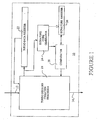
- FIG. 1 is a schematic diagram of a turbo decoder made in accordance with the teachings of the present invention.
- turbo decoder 10 having a communication signal input 12 and an output 14,
- the turbo decoder 10 includes turbo decoding iteration processing circuitry 20 and an associated turbo data register 22.
- the decoder processing circuitry 20 receives data blocks of communication signals via input 12 and generates a new estimate of the transmitted data block which is stored in register 22.
- the processing circuitry 20 is recursively associated with the turbo data register 22 such that the processor 20 utilizes the contents of the turbo data register 22 for the second and each successive iteration of turbo decoding processing.
- the turbo decoding processing circuitry 20 is preferably configured with a predetermined limit as to the number of processing iterations which will occur for any given block of communication data such that the turbo decoder output is based upon the contents of the turbo decoder register after the last decoding iteration.
- the maximum number of processing iterations performed by the processor 20 is eight (8).
- the processor 20 also implements a stopping rule where fewer than the maximum number of iterations are needed.
- a stopping rule where fewer than the maximum number of iterations are needed.
- iterative processing is stopped.
- a relatively simplistic signature code generator 24 and a relatively small code signature register 26 are provided as inputs to a comparator 28 which is operatively associated with the iteration processor 20 to implement the stopping rule.
- the comparator 28 is operatively associated with the decoder circuitry 20 to control decoder circuitry iteration processing only after a selected minimum number of iterations have occurred. Also, preferably the decoder circuitry 20 ceases iteration processing if a predetermined limit of iterations has occurred.
- the limit of iterations is preferably an integer at least three greater than the selected minimum number. In a preferred embodiment, the selected minimum number is four (4) and the limit is eight (8).
- the signature code generator preferably comprises a simple- 16-bit binary divider which divides the 5,114 binary string of data by a selected 16-bit binary number and outputs the remainder which results from the division function to the comparator 28.
- the remainder will necessarily not exceed 16 bits since the divisor is 16 bits in length.
- a 16-bit divisor preferably the binary number 1000000000000011 is utilized.
- Such a divisor corresponds to a binary polynomial represented as 1 + x 14 + x 15 .
- the binary division performed by code generator 24, mathematically corresponds to dividing a binary polynomial representation of the 5,114 bit iteration estimate data by the polynomial 1 + x 14 + x 15 using binary (i.e. modulo 2) mathematics.
- the remainder of the binary division corresponds to the remainder polynomial.
- the odds that the remainder will be the same for two successive 5,114 bit string of estimate data are about 1 in 2 16 which the inventor has determined is an acceptable risk factor.
- the turbo decoder processor 20 outputs, for a given iteration, N bits of estimate data to the turbo data register 22 and signal code generator 24.
- the signal code generator 24 generates a corresponding code signature having M bits which is preferably at least 100 times smaller than N which is input to the comparator 28.
- the comparator 28 compares the M bit signature code input from the code generator 24 with the contents of the signature register 26 to determine if they are equal.
- the comparator determines equality, a signal is sent to the processor 20 to stop iteration processing and output the turbo coding results. If the comparator detects inequality, the M-bit signature code received from the signature code generator 24 is stored in the signature register 26.
- the comparator 28 may be used to store the generated code in the signature register 26, As an alternative, the comparator 28 may simply access the signature register 26 before the signature code generator 24 outputs the new signature code. This permits the signature code generator 24 to output the new signature code to both the comparator 28 and to the signature register 26, as indicated in phantom, which eliminates the need for the comparator 28 to perform a store operation to the signature code register 26.
- the signature code generator 24 preferably divides by 1000000000000011 to produce a remainder of no greater than 16 bits so that the signature register 26 need only have a 16-bit storage capacity.
- the present invention is particularly suited to hardware implementations where the cost of generating the signature code is small, and the cost of the additional memory required would be high. It can also be used, however, in software implementations.
Landscapes
- Engineering & Computer Science (AREA)
- Physics & Mathematics (AREA)
- Probability & Statistics with Applications (AREA)
- Theoretical Computer Science (AREA)
- Computer Networks & Wireless Communication (AREA)
- Signal Processing (AREA)
- Error Detection And Correction (AREA)
- Detection And Correction Of Errors (AREA)
- Detection And Prevention Of Errors In Transmission (AREA)
- Compression, Expansion, Code Conversion, And Decoders (AREA)
Abstract
Description
- The present invention relates to communications systems which use error correcting for received communication signals and, in particular, to such systems which utilize iterative turbo decoder systems.
- Turbo codes are a form of error correcting codes that yield performance near the Shannon limit for performance in an Additive While Gaussian Noise (AWGN) channel in a wireless communication system, such as time division duplex using code division multiple access (TDD/CDMA). Decoders for these codes utilize an iterative algorithm which gives an improved estimate of the transmitted data at each iteration.
- A significant design parameter for decoders is the number of iterations to be used. Decoders can be implemented in hardware or software, but in either case the number of iterations used drives the requirement for processing resources, including the processing throughput required to achieve the desired data rate, power consumed in decoding, and the amount of hardware needed in a hardware implementation.
- Two general strategies are known in the art for determining the number of iterations in a decoder implementation. First, a fixed number of iterations can be determined as part of the design. This simplifies the implementation, but requires excessive processing resources since the fixed number must be set high enough to give the desired performance, i.e. bit error rate for the expected range of signal to noise levels, for nearly all cases where many decodings would require less than the fixed number of iterations.
- Another strategy is to use a stopping rule to dynamically determine when decoding can be terminated without significantly effecting performance. The simplest stopping rule is the hard-decision-aided (HDA) criteria. When using this stopping rule, decoding is terminated when two successive iterations yield the same results. There are no changes in the hard decisions between iterations. Implementation of this rule for a coded block of N bits requires N memory locations to store the results of the previous implementation, as well as comparison of the previous N bit result to the current N bit result.
- [0008a] Conventional stopping criteria are disclosed in Shao, Rose Y., and Fossorier, Marc P.C., "Two Simple Stopping Criteria for Turbo Decoding", IEEE Transactions on Communications, Vol. 47, No. 8, August 1999. That paper presents two simple criteria for stopping the iteration process in turbo decoding. EP 1 017 176 and EP 1 009 098 describe the general state-of-the-art of turbo code error detection. EP 1 009 098 discloses use of cyclic redundancy checksum implemented by appending checksum bits to each frame.
- A typical turbo decoder may produce turbo decoder estimate data having in excess of 5,000 bits of information for each iteration. Accordingly, the implementation of a conventional stopping rule requires an additional memory allocation in excess of 5,000 bits to store a first code iteration for comparison with a next code iteration in order to determine whether the same results have been produced.
- The inventor has recognized that it would be desirable to provide an improved turbo decoder which can more efficiently implement a stopping rule with a lesser requirement for additional memory.
- An iterative turbo decoder for a receiving unit of a wireless communication system and method for error correcting received communication signal data are provided. The decoder recursively evaluates signal data for a selected number of iterations.
- During each iteration, decoder circuitry produces a new estimate of the transmitted data block, also called the extrinsics. A decoder data memory stores the extrinsics generated for one decoding iteration.
- Signature code generating circuitry generates code signatures corresponding to each new estimate of the transmitted data block for each decoder iteration. The code signatures are preferably at least 20 times smaller than the data which they represent and for practical purposes will normally be at least 100 times smaller. A relatively small code signature memory stores the code signature corresponding to turbo decoder estimate data generated for one decoding iteration.
- A comparator is operatively associated with the signature code circuitry and decoder circuitry. The comparator compares a generated code signature for a new estimate of the transmitted data block being produced and stored for a present decoder iteration with the contents of the signature memory, If the comparison reflects equality, the decoder circuitry ceases iteration processing. If the comparison reflects inequality, the generated code signature is stored in the signature memory where it is available for comparison relative to a code signature for a next decoder iteration.
- The comparator may be used to store the generated code in the signature register. As an alternative, the comparator may simply access the signature register before the signature code generator outputs the new signature code. This permits the signature code generator to output the new signature code to both the comparator and to the signature register, as indicated in phantom, which eliminates the need for the comparator to perform a store operation to the signature code register.
- Preferably, the comparator is operatively associated with the decoder circuitry to control decoder circuitry iteration processing only after a selected minimum number of iterations have occurred. Also, preferably the decoder circuitry ceases iteration processing if a predetermined limit of iterations has occurred. The limit of iterations is preferably an integer at least three greater than the selected minimum number. In a preferred embodiment, the selected minimum number is four (4) and the limit is eight (8).
- It is an object of the present invention to provide an iterative turbo decoder which selectively implements a stopping rule with a lesser memory requirement than the prior art.
- Other objects and advantages of the present invention will be apparent from the following description of a presently preferred embodiment.
- Figure 1 is a schematic diagram of a turbo decoder made in accordance with the teachings of the present invention.
- With reference to Figure 1, there is shown a
turbo decoder 10 having acommunication signal input 12 and anoutput 14, Theturbo decoder 10 includes turbo decodingiteration processing circuitry 20 and an associatedturbo data register 22. Thedecoder processing circuitry 20 receives data blocks of communication signals viainput 12 and generates a new estimate of the transmitted data block which is stored inregister 22. Theprocessing circuitry 20 is recursively associated with theturbo data register 22 such that theprocessor 20 utilizes the contents of theturbo data register 22 for the second and each successive iteration of turbo decoding processing. - The turbo
decoding processing circuitry 20 is preferably configured with a predetermined limit as to the number of processing iterations which will occur for any given block of communication data such that the turbo decoder output is based upon the contents of the turbo decoder register after the last decoding iteration. Preferably, the maximum number of processing iterations performed by theprocessor 20 is eight (8). - The
processor 20 also implements a stopping rule where fewer than the maximum number of iterations are needed. When the decoder determines that the estimate data being generated for successive iterations is not changing, iterative processing is stopped. In lieu of providing a relatively large amount of additional memory to store a prior iteration of estimate data, a relatively simplisticsignature code generator 24 and a relatively small code signature register 26 are provided as inputs to acomparator 28 which is operatively associated with theiteration processor 20 to implement the stopping rule. - Preferably, the
comparator 28 is operatively associated with thedecoder circuitry 20 to control decoder circuitry iteration processing only after a selected minimum number of iterations have occurred. Also, preferably thedecoder circuitry 20 ceases iteration processing if a predetermined limit of iterations has occurred. The limit of iterations is preferably an integer at least three greater than the selected minimum number. In a preferred embodiment, the selected minimum number is four (4) and the limit is eight (8). - For a turbo decoder which generates binary estimate data on the order of 5,114 bits for a single iteration, the signature code generator preferably comprises a simple- 16-bit binary divider which divides the 5,114 binary string of data by a selected 16-bit binary number and outputs the remainder which results from the division function to the
comparator 28. The remainder will necessarily not exceed 16 bits since the divisor is 16 bits in length. - For a 16-bit divisor, preferably the binary number 1000000000000011 is utilized. Such a divisor corresponds to a binary polynomial represented as 1 + x14 + x15. The binary division performed by
code generator 24, mathematically corresponds to dividing a binary polynomial representation of the 5,114 bit iteration estimate data by the polynomial 1 + x14 + x15 using binary (i.e. modulo 2) mathematics. The remainder of the binary division corresponds to the remainder polynomial. The odds that the remainder will be the same for two successive 5,114 bit string of estimate data are about 1 in 216 which the inventor has determined is an acceptable risk factor. - Mathematical correspondence and use of polynomial representations to generate signal codes is known in the art and is discussed in, Pearson, W.W, and Brown, D.T., "Signal Codes For Error Detection", "Proceedings of the IRE", January 1961. The inventor has recognized that this form of encoding has application to turbo decoders.
- In operation, the
turbo decoder processor 20 outputs, for a given iteration, N bits of estimate data to the turbo data register 22 andsignal code generator 24. Thesignal code generator 24 generates a corresponding code signature having M bits which is preferably at least 100 times smaller than N which is input to thecomparator 28. Thecomparator 28 compares the M bit signature code input from thecode generator 24 with the contents of the signature register 26 to determine if they are equal. - If the comparator determines equality, a signal is sent to the
processor 20 to stop iteration processing and output the turbo coding results. If the comparator detects inequality, the M-bit signature code received from thesignature code generator 24 is stored in the signature register 26. - The
comparator 28 may be used to store the generated code in the signature register 26, As an alternative, thecomparator 28 may simply access the signature register 26 before thesignature code generator 24 outputs the new signature code. This permits thesignature code generator 24 to output the new signature code to both thecomparator 28 and to the signature register 26, as indicated in phantom, which eliminates the need for thecomparator 28 to perform a store operation to the signature code register 26. - Where a 5,114 bit block of binary data is produced for a decoder iteration, the
signature code generator 24 preferably divides by 1000000000000011 to produce a remainder of no greater than 16 bits so that the signature register 26 need only have a 16-bit storage capacity. - The present invention is particularly suited to hardware implementations where the cost of generating the signature code is small, and the cost of the additional memory required would be high. It can also be used, however, in software implementations.
Claims (17)
- A receiving unit for use in a wireless communication system having an iterative turbo decoder for error correcting received communication signal data that includes a decoder data memory (22) for storing decoder estimate data generated for one decoding iteration and decoder iteration processor means (20) for producing successive iterations of decoder estimate data having a selected bit size based in part on the contents of said decoder data memory and storing the iteration of decoder estimate data which is produced in said decoder data memory (22) to replace its contents characterized by:a signature memory (26) for storing a code signature corresponding to decoder estimate data generated for one decoding iteration;signature code generating means (24) for generating a code signature of decoder estimate data as a function of an entire iteration of decoder estimate data such that each code signature has a bit size at least twenty times smaller than said selected bit size of decoder estimate data; anda comparator (28) operatively associated with said signature code generating means (24) and said decoder iteration processor means (20) configured to compare a generated code signature for one iteration of decoder estimate data with the contents of the signature memory (26) and configured to provide a stopping signal to said decoder iteration processor means (20) based on the comparison results.
- The invention according to claim 1 wherein
said comparator (28) is operatively associated with said decoder iteration processor means (20) and is configured to send a stopping signal only after a selected number of iterations have occurred and when the comparison reflects equality; and
said decoder iteration processor means (20) is configured to stop iteration processing if a predetermined limit of iterations has occurred where said limit is an integer at least three greater than the selected number, - The invention according to claim 2 wherein the selected number is four and the limit is eight.
- The invention according to claim 1 wherein said signature code generating means (24) is configured to generate code signatures such that the code signature bit size is at least 100 times smaller than said selected bit size.
- The invention according to claim 1 wherein the decoder estimate data is a binary string and said signature code generating means (24) comprises a binary divider configured to divide corresponding binary strings of decoder data by a selected binary divisor and to output the remainder of the division to the comparator (28) as the code signature.
- The invention according to claim 5 wherein the decoder estimate data binary strings are at least 5,000 bits in length and the binary divisor is a 16-bit binary number whereby the code signatures are no greater than 16 bits.
- The invention according to claim 6 wherein the divisor is 1000000000000011.
- The invention according to claim 1 wherein said comparator (28) is configured to store the generated code signature in said signature memory (26) to be available for comparison relative to a code signature for a next decoder iteration.
- The invention according to claim 1 wherein said signature code generating means (24) is configured to store the generated code signature in said signature memory (26) to be available for comparison relative to a code signature for a next decoder iteration,
- A method for iterative turbo decoding received wireless communication signals that error corrects communication signal data by recursively evaluating signal data for α. selected number of iterations by producing successive iterations of decoder estimate data having a selected bit size based in part on the contents of a decoder data memory (22) and storing each iteration of decoder estimate data which is produced in said decoder data memory (22) to replace its contents, the method characterized by:generating a code signature of decoder estimate data as a function of an entire iteration of decoder estimate data such that each code signature has a bit size at least twenty times smaller than said selected bit size of decoder estimate data;comparing a generated code signature for an iteration of decoder estimate data with the contents of a signature memory (26);stopping decoder estimate data iteration production based at least in part on the comparison results;Storing the generated code signature in the signature memory (26) to replace its contents at least when the decoder estimate data production is not stopped; andrepeating said generating and comparing for each iteration of decoder estimate data until the decoder estimate data production is stopped.
- A method according to claim 10 wherein:a minimum number of decoding iterations are performed before decoder estimate data iteration production is stopped;decoder estimate data iteration production is stopped if a predetermined limit of iterations has occurred where said limit is an integer at least three greater than the minimum number; anddecoder estimate data iteration production is stopped after the minimum number of iterations and before the predetermined limit of iterations has occurred when the comparison reflects equality.
- A method according to claim 11 wherein the minimum number is four and the limit is eight.
- A method according to claim 10 wherein the decoder estimate data for each processing iteration is a binary string and the signature codes are generated by binary dividing corresponding binary strings of decoder data by a selected binary divisor and outputting the remainder of the division for comparison as the code signature.
- A method according to claim 13 wherein the decoder estimate data binary strings are at least 5,000 bits in length and the binary divisor is a 16-bit binary number whereby the code signatures are no greater than 16 bits,
- A method according to claim 14 wherein the divisor is 1000000000000011,
- A method according to claim 10 wherein the generated code signature is stored by signature code generating means (24) in the signature memory (26) to be available for comparison relative to a code signature for a next decoder iteration.
- A method according to claim 10 wherein the generated code signature is stored by a code signature comparator (28) in the signature memory (26) to be available for comparison relative to a code signature for a next decoder iteration.
Applications Claiming Priority (3)
| Application Number | Priority Date | Filing Date | Title |
|---|---|---|---|
| US24844000P | 2000-11-14 | 2000-11-14 | |
| US248440P | 2000-11-14 | ||
| EP01996943A EP1378086B9 (en) | 2000-11-14 | 2001-11-01 | Turbo decoder with circular redundancy code signature comparison |
Related Parent Applications (1)
| Application Number | Title | Priority Date | Filing Date |
|---|---|---|---|
| EP01996943A Division EP1378086B9 (en) | 2000-11-14 | 2001-11-01 | Turbo decoder with circular redundancy code signature comparison |
Publications (1)
| Publication Number | Publication Date |
|---|---|
| EP1418697A1 true EP1418697A1 (en) | 2004-05-12 |
Family
ID=22939139
Family Applications (2)
| Application Number | Title | Priority Date | Filing Date |
|---|---|---|---|
| EP04001115A Withdrawn EP1418697A1 (en) | 2000-11-14 | 2001-11-01 | Turbo decoder with circular redundancy code signature comparison for a receiving unit of a wireless communication system and method |
| EP01996943A Expired - Lifetime EP1378086B9 (en) | 2000-11-14 | 2001-11-01 | Turbo decoder with circular redundancy code signature comparison |
Family Applications After (1)
| Application Number | Title | Priority Date | Filing Date |
|---|---|---|---|
| EP01996943A Expired - Lifetime EP1378086B9 (en) | 2000-11-14 | 2001-11-01 | Turbo decoder with circular redundancy code signature comparison |
Country Status (19)
| Country | Link |
|---|---|
| US (1) | US6956912B2 (en) |
| EP (2) | EP1418697A1 (en) |
| JP (3) | JP3852406B2 (en) |
| KR (8) | KR100525987B1 (en) |
| CN (2) | CN1874211A (en) |
| AR (3) | AR031331A1 (en) |
| AT (1) | ATE271289T1 (en) |
| AU (1) | AU2002220117A1 (en) |
| BR (1) | BR0115954A (en) |
| CA (2) | CA2428776C (en) |
| DE (1) | DE60104338T2 (en) |
| DK (1) | DK1378086T3 (en) |
| ES (1) | ES2225647T3 (en) |
| IL (3) | IL155880A0 (en) |
| MX (1) | MXPA03004267A (en) |
| MY (1) | MY126922A (en) |
| NO (1) | NO20032162L (en) |
| TW (1) | TW522659B (en) |
| WO (1) | WO2002041563A2 (en) |
Cited By (1)
| Publication number | Priority date | Publication date | Assignee | Title |
|---|---|---|---|---|
| EP1783916A3 (en) * | 2005-11-07 | 2008-04-09 | Samsung Electronics Co., Ltd. | Apparatus and method for stopping iterative decoding in a mobile communication system |
Families Citing this family (12)
| Publication number | Priority date | Publication date | Assignee | Title |
|---|---|---|---|---|
| EP1254544B1 (en) | 1999-12-03 | 2015-04-29 | Broadcom Corporation | Embedded training sequences for carrier acquisition and tracking |
| WO2001043384A2 (en) | 1999-12-03 | 2001-06-14 | Broadcom Corporation | Viterbi slicer for turbo codes |
| EP1329025A1 (en) | 2000-09-05 | 2003-07-23 | Broadcom Corporation | Quasi error free (qef) communication using turbo codes |
| US7242726B2 (en) | 2000-09-12 | 2007-07-10 | Broadcom Corporation | Parallel concatenated code with soft-in soft-out interactive turbo decoder |
| US6518892B2 (en) | 2000-11-06 | 2003-02-11 | Broadcom Corporation | Stopping criteria for iterative decoding |
| US7533320B2 (en) * | 2000-11-14 | 2009-05-12 | Interdigital Technology Corporation | Wireless transmit/receive unit having a turbo decoder with circular redundancy code signature comparison and method |
| KR100713331B1 (en) * | 2000-12-23 | 2007-05-04 | 삼성전자주식회사 | Apparatus and Method for Stopping Repeat Decoding for Code Division Multiple Access Mobile Communication |
| JP3512176B2 (en) * | 2001-05-15 | 2004-03-29 | 松下電器産業株式会社 | Turbo decoding device and method of controlling number of decoding repetitions in turbo decoding |
| EP1499025A1 (en) * | 2003-07-17 | 2005-01-19 | Evolium S.A.S. | Stop criterion for an iterative data processing method |
| EP1897223A1 (en) * | 2005-06-27 | 2008-03-12 | Thomson Licensing S.A. | Stopping criteria in iterative decoders |
| JP2010011119A (en) * | 2008-06-27 | 2010-01-14 | Nec Electronics Corp | Decoding method and device |
| US8984377B2 (en) | 2011-04-19 | 2015-03-17 | National Kaohsiung First University Of Science And Technology | Stopping methods for iterative signal processing |
Citations (3)
| Publication number | Priority date | Publication date | Assignee | Title |
|---|---|---|---|---|
| EP1009098A1 (en) * | 1998-12-10 | 2000-06-14 | Sony International (Europe) GmbH | Error correction using a turbo code and a CRC |
| EP1017176A1 (en) * | 1998-12-30 | 2000-07-05 | Canon Kabushiki Kaisha | Coding device and method, decoding device and method and systems using them |
| WO2001006662A1 (en) * | 1999-07-16 | 2001-01-25 | Technische Universität Dresden | Method and device for iterative decoding interlinked codes |
Family Cites Families (12)
| Publication number | Priority date | Publication date | Assignee | Title |
|---|---|---|---|---|
| CN100388632C (en) * | 1998-11-05 | 2008-05-14 | 高通股份有限公司 | efficient iterative decoding |
| US6298084B1 (en) * | 1998-11-24 | 2001-10-02 | Motorola, Inc. | Bad frame detector and turbo decoder |
| US6665357B1 (en) * | 1999-01-22 | 2003-12-16 | Sharp Laboratories Of America, Inc. | Soft-output turbo code decoder and optimized decoding method |
| US6898254B2 (en) * | 2000-01-31 | 2005-05-24 | Texas Instruments Incorporated | Turbo decoder stopping criterion improvement |
| US6879648B2 (en) * | 2000-01-31 | 2005-04-12 | Texas Instruments Incorporated | Turbo decoder stopping based on mean and variance of extrinsics |
| US6526531B1 (en) * | 2000-03-22 | 2003-02-25 | Agere Systems Inc. | Threshold detection for early termination of iterative decoding |
| US6591390B1 (en) * | 2000-04-11 | 2003-07-08 | Texas Instruments Incorporated | CRC-based adaptive halting turbo decoder and method of use |
| US6675342B1 (en) * | 2000-04-11 | 2004-01-06 | Texas Instruments Incorporated | Direct comparison adaptive halting decoder and method of use |
| US20010052104A1 (en) * | 2000-04-20 | 2001-12-13 | Motorola, Inc. | Iteration terminating using quality index criteria of turbo codes |
| US6865708B2 (en) * | 2000-08-23 | 2005-03-08 | Wang Xiao-An | Hybrid early-termination methods and output selection procedure for iterative turbo decoders |
| JP2002100995A (en) * | 2000-09-22 | 2002-04-05 | Sony Corp | Decoding device and method, and data receiving device and method |
| US6518892B2 (en) * | 2000-11-06 | 2003-02-11 | Broadcom Corporation | Stopping criteria for iterative decoding |
-
2001
- 2001-10-19 US US10/044,109 patent/US6956912B2/en not_active Expired - Fee Related
- 2001-11-01 KR KR10-2003-7006536A patent/KR100525987B1/en not_active Expired - Fee Related
- 2001-11-01 IL IL15588001A patent/IL155880A0/en unknown
- 2001-11-01 CN CNA2006100913693A patent/CN1874211A/en active Pending
- 2001-11-01 KR KR1020097016671A patent/KR101022730B1/en not_active Expired - Fee Related
- 2001-11-01 EP EP04001115A patent/EP1418697A1/en not_active Withdrawn
- 2001-11-01 AT AT01996943T patent/ATE271289T1/en not_active IP Right Cessation
- 2001-11-01 JP JP2002543850A patent/JP3852406B2/en not_active Expired - Fee Related
- 2001-11-01 DK DK01996943T patent/DK1378086T3/en active
- 2001-11-01 KR KR1020087031416A patent/KR100941664B1/en not_active Expired - Fee Related
- 2001-11-01 KR KR1020087000774A patent/KR100886858B1/en not_active Expired - Fee Related
- 2001-11-01 KR KR1020097008060A patent/KR20090060350A/en not_active Withdrawn
- 2001-11-01 KR KR1020077011719A patent/KR100871403B1/en not_active Expired - Fee Related
- 2001-11-01 BR BR0115954-2A patent/BR0115954A/en not_active IP Right Cessation
- 2001-11-01 EP EP01996943A patent/EP1378086B9/en not_active Expired - Lifetime
- 2001-11-01 CA CA002428776A patent/CA2428776C/en not_active Expired - Fee Related
- 2001-11-01 CA CA002604072A patent/CA2604072A1/en not_active Abandoned
- 2001-11-01 CN CNB018192173A patent/CN1264298C/en not_active Expired - Fee Related
- 2001-11-01 ES ES01996943T patent/ES2225647T3/en not_active Expired - Lifetime
- 2001-11-01 WO PCT/US2001/045742 patent/WO2002041563A2/en not_active Ceased
- 2001-11-01 DE DE60104338T patent/DE60104338T2/en not_active Expired - Lifetime
- 2001-11-01 MX MXPA03004267A patent/MXPA03004267A/en active IP Right Grant
- 2001-11-01 KR KR1020037013882A patent/KR100744201B1/en not_active Expired - Fee Related
- 2001-11-01 AU AU2002220117A patent/AU2002220117A1/en not_active Abandoned
- 2001-11-01 KR KR1020087015235A patent/KR100926812B1/en not_active Expired - Fee Related
- 2001-11-05 TW TW090127445A patent/TW522659B/en not_active IP Right Cessation
- 2001-11-09 MY MYPI20015182A patent/MY126922A/en unknown
- 2001-11-14 AR ARP010105293A patent/AR031331A1/en active IP Right Grant
-
2003
- 2003-05-13 IL IL155880A patent/IL155880A/en not_active IP Right Cessation
- 2003-05-13 NO NO20032162A patent/NO20032162L/en unknown
-
2006
- 2006-05-04 AR ARP060101803A patent/AR054111A2/en active IP Right Grant
- 2006-08-11 JP JP2006219978A patent/JP2006325259A/en active Pending
-
2008
- 2008-01-25 AR ARP080100299A patent/AR065022A2/en active IP Right Grant
-
2009
- 2009-02-16 IL IL197056A patent/IL197056A0/en unknown
- 2009-08-28 JP JP2009198061A patent/JP2009278686A/en active Pending
Patent Citations (3)
| Publication number | Priority date | Publication date | Assignee | Title |
|---|---|---|---|---|
| EP1009098A1 (en) * | 1998-12-10 | 2000-06-14 | Sony International (Europe) GmbH | Error correction using a turbo code and a CRC |
| EP1017176A1 (en) * | 1998-12-30 | 2000-07-05 | Canon Kabushiki Kaisha | Coding device and method, decoding device and method and systems using them |
| WO2001006662A1 (en) * | 1999-07-16 | 2001-01-25 | Technische Universität Dresden | Method and device for iterative decoding interlinked codes |
Non-Patent Citations (1)
| Title |
|---|
| SHAO R Y ET AL: "TWO SIMPLE STOPPING CRITERIA FOR TURBO DECODING", IEEE TRANSACTIONS ON COMMUNICATIONS, IEEE INC. NEW YORK, US, vol. 47, no. 8, August 1999 (1999-08-01), pages 1117 - 1120, XP000848102, ISSN: 0090-6778 * |
Cited By (2)
| Publication number | Priority date | Publication date | Assignee | Title |
|---|---|---|---|---|
| EP1783916A3 (en) * | 2005-11-07 | 2008-04-09 | Samsung Electronics Co., Ltd. | Apparatus and method for stopping iterative decoding in a mobile communication system |
| US7810014B2 (en) | 2005-11-07 | 2010-10-05 | Samsung Electronics Co., Ltd. | Apparatus and method for stopping iterative decoding in a mobile communication system |
Also Published As
Similar Documents
| Publication | Publication Date | Title |
|---|---|---|
| JP2009278686A (en) | Turbo decoder with circular redundancy code signature comparison | |
| US6437711B1 (en) | Segmentation mechanism for a block encoder and method for encoding with a block encoder | |
| JP2011072009A (en) | Highly parallel map decoder | |
| US6580762B1 (en) | Rate matching method | |
| US8230304B2 (en) | Wireless transmit/receive unit having a turbo decoder with circular redundancy code signature comparison and method | |
| US5285454A (en) | Method and apparatus for encoding and decoding unordered error correcting codes | |
| US6757859B1 (en) | Parallel turbo trellis-coded modulation | |
| KR20070031479A (en) | Turbo Decoder with Cyclic Redundancy Code Signature Comparison | |
| WO2004086632A1 (en) | Method and device for building a variable-length error-correcting code | |
| Roder et al. | Fast list Viterbi decoding and application for source-channel coding of images | |
| HK1100601A (en) | Turbo decoder with circular redundancy code signature comparison | |
| HK1063548B (en) | Turbo decoder with circular redundancy code signature comparison |
Legal Events
| Date | Code | Title | Description |
|---|---|---|---|
| PUAI | Public reference made under article 153(3) epc to a published international application that has entered the european phase |
Free format text: ORIGINAL CODE: 0009012 |
|
| 17P | Request for examination filed |
Effective date: 20040120 |
|
| AC | Divisional application: reference to earlier application |
Ref document number: 1378086 Country of ref document: EP Kind code of ref document: P |
|
| AK | Designated contracting states |
Kind code of ref document: A1 Designated state(s): AT BE CH CY DE DK ES FI FR GB GR IE IT LI LU MC NL PT SE TR |
|
| AKX | Designation fees paid |
Designated state(s): AT BE CH CY DE DK ES FI FR GB GR IE IT LI LU MC NL PT SE TR |
|
| 17Q | First examination report despatched |
Effective date: 20050228 |
|
| RAP1 | Party data changed (applicant data changed or rights of an application transferred) |
Owner name: INTERDIGITAL TECHNOLOGY CORPORATION |
|
| GRAP | Despatch of communication of intention to grant a patent |
Free format text: ORIGINAL CODE: EPIDOSNIGR1 |
|
| GRAJ | Information related to disapproval of communication of intention to grant by the applicant or resumption of examination proceedings by the epo deleted |
Free format text: ORIGINAL CODE: EPIDOSDIGR1 |
|
| APBK | Appeal reference recorded |
Free format text: ORIGINAL CODE: EPIDOSNREFNE |
|
| APBN | Date of receipt of notice of appeal recorded |
Free format text: ORIGINAL CODE: EPIDOSNNOA2E |
|
| APBR | Date of receipt of statement of grounds of appeal recorded |
Free format text: ORIGINAL CODE: EPIDOSNNOA3E |
|
| APAF | Appeal reference modified |
Free format text: ORIGINAL CODE: EPIDOSCREFNE |
|
| APBT | Appeal procedure closed |
Free format text: ORIGINAL CODE: EPIDOSNNOA9E |
|
| STAA | Information on the status of an ep patent application or granted ep patent |
Free format text: STATUS: THE APPLICATION HAS BEEN WITHDRAWN |
|
| 18W | Application withdrawn |
Effective date: 20120822 |