EP1418599A1 - Aluminum foil for electrolytic capacitor - Google Patents
Aluminum foil for electrolytic capacitor Download PDFInfo
- Publication number
- EP1418599A1 EP1418599A1 EP01951904A EP01951904A EP1418599A1 EP 1418599 A1 EP1418599 A1 EP 1418599A1 EP 01951904 A EP01951904 A EP 01951904A EP 01951904 A EP01951904 A EP 01951904A EP 1418599 A1 EP1418599 A1 EP 1418599A1
- Authority
- EP
- European Patent Office
- Prior art keywords
- foil
- aluminum foil
- electrolytic capacitor
- zinc
- capacitor electrodes
- Prior art date
- Legal status (The legal status is an assumption and is not a legal conclusion. Google has not performed a legal analysis and makes no representation as to the accuracy of the status listed.)
- Granted
Links
Images

Classifications
-
- H—ELECTRICITY
- H01—ELECTRIC ELEMENTS
- H01G—CAPACITORS; CAPACITORS, RECTIFIERS, DETECTORS, SWITCHING DEVICES, LIGHT-SENSITIVE OR TEMPERATURE-SENSITIVE DEVICES OF THE ELECTROLYTIC TYPE
- H01G9/00—Electrolytic capacitors, rectifiers, detectors, switching devices, light-sensitive or temperature-sensitive devices; Processes of their manufacture
- H01G9/004—Details
- H01G9/04—Electrodes or formation of dielectric layers thereon
- H01G9/048—Electrodes or formation of dielectric layers thereon characterised by their structure
- H01G9/055—Etched foil electrodes
-
- C—CHEMISTRY; METALLURGY
- C23—COATING METALLIC MATERIAL; COATING MATERIAL WITH METALLIC MATERIAL; CHEMICAL SURFACE TREATMENT; DIFFUSION TREATMENT OF METALLIC MATERIAL; COATING BY VACUUM EVAPORATION, BY SPUTTERING, BY ION IMPLANTATION OR BY CHEMICAL VAPOUR DEPOSITION, IN GENERAL; INHIBITING CORROSION OF METALLIC MATERIAL OR INCRUSTATION IN GENERAL
- C23C—COATING METALLIC MATERIAL; COATING MATERIAL WITH METALLIC MATERIAL; SURFACE TREATMENT OF METALLIC MATERIAL BY DIFFUSION INTO THE SURFACE, BY CHEMICAL CONVERSION OR SUBSTITUTION; COATING BY VACUUM EVAPORATION, BY SPUTTERING, BY ION IMPLANTATION OR BY CHEMICAL VAPOUR DEPOSITION, IN GENERAL
- C23C22/00—Chemical surface treatment of metallic material by reaction of the surface with a reactive liquid, leaving reaction products of surface material in the coating, e.g. conversion coatings, passivation of metals
- C23C22/05—Chemical surface treatment of metallic material by reaction of the surface with a reactive liquid, leaving reaction products of surface material in the coating, e.g. conversion coatings, passivation of metals using aqueous solutions
- C23C22/06—Chemical surface treatment of metallic material by reaction of the surface with a reactive liquid, leaving reaction products of surface material in the coating, e.g. conversion coatings, passivation of metals using aqueous solutions using aqueous acidic solutions with pH less than 6
- C23C22/34—Chemical surface treatment of metallic material by reaction of the surface with a reactive liquid, leaving reaction products of surface material in the coating, e.g. conversion coatings, passivation of metals using aqueous solutions using aqueous acidic solutions with pH less than 6 containing fluorides or complex fluorides
- C23C22/36—Chemical surface treatment of metallic material by reaction of the surface with a reactive liquid, leaving reaction products of surface material in the coating, e.g. conversion coatings, passivation of metals using aqueous solutions using aqueous acidic solutions with pH less than 6 containing fluorides or complex fluorides containing also phosphates
- C23C22/364—Chemical surface treatment of metallic material by reaction of the surface with a reactive liquid, leaving reaction products of surface material in the coating, e.g. conversion coatings, passivation of metals using aqueous solutions using aqueous acidic solutions with pH less than 6 containing fluorides or complex fluorides containing also phosphates containing also manganese cations
- C23C22/365—Chemical surface treatment of metallic material by reaction of the surface with a reactive liquid, leaving reaction products of surface material in the coating, e.g. conversion coatings, passivation of metals using aqueous solutions using aqueous acidic solutions with pH less than 6 containing fluorides or complex fluorides containing also phosphates containing also manganese cations containing also zinc and nickel cations
-
- C—CHEMISTRY; METALLURGY
- C23—COATING METALLIC MATERIAL; COATING MATERIAL WITH METALLIC MATERIAL; CHEMICAL SURFACE TREATMENT; DIFFUSION TREATMENT OF METALLIC MATERIAL; COATING BY VACUUM EVAPORATION, BY SPUTTERING, BY ION IMPLANTATION OR BY CHEMICAL VAPOUR DEPOSITION, IN GENERAL; INHIBITING CORROSION OF METALLIC MATERIAL OR INCRUSTATION IN GENERAL
- C23C—COATING METALLIC MATERIAL; COATING MATERIAL WITH METALLIC MATERIAL; SURFACE TREATMENT OF METALLIC MATERIAL BY DIFFUSION INTO THE SURFACE, BY CHEMICAL CONVERSION OR SUBSTITUTION; COATING BY VACUUM EVAPORATION, BY SPUTTERING, BY ION IMPLANTATION OR BY CHEMICAL VAPOUR DEPOSITION, IN GENERAL
- C23C22/00—Chemical surface treatment of metallic material by reaction of the surface with a reactive liquid, leaving reaction products of surface material in the coating, e.g. conversion coatings, passivation of metals
- C23C22/05—Chemical surface treatment of metallic material by reaction of the surface with a reactive liquid, leaving reaction products of surface material in the coating, e.g. conversion coatings, passivation of metals using aqueous solutions
- C23C22/06—Chemical surface treatment of metallic material by reaction of the surface with a reactive liquid, leaving reaction products of surface material in the coating, e.g. conversion coatings, passivation of metals using aqueous solutions using aqueous acidic solutions with pH less than 6
- C23C22/34—Chemical surface treatment of metallic material by reaction of the surface with a reactive liquid, leaving reaction products of surface material in the coating, e.g. conversion coatings, passivation of metals using aqueous solutions using aqueous acidic solutions with pH less than 6 containing fluorides or complex fluorides
- C23C22/36—Chemical surface treatment of metallic material by reaction of the surface with a reactive liquid, leaving reaction products of surface material in the coating, e.g. conversion coatings, passivation of metals using aqueous solutions using aqueous acidic solutions with pH less than 6 containing fluorides or complex fluorides containing also phosphates
- C23C22/367—Chemical surface treatment of metallic material by reaction of the surface with a reactive liquid, leaving reaction products of surface material in the coating, e.g. conversion coatings, passivation of metals using aqueous solutions using aqueous acidic solutions with pH less than 6 containing fluorides or complex fluorides containing also phosphates containing alkaline earth metal cations
-
- C—CHEMISTRY; METALLURGY
- C23—COATING METALLIC MATERIAL; COATING MATERIAL WITH METALLIC MATERIAL; CHEMICAL SURFACE TREATMENT; DIFFUSION TREATMENT OF METALLIC MATERIAL; COATING BY VACUUM EVAPORATION, BY SPUTTERING, BY ION IMPLANTATION OR BY CHEMICAL VAPOUR DEPOSITION, IN GENERAL; INHIBITING CORROSION OF METALLIC MATERIAL OR INCRUSTATION IN GENERAL
- C23C—COATING METALLIC MATERIAL; COATING MATERIAL WITH METALLIC MATERIAL; SURFACE TREATMENT OF METALLIC MATERIAL BY DIFFUSION INTO THE SURFACE, BY CHEMICAL CONVERSION OR SUBSTITUTION; COATING BY VACUUM EVAPORATION, BY SPUTTERING, BY ION IMPLANTATION OR BY CHEMICAL VAPOUR DEPOSITION, IN GENERAL
- C23C22/00—Chemical surface treatment of metallic material by reaction of the surface with a reactive liquid, leaving reaction products of surface material in the coating, e.g. conversion coatings, passivation of metals
- C23C22/05—Chemical surface treatment of metallic material by reaction of the surface with a reactive liquid, leaving reaction products of surface material in the coating, e.g. conversion coatings, passivation of metals using aqueous solutions
- C23C22/06—Chemical surface treatment of metallic material by reaction of the surface with a reactive liquid, leaving reaction products of surface material in the coating, e.g. conversion coatings, passivation of metals using aqueous solutions using aqueous acidic solutions with pH less than 6
- C23C22/34—Chemical surface treatment of metallic material by reaction of the surface with a reactive liquid, leaving reaction products of surface material in the coating, e.g. conversion coatings, passivation of metals using aqueous solutions using aqueous acidic solutions with pH less than 6 containing fluorides or complex fluorides
- C23C22/36—Chemical surface treatment of metallic material by reaction of the surface with a reactive liquid, leaving reaction products of surface material in the coating, e.g. conversion coatings, passivation of metals using aqueous solutions using aqueous acidic solutions with pH less than 6 containing fluorides or complex fluorides containing also phosphates
- C23C22/368—Chemical surface treatment of metallic material by reaction of the surface with a reactive liquid, leaving reaction products of surface material in the coating, e.g. conversion coatings, passivation of metals using aqueous solutions using aqueous acidic solutions with pH less than 6 containing fluorides or complex fluorides containing also phosphates containing magnesium cations
-
- H—ELECTRICITY
- H01—ELECTRIC ELEMENTS
- H01G—CAPACITORS; CAPACITORS, RECTIFIERS, DETECTORS, SWITCHING DEVICES, LIGHT-SENSITIVE OR TEMPERATURE-SENSITIVE DEVICES OF THE ELECTROLYTIC TYPE
- H01G9/00—Electrolytic capacitors, rectifiers, detectors, switching devices, light-sensitive or temperature-sensitive devices; Processes of their manufacture
- H01G9/0029—Processes of manufacture
-
- H—ELECTRICITY
- H01—ELECTRIC ELEMENTS
- H01G—CAPACITORS; CAPACITORS, RECTIFIERS, DETECTORS, SWITCHING DEVICES, LIGHT-SENSITIVE OR TEMPERATURE-SENSITIVE DEVICES OF THE ELECTROLYTIC TYPE
- H01G9/00—Electrolytic capacitors, rectifiers, detectors, switching devices, light-sensitive or temperature-sensitive devices; Processes of their manufacture
- H01G9/004—Details
- H01G9/04—Electrodes or formation of dielectric layers thereon
- H01G9/042—Electrodes or formation of dielectric layers thereon characterised by the material
-
- H—ELECTRICITY
- H01—ELECTRIC ELEMENTS
- H01G—CAPACITORS; CAPACITORS, RECTIFIERS, DETECTORS, SWITCHING DEVICES, LIGHT-SENSITIVE OR TEMPERATURE-SENSITIVE DEVICES OF THE ELECTROLYTIC TYPE
- H01G9/00—Electrolytic capacitors, rectifiers, detectors, switching devices, light-sensitive or temperature-sensitive devices; Processes of their manufacture
- H01G9/15—Solid electrolytic capacitors
Definitions
- the present invention relates to an aluminum foil to be used as electrolytic capacitor electrodes and the method of manufacturing the same.
- aluminum materials to be used as electrolytic capacitor electrodes are subjected to etching treatment to enhance the surface increasing rate to thereby increase the capacitance.
- etching treatment As the depth of etching pit to be formed by the etching treatment increases, the surface increasing rate increases. Therefore, to improve the etching aptitude, an aluminum material is subjected to various treatments as pretreatment.
- Such treatments include an adjustment of the (100) crystal orientation, an adjustment of the composition by adding minute impurities such as Pb or Bi to the aluminum material, degreasing washing before the final annealing, hydration treatment before the final annealing and crystalline oxide film forming treatment at the final annealing, and oxidation treatment before the final annealing (see, e.g., Japanese Examined Laid-open Patent Publication No. S58-34925, Japanese Unexamined Laid-open Patent Publication No. H3-122260).
- the present invention aims to provide an aluminum foil for electrolytic capacitor electrodes capable of assuredly increasing a surface increasing rate by forming deep etching pits uniformly at high density to further increase capacitance, and also to provide a method of manufacturing the aluminum foil.
- the basic concept of the first aluminum foil for electrolytic capacitor electrodes according to the present invention resides in that zinc phosphate composite particles containing at least zinc and phosphorous are adhered to a surface of a foil substrate.
- the basic concept of the second aluminum foil for electrolytic capacitor electrodes according to the present invention resides in that zinc phosphate composite particles containing at least zinc and phosphorous and further containing one or more elements selected from the group consisting of iron, manganese, nickel, cobalt, calcium and magnesium are adhered to a surface of a foil substrate.
- the zinc phosphate composite particles each having a mean circle equivalent diameter of 0.1 ⁇ m or more are adhered to the surface of the foil substrate at a rate of 70,000 pieces/mm 2 or more and that the adhered amount thereof is 0.01 to 5 g/m 2 . Furthermore, it is more preferable that the zinc phosphate composite particles are adhered to the surface of the foil substrate at a rate of 200,000 pieces/mm 2 or more and that the adhered amount thereof is 0.1 to 3 g/m 2 .
- the basic concept of the first method of manufacturing an aluminum foil for electrolytic capacitor electrodes according to the present invention resides in that a foil substrate is subjected to chemical conversion treatment to deposit zinc phosphate composite particles containing at least zinc and phosphorous on a surface of a foil substrate by immersing the foil substrate in treatment liquid containing phosphoric acid; fluorine compound, zinc or zinc compound, and pro-oxidant.
- the basic concept of the second method of manufacturing an aluminum foil for electrolytic capacitor electrodes according to the present invention resides in that a foil substrate is subjected to chemical conversion treatment to deposit zinc phosphate composite particles containing at least zinc and phosphorous and further containing one or more elements selected from the group consisting of iron, manganese, nickel, cobalt, calcium and magnesium on a surface of a foil substrate by immersing the foil substrate in treatment liquid containing phosphoric acid, fluorine compound, zinc or zinc compound and pro-oxidant and further containing one or more elements selected from the group consisting of iron, manganese, nickel, cobalt, calcium and magnesium and compound thereof.
- the chemical conversion treatment is performed after a foil rolling step but before or after a final annealing step in aluminum foil manufacturing steps. It is also preferable that surface preparation treatment is performed before the chemical conversion treatment.
- zinc phosphate composite particles containing at least zinc and phosphorous are adhered to the surface of the foil substrate. Since zinc phosphate composite particles can be easily dissolved in acid fluid whose pH is 3 or less, when etching is performed in acid fluid such as hydrochloric acid, the zinc phosphate composite particles will be dissolved preferentially to cause etch pit generating nuclei. In a foil to which zinc phosphate composite particles are adhered finely at high density, a number of etch pits can be formed, increasing the surface increasing rate, which enables higher capacitance. Furthermore, since the reaction rate (rate of dissolution) at the time of etching is fast, prescribed etch pits can be formed even at lower etching electric charge. This is advantageous from the viewpoint of energy saving.
- the aforementioned zinc phosphate composite particles allow, other than zinc and phosphorous, the existence of fluorine compound particles or aluminum compound particles such as AlF 3 derived from the treatment liquid using zinc phosphate composite particles giving treatment or the foil substrate.
- the zinc phosphate composite particles contain, other than zinc and phosphorous, one or more elements selected from the group consisting of iron, manganese, nickel, cobalt, calcium and magnesium.
- the zinc phosphate composite particles can remarkably increase the surface increasing rate due to etching by adjusting the particle size and/or the adhered amount. It is preferable that the zinc phosphate composite particles each having a mean circle equivalent diameter of 0.1 ⁇ m or more exist at a rate of 70,000 pieces/mm 2 or more. If the particle is a ultramicroscopic particle having a mean circle equivalent diameter of below 0.1 ⁇ m, it cannot cause an etch pit generating nucleus. If the number of particles is below 70,000 pieces/mm 2 , the number of etch pit generating nucleus is insufficient, resulting in insufficient surface increasing rate. The more preferable mean circle equivalent diameter is 0.3 ⁇ m or more, and the more preferable number of particles is 200,000 pieces/mm 2 or more.
- the present invention does not define the upper limit of the particle size and the number of particles, it is preferable that the particle size is 10 ⁇ m or less and the number of particles is 1,000,000 pieces/mm 2 to prevent generation of huge pits and/or entire dissolution.
- the preferable adhered amount can be represented by 0.01 to 5 g/m 2 . If the adhered amount is less than 0.01 g/m 2 , the number of etch pit generating nuclei becomes insufficient. To the contrary, if it exceeds 5 g/m 2 , the entire dissolution may occur.
- the preferable lower limit is 0.1 g/m 2 , and the preferable upper limit is 3 g/m 2 .
- Adhesion of zinc phosphate composite particles to a surface of a foil substrate can be attained by chemical conversion treatment based on the first and second methods of manufacturing an aluminum foil for electrolytic capacitor electrodes according to the present invention.
- treatment liquid for the chemical conversion treatment mixed acid solution containing phosphoric acid, fluorine compound, zinc or zinc compound and pro-oxidant is used.
- a foil substrate is immersed in this treatment liquid to deposit zinc phosphate composite particles on the surface of the foil substrate.
- zinc phosphate (Zn 3 (PO 4 ) 2 ) or hydrate thereof (Zn 3 (PO 4 ) 2 ⁇ 4H 2 O) is produced and deposited on the surface of the foil substrate, and the substrate surface is etched by fluorine ion (F - ) derived from fluorine compounds.
- the aluminum ion (AL 3+ ) eluted by the etching reacts with fluoric ion to generate aluminum fluoride (AlF 3 ) some of which are deposited on the surface of the foil substrate to constitute a part of zinc phosphate composite particles.
- Zinc phosphate composite particles containing iron, manganese, nickel, cobalt, calcium and/or magnesium can be obtained by using treatment liquid for the chemical conversion treatment to which iron, manganese, nickel, cobalt, calcium and/or magnesium or compound thereof are added.
- phosphate (M 3 (PO 4 ) 2 ) containing the aforementioned metal (M) or hydrate thereof (M 3 (PO 4 ) 2 ⁇ 4H 2 O) can be deposited on the surface of the foil substrate.
- the following component can be preferably used.
- Titanium colloid can be preferably used as the treatment liquid for the surface preparation treatment, and the surface preparation treatment can be executed by immersing the foil substrate in this treatment liquid.
- pretreatment for eliminating contamination such as dirt or oil on the surface of the foil substrate.
- the treatment liquid for the pretreatment it is preferable to use mixed solution of chelating agent, surfactant and the like to enhance the uniformity of the etching performance of the surface of the foil substrate during the alkaline-degreasing washing.
- the foil substrate is manufactured through the steps of homogenization treatment of an aluminum slab, facing, hot-rolling, cold-rolling including intermediate annealing, foil rolling, washing, final annealing.
- the chemical conversion treatment for giving zinc phosphate composite particles or the sequence of zinc phosphate composite particle giving pretreatment including the pretreatment and the surface preparation treatment before the chemical conversion treatment is performed after the foil rolling but before or after the final annealing.
- the final annealing can be performed after the treatment, or the foil can be subjected to etching treatment as a hard foil without performing final annealing.
- aluminum as foil material is high-purity aluminum of 99.6% purity or more
- the aluminum is not limited to the above and can be any material capable of being used as electrolytic capacitor electrode material.
- Fig. 1 is a flowchart showing the zinc phosphate composite particle giving treatment steps of the method of manufacturing an aluminum foil for electrolytic capacitor electrodes.
- Examples 1 to 3 plural kinds of foil substrates different in aluminum purity and foil thickness were manufactured, zinc phosphate composite particle giving treatments were given to the surfaces of these foil substrates under different conditions.
- each foil substrate was manufactured through the steps of homogenization treatment of an aluminum slab by a common procedure, facing, hot-rolling, cold-rolling including intermediate annealing, foil rolling into a predetermined thickness, washing, and then final annealing.
- zinc phosphate composite particle giving treatment was performed either after the final annealing or after the foil rolling.
- the zinc phosphate composite particle giving treatment was performed after the final annealing, and then the etching was performed.
- Example 2 the zinc phosphate composite particle giving treatment was performed after the foil rolling, and then the etching was performed without performing the final annealing.
- the final annealing was performed for 5 hours at 500°C or 300°C in inert atmosphere in each case.
- Pretreatment liquid composition Composition Mixing ratio I NaOH 80% Chelating agent (Ethylenediaminetetraacetic acid 4 sodium) 10% Surfactant (Polyoxyethylenenonylphenylether) 10% Mixing ratio II NaOH 15% Na 3 PO 4 55% Chelating agent (Ethylenediaminetetraacetic acid 4 sodium) 20% Surfactant (Polyoxyethylenenonylphenylether) 10%
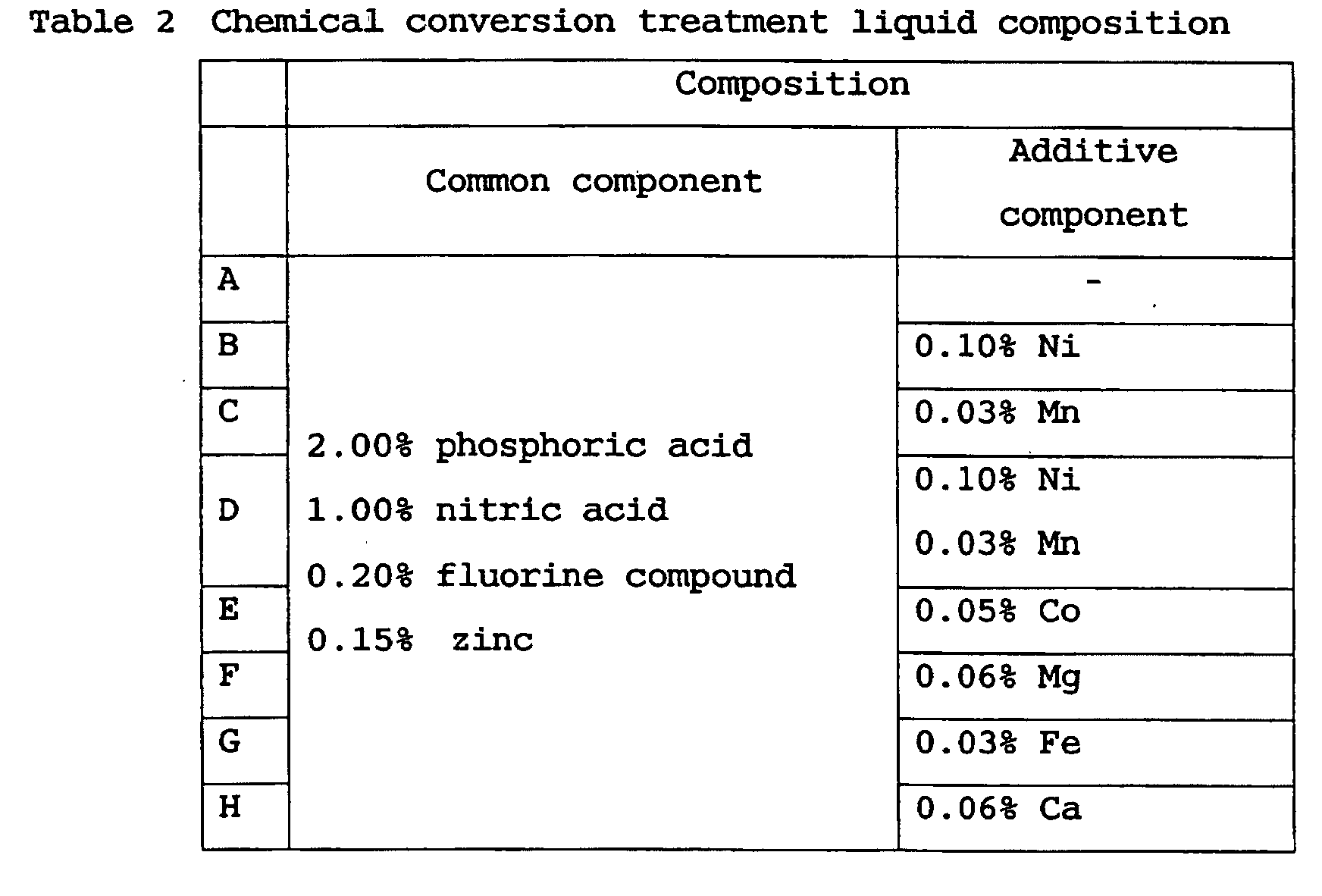
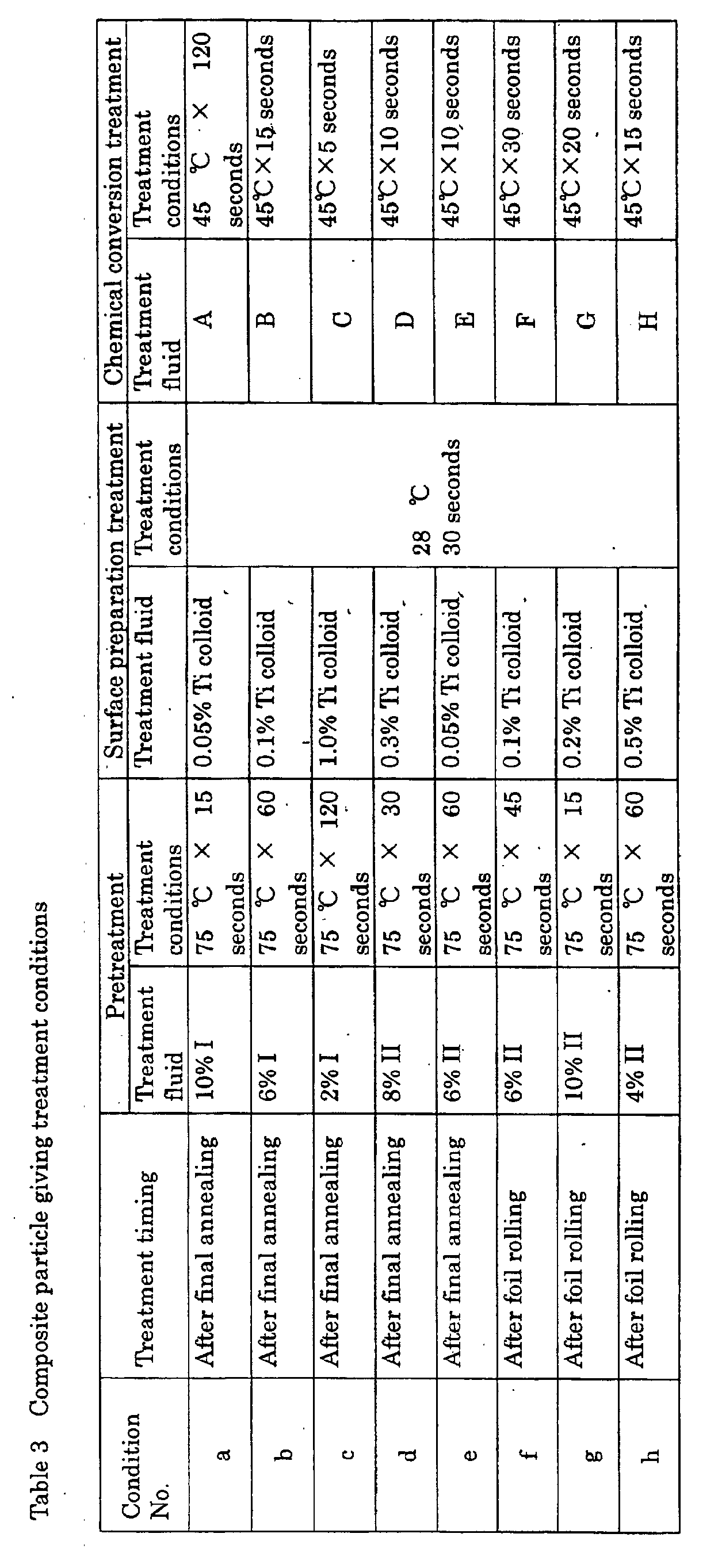
- the treatment liquids having two kinds of compositions I and II as shown in Table 1 were adjusted to have a concentration as shown in Table 3, and the surface of each foil substrate was washed using the treatment liquid. Furthermore, in the surface preparation treatment, Ti colloids different in density were used as treatment liquid. Each foil substrate was immersed in the Ti colloid fluid to perform the surface preparation treatment for depositing fine zinc phosphate composite particles. Furthermore, in the chemical conversion treatment, eight kinds of chemical conversion treatment liquids A to H shown in Table 2 were used. Fluorine compounds and each metal compounds used in the treatment liquid are as follows.
- Foil substrates 100 ⁇ m thick were manufactured from a slab of 99.99% aluminum purity, then subjected to zinc phosphate composite particle giving treatment under the conditions of "a" to "h” shown in Table 3, and thereafter subjected to final annealing at 500 °C.
- the zinc phosphate composite particle given foil substrates were subjected to image analysis by enlarging the image 2,000 times using a scanning electron microscope to thereby obtain the mean circle equivalent diameter of the adhered zinc phosphate composite particle and the number of zinc phosphate composite particles whose circle equivalent diameter is 0.1 ⁇ m or more. Further, the foil substrates were immersed in 5% Chromic anhydride liquid for five minutes at a normal temperature to dissolve the particles, and then the weights of the adhered particles were obtained from the weight difference between the foil substrate before the immersion and that after the immersion.
- the zinc phosphate composite particle given foil substrates were subjected to direct-current electrolysis etching at the current density of 0.1 A/cm 2 by adjusting the electricity so that the dissolving rate of the foil became 40%.
- each etched foil was subjected to chemical conversion treatment of 250 voltage in 5%boric acid + 0.1% ammonium borate at 80 °C, and the capacitance thereof was measured in 3%-ammonium borate.
- a foil with no zinc phosphate composite particle giving treatment was prepared as a comparative example, and the foil was subjected to direct-current electrolysis etching and chemical conversion treatment and the capacitance thereof was measured in the same manner as the treated foil.
- Foil substrates 90 ⁇ m thick were manufactured from a slab of 99.98% aluminum purity, then subjected to zinc phosphate composite particle giving treatment under the conditions of "b" to "e” shown in Table 3. No final annealing was performed.
- the zinc phosphate composite particle given foil substrates were subjected to image analysis and the number of zinc phosphate composite particles and the weights of the adhered particles were obtained in the same manner as the aforementioned experimental example 1.
- the zinc phosphate composite particle given foil substrates were subjected to alternating current electrolysis etching at the current density of 0.2 A/cm 2 in 10% hydrochloric acid + 0.1% sulfuric acid by adjusting the electricity so that the dissolving rate of the foil became 40%.
- each etched foil was subjected to chemical conversion treatment of 20 voltage in 10% ammonium adipate at 80°C, and the capacitance thereof was measured in 3%-ammonium borate.
- a foil with no zinc phosphate composite particle giving treatment was prepared as a comparative example, and the foil was subjected to alternating current electrolysis etching and chemical conversion treatment, and the capacitance thereof was measured in the same manner as the treated foil.
- Foil substrates 50 ⁇ m thick were manufactured from a slab of 99.8% aluminum purity, then subjected to zinc phosphate composite particle giving treatment under the conditions of "b" to "e” shown in Table 3, and then final annealing was performed at 300 °C.
- the zinc phosphate composite particle given foil substrates were subjected to image analysis and the weights of the adhered particles were obtained in the same manner as the aforementioned experimental example 1. ,
- the zinc phosphate composite particle given foil substrates were subjected to alternating current electrolysis etching at the current density of 0.2 A/cm 2 in 10% hydrochloric acid + 0.1% phosphoric acid + 0.2% nitric acid by adjusting the electricity so that the dissolving rate of the foil became 30%. Subsequently, the capacitance of each etched foil was measured in 3%-ammonium borate. Furthermore, a foil with no zinc phosphate composite particle giving treatment was prepared as a comparative example, and the foil was subjected to alternating current electrolysis etching and chemical conversion treatment, and the capacitance thereof was measured in the same manner as the treated foil.
- An aluminum foil for electrolytic capacitor electrodes can obtain high capacitance by increasing the surface increasing rate, and therefore can be used for various electronics device, especially miniaturized electronics devices.
Landscapes
- Engineering & Computer Science (AREA)
- Chemical & Material Sciences (AREA)
- Power Engineering (AREA)
- Materials Engineering (AREA)
- Microelectronics & Electronic Packaging (AREA)
- Metallurgy (AREA)
- Chemical Kinetics & Catalysis (AREA)
- Mechanical Engineering (AREA)
- General Chemical & Material Sciences (AREA)
- Organic Chemistry (AREA)
- Manufacturing & Machinery (AREA)
- Chemical Treatment Of Metals (AREA)
- Laminated Bodies (AREA)
- Electrolytic Production Of Metals (AREA)
- Electroplating Methods And Accessories (AREA)
- Fixed Capacitors And Capacitor Manufacturing Machines (AREA)
Abstract
Description
| Pretreatment liquid composition | ||
| Composition | ||
| Mixing ratio | ||
| I | NaOH | 80% |
| Chelating agent (Ethylenediaminetetraacetic acid 4 sodium) | 10% | |
| Surfactant (Polyoxyethylenenonylphenylether) | 10% | |
| Mixing ratio | ||
| II | NaOH | 15% |
| Na3PO4 | 55% | |
| Chelating agent (Ethylenediaminetetraacetic acid 4 sodium) | 20% | |
| Surfactant (Polyoxyethylenenonylphenylether) | 10% |
- Fluorine compound :
- HF
- Zinc :
- ZnO
- Nickel :
- Ni(OH)2
- Manganese :
- MnCO3·nH2O
- Cobalt :
- CoSO4·7H2O
- Magnesium :
- MgCO3·Mg(OH)2·nH2O
- Iron :
- Fe(NO3)2·9H2O
- Calcium :
- CaCl2·2H2O


Claims (16)
- An aluminum foil for electrolytic capacitor electrodes, characterized in that zinc phosphate composite particles containing at least zinc and phosphorous are adhered to a surface of a foil substrate.
- The aluminum foil for electrolytic capacitor electrodes as recited in claim 1, wherein the zinc phosphate composite particles each having a mean circle equivalent diameter of 0.1 µm or more are adhered to the surface of the foil substrate at a rate of 70,000 pieces/mm2 or more, and the adhered amount thereof is 0.01 to 5 g/m2.
- The aluminum foil for electrolytic capacitor electrodes as recited in claim 2, wherein the zinc phosphate composite particles each having a mean circle equivalent diameter of 0.3 µm or more are adhered to the surface of the foil substrate at a rate of 200,000 pieces/mm2 or more.
- The aluminum foil for electrolytic capacitor electrodes as recited in claim 2 or 3, wherein the adhered amount of the zinc phosphate composite particles is 0.1 to 3 g/m2.
- An aluminum foil for electrolytic capacitor electrodes, characterized in that zinc phosphate composite particles containing at least zinc and phosphorous and further containing one or more elements selected from the group consisting of iron, manganese, nickel, cobalt, calcium and magnesium are adhered to a surface of a foil substrate.
- The aluminum foil for electrolytic capacitor electrodes as recited in claim 5, wherein the zinc phosphate composite particles each having a mean circle equivalent diameter of 0.1 µm or more are adhered to the surface of the foil substrate at a rate of 70,000 pieces/mm2 or more, and the adhered amount thereof is 0.01 to 5 g/m2.
- The aluminum foil for electrolytic capacitor electrodes as recited in claim 6, wherein the zinc phosphate composite particles each having a mean circle equivalent diameter of 0.3 µm or more are adhered to the surface of the foil substrate at a rate of 200,000 pieces/mm2 or more.
- The aluminum foil for electrolytic capacitor electrodes as recited in claim 6 or 7, wherein the adhered amount of the zinc phosphate composite particles is 0.1 to 3 g/m2.
- A method of manufacturing an aluminum foil for electrolytic capacitor electrodes, characterized in that a foil substrate is subjected to chemical conversion treatment to deposit zinc phosphate composite particles containing at least zinc and phosphorous on a surface of the foil substrate by immersing the foil substrate in treatment liquid containing phosphoric acid, fluorine compound, zinc or zinc compound and pro-oxidant.
- The method of manufacturing an aluminum foil for electrolytic capacitor electrodes as recited in claim 9, wherein the chemical conversion treatment is performed after a foil rolling step but before a final annealing step in aluminum foil manufacturing steps.
- The method of manufacturing an aluminum foil for electrolytic capacitor electrodes as recited in claim 9, wherein the chemical conversion treatment is performed after a final annealing step in aluminum foil manufacturing steps.
- The method of manufacturing an aluminum foil for electrolytic capacitor electrodes as recited in any one of claims 9 to 11, wherein surface preparation treatment is performed before the chemical conversion treatment.
- A method of manufacturing an aluminum foil for electrolytic capacitor electrodes, characterized in that a foil substrate is subjected to chemical conversion treatment to deposit zinc phosphate composite particles containing at least zinc and phosphorous and further containing one or more elements selected from the group consisting of iron, manganese, nickel, cobalt, calcium and magnesium on a surface of a foil substrate by immersing the foil substrate in treatment liquid containing phosphoric acid, fluorine compound, zinc or zinc compound and pro-oxidant and further containing one or more elements selected from the group consisting of iron, manganese, nickel, cobalt, calcium and magnesium and compound thereof.
- The method of manufacturing an aluminum foil for electrolytic capacitor electrodes as recited in claim 13, wherein the chemical conversion treatment is performed after a foil rolling step but before a final annealing step in aluminum foil manufacturing steps.
- The method of manufacturing an aluminum foil for electrolytic capacitor electrodes as recited in claim 13, wherein the chemical conversion treatment is performed after a final annealing step in aluminum foil manufacturing steps.
- The method of manufacturing an aluminum foil for electrolytic capacitor electrodes as recited in any one of claims 13 to 15, wherein surface preparation treatment is performed before the chemical conversion treatment.
Applications Claiming Priority (1)
| Application Number | Priority Date | Filing Date | Title |
|---|---|---|---|
| PCT/JP2001/006216 WO2003009321A1 (en) | 2000-01-19 | 2001-07-18 | Aluminum foil for electrolytic capacitor |
Publications (3)
| Publication Number | Publication Date |
|---|---|
| EP1418599A1 true EP1418599A1 (en) | 2004-05-12 |
| EP1418599A4 EP1418599A4 (en) | 2007-05-02 |
| EP1418599B1 EP1418599B1 (en) | 2010-11-17 |
Family
ID=32104815
Family Applications (1)
| Application Number | Title | Priority Date | Filing Date |
|---|---|---|---|
| EP01951904A Expired - Lifetime EP1418599B1 (en) | 2001-07-18 | 2001-07-18 | Aluminum foil for electrolytic capacitor |
Country Status (5)
| Country | Link |
|---|---|
| EP (1) | EP1418599B1 (en) |
| CN (1) | CN100380544C (en) |
| AT (1) | ATE488846T1 (en) |
| DE (1) | DE60143492D1 (en) |
| WO (1) | WO2003009321A1 (en) |
Cited By (1)
| Publication number | Priority date | Publication date | Assignee | Title |
|---|---|---|---|---|
| WO2012003954A3 (en) * | 2010-07-09 | 2012-10-18 | Max-Planck-Gesellschaft zur Förderung der Wissenschaften e. V. | New phosphate- and silicate-based electrode materials, more particularly for lithium ion batteries and lithium capacitors |
Families Citing this family (4)
| Publication number | Priority date | Publication date | Assignee | Title |
|---|---|---|---|---|
| CN1310262C (en) * | 2003-07-08 | 2007-04-11 | 深圳市东阳光化成箔股份有限公司 | Methof for manufacturing foil of cathode of electrolytic capacitor |
| US7531078B1 (en) | 2005-01-13 | 2009-05-12 | Pacesetter, Inc. | Chemical printing of raw aluminum anode foil to induce uniform patterning etching |
| JP4893183B2 (en) * | 2006-09-20 | 2012-03-07 | 日本軽金属株式会社 | Aluminum electrode plate for electrolytic capacitors |
| CN106001111A (en) * | 2016-05-18 | 2016-10-12 | 北京科技大学 | Micro-forming rolling technology preparing high-specific-volume aluminum foil electrode |
Family Cites Families (7)
| Publication number | Priority date | Publication date | Assignee | Title |
|---|---|---|---|---|
| JPH0722092B2 (en) * | 1986-11-13 | 1995-03-08 | 昭和アルミニウム株式会社 | Aluminum electrode foil for electrolytic capacitors having excellent etching characteristics and method for producing the same |
| JPH01316924A (en) * | 1988-06-16 | 1989-12-21 | Showa Alum Corp | Aluminum material for electrolytic capacitor electrode and manufacture thereof |
| KR100197145B1 (en) * | 1989-12-19 | 1999-06-15 | 후지이 히로시 | Method for phosphating metal surface with zinc phosphate |
| JP3276089B2 (en) * | 1993-06-07 | 2002-04-22 | 日本製箔株式会社 | Method for producing anode foil for electrolytic capacitor |
| JPH0794370A (en) * | 1993-09-20 | 1995-04-07 | Mitsubishi Shindoh Co Ltd | Electrode foil for electrolytic capacitors |
| JPH09129513A (en) * | 1995-10-31 | 1997-05-16 | Mitsubishi Alum Co Ltd | Aluminum foil for low voltage electrolytic capacitor anode |
| JP2000313932A (en) * | 1999-04-28 | 2000-11-14 | Shinko Alcoa Yuso Kizai Kk | Aluminum alloy sheet for coating excellent in filiform corrosion resistance |
-
2001
- 2001-07-18 AT AT01951904T patent/ATE488846T1/en not_active IP Right Cessation
- 2001-07-18 WO PCT/JP2001/006216 patent/WO2003009321A1/en not_active Ceased
- 2001-07-18 DE DE60143492T patent/DE60143492D1/en not_active Expired - Lifetime
- 2001-07-18 EP EP01951904A patent/EP1418599B1/en not_active Expired - Lifetime
- 2001-07-18 CN CNB01823643XA patent/CN100380544C/en not_active Expired - Fee Related
Cited By (2)
| Publication number | Priority date | Publication date | Assignee | Title |
|---|---|---|---|---|
| WO2012003954A3 (en) * | 2010-07-09 | 2012-10-18 | Max-Planck-Gesellschaft zur Förderung der Wissenschaften e. V. | New phosphate- and silicate-based electrode materials, more particularly for lithium ion batteries and lithium capacitors |
| US9196902B2 (en) | 2010-07-09 | 2015-11-24 | Max-Planck-Gesellschaft Zur Foerderung Der Wissenschaften E. V. | Phosphate- and silicate-based electrode materials, more particularly for lithium ion batteries and lithium capacitors |
Also Published As
| Publication number | Publication date |
|---|---|
| EP1418599B1 (en) | 2010-11-17 |
| ATE488846T1 (en) | 2010-12-15 |
| CN100380544C (en) | 2008-04-09 |
| EP1418599A4 (en) | 2007-05-02 |
| CN1547752A (en) | 2004-11-17 |
| WO2003009321A1 (en) | 2003-01-30 |
| DE60143492D1 (en) | 2010-12-30 |
Similar Documents
| Publication | Publication Date | Title |
|---|---|---|
| EP1918427A1 (en) | Metal oxide film, laminate, metal member and process for producing the same | |
| EP2351877A1 (en) | Method for forming boron-containing thin film and multilayer structure | |
| CN107177872A (en) | PZT amorphous alloys electroplate liquid and utilize its PZT amorphous alloy electro-plating methods | |
| KR100854202B1 (en) | METHOD FOR MANUFACTURING ALUMINUM FOR ALUMINUM ELECTROLYTIC CONDUCTOR ELECTRODE AND ALUMINUM FOUNDATION FOR ELECTRICALLY CONDUCTOR ELECTRODE | |
| Rudnev et al. | The effect of the conditions of formation on ferromagnetic properties of iron-containing oxide coatings on titanium | |
| US20060237326A1 (en) | Method for treating surface of magnesium or magnesium alloy | |
| EP1418599B1 (en) | Aluminum foil for electrolytic capacitor | |
| US7094327B2 (en) | Compositions for the treatment of magnesium alloys | |
| US20230193476A1 (en) | Chemical polishing bath for aluminum and aluminum alloys, and method using such a bath | |
| JP2002161322A (en) | Aluminum foil for electrode of electrolytic capacitor | |
| JP4414038B2 (en) | Aluminum foil for electrolytic capacitor electrode and method for producing the same | |
| EP0616054B1 (en) | Method of manufacturing electrode foil for aluminium electrolytic capacitors | |
| JP5328129B2 (en) | Aluminum alloy foil for electrolytic capacitors | |
| JP2002118035A (en) | Electrolytic capacitor electrode aluminum foil | |
| CN1921042B (en) | Aluminum foil for the electrolytic capacitor and etching method for forming etching pits | |
| JP2793964B2 (en) | Aluminum foil for cathode of electrolytic capacitor | |
| JPWO2004112065A1 (en) | Method for manufacturing aluminum material for electrolytic capacitor electrode, aluminum material for electrolytic capacitor electrode, method for manufacturing electrode material for electrolytic capacitor, and aluminum electrolytic capacitor | |
| RU2810992C1 (en) | Method for preparing surface of magnetic alloy comprising rare earth elements before applying electroplating | |
| KR950013775B1 (en) | Aluminium foil for electrolytic capacitor | |
| JP4539912B2 (en) | Aluminum foil for electrolytic capacitor anode and manufacturing method thereof | |
| JPH05311360A (en) | Manufacture of aluminum alloy foil for electrode of electrolytic capacitor | |
| JP4308556B2 (en) | Aluminum material for electrolytic capacitor electrode, method for producing electrolytic capacitor electrode material, and electrolytic capacitor | |
| JP3130056B2 (en) | Aluminum foil for electrolytic capacitor electrodes | |
| JP3286968B2 (en) | Aluminum alloy foil for electrolytic capacitor electrodes | |
| JP3244131B2 (en) | Aluminum alloy foil for electrolytic capacitor electrode and method for producing the same |
Legal Events
| Date | Code | Title | Description |
|---|---|---|---|
| PUAI | Public reference made under article 153(3) epc to a published international application that has entered the european phase |
Free format text: ORIGINAL CODE: 0009012 |
|
| 17P | Request for examination filed |
Effective date: 20040216 |
|
| AK | Designated contracting states |
Kind code of ref document: A1 Designated state(s): AT BE CH CY DE DK ES FI FR GB GR IE IT LI LU MC NL PT SE TR |
|
| AX | Request for extension of the european patent |
Extension state: AL LT LV MK RO SI |
|
| A4 | Supplementary search report drawn up and despatched |
Effective date: 20070329 |
|
| RIC1 | Information provided on ipc code assigned before grant |
Ipc: H01G 9/055 20060101AFI20070323BHEP Ipc: H01G 9/04 20060101ALI20070323BHEP |
|
| 17Q | First examination report despatched |
Effective date: 20091214 |
|
| RAP1 | Party data changed (applicant data changed or rights of an application transferred) |
Owner name: SHOWA DENKO K.K. |
|
| GRAP | Despatch of communication of intention to grant a patent |
Free format text: ORIGINAL CODE: EPIDOSNIGR1 |
|
| GRAS | Grant fee paid |
Free format text: ORIGINAL CODE: EPIDOSNIGR3 |
|
| GRAA | (expected) grant |
Free format text: ORIGINAL CODE: 0009210 |
|
| AK | Designated contracting states |
Kind code of ref document: B1 Designated state(s): AT BE CH CY DE DK ES FI FR GB GR IE IT LI LU MC NL PT SE TR |
|
| REG | Reference to a national code |
Ref country code: GB Ref legal event code: FG4D |
|
| REG | Reference to a national code |
Ref country code: CH Ref legal event code: EP |
|
| REG | Reference to a national code |
Ref country code: IE Ref legal event code: FG4D |
|
| REF | Corresponds to: |
Ref document number: 60143492 Country of ref document: DE Date of ref document: 20101230 Kind code of ref document: P |
|
| REG | Reference to a national code |
Ref country code: NL Ref legal event code: VDEP Effective date: 20101117 |
|
| PG25 | Lapsed in a contracting state [announced via postgrant information from national office to epo] |
Ref country code: FI Free format text: LAPSE BECAUSE OF FAILURE TO SUBMIT A TRANSLATION OF THE DESCRIPTION OR TO PAY THE FEE WITHIN THE PRESCRIBED TIME-LIMIT Effective date: 20101117 Ref country code: AT Free format text: LAPSE BECAUSE OF FAILURE TO SUBMIT A TRANSLATION OF THE DESCRIPTION OR TO PAY THE FEE WITHIN THE PRESCRIBED TIME-LIMIT Effective date: 20101117 Ref country code: SE Free format text: LAPSE BECAUSE OF FAILURE TO SUBMIT A TRANSLATION OF THE DESCRIPTION OR TO PAY THE FEE WITHIN THE PRESCRIBED TIME-LIMIT Effective date: 20101117 Ref country code: CY Free format text: LAPSE BECAUSE OF FAILURE TO SUBMIT A TRANSLATION OF THE DESCRIPTION OR TO PAY THE FEE WITHIN THE PRESCRIBED TIME-LIMIT Effective date: 20101117 Ref country code: PT Free format text: LAPSE BECAUSE OF FAILURE TO SUBMIT A TRANSLATION OF THE DESCRIPTION OR TO PAY THE FEE WITHIN THE PRESCRIBED TIME-LIMIT Effective date: 20110317 Ref country code: NL Free format text: LAPSE BECAUSE OF FAILURE TO SUBMIT A TRANSLATION OF THE DESCRIPTION OR TO PAY THE FEE WITHIN THE PRESCRIBED TIME-LIMIT Effective date: 20101117 |
|
| PG25 | Lapsed in a contracting state [announced via postgrant information from national office to epo] |
Ref country code: GR Free format text: LAPSE BECAUSE OF FAILURE TO SUBMIT A TRANSLATION OF THE DESCRIPTION OR TO PAY THE FEE WITHIN THE PRESCRIBED TIME-LIMIT Effective date: 20110218 |
|
| PG25 | Lapsed in a contracting state [announced via postgrant information from national office to epo] |
Ref country code: ES Free format text: LAPSE BECAUSE OF FAILURE TO SUBMIT A TRANSLATION OF THE DESCRIPTION OR TO PAY THE FEE WITHIN THE PRESCRIBED TIME-LIMIT Effective date: 20110228 Ref country code: BE Free format text: LAPSE BECAUSE OF FAILURE TO SUBMIT A TRANSLATION OF THE DESCRIPTION OR TO PAY THE FEE WITHIN THE PRESCRIBED TIME-LIMIT Effective date: 20101117 |
|
| PG25 | Lapsed in a contracting state [announced via postgrant information from national office to epo] |
Ref country code: DK Free format text: LAPSE BECAUSE OF FAILURE TO SUBMIT A TRANSLATION OF THE DESCRIPTION OR TO PAY THE FEE WITHIN THE PRESCRIBED TIME-LIMIT Effective date: 20101117 |
|
| PLBE | No opposition filed within time limit |
Free format text: ORIGINAL CODE: 0009261 |
|
| STAA | Information on the status of an ep patent application or granted ep patent |
Free format text: STATUS: NO OPPOSITION FILED WITHIN TIME LIMIT |
|
| 26N | No opposition filed |
Effective date: 20110818 |
|
| REG | Reference to a national code |
Ref country code: DE Ref legal event code: R097 Ref document number: 60143492 Country of ref document: DE Effective date: 20110818 |
|
| PG25 | Lapsed in a contracting state [announced via postgrant information from national office to epo] |
Ref country code: MC Free format text: LAPSE BECAUSE OF NON-PAYMENT OF DUE FEES Effective date: 20110731 |
|
| REG | Reference to a national code |
Ref country code: CH Ref legal event code: PL |
|
| GBPC | Gb: european patent ceased through non-payment of renewal fee |
Effective date: 20110718 |
|
| REG | Reference to a national code |
Ref country code: IE Ref legal event code: MM4A |
|
| PG25 | Lapsed in a contracting state [announced via postgrant information from national office to epo] |
Ref country code: DE Free format text: LAPSE BECAUSE OF NON-PAYMENT OF DUE FEES Effective date: 20120201 Ref country code: LI Free format text: LAPSE BECAUSE OF NON-PAYMENT OF DUE FEES Effective date: 20110731 Ref country code: CH Free format text: LAPSE BECAUSE OF NON-PAYMENT OF DUE FEES Effective date: 20110731 |
|
| REG | Reference to a national code |
Ref country code: DE Ref legal event code: R119 Ref document number: 60143492 Country of ref document: DE Effective date: 20120201 |
|
| PG25 | Lapsed in a contracting state [announced via postgrant information from national office to epo] |
Ref country code: GB Free format text: LAPSE BECAUSE OF NON-PAYMENT OF DUE FEES Effective date: 20110718 |
|
| PG25 | Lapsed in a contracting state [announced via postgrant information from national office to epo] |
Ref country code: IE Free format text: LAPSE BECAUSE OF NON-PAYMENT OF DUE FEES Effective date: 20110718 |
|
| PG25 | Lapsed in a contracting state [announced via postgrant information from national office to epo] |
Ref country code: LU Free format text: LAPSE BECAUSE OF NON-PAYMENT OF DUE FEES Effective date: 20110718 |
|
| PG25 | Lapsed in a contracting state [announced via postgrant information from national office to epo] |
Ref country code: TR Free format text: LAPSE BECAUSE OF FAILURE TO SUBMIT A TRANSLATION OF THE DESCRIPTION OR TO PAY THE FEE WITHIN THE PRESCRIBED TIME-LIMIT Effective date: 20101117 |
|
| REG | Reference to a national code |
Ref country code: FR Ref legal event code: PLFP Year of fee payment: 16 |
|
| REG | Reference to a national code |
Ref country code: FR Ref legal event code: PLFP Year of fee payment: 17 |
|
| REG | Reference to a national code |
Ref country code: FR Ref legal event code: PLFP Year of fee payment: 18 |
|
| PGFP | Annual fee paid to national office [announced via postgrant information from national office to epo] |
Ref country code: FR Payment date: 20180612 Year of fee payment: 18 |
|
| PGFP | Annual fee paid to national office [announced via postgrant information from national office to epo] |
Ref country code: IT Payment date: 20180713 Year of fee payment: 18 |
|
| PG25 | Lapsed in a contracting state [announced via postgrant information from national office to epo] |
Ref country code: FR Free format text: LAPSE BECAUSE OF NON-PAYMENT OF DUE FEES Effective date: 20190731 |
|
| PG25 | Lapsed in a contracting state [announced via postgrant information from national office to epo] |
Ref country code: IT Free format text: LAPSE BECAUSE OF NON-PAYMENT OF DUE FEES Effective date: 20190718 |