EP1418220A2 - A low-phosphorus lubricating oil composition for extended drain intervals - Google Patents
A low-phosphorus lubricating oil composition for extended drain intervals Download PDFInfo
- Publication number
- EP1418220A2 EP1418220A2 EP03255080A EP03255080A EP1418220A2 EP 1418220 A2 EP1418220 A2 EP 1418220A2 EP 03255080 A EP03255080 A EP 03255080A EP 03255080 A EP03255080 A EP 03255080A EP 1418220 A2 EP1418220 A2 EP 1418220A2
- Authority
- EP
- European Patent Office
- Prior art keywords
- lubricating oil
- oil composition
- weight percent
- molybdenum
- phosphorus
- Prior art date
- Legal status (The legal status is an assumption and is not a legal conclusion. Google has not performed a legal analysis and makes no representation as to the accuracy of the status listed.)
- Withdrawn
Links
Classifications
-
- C—CHEMISTRY; METALLURGY
- C10—PETROLEUM, GAS OR COKE INDUSTRIES; TECHNICAL GASES CONTAINING CARBON MONOXIDE; FUELS; LUBRICANTS; PEAT
- C10M—LUBRICATING COMPOSITIONS; USE OF CHEMICAL SUBSTANCES EITHER ALONE OR AS LUBRICATING INGREDIENTS IN A LUBRICATING COMPOSITION
- C10M163/00—Lubricating compositions characterised by the additive being a mixture of a compound of unknown or incompletely defined constitution and a non-macromolecular compound, each of these compounds being essential
-
- C—CHEMISTRY; METALLURGY
- C10—PETROLEUM, GAS OR COKE INDUSTRIES; TECHNICAL GASES CONTAINING CARBON MONOXIDE; FUELS; LUBRICANTS; PEAT
- C10M—LUBRICATING COMPOSITIONS; USE OF CHEMICAL SUBSTANCES EITHER ALONE OR AS LUBRICATING INGREDIENTS IN A LUBRICATING COMPOSITION
- C10M2203/00—Organic non-macromolecular hydrocarbon compounds and hydrocarbon fractions as ingredients in lubricant compositions
- C10M2203/10—Petroleum or coal fractions, e.g. tars, solvents, bitumen
- C10M2203/1006—Petroleum or coal fractions, e.g. tars, solvents, bitumen used as base material
-
- C—CHEMISTRY; METALLURGY
- C10—PETROLEUM, GAS OR COKE INDUSTRIES; TECHNICAL GASES CONTAINING CARBON MONOXIDE; FUELS; LUBRICANTS; PEAT
- C10M—LUBRICATING COMPOSITIONS; USE OF CHEMICAL SUBSTANCES EITHER ALONE OR AS LUBRICATING INGREDIENTS IN A LUBRICATING COMPOSITION
- C10M2205/00—Organic macromolecular hydrocarbon compounds or fractions, whether or not modified by oxidation as ingredients in lubricant compositions
- C10M2205/02—Organic macromolecular hydrocarbon compounds or fractions, whether or not modified by oxidation as ingredients in lubricant compositions containing acyclic monomers
- C10M2205/0206—Organic macromolecular hydrocarbon compounds or fractions, whether or not modified by oxidation as ingredients in lubricant compositions containing acyclic monomers used as base material
-
- C—CHEMISTRY; METALLURGY
- C10—PETROLEUM, GAS OR COKE INDUSTRIES; TECHNICAL GASES CONTAINING CARBON MONOXIDE; FUELS; LUBRICANTS; PEAT
- C10M—LUBRICATING COMPOSITIONS; USE OF CHEMICAL SUBSTANCES EITHER ALONE OR AS LUBRICATING INGREDIENTS IN A LUBRICATING COMPOSITION
- C10M2207/00—Organic non-macromolecular hydrocarbon compounds containing hydrogen, carbon and oxygen as ingredients in lubricant compositions
- C10M2207/02—Hydroxy compounds
- C10M2207/023—Hydroxy compounds having hydroxy groups bound to carbon atoms of six-membered aromatic rings
- C10M2207/027—Neutral salts thereof
-
- C—CHEMISTRY; METALLURGY
- C10—PETROLEUM, GAS OR COKE INDUSTRIES; TECHNICAL GASES CONTAINING CARBON MONOXIDE; FUELS; LUBRICANTS; PEAT
- C10M—LUBRICATING COMPOSITIONS; USE OF CHEMICAL SUBSTANCES EITHER ALONE OR AS LUBRICATING INGREDIENTS IN A LUBRICATING COMPOSITION
- C10M2207/00—Organic non-macromolecular hydrocarbon compounds containing hydrogen, carbon and oxygen as ingredients in lubricant compositions
- C10M2207/02—Hydroxy compounds
- C10M2207/023—Hydroxy compounds having hydroxy groups bound to carbon atoms of six-membered aromatic rings
- C10M2207/028—Overbased salts thereof
-
- C—CHEMISTRY; METALLURGY
- C10—PETROLEUM, GAS OR COKE INDUSTRIES; TECHNICAL GASES CONTAINING CARBON MONOXIDE; FUELS; LUBRICANTS; PEAT
- C10M—LUBRICATING COMPOSITIONS; USE OF CHEMICAL SUBSTANCES EITHER ALONE OR AS LUBRICATING INGREDIENTS IN A LUBRICATING COMPOSITION
- C10M2207/00—Organic non-macromolecular hydrocarbon compounds containing hydrogen, carbon and oxygen as ingredients in lubricant compositions
- C10M2207/28—Esters
- C10M2207/283—Esters of polyhydroxy compounds
- C10M2207/2835—Esters of polyhydroxy compounds used as base material
-
- C—CHEMISTRY; METALLURGY
- C10—PETROLEUM, GAS OR COKE INDUSTRIES; TECHNICAL GASES CONTAINING CARBON MONOXIDE; FUELS; LUBRICANTS; PEAT
- C10M—LUBRICATING COMPOSITIONS; USE OF CHEMICAL SUBSTANCES EITHER ALONE OR AS LUBRICATING INGREDIENTS IN A LUBRICATING COMPOSITION
- C10M2215/00—Organic non-macromolecular compounds containing nitrogen as ingredients in lubricant Compositions
- C10M2215/02—Amines, e.g. polyalkylene polyamines; Quaternary amines
- C10M2215/06—Amines, e.g. polyalkylene polyamines; Quaternary amines having amino groups bound to carbon atoms of six-membered aromatic rings
- C10M2215/064—Di- and triaryl amines
-
- C—CHEMISTRY; METALLURGY
- C10—PETROLEUM, GAS OR COKE INDUSTRIES; TECHNICAL GASES CONTAINING CARBON MONOXIDE; FUELS; LUBRICANTS; PEAT
- C10M—LUBRICATING COMPOSITIONS; USE OF CHEMICAL SUBSTANCES EITHER ALONE OR AS LUBRICATING INGREDIENTS IN A LUBRICATING COMPOSITION
- C10M2215/00—Organic non-macromolecular compounds containing nitrogen as ingredients in lubricant Compositions
- C10M2215/24—Organic non-macromolecular compounds containing nitrogen as ingredients in lubricant Compositions having hydrocarbon substituents containing thirty or more carbon atoms, e.g. nitrogen derivatives of substituted succinic acid
- C10M2215/28—Amides; Imides
-
- C—CHEMISTRY; METALLURGY
- C10—PETROLEUM, GAS OR COKE INDUSTRIES; TECHNICAL GASES CONTAINING CARBON MONOXIDE; FUELS; LUBRICANTS; PEAT
- C10M—LUBRICATING COMPOSITIONS; USE OF CHEMICAL SUBSTANCES EITHER ALONE OR AS LUBRICATING INGREDIENTS IN A LUBRICATING COMPOSITION
- C10M2219/00—Organic non-macromolecular compounds containing sulfur, selenium or tellurium as ingredients in lubricant compositions
- C10M2219/04—Organic non-macromolecular compounds containing sulfur, selenium or tellurium as ingredients in lubricant compositions containing sulfur-to-oxygen bonds, i.e. sulfones, sulfoxides
- C10M2219/044—Sulfonic acids, Derivatives thereof, e.g. neutral salts
-
- C—CHEMISTRY; METALLURGY
- C10—PETROLEUM, GAS OR COKE INDUSTRIES; TECHNICAL GASES CONTAINING CARBON MONOXIDE; FUELS; LUBRICANTS; PEAT
- C10M—LUBRICATING COMPOSITIONS; USE OF CHEMICAL SUBSTANCES EITHER ALONE OR AS LUBRICATING INGREDIENTS IN A LUBRICATING COMPOSITION
- C10M2219/00—Organic non-macromolecular compounds containing sulfur, selenium or tellurium as ingredients in lubricant compositions
- C10M2219/04—Organic non-macromolecular compounds containing sulfur, selenium or tellurium as ingredients in lubricant compositions containing sulfur-to-oxygen bonds, i.e. sulfones, sulfoxides
- C10M2219/046—Overbased sulfonic acid salts
-
- C—CHEMISTRY; METALLURGY
- C10—PETROLEUM, GAS OR COKE INDUSTRIES; TECHNICAL GASES CONTAINING CARBON MONOXIDE; FUELS; LUBRICANTS; PEAT
- C10M—LUBRICATING COMPOSITIONS; USE OF CHEMICAL SUBSTANCES EITHER ALONE OR AS LUBRICATING INGREDIENTS IN A LUBRICATING COMPOSITION
- C10M2219/00—Organic non-macromolecular compounds containing sulfur, selenium or tellurium as ingredients in lubricant compositions
- C10M2219/06—Thio-acids; Thiocyanates; Derivatives thereof
- C10M2219/062—Thio-acids; Thiocyanates; Derivatives thereof having carbon-to-sulfur double bonds
- C10M2219/066—Thiocarbamic type compounds
-
- C—CHEMISTRY; METALLURGY
- C10—PETROLEUM, GAS OR COKE INDUSTRIES; TECHNICAL GASES CONTAINING CARBON MONOXIDE; FUELS; LUBRICANTS; PEAT
- C10M—LUBRICATING COMPOSITIONS; USE OF CHEMICAL SUBSTANCES EITHER ALONE OR AS LUBRICATING INGREDIENTS IN A LUBRICATING COMPOSITION
- C10M2223/00—Organic non-macromolecular compounds containing phosphorus as ingredients in lubricant compositions
- C10M2223/02—Organic non-macromolecular compounds containing phosphorus as ingredients in lubricant compositions having no phosphorus-to-carbon bonds
-
- C—CHEMISTRY; METALLURGY
- C10—PETROLEUM, GAS OR COKE INDUSTRIES; TECHNICAL GASES CONTAINING CARBON MONOXIDE; FUELS; LUBRICANTS; PEAT
- C10M—LUBRICATING COMPOSITIONS; USE OF CHEMICAL SUBSTANCES EITHER ALONE OR AS LUBRICATING INGREDIENTS IN A LUBRICATING COMPOSITION
- C10M2223/00—Organic non-macromolecular compounds containing phosphorus as ingredients in lubricant compositions
- C10M2223/02—Organic non-macromolecular compounds containing phosphorus as ingredients in lubricant compositions having no phosphorus-to-carbon bonds
- C10M2223/04—Phosphate esters
- C10M2223/045—Metal containing thio derivatives
-
- C—CHEMISTRY; METALLURGY
- C10—PETROLEUM, GAS OR COKE INDUSTRIES; TECHNICAL GASES CONTAINING CARBON MONOXIDE; FUELS; LUBRICANTS; PEAT
- C10M—LUBRICATING COMPOSITIONS; USE OF CHEMICAL SUBSTANCES EITHER ALONE OR AS LUBRICATING INGREDIENTS IN A LUBRICATING COMPOSITION
- C10M2223/00—Organic non-macromolecular compounds containing phosphorus as ingredients in lubricant compositions
- C10M2223/06—Organic non-macromolecular compounds containing phosphorus as ingredients in lubricant compositions having phosphorus-to-carbon bonds
-
- C—CHEMISTRY; METALLURGY
- C10—PETROLEUM, GAS OR COKE INDUSTRIES; TECHNICAL GASES CONTAINING CARBON MONOXIDE; FUELS; LUBRICANTS; PEAT
- C10M—LUBRICATING COMPOSITIONS; USE OF CHEMICAL SUBSTANCES EITHER ALONE OR AS LUBRICATING INGREDIENTS IN A LUBRICATING COMPOSITION
- C10M2227/00—Organic non-macromolecular compounds containing atoms of elements not provided for in groups C10M2203/00, C10M2207/00, C10M2211/00, C10M2215/00, C10M2219/00 or C10M2223/00 as ingredients in lubricant compositions
- C10M2227/09—Complexes with metals
-
- C—CHEMISTRY; METALLURGY
- C10—PETROLEUM, GAS OR COKE INDUSTRIES; TECHNICAL GASES CONTAINING CARBON MONOXIDE; FUELS; LUBRICANTS; PEAT
- C10N—INDEXING SCHEME ASSOCIATED WITH SUBCLASS C10M RELATING TO LUBRICATING COMPOSITIONS
- C10N2010/00—Metal present as such or in compounds
- C10N2010/04—Groups 2 or 12
-
- C—CHEMISTRY; METALLURGY
- C10—PETROLEUM, GAS OR COKE INDUSTRIES; TECHNICAL GASES CONTAINING CARBON MONOXIDE; FUELS; LUBRICANTS; PEAT
- C10N—INDEXING SCHEME ASSOCIATED WITH SUBCLASS C10M RELATING TO LUBRICATING COMPOSITIONS
- C10N2010/00—Metal present as such or in compounds
- C10N2010/12—Groups 6 or 16
-
- C—CHEMISTRY; METALLURGY
- C10—PETROLEUM, GAS OR COKE INDUSTRIES; TECHNICAL GASES CONTAINING CARBON MONOXIDE; FUELS; LUBRICANTS; PEAT
- C10N—INDEXING SCHEME ASSOCIATED WITH SUBCLASS C10M RELATING TO LUBRICATING COMPOSITIONS
- C10N2030/00—Specified physical or chemical properties which is improved by the additive characterising the lubricating composition, e.g. multifunctional additives
- C10N2030/06—Oiliness; Film-strength; Anti-wear; Resistance to extreme pressure
-
- C—CHEMISTRY; METALLURGY
- C10—PETROLEUM, GAS OR COKE INDUSTRIES; TECHNICAL GASES CONTAINING CARBON MONOXIDE; FUELS; LUBRICANTS; PEAT
- C10N—INDEXING SCHEME ASSOCIATED WITH SUBCLASS C10M RELATING TO LUBRICATING COMPOSITIONS
- C10N2030/00—Specified physical or chemical properties which is improved by the additive characterising the lubricating composition, e.g. multifunctional additives
- C10N2030/10—Inhibition of oxidation, e.g. anti-oxidants
-
- C—CHEMISTRY; METALLURGY
- C10—PETROLEUM, GAS OR COKE INDUSTRIES; TECHNICAL GASES CONTAINING CARBON MONOXIDE; FUELS; LUBRICANTS; PEAT
- C10N—INDEXING SCHEME ASSOCIATED WITH SUBCLASS C10M RELATING TO LUBRICATING COMPOSITIONS
- C10N2030/00—Specified physical or chemical properties which is improved by the additive characterising the lubricating composition, e.g. multifunctional additives
- C10N2030/40—Low content or no content compositions
- C10N2030/42—Phosphor free or low phosphor content compositions
-
- C—CHEMISTRY; METALLURGY
- C10—PETROLEUM, GAS OR COKE INDUSTRIES; TECHNICAL GASES CONTAINING CARBON MONOXIDE; FUELS; LUBRICANTS; PEAT
- C10N—INDEXING SCHEME ASSOCIATED WITH SUBCLASS C10M RELATING TO LUBRICATING COMPOSITIONS
- C10N2040/00—Specified use or application for which the lubricating composition is intended
- C10N2040/25—Internal-combustion engines
-
- C—CHEMISTRY; METALLURGY
- C10—PETROLEUM, GAS OR COKE INDUSTRIES; TECHNICAL GASES CONTAINING CARBON MONOXIDE; FUELS; LUBRICANTS; PEAT
- C10N—INDEXING SCHEME ASSOCIATED WITH SUBCLASS C10M RELATING TO LUBRICATING COMPOSITIONS
- C10N2060/00—Chemical after-treatment of the constituents of the lubricating composition
-
- C—CHEMISTRY; METALLURGY
- C10—PETROLEUM, GAS OR COKE INDUSTRIES; TECHNICAL GASES CONTAINING CARBON MONOXIDE; FUELS; LUBRICANTS; PEAT
- C10N—INDEXING SCHEME ASSOCIATED WITH SUBCLASS C10M RELATING TO LUBRICATING COMPOSITIONS
- C10N2060/00—Chemical after-treatment of the constituents of the lubricating composition
- C10N2060/14—Chemical after-treatment of the constituents of the lubricating composition by boron or a compound containing boron
Definitions
- the present invention relates to lubricating oil compositions having improved wear, extreme pressure, and oxidation performance in internal combustion engines.
- the present invention relates to lubricating oil compositions for reducing wear and controlling oxidation in internal combustion engines lubricated with a low phosphorus content lubricating oil intended for extended drain interval applications and to methods employing such.
- a key requirement in the proposed ILSAC GF-4 specification is that the phosphorus content be reduced from the currently allowable limit of 0.10 weight percent specified in the ILSAC GF-3 specification, to as low as 0.05 weight percent, because phosphorus and its derivatives poison catalyst components of catalytic converters.
- This is a major concern, because effective catalytic converters are needed to reduce pollution and to meet governmental regulations designed to reduce toxic gases, such as hydrocarbons, carbon monoxide, and nitrogen oxides, in internal combustion engine exhaust emissions.
- Such catalytic converters generally use a combination of catalytic metals such as platinum or its variations and metal oxides and are installed in the exhaust streams to convert the toxic gases to non-toxic gases.
- the components of the catalytic converter become ineffective and may ultimately loose their intended function.
- Zinc dialkyldithiophosphates are, for example, contained in most of the commercially available internal combustion engine oils, especially those used for automobiles, because of their favorable characteristics as an anti-wear agent and performance as an oxidation inhibitor. It is generally employed in lubricating oils at phosphorus levels about 0.1 weight percent when used for wear control. A problem arises when the level of phosphorus is reduced containing the phosphorus-containing compound in that there is a significant reduction in anti-wear and oxidation control performance arising from this diminution in phosphorus content. Therefore, it is necessary to find a way to reduce phosphorus content while still retaining the anti-wear and oxidation properties of higher phosphorus content engine oils.
- the present invention is directed to a lubricating oil composition having extended drain properties as evidenced by improved wear, extreme pressure, and oxidation performance.
- the present invention provides a lubricating oil composition having improved wear, extreme pressure, and oxidation performance in internal combustion engines. More particularly, the present invention relates to lubricating oil compositions for reducing wear and controlling oxidation in internal combustion engines lubricated with a low phosphorus content lubricating oil intended for extended drain interval applications and to methods employing such.
- the present invention is directed to a lubricating oil composition
- a lubricating oil composition comprising a major amount of a base oil of lubricating viscosity and a minor amount of each of the following: -
- the lubricating oil composition of the present may further comprise a low overbased metal-containing detergent, a nitrogen-containing ashless antioxidant, an alkylthiocarbamoyl compound, a molybdenum-succinimide complex or mixtures thereof.
- the total phosphorus in the composition is no more than 0.05 weight percent based on the total weight of the composition.
- the base oil of lubricating viscosity is selected from the group consisting of a Group III base stock, Group IV base stock, Group V base stock and any mixture thereof.
- the ashless dispersant is selected from the group consisting of an alkenyl succinimide, an alkenyl succinic anhydride, an alkenyl succinate ester, benzylamine or mixtures thereof. More preferably, the ashless dispersant is an alkenyl succinimide.
- the metal-containing detergent is a metal phenate or metal sulfonate.
- the metal sulfonate is more preferred.
- the oil-soluble, phosphorus-containing, anti-wear compound is selected from the group consisting of metal dithiophosphates, phosphorus esters (including phosphates, phosphonates, phosphinates, phosphine oxides, phosphites, phosphonites, phosphinites, phosphines and the like), amine phosphates and amine phosphinates, sulfur-containing phosphorus esters including phosphoro monothionate and phosphoro dithionates, phosphoramides, phosphonamides and the like. More preferably, the phosphorus-containing compound is a metal dithiophosphate and, even more preferably, a zinc dithiophosphate.
- the nitrogen-containing ashless antioxidant is an alkylated diphenylamine.
- the alkylthiocarbamoyl compound is an alkylene bis(dialkyldithiocarbamate).
- the complex of a molybdenum/nitrogen-containing compound is preferably a molybdenum succinimide.
- the complex includes both sulfurized and non-sulfurized forms and, preferably, the complex is sulfurized.
- the present invention is directed to a method of enhancing the life of a lubricating oil composition as evidenced by an improvement in wear, extreme pressure, and oxidation performance, the method comprising operating an internal combustion engine with a lubricating oil composition comprising a major amount of a base oil of lubricating viscosity and a minor amount of each of the following:
- the present invention is based on the surprising discovery that the lubricating oil composition has extended drain properties as evidenced by improved wear, extreme pressure, and oxidation performance.
- the lubricating oil composition of the present invention have a low phosphorus content while maintaining excellent wear and oxidation performance that is critical in an extended drain lubricating oil.
- the present invention provides for a low phosphorus lubricating oil composition having no more than 0.08 weight percent total phosphorus based on the total weight of the composition.
- the combination of additive components in the lubricating oil composition of the present invention provides improved wear, extreme pressure and oxidation performance and are hereinbelow described in detail.
- the lubricant compositions of the present invention include a major amount of base oil of lubricating viscosity.
- Base oil as used herein is defined as a base stock or blend of base stocks which is a lubricant component that is produced by a single manufacturer to the same specifications (independent of feed source or manufacturer's location); that meets the same manufacturer's specification; and that is identified by a unique formula, product identification number, or both.
- Base stocks may be manufactured using a variety of different processes including but not limited to distillation, solvent refining, hydrogen processing, oligomerization, esterification, and rerefining. Rerefined stock shall be substantially free from materials introduced through manufacturing, contamination, or previous use.
- the base oil of this invention may be any natural or synthetic lubricating base oil fraction particularly those having a kinematic viscosity at 100 degrees Centigrade (C) and about 4 centistokes (cSt) to about 20 cSt.
- Hydrocarbon synthetic oils may include, for example, oils prepared from the polymerization of ethylene, i.e., polyalphaolefin or PAO, or from hydrocarbon synthesis procedures using carbon monoxide and hydrogen gases such as in a Fisher-Tropsch process.
- a preferred base oil is one that comprises little, if any, heavy fraction; e.g., little, if any, lube oil fraction of viscosity about 20 cSt or higher at about 100 degrees C.
- the base oil may be derived from natural lubricating oils, synthetic lubricating oils or mixtures thereof.
- Suitable base oil includes base stocks obtained by isomerization of synthetic wax and slack wax, as well as hydrocrackate base stocks produced by hydrocracking (rather than solvent extracting) the aromatic and polar components of the crude.
- Suitable base oils include those in all API categories I, i!, III, IV and V as defined in API Publication 1509, 14th Edition, Addendum I, December 1998. Saturates levels and viscosity indices for Group I, II and III base oils are listed in Table 1.
- Group IV base oils are polyalphaolefins (PAO).
- Group V base oils include all other base oils not included in Group I, II, III, or IV.
- Group II, III and IV base oils are preferred for use in this invention, these preferred base oils may be prepared by combining one or more of Group I, II, III, IV and V base stocks or base oils.
- Natural lubricating oils may include animal oils, vegetable oils (e.g., rapeseed oils, castor oils and lard oil), petroleum oils, mineral oils, and oils derived from coal or shale.
- vegetable oils e.g., rapeseed oils, castor oils and lard oil
- petroleum oils e.g., mineral oils, and oils derived from coal or shale.
- Synthetic oils may include hydrocarbon oils and halo-substituted hydrocarbon oils such as polymerized and inter-polymerized olefins, alkylbenzenes, polyphenyls, alkylated diphenyl ethers, alkylated diphenyl sulfides, as well as their derivatives, analogues and homologues thereof, and the like.
- Synthetic lubricating oils also include alkylene oxide polymers, interpolymers, copolymers and derivatives thereof wherein the terminal hydroxyl groups have been modified by esterification, etherification, etc.
- Another suitable class of synthetic lubricating oils comprises the esters of dicarboxylic acids with a variety of alcohols.
- Esters useful as synthetic oils also include those made from C 5 to C 12 monocarboxylic acids and polyols and polyol ethers.
- Tri-alkyl phosphate ester oils such as those exemplified by tri-n-butyl phosphate and tri-iso-butyl phosphate are also suitable for use as base oils.
- Silicon-based oils (such as the polyakyl-, polyaryl-, polyalkoxy or polyaryloxy-siloxane oils and silicate oils) comprise another useful class of synthetic lubricating oils.
- Other synthetic lubricating oils include liquid esters of phosphorus-containing acids, polymeric tetrahydrofurans, polyalphaolefins, and the like.
- the base oil may be derived from unrefined, refined, rerefined oils, or mixtures thereof.
- Unrefined oils are obtained directly from a natural source or synthetic source (e.g., coal, shale, or tar sand bitumen) without further purification or treatment.
- Examples of unrefined oils include a shale oil obtained directly from a retorting operation, a petroleum oil obtained directly from distillation, or an ester oil obtained directly from an esterification process, each of which may then be used without further treatment.
- Refined oils are similar to the unrefined oils except that refined oils have been treated in one or more purification steps to improve one or more properties.
- Suitable purification techniques include distillation, hydrocracking, hydrotreating, dewaxing, solvent extraction, acid or base extraction, filtration, and percolation, all of which are known to those skilled in the art.
- Rerefined oils are obtained by treating used oils in processes similar to those used to obtain the refined oils. These rerefined oils are also known as reclaimed or reprocessed oils and often are additionally processed by techniques for removal of spent additives and oil breakdown products.
- Base oil derived from the hydroisomerization of wax may also be used, either alone or in combination with the aforesaid natural and/or synthetic base oil.
- Such wax isomerate oil is produced by the hydroisomerization of natural or synthetic waxes or mixtures thereof over a hydroisomerization catalyst.
- a major amount of base oil as defined herein comprises 40 weight percent or more.
- Preferred amounts of base oil comprise about 40 weight percent to about 97 weight percent of at least one of Group III, IV and V base oil or preferably greater than about 50 weight percent to about 97 weight percent of at least one of Group III, IV and V base oil or more preferably about 60 weight percent to about 97 weight percent of at least one of Group III, IV and V base oil.
- weight percent is used herein, it is referring to weight percent of the lubricating oil unless otherwise specified.
- a more preferred embodiment of this invention may comprise an amount of base oil that comprises about 80 weight percent to about 95 weight percent of the lubricating oil.
- the dispersant employed in the lubricating oil composition of the present invention is an ashless dispersant such as an alkenyl succinimide, an alkenyl succinic anhydride, an alkenyl succinate ester, and the like, or mixtures of such dispersants.
- Ashless dispersants are broadly divided into several groups.
- One such group is directed to copolymers which contain a carboxylate ester with one or more additional polar function, including amine, amide, imine, imide, hydroxyl carboxyl, and the like. These products can be prepared by copolymerization of long chain alkyl acrylates or methacrylates with monomers of the above function.
- Such groups include alkyl methacrylate-vinyl pyrrolidinone copolymers, alkyl methacrylate-dialkylaminoethy methacrylate copolymers and the like.
- amides and polyamides or esters and polyesters such as tetraethylene pentamine, polyvinyl polysterarates and other polystearamides may be employed.
- Preferred dispersants are N-substituted long chain alkenyl succinimides.
- Alkenyl succinimides are usually derived from the reaction of alkenyl succinic acid or anhydride and alkylene polyamines. These compounds are generally considered to have the formula: wherein R 1 is a substantially hydrocarbon radical having a molecular weight from about 400 to about 3000, that is, R 1 is a hydrocarbyl radical, preferably an alkenyl radical, containing about 30 to about 200 carbon atoms; Alk is an alkylene radical of about 2 to about 10, preferably about 2 to about 6, carbon atoms, R 2 , R 3 , and R 4 are selected from a C 1 to C 4 alkyl or alkoxy or hydrogen, preferably hydrogen, and a is an integer from 0 to about 10, preferably 0 to about 3.
- reaction product of alkylene succinic acid or anhydride and alkylene polyamine will comprise the mixture of compounds including succinamic acids and succinimides.
- this reaction product is customary to designate this reaction product as a succinimide of the described formula, since this will be a principal component of the mixture. See, for example, U.S. Patent Nos. 3,202,678; 3,024,237; and 3,172,892.
- N-substituted alkenyl succinimides can be prepared by reacting maleic anhydride with an olefinic hydrocarbon followed by reacting the resulting alkenyl succinic anhydride with the alkylene polyamine.
- the R 1 radical of the above formula that is, the alkenyl radical, is preferably derived from a polymer prepared from an olefin monomer containing from about 2 to about 5 carbon atoms.
- the alkenyl radical is obtained by polymerizing an olefin containing from about 2 to about 5 carbon atoms to form a hydrocarbon having a molecular weight ranging from about 400 to about 3,000.
- Such olefin monomers are exemplified by ethylene, propylene, 1-butene, 2-butene, isobutene, and mixtures thereof.
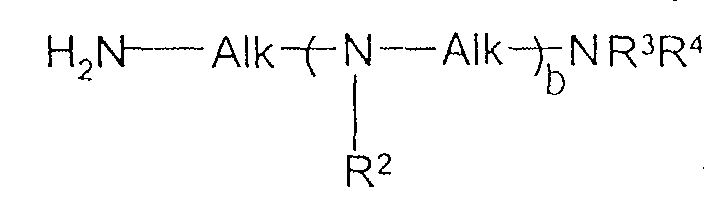
- the preferred polyalkylene amines used to prepare the succinimides are of the formula: wherein b is an integer of from 0 to about 10 and Alk, R 2 , R 3 , and R 4 are as defined above.
- the alkylene amines include principally methylene amines, ethylene amines, butylene amines, propylene amines, pentylene amines, hexylene amines, heptylene amines, octylene amines, other polymethylene amines and also the cyclic and the higher homologs of such amines as piperazine and amino alkylsubstituted piperazines.
- ethylene diamine triethylene tetraamine, propylene diamine, decamethyl diamine, octamethylene diamine, diheptamethylene triamine, tripropylene tetraamine, tetraethylene pentamine, trimethylene diamine, pentaethylene hexamine, ditrimethylene triamine, 2-heptyl-3-(2-aminopropyl)-imidazoline, 4-methyl imidazoline, N,N-dimethyl-1,3-propane diamine, 1,3-bis(2-aminoethyl)imidazoline, 1-(2-aminopropyl)-piperazine, 1,4-bis(2-aminoethyl)piperazine and 2-methyl-1-(2-aminobutyl)piperazine. Higher homologs such as are obtained by condensing two or more of the above-illustrated alkylene amines likewise are useful.
- ethylene amines are especially useful. They are described in some detail under the heading "Ethylene Amines” in Encyclopedia of Chemical Technology, Kirk-Othmer, Vol. 5, pp. 898-905 (Interscience Publishers, New York, 1950).
- ethylene amine is used in a generic sense to denote a class of polyamines conforming for the most part to the structure: H 2 N(CH 2 CH 2 NH) C H wherein c is an integer from 1 to about 10.
- ethylene diamine diethylene triamine
- triethylene tetraamine tetraethylene pentamine
- pentaethylene hexamine pentaethylene hexamine
- alkenyl succinimides are post-treated succinimides such as post-treatment processes involving ethylene carbonate and boric acid disclosed by Wollenberg, et al., U.S. Patent No. 4,612,132; Wollenberg, et al., U.S. Patent No. 4,746,446; and the like as well as other post-treatment processes each of which are incorporated herein by reference in its entirety.
- both the ethylene carbonate-treated and boric acid-treated succinimides are preferably employed in a weight ratio of about 0.3 to about 0.5.
- the ethylene carbonate-treated ashless dispersant and the borated ashless dispersant are preferably contained in the lubricating oil composition in a total amount of from about 4.0 to about 10 weight percent, based on the total weight of the lubricating oil composition.
- the weight range of the ethylene carbonated-treated ashless dispersant will be from about 3.0 to about 7.0 weight percent, preferably from about 4.0 to about 6.0 weight percent, more preferably from about 4.5 to about 5.5 weight percent.
- the weight range of the boric acid-treated ashless dispersant will be from about 2.0 to about 5.0 weight percent, preferably from about 2.5 to about 3.5 weight percent.
- the combination of the two succinmides produces superior detergency and soot dispersancy to either the carbonated-treated or borated-treated succinmides when used alone.
- the detergent employed in the lubricating oil composition of the present invention is a metal-containing detergent.
- materials that are suitable as detergents for the purpose of this invention. These materials include phenates (high overbased or low overbased), high overbased phenate stearates, phenolates, salicylates, phosphonates, thiophosphonates and sulfonates and mixtures thereof.
- sulfonates are used, such as high overbased sulfonates, low overbased sulfonates, or phenoxy sulfonates.
- the sulfonic acids themselves can also be used.
- the sulfonate detergent is preferably an alkali or alkaline earth metal salt of a hydrocarbyl sulfonic acid having from about 15 to about 200 carbons.
- sulfonate encompasses the salts of sulfonic acid derived from petroleum products.
- Such acids are well known in the art. They can be obtained by treating petroleum products with sulfuric acid or sulfur trioxide. The acids thus obtained are known as petroleum sulfonic acids and the salts as petroleum sulfonates. Most of the petroleum products which become sulfonated contain an oil-solubilizing hydrocarbon group.
- sulfonate are the salts of sulfonic acids of synthetic alkyl aryl compounds.
- These acids also are prepared by treating an alkyl aryl compound with sulfuric acid or sulfur trioxide. At least one alkyl substituent of the aryl ring is an oil-solubilizing group, as discussed above.
- the acids thus obtained are known as alkyl aryl sulfonic acids and the salts as alkyl aryl sulfonates.
- the sulfonates where the alkyl is straight-chain are the well-known linear alkylaryl sulfonates.
- the acids obtained by sulfonation are converted to the metal salts by neutralizing with a basic reacting alkali or alkaline earth metal compound to yield the Group I or Group II metal sulfonates.
- the acids are neutralized with an alkali metal base.
- Alkaline earth metal salts are obtained from the alkali metal salt by metathesis.
- the sulfonic acids can be neutralized directly with an alkaline earth metal base.
- the sulfonates can then be overbased. For purposes of the present invention, overbasing is preferred. Overbased materials and methods of preparing such materials are well known to those skilled in the art. See, for example, LeSuer U.S. Patent No. 3,496,105, issued Feb. 17, 1970, particularly columns 3 and 4.
- the sulfonates are present in the oil dispersion in the form of alkali and/or alkaline earth metal salts, or mixtures thereof.
- the alkali metals include lithium, sodium and potassium.
- the alkaline earth metals include barium magnesium and calcium, of which the latter two are preferred.
- salts of the petroleum sulfonic acids particularly the petroleum sulfonic acids which are obtained by sulfonating various hydrocarbon fractions such as lubricating oil fractions and extracts rich in aromatics which are obtained by extracting a hydrocarbon oil with a selective solvent, which extracts may, if desired, be alkylated before sulfonation by reacting them with olefins or alkyl chlorides by means of an alkylation catalyst; organic polysulfonic acids such as benzene disulfonic acid which may or may not be alkylated; and the like.
- the preferred salts for use in the present invention are those of alkylated aromatic sulfonic acids in which the alkyl radical or radicals contain at least about 8 carbon atoms, for example from about 8 to about 22 carbon atoms.
- Another preferred group of sulfonate starting materials are the aliphatic-substituted cyclic sulfonic acids in which the aliphatic substituents or substituents contain a total of at least about 12 carbon atoms, such as the alkyl aryl sulfonic acids, alkyl cycloaliphatic sulfonic acids, the alkyl heterocyclic sulfonic acids and aliphatic sulfonic acids in which the aliphatic radical or radicals contain a total of at least about 12 carbon atoms.
- oil-soluble sulfonic acids include petroleum sulfonic acids, mono- and poly-wax-substituted naphthalene sulfonic acids, substituted sulfonic acids, such as cetyl benzene sulfonic acids, cetyl phenyl sulfonic acids, and the like, aliphatic sulfonic acid, such as paraffin wax sulfonic acids, hydroxy-substituted paraffin wax sulfonic acids, etc., cycloaliphatic sulfonic acids, petroleum naphthalene sulfonic acids, cetyl cyclopentyl sulfonic acid, mono- and poly-wax-substituted cyclohexyl sulfonic acids, and the like.
- the term "petroleum sulfonic acids” is intended to cover all sulfonic acids that are derived directly from petroleum products.
- Typical Group II metal sulfonates suitable for use in the present invention include the metal sulfonates exemplified as follows: calcium white oil benzene sulfonate, barium white oil benzene sulfonate, magnesium white oil benzene sulfonate, calcium dipolypropene benzene sulfonate, barium dipolypropene benzene sulfonate, magnesium dipolypropene benzene sulfonate, calcium mahogany petroleum sulfonate, barium mahogany petroleum sulfonate, magnesium mahogany petroleum sulfonate, calcium triacontyl sulfonate, magnesium triacontyl sulfonate, calcium lauryl sulfonate, barium lauryl sulfonate, magnesium lauryl sulfonate, etc.
- the lubricating oil composition of the present invention may employ a high overbased and low overbased metal-containing detergent, i.e., metal sulfonate.
- the high overbased metal-containing detergent will generally range from about 1.0 to about 3.0 weight percent and preferably from about 1.4 to about 1.8 weight percent, based on the total weight of the lubricating oil composition and has a Total Base Number (TBN) from about 5.7 to about 7.4.
- TBN Total Base Number
- the low overbased metal-containing detergent will generally range from about 0.2 to about 6.0 weight percent and preferably from about 0.3 to about 0.5 weight percent, based on the total weight of the lubricating oil composition and has a TBN from about 0.5 to about 0.9.
- the phosphorus-containing compound employed in the lubricating oil compositions of the present invention is selected from the group consisting of metal dithiophosphates, phosphorus esters (including phosphates, phosphonates, phosphinates, phosphine oxides, phosphites, phosphonites, phosphinites, phosphines and the like), amine phosphates and amine phosphinates, sulfur-containing phosphorus esters including phosphoro monothionate and phosphoro dithionates, phosphoramides, phosphonamides and the like; all of which are well known in the art.
- the phosphorus-containing compound is a metal dithiophosphate and, even more preferably, a zinc dithiophosphate.
- the phosphorous containing compound is a zinc dialkyl dithiophosphate wherein the alkyl groups are independently selected form C 3 to C 13 , branched or straight chain carbon groups including mixtures thereof.
- the phosphorous containing compound is a zinc dialkyldithiophosphate made from a mixture of secondary alcohols where the average carbon chain length is between about 3 and about 6 carbon atoms.
- the metal dithiophosphates are characterized by formula I: wherein each R 5 is independently a hydrocarbyl group containing from about 3 to about 13 carbon atoms, M is a metal, and d is an integer equal to the valence of M.
- the hydrocarbyl groups, R 5 , in the dithiophosphate can be a C 3 to C 13 alkyl, C 3 to C 13 cycloalkyl, C 7 to C 13 aralkyl or C 7 to C 13 alkaryl groups, or a substantially hydrocarbon group of similar structure.
- substantially hydrocarbon is meant hydrocarbons that contain substituent groups such as ether, ester, nitro, or halogen which do not materially affect the hydrocarbon character of the group.
- Illustrative alkyl groups include isopropyl, isobutyl, n-butyl, sec-butyl, the various amyl groups, n-hexyl, methylisobutyl carbinyl, heptyl, 2-ethylhexyl, diisobutyl, isooctyl, nonyl, behenyl, decyl, dodecyl, tridecyl, etc.
- Illustrative lower alkylphenyl groups include butylphenyl, amylphenyl, heptylphenyl, etc.
- Cycloalkyl groups likewise are useful and these include chiefly cyclohexyl and the lower alkyl-cyclohexyl radicals. Many substituted hydrocarbon groups may also be used, e.g., chlorophenyl, dichlorophenyl, and dichlorodecyl.
- at least one R 5 group is an isopropyl or secondary butyl group.
- both R 5 groups are secondary alkyl groups.
- the phosphorodithioic acids from which the metal salts useful in the present invention are prepared are well known.
- Examples of dihydrocarbyl phosphorodithioic acids and metal salts, and processes for preparing such acids and salts are found in, for example, U.S. Patent Nos. 4,263,150; 4,289,635; 4,308,154; and 4,417,990. These patents are hereby incorporated by reference for such disclosures.
- the phosphorodithioic acids are typically prepared by the reaction of phosphorus pentasulfide with an alcohol or phenol or mixtures of alcohols and/or phenols.
- the reaction involves four moles of the alcohol or phenol per mole of phosphorus pentasulfide, and may be carried out within the temperature range from about 50°C to about 200°C.
- the preparation of O,O-di-n-hexyl phosphorodithioic acid involves the reaction of phosphorus pentasulfide with four moles of n-hexyl alcohol at about 100°C for about two hours. Hydrogen sulfide is liberated and the residue is the defined acid.
- the preparation of the metal salt of this acid may be effected by reaction with metal oxide. Simply mixing and heating these two reactants is sufficient to cause the reaction to take place and the resulting product is sufficiently pure for the purposes of this invention.
- the metal dihydrocarbyl dithiophosphates that are useful in this invention include those salts containing Group I metals, Group II metals, zinc, aluminum, lead, tin, molybdenum, manganese, cobalt, and nickel or mixtures thereof
- the Group II metals, zinc, aluminum, tin, iron, cobalt, lead, molybdenum, manganese, nickel and copper are among the preferred metals.
- Zinc and copper either alone or in combination are especially useful metals. Especially preferred is zinc.
- the lubricant compositions of the invention contain examples of metal compounds which may be reacted with the acid include lithium oxide, lithium hydroxide, sodium hydroxide, sodium carbonate, potassium hydroxide, potassium carbonate, silver oxide, magnesium oxide, magnesium hydroxide, calcium oxide, zinc hydroxide, zinc oxide, strontium hydroxide, cadmium oxide, cadmium hydroxide, barium oxide, aluminum oxide, iron carbonate, copper hydroxide, lead hydroxide, tin burylate, cobalt hydroxide, nickel hydroxide, nickel carbonate, etc.
- metal compounds which may be reacted with the acid include lithium oxide, lithium hydroxide, sodium hydroxide, sodium carbonate, potassium hydroxide, potassium carbonate, silver oxide, magnesium oxide, magnesium hydroxide, calcium oxide, zinc hydroxide, zinc oxide, strontium hydroxide, cadmium oxide, cadmium hydroxide, barium oxide, aluminum oxide, iron carbonate, copper hydroxide, lead hydroxide, tin burylate, cobalt
- the incorporation of certain ingredients such as small amounts of the metal acetate or acetic acid (glacial) in conjunction with the metal reactant will facilitate the reaction and result in an improved product.
- certain ingredients such as small amounts of the metal acetate or acetic acid (glacial) in conjunction with the metal reactant will facilitate the reaction and result in an improved product.
- the use of up to about 5% of zinc acetate in combination with the required amount of zinc oxide facilitates the formation of a zinc phosphorodithioate.
- the alkyl groups, R 5 are derived from secondary alcohols such as isopropyl alcohol, secondary butyl alcohol, 2-pentanol, 4-methyl-2-pentanol, 2-hexanol, 3-hexanol, etc.
- R 5 is derived from a mixture of secondary alcohols such as 2-butanol and 4-methyl-2-pentanol.
- Particularly preferred R 5 is derived from the above mixture containing from about 65 to about 75 weight percent 2-butanol with the remainder 4-methyl-2-pentanol.
- Especially useful metal phosphorodithioates can be prepared from phosphorodithioic acids that, in turn, are prepared by the reaction of phosphorus pentasulfide with mixtures of alcohols.
- the use of such mixtures enables the utilization of cheaper alcohols which in themselves may not yield oil-soluble phosphorodithioic acids.
- Useful mixtures of metal salts of dihydrocarbyl dithiophosphoric acid are obtained by reacting phosphorus pentasulfide with a mixture of (a) isopropyl or secondary butyl alcohol, and (b) an alcohol containing at least about 5 carbon atoms wherein at least about 10 mole percent, preferably about 20 or about 25 mole percent, of the alcohol in the mixture is isopropyl alcohol, secondary butyl alcohol or a mixture thereof.
- a mixture of isopropyl and hexyl alcohols can be used to produce a very effective, oil-soluble metal phosphorodithioate.
- mixtures of phosphorodithoic acids can be reacted with the metal compounds to form less expensive, oil-soluble salts.
- the mixtures of alcohols may be mixtures of different primary alcohols, mixtures of different secondary alcohols or mixtures of primary and secondary alcohols.
- useful mixtures include: n-butanol and n-octanol; n-pentanol and 2-ethyl-1-hexanol; isobutanol and n-hexanol; isobutanol and isoamyl alcohol; isopropanol and 4-methyl-2-pentanol; isopropanol and sec-butyl alcohol; isopropanol and isooctyl alcohol; sec-butyl alcohol and 4-methyl-2-pentanol, etc.
- Particularly useful alcohol mixtures are mixtures of secondary alcohols containing at least about 20 mole percent and preferably at least about 40 mole percent of isopropyl alcohol. In a preferred embodiment, at least about 75 mole percent of sec-butyl alcohol is used and preferably combined with 4-methyl-2-pentanol, and most preferably further combined with a zinc metal.
- Particularly preferred metal dihydrocarbyl phosphorodithioates include the zinc dithiophosphates.
- Patents describing the synthesis of such zinc dithiophosphates include U.S. Patent Nos. 2,680,123; 3,000,822; 3,151,075; 3,385,791; 4,377,527; 4,495,075 and 4,778,906. Each of these patents is incorporated herein by reference in their entirety.
- the amount of the phosphorus-containing compound in the lubricating oil composition of the present invention will range from about 0.1 to about 4 weight percent, preferably about 0.1 to about 2.0 weight percent, most preferably, about 0.4 to about 0.8 weight percent, based on the total weight of the lubricating oil composition.
- the nitrogen-containing ashless antioxidants of the present invention are the diphenylamine type.
- diphenylamine-type antioxidants include, but are not limited to, alkylated diphenylamine, phenyl- ⁇ -naphthylamine, and alkylated- ⁇ -naphthylamine.
- the nitrogen-containing ashless antioxidant is an alkylated diphenylamine such as, for example, dialkylated diphenylamine.
- the nitrogen-containing ashless antioxidant is generally incorporated into the lubricating oil composition in an amount of about 0.5 to about 3.0 weight percent, preferably about 1.0 to about 2.0 weight percent, based on the total weight of the lubricating oil composition.
- the alkylthiocarbamoyl compound of the lubricating oil in the present invention may be represented by the formula: wherein R 6 , R 7 , R 8 and R 9 are the same or different and each represents an alkyl group of 1 to about 18 carbon atoms, and (X) represents S, S-S, S-CH 2 -S, S-CH 2 -CH 2 -S, S-CH 2 -CH 2 -CH 2 -S or S-CH 2 -CH(CH 3 )-CH 2 -S.
- R 6 , R 7 , R 8 , and R 9 are independently selected from alkyl groups having 1 to about 6 carbon atoms. More preferably, the dithiocarbamate compound is methylene bis(dibutyldithiocarbamate).
- the lubricating oil composition of the present invention will generally have from about 0.3 to about 1.0 weight percent, preferably about 0.3 to about 0.7 weight percent, most preferably about 0.4 to about 0.6 weight percent, of the alkylthiocarbamoyl compound, based on the total weight of the lubricating oil composition.
- the molybdenum-succinimide complex employed in the present invention may be generally characterized as a molybdenum complex of a basic nitrogen compound.
- Such molybdenum/sulfur complexes are known in the art and are described, for example, in U.S. Patent No. 4,263,152 to King et al., the disclosure of which is hereby incorporated by reference.
- molybdenum compositions employed in the present invention are not known with certainty; however, they are believed to be compounds in which molybdenum, whose valences are satisfied with atoms of oxygen or sulfur, is either complexed by, or the salt of, one or more nitrogen atoms of the basic nitrogen containing compound used in the preparation of these compositions.
- the molybdenum compounds used to prepare the molybdenum and molybdenum/sulfur complexes employed in this invention are acidic molybdenum compounds.
- acidic is meant that the molybdenum compounds will react with a basic nitrogen compound as measured by ASTM test D-664 or D-2896 titration procedure.
- molybdenum compounds are hexavalent and are represented by the following compositions: molybdic acid, ammonium molybdate, sodium molybdate, potassium molybdate and other alkaline metal molybdates and other molybdenum salts such as hydrogen salts, e.g., hydrogen sodium molybdate, MoOCl 4 , MoO 2 Br 2 , Mo 2 O 3 Cl 6 , molybdenum trioxide or similar acidic molybdenum compounds.
- Preferred acidic molybdenum compounds are molybdic acid, ammonium molybdate, and alkali metal molybdates. Particularly preferred are molybdic acid and ammonium molybdate.
- the basic nitrogen compound used to prepare the molybdenum complexes have at least one basic nitrogen and are preferably oil-soluble.
- Typical examples of such compositions are succinimides, carboxylic acid amides, hydrocarbyl monoamines, hydrocarbon polyamines, Mannich bases, phosphoramides, thiophosphoramides, phosphonamides, dispersant viscosity index improvers, and mixtures thereof.
- Any of the nitrogen-containing compositions may be after-treated with, e.g., boron, using procedures well known in the art so long as the compositions continue to contain basic nitrogen. These after-treatments are particularly applicable to succinimides and Mannich base compositions.
- succinimide The mono and polysuccinimides that can be used to prepare the molybdenum complexes described herein are disclosed in numerous references and are well known in the art. Certain fundamental types of succinimides and the related materials encompassed by the term of art "succinimide” are taught in U.S. Patent No's. 3,219,666; 3,172,892; and 3,272,746, the disclosures of which are hereby incorporated by reference. The term “succinimide” is understood in the art to include many of the amide, imide, and amidine species which may also be formed.
- succinimide The predominant product however is a succinimide and this term has been generally accepted as meaning the product of a reaction of an alkenyl substituted succinic acid or anhydride with a nitrogen-containing compound.
- Preferred succinimides because of their commercial availability, are those succinimides prepared from a hydrocarbyl succinic anhydride, wherein the hydrocarbyl group contains from about 24 to about 350 carbon atoms, and an ethylene amine, said ethylene amines being especially characterized by ethylene diamine, diethylene triamine, triethylene tetramine, and tetraethylene pentamine.
- Particularly preferred are those succinimides prepared from polyisobutenyl succinic anhydride of about 70 to about 128 carbon atoms and tetraethylene pentamine or triethylene tetramine or mixtures thereof.
- succinimide also included within the term “succinimide” are the cooligomers of a hydrocarbyl succinic acid or anhydride and a poly secondary amine containing at least one tertiary amino nitrogen in addition to two or more secondary amino groups. Ordinarily this composition has between about 1,500 and about 50,000 average molecular weight.
- a typical compound would be that prepared by reacting polyisobutenyl succinic anhydride and ethylene dipiperazine.
- Carboxylic acid amide compositions are also suitable starting materials for preparing the molybdenum complexes employed in the present invention. Typical of such compounds are those disclosed in U.S. Patent No. 3,405,064, the disclosure of which is hereby incorporated by reference. These compositions are ordinarily prepared by reacting a carboxylic acid or anhydride or ester thereof, having at least about 12 to about 350 aliphatic carbon atoms in the principal aliphatic chain and, if desired, having sufficient pendant aliphatic groups to render the molecule oil soluble with an amine or a hydrocarbyl polyamine, such as an ethylene amine, to give a mono or polycarboxylic acid amide.
- hydrocarbyl monoamines and hydrocarbyl polyamines preferably of the type disclosed in U.S. Patent No. 3,574,576, the disclosure of which is hereby incorporated by reference.
- the hydrocarbyl group which is preferably alkyl, or olefinic having one or two sites of unsaturation, usually contains from about 9 to about 350, preferably from about 20 to about 200 carbon atoms.
- hydrocarbyl polyamines are those which are derived, e.g., by reacting polyisobutenyl chloride and a polyalkylene polyamine, such as an ethylene amine, e.g., ethylene diamine, diethylene triamine, tetraethylene pentamine, 2-aminoethylpiperazine, 1,3-propylene diamine, 1,2-propylenediamine, and the like.
- a polyalkylene polyamine such as an ethylene amine, e.g., ethylene diamine, diethylene triamine, tetraethylene pentamine, 2-aminoethylpiperazine, 1,3-propylene diamine, 1,2-propylenediamine, and the like.
- Mannich base compositions Another class of compounds useful for supplying basic nitrogen are the Mannich base compositions. These compositions are prepared from a phenol or C 9 to C 200 alkylphenol, an aldehyde, such as formaldehyde or formaldehyde precursor such as paraformaldehyde, and an amine compound.
- the amine may be a mono or polyamine and typical compositions are prepared from an alkylamine, such as methylamine or an ethylene amine, such as, diethylene triamine, or tetraethylene pentamine, and the like.
- the phenolic material may be sulfurized and preferably is dodecylphenol or a C 80 to C 100 alkylphenol.
- Typical Mannich bases which can be used in this invention are disclosed in U.S. Pat. Nos.
- Mannich bases prepared by reacting an alkylphenol having at least about 50 carbon atoms, preferably about 50 to about 200 carbon atoms with formaldehyde and an alkylene polyamine HN(ANH) e H where A is a saturated divalent alkyl hydrocarbon of about 2 to about 6 carbon atoms and e is 1 to about 10 and where the condensation product of said alkylene polyamine may be further reacted with urea or thiourea.
- A is a saturated divalent alkyl hydrocarbon of about 2 to about 6 carbon atoms and e is 1 to about 10 and where the condensation product of said alkylene polyamine may be further reacted with urea or thiourea.
- the utility of these Mannich bases as starting materials for preparing lubricating oil additives can often be significantly improved by treating the Mannich base using conventional techniques to introduce boron into the composition.
- compositions useful for preparing the molybdenum complexes employed in the present invention are the phosphoramides and phosphonamides such as those disclosed in U.S. Patent Nos. 3,909,430 and 3,968,157, the disclosures of which are hereby incorporated by reference.
- These compositions may be prepared by forming a phosphorus compound having at least one P-N bond. They can be prepared, for example, by reacting phosphorus oxychloride with a hydrocarbyl diol in the presence of a monoamine or by reacting phosphorus oxychloride with a difunctional secondary amine and a mono-functional amine.
- Thiophosphoramides can be prepared by reacting an unsaturated hydrocarbon compound containing from about 2 to about 450 or more carbon atoms, such as polyethylene, polyisobutylene, polypropylene, ethylene, 1-hexene, 1,3-hexadiene, isobutylene, 4-methyl-1-pentene. and the like, with phosphorus pentasulfide and a nitrogen-containing compound as defined above, particularly an alkylamine, alkyldiamine, alkylpolyamine, or an alkyleneamine, such as ethylene diamine, diethylenetriamine, triethylenetetramine, tetraethylenepentamine, and the like.
- VI improvers dispersant viscosity index improvers
- hydrocarbon polymer especially a polymer derived from ethylene and/or propylene, optionally containing additional units derived from one or more co-monomers such as alicyclic or aliphatic olefins or diolefins.
- the functionalization may be carried out by a variety of processes which introduce a reactive site or sites which usually has at least one oxygen atom on the polymer.
- the polymer is then contacted with a nitrogen-containing source to introduce nitrogen-containing functional groups on the polymer backbone.
- Commonly used nitrogen sources include any basic nitrogen compound especially those nitrogen-containing compounds and compositions described herein.
- Preferred nitrogen sources are alkylene amines, such as ethylene amines, alkyl amines, and Mannich bases.
- Preferred basic nitrogen compounds for use in the present invention are succinimides, carboxylic acid amides, and Mannich bases. More preferred are succinimides having an average molecular weight of about 1,000 or about 1,300 or about 2,300 and mixtures thereof. Such succinimides can be post treated with boron or ethylene carbonate as known in the art.
- the molybdenum complexes of the present invention are sulfurized.
- Representative sulfur sources for preparing the molybdenum/sulfur complexes used in this invention are sulfur, hydrogen sulfide, sulfur monochloride, sulfur dichloride, phosphorus pentasulfide, R 11 S f where R 11 is hydrocarbyl, preferably C 1 to C 40 alkyl, and f is at least 2, inorganic sulfides and polysulfides such as (NH 4 ) 2 S g , where g is at least 1, thioacetamide, thiourea, and mercaptans of the formula R 11 SH where R 11 is as defined above.
- sulfurizing agents are traditional sulfur-containing antioxidants such as wax sulfides and polysulfides, sulfurized olefins, sulfurized carboxylic and esters and sulfurized ester-olefins, and sulfurized alkylphenols and the metal salts thereof.
- the sulfurized fatty acid esters are prepared by reacting sulfur, sulfur monochloride, and/or sulfur dichloride with an unsaturated fatty ester under elevated temperatures.
- Typical esters include C 1 to C 20 alkyl esters of C 8 to C 24 unsaturated fatty acids, such as palmitoleic, oleic, ricinoleic, petroselinic, vaccenic, linoleic, linolenic, oleostearic, licanic, paranaric, tariric, gadoleic, arachidonic, cetoleic, etc.
- mixed unsaturated fatty acid esters such as are obtained from animal fats and vegetable oils, such as tall oil, linseed oil, olive oil, caster oil, peanut oil, rape oil, fish oil, sperm oil, and so forth.
- Exemplary fatty esters include lauryl tallate, methyl oleate, ethyl oleate, lauryl oleate, cetyl oleate, cetyl linoleate, lauryl ricinoleate, oleyl linoleate, oleyl stearate, and alkyl glycerides.
- Cross-sulfurized ester olefins such as a sulfurized mixture of C 10 to C 25 olefins with fatty acid esters of C 10 to C 25 fatty acids and C 10 to C 25 alkyl or alkenyl alcohols, wherein the fatty acid and/or the alcohol is unsaturated may also be used.
- Sulfurized olefins are prepared by the reaction of the C 3 to C 6 olefin or a low-molecular-weight polyolefin derived therefrom with a sulfur-containing compound such as sulfur, sulfur monochloride, and/or sulfur dichloride.
- aromatic and alkyl sulfides such as dibenzyl sulfide, dixylyl sulfide, dicetyl sulfide, diparaffin wax sulfide and polysulfide, cracked wax-olefin sulfides and so forth.
- They can be prepared by treating the starting material, e.g., olefinically unsaturated compounds, with sulfur, sulfur monochloride, and sulfur dichloride.
- the paraffin wax thiomers described in U.S. Patent No. 2,346,156.
- Sulfurized alkyl phenols and the metal salts thereof include compositions such as sulfurized dodecylphenol and the calcium salts thereof.
- the alkyl group ordinarily contains from about 9 to about 300 carbon atoms.
- the metal salt may be preferably, a Group I or Group II salt, especially sodium, calcium, magnesium, or barium.
- Preferred sulfur sources are sulfur, hydrogen sulfide, phosphorus pentasulfide, R 12 S h where R 12 is hydrocarbyl, preferably C 1 to C 10 alkyl, and h is at least about 3, mercaptans wherein R 12 is C 1 to C 10 alkyl, inorganic sulfides and polysulfides, thioacetamide, and thiourea.
- Most preferred sulfur sources are sulfur, hydrogen sulfide, phosphorus pentasulfide, and inorganic sulfides and polysulfides.
- the polar promoter used in the preparation of the molybdenum complexes employed in this invention is one which facilitates the interaction between the acidic molybdenum compound and the basic nitrogen compound.
- a wide variety of such promoters are well known to those skilled in the art.
- Typical promoters are 1,3-propanediol, 1,4-butane-diol, diethylene glycol, butyl cellosolve, propylene glycol, 1,4-butyleneglycol, methyl carbitol, ethanolamine, diethanolamine, N-methyl-diethanol-amine, dimethyl formamide, N-methyl acetamide, dimethyl acetamide, methanol, ethylene glycol, dimethyl sulfoxide, hexamethyl phosphoramide, tetrahydrofuran and water.
- Preferred are water and ethylene glycol. Particularly preferred is water.
- the polar promoter is separately added to the reaction mixture, it may also be present, particularly in the case of water, as a component of non-anhydrous starting materials or as waters of hydration in the acidic molybdenum compound, such as (NH 4 ) 6 Mo 7 O 24 H 2 O. Water may also be added as ammonium hydroxide.
- a method for preparing the molybdenum complexes used in the present invention is to prepare a solution of the acidic molybdenum precursor and a polar promoter with a basic nitrogen-containing compound with or without diluent.
- the diluent is used, if necessary, to provide a suitable viscosity for easy stirring.
- Typical diluents are lubricating oil and liquid compounds containing only carbon and hydrogen.
- ammonium hydroxide may also be added to the reaction mixture to provide a solution of ammonium molybdate. This reaction is carried out at a variety of temperatures, typically at or below the melting point of the mixture to reflux temperature. It is ordinarily carried out at atmospheric pressure although higher or lower pressures may be used if desired.
- This reaction mixture may optionally be treated with a sulfur source as defined above at a suitable pressure and temperature for the sulfur source to react with the acidic molybdenum and basic nitrogen compounds. In some cases, removal of water from the reaction mixture may be desirable prior to completion of reaction with the sulfur source.
- the reactor is agitated and heated at a temperature less than or equal to about 120 degrees Celsius, preferably from about 70 degrees Celsius to about 90 degrees Celsius.
- Molybdic oxide or other suitable molybdenum source is then charged to the reactor and the temperature is maintained at a temperature less than or equal to about 120 degrees Celsius, preferably at about 70 degrees Celsius to about 90 degrees Celsius, until the molybdenum is sufficiently reacted.
- Excess water is removed from the reaction mixture. Removal methods include but are not limited to vacuum distillation or nitrogen stripping while maintaining the temperature of the reactor at a temperature less than or equal to about 120 degrees Celsius, preferably between about 70 degrees Celsius to about 90 degrees Celsius.
- the temperature during the stripping process is held at a temperature less than or equal to about 120 degrees Celsius to maintain the low color intensity of the molybdenum-containing composition. It is ordinarily carried out at atmospheric pressure although higher or lower pressures may be used.
- the stripping step is typically carried out for a period of about 0.5 to about 5 hours.
- this product can be sulfurized by treating this reaction mixture with a sulfur source as defined above at a suitable pressure and temperature, not to exceed about 120 degrees Celsius for the sulfur source to react with the acidic molybdenum and basic nitrogen compounds.
- the sulfurization step is typically carried out for a period of from about 0.5 to about 5 hours and preferably from about 0.5 to about 2 hours.
- removal of the polar promoter (water) from the reaction mixture may be desirable prior to completion of reaction with the sulfur source.
- the molybdenum complex and molybdenum/sulfur complex produced by such method is lighter in color (when compared to complexes prepared at higher temperatures) while maintaining good fuel economy, excellent oxidation inhibition, and anti-wear performance qualities.
- Color in this instance can be more visibly or more quantifiably using a UV spectrophotometer such as a Perkin-Elmer Lambda 18 UV-Visible Double-Beam Spectrophotometer.
- a UV spectrophotometer such as a Perkin-Elmer Lambda 18 UV-Visible Double-Beam Spectrophotometer.
- this test recorded the visible spectra of molybdenum compositions at a constant concentration in an isooctane solvent. The spectra represent the absorbance intensity plotted versus the wavelength in nanometers. The spectra extend from the visible region into the near infrared region of the electromagnetic radiation (350 nanometers to 900 nanometers). In this test, the highly colored samples showed increasingly higher absorbance at increasingly higher wavelengths at a constant molybdenum concentration.
- the preparation of the sample for color measurement comprises diluting the molybdenum-containing composition with isooctane to achieve a constant molybdenum concentration of 0.00025 g molybdenum per gram of the molybdenum-containing composition/isooctane mixture.
- the spectrophotometer Prior to sample measurement the spectrophotometer is referenced by scanning air versus air. The UV visible spectrum from about 350 nanometers to about 900 nanometers is obtained using a one centimeter path-length quartz cell versus an air reference. The spectra are offset corrected by setting the about 867 nanometer absorbance to zero. Then the absorbance of the sample is determined at about 350 nanometers wavelength.
- the ratio of molybdenum compound to basic nitrogen compound is not critical; however, as the amount of molybdenum with respect to basic nitrogen increases, the filtration of the product becomes more difficult. Since the molybdenum component probably oligomerizes, it is advantageous to add as much molybdenum as can easily be maintained in the composition.
- the reaction mixture will have charged to it from about 0.01 to about 2.00 atoms of molybdenum per basic nitrogen atom. Preferably from about 0.3 to about 1.0, and most preferably from about 0.4 to about 0.7, atoms of molybdenum per atom of basic nitrogen is added to the reaction mixture.
- the sulfurized molybdenum containing compositions may be generally characterized as a sulfur/molybdenum complex of a basic nitrogen dispersant compound preferably with a sulfur to molybdenum weight ratio of about (0.01 to 1.0) to 1 and more preferably from about (0.05 to 0.5) to 1 and a nitrogen to molybdenum weight ratio of about (1 to 10) to 1 and more preferably from about (2 to 5) to 1.
- the sulfur to molybdenum weight ratio can be from about (0.01 to 0.08) to 1.
- the sulfurized and unsulfurized molybdenum-succinimide complexes of this invention are typically employed in the lubricating oil composition of the present invention in an amount of about 0.1 to about 1.5 weight percent, more preferably from about 0.5 to about 1.0 weight percent.
- additive components are examples of some of the components that can be favorably employed in the present invention. These examples of additives are provided to illustrate the present invention, but they are not intended to limit it:
- the low phosphorus lubricating oil compositions of the present invention were prepared by blending together at room temperature the following components to obtain a SAE 0W-20 viscosity grade formulation.
- Lubricating Oil Compositions Additive Component Weight Percent of Additive Component Oil 1 Oil 2 Oil 3 Oil 4 Oil 5 Oil 6 EC-Treated Ashless Dispersant 5.2 5.2 5.2 5.2 5.2 Borated-Treated ashless Dispersant 3.2 3.2 3.2 3.2 3.2 3.2 3.2 3.2 LOB Detergent 0.3 0.3 0.3 0.3 0.3 0.3 0.3 0.3 HOB Detergent 1.6 1.6 1.6 1.6 1.6 1.6 1.6 Phosphorus-containing compound 0.7 0.7 0.7 0.7 0.7 0.7 0.7 Nitrogen-containing Ashless antioxidant 1.5 1.5 1.5 1.5 1.5 1.5 1.5 1.5 1.5 1.5 1.5 1.5 1.5 1.5 1.5 1.5 1.5 1.5 1.5 1.5 1.5 1.5 1.5 1.5 1.5 1.5 1.5 1.5 1.5 Alkylthiocarbamoyl compound 0 0 0 0.5 0.5 0.5 Molybden
- the low phosphorus lubricating oil compositions were compared with a commercially recognized long drain lubricating oil (Mobil 1®).
- This reference oil is a fully-formulated synthetic passenger car engine oil formulated to SAE 5W-30 viscometrics and meeting the API SJ/CF specifications.
- the competitive commercial formulation was the minimum acceptable performance target for the extended drain interval oils described.
- Duplicate reference oils were run in the below described bench tests and average results compared with the low phosphorus lubricating oils of the present invention.
- the vessel was charged with oxygen to a gauge pressure of 620 kPa (90 psi, 6.2 bar), placed in a constant-temperature oil bath set at 150°C, and rotated axially at 100 rpm at an angle of 30° from the horizontal.
- the number of minutes required to reach a specific drop in gauge pressure (25 psi) was the oil oxidation stability of the test sample. The longer times indicates better oxidative stability.
- TFOUT Thin Film Oxygen Uptake test
- test oil was mixed in a glass container with three other liquids that were used to simulate engine conditions: (1) an oxidized/nitrated fuel component, (2) a mixture of soluble metal naphthenates (lead, copper, iron, manganese, and tin naphthenates), and (3) distilled water.
- the glass container holding the oil mixture was placed in a high pressure reactor equipped with a pressure gage.
- the high pressure reactor was sealed, charged with oxygen to a pressure of 620 kPa (90 psig), and placed in an oil bath at 160 °C at an angle of 30° from the horizontal.
- the high pressure reactor was rotated axially at a speed of 100 rpm forming a thin film of oil within the glass container resulting in a relatively large oil-oxygen contact area.
- the pressure of the high pressure reactor was recorded continuously from the beginning of the test and the test was terminated when a rapid decrease of the high pressure reactor pressure was observed.
- the period of time that elapses between the time when the high pressure reactor was placed in the oil bath and the time at which the pressure began to decrease rapidly was called the oxidation induction time and was used as a measure of the relative oil oxidation stability. The longer times indicates better oxidative stability.”
- KHTT The Komatsu Hot Tube Test
- a glass tube was placed inside an aluminum block and a small air hose was attached to a holder at the bottom of the glass tube.
- a 5-mL syringe and 12-inch flexible tubing were filled with the oil sample.
- the tubing was attached to the holder above the air hose and oil was steadily introduced into the glass tube. Air forces the oil up the glass tube through the heating block for the duration of the test.
- the glass tubes were removed, rinsed and rated against a standard. The rating, between 0 and 10, was reported.
- the test was often run at several temperatures to determine the deposit performance over a temperature range. Temperatures frequently tested were between 230°C and 330°C.
- test lubricant covered the lower three balls. The rotating speed was 1760 rpm. The machine and test lubricant were brought to 18.33° to 35.0 °C (65° to 95 °F) and then a series of tests of 10-second duration were made at increasing loads until welding occurred. Ten tests were made below the welding point. If ten loads have not been run when welding occurs and the scars at loads below seizure were within 5% of the compensation line no further runs were necessary.”
- the lubricating oil composition of the present invention are at least comparable and usually superior in wear performance to the Reference Oil.
- this invention is not based on the discovery of any one of the disclosed components as new compositions of matter or their individual usefulness as additive agents in lubricant oil compositions. Rather this invention is based on the discovery of a lubricant oil composition useful for the severe service function imposed by long drain life which composition comprises a major amount of a base oil of lubricating viscosity and a minor amount of an ethylene carbonated-treated ashless dispersant, a borated-treated ashless dispersant, and a high overbased metal-containing detergent.
Landscapes
- Chemical & Material Sciences (AREA)
- Chemical Kinetics & Catalysis (AREA)
- General Chemical & Material Sciences (AREA)
- Oil, Petroleum & Natural Gas (AREA)
- Organic Chemistry (AREA)
- Lubricants (AREA)
Abstract
- c) from about 1.0 to about 3.0 weight percent of a high overbased metal-containing detergent;
- d) from about 0.1 to about 2.0 weight percent of a phosphorus-containing compound;
Description
wherein the weight ratio of a) to b) is about 0.3 to about 0.5;
wherein the weight ratio of a) to b) is about 0.3 to about 0.5;
| SATURATES, SULFUR AND VISCOSITY INDEX OF GROUP I, II AND III BASE STOCKS | ||
| Group | Saturates | Viscosity Index |
| (As determined by ASTM D 2007) | (As determined by | |
| Sulfur | ASTM D 4294, ASTM D 4297 or ASTM D 3120) | |
| (As determined by ASTM D 2270) | ||
| I | Less than 90 % saturates and/or Greater than to 0.03 % sulfur | Greater than or equal to 80 and less than 120 |
| II | Greater than or equal to 90 % saturates and less than or equal to 0.03 % sulfur | Greater than or equal to 80 and less than 120 |
| III | Greater than or equal to 90 % saturates and less than or equal to 0.03% sulfur | Greater than or equal to 120 |


In another embodiment, at least one R5 group is an isopropyl or secondary butyl group. In yet another embodiment, both R5 groups are secondary alkyl groups.

| Lubricating Oil Compositions | ||||||
| Additive Component | Weight Percent of Additive Component | |||||
| Oil 1 | Oil 2 | Oil 3 | Oil 4 | Oil 5 | Oil 6 | |
| EC-Treated Ashless Dispersant | 5.2 | 5.2 | 5.2 | 5.2 | 5.2 | 5.2 |
| Borated-Treated ashless Dispersant | 3.2 | 3.2 | 3.2 | 3.2 | 3.2 | 3.2 |
| LOB Detergent | 0.3 | 0.3 | 0.3 | 0.3 | 0.3 | 0.3 |
| HOB Detergent | 1.6 | 1.6 | 1.6 | 1.6 | 1.6 | 1.6 |
| Phosphorus-containing compound | 0.7 | 0.7 | 0.7 | 0.7 | 0.7 | 0.7 |
| Nitrogen-containing Ashless antioxidant | 1.5 | 1.5 | 1.5 | 1.5 | 1.5 | 1.5 |
| Alkylthiocarbamoyl compound | 0 | 0 | 0 | 0.5 | 0.5 | 0.5 |
| Molybdenum-Succinimide Complex | 0.7 | 0.7 | 0.7 | 0.7 | 0.7 | 0.7 |
| Base Oil: | ||||||
| Group III | 0 | 100 | 0 | 0 | 100 | 0 |
| PAO (Group IV) | 100 | 0 | 90 | 100 | 0 | 90 |
| Ester (Group V) | 0 | 0 | 10 | 0 | 0 | 10 |
0.22X
where X denotes mean value."
| Bench Test Results | |||||
| Oil | RBOT Min. to 25 PSI Drop | TFOUT | KHTT | FBWT | |
| Load Wear Index, KGF | Last Non-Seizure Load, KGF | ||||
| 1 | 190 | 796 | 6.5 | 34.4 | 80 |
| 2 | 223 | 683 | 6.5 | 28.6 | 63 |
| 3 | 179 | 388 | 7.0 | 28.8 | 63 |
| 4 | 180 | 649 | 6.5 | 32.9 | 63 |
| 5 | 177 | 1026 | 6.5 | 35.3 | 80 |
| 6 | 159 | 712 | 7.0 | 35.3 | 80 |
| Reference | 100 | 534 | 8.5 | 29.0 | 63 |
Claims (34)
- A lubricating oil composition comprising a major amount of a base oil of lubricating viscosity and a minor amount of each of the following:wherein the weight percent of total phosphorus in the lubricating oil composition is no more than 0.08 weight percent based on the total weight of the lubricating oil composition.a) from about 3.0 to about 7.0 weight percent of an ethylene carbonated-treated ashless dispersant;b) from about 2.0 to about 5.0 weight percent of a borated-treated ashless dispersant;
wherein the weight ratio of a) to b) is about 0.3 to about 0.5;c) from about 1.0 to about 3.0 weight percent of a high overbased metal-containing detergent;d) from about 0.1 to about 2.0 weight percent of a phosphorus-containing compound; - A lubricating oil composition according to Claim 1, further comprising from about 0.2 to about 6.0 weight percent of a low overbased metal containing detergent.
- A lubricating oil composition according to Claim 1, further comprising from about 0.5 to about 3.0 weight percent of a nitrogen-containing ashless antioxidant.
- A lubricating oil composition according to Claim 1, further comprising from about 0.3 to about 1.0 weight percent of an alkylthiocarbamoyl compound.
- A lubricating oil composition according to Claim 1, further comprising from about 0.1 to about 1.5 weight percent of a molybdenum-succinimide complex.
- A lubricating oil composition according to Claim 1 wherein the total phosphorus in the composition is no more than 0.05 weight percent based on the total weight of the composition.
- A lubricating oil composition according to Claim 1 wherein the base oil of lubricating viscosity is selected from the group consisting of a Group III base stock, Group IV base stock, Group V base stock and any mixture thereof.
- A lubricating oil composition according to Claim 1 wherein the ashless dispersant is selected from the group consisting of an alkenyl succinimide, an alkenyl succinic anhydride, an alkenyl succinate ester, benzylamine or mixtures thereof.
- A lubricating oil composition according to Claim 8 wherein the ashless dispersant is an alkenyl succinimide.
- A lubricating oil composition according to Claim 9 wherein the alkenyl succinimide is a polyalkylene succinimide.
- A lubricating oil composition according to Claim 10 wherein the polyalkylene succinimide is a polyisobutylene succinimide.
- A lubricating oil composition according to Claim 1 wherein the metal -containing detergent is a metal phenate or metal sulfonate.
- A lubricating oil composition according to Claim 12 wherein the metal -containing detergent is a metal sulfonate.
- A lubricating oil composition according to Claim 1 wherein the phosphorus-containing compound is selected from the group consisting of metal dithiophosphates, phosphorus esters, amine phosphates and amine phosphinates, sulfur-containing phosphorus esters, phosphoramides and phosphonamides.
- The lubricating oil composition of Claim 14 wherein the phosphorus esters are selected from the group consisting of phosphates, phosphonates, phosphinates, phosphine oxides, phosphites, phosphonites, phosphinites, and phosphines.
- The lubricating oil composition of Claim 14 wherein the sulfur-containing phosphorus esters are selected from the group consisting of phosphoro monothionate and phosphoro dithionates.
- The lubricating oil composition of Claim 14 wherein the phosphorus-containing compound is a metal dithiophosphate.
- The lubricating oil composition of Claim 17 wherein the metal dithiophosphate is a zinc dialkyldithiophosphate.
- The lubricating oil composition of Claim 1, wherein the nitrogen-containing ashless antioxidant is a diphenylamine.
- The lubricating oil composition of Claim 19, wherein the diphenylamine is an alkylated diphenyl amine.
- The lubricating oil composition of Claim 1 wherein the alkylthiocarbamoyl compound is an alkylene, bis(dialkyldithiocarbamate).
- The lubricating oil composition of Claim 21 wherein the alkylene bis(dialkyldithiocarbamate) is methylene bis(dialkyldithiocarbamate).
- The lubricating oil composition of Claim 22 wherein the methylene bis(dialkyldithiocarbamate) is methylene bis(dibutyldithiocarbamate).
- The lubricating oil composition of Claim 1 wherein the nitrogen-containing compound employed in the molybdenum/nitrogen-containing complex is selected from the group consisting of succinimides, carboxylic acid amides, hydrocarbyl monoamines, hydrocarbon polyamines, Mannich bases, phosphoramides, thiophosphoramides, phosphonamides, dispersant viscosity index improvers, and mixtures thereof.
- The lubricating oil composition of Claim 24 wherein the nitrogen-containing compound is a succinimide and the molybdenum/nitrogen-containing complex is a molybdenum succinimide.
- The lubricating oil composition of Claim 25 wherein the molybdenum succinimide is a sulfurized molybdenum succinimide.
- The lubricating oil composition of Claim 25 wherein the molybdenum succinimide is a non-sulfurized molybdenum succinimide.
- The lubricating oil composition of Claim 25 wherein the molybdenum succinimide is employed in an amount sufficient to provide from about 10 to about 5,000 parts per million of atomic molybdenum in the lubricant composition.
- A method of enhancing the life of a lubricating oil composition as evidenced by an improvement in wear, extreme pressure, oxidation, and deposit control performance, the method comprising operating an internal combustion engine with a lubricating oil composition comprising a major amount of a base oil of lubricating viscosity and a minor amount of each of the following:wherein the weight percent of total phosphorus in the lubricating oil composition is no more than 0.08 weight percent based on the total weight of the lubricating oil composition.a) from about 3.0 to about 7.0 weight percent of an ethylene carbonated-treated ashless dispersant;b) from about 2.0 to about 5.0 weight percent of a borated-treated ashless dispersant;
wherein the weight ratio of a) to b) is about 0.3 to about 0.5;c) from about 1.0 to about 3.0 weight percent of a high overbased metal-containing detergent;d) from about 0.1 to about 2.0 weight percent of a phosphorus-containing compound; - A method according to Claim 29, further comprising from about 0.2 to about 0.6 weight percent of a low overbased metal-containing detergent.
- A method according to Claim 29, further comprising from about 0.5 to about 3.0 weight percent of a nitrogen-containing ashless antioxidant.
- A method according to Claim 1, further comprising from about 0.3 to about 1.0 weight percent of an alkylthiocarbamoyl compound.
- A method according to Claim 1, further comprising from about 0.3 to about 1.5 weight percent of a molybdenum-succinimide complex.
- A method according to Claim 1 wherein the total phosphorus in the composition is no more than 0.05 weight percent baseo on the total weight of the composition.
Applications Claiming Priority (2)
| Application Number | Priority Date | Filing Date | Title |
|---|---|---|---|
| US285753 | 2002-10-31 | ||
| US10/285,753 US20040087451A1 (en) | 2002-10-31 | 2002-10-31 | Low-phosphorus lubricating oil composition for extended drain intervals |
Publications (2)
| Publication Number | Publication Date |
|---|---|
| EP1418220A2 true EP1418220A2 (en) | 2004-05-12 |
| EP1418220A3 EP1418220A3 (en) | 2007-12-12 |
Family
ID=32107609
Family Applications (1)
| Application Number | Title | Priority Date | Filing Date |
|---|---|---|---|
| EP03255080A Withdrawn EP1418220A3 (en) | 2002-10-31 | 2003-08-15 | A low-phosphorus lubricating oil composition for extended drain intervals |
Country Status (5)
| Country | Link |
|---|---|
| US (2) | US20040087451A1 (en) |
| EP (1) | EP1418220A3 (en) |
| JP (1) | JP2004149802A (en) |
| CA (1) | CA2437917A1 (en) |
| SG (1) | SG111138A1 (en) |
Cited By (6)
| Publication number | Priority date | Publication date | Assignee | Title |
|---|---|---|---|---|
| WO2005026301A1 (en) * | 2003-09-05 | 2005-03-24 | Exxonmobil Research And Engineering Company | Long life lubricating oil composition using particular antioxidant components |
| EP1757673A1 (en) * | 2005-08-23 | 2007-02-28 | Chevron Oronite Company LLC | Lubricating oil composition for internal combustion engines |
| EP1792969A1 (en) * | 2005-12-02 | 2007-06-06 | Chevron Oronite Company LLC | A lubricating oil composition comprising a lithium containing detergent for reducing catalyst poisoning |
| US7875576B2 (en) | 2004-07-29 | 2011-01-25 | Chevron Oronite Company Llc | Lubricating oil composition for internal combustion engines |
| US8980805B2 (en) | 2006-10-11 | 2015-03-17 | Total Marketing Services | Marine lubricant for fuel oil having high and low sulphur contents |
| WO2015164682A1 (en) * | 2014-04-25 | 2015-10-29 | The Lubrizol Corporation | Multigrade lubricating compositions |
Families Citing this family (21)
| Publication number | Priority date | Publication date | Assignee | Title |
|---|---|---|---|---|
| US7615519B2 (en) * | 2004-07-19 | 2009-11-10 | Afton Chemical Corporation | Additives and lubricant formulations for improved antiwear properties |
| US8709989B2 (en) | 2004-10-19 | 2014-04-29 | Nippon Oil Corporation | Lubricant composition and antioxident composition |
| FR2879621B1 (en) * | 2004-12-16 | 2007-04-06 | Total France Sa | OIL FOR 4-STROKE MARINE ENGINE |
| US7465696B2 (en) * | 2005-01-31 | 2008-12-16 | Chevron Oronite Company, Llc | Lubricating base oil compositions and methods for improving fuel economy in an internal combustion engine using same |
| US20070111904A1 (en) * | 2005-11-14 | 2007-05-17 | Chevron Oronite Company Llc | Low sulfur and low phosphorus lubricating oil composition |
| US7767633B2 (en) * | 2005-11-14 | 2010-08-03 | Chevron Oronite Company Llc | Low sulfur and low phosphorus heavy duty diesel engine lubricating oil composition |
| US7981846B2 (en) * | 2005-11-30 | 2011-07-19 | Chevron Oronite Company Llc | Lubricating oil composition with improved emission compatibility |
| US7501386B2 (en) * | 2005-12-21 | 2009-03-10 | Chevron Oronite Company, Llc | Synergistic lubricating oil composition containing a mixture of a benzo[b]perhydroheterocyclic arylamine and a diarylamine |
| US7875577B2 (en) * | 2005-12-28 | 2011-01-25 | Chevron Japan Ltd. | Diesel engine lubricating oil composition for large-bore two-stroke cross-head diesel engines |
| US20080171677A1 (en) * | 2006-04-13 | 2008-07-17 | Buck William H | Low SAP engine lubricant additive and composition containing non-corrosive sulfur and organic borates |
| US20080039348A1 (en) * | 2006-08-09 | 2008-02-14 | Chevron Oronite Company Llc | Low phosphorus lubricating oil composition having lead corrosion control |
| US20080146473A1 (en) * | 2006-12-19 | 2008-06-19 | Chevron Oronite Company Llc | Lubricating oil with enhanced piston cleanliness control |
| US20090163392A1 (en) * | 2007-12-20 | 2009-06-25 | Boffa Alexander B | Lubricating oil compositions comprising a molybdenum compound and a zinc dialkyldithiophosphate |
| JP5044465B2 (en) * | 2008-03-27 | 2012-10-10 | Jx日鉱日石エネルギー株式会社 | Lubricating oil composition and method for producing the same |
| JP5061006B2 (en) * | 2008-03-27 | 2012-10-31 | Jx日鉱日石エネルギー株式会社 | Lubricating oil composition and method for producing the same |
| US20100056407A1 (en) * | 2008-08-28 | 2010-03-04 | Afton Chemical Corporation | Lubricant formulations and methods of lubricating a combustion system to achieve improved emmisions catalyst durability |
| US8386120B2 (en) * | 2010-02-24 | 2013-02-26 | International Engine Intellectual Property Company, Llc. | Method for automatically determining engine oil change frequency based on fuel injected |
| JP5796869B2 (en) | 2011-09-29 | 2015-10-21 | シェブロンジャパン株式会社 | Lubricating oil composition |
| US20140221260A1 (en) * | 2012-12-21 | 2014-08-07 | Exxonmobil Research And Engineering Company | Method for improving engine fuel efficiency |
| EP3250663A4 (en) * | 2015-01-26 | 2018-06-27 | Chevron Oronite Technology B.V. | Marine diesel engine lubricating oil composition |
| WO2019089177A1 (en) | 2017-10-30 | 2019-05-09 | Exxonmobil Research And Engineering Company | Lubricating oil compositions with engine wear protection |
Family Cites Families (20)
| Publication number | Priority date | Publication date | Assignee | Title |
|---|---|---|---|---|
| US4259195A (en) * | 1979-06-28 | 1981-03-31 | Chevron Research Company | Reaction product of acidic molybdenum compound with basic nitrogen compound and lubricants containing same |
| US4746446A (en) * | 1984-07-20 | 1988-05-24 | Chevron Research Company | Modified succinimides |
| US4612132A (en) * | 1984-07-20 | 1986-09-16 | Chevron Research Company | Modified succinimides |
| US5110488A (en) * | 1986-11-24 | 1992-05-05 | The Lubrizol Corporation | Lubricating compositions containing reduced levels of phosphorus |
| GB8824402D0 (en) * | 1988-10-18 | 1988-11-23 | Ciba Geigy Ag | Lubricant compositions |
| US5652201A (en) * | 1991-05-29 | 1997-07-29 | Ethyl Petroleum Additives Inc. | Lubricating oil compositions and concentrates and the use thereof |
| US5629272A (en) * | 1991-08-09 | 1997-05-13 | Oronite Japan Limited | Low phosphorous engine oil compositions and additive compositions |
| JP3086727B2 (en) * | 1991-08-09 | 2000-09-11 | オロナイトジャパン株式会社 | Additive composition for producing low phosphorus engine oil |
| SG71666A1 (en) * | 1992-12-21 | 2000-04-18 | Oronite Japan Ltd | Low phosphorous engine oil compositions and additive composition |
| US5356552A (en) * | 1993-03-09 | 1994-10-18 | Chevron Research And Technology Company, A Division Of Chevron U.S.A. Inc. | Chlorine-free lubricating oils having modified high molecular weight succinimides |
| US5397486A (en) * | 1993-07-30 | 1995-03-14 | Chevron Chemical Company | Lubricating oil compositions for railroad diesel engines |
| US5716912A (en) * | 1996-04-09 | 1998-02-10 | Chevron Chemical Company | Polyalkylene succinimides and post-treated derivatives thereof |
| US5861363A (en) * | 1998-01-29 | 1999-01-19 | Chevron Chemical Company Llc | Polyalkylene succinimide composition useful in internal combustion engines |
| WO1999016852A1 (en) * | 1997-10-01 | 1999-04-08 | Chevron Chemical Company Llc | Polyalkylene succinimide composition useful in internal combustion engines |
| US6001780A (en) * | 1998-06-30 | 1999-12-14 | Chevron Chemical Company Llc | Ashless lubricating oil formulation for natural gas engines |
| EP1136544B1 (en) * | 2000-03-20 | 2007-01-03 | Infineum International Limited | Crankcase lubricating oil composition |
| US6423670B2 (en) * | 2000-03-20 | 2002-07-23 | Infineum International Ltd. | Lubricating oil compositions |
| US6569818B2 (en) * | 2000-06-02 | 2003-05-27 | Chevron Oronite Company, Llc | Lubricating oil composition |
| EP1310549B1 (en) * | 2001-11-09 | 2006-05-31 | Infineum International Limited | Boron containing lubricating oil compositions with low sulfur and phosphorus content |
| JP4011967B2 (en) * | 2002-05-07 | 2007-11-21 | シェブロンジャパン株式会社 | Lubricating oil composition |
-
2002
- 2002-10-31 US US10/285,753 patent/US20040087451A1/en not_active Abandoned
-
2003
- 2003-08-14 CA CA002437917A patent/CA2437917A1/en not_active Abandoned
- 2003-08-15 EP EP03255080A patent/EP1418220A3/en not_active Withdrawn
- 2003-08-25 SG SG200304575A patent/SG111138A1/en unknown
- 2003-10-30 JP JP2003371211A patent/JP2004149802A/en active Pending
-
2004
- 2004-04-28 US US10/833,562 patent/US20040242433A1/en not_active Abandoned
Cited By (8)
| Publication number | Priority date | Publication date | Assignee | Title |
|---|---|---|---|---|
| WO2005026301A1 (en) * | 2003-09-05 | 2005-03-24 | Exxonmobil Research And Engineering Company | Long life lubricating oil composition using particular antioxidant components |
| US7875576B2 (en) | 2004-07-29 | 2011-01-25 | Chevron Oronite Company Llc | Lubricating oil composition for internal combustion engines |
| EP1757673A1 (en) * | 2005-08-23 | 2007-02-28 | Chevron Oronite Company LLC | Lubricating oil composition for internal combustion engines |
| EP1792969A1 (en) * | 2005-12-02 | 2007-06-06 | Chevron Oronite Company LLC | A lubricating oil composition comprising a lithium containing detergent for reducing catalyst poisoning |
| US8980805B2 (en) | 2006-10-11 | 2015-03-17 | Total Marketing Services | Marine lubricant for fuel oil having high and low sulphur contents |
| WO2015164682A1 (en) * | 2014-04-25 | 2015-10-29 | The Lubrizol Corporation | Multigrade lubricating compositions |
| CN106459818A (en) * | 2014-04-25 | 2017-02-22 | 路博润公司 | multi-stage lubricating composition |
| CN115093893A (en) * | 2014-04-25 | 2022-09-23 | 路博润公司 | Multi-stage lubricating composition |
Also Published As
| Publication number | Publication date |
|---|---|
| EP1418220A3 (en) | 2007-12-12 |
| CA2437917A1 (en) | 2004-04-30 |
| US20040242433A1 (en) | 2004-12-02 |
| US20040087451A1 (en) | 2004-05-06 |
| SG111138A1 (en) | 2005-05-30 |
| JP2004149802A (en) | 2004-05-27 |
Similar Documents
| Publication | Publication Date | Title |
|---|---|---|
| US20040087451A1 (en) | Low-phosphorus lubricating oil composition for extended drain intervals | |
| EP1386957B1 (en) | Methods and compositions for reducing wear in internal combustion engines lubricated with a low phosphorus content lubricating oil | |
| US7875576B2 (en) | Lubricating oil composition for internal combustion engines | |
| CA2427877C (en) | Oil compositions having improved fuel economy employing synergistic organomolybdenum components and methods for their use | |
| EP1422286B1 (en) | Oil compositions for improved fuel economy | |
| US7981846B2 (en) | Lubricating oil composition with improved emission compatibility | |
| US20150094244A1 (en) | Lubricating oil compositions | |
| EP3548590B1 (en) | Lubricating oil compositions for motorcycles | |
| CA2646839A1 (en) | Lubricating oil compositions containing a tetraalkyl-napthalene-1,8 diamine antioxidant | |
| EP1757673B1 (en) | Lubricating oil composition for internal combustion engines | |
| JP2003336089A (en) | Lubricating oil composition | |
| EP3368643B1 (en) | Lubricating oil compositions containing amidine antioxidants | |
| JP5438251B2 (en) | Lubricating oil composition for internal combustion engines | |
| EP2049631A2 (en) | A low phosphorus lubricating oil composition having lead corrosion control | |
| CA2516908C (en) | Lubricating oil composition for internal combustion engines |
Legal Events
| Date | Code | Title | Description |
|---|---|---|---|
| PUAI | Public reference made under article 153(3) epc to a published international application that has entered the european phase |
Free format text: ORIGINAL CODE: 0009012 |
|
| AK | Designated contracting states |
Kind code of ref document: A2 Designated state(s): AT BE BG CH CY CZ DE DK EE ES FI FR GB GR HU IE IT LI LU MC NL PT RO SE SI SK TR |
|
| AX | Request for extension of the european patent |
Extension state: AL LT LV MK |
|
| PUAL | Search report despatched |
Free format text: ORIGINAL CODE: 0009013 |
|
| AK | Designated contracting states |
Kind code of ref document: A3 Designated state(s): AT BE BG CH CY CZ DE DK EE ES FI FR GB GR HU IE IT LI LU MC NL PT RO SE SI SK TR |
|
| AX | Request for extension of the european patent |
Extension state: AL LT LV MK |
|
| 17P | Request for examination filed |
Effective date: 20080611 |
|
| AKX | Designation fees paid |
Designated state(s): DE FR GB NL |
|
| 17Q | First examination report despatched |
Effective date: 20080922 |
|
| STAA | Information on the status of an ep patent application or granted ep patent |
Free format text: STATUS: THE APPLICATION IS DEEMED TO BE WITHDRAWN |
|
| 18D | Application deemed to be withdrawn |
Effective date: 20101130 |
|
| P01 | Opt-out of the competence of the unified patent court (upc) registered |
Effective date: 20230522 |