EP1417892B1 - Ice cream confection containing an antifreeze protein - Google Patents
Ice cream confection containing an antifreeze protein Download PDFInfo
- Publication number
- EP1417892B1 EP1417892B1 EP04002847A EP04002847A EP1417892B1 EP 1417892 B1 EP1417892 B1 EP 1417892B1 EP 04002847 A EP04002847 A EP 04002847A EP 04002847 A EP04002847 A EP 04002847A EP 1417892 B1 EP1417892 B1 EP 1417892B1
- Authority
- EP
- European Patent Office
- Prior art keywords
- ice
- modulus
- strength
- afp
- original
- Prior art date
- Legal status (The legal status is an assumption and is not a legal conclusion. Google has not performed a legal analysis and makes no representation as to the accuracy of the status listed.)
- Expired - Lifetime
Links
- 108010053481 Antifreeze Proteins Proteins 0.000 title claims abstract description 124
- 235000009508 confectionery Nutrition 0.000 title claims abstract description 87
- 235000015243 ice cream Nutrition 0.000 title description 40
- 239000013078 crystal Substances 0.000 claims abstract description 27
- XLYOFNOQVPJJNP-UHFFFAOYSA-N water Substances O XLYOFNOQVPJJNP-UHFFFAOYSA-N 0.000 claims description 83
- 235000013336 milk Nutrition 0.000 claims description 19
- 210000004080 milk Anatomy 0.000 claims description 19
- 239000008267 milk Substances 0.000 claims description 18
- 238000004128 high performance liquid chromatography Methods 0.000 claims description 3
- 238000004519 manufacturing process Methods 0.000 abstract description 12
- 239000000203 mixture Substances 0.000 description 81
- 238000012360 testing method Methods 0.000 description 47
- 238000000034 method Methods 0.000 description 30
- 238000009928 pasteurization Methods 0.000 description 21
- 239000013068 control sample Substances 0.000 description 18
- 239000000463 material Substances 0.000 description 18
- 230000000052 comparative effect Effects 0.000 description 17
- 239000007787 solid Substances 0.000 description 17
- 229930006000 Sucrose Natural products 0.000 description 16
- CZMRCDWAGMRECN-UGDNZRGBSA-N Sucrose Chemical compound O[C@H]1[C@H](O)[C@@H](CO)O[C@@]1(CO)O[C@@H]1[C@H](O)[C@@H](O)[C@H](O)[C@@H](CO)O1 CZMRCDWAGMRECN-UGDNZRGBSA-N 0.000 description 16
- 239000005720 sucrose Substances 0.000 description 16
- 101710123134 Ice-binding protein Proteins 0.000 description 15
- 229920000161 Locust bean gum Polymers 0.000 description 12
- 239000000711 locust bean gum Substances 0.000 description 12
- 235000010420 locust bean gum Nutrition 0.000 description 12
- UHZZMRAGKVHANO-UHFFFAOYSA-M chlormequat chloride Chemical compound [Cl-].C[N+](C)(C)CCCl UHZZMRAGKVHANO-UHFFFAOYSA-M 0.000 description 11
- 238000002156 mixing Methods 0.000 description 11
- 239000004615 ingredient Substances 0.000 description 10
- 238000009472 formulation Methods 0.000 description 9
- 238000005259 measurement Methods 0.000 description 9
- VLKZOEOYAKHREP-UHFFFAOYSA-N n-Hexane Chemical compound CCCCCC VLKZOEOYAKHREP-UHFFFAOYSA-N 0.000 description 9
- 239000002245 particle Substances 0.000 description 8
- 238000003860 storage Methods 0.000 description 8
- 241000196324 Embryophyta Species 0.000 description 7
- 239000008186 active pharmaceutical agent Substances 0.000 description 7
- 230000015572 biosynthetic process Effects 0.000 description 7
- 239000011159 matrix material Substances 0.000 description 7
- 239000000843 powder Substances 0.000 description 7
- 238000001953 recrystallisation Methods 0.000 description 7
- 239000000523 sample Substances 0.000 description 7
- 239000000796 flavoring agent Substances 0.000 description 6
- 235000019634 flavors Nutrition 0.000 description 6
- 235000013305 food Nutrition 0.000 description 6
- 230000005764 inhibitory process Effects 0.000 description 6
- 235000020183 skimmed milk Nutrition 0.000 description 6
- 244000025254 Cannabis sativa Species 0.000 description 5
- 238000007545 Vickers hardness test Methods 0.000 description 5
- 238000006073 displacement reaction Methods 0.000 description 5
- 241000270722 Crocodylidae Species 0.000 description 4
- 102000014171 Milk Proteins Human genes 0.000 description 4
- 108010011756 Milk Proteins Proteins 0.000 description 4
- LNNWVNGFPYWNQE-GMIGKAJZSA-N desomorphine Chemical compound C1C2=CC=C(O)C3=C2[C@]24CCN(C)[C@H]1[C@@H]2CCC[C@@H]4O3 LNNWVNGFPYWNQE-GMIGKAJZSA-N 0.000 description 4
- 235000019197 fats Nutrition 0.000 description 4
- 238000010191 image analysis Methods 0.000 description 4
- 238000007373 indentation Methods 0.000 description 4
- 229910052751 metal Inorganic materials 0.000 description 4
- 239000002184 metal Substances 0.000 description 4
- 235000021239 milk protein Nutrition 0.000 description 4
- 238000004806 packaging method and process Methods 0.000 description 4
- 229920001184 polypeptide Polymers 0.000 description 4
- 102000004196 processed proteins & peptides Human genes 0.000 description 4
- 108090000765 processed proteins & peptides Proteins 0.000 description 4
- 238000004626 scanning electron microscopy Methods 0.000 description 4
- 241000251468 Actinopterygii Species 0.000 description 3
- CURLTUGMZLYLDI-UHFFFAOYSA-N Carbon dioxide Chemical compound O=C=O CURLTUGMZLYLDI-UHFFFAOYSA-N 0.000 description 3
- 239000005913 Maltodextrin Substances 0.000 description 3
- 229920002774 Maltodextrin Polymers 0.000 description 3
- 240000008042 Zea mays Species 0.000 description 3
- 235000002017 Zea mays subsp mays Nutrition 0.000 description 3
- 238000013019 agitation Methods 0.000 description 3
- 238000003556 assay Methods 0.000 description 3
- 235000014121 butter Nutrition 0.000 description 3
- 235000011089 carbon dioxide Nutrition 0.000 description 3
- 229920001525 carrageenan Polymers 0.000 description 3
- 210000004027 cell Anatomy 0.000 description 3
- KRKNYBCHXYNGOX-UHFFFAOYSA-N citric acid Chemical compound OC(=O)CC(O)(C(O)=O)CC(O)=O KRKNYBCHXYNGOX-UHFFFAOYSA-N 0.000 description 3
- 235000013399 edible fruits Nutrition 0.000 description 3
- 239000013604 expression vector Substances 0.000 description 3
- 235000019688 fish Nutrition 0.000 description 3
- 108020001507 fusion proteins Proteins 0.000 description 3
- 102000037865 fusion proteins Human genes 0.000 description 3
- 238000010353 genetic engineering Methods 0.000 description 3
- 229940035034 maltodextrin Drugs 0.000 description 3
- 239000004033 plastic Substances 0.000 description 3
- 229920003023 plastic Polymers 0.000 description 3
- 229920000573 polyethylene Polymers 0.000 description 3
- 238000012545 processing Methods 0.000 description 3
- 108090000623 proteins and genes Proteins 0.000 description 3
- 235000013618 yogurt Nutrition 0.000 description 3
- 241000894006 Bacteria Species 0.000 description 2
- 235000004977 Brassica sinapistrum Nutrition 0.000 description 2
- 244000000626 Daucus carota Species 0.000 description 2
- 235000002767 Daucus carota Nutrition 0.000 description 2
- 235000005824 Zea mays ssp. parviglumis Nutrition 0.000 description 2
- 238000005452 bending Methods 0.000 description 2
- 239000002131 composite material Substances 0.000 description 2
- 235000005822 corn Nutrition 0.000 description 2
- 238000009826 distribution Methods 0.000 description 2
- 239000003995 emulsifying agent Substances 0.000 description 2
- 238000005516 engineering process Methods 0.000 description 2
- 235000013611 frozen food Nutrition 0.000 description 2
- 238000002360 preparation method Methods 0.000 description 2
- 235000018102 proteins Nutrition 0.000 description 2
- 102000004169 proteins and genes Human genes 0.000 description 2
- 229920002379 silicone rubber Polymers 0.000 description 2
- 239000004945 silicone rubber Substances 0.000 description 2
- 241000894007 species Species 0.000 description 2
- 239000003381 stabilizer Substances 0.000 description 2
- 239000006188 syrup Substances 0.000 description 2
- 235000020357 syrup Nutrition 0.000 description 2
- 235000008939 whole milk Nutrition 0.000 description 2
- QHZLMUACJMDIAE-UHFFFAOYSA-N 1-monopalmitoylglycerol Chemical compound CCCCCCCCCCCCCCCC(=O)OCC(O)CO QHZLMUACJMDIAE-UHFFFAOYSA-N 0.000 description 1
- 241000269858 Anarhichas lupus Species 0.000 description 1
- 241000209764 Avena fatua Species 0.000 description 1
- 240000008399 Barbarea vulgaris Species 0.000 description 1
- 235000007563 Barbarea vulgaris Nutrition 0.000 description 1
- 241000219310 Beta vulgaris subsp. vulgaris Species 0.000 description 1
- 235000014698 Brassica juncea var multisecta Nutrition 0.000 description 1
- 240000002791 Brassica napus Species 0.000 description 1
- 235000006008 Brassica napus var napus Nutrition 0.000 description 1
- 235000004221 Brassica oleracea var gemmifera Nutrition 0.000 description 1
- 244000308368 Brassica oleracea var. gemmifera Species 0.000 description 1
- 235000006618 Brassica rapa subsp oleifera Nutrition 0.000 description 1
- 244000188595 Brassica sinapistrum Species 0.000 description 1
- 244000067602 Chamaesyce hirta Species 0.000 description 1
- 241000252203 Clupea harengus Species 0.000 description 1
- 108091026890 Coding region Proteins 0.000 description 1
- 235000003363 Cornus mas Nutrition 0.000 description 1
- 240000006766 Cornus mas Species 0.000 description 1
- 241001025335 Dicentra cucullaria Species 0.000 description 1
- 240000003173 Drymaria cordata Species 0.000 description 1
- 102000002322 Egg Proteins Human genes 0.000 description 1
- 108010000912 Egg Proteins Proteins 0.000 description 1
- 108010028690 Fish Proteins Proteins 0.000 description 1
- 240000009088 Fragaria x ananassa Species 0.000 description 1
- 241000276438 Gadus morhua Species 0.000 description 1
- 241000276484 Gadus ogac Species 0.000 description 1
- WQZGKKKJIJFFOK-GASJEMHNSA-N Glucose Natural products OC[C@H]1OC(O)[C@H](O)[C@@H](O)[C@@H]1O WQZGKKKJIJFFOK-GASJEMHNSA-N 0.000 description 1
- 241000756137 Hemerocallis Species 0.000 description 1
- 241000276572 Hemitripterus americanus Species 0.000 description 1
- 241000238631 Hexapoda Species 0.000 description 1
- 240000005979 Hordeum vulgare Species 0.000 description 1
- 235000007340 Hordeum vulgare Nutrition 0.000 description 1
- 235000002658 Hydrophyllum virginianum Nutrition 0.000 description 1
- 240000000387 Hydrophyllum virginianum Species 0.000 description 1
- 241000269970 Limanda ferruginea Species 0.000 description 1
- 241001424413 Lucia Species 0.000 description 1
- 241001539063 Lycodes lavalaei Species 0.000 description 1
- 235000007688 Lycopersicon esculentum Nutrition 0.000 description 1
- 241001481820 Microgadus Species 0.000 description 1
- 235000003805 Musa ABB Group Nutrition 0.000 description 1
- 240000005561 Musa balbisiana Species 0.000 description 1
- 241000276587 Myoxocephalus aenaeus Species 0.000 description 1
- 241000276581 Myoxocephalus scorpius Species 0.000 description 1
- 235000002637 Nicotiana tabacum Nutrition 0.000 description 1
- 244000061176 Nicotiana tabacum Species 0.000 description 1
- 241000556687 Pholis gunnellus Species 0.000 description 1
- 241001523341 Piptochaetium Species 0.000 description 1
- 235000010503 Plantago lanceolata Nutrition 0.000 description 1
- 244000239204 Plantago lanceolata Species 0.000 description 1
- 235000015266 Plantago major Nutrition 0.000 description 1
- 241000209049 Poa pratensis Species 0.000 description 1
- 241000218978 Populus deltoides Species 0.000 description 1
- 241000269913 Pseudopleuronectes americanus Species 0.000 description 1
- 235000009137 Quercus alba Nutrition 0.000 description 1
- 244000274906 Quercus alba Species 0.000 description 1
- 240000004808 Saccharomyces cerevisiae Species 0.000 description 1
- 241000209056 Secale Species 0.000 description 1
- 235000007238 Secale cereale Nutrition 0.000 description 1
- XUIMIQQOPSSXEZ-UHFFFAOYSA-N Silicon Chemical compound [Si] XUIMIQQOPSSXEZ-UHFFFAOYSA-N 0.000 description 1
- 244000212021 Sisymbrium alliaria Species 0.000 description 1
- 235000014846 Sisymbrium alliaria Nutrition 0.000 description 1
- 241000193241 Solanum dulcamara Species 0.000 description 1
- 235000010307 Solanum dulcamara var. dulcamara Nutrition 0.000 description 1
- 240000003768 Solanum lycopersicum Species 0.000 description 1
- 235000002595 Solanum tuberosum Nutrition 0.000 description 1
- 244000061456 Solanum tuberosum Species 0.000 description 1
- 241001062472 Stokellia anisodon Species 0.000 description 1
- 235000021536 Sugar beet Nutrition 0.000 description 1
- 241000132004 Symphyotrichum cordifolium Species 0.000 description 1
- 240000001949 Taraxacum officinale Species 0.000 description 1
- 235000005187 Taraxacum officinale ssp. officinale Nutrition 0.000 description 1
- 235000019714 Triticale Nutrition 0.000 description 1
- 235000021307 Triticum Nutrition 0.000 description 1
- 244000098338 Triticum aestivum Species 0.000 description 1
- 241000043107 Ulvaria subbifurcata Species 0.000 description 1
- 241000863480 Vinca Species 0.000 description 1
- 244000172533 Viola sororia Species 0.000 description 1
- 235000016383 Zea mays subsp huehuetenangensis Nutrition 0.000 description 1
- 239000002253 acid Substances 0.000 description 1
- 239000002535 acidifier Substances 0.000 description 1
- 239000004411 aluminium Substances 0.000 description 1
- 229910052782 aluminium Inorganic materials 0.000 description 1
- XAGFODPZIPBFFR-UHFFFAOYSA-N aluminium Chemical compound [Al] XAGFODPZIPBFFR-UHFFFAOYSA-N 0.000 description 1
- 238000004458 analytical method Methods 0.000 description 1
- 238000013459 approach Methods 0.000 description 1
- 210000003323 beak Anatomy 0.000 description 1
- 238000007707 calorimetry Methods 0.000 description 1
- 238000004113 cell culture Methods 0.000 description 1
- 239000012141 concentrate Substances 0.000 description 1
- 235000008504 concentrate Nutrition 0.000 description 1
- 239000006071 cream Substances 0.000 description 1
- 235000011950 custard Nutrition 0.000 description 1
- 238000010586 diagram Methods 0.000 description 1
- 235000013345 egg yolk Nutrition 0.000 description 1
- 210000002969 egg yolk Anatomy 0.000 description 1
- 230000007613 environmental effect Effects 0.000 description 1
- 210000003811 finger Anatomy 0.000 description 1
- 239000012520 frozen sample Substances 0.000 description 1
- 235000013572 fruit purees Nutrition 0.000 description 1
- 238000012239 gene modification Methods 0.000 description 1
- 238000012812 general test Methods 0.000 description 1
- 230000005017 genetic modification Effects 0.000 description 1
- 235000013617 genetically modified food Nutrition 0.000 description 1
- 239000011521 glass Substances 0.000 description 1
- 239000008103 glucose Substances 0.000 description 1
- 210000004247 hand Anatomy 0.000 description 1
- 238000011835 investigation Methods 0.000 description 1
- 238000002955 isolation Methods 0.000 description 1
- 239000007788 liquid Substances 0.000 description 1
- 235000009973 maize Nutrition 0.000 description 1
- 244000005700 microbiome Species 0.000 description 1
- 108020004707 nucleic acids Proteins 0.000 description 1
- 102000039446 nucleic acids Human genes 0.000 description 1
- 150000007523 nucleic acids Chemical class 0.000 description 1
- 239000002773 nucleotide Substances 0.000 description 1
- 125000003729 nucleotide group Chemical group 0.000 description 1
- 239000011238 particulate composite Substances 0.000 description 1
- 238000003825 pressing Methods 0.000 description 1
- 230000000717 retained effect Effects 0.000 description 1
- 238000001878 scanning electron micrograph Methods 0.000 description 1
- 229910052710 silicon Inorganic materials 0.000 description 1
- 239000010703 silicon Substances 0.000 description 1
- 238000004513 sizing Methods 0.000 description 1
- 238000010561 standard procedure Methods 0.000 description 1
- 235000021012 strawberries Nutrition 0.000 description 1
- 230000008685 targeting Effects 0.000 description 1
- 210000003813 thumb Anatomy 0.000 description 1
- 238000013518 transcription Methods 0.000 description 1
- 230000035897 transcription Effects 0.000 description 1
- 238000012546 transfer Methods 0.000 description 1
- 238000013519 translation Methods 0.000 description 1
- 239000008371 vanilla flavor Substances 0.000 description 1
- 239000008256 whipped cream Substances 0.000 description 1
- 241000228158 x Triticosecale Species 0.000 description 1
Images



Classifications
-
- A—HUMAN NECESSITIES
- A23—FOODS OR FOODSTUFFS; TREATMENT THEREOF, NOT COVERED BY OTHER CLASSES
- A23G—COCOA; COCOA PRODUCTS, e.g. CHOCOLATE; SUBSTITUTES FOR COCOA OR COCOA PRODUCTS; CONFECTIONERY; CHEWING GUM; ICE-CREAM; PREPARATION THEREOF
- A23G9/00—Frozen sweets, e.g. ice confectionery, ice-cream; Mixtures therefor
- A23G9/32—Frozen sweets, e.g. ice confectionery, ice-cream; Mixtures therefor characterised by the composition containing organic or inorganic compounds
- A23G9/38—Frozen sweets, e.g. ice confectionery, ice-cream; Mixtures therefor characterised by the composition containing organic or inorganic compounds containing peptides or proteins
-
- A—HUMAN NECESSITIES
- A23—FOODS OR FOODSTUFFS; TREATMENT THEREOF, NOT COVERED BY OTHER CLASSES
- A23G—COCOA; COCOA PRODUCTS, e.g. CHOCOLATE; SUBSTITUTES FOR COCOA OR COCOA PRODUCTS; CONFECTIONERY; CHEWING GUM; ICE-CREAM; PREPARATION THEREOF
- A23G9/00—Frozen sweets, e.g. ice confectionery, ice-cream; Mixtures therefor
- A23G9/32—Frozen sweets, e.g. ice confectionery, ice-cream; Mixtures therefor characterised by the composition containing organic or inorganic compounds
- A23G9/327—Frozen sweets, e.g. ice confectionery, ice-cream; Mixtures therefor characterised by the composition containing organic or inorganic compounds characterised by the fatty product used, e.g. fat, fatty acid, fatty alcohol, their esters, lecithin, glycerides
-
- A—HUMAN NECESSITIES
- A23—FOODS OR FOODSTUFFS; TREATMENT THEREOF, NOT COVERED BY OTHER CLASSES
- A23G—COCOA; COCOA PRODUCTS, e.g. CHOCOLATE; SUBSTITUTES FOR COCOA OR COCOA PRODUCTS; CONFECTIONERY; CHEWING GUM; ICE-CREAM; PREPARATION THEREOF
- A23G9/00—Frozen sweets, e.g. ice confectionery, ice-cream; Mixtures therefor
- A23G9/32—Frozen sweets, e.g. ice confectionery, ice-cream; Mixtures therefor characterised by the composition containing organic or inorganic compounds
- A23G9/42—Frozen sweets, e.g. ice confectionery, ice-cream; Mixtures therefor characterised by the composition containing organic or inorganic compounds containing plants or parts thereof, e.g. fruits, seeds, extracts
-
- A—HUMAN NECESSITIES
- A23—FOODS OR FOODSTUFFS; TREATMENT THEREOF, NOT COVERED BY OTHER CLASSES
- A23G—COCOA; COCOA PRODUCTS, e.g. CHOCOLATE; SUBSTITUTES FOR COCOA OR COCOA PRODUCTS; CONFECTIONERY; CHEWING GUM; ICE-CREAM; PREPARATION THEREOF
- A23G9/00—Frozen sweets, e.g. ice confectionery, ice-cream; Mixtures therefor
- A23G9/44—Frozen sweets, e.g. ice confectionery, ice-cream; Mixtures therefor characterised by shape, structure or physical form
- A23G9/46—Aerated, foamed, cellular or porous products
Definitions
- the invention relates to novel ice confections.
- the invention relates to novel ice confections containing an antifreeze protein.
- WO 98/04146 (Unilever) discloses that AFPs can be incorporated into frozen food products such as ice confections to provide desirable product properties providing that the product and processing conditions are varied such that the ice crystals provided in the product have an aspect ratio of more than 1.9, preferably from 1.9 to 3.0.
- the specific examples given are all aerated ice cream compositions. As shown by comparative Examples A to C below, the addition of antifreeze proteins to aerated ice cream does not significantly change the mechanical properties of the ice cream.
- WO 98/04146 does not teach that it is possible to provide specific ice confection products having novel mechanical properties.
- WO 96/39878 discloses a method for making a frozen composition for storage, the method not requiring a hardening step prior to storage.
- the frozen composition contains an antifreeze protein, in particular Type I AFP. Examples show the preparation of an aerated ice cream and an aerated frozen yogurt. As shown by comparative Examples A to C below, the addition of antifreeze proteins to aerated ice cream does not significantly change the mechanical properties of the ice cream.
- WO 96/39878 does not teach that it is possible to provide specific ice confection products having novel mechanical properties.
- US 5 118 792 discloses the addition of fusion proteins, and in particular the fusion protein protein A-Saf5 into foods which are to be consumed frozen, for example, ice cream, frozen yogurt, ice milk, sherbet, popsicles and frozen whipped cream. No examples are given where a final ice confection product is provided containing such fusion proteins. It is shown in Example 3B that when a popsicle formulation is used within the "splat assay", growth of the ice crystals is restricted.
- the invention provides an aerated water ice or an aerated milk ice confection comprising an antifreeze protein, wherein
- ⁇ modulus/original modulus ⁇ 0.4 providing that when ⁇ modulus/original modulus ⁇ 6.0, ⁇ modulus ⁇ 90MPa.
- ⁇ modulus/original modulus ⁇ 1.0 providing that when ⁇ modulus/original modulus ⁇ 6.0, ⁇ modulus ⁇ 100MPa.
- ⁇ strength/original strength ⁇ 0.7.
- ⁇ strength/original strength ⁇ 1.5.
- modulus is meant the apparent elastic modulus (E) as determined using a four point bend test.
- E apparent elastic modulus
- Example 1 gives the standard procedure for performing a four point bend test.
- ⁇ modulus means the change in modulus between two ice confections whose formulation and process of manufacture are identical in all respects except that the first ice confection includes in its composition an antifreeze protein, and the second ice confection has no antifreeze protein included in its composition (the control composition).
- Original modulus (E orig ) is the modulus measured in the control composition.
- ⁇ u the flexure strength ( ⁇ u ) which can be defined as the maximum stress that a material can withstand, under the particular conditions.
- the flexure strength is given by the stress at a point of maximum force on the force versus displacement curve recorded during a four point bend test.
- ⁇ strength ( ⁇ u ) means the change in strength between two ice confections whose formulation and process of manufacture are identical in all respects except that the first ice confection includes in its composition an antifreeze protein, and the second ice confection has no antifreeze protein included in its composition (the control composition).
- Original strength ( ⁇ u orig ) is the modulus measured in the control composition.
- an increase in product hardness is provided by the ice confections according to the invention.
- the increase in hardness can be measured using the Vickers hardness test. Details of the Vickers hardness test are given in Example 3.
- the degree to which the Vickers Hardness (H v ) of the ice confection is increased by the addition of the antifreeze protein depends in part on the ice content of the ice confection.
- ⁇ H v / H v orig 1.0, providing that when ⁇ H v / H v orig ⁇ 5.0, ⁇ H v ⁇ 1.25.
- H v is the change in Vickers Hardness between two ice confections whose formulation and process of manufacture are identical in all respects except that the first ice confection includes in its composition an antifreeze protein, and the second ice confection has no antifreeze protein included in its composition (the control composition).
- H v orig is the original Vickers Hardness measured in the control composition.
- close-packed continuous network of ice crystals is meant that any given ice crystal is connected to at least one other ice crystal.
- Contiguity is defined as the ratio of the particle to particle interface area divided by the total interface area. It is thus a measure of the degree of network formation of the particle phase.
- Example 4 shows a method for the measurement of contiguity.
- Unaerated ice confections have a contiguity of at least 0.2, as measured by the test given in Example 4, for an ice content of from 50-90%, preferably 54-85% by weight, when measured at -18°C.
- the degree of network formation can be measured as the Euler-Poincare characteristic of the ice phase.
- the Euler-Poincare characteristic is a measure of the degree of network formation of a particular phase. The lower and more negative the value of the Euler-Poincare characteristic, the greater the continuity of the phase in question.
- Example 5 shows a method for the measurement of the Euler-Poincare characteristic.
- Unaerated ice confections have an ice phase Euler-Poincare characteristic of less than -150mm -2 as measured by the test given in Example 5 for an ice content of from 50-90%, preferably 54-85% by weight when measured at -18°C.
- antifreeze protein a protein which has significant ice recrystallisation inhibition properties as measured in accordance with Example 2.
- the AFP provides an ice particle size upon recrystallisation of less than 20 ⁇ m, more preferred from 5 to 15 ⁇ m.
- the ice confection comprises at least 0.0005% by weight antifreeze protein, more preferably 0.0025% by weight antifreeze protein.
- the ice confection will comprise from 0.0005% by weight to 0.005% by weight antifreeze protein.
- the AFP for use in products of the invention can be any AFP suitable for use in food products.
- suitable sources of AFP are for example given in the article "Antifreeze proteins and their potential use in frozen food products", Marylin Griffith and K. Vanya Ewart, Biotechnology Advances, vol 13, pp375-402, 1995 and in patent applications WO 98/04699, WO 98/04146, WO 98/04147, WO 98/04148 and WO 98/22591.
- the AFPs can be obtained from their sources by any suitable process, for example the isolation processes as described in the above mentioned documents.
- AFP materials are fish.
- fish AFP materials are antifreeze glycoproteins (AFGP) (for example obtainable from Atlantic cod, Greenland cod and Tomcod), Type I AFP (for example obtainable from Winter flounder, Yellowtail flounder, Shorthorn sculpin and Grubby sculpin), Type II AFP (for example obtainable from Sea raven, Smelt and Atlantic herring) and Type III AFP (for example obtainable from Ocean Pout, Atlantic wolffish, Radiated shanny, Rock gunnel and Laval's eelpout).
- AFGP antifreeze glycoproteins
- Type I AFP for example obtainable from Winter flounder, Yellowtail flounder, Shorthorn sculpin and Grubby sculpin
- Type II AFP for example obtainable from Sea raven, Smelt and Atlantic herring
- Type III AFP for example obtainable from Ocean Pout, Atlantic wolffish, Radiated shanny, Rock gunnel and Laval's eelpout.
- AFP material Another possible source of AFP material are invertebrates. Also AFPs may be obtained from Bacteria.
- a third possible source of AFP material are plants.
- plants containing AFPs are garlic-mustard, blue wood aster, spring oat, winter cress, winter canola, Brussels sprout, carrot, Dutchman's breeches, spurge, daylily, winter barley, Virginia waterleaf, narrow-leaved plantain, plantain, speargrass, Kentucky bluegrass, Eastern cottonwood, white oak, winter rye, bittersweet nightshade, potato, chickweed, dandelion, spring and winter wheat, triticale, periwinkle, violet and grass.
- Both natural occurring species may be used or species which have been obtained through genetic modification.
- micro-organisms or plants may be genetically modified to express AFPs and the AFPs may then be used in accordance to the present invention.
- Genetic manipulation techniques may be used to produce AFPs. Genetic manipulation techniques may be used to produce AFPs having at least 80%, more preferred more than 95%, most preferred 100% homology to the AFPs directly obtained from the natural sources. For the purpose of the invention these AFPs possessing this high level of homology are also embraced within the term "AFPs".
- the genetic manipulation techniques may be used as follows: An appropriate host cell or organism would be transformed by a gene construct that contains the desired polypeptide.
- the nucleotide sequence coding for the polypeptide can be inserted into a suitable expression vector encoding the necessary elements for transcription and translation and in such a manner that they will be expressed under appropriate conditions (for example in proper orientation and correct reading frame and with appropriate targeting and expression sequences).
- suitable expression vector encoding the necessary elements for transcription and translation and in such a manner that they will be expressed under appropriate conditions (for example in proper orientation and correct reading frame and with appropriate targeting and expression sequences).
- the methods required to construct these expression vectors are well known to those skilled in the art.
- a number of expression systems may be utilised to express the polypeptide coding sequence. These include, but are not limited to, bacteria, yeast insect cell systems, plant cell culture systems and plants all transformed with the appropriate expression vectors.
- a wide variety of plants and plant cell systems can be transformed with the nucleic acid constructs of the desired polypeptides.
- Preferred embodiments would include, but are not limited to, maize, tomato, tobacco, carrots, strawberries, rape seed and sugar beet.
- the AFPs may consist of a mixture of two or more different AFPs.
- the antifreeze protein is chosen such that it gives an aspect ratio of more than 1.9 to the ice crystal, preferably from 1.9 to 3.0, more preferably from 2.0 to 2.9, even more preferred from 2.1 and 2.8 (see WO 98/04146).
- antifreeze proteins which provide an aspect ratio of more than 1.9 to the ice crystal are the preferred AFP for addition to aerated ice confections.
- Aspect ratio is defined as the maximum diameter of a particle divided by its minimum diameter. The aspect ratio can be determined by any suitable method. A preferred method is illustrated in the Examples (Example 6).
- the preferred AFPs are derived from fish. Especially preferred is the use of fish proteins of the type III, most preferred HPLC 12 as described in our case WO 97/02343.
- AFP type III HPLC 12 is the preferred AFP for addition to aerated ice confections.
- Ice confections which show the required change in mechanical properties on the addition of the antifreeze protein include unaerated milk containing frozen confections such as ice-cream, frozen yoghurt, and frozen custard, aerated and unaerated sherbet and milk ice, as well as aerated and unaerated frozen confections which do not typically contain milk such as water ices, sorbet, granitas and frozen fruit purees.
- the ice confection is selected from an aerated water ice or an aerated milk ice.
- the ice confection is an aerated water ice.
- water ice a frozen solution made essentially from sugar, water, fruit acid or other acidifying agent, colour, fruit or fruit flavouring.
- unaerated is meant an ice confection having an overrun of less than 25% (equivalent to 0.2 volume fraction of air), preferably less than 10% (equivalent to 0.09 volume fraction of air).
- no deliberate steps such as whipping are undertaken to increase the gas content of the product.
- low levels of gas or air may be incorporated into the product, for example due to the mixing conditions used.
- Ice confections having an antifreeze protein included in their composition can provide many new interesting products having different shapes, textures and properties.
- the ice confection containing the antifreeze protein may constitute the entire product or may be a component of a composite product.
- An example of a product which may be manufactured using ice confections having an antifreeze protein included in their composition, such that the mechanical properties of the ice confection are changed as defined, are shaped products which have a high degree of definition.
- protrusions which are typically greater than 3mm in length and may be as long as 5 cm or more, whilst having a thickness of only 1 to 5 mm. Such protrusions would not normally be able to withstand standard manufacture packaging, storage and transportation processes.
- the ice confection will typically have an ice content of at least 30% by volume when measured at -18°C, more preferably at least 40% by volume when measured at -18°C, most preferably at least 50% by volume when measured at -18°C.
- the ice content may be determined following the techniques described in the article by B de Cindio and S Correra in the Journal of Food Engineering, Volume 24, pages 405-415, 1995.
- the enthalpy data required for this technique is obtained using adiabatic calorimetry (Holometrix Adiabatic Calorimeter).
- the ice contents as expressed herein are measured on an 80g sample poured into the sample holder of the calorimeter and cooled to -75°C by placing the assembly in dry ice prior to placing in the calorimeter (precooled to between -70°C and -80°C).
- the enthalpy data obtained was analysed to give ice content as a function of the temperature following the method of Cindio and Carrera.
- the ice confection has a total soluble solids content of less than 40% by weight, preferably less than 25% by weight, most preferably less than 15% by weight.
- the total soluble solids content may be as low as, for example, approximately 5% by weight.
- the total soluble solids content is measured at 4°C and is the % by weight of the total composition that is dissolved at that temperature.
- the standard four point bend test can be used to determine a number of mechanical properties of ice confection materials.
- the mechanical properties being measured are Young's modulus (apparent) and flexure strength.
- the 4-point bend test requires production of a parallel sided rectangular bar of ice confection material. This may be obtained by any suitable means.
- the liquid ice confection pre-mix was poured into a mould which had been pre-cooled in a blast freezer at -35°C for at least 30 minutes, the mould was then placed in a blast freezer at -35°C for at least 2 hours.
- the samples were then de-moulded and stored at -25°C until testing (conducted after 5-6 days). 18 to 24 hours prior to testing the samples were equilibrated by storing at -18°C, the temperature at which all tests were performed. A minimum of 10 bars was tested for each sample set and the mean value of each sample set was recorded as the value of the mechanical property being measured.
- the ice confection was extruded from the ice cream freezer (scraped surface heat exchanger) at a temperature of from - 1°C to -5°C, depending on the ice confection, into a mould which had been pre-cooled in a blast freezer at -35°C for at least 30 minutes, the mould was lined with silicon paper to prevent ice-metal adhesion. The sample was then prepared as above for quiescent frozen samples.
- Recrystallisation inhibition properties can measured using a modified "splat assay" (Knight et al, 1988). 2.5 ⁇ l of the solution under investigation in 30% (w/w) sucrose is transferred onto a clean, appropriately labelled, 16 mm circular coverslip. A second coverslip is placed on top of the drop of solution and the sandwich pressed together between finger and thumb. The sandwich is dropped into a bath of hexane held at -80°C in a box of dry ice. When all sandwiches have been prepared, sandwiches are transferred from the -80°C hexane bath to the viewing chamber containing hexane held at -6°C using forceps pre-cooled in the dry ice.
- the ice crystal size was taken as being the longest dimension of the 2D projection of each crystal.
- the Vickers Hardness test is an indentation test that involves pushing a pyramid shaped indentor into the surface of material and recording the force applied as a function of tip displacement. Force and displacement are measured during the indentation loading cycle and the unloading cycle.
- A 24.5 ⁇ d i 2
- the Vickers Hardness of a material is a measure of the material's resistance to plastic deformation.
- test samples were 500ml blocks, manufactured by extruding the ice confection (typically at a temperature of from -1°C to -5°C) from a scraped surface heat exchanger into standard 500ml packets and then placing the packets into a blast freezer at -35°C for two hours prior to storage at -25°C. Prior to testing the samples were equilibrated overnight at the required test temperature of -18°C.
- Measurements were conducted on a universal testing machine made by Instron (code 4500), within a temperature controlled cabinet at -18°C.
- the crosshead speed was 2.0mm/min.
- the maximum load was 95N.
- the pyramid tip pushed into the surface of the material to a depth of 1.5mm for a water ice and 2.5mm for an ice cream.
- Contiguity is measured using microstructural images of the ice confection using cryogenic Scanning Electron Microscopy (SEM). Structures are imaged using the technique described in "A low temperature scanning electron microscopy study of ice cream. I. Techniques an general microstructure" Food Structure Vol. 11 (1992), pp 1-9.
- the Contiguity of the particulate phase is defined as the ratio of the particle to particle interface area divided by the total internal interface area. It is a measure of the degree of network formation of the particulate phase.
- Contiguity can be measured from microstructural images of random planar surfaces cut through the material. Cryo-SEM images of flat fracture surfaces of unaerated ice confection are sufficient for this.
- the Euler-Poincare characteristic is measured using microstructural images of the ice confection using cryogenic Scanning Electron Microscopy (SEM). Structures are imaged using the technique described in "A low temperature scanning electron microscopy study of ice cream. I. Techniques on general microstructure" Food Structure Vol. II (1992), pp 1-9.
- the degree of continuity of one phase can be measured using the Euler-Poincare characteristic.
- the lower value of the Euler-Poincare characteristic for a phase the more continuous or connected that phase is within the microstructure.
- the Euler-Poincare characteristic can be a positive or negative number.
- the definition of the Euler-Poincare characteristic is given in "Unbiased estimation of the Euler-Poincare characteristic" by B.P. Pinnamaneni, C. Lantuejoul, J.P. Hernot and J.L. Chermant, Acta Sterelogica, 1989, 8/2, p101-106.
- the ice phase Euler-Poincare characteristic was determined using a specifically written analysis program. Whenever contrast in the images was insufficient for the image analysis system to automatically distinguish ice and matrix separately, the interface between the two was identified manually, thus enabling accurate determination of the Euler-Poincare characteristic.
- the Euler-Poincare characteristic can be measured for ice in an ice confection produced by any processing route.
- Each slide was transferred to a temperature controlled microscopic stage (at -18°C) where images of ice crystals (about 400 individual ice crystals) were collected and relayed through a video camera to an image storage and analysis system.
- the stored ice crystal images were highlighted manually by drawing around its perimeter which then highlights the whole crystal. Images of the highlighted crystals were then measured using the image analysis software which counts the number of pixels required to complete the longest diameter (length), shortest diameter (breadth), the aspect ratio (length/breadth).
- the average aspect ratio for the crystals was calculated.
- An ice cream composition was prepared having the following formulation: weight % Sucrose 13.000 Skimmed Milk Powder 10.000 Butter fat 8.000 Maltodextrin 40 4.000 Monoglycerol Palmitate (MGP) 0.300 Locust Bean Gum 0.144 Carageenan L100 0.016 Flavour 0.012 Water to 100 Total soluble solids; 35% by weight Ice content at -18°C; 54% by weight
- All the ice cream ingredients were mixed together using a high shear mixer for approximately 3 minutes.
- the water being added at a temperature of 80°C.
- the temperature of the water ice mix was approximately 55-65°C after mixing.
- the mix was then homogenized (2000 psi) and passed through to a plate heat exchanger for pasteurization at 81°C for 25 seconds. The mix was then cooled to approximately 4°C in the plate heat exchanger prior to use.
- the ice cream pre-mix was then frozen using a Technohoy MF 75 scraped surface heat exchanger, no overrun was introduced into the ice cream.
- the ice cream was extruded at a temperature of from -4.3°C to -4.6°C.
- the product was then hardened in a blast freezer at -35°C, then stored at -25°C.
- the apparent elastic modulus and the flexure were determined using a four point bend test as described in Example 1.
- Results were compared with a control sample containing no AFP. Results are shown in Figures 3 and 4 where AFP containing examples are shown by ( ⁇ ) and control samples containing no AFP are shown by ( ⁇ ).
- Example 8 An ice cream pre-mix having the formulation of Example 8 was prepared as described for Example 8, the pre-mix was then frozen as described for Example 8 with the following overruns (volume fraction of air (Vair)).
- Vair volume fraction of air
- the apparent elastic modulus and the flexure strength were determined using a four point bend test as described in Example 1.
- Results were compared with relevant control samples containing no AFP. Results are shown in Figures 6 and 7 where AFP containing examples are shown by ( ⁇ ) and control samples containing no AFP are shown by ( ⁇ ).
- a water ice solution having the following composition was prepared as follows; % by weight Sucrose 25 Locust Bean Gum 0.5 Hydrolysed milk protein (Hyfoama DS**) 0.1 Type III AFP* 0.0025 water to 100 * as described in WO 97/02343 ** Hyfoama DS is a trademark from Quest International Total soluble solids; 25.5 % by weight Ice Content at -18°C; 62% by weight
- the mix was then passed through to a plate heat exchanger for pasteurization at 81°C for 25 seconds.
- the mix was then cooled to approximately 4°C in the plate heat exchanger prior to use.
- the AFP was added after pasteurisation.
- the water ice solution was frozen in a Technohoy MF 75 scraped surface heat exchanger with the following overruns (volume fraction of air).
- the water ice was extruded at a temperature of from -3.8°C to -4.5°C.
- the product was then hardened in a blast freezer at -35°C, then stored at -25°C.
- the apparent elastic modulus and the flexure strength were determined using a four point bend test as described in Example 1.
- Results were compared with a control sample containing no AFP. Results are shown in Figures 9 and 10 where AFP containing examples are shown by ( ⁇ ) and control samples containing no AFP are shown by ( ⁇ ).
- a water ice solution having the following composition was prepared as follows; Weight % Sucrose 20.0 Locust Bean Gum 0.2 Water to 100 Total soluble solids; 20.2% by weight Ice content at -18°C; 70% by weight
- the water ice solution was prepared as in Example 12.
- the water ice solution was frozen in a Technohoy MF 75 scraped surface heat exchanger with no overrun being introduced.
- the water ice was extruded at a temperature of from -3.9°C to -5.6°C.
- the product was then hardened in a blast freezer at -35°C, then stored at -25°C.
- the apparent elastic modulus and the flexure strength were determined using a four point bend test as described in Example 1.
- Results were compared with a control sample containing no AFP. Results are shown in Figures 12 and 13 where AFP containing examples are shown by ( ⁇ ) and control samples containing no AFP are shown by ( ⁇ ).
- a water ice solution having the following composition was prepared as in Example 12; Weight % Sucrose 20.0 Locust Bean Gum 0.2 Water to 100 Total soluble solids; 20.2% by weight Ice content at -18°C; 70% by weight
- the water ice solution was then quiescently frozen.
- the water ice solution was poured into the split metal moulds used for the production of mechanical test pieces (see example 1). They were then placed in the cold store overnight to freeze quiescently at a temperature of -25°C. The next day, the test bars were demoulded, placed in polythene bags and stored at -25°C until the day prior to mechanical testing.
- the apparent elastic modulus and the flexure strength were determined using a four point bend test as described in Example 1.
- Results were compared with a control sample containing no AFP. Results are shown in Figures 15 and 16 where AFP containing examples are shown by ( ⁇ ) and control samples containing no AFP are shown by ( ⁇ ).
- a water ice solution having the following composition was prepared as in Example 12; % by weight Sucrose 15 Locust Bean Gum 0.3 Hydrolysed milk protein (Hyfoama DS**) 0.1 Type III AFP* 0.0025 Water to 100 * as described in WO 97/02343 ** Hyfoama DS is a trademark from Quest International Total Soluble Solids; 10.2% by weight Ice content at -18°C; 85% by weight
- the water ice solution was frozen in a Technohoy MF 75 scraped surface heat exchanger with the following overruns being introduced (volume fraction of air).
- the water ice was extruded at a temperature of from -2.5°C to -3.1°C.
- the product was then hardened in a blast freezer at -35°C, then stored at -25°C.
- the apparent elastic modulus and the flexure strength were determined using a four point bend test as described in Example 1.
- Results were compared with a control sample containing no AFP. Results are shown in Figures 17 and 18 where AFP containing examples are shown by ( ⁇ ) and control samples containing no AFP are shown by ( ⁇ ) .
- An ice cream composition was prepared having the following formulation; weight % Sucrose 13.000 Skimmed Milk Powder 10.000 Butter fat 8.000 Maltodextrin 40 4.000 MGP 0.300 Locust Bean Gum 0.144 Carageenan L100 0.016 Flavour 0.012 Water to 100 Total Soluble solids; 35% by weight Ice content at -18°C; 54% by weight
- All the ice cream ingredients were mixed together using a high shear mixer for approximately 3 minutes.
- the water being added at a temperature of 80°C.
- the temperature of the water ice mix was approximately 55-65°C after mixing.
- the mix was then homogenized (2000 psi) and passed through to a plate heat exchanger for pasteurization at 81°C for 25 seconds.
- the mix was then cooled to approximately 4°C in the plate heat exchanger prior to use.
- the ice cream pre-mix was then frozen using a Technohoy MF 75 scraped surface heat exchanger, no overrun was introduced into the ice cream.
- the ice cream was extruded at a temperature of from -4.4 to -5.4°C.
- the product was then hardened in a blast freezer at -35°C, then stored at -25°C.
- a water ice solution having the following composition was prepared as follows; Weight % Sucrose 20.0 Locust Bean Gum 0.2 Water to 100 Total soluble solids; 20.2% by weight Ice content at -18°C; 70% by weight
- the water ice solution was prepared as in Example 12. After pasteurisation Type III AFP (as described in WO 97/02343) was added to the water ice solution in the following concentrations;
- the water ice solution was frozen in a Technohoy MF 75 scraped surface heat exchanger with no overrun being introduced.
- the water ice was extruded at a temperature of from -3.9°C to -5.6°C.
- the product was then hardened in a blast freezer at -35°C, then stored at -25°C.
- An ice cream composition was prepared having the following formulation; Weight % Sucrose 13.000 Skimmed Milk Powder 10.000 Butter fat 8.000 Maltodextrin 40 4.000 MGP 0.300 Locust Bean Gum 0.144 Carageenan L100 0.016 Flavour 0.012 Water to 100 Total soluble solids; 35% by weight Ice content at -18°C; 54% by weight.
- All the ice cream ingredients were mixed together using a high shear mixer for approximately 3 minutes.
- the water being added at a temperature of 80°C.
- the temperature of the water ice mix was approximately 55-65°C after mixing.
- the mix was then homogenized (2000 psi) and passed through to a plate heat exchanger for pasteurization at 81°C for 25 seconds. The mix was then cooled to approximately 4°C in the plate heat exchanger prior to use.
- the ice cream pre-mix was then frozen using a Technology MF 75 scraped surface heat exchanger, no overrun was introduced into the ice cream.
- the ice cream was extruded at a temperature of from -4.4 to -5.4°C.
- the product was then hardened in a blast freezer at -35°C, then stored at -25°C.
- the Euler-Poincare characteristic was measured as in Example 5.
- a water ice solution having the following composition was prepared as follows; Weight % Sucrose 20.0 Locust Bean Gum 0.2 Water to 100 Total soluble solids; 20.2% by weight Ice content at -18°C; 70% by weight
- the water ice solution was prepared as in Example 12.
- the water ice solution was frozen quiescently as described in Example 24 with no overrun being introduced.
- the Euler-Poincare characteristic was measured as in Example 5.
- a milk ice solution having the following composition was prepared as follows; % (w/w) Sucrose 13.2 Corn Syrup 2.8 Whole Milk Powder 11.2 Skimmed Milk Powder 5.0 Stabiliser 0.27 Emulsifier 0.20 Colour/Flavour 0.06 AFP* 0.005 Water to 100 * as described in WO 97/02343
- All the milk ice ingredients except AFP were mixed together using a high shear mixer for approximately 3 minutes. The water being added at a temperature of 80°C. The temperature of the milk ice mix was approximately 55-65°C after mixing.
- the mix was then homogenized (2000 psi) and passed through to a plate heat exchanger for pasteurisation at 81°C for 25 seconds. The mix was then cooled to approximately 4°C in the plate heat exchanger prior to use.
- the milk ice solutions were then quiescently frozen.
- the milk ice solution was poured into the split metal moulds used for the production of mechanical test pieces (see example 1). They were then placed in the cold store overnight to freeze quiescently at a temperature at -25°C.
- test bars were demoulded, placed in polythene bags and stored at -25°C until the day prior to mechanical testing.
- the apparent elastic modulus and the flexure strength were determined using a four point bend test as described in Example 1.
- Results for the milk ice containing AFP were compared with the control sample containing no AFP.
- a milk ice solution having the following composition was prepared as follows; % (w/w) Sucrose 13.2 Corn Syrup 2.8 Whole Milk Powder 11.2 Skimmed Milk Powder 5.0 Stabiliser 0.27 Emulsifier 0.20 Colour/Flavour 0.06 AFP* 0.005 Water to 100 *as described in WO 97/02343
- All the milk ice ingredients except AFP were mixed together using a high shear mixer for approximately 3 minutes. The water being added at a temperature of 80°C. The temperature of the milk ice mix was approximately 55-65°C after mixing.
- the mix was then homogenized (2000 psi) and passed through to a plate heat exchanger for pasteurisation at 81°C for 25 seconds. The mix was then cooled to approximately 4°C in the plate heat exchanger prior to use.
- the milk ice solutions were frozen in a Technology MF 75 scraped surface heat exchanger with no overrun being introduced.
- the water ice was extruded at a temperature of from -3.9°C to -5.6°C.
- the product was then hardened in a blast freezer at -35°C, then stored at -25°C.
- the apparent elastic modulus and the flexure strength were determined using a four point bend test as described in Example 1.
- Results for the milk ice containing AFP were compared with the control sample containing no AFP.
- An ice cream composition was prepared having the following formulation; weight % Sucrose 13.500 Skimmed Milk Concentrate (30% solids) 24.000 Cream (40% fat) 43.000 Egg Yolk (unsweetened) 4.500 Vanilla flavour 1.000 Water to 100 Total Soluble solids; 45% by weight Ice content at -18°C; 46% by weight
- All the ice cream ingredients were mixed together using a high shear mixer for approximately 3 minutes.
- the water being added at a temperature of 80°C.
- the temperature of the ice cream mix was approximately 38-45°C after mixing.
- the mix was then homogenized (2000 psi) and passed through to a plate heat exchanger for pasteurization at 81°C for 25 seconds. The mix was then cooled to approximately 4°C in the plate heat exchanger prior to use.
- Example 37 - 0.001% by weight
- the ice cream pre-mix was then frozen using a Technohoy MF 75 scraped surface heat exchanger with no overrun being introduced.
- the ice cream was extruded at a temperature of from -4.8°C to -5.5°C.
- the product was then hardened in a blast freezer at -35°C, then stored at -25°C.
- the apparent elastic modulus and the flexure strength were determined using a four point bend test as described in Example 1.
- Results were compared with relevant control sample containing no AFP.
- a water ice solution having the following composition was prepared as follows; % by weight Sucrose 18 Locust Bean Gum 0.18 Hydrolysed milk protein (Hyfoama DS) 0.1 Grass AFP solution* 30.0 water to 100 * as described in WO 98/04699.
- the amount of grass AFP solution used was determined by the minimum amount required to provide the recrystallisation inhibition as defined by Example 2. Total soluble solids; 18% by weight Ice Content at -18°C; 73% by weight
- a control mix was made without AFP, the grass AFP solution being replaced by 30% by weight water.
- the mix was then passed through to a plate heat exchanger for pasteurization at 81°C for 25 seconds.
- the mix was then cooled to approximately 4°C in the plate heat exchanger prior to use.
- the AFP was added after pasteurisation.
- the water ice solution was frozen in a Technohoy MF 75 scraped surface heat exchanger with no overrun introduced.
- the water ice was extruded at a temperature of from -2.6°C to -3.6°C.
- the product was then hardened in a blast freezer at -35°C, then stored at -25°C.
- the apparent elastic modulus and the flexure strength were determined using a four point bend test as described in Example 1.
- Results were compared with the control sample containing no AFP.
- a water ice solution having the following composition was prepared as follows; % by weight Sucrose 18 Locust Bean Gum 0.18 Hydrolysed milk protein (Hyfoama DS**) 0.1 Grass AFP solution* 30.0 water to 100 * as described in WO 98/04699.
- the amount of grass AFP solution used was determined by the minimum amount required to provide the recrystallisation inhibition as defined by Example 2. ** Hyfoama DS is a Trademark of Quest International. Total soluble solids; 18% by weight Ice Content at -18°C; 73% by weight
- a control mix was made without AFP, the grass AFP solution being replaced by 30% by weight water.
- the mix was then passed through to a plate heat exchanger for pasteurization at 81°C for 25 seconds.
- the mix was then cooled to approximately 4°C in the plate heat exchanger prior to use.
- AFP solution was added to the water ice solution.
- the water ice solution was then quiescently frozen.
- the water ice solution was poured into the split metal moulds used for the production of mechanical test pieces (see example 1). They were then placed in the cold store overnight to freeze quiescently at a temperature of -25°C.
- test bars were demoulded, placed in polythene bags and stored at -25°C until the day prior to mechanical testing.
- the apparent elastic modulus was determined using a four point bend test as described in Example 1.
- Results were compared with the control sample containing no AFP.
- a water ice solution having the following composition was prepared as follows ; % (w/w) Sucrose 10.0 Glucose 5.0 Locust Bean Gum 0.2 Citric Acid 0.5 AFP * 0.005 Colour / Flavour 0.2 Water to 100 * as described in WO 97/02343
- the mix was then homogenized (2000 psi) and passed through to a plate heat exchanger for pasteurization at 81°C for 25 seconds. The mix was then cooled to approximately 4°C in the plate heat exchanger prior to use.
- the mix was then portioned into two halves, and AFP added to one half.
- Portions of each water ice mix were aliquoted into silicone rubber moulds in the shape of a crocodile.
- the overall dimensions of the crocodile were approximately 15cm long and 3cm wide (at its widest point).
- the legs were approximately 2cm long and 0.5cm thick.
- Mix was frozen for 2 hours in a blast freezer at -35°C. The moulds were then transferred to a cold store at -25°C overnight prior to demoulding.
Landscapes
- Chemical & Material Sciences (AREA)
- Life Sciences & Earth Sciences (AREA)
- Engineering & Computer Science (AREA)
- Food Science & Technology (AREA)
- Polymers & Plastics (AREA)
- Inorganic Chemistry (AREA)
- Proteomics, Peptides & Aminoacids (AREA)
- Botany (AREA)
- Confectionery (AREA)
- Freezing, Cooling And Drying Of Foods (AREA)
- Activated Sludge Processes (AREA)
- Medicines That Contain Protein Lipid Enzymes And Other Medicines (AREA)
- Medicines Containing Material From Animals Or Micro-Organisms (AREA)
- Peptides Or Proteins (AREA)
- Coloring Foods And Improving Nutritive Qualities (AREA)
- Non-Alcoholic Beverages (AREA)
- Meat, Egg Or Seafood Products (AREA)
- Materials Applied To Surfaces To Minimize Adherence Of Mist Or Water (AREA)
Abstract
Description
- The invention relates to novel ice confections. In particular the invention relates to novel ice confections containing an antifreeze protein.
- It is highly desirable to be able to manufacture ice confections having novel shapes, properties and/or textures. Until now, however the ability to provide such a high degree of novelty and interest to the products has been limited. In particular products have to be manufactured with the ability to survive packaging, storage and distribution.
- We have now shown that inclusion of specific antifreeze proteins into selected ice confections results in the formation of a strong, close-packed continuous network of ice crystals within the ice confection. As a result the ice confection is provided with specific defined mechanical properties. Such ice confections have novel textures and/or properties. The novel features can be retained during packaging, storage and distribution.
- WO 98/04146 (Unilever) discloses that AFPs can be incorporated into frozen food products such as ice confections to provide desirable product properties providing that the product and processing conditions are varied such that the ice crystals provided in the product have an aspect ratio of more than 1.9, preferably from 1.9 to 3.0. The specific examples given are all aerated ice cream compositions. As shown by comparative Examples A to C below, the addition of antifreeze proteins to aerated ice cream does not significantly change the mechanical properties of the ice cream. WO 98/04146 does not teach that it is possible to provide specific ice confection products having novel mechanical properties.
- WO 96/39878 (The Pillsbury Company) discloses a method for making a frozen composition for storage, the method not requiring a hardening step prior to storage. The frozen composition contains an antifreeze protein, in particular Type I AFP. Examples show the preparation of an aerated ice cream and an aerated frozen yogurt. As shown by comparative Examples A to C below, the addition of antifreeze proteins to aerated ice cream does not significantly change the mechanical properties of the ice cream. WO 96/39878 does not teach that it is possible to provide specific ice confection products having novel mechanical properties.
- US 5 118 792 (Warren et al) discloses the addition of fusion proteins, and in particular the fusion protein protein A-Saf5 into foods which are to be consumed frozen, for example, ice cream, frozen yogurt, ice milk, sherbet, popsicles and frozen whipped cream. No examples are given where a final ice confection product is provided containing such fusion proteins. It is shown in Example 3B that when a popsicle formulation is used within the "splat assay", growth of the ice crystals is restricted.
- Surprisingly we have now found that the addition of specific antifreeze proteins to defined ice confections, for example to water ices, ice milks, and unaerated ice cream, results in the formation of a strong, close-packed continuous network of ice crystals within the ice confection providing significant, advantageous changes to the mechanical properties of the ice confection.
- Accordingly the invention provides an aerated water ice or an aerated milk ice confection comprising an antifreeze protein, wherein
- Δ modulus/original modulus ≥ 0.4, and/or
- Δ strength/original strength ≥ 0.4, providing that when
- Δ modulus/original modulus ≤ 6.0, Δ modulus ≥ 50MPa, and/or when Δ strength/original strength ≤ 2.0,
- Δ strength ≥ 0.2MPa.
- Preferably Δ modulus/original modulus ≥ 0.4; providing that when Δ modulus/original modulus ≤ 6.0, Δ modulus ≥ 90MPa. Most preferably Δ modulus/original modulus ≥ 1.0; providing that when Δ modulus/original modulus ≤ 6.0, Δ modulus ≥ 100MPa.
- Preferably Δ strength/original strength ≥ 0.7. Most preferably Δ strength/original strength ≥ 1.5.
- By modulus is meant the apparent elastic modulus (E) as determined using a four point bend test. Example 1 gives the standard procedure for performing a four point bend test.
- Therefore Δ modulus (ΔE) means the change in modulus between two ice confections whose formulation and process of manufacture are identical in all respects except that the first ice confection includes in its composition an antifreeze protein, and the second ice confection has no antifreeze protein included in its composition (the control composition). Original modulus (E orig ) is the modulus measured in the control composition.
- By strength is meant the flexure strength (σ u ) which can be defined as the maximum stress that a material can withstand, under the particular conditions. The flexure strength is given by the stress at a point of maximum force on the force versus displacement curve recorded during a four point bend test.
- Therefore Δ strength (Δσu) means the change in strength between two ice confections whose formulation and process of manufacture are identical in all respects except that the first ice confection includes in its composition an antifreeze protein, and the second ice confection has no antifreeze protein included in its composition (the control composition). Original strength (σu orig) is the modulus measured in the control composition.
- In addition to changes in the apparent elastic modulus and flexure strength, an increase in product hardness is provided by the ice confections according to the invention. For ice confections frozen with agitation, for example in an ice cream freezer (such as a scraped surface heat exchanger), the increase in hardness can be measured using the Vickers hardness test. Details of the Vickers hardness test are given in Example 3.
- The degree to which the Vickers Hardness (Hv) of the ice confection is increased by the addition of the antifreeze protein depends in part on the ice content of the ice confection.
- However, generally ΔHv / Hv orig ≥ 0.3, providing that when ΔHv / Hv orig ≤ 5.0, ΔHv ≥ 0.3.
- Preferably ΔHv / Hv orig ≥ 1.0, providing that when ΔHv / Hv orig ≤ 5.0, ΔHv ≥ 1.25.
- Most preferably either ΔHv /Hv orig ≥ 6.0 or ΔHv / Hv orig ≤ 6.0, ΔHv ≥ 2.0.
- Where ΔHv is the change in Vickers Hardness between two ice confections whose formulation and process of manufacture are identical in all respects except that the first ice confection includes in its composition an antifreeze protein, and the second ice confection has no antifreeze protein included in its composition (the control composition). Hv orig is the original Vickers Hardness measured in the control composition.
- By close-packed continuous network of ice crystals is meant that any given ice crystal is connected to at least one other ice crystal.
- In unaerated ice confections which have been frozen with agitation, the degree of network formation can be measured as contiguity. Contiguity is defined as the ratio of the particle to particle interface area divided by the total interface area. It is thus a measure of the degree of network formation of the particle phase. Example 4 shows a method for the measurement of contiguity.
- Unaerated ice confections have a contiguity of at least 0.2, as measured by the test given in Example 4, for an ice content of from 50-90%, preferably 54-85% by weight, when measured at -18°C.
- In unaerated ice confections which have been frozen by any means, the degree of network formation can be measured as the Euler-Poincare characteristic of the ice phase. The Euler-Poincare characteristic is a measure of the degree of network formation of a particular phase. The lower and more negative the value of the Euler-Poincare characteristic, the greater the continuity of the phase in question. Example 5 shows a method for the measurement of the Euler-Poincare characteristic.
- Unaerated ice confections have an ice phase Euler-Poincare characteristic of less than -150mm-2 as measured by the test given in Example 5 for an ice content of from 50-90%, preferably 54-85% by weight when measured at -18°C.
- By antifreeze protein (AFP) is meant a protein which has significant ice recrystallisation inhibition properties as measured in accordance with Example 2. The AFP provides an ice particle size upon recrystallisation of less than 20µm, more preferred from 5 to 15µm.
- Preferably the ice confection comprises at least 0.0005% by weight antifreeze protein, more preferably 0.0025% by weight antifreeze protein. Typically the ice confection will comprise from 0.0005% by weight to 0.005% by weight antifreeze protein.
- For some applications it may be advantageous to include a mixture of two or more different AFPs into the food product.
- The AFP for use in products of the invention can be any AFP suitable for use in food products. Examples of suitable sources of AFP are for example given in the article "Antifreeze proteins and their potential use in frozen food products", Marylin Griffith and K. Vanya Ewart, Biotechnology Advances, vol 13, pp375-402, 1995 and in patent applications WO 98/04699, WO 98/04146, WO 98/04147, WO 98/04148 and WO 98/22591.
- The AFPs can be obtained from their sources by any suitable process, for example the isolation processes as described in the above mentioned documents.
- One possible source of AFP materials is fish. Examples of fish AFP materials are antifreeze glycoproteins (AFGP) (for example obtainable from Atlantic cod, Greenland cod and Tomcod), Type I AFP (for example obtainable from Winter flounder, Yellowtail flounder, Shorthorn sculpin and Grubby sculpin), Type II AFP (for example obtainable from Sea raven, Smelt and Atlantic herring) and Type III AFP (for example obtainable from Ocean Pout, Atlantic wolffish, Radiated shanny, Rock gunnel and Laval's eelpout). A preferred example of the latter type is described in WO 97/02343.
- Another possible source of AFP material are invertebrates. Also AFPs may be obtained from Bacteria.
- A third possible source of AFP material are plants. Examples of plants containing AFPs are garlic-mustard, blue wood aster, spring oat, winter cress, winter canola, Brussels sprout, carrot, Dutchman's breeches, spurge, daylily, winter barley, Virginia waterleaf, narrow-leaved plantain, plantain, speargrass, Kentucky bluegrass, Eastern cottonwood, white oak, winter rye, bittersweet nightshade, potato, chickweed, dandelion, spring and winter wheat, triticale, periwinkle, violet and grass.
- Both natural occurring species may be used or species which have been obtained through genetic modification. For example micro-organisms or plants may be genetically modified to express AFPs and the AFPs may then be used in accordance to the present invention.
- Genetic manipulation techniques may be used to produce AFPs. Genetic manipulation techniques may be used to produce AFPs having at least 80%, more preferred more than 95%, most preferred 100% homology to the AFPs directly obtained from the natural sources. For the purpose of the invention these AFPs possessing this high level of homology are also embraced within the term "AFPs".
- The genetic manipulation techniques may be used as follows: An appropriate host cell or organism would be transformed by a gene construct that contains the desired polypeptide. The nucleotide sequence coding for the polypeptide can be inserted into a suitable expression vector encoding the necessary elements for transcription and translation and in such a manner that they will be expressed under appropriate conditions (for example in proper orientation and correct reading frame and with appropriate targeting and expression sequences). The methods required to construct these expression vectors are well known to those skilled in the art.
- A number of expression systems may be utilised to express the polypeptide coding sequence. These include, but are not limited to, bacteria, yeast insect cell systems, plant cell culture systems and plants all transformed with the appropriate expression vectors.
- A wide variety of plants and plant cell systems can be transformed with the nucleic acid constructs of the desired polypeptides. Preferred embodiments would include, but are not limited to, maize, tomato, tobacco, carrots, strawberries, rape seed and sugar beet.
- For some natural sources the AFPs may consist of a mixture of two or more different AFPs.
- Preferably the antifreeze protein is chosen such that it gives an aspect ratio of more than 1.9 to the ice crystal, preferably from 1.9 to 3.0, more preferably from 2.0 to 2.9, even more preferred from 2.1 and 2.8 (see WO 98/04146). In particular antifreeze proteins which provide an aspect ratio of more than 1.9 to the ice crystal are the preferred AFP for addition to aerated ice confections. Aspect ratio is defined as the maximum diameter of a particle divided by its minimum diameter. The aspect ratio can be determined by any suitable method. A preferred method is illustrated in the Examples (Example 6).
- For the purpose of the invention the preferred AFPs are derived from fish. Especially preferred is the use of fish proteins of the type III, most preferred HPLC 12 as described in our case WO 97/02343. In particular AFP type III HPLC 12 is the preferred AFP for addition to aerated ice confections.
- Ice confections which show the required change in mechanical properties on the addition of the antifreeze protein include unaerated milk containing frozen confections such as ice-cream, frozen yoghurt, and frozen custard, aerated and unaerated sherbet and milk ice, as well as aerated and unaerated frozen confections which do not typically contain milk such as water ices, sorbet, granitas and frozen fruit purees.
- Preferably the ice confection is selected from an aerated water ice or an aerated milk ice.
- Most preferably the ice confection is an aerated water ice.
- By water ice is meant a frozen solution made essentially from sugar, water, fruit acid or other acidifying agent, colour, fruit or fruit flavouring.
- By unaerated is meant an ice confection having an overrun of less than 25% (equivalent to 0.2 volume fraction of air), preferably less than 10% (equivalent to 0.09 volume fraction of air). During the processing of the ice confection no deliberate steps such as whipping are undertaken to increase the gas content of the product. However, it should be realised that during normal methods for the preparation of non-aerated ice confections, low levels of gas or air may be incorporated into the product, for example due to the mixing conditions used.
- Ice confections having an antifreeze protein included in their composition, such that the mechanical properties of the ice confection are changed as defined, can provide many new interesting products having different shapes, textures and properties.
- The ice confection containing the antifreeze protein may constitute the entire product or may be a component of a composite product.
- An example of a product which may be manufactured using ice confections having an antifreeze protein included in their composition, such that the mechanical properties of the ice confection are changed as defined, are shaped products which have a high degree of definition.
- There is an increasing demand, particularly in children's ice confections, to be able to provide products having complex shapes such as cartoon characters and the like, however to date such products cannot be produced having a high degree of definition. Further small protruding features such as hands or beaks are liable to break off during manufacture, packaging, storage or transportation.
- An example of what is meant by "high degree of definition" would be a product having protrusions which are typically greater than 3mm in length and may be as long as 5 cm or more, whilst having a thickness of only 1 to 5 mm. Such protrusions would not normally be able to withstand standard manufacture packaging, storage and transportation processes.
- We are now able to provide such shaped products by the use of an ice confection having the mechanical properties as defined above.
- The ice confection will typically have an ice content of at least 30% by volume when measured at -18°C, more preferably at least 40% by volume when measured at -18°C, most preferably at least 50% by volume when measured at -18°C.
- The ice content may be determined following the techniques described in the article by B de Cindio and S Correra in the Journal of Food Engineering,
Volume 24, pages 405-415, 1995. The enthalpy data required for this technique is obtained using adiabatic calorimetry (Holometrix Adiabatic Calorimeter). The ice contents as expressed herein are measured on an 80g sample poured into the sample holder of the calorimeter and cooled to -75°C by placing the assembly in dry ice prior to placing in the calorimeter (precooled to between -70°C and -80°C). The enthalpy data obtained was analysed to give ice content as a function of the temperature following the method of Cindio and Carrera. - In general the ice confection has a total soluble solids content of less than 40% by weight, preferably less than 25% by weight, most preferably less than 15% by weight. For low calorie products the total soluble solids content may be as low as, for example, approximately 5% by weight.
- The total soluble solids content is measured at 4°C and is the % by weight of the total composition that is dissolved at that temperature.
- It has further been observed that products according to the invention retain their structural integrity for longer when held at ambient temperatures.
-
- Figure 1 shows a schematic of the data recorded during a four-point bend test.
- Figure 2 shows a schematic diagram of typical force vs. displacement curve for a Vickers Hardness Test.
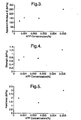
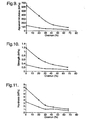
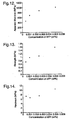
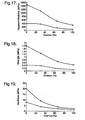
- In Figures 3 to 19, AFP containing examples are shown by (□), control samples containing no AFP are shown by (◆)
- Figure 3 shows a comparison of the apparent modulus measured for Examples 7-10 compared to a control sample.
- Figure 4 shows a comparison of the flexure strength measured for Examples 7-10 compared to a control sample.
- Figure 5 shows a comparison of the Vickers Hardness measured for Examples 7-10 compared to a control sample.
- Figure 6 shows a comparison of the apparent modulus measured for Example 11 compared to Comparative Examples A, B, & C and relevant control samples.
- Figure 7 shows a comparison of the flexure strength measured for Example 11 compared to Comparative Examples A, B, & C and relevant control samples.
- Figure 8 shows a comparison of the Vickers Hardness measured for Example 11 compared to Comparative Examples A, B, & C and relevant control samples.
- Figure 9 shows a comparison of the apparent modulus measured for Examples 12-16 compared with relevant control samples.
- Figure 10 shows a comparison of the flexure strength measured for Examples 12- 16 compared with relevant control samples.
- Figure 11 shows a comparison of the Vickers Hardness measured for Examples 12-16 compared with relevant control samples.
- Figure 12 shows a comparison of the apparent modulus measured for Examples 17-20 compared with a control sample.
- Figure 13 shows a comparison of the flexure strength measured for Examples 17-20 compared with a control sample.
- Figure 14 shows a comparison of the Vickers Hardness measured for Examples 17-20 compared with a control sample.
- Figure 15 shows a comparison of the apparent modulus measured for Examples 21-24 compared with a control sample.
- Figure 16 shows a comparison of the flexure strength measured for Examples 21-24 compared with a control sample.
- Figure 17 shows a comparison of the apparent modulus measured for Examples 25-28 compared with relevant control samples.
- Figure 18 shows a comparison of the flexure strength measured for Examples 25-28 compared with relevant control samples.
- Figure 19 shows a comparison of the Vickers Hardness measured for Examples 25-28 compared with relevant control samples.
- The invention will now be illustrated by means of the following examples:
- The standard four point bend test can be used to determine a number of mechanical properties of ice confection materials. The mechanical properties being measured are Young's modulus (apparent) and flexure strength.
- In a bend test, a test piece is deformed whilst measuring the applied force and test piece deflection. A schematic data set for an ice confection is shown in Figure 1. The apparent elastic modulus is determined by the gradient of the initial linear part of this curve.
- The 4-point bend test requires production of a parallel sided rectangular bar of ice confection material. This may be obtained by any suitable means.
- In this particular application the parallel sided rectangular bar of ice confection was made using aluminium moulds producing bars having the dimensions 25 x 25 x 200 mm.
- The liquid ice confection pre-mix was poured into a mould which had been pre-cooled in a blast freezer at -35°C for at least 30 minutes, the mould was then placed in a blast freezer at -35°C for at least 2 hours. The samples were then de-moulded and stored at -25°C until testing (conducted after 5-6 days). 18 to 24 hours prior to testing the samples were equilibrated by storing at -18°C, the temperature at which all tests were performed. A minimum of 10 bars was tested for each sample set and the mean value of each sample set was recorded as the value of the mechanical property being measured.
- The ice confection was extruded from the ice cream freezer (scraped surface heat exchanger) at a temperature of from - 1°C to -5°C, depending on the ice confection, into a mould which had been pre-cooled in a blast freezer at -35°C for at least 30 minutes, the mould was lined with silicon paper to prevent ice-metal adhesion. The sample was then prepared as above for quiescent frozen samples.
- The general test applied to all types of solids is described in "Biomechanics Materials. A practical Approach" Ed. J.F.V. Vincent, Pub. IRL Press, Oxford University Press, Walton Street, Oxford, 1992 and "Handbook of Plastics Test materials" Ed. R.P. Brown, Pub. George Godwin Limited, The Builder Group, 1-3 Pemberton Row, Fleet Street, London, 1981. Testing involves placing each bar onto 2 supports and bending it until fracture by applying pressure from two upper supports, that are separated by 85mm, centrally on the bar's top surface. The force applied in bending and the displacement of the moving contact is recorded throughout the test. The speed of descent of the moving support was 50mm per minute.
The apparent elastic modulus of the material is given by the equation;
- For these tests the span (S) was 170mm.
- With reference to Figure 1, the strength of a material under three point bend conditions, is given as;

- Recrystallisation inhibition properties can measured using a modified "splat assay" (Knight et al, 1988). 2.5 µl of the solution under investigation in 30% (w/w) sucrose is transferred onto a clean, appropriately labelled, 16 mm circular coverslip. A second coverslip is placed on top of the drop of solution and the sandwich pressed together between finger and thumb. The sandwich is dropped into a bath of hexane held at -80°C in a box of dry ice. When all sandwiches have been prepared, sandwiches are transferred from the -80°C hexane bath to the viewing chamber containing hexane held at -6°C using forceps pre-cooled in the dry ice. Upon transfer to -6°C, sandwiches can be seen to change from a transparent to an opaque appearance. Images are recorded by video camera and grabbed into an image analysis system (LUCIA, Nikon) using a 20x objective. Images of each splat are recorded at time = 0 and again after 60 minutes. The size of the ice-crystals in both assays is compared by placing the slides within a temperature controlled cryostat cabinet (Bright Instrument Co Ltd, Huntington, UK). Images of the samples are transferred to a Quantimet 520 MC image analysis system (Leica, Cambridge UK) by means of a Sony monochrome CCD videocamera. Ice crystal sizing was performed by hand-drawing around ice-crystal. At least 400 crystals were sized for each sample. The ice crystal size was taken as being the longest dimension of the 2D projection of each crystal. The average crystal size was determined as the number average of the individual crystal sizes. If the size at 30-60 minutes is similar or only moderately (less than 10%) increased compared to the size at t=0, and/or the crystal size is less than 20 micrometer, preferably from 5 to 15 micrometer this is an indication of good ice recrystallisation inhibition properties
- The Vickers Hardness test is an indentation test that involves pushing a pyramid shaped indentor into the surface of material and recording the force applied as a function of tip displacement. Force and displacement are measured during the indentation loading cycle and the unloading cycle.
- The test is described in "Handbook of Plastics Test materials" Ed. R.P. Brown, Pub. George Godwin Limited, The Builder Group, 1-3 Pemberton Row, Fleet Street, London, 1981.
- The Vickers pyramid geometry is an engineering industry standard (BSi 427, 1990). It has an apex angle at the tip of 136°. Hardness is determined as;


- The Vickers Hardness of a material is a measure of the material's resistance to plastic deformation.
- The test samples were 500ml blocks, manufactured by extruding the ice confection (typically at a temperature of from -1°C to -5°C) from a scraped surface heat exchanger into standard 500ml packets and then placing the packets into a blast freezer at -35°C for two hours prior to storage at -25°C. Prior to testing the samples were equilibrated overnight at the required test temperature of -18°C.
- Measurements were conducted on a universal testing machine made by Instron (code 4500), within a temperature controlled cabinet at -18°C. The crosshead speed was 2.0mm/min. The maximum load was 95N. The pyramid tip pushed into the surface of the material to a depth of 1.5mm for a water ice and 2.5mm for an ice cream.
- Contiguity is measured using microstructural images of the ice confection using cryogenic Scanning Electron Microscopy (SEM). Structures are imaged using the technique described in "A low temperature scanning electron microscopy study of ice cream. I. Techniques an general microstructure" Food Structure Vol. 11 (1992), pp 1-9.
- In a particulate composite, the Contiguity of the particulate phase is defined as the ratio of the particle to particle interface area divided by the total internal interface area. It is a measure of the degree of network formation of the particulate phase. In ice confections the particles are ice crystals within the matrix and thus contiguity of the ice is defined as;

- By placing an array of lines on the image of the microstructure, the number of intercepts of these lines with ice-ice and ice-matrix interfaces are counted and combined in the following equation, to give the contiguity;

- Ideally, approximately 800 interfaces were counted from a total of 5 images that are representative of each sample's structure.
- To determine contiguity, two sets of measurements were taken from each image. After placing a regular set of lines onto the image, the number of intercepts of the ice-matrix and ice-ice interfaces with these lines were counted, only including all obvious ice-ice interfaces. The count was then repeated, but this time with all possible ice-ice interfaces included. As such, a maximum ice contiguity measurement and a minimum ice contiguity measurement was made for each image. The mean of these figures is then taken as the contiguity value.
- The Euler-Poincare characteristic is measured using microstructural images of the ice confection using cryogenic Scanning Electron Microscopy (SEM). Structures are imaged using the technique described in "A low temperature scanning electron microscopy study of ice cream. I. Techniques on general microstructure" Food Structure Vol. II (1992), pp 1-9.
- In a two-phase composite structure, the degree of continuity of one phase can be measured using the Euler-Poincare characteristic. The lower value of the Euler-Poincare characteristic for a phase, the more continuous or connected that phase is within the microstructure. The Euler-Poincare characteristic can be a positive or negative number. The definition of the Euler-Poincare characteristic is given in "Unbiased estimation of the Euler-Poincare characteristic" by B.P. Pinnamaneni, C. Lantuejoul, J.P. Hernot and J.L. Chermant, Acta Sterelogica, 1989, 8/2, p101-106.
- To measure the Euler-Poincare characteristic for ice in ice confections, identification of the ice and matrix phases on the microstructural images was performed and using an image analysis system, the ice phase Euler-Poincare characteristic was determined using a specifically written analysis program. Whenever contrast in the images was insufficient for the image analysis system to automatically distinguish ice and matrix separately, the interface between the two was identified manually, thus enabling accurate determination of the Euler-Poincare characteristic.
- The Euler-Poincare characteristic can be measured for ice in an ice confection produced by any processing route.
- Samples were equilibrated at -18°C in a Prolan environmental cabinet for approximately 12 hours. Microscopic slides were prepared by smearing a thin layer of ice confection from the centre of thin glass plates.
- Each slide was transferred to a temperature controlled microscopic stage (at -18°C) where images of ice crystals (about 400 individual ice crystals) were collected and relayed through a video camera to an image storage and analysis system.
- The stored ice crystal images were highlighted manually by drawing around its perimeter which then highlights the whole crystal. Images of the highlighted crystals were then measured using the image analysis software which counts the number of pixels required to complete the longest diameter (length), shortest diameter (breadth), the aspect ratio (length/breadth).
- The average aspect ratio for the crystals was calculated.
- An ice cream composition was prepared having the following formulation:
weight % Sucrose 13.000 Skimmed Milk Powder 10.000 Butter fat 8.000 Maltodextrin 40 4.000 Monoglycerol Palmitate (MGP) 0.300 Locust Bean Gum 0.144 Carageenan L100 0.016 Flavour 0.012 Water to 100 Total soluble solids; 35% by weight
Ice content at -18°C; 54% by weight - All the ice cream ingredients were mixed together using a high shear mixer for approximately 3 minutes. The water being added at a temperature of 80°C. The temperature of the water ice mix was approximately 55-65°C after mixing.
- The mix was then homogenized (2000 psi) and passed through to a plate heat exchanger for pasteurization at 81°C for 25 seconds. The mix was then cooled to approximately 4°C in the plate heat exchanger prior to use.
- After pasteurisation Type III AFP (as described in WO 97/02343) was added to the ice cream pre-mix in the following concentrations;
- Example 7 - 0.0005% by weight
- Example 8 - 0.0025% by weight
- Example 9 - 0.005% by weight
- Example 10 - 0.001% by weight
- The ice cream pre-mix was then frozen using a Technohoy MF 75 scraped surface heat exchanger, no overrun was introduced into the ice cream. The ice cream was extruded at a temperature of from -4.3°C to -4.6°C. The product was then hardened in a blast freezer at -35°C, then stored at -25°C.
- The apparent elastic modulus and the flexure were determined using a four point bend test as described in Example 1.
- Results were compared with a control sample containing no AFP. Results are shown in Figures 3 and 4 where AFP containing examples are shown by (□) and control samples containing no AFP are shown by (◆).
- Δ modulus, Δ modulus/original modulus, Δ strength and A strength/original strength were calculated. Results are shown in Table 1.
- The Vickers Hardness was also determined using the method given in Example 3 results are shown in Figure 5 where AFP containing examples are shown by (□) and control samples containing no AFP are shown by (◆).
- ΔHv /Hv orig and ΔHv were calculated. Results are shown in Table 1.
Table 1 Example ΔE
(MPa)ΔE/ E orig Δσu
(MPa)Δσu /σu orig ΔHv
(MPa)ΔHv /Hv orig 7 7.3 1.7 0.2 0.47 1.65 6.2 8 104.8 2.46 0.3 0.67 1.25 9.0 9 208.3 4.9 0.8 1.76 2.7 10.2 10 109.6 2.58 0.37 0.8 - - - An ice cream pre-mix having the formulation of Example 8 was prepared as described for Example 8, the pre-mix was then frozen as described for Example 8 with the following overruns (volume fraction of air (Vair)).
- Example 11 - No overrun (0)
- Comparative Example A - 43% overrun (0.3)
- Comparative Example B - 67% overrun (0.4)
- Comparative Example C - 100% overrun (0.5)
- The apparent elastic modulus and the flexure strength were determined using a four point bend test as described in Example 1.
- Results were compared with relevant control samples containing no AFP. Results are shown in Figures 6 and 7
where AFP containing examples are shown by (□) and control samples containing no AFP are shown by (◆). - A modulus, A modulus/original modulus, A strength and Δ strength/original strength were calculated. Results are shown in Table 2.
- The Vickers Hardness was also determined using the method given in Example 3 results are shown in Figure 8 where AFP containing examples are shown by (□) and control samples containing no AFP are shown by (◆).
- ΔHv /Hv orig and ΔHv were calculated. Results are shown in Table 2.
Table 2 Example ΔE
(MPa)ΔE/ Eorig Δσu
(MPa)Δσu/ σ u orig ΔHv
(MPa)ΔHv / Hv orig 11 132 5.1 0.5 2.3 1.25 8.9 A 40 4.7 0.1 1.5 0.2 4.0 B 17 3.3 0.05 1.1 0.15 4.3 C 6.6 1.6 0.02 0.4 0.05 2.1 - A water ice solution having the following composition was prepared as follows;
% by weight Sucrose 25 Locust Bean Gum 0.5 Hydrolysed milk protein (Hyfoama DS**) 0.1 Type III AFP* 0.0025 water to 100 * as described in WO 97/02343
** Hyfoama DS is a trademark from Quest International
Total soluble solids; 25.5 % by weight
Ice Content at -18°C; 62% by weight - All the water ice ingredients except AFP were mixed together using a high shear mixer for approximately 3 minutes. The water being added at a temperature of 80°C. The temperature of the water ice mix was approximately 55-65°C after mixing.
- The mix was then passed through to a plate heat exchanger for pasteurization at 81°C for 25 seconds. The mix was then cooled to approximately 4°C in the plate heat exchanger prior to use.
- The AFP was added after pasteurisation.
- The water ice solution was frozen in a Technohoy MF 75 scraped surface heat exchanger with the following overruns (volume fraction of air). The water ice was extruded at a temperature of from -3.8°C to -4.5°C. The product was then hardened in a blast freezer at -35°C, then stored at -25°C.
- Example 12 - No overrun (0)
- Example 13 - 20% overrun (0.167)
- Example 14 - 30% overrun (0.23)
- Example 15 - 43% overrun (0.3)
- Example 16 - 67% overrun (0.4)
- The apparent elastic modulus and the flexure strength were determined using a four point bend test as described in Example 1.
- Results were compared with a control sample containing no AFP. Results are shown in Figures 9 and 10 where AFP containing examples are shown by (□ ) and control samples containing no AFP are shown by (◆).
- Δ modulus, Δ modulus/original modulus, Δ strength and Δ strength/original strength. were calculated. Results are shown in Table 3.
- The Vickers Hardness was also determined using the method given in Example 3 results are shown in Figure 11 where AFP containing examples are shown by (□) and control samples containing no AFP are shown by (◆).
- ΔHv /Hv orig and ΔHv were calculated. Results are shown in Table 3.
Table 3 Example ΔE
(MPa)ΔE/ Eorig Δσu
(MPa)Δσu/ σu orig ΔHv
(MPa)ΔHv /Horig 12 500.3 3.7 0.8 2.5 4.35 1.3 13 300.7 4.1 0.5 2.6 2.2 1.3 14 193.4 3.7 0.3 2.6 1.25 1.1 15 101.5 2.1 0.2 1.7 0.6 0.5 16 52.1 1.9 0.1 1.5 0.45 0.7 - A water ice solution having the following composition was prepared as follows;
Weight % Sucrose 20.0 Locust Bean Gum 0.2 Water to 100 Total soluble solids; 20.2% by weight
Ice content at -18°C; 70% by weight - The water ice solution was prepared as in Example 12.
- After pasteurisation Type III AFP (as described in WO 97/02343) was added to the water ice solution in the following concentrations;
- Example 17 - 0.0005%
- Example 18 - 0.0011%
- Example 19 - 0.0025%
- Example 20 - 0.005%
- The water ice solution was frozen in a Technohoy MF 75 scraped surface heat exchanger with no overrun being introduced. The water ice was extruded at a temperature of from -3.9°C to -5.6°C. The product was then hardened in a blast freezer at -35°C, then stored at -25°C.
- The apparent elastic modulus and the flexure strength were determined using a four point bend test as described in Example 1.
- Results were compared with a control sample containing no AFP. Results are shown in Figures 12 and 13 where AFP containing examples are shown by (□) and control samples containing no AFP are shown by (◆).
- Δ modulus, Δ modulus/original modulus, Δ strength and A strength/original strength were calculated. Results are shown in Table 4.
- The Vickers Hardness was also determined using the method given in Example 3 results are shown in Figure 14 where AFP containing examples are shown by (□) and control samples containing no AFP are shown by (◆) .
- ΔHvl Hv orig and ΔHv were calculated. Results are shown in Table 4.
Table 4 Example ΔE
(MPa)ΔE/ E orig Δσu
(MPa)Δσu/ σu orig ΔHv
(MPa)ΔHv /Hv orig 17 243 1.1 0.3 0.8 3.8 1.12 18 471 2.2 0.6 1.5 3.2 0.9 19 662 3.1 0.7 1.7 4.0 1.2 20 785 3.7 1.2 3.0 7.0 2.0 - A water ice solution having the following composition was prepared as in Example 12;
Weight % Sucrose 20.0 Locust Bean Gum 0.2 Water to 100 Total soluble solids; 20.2% by weight
Ice content at -18°C; 70% by weight - After pasteurisation Type III AFP (as described in WO 97/02343) was added to the water ice solution in the following concentrations;
- Example 21 - 0.0005%
- Example 22 - 0.0011%
- Example 23 - 0.0025%
- Example 24 - 0.005%
- The water ice solution was then quiescently frozen. The water ice solution was poured into the split metal moulds used for the production of mechanical test pieces (see example 1). They were then placed in the cold store overnight to freeze quiescently at a temperature of -25°C. The next day, the test bars were demoulded, placed in polythene bags and stored at -25°C until the day prior to mechanical testing.
- The apparent elastic modulus and the flexure strength were determined using a four point bend test as described in Example 1.
- Results were compared with a control sample containing no AFP. Results are shown in Figures 15 and 16 where AFP containing examples are shown by (□) and control samples containing no AFP are shown by (◆).
- Δ modulus, Δ modulus/original modulus, Δ strength and Δ strength/original strength were calculated. Results are shown in Table 5.
Table 5 Example ΔE
(MPa)ΔE/ E orig Δσu
(MPa)Δσu/ σ u orig 21 871 2.7 0.85 2.7 22 985 3.1 0.96 3.0 23 1269 4.0 1.4 4.2 24 1347 4.2 1.5 4.8 - A water ice solution having the following composition was prepared as in Example 12;
% by weight Sucrose 15 Locust Bean Gum 0.3 Hydrolysed milk protein (Hyfoama DS**) 0.1 Type III AFP* 0.0025 Water to 100 * as described in WO 97/02343
** Hyfoama DS is a trademark from Quest International
Total Soluble Solids; 10.2% by weight
Ice content at -18°C; 85% by weight - The water ice solution was frozen in a Technohoy MF 75 scraped surface heat exchanger with the following overruns being introduced (volume fraction of air). The water ice was extruded at a temperature of from -2.5°C to -3.1°C. The product was then hardened in a blast freezer at -35°C, then stored at -25°C.
- Example 25 - 0% overrun (0)
- Example 26 - 30% overrun (0.231)
- Example 27 - 67% overrun (0.4)
- Example 28- 100% overrun (0.5)
- The apparent elastic modulus and the flexure strength were determined using a four point bend test as described in Example 1.
- Results were compared with a control sample containing no AFP. Results are shown in Figures 17 and 18 where AFP containing examples are shown by (□) and control samples containing no AFP are shown by (◆) .
- Δ modulus, Δ modulus/original modulus, Δ strength and Δ strength/original strength were calculated. Results are shown in Table 6.
- The Vickers Hardness was also determined using the method given in Example 3 results are shown in Figure 19 where AFP containing examples are shown by (□) and control samples containing no AFP are shown by (◆).
- ΔHv /Hv orig and ΔHv were calculated. Results are shown in Table 6.
Table 6 Example ΔE
(MPa)ΔE/ E orig Δσu
(MPa)Δσu/ σu orig ΔHv
(MPa)ΔHv / H v orig25 1081 2.8 1.4 3.36 8.67 1.28 26 747 2.10 0.89 2.39 2.51 1.15 27 395 3.06 0.5 3.19 0.93 0.73 28 243 4.73 0.33 3.87 0.65 0.71 - An ice cream composition was prepared having the following formulation;
weight % Sucrose 13.000 Skimmed Milk Powder 10.000 Butter fat 8.000 Maltodextrin 40 4.000 MGP 0.300 Locust Bean Gum 0.144 Carageenan L100 0.016 Flavour 0.012 Water to 100 Total Soluble solids; 35% by weight
Ice content at -18°C; 54% by weight - All the ice cream ingredients were mixed together using a high shear mixer for approximately 3 minutes. The water being added at a temperature of 80°C. The temperature of the water ice mix was approximately 55-65°C after mixing.
The mix was then homogenized (2000 psi) and passed through to a plate heat exchanger for pasteurization at 81°C for 25 seconds. The mix was then cooled to approximately 4°C in the plate heat exchanger prior to use. - After pasteurisation Type III AFP (as described in WO 97/02343) was added to the ice cream pre-mix in the following concentrations;
- Example 29 - 0.0005% by weight
- Example 30 - 0.005 % by weight
- Comparative Example D - no AFP
- The ice cream pre-mix was then frozen using a Technohoy MF 75 scraped surface heat exchanger, no overrun was introduced into the ice cream. The ice cream was extruded at a temperature of from -4.4 to -5.4°C. The product was then hardened in a blast freezer at -35°C, then stored at -25°C.
- Contiguity was measured as in Example 4.
- Results are shown in Table 7
Table 7 Example Contiguity 29 0.2 30 0.3 D 0.1 - A water ice solution having the following composition was prepared as follows;
Weight % Sucrose 20.0 Locust Bean Gum 0.2 Water to 100 Total soluble solids; 20.2% by weight
Ice content at -18°C; 70% by weight - The water ice solution was prepared as in Example 12. After pasteurisation Type III AFP (as described in WO 97/02343) was added to the water ice solution in the following concentrations;
- Example 31 - 0.0005% by weight
- Example 32 - 0.005 % by weight
- Comparative Example E - no AFP
- The water ice solution was frozen in a Technohoy MF 75 scraped surface heat exchanger with no overrun being introduced. The water ice was extruded at a temperature of from -3.9°C to -5.6°C. The product was then hardened in a blast freezer at -35°C, then stored at -25°C.
- Contiguity was measured as in Example 4.
- Results are shown in Table 8
Table 8 Example Contiguity 31 0.24 32 0.22 E 0.11 - An ice cream composition was prepared having the following formulation;
Weight % Sucrose 13.000 Skimmed Milk Powder 10.000 Butter fat 8.000 Maltodextrin 40 4.000 MGP 0.300 Locust Bean Gum 0.144 Carageenan L100 0.016 Flavour 0.012 Water to 100 Total soluble solids; 35% by weight
Ice content at -18°C; 54% by weight. - All the ice cream ingredients were mixed together using a high shear mixer for approximately 3 minutes. The water being added at a temperature of 80°C. The temperature of the water ice mix was approximately 55-65°C after mixing.
- The mix was then homogenized (2000 psi) and passed through to a plate heat exchanger for pasteurization at 81°C for 25 seconds. The mix was then cooled to approximately 4°C in the plate heat exchanger prior to use.
- After pasteurisation Type III AFP (as described in WO 97/02343) was added to the ice cream pre-mix in the following concentrations;
- Example 33 - 0.005% by weight
- Comparative Example F - no AFP
- The ice cream pre-mix was then frozen using a Technology MF 75 scraped surface heat exchanger, no overrun was introduced into the ice cream. The ice cream was extruded at a temperature of from -4.4 to -5.4°C. The product was then hardened in a blast freezer at -35°C, then stored at -25°C.
- The Euler-Poincare characteristic was measured as in Example 5.
- Results are shown in Table 9.
Table 9 Example Euler-Poincare characteristic (mm-z) 33 -577 F 339 - A water ice solution having the following composition was prepared as follows;
Weight % Sucrose 20.0 Locust Bean Gum 0.2 Water to 100 Total soluble solids; 20.2% by weight
Ice content at -18°C; 70% by weight - The water ice solution was prepared as in Example 12.
- After pasteurisation Type III AFP (as described in WO 97/02343) was added to the water ice solution in the following concentrations;
- Example 34 - 0.005 % by weight
- Comparative Example G - no AFP
- The water ice solution was frozen quiescently as described in Example 24 with no overrun being introduced.
- The Euler-Poincare characteristic was measured as in Example 5.
- Results are shown in Table 10.
Table 10 Example Euler-Poincare characteristics (mm-2) 34 -383 G 4.3 - A milk ice solution having the following composition was prepared as follows;
% (w/w) Sucrose 13.2 Corn Syrup 2.8 Whole Milk Powder 11.2 Skimmed Milk Powder 5.0 Stabiliser 0.27 Emulsifier 0.20 Colour/Flavour 0.06 AFP* 0.005 Water to 100 * as described in WO 97/02343 - All the milk ice ingredients except AFP were mixed together using a high shear mixer for approximately 3 minutes. The water being added at a temperature of 80°C. The temperature of the milk ice mix was approximately 55-65°C after mixing.
- The mix was then homogenized (2000 psi) and passed through to a plate heat exchanger for pasteurisation at 81°C for 25 seconds. The mix was then cooled to approximately 4°C in the plate heat exchanger prior to use.
- The mix was then portioned into two halves, and Type III AFP (as described in WO 97/02343) was added to one half.
- The milk ice solutions were then quiescently frozen. The milk ice solution was poured into the split metal moulds used for the production of mechanical test pieces (see example 1). They were then placed in the cold store overnight to freeze quiescently at a temperature at -25°C.
- The next day, the test bars were demoulded, placed in polythene bags and stored at -25°C until the day prior to mechanical testing.
- The apparent elastic modulus and the flexure strength were determined using a four point bend test as described in Example 1.
- Results for the milk ice containing AFP were compared with the control sample containing no AFP.
- Δ modulus, Δ modulus/original modulus, Δ strength and Δ strength/original strength were calculated. Results are shown in Table 11.
Table 11 Example ΔE
(MPa)ΔE/ E orig Δσu
(MPa)Δσu/ σu orig 35 756 16.2 1.81 6.68 - A milk ice solution having the following composition was prepared as follows;
% (w/w) Sucrose 13.2 Corn Syrup 2.8 Whole Milk Powder 11.2 Skimmed Milk Powder 5.0 Stabiliser 0.27 Emulsifier 0.20 Colour/Flavour 0.06 AFP* 0.005 Water to 100 *as described in WO 97/02343 - All the milk ice ingredients except AFP were mixed together using a high shear mixer for approximately 3 minutes. The water being added at a temperature of 80°C. The temperature of the milk ice mix was approximately 55-65°C after mixing.
- The mix was then homogenized (2000 psi) and passed through to a plate heat exchanger for pasteurisation at 81°C for 25 seconds. The mix was then cooled to approximately 4°C in the plate heat exchanger prior to use.
- The mix was then portioned into two halves, and Type III AFP (as described in WO 97/02343) was added to one half.
- The milk ice solutions were frozen in a Technology MF 75 scraped surface heat exchanger with no overrun being introduced. The water ice was extruded at a temperature of from -3.9°C to -5.6°C. The product was then hardened in a blast freezer at -35°C, then stored at -25°C.
- The apparent elastic modulus and the flexure strength were determined using a four point bend test as described in Example 1.
- Results for the milk ice containing AFP were compared with the control sample containing no AFP.
- Δ modulus, Δ modulus/original modulus, Δ strength and Δ strength/original strength were calculated.
- Results are shown in Table 12.
Table 12 Example ΔE
(MPa)ΔE/ Eorig Δσu
(MPa)Δσu/ σu orig 36 290 5.08 0.968 4.17 - An ice cream composition was prepared having the following formulation;
weight % Sucrose 13.500 Skimmed Milk Concentrate (30% solids) 24.000 Cream (40% fat) 43.000 Egg Yolk (unsweetened) 4.500 Vanilla flavour 1.000 Water to 100 Total Soluble solids; 45% by weight
Ice content at -18°C; 46% by weight - All the ice cream ingredients were mixed together using a high shear mixer for approximately 3 minutes. The water being added at a temperature of 80°C. The temperature of the ice cream mix was approximately 38-45°C after mixing.
- The mix was then homogenized (2000 psi) and passed through to a plate heat exchanger for pasteurization at 81°C for 25 seconds. The mix was then cooled to approximately 4°C in the plate heat exchanger prior to use.
- After pasteurisation Type I AFP (from AF Protein) was added to the ice cream pre-mix in the following concentration;
- The ice cream pre-mix was then frozen using a Technohoy MF 75 scraped surface heat exchanger with no overrun being introduced. The ice cream was extruded at a temperature of from -4.8°C to -5.5°C. The product was then hardened in a blast freezer at -35°C, then stored at -25°C.
- The apparent elastic modulus and the flexure strength were determined using a four point bend test as described in Example 1.
- Results were compared with relevant control sample containing no AFP.
- Δ modulus, Δ modulus/original modulus, Δ strength and Δ strength/original strength were calculated. Results are shown in Table 13.
Table 13 Example ΔE
(MPa)ΔE/ E orig Δσu
(MPa)Δσu/ σu orig 37 138 4.2 0.408 1.09 - A water ice solution having the following composition was prepared as follows;
% by weight Sucrose 18 Locust Bean Gum 0.18 Hydrolysed milk protein (Hyfoama DS) 0.1 Grass AFP solution* 30.0 water to 100 * as described in WO 98/04699. The amount of grass AFP solution used was determined by the minimum amount required to provide the recrystallisation inhibition as defined by Example 2.
Total soluble solids; 18% by weight
Ice Content at -18°C; 73% by weight - A control mix was made without AFP, the grass AFP solution being replaced by 30% by weight water.
- All the water ice ingredients except AFP were mixed together using a high shear mixer for approximately 3 minutes. The water being added at a temperature of 80°C. The temperature of the water ice mix was approximately 55-65°C after mixing.
- The mix was then passed through to a plate heat exchanger for pasteurization at 81°C for 25 seconds. The mix was then cooled to approximately 4°C in the plate heat exchanger prior to use.
- The AFP was added after pasteurisation.
- The water ice solution was frozen in a Technohoy MF 75 scraped surface heat exchanger with no overrun introduced. The water ice was extruded at a temperature of from -2.6°C to -3.6°C. The product was then hardened in a blast freezer at -35°C, then stored at -25°C.
- The apparent elastic modulus and the flexure strength were determined using a four point bend test as described in Example 1.
- Results were compared with the control sample containing no AFP.
- Δ modulus, Δ modulus/original modulus, Δ strength and Δ strength/original strength were calculated. Results are shown in Table 14.
Table 14 Example ΔE
(MPa)ΔE/ Eorig Δσu
(MPa)Δσu/ (σu orig 38 230 0.84 0.615 1.03 - A water ice solution having the following composition was prepared as follows;
% by weight Sucrose 18 Locust Bean Gum 0.18 Hydrolysed milk protein (Hyfoama DS**) 0.1 Grass AFP solution* 30.0 water to 100 * as described in WO 98/04699. The amount of grass AFP solution used was determined by the minimum amount required to provide the recrystallisation inhibition as defined by Example 2.
** Hyfoama DS is a Trademark of Quest International.
Total soluble solids; 18% by weight
Ice Content at -18°C; 73% by weight - A control mix was made without AFP, the grass AFP solution being replaced by 30% by weight water.
- All the water ice ingredients except AFP were mixed together using a high shear mixer for approximately 3 minutes. The water being added at a temperature of 80°C. The temperature of the water ice mix was approximately 55-65°C after mixing.
- The mix was then passed through to a plate heat exchanger for pasteurization at 81°C for 25 seconds. The mix was then cooled to approximately 4°C in the plate heat exchanger prior to use.
- After pasteurisation the AFP solution was added to the water ice solution.
- The water ice solution was then quiescently frozen. The water ice solution was poured into the split metal moulds used for the production of mechanical test pieces (see example 1). They were then placed in the cold store overnight to freeze quiescently at a temperature of -25°C.
- The next day, the test bars were demoulded, placed in polythene bags and stored at -25°C until the day prior to mechanical testing.
- The apparent elastic modulus was determined using a four point bend test as described in Example 1.
- Results were compared with the control sample containing no AFP.
- Δ modulus and Δ modulus/original modulus were calculated. Results are shown in Table 15.
Table 15 Example ΔE
(MPa)ΔE/ Eorig 39 146 2.59 - Production of a complex shape water ice using a single piece silicone rubber mould.
- A water ice solution having the following composition was prepared as follows ;
% (w/w) Sucrose 10.0 Glucose 5.0 Locust Bean Gum 0.2 Citric Acid 0.5 AFP * 0.005 Colour / Flavour 0.2 Water to 100 * as described in WO 97/02343 - All the water ice ingredients except AFP were mixed together using a high shear mixer for approximately 3 minutes. The water being added at a temperature of 80°C. The temperature of the water ice mix was approximately 55-65°C after mixing.
- The mix was then homogenized (2000 psi) and passed through to a plate heat exchanger for pasteurization at 81°C for 25 seconds. The mix was then cooled to approximately 4°C in the plate heat exchanger prior to use.
- The mix was then portioned into two halves, and AFP added to one half.
- Portions of each water ice mix were aliquoted into silicone rubber moulds in the shape of a crocodile. The overall dimensions of the crocodile were approximately 15cm long and 3cm wide (at its widest point). The legs were approximately 2cm long and 0.5cm thick. Mix was frozen for 2 hours in a blast freezer at -35°C. The moulds were then transferred to a cold store at -25°C overnight prior to demoulding.
- On attempting to demould the water ice crocodile which did not contain AFP, the small protrusions (including the legs and the tail) were too fragile, and broke off as the product was removed from the mould. In contrast, the crocodile containing AFP could be removed from the mould in one piece, with all small protrusions remaining intact.
Claims (12)
- An aerated water ice or an aerated milk ice confection comprising an antifreeze protein, wherein Δ modulus/original modulus ≥ 0.4, and/or Δ strength/original strength ≥ 0.4; providing that when Δ modulus/original modulus ≤ 6.0, Δ modulus ≥ 50MPa, and/or when Δ strength/original strength ≤ 2.0, Δ strength ≥ 0.2MPa.
- An ice confection according to claim 1 wherein Δ modulus/original modulus ≥ 0.4; providing that when Δ modulus/original modulus ≤ 6.0, Δ modulus ≥ 90MPa.
- An ice confection according to claim 1 wherein Δ modulus/original modulus ≥ 1.0; providing that when Δ modulus/original modulus ≤ 6.0, Δ modulus ≥ 100MPa.
- An ice confection according to claim 1, wherein Δ strength/original strength ≥ 0.7, most preferably ≥ 1.5.
- An ice confection according to claim 1 having a Vickers hardness measure (Hv) wherein ΔHv /Hv orig ≥ 0.3, providing that when ΔHv /Hv orig ≤ 5.0, ΔHv ≥ 0.3
- An ice confection according to claim 1, wherein the antifreeze protein is chosen such that it provides an aspect ratio of more than 1.9, preferably from 1.9 to 3.0, more preferably from 2.0 to 2.9, most preferably from 2.1 to 2.8, to the crystal.
- An ice confection according to claim 1, wherein the antifreeze protein is AFP Type III HPLC 12.
- An ice confection according to claim 1, wherein the antifreeze protein is present at a concentration of at least 0.0005% by weight, preferably at least 0.0025% by weight.
- An ice confection according to any preceding claim, wherein the ice confection has an ice content of at least 30% by volume, preferably at least 40% by volume, more preferably 50% by volume, when measured at -18°C.
- An ice confection according to any preceding claim having a contiguity of at least 0.2 and an ice content of from 50 to 90% by weight when measured at -18°C.
- An ice confection according to any preceding claim having a Euler-Poincare characteristic of less than -150mm-2 and an ice content of from 50 to 90% by weight when measured at -18°C.
- Use of an ice confection according to any preceding claim to provide an ice confection product having a high degree of definition.
Priority Applications (1)
| Application Number | Priority Date | Filing Date | Title |
|---|---|---|---|
| EP04002847A EP1417892B1 (en) | 1999-03-10 | 2000-03-02 | Ice cream confection containing an antifreeze protein |
Applications Claiming Priority (6)
| Application Number | Priority Date | Filing Date | Title |
|---|---|---|---|
| GB9905524 | 1999-03-10 | ||
| GB9905524A GB9905524D0 (en) | 1999-03-10 | 1999-03-10 | Ice confection |
| EP99305842 | 1999-07-23 | ||
| EP99305842 | 1999-07-23 | ||
| EP04002847A EP1417892B1 (en) | 1999-03-10 | 2000-03-02 | Ice cream confection containing an antifreeze protein |
| EP00910745A EP1158863B1 (en) | 1999-03-10 | 2000-03-02 | Ice confection containing antifreeze protein |
Related Parent Applications (1)
| Application Number | Title | Priority Date | Filing Date |
|---|---|---|---|
| EP00910745A Division EP1158863B1 (en) | 1999-03-10 | 2000-03-02 | Ice confection containing antifreeze protein |
Publications (2)
| Publication Number | Publication Date |
|---|---|
| EP1417892A1 EP1417892A1 (en) | 2004-05-12 |
| EP1417892B1 true EP1417892B1 (en) | 2007-05-23 |
Family
ID=26153552
Family Applications (6)
| Application Number | Title | Priority Date | Filing Date |
|---|---|---|---|
| EP00918753A Expired - Lifetime EP1158866B1 (en) | 1999-03-10 | 2000-03-02 | Use of antifreeze proteins in ice confections |
| EP00914099A Expired - Lifetime EP1158865B8 (en) | 1999-03-10 | 2000-03-02 | Ice confection with antifreeze protein |
| EP04002847A Expired - Lifetime EP1417892B1 (en) | 1999-03-10 | 2000-03-02 | Ice cream confection containing an antifreeze protein |
| EP00910746A Expired - Lifetime EP1158864B1 (en) | 1999-03-10 | 2000-03-02 | Ice confection containing antifreeze protein |
| EP00907659A Expired - Lifetime EP1158862B1 (en) | 1999-03-10 | 2000-03-02 | Overrun water ice with antifreeze protein |
| EP00910745A Expired - Lifetime EP1158863B1 (en) | 1999-03-10 | 2000-03-02 | Ice confection containing antifreeze protein |
Family Applications Before (2)
| Application Number | Title | Priority Date | Filing Date |
|---|---|---|---|
| EP00918753A Expired - Lifetime EP1158866B1 (en) | 1999-03-10 | 2000-03-02 | Use of antifreeze proteins in ice confections |
| EP00914099A Expired - Lifetime EP1158865B8 (en) | 1999-03-10 | 2000-03-02 | Ice confection with antifreeze protein |
Family Applications After (3)
| Application Number | Title | Priority Date | Filing Date |
|---|---|---|---|
| EP00910746A Expired - Lifetime EP1158864B1 (en) | 1999-03-10 | 2000-03-02 | Ice confection containing antifreeze protein |
| EP00907659A Expired - Lifetime EP1158862B1 (en) | 1999-03-10 | 2000-03-02 | Overrun water ice with antifreeze protein |
| EP00910745A Expired - Lifetime EP1158863B1 (en) | 1999-03-10 | 2000-03-02 | Ice confection containing antifreeze protein |
Country Status (14)
| Country | Link |
|---|---|
| US (5) | US6491960B1 (en) |
| EP (6) | EP1158866B1 (en) |
| CN (5) | CN1129369C (en) |
| AT (6) | ATE296037T1 (en) |
| AU (5) | AU767157B2 (en) |
| BR (5) | BR0008888B1 (en) |
| CA (5) | CA2363245C (en) |
| DE (6) | DE60015093T2 (en) |
| DK (4) | DK1158863T3 (en) |
| ES (6) | ES2230075T3 (en) |
| IL (10) | IL145154A0 (en) |
| PT (5) | PT1158865E (en) |
| TR (5) | TR200102592T2 (en) |
| WO (5) | WO2000053026A1 (en) |
Families Citing this family (50)
| Publication number | Priority date | Publication date | Assignee | Title |
|---|---|---|---|---|
| DK0836646T3 (en) | 1995-07-05 | 2005-12-19 | Unilever Nv | Anti-freeze peptides from sea fish as additives to food products |
| GB9801410D0 (en) * | 1998-01-22 | 1998-03-18 | Unilever Plc | Frozen food product |
| ES2230075T3 (en) * | 1999-03-10 | 2005-05-01 | Unilever N.V. | ICE CREAM CONTAINING AN ANTI-FREEZING PROTEIN. |
| US6713101B2 (en) * | 2001-05-01 | 2004-03-30 | Nestec S.A. | Frozen dessert novelty and method for its preparation |
| US20030049304A1 (en) * | 2001-08-29 | 2003-03-13 | Somani Jitendra Krishan | Quiescently frozen ice products |
| EP2888948B1 (en) | 2003-04-11 | 2018-02-28 | Cargill, Incorporated | Pellet systems for preparing beverages |
| US7261913B2 (en) * | 2003-07-07 | 2007-08-28 | Dreyer's Ice Cream, Inc. | Aerated frozen suspension with adjusted creaminess and scoop ability based on stress-controlled generation of superfine microstructures |
| US7655265B2 (en) * | 2003-07-07 | 2010-02-02 | Nestec S.A. | Process control scheme for cooling and heating compressible compounds |
| US20050048177A1 (en) * | 2003-08-22 | 2005-03-03 | Reardon Daniel J. | Frozen food item and mold system and method therefor |
| US7155810B2 (en) * | 2003-09-30 | 2007-01-02 | Hitachi Global Storage Technologies Netherlands, B.V. | Method for fabricating a magnetic head |
| CA2548784A1 (en) * | 2003-12-10 | 2005-06-30 | Unilever Plc | Frozen confectionery product comprising ice structuring proteins |
| US20050276886A1 (en) * | 2004-06-12 | 2005-12-15 | Bobby Joe | Micro wave ice cream |
| US20060029709A1 (en) * | 2004-08-06 | 2006-02-09 | Cool Frootz, Llc | Masticated frozen confection material |
| ZA200705400B (en) * | 2004-12-23 | 2008-09-25 | Unilever Plc | Frozen aerated confections |
| TWI382918B (en) * | 2005-04-19 | 2013-01-21 | Sulzer Chemtech Ag | Uses of a method for the manufacture of foamed shaped polymer parts of liquid silicone rubber |
| AU2006201781B8 (en) | 2005-07-14 | 2008-05-15 | Unilever Plc | Low fat frozen confectionery product |
| CA2614287A1 (en) * | 2005-07-25 | 2007-02-01 | Telefonaktiebolaget Lm Ericsson (Publ) | Means and methods for improving the handover characteristics of radio access networks |
| PT1926398E (en) | 2005-09-23 | 2011-02-15 | Unilever Nv | Aerated products with reduced creaming |
| DE602006004369D1 (en) | 2005-09-23 | 2009-01-29 | Unilever Nv | VENTED PRODUCTS WITH LOW PH |
| US20070110855A1 (en) * | 2005-11-15 | 2007-05-17 | Mosey Thomas R | Cup with Self Contained Utensil for Cryogenically Frozen Dessert Particles |
| BRPI0620661A2 (en) * | 2005-12-14 | 2011-11-22 | Unilever Nv | Iced confection and process for making an iced confection |
| EP1800543B1 (en) | 2005-12-21 | 2008-05-14 | Unilever Plc | Frozen aerated confection |
| PT1978819E (en) * | 2006-01-31 | 2009-09-07 | Unilever Nv | Aerated product |
| BRPI0714468A2 (en) * | 2006-07-17 | 2013-03-19 | Nestec Sa | Smart Foam Containing Products and Manufacturing Method |
| EP2043453A2 (en) * | 2006-07-17 | 2009-04-08 | Nestec S.A. | Healthy and nutritious low calorie, low fat foodstuffs |
| AU2007276183A1 (en) * | 2006-07-17 | 2008-01-24 | Nestec S.A. | Stable foam and process for its manufacture |
| MY149295A (en) * | 2006-07-17 | 2013-08-30 | Nestec Sa | Cylindrical membrane apparatus for forming foam |
| DE602007002530D1 (en) * | 2006-08-07 | 2009-11-05 | Unilever Plc | Eiskonfekt |
| EP1886579B1 (en) * | 2006-08-07 | 2009-09-23 | Unilever PLC | Ice Confection |
| FR2906688B1 (en) * | 2006-10-09 | 2012-04-20 | Lavisse Isabelle Desjardins | PROCESS FOR OBTAINING A PRODUCT SUBJECT TO GASIFICATION AND FREEZING |
| ES2356263T3 (en) | 2006-10-19 | 2011-04-06 | Unilever Plc | FROZEN AIR SWEETS AND PRODUCTION PROCEDURE OF THE SAME. |
| EP1917865B1 (en) | 2006-10-20 | 2012-03-28 | Nestec S.A. | Ice-structuring peptides of lactic origin |
| EP2602263B1 (en) | 2007-11-21 | 2019-07-17 | Roskilde Universitet | Polypeptides comprising an ice-binding activity |
| ES2390201T3 (en) * | 2007-11-30 | 2012-11-07 | Unilever N.V. | Frozen product and procedure for its production |
| EP2108265B1 (en) | 2008-04-11 | 2012-07-04 | Unilever PLC | Ice confection |
| ES2411430T3 (en) * | 2008-06-05 | 2013-07-05 | Unilever N.V. | Ice cream confectionery |
| CA2745522A1 (en) | 2008-12-16 | 2010-06-24 | Unilever Plc | Method for extracting hydrophobin from a solution |
| BR112012030149B1 (en) | 2010-06-03 | 2018-03-13 | Unilever N.V. | Frozen confectionery, frozen confectionery, frozen confectionery manufacturing process, method for reducing foaming in the production of frozen confectionery and use of a combination of locust bean gum and xanthan gum |
| WO2012001140A1 (en) * | 2010-06-30 | 2012-01-05 | Svaneke Is Aps | Process for the preparation of a frozen dairy-based product |
| EP2596706A4 (en) * | 2010-08-26 | 2015-01-28 | Nichirei Foods Inc | METHOD FOR INCREASING THERMAL HYSTERESIS ACTIVITY, METHOD FOR REDUCING THERMAL INACTIVATION OF THERMAL HYSTERESIS ACTIVITY, AND COMPOSITION FOR INCREASING THERMAL HYSTERESIS ACTIVITY |
| US8771778B2 (en) | 2010-09-09 | 2014-07-08 | Frito-Lay Trading Company, Gmbh | Stabilized foam |
| WO2012045652A2 (en) | 2010-10-04 | 2012-04-12 | Unilever Plc | Method for producing an edible gas hydrate |
| WO2013001074A1 (en) * | 2011-06-30 | 2013-01-03 | Svaneke Is Aps | Process for the preparation of a frozen dairy-based product |
| CN103648297B (en) * | 2011-07-11 | 2016-10-05 | 荷兰联合利华有限公司 | Frozen desserts with gel coating |
| BR112015024728B1 (en) * | 2013-04-08 | 2021-03-16 | Unilever Ip Holdings B.V. | process for making a frozen confection |
| RU2554436C1 (en) * | 2014-05-07 | 2015-06-27 | Олег Иванович Квасенков | Method for production of "morozko" plombier (versions) |
| WO2015169522A2 (en) * | 2014-05-08 | 2015-11-12 | Unilever Plc | Method for manufacturing a frozen confection |
| US11110176B2 (en) | 2016-11-25 | 2021-09-07 | The Board Of Trustees Of The California State University | Composition and method for the protection of proteins, cell components and cells during temperature stress |
| CN107349994A (en) * | 2017-07-25 | 2017-11-17 | 中南林业科技大学 | A kind of flexible husk rice method |
| US12274272B1 (en) * | 2019-03-15 | 2025-04-15 | Eclipse Foods Co. | Functionalized non-dairy base and method for producing non-dairy analogs |
Family Cites Families (30)
| Publication number | Priority date | Publication date | Assignee | Title |
|---|---|---|---|---|
| GB1050213A (en) * | 1900-01-01 | |||
| US2909433A (en) * | 1957-04-10 | 1959-10-20 | Union Stock Yard & Transit Co Chicago | Method of preparing and handling ice cream, sherbet, ices and the like |
| DK94299C (en) * | 1960-06-16 | 1962-09-10 | Grindstedvaerket As | Process for the preparation of an air-containing fat-free ice cream. |
| US3460713A (en) * | 1967-11-09 | 1969-08-12 | Cornelius Co | Method of dispensing a refrigerated beverage |
| US3642174A (en) * | 1969-10-16 | 1972-02-15 | Cornelius Co | Method and apparatus for dispensing a semifrozen comestible |
| NL7009789A (en) * | 1970-07-02 | 1972-01-04 | ||
| US3969531A (en) * | 1971-07-26 | 1976-07-13 | The Cornelius Company | Method for dispensing a semi-frozen comestible |
| JPS60226588A (en) * | 1984-04-24 | 1985-11-11 | Kanegafuchi Chem Ind Co Ltd | Enzyme-modified protein-based antifreezing agent |
| GB8511702D0 (en) * | 1985-05-09 | 1985-06-19 | Unilever Nv | Producing ice confection product |
| US4826656A (en) * | 1987-02-24 | 1989-05-02 | Pioneer Potato Company, Inc. | Soft-frozen water ices |
| US5118792A (en) * | 1989-05-10 | 1992-06-02 | Dna Plant Technology Corporation | Ice crystal growth suppression polypeptides and method of making |
| WO1992022581A1 (en) * | 1991-06-13 | 1992-12-23 | University Of Waterloo | Cold tolerances in plants |
| US5852172A (en) * | 1991-06-13 | 1998-12-22 | University Of Waterloo | Cold tolerances in plants |
| US5620732A (en) | 1995-06-07 | 1997-04-15 | The Pillsbury Company | Method of making ice cream |
| EP0835306A1 (en) | 1995-06-30 | 1998-04-15 | Kobenhavns Universitet | Recombinant antibodies from a phage display library, directed against a peptide-mhc complex |
| DK0836646T3 (en) * | 1995-07-05 | 2005-12-19 | Unilever Nv | Anti-freeze peptides from sea fish as additives to food products |
| EP0843010A1 (en) * | 1996-11-19 | 1998-05-20 | Unilever Plc | Carrot anti-freeze polypeptides |
| AU719506B2 (en) | 1996-07-26 | 2000-05-11 | Unilever Plc | Frozen food product |
| DK0923306T3 (en) * | 1996-07-26 | 2003-08-25 | Unilever Nv | Frozen foods with anti-freeze peptides |
| IL127652A0 (en) * | 1996-07-26 | 1999-10-28 | Unilever Plc | Frozen food product containing heat stable antifreeze protein |
| GB2315662A (en) * | 1996-07-26 | 1998-02-11 | Unilever Plc | Antifreeze peptides in frozen foods |
| BR9710519A (en) * | 1996-07-26 | 1999-08-17 | Unilever Nv | Process for production of frozen food product frozen confectionery product and mix for ice cream |
| AU7037098A (en) * | 1997-03-14 | 1998-10-12 | Unilever Plc | Frozen food product containing anti-freeze peptides |
| HUP0001550A3 (en) * | 1997-03-14 | 2001-02-28 | Unilever Nv | Frozen food product |
| GB2328136A (en) * | 1997-08-13 | 1999-02-17 | Unilever Plc | Preparation of frozen foods containing antifreeze peptides |
| GB9801410D0 (en) | 1998-01-22 | 1998-03-18 | Unilever Plc | Frozen food product |
| GB9801966D0 (en) * | 1998-01-29 | 1998-03-25 | Unilever Plc | Water ice product and process of manufacture |
| US5968582A (en) * | 1998-02-20 | 1999-10-19 | Nestec S.A. | Molded frozen bar |
| US6098867A (en) * | 1998-03-17 | 2000-08-08 | Advanced Micro Devices, Inc. | Automated brush fluxing system for application of controlled amount of flux to packages |
| ES2230075T3 (en) * | 1999-03-10 | 2005-05-01 | Unilever N.V. | ICE CREAM CONTAINING AN ANTI-FREEZING PROTEIN. |
-
2000
- 2000-03-02 ES ES00910746T patent/ES2230075T3/en not_active Expired - Lifetime
- 2000-03-02 WO PCT/EP2000/001757 patent/WO2000053026A1/en not_active Ceased
- 2000-03-02 EP EP00918753A patent/EP1158866B1/en not_active Expired - Lifetime
- 2000-03-02 BR BRPI0008888-9A patent/BR0008888B1/en active IP Right Grant
- 2000-03-02 DE DE60015093T patent/DE60015093T2/en not_active Expired - Lifetime
- 2000-03-02 AU AU35535/00A patent/AU767157B2/en not_active Expired
- 2000-03-02 EP EP00914099A patent/EP1158865B8/en not_active Expired - Lifetime
- 2000-03-02 IL IL14515400A patent/IL145154A0/en active IP Right Grant
- 2000-03-02 PT PT00914099T patent/PT1158865E/en unknown
- 2000-03-02 IL IL14515800A patent/IL145158A0/en active IP Right Grant
- 2000-03-02 DE DE60000864T patent/DE60000864T2/en not_active Expired - Lifetime
- 2000-03-02 WO PCT/EP2000/001758 patent/WO2000053027A1/en not_active Ceased
- 2000-03-02 AU AU29172/00A patent/AU768722B2/en not_active Expired
- 2000-03-02 CN CN00807385.6A patent/CN1129369C/en not_active Expired - Lifetime
- 2000-03-02 BR BRPI0008886-2A patent/BR0008886B1/en active IP Right Grant
- 2000-03-02 AT AT00907659T patent/ATE296037T1/en not_active IP Right Cessation
- 2000-03-02 AT AT00914099T patent/ATE279122T1/en not_active IP Right Cessation
- 2000-03-02 IL IL14515700A patent/IL145157A0/en active IP Right Grant
- 2000-03-02 AT AT00910745T patent/ATE279121T1/en not_active IP Right Cessation
- 2000-03-02 ES ES00910745T patent/ES2230074T3/en not_active Expired - Lifetime
- 2000-03-02 PT PT00910745T patent/PT1158863E/en unknown
- 2000-03-02 CN CNB008073864A patent/CN1142719C/en not_active Expired - Lifetime
- 2000-03-02 EP EP04002847A patent/EP1417892B1/en not_active Expired - Lifetime
- 2000-03-02 CA CA2363245A patent/CA2363245C/en not_active Expired - Lifetime
- 2000-03-02 DK DK00910745T patent/DK1158863T3/en active
- 2000-03-02 TR TR2001/02592T patent/TR200102592T2/en unknown
- 2000-03-02 EP EP00910746A patent/EP1158864B1/en not_active Expired - Lifetime
- 2000-03-02 AT AT04002847T patent/ATE362711T1/en not_active IP Right Cessation
- 2000-03-02 TR TR2001/02600T patent/TR200102600T2/en unknown
- 2000-03-02 ES ES04002847T patent/ES2286519T3/en not_active Expired - Lifetime
- 2000-03-02 BR BRPI0008887-0A patent/BR0008887B1/en active IP Right Grant
- 2000-03-02 EP EP00907659A patent/EP1158862B1/en not_active Expired - Lifetime
- 2000-03-02 DK DK00918753T patent/DK1158866T3/en active
- 2000-03-02 TR TR2001/02599T patent/TR200102599T2/en unknown
- 2000-03-02 IL IL14515500A patent/IL145155A0/en active IP Right Grant
- 2000-03-02 ES ES00907659T patent/ES2243234T3/en not_active Expired - Lifetime
- 2000-03-02 CA CA002362725A patent/CA2362725C/en not_active Expired - Lifetime
- 2000-03-02 BR BRPI0008885-4A patent/BR0008885B1/en not_active IP Right Cessation
- 2000-03-02 CA CA2363243A patent/CA2363243C/en not_active Expired - Lifetime
- 2000-03-02 AU AU32848/00A patent/AU765323B2/en not_active Expired
- 2000-03-02 CN CNB008073872A patent/CN1142720C/en not_active Expired - Lifetime
- 2000-03-02 WO PCT/EP2000/001756 patent/WO2000053025A1/en not_active Ceased
- 2000-03-02 PT PT00918753T patent/PT1158866E/en unknown
- 2000-03-02 BR BRPI0008889-7A patent/BR0008889B1/en not_active IP Right Cessation
- 2000-03-02 AT AT00918753T patent/ATE228311T1/en not_active IP Right Cessation
- 2000-03-02 CN CNB008073953A patent/CN1142721C/en not_active Expired - Lifetime
- 2000-03-02 WO PCT/EP2000/001760 patent/WO2000053029A1/en not_active Ceased
- 2000-03-02 CA CA2363241A patent/CA2363241C/en not_active Expired - Lifetime
- 2000-03-02 AU AU39602/00A patent/AU761044B2/en not_active Expired
- 2000-03-02 DK DK00914099T patent/DK1158865T3/en active
- 2000-03-02 CA CA2363239A patent/CA2363239C/en not_active Expired - Lifetime
- 2000-03-02 DE DE60034970T patent/DE60034970T2/en not_active Expired - Lifetime
- 2000-03-02 DE DE60014866T patent/DE60014866T2/en not_active Expired - Lifetime
- 2000-03-02 DE DE60014865T patent/DE60014865T2/en not_active Expired - Lifetime
- 2000-03-02 PT PT00910746T patent/PT1158864E/en unknown
- 2000-03-02 PT PT00907659T patent/PT1158862E/en unknown
- 2000-03-02 AT AT00910746T patent/ATE279864T1/en not_active IP Right Cessation
- 2000-03-02 AU AU32847/00A patent/AU765718B2/en not_active Expired
- 2000-03-02 ES ES00918753T patent/ES2187459T3/en not_active Expired - Lifetime
- 2000-03-02 DE DE60020339T patent/DE60020339T8/en active Active
- 2000-03-02 EP EP00910745A patent/EP1158863B1/en not_active Expired - Lifetime
- 2000-03-02 TR TR2001/02598T patent/TR200102598T2/en unknown
- 2000-03-02 DK DK00907659T patent/DK1158862T3/en active
- 2000-03-02 WO PCT/EP2000/001759 patent/WO2000053028A1/en not_active Ceased
- 2000-03-02 CN CNB008074003A patent/CN1142722C/en not_active Expired - Lifetime
- 2000-03-02 ES ES00914099T patent/ES2228484T3/en not_active Expired - Lifetime
- 2000-03-02 IL IL14515600A patent/IL145156A0/en active IP Right Grant
- 2000-03-02 TR TR2001/02596T patent/TR200102596T2/en unknown
- 2000-03-09 US US09/521,721 patent/US6491960B1/en not_active Expired - Lifetime
- 2000-03-09 US US09/521,583 patent/US6447829B1/en not_active Expired - Lifetime
- 2000-03-09 US US09/521,722 patent/US6565908B1/en not_active Expired - Lifetime
- 2000-03-09 US US09/521,582 patent/US6436460B1/en not_active Expired - Lifetime
- 2000-03-09 US US09/521,720 patent/US6503548B1/en not_active Expired - Lifetime
-
2001
- 2001-08-28 IL IL145156A patent/IL145156A/en not_active IP Right Cessation
- 2001-08-28 IL IL145158A patent/IL145158A/en not_active IP Right Cessation
- 2001-08-28 IL IL145157A patent/IL145157A/en not_active IP Right Cessation
- 2001-08-28 IL IL145155A patent/IL145155A/en not_active IP Right Cessation
- 2001-08-28 IL IL145154A patent/IL145154A/en not_active IP Right Cessation
Also Published As
Similar Documents
| Publication | Publication Date | Title |
|---|---|---|
| EP1158863B1 (en) | Ice confection containing antifreeze protein | |
| EP1809120A1 (en) | Low fat frozen confectionery product | |
| US8491949B2 (en) | Ice confection | |
| EP1886579A1 (en) | Ice Confection | |
| MXPA01009071A (en) | Ice confection | |
| MXPA01009072A (en) | Ice confection | |
| MXPA01009068A (en) | Overrun water ice with antifreeze protein | |
| MXPA01009070A (en) | Ice confection containing antifreeze protein |
Legal Events
| Date | Code | Title | Description |
|---|---|---|---|
| PUAI | Public reference made under article 153(3) epc to a published international application that has entered the european phase |
Free format text: ORIGINAL CODE: 0009012 |
|
| AC | Divisional application: reference to earlier application |
Ref document number: 1158863 Country of ref document: EP Kind code of ref document: P |
|
| AK | Designated contracting states |
Kind code of ref document: A1 Designated state(s): AT BE CH CY DE DK ES FI FR GB GR IE IT LI LU MC NL PT SE |
|
| 17P | Request for examination filed |
Effective date: 20040708 |
|
| AKX | Designation fees paid |
Designated state(s): AT BE CH CY DE DK ES FI FR GB GR IE IT LI LU MC NL PT SE |
|
| GRAP | Despatch of communication of intention to grant a patent |
Free format text: ORIGINAL CODE: EPIDOSNIGR1 |
|
| RIC1 | Information provided on ipc code assigned before grant |
Ipc: A23G 9/32 20060101AFI20060921BHEP |
|
| GRAS | Grant fee paid |
Free format text: ORIGINAL CODE: EPIDOSNIGR3 |
|
| GRAA | (expected) grant |
Free format text: ORIGINAL CODE: 0009210 |
|
| AC | Divisional application: reference to earlier application |
Ref document number: 1158863 Country of ref document: EP Kind code of ref document: P |
|
| AK | Designated contracting states |
Kind code of ref document: B1 Designated state(s): AT BE CH CY DE DK ES FI FR GB GR IE IT LI LU MC NL PT SE |
|
| PG25 | Lapsed in a contracting state [announced via postgrant information from national office to epo] |
Ref country code: CH Free format text: LAPSE BECAUSE OF FAILURE TO SUBMIT A TRANSLATION OF THE DESCRIPTION OR TO PAY THE FEE WITHIN THE PRESCRIBED TIME-LIMIT Effective date: 20070523 Ref country code: FI Free format text: LAPSE BECAUSE OF FAILURE TO SUBMIT A TRANSLATION OF THE DESCRIPTION OR TO PAY THE FEE WITHIN THE PRESCRIBED TIME-LIMIT Effective date: 20070523 Ref country code: LI Free format text: LAPSE BECAUSE OF FAILURE TO SUBMIT A TRANSLATION OF THE DESCRIPTION OR TO PAY THE FEE WITHIN THE PRESCRIBED TIME-LIMIT Effective date: 20070523 |
|
| REG | Reference to a national code |
Ref country code: GB Ref legal event code: FG4D |
|
| REG | Reference to a national code |
Ref country code: CH Ref legal event code: EP |
|
| REG | Reference to a national code |
Ref country code: IE Ref legal event code: FG4D |
|
| REF | Corresponds to: |
Ref document number: 60034970 Country of ref document: DE Date of ref document: 20070705 Kind code of ref document: P |
|
| PG25 | Lapsed in a contracting state [announced via postgrant information from national office to epo] |
Ref country code: SE Free format text: LAPSE BECAUSE OF FAILURE TO SUBMIT A TRANSLATION OF THE DESCRIPTION OR TO PAY THE FEE WITHIN THE PRESCRIBED TIME-LIMIT Effective date: 20070823 |
|
| ET | Fr: translation filed | ||
| PG25 | Lapsed in a contracting state [announced via postgrant information from national office to epo] |
Ref country code: AT Free format text: LAPSE BECAUSE OF FAILURE TO SUBMIT A TRANSLATION OF THE DESCRIPTION OR TO PAY THE FEE WITHIN THE PRESCRIBED TIME-LIMIT Effective date: 20070523 |
|
| REG | Reference to a national code |
Ref country code: CH Ref legal event code: PL |
|
| REG | Reference to a national code |
Ref country code: ES Ref legal event code: FG2A Ref document number: 2286519 Country of ref document: ES Kind code of ref document: T3 |
|
| PG25 | Lapsed in a contracting state [announced via postgrant information from national office to epo] |
Ref country code: PT Free format text: LAPSE BECAUSE OF FAILURE TO SUBMIT A TRANSLATION OF THE DESCRIPTION OR TO PAY THE FEE WITHIN THE PRESCRIBED TIME-LIMIT Effective date: 20071023 Ref country code: DK Free format text: LAPSE BECAUSE OF FAILURE TO SUBMIT A TRANSLATION OF THE DESCRIPTION OR TO PAY THE FEE WITHIN THE PRESCRIBED TIME-LIMIT Effective date: 20070523 |
|
| PLBE | No opposition filed within time limit |
Free format text: ORIGINAL CODE: 0009261 |
|
| STAA | Information on the status of an ep patent application or granted ep patent |
Free format text: STATUS: NO OPPOSITION FILED WITHIN TIME LIMIT |
|
| 26N | No opposition filed |
Effective date: 20080226 |
|
| PG25 | Lapsed in a contracting state [announced via postgrant information from national office to epo] |
Ref country code: GR Free format text: LAPSE BECAUSE OF FAILURE TO SUBMIT A TRANSLATION OF THE DESCRIPTION OR TO PAY THE FEE WITHIN THE PRESCRIBED TIME-LIMIT Effective date: 20070824 |
|
| PG25 | Lapsed in a contracting state [announced via postgrant information from national office to epo] |
Ref country code: MC Free format text: LAPSE BECAUSE OF NON-PAYMENT OF DUE FEES Effective date: 20080331 |
|
| PG25 | Lapsed in a contracting state [announced via postgrant information from national office to epo] |
Ref country code: IE Free format text: LAPSE BECAUSE OF NON-PAYMENT OF DUE FEES Effective date: 20080303 |
|
| PG25 | Lapsed in a contracting state [announced via postgrant information from national office to epo] |
Ref country code: CY Free format text: LAPSE BECAUSE OF FAILURE TO SUBMIT A TRANSLATION OF THE DESCRIPTION OR TO PAY THE FEE WITHIN THE PRESCRIBED TIME-LIMIT Effective date: 20070523 |
|
| PG25 | Lapsed in a contracting state [announced via postgrant information from national office to epo] |
Ref country code: LU Free format text: LAPSE BECAUSE OF NON-PAYMENT OF DUE FEES Effective date: 20080302 |
|
| PGFP | Annual fee paid to national office [announced via postgrant information from national office to epo] |
Ref country code: NL Payment date: 20140326 Year of fee payment: 15 |
|
| PGFP | Annual fee paid to national office [announced via postgrant information from national office to epo] |
Ref country code: ES Payment date: 20140326 Year of fee payment: 15 Ref country code: FR Payment date: 20140317 Year of fee payment: 15 Ref country code: IT Payment date: 20140324 Year of fee payment: 15 |
|
| PGFP | Annual fee paid to national office [announced via postgrant information from national office to epo] |
Ref country code: GB Payment date: 20140327 Year of fee payment: 15 |
|
| PGFP | Annual fee paid to national office [announced via postgrant information from national office to epo] |
Ref country code: BE Payment date: 20140328 Year of fee payment: 15 |
|
| PGFP | Annual fee paid to national office [announced via postgrant information from national office to epo] |
Ref country code: DE Payment date: 20140327 Year of fee payment: 15 |
|
| REG | Reference to a national code |
Ref country code: DE Ref legal event code: R119 Ref document number: 60034970 Country of ref document: DE |
|
| GBPC | Gb: european patent ceased through non-payment of renewal fee |
Effective date: 20150302 |
|
| REG | Reference to a national code |
Ref country code: NL Ref legal event code: MM Effective date: 20150401 |
|
| PG25 | Lapsed in a contracting state [announced via postgrant information from national office to epo] |
Ref country code: IT Free format text: LAPSE BECAUSE OF NON-PAYMENT OF DUE FEES Effective date: 20150302 |
|
| REG | Reference to a national code |
Ref country code: FR Ref legal event code: ST Effective date: 20151130 |
|
| PG25 | Lapsed in a contracting state [announced via postgrant information from national office to epo] |
Ref country code: GB Free format text: LAPSE BECAUSE OF NON-PAYMENT OF DUE FEES Effective date: 20150302 Ref country code: DE Free format text: LAPSE BECAUSE OF NON-PAYMENT OF DUE FEES Effective date: 20151001 |
|
| PG25 | Lapsed in a contracting state [announced via postgrant information from national office to epo] |
Ref country code: FR Free format text: LAPSE BECAUSE OF NON-PAYMENT OF DUE FEES Effective date: 20150331 |
|
| REG | Reference to a national code |
Ref country code: ES Ref legal event code: FD2A Effective date: 20160429 |
|
| PG25 | Lapsed in a contracting state [announced via postgrant information from national office to epo] |
Ref country code: ES Free format text: LAPSE BECAUSE OF NON-PAYMENT OF DUE FEES Effective date: 20150303 |
|
| PG25 | Lapsed in a contracting state [announced via postgrant information from national office to epo] |
Ref country code: NL Free format text: LAPSE BECAUSE OF NON-PAYMENT OF DUE FEES Effective date: 20150401 |
|
| PG25 | Lapsed in a contracting state [announced via postgrant information from national office to epo] |
Ref country code: BE Free format text: LAPSE BECAUSE OF NON-PAYMENT OF DUE FEES Effective date: 20150331 |