EP1417190B1 - Substituted piperazines as modulators of the melanocortin receptor - Google Patents
Substituted piperazines as modulators of the melanocortin receptor Download PDFInfo
- Publication number
- EP1417190B1 EP1417190B1 EP02761189A EP02761189A EP1417190B1 EP 1417190 B1 EP1417190 B1 EP 1417190B1 EP 02761189 A EP02761189 A EP 02761189A EP 02761189 A EP02761189 A EP 02761189A EP 1417190 B1 EP1417190 B1 EP 1417190B1
- Authority
- EP
- European Patent Office
- Prior art keywords
- methyl
- ethyl
- phenyl
- amino
- mmol
- Prior art date
- Legal status (The legal status is an assumption and is not a legal conclusion. Google has not performed a legal analysis and makes no representation as to the accuracy of the status listed.)
- Expired - Lifetime
Links
- 150000004885 piperazines Chemical class 0.000 title abstract description 16
- 102000004378 Melanocortin Receptors Human genes 0.000 title abstract description 6
- 108090000950 Melanocortin Receptors Proteins 0.000 title abstract description 6
- 150000001875 compounds Chemical class 0.000 claims abstract description 220
- 238000000034 method Methods 0.000 claims abstract description 153
- 150000003839 salts Chemical class 0.000 claims abstract description 47
- 238000011282 treatment Methods 0.000 claims abstract description 26
- 208000037265 diseases, disorders, signs and symptoms Diseases 0.000 claims abstract description 21
- 208000008589 Obesity Diseases 0.000 claims abstract description 20
- 235000020824 obesity Nutrition 0.000 claims abstract description 20
- 239000008194 pharmaceutical composition Substances 0.000 claims abstract description 9
- 230000004913 activation Effects 0.000 claims abstract description 3
- -1 (R21R22N-)(O=)C- Chemical group 0.000 claims description 611
- 238000002360 preparation method Methods 0.000 claims description 135
- 125000002496 methyl group Chemical group [H]C([H])([H])* 0.000 claims description 62
- 125000006273 (C1-C3) alkyl group Chemical group 0.000 claims description 43
- 125000002924 primary amino group Chemical group [H]N([H])* 0.000 claims description 43
- 125000001495 ethyl group Chemical group [H]C([H])([H])C([H])([H])* 0.000 claims description 41
- 125000003854 p-chlorophenyl group Chemical group [H]C1=C([H])C(*)=C([H])C([H])=C1Cl 0.000 claims description 41
- 125000000623 heterocyclic group Chemical group 0.000 claims description 29
- 125000001997 phenyl group Chemical group [H]C1=C([H])C([H])=C(*)C([H])=C1[H] 0.000 claims description 22
- 125000001449 isopropyl group Chemical group [H]C([H])([H])C([H])(*)C([H])([H])[H] 0.000 claims description 20
- 108010008364 Melanocortins Proteins 0.000 claims description 18
- 125000004202 aminomethyl group Chemical group [H]N([H])C([H])([H])* 0.000 claims description 18
- 125000001436 propyl group Chemical group [H]C([*])([H])C([H])([H])C([H])([H])[H] 0.000 claims description 18
- 102000005962 receptors Human genes 0.000 claims description 18
- 108020003175 receptors Proteins 0.000 claims description 18
- 239000003814 drug Substances 0.000 claims description 17
- 239000002865 melanocortin Substances 0.000 claims description 17
- 125000004193 piperazinyl group Chemical group 0.000 claims description 15
- 241001465754 Metazoa Species 0.000 claims description 14
- 125000001797 benzyl group Chemical group [H]C1=C([H])C([H])=C(C([H])=C1[H])C([H])([H])* 0.000 claims description 14
- 125000004433 nitrogen atom Chemical group N* 0.000 claims description 12
- 125000001424 substituent group Chemical group 0.000 claims description 12
- 125000000959 isobutyl group Chemical group [H]C([H])([H])C([H])(C([H])([H])[H])C([H])([H])* 0.000 claims description 10
- 125000000022 2-aminoethyl group Chemical group [H]C([*])([H])C([H])([H])N([H])[H] 0.000 claims description 9
- 208000035475 disorder Diseases 0.000 claims description 8
- 125000002023 trifluoromethyl group Chemical group FC(F)(F)* 0.000 claims description 8
- 125000004178 (C1-C4) alkyl group Chemical group 0.000 claims description 7
- 125000001309 chloro group Chemical group Cl* 0.000 claims description 7
- 125000001246 bromo group Chemical group Br* 0.000 claims description 6
- 125000004093 cyano group Chemical group *C#N 0.000 claims description 6
- 239000003937 drug carrier Substances 0.000 claims description 6
- 125000004170 methylsulfonyl group Chemical group [H]C([H])([H])S(*)(=O)=O 0.000 claims description 6
- 125000001147 pentyl group Chemical group C(CCCC)* 0.000 claims description 6
- 125000001544 thienyl group Chemical group 0.000 claims description 6
- 125000003349 3-pyridyl group Chemical group N1=C([H])C([*])=C([H])C([H])=C1[H] 0.000 claims description 5
- 125000000484 butyl group Chemical group [H]C([*])([H])C([H])([H])C([H])([H])C([H])([H])[H] 0.000 claims description 5
- 125000004210 cyclohexylmethyl group Chemical group [H]C([H])(*)C1([H])C([H])([H])C([H])([H])C([H])([H])C([H])([H])C1([H])[H] 0.000 claims description 5
- 125000004186 cyclopropylmethyl group Chemical group [H]C([H])(*)C1([H])C([H])([H])C1([H])[H] 0.000 claims description 5
- 125000001153 fluoro group Chemical group F* 0.000 claims description 5
- 125000002883 imidazolyl group Chemical group 0.000 claims description 5
- 125000000449 nitro group Chemical group [O-][N+](*)=O 0.000 claims description 5
- 125000000286 phenylethyl group Chemical group [H]C1=C([H])C([H])=C(C([H])=C1[H])C([H])([H])C([H])([H])* 0.000 claims description 5
- 125000003236 benzoyl group Chemical group [H]C1=C([H])C([H])=C(C([H])=C1[H])C(*)=O 0.000 claims description 4
- 125000000113 cyclohexyl group Chemical group [H]C1([H])C([H])([H])C([H])([H])C([H])(*)C([H])([H])C1([H])[H] 0.000 claims description 4
- 125000005223 heteroarylcarbonyl group Chemical group 0.000 claims description 4
- 125000004066 1-hydroxyethyl group Chemical group [H]OC([H])([*])C([H])([H])[H] 0.000 claims description 3
- UXGVMFHEKMGWMA-UHFFFAOYSA-N 2-benzofuran Chemical group C1=CC=CC2=COC=C21 UXGVMFHEKMGWMA-UHFFFAOYSA-N 0.000 claims description 3
- 125000003903 2-propenyl group Chemical group [H]C([*])([H])C([H])=C([H])[H] 0.000 claims description 3
- 125000001511 cyclopentyl group Chemical group [H]C1([H])C([H])([H])C([H])([H])C([H])(*)C1([H])[H] 0.000 claims description 3
- 125000001559 cyclopropyl group Chemical group [H]C1([H])C([H])([H])C1([H])* 0.000 claims description 3
- 206010012601 diabetes mellitus Diseases 0.000 claims description 3
- DJMJULNXBOQSQP-OAQYLSRUSA-N n-[(2r)-3-(3,4-dichlorophenyl)-1-[4-[2-(methanesulfonamido)phenyl]piperazin-1-yl]-1-oxopropan-2-yl]azetidine-3-carboxamide Chemical compound CS(=O)(=O)NC1=CC=CC=C1N1CCN(C(=O)[C@@H](CC=2C=C(Cl)C(Cl)=CC=2)NC(=O)C2CNC2)CC1 DJMJULNXBOQSQP-OAQYLSRUSA-N 0.000 claims description 3
- KAFOYYBDJHSZQH-XQZUBTRRSA-N n-[(2r)-3-(4-chlorophenyl)-1-[4-[2-(methanesulfonamido)phenyl]piperazin-1-yl]-1-oxopropan-2-yl]-1-methylpiperidine-2-carboxamide Chemical compound CN1CCCCC1C(=O)N[C@@H](C(=O)N1CCN(CC1)C=1C(=CC=CC=1)NS(C)(=O)=O)CC1=CC=C(Cl)C=C1 KAFOYYBDJHSZQH-XQZUBTRRSA-N 0.000 claims description 3
- 125000003386 piperidinyl group Chemical group 0.000 claims description 3
- 125000004076 pyridyl group Chemical group 0.000 claims description 3
- 125000000719 pyrrolidinyl group Chemical group 0.000 claims description 3
- 125000005301 thienylmethyl group Chemical group [H]C1=C([H])C([H])=C(S1)C([H])([H])* 0.000 claims description 3
- 125000001425 triazolyl group Chemical group 0.000 claims description 3
- PXTPSVPECRMEGJ-XZOQPEGZSA-N (2s)-n-[(2r)-3-(4-chlorophenyl)-1-[4-[2-(methanesulfonamido)phenyl]piperazin-1-yl]-1-oxopropan-2-yl]piperidine-2-carboxamide Chemical compound CS(=O)(=O)NC1=CC=CC=C1N1CCN(C(=O)[C@@H](CC=2C=CC(Cl)=CC=2)NC(=O)[C@H]2NCCCC2)CC1 PXTPSVPECRMEGJ-XZOQPEGZSA-N 0.000 claims description 2
- 125000006563 (C1-3) alkylaminocarbonyl group Chemical group 0.000 claims description 2
- 125000006594 (C1-C3) alkylsulfony group Chemical group 0.000 claims description 2
- 125000004765 (C1-C4) haloalkyl group Chemical group 0.000 claims description 2
- 125000004169 (C1-C6) alkyl group Chemical group 0.000 claims description 2
- 125000004916 (C1-C6) alkylcarbonyl group Chemical group 0.000 claims description 2
- 125000006701 (C1-C7) alkyl group Chemical group 0.000 claims description 2
- 125000006569 (C5-C6) heterocyclic group Chemical group 0.000 claims description 2
- GAWIXWVDTYZWAW-UHFFFAOYSA-N C[CH]O Chemical group C[CH]O GAWIXWVDTYZWAW-UHFFFAOYSA-N 0.000 claims description 2
- 108091006027 G proteins Proteins 0.000 claims description 2
- 102000003688 G-Protein-Coupled Receptors Human genes 0.000 claims description 2
- 108090000045 G-Protein-Coupled Receptors Proteins 0.000 claims description 2
- 102000030782 GTP binding Human genes 0.000 claims description 2
- 108091000058 GTP-Binding Proteins 0.000 claims description 2
- 125000004273 azetidin-2-yl group Chemical group [H]N1C([H])([H])C([H])([H])C1([H])* 0.000 claims description 2
- 125000006255 cyclopropyl carbonyl group Chemical group [H]C1([H])C([H])([H])C1([H])C(*)=O 0.000 claims description 2
- 125000004051 hexyl group Chemical group [H]C([H])([H])C([H])([H])C([H])([H])C([H])([H])C([H])([H])C([H])([H])* 0.000 claims description 2
- 125000004029 hydroxymethyl group Chemical group [H]OC([H])([H])* 0.000 claims description 2
- 125000001972 isopentyl group Chemical group [H]C([H])([H])C([H])(C([H])([H])[H])C([H])([H])C([H])([H])* 0.000 claims description 2
- 125000000956 methoxy group Chemical group [H]C([H])([H])O* 0.000 claims description 2
- 125000004674 methylcarbonyl group Chemical group CC(=O)* 0.000 claims description 2
- KPRGYIKYTFPHRG-HSZRJFAPSA-N n-[(2r)-3-(4-chlorophenyl)-1-[4-[2-(methanesulfonamido)phenyl]piperazin-1-yl]-1-oxopropan-2-yl]piperidine-4-carboxamide Chemical compound CS(=O)(=O)NC1=CC=CC=C1N1CCN(C(=O)[C@@H](CC=2C=CC(Cl)=CC=2)NC(=O)C2CCNCC2)CC1 KPRGYIKYTFPHRG-HSZRJFAPSA-N 0.000 claims description 2
- VJWMNVQVQQXHFT-HSZRJFAPSA-N n-[(2r)-3-(4-chlorophenyl)-1-[4-[2-(methanesulfonamido)phenyl]piperazin-1-yl]-1-oxopropan-2-yl]pyridine-3-carboxamide Chemical compound CS(=O)(=O)NC1=CC=CC=C1N1CCN(C(=O)[C@@H](CC=2C=CC(Cl)=CC=2)NC(=O)C=2C=NC=CC=2)CC1 VJWMNVQVQQXHFT-HSZRJFAPSA-N 0.000 claims description 2
- NFBNEJLLPAGHLF-HSZRJFAPSA-N n-[(2r)-3-(4-chlorophenyl)-1-[4-[2-(methanesulfonamido)phenyl]piperazin-1-yl]-1-oxopropan-2-yl]pyridine-4-carboxamide Chemical compound CS(=O)(=O)NC1=CC=CC=C1N1CCN(C(=O)[C@@H](CC=2C=CC(Cl)=CC=2)NC(=O)C=2C=CN=CC=2)CC1 NFBNEJLLPAGHLF-HSZRJFAPSA-N 0.000 claims description 2
- YMOGBSAXRRVCAZ-HHHXNRCGSA-N n-[(2r)-3-(4-chlorophenyl)-1-[4-[2-(methanesulfonamido)phenyl]piperazin-1-yl]-1-oxopropan-2-yl]quinoline-6-carboxamide Chemical compound CS(=O)(=O)NC1=CC=CC=C1N1CCN(C(=O)[C@@H](CC=2C=CC(Cl)=CC=2)NC(=O)C=2C=C3C=CC=NC3=CC=2)CC1 YMOGBSAXRRVCAZ-HHHXNRCGSA-N 0.000 claims description 2
- 125000004673 propylcarbonyl group Chemical group 0.000 claims description 2
- 125000005344 pyridylmethyl group Chemical group [H]C1=C([H])C([H])=C([H])C(=N1)C([H])([H])* 0.000 claims description 2
- VXGYRCVTBHVXMZ-UHFFFAOYSA-N quinoline-6-carboxylic acid Chemical compound N1=CC=CC2=CC(C(=O)O)=CC=C21 VXGYRCVTBHVXMZ-UHFFFAOYSA-N 0.000 claims description 2
- LMBFAGIMSUYTBN-MPZNNTNKSA-N teixobactin Chemical compound C([C@H](C(=O)N[C@@H]([C@@H](C)CC)C(=O)N[C@@H](CO)C(=O)N[C@H](CCC(N)=O)C(=O)N[C@H]([C@@H](C)CC)C(=O)N[C@@H]([C@@H](C)CC)C(=O)N[C@@H](CO)C(=O)N[C@H]1C(N[C@@H](C)C(=O)N[C@@H](C[C@@H]2NC(=N)NC2)C(=O)N[C@H](C(=O)O[C@H]1C)[C@@H](C)CC)=O)NC)C1=CC=CC=C1 LMBFAGIMSUYTBN-MPZNNTNKSA-N 0.000 claims description 2
- 230000001225 therapeutic effect Effects 0.000 claims description 2
- 125000004851 cyclopentylmethyl group Chemical group C1(CCCC1)C* 0.000 claims 3
- 125000004344 phenylpropyl group Chemical group 0.000 claims 3
- 125000000954 2-hydroxyethyl group Chemical group [H]C([*])([H])C([H])([H])O[H] 0.000 claims 2
- CRZWRLQPLPMZAR-UHFFFAOYSA-N n-[1-[4-[2-[1-[bis(cyclopropylmethyl)amino]ethyl]phenyl]piperazin-1-yl]-3-(4-chlorophenyl)-1-oxopropan-2-yl]quinoline-6-carboxamide Chemical compound C=1C=CC=C(N2CCN(CC2)C(=O)C(CC=2C=CC(Cl)=CC=2)NC(=O)C=2C=C3C=CC=NC3=CC=2)C=1C(C)N(CC1CC1)CC1CC1 CRZWRLQPLPMZAR-UHFFFAOYSA-N 0.000 claims 2
- HOJCYQCTDMICMC-UHFFFAOYSA-N n-[1-[4-[2-[[bis(cyclopropylmethyl)amino]methyl]phenyl]piperazin-1-yl]-3-(4-chlorophenyl)-1-oxopropan-2-yl]quinoline-6-carboxamide Chemical compound C1=CC(Cl)=CC=C1CC(C(=O)N1CCN(CC1)C=1C(=CC=CC=1)CN(CC1CC1)CC1CC1)NC(=O)C1=CC=C(N=CC=C2)C2=C1 HOJCYQCTDMICMC-UHFFFAOYSA-N 0.000 claims 2
- STUBWMZILHKGPR-UHFFFAOYSA-N n-[3-(4-chlorophenyl)-1-[4-[2-[1-(cyclopropylmethylamino)ethyl]phenyl]piperazin-1-yl]-1-oxopropan-2-yl]quinoline-6-carboxamide Chemical compound C=1C=CC=C(N2CCN(CC2)C(=O)C(CC=2C=CC(Cl)=CC=2)NC(=O)C=2C=C3C=CC=NC3=CC=2)C=1C(C)NCC1CC1 STUBWMZILHKGPR-UHFFFAOYSA-N 0.000 claims 2
- UXNUYXCDEWRONF-UHFFFAOYSA-N n-[3-(4-chlorophenyl)-1-[4-[2-[1-[cyclohexylmethyl(cyclopropylmethyl)amino]ethyl]phenyl]piperazin-1-yl]-1-oxopropan-2-yl]quinoline-6-carboxamide Chemical compound C=1C=CC=C(N2CCN(CC2)C(=O)C(CC=2C=CC(Cl)=CC=2)NC(=O)C=2C=C3C=CC=NC3=CC=2)C=1C(C)N(CC1CCCCC1)CC1CC1 UXNUYXCDEWRONF-UHFFFAOYSA-N 0.000 claims 2
- TVRHVHDRBLXEGT-UHFFFAOYSA-N n-[3-(4-chlorophenyl)-1-[4-[2-[1-[cyclopropylmethyl(3-methylsulfanylpropyl)amino]ethyl]phenyl]piperazin-1-yl]-1-oxopropan-2-yl]quinoline-6-carboxamide Chemical compound C=1C=CC=C(N2CCN(CC2)C(=O)C(CC=2C=CC(Cl)=CC=2)NC(=O)C=2C=C3C=CC=NC3=CC=2)C=1C(C)N(CCCSC)CC1CC1 TVRHVHDRBLXEGT-UHFFFAOYSA-N 0.000 claims 2
- KATOSSASAWSVRI-UHFFFAOYSA-N n-[3-(4-chlorophenyl)-1-[4-[2-[1-[cyclopropylmethyl(thiophen-3-ylmethyl)amino]ethyl]phenyl]piperazin-1-yl]-1-oxopropan-2-yl]quinoline-6-carboxamide Chemical compound C=1C=CC=C(N2CCN(CC2)C(=O)C(CC=2C=CC(Cl)=CC=2)NC(=O)C=2C=C3C=CC=NC3=CC=2)C=1C(C)N(CC1=CSC=C1)CC1CC1 KATOSSASAWSVRI-UHFFFAOYSA-N 0.000 claims 2
- UUWDEQWIXNGLME-UHFFFAOYSA-N n-[3-(4-chlorophenyl)-1-[4-[2-[[cyclopropylmethyl(propyl)amino]methyl]-4-fluorophenyl]piperazin-1-yl]-1-oxopropan-2-yl]-3-piperidin-1-ylpropanamide Chemical compound C=1C(F)=CC=C(N2CCN(CC2)C(=O)C(CC=2C=CC(Cl)=CC=2)NC(=O)CCN2CCCCC2)C=1CN(CCC)CC1CC1 UUWDEQWIXNGLME-UHFFFAOYSA-N 0.000 claims 2
- CXRXWGZARXRVHS-UHFFFAOYSA-N n-[3-(4-chlorophenyl)-1-[4-[2-[[cyclopropylmethyl(propyl)amino]methyl]phenyl]piperazin-1-yl]-1-oxopropan-2-yl]quinoline-6-carboxamide Chemical compound C=1C=CC=C(N2CCN(CC2)C(=O)C(CC=2C=CC(Cl)=CC=2)NC(=O)C=2C=C3C=CC=NC3=CC=2)C=1CN(CCC)CC1CC1 CXRXWGZARXRVHS-UHFFFAOYSA-N 0.000 claims 2
- UTEQCWFLCDBHSG-UHFFFAOYSA-N n-[3-(4-chlorophenyl)-1-[4-[2-[cyclopropylmethyl(methylsulfonyl)amino]phenyl]piperazin-1-yl]-1-oxopropan-2-yl]piperidine-4-carboxamide Chemical compound C=1C=CC=C(N2CCN(CC2)C(=O)C(CC=2C=CC(Cl)=CC=2)NC(=O)C2CCNCC2)C=1N(S(=O)(=O)C)CC1CC1 UTEQCWFLCDBHSG-UHFFFAOYSA-N 0.000 claims 2
- HFOZDXLJMALAIW-UHFFFAOYSA-N n-[3-(4-chlorophenyl)-1-[4-[2-[cyclopropylmethyl(methylsulfonyl)amino]phenyl]piperazin-1-yl]-1-oxopropan-2-yl]quinoline-6-carboxamide Chemical compound C=1C=CC=C(N2CCN(CC2)C(=O)C(CC=2C=CC(Cl)=CC=2)NC(=O)C=2C=C3C=CC=NC3=CC=2)C=1N(S(=O)(=O)C)CC1CC1 HFOZDXLJMALAIW-UHFFFAOYSA-N 0.000 claims 2
- PZIJJHDEYOEOGI-UHFFFAOYSA-N n-[3-(4-chlorophenyl)-1-oxo-1-[4-[2-(triazol-2-ylmethyl)phenyl]piperazin-1-yl]propan-2-yl]azetidine-3-carboxamide Chemical compound C1=CC(Cl)=CC=C1CC(C(=O)N1CCN(CC1)C=1C(=CC=CC=1)CN1N=CC=N1)NC(=O)C1CNC1 PZIJJHDEYOEOGI-UHFFFAOYSA-N 0.000 claims 2
- 125000006526 (C1-C2) alkyl group Chemical group 0.000 claims 1
- WQNVXTHIRYCNSA-UHFFFAOYSA-N 1-(2,2-dimethylpropyl)azetidine-3-carboxylic acid Chemical compound CC(C)(C)CN1CC(C(O)=O)C1 WQNVXTHIRYCNSA-UHFFFAOYSA-N 0.000 claims 1
- NWSZTVOWVMKPDB-UHFFFAOYSA-N 1-(2-methylpropyl)azetidine-3-carboxylic acid Chemical compound CC(C)CN1CC(C(O)=O)C1 NWSZTVOWVMKPDB-UHFFFAOYSA-N 0.000 claims 1
- OGRJUFFAWNXQSI-UHFFFAOYSA-N 1-(cyclopropylmethyl)azetidine-3-carboxylic acid Chemical compound C1C(C(=O)O)CN1CC1CC1 OGRJUFFAWNXQSI-UHFFFAOYSA-N 0.000 claims 1
- BTVJTKWOCSGJDQ-UHFFFAOYSA-N 1-methylpiperidine-4-carboxamide Chemical compound CN1CCC(C(N)=O)CC1 BTVJTKWOCSGJDQ-UHFFFAOYSA-N 0.000 claims 1
- 125000004637 2-oxopiperidinyl group Chemical group O=C1N(CCCC1)* 0.000 claims 1
- 125000004648 C2-C8 alkenyl group Chemical group 0.000 claims 1
- 101000978418 Homo sapiens Melanocortin receptor 4 Proteins 0.000 claims 1
- 102100023724 Melanocortin receptor 4 Human genes 0.000 claims 1
- MZVQCMJNVPIDEA-UHFFFAOYSA-N [CH2]CN(CC)CC Chemical group [CH2]CN(CC)CC MZVQCMJNVPIDEA-UHFFFAOYSA-N 0.000 claims 1
- 125000000638 benzylaminocarbonyl group Chemical group C(C1=CC=CC=C1)NC(=O)* 0.000 claims 1
- 125000006251 butylcarbonyl group Chemical group 0.000 claims 1
- 125000006637 cyclobutyl carbonyl group Chemical group 0.000 claims 1
- 125000004850 cyclobutylmethyl group Chemical group C1(CCC1)C* 0.000 claims 1
- 125000006639 cyclohexyl carbonyl group Chemical group 0.000 claims 1
- 125000006638 cyclopentyl carbonyl group Chemical group 0.000 claims 1
- 125000003754 ethoxycarbonyl group Chemical group C(=O)(OCC)* 0.000 claims 1
- 125000006260 ethylaminocarbonyl group Chemical group [H]N(C(*)=O)C([H])([H])C([H])([H])[H] 0.000 claims 1
- 125000004672 ethylcarbonyl group Chemical group [H]C([H])([H])C([H])([H])C(*)=O 0.000 claims 1
- 125000003187 heptyl group Chemical group [H]C([*])([H])C([H])([H])C([H])([H])C([H])([H])C([H])([H])C([H])([H])C([H])([H])[H] 0.000 claims 1
- 125000006328 iso-butylcarbonyl group Chemical group [H]C([H])([H])C([H])(C(*)=O)C([H])([H])[H] 0.000 claims 1
- 125000001160 methoxycarbonyl group Chemical group [H]C([H])([H])OC(*)=O 0.000 claims 1
- 125000004458 methylaminocarbonyl group Chemical group [H]N(C(*)=O)C([H])([H])[H] 0.000 claims 1
- 125000004372 methylthioethyl group Chemical group [H]C([H])([H])SC([H])([H])C([H])([H])* 0.000 claims 1
- 125000004092 methylthiomethyl group Chemical group [H]C([H])([H])SC([H])([H])* 0.000 claims 1
- 125000004373 methylthiopropyl group Chemical group [H]C([H])([H])SC([H])([H])C([H])([H])C([H])([H])* 0.000 claims 1
- KRCOSBJJBMMLPP-GWQXNCQPSA-N n-[(2r)-3-(4-chlorophenyl)-1-[4-[2-(methanesulfonamido)phenyl]piperazin-1-yl]-1-oxopropan-2-yl]piperidine-3-carboxamide Chemical compound CS(=O)(=O)NC1=CC=CC=C1N1CCN(C(=O)[C@@H](CC=2C=CC(Cl)=CC=2)NC(=O)C2CNCCC2)CC1 KRCOSBJJBMMLPP-GWQXNCQPSA-N 0.000 claims 1
- LPVIGJMDHRQKAG-XMMPIXPASA-N n-[(2r)-3-(4-chlorophenyl)-1-[4-[2-[cyclopropylmethyl(methylsulfonyl)amino]phenyl]piperazin-1-yl]-1-oxopropan-2-yl]azetidine-3-carboxamide Chemical compound C=1C=CC=C(N2CCN(CC2)C(=O)[C@@H](CC=2C=CC(Cl)=CC=2)NC(=O)C2CNC2)C=1N(S(=O)(=O)C)CC1CC1 LPVIGJMDHRQKAG-XMMPIXPASA-N 0.000 claims 1
- NHPQBWREIFXYSP-UHFFFAOYSA-N n-[2-[4-[2-amino-3-(4-chlorophenyl)propanoyl]piperazin-1-yl]phenyl]-n-(cyclopropylmethyl)methanesulfonamide Chemical compound C=1C=CC=C(N2CCN(CC2)C(=O)C(N)CC=2C=CC(Cl)=CC=2)C=1N(S(=O)(=O)C)CC1CC1 NHPQBWREIFXYSP-UHFFFAOYSA-N 0.000 claims 1
- VISWHUNDZJSUNG-UHFFFAOYSA-N n-[3-(4-chlorophenyl)-1-[4-[2-[1-[cyclopropylmethyl(3-methylbutyl)amino]ethyl]phenyl]piperazin-1-yl]-1-oxopropan-2-yl]quinoline-6-carboxamide Chemical compound C=1C=CC=C(N2CCN(CC2)C(=O)C(CC=2C=CC(Cl)=CC=2)NC(=O)C=2C=C3C=CC=NC3=CC=2)C=1C(C)N(CCC(C)C)CC1CC1 VISWHUNDZJSUNG-UHFFFAOYSA-N 0.000 claims 1
- DOTFAPUGAMFUFG-UHFFFAOYSA-N n-[3-(4-chlorophenyl)-1-[4-[2-[cyclopropylmethyl(methylsulfonyl)amino]phenyl]piperazin-1-yl]-1-oxopropan-2-yl]-1-(2,2-dimethylpropyl)azetidine-3-carboxamide Chemical compound C1N(CC(C)(C)C)CC1C(=O)NC(C(=O)N1CCN(CC1)C=1C(=CC=CC=1)N(CC1CC1)S(C)(=O)=O)CC1=CC=C(Cl)C=C1 DOTFAPUGAMFUFG-UHFFFAOYSA-N 0.000 claims 1
- SYLQNLKYFDGRHW-UHFFFAOYSA-N n-[3-(4-chlorophenyl)-1-[4-[2-[cyclopropylmethyl(methylsulfonyl)amino]phenyl]piperazin-1-yl]-1-oxopropan-2-yl]-1-(2-methylpropyl)azetidine-3-carboxamide Chemical compound C1N(CC(C)C)CC1C(=O)NC(C(=O)N1CCN(CC1)C=1C(=CC=CC=1)N(CC1CC1)S(C)(=O)=O)CC1=CC=C(Cl)C=C1 SYLQNLKYFDGRHW-UHFFFAOYSA-N 0.000 claims 1
- NSKUKZJQDOHXLC-UHFFFAOYSA-N n-[3-(4-chlorophenyl)-1-[4-[2-[cyclopropylmethyl(methylsulfonyl)amino]phenyl]piperazin-1-yl]-1-oxopropan-2-yl]-1-(cyclopropylmethyl)azetidine-3-carboxamide Chemical compound C=1C=CC=C(N2CCN(CC2)C(=O)C(CC=2C=CC(Cl)=CC=2)NC(=O)C2CN(CC3CC3)C2)C=1N(S(=O)(=O)C)CC1CC1 NSKUKZJQDOHXLC-UHFFFAOYSA-N 0.000 claims 1
- 125000005476 oxopyrrolidinyl group Chemical group 0.000 claims 1
- 125000004675 pentylcarbonyl group Chemical group C(CCCC)C(=O)* 0.000 claims 1
- 125000004194 piperazin-1-yl group Chemical group [H]N1C([H])([H])C([H])([H])N(*)C([H])([H])C1([H])[H] 0.000 claims 1
- 125000004742 propyloxycarbonyl group Chemical group 0.000 claims 1
- UBQKCCHYAOITMY-UHFFFAOYSA-N pyridin-2-ol Chemical compound OC1=CC=CC=N1 UBQKCCHYAOITMY-UHFFFAOYSA-N 0.000 claims 1
- 125000005400 pyridylcarbonyl group Chemical group N1=C(C=CC=C1)C(=O)* 0.000 claims 1
- 125000006253 t-butylcarbonyl group Chemical group [H]C([H])([H])C(C(*)=O)(C([H])([H])[H])C([H])([H])[H] 0.000 claims 1
- 125000003831 tetrazolyl group Chemical group 0.000 claims 1
- 201000010099 disease Diseases 0.000 abstract description 13
- 230000008569 process Effects 0.000 abstract description 12
- 239000000543 intermediate Substances 0.000 abstract description 6
- 238000011321 prophylaxis Methods 0.000 abstract description 4
- 239000000651 prodrug Substances 0.000 abstract 1
- 229940002612 prodrug Drugs 0.000 abstract 1
- 150000002500 ions Chemical class 0.000 description 300
- 239000000460 chlorine Substances 0.000 description 208
- YMWUJEATGCHHMB-UHFFFAOYSA-N Dichloromethane Chemical compound ClCCl YMWUJEATGCHHMB-UHFFFAOYSA-N 0.000 description 177
- XEKOWRVHYACXOJ-UHFFFAOYSA-N Ethyl acetate Chemical compound CCOC(C)=O XEKOWRVHYACXOJ-UHFFFAOYSA-N 0.000 description 153
- 150000003254 radicals Chemical class 0.000 description 105
- OKKJLVBELUTLKV-UHFFFAOYSA-N Methanol Chemical compound OC OKKJLVBELUTLKV-UHFFFAOYSA-N 0.000 description 104
- 235000019439 ethyl acetate Nutrition 0.000 description 75
- VLKZOEOYAKHREP-UHFFFAOYSA-N n-Hexane Chemical compound CCCCCC VLKZOEOYAKHREP-UHFFFAOYSA-N 0.000 description 71
- 125000004432 carbon atom Chemical group C* 0.000 description 68
- UIIMBOGNXHQVGW-UHFFFAOYSA-M Sodium bicarbonate Chemical compound [Na+].OC([O-])=O UIIMBOGNXHQVGW-UHFFFAOYSA-M 0.000 description 61
- 239000000203 mixture Substances 0.000 description 53
- 235000002639 sodium chloride Nutrition 0.000 description 53
- VYPSYNLAJGMNEJ-UHFFFAOYSA-N silicon dioxide Inorganic materials O=[Si]=O VYPSYNLAJGMNEJ-UHFFFAOYSA-N 0.000 description 52
- 238000006243 chemical reaction Methods 0.000 description 51
- DTQVDTLACAAQTR-UHFFFAOYSA-N trifluoroacetic acid Substances OC(=O)C(F)(F)F DTQVDTLACAAQTR-UHFFFAOYSA-N 0.000 description 49
- 239000007787 solid Substances 0.000 description 48
- VEXZGXHMUGYJMC-UHFFFAOYSA-N Hydrochloric acid Chemical compound Cl VEXZGXHMUGYJMC-UHFFFAOYSA-N 0.000 description 45
- FPIRBHDGWMWJEP-UHFFFAOYSA-N 1-hydroxy-7-azabenzotriazole Chemical compound C1=CN=C2N(O)N=NC2=C1 FPIRBHDGWMWJEP-UHFFFAOYSA-N 0.000 description 43
- 239000012044 organic layer Substances 0.000 description 43
- 229910001868 water Inorganic materials 0.000 description 42
- 239000011541 reaction mixture Substances 0.000 description 40
- JGFZNNIVVJXRND-UHFFFAOYSA-N N,N-Diisopropylethylamine (DIPEA) Chemical compound CCN(C(C)C)C(C)C JGFZNNIVVJXRND-UHFFFAOYSA-N 0.000 description 38
- WSLDOOZREJYCGB-UHFFFAOYSA-N 1,2-Dichloroethane Chemical compound ClCCCl WSLDOOZREJYCGB-UHFFFAOYSA-N 0.000 description 37
- XLYOFNOQVPJJNP-UHFFFAOYSA-N water Substances O XLYOFNOQVPJJNP-UHFFFAOYSA-N 0.000 description 37
- 239000007832 Na2SO4 Substances 0.000 description 36
- PMZURENOXWZQFD-UHFFFAOYSA-L Sodium Sulfate Chemical compound [Na+].[Na+].[O-]S([O-])(=O)=O PMZURENOXWZQFD-UHFFFAOYSA-L 0.000 description 36
- 125000000217 alkyl group Chemical group 0.000 description 36
- 238000002953 preparative HPLC Methods 0.000 description 36
- 229910052938 sodium sulfate Inorganic materials 0.000 description 36
- 229910000030 sodium bicarbonate Inorganic materials 0.000 description 31
- 239000002253 acid Substances 0.000 description 30
- 239000000556 agonist Substances 0.000 description 30
- 239000000872 buffer Substances 0.000 description 30
- 239000000243 solution Substances 0.000 description 29
- JUJWROOIHBZHMG-UHFFFAOYSA-N Pyridine Chemical compound C1=CC=NC=C1 JUJWROOIHBZHMG-UHFFFAOYSA-N 0.000 description 28
- 239000000047 product Substances 0.000 description 28
- 239000002904 solvent Substances 0.000 description 28
- QTBSBXVTEAMEQO-UHFFFAOYSA-N Acetic acid Chemical compound CC(O)=O QTBSBXVTEAMEQO-UHFFFAOYSA-N 0.000 description 27
- 239000013058 crude material Substances 0.000 description 26
- 238000003818 flash chromatography Methods 0.000 description 25
- 238000003760 magnetic stirring Methods 0.000 description 25
- LFQSCWFLJHTTHZ-UHFFFAOYSA-N Ethanol Chemical compound CCO LFQSCWFLJHTTHZ-UHFFFAOYSA-N 0.000 description 24
- INQOMBQAUSQDDS-UHFFFAOYSA-N iodomethane Chemical compound IC INQOMBQAUSQDDS-UHFFFAOYSA-N 0.000 description 24
- 239000000463 material Substances 0.000 description 24
- 125000006239 protecting group Chemical group 0.000 description 24
- 239000000377 silicon dioxide Substances 0.000 description 24
- LMDZBCPBFSXMTL-UHFFFAOYSA-N 1-ethyl-3-(3-dimethylaminopropyl)carbodiimide Chemical compound CCN=C=NCCCN(C)C LMDZBCPBFSXMTL-UHFFFAOYSA-N 0.000 description 23
- GLUUGHFHXGJENI-UHFFFAOYSA-N Piperazine Chemical compound C1CNCCN1 GLUUGHFHXGJENI-UHFFFAOYSA-N 0.000 description 23
- 125000003118 aryl group Chemical group 0.000 description 23
- 230000015572 biosynthetic process Effects 0.000 description 23
- 239000012267 brine Substances 0.000 description 23
- 229910052681 coesite Inorganic materials 0.000 description 23
- 229910052906 cristobalite Inorganic materials 0.000 description 23
- 239000011347 resin Substances 0.000 description 23
- 229920005989 resin Polymers 0.000 description 23
- HPALAKNZSZLMCH-UHFFFAOYSA-M sodium;chloride;hydrate Chemical compound O.[Na+].[Cl-] HPALAKNZSZLMCH-UHFFFAOYSA-M 0.000 description 23
- 229910052682 stishovite Inorganic materials 0.000 description 23
- 238000003786 synthesis reaction Methods 0.000 description 23
- 229910052905 tridymite Inorganic materials 0.000 description 23
- 239000003795 chemical substances by application Substances 0.000 description 22
- 150000003857 carboxamides Chemical class 0.000 description 20
- HFPVZPNLMJDJFB-LBPRGKRZSA-N (3s)-2-[(2-methylpropan-2-yl)oxycarbonyl]-3,4-dihydro-1h-isoquinoline-3-carboxylic acid Chemical compound C1=CC=C2C[C@@H](C(O)=O)N(C(=O)OC(C)(C)C)CC2=C1 HFPVZPNLMJDJFB-LBPRGKRZSA-N 0.000 description 19
- QGZKDVFQNNGYKY-UHFFFAOYSA-N Ammonia Chemical compound N QGZKDVFQNNGYKY-UHFFFAOYSA-N 0.000 description 19
- 150000001412 amines Chemical class 0.000 description 19
- 239000002585 base Substances 0.000 description 19
- 229910000069 nitrogen hydride Inorganic materials 0.000 description 18
- 239000003921 oil Substances 0.000 description 18
- 235000019198 oils Nutrition 0.000 description 18
- HEMHJVSKTPXQMS-UHFFFAOYSA-M Sodium hydroxide Chemical compound [OH-].[Na+] HEMHJVSKTPXQMS-UHFFFAOYSA-M 0.000 description 17
- 238000003756 stirring Methods 0.000 description 16
- KRKNYBCHXYNGOX-UHFFFAOYSA-N citric acid Chemical compound OC(=O)CC(O)(C(O)=O)CC(O)=O KRKNYBCHXYNGOX-UHFFFAOYSA-N 0.000 description 15
- 239000012043 crude product Substances 0.000 description 15
- 238000009472 formulation Methods 0.000 description 15
- 238000012746 preparative thin layer chromatography Methods 0.000 description 15
- 239000004480 active ingredient Substances 0.000 description 14
- 235000019441 ethanol Nutrition 0.000 description 14
- UMJSCPRVCHMLSP-UHFFFAOYSA-N pyridine Natural products COC1=CC=CN=C1 UMJSCPRVCHMLSP-UHFFFAOYSA-N 0.000 description 14
- 125000000999 tert-butyl group Chemical group [H]C([H])([H])C(*)(C([H])([H])[H])C([H])([H])[H] 0.000 description 14
- 239000005557 antagonist Substances 0.000 description 13
- KDLHZDBZIXYQEI-UHFFFAOYSA-N Palladium on carbon Substances [Pd] KDLHZDBZIXYQEI-UHFFFAOYSA-N 0.000 description 11
- DNIAPMSPPWPWGF-UHFFFAOYSA-N Propylene glycol Chemical compound CC(O)CO DNIAPMSPPWPWGF-UHFFFAOYSA-N 0.000 description 11
- CDBYLPFSWZWCQE-UHFFFAOYSA-L Sodium Carbonate Chemical compound [Na+].[Na+].[O-]C([O-])=O CDBYLPFSWZWCQE-UHFFFAOYSA-L 0.000 description 11
- ZMANZCXQSJIPKH-UHFFFAOYSA-N Triethylamine Chemical compound CCN(CC)CC ZMANZCXQSJIPKH-UHFFFAOYSA-N 0.000 description 11
- 229940024606 amino acid Drugs 0.000 description 11
- 235000001014 amino acid Nutrition 0.000 description 11
- 150000002148 esters Chemical class 0.000 description 11
- 150000003840 hydrochlorides Chemical class 0.000 description 11
- 239000003112 inhibitor Substances 0.000 description 11
- 239000010410 layer Substances 0.000 description 11
- BWHMMNNQKKPAPP-UHFFFAOYSA-L potassium carbonate Chemical compound [K+].[K+].[O-]C([O-])=O BWHMMNNQKKPAPP-UHFFFAOYSA-L 0.000 description 11
- 239000007858 starting material Substances 0.000 description 11
- 239000000126 substance Substances 0.000 description 11
- VHYFNPMBLIVWCW-UHFFFAOYSA-N 4-Dimethylaminopyridine Chemical compound CN(C)C1=CC=NC=C1 VHYFNPMBLIVWCW-UHFFFAOYSA-N 0.000 description 10
- WEVYAHXRMPXWCK-UHFFFAOYSA-N Acetonitrile Chemical compound CC#N WEVYAHXRMPXWCK-UHFFFAOYSA-N 0.000 description 10
- WMFOQBRAJBCJND-UHFFFAOYSA-M Lithium hydroxide Chemical compound [Li+].[OH-] WMFOQBRAJBCJND-UHFFFAOYSA-M 0.000 description 10
- 125000004103 aminoalkyl group Chemical group 0.000 description 10
- 125000002915 carbonyl group Chemical group [*:2]C([*:1])=O 0.000 description 10
- 125000000753 cycloalkyl group Chemical group 0.000 description 10
- 230000000694 effects Effects 0.000 description 10
- 108090000765 processed proteins & peptides Proteins 0.000 description 10
- 238000000746 purification Methods 0.000 description 10
- QZAYGJVTTNCVMB-UHFFFAOYSA-N serotonin Chemical compound C1=C(O)C=C2C(CCN)=CNC2=C1 QZAYGJVTTNCVMB-UHFFFAOYSA-N 0.000 description 10
- DYEPOGOHOUFIKT-DGPALRBDSA-N tert-butyl (3s)-3-[[(2r)-1-[4-(2-aminophenyl)piperazin-1-yl]-3-(4-chlorophenyl)-1-oxopropan-2-yl]carbamoyl]-3,4-dihydro-1h-isoquinoline-2-carboxylate Chemical compound C([C@@H](NC(=O)[C@@H]1CC2=CC=CC=C2CN1C(=O)OC(C)(C)C)C(=O)N1CCN(CC1)C=1C(=CC=CC=1)N)C1=CC=C(Cl)C=C1 DYEPOGOHOUFIKT-DGPALRBDSA-N 0.000 description 10
- 150000001413 amino acids Chemical class 0.000 description 9
- 125000003277 amino group Chemical group 0.000 description 9
- 125000001188 haloalkyl group Chemical group 0.000 description 9
- 125000005843 halogen group Chemical group 0.000 description 9
- 239000007788 liquid Substances 0.000 description 9
- 125000004430 oxygen atom Chemical group O* 0.000 description 9
- 238000010992 reflux Methods 0.000 description 9
- 159000000021 acetate salts Chemical class 0.000 description 8
- 125000003545 alkoxy group Chemical group 0.000 description 8
- 125000003282 alkyl amino group Chemical group 0.000 description 8
- 125000003710 aryl alkyl group Chemical group 0.000 description 8
- 150000005840 aryl radicals Chemical class 0.000 description 8
- 229940079593 drug Drugs 0.000 description 8
- 238000005516 engineering process Methods 0.000 description 8
- 238000001914 filtration Methods 0.000 description 8
- QARBMVPHQWIHKH-UHFFFAOYSA-N methanesulfonyl chloride Chemical compound CS(Cl)(=O)=O QARBMVPHQWIHKH-UHFFFAOYSA-N 0.000 description 8
- IJGRMHOSHXDMSA-UHFFFAOYSA-N nitrogen Substances N#N IJGRMHOSHXDMSA-UHFFFAOYSA-N 0.000 description 8
- 239000003826 tablet Substances 0.000 description 8
- BETBOAZCLSJOBQ-LLVKDONJSA-N (2r)-3-(4-chlorophenyl)-2-[(2-methylpropan-2-yl)oxycarbonylamino]propanoic acid Chemical compound CC(C)(C)OC(=O)N[C@@H](C(O)=O)CC1=CC=C(Cl)C=C1 BETBOAZCLSJOBQ-LLVKDONJSA-N 0.000 description 7
- DEEWOMVBGFLOOL-LBPRGKRZSA-N (2s)-3-phenyl-2-(piperazin-1-ylamino)propanoic acid Chemical class C([C@@H](C(=O)O)NN1CCNCC1)C1=CC=CC=C1 DEEWOMVBGFLOOL-LBPRGKRZSA-N 0.000 description 7
- YJRCDSXLKPERNV-UHFFFAOYSA-N 1-(2-nitrophenyl)piperazine Chemical compound [O-][N+](=O)C1=CC=CC=C1N1CCNCC1 YJRCDSXLKPERNV-UHFFFAOYSA-N 0.000 description 7
- RTZKZFJDLAIYFH-UHFFFAOYSA-N Diethyl ether Chemical compound CCOCC RTZKZFJDLAIYFH-UHFFFAOYSA-N 0.000 description 7
- 239000012359 Methanesulfonyl chloride Substances 0.000 description 7
- 241000699670 Mus sp. Species 0.000 description 7
- 239000002671 adjuvant Substances 0.000 description 7
- 125000000278 alkyl amino alkyl group Chemical group 0.000 description 7
- 210000004556 brain Anatomy 0.000 description 7
- 210000004027 cell Anatomy 0.000 description 7
- 239000003995 emulsifying agent Substances 0.000 description 7
- 239000003925 fat Substances 0.000 description 7
- 235000019197 fats Nutrition 0.000 description 7
- XLYOFNOQVPJJNP-ZSJDYOACSA-N heavy water Substances [2H]O[2H] XLYOFNOQVPJJNP-ZSJDYOACSA-N 0.000 description 7
- 125000001072 heteroaryl group Chemical group 0.000 description 7
- 239000012948 isocyanate Substances 0.000 description 7
- 125000002911 monocyclic heterocycle group Chemical group 0.000 description 7
- 150000002993 phenylalanine derivatives Chemical class 0.000 description 7
- YZTJYBJCZXZGCT-UHFFFAOYSA-N phenylpiperazine Chemical class C1CNCCN1C1=CC=CC=C1 YZTJYBJCZXZGCT-UHFFFAOYSA-N 0.000 description 7
- 125000004434 sulfur atom Chemical group 0.000 description 7
- 239000000725 suspension Substances 0.000 description 7
- WYURNTSHIVDZCO-UHFFFAOYSA-N tetrahydrofuran Substances C1CCOC1 WYURNTSHIVDZCO-UHFFFAOYSA-N 0.000 description 7
- PEDCQBHIVMGVHV-UHFFFAOYSA-N Glycerine Chemical compound OCC(O)CO PEDCQBHIVMGVHV-UHFFFAOYSA-N 0.000 description 6
- 102000003979 Mineralocorticoid Receptors Human genes 0.000 description 6
- 108090000375 Mineralocorticoid Receptors Proteins 0.000 description 6
- NBIIXXVUZAFLBC-UHFFFAOYSA-N Phosphoric acid Chemical compound OP(O)(O)=O NBIIXXVUZAFLBC-UHFFFAOYSA-N 0.000 description 6
- FAPWRFPIFSIZLT-UHFFFAOYSA-M Sodium chloride Chemical compound [Na+].[Cl-] FAPWRFPIFSIZLT-UHFFFAOYSA-M 0.000 description 6
- 125000003342 alkenyl group Chemical group 0.000 description 6
- 239000002775 capsule Substances 0.000 description 6
- 125000003917 carbamoyl group Chemical group [H]N([H])C(*)=O 0.000 description 6
- 238000001816 cooling Methods 0.000 description 6
- 230000008878 coupling Effects 0.000 description 6
- 238000010168 coupling process Methods 0.000 description 6
- 238000005859 coupling reaction Methods 0.000 description 6
- 239000003085 diluting agent Substances 0.000 description 6
- VYFYYTLLBUKUHU-UHFFFAOYSA-N dopamine Chemical compound NCCC1=CC=C(O)C(O)=C1 VYFYYTLLBUKUHU-UHFFFAOYSA-N 0.000 description 6
- 235000013305 food Nutrition 0.000 description 6
- 230000037406 food intake Effects 0.000 description 6
- 235000012631 food intake Nutrition 0.000 description 6
- 238000006452 multicomponent reaction Methods 0.000 description 6
- 238000005897 peptide coupling reaction Methods 0.000 description 6
- 229910000027 potassium carbonate Inorganic materials 0.000 description 6
- 239000002244 precipitate Substances 0.000 description 6
- 229910000029 sodium carbonate Inorganic materials 0.000 description 6
- 150000003456 sulfonamides Chemical class 0.000 description 6
- 229910052717 sulfur Inorganic materials 0.000 description 6
- SFLSHLFXELFNJZ-QMMMGPOBSA-N (-)-norepinephrine Chemical compound NC[C@H](O)C1=CC=C(O)C(O)=C1 SFLSHLFXELFNJZ-QMMMGPOBSA-N 0.000 description 5
- DMENHEVTWVZMAR-UHFFFAOYSA-N 1-benzyl-4-(2-nitrophenyl)piperazine Chemical compound [O-][N+](=O)C1=CC=CC=C1N1CCN(CC=2C=CC=CC=2)CC1 DMENHEVTWVZMAR-UHFFFAOYSA-N 0.000 description 5
- IQXXEPZFOOTTBA-UHFFFAOYSA-N 1-benzylpiperazine Chemical compound C=1C=CC=CC=1CN1CCNCC1 IQXXEPZFOOTTBA-UHFFFAOYSA-N 0.000 description 5
- PWKNBLFSJAVFAB-UHFFFAOYSA-N 1-fluoro-2-nitrobenzene Chemical compound [O-][N+](=O)C1=CC=CC=C1F PWKNBLFSJAVFAB-UHFFFAOYSA-N 0.000 description 5
- OFQCQIGMURIECL-UHFFFAOYSA-N 2-[2-(diethylamino)ethyl]-2',6'-dimethylspiro[isoquinoline-4,4'-oxane]-1,3-dione;phosphoric acid Chemical compound OP(O)(O)=O.O=C1N(CCN(CC)CC)C(=O)C2=CC=CC=C2C21CC(C)OC(C)C2 OFQCQIGMURIECL-UHFFFAOYSA-N 0.000 description 5
- 229960000549 4-dimethylaminophenol Drugs 0.000 description 5
- 241000124008 Mammalia Species 0.000 description 5
- 244000025272 Persea americana Species 0.000 description 5
- 235000008673 Persea americana Nutrition 0.000 description 5
- 241000700159 Rattus Species 0.000 description 5
- QAOWNCQODCNURD-UHFFFAOYSA-N Sulfuric acid Chemical compound OS(O)(=O)=O QAOWNCQODCNURD-UHFFFAOYSA-N 0.000 description 5
- 229910021626 Tin(II) chloride Inorganic materials 0.000 description 5
- 150000007513 acids Chemical class 0.000 description 5
- 239000013543 active substance Substances 0.000 description 5
- 150000001299 aldehydes Chemical class 0.000 description 5
- 239000003153 chemical reaction reagent Substances 0.000 description 5
- 238000004440 column chromatography Methods 0.000 description 5
- 239000006071 cream Substances 0.000 description 5
- 239000006260 foam Substances 0.000 description 5
- 230000006870 function Effects 0.000 description 5
- 125000000524 functional group Chemical group 0.000 description 5
- 125000004438 haloalkoxy group Chemical group 0.000 description 5
- 201000001881 impotence Diseases 0.000 description 5
- 238000004519 manufacturing process Methods 0.000 description 5
- 229910052757 nitrogen Inorganic materials 0.000 description 5
- 239000003960 organic solvent Substances 0.000 description 5
- 150000003053 piperidines Chemical class 0.000 description 5
- 229920006395 saturated elastomer Polymers 0.000 description 5
- 229940076279 serotonin Drugs 0.000 description 5
- 210000003491 skin Anatomy 0.000 description 5
- 239000011734 sodium Substances 0.000 description 5
- 229910000104 sodium hydride Inorganic materials 0.000 description 5
- 229940124530 sulfonamide Drugs 0.000 description 5
- 229940066771 systemic antihistamines piperazine derivative Drugs 0.000 description 5
- BWFSXFYWPLUWKI-UHFFFAOYSA-N tert-butyl 4-[2-(methanesulfonamido)phenyl]piperazine-1-carboxylate Chemical compound C1CN(C(=O)OC(C)(C)C)CCN1C1=CC=CC=C1NS(C)(=O)=O BWFSXFYWPLUWKI-UHFFFAOYSA-N 0.000 description 5
- AXZWODMDQAVCJE-UHFFFAOYSA-L tin(II) chloride (anhydrous) Chemical compound [Cl-].[Cl-].[Sn+2] AXZWODMDQAVCJE-UHFFFAOYSA-L 0.000 description 5
- UCPYLLCMEDAXFR-UHFFFAOYSA-N triphosgene Chemical compound ClC(Cl)(Cl)OC(=O)OC(Cl)(Cl)Cl UCPYLLCMEDAXFR-UHFFFAOYSA-N 0.000 description 5
- 239000003981 vehicle Substances 0.000 description 5
- 230000004580 weight loss Effects 0.000 description 5
- PUPZLCDOIYMWBV-UHFFFAOYSA-N (+/-)-1,3-Butanediol Chemical compound CC(O)CCO PUPZLCDOIYMWBV-UHFFFAOYSA-N 0.000 description 4
- HVAFEFWKCCYKDM-HXUWFJFHSA-N (2r)-2-amino-3-(4-chlorophenyl)-1-[4-[2-[(dimethylamino)methyl]phenyl]piperazin-1-yl]propan-1-one Chemical compound CN(C)CC1=CC=CC=C1N1CCN(C(=O)[C@H](N)CC=2C=CC(Cl)=CC=2)CC1 HVAFEFWKCCYKDM-HXUWFJFHSA-N 0.000 description 4
- RYHBNJHYFVUHQT-UHFFFAOYSA-N 1,4-Dioxane Chemical compound C1COCCO1 RYHBNJHYFVUHQT-UHFFFAOYSA-N 0.000 description 4
- YEDUAINPPJYDJZ-UHFFFAOYSA-N 2-hydroxybenzothiazole Chemical compound C1=CC=C2SC(O)=NC2=C1 YEDUAINPPJYDJZ-UHFFFAOYSA-N 0.000 description 4
- PAYRUJLWNCNPSJ-UHFFFAOYSA-N Aniline Chemical compound NC1=CC=CC=C1 PAYRUJLWNCNPSJ-UHFFFAOYSA-N 0.000 description 4
- 0 C*CCc1ccccc1C(CC1)CC*1C([C@](C*C(C1C*C1)=O)Cc(cc1C)ccc1N)=O Chemical compound C*CCc1ccccc1C(CC1)CC*1C([C@](C*C(C1C*C1)=O)Cc(cc1C)ccc1N)=O 0.000 description 4
- ROSDSFDQCJNGOL-UHFFFAOYSA-N Dimethylamine Chemical compound CNC ROSDSFDQCJNGOL-UHFFFAOYSA-N 0.000 description 4
- MHAJPDPJQMAIIY-UHFFFAOYSA-N Hydrogen peroxide Chemical compound OO MHAJPDPJQMAIIY-UHFFFAOYSA-N 0.000 description 4
- SIKJAQJRHWYJAI-UHFFFAOYSA-N Indole Chemical compound C1=CC=C2NC=CC2=C1 SIKJAQJRHWYJAI-UHFFFAOYSA-N 0.000 description 4
- 102400000740 Melanocyte-stimulating hormone alpha Human genes 0.000 description 4
- 206010028980 Neoplasm Diseases 0.000 description 4
- PVNIIMVLHYAWGP-UHFFFAOYSA-N Niacin Chemical compound OC(=O)C1=CC=CN=C1 PVNIIMVLHYAWGP-UHFFFAOYSA-N 0.000 description 4
- 235000019502 Orange oil Nutrition 0.000 description 4
- 229940122388 Thrombin inhibitor Drugs 0.000 description 4
- 229910052783 alkali metal Inorganic materials 0.000 description 4
- 125000004183 alkoxy alkyl group Chemical group 0.000 description 4
- 125000005094 alkyl carbonyl amino alkyl group Chemical group 0.000 description 4
- 150000001408 amides Chemical class 0.000 description 4
- 239000002830 appetite depressant Substances 0.000 description 4
- 238000003556 assay Methods 0.000 description 4
- WPYMKLBDIGXBTP-UHFFFAOYSA-N benzoic acid group Chemical group C(C1=CC=CC=C1)(=O)O WPYMKLBDIGXBTP-UHFFFAOYSA-N 0.000 description 4
- 230000037396 body weight Effects 0.000 description 4
- 238000002425 crystallisation Methods 0.000 description 4
- 230000008025 crystallization Effects 0.000 description 4
- 238000010438 heat treatment Methods 0.000 description 4
- 125000002768 hydroxyalkyl group Chemical group 0.000 description 4
- NPZTUJOABDZTLV-UHFFFAOYSA-N hydroxybenzotriazole Substances O=C1C=CC=C2NNN=C12 NPZTUJOABDZTLV-UHFFFAOYSA-N 0.000 description 4
- NOESYZHRGYRDHS-UHFFFAOYSA-N insulin Chemical compound N1C(=O)C(NC(=O)C(CCC(N)=O)NC(=O)C(CCC(O)=O)NC(=O)C(C(C)C)NC(=O)C(NC(=O)CN)C(C)CC)CSSCC(C(NC(CO)C(=O)NC(CC(C)C)C(=O)NC(CC=2C=CC(O)=CC=2)C(=O)NC(CCC(N)=O)C(=O)NC(CC(C)C)C(=O)NC(CCC(O)=O)C(=O)NC(CC(N)=O)C(=O)NC(CC=2C=CC(O)=CC=2)C(=O)NC(CSSCC(NC(=O)C(C(C)C)NC(=O)C(CC(C)C)NC(=O)C(CC=2C=CC(O)=CC=2)NC(=O)C(CC(C)C)NC(=O)C(C)NC(=O)C(CCC(O)=O)NC(=O)C(C(C)C)NC(=O)C(CC(C)C)NC(=O)C(CC=2NC=NC=2)NC(=O)C(CO)NC(=O)CNC2=O)C(=O)NCC(=O)NC(CCC(O)=O)C(=O)NC(CCCNC(N)=N)C(=O)NCC(=O)NC(CC=3C=CC=CC=3)C(=O)NC(CC=3C=CC=CC=3)C(=O)NC(CC=3C=CC(O)=CC=3)C(=O)NC(C(C)O)C(=O)N3C(CCC3)C(=O)NC(CCCCN)C(=O)NC(C)C(O)=O)C(=O)NC(CC(N)=O)C(O)=O)=O)NC(=O)C(C(C)CC)NC(=O)C(CO)NC(=O)C(C(C)O)NC(=O)C1CSSCC2NC(=O)C(CC(C)C)NC(=O)C(NC(=O)C(CCC(N)=O)NC(=O)C(CC(N)=O)NC(=O)C(NC(=O)C(N)CC=1C=CC=CC=1)C(C)C)CC1=CN=CN1 NOESYZHRGYRDHS-UHFFFAOYSA-N 0.000 description 4
- WWZJYEBQRPWIKX-UHFFFAOYSA-N n-(2-piperazin-1-ylphenyl)methanesulfonamide;hydrochloride Chemical compound Cl.CS(=O)(=O)NC1=CC=CC=C1N1CCNCC1 WWZJYEBQRPWIKX-UHFFFAOYSA-N 0.000 description 4
- 239000010502 orange oil Substances 0.000 description 4
- 150000007524 organic acids Chemical class 0.000 description 4
- 125000002971 oxazolyl group Chemical group 0.000 description 4
- 230000000144 pharmacologic effect Effects 0.000 description 4
- 239000012071 phase Substances 0.000 description 4
- DHHVAGZRUROJKS-UHFFFAOYSA-N phentermine Chemical compound CC(C)(N)CC1=CC=CC=C1 DHHVAGZRUROJKS-UHFFFAOYSA-N 0.000 description 4
- 229920001223 polyethylene glycol Polymers 0.000 description 4
- 239000000843 powder Substances 0.000 description 4
- 238000001556 precipitation Methods 0.000 description 4
- 239000003755 preservative agent Substances 0.000 description 4
- 230000002265 prevention Effects 0.000 description 4
- 102000004196 processed proteins & peptides Human genes 0.000 description 4
- 230000002829 reductive effect Effects 0.000 description 4
- 230000001105 regulatory effect Effects 0.000 description 4
- 239000003381 stabilizer Substances 0.000 description 4
- 150000003457 sulfones Chemical class 0.000 description 4
- 125000004213 tert-butoxy group Chemical group [H]C([H])([H])C(O*)(C([H])([H])[H])C([H])([H])[H] 0.000 description 4
- GVDMIKZYVYQLFT-OQBISYOISA-N tert-butyl (3s)-3-[[(2r)-3-(4-chlorophenyl)-1-[4-[2-[2-[(2-methylpropan-2-yl)oxycarbonylamino]ethylamino]phenyl]piperazin-1-yl]-1-oxopropan-2-yl]carbamoyl]-3,4-dihydro-1h-isoquinoline-2-carboxylate Chemical compound CC(C)(C)OC(=O)NCCNC1=CC=CC=C1N1CCN(C(=O)[C@@H](CC=2C=CC(Cl)=CC=2)NC(=O)[C@H]2N(CC3=CC=CC=C3C2)C(=O)OC(C)(C)C)CC1 GVDMIKZYVYQLFT-OQBISYOISA-N 0.000 description 4
- 238000012360 testing method Methods 0.000 description 4
- 239000003868 thrombin inhibitor Substances 0.000 description 4
- KWTSXDURSIMDCE-QMMMGPOBSA-N (S)-amphetamine Chemical compound C[C@H](N)CC1=CC=CC=C1 KWTSXDURSIMDCE-QMMMGPOBSA-N 0.000 description 3
- NCADHSLPNSTDMJ-UHFFFAOYSA-N 1-[(2-methylpropan-2-yl)oxycarbonyl]azetidine-3-carboxylic acid Chemical compound CC(C)(C)OC(=O)N1CC(C(O)=O)C1 NCADHSLPNSTDMJ-UHFFFAOYSA-N 0.000 description 3
- SDYFNHZKKLYGNT-OAQYLSRUSA-N 1-[(2r)-3-(4-chlorophenyl)-1-[4-[2-(methanesulfonamido)phenyl]piperazin-1-yl]-1-oxopropan-2-yl]-3-[2-(methylamino)ethyl]urea Chemical compound C([C@@H](NC(=O)NCCNC)C(=O)N1CCN(CC1)C=1C(=CC=CC=1)NS(C)(=O)=O)C1=CC=C(Cl)C=C1 SDYFNHZKKLYGNT-OAQYLSRUSA-N 0.000 description 3
- PHVHWGRKRNDNIG-WUOBNJFPSA-N 9h-fluoren-9-ylmethyl (3r)-3-[[(2r)-3-(4-chlorophenyl)-1-[4-[2-(methanesulfonamido)phenyl]piperazin-1-yl]-1-oxopropan-2-yl]carbamoyl]-3,4-dihydro-1h-isoquinoline-2-carboxylate Chemical compound CS(=O)(=O)NC1=CC=CC=C1N1CCN(C(=O)[C@@H](CC=2C=CC(Cl)=CC=2)NC(=O)[C@@H]2N(CC3=CC=CC=C3C2)C(=O)OCC2C3=CC=CC=C3C3=CC=CC=C32)CC1 PHVHWGRKRNDNIG-WUOBNJFPSA-N 0.000 description 3
- WFDIJRYMOXRFFG-UHFFFAOYSA-N Acetic anhydride Chemical compound CC(=O)OC(C)=O WFDIJRYMOXRFFG-UHFFFAOYSA-N 0.000 description 3
- NLXLAEXVIDQMFP-UHFFFAOYSA-N Ammonia chloride Chemical compound [NH4+].[Cl-] NLXLAEXVIDQMFP-UHFFFAOYSA-N 0.000 description 3
- UHOVQNZJYSORNB-UHFFFAOYSA-N Benzene Chemical compound C1=CC=CC=C1 UHOVQNZJYSORNB-UHFFFAOYSA-N 0.000 description 3
- 102100021752 Corticoliberin Human genes 0.000 description 3
- 239000000055 Corticotropin-Releasing Hormone Substances 0.000 description 3
- 108010022152 Corticotropin-Releasing Hormone Proteins 0.000 description 3
- 150000008566 D-phenylalanines Chemical class 0.000 description 3
- 102000004190 Enzymes Human genes 0.000 description 3
- 108090000790 Enzymes Proteins 0.000 description 3
- 208000010228 Erectile Dysfunction Diseases 0.000 description 3
- WSFSSNUMVMOOMR-UHFFFAOYSA-N Formaldehyde Chemical compound O=C WSFSSNUMVMOOMR-UHFFFAOYSA-N 0.000 description 3
- WQZGKKKJIJFFOK-GASJEMHNSA-N Glucose Natural products OC[C@H]1OC(O)[C@H](O)[C@@H](O)[C@@H]1O WQZGKKKJIJFFOK-GASJEMHNSA-N 0.000 description 3
- 102000018997 Growth Hormone Human genes 0.000 description 3
- 108010051696 Growth Hormone Proteins 0.000 description 3
- DGAQECJNVWCQMB-PUAWFVPOSA-M Ilexoside XXIX Chemical compound C[C@@H]1CC[C@@]2(CC[C@@]3(C(=CC[C@H]4[C@]3(CC[C@@H]5[C@@]4(CC[C@@H](C5(C)C)OS(=O)(=O)[O-])C)C)[C@@H]2[C@]1(C)O)C)C(=O)O[C@H]6[C@@H]([C@H]([C@@H]([C@H](O6)CO)O)O)O.[Na+] DGAQECJNVWCQMB-PUAWFVPOSA-M 0.000 description 3
- KFZMGEQAYNKOFK-UHFFFAOYSA-N Isopropanol Chemical compound CC(C)O KFZMGEQAYNKOFK-UHFFFAOYSA-N 0.000 description 3
- 102000016267 Leptin Human genes 0.000 description 3
- 108010092277 Leptin Proteins 0.000 description 3
- 101150004219 MCR1 gene Proteins 0.000 description 3
- 239000000637 Melanocyte-Stimulating Hormone Substances 0.000 description 3
- 108010007013 Melanocyte-Stimulating Hormones Proteins 0.000 description 3
- 101710151321 Melanostatin Proteins 0.000 description 3
- 101710200814 Melanotropin alpha Proteins 0.000 description 3
- 102400000064 Neuropeptide Y Human genes 0.000 description 3
- MUBZPKHOEPUJKR-UHFFFAOYSA-N Oxalic acid Chemical compound OC(=O)C(O)=O MUBZPKHOEPUJKR-UHFFFAOYSA-N 0.000 description 3
- 101100206347 Schizosaccharomyces pombe (strain 972 / ATCC 24843) pmh1 gene Proteins 0.000 description 3
- YXFVVABEGXRONW-UHFFFAOYSA-N Toluene Chemical compound CC1=CC=CC=C1 YXFVVABEGXRONW-UHFFFAOYSA-N 0.000 description 3
- 150000001298 alcohols Chemical class 0.000 description 3
- 125000004390 alkyl sulfonyl group Chemical group 0.000 description 3
- 125000006350 alkyl thio alkyl group Chemical group 0.000 description 3
- 125000005466 alkylenyl group Chemical group 0.000 description 3
- 229910000147 aluminium phosphate Inorganic materials 0.000 description 3
- 125000002431 aminoalkoxy group Chemical group 0.000 description 3
- 125000005122 aminoalkylamino group Chemical group 0.000 description 3
- 239000000883 anti-obesity agent Substances 0.000 description 3
- 230000036528 appetite Effects 0.000 description 3
- 235000019789 appetite Nutrition 0.000 description 3
- 125000005128 aryl amino alkyl group Chemical group 0.000 description 3
- WQZGKKKJIJFFOK-VFUOTHLCSA-N beta-D-glucose Chemical compound OC[C@H]1O[C@@H](O)[C@H](O)[C@@H](O)[C@@H]1O WQZGKKKJIJFFOK-VFUOTHLCSA-N 0.000 description 3
- 201000011510 cancer Diseases 0.000 description 3
- 235000013877 carbamide Nutrition 0.000 description 3
- 239000000969 carrier Substances 0.000 description 3
- 239000012230 colorless oil Substances 0.000 description 3
- 238000007796 conventional method Methods 0.000 description 3
- 229960003638 dopamine Drugs 0.000 description 3
- 239000006196 drop Substances 0.000 description 3
- 229940088598 enzyme Drugs 0.000 description 3
- 230000012010 growth Effects 0.000 description 3
- 239000000122 growth hormone Substances 0.000 description 3
- 125000005326 heteroaryloxy alkyl group Chemical group 0.000 description 3
- 125000005842 heteroatom Chemical group 0.000 description 3
- 238000002347 injection Methods 0.000 description 3
- 239000007924 injection Substances 0.000 description 3
- NRYBAZVQPHGZNS-ZSOCWYAHSA-N leptin Chemical compound O=C([C@H](CO)NC(=O)[C@H](CC(C)C)NC(=O)[C@H](CC(O)=O)NC(=O)[C@H](CC(C)C)NC(=O)[C@H](CCC(N)=O)NC(=O)[C@H](CC=1C2=CC=CC=C2NC=1)NC(=O)[C@H](CC(C)C)NC(=O)[C@@H](NC(=O)[C@H](CC(O)=O)NC(=O)[C@H](CCC(N)=O)NC(=O)[C@H](CC(C)C)NC(=O)[C@H](CO)NC(=O)CNC(=O)[C@H](CCC(N)=O)NC(=O)[C@@H](N)CC(C)C)CCSC)N1CCC[C@H]1C(=O)NCC(=O)N[C@@H](CS)C(O)=O NRYBAZVQPHGZNS-ZSOCWYAHSA-N 0.000 description 3
- 229940039781 leptin Drugs 0.000 description 3
- 239000003446 ligand Substances 0.000 description 3
- 239000012280 lithium aluminium hydride Substances 0.000 description 3
- 230000001404 mediated effect Effects 0.000 description 3
- 239000012528 membrane Substances 0.000 description 3
- BIJMTBOHUIOCTB-UHFFFAOYSA-N methyl 2-(4-benzylpiperazin-1-yl)benzoate Chemical compound COC(=O)C1=CC=CC=C1N1CCN(CC=2C=CC=CC=2)CC1 BIJMTBOHUIOCTB-UHFFFAOYSA-N 0.000 description 3
- 150000007522 mineralic acids Chemical class 0.000 description 3
- LYGQYNYQKUZRDU-SSYAZFEXSA-N n-[(2r)-3-(4-chlorophenyl)-1-[4-[2-[methyl(methylsulfonyl)amino]phenyl]piperazin-1-yl]-1-oxopropan-2-yl]-1,2,3,4-tetrahydroisoquinoline-3-carboxamide Chemical compound CS(=O)(=O)N(C)C1=CC=CC=C1N1CCN(C(=O)[C@@H](CC=2C=CC(Cl)=CC=2)NC(=O)C2NCC3=CC=CC=C3C2)CC1 LYGQYNYQKUZRDU-SSYAZFEXSA-N 0.000 description 3
- YPVAVEKTCINHPD-QGZVFWFLSA-N n-[2-[4-[(2r)-2-amino-3-(3,4-dichlorophenyl)propanoyl]piperazin-1-yl]phenyl]methanesulfonamide Chemical compound CS(=O)(=O)NC1=CC=CC=C1N1CCN(C(=O)[C@H](N)CC=2C=C(Cl)C(Cl)=CC=2)CC1 YPVAVEKTCINHPD-QGZVFWFLSA-N 0.000 description 3
- NHPQBWREIFXYSP-OAQYLSRUSA-N n-[2-[4-[(2r)-2-amino-3-(4-chlorophenyl)propanoyl]piperazin-1-yl]phenyl]-n-(cyclopropylmethyl)methanesulfonamide Chemical compound C=1C=CC=C(N2CCN(CC2)C(=O)[C@H](N)CC=2C=CC(Cl)=CC=2)C=1N(S(=O)(=O)C)CC1CC1 NHPQBWREIFXYSP-OAQYLSRUSA-N 0.000 description 3
- FHUODRKZJHDBGS-QGZVFWFLSA-N n-[2-[4-[(2r)-2-amino-3-(4-chlorophenyl)propanoyl]piperazin-1-yl]phenyl]methanesulfonamide Chemical compound CS(=O)(=O)NC1=CC=CC=C1N1CCN(C(=O)[C@H](N)CC=2C=CC(Cl)=CC=2)CC1 FHUODRKZJHDBGS-QGZVFWFLSA-N 0.000 description 3
- BDERNNFJNOPAEC-UHFFFAOYSA-N n-propyl alcohol Natural products CCCO BDERNNFJNOPAEC-UHFFFAOYSA-N 0.000 description 3
- 239000002858 neurotransmitter agent Substances 0.000 description 3
- 229960002748 norepinephrine Drugs 0.000 description 3
- SFLSHLFXELFNJZ-UHFFFAOYSA-N norepinephrine Natural products NCC(O)C1=CC=C(O)C(O)=C1 SFLSHLFXELFNJZ-UHFFFAOYSA-N 0.000 description 3
- URPYMXQQVHTUDU-OFGSCBOVSA-N nucleopeptide y Chemical compound C([C@@H](C(=O)N[C@@H]([C@@H](C)CC)C(=O)N[C@@H](CC(N)=O)C(=O)N[C@@H](CC(C)C)C(=O)N[C@@H]([C@@H](C)CC)C(=O)N[C@@H]([C@@H](C)O)C(=O)N[C@@H](CCCNC(N)=N)C(=O)N[C@@H](CCC(N)=O)C(=O)N[C@@H](CCCNC(N)=N)C(=O)N[C@@H](CC=1C=CC(O)=CC=1)C(N)=O)NC(=O)[C@H](CC=1NC=NC=1)NC(=O)[C@H](CCCNC(N)=N)NC(=O)[C@H](CC(C)C)NC(=O)[C@H](C)NC(=O)[C@H](CO)NC(=O)[C@H](CC=1C=CC(O)=CC=1)NC(=O)[C@H](CC=1C=CC(O)=CC=1)NC(=O)[C@H](CCCNC(N)=N)NC(=O)[C@H](C)NC(=O)[C@H](CC(C)C)NC(=O)[C@H](CC(O)=O)NC(=O)[C@H](CCC(O)=O)NC(=O)[C@H](C)NC(=O)[C@H]1N(CCC1)C(=O)[C@H](C)NC(=O)[C@H](CC(O)=O)NC(=O)[C@H](CCC(O)=O)NC(=O)CNC(=O)[C@H]1N(CCC1)C(=O)[C@H](CC(N)=O)NC(=O)[C@H](CC(O)=O)NC(=O)[C@H]1N(CCC1)C(=O)[C@H](CCCCN)NC(=O)[C@H](CO)NC(=O)[C@H]1N(CCC1)C(=O)[C@@H](N)CC=1C=CC(O)=CC=1)C1=CC=C(O)C=C1 URPYMXQQVHTUDU-OFGSCBOVSA-N 0.000 description 3
- 230000003287 optical effect Effects 0.000 description 3
- 235000005985 organic acids Nutrition 0.000 description 3
- AHLBNYSZXLDEJQ-FWEHEUNISA-N orlistat Chemical compound CCCCCCCCCCC[C@H](OC(=O)[C@H](CC(C)C)NC=O)C[C@@H]1OC(=O)[C@H]1CCCCCC AHLBNYSZXLDEJQ-FWEHEUNISA-N 0.000 description 3
- 229960001243 orlistat Drugs 0.000 description 3
- 230000018052 penile erection Effects 0.000 description 3
- 125000003373 pyrazinyl group Chemical group 0.000 description 3
- 125000003226 pyrazolyl group Chemical group 0.000 description 3
- 230000028327 secretion Effects 0.000 description 3
- 238000000926 separation method Methods 0.000 description 3
- 229960004425 sibutramine Drugs 0.000 description 3
- UNAANXDKBXWMLN-UHFFFAOYSA-N sibutramine Chemical compound C=1C=C(Cl)C=CC=1C1(C(N(C)C)CC(C)C)CCC1 UNAANXDKBXWMLN-UHFFFAOYSA-N 0.000 description 3
- 229910052708 sodium Inorganic materials 0.000 description 3
- 239000011780 sodium chloride Substances 0.000 description 3
- 235000000346 sugar Nutrition 0.000 description 3
- SJNLSECWZWPGBE-OFSOJUDTSA-N tert-butyl (3s)-3-[[(2r)-3-(4-chlorophenyl)-1-[4-(2-nitrophenyl)piperazin-1-yl]-1-oxopropan-2-yl]carbamoyl]-3,4-dihydro-1h-isoquinoline-2-carboxylate Chemical compound C([C@@H](NC(=O)[C@@H]1CC2=CC=CC=C2CN1C(=O)OC(C)(C)C)C(=O)N1CCN(CC1)C=1C(=CC=CC=1)[N+]([O-])=O)C1=CC=C(Cl)C=C1 SJNLSECWZWPGBE-OFSOJUDTSA-N 0.000 description 3
- LGLKOUBQIVOCGF-VTIYRKAUSA-N tert-butyl (3s)-3-[[(2r)-3-(4-chlorophenyl)-1-[4-[2-[(dimethylamino)methyl]phenyl]piperazin-1-yl]-1-oxopropan-2-yl]carbamoyl]-3,4-dihydro-1h-isoquinoline-2-carboxylate Chemical compound CN(C)CC1=CC=CC=C1N1CCN(C(=O)[C@@H](CC=2C=CC(Cl)=CC=2)NC(=O)[C@H]2N(CC3=CC=CC=C3C2)C(=O)OC(C)(C)C)CC1 LGLKOUBQIVOCGF-VTIYRKAUSA-N 0.000 description 3
- SQHWOKVFBIVKID-SANMLTNESA-N tert-butyl 3-[[(2s)-3-(4-chlorophenyl)-1-[4-[2-[(dimethylamino)methyl]phenyl]piperazin-1-yl]-1-oxopropan-2-yl]carbamoyl]azetidine-1-carboxylate Chemical compound CN(C)CC1=CC=CC=C1N1CCN(C(=O)[C@H](CC=2C=CC(Cl)=CC=2)NC(=O)C2CN(C2)C(=O)OC(C)(C)C)CC1 SQHWOKVFBIVKID-SANMLTNESA-N 0.000 description 3
- OQFHRIYKFZRAFJ-UHFFFAOYSA-N tert-butyl 4-[2-[methyl(methylsulfonyl)amino]phenyl]piperazine-1-carboxylate Chemical compound CS(=O)(=O)N(C)C1=CC=CC=C1N1CCN(C(=O)OC(C)(C)C)CC1 OQFHRIYKFZRAFJ-UHFFFAOYSA-N 0.000 description 3
- 210000001519 tissue Anatomy 0.000 description 3
- 238000011200 topical administration Methods 0.000 description 3
- 239000000080 wetting agent Substances 0.000 description 3
- WHNFPRLDDSXQCL-UAZQEYIDSA-N α-msh Chemical compound C([C@@H](C(=O)N[C@@H](CO)C(=O)N[C@@H](CCSC)C(=O)N[C@@H](CCC(O)=O)C(=O)N[C@@H](CC=1NC=NC=1)C(=O)N[C@@H](CC=1C=CC=CC=1)C(=O)N[C@@H](CCCNC(N)=N)C(=O)N[C@@H](CC=1C2=CC=CC=C2NC=1)C(=O)NCC(=O)N[C@@H](CCCCN)C(=O)N1[C@@H](CCC1)C(=O)N[C@@H](C(C)C)C(N)=O)NC(=O)[C@H](CO)NC(C)=O)C1=CC=C(O)C=C1 WHNFPRLDDSXQCL-UAZQEYIDSA-N 0.000 description 3
- DBGIVFWFUFKIQN-VIFPVBQESA-N (+)-Fenfluramine Chemical compound CCN[C@@H](C)CC1=CC=CC(C(F)(F)F)=C1 DBGIVFWFUFKIQN-VIFPVBQESA-N 0.000 description 2
- DBGIVFWFUFKIQN-UHFFFAOYSA-N (+-)-Fenfluramine Chemical compound CCNC(C)CC1=CC=CC(C(F)(F)F)=C1 DBGIVFWFUFKIQN-UHFFFAOYSA-N 0.000 description 2
- NMVHVODTWKVCTP-MRXNPFEDSA-N (2r)-2-amino-3-(4-chlorophenyl)-1-[4-(2-nitrophenyl)piperazin-1-yl]propan-1-one Chemical compound C([C@@H](N)C(=O)N1CCN(CC1)C=1C(=CC=CC=1)[N+]([O-])=O)C1=CC=C(Cl)C=C1 NMVHVODTWKVCTP-MRXNPFEDSA-N 0.000 description 2
- IMDUYENVNIXRCJ-PKLMIRHRSA-N (2r)-2-amino-3-(4-chlorophenyl)-1-[4-(2-nitrophenyl)piperazin-1-yl]propan-1-one;hydrochloride Chemical compound Cl.C([C@@H](N)C(=O)N1CCN(CC1)C=1C(=CC=CC=1)[N+]([O-])=O)C1=CC=C(Cl)C=C1 IMDUYENVNIXRCJ-PKLMIRHRSA-N 0.000 description 2
- WVRPHKVQXMHMSN-QRPNPIFTSA-N (2s)-2-amino-3-phenylpropanoic acid;piperazine Chemical class C1CNCCN1.OC(=O)[C@@H](N)CC1=CC=CC=C1 WVRPHKVQXMHMSN-QRPNPIFTSA-N 0.000 description 2
- JIZNDDJEHDFXPM-IAPPQJPRSA-N (3s)-n-[(2r)-1-(4-chlorophenyl)-3-[4-[2-(methanesulfonamido)phenyl]piperazin-1-yl]propan-2-yl]-1,2,3,4-tetrahydroisoquinoline-3-carboxamide Chemical compound CS(=O)(=O)NC1=CC=CC=C1N1CCN(C[C@@H](CC=2C=CC(Cl)=CC=2)NC(=O)[C@H]2NCC3=CC=CC=C3C2)CC1 JIZNDDJEHDFXPM-IAPPQJPRSA-N 0.000 description 2
- ZBNQVGFLLBQYSW-WUFINQPMSA-N (3s)-n-[(2r)-1-[4-[2-(2-aminoethylamino)phenyl]piperazin-1-yl]-3-(4-chlorophenyl)-1-oxopropan-2-yl]-1,2,3,4-tetrahydroisoquinoline-3-carboxamide Chemical compound NCCNC1=CC=CC=C1N1CCN(C(=O)[C@@H](CC=2C=CC(Cl)=CC=2)NC(=O)[C@H]2NCC3=CC=CC=C3C2)CC1 ZBNQVGFLLBQYSW-WUFINQPMSA-N 0.000 description 2
- JGBLVRVFDFNBFC-AJQTZOPKSA-N (3s)-n-[(2r)-1-[4-[2-(benzenesulfonamido)phenyl]piperazin-1-yl]-3-(4-chlorophenyl)-1-oxopropan-2-yl]-1,2,3,4-tetrahydroisoquinoline-3-carboxamide Chemical compound C1=CC(Cl)=CC=C1C[C@H](C(=O)N1CCN(CC1)C=1C(=CC=CC=1)NS(=O)(=O)C=1C=CC=CC=1)NC(=O)[C@H]1NCC2=CC=CC=C2C1 JGBLVRVFDFNBFC-AJQTZOPKSA-N 0.000 description 2
- SLQLDOVHTAKIPG-WUFINQPMSA-N (3s)-n-[(2r)-1-[4-[2-[2-aminoethyl(methylsulfonyl)amino]phenyl]piperazin-1-yl]-3-(4-chlorophenyl)-1-oxopropan-2-yl]-1,2,3,4-tetrahydroisoquinoline-3-carboxamide Chemical compound NCCN(S(=O)(=O)C)C1=CC=CC=C1N1CCN(C(=O)[C@@H](CC=2C=CC(Cl)=CC=2)NC(=O)[C@H]2NCC3=CC=CC=C3C2)CC1 SLQLDOVHTAKIPG-WUFINQPMSA-N 0.000 description 2
- HBOJJGWGNOZPIS-RRPNLBNLSA-N (3s)-n-[(2r)-3-(3,4-dichlorophenyl)-1-[4-[2-(methanesulfonamido)phenyl]piperazin-1-yl]-1-oxopropan-2-yl]-1,2,3,4-tetrahydroisoquinoline-3-carboxamide Chemical compound CS(=O)(=O)NC1=CC=CC=C1N1CCN(C(=O)[C@@H](CC=2C=C(Cl)C(Cl)=CC=2)NC(=O)[C@H]2NCC3=CC=CC=C3C2)CC1 HBOJJGWGNOZPIS-RRPNLBNLSA-N 0.000 description 2
- LZHRMMMBDSSKCJ-URLMMPGGSA-N (3s)-n-[(2r)-3-(4-chlorophenyl)-1-[4-[2-(2-methylpropanoylamino)phenyl]piperazin-1-yl]-1-oxopropan-2-yl]-1,2,3,4-tetrahydroisoquinoline-3-carboxamide Chemical compound CC(C)C(=O)NC1=CC=CC=C1N1CCN(C(=O)[C@@H](CC=2C=CC(Cl)=CC=2)NC(=O)[C@H]2NCC3=CC=CC=C3C2)CC1 LZHRMMMBDSSKCJ-URLMMPGGSA-N 0.000 description 2
- MIAHSHQEHFJVGK-WUFINQPMSA-N (3s)-n-[(2r)-3-(4-chlorophenyl)-1-[4-[2-(dimethylcarbamoyl)phenyl]piperazin-1-yl]-1-oxopropan-2-yl]-1,2,3,4-tetrahydroisoquinoline-3-carboxamide Chemical compound CN(C)C(=O)C1=CC=CC=C1N1CCN(C(=O)[C@@H](CC=2C=CC(Cl)=CC=2)NC(=O)[C@H]2NCC3=CC=CC=C3C2)CC1 MIAHSHQEHFJVGK-WUFINQPMSA-N 0.000 description 2
- DOQXGQVRPIRXJG-RRPNLBNLSA-N (3s)-n-[(2r)-3-(4-chlorophenyl)-1-[4-[2-(methanesulfonamido)phenyl]piperazin-1-yl]-1-oxopropan-2-yl]-1,2,3,4-tetrahydroisoquinoline-3-carboxamide Chemical compound CS(=O)(=O)NC1=CC=CC=C1N1CCN(C(=O)[C@@H](CC=2C=CC(Cl)=CC=2)NC(=O)[C@H]2NCC3=CC=CC=C3C2)CC1 DOQXGQVRPIRXJG-RRPNLBNLSA-N 0.000 description 2
- VJWZUOKQCXSJRH-URLMMPGGSA-N (3s)-n-[(2r)-3-(4-chlorophenyl)-1-[4-[2-[(dimethylamino)methyl]phenyl]piperazin-1-yl]-1-oxopropan-2-yl]-1,2,3,4-tetrahydroisoquinoline-3-carboxamide Chemical compound CN(C)CC1=CC=CC=C1N1CCN(C(=O)[C@@H](CC=2C=CC(Cl)=CC=2)NC(=O)[C@H]2NCC3=CC=CC=C3C2)CC1 VJWZUOKQCXSJRH-URLMMPGGSA-N 0.000 description 2
- VLUNLEWDGMQENF-XZWHSSHBSA-N (3s)-n-[(2r)-3-(4-chlorophenyl)-1-[4-[2-[cyclopropylmethyl(methylsulfonyl)amino]phenyl]piperazin-1-yl]-1-oxopropan-2-yl]-1,2,3,4-tetrahydroisoquinoline-3-carboxamide Chemical compound C=1C=CC=C(N2CCN(CC2)C(=O)[C@@H](CC=2C=CC(Cl)=CC=2)NC(=O)[C@H]2NCC3=CC=CC=C3C2)C=1N(S(=O)(=O)C)CC1CC1 VLUNLEWDGMQENF-XZWHSSHBSA-N 0.000 description 2
- ZOGSKNWLMZTMHU-RRPNLBNLSA-N (3s)-n-[(2r)-3-(4-chlorophenyl)-1-oxo-1-(4-phenylpiperazin-1-yl)propan-2-yl]-1,2,3,4-tetrahydroisoquinoline-3-carboxamide Chemical compound C1=CC(Cl)=CC=C1C[C@H](C(=O)N1CCN(CC1)C=1C=CC=CC=1)NC(=O)[C@H]1NCC2=CC=CC=C2C1 ZOGSKNWLMZTMHU-RRPNLBNLSA-N 0.000 description 2
- DMZKGIJFJGANEA-LOSJGSFVSA-N (3s)-n-[(2r)-3-(4-chlorophenyl)-1-oxo-1-(4-pyridin-2-ylpiperazin-1-yl)propan-2-yl]-1,2,3,4-tetrahydroisoquinoline-3-carboxamide Chemical compound C1=CC(Cl)=CC=C1C[C@H](C(=O)N1CCN(CC1)C=1N=CC=CC=1)NC(=O)[C@H]1NCC2=CC=CC=C2C1 DMZKGIJFJGANEA-LOSJGSFVSA-N 0.000 description 2
- JDKLPDJLXHXHNV-MFVUMRCOSA-N (3s,6s,9r,12s,15s,23s)-15-[[(2s)-2-acetamidohexanoyl]amino]-9-benzyl-6-[3-(diaminomethylideneamino)propyl]-12-(1h-imidazol-5-ylmethyl)-3-(1h-indol-3-ylmethyl)-2,5,8,11,14,17-hexaoxo-1,4,7,10,13,18-hexazacyclotricosane-23-carboxamide Chemical compound C([C@@H]1C(=O)N[C@@H](CCCN=C(N)N)C(=O)N[C@@H](CC=2C3=CC=CC=C3NC=2)C(=O)N[C@@H](CCCCNC(=O)C[C@@H](C(N[C@@H](CC=2NC=NC=2)C(=O)N1)=O)NC(=O)[C@@H](NC(C)=O)CCCC)C(N)=O)C1=CC=CC=C1 JDKLPDJLXHXHNV-MFVUMRCOSA-N 0.000 description 2
- 125000003088 (fluoren-9-ylmethoxy)carbonyl group Chemical group 0.000 description 2
- GVJHHUAWPYXKBD-UHFFFAOYSA-N (±)-α-Tocopherol Chemical compound OC1=C(C)C(C)=C2OC(CCCC(C)CCCC(C)CCCC(C)C)(C)CCC2=C1C GVJHHUAWPYXKBD-UHFFFAOYSA-N 0.000 description 2
- IFYKLBZHBHKPQS-OAQYLSRUSA-N 1-(3-aminopropyl)-3-[(2r)-3-(4-chlorophenyl)-1-[4-[2-(methanesulfonamido)phenyl]piperazin-1-yl]-1-oxopropan-2-yl]urea Chemical compound CS(=O)(=O)NC1=CC=CC=C1N1CCN(C(=O)[C@@H](CC=2C=CC(Cl)=CC=2)NC(=O)NCCCN)CC1 IFYKLBZHBHKPQS-OAQYLSRUSA-N 0.000 description 2
- UUUHXMGGBIUAPW-UHFFFAOYSA-N 1-[1-[2-[[5-amino-2-[[1-[5-(diaminomethylideneamino)-2-[[1-[3-(1h-indol-3-yl)-2-[(5-oxopyrrolidine-2-carbonyl)amino]propanoyl]pyrrolidine-2-carbonyl]amino]pentanoyl]pyrrolidine-2-carbonyl]amino]-5-oxopentanoyl]amino]-3-methylpentanoyl]pyrrolidine-2-carbon Chemical compound C1CCC(C(=O)N2C(CCC2)C(O)=O)N1C(=O)C(C(C)CC)NC(=O)C(CCC(N)=O)NC(=O)C1CCCN1C(=O)C(CCCN=C(N)N)NC(=O)C1CCCN1C(=O)C(CC=1C2=CC=CC=C2NC=1)NC(=O)C1CCC(=O)N1 UUUHXMGGBIUAPW-UHFFFAOYSA-N 0.000 description 2
- VBICKXHEKHSIBG-UHFFFAOYSA-N 1-monostearoylglycerol Chemical compound CCCCCCCCCCCCCCCCCC(=O)OCC(O)CO VBICKXHEKHSIBG-UHFFFAOYSA-N 0.000 description 2
- 125000001637 1-naphthyl group Chemical group [H]C1=C([H])C([H])=C2C(*)=C([H])C([H])=C([H])C2=C1[H] 0.000 description 2
- GJWHXWMUGWZNTO-UHFFFAOYSA-N 2,2-dimethylpropane Chemical compound [CH2]C(C)(C)C GJWHXWMUGWZNTO-UHFFFAOYSA-N 0.000 description 2
- IWLFTURFGRNVIG-UHFFFAOYSA-N 2-(4-benzylpiperazin-1-yl)-n,n-dimethylbenzamide Chemical compound CN(C)C(=O)C1=CC=CC=C1N1CCN(CC=2C=CC=CC=2)CC1 IWLFTURFGRNVIG-UHFFFAOYSA-N 0.000 description 2
- KGTKQCBBMYJSFD-UHFFFAOYSA-N 2-(4-benzylpiperazin-1-yl)aniline Chemical compound NC1=CC=CC=C1N1CCN(CC=2C=CC=CC=2)CC1 KGTKQCBBMYJSFD-UHFFFAOYSA-N 0.000 description 2
- FJUPXLLPYKXHPF-UHFFFAOYSA-N 2-(4-benzylpiperazin-1-yl)benzoic acid Chemical compound OC(=O)C1=CC=CC=C1N1CCN(CC=2C=CC=CC=2)CC1 FJUPXLLPYKXHPF-UHFFFAOYSA-N 0.000 description 2
- WKCCVCSJZFVTNJ-UHFFFAOYSA-N 2-(5-benzyl-2,5-diazabicyclo[2.2.1]heptan-2-yl)aniline Chemical compound NC1=CC=CC=C1N1C(CN2CC=3C=CC=CC=3)CC2C1 WKCCVCSJZFVTNJ-UHFFFAOYSA-N 0.000 description 2
- YZNGJMDLGVMWOK-DGPALRBDSA-N 2-[4-[(2r)-3-(4-chlorophenyl)-2-[[(3s)-2-[(2-methylpropan-2-yl)oxycarbonyl]-3,4-dihydro-1h-isoquinoline-3-carbonyl]amino]propanoyl]piperazin-1-yl]benzoic acid Chemical compound C([C@@H](NC(=O)[C@@H]1CC2=CC=CC=C2CN1C(=O)OC(C)(C)C)C(=O)N1CCN(CC1)C=1C(=CC=CC=1)C(O)=O)C1=CC=C(Cl)C=C1 YZNGJMDLGVMWOK-DGPALRBDSA-N 0.000 description 2
- GOJUJUVQIVIZAV-UHFFFAOYSA-N 2-amino-4,6-dichloropyrimidine-5-carbaldehyde Chemical group NC1=NC(Cl)=C(C=O)C(Cl)=N1 GOJUJUVQIVIZAV-UHFFFAOYSA-N 0.000 description 2
- IZHVBANLECCAGF-UHFFFAOYSA-N 2-hydroxy-3-(octadecanoyloxy)propyl octadecanoate Chemical compound CCCCCCCCCCCCCCCCCC(=O)OCC(O)COC(=O)CCCCCCCCCCCCCCCCC IZHVBANLECCAGF-UHFFFAOYSA-N 0.000 description 2
- 125000001622 2-naphthyl group Chemical group [H]C1=C([H])C([H])=C2C([H])=C(*)C([H])=C([H])C2=C1[H] 0.000 description 2
- WMPPDTMATNBGJN-UHFFFAOYSA-N 2-phenylethylbromide Chemical class BrCCC1=CC=CC=C1 WMPPDTMATNBGJN-UHFFFAOYSA-N 0.000 description 2
- TZWRXFPFRACRLO-UHFFFAOYSA-N 2-piperazin-1-ylaniline Chemical compound NC1=CC=CC=C1N1CCNCC1 TZWRXFPFRACRLO-UHFFFAOYSA-N 0.000 description 2
- 125000000175 2-thienyl group Chemical group S1C([*])=C([H])C([H])=C1[H] 0.000 description 2
- JNEXWYHOXRUCHQ-OAQYLSRUSA-N 3-aminopropyl n-[(2r)-3-(4-chlorophenyl)-1-[4-[2-(methanesulfonamido)phenyl]piperazin-1-yl]-1-oxopropan-2-yl]carbamate Chemical compound CS(=O)(=O)NC1=CC=CC=C1N1CCN(C(=O)[C@@H](CC=2C=CC(Cl)=CC=2)NC(=O)OCCCN)CC1 JNEXWYHOXRUCHQ-OAQYLSRUSA-N 0.000 description 2
- QCQCHGYLTSGIGX-GHXANHINSA-N 4-[[(3ar,5ar,5br,7ar,9s,11ar,11br,13as)-5a,5b,8,8,11a-pentamethyl-3a-[(5-methylpyridine-3-carbonyl)amino]-2-oxo-1-propan-2-yl-4,5,6,7,7a,9,10,11,11b,12,13,13a-dodecahydro-3h-cyclopenta[a]chrysen-9-yl]oxy]-2,2-dimethyl-4-oxobutanoic acid Chemical compound N([C@@]12CC[C@@]3(C)[C@]4(C)CC[C@H]5C(C)(C)[C@@H](OC(=O)CC(C)(C)C(O)=O)CC[C@]5(C)[C@H]4CC[C@@H]3C1=C(C(C2)=O)C(C)C)C(=O)C1=CN=CC(C)=C1 QCQCHGYLTSGIGX-GHXANHINSA-N 0.000 description 2
- 125000001255 4-fluorophenyl group Chemical group [H]C1=C([H])C(*)=C([H])C([H])=C1F 0.000 description 2
- 125000004172 4-methoxyphenyl group Chemical group [H]C1=C([H])C(OC([H])([H])[H])=C([H])C([H])=C1* 0.000 description 2
- 125000000339 4-pyridyl group Chemical group N1=C([H])C([H])=C([*])C([H])=C1[H] 0.000 description 2
- RIUDURLMKUMHOS-UHFFFAOYSA-N 5-benzyl-2-(2-nitrophenyl)-2,5-diazabicyclo[2.2.1]heptane Chemical compound [O-][N+](=O)C1=CC=CC=C1N1C(CN2CC=3C=CC=CC=3)CC2C1 RIUDURLMKUMHOS-UHFFFAOYSA-N 0.000 description 2
- MNEXCCUDXUUUNO-BTMCNDDJSA-N 9h-fluoren-9-ylmethyl (3r)-3-[[(2r)-1-[4-(2-aminophenyl)piperazin-1-yl]-3-(4-chlorophenyl)-1-oxopropan-2-yl]carbamoyl]-3,4-dihydro-1h-isoquinoline-2-carboxylate Chemical compound NC1=CC=CC=C1N1CCN(C(=O)[C@@H](CC=2C=CC(Cl)=CC=2)NC(=O)[C@@H]2N(CC3=CC=CC=C3C2)C(=O)OCC2C3=CC=CC=C3C3=CC=CC=C32)CC1 MNEXCCUDXUUUNO-BTMCNDDJSA-N 0.000 description 2
- 239000000275 Adrenocorticotropic Hormone Substances 0.000 description 2
- PQSUYGKTWSAVDQ-ZVIOFETBSA-N Aldosterone Chemical compound C([C@@]1([C@@H](C(=O)CO)CC[C@H]1[C@@H]1CC2)C=O)[C@H](O)[C@@H]1[C@]1(C)C2=CC(=O)CC1 PQSUYGKTWSAVDQ-ZVIOFETBSA-N 0.000 description 2
- PQSUYGKTWSAVDQ-UHFFFAOYSA-N Aldosterone Natural products C1CC2C3CCC(C(=O)CO)C3(C=O)CC(O)C2C2(C)C1=CC(=O)CC2 PQSUYGKTWSAVDQ-UHFFFAOYSA-N 0.000 description 2
- XKRFYHLGVUSROY-UHFFFAOYSA-N Argon Chemical compound [Ar] XKRFYHLGVUSROY-UHFFFAOYSA-N 0.000 description 2
- 201000001320 Atherosclerosis Diseases 0.000 description 2
- OYPRJOBELJOOCE-UHFFFAOYSA-N Calcium Chemical compound [Ca] OYPRJOBELJOOCE-UHFFFAOYSA-N 0.000 description 2
- 101800001982 Cholecystokinin Proteins 0.000 description 2
- 102100025841 Cholecystokinin Human genes 0.000 description 2
- 229910020323 ClF3 Inorganic materials 0.000 description 2
- 102400000739 Corticotropin Human genes 0.000 description 2
- 101800000414 Corticotropin Proteins 0.000 description 2
- 102100032165 Corticotropin-releasing factor-binding protein Human genes 0.000 description 2
- XTHFKEDIFFGKHM-UHFFFAOYSA-N Dimethoxyethane Chemical compound COCCOC XTHFKEDIFFGKHM-UHFFFAOYSA-N 0.000 description 2
- IAZDPXIOMUYVGZ-UHFFFAOYSA-N Dimethylsulphoxide Chemical compound CS(C)=O IAZDPXIOMUYVGZ-UHFFFAOYSA-N 0.000 description 2
- 206010057671 Female sexual dysfunction Diseases 0.000 description 2
- 229940121710 HMGCoA reductase inhibitor Drugs 0.000 description 2
- 206010020710 Hyperphagia Diseases 0.000 description 2
- 206010020772 Hypertension Diseases 0.000 description 2
- 206010061218 Inflammation Diseases 0.000 description 2
- 102000004877 Insulin Human genes 0.000 description 2
- 108090001061 Insulin Proteins 0.000 description 2
- 229910010084 LiAlH4 Inorganic materials 0.000 description 2
- FYYHWMGAXLPEAU-UHFFFAOYSA-N Magnesium Chemical compound [Mg] FYYHWMGAXLPEAU-UHFFFAOYSA-N 0.000 description 2
- 206010057672 Male sexual dysfunction Diseases 0.000 description 2
- 102100040200 Mitochondrial uncoupling protein 2 Human genes 0.000 description 2
- YNAVUWVOSKDBBP-UHFFFAOYSA-N Morpholine Chemical compound C1COCCN1 YNAVUWVOSKDBBP-UHFFFAOYSA-N 0.000 description 2
- 101100189356 Mus musculus Papolb gene Proteins 0.000 description 2
- 150000001204 N-oxides Chemical class 0.000 description 2
- 229910020889 NaBH3 Inorganic materials 0.000 description 2
- MWUXSHHQAYIFBG-UHFFFAOYSA-N Nitric oxide Chemical compound O=[N] MWUXSHHQAYIFBG-UHFFFAOYSA-N 0.000 description 2
- 206010033307 Overweight Diseases 0.000 description 2
- 102000004270 Peptidyl-Dipeptidase A Human genes 0.000 description 2
- 108090000882 Peptidyl-Dipeptidase A Proteins 0.000 description 2
- NQRYJNQNLNOLGT-UHFFFAOYSA-N Piperidine Chemical compound C1CCNCC1 NQRYJNQNLNOLGT-UHFFFAOYSA-N 0.000 description 2
- 239000002202 Polyethylene glycol Substances 0.000 description 2
- ZLMJMSJWJFRBEC-UHFFFAOYSA-N Potassium Chemical compound [K] ZLMJMSJWJFRBEC-UHFFFAOYSA-N 0.000 description 2
- WHBMMWSBFZVSSR-UHFFFAOYSA-N R3HBA Natural products CC(O)CC(O)=O WHBMMWSBFZVSSR-UHFFFAOYSA-N 0.000 description 2
- 229920002472 Starch Polymers 0.000 description 2
- 208000006011 Stroke Diseases 0.000 description 2
- CZMRCDWAGMRECN-UGDNZRGBSA-N Sucrose Chemical compound O[C@H]1[C@H](O)[C@@H](CO)O[C@@]1(CO)O[C@@H]1[C@H](O)[C@@H](O)[C@H](O)[C@@H](CO)O1 CZMRCDWAGMRECN-UGDNZRGBSA-N 0.000 description 2
- 229930006000 Sucrose Natural products 0.000 description 2
- NINIDFKCEFEMDL-UHFFFAOYSA-N Sulfur Chemical group [S] NINIDFKCEFEMDL-UHFFFAOYSA-N 0.000 description 2
- DTQVDTLACAAQTR-UHFFFAOYSA-M Trifluoroacetate Chemical compound [O-]C(=O)C(F)(F)F DTQVDTLACAAQTR-UHFFFAOYSA-M 0.000 description 2
- 108060008682 Tumor Necrosis Factor Proteins 0.000 description 2
- 102000008316 Type 4 Melanocortin Receptor Human genes 0.000 description 2
- 108010021436 Type 4 Melanocortin Receptor Proteins 0.000 description 2
- 102000011016 Type 5 Cyclic Nucleotide Phosphodiesterases Human genes 0.000 description 2
- 108010037581 Type 5 Cyclic Nucleotide Phosphodiesterases Proteins 0.000 description 2
- 238000010521 absorption reaction Methods 0.000 description 2
- 210000004100 adrenal gland Anatomy 0.000 description 2
- 239000000443 aerosol Substances 0.000 description 2
- 229960002478 aldosterone Drugs 0.000 description 2
- 150000001340 alkali metals Chemical class 0.000 description 2
- 125000004453 alkoxycarbonyl group Chemical group 0.000 description 2
- 125000004471 alkyl aminosulfonyl group Chemical group 0.000 description 2
- 125000004448 alkyl carbonyl group Chemical group 0.000 description 2
- 125000005907 alkyl ester group Chemical group 0.000 description 2
- 125000004414 alkyl thio group Chemical group 0.000 description 2
- 125000000304 alkynyl group Chemical group 0.000 description 2
- 150000001371 alpha-amino acids Chemical class 0.000 description 2
- 235000008206 alpha-amino acids Nutrition 0.000 description 2
- AZDRQVAHHNSJOQ-UHFFFAOYSA-N alumane Chemical compound [AlH3] AZDRQVAHHNSJOQ-UHFFFAOYSA-N 0.000 description 2
- 229910000091 aluminium hydride Inorganic materials 0.000 description 2
- 125000004397 aminosulfonyl group Chemical group NS(=O)(=O)* 0.000 description 2
- MDFFNEOEWAXZRQ-UHFFFAOYSA-N aminyl Chemical compound [NH2] MDFFNEOEWAXZRQ-UHFFFAOYSA-N 0.000 description 2
- 229910052921 ammonium sulfate Inorganic materials 0.000 description 2
- 229940025084 amphetamine Drugs 0.000 description 2
- 230000003579 anti-obesity Effects 0.000 description 2
- 229940030600 antihypertensive agent Drugs 0.000 description 2
- 239000002220 antihypertensive agent Substances 0.000 description 2
- 229940125710 antiobesity agent Drugs 0.000 description 2
- 239000003699 antiulcer agent Substances 0.000 description 2
- VMWNQDUVQKEIOC-CYBMUJFWSA-N apomorphine Chemical compound C([C@H]1N(C)CC2)C3=CC=C(O)C(O)=C3C3=C1C2=CC=C3 VMWNQDUVQKEIOC-CYBMUJFWSA-N 0.000 description 2
- 239000007864 aqueous solution Substances 0.000 description 2
- 125000001691 aryl alkyl amino group Chemical group 0.000 description 2
- 125000005099 aryl alkyl carbonyl group Chemical group 0.000 description 2
- 125000004659 aryl alkyl thio group Chemical group 0.000 description 2
- 125000005160 aryl oxy alkyl group Chemical group 0.000 description 2
- 125000005110 aryl thio group Chemical group 0.000 description 2
- 125000004104 aryloxy group Chemical group 0.000 description 2
- QVGXLLKOCUKJST-UHFFFAOYSA-N atomic oxygen Chemical group [O] QVGXLLKOCUKJST-UHFFFAOYSA-N 0.000 description 2
- 230000006399 behavior Effects 0.000 description 2
- HUMNYLRZRPPJDN-UHFFFAOYSA-N benzaldehyde Chemical compound O=CC1=CC=CC=C1 HUMNYLRZRPPJDN-UHFFFAOYSA-N 0.000 description 2
- WHGYBXFWUBPSRW-FOUAGVGXSA-N beta-cyclodextrin Chemical compound OC[C@H]([C@H]([C@@H]([C@H]1O)O)O[C@H]2O[C@@H]([C@@H](O[C@H]3O[C@H](CO)[C@H]([C@@H]([C@H]3O)O)O[C@H]3O[C@H](CO)[C@H]([C@@H]([C@H]3O)O)O[C@H]3O[C@H](CO)[C@H]([C@@H]([C@H]3O)O)O[C@H]3O[C@H](CO)[C@H]([C@@H]([C@H]3O)O)O3)[C@H](O)[C@H]2O)CO)O[C@@H]1O[C@H]1[C@H](O)[C@@H](O)[C@@H]3O[C@@H]1CO WHGYBXFWUBPSRW-FOUAGVGXSA-N 0.000 description 2
- 229960004853 betadex Drugs 0.000 description 2
- 150000001649 bromium compounds Chemical class 0.000 description 2
- OZVBMTJYIDMWIL-AYFBDAFISA-N bromocriptine Chemical compound C1=CC(C=2[C@H](N(C)C[C@@H](C=2)C(=O)N[C@]2(C(=O)N3[C@H](C(N4CCC[C@H]4[C@]3(O)O2)=O)CC(C)C)C(C)C)C2)=C3C2=C(Br)NC3=C1 OZVBMTJYIDMWIL-AYFBDAFISA-N 0.000 description 2
- 229960002802 bromocriptine Drugs 0.000 description 2
- 235000019437 butane-1,3-diol Nutrition 0.000 description 2
- RYYVLZVUVIJVGH-UHFFFAOYSA-N caffeine Chemical compound CN1C(=O)N(C)C(=O)C2=C1N=CN2C RYYVLZVUVIJVGH-UHFFFAOYSA-N 0.000 description 2
- 239000011575 calcium Substances 0.000 description 2
- 229910052791 calcium Inorganic materials 0.000 description 2
- 229910052799 carbon Inorganic materials 0.000 description 2
- 239000011203 carbon fibre reinforced carbon Substances 0.000 description 2
- 125000003178 carboxy group Chemical group [H]OC(*)=O 0.000 description 2
- 229920002678 cellulose Polymers 0.000 description 2
- 239000007795 chemical reaction product Substances 0.000 description 2
- 239000003638 chemical reducing agent Substances 0.000 description 2
- 229940107137 cholecystokinin Drugs 0.000 description 2
- 238000004587 chromatography analysis Methods 0.000 description 2
- 239000003541 chymotrypsin inhibitor Substances 0.000 description 2
- ZPUCINDJVBIVPJ-LJISPDSOSA-N cocaine Chemical compound O([C@H]1C[C@@H]2CC[C@@H](N2C)[C@H]1C(=O)OC)C(=O)C1=CC=CC=C1 ZPUCINDJVBIVPJ-LJISPDSOSA-N 0.000 description 2
- IDLFZVILOHSSID-OVLDLUHVSA-N corticotropin Chemical compound C([C@@H](C(=O)N[C@@H](CO)C(=O)N[C@@H](CCSC)C(=O)N[C@@H](CCC(O)=O)C(=O)N[C@@H](CC=1NC=NC=1)C(=O)N[C@@H](CC=1C=CC=CC=1)C(=O)N[C@@H](CCCNC(N)=N)C(=O)N[C@@H](CC=1C2=CC=CC=C2NC=1)C(=O)NCC(=O)N[C@@H](CCCCN)C(=O)N1[C@@H](CCC1)C(=O)N[C@@H](C(C)C)C(=O)NCC(=O)N[C@@H](CCCCN)C(=O)N[C@@H](CCCCN)C(=O)N[C@@H](CCCNC(N)=N)C(=O)N[C@@H](CCCNC(N)=N)C(=O)N1[C@@H](CCC1)C(=O)N[C@@H](C(C)C)C(=O)N[C@@H](CCCCN)C(=O)N[C@@H](C(C)C)C(=O)N[C@@H](CC=1C=CC(O)=CC=1)C(=O)N1[C@@H](CCC1)C(=O)N[C@@H](CC(N)=O)C(=O)NCC(=O)N[C@@H](C)C(=O)N[C@@H](CCC(O)=O)C(=O)N[C@@H](CC(O)=O)C(=O)N[C@@H](CCC(O)=O)C(=O)N[C@@H](CO)C(=O)N[C@@H](C)C(=O)N[C@@H](CCC(O)=O)C(=O)N[C@@H](C)C(=O)N[C@@H](CC=1C=CC=CC=1)C(=O)N1[C@@H](CCC1)C(=O)N[C@@H](CC(C)C)C(=O)N[C@@H](CCC(O)=O)C(=O)N[C@@H](CC=1C=CC=CC=1)C(O)=O)NC(=O)[C@@H](N)CO)C1=CC=C(O)C=C1 IDLFZVILOHSSID-OVLDLUHVSA-N 0.000 description 2
- 229960000258 corticotropin Drugs 0.000 description 2
- 108010083720 corticotropin releasing factor-binding protein Proteins 0.000 description 2
- 125000004122 cyclic group Chemical group 0.000 description 2
- 125000006254 cycloalkyl carbonyl group Chemical group 0.000 description 2
- 239000002852 cysteine proteinase inhibitor Substances 0.000 description 2
- 238000011161 development Methods 0.000 description 2
- 230000018109 developmental process Effects 0.000 description 2
- 229960004597 dexfenfluramine Drugs 0.000 description 2
- 125000004663 dialkyl amino group Chemical group 0.000 description 2
- 235000014113 dietary fatty acids Nutrition 0.000 description 2
- 125000004982 dihaloalkyl group Chemical group 0.000 description 2
- 239000006185 dispersion Substances 0.000 description 2
- 239000000839 emulsion Substances 0.000 description 2
- 230000002708 enhancing effect Effects 0.000 description 2
- 125000004185 ester group Chemical group 0.000 description 2
- 229940052303 ethers for general anesthesia Drugs 0.000 description 2
- OAYLNYINCPYISS-UHFFFAOYSA-N ethyl acetate;hexane Chemical compound CCCCCC.CCOC(C)=O OAYLNYINCPYISS-UHFFFAOYSA-N 0.000 description 2
- 239000000194 fatty acid Substances 0.000 description 2
- 229930195729 fatty acid Natural products 0.000 description 2
- 150000004665 fatty acids Chemical class 0.000 description 2
- 229960001582 fenfluramine Drugs 0.000 description 2
- 239000000796 flavoring agent Substances 0.000 description 2
- 125000002541 furyl group Chemical group 0.000 description 2
- 208000020694 gallbladder disease Diseases 0.000 description 2
- 239000008103 glucose Substances 0.000 description 2
- 235000011187 glycerol Nutrition 0.000 description 2
- 150000004820 halides Chemical class 0.000 description 2
- 230000036541 health Effects 0.000 description 2
- 125000005114 heteroarylalkoxy group Chemical group 0.000 description 2
- 125000005241 heteroarylamino group Chemical group 0.000 description 2
- 125000004415 heterocyclylalkyl group Chemical group 0.000 description 2
- 238000004128 high performance liquid chromatography Methods 0.000 description 2
- JYGXADMDTFJGBT-VWUMJDOOSA-N hydrocortisone Chemical compound O=C1CC[C@]2(C)[C@H]3[C@@H](O)C[C@](C)([C@@](CC4)(O)C(=O)CO)[C@@H]4[C@@H]3CCC2=C1 JYGXADMDTFJGBT-VWUMJDOOSA-N 0.000 description 2
- 125000004435 hydrogen atom Chemical group [H]* 0.000 description 2
- 125000002887 hydroxy group Chemical group [H]O* 0.000 description 2
- 239000002471 hydroxymethylglutaryl coenzyme A reductase inhibitor Substances 0.000 description 2
- 235000010979 hydroxypropyl methyl cellulose Nutrition 0.000 description 2
- 229920003088 hydroxypropyl methyl cellulose Polymers 0.000 description 2
- 230000002519 immonomodulatory effect Effects 0.000 description 2
- 125000003453 indazolyl group Chemical group N1N=C(C2=C1C=CC=C2)* 0.000 description 2
- PZOUSPYUWWUPPK-UHFFFAOYSA-N indole Natural products CC1=CC=CC2=C1C=CN2 PZOUSPYUWWUPPK-UHFFFAOYSA-N 0.000 description 2
- OLNJUISKUQQNIM-UHFFFAOYSA-N indole-3-carbaldehyde Chemical compound C1=CC=C2C(C=O)=CNC2=C1 OLNJUISKUQQNIM-UHFFFAOYSA-N 0.000 description 2
- RKJUIXBNRJVNHR-UHFFFAOYSA-N indolenine Natural products C1=CC=C2CC=NC2=C1 RKJUIXBNRJVNHR-UHFFFAOYSA-N 0.000 description 2
- 230000004054 inflammatory process Effects 0.000 description 2
- 229940125396 insulin Drugs 0.000 description 2
- 150000004694 iodide salts Chemical class 0.000 description 2
- SRJOCJYGOFTFLH-UHFFFAOYSA-N isonipecotic acid Chemical compound OC(=O)C1CCNCC1 SRJOCJYGOFTFLH-UHFFFAOYSA-N 0.000 description 2
- QWTDNUCVQCZILF-UHFFFAOYSA-N isopentane Chemical compound CCC(C)C QWTDNUCVQCZILF-UHFFFAOYSA-N 0.000 description 2
- 125000005956 isoquinolyl group Chemical group 0.000 description 2
- 125000000842 isoxazolyl group Chemical group 0.000 description 2
- 230000007774 longterm Effects 0.000 description 2
- 239000011777 magnesium Substances 0.000 description 2
- 229910052749 magnesium Inorganic materials 0.000 description 2
- HQKMJHAJHXVSDF-UHFFFAOYSA-L magnesium stearate Chemical compound [Mg+2].CCCCCCCCCCCCCCCCCC([O-])=O.CCCCCCCCCCCCCCCCCC([O-])=O HQKMJHAJHXVSDF-UHFFFAOYSA-L 0.000 description 2
- 230000007246 mechanism Effects 0.000 description 2
- 239000000336 melanocortin receptor agonist Substances 0.000 description 2
- 210000002752 melanocyte Anatomy 0.000 description 2
- HRDXJKGNWSUIBT-UHFFFAOYSA-N methoxybenzene Chemical group [CH2]OC1=CC=CC=C1 HRDXJKGNWSUIBT-UHFFFAOYSA-N 0.000 description 2
- RMGCAGYDRCGYAA-OAQYLSRUSA-N methyl 2-[4-[(2r)-3-(4-chlorophenyl)-2-[(2-methylpropan-2-yl)oxycarbonylamino]propanoyl]piperazin-1-yl]benzoate Chemical compound COC(=O)C1=CC=CC=C1N1CCN(C(=O)[C@@H](CC=2C=CC(Cl)=CC=2)NC(=O)OC(C)(C)C)CC1 RMGCAGYDRCGYAA-OAQYLSRUSA-N 0.000 description 2
- XGNPSKXFPSPTDE-UHFFFAOYSA-N methyl 2-piperazin-1-ylbenzoate Chemical compound COC(=O)C1=CC=CC=C1N1CCNCC1 XGNPSKXFPSPTDE-UHFFFAOYSA-N 0.000 description 2
- 239000003094 microcapsule Substances 0.000 description 2
- 239000001788 mono and diglycerides of fatty acids Substances 0.000 description 2
- 150000002772 monosaccharides Chemical class 0.000 description 2
- ATTCCASKRFESFD-UHFFFAOYSA-N n,n-dimethyl-1-(2-piperazin-1-ylphenyl)methanamine Chemical compound CN(C)CC1=CC=CC=C1N1CCNCC1 ATTCCASKRFESFD-UHFFFAOYSA-N 0.000 description 2
- SOGDLNPIYKUCQX-UHFFFAOYSA-N n,n-dimethyl-2-piperazin-1-ylbenzamide Chemical compound CN(C)C(=O)C1=CC=CC=C1N1CCNCC1 SOGDLNPIYKUCQX-UHFFFAOYSA-N 0.000 description 2
- NTNKZYVMUMKXOL-OAQYLSRUSA-N n-[(2r)-3-(4-chlorophenyl)-1-[4-[2-(methanesulfonamido)phenyl]piperazin-1-yl]-1-oxopropan-2-yl]azetidine-3-carboxamide Chemical compound CS(=O)(=O)NC1=CC=CC=C1N1CCN(C(=O)[C@@H](CC=2C=CC(Cl)=CC=2)NC(=O)C2CNC2)CC1 NTNKZYVMUMKXOL-OAQYLSRUSA-N 0.000 description 2
- PXTPSVPECRMEGJ-OZAIVSQSSA-N n-[(2r)-3-(4-chlorophenyl)-1-[4-[2-(methanesulfonamido)phenyl]piperazin-1-yl]-1-oxopropan-2-yl]piperidine-2-carboxamide Chemical compound CS(=O)(=O)NC1=CC=CC=C1N1CCN(C(=O)[C@@H](CC=2C=CC(Cl)=CC=2)NC(=O)C2NCCCC2)CC1 PXTPSVPECRMEGJ-OZAIVSQSSA-N 0.000 description 2
- ZIRNIPNUBTTWOF-SSYAZFEXSA-N n-[(2r)-3-(4-chlorophenyl)-1-oxo-1-[4-(pyridin-2-ylmethyl)piperazin-1-yl]propan-2-yl]-1,2,3,4-tetrahydroisoquinoline-3-carboxamide Chemical compound C1=CC(Cl)=CC=C1C[C@H](C(=O)N1CCN(CC=2N=CC=CC=2)CC1)NC(=O)C1NCC2=CC=CC=C2C1 ZIRNIPNUBTTWOF-SSYAZFEXSA-N 0.000 description 2
- LPVIGJMDHRQKAG-DEOSSOPVSA-N n-[(2s)-3-(4-chlorophenyl)-1-[4-[2-[cyclopropylmethyl(methylsulfonyl)amino]phenyl]piperazin-1-yl]-1-oxopropan-2-yl]azetidine-3-carboxamide Chemical compound C=1C=CC=C(N2CCN(CC2)C(=O)[C@H](CC=2C=CC(Cl)=CC=2)NC(=O)C2CNC2)C=1N(S(=O)(=O)C)CC1CC1 LPVIGJMDHRQKAG-DEOSSOPVSA-N 0.000 description 2
- YLORTIWLNAXJBJ-UHFFFAOYSA-N n-[2-(2,5-diazabicyclo[2.2.1]heptan-2-yl)phenyl]methanesulfonamide Chemical compound CS(=O)(=O)NC1=CC=CC=C1N1C(CN2)CC2C1 YLORTIWLNAXJBJ-UHFFFAOYSA-N 0.000 description 2
- AZQAWLNVPPPDRY-UHFFFAOYSA-N n-[2-(4-benzylpiperazin-1-yl)phenyl]methanesulfonamide Chemical compound CS(=O)(=O)NC1=CC=CC=C1N1CCN(CC=2C=CC=CC=2)CC1 AZQAWLNVPPPDRY-UHFFFAOYSA-N 0.000 description 2
- FIACULSMBCUJPP-UHFFFAOYSA-N n-[2-(5-benzyl-2,5-diazabicyclo[2.2.1]heptan-2-yl)phenyl]methanesulfonamide Chemical compound CS(=O)(=O)NC1=CC=CC=C1N1C(CN2CC=3C=CC=CC=3)CC2C1 FIACULSMBCUJPP-UHFFFAOYSA-N 0.000 description 2
- SGKHDEIFCPAKQJ-RUZDIDTESA-N n-[2-[4-[(2r)-2-(benzylamino)-3-(4-chlorophenyl)propanoyl]piperazin-1-yl]phenyl]methanesulfonamide Chemical compound CS(=O)(=O)NC1=CC=CC=C1N1CCN(C(=O)[C@@H](CC=2C=CC(Cl)=CC=2)NCC=2C=CC=CC=2)CC1 SGKHDEIFCPAKQJ-RUZDIDTESA-N 0.000 description 2
- JHAJFQPMCICTNM-GMUIIQOCSA-N n-[2-[4-[(2r)-2-amino-3-(4-chlorophenyl)propyl]piperazin-1-yl]phenyl]methanesulfonamide;hydrochloride Chemical compound Cl.CS(=O)(=O)NC1=CC=CC=C1N1CCN(C[C@H](N)CC=2C=CC(Cl)=CC=2)CC1 JHAJFQPMCICTNM-GMUIIQOCSA-N 0.000 description 2
- UMQYAYRFTMVYLK-HHHXNRCGSA-N n-[2-[4-[(2r)-3-(4-chlorophenyl)-2-(1h-indol-2-ylmethylamino)propanoyl]piperazin-1-yl]phenyl]methanesulfonamide Chemical compound CS(=O)(=O)NC1=CC=CC=C1N1CCN(C(=O)[C@@H](CC=2C=CC(Cl)=CC=2)NCC=2NC3=CC=CC=C3C=2)CC1 UMQYAYRFTMVYLK-HHHXNRCGSA-N 0.000 description 2
- CBLPSAVOVMISKB-RUZDIDTESA-N n-[2-[4-[(2r)-3-(4-chlorophenyl)-2-(2,3-dihydro-1,4-benzodioxin-6-ylmethylamino)propanoyl]piperazin-1-yl]phenyl]methanesulfonamide Chemical compound CS(=O)(=O)NC1=CC=CC=C1N1CCN(C(=O)[C@@H](CC=2C=CC(Cl)=CC=2)NCC=2C=C3OCCOC3=CC=2)CC1 CBLPSAVOVMISKB-RUZDIDTESA-N 0.000 description 2
- PPURBFBXQGWVOT-XMMPIXPASA-N n-[2-[4-[(2r)-3-(4-chlorophenyl)-2-(pyridin-2-ylmethylamino)propanoyl]piperazin-1-yl]phenyl]methanesulfonamide Chemical compound CS(=O)(=O)NC1=CC=CC=C1N1CCN(C(=O)[C@@H](CC=2C=CC(Cl)=CC=2)NCC=2N=CC=CC=2)CC1 PPURBFBXQGWVOT-XMMPIXPASA-N 0.000 description 2
- XVCJRAPCXVKMOR-RUZDIDTESA-N n-[2-[4-[(2r)-3-(4-chlorophenyl)-2-[(4-chlorophenyl)methylamino]propanoyl]piperazin-1-yl]phenyl]methanesulfonamide Chemical compound CS(=O)(=O)NC1=CC=CC=C1N1CCN(C(=O)[C@@H](CC=2C=CC(Cl)=CC=2)NCC=2C=CC(Cl)=CC=2)CC1 XVCJRAPCXVKMOR-RUZDIDTESA-N 0.000 description 2
- YLDSRNZGRUVXOZ-FYYLOGMGSA-N n-[2-[4-[(2r)-3-(4-chlorophenyl)-2-[[(2r)-pyrrolidin-2-yl]methylamino]propanoyl]piperazin-1-yl]phenyl]methanesulfonamide Chemical compound CS(=O)(=O)NC1=CC=CC=C1N1CCN(C(=O)[C@@H](CC=2C=CC(Cl)=CC=2)NC[C@@H]2NCCC2)CC1 YLDSRNZGRUVXOZ-FYYLOGMGSA-N 0.000 description 2
- XTHVCUYRBJJMDO-HHHXNRCGSA-N n-[2-[4-[(2r)-3-(4-chlorophenyl)-2-[[4-(dimethylamino)phenyl]methylamino]propanoyl]piperazin-1-yl]phenyl]methanesulfonamide Chemical compound C1=CC(N(C)C)=CC=C1CN[C@@H](C(=O)N1CCN(CC1)C=1C(=CC=CC=1)NS(C)(=O)=O)CC1=CC=C(Cl)C=C1 XTHVCUYRBJJMDO-HHHXNRCGSA-N 0.000 description 2
- FHUODRKZJHDBGS-KRWDZBQOSA-N n-[2-[4-[(2s)-2-amino-3-(4-chlorophenyl)propanoyl]piperazin-1-yl]phenyl]methanesulfonamide Chemical compound CS(=O)(=O)NC1=CC=CC=C1N1CCN(C(=O)[C@@H](N)CC=2C=CC(Cl)=CC=2)CC1 FHUODRKZJHDBGS-KRWDZBQOSA-N 0.000 description 2
- 229960003512 nicotinic acid Drugs 0.000 description 2
- 235000001968 nicotinic acid Nutrition 0.000 description 2
- 239000011664 nicotinic acid Substances 0.000 description 2
- 239000012299 nitrogen atmosphere Substances 0.000 description 2
- QJGQUHMNIGDVPM-UHFFFAOYSA-N nitrogen group Chemical group [N] QJGQUHMNIGDVPM-UHFFFAOYSA-N 0.000 description 2
- 231100000252 nontoxic Toxicity 0.000 description 2
- 230000003000 nontoxic effect Effects 0.000 description 2
- 239000000346 nonvolatile oil Substances 0.000 description 2
- 239000002674 ointment Substances 0.000 description 2
- 239000003883 ointment base Substances 0.000 description 2
- 150000007530 organic bases Chemical class 0.000 description 2
- 201000008482 osteoarthritis Diseases 0.000 description 2
- CTSLXHKWHWQRSH-UHFFFAOYSA-N oxalyl chloride Chemical compound ClC(=O)C(Cl)=O CTSLXHKWHWQRSH-UHFFFAOYSA-N 0.000 description 2
- 229910052760 oxygen Chemical group 0.000 description 2
- 239000001301 oxygen Chemical group 0.000 description 2
- 239000002245 particle Substances 0.000 description 2
- 230000035515 penetration Effects 0.000 description 2
- 125000006340 pentafluoro ethyl group Chemical group FC(F)(F)C(F)(F)* 0.000 description 2
- 229960003562 phentermine Drugs 0.000 description 2
- 230000001766 physiological effect Effects 0.000 description 2
- IYPZRUYMFDWKSS-UHFFFAOYSA-N piperazin-1-amine Chemical compound NN1CCNCC1 IYPZRUYMFDWKSS-UHFFFAOYSA-N 0.000 description 2
- XJYOPIZTZGCDSR-UHFFFAOYSA-N piperazin-1-yl benzoate Chemical compound C=1C=CC=CC=1C(=O)ON1CCNCC1 XJYOPIZTZGCDSR-UHFFFAOYSA-N 0.000 description 2
- 229920000768 polyamine Polymers 0.000 description 2
- 125000006684 polyhaloalkyl group Polymers 0.000 description 2
- 239000011591 potassium Substances 0.000 description 2
- 229910052700 potassium Inorganic materials 0.000 description 2
- UFUASNAHBMBJIX-UHFFFAOYSA-N propan-1-one Chemical compound CC[C]=O UFUASNAHBMBJIX-UHFFFAOYSA-N 0.000 description 2
- 125000004368 propenyl group Chemical group C(=CC)* 0.000 description 2
- AQHHHDLHHXJYJD-UHFFFAOYSA-N propranolol Chemical compound C1=CC=C2C(OCC(O)CNC(C)C)=CC=CC2=C1 AQHHHDLHHXJYJD-UHFFFAOYSA-N 0.000 description 2
- 235000013772 propylene glycol Nutrition 0.000 description 2
- 125000002098 pyridazinyl group Chemical group 0.000 description 2
- 125000000168 pyrrolyl group Chemical group 0.000 description 2
- 125000005493 quinolyl group Chemical group 0.000 description 2
- 229940044601 receptor agonist Drugs 0.000 description 2
- 239000000018 receptor agonist Substances 0.000 description 2
- 230000009467 reduction Effects 0.000 description 2
- 230000004044 response Effects 0.000 description 2
- 206010039073 rheumatoid arthritis Diseases 0.000 description 2
- 125000002914 sec-butyl group Chemical group [H]C([H])([H])C([H])([H])C([H])(*)C([H])([H])[H] 0.000 description 2
- 230000000697 serotonin reuptake Effects 0.000 description 2
- 230000001568 sexual effect Effects 0.000 description 2
- BNRNXUUZRGQAQC-UHFFFAOYSA-N sildenafil Chemical compound CCCC1=NN(C)C(C(N2)=O)=C1N=C2C(C(=CC=1)OCC)=CC=1S(=O)(=O)N1CCN(C)CC1 BNRNXUUZRGQAQC-UHFFFAOYSA-N 0.000 description 2
- 239000000741 silica gel Substances 0.000 description 2
- 229910002027 silica gel Inorganic materials 0.000 description 2
- IZTQOLKUZKXIRV-YRVFCXMDSA-N sincalide Chemical compound C([C@@H](C(=O)N[C@@H](CCSC)C(=O)NCC(=O)N[C@@H](CC=1C2=CC=CC=C2NC=1)C(=O)N[C@@H](CCSC)C(=O)N[C@@H](CC(O)=O)C(=O)N[C@@H](CC=1C=CC=CC=1)C(N)=O)NC(=O)[C@@H](N)CC(O)=O)C1=CC=C(OS(O)(=O)=O)C=C1 IZTQOLKUZKXIRV-YRVFCXMDSA-N 0.000 description 2
- 201000002859 sleep apnea Diseases 0.000 description 2
- LPXPTNMVRIOKMN-UHFFFAOYSA-M sodium nitrite Chemical compound [Na+].[O-]N=O LPXPTNMVRIOKMN-UHFFFAOYSA-M 0.000 description 2
- 230000007928 solubilization Effects 0.000 description 2
- 238000005063 solubilization Methods 0.000 description 2
- 238000003797 solvolysis reaction Methods 0.000 description 2
- 239000007921 spray Substances 0.000 description 2
- 235000019698 starch Nutrition 0.000 description 2
- KDYFGRWQOYBRFD-UHFFFAOYSA-N succinic acid Chemical compound OC(=O)CCC(O)=O KDYFGRWQOYBRFD-UHFFFAOYSA-N 0.000 description 2
- 239000005720 sucrose Substances 0.000 description 2
- 150000008163 sugars Chemical class 0.000 description 2
- 239000011593 sulfur Chemical group 0.000 description 2
- 239000003765 sweetening agent Substances 0.000 description 2
- 208000024891 symptom Diseases 0.000 description 2
- DYHSDKLCOJIUFX-UHFFFAOYSA-N tert-butoxycarbonyl anhydride Chemical compound CC(C)(C)OC(=O)OC(=O)OC(C)(C)C DYHSDKLCOJIUFX-UHFFFAOYSA-N 0.000 description 2
- SPSMCLHCOYALCG-VHFKIGOXSA-N tert-butyl (3s)-3-[[(2r)-1-[4-[2-(benzenesulfonamido)phenyl]piperazin-1-yl]-3-(4-chlorophenyl)-1-oxopropan-2-yl]carbamoyl]-3,4-dihydro-1h-isoquinoline-2-carboxylate Chemical compound C([C@@H](NC(=O)[C@@H]1CC2=CC=CC=C2CN1C(=O)OC(C)(C)C)C(=O)N1CCN(CC1)C=1C(=CC=CC=1)NS(=O)(=O)C=1C=CC=CC=1)C1=CC=C(Cl)C=C1 SPSMCLHCOYALCG-VHFKIGOXSA-N 0.000 description 2
- VGOBIUJLDZFHPZ-BZFILIQBSA-N tert-butyl (3s)-3-[[(2r)-1-[4-[2-(benzylsulfonylamino)phenyl]piperazin-1-yl]-3-(4-chlorophenyl)-1-oxopropan-2-yl]carbamoyl]-3,4-dihydro-1h-isoquinoline-2-carboxylate Chemical compound C([C@@H](NC(=O)[C@@H]1CC2=CC=CC=C2CN1C(=O)OC(C)(C)C)C(=O)N1CCN(CC1)C=1C(=CC=CC=1)NS(=O)(=O)CC=1C=CC=CC=1)C1=CC=C(Cl)C=C1 VGOBIUJLDZFHPZ-BZFILIQBSA-N 0.000 description 2
- FHUGHBWCWGBNNE-VEEOACQBSA-N tert-butyl (3s)-3-[[(2r)-3-(3,4-dichlorophenyl)-1-[4-[2-(methanesulfonamido)phenyl]piperazin-1-yl]-1-oxopropan-2-yl]carbamoyl]-3,4-dihydro-1h-isoquinoline-2-carboxylate Chemical compound C([C@@H](NC(=O)[C@@H]1CC2=CC=CC=C2CN1C(=O)OC(C)(C)C)C(=O)N1CCN(CC1)C=1C(=CC=CC=1)NS(C)(=O)=O)C1=CC=C(Cl)C(Cl)=C1 FHUGHBWCWGBNNE-VEEOACQBSA-N 0.000 description 2
- MKRLMZBFYZWUNK-VEEOACQBSA-N tert-butyl (3s)-3-[[(2r)-3-(4-chlorophenyl)-1-[4-(2-methoxycarbonylphenyl)piperazin-1-yl]-1-oxopropan-2-yl]carbamoyl]-3,4-dihydro-1h-isoquinoline-2-carboxylate Chemical compound COC(=O)C1=CC=CC=C1N1CCN(C(=O)[C@@H](CC=2C=CC(Cl)=CC=2)NC(=O)[C@H]2N(CC3=CC=CC=C3C2)C(=O)OC(C)(C)C)CC1 MKRLMZBFYZWUNK-VEEOACQBSA-N 0.000 description 2
- GOMHECBJQBQNJF-BHYZAODMSA-N tert-butyl (3s)-3-[[(2r)-3-(4-chlorophenyl)-1-[4-[2-(dimethylcarbamoyl)phenyl]piperazin-1-yl]-1-oxopropan-2-yl]carbamoyl]-3,4-dihydro-1h-isoquinoline-2-carboxylate Chemical compound CN(C)C(=O)C1=CC=CC=C1N1CCN(C(=O)[C@@H](CC=2C=CC(Cl)=CC=2)NC(=O)[C@H]2N(CC3=CC=CC=C3C2)C(=O)OC(C)(C)C)CC1 GOMHECBJQBQNJF-BHYZAODMSA-N 0.000 description 2
- HRNZDBQDJLHGIW-VEEOACQBSA-N tert-butyl (3s)-3-[[(2r)-3-(4-chlorophenyl)-1-[4-[2-(methanesulfonamido)phenyl]piperazin-1-yl]-1-oxopropan-2-yl]carbamoyl]-3,4-dihydro-1h-isoquinoline-2-carboxylate Chemical compound C([C@@H](NC(=O)[C@@H]1CC2=CC=CC=C2CN1C(=O)OC(C)(C)C)C(=O)N1CCN(CC1)C=1C(=CC=CC=1)NS(C)(=O)=O)C1=CC=C(Cl)C=C1 HRNZDBQDJLHGIW-VEEOACQBSA-N 0.000 description 2
- MECUKRUFSWXFMR-LDNVYYCDSA-N tert-butyl (3s)-3-[[(2r)-3-(4-chlorophenyl)-1-[4-[2-[cyclopropylmethyl(methylsulfonyl)amino]phenyl]piperazin-1-yl]-1-oxopropan-2-yl]carbamoyl]-3,4-dihydro-1h-isoquinoline-2-carboxylate Chemical compound C([C@@H](NC(=O)[C@@H]1CC2=CC=CC=C2CN1C(=O)OC(C)(C)C)C(=O)N1CCN(CC1)C=1C(=CC=CC=1)N(CC1CC1)S(C)(=O)=O)C1=CC=C(Cl)C=C1 MECUKRUFSWXFMR-LDNVYYCDSA-N 0.000 description 2
- JYXJXPXBNVMQAE-IHLOFXLRSA-N tert-butyl (3s)-3-[[(2r)-3-(4-chlorophenyl)-1-oxo-1-(4-phenylpiperazin-1-yl)propan-2-yl]carbamoyl]-3,4-dihydro-1h-isoquinoline-2-carboxylate Chemical compound C([C@@H](NC(=O)[C@@H]1CC2=CC=CC=C2CN1C(=O)OC(C)(C)C)C(=O)N1CCN(CC1)C=1C=CC=CC=1)C1=CC=C(Cl)C=C1 JYXJXPXBNVMQAE-IHLOFXLRSA-N 0.000 description 2
- CMVSXYKVPSCYLD-IZLXSDGUSA-N tert-butyl (3s)-3-[[(2r)-3-(4-chlorophenyl)-1-oxo-1-(4-pyridin-2-ylpiperazin-1-yl)propan-2-yl]carbamoyl]-3,4-dihydro-1h-isoquinoline-2-carboxylate Chemical compound C([C@@H](NC(=O)[C@@H]1CC2=CC=CC=C2CN1C(=O)OC(C)(C)C)C(=O)N1CCN(CC1)C=1N=CC=CC=1)C1=CC=C(Cl)C=C1 CMVSXYKVPSCYLD-IZLXSDGUSA-N 0.000 description 2
- GWDOZZLRXFZGSC-IHLOFXLRSA-N tert-butyl (3s)-3-[[(2r)-3-(4-chlorophenyl)-1-oxo-1-[4-(pyridin-2-ylmethyl)piperazin-1-yl]propan-2-yl]carbamoyl]-3,4-dihydro-1h-isoquinoline-2-carboxylate Chemical compound C([C@@H](NC(=O)[C@@H]1CC2=CC=CC=C2CN1C(=O)OC(C)(C)C)C(=O)N1CCN(CC=2N=CC=CC=2)CC1)C1=CC=C(Cl)C=C1 GWDOZZLRXFZGSC-IHLOFXLRSA-N 0.000 description 2
- SJHHZBCIZDDCSM-CSMDKSQMSA-N tert-butyl 2-[[(2r)-3-(4-chlorophenyl)-1-[4-[2-(methanesulfonamido)phenyl]piperazin-1-yl]-1-oxopropan-2-yl]carbamoyl]piperidine-1-carboxylate Chemical compound CC(C)(C)OC(=O)N1CCCCC1C(=O)N[C@@H](C(=O)N1CCN(CC1)C=1C(=CC=CC=1)NS(C)(=O)=O)CC1=CC=C(Cl)C=C1 SJHHZBCIZDDCSM-CSMDKSQMSA-N 0.000 description 2
- BJEMMJHRPMSTBZ-XMMPIXPASA-N tert-butyl 3-[[(2r)-3-(3,4-dichlorophenyl)-1-[4-[2-(methanesulfonamido)phenyl]piperazin-1-yl]-1-oxopropan-2-yl]carbamoyl]azetidine-1-carboxylate Chemical compound C1N(C(=O)OC(C)(C)C)CC1C(=O)N[C@@H](C(=O)N1CCN(CC1)C=1C(=CC=CC=1)NS(C)(=O)=O)CC1=CC=C(Cl)C(Cl)=C1 BJEMMJHRPMSTBZ-XMMPIXPASA-N 0.000 description 2
- QQKAKBDQUSUBSC-XMMPIXPASA-N tert-butyl 3-[[(2r)-3-(4-chlorophenyl)-1-[4-[2-(methanesulfonamido)phenyl]piperazin-1-yl]-1-oxopropan-2-yl]carbamoyl]azetidine-1-carboxylate Chemical compound C1N(C(=O)OC(C)(C)C)CC1C(=O)N[C@@H](C(=O)N1CCN(CC1)C=1C(=CC=CC=1)NS(C)(=O)=O)CC1=CC=C(Cl)C=C1 QQKAKBDQUSUBSC-XMMPIXPASA-N 0.000 description 2
- QZDGDYQRFZAFIA-HHHXNRCGSA-N tert-butyl 3-[[(2r)-3-(4-chlorophenyl)-1-[4-[2-[cyclopropylmethyl(methylsulfonyl)amino]phenyl]piperazin-1-yl]-1-oxopropan-2-yl]carbamoyl]azetidine-1-carboxylate Chemical compound C1N(C(=O)OC(C)(C)C)CC1C(=O)N[C@@H](C(=O)N1CCN(CC1)C=1C(=CC=CC=1)N(CC1CC1)S(C)(=O)=O)CC1=CC=C(Cl)C=C1 QZDGDYQRFZAFIA-HHHXNRCGSA-N 0.000 description 2
- NIWIXFAXWBMGDD-UYEDPJPISA-N tert-butyl 3-[[(2r)-3-(4-chlorophenyl)-1-[4-[2-[methyl(methylsulfonyl)amino]phenyl]piperazin-1-yl]-1-oxopropan-2-yl]carbamoyl]-3,4-dihydro-1h-isoquinoline-2-carboxylate Chemical compound CS(=O)(=O)N(C)C1=CC=CC=C1N1CCN(C(=O)[C@@H](CC=2C=CC(Cl)=CC=2)NC(=O)C2N(CC3=CC=CC=C3C2)C(=O)OC(C)(C)C)CC1 NIWIXFAXWBMGDD-UYEDPJPISA-N 0.000 description 2
- LNDQGWAWYKFYAO-UHFFFAOYSA-N tert-butyl 4-(2-aminophenyl)piperazine-1-carboxylate Chemical compound C1CN(C(=O)OC(C)(C)C)CCN1C1=CC=CC=C1N LNDQGWAWYKFYAO-UHFFFAOYSA-N 0.000 description 2
- FGJACYJASSSXNJ-UHFFFAOYSA-N tert-butyl 4-(2-formylphenyl)piperazine-1-carboxylate Chemical compound C1CN(C(=O)OC(C)(C)C)CCN1C1=CC=CC=C1C=O FGJACYJASSSXNJ-UHFFFAOYSA-N 0.000 description 2
- GTGIZVUOLBRDAO-UHFFFAOYSA-N tert-butyl 4-(2-nitrophenyl)piperazine-1-carboxylate Chemical compound C1CN(C(=O)OC(C)(C)C)CCN1C1=CC=CC=C1[N+]([O-])=O GTGIZVUOLBRDAO-UHFFFAOYSA-N 0.000 description 2
- KYTRUOQDLDBVNL-UHFFFAOYSA-N tert-butyl 4-[2-[(dimethylamino)methyl]phenyl]piperazine-1-carboxylate Chemical compound CN(C)CC1=CC=CC=C1N1CCN(C(=O)OC(C)(C)C)CC1 KYTRUOQDLDBVNL-UHFFFAOYSA-N 0.000 description 2
- ACNRTYKOPZDRCO-UHFFFAOYSA-N tert-butyl n-(2-oxoethyl)carbamate Chemical compound CC(C)(C)OC(=O)NCC=O ACNRTYKOPZDRCO-UHFFFAOYSA-N 0.000 description 2
- UBEIDSFDADNIBQ-OAQYLSRUSA-N tert-butyl n-[(2r)-3-(3,4-dichlorophenyl)-1-[4-[2-(methanesulfonamido)phenyl]piperazin-1-yl]-1-oxopropan-2-yl]carbamate Chemical compound C([C@@H](NC(=O)OC(C)(C)C)C(=O)N1CCN(CC1)C=1C(=CC=CC=1)NS(C)(=O)=O)C1=CC=C(Cl)C(Cl)=C1 UBEIDSFDADNIBQ-OAQYLSRUSA-N 0.000 description 2
- OSYRYCAVCSLSFD-LJQANCHMSA-N tert-butyl n-[(2r)-3-(4-chlorophenyl)-1-[4-(2-nitrophenyl)piperazin-1-yl]-1-oxopropan-2-yl]carbamate Chemical compound C([C@@H](NC(=O)OC(C)(C)C)C(=O)N1CCN(CC1)C=1C(=CC=CC=1)[N+]([O-])=O)C1=CC=C(Cl)C=C1 OSYRYCAVCSLSFD-LJQANCHMSA-N 0.000 description 2
- PHWBKEJNADOQJF-JOCHJYFZSA-N tert-butyl n-[(2r)-3-(4-chlorophenyl)-1-[4-[2-(dimethylcarbamoyl)phenyl]piperazin-1-yl]-1-oxopropan-2-yl]carbamate Chemical compound CN(C)C(=O)C1=CC=CC=C1N1CCN(C(=O)[C@@H](CC=2C=CC(Cl)=CC=2)NC(=O)OC(C)(C)C)CC1 PHWBKEJNADOQJF-JOCHJYFZSA-N 0.000 description 2
- LZJVLJHRVNQQOP-XMMPIXPASA-N tert-butyl n-[(2r)-3-(4-chlorophenyl)-1-[4-[2-[cyclopropylmethyl(methylsulfonyl)amino]phenyl]piperazin-1-yl]-1-oxopropan-2-yl]carbamate Chemical compound C([C@@H](NC(=O)OC(C)(C)C)C(=O)N1CCN(CC1)C=1C(=CC=CC=1)N(CC1CC1)S(C)(=O)=O)C1=CC=C(Cl)C=C1 LZJVLJHRVNQQOP-XMMPIXPASA-N 0.000 description 2
- VWUYHBWINYJMSM-OAQYLSRUSA-N tert-butyl n-[(2r)-3-(4-chlorophenyl)-1-[4-[2-[methyl(methylsulfonyl)amino]phenyl]piperazin-1-yl]-1-oxopropan-2-yl]carbamate Chemical compound CS(=O)(=O)N(C)C1=CC=CC=C1N1CCN(C(=O)[C@@H](CC=2C=CC(Cl)=CC=2)NC(=O)OC(C)(C)C)CC1 VWUYHBWINYJMSM-OAQYLSRUSA-N 0.000 description 2
- BBFLVABTPFKMAT-OAQYLSRUSA-N tert-butyl n-[(2r)-3-(4-chlorophenyl)-1-oxo-1-(4-phenylpiperazin-1-yl)propan-2-yl]carbamate Chemical compound C([C@@H](NC(=O)OC(C)(C)C)C(=O)N1CCN(CC1)C=1C=CC=CC=1)C1=CC=C(Cl)C=C1 BBFLVABTPFKMAT-OAQYLSRUSA-N 0.000 description 2
- ZIRHDNODZMVXSZ-LJQANCHMSA-N tert-butyl n-[(2r)-3-(4-chlorophenyl)-1-oxo-1-(4-pyridin-2-ylpiperazin-1-yl)propan-2-yl]carbamate Chemical compound C([C@@H](NC(=O)OC(C)(C)C)C(=O)N1CCN(CC1)C=1N=CC=CC=1)C1=CC=C(Cl)C=C1 ZIRHDNODZMVXSZ-LJQANCHMSA-N 0.000 description 2
- XTGSWVLTAKDGIZ-OAQYLSRUSA-N tert-butyl n-[(2r)-3-(4-chlorophenyl)-1-oxo-1-[4-(pyridin-2-ylmethyl)piperazin-1-yl]propan-2-yl]carbamate Chemical compound C([C@@H](NC(=O)OC(C)(C)C)C(=O)N1CCN(CC=2N=CC=CC=2)CC1)C1=CC=C(Cl)C=C1 XTGSWVLTAKDGIZ-OAQYLSRUSA-N 0.000 description 2
- HLZKNKRTKFSKGZ-UHFFFAOYSA-N tetradecan-1-ol Chemical compound CCCCCCCCCCCCCCO HLZKNKRTKFSKGZ-UHFFFAOYSA-N 0.000 description 2
- 229940124597 therapeutic agent Drugs 0.000 description 2
- 238000002560 therapeutic procedure Methods 0.000 description 2
- 125000000335 thiazolyl group Chemical group 0.000 description 2
- 238000004809 thin layer chromatography Methods 0.000 description 2
- 230000000699 topical effect Effects 0.000 description 2
- GETQZCLCWQTVFV-UHFFFAOYSA-N trimethylamine Chemical compound CN(C)C GETQZCLCWQTVFV-UHFFFAOYSA-N 0.000 description 2
- 102000003390 tumor necrosis factor Human genes 0.000 description 2
- 208000001072 type 2 diabetes mellitus Diseases 0.000 description 2
- 238000010518 undesired secondary reaction Methods 0.000 description 2
- 229910052720 vanadium Inorganic materials 0.000 description 2
- 239000003643 water by type Substances 0.000 description 2
- 239000001993 wax Substances 0.000 description 2
- HMJIYCCIJYRONP-UHFFFAOYSA-N (+-)-Isradipine Chemical compound COC(=O)C1=C(C)NC(C)=C(C(=O)OC(C)C)C1C1=CC=CC2=NON=C12 HMJIYCCIJYRONP-UHFFFAOYSA-N 0.000 description 1
- SOMPEQIPSQFVMO-AQEKLAMFSA-N (1s,4s)-2-benzyl-2,5-diazabicyclo[2.2.1]heptane;dihydrobromide Chemical compound Br.Br.C([C@]1(NC[C@]2([H])C1)[H])N2CC1=CC=CC=C1 SOMPEQIPSQFVMO-AQEKLAMFSA-N 0.000 description 1
- FUEFNUGYRWQHTH-UHFFFAOYSA-N (2-nitrophenyl)methanesulfonyl chloride Chemical compound [O-][N+](=O)C1=CC=CC=C1CS(Cl)(=O)=O FUEFNUGYRWQHTH-UHFFFAOYSA-N 0.000 description 1
- XUFXOAAUWZOOIT-SXARVLRPSA-N (2R,3R,4R,5S,6R)-5-[[(2R,3R,4R,5S,6R)-5-[[(2R,3R,4S,5S,6R)-3,4-dihydroxy-6-methyl-5-[[(1S,4R,5S,6S)-4,5,6-trihydroxy-3-(hydroxymethyl)-1-cyclohex-2-enyl]amino]-2-oxanyl]oxy]-3,4-dihydroxy-6-(hydroxymethyl)-2-oxanyl]oxy]-6-(hydroxymethyl)oxane-2,3,4-triol Chemical compound O([C@H]1O[C@H](CO)[C@H]([C@@H]([C@H]1O)O)O[C@H]1O[C@@H]([C@H]([C@H](O)[C@H]1O)N[C@@H]1[C@@H]([C@@H](O)[C@H](O)C(CO)=C1)O)C)[C@@H]1[C@@H](CO)O[C@@H](O)[C@H](O)[C@H]1O XUFXOAAUWZOOIT-SXARVLRPSA-N 0.000 description 1
- HTXGCBHBJQJVSO-PKLMIRHRSA-N (2r)-2-amino-3-(4-chlorophenyl)-1-[4-(2-nitrophenyl)piperazin-1-yl]propan-1-one;2,2,2-trifluoroacetic acid Chemical compound OC(=O)C(F)(F)F.C([C@@H](N)C(=O)N1CCN(CC1)C=1C(=CC=CC=1)[N+]([O-])=O)C1=CC=C(Cl)C=C1 HTXGCBHBJQJVSO-PKLMIRHRSA-N 0.000 description 1
- UGZIQCCPEDCGGN-LLVKDONJSA-N (2r)-3-(3,4-dichlorophenyl)-2-[(2-methylpropan-2-yl)oxycarbonylamino]propanoic acid Chemical compound CC(C)(C)OC(=O)N[C@@H](C(O)=O)CC1=CC=C(Cl)C(Cl)=C1 UGZIQCCPEDCGGN-LLVKDONJSA-N 0.000 description 1
- JIUBCAMOSADUGS-GRHHLOCNSA-N (2s)-2-amino-3-phenylpropanamide Chemical compound NC(=O)[C@@H](N)CC1=CC=CC=C1.NC(=O)[C@@H](N)CC1=CC=CC=C1 JIUBCAMOSADUGS-GRHHLOCNSA-N 0.000 description 1
- BETBOAZCLSJOBQ-NSHDSACASA-N (2s)-3-(4-chlorophenyl)-2-[(2-methylpropan-2-yl)oxycarbonylamino]propanoic acid Chemical compound CC(C)(C)OC(=O)N[C@H](C(O)=O)CC1=CC=C(Cl)C=C1 BETBOAZCLSJOBQ-NSHDSACASA-N 0.000 description 1
- BIDNLKIUORFRQP-XYGFDPSESA-N (2s,4s)-4-cyclohexyl-1-[2-[[(1s)-2-methyl-1-propanoyloxypropoxy]-(4-phenylbutyl)phosphoryl]acetyl]pyrrolidine-2-carboxylic acid Chemical compound C([P@@](=O)(O[C@H](OC(=O)CC)C(C)C)CC(=O)N1[C@@H](C[C@H](C1)C1CCCCC1)C(O)=O)CCCC1=CC=CC=C1 BIDNLKIUORFRQP-XYGFDPSESA-N 0.000 description 1
- ZGGHKIMDNBDHJB-NRFPMOEYSA-M (3R,5S)-fluvastatin sodium Chemical compound [Na+].C12=CC=CC=C2N(C(C)C)C(\C=C\[C@@H](O)C[C@@H](O)CC([O-])=O)=C1C1=CC=C(F)C=C1 ZGGHKIMDNBDHJB-NRFPMOEYSA-M 0.000 description 1
- LIRBCUNCXDZOOU-HSZRJFAPSA-N (3r)-2-(9h-fluoren-9-ylmethoxycarbonyl)-3,4-dihydro-1h-isoquinoline-3-carboxylic acid Chemical compound C12=CC=CC=C2C2=CC=CC=C2C1COC(=O)N1CC2=CC=CC=C2C[C@@H]1C(=O)O LIRBCUNCXDZOOU-HSZRJFAPSA-N 0.000 description 1
- JFMNKDRNEZZRBW-VIFPVBQESA-N (3s)-1,2,3,4-tetrahydroisoquinoline-3-carboxamide Chemical compound C1=CC=C2CN[C@H](C(=O)N)CC2=C1 JFMNKDRNEZZRBW-VIFPVBQESA-N 0.000 description 1
- FYQZTYSQNYQJDR-XZWHSSHBSA-N (3s)-n-[(2r)-1-[4-[2-(2-acetamidoethylcarbamoyl)phenyl]piperazin-1-yl]-3-(4-chlorophenyl)-1-oxopropan-2-yl]-1,2,3,4-tetrahydroisoquinoline-3-carboxamide Chemical compound CC(=O)NCCNC(=O)C1=CC=CC=C1N1CCN(C(=O)[C@@H](CC=2C=CC(Cl)=CC=2)NC(=O)[C@H]2NCC3=CC=CC=C3C2)CC1 FYQZTYSQNYQJDR-XZWHSSHBSA-N 0.000 description 1
- YKGHBWIMVOYWJS-AJQTZOPKSA-N (3s)-n-[(2r)-1-[4-[2-(4-acetylpiperazine-1-carbonyl)phenyl]piperazin-1-yl]-3-(4-chlorophenyl)-1-oxopropan-2-yl]-1,2,3,4-tetrahydroisoquinoline-3-carboxamide Chemical compound C1CN(C(=O)C)CCN1C(=O)C1=CC=CC=C1N1CCN(C(=O)[C@@H](CC=2C=CC(Cl)=CC=2)NC(=O)[C@H]2NCC3=CC=CC=C3C2)CC1 YKGHBWIMVOYWJS-AJQTZOPKSA-N 0.000 description 1
- LHDFIWUZFKJCBX-JHOUSYSJSA-N (3s)-n-[(2r)-1-[4-[2-(benzylsulfonylamino)phenyl]piperazin-1-yl]-3-(4-chlorophenyl)-1-oxopropan-2-yl]-1,2,3,4-tetrahydroisoquinoline-3-carboxamide Chemical compound C1=CC(Cl)=CC=C1C[C@H](C(=O)N1CCN(CC1)C=1C(=CC=CC=1)NS(=O)(=O)CC=1C=CC=CC=1)NC(=O)[C@H]1NCC2=CC=CC=C2C1 LHDFIWUZFKJCBX-JHOUSYSJSA-N 0.000 description 1
- SCTXPDQFMLHDML-WUFINQPMSA-N (3s)-n-[(2r)-1-[4-[2-(methanesulfonamido)phenyl]piperazin-1-yl]-3-(4-methoxyphenyl)-1-oxopropan-2-yl]-1,2,3,4-tetrahydroisoquinoline-3-carboxamide Chemical compound C1=CC(OC)=CC=C1C[C@H](C(=O)N1CCN(CC1)C=1C(=CC=CC=1)NS(C)(=O)=O)NC(=O)[C@H]1NCC2=CC=CC=C2C1 SCTXPDQFMLHDML-WUFINQPMSA-N 0.000 description 1
- FFECOYPWAQUZTI-SZAHLOSFSA-N (3s)-n-[(2r)-1-[4-[2-[benzyl(methyl)carbamoyl]phenyl]piperazin-1-yl]-3-(4-chlorophenyl)-1-oxopropan-2-yl]-1,2,3,4-tetrahydroisoquinoline-3-carboxamide Chemical compound C=1C=CC=C(N2CCN(CC2)C(=O)[C@@H](CC=2C=CC(Cl)=CC=2)NC(=O)[C@H]2NCC3=CC=CC=C3C2)C=1C(=O)N(C)CC1=CC=CC=C1 FFECOYPWAQUZTI-SZAHLOSFSA-N 0.000 description 1
- XGLKFXVJDQUZPH-IOWSJCHKSA-N (3s)-n-[(2r)-3-(2-chlorophenyl)-1-oxo-1-[4-[2-(pyridine-3-carbonylamino)phenyl]piperazin-1-yl]propan-2-yl]-1,2,3,4-tetrahydroisoquinoline-3-carboxamide Chemical compound ClC1=CC=CC=C1C[C@H](C(=O)N1CCN(CC1)C=1C(=CC=CC=1)NC(=O)C=1C=NC=CC=1)NC(=O)[C@H]1NCC2=CC=CC=C2C1 XGLKFXVJDQUZPH-IOWSJCHKSA-N 0.000 description 1
- FLIRMADNUDNWCF-URLMMPGGSA-N (3s)-n-[(2r)-3-(4-chlorophenyl)-1-[4-[2-(2-methylsulfanylethylcarbamoyl)phenyl]piperazin-1-yl]-1-oxopropan-2-yl]-1,2,3,4-tetrahydroisoquinoline-3-carboxamide Chemical compound CSCCNC(=O)C1=CC=CC=C1N1CCN(C(=O)[C@@H](CC=2C=CC(Cl)=CC=2)NC(=O)[C@H]2NCC3=CC=CC=C3C2)CC1 FLIRMADNUDNWCF-URLMMPGGSA-N 0.000 description 1
- XVYLESPZCGVNOM-JHOUSYSJSA-N (3s)-n-[(2r)-3-(4-chlorophenyl)-1-[4-[2-(cyclohexylmethylcarbamoyl)phenyl]piperazin-1-yl]-1-oxopropan-2-yl]-1,2,3,4-tetrahydroisoquinoline-3-carboxamide Chemical compound C1=CC(Cl)=CC=C1C[C@H](C(=O)N1CCN(CC1)C=1C(=CC=CC=1)C(=O)NCC1CCCCC1)NC(=O)[C@H]1NCC2=CC=CC=C2C1 XVYLESPZCGVNOM-JHOUSYSJSA-N 0.000 description 1
- HGTYENWFTTYPPK-XZWHSSHBSA-N (3s)-n-[(2r)-3-(4-chlorophenyl)-1-[4-[2-(morpholine-4-carbonyl)phenyl]piperazin-1-yl]-1-oxopropan-2-yl]-1,2,3,4-tetrahydroisoquinoline-3-carboxamide Chemical compound C1=CC(Cl)=CC=C1C[C@H](C(=O)N1CCN(CC1)C=1C(=CC=CC=1)C(=O)N1CCOCC1)NC(=O)[C@H]1NCC2=CC=CC=C2C1 HGTYENWFTTYPPK-XZWHSSHBSA-N 0.000 description 1
- XQVSPNVBFRHJDJ-AJQTZOPKSA-N (3s)-n-[(2r)-3-(4-chlorophenyl)-1-[4-[2-[(2-nitrophenyl)methylsulfonylamino]phenyl]piperazin-1-yl]-1-oxopropan-2-yl]-1,2,3,4-tetrahydroisoquinoline-3-carboxamide Chemical compound [O-][N+](=O)C1=CC=CC=C1CS(=O)(=O)NC1=CC=CC=C1N1CCN(C(=O)[C@@H](CC=2C=CC(Cl)=CC=2)NC(=O)[C@H]2NCC3=CC=CC=C3C2)CC1 XQVSPNVBFRHJDJ-AJQTZOPKSA-N 0.000 description 1
- UEGLWDJBTLSZLD-ITBZIINNSA-N (3s)-n-[(2r)-3-(4-chlorophenyl)-1-[4-[2-[2-(1-methylpyrrolidin-2-yl)ethylcarbamoyl]phenyl]piperazin-1-yl]-1-oxopropan-2-yl]-1,2,3,4-tetrahydroisoquinoline-3-carboxamide Chemical compound CN1CCCC1CCNC(=O)C1=CC=CC=C1N1CCN(C(=O)[C@@H](CC=2C=CC(Cl)=CC=2)NC(=O)[C@H]2NCC3=CC=CC=C3C2)CC1 UEGLWDJBTLSZLD-ITBZIINNSA-N 0.000 description 1
- ZFBBKCSBDAPUPE-XZWHSSHBSA-N (3s)-n-[(2r)-3-(4-chlorophenyl)-1-[4-[2-[2-methylpropyl(methylsulfonyl)amino]phenyl]piperazin-1-yl]-1-oxopropan-2-yl]-1,2,3,4-tetrahydroisoquinoline-3-carboxamide Chemical compound CC(C)CN(S(C)(=O)=O)C1=CC=CC=C1N1CCN(C(=O)[C@@H](CC=2C=CC(Cl)=CC=2)NC(=O)[C@H]2NCC3=CC=CC=C3C2)CC1 ZFBBKCSBDAPUPE-XZWHSSHBSA-N 0.000 description 1
- BFIJREGOPQFQCB-OIDHKYIRSA-N (3s)-n-[(2r)-3-(4-chlorophenyl)-1-[4-[2-[methyl(2-phenylethyl)carbamoyl]phenyl]piperazin-1-yl]-1-oxopropan-2-yl]-1,2,3,4-tetrahydroisoquinoline-3-carboxamide Chemical compound C=1C=CC=C(N2CCN(CC2)C(=O)[C@@H](CC=2C=CC(Cl)=CC=2)NC(=O)[C@H]2NCC3=CC=CC=C3C2)C=1C(=O)N(C)CCC1=CC=CC=C1 BFIJREGOPQFQCB-OIDHKYIRSA-N 0.000 description 1
- VKCCRTXMCINCCN-SZAHLOSFSA-N (3s)-n-[(2r)-3-(4-chlorophenyl)-1-[4-[2-[methylsulfonyl(2-phenylethyl)amino]phenyl]piperazin-1-yl]-1-oxopropan-2-yl]-1,2,3,4-tetrahydroisoquinoline-3-carboxamide Chemical compound C=1C=CC=C(N2CCN(CC2)C(=O)[C@@H](CC=2C=CC(Cl)=CC=2)NC(=O)[C@H]2NCC3=CC=CC=C3C2)C=1N(S(=O)(=O)C)CCC1=CC=CC=C1 VKCCRTXMCINCCN-SZAHLOSFSA-N 0.000 description 1
- CXIQAVJNYKHTHC-SZAHLOSFSA-N (3s)-n-[(2r)-3-(4-chlorophenyl)-1-oxo-1-[4-[2-(2-phenylethylcarbamoyl)phenyl]piperazin-1-yl]propan-2-yl]-1,2,3,4-tetrahydroisoquinoline-3-carboxamide Chemical compound C1=CC(Cl)=CC=C1C[C@H](C(=O)N1CCN(CC1)C=1C(=CC=CC=1)C(=O)NCCC=1C=CC=CC=1)NC(=O)[C@H]1NCC2=CC=CC=C2C1 CXIQAVJNYKHTHC-SZAHLOSFSA-N 0.000 description 1
- GOKVNZXXPGQJKZ-ITBZIINNSA-N (3s)-n-[(2r)-3-(4-chlorophenyl)-1-oxo-1-[4-[2-(2-piperidin-2-ylethylcarbamoyl)phenyl]piperazin-1-yl]propan-2-yl]-1,2,3,4-tetrahydroisoquinoline-3-carboxamide Chemical compound C1=CC(Cl)=CC=C1C[C@H](C(=O)N1CCN(CC1)C=1C(=CC=CC=1)C(=O)NCCC1NCCCC1)NC(=O)[C@H]1NCC2=CC=CC=C2C1 GOKVNZXXPGQJKZ-ITBZIINNSA-N 0.000 description 1
- RHMDXBLEGLHQGQ-URLMMPGGSA-N (3s)-n-[(2r)-3-(4-chlorophenyl)-1-oxo-1-[4-[2-(prop-2-enylcarbamoyl)phenyl]piperazin-1-yl]propan-2-yl]-1,2,3,4-tetrahydroisoquinoline-3-carboxamide Chemical compound C1=CC(Cl)=CC=C1C[C@H](C(=O)N1CCN(CC1)C=1C(=CC=CC=1)C(=O)NCC=C)NC(=O)[C@H]1NCC2=CC=CC=C2C1 RHMDXBLEGLHQGQ-URLMMPGGSA-N 0.000 description 1
- RXAHNSAFOCJMJJ-IOWSJCHKSA-N (3s)-n-[(2r)-3-(4-chlorophenyl)-1-oxo-1-[4-[2-(pyridine-3-carbonylamino)phenyl]piperazin-1-yl]propan-2-yl]-1,2,3,4-tetrahydroisoquinoline-3-carboxamide Chemical compound C1=CC(Cl)=CC=C1C[C@H](C(=O)N1CCN(CC1)C=1C(=CC=CC=1)NC(=O)C=1C=NC=CC=1)NC(=O)[C@H]1NCC2=CC=CC=C2C1 RXAHNSAFOCJMJJ-IOWSJCHKSA-N 0.000 description 1
- MVMJQIAOQYNNTK-XZWHSSHBSA-N (3s)-n-[(2r)-3-(4-chlorophenyl)-1-oxo-1-[4-[2-(pyrrolidine-1-carbonyl)phenyl]piperazin-1-yl]propan-2-yl]-1,2,3,4-tetrahydroisoquinoline-3-carboxamide Chemical compound C1=CC(Cl)=CC=C1C[C@H](C(=O)N1CCN(CC1)C=1C(=CC=CC=1)C(=O)N1CCCC1)NC(=O)[C@H]1NCC2=CC=CC=C2C1 MVMJQIAOQYNNTK-XZWHSSHBSA-N 0.000 description 1
- RJUOULKIZZEVBK-URLMMPGGSA-N (3s)-n-[(2r)-3-(4-chlorophenyl)-1-oxo-1-[4-[2-(thiophen-2-ylsulfonylamino)phenyl]piperazin-1-yl]propan-2-yl]-1,2,3,4-tetrahydroisoquinoline-3-carboxamide Chemical compound C1=CC(Cl)=CC=C1C[C@H](C(=O)N1CCN(CC1)C=1C(=CC=CC=1)NS(=O)(=O)C=1SC=CC=1)NC(=O)[C@H]1NCC2=CC=CC=C2C1 RJUOULKIZZEVBK-URLMMPGGSA-N 0.000 description 1
- DOQXGQVRPIRXJG-SVBPBHIXSA-N (3s)-n-[(2s)-3-(4-chlorophenyl)-1-[4-[2-(methanesulfonamido)phenyl]piperazin-1-yl]-1-oxopropan-2-yl]-1,2,3,4-tetrahydroisoquinoline-3-carboxamide Chemical compound CS(=O)(=O)NC1=CC=CC=C1N1CCN(C(=O)[C@H](CC=2C=CC(Cl)=CC=2)NC(=O)[C@H]2NCC3=CC=CC=C3C2)CC1 DOQXGQVRPIRXJG-SVBPBHIXSA-N 0.000 description 1
- RWIUTHWKQHRQNP-ZDVGBALWSA-N (9e,12e)-n-(1-phenylethyl)octadeca-9,12-dienamide Chemical compound CCCCC\C=C\C\C=C\CCCCCCCC(=O)NC(C)C1=CC=CC=C1 RWIUTHWKQHRQNP-ZDVGBALWSA-N 0.000 description 1
- 125000006592 (C2-C3) alkenyl group Chemical group 0.000 description 1
- 125000006570 (C5-C6) heteroaryl group Chemical group 0.000 description 1
- WRIDQFICGBMAFQ-UHFFFAOYSA-N (E)-8-Octadecenoic acid Natural products CCCCCCCCCC=CCCCCCCC(O)=O WRIDQFICGBMAFQ-UHFFFAOYSA-N 0.000 description 1
- METKIMKYRPQLGS-GFCCVEGCSA-N (R)-atenolol Chemical compound CC(C)NC[C@@H](O)COC1=CC=C(CC(N)=O)C=C1 METKIMKYRPQLGS-GFCCVEGCSA-N 0.000 description 1
- RTHCYVBBDHJXIQ-MRXNPFEDSA-N (R)-fluoxetine Chemical compound O([C@H](CCNC)C=1C=CC=CC=1)C1=CC=C(C(F)(F)F)C=C1 RTHCYVBBDHJXIQ-MRXNPFEDSA-N 0.000 description 1
- MIOPJNTWMNEORI-GMSGAONNSA-N (S)-camphorsulfonic acid Chemical compound C1C[C@@]2(CS(O)(=O)=O)C(=O)C[C@@H]1C2(C)C MIOPJNTWMNEORI-GMSGAONNSA-N 0.000 description 1
- TWBNMYSKRDRHAT-RCWTXCDDSA-N (S)-timolol hemihydrate Chemical compound O.CC(C)(C)NC[C@H](O)COC1=NSN=C1N1CCOCC1.CC(C)(C)NC[C@H](O)COC1=NSN=C1N1CCOCC1 TWBNMYSKRDRHAT-RCWTXCDDSA-N 0.000 description 1
- ZGYIXVSQHOKQRZ-COIATFDQSA-N (e)-n-[4-[3-chloro-4-(pyridin-2-ylmethoxy)anilino]-3-cyano-7-[(3s)-oxolan-3-yl]oxyquinolin-6-yl]-4-(dimethylamino)but-2-enamide Chemical compound N#CC1=CN=C2C=C(O[C@@H]3COCC3)C(NC(=O)/C=C/CN(C)C)=CC2=C1NC(C=C1Cl)=CC=C1OCC1=CC=CC=N1 ZGYIXVSQHOKQRZ-COIATFDQSA-N 0.000 description 1
- QMMJWQMCMRUYTG-UHFFFAOYSA-N 1,2,4,5-tetrachloro-3-(trifluoromethyl)benzene Chemical compound FC(F)(F)C1=C(Cl)C(Cl)=CC(Cl)=C1Cl QMMJWQMCMRUYTG-UHFFFAOYSA-N 0.000 description 1
- 125000004514 1,2,4-thiadiazolyl group Chemical group 0.000 description 1
- 125000004506 1,2,5-oxadiazolyl group Chemical group 0.000 description 1
- 125000004517 1,2,5-thiadiazolyl group Chemical group 0.000 description 1
- 125000001781 1,3,4-oxadiazolyl group Chemical group 0.000 description 1
- 125000004520 1,3,4-thiadiazolyl group Chemical group 0.000 description 1
- FQUYSHZXSKYCSY-UHFFFAOYSA-N 1,4-diazepane Chemical compound C1CNCCNC1 FQUYSHZXSKYCSY-UHFFFAOYSA-N 0.000 description 1
- MJUVRTYWUMPBTR-MRXNPFEDSA-N 1-(2,2-difluoro-1,3-benzodioxol-5-yl)-n-[1-[(2r)-2,3-dihydroxypropyl]-6-fluoro-2-(1-hydroxy-2-methylpropan-2-yl)indol-5-yl]cyclopropane-1-carboxamide Chemical compound FC=1C=C2N(C[C@@H](O)CO)C(C(C)(CO)C)=CC2=CC=1NC(=O)C1(C=2C=C3OC(F)(F)OC3=CC=2)CC1 MJUVRTYWUMPBTR-MRXNPFEDSA-N 0.000 description 1
- NATRYEXANYVWAW-UHFFFAOYSA-N 1-(pyridin-2-ylmethyl)piperazine Chemical compound C=1C=CC=NC=1CN1CCNCC1 NATRYEXANYVWAW-UHFFFAOYSA-N 0.000 description 1
- JQAOHGMPAAWWQO-UHFFFAOYSA-N 1-[(2-methylpropan-2-yl)oxycarbonyl]piperidine-2-carboxylic acid Chemical compound CC(C)(C)OC(=O)N1CCCCC1C(O)=O JQAOHGMPAAWWQO-UHFFFAOYSA-N 0.000 description 1
- NXILIHONWRXHFA-UHFFFAOYSA-N 1-[(2-methylpropan-2-yl)oxycarbonyl]piperidine-3-carboxylic acid Chemical compound CC(C)(C)OC(=O)N1CCCC(C(O)=O)C1 NXILIHONWRXHFA-UHFFFAOYSA-N 0.000 description 1
- JWOHBPPVVDQMKB-UHFFFAOYSA-N 1-[(2-methylpropan-2-yl)oxycarbonyl]piperidine-4-carboxylic acid Chemical compound CC(C)(C)OC(=O)N1CCC(C(O)=O)CC1 JWOHBPPVVDQMKB-UHFFFAOYSA-N 0.000 description 1
- JKNRYJFYWFLKRX-XMMPIXPASA-N 1-[(2r)-3-(4-chlorophenyl)-1-[4-[2-(methanesulfonamido)phenyl]piperazin-1-yl]-1-oxopropan-2-yl]-3-(piperidin-4-ylmethyl)urea Chemical compound CS(=O)(=O)NC1=CC=CC=C1N1CCN(C(=O)[C@@H](CC=2C=CC(Cl)=CC=2)NC(=O)NCC2CCNCC2)CC1 JKNRYJFYWFLKRX-XMMPIXPASA-N 0.000 description 1
- QXQAPNSHUJORMC-UHFFFAOYSA-N 1-chloro-4-propylbenzene Chemical compound CCCC1=CC=C(Cl)C=C1 QXQAPNSHUJORMC-UHFFFAOYSA-N 0.000 description 1
- VFWCMGCRMGJXDK-UHFFFAOYSA-N 1-chlorobutane Chemical compound CCCCCl VFWCMGCRMGJXDK-UHFFFAOYSA-N 0.000 description 1
- VUQPJRPDRDVQMN-UHFFFAOYSA-N 1-chlorooctadecane Chemical class CCCCCCCCCCCCCCCCCCCl VUQPJRPDRDVQMN-UHFFFAOYSA-N 0.000 description 1
- JZUMPNUYDJBTNO-UHFFFAOYSA-N 1-hydroxybenzotriazole;hydrate Chemical compound O.C1=CC=C2N(O)N=NC2=C1.C1=CC=C2N(O)N=NC2=C1 JZUMPNUYDJBTNO-UHFFFAOYSA-N 0.000 description 1
- BTUGGGLMQBJCBN-UHFFFAOYSA-N 1-iodo-2-methylpropane Chemical compound CC(C)CI BTUGGGLMQBJCBN-UHFFFAOYSA-N 0.000 description 1
- ZYVYEJXMYBUCMN-UHFFFAOYSA-N 1-methoxy-2-methylpropane Chemical group COCC(C)C ZYVYEJXMYBUCMN-UHFFFAOYSA-N 0.000 description 1
- 125000006432 1-methyl cyclopropyl group Chemical group [H]C([H])([H])C1(*)C([H])([H])C1([H])[H] 0.000 description 1
- IXPNQXFRVYWDDI-UHFFFAOYSA-N 1-methyl-2,4-dioxo-1,3-diazinane-5-carboximidamide Chemical compound CN1CC(C(N)=N)C(=O)NC1=O IXPNQXFRVYWDDI-UHFFFAOYSA-N 0.000 description 1
- JDEPFXMUEWMBRH-UHFFFAOYSA-N 1-piperidin-2-ylpiperazine Chemical compound N1CCCCC1N1CCNCC1 JDEPFXMUEWMBRH-UHFFFAOYSA-N 0.000 description 1
- LGEZTMRIZWCDLW-UHFFFAOYSA-N 14-methylpentadecyl octadecanoate Chemical compound CCCCCCCCCCCCCCCCCC(=O)OCCCCCCCCCCCCCC(C)C LGEZTMRIZWCDLW-UHFFFAOYSA-N 0.000 description 1
- YBYIRNPNPLQARY-UHFFFAOYSA-N 1H-indene Natural products C1=CC=C2CC=CC2=C1 YBYIRNPNPLQARY-UHFFFAOYSA-N 0.000 description 1
- QXYLYYZZWZQACI-UHFFFAOYSA-N 2,3,4,5-tetrafluorophenol Chemical compound OC1=CC(F)=C(F)C(F)=C1F QXYLYYZZWZQACI-UHFFFAOYSA-N 0.000 description 1
- CWKXDPPQCVWXAG-UHFFFAOYSA-N 2,3-dihydro-1,4-benzodioxine-6-carbaldehyde Chemical compound O1CCOC2=CC(C=O)=CC=C21 CWKXDPPQCVWXAG-UHFFFAOYSA-N 0.000 description 1
- UWKQJZCTQGMHKD-UHFFFAOYSA-N 2,6-di-tert-butylpyridine Chemical compound CC(C)(C)C1=CC=CC(C(C)(C)C)=N1 UWKQJZCTQGMHKD-UHFFFAOYSA-N 0.000 description 1
- SGTNSNPWRIOYBX-UHFFFAOYSA-N 2-(3,4-dimethoxyphenyl)-5-{[2-(3,4-dimethoxyphenyl)ethyl](methyl)amino}-2-(propan-2-yl)pentanenitrile Chemical compound C1=C(OC)C(OC)=CC=C1CCN(C)CCCC(C#N)(C(C)C)C1=CC=C(OC)C(OC)=C1 SGTNSNPWRIOYBX-UHFFFAOYSA-N 0.000 description 1
- BYGHHEDJDSLEKK-UHFFFAOYSA-N 2-[(2-methylpropan-2-yl)oxycarbonylamino]benzoic acid Chemical compound CC(C)(C)OC(=O)NC1=CC=CC=C1C(O)=O BYGHHEDJDSLEKK-UHFFFAOYSA-N 0.000 description 1
- DUGMCDWNXXFHDE-VZYDHVRKSA-N 2-amino-2-methyl-n-[(2r)-1-(1-methylsulfonylspiro[2h-indole-3,4'-piperidine]-1'-yl)-1-oxo-3-phenylmethoxypropan-2-yl]propanamide;methanesulfonic acid Chemical compound CS(O)(=O)=O.C([C@@H](NC(=O)C(C)(N)C)C(=O)N1CCC2(C3=CC=CC=C3N(C2)S(C)(=O)=O)CC1)OCC1=CC=CC=C1 DUGMCDWNXXFHDE-VZYDHVRKSA-N 0.000 description 1
- JYCVIHPVNCGPDN-LJQANCHMSA-N 2-amino-n-[(2r)-3-(4-chlorophenyl)-1-[4-[2-(methanesulfonamido)phenyl]piperazin-1-yl]-1-oxopropan-2-yl]acetamide Chemical compound CS(=O)(=O)NC1=CC=CC=C1N1CCN(C(=O)[C@@H](CC=2C=CC(Cl)=CC=2)NC(=O)CN)CC1 JYCVIHPVNCGPDN-LJQANCHMSA-N 0.000 description 1
- PBCWFWIGIMVJMB-XMMPIXPASA-N 2-amino-n-[(2r)-3-(4-chlorophenyl)-1-[4-[2-(methanesulfonamido)phenyl]piperazin-1-yl]-1-oxopropan-2-yl]benzamide Chemical compound CS(=O)(=O)NC1=CC=CC=C1N1CCN(C(=O)[C@@H](CC=2C=CC(Cl)=CC=2)NC(=O)C=2C(=CC=CC=2)N)CC1 PBCWFWIGIMVJMB-XMMPIXPASA-N 0.000 description 1
- GIIYMLLSLMOKFF-XMMPIXPASA-N 2-chloro-n-[(2r)-3-(4-chlorophenyl)-1-[4-[2-(methanesulfonamido)phenyl]piperazin-1-yl]-1-oxopropan-2-yl]benzamide Chemical compound CS(=O)(=O)NC1=CC=CC=C1N1CCN(C(=O)[C@@H](CC=2C=CC(Cl)=CC=2)NC(=O)C=2C(=CC=CC=2)Cl)CC1 GIIYMLLSLMOKFF-XMMPIXPASA-N 0.000 description 1
- 125000004182 2-chlorophenyl group Chemical group [H]C1=C([H])C(Cl)=C(*)C([H])=C1[H] 0.000 description 1
- SFAAOBGYWOUHLU-UHFFFAOYSA-N 2-ethylhexyl hexadecanoate Chemical compound CCCCCCCCCCCCCCCC(=O)OCC(CC)CCCC SFAAOBGYWOUHLU-UHFFFAOYSA-N 0.000 description 1
- ZWDVQMVZZYIAHO-UHFFFAOYSA-N 2-fluorobenzaldehyde Chemical compound FC1=CC=CC=C1C=O ZWDVQMVZZYIAHO-UHFFFAOYSA-N 0.000 description 1
- CSDSSGBPEUDDEE-UHFFFAOYSA-N 2-formylpyridine Chemical compound O=CC1=CC=CC=N1 CSDSSGBPEUDDEE-UHFFFAOYSA-N 0.000 description 1
- 125000002941 2-furyl group Chemical group O1C([*])=C([H])C([H])=C1[H] 0.000 description 1
- 125000004204 2-methoxyphenyl group Chemical group [H]C1=C([H])C(*)=C(OC([H])([H])[H])C([H])=C1[H] 0.000 description 1
- DGMOBVGABMBZSB-UHFFFAOYSA-N 2-methylpropanoyl chloride Chemical compound CC(C)C(Cl)=O DGMOBVGABMBZSB-UHFFFAOYSA-N 0.000 description 1
- PPWLAQVKIFDULF-UHFFFAOYSA-N 2-phenyl-1h-pyrrolo[2,3-b]pyridine Chemical compound N1C2=NC=CC=C2C=C1C1=CC=CC=C1 PPWLAQVKIFDULF-UHFFFAOYSA-N 0.000 description 1
- 125000001494 2-propynyl group Chemical group [H]C#CC([H])([H])* 0.000 description 1
- 125000004105 2-pyridyl group Chemical group N1=C([*])C([H])=C([H])C([H])=C1[H] 0.000 description 1
- LQJBNNIYVWPHFW-UHFFFAOYSA-N 20:1omega9c fatty acid Natural products CCCCCCCCCCC=CCCCCCCCC(O)=O LQJBNNIYVWPHFW-UHFFFAOYSA-N 0.000 description 1
- DWUCELIBRGJXPV-XMMPIXPASA-N 3,4-dichloro-n-[(2r)-3-(4-chlorophenyl)-1-[4-[2-(methanesulfonamido)phenyl]piperazin-1-yl]-1-oxopropan-2-yl]benzamide Chemical compound CS(=O)(=O)NC1=CC=CC=C1N1CCN(C(=O)[C@@H](CC=2C=CC(Cl)=CC=2)NC(=O)C=2C=C(Cl)C(Cl)=CC=2)CC1 DWUCELIBRGJXPV-XMMPIXPASA-N 0.000 description 1
- 125000004189 3,4-dichlorophenyl group Chemical group [H]C1=C([H])C(Cl)=C(Cl)C([H])=C1* 0.000 description 1
- 125000003762 3,4-dimethoxyphenyl group Chemical group [H]C1=C([H])C(OC([H])([H])[H])=C(OC([H])([H])[H])C([H])=C1* 0.000 description 1
- DRSLXMGFBDZUGA-AREMUKBSSA-N 3-(4-chloroanilino)-n-[(2r)-3-(4-chlorophenyl)-1-[4-[2-(methanesulfonamido)phenyl]piperazin-1-yl]-1-oxopropan-2-yl]propanamide Chemical compound CS(=O)(=O)NC1=CC=CC=C1N1CCN(C(=O)[C@@H](CC=2C=CC(Cl)=CC=2)NC(=O)CCNC=2C=CC(Cl)=CC=2)CC1 DRSLXMGFBDZUGA-AREMUKBSSA-N 0.000 description 1
- YQOYIDOVKCGQTJ-UHFFFAOYSA-N 3-(4-chloroanilino)propanoic acid Chemical compound OC(=O)CCNC1=CC=C(Cl)C=C1 YQOYIDOVKCGQTJ-UHFFFAOYSA-N 0.000 description 1
- DTNKIVSINLXIGB-RUZDIDTESA-N 3-(aminomethyl)-n-[(2r)-3-(4-chlorophenyl)-1-[4-[2-(methanesulfonamido)phenyl]piperazin-1-yl]-1-oxopropan-2-yl]benzamide Chemical compound CS(=O)(=O)NC1=CC=CC=C1N1CCN(C(=O)[C@@H](CC=2C=CC(Cl)=CC=2)NC(=O)C=2C=C(CN)C=CC=2)CC1 DTNKIVSINLXIGB-RUZDIDTESA-N 0.000 description 1
- WCFJUSRQHZPVKY-UHFFFAOYSA-N 3-[(2-methylpropan-2-yl)oxycarbonylamino]propanoic acid Chemical compound CC(C)(C)OC(=O)NCCC(O)=O WCFJUSRQHZPVKY-UHFFFAOYSA-N 0.000 description 1
- YGYGASJNJTYNOL-CQSZACIVSA-N 3-[(4r)-2,2-dimethyl-1,1-dioxothian-4-yl]-5-(4-fluorophenyl)-1h-indole-7-carboxamide Chemical compound C1CS(=O)(=O)C(C)(C)C[C@@H]1C1=CNC2=C(C(N)=O)C=C(C=3C=CC(F)=CC=3)C=C12 YGYGASJNJTYNOL-CQSZACIVSA-N 0.000 description 1
- MQNHKLMHRZYTBZ-UHFFFAOYSA-N 3-[[(2-methylpropan-2-yl)oxycarbonylamino]methyl]benzoic acid Chemical compound CC(C)(C)OC(=O)NCC1=CC=CC(C(O)=O)=C1 MQNHKLMHRZYTBZ-UHFFFAOYSA-N 0.000 description 1
- KLDLRDSRCMJKGM-UHFFFAOYSA-N 3-[chloro-(2-oxo-1,3-oxazolidin-3-yl)phosphoryl]-1,3-oxazolidin-2-one Chemical compound C1COC(=O)N1P(=O)(Cl)N1CCOC1=O KLDLRDSRCMJKGM-UHFFFAOYSA-N 0.000 description 1
- IUXARHVFKKEOFL-HXUWFJFHSA-N 3-amino-n-[(2r)-3-(4-chlorophenyl)-1-[4-[2-(methanesulfonamido)phenyl]piperazin-1-yl]-1-oxopropan-2-yl]propanamide Chemical compound CS(=O)(=O)NC1=CC=CC=C1N1CCN(C(=O)[C@@H](CC=2C=CC(Cl)=CC=2)NC(=O)CCN)CC1 IUXARHVFKKEOFL-HXUWFJFHSA-N 0.000 description 1
- BMYNFMYTOJXKLE-UHFFFAOYSA-N 3-azaniumyl-2-hydroxypropanoate Chemical compound NCC(O)C(O)=O BMYNFMYTOJXKLE-UHFFFAOYSA-N 0.000 description 1
- FGLQRCUYMGFTNZ-XMMPIXPASA-N 3-chloro-n-[(2r)-3-(4-chlorophenyl)-1-[4-[2-(methanesulfonamido)phenyl]piperazin-1-yl]-1-oxopropan-2-yl]benzamide Chemical compound CS(=O)(=O)NC1=CC=CC=C1N1CCN(C(=O)[C@@H](CC=2C=CC(Cl)=CC=2)NC(=O)C=2C=C(Cl)C=CC=2)CC1 FGLQRCUYMGFTNZ-XMMPIXPASA-N 0.000 description 1
- NHQDETIJWKXCTC-UHFFFAOYSA-N 3-chloroperbenzoic acid Chemical compound OOC(=O)C1=CC=CC(Cl)=C1 NHQDETIJWKXCTC-UHFFFAOYSA-N 0.000 description 1
- 125000004179 3-chlorophenyl group Chemical group [H]C1=C([H])C(*)=C([H])C(Cl)=C1[H] 0.000 description 1
- 125000004180 3-fluorophenyl group Chemical group [H]C1=C([H])C(*)=C([H])C(F)=C1[H] 0.000 description 1
- 125000003682 3-furyl group Chemical group O1C([H])=C([*])C([H])=C1[H] 0.000 description 1
- RRRCPCOJPQLWEP-UHFFFAOYSA-N 3-hydroxytriazolo[4,5-b]pyridine Chemical compound C1=CN=C2N(O)N=NC2=C1.C1=CN=C2N(O)N=NC2=C1 RRRCPCOJPQLWEP-UHFFFAOYSA-N 0.000 description 1
- 125000004207 3-methoxyphenyl group Chemical group [H]C1=C([H])C(*)=C([H])C(OC([H])([H])[H])=C1[H] 0.000 description 1
- ASFAFOSQXBRFMV-LJQANCHMSA-N 3-n-(2-benzyl-1,3-dihydroxypropan-2-yl)-1-n-[(1r)-1-(4-fluorophenyl)ethyl]-5-[methyl(methylsulfonyl)amino]benzene-1,3-dicarboxamide Chemical compound N([C@H](C)C=1C=CC(F)=CC=1)C(=O)C(C=1)=CC(N(C)S(C)(=O)=O)=CC=1C(=O)NC(CO)(CO)CC1=CC=CC=C1 ASFAFOSQXBRFMV-LJQANCHMSA-N 0.000 description 1
- UIAGMCDKSXEBJQ-IBGZPJMESA-N 3-o-(2-methoxyethyl) 5-o-propan-2-yl (4s)-2,6-dimethyl-4-(3-nitrophenyl)-1,4-dihydropyridine-3,5-dicarboxylate Chemical compound COCCOC(=O)C1=C(C)NC(C)=C(C(=O)OC(C)C)[C@H]1C1=CC=CC([N+]([O-])=O)=C1 UIAGMCDKSXEBJQ-IBGZPJMESA-N 0.000 description 1
- MVQVNTPHUGQQHK-UHFFFAOYSA-N 3-pyridinemethanol Chemical compound OCC1=CC=CN=C1 MVQVNTPHUGQQHK-UHFFFAOYSA-N 0.000 description 1
- 125000001541 3-thienyl group Chemical group S1C([H])=C([*])C([H])=C1[H] 0.000 description 1
- KFJCXIOVAGJCKB-UHFFFAOYSA-N 4-(3-amino-1h-indazol-5-yl)-n-tert-butylbenzenesulfonamide Chemical compound C1=CC(S(=O)(=O)NC(C)(C)C)=CC=C1C1=CC=C(NN=C2N)C2=C1 KFJCXIOVAGJCKB-UHFFFAOYSA-N 0.000 description 1
- BGNGWHSBYQYVRX-UHFFFAOYSA-N 4-(dimethylamino)benzaldehyde Chemical compound CN(C)C1=CC=C(C=O)C=C1 BGNGWHSBYQYVRX-UHFFFAOYSA-N 0.000 description 1
- JFDQERKXLLKTRR-OAQYLSRUSA-N 4-amino-n-[(2r)-3-(4-chlorophenyl)-1-[4-[2-(methanesulfonamido)phenyl]piperazin-1-yl]-1-oxopropan-2-yl]butanamide Chemical compound CS(=O)(=O)NC1=CC=CC=C1N1CCN(C(=O)[C@@H](CC=2C=CC(Cl)=CC=2)NC(=O)CCCN)CC1 JFDQERKXLLKTRR-OAQYLSRUSA-N 0.000 description 1
- 125000004800 4-bromophenyl group Chemical group [H]C1=C([H])C(*)=C([H])C([H])=C1Br 0.000 description 1
- CYNMUSAXSKWVOC-XMMPIXPASA-N 4-chloro-n-[(2r)-3-(4-chlorophenyl)-1-[4-[2-(methanesulfonamido)phenyl]piperazin-1-yl]-1-oxopropan-2-yl]benzamide Chemical compound CS(=O)(=O)NC1=CC=CC=C1N1CCN(C(=O)[C@@H](CC=2C=CC(Cl)=CC=2)NC(=O)C=2C=CC(Cl)=CC=2)CC1 CYNMUSAXSKWVOC-XMMPIXPASA-N 0.000 description 1
- AVPYQKSLYISFPO-UHFFFAOYSA-N 4-chlorobenzaldehyde Chemical compound ClC1=CC=C(C=O)C=C1 AVPYQKSLYISFPO-UHFFFAOYSA-N 0.000 description 1
- HVCNXQOWACZAFN-UHFFFAOYSA-N 4-ethylmorpholine Chemical compound CCN1CCOCC1 HVCNXQOWACZAFN-UHFFFAOYSA-N 0.000 description 1
- HIQIXEFWDLTDED-UHFFFAOYSA-N 4-hydroxy-1-piperidin-4-ylpyrrolidin-2-one Chemical compound O=C1CC(O)CN1C1CCNCC1 HIQIXEFWDLTDED-UHFFFAOYSA-N 0.000 description 1
- 125000005274 4-hydroxybenzoic acid group Chemical group 0.000 description 1
- 125000006306 4-iodophenyl group Chemical group [H]C1=C([H])C(*)=C([H])C([H])=C1I 0.000 description 1
- 125000004199 4-trifluoromethylphenyl group Chemical group [H]C1=C([H])C(=C([H])C([H])=C1*)C(F)(F)F 0.000 description 1
- MVDXXGIBARMXSA-PYUWXLGESA-N 5-[[(2r)-2-benzyl-3,4-dihydro-2h-chromen-6-yl]methyl]-1,3-thiazolidine-2,4-dione Chemical compound S1C(=O)NC(=O)C1CC1=CC=C(O[C@@H](CC=2C=CC=CC=2)CC2)C2=C1 MVDXXGIBARMXSA-PYUWXLGESA-N 0.000 description 1
- RZTAMFZIAATZDJ-HNNXBMFYSA-N 5-o-ethyl 3-o-methyl (4s)-4-(2,3-dichlorophenyl)-2,6-dimethyl-1,4-dihydropyridine-3,5-dicarboxylate Chemical compound CCOC(=O)C1=C(C)NC(C)=C(C(=O)OC)[C@@H]1C1=CC=CC(Cl)=C1Cl RZTAMFZIAATZDJ-HNNXBMFYSA-N 0.000 description 1
- UNQYAAAWKOOBFQ-UHFFFAOYSA-N 7-[(4-chlorophenyl)methyl]-8-[4-chloro-3-(trifluoromethoxy)phenoxy]-1-(3-hydroxypropyl)-3-methylpurine-2,6-dione Chemical compound C=1C=C(Cl)C=CC=1CN1C=2C(=O)N(CCCO)C(=O)N(C)C=2N=C1OC1=CC=C(Cl)C(OC(F)(F)F)=C1 UNQYAAAWKOOBFQ-UHFFFAOYSA-N 0.000 description 1
- ZCYVEMRRCGMTRW-UHFFFAOYSA-N 7553-56-2 Chemical group [I] ZCYVEMRRCGMTRW-UHFFFAOYSA-N 0.000 description 1
- HBAQYPYDRFILMT-UHFFFAOYSA-N 8-[3-(1-cyclopropylpyrazol-4-yl)-1H-pyrazolo[4,3-d]pyrimidin-5-yl]-3-methyl-3,8-diazabicyclo[3.2.1]octan-2-one Chemical class C1(CC1)N1N=CC(=C1)C1=NNC2=C1N=C(N=C2)N1C2C(N(CC1CC2)C)=O HBAQYPYDRFILMT-UHFFFAOYSA-N 0.000 description 1
- QSBYPNXLFMSGKH-UHFFFAOYSA-N 9-Heptadecensaeure Natural products CCCCCCCC=CCCCCCCCC(O)=O QSBYPNXLFMSGKH-UHFFFAOYSA-N 0.000 description 1
- GHVPFKPAYUPKJG-XQUWYEIYSA-N 9h-fluoren-9-ylmethyl (3r)-3-[[(2r)-3-(4-chlorophenyl)-1-[4-(2-nitrophenyl)piperazin-1-yl]-1-oxopropan-2-yl]carbamoyl]-3,4-dihydro-1h-isoquinoline-2-carboxylate Chemical compound [O-][N+](=O)C1=CC=CC=C1N1CCN(C(=O)[C@@H](CC=2C=CC(Cl)=CC=2)NC(=O)[C@@H]2N(CC3=CC=CC=C3C2)C(=O)OCC2C3=CC=CC=C3C3=CC=CC=C32)CC1 GHVPFKPAYUPKJG-XQUWYEIYSA-N 0.000 description 1
- ZRPZPNYZFSJUPA-UHFFFAOYSA-N ARS-1620 Chemical compound Oc1cccc(F)c1-c1c(Cl)cc2c(ncnc2c1F)N1CCN(CC1)C(=O)C=C ZRPZPNYZFSJUPA-UHFFFAOYSA-N 0.000 description 1
- 208000002874 Acne Vulgaris Diseases 0.000 description 1
- 206010001052 Acute respiratory distress syndrome Diseases 0.000 description 1
- 206010067484 Adverse reaction Diseases 0.000 description 1
- 102000006822 Agouti Signaling Protein Human genes 0.000 description 1
- 108010072151 Agouti Signaling Protein Proteins 0.000 description 1
- GUBGYTABKSRVRQ-XLOQQCSPSA-N Alpha-Lactose Chemical compound O[C@@H]1[C@@H](O)[C@@H](O)[C@@H](CO)O[C@H]1O[C@@H]1[C@@H](CO)O[C@H](O)[C@H](O)[C@H]1O GUBGYTABKSRVRQ-XLOQQCSPSA-N 0.000 description 1
- 208000024827 Alzheimer disease Diseases 0.000 description 1
- 206010001935 American trypanosomiasis Diseases 0.000 description 1
- USFZMSVCRYTOJT-UHFFFAOYSA-N Ammonium acetate Chemical compound N.CC(O)=O USFZMSVCRYTOJT-UHFFFAOYSA-N 0.000 description 1
- 239000005695 Ammonium acetate Substances 0.000 description 1
- 206010002091 Anaesthesia Diseases 0.000 description 1
- 206010002198 Anaphylactic reaction Diseases 0.000 description 1
- 208000019901 Anxiety disease Diseases 0.000 description 1
- 239000004475 Arginine Substances 0.000 description 1
- XUKUURHRXDUEBC-KAYWLYCHSA-N Atorvastatin Chemical compound C=1C=CC=CC=1C1=C(C=2C=CC(F)=CC=2)N(CC[C@@H](O)C[C@@H](O)CC(O)=O)C(C(C)C)=C1C(=O)NC1=CC=CC=C1 XUKUURHRXDUEBC-KAYWLYCHSA-N 0.000 description 1
- XUKUURHRXDUEBC-UHFFFAOYSA-N Atorvastatin Natural products C=1C=CC=CC=1C1=C(C=2C=CC(F)=CC=2)N(CCC(O)CC(O)CC(O)=O)C(C(C)C)=C1C(=O)NC1=CC=CC=C1 XUKUURHRXDUEBC-UHFFFAOYSA-N 0.000 description 1
- XPCFTKFZXHTYIP-PMACEKPBSA-N Benazepril Chemical compound C([C@@H](C(=O)OCC)N[C@@H]1C(N(CC(O)=O)C2=CC=CC=C2CC1)=O)CC1=CC=CC=C1 XPCFTKFZXHTYIP-PMACEKPBSA-N 0.000 description 1
- 229940123208 Biguanide Drugs 0.000 description 1
- 102000013585 Bombesin Human genes 0.000 description 1
- 108010051479 Bombesin Proteins 0.000 description 1
- 241000167854 Bourreria succulenta Species 0.000 description 1
- WKBOTKDWSSQWDR-UHFFFAOYSA-N Bromine atom Chemical compound [Br] WKBOTKDWSSQWDR-UHFFFAOYSA-N 0.000 description 1
- COVZYZSDYWQREU-UHFFFAOYSA-N Busulfan Chemical compound CS(=O)(=O)OCCCCOS(C)(=O)=O COVZYZSDYWQREU-UHFFFAOYSA-N 0.000 description 1
- 239000004358 Butane-1, 3-diol Substances 0.000 description 1
- 238000011740 C57BL/6 mouse Methods 0.000 description 1
- NIPWXYBYRWKVQE-JOCHJYFZSA-N CCCN(CCCc(cccc1)c1NS(C)(=O)=O)C([C@@H](Cc(cc1)ccc1Cl)NC(CN)=O)=O Chemical compound CCCN(CCCc(cccc1)c1NS(C)(=O)=O)C([C@@H](Cc(cc1)ccc1Cl)NC(CN)=O)=O NIPWXYBYRWKVQE-JOCHJYFZSA-N 0.000 description 1
- HHPQPMXXUHJDGY-UHFFFAOYSA-N CNc(cccc1)c1N1CCN(Cc2ccccc2)CC1 Chemical compound CNc(cccc1)c1N1CCN(Cc2ccccc2)CC1 HHPQPMXXUHJDGY-UHFFFAOYSA-N 0.000 description 1
- 229940127291 Calcium channel antagonist Drugs 0.000 description 1
- 102000000584 Calmodulin Human genes 0.000 description 1
- 108010041952 Calmodulin Proteins 0.000 description 1
- 241000282472 Canis lupus familiaris Species 0.000 description 1
- BVKZGUZCCUSVTD-UHFFFAOYSA-L Carbonate Chemical compound [O-]C([O-])=O BVKZGUZCCUSVTD-UHFFFAOYSA-L 0.000 description 1
- 229930186147 Cephalosporin Natural products 0.000 description 1
- 208000024699 Chagas disease Diseases 0.000 description 1
- ZAMOUSCENKQFHK-UHFFFAOYSA-N Chlorine atom Chemical compound [Cl] ZAMOUSCENKQFHK-UHFFFAOYSA-N 0.000 description 1
- 229920001268 Cholestyramine Polymers 0.000 description 1
- 244000060011 Cocos nucifera Species 0.000 description 1
- 235000013162 Cocos nucifera Nutrition 0.000 description 1
- 229920002911 Colestipol Polymers 0.000 description 1
- 206010009900 Colitis ulcerative Diseases 0.000 description 1
- 229940126639 Compound 33 Drugs 0.000 description 1
- 206010010219 Compulsions Diseases 0.000 description 1
- RYGMFSIKBFXOCR-UHFFFAOYSA-N Copper Chemical compound [Cu] RYGMFSIKBFXOCR-UHFFFAOYSA-N 0.000 description 1
- 108010074311 Corticotropin Receptors Proteins 0.000 description 1
- 102000008064 Corticotropin Receptors Human genes 0.000 description 1
- 241000484025 Cuniculus Species 0.000 description 1
- 229920000858 Cyclodextrin Polymers 0.000 description 1
- XDTMQSROBMDMFD-UHFFFAOYSA-N Cyclohexane Chemical compound C1CCCCC1 XDTMQSROBMDMFD-UHFFFAOYSA-N 0.000 description 1
- 102000004127 Cytokines Human genes 0.000 description 1
- 108090000695 Cytokines Proteins 0.000 description 1
- FBPFZTCFMRRESA-FSIIMWSLSA-N D-Glucitol Natural products OC[C@H](O)[C@H](O)[C@@H](O)[C@H](O)CO FBPFZTCFMRRESA-FSIIMWSLSA-N 0.000 description 1
- FBPFZTCFMRRESA-KVTDHHQDSA-N D-Mannitol Chemical compound OC[C@@H](O)[C@@H](O)[C@H](O)[C@H](O)CO FBPFZTCFMRRESA-KVTDHHQDSA-N 0.000 description 1
- FBPFZTCFMRRESA-JGWLITMVSA-N D-glucitol Chemical compound OC[C@H](O)[C@@H](O)[C@H](O)[C@H](O)CO FBPFZTCFMRRESA-JGWLITMVSA-N 0.000 description 1
- 229920002307 Dextran Polymers 0.000 description 1
- 208000032928 Dyslipidaemia Diseases 0.000 description 1
- 238000012286 ELISA Assay Methods 0.000 description 1
- 108010061435 Enalapril Proteins 0.000 description 1
- 241000283086 Equidae Species 0.000 description 1
- 241000282326 Felis catus Species 0.000 description 1
- PXGOKWXKJXAPGV-UHFFFAOYSA-N Fluorine Chemical compound FF PXGOKWXKJXAPGV-UHFFFAOYSA-N 0.000 description 1
- 206010056465 Food craving Diseases 0.000 description 1
- DSLZVSRJTYRBFB-UHFFFAOYSA-N Galactaric acid Natural products OC(=O)C(O)C(O)C(O)C(O)C(O)=O DSLZVSRJTYRBFB-UHFFFAOYSA-N 0.000 description 1
- IAJILQKETJEXLJ-UHFFFAOYSA-N Galacturonsaeure Natural products O=CC(O)C(O)C(O)C(O)C(O)=O IAJILQKETJEXLJ-UHFFFAOYSA-N 0.000 description 1
- 102400001370 Galanin Human genes 0.000 description 1
- 101800002068 Galanin Proteins 0.000 description 1
- 241000287828 Gallus gallus Species 0.000 description 1
- 108010010803 Gelatin Proteins 0.000 description 1
- HEMJJKBWTPKOJG-UHFFFAOYSA-N Gemfibrozil Chemical compound CC1=CC=C(C)C(OCCCC(C)(C)C(O)=O)=C1 HEMJJKBWTPKOJG-UHFFFAOYSA-N 0.000 description 1
- 208000036391 Genetic obesity Diseases 0.000 description 1
- 206010018364 Glomerulonephritis Diseases 0.000 description 1
- 102000004366 Glucosidases Human genes 0.000 description 1
- 108010056771 Glucosidases Proteins 0.000 description 1
- 229920000084 Gum arabic Polymers 0.000 description 1
- 241000282412 Homo Species 0.000 description 1
- 206010060378 Hyperinsulinaemia Diseases 0.000 description 1
- 208000031226 Hyperlipidaemia Diseases 0.000 description 1
- 206010020751 Hypersensitivity Diseases 0.000 description 1
- WZELXJBMMZFDDU-UHFFFAOYSA-N Imidazol-2-one Chemical class O=C1N=CC=N1 WZELXJBMMZFDDU-UHFFFAOYSA-N 0.000 description 1
- 208000022559 Inflammatory bowel disease Diseases 0.000 description 1
- 206010022489 Insulin Resistance Diseases 0.000 description 1
- 229940122355 Insulin sensitizer Drugs 0.000 description 1
- 229940127449 Integrin Receptor Antagonists Drugs 0.000 description 1
- LPHGQDQBBGAPDZ-UHFFFAOYSA-N Isocaffeine Natural products CN1C(=O)N(C)C(=O)C2=C1N(C)C=N2 LPHGQDQBBGAPDZ-UHFFFAOYSA-N 0.000 description 1
- PIWKPBJCKXDKJR-UHFFFAOYSA-N Isoflurane Chemical compound FC(F)OC(Cl)C(F)(F)F PIWKPBJCKXDKJR-UHFFFAOYSA-N 0.000 description 1
- ODKSFYDXXFIFQN-BYPYZUCNSA-P L-argininium(2+) Chemical compound NC(=[NH2+])NCCC[C@H]([NH3+])C(O)=O ODKSFYDXXFIFQN-BYPYZUCNSA-P 0.000 description 1
- KDXKERNSBIXSRK-YFKPBYRVSA-N L-lysine Chemical compound NCCCC[C@H](N)C(O)=O KDXKERNSBIXSRK-YFKPBYRVSA-N 0.000 description 1
- COLNVLDHVKWLRT-QMMMGPOBSA-N L-phenylalanine Chemical compound OC(=O)[C@@H](N)CC1=CC=CC=C1 COLNVLDHVKWLRT-QMMMGPOBSA-N 0.000 description 1
- GUBGYTABKSRVRQ-QKKXKWKRSA-N Lactose Natural products OC[C@H]1O[C@@H](O[C@H]2[C@H](O)[C@@H](O)C(O)O[C@@H]2CO)[C@H](O)[C@@H](O)[C@H]1O GUBGYTABKSRVRQ-QKKXKWKRSA-N 0.000 description 1
- 239000004367 Lipase Substances 0.000 description 1
- 102000004882 Lipase Human genes 0.000 description 1
- 108090001060 Lipase Proteins 0.000 description 1
- 208000017170 Lipid metabolism disease Diseases 0.000 description 1
- 108010007859 Lisinopril Proteins 0.000 description 1
- WHXSMMKQMYFTQS-UHFFFAOYSA-N Lithium Chemical compound [Li] WHXSMMKQMYFTQS-UHFFFAOYSA-N 0.000 description 1
- 206010024870 Loss of libido Diseases 0.000 description 1
- 239000004472 Lysine Substances 0.000 description 1
- KDXKERNSBIXSRK-UHFFFAOYSA-N Lysine Natural products NCCCCC(N)C(O)=O KDXKERNSBIXSRK-UHFFFAOYSA-N 0.000 description 1
- 108010000410 MSH receptor Proteins 0.000 description 1
- 229930195725 Mannitol Natural products 0.000 description 1
- 238000000585 Mann–Whitney U test Methods 0.000 description 1
- 102000000422 Matrix Metalloproteinase 3 Human genes 0.000 description 1
- ZPXSCAKFGYXMGA-UHFFFAOYSA-N Mazindol Chemical compound N12CCN=C2C2=CC=CC=C2C1(O)C1=CC=C(Cl)C=C1 ZPXSCAKFGYXMGA-UHFFFAOYSA-N 0.000 description 1
- 102400000747 Melanocyte-stimulating hormone beta Human genes 0.000 description 1
- 101710129905 Melanotropin beta Proteins 0.000 description 1
- 102400000744 Melanotropin gamma Human genes 0.000 description 1
- 101800000520 Melanotropin gamma Proteins 0.000 description 1
- 102000018697 Membrane Proteins Human genes 0.000 description 1
- 108010052285 Membrane Proteins Proteins 0.000 description 1
- 229920000168 Microcrystalline cellulose Polymers 0.000 description 1
- 101710112393 Mitochondrial uncoupling protein 2 Proteins 0.000 description 1
- PCZOHLXUXFIOCF-UHFFFAOYSA-N Monacolin X Natural products C12C(OC(=O)C(C)CC)CC(C)C=C2C=CC(C)C1CCC1CC(O)CC(=O)O1 PCZOHLXUXFIOCF-UHFFFAOYSA-N 0.000 description 1
- 241000699666 Mus <mouse, genus> Species 0.000 description 1
- HSHXDCVZWHOWCS-UHFFFAOYSA-N N'-hexadecylthiophene-2-carbohydrazide Chemical compound CCCCCCCCCCCCCCCCNNC(=O)c1cccs1 HSHXDCVZWHOWCS-UHFFFAOYSA-N 0.000 description 1
- HTLZVHNRZJPSMI-UHFFFAOYSA-N N-ethylpiperidine Chemical compound CCN1CCCCC1 HTLZVHNRZJPSMI-UHFFFAOYSA-N 0.000 description 1
- 102000003797 Neuropeptides Human genes 0.000 description 1
- 108090000189 Neuropeptides Proteins 0.000 description 1
- ZBBHBTPTTSWHBA-UHFFFAOYSA-N Nicardipine Chemical compound COC(=O)C1=C(C)NC(C)=C(C(=O)OCCN(C)CC=2C=CC=CC=2)C1C1=CC=CC([N+]([O-])=O)=C1 ZBBHBTPTTSWHBA-UHFFFAOYSA-N 0.000 description 1
- GRYLNZFGIOXLOG-UHFFFAOYSA-N Nitric acid Chemical compound O[N+]([O-])=O GRYLNZFGIOXLOG-UHFFFAOYSA-N 0.000 description 1
- 239000005642 Oleic acid Substances 0.000 description 1
- ZQPPMHVWECSIRJ-UHFFFAOYSA-N Oleic acid Natural products CCCCCCCCC=CCCCCCCCC(O)=O ZQPPMHVWECSIRJ-UHFFFAOYSA-N 0.000 description 1
- 102000002512 Orexin Human genes 0.000 description 1
- 208000002193 Pain Diseases 0.000 description 1
- 235000019483 Peanut oil Nutrition 0.000 description 1
- 229930182555 Penicillin Chemical class 0.000 description 1
- 102000003728 Peroxisome Proliferator-Activated Receptors Human genes 0.000 description 1
- 108090000029 Peroxisome Proliferator-Activated Receptors Proteins 0.000 description 1
- YGYAWVDWMABLBF-UHFFFAOYSA-N Phosgene Chemical compound ClC(Cl)=O YGYAWVDWMABLBF-UHFFFAOYSA-N 0.000 description 1
- 208000012641 Pigmentation disease Diseases 0.000 description 1
- 229920005372 Plexiglas® Polymers 0.000 description 1
- 229920001214 Polysorbate 60 Polymers 0.000 description 1
- 239000004793 Polystyrene Substances 0.000 description 1
- 239000004372 Polyvinyl alcohol Substances 0.000 description 1
- 102000004257 Potassium Channel Human genes 0.000 description 1
- TUZYXOIXSAXUGO-UHFFFAOYSA-N Pravastatin Natural products C1=CC(C)C(CCC(O)CC(O)CC(O)=O)C2C(OC(=O)C(C)CC)CC(O)C=C21 TUZYXOIXSAXUGO-UHFFFAOYSA-N 0.000 description 1
- 102100024819 Prolactin Human genes 0.000 description 1
- 108010057464 Prolactin Proteins 0.000 description 1
- OFOBLEOULBTSOW-UHFFFAOYSA-N Propanedioic acid Natural products OC(=O)CC(O)=O OFOBLEOULBTSOW-UHFFFAOYSA-N 0.000 description 1
- 102000001708 Protein Isoforms Human genes 0.000 description 1
- 108010029485 Protein Isoforms Proteins 0.000 description 1
- 206010037660 Pyrexia Diseases 0.000 description 1
- 208000013616 Respiratory Distress Syndrome Diseases 0.000 description 1
- 241000283984 Rodentia Species 0.000 description 1
- YASAKCUCGLMORW-UHFFFAOYSA-N Rosiglitazone Chemical compound C=1C=CC=NC=1N(C)CCOC(C=C1)=CC=C1CC1SC(=O)NC1=O YASAKCUCGLMORW-UHFFFAOYSA-N 0.000 description 1
- YGSDEFSMJLZEOE-UHFFFAOYSA-N Salicylic acid Natural products OC(=O)C1=CC=CC=C1O YGSDEFSMJLZEOE-UHFFFAOYSA-N 0.000 description 1
- 206010040047 Sepsis Diseases 0.000 description 1
- 229920001800 Shellac Polymers 0.000 description 1
- PNUZDKCDAWUEGK-CYZMBNFOSA-N Sitafloxacin Chemical compound C([C@H]1N)N(C=2C(=C3C(C(C(C(O)=O)=CN3[C@H]3[C@H](C3)F)=O)=CC=2F)Cl)CC11CC1 PNUZDKCDAWUEGK-CYZMBNFOSA-N 0.000 description 1
- 208000013738 Sleep Initiation and Maintenance disease Diseases 0.000 description 1
- DBMJMQXJHONAFJ-UHFFFAOYSA-M Sodium laurylsulphate Chemical compound [Na+].CCCCCCCCCCCCOS([O-])(=O)=O DBMJMQXJHONAFJ-UHFFFAOYSA-M 0.000 description 1
- NWGKJDSIEKMTRX-AAZCQSIUSA-N Sorbitan monooleate Chemical compound CCCCCCCC\C=C/CCCCCCCC(=O)OC[C@@H](O)[C@H]1OC[C@H](O)[C@H]1O NWGKJDSIEKMTRX-AAZCQSIUSA-N 0.000 description 1
- 235000021355 Stearic acid Nutrition 0.000 description 1
- 102000001494 Sterol O-Acyltransferase Human genes 0.000 description 1
- 108010054082 Sterol O-acyltransferase Proteins 0.000 description 1
- 229940100389 Sulfonylurea Drugs 0.000 description 1
- 238000006859 Swern oxidation reaction Methods 0.000 description 1
- 208000007536 Thrombosis Diseases 0.000 description 1
- 102000011923 Thyrotropin Human genes 0.000 description 1
- 108010061174 Thyrotropin Proteins 0.000 description 1
- JLRGJRBPOGGCBT-UHFFFAOYSA-N Tolbutamide Chemical compound CCCCNC(=O)NS(=O)(=O)C1=CC=C(C)C=C1 JLRGJRBPOGGCBT-UHFFFAOYSA-N 0.000 description 1
- KJADKKWYZYXHBB-XBWDGYHZSA-N Topiramic acid Chemical compound C1O[C@@]2(COS(N)(=O)=O)OC(C)(C)O[C@H]2[C@@H]2OC(C)(C)O[C@@H]21 KJADKKWYZYXHBB-XBWDGYHZSA-N 0.000 description 1
- 229920001615 Tragacanth Polymers 0.000 description 1
- OKJPEAGHQZHRQV-UHFFFAOYSA-N Triiodomethane Natural products IC(I)I OKJPEAGHQZHRQV-UHFFFAOYSA-N 0.000 description 1
- 102000008314 Type 1 Melanocortin Receptor Human genes 0.000 description 1
- 108010021428 Type 1 Melanocortin Receptor Proteins 0.000 description 1
- 201000006704 Ulcerative Colitis Diseases 0.000 description 1
- 108010021111 Uncoupling Protein 2 Proteins 0.000 description 1
- 102000008200 Uncoupling Protein 3 Human genes 0.000 description 1
- 108010021098 Uncoupling Protein 3 Proteins 0.000 description 1
- ICMGLRUYEQNHPF-UHFFFAOYSA-N Uraprene Chemical compound COC1=CC=CC=C1N1CCN(CCCNC=2N(C(=O)N(C)C(=O)C=2)C)CC1 ICMGLRUYEQNHPF-UHFFFAOYSA-N 0.000 description 1
- 102000005630 Urocortins Human genes 0.000 description 1
- 108010059705 Urocortins Proteins 0.000 description 1
- 206010046788 Uterine haemorrhage Diseases 0.000 description 1
- 229930003427 Vitamin E Natural products 0.000 description 1
- 206010048232 Yawning Diseases 0.000 description 1
- HCHKCACWOHOZIP-UHFFFAOYSA-N Zinc Chemical compound [Zn] HCHKCACWOHOZIP-UHFFFAOYSA-N 0.000 description 1
- LWMDEGCJJGECKK-FYYLOGMGSA-N [(2r)-pyrrolidin-2-yl]methyl n-[(2r)-3-(4-chlorophenyl)-1-[4-[2-(methanesulfonamido)phenyl]piperazin-1-yl]-1-oxopropan-2-yl]carbamate Chemical compound CS(=O)(=O)NC1=CC=CC=C1N1CCN(C(=O)[C@@H](CC=2C=CC(Cl)=CC=2)NC(=O)OC[C@@H]2NCCC2)CC1 LWMDEGCJJGECKK-FYYLOGMGSA-N 0.000 description 1
- 230000037374 absorbed through the skin Effects 0.000 description 1
- 235000010489 acacia gum Nutrition 0.000 description 1
- 239000000205 acacia gum Substances 0.000 description 1
- 229960002632 acarbose Drugs 0.000 description 1
- XUFXOAAUWZOOIT-UHFFFAOYSA-N acarviostatin I01 Natural products OC1C(O)C(NC2C(C(O)C(O)C(CO)=C2)O)C(C)OC1OC(C(C1O)O)C(CO)OC1OC1C(CO)OC(O)C(O)C1O XUFXOAAUWZOOIT-UHFFFAOYSA-N 0.000 description 1
- 206010000496 acne Diseases 0.000 description 1
- YBCVMFKXIKNREZ-UHFFFAOYSA-N acoh acetic acid Chemical compound CC(O)=O.CC(O)=O YBCVMFKXIKNREZ-UHFFFAOYSA-N 0.000 description 1
- 230000009471 action Effects 0.000 description 1
- 239000008186 active pharmaceutical agent Substances 0.000 description 1
- 125000002252 acyl group Chemical group 0.000 description 1
- 230000010933 acylation Effects 0.000 description 1
- 238000005917 acylation reaction Methods 0.000 description 1
- 102000030621 adenylate cyclase Human genes 0.000 description 1
- 108060000200 adenylate cyclase Proteins 0.000 description 1
- 239000000853 adhesive Substances 0.000 description 1
- 230000001070 adhesive effect Effects 0.000 description 1
- 210000000577 adipose tissue Anatomy 0.000 description 1
- 230000001919 adrenal effect Effects 0.000 description 1
- 239000000048 adrenergic agonist Substances 0.000 description 1
- 239000000674 adrenergic antagonist Substances 0.000 description 1
- 229940126157 adrenergic receptor agonist Drugs 0.000 description 1
- 208000011341 adult acute respiratory distress syndrome Diseases 0.000 description 1
- 201000000028 adult respiratory distress syndrome Diseases 0.000 description 1
- 230000002411 adverse Effects 0.000 description 1
- 230000006838 adverse reaction Effects 0.000 description 1
- 230000001270 agonistic effect Effects 0.000 description 1
- IAJILQKETJEXLJ-RSJOWCBRSA-N aldehydo-D-galacturonic acid Chemical compound O=C[C@H](O)[C@@H](O)[C@@H](O)[C@H](O)C(O)=O IAJILQKETJEXLJ-RSJOWCBRSA-N 0.000 description 1
- 125000001931 aliphatic group Chemical group 0.000 description 1
- 229910000288 alkali metal carbonate Inorganic materials 0.000 description 1
- 150000008041 alkali metal carbonates Chemical class 0.000 description 1
- 150000008044 alkali metal hydroxides Chemical class 0.000 description 1
- 229910052784 alkaline earth metal Inorganic materials 0.000 description 1
- 150000001342 alkaline earth metals Chemical class 0.000 description 1
- 125000004702 alkoxy alkyl carbonyl group Chemical group 0.000 description 1
- 125000004457 alkyl amino carbonyl group Chemical group 0.000 description 1
- 150000001350 alkyl halides Chemical class 0.000 description 1
- PAZJSJFMUHDSTF-UHFFFAOYSA-N alprenolol Chemical compound CC(C)NCC(O)COC1=CC=CC=C1CC=C PAZJSJFMUHDSTF-UHFFFAOYSA-N 0.000 description 1
- 229960002213 alprenolol Drugs 0.000 description 1
- 229910052782 aluminium Inorganic materials 0.000 description 1
- XAGFODPZIPBFFR-UHFFFAOYSA-N aluminium Chemical compound [Al] XAGFODPZIPBFFR-UHFFFAOYSA-N 0.000 description 1
- 125000003368 amide group Chemical group 0.000 description 1
- 150000003862 amino acid derivatives Chemical class 0.000 description 1
- NTJOBXMMWNYJFB-UHFFFAOYSA-N amisulpride Chemical compound CCN1CCCC1CNC(=O)C1=CC(S(=O)(=O)CC)=C(N)C=C1OC NTJOBXMMWNYJFB-UHFFFAOYSA-N 0.000 description 1
- 229910021529 ammonia Inorganic materials 0.000 description 1
- 235000019257 ammonium acetate Nutrition 0.000 description 1
- 229940043376 ammonium acetate Drugs 0.000 description 1
- 235000019270 ammonium chloride Nutrition 0.000 description 1
- BFNBIHQBYMNNAN-UHFFFAOYSA-N ammonium sulfate Chemical compound N.N.OS(O)(=O)=O BFNBIHQBYMNNAN-UHFFFAOYSA-N 0.000 description 1
- 235000011130 ammonium sulphate Nutrition 0.000 description 1
- 239000003392 amylase inhibitor Substances 0.000 description 1
- 230000037005 anaesthesia Effects 0.000 description 1
- 230000036592 analgesia Effects 0.000 description 1
- 238000000540 analysis of variance Methods 0.000 description 1
- 230000036783 anaphylactic response Effects 0.000 description 1
- 208000003455 anaphylaxis Diseases 0.000 description 1
- 230000033115 angiogenesis Effects 0.000 description 1
- 150000008064 anhydrides Chemical class 0.000 description 1
- 238000010171 animal model Methods 0.000 description 1
- 238000005349 anion exchange Methods 0.000 description 1
- 230000003042 antagnostic effect Effects 0.000 description 1
- 230000008485 antagonism Effects 0.000 description 1
- 239000003529 anticholesteremic agent Substances 0.000 description 1
- 229940127226 anticholesterol agent Drugs 0.000 description 1
- 239000004019 antithrombin Substances 0.000 description 1
- 230000036506 anxiety Effects 0.000 description 1
- 229960004046 apomorphine Drugs 0.000 description 1
- 239000008346 aqueous phase Substances 0.000 description 1
- 239000003125 aqueous solvent Substances 0.000 description 1
- ODKSFYDXXFIFQN-UHFFFAOYSA-N arginine Natural products OC(=O)C(N)CCCNC(N)=N ODKSFYDXXFIFQN-UHFFFAOYSA-N 0.000 description 1
- 229910052786 argon Inorganic materials 0.000 description 1
- 150000004945 aromatic hydrocarbons Chemical class 0.000 description 1
- 125000001769 aryl amino group Chemical group 0.000 description 1
- 125000005129 aryl carbonyl group Chemical group 0.000 description 1
- 239000000305 astragalus gummifer gum Substances 0.000 description 1
- 229960002274 atenolol Drugs 0.000 description 1
- 239000012298 atmosphere Substances 0.000 description 1
- 229960005370 atorvastatin Drugs 0.000 description 1
- 230000001363 autoimmune Effects 0.000 description 1
- 230000001580 bacterial effect Effects 0.000 description 1
- 229960004530 benazepril Drugs 0.000 description 1
- 230000009286 beneficial effect Effects 0.000 description 1
- 230000008901 benefit Effects 0.000 description 1
- ZXJSGFOXOZRYLV-UHFFFAOYSA-N benzenesulfonamide;piperazine Chemical class C1CNCCN1.NS(=O)(=O)C1=CC=CC=C1 ZXJSGFOXOZRYLV-UHFFFAOYSA-N 0.000 description 1
- CSKNSYBAZOQPLR-UHFFFAOYSA-N benzenesulfonyl chloride Chemical compound ClS(=O)(=O)C1=CC=CC=C1 CSKNSYBAZOQPLR-UHFFFAOYSA-N 0.000 description 1
- 125000003785 benzimidazolyl group Chemical group N1=C(NC2=C1C=CC=C2)* 0.000 description 1
- 125000005874 benzothiadiazolyl group Chemical group 0.000 description 1
- 125000001164 benzothiazolyl group Chemical group S1C(=NC2=C1C=CC=C2)* 0.000 description 1
- 125000003354 benzotriazolyl group Chemical group N1N=NC2=C1C=CC=C2* 0.000 description 1
- 125000004541 benzoxazolyl group Chemical group O1C(=NC2=C1C=CC=C2)* 0.000 description 1
- AGEZXYOZHKGVCM-UHFFFAOYSA-N benzyl bromide Chemical compound BrCC1=CC=CC=C1 AGEZXYOZHKGVCM-UHFFFAOYSA-N 0.000 description 1
- 125000000051 benzyloxy group Chemical group [H]C1=C([H])C([H])=C(C([H])=C1[H])C([H])([H])O* 0.000 description 1
- 229940076810 beta sitosterol Drugs 0.000 description 1
- LGJMUZUPVCAVPU-UHFFFAOYSA-N beta-Sitostanol Natural products C1CC2CC(O)CCC2(C)C2C1C1CCC(C(C)CCC(CC)C(C)C)C1(C)CC2 LGJMUZUPVCAVPU-UHFFFAOYSA-N 0.000 description 1
- NJKOMDUNNDKEAI-UHFFFAOYSA-N beta-sitosterol Natural products CCC(CCC(C)C1CCC2(C)C3CC=C4CC(O)CCC4C3CCC12C)C(C)C NJKOMDUNNDKEAI-UHFFFAOYSA-N 0.000 description 1
- 150000004283 biguanides Chemical class 0.000 description 1
- 239000011230 binding agent Substances 0.000 description 1
- 239000003124 biologic agent Substances 0.000 description 1
- 230000004071 biological effect Effects 0.000 description 1
- 238000012925 biological evaluation Methods 0.000 description 1
- 230000008827 biological function Effects 0.000 description 1
- 230000033228 biological regulation Effects 0.000 description 1
- 239000008280 blood Substances 0.000 description 1
- 210000004369 blood Anatomy 0.000 description 1
- 230000036772 blood pressure Effects 0.000 description 1
- 230000036760 body temperature Effects 0.000 description 1
- 230000006583 body weight regulation Effects 0.000 description 1
- 238000009835 boiling Methods 0.000 description 1
- DNDCVAGJPBKION-DOPDSADYSA-N bombesin Chemical compound C([C@@H](C(=O)N[C@@H](CC(C)C)C(=O)N[C@@H](CCSC)C(N)=O)NC(=O)CNC(=O)[C@@H](NC(=O)[C@H](C)NC(=O)[C@H](CC=1NC2=CC=CC=C2C=1)NC(=O)[C@H](CCC(N)=O)NC(=O)[C@H](CC(N)=O)NC(=O)CNC(=O)[C@H](CC(C)C)NC(=O)[C@H](CCCNC(N)=N)NC(=O)[C@H](CCC(N)=O)NC(=O)[C@H]1NC(=O)CC1)C(C)C)C1=CN=CN1 DNDCVAGJPBKION-DOPDSADYSA-N 0.000 description 1
- 230000008344 brain blood flow Effects 0.000 description 1
- 210000000481 breast Anatomy 0.000 description 1
- GDTBXPJZTBHREO-UHFFFAOYSA-N bromine Substances BrBr GDTBXPJZTBHREO-UHFFFAOYSA-N 0.000 description 1
- 229910052794 bromium Inorganic materials 0.000 description 1
- AEILLAXRDHDKDY-UHFFFAOYSA-N bromomethylcyclopropane Chemical compound BrCC1CC1 AEILLAXRDHDKDY-UHFFFAOYSA-N 0.000 description 1
- SNPPWIUOZRMYNY-UHFFFAOYSA-N bupropion Chemical compound CC(C)(C)NC(C)C(=O)C1=CC=CC(Cl)=C1 SNPPWIUOZRMYNY-UHFFFAOYSA-N 0.000 description 1
- 229960001058 bupropion Drugs 0.000 description 1
- 125000004369 butenyl group Chemical group C(=CCC)* 0.000 description 1
- 125000000480 butynyl group Chemical group [*]C#CC([H])([H])C([H])([H])[H] 0.000 description 1
- 229960001948 caffeine Drugs 0.000 description 1
- VJEONQKOZGKCAK-UHFFFAOYSA-N caffeine Natural products CN1C(=O)N(C)C(=O)C2=C1C=CN2C VJEONQKOZGKCAK-UHFFFAOYSA-N 0.000 description 1
- 239000000480 calcium channel blocker Substances 0.000 description 1
- 159000000007 calcium salts Chemical class 0.000 description 1
- FAKRSMQSSFJEIM-RQJHMYQMSA-N captopril Chemical compound SC[C@@H](C)C(=O)N1CCC[C@H]1C(O)=O FAKRSMQSSFJEIM-RQJHMYQMSA-N 0.000 description 1
- 229960000830 captopril Drugs 0.000 description 1
- 125000002837 carbocyclic group Chemical group 0.000 description 1
- 150000001720 carbohydrates Chemical class 0.000 description 1
- 235000014633 carbohydrates Nutrition 0.000 description 1
- BVKZGUZCCUSVTD-UHFFFAOYSA-N carbonic acid Chemical compound OC(O)=O BVKZGUZCCUSVTD-UHFFFAOYSA-N 0.000 description 1
- STNNHWPJRRODGI-UHFFFAOYSA-N carbonic acid;n,n-diethylethanamine Chemical compound [O-]C([O-])=O.CC[NH+](CC)CC.CC[NH+](CC)CC STNNHWPJRRODGI-UHFFFAOYSA-N 0.000 description 1
- 125000004181 carboxyalkyl group Chemical group 0.000 description 1
- 150000001244 carboxylic acid anhydrides Chemical class 0.000 description 1
- 150000001735 carboxylic acids Chemical class 0.000 description 1
- 239000003054 catalyst Substances 0.000 description 1
- 150000003943 catecholamines Chemical class 0.000 description 1
- 150000001768 cations Chemical class 0.000 description 1
- 230000001413 cellular effect Effects 0.000 description 1
- 239000001913 cellulose Substances 0.000 description 1
- 235000010980 cellulose Nutrition 0.000 description 1
- 229940124587 cephalosporin Drugs 0.000 description 1
- 150000001780 cephalosporins Chemical class 0.000 description 1
- 229940082500 cetostearyl alcohol Drugs 0.000 description 1
- 230000008859 change Effects 0.000 description 1
- PBAYDYUZOSNJGU-UHFFFAOYSA-N chelidonic acid Natural products OC(=O)C1=CC(=O)C=C(C(O)=O)O1 PBAYDYUZOSNJGU-UHFFFAOYSA-N 0.000 description 1
- 238000002512 chemotherapy Methods 0.000 description 1
- 235000019693 cherries Nutrition 0.000 description 1
- 239000007958 cherry flavor Substances 0.000 description 1
- 229910052801 chlorine Inorganic materials 0.000 description 1
- GEAXLHPORCRESC-UHFFFAOYSA-N chlorocyclohexatriene Chemical group ClC1=CC=C=C[CH]1 GEAXLHPORCRESC-UHFFFAOYSA-N 0.000 description 1
- 125000004218 chloromethyl group Chemical group [H]C([H])(Cl)* 0.000 description 1
- 230000001906 cholesterol absorption Effects 0.000 description 1
- 229960001214 clofibrate Drugs 0.000 description 1
- KNHUKKLJHYUCFP-UHFFFAOYSA-N clofibrate Chemical compound CCOC(=O)C(C)(C)OC1=CC=C(Cl)C=C1 KNHUKKLJHYUCFP-UHFFFAOYSA-N 0.000 description 1
- 230000015271 coagulation Effects 0.000 description 1
- 238000005345 coagulation Methods 0.000 description 1
- 238000000576 coating method Methods 0.000 description 1
- 229960003920 cocaine Drugs 0.000 description 1
- 229940110456 cocoa butter Drugs 0.000 description 1
- 235000019868 cocoa butter Nutrition 0.000 description 1
- 230000037410 cognitive enhancement Effects 0.000 description 1
- GMRWGQCZJGVHKL-UHFFFAOYSA-N colestipol Chemical compound ClCC1CO1.NCCNCCNCCNCCN GMRWGQCZJGVHKL-UHFFFAOYSA-N 0.000 description 1
- 229960002604 colestipol Drugs 0.000 description 1
- 210000001072 colon Anatomy 0.000 description 1
- 239000003086 colorant Substances 0.000 description 1
- 238000002648 combination therapy Methods 0.000 description 1
- 238000013329 compounding Methods 0.000 description 1
- 238000013270 controlled release Methods 0.000 description 1
- 229910052802 copper Inorganic materials 0.000 description 1
- 239000010949 copper Substances 0.000 description 1
- 235000005687 corn oil Nutrition 0.000 description 1
- 239000002285 corn oil Substances 0.000 description 1
- 208000029078 coronary artery disease Diseases 0.000 description 1
- 239000002537 cosmetic Substances 0.000 description 1
- 239000006184 cosolvent Substances 0.000 description 1
- 235000012343 cottonseed oil Nutrition 0.000 description 1
- 239000002385 cottonseed oil Substances 0.000 description 1
- 238000011262 co‐therapy Methods 0.000 description 1
- 239000013078 crystal Substances 0.000 description 1
- 230000001186 cumulative effect Effects 0.000 description 1
- WZHCOOQXZCIUNC-UHFFFAOYSA-N cyclandelate Chemical compound C1C(C)(C)CC(C)CC1OC(=O)C(O)C1=CC=CC=C1 WZHCOOQXZCIUNC-UHFFFAOYSA-N 0.000 description 1
- 150000004292 cyclic ethers Chemical class 0.000 description 1
- 125000001316 cycloalkyl alkyl group Chemical group 0.000 description 1
- 125000000582 cycloheptyl group Chemical group [H]C1([H])C([H])([H])C([H])([H])C([H])([H])C([H])(*)C([H])([H])C1([H])[H] 0.000 description 1
- DEZRYPDIMOWBDS-UHFFFAOYSA-N dcm dichloromethane Chemical compound ClCCl.ClCCl DEZRYPDIMOWBDS-UHFFFAOYSA-N 0.000 description 1
- 230000034994 death Effects 0.000 description 1
- 230000003247 decreasing effect Effects 0.000 description 1
- 125000002704 decyl group Chemical group [H]C([H])([H])C([H])([H])C([H])([H])C([H])([H])C([H])([H])C([H])([H])C([H])([H])C([H])([H])C([H])([H])C([H])([H])* 0.000 description 1
- SASYSVUEVMOWPL-NXVVXOECSA-N decyl oleate Chemical compound CCCCCCCCCCOC(=O)CCCCCCC\C=C/CCCCCCCC SASYSVUEVMOWPL-NXVVXOECSA-N 0.000 description 1
- 238000010511 deprotection reaction Methods 0.000 description 1
- 231100000223 dermal penetration Toxicity 0.000 description 1
- NKLCNNUWBJBICK-UHFFFAOYSA-N dess–martin periodinane Chemical compound C1=CC=C2I(OC(=O)C)(OC(C)=O)(OC(C)=O)OC(=O)C2=C1 NKLCNNUWBJBICK-UHFFFAOYSA-N 0.000 description 1
- 239000008121 dextrose Substances 0.000 description 1
- 125000004985 dialkyl amino alkyl group Chemical group 0.000 description 1
- 150000008050 dialkyl sulfates Chemical class 0.000 description 1
- 125000006003 dichloroethyl group Chemical group 0.000 description 1
- 125000004774 dichlorofluoromethyl group Chemical group FC(Cl)(Cl)* 0.000 description 1
- KJOZJSGOIJQCGA-UHFFFAOYSA-N dichloromethane;2,2,2-trifluoroacetic acid Chemical compound ClCCl.OC(=O)C(F)(F)F KJOZJSGOIJQCGA-UHFFFAOYSA-N 0.000 description 1
- WGLUMOCWFMKWIL-UHFFFAOYSA-N dichloromethane;methanol Chemical compound OC.ClCCl WGLUMOCWFMKWIL-UHFFFAOYSA-N 0.000 description 1
- 125000004772 dichloromethyl group Chemical group [H]C(Cl)(Cl)* 0.000 description 1
- LWJYMKDMGMOTSB-UHFFFAOYSA-L dichlorotin;hydrate Chemical compound O.Cl[Sn]Cl LWJYMKDMGMOTSB-UHFFFAOYSA-L 0.000 description 1
- 235000005911 diet Nutrition 0.000 description 1
- 230000037213 diet Effects 0.000 description 1
- 229960004132 diethyl ether Drugs 0.000 description 1
- 125000004177 diethyl group Chemical group [H]C([H])([H])C([H])([H])* 0.000 description 1
- HPNMFZURTQLUMO-UHFFFAOYSA-N diethylamine Chemical compound CCNCC HPNMFZURTQLUMO-UHFFFAOYSA-N 0.000 description 1
- 125000006001 difluoroethyl group Chemical group 0.000 description 1
- 125000001028 difluoromethyl group Chemical group [H]C(F)(F)* 0.000 description 1
- 125000004852 dihydrofuranyl group Chemical group O1C(CC=C1)* 0.000 description 1
- 125000005043 dihydropyranyl group Chemical group O1C(CCC=C1)* 0.000 description 1
- 125000005056 dihydrothiazolyl group Chemical group S1C(NC=C1)* 0.000 description 1
- 125000005057 dihydrothienyl group Chemical group S1C(CC=C1)* 0.000 description 1
- JMRYOSQOYJBDOI-UHFFFAOYSA-N dilithium;di(propan-2-yl)azanide Chemical compound [Li+].CC(C)[N-]C(C)C.CC(C)N([Li])C(C)C JMRYOSQOYJBDOI-UHFFFAOYSA-N 0.000 description 1
- AFABGHUZZDYHJO-UHFFFAOYSA-N dimethyl butane Natural products CCCC(C)C AFABGHUZZDYHJO-UHFFFAOYSA-N 0.000 description 1
- 125000000118 dimethyl group Chemical group [H]C([H])([H])* 0.000 description 1
- UXGNZZKBCMGWAZ-UHFFFAOYSA-N dimethylformamide dmf Chemical compound CN(C)C=O.CN(C)C=O UXGNZZKBCMGWAZ-UHFFFAOYSA-N 0.000 description 1
- GAFRWLVTHPVQGK-UHFFFAOYSA-N dipentyl sulfate Chemical class CCCCCOS(=O)(=O)OCCCCC GAFRWLVTHPVQGK-UHFFFAOYSA-N 0.000 description 1
- ZUOUZKKEUPVFJK-UHFFFAOYSA-N diphenyl Chemical group C1=CC=CC=C1C1=CC=CC=C1 ZUOUZKKEUPVFJK-UHFFFAOYSA-N 0.000 description 1
- 125000005982 diphenylmethyl group Chemical group [H]C1=C([H])C([H])=C(C([H])=C1[H])C([H])(*)C1=C([H])C([H])=C([H])C([H])=C1[H] 0.000 description 1
- 230000006806 disease prevention Effects 0.000 description 1
- NLHWCTNYFFIPJT-UHFFFAOYSA-N disodium bis(trimethylsilyl)azanide Chemical compound [Na+].[Na+].C[Si](C)(C)[N-][Si](C)(C)C.C[Si](C)(C)[N-][Si](C)(C)C NLHWCTNYFFIPJT-UHFFFAOYSA-N 0.000 description 1
- 239000002270 dispersing agent Substances 0.000 description 1
- 238000004821 distillation Methods 0.000 description 1
- 238000009826 distribution Methods 0.000 description 1
- 125000003438 dodecyl group Chemical group [H]C([H])([H])C([H])([H])C([H])([H])C([H])([H])C([H])([H])C([H])([H])C([H])([H])C([H])([H])C([H])([H])C([H])([H])C([H])([H])C([H])([H])* 0.000 description 1
- 239000003136 dopamine receptor stimulating agent Substances 0.000 description 1
- RUZYUOTYCVRMRZ-UHFFFAOYSA-N doxazosin Chemical compound C1OC2=CC=CC=C2OC1C(=O)N(CC1)CCN1C1=NC(N)=C(C=C(C(OC)=C2)OC)C2=N1 RUZYUOTYCVRMRZ-UHFFFAOYSA-N 0.000 description 1
- 229960001389 doxazosin Drugs 0.000 description 1
- 239000000890 drug combination Substances 0.000 description 1
- 238000002651 drug therapy Methods 0.000 description 1
- 238000001035 drying Methods 0.000 description 1
- 230000001804 emulsifying effect Effects 0.000 description 1
- 239000008387 emulsifying waxe Substances 0.000 description 1
- GBXSMTUPTTWBMN-XIRDDKMYSA-N enalapril Chemical compound C([C@@H](C(=O)OCC)N[C@@H](C)C(=O)N1[C@@H](CCC1)C(O)=O)CC1=CC=CC=C1 GBXSMTUPTTWBMN-XIRDDKMYSA-N 0.000 description 1
- 229960000873 enalapril Drugs 0.000 description 1
- 238000003821 enantio-separation Methods 0.000 description 1
- 239000008393 encapsulating agent Substances 0.000 description 1
- 239000006274 endogenous ligand Substances 0.000 description 1
- 210000004696 endometrium Anatomy 0.000 description 1
- 231100000284 endotoxic Toxicity 0.000 description 1
- 230000002346 endotoxic effect Effects 0.000 description 1
- 229950002375 englitazone Drugs 0.000 description 1
- 239000003623 enhancer Substances 0.000 description 1
- 239000002702 enteric coating Substances 0.000 description 1
- 238000009505 enteric coating Methods 0.000 description 1
- 230000032050 esterification Effects 0.000 description 1
- 238000005886 esterification reaction Methods 0.000 description 1
- OLAMWIPURJGSKE-UHFFFAOYSA-N et2o diethylether Chemical compound CCOCC.CCOCC OLAMWIPURJGSKE-UHFFFAOYSA-N 0.000 description 1
- 238000006266 etherification reaction Methods 0.000 description 1
- 150000002170 ethers Chemical class 0.000 description 1
- 125000005745 ethoxymethyl group Chemical group [H]C([H])([H])C([H])([H])OC([H])([H])* 0.000 description 1
- RIFGWPKJUGCATF-UHFFFAOYSA-N ethyl chloroformate Chemical compound CCOC(Cl)=O RIFGWPKJUGCATF-UHFFFAOYSA-N 0.000 description 1
- 125000005469 ethylenyl group Chemical group 0.000 description 1
- 125000006125 ethylsulfonyl group Chemical group 0.000 description 1
- OJCSPXHYDFONPU-UHFFFAOYSA-N etoac etoac Chemical compound CCOC(C)=O.CCOC(C)=O OJCSPXHYDFONPU-UHFFFAOYSA-N 0.000 description 1
- 210000003499 exocrine gland Anatomy 0.000 description 1
- 239000003889 eye drop Substances 0.000 description 1
- 229940012356 eye drops Drugs 0.000 description 1
- 230000004634 feeding behavior Effects 0.000 description 1
- 229960003580 felodipine Drugs 0.000 description 1
- 229960002297 fenofibrate Drugs 0.000 description 1
- YMTINGFKWWXKFG-UHFFFAOYSA-N fenofibrate Chemical compound C1=CC(OC(C)(C)C(=O)OC(C)C)=CC=C1C(=O)C1=CC=C(Cl)C=C1 YMTINGFKWWXKFG-UHFFFAOYSA-N 0.000 description 1
- MQOBSOSZFYZQOK-UHFFFAOYSA-N fenofibric acid Chemical class C1=CC(OC(C)(C)C(O)=O)=CC=C1C(=O)C1=CC=C(Cl)C=C1 MQOBSOSZFYZQOK-UHFFFAOYSA-N 0.000 description 1
- 239000011737 fluorine Substances 0.000 description 1
- 229910052731 fluorine Inorganic materials 0.000 description 1
- 125000004785 fluoromethoxy group Chemical group [H]C([H])(F)O* 0.000 description 1
- 125000004216 fluoromethyl group Chemical group [H]C([H])(F)* 0.000 description 1
- 229960002464 fluoxetine Drugs 0.000 description 1
- 229960003765 fluvastatin Drugs 0.000 description 1
- 235000013355 food flavoring agent Nutrition 0.000 description 1
- 235000003599 food sweetener Nutrition 0.000 description 1
- 229960002490 fosinopril Drugs 0.000 description 1
- 239000012458 free base Substances 0.000 description 1
- 239000000417 fungicide Substances 0.000 description 1
- DSLZVSRJTYRBFB-DUHBMQHGSA-N galactaric acid Chemical compound OC(=O)[C@H](O)[C@@H](O)[C@@H](O)[C@H](O)C(O)=O DSLZVSRJTYRBFB-DUHBMQHGSA-N 0.000 description 1
- WIGCFUFOHFEKBI-UHFFFAOYSA-N gamma-tocopherol Natural products CC(C)CCCC(C)CCCC(C)CCCC1CCC2C(C)C(O)C(C)C(C)C2O1 WIGCFUFOHFEKBI-UHFFFAOYSA-N 0.000 description 1
- 229940083124 ganglion-blocking antiadrenergic secondary and tertiary amines Drugs 0.000 description 1
- 210000001035 gastrointestinal tract Anatomy 0.000 description 1
- 239000008273 gelatin Substances 0.000 description 1
- 229920000159 gelatin Polymers 0.000 description 1
- 235000019322 gelatine Nutrition 0.000 description 1
- 235000011852 gelatine desserts Nutrition 0.000 description 1
- 229960003627 gemfibrozil Drugs 0.000 description 1
- 229940052308 general anesthetics halogenated hydrocarbons Drugs 0.000 description 1
- ZJJXGWJIGJFDTL-UHFFFAOYSA-N glipizide Chemical compound C1=NC(C)=CN=C1C(=O)NCCC1=CC=C(S(=O)(=O)NC(=O)NC2CCCCC2)C=C1 ZJJXGWJIGJFDTL-UHFFFAOYSA-N 0.000 description 1
- 229960001381 glipizide Drugs 0.000 description 1
- 229940074045 glyceryl distearate Drugs 0.000 description 1
- 229940075507 glyceryl monostearate Drugs 0.000 description 1
- 150000002334 glycols Chemical class 0.000 description 1
- 239000008187 granular material Substances 0.000 description 1
- 239000003979 granulating agent Substances 0.000 description 1
- 239000003324 growth hormone secretagogue Substances 0.000 description 1
- 150000008282 halocarbons Chemical class 0.000 description 1
- 229910052736 halogen Inorganic materials 0.000 description 1
- 150000002367 halogens Chemical class 0.000 description 1
- 239000007902 hard capsule Substances 0.000 description 1
- 125000006343 heptafluoro propyl group Chemical group 0.000 description 1
- MNWFXJYAOYHMED-UHFFFAOYSA-N heptanoic acid group Chemical group C(CCCCCC)(=O)O MNWFXJYAOYHMED-UHFFFAOYSA-N 0.000 description 1
- 125000004446 heteroarylalkyl group Chemical group 0.000 description 1
- 125000005553 heteroaryloxy group Chemical group 0.000 description 1
- UBHWBODXJBSFLH-UHFFFAOYSA-N hexadecan-1-ol;octadecan-1-ol Chemical compound CCCCCCCCCCCCCCCCO.CCCCCCCCCCCCCCCCCCO UBHWBODXJBSFLH-UHFFFAOYSA-N 0.000 description 1
- FUZZWVXGSFPDMH-UHFFFAOYSA-N hexanoic acid group Chemical group C(CCCCC)(=O)O FUZZWVXGSFPDMH-UHFFFAOYSA-N 0.000 description 1
- 229940088597 hormone Drugs 0.000 description 1
- 239000005556 hormone Substances 0.000 description 1
- 150000004677 hydrates Chemical class 0.000 description 1
- 229930195733 hydrocarbon Natural products 0.000 description 1
- 150000002430 hydrocarbons Chemical class 0.000 description 1
- 229960000890 hydrocortisone Drugs 0.000 description 1
- 239000001257 hydrogen Substances 0.000 description 1
- 229910052739 hydrogen Inorganic materials 0.000 description 1
- XMBWDFGMSWQBCA-UHFFFAOYSA-N hydrogen iodide Chemical compound I XMBWDFGMSWQBCA-UHFFFAOYSA-N 0.000 description 1
- 238000005984 hydrogenation reaction Methods 0.000 description 1
- USZLCYNVCCDPLQ-UHFFFAOYSA-N hydron;n-methoxymethanamine;chloride Chemical compound Cl.CNOC USZLCYNVCCDPLQ-UHFFFAOYSA-N 0.000 description 1
- 239000008309 hydrophilic cream Substances 0.000 description 1
- TUJKJAMUKRIRHC-UHFFFAOYSA-N hydroxyl Chemical compound [OH] TUJKJAMUKRIRHC-UHFFFAOYSA-N 0.000 description 1
- 239000001863 hydroxypropyl cellulose Substances 0.000 description 1
- 235000010977 hydroxypropyl cellulose Nutrition 0.000 description 1
- 239000001866 hydroxypropyl methyl cellulose Substances 0.000 description 1
- 229940071676 hydroxypropylcellulose Drugs 0.000 description 1
- 201000001421 hyperglycemia Diseases 0.000 description 1
- 230000003451 hyperinsulinaemic effect Effects 0.000 description 1
- 201000008980 hyperinsulinism Diseases 0.000 description 1
- 125000002632 imidazolidinyl group Chemical group 0.000 description 1
- 208000026278 immune system disease Diseases 0.000 description 1
- 238000003018 immunoassay Methods 0.000 description 1
- 230000006872 improvement Effects 0.000 description 1
- 238000000099 in vitro assay Methods 0.000 description 1
- 238000001727 in vivo Methods 0.000 description 1
- 238000011065 in-situ storage Methods 0.000 description 1
- 125000003392 indanyl group Chemical group C1(CCC2=CC=CC=C12)* 0.000 description 1
- 125000003454 indenyl group Chemical group C1(C=CC2=CC=CC=C12)* 0.000 description 1
- 125000003406 indolizinyl group Chemical group C=1(C=CN2C=CC=CC12)* 0.000 description 1
- 125000001041 indolyl group Chemical group 0.000 description 1
- 239000012442 inert solvent Substances 0.000 description 1
- 238000001802 infusion Methods 0.000 description 1
- 239000004615 ingredient Substances 0.000 description 1
- 208000037493 inherited obesity Diseases 0.000 description 1
- 230000002401 inhibitory effect Effects 0.000 description 1
- 229940102223 injectable solution Drugs 0.000 description 1
- 229940102213 injectable suspension Drugs 0.000 description 1
- 230000010354 integration Effects 0.000 description 1
- 238000000185 intracerebroventricular administration Methods 0.000 description 1
- 238000007912 intraperitoneal administration Methods 0.000 description 1
- 230000009593 intrauterine fetal growth Effects 0.000 description 1
- 238000001990 intravenous administration Methods 0.000 description 1
- 125000002346 iodo group Chemical group I* 0.000 description 1
- 208000037906 ischaemic injury Diseases 0.000 description 1
- 229940078545 isocetyl stearate Drugs 0.000 description 1
- 150000002513 isocyanates Chemical class 0.000 description 1
- 229960002725 isoflurane Drugs 0.000 description 1
- 125000000904 isoindolyl group Chemical group C=1(NC=C2C=CC=CC12)* 0.000 description 1
- QXJSBBXBKPUZAA-UHFFFAOYSA-N isooleic acid Natural products CCCCCCCC=CCCCCCCCCC(O)=O QXJSBBXBKPUZAA-UHFFFAOYSA-N 0.000 description 1
- XUGNVMKQXJXZCD-UHFFFAOYSA-N isopropyl palmitate Chemical compound CCCCCCCCCCCCCCCC(=O)OC(C)C XUGNVMKQXJXZCD-UHFFFAOYSA-N 0.000 description 1
- JJWLVOIRVHMVIS-UHFFFAOYSA-N isopropylamine Chemical compound CC(C)N JJWLVOIRVHMVIS-UHFFFAOYSA-N 0.000 description 1
- 125000001786 isothiazolyl group Chemical group 0.000 description 1
- 229960004427 isradipine Drugs 0.000 description 1
- 238000011813 knockout mouse model Methods 0.000 description 1
- 239000008101 lactose Substances 0.000 description 1
- 230000013016 learning Effects 0.000 description 1
- 230000000670 limiting effect Effects 0.000 description 1
- XMGQYMWWDOXHJM-UHFFFAOYSA-N limonene Chemical compound CC(=C)C1CCC(C)=CC1 XMGQYMWWDOXHJM-UHFFFAOYSA-N 0.000 description 1
- 239000000865 liniment Substances 0.000 description 1
- 235000019421 lipase Nutrition 0.000 description 1
- 150000002632 lipids Chemical class 0.000 description 1
- 229940057995 liquid paraffin Drugs 0.000 description 1
- 229960002394 lisinopril Drugs 0.000 description 1
- CZRQXSDBMCMPNJ-ZUIPZQNBSA-N lisinopril dihydrate Chemical compound O.O.C([C@H](N[C@@H](CCCCN)C(=O)N1[C@@H](CCC1)C(O)=O)C(O)=O)CC1=CC=CC=C1 CZRQXSDBMCMPNJ-ZUIPZQNBSA-N 0.000 description 1
- 229910052744 lithium Inorganic materials 0.000 description 1
- 239000006210 lotion Substances 0.000 description 1
- 229960004844 lovastatin Drugs 0.000 description 1
- PCZOHLXUXFIOCF-BXMDZJJMSA-N lovastatin Chemical compound C([C@H]1[C@@H](C)C=CC2=C[C@H](C)C[C@@H]([C@H]12)OC(=O)[C@@H](C)CC)C[C@@H]1C[C@@H](O)CC(=O)O1 PCZOHLXUXFIOCF-BXMDZJJMSA-N 0.000 description 1
- QLJODMDSTUBWDW-UHFFFAOYSA-N lovastatin hydroxy acid Natural products C1=CC(C)C(CCC(O)CC(O)CC(O)=O)C2C(OC(=O)C(C)CC)CC(C)C=C21 QLJODMDSTUBWDW-UHFFFAOYSA-N 0.000 description 1
- 239000000314 lubricant Substances 0.000 description 1
- 239000000395 magnesium oxide Substances 0.000 description 1
- CPLXHLVBOLITMK-UHFFFAOYSA-N magnesium oxide Inorganic materials [Mg]=O CPLXHLVBOLITMK-UHFFFAOYSA-N 0.000 description 1
- 235000019359 magnesium stearate Nutrition 0.000 description 1
- AXZKOIWUVFPNLO-UHFFFAOYSA-N magnesium;oxygen(2-) Chemical compound [O-2].[Mg+2] AXZKOIWUVFPNLO-UHFFFAOYSA-N 0.000 description 1
- 238000012423 maintenance Methods 0.000 description 1
- VZCYOOQTPOCHFL-UPHRSURJSA-N maleic acid Chemical compound OC(=O)\C=C/C(O)=O VZCYOOQTPOCHFL-UPHRSURJSA-N 0.000 description 1
- 239000011976 maleic acid Substances 0.000 description 1
- 239000000594 mannitol Substances 0.000 description 1
- 235000010355 mannitol Nutrition 0.000 description 1
- 238000004949 mass spectrometry Methods 0.000 description 1
- 239000011159 matrix material Substances 0.000 description 1
- 229960000299 mazindol Drugs 0.000 description 1
- 238000005259 measurement Methods 0.000 description 1
- 230000010534 mechanism of action Effects 0.000 description 1
- BCVXHSPFUWZLGQ-UHFFFAOYSA-N mecn acetonitrile Chemical compound CC#N.CC#N BCVXHSPFUWZLGQ-UHFFFAOYSA-N 0.000 description 1
- 230000003101 melanogenic effect Effects 0.000 description 1
- 201000001441 melanoma Diseases 0.000 description 1
- 229950008446 melinamide Drugs 0.000 description 1
- 239000000155 melt Substances 0.000 description 1
- 238000002844 melting Methods 0.000 description 1
- 230000008018 melting Effects 0.000 description 1
- 230000015654 memory Effects 0.000 description 1
- 230000006993 memory improvement Effects 0.000 description 1
- 108020004999 messenger RNA Proteins 0.000 description 1
- 230000008986 metabolic interaction Effects 0.000 description 1
- 230000004060 metabolic process Effects 0.000 description 1
- 230000037323 metabolic rate Effects 0.000 description 1
- 239000002207 metabolite Substances 0.000 description 1
- 239000003475 metalloproteinase inhibitor Substances 0.000 description 1
- XZWYZXLIPXDOLR-UHFFFAOYSA-N metformin Chemical compound CN(C)C(=N)NC(N)=N XZWYZXLIPXDOLR-UHFFFAOYSA-N 0.000 description 1
- 229960003105 metformin Drugs 0.000 description 1
- 125000004184 methoxymethyl group Chemical group [H]C([H])([H])OC([H])([H])* 0.000 description 1
- WDMSYKUWPKPHCM-GOSISDBHSA-N methyl 2-[4-[(2r)-2-amino-3-(4-chlorophenyl)propanoyl]piperazin-1-yl]benzoate Chemical compound COC(=O)C1=CC=CC=C1N1CCN(C(=O)[C@H](N)CC=2C=CC(Cl)=CC=2)CC1 WDMSYKUWPKPHCM-GOSISDBHSA-N 0.000 description 1
- OVQMUSJQZLREHZ-GMUIIQOCSA-N methyl 2-[4-[(2r)-2-amino-3-(4-chlorophenyl)propanoyl]piperazin-1-yl]benzoate;hydrochloride Chemical compound Cl.COC(=O)C1=CC=CC=C1N1CCN(C(=O)[C@H](N)CC=2C=CC(Cl)=CC=2)CC1 OVQMUSJQZLREHZ-GMUIIQOCSA-N 0.000 description 1
- LGZJKQXCKMNOEE-RRPNLBNLSA-N methyl 2-[4-[(2r)-3-(4-chlorophenyl)-2-[[(3s)-1,2,3,4-tetrahydroisoquinoline-3-carbonyl]amino]propanoyl]piperazin-1-yl]benzoate Chemical compound COC(=O)C1=CC=CC=C1N1CCN(C(=O)[C@@H](CC=2C=CC(Cl)=CC=2)NC(=O)[C@H]2NCC3=CC=CC=C3C2)CC1 LGZJKQXCKMNOEE-RRPNLBNLSA-N 0.000 description 1
- QAFJIJWLEBLXHH-UHFFFAOYSA-N methyl 2-fluorobenzoate Chemical compound COC(=O)C1=CC=CC=C1F QAFJIJWLEBLXHH-UHFFFAOYSA-N 0.000 description 1
- 235000010270 methyl p-hydroxybenzoate Nutrition 0.000 description 1
- 125000002816 methylsulfanyl group Chemical group [H]C([H])([H])S[*] 0.000 description 1
- IUBSYMUCCVWXPE-UHFFFAOYSA-N metoprolol Chemical compound COCCC1=CC=C(OCC(O)CNC(C)C)C=C1 IUBSYMUCCVWXPE-UHFFFAOYSA-N 0.000 description 1
- 229960002237 metoprolol Drugs 0.000 description 1
- 244000005700 microbiome Species 0.000 description 1
- 239000008108 microcrystalline cellulose Substances 0.000 description 1
- 229940016286 microcrystalline cellulose Drugs 0.000 description 1
- 235000019813 microcrystalline cellulose Nutrition 0.000 description 1
- 230000003278 mimic effect Effects 0.000 description 1
- 239000002480 mineral oil Substances 0.000 description 1
- 238000002156 mixing Methods 0.000 description 1
- 238000012986 modification Methods 0.000 description 1
- 230000004048 modification Effects 0.000 description 1
- SLZIZIJTGAYEKK-CIJSCKBQSA-N molport-023-220-247 Chemical compound C([C@@H](C(=O)N[C@@H](C)C(=O)N[C@@H]([C@@H](C)CC)C(=O)N[C@@H](CC(O)=O)C(=O)N[C@@H](CC(N)=O)C(=O)N[C@@H](CC=1N=CNC=1)C(=O)N[C@@H](CCCNC(N)=N)C(=O)N[C@@H](CO)C(=O)N[C@@H](CC=1C=CC=CC=1)C(=O)N[C@@H](CC=1N=CNC=1)C(=O)N[C@@H](CC(O)=O)C(=O)N[C@@H](CCCCN)C(=O)N[C@@H](CC=1C=CC(O)=CC=1)C(=O)NCC(=O)N[C@@H](CC(C)C)C(=O)N[C@@H](C)C(N)=O)NC(=O)[C@H]1N(CCC1)C(=O)CNC(=O)[C@H](CC(C)C)NC(=O)[C@H](CC(C)C)NC(=O)[C@H](CC=1C=CC(O)=CC=1)NC(=O)CNC(=O)[C@H](C)NC(=O)[C@H](CO)NC(=O)[C@H](CC(N)=O)NC(=O)[C@H](CC(C)C)NC(=O)[C@@H](NC(=O)[C@H](CC=1C2=CC=CC=C2NC=1)NC(=O)CN)[C@@H](C)O)C1=CNC=N1 SLZIZIJTGAYEKK-CIJSCKBQSA-N 0.000 description 1
- 125000006682 monohaloalkyl group Chemical group 0.000 description 1
- 125000004573 morpholin-4-yl group Chemical group N1(CCOCC1)* 0.000 description 1
- 125000002757 morpholinyl group Chemical group 0.000 description 1
- 230000008450 motivation Effects 0.000 description 1
- 210000004877 mucosa Anatomy 0.000 description 1
- 230000035772 mutation Effects 0.000 description 1
- 229940043348 myristyl alcohol Drugs 0.000 description 1
- 125000001421 myristyl group Chemical group [H]C([*])([H])C([H])([H])C([H])([H])C([H])([H])C([H])([H])C([H])([H])C([H])([H])C([H])([H])C([H])([H])C([H])([H])C([H])([H])C([H])([H])C([H])([H])C([H])([H])[H] 0.000 description 1
- PEECTLLHENGOKU-UHFFFAOYSA-N n,n-dimethylpyridin-4-amine Chemical compound CN(C)C1=CC=NC=C1.CN(C)C1=CC=NC=C1 PEECTLLHENGOKU-UHFFFAOYSA-N 0.000 description 1
- WFCKCCMSOSMREH-UHFFFAOYSA-N n-(2-piperazin-1-ylphenyl)methanesulfonamide Chemical compound CS(=O)(=O)NC1=CC=CC=C1N1CCNCC1 WFCKCCMSOSMREH-UHFFFAOYSA-N 0.000 description 1
- DEJSLSKSEPEBJR-RUZDIDTESA-N n-[(2r)-3-(4-chlorophenyl)-1-[4-[2-(methanesulfonamido)phenyl]piperazin-1-yl]-1-oxopropan-2-yl]-1-methylindole-2-carboxamide Chemical compound C([C@@H](NC(=O)C=1N(C2=CC=CC=C2C=1)C)C(=O)N1CCN(CC1)C=1C(=CC=CC=1)NS(C)(=O)=O)C1=CC=C(Cl)C=C1 DEJSLSKSEPEBJR-RUZDIDTESA-N 0.000 description 1
- ZCUATYUJSSGHHN-XMMPIXPASA-N n-[(2r)-3-(4-chlorophenyl)-1-[4-[2-(methanesulfonamido)phenyl]piperazin-1-yl]-1-oxopropan-2-yl]-1-methylpiperidine-4-carboxamide Chemical compound C1CN(C)CCC1C(=O)N[C@@H](C(=O)N1CCN(CC1)C=1C(=CC=CC=1)NS(C)(=O)=O)CC1=CC=C(Cl)C=C1 ZCUATYUJSSGHHN-XMMPIXPASA-N 0.000 description 1
- WIORORMNBBTIIE-AREMUKBSSA-N n-[(2r)-3-(4-chlorophenyl)-1-[4-[2-(methanesulfonamido)phenyl]piperazin-1-yl]-1-oxopropan-2-yl]-1h-indole-2-carboxamide Chemical compound CS(=O)(=O)NC1=CC=CC=C1N1CCN(C(=O)[C@@H](CC=2C=CC(Cl)=CC=2)NC(=O)C=2NC3=CC=CC=C3C=2)CC1 WIORORMNBBTIIE-AREMUKBSSA-N 0.000 description 1
- UDPDBCNYELSMSQ-RUZDIDTESA-N n-[(2r)-3-(4-chlorophenyl)-1-[4-[2-(methanesulfonamido)phenyl]piperazin-1-yl]-1-oxopropan-2-yl]-2-methylbenzamide Chemical compound CC1=CC=CC=C1C(=O)N[C@@H](C(=O)N1CCN(CC1)C=1C(=CC=CC=1)NS(C)(=O)=O)CC1=CC=C(Cl)C=C1 UDPDBCNYELSMSQ-RUZDIDTESA-N 0.000 description 1
- MHAALRSUQJARDC-OAQYLSRUSA-N n-[(2r)-3-(4-chlorophenyl)-1-[4-[2-(methanesulfonamido)phenyl]piperazin-1-yl]-1-oxopropan-2-yl]-2-methylpropanamide Chemical compound C([C@@H](NC(=O)C(C)C)C(=O)N1CCN(CC1)C=1C(=CC=CC=1)NS(C)(=O)=O)C1=CC=C(Cl)C=C1 MHAALRSUQJARDC-OAQYLSRUSA-N 0.000 description 1
- QXOFABVYAXTHGJ-RUZDIDTESA-N n-[(2r)-3-(4-chlorophenyl)-1-[4-[2-(methanesulfonamido)phenyl]piperazin-1-yl]-1-oxopropan-2-yl]-2-phenylacetamide Chemical compound CS(=O)(=O)NC1=CC=CC=C1N1CCN(C(=O)[C@@H](CC=2C=CC(Cl)=CC=2)NC(=O)CC=2C=CC=CC=2)CC1 QXOFABVYAXTHGJ-RUZDIDTESA-N 0.000 description 1
- OVMTUIKFXFRPNZ-JOCHJYFZSA-N n-[(2r)-3-(4-chlorophenyl)-1-[4-[2-(methanesulfonamido)phenyl]piperazin-1-yl]-1-oxopropan-2-yl]-3-(dimethylamino)propanamide Chemical compound C([C@@H](NC(=O)CCN(C)C)C(=O)N1CCN(CC1)C=1C(=CC=CC=1)NS(C)(=O)=O)C1=CC=C(Cl)C=C1 OVMTUIKFXFRPNZ-JOCHJYFZSA-N 0.000 description 1
- GQBWGCORXPHUHG-XMMPIXPASA-N n-[(2r)-3-(4-chlorophenyl)-1-[4-[2-(methanesulfonamido)phenyl]piperazin-1-yl]-1-oxopropan-2-yl]-3-(trifluoromethyl)benzamide Chemical compound CS(=O)(=O)NC1=CC=CC=C1N1CCN(C(=O)[C@@H](CC=2C=CC(Cl)=CC=2)NC(=O)C=2C=C(C=CC=2)C(F)(F)F)CC1 GQBWGCORXPHUHG-XMMPIXPASA-N 0.000 description 1
- UKEKSQKPEHAPQS-XMMPIXPASA-N n-[(2r)-3-(4-chlorophenyl)-1-[4-[2-(methanesulfonamido)phenyl]piperazin-1-yl]-1-oxopropan-2-yl]-4-(trifluoromethyl)benzamide Chemical compound CS(=O)(=O)NC1=CC=CC=C1N1CCN(C(=O)[C@@H](CC=2C=CC(Cl)=CC=2)NC(=O)C=2C=CC(=CC=2)C(F)(F)F)CC1 UKEKSQKPEHAPQS-XMMPIXPASA-N 0.000 description 1
- SFWBXIWJMHRAIU-HSZRJFAPSA-N n-[(2r)-3-(4-chlorophenyl)-1-[4-[2-[(dimethylamino)methyl]phenyl]piperazin-1-yl]-1-oxopropan-2-yl]azetidine-3-carboxamide Chemical compound CN(C)CC1=CC=CC=C1N1CCN(C(=O)[C@@H](CC=2C=CC(Cl)=CC=2)NC(=O)C2CNC2)CC1 SFWBXIWJMHRAIU-HSZRJFAPSA-N 0.000 description 1
- VFBILHPIHUPBPZ-UHFFFAOYSA-N n-[[2-[4-(difluoromethoxy)-3-propan-2-yloxyphenyl]-1,3-oxazol-4-yl]methyl]-2-ethoxybenzamide Chemical compound CCOC1=CC=CC=C1C(=O)NCC1=COC(C=2C=C(OC(C)C)C(OC(F)F)=CC=2)=N1 VFBILHPIHUPBPZ-UHFFFAOYSA-N 0.000 description 1
- 125000004108 n-butyl group Chemical group [H]C([H])([H])C([H])([H])C([H])([H])C([H])([H])* 0.000 description 1
- NNKPHNTWNILINE-UHFFFAOYSA-N n-cyclopropyl-3-fluoro-4-methyl-5-[3-[[1-[2-[2-(methylamino)ethoxy]phenyl]cyclopropyl]amino]-2-oxopyrazin-1-yl]benzamide Chemical compound CNCCOC1=CC=CC=C1C1(NC=2C(N(C=3C(=C(F)C=C(C=3)C(=O)NC3CC3)C)C=CN=2)=O)CC1 NNKPHNTWNILINE-UHFFFAOYSA-N 0.000 description 1
- WOOWBQQQJXZGIE-UHFFFAOYSA-N n-ethyl-n-propan-2-ylpropan-2-amine Chemical compound CCN(C(C)C)C(C)C.CCN(C(C)C)C(C)C WOOWBQQQJXZGIE-UHFFFAOYSA-N 0.000 description 1
- 125000004123 n-propyl group Chemical group [H]C([H])([H])C([H])([H])C([H])([H])* 0.000 description 1
- 125000001624 naphthyl group Chemical group 0.000 description 1
- 229940097496 nasal spray Drugs 0.000 description 1
- 239000007922 nasal spray Substances 0.000 description 1
- 210000005036 nerve Anatomy 0.000 description 1
- PKWDZWYVIHVNKS-UHFFFAOYSA-N netoglitazone Chemical compound FC1=CC=CC=C1COC1=CC=C(C=C(CC2C(NC(=O)S2)=O)C=C2)C2=C1 PKWDZWYVIHVNKS-UHFFFAOYSA-N 0.000 description 1
- 230000001537 neural effect Effects 0.000 description 1
- 210000002569 neuron Anatomy 0.000 description 1
- 230000000324 neuroprotective effect Effects 0.000 description 1
- 230000003472 neutralizing effect Effects 0.000 description 1
- 229960001783 nicardipine Drugs 0.000 description 1
- 229960004738 nicotinyl alcohol Drugs 0.000 description 1
- HYIMSNHJOBLJNT-UHFFFAOYSA-N nifedipine Chemical compound COC(=O)C1=C(C)NC(C)=C(C(=O)OC)C1C1=CC=CC=C1[N+]([O-])=O HYIMSNHJOBLJNT-UHFFFAOYSA-N 0.000 description 1
- 229960001597 nifedipine Drugs 0.000 description 1
- 229960000715 nimodipine Drugs 0.000 description 1
- 150000002825 nitriles Chemical class 0.000 description 1
- 150000002828 nitro derivatives Chemical class 0.000 description 1
- 231100000344 non-irritating Toxicity 0.000 description 1
- 230000000966 norepinephrine reuptake Effects 0.000 description 1
- 238000000655 nuclear magnetic resonance spectrum Methods 0.000 description 1
- 108020004707 nucleic acids Chemical class 0.000 description 1
- 102000039446 nucleic acids Human genes 0.000 description 1
- 150000007523 nucleic acids Chemical class 0.000 description 1
- 238000013116 obese mouse model Methods 0.000 description 1
- QIQXTHQIDYTFRH-UHFFFAOYSA-N octadecanoic acid Chemical compound CCCCCCCCCCCCCCCCCC(O)=O QIQXTHQIDYTFRH-UHFFFAOYSA-N 0.000 description 1
- OQCDKBAXFALNLD-UHFFFAOYSA-N octadecanoic acid Natural products CCCCCCCC(C)CCCCCCCCC(O)=O OQCDKBAXFALNLD-UHFFFAOYSA-N 0.000 description 1
- 239000004533 oil dispersion Substances 0.000 description 1
- ZQPPMHVWECSIRJ-KTKRTIGZSA-N oleic acid Chemical compound CCCCCCCC\C=C/CCCCCCCC(O)=O ZQPPMHVWECSIRJ-KTKRTIGZSA-N 0.000 description 1
- 239000006186 oral dosage form Substances 0.000 description 1
- 239000007968 orange flavor Substances 0.000 description 1
- 108060005714 orexin Proteins 0.000 description 1
- 210000000056 organ Anatomy 0.000 description 1
- 230000008816 organ damage Effects 0.000 description 1
- 125000002524 organometallic group Chemical group 0.000 description 1
- 230000002611 ovarian Effects 0.000 description 1
- 235000020830 overeating Nutrition 0.000 description 1
- 125000001715 oxadiazolyl group Chemical group 0.000 description 1
- 235000006408 oxalic acid Nutrition 0.000 description 1
- 239000007800 oxidant agent Substances 0.000 description 1
- 230000003647 oxidation Effects 0.000 description 1
- 238000007254 oxidation reaction Methods 0.000 description 1
- 125000000466 oxiranyl group Chemical group 0.000 description 1
- 230000036407 pain Effects 0.000 description 1
- 230000037324 pain perception Effects 0.000 description 1
- FJKROLUGYXJWQN-UHFFFAOYSA-N papa-hydroxy-benzoic acid Natural products OC(=O)C1=CC=C(O)C=C1 FJKROLUGYXJWQN-UHFFFAOYSA-N 0.000 description 1
- QNGNSVIICDLXHT-UHFFFAOYSA-N para-ethylbenzaldehyde Natural products CCC1=CC=C(C=O)C=C1 QNGNSVIICDLXHT-UHFFFAOYSA-N 0.000 description 1
- 239000012188 paraffin wax Substances 0.000 description 1
- 230000003071 parasitic effect Effects 0.000 description 1
- 238000007911 parenteral administration Methods 0.000 description 1
- 230000032696 parturition Effects 0.000 description 1
- 239000006072 paste Substances 0.000 description 1
- 239000000312 peanut oil Substances 0.000 description 1
- 150000002960 penicillins Chemical class 0.000 description 1
- 239000000813 peptide hormone Substances 0.000 description 1
- 125000005010 perfluoroalkyl group Chemical group 0.000 description 1
- 239000002304 perfume Substances 0.000 description 1
- 230000002093 peripheral effect Effects 0.000 description 1
- 150000004965 peroxy acids Chemical class 0.000 description 1
- 239000008177 pharmaceutical agent Substances 0.000 description 1
- 239000008251 pharmaceutical emulsion Substances 0.000 description 1
- 239000000546 pharmaceutical excipient Substances 0.000 description 1
- ICFJFFQQTFMIBG-UHFFFAOYSA-N phenformin Chemical compound NC(=N)NC(=N)NCCC1=CC=CC=C1 ICFJFFQQTFMIBG-UHFFFAOYSA-N 0.000 description 1
- 229960003243 phenformin Drugs 0.000 description 1
- 125000000951 phenoxy group Chemical group [H]C1=C([H])C([H])=C(O*)C([H])=C1[H] 0.000 description 1
- 229960003056 phentolamine mesylate Drugs 0.000 description 1
- WVDDGKGOMKODPV-ZQBYOMGUSA-N phenyl(114C)methanol Chemical compound O[14CH2]C1=CC=CC=C1 WVDDGKGOMKODPV-ZQBYOMGUSA-N 0.000 description 1
- WLJVXDMOQOGPHL-UHFFFAOYSA-N phenylacetic acid Chemical compound OC(=O)CC1=CC=CC=C1 WLJVXDMOQOGPHL-UHFFFAOYSA-N 0.000 description 1
- COLNVLDHVKWLRT-UHFFFAOYSA-N phenylalanine Natural products OC(=O)C(N)CC1=CC=CC=C1 COLNVLDHVKWLRT-UHFFFAOYSA-N 0.000 description 1
- 229960005190 phenylalanine Drugs 0.000 description 1
- OAHKWDDSKCRNFE-UHFFFAOYSA-N phenylmethanesulfonyl chloride Chemical compound ClS(=O)(=O)CC1=CC=CC=C1 OAHKWDDSKCRNFE-UHFFFAOYSA-N 0.000 description 1
- 125000003356 phenylsulfanyl group Chemical group [*]SC1=C([H])C([H])=C([H])C([H])=C1[H] 0.000 description 1
- 239000003016 pheromone Substances 0.000 description 1
- 238000006303 photolysis reaction Methods 0.000 description 1
- 230000015843 photosynthesis, light reaction Effects 0.000 description 1
- 230000037081 physical activity Effects 0.000 description 1
- 230000004962 physiological condition Effects 0.000 description 1
- 230000035790 physiological processes and functions Effects 0.000 description 1
- 239000000049 pigment Substances 0.000 description 1
- 210000004694 pigment cell Anatomy 0.000 description 1
- 239000006187 pill Substances 0.000 description 1
- PHUTUTUABXHXLW-UHFFFAOYSA-N pindolol Chemical compound CC(C)NCC(O)COC1=CC=CC2=NC=C[C]12 PHUTUTUABXHXLW-UHFFFAOYSA-N 0.000 description 1
- 229960002508 pindolol Drugs 0.000 description 1
- LWMPFIOTEAXAGV-UHFFFAOYSA-N piperidin-1-amine Chemical class NN1CCCCC1 LWMPFIOTEAXAGV-UHFFFAOYSA-N 0.000 description 1
- 125000005936 piperidyl group Chemical group 0.000 description 1
- 230000028742 placenta development Effects 0.000 description 1
- 230000003169 placental effect Effects 0.000 description 1
- 229940096701 plain lipid modifying drug hmg coa reductase inhibitors Drugs 0.000 description 1
- 230000004983 pleiotropic effect Effects 0.000 description 1
- 239000004926 polymethyl methacrylate Substances 0.000 description 1
- 235000010482 polyoxyethylene sorbitan monooleate Nutrition 0.000 description 1
- 229920000136 polysorbate Polymers 0.000 description 1
- 229920000053 polysorbate 80 Polymers 0.000 description 1
- 229920002223 polystyrene Polymers 0.000 description 1
- 229920002451 polyvinyl alcohol Polymers 0.000 description 1
- 239000001267 polyvinylpyrrolidone Substances 0.000 description 1
- 229920000036 polyvinylpyrrolidone Polymers 0.000 description 1
- 235000013855 polyvinylpyrrolidone Nutrition 0.000 description 1
- 239000013641 positive control Substances 0.000 description 1
- 230000012495 positive regulation of renal sodium excretion Effects 0.000 description 1
- 238000010149 post-hoc-test Methods 0.000 description 1
- 108020001213 potassium channel Proteins 0.000 description 1
- 230000003389 potentiating effect Effects 0.000 description 1
- 229960002965 pravastatin Drugs 0.000 description 1
- TUZYXOIXSAXUGO-PZAWKZKUSA-N pravastatin Chemical compound C1=C[C@H](C)[C@H](CC[C@@H](O)C[C@@H](O)CC(O)=O)[C@H]2[C@@H](OC(=O)[C@@H](C)CC)C[C@H](O)C=C21 TUZYXOIXSAXUGO-PZAWKZKUSA-N 0.000 description 1
- IENZQIKPVFGBNW-UHFFFAOYSA-N prazosin Chemical compound N=1C(N)=C2C=C(OC)C(OC)=CC2=NC=1N(CC1)CCN1C(=O)C1=CC=CO1 IENZQIKPVFGBNW-UHFFFAOYSA-N 0.000 description 1
- 229960001289 prazosin Drugs 0.000 description 1
- 239000002243 precursor Substances 0.000 description 1
- 206010036596 premature ejaculation Diseases 0.000 description 1
- 230000002335 preservative effect Effects 0.000 description 1
- 150000003141 primary amines Chemical class 0.000 description 1
- FYPMFJGVHOHGLL-UHFFFAOYSA-N probucol Chemical compound C=1C(C(C)(C)C)=C(O)C(C(C)(C)C)=CC=1SC(C)(C)SC1=CC(C(C)(C)C)=C(O)C(C(C)(C)C)=C1 FYPMFJGVHOHGLL-UHFFFAOYSA-N 0.000 description 1
- 229960003912 probucol Drugs 0.000 description 1
- 238000012545 processing Methods 0.000 description 1
- 229940097325 prolactin Drugs 0.000 description 1
- KPBSJEBFALFJTO-UHFFFAOYSA-N propane-1-sulfonyl chloride Chemical compound CCCS(Cl)(=O)=O KPBSJEBFALFJTO-UHFFFAOYSA-N 0.000 description 1
- QLNJFJADRCOGBJ-UHFFFAOYSA-N propionamide Chemical compound CCC(N)=O QLNJFJADRCOGBJ-UHFFFAOYSA-N 0.000 description 1
- 229960003712 propranolol Drugs 0.000 description 1
- 235000010232 propyl p-hydroxybenzoate Nutrition 0.000 description 1
- 210000002307 prostate Anatomy 0.000 description 1
- 229940076376 protein agonist Drugs 0.000 description 1
- 235000018102 proteins Nutrition 0.000 description 1
- 102000004169 proteins and genes Human genes 0.000 description 1
- 108090000623 proteins and genes Proteins 0.000 description 1
- 239000003586 protic polar solvent Substances 0.000 description 1
- 230000005180 public health Effects 0.000 description 1
- 230000002685 pulmonary effect Effects 0.000 description 1
- 239000012264 purified product Substances 0.000 description 1
- 125000004309 pyranyl group Chemical group O1C(C=CC=C1)* 0.000 description 1
- 125000000714 pyrimidinyl group Chemical group 0.000 description 1
- 125000001422 pyrrolinyl group Chemical group 0.000 description 1
- JSDRRTOADPPCHY-HSQYWUDLSA-N quinapril Chemical compound C([C@@H](C(=O)OCC)N[C@@H](C)C(=O)N1[C@@H](CC2=CC=CC=C2C1)C(O)=O)CC1=CC=CC=C1 JSDRRTOADPPCHY-HSQYWUDLSA-N 0.000 description 1
- 229960001455 quinapril Drugs 0.000 description 1
- HDACQVRGBOVJII-JBDAPHQKSA-N ramipril Chemical compound C([C@@H](C(=O)OCC)N[C@@H](C)C(=O)N1[C@@H](C[C@@H]2CCC[C@@H]21)C(O)=O)CC1=CC=CC=C1 HDACQVRGBOVJII-JBDAPHQKSA-N 0.000 description 1
- 229960003401 ramipril Drugs 0.000 description 1
- 239000000376 reactant Substances 0.000 description 1
- 238000011084 recovery Methods 0.000 description 1
- 238000001953 recrystallisation Methods 0.000 description 1
- 210000000664 rectum Anatomy 0.000 description 1
- 238000006722 reduction reaction Methods 0.000 description 1
- 230000004648 relaxation of smooth muscle Effects 0.000 description 1
- 239000003488 releasing hormone Substances 0.000 description 1
- 230000008439 repair process Effects 0.000 description 1
- 230000010410 reperfusion Effects 0.000 description 1
- 230000000241 respiratory effect Effects 0.000 description 1
- 230000000452 restraining effect Effects 0.000 description 1
- 238000004366 reverse phase liquid chromatography Methods 0.000 description 1
- 238000012552 review Methods 0.000 description 1
- 230000036186 satiety Effects 0.000 description 1
- 235000019627 satiety Nutrition 0.000 description 1
- HFHDHCJBZVLPGP-UHFFFAOYSA-N schardinger α-dextrin Chemical compound O1C(C(C2O)O)C(CO)OC2OC(C(C2O)O)C(CO)OC2OC(C(C2O)O)C(CO)OC2OC(C(O)C2O)C(CO)OC2OC(C(C2O)O)C(CO)OC2OC2C(O)C(O)C1OC2CO HFHDHCJBZVLPGP-UHFFFAOYSA-N 0.000 description 1
- 210000002374 sebum Anatomy 0.000 description 1
- 239000003352 sequestering agent Substances 0.000 description 1
- 239000003001 serine protease inhibitor Substances 0.000 description 1
- 239000003772 serotonin uptake inhibitor Substances 0.000 description 1
- VGKDLMBJGBXTGI-SJCJKPOMSA-N sertraline Chemical compound C1([C@@H]2CC[C@@H](C3=CC=CC=C32)NC)=CC=C(Cl)C(Cl)=C1 VGKDLMBJGBXTGI-SJCJKPOMSA-N 0.000 description 1
- 229960002073 sertraline Drugs 0.000 description 1
- 235000011803 sesame oil Nutrition 0.000 description 1
- 239000008159 sesame oil Substances 0.000 description 1
- 239000004208 shellac Substances 0.000 description 1
- 229940113147 shellac Drugs 0.000 description 1
- ZLGIYFNHBLSMPS-ATJNOEHPSA-N shellac Chemical compound OCCCCCC(O)C(O)CCCCCCCC(O)=O.C1C23[C@H](C(O)=O)CCC2[C@](C)(CO)[C@@H]1C(C(O)=O)=C[C@@H]3O ZLGIYFNHBLSMPS-ATJNOEHPSA-N 0.000 description 1
- 235000013874 shellac Nutrition 0.000 description 1
- 230000035939 shock Effects 0.000 description 1
- 230000019491 signal transduction Effects 0.000 description 1
- 229960003310 sildenafil Drugs 0.000 description 1
- KZJWDPNRJALLNS-VJSFXXLFSA-N sitosterol Chemical compound C1C=C2C[C@@H](O)CC[C@]2(C)[C@@H]2[C@@H]1[C@@H]1CC[C@H]([C@H](C)CC[C@@H](CC)C(C)C)[C@@]1(C)CC2 KZJWDPNRJALLNS-VJSFXXLFSA-N 0.000 description 1
- 229950005143 sitosterol Drugs 0.000 description 1
- 208000017520 skin disease Diseases 0.000 description 1
- 208000019116 sleep disease Diseases 0.000 description 1
- 208000020685 sleep-wake disease Diseases 0.000 description 1
- 235000010413 sodium alginate Nutrition 0.000 description 1
- 239000000661 sodium alginate Substances 0.000 description 1
- 229940005550 sodium alginate Drugs 0.000 description 1
- 235000017557 sodium bicarbonate Nutrition 0.000 description 1
- 239000012279 sodium borohydride Substances 0.000 description 1
- 229910000033 sodium borohydride Inorganic materials 0.000 description 1
- AJPJDKMHJJGVTQ-UHFFFAOYSA-M sodium dihydrogen phosphate Chemical compound [Na+].OP(O)([O-])=O AJPJDKMHJJGVTQ-UHFFFAOYSA-M 0.000 description 1
- 239000012312 sodium hydride Substances 0.000 description 1
- 235000019333 sodium laurylsulphate Nutrition 0.000 description 1
- 229910000162 sodium phosphate Inorganic materials 0.000 description 1
- 239000012064 sodium phosphate buffer Substances 0.000 description 1
- 239000012321 sodium triacetoxyborohydride Substances 0.000 description 1
- 239000007901 soft capsule Substances 0.000 description 1
- 239000012453 solvate Substances 0.000 description 1
- 239000011877 solvent mixture Substances 0.000 description 1
- 239000000600 sorbitol Substances 0.000 description 1
- 235000010356 sorbitol Nutrition 0.000 description 1
- 230000021595 spermatogenesis Effects 0.000 description 1
- 238000010186 staining Methods 0.000 description 1
- 238000010561 standard procedure Methods 0.000 description 1
- 239000008107 starch Substances 0.000 description 1
- 238000007619 statistical method Methods 0.000 description 1
- 239000008117 stearic acid Substances 0.000 description 1
- 230000000707 stereoselective effect Effects 0.000 description 1
- 230000001954 sterilising effect Effects 0.000 description 1
- 238000004659 sterilization and disinfection Methods 0.000 description 1
- 230000010009 steroidogenesis Effects 0.000 description 1
- 230000004936 stimulating effect Effects 0.000 description 1
- 230000000638 stimulation Effects 0.000 description 1
- 239000011550 stock solution Substances 0.000 description 1
- 238000003860 storage Methods 0.000 description 1
- 108091007196 stromelysin Proteins 0.000 description 1
- 238000000859 sublimation Methods 0.000 description 1
- 230000008022 sublimation Effects 0.000 description 1
- 201000009032 substance abuse Diseases 0.000 description 1
- 231100000736 substance abuse Toxicity 0.000 description 1
- 208000011117 substance-related disease Diseases 0.000 description 1
- 125000003107 substituted aryl group Chemical group 0.000 description 1
- 239000001384 succinic acid Substances 0.000 description 1
- 150000005846 sugar alcohols Polymers 0.000 description 1
- 125000005864 sulfonamidyl group Chemical group 0.000 description 1
- 125000000472 sulfonyl group Chemical group *S(*)(=O)=O 0.000 description 1
- YBBRCQOCSYXUOC-UHFFFAOYSA-N sulfuryl dichloride Chemical class ClS(Cl)(=O)=O YBBRCQOCSYXUOC-UHFFFAOYSA-N 0.000 description 1
- 239000001117 sulphuric acid Substances 0.000 description 1
- 235000011149 sulphuric acid Nutrition 0.000 description 1
- 230000002483 superagonistic effect Effects 0.000 description 1
- 239000000829 suppository Substances 0.000 description 1
- 230000001629 suppression Effects 0.000 description 1
- 239000004094 surface-active agent Substances 0.000 description 1
- 239000000375 suspending agent Substances 0.000 description 1
- 230000000946 synaptic effect Effects 0.000 description 1
- 208000011580 syndromic disease Diseases 0.000 description 1
- 230000002195 synergetic effect Effects 0.000 description 1
- 239000006188 syrup Substances 0.000 description 1
- 235000020357 syrup Nutrition 0.000 description 1
- 230000009885 systemic effect Effects 0.000 description 1
- 201000000596 systemic lupus erythematosus Diseases 0.000 description 1
- 239000000454 talc Substances 0.000 description 1
- 229910052623 talc Inorganic materials 0.000 description 1
- 230000028016 temperature homeostasis Effects 0.000 description 1
- VCKUSRYTPJJLNI-UHFFFAOYSA-N terazosin Chemical compound N=1C(N)=C2C=C(OC)C(OC)=CC2=NC=1N(CC1)CCN1C(=O)C1CCCO1 VCKUSRYTPJJLNI-UHFFFAOYSA-N 0.000 description 1
- 229960001693 terazosin Drugs 0.000 description 1
- BFFLLBPMZCIGRM-MRVPVSSYSA-N tert-butyl (2r)-2-(hydroxymethyl)pyrrolidine-1-carboxylate Chemical compound CC(C)(C)OC(=O)N1CCC[C@@H]1CO BFFLLBPMZCIGRM-MRVPVSSYSA-N 0.000 description 1
- YDBPZCVWPFMBDH-QMMMGPOBSA-N tert-butyl (2s)-2-formylpyrrolidine-1-carboxylate Chemical compound CC(C)(C)OC(=O)N1CCC[C@H]1C=O YDBPZCVWPFMBDH-QMMMGPOBSA-N 0.000 description 1
- SXTGGXBJOBOQHS-JSOSNVBQSA-N tert-butyl (3s)-3-[[(2r)-3-(4-chlorophenyl)-1-[4-(3-methoxycarbonylphenyl)piperazin-1-yl]-1-oxopropan-2-yl]carbamoyl]-3,4-dihydro-1h-isoquinoline-2-carboxylate Chemical compound COC(=O)C1=CC=CC(N2CCN(CC2)C(=O)[C@@H](CC=2C=CC(Cl)=CC=2)NC(=O)[C@H]2N(CC3=CC=CC=C3C2)C(=O)OC(C)(C)C)=C1 SXTGGXBJOBOQHS-JSOSNVBQSA-N 0.000 description 1
- QIRKCFOFJZJEMK-OQBISYOISA-N tert-butyl (3s)-3-[[(2r)-3-(4-chlorophenyl)-1-oxo-1-[4-[2-(pyridine-3-carbonylamino)phenyl]piperazin-1-yl]propan-2-yl]carbamoyl]-3,4-dihydro-1h-isoquinoline-2-carboxylate Chemical compound C([C@@H](NC(=O)[C@@H]1CC2=CC=CC=C2CN1C(=O)OC(C)(C)C)C(=O)N1CCN(CC1)C=1C(=CC=CC=1)NC(=O)C=1C=NC=CC=1)C1=CC=C(Cl)C=C1 QIRKCFOFJZJEMK-OQBISYOISA-N 0.000 description 1
- HRNZDBQDJLHGIW-SMCANUKXSA-N tert-butyl (3s)-3-[[(2s)-3-(4-chlorophenyl)-1-[4-[2-(methanesulfonamido)phenyl]piperazin-1-yl]-1-oxopropan-2-yl]carbamoyl]-3,4-dihydro-1h-isoquinoline-2-carboxylate Chemical compound C([C@H](NC(=O)[C@@H]1CC2=CC=CC=C2CN1C(=O)OC(C)(C)C)C(=O)N1CCN(CC1)C=1C(=CC=CC=1)NS(C)(=O)=O)C1=CC=C(Cl)C=C1 HRNZDBQDJLHGIW-SMCANUKXSA-N 0.000 description 1
- RQBSVZLMTABKNG-ZDUSSCGKSA-N tert-butyl (3s)-3-formyl-3,4-dihydro-1h-isoquinoline-2-carboxylate Chemical compound C1=CC=C2C[C@@H](C=O)N(C(=O)OC(C)(C)C)CC2=C1 RQBSVZLMTABKNG-ZDUSSCGKSA-N 0.000 description 1
- KLKBCNDBOVRQIJ-UHFFFAOYSA-N tert-butyl 4-(aminomethyl)piperidine-1-carboxylate Chemical compound CC(C)(C)OC(=O)N1CCC(CN)CC1 KLKBCNDBOVRQIJ-UHFFFAOYSA-N 0.000 description 1
- BZNHPPBUKKAOBD-UHFFFAOYSA-N tert-butyl 4-[2-[cyclopropylmethyl(methylsulfonyl)amino]phenyl]piperazine-1-carboxylate Chemical compound C1CN(C(=O)OC(C)(C)C)CCN1C1=CC=CC=C1N(S(C)(=O)=O)CC1CC1 BZNHPPBUKKAOBD-UHFFFAOYSA-N 0.000 description 1
- QUERMGFVJPRMJL-UHFFFAOYSA-N tert-butyl azetidine-1-carboxylate Chemical compound CC(C)(C)OC(=O)N1CCC1 QUERMGFVJPRMJL-UHFFFAOYSA-N 0.000 description 1
- QYJVBVKFXDHFPQ-UHFFFAOYSA-N tert-butyl n-(2-aminoethyl)-n-methylcarbamate Chemical compound NCCN(C)C(=O)OC(C)(C)C QYJVBVKFXDHFPQ-UHFFFAOYSA-N 0.000 description 1
- POHWAQLZBIMPRN-UHFFFAOYSA-N tert-butyl n-(3-aminopropyl)carbamate Chemical compound CC(C)(C)OC(=O)NCCCN POHWAQLZBIMPRN-UHFFFAOYSA-N 0.000 description 1
- XDJCYKMWJCYQJM-UHFFFAOYSA-N tert-butyl n-(3-hydroxypropyl)carbamate Chemical compound CC(C)(C)OC(=O)NCCCO XDJCYKMWJCYQJM-UHFFFAOYSA-N 0.000 description 1
- RBNVLSFFBLNMHG-NRFANRHFSA-N tert-butyl n-[(2s)-3-(4-chlorophenyl)-1-[4-[2-(methanesulfonamido)phenyl]piperazin-1-yl]-1-oxopropan-2-yl]carbamate Chemical compound C([C@H](NC(=O)OC(C)(C)C)C(=O)N1CCN(CC1)C=1C(=CC=CC=1)NS(C)(=O)=O)C1=CC=C(Cl)C=C1 RBNVLSFFBLNMHG-NRFANRHFSA-N 0.000 description 1
- CWXPZXBSDSIRCS-UHFFFAOYSA-N tert-butyl piperazine-1-carboxylate Chemical compound CC(C)(C)OC(=O)N1CCNCC1 CWXPZXBSDSIRCS-UHFFFAOYSA-N 0.000 description 1
- WHRNULOCNSKMGB-UHFFFAOYSA-N tetrahydrofuran thf Chemical compound C1CCOC1.C1CCOC1 WHRNULOCNSKMGB-UHFFFAOYSA-N 0.000 description 1
- 125000001712 tetrahydronaphthyl group Chemical group C1(CCCC2=CC=CC=C12)* 0.000 description 1
- PHCBRBWANGJMHS-UHFFFAOYSA-J tetrasodium;disulfate Chemical compound [Na+].[Na+].[Na+].[Na+].[O-]S([O-])(=O)=O.[O-]S([O-])(=O)=O PHCBRBWANGJMHS-UHFFFAOYSA-J 0.000 description 1
- OULAJFUGPPVRBK-UHFFFAOYSA-N tetratriacontyl alcohol Natural products CCCCCCCCCCCCCCCCCCCCCCCCCCCCCCCCCCO OULAJFUGPPVRBK-UHFFFAOYSA-N 0.000 description 1
- WROMPOXWARCANT-UHFFFAOYSA-N tfa trifluoroacetic acid Chemical compound OC(=O)C(F)(F)F.OC(=O)C(F)(F)F WROMPOXWARCANT-UHFFFAOYSA-N 0.000 description 1
- 125000001113 thiadiazolyl group Chemical group 0.000 description 1
- 125000001984 thiazolidinyl group Chemical group 0.000 description 1
- 125000003396 thiol group Chemical class [H]S* 0.000 description 1
- VNNLHYZDXIBHKZ-UHFFFAOYSA-N thiophene-2-sulfonyl chloride Chemical compound ClS(=O)(=O)C1=CC=CS1 VNNLHYZDXIBHKZ-UHFFFAOYSA-N 0.000 description 1
- 230000000929 thyromimetic effect Effects 0.000 description 1
- 229960004605 timolol Drugs 0.000 description 1
- FWPIDFUJEMBDLS-UHFFFAOYSA-L tin(II) chloride dihydrate Substances O.O.Cl[Sn]Cl FWPIDFUJEMBDLS-UHFFFAOYSA-L 0.000 description 1
- 229960005371 tolbutamide Drugs 0.000 description 1
- 239000012049 topical pharmaceutical composition Substances 0.000 description 1
- 229960004394 topiramate Drugs 0.000 description 1
- VZCYOOQTPOCHFL-UHFFFAOYSA-N trans-butenedioic acid Natural products OC(=O)C=CC(O)=O VZCYOOQTPOCHFL-UHFFFAOYSA-N 0.000 description 1
- 230000001052 transient effect Effects 0.000 description 1
- 238000002054 transplantation Methods 0.000 description 1
- 125000003866 trichloromethyl group Chemical group ClC(Cl)(Cl)* 0.000 description 1
- MBYLVOKEDDQJDY-UHFFFAOYSA-N tris(2-aminoethyl)amine Chemical compound NCCN(CCN)CCN MBYLVOKEDDQJDY-UHFFFAOYSA-N 0.000 description 1
- GXPHKUHSUJUWKP-UHFFFAOYSA-N troglitazone Chemical compound C1CC=2C(C)=C(O)C(C)=C(C)C=2OC1(C)COC(C=C1)=CC=C1CC1SC(=O)NC1=O GXPHKUHSUJUWKP-UHFFFAOYSA-N 0.000 description 1
- 229960001641 troglitazone Drugs 0.000 description 1
- GXPHKUHSUJUWKP-NTKDMRAZSA-N troglitazone Natural products C([C@@]1(OC=2C(C)=C(C(=C(C)C=2CC1)O)C)C)OC(C=C1)=CC=C1C[C@H]1SC(=O)NC1=O GXPHKUHSUJUWKP-NTKDMRAZSA-N 0.000 description 1
- 229960001130 urapidil Drugs 0.000 description 1
- 150000003672 ureas Chemical class 0.000 description 1
- 239000000777 urocortin Substances 0.000 description 1
- 230000006442 vascular tone Effects 0.000 description 1
- 229960001722 verapamil Drugs 0.000 description 1
- 125000000391 vinyl group Chemical group [H]C([*])=C([H])[H] 0.000 description 1
- 235000019165 vitamin E Nutrition 0.000 description 1
- 229940046009 vitamin E Drugs 0.000 description 1
- 239000011709 vitamin E Substances 0.000 description 1
- 230000002747 voluntary effect Effects 0.000 description 1
- 230000037220 weight regain Effects 0.000 description 1
- 238000009736 wetting Methods 0.000 description 1
- 238000010626 work up procedure Methods 0.000 description 1
- 229910052725 zinc Inorganic materials 0.000 description 1
- 239000011701 zinc Substances 0.000 description 1
- SFVVQRJOGUKCEG-OPQSFPLASA-N β-MSH Chemical compound C1C[C@@H](O)[C@H]2C(COC(=O)[C@@](O)([C@@H](C)O)C(C)C)=CCN21 SFVVQRJOGUKCEG-OPQSFPLASA-N 0.000 description 1
- GZWUQPQBOGLSIM-VOOUCTBASA-N γ msh Chemical compound C([C@H](N)C(=O)N[C@H](C(=O)N[C@@H](CCSC)C(=O)NCC(=O)N[C@@H](CC=1N=CNC=1)C(=O)N[C@@H](CC=1C=CC=CC=1)C(=O)N[C@@H](CCCNC(N)=N)C(=O)N[C@@H](CC=1C2=CC=CC=C2NC=1)C(=O)N[C@@H](CC(O)=O)C(=O)N[C@@H](CCCNC(N)=N)C(=O)N[C@@H](CC=1C=CC=CC=1)C(=O)NCC(O)=O)C(C)C)C1=CC=C(O)C=C1 GZWUQPQBOGLSIM-VOOUCTBASA-N 0.000 description 1
Classifications
-
- C—CHEMISTRY; METALLURGY
- C07—ORGANIC CHEMISTRY
- C07D—HETEROCYCLIC COMPOUNDS
- C07D207/00—Heterocyclic compounds containing five-membered rings not condensed with other rings, with one nitrogen atom as the only ring hetero atom
- C07D207/02—Heterocyclic compounds containing five-membered rings not condensed with other rings, with one nitrogen atom as the only ring hetero atom with only hydrogen or carbon atoms directly attached to the ring nitrogen atom
- C07D207/04—Heterocyclic compounds containing five-membered rings not condensed with other rings, with one nitrogen atom as the only ring hetero atom with only hydrogen or carbon atoms directly attached to the ring nitrogen atom having no double bonds between ring members or between ring members and non-ring members
- C07D207/08—Heterocyclic compounds containing five-membered rings not condensed with other rings, with one nitrogen atom as the only ring hetero atom with only hydrogen or carbon atoms directly attached to the ring nitrogen atom having no double bonds between ring members or between ring members and non-ring members with hydrocarbon radicals, substituted by hetero atoms, attached to ring carbon atoms
-
- A—HUMAN NECESSITIES
- A61—MEDICAL OR VETERINARY SCIENCE; HYGIENE
- A61P—SPECIFIC THERAPEUTIC ACTIVITY OF CHEMICAL COMPOUNDS OR MEDICINAL PREPARATIONS
- A61P3/00—Drugs for disorders of the metabolism
- A61P3/04—Anorexiants; Antiobesity agents
-
- A—HUMAN NECESSITIES
- A61—MEDICAL OR VETERINARY SCIENCE; HYGIENE
- A61P—SPECIFIC THERAPEUTIC ACTIVITY OF CHEMICAL COMPOUNDS OR MEDICINAL PREPARATIONS
- A61P3/00—Drugs for disorders of the metabolism
- A61P3/08—Drugs for disorders of the metabolism for glucose homeostasis
- A61P3/10—Drugs for disorders of the metabolism for glucose homeostasis for hyperglycaemia, e.g. antidiabetics
-
- A—HUMAN NECESSITIES
- A61—MEDICAL OR VETERINARY SCIENCE; HYGIENE
- A61P—SPECIFIC THERAPEUTIC ACTIVITY OF CHEMICAL COMPOUNDS OR MEDICINAL PREPARATIONS
- A61P43/00—Drugs for specific purposes, not provided for in groups A61P1/00-A61P41/00
-
- C—CHEMISTRY; METALLURGY
- C07—ORGANIC CHEMISTRY
- C07D—HETEROCYCLIC COMPOUNDS
- C07D205/00—Heterocyclic compounds containing four-membered rings with one nitrogen atom as the only ring hetero atom
- C07D205/02—Heterocyclic compounds containing four-membered rings with one nitrogen atom as the only ring hetero atom not condensed with other rings
- C07D205/04—Heterocyclic compounds containing four-membered rings with one nitrogen atom as the only ring hetero atom not condensed with other rings having no double bonds between ring members or between ring members and non-ring members
-
- C—CHEMISTRY; METALLURGY
- C07—ORGANIC CHEMISTRY
- C07D—HETEROCYCLIC COMPOUNDS
- C07D207/00—Heterocyclic compounds containing five-membered rings not condensed with other rings, with one nitrogen atom as the only ring hetero atom
- C07D207/02—Heterocyclic compounds containing five-membered rings not condensed with other rings, with one nitrogen atom as the only ring hetero atom with only hydrogen or carbon atoms directly attached to the ring nitrogen atom
- C07D207/04—Heterocyclic compounds containing five-membered rings not condensed with other rings, with one nitrogen atom as the only ring hetero atom with only hydrogen or carbon atoms directly attached to the ring nitrogen atom having no double bonds between ring members or between ring members and non-ring members
- C07D207/08—Heterocyclic compounds containing five-membered rings not condensed with other rings, with one nitrogen atom as the only ring hetero atom with only hydrogen or carbon atoms directly attached to the ring nitrogen atom having no double bonds between ring members or between ring members and non-ring members with hydrocarbon radicals, substituted by hetero atoms, attached to ring carbon atoms
- C07D207/09—Radicals substituted by nitrogen atoms, not forming part of a nitro radical
-
- C—CHEMISTRY; METALLURGY
- C07—ORGANIC CHEMISTRY
- C07D—HETEROCYCLIC COMPOUNDS
- C07D209/00—Heterocyclic compounds containing five-membered rings, condensed with other rings, with one nitrogen atom as the only ring hetero atom
- C07D209/02—Heterocyclic compounds containing five-membered rings, condensed with other rings, with one nitrogen atom as the only ring hetero atom condensed with one carbocyclic ring
- C07D209/04—Indoles; Hydrogenated indoles
- C07D209/10—Indoles; Hydrogenated indoles with substituted hydrocarbon radicals attached to carbon atoms of the hetero ring
- C07D209/14—Radicals substituted by nitrogen atoms, not forming part of a nitro radical
-
- C—CHEMISTRY; METALLURGY
- C07—ORGANIC CHEMISTRY
- C07D—HETEROCYCLIC COMPOUNDS
- C07D209/00—Heterocyclic compounds containing five-membered rings, condensed with other rings, with one nitrogen atom as the only ring hetero atom
- C07D209/02—Heterocyclic compounds containing five-membered rings, condensed with other rings, with one nitrogen atom as the only ring hetero atom condensed with one carbocyclic ring
- C07D209/04—Indoles; Hydrogenated indoles
- C07D209/30—Indoles; Hydrogenated indoles with hetero atoms or with carbon atoms having three bonds to hetero atoms with at the most one bond to halogen, directly attached to carbon atoms of the hetero ring
- C07D209/42—Carbon atoms having three bonds to hetero atoms with at the most one bond to halogen, e.g. ester or nitrile radicals
-
- C—CHEMISTRY; METALLURGY
- C07—ORGANIC CHEMISTRY
- C07D—HETEROCYCLIC COMPOUNDS
- C07D211/00—Heterocyclic compounds containing hydrogenated pyridine rings, not condensed with other rings
- C07D211/04—Heterocyclic compounds containing hydrogenated pyridine rings, not condensed with other rings with only hydrogen or carbon atoms directly attached to the ring nitrogen atom
- C07D211/06—Heterocyclic compounds containing hydrogenated pyridine rings, not condensed with other rings with only hydrogen or carbon atoms directly attached to the ring nitrogen atom having no double bonds between ring members or between ring members and non-ring members
- C07D211/08—Heterocyclic compounds containing hydrogenated pyridine rings, not condensed with other rings with only hydrogen or carbon atoms directly attached to the ring nitrogen atom having no double bonds between ring members or between ring members and non-ring members with hydrocarbon or substituted hydrocarbon radicals directly attached to ring carbon atoms
- C07D211/18—Heterocyclic compounds containing hydrogenated pyridine rings, not condensed with other rings with only hydrogen or carbon atoms directly attached to the ring nitrogen atom having no double bonds between ring members or between ring members and non-ring members with hydrocarbon or substituted hydrocarbon radicals directly attached to ring carbon atoms with substituted hydrocarbon radicals attached to ring carbon atoms
- C07D211/26—Heterocyclic compounds containing hydrogenated pyridine rings, not condensed with other rings with only hydrogen or carbon atoms directly attached to the ring nitrogen atom having no double bonds between ring members or between ring members and non-ring members with hydrocarbon or substituted hydrocarbon radicals directly attached to ring carbon atoms with substituted hydrocarbon radicals attached to ring carbon atoms with hydrocarbon radicals, substituted by nitrogen atoms
-
- C—CHEMISTRY; METALLURGY
- C07—ORGANIC CHEMISTRY
- C07D—HETEROCYCLIC COMPOUNDS
- C07D211/00—Heterocyclic compounds containing hydrogenated pyridine rings, not condensed with other rings
- C07D211/04—Heterocyclic compounds containing hydrogenated pyridine rings, not condensed with other rings with only hydrogen or carbon atoms directly attached to the ring nitrogen atom
- C07D211/06—Heterocyclic compounds containing hydrogenated pyridine rings, not condensed with other rings with only hydrogen or carbon atoms directly attached to the ring nitrogen atom having no double bonds between ring members or between ring members and non-ring members
- C07D211/36—Heterocyclic compounds containing hydrogenated pyridine rings, not condensed with other rings with only hydrogen or carbon atoms directly attached to the ring nitrogen atom having no double bonds between ring members or between ring members and non-ring members with hetero atoms or with carbon atoms having three bonds to hetero atoms with at the most one bond to halogen, e.g. ester or nitrile radicals, directly attached to ring carbon atoms
- C07D211/60—Carbon atoms having three bonds to hetero atoms with at the most one bond to halogen, e.g. ester or nitrile radicals
-
- C—CHEMISTRY; METALLURGY
- C07—ORGANIC CHEMISTRY
- C07D—HETEROCYCLIC COMPOUNDS
- C07D211/00—Heterocyclic compounds containing hydrogenated pyridine rings, not condensed with other rings
- C07D211/04—Heterocyclic compounds containing hydrogenated pyridine rings, not condensed with other rings with only hydrogen or carbon atoms directly attached to the ring nitrogen atom
- C07D211/06—Heterocyclic compounds containing hydrogenated pyridine rings, not condensed with other rings with only hydrogen or carbon atoms directly attached to the ring nitrogen atom having no double bonds between ring members or between ring members and non-ring members
- C07D211/36—Heterocyclic compounds containing hydrogenated pyridine rings, not condensed with other rings with only hydrogen or carbon atoms directly attached to the ring nitrogen atom having no double bonds between ring members or between ring members and non-ring members with hetero atoms or with carbon atoms having three bonds to hetero atoms with at the most one bond to halogen, e.g. ester or nitrile radicals, directly attached to ring carbon atoms
- C07D211/60—Carbon atoms having three bonds to hetero atoms with at the most one bond to halogen, e.g. ester or nitrile radicals
- C07D211/62—Carbon atoms having three bonds to hetero atoms with at the most one bond to halogen, e.g. ester or nitrile radicals attached in position 4
-
- C—CHEMISTRY; METALLURGY
- C07—ORGANIC CHEMISTRY
- C07D—HETEROCYCLIC COMPOUNDS
- C07D213/00—Heterocyclic compounds containing six-membered rings, not condensed with other rings, with one nitrogen atom as the only ring hetero atom and three or more double bonds between ring members or between ring members and non-ring members
- C07D213/02—Heterocyclic compounds containing six-membered rings, not condensed with other rings, with one nitrogen atom as the only ring hetero atom and three or more double bonds between ring members or between ring members and non-ring members having three double bonds between ring members or between ring members and non-ring members
- C07D213/04—Heterocyclic compounds containing six-membered rings, not condensed with other rings, with one nitrogen atom as the only ring hetero atom and three or more double bonds between ring members or between ring members and non-ring members having three double bonds between ring members or between ring members and non-ring members having no bond between the ring nitrogen atom and a non-ring member or having only hydrogen or carbon atoms directly attached to the ring nitrogen atom
- C07D213/24—Heterocyclic compounds containing six-membered rings, not condensed with other rings, with one nitrogen atom as the only ring hetero atom and three or more double bonds between ring members or between ring members and non-ring members having three double bonds between ring members or between ring members and non-ring members having no bond between the ring nitrogen atom and a non-ring member or having only hydrogen or carbon atoms directly attached to the ring nitrogen atom with substituted hydrocarbon radicals attached to ring carbon atoms
- C07D213/36—Radicals substituted by singly-bound nitrogen atoms
- C07D213/38—Radicals substituted by singly-bound nitrogen atoms having only hydrogen or hydrocarbon radicals attached to the substituent nitrogen atom
-
- C—CHEMISTRY; METALLURGY
- C07—ORGANIC CHEMISTRY
- C07D—HETEROCYCLIC COMPOUNDS
- C07D213/00—Heterocyclic compounds containing six-membered rings, not condensed with other rings, with one nitrogen atom as the only ring hetero atom and three or more double bonds between ring members or between ring members and non-ring members
- C07D213/02—Heterocyclic compounds containing six-membered rings, not condensed with other rings, with one nitrogen atom as the only ring hetero atom and three or more double bonds between ring members or between ring members and non-ring members having three double bonds between ring members or between ring members and non-ring members
- C07D213/04—Heterocyclic compounds containing six-membered rings, not condensed with other rings, with one nitrogen atom as the only ring hetero atom and three or more double bonds between ring members or between ring members and non-ring members having three double bonds between ring members or between ring members and non-ring members having no bond between the ring nitrogen atom and a non-ring member or having only hydrogen or carbon atoms directly attached to the ring nitrogen atom
- C07D213/60—Heterocyclic compounds containing six-membered rings, not condensed with other rings, with one nitrogen atom as the only ring hetero atom and three or more double bonds between ring members or between ring members and non-ring members having three double bonds between ring members or between ring members and non-ring members having no bond between the ring nitrogen atom and a non-ring member or having only hydrogen or carbon atoms directly attached to the ring nitrogen atom with hetero atoms or with carbon atoms having three bonds to hetero atoms with at the most one bond to halogen, e.g. ester or nitrile radicals, directly attached to ring carbon atoms
- C07D213/78—Carbon atoms having three bonds to hetero atoms, with at the most one bond to halogen, e.g. ester or nitrile radicals
- C07D213/81—Amides; Imides
-
- C—CHEMISTRY; METALLURGY
- C07—ORGANIC CHEMISTRY
- C07D—HETEROCYCLIC COMPOUNDS
- C07D213/00—Heterocyclic compounds containing six-membered rings, not condensed with other rings, with one nitrogen atom as the only ring hetero atom and three or more double bonds between ring members or between ring members and non-ring members
- C07D213/02—Heterocyclic compounds containing six-membered rings, not condensed with other rings, with one nitrogen atom as the only ring hetero atom and three or more double bonds between ring members or between ring members and non-ring members having three double bonds between ring members or between ring members and non-ring members
- C07D213/04—Heterocyclic compounds containing six-membered rings, not condensed with other rings, with one nitrogen atom as the only ring hetero atom and three or more double bonds between ring members or between ring members and non-ring members having three double bonds between ring members or between ring members and non-ring members having no bond between the ring nitrogen atom and a non-ring member or having only hydrogen or carbon atoms directly attached to the ring nitrogen atom
- C07D213/60—Heterocyclic compounds containing six-membered rings, not condensed with other rings, with one nitrogen atom as the only ring hetero atom and three or more double bonds between ring members or between ring members and non-ring members having three double bonds between ring members or between ring members and non-ring members having no bond between the ring nitrogen atom and a non-ring member or having only hydrogen or carbon atoms directly attached to the ring nitrogen atom with hetero atoms or with carbon atoms having three bonds to hetero atoms with at the most one bond to halogen, e.g. ester or nitrile radicals, directly attached to ring carbon atoms
- C07D213/78—Carbon atoms having three bonds to hetero atoms, with at the most one bond to halogen, e.g. ester or nitrile radicals
- C07D213/81—Amides; Imides
- C07D213/82—Amides; Imides in position 3
-
- C—CHEMISTRY; METALLURGY
- C07—ORGANIC CHEMISTRY
- C07D—HETEROCYCLIC COMPOUNDS
- C07D215/00—Heterocyclic compounds containing quinoline or hydrogenated quinoline ring systems
- C07D215/02—Heterocyclic compounds containing quinoline or hydrogenated quinoline ring systems having no bond between the ring nitrogen atom and a non-ring member or having only hydrogen atoms or carbon atoms directly attached to the ring nitrogen atom
- C07D215/16—Heterocyclic compounds containing quinoline or hydrogenated quinoline ring systems having no bond between the ring nitrogen atom and a non-ring member or having only hydrogen atoms or carbon atoms directly attached to the ring nitrogen atom with hetero atoms or with carbon atoms having three bonds to hetero atoms with at the most one bond to halogen, e.g. ester or nitrile radicals, directly attached to ring carbon atoms
- C07D215/48—Carbon atoms having three bonds to hetero atoms with at the most one bond to halogen
-
- C—CHEMISTRY; METALLURGY
- C07—ORGANIC CHEMISTRY
- C07D—HETEROCYCLIC COMPOUNDS
- C07D217/00—Heterocyclic compounds containing isoquinoline or hydrogenated isoquinoline ring systems
- C07D217/02—Heterocyclic compounds containing isoquinoline or hydrogenated isoquinoline ring systems with only hydrogen atoms or radicals containing only carbon and hydrogen atoms, directly attached to carbon atoms of the nitrogen-containing ring; Alkylene-bis-isoquinolines
- C07D217/06—Heterocyclic compounds containing isoquinoline or hydrogenated isoquinoline ring systems with only hydrogen atoms or radicals containing only carbon and hydrogen atoms, directly attached to carbon atoms of the nitrogen-containing ring; Alkylene-bis-isoquinolines with the ring nitrogen atom acylated by carboxylic or carbonic acids, or with sulfur or nitrogen analogues thereof, e.g. carbamates
-
- C—CHEMISTRY; METALLURGY
- C07—ORGANIC CHEMISTRY
- C07D—HETEROCYCLIC COMPOUNDS
- C07D217/00—Heterocyclic compounds containing isoquinoline or hydrogenated isoquinoline ring systems
- C07D217/12—Heterocyclic compounds containing isoquinoline or hydrogenated isoquinoline ring systems with radicals, substituted by hetero atoms, attached to carbon atoms of the nitrogen-containing ring
- C07D217/14—Heterocyclic compounds containing isoquinoline or hydrogenated isoquinoline ring systems with radicals, substituted by hetero atoms, attached to carbon atoms of the nitrogen-containing ring other than aralkyl radicals
-
- C—CHEMISTRY; METALLURGY
- C07—ORGANIC CHEMISTRY
- C07D—HETEROCYCLIC COMPOUNDS
- C07D217/00—Heterocyclic compounds containing isoquinoline or hydrogenated isoquinoline ring systems
- C07D217/22—Heterocyclic compounds containing isoquinoline or hydrogenated isoquinoline ring systems with hetero atoms or with carbon atoms having three bonds to hetero atoms with at the most one bond to halogen, e.g. ester or nitrile radicals, directly attached to carbon atoms of the nitrogen-containing ring
- C07D217/26—Carbon atoms having three bonds to hetero atoms with at the most one bond to halogen
-
- C—CHEMISTRY; METALLURGY
- C07—ORGANIC CHEMISTRY
- C07D—HETEROCYCLIC COMPOUNDS
- C07D233/00—Heterocyclic compounds containing 1,3-diazole or hydrogenated 1,3-diazole rings, not condensed with other rings
- C07D233/54—Heterocyclic compounds containing 1,3-diazole or hydrogenated 1,3-diazole rings, not condensed with other rings having two double bonds between ring members or between ring members and non-ring members
- C07D233/64—Heterocyclic compounds containing 1,3-diazole or hydrogenated 1,3-diazole rings, not condensed with other rings having two double bonds between ring members or between ring members and non-ring members with substituted hydrocarbon radicals attached to ring carbon atoms, e.g. histidine
-
- C—CHEMISTRY; METALLURGY
- C07—ORGANIC CHEMISTRY
- C07D—HETEROCYCLIC COMPOUNDS
- C07D295/00—Heterocyclic compounds containing polymethylene-imine rings with at least five ring members, 3-azabicyclo [3.2.2] nonane, piperazine, morpholine or thiomorpholine rings, having only hydrogen atoms directly attached to the ring carbon atoms
- C07D295/16—Heterocyclic compounds containing polymethylene-imine rings with at least five ring members, 3-azabicyclo [3.2.2] nonane, piperazine, morpholine or thiomorpholine rings, having only hydrogen atoms directly attached to the ring carbon atoms acylated on ring nitrogen atoms
- C07D295/18—Heterocyclic compounds containing polymethylene-imine rings with at least five ring members, 3-azabicyclo [3.2.2] nonane, piperazine, morpholine or thiomorpholine rings, having only hydrogen atoms directly attached to the ring carbon atoms acylated on ring nitrogen atoms by radicals derived from carboxylic acids, or sulfur or nitrogen analogues thereof
- C07D295/182—Radicals derived from carboxylic acids
- C07D295/185—Radicals derived from carboxylic acids from aliphatic carboxylic acids
-
- C—CHEMISTRY; METALLURGY
- C07—ORGANIC CHEMISTRY
- C07D—HETEROCYCLIC COMPOUNDS
- C07D317/00—Heterocyclic compounds containing five-membered rings having two oxygen atoms as the only ring hetero atoms
- C07D317/08—Heterocyclic compounds containing five-membered rings having two oxygen atoms as the only ring hetero atoms having the hetero atoms in positions 1 and 3
- C07D317/44—Heterocyclic compounds containing five-membered rings having two oxygen atoms as the only ring hetero atoms having the hetero atoms in positions 1 and 3 ortho- or peri-condensed with carbocyclic rings or ring systems
- C07D317/46—Heterocyclic compounds containing five-membered rings having two oxygen atoms as the only ring hetero atoms having the hetero atoms in positions 1 and 3 ortho- or peri-condensed with carbocyclic rings or ring systems condensed with one six-membered ring
- C07D317/48—Methylenedioxybenzenes or hydrogenated methylenedioxybenzenes, unsubstituted on the hetero ring
- C07D317/50—Methylenedioxybenzenes or hydrogenated methylenedioxybenzenes, unsubstituted on the hetero ring with only hydrogen atoms, hydrocarbon or substituted hydrocarbon radicals, directly attached to atoms of the carbocyclic ring
- C07D317/60—Radicals substituted by carbon atoms having three bonds to hetero atoms with at the most one bond to halogen, e.g. ester or nitrile radicals
-
- C—CHEMISTRY; METALLURGY
- C07—ORGANIC CHEMISTRY
- C07D—HETEROCYCLIC COMPOUNDS
- C07D317/00—Heterocyclic compounds containing five-membered rings having two oxygen atoms as the only ring hetero atoms
- C07D317/08—Heterocyclic compounds containing five-membered rings having two oxygen atoms as the only ring hetero atoms having the hetero atoms in positions 1 and 3
- C07D317/44—Heterocyclic compounds containing five-membered rings having two oxygen atoms as the only ring hetero atoms having the hetero atoms in positions 1 and 3 ortho- or peri-condensed with carbocyclic rings or ring systems
- C07D317/46—Heterocyclic compounds containing five-membered rings having two oxygen atoms as the only ring hetero atoms having the hetero atoms in positions 1 and 3 ortho- or peri-condensed with carbocyclic rings or ring systems condensed with one six-membered ring
- C07D317/48—Methylenedioxybenzenes or hydrogenated methylenedioxybenzenes, unsubstituted on the hetero ring
- C07D317/62—Methylenedioxybenzenes or hydrogenated methylenedioxybenzenes, unsubstituted on the hetero ring with hetero atoms or with carbon atoms having three bonds to hetero atoms with at the most one bond to halogen, e.g. ester or nitrile radicals, directly attached to atoms of the carbocyclic ring
- C07D317/68—Carbon atoms having three bonds to hetero atoms with at the most one bond to halogen
-
- C—CHEMISTRY; METALLURGY
- C07—ORGANIC CHEMISTRY
- C07D—HETEROCYCLIC COMPOUNDS
- C07D319/00—Heterocyclic compounds containing six-membered rings having two oxygen atoms as the only ring hetero atoms
- C07D319/10—1,4-Dioxanes; Hydrogenated 1,4-dioxanes
- C07D319/14—1,4-Dioxanes; Hydrogenated 1,4-dioxanes condensed with carbocyclic rings or ring systems
- C07D319/16—1,4-Dioxanes; Hydrogenated 1,4-dioxanes condensed with carbocyclic rings or ring systems condensed with one six-membered ring
- C07D319/18—Ethylenedioxybenzenes, not substituted on the hetero ring
-
- C—CHEMISTRY; METALLURGY
- C07—ORGANIC CHEMISTRY
- C07D—HETEROCYCLIC COMPOUNDS
- C07D401/00—Heterocyclic compounds containing two or more hetero rings, having nitrogen atoms as the only ring hetero atoms, at least one ring being a six-membered ring with only one nitrogen atom
- C07D401/02—Heterocyclic compounds containing two or more hetero rings, having nitrogen atoms as the only ring hetero atoms, at least one ring being a six-membered ring with only one nitrogen atom containing two hetero rings
- C07D401/12—Heterocyclic compounds containing two or more hetero rings, having nitrogen atoms as the only ring hetero atoms, at least one ring being a six-membered ring with only one nitrogen atom containing two hetero rings linked by a chain containing hetero atoms as chain links
-
- C—CHEMISTRY; METALLURGY
- C07—ORGANIC CHEMISTRY
- C07D—HETEROCYCLIC COMPOUNDS
- C07D403/00—Heterocyclic compounds containing two or more hetero rings, having nitrogen atoms as the only ring hetero atoms, not provided for by group C07D401/00
- C07D403/02—Heterocyclic compounds containing two or more hetero rings, having nitrogen atoms as the only ring hetero atoms, not provided for by group C07D401/00 containing two hetero rings
- C07D403/12—Heterocyclic compounds containing two or more hetero rings, having nitrogen atoms as the only ring hetero atoms, not provided for by group C07D401/00 containing two hetero rings linked by a chain containing hetero atoms as chain links
-
- C—CHEMISTRY; METALLURGY
- C07—ORGANIC CHEMISTRY
- C07D—HETEROCYCLIC COMPOUNDS
- C07D409/00—Heterocyclic compounds containing two or more hetero rings, at least one ring having sulfur atoms as the only ring hetero atoms
- C07D409/02—Heterocyclic compounds containing two or more hetero rings, at least one ring having sulfur atoms as the only ring hetero atoms containing two hetero rings
- C07D409/12—Heterocyclic compounds containing two or more hetero rings, at least one ring having sulfur atoms as the only ring hetero atoms containing two hetero rings linked by a chain containing hetero atoms as chain links
-
- C—CHEMISTRY; METALLURGY
- C07—ORGANIC CHEMISTRY
- C07D—HETEROCYCLIC COMPOUNDS
- C07D413/00—Heterocyclic compounds containing two or more hetero rings, at least one ring having nitrogen and oxygen atoms as the only ring hetero atoms
- C07D413/02—Heterocyclic compounds containing two or more hetero rings, at least one ring having nitrogen and oxygen atoms as the only ring hetero atoms containing two hetero rings
- C07D413/12—Heterocyclic compounds containing two or more hetero rings, at least one ring having nitrogen and oxygen atoms as the only ring hetero atoms containing two hetero rings linked by a chain containing hetero atoms as chain links
-
- C—CHEMISTRY; METALLURGY
- C07—ORGANIC CHEMISTRY
- C07D—HETEROCYCLIC COMPOUNDS
- C07D417/00—Heterocyclic compounds containing two or more hetero rings, at least one ring having nitrogen and sulfur atoms as the only ring hetero atoms, not provided for by group C07D415/00
- C07D417/02—Heterocyclic compounds containing two or more hetero rings, at least one ring having nitrogen and sulfur atoms as the only ring hetero atoms, not provided for by group C07D415/00 containing two hetero rings
- C07D417/12—Heterocyclic compounds containing two or more hetero rings, at least one ring having nitrogen and sulfur atoms as the only ring hetero atoms, not provided for by group C07D415/00 containing two hetero rings linked by a chain containing hetero atoms as chain links
-
- C—CHEMISTRY; METALLURGY
- C07—ORGANIC CHEMISTRY
- C07D—HETEROCYCLIC COMPOUNDS
- C07D451/00—Heterocyclic compounds containing 8-azabicyclo [3.2.1] octane, 9-azabicyclo [3.3.1] nonane, or 3-oxa-9-azatricyclo [3.3.1.0<2,4>] nonane ring systems, e.g. tropane or granatane alkaloids, scopolamine; Cyclic acetals thereof
- C07D451/02—Heterocyclic compounds containing 8-azabicyclo [3.2.1] octane, 9-azabicyclo [3.3.1] nonane, or 3-oxa-9-azatricyclo [3.3.1.0<2,4>] nonane ring systems, e.g. tropane or granatane alkaloids, scopolamine; Cyclic acetals thereof containing not further condensed 8-azabicyclo [3.2.1] octane or 3-oxa-9-azatricyclo [3.3.1.0<2,4>] nonane ring systems, e.g. tropane; Cyclic acetals thereof
-
- C—CHEMISTRY; METALLURGY
- C07—ORGANIC CHEMISTRY
- C07K—PEPTIDES
- C07K5/00—Peptides containing up to four amino acids in a fully defined sequence; Derivatives thereof
- C07K5/04—Peptides containing up to four amino acids in a fully defined sequence; Derivatives thereof containing only normal peptide links
- C07K5/06—Dipeptides
- C07K5/06008—Dipeptides with the first amino acid being neutral
- C07K5/06017—Dipeptides with the first amino acid being neutral and aliphatic
- C07K5/06026—Dipeptides with the first amino acid being neutral and aliphatic the side chain containing 0 or 1 carbon atom, i.e. Gly or Ala
-
- C—CHEMISTRY; METALLURGY
- C07—ORGANIC CHEMISTRY
- C07K—PEPTIDES
- C07K5/00—Peptides containing up to four amino acids in a fully defined sequence; Derivatives thereof
- C07K5/04—Peptides containing up to four amino acids in a fully defined sequence; Derivatives thereof containing only normal peptide links
- C07K5/06—Dipeptides
- C07K5/06139—Dipeptides with the first amino acid being heterocyclic
-
- C—CHEMISTRY; METALLURGY
- C07—ORGANIC CHEMISTRY
- C07K—PEPTIDES
- C07K5/00—Peptides containing up to four amino acids in a fully defined sequence; Derivatives thereof
- C07K5/04—Peptides containing up to four amino acids in a fully defined sequence; Derivatives thereof containing only normal peptide links
- C07K5/06—Dipeptides
- C07K5/06139—Dipeptides with the first amino acid being heterocyclic
- C07K5/06147—Dipeptides with the first amino acid being heterocyclic and His-amino acid; Derivatives thereof
-
- C—CHEMISTRY; METALLURGY
- C07—ORGANIC CHEMISTRY
- C07K—PEPTIDES
- C07K5/00—Peptides containing up to four amino acids in a fully defined sequence; Derivatives thereof
- C07K5/04—Peptides containing up to four amino acids in a fully defined sequence; Derivatives thereof containing only normal peptide links
- C07K5/06—Dipeptides
- C07K5/06191—Dipeptides containing heteroatoms different from O, S, or N
-
- A—HUMAN NECESSITIES
- A61—MEDICAL OR VETERINARY SCIENCE; HYGIENE
- A61K—PREPARATIONS FOR MEDICAL, DENTAL OR TOILETRY PURPOSES
- A61K38/00—Medicinal preparations containing peptides
Definitions
- the present invention relates generally to the fields of medicinal chemistry and, more specifically, to novel compounds and their use as anti-obesity agents.
- Obesity defined as an excess of body fat relative to lean body mass, contributes to and complicates other diseases. For example, obesity substantially increases the risk of morbidity from hypertension, dyslipidemia, type 2 diabetes, coronary artery disease, stroke, gallbladder disease, osteoarthritis, sleep apnea and respiratory problems, as well as cancers of the endometrium, breast, prostate and colon. As a major cause of preventable death in the United States today, obesity poses a major public health challenge.
- Overweight is defined today as a body mass index (BMI) of 25-29.9 kg/m 2
- obesity is defined as a BMI ⁇ 30 kg/m 2
- BMI body mass index
- Over 60% of the adult population of the United States and Australia are either overweight (BMI of 25-29.9 kg/m 2 ) or obese (BMI>30kg/m 2 ). More than 20% of adults fall into this latter category.
- the cause of obesity is quite complex and not merely the result of voluntary overeating. Rather, the differential body composition observed between obese and normal subjects results from differences in both metabolism and neurologic/metabolic interactions.
- weight loss and weight maintenance are health risks. If weight is regained, health risks increase. A majority of patients who lose weight regain it, so the challenge to the patient and the practitioner is to maintain weight loss. Because of the tendency to regain weight after weight loss, the use of long-term medication to aid in the treatment of obesity may be indicated for carefully selected patients.
- the drugs used to promote weight loss are traditionally anorexiants or appetite suppressants.
- Three classes of anorexiant drugs have been developed, all of which affect neurotransmitters in the brain. They may be designated as follows: (1) those that affect catecholamines, such as dopamine and norepinephrine; (2) those that affect serotonin; and (3) those that affect more than one neurotransmitter. These drugs work by increasing the secretion of dopamine, norepinephrine, or serotonin into the synaptic neural cleft, by inhibiting the reuptake of these neurotransmitters into the neuron, or by a combination of both mechanisms. Sibutramine inhibits the reuptake of norepinephrine and serotonin. Orlistat is not an appetite suppressant and has a different mechanism of action; it blocks about one-third of fat absorption.
- Weight loss drugs approved by the FDA for long-term use may be useful as an adjunct to diet and physical activity for patients with a BMI>27 who also have concomitant obesity-related risk factors or diseases. Our thinking about drug therapy has undergone radical changes over the past few years.
- melanocortin receptor family Of recent interest as a target has been the melanocortin receptor family.
- melanocortin (“MC”) defines a family of peptide hormones that regulate diverse physiological functions through transmembrane G-protein coupled receptors.
- Melanocortins include melanocyte-stimulating hormones (MSH) such as ⁇ -MSH, ⁇ -MSH and ⁇ -MSH, as well as adrenocorticotropic hormone (ACTH).
- MCRs The melanocortin (MC) receptors
- MCRs The melanocortin (MC) receptors
- the five MC receptors termed MCR1, MCR2, MCR3, MCR4 and MCR5, all couple in a stimulatory fashion to cAMP.
- MCR1, MCR3, MCR4 and MCR5 constitute subtypes of MSH receptors.
- the MCRs stimulate adenyl cyclase to generate cAMP.
- the MC1 receptor is present on melanocytes and melanoma and is involved in skin pigmentation.
- the MCR2 receptor is the ACTH receptor and is present predominantly in the adrenal gland. MCR2 plays a role in adrenal steroidogenesis.
- the mRNA for the MCR3 receptor has been found in the brain, as well as in placental and gut tissues.
- the MCR4 receptor has been found primarily in the brain.
- the MCR5 receptor is expressed in the brain, as well as in several peripheral tissues and has been implicated in exocrine gland function.
- the melanocortin peptides also mediate a number of other physiological effects. They are reported to affect motivation, learning, memory, behavior, inflammation, body temperature, pain perception, blood pressure, heart rate, vascular tone, natriuresis, brain blood flow, nerve growth and repair, placental development, aldosterone synthesis and release, thyroxin release, spermatogenesis, ovarian weight, prolactin and FSH secretion, uterine bleeding in women, sebum and pheromone secretion, sexual activity, penile erection, blood glucose levels, intrauterine fetal growth, food motivated behavior, as well as other events related to parturition.
- MC receptor MCR4 has been shown to function in the regulation of body weight and food intake.
- agouti ectopically which is a MCR4 antagonist, produced obese animals.
- MCR3 and MCR4 antagonists stimulated food intake and that MCR4 knockout mice are obese.
- Synthetic MC4 agonist peptides that mimic melanocortins and bind to MCR4 injected into the brain, cause suppression of feeding in normal and mutant obese mice.
- Targeted disruption of MCR4 causes mice to develop a maturity onset of obesity associated with hyperphagia, hyperinsulinemia and hyperglycemia (Huszar et al., supra).
- M. Hadley et al. Discovery and Development of Novel Melanogenic Drugs, Integration of Pharmaceutical Discovery and Development: Case Studies, Borchardt et al., ed., Plenum Press, New York 1998 ).
- Other cyclic and linear ⁇ -MSH peptides also have been studied. See, for example, C. Haskell-Luevano et al., J. Med. Chem., 40, 2133-39 (1997 ); H. Schiöth et al., Brit. J. Pharmacol, 124, 75-82 (1998 ); H. Schiöth et al., Eur. J.
- WO00/78317 published 28 December 2000 , describes piperidine derivatives as integrin receptor antagonists.
- EP1086947 published 29 August 2000 , describes piperidine compounds as agonists and antagonists for the SST receptor.
- WO00/35874 published 22 June 2000 , describes arylpiperidine compounds as intermediates for the preparation of 5HT1A agonists and antagonists.
- WO00/35875 published 22 June 2000 , describes arylpiperidine compounds as intermediates for the preparation of 5HT1A agonists and antagonists.
- WO00/25786 published 11 May 2000 , describes substituted piperidines as potassium channel inhibitors.
- WO95/34311 published 21 December 1995 , describes substituted piperazine compounds as growth hormone releasing agents.
- US Patent No. 5,681,954, issued Oct. 28, 1997 describes substituted piperazines as inhibitors of calmodulin.
- WO97/03060 published 30 January 1997 , describes piperazine derivatives as cysteine protease inhibitors.
- US Patent No. 6,057,290, issued May 2, 2000 describes piperazine derivatives as cysteine protease inhibitors.
- WO97/19919 published 5 June 1997 , describes sulfonamides as having anti-thrombin activity.
- US Patent No. 5,244,895, issued Sept. 14, 1993 describes piperazine derivatives as antiulcer agents.
- EP 513691 published 31 July 1996 , describes piperazine derivatives as antiulcer agents.
- US Patent No. 5,244,895, issued Sept. 14, 1993 describes sulfonamides having smooth muscle relaxation activity.
- WO94/05693, published 17 March 1994 describes piperazinyl-phenylalanine derivatives as tachyquinine antagonists.
- J. Sturzebecher et al. J. Enzyme Inhib., 9, 87-99 (1995 ) describes piperazinyl-phenylalanine derivatives as thrombin inhibitors.
- WO01/10842 published 15 February 2001 , describes melanocortin receptor binding compounds.
- WO99/64002 published 16 December 1999 , describes spiropiperidines as melanocortin receptor agonists.
- WO00/74679 published 14 December 2000 , describes piperidine compounds as melanocortin receptor agonists.
- WO 98/11128 contains some examples of substituted piperidyl amides. Specifically, imidazolone derivatives are described.
- WO 95/34311 describes indole or phenpropyl substituted amino acids. Generally, these require a methyl linker "A" as part of the ring.
- Compounds of the present invention would be useful for, but not limited to, the prevention or treatment of obesity and obesity-related diseases.
- the compounds of the invention have MCR agonist activity, including MCR4 agonist activity.
- MCR agonists are useful in the treatment, control or prevention of diseases, disorders or conditions responsive to the activation of one or more of the MCRs including, but are not limited to, MCR1, MCR2, MCR3, MCR4, and/or MCR5.
- Such diseases, disorders or conditions include, but are not limited to, obesity (by reducing appetite, increasing metabolic rate, reducing fat intake or reducing carbohydrate craving), diabetes mellitus (by enhancing glucose tolerance, decreasing insulin resistance), hypertension, hyperlipidemia, osteoarthritis, cancer, gall bladder disease, sleep apnea, depression, anxiety, compulsion, neuroses, insomnia/sleep disorder, substance abuse, pain, male and female sexual dysfunction (including impotence, loss of libido and erectile dysfunction), fever, inflammation, immunomodulation, rheumatoid arthritis, skin tanning, acne and other skin disorders, neuroprotective and cognitive and memory enhancement including the treatment of Alzheimer's disease.
- MC receptor agonists of the invention include, but are not limited to, disuse deconditioning; organ damage such as occurs in response to organ transplantation or ischemic injury such as that which can occur after reperfusion or strok-e; adverse reactions associated with cancer chemotherapy; diseases such as atherosclerosis that are mediated by free radicals and nitric oxide action; bacterial endotoxic sepsis and related shock; adult respiratory distress syndrome; and autoimmune or other patho-immunogenic diseases or reactions such as allergic reactions or anaphylaxis, rheumatoid arthritis, inflammatory bowel disease, ulcerative colitis, glomerulonephritis, systemic lupus erythematosus, transplant atherosclerosis and parasitic mediated immune dysfunctions such as Chagas' Disease.
- Another aspect of the present invention relates to the use of a compound according to any one of claims 1-5 for the preparation of a medicament for the treatment or prevention of obesity or diabetes in a mammal.
- Compounds of the present invention also are useful as G-protein agonists.
- these compounds are also useful for veterinary treatment of companion animals, exotic animals and farm animals, including mammals, rodents, and the like. More preferred animals include horses, dogs, and cats.
- the compounds of the present invention include the pharmaceutically acceptable derivatives thereof.
- the terms “regulate” or “regulatory” mean to control by enhancing, limiting, restricting, restraining, modulating or moderating. Such regulation includes the pleiotropic, redundant, synergistic or antagonistic effects that occur due to the activity of biological agents such as cytokines, which can affect a variety of biological functions directly or indirectly through cascade or biofeedback mechanisms.
- prevention includes either preventing the onset of disorders altogether or delaying the onset of a pre-clinically evident stage of disorders in individuals. This includes prophylactic treatment of those at risk of developing a disease, such as a cancer, for example. "Prophylaxis" is another term for prevention.
- a “pharmaceutically-acceptable derivative” denotes any salt, ester of a compound of this invention, or any other compound which upon administration to a patient is capable of providing (directly or indirectly) a compound of this invention, or a metabolite or residue thereof, characterized by the ability to inhibit angiogenesis.
- MCR4 agonist and “MCR3 agonist” refers to a compound with affinity for MCR4 or MCR3, respectively, that results in measurable biological activity in cells, tissues, or organisms which contain MCR4 or MCR3.
- MCR3 and MCR4 mean the known MCR3 and MCR4 receptors, their splice variants, and undescribed receptors.
- MCR3 is described by Gantz et al., supra (human MCR3), Desarnaud et al., supra (mouse MCR3) and L. Reyfuss et al., Proc. Natl. Acad. Sci. USA, 90, 8856-8860 (1993 ) (rat MCR3).
- MCR4 receptors are described by Gantz et al., supra (human MCR4), J.D. Alvaro et al., Mol. Pharmacol., 50, 583- 91 (1996 ) (rat MCR4) and Takeuchi, S. and Takahashi, S., Gen- Comp-Endocrinol., 112(2), 320-31 (1998 ) (chicken MCR4).
- terapéuticaally-effective is intended to qualify the amount of each agent, which will achieve the goal of improvement in disorder severity and the frequency of incidence over treatment of each agent by itself, while avoiding adverse side effects typically associated with alternative therapies.
- Erectile dysfunction is a disorder involving the failure of a male mammal to achieve erection, ejaculation, or both. Symptoms of erectile dysfunction include an inability to achieve or maintain an erection, ejaculatory failure, premature ejaculation, or inability to achieve an orgasm. The term “impotence” is oftentimes employed to describe this condition.
- H denotes a single hydrogen atom. This radical may be attached, for example, to an oxygen atom to form a hydroxyl radical.
- alkyl is used, either alone or within other terms such as “haloalkyl” and “alkylamino", it embraces linear or branched radicals having one to about twelve carbon atoms. More preferred alkyl radicals are “lower alkyl” radicals having one to about six carbon atoms. Examples of such radicals include methyl, ethyl, n-propyl, isopropyl, n-butyl, isobutyl, sec -butyl, tert -butyl, pentyl, isoamyl, hexyl and the like. Even more preferred are lower alkyl radicals having one or two carbon atoms.
- alkylenyl embraces bridging divalent alkyl radicals such as methylenyl (-CH 2 -) and ethylenyl (-CH 2 CH 2 -).
- alkenyl embraces linear or branched radicals of two to about twelve carbon atoms having at least one carbon-carbon double bond. More preferred alkenyl radicals are “lower alkenyl” radicals having two to about six carbon atoms. Most preferred lower alkenyl radicals are radicals having two to about four carbon atoms. Examples of alkenyl radicals include ethenyl, propenyl, allyl, propenyl, butenyl and 4-methylbutenyl.
- alkenyl and “lower alkenyl” embrace radicals having "cis” and “trans” orientations, or alternatively, "E” and "Z” orientations.
- alkynyl denotes linear or branched radicals having two to about twelve carbon atoms having at least one carbon carbon triple bond. More preferred alkynyl radicals are "lower alkynyl” radicals having two to about six carbon atoms. Most preferred are lower alkynyl radicals having two to about four carbon atoms. Examples of such radicals include propargyl, butynyl, and the like.
- halo means halogens such as fluorine, chlorine, bromine or iodine atoms.
- haloalkyl embraces radicals wherein any one or more of the alkyl carbon atoms is substituted with one or more halo radicals as defined above. Specifically embraced are monohaloalkyl, dihaloalkyl and polyhaloalkyl radicals.
- a monohaloalkyl radical for one example, may have either an iodo, bromo, chloro or fluoro atom within the radical.
- Dihalo and polyhaloalkyl radicals may have two or more of the same halo atoms or a combination of different halo radicals.
- “Lower haloalkyl” embraces radicals having 1-6 carbon atoms.
- haloalkyl radicals having one to three carbon atoms.
- haloalkyl radicals include fluoromethyl, difluoromethyl, trifluoromethyl, chloromethyl, dichloromethyl, trichloromethyl, pentafluoroethyl, heptafluoropropyl, difluorochloromethyl, dichlorofluoromethyl, difluoroethyl, difluoropropyl, dichloroethyl and dichloropropyl.
- Perfluoroalkyl means alkyl radicals having all hydrogen atoms replaced with fluoro atoms. Examples include trifluoromethyl and pentafluoroethyl.
- hydroxyalkyl embraces linear or branched alkyl radicals having one to about ten carbon atoms any one of which may be substituted with one or more hydroxyl radicals. More preferred hydroxyalkyl radicals are "lower hydroxyalkyl” radicals having one to six carbon atoms and one or more hydroxyl radicals. Examples of such radicals include hydroxymethyl, hydroxyethyl, hydroxypropyl, hydroxybutyl and hydroxyhexyl. Even more preferred are lower hydroxyalkyl radicals having one to three carbon atoms.
- alkoxy embraces linear or branched oxy-containing radicals each having alkyl portions of one to about ten carbon atoms. More preferred alkoxy radicals are "lower alkoxy” radicals having one to six carbon atoms. Examples of such radicals include methoxy, methoxy, propoxy, butoxy and tert -butoxy. Even more preferred are lower alkoxy radicals having one to three carbon atoms.
- Alkoxy radicals may be further substituted with one or more halo atoms, such as fluoro, chloro or bromo, to provide "haloalkoxy" radicals. Even more preferred are lower haloalkoxy radicals having one to three carbon atoms. Examples of such radicals include fluoromethoxy, chloromethoxy, trifluoromethoxy, trifluoroethoxy, fluoroethoxy and fluoropropoxy.
- aryl alone or in combination, means a carbocyclic aromatic system containing one or two rings wherein such rings may be attached together in a fused manner.
- aryl embraces aromatic radicals such as phenyl, naphthyl, indenyl, tetrahydronaphthyl, and indanyl. More preferred aryl is phenyl.
- Said "aryl” group may have 1 to 3 substituents such as lower alkyl, hydroxyl, halo, haloalkyl, nitro, cyano, alkoxy and lower alkylamino.
- heterocyclyl embraces saturated, partially saturated and unsaturated heteroatom-containing ring-shaped radicals, where the heteroatoms may be selected from nitrogen, sulfur and oxygen. It does not include rings containing -O-O-,-O-S- or -S-S- portions.
- Said "heterocyclyl” group may have 1 to 3 substituents such as hydroxyl, halo, haloalkyl, cyano, lower alkyl, lower aralkyl, oxo, lower alkoxy, amino and lower alkylamino.
- saturated heterocyclic radicals include saturated 3 to 6-membered heteromonocyclic group containing 1 to 4 nitrogen atoms [e.g. pyrrolidinyl, imidazolidinyl, piperidinyl, pyrrolinyl, piperazinyl]; saturated 3 to 6-membered heteromonocyclic group containing 1 to 2 oxygen atoms and 1 to 3 nitrogen atoms [e.g. morpholinyl]; saturated 3 to 6-membered heteromonocyclic group containing 1 to 2 sulfur atoms and 1 to 3 nitrogen atoms [e.g., thiazolidinyl].
- partially saturated heterocyclyl radicals include dihydrothienyl, dihydropyranyl, dihydrofuryl and dihydrothiazolyl.
- heterocyclyl also includes bridged heterocyclic groups, having 5-8 members.
- examples of such radicals include 8-aza-bicyclo[3.2.1]octyl, 7-aza-bicyclo[2.2.1]heptyl, 5-aza-bicyclo[2.1.1]hexyl, and the like.
- unsaturated heterocyclic radicals also termed "heteroaryl” radicals
- unsaturated heterocyclic radicals include unsaturated 5 to 6 membered heteromonocyclyl group containing 1 to 4 nitrogen atoms, for example, pyrrolyl, imidazolyl, pyrazolyl, 2-pyridyl, 3-pyridyl, 4-pyridyl, pyrimidyl, pyrazinyl, pyridazinyl, triazolyl [e.g., 4H-1,2,4-triazolyl, 1H-1,2,3-triazolyl, 2H-1,2,3-triazolyl]; unsaturated 5- to 6-membered heteromonocyclic group containing an oxygen atom, for example, pyranyl, 2-furyl, 3-furyl, etc.; unsaturated 5 to 6-membered heteromonocyclic group containing a sulfur atom, for example, 2-thienyl, 3-thienyl, etc.; uns
- heterocyclic radicals are fused/condensed with aryl radicals: unsaturated condensed heterocyclic group containing 1 to 5 nitrogen atoms, for example, indolyl, isoindolyl, indolizinyl, benzimidazolyl, quinolyl, isoquinolyl, indazolyl, benzotriazolyl, tetrazolopyridazinyl [e.g., tetrazolo[1,5-b]pyridazinyl]; unsaturated condensed heterocyclic group containing 1 to 2 oxygen atoms and 1 to 3 nitrogen atoms [e.g.
- heterocyclic radicals include five to ten membered fused or unfused radicals. More preferred examples of heteroaryl radicals include quinolyl, isoquinolyl, imidazolyl, pyridyl, thienyl, thiazolyl, oxazolyl, furyl, and pyrazinyl.
- heteroaryl radicals are 5- or 6-membered heteroaryl, containing one or two heteroatoms selected from sulfur, nitrogen and oxygen, selected from thienyl, furyl, pyrrolyl, indazolyl, pyrazolyl, oxazolyl, triazolyl, imidazolyl, pyrazolyl, isoxazolyl, isothiazolyl, pyridyl, piperidinyl and pyrazinyl.
- sulfonyl whether used alone or linked to other terms such as alkylsulfonyl, denotes respectively divalent radicals -SO 2 -.
- alkylsulfonyl embraces sulfonyl radicals substituted with an alkyl radical. More preferred alkylsulfonyl radicals are "lower alkylsulfonyl” radicals having one to six carbon atoms. Even more preferred are lower alkylsulfonyl radicals having one to three carbon atoms. Examples of such lower alkylsulfonyl radicals include methylsulfonyl, and ethylsulfonyl.
- sulfamyl denotes a sulfonyl radical substituted with an amine radical, (-SO 2 NH 2 ).
- alkylaminosulfonyl includes "N-alkylaminosulfonyl” where sulfonyl radicals are substituted with one or two alkylamino radical(s). More preferred alkylaminosulfonyl radicals are “lower alkylaminosulfonyl” radicals having alkyl portions of one to six carbon atoms. Even more preferred are lower alkylaminosulfonyl radicals having one to three carbon atoms. Examples of such lower alkylaminosulfonyl radicals include N-methylaminosulfonyl, and N-ethylaminosulfonyl.
- alkoxycarbonyl denotes an ester group, where a carbonyl radical is substituted with an alkoxy radical. More preferred are “lower alkoxycarbonyl” having lower alkoxy radicals as described above attached to a carbonyl radical.
- N-alkylaminocarbonyl and N,N-dialkylaminocarbonyl denote aminocarbonyl radicals substituted with one or two alkyl radicals, respectively. More preferred are “lower alkylaminocarbonyl” having lower alkyl radicals as described above attached to an aminocarbonyl radical.
- N-arylaminocarbonyl and "N-alkyl-N-arylaminocarbonyl” denote aminocarbonyl radicals substituted, respectively, with one aryl radical, or one alkyl and one aryl radical.
- heterocyclylalkylenyl and heterocyclylalkyl embrace heterocyclic-substituted alkyl radicals. More preferred heterocyclylalkylenyl radicals are "5- or 6-membered heterocyclylalkylenyl” radicals having alkyl portions of one to six carbon atoms and a 5- or 6-membered heterocyclyl radical. Similarly, “heteroarylalkylenyl” and “ heteroarylalkyl” embrace heteroaryl-substituted alkyl radicals. Even more preferred are lower heteroarylalkylenyl radicals having alkyl portions of one to three carbon atoms. Examples include such radicals as pyridylmethyl and thienylmethyl.
- aralkyl and arylalkyl embrace aryl-substituted alkyl radicals.
- Preferable aralkyl radicals are “lower aralkyl” radicals having aryl radicals attached to alkyl radicals having one to six carbon atoms. Even more preferred are “phenylalkylenyl” having alkyl portions of one to three carbon atoms. Examples of such radicals include benzyl, diphenylmethyl and phenylethyl.
- the aryl in said aralkyl may be additionally substituted, such as with halo, alkyl, alkoxy, haloalkyl and haloalkoxy.
- alkylthio embraces radicals containing a linear or branched alkyl radical, of one to ten carbon atoms, attached to a divalent sulfur atom. Even more preferred are lower alkylthio radicals having one to three carbon atoms.
- An example of “alkylthio” is methylthio, (CH 3 S-).
- alkylthioalkyl embraces radicals containing a alkylthio radical, of one to ten carbon atoms, attached to a linear or branched alkyl radical of one to about ten carbon atoms. Even more preferred are lower alkthioalkyl radicals, where each alkyl portion contains one to six carbon atoms.
- alkthioalkyl is meththiomethyl (CH 3 SCH 2 -).
- alkoxyalkyl embrace radicals containing an alkoxy radical, of one to about ten carbon atoms, attached to a linear or branched alkyl radical of one to about ten carbon atoms. More preferred alkoxyalkyl radicals are "lower alkoxyalkyl” radicals having alkyl portions each with one to six carbon atoms. Examples of such radicals include methoxyethyl, ethoxymethyl, methoxymethyl, and the like. Even more preferred are lower alkoxyalkyl radicals where each alkyl portion has one to three carbon atoms.
- aminoalkyl embraces linear or branched alkyl radicals having one to about ten carbon atoms any one of which may be substituted with one or more amino radicals. More preferred aminoalkyl radicals are "lower aminoalkyl” radicals having one to six carbon atoms and one or more amino radicals. Examples of such radicals include aminomethyl, aminoethyl, aminopropyl, aminobutyl and aminohexyl. Even more preferred are lower aminoalkyl radicals having one to three carbon atoms.
- aminoalkylamino embraces aminoalkyl radicals having one to about ten carbon atoms any one of which are substituted on an amino radical. More preferred aminoalkylamino radicals are "lower aminoalkylamino" radicals having one to six carbon atoms. Examples of such radicals include aminomethylamino, aminoethylamino, aminopropylamino and aminobutylamino. Even more preferred are lower aminoalkylamino radicals having one to three carbon atoms.
- aminoalkoxy embraces alkoxy radicals having one to about ten carbon atoms any one of which may be substituted with one or more amino radicals. More preferred aminoalkoxy radicals are "lower aminoalkoxy” radicals having one to six carbon atoms and one or more amino radicals. Examples of such radicals include aminomethoxy, and aminopropoxy. Even more preferred are lower aminoalkoxy radicals having one to three carbon atoms.
- alkylcarbonylaminoalkyl embraces aminoalkyl radicals which are substituted with an alkylcarbonyl radical. More preferred alkylcarbonylaminoalkyl radicals are "lower alkylcarbonylaminoalkyl” radicals having alkyl portions each containing one to six carbon atoms. Examples of such radicals include methylcarbonylmethylamino, and the like. Even more preferred are lower alkylcarbonylaminoalkyl radicals having alkyl portions each containing one to three carbon atoms.
- alkylcarbonyl denotes carbonyl groups which have been substituted with an alkyl radical. More preferred are C 1 -C 6 -alkylcarbonyl radicals, such as methylcarbonyl, ethlcarbonyl and propylcarbonyl.
- alkoxyalkylcarbonyl denotes alkylcarbonyl groups which have been substituted with one or more alkoxy radicals. More preferred are C 1 -C 6 -alkoxy-C 1 -C 6 -alkylcarbonyl radicals, such as methoxymethylcarbonyl, and the like.
- arylcarbonyl denotes carbonyl groups which have been substituted with aryl radicals, such as phenylcarbonyl.
- arylcarbonyl radicals may be further substituted on the aryl ring portion of the radical.
- heteroarylcarbonyl denotes carbonyl groups which have been substituted with a heteroaryl radical, such as thienylcarbonyl.
- heteroarylcarbonyl radicals may be further substituted on the heteroaryl ring portion of the radical.
- aralkylcarbonyl and "arylalkylcarbonyl” denote carbonyl groups which have been substituted with aralkyl radicals. More preferred are phenyl-C 1 -C 3 -alkylcarbonyl radicals, such as benzylcarbonyl. The aralkylcarbonyl radicals may be further substituted on the aryl ring portion.
- heterocyclylalkylcarbonyl denotes carbonyl groups which have been substituted with heterocyclylalkyl radicals. More preferred are heterocyclyl-C 1 -C 3 -alkylcarbonyl radicals, such as thienylmethylcarbonyl, and the like.
- heterocyclylalklylcarbonyl radicals may be further substituted on the heterocyclyl ring portion of the radical.
- heteroarylalkylcarbonyl denotes carbonyl groups which have been substituted heteroarylalkyl radicals. More preferred are heteroaryl-C 1 -C 3 -alkylcarbonyl radicals, such as pyridylmethylcarbonyl, and the like.
- heteroarylalklylcarbonyl radicals may be further substituted on the heteroaryl ring portion of the radical.
- cycloalkylcarbonyl denotes carbonyl groups which have been substituted with cycloalkyl radicals, such as cyclopropylcarbonyl. More preferred contain C 3 -C 6 cycloalkyl radicals.
- the "cycloalkylcarbonyl” radicals may be further substituted on the cycloalkyl ring portion of the radical.
- cycloalkylalkylcarbonyl denotes carbonyl groups which have been substituted with cycloalkylalkyl radicals. More preferred are C 3 -C 6 cycloalkyl-C 1 -C 3 -alkylcarbonyl radicals, such as cyclpentylmethylcarbonyl. The cycloalkylalkylcarbonyl radicals may be further substituted on the aryl ring portion.
- alkylamino embraces “N-alkyl-amino” and "N,N-dialkylamino” where amino groups are substituted with one alkyl radical and with two alkyl radicals, respectively. More preferred alkylamino radicals are “lower alkylamino” radicals having one or two alkyl radicals of one to six carbon atoms. Even more preferred are lower alkylamino radicals having one to three carbon atoms. Suitable alkylamino radicals may be mono or dialkylamino such as N-methylamino, N-ethylamino, N,N-dimethylamino, N,N-diethylamino or the like.
- alkylaminoalkyl embraces alkyl radicals substituted with alkylamino radicals. More preferred alkylaminoalkyl radicals are "lower alkylaminoalkyl” radicals having alkyl radicals of one to six carbon atoms. Even more preferred are lower alkylaminoalkyl radicals having alkyl radicals of one to three carbon atoms. Suitable alkylaminoalkyl radicals may be mono or dialkyl, such as N-methylaminomethyl, N,N-dimethylaminoethyl, N,N-diethylaminomethyl and the like.
- alkylaminoalkylamino embraces alkylamino radicals substituted with alkylamino radicals. More preferred alkylaminoalkylamino radicals are "lower alkylaminoalkylamino" radicals having alkyl radicals of one to six carbon atoms. Even more preferred are radicals having alkyl radicals of one to three carbon atoms. Suitable alkylaminoalkylamino radicals may be mono or dialkyl, such as N-methylaminomethylamino, N,N-dimethylaminoethylamino, N,N-diethylaminomethylamino or the like.
- arylamino denotes amino groups which have been substituted with one or two aryl radicals, such as N-phenylamino.
- the arylamino radicals may be further substituted on the aryl ring portion of the radical.
- heteroarylamino denotes amino groups which have been substituted with one or two heteroaryl radicals, such as N-thienylamino.
- heteroarylamino radicals may be further substituted on the heteroaryl ring portion of the radical.
- alkylaminoalkyl embraces alkyl radicals substituted with alkylamino radicals. More preferred alkylaminoalkyl radicals are "lower alkylaminoalkyl” radicals having alkyl radicals of one to six carbon atoms, attached to a amino group. Even more preferred are lower alkylamino radicals having alkyl radicals of one to three carbon atoms. Suitable alkylamino radicals may be mono or dialkylamino such as N-methylaminomethyl, N,N-dimethylaminoethyl, N,N-diethylaminomethyl or the like.
- cycloalkylaminoalkyl denotes aminoalkyl groups which have been substituted with one or two cycloalkyl radicals. More preferred are C 3 -C 6 -cycloalkylamino-C 1 -C 3 -alkyl radicals, such as N-cyclohexylmethylaminomethyl.
- the cycloalkylalkylaminoalklyl radicals may be further substituted on the cycloalkyl ring portion of the radical.
- cycloalkylalkylaminoalkyl denotes aminoalkyl groups which have been substituted with one or two cycloalkylalkyl radicals. More preferred are C 3 -C 6 -cycloalkyl-C 1 -C 3 -alkylamino-C 1 -C 3 -alkyl radicals, such as N-cyclohexylmethylaminomethyl.
- the cycloalkylalkylaminoalkyl radicals may be further substituted on the cycloalkyl ring portion.
- aralkylamino and arylalkylamino denote amino groups which have been substituted with one or two aralkyl radicals. More preferred are phenyl-C 1 -C 3 -alkylamino radicals, such as N-benzylamino. The aralkylamino radicals may be further substituted on the aryl ring portion.
- heterocyclylalkylamino denotes amino groups which have been substituted with one or two heterocyclylalkyl radicals. More preferred include heterocyclyl-C 1 -C 3 -alkylamino, such as N-thienylmethylamino, and the like.
- heterocyclylalklylamino radicals may be further substituted on the heterocyclyl ring portion of the radical.
- heteroarylalkylamino denotes amino groups which have been substituted with one or two heteroarylalkyl radicals. More preferred are heteroaryl-C 1 -C 3 -alkylamino, such as N-thienylmethylamino, and the like.
- heteroarylalklylamino radicals may be further substituted on the heteroaryl ring portion of the radical.
- N-alkyl-N-arylamino and "N-aralkyl-N-alkylamino” denote amino groups which have been substituted with one aralkyl and one alkyl radical, or one aryl and one alkyl radical, respectively, to an amino group.
- arylaminoalkyl denotes aminoalkyl groups which have been substituted with one or two aryl radicals. More preferred are arylamino-C 1 -C 3 -alkyl radicals, such as N-phenylaminomethyl.
- the arylaminoalkyl radicals may be further substituted on the aryl ring portion of the radical.
- heteroarylaminoalkyl denotes aminoalkyl groups which have been substituted with one or two heteroaryl radicals. More preferred are heteroarylamino-C 1 -C 3 -alkyl radicals, such as N-thienylaminomethyl. The "heteroarylaminoalkyl” radicals may be further substituted on the heteroaryl ring portion of the radical.
- aralkylaminoalkyl and "arylalkylaminoalkyl” denote aminoalkyl groups which have been substituted with one or two aralkyl radicals. More preferred are phenyl-C 1 -C 3 -alkylamino-C 1 -C 3 -alkyl radicals, such as N-benzylaminomethyl.
- the aralkylaminoalkyl radicals may be further substituted on the aryl ring portion.
- arylthio embraces aryl radicals of six to ten carbon atoms, attached to a divalent sulfur atom.
- An example of “arylthio” is phenylthio. The aryl portion may be further substituted.
- aralkylthio embraces aralkyl radicals as described above, attached to a divalent sulfur atom. More preferred are phenyl-C 1 -C 3 -alkylthio radicals. An example of “aralkylthio” is benzylthio. The aryl portion may be further substituted.
- aryloxy embraces optionally substituted aryl radicals, as defined above, attached to an oxygen atom. Examples of such radicals include phenoxy.
- aralkoxy embraces oxy-containing aralkyl radicals attached through an oxygen atom to other radicals. More preferred aralkoxy radicals are "lower aralkoxy” radicals having optionally substituted phenyl radicals attached to lower alkoxy radical as described above. The aryl portion may be further substituted.
- heteroaryloxy embraces optionally substituted heteroaryl radicals, as defined above, attached to an oxygen atom.
- heteroarylalkoxy embraces heteroarylalkyl radicals attached through an oxygen atom. More preferred heteroarylalkoxy radicals are "lower heteroarylalkoxy” radicals having optionally substituted heteroarylalkyl radicals attached to lower alkoxy radical as described above.
- aryloxyalkyl embraces radicals containing an aryloxy radical attached to a linear or branched alkyl radical of one to about ten carbon atoms. More preferred aryloxyalkyl radicals are "lower phenyloxyalkyl” radicals having alkyl portions of one to six carbon atoms. Examples of such radicals include phenoxyethyl, phenoxymethyl, and the like. Even more preferred are lower aryloxyalkyl radicals having alkyl portions of one to three carbon atoms.
- heteroaryloxyalkyl embraces radicals containing an heteroaryloxy radical attached to a linear or branched alkyl radical of one to about ten carbon atoms. More preferred heteroaryloxyalkyl radicals are "lower heteroaryloxyalkyl” radicals having alkyl portions of one to six carbon atoms. Examples of such radicals include pyridyloxyethyl, and the like. Even more preferred are lower heteroaryloxyalkyl radicals having alkyl portions of one to three carbon atoms.
- heteroarylalkyloxyalkyl embraces radicals containing an heteroarylalkyloxy radical attached to a linear or branched alkyl radical of one to about ten carbon atoms. More preferred heteroarylalkyloxyalkyl radicals are "lower heteroarylalkyloxyalkyl” radicals having alkyl portions of one to six carbon atoms. Examples of such radicals include pyridylmethyloxymethyl, and the like. Even more preferred are lower heteroarylalkyloxyalkyl radicals having alkyl portions of one to three carbon atoms.
- aralkyloxyalkyl embraces radicals containing an aralkyloxy radical attached to a linear or branched alkyl radical of one to about ten carbon atoms. More preferred aralkyloxyalkyl radicals are "lower phenylalkyloxyalkyl” radicals having alkyl portions of one to six carbon atoms each. Examples of such radicals include benzyloxyethyl, phenylethyloxymethyl, and the like. Even more preferred are lower aralkyloxyalkyl radicals having alkyl portions of one to three carbon atoms each.
- cycloalkyl includes saturated carbocyclic groups.
- Preferred cycloalkyl groups include C 3 -C 6 rings. More preferred compounds include, cyclopentyl, cyclopropyl, and cyclohexyl.
- the present invention preferably includes compounds that are agonists of the melanocortin-4 receptor.
- the present invention also comprises the use of a compound of the invention, or pharmaceutically acceptable salt thereof, in the manufacture of a medicament for the treatment either acutely or chronically of an obesity mediated disease state, including those described previously.
- the compounds of the present invention are useful in the manufacture of an anti-obesity medicament.
- the compounds of the present invention are also useful in the manufacture of a medicament to attenuate or prevent disorders through antagonism of melanocortin receptor.
- the present invention comprises a pharmaceutical composition
- a pharmaceutical composition comprising a therapeutically-effective amount of a compound of Formulas II in association with a least one pharmaceutically-acceptable carrier, adjuvant or diluent.
- the compounds of the invention can be administered as the sole active pharmaceutical agent, they can also be used in combination with one or more compounds of the invention or other agents.
- the therapeutic agents can be formulated as separate compositions that are administered at the same time or sequentially at different times, or the therapeutic agents can be given as a single composition.
- co-therapy in defining use of a compound of the present invention and another pharmaceutical agent, is intended to embrace administration of each agent in a sequential manner in a regimen that will provide beneficial effects of the drug combination, and is intended as well to embrace coadministration of these agents in a substantially simultaneous manner, such as in a single capsule having a fixed ratio of these active agents or in multiple, separate capsules for each agent.
- Such combination products employ the compounds of this invention within the accepted dosage ranges.
- Compounds of Formula II may also be administered sequentially with known agents when a combination formulation is inappropriate. The invention is not limited in the sequence of administration; compounds of formula II may be administered either prior to or after administration of the known agents.
- the administration of compounds of the present invention may be in conjunction with additional antiobesity agents or appetite regulating agents, therapies known to those skilled in the art.
- Such agents may be selected from the group consisting of CART (cocaine amphetamine regulated transcript) agonists, NPY (neuropeptide Y) antagonists, MC4 (melanocortin-4) agonists, orexin antagonists, TNF (tumor necrosis factor) agonists, CRF (corticotropin releasing factor) agonists, CRF BP (corticotropin releasing factor binding protein) antagonists, urocortin agonists, P3 agonists, IVISH (melanocyte-stimulating hormone) agonists, MCH (melanocyte-concentrating hormone) antagonists, CCK (cholecystokinin) agonists, serotonin re-uptake inhibitors, serotonin and noradrenaline re-uptake inhibitors, 5HT (serotonin) agonists, bombesin agonists, galanin antagonists, growth hormone, growth hormone releasing compounds, TRH (thyreotropin releasing hormone)
- agents include leptin, topiramate, bupropion, dexamphetamine or amphetamine, fenfluramine, dexfenfluramine or sibutramine, orlistat, mazindol or phentermine.
- the present compounds may be administered in combination with one or more anti hypertensive agents.
- anti-hypertensive agents are P- blockers such as alprenolol, atenolol, timolol, pindolol, propranolol and metoprolol, ACE (angiotensin converting enzyme) inhibitors such as benazepril, captopril, enalapril, fosinopril, lisinopril, quinapril and ramipril, calcium channel blockers such as nifedipine, felodipine, nicardipine, isradipine, nimodipine, diltiazern and verapamil, and a-blockers such as doxazosin, urapidil, prazosin and terazosin, insulin sensitizers including PPARy agonists [such as the glitazones (e.g.
- neuropeptide Y5 PPARu. agonists by Glaxo
- PPARy antagonists serotonin reuptake inhibitors such as fluoxetine and sertraline, growth hormone secretagogues such as MK-0677
- agents useful in the treatment of male and/or female sexual dysfunction which include phosphodiesterase V (PDE-V) inhibitors, such as sildenafil and IC-351; (x2-adrenergic receptor antagonists, such as phentolamine mesylate; and dopamine-receptor agonists, such as apomorphine.
- PDE-V phosphodiesterase V
- x2-adrenergic receptor antagonists such as phentolamine mesylate
- dopamine-receptor agonists such as apomorphine.
- optical isomers can be obtained by resolution of the racemic mixtures according to conventional processes, e.g., by formation of diastereoisomeric salts, by treatment with an optically active acid or base.
- appropriate acids are tartaric, diacetyltartaric, dibenzoyltartaric, ditoluoyltartaric, and camphorsulfonic acid and then separation of the mixture of diastereoisomers by crystallization followed by liberation of the optically active bases from these salts.
- a different process for separation of optical isomers involves the use of a chiral chromatography column optimally chosen to maximize the separation of the enantiomers.
- Still another available method involves synthesis of covalent diastereoisomeric molecules by reacting compounds of the invention with an optically pure acid in an activated form or an optically pure isocyanate.
- the synthesized diastereoisomers can be separated by conventional means such as chromatography, distillation, crystallization or sublimation, and then hydrolyzed to deliver the enantiomerically pure compound.
- the optically active compounds of the invention can likewise be obtained by using active starting materials. These isomers may be in the form of a free acid, a free base, an ester or a salt.
- pharmaceutically-acceptable salts are also included in the family of compounds of Formula II.
- pharmaceutically-acceptable salts embraces salts commonly used to form alkali metal salts and to form addition salts of free acids or free bases. The nature of the salt is not critical, provided that it is pharmaceutically-acceptable.
- Suitable pharmaceutically-acceptable acid addition salts of compounds of Formula II may be prepared from an inorganic acid or from an organic acid. Examples of such inorganic acids are hydrochloric, hydrobromic, hydroiodic, nitric, carbonic, sulfuric and phosphoric acid.
- organic acids may be selected from aliphatic, cycloaliphatic, aromatic, arylaliphatic, heterocyclic, carboxylic and sulfonic classes of organic acids, example of which are formic, acetic, adipic, butyric, propionic, succinic, glycolic, gluconic, lactic, malic, tartaric, citric, ascorbic, glucuronic, maleic, fumaric, pyruvic, aspartic, glutamic, benzoic, anthranilic, mesylic, 4-hydroxybenzoic, phenylacetic, mandelic, embonic (pamoic), methanesulfonic, ethanesulfonic, benzenesulfonic, pantothenic, 2-hydroxyethanesulfonic, toluenesulfonic, sulfanilic, cyclohexylaminosulfonic, camphoric, camphorsulfonic, digluconic, cyclopen
- Suitable pharmaceutically-acceptable base addition salts of compounds of Formula II include metallic salts, such as salts made from aluminum, calcium, lithium, magnesium, potassium, sodium and zinc, or salts made from organic bases including primary, secondary and tertiary amines, substituted amines including cyclic amines, such as caffeine, arginine, diethylamine, N-ethyl piperidine, aistidine, glucamine, isopropylamine, lysine, morpholine, N-ethyl morpholine, piperazine, piperidine, triethylamine, trimethylamine. All of these salts may be prepared by conventional means from the corresponding compound of the invention by reacting, for example, the appropriate acid or base with the compound of Formula II.
- the basic nitrogen-containing groups can be quaternized with such agents as lower alkyl halides, such as methyl, ethyl, propyl, and butyl chloride, bromides and iodides; dialkyl sulfates like dimethyl, diethyl, dibutyl, and diamyl sulfates, long chain halides such as decyl, lauryl, myristyl and stearyl chlorides, bromides and iodides, aralkyl halides like benzyl and phenethyl bromides, and others. Water or oil-soluble or dispersible products are thereby obtained.
- lower alkyl halides such as methyl, ethyl, propyl, and butyl chloride, bromides and iodides
- dialkyl sulfates like dimethyl, diethyl, dibutyl, and diamyl sulfates
- long chain halides such as de
- organic acids such as oxalic acid, maleic acid, succinic acid and citric acid.
- Other examples include salts with alkali metals or alkaline earth metals, such as sodium, potassium, calcium or magnesium or with organic bases.
- Compounds of Formula I may be prepared in a convergent manner as described in Scheme 1.
- Protected amino acids 2 (where P is a protecting group) are coupled with the substituted piperazine 1 using standard peptide coupling conditions, such as with HOAT EDC, and DIEA in a solvent, such as MeCl 2 , and reacted at RT, to afford the protected piperazine amino acid 3.
- the protected amino acid derivatives 2 are commercially available or may be prepared by literature methods ( R.M. Williams, Synthesis of Optically Active ⁇ -Amino Acids, Pergamon Press: Oxford, 1989 ).
- substituted piperazines 1 are either commercially available, can be prepared via literature methods, or may be prepared following literature methods described for analogous compounds.
- Removal of the protecting group P is accomplished using conventional methods, such as with a solution of 50% TFA and CH 2 Cl 2 to remove a Boc group, to yield the free amine.
- the free amine is treated with base, such as DIEA in a solvent, such as MeCl 2 .
- the reaction mixture is coupled with R 2 L (where L is a leaving group), such as a substituted acid using standard peptide coupling conditions, such as with HOAT, EDC, and DIEA in a solvent, at a temperature such as of about RT, to yield the desired compound 4.
- Amino acid ester intermediate 5 wherein P' is an acid protecting group including C 1-4 alkyl (such as methyl or ethyl), benzyl or allyl group, can be synthesized by well documented methods in the literature. Coupling of R 2 L (where L is a leaving group) and ester 5, such as with a substituted acid under standard peptide coupling conditions followed by removal of the ester group P' yields the intermediate 6.
- Compounds of Formula I may also be prepared in a convergent manner as described in Scheme 3.
- Compounds 4 are obtained by coupling intermediates 6 to piperidines 1 under standard peptide coupling reaction conditions.
- Substituted piperazines can be prepared such as by the method described in Scheme 5. 2-Fluoronitrobenzene 8, DIEA, 1-benzylpiperazine 9 and a solvent such as DMF are reacted to yield the nitrophenylpiperazine 10.
- Benzenesulfonamide piperazines are prepared by the method described in Scheme 6. An excess of SnCl 2 •2H 2 O is added to a solution of protected 1-(2-nitrophenyl)piperazine 10 in a solvent, such as an alcohol, preferably EtOH. The reaction mixture is warmed, such as at a temperature of about 60°C and then treated with base, such as with 1N NaOH and CH 2 Cl 2 , to afford the protected amine 11. Alternatively, the nitro compound may be hydrogenated, such as with H 2 in the presence of 10% Pd/C.
- Substituted sulfonyl chloride is added to a mixture of protected 2-piperazinylphenylamine 11 and a base, such as pyridine, in a non-protic solvent such as CH 2 Cl 2 .
- the reaction is heated, such as at a temperature greater than RT, more preferably at reflux.
- base is added, such as a satd soln of NaHCO 3 , to afford the protected sulfone 12.
- the sulfone 12 is deprotected to form the free piperazine 13.
- the piperazine is benzyl protected
- the benzyl group is removed by 10% Pd/C and HCO 2 NH 4 in a solvent such as MeOH, and heating, such as at reflux to yield the sulfonamide 13.
- a solvent such as MeOH
- Benzoic derivatives may be prepared by a process similar to that shown in Scheme 7.
- a mixture of ester 14, protected piperazine 9 and base, such as K 2 CO 3 is heated, such as at a temperature of about greater then 100°C, more preferably at about 150°C, to yield benzoate 15.
- the protected piperazinyl benzoate 15 is deprotected, such as with 10% Pd/C and HCO 2 NH 4 for benzyl protection, and coupled with the appropriate amino acid using traditional coupling chemistry to yield ester 16.
- R 16 CO 2 H with standard peptide conditions
- the free acid 17 is formed by treatment with an aqueous solution of LiOH at a temperature greater than about RT and preferably at about 60°C.
- Piperazine 1 is coupled with acid 22 (where R x is an acid protecting group, such as alkoxy, aryloxy, benzyloxy, and the like) to form the piperazinyl amide 23.
- R x is an acid protecting group, such as alkoxy, aryloxy, benzyloxy, and the like
- the amide 23 is deprotected to form the free acid which can be coupled with appropriate reagents (where R 8b is capable of reacting with an acid, such as an optionally substituted amine) to form compounds 24.
- Such coupling can be normal amino acid coupling reagents.
- the free acid 25 can be reduced to the alcohol 26, for example using a two step procedure that converts the acid 25 first to the mixed carbonate, such as with ethyl chloroformate, then is reduced to the alcohol 26, such as with NaBH 4 .
- the alcohol' 26 can be converted to the aldehyde 27 (using reagents such as with Dess Martin reagent, TPAP or Swern oxidation) which can be further reacted with substituted amines, such as in the presence of acetic acid, then reduced, such as with NaBH 3 CN to form amines 28.
- the aldehyde 27 can react with organometallic agents to form the alcohols 29.
- Protected D-phenylalanine derivatives 31 are coupled with the substituted phenyl piperazine 30 using standard peptide coupling conditions, such as with HOAT, EDC, and DIEA in a solvent, such as MeCl 2 , and reacted at RT, to afford the protected piperazine phenylalanine compounds 32.
- Removal of the protecting group P (CBZ, BOC, FMOC etc.) is accomplished using conventional methods, such as with a solution of 50% TFA and CH 2 Cl 2 (to remove a Boc group), to yield the free amine.
- the free amine is treated with base, such as DIEA in a solvent, such as MeCl 2 .
- the reaction mixture is coupled with a substituted acid, using standard peptide coupling conditions, such as with HOAT, EDC, and DIEA in a solvent, such as at a temperature of about RT, to yield the desired compound 33.
- Compounds of Formula I may be prepared as described in Scheme 14.
- a protected phenylalanine derivative 34 was treated with acid, such as H 2 SO 4 .
- an oxidizer such as NaNO 2 , such as at a temperature of about 0°C, and reacted at about RT to afford the alcohol 35.
- the alcohol 35 is coupled with the substituted phenyl-piperazine 20 similar to the procedures previously described to afford the coupled alcohol 36.
- the coupled alcohol 36 is converted to the ether 37, such as by treatment with an alkali metal and a substituted halide.
- the protected D-phenylalanine derivatives are commercially available or may be prepared by literature methods ( R.M. Williams, Synthesis of Optically Active ⁇ -Amino Acids, Pergamon Press: Oxford, 1989 ).
- substituted piperazines are either commercially available, can be prepared via literature methods, or may be prepared following literature methods described for analogous compounds.
- TIC derivatives can be prepared such as by methods described in WO00/74679 .
- Piperazine derivatives can be prepared such as by methods described in WO95/34311 .
- the starting compounds defined in Schemes 1-14 may also be present with functional groups in protected form if necessary and/or in the form of salts, provided a salt-forming group is present and the reaction in salt form is possible. If so desired, one compound of formula I can be converted into another compound of formula I or a N-oxide thereof; a compound of formula I can be converted into a salt; a salt of a compound of formula I can be converted into the free compound or another salt; and/or a mixture of isomeric compounds of formula I can be separated into the individual isomers.
- N-Oxides can be obtained in a known matter by reacting a compound of formula I with hydrogen peroxide or a peracid, e.g. 3-chloroperoxy-benzoic acid, in an inert solvent, e.g. dichloromethane, at a temperature between about -10-35°C, such as about 0°C - RT.
- hydrogen peroxide or a peracid e.g. 3-chloroperoxy-benzoic acid
- an inert solvent e.g. dichloromethane
- one or more other functional groups for example carboxy, hydroxy, amino, or mercapto, are or need to be protected in a compound of formulas I-IV, because they should not take part in the reaction, these are such groups as are usually used in the synthesis of peptide compounds, and also of cephalosporins and penicillins, as well as nucleic acid derivatives and sugars.
- the protecting groups may already be present in precursors and should protect the functional groups concerned against unwanted secondary reactions, such as acylations, etherifications, esterifications, oxidations, solvolysis, and similar reactions. It is a characteristic of protecting groups that they lend themselves readily, i.e. without undesired secondary reactions, to removal, typically by solvolysis, reduction, photolysis or also by enzyme activity, for example under conditions analogous to physiological conditions, and that they are not present in the end-products.
- the specialist knows, or can easily establish, which protecting groups are suitable with the reactions mentioned above and hereinafter.
- functional groups of the starting compounds which should not take part in the reaction may be present in unprotected form or may be protected for example by one or more of the protecting groups mentioned above under "protecting groups".
- the protecting groups are then wholly or partly removed according to one of the methods described there.
- Salts of a compound of formula I with a salt-forming group may be prepared in a manner known per se. Acid addition salts of compounds of formula I may thus be obtained by treatment with an acid or with a suitable anion exchange reagent.
- a salt with two acid molecules for example a dihalogenide of a compound of formula I
- Salts can usually be converted to free compounds, e.g. by treating with suitable basic agents, for example with alkali metal carbonates, alkali metal hydrogen carbonates, or alkali metal hydroxides, typically potassium carbonate or sodium hydroxide.
- suitable basic agents for example with alkali metal carbonates, alkali metal hydrogen carbonates, or alkali metal hydroxides, typically potassium carbonate or sodium hydroxide.
- All process steps described here can be carried out under known reaction conditions, preferably under those specifically mentioned, in the absence of or usually in the presence of solvents or diluents, preferably such as are inert to the reagents used and able to dissolve these, in the absence or presence of catalysts, condensing agents or neutralizing agents, for example ion exchangers, typically cation exchangers, for example in the H + form, depending on the type of reaction and/or reactants at reduced, normal, or elevated temperature, for example in the range from about - 100°C to about 190°C, preferably from about -80°C to about 150°C, for example at about -80°C to about 60°C, at room temperature, at about -20°C to about 40°C or at the boiling point of the solvent used, under atmospheric pressure or in a closed vessel, where appropriate under pressure, and/or in an inert atmosphere, for example under argon or nitrogen.
- solvents or diluents preferably such as are inert
- Salts may be present in all starting compounds and transients, if these contain salt-forming groups. Salts may also be present during the reaction of such compounds, provided the reaction is not thereby disturbed.
- the solvents from which those can be selected which are suitable for the reaction in question include for example water, esters, typically lower alkyl-lower alkanoates, e.g diethyl acetate, ethers, typically aliphatic ethers, e.g. diethylether, or cyclic ethers, e.g. THF, liquid aromatic hydrocarbons, typically benzene or toluene, alcohols, typically MeOH, EtOH or 1- or 2-propanol, nitriles, typically AcCN, halogenated hydrocarbons, typically CH 2 Cl 2 , acid amides, typically DMF, bases, typically heterocyclic nitrogen bases, e.g.
- carboxylic acids typically lower alkanecarboxylic acids, e.g. AcOH
- carboxylic acid anhydrides typically lower alkane acid anhydrides, e.g. acetic anhydride
- cyclic linear, or branched hydrocarbons, typically cyclohexane, hexane, or isopentane, or mixtures of these solvents, e.g. aqueous solutions, unless otherwise stated in the description of the process.
- solvent mixtures may also be used in processing, for example through chromatography or distribution.
- the invention relates also to those forms of the process in which one starts from a compound obtainable at any stage as a transient and carries out the missing steps, or breaks off the process at any stage, or forms a starting material under the reaction conditions, or uses said starting material in the form of a reactive derivative or salt, or produces a compound obtainable by means of the process according to the invention and processes the said compound in situ.
- the compounds of formula I are also obtainable in the form of hydrates, or their crystals can include for example the solvent used for crystallization (present as solvates).
- the starting materials are used and reaction conditions so selected as to enable the preferred compounds to be obtained.
- Preparative HPLC (TFA Buffer): Unless otherwise stated, compounds that were purified by preparative HPLC using a TFA buffer were run on a YMC-ODS AM (150x20 mm, 5 micron particle size) column, with a flowrate of 20 mL/min. The eluant used was 10 to 100% CH 3 CN in H 2 O over 7 min then 3.5 min at 100% CH 3 CN. Both solvents were buffered with 0.1% TFA.
- Preparative HPLC (AcOH Buffer): The following method was used when AcOH was used as a buffer.
- YMC-ODS AM 150x20 mm, 5 micron particle size
- the eluant used was 10 to 100% CH 3 CN in H 2 O over 6 min then 3.5 min at 100% CH 3 CN. Both solvents were buffered with 0.1% AcOH.
- Boc-L-Tic-OH (Bachem) (1.6 g, 5.3 mmol), HOAT (Aldrich) (1.2 g, 4.7 mmol), EDC (Aldrich) (2.6 g, 8.7 mmol), and DIEA (Aldrich) (0.75 mL, 4.3 mmol) were added, and the mixture was stirred at RT for 2.5 h. A satd soln of NaHCO 3 (10 mL) was added. The organic layer was separated, and the aqueous layer was extracted with CH 2 Cl 2 (2x50 mL). All organic fractions were combined, washed with brine, dried over Na 2 SO 4 , filtered and concentrated in vacuo to afford an orange oil (2.1 g).
- tert -Butyl 4- ⁇ 2-[(methylsulfonyl)amino]phenyl ⁇ -piperazinecarboxylate was prepared following the procedure for Preparation III using, tert -butyl 4-(2-aminophenyl)piperazinecarboxylate (4.4 g, 16 mmol), methanesulfonyl chloride (1.4 mL, 18 mmol) and DIEA (instead of pyridine) (3.1 mL, 18 mmol).
- the crude material was purified by flash chromatography (SiO 2 , 4:1 hexane:EtOAc) and concentrated in vacuo to afford the desired compound (4.1 g).
- N -BOC- p -Cl-D-Phe-OH 5.28 g, 17.6 mmol
- Nova Biochem Nova Biochem
- 1-[3-(dimethylamino)-propyl]-3-ethylcarbodiimide methiodide 10.0 g, 34 mmol
- Aldrich 1-[3-(dimethylamino)-propyl]-3-ethylcarbodiimide methiodide
- HOAT 2.7 g, 20 mmol
- DMF 100 mL
- 1-(2-Nitrophenyl)piperazine 3.5 g, 17 mmol
- Emka-Chemie was added and the solution was stirred for 2 h.
- Fluoren-9-ylmethyl (3 R )-3-( N - ⁇ (1 R )-2-[4-(2-aminophenyl)piperazinyl]-1-[(4-chlorophenyl)methyl]-2-otoethyl ⁇ carbamoyl)-1,2,3,4-tetrahydroisoquinoline-2-carboxylate was prepared according to the procedure for Preparation II using fluoren-9-ylmethyl (3 R )-3-( N - ⁇ (1 R )-1-[(4-chlorophenyl)methyl]-2-[4-(2-nitrophenyl)-piperazinyl]-2-oxoethyl ⁇ carbamoyl)-1,2,3,4-tetrahydroisoquinoline-2-carboxylate (1.4 g, 1.8 mmol) and SnCl 2 •2H 2 O (1.7 g, 7.3 mmol) (Aldrich).
- Fluoren-9-ylmethyl (3 R )-3- ⁇ N -[(1 R )-1-[(4-chlorophenyl)methyl]-2-(4- ⁇ 2-[(methylsulfonyl)amino] phenyl ⁇ piperazinyl)-2-oxoethyl]carbamoyl ⁇ -1,2,3,4-tetrahydroisoquinoline-2-carboxylate was prepared from fluoren-9-ylmethyl (3 R )-3-( N - ⁇ (1 R )-2-[4-(2-aminophenyl)piperazinyl]-1-[(4-chlorophenyl)methyl]-2-oxoethyl ⁇ carbamoyl)-1,2,3,4-tetrahydroisoquinoline-2-carboxylate (250 mg, 0.34 mmol) according to the procedure for Preparation III using methanesulfonyl chloride (30 ⁇ l, 0.39 mmol) and 2,6
- N -[(1 R )-1-[(3,4-Dichlorophenyl)methyl]-2-(4- ⁇ 2-[(methylsulfonyl)amino]phenyl ⁇ piperazinyl)-2-oxoethyl](tert-butoxy)carboxamide was prepared according to the procedure for Preparation XIX using (methylsulfonyl)(2-piperazinylphenyl)amine hydrochloride (800 mg, 2.8 mmol), N -Boc-D-3,4-dichlorophenylalanine (930 mg, 2.80 mmol) (Peptech), DIEA (480 ⁇ l, 2.80 mmol), EDC, (1.66 g, 5.60 mmol), HOAT (400 mg, 3.0 mmol) and DMF (10 mL).
- N -[(1 R )-1-[(3,4-Dichlorophenyl)methyl]-2-(4- ⁇ 2-[(methylsulfonyl)amino]phenyl ⁇ piperazinyl)-2-oxoethyl]azetidin-3-ylcarboxamide was prepared from tert- butyl 3- ⁇ N -[(1 R )-1-[(3,4-dichlorophenyl)methyl]-2-(4- ⁇ 2-[(methylsulfonyl)amino]phenyl ⁇ piperazinyl)-2-oxoethyl]carbamoyl ⁇ azetidinecarboxylate (440 mg, 0.67 mmol) according to the procedure for Preparation XVI.
- N -[(1 S )-1-[(4-Chlorophenyl)methyl]-2-(4- ⁇ 2-[(methylsulfonyl)amino]phenyl ⁇ piperazinyl)-2-oxoethyl]( tert -butoxy)carboxamide was prepared according to the procedure for Preparation XIX using (methylsulfonyl)(2-piperazinylphenyl)amine hydrochloride (913 mg, 3.13 mmol), N-Boc-4-chloro-L-phenylalanine (960 mg, 3.2 mmol) (Bachem), DIEA (550 ⁇ l, 3.16 mmol), 1-(3-dimethylaminopropyl)-3-ethylcarbodiimide methiodide (1.9 g, 6.5 mmol), HOAT (440 mg, 3.2 mmol) and DMF (30 mL).
- PS-isocyanate resin (Argonaut Technologies) (1.76 mmol/g) (500 mg, 0.9 mmol) was added to each reaction vial, and shaking was continued for 48 h. The reactions were filtered and concentrated in vacuo. The crude products were purified by preparative HPLC (TFA buffer).
- N -[(1 R )-1-[(4-chlorophenyl)methyl]-2-(4- ⁇ 2-[(methylsulfonyl)-amino]phenyl ⁇ piperazinyl)-2-oxoethyl]azetidin-3-ylcarboxamide was prepared from tert -butyl 3- ⁇ N -[(1 R )-1-[(4-chlorophenyl)methyl]-2-(4- ⁇ 2-[(methylsulfonyl)-amino]phenyl ⁇ piperazinyl)-2-oxoethyl]carbamoyl ⁇ -azetidinecarboxylate (Step 1) (88 mg, 0.14 mmol) and 1 mL of 1:1 TFA-CH 2 Cl 2 .
- the desired compound was purified by preparative TLC (60% Hexane, 38% CH 2 Cl 2 , and 2% 2N NH 3 in MeOH), and treated with a soln of EtOAc satd with HCl. The precipitate (HCl salt) which formed was filtered and dried in vacuo to afford the desired product as a white solid (102 mg). MS (ESI, pos. ion) m / z : 528 (M+H); MS (ESI, neg. ion) m / z : 526 (M-H). Calc'd for C 26 H 30 ClN 5 O 3 S: 527.18. Anal.
- N -[(1 R )-1-[(4-chlorophenyl)methyl]-2-(4- ⁇ 2-[(methylsulfonyl)-amino]phenyl ⁇ piperazinyl)-2-oxoethyl]-3-[(4-chlorophenyl)amino]propanamide was prepared from (2R)-2-amino-3-(4-chlorophenyl)-1-(4- ⁇ 2-[(methylsulfonyl)-amino]phenyl ⁇ piperazinyl)propan-1-one TFA salt (200 mg, 0.36 mmol) in CH 2 Cl 2 (3 mL), DIEA (0.12 mL, 0.66 mmol), 3-(4-chloroanilino)-propionic acid (Maybridge) (66 mg, 0.33 mmol), HOAT (Aldrich) (53 mg, 0.39 mmol) and EDC (Aldrich) (130
- N-[(1 R )-1-[(4-chlorophenyl)methyl]-2-(4- ⁇ 2-[(methylsulfonyl) amino]phenyl ⁇ piperazinyl)ethyl]((3 S )(3-1,2,3,4-tetrahydroisoquinolyl))carboxamide was prepared from (2- ⁇ 4-[(2 R )-2-amino-3-(4-chlorophenyl)propyl]-piperazinyl ⁇ phenyl)(methylsulfonyl)amine hydrochloride (Step 1) (600 mg, 1.3 mmol) in CH 2 Cl 3 (3 mL), DIEA (0.30 mL, 1.5 mmol), Boc-L-Tic-OH (Bachem) (390 mg, 1.4 mmol), HOAT (Aldrich) (230 mg, 1.70 mmol), and EDC (Aldrich) (540 mg, 2.8 mmol).
- Boc-L-Tic-OH (Bachem) (1 g, 3.6 mmol) and CH 2 Cl 2 (20 mL), followed by TEA (0.5 mL, 3.6 mmol) and N,O- dimethylhydroxylamine hydrochloride.
- the reaction mixture was cooled to 0°C, EDC (690 mg, 3.6 mmol) and HOBT (550 mg, 3.6 mmol) were added, and the reaction mixture was stirred at 0°C for 1 h then at RT for 18h.
- the organic layer was washed with 0.5N HCl, satd NaHCO 3 , and brine.
- N -[(1 R )-1-[(4-chlorophenyl)methyl]-2-(4- ⁇ 2-[(methylsulfonyl)-amino] phenyl ⁇ piperazinyl)-2-oxoethyl] (3-aminopropoxy) carboxamide was prepared from N-(3-hydroxypropyl)-carbamic acid tert-butyl ester (Aldrich) (40 mg, 0.230 mmol), triphosgene (Avocado) (30 mg, 0.1 mmol), DIEA (0.040 mL, 0.230 mmol), (2 R )-2-amino-3-(4-chlorophenyl)-1-(4- ⁇ 2-[(methylsulfonyl) amino]phenyl ⁇ piperazinyl)propan-1-one TFA salt (200 mg, 0.36 mmol), and more DIEA (0.34 mL, 2.0 mmol).
- TFA salt was prepared from triphosgene (Avocado Chemical Company) (45 mg, 0.152 mmol), (2R)-2-amino-3-(4-chlorophenyl)-1-(4- ⁇ 2-[(methylsulfonyl)amino] phenyl ⁇ piperazinyl)propan-1-one TFA salt (200 mg, 0.36 mmol), DIEA (0.32 mL, 0.916 mmol), and tert -butyl- N -(3-aminopropyl)carbamate (Aldrich Chemical Company) (96 mg, 0.55 mmol).
- N -[(1 R )-1-[(4-chlorophenyl)methyl]-2-(4- ⁇ 2-[(methylsulfonyl) amino]phenyl ⁇ piperazinyl)-2-oxoethyl][(4-piperidyl-methyl)amino]-carboxamide was prepared from triphosgene (Avocado Chemical Company) (45 mg, 0.152 mmol), (2R)-2-amino-3-(4-chlorophenyl)-1-(4- ⁇ 2-[(methylsulfonyl)amino]phenyl ⁇ piperazinyl)propan-1-one TFA salt (200 mg, 0.36 mmol), DIEA (0.32 mL, 0.916 mmol), and 4-(aminomethyl)-1-BOC-piperidine (Aldrich Chemical Company) (118 mg, 0.55 mmol).
- N -[(1 R )-1-[(4-chlorophenyl)methyl]-2-(4- ⁇ 2-[(methylsulfonyl)-amino]phenyl ⁇ piperazinyl)-2-oxoethyl] ⁇ [2-(methylamino)ethyl]amino ⁇ carboxamide was prepared from triphosgene (Avocado Chemical Company) (45 mg, 0.152 mmol), N -[(1 R )-1-[(4-chlorophenyl)-methyl]-2-(4- ⁇ 2-[(methylsulfonyl)amino]phenyl ⁇ piperazinyl)-2-oxoethyl]- ⁇ [2-(methylamino)ethyl]-amino ⁇ carboxamide (200 mg, 0.36 mmol), DIEA (0.32 mL, 0.916 mmol), N -Boc- N -methylethylenediamine (Astatech
- tert-butyl 4- ⁇ 2-[(methylsulfonyl)-amino]phenyl ⁇ -piperazinecarboxylate (Preparation III) (692 mg, 1.947 mmol) and DMF (5 mL). After stirring 5 min, NaH (60% oil dispersion) (100 mg, 2.5 mmol) (Aldrich) in DMF (10 mL) was added. The reaction was stirred 20 min, then iodomethane (190 ⁇ l, 3.05 mmol) (Aldrich) was added via syringe.
- Step 1 tert -Butyl 4- ⁇ 2-[methyl(methylsulfonyl)amino]phenyl ⁇ piperazinecarboxylate (Step 1) (700 mg, 1.9 mmol) was stirred with 25 mL of HCl satd EtOAc. The resulting crude material was diluted with EtOAc and washed with a satd NaHCO 3 soln. The organic layer was separated, dried over Ma 2 SO 4 , filtered and concentrated in vacuo .
- Step 2 N -[(1 R )-1-[(4-Chlorophenyl)methyl]-2-(4- ⁇ 2-[methyl-(methylsulfonyl)amino]phenyl ⁇ piperazinyl)-2-oxoethyl]-(tert-butoxy)carboxamide (Step 2) (327 mg, 0.593 mmol) was stirred with 25 mL of HCl satd EtOAc. The resulting crude material was diluted with EtOAc and washed with a satd NaHCO 3 soln. The organic layer was separated, dried over Na 2 SO 4 , filtered and concentrated in vacuo .
- This material was treated with DIEA (115 ⁇ l, 0.660 mmol), Boc-L-Tic-OH (167 mg, 0.602 mmol), 1-(3-dimethylaminopropyl)-3-ethylcarbodiimide methiodide (500 mg, 1.68 mmol), and HOAT (99 mg, 0.727 mmol) according to the procedure for preparation XIX.
- N -[(1 R )-1-[(4-Chlorophenyl)methyl]-2-(4- ⁇ 2-[methyl-(methylsulfonyl)amino]phenyl ⁇ piperazinyl)-2-oxoethyl]-3-1,2,3,4-tetrahydroisoquinolylcarboxamide was prepared according to the procedure for Preparation XVI tert -butyl 3- ⁇ N -[(1 R )-1-[(4-chlorophenyl)methyl]-2-(4- ⁇ 2-[methyl(methylsulfonyl)amino]phenyl ⁇ piperazinyl)-2-oxoethyl]carbamoyl ⁇ -1,2,3,4-tetrahydroisoquinoline-2-carboxylate (220 mg, 0.310 mmol) The crude material was purified by preparative HPLC (TFA buffer) to afford N -[(1 R )-1-[(4-Chlorophenyl)
- Step 2 (150 mg, 0.179 mmol) was treated with 30% TFA in CH 2 Cl 2 , for 1.5 h, in a 50 mL round-bottomed flask equipped with magnetic stirring.
- tert -Butyl 4- ⁇ 2-[(cyclopropylmethyl)(methylsulfonyl) aminophenyl ⁇ piperazinecarboxylate was prepared according to the procedure for Example 56, Step 1, using tert-butyl 4- ⁇ 2-[(methylsulfonyl)amino]phenyl ⁇ piperazinecarboxylate (393 mg, 1.11 mmol), NaH (65 mg, 1.625 mmol), cyclopropylmethyl bromide (140 ⁇ l, 1.44 mmol) (Aldrich), and DMF (15 mL). The product was isolated in a quantitative yield (458 mg). MS (ESI, pos. ion) mlz : 410 (M+H), (ESI, neg. ion) m / z : 408 .(M-H). Calc'd for C 20 H 31 N 3 O 4 S: 409.54.
- N -[(1 S )-1-[(4-Chlorophenyl)methyl]-2-(4- ⁇ 2-[(cyclopropylmethyl)(methylsulfonyl)amino]phenyl ⁇ piperazinyl)-2-oxoethyl]azetidin-3-ylcarboxamide was prepared from tert -butyl 3- ⁇ N -[(1 R )-1-[(4-chlorophenyl)methyl]-2-(4- ⁇ 2-[(cyclopropylmethyl) (methylsulfonyl)amino]phenyl ⁇ piperazinyl)-2-oxoethyl] carbamoyl ⁇ azetidine carboxylate (250 mg, 0.371 mmol) according to the procedure for Preparation XVI.
- the samples from Step 2 were filtered into the vials containing PS-carbodiimide resin (700 mg, 1 mmol/g, 0.70 mmol), Argonaut) and p-Cl-D-Phe-OH (150 mg, 0.5 mmol) and the reaction mixtures were stirred for 60 h.
- PS-isocyanate resin 300 mg, 1.76 mmol/g, 0.53 mmol, Argonaut
- the reactions were filtered and concentrated in vacuo into new scintillation vials.
- the samples from step (4) were filtered into the vials containing PS-carbodiimide resin (800 mg, 1 mmol/g, 0.80 mmol, Argonaut) and Boc-L-Tic-OH (100 mg, 360 mmol, Bachem) and the reaction mixtures were stirred for 48 h.
- PS-isocyante resin 300 mg, 1.76 mmol/g, 0.53 mmol, Argonaut
- the reaction mixtures were filtered, concentrated in vacuo , and treated with CH 2 Cl 2 (5 mL) followed by TFA (2 mL). After stirring 1.5 h, the reaction mixtures were concentrated in vacuo and purified by preparative HPLC (TFA buffer) to yield the TFA salts of the desired products.
- N -((1 R )-1-[(4-Chlorophenyl)methyl]-2-oxo-2- ⁇ 4-[2-(3-pyridylcarbonylamino)phenyl]-piperazinyl ⁇ ethyl)((3 S )(3-1,2,3,4-tetrahydro-isoquinolyl)) carboxamide was prepared from tert -butyl 3-[N-(1R)-1-[(4-chlorophenyl)methyl]-2-oxo-2- ⁇ 4-[2-(3-pyridylcarbonylamino)phenyl]piperazinyl ⁇ -ethyl)-carbamoyl](3S)-1,2,3,4-tetrahydroisoquinoline-2-carboxylate (280 mg, 0.39 mmol) and 15 mL of EtOAc satd with HCl.
- N -[(1 R )-1-[(4-chlorophenyl)methyl]-2-(4- ⁇ 2-[(methylsulfonyl)amino]phenyl ⁇ piperazinyl)-2-oxoethyl]((3 S )(3-1,2,3,4-tetrahydroisoquinolyl)) carboxamide was prepared from tert -butyl 3- ⁇ N -[(1 R )-1-[(4-chlorophenyl)methyl]-2-(4- ⁇ 2-[(methylsulfonyl) amino]phenyl ⁇ piperazinyl)-2-oxoethyl]carbamoyl ⁇ (3 S )-1,2,3,4-tetrahydroisoquinoline-2-carboxylate (Step 1) (1.42 g, 2.04 mmol) and 50 mL of EtOAc satd with HCl.
- N -[(1 R )-1-[(4-Chlorophenyl)methyl]-2-oxo-2-(4- ⁇ 2-[(phenylsulfonyl)amino]phenyl ⁇ piperazinyl)ethyl]((3 S )(3-1,2,3,4-tetrahydroisoquinolyl))carboxamide was prepared from tert -butyl 3-( N -[(1 R )-1-[(4-chlorophenyl)methyl]-2-oxo-2-(4- ⁇ 2-[(phenylsulfonyl) amino]phenyl ⁇ piperazinyl)ethyl] carbamoyl) (3 S )-1,2,3,4-tetrahydroisoquinoline-2-carboxylate (Step 1) (300 mg, 0.40 mmol) according to the procedure for Preparation XVI.
- N- ⁇ (1 R )-1-[(4-Chlorophenyl)methyl]-2-oxo-2-[4-(2- ⁇ [benzylsulfonyl]amino ⁇ phenyl)piperazinyl]ethyl ⁇ (3 S )(3-1,2,3,4-tetrahydroisoquinolyl))carboxamide was prepared from tert -butyl 3-( N -[(1 R )-1-[(4-chlorophenyl)methyl]-2-oxo-2-[4-(2- ⁇ [benzylsulfonyl] amino ⁇ phenyl)piperazinyl]ethyl ⁇ carbamoyl)(3 S )-1,2,3,4-tetrahydroisoquinoline-2-carboxylate (Step 1)(300 mg, 0.39 mmol) according to the procedure for Preparation XVI.
- Step 1 2-[4-benzylpiperazinyl] benzoic acid (Step 1) (1.1 g, 3.7 mmol) in CH 2 Cl 2 (40 mL) under a N 2 atmosphere.
- Oxalyl chloride (Aldrich) (390 ⁇ L, 1.32 mmol) was added, the mixture was stirred at RT for 5 min. and several drops of DMF were added. After stirring at RT for 2 h, the reaction mixture was concentrated in vacuo and redissolved in CH 2 Cl 2 (40 mL).
- N,N-Dimethylamine (Aldrich) (5.6 mL of a 2M soln in THF, 11 mmol) was added and the mixture was stirred at RT for 12 h. The reaction was washed with H 2 O, brine, dried over Na 2 SO 4 , filtered, concentrated in vacuo, and purified by column chromatography (4:1 hexanes-EtOAc) affording N,N -dimethyl ⁇ 2-[4-benzylpiperazinyl]phenyl ⁇ carboxamide (558 mg). MS (ESI, pos.ion) m / z : 324 (M+H). Calc'd for C 20 H 25 N 3 O: 323.43.
- Step 2 N,N -dimethyl ⁇ 2-[4-benzylpiperazinyl]phenyl ⁇ carboxamide (Step 2)(420 mg, 1.3 mmol), MeOH (10 mL), 10% Pd/C (Aldrich) (138 mg), and HCO 2 NH 4 (409 mg, 6.5 mmol), and the reaction mixture was heated at reflux for 2 h. The reaction mixture was filtered through Celite ® , concentrated in vacuo, and redissolved in CH 2 Cl 2 (20 mL).
- Step 1 To tert -butyl 4-(2-formylphenyl) piperazinecarboxylate (Step 1) (0.6 g, 2.1 mmol), was added dimethylamine (Aldrich) (1.6 mL of a 2.0 M soln in THF, 3.2 mmol) in ClCH 2 CH 2 Cl (15 mL) and NaBH(OAc) 3 (Aldrich) (0.66 g, 3.2 mmol). The reaction was stirred at RT for 2 h. The mixture was partitioned between CH 2 Cl 2 and satd NaHCO 3 .
- Step 2 To tert -butyl 4- ⁇ 2-[(dimethylamino)methyl]phenyl ⁇ -piperazine carboxylate (Step 2) (0.68 g, 2.1 mmol) dissolved in CH 2 Cl 2 (12 mL) was added TFA (6 mL). After stirring the reaction at RT for 1 h, the solvent was concentrated in vacuo and the residue was partitioned between CH 2 Cl 2 and satd NaHCO 3 . The organic layer was washed with brine and the combined aqueous layer were extracted with a mixture of CH 2 Cl 2 and 30% MeOH.
- Step 5 To tert -butyl 3- ⁇ N -[(1 R )-2-(4- ⁇ 2-[(dimethylamino) methyl]phenyl ⁇ piperazinyl)-1-[(4-chlorophenyl)methyl]-2-oxoethyl]carbamoyl ⁇ (3 S )-1,2,3,4-tetrahydro-isoquinoline-2-carboxylate (Step 5)(0.31 g, 0.47 mmol) dissolved in dioxane (0.5 mL) was added 4N HCl in dioxane (1 mL).
- Step 1 To tert -butyl 3- ⁇ N -[(1 S )-2-(4- ⁇ 2-[(dimethylamino) methyl]phenyl ⁇ piperazinyl)-1-[(4-chlorophenyl)methyl]-2-oxoethyl]carbamoyl ⁇ azetidinecarboxylate (Step 1)(0.12 g, 0.2 mmol) dissolved in dioxane (0.2 mL) was added 4N HCl in dioxane (0.4 mL).
- N - ⁇ (1 R )-1-[(4-chlorophenyl)methyl]-2-oxo-2-(4-phenylpiperazinyl)ethyl ⁇ ( tert -butoxy)-carboxamide was prepared from Boc-p-Cl-D-Phe-OH (380 mg, 1.3 mmol) (Nova Biochem), 1-[3-(dimethylamino)-propyl]-3-ethylcarbodiimide methiodide, (770 mg, 2.6 mmol) (Aldrich), HOAT (180 mg, 1.30 mmol) (Aldrich) and 1-phenylpiperazine (200 ⁇ l, 1.28 mmol) (Aldrich), (570 mg).
- Step 1 To N - ⁇ (1 R )-1-[(4-chlorophenyl)methyl]-2-oxo-2-(4-phenylpiperazinyl)ethyl ⁇ ( tert -butoxy)carboxamide (Step 1) (573 mg, 1.30 mmol) in 50 mL round bottomed flask equipped with magnetic stirring was added 25 mL of EtOAc satd with HCl, and the reaction mixture was stirred for 1 h. The resulting solid was filtered and washed with hexane. The solid was dried further in vacuo and then added to a 50 mL round bottomed flask equipped with magnetic stirring.
- Step 2 tert -Butyl 3-( N - ⁇ (1 R )-1-[(4-chlorophenyl)methyl]-2-oxo-2-(4-phenylpiperazinyl) ethyl ⁇ carbamoyl)(3 S )-1,2,3,4-tetrahydroisoquinoline-2-carboxylate (Step 2) (127 mg, 0.211 mmol) was treated with 10 mL of EtOAc satd with HCl in a 50 mL round bottomed flask equipped with magnetic stirring.
- N - ⁇ (1 R )-1-[(4-Chlorophenyl)methyl]-2-oxo-2-(4-(2-pyridyl)piperazinyl)ethyl ⁇ (tert-butoxy)carboxamide was prepared according to the procedure for Preparation XIX using Boc-p-Cl-D-Phe-OH (550 mg, 1.8 mmol), 1-(3-dimethylaminopropyl)-3-ethylcarbodiimide methiodide (1.1 g, 3.80 mmol), HOAT (260 mg, 1.9 mmol), DMF (15 mL), and 1-(2-piperidyl)piperazine (280 ⁇ l, 1.8 mmol) (Aldrich).
- N - ⁇ (1 R )-1-[(4-Chlorophenyl)methyl]-2-oxo-2-(4-(2-pyridyl)piperazinyl)ethyl ⁇ ((3 S )(3-1,2,3,4-tetrahydroisoquinolyl))carboxamide was prepared according to the procedure used for Preparation XVI using tert -butyl 3-( N- ⁇ (1 R )-1-[(4-chlorophenyl)methyl]-2-oxo-2-(4-(2-pyridyl)piperazinyl)ethyl ⁇ carbamoyl)(3 S )-1,2,3,4-tetrahydroisoquinoline-2-carboxylate (Step 2)(450 mg, 0.745 mmol) and 10 mL HCl satd EtOAc.
- N- ⁇ (1R)-1-[(4-Chlorophenyl)methyl]-2-oxo-2-[4-(2-pyridylmethyl)piperazinyl]ethyl ⁇ ( tert -butoxy) carboxamide was prepared according to the procedure for Preparation XIX using (2-pyridylmethyl)piperazine (650 mg.
- N - ⁇ (1 R )-1-[(4-Chlorophenyl)methyl]-2-oxo-2-[4-(2-pyridylmethyl)piperazinyl]ethyl ⁇ -3-1,2,3,4-tetrahydroisoquinolylcarboxamide was prepared from tert -butyl 3-( N- ⁇ (1 R )-1-[(4-chlorophenyl)methyl]-2-oxo-2-[4-(2-pyridylmethyl)piperazinyl]ethyl ⁇ carbamoyl) (3 S )-1,2,3,4-tetrahydroisoquinoline-2-carboxylate (Step 2)(140 mg, 0.230 mmol) according to the procedure for Preparation XVI.
- Step 5 N -[(1 R )-2-(2,5-Diaza-5- ⁇ 2-[(methylsulfonyl)amino]-phenyl ⁇ bicyclo[2.2.1]hept-2-yl)-1-[(4-chlorophenyl)-methyl]-2-oxoethyl](tert-butoxy)carboxamide (Step 5)(369 mg, 0.672 mmol) was treated with satd HCl in EtOAc as described in Preparation XVI. The resulting crude material was diluted with EtOAc and washed with 10% Na 2 CO 3 soln. The organic layer was separated, dried over Na 2 SO 4 , filtered and concentrated in vacuo .
- Step 1 1-(2-Nitrophenyl)-1,4-diazaperhydroepine (Step 1)(1.7 g, 7.8 mmol) was treated according to the procedure for Preparation XIX using p-Cl-D-Phe-OH (2.4 g, 7.8 mmol), 1-(3-dimethylaminopropyl)-3-ethylcarbodiimide methiodide (4.82 g, 16.2 mmol), HOAT (1.09 g, 7.99 mmol), and DMF (50 mL) to yield N - ⁇ (1 R )-1-[(4-chlorophenyl)methyl]-2-[4-(2-nitrophenyl)(1,4-diaza-perhydroepinyl)]-2-oxoethyl ⁇ (tert-butoxy)-carboxamide.
- Step 2 N - ⁇ (1 R )-1-[(4-Chlorophenyl)methyl]-2-[4-(2-nitrophenyl)(1,4-diazaperhydroepinyl)]-2-oxoethyl(tert-butoxy)carboxamide (Step 2)(1.37 g, 2.72 mmol) was treated with EtOAc satd with HCl as described in Preparation XVI. The resulting crude material was diluted with ELOAc and washed with satd NaHCO 3 soln. The organic layer was separated, dried over Na 2 SO 4 , filtered and concentrated in vacuo .
- tert -butyl 3-( N - ⁇ (1 R )-1-[(4-chlorophenyl)-methyl]-2-[4-(2-nitrophenyl)(1,4-diazaperhydroepinyl)]-3-oxoethyl ⁇ carbamoyl)(3 S )-1,2,3,4-tetrahydro-isoquinoline-2-carboxylate was prepared according to the procedure for Preparation XIX using Boc-L-Tic-OH (790 mg, 2.85 mmol), HOAT (385 mg, 2.83 mmol) and 1-(3-dimethylaminopropyl)-3-ethylcarbodiimide methiodide (1.695 g, 5.70 mmol).
- N-propyl-N-(CypCH 2 )aminoCH 2 - H H Cl H isobutyl 208.
- 1,2,3-triazol-1-ylCH 2 H H Cl H isobutyl 211.
- N-(CH 3 SO 2 )-N-(CypCH 2 )amino H H Br H isobutyl Reference Example 212.
- -CH 2 cyp phenyl(1-amino)ethyl Reference Example 310. -CH 2 cyp 2-(1,2,3,4-tetrahydronaphthyl) Reference Example 311. -CH 2 cyp phenyl-HC C(CH 3 )- Reference Example 312. -CH 2 cyp isopropyl Reference Example 313. -CH 2 cyp phenyl-CH(CH 3 )CH 2 - Reference Example 314. -CH 2 cyp phenyl(1-hydroxy)ethyl Reference Example 315. -CH 2 cyp 3-indolylethyl Reference Example 316.
- propyl 2-fluorophenylethyl Reference Example 317 -CH 2 cyp 1-phenoxypropyl Reference Example 318. -CH 2 cyp -CH 2 C(CH 3 ) 3 Reference Example 319. propyl 1-(4-fluoronaphthyl) Reference Example 320. H 4-aminochxl 321. -CH 2 cyp 2-benzothienyl Reference Example 322. -CH 2 cyp 2-(1-methylindolyl) Reference Example 323. -CH 2 cyp 5-(4-chloro-1,3-dimethyl)pyridylpyrazolyl Reference Example 324. -CH 2 cyp 2-indanylCH 2 - Reference Example 325.
- H 3-pyridylethyl Reference Example 335 H 1-methyl-5-pyridyl-2-oxo-pyrrolidin-4-yl Reference Example 336. -CH 2 cyp 4-dimethylaminophenyl-CH 2 - Reference Example 337. propyl (2,5-di-trifluoromethylphenyl)ethyl Reference Example 338. -CH 2 cyp 2-methyl-3-indolyl Reference Example 339. -CH 2 cyp 1- (benzylamino) ethyl Reference Example 340. H 2-(4 pyridyloxazolyl) Reference Example 341. H 2-quinolyl 342. propyl 4-piperidyl Reference Example 343.
- mice For reviews, see, e.g., Friedman, J.M. et al., 1991, Mamm. Gen. 1: 130-144 ; Friedman, J.M. and Liebel, R.L., 1992, Cell 69: 217-220 .
- Assays which demonstrate MCR4/MCR3 agonistic activity of compounds are well known in the art.
- One particularly useful assay is the BioTrak TM cAMP direct enzyme immunoassay (EIA) system from Amersham Pharmacia Biotech, which quantitates the cAMP response of cells to MC ligands.
- EIA BioTrak TM cAMP direct enzyme immunoassay
- This system allows the simple quantitation of total cellular cAMP measurement in cells exposed to selective ligands. Briefly summarized: HEK cells stably transfected with the MC-1, MC-3 or MC-4 receptors are plated into 96 well microtiter plates and grown overnight. Cells are dosed with the appropriate MC ligand for I hour and then lysed. A fraction of the lysed cell extract is transferred to the assay plate.
- the ELISA assay is performed according to kit instructions. Each plate contains a series of cAMP standards for calculating a standard curve, as well as a full MC agonist as a positive control for each MC receptor. cAMP activity is calculated as a % of the maximum cAMP activity of the full MC agonist control.
- Method that can be used includes a modified version of that reported by Heaton et al. (J. Urol., 145, 1099-1102, 1991 .) and Ghasi-Kanzari et al. (Pharmacol. Toxicol., 81, 81-84, 1997 .). Rats are kept under a reversed 12-hr light/dark cycle for 5 days prior to testing. On the test day, animals are administered compound via intraperitoneal route of administration 1 hr after the lights go off and then immediately placed in individual Plexiglas cages (32 x 14 x 13 cm). Under red lighting, rats are observed for 1 hr. The number of penile erections and yawns are recorded. There are 10 animals per treatment group and bromocriptine (4 mg/kg) is used as the reference agent as well as a vehicle control. Data are analyzed by comparing treated groups with vehicle control using Mann Whitney U tests.
- mice Male C57BL/6 mice (25-30 g) were used for studies. Food was removed from group-housed mice (5-8/cage) overnight (16-18 hr). The next day, mice were dosed with compound (in 20% Captisol or HPMC/Tween or PBS, depending on the solubility) and then placed into individual cages. Fifteen min following systemic dosing or 30 min following intra-cerebroventricular (i.c.v) dosing (i.e., time to recover from anesthesia), a pre-weighed amount of food was placed in each cage. Food was then weighed 1, 2 and 4 hr after replacement. Cumulative food intake was determined as the difference between the initial weight of the food and the weight of the food at each time point.
- compound in 20% Captisol or HPMC/Tween or PBS, depending on the solubility
- Reference Examples 4, 67, 71, 270, 273 and 308 caused a reduction in feeding at concentrations of 30 mg/kg or below.
- the compounds of Formula I can be combined as the active ingredient in intimate admixture with a pharmaceutical carrier according to conventional pharmaceutical compounding techniques.
- the carrier may take a wide variety of forms depending on the form of preparation desired for administration, e.g., oral or parenteral (including intravenous).
- any of the usual pharmaceutical media may be employed, such as, for example, water, glycols, oils, alcohols, flavoring agents, preservatives, coloring agents and the like in the case of oral liquid preparations, such as, for example, suspensions, elixirs and solutions; or carriers such as starches, sugars, microcrystalline cellulose, diluents, granulating agents, lubricants, binders, disintegrating agents and the like in the case of oral solid preparations such as, for example, powders, hard and soft capsules and tablets, with the solid oral preparations being preferred over the liquid preparations.
- oral liquid preparations such as, for example, suspensions, elixirs and solutions
- carriers such as starches, sugars, microcrystalline cellulose, diluents, granulating agents, lubricants, binders, disintegrating agents and the like in the case of oral solid preparations such as, for example, powders, hard and soft capsules and tablets, with the solid oral preparations being preferred over the liquid preparation
- compositions comprising the active compounds of Formula II in association with one or more non-toxic, pharmaceutically-acceptable carriers and/or diluents and/or adjuvants (collectively referred to herein as "carrier" materials) and, if desired, other active ingredients.
- carrier non-toxic, pharmaceutically-acceptable carriers and/or diluents and/or adjuvants
- the active compounds of the present invention may be administered by any suitable route, preferably in the form of a pharmaceutical composition adapted to such a route, and in a dose effective for the treatment intended.
- compositions of the present invention may, for example, be administered orally, mucosally, topically, rectally, pulmonarily such as by inhalation spray, nasal or buccal or parentally including intravascularly, intravenously, intraperitoneally, subcutaneously, intramuscularly intrasternally and infusion techniques, in dosage unit formulations containing conventional pharmaceutically acceptable carriers, adjuvants, and vehicles.
- the pharmaceutically active compounds of this invention can be processed in accordance with conventional methods of pharmacy to produce medicinal agents for administration to patients, including humans and other mammals.
- a 70 kg adult human may contain an amount of active ingredient from about 0.7 to 3500 mg, preferably from about 5 to 1500 mg.
- a suitable daily dose for a human or other mammal may vary widely depending on the condition of the patient and other factors, but, once again, can be determined using routine methods.
- the amount of compounds which are administered and the dosage regimen for treating a disease condition with the compounds and/or compositions of this invention depends on a variety of factors, including the age, weight, sex and medical condition of the subject, the type of disease, the severity of the disease, the route and frequency of administration, and the particular compound employed. Thus, the dosage regimen may vary widely, but can be determined routinely using standard methods.
- the daily dose can be administered in one to four doses per day.
- the pharmaceutical composition may be in the form of, for example, a tablet, capsule, suspension or liquid.
- the pharmaceutical composition is preferably made in the form of a dosage unit containing a particular amount of the active ingredient. Examples of such dosage units are tablets or capsules.
- Solutions or suspensions of these active compounds can be prepared in water suitably mixed with a surfactant such as hydroxy-propylcellulose.
- Dispersions can also be prepared in glycerol, liquid polyethylene glycols and mixtures thereof in oils. Under ordinary conditions of storage and use, these preparations contain a preservative to prevent the growth of microorganisms.
- tablets and capsules represent the most advantageous oral dosage unit form in which case solid pharmaceutical carriers are obviously employed. If desired, tablets may be coated by standard aqueous or nonaqueous techniques. Such compositions and preparations should contain at least 0.1 percent of active compound. The percentage of active compound in these compositions may, of course, be varied and may conveniently be between about 2 percent to about 60 percent of the weight of the unit. The amount of active compound in such therapeutically useful compositions is such that an effective dosage will be obtained.
- the active compounds can also be administered intranasally as, for example, liquid drops or spray.
- the active compounds of this invention are ordinarily combined with one or more adjuvants appropriate to the indicated route of administration.
- the compounds may be admixed with lactose, sucrose, starch powder, cellulose esters of alkanoic acids, cellulose alkyl esters, talc, stearic acid, magnesium stearate, magnesium oxide, sodium and calcium salts of phosphoric and sulfuric acids, gelatin, acacia gum, sodium alginate, polyvinylpyrrolidone, and/or polyvinyl alcohol, and then tableted or encapsulated for convenient administration.
- Such capsules or tablets may contain a controlled-release formulation as may be provided in a dispersion of active compound in hydroxypropylmethyl cellulose for the treatment of sexual disfunction compounds of the present invention can be given orally or as a nasal spray.
Landscapes
- Chemical & Material Sciences (AREA)
- Organic Chemistry (AREA)
- Health & Medical Sciences (AREA)
- General Health & Medical Sciences (AREA)
- Life Sciences & Earth Sciences (AREA)
- Medicinal Chemistry (AREA)
- Proteomics, Peptides & Aminoacids (AREA)
- Biophysics (AREA)
- Molecular Biology (AREA)
- Genetics & Genomics (AREA)
- Biochemistry (AREA)
- Diabetes (AREA)
- Animal Behavior & Ethology (AREA)
- Bioinformatics & Cheminformatics (AREA)
- Engineering & Computer Science (AREA)
- Public Health (AREA)
- Veterinary Medicine (AREA)
- Chemical Kinetics & Catalysis (AREA)
- General Chemical & Material Sciences (AREA)
- Nuclear Medicine, Radiotherapy & Molecular Imaging (AREA)
- Pharmacology & Pharmacy (AREA)
- Obesity (AREA)
- Hematology (AREA)
- Child & Adolescent Psychology (AREA)
- Emergency Medicine (AREA)
- Endocrinology (AREA)
- Pharmaceuticals Containing Other Organic And Inorganic Compounds (AREA)
- Plural Heterocyclic Compounds (AREA)
- Seasonings (AREA)
- Quinoline Compounds (AREA)
- Other In-Based Heterocyclic Compounds (AREA)
- Nitrogen Condensed Heterocyclic Rings (AREA)
- Hydrogenated Pyridines (AREA)
- Pyridine Compounds (AREA)
- Indole Compounds (AREA)
Abstract
Description
- The present invention relates generally to the fields of medicinal chemistry and, more specifically, to novel compounds and their use as anti-obesity agents.
- Obesity, defined as an excess of body fat relative to lean body mass, contributes to and complicates other diseases. For example, obesity substantially increases the risk of morbidity from hypertension, dyslipidemia, type 2 diabetes, coronary artery disease, stroke, gallbladder disease, osteoarthritis, sleep apnea and respiratory problems, as well as cancers of the endometrium, breast, prostate and colon. As a major cause of preventable death in the United States today, obesity poses a major public health challenge.
- Overweight is defined today as a body mass index (BMI) of 25-29.9 kg/m2, and obesity is defined as a BMI≥30 kg/m2. Over 60% of the adult population of the United States and Australia are either overweight (BMI of 25-29.9 kg/m2) or obese (BMI>30kg/m2). More than 20% of adults fall into this latter category.
- The cause of obesity is quite complex and not merely the result of voluntary overeating. Rather, the differential body composition observed between obese and normal subjects results from differences in both metabolism and neurologic/metabolic interactions.
- The purpose of weight loss and weight maintenance is to reduce health risks. If weight is regained, health risks increase. A majority of patients who lose weight regain it, so the challenge to the patient and the practitioner is to maintain weight loss. Because of the tendency to regain weight after weight loss, the use of long-term medication to aid in the treatment of obesity may be indicated for carefully selected patients.
- The drugs used to promote weight loss are traditionally anorexiants or appetite suppressants. Three classes of anorexiant drugs have been developed, all of which affect neurotransmitters in the brain. They may be designated as follows: (1) those that affect catecholamines, such as dopamine and norepinephrine; (2) those that affect serotonin; and (3) those that affect more than one neurotransmitter. These drugs work by increasing the secretion of dopamine, norepinephrine, or serotonin into the synaptic neural cleft, by inhibiting the reuptake of these neurotransmitters into the neuron, or by a combination of both mechanisms. Sibutramine inhibits the reuptake of norepinephrine and serotonin. Orlistat is not an appetite suppressant and has a different mechanism of action; it blocks about one-third of fat absorption.
- Weight loss drugs approved by the FDA for long-term use may be useful as an adjunct to diet and physical activity for patients with a BMI>27 who also have concomitant obesity-related risk factors or diseases. Our thinking about drug therapy has undergone radical changes over the past few years.
- Of recent interest as a target has been the melanocortin receptor family. The term melanocortin ("MC") defines a family of peptide hormones that regulate diverse physiological functions through transmembrane G-protein coupled receptors. Melanocortins include melanocyte-stimulating hormones (MSH) such as α-MSH, β-MSH and γ-MSH, as well as adrenocorticotropic hormone (ACTH). The melanocortin (MC) receptors ("MCRs") are a group of cell surface proteins that mediate a variety of physiological effects, including adrenal gland function, production of cortisol and aldosterone, control of melanocyte growth and pigment production, thermoregulation, immunomodulation and analgesia. In the past several years, five distinct melanocortin receptor subtypes have been identified. The five MC receptors, termed MCR1, MCR2, MCR3, MCR4 and MCR5, all couple in a stimulatory fashion to cAMP. MCR1, MCR3, MCR4 and MCR5 constitute subtypes of MSH receptors. The MCRs stimulate adenyl cyclase to generate cAMP.
- The MC1 receptor is present on melanocytes and melanoma and is involved in skin pigmentation. The MCR2 receptor is the ACTH receptor and is present predominantly in the adrenal gland. MCR2 plays a role in adrenal steroidogenesis. The mRNA for the MCR3 receptor has been found in the brain, as well as in placental and gut tissues. The MCR4 receptor has been found primarily in the brain. The MCR5 receptor is expressed in the brain, as well as in several peripheral tissues and has been implicated in exocrine gland function.
- The melanocortin peptides also mediate a number of other physiological effects. They are reported to affect motivation, learning, memory, behavior, inflammation, body temperature, pain perception, blood pressure, heart rate, vascular tone, natriuresis, brain blood flow, nerve growth and repair, placental development, aldosterone synthesis and release, thyroxin release, spermatogenesis, ovarian weight, prolactin and FSH secretion, uterine bleeding in women, sebum and pheromone secretion, sexual activity, penile erection, blood glucose levels, intrauterine fetal growth, food motivated behavior, as well as other events related to parturition.
- Recently, MC receptor MCR4 has been shown to function in the regulation of body weight and food intake. Early studies on mice that expressed agouti ectopically, which is a MCR4 antagonist, produced obese animals. Subsequent work has shown that MCR3 and MCR4 antagonists stimulated food intake and that MCR4 knockout mice are obese. Synthetic MC4 agonist peptides that mimic melanocortins and bind to MCR4 injected into the brain, cause suppression of feeding in normal and mutant obese mice. Targeted disruption of MCR4 causes mice to develop a maturity onset of obesity associated with hyperphagia, hyperinsulinemia and hyperglycemia (Huszar et al., supra). Stimulation of the MC4 receptor by an endogenous ligand, α-MSH, produces a satiety signal and may be the downstream mediator of the leptin signalling pathway. These results indicate that the brain MC receptor MCR-4 functions in regulating food intake and body weight and is a promising target in the treatment of obesity. It is believed that by providing potent MC-4 receptor agonists, appetite may be suppressed and weight loss benefits may be achieved. See J. Wikberg, Eur. J. Pharm., 375, 295-310 (1999).
- Melanotan II (MTII) is an α-MSH peptide superagonist for MCR4. (M. Hadley et al., Discovery and Development of Novel Melanogenic Drugs, Integration of Pharmaceutical Discovery and Development: Case Studies, Borchardt et al., ed., Plenum Press, New York 1998). Other cyclic and linear α-MSH peptides also have been studied. See, for example, C. Haskell-Luevano et al., J. Med. Chem., 40, 2133-39 (1997); H. Schiöth et al., Brit. J. Pharmacol, 124, 75-82 (1998); H. Schiöth et al., Eur. J. Pharmacol., 349, 359-66 (1998); M. Hadley et al., Pigment Cell Res., 9 ,213-34 (1996); M. Bednarek et al., Peptides, 20, 401-09 (1999); and
U.S. Patent Nos. 6,054,556 ,6,051,555 and5,576,290 . -
WO98/11128, published 19 March 1998 -
WO00/78317, published 28 December 2000 EP1086947, published 29 August 2000 , describes piperidine compounds as agonists and antagonists for the SST receptor.WO00/35874, published 22 June 2000 WO00/35875, published 22 June 2000 WO00/25786, published 11 May 2000 5,518,735, issued May 21, 1996 , describes phenylalanine derivatives which prevent coagulation or thrombosis.WO97/19908, published 5 June 1997 WO97/49673, published 31 December 1997 -
WO95/34311, published 21 December 1995 US Patent No. 5,681,954, issued Oct. 28, 1997 , describes substituted piperazines as inhibitors of calmodulin.WO97/03060, published 30 January 1997 US Patent No. 6,057,290, issued May 2, 2000 , describes piperazine derivatives as cysteine protease inhibitors.WO97/19919, published 5 June 1997 US Patent No. 5,244,895, issued Sept. 14, 1993 , describes piperazine derivatives as antiulcer agents.EP 513691, published 31 July 1996 US Patent No. 5,244,895, issued Sept. 14, 1993 , describes sulfonamides having smooth muscle relaxation activity.WO94/05693, published 17 March 1994 WO97/40031 -
WO01/10842, published 15 February 2001 WO99/64002, published 16 December 1999 WO00/74679, published 14 December 2000 - Barakat et. al. describe in Bioorg. & Med. Chem. Lett., 8:1431-36 (1998) peptide mimetics having either an indole or a phenpropyl substituted amino acid.
WO 98/11128 WO 95/34311 US 2002/091090 A1 ,WO 02/070511 A WO 02/059117 A WO 02/059108 A - The present invention relates to compounds represented by formula II:

wherein R12 is
wherein R13b is H;
wherein R14 is selected from R19R20N-, R19R20N-C1-4-alkyl, (R21R22N-)(o=)C-, C1-4-haloalkyl, C2-4-hydroxyalkyl, heterocyclyloxy-C1-4-alkyl, aryloxy-C1-4-alkyl and C1-4-alkoxycarbonyl;
wherein R15 is selected from H and C1-2-haloalkyl;
wherein R16 is selected from 3-pyridyl, 5-benzopyrrolyl, 2-benzofuran, 2-benzothienyl, 6-quinolyl, thienyl, 4-piperidyl, N-methyl-4-piperidyl, N-methyl-2-piperidyl, N-ethyl-4-piperidyl, N-isobutyl-4-piperidyl, 3-piperidyl and 3-azetidinyl optionally N-substituted with a substituent selected from methyl, ethyl, propyl, isopropyl, butyl, isobutyl, pentyl, cyclohexylmethyl and benzyl;
wherein R17 is selected from H, C1-3-alkyl, -(CH2)n-C3-6-cycloalkyl, and -(CH2)n-phenyl;
wherein R19 is selected from H, R23SO2-, C1-6-alkyl, amino-C1-3-alkyl, C1-6-alkylamino-C1-3-alkyl, C3-5-cycloalkylamino-C1-3-alkyl, C3-5-cycloalkyl-C1-3-alkylamino-C1-3-alkyl, C1-3-alkylthio-C1-3-alkyl, C1-3-alkoxy-C1-3-alkyl, heteroarylamino-C1-3-alkyl, 5-6 membered heteroaryl-C1-3-alkylamino-C1-3-alkyl, phenylamino-C1-3-alkyl, phenyl-C1-3-alkylamino-C1-3-alkyl, 5-6 membered heteroaryloxy-C1-3-alkyl, phenyloxy-C1-3-alkyl, hydroxy-C1-3-alkyl, phenyl-C1-3-alkoxy-C1-3-alkyl, C1-6-alkylcarbonyl, C1-3-alkoxycarbonyl, C1-3-alkoxy-C1-3-alkylcarbonyl, C1-3-alkylaminocarbonyl, C3-6-cycloalkylcarbonyl, C3-6-cycloalkyl-C1-3-alkylcarbonyl, phenylcarbonyl, phenyl-C1-3-alkylcarbonyl, 5- or 6-membered heteroaryl-C1-3-alkylcarbonyl, 5- or 6- membered heteroarylcarbonyl and -(CH2)n-C3-5-cycloalkyl optionally substituted with C1-2-alkoxycarbonyl;
wherein R20 is selected from H, C1-7-alkyl, -(CH2)n-C5-6-cycloalkyl, -(CH2)n-5-6-membered heterocyclyl, C1-3-alkylsulfonyl, amino-C1-3-alkyl and -(CH2)n-phenyl; alternatively R19 and R20 together with the nitrogen atom form a 4-8 membered heterocyclic ring;
wherein R21 is selected from H, C1-3-alkyl, C2-3-alkenyl, C1-3-alkylthio-C1-3-alkyl, C1-3-alkylcarbonylamino-C1-3-alkyl, amino-C1-3-alkyl, -(CH2)n-[5- or 6- membered heterocyclyl], -(CH2)n-C5-6-cycloalkyl, and -(CH2)n-phenyl;
wherein R22 is selected from H, C1-3-alkyl, -(CH2)n-C4-6-cycloalkyl, -(CH2)n-[5- or 6- membered heterocyclyl] and - (CH2)n-phenyl;
alternatively R21 and R22 together with the amide nitrogen atom form a 5-6 membered heterocyclic ring; and
wherein R23 is selected from H, C1-3-alkyl, -(CH2)n-C4-6-cycloalkyl, -(CH2)n-[5- or 6- membered heterocyclyl] and-(CH2)n-Phenyl;
wherein phenyl and heterocyclyl are optionally substituted with one or more substituents selected from C1-2-haloalkyl, C1-2-alkyl, -(CH2)n-C4-6-cycloalkyl, chloro, fluoro, -OR17, -NR17CO2R17, -NR17SO2R17, N(R17)2, cyano,-COR17, -C(R17)2N(R17)2, nitro, -SO2N(R17)2, -S(O)mR17, and C1-3-haloalkoxy;
wherein n is 0, 1, 2 or 3; and
wherein m is 0, 1 or 2;
and a pharmaceutically-acceptable salt thereof.
Further and preferred embodiments of the present invention are derivable from the appended claims, as construed properly by law. - Compounds of the present invention would be useful for, but not limited to, the prevention or treatment of obesity and obesity-related diseases. The compounds of the invention have MCR agonist activity, including MCR4 agonist activity.
- Compounds of formula II are MCR agonists and as such are useful in the treatment, control or prevention of diseases, disorders or conditions responsive to the activation of one or more of the MCRs including, but are not limited to, MCR1, MCR2, MCR3, MCR4, and/or MCR5. Such diseases, disorders or conditions include, but are not limited to, obesity (by reducing appetite, increasing metabolic rate, reducing fat intake or reducing carbohydrate craving), diabetes mellitus (by enhancing glucose tolerance, decreasing insulin resistance), hypertension, hyperlipidemia, osteoarthritis, cancer, gall bladder disease, sleep apnea, depression, anxiety, compulsion, neuroses, insomnia/sleep disorder, substance abuse, pain, male and female sexual dysfunction (including impotence, loss of libido and erectile dysfunction), fever, inflammation, immunomodulation, rheumatoid arthritis, skin tanning, acne and other skin disorders, neuroprotective and cognitive and memory enhancement including the treatment of Alzheimer's disease.
- Other conditions that can be treated with the MC receptor agonists of the invention include, but are not limited to, disuse deconditioning; organ damage such as occurs in response to organ transplantation or ischemic injury such as that which can occur after reperfusion or strok-e; adverse reactions associated with cancer chemotherapy; diseases such as atherosclerosis that are mediated by free radicals and nitric oxide action; bacterial endotoxic sepsis and related shock; adult respiratory distress syndrome; and autoimmune or other patho-immunogenic diseases or reactions such as allergic reactions or anaphylaxis, rheumatoid arthritis, inflammatory bowel disease, ulcerative colitis, glomerulonephritis, systemic lupus erythematosus, transplant atherosclerosis and parasitic mediated immune dysfunctions such as Chagas' Disease.
- Another aspect of the present invention relates to the use of a compound according to any one of claims 1-5 for the preparation of a medicament for the treatment or prevention of obesity or diabetes in a mammal. Compounds of the present invention also are useful as G-protein agonists.
- Besides being useful for human treatment, these compounds are also useful for veterinary treatment of companion animals, exotic animals and farm animals, including mammals, rodents, and the like. More preferred animals include horses, dogs, and cats.
- As used herein, the compounds of the present invention include the pharmaceutically acceptable derivatives thereof.
- As used herein, the terms "regulate" or "regulatory" mean to control by enhancing, limiting, restricting, restraining, modulating or moderating. Such regulation includes the pleiotropic, redundant, synergistic or antagonistic effects that occur due to the activity of biological agents such as cytokines, which can affect a variety of biological functions directly or indirectly through cascade or biofeedback mechanisms.
- The term "prevention" includes either preventing the onset of disorders altogether or delaying the onset of a pre-clinically evident stage of disorders in individuals. This includes prophylactic treatment of those at risk of developing a disease, such as a cancer, for example. "Prophylaxis" is another term for prevention.
- A "pharmaceutically-acceptable derivative " denotes any salt, ester of a compound of this invention, or any other compound which upon administration to a patient is capable of providing (directly or indirectly) a compound of this invention, or a metabolite or residue thereof, characterized by the ability to inhibit angiogenesis.
- As used herein, "MCR4 agonist" and "MCR3 agonist" refers to a compound with affinity for MCR4 or MCR3, respectively, that results in measurable biological activity in cells, tissues, or organisms which contain MCR4 or MCR3.
- As used herein, "MCR3" and "MCR4" mean the known MCR3 and MCR4 receptors, their splice variants, and undescribed receptors. MCR3 is described by Gantz et al., supra (human MCR3), Desarnaud et al., supra (mouse MCR3) and L. Reyfuss et al., Proc. Natl. Acad. Sci. USA, 90, 8856-8860 (1993) (rat MCR3). MCR4 receptors are described by Gantz et al., supra (human MCR4), J.D. Alvaro et al., Mol. Pharmacol., 50, 583- 91 (1996) (rat MCR4) and Takeuchi, S. and Takahashi, S., Gen- Comp-Endocrinol., 112(2), 320-31 (1998) (chicken MCR4).
- The phrase "therapeutically-effective" is intended to qualify the amount of each agent, which will achieve the goal of improvement in disorder severity and the frequency of incidence over treatment of each agent by itself, while avoiding adverse side effects typically associated with alternative therapies.
- "Erectile dysfunction" is a disorder involving the failure of a male mammal to achieve erection, ejaculation, or both. Symptoms of erectile dysfunction include an inability to achieve or maintain an erection, ejaculatory failure, premature ejaculation, or inability to achieve an orgasm. The term "impotence" is oftentimes employed to describe this condition.
- The term "H" denotes a single hydrogen atom. This radical may be attached, for example, to an oxygen atom to form a hydroxyl radical.
- Where the term "alkyl" is used, either alone or within other terms such as "haloalkyl" and "alkylamino", it embraces linear or branched radicals having one to about twelve carbon atoms. More preferred alkyl radicals are "lower alkyl" radicals having one to about six carbon atoms. Examples of such radicals include methyl, ethyl, n-propyl, isopropyl, n-butyl, isobutyl, sec-butyl, tert-butyl, pentyl, isoamyl, hexyl and the like. Even more preferred are lower alkyl radicals having one or two carbon atoms. The term "alkylenyl" embraces bridging divalent alkyl radicals such as methylenyl (-CH2-) and ethylenyl (-CH2CH2-).
- The term "alkenyl" embraces linear or branched radicals of two to about twelve carbon atoms having at least one carbon-carbon double bond. More preferred alkenyl radicals are "lower alkenyl" radicals having two to about six carbon atoms. Most preferred lower alkenyl radicals are radicals having two to about four carbon atoms. Examples of alkenyl radicals include ethenyl, propenyl, allyl, propenyl, butenyl and 4-methylbutenyl. The terms "alkenyl" and "lower alkenyl", embrace radicals having "cis" and "trans" orientations, or alternatively, "E" and "Z" orientations.
- The term "alkynyl" denotes linear or branched radicals having two to about twelve carbon atoms having at least one carbon carbon triple bond. More preferred alkynyl radicals are "lower alkynyl" radicals having two to about six carbon atoms. Most preferred are lower alkynyl radicals having two to about four carbon atoms. Examples of such radicals include propargyl, butynyl, and the like.
- The term "halo" means halogens such as fluorine, chlorine, bromine or iodine atoms.
- The term "haloalkyl" embraces radicals wherein any one or more of the alkyl carbon atoms is substituted with one or more halo radicals as defined above. Specifically embraced are monohaloalkyl, dihaloalkyl and polyhaloalkyl radicals. A monohaloalkyl radical, for one example, may have either an iodo, bromo, chloro or fluoro atom within the radical. Dihalo and polyhaloalkyl radicals may have two or more of the same halo atoms or a combination of different halo radicals. "Lower haloalkyl" embraces radicals having 1-6 carbon atoms. Even more preferred are lower haloalkyl radicals having one to three carbon atoms. Examples of haloalkyl radicals include fluoromethyl, difluoromethyl, trifluoromethyl, chloromethyl, dichloromethyl, trichloromethyl, pentafluoroethyl, heptafluoropropyl, difluorochloromethyl, dichlorofluoromethyl, difluoroethyl, difluoropropyl, dichloroethyl and dichloropropyl. "Perfluoroalkyl" means alkyl radicals having all hydrogen atoms replaced with fluoro atoms. Examples include trifluoromethyl and pentafluoroethyl.
- The term "hydroxyalkyl" embraces linear or branched alkyl radicals having one to about ten carbon atoms any one of which may be substituted with one or more hydroxyl radicals. More preferred hydroxyalkyl radicals are "lower hydroxyalkyl" radicals having one to six carbon atoms and one or more hydroxyl radicals. Examples of such radicals include hydroxymethyl, hydroxyethyl, hydroxypropyl, hydroxybutyl and hydroxyhexyl. Even more preferred are lower hydroxyalkyl radicals having one to three carbon atoms.
- The term "alkoxy" embraces linear or branched oxy-containing radicals each having alkyl portions of one to about ten carbon atoms. More preferred alkoxy radicals are "lower alkoxy" radicals having one to six carbon atoms. Examples of such radicals include methoxy, methoxy, propoxy, butoxy and tert-butoxy. Even more preferred are lower alkoxy radicals having one to three carbon atoms.
- Alkoxy radicals may be further substituted with one or more halo atoms, such as fluoro, chloro or bromo, to provide "haloalkoxy" radicals. Even more preferred are lower haloalkoxy radicals having one to three carbon atoms. Examples of such radicals include fluoromethoxy, chloromethoxy, trifluoromethoxy, trifluoroethoxy, fluoroethoxy and fluoropropoxy.
- The term "aryl", alone or in combination, means a carbocyclic aromatic system containing one or two rings wherein such rings may be attached together in a fused manner. The term "aryl" embraces aromatic radicals such as phenyl, naphthyl, indenyl, tetrahydronaphthyl, and indanyl. More preferred aryl is phenyl. Said "aryl" group may have 1 to 3 substituents such as lower alkyl, hydroxyl, halo, haloalkyl, nitro, cyano, alkoxy and lower alkylamino.
- The term "heterocyclyl" embraces saturated, partially saturated and unsaturated heteroatom-containing ring-shaped radicals, where the heteroatoms may be selected from nitrogen, sulfur and oxygen. It does not include rings containing -O-O-,-O-S- or -S-S- portions. Said "heterocyclyl" group may have 1 to 3 substituents such as hydroxyl, halo, haloalkyl, cyano, lower alkyl, lower aralkyl, oxo, lower alkoxy, amino and lower alkylamino.
- Examples of saturated heterocyclic radicals include saturated 3 to 6-membered heteromonocyclic group containing 1 to 4 nitrogen atoms [e.g. pyrrolidinyl, imidazolidinyl, piperidinyl, pyrrolinyl, piperazinyl]; saturated 3 to 6-membered heteromonocyclic group containing 1 to 2 oxygen atoms and 1 to 3 nitrogen atoms [e.g. morpholinyl]; saturated 3 to 6-membered heteromonocyclic group containing 1 to 2 sulfur atoms and 1 to 3 nitrogen atoms [e.g., thiazolidinyl]. Examples of partially saturated heterocyclyl radicals include dihydrothienyl, dihydropyranyl, dihydrofuryl and dihydrothiazolyl.
- The term "heterocyclyl" also includes bridged heterocyclic groups, having 5-8 members. Examples of such radicals include 8-aza-bicyclo[3.2.1]octyl, 7-aza-bicyclo[2.2.1]heptyl, 5-aza-bicyclo[2.1.1]hexyl, and the like. Examples of unsaturated heterocyclic radicals, also termed "heteroaryl" radicals, include unsaturated 5 to 6 membered heteromonocyclyl group containing 1 to 4 nitrogen atoms, for example, pyrrolyl, imidazolyl, pyrazolyl, 2-pyridyl, 3-pyridyl, 4-pyridyl, pyrimidyl, pyrazinyl, pyridazinyl, triazolyl [e.g., 4H-1,2,4-triazolyl, 1H-1,2,3-triazolyl, 2H-1,2,3-triazolyl]; unsaturated 5- to 6-membered heteromonocyclic group containing an oxygen atom, for example, pyranyl, 2-furyl, 3-furyl, etc.; unsaturated 5 to 6-membered heteromonocyclic group containing a sulfur atom, for example, 2-thienyl, 3-thienyl, etc.; unsaturated 5- to 6-membered heteromonocyclic group containing 1 to 2 oxygen atoms and 1 to 3 nitrogen atoms, for example, oxazolyl, isoxazolyl, oxadiazolyl [e.g., 1,2 4-oxadiazolyl, 1,3,4-oxadiazolyl, 1,2,5-oxadiazolyl]; unsaturated 5 to 6-membered heteromonocyclic group containing 1 to 2 sulfur atoms and 1 to 3 nitrogen atoms, for example, thiazolyl, thiadiazolyl [e.g., 1,2,4-thiadiazolyl, 1,3,4-thiadiazolyl, 1,2,5-thiadiazolyl].
- The term also embraces radicals where heterocyclic radicals are fused/condensed with aryl radicals: unsaturated condensed heterocyclic group containing 1 to 5 nitrogen atoms, for example, indolyl, isoindolyl, indolizinyl, benzimidazolyl, quinolyl, isoquinolyl, indazolyl, benzotriazolyl, tetrazolopyridazinyl [e.g., tetrazolo[1,5-b]pyridazinyl]; unsaturated condensed heterocyclic group containing 1 to 2 oxygen atoms and 1 to 3 nitrogen atoms [e.g. benzoxazolyl, benzoxadiazolyl]; unsaturated condensed heterocyclic group containing 1 to 2 sulfur atoms and 1 to 3 nitrogen atoms [e.g., benzothiazolyl, benzothiadiazolyl]. Preferred heterocyclic radicals include five to ten membered fused or unfused radicals. More preferred examples of heteroaryl radicals include quinolyl, isoquinolyl, imidazolyl, pyridyl, thienyl, thiazolyl, oxazolyl, furyl, and pyrazinyl. Other preferred heteroaryl radicals are 5- or 6-membered heteroaryl, containing one or two heteroatoms selected from sulfur, nitrogen and oxygen, selected from thienyl, furyl, pyrrolyl, indazolyl, pyrazolyl, oxazolyl, triazolyl, imidazolyl, pyrazolyl, isoxazolyl, isothiazolyl, pyridyl, piperidinyl and pyrazinyl.
- The term "sulfonyl", whether used alone or linked to other terms such as alkylsulfonyl, denotes respectively divalent radicals -SO2-.
- The term "alkylsulfonyl" embraces sulfonyl radicals substituted with an alkyl radical. More preferred alkylsulfonyl radicals are "lower alkylsulfonyl" radicals having one to six carbon atoms. Even more preferred are lower alkylsulfonyl radicals having one to three carbon atoms. Examples of such lower alkylsulfonyl radicals include methylsulfonyl, and ethylsulfonyl.
- The terms "sulfamyl," "aminosulfonyl" and "sulfonamidyl," denotes a sulfonyl radical substituted with an amine radical, (-SO2NH2).
- The term "alkylaminosulfonyl" includes "N-alkylaminosulfonyl" where sulfonyl radicals are substituted with one or two alkylamino radical(s). More preferred alkylaminosulfonyl radicals are "lower alkylaminosulfonyl" radicals having alkyl portions of one to six carbon atoms. Even more preferred are lower alkylaminosulfonyl radicals having one to three carbon atoms. Examples of such lower alkylaminosulfonyl radicals include N-methylaminosulfonyl, and N-ethylaminosulfonyl.
- The terms "carboy" or "carboxyl", whether used alone or with other terms, such as "carboxyalkyl", denotes -CO2H.
- The term "carbonyl", whether used alone or with other terms, such as "aminocarbonyl", denotes -(C=O)-.
- The term "aminocarbonyl" denotes an amide group of the formula -C(=O)NH2.
- The term "alkoxycarbonyl" denotes an ester group, where a carbonyl radical is substituted with an alkoxy radical. More preferred are "lower alkoxycarbonyl" having lower alkoxy radicals as described above attached to a carbonyl radical.
- The terms "N-alkylaminocarbonyl" and "N,N-dialkylaminocarbonyl" denote aminocarbonyl radicals substituted with one or two alkyl radicals, respectively. More preferred are "lower alkylaminocarbonyl" having lower alkyl radicals as described above attached to an aminocarbonyl radical.
- The terms "N-arylaminocarbonyl" and "N-alkyl-N-arylaminocarbonyl" denote aminocarbonyl radicals substituted, respectively, with one aryl radical, or one alkyl and one aryl radical.
- The terms "heterocyclylalkylenyl" and " heterocyclylalkyl" embrace heterocyclic-substituted alkyl radicals. More preferred heterocyclylalkylenyl radicals are "5- or 6-membered heterocyclylalkylenyl" radicals having alkyl portions of one to six carbon atoms and a 5- or 6-membered heterocyclyl radical. Similarly, "heteroarylalkylenyl" and " heteroarylalkyl" embrace heteroaryl-substituted alkyl radicals. Even more preferred are lower heteroarylalkylenyl radicals having alkyl portions of one to three carbon atoms. Examples include such radicals as pyridylmethyl and thienylmethyl.
- The terms "aralkyl" and "arylalkyl" embrace aryl-substituted alkyl radicals. Preferable aralkyl radicals are "lower aralkyl" radicals having aryl radicals attached to alkyl radicals having one to six carbon atoms. Even more preferred are "phenylalkylenyl" having alkyl portions of one to three carbon atoms. Examples of such radicals include benzyl, diphenylmethyl and phenylethyl. The aryl in said aralkyl may be additionally substituted, such as with halo, alkyl, alkoxy, haloalkyl and haloalkoxy.
- The term "alkylthio" embraces radicals containing a linear or branched alkyl radical, of one to ten carbon atoms, attached to a divalent sulfur atom. Even more preferred are lower alkylthio radicals having one to three carbon atoms. An example of "alkylthio" is methylthio, (CH3S-).
- The term "alkylthioalkyl" embraces radicals containing a alkylthio radical, of one to ten carbon atoms, attached to a linear or branched alkyl radical of one to about ten carbon atoms. Even more preferred are lower alkthioalkyl radicals, where each alkyl portion contains one to six carbon atoms. An example of "alkthioalkyl" is meththiomethyl (CH3SCH2-).
- The term "alkoxyalkyl" embrace radicals containing an alkoxy radical, of one to about ten carbon atoms, attached to a linear or branched alkyl radical of one to about ten carbon atoms. More preferred alkoxyalkyl radicals are "lower alkoxyalkyl" radicals having alkyl portions each with one to six carbon atoms. Examples of such radicals include methoxyethyl, ethoxymethyl, methoxymethyl, and the like. Even more preferred are lower alkoxyalkyl radicals where each alkyl portion has one to three carbon atoms.
- The term "aminoalkyl" embraces linear or branched alkyl radicals having one to about ten carbon atoms any one of which may be substituted with one or more amino radicals. More preferred aminoalkyl radicals are "lower aminoalkyl" radicals having one to six carbon atoms and one or more amino radicals. Examples of such radicals include aminomethyl, aminoethyl, aminopropyl, aminobutyl and aminohexyl. Even more preferred are lower aminoalkyl radicals having one to three carbon atoms.
- The term "aminoalkylamino" embraces aminoalkyl radicals having one to about ten carbon atoms any one of which are substituted on an amino radical. More preferred aminoalkylamino radicals are "lower aminoalkylamino" radicals having one to six carbon atoms. Examples of such radicals include aminomethylamino, aminoethylamino, aminopropylamino and aminobutylamino. Even more preferred are lower aminoalkylamino radicals having one to three carbon atoms.
- The term "aminoalkoxy" embraces alkoxy radicals having one to about ten carbon atoms any one of which may be substituted with one or more amino radicals. More preferred aminoalkoxy radicals are "lower aminoalkoxy" radicals having one to six carbon atoms and one or more amino radicals. Examples of such radicals include aminomethoxy, and aminopropoxy. Even more preferred are lower aminoalkoxy radicals having one to three carbon atoms.
- The term "alkylcarbonylaminoalkyl" embraces aminoalkyl radicals which are substituted with an alkylcarbonyl radical. More preferred alkylcarbonylaminoalkyl radicals are "lower alkylcarbonylaminoalkyl" radicals having alkyl portions each containing one to six carbon atoms. Examples of such radicals include methylcarbonylmethylamino, and the like. Even more preferred are lower alkylcarbonylaminoalkyl radicals having alkyl portions each containing one to three carbon atoms.
- The term "alkylcarbonyl" denotes carbonyl groups which have been substituted with an alkyl radical. More preferred are C1-C6-alkylcarbonyl radicals, such as methylcarbonyl, ethlcarbonyl and propylcarbonyl.
- The term "alkoxyalkylcarbonyl" denotes alkylcarbonyl groups which have been substituted with one or more alkoxy radicals. More preferred are C1-C6-alkoxy-C1-C6-alkylcarbonyl radicals, such as methoxymethylcarbonyl, and the like.
- The tern "arylcarbonyl" denotes carbonyl groups which have been substituted with aryl radicals, such as phenylcarbonyl. The arylcarbonyl radicals may be further substituted on the aryl ring portion of the radical.
- The term "heteroarylcarbonyl" denotes carbonyl groups which have been substituted with a heteroaryl radical, such as thienylcarbonyl. The "heteroarylcarbonyl" radicals may be further substituted on the heteroaryl ring portion of the radical.
- The terms "aralkylcarbonyl" and "arylalkylcarbonyl" denote carbonyl groups which have been substituted with aralkyl radicals. More preferred are phenyl-C1-C3-alkylcarbonyl radicals, such as benzylcarbonyl. The aralkylcarbonyl radicals may be further substituted on the aryl ring portion.
- The term "heterocyclylalkylcarbonyl" denotes carbonyl groups which have been substituted with heterocyclylalkyl radicals. More preferred are heterocyclyl-C1-C3-alkylcarbonyl radicals, such as thienylmethylcarbonyl, and the like. The "heterocyclylalklylcarbonyl" radicals may be further substituted on the heterocyclyl ring portion of the radical.
- The term "heteroarylalkylcarbonyl" denotes carbonyl groups which have been substituted heteroarylalkyl radicals. More preferred are heteroaryl-C1-C3-alkylcarbonyl radicals, such as pyridylmethylcarbonyl, and the like. The "heteroarylalklylcarbonyl" radicals may be further substituted on the heteroaryl ring portion of the radical.
- The term "cycloalkylcarbonyl" denotes carbonyl groups which have been substituted with cycloalkyl radicals, such as cyclopropylcarbonyl. More preferred contain C3-C6 cycloalkyl radicals. The "cycloalkylcarbonyl" radicals may be further substituted on the cycloalkyl ring portion of the radical.
- The term "cycloalkylalkylcarbonyl" denotes carbonyl groups which have been substituted with cycloalkylalkyl radicals. More preferred are C3-C6 cycloalkyl-C1-C3-alkylcarbonyl radicals, such as cyclpentylmethylcarbonyl. The cycloalkylalkylcarbonyl radicals may be further substituted on the aryl ring portion.
- The term "alkylamino" embraces "N-alkyl-amino" and "N,N-dialkylamino" where amino groups are substituted with one alkyl radical and with two alkyl radicals, respectively. More preferred alkylamino radicals are "lower alkylamino" radicals having one or two alkyl radicals of one to six carbon atoms. Even more preferred are lower alkylamino radicals having one to three carbon atoms. Suitable alkylamino radicals may be mono or dialkylamino such as N-methylamino, N-ethylamino, N,N-dimethylamino, N,N-diethylamino or the like.
- The term "alkylaminoalkyl" embraces alkyl radicals substituted with alkylamino radicals. More preferred alkylaminoalkyl radicals are "lower alkylaminoalkyl" radicals having alkyl radicals of one to six carbon atoms. Even more preferred are lower alkylaminoalkyl radicals having alkyl radicals of one to three carbon atoms. Suitable alkylaminoalkyl radicals may be mono or dialkyl, such as N-methylaminomethyl, N,N-dimethylaminoethyl, N,N-diethylaminomethyl and the like.
- The term "alkylaminoalkylamino" embraces alkylamino radicals substituted with alkylamino radicals. More preferred alkylaminoalkylamino radicals are "lower alkylaminoalkylamino" radicals having alkyl radicals of one to six carbon atoms. Even more preferred are radicals having alkyl radicals of one to three carbon atoms. Suitable alkylaminoalkylamino radicals may be mono or dialkyl, such as N-methylaminomethylamino, N,N-dimethylaminoethylamino, N,N-diethylaminomethylamino or the like.
- The term "arylamino" denotes amino groups which have been substituted with one or two aryl radicals, such as N-phenylamino. The arylamino radicals may be further substituted on the aryl ring portion of the radical.
- The term "heteroarylamino" denotes amino groups which have been substituted with one or two heteroaryl radicals, such as N-thienylamino. The "heteroarylamino" radicals may be further substituted on the heteroaryl ring portion of the radical.
- The term "alkylaminoalkyl" embraces alkyl radicals substituted with alkylamino radicals. More preferred alkylaminoalkyl radicals are "lower alkylaminoalkyl" radicals having alkyl radicals of one to six carbon atoms, attached to a amino group. Even more preferred are lower alkylamino radicals having alkyl radicals of one to three carbon atoms. Suitable alkylamino radicals may be mono or dialkylamino such as N-methylaminomethyl, N,N-dimethylaminoethyl, N,N-diethylaminomethyl or the like.
- The term "cycloalkylaminoalkyl" denotes aminoalkyl groups which have been substituted with one or two cycloalkyl radicals. More preferred are C3-C6-cycloalkylamino-C1-C3-alkyl radicals, such as N-cyclohexylmethylaminomethyl. The cycloalkylalkylaminoalklyl radicals may be further substituted on the cycloalkyl ring portion of the radical.
- The term "cycloalkylalkylaminoalkyl" denotes aminoalkyl groups which have been substituted with one or two cycloalkylalkyl radicals. More preferred are C3-C6-cycloalkyl-C1-C3-alkylamino-C1-C3-alkyl radicals, such as N-cyclohexylmethylaminomethyl. The cycloalkylalkylaminoalkyl radicals may be further substituted on the cycloalkyl ring portion.
- The terms "aralkylamino" and "arylalkylamino" denote amino groups which have been substituted with one or two aralkyl radicals. More preferred are phenyl-C1-C3-alkylamino radicals, such as N-benzylamino. The aralkylamino radicals may be further substituted on the aryl ring portion.
- The term "heterocyclylalkylamino" denotes amino groups which have been substituted with one or two heterocyclylalkyl radicals. More preferred include heterocyclyl-C1-C3-alkylamino, such as N-thienylmethylamino, and the like. The "heterocyclylalklylamino" radicals may be further substituted on the heterocyclyl ring portion of the radical.
- The term "heteroarylalkylamino" denotes amino groups which have been substituted with one or two heteroarylalkyl radicals. More preferred are heteroaryl-C1-C3-alkylamino, such as N-thienylmethylamino, and the like. The "heteroarylalklylamino" radicals may be further substituted on the heteroaryl ring portion of the radical.
- The terms "N-alkyl-N-arylamino" and "N-aralkyl-N-alkylamino" denote amino groups which have been substituted with one aralkyl and one alkyl radical, or one aryl and one alkyl radical, respectively, to an amino group.
- The tern "arylaminoalkyl" denotes aminoalkyl groups which have been substituted with one or two aryl radicals. More preferred are arylamino-C1-C3-alkyl radicals, such as N-phenylaminomethyl. The arylaminoalkyl radicals may be further substituted on the aryl ring portion of the radical.
- The term "heteroarylaminoalkyl" denotes aminoalkyl groups which have been substituted with one or two heteroaryl radicals. More preferred are heteroarylamino-C1-C3-alkyl radicals, such as N-thienylaminomethyl. The "heteroarylaminoalkyl" radicals may be further substituted on the heteroaryl ring portion of the radical.
- The terms "aralkylaminoalkyl" and "arylalkylaminoalkyl" denote aminoalkyl groups which have been substituted with one or two aralkyl radicals. More preferred are phenyl-C1-C3-alkylamino-C1-C3-alkyl radicals, such as N-benzylaminomethyl. The aralkylaminoalkyl radicals may be further substituted on the aryl ring portion.
- The term "arylthio" embraces aryl radicals of six to ten carbon atoms, attached to a divalent sulfur atom. An example of "arylthio" is phenylthio. The aryl portion may be further substituted.
- The term "aralkylthio" embraces aralkyl radicals as described above, attached to a divalent sulfur atom. More preferred are phenyl-C1-C3-alkylthio radicals. An example of "aralkylthio" is benzylthio. The aryl portion may be further substituted.
- The term "aryloxy" embraces optionally substituted aryl radicals, as defined above, attached to an oxygen atom. Examples of such radicals include phenoxy.
- The term "aralkoxy" embraces oxy-containing aralkyl radicals attached through an oxygen atom to other radicals. More preferred aralkoxy radicals are "lower aralkoxy" radicals having optionally substituted phenyl radicals attached to lower alkoxy radical as described above. The aryl portion may be further substituted.
- The term "heteroaryloxy" embraces optionally substituted heteroaryl radicals, as defined above, attached to an oxygen atom.
- The term "heteroarylalkoxy" embraces heteroarylalkyl radicals attached through an oxygen atom. More preferred heteroarylalkoxy radicals are "lower heteroarylalkoxy" radicals having optionally substituted heteroarylalkyl radicals attached to lower alkoxy radical as described above.
- The term "aryloxyalkyl" embraces radicals containing an aryloxy radical attached to a linear or branched alkyl radical of one to about ten carbon atoms. More preferred aryloxyalkyl radicals are "lower phenyloxyalkyl" radicals having alkyl portions of one to six carbon atoms. Examples of such radicals include phenoxyethyl, phenoxymethyl, and the like. Even more preferred are lower aryloxyalkyl radicals having alkyl portions of one to three carbon atoms.
- The term "heteroaryloxyalkyl" embraces radicals containing an heteroaryloxy radical attached to a linear or branched alkyl radical of one to about ten carbon atoms. More preferred heteroaryloxyalkyl radicals are "lower heteroaryloxyalkyl" radicals having alkyl portions of one to six carbon atoms. Examples of such radicals include pyridyloxyethyl, and the like. Even more preferred are lower heteroaryloxyalkyl radicals having alkyl portions of one to three carbon atoms.
- The term "heteroarylalkyloxyalkyl" embraces radicals containing an heteroarylalkyloxy radical attached to a linear or branched alkyl radical of one to about ten carbon atoms. More preferred heteroarylalkyloxyalkyl radicals are "lower heteroarylalkyloxyalkyl" radicals having alkyl portions of one to six carbon atoms. Examples of such radicals include pyridylmethyloxymethyl, and the like. Even more preferred are lower heteroarylalkyloxyalkyl radicals having alkyl portions of one to three carbon atoms.
- The term "aralkyloxyalkyl" embraces radicals containing an aralkyloxy radical attached to a linear or branched alkyl radical of one to about ten carbon atoms. More preferred aralkyloxyalkyl radicals are "lower phenylalkyloxyalkyl" radicals having alkyl portions of one to six carbon atoms each. Examples of such radicals include benzyloxyethyl, phenylethyloxymethyl, and the like. Even more preferred are lower aralkyloxyalkyl radicals having alkyl portions of one to three carbon atoms each.
- The term "cycloalkyl" includes saturated carbocyclic groups. Preferred cycloalkyl groups include C3-C6 rings. More preferred compounds include, cyclopentyl, cyclopropyl, and cyclohexyl.
- The term "comprising" is meant to be open ended, including the indicated component but not excluding other elements.
- The present invention preferably includes compounds that are agonists of the melanocortin-4 receptor.
- The present invention also comprises the use of a compound of the invention, or pharmaceutically acceptable salt thereof, in the manufacture of a medicament for the treatment either acutely or chronically of an obesity mediated disease state, including those described previously. The compounds of the present invention are useful in the manufacture of an anti-obesity medicament. The compounds of the present invention are also useful in the manufacture of a medicament to attenuate or prevent disorders through antagonism of melanocortin receptor.
- The present invention comprises a pharmaceutical composition comprising a therapeutically-effective amount of a compound of Formulas II in association with a least one pharmaceutically-acceptable carrier, adjuvant or diluent.
- While the compounds of the invention can be administered as the sole active pharmaceutical agent, they can also be used in combination with one or more compounds of the invention or other agents. When administered as a combination, the therapeutic agents can be formulated as separate compositions that are administered at the same time or sequentially at different times, or the therapeutic agents can be given as a single composition.
- The phrase "co-therapy" (or "combination-therapy"), in defining use of a compound of the present invention and another pharmaceutical agent, is intended to embrace administration of each agent in a sequential manner in a regimen that will provide beneficial effects of the drug combination, and is intended as well to embrace coadministration of these agents in a substantially simultaneous manner, such as in a single capsule having a fixed ratio of these active agents or in multiple, separate capsules for each agent.
- If formulated as a fixed dose, such combination products employ the compounds of this invention within the accepted dosage ranges. Compounds of Formula II may also be administered sequentially with known agents when a combination formulation is inappropriate. The invention is not limited in the sequence of administration; compounds of formula II may be administered either prior to or after administration of the known agents.
- Specifically, the administration of compounds of the present invention may be in conjunction with additional antiobesity agents or appetite regulating agents, therapies known to those skilled in the art.
- Such agents may be selected from the group consisting of CART (cocaine amphetamine regulated transcript) agonists, NPY (neuropeptide Y) antagonists, MC4 (melanocortin-4) agonists, orexin antagonists, TNF (tumor necrosis factor) agonists, CRF (corticotropin releasing factor) agonists, CRF BP (corticotropin releasing factor binding protein) antagonists, urocortin agonists, P3 agonists, IVISH (melanocyte-stimulating hormone) agonists, MCH (melanocyte-concentrating hormone) antagonists, CCK (cholecystokinin) agonists, serotonin re-uptake inhibitors, serotonin and noradrenaline re-uptake inhibitors, 5HT (serotonin) agonists, bombesin agonists, galanin antagonists, growth hormone, growth hormone releasing compounds, TRH (thyreotropin releasing hormone) agonists, UCP 2 or 3 (uncoupling protein 2 or 3) modulators, leptin agonists, DA (dopamine) agonists (bromocriptin, doprexin), lipase/amylase inhibitors, PPAR modulators, RXR modulators or TR P agonists.
- Specifically such agents include leptin, topiramate, bupropion, dexamphetamine or amphetamine, fenfluramine, dexfenfluramine or sibutramine, orlistat, mazindol or phentermine.
- Furthermore, the present compounds may be administered in combination with one or more anti hypertensive agents. Examples of anti-hypertensive agents are P- blockers such as alprenolol, atenolol, timolol, pindolol, propranolol and metoprolol, ACE (angiotensin converting enzyme) inhibitors such as benazepril, captopril, enalapril, fosinopril, lisinopril, quinapril and ramipril, calcium channel blockers such as nifedipine, felodipine, nicardipine, isradipine, nimodipine, diltiazern and verapamil, and a-blockers such as doxazosin, urapidil, prazosin and terazosin, insulin sensitizers including PPARy agonists [such as the glitazones (e.g. troglitazone, ploglitazone, englitazone, MCC-555, BRL49653 and the like)] and biguanides such as metformin and phenformin, insulin or insulin mimetics, sulfonylureas such as tolbutamide and glipizide, glucosidase inhibitors (such as acarbose), cholesterol lowering agents such as [HMG-CoA reductase inhibitors (lovastatin, slmvastatin and pravastatin, fluvastatin, atorvastatin, and other statins), sequestrants (cholestyramine, colestipol and a dialkylaminoalkyl derivatives of a cross-linked dextran), nicotinyl alcohol nicotinic acid or a salt thereof, proliferator-activater receptor (x agonists such as fenofibric acid derivatives (gemfibrozil, clofibrate, fenofibrate and benzafibrate), inhibitors of cholesterol absorption for example beta-sitosterol and (acyl CoA:cholesterol acyltransferase) inhibitors for example melinamide, probucol, vitamin E, and thyromimetics] PPAR8 agonists, antiobesity compounds such as fenfluramine, dexfenfluramine, phentermine, sibutramine, orlistat, or P3 adrenergic receptor agonists, feeding behavior modifying agents such as neuropeptide Y antagonists (e.g. neuropeptide Y5), PPARu. agonists by Glaxo, PPARy antagonists, serotonin reuptake inhibitors such as fluoxetine and sertraline, growth hormone secretagogues such as MK-0677; and agents useful in the treatment of male and/or female sexual dysfunction which include phosphodiesterase V (PDE-V) inhibitors, such as sildenafil and IC-351; (x2-adrenergic receptor antagonists, such as phentolamine mesylate; and dopamine-receptor agonists, such as apomorphine. Further reference can be made to Remington: The Science and Practice of Pharmacy, 19th Edition, Gennaro, Ed., Mack Publishing Co., Easton, PA, 1995.
- Compounds of the present invention can possess, in general, one or more asymmetric carbon atoms and are thus capable of existing in the form of optical isomers as well as in the form of racemic or non-racemic mixtures thereof. The optical isomers can be obtained by resolution of the racemic mixtures according to conventional processes, e.g., by formation of diastereoisomeric salts, by treatment with an optically active acid or base. Examples of appropriate acids are tartaric, diacetyltartaric, dibenzoyltartaric, ditoluoyltartaric, and camphorsulfonic acid and then separation of the mixture of diastereoisomers by crystallization followed by liberation of the optically active bases from these salts. A different process for separation of optical isomers involves the use of a chiral chromatography column optimally chosen to maximize the separation of the enantiomers. Still another available method involves synthesis of covalent diastereoisomeric molecules by reacting compounds of the invention with an optically pure acid in an activated form or an optically pure isocyanate. The synthesized diastereoisomers can be separated by conventional means such as chromatography, distillation, crystallization or sublimation, and then hydrolyzed to deliver the enantiomerically pure compound. The optically active compounds of the invention can likewise be obtained by using active starting materials. These isomers may be in the form of a free acid, a free base, an ester or a salt.
- Compounds of the present invention can possess, in general, tautomeric forms, which are included in the family of compounds in Formula II.
- Also included in the family of compounds of Formula II are the pharmaceutically-acceptable salts thereof. The term "pharmaceutically-acceptable salts" embraces salts commonly used to form alkali metal salts and to form addition salts of free acids or free bases. The nature of the salt is not critical, provided that it is pharmaceutically-acceptable. Suitable pharmaceutically-acceptable acid addition salts of compounds of Formula II may be prepared from an inorganic acid or from an organic acid. Examples of such inorganic acids are hydrochloric, hydrobromic, hydroiodic, nitric, carbonic, sulfuric and phosphoric acid. Appropriate organic acids may be selected from aliphatic, cycloaliphatic, aromatic, arylaliphatic, heterocyclic, carboxylic and sulfonic classes of organic acids, example of which are formic, acetic, adipic, butyric, propionic, succinic, glycolic, gluconic, lactic, malic, tartaric, citric, ascorbic, glucuronic, maleic, fumaric, pyruvic, aspartic, glutamic, benzoic, anthranilic, mesylic, 4-hydroxybenzoic, phenylacetic, mandelic, embonic (pamoic), methanesulfonic, ethanesulfonic, benzenesulfonic, pantothenic, 2-hydroxyethanesulfonic, toluenesulfonic, sulfanilic, cyclohexylaminosulfonic, camphoric, camphorsulfonic, digluconic, cyclopentanepropionic, dodecylsulfonic, glucoheptanoic, glycerophosphonic, heptanoic, hexanoic, 2-hydroxyethanesulfonic, nicotinic, 2-naphthalenesulfonic, oxalic, palmoic, pectinic, persulfuric, 2-phenylpropionic, picric, pivalic propionic, succinic, tartaric, thiocyanic, mesylic, undecanoic, stearic, algenic, β-hydroxybutyric, salicylic, galactaric and galacturonic acid. Suitable pharmaceutically-acceptable base addition salts of compounds of Formula II include metallic salts, such as salts made from aluminum, calcium, lithium, magnesium, potassium, sodium and zinc, or salts made from organic bases including primary, secondary and tertiary amines, substituted amines including cyclic amines, such as caffeine, arginine, diethylamine, N-ethyl piperidine, aistidine, glucamine, isopropylamine, lysine, morpholine, N-ethyl morpholine, piperazine, piperidine, triethylamine, trimethylamine. All of these salts may be prepared by conventional means from the corresponding compound of the invention by reacting, for example, the appropriate acid or base with the compound of Formula II.
- Also, the basic nitrogen-containing groups can be quaternized with such agents as lower alkyl halides, such as methyl, ethyl, propyl, and butyl chloride, bromides and iodides; dialkyl sulfates like dimethyl, diethyl, dibutyl, and diamyl sulfates, long chain halides such as decyl, lauryl, myristyl and stearyl chlorides, bromides and iodides, aralkyl halides like benzyl and phenethyl bromides, and others. Water or oil-soluble or dispersible products are thereby obtained.
- Examples of acids that may be employed to form pharmaceutically acceptable acid addition salts include such inorganic acids as hydrochloric acid, sulphuric acid and phosphoric acid and such organic acids as oxalic acid, maleic acid, succinic acid and citric acid. Other examples include salts with alkali metals or alkaline earth metals, such as sodium, potassium, calcium or magnesium or with organic bases.
- Additional examples of such salts can be found in Berge et al., J. Pharm. Sci., 66, 1 (1977).
- The compounds of the invention can be synthesized according to the following procedures of Schemes 1-14, wherein the substituents are as defined for Formula I below, except where further noted.

wherein R is selected from - a) alkyl,
- b) -(CH2)n-cycloalkyl,
- c) -(CH2)n-aryl, and
- d) -(CH2)n-heterocyclyl;
- a) alkyl,
- b) -(CH2)n-cycloalkyl,
- c) -(CH2)n-aryl,
- d) -(CH2)n-heterocyclyl,
- e)

- f)

- a) Heterocyclyl,
- b) aminoalkyl,
- c) aminoalkylamino,
- d) alkylaminoalkylamino,
- e) alkylaminoalkyl,
- f) arylaminoalkyl,
- g) arylalkylaminoalkyl,
- h) heterocyclylalkylaminoalkyl,
- i) aryl,
- j) alkyl,
- k) aralkyl,
- l) heterocyclylalkyl,
- m) cycloalkylalkyl,
- n) -OR9
- o) aminoalkoxy,
- p) N-(heterocyclylalkyl)amino,
- q) aralkyl where the alkyl portion is substituted with amino, hydroxy or alkylamino, and
- r) heterocyclylalkylenyl where the alkylenyl portion is substituted with amino, hydroxy or alkylamino;
- Compounds of Formula I may be prepared in a convergent manner as described in Scheme 1. Protected amino acids 2 (where P is a protecting group) are coupled with the substituted piperazine 1 using standard peptide coupling conditions, such as with HOAT EDC, and DIEA in a solvent, such as MeCl2, and reacted at RT, to afford the protected piperazine amino acid 3. The protected amino acid derivatives 2 are commercially available or may be prepared by literature methods (R.M. Williams, Synthesis of Optically Active α-Amino Acids, Pergamon Press: Oxford, 1989).
Similarly, substituted piperazines 1 are either commercially available, can be prepared via literature methods, or may be prepared following literature methods described for analogous compounds. Some of these methods are illustrated in the subsequent schemes. Removal of the protecting group P (CBZ, BOC, etc.) is accomplished using conventional methods, such as with a solution of 50% TFA and CH2Cl2 to remove a Boc group, to yield the free amine. The free amine is treated with base, such as DIEA in a solvent, such as MeCl2. The reaction mixture is coupled with R2L (where L is a leaving group), such as a substituted acid using standard peptide coupling conditions, such as with HOAT, EDC, and DIEA in a solvent, at a temperature such as of about RT, to yield the desired compound 4.
- Amino acid ester intermediate 5, wherein P' is an acid protecting group including C1-4 alkyl (such as methyl or ethyl), benzyl or allyl group, can be synthesized by well documented methods in the literature. Coupling of R2L (where L is a leaving group) and ester 5, such as with a substituted acid under standard peptide coupling conditions followed by removal of the ester group P' yields the intermediate 6.

- Compounds of Formula I may also be prepared in a convergent manner as described in Scheme 3. Compounds 4 are obtained by coupling intermediates 6 to piperidines 1 under standard peptide coupling reaction conditions.

- Chemical libraries can be made using variations of the above described chemistry to make compounds of Formula I as described in Scheme 4. Piperazine 1 is added to PS-carbodiimide resin, and an FMOC protected amino acid.
Excess piperazine 1 is scavenged, such as with PS-isocyanate resin. The reaction mixture is filtered into vials containing DMAP and piperidine-4-carboxylic acid polyamine resin HL. PS-carbodiimide resin and R8CO2H are added. The reactions are filtered and excess amine is scavenged, such as with PS-isocyanate resin. The compounds are deprotected if needed to yield compounds 4. Other conditions and resins known to one skilled in the art can be used.
- Substituted piperazines can be prepared such as by the method described in Scheme 5. 2-Fluoronitrobenzene 8, DIEA, 1-benzylpiperazine 9 and a solvent such as DMF are reacted to yield the nitrophenylpiperazine 10.

- Benzenesulfonamide piperazines are prepared by the method described in Scheme 6. An excess of SnCl2•2H2O is added to a solution of protected 1-(2-nitrophenyl)piperazine 10 in a solvent, such as an alcohol, preferably EtOH. The reaction mixture is warmed, such as at a temperature of about 60°C and then treated with base, such as with 1N NaOH and CH2Cl2, to afford the protected amine 11. Alternatively, the nitro compound may be hydrogenated, such as with H2 in the presence of 10% Pd/C.
- Substituted sulfonyl chloride is added to a mixture of protected 2-piperazinylphenylamine 11 and a base, such as pyridine, in a non-protic solvent such as CH2Cl2. The reaction is heated, such as at a temperature greater than RT, more preferably at reflux. After cooling to RT, base is added, such as a satd soln of NaHCO3, to afford the protected sulfone 12.
- The sulfone 12 is deprotected to form the free piperazine 13. For example, where the piperazine is benzyl protected, the benzyl group is removed by 10% Pd/C and HCO2NH4 in a solvent such as MeOH, and heating, such as at reflux to yield the sulfonamide 13. One skilled in the art knows how to remove other protecting groups.

- Benzoic derivatives may be prepared by a process similar to that shown in Scheme 7. A mixture of ester 14, protected piperazine 9 and base, such as K2CO3, is heated, such as at a temperature of about greater then 100°C, more preferably at about 150°C, to yield benzoate 15. The protected piperazinyl benzoate 15 is deprotected, such as with 10% Pd/C and HCO2NH4 for benzyl protection, and coupled with the appropriate amino acid using traditional coupling chemistry to yield ester 16. After further deprotection and coupling with R16CO2H (with standard peptide conditions), the free acid 17 is formed by treatment with an aqueous solution of LiOH at a temperature greater than about RT and preferably at about 60°C.

- Compounds of Formula I, where R2 is -CH2R2a, may also be prepared in a convergent manner as described in Scheme 8. To a free amine 7 in a solvent, such as ClCH2CH2Cl, and base, such as DIEA, an aldehyde and a reducing agent, such as NaBH(OAc)3 are added, to form the substituted amine 4, where R2a is aryl, heterocyclyl or cycloalkyl. The reaction is preferably kept at about RT.

- Compounds of Formula I, where R2 is -C(=O)OR9, may also be prepared as described in Scheme 9. Alcohol 18 is converted to the anhydride, such as with phosgene and base, such as DIEA, at a temperature between -23°C and reflux, preferably at about 0°C and reflux, in a suitable solvent, such as CH2Cl2. To the mixture is added the piperazine derivative 7 and base to afford the amide 4. A similar procedure can be used for the reactions of amines to form the corresponding ureas.

- Compounds of Formula I may also be prepared in a convergent manner as described in Scheme 10. Following the procedure for the synthesis of Scheme 9, the aniline 20 was prepared from the corresponding amine 19, aldehyde and reducing agent, such as NaBH(OAc)3. The aniline 20 may be further substituted using, for example methylsulfonyl chloride, base such as pyridine, and DMAP (cat.), in a suitable solvent, such as ClCH2CH2Cl to yield the sulfonamide 21.

- Compounds of Formula I, where R2 is -C(=O)R8 and Y is CH2 may be prepared as described in Scheme 11. Piperazine 1 is coupled with acid 22 (where Rx is an acid protecting group, such as alkoxy, aryloxy, benzyloxy, and the like) to form the piperazinyl amide 23. The amide 23 is deprotected to form the free acid which can be coupled with appropriate reagents (where R8b is capable of reacting with an acid, such as an optionally substituted amine) to form compounds 24. Such coupling can be normal amino acid coupling reagents.

- Alternatively, several types of compounds of Formula I, where R2 is -COR8 and Y is CH2 may be prepared as described in Scheme 12. The free acid 25 can be reduced to the alcohol 26, for example using a two step procedure that converts the acid 25 first to the mixed carbonate, such as with ethyl chloroformate, then is reduced to the alcohol 26, such as with NaBH4. The alcohol' 26 can be converted to the aldehyde 27 (using reagents such as with Dess Martin reagent, TPAP or Swern oxidation) which can be further reacted with substituted amines, such as in the presence of acetic acid, then reduced, such as with NaBH3CN to form amines 28. Alternatively the aldehyde 27 can react with organometallic agents to form the alcohols 29.

- Compounds of Formula II may be prepared as described in Scheme 13. Protected D-phenylalanine derivatives 31 (where P is a protecting group) are coupled with the substituted phenyl piperazine 30 using standard peptide coupling conditions, such as with HOAT, EDC, and DIEA in a solvent, such as MeCl2, and reacted at RT, to afford the protected piperazine phenylalanine compounds 32. Removal of the protecting group P (CBZ, BOC, FMOC etc.) is accomplished using conventional methods, such as with a solution of 50% TFA and CH2Cl2 (to remove a Boc group), to yield the free amine. The free amine is treated with base, such as DIEA in a solvent, such as MeCl2. The reaction mixture is coupled with a substituted acid, using standard peptide coupling conditions, such as with HOAT, EDC, and DIEA in a solvent, such as at a temperature of about RT, to yield the desired compound 33.

- Compounds of Formula I (where Y is O) may be prepared as described in Scheme 14. A protected phenylalanine derivative 34 was treated with acid, such as H2SO4. To the solution was added an oxidizer, such as NaNO2, such as at a temperature of about 0°C, and reacted at about RT to afford the alcohol 35. The alcohol 35 is coupled with the substituted phenyl-piperazine 20 similar to the procedures previously described to afford the coupled alcohol 36. The coupled alcohol 36 is converted to the ether 37, such as by treatment with an alkali metal and a substituted halide.
- The protected D-phenylalanine derivatives are commercially available or may be prepared by literature methods (R.M. Williams, Synthesis of Optically Active α-Amino Acids, Pergamon Press: Oxford, 1989). Similarly, substituted piperazines are either commercially available, can be prepared via literature methods, or may be prepared following literature methods described for analogous compounds. TIC derivatives can be prepared such as by methods described in
WO00/74679 WO95/34311 - The starting compounds defined in Schemes 1-14 may also be present with functional groups in protected form if necessary and/or in the form of salts, provided a salt-forming group is present and the reaction in salt form is possible. If so desired, one compound of formula I can be converted into another compound of formula I or a N-oxide thereof; a compound of formula I can be converted into a salt; a salt of a compound of formula I can be converted into the free compound or another salt; and/or a mixture of isomeric compounds of formula I can be separated into the individual isomers.
- N-Oxides can be obtained in a known matter by reacting a compound of formula I with hydrogen peroxide or a peracid, e.g. 3-chloroperoxy-benzoic acid, in an inert solvent, e.g. dichloromethane, at a temperature between about -10-35°C, such as about 0°C - RT.
- If one or more other functional groups, for example carboxy, hydroxy, amino, or mercapto, are or need to be protected in a compound of formulas I-IV, because they should not take part in the reaction, these are such groups as are usually used in the synthesis of peptide compounds, and also of cephalosporins and penicillins, as well as nucleic acid derivatives and sugars.
- The protecting groups may already be present in precursors and should protect the functional groups concerned against unwanted secondary reactions, such as acylations, etherifications, esterifications, oxidations, solvolysis, and similar reactions. It is a characteristic of protecting groups that they lend themselves readily, i.e. without undesired secondary reactions, to removal, typically by solvolysis, reduction, photolysis or also by enzyme activity, for example under conditions analogous to physiological conditions, and that they are not present in the end-products. The specialist knows, or can easily establish, which protecting groups are suitable with the reactions mentioned above and hereinafter.
- The protection of such functional.groups by such protecting groups, the protecting groups themselves, and their removal reactions are described for example in standard reference works, such as J. F. W. McOmie, "Protective Groups in Organic Chemistry", Plenum Press, London and New York 1973, in T. W. Greene, "Protective Groups in Organic Synthesis", Wiley, New York 1981, in "The Peptides"; Volume 3 (editors: E. Gross and J. Meienhofer), Academic Press, London and New York 1981, in "Methoden der organischen Chemie" (Methods of organic chemistry), Houben Weyl, 4th edition, Volume 15/1, Georg Thieme Verlag, Stuttgart 1974, in H.-D. Jakubke and H. Jescheit, "Aminosäuren, Peptide, Proteine" (Amino acids, peptides, proteins), Verlag Chemie, Weinheim, Deerfield Beach, and Basel 1982, and in Jochen Lehmann, "Chemie der Kohlenhydrate: Monosaccharide und Derivate" (Chemistry of carbohydrates: monosaccharides and derivatives), Georg Thieme Verlag, Stuttgart 1974.
- In the additional process steps, carried out as desired, functional groups of the starting compounds which should not take part in the reaction may be present in unprotected form or may be protected for example by one or more of the protecting groups mentioned above under "protecting groups". The protecting groups are then wholly or partly removed according to one of the methods described there.
- Salts of a compound of formula I with a salt-forming group may be prepared in a manner known per se. Acid addition salts of compounds of formula I may thus be obtained by treatment with an acid or with a suitable anion exchange reagent. A salt with two acid molecules (for example a dihalogenide of a compound of formula I) may also be converted into a salt with one acid molecule per compound (for example a monohalogenide); this may be done by heating to a melt, or for example by heating as a solid under a high vacuum at elevated temperature, for example from about 130 to about 170°C, one molecule of the acid being expelled per molecule of a compound of formula I.
- Salts can usually be converted to free compounds, e.g. by treating with suitable basic agents, for example with alkali metal carbonates, alkali metal hydrogen carbonates, or alkali metal hydroxides, typically potassium carbonate or sodium hydroxide.
- All process steps described here can be carried out under known reaction conditions, preferably under those specifically mentioned, in the absence of or usually in the presence of solvents or diluents, preferably such as are inert to the reagents used and able to dissolve these, in the absence or presence of catalysts, condensing agents or neutralizing agents, for example ion exchangers, typically cation exchangers, for example in the H+ form, depending on the type of reaction and/or reactants at reduced, normal, or elevated temperature, for example in the range from about - 100°C to about 190°C, preferably from about -80°C to about 150°C, for example at about -80°C to about 60°C, at room temperature, at about -20°C to about 40°C or at the boiling point of the solvent used, under atmospheric pressure or in a closed vessel, where appropriate under pressure, and/or in an inert atmosphere, for example under argon or nitrogen.
- Salts may be present in all starting compounds and transients, if these contain salt-forming groups. Salts may also be present during the reaction of such compounds, provided the reaction is not thereby disturbed.
- In certain cases, typically in hydrogenation processes, it is possible to achieve stereoselective reactions, allowing for example easier recovery of individual isomers.
- The solvents from which those can be selected which are suitable for the reaction in question include for example water, esters, typically lower alkyl-lower alkanoates, e.g diethyl acetate, ethers, typically aliphatic ethers, e.g. diethylether, or cyclic ethers, e.g. THF, liquid aromatic hydrocarbons, typically benzene or toluene, alcohols, typically MeOH, EtOH or 1- or 2-propanol, nitriles, typically AcCN, halogenated hydrocarbons, typically CH2Cl2, acid amides, typically DMF, bases, typically heterocyclic nitrogen bases, e.g. pyridine, carboxylic acids, typically lower alkanecarboxylic acids, e.g. AcOH, carboxylic acid anhydrides, typically lower alkane acid anhydrides, e.g. acetic anhydride, cyclic, linear, or branched hydrocarbons, typically cyclohexane, hexane, or isopentane, or mixtures of these solvents, e.g. aqueous solutions, unless otherwise stated in the description of the process. Such solvent mixtures may also be used in processing, for example through chromatography or distribution.
- The invention relates also to those forms of the process in which one starts from a compound obtainable at any stage as a transient and carries out the missing steps, or breaks off the process at any stage, or forms a starting material under the reaction conditions, or uses said starting material in the form of a reactive derivative or salt, or produces a compound obtainable by means of the process according to the invention and processes the said compound in situ. In the preferred embodiment, one starts from those starting materials which lead to the compounds described above as preferred.
- The compounds of formula I, including their salts, are also obtainable in the form of hydrates, or their crystals can include for example the solvent used for crystallization (present as solvates).
- In the preferred embodiment, the starting materials are used and reaction conditions so selected as to enable the preferred compounds to be obtained.
- Starting materials of the invention are known, are commercially available, or can be synthesized in analogy to or according to methods that are known in the art.
- The skills required in carrying out the reaction and purification of the resulting reaction products are known to those in the art. Purification procedures include crystallization and normal-phase or reverse-phase chromatography.
- In the preparation of starting materials, existing functional groups which do not participate in the reaction should, if necessary, be protected. Preferred protecting groups, their introduction and their removal are described above or in the examples.
- All remaining starting materials are known, capable of being prepared according to known processes, or commercially obtainable; in particular, they can be prepared using processes as described in the examples.
- The following examples contain detailed descriptions of the methods of preparation of compounds of Formulas I and II. These detailed descriptions fall within the scope, and serve to exemplify, the above described General Synthetic Procedures which form part of the invention. However, examples outside the scope of the invention are marked as Reference Examples.
- These detailed descriptions are presented for illustrative purposes only and are not intended as a restriction on the scope of the invention.
- Unless otherwise noted, all materials were obtained from commercial suppliers and used without further purification. All reactions involving air- or moisture-sensitive compounds were performed under a nitrogen atmosphere. All parts are by weight and temperatures are in Degrees centigrade unless otherwise indicated. All compounds showed NMR spectra consistent with their assigned structures. Unless otherwise stated, reactions were run at room temperature.
The following abbreviations are used: - AcOH -
- acetic acid
- AlH3 -
- aluminum hydride
- Bn -
- benzyl
- Boc -
- tert-(butoxycarbonyl)-
- Boc-D-Phe-OH -
- N-tert-(butoxycarbonyl)-D-phenylalanine
- Boc-L-Tic-OH -
- N-tert-(butoxycarbonyl)-L-1,2,3,4-tetrahydroisoquinoline-3-carboxylic acid
- Boc-p-Cl-D-Phe-OH -
- N-tert-(butoxycarbonyl)-para-chloro-D-phenylalanine
- BOP-Cl -
- bis(2-oxo-3-oxazolidinyl)phosphinic chloride
- CBZ-N-
- Carbobenzyloxy
- CH2Cl2 -
- dichloromethane
- ClCH2CH2Cl -
- ethylene dichloride
- CH3CN -
- acetonitrile
- chxl -
- cyclohexyl
- Cond -
- concentrated
- cyp -
- cyclopropyl
- DIEA -
- N,N-diisopropylethylamine
- DMAP -
- 4-dimethylaminopyridine
- DME -
- ethylene glycol dimethylether
- DMF -
- dimethylformamide
- EDC -
- 1-ethyl-3-[3-(dimethylamino)propyl] carbodiimide hydrochloride
- Et2O -
- diethyl ether
- EtOAc -
- ethyl acetate
- EtOH -
- ethyl alcohol
- Fmoc -
- N-(9-fluorenylmethoxycarbonyl)-
- g -
- gram
- h -
- hour
- H2 -
- hydrogen
- H2O -
- water
- H2O2 -
- hydrogen peroxide
- HCO2NH4 -
- ammonium formate
- HCl -
- hydrochloric acid
- HOAT -
- 1-hydroxy-7-azabenzotriazole
- HOBT -
- 1-hydroxybenzotriazole hydrate
- H3PO4 -
- Phosphoric acid
- HPLC -
- high pressure liquid chromatography
- K2CO3 -
- potassium carbonate
- LDA -
- lithium diisopropylamide
- LiOH -
- lithium hydroxide
- LiAlH4 -
- lithium aluminum hydride
- mg -
- milligram
- ml -
- milliliter
- min -
- minutes
- MeOH -
- methyl alcohol
- Na2CO3 -
- sodium carbonate
- NaH -
- sodium hydride
- NaOH -
- sodium hydroxide
- NaBH3CN -
- sodium cyanoborohydride
- NaBH(OAc)3 -
- sodium triacetoxyborohydride
- NaHCO3 -
- sodium bicarbonate
- NaHMDS -
- sodium bis(trimethylsilyl)amide
- NaH2PO4 -
- sodium phosphate monobasic
- Na2SO4 -
- sodium sulfate
- N2 -
- nitrogen
- NH3 -
- ammonia
- (NH4)2SO4 -
- ammonium sulfate
- NH4OAc -
- ammonium acetate
- NH4Cl -
- ammonium chloride
- Pd/C -
- palladium on carbon
- ps -
- polystyrene
- phe -
- phenylalanine
- RT -
- room temperature
- Satd -
- saturated
- SiO2 -
- silica
- SnCl2•2H2O -
- stannous chloride dihydrate
- soln -
- solution
- TEA -
- triethylamine
- TFA -
- trifluoroacetic acid
- THF -
- tetrahydrofuran
- TIC -
- tetrahydroisoquinoline carboxylic acid
- TPAP -
- tetrapropyl ammonium perruthenate
- TLC -
- thin layer chromatography
- Preparative HPLC (TFA Buffer): Unless otherwise stated, compounds that were purified by preparative HPLC using a TFA buffer were run on a YMC-ODS AM (150x20 mm, 5 micron particle size) column, with a flowrate of 20 mL/min. The eluant used was 10 to 100% CH3CN in H2O over 7 min then 3.5 min at 100% CH3CN. Both solvents were buffered with 0.1% TFA.
- Preparative HPLC (AcOH Buffer): The following method was used when AcOH was used as a buffer. YMC-ODS AM (150x20 mm, 5 micron particle size) column, with a flowrate of 20 mL/min. The eluant used was 10 to 100% CH3CN in H2O over 6 min then 3.5 min at 100% CH3CN. Both solvents were buffered with 0.1% AcOH.
-

- To a 50.0 mL round-bottomed flask equipped with magnetic stirring was added 1-(2-nitrophenyl)piperazine (Emka-Chemie) (30 g, 145 mmol) in CH2Cl2 (300 mL). A solution of Na2CO3 in H2O (61.2 g in 100 mL) was added, and the reaction mixture was stirred for 5 min. Stirring was stopped, benzyl bromide (18.6 mL, 159 mmol) was added, and the reaction was heated at reflux for 4 h. The organic layer was separated, and the aqueous layer was extracted with CH2Cl2 (2x50 mL). All organic fractions were combined, washed with brine, dried over Na2SO4, filtered and concentrated in vacuo to afford 1-(2-nitrophenyl)-4-benzylpiperazine as an orange oil (42 g). MS (ESI, pos. Ion) mlz: 298 (M+H); MS (ESI, neg. Ion) m/z: 296 (M-H). Calc'd for C17H19N3O2: 297.15.
-

- To a 500 mL round-bottomed flask equipped with magnetic stirring was added 2-fluoronitrobenzene (14 g, 101 mmol), DIEA (19 mL, 110 mmol), 1-benzylpiperazine (18 mL, 110 mmol) (Aldrich) and DMF (250 mL). The reaction was stirred for 18 h, diluted with 400 mL of EtOAc and washed with 300 mL each of 10% NaHCO3, H2O, and brine. The organic layer was separated, dried over Na2SO4, filtered, and concentrated in vacuo to yield 1-(2-nitrophenyl)-4-benzylpiperazine (30 g). Calc'd for C17H19N3O2: 297.15.
-

- To a round-bottomed flask equipped with magnetic stirring was added 1-(2-nitrophenyl)-4-benzylpiperazine (42 g, 160 mmol), EtOH (300 mL), and SnCl2•2H2O (Aldrich) (141 g, 624 mmol), and the reaction mixture was warmed to 60°C for 5 h. The reaction mixture was treated with 1N NaOH (30 mL) and CH2Cl2. The organic layer was separated, and the aqueous layer was extracted with CH2Cl2 (2x30 mL). All organic fractions were combined, washed with brine, dried over Na2SO4, filtered and concentrated in vacuo to afford the amine as a light yellow oil (34 g). MS (ESI, pos. Ion) m/z: 268 (M+H); MS (ESI, neg. Ion) m/z: 266 (M-H). Calc'd for C17H21N3: 267.17.
-

- To a round-bottomed flask equipped with magnetic stirring was added 2-[4-benzylpiperazinyl]phenylamine (34 g, 127 mmol) in ClCH2CH2Cl (100 mL) and pyridine (12 mL, 140 mmol). The reaction mixture was stirred for 5 min. To the reaction was added methanesulfonyl chloride (Aldrich) (11 mL, 139 mmol), and the reaction mixture was heated at reflux for 18 h. After cooling to RT a satd soln of NaHCO3 (50 mL) was added. The organic layer was separated, and the aqueous layer was extracted with CH2Cl2 (2x50 mL). All organic fractions were combined, washed with brine, dried over Na2SO4, filtered and concentrated in vacuo to afford the sulfonamide as yellow oil (42 g). MS (ESI, pos. Ion) m/z: 346 (M+H); MS (ESI, neg. Ion) m/z: 344 (M-H). Calc'd for C18H23N3O2S: 345.15.
-

- To a round-bottomed flask equipped with stirring was added (methylsulfonyl){2-[4-benzylpiperazinyl] phenyl}amine (42 g, 120 mmol), MeOH, 10% Pd/C (Aldrich)(25 g), and HCO2NH4 (38 g, 610 mmol). After heating at reflux for 2 h, the mixture was filtered through Celite® and washed with CH2Cl2. The combined organic layers were washed with NaHCO3 and concentrated in vacuo to afford a light yellow solid. This was treated with a soln of EtOAc and HCl to afford the salt of the desired compound as the hydrochloride salt (20 g). MS (ESI, pos. Ion) m/z: 256 (M+H); MS (ESI, neg. Ion) mlz: 254 (M-H). Calc'd for C11H17N3O2S: 255.10.
-

- To a round-bottomed flask equipped with magnetic stirring was added (methylsulfonyl) (2-piperazinylphenyl)amine hydrochloride (3.0 g, 10 mmol) and CH2Cl2 (20 mL) followed by DIEA (2.1 mL, 11.72 mmol). The reaction was stirred for 5 min. To the mixture was added N-Boc-p-Cl-D-Phe-OH (Peptech Corp.) (3.2 g, 10.6 mmol), HOAT (Aldrich) (1.8 g, 13 mmol) and EDC (4.1 g, 21 mmol), and the reaction mixture was stirred at RT for 2.5 h. A satd soln of NaHCO3 was added, the organic layer was separated, and the aqueous layer was extracted with CH2Cl2 (2x50 mL). All organic fractions were combined, washed with brine, dried over Na2SO4, filtered and concentrated in vacuo to afford an orange oil. MS (ESI, pos. ion) m/z: 537 (M+H); MS (ESI, neg. ion) m/z: 535 (M-H). Calc'd for C25H33ClN4O5S: 536.19.
-

- To a round-bottomed flask equipped with magnetic stirring was added (2R)-{1-(4-chlorobenzyl)-2-[4-(2-methylsulfonylamino-phenyl)-piperazin-1-yl]-2-oxo-ethyl}-carbamic acid tert-butyl ester (12 g, 22 mmol) and a soln of CH2Cl2 (10 mL), and TFA (10 mL). This was stirred at RT for 2 h. The organic solvent was concentrated in vacuo to give the amine as the TFA salt (6.1 g). MS (ESI, pos. ion) m/z: 437 (M+H); MS (ESI, neg. ion) m/z: 435 (M-H). Calc'd for C20H25ClN4O3S: 436.13.
-

- To a round-bottomed flask equipped with magnetic stirring was added a solution of 1-(2-nitrophenyl)-piperazine (Emka-Chemie) (1.0 g, 4.8 mmol) CH2Cl2 (10 mL), and the reaction mixture was stirred for 5 min. N-Boc-p-Cl-D-Phe-OH (Peptech Corporation) (1.6 g, 5.3 mmol), HOAT (Aldrich)(660 mg, 4.8 mmol) and EDC (Aldrich)(2.9 g, 9.7 mmol) were added, and the reaction mixture was stirred at RT for 2.5 h. A satd soln of NaHCO3 (10 mL) was added, the organic layer was separated, and the aqueous layer was extracted with CH2Cl2 (2x50 mL). All organic fractions were combined, washed with brine, dried over Na2SO4, filtered and concentrated in vacuo to afford an orange oil. The Boc protecting group was removed using the procedure described for Preparation VI with a soln of 50% TFA and CH2Cl2 (2 mL). The organic solvent was removed in vacuo to give the desired compound as the TFA salt (1.4 g). MS (ESI, pos. ion) m/z: 389 (M+H); MS (ESI, neg. ion) m/z: 387 (M-H). Calc'd for C19H21ClN4O3: 388.13.
-

- To a round-bottomed flask equipped with stirring was added (2R)-2-amino-3-(4-chlorophenyl)-1-[4-(2-nitrophenyl)piperazinyl]propan-1-one trifluoroacetate (1.7 g, 3.4 mmol) and CH2Cl2 (10 mL), and the reaction was stirred for 5 min. Boc-L-Tic-OH (Bachem) (1.6 g, 5.3 mmol), HOAT (Aldrich) (1.2 g, 4.7 mmol), EDC (Aldrich) (2.6 g, 8.7 mmol), and DIEA (Aldrich) (0.75 mL, 4.3 mmol) were added, and the mixture was stirred at RT for 2.5 h. A satd soln of NaHCO3 (10 mL) was added. The organic layer was separated, and the aqueous layer was extracted with CH2Cl2 (2x50 mL). All organic fractions were combined, washed with brine, dried over Na2SO4, filtered and concentrated in vacuo to afford an orange oil (2.1 g). MS (ESI, pos. ion) m/z: 648 (M+H); MS (ESI, neg. ion) m/z: 646 (M-H). Calc'd for C34H38ClN5O6: 647.25.
-

- Following the procedure of Preparation II, tert-butyl 3-(N-{(1R)-2-[4-(2-aminophenyl)piperazinyl]-1-[(4-chlorophenyl)methyl]-2-oxoethyl}carbamoyl)(3S)-1,2,3,4-tetrahydroisoquinoline-2-carboxylate was prepared from tert-butyl 3-(N-{(1R)-1-[(4-chlorophenyl)methyl]-2-[4-(2-nitrophenyl)piperazinyl]-2-oxoethyl}carbamoyl)(3S)-1,2,3,4-tetrahydroisoquinoline-2-carboxylate (2.5 g, 3.9 mmol) in EtOH (10 mL), and SnCl2•2H2O (Aldrich) (3.6 g, 16 mmol). A light yellow solid was isolated (2.1 g). MS (ESI, pos. ion) m/z: 618 (M+H); MS (ESI, neg. ion) m/z: 616 (M-H). Calc'd for C34H40ClN5O4: 617.28.
-

- To a 1 L round-bottomed flask equipped with magnetic stirring was added 1-(2-nitrophenyl)-piperazine (Emkachem) (7.2 g, 35 mmol), di-tert-butyl dicarbonate (11 g, 52 mmol) (Aldrich), and DMAP (cat.) (Aldrich) in THF (500 mL), and the reaction was stirred 18 h and then concentrated in vacuo. The resulting crude material was dissolved in 500 mL EtOAc and washed with 400 mL each of 10% citric acid (2x), 10% NaHCO3, H2O and brine. The organic layer was separated, dried over Na2SO4, filtered, and concentrated in vacuo to afford the desired material (6.4 g). MS (ESI, pos. ion) m/z: 308 (M+H), (ESI, neg. ion) m/z: 306 (M-H). Calc'd for C15H21N3O4: 307.15.
-

- Into a 500 mL round bottomed flask equipped with magnetic stirring was added tert-butyl 4-(2-nitrophenyl)piperazinecarboxylate (5.0 g, 16 mmol) in 95% EtOH (250 mL), and 10% Pd/C (2.0 g, 1.9 mmol) (Aldrich). The flask was equipped with a balloon filled with H2, and the reaction was stirred for 18 h. After filtering through a pad of Celite®, the crude material was concentrated in vacuo to afford the desired compound (4.4 g). MS (ESI, pos. ion) mlz: 278 (M+H), (ESI, neg. ion) mlz: 276 (M-H). Calc'd for C15H23N3O2: 277.18.
-

- tert-Butyl 4-{2-[(methylsulfonyl)amino]phenyl}-piperazinecarboxylate was prepared following the procedure for Preparation III using, tert-butyl 4-(2-aminophenyl)piperazinecarboxylate (4.4 g, 16 mmol), methanesulfonyl chloride (1.4 mL, 18 mmol) and DIEA (instead of pyridine) (3.1 mL, 18 mmol). The crude material was purified by flash chromatography (SiO2, 4:1 hexane:EtOAc) and concentrated in vacuo to afford the desired compound (4.1 g). MS (ESI, pos. ion) m/z: 356 (M+H), (ESI, neg. ion) mlz: 354 (M-H). Calc'd for C16H25N3O4S: 355.16.
-
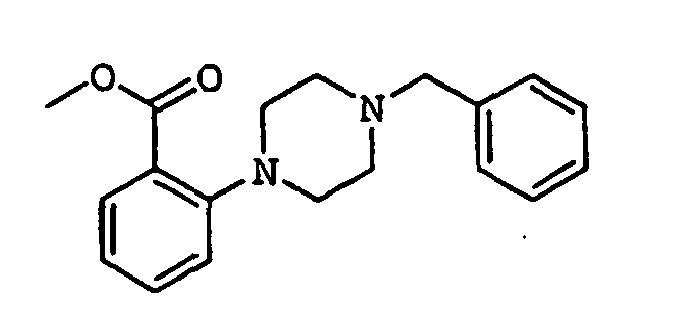
- To a 250 mL pressure bottle equipped with magnetic stirring was added methyl 2-fluorobenzoate (Lancaster Synthesis Inc.) (3.0 g, 20 mmol), 1-benzylpiperazine (Aldrich) (3.8 g, 22 mmol) and K2CO3 (3.0 g, 22 mmol) in DMF (100 mL). The mixture was heated at 150°C for 12 h. After cooling to RT the reaction was diluted with EtOAc (100 mL) and H2O was added. The organic layer was separated and washed with H2O, brine, dried over Na2SO4, filtered and concentrated in vacuo to afford a brown oil. The crude material was purified by column chromatography (4:1 hexanes-EtOAc) to give the title compound as a white foam (3.6 g). MS (ESI, pos. ion) m/z: 311 (M+H). Calc'd for C19H22N2O2: 310.17.
-
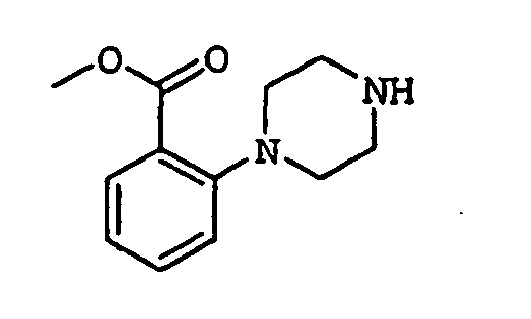
- The title compound was prepared according to the procedure described in Preparation IV by using methyl 2-[4-benzylpiperazinyl]benzoate (2.8 g, 8.9 mmol), 10% Pd/C (Aldrich) (940 mg), and HCO2NH4 (2.8, 44 mmol). The title compound was isolated as a colorless oil (1.75 g). (MS (ESI, pos. ion) mlz: 221 (M+H). Calc'd for C12H16N2O2: 220.12.
-

- The title compound was prepared according to the procedure described in Preparation V (without DIEA) by using methyl 2-piperazinylbenzoate (2.5 g, 11 mmol), N-Boc-p-Cl-D-Phe-OH (Peptech Corporation) (3.8 g, 13 mmol), HOAT (Aldrich) (1.6 g, 11 mmol), and EDC (Aldrich) (4.4 g, 23 mmol). The title compound was isolated as a crude white foam (4.8 g). MS (ESI, pos. ion) mlz: 502 (M+H). Calc'd for C26H32ClN3O5: 501.20.
-

- To a 25 mL round-bottomed flask equipped with magnetic stirring was added methyl 2-(4-{(2R)-2-[(tert-butoxy)carbonylamino]-3-(4-chlorophenyl) propanoyl}-piperazinyl)benzoate (3.2 g, 6.4 mmol). A satd soln of HCl in EtOAc (15 mL) was added, and the mixture was stirred at RT for 1 h. The title compound, as the hydrochloride salt, was isolated by filtration as a white solid (2.6 g). MS (ESI, pos. ion) mlz: 402 (M+H). Calc'd for C21H24ClN3O3: 401.15.
-

- The title compound was prepared according to the procedure described in Preparation V by using methyl 2-{4-[(2R)-2-amino-3-(4-chlorophenyl)propanoyl] piperazinyl}-benzoate hydrochloride (2.6 g, 5.9 mmol), Boc-L-Tic-OH (Bachem) (1.8 g, 6.5 mmol), HOAT (Aldrich) (810 mg, 5.9 mmol), and EDC (Aldrich) (2.3 g, 12 mmol) and DIEA (Aldrich) (1.0 mL, 5.9 mmol). The title compound was isolated and purified by column chromatography (CH2Cl2 with 1.5% NH3 2M in MeOH) (2.8 g). MS (ESI, pos. ion) m/z: 661 (M+H). Calc' d for C36H41ClN4O6: 660.27.
-

- To a 150 mL round-bottomed flask equipped with magnetic stirring was added methyl 3-{4-[(2R)-2-({(3S)-2-[(tert-butyl)oxycarbonyl](3-1,2,3,4-tetrahydroisoquinolyl)}carbonylamino)-3-(4-chlorophenyl)propanoyl]piperazinyl}benzoate (1.6 g, 2.4 mmol) in THF (30 mL). A soln of LiOH (Aldrich) (303 mg, 7.14 mmol) in H2O (ca. 10 mL) was added and the reaction was heated at 60°C for 12 h. After cooling to RT, the mixture was concentrated in vacuo and diluted with EtOAc (100 mL). A 10% soln of citric acid (25 mL) was added, the organic layer was separated, and the aqueous layer was extracted with EtOAc (2x25 mL). The organic layers were combined, washed with H2O, and brine, dried over Na2SO4, filtered and concentrated in vacuo to afford the title compound as a white solid (960 mg). MS (ESI, pos. ion) m/z: 647 (M+H). Calc'd for C35H39ClN4O6: 646.26.
-

- To a 500 mL round-bottomed flask equipped with magnetic stirring was added N-BOC-p-Cl-D-Phe-OH (5.28 g, 17.6 mmol) (Nova Biochem), 1-[3-(dimethylamino)-propyl]-3-ethylcarbodiimide methiodide (10.0 g, 34 mmol) (Aldrich), and HOAT (2.7 g, 20 mmol) (Aldrich). DMF (100 mL) was added and the solution was stirred for 5 min. 1-(2-Nitrophenyl)piperazine (3.5 g, 17 mmol) (Emka-Chemie) was added and the solution was stirred for 2 h. The reaction was diluted with EtOAc (150 mL) and washed with satd NaHCO3, H2O, and brine (75 mL each). The organic layer was collected, dried over Na2SO4, filtered, and concentrated in vacuo. MS (ESI, pos. ion) m/z: 489 (M+H), (ESI, neg. ion) m/z: 487 (M-H). Calc'd for C24H29ClN4O5:488.18.
-

- N-{(1R)-1-[(4-Chlorophenyl)methyl]-2-[4-(2-nitrophenyl)piperazinyl]-2-oxoethyl}(tert-butoxy)-carboxamide (1.4 g, 2.8 mmol) was treated with satd HCl in EtOAc as described in Preparation XVI. The resulting crude material was diluted with EtOAc and washed with satd NaHCO3 soln. The organic layer was separated, dried over Na2SO4, filtered and concentrated in vacuo. This sample (1.05 g, 2.50 mmol), was coupled to N-Fmoc-D-1,2,3,4-tetrahydroisoquinoline-3-carboxylic acid (1.1 g, 2.7 mmol) (Peptech), by the procedure for Preparation XIX using 1-(3-dimethylaminopropyl)-3-ethylcarbodiimide methiodide (Aldrich) (1.6 g, 5.5 mmol) and HOAT (370 mg, 2.7 mmol). The crude compound was obtained in a quantitative yield (2.2 g). MS (ESI, pos. ion) m/z: 770 (M+H), (ESI, neg. ion) m/z: 768 (M-H). Calc'd for C44H40ClN5O6: 769.27.
-

- Fluoren-9-ylmethyl (3R)-3-(N-{(1R)-2-[4-(2-aminophenyl)piperazinyl]-1-[(4-chlorophenyl)methyl]-2-otoethyl}carbamoyl)-1,2,3,4-tetrahydroisoquinoline-2-carboxylate was prepared according to the procedure for Preparation II using fluoren-9-ylmethyl (3R)-3-(N-{(1R)-1-[(4-chlorophenyl)methyl]-2-[4-(2-nitrophenyl)-piperazinyl]-2-oxoethyl}carbamoyl)-1,2,3,4-tetrahydroisoquinoline-2-carboxylate (1.4 g, 1.8 mmol) and SnCl2•2H2O (1.7 g, 7.3 mmol) (Aldrich). The crude product was purified by flash chromatography (SiO2, 1:1 EtOAc:hexane) and concentrated in vacuo to afford the desired compound (770 mg). MS (ESI, pos. ion) m/z: 740 (M+H), (ESI, neg. ion) m/z: 738 (M-H). Calc'd for C44H42ClN5O4: 739.29.
-

- Fluoren-9-ylmethyl (3R)-3-{N-[(1R)-1-[(4-chlorophenyl)methyl]-2-(4-{2-[(methylsulfonyl)amino] phenyl}piperazinyl)-2-oxoethyl]carbamoyl}-1,2,3,4-tetrahydroisoquinoline-2-carboxylate was prepared from fluoren-9-ylmethyl (3R)-3-(N-{(1R)-2-[4-(2-aminophenyl)piperazinyl]-1-[(4-chlorophenyl)methyl]-2-oxoethyl}carbamoyl)-1,2,3,4-tetrahydroisoquinoline-2-carboxylate (250 mg, 0.34 mmol) according to the procedure for Preparation III using methanesulfonyl chloride (30 µl, 0.39 mmol) and 2,6-di-tert-butyl-pyridine (80 µl, 0.36 mmol) (Aldrich). The crude product was concentrated in vacuo and purified by flash chromatography (SiO2, 15% EtOAc in CH2Cl2), to afford the desired compound (240 mg). MS (ESI, pos. ion) m/z: 818 (M+H), (ESI, neg. ion) m/z: 816 (M-H). Calc'd for C45H44ClN5O6S: 817.27.
-

- Using the procedure described for the synthesis of Preparation XVI, (2R)-2-amino-3-(4-chlorophenyl)-1-[4-(2-nitrophenyl)piperazinyl]propan-1-one hydrochloride was prepared from N-{(1R)-1-[(4-chlorophenyl)methyl]-2-[4-(2-nitrophenyl)piperazinyl]-2-oxoethyl}(tert-butohy)carboxamide (660 mg, 1.4 mmol) and a satd soln of HCl in EtOAc (10 mL). The yellow solid was filtered to give the target compound isolated as the HCl salt, as a white solid (530 mg). MS (ESI, pos. ion) m/z: 389 (M+H). Calc'd for C19H21ClN4O5: 388.13.
-

- Using the procedure described for the synthesis of Preparation V, tert-butyl 3-(N-{(1R)-1-[(4-chlorophenyl)methyl]-2-[4-(2-nitrophenyl) piperazinyl]-2-oxoethyl}carbamoyl) (3S)-1,2,3,4-tetrahydroisoquinoline-2-carboxylate was prepared from (2R)-2-amino-3-(4-chlorophenyl)-1-[4-(2-nitrophenyl)piperazinyl]propan-1-one hydrochloride (570 mg, 1.3 mmol) in DMF (10 mL), Boc-L-Tic-OH (Bachem) (410, 1.5 mmol), HOAT (Aldrich) (180 mg, 1.4 mmol), EDC (Aldrich) (520 mg, 2.70 mmol), and DIEA (Aldrich) (240 µL, 1.4 mmol). The crude material was purified by column chromatography (1:1 hexanes-EtOAc) to give the title compound as a white foam (716 mg). MS (ESI, pos. ion) m/z: 648 (M+H). Calc'd for C34H38ClN5O6: 647.25.
-

- In a 50 mL round bottomed flask equipped with magnetic stirring was added fluoren-9-ylmethyl (3R)-3-{N-[(1R)-1-[(4-chlorophenyl)methyl]-2-(4-{2-[(methylsulfonyl)amino]phenyl}piperazinyl)-2-oxoethyl]carbamoyl}-1,2,3,4-tetrahydroisoquinoline-2-carboxylate (240 mg, 0.290 mmol) in CH2Cl2 (5 mL). This solution was treated with tris(2-aminoethyl)amine (220 µl, 1.4 mmol) (Aldrich) and stirred for 1.5 h. The reaction was diluted with CH2Cl2 and washed with brine. The organic layer was separated and washed with sodium phosphate buffer (1M, pH 5.5), dried over Na2SO4, filtered and concentrated in vacuo. The crude product was purified by flash chromatography (SiO2, 1% MeOH in CH2Cl2) and to afford the desired material (150 mg). The purified compound was dissolved in H2O, treated with excess AcOH and lyophilized to yield the acetate salt. MS (ESI, pos. ion) m/z: 596 (M+H), (ESI, neg. ion) m/z: 594 (M-H). Calc'd for C30H34ClN5O4S: 595.20. Anal. Calc'd for C30H34ClN5O4S-C2H4O2-0.5H2O: C, 57.78; H, 5.91; N, 10.53; Cl, 5.33. Found C, 58.01; H, 5.63; N, 10.83; Cl, 5.49.
-

- N-[(1R)-1-[(3,4-Dichlorophenyl)methyl]-2-(4-{2-[(methylsulfonyl)amino]phenyl}piperazinyl)-2-oxoethyl](tert-butoxy)carboxamide was prepared according to the procedure for Preparation XIX using (methylsulfonyl)(2-piperazinylphenyl)amine hydrochloride (800 mg, 2.8 mmol), N-Boc-D-3,4-dichlorophenylalanine (930 mg, 2.80 mmol) (Peptech), DIEA (480 µl, 2.80 mmol), EDC, (1.66 g, 5.60 mmol), HOAT (400 mg, 3.0 mmol) and DMF (10 mL). The crude product was purified by flash chromatography (SiO2, 1:1 hexane:EtOAc) and concentrated in vacuo to afford the desired compound (1.0 g). MS (ESI, pos. ion) m/z: 571 (M+H), (ESI, neg. ion) m/z: 569 (M-H). Calc'd for C25H32Cl2N4O5S: 570.15.
- (2R)-2-Amino-3-(3,4-dichlorophenyl)-1-(4-{2-[(methylsulfonyl)amino]phenyl}piperazinyl)propan-1-one was prepared according to the procedure for Preparation XVI using N-[(1R)-1-[(3,4-dichlorophenyl)methyl]-2-(4-{2-[(methylsulfonyl)amino]phenyl}piperazinyl)-2-oxoethyl](tert-butoxy)carboxamide (Step 1) (1.0 g, 1.8 mmol) and satd HCL in EtOAC. The resulting crude material was diluted with EtOAc and washed with satd NaHCO3 soln. The organic layer was separated, dried over Na3SO4, filtered and concentrated in vacuo (700 mg). MS (ESI, pos. ion) m/z: 471 (M+H), (ESI, neg. ion) m/z: 469 (M-H). Calc'd for C20H14Cl2N4O3S: 470.09. Anal. Calc'd for C20H24Cl2N4O3S: C, 50.96; H, 5.13; N, 11.88; Cl, 15.04. Found C, 50.66; H, 5.14; N, 11.51; Cl, 15.11.
- tert-Butyl 3-{N-[(1R)-1-[(3,4-dichlorophenyl)methyl]-2-(4-{2-[(methylsulfonyl)amino]phenyl}piperazinyl)-2-oxoethyl]carbamoyl}(3S)-1,2,3,4-tetrahydroisoquinoline-2-carboxylate was prepared from (2R)-2-amino-3-(3,4-dichlorophenyl)-1-(4-{2-[(methylsulfonyl)amino]phenyl}-piperazinyl)propan-1-one (Step 2) (350 mg, 0.750 mmol) according to the procedure for Preparation XIX using Boc-L-Tic-OH (220 mg, 0.78 mmol), 1-(3-dimethylaminopropyl)-3-ethylcarbodiimide methiodide (450 mg, 1.5 mmol), HOAT (100 mg, 0.764mmol), and DMF (5 mL) (590 mg crude). MS (ESI, pos. ion) m/z: 730 (M+H), (ESI, neg. ion) m/z: 728 (M-H). Calc'd for C35H41Cl2N5O6S: 729.22.
- N-[(1R)-1-[(3,4-Dichlorophenyl)methyl]-2-(4-{2-[(methylsulfonyl)amino]phenyl}piperazinyl)-2-oxoethyl]((3S)(3-1,2,3,4-tetrahydroisoquinolyl)) carboxamide was prepared from tert-butyl 3-{N-[(1R)-1-[(3,4-dichlorophenyl) methyl]-2-(4-{2-[(methylsulfonyl)amino]phenyl} piperazinyl)-2-oxoethyl]carbamoyl}(3S)-1,2,3,4-tetrahydroisoquinoline-2-carboxylate (Step 3) (590 mg, 0.80 mmol) according to the procedure for Preparation XVI. The resulting crude material was diluted with EtOAc and washed with satd NaHCO3 soln. The organic layer was separated, dried over Na2SO4, filtered and concentrated in vacuo. The material was purified by preparative HPLC to give the title compound (477 mg) as the TFA salt. MS (ESI, pos. ion) m/z: 630 (M+H), (ESI, neg. ion) m/z: 628 (M-H). Calc'd for C30H33Cl2N5O4S: 629.16. Anal. Calcd for C30H33Cl2N5O4S-1.5C2HF3O2-0.5H2O: C, 48.89; H, 4.41; N, 8.64; Cl, 8.75. Found C, 49.33; H, 4.47; N, 8.94; Cl, 8.61.
-

- tert-Butyl 3-{N-[(1R)-1-[(3,4-dichlorophenyl)methyl]-2-(4-{2-[(methylsulfonyl)amino]phenyl}piperazinyl)-2-oxoethyl]carbamoyl}azetidinecarboxylate was prepared from (2R)-2-amino-3-(3,4-dichlorophenyl)-1-(4-{2-[(methylsulfonyl)amino]phenyl}-piperazinyl)propan-1-one (Example 2, Step 2) (320 mg, 0.67 mmol), according to the procedure for Preparation XIX using Boc-azetidine-3-carboxylic acid (140 mg, 0.71 mmol), 1-(3-dimethylaminopropyl)-3-ethylcarbodiimide methiodide (400 mg, 1.3 mmol), HOAT (96 mg, 0.71 mmol), and DMF (5 mL) (448 mg crude). MS (ESI, pos. ion) m/z: 654 (M+H), (ESI, neg. ion) m/z: 652 (M-H), Calc'd for C29H37Cl2N5O6S: 653.18.
- N-[(1R)-1-[(3,4-Dichlorophenyl)methyl]-2-(4-{2-[(methylsulfonyl)amino]phenyl}piperazinyl)-2-oxoethyl]azetidin-3-ylcarboxamide was prepared from tert-butyl 3-{N-[(1R)-1-[(3,4-dichlorophenyl)methyl]-2-(4-{2-[(methylsulfonyl)amino]phenyl}piperazinyl)-2-oxoethyl]carbamoyl}azetidinecarboxylate (440 mg, 0.67 mmol) according to the procedure for Preparation XVI. The resulting crude material was diluted with EtOAc and washed with satd NaHCO3 soln. The organic layer was separated, dried over Na2SO4, filtered and concentrated in vacuo. Purification by preparative HPLC (TFA buffer) gave the title compound as the TFA salt (10 mg). MS (ESI, pos. ion) m/z: 554 (M+H), (ESI, neg. ion) m/z: 552 (M-H). Calc'd for C24H29Cl2N5O4S: 553.13.
-

- N-[(1S)-1-[(4-Chlorophenyl)methyl]-2-(4-{2-[(methylsulfonyl)amino]phenyl}piperazinyl)-2-oxoethyl](tert-butoxy)carboxamide was prepared according to the procedure for Preparation XIX using (methylsulfonyl)(2-piperazinylphenyl)amine hydrochloride (913 mg, 3.13 mmol), N-Boc-4-chloro-L-phenylalanine (960 mg, 3.2 mmol) (Bachem), DIEA (550 µl, 3.16 mmol), 1-(3-dimethylaminopropyl)-3-ethylcarbodiimide methiodide (1.9 g, 6.5 mmol), HOAT (440 mg, 3.2 mmol) and DMF (30 mL). The crude was purified by flash chromatography (SiO2, 1:1 hexane:EtOAc) to afford the desired compound (1.1 g). MS (ESI, pos. ion) m/z: 537 (M+H), (ESI, neg. ion) m/z: 535 (M-H). Calc'd for C25H33ClN4O5S: 536.19.
- (2S)-2-Amino-3-(4-chlorophenyl)-1-(4-{2-[(methylsulfonyl)amino]phenyl}piperazinyl)propan-1-one (1.1 g, 2.1 mmol) was prepared from the material of Step 1, according to the procedure for Preparation XVI. The resulting crude material was diluted with EtOAc and washed with satd NaHCO3 soln. The organic layer was separated, dried over Na2SO4, filtered, and concentrated in vacuo to afford the desired compound (823 mg). MS (ESI, pos. ion) m/z: 437 (M+H), (ESI, neg. ion) m/z: 435 (M-H). Calc'd for C20H25ClN4O3S: 436.13. Anal. Calcd for C20H25ClN4O3S: C, 54.98; H, 5.77; N, 12.82; Cl, 8.11. Found C, 55.05; H, 5.82; N, 12.68.
- tert-Butyl (3S)-3-(N-[(1S)-1-[(4-chlorophenyl)methyl]-2-(4-{2-[(methylsulfonyl)amino]phenyl}piperazinyl)-2-oxoethyl]carbamoyl}-1,2,3,4-tetrahydroisoquinoline-2-carboxylate was prepared from (2S)-2-amino-3-(4-chlorophenyl)-1-(4-(2-[(methylsulfonyl)amino]phenyl)-piperazinyl)propan-1-one (Step 2) (380 mg, 0.87 mmol), according to the procedure for Preparation XIX using Boc-L-Tic-OH (250 mg, 0.91 mmol), 1-(3-dimethylaminopropyl)-3-ethylcarbodiimide methiodide (540 mg, 1.8 mmol), HOAT (140 mg, 1.0 mmol), and DMF (25 mL). Crude material was obtained in a quantitative yield and used without further purification. MS (ESI, pos. ion) m/z: 696 (M+H), (ESI, neg. ion) m/z: 694 (M-H). Calc'd for C35H42ClN5O6S: 695.25.
- ((3S)(3-1,2,3,4-Tetrahydroisoquinolyl))-N-[(1S)-1-[(4-chlorophenyl)methyl]-2-(4-{2-[(methylsulfonyl)amino]phenyl}piperazinyl)-2-oxoethyl]carboxamide (600 mg, 0.86 mmol) was prepared from the compound of Step 3 according to the procedure for Preparation XVI. The resulting crude material was diluted with EtOAc and washed with satd NaHCO3 soln. The organic layer was separated, dried over Na2SO4, filtered, and concentrated in vacuo. The resulting crude was purified by preparative HPLC (AcOH buffer) to afford the title compound (240 mg) as the acetate salt. MS (ESI, pos. ion) m/z: 596 (M+H), (ESI, neg. ion) m/z: 594 (M-H). Calc'd for C30H34ClN5O4S: 595.20 Anal. Calcd for C30H34ClN5O4S-C2H4O2-H2O: C, 57.01; H, 5.98; N, 10.39; Cl, 5.26. Found C, 57.69; H, 5.82; N, 10.54; Cl, 5.20.
-
- (a) To 25 mL peptide vessels were added PS-carbodiimide resin (Argonaut Technologies) (1 mmol/g) (800 mg, 0.8 mmol), an Fmoc-protected amino acid (0.4 mmol) and (methylsulfonyl)(2-piperazinylphenyl)amine hydrochloride (0.2 mmol) previously free based. The vessels were shaken for 48 h, and PS-isocyanate resin (Argonaut Technologies) was added to each vessel (1.76 mmol/g) (500 mg, 0.9 mmol). After shaking for 48 h, the mixture was filtered into scintillation vials containing DMAP (50 mg, 0.5 mmol) and piperidine-4-carboxylic acid polyamine resin HL (Nova Biochem) (0.7 mmol/g) (1 g, 0.7 mmol) and shaken for another 48 h. These reaction mixtures were filtered into 10 mL scintillation vials containing PS-carbodiimide resin (Argonaut Technologies) (1 mmol/g) (800 mg, 0.8 mmol) and Boc-L-Tic-OH (100 mg, 0.36 mmol).
- (b) These vials were shaken for 48 h. To each vial was added PS-isocyanate resin (Argonaut Technologies) (1.76 mmol/g) (1 g, 1.76 mmol) and shaking continued for 48 h. The solutions were filtered, concentrated in vacuo, and treated with 30% TFA in CH2Cl2 for 1.5 h. The solvent was eliminated in vacuo, and the resulting crude products were purified by preparative HPLC to yield the TFA salts of the products.
-

- MS (ESI, pos. ion) m/z: 592 (M+H), (ESI, neg. ion) m/z: 590 (M-H). Calc'd for C31H37N5O5S: 591.25.
-

- MS (ESI, pos. ion) m/z: 630 (M+H), (ESI, neg. ion) m/z: 628 (M-H). Calc'd for C31H34F3N5O4S: 629.23.
-

- MS (ESI, pos. ion) m/z: 612 (M+H), (ESI, neg. ion) m/z: 610 (M-H). Calc'd for C34H37N5O4S: 611.26.
- General Procedure: To 10 mL scintillation vials were added PS-carbodiimide resin (Argonaut Technologies) (1 mmol/g) (400 mg, 0.4 mmol) and the appropriate Boc protected amino acid (0.2 mmol). DMF (5 mL) was added followed by a stock solution of (2R)-2-amino-3-(4-chlorophenyl)-1-(4-{2-[(methylsulfonyl)amino]phenyl} piperazinyl)propan-1-one TFA salt (0.1 mmol) (previously free-based) in DMF. The vials were shaken over night. The reactions were filtered and the resins were washed with a 2:1 mixture of CH2Cl2:DMF (2x2 mL). The solutions were concentrated in vacuo and the Boc groups were removed by dissolving the crude product in CH2Cl2 (1 mL) and adding TFA (1 mL). The vials were shaken for 2 h and the solvent was removed in vacuo. Each compound was purified by preparative HPLC (TFA buffer) to yield the TFA salt of the desired product.
-

- MS (ESI, pos. ion) m/z: 494 (M+H), (ESI, neg. ion) m/z: 492 (M-H). Calc'd for C22H28ClN5O4S: 493.16.
-

- MS (ESI, pos. ion) m/z: 548 (M+H), (ESI, neg. ion) m/z: 546 (M-H). Calc'd for C26H34ClN5O4S: 547.20.
-

- MS (ESI, pos. ion) m/z: 508 (M+H), (ESI, neg. ion) m/z: 506 (M-H). Calc'd forC23H30ClN5O4S: 507.17.
-

- MS (ESI, pos. ion) m/z: 508 (M+H), (ESI, neg. ion) m/z: 506 (M-H). Calc'd for C23H30ClN5O4S: 507.17.
-

- MS (ESI, pos. ion) m/z: 584 (M+H), (ESI, neg. ion) m/z: 582 (M-H). Calc' d for C29H34ClH5O4S: 583.20.
-

- MS (ESI, pos. ion) m/z: 548 (M+H), (ESI, neg. ion) m/z: 546 (M-H). Calc'd for C26H34ClN5O4S: 547.20.
-

- MS (ESI, pos. ion) m/z: 574 (M+H), (ESI, neg. ion) m/z: 572 (M-H). Calc'd for C26H32ClN7O4S: 573.19.
-

- MS (ESI, pos. ion) m/z: 522 (M+H), (ESI, neg. ion) m/z: 520 (M-H). Calc'd for C24H32ClN5O4S: 521.19.
-

- MS (ESI, pos. ion) m/z: 520 (M+H), (ESI, neg. ion) m/z: 518 (M-H). Calc'd for C24H30ClN5O4S: 519.17.
- General Procedure: To 10 mL scintillation vials were added tetrafluorophenol resin (TFP) (IRORI Inc.) (0.96 mmol/g) (125 mg, 0.12 mmol) loaded with the appropriate acid and (2R)-2-amino-3-(4-chlorophenyl)-1-(4-{2-[(methylsulfonyl)amino]phenyl)piperazinyl)propan-1-one TFA salt (0.1 mmol, previously free based) in DMF (2 mL). After shaking at RT for 16 h, the reactions were filtered and the resin was washed with 2:1 CH2Cl2:DMF (2 x 2 mL). The solutions were concentrated in vacuo and each compound was purified by preparative HPLC (TFA buffer).
-

- MS (ESI, pos. ion) m/z: 580 (M+H), (ESI, neg. ion) m/z: 578 (M-H). Calc'd for C29H30ClN5O4S: 579.17.
-

- MS (ESI, pos. ion) m/z: 594 (M+H), (ESI, neg. ion) m/z: 592 (M-H). Calc'd for C30H32ClN5O4S: 593.19.
- General procedure: To 10 mL scintillation vials were added PS-carbodiimide resin (Argonaut Technologies) (1 mmol/g) (400 mg, 0.4 mmol) and the appropriate acid (0.2 mmol) in DMF (2 mL). After shaking at RT for 0.5 h, a solution of (2R)-2-amino-3-(4-chlorophenyl)-1-(4-{2-[(methylsulfonyl)amino]phenyl}piperazinyl)propan-1-one TFA salt (0.1 mmol, previously free-based) dissolved in 1:1 CH2Cl2:DMF was added to each vial, and the vials were shaken for 48 h. PS-isocyanate resin (Argonaut Technologies) (1.76 mmol/g) (500 mg, 0.9 mmol) was added to each reaction vial, and shaking was continued for 48 h. The reactions were filtered and concentrated in vacuo. The crude products were purified by preparative HPLC (TFA buffer).
-

- MS (ESI, pos. ion) m/z: 575 (M+H), (ESI, neg. ion) m/z: 573 (M-H). Calc'd for C27H28Cl2N4O4S: 574.12.
-

- MS (ESI, pos. ion) m/z: 575 (M+H), (ESI, neg. ion) m/z: 573 (M-H). Calc'd for C27H28Cl2N4O4S: 574.12.
-

- MS (ESI, pos. ion) m/z: 555 (M+H), (ESI, neg. ion) m/z: 553 (M-H). Calc'd for C20H31ClN4O4S: 554.18.
-

- MS (ESI, pos. ion) m/z: 571 (M+H), (ESI, neg. ion) m/z: 569 (M-H). Calc'd for C28H31ClN4O5S: 570.17.
-

- MS (ESI, pos. ion) m/z: 575 (M+H), (ESI, neg. ion) m/z: 573 (M-H). Calc'd for C27H28Cl2N4O4S: 574.12.
-

- MS (ESI, pos. ion) m/z: 609 (M+H), (ESI, neg. ion) m/z: 607 (M-H). Calc'd for C27H27Cl3N4O4S: 608.08.
-

- MS (ESI, pos. ion) m/z: 609 (M+H), (ESI, neg. ion) m/z: 607 (M-H). Calc'd for C28H28ClF3N4O4S: 608.15.
-

- MS (ESI, pos. ion) m/z: 585 (M+H), (ESI, neg. ion) m/z: 583 (M-H). Calc'd for C28H29ClN4O6S: 584.15.
-

- MS (ESI, pos. ion) m/z: 609 (M+H), (ESI, neg. ion) m/z: 607 (M-H). Calc'd for C28H28ClF3N4O4S: 608.15.
-

- MS (ESI, pos. ion) m/z: 555 (M+H), (ESI, neg. ion) m/z: 553 (M-H). Calc'd for C28H31ClN4O4S: 554.15. Anal. Calcd for C28H31ClN4O4S•1.5 H2O: C, 57.77; H, 5.89; N, 9.62. Found: C, 58.11; H, 6.18; N, 9.59.
-

- MS (ESI, pos. ion) m/z: 542 (M+H), (ESI, neg. ion) m/z: 540 (M-H). Calc'd for C26H28ClN5O4S: 541.16.
-

- MS (ESI, pos. ion) m/z: 542 (M+H), (ESI, neg. ion) m/z: 540 (M-H). Calc'd for C26H28ClN5O4S: 541.16.
-

- MS (ESI, pos. ion) m/z: 542 (M+H), (ESI, neg. ion) m/z: 540 (M-H). Calc'd for C26H28ClN5O4S: 541.16.
-

- MS (ESI, pos. ion) m/z: 507 (M+H), (ESI, neg. ion) m/z: 505 (M-H). Calc'd for C24H31ClN4O4S: 506.18.
-

- (2R)-2-Amino-3-(4-chlorophenyl)-1-(4-{2-[(methylsulfonyl) amino]phenyl} piperazinyl)propan-1-one, TFA salt (850 mg, 1.6 mmol) was diluted with EtOAc and washed with satd NaHCO3 soln. The organic layer was separated, dried over Na2SO4. filtered and concentrated in vacuo. This material was used to prepare the title compound according to the procedure for Preparation XIX using quinoline-6-carboxylic acid (240 mg, 1.40 mmol) (Acros), HOAT (190 mg, 1.40 mmol), 1-(3-dimethylaminopropyl)-3-ethylcarbodiimide methiodide (810 mg, 2.7 mmol) and DMF (50 mL). The crude material was purified by flash chromatography, (SiO2, 3% MeOH in CH2Cl2) and concentrated in vacuo to provide 500 mg. The purified product was dissolved in H2O with CH3CN and AcOH, then lyophilized to yield the acetate salt. MS (ESI, pos. ion) m/z: 592 (M+H), (ESI, neg. ion) m/z: 590 (M-H). Calc'd for C30H30ClN5O4S: 591.17. Anal. Calcd for C30H30ClN5O4S-0.5C2H4O2-0.5H2O: C, 58.99; H, 5.27; N, 11.10; Cl, 5.62. Found C, 59.32; H, 5.23; N, 11.25; Cl, 5.89.
-

- Following the procedure of Preparation V, tert-butyl 3-{N-[(1R)-1-[(4-chlorophenyl)methyl]-2-(4-{2-[(methylsulfonyl)amino]phenyl}piperazinyl)-2-oxoethyl]-carbamoyl}azetidinecarboxylate was prepared from (2R)-2-amino-3-(4-chlorophenyl)-1-(4-{2-[(methylsulfonyl)-amino]phenyl}piperazinyl)propan-1-one TFA salt (200 mg, 0.36 mmol) in DMF (1 mL), DIEA (Aldrich) (0.18 mL, 1.05 mmol), Boc-azetidine-3-carboxylic acid (PepTech Corp.) (73 mg, 0.36 mmol), HOAT (Aldrich) (41 mg, 0.30 mmol), and EDC (Sigma) (86 mg, 0.45 mmol). The crude was purified by flash column chromatography (silica gel, 1:1 EtOAc-hexane) to give the protected compound as an off-white solid (88 mg). MS (ESI, pos. ion) m/z: 620 (M+H); (ESI, neg. ion) m/z: 618 (M-H). Calc'd for C29H38ClN5O6S: 619.22.
- Following the procedure of Preparation VI, N-[(1R)-1-[(4-chlorophenyl)methyl]-2-(4-{2-[(methylsulfonyl)-amino]phenyl}piperazinyl)-2-oxoethyl]azetidin-3-ylcarboxamide was prepared from tert-butyl 3-{N-[(1R)-1-[(4-chlorophenyl)methyl]-2-(4-{2-[(methylsulfonyl)-amino]phenyl}piperazinyl)-2-oxoethyl]carbamoyl}-azetidinecarboxylate (Step 1) (88 mg, 0.14 mmol) and 1 mL of 1:1 TFA-CH2Cl2. The crude product was purified by preparative HPLC (TFA buffer) to afford the title compound (TFA salt) as a white solid (44 mg). MS (ESI, pos. ion) m/z: 520 (M+H). Calc'd for C24H30ClN5O4S: 519.17.
-

- The title compound was prepared according to the procedure described in Example 34 by using 3-Boc-aminomethyl-benzoic acid (Chem-Impex International Inc.) (91 mg, 0.36 mmol). The title compound, TFA salt, was isolated as a white solid (133 mg). MS (ESI, pos. ion) m/z: 570 (M+H); (ESI, neg. ion) m/z: 568 (M-H). Calc'd for C28H32ClN5O4S: 569.19.
-

- The title compound was prepared according to the procedure described in Example 34 by using piperidine-1,3-dicarboxylic acid 1-tert-butyl ester (Aldrich) (82 mg, 0.36 mmol). The title compound as the TFA salt, was isolated as a white solid (83 mg) containing two diastereomers. MS (ESI, pos. ion) m/z: 548 (M+H); (ESI, neg. ion) m/z: 546 (M-H). Calc'd for C26H34ClN5O4S: 547.20.
-

- The title compound was prepared according to the procedure described in Example 34 by using 2-tert-butoxycarbonylaminobenzoic acid (Advanced ChemTech) (85 mg, 0.36 mmol). The title compound, as the TFA salt, was isolated as a white solid (36 mg). MS (ESI, pos. ion) m/z: 556 (M+H); (ESI, neg. ion) m/z: 554 (M-H). Calc'd for C27H30ClN5O4S: 555.17.
-

- tert-Butyl 2-{N-[(1R)-1-[(4-chlorophenyl)methyl]-2-(4-{2-[(methylsulfonyl) amino]phenyl}piperazinyl)-2-oxoethyl]carbamoyl}piperidinecarboxylate was prepared according to,the procedure described in Preparation V by using piperidine-1,2-dicarboxylic acid 1-tert-butyl ester (Aldrich) (82 mg, 0.36 mmol) and (2R)-2-Amino-3-(4-chlorophenyl)-1-(4-{2-[(methylsulfonyl)-amino]phenyl}piperazinyl)propan-1-one. The desired compound was isolated as a white solid (106 mg). MS (ESI, pos. ion) m/z: 648 (M+H); (ESI, neg. ion) m/z: 646 (M-H). Calc'd for C31H42ClN5O6S: 647.25.
- N-[(1R)-1-[(4-Chlorophenyl)methyl]-2-(4-{2-[(methylsulfonyl)amino]phenyl}piperazinyl)-2-oxoethyl]-2-piperidylcarboxamide, trifluoroacetate was prepared according to the procedure described in Preparation VI by using tert-butyl 2-{N-[(1R)-1-[(4-chlorophenyl) methyl]-2-(4-{2-[(methylsulfonyl)amino]phenyl} piperazinyl)-2-oxoethyl]carbamoyl}piperidinecarboxylate (Step 1). The crude material was used directly in the next step without further purification. MS (ESI, pos. ion) m/z: 548 (M+H); (ESI, neg. ion) m/z: 546 (M-H). Calc'd for C26H34ClN5O4S: 547.20.
- To a round-bottomed flask equipped with magnetic stirring was added N-[(1R)-1-[(4-chlorophenyl)methyl]-2-(4-{2-[(methylsulfonyl)amino]phenyl}piperazinyl)-2-oxoethyl]-2-piperidylcarboxamide, trifluoroacetate (Step 2) (0.16 mmol), ClCH2CH2Cl (1 mL) and DIEA (Aldrich) (0.06 mL, 0.32 mmol). Formaldehyde (Aldrich, 37% aqueous soln) (0.03 mL, 0.33 mmol) was added to the reaction mixture, followed by NaBH(OAc)3 (Aldrich Chemical Company) (52 mg, 0.25 mmol), and the reaction mixture was stirred at RT 18 h. The mixture was diluted with CH2Cl2, and the organic solution was washed with satd NaHCO3 and brine. The organic layer was dried over Na2SO4, filtered and concentrated in vacuo. The crude product was purified by flash column chromatography (silica gel, 5:95 MeOH-CH2Cl2) to give N-[(1R)-1-[(4-chlorophenyl)methyl]-2-(4-{2-[(methylsulfonyl)amino]phenyl}piperazinyl)-2-oxoethyl]-(1-methyl(2-piperidyl))carboxamide as a white solid, (71 mg) (two diastereomers). MS (ESI, pos. ion) m/z: 562 (M+H); (ESI, neg. ion) m/z: 560 (M-H). Calc'd for C27H36ClN5O4S: 561.22.
-

- The title compound was prepared according to the procedure of Example 38 by using piperidine-1,4-dicarboxylic acid mono-tert-butyl ester (Aldrich) (82 mg, 0.36 mmol). The title compound was isolated as a white solid (63 mg ). MS (ESI, pos. ion) m/z: 562 (M+H); (ESI, neg. ion) m/z: 560 (M-H). Calc'd for C27H36ClN5O4S: 561.22.
-

- The title compound was prepared according to the procedure of Example 40 by using 3-tert-butoxycarbonylaminopropionic acid (Novabiochem). The title compound was isolated as a white solid. MS (ESI, pos. ion) m/z: 536 (M+H); (ESI, neg. ion) m/z: 534 (M-H). Calc'd for C25H34ClN5O4S: 535.20.
-

- Following the procedure of Example 38, Step 3, (2R)-3-(4-chlorophenyl)-1-(4-{2-[(methylsulfonyl)-amino]phenyl}-piperazinyl)-2-[benzylamino]propan-1-one, hydrochloride was prepared from (2R)-2-amino-3-(4-chlorophenyl)-1-(4-{2-[(methylsulfonyl)amino]phenyl}-piperazinyl)propan-1-one TFA salt (0.6 g, 1.1 mmol) in ClCH2Cl2Cl (10 mL), benzaldehyde (Aldrich) (0.14 mL, 1.4 mmol) and NaBH(OAc)3 (Aldrich) (340 mg, 1.9 mmol). The desired compound was purified by preparative TLC (60% Hexane, 38% CH2Cl2, and 2% 2N NH3 in MeOH), and treated with a soln of EtOAc satd with HCl. A precipitate formed (HCl salt), was filtered and dried in vacuo to afford the desired product as a white solid (130 mg). MS (ESI, pos. ion) m/z: 527 (M+H); MS (ESI, neg. ion) m/z: 525 (M-H). Calc'd for C27H31ClN4O3S: 526.18. Anal. Calcd for C27H31ClN4O3S·1.1 HCl. 0.9H2O: C, 55.59; H, 5.86; N, 9.60; Cl, 12.76. Found: C, 55.91; H, 5.61; N, 9.33; Cl, 12.92.
-

- Following the procedure of Example 38, Step 3, (2R)-2-({[4-(dimethylamino)phenyl]methyl}amino)-3-(4-chlorophenyl)-1-(4-{2-[(methylsulfonyl)amino]-phenyl}piperazinyl)propan-1-one was prepared from (2R)-2-amino-3-(4-chlorophenyl)-1-(4-{2-[(methylsulfonyl) amino]phenyl} piperazinyl)propan-1-one TFA salt (0.6 g, 1.1 mmol) in ClCH2Cl2Cl (10 mL), 4-dimethylamino-benzaldehyde (Aldrich) (170 mg, 1.1 mmol) and NaBH(OAc)3 (Aldrich) (340 mg, 1.6 mmol). The desired compound was purified by preparative TLC (60% Hexane, 38% CH2Cl2, and 2% 2N NH3 in MeOH), and treated with a soln of EtOAc satd with HCl. The precipitate (HCl salt) which formed was filtered and dried in vacuo to afford the desired product as a white solid (75 mg) MS (ESI, pos. ion) m/z: 570 (M+H); MS (ESI, neg. ion) m/z: 568 (M-H). Calc'd for C29H36ClN5O3S: 569.22.
-

- Following the procedure of Example 38, Step 3, (2R)-3-(4-chlorophenyl)-1-(4-{2-[(methylsulfonyl)-amino]phenyl} piperazinyl)-2-[(2-pyridylmethyl)amino]-propan-1-one was prepared from (2R)-2-amino-3-(4-chlorophenyl)-1-(4-{2-[(methylsulfonyl) amino]phenyl} piperazinyl)propan-1-one TFA salt (0.6 g, 1.1 mmol) in ClCH2Cl2Cl (10 mL), 2-pyridine carboxaldehyde (Aldrich) (0.1 mL, 1.1 mmol) and NaBH(OAc)3 (Aldrich) (340 mg, 1.6 mmol). The desired compound was purified by preparative TLC (60% Hexane, 38% CH2Cl2, and 2% 2N NH3 in MeOH), and treated with a soln of EtOAc satd with HCl. The precipitate (HCl salt) which formed was filtered and dried in vacuo to afford the desired product as a white solid (102 mg). MS (ESI, pos. ion) m/z: 528 (M+H); MS (ESI, neg. ion) m/z: 526 (M-H). Calc'd for C26H30ClN5O3S: 527.18. Anal. Calcd for C26H30ClN5O3S·1.8H2O·2.6 HCl: C, 47.66; H, 5.57; N, 10.69; Cl, 19.48. Found: C, 47.59; H, 5.62; N, 10.4; Cl, 19.47.
-

- Following the procedure of Example 38, Step 3, (2R)-3-(4-chlorophenyl)-2-{[(4-chlorophenyl)methyl] amino}-1-(4-{2-[(methyl sulfonyl)amino]phenyl} piperazinyl)propan-1-one was prepared from (2R)-2-amino-3-(4-chlorophenyl)-1-(4-{2-[(methylsulfonyl) amino]phenyl} piperazinyl)propan-1-one TFA salt (0.6 g, 1.1 mmol) in ClCH2Cl2Cl (10 mL), 4-chlorobenzaldehyde (Aldrich) (270 mg, 1.40 mmol) and NaBH(OAc)3 (Aldrich) (340 mg, 1.9 mmol). The desired compound was purified by preparative TLC (60% Hexane, 38% CH2Cl2, and 2% 2N NH3 in MeOH), and treated with a soln of EtOAc satd with HCl. A precipitate formed (HCl salt), was filtered and dried in vacuo to afford the desired product as a white solid (80 mg, 12%). MS (ESI, pos. ion) m/z: 561 (M+H); MS (ESI, neg. ion) m/z: 559 (M-H). Calc'd for C27H30Cl2N4O3S: 560.14.
-

- Following the procedure of Example 38, Step 3, (2R)-2-{[((2R)-pyrrolidin-2-yl)methyl]amino}-3-(4-chlorophenyl)-1-(4-{2-[(methylsulfonyl)amino]phenyl} piperazinyl)propan-1-one was prepared from (2R)-2-amino-3-(4-chlorophenyl)-1-(4-{2-[(methylsulfonyl)-amino]phenyl}piperazinyl)propan-1-one TFA salt (0.6 g, 1.1 mmol) in ClCH2Cl2Cl (10 mL), N-Boc-L-prolinal (Aldrich) (280 mg, 1.4 mmol), and NaBH(OAc)3 (Aldrich) (340 mg , 1.9 mmol). The desired compound (TFA salt) was purified by preparative TLC (60% Hexane, 38% CH2Cl2 and 2% 2N NH3 in MeOH), followed by preparative HPLC (TFA buffer) yielding a white solid (14.8 mg). MS (ESI, pos. ion) m/z: 520 (M+H); MS (ESI, neg. ion) m/z: 518 (M-H). Calc'd for C25H34ClN5O3S: 519.21.
-

- Following the procedure of Example 38, Step 3, (2R)-3-(4-chlorophenyl)-2-[(indol-2-ylmethyl)amino]-1-(4-{2-[(methylsulfonyl)amino]phenyl}piperazinyl)propan-1-one was prepared from (2R)-2-amino-3-(4-chlorophenyl)-1-(4-{2-[(methylsulfonyl) amino]phenyl} piperazinyl)propan-1-one TFA salt (0.5 g, 0.91 mmol) in ClCH2Cl2Cl (10 mL), indole-3-carboxaldehyde (Aldrich) (150 mg, 0.930 mmol) and NaBH(OAc)3 (Aldrich) (280 mg, 1.30 mmol). The desired compound was purified by preparative TLC (60% hexane, 38% CH2Cl2 and 2% 2N NH3 in MeOH), followed by preparative HPLC (TFA buffer) to afford the TFA salt as a white solid (10.8 mg). MS (ESI, pos. ion) m/z: 566 (M+H); MS (ESI, neg. ion) m/z: 564 (M-H). Calc'd for C29H32ClN5O3S: 565.19.
-

- Following the procedure of Preparation V, N-[(1R)-1-[(4-chlorophenyl)methyl]-2-(4-{2-[(methylsulfonyl)-amino]phenyl}piperazinyl)-2-oxoethyl]-3-[(4-chlorophenyl)amino]propanamide was prepared from (2R)-2-amino-3-(4-chlorophenyl)-1-(4-{2-[(methylsulfonyl)-amino]phenyl}piperazinyl)propan-1-one TFA salt (200 mg, 0.36 mmol) in CH2Cl2 (3 mL), DIEA (0.12 mL, 0.66 mmol), 3-(4-chloroanilino)-propionic acid (Maybridge) (66 mg, 0.33 mmol), HOAT (Aldrich) (53 mg, 0.39 mmol) and EDC (Aldrich) (130 mg, 0.66 mmol). The desired compound was purified by preparative TLC (60% hexane, 38% CH2Cl2, and 2% 2N NH3 in MeOH), followed by preparative HPLC (TFA buffer) to afford the desired compound (TFA salt) as a white solid (9.8 mg). MS (ESI, pos. ion) m/z: 618 (M+H); MS (ESI, neg. ion) m/z: 616 (M-H). Calc'd for C29H33Cl2N5O4S: 617.16.
-

- To a round-bottomed flask equipped with stirring was added (2R)-{1-(4-chlorobenzyl)-2-[4-(2-methylsulfonylaminophenyl)-piperazin-1-yl]-2-oxo-ethyl}-carbamic acid tert-butyl ester (3.0 g, 5.59 mmol) and THF (6 mL). AlH3 (prepared according to the method of H. C. Brown and N.M. Yoon, J. Am. Chem. Soc., 1968, 90, 2927) (28 mL, 27 mmol) was added to the reaction mixture drop-wise, and the reaction mixture was stirred at RT for 2 h. The organic layer was washed with satd aqueous NaHCO3 soln, dried over Na2SO4, filtered and concentrated in vacuo. The residue was treated with a soln of EtOAc satd with HCl. The precipitate was filtered and dried in vacuo to afford (2-{4-[(2R)-2-amino-3-(4-chlorophenyl)propyl]piperazinyl}phenyl) (methylsulfonyl)-amine hydrochloride (HCl salt) as a white solid (2.8 g). MS (ESI, pos. ion) m/z: 423 (M+H); MS (ESI, neg. ion) m/z: 421 (M-H). Calc'd for C20H27ClN4O2S: 422.15.
- Following the procedure of Preparation V, N-[(1R)-1-[(4-chlorophenyl)methyl]-2-(4-{2-[(methylsulfonyl) amino]phenyl}piperazinyl)ethyl]((3S)(3-1,2,3,4-tetrahydroisoquinolyl))carboxamide was prepared from (2-{4-[(2R)-2-amino-3-(4-chlorophenyl)propyl]-piperazinyl}phenyl)(methylsulfonyl)amine hydrochloride (Step 1) (600 mg, 1.3 mmol) in CH2Cl3 (3 mL), DIEA (0.30 mL, 1.5 mmol), Boc-L-Tic-OH (Bachem) (390 mg, 1.4 mmol), HOAT (Aldrich) (230 mg, 1.70 mmol), and EDC (Aldrich) (540 mg, 2.8 mmol). The desired compound was purified by preparative TLC (60% hexane, 38% CH2Cl2, and 2% 2N NH3 in MeOH), followed by preparative HPLC to afford the TFA salt as a white solid (35 mg). MS (ESI, pos. ion) m/z: 582 (M+H); MS (ESI, neg. ion) m/z: 580 (M-H). Calc'd for C30H36ClN5O3S: 581.22.
-

- To a round-bottomed flask equipped with stirring was added Boc-L-Tic-OH (Bachem) (1 g, 3.6 mmol) and CH2Cl2 (20 mL), followed by TEA (0.5 mL, 3.6 mmol) and N,O-dimethylhydroxylamine hydrochloride. The reaction mixture was cooled to 0°C, EDC (690 mg, 3.6 mmol) and HOBT (550 mg, 3.6 mmol) were added, and the reaction mixture was stirred at 0°C for 1 h then at RT for 18h. The organic layer was washed with 0.5N HCl, satd NaHCO3, and brine. The organic layer was dried over Na2SO4, filtered and concentrated in vacuo to afford a colorless oil. Into a round bottomed flask equipped with magnetic stirring, was added the oil dissolved in Et2O (15 mL), and the flask was cooled to -78 °C. LiAlH4 (1M in Et2O, Aldrich) (3.2 mL, 3.2 mmol) was added, and after 30 min the reaction was warmed to RT. The organic layer was washed with 0.5N HCl, satd NaHCO3, and brine. After drying the organic layer over Na2SO4, it was filtered and concentrated in vacuo to afford (3S)-N-Boc-1,2,3,4-tetrahydroisoquinoline-3-carbaldehyde as a colorless oil (588 mg).
- Following the procedure of Example 38, Step 3, (2R)-2-{[((3S)(3-(1,2,3,4-tetrahydroisoquinolyl))methyl]-amino}-3-(4-chloro phenyl)-1-(4-{2-[(methylsulfonyl)-amino]phenyl}-piperazinyl)propan-1-one was prepared from (2R)-2-amino-3-(4-chlorophenyl)-1-(4-{2-[(methylsulfonyl)amino]phenyl} piperazinyl)propan-1-one TFA salt (0.52 g, 0.94 mmol) in ClCH2CH2Cl (10 mL), (35)-N-Boc-1,2,3,4-tetrahydroisoquinoline-3-carbaldehyde (310 mg, 1.2 mmol), and NaBH(OAC)3 (Aldrich) (350 mg, 1.70 mmol). The desired compound was purified by preparative TLC (60% hexane, 38% CH2Cl2, and 2% 2N NH3 in MeOH), followed by preparative HPLC (TFA buffer) to afford the desired material (TFA salt) as a white solid (59 mg). MS (ESI, pos. ion) m/z: 582 (M+H); MS (ESI, neg. ion) m/z: 580 (M-H). Calc'd for C30H36ClN5O3S: 581.22.
-

- Following the procedure of Example 38, Step 3, (2R)-2-[(2H,3H-benzo[3,4-e]1,4-dioxin-6-ylmethyl)-amino]-3-(4-chlorophenyl)-1-(4-{2-[(methylsulfonyl)-amino]phenyl}-piperazinyl)propan-1-one was prepared from (2R)-2-amino-3-(4-chlorophenyl)-1-(4-{2-[(methylsulfonyl)amino]phenyl}piperazinyl)propan-1-one TFA salt (0.6 g, 1.1 mmol) in ClCH2CH2Cl (10 mL), 1,4-benzodioxan-6-carboxaldehyde (Aldrich) (184 mg, 1.12 mmol) and NaBH(OAc)3 (Aldrich) (340 mg, 1.6 mmol). The desired compound was purified by preparative TLC (60% Hexane, 38% CH2Cl2, and 2% 2N NH3 in MeOH), and treated with a soln of EtOAc satd with HCl. The precipitate which formed was filtered and dried in vacuo to afford the title compound (HCl salt) as a white solid (330 mg). MS (ESI, pos. ion) m/z: 585 (M+H); MS (ESI, neg. ion) m/z: 583 (M-H). Calc'd for C29H33ClN4O5S: 584.19. Anal. Calcd for C29H33ClN4O5S·HCl: C, 56.04; H, 5.51; N, 9.01; Cl, 11.41. Found: C, 55.57 (+/-0.46); H, 5.45; N, 8.99; Cl, 11.25.
-

- To a round-bottomed flask equipped with stirring was added Boc-D-prolinol (Aldrich) (46 mg, 0.23 mmol) and CH2Cl2 (1 mL), and the reaction flask was cooled to -23°C. A soln of triphosgene (Avocado) (30 mg, 0.1 mmol) in CH2Cl2 (0.5 mL) was added drop-wise followed by DIEA (0.040 mL, 0.230 mmol). The reaction mixture was stirred at 0°C for 4 h, at RT for 16 h, and then at reflux for 1.5 h. The reaction mixture was concentrated in vacuo. This was then stirred with (2R)-2-amino-3-(4-chlorophenyl)-1-(4-{2-[(methylsulfonyl)amino]phenyl}piperazinyl)propan-1-one TFA salt (200 mg, 0.36 mmol) and DIEA (0.34 mL, 2.0 mmol) in CH2Cl2 (1.5 mL) for 18 h. The organic layer was washed with 10% citric acid, dried over Na3SO4, filtered and concentrated in vacuo to afford a yellow oil. The Boc protecting group was removed by treating the compound with a soln of 50% TFA in CH2Cl2 (2 mL) for 2 h. The desired compound was purified by preparative TLC (60% hexane, 38% CH2Cl2, and 2% 2N NH3 in MeOH), followed by preparative HPLC to afford the TFA salt as a white solid (10 mg). MS (ESI, pos. ion) m/z: 564 (M+H); MS (ESI, neg. ion) m/z: 562 (M-H). Calc'd for C26H34ClN5O5S: 563.20.
-

- Following the procedure of Example 51, N-[(1R)-1-[(4-chlorophenyl)methyl]-2-(4-{2-[(methylsulfonyl)-amino] phenyl}piperazinyl)-2-oxoethyl] (3-aminopropoxy) carboxamide, was prepared from N-(3-hydroxypropyl)-carbamic acid tert-butyl ester (Aldrich) (40 mg, 0.230 mmol), triphosgene (Avocado) (30 mg, 0.1 mmol), DIEA (0.040 mL, 0.230 mmol), (2R)-2-amino-3-(4-chlorophenyl)-1-(4-{2-[(methylsulfonyl) amino]phenyl} piperazinyl)propan-1-one TFA salt (200 mg, 0.36 mmol), and more DIEA (0.34 mL, 2.0 mmol). The Boc protecting group was removed by treating with a soln of 50% TFA in CH2Cl2 (2 mL) for 2 h. The crude product was purified by preparative TLC (60% hexane, 38% CH2Cl2 and 2% 2N NH3 in MeOH) and then by preparative HPLC (TFA buffer) to afford the title compound (TFA salt) as a white solid (10 mg). MS (ESI, pos. ion) m/z: 538 (M+H); MS (ESI, neg. ion) m/z: 536 (M-H). Calc'd for C24H32ClN5O5S: 537.18.
-
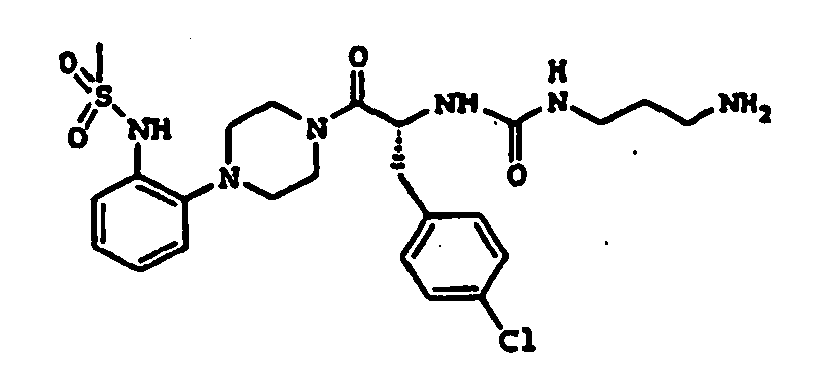
- Following the procedure of Example 51, N-[(1R)-1-[(4-chlorophenyl)methyl]-2-(4-{2-[(methylsulfonyl) amino]phenyl}piperazinyl)-2-oxoethyl][(3-aminopropyl)amino]carboxamide, TFA salt was prepared from triphosgene (Avocado Chemical Company) (45 mg, 0.152 mmol), (2R)-2-amino-3-(4-chlorophenyl)-1-(4-{2-[(methylsulfonyl)amino] phenyl}piperazinyl)propan-1-one TFA salt (200 mg, 0.36 mmol), DIEA (0.32 mL, 0.916 mmol), and tert-butyl-N-(3-aminopropyl)carbamate (Aldrich Chemical Company) (96 mg, 0.55 mmol). The Boc protecting group was removed by treating the compound with a soln of 50% TFA and CH2Cl2 (2 mL) for 2 h. The organic solvent was removed in vacuo to give the desired product. Preparative TLC purification with 60% Hexane, 35% CH2Cl2 and 5% 2N NH3 in MeOH afforded 90% pure compound. This was further purified by preparative HPLC (TFA buffer) to afford the title compound (TFA salt) as a white solid (10 mg). MS (ESI, pos. ion) m/z: 537 (M+H); MS (ESI, neg. ion) m/z: 535 (M-H). Calc'd for C24H33ClN6O4S: 536.20.
-

- Following the procedure of Example 51, N-[(1R)-1-[(4-chlorophenyl)methyl]-2-(4-{2-[(methylsulfonyl) amino]phenyl} piperazinyl)-2-oxoethyl][(4-piperidyl-methyl)amino]-carboxamide, was prepared from triphosgene (Avocado Chemical Company) (45 mg, 0.152 mmol), (2R)-2-amino-3-(4-chlorophenyl)-1-(4-{2-[(methylsulfonyl)amino]phenyl}piperazinyl)propan-1-one TFA salt (200 mg, 0.36 mmol), DIEA (0.32 mL, 0.916 mmol), and 4-(aminomethyl)-1-BOC-piperidine (Aldrich Chemical Company) (118 mg, 0.55 mmol). The Boc protecting group was removed by treating the compound with a soln of 50% TFA and CH3Cl2 (2 mL) for 2 h. The organic solvent was removed in vacuo to give the desired product. Preparative TLC purification with 60% Hexane, 35% CH2Cl2 and 5% 2N NH3 in MeOH afforded 90% pure compound. This was further purified by preparative HPLC (TFA buffer) to afford the title compound (TFA salt) as a white solid (10 mg). MS (ESI, pos. ion) m/z: 577 (M+H); MS (ESI, neg. ion) m/z: 575 (M-H). Calc'd for C27H37ClN6O4S: 576.23.
-

- Following the procedure of Example 51, N-[(1R)-1-[(4-chlorophenyl)methyl]-2-(4-{2-[(methylsulfonyl)-amino]phenyl}piperazinyl)-2-oxoethyl]{[2-(methylamino)ethyl]amino}carboxamide was prepared from triphosgene (Avocado Chemical Company) (45 mg, 0.152 mmol), N-[(1R)-1-[(4-chlorophenyl)-methyl]-2-(4-{2-[(methylsulfonyl)amino]phenyl} piperazinyl)-2-oxoethyl]-{[2-(methylamino)ethyl]-amino}carboxamide (200 mg, 0.36 mmol), DIEA (0.32 mL, 0.916 mmol), N-Boc-N-methylethylenediamine (Astatech Inc.) (96 mg, 0.55 mmol). The Boc protecting group was removed by treating compound with a soln of 50% TFA and CH2Cl2 (2 mL) for 2 h. The organic solvent was removed in vacuo to give the desired product. Preparative TLC purification with 60% Hexane, 35% CH2Cl2 and 5% 2N NH3 in MeOH afforded 90% pure compound. This was further purified by preparative HPLC (TFA buffer) to afford the title compound (TFA salt) as a white solid (10 mg). MS (ESI, pos. ion) m/z: 537 (M+H); MS (ESI, neg. ion) m/z: 535 (M-H). Calc'd for C24HN6O4ClS: 536.
-

- In a 100 mL round bottomed flask equipped with magnetic stirring was added tert-butyl 4-{2-[(methylsulfonyl)-amino]phenyl}-piperazinecarboxylate (Preparation III) (692 mg, 1.947 mmol) and DMF (5 mL). After stirring 5 min, NaH (60% oil dispersion) (100 mg, 2.5 mmol) (Aldrich) in DMF (10 mL) was added. The reaction was stirred 20 min, then iodomethane (190 µl, 3.05 mmol) (Aldrich) was added via syringe. After stirring 2.5 h, the reaction was diluted with 150 mL EtOAc and washed 75 mL each, satd NH4Cl, H2O, 10% NaHCO3 and brine. The organic layer was separated, dried over Na2SO4, filtered and concentrated in vacuo to give tert-butyl 4-{2-[methyl(methylsulfonyl)amino]phenyl}piperazine-carboxylate (700 mg). MS (ESI, pos. ion) m/z: 370(M+H), (ESI, neg. ion) m/z: 368 (M-H). Calc'd for C17H27N3O4S: 369.48.
- tert-Butyl 4-{2-[methyl(methylsulfonyl)amino]phenyl} piperazinecarboxylate (Step 1) (700 mg, 1.9 mmol) was stirred with 25 mL of HCl satd EtOAc. The resulting crude material was diluted with EtOAc and washed with a satd NaHCO3 soln. The organic layer was separated, dried over Ma2SO4, filtered and concentrated in vacuo. This material was treated with DIEA (400 µl, 2.295 mmol), Boc-p-Cl-D-Phe-OH (672 mg, 2.241 mmol), 1-(3-dimethylaminopropyl)-3-ethylcarbodiimide methiodide (1.25 g, 4.206 mmol), HOAT (345 mg, 2.535 mmol), and DMF (15 mL) according to the procedure for preparation XIX. The crude material was purified by flash chromatography (SiO2, 1.5:1 hexane:EtOAc) to yield N-[(1R)-1-[(4-chlorophenyl)methyl]-2-(4-{2-[methyl-(methylsulfonyl)amino]phenyl}piperazinyl)-2-oxoethyl]-(tert-butoxy)carboxamide (327 mg). MS (ESI, pos. ion) m/z: 551 (M+H), (ESI, neg. ion) m/z: 549 (M-H). Calc'd for C26H35ClN4O5S: 551.10.
- N-[(1R)-1-[(4-Chlorophenyl)methyl]-2-(4-{2-[methyl-(methylsulfonyl)amino]phenyl}piperazinyl)-2-oxoethyl]-(tert-butoxy)carboxamide (Step 2) (327 mg, 0.593 mmol) was stirred with 25 mL of HCl satd EtOAc. The resulting crude material was diluted with EtOAc and washed with a satd NaHCO3 soln. The organic layer was separated, dried over Na2SO4, filtered and concentrated in vacuo. This material was treated with DIEA (115 µl, 0.660 mmol), Boc-L-Tic-OH (167 mg, 0.602 mmol), 1-(3-dimethylaminopropyl)-3-ethylcarbodiimide methiodide (500 mg, 1.68 mmol), and HOAT (99 mg, 0.727 mmol) according to the procedure for preparation XIX. The crude was purified by flash chromatography (SiO2, 10% EtOAc in CH2Cl2) and concentrated in vacuo to yield tert-butyl 3-{N-[(1R)-1-[(4-chlorophenyl)methyl]-2-(4-{2-[methyl(methylsulfonyl)amino]phenyl}piperazinyl)-2-oxoethyl]carbamoyl}-1,2,3,4-tetrahydroisoquinoline-2-carboxylate (219 mg). MS (ESI, pos. ion) m/z: 710 (M+H), (ESI, neg. ion) m/z: 708 (M-H). Calc'd for C36H44ClN5O6S: 710.28.
- N-[(1R)-1-[(4-Chlorophenyl)methyl]-2-(4-{2-[methyl-(methylsulfonyl)amino]phenyl}piperazinyl)-2-oxoethyl]-3-1,2,3,4-tetrahydroisoquinolylcarboxamide was prepared according to the procedure for Preparation XVI tert-butyl 3-{N-[(1R)-1-[(4-chlorophenyl)methyl]-2-(4-{2-[methyl(methylsulfonyl)amino]phenyl}piperazinyl)-2-oxoethyl]carbamoyl}-1,2,3,4-tetrahydroisoquinoline-2-carboxylate (220 mg, 0.310 mmol) The crude material was purified by preparative HPLC (TFA buffer) to afford N-[(1R)-1-[(4-Chlorophenyl)methyl]-2-(4-{2-[methyl (methylsulfonyl) amino]phenyl}piperazinyl)-2-oxoethyl]-3-1,2,3,4-tetrahydroisoquinolylcarboxamide as the TFA salt (20 mg). MS (ESI, pos. ion) m/z: 610 (M+H), (ESI, neg. ion) m/z: 608 (M-H). Calc'd for C31H36ClN5O4S 609. Anal. Calcd for C31H36ClN5O4S-C2HF3O2-2H2O: C, 52.14; H, 5.44; Cl, 4.66; F, 7.50; N, 9.21; O, 16.84; S, 4.22. Found C, 52.51; H, 5.10; N, 8.85.
-

- Following the procedure for the synthesis of Example 38, Step 3, (without DIEA), tert-butyl 3-[N-((1R)-2-{4-[2-({2-[(tert-butoxy)carbonylamino]ethyl}amino)phenyl]-piperazinyl}-1-[(4-chlorophenyl)methyl]-2-oxoethyl)-carbamoyl](3S)-1,2,3,4-tetrahydroisoquinoline-2-carboxylate was prepared from tert-butyl 3-(N-{(1R)-2-[4-(2-aminophenyl)piperazinyl]-1-[(4-chlorophenyl)-methyl]-2-oxoethyl}carbamoyl)(3S)-1,2,3,4-tetrahydroisoquinoline-2-carboxylate (633 mg, 1.024 mmol), (Preparation IX) tert-butyl-N-(2-oxoethyl)-carbamate (179 mg, 1.126 mmol) (Aldrich) and NaBH(OAc)3 (330 mg, 1.557 mmol) (Aldrich). The compound was purified by flash chromatography, (SiO2, 2:1 hexane:EtOAc) and concentrated in vacuo yielding (578 mg). MS (ESI, pos. ion) m/z: 761 (M+H), (ESI, neg. ion) m/z: 759 (M-H). Calc'd for C41H53ClN6O6: 761.35. Anal. Calc'd for C41H53ClN6O6-0.5C4H8O2-0.5H2O: C, 63.42; H, 7.18; N, 10.32; Cl, 4.35. Found C, 62.96; H, 7.14; N, 10.26; Cl, 4.06.
- tert-Butyl 3-[N-((1R)-2-{4-[2-({2-[(tert-butoxy) carbonylamino]ethyl}(methylsulfonyl)amino)phenyl] piperazinyl}-1-[(4-chlorophenyl)methyl]-2-oxoethyl)-carbamoyl](3S)-1,2,3,4-tetrahydroisoquinoline-2-carboxylate was prepared according to the procedure for Preparation III using tert-butyl 3-[N-((1R)-2-{4-[2-({2-[(tert-butoxy)carbonylamino]ethyl}amino)phenyl] piperazinyl}-1-[(4-chlorophenyl)methyl]-2-oxoethyl) carbamoyl](3S)-1,2,3,4-tetrahydroisoquinoline-2-carboxylate (Step 1) (370 mg, 0.45 mmol), methanesulfonyl chloride (41 µl, 0.530 mmol), pyridine (40 µl, 0.495 mmol), DMAP (cat.), and ClCH2CH2Cl (15 mL). The crude material was purified by flash chromatography, (SiO2, 1:1 hexane:EtOAc) to afford the desired material (155 mg). MS (ESI, pos. ion) m/z: 839 (M+H), (ESI, neg. ion) m/z: 837 (M-H). Calc'd for C42H55ClN6O8S: 839.44.
- tert-Butyl 3-[N-((1R)-2-{4-[2-({2-[(tert-butoxy) carbonylamino]ethyl}(methylsulfonyl)amino)phenyl] piperazinyl}-1-[(4-chlorophenyl)methyl]-2-oxoethyl)-carbamoyl](3S)-1,2,3,4-tetrahydroisoquinoline-2-carboxylate (Step 2) (150 mg, 0.179 mmol) was treated with 30% TFA in CH2Cl2, for 1.5 h, in a 50 mL round-bottomed flask equipped with magnetic stirring. The reaction was concentrated in vacuo and purified by preparative HPLC (TFA buffer) to afford N-[(1R)-2-(4-{2-[(2-aminoethyl)(methylsulfonyl)amino]phenyl}-piperazinyl)-1-[(4-chlorophenyl)methyl]-2-oxoethyl]((3S)(3-1,2,3,4-tetrahydroisoquinolyl)) carboxamide as the TFA salt (35 mg). MS (ESI, pos. ion) m/z: 639 (M+H), (ESI, neg. ion) m/z: 637 (M-H). Calc'd for C32H39ClN6O4S: 638.24. Anal. Calcd for C32H39ClN6O4S-2 C2HF3O2-H2O: C, 48.84; H, 4.90; N, 9.49; Cl, 4.00: Found C, 48.52; H, 4.77; N, 9.36; Cl, 4.13.
-

- tert-Butyl 4-{2-[(cyclopropylmethyl)(methylsulfonyl) aminophenyl}piperazinecarboxylate was prepared according to the procedure for Example 56, Step 1, using tert-butyl 4-{2-[(methylsulfonyl)amino]phenyl} piperazinecarboxylate (393 mg, 1.11 mmol), NaH (65 mg, 1.625 mmol), cyclopropylmethyl bromide (140 µl, 1.44 mmol) (Aldrich), and DMF (15 mL). The product was isolated in a quantitative yield (458 mg). MS (ESI, pos. ion) mlz: 410 (M+H), (ESI, neg. ion) m/z: 408 .(M-H). Calc'd for C20H31N3O4S: 409.54.
- tert-Butyl 4-{2-[(cyclopropylmethyl)(methylsulfonyl) amino]phenyl}piperazinecarboxylate (450 mg, 1.099 mmol) was treated with satd HCl in EtOAc as described in Preparation XVI. The resulting crude material was diluted with EtOAc and washed with 10% Na2CO3 soln. The organic layer was separated, dried over Na2SO4, filtered and concentrated in vacuo. This material was used to prepare N-[(1R)-1-[(4-chlorophenyl)methyl]-2-(4-{2-[(cyclopropylmethyl)(methylsulfonyl)amino]phenyl} piperazinyl)-2-oxoethyl](tert-butoxy)carboxamide according to the procedure for Preparation XIX using p-Cl-D-Phe-OH (301 mg, 1.0 mmol), HOAT (130 mg, 0.955 mmol), 1-(3-dimethylaminopropyl)-3-ethylcarbodiimide methiodide (595 mg, 2.00 mmol) and DMF (10 mL). The compound was concentrated in vacuo to yield 581 mg. MS (ESI, pos. ion) m/z: 591 (M+H), (ESI, neg. ion) m/z: 589 (M-H). Calc'd for C29H39ClN4O5S: 591 .16.
- (2R)-2-Amino-3-(4-chlorophenyl)-1-(4-{2-[(cyclopropylmethyl)(methylsulfonyl)amino]phenyl}piperazinyl )propan-1-one was prepared according to the procedure for Preparation XVI using N-[(1R)-1-[(4-chlorophenyl)methyl]-2-(4-{2-[(cyclopropylmethyl)-(methylsulfonyl)amino]phenyl}-piperazinyl)-2-oxoethyl](tert-butoxy)carboxamide (Step 2) (560 mg, 0.95 mmol). The resulting crude material was diluted with EtOAc and washed with satd NaHCO3 soln. The organic layer was separated, dried over Na2SO4, filtered and concentrated in vacuo to afford 449 mg. MS (ESI, pos. ion) m/z: 491 (M+H), (ESI, neg. ion) m/z: 489 (M-H). Calc'd for C24H31ClN4O3S: 491.05.
- tert-Butyl 3-{N-[(1R)-1-[(4-chlorophenyl)methyl]-2-(4-{2-[(cyclopropylmethyl)(methylsulfonyl)amino]phenyl}-piperazinyl)-2-oxoethyl]carbamoyl}-azetidine-carboxylate was prepared from (2R)-2-amino-3-(4-chlorophenyl)-1-(4-{2-[(cyclopropylmethyl)-(methylsulfonyl)amino]phenyl}piperazinyl)propan-1-one (Step 3) (220 mg, 0.46 mmol), according to the procedure for Preparation XIX using Boc-azetidine-3-carboxylic acid (100 mg, 0.50 mmol) (Peptech), 1-(3-dimethylaminopropyl)-3-ethylcarbodiimide methiodide (275 mg, 0.925 mmol), HOAT (64 mg, 0.470 mmol), and DMF (7 mL). The compound was isolated (294 mg). MS (ESI, pos. ion) m/z: 674 (M+H), (ESI, neg. ion) m/z: 672 (M-H). Calc'd for C33H44ClN5O6S: 674.25.
- N-[(1S)-1-[(4-Chlorophenyl)methyl]-2-(4-{2-[(cyclopropylmethyl)(methylsulfonyl)amino]phenyl} piperazinyl)-2-oxoethyl]azetidin-3-ylcarboxamide was prepared from tert-butyl 3-{N-[(1R)-1-[(4-chlorophenyl)methyl]-2-(4-{2-[(cyclopropylmethyl) (methylsulfonyl)amino]phenyl}piperazinyl)-2-oxoethyl] carbamoyl}azetidine carboxylate (250 mg, 0.371 mmol) according to the procedure for Preparation XVI. The product was purified using preparative HPLC (TFA buffer) (3 mg). MS (ESI, pos. ion) m/z: 574 (M+H), (ESI, neg. ion) m/z: 572 (M-H). Calc'd for C28H36ClN5O4S: 573.
-

- tert-Butyl 3-{N-[(1R)-1-[(4-chlorophenyl)methyl]-2-(4-{2-[(cyclopropylmethyl)(methylsulfonyl)amino]phenyl} piperazinyl)-2-oxoethyl]carbamoyl}(3S)-1,2,3,4-tetrahydroisoquinoline-2-carboxylate was prepared from (2R)-2-amino-3-(4-chlorophenyl)-1-(4-{2-[(cyclopropylmethyl)(methylsulfonyl)amino]phenyl}-piperazinyl)propan-1-one (Example 58, Step 3) (224 mg, 0.457 mmol), according to the procedure for Preparation XIX using Boc-L-Tic-OH (135 mg, 0.487 mmol), 1-(3-dimethylaminopropyl)-3-ethylcarbodiimide methiodide (285 mg, 0.959 mmol), HOAT (68 mg, 0.50 mmol), and DMF (7 mL). The compound was isolated (339 mg). MS (ESI, pos. ion) m/z: 750 (M+H), (ESI, neg. ion) m/z: 748 (M-H). Calc'd for C39H48ClN5O6S: 750.35.
- N-[(1R)-1-[(4-Chlorophenyl)methyl]-2-(4-{2-[(cyclopropylmethyl)(methylsulfonyl)amino]phenyl}piperazinyl )-2-oxoethyl]((3S)(3-1,2,3,4-tetrahydro-isoquinolyl))carboxamide was prepared from tert-butyl 3-{N-[(1R)-1-[(4-chlorophenyl)methyl]-2-(4-{2-[(cyclopropylmethyl)(methylsulfonyl)amino]-phenyl}piperazinyl)-2-oxoethyl]carbamoyl}(3S)-1,2,3,4-tetrahydroisoquinoline-2-carboxylate (Step 1)(315 mg, 0.420 mmol) according to the procedure for Preparation XVI. The crude was concentrated in vacuo, purified by preparative HPLC (TFA buffer) to afford the desired product as the TFA salt (120 mg). MS (ESI, pos. ion) m/z: 650 (M+H), (ESI, neg. ion) m/z: 648 (M-H). Calc'd for C34H40ClN5O4S: 649. Anal. Calcd for C34H40ClN5O4S-2 C2HF3O2: C, 51.97; H, 4.82; N, 7.97; Cl, 4.04. Found C, 52.05; H, 4.99; N, 8.04; Cl, 3.84.
- tert-Butyl 4-{2-[(methylsulfonyl)amino]phenyl}-piperazinecarboxylate (Preparation XII) (650 mg, 1.1 mmol)was treated according to the procedure for tert-butyl 4-{2-[methyl-(methylsulfonyl)amino]phenyl}-piperazinecarboxylate (Example 56, Step 1) with NaH (88 mg, 2.2 mmol) in DMF. This solution was divided evenly into two 10 mL scintillation vials equipped with magnetic stirring. To one vial was added 1-iodo-2-methylpropane (77 mg, 0.418 mmol) (Aldrich) for Example 60, and to the other vial was added 2-(bromoethyl)-benzene (79 mg, 0.427 mmol) (Aldrich) for Example 61. The reaction mixtures were stirred 24 h. The reaction mixtures were diluted with EtOAc, washed with 10% NaHCO3, H2O and brine. The organic layers were dried over Na2SO4, filtered and concentrated in vacuo, in scintillation vials.
- To each vial was added CH2Cl2 (5 mL) followed by TFA (2 mL). The mixtures were stirred 1.5 h, and the reaction mixtures were concentrated in vacuo. To each vial was added CH2Cl2 (5 mL) and MP-carbonate resin (300 mg, 3.23 mmol/g, 0.97 mmol, Argonaut). The reaction mixtures were stirred 4 h.
- The samples from Step 2 were filtered into the vials containing PS-carbodiimide resin (700 mg, 1 mmol/g, 0.70 mmol), Argonaut) and p-Cl-D-Phe-OH (150 mg, 0.5 mmol) and the reaction mixtures were stirred for 60 h. To each vial was added PS-isocyanate resin (300 mg, 1.76 mmol/g, 0.53 mmol, Argonaut), and the reaction mixtures were stirred for 24 h. The reactions were filtered and concentrated in vacuo into new scintillation vials.
- The reaction mixtures from Step 3 were treated according to the procedure for Step 2.
- The samples from step (4) were filtered into the vials containing PS-carbodiimide resin (800 mg, 1 mmol/g, 0.80 mmol, Argonaut) and Boc-L-Tic-OH (100 mg, 360 mmol, Bachem) and the reaction mixtures were stirred for 48 h. To each vial was added PS-isocyante resin (300 mg, 1.76 mmol/g, 0.53 mmol, Argonaut) and stirring was continued for 48 h. The reaction mixtures were filtered, concentrated in vacuo, and treated with CH2Cl2 (5 mL) followed by TFA (2 mL). After stirring 1.5 h, the reaction mixtures were concentrated in vacuo and purified by preparative HPLC (TFA buffer) to yield the TFA salts of the desired products.
-

- MS (ESI, pos. ion) m/z: 652 (M+H), (ESI, neg. ion) m/z: 650 (M-H). Calc'd for C34H42ClN5O4S: 651.
-

- MS (ESI, pos. ion) m/z: 700 (M+H), (ESI, neg. ion) m/z: 698 (M-H). Calc'd, for C38H42ClN5O4S: 699.
-

- Following the procedure for the synthesis of Preparation III, N-[(1R)-1-(4-chlorophenyl)methyl]-2-oxo-2-(4-{2-[(propylsulfonyl)amino]phenyl}-piperazinyl)ethyl]((3S)(3-1,2,3,4-tetrahydroisoquinolyl))carboxamide was prepared from tert-butyl 3-(N-{(1R)-2-[4-(2-aminophenyl)piperazinyl]-1-[(4-chlorophenyl)methyl]-2-oxoethyl}carbamoyl)(3S)-1,2,3,4-tetrahydroisoquinoline-2-carboxylate (Preparation IX) (200 mg, 0.32 mmol) in ClCH2CH2Cl (1.3 mL), pyridine (0.030 mL, 0.16 mmol), and propanesulfonyl chloride (Aldrich) (0.04 mL, 0.18 mmol). The material was treated with a soln of HCl satd EtOAc, which resulted in the precipitation of the salt. This was filtered and placed in vacuo to afford the desired crude as a white solid. After recrystallization from MeOH, the desired product was isolated as the HCl salt (10 mg). MS (ESI, pos. ion) m/z: 624 (M+H); MS (ESI, neg. ion) m/z: 622 (M-H). Calc'd for C32H38ClN5O4S: 623.23.
-

- Following the procedure for the synthesis of Preparation III, N-[(1R)-1-[(4-chlorophenyl)methyl]-2-oxo-2-(4-{2-[(2-thienylsulfonyl)amino]phenyl}-piperazinyl)ethyl]((3S)(3-1,2,3,4-tetrahydroisoquinolyl))carboxamide was prepared from tert-butyl 3-(N-{(1R)-2-[4-(2-aminophenyl)piperazinyl]-1-[(4-chlorophenyl)methyl]-2-oxoethyl}carbamoyl)(3S)-1,2,3,4-tetrahydroisoquinoline-2-carboxylate (Preparation IX) (100 mg, 0.17 mmol) in ClCH2CH2Cl (5.0 mL), TEA (0.047 mL, 0.32 mmol) and 2-thiophenesulfonyl chloride (Aldrich) (34 mg, 0.188 mmol). The crude product from this reaction was treated with a soln of HCl satd EtOAc that resulted in the precipitation of the salt. This material was collected by filtration, dried in vacuo, and recrystallized from MeOH to afford the desired product as the HCl salt (55 mg). MS (ESI, pos. ion) m/z: 664 (M+H); MS (ESI, neg. ion) m/z: 662 (M-H). Calc'd for C33H34ClN5O4S2: 663.
-

- Following the procedure for the synthesis of Preparation III, N-[2-(4-{(2R)-2-[((3S)(3-1,2,3,4-tetrahydroisoquinolyl))carbonylamino]-3-(4-chlorophenyl)propanoyl}piperazinyl)phenyl]-2-methylpropanamide was prepared from tert-butyl 3-(N-{(1R)-2-[4-(2-aminophenyl)piperazinyl]-1-(4-chlorophenyl)-methyl]-2-oxoethyl}carbamoyl)(3S)-1,2,3,4-tetrahydro-isoquinoline-2-carboxylate (PreparationIX) (200 mg, 0.32 mmol) in ClCH2CH2Cl (1.3 mL), pyridine (0.040 mL, 0.32 mmol), and isobutyryl chloride (Aldrich Chemical Company) (37 mg, 0.36 mmol). The crude was treated with a soln of HCl satd EtOAc, which resulted in the precipitation of the salt. This material' was collected by filtration, dried in vacuo, and recrystallized from MeOH to afford the desired product as the HCl salt (75 mg). MS (ESI, pos. ion) m/z: 588 (M+H); MS (ESI, neg. ion) m/z: 586 (M-H). Calc'd for C33H38ClN5O3: 587.
-

- Following the procedure for the synthesis of Preparation III, the title compound was prepared from tert-butyl 3-(N-{(1R)-2-[4-(2-aminophenyl)piperazihyl]-1-[(4-chlorophenyl)methyl]-2-oxoethyl}carbamoyl)(3S)-1,2,3,4-tetrahydroisoquinoline-2-carboxylate (Preparation IX) (250 mg, 0.40 mmol) in ClCH2CH2Cl (1.5 mL), pyridine (0.040 mL, 0.44 mmol), and 2-nitro-α-toluenesulfonyl chloride (Aldrich) (104 mg, 0.44 mmol). The crude was treated with a soln of HCl satd EtOAc, which resulted in the precipitation of the salt. This material was collected by filtration, dried in vacuo, and recrystallized from MeOH to afford the product as the HCl salt (18 mg). MS (ESI, pos. ion) m/z: 717 (M+H). Calc'd for C36H37ClN6O4S: 716.
-

- Following the procedure for the synthesis of Preparation XIX, tert-butyl 3-[N-((1R)-1-[(4-chlorophenyl)methyl]-2-oxo-2-{4-[2-(3-pyridylcarbonyl-amino)phenyl]piperazinyl}-ethyl)carbamoyl](3S)-1,2,3,4-tetrahydroisoquinoline-2-carboxylate was prepared from tert-butyl 3-(N-{(1R)-2-[4-(2-aminophenyl)piperazinyl]-1-[(4-chlorophenyl)methyl]-2-oxoethyl}carbamoyl)(3S)-1,2,3,4-tetrahydroisoquinoline-2-carboxylate (Preparation IX) (250 mg, 0.40 mmol), nicotinic acid (54 mg, 0.44 mmol) (Aldrich), 1-(3-dimethylaminopropyl)-3-ethylcarbodiimide methiodide (227 mg; 0.76 mmol) and HOAT (62 mg; 0.46 mmol). The crude was concentrated in vacuo to afford of the desired compound (286 mg). MS (ESI, pos. ion) m/z: 723 (M+H), (ESI, neg. ion) m/z: 721 (M-H). Calc'd for C40H43ClN6O5: 723.26
- Following the procedure for the synthesis of Preparation XVI, N-((1R)-1-[(4-Chlorophenyl)methyl]-2-oxo-2-{4-[2-(3-pyridylcarbonylamino)phenyl]-piperazinyl}ethyl)((3S)(3-1,2,3,4-tetrahydro-isoquinolyl)) carboxamide was prepared from tert-butyl 3-[N-(1R)-1-[(4-chlorophenyl)methyl]-2-oxo-2-{4-[2-(3-pyridylcarbonylamino)phenyl]piperazinyl}-ethyl)-carbamoyl](3S)-1,2,3,4-tetrahydroisoquinoline-2-carboxylate (280 mg, 0.39 mmol) and 15 mL of EtOAc satd with HCl. The crude was purified by flash chromatography (SiO2, 3% MeOH in CH2Cl2) to afford 150 mg. The product was dissolved in H2O (5 mL), CH3CN (2 mL) and AcOH was added. The resulting solution was lyophilized to form the acetate salt. MS (ESI, pos. ion) m/z: 623 (M+H), MS (ESI, neg. ion) m/z: 621 (M-H). Calc'd for C35H35ClN6O3: 622.25. Anal. Calc'd for C35H35ClN6O3-C2H4O2: C, 65.05; H, 5.75; N, 12.30; Cl, 5.19. Found C, 64.79; H, 5.84; N, 12.55; Cl, 5.40.
-

- Following the procedure for the synthesis of Preparation III, tert-butyl 3-{N-[(1R)-1-[(4-chlorophenyl)methyl]-2-(4-{2-[(methylsulfonyl) amino]phenyl}piperazinyl)-2-oxoethyl]carbamoyl}(3S)-1,2,3,4-tetrahydroisoquinoline-2-carboxylate was prepared from tert-butyl 3-(N-{(1R)-2-[4-(2-aminophenyl)piperazinyl]-1-[(4-chlorophenyl)methyl]-2-oxoethyl}carbamoyl)(3S)-1,2,3,4-tetrahydroisoquinoline-2-carboxylate (Preparation IX) (1.3 g, 2.0 mmol) in 20 mL of ClCH2CH2Cl, pyridine (200 µl, 2.5 mmol) (Aldrich) and methanesulfonyl chloride (180 µl, 2.3 mmol) (Aldrich) to give 1.4 g of the compound. MS (ESI, pos. ion) m/z: 695 (M+H), (ESI, neg. ion) m/z: 693 (M-H). Calc'd for C35H42ClN5O6S: 696.26. Anal. Calcd for C35H42ClN5O6S-0.5 C4H8O2: C, 60.03; H, 6.26; N, 9.46; Cl, 4.79. Found C, 59.68; H, 6.33; N, 9.50; Cl, 4.99.
- Following the procedure for the synthesis of Preparation XVI,) N-[(1R)-1-[(4-chlorophenyl)methyl]-2-(4-{2-[(methylsulfonyl)amino]phenyl}piperazinyl)-2-oxoethyl]((3S)(3-1,2,3,4-tetrahydroisoquinolyl)) carboxamide was prepared from tert-butyl 3-{N-[(1R)-1-[(4-chlorophenyl)methyl]-2-(4-{2-[(methylsulfonyl) amino]phenyl}piperazinyl)-2-oxoethyl]carbamoyl}(3S)-1,2,3,4-tetrahydroisoquinoline-2-carboxylate (Step 1) (1.42 g, 2.04 mmol) and 50 mL of EtOAc satd with HCl. The crude product was purified by preparative HPLC (AcOH buffer) yielding the desired product as the acetate salt (250 mg). MS (ESI, pos. ion) m/z: 596 (M+H), (ESI, neg. ion) m/z: 594 (M-H). Calc'd for C30H34ClN5O4S: 595. Anal. Calcd for C30H34ClN5O4S-C2H4O2-H2O: C, 57.01; H, 5.98; N, 10.39; Cl, 5.26. Found C, 56.83; H, 6.05; N, 10.25; Cl, 5.25.
-

- Following the procedure for the synthesis of Preparation III, tert-butyl 3-{N-[(1R)-1-[(4-chlorophenyl)methyl]-2-oxo-2-(4-{2-[(phenylsulfonyl)-amino]phenyl}piperazinyl)ethyl]carbamoyl)(3S)-1,2,3,4-tetrahydroisoquinoline-2-carboxylate was prepared from tert-butyl 3-(N-{(1R)-2-[4-(2-aminophenyl)piperazinyl]-1-[(4-chlorophenyl) methyl]-2-oxoethyl}carbamoyl)(3S)-1,2,3,4-tetrahydroisoquinoline-2-carboxylate (Preparation IX) (771 mg, 1.247 mmol), pyridine (110 µl, 1.4 mmol) and benzenesulfonyl chloride (160 µl, 1.3 mmol) (Aldrich). The crude was purified by flash chromatography (SiO2, 10% EtOAc in CH2Cl2) to afford 330 mg of the desired compound. MS (ESI, pos. ion) m/z: 758 (M+H), (ESI, neg. ion) m/z: 756 (M-H). Calc'd for C40H44ClN5O6S: 758.33. Anal. Calcd for C40H44ClN5O6S-0.5 C4H8O2: C, 62.87; H, 6.03; N, 8.73; Cl, 4.42. Found C, 62.49; H, 6.03; N, 8.52.
- N-[(1R)-1-[(4-Chlorophenyl)methyl]-2-oxo-2-(4-{2-[(phenylsulfonyl)amino]phenyl}piperazinyl)ethyl]((3S)(3-1,2,3,4-tetrahydroisoquinolyl))carboxamide was prepared from tert-butyl 3-(N-[(1R)-1-[(4-chlorophenyl)methyl]-2-oxo-2-(4-{2-[(phenylsulfonyl) amino]phenyl}piperazinyl)ethyl] carbamoyl) (3S)-1,2,3,4-tetrahydroisoquinoline-2-carboxylate (Step 1) (300 mg, 0.40 mmol) according to the procedure for Preparation XVI. The product was concentrated in vacuo (66 mg) dissolved in H2O and CH3CN, treated with AcOH and lyophilized. MS (ESI, pos. ion) m/z: 658 (M+H), (ESI, neg. ion) m/z: 656 (M-H). Calc'd for C35H36ClN5O4S: 657. Anal. Calcd for C35H36ClN5O4S-0.5C2H4O2-0.5 H2O: C, 62.01: H, 5.64; N, 10.04; Cl, 5.08. Found C, 62.36; H, 5.54: N, 10.06; Cl, 5.05.
-
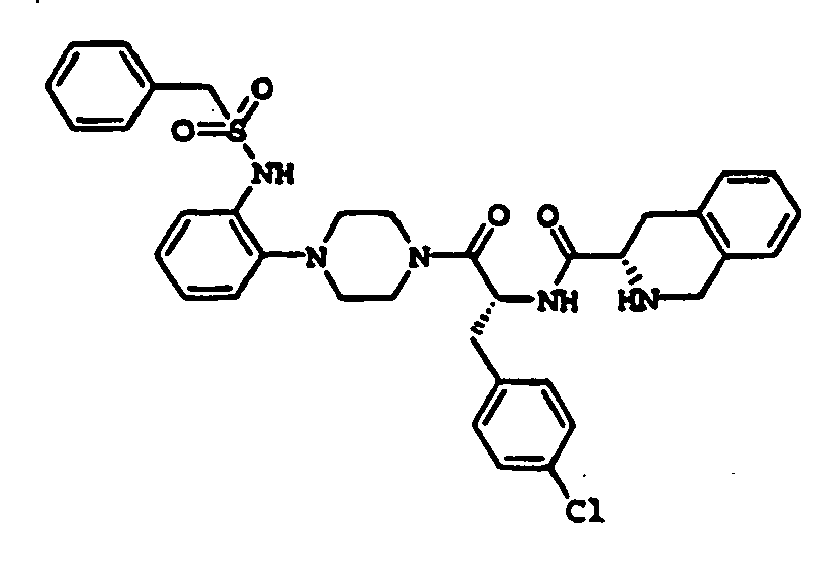
- tert-Butyl 3-(N-{(1R)-1-[(4-chlorophenyl)methyl]-2-oxo-2-[4-(2-{[benzylsulfonyl]amino}phenyl)piperazinyl] ethyl}carbamoyl) (3S)-1,2,3,4-tetrahydroisoquinoline-2-carboxylate was prepared according to the procedure for Preparation III using tert-butyl 3-(N-{(1R)-2-[4-(2-aminophenyl)piperazinyl]-1-[(4-chlorophenyl)methyl]-2-oxoethyl}carbamoyl)(3S)-1,2,3,4-tetrahydroisoquinoline-2-carboxylate (Preparation IX) (730 mg, 1.2 mmol), pyridine (100 µl, 1.2 mmol) and α-toluenesulfonyl chloride (240 mg, 1.2 mmol) (Aldrich). The crude material was purified by flash chromatography (SiO2 10% EtOAc in CH2Cl2) to afford the desired compound (387 mg). MS (ESI, pos. ion) m/z: 772 (M+H), (ESI, neg. ion) m/z: 770 (M-H). Calc'd for C41H46ClN5O6S: 772.35. Anal. Calcd for C41H46ClN5O6S-0.5 C4H8O2: C, 63.26; H, 6.17; N, 8.58; Cl, 4.34. Found C, 62.98; H, 6.09; N, 8.36.
- N-{(1R)-1-[(4-Chlorophenyl)methyl]-2-oxo-2-[4-(2-{[benzylsulfonyl]amino}phenyl)piperazinyl]ethyl}(3S)(3-1,2,3,4-tetrahydroisoquinolyl))carboxamide was prepared from tert-butyl 3-(N-[(1R)-1-[(4-chlorophenyl)methyl]-2-oxo-2-[4-(2-{[benzylsulfonyl] amino}phenyl)piperazinyl]ethyl}carbamoyl)(3S)-1,2,3,4-tetrahydroisoquinoline-2-carboxylate (Step 1)(300 mg, 0.39 mmol) according to the procedure for Preparation XVI. The crude product was purified by flash chromatography (SiO2 3% MeOH in CH2Cl2) to afford the desired material (130 mg). The compound was dissolved in H2O and CH3CN, treated with AcOH and freeze-dried to yield the acetate salt. MS (ESI, pos. ion) m/z: 672 (M+H), (ESI, neg. ion) m/z: 670 (M-H). Calc'd for C36H38ClN5O4S: 671.23.
-

- Following the procedure for the synthesis of Example 40 Step 3 (without DIEA), tert-butyl 3-[N-((1R)-2-{4-[2-({2-[(tert-butoxy)carbonylamino]ethyl)amino)phenyl]-piperazinyl}-1-[(4-chlorophenyl)methyl]-2-oxoethyl)-carbamoyl](3S)-1,2,3,4-tetrahydroisoquinoline-2-carboxylate was prepared from tert-butyl 3-(N-{(1R)-2-[4-(2-aminophenyl)piperazinyl]-1-[(4-chlorophenyl)-methyl]-2-oxoethyl}carbamoyl)(3S)-1,2,3,4-tetrahydro-isoquinoline-2-carboxylate (Preparation IX) (630 mg, 1.0 mmol) in 2 mL of ClCH2CH2Cl, tert-butyl-N-(2-oxoethyl)carbamate (179 mg, 1.126 mmol) (Aldrich) in ClCH2CH2Cl (10 mL), and NaBH(OAc)3 (330 mg, 1.557 mmol) (Aldrich). The crude was purified by flash chromatography (SiO2, 2:1 hexane:EtOAc) to afford the desired compound (578 mg). MS (ESI, pos. ion) m/z: 761 (M+H), (ESI, neg. ion) m/z: 759 (M-H). Calc'd for C41H53ClN6O6: 761.35. Anal. Calc'd for C41H53ClN6O6-0.5 C4H8O2-0.5 H2O: C, 63.42; H, 7.18; N, 10.32; Cl. 4.35. Found C, 62.96 (+ 0.46); H, 7.14; N, 10.26; Cl, 4.06.
- N-[(1R)-2-(4-{2-[(2-Aminoethyl)amino]phenyl} piperazinyl)-1-[(4-chlorophenyl)methyl]-2-oxoethyl] ((3S)(3-1,2,3,4-tetrahydroisoquinolyl)) carboxamide was prepared according to Preparation XVI using tert-butyl 3-[N-((1R)-2-{4-[2-({2-[(tert-butoxy)carbonylamino]-ethyl}amino)phenyl]-piperazinyl}-1-[(4-chlorophenyl)-methyl]-2-oxoethyl)-carbamoyl](3S)-1,2,3,4-tetrahydro-isoquinoline-2-carboxylate (150 mg, 0.18 mmol) and 25 mL of EtOAc satd with HCl. The crude product was concentrated to provide the desired product (90 mg). MS (ESI, pos. ion) m/z: 561 (M+H), (ESI, neg. ion) m/z: 559 (M-H). Calc'd for C11H37ClN6O2: 560.27.
-

- To a 150 mL round-bottomed flask equipped with magnetic stirring was added methyl 2-[4-benzylpiperazinyl] benzoate (Preparation XIII) (2.3 g, 7.4 mmol) in THF (60 mL). A soln of LiOH (Aldrich) (940 mg, 22 mmol) in H2O (20 mL), was added and the reaction mixture was heated at 60°C for 12 h. After cooling to RT, the reaction mixture was concentrated in vacuo and diluted with EtOAc (100 mL). A 10% soln of citric acid (25 mL) was added, the organic layer was separated and the aqueous layer was extracted with EtOAc (2 x 25 mL). The organic layers were combined, washed with H2O, satd NaCl, dried over Na2SO4, filtered and concentrated in vacuo to afford 2-[4-benzylpiperazinyl]benzoic acid as a white solid (2.05 g). MS (ESI, pos.ion) m/z: 297 (M+H). Calc'd for C18H20N2O2: 296.15 : 296.15.
- To a 100 mL round-bottomed flask equipped with magnetic stirring was added 2-[4-benzylpiperazinyl] benzoic acid (Step 1) (1.1 g, 3.7 mmol) in CH2Cl2 (40 mL) under a N2 atmosphere. Oxalyl chloride (Aldrich) (390 µL, 1.32 mmol) was added, the mixture was stirred at RT for 5 min. and several drops of DMF were added. After stirring at RT for 2 h, the reaction mixture was concentrated in vacuo and redissolved in CH2Cl2 (40 mL). N,N-Dimethylamine (Aldrich) (5.6 mL of a 2M soln in THF, 11 mmol) was added and the mixture was stirred at RT for 12 h. The reaction was washed with H2O, brine, dried over Na2SO4, filtered, concentrated in vacuo, and purified by column chromatography (4:1 hexanes-EtOAc) affording N,N-dimethyl{2-[4-benzylpiperazinyl]phenyl}carboxamide (558 mg). MS (ESI, pos.ion) m/z: 324 (M+H). Calc'd for C20H25N3O: 323.43.
- To a round-bottomed flask equipped with stirring was added N,N-dimethyl{2-[4-benzylpiperazinyl]phenyl} carboxamide (Step 2)(420 mg, 1.3 mmol), MeOH (10 mL), 10% Pd/C (Aldrich) (138 mg), and HCO2NH4 (409 mg, 6.5 mmol), and the reaction mixture was heated at reflux for 2 h. The reaction mixture was filtered through Celite®, concentrated in vacuo, and redissolved in CH2Cl2 (20 mL). The reaction mixture was washed with a Na2CO3 (10%, 2x), H2O, brine, dried over Na2SO4, filtered and concentrated in vacuo yielding N,N-dimethyl(2-piperazinylphenyl)carboxamide (255 mg). MS (ESI, pos. ion) m/z: 234 (M+H). Calc'd for C13H19N3O: 233.31.
- [2-(4-{(2R)-2-[(tert-Butoxy)carbonylamino]-3-(4-chlorophenyl)propanoyl}piperazinyl)phenyl]-N,N-dimethylcarboxamide was prepared according to the procedure described in Preparation V by using N,N-dimethyl(2-piperazinylphenyl)carboxamide (Step 3) (260 mg, 1.1 mmol), Boc-p-Cl-D-Phe-OH (Peptech Corporation) (370 mg, 1.2 mmol), HOAT (Aldrich) (151 mg, 1.11 mmol), and EDC (Aldrich Chemical Company) (430 mg, 2.2 mmol). The compound was isolated as a crude white foam (480 mg) and used in the next step without further purification. MS (ESI, pos.ion) m/z: 515 (M+H). Calc'd for C27H35ClN4O4: 515.04.
- (2-{4-[(2R)-2-Amino-3-(4-chlorophenyl)propanoyl]-piperazinyl}phenyl)-N,N-dimethylcarboxamide HCl salt was prepared according to the procedure described in Preparation XVI by using [2-(4-{(2R)-2-[(tert-butoxy)carbonylamino]-3-(4-chlorophenyl)propanoyl}-piperazinyl)phenyl]-N,N-dimethylcarboxamide (Step 4) (240 mg, 0.46 mmol) and a satd soln of HCl in EtOAc (10 mL). The white solid that formed was isolated by filtration (200 mg). MS (ESI, pos.ion) m/z: 415 (M+H). Calc'd for C22H28Cl2N4O2: 451.39.
- tert-Butyl 3-[N-((1R)-2-{4-[2-(N,N-dimethylcarbamoyl)-phenyl]piperazinyl}-1-[(4-chlorophenyl)methyl]-2-oxoethyl)carbamoyl](3S)-1,2,3,4-tetrahydro-isoquinoline-2-carboxylate was prepared according to the procedure described in Preparation V by using (2-{4-[(2R)-2-amino-3-(4-chlorophenyl)-propanoyl]-piperazinyl)phenyl)-N,N-dimethylcarboxamide HCl salt (Step 5)(230 mg, 0.50 mmol), Boc-L-Tic-OH (Bachem Company) (150 mg, 0.55 mmol), HOAT (Aldrich) (68 mg, 0. 50 mmol), EDC (Aldrich) (190 mg, 1.00 mmol) and DIEA (Aldrich) (87 µL, 0.50 mmol). The compound was isolated and purified by column chromatography (CH2Cl2: 1.5% 2M NH3 in MeOH). (255 mg). MS (ESI, pos. ion) m/z: 674 (M+H). Calc'd for C37H44ClN5O5: 674.23.
- [2-(4-{(2R)-2-[((3S)(3-1,2,3,4-Tetrahydroisoquinolyl))carbonylamino]-3-(4-chlorophenyl)-propanoyl}piperazinyl)phenyl]-N,N-dimethylcarboxamide was prepared according to the procedure described in Preparation XVI by using tert-butyl 3-[N-((1R)-2-{4-[2-(N,N-dimethylcarbamoyl)-phenyl]piperazinyl}-1-[(4-chlorophenyl)methyl]-2-oxoethyl)carbamoyl](3S)-1,2,3,4-tetrahydro-isoquinoline-2-carboxylate (Step 6) (156 mg, 0.23 mmol) and a satd soln of HCl in EtOAc (5 mL). The title compound was isolated by filtration as a white solid, and purified by preparative HPLC (TFA buffer) (125 mg). MS (ESI, pos.ion) m/z: 574 (M+H). Calc'd for C32H36ClN5O3: 573.25.
-

- The title compound was prepared according to the procedure described in Preparation XVI by using methyl 2-(4-[(2R)-2-({(3S)-2-[(tert-butyl)oxycarbonyl](3-1,2,3,4-tetrahydroisoquinolyl)}carbonylamino)-3-(4-chlorophenyl)propanoyl]piperazinyl}benzoate (Preparation XVII) (140 mg, 0.21 mmol) and a satd soln of HCl in EtOAc (5 mL). The title compound was isolated by filtration as a white solid, and purified by preparative HPLC (62 mg). MS (ESI, pos.ion) m/z: 561 (M+H). Calc'd for C32H33ClN4O4: 560.22.
- To eighteen 10 mL scintillation vials were added PS-carbodiimide resin (Argonaut Technologies) (1mmol/g) (80 mg, 0.08 mmol), HOAT (Aldrich) (8 mg, 0.06 mmol) and 2-{4-[(2R)-2-({(3S)-2-[(tert-butyl)oxycarbonyl](3-1,2,3,4-tetrahydroisoquinolyl)} carbonylamino)-3-(4-chlorophenyl)propanoyl]-piperazinyl}benzoic acid (Preparation XVIII) (40 mg, 0.06 mmol) in CH2Cl2 (3 mL), and the reaction mixtures were shaken at RT for 10 min. The corresponding amine (0.05 mmol) was added, and the vials were shaken at RT for 12 h. Resin was filtered off and washed with CH2Cl2, and the solutions were concentrated in vacuo. A satd soln of HCl in EtOAc (2mL) was added. After 1h at RT, the solutions were concentrated in vacuo, and the products were purified by preparative HPLC (TFA buffer) to yield the TFA salts of the desired product.
-

- MS (ESI, pos.ion) m/z: 616 (M+H). Calc'd for C34H38N5O4Cl: 615.26.
-

- MS (ESI, pos.ion) m/z: 600 (M+N). Calc'd for C34H38ClN5O3: 599.27.
-

- MS (ESI, pos.ion) m/z: 650 (M+H). Calc'd for C38H40ClN5O3: 649.28.
-

- MS (ESI, pos.ion) m/z: 586 (M+H). Calc'd for C33H36ClN5O3: 585.25.
-

- MS (ESI, pos.ion) m/z: 705 (M+H). Calc'd for C41H45ClN6O3: 704.32.
-

- MS (ESI, pos.ion) m/z: 629 (M+H). Calc'd for C35H41ClN6O3: 628.29.
-

- MS (ESI, pos.ion) m/z: 631 (M+H). Calc'd for C34H39ClN6O4: 630.27.
-

- MS (ESI, pos.ion) m/z: 664 (M+H). Calc'd for C39H42ClN5O3: 663.30.
-

- MS (ESI, pos.ion) m/z: 620 (M+H). Calc'd for C33H38ClN5O3S: 619.24.
-
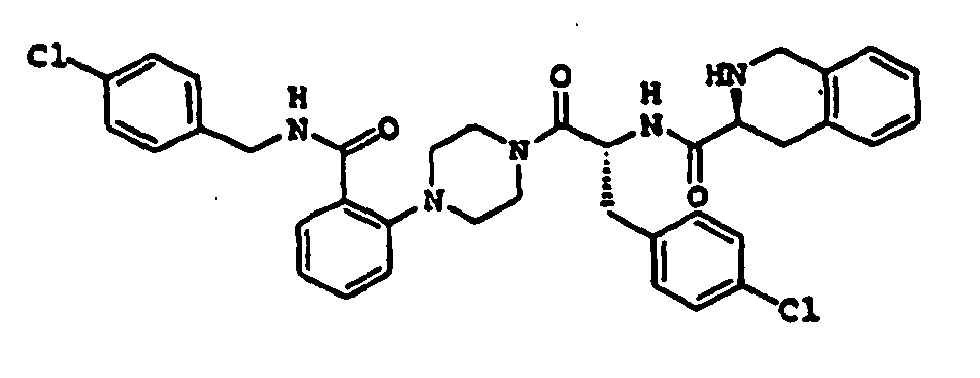
- MS (ESI, pos.ion) m/z: 670 (M+H). Calc'd for C37H37Cl2N5O3: 669.23.
-

- MS (ESI, pos.ion) m/z: 622 (M+H). Calc'd for C36H36ClN5O3: 621.25.
-

- MS (ESI, pos.ion) m/z: 657 (M+H). Calc'd for C37H45ClN6O3: 656.32.
-

- MS (ESI, pos.ion) m/z: 657 (M+H). Calc'd for C36H41ClN6O4: 656.29.
-

- MS (ESI, pos.ion) m/z: 742 (M+H). Calc'd for C44H44ClN5O4: 741.31.
-

- MS (ESI, pos.ion) m/z: 650 (M+H). Calc'd for C38H40ClN5O3: 646.28.
-

- MS (ESI, pos.ion) m/z: 657 (M+H). Calc'd for C37H45ClN6O3: 656.32.
-

- MS (ESI, pos.ion) m/z: 642 (M+H). Calc'd for C37H44ClN5O3: 641.31.
-
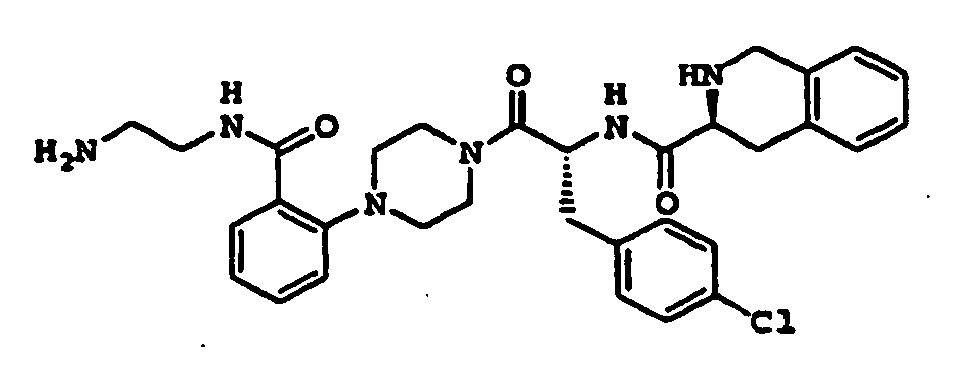
- MS (ESI, pos.ion) m/z: 589 (M+H). Calc'd for C32H37ClN6O3: 588.26.
-

- To a solution of 2-fluorobenzaldehyde (Aldrich) (1 g, 8.1 mmol) in DMF (14 mL) was added 1-Boc-piperazine (Lancaster) (2.3 g, 12 mmol). The resulting solution was treated with copper (Aldrich Chemical Company) (50 mg, 0.8 mmol) and K2CO3 (Aldrich) (5.1 g, 37 mmol). The suspension was heated in a sealed tube at 150°C for 18 h. After cooling to RT, the reaction mixture was partitioned between EtOAc and brine. The aqueous layer was extracted twice with EtOAc and the combined EtOAc layers were washed with water, dried over Na2SO4, filtered and concentrated in vacuo. The crude compound was purified on a Biotage 40M column (12% EtOAc in hexanes) to give tert-butyl 4-(2-formylphenyl) piperazinecarboxylate (0.66 g) as a yellow oil. MS m/z: 291 (M+H). Calc'd for C16H22N2O3: 290.36.
- To tert-butyl 4-(2-formylphenyl) piperazinecarboxylate (Step 1) (0.6 g, 2.1 mmol), was added dimethylamine (Aldrich) (1.6 mL of a 2.0 M soln in THF, 3.2 mmol) in ClCH2CH2Cl (15 mL) and NaBH(OAc)3 (Aldrich) (0.66 g, 3.2 mmol). The reaction was stirred at RT for 2 h. The mixture was partitioned between CH2Cl2 and satd NaHCO3. The organic layer was washed with brine, dried over Na2SO4, filtered and concentrated in vacuo to give tert-butyl 4-{2-[(dimethylamino)methyl]phenyl} piperazinecarboxylate (0.68 g) as a yellow oil. MS m/z: 320 (M+H). Calc'd for C18H29N3O2: 319.44.
- To tert-butyl 4-{2-[(dimethylamino)methyl]phenyl}-piperazine carboxylate (Step 2) (0.68 g, 2.1 mmol) dissolved in CH2Cl2 (12 mL) was added TFA (6 mL). After stirring the reaction at RT for 1 h, the solvent was concentrated in vacuo and the residue was partitioned between CH2Cl2 and satd NaHCO3. The organic layer was washed with brine and the combined aqueous layer were extracted with a mixture of CH2Cl2 and 30% MeOH. The combined organic layer was dried over Na2SO4, filtered and concentrated in vacuo to give dimethyl[(2-piperazinylphenyl)methyl]amine as a yellow oil (0.35 g). MS m/z: 220 (M+H). Calc'd for C13H21N3: 219.33.
- (2R)-2-Amino-1-(4-{2-[(dimethylamino)methyl] phenyl}piperazinyl)-3-(4-chlorophenyl)propan-1-one was prepared according to the procedure described in Preparation V using dimethyl[(2-piperazinylphenyl) methyl]amine (Step 3)(0.35 g, 1.4 mmol), Boc-p-Cl-D-Phe-OH (Peptech Corp.) (0.53 g, 1.8 mmol) in CH2Cl2 (7 mL), EDC (Aldrich Chemical Company) (0.37 g, 1.9 mmol) and HOBT (used in place of HOAT) (Bachem) (0.27 g, 1.8 mmol). After workup as described in Preparation V, the crude compound was dissolved in CH2Cl2 (10 mL) and treated with TFA (5 mL). After stirring the reaction at RT for 1 h, the solvent was concentrated in vacuo and the residue was partitioned between CH2Cl2 and satd NaHCO3. The organic layer was washed with brine, dried over Na2SO4, filtered and concentrated in vacuo to give (2R)-2-amino-1-(4-{2-[(dimethylamino)methyl]phenyl} piperazinyl)-3-(4-chlorophenyl)propan-1-one as a yellow oil (0.53 g). MS mlz: 401 (M+H). Calc'd for C22H29ClN4O: 400.94.
- tert-Butyl 3-{N-[(1R)-2-(4-{2-[(dimethylamino)methyl] phenyl}piperazinyl)-1-[(4-chlorophenyl)methyl]-2-oxoethyl]carbamoyl}(3S)-1,2,3,4-tetrahydroisoquinoline-2-carboxylate was prepared according to the procedure described in Preparation V, (2R)-2-amino-1-(4-{2-[(dimethylamino)methyl]phenyl} piperazinyl)-3-(4-chlorophenyl)propan-1-one (0.34 g, 0.85 mmol), Boc-L-Tic-OH (Peptech Corp.) (0.26 g, 0.93 mmol), EDC (0.2 g, 1.0 mmol), HOBT (used in place of HOAT) (Bachem) (0.14 g, 0.93 mmol) and CH2Cl2 (4 mL). The crude compound was purified on a Biotage 40S column (CH2Cl2/MeOH 95:5) to give tert-butyl 3-{N-[(1R)-2-(4-{2-[(dimethylamino) methyl]phenyl}piperazinyl)-1-[(4-chlorophenyl)methyl]-2-oxoethyl]carbamoyl}(3S)-1,2,3,4-tetrahydro-isoquinoline-2-carboxylate as a white foam (0.32 g). MS mlz: 660 (M+H). Calc'd for C37H46ClN5O4: 660.25.
- To tert-butyl 3-{N-[(1R)-2-(4-{2-[(dimethylamino) methyl]phenyl}piperazinyl)-1-[(4-chlorophenyl)methyl]-2-oxoethyl]carbamoyl}(3S)-1,2,3,4-tetrahydro-isoquinoline-2-carboxylate (Step 5)(0.31 g, 0.47 mmol) dissolved in dioxane (0.5 mL) was added 4N HCl in dioxane (1 mL). After stirring at RT for 6 h, the solvent was removed in vacuo, and the residue was purified by preparative HPLC (Waters Xterra C18 5 micron 100 x 20 mm, 10% to 80% CH3CN in H2O over 6.0 min, 4.63 min) to give N-[(1R)-2-(4-{2-[(dimethylamino)methyl]phenyl}piperazinyl)-1-[(4-chlorophenyl)methyl]-2-oxoethyl]((3S)(3-1,2,3,4-tetrahydroisoquinolyl))carboxamide (TFA salt) as a white solid (0.27 g). MS m/z: 560 (M+H). Calc'd for C32H38ClN5O2: 559.27. Anal. Calcd for C32H38ClN5O2-2.5 TFA-0.1 H2O: C, 52.47; H, 4.84; N, 8.27; Cl, 4.19. Found: C, 52.26; H, 4.75; N, 8.14; Cl, 4.41.
-

- tert-Butyl 3-{N-[(1S)-2-(4-{2-[(dimethylamino)methyl]-phenyl}piperazinyl)-1-[(4-chlorophenyl)methyl]-2-oxoethyl]carbamoyl}azetidinecarboxylate was prepared according to the procedure described in Preparation V by using (2R)-2-amino-1-(4-{2-[(dimethylamino)methyl]-phenyl}piperazinyl)-3-(4-chlorophenyl)propan-1-one (Example 91, Step 4)(0.17 g, 0.42 mmol), Boc-azetidine (Peptech Corp.) (0.094 g, 0.47 mmol), EDC (Aldrich) (0.097 g, 0.51 mmol), HOBT (used in place of HOAT) (Bachem) (0.071 g, 0.47 mmol) and CH2Cl2 (2 mL). The crude was purified on a Biotage 40S column (CH2Cl2/MeOH= 95:5) to give tert-butyl 3-{N-[(1S)-2-(4-{2-[(dimethylamino)methyl]phenyl}piperazinyl)-1-[(4-chlorophenyl)methyl]-2-oxoethyl]carbamoyl}azetidine carboxylate as a white solid (0.15 g). MS m/z: 584 (M+H). Calc'd for C31H42ClN5O4: 584.15.
- To tert-butyl 3-{N-[(1S)-2-(4-{2-[(dimethylamino) methyl]phenyl}piperazinyl)-1-[(4-chlorophenyl)methyl]-2-oxoethyl]carbamoyl}azetidinecarboxylate (Step 1)(0.12 g, 0.2 mmol) dissolved in dioxane (0.2 mL) was added 4N HCl in dioxane (0.4 mL). After stirring at RT for 6 h, the solvent was concentrated in vacuo and the residue was purified by preparative HPLC (Waters Xterra C18 5 micron 100x20 mm, 10% to 80% CH3CN in H2O over 6.0 min) to yield the TFA salt of the desired compound. MS m/z: 520 (M+HCl). Calc'd for C26H34ClN5O2: 483.24.
-

- Following the procedure for the synthesis of Preparation XIX, N-{(1R)-1-[(4-chlorophenyl)methyl]-2-oxo-2-(4-phenylpiperazinyl)ethyl}(tert-butoxy)-carboxamide was prepared from Boc-p-Cl-D-Phe-OH (380 mg, 1.3 mmol) (Nova Biochem), 1-[3-(dimethylamino)-propyl]-3-ethylcarbodiimide methiodide, (770 mg, 2.6 mmol) (Aldrich), HOAT (180 mg, 1.30 mmol) (Aldrich) and 1-phenylpiperazine (200 µl, 1.28 mmol) (Aldrich), (570 mg). MS (ESI, pos. ion) mlz: 444 (M+H), (ESI, neg. ion) m/z: 442 (M-H). Calc'd for C24H30ClN3O3: 443.97.
- To N-{(1R)-1-[(4-chlorophenyl)methyl]-2-oxo-2-(4-phenylpiperazinyl)ethyl}(tert-butoxy)carboxamide (Step 1) (573 mg, 1.30 mmol) in 50 mL round bottomed flask equipped with magnetic stirring was added 25 mL of EtOAc satd with HCl, and the reaction mixture was stirred for 1 h. The resulting solid was filtered and washed with hexane. The solid was dried further in vacuo and then added to a 50 mL round bottomed flask equipped with magnetic stirring. DMF (10 mL), DIEA (110 µl, 0.631 mmol) (Aldrich), Boc-L-Tic-OH (90 mg, 0.68 mmol) (Peptech), 1-(3-dimethylaminopropyl)-3-ethylcarbodiimide methiodide (396 mg, 1.33 mmol), and HOAT (90 mg, 0.661 mmol) were added to the reaction flask. The resulting solution was stirred 2 h then worked up as in Preparation XIX. The resulting crude was purified by flash chromatography (SiO2, 1:1, hexane-EtOAc) to afford tert-butyl 3-(N-{(1R)-1-[(4-chlorophenyl)methyl]-2-oxo-2-(4-phenylpiperazinyl) ethyl}carbamoyl)(3S)-1,2,3,4-tetrahydroisoquinoline-2-carboxylate (130 mg). MS (ESI, pos. ion) m/z: 603 (M+H), (ESI, neg. ion) m/z: 601 (M-H). Calc'd for C34H39ClN4O4: 603.15.
- tert-Butyl 3-(N-{(1R)-1-[(4-chlorophenyl)methyl]-2-oxo-2-(4-phenylpiperazinyl) ethyl}carbamoyl)(3S)-1,2,3,4-tetrahydroisoquinoline-2-carboxylate (Step 2) (127 mg, 0.211 mmol) was treated with 10 mL of EtOAc satd with HCl in a 50 mL round bottomed flask equipped with magnetic stirring. The resulting solid was filtered, washed with hexane and dried in vacuo to yield N-{(1R)-1-[(4-chlorophenyl)methyl]-2-oxo-2-(4-phenyl-piperazinyl)ethyl}((3S)(3-1,2,3,4-tetrahydro-isoquinolyl))carboxamide (40 mg). MS (ESI, pos. ion) m/z: 503 (M+H), (ESI, neg. ion) m/z: 501 (M-H). Calc'd for C29H31ClN4O2: 502.21.
-

- N-{(1R)-1-[(4-Chlorophenyl)methyl]-2-oxo-2-(4-(2-pyridyl)piperazinyl)ethyl}(tert-butoxy)carboxamide was prepared according to the procedure for Preparation XIX using Boc-p-Cl-D-Phe-OH (550 mg, 1.8 mmol), 1-(3-dimethylaminopropyl)-3-ethylcarbodiimide methiodide (1.1 g, 3.80 mmol), HOAT (260 mg, 1.9 mmol), DMF (15 mL), and 1-(2-piperidyl)piperazine (280 µl, 1.8 mmol) (Aldrich). The crude material was concentrated in vacuo to yield 810 mg. MS (ESI, pos. ion) m/z: 445 (M+H), (ESI, neg. ion) m/z: 443 (M-H). Calc'd for C23H29ClN4O3: 444.95.
- tert-Butyl 3-(N-{(1R)-1-[(4-chlorophenyl)methyl]-2-oxo-2-(4-(2-pyridyl)piperazinyl)ethyl}carbamoyl)(3S)-1,2,3,4-tetrahydroisoquinoline-2-carboxylate was prepared from N-{(1R)-1-[(4-chlorophenyl)methyl]-2-oxo-2-(4-(2-pyridyl)piperazinyl)ethyl}(tert-butoxy)-carboxamide (Step 1) (800 mg, 1.80 mmol), following the procedure for Example 93, Step 2 using 25 mL of EtOAc satd with HCl for the first step, and DIEA (240 µl, 1.38 mmol), Boc-L-Tic-OH (340 mg, 1.2 mmol), 1-(3-dimethylaminopropyl)-3-ethylcarbodiimide methiodide (740 mg, 2.5 mmol), HOAT (184 mg, 1.35 mmol) and DMF (15 mL) for the second step. The crude was purified by flash chromatography (SiO2, 1:1, hexane:EtOAc) to yield the title compound (460 mg). MS (ESI, pos. ion) mlz: 604 (M+H), (ESI, neg. ion) m/z: 602 (M-H). Calc'd for C33H38ClN5O4: 604.14.
- N-{(1R)-1-[(4-Chlorophenyl)methyl]-2-oxo-2-(4-(2-pyridyl)piperazinyl)ethyl}((3S)(3-1,2,3,4-tetrahydroisoquinolyl))carboxamide was prepared according to the procedure used for Preparation XVI using tert-butyl 3-(N-{(1R)-1-[(4-chlorophenyl)methyl]-2-oxo-2-(4-(2-pyridyl)piperazinyl)ethyl}carbamoyl)(3S)-1,2,3,4-tetrahydroisoquinoline-2-carboxylate (Step 2)(450 mg, 0.745 mmol) and 10 mL HCl satd EtOAc. The resulting solid was purified by preparative HPLC (AcOH buffer) and freeze-dried yielding the acetate salt (410 mg). Mass Spec. m/z: 504 (M+H), (ESI, neg. ion) m/z: 502 (M-H). Calc'd for C28H30ClN5O2: 503.21. Anal. Calcd for C28H30ClN5O2-C2H4O2: C, 63.88; H, 6.08; N, 12.42. Found C, 63.66; H, 6.02; N, 12.64.
-

- N-{(1R)-1-[(4-Chlorophenyl)methyl]-2-oxo-2-[4-(2-pyridylmethyl)piperazinyl]ethyl}(tert-butoxy) carboxamide was prepared according to the procedure for Preparation XIX using (2-pyridylmethyl)piperazine (650 mg. 3.7 mmol) (Array), Boc-p-Cl-D-Phe-OH (1.1 g, 3.7 mmol), 1-(3-dimethylaminopropyl)-3-ethylcarbodiimide methiodide (2.2 g, 7.2 mmol), HOAT (560 mg, 4.10 mmol) and DMF (15 mL) (730 mg). MS (ESI, pos. ion) m/z: 459 (M+H), (ESI, neg. ion) m/z: 457 (M-H). Calc'd for C24H31ClN4O3: 458.98.
- tert-Butyl 3-(N-{(1R)-1-[(4-chlorophenyl)methyl]-2-oxo-2-[4-(2-pyridylmethyl)-piperazinyl]ethyl}carbamoyl)-(3S)-1,2,3,4-tetrahydroisoquinoline-2-carboxylate was prepared from N-{(1R)-1-[(4-chlorophenyl)methyl]-2-oxo-2-[4-(2-pyridylmethyl)piperazinyl]ethyl}(tert-butoxy) carboxamide (Step 1)(270 mg, 0.58 mmol) according to the procedure used for Example 93, Step 2 using 25 mL HCl satd EtOAc, for the first step, then DIEA (100 µl, 0.574 mmol), Boc-L-Tic-OH (82 mg, 0.296 mmol); 1-(3-dimethylaminopropyl)-3-ethylcarbodiimide methiodide (101 mg, 0.340 mmol), and HOAT (50 mg, 0.367 mmol) for the second step (139 mg). MS (ESI, pos. ion) m/z: 618 (M+H), (ESI, neg. ion) m/z: 616 (M-H). Calc'd for C34H40ClN5O4: 618.17.
- N-{(1R)-1-[(4-Chlorophenyl)methyl]-2-oxo-2-[4-(2-pyridylmethyl)piperazinyl]ethyl}-3-1,2,3,4-tetrahydroisoquinolylcarboxamide was prepared from tert-butyl 3-(N-{(1R)-1-[(4-chlorophenyl)methyl]-2-oxo-2-[4-(2-pyridylmethyl)piperazinyl]ethyl}carbamoyl) (3S)-1,2,3,4-tetrahydroisoquinoline-2-carboxylate (Step 2)(140 mg, 0.230 mmol) according to the procedure for Preparation XVI. The crude was purified by preparative HPLC (TFA buffer) to afford the desired product (20 mg) as a TFA salt. MS (ESI, pos. ion) m/z: 518 (M+H), (ESI, neg. ion) m/z: 516 (M-H). Calc'd for C29H32ClN5O2: 517.22.
-

- 2,5-Diaza-2-(2-nitrophenyl)-5-benzylbicyclo[2.2.1] heptane was prepared according to the procedure for Preparation Ia using, 2-fluoronitrobenzene (860 µl, 8.2 mmol), DIEA (5.3 mL, 30 mmol), and (1S, 4S)-2-benzyl-2,5-diazabicyclo[2.2.1]heptane dihydrobromide (3.0 g, 8.6 mmol) (Aldrich) and DMF (100 mL). The crude was purified by flash chromatography (SiO2, 2:1 hexane:EtOAc) to yield 685 mg. MS (ESI, pos. ion) m/z: 310 (M+H), (ESI, neg. ion) m/z: 308 (M-H). Calc'd for C18H19N3O2: 309.36.
- 2-[2,5-Diaza-5-benzylbicyclo[2.2.1]hept-2-yl]-phenylamine was prepared according to the procedure for Preparation II using 2,5-diaza-2-(2-nitrophenyl)-5-benzylbicyclo[2.2.1]heptane (Step 1) (690 mg, 2.2 mmol) and SnCl2-H2O (2.2 g, 9.8 mmol). MS (ESI, pos. ion) m/z: 280 (M+H), (ESI, neg. ion) m/z: 278 (M-H). Calc'd for C18H21N3: 279.38.
- {2-[2,5-Diaza-5-benzylbicyclo[2.2.1]hept-2-yl]phenyl}-(methylsulfonyl)amine was prepared from 2-[2,5-diaza-5-benzylbicyclo[2.2.1]hept-2-yl]phenylamine (Step 2) (690 mg, 2.5 mmol) according to the procedure for Preparation III using methanesulfonyl chloride (190 µl, 2.46 mmol) and pyridine (220 µl, 2.72 mmol). The crude mix was purified by flash chromatography (SiO2, 3% MeOH in CH2Cl2) to afford the desired sulfonamide (533 mg). MS (ESI, pos. ion) m/z: 358 (M+H), (ESI, neg. ion) m/z: 356 (M-H). Calc'd for C19H23N3O2S: 357.47.
- [2-(2,5-Diazabicyclo[2.2.1]hept-2-yl)phenyl] (methylsulfonyl)amine (180 mg) was prepared according to the procedure for Preparation IV using {2-[2,5-diaza-5-benzylbicyclo[2.2.1]hept-2-yl]phenyl}-(methylsulfonyl)amine (Step 3) (530 mg, 1.5 mmol), 10% Pd/C (450 mg) and HCO2NH4 (520 mg, 8.30 mmol). MS (ESI, pos. ion) mlz: 268 (M+H), (ESI, neg. ion) m/z: 266 (M-H). Calc'd for C12H17N3O2S: 267.10.
- N-[(1R)-2-(2,5-Diaza-5-{2-[(methylsulfonyl)amino] phenyl}bicyclo[2.2.1]hept-2-yl)-1-[(4-chlorophenyl) methyl]-2-oxoethyl](tert-butoxy)carboxamide was prepared according to the procedure for Preparation XIX using [2-(2,5-diazabicyclo[2.2.1]hept-2-yl)phenyl] (methylsulfonyl)amine (Step 4)(176 mg, 0.658 mmol), p-Cl-D-Phe-OH (210 mg, 0.700 mmol), 1-(3-dimethylamino-propyl)-3-ethylcarbodiimide methiodide (351 mg, 1.181 mmol) and HOAT (92 mg, 0.676 mmol). The crude was concentrated in vacuo to yield 369 mg, and used as is in the next step. MS (ESI, pos. ion) m/z: 549 (M+H), (ESI, neg. ion) m/z: 547 (M-H). Calc'd for C26H33ClN4O5S: 549.08.
- N-[(1R)-2-(2,5-Diaza-5-{2-[(methylsulfonyl)amino]-phenyl}bicyclo[2.2.1]hept-2-yl)-1-[(4-chlorophenyl)-methyl]-2-oxoethyl](tert-butoxy)carboxamide (Step 5)(369 mg, 0.672 mmol) was treated with satd HCl in EtOAc as described in Preparation XVI. The resulting crude material was diluted with EtOAc and washed with 10% Na2CO3 soln. The organic layer was separated, dried over Na2SO4, filtered and concentrated in vacuo. Using this material, tert-butyl 3-{N-[(1R)-2-(2,5-diaza-5-{2-[(methylsulfonyl)amino]phenyl}bicyclo [2.2.1]hept-2-yl)-1-[(4-chlorophenyl)methyl]-2-oxoethyl]carbamoyl}(3S)-1,2,3,4-tetrahydroisoquinoline-2-carboxylate was prepared according to the procedure for Preparation XIX from Boc-L-Tic-OH (194 mg, 0.699 mmol), HOAT (94 mg, 0.691 mmol), 1-(3-dimethylamino-propyl)-3-ethylcarbodiimide methiodide (415 mg, 1.396 mmol) and DMF (5 mL). The crude was purified by flash chromatography (SiO2, 20% EtOAc in CH2Cl2) to afford the desired compound (250 mg). MS (ESI, pos. ion) m/z: 708 (M+H), (ESI, neg. ion) m/z: 706 (M-H). Calc'd for C36H42ClN5O6S: 708.27.
- N-[(1R)-2-(2,5-Diaza-5-{2-[(methylsulfonyl)amino] phenyl}bicyclo[2.2.1]hept-2-yl)-1-[(4-chlorophenyl) ethyl]-2-oxoethyl]((3S)(3-1,2,3,4-tetrahydroisoquinolyl))carboxamide was prepared from tert-butyl 3-{N-[(1R)-2-(2,5-diaza-5-{2-[(methylsulfonyl)amino]-phenyl}bicyclo [2.2.1]hept-2-yl)-1-[(4-chlorophenyl)-methyl]-2-oxoethyl] carbamoyl}(3S)-1,2,3,4-tetrahydroisoquinoline-2-carboxylate (Step 6)(250 mg, 0.35 mmol) according to the procedure for Preparation XVI. The crude was purified by preparative HPLC (TFA buffer) to afford the desired product as the TFA salt (50 mg). MS (ESI, pos. ion) m/z: 608 (M+H), (ESI, neg. ion) m/z: 606 (M-H). Calc'd for C31H34ClN5C4S: 607.20. Anal. Calcd for C31H34ClN5O4S-1.5C2HF3O2-H2O: C, 51.23; H, 4.74; N, 8.78; Cl, 4.45; Found C, 50.96; H, 4.56; N, 8.57; Cl, 4.46.
-

- To a 500 mL round-bottomed flask equipped with magnetic stirring was added homopiperazine (8.315 g, 83 mmol) (Aldrich) and DMF (200 mL). This solution was heated in a 45°C oil bath and 2-fluoronitrobenzene (1.8 mL, 17 mmol) was added over 5 min. The reaction was stirred for 16 h, diluted with 400 mL EtOAc and washed with 1N NaOH (2 x 300 mL). The organic layer was concentrated in vacuo to afford 1-(2-nitrophenyl)-1,4-diaza-perhydroepine (3.8 g). MS (ESI, pos. ion) m/z: 222 (M+H), (ESI, neg. ion) m/z: 220 (M-H). Calc'd for C11H15N3O2: 221.26.
- 1-(2-Nitrophenyl)-1,4-diazaperhydroepine (Step 1)(1.7 g, 7.8 mmol) was treated according to the procedure for Preparation XIX using p-Cl-D-Phe-OH (2.4 g, 7.8 mmol), 1-(3-dimethylaminopropyl)-3-ethylcarbodiimide methiodide (4.82 g, 16.2 mmol), HOAT (1.09 g, 7.99 mmol), and DMF (50 mL) to yield N-{(1R)-1-[(4-chlorophenyl)methyl]-2-[4-(2-nitrophenyl)(1,4-diaza-perhydroepinyl)]-2-oxoethyl}(tert-butoxy)-carboxamide. MS (ESI, pos. ion) mlz: 503 (M+H), (ESI, neg. ion) m/z: 501 (M-H). Calc'd for C25H31ClN4O5: 502.99.
- N-{(1R)-1-[(4-Chlorophenyl)methyl]-2-[4-(2-nitrophenyl)(1,4-diazaperhydroepinyl)]-2-oxoethyl(tert-butoxy)carboxamide (Step 2)(1.37 g, 2.72 mmol) was treated with EtOAc satd with HCl as described in Preparation XVI. The resulting crude material was diluted with ELOAc and washed with satd NaHCO3 soln. The organic layer was separated, dried over Na2SO4, filtered and concentrated in vacuo. Using this material, tert-butyl 3-(N-{(1R)-1-[(4-chlorophenyl)-methyl]-2-[4-(2-nitrophenyl)(1,4-diazaperhydroepinyl)]-3-oxoethyl}carbamoyl)(3S)-1,2,3,4-tetrahydro-isoquinoline-2-carboxylate was prepared according to the procedure for Preparation XIX using Boc-L-Tic-OH (790 mg, 2.85 mmol), HOAT (385 mg, 2.83 mmol) and 1-(3-dimethylaminopropyl)-3-ethylcarbodiimide methiodide (1.695 g, 5.70 mmol). The crude material was purified by flash chromatography (SiO2, 2:1 Hexane:EtOAc) to afford the desired material (1.2 g). MS (ESI, pos. ion) m/z: 662 (M+H), (ESI, neg. ion) m/z: 660 (M-H). Calc'd for C35H40ClN4O6: 662.17.
- tert-Butyl 3-(N-{(1R)-2-[4-(2-aminophenyl)(1,4-diazaperhydroepinyl)]-1-[(4-chlorophenyl)methyl]-2-oxoethyl}carbamoyl)(3S)-1,2,3,4-tetrahydroisoquinoline-2-carboxylate was prepared from tert-butyl 3-(N-{(1R)-1-[(4-chlorophenyl)methyl]-2-[4-(2-nitrophenyl)(1,4-diazaperhydroepinyl)]-2-oxoethyl}carbamoyl)(3S)-1,2,3,4-tetrahydroisoquinoline-2-carboxylate (Step 3)(1.2 g, 1.8 mmol) and SnCl2-2H2O (1.6 g, 7.2 mmol), according to the procedure for Preparation II. The crude was purified by flash chromatography (SiO2, 20% EtOAc in CH2Cl2) to afford the desired material (590 mg). MS (ESI, pos. ion) m/z: 632 (M+H), (ESI, neg. ion) m/z: 630 (M-H). Calc'd for C35H42ClN5O4: 632.19.
- tert-Butyl 3-{N-[(1R)-1-[(4-chlorophenyl)methyl]-2-(4-{2-[(methylsulfonyl)amino]phenyl}(1,4-diaza-perhydroepinyl))-2-oxoethyl]carbamoyl}(3S)-1,2,3,4-tetrahydroisoquinoline-2-carboxylate was prepared according to the procedure for Preparation III using tert-butyl 3-(N-{(1R)-2-[4-(2-aminophenyl) (1,4-diazaperhydroepinyl)]-1-[(4-chlorophenyl)methyl]-2-oxoethyl}carbamoyl)(3S)-1,2,3,4-tetrahydroisoquinoline-2-carboxylate (Step 4)(390 mg, 0.61 mmol), methanesulfonyl chloride (52 µl, 0.67 mmol) and pyridine (60 µl, 0.74 mmol). The crude was isolated (400 mg). MS (ESI, pos. ion) m/z: 710 (M+H), (ESI, neg. ion) m/z: 708 (M-H). Calc'd for C36H44ClN5O6: 710.28.
- N-[(1R)-1-[(4-Chlorophenyl)methyl]-2-(4-{2-[(methylsulfonyl)amino]phenyl}(1,4-diaza-perhydroepinyl))-2-oxoethyl]((3S)(3-1,2,3,4-tetrahydro-isoquinolyl))carboxamide was prepared from tert-butyl 3-{N-[(1R)-1-[(4-chlorophenyl)methyl]-2-(4-(2-[(methylsulfonyl)amino]phenyl)(1,4-diaza-perhydro-epinyl))-2-oxoethyl]carbamoyl}(3S)-1,2,3,4-tetrahydro-isoquinoline-2-carboxylate (Step 5)(400 mg, 0.56 mmol) according to the procedure for Preparation XVI. The crude product was purified by preparative HPLC to yield the desired material as the acetate salt (7 mg). MS (ESI, pos. ion) m/z: 610 (M+H), (ESI, neg. ion) m/z: 608 (M-H). Calc'd for C31H36ClN5O4S: 609.22.
- Other compounds included in this invention are set forth in Tables 3-8 below.
Table 3. 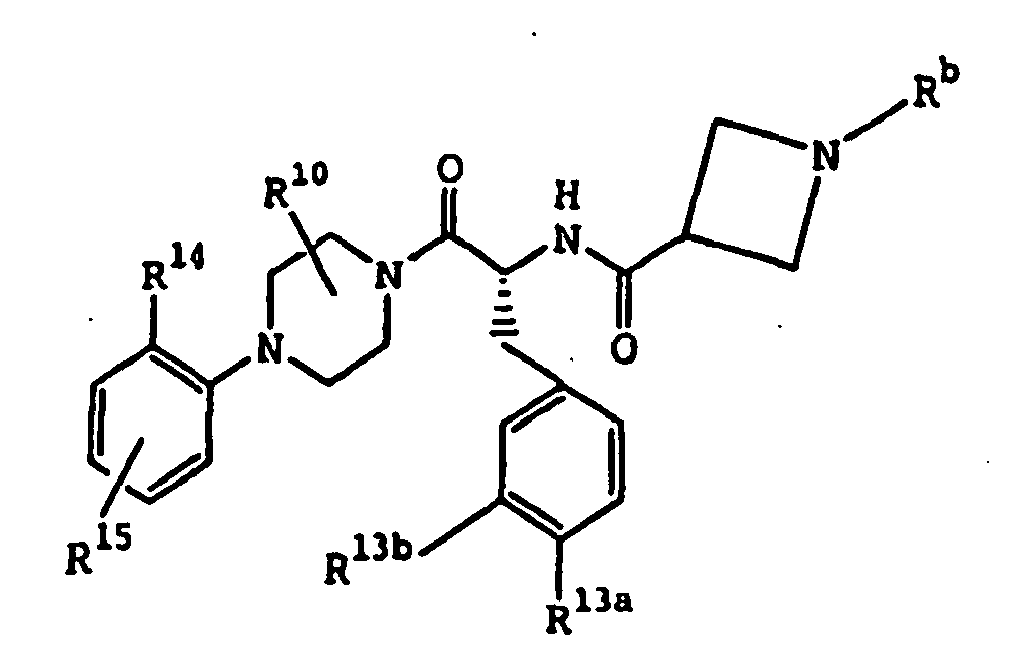
# R14 R10 R15 R13a R13b Rb 148. N-(CH3SO2)-N-(CypCH2)amino H H Cl H isobutyl Reference Example 149. N-(CH3SO2)-N-(CypCH2)amino H H Cl H -CH2C(CH3)3 Reference Example 150. N-(CH3SO2)-N-(CypCH2)amino H H Cl H -CH2cyp 151. N-(CH3SO2)-N-(CypCH2) amino H H Cl H butyl 152. N-(CH3SO2)-N-(CypCH2)amino H H Cl H pentyl 153. N-(CH3SO2)-N-(CypCH2)amino H H Cl H -CH2chxl 154. N-(3SO2)-N-(CypCH2)amino H H Cl H ethyl 155. N-(CH3SO2)-N-(CypCH2)amino H H Cl H methyl 156. N-(CH3SO2)-N-(CypCH2) amino H H Cl H isopropyl 157. N-(CH3SO2)-N-(CypCH2)amino H H Cl H benzyl 158. N-(CH3SO2)amino H H Cl H H 159. N-(CH3SO2)-N-(CypCH2)amino- H H Cl H propyl 160. 1,2,3-triazol-2-yl-CH2- H H Cl H H Reference Example 161. N-(CypCH2)-N-propylaminoCH2- H H Cl H Boc 162. N-(CypCH2)-N-propylaminoCH2- H H Cl H H 163. 1-imidazolylCH2- H H Cl H H 164. 1-tetrazolylCH2- H H Cl H H 165. 2,5-dimethylpyrrolidin-1-yl H H Cl H H 166. 2-oxo-pyrrolidin-1-ylmethyl H H Cl H H 167. 2-oxo-pyrrolidin-5-ylmethyl H H Cl H isopropyl 168. 2-oxo-pyrrolidin-1-ylmethyl H H Cl H ethyl Reference Example 169. 2-oxo-pyrrolidin-1-ylmethyl H H Cl H CypCH2- Reference Example 170. 2-oxo-pyrrolidin-1-ylmethyl H H Cl H -CH2C(CH3)3 171. 8-aza-bicyclo[3.2.1]oct-8-ylmethyl H H Cl H H 172. 8-aza-bicyclo[3.2.1]oct-8-ylmethyl H H Cl H isopropyl 173. 8-aza-bicyclo[3.2.1]oct-8-ylmethyl H H Cl H ethyl Reference Example 174. 8-aza-bicyclo[3.2.1]oct-8-ylmethyl H H Cl H CypCH2- Reference Example 175. 8-aza-bicyclo[3.2.1]oct-8-ylmethyl H H Cl H -CH2C(CH3)3 176. phenoxymethyl H H Cl H H 177. 1-methylpiperazin-4-ylCH2- H H Cl H H 178. 2,6-dimethylpiperdin-l-ylCH2- H H Cl H H 179. 3-pyridyloxymethyl H H Cl H H 180. 1,2,3-triazol-2-ylCH2- H H Cl H isopropyl 181. 1,2,3-triazol-2-ylCH2- H H Cl H H Reference Example 182. 1,2,3-triazol-2-ylCH2- H H Cl H CypCH2- 183. 1,2,4-triazol-1-ylCH2- H H Cl H H 184. pyridyl-2-one-CH2- H H Cl H H 185. 1,2,3-triazol-2-ylCH2- H H Cl H isobutyl 186. 4-morpholinoCH2- H H Cl H H 187. 2-CH3-imidazol-1-ylCH2- H H Cl H H 188. 
H H Cl H H 189. 2-propylimidazol-1-yl-CH2- H H Cl H H 190. 1-piperidylCH2- H H Cl H H 191. 1-pyrrolidinylCH2- H H Cl H H 192. N-(MeSO2)-N-(CypCH2)aminomethyl H H Cl H H 193. 2-isopropylimidazol-1-ylCH2- H H Cl H H Reference Example 194. 1,2,3-triazol-2-ylCH2- H H Cl H -CH2C(CH3)3 195. 
H H Cl H H 196. 
H H Cl H H Reference Example 197. 1,2,3-triazol-2-ylCH2 H H Cl H chxl Reference Example 198. N-(MeSO2)-N-(CypCH2)aminomethyl H H Cl H cycloheptyl Reference Example 199. N-(MeSO2)-N-(CypCH2)aminomethyl H H Cl H morpholino Reference Example 200. N-(MeSO2)-N-(CypCH2)aminomethyl H H Cl H 2-(ethyl)butyl Reference Example 201. N-(MeSO2)-N-(CypCH2)aminomethyl H H Cl H chxl Reference Example 202. 1-pyrazolyl-CH2- H H Cl H CypCH2- 203. 1-pyrazolyl-CH2- H H Cl H ethyl 204. 1-pyrazolyl-CH2- H H Cl H H 205. 1-pyrazolyl-CH2- H H Cl H isopropyl 206. 1,2,3-triazol-1-ylCH2- H H Cl H isopropyl 207. N-propyl-N-(CypCH2)aminoCH2- H H Cl H isobutyl 208. N-propyl-N-(CypCH2)aminoCH2- H H Cl H ethyl Reference Example 209. N-(CypCH2)-N-propylaminoCH2 H H Cl H -CH2C(CH3)3 210. 1,2,3-triazol-1-ylCH2 H H Cl H isobutyl 211. N-(CH3SO2)-N-(CypCH2)amino H H Br H isobutyl Reference Example 212. N-(CH3SO2)-N-(CypCH2)amino H H Br H -CH2C(CH3)3 Reference Example 213. N-(CH3SO2)-N-(CypCH2)amino H H Br H -CH2cyp 214. N-(CH3SO2)-N-(CypCH2)amino H H Br H butyl 215. N-(CH3SO2)-N-(CypCH2)amino H H Br H pentyl 216. N-(CH3SO2)-N-(CypCH2)amino H H Br H -CH2chxl 217. N-(CH3SO2)-N-(CypCH2)amino H H Br H ethyl 218. N-(CH3SO2)-N-(CypCH2)amino H H Br H methyl 219. N-(CH3SO2)-N-(CypCH2)amino H H Br H isopropyl 220. N-(CH3SO2)-N-(CypCH2)amino H H Br H H Reference Example 221. N-(CypCH2)-N-(MeSO2)amino- H H Cl H cyclopentyl Reference Example 222. N-(CypCH2)-N-(MeSO2)amino- H H Cl H 2-butyl 223. 1,2,3-triazol-1-ylCH2- H H Cl H ethyl Reference Example 224. 1,2,3-triazol-1-ylCH2 H H Cl H -CH2C(CH3)3 Reference Example 225. N-(CypCH2)-N-propylaminoCH2- H H Br H Boc 226. N-(CypCH2)-N-propylaminoCH2- H H Br H H Reference Example 227. N-(CypCH2)-N-propylaminoCH2- H 4-F Cl H H Table 4. 
# R14a R14b R15 R10 R13a R13b Rb 228. cyclopropylmethyl methyl H H Cl H H 229. cyclopropylmethyl H H H Cl H H 230. methylcarbonyl methyl H H Cl H CypCH2 231. isobutyl methyl H H Cl H H 232. propyl methyl H H Cl H H 233. methylsulfonyl methyl H H Cl H H 234. ethyl methyl H H Cl H H 235. ethoxycarbonylcyclopropylmethyl methyl H H Cl H H 236. isopentyl methyl H H Cl H H 237. 4-methylcarbonylaminobenzyl methyl H H Cl H H Reference Example 238. methyl H 4-Br H Cl H H 239. methylcarbonyl methyl H H Cl H isobutyl 240. methylcarbonyl methyl H H Cl H ethyl 241. methylcarbonyl methyl H H Cl H H 242. methylcarbonyl methyl H H Cl H isopropyl 243. cyclohexylmethyl methyl H H Cl H H 244. methyl methyl H H Cl H H 245. 3-thienylmethyl methyl H H Cl H H 246. benzyloxyethyl methyl H H Cl H H 247. 2-methoxybenzyl methyl H H Cl H H 248. methyl H H H Cl H H 249. 4-pyridylmethyl methyl H H Cl H H 250. 2-pyrrolidinylmethyl methyl H H Cl H H 251. 3-methoxybenzyl methyl H H Cl H H 252. benzyl methyl H H Cl H H 253. aminoethyl methyl H H Cl H H 254. 4-methoxybenzyl methyl H H Cl H H Table 5. 
# R6 255. 4-bromophenyl Reference Example 256. 2-naphthyl 257. 1,4-biphenyl Reference Example 258. 1-naphthyl Reference Example 259. 3,4-dichlorophenyl 260. 4-methoxyphenyl Reference Example 261. 4-iodophenyl Reference Example 262. 3-chlorophenyl 263. 4-trifluoromethylphenyl Reference Example 264. 3-pyridyl Table 6 
# R19 R16 265. -CH2cyp 6-quinolyl Reference Example 266. -CH2cyp 4-(benzyloxy)phenyl Reference Example 267. -CH2cyp -CH2CH2NHCH3 Reference Example 268. -CH2cyp 3,4-dimethoxyphenyl Reference Example 269. -CH2cyp 4-(phenoxy)phenyl Reference Example 270. -CH2cyp -CH2CH2NH2 271. -CH2cyp 4-piperidyl Reference Example 272. -CH2cyp 4-fluorophenyl Reference Example 273. -CH2cyp 4-(1-pyrrolyl)phenyl Reference Example 274. -CH2cyp 5-methoxyindol-2-yl Reference Example 275. -CH2cyp 3-quinolyl Reference Example 276. -CH2cyp 3-cyanophenyl 277. -CH2cyp 4-(1-isobutyl)piperidyl 278. -CH2cyp 4-(1-ethyl)piperidyl Reference Example 279. propyl 3-fluorophenyl-CH2- Reference Example 280. -CH2cyp 3-methoxyphenyl Reference Example 281. propyl 2-CF3-phenyl-CH2- Reference Example 282. -CH2cyp 2-methylthiophenyl Reference Example 283. -CH2cyp -CH(CH3)phenyl Reference Example 284. -CH2cyp 3 , 4-dimethoxyphenyl-CH2CH2 Reference Example 285. -CH2cyp 3-fluorophenyl Reference Example 286. -CH2cyp 4-pyridyl 287. -CH2cyp 4-(1-methyl)piperidyl Reference Example 288. -CH2cyp 3-(aminomethyl)phenyl 289. -CH2cyp 2-methylthio pyrid-3-yl Reference Example 290. -CH2cyp 1-aminochxl Reference Example 291. -CH2cyp (1-phenyl)aminomethyl Reference Example 292. -CH2cyp 3-tetrahydrofuranyl 293. -CH2cyp 2-thienyl Reference Example 294. -CH2cyp 2-indolyl Reference Example 295. -CH2cyp cyclohexyl Reference Example 296. -CH2cyp 2-aminoethyl 297. -CH2cyp 3-piperidyl Reference Example 298. -CH2cyp phenyl Reference Example 299. -CH2cyp 4-chlorophenyl Reference Example 300. -CH2cyp 2-(4-pyridyl)oxazolyl Reference Example 301. propyl 3-fluorophenyl Reference Example 302. propyl 2-fluorophenyl Reference Example 303. -CH2cyp 2-naphthyl Reference Example 304. -CH2cyp 3-indolyl 305. -CH2cyp 3-pyridyl Reference Example 306. -CH2cyp 3-isoquinolyl Reference Example 307. -CH2cyp 1-methylcyclopropyl Reference Example 308. -CH2cyp 2-chlorophenyl Reference Example 309. -CH2cyp phenyl(1-amino)ethyl Reference Example 310. -CH2cyp 2-(1,2,3,4-tetrahydronaphthyl) Reference Example 311. -CH2cyp phenyl-HC=C(CH3)- Reference Example 312. -CH2cyp isopropyl Reference Example 313. -CH2cyp phenyl-CH(CH3)CH2- Reference Example 314. -CH2cyp phenyl(1-hydroxy)ethyl Reference Example 315. -CH2cyp 3-indolylethyl Reference Example 316. propyl 2-fluorophenylethyl Reference Example 317. -CH2cyp 1-phenoxypropyl Reference Example 318. -CH2cyp -CH2C(CH3)3 Reference Example 319. propyl 1-(4-fluoronaphthyl) Reference Example 320. H 4-aminochxl 321. -CH2cyp 2-benzothienyl Reference Example 322. -CH2cyp 2-(1-methylindolyl) Reference Example 323. -CH2cyp 5-(4-chloro-1,3-dimethyl)pyridylpyrazolyl Reference Example 324. -CH2cyp 2-indanylCH2- Reference Example 325. H 3-aminocyclopentyl- 326. H 5-indolyl Reference Example 327. -CH2cyp phenyl(1-methylamino)ethyl Reference Example 328. -CH2cyp 3-indolylCH2- Reference Example 329. -CH2cyp 2-(7-pyridyl)oxazolyl Reference Example 330. -CH2cyp 2-benzoxazolyl Reference Example 331. -CH2cyp 2-methoxyphenyl Reference Example 332. -CH2cyp 3-(phenoxy)phenyl 333. -CH2cyp 2-benzofuran Reference Example 334. H 3-pyridylethyl Reference Example 335. H 1-methyl-5-pyridyl-2-oxo-pyrrolidin-4-yl Reference Example 336. -CH2cyp 4-dimethylaminophenyl-CH2- Reference Example 337. propyl (2,5-di-trifluoromethylphenyl)ethyl Reference Example 338. -CH2cyp 2-methyl-3-indolyl Reference Example 339. -CH2cyp 1- (benzylamino) ethyl Reference Example 340. H 2-(4 pyridyloxazolyl) Reference Example 341. H 2-quinolyl 342. propyl 4-piperidyl Reference Example 343. CypCH2- 4-ethoxycarbonylpiperid-1-yl Reference Example 344. CypCH2- 1-piperazinyl Reference Example 345. CypCH2- 4-Boc-piperid-1-yl Reference Example 346. propyl 3-CF3-phenyl Reference Example 347. propyl 4-CF3-phenyl Reference Example 348. CypCH2- 3-CF3-phenyl Reference Example 349. CypCH2- 4-CF3-phenyl Reference Example 350. propyl 4-fluorophenyl Reference Example 351. propyl 2-naphthyl Reference Example 352. propyl phenyl 353. propyl 3-pyridyl Reference Example 354. propyl 4-pyridyl Reference Example 355. CypCH2- 4-pyridyl Reference Example 356. CypCH2- 
Table 7. 
# R14 R16 R15 R13a 357. 1-(N-(CypCH2)amino)ethyl 6-quinolyl H Cl 358. 1-(N,N-(CypCH2)2amino)ethyl 6-quinolyl H Cl 359. 1-(N-(CypCH2)-N-propylamino)ethyl 6-quinolyl H Cl 360. (N,N-(CypCH2)2amino)CH2- 6-quinolyl H Cl 361. N-(CypCH2)-N-propylaminomethyl 6-quinolyl H Cl 362. N-(CypCH2)-N-ethylaminomethyl 6-quinolyl H Cl 363. N,N-(propyl)2aminomethyl 6-quinolyl H Cl 364. 1-(N-(CypCH2)-N-butylamino)ethyl 6-quinolyl H Cl 365. 1-(N-CypCH2)-N-isopentylamino)ethyl 6-quinolyl H Cl 366. 1-(N-(CypCH2)-N-(Chx1CH2)amino) ethyl 6-quinolyl H Cl 367. 1-(N-(CypCH2)-N-(CH3S(CH2)3)amino) ethyl 6-quinolyl H Cl 368. N-(CypCH2)-N-(MeSO2)aminomethyl 6-quinolyl H Cl 369. 1-(N-CypCH2)-N-(3-thienylmethyl)amino)ethyl H 6-quinolyl Cl 370. 1-(N-(CypCH2)-N-(CH3C=O)amino) ethyl H 6-quinolyl Cl 371. 1-hydroxyethyl H 6-quinolyl Cl 372. 1-(N-(CypCH2)-N-isobutylamino)ethyl H 6-quinolyl Cl 373. 1-(N-(CypCH2)-N-(phenylethyl)amino)ethyl H 6-quinolyl Cl 374. N-(CypCH2)-N-(MeSO2)aminomethyl H 6-quinolyl Cl 375. 1-(N-(CypCH2)-N-(pentyl)amino)ethyl H 6-quinolyl Cl 376. N,N-di(isobutyl)aminomethyl H 6-quinolyl Cl 377. 1-(N-(CypCH2)-N-(2-ethylbutyl)amino)ethyl H 6-quinolyl Cl 378. 1-(N-(CypCH2)-N-(3-methylphenyl)amino)ethyl H 6-quinolyl Cl Reference Example 379. N-(MeSO2)-N-(CypCH2)aminomethyl H 3-isoquinolyl Cl Reference Example 380. 1-(N-(CypCH2)amino)ethyl H 3-isoquinolyl Cl 381. N-(MeSO2)-N-(CypCH2)aminomethyl H 4-piperidyl Cl Reference Example 382. N-propyl-N-(CypCH2)aminomethyl H piperid-1-ylethyl Cl 383. 1,2,3-triazol-1-ylmethyl H 1-ethylpiperid-4-yl Cl 384. N-propyl-N-(CypCH2)aminomethyl H 1-isobutylpiperid-4-yl Cl 385. N-isopropyl-N-(CypCH2)aminomethyl H 1-ethylpiperid-4-yl Cl 386. N-ethyl-N-(CypCH2)aminomethyl H 1-ethylpiperid-4-yl Cl 387. N-cyclopentyl-N-(CypCH2)aminomethyl H 1-ethylpiperid-4-yl Cl 388. 1,2,3-triazol-1-ylmethyl H 1-isopropylpiperid-4-yl Cl Reference Example 389. 1,2,3-triazol-1-ylmethyl H 1-(CypCH2)piperid-4-yl Cl 390. 1,2,3-triazol-1-ylmethyl H 1-isobutylpiperid-4-yl Cl Reference Example 391. 1,2,3-triazol-1-ylmethyl H 1-[(CH3)3CCH2)piperid-4-yl Cl 392. N-(CypCH2)-N-propylaminomethyl H 6-quinolyl Br Reference Example 393. N-(CypCH2)-N-propylaminomethyl H 3-quinolyl Br 394. N-(CypCH2)-N-propylaminomethyl H 4-piperidyl Br 395. N-(CypCH2)-N-propylaminomethyl H 1-ethylpiperid-4-yl Hr 396. N-propyl-N-(CypCH2)aminomethyl H 1-isobutylpiperid-4-yl Br 397. N-(CypCH2)-N-propylaminomethyl H 1-isopropylpiperid-4-yl Br Reference Example 398. N-(CypCH2)-N-propylaminomethyl H 1-(CypCH2)piperid-4-yl Br 399. N-(CypCH2)-N-propylaminomethyl H 1-isobutylpiperid-4-yl Br Reference Example 400. N-(CypCH2)-N-propylaminomethyl H 1-[(CH3)3CCH2)piperid-4-yl Br Reference Example 401. N-(CypCH2)-N-propylaminomethyl H piperid-1-ylethyl Br Reference Example 402. N-(CypCH2)-N-propylaminomethyl H ethylaminoethyl Br Reference Example 403. 1-(N-(CypCH2)amino)ethyl H 2-quinolyl Cl 404. 1-(N-(CypCH2)amino)ethyl H 4-piperidyl Cl Reference Example 405. N-(CypCH2)-N-propylaminomethyl F piperid-1-ylethyl Cl Reference Example 406. N-(CypCH2)-N-propylaminomethyl F N-methylaminoethyl Cl Reference Example 407. N-(CypCH2)-N-propylaminomethyl F N,N-di(ethyl)aminoethyl Cl Reference Example 408. N-(CypCH2)-N-propylaminomethyl F N-ethylaminoethyl Cl Reference Example 409. N-(CypCH2)-N-propylaminomethyl F 6-quinolyl Cl Reference Example 410. N-(CypCH2)-N-propylaminomethyl F 3-quinolyl Cl Table 8. 
# R19 R8a Reference Example 411. -CH2cyp 
Reference Example 412. -CH2cyp phenyl Reference Example 413. -CH2cyp benzyl Reference Example 414. -CH2cyp 1-methylimidazol-4-yl Reference Example 415. -CH2cyp 3,5-dimethylisoxazol-4-yl Reference Example 416. -CH2cyp 2-methoxycarbonylthien-3-yl Reference Example 417. -CH2cyp 4-fluorophenyl Reference Example 418. -CH2cyp 4-methylcarbonylaminophenyl Reference Example 419. -CH2cyp 2-(phenylcarbonylaminomethyl)thien-5-yl Reference Example 420. -CH2cyp 1-naphthyl 421. -CH2cyp 6-quinolyl Reference Example 422. -CH2cyp 2-(trifluoromethylcarbonyl)-1,2,3,4-tetrahydroisoquinol-7-yl - Although the pharmacological properties of the compounds of Formula II vary with structural change, in general, activity possessed by compounds of Formula II may be demonstrated in vivo. The pharmacological properties of the compounds of this invention may be confirmed by a number of pharmacological in vitro assays. The exemplified pharmacological assays which follow have been carried out with the compounds according to the invention and their salts.
- A number of models exist for the study of obesity (see, e.g., Bray, G. A., 1992, Prog. Brain Res. 93: 333-341; and Bray, G.A., 1989, Amer. J. Clin. Nutr. 5: 891-902). Animals having mutations which lead to syndromes that include obesity symptoms have also been identified.
- Attempts have been made to utilize such animals as models for the study of obesity, and the best studied animal models to date for genetic obesity are mice. For reviews, see, e.g., Friedman, J.M. et al., 1991, Mamm. Gen. 1: 130-144; Friedman, J.M. and Liebel, R.L., 1992, Cell 69: 217-220.
- Assays which demonstrate MCR4/MCR3 agonistic activity of compounds are well known in the art. One particularly useful assay is the BioTrak TM cAMP direct enzyme immunoassay (EIA) system from Amersham Pharmacia Biotech, which quantitates the cAMP response of cells to MC ligands. This system allows the simple quantitation of total cellular cAMP measurement in cells exposed to selective ligands. Briefly summarized: HEK cells stably transfected with the MC-1, MC-3 or MC-4 receptors are plated into 96 well microtiter plates and grown overnight. Cells are dosed with the appropriate MC ligand for I hour and then lysed. A fraction of the lysed cell extract is transferred to the assay plate. The ELISA assay is performed according to kit instructions. Each plate contains a series of cAMP standards for calculating a standard curve, as well as a full MC agonist as a positive control for each MC receptor. cAMP activity is calculated as a % of the maximum cAMP activity of the full MC agonist control.
- Method that can be used includes a modified version of that reported by Heaton et al. (J. Urol., 145, 1099-1102, 1991.) and Ghasi-Kanzari et al. (Pharmacol. Toxicol., 81, 81-84, 1997.). Rats are kept under a reversed 12-hr light/dark cycle for 5 days prior to testing. On the test day, animals are administered compound via intraperitoneal route of administration 1 hr after the lights go off and then immediately placed in individual Plexiglas cages (32 x 14 x 13 cm). Under red lighting, rats are observed for 1 hr. The number of penile erections and yawns are recorded. There are 10 animals per treatment group and bromocriptine (4 mg/kg) is used as the reference agent as well as a vehicle control. Data are analyzed by comparing treated groups with vehicle control using Mann Whitney U tests.
- Male C57BL/6 mice (25-30 g) were used for studies. Food was removed from group-housed mice (5-8/cage) overnight (16-18 hr). The next day, mice were dosed with compound (in 20% Captisol or HPMC/Tween or PBS, depending on the solubility) and then placed into individual cages. Fifteen min following systemic dosing or 30 min following intra-cerebroventricular (i.c.v) dosing (i.e., time to recover from anesthesia), a pre-weighed amount of food was placed in each cage. Food was then weighed 1, 2 and 4 hr after replacement. Cumulative food intake was determined as the difference between the initial weight of the food and the weight of the food at each time point. For statistical analysis, food intake values of compound treated animals were compared with that of vehicle treated animals using ANOVA followed by a post-hoc test (i.e., FLSD) when warranted. For these studies, group sizes for each treatment were 8-10 animals. For i.c.v. dosing, animals were anesthetized using isoflurane. Next, the i.c.v. injection was made using a free-hand technique. Mice were allowed 30 min to recover prior to the start of the test.
- Reference Examples 4, 67, 71, 270, 273 and 308 caused a reduction in feeding at concentrations of 30 mg/kg or below.
- In practical use, the compounds of Formula I can be combined as the active ingredient in intimate admixture with a pharmaceutical carrier according to conventional pharmaceutical compounding techniques. The carrier may take a wide variety of forms depending on the form of preparation desired for administration, e.g., oral or parenteral (including intravenous). In preparing the compositions for oral dosage form, any of the usual pharmaceutical media may be employed, such as, for example, water, glycols, oils, alcohols, flavoring agents, preservatives, coloring agents and the like in the case of oral liquid preparations, such as, for example, suspensions, elixirs and solutions; or carriers such as starches, sugars, microcrystalline cellulose, diluents, granulating agents, lubricants, binders, disintegrating agents and the like in the case of oral solid preparations such as, for example, powders, hard and soft capsules and tablets, with the solid oral preparations being preferred over the liquid preparations.
- Also embraced within this invention is a class of pharmaceutical compositions comprising the active compounds of Formula II in association with one or more non-toxic, pharmaceutically-acceptable carriers and/or diluents and/or adjuvants (collectively referred to herein as "carrier" materials) and, if desired, other active ingredients. The active compounds of the present invention may be administered by any suitable route, preferably in the form of a pharmaceutical composition adapted to such a route, and in a dose effective for the treatment intended.
- The compounds and compositions of the present invention may, for example, be administered orally, mucosally, topically, rectally, pulmonarily such as by inhalation spray, nasal or buccal or parentally including intravascularly, intravenously, intraperitoneally, subcutaneously, intramuscularly intrasternally and infusion techniques, in dosage unit formulations containing conventional pharmaceutically acceptable carriers, adjuvants, and vehicles.
- The pharmaceutically active compounds of this invention can be processed in accordance with conventional methods of pharmacy to produce medicinal agents for administration to patients, including humans and other mammals.
- For example, in the case of a 70 kg adult human, these may contain an amount of active ingredient from about 0.7 to 3500 mg, preferably from about 5 to 1500 mg. A suitable daily dose for a human or other mammal may vary widely depending on the condition of the patient and other factors, but, once again, can be determined using routine methods.
- The amount of compounds which are administered and the dosage regimen for treating a disease condition with the compounds and/or compositions of this invention depends on a variety of factors, including the age, weight, sex and medical condition of the subject, the type of disease, the severity of the disease, the route and frequency of administration, and the particular compound employed. Thus, the dosage regimen may vary widely, but can be determined routinely using standard methods. A daily dose of about 0.01 to 100 mg/kg body weight, preferably between about 0.1 and about 50 mg/kg body weight and most preferably between about 0.5 to 20 mg/kg body weight, may be appropriate may be appropriate. The daily dose can be administered in one to four doses per day.
- For oral administration, the pharmaceutical composition may be in the form of, for example, a tablet, capsule, suspension or liquid. The pharmaceutical composition is preferably made in the form of a dosage unit containing a particular amount of the active ingredient. Examples of such dosage units are tablets or capsules.
- Solutions or suspensions of these active compounds can be prepared in water suitably mixed with a surfactant such as hydroxy-propylcellulose. Dispersions can also be prepared in glycerol, liquid polyethylene glycols and mixtures thereof in oils. Under ordinary conditions of storage and use, these preparations contain a preservative to prevent the growth of microorganisms.
- Because of their ease of administration, tablets and capsules represent the most advantageous oral dosage unit form in which case solid pharmaceutical carriers are obviously employed. If desired, tablets may be coated by standard aqueous or nonaqueous techniques. Such compositions and preparations should contain at least 0.1 percent of active compound. The percentage of active compound in these compositions may, of course, be varied and may conveniently be between about 2 percent to about 60 percent of the weight of the unit. The amount of active compound in such therapeutically useful compositions is such that an effective dosage will be obtained. The active compounds can also be administered intranasally as, for example, liquid drops or spray.
- For therapeutic purposes, the active compounds of this invention are ordinarily combined with one or more adjuvants appropriate to the indicated route of administration. If administered per os, the compounds may be admixed with lactose, sucrose, starch powder, cellulose esters of alkanoic acids, cellulose alkyl esters, talc, stearic acid, magnesium stearate, magnesium oxide, sodium and calcium salts of phosphoric and sulfuric acids, gelatin, acacia gum, sodium alginate, polyvinylpyrrolidone, and/or polyvinyl alcohol, and then tableted or encapsulated for convenient administration. Such capsules or tablets may contain a controlled-release formulation as may be provided in a dispersion of active compound in hydroxypropylmethyl cellulose for the treatment of sexual disfunction compounds of the present invention can be given orally or as a nasal spray.
- In the case of skin conditions, it may be preferable to apply a topical preparation of compounds of this invention to the affected area two to four times a day.
- Formulations suitable for topical administration include liquid or semi-liquid preparations suitable for penetration through the skin (e.g., liniments, lotions, ointments, creams, or pastes) and drops suitable for administration to the eye, ear, or nose. A suitable topical dose of active ingredient of a compound of the invention is 0.1 mg to 150 mg administered one to four, preferably one or two times daily. For topical administration, the active ingredient may comprise from 0.001% to 10% w/w, e.g., from 1% to 2% by weight of the formulation, although it may comprise as much as 10% w/w, but preferably not more than 5% w/w, and more preferably from 0.1% to 1% of the formulation.
- When formulated in an ointment, the active ingredients may be employed with either paraffinic or a water-miscible ointment base. Alternatively, the active ingredients may be formulated in a cream with an oil-in-water cream base. If desired, the aqueous phase of the cream base may include, for example at Least 30% w/w of a polyhydric alcohol such as propylene glycol, butane-1,3-diol, mannitol, sorbitol, glycerol, polyethylene glycol and mixtures thereof. The topical formulation may desirably include a compound which enhances absorption or penetration of the active ingredient through the skin or other affected areas. Examples of such dermal penetration enhancers include dimethylsulfoxide and related analogs.
- The compounds of this invention can also be administered by a transdermal device. Preferably transdermal administration will be accomplished using a patch either of the reservoir and porous membrane type or of a solid matrix variety. In either case, the active agent is delivered continuously from the reservoir or microcapsules through a membrane into the active agent permeable adhesive, which is in contact with the skin or mucosa of the recipient. If the active agent is absorbed through the skin, a controlled and predetermined flow of the active agent is administered to the recipient. In the case of microcapsules, the encapsulating agent may also function as the membrane.
- The oily phase of the emulsions of this invention may be constituted from known ingredients in a known manner. While the phase may comprise merely an emulsifier, it may comprise a mixture of at least one emulsifier with a fat or an oil or with both a fat and an oil. Preferably, a hydrophilic emulsifier is included together with a lipophilic emulsifier which acts as a stabilizer. It is also preferred to include both an oil and a fat. Together, the emulsifier(s) with or without stabilizer(s) make-up the so-called emulsifying wax, and the wax together with the oil and fat make up the so-called emulsifying ointment base which forms the oily dispersed phase of the cream formulations. Emulsifiers and emulsion stabilizers suitable for use in the formulation of the present invention include Tween 60, Span 80, cetostearyl alcohol, myristyl alcohol, glyceryl monostearate, sodium lauryl sulfate, glyceryl distearate alone or with a wax, or other materials well known in the art.
- The choice of suitable oils or fats for the formulation is based on achieving the desired cosmetic properties, since the solubility of the active compound in most oils likely to be used in pharmaceutical emulsion formulations is very low. Thus, the cream should preferably be a non-greasy, non-staining and washable product with suitable consistency to avoid leakage from tubes or other containers. Straight or branched chain, mono- or dibasic alkyl esters such as di-isoadipate, isocetyl stearate, propylene glycol diester of coconut fatty acids, isopropyl myristate, decyl oleate, isopropyl palmitate, butyl stearate, 2-ethylhexyl palmitate or a blend of branched chain esters may be used. These may be used alone or in combination depending on the properties required. Alternatively, high melting point lipids such as white soft paraffin and/or liquid paraffin or other mineral oils can be used.
- Formulations suitable for topical administration to the eye also include eye drops wherein the active ingredients are dissolved or suspended in suitable carrier, especially an aqueous solvent for the active ingredients. The active ingredients are preferably present in such formulations in a concentration of 0.5 to 20%, advantageously 0.5 to 10% and particularly about 1.5% w/w.
- Formulations for parenteral administration may be in the form of aqueous or non-aqueous isotonic sterile injection solutions or suspensions. These solutions and suspensions may be prepared from sterile powders or granules using one or more of the carriers or diluents mentioned for use in the formulations for oral administration or by using other suitable dispersing or wetting agents and suspending agents. The compounds may be dissolved in water, polyethylene glycol, propylene glycol, ethanol, corn oil, cottonseed oil, peanut oil, sesame oil, benzyl alcohol, sodium chloride, tragacanth gum, and/or various buffers. Other adjuvants and modes of administration are well and widely known in the pharmaceutical art. The active ingredient may also be administered by injection as a composition with suitable carriers including saline, dextrose, or water, or with cyclodextrin (i.e. Captisol), cosolvent solubilization (i.e. propylene glycol) or micellar solubilization (i.e. Tween 80).
- The sterile injectable preparation may also be a sterile injectable solution or suspension in a non-toxic parenterally acceptable diluent or solvent, for example as a solution in 1,3-butanediol. Among the acceptable vehicles and solvents that may be employed are water, Ringer's solution, and isotonic sodium chloride solution. In addition, sterile, fixed oils are conventionally employed as a solvent or suspending medium. For this purpose any bland fixed oil may be employed, including synthetic mono- or diglycerides. In addition, fatty acids such as oleic acid find use in the preparation of injectables.
- For pulmonary administration, the pharmaceutical composition may be administered in the form of an aerosol or with an inhaler including dry powder aerosol.
- Suppositories for rectal administration of the drug can be prepared by mixing the drug with a suitable non-irritating excipient such as cocoa butter and polyethylene glycols that are solid at ordinary temperatures but liquid at the rectal temperature and will therefore melt in the rectum and release the drug.
- The pharmaceutical compositions may be subjected to conventional pharmaceutical operations such as sterilization and/or may contain conventional adjuvants, such as preservatives, stabilizers, wetting agents, emulsifiers, buffers etc. Tablets and pills can additionally be prepared with enteric coatings. Such compositions may also comprise adjuvants, such as wetting, sweetening, flavoring, and perfuming agents.
- Various other materials may be present as coatings or to modify the physical form of the dosage unit. For instance, tablets may be coated with shellac, sugar or both. A syrup or elixir may contain, in addition to the active ingredient, sucrose as a sweetening agent, methyl and propylparabens as preservatives, a dye and a flavoring such as cherry or orange flavor.
- The foregoing is merely illustrative of the invention and is not intended to limit the invention to the disclosed compounds. Variations and changes which are obvious to one skilled in the art are intended to be within the scope and nature of the invention which are defined in the appended claims.
- From the foregoing description, one skilled in the art can easily ascertain the essential characteristics of this invention, and without departing from the spirit and scope thereof, can make various changes and modifications of the invention to adapt it to various usages and conditions.
wherein R1a, R1b, R1c, R1d, R1e, and R1f are independently selected from R4; or wherein R1a and R1b or R1d and R1c form oxo; or wherein R1e and R1c form an alkylenyl or alkenylenyl bridge; or wherein R1a, R1b, R1c, and R1d together with the piperazine ring forms an optionally substituted 1,2,3,4-tetrahydroquinoxalinyl ring;
wherein R2 is selected from
wherein R3 is independently selected from H, halo, amino, haloalkyl, alkyl, phenyl, haloalkoxy, and alkoxy; or wherein R3 is an alkenylene bridge;
wherein R4 is selected from H, alkyl, -(CH2)n-cycloalkyl, -(CH2)n-aryl, -(CH2)n-heterocyclyl, halo, -(CH2)n-OR9, -NR9SO2R7, -[C(R7)2]pNR9SO2R7,-[C(R7)2]pNR9C(O)R7, -N(R9)2, -C(O)NR9R9, -NR9C(O)R7,-NR9CO2R7, cyano, -COOR9, -(CH2)n-C=OR7, -(CH2)n-C=SR7, -(CH2)n-C=(NR9)R7, -NR9C=(NR7)N(R9)2, -[C(R7)2]pN(R9)2, nitro, -SO2N(R9)2, -S(O)mR7, -C(R7)2SO2CF3, hydroxyalkyl, haloalkyl and haloalkoxy;
wherein R5 is selected from halo, -OR9, NHSO2R7, -N(R9)2, cyano, -COR7, -[C(R7)2]nN(R9)2, nitro, -SO2N(R9)2,-S(O)mR7, haloalkyl, and haloalkoxy;
wherein R6 is selected from aryl and heteroaryl, wherein R6 is optionally substituted with one or more R3;
wherein R7 is selected from H, alkyl, -(CH2)n-cycloalkyl, -(CH2)n-heterocyclyl, -(CH2)n-aryl, aminoalkyl, alkylamino, alkenyl,_ alkylcarbonylaminoalkyl, alkylthioalkyl, alkylaminoalkyl, alkoxyalkyl and alkoxy;
wherein R8 is selected from
wherein R9 is selected from H, alkyl, alkenyl, cycloalkyl-(CH2)n-, heterocyclyl-(CH2)n-, aryl-(CH2)n-, aminoalkyl, alkylcarbonylaminoalkyl, cycloalkylaminoalkyl, cycloalkylalkylaminoalkyl, heteroarylaminoalkyl, heteroarylalkylaminoalkyl, arylaminoalkyl, arylalkylaminoalkyl, heteroaryloxyalkyl, heteroarylalkyloxyalkyl, arylalkyloxyalkyl, aryloxyalkyl, alkylthioalkyl, alkylaminoalkyl, hydroxyalkyl and alkoxyalkyl;
wherein Ra are independently selected from H, and alkyl or the two Ra's together form cycloalkyl;
wherein k is 0 or 1;
wherein m is 0, 1 or 2;
wherein n is 0, 1, 2, 3 or 4;
wherein p is 1 or 2; and
wherein q is 1 or 2;
provided R6 is not ortho-substituted; further provided R6 is not thienyl; further provided R2 is not unsubstituted 5-membered heterocyclyl; further provided R is ortho substituted with R4 when n is 0 and when R is -(CH2)n-aryl; further provided R is not unsubstituted 2-pyrimidine, or benzodioxolylmethyl; and further provide R2 is not - (C=O) oxiranyl ;

Claims (12)
- A compound of Formula II

wherein R12 is
wherein R13b is H;
wherein R14 is selected from R19R20N-, R19R20N-C1-4-alkyl, (R21R22N-)(O=)C-, C1-4-haloalkyl, C2-4-hydroxyalkyl, heterocyclyloxy-C1-4-alkyl, aryloxy-C1-4-alkyl and C1-4-alkoxycarbonyl;
wherein R15 is selected from H and C1-2-haloalkyl;
wherein R16 is selected from 3-pyridyl, 5-benzopyrrolyl, 2-benzofuran, 2-benzothienyl, 6-quinolyl, thienyl, 4-piperidyl, N-methyl-4-piperidyl, N-methyl-2-piperidyl, N-ethyl-4-piperidyl, N-isobutyl-4-piperidyl, 3-piperidyl and 3-azetidinyl optionally N-substituted with a substituent selected from methyl, ethyl, propyl, isopropyl, butyl, isobutyl, pentyl, cyclohexylmethyl and benzyl;
wherein R17 is selected from H, C1-3-alkyl, -(CH2)n-C3-6-cycloalkyl, and -(CH2)n-phenyl;
wherein R19 is selected from H, R23SO2-, C1-6-alkyl, amino-C1-8-alkyl, C1-6-alkylamino-C1-3-alkyl, C3-5-cycloalkylamino-C1-3-alkyl, C3-5-cycloalkyl-C1-3-alkylamino-C1-3-alkyl, C1-3-alkylthio-C1-3-alkyl, C1-3-alkoxy-C1-3-alkyl, heteroarylamino-C1-3-alkyl, 5-6 membered heteroaryl-C1-3-alkylamino-C1-3-alkyl, phenylamino-C1-3-alkyl, phenyl-C1-3-alkylamino-C1-3-alkyl, 5-6 membered heteroaryloxy-C1-3-alkyl, phenyloxy-C1-3-alkyl, hydroxy-C1-3-alkyl, phenyl-C1-3-alkoxy-C1-3-alkyl, C1-6-alkylcarbonyl, C1-3-alkoxycarbonyl, C1-3-alkoxy-C1-3-alkylcarbonyl, C1-3-alkylaminocarbonyl, C3-6-cycloalkylcarbonyl, C3-6-cycloalkyl-C1-3-alkylcarbonyl, phenylcarbonyl, phenyl-C1-3-alkylcarbonyl, 5- or 6- membered heteroaryl-C1-3-alkylcarbonyl, 5- or 6- membered heteroarylcarbonyl and -(CH2)n-C3-6-cycloalkyl optionally substituted with C1-2-alkoxycarbonyl;
wherein R20 is selected from H, C1-7-alkyl, -(CH2)n-C5-6-cycloalkyl, -(CH2)n-5-6-membered heterocyclyl, C1-3-alkylsulfonyl, amino-C1-3-alkyl and -(CH2)n-phenyl;
alternatively R19 and R20 together with the nitrogen atom form a 4-8 membered heterocyclic ring;
wherein R21 is selected from H, C1-3-alkyl, C2-8-alkenyl, C1-3-alkylthio-C1-3-alkyl, C1-3-alkylcarbonylamino-C1-3-alkyl, amino-C1-3-alkyl, -(CH2)n-[5- or 6- membered heterocyclyl], -(CH2)n-C5-6-cycloalkyl, and -(CH2)n-phenyl;
wherein R22 is selected from H, C1-3-alkyl, -(CH2)n-C4-6-cycloalkyl, -(CH2)n-[5- or 6- membered heterocyclyl] and -(CH2)n-phenyl;
alternatively R21 and R22 together with the amide nitrogen atom form a 5-6 membered heterocyclic ring; and
wherein R23 is selected from H, C1-3-alkyl, -(CH2)n-C4-6-cycloalkyl, -(CH2)n-[5- or 6- membered heterocyclyl] and -(CH2)n-phenyl;
wherein phenyl and heterocyclyl are optionally substituted with one or more substituents selected from C1-2-haloalkyl, C1-2-alkyl, -(CH2)n-C4-6-cycloalkyl, chloro, fluoro, -OR17, NR17CO2R17, -NR17SO2R17, N(R17)2, cyano, -COR17, -C(R17)2N(R17)2, nitro, -SO2N(R17)2,-S(O)mR17, and C1-2-haloalkoxy;
wherein n is 0, 1, 2 or 3; and
wherein m is 0, 1 or 2;
ans a pharmaceutically acceptable salt thereof. - Compound of Claim 1 wherein R13a is selected from H, bromo and chloro;
wherein R13b is H;
wherein R14 is selected from trifluoromethyl, 2-hydroxyethyl, 1-hydroxyethyl, R19R20N-, R19R20N-C1-2-alkyl and (R21R22N-)(O=)C-;
wherein R16 is H or trifluoromethyl;
wherein R17 is selected from H, methyl, ethyl, propyl, isopropyl, cyclopropyl, cyclopropylmethyl, cyclopentyl, cyclopentylmethyl, cyclohexyl, cyclohexylmethyl, phenylpropyl, phenylethyl, benzyl and phenyl;
wherein R19 is selected from H, R23SO2-, methyl, ethyl, propyl, isopropyl, isopentyl, 3-ethylbutyl, hydroxymethyl, hydroxyethyl, cyclopropylmethyl, 1-(ethoxycarbonyl)cycloprop-2-ylmethyl, R23SO2-, aminomethyl, aminoethyl, dimethylaminoethyl, diethylaminoethyl, dipropylaminoethyl, di-isobutylaminoethyl, di-tert-butylmethylaminoethyl, di(3-ethylbutyl)aminoethyl, furylmethylaminoethyl, thienylmethylaminoethyl, benzylaminoethyl, di(furylmethyl)aminoethyl, di(cyclohexylmethyl)aminoethyl, di(cyclopropylmethyl)aminoethyl, di(thienylmethyl)aminoethyl, di(benzyl)aminoethyl, phenylmethoxyethyl, pyridyloxymethyl, methylthiopropyl, methylcarbonyl, ethylcarbonyl, propylcarbonyl, isopropylcarbonyl, isobutylcarbonyl, tert-butylcarbonyl, pentylcarbonyl, butylcarbonyl, cyclopentylcarbonyl, cyclopropylcarbonyl, cyclobutylcarbonyl, cyclohexylcarbonyl, methoxycarbonyl, methoxymethylcarbonyl, ethoxycarbonyl, propoxycarbonyl, methylaminocarbonyl, ethylaminocarbonyl, propylaminocarbonyl, optionally substituted thienylmethylcarbonyl, optionally substituted benzylcarbonyl, optionally substituted phenylethylcarbonyl, optionally substituted phenylcarbonyl and optionally substituted pyridylcarbonyl;
wherein R20 is selected from H, methyl, ethyl, propyl, isopropyl, butyl, isobutyl, pentyl, hexyl, heptyl, cyclopropylmethyl, cyclobutylmethyl, cyclopentylmethyl, cyclohexylmethyl, cyclopropyl, cyclohexyl, methylsulfonyl, aminoethyl, optionally substituted phenyl, optionally substituted imidazolyl, optionally substituted imidazolylmethyl, optionally substituted thienylmethyl, optionally substituted furylmethyl, optionally substituted pyrrolidinylmethyl, optionally substituted pyridylmethyl, optionally substituted thienylmethyl, optionally substituted benzyl, optionally substituted phenylethyl and optionally substituted phenylpropyl; alternatively R19 and R20 together with the nitrogen atom form a heterocyclic ring selected from triazolyl, tetrazolyl, 2-pyridone, oxo-pyrrolidinyl, 2-oxo-piperidinyl, 4,5-dihydro-2-oxo-oxazolyl, 1,1-dioxo-isothiazolidin-2-yl, 2-oxo-imidazolin-1-yl, 3-methyl-2-oxo-imidazolin-1-yl, piperidinyl optionally
substituted with one or more substituents selected from methyl, ethyl, propyl, and isopropyl,
piperazinyl optionally substituted with one or more substituents selected from methyl, ethyl, propyl, and isopropyl,
imidazolyl optionally substituted with one or more substituents selected from methyl, ethyl, propyl, and isopropyl, and
pyrrolidinyl optionally substituted with one or more substituents selected from methyl, ethyl, propyl, and isopropyl;
wherein R21 is selected from H, methyl, ethyl, propyl, isopropyl, allyl, methylthioethyl, methylthiomethyl, methylcarbonylaminoethyl, methylcarbonylaminomethyl, aminomethyl, aminoethyl, 1-methylpyrrolidinylethyl, piperidinylethyl, pyridyl, cyclopentylmethyl, cyclohexylmethyl, phenyl, 4-chlorophenylmethyl, 4-phenoxyphenylethyl, benzyl and phenylethyl;
wherein R22 is H or methyl;
alternatively R21 and R22 together form a ring selected from pyrrolidinyl, morpholino, piperidinyl, piperazinyl, 4-acetylpiperazinyl and 4-methylpiperazinyl; and
wherein R23 is selected from H, methyl, ethyl, propyl, optionally substituted thienyl, optionally substituted phenyl, optionally substituted benzyl, optionally substituted phenylethyl and optionally substituted phenylpropyl;
wherein phenyl and heterocyclyl are optionally substituted with one or more substituents selected from trifluoromethyl, methyl, nitro, cyano, chloro, methoxy, phenyloxy, acetyl, amino, dimethylamino and aminomethyl;
and pharmaceutically-acceptable salts thereof. - Compound of Claim 2 wherein R14 is selected from N-pyrrolidinylcarbonyl, N-morpholinocarbonyl, N-piperidinylethylaminocarbonyl, benzylaminocarbonyl, N-methyl-N-benzylaminocarbonyl, aminoethylaminocarbonyl, pyridylaminocarbonyl, methylthioethylaminocarbonyl, methylcarbonylaminoethylaminocarbonyl, 1-methylpyrrolidinylethylaminocarbonyl, phenethylaminocarbonyl, phenylaminocarbonyl, cyclohexylmethylaminocarbonyl, N-methyl-N-phenethylaminocarbonyl, N,N-dimethylaminocarbonyl, 4-chlorophenylmethylaminocarbonyl, phenoxyphenethylaminocarbonyl, allylaminocarbonyl, 4-methylpiperazinylcarbonyl, 4-acetylpiperazinylcarbonyl, isopropylaminocarbonyl,
1-(N-cyclopropylmethylamino)ethyl, 1-(N-methyl-N-methylcarbonylamino)ethyl, 1-(N-isopropylamino)ethyl, 1-(N-isobutyl-N-methylamino)ethyl, N-cyclopropylmethyl-N-propylaminomethyl, N,N-dicyclopropylmethylaminomethyl, 1-(N-propyl-N-methylamino)ethyl, 1-(N-methyl-N-methylsulfonylamino)ethyl, triazolylmethyl, imidazol-1-ylmethyl, 2-isopropylimidazol-1-yl-methyl, 2-propylimidazol-1-yl-methyl, 2-oxo-pyrid-1-ylmethyl, 3-pyridyl-oxymethyl, 2-methylimidazol-1-yl-methyl, tetrazolylmethyl, 2,5-dimethylpyrrolidin-1-ylmethyl, 2-oxo-pyrrolidin-1-yl-methyl, 2-oxo-piperidin-1-yl-methyl, 4,5-dihydro-2-oxo-oxazol-3-yl-methyl, pyrrolidin-1-ylmethyl, 2,6-dimethylpiperidin-1-ylmethyl, piperazin-1-yl-methyl, 4-methylpiperazin-1-yl-methyl, piperidin-1-yl-methyl, 1-(N-ethyl-N-methylamino)ethyl, 1-(N,N-dipropylamino)ethyl, 1-(N,N-diisopropylamino)ethyl, 1-(N-(1-ethoxycarbonyl)cycloprop-2-ylmethyl-N-methylamino)ethyl, 1-(N-(2-methylbutyl)-N-methylamino)ethyl, 1-(N-(4-methylcarbonylaminophenyl)methyl-N-methylamino)ethyl, 1-(N-methylamino)ethyl, 1-(N,N-dimethylamino)ethyl, N,N-dimethylaminomethyl, N-cyclopropylmethyl-N-methylsulfonylaminomethyl, 1-(N-(3-thienyl)methyl-N-methylamino)ethyl, 1-(N-phenylmethoxyethyl-N-methylamino)ethyl, 1-(N-(2-methoxyphenyl)methyl-N-methylamino)ethyl, 1-(N-(4-pyridyl)methyl-N-methylamino)ethyl, 1-(N-(2-pyrrolidinyl)methyl-N-methylamino)ethyl, 1-(N-(3-methoxyphenyl)methyl-N-methylamino)ethyl, 1-(N-(4-methoxyphenyl)methyl-N-methylamino)ethyl, 1-(N-benzyl-N-methylamino)ethyl; 1-(N-methyl-N-aminoethylamino)ethyl, 1-(N-cyclohexylmethyl-N-methylamino)ethyl, N,N-dimethylaminomethyl, N-(1-hydroxyethyl)-N-methylaminomethyl, N-(1-hydroxyethyl)-N-methylaminomethyl,
N-propyl-N-methylsulfonylamino, N-(methylsulfonyl)-N-propylamino, N-(methylsulfonyl)-N-cyclopropylmethylamino, N-(methylsulfonyl)-N-aminoethylamino, N-(methylsulfonyl)-N-(N',N'-dimethylaminoethyl)amino, N-(N',N'-diethylaminoethyl)-N-methylsulfonylamino, N-(N',N'-dipropylaminoethyl)-N-methylsulfonylamino, N-(N',N'-diisobutylaminoethyl)-N-methylsulfonylamino, N-(N',N'-di-tert-butylmethylaminoethyl)-N-methylsulfonylamino, N-(N',N'-di(cyclopropylmethyl)aminoethyl)-N-methylsulfonylamino, N-(N',N'-di(2-furylmethyl)aminoethyl)-N-methylsulfonylamino, N-(N',N'-di(3-thienylmethyl)aminoethyl)-N-methylsulfonylamino, N-(N',N'-di(benzyl)aminoethyl)-N-methylsulfonylamino, N-(methylsulfonyl)-N-isobutylamino, N-(methylsulfonyl)-N-methylamino, N-(methylsulfonyl)-N-phenethylamino, N-(methylsulfonyl)amino, N-(benzylsulfonyl)amino, N-(propylsulfonyl)amino, N-(phenylsulfonyl)amino, N-(methylsulfonyl)-N-phenylpropylamino, thienylsulfonylamino, (2-nitrophenyl)methylsulfonylamino, (2,4,6-trimethylphenyl)sulfonylamino, (2-cyanophenyl)sulfonylamino,
N-methoxymethylcarbonyl-N-cyclopropylmethylamino, N-methylcarbonyl-N-cyclopropylmethylamino, N-phenylcarbonyl-N-cyclopropylmethylamino, N-(3-methoxyphenylcarbonyl-N-cyclopropylmethylamino, N-benzylcarbonyl-N-cyclopropylmethylamino, N-phenylethyl-N-cyclopropylmethylamino, N-(2-imidazolyl)-N-cyclopropylmethylamino, N-(4-methyl-5-imidazolyl)-N-cyclopropylmethylamino, N-(2-thienylmethyl)-N-cyclopropylmethylamino, N-(3-thienylmethyl)-N-cyclopropylmethylamino, N-(3-furylmethyl)-N-cyclopropylmethylamino, N-(4-imidazolyl)-N-cyclopropylmethylamino, N-cyclopentylcarbonyl-N-cyclopropylmethylamino, N-cyclohexylcarbonyl-N-cyclopropylmethylamino, N-methylthiopropyl-N-cyclopropylmethylamino, N-ethylcarbonyl-N-cyclopropylmethylamino, N-isopropylcarbonyl-N-cyclopropylmethylamino, N-isobutylcarbonyl-N-cyclopropylmethylamino, N-ethyl-N-cyclopropylmethylamino, N-isobutyl-N-cyclopropylethylamino, N-cyclopropylcarbonyl-N-cyclopropylmethylamino, N,N-di(cyclopropylmethyl)amino,
N-methoxymethylcarbonyl-N-aminoethylamino, N-ethylcarbonyl-N-aminoethylamino, N-isopropylcarbonyl-N-aminoethylamino, N-isobutylcarbonyl-N-aminoethylamino, N-tert-butylcarbonyl-N-aminoethylamino, N-propylcarbonyl-N-aminoethylamino, N-pentylcarbonyl-N-aminoethylamino, N-ethyl-N-aminoethylamino, N-propyl-N-aminoethylamino, N-cyclopropyl-N-aminoethylamino,N-cyclopropylmethyl-N-aminoethylamino, N-cyclobutylmethyl-N-aminoethylamino, N-butyl-N-aminoethylamino, N-pentyl-N-aminoethylamino, N-hexyl-N-aminoethylamino, N-heptyl-N-aminoethylamino, N-(3-ethylbutyl)-N-aminoethylamino, N-cyclohexylcarbonyl-N-aminoethylamino, N-phenylcarbonyl-N-aminoethylamino, N-(3-methoxyphenyl)carbonyl-N-aminoethylamino, N-benzylcarbonyl-N-aminoethylamino, N-phenylethylcarbonyl-N-aminoethylamino, N-pyridylcarbonyl-N-aminoethylamino, N-thienylmethyl-N-aminoethylamino,
aminoethylamino, pyridylcarbonylamino, N-cyclopropylmethylamino, methylcarbonylamino, methoxycarbonylamino, trifluoromethyl, 2-hydroxyethyl, 1-hydroxyethyl, methylaminocarbonylamino, 1,1-dioxo-isothiazolidin-2-yl, 2-oxo-imidazolin-1-yl and 3-methyl-2-oxo-imidazolin-1-yl;
and pharmaceutically-acceptable salts thereof. - Compound of Claim 1 and pharmaceutically acceptable salts thereof selected fromN-[(1R)-1-[(3,4-dichlorophenyl)methyl]-2-(4-{2-[(methylsulfonyl)amino]phenyl}piperazinyl)-2-oxoethyl]azetidin-3-ylcarboxamide;N-[(1R)-1-[(4-chlorophenyl)methyl]-2-(4-{2-[(methylsulfonyl)amino]phenyl}piperazinyl)-2-oxoethyl]((2S)(2-piperidyl))carboxamide;N-[(1R)-1-[(4-chlorophenyl)methyl]-2-(4-{2-[(methylsulfonyl)amino]phenyl}piperazinyl)-2-oxoethyl] -4-piperidylcarboxamide;((2R)azetidin-2-yl)-N-[(1R)-1-[(4-chlorophenyl)methyl]-2-(4-{2-[(methylsulfonyl)amino]phenyl}piperazinyl)-2-oxoethyl]carboxamide;N-[(1R)-1-[(4-chlorophenyl)methyl]-2-(4-{2-[(methylsulfonyl)amino]phenyl}piperazinyl)-2-oxoethyl] -3-pyridylcarboxamide;N-[(1R)-1-[(4-chlorophenyl)methyl]-2-(4-{2-[(methylsulfonyl)amino]phenyl}piperazinyl)-2-oxoethyl]-4-pyridylcarboxamide;N-[(1R)-1-[(4-chlorophenyl)methyl]-2-(4-{2-[(methylsulfonyl)amino]phenyl}piperazinyl)-2-oxoethyl]-6-quinolylcarboxamide;N-[(1R)-1-[(4'chlorophenyl)methyl]-2-(4-{2-[(methyloulfonyl)aminolphenyl}piperazinyl)-2-oxoethyl]azetidin-3-ylcarboxamide;N-[(1R)-1-[(4-chlorophenyl)methyl]-2-(4-{2-[(methylsulfonyl)amino]phenyl}piperazinyl)-2-oxoethyl]-3-piperidylcarboxamide;N-[(1R)-1-[(4-chlorophenyl)methyl]-2-(4-{2-[(methylsulfonyl)amino]phenyl}piperazinyl)-2-oxoethyl](1-methyl(2-piperidyl))carboxamide;N-[(1R)-1-[(4-chlorophenyl)methyl]-2-(4-{2-[(methylsulfonyl)amino]phenyl}piperazinyl)-2-oxoethyl](1-methyl(4-piperidyl)carboxamide;N-[(1R)-1-[(4-chlorophenyl)methyl]-2-(4-{2-[(cyclopropylmethyl)(methylsulfonyl)amino]phenyl}piperazinyl)-2-oxoethyl]azetidin-3-ylcarboxamide;quinoline-6-carboxylic acid [1-(4-chloro-benzyl)-2-(4-{2-[1-(cyclopropylmethyl-amino)-ethyl]-phenyl}-piperazin-1-yl)-2-oxo-ethyl]-amide;quinoline-6-carboxylic acid [2-(4-{2-[1-(bis-cyclopropylmethyl-amino)-ethyl]-phenyl}-piperazin-1-yl)-1-(4-chloro-benzyl)-2-oxo-ethyl]-amide;quinoline-6-carboxylic acid [2-(4-{2-[(bis-cyclopropylmethyl-amino)methyl]phenyl}-piperazin-1-yl)-1-(4-chlorobenzyl)-2-oxo-ethyl]amide;quinoline-6-carboxylic acid [1-(4-chlorobenzyl)-2-(4-{2-[(cyclopropylmethylpropylamino)methyl]phenyl}-piperazin-1-yl)-2-oxo-ethyl]amide;N-[1-(4-chlorobenzyl)-2-(4-{2-[(cyclopropylmethyl-propyl-amino)-methyl]-4-fluorophenyl}-piperazin-1-yl)-2-oxo-ethyl]-3-piperidin-1-yl-propionamide;azetidine-3-carboxylic acid {1-(4-chlorobenzyl)-2-oxo-2-[4-(2-[1,2,3]triazol-2-ylmethylphenyl)piperazin-1-yl]ethyl}amide;quinoline-6-carboxylic acid {1-(4-chlorobenzyl)-2-[4-(2-{1-[cyclopropylmethyl-(3-methylbutyl)amino]ethyl}-phenyl)-piperazin-1-yl]-2-oxo-ethyl}-amide:quinoline-6-carboxylic acid [1-(4-chlorobenzyl)-2-(4-{2-[1-(cyclohexylmethylcyclopropylmethyl-amino)-ethyl]-phenyl}-piperazin-1-yl)-2-oxo-ethyl]-amide;quinoline-6-carboxylic acid {1-(4-chlorobenzyl)-2-[4-(2-{1-[cyclopropylmethyl-(3-methylsulfanylpropyl)amino]-ethyl}phenyl)-piperazin-1-yl]-2-oxo-ethyl}-amide;quinoline-6-carboxylic acid [1-(4-chlorobenzyl)-2-(4-{2-[1-(cyclopropylmethyl-thiophen-3-ylmethylamino)-ethyl]-phenyl}-piperazin-1-yl)-2-oxo-ethyl]amide;quinoline-6-carboxylic acid (1-(4-chlorobenzyl)-2-{4-[2-(cyclopropylmethyl-methylsulfonylamino)-phenyl]-piperazin-1-yl}-2-oxo-ethyl)-amide;1-isobutyl-azetidine-3-carboxylic acid (1-(4-chloro-benzyl)-2-{4-[2-(cyclopropylmethyl-methylsulfonyl-amino)-phenyl]-piperazin-1-yl}-2-oxo-ethyl)-amide;1-(2,2-dimethylpropyl)-azetidine-3-carboxylic acid (1-(4-chlorobenzyl)-2-{4-[2-(cyclopropylmethyl-methylsulfonylamino)phenyl]-piperazin-1-yl}-2-oxo-ethyl)-amide;1-cyclopropylmethyl-azetidine-3-carboxylic acid (1-(4-chlorobenzyl)-2-{4-(2-(cyclopropylmethyl-methylsulfonylamino)phenyl]piperazin-1-yl}-2-oxo-ethyl)-amide; andpiperidine-4-carboxylic acid (1-(4-chlorobenzyl)-2-{4-[2-(cyclopropylmethyl-methanesulfonylamino)phenyl]-piperazin-1-yl}-2-oxo-ethyl)amide.
- A compound of claim 1 and pharmaceutically acceptable salts thereof selected fromquinoline-6-carboxylic acid [1-(4-chloro-benzyl)-2-(4-{2-[1-(cyclopropylmethyl-amino)-ethyl]-phenyl}-piperazin-1-yl)-2-oxo-ethyl]-amide;quinoline-6-carboxylic acid [2-(4-{2-[1-(bis-cyclopropylmethyl-amino)-ethyl]-phenyl}-piperazin-1-yl)-1-(4-chloro-benzyl)-2-oxo-ethyl]-amide;quinoline-6-carboxylic acid [2-(4-{2-[(bis-cyclopropylmethyl-amino)methyl]phenyl}-piperazin-1-yl)-1-(4-chlorobenzyl)-2-oxo-ethyl]amide;quinoline-6-carboxylic acid [1-(4-chlorobenzyl)-2-(4-{2-[(cyclopropylmethyl-propylamino)methyl]phenyl}-piperazin-1-yl)-2-oxo-ethyl]amide;N-[1-(4-chlorobenzyl)-2-(4-{2-[(cyclopropylmethyl-propyl-amino)-methyl]-4-fluorophenyl}-piperazin-1-yl)-2-oxo-ethyl]-3-piperidin-1-yl-propionamide;azetidine-3-carboxylic acid {1-(4-chlorobenzyl)-2-oxo-2-[4-(2-[1,2,3]triazol-2-ylmethylphenyl)piperazin-1-yl]ethyl}amide;quinoline-6-carboxylic acid {1-(4-chlorobenzyl)-2-[4-(2-{1-[cyclopylmethyl-(3-methylbutyl)amino]ethyl}-phenyl)-piperazin-1-yl]-2-oxo-ethyl}-amide;quinoline-6-carboxylic acid [1-(4-chlorobenzyl)-2-(4-{2-[1-(cyclohexylmethyl-cyclopropylmethyl-amino)-ethyl]-phenyl}-piperazin-1-yl)-2-oxo-ethyl]-amide;quinoline-6-carboxylic acid {1-(4-chlorobenzyl)-2-[4-(2-{1-[cyclopropylmethyl-(3-methylsulfanylpropyl)amino]-ethyl}phenyl)-piperazin-1-yl]-2-oxo-ethyl}-amide;quinoline-6-carboxylic acid [1-(4-chlorobenzyl)-2-(4-{2-[1-(cyclopropylmethyl-thiophen-3-ylmethylamino)-ethyl]-phenyl}-piperazin-1-yl)-2-oxo-ethyl]-amide;quinoline-6-carboxylic acid (1-(4-chlorobenzyl)-2-{4-[2-(cyclopropylmethyl-methylsulfonylamino)-phenyl]-piperazin-1-yl}-2-oxo-ethyl)-amide;1-isobutyl-azetidine-3-carboxylicacid (1-(4-chloro-benzyl)-2-{4-[2-(cyclopropylmethyl-methylslfonyl-amino)-phenyl]-piperazin-1-yl}-2-oxo-ethyl)-amide;1-(2,2-dimethylpropyl)-azetidine-3-carboxylic acid (1-(4-chlorobenzyl)-2-{4-[2-(cyclopropylmethyl-methylsulfonylamino)phenyl]-piperazin-1-yl}-2-oxo-ethyl)-amide;1-cyclopropylmethyl-azetidine-3-carboxylic acid (1-(4-chlorobenzyl)-2-{4-[2-(cyclopropylmethyl-methylsulfonylamino)phenyl]piperazin-1-yl}-2-oxo-ethyl)-amide; andpiperidine-4-carboxylic acid (1-(4-chlorobenzyl)-2-{4-[2-(cyclopropylmethyl-methylsulfonylamino)phenyl]-piperazin-1-yl}-2-oxo-ethyl)amide.
- A pharmaceutical composition comprising a pharmaceutically-acceptable carrier and a compound as in Claims 1-5.
- The use of a compound according to any one of Claims 1 to 5 for the preparation of a medicament for the treatment of obesity.
- The use of a compound according to any one of Claims 1 to 5 for the preparation of a medicament for the treatment of diabetes mellitus.
- The use of a compound according to any one of Claims 1 to 5 for the preparation of a medicament for the treatment of disorders related to activation of a G-protein coupled receptor.
- The use according to Claim 9 wherein the receptor is a melanocortin G-protein receptor.
- The use according to Claim 9 wherein the receptor is a melanocortin MC4R G-protein receptor.
- A compound according to any one of Claims 1-5 for use in a method for therapeutic treatment for the human or animal body.
Applications Claiming Priority (5)
| Application Number | Priority Date | Filing Date | Title |
|---|---|---|---|
| US30783101P | 2001-07-25 | 2001-07-25 | |
| US307831P | 2001-07-25 | ||
| US202823 | 2002-07-24 | ||
| US10/202,823 US7115607B2 (en) | 2001-07-25 | 2002-07-24 | Substituted piperazinyl amides and methods of use |
| PCT/US2002/023926 WO2003009850A1 (en) | 2001-07-25 | 2002-07-25 | Substituted piperazines as modulators of the melanocortin receptor |
Publications (2)
| Publication Number | Publication Date |
|---|---|
| EP1417190A1 EP1417190A1 (en) | 2004-05-12 |
| EP1417190B1 true EP1417190B1 (en) | 2008-10-22 |
Family
ID=26898056
Family Applications (1)
| Application Number | Title | Priority Date | Filing Date |
|---|---|---|---|
| EP02761189A Expired - Lifetime EP1417190B1 (en) | 2001-07-25 | 2002-07-25 | Substituted piperazines as modulators of the melanocortin receptor |
Country Status (11)
| Country | Link |
|---|---|
| US (2) | US7115607B2 (en) |
| EP (1) | EP1417190B1 (en) |
| JP (1) | JP2005503369A (en) |
| AT (1) | ATE411985T1 (en) |
| AU (1) | AU2002326469B2 (en) |
| CA (1) | CA2454903A1 (en) |
| DE (1) | DE60229530D1 (en) |
| ES (1) | ES2315390T3 (en) |
| MX (1) | MXPA04000761A (en) |
| PL (1) | PL370381A1 (en) |
| WO (1) | WO2003009850A1 (en) |
Families Citing this family (94)
| Publication number | Priority date | Publication date | Assignee | Title |
|---|---|---|---|---|
| EP1370558B1 (en) * | 2001-01-23 | 2005-08-24 | Eli Lilly And Company | Piperazine- and piperidine-derivatives as melanocortin receptor agonists |
| US7456184B2 (en) | 2003-05-01 | 2008-11-25 | Palatin Technologies Inc. | Melanocortin receptor-specific compounds |
| US7354923B2 (en) | 2001-08-10 | 2008-04-08 | Palatin Technologies, Inc. | Piperazine melanocortin-specific compounds |
| EP1465867A1 (en) * | 2001-10-09 | 2004-10-13 | Neurocrine Biosciences, Inc. | Ligands of melanocortin receptors and compositions and methods related thereto |
| US7390813B1 (en) * | 2001-12-21 | 2008-06-24 | Xenon Pharmaceuticals Inc. | Pyridylpiperazines and aminonicotinamides and their use as therapeutic agents |
| US20050119251A1 (en) * | 2001-12-21 | 2005-06-02 | Jian-Min Fu | Nicotinamide derivatives and their use as therapeutic agents |
| JP2005534632A (en) * | 2002-05-10 | 2005-11-17 | ニューロクライン バイオサイエンセズ, インコーポレイテッド | Substituted piperazines as melanocortin receptor ligands |
| TW200504033A (en) * | 2002-10-23 | 2005-02-01 | Procter & Gamble | Melanocortin receptor ligands |
| WO2004081643A1 (en) * | 2002-12-20 | 2004-09-23 | Kaiser Aerospace & Electronics Corp. | Lenslet array with polarization conversion |
| US7772188B2 (en) | 2003-01-28 | 2010-08-10 | Ironwood Pharmaceuticals, Inc. | Methods and compositions for the treatment of gastrointestinal disorders |
| US7153858B2 (en) | 2003-01-31 | 2006-12-26 | Epix Delaware, Inc. | Arylpiperazinyl compounds |
| EP1460070B1 (en) * | 2003-03-20 | 2007-05-16 | Santhera Pharmaceuticals (Schweiz) AG | Substituted piperidine and piperazine derivatives as melanocortin-4 receptor modulators |
| KR20060026011A (en) | 2003-05-09 | 2006-03-22 | 노보 노르디스크 에이/에스 | Obesity Treatment Peptides |
| MXPA06003474A (en) | 2003-09-30 | 2006-06-05 | Novo Nordisk As | Melanocortin receptor agonists. |
| US20050119252A1 (en) * | 2003-10-22 | 2005-06-02 | Neurocrine Biosciences, Inc. | Ligands of melanocortin receptors and compositions and methods related thereto |
| WO2005050885A1 (en) | 2003-11-21 | 2005-06-02 | Matsushita Electric Industrial Co., Ltd. | Multi-antenna receiving apparatus, multi-antenna receiving method, multi-antenna transmitting apparatus, and multi-antenna communication system |
| EP1538159A1 (en) * | 2003-12-05 | 2005-06-08 | Santhera Pharmaceuticals (Schweiz) GmbH | Substituted N-benzyl-lactam derivatives as melanocortin-4 receptor agonists |
| US20080125403A1 (en) | 2004-04-02 | 2008-05-29 | Merck & Co., Inc. | Method of Treating Men with Metabolic and Anthropometric Disorders |
| WO2005110982A2 (en) * | 2004-04-07 | 2005-11-24 | Neurogen Corporation | Substituted 1-benzyl-4-substituted piperazine analogues |
| WO2005110989A1 (en) * | 2004-04-07 | 2005-11-24 | Neurogen Corporation | Substituted 1-heteroaryl-4-substituted piperazine and piperidine analogues |
| US7442693B2 (en) * | 2004-05-28 | 2008-10-28 | Smithkline Beecham Corporation | Diazepine compounds as ligands of the melanocortin 1 and/or 4 receptors |
| EP2289510A1 (en) | 2004-09-20 | 2011-03-02 | Xenon Pharmaceuticals Inc. | Heterocyclic derivatives for the treatment of diseases mediated by stearoyl-coa desaturase enzymes |
| MX2007003327A (en) * | 2004-09-20 | 2007-06-05 | Xenon Pharmaceuticals Inc | Heterocyclic derivatives and their use as mediators of stearoyl-coa desaturase. |
| EP1799667B1 (en) * | 2004-09-20 | 2013-03-20 | Xenon Pharmaceuticals Inc. | Heterocyclic derivatives and their use as therapeutic agents |
| JP4958786B2 (en) | 2004-09-20 | 2012-06-20 | ゼノン・ファーマシューティカルズ・インコーポレイテッド | Heterocyclic derivatives and their use as therapeutic agents |
| US20080167321A1 (en) * | 2004-09-20 | 2008-07-10 | Xenon Pharmaceuticals Inc. | Pyridine Derivatives For Inhibiting Human Stearoyl-Coa-Desaturase |
| EP2269610A3 (en) * | 2004-09-20 | 2011-03-09 | Xenon Pharmaceuticals Inc. | Heterocyclic derivatives and their use as stearoyl-coa desaturase inhibitors |
| MX2007003332A (en) * | 2004-09-20 | 2007-06-05 | Xenon Pharmaceuticals Inc | Heterocyclic derivatives and their use as stearoyl-coa desaturase inhibitors. |
| US7547698B2 (en) * | 2004-09-20 | 2009-06-16 | Xenon Pharmaceuticals Inc. | Bicyclic heterocyclic derivatives and their use as inhibitors of stearoyl-coadesaturase (SCD) |
| MX2007003319A (en) * | 2004-09-20 | 2007-06-05 | Xenon Pharmaceuticals Inc | Pyridazine derivatives for inhibiting human stearoyl-coa- desaturase. |
| US20070021433A1 (en) | 2005-06-03 | 2007-01-25 | Jian-Qiang Fan | Pharmacological chaperones for treating obesity |
| BRPI0611187A2 (en) * | 2005-06-03 | 2010-08-24 | Xenon Pharmaceuticals Inc | amino thiazide derivatives as inhibitors of human stearoyl coa desaturase |
| KR20080048502A (en) | 2005-09-29 | 2008-06-02 | 머크 앤드 캄파니 인코포레이티드 | Acylated spiropiperidine derivatives as melanocortin-4 receptor modulators |
| US7652024B2 (en) | 2005-10-18 | 2010-01-26 | Merck Sharp & Dohme Corp. | Acylated spiropiperidine derivatives as melanocortin-4 receptor modulators |
| US20080318945A1 (en) * | 2005-12-15 | 2008-12-25 | Casillas Linda N | Novel Compounds |
| US8969514B2 (en) | 2007-06-04 | 2015-03-03 | Synergy Pharmaceuticals, Inc. | Agonists of guanylate cyclase useful for the treatment of hypercholesterolemia, atherosclerosis, coronary heart disease, gallstone, obesity and other cardiovascular diseases |
| MX2009013293A (en) | 2007-06-04 | 2010-02-15 | Synergy Pharmaceuticals Inc | Agonists of guanylate cyclase useful for the treatment of gastrointestinal disorders, inflammation, cancer and other disorders. |
| US9056201B1 (en) | 2008-01-07 | 2015-06-16 | Salutaris Medical Devices, Inc. | Methods and devices for minimally-invasive delivery of radiation to the eye |
| US10022558B1 (en) | 2008-01-07 | 2018-07-17 | Salutaris Medical Devices, Inc. | Methods and devices for minimally-invasive delivery of radiation to the eye |
| US9873001B2 (en) | 2008-01-07 | 2018-01-23 | Salutaris Medical Devices, Inc. | Methods and devices for minimally-invasive delivery of radiation to the eye |
| KR101634983B1 (en) | 2008-01-07 | 2016-07-01 | 살루타리스 메디컬 디바이스즈, 인코퍼레이티드 | Methods and devices for minimally-invasive extraocular delivery of radiation to the posterior portion of the eye |
| US8602959B1 (en) | 2010-05-21 | 2013-12-10 | Robert Park | Methods and devices for delivery of radiation to the posterior portion of the eye |
| US8608632B1 (en) | 2009-07-03 | 2013-12-17 | Salutaris Medical Devices, Inc. | Methods and devices for minimally-invasive extraocular delivery of radiation and/or pharmaceutics to the posterior portion of the eye |
| CN102088853A (en) * | 2008-05-12 | 2011-06-08 | 安内斯蒂克斯公司 | Compounds for improving learning and memory |
| EP2810951B1 (en) | 2008-06-04 | 2017-03-15 | Synergy Pharmaceuticals Inc. | Agonists of guanylate cyclase useful for the treatment of gastrointestinal disorders, inflammation, cancer and other disorders |
| CA2730603C (en) | 2008-07-16 | 2019-09-24 | Synergy Pharmaceuticals Inc. | Agonists of guanylate cyclase useful for the treatment of gastrointestinal disorders, inflammation, cancer and other disorders |
| EP2348857B1 (en) | 2008-10-22 | 2016-02-24 | Merck Sharp & Dohme Corp. | Novel cyclic benzimidazole derivatives useful anti-diabetic agents |
| JP5557845B2 (en) | 2008-10-31 | 2014-07-23 | メルク・シャープ・アンド・ドーム・コーポレーション | Novel cyclic benzimidazole derivatives useful as antidiabetic agents |
| UA99555C2 (en) | 2008-11-12 | 2012-08-27 | Элджи Лайф Саенсез Лтд. | Melanocortin receptor agonists |
| US8759539B2 (en) | 2008-11-17 | 2014-06-24 | Merck Sharp & Dohme Corp. | Substituted bicyclic amines for the treatment of diabetes |
| USD691267S1 (en) | 2009-01-07 | 2013-10-08 | Salutaris Medical Devices, Inc. | Fixed-shape cannula for posterior delivery of radiation to eye |
| USD691268S1 (en) | 2009-01-07 | 2013-10-08 | Salutaris Medical Devices, Inc. | Fixed-shape cannula for posterior delivery of radiation to eye |
| USD691270S1 (en) | 2009-01-07 | 2013-10-08 | Salutaris Medical Devices, Inc. | Fixed-shape cannula for posterior delivery of radiation to an eye |
| USD691269S1 (en) | 2009-01-07 | 2013-10-08 | Salutaris Medical Devices, Inc. | Fixed-shape cannula for posterior delivery of radiation to an eye |
| EP2419413B1 (en) * | 2009-04-16 | 2016-11-23 | Takeda Pharmaceutical Company Limited | Derivatives of n-acyl-n'-phenylpiperazine useful (inter alia) for the prophylaxis or treatment of diabetes |
| WO2011011506A1 (en) | 2009-07-23 | 2011-01-27 | Schering Corporation | Spirocyclic oxazepine compounds as stearoyl-coenzyme a delta-9 desaturase inhibitors |
| US20120220567A1 (en) | 2009-07-23 | 2012-08-30 | Shipps Jr Gerald W | Benzo-fused oxazepine compounds as stearoyl-coenzyme a delta-9 desaturase inhibitors |
| US8476227B2 (en) | 2010-01-22 | 2013-07-02 | Ethicon Endo-Surgery, Inc. | Methods of activating a melanocortin-4 receptor pathway in obese subjects |
| US9044606B2 (en) | 2010-01-22 | 2015-06-02 | Ethicon Endo-Surgery, Inc. | Methods and devices for activating brown adipose tissue using electrical energy |
| AU2011218830B2 (en) | 2010-02-25 | 2014-07-24 | Merck Sharp & Dohme Corp. | Novel cyclic benzimidazole derivatives useful anti-diabetic agents |
| BR112012021231A2 (en) | 2010-02-26 | 2015-09-08 | Basf Plant Science Co Gmbh | method for enhancing plant yield, plant, construct, use of a construct, method for producing a transgenic plant, collectable parts of a plant, products derived from a plant, use of a nucleic acid and method for producing a product |
| WO2011104378A1 (en) | 2010-02-26 | 2011-09-01 | Novo Nordisk A/S | Peptides for treatment of obesity |
| US8785634B2 (en) | 2010-04-26 | 2014-07-22 | Merck Sharp & Dohme Corp | Spiropiperidine prolylcarboxypeptidase inhibitors |
| WO2011143057A1 (en) | 2010-05-11 | 2011-11-17 | Merck Sharp & Dohme Corp. | Novel prolylcarboxypeptidase inhibitors |
| US9006268B2 (en) | 2010-06-11 | 2015-04-14 | Merck Sharp & Dohme Corp. | Prolylcarboxypeptidase inhibitors |
| US9616097B2 (en) | 2010-09-15 | 2017-04-11 | Synergy Pharmaceuticals, Inc. | Formulations of guanylate cyclase C agonists and methods of use |
| WO2012100342A1 (en) | 2011-01-27 | 2012-08-02 | Université de Montréal | Pyrazolopyridine and pyrazolopyrimidine derivatives as melanocortin-4 receptor modulators |
| MX348131B (en) | 2011-02-25 | 2017-05-26 | Merck Sharp & Dohme | Novel cyclic azabenzimidazole derivatives useful as anti-diabetic agents. |
| WO2014022528A1 (en) | 2012-08-02 | 2014-02-06 | Merck Sharp & Dohme Corp. | Antidiabetic tricyclic compounds |
| WO2014130608A1 (en) | 2013-02-22 | 2014-08-28 | Merck Sharp & Dohme Corp. | Antidiabetic bicyclic compounds |
| WO2014139388A1 (en) | 2013-03-14 | 2014-09-18 | Merck Sharp & Dohme Corp. | Novel indole derivatives useful as anti-diabetic agents |
| JP2016514670A (en) | 2013-03-15 | 2016-05-23 | シナジー ファーマシューティカルズ インコーポレイテッド | Guanylate cyclase receptor agonists in combination with other drugs |
| JP2016514671A (en) | 2013-03-15 | 2016-05-23 | シナジー ファーマシューティカルズ インコーポレイテッド | Guanylate cyclase agonists and uses thereof |
| EA201592263A1 (en) | 2013-06-05 | 2016-05-31 | Синерджи Фармасьютикалз, Инк. | ULTRASCULAR AGONISTS OF GUANYLACYCLASE C, METHOD OF THEIR RECEIVING AND USING |
| WO2015051496A1 (en) | 2013-10-08 | 2015-04-16 | Merck Sharp & Dohme Corp. | Antidiabetic tricyclic compounds |
| US10092738B2 (en) | 2014-12-29 | 2018-10-09 | Ethicon Llc | Methods and devices for inhibiting nerves when activating brown adipose tissue |
| US10080884B2 (en) | 2014-12-29 | 2018-09-25 | Ethicon Llc | Methods and devices for activating brown adipose tissue using electrical energy |
| WO2017100525A1 (en) * | 2015-12-11 | 2017-06-15 | The Board Of Regents Of The University Of Texas System | Substituted benzimidazolium, pyrido-imidazolium, or pyrazino-imidazolium compounds as chemotherapeutics |
| USD814637S1 (en) | 2016-05-11 | 2018-04-03 | Salutaris Medical Devices, Inc. | Brachytherapy device |
| USD815285S1 (en) | 2016-05-11 | 2018-04-10 | Salutaris Medical Devices, Inc. | Brachytherapy device |
| USD814638S1 (en) | 2016-05-11 | 2018-04-03 | Salutaris Medical Devices, Inc. | Brachytherapy device |
| WO2017216805A1 (en) * | 2016-06-15 | 2017-12-21 | Lakshmi Prasad Alaparthi | Intermediates and processes for preparation of vortioxetine |
| CN109563074B (en) * | 2016-07-19 | 2021-09-28 | 安斯泰来制药株式会社 | Piperazine derivatives |
| USD808529S1 (en) | 2016-08-31 | 2018-01-23 | Salutaris Medical Devices, Inc. | Holder for a brachytherapy device |
| USD808528S1 (en) | 2016-08-31 | 2018-01-23 | Salutaris Medical Devices, Inc. | Holder for a brachytherapy device |
| US11072602B2 (en) | 2016-12-06 | 2021-07-27 | Merck Sharp & Dohme Corp. | Antidiabetic heterocyclic compounds |
| EP3558298B1 (en) | 2016-12-20 | 2026-03-11 | Merck Sharp & Dohme LLC | Antidiabetic spirochroman compounds |
| US10519121B2 (en) | 2016-12-30 | 2019-12-31 | Apicore Us Llc | Process and novel polymorphic form of vortioxetine and its pharmaceutically acceptable salts |
| JP7359783B2 (en) | 2018-06-05 | 2023-10-11 | クリネティックス ファーマシューティカルズ,インク. | Melanocortin subtype-2 receptor (MC2R) antagonists and their uses |
| JP7657792B2 (en) | 2019-11-07 | 2025-04-07 | クリネティックス ファーマシューティカルズ,インク. | Melanocortin subtype-2 receptor (MC2R) antagonists and uses thereof - Patents.com |
| PT4077307T (en) | 2019-12-18 | 2025-06-03 | Crinetics Pharmaceuticals Inc | Gem-disubstituted piperidine melanocortin subtype-2 receptor (mc2r) antagonists and uses thereof |
| JP7651574B2 (en) | 2019-12-23 | 2025-03-26 | クリネティックス ファーマシューティカルズ,インク. | SPIROCYCLIC PIPERIDINE MELANOCORTIN SUBTYPE-2 RECEPTOR (MC2R) ANTAGONISTS AND USES THEREOF - Patent application |
| IL305952A (en) | 2021-03-19 | 2023-11-01 | Crinetics Pharmaceuticals Inc | Melanocortin subtype-2 receptor (mc2r) antagonist for the treatment of disease |
| CN113549038B (en) * | 2021-07-07 | 2023-05-23 | 常州大学 | Polysubstituted isobenzofuran compound and application thereof |
Family Cites Families (43)
| Publication number | Priority date | Publication date | Assignee | Title |
|---|---|---|---|---|
| US6051556A (en) * | 1988-04-28 | 2000-04-18 | Mycogen Corporation | Hybrid pesticidal toxins |
| JPH05503300A (en) | 1990-11-15 | 1993-06-03 | ペンタファルム アクチェンゲゼルシャフト | Meta-substituted phenylalanine derivatives |
| JPH069402A (en) | 1991-05-15 | 1994-01-18 | Hiroyoshi Hidaka | Antiulcer agent |
| FR2680508B1 (en) * | 1991-08-20 | 1995-03-03 | Adir | NOVEL 1- (ALCOXYBENZYL) PIPERAZINE AMIDE COMPOUNDS, PROCESSES FOR THEIR PREPARATION AND THE PHARMACEUTICAL COMPOSITIONS CONTAINING THEM. |
| DE59309867D1 (en) | 1992-09-03 | 1999-12-16 | Boehringer Ingelheim Pharma | NEW AMINO ACID DERIVATIVES, METHOD FOR THE PRODUCTION THEREOF AND PHARMACEUTICAL COMPOSITIONS CONTAINING THESE COMPOUNDS |
| EP0696919B1 (en) | 1993-04-05 | 2002-01-30 | Competitive Technologies, Inc. | Diagnosis and treatment of erectile dysfunction |
| US5681954A (en) | 1993-05-14 | 1997-10-28 | Daiichi Pharmaceutical Co., Ltd. | Piperazine derivatives |
| US5721251A (en) | 1993-12-10 | 1998-02-24 | Merck & Co., Inc. | Piperidine, pyrrolidine and hexahydro-1H-azepines promote release of growth hormone |
| WO1995034311A1 (en) | 1994-06-13 | 1995-12-21 | Merck & Co., Inc. | Piperazine compounds promote release of growth hormone |
| US6054556A (en) | 1995-04-10 | 2000-04-25 | The Arizona Board Of Regents On Behalf Of The University Of Arizona | Melanocortin receptor antagonists and agonists |
| KR0173034B1 (en) | 1995-04-28 | 1999-03-30 | 성재갑 | Selective thrombin inhibitor |
| US5575290A (en) * | 1995-06-30 | 1996-11-19 | Siemens Medical Systems, Inc. | Coarse-fine ultrasound transducer array for medical imaging |
| WO1997003060A1 (en) | 1995-07-13 | 1997-01-30 | Senju Pharmaceutical Co., Ltd. | Piperazine derivatives and use of the same |
| ES2193615T3 (en) | 1995-10-25 | 2003-11-01 | Senju Pharma Co | .NIVER OF ANGIOGENESIS. |
| WO1997019908A1 (en) | 1995-11-29 | 1997-06-05 | Nihon Nohyaku Co., Ltd. | Phenylalanine derivatives, optically active substances, salts or coordination compounds thereof, and their use as fungicides |
| WO1997019919A1 (en) | 1995-11-30 | 1997-06-05 | C & C Research Laboratories | Sulfamide derivatives |
| DK0900211T3 (en) | 1996-04-23 | 2003-10-27 | Upjohn Co | Thiadiazolyl (thio) ureas useful as matrix metalloprotease inhibitors |
| AU721035C (en) * | 1996-09-10 | 2004-09-02 | Dr. Karl Thomae Gmbh | Modified aminoacids, pharmaceuticals containing these compounds and method for their production |
| US6262069B1 (en) * | 1997-08-29 | 2001-07-17 | Protherics Molecular Design Limited | 1-amino-7-isoquinoline derivatives as serine protease inhibitors |
| WO1999064002A1 (en) | 1998-06-11 | 1999-12-16 | Merck & Co., Inc. | Spiropiperidine derivatives as melanocortin receptor agonists |
| US6303637B1 (en) | 1998-10-30 | 2001-10-16 | Merck & Co., Inc. | Heterocyclic potassium channel inhibitors |
| DE69925160T2 (en) | 1998-12-17 | 2006-02-16 | Wyeth | ARYLPIPERIDINE AND ARYL 1,2,5,6-TETRAHYDROPYRIDINAMIDE DERIVATIVES WITH 5HT1A RECEPTOR ACTIVITY |
| EP1140831A1 (en) | 1998-12-17 | 2001-10-10 | American Home Products Corporation | Arylpiperidine and aryl-1,2,5,6-tetrahydropyridine urea derivatives having 5ht1a receptor activity |
| CA2377369A1 (en) | 1999-06-04 | 2000-12-14 | Merck & Co., Inc. | Substituted piperidines as melanocortin-4 receptor agonists |
| AU748949B2 (en) | 1999-06-23 | 2002-06-13 | Merck & Co., Inc. | Integrin receptor antagonists |
| BR0012984A (en) | 1999-08-04 | 2002-07-16 | Millennium Pharm Inc | Method for treating a condition associated with mc4-r in a mammal, compound binding to mc4-r, and pharmaceutical composition |
| EP1086947A1 (en) | 1999-09-01 | 2001-03-28 | Pfizer Products Inc. | Somatostatin antagonists and agonists that act at the SST subtype 2 receptor |
| JP2003517468A (en) * | 1999-11-12 | 2003-05-27 | ワイス | Branched adamantyl and noradamatyl aryl- and aralkylpiperazines having serotonin 5-HT1A activity |
| CA2419310A1 (en) | 2000-08-23 | 2002-02-28 | Merck & Co., Inc. | Substituted piperidines as melanocortin receptor agonists |
| US20020091090A1 (en) | 2000-12-28 | 2002-07-11 | Cole Bridget M. | Somatostatin antagonists and agonists |
| EP1370558B1 (en) | 2001-01-23 | 2005-08-24 | Eli Lilly And Company | Piperazine- and piperidine-derivatives as melanocortin receptor agonists |
| WO2002059107A1 (en) | 2001-01-23 | 2002-08-01 | Eli Lilly And Company | Substituted piperidines/piperazines as melanocortin receptor agonists |
| JP2004524297A (en) | 2001-01-23 | 2004-08-12 | イーライ・リリー・アンド・カンパニー | Melanocortin receptor agonist |
| WO2002062766A2 (en) | 2001-02-07 | 2002-08-15 | Millennium Pharmaceuticals, Inc. | Melanocortin-4 receptor binding compounds and methods of use thereof |
| GEP20053710B (en) | 2001-02-28 | 2005-12-26 | Merck & Co Inc | Acylated Piperidine Derivatives as Melanocortin-4 Receptor Agonists |
| EP1372653B1 (en) | 2001-02-28 | 2006-10-04 | Merck & Co., Inc. | Acylated piperidine derivatives as melanocortin-4 receptor agonists |
| EP1385506B1 (en) | 2001-02-28 | 2009-05-06 | Merck & Co., Inc. | Acylated piperidine derivates as melanocortin-4 receptor agonists |
| WO2002079146A2 (en) | 2001-03-02 | 2002-10-10 | Bristol-Myers Squibb Company | Compounds useful as modulators of melanocortin receptors and pharmaceutical compositions comprising same |
| HUP0600103A2 (en) | 2001-03-02 | 2006-06-28 | Bristol Myers Squibb Co | Co-administration of melanocortin receptor agonist and phosphodiesterase inhibitor for treatment of cyclic-amp associated disorders |
| US6977264B2 (en) | 2001-07-25 | 2005-12-20 | Amgen Inc. | Substituted piperidines and methods of use |
| EP1465867A1 (en) | 2001-10-09 | 2004-10-13 | Neurocrine Biosciences, Inc. | Ligands of melanocortin receptors and compositions and methods related thereto |
| JP2005527492A (en) | 2002-01-23 | 2005-09-15 | イーライ・リリー・アンド・カンパニー | Melanocortin receptor agonist |
| AU2003209388A1 (en) | 2002-01-29 | 2003-09-02 | Merck And Co., Inc. | Substituted imidazoles as cannabinoid receptor modulators |
-
2002
- 2002-07-24 US US10/202,823 patent/US7115607B2/en not_active Expired - Fee Related
- 2002-07-25 CA CA002454903A patent/CA2454903A1/en not_active Abandoned
- 2002-07-25 JP JP2003515242A patent/JP2005503369A/en active Pending
- 2002-07-25 AU AU2002326469A patent/AU2002326469B2/en not_active Ceased
- 2002-07-25 WO PCT/US2002/023926 patent/WO2003009850A1/en not_active Ceased
- 2002-07-25 MX MXPA04000761A patent/MXPA04000761A/en active IP Right Grant
- 2002-07-25 PL PL02370381A patent/PL370381A1/en not_active Application Discontinuation
- 2002-07-25 ES ES02761189T patent/ES2315390T3/en not_active Expired - Lifetime
- 2002-07-25 DE DE60229530T patent/DE60229530D1/en not_active Expired - Lifetime
- 2002-07-25 AT AT02761189T patent/ATE411985T1/en not_active IP Right Cessation
- 2002-07-25 EP EP02761189A patent/EP1417190B1/en not_active Expired - Lifetime
-
2005
- 2005-04-27 US US11/116,759 patent/US7560460B2/en not_active Expired - Fee Related
Also Published As
| Publication number | Publication date |
|---|---|
| US20070265248A1 (en) | 2007-11-15 |
| PL370381A1 (en) | 2005-05-30 |
| CA2454903A1 (en) | 2003-02-06 |
| MXPA04000761A (en) | 2004-07-08 |
| US7115607B2 (en) | 2006-10-03 |
| WO2003009850A1 (en) | 2003-02-06 |
| US7560460B2 (en) | 2009-07-14 |
| ATE411985T1 (en) | 2008-11-15 |
| EP1417190A1 (en) | 2004-05-12 |
| US20030220324A1 (en) | 2003-11-27 |
| DE60229530D1 (en) | 2008-12-04 |
| AU2002326469B2 (en) | 2006-03-30 |
| ES2315390T3 (en) | 2009-04-01 |
| JP2005503369A (en) | 2005-02-03 |
Similar Documents
| Publication | Publication Date | Title |
|---|---|---|
| US7115607B2 (en) | Substituted piperazinyl amides and methods of use | |
| EP1416933B1 (en) | Substituted piperidines as modulators of the melanocortin receptor | |
| AU2002326469A1 (en) | Substituted piperazines as modulators of the melanocortin receptor | |
| AU2002319695A1 (en) | Substituted piperidines as modulators of the melanocortin receptor | |
| DE69830410T2 (en) | META BENZAMIDINE DERIVATIVES AS SERINE PROTEASE INHIBITORS | |
| KR100720907B1 (en) | Cell adhesion inhibitors | |
| CN101133026B (en) | 1- sulfonyl-pi perdine- 3 -carboxyl i c acid amide derivatives as inhibitors of 11-beta-hydroxysteroid dehydrogenase for the treatment of type ii diabetes mellitus | |
| US7928137B2 (en) | Meta-benzamidine derivatives as serine protease inhibitors | |
| MX2010013675A (en) | Pyrazine derivatives as epithelial sodium channel blockers. | |
| FR2786185A1 (en) | 3-AMINOMETHYLPYRROLIDINES, PHARMACEUTICAL COMPOSITIONS CONTAINING THEM AND METHODS FOR PREPARING THEM | |
| JP2008518889A (en) | Novel bradykinin B1 antagonists, methods for their preparation and their use as drugs | |
| JP2001511766A (en) | New aminopiperazine derivatives | |
| FR2785902A1 (en) | 4-AROYLPIPERIDINES ANTAGONISTS OF THE CCR-3 RECEPTOR, PHARMACEUTICAL COMPOSITIONS CONTAINING THEM, METHOD FOR USING AND PREPARING THEM | |
| FR2873691A1 (en) | AMINO-PIPERIDINE DERIVATIVES, THEIR PREPARATION AND THEIR THERAPEUTIC APPLICATION | |
| JP2006506384A (en) | 2-alkyl- (2-amino-3-aryl-propionyl) -piperazine derivatives and related compounds as melanocortin receptor ligands for the treatment of obesity | |
| JP4353803B2 (en) | 4-Piperidinylalkylamine derivatives as muscarinic receptor antagonists | |
| WO2005030754A1 (en) | Indole or quinoline derivatives as non-pepticid npy y2 receptor inhibitors useful for the treatment of anxiolytic and depressive disorders and obesity | |
| EP1622867B1 (en) | N-(2-phenylethyl)sulfamide derivatives as integrin alpha4 antagonists | |
| CN120322437A (en) | Non-peptide agonists of oxytocin receptors | |
| TWI281396B (en) | Compounds useful for the treatment of diseases | |
| HK1051500B (en) | Cell adhesion inhibitors |
Legal Events
| Date | Code | Title | Description |
|---|---|---|---|
| PUAI | Public reference made under article 153(3) epc to a published international application that has entered the european phase |
Free format text: ORIGINAL CODE: 0009012 |
|
| 17P | Request for examination filed |
Effective date: 20040211 |
|
| AK | Designated contracting states |
Kind code of ref document: A1 Designated state(s): AT BE BG CH CY CZ DE DK EE ES FI FR GB GR IE IT LI LU MC NL PT SE SK TR |
|
| AX | Request for extension of the european patent |
Extension state: AL LT LV MK RO SI |
|
| RIN1 | Information on inventor provided before grant (corrected) |
Inventor name: HSIEH, FENG-YIN Inventor name: XU, SHIMIN Inventor name: KELLY, MICHAEL, G. Inventor name: LIU, QINGYIAN Inventor name: BO, YUNXIN Inventor name: CHEN, NING Inventor name: FOTSCH, CHRISTOPHER, H. Inventor name: NORMAN, MARK, H. Inventor name: STEC, MARKIAN Inventor name: XI, NING Inventor name: HAN, NIANHE Inventor name: SMITH, DUNCAN, M. Inventor name: TAMAYO, NURIA Inventor name: GOLDBERG, MARTIN, H. Inventor name: ARASASINGHAM, PREMILLA |
|
| 17Q | First examination report despatched |
Effective date: 20051110 |
|
| 17Q | First examination report despatched |
Effective date: 20051110 |
|
| 17Q | First examination report despatched |
Effective date: 20051110 |
|
| RIN1 | Information on inventor provided before grant (corrected) |
Inventor name: XU, SHIMIN Inventor name: FOTSCH, CHRISTOPHER, H. Inventor name: KELLY, MICHAEL, G. Inventor name: HAN, NIANHE Inventor name: ARASASINGHAM, PREMILLA Inventor name: BO, YUNXIN Inventor name: NORMAN, MARK, H. Inventor name: XI, NING Inventor name: GOLDBERG, MARTIN, H. Inventor name: STEC, MARKIAN Inventor name: HSIEH, FENG-YIN Inventor name: CHEN, NING Inventor name: TAMAYO, NURIA Inventor name: SMITH, DUNCAN, M. Inventor name: LIU, QINGYIAN |
|
| GRAP | Despatch of communication of intention to grant a patent |
Free format text: ORIGINAL CODE: EPIDOSNIGR1 |
|
| GRAJ | Information related to disapproval of communication of intention to grant by the applicant or resumption of examination proceedings by the epo deleted |
Free format text: ORIGINAL CODE: EPIDOSDIGR1 |
|
| GRAP | Despatch of communication of intention to grant a patent |
Free format text: ORIGINAL CODE: EPIDOSNIGR1 |
|
| GRAS | Grant fee paid |
Free format text: ORIGINAL CODE: EPIDOSNIGR3 |
|
| GRAA | (expected) grant |
Free format text: ORIGINAL CODE: 0009210 |
|
| AK | Designated contracting states |
Kind code of ref document: B1 Designated state(s): AT BE BG CH CY CZ DE DK EE ES FI FR GB GR IE IT LI LU MC NL PT SE SK TR |
|
| AX | Request for extension of the european patent |
Extension state: AL LT LV MK RO SI |
|
| REG | Reference to a national code |
Ref country code: GB Ref legal event code: FG4D |
|
| REG | Reference to a national code |
Ref country code: CH Ref legal event code: EP |
|
| REG | Reference to a national code |
Ref country code: IE Ref legal event code: FG4D |
|
| REG | Reference to a national code |
Ref country code: CH Ref legal event code: NV Representative=s name: NOVAGRAAF INTERNATIONAL SA |
|
| REF | Corresponds to: |
Ref document number: 60229530 Country of ref document: DE Date of ref document: 20081204 Kind code of ref document: P |
|
| LTIE | Lt: invalidation of european patent or patent extension |
Effective date: 20081022 |
|
| NLV1 | Nl: lapsed or annulled due to failure to fulfill the requirements of art. 29p and 29m of the patents act | ||
| REG | Reference to a national code |
Ref country code: ES Ref legal event code: FG2A Ref document number: 2315390 Country of ref document: ES Kind code of ref document: T3 |
|
| PG25 | Lapsed in a contracting state [announced via postgrant information from national office to epo] |
Ref country code: AT Free format text: LAPSE BECAUSE OF FAILURE TO SUBMIT A TRANSLATION OF THE DESCRIPTION OR TO PAY THE FEE WITHIN THE PRESCRIBED TIME-LIMIT Effective date: 20081022 Ref country code: BG Free format text: LAPSE BECAUSE OF FAILURE TO SUBMIT A TRANSLATION OF THE DESCRIPTION OR TO PAY THE FEE WITHIN THE PRESCRIBED TIME-LIMIT Effective date: 20090122 |
|
| PG25 | Lapsed in a contracting state [announced via postgrant information from national office to epo] |
Ref country code: PT Free format text: LAPSE BECAUSE OF FAILURE TO SUBMIT A TRANSLATION OF THE DESCRIPTION OR TO PAY THE FEE WITHIN THE PRESCRIBED TIME-LIMIT Effective date: 20090323 Ref country code: FI Free format text: LAPSE BECAUSE OF FAILURE TO SUBMIT A TRANSLATION OF THE DESCRIPTION OR TO PAY THE FEE WITHIN THE PRESCRIBED TIME-LIMIT Effective date: 20081022 Ref country code: NL Free format text: LAPSE BECAUSE OF FAILURE TO SUBMIT A TRANSLATION OF THE DESCRIPTION OR TO PAY THE FEE WITHIN THE PRESCRIBED TIME-LIMIT Effective date: 20081022 |
|
| PG25 | Lapsed in a contracting state [announced via postgrant information from national office to epo] |
Ref country code: BE Free format text: LAPSE BECAUSE OF FAILURE TO SUBMIT A TRANSLATION OF THE DESCRIPTION OR TO PAY THE FEE WITHIN THE PRESCRIBED TIME-LIMIT Effective date: 20081022 Ref country code: DK Free format text: LAPSE BECAUSE OF FAILURE TO SUBMIT A TRANSLATION OF THE DESCRIPTION OR TO PAY THE FEE WITHIN THE PRESCRIBED TIME-LIMIT Effective date: 20081022 Ref country code: EE Free format text: LAPSE BECAUSE OF FAILURE TO SUBMIT A TRANSLATION OF THE DESCRIPTION OR TO PAY THE FEE WITHIN THE PRESCRIBED TIME-LIMIT Effective date: 20081022 |
|
| PLBE | No opposition filed within time limit |
Free format text: ORIGINAL CODE: 0009261 |
|
| STAA | Information on the status of an ep patent application or granted ep patent |
Free format text: STATUS: NO OPPOSITION FILED WITHIN TIME LIMIT |
|
| PG25 | Lapsed in a contracting state [announced via postgrant information from national office to epo] |
Ref country code: SE Free format text: LAPSE BECAUSE OF FAILURE TO SUBMIT A TRANSLATION OF THE DESCRIPTION OR TO PAY THE FEE WITHIN THE PRESCRIBED TIME-LIMIT Effective date: 20090122 Ref country code: CZ Free format text: LAPSE BECAUSE OF FAILURE TO SUBMIT A TRANSLATION OF THE DESCRIPTION OR TO PAY THE FEE WITHIN THE PRESCRIBED TIME-LIMIT Effective date: 20081022 |
|
| 26N | No opposition filed |
Effective date: 20090723 |
|
| PG25 | Lapsed in a contracting state [announced via postgrant information from national office to epo] |
Ref country code: SK Free format text: LAPSE BECAUSE OF FAILURE TO SUBMIT A TRANSLATION OF THE DESCRIPTION OR TO PAY THE FEE WITHIN THE PRESCRIBED TIME-LIMIT Effective date: 20081022 |
|
| PG25 | Lapsed in a contracting state [announced via postgrant information from national office to epo] |
Ref country code: MC Free format text: LAPSE BECAUSE OF NON-PAYMENT OF DUE FEES Effective date: 20090731 |
|
| REG | Reference to a national code |
Ref country code: IE Ref legal event code: MM4A |
|
| PG25 | Lapsed in a contracting state [announced via postgrant information from national office to epo] |
Ref country code: IE Free format text: LAPSE BECAUSE OF NON-PAYMENT OF DUE FEES Effective date: 20090725 |
|
| PG25 | Lapsed in a contracting state [announced via postgrant information from national office to epo] |
Ref country code: GR Free format text: LAPSE BECAUSE OF FAILURE TO SUBMIT A TRANSLATION OF THE DESCRIPTION OR TO PAY THE FEE WITHIN THE PRESCRIBED TIME-LIMIT Effective date: 20090123 |
|
| PG25 | Lapsed in a contracting state [announced via postgrant information from national office to epo] |
Ref country code: LU Free format text: LAPSE BECAUSE OF NON-PAYMENT OF DUE FEES Effective date: 20090725 |
|
| REG | Reference to a national code |
Ref country code: CH Ref legal event code: PFA Owner name: AMGEN INC. Free format text: AMGEN INC.#ONE AMGEN CENTER DRIVE#THOUSAND OAKS, CA 91320-1799 (US) -TRANSFER TO- AMGEN INC.#ONE AMGEN CENTER DRIVE#THOUSAND OAKS, CA 91320-1799 (US) |
|
| PG25 | Lapsed in a contracting state [announced via postgrant information from national office to epo] |
Ref country code: TR Free format text: LAPSE BECAUSE OF FAILURE TO SUBMIT A TRANSLATION OF THE DESCRIPTION OR TO PAY THE FEE WITHIN THE PRESCRIBED TIME-LIMIT Effective date: 20081022 |
|
| PG25 | Lapsed in a contracting state [announced via postgrant information from national office to epo] |
Ref country code: CY Free format text: LAPSE BECAUSE OF FAILURE TO SUBMIT A TRANSLATION OF THE DESCRIPTION OR TO PAY THE FEE WITHIN THE PRESCRIBED TIME-LIMIT Effective date: 20081022 |
|
| PGFP | Annual fee paid to national office [announced via postgrant information from national office to epo] |
Ref country code: CH Payment date: 20110712 Year of fee payment: 10 Ref country code: FR Payment date: 20110727 Year of fee payment: 10 |
|
| PGFP | Annual fee paid to national office [announced via postgrant information from national office to epo] |
Ref country code: DE Payment date: 20110720 Year of fee payment: 10 Ref country code: GB Payment date: 20110720 Year of fee payment: 10 Ref country code: ES Payment date: 20110817 Year of fee payment: 10 |
|
| PGFP | Annual fee paid to national office [announced via postgrant information from national office to epo] |
Ref country code: IT Payment date: 20110721 Year of fee payment: 10 |
|
| REG | Reference to a national code |
Ref country code: CH Ref legal event code: PL |
|
| GBPC | Gb: european patent ceased through non-payment of renewal fee |
Effective date: 20120725 |
|
| REG | Reference to a national code |
Ref country code: FR Ref legal event code: ST Effective date: 20130329 |
|
| PG25 | Lapsed in a contracting state [announced via postgrant information from national office to epo] |
Ref country code: LI Free format text: LAPSE BECAUSE OF NON-PAYMENT OF DUE FEES Effective date: 20120731 Ref country code: DE Free format text: LAPSE BECAUSE OF NON-PAYMENT OF DUE FEES Effective date: 20130201 Ref country code: GB Free format text: LAPSE BECAUSE OF NON-PAYMENT OF DUE FEES Effective date: 20120725 Ref country code: CH Free format text: LAPSE BECAUSE OF NON-PAYMENT OF DUE FEES Effective date: 20120731 Ref country code: FR Free format text: LAPSE BECAUSE OF NON-PAYMENT OF DUE FEES Effective date: 20120731 |
|
| PG25 | Lapsed in a contracting state [announced via postgrant information from national office to epo] |
Ref country code: IT Free format text: LAPSE BECAUSE OF NON-PAYMENT OF DUE FEES Effective date: 20120725 |
|
| REG | Reference to a national code |
Ref country code: DE Ref legal event code: R119 Ref document number: 60229530 Country of ref document: DE Effective date: 20130201 |
|
| REG | Reference to a national code |
Ref country code: ES Ref legal event code: FD2A Effective date: 20131030 |
|
| PG25 | Lapsed in a contracting state [announced via postgrant information from national office to epo] |
Ref country code: ES Free format text: LAPSE BECAUSE OF NON-PAYMENT OF DUE FEES Effective date: 20120726 |