EP1416959B1 - Aus mycobacterium extrahierbaren lipide hergestellete liposomen - Google Patents
Aus mycobacterium extrahierbaren lipide hergestellete liposomen Download PDFInfo
- Publication number
- EP1416959B1 EP1416959B1 EP02754001A EP02754001A EP1416959B1 EP 1416959 B1 EP1416959 B1 EP 1416959B1 EP 02754001 A EP02754001 A EP 02754001A EP 02754001 A EP02754001 A EP 02754001A EP 1416959 B1 EP1416959 B1 EP 1416959B1
- Authority
- EP
- European Patent Office
- Prior art keywords
- liposome
- lipid
- antigen
- bcg
- pim
- Prior art date
- Legal status (The legal status is an assumption and is not a legal conclusion. Google has not performed a legal analysis and makes no representation as to the accuracy of the status listed.)
- Expired - Lifetime
Links
- 150000002632 lipids Chemical class 0.000 title claims abstract description 178
- 239000002502 liposome Substances 0.000 title claims abstract description 144
- 241000186359 Mycobacterium Species 0.000 title claims abstract description 11
- HEDRZPFGACZZDS-UHFFFAOYSA-N Chloroform Chemical compound ClC(Cl)Cl HEDRZPFGACZZDS-UHFFFAOYSA-N 0.000 claims abstract description 92
- 150000003905 phosphatidylinositols Chemical class 0.000 claims abstract description 43
- 210000004443 dendritic cell Anatomy 0.000 claims abstract description 24
- 230000028993 immune response Effects 0.000 claims abstract description 22
- LOKCTEFSRHRXRJ-UHFFFAOYSA-I dipotassium trisodium dihydrogen phosphate hydrogen phosphate dichloride Chemical compound P(=O)(O)(O)[O-].[K+].P(=O)(O)([O-])[O-].[Na+].[Na+].[Cl-].[K+].[Cl-].[Na+] LOKCTEFSRHRXRJ-UHFFFAOYSA-I 0.000 claims abstract description 20
- 239000002953 phosphate buffered saline Substances 0.000 claims abstract description 20
- XLYOFNOQVPJJNP-UHFFFAOYSA-N water Substances O XLYOFNOQVPJJNP-UHFFFAOYSA-N 0.000 claims abstract description 18
- 206010028980 Neoplasm Diseases 0.000 claims abstract description 16
- -1 phosphatidylinositol mannoside Chemical class 0.000 claims abstract description 12
- 241000124008 Mammalia Species 0.000 claims abstract description 8
- 150000008104 phosphatidylethanolamines Chemical class 0.000 claims abstract description 8
- JZNWSCPGTDBMEW-UHFFFAOYSA-N Glycerophosphorylethanolamin Natural products NCCOP(O)(=O)OCC(O)CO JZNWSCPGTDBMEW-UHFFFAOYSA-N 0.000 claims abstract description 7
- 244000052769 pathogen Species 0.000 claims abstract description 7
- 201000011510 cancer Diseases 0.000 claims abstract description 6
- 241001467552 Mycobacterium bovis BCG Species 0.000 claims abstract description 5
- 230000001717 pathogenic effect Effects 0.000 claims abstract description 4
- 238000001035 drying Methods 0.000 claims abstract description 3
- 230000000887 hydrating effect Effects 0.000 claims abstract description 3
- 102000036639 antigens Human genes 0.000 claims description 48
- 108091007433 antigens Proteins 0.000 claims description 48
- 239000000427 antigen Substances 0.000 claims description 46
- 229960005486 vaccine Drugs 0.000 claims description 22
- 210000001151 cytotoxic T lymphocyte Anatomy 0.000 claims description 20
- 238000000034 method Methods 0.000 claims description 20
- 239000000203 mixture Substances 0.000 claims description 14
- 230000028327 secretion Effects 0.000 claims description 11
- HVYWMOMLDIMFJA-DPAQBDIFSA-N cholesterol Chemical compound C1C=C2C[C@@H](O)CC[C@]2(C)[C@@H]2[C@@H]1[C@@H]1CC[C@H]([C@H](C)CCCC(C)C)[C@@]1(C)CC2 HVYWMOMLDIMFJA-DPAQBDIFSA-N 0.000 claims description 10
- 230000004913 activation Effects 0.000 claims description 9
- 239000003814 drug Substances 0.000 claims description 8
- 230000003213 activating effect Effects 0.000 claims description 6
- 235000012000 cholesterol Nutrition 0.000 claims description 5
- 230000004936 stimulating effect Effects 0.000 claims description 5
- ATBOMIWRCZXYSZ-XZBBILGWSA-N [1-[2,3-dihydroxypropoxy(hydroxy)phosphoryl]oxy-3-hexadecanoyloxypropan-2-yl] (9e,12e)-octadeca-9,12-dienoate Chemical compound CCCCCCCCCCCCCCCC(=O)OCC(COP(O)(=O)OCC(O)CO)OC(=O)CCCCCCC\C=C\C\C=C\CCCCC ATBOMIWRCZXYSZ-XZBBILGWSA-N 0.000 claims description 4
- AWUCVROLDVIAJX-UHFFFAOYSA-N alpha-glycerophosphate Natural products OCC(O)COP(O)(O)=O AWUCVROLDVIAJX-UHFFFAOYSA-N 0.000 claims description 4
- 238000002481 ethanol extraction Methods 0.000 claims description 4
- 238000004992 fast atom bombardment mass spectroscopy Methods 0.000 claims description 4
- 238000004519 manufacturing process Methods 0.000 claims description 4
- 108090000623 proteins and genes Proteins 0.000 claims description 3
- 102000004169 proteins and genes Human genes 0.000 claims description 3
- 230000005867 T cell response Effects 0.000 claims description 2
- WTJKGGKOPKCXLL-RRHRGVEJSA-N phosphatidylcholine Chemical compound CCCCCCCCCCCCCCCC(=O)OC[C@H](COP([O-])(=O)OCC[N+](C)(C)C)OC(=O)CCCCCCCC=CCCCCCCCC WTJKGGKOPKCXLL-RRHRGVEJSA-N 0.000 claims description 2
- 238000011321 prophylaxis Methods 0.000 claims description 2
- 230000001225 therapeutic effect Effects 0.000 claims description 2
- 102000013462 Interleukin-12 Human genes 0.000 claims 4
- 108010065805 Interleukin-12 Proteins 0.000 claims 4
- 102000018594 Tumour necrosis factor Human genes 0.000 claims 4
- 108050007852 Tumour necrosis factor Proteins 0.000 claims 4
- 229940117681 interleukin-12 Drugs 0.000 claims 4
- 239000002691 unilamellar liposome Substances 0.000 claims 2
- 230000008350 antigen-specific antibody response Effects 0.000 claims 1
- 150000003904 phospholipids Chemical class 0.000 abstract description 5
- 102000004127 Cytokines Human genes 0.000 abstract description 4
- 108090000695 Cytokines Proteins 0.000 abstract description 4
- 229960000190 bacillus calmette–guérin vaccine Drugs 0.000 description 109
- 108010058846 Ovalbumin Proteins 0.000 description 39
- 210000004027 cell Anatomy 0.000 description 36
- 229940092253 ovalbumin Drugs 0.000 description 36
- 239000002671 adjuvant Substances 0.000 description 34
- LFQSCWFLJHTTHZ-UHFFFAOYSA-N Ethanol Chemical compound CCO LFQSCWFLJHTTHZ-UHFFFAOYSA-N 0.000 description 23
- 241000699670 Mus sp. Species 0.000 description 21
- CSCPPACGZOOCGX-UHFFFAOYSA-N acetone Substances CC(C)=O CSCPPACGZOOCGX-UHFFFAOYSA-N 0.000 description 19
- 230000000694 effects Effects 0.000 description 18
- 238000010265 fast atom bombardment Methods 0.000 description 18
- 239000012071 phase Substances 0.000 description 17
- OKKJLVBELUTLKV-UHFFFAOYSA-N Methanol Chemical compound OC OKKJLVBELUTLKV-UHFFFAOYSA-N 0.000 description 15
- 238000001228 spectrum Methods 0.000 description 14
- 238000002347 injection Methods 0.000 description 12
- 239000007924 injection Substances 0.000 description 12
- 230000004044 response Effects 0.000 description 12
- 241000193747 Bacillus firmus Species 0.000 description 11
- 229920006395 saturated elastomer Polymers 0.000 description 11
- 239000013316 polymer of intrinsic microporosity Substances 0.000 description 10
- GZDFHIJNHHMENY-UHFFFAOYSA-N Dimethyl dicarbonate Chemical compound COC(=O)OC(=O)OC GZDFHIJNHHMENY-UHFFFAOYSA-N 0.000 description 9
- 229910019142 PO4 Inorganic materials 0.000 description 9
- 108060008682 Tumor Necrosis Factor Proteins 0.000 description 9
- 238000004458 analytical method Methods 0.000 description 9
- 239000010452 phosphate Substances 0.000 description 9
- 102000003390 tumor necrosis factor Human genes 0.000 description 9
- WQZGKKKJIJFFOK-QTVWNMPRSA-N D-mannopyranose Chemical group OC[C@H]1OC(O)[C@@H](O)[C@@H](O)[C@@H]1O WQZGKKKJIJFFOK-QTVWNMPRSA-N 0.000 description 8
- 239000008188 pellet Substances 0.000 description 8
- 239000002904 solvent Substances 0.000 description 8
- 239000002253 acid Substances 0.000 description 7
- 229940037003 alum Drugs 0.000 description 7
- 239000000284 extract Substances 0.000 description 7
- 239000002609 medium Substances 0.000 description 7
- NBIIXXVUZAFLBC-UHFFFAOYSA-K phosphate Chemical compound [O-]P([O-])([O-])=O NBIIXXVUZAFLBC-UHFFFAOYSA-K 0.000 description 7
- 241000894006 Bacteria Species 0.000 description 6
- 210000000612 antigen-presenting cell Anatomy 0.000 description 6
- 230000001681 protective effect Effects 0.000 description 6
- 239000006228 supernatant Substances 0.000 description 6
- 229930186217 Glycolipid Natural products 0.000 description 5
- SQUHHTBVTRBESD-UHFFFAOYSA-N Hexa-Ac-myo-Inositol Natural products CC(=O)OC1C(OC(C)=O)C(OC(C)=O)C(OC(C)=O)C(OC(C)=O)C1OC(C)=O SQUHHTBVTRBESD-UHFFFAOYSA-N 0.000 description 5
- 241000282414 Homo sapiens Species 0.000 description 5
- 241000186366 Mycobacterium bovis Species 0.000 description 5
- 238000003556 assay Methods 0.000 description 5
- 238000006243 chemical reaction Methods 0.000 description 5
- 150000002190 fatty acyls Chemical group 0.000 description 5
- 239000012634 fragment Substances 0.000 description 5
- CDAISMWEOUEBRE-GPIVLXJGSA-N inositol Chemical compound O[C@H]1[C@H](O)[C@@H](O)[C@H](O)[C@H](O)[C@@H]1O CDAISMWEOUEBRE-GPIVLXJGSA-N 0.000 description 5
- 229960000367 inositol Drugs 0.000 description 5
- 150000002500 ions Chemical class 0.000 description 5
- 238000011068 loading method Methods 0.000 description 5
- 238000002360 preparation method Methods 0.000 description 5
- CDAISMWEOUEBRE-UHFFFAOYSA-N scyllo-inosotol Natural products OC1C(O)C(O)C(O)C(O)C1O CDAISMWEOUEBRE-UHFFFAOYSA-N 0.000 description 5
- 230000003248 secreting effect Effects 0.000 description 5
- 238000004809 thin layer chromatography Methods 0.000 description 5
- XETCRXVKJHBPMK-MJSODCSWSA-N trehalose 6,6'-dimycolate Chemical compound C([C@@H]1[C@H]([C@H](O)[C@@H](O)[C@@H](O[C@@H]2[C@@H]([C@@H](O)[C@H](O)[C@@H](COC(=O)C(CCCCCCCCCCC3C(C3)CCCCCCCCCCCCCCCCCC)C(O)CCCCCCCCCCCCCCCCCCCCCCCCC)O2)O)O1)O)OC(=O)C(C(O)CCCCCCCCCCCCCCCCCCCCCCCCC)CCCCCCCCCCC1CC1CCCCCCCCCCCCCCCCCC XETCRXVKJHBPMK-MJSODCSWSA-N 0.000 description 5
- 201000008827 tuberculosis Diseases 0.000 description 5
- IJGRMHOSHXDMSA-UHFFFAOYSA-N Atomic nitrogen Chemical compound N#N IJGRMHOSHXDMSA-UHFFFAOYSA-N 0.000 description 4
- 244000068988 Glycine max Species 0.000 description 4
- 235000010469 Glycine max Nutrition 0.000 description 4
- 102000043129 MHC class I family Human genes 0.000 description 4
- 108091054437 MHC class I family Proteins 0.000 description 4
- 241000699666 Mus <mouse, genus> Species 0.000 description 4
- 210000001744 T-lymphocyte Anatomy 0.000 description 4
- 150000001450 anions Chemical class 0.000 description 4
- 229940005348 bacillus firmus Drugs 0.000 description 4
- 230000015572 biosynthetic process Effects 0.000 description 4
- 210000001185 bone marrow Anatomy 0.000 description 4
- 239000003153 chemical reaction reagent Substances 0.000 description 4
- 230000009089 cytolysis Effects 0.000 description 4
- BPHQZTVXXXJVHI-UHFFFAOYSA-N dimyristoyl phosphatidylglycerol Chemical compound CCCCCCCCCCCCCC(=O)OCC(COP(O)(=O)OCC(O)CO)OC(=O)CCCCCCCCCCCCC BPHQZTVXXXJVHI-UHFFFAOYSA-N 0.000 description 4
- 239000002158 endotoxin Substances 0.000 description 4
- 238000003114 enzyme-linked immunosorbent spot assay Methods 0.000 description 4
- 230000036571 hydration Effects 0.000 description 4
- 238000006703 hydration reaction Methods 0.000 description 4
- 230000006698 induction Effects 0.000 description 4
- 229920006008 lipopolysaccharide Polymers 0.000 description 4
- 238000010186 staining Methods 0.000 description 4
- TXLHNFOLHRXMAU-UHFFFAOYSA-N 2-(4-benzylphenoxy)-n,n-diethylethanamine;hydron;chloride Chemical compound Cl.C1=CC(OCCN(CC)CC)=CC=C1CC1=CC=CC=C1 TXLHNFOLHRXMAU-UHFFFAOYSA-N 0.000 description 3
- QTBSBXVTEAMEQO-UHFFFAOYSA-N Acetic acid Chemical compound CC(O)=O QTBSBXVTEAMEQO-UHFFFAOYSA-N 0.000 description 3
- 238000011740 C57BL/6 mouse Methods 0.000 description 3
- 238000002965 ELISA Methods 0.000 description 3
- 238000011510 Elispot assay Methods 0.000 description 3
- 241001465754 Metazoa Species 0.000 description 3
- 230000002378 acidificating effect Effects 0.000 description 3
- 125000004432 carbon atom Chemical group C* 0.000 description 3
- 210000002421 cell wall Anatomy 0.000 description 3
- 235000014113 dietary fatty acids Nutrition 0.000 description 3
- 238000000605 extraction Methods 0.000 description 3
- 229930195729 fatty acid Natural products 0.000 description 3
- 239000000194 fatty acid Substances 0.000 description 3
- 239000012091 fetal bovine serum Substances 0.000 description 3
- PEDCQBHIVMGVHV-UHFFFAOYSA-N glycerol group Chemical group OCC(O)CO PEDCQBHIVMGVHV-UHFFFAOYSA-N 0.000 description 3
- 230000002519 immonomodulatory effect Effects 0.000 description 3
- 210000000987 immune system Anatomy 0.000 description 3
- 230000003053 immunization Effects 0.000 description 3
- 238000002649 immunization Methods 0.000 description 3
- 230000003308 immunostimulating effect Effects 0.000 description 3
- 125000000311 mannosyl group Chemical group C1([C@@H](O)[C@@H](O)[C@H](O)[C@H](O1)CO)* 0.000 description 3
- 238000005259 measurement Methods 0.000 description 3
- 230000001404 mediated effect Effects 0.000 description 3
- 239000012528 membrane Substances 0.000 description 3
- 210000004379 membrane Anatomy 0.000 description 3
- ISWSIDIOOBJBQZ-UHFFFAOYSA-N phenol group Chemical group C1(=CC=CC=C1)O ISWSIDIOOBJBQZ-UHFFFAOYSA-N 0.000 description 3
- 239000000243 solution Substances 0.000 description 3
- 239000007921 spray Substances 0.000 description 3
- 210000004881 tumor cell Anatomy 0.000 description 3
- 230000004614 tumor growth Effects 0.000 description 3
- KJCVRFUGPWSIIH-UHFFFAOYSA-N 1-naphthol Chemical compound C1=CC=C2C(O)=CC=CC2=C1 KJCVRFUGPWSIIH-UHFFFAOYSA-N 0.000 description 2
- HVCOBJNICQPDBP-UHFFFAOYSA-N 3-[3-[3,5-dihydroxy-6-methyl-4-(3,4,5-trihydroxy-6-methyloxan-2-yl)oxyoxan-2-yl]oxydecanoyloxy]decanoic acid;hydrate Chemical compound O.OC1C(OC(CC(=O)OC(CCCCCCC)CC(O)=O)CCCCCCC)OC(C)C(O)C1OC1C(O)C(O)C(O)C(C)O1 HVCOBJNICQPDBP-UHFFFAOYSA-N 0.000 description 2
- WQZGKKKJIJFFOK-GASJEMHNSA-N Glucose Natural products OC[C@H]1OC(O)[C@H](O)[C@@H](O)[C@@H]1O WQZGKKKJIJFFOK-GASJEMHNSA-N 0.000 description 2
- 102000004457 Granulocyte-Macrophage Colony-Stimulating Factor Human genes 0.000 description 2
- 108010017213 Granulocyte-Macrophage Colony-Stimulating Factor Proteins 0.000 description 2
- 102100037850 Interferon gamma Human genes 0.000 description 2
- 108010074328 Interferon-gamma Proteins 0.000 description 2
- 108010002350 Interleukin-2 Proteins 0.000 description 2
- 241001529936 Murinae Species 0.000 description 2
- 239000004677 Nylon Substances 0.000 description 2
- 239000006146 Roswell Park Memorial Institute medium Substances 0.000 description 2
- FAPWRFPIFSIZLT-UHFFFAOYSA-M Sodium chloride Chemical compound [Na+].[Cl-] FAPWRFPIFSIZLT-UHFFFAOYSA-M 0.000 description 2
- QAOWNCQODCNURD-UHFFFAOYSA-N Sulfuric acid Chemical compound OS(O)(=O)=O QAOWNCQODCNURD-UHFFFAOYSA-N 0.000 description 2
- 102000008228 Toll-like receptor 2 Human genes 0.000 description 2
- 108010060888 Toll-like receptor 2 Proteins 0.000 description 2
- DTQVDTLACAAQTR-UHFFFAOYSA-N Trifluoroacetic acid Chemical compound OC(=O)C(F)(F)F DTQVDTLACAAQTR-UHFFFAOYSA-N 0.000 description 2
- XSQUKJJJFZCRTK-UHFFFAOYSA-N Urea Chemical compound NC(N)=O XSQUKJJJFZCRTK-UHFFFAOYSA-N 0.000 description 2
- 238000002835 absorbance Methods 0.000 description 2
- 125000002252 acyl group Chemical group 0.000 description 2
- PYMYPHUHKUWMLA-LMVFSUKVSA-N aldehydo-D-ribose Chemical compound OC[C@@H](O)[C@@H](O)[C@@H](O)C=O PYMYPHUHKUWMLA-LMVFSUKVSA-N 0.000 description 2
- 230000005875 antibody response Effects 0.000 description 2
- PYMYPHUHKUWMLA-UHFFFAOYSA-N arabinose Natural products OCC(O)C(O)C(O)C=O PYMYPHUHKUWMLA-UHFFFAOYSA-N 0.000 description 2
- 230000002238 attenuated effect Effects 0.000 description 2
- SRBFZHDQGSBBOR-UHFFFAOYSA-N beta-D-Pyranose-Lyxose Natural products OC1COC(O)C(O)C1O SRBFZHDQGSBBOR-UHFFFAOYSA-N 0.000 description 2
- MSWZFWKMSRAUBD-UHFFFAOYSA-N beta-D-galactosamine Natural products NC1C(O)OC(CO)C(O)C1O MSWZFWKMSRAUBD-UHFFFAOYSA-N 0.000 description 2
- 230000004071 biological effect Effects 0.000 description 2
- 210000004369 blood Anatomy 0.000 description 2
- 239000008280 blood Substances 0.000 description 2
- 150000001720 carbohydrates Chemical class 0.000 description 2
- 235000014633 carbohydrates Nutrition 0.000 description 2
- 238000004113 cell culture Methods 0.000 description 2
- 238000005119 centrifugation Methods 0.000 description 2
- 238000010276 construction Methods 0.000 description 2
- 230000003247 decreasing effect Effects 0.000 description 2
- 238000011161 development Methods 0.000 description 2
- 238000010790 dilution Methods 0.000 description 2
- 239000012895 dilution Substances 0.000 description 2
- 239000012636 effector Substances 0.000 description 2
- 150000002313 glycerolipids Chemical class 0.000 description 2
- 230000012010 growth Effects 0.000 description 2
- 230000008348 humoral response Effects 0.000 description 2
- 238000000338 in vitro Methods 0.000 description 2
- 230000001965 increasing effect Effects 0.000 description 2
- 208000015181 infectious disease Diseases 0.000 description 2
- 230000002757 inflammatory effect Effects 0.000 description 2
- 239000007788 liquid Substances 0.000 description 2
- 239000000463 material Substances 0.000 description 2
- 230000007935 neutral effect Effects 0.000 description 2
- 229910052757 nitrogen Inorganic materials 0.000 description 2
- 229920001778 nylon Polymers 0.000 description 2
- 125000001312 palmitoyl group Chemical group O=C([*])C([H])([H])C([H])([H])C([H])([H])C([H])([H])C([H])([H])C([H])([H])C([H])([H])C([H])([H])C([H])([H])C([H])([H])C([H])([H])C([H])([H])C([H])([H])C([H])([H])C([H])([H])[H] 0.000 description 2
- 125000002467 phosphate group Chemical group [H]OP(=O)(O[H])O[*] 0.000 description 2
- 229940067605 phosphatidylethanolamines Drugs 0.000 description 2
- 230000001737 promoting effect Effects 0.000 description 2
- 238000011160 research Methods 0.000 description 2
- 238000000926 separation method Methods 0.000 description 2
- 210000002966 serum Anatomy 0.000 description 2
- 238000007086 side reaction Methods 0.000 description 2
- 238000005549 size reduction Methods 0.000 description 2
- 239000007790 solid phase Substances 0.000 description 2
- 210000000952 spleen Anatomy 0.000 description 2
- 210000004989 spleen cell Anatomy 0.000 description 2
- 230000003393 splenic effect Effects 0.000 description 2
- 230000000638 stimulation Effects 0.000 description 2
- 210000001519 tissue Anatomy 0.000 description 2
- 231100000331 toxic Toxicity 0.000 description 2
- 230000002588 toxic effect Effects 0.000 description 2
- 231100000419 toxicity Toxicity 0.000 description 2
- 230000001988 toxicity Effects 0.000 description 2
- LWIHDJKSTIGBAC-UHFFFAOYSA-K tripotassium phosphate Chemical compound [K+].[K+].[K+].[O-]P([O-])([O-])=O LWIHDJKSTIGBAC-UHFFFAOYSA-K 0.000 description 2
- 238000002255 vaccination Methods 0.000 description 2
- HDTRYLNUVZCQOY-UHFFFAOYSA-N α-D-glucopyranosyl-α-D-glucopyranoside Natural products OC1C(O)C(O)C(CO)OC1OC1C(O)C(O)C(O)C(CO)O1 HDTRYLNUVZCQOY-UHFFFAOYSA-N 0.000 description 1
- JVJGCCBAOOWGEO-RUTPOYCXSA-N (2s)-2-[[(2s)-2-[[(2s)-2-[[(2s)-2-[[(2s)-4-amino-2-[[(2s,3s)-2-[[(2s,3s)-2-[[(2s)-2-azaniumyl-3-hydroxypropanoyl]amino]-3-methylpentanoyl]amino]-3-methylpentanoyl]amino]-4-oxobutanoyl]amino]-3-phenylpropanoyl]amino]-4-carboxylatobutanoyl]amino]-6-azaniumy Chemical compound OC[C@H](N)C(=O)N[C@@H]([C@@H](C)CC)C(=O)N[C@@H]([C@@H](C)CC)C(=O)N[C@@H](CC(N)=O)C(=O)N[C@H](C(=O)N[C@@H](CCC(O)=O)C(=O)N[C@@H](CCCCN)C(=O)N[C@@H](CC(C)C)C(O)=O)CC1=CC=CC=C1 JVJGCCBAOOWGEO-RUTPOYCXSA-N 0.000 description 1
- PORPENFLTBBHSG-MGBGTMOVSA-N 1,2-dihexadecanoyl-sn-glycerol-3-phosphate Chemical compound CCCCCCCCCCCCCCCC(=O)OC[C@H](COP(O)(O)=O)OC(=O)CCCCCCCCCCCCCCC PORPENFLTBBHSG-MGBGTMOVSA-N 0.000 description 1
- TZCPCKNHXULUIY-RGULYWFUSA-N 1,2-distearoyl-sn-glycero-3-phosphoserine Chemical compound CCCCCCCCCCCCCCCCCC(=O)OC[C@H](COP(O)(=O)OC[C@H](N)C(O)=O)OC(=O)CCCCCCCCCCCCCCCCC TZCPCKNHXULUIY-RGULYWFUSA-N 0.000 description 1
- PFKYCGAUNWCWNO-UHFFFAOYSA-N 1,5-diphenyl-1h-tetrazol-1-ium;bromide Chemical compound [Br-].C1=CC=CC=C1[NH+]1C(C=2C=CC=CC=2)=NN=N1 PFKYCGAUNWCWNO-UHFFFAOYSA-N 0.000 description 1
- MSWZFWKMSRAUBD-GASJEMHNSA-N 2-amino-2-deoxy-D-galactopyranose Chemical compound N[C@H]1C(O)O[C@H](CO)[C@H](O)[C@@H]1O MSWZFWKMSRAUBD-GASJEMHNSA-N 0.000 description 1
- MSWZFWKMSRAUBD-IVMDWMLBSA-N 2-amino-2-deoxy-D-glucopyranose Chemical compound N[C@H]1C(O)O[C@H](CO)[C@@H](O)[C@@H]1O MSWZFWKMSRAUBD-IVMDWMLBSA-N 0.000 description 1
- MSWZFWKMSRAUBD-CBPJZXOFSA-N 2-amino-2-deoxy-D-mannopyranose Chemical compound N[C@@H]1C(O)O[C@H](CO)[C@@H](O)[C@@H]1O MSWZFWKMSRAUBD-CBPJZXOFSA-N 0.000 description 1
- SATHPVQTSSUFFW-UHFFFAOYSA-N 4-[6-[(3,5-dihydroxy-4-methoxyoxan-2-yl)oxymethyl]-3,5-dihydroxy-4-methoxyoxan-2-yl]oxy-2-(hydroxymethyl)-6-methyloxane-3,5-diol Chemical compound OC1C(OC)C(O)COC1OCC1C(O)C(OC)C(O)C(OC2C(C(CO)OC(C)C2O)O)O1 SATHPVQTSSUFFW-UHFFFAOYSA-N 0.000 description 1
- ZCYVEMRRCGMTRW-UHFFFAOYSA-N 7553-56-2 Chemical compound [I] ZCYVEMRRCGMTRW-UHFFFAOYSA-N 0.000 description 1
- 241000545220 Accipiter virgatus Species 0.000 description 1
- 108010042708 Acetylmuramyl-Alanyl-Isoglutamine Proteins 0.000 description 1
- VHUUQVKOLVNVRT-UHFFFAOYSA-N Ammonium hydroxide Chemical compound [NH4+].[OH-] VHUUQVKOLVNVRT-UHFFFAOYSA-N 0.000 description 1
- 229920000189 Arabinogalactan Polymers 0.000 description 1
- 239000001904 Arabinogalactan Substances 0.000 description 1
- 241000193738 Bacillus anthracis Species 0.000 description 1
- 235000014469 Bacillus subtilis Nutrition 0.000 description 1
- 108010023063 Bacto-peptone Proteins 0.000 description 1
- 241000283690 Bos taurus Species 0.000 description 1
- 108091003079 Bovine Serum Albumin Proteins 0.000 description 1
- 241000283707 Capra Species 0.000 description 1
- 241000588724 Escherichia coli Species 0.000 description 1
- 241000272184 Falconiformes Species 0.000 description 1
- 210000000712 G cell Anatomy 0.000 description 1
- ZWZWYGMENQVNFU-UHFFFAOYSA-N Glycerophosphorylserin Natural products OC(=O)C(N)COP(O)(=O)OCC(O)CO ZWZWYGMENQVNFU-UHFFFAOYSA-N 0.000 description 1
- 206010018691 Granuloma Diseases 0.000 description 1
- 241000282412 Homo Species 0.000 description 1
- 101001057154 Homo sapiens Melanoma-associated antigen D2 Proteins 0.000 description 1
- 108060003951 Immunoglobulin Proteins 0.000 description 1
- 102100022297 Integrin alpha-X Human genes 0.000 description 1
- 206010024229 Leprosy Diseases 0.000 description 1
- 239000000232 Lipid Bilayer Substances 0.000 description 1
- 241000186779 Listeria monocytogenes Species 0.000 description 1
- 206010024769 Local reaction Diseases 0.000 description 1
- KDXKERNSBIXSRK-UHFFFAOYSA-N Lysine Natural products NCCCCC(N)C(O)=O KDXKERNSBIXSRK-UHFFFAOYSA-N 0.000 description 1
- 239000004472 Lysine Substances 0.000 description 1
- 102000043131 MHC class II family Human genes 0.000 description 1
- 108091054438 MHC class II family Proteins 0.000 description 1
- 238000000134 MTT assay Methods 0.000 description 1
- 231100000002 MTT assay Toxicity 0.000 description 1
- 101710175243 Major antigen Proteins 0.000 description 1
- 229920000057 Mannan Polymers 0.000 description 1
- 102100027251 Melanoma-associated antigen D2 Human genes 0.000 description 1
- MSFSPUZXLOGKHJ-UHFFFAOYSA-N Muraminsaeure Natural products OC(=O)C(C)OC1C(N)C(O)OC(CO)C1O MSFSPUZXLOGKHJ-UHFFFAOYSA-N 0.000 description 1
- 241000186367 Mycobacterium avium Species 0.000 description 1
- 241000186362 Mycobacterium leprae Species 0.000 description 1
- 241000187479 Mycobacterium tuberculosis Species 0.000 description 1
- 235000021314 Palmitic acid Nutrition 0.000 description 1
- 108010013639 Peptidoglycan Proteins 0.000 description 1
- 102000003992 Peroxidases Human genes 0.000 description 1
- 102000002689 Toll-like receptor Human genes 0.000 description 1
- 108020000411 Toll-like receptor Proteins 0.000 description 1
- HDTRYLNUVZCQOY-WSWWMNSNSA-N Trehalose Natural products O[C@@H]1[C@@H](O)[C@@H](O)[C@@H](CO)O[C@@H]1O[C@@H]1[C@H](O)[C@@H](O)[C@@H](O)[C@@H](CO)O1 HDTRYLNUVZCQOY-WSWWMNSNSA-N 0.000 description 1
- GSEJCLTVZPLZKY-UHFFFAOYSA-N Triethanolamine Chemical compound OCCN(CCO)CCO GSEJCLTVZPLZKY-UHFFFAOYSA-N 0.000 description 1
- UZQJVUCHXGYFLQ-AYDHOLPZSA-N [(2s,3r,4s,5r,6r)-4-[(2s,3r,4s,5r,6r)-4-[(2r,3r,4s,5r,6r)-4-[(2s,3r,4s,5r,6r)-3,5-dihydroxy-6-(hydroxymethyl)-4-[(2s,3r,4s,5s,6r)-3,4,5-trihydroxy-6-(hydroxymethyl)oxan-2-yl]oxyoxan-2-yl]oxy-3,5-dihydroxy-6-(hydroxymethyl)oxan-2-yl]oxy-3,5-dihydroxy-6-(hy Chemical compound O([C@H]1[C@H](O)[C@@H](CO)O[C@H]([C@@H]1O)O[C@H]1[C@H](O)[C@@H](CO)O[C@H]([C@@H]1O)O[C@H]1CC[C@]2(C)[C@H]3CC=C4[C@@]([C@@]3(CC[C@H]2[C@@]1(C=O)C)C)(C)CC(O)[C@]1(CCC(CC14)(C)C)C(=O)O[C@H]1[C@@H]([C@@H](O[C@H]2[C@@H]([C@@H](O[C@H]3[C@@H]([C@@H](O[C@H]4[C@@H]([C@@H](O[C@H]5[C@@H]([C@@H](O)[C@H](O)[C@@H](CO)O5)O)[C@H](O)[C@@H](CO)O4)O)[C@H](O)[C@@H](CO)O3)O)[C@H](O)[C@@H](CO)O2)O)[C@H](O)[C@@H](CO)O1)O)[C@@H]1O[C@H](CO)[C@@H](O)[C@H](O)[C@H]1O UZQJVUCHXGYFLQ-AYDHOLPZSA-N 0.000 description 1
- SXEHKFHPFVVDIR-UHFFFAOYSA-N [4-(4-hydrazinylphenyl)phenyl]hydrazine Chemical compound C1=CC(NN)=CC=C1C1=CC=C(NN)C=C1 SXEHKFHPFVVDIR-UHFFFAOYSA-N 0.000 description 1
- 208000038016 acute inflammation Diseases 0.000 description 1
- 230000006022 acute inflammation Effects 0.000 description 1
- 230000001464 adherent effect Effects 0.000 description 1
- 239000003463 adsorbent Substances 0.000 description 1
- HDTRYLNUVZCQOY-LIZSDCNHSA-N alpha,alpha-trehalose Chemical compound O[C@@H]1[C@@H](O)[C@H](O)[C@@H](CO)O[C@@H]1O[C@@H]1[C@H](O)[C@@H](O)[C@H](O)[C@@H](CO)O1 HDTRYLNUVZCQOY-LIZSDCNHSA-N 0.000 description 1
- XAGFODPZIPBFFR-UHFFFAOYSA-N aluminium Chemical compound [Al] XAGFODPZIPBFFR-UHFFFAOYSA-N 0.000 description 1
- 229910052782 aluminium Inorganic materials 0.000 description 1
- 150000001413 amino acids Chemical class 0.000 description 1
- 239000000908 ammonium hydroxide Substances 0.000 description 1
- RJGDLRCDCYRQOQ-UHFFFAOYSA-N anthrone Chemical compound C1=CC=C2C(=O)C3=CC=CC=C3CC2=C1 RJGDLRCDCYRQOQ-UHFFFAOYSA-N 0.000 description 1
- 238000013459 approach Methods 0.000 description 1
- 235000019312 arabinogalactan Nutrition 0.000 description 1
- PYMYPHUHKUWMLA-WDCZJNDASA-N arabinose Chemical compound OC[C@@H](O)[C@@H](O)[C@H](O)C=O PYMYPHUHKUWMLA-WDCZJNDASA-N 0.000 description 1
- 239000012298 atmosphere Substances 0.000 description 1
- OHDRQQURAXLVGJ-HLVWOLMTSA-N azane;(2e)-3-ethyl-2-[(e)-(3-ethyl-6-sulfo-1,3-benzothiazol-2-ylidene)hydrazinylidene]-1,3-benzothiazole-6-sulfonic acid Chemical compound [NH4+].[NH4+].S/1C2=CC(S([O-])(=O)=O)=CC=C2N(CC)C\1=N/N=C1/SC2=CC(S([O-])(=O)=O)=CC=C2N1CC OHDRQQURAXLVGJ-HLVWOLMTSA-N 0.000 description 1
- 244000052616 bacterial pathogen Species 0.000 description 1
- 238000004166 bioassay Methods 0.000 description 1
- 230000008512 biological response Effects 0.000 description 1
- 230000002051 biphasic effect Effects 0.000 description 1
- 230000036760 body temperature Effects 0.000 description 1
- 210000004556 brain Anatomy 0.000 description 1
- 239000000872 buffer Substances 0.000 description 1
- 125000000484 butyl group Chemical group [H]C([*])([H])C([H])([H])C([H])([H])C([H])([H])[H] 0.000 description 1
- 229940041514 candida albicans extract Drugs 0.000 description 1
- 239000004202 carbamide Substances 0.000 description 1
- 229910052799 carbon Inorganic materials 0.000 description 1
- 210000000170 cell membrane Anatomy 0.000 description 1
- 239000006285 cell suspension Substances 0.000 description 1
- 230000001413 cellular effect Effects 0.000 description 1
- 238000012512 characterization method Methods 0.000 description 1
- 230000007665 chronic toxicity Effects 0.000 description 1
- 231100000160 chronic toxicity Toxicity 0.000 description 1
- 238000004891 communication Methods 0.000 description 1
- 239000012228 culture supernatant Substances 0.000 description 1
- 210000000172 cytosol Anatomy 0.000 description 1
- 230000007423 decrease Effects 0.000 description 1
- 230000001419 dependent effect Effects 0.000 description 1
- IJKVHSBPTUYDLN-UHFFFAOYSA-N dihydroxy(oxo)silane Chemical compound O[Si](O)=O IJKVHSBPTUYDLN-UHFFFAOYSA-N 0.000 description 1
- 229960005160 dimyristoylphosphatidylglycerol Drugs 0.000 description 1
- 231100000676 disease causative agent Toxicity 0.000 description 1
- 230000002222 downregulating effect Effects 0.000 description 1
- 230000003828 downregulation Effects 0.000 description 1
- 229940079593 drug Drugs 0.000 description 1
- 230000003028 elevating effect Effects 0.000 description 1
- 239000000839 emulsion Substances 0.000 description 1
- 238000001704 evaporation Methods 0.000 description 1
- 230000008020 evaporation Effects 0.000 description 1
- 230000001747 exhibiting effect Effects 0.000 description 1
- 150000004665 fatty acids Chemical group 0.000 description 1
- 238000000684 flow cytometry Methods 0.000 description 1
- 239000012530 fluid Substances 0.000 description 1
- 238000013467 fragmentation Methods 0.000 description 1
- 238000006062 fragmentation reaction Methods 0.000 description 1
- 238000004108 freeze drying Methods 0.000 description 1
- 125000000524 functional group Chemical group 0.000 description 1
- 230000004927 fusion Effects 0.000 description 1
- 230000000799 fusogenic effect Effects 0.000 description 1
- 229930182830 galactose Natural products 0.000 description 1
- 238000002290 gas chromatography-mass spectrometry Methods 0.000 description 1
- 239000011521 glass Substances 0.000 description 1
- 229960002442 glucosamine Drugs 0.000 description 1
- 239000008103 glucose Substances 0.000 description 1
- 230000002209 hydrophobic effect Effects 0.000 description 1
- 230000033444 hydroxylation Effects 0.000 description 1
- 238000005805 hydroxylation reaction Methods 0.000 description 1
- 230000008105 immune reaction Effects 0.000 description 1
- 230000036039 immunity Effects 0.000 description 1
- 230000005847 immunogenicity Effects 0.000 description 1
- 102000018358 immunoglobulin Human genes 0.000 description 1
- 238000001727 in vivo Methods 0.000 description 1
- 210000005007 innate immune system Anatomy 0.000 description 1
- 230000003834 intracellular effect Effects 0.000 description 1
- 230000009545 invasion Effects 0.000 description 1
- 229910052740 iodine Inorganic materials 0.000 description 1
- 239000011630 iodine Substances 0.000 description 1
- 238000002955 isolation Methods 0.000 description 1
- 231100001231 less toxic Toxicity 0.000 description 1
- GZQKNULLWNGMCW-PWQABINMSA-N lipid A (E. coli) Chemical compound O1[C@H](CO)[C@@H](OP(O)(O)=O)[C@H](OC(=O)C[C@@H](CCCCCCCCCCC)OC(=O)CCCCCCCCCCCCC)[C@@H](NC(=O)C[C@@H](CCCCCCCCCCC)OC(=O)CCCCCCCCCCC)[C@@H]1OC[C@@H]1[C@@H](O)[C@H](OC(=O)C[C@H](O)CCCCCCCCCCC)[C@@H](NC(=O)C[C@H](O)CCCCCCCCCCC)[C@@H](OP(O)(O)=O)O1 GZQKNULLWNGMCW-PWQABINMSA-N 0.000 description 1
- 230000014759 maintenance of location Effects 0.000 description 1
- 150000008146 mannosides Chemical class 0.000 description 1
- 238000004949 mass spectrometry Methods 0.000 description 1
- 239000011159 matrix material Substances 0.000 description 1
- 230000007246 mechanism Effects 0.000 description 1
- GBMDVOWEEQVZKZ-UHFFFAOYSA-N methanol;hydrate Chemical compound O.OC GBMDVOWEEQVZKZ-UHFFFAOYSA-N 0.000 description 1
- 125000002496 methyl group Chemical group [H]C([H])([H])* 0.000 description 1
- 238000000386 microscopy Methods 0.000 description 1
- 238000005497 microtitration Methods 0.000 description 1
- BSOQXXWZTUDTEL-ZUYCGGNHSA-N muramyl dipeptide Chemical compound OC(=O)CC[C@H](C(N)=O)NC(=O)[C@H](C)NC(=O)[C@@H](C)O[C@H]1[C@H](O)[C@@H](CO)O[C@@H](O)[C@@H]1NC(C)=O BSOQXXWZTUDTEL-ZUYCGGNHSA-N 0.000 description 1
- 210000000581 natural killer T-cell Anatomy 0.000 description 1
- FEMOMIGRRWSMCU-UHFFFAOYSA-N ninhydrin Chemical compound C1=CC=C2C(=O)C(O)(O)C(=O)C2=C1 FEMOMIGRRWSMCU-UHFFFAOYSA-N 0.000 description 1
- 235000015097 nutrients Nutrition 0.000 description 1
- 244000039328 opportunistic pathogen Species 0.000 description 1
- 230000003287 optical effect Effects 0.000 description 1
- 239000002245 particle Substances 0.000 description 1
- 230000008506 pathogenesis Effects 0.000 description 1
- 230000007918 pathogenicity Effects 0.000 description 1
- 108040007629 peroxidase activity proteins Proteins 0.000 description 1
- 235000020030 perry Nutrition 0.000 description 1
- 229920001223 polyethylene glycol Polymers 0.000 description 1
- 229920000642 polymer Polymers 0.000 description 1
- 229910000160 potassium phosphate Inorganic materials 0.000 description 1
- 235000011009 potassium phosphates Nutrition 0.000 description 1
- 230000003389 potentiating effect Effects 0.000 description 1
- 239000000843 powder Substances 0.000 description 1
- 239000002244 precipitate Substances 0.000 description 1
- 230000001376 precipitating effect Effects 0.000 description 1
- 239000002243 precursor Substances 0.000 description 1
- 125000002924 primary amino group Chemical group [H]N([H])* 0.000 description 1
- 238000012545 processing Methods 0.000 description 1
- 238000000746 purification Methods 0.000 description 1
- 238000011002 quantification Methods 0.000 description 1
- 239000001397 quillaja saponaria molina bark Substances 0.000 description 1
- 238000011084 recovery Methods 0.000 description 1
- 230000007115 recruitment Effects 0.000 description 1
- 238000010992 reflux Methods 0.000 description 1
- 238000003118 sandwich ELISA Methods 0.000 description 1
- 229930182490 saponin Natural products 0.000 description 1
- 150000007949 saponins Chemical class 0.000 description 1
- 239000011780 sodium chloride Substances 0.000 description 1
- 241000894007 species Species 0.000 description 1
- 238000005507 spraying Methods 0.000 description 1
- 239000008223 sterile water Substances 0.000 description 1
- 238000003756 stirring Methods 0.000 description 1
- 238000010254 subcutaneous injection Methods 0.000 description 1
- 239000007929 subcutaneous injection Substances 0.000 description 1
- 229940031626 subunit vaccine Drugs 0.000 description 1
- 230000008685 targeting Effects 0.000 description 1
- 238000012360 testing method Methods 0.000 description 1
- 210000002303 tibia Anatomy 0.000 description 1
- 150000003626 triacylglycerols Chemical class 0.000 description 1
- BEOUGZFCUMNGOU-UHFFFAOYSA-N tuberculostearic acid Chemical compound CCCCCCCCC(C)CCCCCCCCC(O)=O BEOUGZFCUMNGOU-UHFFFAOYSA-N 0.000 description 1
- 238000005199 ultracentrifugation Methods 0.000 description 1
- 210000000689 upper leg Anatomy 0.000 description 1
- 239000003981 vehicle Substances 0.000 description 1
- 210000003462 vein Anatomy 0.000 description 1
- 244000052613 viral pathogen Species 0.000 description 1
- 230000003612 virological effect Effects 0.000 description 1
- 230000001018 virulence Effects 0.000 description 1
- 238000005406 washing Methods 0.000 description 1
- 229920003169 water-soluble polymer Polymers 0.000 description 1
- 229910052724 xenon Inorganic materials 0.000 description 1
- FHNFHKCVQCLJFQ-UHFFFAOYSA-N xenon atom Chemical compound [Xe] FHNFHKCVQCLJFQ-UHFFFAOYSA-N 0.000 description 1
- 239000012138 yeast extract Substances 0.000 description 1
Images






Classifications
-
- A—HUMAN NECESSITIES
- A61—MEDICAL OR VETERINARY SCIENCE; HYGIENE
- A61K—PREPARATIONS FOR MEDICAL, DENTAL OR TOILETRY PURPOSES
- A61K39/00—Medicinal preparations containing antigens or antibodies
- A61K39/39—Medicinal preparations containing antigens or antibodies characterised by the immunostimulating additives, e.g. chemical adjuvants
-
- A—HUMAN NECESSITIES
- A61—MEDICAL OR VETERINARY SCIENCE; HYGIENE
- A61P—SPECIFIC THERAPEUTIC ACTIVITY OF CHEMICAL COMPOUNDS OR MEDICINAL PREPARATIONS
- A61P35/00—Antineoplastic agents
-
- A—HUMAN NECESSITIES
- A61—MEDICAL OR VETERINARY SCIENCE; HYGIENE
- A61P—SPECIFIC THERAPEUTIC ACTIVITY OF CHEMICAL COMPOUNDS OR MEDICINAL PREPARATIONS
- A61P37/00—Drugs for immunological or allergic disorders
-
- A—HUMAN NECESSITIES
- A61—MEDICAL OR VETERINARY SCIENCE; HYGIENE
- A61P—SPECIFIC THERAPEUTIC ACTIVITY OF CHEMICAL COMPOUNDS OR MEDICINAL PREPARATIONS
- A61P37/00—Drugs for immunological or allergic disorders
- A61P37/02—Immunomodulators
- A61P37/04—Immunostimulants
-
- A—HUMAN NECESSITIES
- A61—MEDICAL OR VETERINARY SCIENCE; HYGIENE
- A61K—PREPARATIONS FOR MEDICAL, DENTAL OR TOILETRY PURPOSES
- A61K39/00—Medicinal preparations containing antigens or antibodies
- A61K2039/555—Medicinal preparations containing antigens or antibodies characterised by a specific combination antigen/adjuvant
- A61K2039/55511—Organic adjuvants
- A61K2039/55555—Liposomes; Vesicles, e.g. nanoparticles; Spheres, e.g. nanospheres; Polymers
-
- A—HUMAN NECESSITIES
- A61—MEDICAL OR VETERINARY SCIENCE; HYGIENE
- A61K—PREPARATIONS FOR MEDICAL, DENTAL OR TOILETRY PURPOSES
- A61K39/00—Medicinal preparations containing antigens or antibodies
- A61K2039/555—Medicinal preparations containing antigens or antibodies characterised by a specific combination antigen/adjuvant
- A61K2039/55588—Adjuvants of undefined constitution
- A61K2039/55594—Adjuvants of undefined constitution from bacteria
Definitions
- This invention relates to the use of the chloroform-extractable polar lipids from the human vaccine strain of Mycobacterium bovis BCG, and other Mycobacteria with similar lipids, to prepare liposomes with immunomodulatory and adjuvant activity to promote an immune response to an associated antigen.
- Total polar lipids of BCG or purified lipid fractions PI, (phosphatidylinositol), PIM 1 (phosphatidylinositol mannoside), PIM 2 (phosphatidylinositol dimannoside) and their palmitoylated forms, or acylated-phospholipids of 899, 1139 and 1155 m/z are used to form liposomes at elevated temperatures and to activate antigen presenting cells in specific ways.
- the invention more specifically relates to vaccine development by providing a stable vehicle for antigen delivery to antigen presenting cells using immunostimulatory, chloroform extractable, polar BCG glycerolipids, resulting in enhancement of MHC class I and class II responses in an animal.
- human vaccines have consisted of live attenuated viral or bacterial pathogens. Patient acceptance and safety is a concern based on possible side-reactions of complex and ill-defined vaccines, and the possibility for reversion to virulence.
- a more current approach is to use defined, highly purified antigens. Side-reactions are minimized, but the efficacy of these subunit vaccines is generally poor because of a loss in immunogenicity when the antigen is purified.
- a further difficulty is efficiently targeting both the antigen and adjuvant to precisely the same antigen presenting cells.
- Alum as an adjuvant (approved for human use) is based on forming a complex with antigen to give a depot effect, resulting in only a Th2 response, and not CTL. Further, local reactions may occur at the injection site with aluminum-based adjuvants such as Alum (Koike et al. 1998).
- ISCOMS immunostimulating complexes
- Other adjuvant systems such as archaeosomes (Krishnan et al. 2001) and immunostimulating complexes (ISCOMS) are especially suited as cell-mediated adjuvants, but give only moderate antibody responses.
- ISCOMS have issues related to toxicity of saponin preparations used in their construction, and in use with water-soluble antigens (Bowersock and Martin 1999).
- inefficiency occurs in antigen delivery to the same antigen presenting cells activated by the adjuvant.
- Many delivery systems also require co-adjuvants such as Quil A or Lipid A (ex.
- ISCOMS conventional liposomes
- Ease of production and costs can be an issue for many of these adjuvant systems.
- lack of retention of the encapsulated antigen will make a vaccine vesicle system ineffective.
- Mycobacteria spp. are often associated with pathogenesis and are best known as causative agents for tuberculosis ( M. tuberculosis), leprosy ( M. leprae ), and as opportunistic pathogens ( M. avium ).
- M. tuberculosis tuberculosis
- leprosy M. leprae
- M. avium opportunistic pathogens
- FCA Freund's Complete adjuvant
- CTL cytotoxic T cell
- FCA Active components in FCA include muramyl dipeptide and trehalose 6,6'-dimycolate from the cell wall (Retzinger et al . 1981). Freund's Complete adjuvant is toxic causing acute inflammation, granulomas, and chronic toxicity (Retzinger et al. 1981) and is unacceptable, therefore, for human or veterinary use.
- the Mycobacterium spp. surface is composed of the cytoplasmic membrane surrounded by a cell wall made of mycoloyl arabinogalactan covalently attached to peptidoglycan, and associated lipoarabinomannan (LAM) (Chatterjee and Khoo 1998).
- Lipids comprise part of these various outer layers and account for up to 60% by weight of the mycobacterial cell wall. This includes the mycolyl-arabinogalactan-peptidoglycan, covalently linked polymer, and several types of "extractable"lipids.
- Extractable lipids found in various strains include: (1) trehalose-containing glycolipids, (2) glycopeptidolipids, (3) phenolic glycolipids, (4) lipooligosaccharides, (5) phosphatidylinositol mannosides (PIMs), (6) phosphatidylethanolamine, and (7) triacylglycerols (Wang et al. 2000; Besra and Brennan 1994). The completed structures for novel palmitoyl and dipalmitoyl-PIMs has been reported only recently (Gilleron et al. 2001).
- phosphatidylinositol had the same ability as PIM 1 and PIM 2 (all apparently adsorbed on Alum) to induce recruitment of Natural Killer T cells, indicating no difference in biological response with addition of mannose residues to PI (Gilleron et al. 2001). This biological effect is in direct contrast to the stimulation of dendritic cells to secrete IL-12 by PIMs, and not PI, as shown in the current invention.
- LAMs represent the mycobacterial counterpart to Gram-negative lipopolysaccharides. These lipids are composed of a phosphatidylinositol anchor, a mannan core, an arabinan domain, and also mannooligosaccharide caps in the case of ManLAMs (Chatterjee and Khoo 1998). LAMs exert their effects on the immune system in several ways. For example, LAM isolated from actively growing mycobacteria activated cells expressing a Toll-like receptor 2 (TLR2) in a TLR-dependent fashion, but LAM isolated from BCG could not (Means et al. 1999). LAM is a water-soluble polymer and would not, therefore, be a component of the chloroform-soluble lipids used herein (Nigou et al. 1997).
- TLR2 Toll-like receptor 2
- the phenolic glycolipid trehalose 6,6'-dimycolate (cord factor) is an active component in FCA capable of promoting an antigen-specific CTL response (Skinner et al. 2001), and moderate antibody titres when injected with an antigen (Koike et al. 1998).
- cord factor phenolic glycolipid trehalose 6,6'-dimycolate
- EP-A-0 241 376 discusses liposomes made from a mixture of PIMs; and liposomes from total polar lipids of M.bovis, are mentioned in the abstract of Sprott G. et al, Abstracts of the General Meeting of the American Society for Microbiology, Vol. 101, 2001, page 349 (XP008014632 ); and liposomes made from BCG lipid mixture of PIM 1-5 lipids + cholesterol are described in the abstract of Tenu Jean-Pierre et al, Biochemical and Biophysical Research Communications Vo1.28, No. 1, 1995, pages 295-301 , these disclosures do not teach the present invention as defined in the claims hereinafter.
- Liposomes form at elevated temperatures above 55°C, and preferably 65°C to 75°C, from the chloroform-soluble total lipid fraction of Mycobacterium bovis bacillus Calmette-Guérin (BCG), and its purified lipid components.
- BCG Mycobacterium bovis bacillus Calmette-Guérin
- Total polar lipids were separated by thin layer chromatography into eight fractions and characterized by specific spray reagents and mass spectrometry. Dendritic cells exposed to BCG total polar lipid liposomes were activated to excrete inflammatory cytokines, whereas lipids from commercial sources were relatively inactive.
- Dendritic cell activating for IL-12 secretion was localized to the phosphatidylinositol mannosides with a mannose residue (PIM 1 and PIM 2 ) and their acylated forms, and to novel BCG acylated-phospholipids having fast atom bombardment mass spectrometry peaks at m/z 899, 1139 and 1155. Indeed, activity was considerably higher in these purified BCG lipid liposomes than in the BCG total polar lipid liposomes. In contrast, BCG phosphatidylinositol activated dendritic cells to secret tumor necrosis factor (TNF) (in absence of mannose residues) at amounts higher than BCG total polar lipid liposomes.
- TNF tumor necrosis factor
- a liposome comprising one or more lipids obtainable from mycobacterium species, and selected from phosphotidylinositol (PI), phosphotidylinositol mannoside (PIM 1 ), phosphotidylinositol dimannoside (PIM 2 ), mono and dipalitoylated forms of PIM 1 and PIM 2 , acylated-phospholipids having fast atom bombardment mass spectrometry peaks at 899, 1139 and 1155m/z, phosphotidylethanolamine and cardiolipid, wherein said lipids that are obtainable from mycobacterium are chloroform soluble and extractable.
- PI phosphotidylinositol
- PIM 1 phosphotidylinositol mannoside
- PIM 2 phosphotidylinositol dimannoside
- mono and dipalitoylated forms of PIM 1 and PIM 2 acylated
- the mycobacterium is Mycobacterium bovis BCG.
- the chloroform soluble and extractable lipid may be PIM 1 , PIM 2 , palmitoyl-PIM 1 , palmitoyl-PIM 2 and preferably it is obtainable by 50% ethanol extraction.
- the liposome may further comprise at least one other lipid which may be phosphatidylcholine, phosphatidylglycerol, cholesterol, or a mixture thereof.
- a liposome vaccine composition comprising the liposome of the first aspect, where the liposome contains an associated antigen.
- the liposome vaccine may also comprise an antigen which may be a protein.
- a method for preparing a liposome according to the first aspect comprises drying chloroform soluble and extractable lipid from Mycobacterium SPP and then hydrating said dried lipid at t a temperature of 65 to 75°C in water or phosphate buffered saline (PBS).
- PBS phosphate buffered saline
- a yet further aspect of the present invention relates to the use of a liposome according to the first aspect, in the manufacture of a medicament for stimulating an immune response in a mammal. Additionally there are further aspects of the present invention which relate to the use of the abovementioned liposome vaccine composition in preparing a medicament for the therapeutic or prophylactic treatment of cancer or in preparing a medicament to direct an immune response to confer protection against a pathogen or a cancer.
- Liposomes are closed spherical vesicles composed of a lipid bilayer with polar headgroups exposed to inner and outer surfaces and the lipid chains forming the interior part of the bilayer. Water-soluble drugs or antigens are either bound to the surface or entrapped in the fluid space within the liposome, whereas hydrophobic molecules tend to associate with the lipid layer.
- the total lipids from fresh BCG cells are extracted with ambient temperature methanol/chloroform/water (2:1:0.8, v/v), and the polar chloroform-extractable lipids separated from neutral lipids as the cold-acetone insoluble fraction.
- this total polar lipid fraction, and purified lipids therefrom such as PIMs and palmitoyl-PIMs, will form liposomes provided the temperature is sufficiently high and preferably 65-75 °C.
- Animals may then immunized with BCG liposomes associated with one or more protective antigens to confer protection to pathogens or cancer where a strong immune response is required, or for the production of high antibody titres for research purposes.
- Adjuvant activity includes not only the MHC class II mediated Th2 and antibody arm of the immune response, but also MHC class I responses evident by induction of CTL responses and INF-gamma secreting CDS+ T cells in the Elispot assay and by showing that a BCG liposome vaccine can protect in a mouse tumor model.
- the active lipids are composed of a glycerol backbone linked sn-1,2 with saturated fatty acyl C19:0 chains of tuberculosteric (unique to mycobacteria) and C16:0 palmitic acids, and a phosphoinositol headgroup at the sn-3 position linked to 1 or 2 mannose sugar residues (PIM1, PIM2), sometimes mono- or dipalmitoylated.
- PIM1, PIM2 mannose sugar residues
- active lipids may be obtained from BCG cells that are grown easily with high yield, or alternatively it may be appreciated they may be chemically synthesised, as their structures are known.
- the tuberculosteric acid found in Mycobacteria species is a methyl-branched, long-chain, fully saturated fatty acyl chain, and as such is predicted to contribute to liposome stability.
- the only BCG lipid that has unsaturation is the cardiolipids fraction S.
- Mycobacterium bovis (BCG) Pasteur strain was obtained from Dr. Robert North (Trudeau Institute, USA) and grown aerobically in 1-liter shake flasks containing standard complex medium.
- Bacillus firmus was purchased from the American Type Culture Collection (ATTC 14575) and grown aerobically on Nutrient Broth 8 g/l, Yeast Extract 3 g/l (Difco Laboratories, Mich.), urea 1.5 g/l and Bactopeptone 1 g/l at 30 °C.
- EL-4 and EG.7 a subclone of EL-4 stably transfected with the OVA gene, were obtained from the ATTC, and maintained and grown as described before (Krishnan et al. 2000).
- total lipid extracts were obtained from frozen-thawed cell pastes of B . firmus, or from fresh cell paste of M. bovis by adding a one-phase solution of methanol, chloroform, and water (2:1:0.8, v/v) in a ratio of 15 g cell dry weight/1. After 16 h the cellular debris was collected by centrifugation and re-extracted twice more. Extracts were pooled and made biphasic by addition of chloroform and water by the Bligh and Dyer method previously described (Sprott et al. 1995). Polar lipids in the chloroform bottom phase were freed of neutral lipids by differential solubility in cold acetone (Sprott et al. 1995).
- Polar lipid extracts were analysed by fast atom bombardment mass spectrometry (FAB MS) with a JEOLJMS-AX 505H instrument operated at 3 kV in negative ion mode.
- the xenon gun was operated at 10 kV.
- Current-controlled scans were acquired at a rate of 10-s full scale.
- a mixture of triethanolamine and Kryptofix® (Sigma) was used as the matrix.
- lipids were first hydrolysed with 2 M trifluoroacetic acid for 2 h at 100°C. D-ribose was then added as an internal standard, and alditol acetate derivatives prepared for identification and quantification by gas chromatography-mass spectrometry (GC MS) (17). The total carbohydrate content of each lipid extract was determined by Anthrone reaction using D-glucose as the standard.
- GC MS gas chromatography-mass spectrometry
- Bone marrow derived dendritic cells were prepared as described before (Krishnan et al. 2001), and were consistently > 80% CD11c + by flow cytometry. Briefly, bone marrow was flushed from the femurs and tibias of C57BL/6 mice, and single cell suspensions made. Cells obtained were cultured (1X10 6 /ml) in RMPI medium supplemented with 8 % fetal bovine serum, FBS (RS) and 5 ng/ml of recombinant murine GM-CSF (ID Labs, London, ON, Canada) for 6-8 days at 37°C in 8% CO 2 .
- RS fetal bovine serum
- Non-adherent cells were removed at days 2 and 4 of culture, and fresh R8 plus GM-CSF was added. Dendritic cells were harvested on days 6-8 as non-adherent cells. Dendritic cells (10 5 ) were incubated in vitro with various concentrations of antigen-free archaeosomes or lipopolysaccharide (LPS, E. coli, Sigma), in triplicate in 96-well tissue culture plates, for 72 h at 37°C, 8 % CO 2 , in a humidified atmosphere.
- LPS lipopolysaccharide
- mice Female, C57BL/6 mice, 6-8 weeks of age, were immunized subcutaneously at the base of the tail at 0 and 21 days. Immunizations were with 15 ⁇ g OVA either with no adjuvant, or OVA entrapped in liposomes prepared from the total polar lipids extracted from BCG or B. firmus. In some cases FCA was included in the first immunization and Freund's incomplete adjuvant (FIA) in the second at 62% strength with 15 ⁇ g OVA in PBS.
- FIA Freund's incomplete adjuvant
- Sera were collected from blood obtained from the tail veins of mice and analysed for anti OVA antibodies.
- the antibody titres were determined by indirect antigen-specific ELISA. Briefly, ELISA plates (EIA microtitration plates, 96-well flat bottom, ICN Biomedicals Inc., Aurora, OH) were coated with antigen in PBS (10 ⁇ g/ml), and serial two-fold dilutions of serum (from individual mice) were assayed in duplicate. HRP-conjugated goat anti-mouse immunoglobulin (IgG + IgM) revealing antibody (Caltag, San Francisco, CA) was used to determine total antibody titres of sera.
- IgG + IgM immunoglobulin
- X 10 6 spleen cells were cultured with 5 X 10 5 irradiated (10,000 rads) EG.7 cells in 10 ml of RPMI plus 8 % FBS containing 0.1 ng/ml IL-2, in 25 cm 2 tissue culture flasks (Falcon), kept upright. After 5 days (37°C, 8% CO 2 ), the cells recovered from the flask were used as effectors in a standard 51 Cr-release CTL assay and % specific lysis against EG.7 targets determined (Krishnan et al. 2001).
- Enumeration of IFN- ⁇ secreting cells was done by ELISPOT assay (Vijh and Pamer, 1997). Briefly, spleen cells were incubated in anti-IFN- ⁇ antibody coated ELISPOT plates in various numbers (in a final cell density of 5x10 5 /well using feeder cells) in the presence of IL-2 (1 ng/ml) and RPMI media or OVA 257-264 (10 ⁇ g/ml) for 48 h at 37°C, 8 % CO 2 . The plates were subsequently blocked, incubated with the biotinylated secondary antibody (4°C, overnight), followed by avidin-peroxidase conjugate (room temperature for 2 h). Spots were revealed using di-amino benzidine.
- a murine solid tumor model was used to assess the relative protective potential of CD8 + T cells induced by BCG TPL liposomes with OVA entrapped. Mice were injected twice at 0 and 21 days with OVA, 15 ⁇ g/0.1 ml injected per mouse, given subcutaneously. EG.7 cells (5 x 10 6 ) expressing OVA (in PBS plus 0.5 % normal mouse serum) were injected in 0.1 ml in the shaved lower dorsal region, 9 weeks post first injection. From day 5 onwards, detectable solid tumors were measured using callipers. Tumor size, expressed in mm 2 , was obtained by multiplication of diametrically perpendicular measurements.
- centrifuged cell pellets of BCG (10 g) are extracted at ambient temperature by stirring for 24 h with 1 liter of 1-phase Bligh and Dyer consisting of methanol/chloroform/water (2:1:0.8, v/v).
- the mixture is centrifuged at 10,500 x g for 15 min and supernatant and pellet fractions separated.
- the pellet fraction is extracted twice more as above and the three supernatants combined.
- Upon storing at 4°C a cloudy white precipitate forms and is removed by centrifuging at 4,100 x g for 15 min. This supernatant contains most of the chloroform extractable lipids.
- the small pellet removed is extracted again with 1-phase and the supernatant from this extraction combined with the chloroform extractable lipids.
- a volume of chloroform and water each equal to the total volume of the chloroform extractable lipids divided by 3.8 is added to obtain a 2-phase system in glass separatory funnels.
- the bottom chloroform phase containing the desired lipids is removed, and two 200-ml volumes of chloroform are used to wash the upper methanol-water phase. These chloroform washes are combined with the first chloroform phase.
- Total polar lipids are recovered from the chloroform phases concentrated by flash evaporation by precipitating upon adding 20-volumes of ice-cold acetone. The pellet obtained is washed twice with ice cold acetone, dissolved in chloroform, and finally filtered through nylon 0.45 ⁇ m filters to obtain chloroform extractable total polar lipids (TPL). The total lipids account for about 10.2% of the starting BCG cell weight, of which 65% is total polar lipids and 35% acetone soluble lipids. A typical FAB MS spectrum of the total polar lipids is shown in figure 1 .
- Dominant lipids were assigned as PE, PI, PIM 1 , palmitoyl-PIM 1 , PIM 2 , palmitoyl- PIM 2 , and cardiolipid.
- Dominant fatty acid carboxylate anions generated from the polar lipids during MS analysis are C16:0, C19:0 and C18:1.
- the signal of m/z 297.3 corresponds to the M . tuberculosis C19:0 fatty acid, 10-methyloctadecanoate, known as tuberculosteric acid (Leopold and Fisher 1993).
- a headgroup analysis shows mannose to be the major sugar present in about equal amount to inositol (Table 1).
- a hot ethanol soluble lipid fraction may be obtained from the cell pellet above, already extracted three times with 1-phase Bligh and Dyer solution, by dispersing into 50% ethanol and refluxing at 65°C for 8 h. The mixture is centrifuged at 10,500 x g for 20 min and the supernatant flash evaporated to remove the ethanol. The remaining liquid is extracted with 1-phase Bligh and Dyer solution and made 2-phase to recover the hot ethanol lipids in the chlorofonn phase. Hot ethanol extracted lipids were similar to TPL in mannose and inositol content and represent roughly half of the mannose and inositol recovered in TPL lipids (Table 1). Thin layer chromatography and FAB MS show the same lipids present as in TPL.
- TPL yield may be increased by combining, or replacing with a hot ethanol extraction. It may also be appreciated that a hot ethanol extraction may be used as an alternative to the Bligh and Dyer method to obtain essentially the same lipids using less costly and less toxic solvent.
- Thin layer chromatography is used to separate TPL into 8 fractions, all of which stain positively for phosphate ( Fig. 1 ).
- Fraction 4 has similar mobility to standard PI and fraction 7 corresponds to a PE standard. Staining reactions further define these 8 lipid fractions (Table 2).
- Lipids 1, 2, 4 and 5 are phosphoglycolipids, 3, 6 and 7 are phospholipids, and lipid 7 is a phosphoaminolipid.
- BCG TPL is applied as a band (6 mg/plate) and separated in this way into the 8 fractions by locating bands with iodine vapor and recovering the chloroform soluble lipids from the removed adsorbent. Bands 3 and 4 merge and may be recovered together, then separated and recovered using another thin layer plate and an alkaline solvent. The relative abundance of each recovered fraction 1 to S is shown in Table 2.
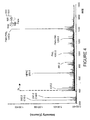
- Fraction 1 consists of PIM 2 and an 899.5 m/z lipid. Both have C19:0 and C16:0 chains as only these two chains are seen as carboxylate anions ( Figure 3 ).
- the 899.5 m/z lipid is clearly in low relative amount, as it is not seen in a spectrum of TPL ( Figure 1 ).
- An acyl-PGP lipid structure consistent with the above spectrum is shown in figure 3 , in which the acyl group must be 57 m/z (either a propionic fatty acyl or butyl group).
- glycerol moieties are shown in 'stick' form and tuberculosteric acid chain position is sn-1 based on Gilleron et al. (2001).
- Lipid fraction 2 is primarily palmitoyl- PIM 2 with C19:0 and C16:0 chains ( Figure 4 ), and fraction 3 is pure PI ( Figure 5 ). In the case of PI most molecules have C19:0 plus C16:0 chains, with the bulk of the remaining PI having C19:0 and C 15:0 chains.
- Fraction 4 is a phosphoglycolipid defined by FAB MS as dipalmitoyl- PIM 2 of various sn-1,2 chain forms ranging from C35:0 to C38:0 ( Figure 6 ). PI is detected also in this fraction.
- Palmitoyl- PIM 1 and PI in about equal amount comprise fraction 5 ( Figure 7 ) a phosphoglycolipid fraction of only 3% abundance in BCG TPL (Table 2).
- Fraction 6 is a phospholipid of m/z 899.1 ( Figure S) comprising only 1.2% of TPL.
- the most dominant PA fragment ion is 731.2 m/z indicating a methyl-PGP with sn-1,2 tuberculosteric acid fatty acid chains.
- other PA fragment anions, and fatty acid carboxylate signals indicate PGP molecules with other sn-1,2-chains and acyl moieties on the terminal phosphate to total a m/z of 899.1, the primary signal for the molecular anion.
- fraction 7 is pure PE with several sn-1,2 chain combinations, primarily C18:0 plus C16:0 (C34:0).
- PA fragment ions at m/z 647.1 and 675.1 confirm the PE assignments and correspond to fragments from C32:0 and C34:0, respectively.
- mobility of thin layer plates, staining reaction, and FAB MS identifies fraction 8 as a cardiolipid with mainly C18:1 and C16:0 chains and a molecular anion signal of 1403.2 m/z ( Figure 10 ).
- BCG TPL total polar lipid
- TLP lipids were dried from solvent and liposomes monitored by phase microscopy after addition of water, or PBS buffer, at 35, 45, 55, 65, and 75°C. Liposomes did not form well at 55°C or less, resulting in clumps of lipid, but elevating the temperature to 65 or 75°C resulted in a dramatic formation especially when water was used for hydration.
- chloroform extractable BCG TPL is hydrated preferably at 65°C in the presence of antigen to form multilamellar liposomes.
- Smaller liposomes are produced, if desired, by size reduction at preferably 65°C using a bath sonicator. Other methods of size reduction could be used if the temperature is 65°C. Entrapment of antigen may be improved by lyophilization and rehydration of the liposome powder in water at 65°C, followed by PBS. Liposomes are then annealed and any unentrapped antigen removed as described in Materials and Methods. Average diameters were 230 ⁇ 136 nm with OVA loadings in 3 preparations ranging from of 33 to 67 ⁇ g/mg dry weight of liposomes. Average diameters of BCG liposomes made from the purified lipid fractions are shown in Table 3. Those skilled in the art will appreciate that the various methods described in liposome formation should apply to these BCG lipids providing care is taken to achieve the required temperature, preferably 65°C.
- dendritic cells represent the major antigen presenting cells in mammals, they are the preferred cells for in vitro adjuvant testing. Bone marrow dendritic cells were cultured with zero (R8 medium only) to 10 ⁇ g dry weight liposomes/ml of R8 medium. Liposomes tested are shown in table 3 and include several made from commercial lipids. After 72 h the numbers of viable cells were quantified by the MTT assay and secreted inflammatory cytokines assayed in the culture supernatants. Liposomes at 10 ⁇ g/ml giving an MTT of >25% above the control R8 medium, were limited to BCG TPL liposomes, and purified BCG lipid fractions 3 (PI) and 6.
- lipids in BCG TPL have very different biological effects on activation and cytokine secretion from dendritic cells and consequently on the type of immune response obtained. Also clear, preparing liposomes using various combinations of BCG polar lipids is indicated as a mechanism to direct the type of immune response obtained to an entrapped antigen.
- Phosphatidylethanolamines are known generally as fusogenic lipids, capable of promoting fusion of membranes, and account for about 25% of the lipids in BCG TPL (Table 2).
- To mount a CTL immune reaction it is first necessary to deliver antigen to the cytosol of antigen presenting cells. It follows that inclusion of this lipid in a liposome with antigen entrapped, may aid in directing the immune response to MHC class I presentation of antigen and mounting a CTL response.
- the adjuvant activity of BCG liposomes is compared to several other adjuvant systems.
- these TPL liposomes from another Gram positive bacterium are included.
- the bacterium chosen was Bacillus firmus based on the observation that injections of these lipids into mice 5 days prior to infection with Listeria monocytogenes resulted in some short-term protection (Mára et al. 1992), presumably by activating the innate immune system.
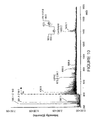
- the TPL lipids of this bacterium extracted by the Bligh and Dyer method and collected as the acetone insoluble lipids, are characterized by FAB MS ( Figure 11 ). In the case of B.
- Table 4 represents a first example of an enhanced immune cytotoxic T cell (CTL) response raised in an animal to an antigen entrapped in BCG liposomes.
- CTL cytotoxic T cell
- BCG liposomes served to promote an immune response to the entrapped antigen that was similar to live BCG recombinant, and superior to Freund's adjuvant.
- the TPL of another Gram positive bacterium also with saturated glycerolipids formed liposomes with inferior properties to BCG liposomes, teaching away from the positive result with BCG liposomes.
- Table 5 describes the humoral adjuvant activity of BCG liposomes to entrapped protein.
- injection of equivalent amounts of BCG liposomes and OVA produced no adjuvant activity, whereas entrapment resulted in humoral adjuvant activity comparable to the adjuvant Alum.
- the toxic adjuvant FCA was superior in potency and in maintaining the antibody titre for longer periods after vaccination.
- Live recombinant BCG expressing OVA in vivo produced CTL as expected (Dudani et al, 2002), but no antibody response.
- liposomes containing no BCG lipids gave very low antibody titres that improved as BCG lipids were incorporated at increasing amounts from 10 to 50%.
- TPL BCG total polar lipids
- BCG cells were first extracted by the Bligh and Dyer method to generate TPL. These cells were extracted again with hot 50% ethanol to yield a hot ethanol lipids.
- TPL Hot ethanol % carbohydrates 5.62 2.79 Mannose 4.52 1.96 Glucose 1.05 0.73 Galactose 0.0 0.0 Mannosamine 0.0 0.0 Glucosamine 0.0 0.0 Galactosamine 0.0 0.0 Arabinose 0.062 0.099 Inositol (% of Man) 4.29 2.57 Table 2.
- mice immunized with OVA in various adjuvant systems were immunized subcutaneously at 0 and 21 days with 15 ⁇ g OVA entrapped in BCG total polar lipid liposomes, mixed with Freund's adjuvant, or entrapped in liposomes prepared from the total polar lipids extracted from B. firmus (92 ⁇ 48 nm diameter, loading 53 ⁇ g/mg).
- OVA entrapped in liposomes prepared from the total polar lipids extracted from B. firmus (92 ⁇ 48 nm diameter, loading 53 ⁇ g/mg).
- live BCG cells expressing OVA only one subcutaneous injection was given containing 10 6 cells. Spleens from duplicate mice were pooled for each analysis 10 weeks post first injection with exception of B. firmus taken 6 weeks post first injection.
- BCG liposomes with OVA entrapped were prepared from 100% BCG TPL lipids mixed with DMPC/DMPG/cholesterol lipids from 0 to 100%, such that 0% BCG lipids were pure DMPC/DMPG/cholesterol liposomes.
- BCG OVA-free liposomes were separate injections of an equivalent amount of antigen-free BCG liposomes and OVA (unentrapped).
- FCA OVA was mixed with FCA for the first injection and FIA for the second.
- Alum was Imject Alum to which OVA was bound.
- BCG live are BCG cells genetically modified to express OVA (see table 4 injection details).
Landscapes
- Health & Medical Sciences (AREA)
- Chemical & Material Sciences (AREA)
- Life Sciences & Earth Sciences (AREA)
- Immunology (AREA)
- Veterinary Medicine (AREA)
- Chemical Kinetics & Catalysis (AREA)
- General Chemical & Material Sciences (AREA)
- Medicinal Chemistry (AREA)
- Pharmacology & Pharmacy (AREA)
- Animal Behavior & Ethology (AREA)
- General Health & Medical Sciences (AREA)
- Public Health (AREA)
- Nuclear Medicine, Radiotherapy & Molecular Imaging (AREA)
- Organic Chemistry (AREA)
- Engineering & Computer Science (AREA)
- Bioinformatics & Cheminformatics (AREA)
- Microbiology (AREA)
- Mycology (AREA)
- Epidemiology (AREA)
- Medicines Containing Antibodies Or Antigens For Use As Internal Diagnostic Agents (AREA)
- Medicinal Preparation (AREA)
- Medicines Containing Material From Animals Or Micro-Organisms (AREA)
Claims (27)
- Ein Liposom, das ein oder mehrere aus einer Gattung Mycobacterium erhältliche Lipide beinhaltet, die aus Phosphatidylinositol (PI), Phosphatidylinositolmannosid (PIM1), Phosphatidylinositoldimannosid (PIM2), mono- und dipalmitoylierten Formen von PIM1 und PIM2, acylierten Phospholipiden mit Fast-Atom-Bombardment-Massenspektrometriespitzen bei 899, 1139 und 1155 m/q, Phosphatidylethanolamin und Cardiolipid ausgewählt sind,
wobei die aus Mycobacterium erhältlichen Lipide in Chloroform löslich und damit extrahierbar sind. - Liposom gemäß Anspruch 1, wobei die Gattung Mycobacterium Mycobacterium bovis BCG ist.
- Liposom gemäß einem der Ansprüche 1 oder 2,
wobei das in Chloroform lösliche und damit extrahierbare Lipid PIM1 ist. - Liposom gemäß einem der Ansprüche 1 oder 2,
wobei das in Chloroform lösliche und damit extrahierbare Lipid PIM2 ist. - Liposom gemäß einem der Ansprüche 1 oder 2, wobei das in Chloroform lösliche und damit extrahierbare Lipid Palmitoyl-PIM1 ist.
- Liposom gemäß einem der Ansprüche 1 oder 2, wobei das in Chloroform lösliche und damit extrahierbare Lipid Palmitoyl-PIM2 ist.
- Liposom gemäß einem der Ansprüche 1 oder 2, wobei das in Chloroform lösliche und damit extrahierbare polare Lipid durch eine Extraktion mit 50%igem heißen Ethanol erhältlich ist.
- Liposom gemäß einem der Ansprüche 1 oder 2, das Lipidphosphatidylethanolamin beinhaltet.
- Liposom gemäß den Ansprüchen 1 bis 2, das ferner mindestens ein anderes Lipid beinhaltet, wobei das andere Lipid Phosphatidylcholin, Phosphatidylglycerin, Cholesterin oder eine Mischung von beliebigen aus diesen ist.
- Eine Liposomimpfstoffzusammensetzung, die ein Liposom gemäß einem der Ansprüche 1 bis 9 beinhaltet, wobei das Liposom ein assoziiertes Antigen enthält.
- Liposomimpfstoffzusammensetzung gemäß Anspruch 10,
wobei das Antigen ein Protein ist. - Ein Verfahren zum Zubereiten eines Liposoms gemäß einem der Ansprüche 1 bis 9, wobei das Verfahren das Trocknen von in Chloroform löslichem und damit extrahierbarem Lipid aus Mycobacterium SPP und dann das Hydratisieren des getrockneten Lipids bei einer Temperatur von 65 bis 75 °C in Wasser oder phosphatgepufferter Salzlösung (PBS) beinhaltet.
- Verfahren gemäß Anspruch 12, wobei die Temperatur 65 °C beträgt.
- Verfahren gemäß Anspruch 12, wobei das aus dem Verfahren resultierende Liposom multilamellar ist.
- Verfahren gemäß Anspruch 14, das zusätzlich das Reduzieren der Größe eines multilamellaren Liposoms bei einer Temperatur von 65 °C beinhaltet, um ein unilamellares Liposom zu ergeben.
- Verfahren gemäß Anspruch 14, wobei ein Antigen durch Inklusion des Antigens in dem Wasser oder der phosphatgepufferten Salzlösung (PBS) in dem multilamellaren Liposom eingeschlossen ist.
- Verfahren gemäß Anspruch 16, wobei ein Antigen durch Inklusion des Antigens in dem Wasser oder der phosphatgepufferten Salzlösung (PBS) in dem unilamellaren Liposom eingeschlossen ist.
- Eine Verwendung eines Liposoms gemäß einem der Ansprüche 1 bis 9 bei der Erzeugung eines Medikaments zur Anregung einer Immunreaktion bei einem Säugetier.
- Verwendung gemäß Anspruch 18, wobei die Anregung der Immunreaktion bei einem Säugetier durch die Aktivierung dendritischer Zellen erreicht wird, wobei die Aktivierung die Absonderung von Interleukin-12 (IL-12) durch die dendritischen Zellen auslöst.
- Verwendung gemäß Anspruch 18, wobei die Anregung der Immunreaktion bei einem Säugetier durch die Aktivierung dendritischer Zellen erreicht wird, wobei die Aktivierung die Absonderung von Tumornekrosefaktor (TNF) durch die dendritischen Zellen auslöst.
- Verwendung gemäß Anspruch 18, wobei die Anregung der Immunreaktion bei einem Säugetier durch die Aktivierung dendritischer Zellen erreicht wird, wobei die Aktivierung die Absonderung von Interleukin-12 (IL-12) und Tumornekrosefaktor (TNF) durch die dendritischen Zellen auslöst.
- Verwendung eines Liposoms gemäß einem der Ansprüche 18 bis 21, wobei das Liposom zusätzlich ein Antigen beinhaltet.
- Verwendung einer Liposomimpfstoffzusammensetzung gemäß Anspruch 10 oder 11 beim Zubereiten eines Medikaments zum Auslösen einer Immunreaktion bei einem Säugetier.
- Verwendung gemäß Anspruch 23, wobei das Liposom sowohl als ein Träger für das Antigen als auch als ein Stimulator einer Immunreaktion dient.
- Verwendung gemäß Anspruch 23, wobei die Immunreaktion eine antigenspezifische Antikörperreaktion und eine antigenspezifische zytotoxische T-Zell-Reaktion ist.
- Verwendung einer Liposomimpfstoffzusammensetzung gemäß Anspruch 10 oder 11 beim Zubereiten eines Medikaments zur therapeutischen oder prophylaktischen Behandlung von Krebs.
- Verwendung einer Liposomimpfstoffzusammensetzung gemäß Anspruch 10 oder 11 beim Zubereiten eines Medikaments zur Anleitung einer Immunreaktion, um einen Schutz gegen ein Pathogen oder Krebs zu verleihen.
Applications Claiming Priority (3)
| Application Number | Priority Date | Filing Date | Title |
|---|---|---|---|
| US30951201P | 2001-08-03 | 2001-08-03 | |
| US309512P | 2001-08-03 | ||
| PCT/CA2002/001217 WO2003011336A2 (en) | 2001-08-03 | 2002-08-02 | Liposomes prepared from the extractable lipids from a mycobacterium |
Publications (2)
| Publication Number | Publication Date |
|---|---|
| EP1416959A2 EP1416959A2 (de) | 2004-05-12 |
| EP1416959B1 true EP1416959B1 (de) | 2010-06-23 |
Family
ID=23198527
Family Applications (1)
| Application Number | Title | Priority Date | Filing Date |
|---|---|---|---|
| EP02754001A Expired - Lifetime EP1416959B1 (de) | 2001-08-03 | 2002-08-02 | Aus mycobacterium extrahierbaren lipide hergestellete liposomen |
Country Status (8)
| Country | Link |
|---|---|
| US (2) | US20040191304A1 (de) |
| EP (1) | EP1416959B1 (de) |
| AT (1) | ATE471721T1 (de) |
| AU (1) | AU2002322246A1 (de) |
| CA (1) | CA2455597A1 (de) |
| DE (1) | DE60236805D1 (de) |
| ES (1) | ES2347421T3 (de) |
| WO (1) | WO2003011336A2 (de) |
Families Citing this family (8)
| Publication number | Priority date | Publication date | Assignee | Title |
|---|---|---|---|---|
| KR100992646B1 (ko) * | 2003-07-09 | 2010-11-05 | 제이에스알 가부시끼가이샤 | 파장판 |
| US7825270B2 (en) * | 2005-12-21 | 2010-11-02 | Nutrimed Biotech | Inositolphospholipids and analogues: phosphatidylinositol products and processes |
| FR2908658B1 (fr) * | 2006-11-20 | 2011-11-11 | Centre Nat Rech Scient | Composition pour la prevention et/ou le traitement des maladies associees a la surexpression du tnf et/ou de l'il-12 |
| CA2694457A1 (en) * | 2007-07-24 | 2009-01-29 | Ingrid Jolanda Monique De Vries | Compositions and methods for generating an immune response in a subject |
| FR2931480B1 (fr) | 2008-05-23 | 2016-04-01 | Centre Nat Rech Scient | Analogues synthetiques de phosphatidyl-myo-inositol mannosides pourvus d'une active inhibitrice de la reponse inflammatoire |
| KR101102834B1 (ko) * | 2010-02-24 | 2012-01-05 | 충남대학교산학협력단 | 신규한 리포좀 제조 방법 및 장치 |
| WO2017177073A1 (en) * | 2016-04-07 | 2017-10-12 | The United States Of America, As Represented By The Secretary, Department Of Health & Human Services | Francisella lipids as broad anti-inflammatory therapeutics and associated methods of use |
| WO2020230741A1 (ja) * | 2019-05-13 | 2020-11-19 | 昭和電工株式会社 | がん細胞増殖抑制剤及びがん細胞増殖抑制用組成物 |
Family Cites Families (3)
| Publication number | Priority date | Publication date | Assignee | Title |
|---|---|---|---|---|
| FR2596651B1 (fr) * | 1986-04-08 | 1989-11-10 | Centre Nat Rech Scient | Nouveaux liposomes a base de phosphatidylinositolmannosides, et compositions pharmaceutiques les contenant |
| US6248329B1 (en) * | 1998-06-01 | 2001-06-19 | Ramaswamy Chandrashekar | Parasitic helminth cuticlin nucleic acid molecules and uses thereof |
| ES2320971T3 (es) * | 1999-10-12 | 2009-06-01 | National Research Council Of Canada | Arqueosomas como adjuvantes y vehiculos para vacunas acelulares para inducir respuestas de linfocitos t cototoxicos. |
-
2002
- 2002-08-02 EP EP02754001A patent/EP1416959B1/de not_active Expired - Lifetime
- 2002-08-02 DE DE60236805T patent/DE60236805D1/de not_active Expired - Lifetime
- 2002-08-02 US US10/485,569 patent/US20040191304A1/en not_active Abandoned
- 2002-08-02 ES ES02754001T patent/ES2347421T3/es not_active Expired - Lifetime
- 2002-08-02 AT AT02754001T patent/ATE471721T1/de not_active IP Right Cessation
- 2002-08-02 WO PCT/CA2002/001217 patent/WO2003011336A2/en not_active Ceased
- 2002-08-02 AU AU2002322246A patent/AU2002322246A1/en not_active Abandoned
- 2002-08-02 CA CA002455597A patent/CA2455597A1/en not_active Abandoned
-
2007
- 2007-11-15 US US11/940,858 patent/US20080248094A1/en not_active Abandoned
Also Published As
| Publication number | Publication date |
|---|---|
| WO2003011336A2 (en) | 2003-02-13 |
| ATE471721T1 (de) | 2010-07-15 |
| DE60236805D1 (de) | 2010-08-05 |
| WO2003011336A3 (en) | 2003-05-15 |
| EP1416959A2 (de) | 2004-05-12 |
| US20040191304A1 (en) | 2004-09-30 |
| CA2455597A1 (en) | 2003-02-13 |
| AU2002322246A1 (en) | 2003-02-17 |
| US20080248094A1 (en) | 2008-10-09 |
| ES2347421T3 (es) | 2010-10-29 |
Similar Documents
| Publication | Publication Date | Title |
|---|---|---|
| US20080248094A1 (en) | Vaccine adjuvant properties of lipsomes formed at elevated temperatures from the polar chloroform extractable lipids from mycobacterium bovis | |
| US8241610B2 (en) | Adjuvant combinations of liposomes and mycobacterial lipids for immunization compositions and vaccines | |
| Werner et al. | Immunostimulating agents: what next? A review of their present and potential medical applications | |
| US8653049B2 (en) | Normuramyl glycopeptide compounds | |
| CN101790384B (zh) | 单分枝酰基甘油(mmg)作为佐剂的应用 | |
| CA2647060C (en) | Synthetic archaeal glycolipid adjuvants | |
| AU749218B2 (en) | Synthetic antigens for CD1-restricted immune responses | |
| AU3558899A (en) | Vaccine compositions comprising cd-1 antigens and t-cell stimulating compound and methods of use thereof | |
| WO2001075096A1 (en) | Isolated and purified nonpeptide antigens from mycobacterium tuberculosis | |
| US7622128B2 (en) | Porphyromonas gingivalis 1435/1449 LPS as an immune modulator | |
| HK1143086B (en) | The use of monomycolyl glycerol (mmg) as an adjuvant |
Legal Events
| Date | Code | Title | Description |
|---|---|---|---|
| PUAI | Public reference made under article 153(3) epc to a published international application that has entered the european phase |
Free format text: ORIGINAL CODE: 0009012 |
|
| 17P | Request for examination filed |
Effective date: 20040303 |
|
| AK | Designated contracting states |
Kind code of ref document: A2 Designated state(s): AT BE BG CH CY CZ DE DK EE ES FI FR GB GR IE IT LI LU MC NL PT SE SK TR |
|
| AX | Request for extension of the european patent |
Extension state: AL LT LV MK RO SI |
|
| RTI1 | Title (correction) |
Free format text: VACCINE ADJUVANT PROPERTIES OF LIPOSOMES FORMED AT ELEVATED TEMPERATURES FROM THE POLAR CHLOROFORM EXTRACTABLE LIPIDS FROM MYCOBACTERIUM BOVIS (BCG) |
|
| RTI1 | Title (correction) |
Free format text: VACCINE ADJUVANT PROPERTIES OF LIPOSOMES FORMED AT ELEVATED TEMPERATURES FROM POLAR CHLOROFORM EXTRACTABLE LIPIDS FROM MYCOBACTERIUM BOVIS (BCG) |
|
| GRAP | Despatch of communication of intention to grant a patent |
Free format text: ORIGINAL CODE: EPIDOSNIGR1 |
|
| RTI1 | Title (correction) |
Free format text: LIPOSOMES PREPARED FROM THE EXTRACTABLE LIPIDS FROM A MYCOBACTERIUM |
|
| GRAS | Grant fee paid |
Free format text: ORIGINAL CODE: EPIDOSNIGR3 |
|
| GRAA | (expected) grant |
Free format text: ORIGINAL CODE: 0009210 |
|
| AK | Designated contracting states |
Kind code of ref document: B1 Designated state(s): AT BE BG CH CY CZ DE DK EE ES FI FR GB GR IE IT LI LU MC NL PT SE SK TR |
|
| REG | Reference to a national code |
Ref country code: CH Ref legal event code: EP |
|
| REG | Reference to a national code |
Ref country code: IE Ref legal event code: FG4D |
|
| REF | Corresponds to: |
Ref document number: 60236805 Country of ref document: DE Date of ref document: 20100805 Kind code of ref document: P |
|
| REG | Reference to a national code |
Ref country code: NL Ref legal event code: VDEP Effective date: 20100623 |
|
| PG25 | Lapsed in a contracting state [announced via postgrant information from national office to epo] |
Ref country code: SE Free format text: LAPSE BECAUSE OF FAILURE TO SUBMIT A TRANSLATION OF THE DESCRIPTION OR TO PAY THE FEE WITHIN THE PRESCRIBED TIME-LIMIT Effective date: 20100623 |
|
| REG | Reference to a national code |
Ref country code: ES Ref legal event code: FG2A Ref document number: 2347421 Country of ref document: ES Kind code of ref document: T3 |
|
| PG25 | Lapsed in a contracting state [announced via postgrant information from national office to epo] |
Ref country code: AT Free format text: LAPSE BECAUSE OF FAILURE TO SUBMIT A TRANSLATION OF THE DESCRIPTION OR TO PAY THE FEE WITHIN THE PRESCRIBED TIME-LIMIT Effective date: 20100623 Ref country code: FI Free format text: LAPSE BECAUSE OF FAILURE TO SUBMIT A TRANSLATION OF THE DESCRIPTION OR TO PAY THE FEE WITHIN THE PRESCRIBED TIME-LIMIT Effective date: 20100623 |
|
| PG25 | Lapsed in a contracting state [announced via postgrant information from national office to epo] |
Ref country code: GR Free format text: LAPSE BECAUSE OF FAILURE TO SUBMIT A TRANSLATION OF THE DESCRIPTION OR TO PAY THE FEE WITHIN THE PRESCRIBED TIME-LIMIT Effective date: 20100924 |
|
| PG25 | Lapsed in a contracting state [announced via postgrant information from national office to epo] |
Ref country code: NL Free format text: LAPSE BECAUSE OF FAILURE TO SUBMIT A TRANSLATION OF THE DESCRIPTION OR TO PAY THE FEE WITHIN THE PRESCRIBED TIME-LIMIT Effective date: 20100623 Ref country code: EE Free format text: LAPSE BECAUSE OF FAILURE TO SUBMIT A TRANSLATION OF THE DESCRIPTION OR TO PAY THE FEE WITHIN THE PRESCRIBED TIME-LIMIT Effective date: 20100623 |
|
| PG25 | Lapsed in a contracting state [announced via postgrant information from national office to epo] |
Ref country code: CZ Free format text: LAPSE BECAUSE OF FAILURE TO SUBMIT A TRANSLATION OF THE DESCRIPTION OR TO PAY THE FEE WITHIN THE PRESCRIBED TIME-LIMIT Effective date: 20100623 Ref country code: PT Free format text: LAPSE BECAUSE OF FAILURE TO SUBMIT A TRANSLATION OF THE DESCRIPTION OR TO PAY THE FEE WITHIN THE PRESCRIBED TIME-LIMIT Effective date: 20101025 Ref country code: SK Free format text: LAPSE BECAUSE OF FAILURE TO SUBMIT A TRANSLATION OF THE DESCRIPTION OR TO PAY THE FEE WITHIN THE PRESCRIBED TIME-LIMIT Effective date: 20100623 Ref country code: BE Free format text: LAPSE BECAUSE OF FAILURE TO SUBMIT A TRANSLATION OF THE DESCRIPTION OR TO PAY THE FEE WITHIN THE PRESCRIBED TIME-LIMIT Effective date: 20100623 Ref country code: CY Free format text: LAPSE BECAUSE OF FAILURE TO SUBMIT A TRANSLATION OF THE DESCRIPTION OR TO PAY THE FEE WITHIN THE PRESCRIBED TIME-LIMIT Effective date: 20100623 |
|
| PGFP | Annual fee paid to national office [announced via postgrant information from national office to epo] |
Ref country code: DE Payment date: 20100929 Year of fee payment: 9 |
|
| PG25 | Lapsed in a contracting state [announced via postgrant information from national office to epo] |
Ref country code: MC Free format text: LAPSE BECAUSE OF NON-PAYMENT OF DUE FEES Effective date: 20100831 |
|
| REG | Reference to a national code |
Ref country code: CH Ref legal event code: PL |
|
| PG25 | Lapsed in a contracting state [announced via postgrant information from national office to epo] |
Ref country code: DK Free format text: LAPSE BECAUSE OF FAILURE TO SUBMIT A TRANSLATION OF THE DESCRIPTION OR TO PAY THE FEE WITHIN THE PRESCRIBED TIME-LIMIT Effective date: 20100623 Ref country code: LI Free format text: LAPSE BECAUSE OF NON-PAYMENT OF DUE FEES Effective date: 20100831 Ref country code: CH Free format text: LAPSE BECAUSE OF NON-PAYMENT OF DUE FEES Effective date: 20100831 |
|
| PLBE | No opposition filed within time limit |
Free format text: ORIGINAL CODE: 0009261 |
|
| STAA | Information on the status of an ep patent application or granted ep patent |
Free format text: STATUS: NO OPPOSITION FILED WITHIN TIME LIMIT |
|
| 26N | No opposition filed |
Effective date: 20110324 |
|
| REG | Reference to a national code |
Ref country code: DE Ref legal event code: R097 Ref document number: 60236805 Country of ref document: DE Effective date: 20110323 |
|
| PG25 | Lapsed in a contracting state [announced via postgrant information from national office to epo] |
Ref country code: IE Free format text: LAPSE BECAUSE OF NON-PAYMENT OF DUE FEES Effective date: 20100802 |
|
| PGFP | Annual fee paid to national office [announced via postgrant information from national office to epo] |
Ref country code: GB Payment date: 20110719 Year of fee payment: 10 Ref country code: FR Payment date: 20110812 Year of fee payment: 10 Ref country code: ES Payment date: 20110726 Year of fee payment: 10 |
|
| PGFP | Annual fee paid to national office [announced via postgrant information from national office to epo] |
Ref country code: IT Payment date: 20110725 Year of fee payment: 10 |
|
| PG25 | Lapsed in a contracting state [announced via postgrant information from national office to epo] |
Ref country code: LU Free format text: LAPSE BECAUSE OF NON-PAYMENT OF DUE FEES Effective date: 20100802 Ref country code: BG Free format text: LAPSE BECAUSE OF FAILURE TO SUBMIT A TRANSLATION OF THE DESCRIPTION OR TO PAY THE FEE WITHIN THE PRESCRIBED TIME-LIMIT Effective date: 20100623 |
|
| PG25 | Lapsed in a contracting state [announced via postgrant information from national office to epo] |
Ref country code: TR Free format text: LAPSE BECAUSE OF FAILURE TO SUBMIT A TRANSLATION OF THE DESCRIPTION OR TO PAY THE FEE WITHIN THE PRESCRIBED TIME-LIMIT Effective date: 20100623 |
|
| GBPC | Gb: european patent ceased through non-payment of renewal fee |
Effective date: 20120802 |
|
| REG | Reference to a national code |
Ref country code: FR Ref legal event code: ST Effective date: 20130430 |
|
| PG25 | Lapsed in a contracting state [announced via postgrant information from national office to epo] |
Ref country code: IT Free format text: LAPSE BECAUSE OF NON-PAYMENT OF DUE FEES Effective date: 20120802 |
|
| PG25 | Lapsed in a contracting state [announced via postgrant information from national office to epo] |
Ref country code: GB Free format text: LAPSE BECAUSE OF NON-PAYMENT OF DUE FEES Effective date: 20120802 Ref country code: DE Free format text: LAPSE BECAUSE OF NON-PAYMENT OF DUE FEES Effective date: 20130301 |
|
| PG25 | Lapsed in a contracting state [announced via postgrant information from national office to epo] |
Ref country code: FR Free format text: LAPSE BECAUSE OF NON-PAYMENT OF DUE FEES Effective date: 20120831 |
|
| REG | Reference to a national code |
Ref country code: DE Ref legal event code: R119 Ref document number: 60236805 Country of ref document: DE Effective date: 20130301 |
|
| PG25 | Lapsed in a contracting state [announced via postgrant information from national office to epo] |
Ref country code: BG Free format text: LAPSE BECAUSE OF FAILURE TO SUBMIT A TRANSLATION OF THE DESCRIPTION OR TO PAY THE FEE WITHIN THE PRESCRIBED TIME-LIMIT Effective date: 20100923 |
|
| REG | Reference to a national code |
Ref country code: ES Ref legal event code: FD2A Effective date: 20131021 |
|
| PG25 | Lapsed in a contracting state [announced via postgrant information from national office to epo] |
Ref country code: ES Free format text: LAPSE BECAUSE OF NON-PAYMENT OF DUE FEES Effective date: 20120803 |