EP1416261A2 - Method and procedure for swift characterization of foamability and foam stability - Google Patents
Method and procedure for swift characterization of foamability and foam stability Download PDFInfo
- Publication number
- EP1416261A2 EP1416261A2 EP03024885A EP03024885A EP1416261A2 EP 1416261 A2 EP1416261 A2 EP 1416261A2 EP 03024885 A EP03024885 A EP 03024885A EP 03024885 A EP03024885 A EP 03024885A EP 1416261 A2 EP1416261 A2 EP 1416261A2
- Authority
- EP
- European Patent Office
- Prior art keywords
- foam
- solution
- dev
- time
- foams
- Prior art date
- Legal status (The legal status is an assumption and is not a legal conclusion. Google has not performed a legal analysis and makes no representation as to the accuracy of the status listed.)
- Granted
Links
Images



Classifications
-
- G—PHYSICS
- G01—MEASURING; TESTING
- G01F—MEASURING VOLUME, VOLUME FLOW, MASS FLOW OR LIQUID LEVEL; METERING BY VOLUME
- G01F1/00—Measuring the volume flow or mass flow of fluid or fluent solid material wherein the fluid passes through a meter in a continuous flow
- G01F1/007—Measuring the volume flow or mass flow of fluid or fluent solid material wherein the fluid passes through a meter in a continuous flow by measuring the level variations of storage tanks relative to the time
-
- G—PHYSICS
- G01—MEASURING; TESTING
- G01F—MEASURING VOLUME, VOLUME FLOW, MASS FLOW OR LIQUID LEVEL; METERING BY VOLUME
- G01F23/00—Indicating or measuring liquid level or level of fluent solid material, e.g. indicating in terms of volume or indicating by means of an alarm
- G01F23/22—Indicating or measuring liquid level or level of fluent solid material, e.g. indicating in terms of volume or indicating by means of an alarm by measuring physical variables, other than linear dimensions, pressure or weight, dependent on the level to be measured, e.g. by difference of heat transfer of steam or water
- G01F23/28—Indicating or measuring liquid level or level of fluent solid material, e.g. indicating in terms of volume or indicating by means of an alarm by measuring physical variables, other than linear dimensions, pressure or weight, dependent on the level to be measured, e.g. by difference of heat transfer of steam or water by measuring the variations of parameters of electromagnetic or acoustic waves applied directly to the liquid or fluent solid material
- G01F23/284—Electromagnetic waves
- G01F23/292—Light, e.g. infrared or ultraviolet
- G01F23/2921—Light, e.g. infrared or ultraviolet for discrete levels
- G01F23/2922—Light, e.g. infrared or ultraviolet for discrete levels with light-conducting sensing elements, e.g. prisms
- G01F23/2925—Light, e.g. infrared or ultraviolet for discrete levels with light-conducting sensing elements, e.g. prisms using electrical detecting means
-
- G—PHYSICS
- G01—MEASURING; TESTING
- G01N—INVESTIGATING OR ANALYSING MATERIALS BY DETERMINING THEIR CHEMICAL OR PHYSICAL PROPERTIES
- G01N13/00—Investigating surface or boundary effects, e.g. wetting power; Investigating diffusion effects; Analysing materials by determining surface, boundary, or diffusion effects
- G01N13/02—Investigating surface tension of liquids
Definitions
- the invention relates to the field of evaluation and characterization of the foamability of different foaming agents and of the properties and the stability of foams formed by using a simple and quick method.
- the volume of the foam formed and the lifetime of either the entire or half the height of the foam formed are measured in both methods [2,3].
- the main advantage and the reason of the wide application of these methods consist in their simplicity.
- modifications and standardization were applied [3-6].
- An interesting modification was proposed recently by Pinazo et al. [7].
- Unlike the classical Ross-Miles test they kept the volume of liquid in the vessel constant by continuously pumping back the dropped solution. The initial foam height was measured after the solution had flowed for 1 min and the foam height changes with time were determined.
- the shaking test as well as the Ross-Miles method have in common the similar and fundamental disadvantage, that the amount of gas introduced into the system is not controlled at all.
- Foamscan is commercially available [11, 12].
- This method adopts the pneumatic technique well-known for the characterization of unstable foams [2, 13, 14].
- the foam is created in a glass tube and its time dependent height is measured by image processing while the residual liquid is measured by a conductivity meter.
- the foaming solutions are characterized in such way that a gas of constant flow is bubbled through the solutions until an identical foam height is reached in all cases. This maximum height is used as reference state.
- the Foamscan apparatus the gas flow and the end of sparging are defined. However, the period of sparging time required for forming the same foam volume is rather long, of the order of magnitude of a few minutes. In [11] ] this time amounts to 8 minutes (commercial soap solutions).
- a characterization of the foam evolution is attempted by discriminating two periods both of which cover solution draining and foam collapse in different ratios.
- An object of the present invention therefore was to provide a simple, quick, reproducible and generally applicable procedure for the determination and evaluation of foam properties. It was a further object of the present invention to provide a relatively inexpensive procedure for testing foam stability of any foaming solution by a well-defined process under well-defined conditions. A further object was to provide a simple apparatus either manual or automated, which can be utilized for the foaming tests, and a procedure which can quickly discriminate foams of different stability and evaluate the stability of the foams formed by appropriate parameters that refer to physically well-defined boundary conditions.
- a further object was to provide an apparatus which can be utilized for characterizing both (meta)stable as well as unstable foam systems by the same procedure that can be run manually as well as automatically and by the same parameters.
- a definite amount of gas preferably air, is dispersed in a definite volume of solution by introducing the gas with definite velocity into the solution.
- the process can be performed manually as well as automatically. Foam height and efflux of solution are measured simultaneously in dependence on time.
- foams and foam properties can be measured in a standardized manner, whereby the parameters to be determined are not chosen arbitrarily but have a physicochemical basis.
- a predefined volume of gas is introduced into a solution to be tested, e.g. a solution of a detergent or solutions for which foam properties are important, such as beer, waste water, detergent solutions, etc., whereby a predefined volume of such solution is used.
- the general set-up is further defined by predefining the volumes of solution and gas.
- the ratio of solution volume to gas volume is 1:10 to 10:1, more preferably 1:5 to 5:1 and, especially preferred, 1:1.8 to 1 :2.2.
- the gas is introduced into the solution at a constant rate, e.g. at a rate of from 1 to 100 l/h, more preferably from 10 to 30 l/h and, in particular, at about 18 l/h. Therefore, the amounts of gas and solution used to form the foam are well-controlled according to the invention.
- foam height or/and efflux of solution are measured to characterize the foams, whereby physicochemical parameters of the foams can be derived from these measured quantities.
- An essential advantage of the invention lies in that all kinds of foams, i.e. metastable and non-stable foams can be tested quantitatively by the same procedure.
- the characteristic physical values to be measured provide significant values of all kinds of foams. Definite and equal boundary conditions are applied in each case.
- the foam decay can be described by three different stages of decay according to the ratio of the ruptured foam volume and the corresponding volume of drained solution: a) initial stage: only syneresis of draining solution, no foam rupture; b) intermediate (transitional) stage: syneresis and rupture occur simultaneously; c) final stage: negligible syneresis, only rupture progressing.
- the parameters used to characterize foam stability are either duration of such periods or efflux rate at characteristic states of the decaying foam system.
- the method according to the invention and the parameters given allow to determine i) foamability, ii) foam stability, iii) liquid contents in foam or/and drainage rates.
- novel parameters characterizing foam properties can be derived which are applicable to metastable as well as to unstable foams. This enables shorter times for testing foam systems.
- the description of foam stability can be improved considerably thereby because they can be related to reasonable, physically well-defined conditions instead of to arbitrarily chosen conditions.
- the method allows to get information about stability of metastable foams in a test lasting only a few minutes instead of measurements of foam half lifetime lasting hours (cf. Ross-Miles method).
- the new stability and/or foamability parameters do not only correlate with parameters used so far for certain methods of characterization of stable foams like half foam lifetime or R5-parameter, but for the first time the foam stability of unstable foams can be characterized by the same parameters. This makes it possible to standardize and unify all methods of foam characterization.
- test experiments according to the invention are simple, quick and reproducible. Further automatization of the test procedure is easily possible. While air is preferably used as gas, in general different kinds of gas are applicable.
- a predefined volume of gas is introduced into a predefined volume of solution to be tested, preferably with a predefined velocity.
- a certain amount of foam and, therefore, a certain foam height is formed.
- ⁇ h F / ⁇ h S 1 in said initial stage.
- the initial stage is at least 2 s, more preferably at least 5 s and particularly preferred at least 10 s.
- t dev foam rupture begins.
- the following quantities are determined in a standardized manner:
- the height of the foam column, h F together with the corresponding height of the solution column, h S is registered, in dependence on time.
- the reference state, t 0 refers to that time when the gas supply had been finished.
- the decrease of the foam column, ⁇ h F (h O F - h t F )
- ⁇ h S (h S t - h S O )
- liquid content refers to the amount of solution contained in the entire foam.
- drainage refers to the process of outflow (efflux) of the solution from the foam layers. As a result of the drainage, the liquid content in the foam decreases and the foam films become thinner.
- the stable foams can further be discriminated by the occurence of a transitional state.
- the latter condition means that the foam system is very stable.
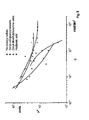
- Fig. 2 For three different foam systems, namely for a solution of 1.5 x 10 -3 M octanoic acid, as an example of an unstable foam system, for a solution of 3 x 10 -4 M Nadodecylsulfate as an example of a stable foam system having a medium stability and for a solution of 3 x 10 -4 M decyl- ⁇ -D-glucopyranoside as an example of a very stable foam system.
- a solution of 1.5 x 10 -3 M octanoic acid as an example of an unstable foam system
- 3 x 10 -4 M Nadodecylsulfate as an example of a stable foam system having a medium stability
- 3 x 10 -4 M decyl- ⁇ -D-glucopyranoside as an example of a very stable foam system.
- t tr (c) characterizes the foam behaviour of any foaming solution in a well-defined way. This is illustrated for various surfactant solutions in Fig. 4. As seen the t tr -values of foaming solutions span several orders of magnitude.
- t tr ⁇ 10 s means unstable foam
- t tr > 10s stands for (meta)stable foam.
- t tr ⁇ 20 s more preferably t tr ⁇ 30s and most preferably t tr ⁇ 100s.
- the parameter t tr can be correlated with parameters usually applied for foam characterization such as the time t 1/2 referring to that time when the foam column has reached half of its initial height or the R5-value [1] (foam height after five minutes related to the initial foam height).
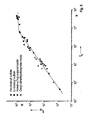
- Fig. 5 the time t 1/2 of half foam height rupture is plotted against the transitional time for the solutions of various surfactants, t tr .
- t 1/2 ⁇ 10 3 s there is a linear relationship between t 1/2 and t tr , whereas at t 1/2 > 10 3 s stable foams can still be further discriminated by the parameter t tr , while the corresponding t 1/2 -values remain unaltered.
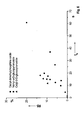
- Fig. 6 shows the correlation between the R5-value and the transition time t tr for solutions of surfactants revealing medium foam stability.
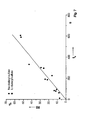
- Fig. 7 shows the like dependence R5(t tr ) for solutions of the two ionic surfactants sodium and lithium dodecylsulfate revealing strong foam stability.
- Foam stability can be reasonably well characterized by relating the foam height to a certain value of the foam colum during the decay period, like, for example, the R5-value which refers to that height to which the foam colum has ruptured after 5 minutes related to the initial foam height.
- an equivalent R10-value can be formulated.
- t ref this reference time
- the change in foam and/or solution volumes can easily be determined by measuring the changes of the corresponding heights.
- such specific rate is the rate of foam decay and/or the rate of the change of the solution's level per unit cross-sectional area of the foam column [cm 3 /(s x cm 2 )].
- Fig. 8 presents the v F dev -values of the specific rates of foam decay at t dev for solutions of different surfactants.
- the v F dev -values span four orders of magnitude.
- Unstable foam systems are characterized by comparatively high efflux rates and almost constant v F dev -values, whereas the efflux rates of stable foam systems are smaller by at least one order of magnitude.
- the efflux rates are strongly retarded down to three orders of magnitude as compared to the solutions forming unstable foams.
- the initial efflux rate of solution from foam, v S O is also a convenient parameter to distinguish between foams of different stability.
- Fig. 9 presents the v O -values as a function of concentration for solutions of different surfactants.
- This invention comprises a process and an apparatus for forming (meta)stable und unstable foams by introducing a definite amount of gas into a definite amount of solution with definite velocity and provides the characterization of foam stability in terms of dynamic parameters that refer to well-defined stages of foam decay.
- the foamability of a system can be determined.
- Foamability is the ability of a solution to form a foam column after introduction of a definite volume of gas at a definite velocity. The higher the volume of the system (foam plus solution with gas bubbles) immediately after introduction of the gas, the higher is the foamability of the solution.
- foam stability is the ability of the foam layer to last or survive without rupture and to counteract the foam film's rupture leading to a decay of the foam column/foam height. Higher foam stability means that foam films and foam layer will last comparatively longer under identical conditions.
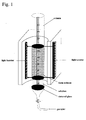
- Fig. 1 is a vertical sectional view of the novel foam test apparatus used for the measurements of foam stability of solutions of surface-active agents.
- Fig. 3a Plot of the difference ( ⁇ h F - ⁇ h S ) against the logarithm of time for different surfactant solutions.
- the arrows indicate that time when foam decay starts, t dev . ⁇ ⁇ ⁇ 3 x 10 -4 M sodium dodecyl sulfate; ⁇ ⁇ ⁇ 2 x 10 -3 M lithium dodecyl sulfate; ⁇ ⁇ ⁇ 3 x 10 -4 M decyl- ⁇ -D-glucopyranoside; ⁇ ⁇ ⁇ 1.5 x 10 -3 M octanoic acid in 0.005 M hydrochloric acid.
- Fig. 3b Examples of te dependences of ( ⁇ h F - ⁇ h S ) against the logarithm of time with their inflection points marked by arrows.
- the time at the inflection point is defined as the transition time t tr .
- Fig. 6 R5-value in dependence on the corresponding time of transition, t tr , for several solutions of three different surfactants revealing medium foam stability. ⁇ ⁇ ⁇ octyl- ⁇ -D-glucopyranoside; ⁇ ⁇ ⁇ nonyl- ⁇ -D-glucopyranoside; ⁇ ⁇ ⁇ decyldimethylphosphine oxide.
- Fig. 8 Specific rate of foam decay at the time of deviation, v F dev , in dependence on concentration. ⁇ ⁇ ⁇ octanoic acid in 0.005 M HCl; ⁇ ⁇ ⁇ nonyl- ⁇ -D-glucopyranoside; ⁇ ⁇ ⁇ decyldimethylphosphine oxide; ⁇ ⁇ ⁇ sodium dodecylsulfate. (Specific rate is the rate of foam decay is efflux rate per unit cross-sectional area of the foam column [cm/s])
- the apparatus used in the test is very simple and is shown schematically in Fig. 1.
- the set-up consists of a glass column of 42-mm inner diameter and 25 cm length with a fritted glass G-2 at the bottom for gas dispersing, and a syringe for supplying a definite amount of gas (e.g. air) into the solution to be foamed.
- a definite amount of gas e.g. air
- Beneath the frit is a stopcock, which is connected to a small pump the piston of which is driven automatically at a preset gas flow rate of e.g. 18 l/h.
- the volumes of 50 ml of solution and 100 ml of gas were used.
- the gas from the syringe was introduced into the solution through the sintered glass.
- the stopcock was locked when the solution (50 ml) was poured into the column in such manner that no foam was formed. If a foam layer is formed during the pouring of the solution, introduction of gas was deferred until the solution mirror was seen.
- the filled foam column is fixed between the optical sensors of a Foam Test System (FTS) of the firm Paar.
- FTS Foam Test System
- This apparatus was originally developed for observing foam decay of beer in beer glasses. To adapt this equipment to the foam measurements the bottom of the FTS had been removed.
- the stopcock was opened and subsequently 90 cm 3 of air were bubbled via the frit into the surfactant solution with a flow rate of 18 I/h by a connected RTU-Dosierpumpe (firm Paar). Then foam and solution height were measured simultaneously. Due to the certain size of the fotodiodes the minimal measurable difference of the height of the foam and/or the solution column was 2.5mm.
- the experiments were performed at room temperature (22 ⁇ 1°C).
- Fig.2 the difference between the initial height of the foam column and the foam height at time t, ⁇ h F , is plotted against the corresponding height of the solution drained out, ⁇ h S , for three different aqueous surfactant solutions.
- stage III synersis had finished and only rupture remained (stage III).
- t tr time of transition - see Fig. 3b).
- stage I For the octanoic acid solution there is only a very short time interval in which stage I was observed. It is finished already at a time as short as 0.1 s. (As the method is at its detection limit at such short times, this is the lowest detectable time). Having passed this stage, there is rupture together with syneresis. However, stage III was not met because the foam ruptured before all solution had flowed out of the foam. Such behaviour is typical of all wet (unstable) foam systems.
- the sodium dodecylsulfate solution shows a distinct interval of the stage I which lasts for 1.2 s. (It lasts much longer, i. e. about 50s, for the sodium dodecylsulfate solutions of the highest concentrations.) This is followed by the pronounced stage II which is finished after 220 s only. At t > > 220 s there is only foam rupture (stage III). This period prevails for a long time of more than 2000 s then.
- Fig.3a the difference of the variables of Fig 2, ( ⁇ h F - ⁇ h S ), is plotted against the logarithm of time for different surfactant solutions.
- the arrows indicate that time when the foam decay starts, denoted by t dev .
- time of deviation time when the dependence ( ⁇ h F - ⁇ h S ) begins to deviate from zero.
- the characteristic times of deviation cover three orders of magnitude depending mainly on the stability of the foam, the concentration of the solution and/or the structure of the surfactants.
- Fig. 3b illustrates the method of determination of the value of the transition time t tr .
- the transition time, t tr when the syneresis of the foam was finished ( ⁇ h S ⁇ 0), is plotted against the concentration of several solutions of different surfactants in Fig.4.
- Unstable (wet) and (meta)stable (dry) foam systems can easily be discriminated by the following conditions
- the parameter t tr covers about four orders of magnitude depending on the type of the surfactant and the concentration of its solutions.
- Fig. 5 shows the time of rupture of half the foam column, t 1/2 , in dependence on the corresponding transition time, t tr , for several solutions of various surfactants. It is seen that the "classical" parameter t 1/2 , generally used to characterize foam stability, is correlated to the parameter t tr within a broad concentration range, except the highest concentrations.
- Fig. 7 represents the like dependence of the R5-values on the corresponding transition times, t tr for solutions of surfactants revealing strong foam stability. As seen there is a good correlation between the R5-values and the corresponding transitional times. This is for the simple reason given by equation (1), see above, that the reference time, t ref , has to be equal to or greater than t tr .
- Fig. 8 is the specific rate of foam decay at the time of deviation, V F dev , in dependence on concentration.
- the specific rate of foam decay is the rate related to the rate related to the cross-sectional area of the foam column [cm 3 /(s x cm 2 )], that is independent of the diameter of the foam column.
- the v F dev -values are given for solutions of various surfactants belonging to either unstable, medium or very stable foam systems.
- the v F dev -values cover four orders of magnitude.
- Comparison of this figure with Fig.4 proves that the dependence of the specific efflux rate on concentration reveals an inverse trend to that one of the transition time on concentration.
- the greatest v F dev -values are characteristic of wet foams whereas the lowest v S dev -values are typical of dry foam systems.
- the lower the specific efflux rate is the more stable the corresponding foam will be.
- Fig. 9 shows the initial rates of solution efflux from foam that is equal to the foam decay rates v O in dependence on the concentration of different surfactant solutions.
Landscapes
- Physics & Mathematics (AREA)
- General Physics & Mathematics (AREA)
- Fluid Mechanics (AREA)
- Electromagnetism (AREA)
- Analytical Chemistry (AREA)
- Immunology (AREA)
- Life Sciences & Earth Sciences (AREA)
- Chemical & Material Sciences (AREA)
- Thermal Sciences (AREA)
- Biochemistry (AREA)
- General Health & Medical Sciences (AREA)
- Health & Medical Sciences (AREA)
- Pathology (AREA)
- Emulsifying, Dispersing, Foam-Producing Or Wetting Agents (AREA)
- Organic Low-Molecular-Weight Compounds And Preparation Thereof (AREA)
- Gas Separation By Absorption (AREA)
- Pharmaceuticals Containing Other Organic And Inorganic Compounds (AREA)
- Polyurethanes Or Polyureas (AREA)
- Investigating Or Analyzing Non-Biological Materials By The Use Of Chemical Means (AREA)
Abstract
Description
- Well-defined boundary conditions (volume of solution, volume of dispersed gas, condition of gas supply)
- gas content per unit volume of solution adjustable and measurable (convenient for theoretical description of foamability). This is hardly possibly for other methods like Bartsch, Ross-Miles or methods using stirring, shaking, whipping,etc.
- parameters by means of which the foam stability is characterized refer to physically reasonable and well-defined conditions. They are very sensitive to foam stability covering several orders of magnitude.
- unstable and metastable foams can be characterized by an identical procedure.
- simplicity
- swiftness: foam stability of very stable foams can reasonably be characterized by short time measurements.
- reasonable reproducibility.
Fig. 7 shows the like dependence R5(ttr) for solutions of the two ionic surfactants sodium and lithium dodecylsulfate revealing strong foam stability.
O O O 3 10-4 M decyl-β-D-glucopyranoside; □ □ □ 3 x 10⁻⁴ M sodium dodecyl sulfate.
□ □ □ 3 x 10⁻⁴ M sodium dodecyl sulfate; ○ ○ ○ 2 x 10⁻³ M lithium dodecyl sulfate;
Δ Δ Δ 3 x 10⁻⁴ M decyl-β-D-glucopyranoside; ▿ ▿ ▿ 1.5 x 10⁻³ M octanoic acid in 0.005 M hydrochloric acid.
Δ Δ Δ octyl-β-D-glucopyranoside; ○ ○ ○ nonyl-α-D-glucopyranoside;
□ □ □ decyldimethylphosphine oxide.
For very stable foams ttr ≥ 100 s.
frothability n-octanol and n-octanoic acid solutions", Colloids & Surfaces, 3(1981 ) 329-338
16.SITA-Internet webpage:
http://www.sita-messtechnik.de/forschung/index.html
Claims (11)
- A method for determining or/and evaluating foam properties of a solution, wherein a predefined volume of gas is introduced into a predefined volume of solution to be tested and foam height hF or/and efflux of solution hS are measured.
- The method according to claim 1, wherein foam height hF or/and efflux of solution hS are measured in relation to time.
- The method according to claim 1 or 2, wherein the foam decay is classified into the categories(a) initial stage,(b) intermediate stage or(c) final stage.
- The method according to any of claims 1-3, wherein at least one of the characteristic parameters ΔhF, ΔhS, ΔhF-ΔhS, tdev, ttr, vF dev, vS dev, or/and vO is determined.
- The method according to any of the preceding claims, whereinare determined.(i) foamability,(ii) foam stability,(iii) liquid content in foam,(iv) drainage rates
- The method according to any of the preceding claims, wherein a classification intois performed.(I) unstable foams or(II) (meta)stable foams
- The method according to any of the preceding claims, wherein the foam stability is classified on basis of the ratio ΔhF/ΔhS.
- The method according to any of claims 1-7, wherein the initial behaviour of the foam is characterized by the ratio ΔhF/ΔhS = 1.
- The method according to any of the preceding claims, wherein the foam is classified as unstable foam, if tdev < 2s or classified as (meta)stable foam, if tdev > 2s, preferably if tdev > 10s.
- The method according to any of the preceding claims, wherein the foam is classified as unstable foam, if ttr < 10s or classified as (meta)stable foam, if ttr > 10s, preferably if ttr > 100s.
- The method according to any of the preceding claims, wherein the solution is selected from beer, waste water, sea water, (laudry) lye, extinguisher solutions, emulsions, microemulsions, suspensions, froth flotation, frost protection of plants, lung lavage or/and amniotic fluid or any other form forming solution.
Priority Applications (1)
| Application Number | Priority Date | Filing Date | Title |
|---|---|---|---|
| EP03024885A EP1416261B1 (en) | 2002-10-31 | 2003-10-31 | Method and procedure for swift characterization of foamability and foam stability |
Applications Claiming Priority (3)
| Application Number | Priority Date | Filing Date | Title |
|---|---|---|---|
| EP02024377 | 2002-10-31 | ||
| EP02024377 | 2002-10-31 | ||
| EP03024885A EP1416261B1 (en) | 2002-10-31 | 2003-10-31 | Method and procedure for swift characterization of foamability and foam stability |
Publications (3)
| Publication Number | Publication Date |
|---|---|
| EP1416261A2 true EP1416261A2 (en) | 2004-05-06 |
| EP1416261A3 EP1416261A3 (en) | 2005-11-30 |
| EP1416261B1 EP1416261B1 (en) | 2008-01-16 |
Family
ID=38989877
Family Applications (1)
| Application Number | Title | Priority Date | Filing Date |
|---|---|---|---|
| EP03024885A Expired - Lifetime EP1416261B1 (en) | 2002-10-31 | 2003-10-31 | Method and procedure for swift characterization of foamability and foam stability |
Country Status (3)
| Country | Link |
|---|---|
| EP (1) | EP1416261B1 (en) |
| AT (1) | ATE384255T1 (en) |
| DE (1) | DE60318666T2 (en) |
Cited By (14)
| Publication number | Priority date | Publication date | Assignee | Title |
|---|---|---|---|---|
| CN102519829A (en) * | 2011-11-18 | 2012-06-27 | 华南理工大学 | Test method for determining beer foam stability |
| CN103969407A (en) * | 2014-05-19 | 2014-08-06 | 中国石油大学(华东) | Device for evaluating foaming property of air-soluble surface active agent and application of device |
| CN105044299A (en) * | 2015-09-18 | 2015-11-11 | 江南大学 | Method for measuring beer foam duration |
| WO2016000739A1 (en) | 2014-06-30 | 2016-01-07 | MAX-PLANCK-Gesellschaft zur Förderung der Wissenschaften e.V. | Novel options of characterizing foam properties |
| CN106706890A (en) * | 2017-02-24 | 2017-05-24 | 徐工集团工程机械有限公司 | Asphalt foaming effect measuring device and method |
| GB2560386A (en) * | 2017-03-10 | 2018-09-12 | In Touch Ltd | Gully Sensor and apparatus |
| CN110388971A (en) * | 2019-07-23 | 2019-10-29 | 天津丰逸科技有限公司 | A kind of liquid level sensing device of beer brewing machine |
| CN110702532A (en) * | 2019-10-18 | 2020-01-17 | 中国海洋石油集团有限公司 | Method for grading and evaluating foam strength by utilizing buoy and weight gasket |
| CN112782045A (en) * | 2021-02-05 | 2021-05-11 | 西南石油大学 | Device for measuring permeability of high-temperature and high-pressure foam liquid film and using method thereof |
| CN113125645A (en) * | 2021-04-12 | 2021-07-16 | 陕西延长石油(集团)有限责任公司 | Novel method for representing comprehensive performance of foam system |
| CN114788943A (en) * | 2022-04-22 | 2022-07-26 | 中科永安(安徽)科技有限公司 | PFOS-free efficient seawater-resistant type aqueous film-forming foam extinguishing agent and preparation method thereof |
| CN115212508A (en) * | 2022-06-08 | 2022-10-21 | 国网安徽省电力有限公司电力科学研究院 | Aqueous film-forming foam fire extinguishing agent for transformer oil fire and preparation method thereof |
| US11821827B2 (en) | 2021-05-28 | 2023-11-21 | Saudi Arabian Oil Company | Method of evaluating foaming agents and surfactants |
| CN119174933A (en) * | 2024-11-26 | 2024-12-24 | 佛山恒益热电有限公司 | Automatic detection defoaming treatment method and equipment for slurry foam in absorption tower |
Families Citing this family (3)
| Publication number | Priority date | Publication date | Assignee | Title |
|---|---|---|---|---|
| DE102010030284B4 (en) * | 2010-06-18 | 2017-05-11 | Hochschule für Technik und Wirtschaft Dresden | Method and arrangement for stabilizing the foam image of beer |
| CN109164017B (en) * | 2018-10-15 | 2020-10-23 | 中国矿业大学 | Gas-liquid-solid three-phase foam forced liquid drainage test device and test method |
| US20250110033A1 (en) * | 2023-09-29 | 2025-04-03 | Weatherford Technology Holdings, Llc | Systems and methods to evaluate a foamer for unloading liquid in oil and gas wells of mature fields |
Family Cites Families (7)
| Publication number | Priority date | Publication date | Assignee | Title |
|---|---|---|---|---|
| GB8411608D0 (en) * | 1984-05-05 | 1984-06-13 | British Petroleum Co Plc | Determining stability of foam |
| US4589276A (en) * | 1984-12-12 | 1986-05-20 | Mobil Oil Corporation | Method and apparatus for determining effectiveness of foamant in porous media |
| FR2596866B1 (en) * | 1986-04-04 | 1989-06-02 | Tepral | PROCESS AND INSTALLATION FOR THE STUDY, AS A FUNCTION OF TIME, OF THE CHARACTERISTICS OF A BEER HAT |
| GB8617001D0 (en) * | 1986-07-11 | 1986-08-20 | Bp Chem Int Ltd | Foam meter |
| FR2677768B1 (en) * | 1991-06-11 | 1994-08-05 | Agronomique Inst Nat Rech | DEVICE FOR CHARACTERIZING THE FOAMING PROPERTIES OF AN AT LEAST PARTIALLY SOLUBLE PRODUCT. |
| NL1010213C2 (en) * | 1998-09-29 | 2000-03-30 | Haffmans Bv | Method and device for determining the stability of a foam layer on a liquid column. |
| US6640618B2 (en) * | 2000-05-08 | 2003-11-04 | The United States Of America As Represented By The Secretary Of The Navy | Method for detecting and measuring foam forming compounds in aqueous solutions |
-
2003
- 2003-10-31 DE DE60318666T patent/DE60318666T2/en not_active Expired - Lifetime
- 2003-10-31 AT AT03024885T patent/ATE384255T1/en not_active IP Right Cessation
- 2003-10-31 EP EP03024885A patent/EP1416261B1/en not_active Expired - Lifetime
Cited By (20)
| Publication number | Priority date | Publication date | Assignee | Title |
|---|---|---|---|---|
| CN102519829A (en) * | 2011-11-18 | 2012-06-27 | 华南理工大学 | Test method for determining beer foam stability |
| CN103969407A (en) * | 2014-05-19 | 2014-08-06 | 中国石油大学(华东) | Device for evaluating foaming property of air-soluble surface active agent and application of device |
| CN103969407B (en) * | 2014-05-19 | 2015-03-25 | 中国石油大学(华东) | Device for evaluating foaming property of air-soluble surface active agent and application of device |
| WO2015176610A1 (en) * | 2014-05-19 | 2015-11-26 | 中国石油大学(华东) | Device for evaluating foaming property of gas-soluble surfactant and application thereof |
| WO2016000739A1 (en) | 2014-06-30 | 2016-01-07 | MAX-PLANCK-Gesellschaft zur Förderung der Wissenschaften e.V. | Novel options of characterizing foam properties |
| CN105044299A (en) * | 2015-09-18 | 2015-11-11 | 江南大学 | Method for measuring beer foam duration |
| CN106706890A (en) * | 2017-02-24 | 2017-05-24 | 徐工集团工程机械有限公司 | Asphalt foaming effect measuring device and method |
| CN106706890B (en) * | 2017-02-24 | 2023-07-04 | 江苏徐工工程机械研究院有限公司 | Asphalt foaming effect measuring device and method |
| GB2560386A (en) * | 2017-03-10 | 2018-09-12 | In Touch Ltd | Gully Sensor and apparatus |
| CN110388971A (en) * | 2019-07-23 | 2019-10-29 | 天津丰逸科技有限公司 | A kind of liquid level sensing device of beer brewing machine |
| CN110702532B (en) * | 2019-10-18 | 2022-01-25 | 中国海洋石油集团有限公司 | Method for grading and evaluating foam strength by utilizing buoy and weight gasket |
| CN110702532A (en) * | 2019-10-18 | 2020-01-17 | 中国海洋石油集团有限公司 | Method for grading and evaluating foam strength by utilizing buoy and weight gasket |
| CN112782045A (en) * | 2021-02-05 | 2021-05-11 | 西南石油大学 | Device for measuring permeability of high-temperature and high-pressure foam liquid film and using method thereof |
| CN112782045B (en) * | 2021-02-05 | 2022-04-12 | 西南石油大学 | Device for measuring permeability of high-temperature and high-pressure foam liquid film and using method thereof |
| CN113125645A (en) * | 2021-04-12 | 2021-07-16 | 陕西延长石油(集团)有限责任公司 | Novel method for representing comprehensive performance of foam system |
| CN113125645B (en) * | 2021-04-12 | 2023-09-05 | 陕西延长石油(集团)有限责任公司 | Novel method for representing comprehensive performance of foam system |
| US11821827B2 (en) | 2021-05-28 | 2023-11-21 | Saudi Arabian Oil Company | Method of evaluating foaming agents and surfactants |
| CN114788943A (en) * | 2022-04-22 | 2022-07-26 | 中科永安(安徽)科技有限公司 | PFOS-free efficient seawater-resistant type aqueous film-forming foam extinguishing agent and preparation method thereof |
| CN115212508A (en) * | 2022-06-08 | 2022-10-21 | 国网安徽省电力有限公司电力科学研究院 | Aqueous film-forming foam fire extinguishing agent for transformer oil fire and preparation method thereof |
| CN119174933A (en) * | 2024-11-26 | 2024-12-24 | 佛山恒益热电有限公司 | Automatic detection defoaming treatment method and equipment for slurry foam in absorption tower |
Also Published As
| Publication number | Publication date |
|---|---|
| EP1416261A3 (en) | 2005-11-30 |
| EP1416261B1 (en) | 2008-01-16 |
| DE60318666T2 (en) | 2009-01-22 |
| ATE384255T1 (en) | 2008-02-15 |
| DE60318666D1 (en) | 2008-03-06 |
Similar Documents
| Publication | Publication Date | Title |
|---|---|---|
| EP1416261B1 (en) | Method and procedure for swift characterization of foamability and foam stability | |
| Hilgenfeldt et al. | Dynamics of coarsening foams: accelerated and self-limiting drainage | |
| US5465610A (en) | Device for the characterization of the foaming properties of a product which is at least partially soluable | |
| Song et al. | Determination of interfacial tension from the profile of a pendant drop using computer-aided image processing: 2. Experimental | |
| Binks et al. | Measurement of film rigidity and interfacial tensions in several ionic surfactant-oil-water microemulsion systems | |
| Malysa et al. | Foams under dynamic conditions | |
| Frostad et al. | Dynamic fluid-film interferometry as a predictor of bulk foam properties | |
| Stubenrauch et al. | A disjoining pressure study of n-dodecyl-β-D-maltoside foam films | |
| Kratohvil | Comments on some novel approaches for the determination of micellar aggregation numbers | |
| Baniel et al. | Foaming properties of egg albumen with a bubbling apparatus compared with whipping | |
| Liggieri et al. | Measurement of the surface dilational viscoelasticity of adsorbed layers with a capillary pressure tensiometer | |
| Guillerme et al. | Study of foam stability by video image analysis: relationship with the quantity of liquid in the foams | |
| Beaglehole | Capillary-wave and intrinsic thicknesses of the surface of a simple liquid | |
| Wilde | Foam measurement by the microconductivity technique: An assessment of its sensitivity to interfacial and environmental factors | |
| Canet et al. | High-pressure (up to 140 MPa) dynamic viscosity of the methane+ decane system | |
| Brierley et al. | The influence of ethanol on the foaming properties of beer protein fractions: a comparison of Rudin and microconductivity methods of foam assessment | |
| Velev et al. | Experimental investigations on model emulsion systems stabilized with non-ionic surfactant blends | |
| EP0252738A2 (en) | Foam meter | |
| Lunkenheimer et al. | Method and procedure for swift characterization of foamability and foam stability | |
| Canet et al. | Density and Viscosity of the 1-Methylnaphthalene+ 2, 2, 4, 4, 6, 8, 8-Heptamethylnonane System from 293.15 to 353.15 K at Pressures up to 100 MPa | |
| Collins et al. | Evaluation of Laboratory Distillation Apparatus. Improved Oldershaw Glass Bubble Plate Columns, Automatic Still Heads and Accessories | |
| CA2276358C (en) | Method of determining pulp properties | |
| US5305632A (en) | Method and apparatus for measuring interfacial tension of a liquid using the capillary rise method | |
| Coulson et al. | Fractional distillation. II. The use of dilute solutions of thiophene in benzene as test mixtures and a comparison with mixtures of benzene and ethylene dichloride | |
| Ross | Current methods of measuring foam |
Legal Events
| Date | Code | Title | Description |
|---|---|---|---|
| PUAI | Public reference made under article 153(3) epc to a published international application that has entered the european phase |
Free format text: ORIGINAL CODE: 0009012 |
|
| AK | Designated contracting states |
Kind code of ref document: A2 Designated state(s): AT BE BG CH CY CZ DE DK EE ES FI FR GB GR HU IE IT LI LU MC NL PT RO SE SI SK TR |
|
| AX | Request for extension of the european patent |
Extension state: AL LT LV MK |
|
| PUAL | Search report despatched |
Free format text: ORIGINAL CODE: 0009013 |
|
| AK | Designated contracting states |
Kind code of ref document: A3 Designated state(s): AT BE BG CH CY CZ DE DK EE ES FI FR GB GR HU IE IT LI LU MC NL PT RO SE SI SK TR |
|
| AX | Request for extension of the european patent |
Extension state: AL LT LV MK |
|
| RIC1 | Information provided on ipc code assigned before grant |
Ipc: 7G 01N 33/14 B Ipc: 7G 01N 13/02 A Ipc: 7G 01F 22/00 B |
|
| 17P | Request for examination filed |
Effective date: 20060526 |
|
| AKX | Designation fees paid |
Designated state(s): AT BE BG CH CY CZ DE DK EE ES FI FR GB GR HU IE IT LI LU MC NL PT RO SE SI SK TR |
|
| 17Q | First examination report despatched |
Effective date: 20060915 |
|
| GRAP | Despatch of communication of intention to grant a patent |
Free format text: ORIGINAL CODE: EPIDOSNIGR1 |
|
| GRAS | Grant fee paid |
Free format text: ORIGINAL CODE: EPIDOSNIGR3 |
|
| GRAA | (expected) grant |
Free format text: ORIGINAL CODE: 0009210 |
|
| AK | Designated contracting states |
Kind code of ref document: B1 Designated state(s): AT BE BG CH CY CZ DE DK EE ES FI FR GB GR HU IE IT LI LU MC NL PT RO SE SI SK TR |
|
| REG | Reference to a national code |
Ref country code: GB Ref legal event code: FG4D |
|
| REG | Reference to a national code |
Ref country code: CH Ref legal event code: EP |
|
| REG | Reference to a national code |
Ref country code: IE Ref legal event code: FG4D |
|
| REF | Corresponds to: |
Ref document number: 60318666 Country of ref document: DE Date of ref document: 20080306 Kind code of ref document: P |
|
| RAP4 | Party data changed (patent owner data changed or rights of a patent transferred) |
Owner name: MAX-PLANCK-GESELLSCHAFT ZUR FOERDERUNG DER WISSENS |
|
| PG25 | Lapsed in a contracting state [announced via postgrant information from national office to epo] |
Ref country code: NL Free format text: LAPSE BECAUSE OF FAILURE TO SUBMIT A TRANSLATION OF THE DESCRIPTION OR TO PAY THE FEE WITHIN THE PRESCRIBED TIME-LIMIT Effective date: 20080116 |
|
| NLV1 | Nl: lapsed or annulled due to failure to fulfill the requirements of art. 29p and 29m of the patents act | ||
| PG25 | Lapsed in a contracting state [announced via postgrant information from national office to epo] |
Ref country code: CH Free format text: LAPSE BECAUSE OF FAILURE TO SUBMIT A TRANSLATION OF THE DESCRIPTION OR TO PAY THE FEE WITHIN THE PRESCRIBED TIME-LIMIT Effective date: 20080116 Ref country code: LI Free format text: LAPSE BECAUSE OF FAILURE TO SUBMIT A TRANSLATION OF THE DESCRIPTION OR TO PAY THE FEE WITHIN THE PRESCRIBED TIME-LIMIT Effective date: 20080116 Ref country code: ES Free format text: LAPSE BECAUSE OF FAILURE TO SUBMIT A TRANSLATION OF THE DESCRIPTION OR TO PAY THE FEE WITHIN THE PRESCRIBED TIME-LIMIT Effective date: 20080427 Ref country code: FI Free format text: LAPSE BECAUSE OF FAILURE TO SUBMIT A TRANSLATION OF THE DESCRIPTION OR TO PAY THE FEE WITHIN THE PRESCRIBED TIME-LIMIT Effective date: 20080116 |
|
| REG | Reference to a national code |
Ref country code: CH Ref legal event code: PL |
|
| PG25 | Lapsed in a contracting state [announced via postgrant information from national office to epo] |
Ref country code: AT Free format text: LAPSE BECAUSE OF FAILURE TO SUBMIT A TRANSLATION OF THE DESCRIPTION OR TO PAY THE FEE WITHIN THE PRESCRIBED TIME-LIMIT Effective date: 20080116 Ref country code: BG Free format text: LAPSE BECAUSE OF FAILURE TO SUBMIT A TRANSLATION OF THE DESCRIPTION OR TO PAY THE FEE WITHIN THE PRESCRIBED TIME-LIMIT Effective date: 20080416 |
|
| ET | Fr: translation filed | ||
| PG25 | Lapsed in a contracting state [announced via postgrant information from national office to epo] |
Ref country code: PT Free format text: LAPSE BECAUSE OF FAILURE TO SUBMIT A TRANSLATION OF THE DESCRIPTION OR TO PAY THE FEE WITHIN THE PRESCRIBED TIME-LIMIT Effective date: 20080616 Ref country code: SI Free format text: LAPSE BECAUSE OF FAILURE TO SUBMIT A TRANSLATION OF THE DESCRIPTION OR TO PAY THE FEE WITHIN THE PRESCRIBED TIME-LIMIT Effective date: 20080116 Ref country code: BE Free format text: LAPSE BECAUSE OF FAILURE TO SUBMIT A TRANSLATION OF THE DESCRIPTION OR TO PAY THE FEE WITHIN THE PRESCRIBED TIME-LIMIT Effective date: 20080116 |
|
| PG25 | Lapsed in a contracting state [announced via postgrant information from national office to epo] |
Ref country code: SE Free format text: LAPSE BECAUSE OF FAILURE TO SUBMIT A TRANSLATION OF THE DESCRIPTION OR TO PAY THE FEE WITHIN THE PRESCRIBED TIME-LIMIT Effective date: 20080416 Ref country code: SK Free format text: LAPSE BECAUSE OF FAILURE TO SUBMIT A TRANSLATION OF THE DESCRIPTION OR TO PAY THE FEE WITHIN THE PRESCRIBED TIME-LIMIT Effective date: 20080116 Ref country code: DK Free format text: LAPSE BECAUSE OF FAILURE TO SUBMIT A TRANSLATION OF THE DESCRIPTION OR TO PAY THE FEE WITHIN THE PRESCRIBED TIME-LIMIT Effective date: 20080116 Ref country code: CZ Free format text: LAPSE BECAUSE OF FAILURE TO SUBMIT A TRANSLATION OF THE DESCRIPTION OR TO PAY THE FEE WITHIN THE PRESCRIBED TIME-LIMIT Effective date: 20080116 |
|
| PLBE | No opposition filed within time limit |
Free format text: ORIGINAL CODE: 0009261 |
|
| STAA | Information on the status of an ep patent application or granted ep patent |
Free format text: STATUS: NO OPPOSITION FILED WITHIN TIME LIMIT |
|
| PG25 | Lapsed in a contracting state [announced via postgrant information from national office to epo] |
Ref country code: RO Free format text: LAPSE BECAUSE OF FAILURE TO SUBMIT A TRANSLATION OF THE DESCRIPTION OR TO PAY THE FEE WITHIN THE PRESCRIBED TIME-LIMIT Effective date: 20080116 |
|
| 26N | No opposition filed |
Effective date: 20081017 |
|
| PG25 | Lapsed in a contracting state [announced via postgrant information from national office to epo] |
Ref country code: EE Free format text: LAPSE BECAUSE OF FAILURE TO SUBMIT A TRANSLATION OF THE DESCRIPTION OR TO PAY THE FEE WITHIN THE PRESCRIBED TIME-LIMIT Effective date: 20080116 |
|
| PG25 | Lapsed in a contracting state [announced via postgrant information from national office to epo] |
Ref country code: MC Free format text: LAPSE BECAUSE OF NON-PAYMENT OF DUE FEES Effective date: 20081031 |
|
| PG25 | Lapsed in a contracting state [announced via postgrant information from national office to epo] |
Ref country code: CY Free format text: LAPSE BECAUSE OF FAILURE TO SUBMIT A TRANSLATION OF THE DESCRIPTION OR TO PAY THE FEE WITHIN THE PRESCRIBED TIME-LIMIT Effective date: 20080116 |
|
| PG25 | Lapsed in a contracting state [announced via postgrant information from national office to epo] |
Ref country code: IT Free format text: LAPSE BECAUSE OF FAILURE TO SUBMIT A TRANSLATION OF THE DESCRIPTION OR TO PAY THE FEE WITHIN THE PRESCRIBED TIME-LIMIT Effective date: 20080116 |
|
| PG25 | Lapsed in a contracting state [announced via postgrant information from national office to epo] |
Ref country code: IE Free format text: LAPSE BECAUSE OF NON-PAYMENT OF DUE FEES Effective date: 20081031 |
|
| PG25 | Lapsed in a contracting state [announced via postgrant information from national office to epo] |
Ref country code: LU Free format text: LAPSE BECAUSE OF NON-PAYMENT OF DUE FEES Effective date: 20081031 Ref country code: HU Free format text: LAPSE BECAUSE OF FAILURE TO SUBMIT A TRANSLATION OF THE DESCRIPTION OR TO PAY THE FEE WITHIN THE PRESCRIBED TIME-LIMIT Effective date: 20080717 |
|
| PG25 | Lapsed in a contracting state [announced via postgrant information from national office to epo] |
Ref country code: TR Free format text: LAPSE BECAUSE OF FAILURE TO SUBMIT A TRANSLATION OF THE DESCRIPTION OR TO PAY THE FEE WITHIN THE PRESCRIBED TIME-LIMIT Effective date: 20080116 |
|
| PG25 | Lapsed in a contracting state [announced via postgrant information from national office to epo] |
Ref country code: GR Free format text: LAPSE BECAUSE OF FAILURE TO SUBMIT A TRANSLATION OF THE DESCRIPTION OR TO PAY THE FEE WITHIN THE PRESCRIBED TIME-LIMIT Effective date: 20080417 |
|
| REG | Reference to a national code |
Ref country code: FR Ref legal event code: PLFP Year of fee payment: 13 |
|
| REG | Reference to a national code |
Ref country code: FR Ref legal event code: PLFP Year of fee payment: 14 |
|
| PGFP | Annual fee paid to national office [announced via postgrant information from national office to epo] |
Ref country code: FR Payment date: 20161020 Year of fee payment: 14 Ref country code: GB Payment date: 20161020 Year of fee payment: 14 Ref country code: DE Payment date: 20160915 Year of fee payment: 14 |
|
| REG | Reference to a national code |
Ref country code: DE Ref legal event code: R119 Ref document number: 60318666 Country of ref document: DE |
|
| GBPC | Gb: european patent ceased through non-payment of renewal fee |
Effective date: 20171031 |
|
| REG | Reference to a national code |
Ref country code: FR Ref legal event code: ST Effective date: 20180629 |
|
| PG25 | Lapsed in a contracting state [announced via postgrant information from national office to epo] |
Ref country code: DE Free format text: LAPSE BECAUSE OF NON-PAYMENT OF DUE FEES Effective date: 20180501 Ref country code: GB Free format text: LAPSE BECAUSE OF NON-PAYMENT OF DUE FEES Effective date: 20171031 |
|
| PG25 | Lapsed in a contracting state [announced via postgrant information from national office to epo] |
Ref country code: FR Free format text: LAPSE BECAUSE OF NON-PAYMENT OF DUE FEES Effective date: 20171031 |