FIELD OF THE INVENTION
The present invention relates to a method and an apparatus for estimating an
amount of drawn air of an internal-combustion engine. Further, the present
invention relates to a method and an apparatus for controlling a value estimated by
the above-mentioned method or apparatus for estimation, to a desired value. In
particular, the present invention relates to a method and an apparatus for estimating
an amount of drawn air, using an adaptive observer to identify a parameter and a
method and an apparatus for controlling a value estimated by the above-mentioned
method and apparatus for estimation, to a desired value.
BACKGOUND OF THE INVENTION
Fig. 1 shows a structure of an internal-combustion engine to which a method
and an apparatus for estimating an amount of drawn air and a method and an
apparatus for controlling a value estimated by the above-mentioned method and
apparatus for estimation, to a desired value, according to the present invention, are
applied. The internal-combustion engine in Fig. 1 is provided with a charger
comprising a turbine 2 and a compressor land a flexible valve timing mechanism 8.
The turbine 2 and the compressor 1 may be mechanically or electrically connected.
The flexible valve timing mechanism 8 may directly operate valves electrically or may
electrically adjust valve operations carried out by mechanical cams. Further, in order
to reduce emissions, the internal-combustion engine in Fig. 1 is provided with an
airflow meter 3, an intake manifold pressure sensor (PB sensor) 6, a large area air-fuel
ratio sensor (LAF sensor) 12, an oxygen sensor 15, a primary catalyst converter
(highly heat-resistant and low thermal capacity CAT) 13 for early activation in
starting stage and a main catalyst converter (high cell density CAT) 14 for high
cleaning-up ratio of emissions during a period after the engine has been warmed up.
In Fig. 1, a charging pressure sensor, an electronically controlled throttle, an exhaust
gas recycling valve, an injector, a combustion chamber and an ignition plug are
represented respectively by reference numerals 4, 5, 7, 9, 10 and 11.
Fig. 2 shows an air-drawing section of the internal combustion engine. Air is
fed through throttle 5 to the cylinder. Fig. 3 shows a relationship among an amount
of air having passed through the throttle Gth, measured by the airflow meter 3, an
amount of drawn air of the cylinder Gcyl, an amount of air filling the intake manifold
Gb and an intake manifold pressure Pb measured by the intake manifold pressure
sensor 6. Fig. 3 shows that an amount of air having passed through the throttle Gth
will overshoot an amount of drawn air of the cylinder Gcyl, because of effect of filling
the intake manifold. Accordingly, if an amount of air having passed through the
throttle Gth is regarded as an amount of drawn air of the cylinder Gcyl to determine
an amount of fuel to be injected, while the throttle is quickly moving, the air-fuel ratio
will change as below. That is, the air-fuel ratio will become too large (fuel is too rich)
when the opening is increased and will become too small (fuel is too lean) when the
opening is decreased. As a result, the cleaning-up ratio of a catalyst will be reduced.
Conventionally, an amount of drawn air of the cylinder Gcyl has been
estimated as mentioned below. A change in an amount of air filling the intake
manifold ΔGB is estimated based on a change ΔPB in intake manifold pressure Pb,
using the following equations.
Pb(k) Vb = Gb(b) R Tb
ΔPb(k) Vb = ΔGb(k) R Tb
ΔGb(k) = ΔPb(k) Vb / (R Tb)
Vb, R, Tb and k respectively represent a volume of the intake manifold, the gas
constant, gas temperature in the intake manifold and control time synchronized with
intake stroke (TDC) of the cylinder. Tb is assumed to be constant.
A change in an amount of air filling the intake manifold ΔGb(k) is used to
adjust an amount of air having passed through the throttle Gth(k) using the following
equation to obtain an estimated value of an amount of drawn air of the cylinder
Gcyl_hat(k).
Gcyl_hat(k) = Gth(k)-ΔGb(k)
However, an effective volume of the intake manifold which contributes to the
effect of filling the intake manifold, will vary depending on increase or decrease in the
throttle opening and a changing rate of the throttle opening. Further, compensation
for the overshot of an amount of air having passed through the throttle Gth, might be
excessive or insufficient, as shown in Fig. 4, depending on a change in a gas
temperature Tb in the intake manifold. In order to deal with the problem, gain
scheduling has been performed for a volume of the intake manifold, an estimated
value of an amount of drawn air of the cylinder Gcyl_hat(k) has been limited within
limits or a change ΔGb in an amount of air filling the intake manifold has been
subjected to filtering. As a result, the number of setting parameters for the
above-mentioned methods has been increased. In spite of the efforts, the
above-mentioned methods cannot deal with variation between engines or sensor
properties and secular variation.
Publication of Japanese Unexamined Patent Application (KOKAI) No.
11-294231 discloses a method in which an estimated amount of drawn air is obtained
using fuzzy-neural network. Refer to Figs. 9 and 10 of the application. However,
even this method cannot resolve the above-mentioned problems.
Accordingly there is a great need for a method and an apparatus for
estimating an amount of drawn air, which can deal with variation between engines or
sensor properties and secular variation, without increasing setting parameters.
There is also a great need for a method and an apparatus for controlling a value
estimated by the above-mentioned method and apparatus for estimation, to a desired
value.
SUMMARY OF THE INVENTION
In the present invention an adaptive observer is used to estimate an amount
of drawn air of a cylinder.
Thus, use of an adaptive observer allows accurate estimation of an amount of
drawn air of a cylinder, independently of a moving rate and a moving direction of the
throttle. As a result, control accuracy of air-fuel ratio is increased so that hazardous
substances in exhaust gases can be reduced. Further, use of an adaptive observer
remarkably reduces enormous time and manpower for settings of algorithm for
estimating an amount of drawn air, conventionally required.
A method for estimating an amount of drawn air of a cylinder of an internal
combustion engine, according to an embodiment of the present invention, comprises
the step of obtaining an estimated value of an amount of drawn air of the cylinder,
based on a value of intake manifold pressure. The method further comprises the step
of determining a value of an identification parameter using an adaptive observer in
such a way that a product of the estimated value of an amount of drawn air of the
cylinder, based on a value of intake manifold pressure and a value of the identification
parameter, is made equal to a value of an amount of air having passed through the
throttle. The method further comprises the step of multiplying the estimated value
of an amount of drawn air of the cylinder, based on a value of intake manifold pressure,
by the value of the identification parameter to obtain a final estimated value of an
amount of drawn air of the cylinder.
An apparatus for estimating an amount of drawn air of a cylinder of an
internal combustion engine, according to an embodiment of the present invention,
comprises a module for obtaining an estimated value of an amount of drawn air of the
cylinder, based on a value of intake manifold pressure to deliver the estimated value
as an output. The apparatus further comprises a module for determining an
identification parameter using an adaptive observer, based on a value of intake
manifold pressure and an amount of air having passed through a throttle. The
apparatus further comprises a multiplying module for multiplying the estimated
value, by a value of identification parameter to obtain a final estimated value of an
amount of drawn air of the cylinder. The adaptive observer determines a value of the
identification parameter based on the estimated value of an amount of drawn air of
the cylinder, in such a way that a product of the estimated value and a value of the
identification parameter, is made equal to a value of an amount of air having passed
through the throttle, to deliver the value of the identification parameter as an output.
A computer-readable medium, according to an embodiment of the present
invention, has a program stored therein. The program is made to perform the step of
obtaining an estimated value of an amount of drawn air of the cylinder, based on a
value of intake manifold pressure. The program is made to further perform the step
of determining a value of an identification parameter using an adaptive observer in
such a way that a product of the estimated value of an amount of drawn air of the
cylinder, based on a value of intake manifold pressure and a value of the identification
parameter, is made equal to a value of an amount of air having passed through the
throttle. The program is made to further perform the step of multiplying the
estimated value of an amount of drawn air of the cylinder, based on a value of intake
manifold pressure, by the value of the identification parameter to obtain a final
estimated value of an amount of drawn air of the cylinder.
An apparatus for estimating an amount of drawn air of a cylinder of an
internal combustion engine, according to an embodiment of the present invention,
comprises means for obtaining an estimated value of an amount of drawn air of the
cylinder, based on a value of intake manifold pressure to deliver the estimated value
as an output. The apparatus further comprises means for determining an
identification parameter using an adaptive observer. The apparatus further
comprises means for multiplying the estimated value, by a value of identification
parameter to obtain a final estimated value of an amount of drawn air of the cylinder.
The adaptive observer determines a value of the identification parameter based on the
estimated value of an amount of drawn air of the cylinder, in such a way that a
product of the estimated value and a value of the identification parameter, is made
equal to a value of an amount of air having passed through the throttle, to deliver the
value of the identification parameter as an output.
An amount of air having passed through the throttle, measured by the
airflow meter, will show an overshoot when the throttle opening rapidly changes and
will oscillate when the throttle opening remains invariant. As a result, accuracy of
air-fuel ratio control is reduced. In the above-mentioned embodiment of the present
invention, an estimated value of an amount of drawn air of the cylinder, based on
intake manifold pressure, is multiplied by a value of an identification parameter
obtained by an adaptive observer, to obtain a final estimated value of an amount of
drawn air of the cylinder. The embodiment allows an accurate estimated value in a
transient state as well as an estimated value not oscillating in a steady state.
Accordingly, accuracy of air-fuel ratio control can be remarkably increased.
According to another embodiment of the present invention, when determining
an identification parameter using an adaptive observer, an amount of lift of a exhaust
gas recycling valve is further used for identification.
As recycling of waste gas is turned on or off, an amount of air having passed
through the throttle, changes rapidly. The identification parameter calculated by the
adaptive observer shows oscillation because of occurrences of spike errors. As a result,
a final estimated value of drawn air of the cylinder, will sometimes be oscillating. In
the present embodiment, an amount of lift of a exhaust gas recycling valve is used to
cancel spike errors, to prevent a final estimated value of drawn air of the cylinder,
from being oscillating. Accordingly, accuracy of air-fuel ratio control can be increased
when recycling of waste gas is turned on or off.
A method for estimating an amount of drawn air of a cylinder of an internal
combustion engine, according to another embodiment of the present invention,
comprises the step of obtaining an estimated value of an amount of drawn air of the
cylinder, based on a value of intake manifold pressure. The method further
comprises the step of obtaining an estimated value of an amount of recycled exhaust
gas based on a value of intake manifold pressure, a value corresponding to pressure
inside an exhaust manifold and a value of an amount of lift of an exhaust gas recycling
valve. The method further comprises the step of determining values of first and
second identification parameters using an adaptive observer, in a way shown below.
A value obtained by subtracting a product of the estimated value of an amount of
recycled exhaust gas and a value of the second identification parameter, from a
product of the estimated value of an amount of drawn air of the cylinder, based on a
value of intake manifold pressure and a value of the first identification parameter, is
made equal to a value of an amount of air having passed through the throttle. The
method further comprises the step of subtracting a product of the estimated value of
an amount of recycled exhaust gas and the value of the second identification
parameter, from a product of the estimated value of an amount of drawn air of the
cylinder, based on a value of intake manifold pressure and the value of the first
identification parameter, to obtain a final estimated value of an amount of drawn air of
the cylinder.
An apparatus for estimating an amount of drawn air of a cylinder of an
internal combustion engine, according to the present embodiment, comprises a module
for obtaining an estimated value of an amount of drawn air of the cylinder, based on a
value of intake manifold pressure, to deliver the estimated value of an amount of
drawn air, as an output. The apparatus further comprises a module for obtaining an
estimated value of an amount of recycled exhaust gas based on a value of intake
manifold pressure, a value corresponding to pressure inside an exhaust manifold and
a value of an amount of lift of an exhaust gas recycling valve, to deliver the estimated
value of an amount of recycled exhaust gas, as an output. The apparatus further
comprises a module for determining first and second identification parameters using
an adaptive observer to deliver values of the first and second identification parameters
as outputs. The adaptive observer determines the identification parameters in a way
shown below. A value obtained by subtracting a product of the estimated value of an
amount of recycled exhaust gas and a value of the second identification parameter,
from a product of the estimated value of an amount of drawn air of the cylinder, based
on a value of intake manifold pressure and a value of the first identification parameter,
is made equal to a value of an amount of air having passed through the throttle. The
apparatus further comprises a module for subtracting a product of the estimated value
of an amount of recycled exhaust gas and the value of the second identification
parameter, from a product of the estimated value of an amount of drawn air of the
cylinder, based on a value of intake manifold pressure and the value of the first
identification parameter, to obtain and deliver as an output, a final estimated value of
an amount of drawn air of the cylinder.
A computer-readable medium, according to the present embodiment, has a
program stored therein. The program is made to perform the step of obtaining an
estimated value of an amount of drawn air of the cylinder, based on a value of intake
manifold pressure. The program is made to further perform the step of obtaining an
estimated value of an amount of recycled exhaust gas based on a value of intake
manifold pressure, a value corresponding to pressure inside an exhaust manifold and
a value of an amount of lift of an exhaust gas recycling valve. The program is made
to further perform the step of determining values of first and second identification
parameters using an adaptive observer in a way shown below. A value obtained by
subtracting a product of the estimated value of an amount of recycled exhaust gas and
a value of the second identification parameter, from a product of the estimated value of
an amount of drawn air of the cylinder, based on a value of intake manifold pressure
and a value of the first identification parameter, is made equal to a value of an amount
of air having passed through the throttle. The program is made to further perform
the step of subtracting a product of the estimated value of an amount of recycled
exhaust gas and the value of the second identification parameter, from a product of the
estimated value of an amount of drawn air of the cylinder, based on a value of intake
manifold pressure and the value of the first identification parameter, to obtain a final
estimated value of an amount of drawn air of the cylinder.
An apparatus for estimating an amount of drawn air of a cylinder of an
internal combustion engine, according to the present embodiment, comprises means
for obtaining an estimated value of an amount of drawn air of the cylinder, based on a
value of intake manifold pressure, to deliver the estimated value of an amount of
drawn air, as an output. The apparatus further comprises means for obtaining an
estimated value of an amount of recycled exhaust gas based on a value of intake
manifold pressure, a value corresponding to pressure inside an exhaust manifold and
a value of an amount of lift of an exhaust gas recycling valve, to deliver the estimated
value of an amount of recycled exhaust gas, as an output. The apparatus further
comprises means for determining values of first and second identification parameters
using an adaptive observer to deliver the first and second identification parameters as
outputs. The adaptive observer determines the identification parameters in a way
shown below. A value obtained by subtracting a product of the estimated value of an
amount of recycled exhaust gas and a value of the second identification parameter,
from a product of the estimated value of an amount of drawn air of the cylinder, based
on a value of intake manifold pressure and a value of the first identification parameter,
is made equal to a value of an amount of air having passed through the throttle. The
apparatus further comprises means for subtracting a product of the estimated value of
an amount of recycled exhaust gas and the value of the second identification
parameter, from a product of the estimated value of an amount of drawn air of the
cylinder, based on a value of intake manifold pressure and the value of the first
identification parameter, to obtain and deliver as an output, a final estimated value of
an amount of drawn air of the cylinder.
In the present embodiment, a final estimated value of an amount of drawn air
of the cylinder, is obtained by subtracting a product of the estimated value of an
amount of recycled exhaust gas and a value of the second identification parameter,
from a product of the estimated value of an amount of drawn air of the cylinder, based
on a value of intake manifold pressure and a value of the first identification parameter.
Accordingly, a change in an actual amount of drawn air of the cylinder due to turning
on and off of recycling of waste gas, can be reflected on the estimated value, without
delay behind the turning on and off of recycling of waste gas. As a result, accuracy of
air-fuel ratio control can be increased when recycling of waste gas is turned on or off.
According to another embodiment of the present invention, when determining
first and second identification parameters using an adaptive observer, a forgetting
factor is used for the second identification parameter.
In the present embodiment, when an amount of air having passed through
the throttle, remains invariant, the second parameter will become zero. Accordingly,
an increase (a drift) in a sum of the absolute values of the first and second parameters,
can be prevented when an amount of air having passed through the throttle, remains
invariant. As a result, a remarkable decrease in accuracy of a final estimated value
of an amount of drawn air of the cylinder, can be prevented.
A method for estimating an amount of drawn air of a cylinder of an internal
combustion engine, according to another embodiment of the present invention,
comprises the step of obtaining an estimated value of an amount of drawn air of the
cylinder, based on a value of intake manifold pressure. The method further
comprises the step of obtaining a difference of values of intake manifold pressure, a
second-order difference of values of intake manifold pressure, a difference of values of
an amount of air having passed through a throttle and a difference of estimated values
of an amount of drawn air of the cylinder, based on a value of intake manifold pressure.
The method further comprises the step of determining a value of an identification
parameter using an adaptive observer. The method further comprises the step of
subtracting a product of the difference of values of intake manifold pressure and the
value of the identification parameter, from a value of an amount of air having passed
through the throttle, to obtain a final estimated value of an amount of drawn air of the
cylinder. The adaptive observer determines a value of the identification parameter in
such a way that a product of the second-order difference of values of intake manifold
pressure and a value of the identification parameter, made equal to a value obtained
by subtracting the difference of estimated values of an amount of drawn air of the
cylinder, based on a value of intake manifold pressure, from the difference of values of
an amount of air having passed through the throttle.
An apparatus for estimating an amount of drawn air of a cylinder of an
internal combustion engine, according to the present embodiment, comprises a module
for obtaining an estimated value of an amount of drawn air of the cylinder, based on a
value of intake manifold pressure, to deliver the estimated value of an amount of
drawn air, as an output. The apparatus further comprises at least one module for
obtaining a difference of values of intake manifold pressure, a second-order difference
of values of intake manifold pressure, a difference of values of an amount of air having
passed through a throttle and a difference of estimated values of an amount of drawn
air of the cylinder, based on a value of intake manifold pressure. The apparatus
further comprises a module for determining a value of an identification parameter
using an adaptive observer and a module for multiplying the difference of values of
intake manifold pressure by the value of the identification parameter. The apparatus
further comprises a module for subtracting a product of the difference of values of
intake manifold pressure and the value of the identification parameter, from a value of
an amount of air having passed through the throttle, to obtain and deliver, as an
output, a final estimated value of an amount of drawn air of the cylinder. The
adaptive observer determines a value of the identification parameter in such a way
that a product of the second-order difference of values of intake manifold pressure and
a value of the identification parameter, is made equal to a value obtained by
subtracting the difference of estimated values of an amount of drawn air of the
cylinder, based on a value of intake manifold pressure, from the difference of values of
an amount of air having passed through the throttle.
A computer-readable medium, according to the present embodiment, has a
program stored therein. The program is made to perform the step of obtaining an
estimated value of an amount of drawn air of the cylinder, based on a value of intake
manifold pressure. The program is made to further perform the step of obtaining a
difference of values of intake manifold pressure, a second-order difference of values of
intake manifold pressure, a difference of values of an amount of air having passed
through a throttle and a difference of estimated values of an amount of drawn air of
the cylinder, based on a value of intake manifold pressure. The program is made to
further perform the step of determining a value of an identification parameter using
an adaptive observer. The program is made to further perform the step of
subtracting a product of the difference of values of intake manifold pressure and the
value of the identification parameter, from a value of an amount of air having passed
through the throttle, to obtain a final estimated value of an amount of drawn air of the
cylinder. The adaptive observer determines a value of the identification parameter in
such a way that a product of the second-order difference of values of intake manifold
pressure and a value of the identification parameter, made equal to a value obtained
by subtracting the difference of estimated values of an amount of drawn air of the
cylinder, based on a value of intake manifold pressure, from the difference of values of
an amount of air having passed through the throttle.
An apparatus for estimating an amount of drawn air of a cylinder of an
internal combustion engine, according to the present embodiment, comprises means
for obtaining an estimated value of an amount of drawn air of the cylinder, based on a
value of intake manifold pressure, to deliver the estimated value of an amount of
drawn air, as an output. The apparatus further comprises at least means for
obtaining a difference of values of intake manifold pressure, a second-order difference
of values of intake manifold pressure, a difference of values of an amount of air having
passed through a throttle and a difference of estimated values of an amount of drawn
air of the cylinder, based on a value of intake manifold pressure. The apparatus
further comprises means for determining a value of an identification parameter using
an adaptive observer and means for multiplying the difference of values of intake
manifold pressure by the value of the identification parameter. The apparatus
further comprises means for subtracting a product of the difference of values of intake
manifold pressure and the value of the identification parameter, from a value of an
amount of air having passed through the throttle, to obtain and deliver, as an output, a
final estimated value of an amount of drawn air of the cylinder. The adaptive
observer determines a value of the identification parameter in such a way that a
product of the second-order difference of values of intake manifold pressure and a
value of the identification parameter, is made equal to a value obtained by subtracting
the difference of estimated values of an amount of drawn air of the cylinder, based on a
value of intake manifold pressure, from the difference of values of an amount of air
having passed through the throttle.
According to the present embodiment, a product of difference of values of
intake manifold pressure and a value of the identification parameter, is subtracted
from a value of an amount of air having passed through the throttle, to obtain a final
estimated value of an amount of drawn air of the cylinder. A value of the
identification parameter is determined by the adaptive observer, in such a way that a
change in a final estimated value of an amount of drawn air of the cylinder, is made to
coincide with a change in an estimated value of drawn air of the cylinder, based on
intake manifold pressure. Accordingly a first estimated value of drawn air of the
cylinder shows behavior similar to behavior of an estimated value of drawn air, based
on intake manifold pressure, which is identical with behavior of an actual amount of
drawn air of the cylinder in a transient state. As a result, accuracy of air-fuel ratio
control can be increased in a transient state.
A method for controlling an amount of drawn air of a cylinder, according to
still another embodiment of the present invention, further comprises the step of
controlling the final estimated value of an amount of drawn air of the cylinder,
obtained through a method for estimating an amount of drawn air of the cylinder,
according to any one of embodiments of the present invention, to a desired value.
An apparatus for controlling an amount of drawn air of a cylinder, according
to the present embodiment, comprises an apparatus for estimating an amount of
drawn air of a cylinder according to any one of the embodiments of the present
invention. The apparatus further comprises a controller receiving, as inputs, the
final estimated value of the apparatus for estimating an amount of drawn air of a
cylinder and a desired value of an amount of drawn air, to manipulate throttle opening
in such a way that the final estimated value is controlled at the desired value.
According to the present embodiment, an estimated value of an amount of
drawn air of the cylinder, obtained using the adaptive observer, according to any one of
embodiments of the present invention, is controlled to a desired value. Accordingly,
an amount of drawn air of the cylinder can be estimated with high accuracy,
independently of a moving rate and a moving direction of the throttle. As a result, an
amount of drawn air of the cylinder can be controlled with high accuracy, even when
the throttle is required to move quickly. In other words, driving torque of the engine
can be similarly controlled.
According to another embodiment, a response-specifying type control
algorithm is used for the control.
Use of a response-specifying type control algorithm, allows control of an
amount of drawn air of the cylinder, without generating an overshoot over a desired
value. In other words, driving torque of the engine can be controlled, without
generating an overshoot over a desired value of torque. As a result, drivability is
enhanced as well as fuel efficiency is enhanced through reduction of wastes in
HEV/GDI (a combination of a GDI engine and an electric motor) system.
DESCRIPTION OF THE DRAWINGS
Fig. 1 shows a structure of an internal-combustion engine to which a method
and an apparatus for estimating an amount of drawn air and an apparatus for
controlling a value estimated by the above-mentioned method and apparatus for
estimation, to a desired value, according to the present invention, are applied.
Fig. 2 shows an air-drawing section of the internal combustion engine.
Fig. 3 shows a relationship between an amount of air having passed through
the throttle Gth and an amount of drawn air of the cylinder Gcyl.
Fig. 4 shows behavior of an estimated value of an amount of drawn air of the
cylinder when compensation for the overshot of an amount of air having passed
through the throttle Gth, is excessive or insufficient in a conventional system.
Fig. 5 shows a relationship among an amount of drawn air of the cylinder
Gcyl, an amount of air having passed through the throttle Gth and an estimated value
Gair_Pb of an amount of drawn air of the cylinder, based on an amount of drawn air of
the cylinder.
Fig. 6 shows a block diagram of an apparatus for estimating an amount of
drawn air of the cylinder, according to an embodiment of the present invention.
Fig. 7 shows an estimated result of an amount of drawn air of the cylinder,
according to an embodiment of the present invention.
Fig. 8 shows a block diagram of an apparatus for estimating an amount of
drawn air of the cylinder, according to another embodiment of the present invention.
Fig. 9 shows an estimated result of an amount of drawn air of the cylinder,
according to another embodiment of the present invention.
Fig. 10 shows a block diagram of an apparatus for estimating an amount of
drawn air of the cylinder, according to another embodiment of the present invention.
Fig. 11 shows an estimated result of an amount of drawn air of the cylinder,
according to another embodiment of the present invention.
Fig. 12 shows behavior of error Ge converging to zero.
Fig. 13 shows a result of an amount of drawn air of the cylinder Gcyl,
controlled by the response-specifying type controller.
Fig. 14 shows a configuration of a fuel-injection control system comprising an
apparatus for estimating an amount of drawn air and a response-specifying type
controller for controlling an amount of drawn air, according to an embodiment of the
present invention.
Fig. 15 shows a procedure of a method for estimating an amount of drawn air,
according to an embodiment of the present invention.
Fig. 16 shows an example of an electronic control unit used in embodiments of
the present invention.
DETAILED DESCRIPTION OF THE PREFFERRED EMBODIMENTS
An embodiment of the present invention will be described below.
At first, a gas at intake manifold pressure Pb is assumed to be charged into
the cylinder without considering a filling efficiency, and an estimated value Gair_Pb of
an amount of drawn air of the cylinder, based on intake manifold pressure, is
calculated using the following equation.
Pb(k)Vcyl = Gair_Pb(k)R Tcyl
Vcyl, R, Tcyl and k respectively represent a volume of the cylinder (a effective
compressed volume of the cylinder in the case of flexible valve timing mechanism), the
gas constant, gas temperature in the cylinder and control time synchronized with TDC.
Gas temperature in the cylinder Tcyl is assumed to be equal to gas temperature in the
intake manifold Tb. The above equation (5) is transformed into the following
equation (6).
Gair_Pb(k) = (Pb(k) Vcyl/(R Tcyl)
In this case, a relationship among an amount of drawn air of the cylinder Gcyl,
an amount of air having passed through the throttle Gth and an estimated value
Gair_Pb of an amount of drawn air of the cylinder, obtained using intake manifold
pressure, is shown in Fig. 5. Since a filling efficiency is neglected, there is an offset
between an estimated value Gair_Pb of an amount of drawn air of the cylinder and an
amount of drawn air of the cylinder Gcyl. However, behavior of the estimated value
corresponds to that of an amount of drawn air of the cylinder Gcyl. In the present
embodiment, attention has been focused on this characteristic of an estimated value
Gair_Pb of an amount of drawn air of the cylinder.
In other words, an estimated value Gair_Pb of an amount of drawn air of the
cylinder has information on behavior of an amount of drawn air of the cylinder Gcyl,
while an amount of air having passed through the throttle Gth has information on a
filling efficiency of the cylinder. Accordingly a method has been invented, in which
an amount of air having passed through the throttle Gth is used to compensate for an
offset of an estimated value Gair_Pb of an amount of drawn air of the cylinder.
Since a filling efficiency of the cylinder is not constant, an offset between an
estimated value Gair_Pb of an amount of drawn air of the cylinder and an amount of
drawn air of the cylinder Gcyl, is not constant in a strict sense. Accordingly,
adjustment of an estimated value Gair_Pb of an amount of drawn air of the cylinder,
thorough an amount of drawn air of the cylinder Gcyl, must be adaptive.
For this reason, in the present invention an adaptive observer is used to make
adaptive adjustment. Particularly, in the present embodiment, a recursive
identification algorithm is used as an adaptive observer, to adjust an estimated value
Gair_Pb of an amount of drawn air of the cylinder, using identification parameter A' to
obtain a final estimated value Gcyl_hat of an amount of drawn air of the cylinder, as
shown below.
Gcyl_hat(k) = A'(k)Gair_Pb(k)
A'(k) = A'(k-1)+KP'(k)(ide'(k)-Klact ΔLACT)
KP(k) = P'(k-1)Z'(k) 1+Z'(k)P'(k-1)Z'(k)
ide'(k) = Gth(k)-A'(k-1)Gair_Pb(k)
P'(k+1) = 1λ1 (1-λ2P'(k)Z'(k)Z'(k)λ1+λ2Z'(k)P'(k)Z'(k) ) P'(k)
Z'(k) = Gair_Pb(k)
ΔLACT = LACT(k) - LACT(k-1)
λ1 and λ2 represent weighting parameters. LACT and Klact respectively
represent an amount of lift of the exhaust gas recycling (EGR) valve and a damping
factor. When λ1 = 1 and λ2 = 1, the method is least square. When λ1 < 1
and λ2 = 1 , the method is weighted least square. When λ1 = 1 and λ2 = 0 ,
the method is of fixed gain. When λ1 = 1 and λ2 < 1, the method is of gradually
decreasing gain. Identification parameter A' is determined in such a way that an
error in Equation (10) is minimized.
Term ΔLACT of in Equation (8) is a term for damping to control oscillation of
a final estimated value Gcyl_hat of an amount of drawn air of the cylinder, in the case
of a sudden change in an amount of lift of the EGR valve. In the case of a sudden
change in an amount of lift of the EGR valve, a filling efficiency of the cylinder will
suddenly change to cause a spike error. This will have identification parameter A'
oscillate. The above-mentioned term for damping is intended to prevent oscillation of
the identification parameter.
Fig. 6 shows a block diagram of an apparatus for estimating an amount of
drawn air of the cylinder, according to the present embodiment. The apparatus for
estimating an amount of drawn air of the cylinder, comprises a module 61, a module
62 and a multiplying module 63. The module 61 receives a value of intake manifold
pressure Pb as input, obtains an estimated value Gair_Pb of an amount of drawn air
of the cylinder and delivers the estimated value as output [Equation (6)]. The module
62 receives an amount of air having passed through the throttle Gth, the estimated
value Gair_Pb of an amount of drawn air of the cylinder and an amount of lift of the
exhaust gas recycling (EGR) valve LACT, as inputs, determines an identification
parameter A', using recursive least square method and delivers the parameter as
output [Equations (8) to (13)]. Identification parameter A' is determined in such a
way that an error in Equation (10) is minimized. The multiplying module 63
multiplies the estimated value Gair_Pb of an amount of drawn air of the cylinder by
the identification parameter A' to obtain a final estimated value Gcyl_hat of an
amount of drawn air of the cylinder [Equation (7)].
Fig. 7 shows an estimated result of an amount of drawn air of the cylinder,
according to the present embodiment. Even when an amount of air having passed
through the throttle Gth or an amount of lift of the EGR valve LACT, changes, a final
estimated value Gcyl_hat of an amount of drawn air of the cylinder, follows a value of
an amount of drawn air of the cylinder Gcyl. The identification parameter A' changes
depending on a change in an amount of air having passed through the throttle Gth
and a change in an amount of lift of the EGR valve LACT.
Another embodiment of the present invention will be described below.
In the present embodiment, an amount of exhaust gas Gegr recycled through
EGR passage, is estimated using the following equation.
Gegr(k) = Kgegr LACT(k-d) Pa-Pb
Kgegr, LACT and Pa respectively represent a calculation factor for a recycled amount
of exhaust gas, an amount of lift of the valve and atmospheric pressure. Atmospheric
pressure is substantially equal to pressure (back pressure) of exhaust gas.
A final estimated value Gcyl_hat of an amount of drawn air of the cylinder, is
calculated using the following equation.
Gcyl_hat(k) = A"(k)Gair_Pb(k) - B"(k) Gegr(k)
A" and B" represent identification parameters. An estimated value Gair_Pb of an
amount of drawn air of the cylinder will not reflect an effect of a recycled amount of
exhaust gas (EGR). However, Equation (15) will eliminate an excessive portion of an
estimated value Gair_Pb of an amount of drawn air of the cylinder, caused by an
increase in pressure Pb due to the recycled amount of exhaust gas (EGR).
A procedure by which Equation (15) is calculated using recursive least square
method, is shown with he following equations.
Gcyl_hat(k) = A"(k)Gair_Pb(k) - B"(k) Gegr(k)
"(k) = δ" (k - 1) + KP "(k)ide "(k)
KP "(k) = P"(k-1)Z"(k) 1+Z"(k)TP"(k-1)Z' '(k)
ide"(k) = Gth (k)-"(k - 1)T Z"(k)
Z"(k)T = [Gair_Pb(k) Gegr(k)]
"(k)T = [A"(k),-B"(k)]
" (A", B") represents identification parameters, while P" represents an identification
gain.
Since in Equations (17) to (22), there exist more than one identification
parameters, a drift might occur when an amount of air having passed through the
throttle Gth remains substantially constant. Accordingly, a fixed gain algorithm
using σ- correction method, is employed as algorithm for identification.
Fig. 8 shows a block diagram of an apparatus for estimating an amount of
drawn air of the cylinder, according to the present embodiment. The apparatus for
estimating an amount of drawn air of the cylinder, comprises a module 81, a module
82, a module 83 and a module 84. The module 81 receives a value of intake manifold
pressure Pb as input, obtains an estimated value Gair_Pb of an amount of drawn air
of the cylinder and delivers the estimated value as output [Equation (6)]. The module
82 receives a value of intake manifold pressure Pb, a value of atmospheric pressure Pa
and a value of an amount of lift of the exhaust gas recycling valve LACT, as inputs,
obtains an estimated value Gerg of an amount of recycled exhaust gas based on intake
manifold pressure and delivers the estimated value as output [Equation (14)]. The
module 83 receives an amount of air having passed through the throttle Gth, the
estimated value Gerg of an amount of recycled exhaust gas, based on intake manifold
pressure and the estimated value Gair_Pb of an amount of drawn air of the cylinder,
based on intake manifold pressure, as inputs, obtains the first identification
parameter A" and the second identification parameter B", using recursive least square
mean method and delivers the identification parameters as outputs [Equations (17) to
(22)]. The first and second identification parameters A" and B" are determined in
such a way that an error in Equation (19) is minimized. The module 84 obtains a
first product of the estimated value Gair_Pb of an amount of drawn air of the cylinder,
based on intake manifold pressure and the first identification parameter A". The
module 84 obtains a second product of the estimated value Gerg of an amount of
recycled exhaust gas, based on intake manifold pressure and the second identification
parameter B". Then, the module 84 subtracts the second product from the first
product to obtain a final estimated value Gcyl_hat of an amount of drawn air of the
cylinder [Equation (16)].
Fig. 9 shows an estimated result of an amount of drawn air of the cylinder,
according to the present embodiment. Even when an amount of air having passed
through the throttle Gth or an amount of lift LACT of the EGR valve, changes, a final
estimated value Gcyl_hat of an amount of drawn air of the cylinder, follows a value of
an amount of drawn air of the cylinder Gcyl. The first identification parameter A"
changes depending on a change in an amount of air having passed through the
throttle Gth and a change in an amount of lift LACT of the EGR valve. The second
identification parameter B" changes depending on a change in an amount of lift LACT
of the EGR valve and returns back to zero in a steady state. Such behaviors of the
identification parameters allow estimation with high-accuracy even at a sudden
change in an amount of lift of the EGR valve.
Still another embodiment of the present invention will be described below.
An estimated value Gair_Pb of an amount of drawn air of the cylinder, based
on intake manifold pressure, has precise information on a change in an amount of
drawn air of the cylinder. Accordingly, a change ΔG b in an amount of gas filling the
intake manifold is adaptively calculated in such a way that a change in a final
estimated value Gcyl_hat of an amount of drawn air of the cylinder, is made to
coincide with a change in an estimated value Gair_Pb of an amount of drawn air of the
cylinder, based on intake manifold pressure.
Conventionally, an estimated value Gcyl_hat of an amount of drawn air of the
cylinder, is calculated using the following equation.
Gcyl_hat(k) = Gth(k) - ΔGb(k)
ΔGb(k) = ΔPb(k) Vb/(R Tb)
The conventional method mentioned above has the problem that a change ΔGb in an
amount of gas filling the intake manifold, cannot be properly set for variation between
engines or sensor properties and secular variation.
Therefore, an estimated value Gcyl_hat of an amount of drawn air of the
cylinder, is newly defined by the following equation.
Gcyl_hat(k) = Gth(k) - AΔPb(k)
It should be noted that identification parameter A is used to adaptively
calculate a change ΔGb in an amount of gas filling the intake manifold.
A difference of Equation (23) is obtained as below.
ΔGcyl_hat(k) = ΔGth(k) - AΔΔPb(k)
ΔGcyl_hat(k) = Gcyl_hat(k) - Gcyl_hat(k-1)
ΔGth(k) = Gth(k) - Gth(k-1)
ΔΔPb(k) = ΔPb(k) - ΔPb(k-1)
A difference of an estimated value Gair_Pb of an amount of drawn air of the
cylinder, based on intake manifold pressure, is defined by the following equation.
ΔGair_Pb(k) = Gair_Pb(k) - Gair_Pb(k-1)
The condition that a change in a final estimated value Gcyl_hat of an amount
of drawn air of the cylinder, coincides with a change in an estimated value Gair_Pb of
an amount of drawn air of the cylinder, based on intake manifold pressure, is
represented by the following equation.
ΔGair_Pb(k) = ΔGcyl_hat(k)
Substituting Equation (24) to the right side of Equation (29) leads to the following
equation.
ΔGth(k) - ΔGair_Pb(k) = A ΔΔPb(k)
Thus, identification parameter A should be defined in such a way that Equation (30) is
satisfied, to calculate a final estimated value Gcyl_hat of an amount of drawn air of the
cylinder. A method by which the final estimated value is calculated, is shown
specifically by the following equations.
Gcyl_hat(k) = Gth(k) - AΔPb(k)
A(k) = A(k-1) + KP(k) ide(k)
KP(k) = P'(k - 1)Z(k)1 + Z ( k )P(k - 1)Z( k )
P(k + 1) = 1 λ1 (1 -λ2P(k)Z(k)Z(k) λ1+λ2Z(k)P(k)Z(k) )P(k)
Z(k) = ΔΔPb(k) Fig. 10 shows a block diagram of an apparatus for estimating an amount of
drawn air of the cylinder, according to the present embodiment. The apparatus for
estimating an amount of drawn air of the cylinder, comprises modules 101 to 108.
The module 101 receives a value of intake manifold pressure Pb as input, obtains an
estimated value Gair_Pb of an amount of drawn air of the cylinder, based on intake
manifold pressure and delivers the estimated value as output [Equation (6)]. The
modules 102 to 105 are devices for obtaining differences. The module 106 receives a
difference ΔGth of an amount of air having passed through the throttle, a second order
difference ΔΔPb of intake manifold pressure and a difference ΔGair_Pb of an
estimated value Gair_Pb of an amount of drawn air of the cylinder, based on intake
manifold pressure, as inputs. Then, the module 106 determines identification
parameter A in such a way that a change in a final estimated value Gcyl_hat of an
amount of drawn air of the cylinder, is made to coincide with a change in an estimated
value Gair_Pb of an amount of drawn air of the cylinder [Equations 32 to 36]. More
specifically, the identification parameter A is determined in such a way that an error
in Equation (34) is minimized. The module 107 multiplies the estimated value
Gair_Pb by identification parameter A. The module 108 subtracts the result of the
multiplication from an amount of air having passed through the throttle Gth, to obtain
a final estimated value Gcyl_hat[Equation (31)].
Fig. 11 shows an estimated result of an amount of drawn air of the cylinder,
according to the present embodiment. Even when an amount of air having passed
through the throttle Gth changes, a final estimated value Gcyl_hat of an amount of
drawn air of the cylinder, follows a value of an amount of drawn air of the cylinder
Gcyl. The identification parameter A changes depending on a change in an amount
of air having passed through the throttle Gth.
In the embodiments shown in Figs. 6 and 8, behavior of a final estimated
value Gcyl_hat of an amount of drawn air of the cylinder, in a transient state, is
followed by recursive least square method having delay in response. Accordingly,
when a convergence speed for an offset in a steady state between an amount of drawn
air of the cylinder Gcyl and a final estimated value Gcyl_hat, is increased, behavior of
a final estimated value Gcyl_hat, approaches that of a value of an amount of air
having passed through the throttle Gth. On the other hand, in the embodiments
shown in Figs. 6 and 8, air-fuel ratio control in a steady state is considerably stable,
because oscillations of an amount of air having passed through the throttle Gth, in a
steady state is subjected to filtering.
In the embodiment shown in Fig. 10, a convergence speed for an offset in a
steady state, can be increased, while oscillations of an amount of air having passed
through the throttle Gth, in a steady state cannot be subjected to filtering.
A method by which an estimated value Gcyl_hat of an amount of drawn air of
the cylinder, is controlled to a desired value Gcyl_cmd, will be described below. The
value Gcyl_hat has been estimated by one of the apparatuses for estimating an
amount of drawn air of the cylinder, according to the present invention, mentioned
above.
A relationship between opening TH and a desired value TH_com of an
electronically controlled throttle, can be approximated by the following equation.
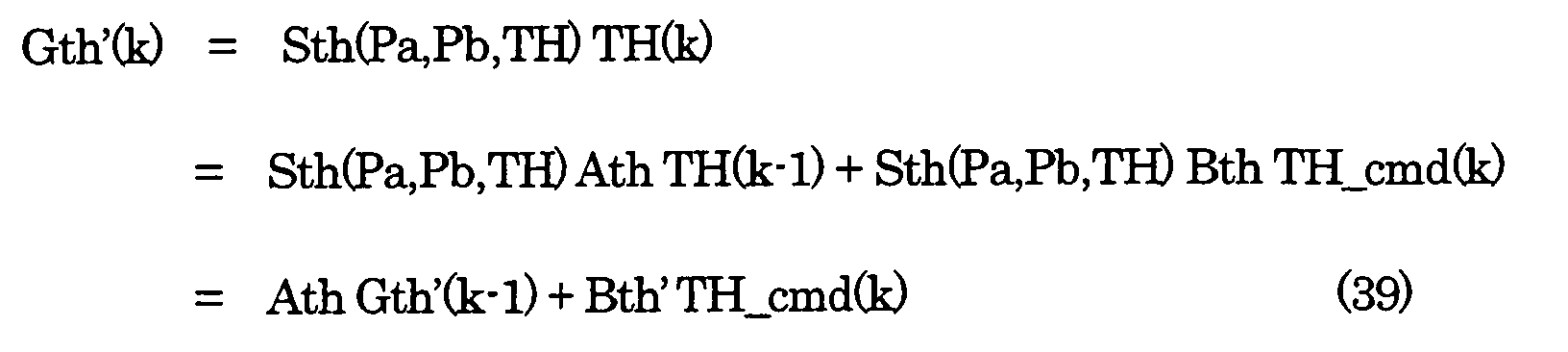
TH(k) = Ath TH(k-1) + Bth TH_cmd(k)
Ath and Bth are constants a sum of which is 1.
Further, an amount of air having passed through the throttle can be
approximated by the following equation.
Gth'(k) = Sth(Pa,Pb,TH)TH(k)
Sth is a factor determined depending on atmospheric pressure Pa (substantially equal
to a pressure at a point upstream the throttle), intake manifold pressure Pb and
throttle opening TH.
The following equation is obtained from Equations (37) and (38).
Bth' = Sth (Pa, Pb,TH) Bth Further, since an amount of air having passed through the throttle Gth is
substantially equal to an approximated value Gth', a relationship between Gth' and
Gcyl_hat can be approximated by the following equation.
The following equations can be obtained by substituting Equation (39) into Equation
(40).
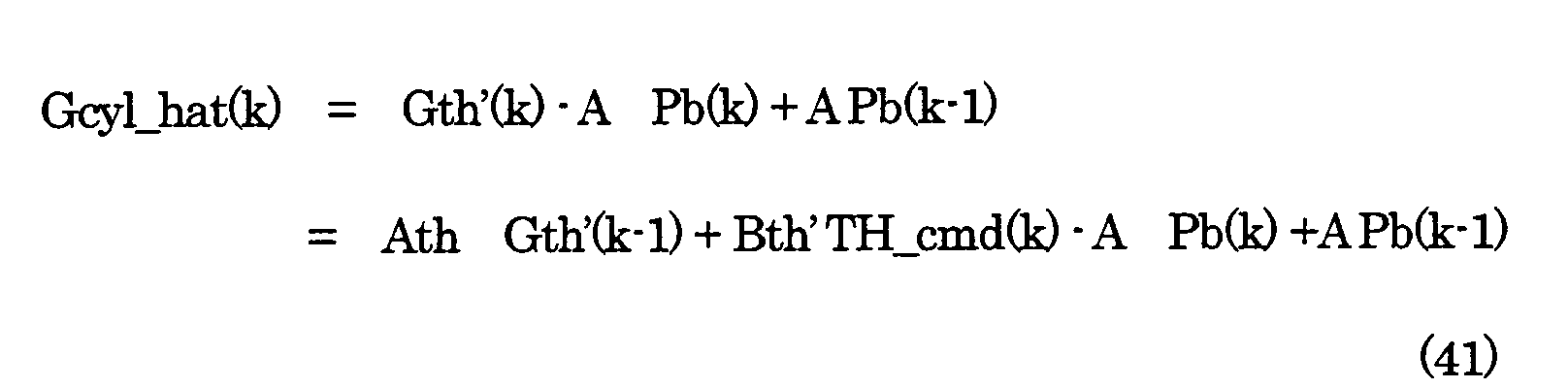
Gcyl_hat(k) = Ath Gth'(k-1)-A Pb(k) + APb(k-1) + Bth'TH_cmd(k)
In the following equation, Gth' in Equation (42) is replaced with a measured value Gth
from the air-low meter.
Gcyl_hat(k) = Ath Gth(k-1)-A Pb(k) + APb(k-1) + Bth'TH_cmd(k) Equation (43) described above, is assumed to be a model which represents a
relationship between a desired value TH_com of throttle opening and an estimated
value Gcyl_hat of an amount of drawn air.
An error between an estimated value Gcyl_hat of an amount of drawn air and
a desired value Gcyl_cmd of an amount of drawn air, is defined by the following
equation.
Ge(k) = Gcyl_hat(k) - Gcyl_cmd(k)
Further, convergence behavior of Ge is defined by the following switch function σ.
σ(k) = Ge(k) - S Ge(k -1)
where -1<S<1. The switch function is represented as below.
Ge(k) = S Ge(k-1)
The switch function means that error Ge will converge to zero with behavior of a
first-order delay system without an input, as shown in Fig. 12.
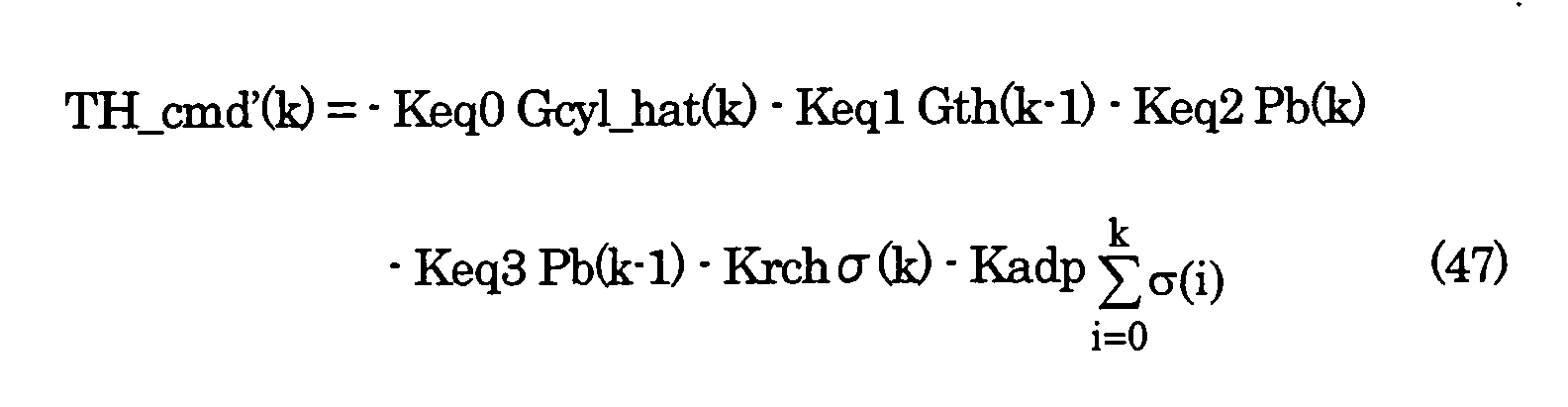
A response-specifying type controller which will realize convergence behavior
specified by the switch function σ, is represented as below.
Feedback gains Keq0, Keq1, Keq2, Keq3, Krch and kadp are determined to minimize
the estimation function described below.
ΔX(k) = [ΔGcyl_hat(k) ΔGth(k) ΔPb(k) ΔPb(k-1) Δσ(k) σ(k)]T
R = r0
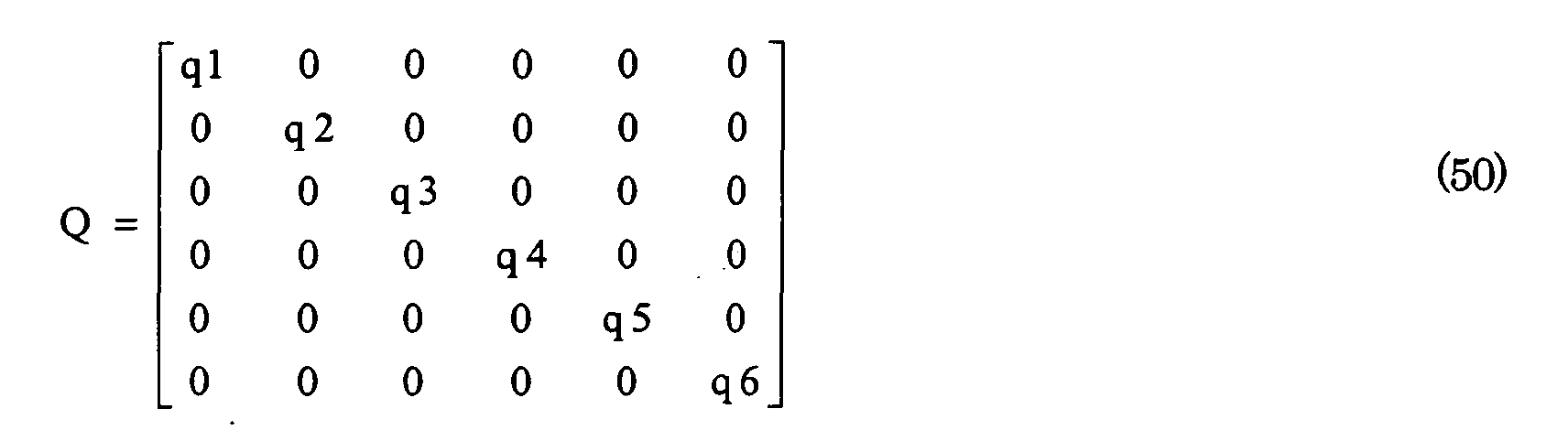
Q represents a set of weighting parameters, while q1, q2, q3, q4, q5, q6 and r0 are
positive constants. If weighting factors are set as shown below, a convergence to zero
of Δσ and σ can be made faster than a convergence to zero of each of state variables
ΔGcyl_hat (k), ΔGth(k), ΔPb(k) and ΔPb(k-1). In other words, responses of specified
errors can be made faster. Further, robust stability for modeling error and
disturbances in the control system, can be improved
q1, q2, q3, q4 ≦ q5, q6 Further, feedforward opening TH_ff is added to TH_cmd'in Equation (47) to
obtain a desired value of throttle opening, that is, a controlled variable TH_cmd of
throttle opening in the response-specifying type controller. Feedforward opening
TH_ff is obtained based on accelerator pedal opening AP, vehicle velocity VP,
transmission shift position NGEAR, charging pressure Pc, presence or absence of
electric load and state of being turned on or off of the hydraulic pump for power
steering.
Fig. 13 shows a result of an amount of drawn air of the cylinder Gcyl,
controlled by the response-specifying type controller.
Fig. 14 shows a configuration of a fuel-injection control system comprising the
apparatus for estimating an amount of drawn air and the response-specifying type
controller for controlling an amount of drawn air, according to the embodiment of the
present invention.
The response-specifying type controller 1002 receives, as inputs, an estimated
value of an amount of drawn air of the cylinder, from the apparatus 1001 for
estimating an amount of drawn air of the cylinder and a desired value of an amount of
drawn air of the cylinder, from a section 1003 for calculating a desired value of an
amount of drawn air of the cylinder. The response-specifying type controller 1002
manipulates throttle opening to have an estimated value controlled at a desired value.
In Fig. 14, a fuel conversion module and a fuel adhesion correction module are
represented with reference numerals 1004 and 1005, while fuel correction factor
calculating modules are represented with reference numerals 1006 and 1007. These
modules determine an amount of fuel to be injected.
In Fig. 14 throttle opening is manipulated to control an amount of drawn air
of the cylinder. Alternatively, an amount of drawn air of the cylinder can be
controlled by flexible valve timing mechanism. Further, in a system with a
motor-driven compressor, an amount of drawn air of the cylinder can be controlled by
adjusting voltage to be applied to the motor-driven compressor. In a system provided
with a turbine with a waste gate, an amount of drawn air of the cylinder can be
controlled by controlling the waste gate to control a charging pressure.
Fig. 15 shows a procedure of a method for estimating an amount of drawn air,
according to an embodiment of the present invention. Calculations of the procedure
are carried out for each intake stroke (TDC). In step S10, values Pb_buf of intake
manifold pressure sampled at certain crank angles (CRK) determined by dividing
TDC into 6 equal parts, are subjected to 6-tap moving averaging to remove pulsing
components of Pb_buf. For example, a crank angle for an intake stroke (TDC) is 180
degrees, and a crank angle (CRK) signal is delivered for every 30 degrees of crank
rotation angle. In step S20, it is determined whether or not the airflow meter is
active. If active, the process goes to step 30, in which values Gth_buf of an amount of
air having passed through the throttle, are subjected to 6-tap moving averaging to
remove pulsing components of Gth_buf. In step S40, an estimated value Gcyl_hat
of an amount of drawn air of the cylinder, is calculated. In step S50, a desired value
TH_cmd of throttle opening is calculated. If the airflow meter is determined to be not
active in step S20, the process goes to step S60, in which an estimated value Gcyl_hat
of an amount of drawn air of the cylinder, is calculated based on the number of
revolutions of the engine and intake manifold pressure. In step S70, a desired value
TH_cmd of throttle_opening is made equal to accelerator pedal opening. At this time,
when the accelerator pedal is fully closed, a certain opening is given to allow the
engine to maintain an idling speed. In other words, when the accelerator pedal is
fully closed, TH_cmd is determined by idling speed control not shown.
An example of an electronic control unit used in embodiments of the present
invention, will be described with reference to Fig. 16. The electronic control unit
includes a CPU 1601, a ROM 1611, a flash memory 1612, a RAM 1613, an I/O unit
1614 and a communication controller 1615 for a network on the vehicle. The above
devices are connected with one another via a bus 1620.
Algorithm for estimating and controlling an amount of drawn air of a cylinder,
according to the present invention, may be stored as a program in the ROM 1611 or
the flash memory 1612. Some part of the algorithm, for example fuzzy rules, may be
stored in the flash memory 1612, while the other part may be stored in the ROM 1611.
Alternatively, the algorithm may be stored in another type of memory not shown in
the drawing.
A method and an apparatus for estimating an amount of drawn air of a
cylinder and a method and an apparatus for controlling the amount of drawn air, are
presented. An estimated value of an amount of drawn air of the cylinder, based on
intake manifold pressure, is multiplied by a value of an identification parameter
obtained by an adaptive observer, to obtain a final estimated value of an amount of
drawn air of the cylinder. An accurate estimated value in a transient state as well as
an estimated value not oscillating in a steady state can be obtained. Accordingly,
accuracy of air-fuel ratio control can be remarkably increased.