TECHNICAL FIELD
The present invention relates to fluids for traction drives. More
particularly, the present invention relates to a fluid for traction drives for
automobiles exhibiting a great traction coefficient at high temperatures
which is important for practical application to continuously variable
transmissions (CVT) for automobiles and improved fluidity at low
temperatures, i.e., small viscosity at low temperatures, which is important
for starting engines at low temperatures.
BACKGROUND ART
Since CVT of the traction drive type for automobiles has a great
capacity of torque transfer and the condition in the use is severe, it is
essential that a traction oil used for CVT has a traction coefficient
sufficiently greater than the value prescribed in the design of CVT at the
lowest temperature in the temperature range of the use, which is a high
temperature (140°C).
On the other hand, a small viscosity even at -40°C is required for
starting an engine at low temperatures in cold areas such as northern
America and northern Europe. However, the traction coefficient at high
temperatures and the property for starting an engine at low temperatures
are contradictory properties. A base oil for a traction oil satisfying both
of these contradictory properties at a high level has been required.
Moreover, excellent viscosity-temperature characteristics are also
essential for practical applications in combination with the small
viscosity.
Under the above circumstances, the present inventors discovered a
high performance base oil for a traction oil exhibiting excellent properties
at high and low temperatures which were not achieved before (Japanese
Patent Application Laid-Open No. 2000-17280). This base oil for a
traction oil has advantageous properties in that the traction coefficient at
high temperatures is greater and the viscosity at low temperatures is
remarkably improved in comparison with those of a commercial base oil
which is 2,4-dicyclohexyl-2-methylpentane. However, a further
improvement in the viscosity at low temperatures have been desired so
that the property for starting an engine at low temperatures is further
improved.
As the base oil having a small viscosity which is added to the above
high performance base oil for traction oils and improves the fluidity at low
temperatures without decreasing the traction coefficient at high
temperatures, the present inventors have developed a group of compounds
having specific structures and exhibiting a viscosity index of 0 or greater
by the improvement of the bicyclo[2.2.1]heptane hydrocarbon compound
which had been discovered by the present inventors (Japanese Patent
Application Publication Heisei 5(1993)-63519).
Under the above circumstances, the present invention has an object
of providing a fluid for traction drives for automobiles exhibiting a great
traction coefficient at high temperatures which is important for practical
application to CVT for automobiles and improved fluidity at low
temperatures, i.e., small viscosity at low temperatures, which is important
for starting engines at low temperatures.
DISCLOSURE OF THE INVENTION
As the result of the intensive studies by the present inventors on
the fluid for traction drives to improve the viscosity characteristics at low
temperatures without decreasing the traction coefficient at high
temperatures, it was found that the above object could be achieved by
mixing a hydrocarbon compound having a small viscosity which had a
specific structure and a specific kinematic viscosity to a bridged cyclic
hydrocarbon compound having the specific structure which had been
discovered by the present inventors before. The present invention has
been completed based on this knowledge.
As the first aspect, the present invention provides a fluid for
traction drives which comprises (A) a hydrocarbon compound having two
bridged rings selected from bicyclo[2.2.1]heptane ring, bicyclo[3.2.1]octane
ring, bicyclo[3.3.0]octane ring and bicyclo[2.2.2]octane ring and (B) a
hydrocarbon compound having at least one structure selected from
quaternary carbon atom and ring structures and having a kinematic
viscosity at 40°C of 10 mm2/s or smaller, and has a viscosity at -40°C of
40,000 mPa·s or smaller and a flash point of 140°C or higher.
As the second aspect, the present invention provides a fluid for
traction drives which comprises at least 5% by mass of a
bicyclo[2.2.1]heptane derivative having 14 to 17 carbon atom in an entire
molecule, having a viscosity index of 0 or greater and represented by
following general formula (1) or (2):
wherein R
1 represents an alkyl group having 1 to 4 carbon atoms, R
2
represents a branched alkyl group having 7 to 10 carbon atoms and at
least one quaternary carbon atom or an alkyl group having 7 to 10 carbon
atoms and a cyclopentane ring, and a, b and c each represent an integer of
0 to 2.
In the fluid for traction drives as the first aspect of the present
invention, a hydrocarbon compound having two bridged rings selected
from bicyclo[2.2.1]heptane ring, bicyclo[3.2.1]octane ring, bicyclo[3.3.0]-octane
ring and bicyclo[2.2.2]octane ring is used as component (A) which
is the major base oil component.
It is preferable that the hydrocarbon compound having two bridged
rings is selected from hydrogenation products of dimers of at least one
alicyclic compound selected from bicyclo[2.2.1]heptane ring compounds,
bicyclo[3.2.1]octane ring compounds, bicyclo[3.3.0]octane ring compounds
and bicyclo[2.2.2]octane ring compounds. The hydrogenation compounds
of dimers of bicyclo[2.2.1]heptane ring compounds, i.e., compounds
represented by general formula (XI):
wherein R
12 and R
13 each independently represent an alkyl group having
1 to 3 carbon atoms, R
14 represents methylene group, ethylene group or
trimethylene group which may be substituted with methyl group or ethyl
group as the side chain, p and q each represent an integer of 0 to 3, and r
represents 0 or 1, are more preferable.
As the preferable process for producing the above dimer of an
alicyclic compound, for example, an olefin described in the following which
may be substituted with an alkyl group is dimerized, hydrogenated and
distilled, successively. Examples of the olefin which may be substituted
with an alkyl group include bicyclo[2.2.1]hept-2-ene; bicyclo[2.2.1]-hept-2-ene
substituted with an alkenyl group such as bicyclo[2.2.1]hept-2-ene
substituted with vinyl group or isopropenyl group; bicyclo[2.2.1]hept-2-ene
substituted with an alkylidene group such as bicyclo[2.2.1]hept-2-enes
substituted with methylene group, ethylidene group or isopropylidene
group; bicyclo[2.2.1.]heptane substituted with an alkenyl group such as
bicyclo[2.2.1]heptane substituted with vinyl group or isopropenyl group;
bicyclo[2.2.1]heptane substituted with an alkylidene group such as
bicyclo[2.2.1]heptane substituted with methylene group, ethylidene group
or isopropylidene group; bicyclo[3.2.1]octene; bicyclo[3.2.1]octene
substituted with an alkenyl group such as bicyclo[3.2.1]octene substituted
with vinyl group or isopropenyl group; bicyclo[3.2.1]octene substituted
with an alkylidene group such as bicyclo[3.2.1]octene substituted with
methylene group, ethylidene group or isopropylidene group;
bicyclo[3.2.1]octane substituted with an alkenyl group such as
bicyclo[3.2.1]octane substituted with vinyl group or isopropenyl group;
bicyclo[3.2.1]octane substituted with an alkylidene group such as
bicyclo[3.2.1]octane substituted with methylene group, ethylidene group
or isopropylidene group; bicyclo[3.3.0]octene; bicyclo[3.3.0]octene
substituted with an alkenyl group such as bicyclo[3.3.0]octene substituted
with vinyl group or isopropenyl group; bicyclo[3.3.0]octene substituted
with an alkylidene group such as bicyclo[3.3.0]octene substituted with
methylene group, ethylidene group or isopropylidene group;
bicycle[3.3.0]octane substituted with an alkenyl group such as
bicyclo[3.3.0]octane substituted with vinyl group or isopropenyl group;
bicyclo[3.3.0]octane substituted with an alkylidene group such as
bicyclo[3.3.0]octane substituted with methylene group, ethylidene group
or isopropylidene group; bicyclo[2.2.2]octene; bicyclo[2.2.2]octene
substituted with an alkenyl group such as bicyclo[2.2.2]octene substituted
with vinyl group or isopropenyl group; bicyclo[2.2.2]octene substituted
with an alkylidene group such as bicyclo[2.2.2]octene substituted with
methylene group, ethylidene group or isopropylidene group;
bicyclo[2.2.2]octane substituted with an alkenyl group such as
bicyclo[2.2.2]octane substituted with vinyl group or isopropenyl group;
bicyclo[2.2.2]octane substituted with an alkylidene group such as
bicyclo[2.2.2]octane substituted with methylene group, ethylidene group
or isopropylidene group;
Among the above compounds, the hydrogenation products of dimers
of bicyclo[2.2.1]heptane cyclic compounds which are represented by
general formula (XI) described above are preferable. Examples of the
olefin as the corresponding raw material include bicyclo[2.2.1]hept-2-ene,
2-methylenebicyclo[2.2.1]heptane, 2-methylbicyclo[2.2.1]hept-2-ene,
2-methylene-3-methylbicyclo[2.2.1]heptane, 2,3-dimethylbicyclo[2.2.1]hept-2-ene,
2-methylene-7-methylbicyclo[2.2.1]heptane, 2,7-dimethylbicyclo-[2.2.1]hept-2-ene,
2-methylene-5-methylbicyclo[2.2.1]heptane,
2,5-dimethylbicyclo[2.2.1]hept-2-ene, 2-methylene-6-methylbicyclo[2.2.1]heptane,
2,6-dimethylbicyclo[2.2.1]hept-2-ene, 2-methylene-1-methylbicyclo-[2.2.1]-heptane,
1,2-dimethylbicyclo[2.2.1]hept-2-ene, 2-methylene-4-methylbicyclo[2.2.1]heptane,
2,4-dimethylbicyclo[2.2.1]hept-2-ene,
2-methylene-3,7-dimethylbicyclo[2.2.1]heptane, 2,3,7-trimethylbicyclo[2.2.1]hept-2-ene,
2-methylene-3,6-dimethylbicyclo[2.2.1]heptane,
2-methylene-3,3-dimethylbicyclo[2.2.1]heptane, 2,3,6-trimethylbicyclo[2.2.1]hept-2-ene,
2-methylene-3-ethylbicyclo[2.2.1]heptane and 2-methyl-3-ethylbicyclo[2.2.1]hept-2-ene.
The dimerization described above means not only dimerization of
the same type of olefin but also dimerization of plurality of olefins of
different types. The dimerization of the olefin described above is
conducted, in general, in the presence of a catalyst and, where necessary,
by adding a solvent. As the catalyst used for the dimerization, in general,
an acid catalyst is used. Examples of the catalyst include mineral acids
such as hydrofluoric acid and polyphosphoric acid; organic acids such as
triflic acid; Lewis acids such as aluminum chloride, ferric chloride, stannic
chloride, boron trifluoride, complexes of boron trifluoride, boron
tribromide, aluminum bromide, gallium chloride and gallium bromide;
and organoaluminum compounds such as triethylaluminum,
diethylaluminum chloride and ethylaluminum dichloride. Among these
acids, complexes of boron trifluoride such as boron trifluoride diethyl
ether complex, boron trifluoride 1.5 hydrate and boron trifluoride alcohol
complexes are preferable.
The amount of the catalyst is not particularly limited. In general,
the amount is in the range of 0.1 to 100% by weight and preferably in the
range of 1 to 20% by weight based on the amount of the olefin used as
the raw material. A solvent is not always necessary in the dimerization.
A solvent may be used for handling the olefin of the raw material and the
catalyst during the reaction and for adjusting the progress of the reaction.
Examples of the solvent include saturated hydrocarbons such as various
types of pentane, various types of hexane, various types of octane, various
types of nonane and various types of decane; alicyclic hydrocarbons such
as cyclopentane, cyclohexane, methylcyclohexane and decaline; ether
compounds such as diethyl ether and tetrahydrofuran; compounds having
halogens such as methylene chloride and dichloroethane; and nitro
compounds such as nitromethane and nitrobenzene.
The dimerization is conducted in the presence of the above catalyst.
The temperature of the reaction is, in general, in the range of -70 to
100°C and preferably in the range of -30 to 60°C. The reaction condition
can be set suitably in the above temperature range in accordance with the
type of the catalyst and additives. The pressure of the reaction is, in
general, the atmospheric pressure and the time of the reaction is, in
general, in the range of 0.5 to 10 hours.
The dimer of the raw material obtained as described above is
hydrogenated and converted into the hydrogenation product of the dimer
of the object compound. The hydrogenation may be conducted using a
suitable mixture of a plurality of dimers prepared separately by
dimerization of the plurality of corresponding olefins as the raw materials.
The hydrogenation is, in general, conducted in the presence of a catalyst.
Examples of the catalyst include catalysts for hydrogenation such as
nickel, ruthenium, palladium, platinum, rhodium and iridium. In
general, the above catalyst is used in the form supported on a support
such as diatomaceous earth, alumina, active carbon and silica alumina.
Where necessary, solid acids such as zeolite may be used as the cocatalyst
of the hydrogenation. Among the above catalysts, nickel supported on
diatomaceous earth is preferable from the standpoint of the physical
properties of the obtained hydrogenation product. The amount of the
catalyst is, in general, in the range of 0.1 to 100% by weight and
preferably in the range of 1 to 20% by weight based on the amount of the
hydrogenation product.
Similarly to the dimerization described above, a solvent may be
used although the hydrogenation can proceed in the absence of solvents.
Examples of the solvent include saturated hydrocarbons such as various
types of pentane, various types of hexane, various types of octane, various
types of nonane and various types of decane; and alicyclic hydrocarbons
such as cyclopentane, cyclohexane, methylcyclohexane and decaline.
The temperature of the reaction is, in general, in the range of 100 to
300°C and preferably in the range of 200 to 300°C. The pressure of the
reaction is, in general, in the range of the atmospheric pressure to 20
MPa·G and preferably in the range of the atmospheric pressure to 10
MPa·G. When the pressure is expressed as the partial pressure of
hydrogen, the pressure is in the range of 0.5 to 9 MPa·G and preferably in
the range of 1 to 8 MPa·G. The time of the reaction is, in general, in the
range of 1 to 10 hours.. The formed hydrogenation product may be mixed
with hydrogenation products formed from different olefins of the raw
materials in separated procedures.
In the first aspect of the present invention, the compound having at
least two bridged rings may be used as component (A) singly or in
combination of two or more.
In the first aspect of the invention, the base oil of component (A)
has, in general, the following physical properties: a kinematic viscosity at
40°C of 10 to 25 mm2/s; a viscosity index of 60 or greater; a pour point of
-40°C or lower; a density at 20°C of 0.93 g/cm3 or greater; a flash point of
140°C or higher; and a traction coefficient (the value obtained in
accordance with the method using a two-cylinder friction tester described
below) at 140°C of 0.063 or greater.
In the first aspect of the present invention, as component (B) of the
base oil, a hydrocarbon compound having a small viscosity, i.e., a
hydrocarbon compound having at least one structure selected from
quaternary carbon atom and ring structures and having a kinematic
viscosity at 40°C of 10 mm2/s or smaller, is used. When the kinematic
viscosity at 40°C of component (B) exceeds 10 mm2/s, the fluid for traction
drives exhibiting the excellent viscosity characteristics at low
temperatures cannot be obtained and the object of the present invention
cannot be achieved. It is preferable that the kinematic viscosity at 40°C
is 9 mm2/s or smaller and more preferably 8.5 mm2/s or smaller. There is
not particular lower limit to the kinematic viscosity. The kinematic
viscosity is, in general, 2 mm2/s or greater.
In the present invention, as the hydrocarbon compound having a
small viscosity of component (B), compounds (a) to (h) shown in the
following are preferable.
Hydrocarbon compound (a)
Hydrocarbon compound (a) is an isoparaffin having 15 to 24 carbon
atoms which has at least two gem-dimethyl structure. The gem-dimethyl
structure means a structure in which two methyl groups are bonded to
one carbon atom. Examples of the isoparaffin include 2,2,4,4,6,8,8-heptamethylnonane,
2,4,4,6,6,8,8-heptamethylnonane and 2,4,4,6,8,8,
10,10-nonamethylundecane. The above compound may be used singly or
in combination of two or more.
Hydrocarbon compound (b)
Hydrocarbon compound (b) is a hydrocarbon compound having 13 to
16 carbon atoms and represented by at least one of general formula (I)
and general formula (II):
wherein R
1 represents a methylene group which may have a methyl
branch, R
2 and R
3 each independently represent an alkyl group having 1
to 3 carbon atoms, k, m and n each represent an integer of 0 to 3, and m+n
represents an integer of 0 to 4. Examples of the alkyl group having 1 to 3
carbon atoms which is represented by R
2 and R
3 in general formulae (I)
and (II) include methyl group, ethyl group, n-propyl group and isopropyl
group.
Examples of the compound represented by general formula (I)
shown above include ethyldicyclohexyl, (methylcyclohexylmethyl)-cyclohexane,
1-cyclohexyl-1-methylcyclohexylethane, trimethyldicyclohexyl
and diethyldicyclohexyl.
Examples of the compound represented by general formula (II)
shown above include ethylbiphenyl, benzyltoluene, phenyltolylethane,
trimethylbiphenyl and diethylbiphenyl.
The above hydrocarbon compound may be used singly or in
combination of two or more.
Hydrocarbon compound (c)
Hydrocarbon compound (c) is a hydrocarbon compound having 13 to
24 carbon atoms and represented by at least one of general formula (III)
and general formula (IV):
wherein R
4 represent an alkyl group having 1 to 7 carbon atoms, R
5
represents an alkyl group having 8 to 10 carbon atoms which may have at
least one of alkyl branches and cyclopentane ring, a and b each represent
an integer of 0 to 3, and a+b represents an integer of 1 to 4. The alkyl
group having 1 to 7 carbon atoms which is represented by R
4 in general
formula (III) and (IV) shown above may be any of a linear alkyl group and
a branched alkyl group. Examples of the alkyl group represented by R
4
include methyl group, ethyl group, n-propyl group, isopropyl group,
various types of butyl group, various types of pentyl group, various types
of hexyl group and various types of heptyl group. Examples of the alkyl
group having 8 to 10 carbon atoms which may have at least one of alkyl
branches and cyclopentane ring and is represented by R
5 include various
types of octyl group, various types of nonyl group, various types of decyl
group, dimethylcyclopentylmethyl group, methylcyclopentylethyl group,
dimethylcyclopentylethyl group, trimethylcyclopentyl group and
trimethylcyclopentylmethyl group.
Examples of the hydrocarbon compound represented by general
formula (III) shown above include 1,4-bis(1,5-dimethylhexyl)cyclohexane,
dodecylcyclohexane and octylcyclohexane.
Examples of the hydrocarbon compound represented by general
formula (IV) shown above include dodecylbenzene, octyltoluene,
octylbenzene and nonylbenzene.
The above hydrocarbon compound may be used singly or in
combination of two or more.
Hydrocarbon compound (d)
Hydrocarbon compound (d) is a hydrocarbon compound having 12 to
16 carbon atoms and represented by at least one of general formula (V)
and general formula (VI):
wherein R
6 and R
7 each independently represent an alkyl group having 1
to 3 carbon atoms, c and d each represent an integer of 0 to 3, and c+d
represents an integer of 1 to 6. Examples of the alkyl group having 1 to 3
carbon atoms which is represented by R
6 and R
7 in general formulae (V)
and (VI) shown above include methyl group, ethyl group, n-isopropyl
group and isopropyl group.
Examples of the hydrocarbon compound represented by general
formula (V) shown above include isopropyldecaline, diisopropyldecaline
and diethyldecaline.
Examples of the hydrocarbon compound represented by general
formula (VI) shown above include isopropylnaphthalene, diisopropylnaphthalene
and diethylnaphthalene.
The above hydrocarbon compound may be used singly or in
combination of two or more.
Hydrocarbon compound (e)
Hydrocarbon compound (e) is a hydrocarbon compound having 16 to
18 carbon atoms and represented by general formula (VII):
wherein e and f each represent an integer of 0 to 2.
Examples of the hydrocarbon represented by general formula (VII)
include dicyclooctyl and dimethyldicyclooctyl.
The above hydrocarbon compound may be used singly or in
combination of two or more.
Hydrocarbon compound (f)
Hydrocarbon compound (f) is a hydrocarbon compound having 13 to
17 carbon atoms and represented by at least one of general formula (VIII)
and general formula (IX):
wherein R
8 and R
9 each independently represent methyl group or ethyl
group, g and h each represent an integer of 0 to 3, and g+h represents an
integer of 0 to 4.
Examples of the hydrocarbon compound represented by general
formula (VIII) shown above include (methylcyclohexyl)dimethylbicyclo[2.2.1]heptane,
cyclohexyldimethylbicyclo[2.2.1]heptane, (methylcyclohexyl)bicyclo[2.2.1]heptane,
(dimethylcyclohexyl)bicyclo[2.2.1]heptane
and (methylcyclohexyl)methylbicyclo[2.2.1]heptane.
Examples of the hydrocarbon compound represented by general
formula (IX) shown above include (methylphenyl)dimethylbicyclo[2.2.1]heptane
and phenyldimethylbicyclo[2.2.1]heptane.
The above hydrocarbon compound may be used singly or in
combination of two or more.
Hydrocarbon compound (g)
Hydrocarbon compound (g) is a hydrocarbon compound having 13 to
20 carbon atoms and represented by general formula (X):
wherein R
10 represents methyl group or ethyl group, R
11 represents an
alkyl group having 6 to 13 carbon atoms which may have at least one of
alkyl branches and cyclopentane ring, i and j each represent an integer of
0 to 3, and i+j represents an integer of 1 to 4. Example of the alkyl group
having 6 to 13 carbon atoms which may have at least one of alkyl
branches and cyclopentane ring and is represented by R
11 in general
formula (X) shown above include various types of hexyl group, various
types of octyl group, various types of decyl group, various types of dodecyl
group, cyclopentylmethyl group, methylcyclopentylmethyl group and
dimethylcyclopentylmethyl group.
Examples of the hydrocarbon compound represented by general
formula (X) shown above include 2-(1,5-dimethylhexyl)bicyclo[2.2.1]heptane,
2-octylbicyclo[2.2.1]heptane, 2-hexylbicyclo[2.2.1]heptane,
octyl-2,3-dimethylbicyclo[2.2.1]heptane, (methylcyclopentylmethyl)dimethylbicyclo[2.2.1]heptane
and (nonyl)methylbicyclo[2.2.1]heptane.
The above hydrocarbon compound may be used singly or in
combination of two or more.
Hydrocarbon compound (h)
As hydrocarbon compound (h), a naphthenic mineral oil is used.
In the first aspect of the present invention, any one of hydrocarbon
compounds (a) to (h) or a suitable combination of hydrocarbon compounds
(a) to (h) may be used as the hydrocarbon compound having a small
viscosity of component (B).
The fluid for traction drives as the first aspect of the present
invention comprises the base oil of component (A) and the base oil of
component (B) and has a viscosity at -40°C of 40,000 mPa·s or smaller
and a flash point of 140°C or lower. When the viscosity at -40°C exceeds
40,000 mPa·s, the effect of improving the properties at low temperatures
is not sufficiently exhibited and the object of the present invention cannot
be achieved. It is preferable that the viscosity at -40°C is 35,000 mPa·s
or smaller and more preferably 30,000 mPa·s or smaller. There is no
particular lower limit to the viscosity. The viscosity is, in general, 5,000
mPa·s or greater. When the flash point is lower than 140°C, there is the
possibility that the fluid is ignited. It is preferable that the flash point is
145°C or higher and more preferably 150°C or higher.
The relative amounts of component (A) and component (B) in the
fluid for traction drives as the first aspect of the present invention are not
particularly limited as long as the fluid for traction drives having the
above properties can be obtained. In general, the content of component
(B) is selected in the range of 1 to 50% by weight, preferably in the range
of 2 to 40% by weight and more preferably in the range of 3 to 30% by
weight.
The fluid for traction drives as the first aspect of the present
invention may further comprise, where desired, base oils having a small
viscosity such as poly-α-olefin oils and diesters and base materials for
improving the traction coefficient at high temperatures such as
dicyclopentadiene-based hydrogenated petroleum resins as long as the
object of the present invention such as the excellent traction coefficient at
high temperatures and the excellent properties at low temperatures is not
adversely affected.
The fluid for traction drives as the second aspect of the present
invention is a fluid for traction drives which comprises a
bicyclo[2,2,1]heptane derivative having 14 to 17 carbon atom in the entire
molecule, represented by general formula (1) or (2) shown above and
having a viscosity index of 0 or greater.
The number of carbon atom in the entire molecule is in the range of
14 to 17. When the number of carbon atom is 13 or less, the flash point
lowers and the volatility increases. When the number of carbon atom is
18 or more, the viscosity increases and the derivative is not preferable.
The viscosity index is 0 or greater. When the viscosity index is smaller
than 0, the viscosity-temperature characteristics deteriorate and the
derivative is not preferable.
In the following, the bicyclo[2.2.1]heptane derivative represented by
general formula (1) will be referred to as Compound 1 and the
bicyclo[2.2.1]heptane derivative represented by general formula (2) will be
referred to as Compound 2.
In Compound 1, R1 represents an alkyl group having 1 to 4 carbon
atoms. Examples of the alkyl group include methyl group, ethyl group,
n-propyl group, isopropyl group, n-butyl group, isobutyl group, sec-butyl
group and tert-butyl group. Among these groups, methyl group is
preferable.
Examples of Compound 1 include methylcyclohexyl-dimethyl[bicyclo[2.2.1]heptane,
cyclohexyl-dimethylbicyclo[2.2.1]heptane, methylcyclohexyl-bicyclo[2.2.1]heptane,
dimethylcyclohexyl-bicyclo[2.2.1]heptane,
dimethylcyclohexyl-dimethylbicyclo[2.2.1]heptane, ethylcyclohexylbicyclo[2.2.1]heptane,
ethylcyclohexyl-dimethylbicyclo[2.2.1]heptane and
methylcyclohexyl-methylbicyclo[2.2.1]heptane.
In Compound 2, R2 represents a branched alkyl group having 7 to
10 carbon atoms and at least one quaternary carbon atom or an alkyl
group having 7 to 10 carbon atoms and a cyclopentane ring. Examples of
the group represented by R2 include 2,4,4-trimethylpentyl group,
neopentyl group, 3,3-dimethylbutyl group, 2,2,4,4-tetramethylpentyl
group, methylcyclopentylmethyl group and cyclopentylmethyl group.
Among these groups, 2,4,4-trimethylpentyl group and
methylcyclopentylmethyl group are preferable.
Examples of Compound 2 include 2,3-dimethyl-2- (2,4-4-trimethylpentyl)bxcyclo[2.2.1]heptane,
2-methyl-2-(2,4,4-trimethylpentyl)bicyclo[2.2.1]heptane,
2-methyl-2-(2,2,4,4-tetramethylpentyl)bicyclo[2.2.1]heptane,
methylcyclopentylmethyl-dimethylbicyclo[2.2.1]heptane and
cyclopentylmethyl-methylbicyclo[2.2.1]heptane.
In the following, the preferable processes for preparation of
Compound 1 and Compound 2 will be described.
Compound 1 can be obtained by the Friedel-Crafts alkylation of the
following olefin which may be substituted with one or two methyl groups
and the following aromatic compound which may be substituted with an
alkyl group having 1 to 4 carbon atoms, followed by hydrogenation of the
product.
Examples of the above olefin which may be substituted with one or
two methyl groups of the raw material include bicyclo[2.2.1]hept-2-ene,
methylenebicyclo[2.2.1]hept-2-ene and methylenebicyclo[2.2.1]heptane.
Examples of the above aromatic compound which may be substituted with
an alkyl group having 1 to 4 carbon atoms of the raw material include
benzene, toluene, o-xylene, m-xylene, p-xylene, ethylbenzene, cumene,
cymene, sec-butylbenzene and tert-butylbenzene.
As the catalyst for the Friedel-Crafts alkylation described above,
solid acids such as zeolite and active clay; mineral acids such as
hydrofluoric acid, polyphosphoric acid, sulfuric acid and hydrochloric acid;
organic acids such as triflic acid, p-toluenesulfonic acid and
methanesulfonic acid; Lewis acids such as aluminum chloride, ferric
chloride, stannic chloride, boron trifluoride, complexes of boron trifluoride,
boron tribromide, aluminum bromide, gallium chloride and gallium
bromide; and organoaluminum compound such as triethylaluminum,
diethylaluminum chloride and ethylaluminum dichloride; can be used.
The amount of the catalyst is not particularly limited. In general,
the catalyst is used in an amount in the range of 0.1 to 100 part by mass
based on 100 parts by mass of the olefin of the raw material.
The alkylation is conducted in the presence of the above catalyst.
The temperature is, in general, 200°C or lower and preferably 100°C or
lower so that the isomerization is suppressed. There is no lower limit to
the temperature as long as the reaction can proceed. From the
standpoint of economy, it is preferable that the temperature is -70°C or
higher and more preferably -30°C or higher. The pressure of the
reaction is, in general, the atmospheric pressure. The time of the
reaction is, in general, in the range of 0.5 to 10 hours.
As the catalyst of the hydrogenation described above, nickel,
ruthenium, palladium, platinum, rhodium and iridium supported with a
support such as diatomaceous earth, silica-alumina and active carbon and
Raney nickel can be used. Among these catalysts, the supported nickel
catalysts such as nickel/diatomaceous earth and nickel/silica-alumina are
preferable. The amount of the catalyst is, in general, in the range of 0.1
to 100 parts by mass based on 100 parts by mass of the alkylation product
described above.
The hydrogenation of the alkylation product described above is
conducted in the presence of the above catalyst. The temperature of the
reaction is, in general, in the range of 50 to 300°C. When the
temperature is lower than 50°C, there is the possibility that the
hydrogenation does not take place sufficiently. When the temperature
exceeds 300°C, the yield decreases due to the decomposition reaction. It
is preferable that the temperature is in the range of 100 to 280°C
although the preferable temperature is different depending on the catalyst
and cannot be generally defined.
The pressure of the reaction is, in general, in the range of the
atmospheric pressure to 20 MPa·G and preferably in the range of the
atmospheric pressure to 10 MPa·G. The time of the reaction is, in
general, in the range of 1 to 10 hours.
Compound 2 can be obtained by codimerization of the following
olefin which may be substituted with one or two methyl groups and a
branched olefin having 7 to 10 carbon atoms and at least one quaternary
carbon atom such as diisobutylene, followed by hydrogenation of the
product. Compound 2 can also be obtained by the Diels-Alder reaction of
cyclopentadiene which may be substituted with at most two methyl
groups and a branched olefin having 7 to 12 carbon atoms and at least one
quaternary carbon atom such as diisobutylene and triisobutylene, followed
by hydrogenation of the product. Compound 2 having cyclopentadiene
ring can be obtained by the retro-Diels-Alder reaction of a dimer of the
following olefin which may be substituted with one or two methyl groups,
followed by hydrogenation of the product. As for the condition of the
retro-Diels-Alder reaction, the dimer of the olefin used as the raw
material is placed into an autoclave and subjected to reaction at a
temperature, in general, in the range of 200 to 400°C and preferably in
the range of 250 to 350°C under the spontaneous pressure for a time in
the range of 1 to 30 hours.
As the above olefin which may be substituted with one or two
methyl groups, the same compounds as those used for the preparation of
Compound 1 can be used.
The catalyst used for the dimerization and the condition of the
dimerization described above are the same as those for the alkylation
described in the preparation of Compound 1.
As for the conditions of the Diels-Alder reaction described above,
the cyclopentadiene and the olefin used as the raw materials are placed
into an autoclave and subjected to the reaction at a temperature, in
general, in the range of 50 to 350°C and preferably in the range of 100 to
300°C under the spontaneous pressure for a time in the range of 0.5 to 20
hours. For the reaction, dicyclopentadiene which is the dimer of
cyclopentadiene may be used in place of cyclopentadiene, and the reaction
may be conducted under heat decomposition of dicyclopentadiene.
The catalyst used for the hydrogenation and the condition of the
hydrogenation described above are the same as those for the
hydrogenation described in the preparation of Compound 1.
The bicyclo[2.2.1]heptane derivative represented by general
formula (1) or (2) which is prepared as described above may be used as a
mixture with other fluid for traction drives, where necessary. In this
case, it is preferable that the amounts of the components are adjusted so
that the resultant fluid contains at least 5% by mass and preferably 30%
by mass or more of the bicyclo[2.2.1]heptane derivative.
Where necessary, the fluid for traction drives of the present
invention may further comprise various additives such as antioxidants,
rust preventives, detergent-dispersants, pour point depressants, viscosity
index improvers, extreme pressure agents, antiwear agents, oiliness
agents, defoaming agents and corrosion inhibitors.
The present invention will be described more specifically with
reference to examples in the following. However, the present invention is
not limited to the examples.
The measurement of the traction coefficient in Examples and
Comparative Examples was conducted using a two-cylinder friction tester.
<Measurement of the traction coefficient>
One of two cylinders having the same size and in contact with each
other (the diameter: 52 mm; the thickness: 6 mm; the driven cylinder had
a shape with crowning, i.e., a shape having a diameter increasing toward
the middle portion, and the driving cylinder had a flat shape without the
crowning) was rotated at a constant speed and the other was rotated at a
rotation speed changed continuously, and a load of 98.0 N was applied to
the contacting point between the two cylinders with a weight. The
tangential force, i.e., the traction force, formed between the two cylinders
was measured, and the traction coefficient was obtained. The cylinders
were made of a mirror finished steel plate for bearings SUJ-2. The
average circumferential speed was 6.8 m/s and the contact pressure at the
maximum Herz was 1.23 GPa. For the measurement of the traction
coefficient at the temperature of the fluid of 140°C, the temperature of the
fluid (the oil temperature) was raised from 40°C to 140°C by heating the
oil tank by a heater, and the traction coefficient was obtained at the
slipping ratio of 5%.
Comparative Example 1
Into a 2 liter autoclave made of stainless steel, 561 g (8 moles) of
crotonaldehyde and 352 g (2.67 moles) of dicyclopentadiene were placed,
and the reaction was allowed to proceed at 170°C for 3 hours. After the
resultant reaction mixture was cooled, 18 g of Raney nickel catalyst
(manufactured by KAWAKEN FINE CHEMICALS Co., Ltd.; "M-300T")
was added, and the hydrogenation was conducted under a hydrogen
pressure of 0.9 MPa at a reaction temperature of 150°C for 4 hours.
After the resulting reaction mixture was cooled, the catalyst was removed
by filtration. The filtrate was distilled under a reduced pressure, and
565 g of a fraction of 105°C/2670 Pa was obtained. The fraction was
identified to be 2-hydroxymethyl-3-methylbicyclo[2.2.1]heptane by the
, analysis of the mass spectrum and the nuclear magnetic resonance
spectrum.
Into an atmospheric reaction tube of the flow type made of quartz
and having an outer diameter of 20 mm and a length of 500 mm, 20 g of
γ-alumina (manufactured by NIKKI CHEMICAL Co., Ltd.; "N612N") was
placed. The dehydration was conducted at a reaction temperature of
285°C and a weight hourly space velocity (WHSV) of 1.1 hr-1, and 490 g of
a dehydration product of 2-hydroxymethyl-3-methylbicyclo[2.2.1]heptane
containing 2-methylene-3-methylbicyclo[2.2.1]heptane and 2,3-dimethylbicyclo[2.2.1]hept-2-ene
was obtained.
Into a 1 liter four-necked flask, 10 g of boron trifluoride diethyl
etherate and 490 g of the olefin compound obtained above were placed.
The dimerization was conducted for 5 hours under stirring at 10°C. The
resultant reaction mixture was washed with a dilute aqueous solution of
NaOH and a saturated aqueous solution of sodium chloride. The
obtained product was placed into a 1 liter autoclave, and the
hydrogenation was conducted after adding 15 g of a nickel/diatomaceous
earth catalyst for hydrogenation (manufactured by NIKKI CHEMICAL
Co., Ltd.; "N-113") (the hydrogen pressure: 3 MPa; the reaction
temperature: 250°C; the reaction time: 5 hours). After the reaction was
completed, the catalyst was removed by filtration. The filtrate was
distilled under a reduced pressure, and 340 g of the hydrogenation
product of the object product (Fluid A) was obtained. The results of the
measurements of the properties and the traction coefficient of the
hydrogenation product of the dimer are shown in Table 1.
Comparative Example 2
Into a 500 ml four-necked flask equipped with a reflux condenser, a
stirrer and a thermometer, 4 g of active clay (manufactured by
MIZUSAWA INDUSTRIAL CHEMICALS, LTD; "GALEON EARTH NS"),
10 g of diethylene glycol monoethyl ether and 200 g of α-methylstyrene
were placed. The resultant mixture was heated at a reaction
temperature of 105°C and stirred for 4 hours. After the reaction was
completed, the produced liquid was analyzed in accordance with the gas
chromatography. It was found that the conversion was 70%; the
selectivity of the linear dimer of α-methylstyrene of the object compound
was 95%; the selectivity of the cyclic dimer of α-methylstyrene of the side
reaction product was 1%; and the selectivity of products having higher
boiling points such as trimers was 4%. The obtained reaction product
was hydrogenated and distilled under a reduced pressure in accordance
with the same procedures as those conducted in Comparative Example 1,
and 125 g of the hydrogenation product of the linear dimer of
α-methylstyrene, i.e., 2,4-dicyclohexyl-2-methylpentane, (Fluid B) having
a purity of 99% was obtained. The results of the measurements of the
properties and the traction coefficient of the hydrogenation product of the
dimer are shown in Table 1.
Example 1
2,2,4,4,6,8,8-Heptamethylnonane (manufactured by TOKYO KASEI
KOGYO Co., Ltd.; Fluid 1) was mixed with Fluid A obtained in
Comparative Example 1 in an amount such that the content of Fluid 1 in
the entire fluid was 10% by weight. The results of the measurements of
the properties and the traction coefficient of the fluid are shown in Table
1.
Example 2
An isoparaffin-based hydrocarbon (manufactured by IDEMITSU
PETROCHEMICAL Co., Ltd; "IP SOLVENT 2028") in an amount of 1 liter
was rectified and 350 g of a fraction having a boiling point in the range of
235 to 250°C (Fluid 2) was obtained. Fluid 2 was mixed with Fluid A
obtained in Comparative Example 1 in an amount such that the content of
Fluid 2 in the entire fluid was 10% by weight. The results of the
measurements of the properties and the traction coefficient of the fluid are
shown in Table 1.
Example 3
Ethylbiphenyl (manufactured by Nippon Steel Chemical Co., Ltd.;
"THERM-S 600"; Fluid 3) was mixed with Fluid A obtained in
Comparative Example 1 in an amount such that the content of Fluid 3 in
the entire fluid was 10% by weight. The results of the measurements of
the properties and the traction coefficient of the fluid are shown in Table
1.
Example 4
Into a 2 liter autoclave, 1,200 g of ethylbiphenyl (manufactured by
Nippon Steel Chemical Co., Ltd.; "THERM-S 600"; Fluid 3) and 30 g of a
nickel/diatomaceous earth catalyst for hydrogenation (manufactured by
NIKKI CHEMICAL Co., Ltd.; "N-113") were placed, and the
hydrogenation was conducted under a hydrogen pressure of 2 MPa at a
reaction temperature of 200°C for 4 hours. After the reaction was
completed, the catalyst was removed by filtration, and 1,200 g of the
hydrogenation product of ethylbiphenyl of the object compound (Fluid 4)
was obtained. The obtained ethyldicyclohexyl was mixed with Fluid A
obtained in Comparative Example 1 in an amount such that the content of
ethyldicyclohexyl in the entire fluid was 10% by weight. The results of
the measurements of the properties and the traction coefficient of the fluid
are shown in Table 2.
Example 5
Benzyltoluene (manufactured by SOKEN CHEMICAL &
ENGINEERING Co., Ltd.; "NeoSK-OIL 1300"; Fluid 5) was mixed with
Fluid A obtained in Comparative Example 1 in an amount such that the
content of Fluid 5 in the entire fluid was 10% by weight. The results of
the measurements of the properties and the traction coefficient of the fluid
are shown in Table 2.
Example 6
Into a 2 liter autoclave, 1,200 g of benzyltoluene (manufactured by
SOKEN CHEMICAL & ENGINEERING Co., Ltd.; "NeoSK-OIL 1300";
Fluid 5) and 30 g of a nickel/diatomaceous earth catalyst for
hydrogenation (manufactured by NIKKI CHEMICAL Co., Ltd.; "N-113")
were placed, and the hydrogenation was conducted under a hydrogen
pressure of 2 MPa at a reaction temperature of 200°C for 4 hours. After
the reaction was completed, the catalyst was removed by filtration, and
1,000 g of the hydrogenation product of benzyltoluene of the object
compound (Fluid 6) was obtained by distillation under a reduced pressure.
The obtained (methylcyclohexyl- methyl)cyclohexane was mixed with
Fluid A obtained in Comparative Example 1 in an amount such that the
content of (methylcyclohexyl- methyl)cyclohexane in the entire fluid was
10% by weight. The results of the measurements of the properties and
the traction coefficient of the fluid are shown in Table 2.
Example 7
Into a 3 liter four-necked flask, 1,074 g of toluene and 76 g of
concentrated sulfuric acid were placed. While the resultant mixture was
stirred at 10°C, 450 g of styrene was added dropwise over 2 hours, and the
alkylation was conducted. After the resultant reaction mixture was
washed with a dilute aqueous solution of NaOH and a saturated aqueous
solution of sodium chloride, the unreacted toluene was removed by
distillation. The obtained reaction product was placed into a 2 liter
autoclave in combination with 20 g of a nickel/diatomaceous earth catalyst
for hydrogenation (manufactured by NIKKI CHEMICAL Co., Ltd.;
"N-113"), and the hydrogenation was conducted (the hydrogen pressure: 3
MPa; the reaction temperature: 200°C; the reaction time: 4 hours). After
the reaction was completed, the catalyst was removed by filtration. The
filtrate was distilled under a reduced pressure, and 420 g of
1-cyclohexyl-1-methylcyclohexylethane of the object product (Fluid 7) was
obtained. The obtained 1-cyclohexyl-1-methylcyclohexylethane was
mixed with Fluid A obtained in Comparative Example 1 in an amount
such that the content of 1-cyclohexyl-1-methylcyclohexylethane in the
entire fluid was 10% by weight. The results of the measurements of the
properties and the traction coefficient of the fluid are shown in Table 2.
Example 8
Into a 3 liter four-necked flask, 880 g of o-xylene and 900 g of
concentrated sulfuric acid were placed. While the resultant mixture was
stirred at 5°C, a mixture of 465 g of 2-methylcyclohexanol and 440 g of
o-xylene was added dropwise over 5 hours, and the alkylation was
conducted. After the resultant reaction mixture was washed with a
dilute aqueous solution of NaOH and a saturated aqueous solution of
sodium chloride, the unreacted o-xylene was removed by distillation. The
obtained reaction product was placed into a 2 liter autoclave in
combination with 70 g of a nickel/diatomaceous earth catalyst for
hydrogenation (manufactured by NIKKI CHEMICAL Co., Ltd.; "N-113"),
and the hydrogenation was conducted (the hydrogen pressure: 3 MPa; the
reaction temperature: 200°C; the reaction time: 6 hours). After the
reaction was completed, the catalyst was removed by filtration. The
filtrate was distilled under a reduced pressure, and 230 g of
trimethyldicyclohexy of the object product (Fluid 8) was obtained. The
obtained trimethyldicyclohexyl was mixed with Fluid A obtained in
Comparative Example 1 in an amount such that the content of
trimethyldicyclohexyl in the entire fluid was 10% by weight. The
results of the measurements of the properties and the traction coefficient
of the fluid are shown in Table 3.
Example 9
Dodecylbenzene (manufactured by TOKYO KASEI KOGYO Co.,
Ltd.; the hard type; Fluid 9) was mixed with Fluid A obtained in
Comparative Example 1 in an amount such that the content of
dodecylbenzene in the entire fluid was 10% by weight. The results of the
measurements of the properties and the traction coefficient of the fluid are
shown in Table 3.
Example 10
Into a 3 liter four-necked flask, 1,232 g of toluene and 200 g of
concentrated sulfuric acid were placed. While the resultant mixture was
stirred at 10°C, 500 g of diisobutylene was added dropwise over 3 hours,
and the alkylation was conducted. After the resultant reaction mixture
was washed with a dilute aqueous solution of NaOH and a saturated
aqueous solution of sodium chloride, the unreacted toluene was removed
by distillation. The obtained product was distilled under a reduced
pressure, and 305 g of the product of alkylation of toluene with
isobutylene of the object product (Fluid 10) was obtained as a fraction
having a boiling point in the range of 70 to 77°C/200 Pa. The obtained
Fluid 10 was mixed with Fluid A obtained in Comparative Example 1 in
an amount such that the content of Fluid 10 in the entire fluid was 10%
by weight. The results of the measurements of the properties and the
traction coefficient of the fluid are shown in Table 3.
Example 11
Isopropylnaphthalene (manufactured by SOKEN CHEMICAL &
ENGINEERING Co., Ltd.; KSK OIL 260; Fluid 11) was mixed with Fluid
A obtained in Comparative Example 1 in an amount such that the content
of isopropylnaphthalene in the entire fluid was 10% by weight. The
results of the measurements of the properties and the traction coefficient
of the fluid are shown in Table 3.
Example 12
Into a 2 liter autoclave, 1,200 g of isopropylnaphthalene
(manufactured by SOKEN CHEMICAL & ENGINEERING Co., Ltd.;
"KSK OIL 260"; Fluid 11) and 30 g of a nickel/diatomaceous earth catalyst
for hydrogenation (manufactured by NIKKI CHEMICAL Co., Ltd.;
"N-113") were placed, and the hydrogenation was conducted under a
hydrogen pressure of 4 MPa at a reaction temperature of 200°C for 5
hours. After the reaction was completed, the catalyst was removed by
filtration, and 1,000 g of the hydrogenation product of
isopropylnaphthalene of the object compound (Fluid 12) was obtained by
distillation under a reduced pressure. The obtained isopropyldecaline
was mixed with Fluid A obtained in Comparative Example 1 in an amount
such that the content of isopropyldecaline in the entire fluid was 10% by
weight. The results of the measurements of the properties and the
traction coefficient of the fluid are shown in Table 4.
Example 13
Into a 1 liter four-necked flask, 100 g of boron trifluoride 1.5
hydrate and 200 ml of heptane were placed. While the resultant mixture
was stirred at 20°C, 450 g of cyclooctene was added dropwise over 4 hours,
and the dimerization was conducted. After the resultant reaction
mixture was washed with a dilute aqueous solution of NaOH and a
saturated aqueous solution of sodium chloride, heptane was removed by
distillation. The obtained reaction product was placed into a 1 liter
autoclave in combination with 15 g of a nickel/diatomaceous earth catalyst
for hydrogenation (manufactured by NIKKI CHEICAL Co., Ltd.; "N-113"),
and the hydrogenation was conducted (the hydrogen pressure: 3 MPa; the
reaction temperature: 200°C; the reaction time: 3 hours). After the
reaction was completed, the catalyst was removed by filtration. The
filtrate was distilled under a reduced pressure, and 210 g of the
hydrogenation product of the dimer of the object product (Fluid 13) was
obtained. The obtained hydrogenation product of the dimer was mixed
with Fluid A obtained in Comparative Example 1 in an amount such that
the content of the hydrogenation product of the dimer in the entire fluid
was 10% by weight. The results of the measurements of the properties
and the traction coefficient of the fluid are shown in Table 4.
Examples 14 and 15
Into a 2 liter autoclave, 730 g of myrcene and 88 g of
dicyclopentadiene were placed. The resultant mixture was stirred at
240°C for 3 hours, and the Diels-Alder reaction was conducted. After the
reaction was completed, the unreacted myrcene was removed using a
rotary evaporator. The obtained reaction mixture in an amount of 727 g
was placed into a 2 liter autoclave in combination with 25 g of a
nickel/diatomaceous earth catalyst for hydrogenation (manufactured by
NIKKI CHEMICAL Co., Ltd.; "N-113"), and the hydrogenation was
conducted (the hydrogen pressure: 2 MPa; the reaction temperature:
200°C; the reaction time: 3 hours). After the reaction was completed, the
catalyst was removed by filtration. The filtrate was distilled, and 312 g
of a fraction having a boiling point in the range of 118 to 124°C/670 Pa
(Fluid 14) and 297 g of a fraction having a boiling point in the range of 147
to 152/670 Pa (Fluid 15) were obtained. As the result of the analysis, it
was found that Fluid 14 was 2-(1,5-dimethylhexyl)bicyclo[2.2.1]heptane
and Fluid 15 was 1,4-bis(1,5-dimethylhexyl)cyclohexane. In Example 14,
Fluid 14 was mixed with Fluid A obtained in Comparative Example 1 in
an amount such that the content of Fluid 14 in the entire fluid was 10%
by weight. In Example 15, Fluid 15 was mixed with Fluid A obtained in
Comparative Example 1 in an amount such that the content of Fluid 15 in
the entire fluid was 10% by weight. The results of the measurements of
the properties and the traction coefficient of the fluids are shown in Table
4.
Example 16
Into a 2 liter autoclave, 700 g of 1-decene and 83 g of
dicyclopentadiene were placed. The resultant mixture was stirred at
240°C for 3 hours, and the Diels-Alder reaction was conducted. After the
reaction was completed, the unreacted 1-decene was removed using a
rotary evaporator. The obtained reaction mixture in an amount of 258 g
was placed into a 2 liter autoclave in combination with 8 g of a
nickel/diatomaceous earth catalyst for hydrogenation (manufactured by
NIKKI CHEMICAL Co., Ltd.; "N-113"), and the hydrogenation was
conducted (the hydrogen pressure: 3 MPa; the reaction temperature:
200°C; the reaction time: 3 hours). After the reaction was completed, the
catalyst was removed by filtration. The filtrate was distilled, and 175 g
of a fraction having a boiling point in the range of 119 to 123°C/670 Pa
(Fluid 16) was obtained. As the result of the analysis, it was found that
Fluid 16 was 2-octylbicyclo[2.2.1]heptane. Fluid 16 was mixed with Fluid
A obtained in Comparative Example 1 in an amount such that the content
of Fluid 16 in the entire fluid was 10% by weight. The results of the
measurements of the properties and the traction coefficient of the fluid are
shown in Table 5.
Example 17
In accordance with the same procedures as those conducted in
Example 16 except that 700 g of 1-octene was used in place of 700 g of
1-decene, 160 g of 2-hexylbicyclo[2.2.1]heptane (Fluid 17) was obtained.
Fluid 17 was mixed with Fluid A obtained in Comparative Example 1 in
an amount such that the content of Fluid 17 in the entire fluid was 10%
by weight. The results of the measurements of the properties and the
traction coefficient of the fluid are shown in Table 5.
Example 18
Into a 2 liter autoclave made of stainless steel, 561 g (8 moles) of
crotonaldehyde and 352 g (2.67 moles) of dicyclopentadiene were placed,
and the reaction was allowed to proceed at 170°C for 3 hours. After the
resultant reaction mixture was cooled, 18 g of Raney nickel (manufactured
by KAWAKEN FINE CHEMICALS Co., Ltd.; "M-300T") was added, and
the hydrogenation was conducted under a hydrogen pressure of 0.9 MPa
at a reaction temperature of 150°C for 4 hours. After the resulting
reaction mixture was cooled, the catalyst was removed by filtration. The
filtrate was distilled under a reduced pressure, and 565 g of a fraction of
105°C/2,670 Pa was obtained. The fraction was identified to be
2-hydroxymethyl-3-methylbicyclo[2.2.1]heptane by the analysis of the
mass spectrum and the nuclear magnetic resonance spectrum.
Into an atmospheric reaction tube of the flow type made of quartz
and having an outer diameter of 20 mm and a length of 500 mm, 20 g of
γ-alumina (manufactured by NIKKI CHEMICAL Co., Ltd.; "N612N") was
placed. The dehydration was conducted at a reaction temperature of
285°C at a weight hourly space velocity (WHSV) of 1.1 hr-1, and 490 g of a
dehydration product of 2-hydroxymethyl-3-methylbicyclo[2.2.1]heptane
containing 2-methylene-3-methylbicyclo[2.2.1]heptane and 2,3-dimethylbicyclo[2.2.1]hept-2-ene
was obtained.
Into a 5 liter four-necked flask, 400 g of heptane and 200 g of boron
trifluoride diethyl etherate were placed. To the resultant mixture, a
mixture of 980 g of the olefin compound obtained above and 900 g of
diisobutylene was added dropwise over 6 hours while the mixture was
stirred at 10°C. After the resultant reaction mixture was washed with a
dilute aqueous solution of NaOH and a saturated aqueous solution of
sodium chloride, the obtained product was distilled under a reduced
pressure, and 630 g of a fraction having a boiling point in the range of 130
to 133°C/1,070 Pa was obtained. As the result of the analysis, it was
found that this fraction was a codimer of the olefins used as the raw
materials. The obtained product and 19 g of a nickel/diatomaceous earth
catalyst for hydrogenation (manufactured by NIKKI CHEMICAL Co.,
Ltd.; "N-113") were placed into a 2 liter autoclave, and the
hydrogenation was conducted (the hydrogen pressure: 3 MPa; the reaction
temperature: 250°C; the reaction time: 5 hours). After the reaction was
completed, the catalyst was removed by filtration, and 620 g of the
hydrogenation product of the codimer of the object product (Fluid 18) was
obtained. Fluid 18 was mixed with Fluid A obtained in Comparative
Example 1 in an amount such that the content of Fluid 18 in the entire
fluid was 10% by weight. The results of the measurements of the
properties and the traction coefficient of the fluid are shown in Table 5.
Example 19
Into a 3 liter four-necked flask, 644 g of toluene and 53 g of
concentrated sulfuric acid were placed. While the resultant mixture was
stirred at 5°C, 428 g of a dehydration product of 2-hydroxymethyl-3-methylbicyclo[2.2.1]heptane
containing 2-methylene-3-methylbicyclo[2.2.1]heptane
and 2,3-dimethylbicyclo[2.2.1]hept-2-ene as the major
components was added dropwise over 3 hours, and the alkylation was
conducted. After the resultant reaction mixture was washed with a
dilute aqueous solution of NaOH and a saturated aqueous solution of
sodium chloride, the unreacted toluene was removed by distillation. The
obtained reaction product was placed into a 2 liter autoclave in
combination with 18 g of a nickel/diatomaceous earth catalyst for
hydrogenation (manufactured by NIKKI CHEMICAL Co., Ltd.; "N-113"),
and the hydrogenation was conducted (the hydrogen pressure: 2 MPa; the
reaction temperature: 250°C; the reaction time: 8 hours). After the
reaction was completed, the catalyst was removed by filtration. The
filtrate was distilled under a reduced pressure, and 580 g of
(methylcyclohexyl)dimethylbicyclo[2.2.1]heptane of the object product
(Fluid 19) was obtained. The obtained Fluid 19 was mixed with Fluid A
obtained in Comparative Example 1 in an amount such that the content of
Fluid 19 in the entire fluid was 20% by weight. The results of the
measurements of the properties and the traction coefficient of the fluid are
shown in Table 5.
Example 20
The raw material of hydrogenation used in Example 19 was
distilled under a reduced pressure, and 590 g of (methylphenyl)-dimethylbicyclo[2.2.1]heptane
(Fluid 20) was obtained. The obtained
Fluid 20 was mixed with Fluid A obtained in Comparative Example 1 in
an amount such that the content of Fluid 20 in the entire fluid was 30%
by weight. The results of the measurements of the properties and the
traction coefficient of the fluid are shown in Table 6.
Example 21
In accordance with the same procedures as those conducted in
Example 19 except that 820 g of benzene was used in place of 644 g of
toluene, 210 g of cyclohexyldimethylbicyclo[2.2.1]heptane (Fluid 21) was
obtained. The obtained Fluid 21 was mixed with Fluid A obtained in
Comparative Example 1 in an amount such that the content of Fluid 21 in
the entire fluid was 10% by weight. The results of the measurements of
the properties and the traction coefficient of the fluid are shown in Table
6.
Example 22
Into a 3 liter four-necked flask, 644 g of toluene and 53 g of
concentrated sulfuric acid were placed. While the resultant mixture was
stirred at 5°C, 330 g of norbornene was added dropwise over 3 hours, and
the alkylation was conducted. After the resultant reaction mixture was
washed with a dilute aqueous solution of NaOH and a saturated aqueous
solution of sodium chloride, the unreacted toluene was removed by
distillation. The obtained reaction product was placed into a 2 liter
autoclave in combination with 18 g of a nickel/diatomaceous earth catalyst
for hydrogenation (manufactured by NIKKI CHEMICAL Co., Ltd.;
"N-113"), and the hydrogenation was conducted (the hydrogen pressure: 3
MPa; the reaction temperature: 250°C; the reaction time: 5 hours). After
the reaction was completed, the catalyst was removed by filtration. The
filtrate was distilled under a reduced pressure, and 450 g of
(methylcyclohexyl)bicyclo[2.2.1]heptane of the object product (Fluid 22)
was obtained. The obtained Fluid 22 was mixed with Fluid A obtained in
Comparative Example 1 in an amount such that the content of Fluid 22 in
the entire fluid was 10% by weight. The results of the measurements of
the properties and the traction coefficient of the fluid are shown in Table
6.
Example 23
In accordance with the same procedures as those conducted in
Example 22 except that 750 g of a mixed xylene was used in place of 644 g
of toluene, 470 g of a fluid containing (dimethylcyclohexyl)bicyclo[2.2.1]heptane
as the major component (Fluid 23) was obtained. The
obtained Fluid 23 was mixed with Fluid A obtained in Comparative
Example 1 in an amount such that the content of Fluid 23 in the entire
fluid was 10% by weight. The results of the measurements of the
properties and the traction coefficient of the fluid are shown in Table 6.
Example 24
Into a 2 liter autoclave, 1,500 g of the dimer of olefins containing
2-methylene-3-methylbicyclo[2.2.1]heptane and 2,3-dimethylbicyclo[2.2.1]-hept-2-ene
as the major components which was obtained in Comparative
Example 1 was placed and the resultant mixture was heated at 300°C for
7 hours under stirring. After the reaction mixture was cooled, 30 g of a
nickel/diatomaceous earth catalyst for hydrogenation (manufactured by
NIKKI CHEMICAL Co., Ltd.; "N-113") was added, and the hydrogenation
was conducted (the hydrogen pressure: 3 MPa; the reaction temperature:
250°C; the reaction time: 5 hours). After the reaction was completed, the
catalyst was removed by filtration. The filtrate was rectified under a
reduced pressure, and 155 g of (methylcyclopentylmethyl)dimethylbicyclo[2.2.1]heptane
(Fluid 24) was obtained as a fraction having a
boiling point in the range of 127 to 130°C/9,060 Pa. Fluid 24 was mixed
with Fluid A obtained in Comparative Example 1 in an amount such that
the content of Fluid 24 in the entire fluid was 10% by weight. The
results of the measurements of the properties and the traction coefficient
of the fluid are shown in Table 7.
Example 25
A naphthenic mineral oil ("NA35"; Fluid 25) was mixed with Fluid
A obtained in Comparative Example 1 in an amount such that the content
of Fluid 25 in the entire fluid was 10% by weight. The results of the
measurements of the properties and the traction coefficient of the fluid are
shown in Table 7.
Comparative Example 3
A hydrogenation product of a dimer of 1-decene (IDEMITSU
"PAO-5002"; Fluid C) was mixed with Fluid A obtained in Comparative
Example 1 in an amount such that the content of Fluid C in the entire
fluid was 10% by weight. The results of the measurements of the
properties and the traction coefficient of the fluid are shown in Table 7.
As shown in Table 7, the traction coefficient decreased markedly although
the viscosity at the low temperature was improved.
Comparative Example 4
Fluid 4 used in Example 4 was mixed with Fluid B obtained in
Comparative Example 2 in an amount such that the content of Fluid 4 in
the entire fluid was 10% by weight. The results of the measurements of
the properties and the traction coefficient of the fluid are shown in Table 7.
As shown in Table 7, the viscosity at the low temperature was great.
Comparative Example 5
An isoparaffin-based hydrocarbon (manufactured by IDEMITSU
PETROCHEMICAL Co., Ltd.; "IP SOLVENT 2835"; Fluid D) was mixed
with Fluid A obtained in Comparative Example 1 in an amount such that
the content of Fluid D in the entire fluid was 10% by weight. The results
of the measurements of the properties and the traction coefficient of the
fluid are shown in Table 8. As shown in Table 8, the improvement in the
viscosity at the low temperature was insufficient.
Comparative Example 6
Fluid D used in Comparative Example 5 was mixed with Fluid B
obtained in Comparative Example 2 in an amount such that the content of
Fluid D in the entire fluid was 10% by weight. The results of the
measurements of the properties and the traction coefficient of the fluid are
shown in Table 8. As shown in Table 8, the viscosity at the low
temperature was great and the traction coefficient was small.
Example 26
Into a 2 liter autoclave made of stainless steel, 561 g (8 moles) of
crotonaldehyde and 352 g (2.67 moles) of dicyclopentadiene were placed,
and the reaction was allowed to proceed at 170°C for 3 hours. After the
resultant reaction mixture was cooled to the room temperature, 18 g of
Raney nickel catalyst (manufactured by KAWAKEN FINE CHEMICALS
Co., Ltd.; "M-300T") was added, and the hydrogenation was conducted
under a hydrogen pressure of 0.88 MPa · G at a reaction temperature of
150°C for 4 hours. After the resulting reaction mixture was cooled, the
catalyst was removed by filtration. The filtrate was distilled under a
reduced pressure, and 565 g of a fraction of 105°C/2.67 kPa was obtained.
The fraction was identified to be 2-hydroxymethyl-3-methylbicyclo[2.2.1]heptane
by the analysis of the mass spectrum and the nuclear
magnetic resonance spectrum.
Into an atmospheric reaction tube of the flow type made of quartz
and having an outer diameter of 20 mm and a length of 500 mm, 20 g of
γ-alumina (manufactured by NIKKI CHEMICAL Co., Ltd.; "N612") was
placed. The dehydration was conducted at a reaction temperature of
285°C and a weight hourly space velocity (WHSV) of 1.1 hr-1, and 490 g of
a dehydration product of 2-hydroxymethyl-3-methylbicyclo[2.2.1]heptane
containing 2-methylene-3-methylbicyclo[2.2.1]heptane and 2,3-dimethylbicyclo[2.2.1]hept-2-ene
was obtained.
Into a 5 liter four-necked flask, 400 g of n-heptane and 200 g of
boron trifluoride diethyl etherate were placed. To the resultant mixture,
a mixture of 980 g of the olefin compound obtained above and 900 g of
diisobutylene was added dropwise over 6 hours while the mixture was
stirred at 10°C. After the resultant reaction mixture was washed with a
dilute aqueous solution of NaOH and a saturated aqueous solution of
sodium chloride, the obtained product was distilled under a reduced
pressure, and 630 g of a fraction having a boiling point in the range of 130
to 133°C/1.07 kPa was obtained. As the result of the analysis, it was
found that this fraction was a codimer of the olefins used as the raw
materials. The obtained product and 19 g of a nickel/diatomaceous earth
catalyst for hydrogenation (manufactured by NIKKI CHEMICAL Co.,
Ltd.; "N-113") were placed into a 2 liter autoclave, and the hydrogenation
was conducted (the hydrogen pressure: 29.4 MPa; · G the reaction
temperature: 250°C; the reaction time: 5 hours). After the reaction was
completed, the catalyst was removed by filtration, and 620 g of the
hydrogenation product of the codimer of the object product was obtained.
The results of the measurements of the properties and the traction
coefficient of the fluid are shown in Table 9. The calculated value of the
viscosity index is listed in Table 9 for reference although the viscosity
index is not applicable unless the kinematic viscosity at 100°C is 2 mm2/s
or greater.
Example 27
Into a 3 liter four-necked flask, 644 g of toluene and 53 g of
concentrated sulfuric acid were placed. While the resultant mixture was
stirred at 5°C, 428 g of a dehydration product of 2-hydroxymethyl-3-methylbicyclo[2.2.1]heptane
containing 2-methylene-3-methylbicyclo[2.2.1]heptane
and 2,3-dimethylbicyclo[2.2.1]hept-2-ene as the major
components was added dropwise over 3 hours, and the alkylation was
conducted. After the resultant reaction mixture was washed with a
dilute aqueous solution of sodium hydroxide and a saturated aqueous
solution of sodium chloride, the unreacted toluene was removed by
distillation. The obtained reaction product was placed into a 2 liter
autoclave in combination with 18 g of a nickel/diatomaceous earth catalyst
for hydrogenation (manufactured by NIKKI CHEICAL Co., Ltd.; "N-113"),
and the hydrogenation was conducted (the hydrogen pressure: 2 MPa; the
reaction temperature: 250°C; the reaction time: 8 hours). After the
reaction was completed, the catalyst was removed by filtration. The
filtrate was distilled under a reduced pressure, and 580 g of
methylcyclohexyl-dimethylbicyclo[2.2.1]heptane of the object product was
obtained. The results of the measurements of the properties and the
traction coefficient of the fluid are shown in Table 9.
Example 28
In accordance with the same procedures as those conducted in
Example 27 except that 820 g of benzene was used in place of 644 g of
toluene, 210 g of cyclohexyl-dimethylbicyclo[2.2.1]heptane was obtained.
The results of the measurements of the properties and the traction
coefficient of the fluid are shown in Table 9.
Example 29
Into a 3 liter four-necked flask, 644 g of toluene and 53 g of
concentrated sulfuric acid were placed. While the resultant mixture was
stirred at 5°C, 330 g of norbornene was added dropwise over 3 hours, and
the alkylation was conducted. After the resultant reaction mixture was
washed with a dilute aqueous solution of sodium hydroxide and a
saturated aqueous solution of sodium chloride, the unreacted toluene was
removed by distillation. The obtained reaction product was placed into a
2 liter autoclave in combination with 18 g of a nickel/diatomaceous earth
catalyst for hydrogenation (manufactured by NIKKI CHEMICAL Co.,
Ltd.; "N-113"), and the hydrogenation was conducted (the hydrogen
pressure: 3 MPa; the reaction temperature: 250°C; the reaction time: 5
hours). After the reaction was completed, the catalyst was removed by
filtration. The filtrate was distilled under a reduced pressure, and 450 g
of methylcyclohexyl-bicyclo[2.2.1]heptane of the object product was
obtained. The results of the measurements of the properties and the
traction coefficient of the fluid are shown in Table 9. The calculated
value of the viscosity index is listed in Table 9 for reference although the
viscosity index is not applicable unless the kinematic viscosity at 100°C is
2 mm2/s or greater.
Example 30
In accordance with the same procedures as those conducted in
Example 29 except that 750 g of a mixed xylene was used in place of 644 g
of toluene, 470 g of a fluid containing dimethylcyclohexylbicyclo[2.2.1]heptane
as the major component was obtained. The results of the
measurements of the properties and the traction coefficient of the fluid are
shown in Table 9. The calculated value of the viscosity index is listed in
Table 9 for reference although the viscosity index is not applicable unless
the kinematic viscosity at 100°C is 2 mm2/s or greater.
Example 31
In accordance with the same procedures as those conducted in
Example 26, 2,200 g of a dehydration product of 2-hydroxymethyl-3-methylbicyclo[2.2.1]heptane
containing 2-methylene-3-methylbicyclo[2.2.1]heptane
and 2,3-dimethylbicyclo[2.2.1]hept-2-ene was obtained.
The obtained product was placed into a 5 liter four-necked flask in
combination with 45 g of boron trifluoride diethyl etherate. The
dimerization was conducted for 5 hours under stirring at 10°C. After the
reaction mixture was washed with a dilute aqueous solution of NaOH and
a saturated aqueous solution of sodium chloride, the unreacted olefin was
removed by distillation, and a reaction mixture of the dimerization of the
raw material was obtained. The dimer of the olefin in an amount of
1,500 g was placed into a 2 liter autoclave and heated at 300°C for 7 hours
under stirring. After the reaction mixture was cooled, 30 g of a
nickel/diatomaceous earth catalyst for hydrogenation (manufactured by
NIKKI CHEMICAL Co., Ltd.; "N-113") was added, and the hydrogenation
was conducted (the hydrogen pressure: 30 kg/cm2; the reaction
temperature: 250°C; the reaction time: 5 hours). After the reaction was
completed, the catalyst was removed by filtration. The filtrate was
rectified under a reduced pressure, and 155 g of methylcyclopentylmethyldimethylbicyclo[2.2.1]heptane
was obtained as a fraction having a boiling
point in the range of 127 to 130°C/68 mmHg. The results of the
measurements of the properties and the traction coefficient of the fluid are
shown in Table 9.
Comparative Example 7
Into a 1 liter four-necked flask, 500 ml of m-xylene as the solvent
and the raw material and 90 g of concentrated sulfuric acid as the catalyst
were placed, and the resultant mixture was stirred for 0.5 hours. To the
mixture at 25°C, a mixed solution of 200.6 g of camphene and 50 ml of
m-xylene was added dropwise over 1 hour. The temperature of the
reaction solution was 35°C after the addition. After being stirred for
further 20 minutes, the reaction solution was transferred to a separation
funnel, and the layer of sulfuric acid was separated and removed. The
organic layer was washed twice with 300 ml of a 10% by mass aqueous
solution of sodium hydrogencarbonate and twice with 200 ml of a
saturated aqueous solution of sodium chloride and dried with anhydrous
magnesium sulfate. After the dried solution was kept standing for one
night, the drying agent was removed. The solvent and the unreacted raw
materials were recovered using a rotary evaporator, and 225 g of the
residual reaction solution was obtained. The residual reaction solution
was distilled under a reduced pressure, and 176 g of a fraction having a
boiling point in the range of 128 to 134°C/2.67 daPa was obtained. In
accordance with the gas chromatography-mass analysis (GC-MS) and the
gas chromatography (GC) of the hydrogen flame (FID) type, it was found
that the fraction obtained above was an addition product of camphene to
m-xylene containing 99% or more of the component having 18 carbon
atoms. Into a 1 liter autoclave, 175 g of the above fraction and 18 g of a
5% by mass ruthenium/active carbon catalyst for hydrogenation
(manufactured by N.E. CHEMCAT CORPORATION) were placed, and the
hydrogenation was conducted under a hydrogen pressure of 8.33 MPa·G at
a temperature of 160°C for 7 hours. After the reaction mixture was
cooled and the catalyst was removed by filtration, the reaction product
was analyzed, and it was found that the fraction of the hydrogenated
product was 99% or greater. The results of the measurements of the
properties and the traction coefficient of the product are shown in Table 9.
Comparative Example 8
Into a 2 liter four-necked flask, 263.8 g of naphthalene, 1,020 g of
carbon tetrachloride as the solvent and 101.7 g of concentrated sulfuric
acid as the catalyst were placed, and the resultant mixture was stirred for
0.5 hours while the temperature was kept at 4°C in an ice bath. To the
resultant mixture, a mixed solution of 160.5 g of camphene and 60.4 g of
carbon tetrachloride was added dropwise over 4.5 hour. The temperature
of the reaction solution was 8°C after the addition. The reaction solution
was transferred to a separation funnel, and the layer of sulfuric acid was
separated and removed. The organic layer was washed twice with 300
ml of a 10% by mass aqueous solution of sodium hydrogencarbonate and
twice with 200 ml of a saturated aqueous solution of sodium chloride and
dried with anhydrous calcium chloride. After the dried solution was kept
standing for one night, the drying agent was removed. The solvent and
the unreacted raw materials were recovered using a rotary evaporator,
and 203 g of the residual reaction solution was obtained. The residual
reaction solution was distilled under a reduced pressure, and 142 g of a
fraction having a boiling point in the range of 164 to 182°C/2.67 daPa was
obtained. In accordance with GC-MS and GC(FID), it was found that the
fraction obtained above was an addition product of camphene to
naphthalene containing 99% or more of the component having 20 carbon
atoms. Into a 1 liter autoclave, 140 g of the above fraction and 15 g of a
5% by mass ruthenium/active carbon catalyst for hydrogenation
(manufactured by N.E. CHEMCAT CORPORATION ) were placed, and
the hydrogenation was conducted under a hydrogen pressure of 8.83
MPa·G at a temperature of 165°C for 6 hours. After the reaction mixture
was cooled and the catalyst was removed by filtration, the reaction
product was analyzed, and it was found that the fraction of the
hydrogenated product was 99% or greater. The results of the
measurements of the properties and the traction coefficient of the product
are shown in Table 9. It is shown by the results in Table 9 that the fluids
of Examples exhibited smaller viscosity and more excellent fluidity at low
temperatures than those of the fluids of Comparative Examples while the
traction coefficients were kept almost the same.
| Example | | | 1 |
| Comparative Example | 1 | 2 | |
| | [Fluid A] | [Fluid B] | Fluid 1 | mixture |
| Kinematic viscosity (mm2/s) |
| 40°C | 17.32 | 20.23 | 3.098 | 13.31 |
| 100°C | 3.578 | 3.572 | 1.266 | 3.112 |
| Viscosity index | 77 | 13 | - | 88 |
| Pour point (°C) | -50.0> | -42.5 | -50.0> | -50.0> |
| Viscosity at -40°C (mPa·s) | 55,000 | 256,000 | 1,000> | 14,000 |
| Density at 20°C (g/cm3) | 0.9544 | 0.9009 | 0.7877 | 0.9357 |
| Flash point (°C) | 156 | 164 | 104 | 146 |
| Traction coefficient at 140°C | 0.077 | 0.070 | 0.044 | 0.069 |
| Content in entire fluid (% by wt) | 100 | 100 | - | 10 |
| [type of main base oil] | [-] | [-] | | [Fluid A] |
| Example | 2 | 3 |
| | Fluid 2 | mixture | Fluid 3 | mixture |
| Kinematic viscosity (mm2/s) |
| 40°C | 3.370 | 13.25 | 3.214 | 13.80 |
| 100°C | 1.279 | 3.067 | 1.160 | 3.089 |
| Viscosity index | - | 81 | - | 70 |
| Pour point (°C) | -50.0> | -50.0> | -50.0> | -50.0> |
| Viscosity at -40°C (mPa·s) | 1,000> | 17,100 | 1,000> | 18,400 |
| Density at 20°C (g/cm3) | 0.7969 | 0.9349 | 1.0053 | 0.9596 |
| Flash point (°C) | 110 | 148 | 152 | 156 |
| Traction coefficient at 140°C | 0.042 | 0.068 | 0.022 | 0.065 |
| Content in entire fluid (% by wt) | - | 10 | - | 10 |
| [type of main base oil] | | [Fluid A] | | [Fluid A] |
| Example | 4 | 5 |
| | Fluid 4 | mixture | Fluid 5 | mixture |
| Kinematic viscosity (mm2/s) |
| 40°C | 4.035 | 13.98 | 3.115 | 13.79 |
| 100°C | 1.425 | 3.168 | 1.212 | 3.116 |
| Viscosity index | - | 79 | - | 76 |
| Pour point (°C) | -50.0> | -50.0> | -50.0> | -50.0> |
| Viscosity at -40°C (mPa·s) | 1,000> | 21,300 | 1,000> | 16,500 |
| Density at 20°C (g/cm3) | 0.8860 | 0.9475 | 1.0055 | 0.9594 |
| Flash point (°C) | 136 | 150 | 148 | 155 |
| Traction coefficient at 140°C | 0.037 | 0.069 | 0.022 | 0.065 |
| Content in entire fluid (% by wt) | - | 10 | - | 10 |
| [type of main base oil] | | [Fluid A] | | [Fluid A] |
| Example | 6 | 7 |
| | Fluid 6 | mixture | Fluid 7 | mixture |
| Kinematic viscosity (mm2/s) |
| 40°C | 4.267 | 14.12 | 6.213 | 14.68 |
| 100°C | 1.493 | 3.173 | 1.872 | 3.256 |
| Viscosity index | - | 78 | - | 80 |
| Pour point (°C) | -50.0> | -50.0> | -50.0> | -50.0> |
| Viscosity at -40°C (mPa·s) | 1,000> | 25,000 | 1,500 | 33,000 |
| Density at 20°C (g/cm3) | 0.8774 | 0.9465 | 0.8910 | 0.9515 |
| Flash point (°C) | 126 | 146 | 142 | 152 |
| Traction coefficient at 140°C | 0.045 | 0.071 | 0.051 | 0.073 |
| Content in entire fluid (% by wt) | - | 10 | - | 10 |
| [type of main base oil] | | [Fluid A] | | [Fluid A] |
| Example | 8 | 9 |
| | Fluid 8 | mixture | Fluid 9 | mixture |
| Kinematic viscosity (mm2/s) |
| 40°C | 5.688 | 15.13 | 5.696 | 15.16 |
| 100°C | 1.802 | 3.279 | 1.672 | 3.269 |
| Viscosity index | - | 76 | - | 70 |
| Pour point (°C) | -50.0> | -50.0> | -50.0> | -50.0> |
| Viscosity at -40°C (mPa·s) | 1,100 | 28,700 | 2,400 | 35,000 |
| Density at 20°C (g/cm3) | 0.8945 | 0.9483 | 0.8695 | 0.9457 |
| Flash point (°C) | 130 | 148 | 142 | 152 |
| Traction coefficient at 140°C | 0.056 | 0.074 | 0.022 | 0.065 |
| Content in entire fluid (% by wt) | - | 10 | - | 10 |
| [type of main base oil] | | [Fluid A] | | [Fluid A] |
| Example | 10 | 11 |
| | Fluid 10 | mixture | Fluid 11 | mixture |
| Kinematic viscosity (mm2/s) |
| 40°C | 3.492 | 14.01 | 2.642 | 13.40 |
| 100°C | 1.241 | 3.128 | 1.016 | 3.026 |
| Viscosity index | - | 72 | - | 68 |
| Pour point (°C) | -50.0> | -50.0> | -50.0> | -50.0> |
| Viscosity at -40°C (mPa·s) | 1,000> | 18,100 | 1,000> | 17,800 |
| Density at 20°C (g/cm3) | 0.8708 | 0.9458 | 1.016 | 0.9606 |
| Flash point (°C) | 120 | 147 | 130 | 150 |
| Traction coefficient at 140°C | 0.046 | 0.071 | 0.033 | 0.068 |
| Content in entire fluid (% by wt) | - | 10 | - | 10 |
| [type of main base oil] | | [Fluid A] | | [Fluid A] |
| Example | 12 | 13 |
| | Fluid 12 | mixture | Fluid 13 | mixture |
| Kinematic viscosity (mm2/s) |
| 40°C | 3.058 | 13.32 | 7.817 | 15.59 |
| 100°C | 1.209 | 3.078 | 2.144 | 3.349 |
| Viscosity index | | 83 | 61 | 75 |
| Pour point (°C) | -50.0> | -50.0> | -50.0> | -50.0> |
| Viscosity at -40°C (mPa·s) | 1,000> | 18,200 | 3,200 | 35,000 |
| Density at 20°C (g/cm3) | 0.8862 | 0.9476 | 0.8878 | 0.9476 |
| Flash point (°C) | 108 | 144 | 140 | 152 |
| Traction coefficient at 140°C | 0.043 | 0.070 | 0.050 | 0.073 |
| Content in entire fluid (% by wt) | - | 10 | - | 10 |
| [type of main base oil] | | [Fluid A] | | [Fluid A] |
| Example | 14 | 15 |
| | Fluid 14 | mixture | Fluid 15 | mixture |
| Kinematic viscosity (mm2/s) |
| 40°C | 4.516 | 14.65 | 9.892 | 16.25 |
| 100°C | 1.549 | 3.232 | 2.475 | 3.435 |
| Viscosity index | - | 76 | 58 | 75 |
| Pour point (°C) | -50.0> | -50.0> | -50.0> | -50.0> |
| Viscosity at -40°C (mPa·s) | 1,000> | 28,000 | 10,500 | 41,000 |
| Density at 20°C (g/cm3) | 0.8642 | 0.9455 | 0.8440 | 0.9432 |
| Flash point (°C) | 132 | 152 | 166 | 160 |
| Traction coefficient at 140°C | 0.042 | 0.070 | 0.030 | 0.067 |
| Content in entire fluid (% by wt) | - | 10 | - | 10 |
| [type of main base oil] | | [Fluid A] | | [Fluid A] |
| Example | 16 | 17 |
| | Fluid 16 | mixture | Fluid 17 | mixture |
| Kinematic viscosity (mm2/s) |
| 40°C | 4.262 | 13.69 | 2.820 | 13.57 |
| 100°C | 1.541 | 3.142 | 1.137 | 3.085 |
| Viscosity index | - | 84 | - | 76 |
| Pour point (°C) | -50.0> | -50.0> | -50.0> | -50.0> |
| Viscosity at -40°C (mPa·s) | 1,000> | 19,000 | 1,000> | 17,700 |
| Density at 20°C (g/cm3) | 0.8606 | 0.9444 | 0.8592 | 0.9446 |
| Flash point (°C) | 138 | 148 | 108 | 142 |
| Traction coefficient at 140°C | 0.036 | 0.068 | 0.035 | 0.066 |
| Content in entire fluid (% by wt) | - | 10 | - | 10 |
| [type of main base oil] | | [Fluid A] | | [Fluid A] |
| Example | 18 | 19 |
| | Fluid 18 | mixture | Fluid 19 | mixture |
| Kinematic viscosity (mm2/s) |
| 40°C | 6.164 | 15.20 | 8.242 | 14.73 |
| 100°C | 1.959 | 3.338 | 2.124 | 3.194 |
| Viscosity index | - | 82 | 31 | 66 |
| Pour point (°C) | -50.0> | -50.0> | -50.0> | -50.0> |
| Viscosity at -40°C (mPa·s) | 1,000> | 26,800 | 9,800 | 34,200 |
| Density at 20°C (g/cm3) | 0.8666 | 0.9454 | 0.9194 | 0.9474 |
| Flash point (°C) | 134 | 156 | 142 | 150 |
| Traction coefficient at 140°C | 0.047 | 0.072 | 0.068 | 0.075 |
| Content in entire fluid (% by wt) | - | 10 | - | 20 |
| [type of main base oil] | | [Fluid A] | | [Fluid A] |
| Example | 20 | 21 |
| | Fluid 20 | mixture | Fluid 21 | mixture |
| Kinematic viscosity (mm2/s) |
| 40°C | 8.110 | 13.53 | 7.034 | 15.60 |
| 100°C | 2.008 | 2.961 | 2.002 | 3.350 |
| Viscosity index | -3 | 50 | 61 | 75 |
| Pour point (°C) | -50 | -50.0> | -50.0> | -50.0> |
| Viscosity at -40°C (mPa·s) | 8,600 | 34,800 | 3,500 | 34,200 |
| Density at 20°C (g/cm3) | 0.9702 | 0.9581 | 0.9242 | 0.9516 |
| Flash point (°C) | 148 | 156 | 130 | 150 |
| Traction coefficient at 140°C | 0.059 | 0.072 | 0.067 | 0.075 |
| Content in entire fluid (% by wt) | - | 30 | - | 10 |
| [type of main base oil] | | [Fluid A] | | [Fluid A] |
| Example | 22 | 23 |
| | Fluid 22 | mixture | Fluid 23 | mixture |
| Kinematic viscosity (mm2/s) |
| 40°C | 5.146 | 15.12 | 6.059 | 15.24 |
| 100°C | 1.686 | 3.297 | 1.825 | 3.305 |
| Viscosity index | - | 76 | - | 75 |
| Pour point (°C) | -50.0> | -50.0 | -50.0> | -50.0> |
| Viscosity at -40°C (mPa·s) | 1,000> | 28,800 | 1,800 | 30,700 |
| Density at 20°C (g/cm3) | 0.9226 | 0.9481 | 0.9205 | 0.9507 |
| Flash point (°C) | 128 | 150 | 140 | 153 |
| Traction coefficient at 140°C | 0.048 | 0.072 | 0.055 | 0.072 |
| Content in entire fluid (% by wt) | - | 10 | - | 10 |
| [type of main base oil] | | [Fluid A] | | [Fluid A] |
| Example | 24 | 25 |
| | Fluid 24 | mixture | Fluid 25 | mixture |
| Kinematic viscosity (mm2/s) |
| 40°C | 7.094 | 15.53 | 2.420 | 13.18 |
| 100°C | 2.169 | 3.378 | 1.030 | 3.013 |
| Viscosity index | 190 | 82 | - | 76 |
| Pour point (°C) | -50.0> | -50.0> | -50.0> | -50.0> |
| Viscosity at -40°C (mPa·s) | 1,300 | 29,800 | 1,000> | 17,100 |
| Density at 20°C (g/cm3) | 0.9279 | 0.9518 | 0.8231 | 0.9413 |
| Flash point (°C) | 141 | 154 | 118 | 146 |
| Traction coefficient at 140°C | 0.048 | 0.073 | 0.015 | 0.062 |
| Content in entire fluid (% by wt) | - | 10 | - | 10 |
| [type of main base oil] | | [Fluid A] | | [Fluid A] |
| Comparative Example | 3 | 4 |
| | Fluid C | mixture | Fluid 4 | mixture |
| Kinematic viscosity (mm2/s) |
| 40°C | 5.279 | 15.03 | 4.035 | 16.40 |
| 100°C | 1.745 | 3.293 | 1.425 | 3.192 |
| Viscosity index | - | 78 | - | 21 |
| Pour point (°C) | -50.0> | -50.0> | -50.0> | -50.0 |
| Viscosity at -40°C (mPa·s) | 1,000> | 17,000 | 1,000> | 112,000 |
| Density at 20°C (g/cm3) | 0.7978 | 0.9387 | 0.8860 | 0.8996 |
| Flash point (°C) | 171 | 162 | 136 | 158 |
| Traction coefficient at 140°C | 0.004 | 0.057 | 0.037 | 0.062 |
| Content in entire fluid (% by wt) | - | 10 | - | 10 |
| [type of main base oil] | | [Fluid A] | | [Fluid B] |
| Comparative Example | 5 | 6 |
| | Fluid D | mixture | Fluid D | mixture |
| Kinematic viscosity (mm2/s) |
| 40°C | 12.70 | 16.72 | 12.70 | 19.16 |
| 100°C | 2.740 | 3.472 | 2.740 | 3.470 |
| Viscosity index | 22 | 71 | 22 | 15 |
| Pour point (°C) | -50.0> | -50.0> | -50.0> | -46.0 |
| Viscosity at -40°C (mPa·s) | 46,000 | 52,000 | 46,000 | 211,000 |
| Density at 20°C (g/cm3) | 0.820 | 0.9410 | 0.820 | 0.8927 |
| Flash point (°C) | 146 | 141 | 146 | 160 |
| Traction coefficient at 140°C | 0.043 | 0.068 | 0.043 | 0.061 |
| Content in entire fluid (% by wt) | - | 10 | - | 10 |
| [type of main base oil] | | [Fluid A] | | [Fluid B] |
| Example | 26 | 27 | 28 | 29 |
| Kinematic viscosity at 40°C (mm2/s) | 6.164 | 8.242 | 7.034 | 5.146 |
| Kinematic viscosity at 100°C (mm2/s) | 1.959 | 2.124 | 2.002 | 1.686 |
| Viscosity index | (98) | 31 | 61 | (71) |
| Pour point (°C) | -50.0> | -50.0> | -50.0> | -50.0> |
| Density at 20°C (g/cm3) | 0.8666 | 0.9194 | 0.9242 | 0.9226 |
| Traction coefficient at 40°C | 0.094 | 0.099 | 0.097 | 0.096 |
| Example | 30 | 31 |
| Comparative Example | | | 7 | 8 |
| Kinematic viscosity at 40°C (mm2/s) | 6.059 | 7.094 | 16.17 | 138.8 |
| Kinematic viscosity at 100°C (mm2/s) | 1.825 | 2.169 | 3.030 | 7.380 |
| Viscosity index | (56) | 109 | -13 | -157 |
| Pour point (°C) | -50.0> | -50.0> | -35.0 | -7.5 |
| Density at 20°C (g/cm3) | 0.9205 | 0.9279 | 0.9240 | 0.9638 |
| Traction coefficient at 40°C | 0.095 | 0.095 | 0.098 | 0.094 |
In accordance with the first aspect of the present invention, the
fluid for traction drives for automobiles exhibiting a great traction
coefficient at high temperatures which is important for practical
application to CVT for automobiles and improved fluidity at low
temperatures, i.e., small viscosity at low temperatures, which is important
for starting engines at low temperatures, can be provided. By the use of
this fluid for traction drives, CVT of the traction drive type can be applied
to automobiles in areas ranging from cold areas such as northern America
and northern Europe to extremely hot desert areas.
The fluid for traction drives of the second aspect of the present
invention exhibits the improved viscosity-temperature characteristics and
the combination of the decreased viscosity and the improved fluidity at
low temperatures and can be used in the whole world ranging from cold
areas to hot areas for practical applications to the CVT oil of the traction
drive type as the base material having a small viscosity which exhibits the
improved fluidity at low temperatures without adverse effects on the
traction coefficient at high temperatures.


 wherein R1 represents a methylene group which may have a methyl branch, R2 and R3 each independently represent an alkyl group having 1 to 3 carbon atoms, k, m and n each represent an integer of 0 to 3, and m+n represents an integer of 0 to 4.
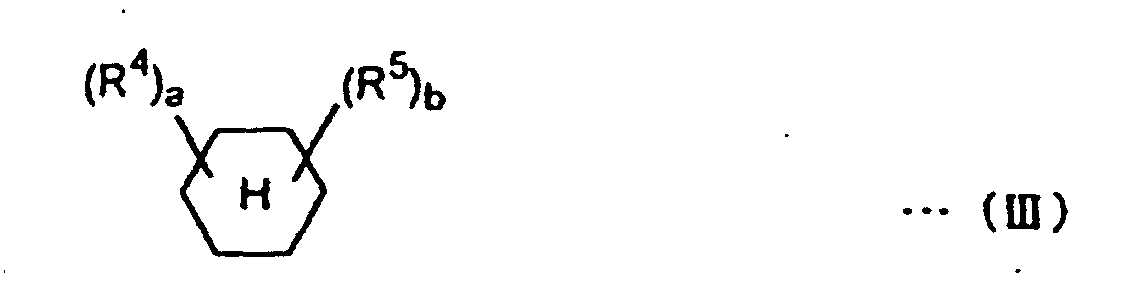 wherein R4 represent an alkyl group having 1 to 7 carbon atoms, R5 represents an alkyl group having 8 to 10 carbon atoms which may have at least one of alkyl branches and cyclopentane ring, a and b each represent an integer of 0 to 3, and a+b represents an integer of 1 to 4.
 wherein R6 and R7 each independently represent an alkyl group having 1 to 3 carbon atoms, c and d each represent an integer of 0 to 3, and c+d represents an integer of 1 to 6.
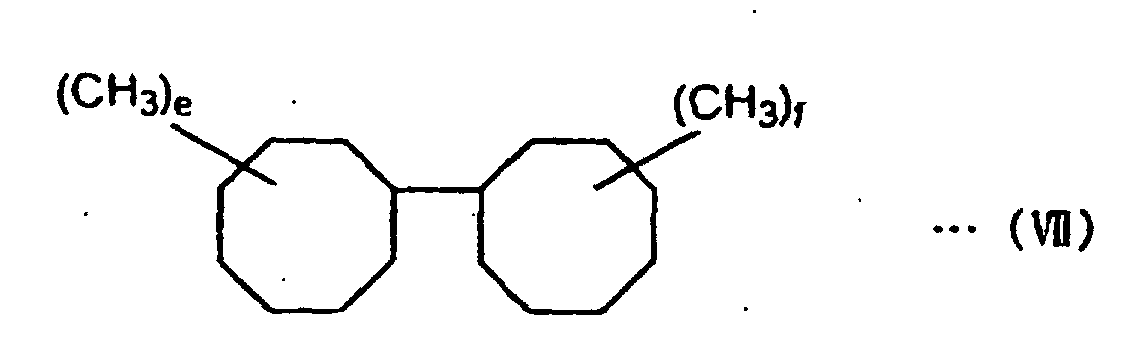
 wherein R8 and R9 each independently represent methyl group or ethyl group, g and h each represent an integer of 0 to 3, and g+h represents an integer of 0 to 4.
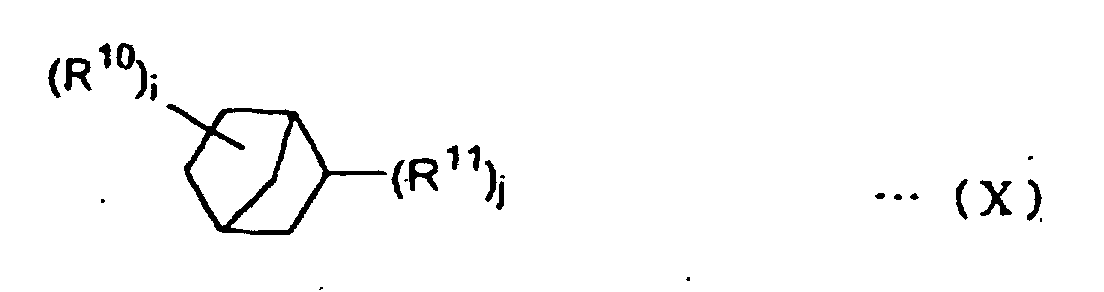
 wherein R1 represents an alkyl group having 1 to 4 carbon atoms, R2 represents a branched alkyl group having 7 to 10 carbon atoms and at least one quaternary carbon atom, and a, b and c each represent an integer of 0 to 2.