EP1416026A1 - SUGAR−DERIVED GELLANT FOR HYDROGEL FORMATION - Google Patents
SUGAR−DERIVED GELLANT FOR HYDROGEL FORMATION Download PDFInfo
- Publication number
- EP1416026A1 EP1416026A1 EP02705225A EP02705225A EP1416026A1 EP 1416026 A1 EP1416026 A1 EP 1416026A1 EP 02705225 A EP02705225 A EP 02705225A EP 02705225 A EP02705225 A EP 02705225A EP 1416026 A1 EP1416026 A1 EP 1416026A1
- Authority
- EP
- European Patent Office
- Prior art keywords
- gel
- gelatinizer
- chem
- sugar
- water
- Prior art date
- Legal status (The legal status is an assumption and is not a legal conclusion. Google has not performed a legal analysis and makes no representation as to the accuracy of the status listed.)
- Granted
Links
Images

Classifications
-
- C—CHEMISTRY; METALLURGY
- C07—ORGANIC CHEMISTRY
- C07H—SUGARS; DERIVATIVES THEREOF; NUCLEOSIDES; NUCLEOTIDES; NUCLEIC ACIDS
- C07H15/00—Compounds containing hydrocarbon or substituted hydrocarbon radicals directly attached to hetero atoms of saccharide radicals
- C07H15/20—Carbocyclic rings
- C07H15/203—Monocyclic carbocyclic rings other than cyclohexane rings; Bicyclic carbocyclic ring systems
-
- C—CHEMISTRY; METALLURGY
- C09—DYES; PAINTS; POLISHES; NATURAL RESINS; ADHESIVES; COMPOSITIONS NOT OTHERWISE PROVIDED FOR; APPLICATIONS OF MATERIALS NOT OTHERWISE PROVIDED FOR
- C09K—MATERIALS FOR MISCELLANEOUS APPLICATIONS, NOT PROVIDED FOR ELSEWHERE
- C09K3/00—Materials not provided for elsewhere
-
- C—CHEMISTRY; METALLURGY
- C40—COMBINATORIAL TECHNOLOGY
- C40B—COMBINATORIAL CHEMISTRY; LIBRARIES, e.g. CHEMICAL LIBRARIES
- C40B40/00—Libraries per se, e.g. arrays, mixtures
Definitions
- This invention relates to a gelatinizer having a gel-forming ability regarding both organic solvents and water.
- the advantage of this system is that, by using the rich basic skeleton of the hydrocarbon family, various types of agglomerates can be systematically designed.
- the Inventors designed several gelatinizers, and by performing this type of analysis, they carried out studies on gelatinizers which had excellent gel-forming abilities in both organic solvents and water.
- hydrogelatinizer represented by the following chemical formula: (where, A is a sugar residue and R is an alkyl group) had excellent gel-forming abilities in both organic solvents and water.
- the long-chain alkyl group forming the end of this gelatinizer improves solubility in organic solvents, but at the same time it promotes aggregation of fibres due to Van der Waals forces, and finally forms a gel.
- the hydrogel of this invention is represented by:
- A is a sugar residue.
- This sugar may be a monosaccharide, oligosaccharide or polysaccharide, but it is preferably a monosaccharide.
- this monosaccharide are hexoses such as glucose, galactose and N-acetylglucosamine, and pentoses such as L-arabinoside and xylose, but aldopyranose is preferred.
- Pyranoses may be ⁇ or ⁇ .
- Examples of the aldopyranose are ⁇ -D-glucose, ⁇ -D-galactose, ⁇ -D-mannose, ⁇ -D-glucose, ⁇ -D-galactose, ⁇ -D-mannose, p-nitrophenyl- ⁇ -D-glucopyranoside, p-nitrophenyl- ⁇ -D-galactopyranoside, p-nitrophenyl- ⁇ -D-mannopyranoside, p-nitro phenyl- ⁇ -D-glucopyranoside, p-nitro phenyl- ⁇ -D-galactopyranoside and p-nitrophenyl- ⁇ -D-mannopyranoside.
- the aldopyranose is preferably glucopyranose or galactopyranose.
- the residue is a residue obtained by removing the hydrogen atom from any of the hydroxyl groups of the sugar, and preferably, is a residue obtained by removing the hydrogen atom from any of the hydroxyl groups bonded to the six-member ring of aldopyranose.
- R in the aforesaid chemical formula is an alkyl group.
- This alkyl group may be straight chain or branched, but straight chain is preferred.
- the number of carbon atoms is preferably 6-20, but more preferably 10-20.
- the hydrogelatinizer of this invention can solidify a large amount of water with a small amount of solid gelatinizer, and due to its ability to function as a water retention agent (water retention agent for desert greenification or plant cultivation), as a water absorbent (pet tray urine absorber or physiological water absorber) and as an alcohol-retaining agent since it also solidifies small amounts of alcohol components, it can solidify fuel solids, organic solvents and oils. It may be used as a household oil caking agent, heavy oil solidifying agent or organic effluent solidifying agent, and as it is a flexible material containing a large amount of water, it has potential application as a biological compatibility material, tissue/cell culture matrix, or biological material separator of proteins and nucleic acids.
- the gelatinizer of this invention was manufactured, and its agglomerating properties in water were analyzed by EF-TEM (transmission electron microscope with energy filter) (Nakazawa, I.; Masuda, M.; Okada, Y.; Hanada, T.; Yase, K.; Asai, M.; Shimizu, T. Langmuir 1999, 15, 4757.), NMR, FT-IR and XRD.
- EF-TEM transmission electron microscope with energy filter
- p-nitrophenyl- ⁇ -D-glucopyranoside (Tokyo Chemical Industries) (250mg) was dissolved in a methanol/tetrahydrofuran mixed solvent (20ml/5ml), and 10% palladium carbon (250mg) was added to this solution. Hydrogen gas was introduced under a nitrogen gas atmosphere into the reaction solution at room temperature for 3 hours. The reaction mixture was filtered to remove palladium carbon, the filtrate was evaporated under vacuum, and solidified. This residue was purified by silica gel chromatography using a tetrahydrofuran/chloroform mixed solvent (1/1, volume ratio) as an eluant, and p-aminophenol- ⁇ -D-glucopyranoside was obtained.
- the p-aminophenol- ⁇ -D-glucopyranoside (250mg) thus obtained was dissolved in tetrahydrofuran (20ml), and lauroyl chloride (300mg) and triethylamine (1.0g) were added.
- the reaction mixture was refluxed for 5 hours.
- the reaction solution was filtered to remove solids, and the filtrate was evaporated under vacuum to give a dry solid.
- the residue was purified by silica gel chromatography using a tetrahydrofuran/chloroform mixed solvent (1/1, volume ratio) as an eluant, and dodecanoylaminophenol- ⁇ -D-glucopyranoside was thus obtained.
- the dodecanoylaminophenol- ⁇ -D-glucopyranoside and dodecanoylaminophenol- ⁇ -D-galactopyranoside (1mg of each) obtained in the above experiments were respectively weighed out into test tubes, and a mixed solvent of water (900mg) and methanol (100mg) was added. The mixture was heated to ensure complete dissolution. Subsequently, it was gradually cooled, and left at room temperature for approximately 2-5 hours. A hydrated gel which did not collapse even when inverted, was obtained.
- the gel-forming ability was evaluated as follows.
- the solvent was water (including a small amount of methanol and ethanol), methanol, ethanol, 1-butanol, t-butanol, tetrahydrofuran, chloroform, dichloromethane, n-hexane, ethyl acetate, dimethylformamide or dimethyl sulfoxide.
- One of the aforesaid solvents was mixed in a test tube wherein the two types of gelatinizer prepared in the Examples were sealed such that the concentration of gelatinizer was 0.1-3.0 wt%, and this mixture was heated until the solids dissolved. The resulting solution was cooled to 25°C for one hour. The gelatinizer and solvent were introduced into a test tube capped by a diaphragm, and heated in the oil bath until the solids dissolved. This solution was cooled to 25°C.
- gelatinizer of this invention is an amphoteric gelatinizer agent which works on both water and organic solvents.
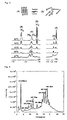
- Figs. 1-3 show EF-TEM and SEM images of an aqueous gel produced by the gelatinizer of this invention for the purpose of visually observing chiral aggregation produced by the sugar part.
- Fig. 1 and Fig. 3 are typical photographs of an aqueous gel produced by the gelatinizer of this invention. These photographs clearly show that this gelatinizer is formed of a 3-dimensional network comprising creased fibres having a diameter of 20-500 nanometers. From the SEM photograph (Fig. 3), it is clear that several ribbon-shaped structures are twisted together to form a left-handed spiral.
- the fibres are twisted spiral ribbons having a width of approximately 85 nanometers, a pitch of approximately 315 nanometers and length of several micrometers, and that this is specifically left-handed (Fig. 2).
- Fig. 2 These spiral aggregates explain how, instead of a crystal stable to heat, a quasi-stable gel is formed.
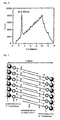
- the xerogel of this invention obtained from water by a freezing method gives a sponge-like aggregate, and it is not a typical crystal. From X-ray diffraction of the xerogel, the Inventors obtained information regarding the type of molecular packing of the gelatinizer molecules in an ordered gel. The diffraction pattern of the xerogel of this invention shows a periodic diffraction peak (Fig.
- the intervals (d) of the aggregate obtained by the XRD method are approximately 2.90 nanometers, 1.46 nanometers and 0.97 nanometers. These are almost precisely in a ratio of 1:1/2:1/3, are shorter than twice the molecular length of the gelatinizer (according to the CPK molecular model, 2.45 nanometers), and longer than one molecule.
- the aqueous gel of this invention has a bimolecular interdigitation film structure having a molecular film corresponding to the (100) plane of thickness 2.90 nanometers (Fig. 7).
- the wide angle X-ray diagram of the aqueous gel of this invention shows a series of sharp reflection peaks, which supports the hypothetical viewpoint that a regular lamellar high density packing is formed due to the interdigitation of hydrophobic interactions. This is the first example where a well-ordered two molecule layer forms an aqueous gel. From the results of XRD, FT-NMR and FT-IR, it is seen that the aqueous gel of this invention is stabilized by a combination of hydrogen bonds, ⁇ - ⁇ interactions and hydrophobic forces.
Landscapes
- Chemical & Material Sciences (AREA)
- Organic Chemistry (AREA)
- Engineering & Computer Science (AREA)
- Health & Medical Sciences (AREA)
- Biochemistry (AREA)
- Biotechnology (AREA)
- General Health & Medical Sciences (AREA)
- Genetics & Genomics (AREA)
- Molecular Biology (AREA)
- Life Sciences & Earth Sciences (AREA)
- Materials Engineering (AREA)
- Compositions Of Macromolecular Compounds (AREA)
- Cosmetics (AREA)
- Peptides Or Proteins (AREA)
- Saccharide Compounds (AREA)
Abstract
Description


Claims (5)
- A hydrogelatinizer represented by:where, A is a sugar residue and R is an alkyl group.

- The hydrogelatinizer according to Claim 1 or 2, wherein A is a sugar residue obtained by removing a hydrogen atom from any of the hydroxyl groups bonded to the six-member ring of aldopyranose.
- The hydrogelatinizer according to Claim 1 or 2, wherein said aldopyranose is glucopyranose or galactopyranose.
- The hydrogelatinizer according to any of Claims 1 to 3, wherein R a straight chain alkyl group having 6-20 carbon atoms.
- The hydrogelatinizer according to any of Claims 1 to 3, wherein R is a straight chain alkyl group having 10-20 carbon atoms.
Applications Claiming Priority (3)
| Application Number | Priority Date | Filing Date | Title |
|---|---|---|---|
| JP2001239014A JP4164247B2 (en) | 2001-08-07 | 2001-08-07 | Sugar-derived gelling agent |
| JP2001239014 | 2001-08-07 | ||
| PCT/JP2002/002463 WO2003014249A1 (en) | 2001-08-07 | 2002-03-15 | Sugar-derived gellant for hydrogel formation |
Publications (3)
| Publication Number | Publication Date |
|---|---|
| EP1416026A1 true EP1416026A1 (en) | 2004-05-06 |
| EP1416026A4 EP1416026A4 (en) | 2007-11-21 |
| EP1416026B1 EP1416026B1 (en) | 2010-09-01 |
Family
ID=19069838
Family Applications (1)
| Application Number | Title | Priority Date | Filing Date |
|---|---|---|---|
| EP02705225A Expired - Lifetime EP1416026B1 (en) | 2001-08-07 | 2002-03-15 | Sugar-derived gellant for hydrogel formation |
Country Status (5)
| Country | Link |
|---|---|
| US (1) | US7196178B2 (en) |
| EP (1) | EP1416026B1 (en) |
| JP (1) | JP4164247B2 (en) |
| DE (1) | DE60237525D1 (en) |
| WO (1) | WO2003014249A1 (en) |
Families Citing this family (6)
| Publication number | Priority date | Publication date | Assignee | Title |
|---|---|---|---|---|
| JP3821223B2 (en) * | 2002-05-24 | 2006-09-13 | 独立行政法人科学技術振興機構 | Metal oxide nanotube and method for producing the same |
| WO2006082768A1 (en) | 2005-02-02 | 2006-08-10 | National Institute Of Advanced Industrial Science And Technology | Ionic organic compound |
| JP5757517B2 (en) | 2008-09-08 | 2015-07-29 | 国立研究開発法人産業技術総合研究所 | Ionic organic compound and process for producing the same, hydrogelator comprising the ionic organic compound, hydrogel containing the same, methanol gelator, methanol gel containing the same, and carbon nanotube dispersant |
| CN102741336B (en) | 2009-12-01 | 2014-03-19 | 株式会社普利司通 | Modified rubber composition and preparation method |
| JP5750798B2 (en) * | 2011-03-01 | 2015-07-22 | 国立研究開発法人産業技術総合研究所 | Sugar-derived low-molecular hydrogelator and hydrogel containing the hydrogelator as an active ingredient |
| CN105384785B (en) * | 2015-11-24 | 2018-06-19 | 中国人民解放军第二军医大学 | Preparation method containing galactolipin class derivative of fatty acid and its application in field of medicaments |
Family Cites Families (10)
| Publication number | Priority date | Publication date | Assignee | Title |
|---|---|---|---|---|
| DE2841898A1 (en) | 1978-09-26 | 1980-04-03 | Robugen Gmbh | ANTIVIRAL AGENT BASED ON 5-LOW-RIGALKYL-2'-DESOXYURIDINE-5 'MONOPHOSPHATES |
| JPS57106696A (en) | 1980-12-25 | 1982-07-02 | Teijin Ltd | 1-(beta-d-arabinofuranosyl)cytosine derivative and its preparation |
| DK363987A (en) | 1986-08-08 | 1988-02-09 | Hoffmann La Roche | pyrimidine |
| US5405987A (en) | 1989-08-31 | 1995-04-11 | Hoechst Celanese Corporation | Process for preparing pyridine and quinoline derivatives |
| JP4015710B2 (en) * | 1995-05-31 | 2007-11-28 | 生化学工業株式会社 | New pseudoglycolipid |
| JP3916330B2 (en) * | 1998-03-13 | 2007-05-16 | 独立行政法人科学技術振興機構 | Gelling agent comprising sugar benzylidene derivative |
| JP2000229992A (en) * | 1999-02-09 | 2000-08-22 | Japan Science & Technology Corp | Gelling organic compound and gelling agent and gel using the same |
| JP3898850B2 (en) * | 1999-02-26 | 2007-03-28 | 独立行政法人科学技術振興機構 | Gelling agent comprising sugar derivative having metal coordination ability |
| JP4099891B2 (en) * | 1999-03-11 | 2008-06-11 | 味の素株式会社 | Gelling or solidifying agent for liquid organic medium |
| JP2002248258A (en) | 2001-02-26 | 2002-09-03 | Teizu Design Company:Kk | Puzzle using magnet and reed switch |
-
2001
- 2001-08-07 JP JP2001239014A patent/JP4164247B2/en not_active Expired - Lifetime
-
2002
- 2002-03-15 WO PCT/JP2002/002463 patent/WO2003014249A1/en not_active Ceased
- 2002-03-15 US US10/415,729 patent/US7196178B2/en not_active Expired - Fee Related
- 2002-03-15 EP EP02705225A patent/EP1416026B1/en not_active Expired - Lifetime
- 2002-03-15 DE DE60237525T patent/DE60237525D1/en not_active Expired - Lifetime
Also Published As
| Publication number | Publication date |
|---|---|
| WO2003014249A1 (en) | 2003-02-20 |
| JP2003049154A (en) | 2003-02-21 |
| US20040014683A1 (en) | 2004-01-22 |
| JP4164247B2 (en) | 2008-10-15 |
| US7196178B2 (en) | 2007-03-27 |
| EP1416026B1 (en) | 2010-09-01 |
| DE60237525D1 (en) | 2010-10-14 |
| EP1416026A4 (en) | 2007-11-21 |
Similar Documents
| Publication | Publication Date | Title |
|---|---|---|
| Shimizu et al. | Stereochemical effect of even− odd connecting links on supramolecular assemblies made of 1-glucosamide bolaamphiphiles | |
| Yoza et al. | Sugar‐Integrated Gelators of Organic Solvents—Their Remarkable Diversity in Gelation Ability and Aggregate Structure | |
| Wang et al. | Synthesis and Self‐Assembling Properties of Polymerizable Organogelators | |
| Jung et al. | Sol‐gel polycondensation in a cyclohexane‐based organogel system in helical silica: creation of both right‐and left‐handed silica structures by helical organogel fibers | |
| Goyal et al. | Synthesis and characterization of d-glucosamine-derived low molecular weight gelators | |
| Amaike et al. | New Organogelators Bearing Both Sugar and Cholesterol Units. An Approach toward Molecular Design of Universal Gelators. | |
| Xie et al. | Organo-and hydrogels derived from cyclo (L-Tyr-L-Lys) and its ε-amino derivatives | |
| CN112898571A (en) | Porous cross-linked material and preparation method and application thereof | |
| US20100210786A1 (en) | Thermoplastic layered alkylsiloxane and production method therefor | |
| EP1416026B1 (en) | Sugar-derived gellant for hydrogel formation | |
| CN107551962B (en) | High-thermal-stability two-component organogel and preparation method thereof | |
| JP3664401B2 (en) | N-glycoside type glycolipid and hollow fiber organic nanotube comprising the same | |
| CN1113877C (en) | Effective synthetic method for furau sulfonic acid amide compound for synthesizing new IL-1 inhibitor | |
| JP3882067B2 (en) | Isoprenoid chain polyglycoside and its endoplasmic reticulum | |
| Luboradzki et al. | Glucofuranose derivatives as a library for designing and investigating low molecular mass organogelators | |
| JP3916330B2 (en) | Gelling agent comprising sugar benzylidene derivative | |
| CN107698629A (en) | Disulfide bond bridging detergent and its application in memebrane protein research | |
| WO2022160356A1 (en) | Porous crosslinked material, preparation method for same, and applications thereof | |
| EP1479799A1 (en) | Fibrous nano self-assemblies | |
| Moreau et al. | New approach for the organisation and the shaping of organo-bridged silicas: An overview | |
| Rekha et al. | Solvent‐induced self‐assembly in cardanol‐based urethane methacrylate comb polymers | |
| JP2905875B1 (en) | Polymerizable double-headed glycolipids, fine fibrous aggregates thereof, and methods for producing them | |
| Hosoda et al. | Organogel formation of optically active 1, 6-di-O-TIPDS-myo-inositol | |
| JPS62249995A (en) | Phosphoric acid ester and production thereof | |
| JP3898897B2 (en) | Novel gelling agent comprising a sugar derivative |
Legal Events
| Date | Code | Title | Description |
|---|---|---|---|
| PUAI | Public reference made under article 153(3) epc to a published international application that has entered the european phase |
Free format text: ORIGINAL CODE: 0009012 |
|
| 17P | Request for examination filed |
Effective date: 20030410 |
|
| AK | Designated contracting states |
Kind code of ref document: A1 Designated state(s): DE FR GB |
|
| RTI1 | Title (correction) |
Free format text: SUGAR-DERIVED GELLANT FOR HYDROGEL FORMATION |
|
| RIC1 | Information provided on ipc code assigned before grant |
Ipc: C07H 15/203 20060101AFI20071011BHEP |
|
| A4 | Supplementary search report drawn up and despatched |
Effective date: 20071022 |
|
| RAP1 | Party data changed (applicant data changed or rights of an application transferred) |
Owner name: JAPAN SCIENCE AND TECHNOLOGY AGENCY Owner name: NATIONAL INSTITUE OF ADVANCED INDUSTRIAL SCIENCE A |
|
| 17Q | First examination report despatched |
Effective date: 20080404 |
|
| GRAP | Despatch of communication of intention to grant a patent |
Free format text: ORIGINAL CODE: EPIDOSNIGR1 |
|
| GRAS | Grant fee paid |
Free format text: ORIGINAL CODE: EPIDOSNIGR3 |
|
| GRAA | (expected) grant |
Free format text: ORIGINAL CODE: 0009210 |
|
| AK | Designated contracting states |
Kind code of ref document: B1 Designated state(s): DE FR GB |
|
| REG | Reference to a national code |
Ref country code: GB Ref legal event code: FG4D |
|
| REF | Corresponds to: |
Ref document number: 60237525 Country of ref document: DE Date of ref document: 20101014 Kind code of ref document: P |
|
| PLBE | No opposition filed within time limit |
Free format text: ORIGINAL CODE: 0009261 |
|
| STAA | Information on the status of an ep patent application or granted ep patent |
Free format text: STATUS: NO OPPOSITION FILED WITHIN TIME LIMIT |
|
| 26N | No opposition filed |
Effective date: 20110606 |
|
| REG | Reference to a national code |
Ref country code: DE Ref legal event code: R097 Ref document number: 60237525 Country of ref document: DE Effective date: 20110606 |
|
| PGFP | Annual fee paid to national office [announced via postgrant information from national office to epo] |
Ref country code: FR Payment date: 20130408 Year of fee payment: 12 Ref country code: GB Payment date: 20130321 Year of fee payment: 12 Ref country code: DE Payment date: 20130321 Year of fee payment: 12 |
|
| REG | Reference to a national code |
Ref country code: DE Ref legal event code: R119 Ref document number: 60237525 Country of ref document: DE |
|
| GBPC | Gb: european patent ceased through non-payment of renewal fee |
Effective date: 20140315 |
|
| REG | Reference to a national code |
Ref country code: FR Ref legal event code: ST Effective date: 20141128 |
|
| REG | Reference to a national code |
Ref country code: DE Ref legal event code: R119 Ref document number: 60237525 Country of ref document: DE Effective date: 20141001 |
|
| PG25 | Lapsed in a contracting state [announced via postgrant information from national office to epo] |
Ref country code: DE Free format text: LAPSE BECAUSE OF NON-PAYMENT OF DUE FEES Effective date: 20141001 Ref country code: GB Free format text: LAPSE BECAUSE OF NON-PAYMENT OF DUE FEES Effective date: 20140315 Ref country code: FR Free format text: LAPSE BECAUSE OF NON-PAYMENT OF DUE FEES Effective date: 20140331 |