EP1413704A2 - Geführtes Steuerungsverfahren für die Isolierglasproduktion - Google Patents
Geführtes Steuerungsverfahren für die Isolierglasproduktion Download PDFInfo
- Publication number
- EP1413704A2 EP1413704A2 EP03024514A EP03024514A EP1413704A2 EP 1413704 A2 EP1413704 A2 EP 1413704A2 EP 03024514 A EP03024514 A EP 03024514A EP 03024514 A EP03024514 A EP 03024514A EP 1413704 A2 EP1413704 A2 EP 1413704A2
- Authority
- EP
- European Patent Office
- Prior art keywords
- procedure
- production
- insulating glass
- components
- fact
- Prior art date
- Legal status (The legal status is an assumption and is not a legal conclusion. Google has not performed a legal analysis and makes no representation as to the accuracy of the status listed.)
- Withdrawn
Links
- 239000011521 glass Substances 0.000 title claims abstract description 34
- 238000004519 manufacturing process Methods 0.000 title claims abstract description 34
- 238000000034 method Methods 0.000 title claims abstract description 30
- 125000006850 spacer group Chemical group 0.000 claims abstract description 24
- 239000000565 sealant Substances 0.000 claims abstract description 14
- 238000005520 cutting process Methods 0.000 claims abstract description 13
- 239000000047 product Substances 0.000 claims description 11
- 239000011265 semifinished product Substances 0.000 claims description 10
- 238000007726 management method Methods 0.000 claims description 5
- 239000000203 mixture Substances 0.000 claims description 3
- 238000002360 preparation method Methods 0.000 claims description 3
- 238000001125 extrusion Methods 0.000 claims 1
- 238000003780 insertion Methods 0.000 claims 1
- 230000037431 insertion Effects 0.000 claims 1
- 238000003754 machining Methods 0.000 claims 1
- 238000011144 upstream manufacturing Methods 0.000 claims 1
- 239000000463 material Substances 0.000 abstract description 10
- 238000007789 sealing Methods 0.000 abstract description 8
- 238000005406 washing Methods 0.000 abstract description 8
- 238000005452 bending Methods 0.000 abstract description 4
- 238000003490 calendering Methods 0.000 abstract description 4
- 239000002994 raw material Substances 0.000 description 7
- 239000003086 colorant Substances 0.000 description 3
- 230000008878 coupling Effects 0.000 description 3
- 238000010168 coupling process Methods 0.000 description 3
- 238000005859 coupling reaction Methods 0.000 description 3
- 239000002699 waste material Substances 0.000 description 3
- 230000004397 blinking Effects 0.000 description 2
- 229920001296 polysiloxane Polymers 0.000 description 2
- 229920001021 polysulfide Polymers 0.000 description 2
- 229920002635 polyurethane Polymers 0.000 description 2
- 239000004814 polyurethane Substances 0.000 description 2
- 238000003825 pressing Methods 0.000 description 2
- 230000000007 visual effect Effects 0.000 description 2
- 230000002159 abnormal effect Effects 0.000 description 1
- 239000000853 adhesive Substances 0.000 description 1
- 230000001070 adhesive effect Effects 0.000 description 1
- 125000000484 butyl group Chemical group [H]C([*])([H])C([H])([H])C([H])([H])C([H])([H])[H] 0.000 description 1
- 239000011248 coating agent Substances 0.000 description 1
- 238000000576 coating method Methods 0.000 description 1
- 230000000295 complement effect Effects 0.000 description 1
- 230000007547 defect Effects 0.000 description 1
- 239000002274 desiccant Substances 0.000 description 1
- 238000011161 development Methods 0.000 description 1
- 230000018109 developmental process Effects 0.000 description 1
- 239000006185 dispersion Substances 0.000 description 1
- 239000000945 filler Substances 0.000 description 1
- 239000012467 final product Substances 0.000 description 1
- 239000012943 hotmelt Substances 0.000 description 1
- 238000005457 optimization Methods 0.000 description 1
- 238000004806 packaging method and process Methods 0.000 description 1
- 238000003908 quality control method Methods 0.000 description 1
- 238000003892 spreading Methods 0.000 description 1
- 238000003860 storage Methods 0.000 description 1
Images




Classifications
-
- E—FIXED CONSTRUCTIONS
- E06—DOORS, WINDOWS, SHUTTERS, OR ROLLER BLINDS IN GENERAL; LADDERS
- E06B—FIXED OR MOVABLE CLOSURES FOR OPENINGS IN BUILDINGS, VEHICLES, FENCES OR LIKE ENCLOSURES IN GENERAL, e.g. DOORS, WINDOWS, BLINDS, GATES
- E06B3/00—Window sashes, door leaves, or like elements for closing wall or like openings; Layout of fixed or moving closures, e.g. windows in wall or like openings; Features of rigidly-mounted outer frames relating to the mounting of wing frames
- E06B3/66—Units comprising two or more parallel glass or like panes permanently secured together
- E06B3/673—Assembling the units
- E06B3/67365—Transporting or handling panes, spacer frames or units during assembly
-
- E—FIXED CONSTRUCTIONS
- E06—DOORS, WINDOWS, SHUTTERS, OR ROLLER BLINDS IN GENERAL; LADDERS
- E06B—FIXED OR MOVABLE CLOSURES FOR OPENINGS IN BUILDINGS, VEHICLES, FENCES OR LIKE ENCLOSURES IN GENERAL, e.g. DOORS, WINDOWS, BLINDS, GATES
- E06B3/00—Window sashes, door leaves, or like elements for closing wall or like openings; Layout of fixed or moving closures, e.g. windows in wall or like openings; Features of rigidly-mounted outer frames relating to the mounting of wing frames
- E06B3/66—Units comprising two or more parallel glass or like panes permanently secured together
- E06B3/673—Assembling the units
- E06B3/67365—Transporting or handling panes, spacer frames or units during assembly
- E06B3/67369—Layout of the assembly streets
Definitions
- This claim concerns an aided managerial procedure especially for the production of insulating glass (panels) that coordinates many work stations, called stations, and includes, for example only and without limiting the types and number of stations: one or more machines for cutting panes of glass, whether monolithic, laminated or armoured glass; one machine to form the spacer frame from a straight bar and obtain - by bending and/or calendering - a closed frame; a machine to fill the hollow part of the frame with hygroscopic material; a machine to apply the sealant to the sides of the spacer frame; a line (washing, assembly, sealing and so on) for the production of insulating glass.
- One essential feature of the system is the special way (explained in detail in the description) to assist the operators who load and unload the machines.
- the sequence of loading, unloading and moving the raw materials and the semi-finished products from one machine to the other (or from one station to another) is governed both by the common sense of the operators and by management programs that assist the operators in the work stations mainly by supplying them with printouts or, in the cutting lines, with an unfriendly monitor displaying only the division of the "origin" sheet of glass into the "destination" sections.
- the “multiple glazing” is made of two or more “panes” (that is, sheets of glass), each pair separated by one or more hollow “spacer frame” with micro-holes on the internal side; the spacer frames being filled with hygroscopic material and the chambers created by the panes and the frames being filled with air or gas or gas mixtures that confer the "multiple glazing” particular properties, e.g. heat insulating and/or sound insulating.
- the panes and frames are joined by two sealing operations, the first sealing makes the unit gas-tight (and is also useful for the production of the multiple glazing), the second operation binds the components and makes the assembly mechanically strong.
- the "panes" used to produce the “multiple glazing” may be of different types according to the final use; for instance the eternal pane may be normal or reflecting (to reduce heat in summer) or laminated/armoured (to protect against trespassing/vandalism) or laminated/tempered (for safety reasons) or combined (for instance reflecting, and stratified to obtain a combination of features), the internal pane may be normal or low-emissivity (to reduce the dispersion of heat in winter) or stratified/tempered (for safety reasons) or combined (for instance low-emissivity and laminated to obtain a combination of features).
- the “spacer frames” are made of hollow profiles that may be produced with different materials, thickness (corresponding to the distance between the panes), finishes and colours.
- each producer of "multiple glazing” since it supplies many customers, organizes the jobs according to the lists of requirements of each customer, but it also groups and mixes the jobs in order to use the raw materials in the best way, mainly the sheets of glass (large panes, usually sized 6000 mm x 3210 mm, and of different types), the "spacer frames” (according to the materials, sizes, finishes and colours) and the sealants (usually polysulphide, polyurethane, silicone, hot melt, some two-components, other single-components, some available both as single and as two-components).
- This process is carried out by means of management and optimization programs, for instance, for cutting glass.
- the shipment units of the finished products must be reconstructed according to the destination, that is, the customer.
- the operators are currently inadequately assisted, since they only receive printouts that list the "multiple glazing" for each customer and the components of the multiple glazing by uniform types, to deal with both as raw materials and as processing.
- This invention intends to reduce the flow of information burdening the operators by communicating only the essential information in a synopsis and intelligent way.
- a production line for "multiple glazing” (mainly rectangular, but also of other shapes) requires many cascading processes, and productivity and service to the customer may be improved if such processes, loading, unloading and moving of raw materials are rationalized, managed and assisted.
- This invention concerns only the identification of the components of the insulating glass insofar as the same are marked - for instance - with bar codes, and each machine is equipped with a reader and the production is therefore managed, as well the production parameters of the machines are set according to the features (sizes, shapes, etc.) of the components being processed.
- the main purpose of the object of this patent application is to solve the technical problems mentioned above and eliminate the drawbacks of the prior art mentioned above by means of an assisted coordination system for the production of "multiple glazing", that is, a system based mainly on a software program that assists the operators in loading and unloading the machines with raw materials or semi-finished products.
- stations including, as a non-binding and non-limiting example concerning the number and types of stations: lines for cutting "panes of glass”; one machine to produce the spacer frame from a straight bar and obtain, by bending and/or calendaring, a closed frame; one machine to fill the hollow part of the frame with hygroscopic material; one machine to apply the sealant to the sides of the spacer frame and finally a line for the production of "multiple glazing" which itself is composed of several machines.
- the essential feature of the aided managerial procedure is to use in each position where there is an operator, or at least in the most important positions, a monitor, or an equivalent device, that displays a 3D synopsis and dynamic view of the components while they are picked up from the other components of the same level during the feeding of a station or while they are accumulated with other components of the same level during the unloading of a station.
- the operator is assisted because the component being processed is highlighted, in relation to the other components of the same level, by means of a different colour, by blinking. or by an arrow, etc.
- the logic of progression of the components to be handled is always governed by the need of arranging the finished products in accordance with the progression required by the priorities of delivery of the finished product.
- FIGURE 1 which concerns the "multiple glazing” product already described, displays the problems of differentiating the products to be laid on the carriages that come from the production grouped by types but assigned to different customers, each of them requiring a mix of types and dimensions.
- This figures displays the edge of the "double glazing" in a non-limiting example of combinations: 1A normal, 1B triple glazing, 1C stepped panes, 1D laminated external pane and low-emissivity internal pane, 1E tempered reflecting external pane and low-emissivity stratified internal pane.
- the two types of sealant used are also shown: in black, the butyl sealant for tightness (first sealing), in dotted lines, the sealant (polysulphide or polyurethane or silicone) required to achieve mechanical strength (second sealing).
- the external/internal position is marked visually by the icons of the sun (external side) and of a heater (internal side).
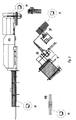
- FIGURES 2, 3, 4 show a possible version of the machines coordinated for the production of the insulating glass starting from the raw materials which are the “panes” to be cut, the "spacer frames", the sealants, up to the finished product, which is packed on the carriages or stands that will be subsequently, and almost in real time, shipped to the customer.
- FIGURE 2 [VC] the vertical cutting table; [HC] the horizontal cutting table; in FIGURE 3: [PB] the automatic profile bender; [DF], the desiccant filler; [MB] the manual butyliser; [AB] the automatic butyliser; in FIGURE 4: [IL] the insulating glass line, the line for the production of insulating glass composed of the sections for edge finishing, washing, assembly, pressing, filling with gas, and sealing.
- the monitor symbol and the letter [M] mark the positions where a monitor assists the view of the operator with a "3D, synopsis and dynamic", by blinking or in some other way highlighting the item to be picked up from the set of items or the position in the subsequent stage that the processed item is to be inserted.
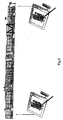
- FIGURES 5, 6, 7 (shaded, not due to a mistake made by the draftsman, but , as they concern the software part of the invention) better displays the interface with the operator.
- FIGURE 5 displays the operating logic of the software part of the invention, as far as cutting of the "pane” is concerned, that is: in the first part, one can see a part of the storage of the glass panes ("origin"), for instance, a type of panes, where the well-known waste reduction program cuts them into the "destination" sizes; in the second part, one can see the operation of the software part of this invention that reorders the "origin" panes and, if this is not enough, re-runs the waste reduction programs, to organize the subsequent processes according to the priorities of delivery of the several types of multiple glazing to the final customers.
- oil part of the storage of the glass panes
- FIGURE 6 shows, for the part concerning cutting of the panes, the messages that the software part, which is an essential component of this invention, sends to the operator to assist him in handling each semi-finished product that comes out of the cutting table(s) and moving it to the correct carriage, and -within the carriage- to the correct position, so that in the subsequent processing station (in this case the washing machine of the insulating glass line) is fed with semi-finished products in the correct sequence according to the priorities of delivery of the several types of multiple glazing to the final customers.
- the subsequent processing station in this case the washing machine of the insulating glass line
- FIGURE 7 shows, for the part concerning the production of the "spacer frame", the messages that the software part, which is an essential component of this invention, sends to the operator to assist him in destining each semi-finished product that comes out of each machine that takes part in the production of the frame to the correct carriage so that in the subsequent processing station (in this case the coupling machine of the insulating glass line) is fed with semi-finished products in the correct sequence according to the priorities of delivery of the several types of multiple glazing to the final customers.
- the software part which is an essential component of this invention
- FIGURE 8 shows, for the part concerning the insulating glass line, the messages that the software part, which is an essential component of this invention, sends to the operators, at the feeding of the washing machine and at the delivery of the sealer respectively, to assist them in handling the semi-finished products ("panes") and the finished product (“multiple glazing”) according to the priorities of delivery of the several types of multiple glazing or in such a way as to optimize these priorities.
- This invention may be realized in many variations (as compared to what can be seen in the drawings), all falling within the scope of the invention: which is, assisting the operator with a visual representation of the components to be fed and delivered in each stage of production, such variations may concern the methods of representation (orthogonal projections, 3D views, axonometric projections, perspective views, etc. the colours, the highlighting method), the positions of the monitors (external to the machine or on the machine itself, etc.), the quantity of monitors (as a function of the combinations of machines that carry out the process and of the extent of details to be supplied).
Landscapes
- Engineering & Computer Science (AREA)
- Civil Engineering (AREA)
- Structural Engineering (AREA)
- Securing Of Glass Panes Or The Like (AREA)
- Joining Of Glass To Other Materials (AREA)
- Detail Structures Of Washing Machines And Dryers (AREA)
Applications Claiming Priority (2)
| Application Number | Priority Date | Filing Date | Title |
|---|---|---|---|
| ITTV20020122 | 2002-10-25 | ||
| ITTV20020122 ITTV20020122A1 (it) | 2002-10-25 | 2002-10-25 | Sistema gestionale guidato per la produzione di vetro isolante. |
Publications (2)
| Publication Number | Publication Date |
|---|---|
| EP1413704A2 true EP1413704A2 (de) | 2004-04-28 |
| EP1413704A3 EP1413704A3 (de) | 2005-02-09 |
Family
ID=32051257
Family Applications (1)
| Application Number | Title | Priority Date | Filing Date |
|---|---|---|---|
| EP03024514A Withdrawn EP1413704A3 (de) | 2002-10-25 | 2003-10-24 | Geführtes Steuerungsverfahren für die Isolierglasproduktion |
Country Status (2)
| Country | Link |
|---|---|
| EP (1) | EP1413704A3 (de) |
| IT (1) | ITTV20020122A1 (de) |
Citations (1)
| Publication number | Priority date | Publication date | Assignee | Title |
|---|---|---|---|---|
| EP0252066A1 (de) | 1986-06-23 | 1988-01-07 | Peter Lisec | Steuerung einer Anlage zur Herstellung von Isolierglas |
Family Cites Families (4)
| Publication number | Priority date | Publication date | Assignee | Title |
|---|---|---|---|---|
| US4821197A (en) * | 1987-04-22 | 1989-04-11 | Outboard Marine Corporation | Apparatus and method for parts assembly |
| GB2265473B (en) * | 1992-03-25 | 1995-05-24 | Michael Brendan Nagle | A control apparatus and method for the control and operation of a production process |
| US6434264B1 (en) * | 1998-12-11 | 2002-08-13 | Lucent Technologies Inc. | Vision comparison inspection system |
| US6400997B1 (en) * | 2000-01-06 | 2002-06-04 | Roy Rapp, III | Paperless tablet automation apparatus and method |
-
2002
- 2002-10-25 IT ITTV20020122 patent/ITTV20020122A1/it unknown
-
2003
- 2003-10-24 EP EP03024514A patent/EP1413704A3/de not_active Withdrawn
Patent Citations (1)
| Publication number | Priority date | Publication date | Assignee | Title |
|---|---|---|---|---|
| EP0252066A1 (de) | 1986-06-23 | 1988-01-07 | Peter Lisec | Steuerung einer Anlage zur Herstellung von Isolierglas |
Also Published As
| Publication number | Publication date |
|---|---|
| EP1413704A3 (de) | 2005-02-09 |
| ITTV20020122A1 (it) | 2004-04-26 |
Similar Documents
| Publication | Publication Date | Title |
|---|---|---|
| EP2776653B1 (de) | Effiziente anordnung aus isolierglasfenstern | |
| US6954676B2 (en) | Window or door manufacturing method and apparatus | |
| US10441986B2 (en) | Method for automatically bending spacer elements for insulating glass panes—double glazings and machine for carrying out the method | |
| CN102417311B (zh) | Sgp胶片为中间膜超宽夹层玻璃及生产方法 | |
| US12024941B2 (en) | Automatic device and automatic method for filling the insulating glazing unit composed of at least two glass panes and at least one spacer frame with a gas other than air | |
| CN102756281A (zh) | 一种玻璃钢窗装配生产线 | |
| US8522831B2 (en) | Automatic device for filling insulating glazing units and method therefor | |
| CN105397848B (zh) | 密封胶条切边机 | |
| EP1413704A2 (de) | Geführtes Steuerungsverfahren für die Isolierglasproduktion | |
| US12139962B2 (en) | Profiled element for doors/windows made of plastic material, in particular PVC | |
| EP2460971B1 (de) | Verfahren zum Versiegeln einer Umfangsnut einer Isolierverglasung | |
| CN111824676A (zh) | 一种柔性化智能线束自动循环送料搬运模组 | |
| CN105269316A (zh) | Led灯泡自动组装系统 | |
| CN208802487U (zh) | 板件流柜体生产线 | |
| CN114179185A (zh) | 一种木门生产线及使用方法 | |
| GB2282628A (en) | Production of window and door frames | |
| US7246423B1 (en) | System and method for in-line production of insulated glass units for custom windows | |
| CN112340109A (zh) | 一种封装基板包装前自动分叉机装置及分叉方法 | |
| CN217024639U (zh) | 一种气帘卷折机 | |
| CN220498362U (zh) | 一种用于安装门窗角码的自动化组装线 | |
| KR200499481Y1 (ko) | 자동차 도어용 웨더스트립의 단부커팅기 | |
| CN113134712A (zh) | 一种铝合金窗加工工艺 | |
| CN109434171A (zh) | L型线条加工设备 | |
| JPH084998B2 (ja) | ワーク品質管理装置 | |
| KR102573872B1 (ko) | 전자응용 방충창의 방충망 자동화 조립방법 |
Legal Events
| Date | Code | Title | Description |
|---|---|---|---|
| PUAI | Public reference made under article 153(3) epc to a published international application that has entered the european phase |
Free format text: ORIGINAL CODE: 0009012 |
|
| AK | Designated contracting states |
Kind code of ref document: A2 Designated state(s): AT BE BG CH CY CZ DE DK EE ES FI FR GB GR HU IE IT LI LU MC NL PT RO SE SI SK TR |
|
| AX | Request for extension of the european patent |
Extension state: AL LT LV MK |
|
| PUAL | Search report despatched |
Free format text: ORIGINAL CODE: 0009013 |
|
| AK | Designated contracting states |
Kind code of ref document: A3 Designated state(s): AT BE BG CH CY CZ DE DK EE ES FI FR GB GR HU IE IT LI LU MC NL PT RO SE SI SK TR |
|
| AX | Request for extension of the european patent |
Extension state: AL LT LV MK |
|
| 17P | Request for examination filed |
Effective date: 20050606 |
|
| AKX | Designation fees paid |
Designated state(s): AT BE BG CH CY CZ DE DK EE ES FI FR GB GR HU IE IT LI LU MC NL PT RO SE SI SK TR |
|
| RAP1 | Party data changed (applicant data changed or rights of an application transferred) |
Owner name: FOR.EL. BASE - DI DAVANZO NADIA & C.S.N.C. |
|
| STAA | Information on the status of an ep patent application or granted ep patent |
Free format text: STATUS: THE APPLICATION IS DEEMED TO BE WITHDRAWN |
|
| 18D | Application deemed to be withdrawn |
Effective date: 20120503 |