EP1413619A1 - Luminescent material, especially for LED application - Google Patents
Luminescent material, especially for LED application Download PDFInfo
- Publication number
- EP1413619A1 EP1413619A1 EP20020021177 EP02021177A EP1413619A1 EP 1413619 A1 EP1413619 A1 EP 1413619A1 EP 20020021177 EP20020021177 EP 20020021177 EP 02021177 A EP02021177 A EP 02021177A EP 1413619 A1 EP1413619 A1 EP 1413619A1
- Authority
- EP
- European Patent Office
- Prior art keywords
- blue
- luminescent material
- material according
- excitable luminescent
- light source
- Prior art date
- Legal status (The legal status is an assumption and is not a legal conclusion. Google has not performed a legal analysis and makes no representation as to the accuracy of the status listed.)
- Withdrawn
Links
Images



Classifications
-
- H—ELECTRICITY
- H10—SEMICONDUCTOR DEVICES; ELECTRIC SOLID-STATE DEVICES NOT OTHERWISE PROVIDED FOR
- H10H—INORGANIC LIGHT-EMITTING SEMICONDUCTOR DEVICES HAVING POTENTIAL BARRIERS
- H10H20/00—Individual inorganic light-emitting semiconductor devices having potential barriers, e.g. light-emitting diodes [LED]
- H10H20/80—Constructional details
- H10H20/85—Packages
- H10H20/851—Wavelength conversion means
- H10H20/8511—Wavelength conversion means characterised by their material, e.g. binder
- H10H20/8512—Wavelength conversion materials
-
- C—CHEMISTRY; METALLURGY
- C04—CEMENTS; CONCRETE; ARTIFICIAL STONE; CERAMICS; REFRACTORIES
- C04B—LIME, MAGNESIA; SLAG; CEMENTS; COMPOSITIONS THEREOF, e.g. MORTARS, CONCRETE OR LIKE BUILDING MATERIALS; ARTIFICIAL STONE; CERAMICS; REFRACTORIES; TREATMENT OF NATURAL STONE
- C04B35/00—Shaped ceramic products characterised by their composition; Ceramics compositions; Processing powders of inorganic compounds preparatory to the manufacturing of ceramic products
- C04B35/515—Shaped ceramic products characterised by their composition; Ceramics compositions; Processing powders of inorganic compounds preparatory to the manufacturing of ceramic products based on non-oxide ceramics
- C04B35/58—Shaped ceramic products characterised by their composition; Ceramics compositions; Processing powders of inorganic compounds preparatory to the manufacturing of ceramic products based on non-oxide ceramics based on borides, nitrides, i.e. nitrides, oxynitrides, carbonitrides or oxycarbonitrides or silicides
- C04B35/597—Shaped ceramic products characterised by their composition; Ceramics compositions; Processing powders of inorganic compounds preparatory to the manufacturing of ceramic products based on non-oxide ceramics based on borides, nitrides, i.e. nitrides, oxynitrides, carbonitrides or oxycarbonitrides or silicides based on silicon oxynitride, e.g. SIALONS
-
- C—CHEMISTRY; METALLURGY
- C04—CEMENTS; CONCRETE; ARTIFICIAL STONE; CERAMICS; REFRACTORIES
- C04B—LIME, MAGNESIA; SLAG; CEMENTS; COMPOSITIONS THEREOF, e.g. MORTARS, CONCRETE OR LIKE BUILDING MATERIALS; ARTIFICIAL STONE; CERAMICS; REFRACTORIES; TREATMENT OF NATURAL STONE
- C04B35/00—Shaped ceramic products characterised by their composition; Ceramics compositions; Processing powders of inorganic compounds preparatory to the manufacturing of ceramic products
- C04B35/622—Forming processes; Processing powders of inorganic compounds preparatory to the manufacturing of ceramic products
- C04B35/626—Preparing or treating the powders individually or as batches ; preparing or treating macroscopic reinforcing agents for ceramic products, e.g. fibres; mechanical aspects section B
- C04B35/62605—Treating the starting powders individually or as mixtures
- C04B35/62645—Thermal treatment of powders or mixtures thereof other than sintering
- C04B35/6265—Thermal treatment of powders or mixtures thereof other than sintering involving reduction or oxidation
-
- C—CHEMISTRY; METALLURGY
- C04—CEMENTS; CONCRETE; ARTIFICIAL STONE; CERAMICS; REFRACTORIES
- C04B—LIME, MAGNESIA; SLAG; CEMENTS; COMPOSITIONS THEREOF, e.g. MORTARS, CONCRETE OR LIKE BUILDING MATERIALS; ARTIFICIAL STONE; CERAMICS; REFRACTORIES; TREATMENT OF NATURAL STONE
- C04B35/00—Shaped ceramic products characterised by their composition; Ceramics compositions; Processing powders of inorganic compounds preparatory to the manufacturing of ceramic products
- C04B35/622—Forming processes; Processing powders of inorganic compounds preparatory to the manufacturing of ceramic products
- C04B35/626—Preparing or treating the powders individually or as batches ; preparing or treating macroscopic reinforcing agents for ceramic products, e.g. fibres; mechanical aspects section B
- C04B35/62605—Treating the starting powders individually or as mixtures
- C04B35/62645—Thermal treatment of powders or mixtures thereof other than sintering
- C04B35/6268—Thermal treatment of powders or mixtures thereof other than sintering characterised by the applied pressure or type of atmosphere, e.g. in vacuum, hydrogen or a specific oxygen pressure
-
- C—CHEMISTRY; METALLURGY
- C09—DYES; PAINTS; POLISHES; NATURAL RESINS; ADHESIVES; COMPOSITIONS NOT OTHERWISE PROVIDED FOR; APPLICATIONS OF MATERIALS NOT OTHERWISE PROVIDED FOR
- C09K—MATERIALS FOR MISCELLANEOUS APPLICATIONS, NOT PROVIDED FOR ELSEWHERE
- C09K11/00—Luminescent materials, e.g. electroluminescent or chemiluminescent
- C09K11/08—Luminescent materials, e.g. electroluminescent or chemiluminescent containing inorganic luminescent materials
- C09K11/0883—Arsenides; Nitrides; Phosphides
-
- C—CHEMISTRY; METALLURGY
- C09—DYES; PAINTS; POLISHES; NATURAL RESINS; ADHESIVES; COMPOSITIONS NOT OTHERWISE PROVIDED FOR; APPLICATIONS OF MATERIALS NOT OTHERWISE PROVIDED FOR
- C09K—MATERIALS FOR MISCELLANEOUS APPLICATIONS, NOT PROVIDED FOR ELSEWHERE
- C09K11/00—Luminescent materials, e.g. electroluminescent or chemiluminescent
- C09K11/08—Luminescent materials, e.g. electroluminescent or chemiluminescent containing inorganic luminescent materials
- C09K11/77—Luminescent materials, e.g. electroluminescent or chemiluminescent containing inorganic luminescent materials containing rare earth metals
- C09K11/7728—Luminescent materials, e.g. electroluminescent or chemiluminescent containing inorganic luminescent materials containing rare earth metals containing europium
- C09K11/77348—Silicon Aluminium Nitrides or Silicon Aluminium Oxynitrides
-
- C—CHEMISTRY; METALLURGY
- C04—CEMENTS; CONCRETE; ARTIFICIAL STONE; CERAMICS; REFRACTORIES
- C04B—LIME, MAGNESIA; SLAG; CEMENTS; COMPOSITIONS THEREOF, e.g. MORTARS, CONCRETE OR LIKE BUILDING MATERIALS; ARTIFICIAL STONE; CERAMICS; REFRACTORIES; TREATMENT OF NATURAL STONE
- C04B2235/00—Aspects relating to ceramic starting mixtures or sintered ceramic products
- C04B2235/02—Composition of constituents of the starting material or of secondary phases of the final product
- C04B2235/30—Constituents and secondary phases not being of a fibrous nature
- C04B2235/32—Metal oxides, mixed metal oxides, or oxide-forming salts thereof, e.g. carbonates, nitrates, (oxy)hydroxides, chlorides
- C04B2235/3205—Alkaline earth oxides or oxide forming salts thereof, e.g. beryllium oxide
- C04B2235/3208—Calcium oxide or oxide-forming salts thereof, e.g. lime
-
- C—CHEMISTRY; METALLURGY
- C04—CEMENTS; CONCRETE; ARTIFICIAL STONE; CERAMICS; REFRACTORIES
- C04B—LIME, MAGNESIA; SLAG; CEMENTS; COMPOSITIONS THEREOF, e.g. MORTARS, CONCRETE OR LIKE BUILDING MATERIALS; ARTIFICIAL STONE; CERAMICS; REFRACTORIES; TREATMENT OF NATURAL STONE
- C04B2235/00—Aspects relating to ceramic starting mixtures or sintered ceramic products
- C04B2235/02—Composition of constituents of the starting material or of secondary phases of the final product
- C04B2235/30—Constituents and secondary phases not being of a fibrous nature
- C04B2235/32—Metal oxides, mixed metal oxides, or oxide-forming salts thereof, e.g. carbonates, nitrates, (oxy)hydroxides, chlorides
- C04B2235/3205—Alkaline earth oxides or oxide forming salts thereof, e.g. beryllium oxide
- C04B2235/3213—Strontium oxides or oxide-forming salts thereof
-
- C—CHEMISTRY; METALLURGY
- C04—CEMENTS; CONCRETE; ARTIFICIAL STONE; CERAMICS; REFRACTORIES
- C04B—LIME, MAGNESIA; SLAG; CEMENTS; COMPOSITIONS THEREOF, e.g. MORTARS, CONCRETE OR LIKE BUILDING MATERIALS; ARTIFICIAL STONE; CERAMICS; REFRACTORIES; TREATMENT OF NATURAL STONE
- C04B2235/00—Aspects relating to ceramic starting mixtures or sintered ceramic products
- C04B2235/02—Composition of constituents of the starting material or of secondary phases of the final product
- C04B2235/30—Constituents and secondary phases not being of a fibrous nature
- C04B2235/32—Metal oxides, mixed metal oxides, or oxide-forming salts thereof, e.g. carbonates, nitrates, (oxy)hydroxides, chlorides
- C04B2235/3205—Alkaline earth oxides or oxide forming salts thereof, e.g. beryllium oxide
- C04B2235/3215—Barium oxides or oxide-forming salts thereof
-
- C—CHEMISTRY; METALLURGY
- C04—CEMENTS; CONCRETE; ARTIFICIAL STONE; CERAMICS; REFRACTORIES
- C04B—LIME, MAGNESIA; SLAG; CEMENTS; COMPOSITIONS THEREOF, e.g. MORTARS, CONCRETE OR LIKE BUILDING MATERIALS; ARTIFICIAL STONE; CERAMICS; REFRACTORIES; TREATMENT OF NATURAL STONE
- C04B2235/00—Aspects relating to ceramic starting mixtures or sintered ceramic products
- C04B2235/02—Composition of constituents of the starting material or of secondary phases of the final product
- C04B2235/30—Constituents and secondary phases not being of a fibrous nature
- C04B2235/32—Metal oxides, mixed metal oxides, or oxide-forming salts thereof, e.g. carbonates, nitrates, (oxy)hydroxides, chlorides
- C04B2235/3217—Aluminum oxide or oxide forming salts thereof, e.g. bauxite, alpha-alumina
- C04B2235/322—Transition aluminas, e.g. delta or gamma aluminas
-
- C—CHEMISTRY; METALLURGY
- C04—CEMENTS; CONCRETE; ARTIFICIAL STONE; CERAMICS; REFRACTORIES
- C04B—LIME, MAGNESIA; SLAG; CEMENTS; COMPOSITIONS THEREOF, e.g. MORTARS, CONCRETE OR LIKE BUILDING MATERIALS; ARTIFICIAL STONE; CERAMICS; REFRACTORIES; TREATMENT OF NATURAL STONE
- C04B2235/00—Aspects relating to ceramic starting mixtures or sintered ceramic products
- C04B2235/02—Composition of constituents of the starting material or of secondary phases of the final product
- C04B2235/30—Constituents and secondary phases not being of a fibrous nature
- C04B2235/32—Metal oxides, mixed metal oxides, or oxide-forming salts thereof, e.g. carbonates, nitrates, (oxy)hydroxides, chlorides
- C04B2235/3224—Rare earth oxide or oxide forming salts thereof, e.g. scandium oxide
-
- C—CHEMISTRY; METALLURGY
- C04—CEMENTS; CONCRETE; ARTIFICIAL STONE; CERAMICS; REFRACTORIES
- C04B—LIME, MAGNESIA; SLAG; CEMENTS; COMPOSITIONS THEREOF, e.g. MORTARS, CONCRETE OR LIKE BUILDING MATERIALS; ARTIFICIAL STONE; CERAMICS; REFRACTORIES; TREATMENT OF NATURAL STONE
- C04B2235/00—Aspects relating to ceramic starting mixtures or sintered ceramic products
- C04B2235/02—Composition of constituents of the starting material or of secondary phases of the final product
- C04B2235/30—Constituents and secondary phases not being of a fibrous nature
- C04B2235/34—Non-metal oxides, non-metal mixed oxides, or salts thereof that form the non-metal oxides upon heating, e.g. carbonates, nitrates, (oxy)hydroxides, chlorides
- C04B2235/3418—Silicon oxide, silicic acids or oxide forming salts thereof, e.g. silica sol, fused silica, silica fume, cristobalite, quartz or flint
-
- C—CHEMISTRY; METALLURGY
- C04—CEMENTS; CONCRETE; ARTIFICIAL STONE; CERAMICS; REFRACTORIES
- C04B—LIME, MAGNESIA; SLAG; CEMENTS; COMPOSITIONS THEREOF, e.g. MORTARS, CONCRETE OR LIKE BUILDING MATERIALS; ARTIFICIAL STONE; CERAMICS; REFRACTORIES; TREATMENT OF NATURAL STONE
- C04B2235/00—Aspects relating to ceramic starting mixtures or sintered ceramic products
- C04B2235/02—Composition of constituents of the starting material or of secondary phases of the final product
- C04B2235/30—Constituents and secondary phases not being of a fibrous nature
- C04B2235/38—Non-oxide ceramic constituents or additives
- C04B2235/3852—Nitrides, e.g. oxynitrides, carbonitrides, oxycarbonitrides, lithium nitride, magnesium nitride
- C04B2235/3873—Silicon nitrides, e.g. silicon carbonitride, silicon oxynitride
-
- C—CHEMISTRY; METALLURGY
- C04—CEMENTS; CONCRETE; ARTIFICIAL STONE; CERAMICS; REFRACTORIES
- C04B—LIME, MAGNESIA; SLAG; CEMENTS; COMPOSITIONS THEREOF, e.g. MORTARS, CONCRETE OR LIKE BUILDING MATERIALS; ARTIFICIAL STONE; CERAMICS; REFRACTORIES; TREATMENT OF NATURAL STONE
- C04B2235/00—Aspects relating to ceramic starting mixtures or sintered ceramic products
- C04B2235/02—Composition of constituents of the starting material or of secondary phases of the final product
- C04B2235/30—Constituents and secondary phases not being of a fibrous nature
- C04B2235/44—Metal salt constituents or additives chosen for the nature of the anions, e.g. hydrides or acetylacetonate
- C04B2235/442—Carbonates
-
- H—ELECTRICITY
- H10—SEMICONDUCTOR DEVICES; ELECTRIC SOLID-STATE DEVICES NOT OTHERWISE PROVIDED FOR
- H10W—GENERIC PACKAGES, INTERCONNECTIONS, CONNECTORS OR OTHER CONSTRUCTIONAL DETAILS OF DEVICES COVERED BY CLASS H10
- H10W72/00—Interconnections or connectors in packages
- H10W72/851—Dispositions of multiple connectors or interconnections
- H10W72/874—On different surfaces
- H10W72/884—Die-attach connectors and bond wires
-
- H—ELECTRICITY
- H10—SEMICONDUCTOR DEVICES; ELECTRIC SOLID-STATE DEVICES NOT OTHERWISE PROVIDED FOR
- H10W—GENERIC PACKAGES, INTERCONNECTIONS, CONNECTORS OR OTHER CONSTRUCTIONAL DETAILS OF DEVICES COVERED BY CLASS H10
- H10W90/00—Package configurations
- H10W90/701—Package configurations characterised by the relative positions of pads or connectors relative to package parts
- H10W90/751—Package configurations characterised by the relative positions of pads or connectors relative to package parts of bond wires
- H10W90/756—Package configurations characterised by the relative positions of pads or connectors relative to package parts of bond wires between a chip and a stacked lead frame, conducting package substrate or heat sink
Definitions
- This invention relates to a luminescent material which is excitable in the UV-blue part of the spectral region, and more particularly, but not exclusively to a phosphor for light sources, especially for Light Emitting Diodes (LED).
- the phosphor belongs to the class of rare-earth activated silicon oxynitrides.
- a further object is to provide a phosphor with a fine-tuned emission which can be efficiently excited by UV/blue radiation.
- a further object is to provide a phosphor for use in an illumination device with at least one LED as light source, the LED emitting primary radiation in the range from 360 to 470 nm, this radiation being partially or completely converted into longer-wavelength radiation by phosphors which are exposed to the primary radiation from the LED.
- a further object is to provide an illumination device which emits white light and in particular has a high color rendering.
- a further object is to provide a high-efficiency illumination device like a LED device which absorbs well in the range from 360 to 470 nm and is easy to produce.
- the conversion is achieved at least with the aid of an oxynitride phosphor which originates from the class of the Eu- or Eu,Mn-coactivated aluminates.
- an (AlO) + pair is replaced by a (SiN) + pair giving the general composition: MAl 2 - x Si x O 4-x N x :(Eu or Eu,Mn).
- a preferred value is 0,01 ⁇ x ⁇ 0,1.
- a preferred value is 0,1 ⁇ x ⁇ 0,7.
- the incorporation of nitrogen increases the degree of covalent bonding and ligand-field splitting. As a consequence this leads to a shift of excitation and emission bands to longer wavelengths compared to oxide lattices.
- the obtained phosphors show high chemical and thermal stability. More extended fine tuning of all relevant properties can be obtained by use of a cation M which is achieved by combining several of said M metals, by further addition of Zn as part of cation M, and/or at least partial replacement of Si by Ge (preferably up to 25 mol%) and/or Al by Ga.
- the metal M is mainly Ba and/or Sr for a green-emitting material, and mainly Ca for a blue-emitting material.
- the amount of Eu doped to cation M is between 0,1 and 25 %, preferably between 2 and 15%.
- further doping with Mn for fine-tuning of relevant properties is possible with an preferred amount of at most 50% of the Eu doping.
- FIG. 1a a structure similar to that used in WO 01/40403 is described for use in a white LED together with an InGaN chip.
- the structure of such a light source for white light is specifically shown in Figure 1a.
- the light source is based on a semiconductor component (chip 1) of type InGaN with a peak emission wavelength of 400 nm, having a first and a second electrical connection 2,3, which is embedded in an opaque base housing 8 in the region of a recess 9.
- One of the connections 3 is connected to the chip 1 via a bonding wire 4.
- the recess has a wall 7 which serves as reflector for the blue primary radiation of the chip 1.
- the recess 9 is filled with a potting compound 5 which contains a silicone casting resin (or epoxy casting resin) as its main constituents (pref. more than 80 by weight) and further comprises phosphor pigments 6 (pref. less than 15% by weight). There are also further small amounts of, inter alia, methyl ether and Aerosil.
- the phosphor pigments are a mixture of three pigments which emit blue, green and red light with the green phosphor being in accordance with the invention.
- Fig. 1b shows an embodiment of a light source with a semiconductor component 10 in which the conversion into white light is effected by means of phosphor conversion layers 16 which are applied directly to the individual chip.
- a contact layer 12 On top of a substrate 11 there are a contact layer 12, a mirror 13, a LED chip 14, a filter 15 and a phosphor layer 16, which is excited by the primary radiation of the LED, and converts it into visible long-wave radiation.
- This structural unit is surrounded by a plastic lens 17. Only the upper contact 18 of the two ohmic contacts is illustrated.
- Primary UV radiation of the LED is around 400 nm and secondary radiation is emitted by a first phosphor in accordance with the invention using BaAl 2-x Si x O 4-x N x : (10%) Eu 2+ , emitting around 525 nm, and by a second phosphor using a Nitridosilicate emitting orange-red.
- Figure 2 shows an illumination device 20. It comprises a common support 21, to which a cubical outer housing 22 is adhesively bonded. Its upper side is provided with a common cover 23.
- the cubical housing has cutouts in which individual semiconductor components 24 are accommodated. They are blue emitting light-emitting diodes with a peak emission of around 450 to 470 nm.
- the conversion into white light takes place by means of conversion layers 25 which are arranged on all the surfaces which are accessible to the blue radiation. These include the inner surfaces of the side walls of the housing, of the cover and of the support.
- the conversion layers 25 consist of phosphors which emit in the red spectral region, and in the green spectral region using a phosphor according to the invention and mixing up together with the non-absorbed part of the primary radiation blue primary into white light.
- Eu 2 O 3 (with purity 99.99%), BaCO 3 (with purity > 99.0%), SrCO 3 (with purity > 99.0%), CaCO 3 (with purity > 99.0%), Al 2 O 3 (with purity 99,9%), SiO 2 and Si 3 N 4 were used as commercially available starting materials for the production of the new inventive phosphors.
- the raw materials were homogeneously wet-mixed in the appropriate amounts by a planetary ball mill for 4-5 hours in isopropanol. After mixing the mixture was dried in a stove and ground in an agate mortar. Subsequently, the powders were fired in molybdenum crucibles at 1100-1400 °C under a reducing nitrogen/hydrogen atmosphere in a horizontal tube furnace. After firing, the materials were characterized by powder X-ray diffraction (copper K-alpha line).
- the emission can be shifted in the range 495-575 nm.
- the observed shift to higher wavelengths is the result of a center of gravity of the Eu 5d band at lower energy and a stronger ligand-field splitting of the Eu 5d band.
- Additional fine tuning can be achieved by incorporation of Zn as an addition to cation M, preferably not more than 30%, and at least partial replacement of Al by Ga, preferably not more than 25%, and/or Si by Ge, preferably not more than 25 %.
- compositions of Ba .9 Eu 0.1 Al 2-x Si x O 4-x N x are shown in the following table 2.
- the powder mixture is fired for several hours in Mo crucibles at 1100-1400 °C in a reducing atmosphere of N 2 with a small amount of H 2 (10%) in the horizontal tube furnaces.
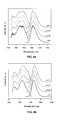
- Fig. 8a shows excitation and emission spectra of SrAl 2-x Si x O 4-x N x :Eu 2+ (10%) and Figure 8b excitation and emission spectra of CaAl 2-x Si x O 4-x N x :EU 2+ (10%), each with various x.
- the emission bands shift more or less to the longer wavelength depending on the cation.
- the shift is typically from 495 to 530 nm
- the shift is typically from 515 to 575 nm
- the emission band shifts from about 497 to 527 nm with increasing content x of incorporated nitrogen. The position of the excitation band shifts accordingly from 385 to 425 nm.
Landscapes
- Chemical & Material Sciences (AREA)
- Engineering & Computer Science (AREA)
- Ceramic Engineering (AREA)
- Materials Engineering (AREA)
- Organic Chemistry (AREA)
- Manufacturing & Machinery (AREA)
- Inorganic Chemistry (AREA)
- Structural Engineering (AREA)
- Physics & Mathematics (AREA)
- Thermal Sciences (AREA)
- Luminescent Compositions (AREA)
- Led Device Packages (AREA)
Abstract
Ultraviolet-blue excitable phosphor consist of a europium-doped oxynitride host lattice derived from tridymite structure. The lattice has a general composition MAl 2-xSi xO 4-xN x(where M = calcium (Ca), strontium (Sr) or barium (Ba); x = 0.002 - 1.5 (preferably less than 0.7)). The amount of europium (Eu) doped to cation M is 0.1 - 25%.
Description
- This invention relates to a luminescent material which is excitable in the UV-blue part of the spectral region, and more particularly, but not exclusively to a phosphor for light sources, especially for Light Emitting Diodes (LED). The phosphor belongs to the class of rare-earth activated silicon oxynitrides.
- So far white LEDs were realized by combining a blue-emitting diode with a yellow emitting phosphor. Such a combination has a poor color rendition, which, however, can be improved significantly by using a red-green-blue system (RGB). Such a system uses for example a red and blue emitter in combination with a green-emitting aluminate phosphor, like SrAl2O4:Eu or BaAl2O4:Eu, with the possible addition of Mn to Eu, whose emission maximum is around 520 nm, see US-A 6 278 135. However, the position of the excitation and emission bands of theses aluminates is not optimum. They have to be excited by short UV in the range of 330 to 400 nm.
- It is an object of the present invention to provide a new luminescent material. A further object is to provide a phosphor with a fine-tuned emission which can be efficiently excited by UV/blue radiation. A further object is to provide a phosphor for use in an illumination device with at least one LED as light source, the LED emitting primary radiation in the range from 360 to 470 nm, this radiation being partially or completely converted into longer-wavelength radiation by phosphors which are exposed to the primary radiation from the LED. A further object is to provide an illumination device which emits white light and in particular has a high color rendering. A further object is to provide a high-efficiency illumination device like a LED device which absorbs well in the range from 360 to 470 nm and is easy to produce.
- These objects are achieved by the characterizing features of
claim - The conversion is achieved at least with the aid of an oxynitride phosphor which originates from the class of the Eu- or Eu,Mn-coactivated aluminates. In more detail, the disadvantages of the prior art are overcome by incorporation of nitrogen in MAl2O4:Eu (M = Ca, Sr, Ba), resulting in an oxynitride phosphor, usually maintaining the tridymite structure. More specifically, an (AlO)+ pair is replaced by a (SiN)+ pair giving the general composition: MAl2-xSixO4-xNx:(Eu or Eu,Mn). The value x is set as x ≥ 0,002 and at most x=1,5. In case of Ca as main component of M a preferred value is 0,01 ≤ x ≤ 0,1. In case of Ba or Sr as main component of M a preferred value is 0,1 ≤ x ≤ 0,7. The incorporation of nitrogen increases the degree of covalent bonding and ligand-field splitting. As a consequence this leads to a shift of excitation and emission bands to longer wavelengths compared to oxide lattices. The obtained phosphors show high chemical and thermal stability. More extended fine tuning of all relevant properties can be obtained by use of a cation M which is achieved by combining several of said M metals, by further addition of Zn as part of cation M, and/or at least partial replacement of Si by Ge (preferably up to 25 mol%) and/or Al by Ga. Preferably, the metal M is mainly Ba and/or Sr for a green-emitting material, and mainly Ca for a blue-emitting material. The amount of Eu doped to cation M is between 0,1 and 25 %, preferably between 2 and 15%. In addition further doping with Mn for fine-tuning of relevant properties is possible with an preferred amount of at most 50% of the Eu doping.
- Since these materials can convert UV-blue radiation into blue-green light due to low-energy excitation bands, they can be applied for example in white light sources (e.g. lamps), especially sources based on primarily blue-emitting LEDs (typically GaN or InGaN with emission around 430 to 470 nm) combined with a red-emitting phosphor. A suitable red-emitting phosphor is a Eu-doped silicon nitride material, like M2Si5N8 (M = Ca, Sr, Ba), see for example WO 01/40403. Also application for colored light sources is possible.
- In the text which follows, the invention is explained in more detail with reference to a plurality of exemplary embodiments. In the drawings:
- Figure 1
- shows a semiconductor component (LED) which serves as light source for white light, with casting resin (Figure 1a) and without casting resin (Figure 1b);
- Figure 2
- shows an illumination device with phosphors in accordance with the present invention;
- Figure 3
- shows the emission spectrum and reflection spectrum of a phosphor in accordance with the present invention;
- Figures 4 to 8
- show the emission spectra and reflection spectra of further phosphors in accordance with the present invention;
- Figure 9
- shows the relationship between the volume of a unit cell and the value of x.
- By way of example, a structure similar to that used in WO 01/40403 is described for use in a white LED together with an InGaN chip. The structure of such a light source for white light is specifically shown in Figure 1a. The light source is based on a semiconductor component (chip 1) of type InGaN with a peak emission wavelength of 400 nm, having a first and a second
electrical connection opaque base housing 8 in the region of arecess 9. One of theconnections 3 is connected to thechip 1 via abonding wire 4. The recess has awall 7 which serves as reflector for the blue primary radiation of thechip 1. Therecess 9 is filled with apotting compound 5 which contains a silicone casting resin (or epoxy casting resin) as its main constituents (pref. more than 80 by weight) and further comprises phosphor pigments 6 (pref. less than 15% by weight). There are also further small amounts of, inter alia, methyl ether and Aerosil. The phosphor pigments are a mixture of three pigments which emit blue, green and red light with the green phosphor being in accordance with the invention. - Fig. 1b shows an embodiment of a light source with a
semiconductor component 10 in which the conversion into white light is effected by means ofphosphor conversion layers 16 which are applied directly to the individual chip. On top of asubstrate 11 there are acontact layer 12, amirror 13, aLED chip 14, afilter 15 and aphosphor layer 16, which is excited by the primary radiation of the LED, and converts it into visible long-wave radiation. This structural unit is surrounded by aplastic lens 17. Only theupper contact 18 of the two ohmic contacts is illustrated. Primary UV radiation of the LED is around 400 nm and secondary radiation is emitted by a first phosphor in accordance with the invention using BaAl2-xSixO4-xNx: (10%) Eu2+, emitting around 525 nm, and by a second phosphor using a Nitridosilicate emitting orange-red. - Figure 2 shows an
illumination device 20. It comprises acommon support 21, to which a cubicalouter housing 22 is adhesively bonded. Its upper side is provided with acommon cover 23. The cubical housing has cutouts in whichindividual semiconductor components 24 are accommodated. They are blue emitting light-emitting diodes with a peak emission of around 450 to 470 nm. The conversion into white light takes place by means of conversion layers 25 which are arranged on all the surfaces which are accessible to the blue radiation. These include the inner surfaces of the side walls of the housing, of the cover and of the support. The conversion layers 25 consist of phosphors which emit in the red spectral region, and in the green spectral region using a phosphor according to the invention and mixing up together with the non-absorbed part of the primary radiation blue primary into white light. - Eu2O3 (with purity 99.99%), BaCO3 (with purity > 99.0%), SrCO3 (with purity > 99.0%), CaCO3 (with purity > 99.0%), Al2O3 (with
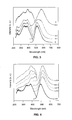
purity 99,9%), SiO2 and Si3N4 were used as commercially available starting materials for the production of the new inventive phosphors. The raw materials were homogeneously wet-mixed in the appropriate amounts by a planetary ball mill for 4-5 hours in isopropanol. After mixing the mixture was dried in a stove and ground in an agate mortar. Subsequently, the powders were fired in molybdenum crucibles at 1100-1400 °C under a reducing nitrogen/hydrogen atmosphere in a horizontal tube furnace. After firing, the materials were characterized by powder X-ray diffraction (copper K-alpha line). - All samples show efficient luminescence under UV-blue excitation with emission maxima in the blue (in case of M = Ca), especially 435 to 445 nm, or green (for M = Sr or Ba), especially in case of Ba 495 to 530 nm and in case of Sr 515 to 575 nm. Two typical examples of emission and excitation spectra can be seen in Fig. 3 and Fig. 4. Figure 3 shows emission spectra and excitation spectra of SrAl2-xSixO4-xNx:Eu with varying value of x. Figure 4 shows emission/excitation spectra of BaAl2-xSixO4-xNx:Eu with varying value of x.
- By varying the amount of nitrogen, the emission can be shifted in the range 495-575 nm. Esp. Sr is sensitive to shifting (Fig. 3), while the top of the excitation band can be shifted from below 400 nm up till 430 to 465 nm, preferably to 440 nm, see M =Ba (Fig. 4). The observed shift to higher wavelengths is the result of a center of gravity of the Eu 5d band at lower energy and a stronger ligand-field splitting of the Eu 5d band.
- Additional fine tuning can be achieved by incorporation of Zn as an addition to cation M, preferably not more than 30%, and at least partial replacement of Al by Ga, preferably not more than 25%, and/or Si by Ge, preferably not more than 25 %.
Table 1 Raw materials Grade MCO3 (M = Ca, Sr, Ba) 99.0% SiO2 Aerosil OX50 γ-Al2O3 > 99.995 Si3N4 β content: 23.3%, O~0.7% Eu2O3 99.99% - In the following the synthesis procedures for MAl2-xSixO4-xNx:(10%) Eu2+ (M = Ca, Sr, Ba) are given. Possible starting materials are shown in table 1.
- All the oxynitride phosphors including tridymite are synthesized according to the following reaction equation (gas phases neglected):

- For example, the compositions of Ba.9Eu0.1Al2-xSixO4-xNx are shown in the following table 2.
Table 2 (Unit: gram) x value BaCO 3 Al 2 O 3 Si 3 N 4 SiO 2 Eu 2 O 3 0.3 3.497 1.689 0.205 0.088 0.343 0.5 3.500 1.492 0.342 0.146 0.343 - The detailed experimental results showed that the luminescence properties of the phosphors were almost independent of exact SiO2 content. However, reducing SiO2 content in an appropriate amount (i.e., it can be reduced up to 1/60 of the calculated amount SiO2) strongly increases phase purity as well as efficiency.
- The powder mixture is fired for several hours in Mo crucibles at 1100-1400 °C in a reducing atmosphere of N2 with a small amount of H2 (10%) in the horizontal tube furnaces.
- Further excitation and emission spectra of samples elucidating the role of SiO2 reduction are shown in Figures 5 to 8.
- Embodiment according to Fig. 5: Ba0.9Eu0.1Al2-xSixO4-xNx with x = 0.3 and no SiO2 reduction. The phosphor was excited with λexc = 440 nm for the emission spectrum and monitored at λmon = 530 nm for the excitation spectrum. Its main phase has BaAl2O4 structure.
- Embodiment according to Fig. 6: Ba0.9Eu0.1Al2-xSixO4-xNx with x = 0.3, SiO2 amount reduced to one-fourth of calculated SiO2 amount (λexc = 440 nm, λmon = 530 nm). Its main phase has BaAl2O4 structure.
- Embodiment according to Fig. 7: Ba0.9Eu0.1Al2-xSixO4-xNx with x = 0.5 and SiO2 amount reduced to 1/16 of calculated SiO2 amount (λexc = 440 nm, λmon = 530 nm). Its main phase has BaAl2O4 structure.
- Si3N4 was used as the source of (SiN)+ according to the following reaction [1]:

- So, good results can be achieved with Ba aluminate and with x up to about 0,6 without the need to adapt the SiO2 amount.
- Also good results are seen with Sr aluminate. Reduction (expressed as amount y) of the SiO2 content results in an non-stoichiometric aluminate of the type MAl2-xSix-yO4-x-2yNx:Eu, preferably with y≤ 0,25 x. Best performance is achieved with SiO2 correction, and with x up to 0,5. The same holds true for Ca aluminate, however smaller x values are preferred below 0,05.
- The luminescence properties of MAl2-xSixO4-xNx:10%EU2+ are now discussed in more detail. Fig. 8 shows the excitation and emission spectra of MAl2-xSixO4-xN.:EU2+ (M = Sr, Ca). The SiO2 content is not reduced. In more detail, Fig. 8a shows excitation and emission spectra of SrAl2-xSixO4-xNx:Eu2+(10%) and Figure 8b excitation and emission spectra of CaAl2-xSixO4-xNx:EU2+ (10%), each with various x.
- Corresponding to the results of the relationship between unit cell volume and x values of MAl2-xSixO4-xNx, the emission bands shift more or less to the longer wavelength depending on the cation. In case of Ba the shift is typically from 495 to 530 nm, in case of Sr the shift is typically from 515 to 575 nm and in case of Ca the shift is typically from 440 to 445 nm. For BaAl2-xSixO4-xNx: (10%) Eu2+, the emission band shifts from about 497 to 527 nm with increasing content x of incorporated nitrogen. The position of the excitation band shifts accordingly from 385 to 425 nm.
- For MAl2-xSixO4-xNx: (10%) Eu2+, with M is at least one of Sr or Ca, the amount of (SiN)+ does not essentially increase the emission and excitation wavelengths because almost no shift in the lattice parameters is observed. The maximum shift of emission bands of Eu is less than 10 nm corresponding to the fact of small nitrogen incorporation in case of M = Ca. Therefore, a small amount of (SiN)+ incorporation can only exert weak influence to the local coordination of the Eu2+ ion. This discussion is understood with the addition of the normal stoichiometric amount of SiO2.
- However, it turned out very surprisingly that the use of understoichiometric amount of SiO2 is advantageous in several cases. The effect of an reduced amount of SiO2 in the reaction (1) to the incorporation of N and to the luminescence properties is most pronounced in the case of SrAl2-xSixO4-xNx:Eu2+ (10%). The reason is not yet fully understood. When the amount of SiO2 which should be used in reaction (1) is taken about a factor 60 lower, it is found that an increased amount of (SiN)+ is incorporated into SrAl2O4 lattice with stuffed tridymite structure. The maximum solubility is x ≈ 0.5 (Table 1). As a result of N incorporation the Eu emission bands shift to longer wavelengths, up to 575 nm (Fig. 3). An evident excitation shoulder at 430 nm appears at the maximum solubility of nitrogen (x = 0,3 ... 0,5), as shown in Fig. 3.
Claims (13)
- Luminescent material, preferably a phosphor for LED-applications, which is excitable in the UV-blue region from 360 to 470 nm, characterized by a Eu-doped host lattice with general composition MAl2-xSixO4-xNx, wherein M is at least one of an alkaline earth metal chosen from the group Ca, Sr, Ba, with x ≥ 0,002 and x ≤ 1,5, pref. x below 0,7, and with a proportion of Eu from 0,1 to 25% of M.
- UV-blue excitable luminescent material according to claim 1, wherein the host lattice has a tridymite structure.
- UV-blue excitable luminescent material according to claim 1, wherein M is Strontium and/or Barium in order to achieve green emission.
- UV-blue excitable luminescent material according to claim 1, wherein M is Calcium in order to achieve blue emission.
- UV-blue excitable luminescent material according to claim 1, wherein M is a mixture of at least two of these metals.
- UV-blue excitable luminescent material according to claim 1, wherein M comprises in addition Zn, preferably up to 40 mol-% .
- UV-blue excitable luminescent material according to claim 1, wherein Al is replaced fully or partially by Ga.
- UV-blue excitable luminescent material according to claim 1, wherein Si is replaced fully or partially by Ge, preferably not more than 25%.
- UV-blue excitable luminescent material according to claim 1, wherein the host material is further doped with Mn, the amount of Mn being preferably at most up to 50% of the Eu doping.
- Light source (20) with a UV-blue excitable luminescent material according to one of the preceding claims.
- Light source according to claim 10, wherein the primary emitted light is blue and the UV-blue excitable luminescent material according to claims 1-9 is combined with other phosphors, esp. a red emitting phosphor, in order to convert part of the primary emitted light into secondary emitted light of longer wavelength resulting in emitting white light..
- Light source according to claim 10, wherein the primary emitted radiation is UV and the UV-blue excitable luminescent materials according to claims 1-9 are combined with other phosphors, esp. a red and blue emitting phosphor, in order to convert the primary emitted radiation into secondary emitted light of longer wavelength resulting in emitting white light.
- Light source according to claim 10, wherein the light source is an illuminating device with at least one LED.
Priority Applications (9)
| Application Number | Priority Date | Filing Date | Title |
|---|---|---|---|
| EP20020021177 EP1413619A1 (en) | 2002-09-24 | 2002-09-24 | Luminescent material, especially for LED application |
| EP03798179A EP1438364B1 (en) | 2002-09-24 | 2003-09-23 | Photoluminescent material and light emitting diode using the same |
| DE60307411T DE60307411T2 (en) | 2002-09-24 | 2003-09-23 | PHOTOLUMINESCENT MATERIAL AND LUMINAIRE DIODE |
| US10/496,560 US7485243B2 (en) | 2002-09-24 | 2003-09-23 | Luminescent material and light emitting diode using the same |
| TW092126178A TWI287566B (en) | 2002-09-24 | 2003-09-23 | Luminescent material, preferably for LED application |
| JP2004539001A JP3906224B2 (en) | 2002-09-24 | 2003-09-23 | Luminescent substance and light emitting diode using this substance |
| PCT/EP2003/010598 WO2004029177A1 (en) | 2002-09-24 | 2003-09-23 | Luminescent material and light emitting diode using the same |
| CNB038016052A CN1311055C (en) | 2002-09-24 | 2003-09-23 | Luminescent material and light emitting diode using the same |
| AT03798179T ATE335799T1 (en) | 2002-09-24 | 2003-09-23 | PHOTOLUMINescent material and light-emitting diode |
Applications Claiming Priority (1)
| Application Number | Priority Date | Filing Date | Title |
|---|---|---|---|
| EP20020021177 EP1413619A1 (en) | 2002-09-24 | 2002-09-24 | Luminescent material, especially for LED application |
Publications (1)
| Publication Number | Publication Date |
|---|---|
| EP1413619A1 true EP1413619A1 (en) | 2004-04-28 |
Family
ID=32039087
Family Applications (2)
| Application Number | Title | Priority Date | Filing Date |
|---|---|---|---|
| EP20020021177 Withdrawn EP1413619A1 (en) | 2002-09-24 | 2002-09-24 | Luminescent material, especially for LED application |
| EP03798179A Expired - Lifetime EP1438364B1 (en) | 2002-09-24 | 2003-09-23 | Photoluminescent material and light emitting diode using the same |
Family Applications After (1)
| Application Number | Title | Priority Date | Filing Date |
|---|---|---|---|
| EP03798179A Expired - Lifetime EP1438364B1 (en) | 2002-09-24 | 2003-09-23 | Photoluminescent material and light emitting diode using the same |
Country Status (8)
| Country | Link |
|---|---|
| US (1) | US7485243B2 (en) |
| EP (2) | EP1413619A1 (en) |
| JP (1) | JP3906224B2 (en) |
| CN (1) | CN1311055C (en) |
| AT (1) | ATE335799T1 (en) |
| DE (1) | DE60307411T2 (en) |
| TW (1) | TWI287566B (en) |
| WO (1) | WO2004029177A1 (en) |
Cited By (5)
| Publication number | Priority date | Publication date | Assignee | Title |
|---|---|---|---|---|
| WO2006087661A1 (en) * | 2005-02-21 | 2006-08-24 | Philips Intellectual Property & Standards Gmbh | Illumination system comprising a radiation source and a luminescent material |
| WO2006095285A1 (en) * | 2005-03-09 | 2006-09-14 | Philips Intellectual Property & Standards Gmbh | Illumination system comprising a radiation source and a fluorescent material |
| WO2007025973A1 (en) * | 2005-08-30 | 2007-03-08 | Leuchtstoffwerk Breitungen Gmbh | Carbidonitridosilicate luminescent substance |
| EP1777280A4 (en) * | 2004-06-30 | 2009-04-22 | Nat Inst For Materials Science | FLUORESCENT SUBSTANCE AND LUMINESCENT EQUIPMENT |
| EP1865564A4 (en) * | 2005-03-18 | 2013-01-16 | Mitsubishi Chem Corp | LUMINESCENT DEVICE, WHITE LIGHT EMITTING DEVICE, LIGHTING DEVICE, AND IMAGE DISPLAY |
Families Citing this family (53)
| Publication number | Priority date | Publication date | Assignee | Title |
|---|---|---|---|---|
| MY149573A (en) * | 2002-10-16 | 2013-09-13 | Nichia Corp | Oxynitride phosphor and production process thereof, and light-emitting device using oxynitride phosphor |
| JP2004210921A (en) * | 2002-12-27 | 2004-07-29 | Nichia Chem Ind Ltd | Oxynitride phosphor, method of manufacturing the same, and light emitting device using the same |
| AU2003283731A1 (en) * | 2002-12-13 | 2004-07-09 | Koninklijke Philips Electronics N.V. | Illumination system comprising a radiation source and a fluorescent material |
| US7368179B2 (en) | 2003-04-21 | 2008-05-06 | Sarnoff Corporation | Methods and devices using high efficiency alkaline earth metal thiogallate-based phosphors |
| JP4128564B2 (en) * | 2004-04-27 | 2008-07-30 | 松下電器産業株式会社 | Light emitting device |
| WO2005103199A1 (en) | 2004-04-27 | 2005-11-03 | Matsushita Electric Industrial Co., Ltd. | Phosphor composition and method for producing the same, and light-emitting device using the same |
| JP4414821B2 (en) * | 2004-06-25 | 2010-02-10 | Dowaエレクトロニクス株式会社 | Phosphor, light source and LED |
| JP2008506011A (en) | 2004-07-06 | 2008-02-28 | サーノフ コーポレーション | Efficient green-emitting phosphor and combination with red-emitting phosphor |
| EP1835008B1 (en) * | 2004-08-11 | 2019-05-01 | National Institute for Materials Science | Lighting instrument |
| EP2366754B1 (en) * | 2004-09-22 | 2014-08-27 | National Institute for Materials Science | Phosphor, production method thereof and light emitting instrument |
| CN100365607C (en) * | 2004-12-31 | 2008-01-30 | 北京中星微电子有限公司 | Apparatus and method for controlling SD card interface |
| US7439668B2 (en) | 2005-03-01 | 2008-10-21 | Lumination Llc | Oxynitride phosphors for use in lighting applications having improved color quality |
| US7524437B2 (en) | 2005-03-04 | 2009-04-28 | Dowa Electronics Materials Co., Ltd. | Phosphor and manufacturing method of the same, and light emitting device using the phosphor |
| JP5145934B2 (en) | 2005-03-04 | 2013-02-20 | 三菱化学株式会社 | Phosphor and method for producing the same, and light emitting device using the phosphor |
| US7276183B2 (en) * | 2005-03-25 | 2007-10-02 | Sarnoff Corporation | Metal silicate-silica-based polymorphous phosphors and lighting devices |
| WO2006106883A1 (en) * | 2005-03-31 | 2006-10-12 | Dowa Electronics Materials Co., Ltd. | Fluorescent substance, fluorescent substance sheet and process for producing the same, and luminescent device using said fluorescent substance |
| WO2006121083A1 (en) * | 2005-05-12 | 2006-11-16 | National Institute For Materials Science | β-TYPE SIALON FLUORESCENT SUBSTANCE |
| CN102816565B (en) * | 2005-09-27 | 2015-05-27 | 三菱化学株式会社 | Phosphor, method for producing same, and light-emitting device using same |
| US20070125984A1 (en) * | 2005-12-01 | 2007-06-07 | Sarnoff Corporation | Phosphors protected against moisture and LED lighting devices |
| US8906262B2 (en) * | 2005-12-02 | 2014-12-09 | Lightscape Materials, Inc. | Metal silicate halide phosphors and LED lighting devices using the same |
| JP4991027B2 (en) * | 2005-12-26 | 2012-08-01 | 日亜化学工業株式会社 | Oxynitride phosphor and light emitting device using the same |
| JP4238269B2 (en) * | 2006-02-02 | 2009-03-18 | 三菱化学株式会社 | Composite oxynitride phosphor, light-emitting device using the same, image display device, illumination device, phosphor-containing composition, and composite oxynitride |
| EP1997865B1 (en) * | 2006-02-24 | 2013-11-06 | National Institute for Materials Science | Phosphor, method for producing same, and light-emitting device |
| CN101077973B (en) | 2006-05-26 | 2010-09-29 | 大连路明发光科技股份有限公司 | Silicate fluorescent material, method for producing same, and light-emitting device using same |
| ES2391586T3 (en) | 2006-08-15 | 2012-11-28 | Dalian Luminglight Co., Ltd. | Silicate-based luminescent materials that have multiple emission peaks, procedures for their preparation and use in light emitting devices |
| US7713442B2 (en) | 2006-10-03 | 2010-05-11 | Lightscape Materials, Inc. | Metal silicate halide phosphors and LED lighting devices using the same |
| US8529791B2 (en) * | 2006-10-20 | 2013-09-10 | Intematix Corporation | Green-emitting, garnet-based phosphors in general and backlighting applications |
| CN2911965Y (en) * | 2006-11-08 | 2007-06-13 | 秦波 | white light emitting diode |
| DE102006054239A1 (en) * | 2006-11-17 | 2008-05-21 | Bayer Materialscience Ag | Photochromic material and process for its preparation |
| DE102006054236A1 (en) * | 2006-11-17 | 2008-05-21 | Bayer Materialscience Ag | Photochromic material and process for its preparation |
| JP5463495B2 (en) * | 2007-05-18 | 2014-04-09 | 三星電子株式会社 | Phosphor manufacturing method and light emitting device |
| JP2009263610A (en) | 2007-08-01 | 2009-11-12 | Mitsubishi Chemicals Corp | Phosphor and method for producing the same, crystalline silicon nitride and method for producing the same, phosphor-containing composition, light-emitting device using the phosphor, image display device, and illuminating device |
| WO2009031089A1 (en) * | 2007-09-04 | 2009-03-12 | Philips Intellectual Property & Standards Gmbh | Light emitting device comprising a composite sialon-based ceramic material |
| JP5251140B2 (en) * | 2008-01-22 | 2013-07-31 | 三菱化学株式会社 | Phosphor, phosphor-containing composition, light emitting device, image display device, and illumination device |
| JP5523676B2 (en) * | 2008-02-29 | 2014-06-18 | 日亜化学工業株式会社 | Phosphor and light emitting device using the same |
| DE102008038249A1 (en) * | 2008-08-18 | 2010-02-25 | Osram Gesellschaft mit beschränkter Haftung | alpha-sialon phosphor |
| DE102009025266B4 (en) * | 2009-06-17 | 2015-08-20 | Osram Opto Semiconductors Gmbh | Optoelectronic semiconductor device |
| KR101565988B1 (en) | 2009-10-23 | 2015-11-05 | 삼성전자주식회사 | Red phosphor, manufacturing method thereof, light emitting device package using the same, lighting apparatus |
| KR20110050206A (en) * | 2009-11-06 | 2011-05-13 | 삼성전자주식회사 | Oxynitride phosphor, manufacturing method thereof and white light emitting device using same |
| US20110220920A1 (en) * | 2010-03-09 | 2011-09-15 | Brian Thomas Collins | Methods of forming warm white light emitting devices having high color rendering index values and related light emitting devices |
| US8643038B2 (en) * | 2010-03-09 | 2014-02-04 | Cree, Inc. | Warm white LEDs having high color rendering index values and related luminophoric mediums |
| KR101717668B1 (en) * | 2010-03-26 | 2017-03-17 | 삼성전자주식회사 | Complex crystal phosphor, light emitting device, display apparatus and illumination apparatus |
| TWI456028B (en) * | 2011-02-16 | 2014-10-11 | Univ Nat Cheng Kung | Method for producing fluorescent material of Mg-α-SiAlON as main crystal lattice and post-processing method of fluorescent material |
| DE202011106052U1 (en) * | 2011-09-23 | 2011-11-09 | Osram Ag | Light source with phosphor and associated lighting unit. |
| DE102012202927B4 (en) * | 2012-02-27 | 2021-06-10 | Osram Gmbh | LIGHT SOURCE WITH LED CHIP AND LUMINOUS LAYER |
| US9546319B2 (en) * | 2012-05-22 | 2017-01-17 | Koninklijke Philips N.V. | Phosphors, such as new narrow-band red emitting phosphors for solid state lighting |
| CN103998571B (en) * | 2012-12-14 | 2016-03-23 | 电化株式会社 | Phosphor, its preparation method and light-emitting device |
| US10283681B2 (en) * | 2013-09-12 | 2019-05-07 | Cree, Inc. | Phosphor-converted light emitting device |
| JP6169468B2 (en) * | 2013-10-09 | 2017-07-26 | 三星電子株式会社Samsung Electronics Co.,Ltd. | Phosphor |
| CN104610967A (en) * | 2015-02-15 | 2015-05-13 | 江西理工大学 | A kind of rare earth doped nitrogen oxide green fluorescent powder and preparation method thereof |
| JP6008017B2 (en) * | 2015-06-12 | 2016-10-19 | 日亜化学工業株式会社 | Phosphor and light emitting device using the same |
| US11453821B2 (en) * | 2019-12-05 | 2022-09-27 | Lumileds Llc | Narrow band emitting SiAlON phosphor |
| US11729915B1 (en) * | 2022-03-22 | 2023-08-15 | Tactotek Oy | Method for manufacturing a number of electrical nodes, electrical node module, electrical node, and multilayer structure |
Citations (5)
| Publication number | Priority date | Publication date | Assignee | Title |
|---|---|---|---|---|
| GB1112777A (en) * | 1965-11-24 | 1968-05-08 | Gen Electric Co Ltd | Improvements in or relating to luminescent materials |
| EP0155047A1 (en) * | 1984-03-01 | 1985-09-18 | Koninklijke Philips Electronics N.V. | Luminescent screen |
| EP1104799A1 (en) * | 1999-11-30 | 2001-06-06 | Patent-Treuhand-Gesellschaft für elektrische Glühlampen mbH | Red emitting luminescent material |
| EP1193306A2 (en) * | 2000-09-29 | 2002-04-03 | Sumitomo Chemical Company, Limited | Fluorescent substances for vacuum ultraviolet radiation excited light-emitting devices |
| US20020043926A1 (en) * | 2000-08-28 | 2002-04-18 | Toyoda Gosei Co., Ltd. | Light-emitting unit |
Family Cites Families (4)
| Publication number | Priority date | Publication date | Assignee | Title |
|---|---|---|---|---|
| US6278135B1 (en) | 1998-02-06 | 2001-08-21 | General Electric Company | Green-light emitting phosphors and light sources using the same |
| US6501100B1 (en) | 2000-05-15 | 2002-12-31 | General Electric Company | White light emitting phosphor blend for LED devices |
| EP1413618A1 (en) * | 2002-09-24 | 2004-04-28 | Osram Opto Semiconductors GmbH | Luminescent material, especially for LED application |
| US7267787B2 (en) | 2004-08-04 | 2007-09-11 | Intematix Corporation | Phosphor systems for a white light emitting diode (LED) |
-
2002
- 2002-09-24 EP EP20020021177 patent/EP1413619A1/en not_active Withdrawn
-
2003
- 2003-09-23 US US10/496,560 patent/US7485243B2/en not_active Expired - Lifetime
- 2003-09-23 WO PCT/EP2003/010598 patent/WO2004029177A1/en not_active Ceased
- 2003-09-23 JP JP2004539001A patent/JP3906224B2/en not_active Expired - Fee Related
- 2003-09-23 DE DE60307411T patent/DE60307411T2/en not_active Expired - Lifetime
- 2003-09-23 EP EP03798179A patent/EP1438364B1/en not_active Expired - Lifetime
- 2003-09-23 TW TW092126178A patent/TWI287566B/en not_active IP Right Cessation
- 2003-09-23 AT AT03798179T patent/ATE335799T1/en not_active IP Right Cessation
- 2003-09-23 CN CNB038016052A patent/CN1311055C/en not_active Expired - Fee Related
Patent Citations (5)
| Publication number | Priority date | Publication date | Assignee | Title |
|---|---|---|---|---|
| GB1112777A (en) * | 1965-11-24 | 1968-05-08 | Gen Electric Co Ltd | Improvements in or relating to luminescent materials |
| EP0155047A1 (en) * | 1984-03-01 | 1985-09-18 | Koninklijke Philips Electronics N.V. | Luminescent screen |
| EP1104799A1 (en) * | 1999-11-30 | 2001-06-06 | Patent-Treuhand-Gesellschaft für elektrische Glühlampen mbH | Red emitting luminescent material |
| US20020043926A1 (en) * | 2000-08-28 | 2002-04-18 | Toyoda Gosei Co., Ltd. | Light-emitting unit |
| EP1193306A2 (en) * | 2000-09-29 | 2002-04-03 | Sumitomo Chemical Company, Limited | Fluorescent substances for vacuum ultraviolet radiation excited light-emitting devices |
Non-Patent Citations (2)
| Title |
|---|
| VAN KREVEL J ET AL: "Luminescence Tb/Ce/Eu-doped alpha-SiAlON materials", J. SOLID STATE CHEMISTRY, APRIL 2002, vol. 165, pages 19 - 24, XP001157540, ISSN: 0022-4596 * |
| XIE R-J ET AL: "Luminescence of Ca- and Eu/Tb/Pr-codoped alpha-SiAlON ceramics", J. AMERICAN CERAMIC SOCIETY, MAY 2002, vol. 85, pages 1229 - 1234, XP001151981, ISSN: 0002-7820 * |
Cited By (12)
| Publication number | Priority date | Publication date | Assignee | Title |
|---|---|---|---|---|
| EP1777280A4 (en) * | 2004-06-30 | 2009-04-22 | Nat Inst For Materials Science | FLUORESCENT SUBSTANCE AND LUMINESCENT EQUIPMENT |
| WO2006087661A1 (en) * | 2005-02-21 | 2006-08-24 | Philips Intellectual Property & Standards Gmbh | Illumination system comprising a radiation source and a luminescent material |
| US8545722B2 (en) | 2005-02-21 | 2013-10-01 | Koninklijke Philips N.V. | Illumination system comprising a radiation source and a luminescent material |
| WO2006095285A1 (en) * | 2005-03-09 | 2006-09-14 | Philips Intellectual Property & Standards Gmbh | Illumination system comprising a radiation source and a fluorescent material |
| WO2006123259A1 (en) * | 2005-03-09 | 2006-11-23 | Koninklijke Philips Electronics N.V. | Illumination system comprising a radiation source and a fluorescent material |
| US7938983B2 (en) | 2005-03-09 | 2011-05-10 | Koninklijke Philips Electronics N.V. | Illumination system comprising a radiation source and a fluorescent material |
| US8038905B2 (en) | 2005-03-09 | 2011-10-18 | Koninklijke Philips Electronics N.V. | Illumination system comprising a radiation source and a fluorescent material |
| EP1865564A4 (en) * | 2005-03-18 | 2013-01-16 | Mitsubishi Chem Corp | LUMINESCENT DEVICE, WHITE LIGHT EMITTING DEVICE, LIGHTING DEVICE, AND IMAGE DISPLAY |
| US9028718B2 (en) | 2005-03-18 | 2015-05-12 | Mitsubishi Chemical Corporation | Light-emitting device, white light-emitting device, illuminator, and image display |
| WO2007025973A1 (en) * | 2005-08-30 | 2007-03-08 | Leuchtstoffwerk Breitungen Gmbh | Carbidonitridosilicate luminescent substance |
| US8007683B2 (en) | 2005-08-30 | 2011-08-30 | Leuchtstoffwerk Breitungen Gmbh | Carbidonitridosilicate luminescent substance |
| RU2430948C2 (en) * | 2005-08-30 | 2011-10-10 | Лейхьтштоффверк Брайтунген Гмбх | Carbide-silicon nitride luminophores |
Also Published As
| Publication number | Publication date |
|---|---|
| WO2004029177A1 (en) | 2004-04-08 |
| TWI287566B (en) | 2007-10-01 |
| US7485243B2 (en) | 2009-02-03 |
| US20060033081A1 (en) | 2006-02-16 |
| EP1438364A1 (en) | 2004-07-21 |
| DE60307411D1 (en) | 2006-09-21 |
| CN1596292A (en) | 2005-03-16 |
| WO2004029177A8 (en) | 2004-06-03 |
| JP2005529229A (en) | 2005-09-29 |
| JP3906224B2 (en) | 2007-04-18 |
| ATE335799T1 (en) | 2006-09-15 |
| DE60307411T2 (en) | 2007-03-29 |
| CN1311055C (en) | 2007-04-18 |
| TW200422375A (en) | 2004-11-01 |
| EP1438364B1 (en) | 2006-08-09 |
Similar Documents
| Publication | Publication Date | Title |
|---|---|---|
| EP1438364B1 (en) | Photoluminescent material and light emitting diode using the same | |
| EP1449264B1 (en) | Photoluminescent material for light emitting diodes, and light emitting diode | |
| EP1980605B1 (en) | Light-emitting Device | |
| US8709838B2 (en) | Method for preparing a β-SiAlON phosphor | |
| US20030094893A1 (en) | Illumination unit having at least one LED as light source | |
| KR20080096597A (en) | Light emitter and light source comprising the light emitter, and method for forming the light emitter | |
| CN101331207B (en) | Red-emitting luminescent substance and light source comprising such a luminescent substance |
Legal Events
| Date | Code | Title | Description |
|---|---|---|---|
| PUAI | Public reference made under article 153(3) epc to a published international application that has entered the european phase |
Free format text: ORIGINAL CODE: 0009012 |
|
| AK | Designated contracting states |
Kind code of ref document: A1 Designated state(s): AT BE BG CH CY CZ DE DK EE ES FI FR GB GR IE IT LI LU MC NL PT SE SK TR |
|
| AX | Request for extension of the european patent |
Extension state: AL LT LV MK RO SI |
|
| AKX | Designation fees paid | ||
| REG | Reference to a national code |
Ref country code: DE Ref legal event code: 8566 |
|
| STAA | Information on the status of an ep patent application or granted ep patent |
Free format text: STATUS: THE APPLICATION IS DEEMED TO BE WITHDRAWN |
|
| 18D | Application deemed to be withdrawn |
Effective date: 20041029 |