EP1411625A1 - Perfectionnements aux moteurs hautes puissances - Google Patents
Perfectionnements aux moteurs hautes puissances Download PDFInfo
- Publication number
- EP1411625A1 EP1411625A1 EP03292264A EP03292264A EP1411625A1 EP 1411625 A1 EP1411625 A1 EP 1411625A1 EP 03292264 A EP03292264 A EP 03292264A EP 03292264 A EP03292264 A EP 03292264A EP 1411625 A1 EP1411625 A1 EP 1411625A1
- Authority
- EP
- European Patent Office
- Prior art keywords
- rotor
- counterweight
- heat
- materials
- alloys
- Prior art date
- Legal status (The legal status is an assumption and is not a legal conclusion. Google has not performed a legal analysis and makes no representation as to the accuracy of the status listed.)
- Granted
Links
- 239000000463 material Substances 0.000 claims abstract description 78
- 230000001360 synchronised effect Effects 0.000 claims abstract description 4
- 239000010936 titanium Substances 0.000 claims description 63
- 229910052719 titanium Inorganic materials 0.000 claims description 45
- MCMNRKCIXSYSNV-UHFFFAOYSA-N Zirconium dioxide Chemical compound O=[Zr]=O MCMNRKCIXSYSNV-UHFFFAOYSA-N 0.000 claims description 32
- 229910052750 molybdenum Inorganic materials 0.000 claims description 23
- 229910052757 nitrogen Inorganic materials 0.000 claims description 23
- 229910052799 carbon Inorganic materials 0.000 claims description 21
- PNEYBMLMFCGWSK-UHFFFAOYSA-N aluminium oxide Inorganic materials [O-2].[O-2].[O-2].[Al+3].[Al+3] PNEYBMLMFCGWSK-UHFFFAOYSA-N 0.000 claims description 18
- 229910000831 Steel Inorganic materials 0.000 claims description 17
- 239000010959 steel Substances 0.000 claims description 17
- HBMJWWWQQXIZIP-UHFFFAOYSA-N silicon carbide Chemical compound [Si+]#[C-] HBMJWWWQQXIZIP-UHFFFAOYSA-N 0.000 claims description 16
- 229910010271 silicon carbide Inorganic materials 0.000 claims description 16
- 229910018072 Al 2 O 3 Inorganic materials 0.000 claims description 15
- XUIMIQQOPSSXEZ-UHFFFAOYSA-N Silicon Chemical compound [Si] XUIMIQQOPSSXEZ-UHFFFAOYSA-N 0.000 claims description 14
- 229910045601 alloy Inorganic materials 0.000 claims description 14
- 239000000956 alloy Substances 0.000 claims description 14
- 229910052782 aluminium Inorganic materials 0.000 claims description 13
- 235000019592 roughness Nutrition 0.000 claims description 13
- 229910000789 Aluminium-silicon alloy Inorganic materials 0.000 claims description 12
- 239000000203 mixture Substances 0.000 claims description 10
- 229910052710 silicon Inorganic materials 0.000 claims description 10
- 239000010703 silicon Substances 0.000 claims description 9
- 238000005245 sintering Methods 0.000 claims description 8
- 238000007751 thermal spraying Methods 0.000 claims description 7
- 229910052721 tungsten Inorganic materials 0.000 claims description 7
- 229910052720 vanadium Inorganic materials 0.000 claims description 7
- 229910052804 chromium Inorganic materials 0.000 claims description 6
- PMHQVHHXPFUNSP-UHFFFAOYSA-M copper(1+);methylsulfanylmethane;bromide Chemical compound Br[Cu].CSC PMHQVHHXPFUNSP-UHFFFAOYSA-M 0.000 claims description 6
- 238000010791 quenching Methods 0.000 claims description 6
- 230000000171 quenching effect Effects 0.000 claims description 6
- 229910001069 Ti alloy Inorganic materials 0.000 claims description 5
- 229910000756 V alloy Inorganic materials 0.000 claims description 5
- AZDRQVAHHNSJOQ-UHFFFAOYSA-N alumane Chemical class [AlH3] AZDRQVAHHNSJOQ-UHFFFAOYSA-N 0.000 claims description 4
- 239000011230 binding agent Substances 0.000 claims description 4
- 235000000396 iron Nutrition 0.000 claims description 4
- 229910052759 nickel Inorganic materials 0.000 claims description 4
- 230000007246 mechanism Effects 0.000 abstract description 2
- 238000000576 coating method Methods 0.000 description 17
- 238000009826 distribution Methods 0.000 description 12
- 239000010410 layer Substances 0.000 description 9
- 235000010210 aluminium Nutrition 0.000 description 8
- 239000011651 chromium Substances 0.000 description 8
- 229910001060 Gray iron Inorganic materials 0.000 description 7
- XAGFODPZIPBFFR-UHFFFAOYSA-N aluminium Chemical compound [Al] XAGFODPZIPBFFR-UHFFFAOYSA-N 0.000 description 7
- 239000002783 friction material Substances 0.000 description 7
- 239000011248 coating agent Substances 0.000 description 6
- 238000009825 accumulation Methods 0.000 description 5
- 239000011149 active material Substances 0.000 description 5
- 238000005260 corrosion Methods 0.000 description 5
- 239000000919 ceramic Substances 0.000 description 4
- 238000013461 design Methods 0.000 description 4
- 239000011159 matrix material Substances 0.000 description 4
- RTAQQCXQSZGOHL-UHFFFAOYSA-N Titanium Chemical compound [Ti] RTAQQCXQSZGOHL-UHFFFAOYSA-N 0.000 description 3
- 230000007797 corrosion Effects 0.000 description 3
- 238000011161 development Methods 0.000 description 3
- 230000018109 developmental process Effects 0.000 description 3
- 239000000835 fiber Substances 0.000 description 3
- 239000000543 intermediate Substances 0.000 description 3
- XEEYBQQBJWHFJM-UHFFFAOYSA-N iron Substances [Fe] XEEYBQQBJWHFJM-UHFFFAOYSA-N 0.000 description 3
- 239000007788 liquid Substances 0.000 description 3
- 230000033001 locomotion Effects 0.000 description 3
- 229910052698 phosphorus Inorganic materials 0.000 description 3
- 238000005507 spraying Methods 0.000 description 3
- 239000000758 substrate Substances 0.000 description 3
- 238000012876 topography Methods 0.000 description 3
- 229910003668 SrAl Inorganic materials 0.000 description 2
- 229910009848 Ti4O7 Inorganic materials 0.000 description 2
- 229910009870 Ti5O9 Inorganic materials 0.000 description 2
- 229910010420 TinO2n-1 Inorganic materials 0.000 description 2
- 238000005275 alloying Methods 0.000 description 2
- HIGRAKVNKLCVCA-UHFFFAOYSA-N alumine Chemical compound C1=CC=[Al]C=C1 HIGRAKVNKLCVCA-UHFFFAOYSA-N 0.000 description 2
- 239000004411 aluminium Substances 0.000 description 2
- 230000015556 catabolic process Effects 0.000 description 2
- 229910052593 corundum Inorganic materials 0.000 description 2
- 239000013310 covalent-organic framework Substances 0.000 description 2
- 238000006073 displacement reaction Methods 0.000 description 2
- 230000004907 flux Effects 0.000 description 2
- 238000005338 heat storage Methods 0.000 description 2
- 238000003754 machining Methods 0.000 description 2
- 229910052748 manganese Inorganic materials 0.000 description 2
- 239000011572 manganese Substances 0.000 description 2
- 230000009467 reduction Effects 0.000 description 2
- 238000001228 spectrum Methods 0.000 description 2
- 230000003068 static effect Effects 0.000 description 2
- 230000035882 stress Effects 0.000 description 2
- 239000000126 substance Substances 0.000 description 2
- 238000012360 testing method Methods 0.000 description 2
- 229910001845 yogo sapphire Inorganic materials 0.000 description 2
- 229910000838 Al alloy Inorganic materials 0.000 description 1
- 229910016384 Al4C3 Inorganic materials 0.000 description 1
- QYEXBYZXHDUPRC-UHFFFAOYSA-N B#[Ti]#B Chemical compound B#[Ti]#B QYEXBYZXHDUPRC-UHFFFAOYSA-N 0.000 description 1
- UXVMQQNJUSDDNG-UHFFFAOYSA-L Calcium chloride Chemical compound [Cl-].[Cl-].[Ca+2] UXVMQQNJUSDDNG-UHFFFAOYSA-L 0.000 description 1
- OKTJSMMVPCPJKN-UHFFFAOYSA-N Carbon Chemical compound [C] OKTJSMMVPCPJKN-UHFFFAOYSA-N 0.000 description 1
- VYZAMTAEIAYCRO-UHFFFAOYSA-N Chromium Chemical compound [Cr] VYZAMTAEIAYCRO-UHFFFAOYSA-N 0.000 description 1
- DGAQECJNVWCQMB-PUAWFVPOSA-M Ilexoside XXIX Chemical compound C[C@@H]1CC[C@@]2(CC[C@@]3(C(=CC[C@H]4[C@]3(CC[C@@H]5[C@@]4(CC[C@@H](C5(C)C)OS(=O)(=O)[O-])C)C)[C@@H]2[C@]1(C)O)C)C(=O)O[C@H]6[C@@H]([C@H]([C@@H]([C@H](O6)CO)O)O)O.[Na+] DGAQECJNVWCQMB-PUAWFVPOSA-M 0.000 description 1
- ZOKXTWBITQBERF-UHFFFAOYSA-N Molybdenum Chemical compound [Mo] ZOKXTWBITQBERF-UHFFFAOYSA-N 0.000 description 1
- 229910003294 NiMo Inorganic materials 0.000 description 1
- OAICVXFJPJFONN-UHFFFAOYSA-N Phosphorus Chemical compound [P] OAICVXFJPJFONN-UHFFFAOYSA-N 0.000 description 1
- 239000004642 Polyimide Substances 0.000 description 1
- 229910033181 TiB2 Inorganic materials 0.000 description 1
- GWEVSGVZZGPLCZ-UHFFFAOYSA-N Titan oxide Chemical compound O=[Ti]=O GWEVSGVZZGPLCZ-UHFFFAOYSA-N 0.000 description 1
- WGLPBDUCMAPZCE-UHFFFAOYSA-N Trioxochromium Chemical compound O=[Cr](=O)=O WGLPBDUCMAPZCE-UHFFFAOYSA-N 0.000 description 1
- XSQUKJJJFZCRTK-UHFFFAOYSA-N Urea Chemical compound NC(N)=O XSQUKJJJFZCRTK-UHFFFAOYSA-N 0.000 description 1
- HCHKCACWOHOZIP-UHFFFAOYSA-N Zinc Chemical compound [Zn] HCHKCACWOHOZIP-UHFFFAOYSA-N 0.000 description 1
- 238000010521 absorption reaction Methods 0.000 description 1
- 230000009471 action Effects 0.000 description 1
- 239000000853 adhesive Substances 0.000 description 1
- 230000001070 adhesive effect Effects 0.000 description 1
- 230000002528 anti-freeze Effects 0.000 description 1
- QVGXLLKOCUKJST-UHFFFAOYSA-N atomic oxygen Chemical compound [O] QVGXLLKOCUKJST-UHFFFAOYSA-N 0.000 description 1
- 230000005540 biological transmission Effects 0.000 description 1
- 230000000903 blocking effect Effects 0.000 description 1
- 229910001628 calcium chloride Inorganic materials 0.000 description 1
- 239000001110 calcium chloride Substances 0.000 description 1
- 239000004202 carbamide Substances 0.000 description 1
- CREMABGTGYGIQB-UHFFFAOYSA-N carbon carbon Chemical compound C.C CREMABGTGYGIQB-UHFFFAOYSA-N 0.000 description 1
- 239000011203 carbon fibre reinforced carbon Substances 0.000 description 1
- 239000000969 carrier Substances 0.000 description 1
- 229910010293 ceramic material Inorganic materials 0.000 description 1
- 239000003638 chemical reducing agent Substances 0.000 description 1
- 229910000423 chromium oxide Inorganic materials 0.000 description 1
- 239000011247 coating layer Substances 0.000 description 1
- 239000000470 constituent Substances 0.000 description 1
- 239000013078 crystal Substances 0.000 description 1
- 230000001186 cumulative effect Effects 0.000 description 1
- 238000005520 cutting process Methods 0.000 description 1
- 230000007547 defect Effects 0.000 description 1
- 238000006731 degradation reaction Methods 0.000 description 1
- 238000009792 diffusion process Methods 0.000 description 1
- 230000000694 effects Effects 0.000 description 1
- 230000005489 elastic deformation Effects 0.000 description 1
- 238000009661 fatigue test Methods 0.000 description 1
- 239000007789 gas Substances 0.000 description 1
- 230000009477 glass transition Effects 0.000 description 1
- 239000003292 glue Substances 0.000 description 1
- 230000017525 heat dissipation Effects 0.000 description 1
- 238000010438 heat treatment Methods 0.000 description 1
- 230000001771 impaired effect Effects 0.000 description 1
- 238000010348 incorporation Methods 0.000 description 1
- 229910052742 iron Inorganic materials 0.000 description 1
- 230000007774 longterm Effects 0.000 description 1
- WPBNNNQJVZRUHP-UHFFFAOYSA-L manganese(2+);methyl n-[[2-(methoxycarbonylcarbamothioylamino)phenyl]carbamothioyl]carbamate;n-[2-(sulfidocarbothioylamino)ethyl]carbamodithioate Chemical compound [Mn+2].[S-]C(=S)NCCNC([S-])=S.COC(=O)NC(=S)NC1=CC=CC=C1NC(=S)NC(=O)OC WPBNNNQJVZRUHP-UHFFFAOYSA-L 0.000 description 1
- 238000004519 manufacturing process Methods 0.000 description 1
- 238000000034 method Methods 0.000 description 1
- 229910003465 moissanite Inorganic materials 0.000 description 1
- 239000011733 molybdenum Substances 0.000 description 1
- 238000005457 optimization Methods 0.000 description 1
- 229910052760 oxygen Inorganic materials 0.000 description 1
- 239000001301 oxygen Substances 0.000 description 1
- 238000002161 passivation Methods 0.000 description 1
- 239000011574 phosphorus Substances 0.000 description 1
- 229920001721 polyimide Polymers 0.000 description 1
- 229920000642 polymer Polymers 0.000 description 1
- 238000001556 precipitation Methods 0.000 description 1
- 230000004044 response Effects 0.000 description 1
- 239000011734 sodium Substances 0.000 description 1
- 229910052708 sodium Inorganic materials 0.000 description 1
- 239000010935 stainless steel Substances 0.000 description 1
- 229910001220 stainless steel Inorganic materials 0.000 description 1
- 238000003860 storage Methods 0.000 description 1
- 230000008646 thermal stress Effects 0.000 description 1
- OGIDPMRJRNCKJF-UHFFFAOYSA-N titanium oxide Inorganic materials [Ti]=O OGIDPMRJRNCKJF-UHFFFAOYSA-N 0.000 description 1
- LEONUFNNVUYDNQ-UHFFFAOYSA-N vanadium atom Chemical compound [V] LEONUFNNVUYDNQ-UHFFFAOYSA-N 0.000 description 1
- XLYOFNOQVPJJNP-UHFFFAOYSA-N water Substances O XLYOFNOQVPJJNP-UHFFFAOYSA-N 0.000 description 1
- 239000011701 zinc Substances 0.000 description 1
- 229910052725 zinc Inorganic materials 0.000 description 1
Images


Classifications
-
- H—ELECTRICITY
- H02—GENERATION; CONVERSION OR DISTRIBUTION OF ELECTRIC POWER
- H02N—ELECTRIC MACHINES NOT OTHERWISE PROVIDED FOR
- H02N2/00—Electric machines in general using piezoelectric effect, electrostriction or magnetostriction
- H02N2/10—Electric machines in general using piezoelectric effect, electrostriction or magnetostriction producing rotary motion, e.g. rotary motors
Definitions
- the present invention relates to the application of friction materials in high power or vibration motors.
- Some high power motors use in their operation the elongation properties of active materials.
- These materials can for example be materials of the piezoelectric type, magneto-strict, electro-strict, etc.
- Figures 1 and 2 schematically represent a motor 2 high power comprising blocks 4a, 4b, 5a, 5b of substantially shape circular, and two rotors 1a and 1b, one being interposed between the blocks 4a and 4b, and the other between blocks 5a and 5b.
- the rotors 1a and 1b are mounted on a common shaft 3.
- the blocks 4a, 4b, 5a, 5b have petals 6 able to be placed contact with rotors 1a and 1b.
- the blocks 4a, 4b, 5a, 5b include elements made of active materials 7 interposed between the petals 6, and which undergo elongations in the plan of the blocks, in order to set in motion the petals 6.
- the innermost blocks 4a and 5a are connected together, by through the petals 6, by elements 8 made of active materials. These elements are able to deform and move the petals 6 according to the direction arrows visible in Figure 2.
- the outermost blocks 4b and 5b are connected to the motor casing 2, by means of the petals 6, by elements 9 forming springs.
- the synchronized elongations of elements 7 and 8 allow rotate the rotors 1a and 1b, in particular by the presence of friction between the petals 6 and the rotors 1a and 1b.
- Figure 3 shows schematically that the petals 6 have a main part 12, connected to a contact pad 11 by elements intermediates 10 having elastic properties.
- the contact pads 11 are dimensioned correctly, the efficiency of the vibration motor is greatly increased.
- the weight of the skids will also be called contact.
- the flyweight which has a limited and fixed mass for the reasons mentioned above, has on its surface a rubbing layer, in contact with a rotor.
- the thickness of the counterweight is of the order of 2 mm.
- the flyweight can rub directly without the presence of a rubbing layer.
- the intermediate layer 10 generally comprises a low ⁇ thermal conductivity ( ⁇ ⁇ 0.5 W / mK).
- Vibration motors are attractive to actuators intermittent, such as landing gear systems, cargo carriers, rudders and shutters. They are then used in replacement of hydraulic or pneumatic circuits, which require liquids with pour points below -60 ° C.
- vibration motors are also used to replace the electric motors with speed reducers with gears.
- topping made up of 10 to 30 substances and / or phases are as follows.
- the wear coefficient is used internationally in Tribology to qualify the wear behavior. It is defined by the wear volume divided by normal load and sliding distance related to the wear volume.
- Application FR 2 819 650 proposes friction torques in linear actuators whose structure and application are very different from those of high power motors.
- the friction couples of the application FR 2 819 650 have stable properties depending on the Working conditions. Said friction couples are stressed without sliding. Indeed, they are used in blocking systems whose aim is to avoid sliding of the micro-contact. They don't have important heat dissipation properties, since they do not have to dissipate the significant amounts of heat induced by phases of sliding.
- the specifications of a high power engine therefore mention low rates of wear and high coefficients of friction.
- the friction materials must have calorific properties, and in particular of thermal diffusivity ⁇ [in mm 2 / s] important for the materials especially of the rotor.
- the Curie temperature limits the active effect, in particular piezoelectric. So if the temperature rises too high in the high power engine, its operation is impaired.
- the constraint of not reaching the Curie temperature limits the temperature of heating of the counterweight to approximately 150 ° C and that of rotor at 200 ° C.
- the higher temperature tolerable by the rotor is due the fact that it is not connected to temperature sensitive elements, in particular piezoelectric materials, and that it is connected to an axis which is a way to dissipate heat faster.
- the invention proposes to overcome these drawbacks.
- the invention provides a system, particularly suitable for high power motors, comprising at least one rotor and means comprising active elements capable of rotating the rotor (s) by their synchronized deformation, said means for rotating the rotor (s) comprising at least one petal comprising a counterweight, characterized in that the material of each counterweight is such that it has a specific thermal capacity (Cp 22C ) greater than 0.35 [J / g / K], and / or the material of each rotor is such that it has a heat capacity greater than 2 [J / cm 3 / K].
- Cp 22C specific thermal capacity
- the creation of heat is very important in a high engine power, because of the dry friction between its constituent elements.
- a high power motor with a mechanical power of 5 kW produces a friction loss of approximately 4.5 kW. Since the engine is not lubricated, all frictional losses are transformed into heat. The heat produced must be stored by the materials in contact.
- motors generally have a limitation of their power to mass ratio. This ratio is generally equal to 1 kW per kg. So the engine doesn't have a lot of mass to be able to absorb the frictional heat produced.
- the invention aims to improve the distribution of heat between different elements of the high power engine.
- thermal diffusivity ⁇ [in mm 2 / s] is the determining quantity in this distribution.
- the heat generated during the actuation of the motor is shared between the surfaces of the "flyweight-rotor" triboelement.
- the rotor volume is fixed by design.
- the mass of the counterweight is fixed by design, for example at 10 grams each for a power of 5 kW at the engine output.
- a heat of 220,000 Joules is for example generated with a friction loss of 4.5 kW during a shorter actuation time at 50 seconds.
- the distribution of heat between the different surfaces of the triboelement depends first of all on the ratio of the two surfaces in contact.
- the ratio of the friction surfaces between for example a structure comprising 32 weights (17,176 mm 2 ) and for example the two sides of two rotors (50,990 mm 2 ) of a high power motor is approximately 1: 2.96.
- Formula (1) shows that the distribution of heat depends on priority of the calorific properties of materials, such as conductivity, mass heat capacity and density of materials friction. We also recall that these properties depend on the temperature.
- Each flyweight is close to active materials, and / or an adhesive for example, heat sensitive.
- the glue will be of the type polyimide with a glass transition temperature of the order of 150 ° C. So, for the flyweight, we want a material that has both a low thermal conductivity and high specific heat.
- the low thermal conductivity makes it possible to attract a minimum of heat produced at the interface.
- the great specific heat allows to store a maximum of heat which would still have been transmitted to the flyweight.
- the disc is not connected to elements sensitive to the heat. Therefore, for the disc, we want a material that has both high thermal conductivity and high heat Mass.
- the high thermal conductivity allows to attract towards the disc a maximum heat produced at the interface.
- the ratio of total heat to heat stored by the 32 weights be greater than 1:10. This is the case for Z6CND16-05-01 steel.
- the ratio for silicon carbide infiltrated to silicon SiSiC or Silicon Infiltrated Silicon Carbide is of the order of 1: 4.
- the conductivity of this material is too important for it to be used for weights.
- Table 1 summarizes all the possible materials for the counterweights, as well as their calorific properties.
- the accumulated heat, that is between 20,640 Joules and 52,800 Joules (visible in Table I) of all the weights should not be overcome by a lack of calorific capacity of the rotor.
- the heat dissipated in all the weights must not exceed their calorific capacity, so that equation (2) is fulfilled.
- Q frictional is the heat generated by friction
- Q weights is the heat capacity of all the weights.
- abbreviation FGL refers to gray fonts lamellar
- abbreviation FGS refers to gray fonts spheroidal
- each flyweight has a defined mass (10 grams with ⁇ 10% for example).
- the volume of the rotor is defined by design.
- Table 2 gives a range of 220 to 970 kJ / dm 3 .
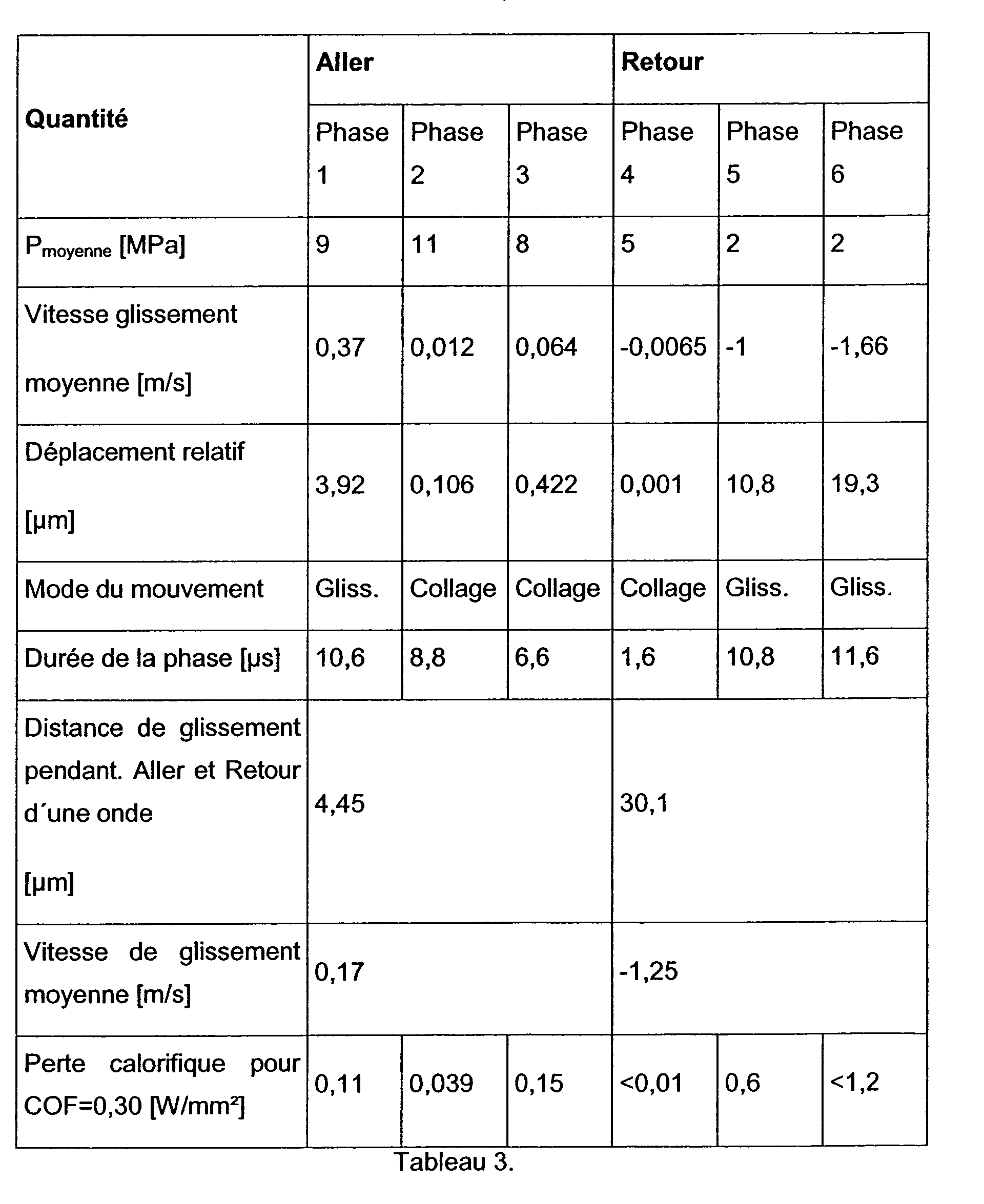
- the high power engine tribosystem contact performs a elliptical rotary movement, with an evolution of pressure and speed slip.
- the movement breaks down into two phases.
- a “go” phase with sliding and pseudo-collage.
- the pressure reaches its maximum (12 MPa for a COF of 0.2) at a relatively low speed (0.5 m / s maximum, then a tendency towards 0).
- This phase corresponds to a power or torque transmission.
- Table 3 shows a 20 kHz cycle cut of 50 ⁇ s in several periods of operation which are called "phases". This cutting was carried out for an engine with a mechanical power of 5 kW.
- the contact can be made according to an elastic deflection roughness, here called “collage” (or “stick” according to the terminology Anglo-Saxon generally used by those skilled in the art).
- the contact can be made in a total slip (or “sliding” or “slip” according to English terminology generally used by those skilled in the art).
- the micro-roughness stick and do not slip. They are resistant to fatigue, since they are stressed elastically. In this case of elastic response of the micro-asperities without sliding, or in the collage mode, the energy dissipated friction is null. The few losses are at the level of small anelastic losses of deformation of the micro-asperities.
- the return of the counterweight during the second phase of the cycle is carried out with calorific densities of the order of 1 W / mm 2 , while remaining below this value, under sliding speeds of the order of 1.7 m / s, while remaining below this value.
- the choice of materials is limited to polymers resistant to high temperatures, certain steels, materials cemented and ceramic, the same properties may be required for coatings.
- the material or coatings must have low wear rates for such stresses.
- the radius of curvature of the micro-roughness must be "large”. A such radius of curvature is obtained by machining.
- the tribosystem Under high sliding speeds (of the order of 1.66 m / s), the tribosystem will “self-code”. It will present a surface finish with a roughness of particular operation. The radii of curvature of the asperities have values determined by speed. Thus, machining allows to obtain a topography predetermined by engine tests.
- Determining the topography values of the rubbing surfaces after testing in an actual engine represents the only method for reduce the initial wear rate. So, if the roughness is requested elastically, the topography remains invariant in time.
- Materials or coatings must have a coefficient of static and dynamic friction between 0.2 and 0.8, in particular they can have a preference value between 0.5 and 0.8.
- COF and wear rate values should never be lower than the minimum values as a function of temperature, pressure and relative humidity.
- couples should not have mechanisms adhesion wear.
- the materials or coatings must have a resistance to fatigue, up to 1.4 10 11 cycles for 2,000 hours accumulated.
- Materials or coatings must be resistant to shear at the coating interface which has a value greater than 12 MPa.
- the previous conditions on the flyweights and rotors are alternatives. They can also preferably be cumulative, the flyweights, the rotors then checking one of the preceding conditions respectively.
- the temperature of the counterweight is minimized by maximization the ratio of the distribution of heat flow to the rotor, this distribution being in accordance with equation (1).
- Possible friction materials are part of ceramics, cemented materials in monolithic forms or coatings deposited on supports of steel, gray cast iron, alloys aluminum and titanium.
- important properties include the ability to store the heat losses, as well as the distribution of the flow of heat between weights and rotors, and this according to the diffusivities of frictional materials.
- the distribution of friction surfaces between the flyweights and the rotors is approximately 1: 2.96. Therefore, one can consider using the same materials and coatings for the rotors (second body) and the weights (first body).
- the (hard) layers deposited by thermal spraying must be machined to final roughness of R a (arithmetic roughness) less than 0.04 ⁇ m. This roughness eliminates an abrasive action and minimizes self-running (or "running-in” according to the English terminology generally used).
- R a arithmetic roughness
- This roughness eliminates an abrasive action and minimizes self-running (or "running-in” according to the English terminology generally used).
- the coatings have a porosity of between 1% by volume and 4% by volume
- the roughness values R pK and R vK (defined according to DIN EN ISO 13565-2: 1998) must be less than 0.030 ⁇ m and 0.070 ⁇ m respectively.
- the thicknesses of the machined layers (functional thickness) deposited by thermal spraying is greater than 50 ⁇ m, and preferably greater than 200 ⁇ m.
- Table 4 shows the materials that are suitable for applications to high power motors.
- the gray fonts of the present invention are hypoeutectic between 2.06% and ⁇ 4.3% by weight of carbon, which contain up to 2.5% by weight of silicon to decompose Fe 3 C.
- Alloyed fonts can contain up to 0-5% of Chrome, and / or 0-6% Vanadium, and / or 0-5% Manganese, and / or 0-4% Molybdenum, and / or 0-2% of Titanium and / or 0-5% of Aluminum, as well as and / or 0-5% of Phosphorus.
- Alloys of the 7xxx series contain as alloying element main between 6% and 14% by weight of Zinc and are heat treated in the “T6” degradation level, or even higher.
- AlSi alloys contain up to 30% by volume of dispersoids, whiskers or fibers of SiC, Al 2 O 3 , Al 4 C 3 , TiB 2 or B 4 C and mixtures of these.
- Al-Fe-V alloys contain alloying elements main up to 15% by weight of iron and up to 10% by weight of V.
- Alumina reinforced with zirconia or ZTA Zirconia Toughened Alumina
- alumina reinforced with zirconia and lamellae or ZPTA Zirconia and Platelet Toughened Alumina
- Anglo-Saxon terminologies generally used by those skilled in the art are alumina matrix ceramics.
- zirconia Toughened Alumina (ZTA) materials typically contain 11 vol .-% Y 2 O 3 -ZrO 2 in 89 vol .-% Al 2 O 3 .
- chromium oxide Cr 2 O 3 forms a SrAl 12-x Cr x O 19 phase when diluted in the alumina crystal.
- an amount of 0.3% by weight of Cr 2 O 3 gives a considerable increase in hardness.
- Titanium oxide having a stoichiometric oxygen defect (planar vacancies). It comes in many forms. Ti n O 2n-1 , with 4 ⁇ n ⁇ 10, n integer as well as Ti n O 2n-1 , with n integer 16 ⁇ n ⁇ 50.
- These two materials are preferably applied as a coating by thermal spraying or are glued to the monolithic counterweight.
- CfC carbon-carbon
- titanium alloys titanium alloys
- WC-6Ni have insufficient heat storage capacity to store frictional losses (see tables 1, 2 and 7).
- Table 5 shows examples of materials that can be used in the tribosystem with heats of 220,000 Joules and a lifespan of 2,000 hours.
- Rotor materials Supports / Substrates for rotors Thermal spray coatings (Ti, Mo) (C, N) + 8-20% Ni / Mo (TM grades 8,10,20) Unlined Globular gray font And bainitic and / or alloy quenching by Cr, Mo, Al, V, Ti, P, Mn -Phases
- Magnéli Ti n O 2n-1 , 4 ⁇ n ⁇ 10, with n integer, or mixtures such as 40% Ti 4 O 7 /60% Ti 5 O 9 ) - WC-17% Co - (Ti, Mo) (C, N) or (Ti, W) (C, N) + Ni / Mo ⁇ 75Cr 3 C 2 / ⁇ 25NiCr -4-6Al 2 O 3 / 4-6TiO 2
- Gray cast iron Lamellar gray cast iron Steels Z6
- the coatings deposited on the counterweight in thermal projection such as WC-17% Co, (Ti, Mo) (C, N) or (Ti, W) (C, N) + Ni / Mo and> 75Cr 3 C 2 / ⁇ 25NiCr have very good wear resistance and have a high thermal conductivity.
- the high thermal conductivity will increase or guide the frictional heat flow to the weights. This represents a risk for the flyweight and active ceramics, in particular piezoelectric.
- these materials will preferably be applied to the rotors.
- the reduction of the absolute weight of the rotors can be achieved in the case a low level of generated heat.
- this strategy will be favored coated aluminum alloys, which reduce the weight of the rotors around 680 to 730 grams.
- Table 6 shows the materials usable for frictional applications in the flyweight / rotor tribosystem for energy dissipated by the motor in an actuation with 220,000 Joules and a lifetime of 2,000 hours.
- Materials for weights Supports / Substrates for weights
- the materials above the thick line are monolithic materials.
- the materials below are materials requiring coating.
- Rotors made of MgO- or Y 2 O 3 -ZrO 2 and Ti n O 2n-1 with n integer (which have a thermal conductivity less than 4W / mK) will mainly guide the heat flow towards each rotor.
- the tensile strength of Ti n O 2n-1 is too low for them to be applied to rotors.
- the SiSiC grades with 8-18% Si by weight and coated will represent an optimal material for the rotor, and for the flyweight when coated with a low thermal conductivity coating.
- SiSiC can be used for rotors and / or weights without coating.
- the WC-6Ni is too heavy to constitute the rotor material which must be relatively light in the case of an engine high power.
Landscapes
- Coating By Spraying Or Casting (AREA)
- Braking Arrangements (AREA)
Abstract
Description
- ils perdent du coefficient de frottement avec la température croissante,
- ils perdent du coefficient de frottement avec la vitesse croissante,
- ils perdent de la résistance à l'usure avec la température croissante,
- ils perdent de la résistance à l'usure avec la vitesse croissante,
- ils ont une charge limite pour une usure douce limitée à 2-3 MPa,
- ils ont des propriétés tribologiques sensibles à l'humidité,
- ils ont un coefficient de frottement (COF) ou d'usure variant différemment et de façon imprévisible en fonction de la vitesse, de la température et de la pression géométrique, et
- ils ont un coefficient d'usure (Kv) supérieur à 10-5 mm3/Nm.
- de bonnes propriétés de frottement et des faibles taux d'usure ;
- de bonnes propriétés calorifiques ;
- une bonne répartition du flux de chaleur ;
- de bonnes propriétés mécaniques, notamment une bonne résistance à la fatigue ; et
- de bonnes propriétés anti-corrosion.
- chaque masselotte présente une capacité thermique massique supérieure à 0.5 [J/g/K] ;
- la capacité calorifique de chaque rotor est supérieure à 2.5 [J/cm3/K] ;
- le matériau de chaque masselotte et de chaque rotor, ce matériau étant
non revêtu, comporte du :
- (Ti,Mo)(C,N) + 8-20 % liant Ni/Mo (nuances TM 8,10,20) ; et/ou
- WC-6Ni ; et/ou
- de l'alumine renforcée par de la zircone (ZTA, ZTPA); et/ou
- AIN ; et/ou
- carbure de silicium infiltré au silicium SiSiC, avec 8-20% en poids de silicium.
- le matériau de chaque masselotte comporte du :
- MgO-ZrO2 ; et/ou
- du nitrure l'aluminium par frittage à chaud HIP-AIN; et/ou
- du nitrure l'aluminium par frittage sous pression GPS-AIN; et/ou-
- de l'alumine renforcée par de la zircone (ZTA, ZTPA); et/ou
- une phase Magnéli (TinO2n-1, 4≤n≤10 avec n entier, ou des mélanges du type 40%Ti4O7/60%Ti5O9) ;
- le matériau de chaque masselotte et de chaque rotor est revêtu en
projection thermique par un matériau qui comporte du/des :
- phases Magnéli (TinO2n-1, 4≤n≤10 avec n entier, ou des mélanges du type 40%Ti4O7/60%Ti5O9) ; et/ou
- WC-17%Co ; et/ou
- (Ti,Mo)(C,N) ou (Ti,W)(C,N) + un liant Ni/Mo ; et/ou
- >75Cr3C2/<25NiCr ; et/ou
- 4-6Al2O3/6-4TiO2; et/ou
- le matériau de chaque masselotte et de chaque rotor comporte du/des :
- Fontes grises globulaires et/ou des fontes grises lamellaires et/ou avec une trempe bainitique et/ou alliées par Cr, Mo, Al, V, Ti ; et/ou
- Aciers (Z6CND16-05-01) ; et/ou
- Aciers X5CrNiCu15-5 ; et/ou
- Alliages AlSi + SiC/Al2O3 ; et/ou
- Alliages AlSi + dispersoïdes Al4C3/Al2O3/TiB2; et/ou
- Alliages Al-Fe-V ; et/ou
- Aluminiums série 6xxx en T6 et supérieure et série 7xxx ; et/ou
- du carbure de silicium infiltré au silicium SiSiC ; et/ou
- Alliages de titanium, UNS R5xxxx, tels que TiAl6V4.
- les couches dures déposées par projection thermique doivent être usinées vers des rugosités finales de Ra (rugosité arithmétique) inférieures à 0,04 µm, l'épaisseur des couches usinées étant supérieures à 50 µm ;et
- les valeurs des rugosités RpK et RvK de la norme DIN EN ISO 13565-2:1998 sont inférieures à 0,030 µm et 0,070 µm respectivement.
- la figure 1, déjà commentée, représente schématiquement une vue en élévation d'un moteur haute puissance ;
- la figure 2, déjà commentée, représente schématiquement une vue de profil d'un moteur haute puissance ;
- la figure 3, déjà commentée, représente schématiquement une vue en coupe d'un pétale d'un moteur à vibrations ; et
- la figure 4, déjà commentée, représente schématiquement le système masses ressorts constitué par le pétale de la figure 3.
- X5CrNiCu15-5;
- X5CrNiCuNb 17-4-4 ; DIN EN 1.4521/1.4548 ; ou DIN EN 1.4542 ;
- X5 CrNiCuNb 16-4,
- Z7 CNU 15-05 ou Z7 CNU 17-04, qui donnent une capacité calorifique de 20.640 Joules de l'ensemble des masselottes en acier.
| Matériaux pour masselotte | Accumulation calorique pour 10 grammes et ΔT= 150K [J] | Accumulation calorique pour l'ensemble des 32 masselottes [J] |
| WC-6Ni | 375 | 12.000 |
| Z6CN D 16-05-01 | 645 | 20.640 |
| (Ti,Mo)(C,N) (TM10) | 750 | 24.000 |
| Fonte grise globulaire | 930 | 29.760 |
| MgO-ZrO2 | 1.020 | 32.640 |
| TinO2n-1 avec n entier | 1.200 | 38.400 |
| Si3N4 | 1.200 | 38.400 |
| Aluminium | 1.320 | 42.240 |
| Zirconia Toughened Alumina (ZTA) | 1.330 | 42.560 |
| AlSi + SiC/Al2O3 | 1.350 | 43.200 |
| SiSiC | 1.650 | 52.800 |

| Matériaux | Densité [g/cm3] | Conductivité thermique [W/mK] | Capacité calorifique [kJ/kg] (kJ/dm3) | Capacité calorifique 2 rotors [kJ] | Opération maximale [°C] | Capacité thermique massique [J/g/K] |
| Cfibre-Cmatrice | 1,8 | 8-20 | 124 (220) | 56,2 | 1400 | 0,62 (1,8 à 1400°C) |
| TiAl6V4 | 4,6 | 6,7 | 105 (483) | 120,1 | 1000 | 0,523 |
| Aluminium 6xxx | 2,7 | 189 | 178 (480) | 121,0 | 300 | 0,89 |
| AIN | 3,3 | >170 | 160 (521) | 133,0 | 1450 | 0,8 |
| AlSi + SiC/Al2O3 | 2,9 | 120-140 (Al2O3) ~180 (SiC) | 180 (520) | 131,3 | 400 | 0,9 |
| Si3N4 | 3,2 | → >100 | 160 (528) | 128,9 | 1300 | 0,8 |
| (Ti,Mo)(C,N) | 6,5 | 60 | 92 (560) | 150,1 | >1000 | 0,46 (0,56 à 200°C) |
| Z6CND16-05-01 | 7,7 | 15 | 86 (650) | 166,3 | 600 | 0,43 |
| SiSiC | 3,1 | >120 | 220 (680) | 171,4 | 1400 | 1,1 (1,4 à 1000°C) |
| WC-6Ni | 14,9 | 80 | 50 (745) | 187,4 | 1000 | 0,25 (0,35 à 200°C) |
| Fontes grises | 7,2 | 50 (FGL) 38 (FGS) | 100 (810) 124 (970) | 188,6 (223,9) | 700 700 | 0,52 (FGL) 0,62 (FGS) |
| MgO-ZrO2 | 5,7 | 2 | 136 (775) | 196,4 | 1000 | 0,6-0,7 |
| TinO2n-1 | 5,2 | -5 | 160 (920) | 221,1 | 700 (1400) | 0,8 |
MICROCONTACT « COLLAGE » (OU « STICK ») ET « GLISSEMENT » (OU « SLIP »).
- invariantes avec l'humidité relative ;
- invariantes à la température, et ce jusqu'à 200°C ; et
- invariantes à des pressions de contact nominale P inférieures à 12 MPa.
| Matériaux pour masselottes et rotors | ||
| Supports/Substrats | Revêtements en projection thermique | |
| (Ti,Mo)(C,N) + 8-20 % NiMo (nuances TM 8,10,20) | Non revêtu | |
| WC-6Ni | Non revêtu | |
| MgO-ZrO2 (masselotte) | Non revêtu | |
| HIP-AIN ou GPS- AIN (masselotte) | Non revêtu | |
| Fontes grises globulaire | Et trempe bainitique et/ou alliées par Cr, Mo, Al, V, Ti | -Phases Magnéli (TinO2n-1, 4≤n≤10, avec n entier ou mélanges tels que 40%Ti4O7/60%Ti5O9) -WC-17%Co -(Ti,Mo)(C,N) ou (Ti,W)(C,N) + Ni/Mo →75Cr3C2/<25NiCr - 4-6Al2O3/6-4TiO2 |
| Fontes grises lamellaire | ||
| Aciers (Z6CND16-05-01) | ||
| Aciers XSCrNiCu15-5 | ||
| Alliages Alsi + SiC/Al2O3 | ||
| Alliages Alsi+dispersoïdes Al4C3/Al2O3/TiB2 | ||
| Alliages Al-Fe-V | ||
| Aluminiums série 6xxx en T6 et supérieure et série 7xxx | ||
| Alliages de titanium, UNS R5xxxx, tels que TiAl6V4. |
ou nitrure d'aluminium par frittage sous pression GPS (Gas Pressure Sintered)-AIN.
TinO2n-1, avec 4 ≤ n ≤ 10, n entier
ainsi que
TinO2n-1, avec n entier 16 ≤ n ≤ 50.
| Matériaux pour rotors | ||
| Supports/Substrats pour rotors | Revêtements en projection thermique | |
| (Ti,Mo)(C,N) + 8-20 % Ni/Mo (nuances TM 8,10,20) | Non-revêtu | |
| Fontes grises globulaire | Et trempe bainitique et/ou alliées par Cr, Mo, Al, V, Ti, P, Mn | -Phases Magnéli (TinO2n-1, 4≤n≤10, avec n entier, ou mélanges tels que 40%Ti4O7/60%Ti5O9) - WC-17%Co - (Ti,Mo)(C,N) ou (Ti,W)(C,N) + Ni/Mo →75Cr3C2/<25NiCr -4-6Al2O3/4-6TiO2 |
| Fontes grises Fontes grises lamellaire | ||
| Aciers (Z6CND16-05-01 ) | ||
| Aciers X5CrNiCu15-5 | ||
| Alliages AlSi + SiC/Al2O3 | ||
| Alliages AlSi + dispersoïdes : Al4C3/Al2O3/TiB2 | ||
| Alliages Al-Fe-V | ||
| Aluminiums série 6xxx en T6 et supérieure et série 7xxx |
WC-17%Co, (Ti,Mo)(C,N) ou
(Ti,W)(C,N) + Ni/Mo et >75Cr3C2/<25NiCr ont une très bonne résistance à l'usure et présentent une conductivité thermique élevée. La conductivité thermique élevée augmentera ou guidera le flux de chaleur frictionnelle vers les masselottes. Ceci représente un risque pour la masselotte et les céramiques actives, notamment piézo-électriques. Ainsi, ces matériaux s'appliqueront de préférence sur les rotors.
| Matériaux pour masselottes | |
| Supports/Substrats pour masselottes | Revêtements en projection thermique |
| Zirconia toughened Alumina (ZTA, ZPTA) | Non revêtu |
| (TinO2n-1, 4≤n≤10, avec n entier, ou mélanges du type 40%Ti4O7/60%Ti5O9) | Non revêtu |
| AIN par frittage à chaud (HIP-AIN) | Non revêtu |
| AIN par frittage sous pression GPS-AIN | Non revêtu |
| SiSiC (pour certaines applications faible chaleur) | Non revêtu |
| MgO-ZrO2 | Non revêtu |
| (Ti,Mo)(C,N) + 8-20 % Ni/Mo (nuances TM 8,10,20) | Non revêtu |
| Aciers X5CrNiCu15-5 | -Phases Magnéli (TinO2n-1, 4≤n≤10, ou mélanges tels que 40%Ti4O7/60%Ti5O9) -4-6Al2O3/6-4TiO2 [-WC-17%Co -(Ti,Mo)(C,N) ou (Ti,W)(C,N) + Ni/Mo ->75Cr3C2/<25NiCr] |
| Fontes grises globulaires | Et trempe bainitique et/ou alliées par Cr, Mo, Al, V, Ti, P, Mn |
| Fontes grises lamellaires | |
| Aciers (Z6CND16-05-01) | |
| SiSiC |
| Matériaux | Poids des 2 rotors [kg] | Capacité calorifique des 2 rotors [kJ] | Rapport Calorifique/ Poids [kJ/kg] |
| Cfibre-Cmatrice | 0,452 | 56,2 | 124 |
| TiAl6V4 | 1,156 | 120,1 | 103 |
| Aluminium 6xxx | 0,679 | 121,0 | 178 |
| AIN | 0,830 | 133,0 | 160 |
| AlSi + SiC/Al2O3 | 0,729 | 131,3 | 179 |
| Si3N4 | 0,805 | 128,9 | 160 |
| (Ti,Mo)(C,N) | 1,635 | 150,1 | 92 |
| Z6CND16-05-01 | 1,937 | 166,3 | 86 |
| SiSiC | 0,779 | 171,4 | 219 |
| WC-6Ni | 3,748 | 187,4 | 50 |
| Fontes grises FGL | 1,811 | 188,6 | 103 |
| MgO-ZrO2 | 1,434 | 196,4 | 137 |
| Fontes grises FGS | 1,811 | 223,9 | 124 |
| TinO2n-1 | 1,313 | 221,1 | 168 |
Claims (9)
- Système, notamment adapté pour les moteurs hautes puissances, comportant au moins un rotor (1a ; 1b) et des moyens (4a, 4b ; 5a, 5b) comportant des éléments actifs (7, 8) aptes à mettre en rotation le/les rotor(s) (1a ; 1b) par leur déformation synchronisée, lesdits moyens de mise en rotation du/des rotor(s) comportant au moins un pétale (6) comportant une masselotte (11), caractérisé en ce que le matériau de chaque masselotte (11) est tel qu'elle présente une capacité thermique massique (Cp22C) supérieure à 0,35 [J/g/K], et/ou le matériau de chaque rotor (1a ; 1b) est tel qu'il présente une capacité calorifique supérieure à 2 [J/cm3/K].
- Système selon la revendication 1, caractérisé en ce que chaque masselotte (11) présente une capacité thermique massique supérieure à 0.5 [J/g/K].
- Système selon l'une des revendications 1 ou 2, caractérisé en ce que la capacité calorifique de chaque rotor (1a ; 1b) est supérieure à 2.5 [J/cm3/K].
- Système selon l'une des revendications 1 à 3, caractérisé en ce que le matériau de chaque masselotte (11) et de chaque rotor (1a; 1b), ce matériau étant non revêtu, comporte du :(Ti,Mo)(C,N) + 8-20 % liant Ni/Mo (nuances TM 8,10,20) ; et/ouWC-6Ni ; et/oude l'alumine renforcée par de la zircone (ZTA, ZTPA); et/ouAIN ; et/oucarbure de silicium infiltré au silicium SiSiC, avec 8-20% en poids de silicium.
- Système selon l'une des revendications 1 à 4, caractérisé en ce que le matériau de chaque masselotte (11) comporte du :MgO-ZrO2; et/oude l'alumine renforcée par de la zircone (ZTA, ZTPA); et/oudu nitrure l'aluminium par frittage à chaud HIP-AIN; et/oudu nitrure l'aluminium par frittage sous pression GPS-AIN; et/ou-une phase Magnéli (TinO2n-1, 4≤n≤10 avec n entier, ou des mélanges du type 40%Ti4O7/60%Ti5O9).
- Système selon l'une des revendications 1 à 3, caractérisé en ce que le matériau de chaque masselotte (11) et de chaque rotor (1a ; 1b) est revêtu en projection thermique par un matériau qui comporte du/des :phases Magnéli (TinO2n-1, 4≤n≤10 avec n entier, ou des mélanges du type 40%Ti4O7/60%Ti5O9) ; et/ouWC-17%Co ; et/ou(Ti,Mo)(C,N) ou (Ti,W)(C,N) + un liant Ni/Mo ; et/ou>75Cr3C2/<25NiCr ; et/ou4-6Al2O3/6-4TiO2.
- Système selon la revendication 6, caractérisé en ce que le matériau de chaque masselotte (11) et de chaque rotor (1a ; 1b) comporte du/des :Fontes grises globulaires et/ou des fontes grises lamellaires et/ou avec une trempe bainitique et/ou alliées par Cr, Mo, Al, V, Ti ; et/ouAciers (Z6CND16-05-01 ) ; et/ouAciers X5CrNiCu15-5 ; et/ouAlliages AlSi + SiC/Al2O3; et/ouAlliages AlSi + dispersoïdes Al4C3/Al2O3/TiB2; et/ouAlliages Al-Fe-V ; et/ouAluminiums série 6xxx en T6 et supérieure et série 7xxx ; et/oudu carbure de silicium infiltré au silicium SiSiC ; et/ouAlliages de titanium, UNS R5xxxx, tels que TiAl6V4.
- Système selon la revendication 6, caractérisé en ce que les couches dures déposées par projection thermique doivent être usinées vers des rugosités finales de Ra (rugosité arithmétique) inférieures à 0,04 µm, l'épaisseur des couches usinées étant supérieures à 50 µm.
- Système selon la revendication 6, caractérisé en ce que les valeurs des rugosités RpK et RvK de la norme DIN EN ISO 13565-2:1998 sont inférieures à 0,030 µm et 0,070 µm respectivement.
Applications Claiming Priority (2)
| Application Number | Priority Date | Filing Date | Title |
|---|---|---|---|
| FR0211635A FR2844933B1 (fr) | 2002-09-20 | 2002-09-20 | Perfectionnements aux moteurs hautes puissances. |
| FR0211635 | 2002-09-20 |
Publications (2)
| Publication Number | Publication Date |
|---|---|
| EP1411625A1 true EP1411625A1 (fr) | 2004-04-21 |
| EP1411625B1 EP1411625B1 (fr) | 2008-04-23 |
Family
ID=31970831
Family Applications (1)
| Application Number | Title | Priority Date | Filing Date |
|---|---|---|---|
| EP03292264A Expired - Lifetime EP1411625B1 (fr) | 2002-09-20 | 2003-09-15 | Perfectionnements aux moteurs hautes puissances |
Country Status (5)
| Country | Link |
|---|---|
| US (1) | US6888274B2 (fr) |
| EP (1) | EP1411625B1 (fr) |
| CA (1) | CA2441020C (fr) |
| DE (1) | DE60320505T2 (fr) |
| FR (1) | FR2844933B1 (fr) |
Families Citing this family (10)
| Publication number | Priority date | Publication date | Assignee | Title |
|---|---|---|---|---|
| JP4041083B2 (ja) * | 2004-03-25 | 2008-01-30 | ヤマウチ株式会社 | 抄紙機用プレスロール、その製造方法、湿紙に対するプレス方法および抄紙機用プレスロールの表面研磨方法 |
| DE102004046320A1 (de) * | 2004-09-17 | 2006-05-11 | Bundesanstalt für Materialforschung und -Prüfung (BAM) | Reibmaterialien/Tribowerkstoffe für radiale und axiale Folienlager |
| US7398411B2 (en) * | 2005-05-12 | 2008-07-08 | Schweitzer Engineering Laboratories, Inc. | Self-calibrating time code generator |
| FR2886487B1 (fr) | 2005-05-31 | 2007-07-13 | Sagem Defense Securite | Perfectionnements aux rotors de moteurs hautes puissances |
| FR2886486B1 (fr) | 2005-05-31 | 2007-07-13 | Sagem Defense Securite | Perfectionnement aux materiaux de friction |
| WO2012167316A1 (fr) * | 2011-06-10 | 2012-12-13 | Axiflux Holdings Pty Ltd | Moteur/générateur électrique |
| CN111585385B (zh) * | 2020-05-27 | 2021-07-30 | 苏州维斯勒姆智能科技有限公司 | 一种电磁摩擦抵消传动辅助装置 |
| KR20220033650A (ko) * | 2020-09-09 | 2022-03-17 | 삼성디스플레이 주식회사 | 반사 전극 및 이를 포함하는 표시 장치 |
| US20240173743A1 (en) * | 2022-11-29 | 2024-05-30 | Raytheon Technologies Corporation | Slot with coating and method of coating a slot |
| US12138720B2 (en) | 2022-12-13 | 2024-11-12 | Rtx Corporation | Article and method of making an article by chemical vapor infiltration |
Citations (5)
| Publication number | Priority date | Publication date | Assignee | Title |
|---|---|---|---|---|
| JPH0241669A (ja) * | 1988-07-29 | 1990-02-09 | Canon Inc | インチワームモータ |
| JPH0433578A (ja) * | 1990-05-30 | 1992-02-04 | Mitsubishi Steel Mfg Co Ltd | 超音波モータ用ステータ |
| US5329201A (en) * | 1991-11-29 | 1994-07-12 | Canon Kabushiki Kaisha | Vibration driven motor |
| US6107724A (en) * | 1996-09-09 | 2000-08-22 | Canon Kabushiki Kaisha | Vibration wave driving device and apparatus having the same |
| FR2806225A1 (fr) * | 2000-03-10 | 2001-09-14 | Sagem | Moteurs a vibrations |
Family Cites Families (4)
| Publication number | Priority date | Publication date | Assignee | Title |
|---|---|---|---|---|
| US5731645A (en) * | 1996-02-05 | 1998-03-24 | Magnetic Bearing Technologies, Inc. | Integrated motor/generator/flywheel utilizing a solid steel rotor |
| FR2782420B1 (fr) * | 1998-08-13 | 2003-01-17 | Sfim Ind | Perfectionnements aux moteurs a vibrations |
| US6140719A (en) * | 1999-02-17 | 2000-10-31 | American Superconductor Corporation | High temperature superconducting rotor for a synchronous machine |
| DE10318856B3 (de) * | 2003-04-25 | 2004-07-29 | Hilti Ag | Treibgas für brennkraftbetriebene Werkzeuge und Verwendung mindestens eines Isoparaffins und/oder brennbaren synthetischen Öls als rückstandslos zu verwendenden Schmierstoff in solchen Teibgasen |
-
2002
- 2002-09-20 FR FR0211635A patent/FR2844933B1/fr not_active Expired - Fee Related
-
2003
- 2003-09-15 DE DE60320505T patent/DE60320505T2/de not_active Expired - Lifetime
- 2003-09-15 EP EP03292264A patent/EP1411625B1/fr not_active Expired - Lifetime
- 2003-09-17 CA CA2441020A patent/CA2441020C/fr not_active Expired - Fee Related
- 2003-09-19 US US10/666,481 patent/US6888274B2/en not_active Expired - Fee Related
Patent Citations (5)
| Publication number | Priority date | Publication date | Assignee | Title |
|---|---|---|---|---|
| JPH0241669A (ja) * | 1988-07-29 | 1990-02-09 | Canon Inc | インチワームモータ |
| JPH0433578A (ja) * | 1990-05-30 | 1992-02-04 | Mitsubishi Steel Mfg Co Ltd | 超音波モータ用ステータ |
| US5329201A (en) * | 1991-11-29 | 1994-07-12 | Canon Kabushiki Kaisha | Vibration driven motor |
| US6107724A (en) * | 1996-09-09 | 2000-08-22 | Canon Kabushiki Kaisha | Vibration wave driving device and apparatus having the same |
| FR2806225A1 (fr) * | 2000-03-10 | 2001-09-14 | Sagem | Moteurs a vibrations |
Non-Patent Citations (2)
| Title |
|---|
| PATENT ABSTRACTS OF JAPAN vol. 014, no. 200 (E - 0920) 24 April 1990 (1990-04-24) * |
| PATENT ABSTRACTS OF JAPAN vol. 016, no. 210 (E - 1203) 19 May 1992 (1992-05-19) * |
Also Published As
| Publication number | Publication date |
|---|---|
| US20040113520A1 (en) | 2004-06-17 |
| DE60320505D1 (de) | 2008-06-05 |
| CA2441020A1 (fr) | 2004-03-20 |
| EP1411625B1 (fr) | 2008-04-23 |
| US6888274B2 (en) | 2005-05-03 |
| FR2844933A1 (fr) | 2004-03-26 |
| CA2441020C (fr) | 2010-03-16 |
| FR2844933B1 (fr) | 2004-11-26 |
| DE60320505T2 (de) | 2009-06-10 |
Similar Documents
| Publication | Publication Date | Title |
|---|---|---|
| EP0674114B1 (fr) | Disque multimatériaux pour freinage à haute énergie | |
| EP1411625B1 (fr) | Perfectionnements aux moteurs hautes puissances | |
| US7572313B2 (en) | Ternary carbide and nitride composites having tribological applications and methods of making same | |
| Hooke et al. | The friction and wear of polymers in non-conformal contacts | |
| CN107523716B (zh) | 用于摩擦衬片的烧结摩擦材料 | |
| FR2910610A1 (fr) | Matiere de blindage et procede pour sa production | |
| FR2623263A1 (fr) | Frein pour vehicules routiers, ferroviaires et aeronefs | |
| EP1966107A2 (fr) | Assemblage par brasage entre une piece metallique a base de titane et une piece en materiau ceramique a base de carbure de silicium (sic) et/ou de carbone | |
| EP1729404B1 (fr) | Perfectionnements aux rotors de moteurs hautes puissances | |
| FR2806765A1 (fr) | Portee lisse sans plomb et procede pour sa fabrication | |
| AU2021101683A4 (en) | A process for fabricating aluminum, boron carbide-based aluminum matrix composites using powder metallurgy route | |
| FR2765244A1 (fr) | Materiau de frottement | |
| EP1729354B1 (fr) | Perfectionnement aux matériaux des cylindres des actionneurs à piston actif | |
| EP1729353B1 (fr) | Perfectionnement aux materiaux de friction | |
| FR2805583A1 (fr) | Piece de friction metallique comportant une couche a proprietes de frottement et d'usure ameliorees | |
| FR2723193A1 (fr) | Materiau de protection balistique | |
| WO2023144454A1 (fr) | Plaquette de frein a performances améliorées | |
| EP4457448A1 (fr) | Disque de frein perfectionne | |
| CA2548641C (fr) | Perfectionnement aux materiaux des actionneurs a piston actif | |
| FR2818663A1 (fr) | Alliage de fonte grise pour un element de friction d'un embrayage a friction et element ainsi realise | |
| WO2024223240A1 (fr) | Disque de frein pour véhicule automobile et procédé de fabrication d'un tel disque de frein | |
| FR2717875A1 (fr) | Disque multimatériaux pour freinage à haute énergie. | |
| FR2805582A1 (fr) | Materiaux de friction pour systeme de freinage et d'embrayage comprenant un materiau multifonctionnel | |
| Patil et al. | Study of Tribological Performance of Eutectic Al-Si Alloy Composite Enhanced With Combination of Kyanite and Graphite Reinforcement | |
| KR20250014408A (ko) | 자동차 부품용 주철 합금 소재 및 그 자동차 부품 |
Legal Events
| Date | Code | Title | Description |
|---|---|---|---|
| PUAI | Public reference made under article 153(3) epc to a published international application that has entered the european phase |
Free format text: ORIGINAL CODE: 0009012 |
|
| AK | Designated contracting states |
Kind code of ref document: A1 Designated state(s): AT BE BG CH CY CZ DE DK EE ES FI FR GB GR HU IE IT LI LU MC NL PT RO SE SI SK TR |
|
| AX | Request for extension of the european patent |
Extension state: AL LT LV MK |
|
| 17P | Request for examination filed |
Effective date: 20041015 |
|
| AKX | Designation fees paid |
Designated state(s): DE ES GB IT |
|
| RAP1 | Party data changed (applicant data changed or rights of an application transferred) |
Owner name: SAGEM DEFENSE SECURITE |
|
| 17Q | First examination report despatched |
Effective date: 20060919 |
|
| GRAP | Despatch of communication of intention to grant a patent |
Free format text: ORIGINAL CODE: EPIDOSNIGR1 |
|
| RIC1 | Information provided on ipc code assigned before grant |
Ipc: H01L 41/09 20060101ALN20071002BHEP Ipc: H02N 2/10 20060101AFI20071002BHEP |
|
| RIN1 | Information on inventor provided before grant (corrected) |
Inventor name: AUDREN, JEAN-THIERRY Inventor name: WOYDT, MATHIAS Inventor name: HODAR, FRANCOIS |
|
| GRAS | Grant fee paid |
Free format text: ORIGINAL CODE: EPIDOSNIGR3 |
|
| GRAA | (expected) grant |
Free format text: ORIGINAL CODE: 0009210 |
|
| AK | Designated contracting states |
Kind code of ref document: B1 Designated state(s): DE ES GB IT |
|
| REG | Reference to a national code |
Ref country code: GB Ref legal event code: FG4D Free format text: NOT ENGLISH |
|
| REF | Corresponds to: |
Ref document number: 60320505 Country of ref document: DE Date of ref document: 20080605 Kind code of ref document: P |
|
| PG25 | Lapsed in a contracting state [announced via postgrant information from national office to epo] |
Ref country code: ES Free format text: LAPSE BECAUSE OF FAILURE TO SUBMIT A TRANSLATION OF THE DESCRIPTION OR TO PAY THE FEE WITHIN THE PRESCRIBED TIME-LIMIT Effective date: 20080803 |
|
| PLBE | No opposition filed within time limit |
Free format text: ORIGINAL CODE: 0009261 |
|
| STAA | Information on the status of an ep patent application or granted ep patent |
Free format text: STATUS: NO OPPOSITION FILED WITHIN TIME LIMIT |
|
| 26N | No opposition filed |
Effective date: 20090126 |
|
| PG25 | Lapsed in a contracting state [announced via postgrant information from national office to epo] |
Ref country code: IT Free format text: LAPSE BECAUSE OF FAILURE TO SUBMIT A TRANSLATION OF THE DESCRIPTION OR TO PAY THE FEE WITHIN THE PRESCRIBED TIME-LIMIT Effective date: 20080423 |
|
| PGFP | Annual fee paid to national office [announced via postgrant information from national office to epo] |
Ref country code: DE Payment date: 20150820 Year of fee payment: 13 Ref country code: GB Payment date: 20150825 Year of fee payment: 13 |
|
| REG | Reference to a national code |
Ref country code: DE Ref legal event code: R119 Ref document number: 60320505 Country of ref document: DE |
|
| GBPC | Gb: european patent ceased through non-payment of renewal fee |
Effective date: 20160915 |
|
| PG25 | Lapsed in a contracting state [announced via postgrant information from national office to epo] |
Ref country code: DE Free format text: LAPSE BECAUSE OF NON-PAYMENT OF DUE FEES Effective date: 20170401 Ref country code: GB Free format text: LAPSE BECAUSE OF NON-PAYMENT OF DUE FEES Effective date: 20160915 |