EP1411112B1 - Highviscosity liquid detergent composition containing a thickener comprising hydroxyalkylated polyhydric alcohol ether compound - Google Patents
Highviscosity liquid detergent composition containing a thickener comprising hydroxyalkylated polyhydric alcohol ether compound Download PDFInfo
- Publication number
- EP1411112B1 EP1411112B1 EP02746120A EP02746120A EP1411112B1 EP 1411112 B1 EP1411112 B1 EP 1411112B1 EP 02746120 A EP02746120 A EP 02746120A EP 02746120 A EP02746120 A EP 02746120A EP 1411112 B1 EP1411112 B1 EP 1411112B1
- Authority
- EP
- European Patent Office
- Prior art keywords
- composition
- liquid detergent
- detergent composition
- formula
- polyhydric alcohol
- Prior art date
- Legal status (The legal status is an assumption and is not a legal conclusion. Google has not performed a legal analysis and makes no representation as to the accuracy of the status listed.)
- Expired - Lifetime
Links
- 239000000203 mixture Substances 0.000 title claims description 187
- 239000002562 thickening agent Substances 0.000 title claims description 87
- 239000003599 detergent Substances 0.000 title claims description 78
- 150000005846 sugar alcohols Polymers 0.000 title claims description 56
- 239000007788 liquid Substances 0.000 title claims description 47
- RTZKZFJDLAIYFH-UHFFFAOYSA-N ether Substances CCOCC RTZKZFJDLAIYFH-UHFFFAOYSA-N 0.000 title description 54
- -1 ether compound Chemical class 0.000 title description 41
- 150000001875 compounds Chemical class 0.000 claims description 64
- 125000002768 hydroxyalkyl group Chemical group 0.000 claims description 50
- 239000002563 ionic surfactant Substances 0.000 claims description 38
- 239000002280 amphoteric surfactant Substances 0.000 claims description 27
- PUPZLCDOIYMWBV-UHFFFAOYSA-N (+/-)-1,3-Butanediol Chemical class CC(O)CCO PUPZLCDOIYMWBV-UHFFFAOYSA-N 0.000 claims description 25
- 150000002170 ethers Chemical class 0.000 claims description 20
- 125000004432 carbon atom Chemical group C* 0.000 claims description 18
- DNIAPMSPPWPWGF-UHFFFAOYSA-N monopropylene glycol Natural products CC(O)CO DNIAPMSPPWPWGF-UHFFFAOYSA-N 0.000 claims description 14
- 125000000217 alkyl group Chemical group 0.000 claims description 13
- 229960004063 propylene glycol Drugs 0.000 claims description 12
- 235000013772 propylene glycol Nutrition 0.000 claims description 12
- DNIAPMSPPWPWGF-GSVOUGTGSA-N (R)-(-)-Propylene glycol Chemical compound C[C@@H](O)CO DNIAPMSPPWPWGF-GSVOUGTGSA-N 0.000 claims description 11
- 239000003945 anionic surfactant Substances 0.000 claims description 11
- 125000002496 methyl group Chemical group [H]C([H])([H])* 0.000 claims description 11
- 125000003178 carboxy group Chemical group [H]OC(*)=O 0.000 claims description 10
- 239000007795 chemical reaction product Substances 0.000 claims description 9
- 125000004435 hydrogen atom Chemical group [H]* 0.000 claims description 9
- 239000004593 Epoxy Substances 0.000 claims description 8
- 239000002253 acid Substances 0.000 claims description 8
- 125000003342 alkenyl group Chemical group 0.000 claims description 8
- 235000019437 butane-1,3-diol Nutrition 0.000 claims description 8
- 238000006482 condensation reaction Methods 0.000 claims description 7
- 229910052783 alkali metal Inorganic materials 0.000 claims description 6
- 150000001340 alkali metals Chemical group 0.000 claims description 6
- 125000001495 ethyl group Chemical group [H]C([H])([H])C([H])([H])* 0.000 claims description 5
- 125000001424 substituent group Chemical group 0.000 claims description 5
- 238000010586 diagram Methods 0.000 claims description 4
- 125000001931 aliphatic group Chemical group 0.000 claims description 2
- 229910052799 carbon Inorganic materials 0.000 claims description 2
- 125000005313 fatty acid group Chemical group 0.000 claims 2
- 238000006243 chemical reaction Methods 0.000 description 62
- KRKNYBCHXYNGOX-UHFFFAOYSA-N citric acid Chemical compound OC(=O)CC(O)(C(O)=O)CC(O)=O KRKNYBCHXYNGOX-UHFFFAOYSA-N 0.000 description 60
- POULHZVOKOAJMA-UHFFFAOYSA-N dodecanoic acid Chemical compound CCCCCCCCCCCC(O)=O POULHZVOKOAJMA-UHFFFAOYSA-N 0.000 description 48
- 230000008719 thickening Effects 0.000 description 43
- 230000000694 effects Effects 0.000 description 40
- 239000002453 shampoo Substances 0.000 description 36
- PEDCQBHIVMGVHV-UHFFFAOYSA-N Glycerine Chemical compound OCC(O)CO PEDCQBHIVMGVHV-UHFFFAOYSA-N 0.000 description 33
- MPGABYXKKCLIRW-UHFFFAOYSA-N 2-decyloxirane Chemical compound CCCCCCCCCCC1CO1 MPGABYXKKCLIRW-UHFFFAOYSA-N 0.000 description 30
- XLYOFNOQVPJJNP-UHFFFAOYSA-N water Substances O XLYOFNOQVPJJNP-UHFFFAOYSA-N 0.000 description 29
- 239000012295 chemical reaction liquid Substances 0.000 description 28
- 150000004665 fatty acids Chemical class 0.000 description 26
- LXCFILQKKLGQFO-UHFFFAOYSA-N methylparaben Chemical compound COC(=O)C1=CC=C(O)C=C1 LXCFILQKKLGQFO-UHFFFAOYSA-N 0.000 description 26
- 239000005639 Lauric acid Substances 0.000 description 24
- 239000004094 surface-active agent Substances 0.000 description 24
- 235000014113 dietary fatty acids Nutrition 0.000 description 22
- 239000000194 fatty acid Substances 0.000 description 22
- 229930195729 fatty acid Natural products 0.000 description 22
- QELSKZZBTMNZEB-UHFFFAOYSA-N propylparaben Chemical compound CCCOC(=O)C1=CC=C(O)C=C1 QELSKZZBTMNZEB-UHFFFAOYSA-N 0.000 description 20
- QTBSBXVTEAMEQO-UHFFFAOYSA-N Acetic acid Chemical compound CC(O)=O QTBSBXVTEAMEQO-UHFFFAOYSA-N 0.000 description 18
- LYCAIKOWRPUZTN-UHFFFAOYSA-N Ethylene glycol Chemical compound OCCO LYCAIKOWRPUZTN-UHFFFAOYSA-N 0.000 description 18
- UXVMQQNJUSDDNG-UHFFFAOYSA-L Calcium chloride Chemical compound [Cl-].[Cl-].[Ca+2] UXVMQQNJUSDDNG-UHFFFAOYSA-L 0.000 description 17
- 239000001110 calcium chloride Substances 0.000 description 17
- 229910001628 calcium chloride Inorganic materials 0.000 description 17
- 230000000052 comparative effect Effects 0.000 description 17
- 239000011369 resultant mixture Substances 0.000 description 17
- HFZMYZTWHLIFLU-UHFFFAOYSA-N 12-(2-hydroxypropoxy)dodecan-1-ol Chemical compound CC(O)COCCCCCCCCCCCCO HFZMYZTWHLIFLU-UHFFFAOYSA-N 0.000 description 16
- UIIMBOGNXHQVGW-UHFFFAOYSA-M Sodium bicarbonate Chemical compound [Na+].OC([O-])=O UIIMBOGNXHQVGW-UHFFFAOYSA-M 0.000 description 16
- 239000006260 foam Substances 0.000 description 16
- KWIUHFFTVRNATP-UHFFFAOYSA-N Betaine Natural products C[N+](C)(C)CC([O-])=O KWIUHFFTVRNATP-UHFFFAOYSA-N 0.000 description 15
- KWIUHFFTVRNATP-UHFFFAOYSA-O N,N,N-trimethylglycinium Chemical compound C[N+](C)(C)CC(O)=O KWIUHFFTVRNATP-UHFFFAOYSA-O 0.000 description 15
- 229960003237 betaine Drugs 0.000 description 15
- 238000005187 foaming Methods 0.000 description 15
- 238000000034 method Methods 0.000 description 15
- 238000002156 mixing Methods 0.000 description 14
- 239000004292 methyl p-hydroxybenzoate Substances 0.000 description 13
- 235000010270 methyl p-hydroxybenzoate Nutrition 0.000 description 13
- 229960002216 methylparaben Drugs 0.000 description 13
- 229910052717 sulfur Inorganic materials 0.000 description 13
- GLDOVTGHNKAZLK-UHFFFAOYSA-N octadecan-1-ol Chemical compound CCCCCCCCCCCCCCCCCCO GLDOVTGHNKAZLK-UHFFFAOYSA-N 0.000 description 12
- 238000011156 evaluation Methods 0.000 description 11
- 230000001965 increasing effect Effects 0.000 description 11
- 239000002304 perfume Substances 0.000 description 11
- 239000000344 soap Substances 0.000 description 11
- 125000004434 sulfur atom Chemical group 0.000 description 11
- DBVJJBKOTRCVKF-UHFFFAOYSA-N Etidronic acid Chemical compound OP(=O)(O)C(O)(C)P(O)(O)=O DBVJJBKOTRCVKF-UHFFFAOYSA-N 0.000 description 10
- QAOWNCQODCNURD-UHFFFAOYSA-N Sulfuric acid Chemical compound OS(O)(=O)=O QAOWNCQODCNURD-UHFFFAOYSA-N 0.000 description 10
- 238000001035 drying Methods 0.000 description 10
- 238000000605 extraction Methods 0.000 description 10
- 239000004405 propyl p-hydroxybenzoate Substances 0.000 description 10
- 235000010232 propyl p-hydroxybenzoate Nutrition 0.000 description 10
- 229960003415 propylparaben Drugs 0.000 description 10
- 229920003171 Poly (ethylene oxide) Polymers 0.000 description 9
- 230000015572 biosynthetic process Effects 0.000 description 9
- 238000004821 distillation Methods 0.000 description 9
- 239000007858 starting material Substances 0.000 description 9
- 238000003786 synthesis reaction Methods 0.000 description 9
- 239000003240 coconut oil Substances 0.000 description 8
- 235000017557 sodium bicarbonate Nutrition 0.000 description 8
- 229910000030 sodium bicarbonate Inorganic materials 0.000 description 8
- 238000003756 stirring Methods 0.000 description 8
- 238000012360 testing method Methods 0.000 description 8
- 238000004809 thin layer chromatography Methods 0.000 description 8
- 239000003054 catalyst Substances 0.000 description 7
- 239000000126 substance Substances 0.000 description 7
- IOHJQSFEAYDZGF-UHFFFAOYSA-N 2-dodecyloxirane Chemical compound CCCCCCCCCCCCC1CO1 IOHJQSFEAYDZGF-UHFFFAOYSA-N 0.000 description 6
- DGAQECJNVWCQMB-PUAWFVPOSA-M Ilexoside XXIX Chemical compound C[C@@H]1CC[C@@]2(CC[C@@]3(C(=CC[C@H]4[C@]3(CC[C@@H]5[C@@]4(CC[C@@H](C5(C)C)OS(=O)(=O)[O-])C)C)[C@@H]2[C@]1(C)O)C)C(=O)O[C@H]6[C@@H]([C@H]([C@@H]([C@H](O6)CO)O)O)O.[Na+] DGAQECJNVWCQMB-PUAWFVPOSA-M 0.000 description 6
- OKKJLVBELUTLKV-UHFFFAOYSA-N Methanol Chemical compound OC OKKJLVBELUTLKV-UHFFFAOYSA-N 0.000 description 6
- 239000003795 chemical substances by application Substances 0.000 description 6
- 229940093476 ethylene glycol Drugs 0.000 description 6
- 239000000693 micelle Substances 0.000 description 6
- GOQYKNQRPGWPLP-UHFFFAOYSA-N n-heptadecyl alcohol Natural products CCCCCCCCCCCCCCCCCO GOQYKNQRPGWPLP-UHFFFAOYSA-N 0.000 description 6
- 239000000523 sample Substances 0.000 description 6
- 239000011734 sodium Substances 0.000 description 6
- 229910052708 sodium Inorganic materials 0.000 description 6
- LOBXNKKFDKXXQW-UHFFFAOYSA-M sodium;3-[dodecanoyl(methyl)amino]propanoate Chemical compound [Na+].CCCCCCCCCCCC(=O)N(C)CCC([O-])=O LOBXNKKFDKXXQW-UHFFFAOYSA-M 0.000 description 6
- LFCGYBXGBWMIOA-UHFFFAOYSA-N 12-(3-hydroxybutoxy)dodecan-1-ol Chemical compound CC(O)CCOCCCCCCCCCCCCO LFCGYBXGBWMIOA-UHFFFAOYSA-N 0.000 description 5
- 239000003377 acid catalyst Substances 0.000 description 5
- 239000001913 cellulose Substances 0.000 description 5
- 229920002678 cellulose Polymers 0.000 description 5
- 230000008859 change Effects 0.000 description 5
- 239000013078 crystal Substances 0.000 description 5
- 229920006395 saturated elastomer Polymers 0.000 description 5
- 230000003381 solubilizing effect Effects 0.000 description 5
- QBJWYMFTMJFGOL-UHFFFAOYSA-N 2-hexadecyloxirane Chemical compound CCCCCCCCCCCCCCCCC1CO1 QBJWYMFTMJFGOL-UHFFFAOYSA-N 0.000 description 4
- WQDUMFSSJAZKTM-UHFFFAOYSA-N Sodium methoxide Chemical compound [Na+].[O-]C WQDUMFSSJAZKTM-UHFFFAOYSA-N 0.000 description 4
- WERYXYBDKMZEQL-UHFFFAOYSA-N butane-1,4-diol Chemical compound OCCCCO WERYXYBDKMZEQL-UHFFFAOYSA-N 0.000 description 4
- 235000019864 coconut oil Nutrition 0.000 description 4
- NOPFSRXAKWQILS-UHFFFAOYSA-N docosan-1-ol Chemical compound CCCCCCCCCCCCCCCCCCCCCCO NOPFSRXAKWQILS-UHFFFAOYSA-N 0.000 description 4
- 230000002708 enhancing effect Effects 0.000 description 4
- 238000001914 filtration Methods 0.000 description 4
- 238000005259 measurement Methods 0.000 description 4
- 239000003921 oil Substances 0.000 description 4
- 235000019198 oils Nutrition 0.000 description 4
- ZGTMUACCHSMWAC-UHFFFAOYSA-L EDTA disodium salt (anhydrous) Chemical compound [Na+].[Na+].OC(=O)CN(CC([O-])=O)CCN(CC(O)=O)CC([O-])=O ZGTMUACCHSMWAC-UHFFFAOYSA-L 0.000 description 3
- FPVVYTCTZKCSOJ-UHFFFAOYSA-N Ethylene glycol distearate Chemical compound CCCCCCCCCCCCCCCCCC(=O)OCCOC(=O)CCCCCCCCCCCCCCCCC FPVVYTCTZKCSOJ-UHFFFAOYSA-N 0.000 description 3
- 241000047703 Nonion Species 0.000 description 3
- KWYUFKZDYYNOTN-UHFFFAOYSA-M Potassium hydroxide Chemical compound [OH-].[K+] KWYUFKZDYYNOTN-UHFFFAOYSA-M 0.000 description 3
- FAPWRFPIFSIZLT-UHFFFAOYSA-M Sodium chloride Chemical compound [Na+].[Cl-] FAPWRFPIFSIZLT-UHFFFAOYSA-M 0.000 description 3
- HEMHJVSKTPXQMS-UHFFFAOYSA-M Sodium hydroxide Chemical compound [OH-].[Na+] HEMHJVSKTPXQMS-UHFFFAOYSA-M 0.000 description 3
- MTNDZQHUAFNZQY-UHFFFAOYSA-N imidazoline Chemical compound C1CN=CN1 MTNDZQHUAFNZQY-UHFFFAOYSA-N 0.000 description 3
- 230000006872 improvement Effects 0.000 description 3
- 239000000314 lubricant Substances 0.000 description 3
- 238000002844 melting Methods 0.000 description 3
- 230000008018 melting Effects 0.000 description 3
- 229910052757 nitrogen Inorganic materials 0.000 description 3
- 125000004433 nitrogen atom Chemical group N* 0.000 description 3
- YUWZDJUUKVDFGD-UHFFFAOYSA-N 12-(2-hydroxyethoxy)dodecan-1-ol Chemical compound OCCCCCCCCCCCCOCCO YUWZDJUUKVDFGD-UHFFFAOYSA-N 0.000 description 2
- AAMHBRRZYSORSH-UHFFFAOYSA-N 2-octyloxirane Chemical compound CCCCCCCCC1CO1 AAMHBRRZYSORSH-UHFFFAOYSA-N 0.000 description 2
- JJUJIWMPUQQPPZ-UHFFFAOYSA-N 3-(12-hydroxydodecoxy)propane-1,2-diol Chemical compound OCCCCCCCCCCCCOCC(O)CO JJUJIWMPUQQPPZ-UHFFFAOYSA-N 0.000 description 2
- NLXLAEXVIDQMFP-UHFFFAOYSA-N Ammonia chloride Chemical compound [NH4+].[Cl-] NLXLAEXVIDQMFP-UHFFFAOYSA-N 0.000 description 2
- 0 CCC(C)(*)*(C1)C1ONC** Chemical compound CCC(C)(*)*(C1)C1ONC** 0.000 description 2
- FBPFZTCFMRRESA-FSIIMWSLSA-N D-Glucitol Natural products OC[C@H](O)[C@H](O)[C@@H](O)[C@H](O)CO FBPFZTCFMRRESA-FSIIMWSLSA-N 0.000 description 2
- FBPFZTCFMRRESA-JGWLITMVSA-N D-glucitol Chemical compound OC[C@H](O)[C@@H](O)[C@H](O)[C@H](O)CO FBPFZTCFMRRESA-JGWLITMVSA-N 0.000 description 2
- VEXZGXHMUGYJMC-UHFFFAOYSA-N Hydrochloric acid Chemical compound Cl VEXZGXHMUGYJMC-UHFFFAOYSA-N 0.000 description 2
- NBIIXXVUZAFLBC-UHFFFAOYSA-N Phosphoric acid Chemical compound OP(O)(O)=O NBIIXXVUZAFLBC-UHFFFAOYSA-N 0.000 description 2
- ZLMJMSJWJFRBEC-UHFFFAOYSA-N Potassium Chemical compound [K] ZLMJMSJWJFRBEC-UHFFFAOYSA-N 0.000 description 2
- VBIIFPGSPJYLRR-UHFFFAOYSA-M Stearyltrimethylammonium chloride Chemical compound [Cl-].CCCCCCCCCCCCCCCCCC[N+](C)(C)C VBIIFPGSPJYLRR-UHFFFAOYSA-M 0.000 description 2
- NINIDFKCEFEMDL-UHFFFAOYSA-N Sulfur Chemical compound [S] NINIDFKCEFEMDL-UHFFFAOYSA-N 0.000 description 2
- GSEJCLTVZPLZKY-UHFFFAOYSA-N Triethanolamine Chemical compound OCCN(CCO)CCO GSEJCLTVZPLZKY-UHFFFAOYSA-N 0.000 description 2
- ZJCCRDAZUWHFQH-UHFFFAOYSA-N Trimethylolpropane Chemical compound CCC(CO)(CO)CO ZJCCRDAZUWHFQH-UHFFFAOYSA-N 0.000 description 2
- QVFOGJXHRGAFSH-UHFFFAOYSA-N acetic acid;1-dodecoxydodecane Chemical compound CC(O)=O.CCCCCCCCCCCCOCCCCCCCCCCCC QVFOGJXHRGAFSH-UHFFFAOYSA-N 0.000 description 2
- 239000000654 additive Substances 0.000 description 2
- 230000000996 additive effect Effects 0.000 description 2
- 150000001298 alcohols Chemical class 0.000 description 2
- 230000000844 anti-bacterial effect Effects 0.000 description 2
- 239000003963 antioxidant agent Substances 0.000 description 2
- 229960000686 benzalkonium chloride Drugs 0.000 description 2
- 229960001950 benzethonium chloride Drugs 0.000 description 2
- UREZNYTWGJKWBI-UHFFFAOYSA-M benzethonium chloride Chemical compound [Cl-].C1=CC(C(C)(C)CC(C)(C)C)=CC=C1OCCOCC[N+](C)(C)CC1=CC=CC=C1 UREZNYTWGJKWBI-UHFFFAOYSA-M 0.000 description 2
- CADWTSSKOVRVJC-UHFFFAOYSA-N benzyl(dimethyl)azanium;chloride Chemical compound [Cl-].C[NH+](C)CC1=CC=CC=C1 CADWTSSKOVRVJC-UHFFFAOYSA-N 0.000 description 2
- BMRWNKZVCUKKSR-UHFFFAOYSA-N butane-1,2-diol Chemical compound CCC(O)CO BMRWNKZVCUKKSR-UHFFFAOYSA-N 0.000 description 2
- 229960000735 docosanol Drugs 0.000 description 2
- 230000001747 exhibiting effect Effects 0.000 description 2
- 230000002070 germicidal effect Effects 0.000 description 2
- BXWNKGSJHAJOGX-UHFFFAOYSA-N hexadecan-1-ol Chemical compound CCCCCCCCCCCCCCCCO BXWNKGSJHAJOGX-UHFFFAOYSA-N 0.000 description 2
- 230000007062 hydrolysis Effects 0.000 description 2
- 238000006460 hydrolysis reaction Methods 0.000 description 2
- JEIPFZHSYJVQDO-UHFFFAOYSA-N iron(III) oxide Inorganic materials O=[Fe]O[Fe]=O JEIPFZHSYJVQDO-UHFFFAOYSA-N 0.000 description 2
- 239000000463 material Substances 0.000 description 2
- ONLRKTIYOMZEJM-UHFFFAOYSA-N n-methylmethanamine oxide Chemical compound C[NH+](C)[O-] ONLRKTIYOMZEJM-UHFFFAOYSA-N 0.000 description 2
- 235000014593 oils and fats Nutrition 0.000 description 2
- WXZMFSXDPGVJKK-UHFFFAOYSA-N pentaerythritol Chemical compound OCC(CO)(CO)CO WXZMFSXDPGVJKK-UHFFFAOYSA-N 0.000 description 2
- 229920001296 polysiloxane Polymers 0.000 description 2
- 229910052700 potassium Inorganic materials 0.000 description 2
- 239000011591 potassium Substances 0.000 description 2
- XAEFZNCEHLXOMS-UHFFFAOYSA-M potassium benzoate Chemical compound [K+].[O-]C(=O)C1=CC=CC=C1 XAEFZNCEHLXOMS-UHFFFAOYSA-M 0.000 description 2
- 238000002360 preparation method Methods 0.000 description 2
- 230000003449 preventive effect Effects 0.000 description 2
- 238000011160 research Methods 0.000 description 2
- 230000004044 response Effects 0.000 description 2
- 150000003839 salts Chemical class 0.000 description 2
- 239000011780 sodium chloride Substances 0.000 description 2
- 239000007787 solid Substances 0.000 description 2
- 239000000600 sorbitol Substances 0.000 description 2
- 239000011593 sulfur Substances 0.000 description 2
- JOXIMZWYDAKGHI-UHFFFAOYSA-N toluene-4-sulfonic acid Chemical compound CC1=CC=C(S(O)(=O)=O)C=C1 JOXIMZWYDAKGHI-UHFFFAOYSA-N 0.000 description 2
- 238000005406 washing Methods 0.000 description 2
- HOVAGTYPODGVJG-UVSYOFPXSA-N (3s,5r)-2-(hydroxymethyl)-6-methoxyoxane-3,4,5-triol Chemical compound COC1OC(CO)[C@@H](O)C(O)[C@H]1O HOVAGTYPODGVJG-UVSYOFPXSA-N 0.000 description 1
- DSZTYVZOIUIIGA-UHFFFAOYSA-N 1,2-Epoxyhexadecane Chemical compound CCCCCCCCCCCCCCC1CO1 DSZTYVZOIUIIGA-UHFFFAOYSA-N 0.000 description 1
- 229940058015 1,3-butylene glycol Drugs 0.000 description 1
- CMCBDXRRFKYBDG-UHFFFAOYSA-N 1-dodecoxydodecane Chemical compound CCCCCCCCCCCCOCCCCCCCCCCCC CMCBDXRRFKYBDG-UHFFFAOYSA-N 0.000 description 1
- JLGTVZDVIYWGPG-UHFFFAOYSA-N 12-(2-hydroxybutoxy)dodecan-1-ol Chemical compound CCC(O)COCCCCCCCCCCCCO JLGTVZDVIYWGPG-UHFFFAOYSA-N 0.000 description 1
- JXWLDLVTOKTXRQ-UHFFFAOYSA-N 12-(4-hydroxybutoxy)dodecan-1-ol Chemical compound OCCCCCCCCCCCCOCCCCO JXWLDLVTOKTXRQ-UHFFFAOYSA-N 0.000 description 1
- GSBHZIGTTNZGFV-UHFFFAOYSA-N 14-(2-hydroxypropoxy)tetradecan-1-ol Chemical compound CC(O)COCCCCCCCCCCCCCCO GSBHZIGTTNZGFV-UHFFFAOYSA-N 0.000 description 1
- KGOMMYLXNNSAOI-UHFFFAOYSA-N 18-(2-hydroxyethoxy)octadecan-1-ol propane-1,2-diol Chemical compound OCCCCCCCCCCCCCCCCCCOCCO.C(C(C)O)O KGOMMYLXNNSAOI-UHFFFAOYSA-N 0.000 description 1
- DQUNFWNNVQQILX-UHFFFAOYSA-N 18-(2-hydroxypropoxy)octadecan-1-ol Chemical compound CC(O)COCCCCCCCCCCCCCCCCCCO DQUNFWNNVQQILX-UHFFFAOYSA-N 0.000 description 1
- CHZLVSBMXZSPNN-UHFFFAOYSA-N 2,4-dimethylbenzenesulfonic acid Chemical compound CC1=CC=C(S(O)(=O)=O)C(C)=C1 CHZLVSBMXZSPNN-UHFFFAOYSA-N 0.000 description 1
- YPDCDBRKWQYBPV-UHFFFAOYSA-N 2-[2-(dodecanoylamino)ethyl-(2-hydroxyethyl)amino]acetic acid;sodium Chemical compound [Na].CCCCCCCCCCCC(=O)NCCN(CCO)CC(O)=O YPDCDBRKWQYBPV-UHFFFAOYSA-N 0.000 description 1
- RCSNSVHFNKQECB-UHFFFAOYSA-N 3-(methylamino)propanoyl dodecanoate;sodium Chemical compound [Na].CCCCCCCCCCCC(=O)OC(=O)CCNC RCSNSVHFNKQECB-UHFFFAOYSA-N 0.000 description 1
- AGNTUZCMJBTHOG-UHFFFAOYSA-N 3-[3-(2,3-dihydroxypropoxy)-2-hydroxypropoxy]propane-1,2-diol Chemical compound OCC(O)COCC(O)COCC(O)CO AGNTUZCMJBTHOG-UHFFFAOYSA-N 0.000 description 1
- DDGPBVIAYDDWDH-UHFFFAOYSA-N 3-[dodecyl(dimethyl)azaniumyl]-2-hydroxypropane-1-sulfonate Chemical compound CCCCCCCCCCCC[N+](C)(C)CC(O)CS([O-])(=O)=O DDGPBVIAYDDWDH-UHFFFAOYSA-N 0.000 description 1
- 241000251468 Actinopterygii Species 0.000 description 1
- ZOXJGFHDIHLPTG-UHFFFAOYSA-N Boron Chemical compound [B] ZOXJGFHDIHLPTG-UHFFFAOYSA-N 0.000 description 1
- 241001340526 Chrysoclista linneella Species 0.000 description 1
- FBPFZTCFMRRESA-KVTDHHQDSA-N D-Mannitol Chemical compound OC[C@@H](O)[C@@H](O)[C@H](O)[C@H](O)CO FBPFZTCFMRRESA-KVTDHHQDSA-N 0.000 description 1
- 241000196324 Embryophyta Species 0.000 description 1
- 239000004386 Erythritol Substances 0.000 description 1
- UNXHWFMMPAWVPI-UHFFFAOYSA-N Erythritol Natural products OCC(O)C(O)CO UNXHWFMMPAWVPI-UHFFFAOYSA-N 0.000 description 1
- WYUFTYLVLQZQNH-JAJWTYFOSA-N Ethyl beta-D-glucopyranoside Chemical compound CCO[C@@H]1O[C@H](CO)[C@@H](O)[C@H](O)[C@H]1O WYUFTYLVLQZQNH-JAJWTYFOSA-N 0.000 description 1
- WQZGKKKJIJFFOK-GASJEMHNSA-N Glucose Natural products OC[C@H]1OC(O)[C@H](O)[C@@H](O)[C@@H]1O WQZGKKKJIJFFOK-GASJEMHNSA-N 0.000 description 1
- WHUUTDBJXJRKMK-UHFFFAOYSA-N Glutamic acid Natural products OC(=O)C(N)CCC(O)=O WHUUTDBJXJRKMK-UHFFFAOYSA-N 0.000 description 1
- SQUHHTBVTRBESD-UHFFFAOYSA-N Hexa-Ac-myo-Inositol Natural products CC(=O)OC1C(OC(C)=O)C(OC(C)=O)C(OC(C)=O)C(OC(C)=O)C1OC(C)=O SQUHHTBVTRBESD-UHFFFAOYSA-N 0.000 description 1
- WHXSMMKQMYFTQS-UHFFFAOYSA-N Lithium Chemical compound [Li] WHXSMMKQMYFTQS-UHFFFAOYSA-N 0.000 description 1
- 229930195725 Mannitol Natural products 0.000 description 1
- 241001465754 Metazoa Species 0.000 description 1
- GRYLNZFGIOXLOG-UHFFFAOYSA-N Nitric acid Chemical compound O[N+]([O-])=O GRYLNZFGIOXLOG-UHFFFAOYSA-N 0.000 description 1
- YURBHDXRQPYZGZ-UHFFFAOYSA-N OCCCCCCCCCCCCOCC(C)O.C(CO)O Chemical compound OCCCCCCCCCCCCOCC(C)O.C(CO)O YURBHDXRQPYZGZ-UHFFFAOYSA-N 0.000 description 1
- 239000002202 Polyethylene glycol Substances 0.000 description 1
- KEAYESYHFKHZAL-UHFFFAOYSA-N Sodium Chemical compound [Na] KEAYESYHFKHZAL-UHFFFAOYSA-N 0.000 description 1
- 229910000831 Steel Inorganic materials 0.000 description 1
- 239000006096 absorbing agent Substances 0.000 description 1
- 229910000147 aluminium phosphate Inorganic materials 0.000 description 1
- 150000001412 amines Chemical class 0.000 description 1
- 235000001014 amino acid Nutrition 0.000 description 1
- 150000001413 amino acids Chemical class 0.000 description 1
- LHIJANUOQQMGNT-UHFFFAOYSA-N aminoethylethanolamine Chemical compound NCCNCCO LHIJANUOQQMGNT-UHFFFAOYSA-N 0.000 description 1
- 235000019270 ammonium chloride Nutrition 0.000 description 1
- 125000000129 anionic group Chemical group 0.000 description 1
- 150000001450 anions Chemical class 0.000 description 1
- JPIYZTWMUGTEHX-UHFFFAOYSA-N auramine O free base Chemical compound C1=CC(N(C)C)=CC=C1C(=N)C1=CC=C(N(C)C)C=C1 JPIYZTWMUGTEHX-UHFFFAOYSA-N 0.000 description 1
- RQPZNWPYLFFXCP-UHFFFAOYSA-L barium dihydroxide Chemical compound [OH-].[OH-].[Ba+2] RQPZNWPYLFFXCP-UHFFFAOYSA-L 0.000 description 1
- 229910001863 barium hydroxide Inorganic materials 0.000 description 1
- WQZGKKKJIJFFOK-VFUOTHLCSA-N beta-D-glucose Chemical compound OC[C@H]1O[C@@H](O)[C@H](O)[C@@H](O)[C@@H]1O WQZGKKKJIJFFOK-VFUOTHLCSA-N 0.000 description 1
- 229910052796 boron Inorganic materials 0.000 description 1
- 238000005282 brightening Methods 0.000 description 1
- VBAFEFWFMDUWFF-UHFFFAOYSA-N butane-1,2-diol 12-(2-hydroxyethoxy)dodecan-1-ol Chemical compound OCCCCCCCCCCCCOCCO.C(C(CC)O)O VBAFEFWFMDUWFF-UHFFFAOYSA-N 0.000 description 1
- WAFBJQLLPZAZBR-UHFFFAOYSA-N butane-1,4-diol 12-(2-hydroxyethoxy)dodecan-1-ol Chemical compound OCCCCCCCCCCCCOCCO.C(CCCO)O WAFBJQLLPZAZBR-UHFFFAOYSA-N 0.000 description 1
- AXCZMVOFGPJBDE-UHFFFAOYSA-L calcium dihydroxide Chemical compound [OH-].[OH-].[Ca+2] AXCZMVOFGPJBDE-UHFFFAOYSA-L 0.000 description 1
- 239000000920 calcium hydroxide Substances 0.000 description 1
- 229910001861 calcium hydroxide Inorganic materials 0.000 description 1
- 150000001720 carbohydrates Chemical class 0.000 description 1
- 229960000541 cetyl alcohol Drugs 0.000 description 1
- 238000004140 cleaning Methods 0.000 description 1
- 238000002425 crystallisation Methods 0.000 description 1
- 230000008025 crystallization Effects 0.000 description 1
- FNTHQRXVZDCWSP-UHFFFAOYSA-N cyclohexane-1,1,2-triol Chemical compound OC1CCCCC1(O)O FNTHQRXVZDCWSP-UHFFFAOYSA-N 0.000 description 1
- 230000003247 decreasing effect Effects 0.000 description 1
- 238000011161 development Methods 0.000 description 1
- ZBCBWPMODOFKDW-UHFFFAOYSA-N diethanolamine Chemical compound OCCNCCO ZBCBWPMODOFKDW-UHFFFAOYSA-N 0.000 description 1
- GPLRAVKSCUXZTP-UHFFFAOYSA-N diglycerol Chemical compound OCC(O)COCC(O)CO GPLRAVKSCUXZTP-UHFFFAOYSA-N 0.000 description 1
- 239000012470 diluted sample Substances 0.000 description 1
- REZZEXDLIUJMMS-UHFFFAOYSA-M dimethyldioctadecylammonium chloride Chemical compound [Cl-].CCCCCCCCCCCCCCCCCC[N+](C)(C)CCCCCCCCCCCCCCCCCC REZZEXDLIUJMMS-UHFFFAOYSA-M 0.000 description 1
- WODOUQLMOIMKAL-FJSYBICCSA-L disodium;(2s)-2-(octadecanoylamino)pentanedioate Chemical compound [Na+].[Na+].CCCCCCCCCCCCCCCCCC(=O)N[C@H](C([O-])=O)CCC([O-])=O WODOUQLMOIMKAL-FJSYBICCSA-L 0.000 description 1
- 239000004664 distearyldimethylammonium chloride (DHTDMAC) Substances 0.000 description 1
- 239000012153 distilled water Substances 0.000 description 1
- ILRSCQWREDREME-UHFFFAOYSA-N dodecanamide Chemical compound CCCCCCCCCCCC(N)=O ILRSCQWREDREME-UHFFFAOYSA-N 0.000 description 1
- YYHFXRVNHPJBQE-UHFFFAOYSA-N dodecanamide;guanidine;hydrochloride Chemical compound Cl.NC(N)=N.CCCCCCCCCCCC(N)=O YYHFXRVNHPJBQE-UHFFFAOYSA-N 0.000 description 1
- SYELZBGXAIXKHU-UHFFFAOYSA-N dodecyldimethylamine N-oxide Chemical compound CCCCCCCCCCCC[N+](C)(C)[O-] SYELZBGXAIXKHU-UHFFFAOYSA-N 0.000 description 1
- 239000000839 emulsion Substances 0.000 description 1
- UNXHWFMMPAWVPI-ZXZARUISSA-N erythritol Chemical compound OC[C@H](O)[C@H](O)CO UNXHWFMMPAWVPI-ZXZARUISSA-N 0.000 description 1
- 229940009714 erythritol Drugs 0.000 description 1
- 235000019414 erythritol Nutrition 0.000 description 1
- 150000002148 esters Chemical class 0.000 description 1
- 239000000284 extract Substances 0.000 description 1
- 239000007888 film coating Substances 0.000 description 1
- 238000009501 film coating Methods 0.000 description 1
- 239000008103 glucose Substances 0.000 description 1
- 235000013922 glutamic acid Nutrition 0.000 description 1
- 239000004220 glutamic acid Substances 0.000 description 1
- 229940100608 glycol distearate Drugs 0.000 description 1
- 239000003906 humectant Substances 0.000 description 1
- 229930195733 hydrocarbon Natural products 0.000 description 1
- 150000002430 hydrocarbons Chemical class 0.000 description 1
- 230000003301 hydrolyzing effect Effects 0.000 description 1
- 125000002636 imidazolinyl group Chemical group 0.000 description 1
- 229910017053 inorganic salt Inorganic materials 0.000 description 1
- CDAISMWEOUEBRE-GPIVLXJGSA-N inositol Chemical compound O[C@H]1[C@H](O)[C@@H](O)[C@H](O)[C@H](O)[C@@H]1O CDAISMWEOUEBRE-GPIVLXJGSA-N 0.000 description 1
- 229960000367 inositol Drugs 0.000 description 1
- 230000001788 irregular Effects 0.000 description 1
- 229940071085 lauroyl glutamate Drugs 0.000 description 1
- 229910052744 lithium Inorganic materials 0.000 description 1
- VTHJTEIRLNZDEV-UHFFFAOYSA-L magnesium dihydroxide Chemical compound [OH-].[OH-].[Mg+2] VTHJTEIRLNZDEV-UHFFFAOYSA-L 0.000 description 1
- 239000000347 magnesium hydroxide Substances 0.000 description 1
- 229910001862 magnesium hydroxide Inorganic materials 0.000 description 1
- 239000000594 mannitol Substances 0.000 description 1
- 235000010355 mannitol Nutrition 0.000 description 1
- 238000004519 manufacturing process Methods 0.000 description 1
- 230000007246 mechanism Effects 0.000 description 1
- HOVAGTYPODGVJG-UHFFFAOYSA-N methyl beta-galactoside Natural products COC1OC(CO)C(O)C(O)C1O HOVAGTYPODGVJG-UHFFFAOYSA-N 0.000 description 1
- 244000005700 microbiome Species 0.000 description 1
- ONHFWHCMZAJCFB-UHFFFAOYSA-N myristamine oxide Chemical compound CCCCCCCCCCCCCC[N+](C)(C)[O-] ONHFWHCMZAJCFB-UHFFFAOYSA-N 0.000 description 1
- 229910017604 nitric acid Inorganic materials 0.000 description 1
- QJGQUHMNIGDVPM-UHFFFAOYSA-N nitrogen group Chemical group [N] QJGQUHMNIGDVPM-UHFFFAOYSA-N 0.000 description 1
- 229920001223 polyethylene glycol Polymers 0.000 description 1
- 229920000223 polyglycerol Polymers 0.000 description 1
- 229920000642 polymer Polymers 0.000 description 1
- WLPORNKIACJZBO-UHFFFAOYSA-M potassium;2-(dodecanoylamino)acetate Chemical compound [K+].CCCCCCCCCCCC(=O)NCC([O-])=O WLPORNKIACJZBO-UHFFFAOYSA-M 0.000 description 1
- 239000000047 product Substances 0.000 description 1
- 230000035484 reaction time Effects 0.000 description 1
- 108700004121 sarkosyl Proteins 0.000 description 1
- CDAISMWEOUEBRE-UHFFFAOYSA-N scyllo-inosotol Natural products OC1C(O)C(O)C(O)C(O)C1O CDAISMWEOUEBRE-UHFFFAOYSA-N 0.000 description 1
- 239000003352 sequestering agent Substances 0.000 description 1
- 235000015170 shellfish Nutrition 0.000 description 1
- BTURAGWYSMTVOW-UHFFFAOYSA-M sodium dodecanoate Chemical compound [Na+].CCCCCCCCCCCC([O-])=O BTURAGWYSMTVOW-UHFFFAOYSA-M 0.000 description 1
- QDRKDTQENPPHOJ-UHFFFAOYSA-N sodium ethoxide Chemical compound [Na+].CC[O-] QDRKDTQENPPHOJ-UHFFFAOYSA-N 0.000 description 1
- 229940082004 sodium laurate Drugs 0.000 description 1
- KSAVQLQVUXSOCR-UHFFFAOYSA-M sodium lauroyl sarcosinate Chemical compound [Na+].CCCCCCCCCCCC(=O)N(C)CC([O-])=O KSAVQLQVUXSOCR-UHFFFAOYSA-M 0.000 description 1
- 229940045885 sodium lauroyl sarcosinate Drugs 0.000 description 1
- 229940045870 sodium palmitate Drugs 0.000 description 1
- GGXKEBACDBNFAF-UHFFFAOYSA-M sodium;hexadecanoate Chemical compound [Na+].CCCCCCCCCCCCCCCC([O-])=O GGXKEBACDBNFAF-UHFFFAOYSA-M 0.000 description 1
- ZNYIJXQYUNSKDX-NTISSMGPSA-M sodium;hydron;(2s)-2-(tetradecanoylamino)pentanedioate Chemical compound [Na+].CCCCCCCCCCCCCC(=O)N[C@H](C([O-])=O)CCC(O)=O ZNYIJXQYUNSKDX-NTISSMGPSA-M 0.000 description 1
- 239000011973 solid acid Substances 0.000 description 1
- 239000010959 steel Substances 0.000 description 1
- 229920003002 synthetic resin Polymers 0.000 description 1
- 239000000057 synthetic resin Substances 0.000 description 1
- ISIJQEHRDSCQIU-UHFFFAOYSA-N tert-butyl 2,7-diazaspiro[4.5]decane-7-carboxylate Chemical compound C1N(C(=O)OC(C)(C)C)CCCC11CNCC1 ISIJQEHRDSCQIU-UHFFFAOYSA-N 0.000 description 1
- JYKSTGLAIMQDRA-UHFFFAOYSA-N tetraglycerol Chemical compound OCC(O)CO.OCC(O)CO.OCC(O)CO.OCC(O)CO JYKSTGLAIMQDRA-UHFFFAOYSA-N 0.000 description 1
- 239000004034 viscosity adjusting agent Substances 0.000 description 1
- 239000011782 vitamin Substances 0.000 description 1
- 229940088594 vitamin Drugs 0.000 description 1
- 235000013343 vitamin Nutrition 0.000 description 1
- 229930003231 vitamin Natural products 0.000 description 1
- 229920003169 water-soluble polymer Polymers 0.000 description 1
- 239000001993 wax Substances 0.000 description 1
Classifications
-
- C—CHEMISTRY; METALLURGY
- C11—ANIMAL OR VEGETABLE OILS, FATS, FATTY SUBSTANCES OR WAXES; FATTY ACIDS THEREFROM; DETERGENTS; CANDLES
- C11D—DETERGENT COMPOSITIONS; USE OF SINGLE SUBSTANCES AS DETERGENTS; SOAP OR SOAP-MAKING; RESIN SOAPS; RECOVERY OF GLYCEROL
- C11D3/00—Other compounding ingredients of detergent compositions covered in group C11D1/00
- C11D3/16—Organic compounds
- C11D3/20—Organic compounds containing oxygen
- C11D3/2068—Ethers
-
- C—CHEMISTRY; METALLURGY
- C11—ANIMAL OR VEGETABLE OILS, FATS, FATTY SUBSTANCES OR WAXES; FATTY ACIDS THEREFROM; DETERGENTS; CANDLES
- C11D—DETERGENT COMPOSITIONS; USE OF SINGLE SUBSTANCES AS DETERGENTS; SOAP OR SOAP-MAKING; RESIN SOAPS; RECOVERY OF GLYCEROL
- C11D17/00—Detergent materials or soaps characterised by their shape or physical properties
- C11D17/0008—Detergent materials or soaps characterised by their shape or physical properties aqueous liquid non soap compositions
- C11D17/003—Colloidal solutions, e.g. gels; Thixotropic solutions or pastes
Definitions
- the present invention relates to a liquid detergent composition
- a liquid detergent composition comprising a thickening agent containing a hydroxyalkyl polyhydric alcohol ether compound having an enhanced foaming property, foam-stability and stability at low temperatures.
- an inorganic salt for example, sodium chloride
- a method in which a thickening polymeric agent is mixed into the detergent composition, and a method in which electrical mutual actions generated between the molecules of surfactant compounds in the detergent composition, are utilized for thickening the composition.
- fatty acid alkanolamides As a most common thickening method, it is known to use fatty acid alkanolamides as thickening agents.
- the fatty acid alkanolamides are surface-active agents exhibiting very excellent thickening (viscosity-increasing) effects and foam-stabilizing effects, particularly when used in combination with an anionic surface active agent.
- the fatty acid alkanolamides contain a nitrogen atom in the molecular structure thereof and, thus, in some surface active agent compositions, an undesired coloration of the composition unavoidably occurs with a lapse of time. Accordingly, development of a new type of thickening agent having a thickening property equal to or more than that of the fatty acid alkanolamides but not containing nitrogen atom in the molecular structure thereof has been demanded.
- non-ionic surface active compound containing nitrogen atom and utilizable as a thickening agent compounds having a very long polyoxyethylene chain segment, for example, polyethylene glycol distearate having a high addition degree of a polyoxyethylene segment, are known, and a method in which the above-mentioned compounds are used to exhibit the thickening effect thereof, is also known.
- This type of compounds has, however, a chemical structure similar to that of polymeric compounds and thus a problem such that when the compound is mixed, as a thickening agent, in a detergent composition, the compound causes the resultant mixture to exhibit an unpleasant slippery feel, occurs.
- JP-54-49322-A discloses that the derivative compound is used as a non-medical anti-bacterial and mildew-proofing agent.
- JP-54-49322-A discloses that the derivative compound is used as a non-medical anti-bacterial and mildew-proofing agent.
- JP-54-49322-A discloses that the derivative compound is used as a non-medical anti-bacterial and mildew-proofing agent.
- JP-54-49322-A discloses that the derivative compound is used as a non-medical anti-bacterial and mildew-proofing agent.
- hydroxyalkyl polyhydric alcohol ether compounds having a fluidity-enhancing effect and a rust preventive effect are employed.
- the hydroxyalkyl polyhydric alcohol ether compounds are mixed, as a thickening agent, into detergents. Namely, in the above-mentioned publications, the employment of the hydroxyalkyl polyhydric alcohol ether compounds for the purpose of cleaning or lavation is not disclosed.
- JP-01-67235-A discloses a method in which, in the preparation of an aqueous ionic surface active agent-containing detergent, hydroxyalkyl polyhydric alcohol ether compounds are mixed into water-soluble ionic surface active agents, is disclosed.
- the employed polyhydric alcohols include ethylene glycol, glycerol, erythritol, pentaerythritol, trimethylolpropane, sorbitol, cyclohexanetriol and inositol.
- the publication reports that in consideration of the degree of increase in the viscosity of the mixture of the water-soluble ionic surface active agent with the polyhydric alcohol, glycerol and trimethylol propane are preferably employed as the polyhydric alcohols.
- JP-11-315043-A discloses a composition in which a hydroxyalkyl polyhydric alcohol ether compound prepared by using a solid acid catalyst is mixed into a detergent.
- the polyhydric alcohol is preferably selected from polyhydroxy compounds, for example, glycerol, diglycerol, triglycerol, tetraglycerol, polyglycerol, glucose, methylglucoside, ethylglucoside, alkyl polyglucoside, sorbitol, mannitol, and pentaerythritol.
- the hydroxyalkyl polyhydric alcohol ether compounds produced from the above-mentioned polyhydroxy compounds exhibit an enhanced solubility in water.
- the compound is not always satisfactory in the thickening effect on the detergent, in comparison with that of the conventional fatty acid alkanolamide compounds.
- EP-A-0 303 187 discloses compositions of ionic surfactants and polyolmonoethers with enhanced viscosity.
- An object of the present invention is to provide a liquid detergent composition containing a thickening agent comprising a hydroxyalkyl polyhydric alcohol ether compound not only having an excellent thickening effect but also not affecting the stability at low temperature and the foaming property of the composition.
- the inventors of the present invention have made extensive research to develop a new non-nitrogen-containing thickening agent comparable to the conventional fatty acid alkanolamide compounds, and as a result, found that hydroxyalkyl polyhydric alcohol ether compound having a specific chemical structure exhibits a comparable thickening effect to the fatty acid alkanolamide compounds and contributes to enhancing stability at low temperature, to improving the foaming property and to enhancing the foam stability of the composition, and the present invention was completed on the basis of the above-mentioned findings.
- the thickening agent used in the present invention comprises at least one hydroxyalkyl polyhydric alcohol ether compound selected from those of the general formulae (1) and (2): and in which formulae (1) and (2), R 1 represents an alkyl or alkenyl group having 8 to 18 carbon atoms, R 2 represents an alkyl group having 1 carbon atom, R 3 , R 4 and R 5 represent a hydrogen atom and n represents an integer of 0 or 1.
- each of the hydroxyalkyl polyhydric alcohol ether compounds of the general formulae (1) and (2) preferably has a HLB value of 6 to 9, determined in accordance with the Organic Conception Diagram.
- the hydroxyalkyl polyhydric alcohol ether compounds of the general formulae (1) and (2) preferably selected from condensation reaction products of 1,2-epoxy compounds represented by the general formula (3) with aliphatic diol compounds represented by the general formula (4): and in which formulae (3) and (4), R 1 , R 2 , R 3 , R 4 and R 5 are as defined above and n is as defined above.
- the aliphatic diol compounds by the general formula (4) are preferably selected from 1,2-propane diol and 1,3-butane diol.
- the liquid detergent composition of the present invention comprising a thickening agent component comprises the hydroxyalkyl polyhydric alcohol ether compound-comprising thickening agent used in the present invention as mentioned above, and a liquid detergent component comprising at least one member selected from amphoteric surfactants, dipolar-ionic surfactants and semipolar-ionic surfactants under Formulae (5), (13) and (16) different from the hydroxyalkyl polyhydric alcohol ether compounds of the formulae (1) and (2).
- the liquid detergent component preferably comprises at least one member selected from sulfur atom-containing dipolar-ionic surfactants.
- the liquid detergent component preferably comprises at least one member selected from acetic acid betaine surfactants and amidoamine type amphoteric surfactants represented by the general formula (5): [in which formula (5), R 6 -CO represents a residue group of an aliphatic acid having 10 to 18 carbon atoms, s represents an integer of 2 or 3 and M 1 represents an alkali metal atom or an alkanolamine residue group] and semipolar-ionic surfactants.
- the liquid detergent component preferably comprises at least one member selected from the amide amine type amphoteric surfactants represented by the general formula (5), dipolar-ionic surfactants and semipolar-ionic surfactants represented by formulae (13) and (16), respectively.
- the thickening agent component and the liquid detergent component are present at a dry mass ratio of 1:99 to 40:60.
- the hydroxyalkyl polyhydric alcohol ether compounds which are contained as a principal component in the thickening agent are those represented by the general formulae (1) and (2).
- the compounds of the formulae (1) and (2) can be produced by condensation-reacting 1,2-epoxy compounds represented by the formula (3) with aliphatic diol compounds represented by the formula (4) in the presence or absence of a catalyst.
- condensation reaction of the 1,2-epoxy compounds of the formula (3) with the aliphatic diol compounds of the formula (4) is carried out in the presence of a catalyst
- either one of acid catalyst and basic catalyst can be employed.
- the resultant hydroxyalkyl polyhydric ether compounds produced in the presence of the acid catalyst are different in composition of the resultant compounds, namely a product amount ratio of the compounds of the general formula (1) to the compounds of the general formula (2), from those produced in the presence of the basic catalyst.
- the proportion of the compounds of the general formula (2) based on the total amount of in the resultant compounds is higher than that of the compound of the general formula (1).
- the employment of the basic catalyst causes the proportion of the compound of the general formula (1) to be higher than that of the general formula (2).
- the compounds of the general formula (1) which are identical in R 1 to R 5 to the compounds of the general formula (2), have a higher melting point.
- a problem such that when the proportion of the compounds of the formula (1) is higher than that of the formula (2), based on the total amount of the resultant reaction product, the resultant thickening agent exhibits an unsatisfactory handling property and the resultant thickening agent-containing composition exhibit an insufficient stability at low temperature, occurs.
- the acid catalyst which causes the proportion of the compounds of the general formula (2) in the reaction product to be high is preferably employed.
- the proportion of the compounds of the formula (2) based on the total mass of the compounds of the formulae (1) and (2) is preferably controlled to 50% by mass or more. Further, the mass ratio of the content of the compounds of the formula (1) to that of the formula (2) can be appropriately established in response to the purpose of using the target thickening agent.
- the acid catalyst for the condensation reaction of the 1,2-epoxy compounds of the formula (3) with the aliphatic diol compounds of the formula (4) preferably comprises at least one member selected from sulfuric acid, hydrochloric acid, nitric acid, phosphorous acid, phosphoric acid, p-toluenesulfonic acid, m-xylenesulfonic acid and boron trifluoside-ether complex, and is used in an amount of 0.0001 to 0.1 mole per mole of the epoxy compound subjected to the condensation reaction.
- the basic catalyst preferably comprises at least one member selected from sodium hydroxide, potassium hydroxide, calcium hydroxide, magnesium hydroxide, barium hydroxide, sodium methoxide, sodium ethoxide, metallic sodium, metallic potassium and metallic lithium, and used in an ampount of 0.0001 to 0.1 mole per mole of the epoxy compound subjected to the reaction.
- the condensation reaction of the compounds of the formula (3) with the compounds of the formula (4) is preferably carried out at a temperature of 30 to 150°C for 10 minutes to 2 days. There is no specific limitation to the reaction pressure. Usually, the condensation reaction is carried out under the ambient atmospheric pressure.
- the 1,2-epoxy compounds of the formula (3) are preferably selected from 1,2-epoxydecane, 1,2-epoxydodecane, 1,2-epoxytetradecane, 1,2-epoxyhexadecane and 1,2-epoxyoctadecane, more preferably from 1,2-epoxydecane, 1,2-epoxydodecane and 1,2-epoxytetradecane. These compounds may be employed alone or in a mixture of two or more thereof.
- the aliphatic diol compounds of the general formula (4) include 1,2-propanediol and 1,3-butanediol. These compounds may be employed alone or in a mixture of two thereof.
- the hydroxyalkyl polyhydric alcohol ether compounds usable for the thickening agent used in the present invention exhibit a very low solubility in water and therefore the viscosity of water cannot be increased by the compounds alone.
- the hydroxyalkyl polyhydric alcohol ether compound-containing thickening agent is mixed in a liquid detergent optionally together with a component capable of solubilizing the resultant thickening agent composition of the present invention in water, the viscosity and foaming property of the resultant detergent composition can be improved by the thickening agent.
- Each of the hydroxyalkyl polyhydric alcohol ether compounds of the formulae (1) and (2) preferably has a HLB value of 6.0 to 9.0, more preferably 7.0 to 8.8, determined in accordance with the Organic Conception Diagram of each compound.
- HLB value ⁇ organicity / ⁇ inorganicity ⁇ 10
- the resultant thickening agent of the present invention is caused to be in the state of a liquid or paste at room temperature, so as to enhance the handing property of the thickening agent itself, and, simultaneously, the stability at low temperature of the liquid detergent composition containing the thickening agent used in the present invention is improved.
- Table 1 R 3 Polyhydric alcohol HLB value C 10 H 21 Ethylene glycol 8.15 C 10 H 21 Propylene glycol 7.86 C 10 H 21 1,3-butylene glycol 7.33 C 10 H 21 Glycerol 11.43
- 1,2-propanediol, and 1,3-butanediol are easily available and cause the resultant hydroxyalkyl polyhydric alcohol ether compound to exhibit a low melting temperature, and the resultant composition produced by mixing the hydroxyalkyl polyhydric alcohol ether compound into the liquid detergent to exhibit a high thickening effect and a good stability at low temperature and, thus, are specifically preferred.
- the high viscosity liquid detergent composition containing the thickening agent used in the present invention will be explained below.
- the component for solubilizing the thickening agent of the present invention in water includes amphoteric surfactants, dipolar-ionic surfactants and semipolar-ionic surfactants.
- a combination of the thickening agent of the present invention with a sulfur-containing dipolar-ionic surfactant exhibits a significant thickening effect.
- the sulfur-containing dipolar-ionic surfactants will be further explained below.
- the sulfur atom-containing dipolar-ionic surfactants include sulfo-betain type dipolar-ionic surfactants represented by the following formula (13):
- r represents an integer of 0 or 1
- R 15 represents an alkyl or alkenyl group having 10 to 18 carbon atoms when r represents 0, or a fatty acid residue having 10 to 18 carbon atoms when r represents 1
- R 16 and R 17 respectively and independently from each other represent a hydrogen atom or a substituent group selected from methyl and ethyl groups
- s represents an integer of 2 or 3.
- the compounds of the formula (13) is preferably selected from, for example, lauric acid amide propylhydroxysulfobetaine, coconit oil fatty acid amide propylhydroxysulfobetaine and laurylhydroxysulfobetaine.
- thickening agents of the present invention with surfactants having, as a hydrophilic group, a carboxyl group or a amineoxide group will be explained in detail below.
- the thickening agent of the present invention is used in a detergent composition comprising two components, a combination of the two components with amphoteric surfactants having, as a hydrophilic group, a carboxyl group or a semipolar-ionic surfactants having, as a hydrophilic group, an amineoxide group, enables the thickening agent of the present invention to exhibit a significant thickening effect.
- amphoteric surfactants containing, as a hydrophilic group, a carboxyl group and causing the thickening agent of the present invention mixed therewith to exhibit a significant thickening effect are selected from acetic acid betaine type amphoteric surfactants and amidoamine type amphoteric surfactants having a specific chemical structure.
- Amidoamine type amphoteric surfactants having a specific structure represented by the above-mentioned formula (5)
- amidoamine type amphoteric surfactants having a specific structure preferably include the amidoamine type amphoteric surfactants having the specific structure represented by the above-mentioned general formula (5).
- the compound of the formula (5) preferably include, for example, sodium N-lauroyl-N'-carboxymethyl-N'-hydroxyethylethylenediamine, sodium N-myrisyl-N'-carboxymethyl-N'-hydroxyethylethylenediamine, and sodium N-coconit oil fatty acid-N'-carboxymethyl-N' hydroxyethyl ethylenediamine.
- the surfactants represented by the general formula (5) have a chemical structure formed by hydrolysing a conventional surfactants which are referred to as imidazolinium betaine type amphoteric surfactants. It is well known that the structures of the conventional compound which are referred to as imidazolinium betaine type amphoteric surfactants are changed to various complicated structures due to the hydrolysis of the imidazoline ring portion thereof during the production procedure of the surfactants. (For example, as shown in Japanese Examined Patent Publication No. 59-51532 and No. 35-4762 and Cosmet Toiletries, Vol. 95, No. 11, p 45 - 48, 1980.
- the imidazolinium betaine type surfactants may be changed, by hydrolysis, into the chemical structure represented by the following general formula (15).
- R 21 -CO represents a fatty acid residue having 10 to 18 carbon atoms
- s represents an integer of 2 or 3
- v and w respectively and independently from each other represent an integer of 1 to 3
- M 7 represents an alkali metal atom or an alkanolamine residue.
- the semipolar-ionic surfactants having, as a hydrophilic group, an amineoxide group may include the compounds represented by the following general formula (16).
- r represents an integer of 0 or 1
- R 22 represents an alkyl or alkenyl group having 10 to 18 carbon atoms when r represents 0, or a fatty acid residue having 10 to 18 carbon atoms when r represents 1
- R 23 and R 24 respectively and independently from each other represent a hydrogen atom or an substituent group selected from methyl and ethyl groups and s represents an integer of 2 or 3.
- the compounds of the formula (16) are preferably selected from, for example, lauryldimethylamineoxide, myristyldimethylamineoxide, lauric acid amidopropyl dimethylamineoxide, and coconut oil fatty acid amidopropyl dimethylamineoxide.
- the content of the thickening agent of the present invention will be explained below.
- the dry weight ratio of a component consisting of the thickening agent of the present invention to a component consisting of the liquid detergent is preferably in the range of from 1:99 to 40:50.
- the thickening agent of the present invention exhibits a significant thickening effect on the resultant detergent composition.
- the thickening agent contained in the detergent composition is preferably in a content of 2.5 to 43 parts by mass, more preferably 5 to 25 parts by mass, per 100 parts by mass of the total content of the amphoteric surfactants, dipolar-ionic surfactants and/or semipolar-ionic surfactants which contribute to solubilizing the thickening agent.
- the content of the thickening agent of the present invention is less than 2.5 parts by mass per 100 parts by mass of the surfactants contributing to solubilizing the thickening agent in the detergent composition, a thickening effect of the thickening agent for the detergent composition may be insufficient. Also, if the content of the thickening agent is more than 43 parts by mass, the resultant detergent composition may exhibit an unsatisfactory stability at low temperature.
- the content of the surfactants contributing to the solubilizing the thickening agent of the present invention is 20% by mass based on the total mass of the liquid detergent composition
- the content of the thickening agent of the present invention is preferably 0.5 to 8.6% by mass, more preferably 1.0 to 5% by mass, based on the total mass of the liquid detergent composition.
- the thickening agent of the present invention may exhibit an improvement in foaming property of the resultant composition
- the thickening effect on the combination is lower than that on the above-mentioned specific combinations.
- the thickening agent of the present invention exhibits an effect of enhancing the foaming property of the resultant composition and of making the resultant foams creamy, and, however, the thickening effect is lower than that in the above-mentioned combinations (a) to (c).
- the thickening agent of the present invention and at least one member selected from sulfur atom-containing dipolar-ionic surfactants, amidoamine type amphoteric surfactants of the general formula (5) and semipolar-ionic surfactants are contained in combination with carboanions, in a detergent composition
- the carboanions which contribute to enhancing the thickening effect and foaming property and to improving the quality of the foam include the compounds as shown below.
- R 25 represents an alkyl or alkenyl group having 10 to 18 carbon atoms
- M 8 represents a hydrogen atom, an alkali metal atom or an alkanolamine residue
- t represents an integer of 0 or 1 to 5.
- the compounds of the formula (17) preferably include, for example, sodium laurylethercarboxylate, soap materials, sodium laurate, sodium palmitate, and coconut oil potassium soap.
- R 26 -CO represents a fatty acid residue having 10 to 18 carbon atoms
- R 26 represents an alkyl or alkenyl group corresponding to the above-mentioned fatty acid residue
- R 27 represents a hydrogen atom or a substituent group selected from methyl and ethyl groups
- u represents an integer of 1 to 3
- M 10 represents an alkali metal atom or an alkanolamine residue
- M 9 and M 11 respectively and independently from each other represent a hydrogen atom, an alkali metal atom or an alkanolamine residue.
- the compounds of the formulae (18) and (19) preferably include, for example, sodium lauroyl sarcosinate, sodium lauroyl-N-methyl- ⁇ -alaninate, monosodium N-lauroyl glutamate, disodium N-stearoyl glutamate, monosodium N-myristoyl-L-glutamate and diethanolamine N-palmitoyl asparagate.
- the mixing proportions of a thickening agent component consisting of the thickening agent of the present invention, the above-mentioned carboanions and a detergent component consisting of at least one member selected from the sulfur atom-containing dipolar-ionic surfactants, amideamine type amphoteric surfactants of the general formula (5) and semipolar-ionic surfactants are preferably established so that the mixing proportion of the thickening agent of the present invention is in the range of from 2.5 to 43 parts by mass, more preferably 5 to 25 parts by mass, per 100 parts by mass of the total of all the other components than the thickening agent component.
- the mixing mass ratio of the carboanions to at least one member selected from the the sulfur atom-containing dipolar-ionic surfactants, the amideamine type amphoteric surfactants of the general formula (5) and the semipolar-ionic surfactants is preferably in the range of from 90:10 to 50:50, more preferably 80:20 to 55:45.
- the resultant composition When the proportion of the carboanions is higher than 90:10, the resultant composition may exhibit an insufficient thickening effect, while the foaming property and the foam quality may be somewhat improved. Also, when the proportion is lower than 50:50, the feeling in use of the resultant detergent composition may be governed by the sulfur atom type dipolar-ionic surfactants, the amidoamine type amphoteric surfactants of the general formula (5) and/or the semipolar-ionic surfactants, and the detergent composition having a preferable feeling in use thereof due to the carboanions themselve may not be obtained.
- the liquid detergent containing the thickening agent composition of the present invention optionally further contains at least one additive selected from, for example, extracts and powdery materials derived from animals, plants, fish, shellfish and microorganisms, liquid oils and fats, solid oils and fats, waxes, hydrocarbons, higher alcohols, esters, silicones, humectants, water-soluble polymers, film-coating agents, ultraviolet-ray absorbers, extinguishing agents, sequestering agents, lower alcohols, saccharides, amino acids, organic amines, synthetic resin emulsions, pH controller, skin-nutritive agents, vitamins, antioxidants, antioxidant additives and perfumes.
- at least one additive selected from, for example, extracts and powdery materials derived from animals, plants, fish, shellfish and microorganisms, liquid oils and fats, solid oils and fats, waxes, hydrocarbons, higher alcohols, esters, silicones, humectants, water-soluble polymers, film-coating agents, ultraviolet-ray
- a reaction vessel equipped with a thermometer, a condenser, a stirrer, a distillation apparatus, a dropping apparatus and a calcium chloride-containing tube and having a capacity of 100 ml was charged with 37.2g (0.60 mole) of ethylene glycol, and the temperature of the reaction vessel was increased to 50 to 55°C.
- a 100 ml mixing vessel equipped with a calcium chloride-containing tube was charged with 36.9g (0.20 mole) of 1,2-epoxydodecane. While the charged 1,2-epoxydodecane was stirred and cooled with water, concentrated sulfuric acid was gradually dropped in an amount of 0.4g (0.004 mole) into the cooled 1,2-epoxydodecane. After stirring for 15 minutes, the resultant mixture was placed into the dropping apparatus attached to the reaction vessel and was dropped into the ethylene glycol contained in the reaction vessel and maintained at a temperature of 50 to 55°C over a time of 2 hours. Then the reaction of the mixture was carried out at a temperature of 50 to 55°C for one hour.
- the reaction was stopped.
- a saturated aqueous sodium hydrogen carbonate solution was mixed in an amount of 50 ml into the resultant reaction liquid in the reaction vessel, the resultant mixture was stirred for 10 minutes to neutralize the reaction liquid.
- the reaction liquid was subjected to an extraction procedure using diethyl ether to extract the reaction product.
- the resultant extraction liquid was concentrated by using a rotary evaporator.
- An ethylene glycol monohydroxydodecyl ether mixture was obtained in an amount of 48.3g (yield: 98.1%).
- a reaction vessel equipped with a thermometer, a condenser, a stirrer, a distillation apparatus, a dropping apparatus and a calcium chloride-containing tube and having a capacity of 500 ml was charged with 120.98g (1.59 moles) of 1,2-propanediol, and the temperature of the reaction vessel was increased to 60 to 65°C.
- a 500 ml mixing vessel equipped with a calcium chloride-containing tube was charged with 276.5g (1.50 moles) of 1,2-epoxydodecane. While the charged 1,2-epoxydodecane was stirred and cooled with water, a concentrated sulfuric acid was gradually dropped in an amount of 2.7g (0.027 mole) into the cooled 1,2-epoxydodecane. After stirring for 15 minutes, the resultant mixture was placed into the dropping apparatus attached to the reaction vessel and was dropped into the ethylene glycol contained in the reaction vessel and maintained at a temperature of 60 to 65°C over a time of 2 hours. Then the reaction of the mixture was carried out at a temperature of 60 to 65°C for one hour.
- a reaction vessel equipped with a thermometer, a condenser, a stirrer, a distillation apparatus, a dropping apparatus and a calcium chloride-containing tube and having a capacity of 500 ml was charged with 125.5g (1.65 moles) of 1,2-propanediol, and the temperature of the reaction vessel was increased to 60 to 65°C.
- a 500 ml mixing vessel equipped with a calcium chloride-containing tube was charged with 318.6g (1.50 moles) of 1,2-epoxytetradecane. While the charged 1,2-epoxytetradecane was stirred and cooled with water, a concentrated sulfuric acid was gradually dropped in an amount of 2.7g (0.027 mole) into the cooled 1,2-epoxytetradecane. After stirring for 15 minutes, the resultant mixture was placed into the dropping apparatus attached to the reaction vessel and was dropped into the 1,2-propanediol contained in the reaction vessel and maintained at a temperature of 60 to 65°C over a time of 2 hours. Then the reaction of the mixture was carried out at a temperature of 60 to 65°C for one hour.
- a reaction vessel equipped with a thermometer, a condenser, a stirrer, a distillation apparatus, a dropping apparatus and a calcium chloride-containing tube and having a capacity of 1.0 liter was charged with 125.5g (1.65 moles) of 1,2-propanediol, and the temperature of the reaction vessel was increased to 70 to 75°C.
- a 1.0 liter mixing vessel equipped with a calcium chloride-containing tube was charged with 402.7g (1.50 moles) of 1,2-epoxyoctadecane. While the charged 1,2-epoxyoctadecane was stirred at room temperature, a concentrated sulfuric acid was gradually dropped in an amount of 2.7g (0.027 mole) into 1,2-epoxyoctadecane. After stirring for 15 minutes, the resultant mixture was placed into the dropping apparatus attached to the reaction vessel and was dropped into the 1,2-propanediol contained in the reaction vessel and maintained at a temperature of 70 to 75°C over a time of 2 hours. Then the reaction of the mixture was carried out at a temperature of 70 to 75°C for one hour.
- a reaction vessel equipped with a thermometer, a condenser, a stirrer, a distillation apparatus, a dropping apparatus and a calcium chloride-containing tube and having a capacity of 200 ml was charged with 90.1g (1.0 mole) of 1,2-butanediol, and the temperature of the reaction vessel was increased to 40 to 45°C.
- a 100 ml mixing vessel equipped with a calcium chloride-containing tube was charged with 36.9g (0.20 mole) of 1,2-epoxydodecane. While the charged 1,2-epoxydodecane was stirred and cooled with water, a concentrated sulfuric acid was gradually dropped in an amount of 0.4g (0.004 mole) into the cooled 1,2-epoxydodecane. After stirring for 15 minutes, the resultant mixture was placed into the dropping apparatus attached to the reaction vessel and was dropped into the 1,2-butanediol contained in the reaction vessel and maintained at a temperature of 40 to 45°C over a time of 2 hours. Then the reaction of the mixture was carried out at a temperature of 40 to 45°C for one hour.
- the reaction was stopped.
- a saturated aqueous sodium hydrogen carbonate solution was mixed in an amount of 50 ml into the resultant reaction liquid in the reaction vessel, the resultant mixture was stirred for 10 minutes to neutralize the reaction liquid.
- the reaction liquid was subjected to an extraction procedure using diethyl ether to extract the reaction product.
- the resultant extraction liquid was concentrated by using a rotary evaporator.
- a 1,2-butanediol monohydroxydodecyl ether mixture was obtained in an amount of 51.2g (yield: 95.5%).
- a reaction vessel equipped with a thermometer, a condenser, a stirrer, a distillation apparatus, a dropping apparatus and a calcium chloride-containing tube and having a capacity of 200 ml was charged with 54.1g (0.60 mole) of 1,3-butanediol, and the temperature of the reaction vessel was increased to 50 to 55°C.
- a 100 ml mixing vessel equipped with a calcium chloride-containing tube was charged with 36.9g (0.20 mole) of 1,2-epoxydodecane. While the charged 1,2-epoxydodecane was stirred and cooled with water, a concentrated sulfuric acid was gradually dropped in an amount of 0.4g (0.004 mole) into the cooled 1,2-epoxydodecane. After stirring for 15 minutes, the resultant mixture was placed into the dropping apparatus attached to the reaction vessel and was dropped into 1,3-butanediol contained in the reaction vessel and maintained at a temperature of 50 to 55°C over a time of 2 hours. Then the reaction of the mixture was carried out at a temperature of 50 to 55°C for one hour.
- the reaction was stopped.
- a saturated aqueous sodium hydrogen carbonate solution was mixed in an amount of 50 ml into the resultant reaction liquid in the reaction vessel, the resultant mixture was stirred for 10 minutes to neutralize the reaction liquid.
- the reaction liquid was subjected to an extraction procedure using diethyl ether to extract the reaction product.
- the resultant extraction liquid was concentrated by using rotary evaporator.
- a 1,3-butanediol monohydroxydodecyl ether mixture was obtained in an amount of 52.8g (yield: 98.6%).
- a reaction vessel equipped with a thermometer, a condenser, a stirrer, a distillation apparatus, a dropping apparatus and a calcium chloride-containing tube and having a capacity of 200 ml was charged with 54.1g (0.60 mole) of 1,4-butanediol, and the temperature of the reaction vessel was raised to 50 to 55°C.
- a 100 ml mixing vessel equipped with a calcium chloride-containing tube was charged with 36.9g (0.20 mole) of 1,2-epoxydodecane. While the charged 1,2-epoxydodecane was stirred and cooled with water, a concentrated sulfuric acid was gradually dropped in an amount of 0.4g (0.004 mole) into the cooled 1,2-epoxydodecane. After stirring for 15 minutes, the resultant mixture was placed into the dropping apparatus attached to the reaction vessel and was dropped into 1,4-butanediol contained in the reaction vessel and maintained at a temperature of 50 to 55°C over a time of 2 hours. Then the reaction of the mixture was carried out at a temperature of 50 to 55°C for one hour.
- the reaction was stopped.
- a saturated aqueous sodium hydrogen carbonate solution was mixed in an amount of 50 ml into the resultant reaction liquid in the reaction vessel, the resultant mixture was stirred for 10 minutes to neutralize the reaction liquid.
- the reaction liquid was subjected to an extraction procedure using diethyl ether to extract the reaction product.
- the resultant extraction liquid was concentrated by using a rotary evaporator.
- a 1,4-butanediol monohydroxydodecyl ether mixture was obtained in an amount of 50.4g (yield: 94.1%).
- a reaction vessel equipped with a thermometer, a condenser, a stirrer, a distillation apparatus, a dropping apparatus and a calcium chloride-containing tube and having a capacity of 2.0 liters was charged with 114.1g (15 moles) of 1,2-propanediol and 5.79g (0.03 mole) of a solution of 28% sodium methoxide in methyl alcohol, and the temperature of the reaction vessel was increased to 125 to 130°C, to evaporate off the methyl alcohol.
- 1,2-epoxydodecane in an amount of 276.5g (1.50 moles) was added dropwise into 1,2-propanediol maintained at a temperature of 125 to 130°C through the dropping apparatus over a time of 2 hours. The reaction of the reaction liquid was continued at a temperature of 125 to 130°C.
- the reaction liquid was mixed with 500 ml of a saturated aqueous ammonium chloride solution and stirred for 10 minutes to neutralize the reaction liquid.
- the reaction liquid was subjected to an extraction procedure using diethyl ether to extract the reaction product.
- the resultant extraction liquid was concentrated by using a rotary evaporator.
- a 1,2-propanediol monohydroxydodecyl ether mixture was obtained in an amount of 359.2g (yield: 92.0%).
- a reaction vessel equipped with a thermometer, a condenser, a stirrer, a distillation apparatus, a dropping apparatus and a calcium chloride-containing tube and having a capacity of 100 ml was charged with 20.2g (0.22 mole) of glycerol, and the temperature of the reaction vessel was rised to 70 to 75°C.
- a 100 ml mixing vessel equipped with a calcium chloride-containing tube was charged with 36.9g (0.20 mole) of 1,2-epoxydodecane. While the charged 1,2-epoxydodecane was stirred and cooled with water, a concentrated sulfuric acid was gradually dropped in an amount of 0.4g (0.004 mole) into the cooled 1,2-epoxydodecane. After stirring for 15 minutes, the resultant mixture was placed into the dropping apparatus attached to the reaction vessel and was dropped into glycerol contained in the reaction vessel and maintained at a temperature of 70 to 75°C over a time of 2 hours. Then the reaction of the mixture was carried out at a temperature of 70 to 75°C for one hour.
- Each sample was diluted with distilled water so that the content of solid dissolved substance is adjusted to 0.25% by weight, and the diluted sample was subjected to a LOSS-MILES foaming power measurement at a constant temperature of 40°C.
- test results are relatively evaluated in fine ranks (one point to fine points), the average of the evaluation results are calculated.
- the evaluation results are represented in accordance with the averages in the following four classes. Average Evaluation More than 4.5 Very good (4) 4.5 to 3.5 Good (3) Less than 3.5 but not less than 3.0 Standard (2) Less than 3.0 Bad (1)
- Example 8 to 23 and Comparative Examples 3 to 28 the evaluation result of Comparative Example 3 (Table 3) was classified as a standard and given 3 points. Also, in Example 24 to 35 and Comparative Examples 29 to 38, the evaluation result of Comparative Example 38 (Table 9) was classified as a standard and given 3 points.
- Tables 2 and 3 clearly show that the thickening agents consisting of the hydroxyalkyl polyhydric alcohol ether compounds produced in Examples 2 and 6 exhibited, in combination with the sulfur atom-containing anionic surfactant, a high thickening effect comparative to that of the conventional fatty acid alkanolamide type nonions.
- the thickening agent which was produced in Comparative Example 2 and was a type of hydroxyalkyl polyhydric alcohol ether compound exhibited some degree of thickening effect.
- the resultant thickening effect is low and, in order to obtain a practical thickening effect, the comparative thickening agent must be employed in a large amount in comparison with that of the thickening agents of Examples 2 and 6.
- the comparative thickening agent had a problem that the stability thereof at low temperature was unsatisfactory.
- the fatty acid monoalkanolamides exhibit an excellent thickening effect but are insufficient in stability at low temperature.
- the thickening agent comprising the hydroxyalkyl polyhydric alcohol ether compounds of the present invention is quite satisfactory in the stability at low temperature.
- the detergent composition of the present invention comprising a combination of the thickening agent comprising the hydroxyalkyl polyhydric alcohol ether compound with the sulfur atom-containing anionic surfactant can form fine and creamy foam and exhibit a pleasant feel in rinsing procedure in practice.
- Table 4 clearly shows that when the thickening agent comprising the hydroxyalkyl polyhydric alcohol ether compound prepared in Example 2 exhibited a high thickening effect comparative to the conventional fatty acid alkanolamide type nonions, when it was used in combination with a dipolar-ionic surfactant.
- the conventional fatty acid monoalkanolamide has been considered to exhibit a high thickening effect, however, it was unsatisfactory in stability at low temperature. It was confirmed that the hydroxyalkyl polyhydric alcohol ether compound-containing thickening agent was quite satisfactory in stability at low temperature.
- the detergent composition comprising a combination of the hydroxyalkyl polyhydric alcohol ether compound-containing thickening agent with the dipolar-ionic surfactant can provide fine and creamy foam an exhibit a pleasant feel in practical rinsing.
- Tables 5 and 6 clearly show that when the thickening agent comprising the hydroxyalkyl polyhydric alcohol ether compound prepared in Example 2 exhibited a high thickening effect, comparative to the conventional fatty acid alkanolamide type nonions, when it was used in combination with the acetic acid betaine type surfactant, the amideamine type amphoteric surfactant represented by the general formula (5) and a semipolar-ionic surfactant.
- the conventional fatty acid monoalkanolamide has been considered to exhibit a high thickening effect, however, it was unsatisfactory in stability at low temperature. It was confirmed that the hydroxyalkyl polyhydric alcohol ether compound-containing thickening agent was quite satisfactory in stability at low temperature.
- the detergent composition comprising a combination of the hydroxyalkyl polyhydric alcohol ether compound-containing thickening agent with the acetic acid betaine type surfactant, the amideamine type amphoteric surfactant represented by the general formula (5) and the semipolar-ionic surfactant can provide fine and creamy foam an exhibit a pleasant feel in practical rinsing.
- Comparative Example 28 shows that the amideamine type amphoteric surfactant comprising a component, in a high content, represented by the general formula (15), as a specific amideamine type amphoteric surfactant in which the imidazolium betaine skeleton thereof is opened at an irregular position, did not exhibit a thickening effect.
- Tables 7 to 8 clearly show that the anionic surfactants having, as a hydrophylic group, a carboxyl group as shown in Comparative Examples 29 to 31 exhibited no thickening effect even in the combination with the amphoteric surfactant. In this point, the anionic surfactant should be distinguished from the sulfur atom-containing anions.
- the detergent composition of Comparative Example 38 which was a standard in the evaluation of feeling in use, could provide a good feeling after using. However, this detergent composition exhibited an insufficient foaming property and poor voluminosity of the foam. By mixing the hydroxyalkyl polyhydric alcohol ether compound of the present invention, the resultant detergent composition could exhibit an increased voluminosity of foam and a pleasant feel in practical use.
- the anionic surfactants must be used in combination with at least one member selected from amidoamine type amphoteric surfactants represented by the general formula (5), dipolar-ionic surfactants, and semipolar-ionic surfactants and further with the hydroxyalkyl polyhydric alcohol ether compound-containing thickening agent.
- the detergent component containing the anionic surfactants having, as a hydrophilic group, a carboxyl group in combination with at least one surfactant selected from amideamine type amphoteric surfactants represented by the general formula (5), dipolar-ionic surfactants and semipolar-ionic surfactants, when the content of the anionic surfactants having, as a hydrophilic group, a carboxyl group is less than 50% by weight, characteristic property of the anionic surfactants having, as a hydrophilic group, a carboxyl group could not be sufficiently appeared, while an improvement in forming property of the resultant composition could be realized.
- amideamine type amphoteric surfactants represented by the general formula (5) dipolar-ionic surfactants and semipolar-ionic surfactants
- a germicidal hand soap composition was prepared in the following composition.
- the above-mentioned components were mixed with each other, the mixture was heated to 80°C to provide a uniform solution, and then cooled.
- the resultant hand soap composition was stored at -5°C for 3 days. In the stored composition, no change in appearance was found.
- the viscosity of the composition was 570 mPa ⁇ s, determined by using a HM-2 rotor.
- a germicidal hand soap composition was prepared in the following composition.
- the above-mentioned components were mixed with each other, the mixture was heated to 80°C to provide a uniform solution, and then cooled.
- the resultant hand soap composition was stored at -5°C for 3 days. In the stored composition, no change in appearance was found.
- the viscosity of the composition was 470 mPa ⁇ s, determined by using a HM-2 rotor.
- a body shampoo composition having a pearly gloss was prepared in the following composition.
- the above-mentioned components were mixed with each other, the mixture was heated to 80°C to provide a uniform solution, and then cooled.
- the resultant hand soap composition was stored at -5°C for 3 days. In the stored composition, no change in appearance was found.
- the viscosity of the composition was 2145 mPa ⁇ s, determined by using a HM-2 rotor.
- a body shampoo composition having a pearly gloss was prepared in the following composition.
- the above-mentioned components were mixed with each other, the mixture was heated to 80°C to provide a uniform solution, and then cooled.
- the resultant hand soap composition was stored at -5°C for 3 days. In the stored composition, no change in appearance was found.
- the viscosity of the composition was 1815 mPa ⁇ s, determined by using a HM-2 rotor.
- a shampoo composition was prepared in the following composition.
- the above-mentioned components were mixed with each other, the mixture was heated to 80°C to provide a uniform solution, and then cooled.
- the resultant hand soap composition was stored at -5°C for 3 days. In the stored composition, no change in appearance was found.
- the viscosity of the composition was 4660 mPa ⁇ s, determined by using a HM-2 rotor.
- a shampoo composition was prepared in the following composition.
- Composition of shampoo 30% solution of lauric acid amidopropyldimethylamine oxide 8.3% by weight Cetyl alcohol 1.5% 25% solution of POE (3) laurylethersulforic acid ether sodium salt 52.0% 50% solution of stearyltrimethyl ammonium chloride 0.2 1,2-propanediol monohydroxydodecyl ether 2.0% Cationized cellulose 0.5% 60% solution of 1-hydroxyethane-1,1-diphosphonic acid 0.2% Methylparaben 0.2% Propylparaben 0.1% Perfume 0.1% Citric acid An amount sufficient to adjust pH 6.5 Refined water An amount necessary to adjust the total amount to 100%
- the resultant shampoo composition exhibited a high foam-forming property, no creaky feel in rinsing and a pleasant feel after shampooing and a moist feel after drying.
- the viscosity of the composition was 7560 mPa ⁇ s, determined by using HM-2 rotor.
- a shampoo composition was prepared in the following composition.
- Composition of shampoo 30% solution of lauric acid amidopropyldimethylamine oxide 10.0% by weight Behenyl alcohol 0.8% 25% solution of POE (3) laurylethersulfuric acid ester sodium salt 52.0% 60% solution of N-[3-alkyl (12,14) oxy-2-hydroxypropyl]-L-arginine hydrochloric acid salt 0.3% 1,2-propanediol monohydroxydodecyl ether 2.0% Cationized cellulose 0.3% 60% solution of 1-hydroxyethane-1,1-diphosphonic acid 0.5% Methylparaben 0.2% Propylparaben 0.1% Perfume 0.1% Citric acid An amount sufficient to adjust pH 6.0 Refined water An amount necessary to adjust the total amount to 100%
- the resultant shampoo composition exhibited a nice and fine foam-forming property, no creaky feel in rinsing and a moist and soft feel after drying.
- the viscosity of the composition was 2035 mPa ⁇ s, determined by using HM-2 rotor.
- a shampoo composition was prepared in the following composition.
- Composition of shampoo 30% solution of lauric acid amidopropyldimethylamine oxide 11.7% by weight Stearyl alcohol 0.4% 25% solution of POE (3) laurylethersulfuric acid ester sodium salt 28.0% 30% solution of lauric acid amidopropyldimethylamino-acetic acid betaine 11.7% 1,2-propanediol monohydroxydodecyl ether 1.0%
- Cationized cellulose 0.3% 60% solution of 1-hydroxyethane-1,1-diphosphonic acid 0.2%
- Citric acid 0.3% Methylparaben 0.2% Propylparaben 0.1% Perfume 0.2% Citric acid
- An amount sufficient to adjust pH 6.5 Refined water An amount necessary to adjust the total amount to 100%
- the resultant shampoo composition exhibited a very nice, and fine foam-forming property, no creaky feel in rinsing and a moist feel after drying.
- the shampooed hair exhibited a pleasant combing property.
- the viscosity of the composition was 6520 mPa ⁇ s, determined by using HM-2 rotor.
- a shampoo composition was prepared in the following composition.
- Composition of shampoo 30% solution of lauric acid amidopropyldimethylamine oxide 11.7% by weight Stearyl alcohol 0.4% 25% solution of POE (3) laurylethersulfuric acid ester sodium salt 28.0% 30% solution of N-coconut oil fatty acid acyl-N-carboxymethyl-N'-ethylenediamine sodium salt (desalted) 11.7% 1,3-butanediol monohydroxydodecyl ether 1.5%
- Cationized cellulose 0.3% 60% solution of 1-hydroxyethane-1,1-diphosphonic acid 0.2%
- Citric acid 0.6% Methylparaben 0.2% Propylparaben 0.1% Perfume 0.1% Citric acid
- An amount sufficient to adjust pH 6.5 Refined water An amount necessary to adjust the total amount to 100%
- the resultant shampoo composition exhibited a very nice, fine and soft foam-forming property, and no creaky feel in rinsing and a moist feel after drying.
- the shampooed hair exhibited a pleasant combing property.
- the viscosity of the composition was 5780 mPa ⁇ s, determined by using HM-2 rotor.
- a shampoo composition was prepared in the following composition.
- the resultant shampoo composition exhibited a nice, fine and creamy foam-forming property, no creaky feel in rinsing, a pleasant feel after shampooing and a moist feel after drying.
- the dried hair exhibited smooth and non-unkempt feeling.
- the viscosity of the composition was 4660 mPa ⁇ s, determined by using HM-2 rotor.
- a shampoo composition was prepared in the following composition.
- the resultant shampoo composition exhibited a very nice, fine and creamy foam-forming property, no creaky feel in rinsing, and a significant moist feel after drying.
- the shampooed hair exhibited a smooth combing property.
- the viscosity of the composition was 2005 mPa ⁇ s, determined by using HM-2 rotor.
- a shampoo composition was prepared in the following composition.
- the resultant shampoo composition exhibited a nice and fine foam-forming property, no creaky feel in rinsing and a moist and smooth feel after drying.
- the viscosity of the composition was 715 mPa ⁇ s, determined by using HM-2 rotor.
- a shampoo composition was prepared in the following composition.
- the resultant shampoo composition exhibited a very nice and fine foam-forming property, no creaky feel in rinsing and a moist feel after drying.
- the dried hair exhibited a smooth combing property.
- the viscosity of the composition was 2500 mPa ⁇ s, determined by using HM-2 rotor.
- a shampoo composition was prepared in the following composition.
- the resultant shampoo composition exhibited a high foaming property, no creaky feel in rinsing and a moist feel after drying.
- the dried hair had a smooth combing property.
- the viscosity of the composition was 1090 mPa ⁇ s, determined by using HM-2 rotor.
- a shampoo composition was prepared in the following composition.
- Composition of shampoo 30% solution of lauric acid amidopropyldimethylamine oxide 20.0% by weight Behenyl alcohol 0.2% 30% solution of lauroyl-N-methyl- ⁇ -alanine sodium salt 33.3% 30% solution of N-lauroyl-N'-carboxymethyl-N'-ethylenediamine sodium salt (desalted) 3.3%
- Lauroylamide guanidine hydrochloric acid salt 0.1% 1,2-propanediol monohydroxydodecyl ether 2.0% 60% solution of 1-hydroxyethane-1,1-diphosphonic acid 0.3%
- the resultant shampoo composition exhibited a very fine and soft foam-forming property, no creaky feel in rinsing, a pleasant and soft feel after shampooing and a moist feel after drying.
- the dried hair had a smooth combing property.
- the viscosity of the composition was 986 mPa ⁇ s, determined by using HM-2 rotor.
- the thickening agent comprising a hydroxyalkyl polyhydric alcohol ether compound of the present invention is useful for preparing a liquid detergent composition by mixing the thickening agent with a detergent.
- the resultant liquid detergent composition exhibits an increased viscosity, a satisfactory stability at low temperature and an initial foaming property in practical use, a excellent foam quality and gives a nice feeling to users in practical use.
- the thickening agent of the present invention has an excellent performance in practical use.
Landscapes
- Chemical & Material Sciences (AREA)
- Wood Science & Technology (AREA)
- Life Sciences & Earth Sciences (AREA)
- Engineering & Computer Science (AREA)
- Chemical Kinetics & Catalysis (AREA)
- Oil, Petroleum & Natural Gas (AREA)
- Organic Chemistry (AREA)
- Dispersion Chemistry (AREA)
- Health & Medical Sciences (AREA)
- Emergency Medicine (AREA)
- Detergent Compositions (AREA)
- Cosmetics (AREA)
- Organic Low-Molecular-Weight Compounds And Preparation Thereof (AREA)
Description
- The present invention relates to a liquid detergent composition comprising a thickening agent containing a hydroxyalkyl polyhydric alcohol ether compound having an enhanced foaming property, foam-stability and stability at low temperatures.
- It is known that, for the purpose of increasing a viscosity of a detergent composition to enhance a practical handling property of the detergent composition, or to stably disperse a water-insoluble substance, for example, a pearl brightening agent, an abrasive, etc, in the detergent composition, various types of thickening agents are mixed into the detergent composition.
- As conventional main thickening methods, a method in which an inorganic salt, for example, sodium chloride is mixed into the detergent composition to agglomerate the micelles of the detergent with each other; a method in which a thickening polymeric agent is mixed into the detergent composition, and a method in which electrical mutual actions generated between the molecules of surfactant compounds in the detergent composition, are utilized for thickening the composition.
- As a most common thickening method, it is known to use fatty acid alkanolamides as thickening agents. The fatty acid alkanolamides are surface-active agents exhibiting very excellent thickening (viscosity-increasing) effects and foam-stabilizing effects, particularly when used in combination with an anionic surface active agent. However, the fatty acid alkanolamides contain a nitrogen atom in the molecular structure thereof and, thus, in some surface active agent compositions, an undesired coloration of the composition unavoidably occurs with a lapse of time. Accordingly, development of a new type of thickening agent having a thickening property equal to or more than that of the fatty acid alkanolamides but not containing nitrogen atom in the molecular structure thereof has been demanded.
- As a non-ionic surface active compound containing nitrogen atom and utilizable as a thickening agent, compounds having a very long polyoxyethylene chain segment, for example, polyethylene glycol distearate having a high addition degree of a polyoxyethylene segment, are known, and a method in which the above-mentioned compounds are used to exhibit the thickening effect thereof, is also known. This type of compounds has, however, a chemical structure similar to that of polymeric compounds and thus a problem such that when the compound is mixed, as a thickening agent, in a detergent composition, the compound causes the resultant mixture to exhibit an unpleasant slippery feel, occurs.
- With respect to derivative compounds from hydroxyalkyl polyhydric alcohol ether, Japanese Unexamined Patent Publication No. 54-49322 (JP-54-49322-A) discloses that the derivative compound is used as a non-medical anti-bacterial and mildew-proofing agent. In this Japanese publication, it is reported that a hydroxyalkyl polyhydric alcohol ether compound having an excellent anti-bacterial and mildew-proofing property can be obtained when ethyleneglycol is used as a polyhydric alcohol.
- Also, in a rust preventive lubricant agent for zinc-plated steel sheet disclosed in Japanese Unexamined Patent Publication No. 7-173486 (JP-7-173486-A), an additive for lubricant oils and a lubricant oil composition disclosed in Japanese Unexamined Patent Publication No. 2000-17283 (JP-2000-17283-A), hydroxyalkyl polyhydric alcohol ether compounds having a fluidity-enhancing effect and a rust preventive effect are employed. However, none of the above-mentioned prior art publications discloses that the hydroxyalkyl polyhydric alcohol ether compounds are mixed, as a thickening agent, into detergents. Namely, in the above-mentioned publications, the employment of the hydroxyalkyl polyhydric alcohol ether compounds for the purpose of cleaning or lavation is not disclosed.
- With respect to the use as a detergent, Japanese Unexamined Patent Publication No. 01-67235 (JP-01-67235-A) discloses a method in which, in the preparation of an aqueous ionic surface active agent-containing detergent, hydroxyalkyl polyhydric alcohol ether compounds are mixed into water-soluble ionic surface active agents, is disclosed. In this prior method, the employed polyhydric alcohols include ethylene glycol, glycerol, erythritol, pentaerythritol, trimethylolpropane, sorbitol, cyclohexanetriol and inositol. Further, the publication reports that in consideration of the degree of increase in the viscosity of the mixture of the water-soluble ionic surface active agent with the polyhydric alcohol, glycerol and trimethylol propane are preferably employed as the polyhydric alcohols.
- In fact, although hydroxydodecyl glycelylether produced from glycerol and 1,2-epoxydodecane can be used as a viscosity-modifier of the surface active agent composition, this compound has a problem such that the compound has a very high melting point and causes the resultant composition to exhibit a decreased stability at low temperature. Therefore, the compound has a low usability in practice.
- Japanese Unexamined Patent Publication No. 11-315043 (JP-11-315043-A) discloses a composition in which a hydroxyalkyl polyhydric alcohol ether compound prepared by using a solid acid catalyst is mixed into a detergent. The Japanese publication reports that, in the preparation of the ether compound, the polyhydric alcohol is preferably selected from polyhydroxy compounds, for example, glycerol, diglycerol, triglycerol, tetraglycerol, polyglycerol, glucose, methylglucoside, ethylglucoside, alkyl polyglucoside, sorbitol, mannitol, and pentaerythritol. The hydroxyalkyl polyhydric alcohol ether compounds produced from the above-mentioned polyhydroxy compounds exhibit an enhanced solubility in water. However, the compound is not always satisfactory in the thickening effect on the detergent, in comparison with that of the conventional fatty acid alkanolamide compounds.
- EP-A-0 303 187 discloses compositions of ionic surfactants and polyolmonoethers with enhanced viscosity.
- An object of the present invention is to provide a liquid detergent composition containing a thickening agent comprising a hydroxyalkyl polyhydric alcohol ether compound not only having an excellent thickening effect but also not affecting the stability at low temperature and the foaming property of the composition.
- The inventors of the present invention have made extensive research to develop a new non-nitrogen-containing thickening agent comparable to the conventional fatty acid alkanolamide compounds, and as a result, found that hydroxyalkyl polyhydric alcohol ether compound having a specific chemical structure exhibits a comparable thickening effect to the fatty acid alkanolamide compounds and contributes to enhancing stability at low temperature, to improving the foaming property and to enhancing the foam stability of the composition, and the present invention was completed on the basis of the above-mentioned findings.
- The thickening agent used in the present invention comprises at least one hydroxyalkyl polyhydric alcohol ether compound selected from those of the general formulae (1) and (2):
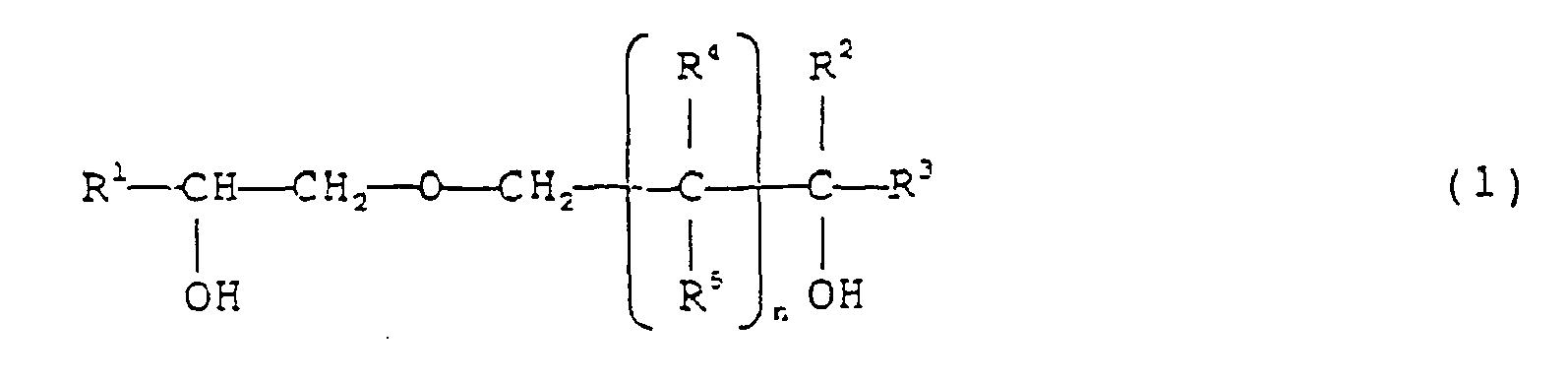

- In the hydroxyalkyl polyhydric alcohol ether compound-comprising thickening agent used in the present invention, each of the hydroxyalkyl polyhydric alcohol ether compounds of the general formulae (1) and (2) preferably has a HLB value of 6 to 9, determined in accordance with the Organic Conception Diagram.
- In the hydroxyalkyl polyhydric alcohol ether compound-comprising thickening agent used in the present invention, the hydroxyalkyl polyhydric alcohol ether compounds of the general formulae (1) and (2) preferably selected from condensation reaction products of 1,2-epoxy compounds represented by the general formula (3) with aliphatic diol compounds represented by the general formula (4):


- In the hydroxyalkyl polyhydric alcohol ether compound-comprising thickening agent used in the present invention, the aliphatic diol compounds by the general formula (4) are preferably selected from 1,2-propane diol and 1,3-butane diol.
- The liquid detergent composition of the present invention comprising a thickening agent component comprises the hydroxyalkyl polyhydric alcohol ether compound-comprising thickening agent used in the present invention as mentioned above, and a liquid detergent component comprising at least one member selected from amphoteric surfactants, dipolar-ionic surfactants and semipolar-ionic surfactants under Formulae (5), (13) and (16) different from the hydroxyalkyl polyhydric alcohol ether compounds of the formulae (1) and (2).
- In the liquid detergent composition of the present invention, the liquid detergent component preferably comprises at least one member selected from sulfur atom-containing dipolar-ionic surfactants.
- In the liquid detergent composition of the present invention, the liquid detergent component preferably comprises at least one member selected from acetic acid betaine surfactants and amidoamine type amphoteric surfactants represented by the general formula (5):

- In the liquid detergent composition of the present invention, the liquid detergent component preferably comprises at least one member selected from the amide amine type amphoteric surfactants represented by the general formula (5), dipolar-ionic surfactants and semipolar-ionic surfactants represented by formulae (13) and (16), respectively.
- In the liquid detergent composition of the present invention, the thickening agent component and the liquid detergent component are present at a dry mass ratio of 1:99 to 40:60.
- In the thickening agent used in the present invention, the hydroxyalkyl polyhydric alcohol ether compounds which are contained as a principal component in the thickening agent, are those represented by the general formulae (1) and (2). The compounds of the formulae (1) and (2) can be produced by condensation-reacting 1,2-epoxy compounds represented by the formula (3) with aliphatic diol compounds represented by the formula (4) in the presence or absence of a catalyst.
- In the case where the condensation reaction of the 1,2-epoxy compounds of the formula (3) with the aliphatic diol compounds of the formula (4) is carried out in the presence of a catalyst, either one of acid catalyst and basic catalyst can be employed. However, the resultant hydroxyalkyl polyhydric ether compounds produced in the presence of the acid catalyst are different in composition of the resultant compounds, namely a product amount ratio of the compounds of the general formula (1) to the compounds of the general formula (2), from those produced in the presence of the basic catalyst.
- In the case where the acid catalyst is employed, the proportion of the compounds of the general formula (2) based on the total amount of in the resultant compounds is higher than that of the compound of the general formula (1). Compared with this, the employment of the basic catalyst causes the proportion of the compound of the general formula (1) to be higher than that of the general formula (2).
- In comparison with the compounds of the general formula (2), the compounds of the general formula (1), which are identical in R1 to R5 to the compounds of the general formula (2), have a higher melting point. Thus, a problem such that when the proportion of the compounds of the formula (1) is higher than that of the formula (2), based on the total amount of the resultant reaction product, the resultant thickening agent exhibits an unsatisfactory handling property and the resultant thickening agent-containing composition exhibit an insufficient stability at low temperature, occurs. In view of the above-mentioned problem, the acid catalyst which causes the proportion of the compounds of the general formula (2) in the reaction product to be high is preferably employed. Also, the proportion of the compounds of the formula (2) based on the total mass of the compounds of the formulae (1) and (2) is preferably controlled to 50% by mass or more. Further, the mass ratio of the content of the compounds of the formula (1) to that of the formula (2) can be appropriately established in response to the purpose of using the target thickening agent.
- The acid catalyst for the condensation reaction of the 1,2-epoxy compounds of the formula (3) with the aliphatic diol compounds of the formula (4) preferably comprises at least one member selected from sulfuric acid, hydrochloric acid, nitric acid, phosphorous acid, phosphoric acid, p-toluenesulfonic acid, m-xylenesulfonic acid and boron trifluoside-ether complex, and is used in an amount of 0.0001 to 0.1 mole per mole of the epoxy compound subjected to the condensation reaction. The basic catalyst preferably comprises at least one member selected from sodium hydroxide, potassium hydroxide, calcium hydroxide, magnesium hydroxide, barium hydroxide, sodium methoxide, sodium ethoxide, metallic sodium, metallic potassium and metallic lithium, and used in an ampount of 0.0001 to 0.1 mole per mole of the epoxy compound subjected to the reaction.
- The condensation reaction of the compounds of the formula (3) with the compounds of the formula (4) is preferably carried out at a temperature of 30 to 150°C for 10 minutes to 2 days. There is no specific limitation to the reaction pressure. Usually, the condensation reaction is carried out under the ambient atmospheric pressure.
- The 1,2-epoxy compounds of the formula (3) are preferably selected from 1,2-epoxydecane, 1,2-epoxydodecane, 1,2-epoxytetradecane, 1,2-epoxyhexadecane and 1,2-epoxyoctadecane, more preferably from 1,2-epoxydecane, 1,2-epoxydodecane and 1,2-epoxytetradecane. These compounds may be employed alone or in a mixture of two or more thereof.
- The aliphatic diol compounds of the general formula (4) include 1,2-propanediol and 1,3-butanediol. These compounds may be employed alone or in a mixture of two thereof.
- The hydroxyalkyl polyhydric alcohol ether compounds usable for the thickening agent used in the present invention exhibit a very low solubility in water and therefore the viscosity of water cannot be increased by the compounds alone. When the hydroxyalkyl polyhydric alcohol ether compound-containing thickening agent is mixed in a liquid detergent optionally together with a component capable of solubilizing the resultant thickening agent composition of the present invention in water, the viscosity and foaming property of the resultant detergent composition can be improved by the thickening agent.
- This feature will be further explained below.
- Each of the hydroxyalkyl polyhydric alcohol ether compounds of the formulae (1) and (2) preferably has a HLB value of 6.0 to 9.0, more preferably 7.0 to 8.8, determined in accordance with the Organic Conception Diagram of each compound.
- The HLB value determined in accordance with the Organic Conception Diagram is one calculated in accordance with the following equation.

- When the compounds of the formulae (1) and (2) have an HLB value of 6.0 to 9.0, they can exhibit a high thickening effect on the liquid detergent.
- The mechanism of exhibiting a high thickening effect when the hydroxyalkyl polyhydric alcohol ether compounds have an HLB value of 6.0 to 9.0 is not completely clear. It is assumed that when the hydroxyalkyl polyhydric alcohol ether compounds of the formulae (1) and (2) are contained and dissolved in the liquid detergent composition, the compounds of the formulae (1) and (2) and the component in which the compounds of formulae (1) and (2) are dissolved are mixed with each other to form mixture micelles which exhibit the thickening effect on the detergent. Also, it is assumed that when the mixture micelles are formed, the thickening effect is variable in response to a position in each micelle in which position the hydroxyalkyl polyhydric alcohol ether compound of the formula (1) or (2) is dissolved in the mixture micelle.
- In the hydroxyalkyl polyhydric ether compound having an HLB value of 6.0 to 9.0, when a hydrophilic moiety of the molecule of the compound has a methyl group, in the general formulae (1) and (2), preferably at least one of R2 to R5 represents a methyl group, more preferably one of R2 and R3 represents a methyl group, the resultant thickening agent of the present invention is caused to be in the state of a liquid or paste at room temperature, so as to enhance the handing property of the thickening agent itself, and, simultaneously, the stability at low temperature of the liquid detergent composition containing the thickening agent used in the present invention is improved.
- In the compounds of the formulae (1) and (2), it is assumed that the reasons for such a phenomenon are that, when the methyl group is located in the hydrophilic moiety of the compounds, the resultant thickening agent per se exhibits a high stability in liquid state at room temperature, and stability at low temperature of the detergent composition containing the thickening agent is enhanced, is due to the crystallization of the hydroxyalkyl polyhydric alcohol ether compound being three-dimensionally hindered by the methyl group introduced into the hydrophilic moiety of the molecule of the compound.
- In the case where an alkyl group longer than the methyl group is introduced into the hydrophilic moiety, an improvement in the foaming stability of the resultant thickening agent-containing detergent composition is not confirmed and, in the case where the alkyl group is extremly long (having 4 or more carbon atoms), no growth of the mixture micelles of the resultant hydroxyalkyl polyhydric alcohol ether compound and the component by which the compound is dissolved in the detergent composition occurs and the resultant compound exhibits a poor thickening effect.
- As referential data, Table 1 shows the HLB values of the hydroxyalkyl polyhydric alcohol ether compounds of the formulae (1) and (2) in which R1 = C10H21 group, and the polyhydric alcohol groups are as shown in Table 1.
Table 1 R3 Polyhydric alcohol HLB value C10H21 Ethylene glycol 8.15 C10H21 Propylene glycol 7.86 C10H21 1,3-butylene glycol 7.33 C10H21 Glycerol 11.43 - For the above-mentioned reasons, among the aliphatic diol compounds of the general formula (4), 1,2-propanediol, and 1,3-butanediol are easily available and cause the resultant hydroxyalkyl polyhydric alcohol ether compound to exhibit a low melting temperature, and the resultant composition produced by mixing the hydroxyalkyl polyhydric alcohol ether compound into the liquid detergent to exhibit a high thickening effect and a good stability at low temperature and, thus, are specifically preferred.
- The high viscosity liquid detergent composition containing the thickening agent used in the present invention will be explained below.
- In the detergent composition, the component for solubilizing the thickening agent of the present invention in water includes amphoteric surfactants, dipolar-ionic surfactants and semipolar-ionic surfactants.
- Particularly, a combination of the thickening agent of the present invention with a sulfur-containing dipolar-ionic surfactant exhibits a significant thickening effect.
- The sulfur-containing dipolar-ionic surfactants will be further explained below.
- The sulfur atom-containing dipolar-ionic surfactants include sulfo-betain type dipolar-ionic surfactants represented by the following formula (13):

- In the formula (13), r represents an integer of 0 or 1, R15 represents an alkyl or alkenyl group having 10 to 18 carbon atoms when r represents 0, or a fatty acid residue having 10 to 18 carbon atoms when r represents 1, R16 and R17 respectively and independently from each other represent a hydrogen atom or a substituent group selected from methyl and ethyl groups, s represents an integer of 2 or 3.
- The compounds of the formula (13) is preferably selected from, for example, lauric acid amide propylhydroxysulfobetaine, coconit oil fatty acid amide propylhydroxysulfobetaine and laurylhydroxysulfobetaine.
- In the case where the above-mentioned sulfur atom-containing dipolar-ionic surfactants are used in combination with the thickening agent composition of the present invention, a significantly high thickening effect is obtained.
- The combination of the thickening agents of the present invention with surfactants having, as a hydrophilic group, a carboxyl group or a amineoxide group will be explained in detail below.
- Where the thickening agent of the present invention is used in a detergent composition comprising two components, a combination of the two components with amphoteric surfactants having, as a hydrophilic group, a carboxyl group or a semipolar-ionic surfactants having, as a hydrophilic group, an amineoxide group, enables the thickening agent of the present invention to exhibit a significant thickening effect.
- The amphoteric surfactants containing, as a hydrophilic group, a carboxyl group and causing the thickening agent of the present invention mixed therewith to exhibit a significant thickening effect are selected from acetic acid betaine type amphoteric surfactants and amidoamine type amphoteric surfactants having a specific chemical structure.
- The amidoamine type amphoteric surfactants having a specific structure preferably include the amidoamine type amphoteric surfactants having the specific structure represented by the above-mentioned general formula (5).
- The compound of the formula (5) preferably include, for example, sodium N-lauroyl-N'-carboxymethyl-N'-hydroxyethylethylenediamine, sodium N-myrisyl-N'-carboxymethyl-N'-hydroxyethylethylenediamine, and sodium N-coconit oil fatty acid-N'-carboxymethyl-N' hydroxyethyl ethylenediamine.
- The surfactants represented by the general formula (5) have a chemical structure formed by hydrolysing a conventional surfactants which are referred to as imidazolinium betaine type amphoteric surfactants. It is well known that the structures of the conventional compound which are referred to as imidazolinium betaine type amphoteric surfactants are changed to various complicated structures due to the hydrolysis of the imidazoline ring portion thereof during the production procedure of the surfactants. (For example, as shown in Japanese Examined Patent Publication No. 59-51532 and No. 35-4762 and Cosmet Toiletries, Vol. 95, No. 11, p 45 - 48, 1980.
- The imidazolinium betaine type surfactants may be changed, by hydrolysis, into the chemical structure represented by the following general formula (15).

- In the formula (15), R21-CO represents a fatty acid residue having 10 to 18 carbon atoms, s represents an integer of 2 or 3, v and w respectively and independently from each other represent an integer of 1 to 3, and M7 represents an alkali metal atom or an alkanolamine residue.
- The semipolar-ionic surfactants having, as a hydrophilic group, an amineoxide group may include the compounds represented by the following general formula (16).

- In the formula (16), r represents an integer of 0 or 1, R22 represents an alkyl or alkenyl group having 10 to 18 carbon atoms when r represents 0, or a fatty acid residue having 10 to 18 carbon atoms when r represents 1, R23 and R24 respectively and independently from each other represent a hydrogen atom or an substituent group selected from methyl and ethyl groups and s represents an integer of 2 or 3.
- The compounds of the formula (16) are preferably selected from, for example, lauryldimethylamineoxide, myristyldimethylamineoxide, lauric acid amidopropyl dimethylamineoxide, and coconut oil fatty acid amidopropyl dimethylamineoxide.
- In the high viscosity liquid detergent composition of the present invention, the content of the thickening agent of the present invention will be explained below.
- In the liquid detergent composition of the present invention, the dry weight ratio of a component consisting of the thickening agent of the present invention to a component consisting of the liquid detergent is preferably in the range of from 1:99 to 40:50.
- In the case where the thickening agent of the present invention is used together with a component by which the thickening agent is solubilized in water, the thickening agent exhibits a significant thickening effect on the resultant detergent composition. In this case, the thickening agent contained in the detergent composition is preferably in a content of 2.5 to 43 parts by mass, more preferably 5 to 25 parts by mass, per 100 parts by mass of the total content of the amphoteric surfactants, dipolar-ionic surfactants and/or semipolar-ionic surfactants which contribute to solubilizing the thickening agent.
- If the content of the thickening agent of the present invention is less than 2.5 parts by mass per 100 parts by mass of the surfactants contributing to solubilizing the thickening agent in the detergent composition, a thickening effect of the thickening agent for the detergent composition may be insufficient. Also, if the content of the thickening agent is more than 43 parts by mass, the resultant detergent composition may exhibit an unsatisfactory stability at low temperature.
- For example, in the case where the content of the surfactants contributing to the solubilizing the thickening agent of the present invention is 20% by mass based on the total mass of the liquid detergent composition, the content of the thickening agent of the present invention is preferably 0.5 to 8.6% by mass, more preferably 1.0 to 5% by mass, based on the total mass of the liquid detergent composition.
- The combinations of the thickening agent of the present invention with the surfactants dissolving therein the thickening agent, in which combination, the thickening agent exhibits a significant thickening effect, are shown below.
- (a) The thickening agent of the present invention + sulfur atom-containing dipolar-ionic surfactants
- (b) The thickening agent of the present invention + amideamine type amphoteric surfactants of the formula (5)
- (c) The thickening agent of the present invention + semipolar-ionic surfactants.
- In the other combinations than the above-mentioned combinations, though the thickening agent of the present invention may exhibit an improvement in foaming property of the resultant composition, the thickening effect on the combination is lower than that on the above-mentioned specific combinations. Particularly, in a two component composition containing an anionic surfactant having, as a hydrophilic group, only a carboxyl group, the thickening agent of the present invention exhibits an effect of enhancing the foaming property of the resultant composition and of making the resultant foams creamy, and, however, the thickening effect is lower than that in the above-mentioned combinations (a) to (c).
- In the research of thickening conditions on which the carboanion type surfactants are thickened by using the thickening agent of the present invention, it has been found that when the carboanion type surfactants are used together with the combinations (a) to (c), the thickening effect and the foaming property is enhanced and the quality of the resultant foam is improved.
- Where the thickening agent of the present invention and at least one member selected from sulfur atom-containing dipolar-ionic surfactants, amidoamine type amphoteric surfactants of the general formula (5) and semipolar-ionic surfactants are contained in combination with carboanions, in a detergent composition, the carboanions which contribute to enhancing the thickening effect and foaming property and to improving the quality of the foam, include the compounds as shown below.
-

- In the formula (17), R25 represents an alkyl or alkenyl group having 10 to 18 carbon atoms, M8 represents a hydrogen atom, an alkali metal atom or an alkanolamine residue, t represents an integer of 0 or 1 to 5.
- The compounds of the formula (17) preferably include, for example, sodium laurylethercarboxylate, soap materials, sodium laurate, sodium palmitate, and coconut oil potassium soap.
-
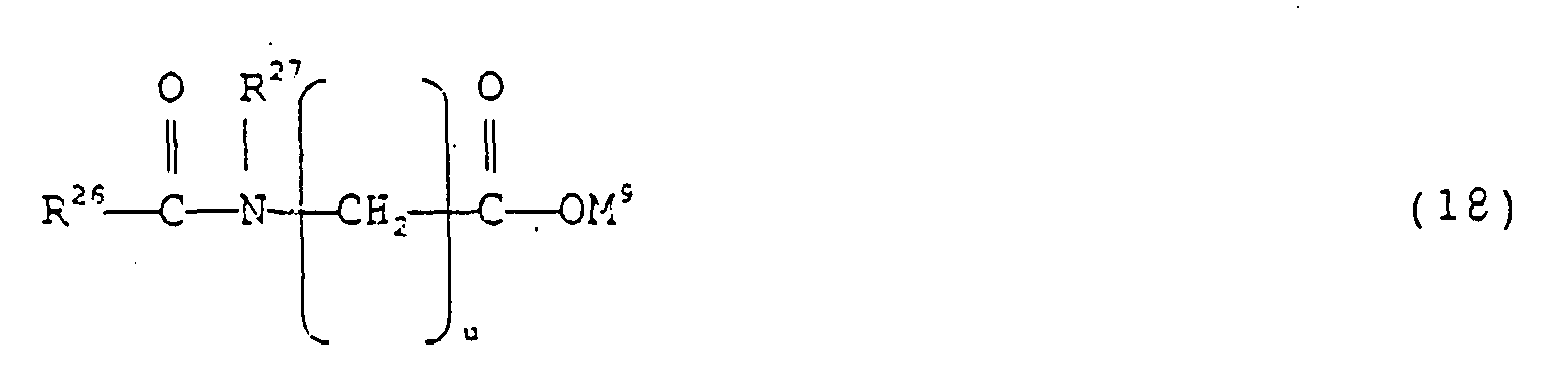

- In the formulae (18) and (19), R26-CO represents a fatty acid residue having 10 to 18 carbon atoms, R26 represents an alkyl or alkenyl group corresponding to the above-mentioned fatty acid residue, R27 represents a hydrogen atom or a substituent group selected from methyl and ethyl groups, u represents an integer of 1 to 3, M10 represents an alkali metal atom or an alkanolamine residue, M9 and M11 respectively and independently from each other represent a hydrogen atom, an alkali metal atom or an alkanolamine residue.
- The compounds of the formulae (18) and (19) preferably include, for example, sodium lauroyl sarcosinate, sodium lauroyl-N-methyl-β-alaninate, monosodium N-lauroyl glutamate, disodium N-stearoyl glutamate, monosodium N-myristoyl-L-glutamate and diethanolamine N-palmitoyl asparagate.
- In the detergent composition of the present invention, the mixing proportions of a thickening agent component consisting of the thickening agent of the present invention, the above-mentioned carboanions and a detergent component consisting of at least one member selected from the sulfur atom-containing dipolar-ionic surfactants, amideamine type amphoteric surfactants of the general formula (5) and semipolar-ionic surfactants are preferably established so that the mixing proportion of the thickening agent of the present invention is in the range of from 2.5 to 43 parts by mass, more preferably 5 to 25 parts by mass, per 100 parts by mass of the total of all the other components than the thickening agent component.
- Further in the detergent composition of the present invention, the mixing mass ratio of the carboanions to at least one member selected from the the sulfur atom-containing dipolar-ionic surfactants, the amideamine type amphoteric surfactants of the general formula (5) and the semipolar-ionic surfactants is preferably in the range of from 90:10 to 50:50, more preferably 80:20 to 55:45.
- When the proportion of the carboanions is higher than 90:10, the resultant composition may exhibit an insufficient thickening effect, while the foaming property and the foam quality may be somewhat improved. Also, when the proportion is lower than 50:50, the feeling in use of the resultant detergent composition may be governed by the sulfur atom type dipolar-ionic surfactants, the amidoamine type amphoteric surfactants of the general formula (5) and/or the semipolar-ionic surfactants, and the detergent composition having a preferable feeling in use thereof due to the carboanions themselve may not be obtained.
- The liquid detergent containing the thickening agent composition of the present invention optionally further contains at least one additive selected from, for example, extracts and powdery materials derived from animals, plants, fish, shellfish and microorganisms, liquid oils and fats, solid oils and fats, waxes, hydrocarbons, higher alcohols, esters, silicones, humectants, water-soluble polymers, film-coating agents, ultraviolet-ray absorbers, extinguishing agents, sequestering agents, lower alcohols, saccharides, amino acids, organic amines, synthetic resin emulsions, pH controller, skin-nutritive agents, vitamins, antioxidants, antioxidant additives and perfumes.
- The present invention will be further explained by the following examples. The starred examples (*) are not within the scope of the claimed invention.
- A reaction vessel equipped with a thermometer, a condenser, a stirrer, a distillation apparatus, a dropping apparatus and a calcium chloride-containing tube and having a capacity of 100 ml was charged with 37.2g (0.60 mole) of ethylene glycol, and the temperature of the reaction vessel was increased to 50 to 55°C.
- Separately, a 100 ml mixing vessel equipped with a calcium chloride-containing tube was charged with 36.9g (0.20 mole) of 1,2-epoxydodecane. While the charged 1,2-epoxydodecane was stirred and cooled with water, concentrated sulfuric acid was gradually dropped in an amount of 0.4g (0.004 mole) into the cooled 1,2-epoxydodecane. After stirring for 15 minutes, the resultant mixture was placed into the dropping apparatus attached to the reaction vessel and was dropped into the ethylene glycol contained in the reaction vessel and maintained at a temperature of 50 to 55°C over a time of 2 hours. Then the reaction of the mixture was carried out at a temperature of 50 to 55°C for one hour. After the exhaustion of the starting material, namely 1,2-epoxydodecane, was confirmed by a thin-layer chromatography, the reaction was stopped. A saturated aqueous sodium hydrogen carbonate solution was mixed in an amount of 50 ml into the resultant reaction liquid in the reaction vessel, the resultant mixture was stirred for 10 minutes to neutralize the reaction liquid. The reaction liquid was subjected to an extraction procedure using diethyl ether to extract the reaction product. The resultant extraction liquid was concentrated by using a rotary evaporator. An ethylene glycol monohydroxydodecyl ether mixture was obtained in an amount of 48.3g (yield: 98.1%).
- A reaction vessel equipped with a thermometer, a condenser, a stirrer, a distillation apparatus, a dropping apparatus and a calcium chloride-containing tube and having a capacity of 500 ml was charged with 120.98g (1.59 moles) of 1,2-propanediol, and the temperature of the reaction vessel was increased to 60 to 65°C.
- Separately, a 500 ml mixing vessel equipped with a calcium chloride-containing tube was charged with 276.5g (1.50 moles) of 1,2-epoxydodecane. While the charged 1,2-epoxydodecane was stirred and cooled with water, a concentrated sulfuric acid was gradually dropped in an amount of 2.7g (0.027 mole) into the cooled 1,2-epoxydodecane. After stirring for 15 minutes, the resultant mixture was placed into the dropping apparatus attached to the reaction vessel and was dropped into the ethylene glycol contained in the reaction vessel and maintained at a temperature of 60 to 65°C over a time of 2 hours. Then the reaction of the mixture was carried out at a temperature of 60 to 65°C for one hour. After the exhaustion of the starting material, namely 1,2-epoxydodecane, was confirmed by a thin-layer chromatography, the reaction was stopped. A powdered sodium hydrogen carbonate was mixed in an amount of 2.5g (0.03 mole) into the resultant reaction liquid in the reaction vessel, the resultant mixture was stirred for 30 minutes to neutralize the reaction liquid. From the reaction liquid, precipitated crystals were separated by filtration. An 1,2-propanediol monohydroxydodecyl ether mixture was obtained in an amount of 395.4g (yield: 99.5%).
- A reaction vessel equipped with a thermometer, a condenser, a stirrer, a distillation apparatus, a dropping apparatus and a calcium chloride-containing tube and having a capacity of 500 ml was charged with 125.5g (1.65 moles) of 1,2-propanediol, and the temperature of the reaction vessel was increased to 60 to 65°C.
- Separately, a 500 ml mixing vessel equipped with a calcium chloride-containing tube was charged with 318.6g (1.50 moles) of 1,2-epoxytetradecane. While the charged 1,2-epoxytetradecane was stirred and cooled with water, a concentrated sulfuric acid was gradually dropped in an amount of 2.7g (0.027 mole) into the cooled 1,2-epoxytetradecane. After stirring for 15 minutes, the resultant mixture was placed into the dropping apparatus attached to the reaction vessel and was dropped into the 1,2-propanediol contained in the reaction vessel and maintained at a temperature of 60 to 65°C over a time of 2 hours. Then the reaction of the mixture was carried out at a temperature of 60 to 65°C for one hour. After the exhaustion of the starting material, namely 1,2-epoxytetradecane was confirmed by a thin-layer chromatography, the reaction was stopped. A powdered sodium hydrogen carbonate was mixed in an amount of 2.5g (0.03 mole) into the resultant reaction liquid in the reaction vessel, the resultant mixture was stirred for 30 minutes to neutralize the reaction liquid. From the reaction liquid, the resultant precipitated crystals were separated by filtration. A 1,2-propanediol monohydroxydodecyl ether mixture was obtained in an amount of 432.0g (yield: 97.3%).
- A reaction vessel equipped with a thermometer, a condenser, a stirrer, a distillation apparatus, a dropping apparatus and a calcium chloride-containing tube and having a capacity of 1.0 liter was charged with 125.5g (1.65 moles) of 1,2-propanediol, and the temperature of the reaction vessel was increased to 70 to 75°C.
- Separately, a 1.0 liter mixing vessel equipped with a calcium chloride-containing tube was charged with 402.7g (1.50 moles) of 1,2-epoxyoctadecane. While the charged 1,2-epoxyoctadecane was stirred at room temperature, a concentrated sulfuric acid was gradually dropped in an amount of 2.7g (0.027 mole) into 1,2-epoxyoctadecane. After stirring for 15 minutes, the resultant mixture was placed into the dropping apparatus attached to the reaction vessel and was dropped into the 1,2-propanediol contained in the reaction vessel and maintained at a temperature of 70 to 75°C over a time of 2 hours. Then the reaction of the mixture was carried out at a temperature of 70 to 75°C for one hour. After the exhaustion of the starting material, namely 1,2-epoxydodecane was confirmed by a thin-layer chromatography, the reaction was stopped. A powdered sodium hydrogen carbonate was mixed in an amount of 2.5g (0.03 mole) into the resultant reaction liquid in the reaction vessel, the resultant mixture was stirred for 30 minutes to neutralize the reaction liquid. From the reaction liquid, the precipitated crystals were separated by filtration. A 1,2-propanediol monohydroxyoctadecyl ether mixture was obtained in an amount of 510.9g (yield: 96.7%).
- A reaction vessel equipped with a thermometer, a condenser, a stirrer, a distillation apparatus, a dropping apparatus and a calcium chloride-containing tube and having a capacity of 200 ml was charged with 90.1g (1.0 mole) of 1,2-butanediol, and the temperature of the reaction vessel was increased to 40 to 45°C.
- Separately, a 100 ml mixing vessel equipped with a calcium chloride-containing tube was charged with 36.9g (0.20 mole) of 1,2-epoxydodecane. While the charged 1,2-epoxydodecane was stirred and cooled with water, a concentrated sulfuric acid was gradually dropped in an amount of 0.4g (0.004 mole) into the cooled 1,2-epoxydodecane. After stirring for 15 minutes, the resultant mixture was placed into the dropping apparatus attached to the reaction vessel and was dropped into the 1,2-butanediol contained in the reaction vessel and maintained at a temperature of 40 to 45°C over a time of 2 hours. Then the reaction of the mixture was carried out at a temperature of 40 to 45°C for one hour. After the exhaustion of the starting material, namely 1,2-epoxydodecane, was confirmed by a thin-layer chromatography, the reaction was stopped. A saturated aqueous sodium hydrogen carbonate solution was mixed in an amount of 50 ml into the resultant reaction liquid in the reaction vessel, the resultant mixture was stirred for 10 minutes to neutralize the reaction liquid. The reaction liquid was subjected to an extraction procedure using diethyl ether to extract the reaction product. The resultant extraction liquid was concentrated by using a rotary evaporator. A 1,2-butanediol monohydroxydodecyl ether mixture was obtained in an amount of 51.2g (yield: 95.5%).
- A reaction vessel equipped with a thermometer, a condenser, a stirrer, a distillation apparatus, a dropping apparatus and a calcium chloride-containing tube and having a capacity of 200 ml was charged with 54.1g (0.60 mole) of 1,3-butanediol, and the temperature of the reaction vessel was increased to 50 to 55°C.
- Separately, a 100 ml mixing vessel equipped with a calcium chloride-containing tube was charged with 36.9g (0.20 mole) of 1,2-epoxydodecane. While the charged 1,2-epoxydodecane was stirred and cooled with water, a concentrated sulfuric acid was gradually dropped in an amount of 0.4g (0.004 mole) into the cooled 1,2-epoxydodecane. After stirring for 15 minutes, the resultant mixture was placed into the dropping apparatus attached to the reaction vessel and was dropped into 1,3-butanediol contained in the reaction vessel and maintained at a temperature of 50 to 55°C over a time of 2 hours. Then the reaction of the mixture was carried out at a temperature of 50 to 55°C for one hour. After the exhaustion of the starting material, namely 1,2-epoxydodecane was confirmed by a thin-layer chromatography, the reaction was stopped. A saturated aqueous sodium hydrogen carbonate solution was mixed in an amount of 50 ml into the resultant reaction liquid in the reaction vessel, the resultant mixture was stirred for 10 minutes to neutralize the reaction liquid. The reaction liquid was subjected to an extraction procedure using diethyl ether to extract the reaction product. The resultant extraction liquid was concentrated by using rotary evaporator. A 1,3-butanediol monohydroxydodecyl ether mixture was obtained in an amount of 52.8g (yield: 98.6%).
- A reaction vessel equipped with a thermometer, a condenser, a stirrer, a distillation apparatus, a dropping apparatus and a calcium chloride-containing tube and having a capacity of 200 ml was charged with 54.1g (0.60 mole) of 1,4-butanediol, and the temperature of the reaction vessel was raised to 50 to 55°C.
- Separately, a 100 ml mixing vessel equipped with a calcium chloride-containing tube was charged with 36.9g (0.20 mole) of 1,2-epoxydodecane. While the charged 1,2-epoxydodecane was stirred and cooled with water, a concentrated sulfuric acid was gradually dropped in an amount of 0.4g (0.004 mole) into the cooled 1,2-epoxydodecane. After stirring for 15 minutes, the resultant mixture was placed into the dropping apparatus attached to the reaction vessel and was dropped into 1,4-butanediol contained in the reaction vessel and maintained at a temperature of 50 to 55°C over a time of 2 hours. Then the reaction of the mixture was carried out at a temperature of 50 to 55°C for one hour. After the exhaustion of the starting material, namely 1,2-epoxydodecane, was confirmed by a thin-layer chromatography, the reaction was stopped. A saturated aqueous sodium hydrogen carbonate solution was mixed in an amount of 50 ml into the resultant reaction liquid in the reaction vessel, the resultant mixture was stirred for 10 minutes to neutralize the reaction liquid. The reaction liquid was subjected to an extraction procedure using diethyl ether to extract the reaction product. The resultant extraction liquid was concentrated by using a rotary evaporator. A 1,4-butanediol monohydroxydodecyl ether mixture was obtained in an amount of 50.4g (yield: 94.1%).
- A reaction vessel equipped with a thermometer, a condenser, a stirrer, a distillation apparatus, a dropping apparatus and a calcium chloride-containing tube and having a capacity of 2.0 liters was charged with 114.1g (15 moles) of 1,2-propanediol and 5.79g (0.03 mole) of a solution of 28% sodium methoxide in methyl alcohol, and the temperature of the reaction vessel was increased to 125 to 130°C, to evaporate off the methyl alcohol. 1,2-epoxydodecane in an amount of 276.5g (1.50 moles) was added dropwise into 1,2-propanediol maintained at a temperature of 125 to 130°C through the dropping apparatus over a time of 2 hours. The reaction of the reaction liquid was continued at a temperature of 125 to 130°C.
- At the stage at which the reaction time of 3.5 hours lapsed, the exhaustion of the starting material, namely, 1,2-epoxydodecane, was confirmed by a thin-layer chromatograhy, and then the reaction was stopped.
- The reaction liquid was mixed with 500 ml of a saturated aqueous ammonium chloride solution and stirred for 10 minutes to neutralize the reaction liquid. The reaction liquid was subjected to an extraction procedure using diethyl ether to extract the reaction product. The resultant extraction liquid was concentrated by using a rotary evaporator. A 1,2-propanediol monohydroxydodecyl ether mixture was obtained in an amount of 359.2g (yield: 92.0%).
- A reaction vessel equipped with a thermometer, a condenser, a stirrer, a distillation apparatus, a dropping apparatus and a calcium chloride-containing tube and having a capacity of 100 ml was charged with 20.2g (0.22 mole) of glycerol, and the temperature of the reaction vessel was rised to 70 to 75°C.
- Separately, a 100 ml mixing vessel equipped with a calcium chloride-containing tube was charged with 36.9g (0.20 mole) of 1,2-epoxydodecane. While the charged 1,2-epoxydodecane was stirred and cooled with water, a concentrated sulfuric acid was gradually dropped in an amount of 0.4g (0.004 mole) into the cooled 1,2-epoxydodecane. After stirring for 15 minutes, the resultant mixture was placed into the dropping apparatus attached to the reaction vessel and was dropped into glycerol contained in the reaction vessel and maintained at a temperature of 70 to 75°C over a time of 2 hours. Then the reaction of the mixture was carried out at a temperature of 70 to 75°C for one hour. After the exhaustion of the starting material, namely 1,2-epoxydodecane, was confirmed by a thin-layer chromatography, the reaction was stopped. A powdered sodium hydrogen carbonate solution was mixed in an amount of 0.4g (0.005 mole) into the resultant reaction liquid in the reaction vessel, the resultant mixture was stirred for 30 minutes to neutralize the reaction liquid. From the reaction liquid, precipitated crystals were separated by filtration. A glycerol monohydroxydodecyl ether mixture was obtained in an amount of 55.3g (yield: 96.7%).
- In each of Examples 8 to 35 and Comparative Examples 3 to 32, a liquid detergent composition having the composition as shown in Tables 2 to 9 was prepared. The resultant composition was subjected to the tests as shown below.
-
- Viscometer: B type rotational viscometer Model B8M, made by TOKIMEC K.K.
- Measurement temperature: 25°C
- Each of samples prepared in the thickening effect evaluation test was left to stand at a temperature of -5°C for 12 hours, then the sample was taken out from the test and the state of the sample was observed and evaluated into the following two classes. Class 1: opalized or crystals are deposited
- Class 2: Clear liquid state is kept
- Each sample was diluted with distilled water so that the content of solid dissolved substance is adjusted to 0.25% by weight, and the diluted sample was subjected to a LOSS-MILES foaming power measurement at a constant temperature of 40°C.
- Each sample was subjected to use test by 10 testing members, in which test, the sample was used for hand washing and the following properties of the sample were organoloptically evaluated.
- Foam-forming property during practical use (volume of foam)
- Foam quality (Form of foam, and creaminess of foam)
- Hand feeling in rinsing (ease of rinsing, sliminess)
- General evaluation of use feel (including stiff feel after washing hand)
- The test results are relatively evaluated in fine ranks (one point to fine points), the average of the evaluation results are calculated. The evaluation results are represented in accordance with the averages in the following four classes.
Average Evaluation More than 4.5 Very good (4) 4.5 to 3.5 Good (3) Less than 3.5 but not less than 3.0 Standard (2) Less than 3.0 Bad (1) - In Examples 8 to 23 and Comparative Examples 3 to 28, the evaluation result of Comparative Example 3 (Table 3) was classified as a standard and given 3 points. Also, in Example 24 to 35 and Comparative Examples 29 to 38, the evaluation result of Comparative Example 38 (Table 9) was classified as a standard and given 3 points.
- The test results are shown in Tables 2 to 9.

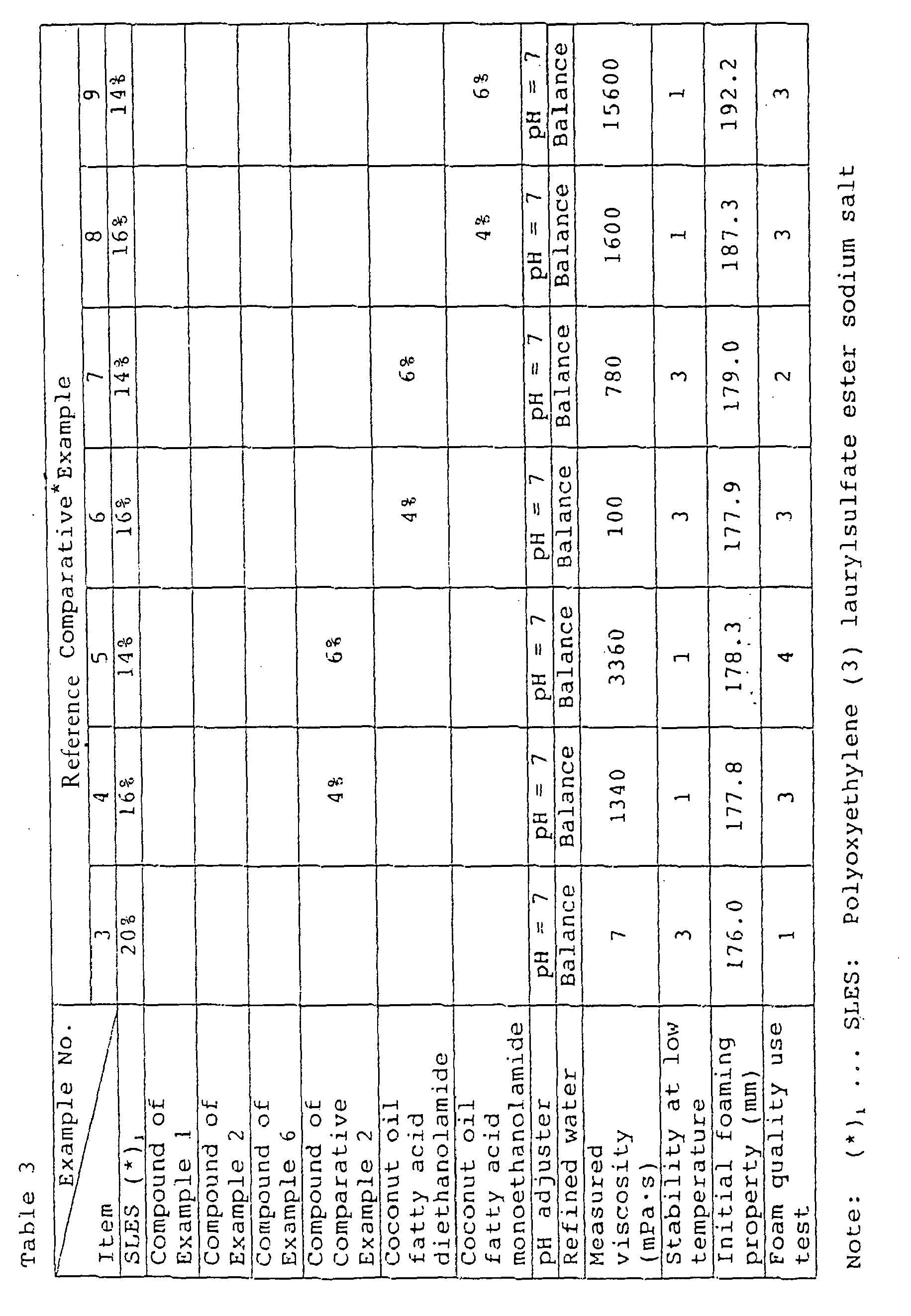
- Tables 2 and 3 clearly show that the thickening agents consisting of the hydroxyalkyl polyhydric alcohol ether compounds produced in Examples 2 and 6 exhibited, in combination with the sulfur atom-containing anionic surfactant, a high thickening effect comparative to that of the conventional fatty acid alkanolamide type nonions.
- The thickening agent which was produced in Comparative Example 2 and was a type of hydroxyalkyl polyhydric alcohol ether compound exhibited some degree of thickening effect. However, the resultant thickening effect is low and, in order to obtain a practical thickening effect, the comparative thickening agent must be employed in a large amount in comparison with that of the thickening agents of Examples 2 and 6. Also, the comparative thickening agent had a problem that the stability thereof at low temperature was unsatisfactory.
- Also, up to now it was considered that the fatty acid monoalkanolamides exhibit an excellent thickening effect but are insufficient in stability at low temperature. However, it was confirmed that the thickening agent comprising the hydroxyalkyl polyhydric alcohol ether compounds of the present invention is quite satisfactory in the stability at low temperature.
Further, it was confirmed that the detergent composition of the present invention comprising a combination of the thickening agent comprising the hydroxyalkyl polyhydric alcohol ether compound with the sulfur atom-containing anionic surfactant can form fine and creamy foam and exhibit a pleasant feel in rinsing procedure in practice.
- Table 4 clearly shows that when the thickening agent comprising the hydroxyalkyl polyhydric alcohol ether compound prepared in Example 2 exhibited a high thickening effect comparative to the conventional fatty acid alkanolamide type nonions, when it was used in combination with a dipolar-ionic surfactant.
- Also, the conventional fatty acid monoalkanolamide has been considered to exhibit a high thickening effect, however, it was unsatisfactory in stability at low temperature. It was confirmed that the hydroxyalkyl polyhydric alcohol ether compound-containing thickening agent was quite satisfactory in stability at low temperature.
- Further, it was confirmed that the detergent composition comprising a combination of the hydroxyalkyl polyhydric alcohol ether compound-containing thickening agent with the dipolar-ionic surfactant can provide fine and creamy foam an exhibit a pleasant feel in practical rinsing.


- Tables 5 and 6 clearly show that when the thickening agent comprising the hydroxyalkyl polyhydric alcohol ether compound prepared in Example 2 exhibited a high thickening effect, comparative to the conventional fatty acid alkanolamide type nonions, when it was used in combination with the acetic acid betaine type surfactant, the amideamine type amphoteric surfactant represented by the general formula (5) and a semipolar-ionic surfactant.
- Also, the conventional fatty acid monoalkanolamide has been considered to exhibit a high thickening effect, however, it was unsatisfactory in stability at low temperature. It was confirmed that the hydroxyalkyl polyhydric alcohol ether compound-containing thickening agent was quite satisfactory in stability at low temperature.
- Further it was confirmed that the detergent composition comprising a combination of the hydroxyalkyl polyhydric alcohol ether compound-containing thickening agent with the acetic acid betaine type surfactant, the amideamine type amphoteric surfactant represented by the general formula (5) and the semipolar-ionic surfactant can provide fine and creamy foam an exhibit a pleasant feel in practical rinsing.
- Comparative Example 28 shows that the amideamine type amphoteric surfactant comprising a component, in a high content, represented by the general formula (15), as a specific amideamine type amphoteric surfactant in which the imidazolium betaine skeleton thereof is opened at an irregular position, did not exhibit a thickening effect.


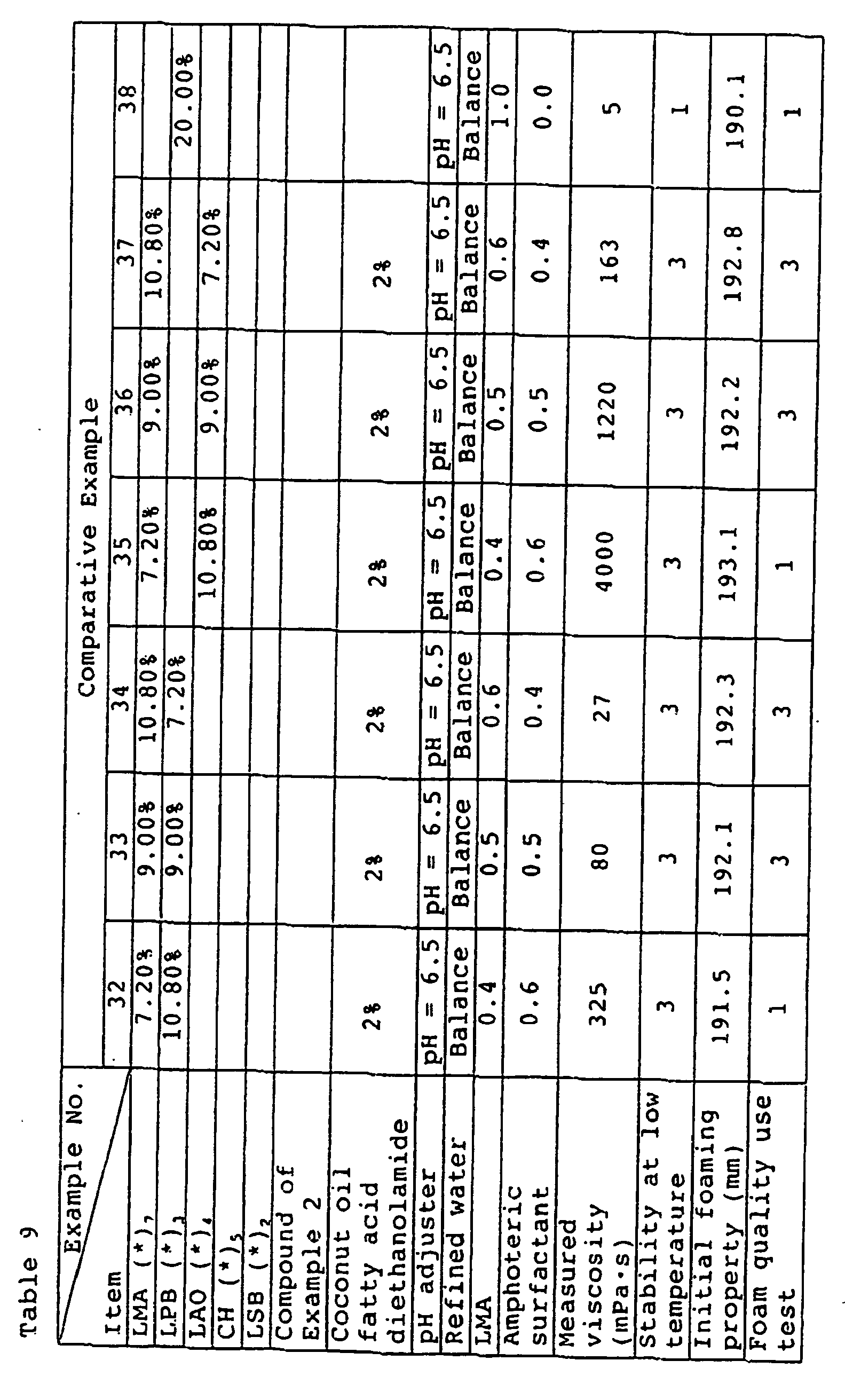
- Tables 7 to 8 clearly show that the anionic surfactants having, as a hydrophylic group, a carboxyl group as shown in Comparative Examples 29 to 31 exhibited no thickening effect even in the combination with the amphoteric surfactant. In this point, the anionic surfactant should be distinguished from the sulfur atom-containing anions.
- When the combination of the surfactants was used in further combination with the hydroxyalkyl polyhydric alcohol ether compound prepared in Example 2 in the resultant composition, a thickening effect was realized, as shown in Examples 24 to 26.
- The detergent composition of Comparative Example 38 which was a standard in the evaluation of feeling in use, could provide a good feeling after using. However, this detergent composition exhibited an insufficient foaming property and poor voluminosity of the foam. By mixing the hydroxyalkyl polyhydric alcohol ether compound of the present invention, the resultant detergent composition could exhibit an increased voluminosity of foam and a pleasant feel in practical use.
- Accordingly, to thicken and increase the viscosity of the liquid detergent containing an anionic surfactant having, as a hydrophilic group, a carboxyl group, the anionic surfactants must be used in combination with at least one member selected from amidoamine type amphoteric surfactants represented by the general formula (5), dipolar-ionic surfactants, and semipolar-ionic surfactants and further with the hydroxyalkyl polyhydric alcohol ether compound-containing thickening agent.
- Also, in the detergent component containing the anionic surfactants having, as a hydrophilic group, a carboxyl group, in combination with at least one surfactant selected from amideamine type amphoteric surfactants represented by the general formula (5), dipolar-ionic surfactants and semipolar-ionic surfactants, when the content of the anionic surfactants having, as a hydrophilic group, a carboxyl group is less than 50% by weight, characteristic property of the anionic surfactants having, as a hydrophilic group, a carboxyl group could not be sufficiently appeared, while an improvement in forming property of the resultant composition could be realized.
- A germicidal hand soap composition was prepared in the following composition.
Composition of hand soap Lauric acid 6.0% by weight 30% solution of lauric acid amidopropyldimethylamine oxide 15.0% 30% solution of POE (3) lauryl ether-acetic acid 3.0% 50% solution of benzalkonium chloride 1.0% 50% solution of benzethonium chloride 0.5% % 1,2-propanediol monohydroxydodecyl ether 2.0% N-coconut oil fatty acid acyl-N'-carboxymethyl-N'-ethylenediamine sodium salt 9.5% Triethanolamine An amount sufficient to adjust pH = 7.8 Glycerol 3.0% Refined water An amount necessary to adjust the total amount to 100% - The above-mentioned components were mixed with each other, the mixture was heated to 80°C to provide a uniform solution, and then cooled. The resultant hand soap composition was stored at -5°C for 3 days. In the stored composition, no change in appearance was found. The viscosity of the composition was 570 mPa·s, determined by using a HM-2 rotor.
- A germicidal hand soap composition was prepared in the following composition.
Composition of hand soap Lauric acid 6.6% by weight 30% solution of lauric acid amidopropyldimethylamine oxide 15.0% 30% solution of POE (3) lauryl ether-acetic acid 3.0% 50% solution of benzalkonium chloride 1.0% 50% solution of benzethonium chloride 0.5% 1,3-butanediol monohydroxydodecyl ether 2.0% N-coconut oil fatty acid acyl-N'-carboxymethyl-N'-ethylenediamine sodium salt 9.5% Triethanolamine An amount sufficient to adjust pH = 7.8 Glycerol 3.0% Refined water An amount necessary to adjust the total amount to 100% - The above-mentioned components were mixed with each other, the mixture was heated to 80°C to provide a uniform solution, and then cooled. The resultant hand soap composition was stored at -5°C for 3 days. In the stored composition, no change in appearance was found. The viscosity of the composition was 470 mPa·s, determined by using a HM-2 rotor.
- A body shampoo composition having a pearly gloss was prepared in the following composition.
Composition of body shampoo Potassium salt of coconut oil fatty acid 4.0% by weight 30% solution of lauric acid amidopropyl betaine 15.0% 25% solution of sodium polyoxyethylene laurylsulfate 20.0% 30% solution of lauroyl-N-methyl-β-alanine sodium salt 10.0% 1,2-propanediol monohydroxydodecyl ether 3.0% Ethyleneglycol distearate 2.0% Glycerol 3.0% Citric acid An amount sufficient to adjust pH = 7.5 EDTA disodium salt 0.2% Methylparaben 0.2% Refined water An amount necessary to adjust the total amount to 100% - The above-mentioned components were mixed with each other, the mixture was heated to 80°C to provide a uniform solution, and then cooled. The resultant hand soap composition was stored at -5°C for 3 days. In the stored composition, no change in appearance was found. The viscosity of the composition was 2145 mPa·s, determined by using a HM-2 rotor.
- A body shampoo composition having a pearly gloss was prepared in the following composition.
Composition of body shampoo Potassium salt of coconut oil fatty acid 4.0% by weight 30% solution of lauric acid amidopropyl betaine 15.0% 25% solution of sodium polyoxyethylene laurylsulfate 20.0% 30% solution of lauroyl-N-methyl-β-alanine sodium salt 10.0% 1,3-butanediol monohydroxydodecyl ether 3.0% Ethyleneglycol distearate 2.0% Glycerol 3.0% Citric acid An amount sufficient to adjust pH = 7.5 EDTA disodium salt 0.2% Methylparaben 0.2% Refined water An amount necessary to adjust the total amount to 100% - The above-mentioned components were mixed with each other, the mixture was heated to 80°C to provide a uniform solution, and then cooled. The resultant hand soap composition was stored at -5°C for 3 days. In the stored composition, no change in appearance was found. The viscosity of the composition was 1815 mPa·s, determined by using a HM-2 rotor.
- A shampoo composition was prepared in the following composition.
Composition of shampoo 30% solution of lauric acid amidopropyldimethylamine oxide 26.7% by weight 30% solution of lauroyl-N-methyl-β-alanine sodium salt 18.7% 30% solution of lauric acid amidopropyldimethylamino-acetic acid betaine 8.0% 1,2-propanediol monohydroxydodecyl ether 2.0% Cationized cellulose 0.5% Pyrokuton auramine 0.8% Methylparaben 0.2% Fropylparaben 0.1% EDTA disodium salt 0.2% Citric acid An amount sufficient to adjust pH = 6.5 Refined water An amount necessary to adjust the total amount to 100% - The above-mentioned components were mixed with each other, the mixture was heated to 80°C to provide a uniform solution, and then cooled. The resultant hand soap composition was stored at -5°C for 3 days. In the stored composition, no change in appearance was found. The viscosity of the composition was 4660 mPa·s, determined by using a HM-2 rotor.
- A shampoo composition was prepared in the following composition.
Composition of shampoo 30% solution of lauric acid amidopropyldimethylamine oxide 8.3% by weight Cetyl alcohol 1.5% 25% solution of POE (3) laurylethersulforic acid ether sodium salt 52.0% 50% solution of stearyltrimethyl ammonium chloride 0.2 1,2-propanediol monohydroxydodecyl ether 2.0% Cationized cellulose 0.5% 60% solution of 1-hydroxyethane-1,1-diphosphonic acid 0.2% Methylparaben 0.2% Propylparaben 0.1% Perfume 0.1% Citric acid An amount sufficient to adjust pH = 6.5 Refined water An amount necessary to adjust the total amount to 100% - The resultant shampoo composition exhibited a high foam-forming property, no creaky feel in rinsing and a pleasant feel after shampooing and a moist feel after drying. The viscosity of the composition was 7560 mPa·s, determined by using HM-2 rotor.
- A shampoo composition was prepared in the following composition.
Composition of shampoo 30% solution of lauric acid amidopropyldimethylamine oxide 10.0% by weight Behenyl alcohol 0.8% 25% solution of POE (3) laurylethersulfuric acid ester sodium salt 52.0% 60% solution of N-[3-alkyl (12,14) oxy-2-hydroxypropyl]-L-arginine hydrochloric acid salt 0.3% 1,2-propanediol monohydroxydodecyl ether 2.0% Cationized cellulose 0.3% 60% solution of 1-hydroxyethane-1,1-diphosphonic acid 0.5% Methylparaben 0.2% Propylparaben 0.1% Perfume 0.1% Citric acid An amount sufficient to adjust pH = 6.0 Refined water An amount necessary to adjust the total amount to 100% - The resultant shampoo composition exhibited a nice and fine foam-forming property, no creaky feel in rinsing and a moist and soft feel after drying. The viscosity of the composition was 2035 mPa·s, determined by using HM-2 rotor.
- A shampoo composition was prepared in the following composition.
Composition of shampoo 30% solution of lauric acid amidopropyldimethylamine oxide 11.7% by weight Stearyl alcohol 0.4% 25% solution of POE (3) laurylethersulfuric acid ester sodium salt 28.0% 30% solution of lauric acid amidopropyldimethylamino-acetic acid betaine 11.7% 1,2-propanediol monohydroxydodecyl ether 1.0% Cationized cellulose 0.3% 60% solution of 1-hydroxyethane-1,1-diphosphonic acid 0.2% Citric acid 0.3% Methylparaben 0.2% Propylparaben 0.1% Perfume 0.2% Citric acid An amount sufficient to adjust pH = 6.5 Refined water An amount necessary to adjust the total amount to 100% - The resultant shampoo composition exhibited a very nice, and fine foam-forming property, no creaky feel in rinsing and a moist feel after drying. The shampooed hair exhibited a pleasant combing property. The viscosity of the composition was 6520 mPa·s, determined by using HM-2 rotor.
- A shampoo composition was prepared in the following composition.
Composition of shampoo 30% solution of lauric acid amidopropyldimethylamine oxide 11.7% by weight Stearyl alcohol 0.4% 25% solution of POE (3) laurylethersulfuric acid ester sodium salt 28.0% 30% solution of N-coconut oil fatty acid acyl-N-carboxymethyl-N'-ethylenediamine sodium salt (desalted) 11.7% 1,3-butanediol monohydroxydodecyl ether 1.5% Cationized cellulose 0.3% 60% solution of 1-hydroxyethane-1,1-diphosphonic acid 0.2% Citric acid 0.6% Methylparaben 0.2% Propylparaben 0.1% Perfume 0.1% Citric acid An amount sufficient to adjust pH = 6.5 Refined water An amount necessary to adjust the total amount to 100% - The resultant shampoo composition exhibited a very nice, fine and soft foam-forming property, and no creaky feel in rinsing and a moist feel after drying. The shampooed hair exhibited a pleasant combing property. The viscosity of the composition was 5780 mPa·s, determined by using HM-2 rotor.
- A shampoo composition was prepared in the following composition.
Composition of shampoo 30% solution of lauric acid amidopropyldimethylamine oxide 13.3% by weight Stearyl alcohol 0.4% 25% solution of POE (3) laurylethersulfuric acid ester sodium salt 40.0% POE (4.2) laurylether 1.5% 1,2-propanediol monohydroxydodecyl ether 1.0% Polyether-modified silicone 0.3% 60% solution of 1-hydroxyethane-1,1-diphosphonic acid 0.2% Saline 0.3% Methylparaben 0.2% Propylparaben 0.1% Perfume 0.1% Citric acid An amount sufficient to adjust pH = 6.0 Refined water An amount necessary to adjust the total amount to 100% - The resultant shampoo composition exhibited a nice, fine and creamy foam-forming property, no creaky feel in rinsing, a pleasant feel after shampooing and a moist feel after drying. The dried hair exhibited smooth and non-unkempt feeling. The viscosity of the composition was 4660 mPa·s, determined by using HM-2 rotor.
- A shampoo composition was prepared in the following composition.
Composition of shampoo 30% solution of lauric acid amidopropyldimethylamine oxide 26.7% by weight Stearyl alcohol 0.3% 30% solution of lauroyl-N- methyl-β-alanine sodium salt 18.7% 30% solution of lauric acid amidopropyldimethylamino-acetic acid betaine 8.0% 1,2-propanediol monohydroxydodecyl ether 2.0% 1,3-butanediol 2.0% 60% solution of 1-hydroxyethane-1,1-diphosphonic acid 0.5% Citric acid 0.6% Methylparaben 0.2% Propylparaben 0.1% Perfume 0.1% Citric acid An amount sufficient to adjust pH = 6.5 Refined water An amount necessary to adjust the total amount to 100% - The resultant shampoo composition exhibited a very nice, fine and creamy foam-forming property, no creaky feel in rinsing, and a significant moist feel after drying. The shampooed hair exhibited a smooth combing property. The viscosity of the composition was 2005 mPa·s, determined by using HM-2 rotor.
- A shampoo composition was prepared in the following composition.
Composition of shampoo 30% solution of lauric acid amidopropyldimethylamine oxide 16.7% by weight 30% solution of lauroyl-N-methyl-β-alanine sodium salt 33.3% 30% solution of lauric acid amidopropyldimethylamino-acetic acid betaine (desalted) 6.7% 50% solution of stearyltrimethyl ammonium chloride 0.3% 1,2-propanediol monohydroxydodecyl ether 2.0% 60% solution of 1-hydroxyethane-1,1-diphosphonic acid 0.2% Citric acid 0.6% Methylparaben 0.2% Propylparaben 0.1% Perfume 0.1% Citric acid An amount sufficient to adjust pH = 6.5 Refined water An amount necessary to adjust the total amount to 100% - The resultant shampoo composition exhibited a nice and fine foam-forming property, no creaky feel in rinsing and a moist and smooth feel after drying. The viscosity of the composition was 715 mPa·s, determined by using HM-2 rotor.
- A shampoo composition was prepared in the following composition.
Composition of shampoo 30% solution of lauric acid amidopropyldimethylamine oxide 13.3% by weight Stearyl alcohol 0.3% 30% solution of N-lauroylglycine potassium salt 33.3% 30% solution of lauric acid amidopropyldimethylamino-acetic acid betaine (desalted) 10.0% 75% solution of distearyldimethyl ammonium chloride 0.2% 1,2-propanediol monohydroxydodecyl ether 2.0% 60% solution of 1-hydroxyethane-1,1-diphosphonic acid 0.3% Citric acid 0.6% Methylparaben 0.2% Propylparaben 0.1% Perfume 0.2% Citric acid An amount sufficient to adjust pH = 6.5 Refined water An amount necessary to adjust the total amount to 100% - The resultant shampoo composition exhibited a very nice and fine foam-forming property, no creaky feel in rinsing and a moist feel after drying. The dried hair exhibited a smooth combing property. The viscosity of the composition was 2500 mPa·s, determined by using HM-2 rotor.
- A shampoo composition was prepared in the following composition.
Composition of shampoo 30% solution of lauric acid amidopropyldimethylamine oxide 20.0% by weight Stearyl alcohol 0.3% 30% solution of N-coconut oil fatty acid acyl glutamic acid triethanolamine salt 33.3% 30% solution of lauric acid amidopropyldimethylamino-acetic acid betaine (desalted) 3.3% 60% solution of N-[3-alkyl(12, 14)oxy-2-hydroxypropyl]-L-arginine hydrochloric acid salt 0.3% 1,2-propanediol monohydroxydodecyl ether 1.5% 60% solution of 1-hydroxyethane-1,1-diphosphonic acid 0.3% Citric acid 0.6% Methylparaben 0.2% Propylparaben 0.1% Perfume 0.1% Citric acid An amount sufficient to adjust pH = 5.8 Refined water An amount necessary to adjust the total amount to 100% - The resultant shampoo composition exhibited a high foaming property, no creaky feel in rinsing and a moist feel after drying. The dried hair had a smooth combing property. The viscosity of the composition was 1090 mPa·s, determined by using HM-2 rotor.
- A shampoo composition was prepared in the following composition.
Composition of shampoo 30% solution of lauric acid amidopropyldimethylamine oxide 20.0% by weight Behenyl alcohol 0.2% 30% solution of lauroyl-N-methyl-β-alanine sodium salt 33.3% 30% solution of N-lauroyl-N'-carboxymethyl-N'-ethylenediamine sodium salt (desalted) 3.3% Lauroylamide guanidine hydrochloric acid salt 0.1% 1,2-propanediol monohydroxydodecyl ether 2.0% 60% solution of 1-hydroxyethane-1,1-diphosphonic acid 0.3% Citric acid 0.6% Methylparaben 0.2% Propylparaben 0.1% Perfume 0.1% Citric acid An amount sufficient to adjust pH = 6.5 Refined water An amount necessary to adjust the total amount to 100% - The resultant shampoo composition exhibited a very fine and soft foam-forming property, no creaky feel in rinsing, a pleasant and soft feel after shampooing and a moist feel after drying. The dried hair had a smooth combing property. The viscosity of the composition was 986 mPa·s, determined by using HM-2 rotor.
- The thickening agent comprising a hydroxyalkyl polyhydric alcohol ether compound of the present invention is useful for preparing a liquid detergent composition by mixing the thickening agent with a detergent. The resultant liquid detergent composition exhibits an increased viscosity, a satisfactory stability at low temperature and an initial foaming property in practical use, a excellent foam quality and gives a nice feeling to users in practical use. Thus the thickening agent of the present invention has an excellent performance in practical use.
Claims (6)
- A liquid detergent composition comprising:(A) a thickening agent component comprising at least one member selected from hydroxyalkyl polyhydric alcohol ether compounds of the general formulae (1) and (2):

 (B) a liquid detergent component comprising at least one member selected from:(a) amidoamine type amphoteric surfactants represented by the general formula (5):
 (b) sulfo-betain dipolar-ionic surfactants represented by the formula (13):
 (c) semipolar-ionic surfactants represented by the formula (16):in which formula (16), r represents an integer of 0 or 1, R22 represents an alkyl or alkenyl group having 10 to 18 carbon atoms when r represents 0, or a fatty acid residue having 10 to 18 carbon atoms when r represents 1, R23 and R24 respectively and independently from each other represent a hydrogen atom or a substituent group selected from methyl and ethyl groups and s represents an integer of 2 or 3.
- The liquid detergent composition as claimed in claim 1, wherein the liquid detergent component (B) further contains a carboxyl group-containing anionic surfactants.
- The liquid detergent composition as claimed in claim 1, wherein each of the hydroxyalkyl polyhydric alcohol ether compounds of the general formulae (1) and (2) has a HLB value of 6 to 9, determined in accordance with the Organic Conception Diagram.
- The liquid detergent composition as claimed in any one of claims 1 or 3, wherein the hydroxyalkyl polyhydric alcohol ether compounds of the general formulae (1) and (2) are selected from condensation reaction products of 1,2-epoxy compounds represented by the general formula (3) with aliphatic diol compounds represented by the general formula (4):


- The liquid detergent composition as claimed in claim 4, wherein aliphatic diol compounds represented by the general formula (4) are selected from 1,2-propane diol and 1,3-butane diol.
- The liquid detergent composition as claimed in any of claims 1 to 5, wherein the thickening agent component and the liquid detergent component are present at a dry mass ratio of 1:99 to 40:60.
Applications Claiming Priority (3)
| Application Number | Priority Date | Filing Date | Title |
|---|---|---|---|
| JP2001220255 | 2001-07-19 | ||
| JP2001220255 | 2001-07-19 | ||
| PCT/JP2002/007361 WO2003008527A1 (en) | 2001-07-19 | 2002-07-19 | Thickener comprising hydroxyalkylated polyhydric alcohol ether compound and high-viscosity liquid detergent composition containing the same |
Publications (3)
| Publication Number | Publication Date |
|---|---|
| EP1411112A1 EP1411112A1 (en) | 2004-04-21 |
| EP1411112A4 EP1411112A4 (en) | 2004-08-04 |
| EP1411112B1 true EP1411112B1 (en) | 2006-07-12 |
Family
ID=19054107
Family Applications (1)
| Application Number | Title | Priority Date | Filing Date |
|---|---|---|---|
| EP02746120A Expired - Lifetime EP1411112B1 (en) | 2001-07-19 | 2002-07-19 | Highviscosity liquid detergent composition containing a thickener comprising hydroxyalkylated polyhydric alcohol ether compound |
Country Status (4)
| Country | Link |
|---|---|
| US (1) | US7138365B2 (en) |
| EP (1) | EP1411112B1 (en) |
| DE (1) | DE60213095T2 (en) |
| WO (1) | WO2003008527A1 (en) |
Families Citing this family (3)
| Publication number | Priority date | Publication date | Assignee | Title |
|---|---|---|---|---|
| DE602004016908D1 (en) | 2003-04-23 | 2008-11-20 | Kao Corp | Tensidzuammensetzung |
| DE102004048779A1 (en) | 2004-10-07 | 2006-04-13 | Cognis Ip Management Gmbh | Cleaning agent containing Polyolhydroxyalkylether |
| WO2014070689A1 (en) | 2012-10-29 | 2014-05-08 | The Procter & Gamble Company | Personal care compositions having a tan delta of 0.30 or more at 10°c |
Family Cites Families (9)
| Publication number | Priority date | Publication date | Assignee | Title |
|---|---|---|---|---|
| US3427248A (en) * | 1965-10-22 | 1969-02-11 | Lever Brothers Ltd | Detergent |
| JPS5449322A (en) | 1977-09-26 | 1979-04-18 | Daicel Chem Ind Ltd | Non-medical anti-bacterial and anti-mold agent |
| DE3726911A1 (en) | 1987-08-13 | 1989-02-23 | Henkel Kgaa | WAITER PREPARATIONS OF IONIC TENSIDES WITH INCREASED VISCOSITY |
| JPH07173486A (en) | 1993-12-17 | 1995-07-11 | Kao Corp | Anti-rust lubricant for galvanized steel |
| JPH11315043A (en) | 1998-04-30 | 1999-11-16 | Lion Corp | Method for producing hydroxyether compound and detergent composition |
| JP4101934B2 (en) | 1998-07-03 | 2008-06-18 | 株式会社Adeka | Lubricating oil additive and lubricating oil composition |
| JP2001181696A (en) * | 1999-12-27 | 2001-07-03 | Kawaken Fine Chem Co Ltd | Low irritation liquid detergent composition |
| JP2002180086A (en) * | 2000-12-08 | 2002-06-26 | Kawaken Fine Chem Co Ltd | Thickener and high-viscosity liquid detergent composition containing the same |
| JP2002226825A (en) * | 2001-01-31 | 2002-08-14 | Kawaken Fine Chem Co Ltd | Thickener containing non-ionic compound having 1,3- propanediol skeleton and liquid detergent composition containing the same |
-
2002
- 2002-07-19 EP EP02746120A patent/EP1411112B1/en not_active Expired - Lifetime
- 2002-07-19 DE DE60213095T patent/DE60213095T2/en not_active Expired - Lifetime
- 2002-07-19 US US10/484,308 patent/US7138365B2/en not_active Expired - Lifetime
- 2002-07-19 WO PCT/JP2002/007361 patent/WO2003008527A1/en not_active Ceased
Also Published As
| Publication number | Publication date |
|---|---|
| DE60213095D1 (en) | 2006-08-24 |
| US7138365B2 (en) | 2006-11-21 |
| WO2003008527A1 (en) | 2003-01-30 |
| EP1411112A1 (en) | 2004-04-21 |
| DE60213095T2 (en) | 2006-12-07 |
| US20040214739A1 (en) | 2004-10-28 |
| EP1411112A4 (en) | 2004-08-04 |
Similar Documents
| Publication | Publication Date | Title |
|---|---|---|
| JP4040775B2 (en) | Cleaning composition | |
| CN101568632B (en) | Detergent composition | |
| WO2004092315A1 (en) | Cleaning agent composition | |
| EP1696023A1 (en) | Surfactant composition | |
| JPWO2005078039A1 (en) | Thickening composition | |
| US5922659A (en) | Cleanser composition | |
| JP5806526B2 (en) | Foam enhancer and detergent composition containing the same | |
| JPH0517343A (en) | Liquid detergent component | |
| EP0733698B1 (en) | Detergent composition | |
| JP4471558B2 (en) | High viscosity liquid detergent composition | |
| US7138365B2 (en) | Thickener comprising hydroxyalkylated polyhydric alcohol ether compound and high-viscosity liquid detergent composition containing the same | |
| JPH1053795A (en) | Detergent composition | |
| JP6134118B2 (en) | Liquid detergent composition | |
| JPH08325594A (en) | Detergent composition | |
| JP2005146014A (en) | Alkylglycol polyhydric alcohol ether-containing surfactant composition improved in low-temperature stability, and detergent composition comprising the same | |
| JPH09165319A (en) | Transparent gel shampoo composition | |
| JPH0776355B2 (en) | Liquid detergent composition | |
| US4812254A (en) | Detergent composition | |
| JP2002265352A (en) | Creamy cleanser composition | |
| JPH10140182A (en) | Detergent composition | |
| JPH07310092A (en) | Cleaning composition | |
| JP3294478B2 (en) | Detergent composition | |
| JPH1180780A (en) | Anionic surfactant and detergent composition containing the same | |
| JPH0776354B2 (en) | Liquid detergent composition | |
| JPH07310093A (en) | Cleaning composition |
Legal Events
| Date | Code | Title | Description |
|---|---|---|---|
| PUAI | Public reference made under article 153(3) epc to a published international application that has entered the european phase |
Free format text: ORIGINAL CODE: 0009012 |
|
| 17P | Request for examination filed |
Effective date: 20040116 |
|
| AK | Designated contracting states |
Kind code of ref document: A1 Designated state(s): AT BE BG CH CY CZ DE DK EE ES FI FR GB GR IE IT LI LU MC NL PT SE SK TR |
|
| RTI1 | Title (correction) |
Free format text: THICKENER COMPRISING HYDROXYALKYLATED POLYHYDRIC ALCOHOL ETHER COMPOUND AND HIGHVISCOSITY LIQUID DETERGENT COMPOSITION CO |
|
| A4 | Supplementary search report drawn up and despatched |
Effective date: 20040618 |
|
| RIC1 | Information provided on ipc code assigned before grant |
Ipc: 7C 11D 1/12 B Ipc: 7C 11D 17/08 B Ipc: 7C 11D 3/20 A Ipc: 7C 11D 17/00 B Ipc: 7C 09K 3/00 B |
|
| 17Q | First examination report despatched |
Effective date: 20040923 |
|
| GRAP | Despatch of communication of intention to grant a patent |
Free format text: ORIGINAL CODE: EPIDOSNIGR1 |
|
| RTI1 | Title (correction) |
Free format text: HIGHVISCOSITY LIQUID DETERGENT COMPOSITION CONTAINING A THICKENER COMPRISING HYDROXYALKYLATED POLYHYDRIC ALCOHOL ETHER COMPOUND |
|
| RBV | Designated contracting states (corrected) |
Designated state(s): DE FR |
|
| GRAS | Grant fee paid |
Free format text: ORIGINAL CODE: EPIDOSNIGR3 |
|
| GRAA | (expected) grant |
Free format text: ORIGINAL CODE: 0009210 |
|
| AK | Designated contracting states |
Kind code of ref document: B1 Designated state(s): DE FR |
|
| REF | Corresponds to: |
Ref document number: 60213095 Country of ref document: DE Date of ref document: 20060824 Kind code of ref document: P |
|
| ET | Fr: translation filed | ||
| PLBE | No opposition filed within time limit |
Free format text: ORIGINAL CODE: 0009261 |
|
| STAA | Information on the status of an ep patent application or granted ep patent |
Free format text: STATUS: NO OPPOSITION FILED WITHIN TIME LIMIT |
|
| 26N | No opposition filed |
Effective date: 20070413 |
|
| PGFP | Annual fee paid to national office [announced via postgrant information from national office to epo] |
Ref country code: DE Payment date: 20100727 Year of fee payment: 9 Ref country code: FR Payment date: 20100805 Year of fee payment: 9 |
|
| REG | Reference to a national code |
Ref country code: FR Ref legal event code: ST Effective date: 20120330 |
|
| PG25 | Lapsed in a contracting state [announced via postgrant information from national office to epo] |
Ref country code: FR Free format text: LAPSE BECAUSE OF NON-PAYMENT OF DUE FEES Effective date: 20110801 Ref country code: DE Free format text: LAPSE BECAUSE OF NON-PAYMENT OF DUE FEES Effective date: 20120201 |
|
| REG | Reference to a national code |
Ref country code: DE Ref legal event code: R119 Ref document number: 60213095 Country of ref document: DE Effective date: 20120201 |