EP1407876A1 - Compacteur de matières telles que des déchets d'emballages - Google Patents
Compacteur de matières telles que des déchets d'emballages Download PDFInfo
- Publication number
- EP1407876A1 EP1407876A1 EP03292328A EP03292328A EP1407876A1 EP 1407876 A1 EP1407876 A1 EP 1407876A1 EP 03292328 A EP03292328 A EP 03292328A EP 03292328 A EP03292328 A EP 03292328A EP 1407876 A1 EP1407876 A1 EP 1407876A1
- Authority
- EP
- European Patent Office
- Prior art keywords
- tank
- materials
- compactor
- head
- pressure plate
- Prior art date
- Legal status (The legal status is an assumption and is not a legal conclusion. Google has not performed a legal analysis and makes no representation as to the accuracy of the status listed.)
- Granted
Links
- 239000002699 waste material Substances 0.000 title claims abstract description 47
- 239000000463 material Substances 0.000 title claims description 63
- 238000012856 packing Methods 0.000 title 1
- 238000000227 grinding Methods 0.000 claims description 38
- 238000005056 compaction Methods 0.000 claims description 21
- 230000006835 compression Effects 0.000 claims description 13
- 238000007906 compression Methods 0.000 claims description 13
- 230000000694 effects Effects 0.000 claims description 11
- 238000007493 shaping process Methods 0.000 claims description 5
- 238000002788 crimping Methods 0.000 claims description 2
- 239000010816 packaging waste Substances 0.000 claims description 2
- 230000000750 progressive effect Effects 0.000 claims description 2
- 230000000284 resting effect Effects 0.000 claims description 2
- 238000007599 discharging Methods 0.000 claims 1
- 230000009471 action Effects 0.000 description 7
- 238000004806 packaging method and process Methods 0.000 description 7
- 230000008901 benefit Effects 0.000 description 5
- 238000003860 storage Methods 0.000 description 5
- 238000003825 pressing Methods 0.000 description 4
- 230000001681 protective effect Effects 0.000 description 4
- 230000005540 biological transmission Effects 0.000 description 3
- 239000004033 plastic Substances 0.000 description 3
- 229920003023 plastic Polymers 0.000 description 3
- 230000015572 biosynthetic process Effects 0.000 description 2
- 230000006378 damage Effects 0.000 description 2
- 238000001514 detection method Methods 0.000 description 2
- 239000012530 fluid Substances 0.000 description 2
- 238000000034 method Methods 0.000 description 2
- 210000000056 organ Anatomy 0.000 description 2
- 239000000123 paper Substances 0.000 description 2
- 238000004064 recycling Methods 0.000 description 2
- 238000004804 winding Methods 0.000 description 2
- 230000004308 accommodation Effects 0.000 description 1
- 238000005054 agglomeration Methods 0.000 description 1
- 230000002776 aggregation Effects 0.000 description 1
- 238000010009 beating Methods 0.000 description 1
- 230000000903 blocking effect Effects 0.000 description 1
- 239000010897 cardboard waste Substances 0.000 description 1
- 230000015556 catabolic process Effects 0.000 description 1
- 230000008859 change Effects 0.000 description 1
- 238000006243 chemical reaction Methods 0.000 description 1
- 239000011093 chipboard Substances 0.000 description 1
- 238000004140 cleaning Methods 0.000 description 1
- 230000000295 complement effect Effects 0.000 description 1
- 238000005520 cutting process Methods 0.000 description 1
- 230000007423 decrease Effects 0.000 description 1
- 230000007812 deficiency Effects 0.000 description 1
- 238000006073 displacement reaction Methods 0.000 description 1
- 238000009826 distribution Methods 0.000 description 1
- 238000000605 extraction Methods 0.000 description 1
- 230000005484 gravity Effects 0.000 description 1
- 230000004886 head movement Effects 0.000 description 1
- 238000000265 homogenisation Methods 0.000 description 1
- 239000002440 industrial waste Substances 0.000 description 1
- 238000009434 installation Methods 0.000 description 1
- 238000004519 manufacturing process Methods 0.000 description 1
- 230000007246 mechanism Effects 0.000 description 1
- 239000002184 metal Substances 0.000 description 1
- 239000005022 packaging material Substances 0.000 description 1
- 239000002985 plastic film Substances 0.000 description 1
- 229920006255 plastic film Polymers 0.000 description 1
- 230000008569 process Effects 0.000 description 1
- 230000003014 reinforcing effect Effects 0.000 description 1
- 230000000717 retained effect Effects 0.000 description 1
- 238000010008 shearing Methods 0.000 description 1
- 230000001960 triggered effect Effects 0.000 description 1
- 239000002023 wood Substances 0.000 description 1
Images




Classifications
-
- B—PERFORMING OPERATIONS; TRANSPORTING
- B30—PRESSES
- B30B—PRESSES IN GENERAL
- B30B9/00—Presses specially adapted for particular purposes
- B30B9/30—Presses specially adapted for particular purposes for baling; Compression boxes therefor
- B30B9/306—Mechanically-driven presses
- B30B9/3071—Mechanically-driven presses by the pull of chains or ropes
-
- B—PERFORMING OPERATIONS; TRANSPORTING
- B30—PRESSES
- B30B—PRESSES IN GENERAL
- B30B15/00—Details of, or accessories for, presses; Auxiliary measures in connection with pressing
- B30B15/08—Accessory tools, e.g. knives; Mountings therefor
-
- B—PERFORMING OPERATIONS; TRANSPORTING
- B30—PRESSES
- B30B—PRESSES IN GENERAL
- B30B9/00—Presses specially adapted for particular purposes
- B30B9/30—Presses specially adapted for particular purposes for baling; Compression boxes therefor
- B30B9/3082—Presses specially adapted for particular purposes for baling; Compression boxes therefor with compression means other than rams performing a rectilinear movement
Definitions
- the present invention relates to compaction of materials, such as those which ensure the compaction of waste for destruction or recycling. She applies more particularly, although not limitatively, to treatment of cardboard packaging waste and / or materials plastics.
- the present invention aims to solve these problems better than the materials known to date.
- these problems there is in particular that posed by the place taken by the materials in a workshop or the need to convey these materials to the place where they are retired.
- rotary roller compactors For materials of this kind, rotary roller compactors. These compactors include, in a conventional manner, a tank for receiving the materials to be compacted inside which a compacting head carries at least one rotating roller moving on the surface of the contained waste in the tank. The materials to be treated are introduced gradually in the tank. The roller (s) are generally fitted roughness projecting from their surface to better grind the materials while they are being rotated on themselves. In most of the current roller compactors, the compaction head rests directly on the materials already introduced into the tank. It thus exerts a pressure effect on the roller on the materials being compacted due to its own weight, but you can also plan to apply pressure further on materials by other means.
- roller compactors are rotary head in a circular section tank.
- the compaction head is there driven in gyration all around the axis of the tank, and it drives with it the grinding roller, which thus acts on all of the materials located in the tank.
- Such compactors often called rotary type, are for example described in the patent document European EP 1 023 988.
- compactors rectangular section tank in which the compacting head is driven by a pendulum movement in the tank, in order to train the rotary roller back and forth from one end to the other of the tank so that, there too, it acts on a maximum of the surface of materials.
- Such compactors are, for example, described in the European patent document EP 0 042 580.
- rotary head compactors are more common in the trade than rectangular bin compactors because they are more simple to carry out.
- they have the serious disadvantage of lead to bales of compacted material which are necessarily cylindrical in shape, while the demand for the industry is generally in favor of cubic bales.
- the principle behind the invention consists in implementing alternately, in a same tank for receiving the materials to be compacted, a rotary roller type compaction and compression device with tray.
- the first mainly has a grinding effect
- the second essentially a pressing effect.
- the material compactor according to the invention comprises a tank reception of the materials to be compacted, generally open upwards for progressive loading, if necessary continuously, in which configuration means make it possible to set up works in turn a grinding roller head comprising at minus a rotary roller mounted mobile in rotation on itself and in displacement on the surface of the materials when the head of compaction is in an active position in the tank, as well as a pressure plate compression device associated with translation means for compressing the materials against the bottom of the tank when it is in an active position in the tank.
- Said configuration means advantageously have for effect of raising said head from its active position to a position inactive where it is out of the tank above it, and to retract the tray device from its active position by tilting to an inactive position where it is away from the tank.
- the compactor according to the invention meets various characteristics which apply individually or in any technically effective combination, which will now be on display.
- the roller In the grinding head, the roller is rotatably mounted about himself as he is known per se. When the grinding head is in an active position in the tank, it is controlled to drive the moving roller on the surface of the materials. lci and in the following, we talk about a roll in the singular, which corresponds to the most frequent case in practice, but it can also well be provided two or even more rollers, driven by the same motorized system.
- the other device includes a tray of material pressure, which is preferably sized and arranged to extend over the entire surface of the waste when it is in an active position in the tank.
- the pressure plate is mounted movable in translation in the tank to press the materials against the bottom of the tank when the tray device is in its position active.
- the so-called configuration means are designed to make pass the rotary roller grinding head alternately in a inactive position outside the waste contained in the tank and in an active position pressing on them, and symmetrically, to make pass the pressure plate device alternately through a position where it is retracted outside the tank and in a active position where it is subjected to the action of drive means lowering it in pressure on the materials contained in the tank.
- Each movement of one of the devices, rotating roller head or pressure plate, between active position and inactive position and conversely, takes place while the other device is in position inactive, so as to clear the passage for the first.
- the grinding head in its active position is rotated around the axis of the tank, normally vertical in operation, while it is driven in translation along the axis of the tank by first means of configuration that lift it out of the tank or release it for that it gradually lowers to the materials being compaction.
- the device essentially acting by compression works advantageously on the move vertical, along the axis of the tank, in its active position, while second configuration means switch it around a horizontal axis to retract it laterally to a position inactive away from the tank.
- the material compactor according to the invention allows in particular to homogenize the compaction of a bale thanks to the combination of the actions of the grinding roller and the pressure on the materials.
- the compacting density of materials in the tank decreases as as the material level rises in the tank. This is explained by the fact that the materials at the bottom of the tank not only undergo the weight of the roller, but also the weight of the materials which are piled up above them.
- the materials are pressed against the bottom of the tank by the pressure plate which is applied to them advantageously under high pressure.
- the plate ensures uniformity over the entire surface of the materials in the tank, much greater than the weight of the roller and upper layers of material. It also provides homogenization of the compacting density in the bale as and as it descends into the tank.
- the compactor according to the invention produces homogeneous bales whose mass is uniformly distributed in volume. All this is obtained in combination with material shredding by the rollers that known movable plate presses cannot achieve.
- the configuration means are designed to automatically pass a stage of operation of the rotary roller head in one step operation of the pressure device as soon as the thickness material in the tank reaches a predetermined value.
- this value translates to a level that the head reaches in the tank when it gradually rises as the materials to be compacted are introduced into the tank. Arrival at this level automatically causes, and successively, the head up to inactive position, device tilting pressure to bring the plate flat on the materials and the translation of the plate downwards in compression of the materials.
- the introduction of these is interrupted during the operation of the pressure device.
- the compactor according to the invention makes it possible in particular to form a bale of compacted material directly in the tank, thanks to the efficiency of the combined grinding operations and compression, which lead to a homogeneous agglomeration of materials over the entire section of the tank, faithfully matching its interior shape.
- the user no longer has to worry about a bag packaging become unnecessary.
- he can freely choose the shape and the dimensions of the balls that he wishes to achieve by fixing in consequently the shape of the compactor's tank.
- there are there advantage to be freed from the forms of cylindrical tank which were previously almost mandatory for rotary heads and rather provide for cubic shapes, of rectangular section, or more particularly square, facilitating handling and storage of the bales obtained.
- the compactor according to the invention can advantageously include means for making a strapping of the bale obtained at the end of the operations, advantageously after a final stage of compression by the plate, in order to maintain the cohesion of the assembly and facilitate the extraction of the compactor and transportation.
- the compactor according to the invention may in particular include accommodation for reels of strips, means for passing the strips around a ball of compacted material still in the compactor tank, after removing the roller head and pressure plate, and means for ensuring the assembly of two strands of strip joined together to form a closed loop around of the ball.
- the compactor tank according to the invention advantageously comprises a partially conforming bottom made up of retractable elements.
- These elements can in particular consist of retractable bands, advantageously running on the entire width of the bottom of the tank, which protrude from a normally flat tank bottom. The movements of such bands relative to the parts of the bottom of the tank remaining fixed can make intervene, for example, an articulated parallelogram assembly.
- the bands When the rotating roller head or the pressure plate are in active position, the bands are not retracted and they are in prominent position relative to the bottom of the tank. During the compaction of the materials, the bands create in the bales of compacted material during formation of furrows or corridors able to accommodate the two branches of forklift trucks standard dimensions. For unloading bales from the tank, the bands are retracted in the bottom of the tank so not to hinder the movement of the ball.
- the compactor according to the invention preferably comprises a door with a hinged bottom leaf about a horizontal axis forming a hinge and which can be folded down until it hits the ground.
- the compactor according to the invention is intended more particularly to treat industrial waste constituted cardboard packaging, but it can also be packaging lightweight plastic, loose papers, wooden components or metal sheets, and, more generally, all materials that are found together with the cardboard in the lost packaging.
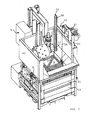
- the compactor includes a tank 2 for receiving the waste to be compacted resting vertically on its bottom and open upwards.
- a protective collar 63 which blocks waste being compacted which could be expelled out of the tank, and which also acts as a feed hopper for the waste compactor to compact by which they are manually entered in the context of this exemplary embodiment.
- the loading takes place gradually, in practice of continuously, but only during operation of the grinding head.
- the grinding head is a conventional compacting head with rotary roller 1, mounted at the end of a support arm 5, advantageously bent, which is fixed to the end of a frame 4 outside the tank 2.
- the compactor described also comprises, in accordance with the invention, a compression device mainly consisting of a plate pressure 3, coming flat to cover the waste horizontally and mobile in vertical translation in the tank.
- a compression device mainly consisting of a plate pressure 3, coming flat to cover the waste horizontally and mobile in vertical translation in the tank.
- the head 1 comprises a roller grinder 11 operating essentially by shredding waste, which is associated with rotational drive means on itself, around its own axis.
- This roller 11 unique in the case described, is cylindrical in shape and advantageously has teeth 13 distributed over its surface. Note, however, that this roller could be tapered rather than shaped cylindrical.
- the head 1 presses by the roller 11 on the waste to compact in the tank when it is in the active position.
- the head 1 rises in the tank 2 as and when the crushed waste is piled up in the tank.
- the roller 11 is driven in rotation on itself at the same time as the head 1 is driven in gyration around the axis of the tank 2, and this advantageously from of the same motor means.
- only one of the two movements is controlled by a motor, the other arising by reaction.
- head 1 is advantageously, as it is described here, of the type of conventional compacting heads of so-called rotary compactors.
- the means for rotating the roller 11 on himself and in gyration of the head 1 as a whole around the axis of the tank 2 thus comprises a motor 14, located at the end upper head 1, which drives a vertical shaft 51, mounted along the axis of the tank, whose movement is transmitted to an arm 12 driving in rotation of the roller 11 on itself by a angle gear mechanism.
- the transmission organs of movements are enclosed in a protective casing 15 ( Figures 1 and 3), which protects them in particular from damage from waste to compact in the tank.
- the grinding head 1 allows mainly to grind the waste introduced into the tank by the shearing effect of the shredding roller. incidentally, pressure is exerted on the crushed waste which causes them to each passage of the roller 11, this corresponding pressure advantageously on the sole weight of the grinding head 1.
- these two combined actions of crushing and compression are exerted by the roller successively at any point of the surface it can cover around the vertical axis of the tank.
- Arm 5 which supports the grinding head with rotary roller 1 is mounted movable in translation along the frame 4.
- the arm 5 is mounted telescopically in the frame 4.
- a hydraulic cylinder of the single-acting type, is located in the building 4. Its action is exerted only to impose a forced movement in the lifting direction and to lift said head 1, whereas when it is not operational, the latter is in free descent, due to its weight.
- the hydraulic cylinder in question is powered by a pump, via a two-position distributor which controls either the placing under cylinder pressure, i.e. putting the cylinder at the exhaust to a tank.
- the head 1 is movable in vertical translation along the axis of the tank 2 progressively that the level of waste gradually introduced during its operation goes up in the tank. But by an order specific under configuration means, we can also raise head 1 to get it out of the tank until it reaches its inactive position where it is high enough to leave move the plate compression device from its inactive position to its active position or vice versa. The same ascent operation of head 1 is carried out at the end of compaction, and it then triggers the procedure for evacuating the bale obtained.
- roller head level detection sensor is provided rotary 1 in the tank 2, which provides a control cabinet 8 with a lifting signal in inactive position of head 1 when this level reaches a predetermined upper threshold.
- the control cabinet 8 is placed on the frame exterior 4 to be easily accessible in the event of a breakdown.
- various photo-electric proximity detection sensors which are arranged in the tank at several predetermined levels. Some may determine, for example, a reversal of the sense of gyration of the rotating roller head, others a partial ascent of this head, still others its complete rise above the tank 2.
- the inactive position of the head 1 occurs either, in course of constitution of a compacted ball, to let pass the pressure plate, either to allow the evacuation of the bale when it is finished. It can also be ordered by the operator, who presses a specific button on the cabinet for this purpose 8, for example in the event of a deficiency in the position sensors.
- the motor 14 is a motor hydraulic which is powered by a motor pump from the same hydraulic fluid reservoir to that to which the cylinder is connected hydraulics causing the head to rise 1.
- the motor pump is driven by an electric motor.
- a pressure detector threshold measures the supply pressure at the inlet to the motor 14.
- the pressure plate 3 is flat and square in shape, under the same dimensions as the section of the tank. In practice its dimensions are fixed in correspondence with the internal dimensions of the tank so that it can be easily moved there vertically by means of vertical translation while covering substantially the entire surface of the ground waste occupying tank. As it would also be for a rectangular section, the tank 2 of the compactor according to the invention was chosen in section partly square to facilitate the movement of the active position in tank 2 in its inactive position when it is retracted away from the tank. Above all, it has the advantage of facilitating the subsequent handling of the bale obtained as well as its storage.
- the pressure plate 3 includes reinforcing elements 7 on each of its faces.
- Two parallel edges 30 and 39 of the pressure plate 9 each have a handle 9 of gripping the tray. These two handles 9 are projecting of each of the two edges 30 and 39. They ensure the descent of the tray in the tank, as will be detailed later.
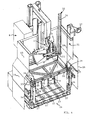
- the pressure plate 3 When the grinding head 1 is put into operation in the tank (active position), as shown in the figure 2, the pressure plate 3 is in the inactive position, retracted in a storage chassis 31.
- the chassis 31 has two columns 32 in extension of two edges of the tank 2, and preferably, as is notably represented in FIGS. 1, 2 and 3, the two columns 32 are an extension of two edges of one of the two lateral sides of the tank. In its position inactive, the pressure plate 3 is blocked between the columns 32 of the chassis 31.
- the compactor comprises in particular a winch 37 around which is wound and unwound a cable 38 whose end is fixed to part of the edge 39 of the pressure plate 3.
- Electrical sensors positioned at predetermined levels in tank 2 detect the level of the tray pressure 3 in the tank and they provide the control cabinet 8 signals controlling the winding or cable 38 around the winch 37.
- the electrical sensors can also be used to provide an indication of the degree of compaction due specifically to compaction by the pressure.
- Their main utility however, remains that of ordering automatically change the position of the plate device pressure and either the alternating intervention of the rotating roller head, or the start of bale unloading operations.
- the shredding roller 11 In order not to hinder the descent of the tray 3 in the tank 2, the shredding roller 11 is kept in the inactive position at a height above the tank such that it does not interfere with the descent of tray 3 in the tank. In order to clutter as little as possible the space above the tank, and as we can see in Figure 1 for example, the shredding roller 11 located opposite the plate 3 with respect to the axis of the tank, which allows passage to the pressure plate 3 when placed in the tank.
- the compactor includes in particular an electrical sensor positioned in the tank 2 which detects that the axis of the roller 11 is in the position desired when the roller 11 passes in front of it during movement of the grinding head 1.
- the electrical sensor sends a signal to the control cabinet 8 to almost stop instantly the turning movement of the grinding head 1 around the axis of the tank, as well as the rotational movement of the roll 11 on itself.
- the resistance that the waste exerts on the roller 11 is such that the movement of rotation of the roller 11 around its axis is stopped, which also causes the head movement to stop grinding 1 through the transmission box angular movement.
- the roller 11 When the grinding head 1 is raised vertically out of tank 2 to be locked in the inactive position, the roller 11 is in a position opposite that of the pressure retracted relative to the tank. In this way, it does not does not interfere with the tilting of the pressure plate 3 towards its position active in the tank.
- the pressure plate device 3 When the grinding head 1 is in active position, the pressure plate device 3 is held in inactive position. Similarly, as long as the pressure plate 3 remains found in active position in the tank, the grinding head is kept in the inactive position. The grinding head is not placed in the tank in the active position only once the device has pressure plate 3 is retracted in the inactive position out of the tank. And conversely: the pressure plate device 3 is not put in place in the active position in the tank only when the grinding 1 is retracted in the inactive position out of the tank.
- the plate 3 comprises in particular four parts 35 protruding from each of its four corners. Two of the four parts 35 are mounted movable in rails 36 which are provided in each of the columns 32 of the chassis 31. The other two parts 35 are mounted mobile in rails 23 provided in two parallel edges of the tank, these edges being those lying perpendicular to columns 32 ( Figures 2, 5 and 6).
- the compactor according to the invention has two clamps 33. They are each actuated by a jack with hydraulic pressure 34 to keep the tray in position pressure 3 at least by one of these four edges. advantageously and as shown in Figure 4, the two clamps 33 grip the handles 9 of the edges 30 and 39 of the plate 3 ( Figure 4).
- a protective dress 26 is provided, which appears in particular in Figure 4. The orders take place automatically.
- tray 3 begins with level the surface of the shredded waste. Indeed, the grinding head 1 making a circular movement in the tank and the tank being square section, the waste being in the four corners of the tank were not completely shredded and distributed in the tank.
- the pressure plate 3 therefore remedies at first to this uneven distribution of the waste to be compacted in the tank 2. Then, it compresses the crushed waste until it has subsided at a predetermined level.
- the tank 2 opens laterally by a door with two leaves 21 and 22, capable of withstanding the forces exerted by the compaction of the crushed waste against the internal walls of the tank.
- the two leaves 21 and 22 are mounted articulated in two horizontal axes. Specifically, the hinges of the two leaves are parallel to the bottom of the tank, one at the top for the upper leaf 21 and the other at the bottom for the lower leaf 22.
- This preferred mounting of the tank door reduces the size of the compactor, which saves space in the workshop, and facilitate access to the compacted bale for unloading.
- Door 21-22 can be opened and closed by a system hydraulic, which when open, retains the upper leaf 21 against gravity, to allow the exit of the bullet from compacted waste.
- the lower leaf 22 serves as a ramp for unloading bales when open. Indeed, as it is particularly shown in Figure 6, the bottom of the tank compactor is slightly raised above the ground on which the compactor is installed.
- the bottom 24 of the tank is made to constitute a bottom compactor of compacted waste bales.
- it is cut to form two strips 25 which are connected to the parts fixed from the bottom by an articulated parallelogram mounting allowing to bring them up during all the operations of compaction, or conversely to retract them to the same level at when the bale was unloaded.
- These two bands 25 are linear and parallel to each other. They are at the origin of the formation of two grooves of complementary shape in the balls compacted waste, the purpose of which is to clear the way for two branches of a forklift.
- the direction of the two bands 25 is perpendicular to the direction of exit of the balls through the door.
- the compactor described comprises means for producing a strapping of the waste ball by strands assembled strand on closed loop strand, which occur after compression by the plate 3, at the end of the combined compaction operations.
- a housing 74 accommodating strip reels 72 is formed at the foot of the frame 4, in a chosen position of so as to occupy as little space as possible.
- the housing 74 encloses a launch tube 73 which allows you to guide the end of the strap and propel it in slides 27, 28 and 29 formed in the side walls and in the bottom of the tank 2, with sufficient power for the strip can make at least one full turn around the tank.
- the slides are open inside the tank. They determine a path of the straps around the ball which is in the direction transverse to the bands 25 of the shaping bottom. The slides continue on these.
- the strapping is performed while the pressure plate is still in place to compress the resulting ball.
- the tray of pressure 3 therefore also has five guide slides 20 strips, open towards the inside of the tank, which match with slides 28 and 29 ( Figures 6), in the same vertical plane than these.
- the opening control system side door of the tank authorizes the opening of the upper leaf 21 regardless of the opening of the lower leaf 22. While the lower leaf 22 remains closed under pressure on the waste, the opening of the upper leaf can allow passage to a machine for crimping the strands of strip end to end.
- the ejection means 6 (FIG. 6) of the waste ball that comprises the compactor according to the invention are triggered by control means in synchronism with a tilting pressure plate in its inactive position away of the bale of compacted material, and with the opening of the door side of the tank.
- control means in synchronism with a tilting pressure plate in its inactive position away of the bale of compacted material, and with the opening of the door side of the tank.
- it is the operator who operates the control means, by pressing a control button located on the control cabinet 8.
- the triggering of the ball ejection means 6 first causes the opening of the lower leaf 22 of the tank door. Then, two plates 61, each associated with a push system 62 clearly visible in FIG. 6, are propelled from a wall of the tank opposite the door to expel the ball out of the bowl.
- the plates 61 are cut from the tank wall.
- They can come in support on the ball in the same vertical plane as one of the straps strapping.
- the push system 62 is made of a structure extendable, the length of which varies according to the angle between the articulated elements that constitute it.
- the operator can command the restart of the compactor after checking that the bale has been correctly ejected from the tank.
- This command successively triggers the closing of the two leaves 21 and 22 of the tank door, the reassembly of the plate 3 in the storage frame 31 by winding of the cable 38 around the winch 37, the descent of the head 1 in the tank 2 and its return to activity, once the gradual introduction of the waste to be compacted has been resumed.
- the compactor according to the invention allows more homogeneous compaction of waste thanks to to the respective combined actions of the grinding head and the pressure plate implemented in turn in the tank. More in particular, it appears from the description that the plate of pressure allows to homogenize the compaction density of waste in the tank. It also makes it possible to press waste towards the bottom of the tank 2 and against the internal side walls of the tank more intensely than the grinding head 1, and to obtain thus a waste ball having the same shape as the shape internal of the tank.
- the grinding head could, for example, also include deflector means fixed mounted in the vicinity of the roller drive means, to repel the waste to be compacted away from the organs of transmission of the rotational movement between the head shaft and the axis of the roller and to guide those approaching it nevertheless up to a cutting area where they are subjected to the action of sharp means.
- the grinding head would have the advantage of treating waste effectively resistant due to their composition, for example waste in plastic and grind them enough so that the pressure plate compression device then exerts on them roughly the same effect as on simple pieces of cardboard.
Landscapes
- Engineering & Computer Science (AREA)
- Mechanical Engineering (AREA)
- Refuse Collection And Transfer (AREA)
- Diaphragms For Electromechanical Transducers (AREA)
- Processing Of Solid Wastes (AREA)
- Control And Other Processes For Unpacking Of Materials (AREA)
- Containers And Plastic Fillers For Packaging (AREA)
- Supplying Of Containers To The Packaging Station (AREA)
- Refuse Receptacles (AREA)
Abstract
Description
- la figure 1 représente un mode de réalisation préféré du compacteur selon l'invention vu en perspective, dont la tête de broyage est en position inactive et dont le dispositif à plateau de pression est mis en place dans la cuve ;
- la figure 2 illustre le compacteur représenté en figure 1 vu en perspective, dont la tête de broyage est en position active dans la cuve et dont le dispositif à plateau de pression est en position inactive ;
- la figure 3 montre le compacteur représenté en figure 1 et 2 vu en perspective, dont la tête de broyage est en position inactive et dont le dispositif à plateau de pression est en position active dans la cuve ;
- la figure 4 montre le compacteur représenté en figure 3, muni d'une robe latérale protectrice, vu en coupe longitudinale ;
- la figure 5 représente le compacteur vu partiellement en coupe latérale, dont le fond conformateur présente deux bandes rétractables ;
- et la figure 6 montre le compacteur vu partiellement en coupe latérale, dont les battants de la porte sont ouverts et dont les moyens d'éjection sont mis en oeuvre pour éjecter une balle de matières compactées.
Claims (12)
- Compacteur de matières telles que des déchets, notamment des déchets d'emballages à base de carton, caractérisé en ce qu'il comporte une cuve (2) de réception des matières à compacter, dans laquelle des moyens de configuration permettent de mettre en oeuvre à tour de rôle une tête de broyage à rouleau (1) comportant au moins un rouleau rotatif (11) monté mobile en rotation sur lui-même et en déplacement sur la surface des matières quand la tête de broyage est dans une position active dans la cuve, ainsi qu'un dispositif de compression à plateau de pression (3) associé à des moyens de translation pour comprimer les matières préalablement broyées par ladite tête quand il est dans une position active dans ladite cuve.
- Compacteur selon la revendication 1 dans lequel ladite cuve (2) est de section rectangulaire, le cas échéant carrée, et avantageusement ouverte vers le haut pour un chargement progressif en matières à compacter, ladite tête (1) est montée mobile en translation verticale avec son rouleau en appui sur les matières en cours de compactage et elle est associée à des moyens d'entraínement en rotation autour d'un axe vertical quand elle est en position active, ledit plateau de pression (3) est dimensionné pour venir à plat couvrir toute la surface des matières quand il est amené dans sa position active et les moyens de translation auquel il est associé sont conçus pour l'entraíner en translation verticale pour comprimer les matières préalablement broyées contre le fond (24) de la cuve.
- Compacteur selon la revendication 1 ou 2, caractérisé en ce que lesdits moyens de configuration comportent des premiers moyens de configuration qui ont pour effet de relever ladite tête (1 ), à partir de sa position active où son rouleau est en appui sur les matières en cours de compactage, jusque dans une position inactive où elle est hors de la cuve au-dessus de celle-ci, et des seconds moyens de configuration qui ont pour effet d'escamoter le dispositif à plateau de pression (3), à partir de sa position active, par basculement vers une position inactive où il est latéralement à l'écart de la cuve.
- Compacteur selon l'une quelconque des revendications 1 à 4, caractérisé par des moyens pour assurer automatiquement le passage d'une première étape de fonctionnement où ladite tête de broyage est active dans la cuve tandis que le dispositif à plateau de pression est en position inactive, à une seconde étape de fonctionnement où le dispositif à plateau de pression est actif dans ladite cuve tandis que la tête de broyage est en position inactive, dès lors que dans ladite cuve (2), l'épaisseur des matières atteint une valeur prédéterminée.
- Compacteur suivant l'une quelconque des revendications précédentes, caractérisé en ce que ladite cuve (2) présente, sur un fond rigide (24) résistant à la pression exercée par le dispositif à plateau de pression, deux parois latérales opposées dont l'une est constituée par une porte (21, 22) s'ouvrant pour l'évacuation d'une balle de matières compactées, et dont une autre comporte des moyens d'éjection (6) pour pousser ladite balle hors de ladite cuve (2) à travers ladite porte (21, 22).
- Compacteur selon la revendication 5, caractérisé en ce que les moyens d'éjection (6) comportent des plaques (61) découpées dans la paroi correspondante qui sont mues chacune par un système de poussoir (62) à éléments articulés.
- Compacteur selon la revendication 5 ou 6, caractérisé en ce que ladite porte est au moins partiellement constituée par un battant inférieur rabattable vers le sol à l'extérieur de la cuve autour d'une charnière horizontale, ledit battant formant ainsi une rampe de déchargement de la balle obtenue en fin de compactage.
- Compacteur selon la revendication 5, 6, ou 7, caractérisé en ce qu'il comporte des moyens de commande automatique (8) déterminant la mise en oeuvre desdits moyens d'éjection (6) en synchronisme avec l'ouverture de ladite porte (21, 22) de la cuve une fois qu'après une dernière étape de fonctionnement du compacteur où le dispositif à plateau de pression était actif dans ladite cuve (2), ce dispositif ait été escamoté hors de la cuve (2).
- Compacteur selon l'une quelconque des revendications précédentes, caractérisé en ce que ladite cuve (2) comporte un fond conformateur (24) partiellement constitué de bandes rétractables (25) courant avantageusement sur toute la largeur du fond (24) de la cuve (2), lesdites bandes (25) étant amenées en saillie du reste du fond (24) de la cuve (2) pendant les opérations de compactage pour ménager dans la balle finalement obtenue des sillons en creux, pouvant notamment servir au transport de la balle par un chariot à fourche.
- Compacteur suivant l'une quelconque des revendications précédentes, comportant des moyens de cerclage d'une balle obtenue en fin des opérations de compactage par des feuillards propulsés directement autour de la balle se trouvant encore dans ladite cuve.
- Compacteur selon la revendication 10, caractérisé en ce qu'il comporte un battant supérieur de porte (21) pour l'introduction d'une machine de sertissage de deux brins de feuillard entre eux, et ce que, dans le cas où ladite porte est une porte à deux battants comportant également un battant inférieur (22) pour l'évacuation d'une balle de matières compactées, un système de commande est prévu pour déterminer l'ouverture dudit battant supérieur (21) indépendamment de l'ouverture dudit battant inférieur (22), celui-ci pouvant ainsi, pendant l'opération de cerclage, assurer le maintien de la balle en partie inférieure de ladite cuve (2).
- Compacteur selon la revendication 10 ou 11, caractérisé en ce que ladite cuve (2) présente des glissières (20, 27, 28, 29) de guidage du passage des feuillards de cerclage de la balle, quand ceux sont propulsés à partir de bobines distributrices (72) installées dans des logements d'accueil (74) que présente ledit compacteur, lesdites glissières étant ménagées dans les parois interne de la cuve (2) ainsi que le plateau de pression (3), et en ce que, dans le cas où la cuve présente un fond conformateur suivant la revendication 9, lesdites glissières sont orientées dans une direction transversale à celle des bandes rétractables dudit fond.
Applications Claiming Priority (2)
| Application Number | Priority Date | Filing Date | Title |
|---|---|---|---|
| FR0211785A FR2844727B1 (fr) | 2002-09-24 | 2002-09-24 | Compacteur de matieres |
| FR0211785 | 2002-09-24 |
Publications (2)
| Publication Number | Publication Date |
|---|---|
| EP1407876A1 true EP1407876A1 (fr) | 2004-04-14 |
| EP1407876B1 EP1407876B1 (fr) | 2008-02-13 |
Family
ID=31970930
Family Applications (1)
| Application Number | Title | Priority Date | Filing Date |
|---|---|---|---|
| EP03292328A Expired - Lifetime EP1407876B1 (fr) | 2002-09-24 | 2003-09-23 | Compacteur de matières telles que des déchets d'emballages |
Country Status (6)
| Country | Link |
|---|---|
| US (1) | US6851354B2 (fr) |
| EP (1) | EP1407876B1 (fr) |
| AT (1) | ATE385891T1 (fr) |
| CA (1) | CA2442890A1 (fr) |
| DE (1) | DE60319044D1 (fr) |
| FR (1) | FR2844727B1 (fr) |
Families Citing this family (5)
| Publication number | Priority date | Publication date | Assignee | Title |
|---|---|---|---|---|
| TWM326858U (en) * | 2007-08-20 | 2008-02-11 | Michilin Prosperity Co Ltd | Swinging apparatus for increasing the volume of waste paper can |
| US7708217B2 (en) * | 2007-10-15 | 2010-05-04 | Michilin Prosperity Co., Ltd. | Shredder with waste leveler and compactor |
| CN108792359B (zh) * | 2018-07-17 | 2021-08-03 | 佛山市南海区北奥清洁用品有限公司 | 一种公共场所用垃圾桶 |
| CN112588784B (zh) * | 2020-11-27 | 2022-04-26 | 青岛盈拓环保科技有限公司 | 一种工业塑料回收用快速处理装置 |
| CN112973875B (zh) * | 2021-02-03 | 2022-12-06 | 北京吉乃尔科技有限公司 | 一种生物凝胶制备装置 |
Citations (2)
| Publication number | Priority date | Publication date | Assignee | Title |
|---|---|---|---|---|
| CH431373A (de) * | 1964-02-12 | 1967-02-28 | Bonnierfoeretagen Ab | Sammelbehälter |
| EP1023988A2 (fr) * | 1999-12-18 | 2000-08-02 | Valdec | Procédé de compactage de déchets et machine pour sa mise en oeuvre |
Family Cites Families (5)
| Publication number | Priority date | Publication date | Assignee | Title |
|---|---|---|---|---|
| JPS5035154B1 (fr) * | 1970-01-10 | 1975-11-13 | ||
| US3851577A (en) * | 1972-11-06 | 1974-12-03 | Munro Newcom Inc | Vertical baler |
| DE3166299D1 (en) * | 1980-06-24 | 1984-10-31 | Heinz Bergmann | Device to compact refuse in open containers |
| DE3903642C2 (de) * | 1989-02-08 | 1996-05-30 | Heinz Bergmann | Vorrichtung zum Verdichten von aus Verpackungsmaterial bestehendem Müll |
| FR2769900B1 (fr) * | 1997-10-16 | 1999-12-31 | Antoine Marie Chedru | Dispositif de reduction du volume de dechets |
-
2002
- 2002-09-24 FR FR0211785A patent/FR2844727B1/fr not_active Expired - Fee Related
-
2003
- 2003-09-23 AT AT03292328T patent/ATE385891T1/de not_active IP Right Cessation
- 2003-09-23 DE DE60319044T patent/DE60319044D1/de not_active Expired - Lifetime
- 2003-09-23 EP EP03292328A patent/EP1407876B1/fr not_active Expired - Lifetime
- 2003-09-24 US US10/668,598 patent/US6851354B2/en not_active Expired - Fee Related
- 2003-09-24 CA CA002442890A patent/CA2442890A1/fr not_active Abandoned
Patent Citations (2)
| Publication number | Priority date | Publication date | Assignee | Title |
|---|---|---|---|---|
| CH431373A (de) * | 1964-02-12 | 1967-02-28 | Bonnierfoeretagen Ab | Sammelbehälter |
| EP1023988A2 (fr) * | 1999-12-18 | 2000-08-02 | Valdec | Procédé de compactage de déchets et machine pour sa mise en oeuvre |
Also Published As
| Publication number | Publication date |
|---|---|
| CA2442890A1 (fr) | 2004-03-24 |
| FR2844727B1 (fr) | 2004-12-03 |
| US6851354B2 (en) | 2005-02-08 |
| FR2844727A1 (fr) | 2004-03-26 |
| DE60319044D1 (de) | 2008-03-27 |
| ATE385891T1 (de) | 2008-03-15 |
| EP1407876B1 (fr) | 2008-02-13 |
| US20040112230A1 (en) | 2004-06-17 |
Similar Documents
| Publication | Publication Date | Title |
|---|---|---|
| EP0142438A2 (fr) | Méthode et appareillage pour l'ensachage de matières fibreuses | |
| FR2474465A1 (fr) | Dispositif pour une machine destinee plus particulierement a la manipulation de paquets non attaches de periodiques | |
| FR2631878A1 (fr) | Dispositif pour decouper un stratifie | |
| EP0115235A2 (fr) | Dispositif et procédé d'empilage et de chargement de feutres | |
| FR2655944A1 (fr) | Dispositif pour empaqueter des dechets. | |
| EP1407876B1 (fr) | Compacteur de matières telles que des déchets d'emballages | |
| EP1023988B1 (fr) | Procédé de compactage de déchets et machine pour sa mise en oeuvre | |
| EP0428457B1 (fr) | Procédé et dispositif d'empâtage d'une structure alvéolaire en forme de plaque | |
| FR2769900A1 (fr) | Dispositif de reduction du volume de dechets | |
| WO2012020199A1 (fr) | Concasseur ou broyeur a marteaux, dechiqueteur ou analogue pourvu d'un dispositif d'alimentation mobile | |
| KR101782876B1 (ko) | 롤 컴팩터 | |
| CA2104482A1 (fr) | Appareil et methode de formage d'un ballot de foin carre a partir d'un ballot rond, et de tassement | |
| FR2845562A1 (fr) | Presse a balles rondes equipee d'au moins deux systemes de liage | |
| FR2647704A1 (fr) | Dispositif de chargement, de compression et de dechargement d'un paquet de couches compose d'un panneau et de feuilles de parement, dans une presse a chaud | |
| CH708469A1 (fr) | Machine de conditionnement de bûches de bois de feu. | |
| CN210634810U (zh) | 一种自动包膜机 | |
| FR2552743A1 (fr) | Machine d'empilage | |
| FR2617324A1 (fr) | Procede et installation de conditionnement de dechets, notamment nucleaires | |
| EP4119337B1 (fr) | Compacteur a cartons et autres papiers secs | |
| EP0329574B1 (fr) | Installation d'évacuation d'objets par chargement dans un conteneur | |
| FR2645065A1 (fr) | Procede pour trancher en secteurs un produit alimentaire, notamment du type fromage et le dispositif de mise en oeuvre | |
| FR2558792A1 (fr) | Chaine de conditionnement de produits sous film dans un receptacle forme a partir d'un flan plat predecoupe | |
| FR2687635A1 (fr) | Dispositif de presse de la paille, ou autres matieres vegetales, permettant de realiser des balles de tres haute densite. | |
| FR2593792A1 (fr) | Distributeur d'elements minces et souples empiles, muni d'un dispositif d'extraction de ces derniers, et boite-cartouche destinee a equiper un tel distributeur | |
| FR2767634A1 (fr) | Godet desileur |
Legal Events
| Date | Code | Title | Description |
|---|---|---|---|
| PUAI | Public reference made under article 153(3) epc to a published international application that has entered the european phase |
Free format text: ORIGINAL CODE: 0009012 |
|
| AK | Designated contracting states |
Kind code of ref document: A1 Designated state(s): AT BE BG CH CY CZ DE DK EE ES FI FR GB GR HU IE IT LI LU MC NL PT RO SE SI SK TR |
|
| AX | Request for extension of the european patent |
Extension state: AL LT LV MK |
|
| 17P | Request for examination filed |
Effective date: 20041014 |
|
| AKX | Designation fees paid |
Designated state(s): AT BE BG CH CY CZ DE DK EE ES FI FR GB GR HU IE IT LI LU MC NL PT RO SE SI SK TR |
|
| GRAP | Despatch of communication of intention to grant a patent |
Free format text: ORIGINAL CODE: EPIDOSNIGR1 |
|
| GRAS | Grant fee paid |
Free format text: ORIGINAL CODE: EPIDOSNIGR3 |
|
| GRAA | (expected) grant |
Free format text: ORIGINAL CODE: 0009210 |
|
| AK | Designated contracting states |
Kind code of ref document: B1 Designated state(s): AT BE BG CH CY CZ DE DK EE ES FI FR GB GR HU IE IT LI LU MC NL PT RO SE SI SK TR |
|
| REG | Reference to a national code |
Ref country code: GB Ref legal event code: FG4D Free format text: NOT ENGLISH |
|
| REG | Reference to a national code |
Ref country code: CH Ref legal event code: EP |
|
| REG | Reference to a national code |
Ref country code: IE Ref legal event code: FG4D Free format text: LANGUAGE OF EP DOCUMENT: FRENCH |
|
| REF | Corresponds to: |
Ref document number: 60319044 Country of ref document: DE Date of ref document: 20080327 Kind code of ref document: P |
|
| PG25 | Lapsed in a contracting state [announced via postgrant information from national office to epo] |
Ref country code: FI Free format text: LAPSE BECAUSE OF FAILURE TO SUBMIT A TRANSLATION OF THE DESCRIPTION OR TO PAY THE FEE WITHIN THE PRESCRIBED TIME-LIMIT Effective date: 20080213 Ref country code: ES Free format text: LAPSE BECAUSE OF FAILURE TO SUBMIT A TRANSLATION OF THE DESCRIPTION OR TO PAY THE FEE WITHIN THE PRESCRIBED TIME-LIMIT Effective date: 20080524 |
|
| NLV1 | Nl: lapsed or annulled due to failure to fulfill the requirements of art. 29p and 29m of the patents act | ||
| PG25 | Lapsed in a contracting state [announced via postgrant information from national office to epo] |
Ref country code: AT Free format text: LAPSE BECAUSE OF FAILURE TO SUBMIT A TRANSLATION OF THE DESCRIPTION OR TO PAY THE FEE WITHIN THE PRESCRIBED TIME-LIMIT Effective date: 20080213 |
|
| PG25 | Lapsed in a contracting state [announced via postgrant information from national office to epo] |
Ref country code: SI Free format text: LAPSE BECAUSE OF FAILURE TO SUBMIT A TRANSLATION OF THE DESCRIPTION OR TO PAY THE FEE WITHIN THE PRESCRIBED TIME-LIMIT Effective date: 20080213 |
|
| REG | Reference to a national code |
Ref country code: IE Ref legal event code: FD4D |
|
| PG25 | Lapsed in a contracting state [announced via postgrant information from national office to epo] |
Ref country code: IE Free format text: LAPSE BECAUSE OF FAILURE TO SUBMIT A TRANSLATION OF THE DESCRIPTION OR TO PAY THE FEE WITHIN THE PRESCRIBED TIME-LIMIT Effective date: 20080213 Ref country code: PT Free format text: LAPSE BECAUSE OF FAILURE TO SUBMIT A TRANSLATION OF THE DESCRIPTION OR TO PAY THE FEE WITHIN THE PRESCRIBED TIME-LIMIT Effective date: 20080714 Ref country code: DK Free format text: LAPSE BECAUSE OF FAILURE TO SUBMIT A TRANSLATION OF THE DESCRIPTION OR TO PAY THE FEE WITHIN THE PRESCRIBED TIME-LIMIT Effective date: 20080213 Ref country code: SE Free format text: LAPSE BECAUSE OF FAILURE TO SUBMIT A TRANSLATION OF THE DESCRIPTION OR TO PAY THE FEE WITHIN THE PRESCRIBED TIME-LIMIT Effective date: 20080513 Ref country code: NL Free format text: LAPSE BECAUSE OF FAILURE TO SUBMIT A TRANSLATION OF THE DESCRIPTION OR TO PAY THE FEE WITHIN THE PRESCRIBED TIME-LIMIT Effective date: 20080213 Ref country code: SK Free format text: LAPSE BECAUSE OF FAILURE TO SUBMIT A TRANSLATION OF THE DESCRIPTION OR TO PAY THE FEE WITHIN THE PRESCRIBED TIME-LIMIT Effective date: 20080213 Ref country code: CZ Free format text: LAPSE BECAUSE OF FAILURE TO SUBMIT A TRANSLATION OF THE DESCRIPTION OR TO PAY THE FEE WITHIN THE PRESCRIBED TIME-LIMIT Effective date: 20080213 |
|
| PG25 | Lapsed in a contracting state [announced via postgrant information from national office to epo] |
Ref country code: RO Free format text: LAPSE BECAUSE OF FAILURE TO SUBMIT A TRANSLATION OF THE DESCRIPTION OR TO PAY THE FEE WITHIN THE PRESCRIBED TIME-LIMIT Effective date: 20080213 |
|
| PLBE | No opposition filed within time limit |
Free format text: ORIGINAL CODE: 0009261 |
|
| STAA | Information on the status of an ep patent application or granted ep patent |
Free format text: STATUS: NO OPPOSITION FILED WITHIN TIME LIMIT |
|
| 26N | No opposition filed |
Effective date: 20081114 |
|
| PG25 | Lapsed in a contracting state [announced via postgrant information from national office to epo] |
Ref country code: DE Free format text: LAPSE BECAUSE OF FAILURE TO SUBMIT A TRANSLATION OF THE DESCRIPTION OR TO PAY THE FEE WITHIN THE PRESCRIBED TIME-LIMIT Effective date: 20080514 |
|
| BERE | Be: lapsed |
Owner name: TECHVAL Effective date: 20080930 |
|
| PG25 | Lapsed in a contracting state [announced via postgrant information from national office to epo] |
Ref country code: MC Free format text: LAPSE BECAUSE OF NON-PAYMENT OF DUE FEES Effective date: 20080930 Ref country code: BG Free format text: LAPSE BECAUSE OF FAILURE TO SUBMIT A TRANSLATION OF THE DESCRIPTION OR TO PAY THE FEE WITHIN THE PRESCRIBED TIME-LIMIT Effective date: 20080513 Ref country code: EE Free format text: LAPSE BECAUSE OF FAILURE TO SUBMIT A TRANSLATION OF THE DESCRIPTION OR TO PAY THE FEE WITHIN THE PRESCRIBED TIME-LIMIT Effective date: 20080213 |
|
| REG | Reference to a national code |
Ref country code: CH Ref legal event code: PL |
|
| GBPC | Gb: european patent ceased through non-payment of renewal fee |
Effective date: 20080923 |
|
| REG | Reference to a national code |
Ref country code: FR Ref legal event code: ST Effective date: 20090529 |
|
| PG25 | Lapsed in a contracting state [announced via postgrant information from national office to epo] |
Ref country code: CY Free format text: LAPSE BECAUSE OF FAILURE TO SUBMIT A TRANSLATION OF THE DESCRIPTION OR TO PAY THE FEE WITHIN THE PRESCRIBED TIME-LIMIT Effective date: 20080213 Ref country code: BE Free format text: LAPSE BECAUSE OF NON-PAYMENT OF DUE FEES Effective date: 20080930 |
|
| PG25 | Lapsed in a contracting state [announced via postgrant information from national office to epo] |
Ref country code: IT Free format text: LAPSE BECAUSE OF FAILURE TO SUBMIT A TRANSLATION OF THE DESCRIPTION OR TO PAY THE FEE WITHIN THE PRESCRIBED TIME-LIMIT Effective date: 20080213 |
|
| PG25 | Lapsed in a contracting state [announced via postgrant information from national office to epo] |
Ref country code: LI Free format text: LAPSE BECAUSE OF NON-PAYMENT OF DUE FEES Effective date: 20080930 Ref country code: CH Free format text: LAPSE BECAUSE OF NON-PAYMENT OF DUE FEES Effective date: 20080930 Ref country code: FR Free format text: LAPSE BECAUSE OF NON-PAYMENT OF DUE FEES Effective date: 20080930 |
|
| PG25 | Lapsed in a contracting state [announced via postgrant information from national office to epo] |
Ref country code: GB Free format text: LAPSE BECAUSE OF NON-PAYMENT OF DUE FEES Effective date: 20080923 |
|
| PG25 | Lapsed in a contracting state [announced via postgrant information from national office to epo] |
Ref country code: LU Free format text: LAPSE BECAUSE OF NON-PAYMENT OF DUE FEES Effective date: 20080923 Ref country code: HU Free format text: LAPSE BECAUSE OF FAILURE TO SUBMIT A TRANSLATION OF THE DESCRIPTION OR TO PAY THE FEE WITHIN THE PRESCRIBED TIME-LIMIT Effective date: 20080814 |
|
| PG25 | Lapsed in a contracting state [announced via postgrant information from national office to epo] |
Ref country code: TR Free format text: LAPSE BECAUSE OF FAILURE TO SUBMIT A TRANSLATION OF THE DESCRIPTION OR TO PAY THE FEE WITHIN THE PRESCRIBED TIME-LIMIT Effective date: 20080213 |
|
| PG25 | Lapsed in a contracting state [announced via postgrant information from national office to epo] |
Ref country code: GR Free format text: LAPSE BECAUSE OF FAILURE TO SUBMIT A TRANSLATION OF THE DESCRIPTION OR TO PAY THE FEE WITHIN THE PRESCRIBED TIME-LIMIT Effective date: 20080514 |