EP1407625B1 - Method and system for improving battery performance in broadcast paging - Google Patents
Method and system for improving battery performance in broadcast paging Download PDFInfo
- Publication number
- EP1407625B1 EP1407625B1 EP02746970A EP02746970A EP1407625B1 EP 1407625 B1 EP1407625 B1 EP 1407625B1 EP 02746970 A EP02746970 A EP 02746970A EP 02746970 A EP02746970 A EP 02746970A EP 1407625 B1 EP1407625 B1 EP 1407625B1
- Authority
- EP
- European Patent Office
- Prior art keywords
- broadcast
- broadcast page
- time slots
- channel
- slots
- Prior art date
- Legal status (The legal status is an assumption and is not a legal conclusion. Google has not performed a legal analysis and makes no representation as to the accuracy of the status listed.)
- Expired - Lifetime
Links
- 238000000034 method Methods 0.000 title claims abstract description 13
- 230000005540 biological transmission Effects 0.000 claims description 13
- 238000004891 communication Methods 0.000 claims description 11
- 238000010295 mobile communication Methods 0.000 abstract 1
- 230000008569 process Effects 0.000 description 3
- 230000004044 response Effects 0.000 description 3
- 230000011664 signaling Effects 0.000 description 3
- 230000001143 conditioned effect Effects 0.000 description 2
- 230000006870 function Effects 0.000 description 2
- 238000012544 monitoring process Methods 0.000 description 2
- 239000002245 particle Substances 0.000 description 2
- 238000012545 processing Methods 0.000 description 2
- 230000000153 supplemental effect Effects 0.000 description 2
- 230000001413 cellular effect Effects 0.000 description 1
- 230000008859 change Effects 0.000 description 1
- 230000000295 complement effect Effects 0.000 description 1
- 125000004122 cyclic group Chemical group 0.000 description 1
- 230000001419 dependent effect Effects 0.000 description 1
- 238000013461 design Methods 0.000 description 1
- 238000010586 diagram Methods 0.000 description 1
- 238000005516 engineering process Methods 0.000 description 1
- 238000012986 modification Methods 0.000 description 1
- 230000004048 modification Effects 0.000 description 1
- 230000003287 optical effect Effects 0.000 description 1
- 230000002618 waking effect Effects 0.000 description 1
Images
Classifications
-
- H—ELECTRICITY
- H04—ELECTRIC COMMUNICATION TECHNIQUE
- H04W—WIRELESS COMMUNICATION NETWORKS
- H04W4/00—Services specially adapted for wireless communication networks; Facilities therefor
- H04W4/06—Selective distribution of broadcast services, e.g. multimedia broadcast multicast service [MBMS]; Services to user groups; One-way selective calling services
-
- H—ELECTRICITY
- H04—ELECTRIC COMMUNICATION TECHNIQUE
- H04L—TRANSMISSION OF DIGITAL INFORMATION, e.g. TELEGRAPHIC COMMUNICATION
- H04L12/00—Data switching networks
- H04L12/02—Details
- H04L12/12—Arrangements for remote connection or disconnection of substations or of equipment thereof
-
- H—ELECTRICITY
- H04—ELECTRIC COMMUNICATION TECHNIQUE
- H04L—TRANSMISSION OF DIGITAL INFORMATION, e.g. TELEGRAPHIC COMMUNICATION
- H04L9/00—Cryptographic mechanisms or cryptographic arrangements for secret or secure communications; Network security protocols
- H04L9/40—Network security protocols
-
- H—ELECTRICITY
- H04—ELECTRIC COMMUNICATION TECHNIQUE
- H04W—WIRELESS COMMUNICATION NETWORKS
- H04W52/00—Power management, e.g. Transmission Power Control [TPC] or power classes
- H04W52/02—Power saving arrangements
-
- H—ELECTRICITY
- H04—ELECTRIC COMMUNICATION TECHNIQUE
- H04W—WIRELESS COMMUNICATION NETWORKS
- H04W68/00—User notification, e.g. alerting and paging, for incoming communication, change of service or the like
- H04W68/02—Arrangements for increasing efficiency of notification or paging channel
-
- H—ELECTRICITY
- H04—ELECTRIC COMMUNICATION TECHNIQUE
- H04W—WIRELESS COMMUNICATION NETWORKS
- H04W72/00—Local resource management
- H04W72/30—Resource management for broadcast services
-
- H—ELECTRICITY
- H04—ELECTRIC COMMUNICATION TECHNIQUE
- H04W—WIRELESS COMMUNICATION NETWORKS
- H04W52/00—Power management, e.g. Transmission Power Control [TPC] or power classes
- H04W52/02—Power saving arrangements
- H04W52/0209—Power saving arrangements in terminal devices
- H04W52/0212—Power saving arrangements in terminal devices managed by the network, e.g. network or access point is leader and terminal is follower
- H04W52/0216—Power saving arrangements in terminal devices managed by the network, e.g. network or access point is leader and terminal is follower using a pre-established activity schedule, e.g. traffic indication frame
-
- H—ELECTRICITY
- H04—ELECTRIC COMMUNICATION TECHNIQUE
- H04W—WIRELESS COMMUNICATION NETWORKS
- H04W68/00—User notification, e.g. alerting and paging, for incoming communication, change of service or the like
- H04W68/02—Arrangements for increasing efficiency of notification or paging channel
- H04W68/025—Indirect paging
-
- Y—GENERAL TAGGING OF NEW TECHNOLOGICAL DEVELOPMENTS; GENERAL TAGGING OF CROSS-SECTIONAL TECHNOLOGIES SPANNING OVER SEVERAL SECTIONS OF THE IPC; TECHNICAL SUBJECTS COVERED BY FORMER USPC CROSS-REFERENCE ART COLLECTIONS [XRACs] AND DIGESTS
- Y02—TECHNOLOGIES OR APPLICATIONS FOR MITIGATION OR ADAPTATION AGAINST CLIMATE CHANGE
- Y02D—CLIMATE CHANGE MITIGATION TECHNOLOGIES IN INFORMATION AND COMMUNICATION TECHNOLOGIES [ICT], I.E. INFORMATION AND COMMUNICATION TECHNOLOGIES AIMING AT THE REDUCTION OF THEIR OWN ENERGY USE
- Y02D30/00—Reducing energy consumption in communication networks
- Y02D30/70—Reducing energy consumption in communication networks in wireless communication networks
Definitions
- the present invention relates generally to telecommunications systems, and more specifically to a method and system for improving battery life in mobile stations designed to receive broadcast messages.
- a base station uses a paging channel (F-PCH) to transmit broadcast pages and broadcast messages to target mobile stations.
- the base station may also send broadcast indicators on quick paging channel (F-QPCH) slots to inform the target mobile stations to monitor the F-PCH channel slots for the upcoming broadcast pages and/or broadcast messages.
- F-PCH paging channel
- F-QPCH quick paging channel
- the base station uses a common control channel (F-CCCH) to transmit broadcast pages, a broadcast control channel (F-BCCH) to transmit broadcast messages.
- F-CCCH common control channel
- F-BCCH broadcast control channel
- the base station may also send broadcast indicators on the F-QPCH channel slots to inform the target mobile stations to monitor the F-CCCH slots for the broadcast pages, which may point to the assigned F-BCCH channel slots that carry broadcast messages.
- a service provider may choose to adopt either of the above broadcasting channel protocols to broadcast messages to target mobile stations, but only the mobile stations that are designed for a chosen broadcasting channel protocol would be able to receive the broadcast messages. It is highly desirable to transmit broadcast messages using both broadcasting channel protocols such that the mobile stations that are designed to receive broadcast messages transmitted in either broadcasting channel protocol would be able to receive the broadcast messages.
- the broadcast indicators on the F-QPCH channel slots which may be used to signal a group of mobile stations to monitor the broadcast pages on either the F-PCH or F-CCCH channel, may cause false signaling to other mobile stations.
- a broadcast indicator on a F-QPCH channel slot that correctly points to a broadcast page slot on the F-PCH channel may also erroneously point to a broadcast page slot on the F-CCCH channel. Consequently, the mobile stations that are designed to monitor the F-CCCH channel slots may be unnecessarily awakened to monitor the F-CCCH channel slots. Therefore, these mobile stations may suffer from unnecessary battery consumption.
- US-B-6 339 588 describes a method of CDMA communication wherein a page message notice signal is transmitted over a page message notice channel, which is different from paging channels.
- the page message notice signal indicates whether a monitor-required page message is included in an up-coming time slot assigned to the mobile station.
- One aspect of the present invention is directed to a method and system for providing broadcast messages using more than one broadcast channel protocol.
- the method and system may include transmitting a plurality of first broadcast page slots on a first channel, transmitting a plurality of second broadcast page slots on a second channel, and transmitting a plurality of broadcast indicators on a third channel, such that each one of the plurality of broadcast indicators may point to only one of the first or second broadcast page slots.
- the first broadcast page slots on the first channel may be shifted with respect to the second broadcast page slots on the second channel.
- the first broadcast page slots on the first channel and the second broadcast page slots on the second channel may be transmitted at different broadcast page cycles.
- a base station for providing broadcast messages which may include a transmitter and a processor.
- the transmitter may be adapted to transmit a plurality of first broadcast page slots on a first channel, transmit a plurality of second broadcast page slots on a second channel, and transmit a plurality of broadcast indicators on a third channel.
- the processor may be adapted to control the transmitter such that each one of the plurality of broadcast indicators points to only one of the first or second broadcast page slots.
- the processor may be further adapted to shift the plurality of first broadcast page slots on the first channel with respect to the plurality of second broadcast page slots on the second channel.
- the processor may be further adapted to control the transmitter to transmit the plurality of first broadcast page slots on the first channel and the plurality of second broadcast page slots on the second channel at different broadcast page cycles.
- FIG. 1 is a representation of an exemplary arrangement for forward channels used in message broadcasting
- FIG. 2 is a representation of an exemplary base station and mobile station that may be used in message broadcasting
- FIG. 3 is a representation of exemplary broadcast paging cycles for forward broadcast channels according to a first embodiment
- FIG. 4 is a representation of exemplary broadcast paging cycles for the forward broadcast channels according to a second embodiment.
- FIG. 5 is a representation of exemplary broadcast paging cycles for the forward broadcast channels according to a third embodiment.
- the paging channel may be divided into 80 ms slots called paging channel slots. Paging and control messages for a mobile station operating in the non-slotted mode may be received in any one of the paging channel slots. Therefore, the non-slotted mode of operation requires the mobile station to monitor all slots.
- the forward common control channel also may be divided into 80 ms slots called forward common control channel slots. Paging and mobile-directed messages for a mobile station operating in the non-slotted mode may be received in any one of the forward common control channel slots. Therefore, the non-slotted mode of operation requires the mobile station to continuously monitor the forward common control channel.
- the paging channel protocol or the forward common control channel protocol may provide for scheduling the transmission of messages for a specific mobile station in certain assigned slots.
- a mobile station that monitors the paging channel or the forward common control channel only during the assigned slots is referred to as operating in the slotted mode.
- the mobile station may stop or reduce its processing for power conservation.
- a mobile station operating in the slotted mode generally monitors the paging channel or the forward common control channel for one or two slots per slot cycle.
- the mobile station may specify its preferred slot cycle, e.g., by using the SLOT_CYCLE_INDEX field provided in the registration message, origination message, or page response message.
- the mobile station may also specify its preferred slot cycle using the SLOT_CYCLE_INDEX field of the terminal information record of the status response message or the extended status response message.
- the base station may transmit broadcast messages, e.g., data burst messages with broadcast addresses, to target mobile stations.
- broadcast messages e.g., data burst messages with broadcast addresses
- the base station may send a broadcast page, such as the general page message (GPM) or the universal page message (UPM) with a broadcast address type, to the target mobile stations.
- GPS general page message
- UPM universal page message
- the physical channel or channels on which the broadcast pages and the corresponding broadcast messages may be transmitted to the mobile stations may depend on the common channel configuration. Two exemplary channel configurations are considered here.
- the first configuration corresponds to the broadcasting channel protocol used in the IS-95 family of CDMA systems as well as the prior releases of cdma2000.
- the forward channels may include the paging channel (F-PCH), and the quick paging channel (F-QPCH). Both a broadcast page, which may point to a companion broadcast message slot that contains a broadcast message, and the broadcast message may be sent on the F-PCH.
- F-PCH paging channel
- F-QPCH quick paging channel
- the second configuration corresponds to the broadcasting channel protocol used in the newer release of cdma2000, e.g., Release A.
- the forward channels may include the common control channel (F-CCCH), broadcast control channel (F-BCCH), and the quick paging channel (F-QPCH).
- the broadcast page may be sent on the F-CCCH, and the broadcast message may be sent on the F-BCCH.
- the broadcast pages may be distributed either on the F-PCH or the F-CCCH at specially defined channel slot cycles.
- the broadcast pages may be sent in the first slot of a broadcast paging cycle.
- Distribution of broadcast pages may also be on specially defined F-CCCH slot cycles.
- the F-QPCH may be divided into slots, e.g., 80 ms, called F-QPCH slots.
- the F-QPCH protocol may provide for scheduling the transmission of the paging indicators, the configuration change indicators, and the broadcast indicators in an F-QPCH slot.
- the F-QPCH slots may contain broadcast indicator (BI) bits that may be used to inform target mobile stations when to monitor the F-PCH/F-CCCH slot for a broadcast page. That is, if there is a broadcast page on the F-CCCH, for example, the BI bits of the corresponding F-QPCH slot are turned on to signal the target mobile stations to monitor the F-CCCH slots.
- BI broadcast indicator
- a service provider may support broadcast messaging using both F-PCH and F-CCCH/F-BCCH broadcasting channel protocols. Therefore, if both channel protocols operate in slotted mode with the quick paging channel, the same F-QPCH may be used to signal a mobile unit that is configured to monitor either the F-PCH or the F-CCCH/F-BCCH for a broadcast page.
- the Bls corresponding to the F-PCH may signal a group of mobile units to monitor the paging channel slots on the F-PCH
- the Bls corresponding to the F-CCCH may signal another group of mobile units to monitor the forward common control channel slots on the F-CCCH.
- FIG. 1 shows a representation of an exemplary arrangement for forward channels used in message broadcasting.
- the F-PCH/F-CCCH 102 may be divided into 80 ms slots 104 called paging channel slots.
- the quick paging channel 106 may be also divided into 80 ms slots 108 called F-QPCH slots.
- the mobile station may monitor broadcast indicators on an assigned F-QPCH channel slot that is offset from the mobile station's assigned broadcast page slots by a predetermined time interval 110, e.g., 100 ms, as shown in FIG. 1.
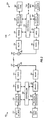
- FIG. 2 is a simplified block diagram of an embodiment of base station 204 and remote terminal 206, which are capable of implementing various aspects of the invention.
- voice data, packet data, and/or messages may be exchanged between base station 204 and remote terminal 206, via an air interface 208.
- Various types of messages may be transmitted, such as messages used to establish a communication session between the base station and remote terminal and messages used to control a data transmission (e.g., power control, data rate information, acknowledgment, and so on).
- voice and/or packet data e.g., from a data source 2
- messages e.g., from a controller 230
- TX transmit
- Each coding scheme may include any combination of cyclic redundancy check (CRC), convolutional, turbo, block, and other coding, or no coding at all.
- CRC cyclic redundancy check
- the voice data, packet data, and messages may be coded using different schemes, and different types of messages may be coded differently.
- the coded data is then provided to a modulator (MOD) 214 and further processed (e.g., covered, spread with short PN sequences, and scrambled with a long PN sequence assigned to the user terminal).
- the modulated data is then provided to a transmitter unit (TMTR) 216 and conditioned (e.g., converted to one or more analog signals, amplified, filtered, and quadrature modulated) to generate a reverse link signal.
- TMTR transmitter unit
- the reverse link signal is routed through a duplexer (D) 218 and transmitted via an antenna 220 to base station 204.
- the reverse link signal is received by an antenna 250, routed through a duplexer (D) 252, and provided to a receiver unit (RCVR) 254.
- Receiver unit 254 conditions (e.g., filters, amplifies, down converts, and digitizes) the received signal and provides samples.
- a demodulator (DEMOD) 256 receives and processes (e.g., despreads, decovers, and pilot demodulates) the samples to provide recovered symbols.
- Demodulator (DEMOD) 256 may implement a rake receiver that processes multiple instances of the received signal and generates combined symbols.
- a receiving (RX) data processor 258 then decodes the symbols to recover the data and messages transmitted on the reverse link.
- the recovered voice/packet data is provided to a data sink 260, and the recovered messages may be provided to a controller 270.
- the processing by demodulator (DEMOD) 256 and RX data processor 258 are complementary to that performed at remote terminal 206.
- Demodulator (DEMOD) 256 and RX data processor 258 may further be operated to process multiple transmissions received via multiple channels, e.g., a reverse fundamental channel (R-FCH) and a reverse supplemental channel (R-SCH). Also, transmissions may be simultaneously from multiple remote terminals, each of which may be transmitting on a reverse fundamental channel, a reverse supplemental channel, or both.
- R-FCH reverse fundamental channel
- R-SCH reverse supplemental channel
- voice and/or packet data e.g., from a data source 262
- messages e.g., from controller 270
- TX transmit
- MOD modulator
- TMTR transmitter unit
- the forward link signal is routed through duplexer (D) 252 and transmitted via antenna 250 to remote terminal 206.
- the forward link signal is received by antenna 220, routed through duplexer (D) 218, and provided to a receiver unit (RCVR) 222.
- Receiver unit (RCVR) 222 conditions (e.g., down converts, filters, amplifies, quadrature modulates, and digitizes) the received signal and provides samples.
- the samples are processed (e.g., despreaded, decovered, and pilot demodulated) by a demodulator (DEMOD) 224 to provide symbols, and the symbols are further processed (e.g., decoded and checked) by a receiving data processor 226 to recover the data and messages transmitted on the forward link.
- the recovered data is provided to a data sink 228, and the recovered messages may be provided to controller 230.
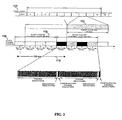
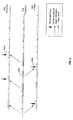
- FIG. 3 shows a representation of an exemplary arrangement for the F-CCCH 302, F-QPCH 304, and F-PCH 306.
- the broadcast paging cycles on the F-CCCH and the broadcast paging cycles on the F-PCH have identical durations and start at identical slot numbers. Therefore, the respective broadcast page slots overlap.
- the broadcast page slot 302A on the F-CCCH 302 overlaps with the broadcast page slot 306A on the F-PCH 306. Consequently, the BI bits on the F-QPCH slots point to the broadcast page slots on both the F-CCCH and the F-PCH.
- the same BI bit also points to the broadcast page slot 302A on the F-CCCH 302, as shown by the broken-line arrow, which erroneously wakes up a mobile designed to monitor the F-CCCH.
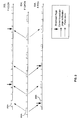
- the BPCs on the F-PCH and the F-CCCH may be shifted with respect to each other such that the broadcast slots on the F-CCCH and F-PCH do not overlap, as shown in FIG. 4.
- the broadcast page slots on the F-CCCH 402 do not overlap with the broadcast page slots on the F-PCH 406. Consequently, the BI bits on the quick paging channel slots on the F-QPCH channel do not point to both the F-CCCH slots and the F-PCH slots.
- a BI bit is directed to only one of the F-PCH or F-CCCH, the same BI bit does not point to the other of the F-PCH and the F-CCCH, which advantageously prevents a mobile station from unnecessarily waking up and monitoring the respective channel for broadcast messages.
- the BI bit in the F-QPCH slot 404A that points to the broadcast page slot 406A on the F-PCH 406 correctly wakes up a mobile station designed to monitor the F-PCH, as shown by the solid-line arrow.
- the same BI bit does not point to the broadcast page slot 402A on the F-CCCH 402 because the F-QPCH slot 404A is positioned more than the allowed time interval, e.g., 100 ms, before the broadcast page slot 402A on the F-CCCH 402. Therefore, the two BPCs do not overlap, and only the intended target mobile stations wake up to monitor their respective broadcast page slots.
- This embodiment may have the following advantages: (1) the duration of one BPC need not be increased to avoid the overlap, which increases the average delay to deliver a broadcast message, and (2) the two BPCs may not overlap at any slot, thus eliminating false alarm due to broadcast paging and hence improving battery performance of the mobile station.
- the base station may configure a predetermined shift into one of the equations that provide for the BPCs, such that the first slots of the BPCs are shifted by the predetermined shift.
- the base station may introduce a shift of two slots in the BPC on the F-CCCH compared to the BPC of the F-PCH.
- FIG. 4 shows the corresponding BPCs, and the first slots of the corresponding BPCs are shown in the following table: 1 2 3 4 5 6 7 8 9 10 ...
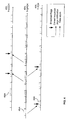
- the base station may specify different values for X 1 and X 2 in the equations that provide for the BPCs of the F-PCH and F-CCCH, respectively, and thereby cause the BPCs of the F-PCH and the F-CCCH to have different periods.
- the same BI bit would not point to the other of the F-PCH and the F-CCCH, which advantageously prevents a mobile station's unnecessary wake up.
- the Bl bit in the F-QPCH slot 504A that points to the broadcast page slot 506A on the F-PCH 506 correctly wakes up a mobile designed to monitor the F-PCH.
- the same BI bit does not point to the broadcast page slot 502A on the F-CCCH 502 because the F-QPCH slot 504A is positioned more than the allowed time interval, e.g., 100 ms, before the broadcast paging slot 502A on the F-CCCH 502.
- the following table shows the first slots of the resulting BPCs: 1 2 3 4 5 6 7 8 9 10 ...
- the base station may directly specify the values for BPCs of the F-PCH and the F-CCCH.
- the base station may specify different values for B 1 and B 2 in the equations that provide for the BPCs of the F-PCH and the F-CCCH , respectively, and thereby cause the BPCs of the F-PCH and F-CCCH to have different periods.
- the base station may specify the parameter "B" (rather than the BCAST_INDEX parameter) in the extended system parameters message for the F-PCH and in the system parameters message for the F-CCCH.
- the Bl bit in the F-QPCH slot 504A that points to the broadcast page slot 506A on the F-PCH 506 correctly wakes up a mobile station designed to monitor the F-PCH.
- the same BI bit does not point to the broadcast page slot 502A on the F-CCCH 502 because the F-QPCH slot 504A is positioned more than the allowed time interval, e.g., 100 ms, before the broadcast paging slot 502A on the F-CCCH 502.
- the first slots of the corresponding BPCs are shown in the following table. 1 2 3 4 5 6 7 8 9 10 ..
- DSP digital signal processor
- ASIC application specific integrated circuit
- FPGA field programmable gate array
- a general-purpose processor may be a microprocessor, but in the alternative, the processor may be any conventional processor, controller, microcontroller, or state machine.
- a processor may also be implemented as a combination of computing devices, e.g., a combination of a DSP and a microprocessor, a plurality of microprocessors, one or more microprocessors in conjunction with a DSP core, or any other such configuration.
- a software module may reside in RAM memory, flash memory, ROM memory, EPROM memory, EEPROM memory, registers, hard disk, a removable disk, a CD-ROM, or any other form of storage medium known in the art.
- An exemplary storage medium is coupled to the processor such the processor can read information from, and write information to, the storage medium.
- the storage medium may be integral to the processor.
- the processor and the storage medium may reside in an ASIC.
- the ASIC may reside in a user terminal.
- the processor and the storage medium may reside as discrete components in a user terminal.
Landscapes
- Engineering & Computer Science (AREA)
- Computer Networks & Wireless Communication (AREA)
- Signal Processing (AREA)
- Computer Security & Cryptography (AREA)
- Multimedia (AREA)
- Mobile Radio Communication Systems (AREA)
- Transmitters (AREA)
- Circuits Of Receivers In General (AREA)
- Telephonic Communication Services (AREA)
Applications Claiming Priority (3)
| Application Number | Priority Date | Filing Date | Title |
|---|---|---|---|
| US09/905,507 US6745056B2 (en) | 2001-07-13 | 2001-07-13 | Method and system for improving battery performance in broadcast paging |
| US905507 | 2001-07-13 | ||
| PCT/US2002/021933 WO2003007636A1 (en) | 2001-07-13 | 2002-07-12 | Method and system for improving battery performance in broadcast paging |
Publications (2)
| Publication Number | Publication Date |
|---|---|
| EP1407625A1 EP1407625A1 (en) | 2004-04-14 |
| EP1407625B1 true EP1407625B1 (en) | 2007-03-21 |
Family
ID=25420953
Family Applications (1)
| Application Number | Title | Priority Date | Filing Date |
|---|---|---|---|
| EP02746970A Expired - Lifetime EP1407625B1 (en) | 2001-07-13 | 2002-07-12 | Method and system for improving battery performance in broadcast paging |
Country Status (9)
| Country | Link |
|---|---|
| US (1) | US6745056B2 (enExample) |
| EP (1) | EP1407625B1 (enExample) |
| JP (1) | JP4184263B2 (enExample) |
| KR (1) | KR100909728B1 (enExample) |
| CN (1) | CN1305330C (enExample) |
| AT (1) | ATE357822T1 (enExample) |
| DE (1) | DE60219019T2 (enExample) |
| TW (1) | TWI238014B (enExample) |
| WO (1) | WO2003007636A1 (enExample) |
Families Citing this family (46)
| Publication number | Priority date | Publication date | Assignee | Title |
|---|---|---|---|---|
| KR100464351B1 (ko) * | 2001-10-20 | 2005-01-03 | 삼성전자주식회사 | 비동기 부호분할다중접속 통신시스템의 멀티미디어브로드캐스팅, 멀티캐스팅 방식에 있어서 추가적인반송파의 사용시에 적용 가능한 페이징 방법 및 장치 |
| US6950684B2 (en) | 2002-05-01 | 2005-09-27 | Interdigital Technology Corporation | Method and system for optimizing power resources in wireless devices |
| KR20080046292A (ko) | 2002-05-06 | 2008-05-26 | 인터디지탈 테크날러지 코포레이션 | 배터리 수명을 연장시키기 위한 동기화 방법 |
| KR20030097373A (ko) * | 2002-06-20 | 2003-12-31 | 삼성전자주식회사 | 이동 통신 시스템에서 멀티캐스트 멀티미디어 방송서비스를 위한 호출 장치 및 방법 |
| US6876636B2 (en) | 2002-07-09 | 2005-04-05 | Qualcomm Inc. | Method and system for a multicast service initiation in a communication system |
| KR100480652B1 (ko) * | 2002-11-08 | 2005-04-07 | 엘지전자 주식회사 | 방송형 단문 메시지 송수신 방법 |
| US20040192286A1 (en) * | 2003-03-31 | 2004-09-30 | Motorola, Inc. | Adaptive dispatch paging monitoring system and method |
| EP1467586B1 (en) * | 2003-04-09 | 2010-05-19 | Samsung Electronics Co., Ltd. | Method for cell reselection in an MBMS mobile communication system |
| KR100606014B1 (ko) * | 2003-04-09 | 2006-07-26 | 삼성전자주식회사 | 멀티미디어 브로드캐스트/멀티캐스트 서비스를 지원하는 이동통신 시스템에서 사용자 단말의 셀 재선택 방법 |
| US7606601B2 (en) * | 2003-07-04 | 2009-10-20 | Lg Electronics Inc. | Fast call setup system and method in a mobile communications system |
| KR101049107B1 (ko) * | 2003-09-15 | 2011-07-15 | 엘지전자 주식회사 | 이동통신 단말기의 리스캔 방법 및 장치 |
| FR2860361A1 (fr) * | 2003-09-25 | 2005-04-01 | France Telecom | Procede de regulation de la puissance de transmission au sein d'un reseau de communication sans fil |
| US20050186973A1 (en) * | 2004-02-04 | 2005-08-25 | Peter Gaal | Method and apparatus for sending signaling for multicast and broadcast services |
| EP1585356A1 (en) * | 2004-04-09 | 2005-10-12 | Motorola Inc. | Multi-user services control information transfer |
| US7711377B2 (en) | 2004-06-10 | 2010-05-04 | Qualcomm Incorporated | Efficient paging in a wireless communication system |
| KR100693599B1 (ko) * | 2004-08-21 | 2007-03-14 | 주식회사 팬택앤큐리텔 | 이동통신 단말기의 방송슬롯 감시시스템 및 방법 |
| US7738858B2 (en) * | 2004-10-18 | 2010-06-15 | Natan Epstein | Wireless messaging system |
| US7768948B2 (en) * | 2004-11-19 | 2010-08-03 | Atmel Automotive Gmbh | Method and device for data transmission |
| CN1610445B (zh) * | 2004-11-25 | 2010-04-28 | 开曼群岛威睿电通股份有限公司 | 兼容于传统方式用于广播/多播服务指示信号扩增方法 |
| US20060148493A1 (en) * | 2004-12-30 | 2006-07-06 | Murali Narasimha | Paging for broadcast and multicast services |
| KR100969754B1 (ko) | 2005-01-13 | 2010-07-13 | 삼성전자주식회사 | 셀룰러 무선통신 시스템에서 방송 채널 전송 방법 |
| KR101203062B1 (ko) * | 2005-03-10 | 2012-11-21 | 엘지전자 주식회사 | 이동통신 시스템에서 오버헤드 메시지 전송 방법 |
| US7904055B2 (en) | 2005-08-23 | 2011-03-08 | Lg Electronics Inc. | Communicating message in mobile communication system |
| US7787892B2 (en) | 2005-10-05 | 2010-08-31 | Via Technologies, Inc. | Method and apparatus for adaptive multi-stage multi-threshold detection of paging indicators in wireless communication systems |
| BRPI0706841A8 (pt) | 2006-01-05 | 2018-04-17 | Lg Electronics Inc | transmissão de dados em um sistema e comunicação móvel |
| KR100912784B1 (ko) | 2006-01-05 | 2009-08-18 | 엘지전자 주식회사 | 데이터 송신 방법 및 데이터 재전송 방법 |
| KR101187076B1 (ko) | 2006-01-05 | 2012-09-27 | 엘지전자 주식회사 | 이동 통신 시스템에 있어서 신호 전송 방법 |
| KR101203841B1 (ko) * | 2006-01-05 | 2012-11-21 | 엘지전자 주식회사 | 무선 통신 시스템에서의 페이징 메시지 전송 및 수신 방법 |
| KR101265628B1 (ko) | 2006-01-05 | 2013-05-22 | 엘지전자 주식회사 | 이동 통신 시스템에서의 무선 자원 스케줄링 방법 |
| US7881724B2 (en) | 2006-01-05 | 2011-02-01 | Lg Electronics Inc. | Allocating radio resources in mobile communications system |
| US9456455B2 (en) | 2006-01-05 | 2016-09-27 | Lg Electronics Inc. | Method of transmitting feedback information in a wireless communication system |
| KR101211807B1 (ko) | 2006-01-05 | 2012-12-12 | 엘지전자 주식회사 | 이동통신 시스템에서 무선단말의 동기상태 관리방법 |
| US8493854B2 (en) | 2006-02-07 | 2013-07-23 | Lg Electronics Inc. | Method for avoiding collision using identifier in mobile network |
| KR101387475B1 (ko) | 2006-03-22 | 2014-04-22 | 엘지전자 주식회사 | 복수의 네트워크 엔터티를 포함하는 이동 통신시스템에서의 데이터 처리 방법 |
| MY187399A (en) * | 2006-04-28 | 2021-09-22 | Qualcomm Inc | Method and apparatus for enhanced paging |
| KR20070121505A (ko) | 2006-06-21 | 2007-12-27 | 엘지전자 주식회사 | 무선링크 재설정 방법 |
| EP2618517B1 (en) | 2006-06-21 | 2023-08-02 | LG Electronics Inc. | Method of supporting data retransmission in a mobile communication system |
| CA2662261C (en) * | 2006-09-05 | 2014-09-30 | Research In Motion Limited | Method, and associated apparatus, of integrating extraction of extra partial identity bits with quick paging techniques where multiple pages share a message field |
| US8009603B2 (en) * | 2006-09-06 | 2011-08-30 | Futurewei Technologies, Inc. | Transmitting page and broadcast control channel through the same time frequency resources across the sectors in a wireless communications system |
| KR100801649B1 (ko) * | 2006-10-12 | 2008-02-05 | 삼성전자주식회사 | 휴대 단말의 대기모드 절전 방법 |
| JP4890315B2 (ja) * | 2007-03-29 | 2012-03-07 | 京セラ株式会社 | 携帯端末装置および無線ネットワークシステム |
| US8706145B2 (en) * | 2007-07-10 | 2014-04-22 | Qualcomm Incorporated | Multihop paging of a peer in a peer-to-peer communication network |
| US8320398B2 (en) * | 2007-07-10 | 2012-11-27 | Qualcomm Incorporated | Paging a peer in a peer-to-peer communication network |
| US9143946B2 (en) | 2008-09-15 | 2015-09-22 | Qualcomm Incorporated | Interference management in a multi-carrier communication system |
| WO2012023280A1 (en) | 2010-08-20 | 2012-02-23 | Panasonic Corporation | Apparatus and methods for data transmission synchronization for low power devices |
| CN102595575B (zh) * | 2012-02-27 | 2014-08-13 | 杭州星纬物联技术有限公司 | 一种有源无源交叉使用的全网低功耗组网方法 |
Family Cites Families (10)
| Publication number | Priority date | Publication date | Assignee | Title |
|---|---|---|---|---|
| US5485463A (en) | 1994-09-09 | 1996-01-16 | Glenayre Electronics, Inc. | System for transmitting paging signals using time-division-multiplexing |
| ZA957816B (en) * | 1994-09-30 | 1996-05-31 | Qualcomm Inc | Method and apparatus for providing broadcast messages in a communications network |
| US6069880A (en) * | 1997-05-19 | 2000-05-30 | Qualcomm Incorporated | Method and apparatus for scanning other frequency pilot signals in a code division multiple access communication system |
| US6111865A (en) | 1997-05-30 | 2000-08-29 | Qualcomm Incorporated | Dual channel slotted paging |
| US6101394A (en) * | 1997-12-24 | 2000-08-08 | Nortel Networks Corporation | CDMA multiple carrier paging channel optimization |
| EP0940935A1 (en) * | 1998-03-03 | 1999-09-08 | ICO Services Ltd. | Satellite paging channels |
| US6356538B1 (en) * | 1998-03-30 | 2002-03-12 | Oki Telecom, Inc. | Partial sleep system for power savings in CDMA wireless telephone devices |
| US6339588B1 (en) | 1998-06-09 | 2002-01-15 | Oki Electric Industry Co., Ltd. | Method and system of CDMA communication |
| KR20000014423A (ko) * | 1998-08-17 | 2000-03-15 | 윤종용 | 부호분할다중접속 통신시스템의 통신제어장치 및 방법 |
| US6138034A (en) | 1998-12-04 | 2000-10-24 | Motorola, Inc. | Method for transmitting a quick paging channel at different power levels |
-
2001
- 2001-07-13 US US09/905,507 patent/US6745056B2/en not_active Expired - Lifetime
-
2002
- 2002-07-12 KR KR1020047000539A patent/KR100909728B1/ko not_active Expired - Fee Related
- 2002-07-12 CN CNB028171454A patent/CN1305330C/zh not_active Expired - Fee Related
- 2002-07-12 TW TW091115541A patent/TWI238014B/zh active
- 2002-07-12 EP EP02746970A patent/EP1407625B1/en not_active Expired - Lifetime
- 2002-07-12 WO PCT/US2002/021933 patent/WO2003007636A1/en not_active Ceased
- 2002-07-12 JP JP2003513268A patent/JP4184263B2/ja not_active Expired - Fee Related
- 2002-07-12 DE DE60219019T patent/DE60219019T2/de not_active Expired - Lifetime
- 2002-07-12 AT AT02746970T patent/ATE357822T1/de not_active IP Right Cessation
Also Published As
| Publication number | Publication date |
|---|---|
| CN1550114A (zh) | 2004-11-24 |
| WO2003007636A1 (en) | 2003-01-23 |
| KR100909728B1 (ko) | 2009-07-29 |
| TWI238014B (en) | 2005-08-11 |
| DE60219019T2 (de) | 2007-12-13 |
| KR20040015353A (ko) | 2004-02-18 |
| HK1068082A1 (en) | 2005-04-22 |
| EP1407625A1 (en) | 2004-04-14 |
| JP2004535731A (ja) | 2004-11-25 |
| US6745056B2 (en) | 2004-06-01 |
| JP4184263B2 (ja) | 2008-11-19 |
| US20030032462A1 (en) | 2003-02-13 |
| CN1305330C (zh) | 2007-03-14 |
| ATE357822T1 (de) | 2007-04-15 |
| DE60219019D1 (de) | 2007-05-03 |
Similar Documents
| Publication | Publication Date | Title |
|---|---|---|
| EP1407625B1 (en) | Method and system for improving battery performance in broadcast paging | |
| EP2134131B1 (en) | Two stage paging of cellular terminals via a first paging indicator message. | |
| EP1608195B1 (en) | Cyclic transmission of notification coordinates in a communication system | |
| EP2352349B1 (en) | Two stage paging in wireless terminals via a paging indicator in a first channel | |
| TWI424775B (zh) | 加強傳呼之方法及裝置 | |
| EP1714523B1 (en) | Transmission of signaling information for broadcast and multicast services | |
| EP2047708B1 (en) | Method and apparatus for paging terminals in a wireless communication system | |
| EP1621041B1 (en) | Method and apparatus for enhancing air-interface information exchange during a dormant packet data session | |
| EP2207370A2 (en) | Transmission of notifications for broadcast and multicast services | |
| US20050101351A1 (en) | Paging technique to support point-to-multipoint (p-t-m) data transmissions | |
| JPWO2008155910A1 (ja) | 無線送受信方法および無線通信端末装置 | |
| CN1127058A (zh) | 在数字蜂窝通系统统中延长电池寿命的方法和装置 | |
| CN101601326A (zh) | 通过将干扰信息包含在寻呼消息中来减小呼叫建立延迟的方法和装置 | |
| CN104798385B (zh) | 机器到机器无线广域网中的前向链路上的传输的机会性解码 | |
| CN117016014A (zh) | 寻呼指示信息分组技术 | |
| AU2004237719C1 (en) | Method and apparatus for exchanging air-interface information during a dormant packet data session | |
| HK1068082B (en) | Method and system for improving battery performance in broadcast paging | |
| HK1086709A (en) | Method and apparatus for enhancing air-interface information exchange during a dormant packet data session | |
| HK1043277A1 (en) | Method and apparatus for supervising the performance of a quick paging channel in a dual event slotted paging system | |
| HK1139545B (en) | Two stage paging of cellular terminals via a first paging indicator message | |
| HK1043277B (en) | Method and apparatus for supervising the performance of a quick paging channel in a dual event slotted paging system | |
| HK1099879B (en) | Transmission of signaling information for broadcast and multicast services | |
| KR20060131485A (ko) | 이동 통신 시스템에서의 호출 정보 송수신 방법 및 장치 | |
| HK1161022B (en) | Two stage paging in wireless terminals via a paging indicator in a first channel |
Legal Events
| Date | Code | Title | Description |
|---|---|---|---|
| PUAI | Public reference made under article 153(3) epc to a published international application that has entered the european phase |
Free format text: ORIGINAL CODE: 0009012 |
|
| 17P | Request for examination filed |
Effective date: 20040112 |
|
| AK | Designated contracting states |
Kind code of ref document: A1 Designated state(s): AT BE BG CH CY CZ DE DK EE ES FI FR GB GR IE IT LI LU MC NL PT SE SK TR |
|
| AX | Request for extension of the european patent |
Extension state: AL LT LV MK RO SI |
|
| 17Q | First examination report despatched |
Effective date: 20040427 |
|
| GRAP | Despatch of communication of intention to grant a patent |
Free format text: ORIGINAL CODE: EPIDOSNIGR1 |
|
| GRAS | Grant fee paid |
Free format text: ORIGINAL CODE: EPIDOSNIGR3 |
|
| GRAA | (expected) grant |
Free format text: ORIGINAL CODE: 0009210 |
|
| AK | Designated contracting states |
Kind code of ref document: B1 Designated state(s): AT BE BG CH CY CZ DE DK EE ES FI FR GB GR IE IT LI LU MC NL PT SE SK TR |
|
| PG25 | Lapsed in a contracting state [announced via postgrant information from national office to epo] |
Ref country code: AT Free format text: LAPSE BECAUSE OF FAILURE TO SUBMIT A TRANSLATION OF THE DESCRIPTION OR TO PAY THE FEE WITHIN THE PRESCRIBED TIME-LIMIT Effective date: 20070321 Ref country code: CH Free format text: LAPSE BECAUSE OF FAILURE TO SUBMIT A TRANSLATION OF THE DESCRIPTION OR TO PAY THE FEE WITHIN THE PRESCRIBED TIME-LIMIT Effective date: 20070321 Ref country code: LI Free format text: LAPSE BECAUSE OF FAILURE TO SUBMIT A TRANSLATION OF THE DESCRIPTION OR TO PAY THE FEE WITHIN THE PRESCRIBED TIME-LIMIT Effective date: 20070321 Ref country code: NL Free format text: LAPSE BECAUSE OF FAILURE TO SUBMIT A TRANSLATION OF THE DESCRIPTION OR TO PAY THE FEE WITHIN THE PRESCRIBED TIME-LIMIT Effective date: 20070321 Ref country code: BE Free format text: LAPSE BECAUSE OF FAILURE TO SUBMIT A TRANSLATION OF THE DESCRIPTION OR TO PAY THE FEE WITHIN THE PRESCRIBED TIME-LIMIT Effective date: 20070321 |
|
| REG | Reference to a national code |
Ref country code: GB Ref legal event code: FG4D |
|
| REG | Reference to a national code |
Ref country code: CH Ref legal event code: EP |
|
| REF | Corresponds to: |
Ref document number: 60219019 Country of ref document: DE Date of ref document: 20070503 Kind code of ref document: P |
|
| REG | Reference to a national code |
Ref country code: IE Ref legal event code: FG4D |
|
| PG25 | Lapsed in a contracting state [announced via postgrant information from national office to epo] |
Ref country code: SE Free format text: LAPSE BECAUSE OF FAILURE TO SUBMIT A TRANSLATION OF THE DESCRIPTION OR TO PAY THE FEE WITHIN THE PRESCRIBED TIME-LIMIT Effective date: 20070621 |
|
| PG25 | Lapsed in a contracting state [announced via postgrant information from national office to epo] |
Ref country code: ES Free format text: LAPSE BECAUSE OF FAILURE TO SUBMIT A TRANSLATION OF THE DESCRIPTION OR TO PAY THE FEE WITHIN THE PRESCRIBED TIME-LIMIT Effective date: 20070702 |
|
| PG25 | Lapsed in a contracting state [announced via postgrant information from national office to epo] |
Ref country code: PT Free format text: LAPSE BECAUSE OF FAILURE TO SUBMIT A TRANSLATION OF THE DESCRIPTION OR TO PAY THE FEE WITHIN THE PRESCRIBED TIME-LIMIT Effective date: 20070821 |
|
| ET | Fr: translation filed | ||
| REG | Reference to a national code |
Ref country code: CH Ref legal event code: PL |
|
| NLV1 | Nl: lapsed or annulled due to failure to fulfill the requirements of art. 29p and 29m of the patents act | ||
| PG25 | Lapsed in a contracting state [announced via postgrant information from national office to epo] |
Ref country code: SK Free format text: LAPSE BECAUSE OF FAILURE TO SUBMIT A TRANSLATION OF THE DESCRIPTION OR TO PAY THE FEE WITHIN THE PRESCRIBED TIME-LIMIT Effective date: 20070321 |
|
| PG25 | Lapsed in a contracting state [announced via postgrant information from national office to epo] |
Ref country code: CZ Free format text: LAPSE BECAUSE OF FAILURE TO SUBMIT A TRANSLATION OF THE DESCRIPTION OR TO PAY THE FEE WITHIN THE PRESCRIBED TIME-LIMIT Effective date: 20070321 |
|
| PLBE | No opposition filed within time limit |
Free format text: ORIGINAL CODE: 0009261 |
|
| STAA | Information on the status of an ep patent application or granted ep patent |
Free format text: STATUS: NO OPPOSITION FILED WITHIN TIME LIMIT |
|
| PG25 | Lapsed in a contracting state [announced via postgrant information from national office to epo] |
Ref country code: DK Free format text: LAPSE BECAUSE OF FAILURE TO SUBMIT A TRANSLATION OF THE DESCRIPTION OR TO PAY THE FEE WITHIN THE PRESCRIBED TIME-LIMIT Effective date: 20070321 |
|
| 26N | No opposition filed |
Effective date: 20071227 |
|
| PG25 | Lapsed in a contracting state [announced via postgrant information from national office to epo] |
Ref country code: GR Free format text: LAPSE BECAUSE OF FAILURE TO SUBMIT A TRANSLATION OF THE DESCRIPTION OR TO PAY THE FEE WITHIN THE PRESCRIBED TIME-LIMIT Effective date: 20070622 Ref country code: MC Free format text: LAPSE BECAUSE OF NON-PAYMENT OF DUE FEES Effective date: 20070731 |
|
| PG25 | Lapsed in a contracting state [announced via postgrant information from national office to epo] |
Ref country code: IE Free format text: LAPSE BECAUSE OF NON-PAYMENT OF DUE FEES Effective date: 20070712 |
|
| PG25 | Lapsed in a contracting state [announced via postgrant information from national office to epo] |
Ref country code: EE Free format text: LAPSE BECAUSE OF FAILURE TO SUBMIT A TRANSLATION OF THE DESCRIPTION OR TO PAY THE FEE WITHIN THE PRESCRIBED TIME-LIMIT Effective date: 20070321 |
|
| PG25 | Lapsed in a contracting state [announced via postgrant information from national office to epo] |
Ref country code: CY Free format text: LAPSE BECAUSE OF FAILURE TO SUBMIT A TRANSLATION OF THE DESCRIPTION OR TO PAY THE FEE WITHIN THE PRESCRIBED TIME-LIMIT Effective date: 20070321 |
|
| PG25 | Lapsed in a contracting state [announced via postgrant information from national office to epo] |
Ref country code: BG Free format text: LAPSE BECAUSE OF FAILURE TO SUBMIT A TRANSLATION OF THE DESCRIPTION OR TO PAY THE FEE WITHIN THE PRESCRIBED TIME-LIMIT Effective date: 20070621 Ref country code: LU Free format text: LAPSE BECAUSE OF NON-PAYMENT OF DUE FEES Effective date: 20070712 |
|
| PG25 | Lapsed in a contracting state [announced via postgrant information from national office to epo] |
Ref country code: TR Free format text: LAPSE BECAUSE OF FAILURE TO SUBMIT A TRANSLATION OF THE DESCRIPTION OR TO PAY THE FEE WITHIN THE PRESCRIBED TIME-LIMIT Effective date: 20070321 |
|
| PGFP | Annual fee paid to national office [announced via postgrant information from national office to epo] |
Ref country code: FI Payment date: 20100630 Year of fee payment: 9 |
|
| PGFP | Annual fee paid to national office [announced via postgrant information from national office to epo] |
Ref country code: FR Payment date: 20100813 Year of fee payment: 9 Ref country code: IT Payment date: 20100719 Year of fee payment: 9 |
|
| REG | Reference to a national code |
Ref country code: FR Ref legal event code: ST Effective date: 20120330 |
|
| PG25 | Lapsed in a contracting state [announced via postgrant information from national office to epo] |
Ref country code: FR Free format text: LAPSE BECAUSE OF NON-PAYMENT OF DUE FEES Effective date: 20110801 |
|
| PG25 | Lapsed in a contracting state [announced via postgrant information from national office to epo] |
Ref country code: IT Free format text: LAPSE BECAUSE OF NON-PAYMENT OF DUE FEES Effective date: 20110712 Ref country code: FI Free format text: LAPSE BECAUSE OF NON-PAYMENT OF DUE FEES Effective date: 20110712 |
|
| PGFP | Annual fee paid to national office [announced via postgrant information from national office to epo] |
Ref country code: GB Payment date: 20170626 Year of fee payment: 16 |
|
| PGFP | Annual fee paid to national office [announced via postgrant information from national office to epo] |
Ref country code: DE Payment date: 20170726 Year of fee payment: 16 |
|
| REG | Reference to a national code |
Ref country code: DE Ref legal event code: R119 Ref document number: 60219019 Country of ref document: DE |
|
| GBPC | Gb: european patent ceased through non-payment of renewal fee |
Effective date: 20180712 |
|
| PG25 | Lapsed in a contracting state [announced via postgrant information from national office to epo] |
Ref country code: DE Free format text: LAPSE BECAUSE OF NON-PAYMENT OF DUE FEES Effective date: 20190201 Ref country code: GB Free format text: LAPSE BECAUSE OF NON-PAYMENT OF DUE FEES Effective date: 20180712 |