EP1406429A1 - Information providing apparatus, provided information presenting apparatus, and information providing method - Google Patents
Information providing apparatus, provided information presenting apparatus, and information providing method Download PDFInfo
- Publication number
- EP1406429A1 EP1406429A1 EP03705132A EP03705132A EP1406429A1 EP 1406429 A1 EP1406429 A1 EP 1406429A1 EP 03705132 A EP03705132 A EP 03705132A EP 03705132 A EP03705132 A EP 03705132A EP 1406429 A1 EP1406429 A1 EP 1406429A1
- Authority
- EP
- European Patent Office
- Prior art keywords
- information
- presentation
- presenting
- priority
- apparatuses
- Prior art date
- Legal status (The legal status is an assumption and is not a legal conclusion. Google has not performed a legal analysis and makes no representation as to the accuracy of the status listed.)
- Withdrawn
Links
Images







Classifications
-
- H—ELECTRICITY
- H04—ELECTRIC COMMUNICATION TECHNIQUE
- H04M—TELEPHONIC COMMUNICATION
- H04M3/00—Automatic or semi-automatic exchanges
- H04M3/42—Systems providing special services or facilities to subscribers
- H04M3/54—Arrangements for diverting calls for one subscriber to another predetermined subscriber
-
- H—ELECTRICITY
- H04—ELECTRIC COMMUNICATION TECHNIQUE
- H04M—TELEPHONIC COMMUNICATION
- H04M3/00—Automatic or semi-automatic exchanges
- H04M3/42—Systems providing special services or facilities to subscribers
-
- H—ELECTRICITY
- H04—ELECTRIC COMMUNICATION TECHNIQUE
- H04M—TELEPHONIC COMMUNICATION
- H04M3/00—Automatic or semi-automatic exchanges
- H04M3/42—Systems providing special services or facilities to subscribers
- H04M3/42008—Systems for anonymous communication between parties, e.g. by use of disposal contact identifiers
-
- H—ELECTRICITY
- H04—ELECTRIC COMMUNICATION TECHNIQUE
- H04M—TELEPHONIC COMMUNICATION
- H04M3/00—Automatic or semi-automatic exchanges
- H04M3/42—Systems providing special services or facilities to subscribers
- H04M3/46—Arrangements for calling a number of substations in a predetermined sequence until an answer is obtained
-
- H—ELECTRICITY
- H04—ELECTRIC COMMUNICATION TECHNIQUE
- H04M—TELEPHONIC COMMUNICATION
- H04M3/00—Automatic or semi-automatic exchanges
- H04M3/42—Systems providing special services or facilities to subscribers
- H04M3/487—Arrangements for providing information services, e.g. recorded voice services or time announcements
-
- H—ELECTRICITY
- H04—ELECTRIC COMMUNICATION TECHNIQUE
- H04M—TELEPHONIC COMMUNICATION
- H04M3/00—Automatic or semi-automatic exchanges
- H04M3/42—Systems providing special services or facilities to subscribers
- H04M3/487—Arrangements for providing information services, e.g. recorded voice services or time announcements
- H04M3/4872—Non-interactive information services
-
- H—ELECTRICITY
- H04—ELECTRIC COMMUNICATION TECHNIQUE
- H04M—TELEPHONIC COMMUNICATION
- H04M2201/00—Electronic components, circuits, software, systems or apparatus used in telephone systems
- H04M2201/16—Sequence circuits
-
- H—ELECTRICITY
- H04—ELECTRIC COMMUNICATION TECHNIQUE
- H04M—TELEPHONIC COMMUNICATION
- H04M2203/00—Aspects of automatic or semi-automatic exchanges
- H04M2203/20—Aspects of automatic or semi-automatic exchanges related to features of supplementary services
- H04M2203/2016—Call initiation by network rather than by subscriber
-
- H—ELECTRICITY
- H04—ELECTRIC COMMUNICATION TECHNIQUE
- H04M—TELEPHONIC COMMUNICATION
- H04M2203/00—Aspects of automatic or semi-automatic exchanges
- H04M2203/20—Aspects of automatic or semi-automatic exchanges related to features of supplementary services
- H04M2203/2072—Schedules, e.g. personal calendars
-
- H—ELECTRICITY
- H04—ELECTRIC COMMUNICATION TECHNIQUE
- H04M—TELEPHONIC COMMUNICATION
- H04M2207/00—Type of exchange or network, i.e. telephonic medium, in which the telephonic communication takes place
- H04M2207/18—Type of exchange or network, i.e. telephonic medium, in which the telephonic communication takes place wireless networks
-
- H—ELECTRICITY
- H04—ELECTRIC COMMUNICATION TECHNIQUE
- H04M—TELEPHONIC COMMUNICATION
- H04M2242/00—Special services or facilities
- H04M2242/30—Determination of the location of a subscriber
-
- H—ELECTRICITY
- H04—ELECTRIC COMMUNICATION TECHNIQUE
- H04M—TELEPHONIC COMMUNICATION
- H04M3/00—Automatic or semi-automatic exchanges
- H04M3/42—Systems providing special services or facilities to subscribers
- H04M3/42025—Calling or Called party identification service
- H04M3/42085—Called party identification service
- H04M3/42102—Making use of the called party identifier
-
- H—ELECTRICITY
- H04—ELECTRIC COMMUNICATION TECHNIQUE
- H04M—TELEPHONIC COMMUNICATION
- H04M3/00—Automatic or semi-automatic exchanges
- H04M3/42—Systems providing special services or facilities to subscribers
- H04M3/42025—Calling or Called party identification service
- H04M3/42085—Called party identification service
- H04M3/42102—Making use of the called party identifier
- H04M3/4211—Making use of the called party identifier where the identifier is used to access a profile
-
- H—ELECTRICITY
- H04—ELECTRIC COMMUNICATION TECHNIQUE
- H04M—TELEPHONIC COMMUNICATION
- H04M3/00—Automatic or semi-automatic exchanges
- H04M3/42—Systems providing special services or facilities to subscribers
- H04M3/42365—Presence services providing information on the willingness to communicate or the ability to communicate in terms of media capability or network connectivity
-
- H—ELECTRICITY
- H04—ELECTRIC COMMUNICATION TECHNIQUE
- H04M—TELEPHONIC COMMUNICATION
- H04M3/00—Automatic or semi-automatic exchanges
- H04M3/42—Systems providing special services or facilities to subscribers
- H04M3/436—Arrangements for screening incoming calls, i.e. evaluating the characteristics of a call before deciding whether to answer it
-
- H—ELECTRICITY
- H04—ELECTRIC COMMUNICATION TECHNIQUE
- H04W—WIRELESS COMMUNICATION NETWORKS
- H04W8/00—Network data management
- H04W8/18—Processing of user or subscriber data, e.g. subscribed services, user preferences or user profiles; Transfer of user or subscriber data
Definitions
- the present invention relates to techniques regarding a service for automatically providing various information to mobile information terminals, and the like, through a communication network represented by the Internet, or the like.
- Japanese Unexamined Patent Publication No. 2001-358837 discloses a technique wherein a call is sequentially given to a plurality of destinations (telephone numbers), and communication is established only with the first one that makes a response to the call. This technique improves the possibility that communication is established with any destination, but the destination is not always suitable for presentation of provided information. Thus, this technique does not necessarily largely increase the chance that the user appropriately acquires information.
- an objective of the present invention is to realize more secured provision of appropriate information according to various situations in which a information-receiving terminal apparatus is placed.
- destination information indicative of one or more provided-information presenting apparatuses is stored for each one information recipient.
- a destination to which provided information is to be transmitted is determined according to a priority determined based on the possibility for communication and suitableness for presentation of the provided information.
- the destination is determined not only based on whether or not a provided-information presenting apparatus is available for communication but also based on whether or not the provided-information presenting apparatus is suitable for presentation of the provided information or based on the degree of suitableness.
- presentation of appropriate provided information is readily achieved.
- Determination as to whether or not to be suitable for presentation of provided information can be performed based on, for example, the operation status of a provided-information presenting apparatus. Specifically, when an interested provided-information presenting apparatus is in a state generally unsuitable for browsing a presentation of the provided information, for example, when the interested provided-information presenting apparatus is being charged with electric power or is connected to another device, the provided information can be presented at an alternative terminal apparatus that is more suitable for presentation of the provided information. Further, the suitableness of presentation can be determined according to the position of a provided-information presenting apparatus. Furthermore, it can be estimated whether or not a provided-information presenting apparatus is in a home or in a car according to the receiving state of remote control signal light or radio wave from a vicinal wireless device.
- the suitableness of presentation can also be determined according to the operation state, for example, according to whether or not a provided-information presenting apparatus is in a pause mode where presentation of provided information is suppressed or in a silent mode where output of sound is suppressed.
- Determination as to whether or not to be suitable for presentation of provided information can be performed based on, for example, the attribute of the provided information, e.g., which of a character, still picture, motion picture, sound, and the like, the provided information is, and the characteristics of the provided-information presenting apparatus, e.g., whether or not the provided-information presenting apparatus can present such information, the size of a screen, or the like.
- the provided information asks a reply of a user like a questionnaire, for example, it is determined that an apparatus having better manipulability is suitable for presentation of the provided information. Specifically, if it is necessary to input a text of a certain length for making a reply, it is determined that an apparatus having an input device, such as a keyboard, or the like, is suitable for presentation of the provided information.
- the provided information may be subjected to a predetermined conversion before it is transmitted. Specifically, for example, the size of an image is decreased, a text is summarized, or only a title is extracted and transmitted. With such a conversion, appropriate presentation of the provided information is readily achieved even when the screen size of a provided-information presenting apparatus is small.
- Selection of a provided-information presenting apparatus as a destination of provided information is performed based on, for example, information indicative of the priority which is set in advance for each user instead of determining the above-described suitableness of presentation.
- a more appropriate destination can readily be selected simply by setting the information indicative of the priority according to predetermined time zones or the days of the week.
- the information indicative of the priority may include information indicating that provided information is not transmitted to any device within a predetermined time zone or information indicating that provided information is transmitted after being suspended for a predetermined time period. With such information, excessive provision of information is readily suppressed, and provided information is readily transmitted to a more appropriate provided-information presenting apparatus even at a boundary between time zones where the priority changes.
- a more appropriate destination may be determined according to a combination of determination of the suitableness of presentation and a predetermined priority.
- FIG. 1 illustrates the entire structure of an information providing system according to embodiment 1 of the present invention.
- reference numeral 110 denotes a server for accumulating and distributing a plurality of contents as recommendation information to be provided.
- Reference numeral 100 denotes a communication network represented by the Internet.
- Reference numeral 130 denotes a cellular mobile phone network.
- Reference numeral 140 denotes a cellular mobile phone, which is an example of a terminal apparatus for acquiring a content from the server 110 and presenting (recommending) the content to a user.
- Reference numeral 150 denotes a car navigation device which has the function of acquiring a content from the server 110 and presenting the content to a user.
- Reference numeral 160 denotes a television set which has the function of acquiring a content from the server 110 and presenting the content to a user.
- the server 110 and the cellular mobile phone 140 are capable of communicating with each other through the communication network 100 and the cellular mobile phone network 130 .
- the cellular mobile phone 140 and the like have IDs (identification information) allocated thereto for distinguishing from each other.
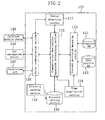
- the server 110 is structured as shown in FIG. 2 .
- Reference numeral 111 denotes a content DB (database) for storing a plurality of contents to be provided.
- Reference numeral 112 denotes a user profile DB for storing a user profile for retrieving (filtering) provided information.
- Reference numeral 113 denotes a content provision managing section for determining a content to be provided to a user and providing the determined content to the user.
- Reference numeral 114 denotes a time acquisition section for acquiring the time.
- Reference numeral 115 denotes a communication destination apparatus determining section (destination determining means) for selecting a terminal apparatus at which information is to be presented.
- Reference numeral 116 denotes a priority storing section (destination information storing means, priority information storing means) for storing information about the priority of terminal apparatuses at which information is to be presented.
- Reference numeral 117 denotes a status detecting section (communication possibility detecting means, presentation suitableness determining means, operation status detecting means) for detecting the status of the cellular mobile phone 140 , more specifically, the possibility for communication, the suitableness for presentation of provided information, and the like.
- Reference numeral 118 denotes a server communication section (transmission means) for allowing the server 110 to communicate with the cellular mobile phone 140 and the like.
- Reference numeral 119 denotes a priority setting section (priority information setting means) for setting the priority in the priority storing section 116 according to an instruction from the cellular mobile phone 140 , or the like.
- the status detecting section 117 includes a communication possibility detecting section 117a , an operation status detecting section 117b and a presentation suitableness determining section 117c .
- the communication possibility detecting section 117a detects whether or not communication with the cellular mobile phone 140 , or the like, is possible.
- the operation status detecting section 117b detects the operation status of the cellular mobile phone 140 , or the like, for example, whether or not the cellular mobile phone 140 is in a pause mode where presentation of provided information is suppressed, a silent mode where output of sound is suppressed, or in a low power mode where a backlight of a display section is turned off, even when the communication is possible.
- the presentation suitableness determining section 117c determines based on the above operation status as to whether or not presentation of provided information is possible or suitable.
- the cellular mobile phone 140 and the like apparatuses are structured as shown in FIG. 4 .
- the cellular mobile phone 140 , the car navigation device 150 and the television set 160 each have their original functions, but the function and structure as a terminal apparatus of receiving provided information are the same among these elements.
- the cellular mobile phone 140 is herein described as a representative of these elements.
- Reference numeral 141 denotes a terminal communication section (operation status information transmitting means, characteristic information transmitting means) for allowing the cellular mobile phone 140 to communicate with the server 110 .
- Reference numeral 142 denotes a terminal information presentation managing section for managing presentation of information to a user.
- Reference numeral 143 denotes a display section (presentation means) for displaying provided information.
- Reference numeral 144 denotes an input section for receiving an input manipulation from a user.
- Reference numeral 145 denotes a presentation suitableness controlling section (operation status controlling means) for storing and controlling the suitableness for presentation of information transmitted from a server.
- the content DB 111 stores a plurality of given contents to be provided in the form of a certain structure as shown in FIG. 5 , for example.
- a content is formed by:
- the user profile DB 112 stores a user profile used for selecting a content to be presented to a user.
- a user profile is in the form of a vector, (1, 0, 0, 1, 0, 0), for categories of provided information, (gourmet, television, music, fashion, life, sport), where the value of a category a user is interested in is "1" and the value of a category a user is not interested in is "0".
- These values are set by any unshown means, such as an entry form or document on a homepage, or the like.
- the priority storing section 116 stores, for each user, information about the priority of terminal apparatuses to which provided information is to be transmitted, for example, information about the priority among the cellular mobile phone 140 , the car navigation device 150 and the television set 160 .
- the priority is set by the priority setting section 119 using, for example, an entry form on a homepage, or the like.
- the content provision managing section 113 acquires the present time from the time acquisition section 114 and periodically performs the process of subsequent steps from step S102 to step S110 to transmit provided information to the cellular mobile phone 140 and the like.
- the communication destination apparatus determining section 115 extracts the priority of terminal apparatuses from the priority storing section 116 to select a terminal apparatus having the highest priority.
- the cellular mobile phone 140 is first selected.
- the communication destination apparatus determining section 115 performs a test communication with the selected terminal apparatus through the server communication section 118 .
- the communication possibility detecting section 117a of the status detecting section 117 detects the status (communication status) of the terminal apparatus. If the detected status indicates that communication with the terminal apparatus is possible, the communication destination apparatus determining section 115 proceeds to step S105. If the detected status indicates that communication is impossible, the communication destination apparatus determining section 115 proceeds to step S107.
- the communication destination apparatus determining section 115 queries the terminal apparatus as to whether or not presentation of information at the terminal apparatus is suitable.
- the terminal communication section 141 extracts suitableness information as to presentation of information from the presentation suitableness controlling section 145 and sends it to the server 110 .
- the value of the suitableness information can be set by a user by the terminal information presentation managing section 142 through an input section 144 whenever necessary.
- the operation status detecting section 117b of the status detecting section 117 receives the presentation suitableness information and outputs it to the presentation suitableness determining section 117c .
- the presentation suitableness determining section 117c determines whether or not presentation is suitable and outputs the determination result to the communication destination apparatus determining section 115 . If the determination result indicates that presentation of information at the terminal apparatus is "suitable”, the communication destination apparatus determining section 115 proceeds to step S108. If "unsuitable”, the communication destination apparatus determining section 115 proceeds to step S107.
- step S104 or step S106 the communication destination apparatus determining section 115 selects a terminal apparatus having the second highest priority. The process of step S103 and subsequent steps is repeated till a terminal apparatus with which communication can be established and at which presentation of information is "suitable" is encountered. If no such terminal apparatus is encountered, the communication destination apparatus determining section 115 returns to step S101 and waits for next transmission of provided information.
- the content provision managing section 113 extracts a user profile from the user profile DB 112 .
- the content provision managing section 113 retrieves from the content DB 111 one of the contents included in a category whose user profile value is 1 and transmits the retrieved content to the terminal apparatus.
- the terminal information presentation managing section 142 displays the content received by the terminal communication section 141 on the display section 143 , thereby presenting the content to a user.
- FIG. 7 illustrates an example of a user display screen where the terminal apparatus is the cellular mobile phone 140 .
- FIGS. 8 and 9 illustrate examples of a user display screen where the terminal apparatus is the car navigation device 150 or the television set 160 , respectively.
- the content to be presented may be the same content regardless of the type of terminal apparatuses. Alternatively, different contents may be selected according to the type of terminal apparatuses.
- the content provision managing section 113 ends the transmission process of provided information and returns to step S101.
- the server 110 sets the priority of terminal apparatuses with which communication is attempted, and the terminal apparatuses, such as the cellular mobile phone 140 , and the like, each set whether or not presentation of information is suitable.
- the terminal apparatuses such as the cellular mobile phone 140 , and the like.
- a user sets whether or not presentation of information is suitable at a terminal apparatus, such as the cellular mobile phone 140 , or the like, and the destination of transmitted information is determined according to the setting made by the user.
- the determination of transmitted information may be determined according to information that is set automatically, such as the state of the cellular mobile phone 140 , or the like.
- a charge determination section 201 which indicates whether or not the terminal apparatus is in a charged state may be provided in place of the presentation suitableness controlling section 145 of FIG. 4. (In this section, like elements are denoted by like reference numerals used in FIG.
- the charge determination section 201 While the terminal apparatus is being charged with electric power, the charge determination section 201 returns a reply indicating that presentation of provided information is "unsuitable" in response to a query from the server 110 . Alternatively, in response to a query from the server 110 , the charge determination section 201 returns a reply indicating that the terminal apparatus is being charged with electric power and the server 110 determines, according to the reply, that presentation of provided information is "unsuitable". In this case, if a terminal apparatus, for example, the cellular mobile phone 140 , is in a state generally unsuitable for browsing of a presentation of provided information, the information may be presented at an alternative terminal apparatus more suitable for presentation of the information.
- a position determining section 202 may be provided as shown in FIG. 11. With the position determining section 202 , once a user sets whether or not communication is possible according to the position of the terminal apparatus, it is automatically determined (judged) whether or not communication is possible based on the position of the terminal apparatus. For example, if the terminal apparatus is at a place that has been set by the user to be an inappropriate place for receipt of a communication, information is presented using an alternative terminal apparatus.
- the position determining section 202 may be formed by an element for obtaining a current position based on, for example, a GPS (Global Positioning System) to determine whether or not the current position is within a predetermined range from a registered position or whether or not the current position is within a predetermined absolute positional range. It should be noted that the present invention is not limited to an example where communication is impossible at a registered position. For example, conversely, communication may be possible at a registered position.
- a contact determining section 203 may be provided as shown in FIG. 12 .
- the possibility of communication, or the like may be automatically determined according to the connection state of a contact terminal which is externally exposed for connecting the terminal apparatus to an external apparatus (for example, a mobile apparatus which uses a cellular mobile phone as a modem).
- an external apparatus for example, a mobile apparatus which uses a cellular mobile phone as a modem.
- presentation of provided information is "suitable” or "unsuitable”.
- an alternative terminal apparatus may be used for presentation of information.
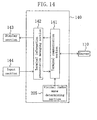
- an infrared light determining section 204 or a vicinal radio wave determining section 205 may be provided as shown in FIG. 13 or 14 , respectively.
- presentation of provided information is "suitable” or “unsuitable” according to the state of reception of predetermined infrared light in the vicinity of the terminal apparatus, e.g., in a room of a home in which a signal is emitted from a remote controller of a household electric device, or according to the state of reception of a predetermined electric wave, e.g., in a running car in which a predetermined vicinal radio wave is emitted.
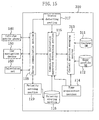
- FIG. 15 is a block diagram showing the structure of a server 310 according to embodiment 2 of the present invention. It should be noted that, in the following embodiments, like elements are denoted by like reference numerals used in embodiment 1, and descriptions thereof are omitted.
- the server 310 is different from the server 110 (FIG. 2 ) of embodiment 1 in that the server 310 includes a content DB 311 , a content provision managing section 313 and a status detecting section 317 in place of the content DB 111 , the content provision managing section 113 and the status detecting section 117 , respectively.
- the content DB 311 stores the attribute of each content in addition to the contents of the content DB 111 (FIG. 5 ) of embodiment 1. Specifically, the content DB 311 stores attribute information indicating which of a character, a still picture, a motion picture, sound, and combinations thereof each content is.
- the content provision managing section 313 has the function of outputting the attribute information of a content extracted from the content DB 311 to the status detecting section 317 in addition to the function of the content provision managing section 113 of embodiment 1.
- the status detecting section 317 includes a presentation suitableness determining section 317c in place of the presentation suitableness determining section 117c of the status detecting section 117 (FIG. 3 ) of embodiment 1. Further, the status detecting section 317 includes a presentation characteristic detecting section 317d and a presentation characteristic storing section 317e .
- the presentation characteristic detecting section 317d Based on presentation characteristic information output from the terminal information presentation managing section 142 (characteristic information transmitting means) of the cellular mobile phone 140 , the presentation characteristic detecting section 317d detects the presentation characteristics, e.g., which of a character, a still picture, a motion picture, sound, and combinations thereof can be presented by the cellular mobile phone 140 , or the like, the viewability of a motion picture, the viewability resulting from the screen size, screen brightness, or the like, whether or not a reply can be input or is readily input in response to a presented content which asks some reply, etc.
- the presentation characteristic storing section 317e stores presentation characteristic information output from the presentation characteristic detecting section 317d .
- the presentation characteristic information stored in the presentation characteristic storing section 317e is not limited to information obtained from the cellular mobile phone 140 , or the like, as described above.
- the presentation characteristic information may be directly input to the server 310 or may be input by another terminal apparatus, or the like.
- presentation characteristic information may be obtained by the presentation characteristic detecting section 317d every time a content is provided, so that the presentation characteristic storing section 317e can be omitted.
- information that specifies the type of a device, or the like is obtained from the cellular mobile phone 140 , and a table which stores correspondences between the types of devices and presentation characteristic information inherent to the device types is referred to for obtaining presentation characteristic information.
- the presentation suitableness determining section 317c of the status detecting section 317 determines whether or not each of the cellular mobile phone 140 and the like apparatuses is suitable for presentation of a content to be transmitted (including "whether or not it is capable of presenting a content to be transmitted") based on the operation status of the cellular mobile phone 140 , or the like, which has been detected by the operation status detecting section 117b , the presentation characteristics stored in the presentation characteristic storing section 317e , and the attribute of a content output from the content DB 311 .
- the communication destination apparatus determining section 115 determines an apparatus of communication destination based on the determination as described above, an appropriate presentation is realized at an apparatus suitable for presentation.
- Determination by the presentation suitableness determining section 317c as to the suitableness of presentation may be achieved by selecting one of multiple degrees of suitableness instead of determining whether or not it is suitable for presentation.
- an apparatus of communication determination may be determined based on the degree of suitableness of presentation and the priority obtained from the priority storing section 116 .
- the priority stored in the priority storing section 116 may be considered prior to the degree of suitableness, and if apparatuses have the same priority, a content is transmitted to an apparatus which is more suitable for presentation than the other.
- an apparatus having a high degree of suitableness may be selected even if the priority exhibited by the priority storing section 116 is low.
- an overall priority may be determined according to the combinations of respective apparatuses and the degree of suitableness for presentation.
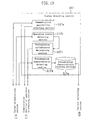
- FIG. 18 is a block diagram showing the structure of a server 410 according to embodiment 3 of the present invention.
- the server 410 is different from the server 310 (FIG. 15 ) of embodiment 2 in that the server 410 includes a status detecting section 417 in place of the status detecting section 317 and further includes a content converting section (format converting means) 420 .
- the status detecting section 417 includes the presentation characteristic detecting section 317d and the presentation characteristic storing section 317e of the status detecting section 317 (FIG. 17 ) of embodiment 2 in addition to the elements of the status detecting section 117 (FIG. 3 ) of embodiment 1. (It should be noted that any one of the presentation characteristic detecting section 317d and the presentation characteristic storing section 317e may be omitted when the method for acquiring presentation characteristics as described in embodiment 2 is employed).
- the content converting section 420 converts the format of a content to be transmitted based on the presentation characteristics of the cellular mobile phone 140 , or the like, which are output from the status detecting section 417 and the attribute of the content which is output from the content provision managing section 313 , so as to comply with the presentation characteristics. Specifically, for example, if a content stored in the content DB 311 includes an image as shown in FIG. 7 whereas the cellular mobile phone 140 has only the characteristic (function) of displaying a text, only a text is extracted from the content and transmitted to the cellular mobile phone 140 , whereby the content is appropriately presented as shown in FIG. 20 . It should be noted that conversion of contents is not limited to deletion of an image as described above.
- a summarized text may be displayed, or only a caption may be displayed.
- the size, the number of colors or the resolution of an image may be converted.
- a text may be converted to sound data.
- the present invention is not limited to conversion of contents.
- a content may be selectively read from the content DB 311 according to the presentation characteristics.
- the priority of destinations of transmission which is set by the priority storing section 116 (the priority of destinations with which communication is attempted) is not limited to a fixed priority.
- the priority may be changed according to the time, or the like, as shown in FIG. 21 .
- setting of the priority in the server 110 according to the time as described above can readily be achieved by unshown means, such as an entry form or document on a homepage, or the like.
- communication with terminal apparatuses can be flexibly attempted in an efficient order in accordance with a schedule of a user.
- the priority may be set according to the days of the week, the months, the seasons, or the like.
- the priority of a cellular mobile phone is set higher in weekdays, and the priority of a television set in the home is set higher in holidays.
- a priority table wherein the priority is determined according to the time zones may be set for each day of the week, for example.
- transmission may be suspended for a predetermined time period by issuing information indicative of suspension of transmission (suppression of presentation). For example, information is not transmitted to any terminal in the time zone of 7:00 to 8:00, but after 8:00, it is transmitted to any terminal. In the time zone of 16:00 to 17:00, if presentation of information is suitable at a cellular mobile phone which has the first priority, the information is transmitted to the cellular mobile phone. If not suitable, the information is not transmitted to any other apparatus, but after 17:00, it is transmitted to a car navigation device, or the like. Even if the information indicative of suspension of transmission is not issued, presentation of information may be suspended.
- Setting of the priority is not limited to setting by an explicit instruction from a user.
- the priority may be set or updated based on a track record of user's presentation manipulation, or the like. For example, the priority may be increased or decreased according to whether or not a user has actually performed manipulation for presenting a content transmitted to any apparatus, whether or not the user has performed manipulation for suppressing presentation of the content, or whether or not the user has performed manipulation for presenting details of the content when only a title of the content was presented.
- the priority of the first apparatus in which presentation manipulation for the content is performed earlier than the other apparatuses may be increased.
- a content to be provided is determined based on categories represented by a user profile, but the present invention is not limited thereto. Any other method, for example, a method for determining the priority for providing contents as described in Japanese Unexamined Patent Publication No. 2001-92824, may be used.
- an apparatus to which the mail is to be transmitted is determined according to the accumulation amount of unread mails in each apparatus. For example, if a large number of unread mails of recent receiving dates are accumulated in an apparatus, there is a high possibility that the apparatus is frequently used for reading mails, and therefore, the apparatus is set so as to receive mails prior to the other apparatuses. If a large number of unread mails of old receiving dates are accumulated in an apparatus, there is a high possibility that the apparatus is not frequently used for reading mails, and therefore, the priority of the apparatus for transmission is decreased. In this way, the possibility that mails are appropriately read is increased.
- a server checks whether or not a mail transmitted to an apparatus in a time zone having a certain priority has been read, and if the mail has not been read until a next time zone having a different priority, the unread mail is transmitted to another apparatus according to the priority of the next time zone.
- the unread mail at the first apparatus may be forcedly deleted or may be provided with a mark indicating that the mail has been transferred to another apparatus.
- the present invention provides information is transmitted to an appropriate terminal apparatus according to the status or characteristics of terminal apparatuses, whereby secure provision of appropriate information is readily achieved.
- the present invention is useful in the field of services of providing various information through a network, or the like.
Landscapes
- Engineering & Computer Science (AREA)
- Signal Processing (AREA)
- Information Transfer Between Computers (AREA)
- Mobile Radio Communication Systems (AREA)
Abstract
Description
Claims (22)
- An information providing apparatus for transmitting provided information which is to be presented at a provided-information presenting apparatus, the information providing apparatus comprising:destination information storing means for storing destination information indicative of one or more provided-information presenting apparatuses for each one information recipient;communication possibility detecting means for detecting whether or not communication with the provided-information presenting apparatuses is possible;presentation suitableness determining means for determining whether or not presentation of the provided information at the provided-information presenting apparatuses is suitable;destination determining means for selecting a destination of the provided information among provided-information presenting apparatuses which have been detected by the communication possibility detecting means to be available for communication, according to a predetermined priority, based on a determination result by the presentation suitableness determining means; andtransmission means for transmitting the provided information to the provided-information presenting apparatus selected by the destination determining means.
- The information providing apparatus of claim 1, wherein the presentation suitableness determining means determines whether or not presentation of the provided information at the provided-information presenting apparatuses is suitable based on an attribute of the provided information.
- The information providing apparatus of claim 1, further comprising operation status detecting means for detecting the operation status of the provided information presenting means,
wherein the presentation suitableness determining means determines whether or not presentation of the provided information is suitable based on the operation status. - The information providing apparatus of claim 3, wherein:the operation status detecting means detects whether or not each of the provided-information presenting apparatuses is being charged with electric power; andthe destination determining means selects, among provided-information presenting apparatuses which are not being charged with electric power, a provided-information presenting apparatus having a high priority as the destination.
- The information providing apparatus of claim 3, wherein:the operation status detecting means detects the position of each of the provided-information presenting apparatuses; andthe destination determining means selects, among provided-information presenting apparatuses residing at predetermined positions, a provided-information presenting apparatus having a high priority as the destination.
- The information providing apparatus of claim 3, wherein:the operation status detecting means detects whether or not each of the provided-information presenting apparatuses is connected to another device; andthe destination determining means selects, among provided-information presenting apparatuses which are not connected to another device, a provided-information presenting apparatus having a high priority as the destination.
- The information providing apparatus of claim 3, wherein:the operation status detecting means detects whether or not each of the provided-information presenting apparatuses receives predetermined remote control signal light; andthe destination determining means selects, among provided-information presenting apparatuses which do not receive the predetermined remote control signal light, a provided-information presenting apparatus having a high priority as the destination.
- The information providing apparatus of claim 3, wherein:the operation status detecting means detects whether or not each of the provided-information presenting apparatuses receives predetermined radio wave; andthe destination determining means selects, among provided-information presenting apparatuses which do not receive the predetermined radio wave, a provided-information presenting apparatus having a high priority as the destination.
- The information providing apparatus of claim 3, wherein:the operation status detecting means detects whether or not each of the provided-information presenting apparatuses is in a state where presentation of the provided information is suppressed; andthe destination determining means selects, among provided-information presenting apparatuses at which presentation of the provided information is not suppressed, a provided-information presenting apparatus having a high priority as the destination.
- The information providing apparatus of claim 1, wherein:the presentation suitableness determining means determines whether or not presentation of the provided information is suitable based on a characteristic regarding presentation of the provided information at the provided-information presenting apparatuses.
- The information providing apparatus of claim 10, wherein:the presentation suitableness determining means determines whether or not presentation of the provided information is suitable based on which information attribute among a character, a still picture, a motion picture and sound the provided-information presenting apparatus can present.
- The information providing apparatus of claim 10, wherein:the presentation suitableness determining means determines whether or not presentation of the provided information is suitable based on the screen size of the provided-information presenting apparatuses.
- The information providing apparatus of claim 10, wherein:the presentation suitableness determining means determines whether or not presentation of the provided information is suitable based on information indicative of the manipulability of the provided-information presenting apparatus if the provided information requires manipulation which accompanies the presentation of the provided information.
- The information providing apparatus of claim 10, further comprising format converting means for converting the format of the provided information according to the characteristic regarding presentation of the provided information at the provided-information presenting apparatuses.
- The information providing apparatus of claim 1, further comprising priority information storing means for storing priority information indicative of the priority of the provided-information presenting apparatuses to which the provided information is to be provided, the priority information being determined in accordance with the time at which the provided information is transmitted,
wherein the destination determining means selects a provided-information presenting apparatus as the destination of the provided information based on the priority information in accordance with the time at which the provided information is transmitted. - The information providing apparatus of claim 15, wherein:the priority information storing means stores information indicating that transmission of the provided information is suppressed in a predetermined time zone; andif the time at which the provided information is scheduled to be transmitted is within the predetermined time zone, the transmission means transmits the provided information after being suspended until the end of the time zone.
- The information providing apparatus of claim 15, wherein if a first provided-information presenting apparatus having the highest priority among provided-information presenting apparatuses at which presentation of the provided information is suitable at a first time point where the provided information is scheduled to be transmitted is less suitable for presentation of the provided information than a second provided-information presenting apparatus having the highest priority among provided-information presenting apparatuses at which presentation of the provided information is suitable at a second time point that occurs a predetermine time period after the first time point, transmission of the provided information is suspended till the priority of the second provided-information presenting apparatus becomes highest, and then, the provided information is transmitted to the second provided-information presenting apparatus.
- The information providing apparatus of claim 1, further comprising priority information storing means for storing, for each information recipient, priority information indicative of the priority of provided-information presenting apparatuses to which the provided information is to be transmitted,
wherein the destination determining means selects the destination of the provided information according to the priority information and the information recipient. - The information providing apparatus of claim 18, further comprising priority information setting means for setting the priority information in the priority information storing means according to an instruction from the provided-information presenting apparatus.
- A provided-information presenting apparatus for receiving and presenting provided information transmitted from an information providing apparatus which transmits provided information to a provided-information presenting apparatus selected in accordance with the suitableness of presentation of the provided information, the suitableness being determined based on the operation status of a provided-information presenting apparatus, the provided-information presenting apparatus comprising:operation status controlling means for controlling the operation status of the provided-information presenting apparatus; andoperation status information transmitting means for transmitting operation status information indicative of the operation status to the information providing means.
- A provided-information presenting apparatus for receiving and presenting provided information transmitted from an information providing apparatus which transmits provided information to a provided-information presenting apparatus selected in accordance with the suitableness of presentation of the provided information, the suitableness being determined based on a characteristic regarding presentation of the provided information at provided-information presenting apparatuses, the provided-information presenting apparatus comprising:presentation means for presenting provided information transmitted from the information providing apparatus with a predetermined presentation characteristic; andcharacteristic information transmitting means for transmitting characteristic information indicative of the characteristic to the information providing means.
- An information providing method for transmitting provided information which is to be presented at any of one or more provided-information presenting apparatuses for each information recipient, the information providing method comprising:a communication possibility detecting step of detecting whether or not communication with the provided-information presenting apparatuses is possible;a presentation suitableness determining step of determining whether or not presentation of the provided information at the provided-information presenting apparatuses is suitable;a destination determining step of selecting a destination of the provided information among provided-information presenting apparatuses which have been detected at the communication possibility detecting step to be available for communication, according to a predetermined priority, based on a determination result at the presentation suitableness determining step; anda transmission step of transmitting the provided information to the provided-information presenting apparatus selected at the destination determining step.
Applications Claiming Priority (3)
| Application Number | Priority Date | Filing Date | Title |
|---|---|---|---|
| JP2002035221 | 2002-02-13 | ||
| JP2002035221 | 2002-02-13 | ||
| PCT/JP2003/001513 WO2003069881A1 (en) | 2002-02-13 | 2003-02-13 | Information providing apparatus, provided information presenting apparatus, and information providing method |
Publications (2)
| Publication Number | Publication Date |
|---|---|
| EP1406429A1 true EP1406429A1 (en) | 2004-04-07 |
| EP1406429A4 EP1406429A4 (en) | 2005-06-08 |
Family
ID=27678050
Family Applications (1)
| Application Number | Title | Priority Date | Filing Date |
|---|---|---|---|
| EP03705132A Withdrawn EP1406429A4 (en) | 2002-02-13 | 2003-02-13 | INFORMATION PROVIDING APPARATUS, PROVIDING INFORMATION PROVIDING APPARATUS, AND INFORMATION PROVIDING METHOD |
Country Status (6)
| Country | Link |
|---|---|
| US (1) | US7949713B2 (en) |
| EP (1) | EP1406429A4 (en) |
| JP (1) | JP3706381B2 (en) |
| CN (1) | CN100463475C (en) |
| AU (1) | AU2003211970A1 (en) |
| WO (1) | WO2003069881A1 (en) |
Families Citing this family (11)
| Publication number | Priority date | Publication date | Assignee | Title |
|---|---|---|---|---|
| CN100592753C (en) * | 2006-03-06 | 2010-02-24 | 英业达股份有限公司 | State prompting system and method |
| US9077784B2 (en) | 2009-02-06 | 2015-07-07 | Empire Technology Development Llc | Media file synchronization |
| US8893232B2 (en) * | 2009-02-06 | 2014-11-18 | Empire Technology Development Llc | Media monitoring system |
| CN102323937A (en) * | 2011-08-31 | 2012-01-18 | 百度在线网络技术(北京)有限公司 | Method and equipment for providing search result |
| US9208753B2 (en) * | 2012-09-17 | 2015-12-08 | Elwha Llc | Unauthorized viewer detection system and method |
| JP5536926B2 (en) * | 2013-04-10 | 2014-07-02 | オリンパスイメージング株式会社 | Display method for imaging apparatus, and imaging apparatus |
| JP5847230B2 (en) * | 2014-04-24 | 2016-01-20 | オリンパス株式会社 | IMAGING DEVICE AND IMAGING DEVICE CONTROL METHOD |
| KR102089487B1 (en) * | 2017-05-16 | 2020-03-17 | 애플 인크. | Far-field extension for digital assistant services |
| DK179560B1 (en) | 2017-05-16 | 2019-02-18 | Apple Inc. | Far-field extension for digital assistant services |
| US11703425B2 (en) * | 2020-11-05 | 2023-07-18 | Canon Kabushiki Kaisha | Information processing apparatus, system, production facility, information processing method, method of manufacturing products, and recording medium |
| US12021806B1 (en) | 2021-09-21 | 2024-06-25 | Apple Inc. | Intelligent message delivery |
Family Cites Families (26)
| Publication number | Priority date | Publication date | Assignee | Title |
|---|---|---|---|---|
| JPS59214365A (en) | 1983-05-20 | 1984-12-04 | Toshiba Corp | Mail service system |
| JPH03256426A (en) * | 1990-03-07 | 1991-11-15 | Hitachi Ltd | Information distribution method |
| JPH06268676A (en) | 1993-03-16 | 1994-09-22 | Nec Corp | Electronic mail system |
| JP3119079B2 (en) * | 1994-07-28 | 2000-12-18 | ブラザー工業株式会社 | Facsimile machine |
| US6745937B2 (en) * | 1995-06-07 | 2004-06-08 | E-Comm, Inc. | Low-power hand-held transaction device |
| CA2180684C (en) * | 1996-07-08 | 2001-08-21 | Paul Erb | Automatic call forwarding |
| US5905789A (en) * | 1996-10-07 | 1999-05-18 | Northern Telecom Limited | Call-forwarding system using adaptive model of user behavior |
| JP2000047980A (en) * | 1998-07-31 | 2000-02-18 | Nec Corp | Individual information presenting device |
| US6466232B1 (en) * | 1998-12-18 | 2002-10-15 | Tangis Corporation | Method and system for controlling presentation of information to a user based on the user's condition |
| JP2001075977A (en) * | 1999-09-01 | 2001-03-23 | Toshiba Corp | Location-dependent information management apparatus, location-dependent information management method, and medium storing location-dependent information management program |
| US6430624B1 (en) * | 1999-10-21 | 2002-08-06 | Air2Web, Inc. | Intelligent harvesting and navigation system and method |
| DE19955781A1 (en) | 1999-11-19 | 2001-05-31 | Siemens Ag | Selecting subscriber line from group in telecommunications switch |
| JP2001237873A (en) | 2000-02-22 | 2001-08-31 | Canon Inc | E-mail system and e-mail communication method |
| US20020087649A1 (en) * | 2000-03-16 | 2002-07-04 | Horvitz Eric J. | Bounded-deferral policies for reducing the disruptiveness of notifications |
| US7137119B1 (en) * | 2000-05-02 | 2006-11-14 | Microsoft Corporation | Resource manager architecture with resource allocation utilizing priority-based preemption |
| JP3480425B2 (en) | 2000-06-09 | 2003-12-22 | 日本電気株式会社 | Call transfer method and call transfer method based on caller settings |
| JP3619958B2 (en) * | 2000-06-13 | 2005-02-16 | 富士通株式会社 | Crisis management system and computer |
| JP3478246B2 (en) * | 2000-06-15 | 2003-12-15 | 村田機械株式会社 | Image communication device |
| US7117245B1 (en) | 2000-07-05 | 2006-10-03 | Iris Wireless, Llc | Global communication method and system |
| JP2002032399A (en) * | 2000-07-14 | 2002-01-31 | Media Integration Systems Kk | Method for providing individual information through communication network, communication system for providing individual information and information recording medium |
| JP2002111707A (en) | 2000-09-26 | 2002-04-12 | Matsushita Electric Ind Co Ltd | Mail arrival notification system and mail delivery device |
| US7376897B1 (en) * | 2000-09-30 | 2008-05-20 | Intel Corporation | Method, apparatus, and system for determining information representations and modalities based on user preferences and resource consumption |
| FR2823405B1 (en) | 2001-04-10 | 2003-07-04 | France Telecom | SYSTEM FOR AUTOMATIC TRANSMISSION OF INFORMATION TO A LIST OF SELECTED RECIPIENTS IN AN ELECTRONIC DIRECTORY |
| US20030023690A1 (en) * | 2001-07-26 | 2003-01-30 | Sunit Lohtia | Method and apparatus for providing selective delivery of notifications to users of multiple devices over a network |
| US20030083047A1 (en) * | 2001-10-29 | 2003-05-01 | Garland Phillips | Method and communication network for providing operating information associated with a wireless device |
| US7096311B2 (en) * | 2002-09-30 | 2006-08-22 | Innopath Software, Inc. | Updating electronic files using byte-level file differencing and updating algorithms |
-
2003
- 2003-02-13 WO PCT/JP2003/001513 patent/WO2003069881A1/en not_active Ceased
- 2003-02-13 US US10/485,068 patent/US7949713B2/en not_active Expired - Fee Related
- 2003-02-13 JP JP2003568869A patent/JP3706381B2/en not_active Expired - Lifetime
- 2003-02-13 AU AU2003211970A patent/AU2003211970A1/en not_active Abandoned
- 2003-02-13 CN CNB038012804A patent/CN100463475C/en not_active Expired - Fee Related
- 2003-02-13 EP EP03705132A patent/EP1406429A4/en not_active Withdrawn
Also Published As
| Publication number | Publication date |
|---|---|
| US20040233908A1 (en) | 2004-11-25 |
| CN1568610A (en) | 2005-01-19 |
| US7949713B2 (en) | 2011-05-24 |
| JP3706381B2 (en) | 2005-10-12 |
| JPWO2003069881A1 (en) | 2005-06-09 |
| EP1406429A4 (en) | 2005-06-08 |
| WO2003069881A1 (en) | 2003-08-21 |
| AU2003211970A1 (en) | 2003-09-04 |
| CN100463475C (en) | 2009-02-18 |
Similar Documents
| Publication | Publication Date | Title |
|---|---|---|
| US8583139B2 (en) | Context diary application for a mobile terminal | |
| CA2365050C (en) | A communication network terminal supporting a plurality of applications | |
| US20050197111A1 (en) | Communication network terminal supporting a plurality of applications | |
| US20030114171A1 (en) | Position data notification system and position data notification method | |
| US20060217885A1 (en) | User location driven identification of service vehicles | |
| US7949713B2 (en) | Information providing apparatus, provided information presenting apparatus, and information providing method | |
| US20030017857A1 (en) | Wireless device local access system | |
| JP2012160032A (en) | Advertisement provision server, advertisement provision system and advertisement provision method | |
| WO2002011456A1 (en) | Contextually aware network announcements of people | |
| WO2009035215A1 (en) | Method for providing location-based advertising service | |
| JP2003110482A (en) | Information distribution system | |
| JPH09128441A (en) | Information processing device | |
| JP2006065650A (en) | Information providing method and system, program, and recording medium | |
| JP2005071381A (en) | Information providing apparatus, provided information presenting apparatus, and information providing method | |
| JP2002041961A (en) | Ad distribution system | |
| JP3510957B2 (en) | Regional information display device, regional information management device and regional information display system | |
| US20050222920A1 (en) | Virtual shop system and method of controlling the same | |
| US20010055962A1 (en) | Information distribution system for distributing information by using visual device and electrical device | |
| JP2007183766A (en) | Advertisement providing device and advertisement providing program | |
| JP2006040234A (en) | Information distribution system and information distribution method | |
| US20020055877A1 (en) | Data distribution method, system, and apparatus and recording medium recording method | |
| KR100434647B1 (en) | Method and apparauts for supplying correspondence information in network | |
| US20070094398A1 (en) | System and method for automatically downloading network content | |
| KR100624650B1 (en) | Content delivery apparatus and method of controlling content delivery | |
| JP4343876B2 (en) | Portable wireless telephone device |
Legal Events
| Date | Code | Title | Description |
|---|---|---|---|
| PUAI | Public reference made under article 153(3) epc to a published international application that has entered the european phase |
Free format text: ORIGINAL CODE: 0009012 |
|
| 17P | Request for examination filed |
Effective date: 20040129 |
|
| AK | Designated contracting states |
Kind code of ref document: A1 Designated state(s): AT BE BG CH CY CZ DE DK EE ES FI FR GB GR HU IE IT LI LU MC NL PT SE SI SK TR |
|
| AX | Request for extension of the european patent |
Extension state: AL LT LV MK RO |
|
| A4 | Supplementary search report drawn up and despatched |
Effective date: 20050426 |
|
| 17Q | First examination report despatched |
Effective date: 20071214 |
|
| RAP1 | Party data changed (applicant data changed or rights of an application transferred) |
Owner name: PANASONIC CORPORATION |
|
| STAA | Information on the status of an ep patent application or granted ep patent |
Free format text: STATUS: THE APPLICATION IS DEEMED TO BE WITHDRAWN |
|
| 18D | Application deemed to be withdrawn |
Effective date: 20091128 |