EP1406272A1 - Current supply for superconducting devices - Google Patents
Current supply for superconducting devices Download PDFInfo
- Publication number
- EP1406272A1 EP1406272A1 EP20020292449 EP02292449A EP1406272A1 EP 1406272 A1 EP1406272 A1 EP 1406272A1 EP 20020292449 EP20020292449 EP 20020292449 EP 02292449 A EP02292449 A EP 02292449A EP 1406272 A1 EP1406272 A1 EP 1406272A1
- Authority
- EP
- European Patent Office
- Prior art keywords
- filaments
- current supply
- coil
- current
- superconducting
- Prior art date
- Legal status (The legal status is an assumption and is not a legal conclusion. Google has not performed a legal analysis and makes no representation as to the accuracy of the status listed.)
- Withdrawn
Links
- 239000000463 material Substances 0.000 claims abstract description 42
- 238000007669 thermal treatment Methods 0.000 claims abstract description 5
- 239000002887 superconductor Substances 0.000 claims description 17
- 238000000034 method Methods 0.000 claims description 11
- 239000004020 conductor Substances 0.000 claims description 4
- 238000004519 manufacturing process Methods 0.000 claims description 4
- 238000005520 cutting process Methods 0.000 claims description 3
- 229910052751 metal Inorganic materials 0.000 description 16
- 239000002184 metal Substances 0.000 description 16
- 230000001965 increasing effect Effects 0.000 description 7
- 238000004804 winding Methods 0.000 description 7
- 229910045601 alloy Inorganic materials 0.000 description 6
- 239000000956 alloy Substances 0.000 description 6
- 239000007788 liquid Substances 0.000 description 6
- 239000001307 helium Substances 0.000 description 5
- 229910052734 helium Inorganic materials 0.000 description 5
- SWQJXJOGLNCZEY-UHFFFAOYSA-N helium atom Chemical compound [He] SWQJXJOGLNCZEY-UHFFFAOYSA-N 0.000 description 5
- 239000011810 insulating material Substances 0.000 description 5
- 150000002739 metals Chemical class 0.000 description 5
- 229910000510 noble metal Inorganic materials 0.000 description 5
- 239000000919 ceramic Substances 0.000 description 3
- 239000010949 copper Substances 0.000 description 3
- 230000007423 decrease Effects 0.000 description 3
- 230000000694 effects Effects 0.000 description 3
- 229910052709 silver Inorganic materials 0.000 description 3
- 229920002994 synthetic fiber Polymers 0.000 description 3
- IJGRMHOSHXDMSA-UHFFFAOYSA-N Atomic nitrogen Chemical compound N#N IJGRMHOSHXDMSA-UHFFFAOYSA-N 0.000 description 2
- RYGMFSIKBFXOCR-UHFFFAOYSA-N Copper Chemical compound [Cu] RYGMFSIKBFXOCR-UHFFFAOYSA-N 0.000 description 2
- 229910002480 Cu-O Inorganic materials 0.000 description 2
- 229910052784 alkaline earth metal Inorganic materials 0.000 description 2
- 150000001342 alkaline earth metals Chemical class 0.000 description 2
- TZCXTZWJZNENPQ-UHFFFAOYSA-L barium sulfate Chemical compound [Ba+2].[O-]S([O-])(=O)=O TZCXTZWJZNENPQ-UHFFFAOYSA-L 0.000 description 2
- 229910052802 copper Inorganic materials 0.000 description 2
- 230000003247 decreasing effect Effects 0.000 description 2
- 239000003822 epoxy resin Substances 0.000 description 2
- LNEPOXFFQSENCJ-UHFFFAOYSA-N haloperidol Chemical compound C1CC(O)(C=2C=CC(Cl)=CC=2)CCN1CCCC(=O)C1=CC=C(F)C=C1 LNEPOXFFQSENCJ-UHFFFAOYSA-N 0.000 description 2
- 229920000647 polyepoxide Polymers 0.000 description 2
- 239000004332 silver Substances 0.000 description 2
- 150000003467 sulfuric acid derivatives Chemical class 0.000 description 2
- 229910015802 BaSr Inorganic materials 0.000 description 1
- 229910015901 Bi-Sr-Ca-Cu-O Inorganic materials 0.000 description 1
- 229910003336 CuNi Inorganic materials 0.000 description 1
- 229910020073 MgB2 Inorganic materials 0.000 description 1
- 238000005481 NMR spectroscopy Methods 0.000 description 1
- 230000002411 adverse Effects 0.000 description 1
- 229910052797 bismuth Inorganic materials 0.000 description 1
- JCXGWMGPZLAOME-UHFFFAOYSA-N bismuth atom Chemical compound [Bi] JCXGWMGPZLAOME-UHFFFAOYSA-N 0.000 description 1
- 229910052791 calcium Inorganic materials 0.000 description 1
- 229910052923 celestite Inorganic materials 0.000 description 1
- 150000001875 compounds Chemical class 0.000 description 1
- 239000002826 coolant Substances 0.000 description 1
- 230000001419 dependent effect Effects 0.000 description 1
- 238000000151 deposition Methods 0.000 description 1
- 230000009977 dual effect Effects 0.000 description 1
- 238000004070 electrodeposition Methods 0.000 description 1
- 230000002708 enhancing effect Effects 0.000 description 1
- 229910052737 gold Inorganic materials 0.000 description 1
- 238000010438 heat treatment Methods 0.000 description 1
- 238000009413 insulation Methods 0.000 description 1
- 229910052741 iridium Inorganic materials 0.000 description 1
- 238000002844 melting Methods 0.000 description 1
- 230000008018 melting Effects 0.000 description 1
- 229910052753 mercury Inorganic materials 0.000 description 1
- 238000003801 milling Methods 0.000 description 1
- 229910052757 nitrogen Inorganic materials 0.000 description 1
- 229910052762 osmium Inorganic materials 0.000 description 1
- 229910052763 palladium Inorganic materials 0.000 description 1
- 229910052697 platinum Inorganic materials 0.000 description 1
- 229910052761 rare earth metal Inorganic materials 0.000 description 1
- 229910052703 rhodium Inorganic materials 0.000 description 1
- 229910052707 ruthenium Inorganic materials 0.000 description 1
- 238000004544 sputter deposition Methods 0.000 description 1
- 239000007858 starting material Substances 0.000 description 1
- 229910052712 strontium Inorganic materials 0.000 description 1
- 229920003002 synthetic resin Polymers 0.000 description 1
- 239000000057 synthetic resin Substances 0.000 description 1
Classifications
-
- H—ELECTRICITY
- H01—ELECTRIC ELEMENTS
- H01R—ELECTRICALLY-CONDUCTIVE CONNECTIONS; STRUCTURAL ASSOCIATIONS OF A PLURALITY OF MUTUALLY-INSULATED ELECTRICAL CONNECTING ELEMENTS; COUPLING DEVICES; CURRENT COLLECTORS
- H01R4/00—Electrically-conductive connections between two or more conductive members in direct contact, i.e. touching one another; Means for effecting or maintaining such contact; Electrically-conductive connections having two or more spaced connecting locations for conductors and using contact members penetrating insulation
- H01R4/58—Electrically-conductive connections between two or more conductive members in direct contact, i.e. touching one another; Means for effecting or maintaining such contact; Electrically-conductive connections having two or more spaced connecting locations for conductors and using contact members penetrating insulation characterised by the form or material of the contacting members
- H01R4/68—Connections to or between superconductive connectors
-
- H—ELECTRICITY
- H01—ELECTRIC ELEMENTS
- H01F—MAGNETS; INDUCTANCES; TRANSFORMERS; SELECTION OF MATERIALS FOR THEIR MAGNETIC PROPERTIES
- H01F41/00—Apparatus or processes specially adapted for manufacturing or assembling magnets, inductances or transformers; Apparatus or processes specially adapted for manufacturing materials characterised by their magnetic properties
- H01F41/02—Apparatus or processes specially adapted for manufacturing or assembling magnets, inductances or transformers; Apparatus or processes specially adapted for manufacturing materials characterised by their magnetic properties for manufacturing cores, coils, or magnets
- H01F41/04—Apparatus or processes specially adapted for manufacturing or assembling magnets, inductances or transformers; Apparatus or processes specially adapted for manufacturing materials characterised by their magnetic properties for manufacturing cores, coils, or magnets for manufacturing coils
- H01F41/048—Superconductive coils
-
- H—ELECTRICITY
- H01—ELECTRIC ELEMENTS
- H01F—MAGNETS; INDUCTANCES; TRANSFORMERS; SELECTION OF MATERIALS FOR THEIR MAGNETIC PROPERTIES
- H01F6/00—Superconducting magnets; Superconducting coils
- H01F6/06—Coils, e.g. winding, insulating, terminating or casing arrangements therefor
- H01F6/065—Feed-through bushings, terminals and joints
Definitions
- the present invention relates generally to a current supply for supplying low temperature superconducting devices refrigerated below the critical temperature with current.
- the present invention relates to such a current supply comprising a multi-filament coil made of a high temperature superconducting material.
- hybrid current leads being tubes or rods and consisting of two parts.
- the first part is normal conducting and runs from room temperature to a cryogenic system having an intermediate temperature e.g. of liquid nitrogen LN2, i.e. 77 K.
- the second part is made of high temperature superconducting (htsc) ceramic having a critical temperature above said intermediate temperature and runs from the cryogenic system with intermediate temperature to the low Tc device at e.g. liquid helium LHe.
- htsc high temperature superconducting
- Both ends of the superconducting part of the current leads are provided with contacts of little resistance one end being connected with the normal conducting part at the high temperature end (warm end) and the other being connected with the superconducting device at the low temperature end (cold end).
- Such a tube type hybrid current lead is disclosed in EP 0 723 278 A1.
- This hybrid current lead is in the form of a hollow cylinder one end being made of a superconducting material (cold end) and the other end being made of a metal.
- a reservoir filled with a cooling medium is provided within the tube at the side of the metal part of the tube adjacent to the superconducting part.
- US 5,057,645 discloses a lead interface connected to a superconducting device said lead interface being e.g. a cylindrical insulating dewar housing an electrical lead for current supply to the low temperature device. Since the electrical lead is housed in an insulating dewar it is not necessary to disconnect the electrical lead from the superconducting device in the periods when no current is supplied to the superconducting device and the electrical lead need not be cooled.
- a monofilament coil is employed as electrical lead for the superconducting part at the cold end.
- US 5,880,068 discloses a method for increasing the thermal length of the high temperature superconducting moiety of a current supply for low temperature superconductor devices relative to the spacing between its warm and cold end wherein the high temperature superconducting moiety comprises at least two parts being arranged in a non colinear manner.
- the single parts can be arranged parallel to each other forming plates or one after the other forming a zig-zag pattern.
- two plates each composed of a plurality of single parts to a dual hts lead one plate adapted to carry current to the low temperature superconducting device and the other plate adapted to carry current away there from.
- the current supply according to US 5,880,068 is a complex structure comprised of a plurality of single parts. Furthermore its production requires a plurality of process steps including producing, arranging and conductively connecting each single part.
- the cross section of the superconductor is as low as possible, the minimum value, however, being determined by the nominal current and the critical current density, that is the critical current density at the warmest part in the magnetic self field.
- a htsc current supply in form of a multi-filament coil having at least two filaments, said filaments being made of a htsc material and being insulated from each other by a material of small heat conductivity.
- the present invention relates to a double thread coil or bifilar coil composed of two spiral filaments which are made of a htsc material and the gaps between the spiral filaments being filled at least partially with a material of small heat conductivity for insulating the filaments from each other.
- each filament composing the coil is connected to a low temperature superconducting device and the other end of each of the filaments is connected to a normal conducting lead the current being supplied by one of the filaments and being returned by the other.
- the thermal length is drastically increased so that the heat input is significantly reduced. Further, since in the htsc current supply of the present invention the current runs in opposite direction adverse influences of the self field of the superconductor affecting the current carrying capacity of the conductor are reduced. Due to the enhanced current carrying capacity compared to a superconductor in which the current runs in one way only in the current supply of the present invention the cross section of the superconductor, i.e. of the filament can be reduced and the number of turns can be increased.
- any kind of high temperature superconducting material can be used for forming the multi-filament coil.
- the high temperature superconducting material used in the present invention can be an oxide material as well as a non oxide material.
- the present invention relates also to multi-filament coils made of a material which becomes superconducting on thermal treatment.
- oxide superconducting materials of the type (Y,SE)-(Ba,Ca,Sr)-Cu-O, (TI,SE)-Ea-Cu-O with Ea being alkaline-earth metal and SE being rare earth element, or an oxide superconducting material comprising Hg, such as rare earth-barium-cuprate type superconductors, e.g. mercury-barium-strontium-calcium-cuprate type superconductors, thallium-strontium-calcium-barium-cuprate type superconductors.
- An example for a non oxide material is MgB 2 having Tc of about 50 K.
- a preferred oxide superconducting material is of the bismuth-strontium-calcium-cuprate type (BSCCO) such as Bi 2 Sr 2 CaCu 2 Oy (generally referred to "2212") or Bi 2 Sr 2 Ca 2 Cu 3 Oy (generally referred to "2223").
- BSCCO bismuth-strontium-calcium-cuprate type
- the superconducting material can include one or more suitable additional and/or substituent element.
- the BSCCO part of the bismuth can be substituted by Pb ((Pb-)Bi-Sr-Ca-Cu-O).
- the superconducting material can include one or more suitable compounds, such as sulfates or alkaline-earth metals, said sulfates having a high melting point, e.g. BaSO4, SrS04, and/or (BaSr)SO4.
- suitable compounds such as sulfates or alkaline-earth metals, said sulfates having a high melting point, e.g. BaSO4, SrS04, and/or (BaSr)SO4.
- the single filaments of a coil are thermally insulated from each other by a suitable material of low heat conductivity. Suitable materials are synthetic materials.
- Examples are synthetic resins such as epoxy resins, e. y. epoxy resins distributed under the trade marks "Stycast” produced by Emerson & Cuming and "Aral-dit” produced by Ciba-Geigy. Said insulating material is filled into the gaps or incisions, respectively, between the single filaments. The gaps/incisions may be filled completely or at least partially.
- sufficiently thermal insulation of the filaments from each other can be realized by simply providing the gaps without insulating material.
- vacuum is applied said vacuum being thermally insulating. That is, in operation the coil is under vacuum and vacuum in the gaps serves to thermally insulating the filaments from each other.
- the ends of the coil and of each filament, respectively, are formed as contacts, i.e. they are provided with means for electrically conductive connection of the coil and filaments, respectively, with a current source, here the conventionally conducting part of the current supply, and a current consumer, respectively, here the low temperature superconducting device.
- a current source here the conventionally conducting part of the current supply
- a current consumer here the low temperature superconducting device.
- Suitable methods for preparing such contacts are generally known and are disclosed in WO 00/08657 which is included herein by way of reference.
- an electrically conducting connection can be obtained by surrounding the ends of the superconducting coil and filaments, respectively, with an electrically conducting metal.
- suitable metals are copper, silver, alloys with each other and/or with further metals such as CuNi alloys.
- These contacts may be formed from metal sheets or may be burned-in metal contacts.
- any known process for producing multi-filament coils can be used for producing the multi-filament coil of the present invention suitable as a multi-filament current supply.
- methods for producing double- and multi-filaments coils are disclosed in WO 99/22386 which is included herein by way of reference.
- starting body a superconducting ceramic tube or a tube made of a material which becomes superconducting on further heat treatment can be used.
- the starting body can be provided at both ends with annular metal contacts, e.g. made of silver.
- the intended double spiral profile is cut into the external surface of the tube, e.g. by sawing, turning or milling.
- the wall is not completely separated, that is the incisions in the form of the spiral profile do not extend to the internal of the tube.
- the ends of the tube, approximately the area corresponding to the area of the contacts, remains uncutted, that is the incisions of the spiral profile do not extend up to the ends of tube.
- the incisions are filled at least partially with a non superconducting material of low heat conductivity, preferably a suitable synthetic material.
- the internal surface of the tube is turned down until the single spiral filaments are separated from each other.
- the ends of the tube not having incisions that is the area of the contacts, are separated by two cuts, e.g. parallel to the axis of the tube, and the cuts are also filled completely or partially with the material of low heat conductivity.
- a stable component can be obtained composed of two (or if desired three and more) spiral filaments isolated from each other.
- multi-filament coil can be obtained wherein more than two current leads are integrated in one tube.
- Such current supply in form of a multi-filament coil can be advantageously used for magnets with low temperature superconducting (Itsc)-Shim coils as used e.g. in NMR spectroscopy.
- suitable means can be provided at each end of the filaments which are well known to those skilled in the art.
- semi-circle components made of copper can be provided on both ends of the filaments.
- the geometry of the starting body is not restricted to a tube but any geometry suitable for the production of a coil may be used.
- the geometry of the starting material is substantially cylindrical.
- the width of the windings corresponding to the width of the filaments and the width of the cuts of each spiral filament define the pitch per winding and consequently the overall length of the spiral filament.
- width is defined to be the extension parallel to the longitudinal axis of the starting tube.
- the dimensions and geometry of the coil are not particularly restricted and can be chosen according to need.
- the single filaments of the coil are arranged concentrically and have the same diameter.
- the width of the cuts is within some millimetres, e.g. from 0.5 mm to 10 mm, particularly from 0.5 mm to 6 mm and mostly preferred from 2 mm to 4 mm.
- the superconducting cross section A sc is determined by the width and the thickness of the windings. Since the width and the thickness of the windings can be chosen according to need it is possible to adjust precisely the desired nominal current.
- the thickness of the windings corresponds to the wall thickness of the starting tube for preparing the coil.
- the current supply in form of a coil of the present invention can be provided with a shunt.
- a shunt serves to protect the superconducting component in case of burn out when the htsc material looses its superconducting properties. In such case high resistance occurs causing ohmic heat which can destroy or damage the superconducting component within a very short period.
- the shunt is made of a normal conducting material which is applied on the external surface of each of the spiral filaments.
- the shunt may cover the external surface completely or only partially both in length and width.
- Preferably the shunt extends over the whole length of the spiral filament.
- the material for the shunt can be selected from any suitable conducting synthetic material or from a metal, metal being preferred.
- metal metal being preferred.
- noble metals in particular Ag, Au, Pt, Rh, Pd, Ru, Os and Ir and alloys thereof. Also non noble metals and alloys can be used.
- the noble metals are advantageous in view of electrical conductivity. However otherwise noble metals exhibit also good thermal conductivity. In view of the desired reduced thermal input into the superconducting device connected to the current supply it is preferred to use metals or alloys having less heat conductivity even though these materials exhibit often only less electrical conductivity than the noble metals.
- a suitable example thereof is CuNi30.
- the starting body in which the spiral profile is cut e.g. a tube
- the metal for the shunt can be applied on the surface of the spiral filaments by a vapour deposition technique such as a plasma method, a sputtering technique or electrodeposition.
- Suitable techniques and materials for providing a superconductor with a shunt are disclosed in WO 00/086657 referred to above and being included by way of reference. The techniques disclosed therein are also applicable for the present invention.
- the cross section of the spiral filaments can diminish in direction toward the cold end of the spiral filament since the critical current density increases with decreasing temperature.
- the cross section can diminish gradually over the whole length or can be the same over a specific extension at the warm end and may be reduced from the end of the extension directed toward the cold end to the cold end of the spiral filament.
- the residual heat conductivity of the present htsc current supply in form of a multi-filament coil is determined by two effects that is the heat conductivity in axial direction (P1) and the heat conductivity in azimuthal direction (P2, parallel to the superconductor).
- the former (P1) is determined by the width of the insulating incisions and decreases with increasing width of the incisions.
- the latter (P2) is determined by the overall length of the superconductor (the coil) and decreases with increasing length of the coil.
- the cross section of the tube should be small but on the other side for minimum P2 the length of the coil should be large. Since the length of the coil decreases with increasing width of the incisions the cross section of the coil has to be optimised in order to minimize the residual heat conductivity. In the present invention this can be readily achieved by simple variation of the width of the incisions made and the dimensions of the coil used.
- htsc current supply in form of a double filament coil according to the present invention is compared with a hitherto known htsc current supply in form of a tube. These examples are only for illustration purposes and are not intended to restrict the invention.
- cryogenic system and current supplies were used as in example 1 with the exception that the current supply of the present invention in form of a double filament coil and the rod-like current supply of the prior art were provided with a shunt made of metal being normal conducting.
- the heat input into the cryogenic system at LHe was reduced by 55 %.
- the current carrying capacity is increased in the present htsc current supply in form of a mulit-filament coil, for a predetermined value for the current carrying capacity it is possible to reduce the cross section of the superconductor by the same amount. Furthermore according to the present invention it is possible to readily optimize the dimensions of the coil by varying the width of the filaments and /or the width of the incisions in dependence on the critical current density being dependent on the temperature (also not considered in the calculation).
Landscapes
- Engineering & Computer Science (AREA)
- Power Engineering (AREA)
- Physics & Mathematics (AREA)
- Condensed Matter Physics & Semiconductors (AREA)
- General Physics & Mathematics (AREA)
- Manufacturing & Machinery (AREA)
- Superconductors And Manufacturing Methods Therefor (AREA)
- Inorganic Compounds Of Heavy Metals (AREA)
- Superconductor Devices And Manufacturing Methods Thereof (AREA)
- Oxygen, Ozone, And Oxides In General (AREA)
- Containers, Films, And Cooling For Superconductive Devices (AREA)
Abstract
Description
- The present invention relates generally to a current supply for supplying low temperature superconducting devices refrigerated below the critical temperature with current. In particular the present invention relates to such a current supply comprising a multi-filament coil made of a high temperature superconducting material.
- Today's superconducting devices are mostly operated at liquid helium temperature, i.e. 4.2 K. For supplying such a low Tc device with current at least two current leads must run from outside (room temperature) into the cryogenic system for leading the current to and away.
- Generally these current leads are made of normal conducting metals. However the power introduced into the cryogenic system due to heat conduction and ohmic loss causes an appreciable boil-off of liquid helium being a considerable cost factor.
- It was suggested using so called hybrid current leads being tubes or rods and consisting of two parts. The first part is normal conducting and runs from room temperature to a cryogenic system having an intermediate temperature e.g. of liquid nitrogen LN2, i.e. 77 K. The second part is made of high temperature superconducting (htsc) ceramic having a critical temperature above said intermediate temperature and runs from the cryogenic system with intermediate temperature to the low Tc device at e.g. liquid helium LHe. Thereby the heat input into the liquid helium could be reduced since the second part is a ceramic having a lower heat conductivity than metals. Further in case of DC applications ohmic losses are avoided since the second part itself is superconducting over its whole length.
- Both ends of the superconducting part of the current leads are provided with contacts of little resistance one end being connected with the normal conducting part at the high temperature end (warm end) and the other being connected with the superconducting device at the low temperature end (cold end).
Such a tube type hybrid current lead is disclosed in EP 0 723 278 A1. This hybrid current lead is in the form of a hollow cylinder one end being made of a superconducting material (cold end) and the other end being made of a metal. - For reducing the heat input a reservoir filled with a cooling medium is provided within the tube at the side of the metal part of the tube adjacent to the superconducting part.
- US 5,057,645 discloses a lead interface connected to a superconducting device said lead interface being e.g. a cylindrical insulating dewar housing an electrical lead for current supply to the low temperature device. Since the electrical lead is housed in an insulating dewar it is not necessary to disconnect the electrical lead from the superconducting device in the periods when no current is supplied to the superconducting device and the electrical lead need not be cooled. In the electrical element according to US 5,057,645 a monofilament coil is employed as electrical lead for the superconducting part at the cold end.
- US 5,880,068 discloses a method for increasing the thermal length of the high temperature superconducting moiety of a current supply for low temperature superconductor devices relative to the spacing between its warm and cold end wherein the high temperature superconducting moiety comprises at least two parts being arranged in a non colinear manner. For example the single parts can be arranged parallel to each other forming plates or one after the other forming a zig-zag pattern.
Furthermore it is suggested arranging two plates each composed of a plurality of single parts to a dual hts lead one plate adapted to carry current to the low temperature superconducting device and the other plate adapted to carry current away there from. - The current supply according to US 5,880,068 is a complex structure comprised of a plurality of single parts. Furthermore its production requires a plurality of process steps including producing, arranging and conductively connecting each single part.
- For practical use it is desired that the cross section of the superconductor is as low as possible, the minimum value, however, being determined by the nominal current and the critical current density, that is the critical current density at the warmest part in the magnetic self field.
- It was the object of the present invention to provide an improved htsc current supply having drastically decreased heat input. Furthermore it was the object of the present invention to provide a htsc current supply wherein the lead for carrying current to and for carrying current away from the low temperature device are combined in one stable component.
According to a further aspect it was the object of the present invention to provide such a combined htsc current supply allowing an optimisation of the superconducting geometry and a reduction of the heat input depending on the requirements of the specific application. - According to the present invention this object is solved by a htsc current supply in form of a multi-filament coil having at least two filaments, said filaments being made of a htsc material and being insulated from each other by a material of small heat conductivity.
- In its simplest embodiment the present invention relates to a double thread coil or bifilar coil composed of two spiral filaments which are made of a htsc material and the gaps between the spiral filaments being filled at least partially with a material of small heat conductivity for insulating the filaments from each other.
- In operation one end of each filament composing the coil is connected to a low temperature superconducting device and the other end of each of the filaments is connected to a normal conducting lead the current being supplied by one of the filaments and being returned by the other.
- Due to the coil structure the thermal length is drastically increased so that the heat input is significantly reduced.
Further, since in the htsc current supply of the present invention the current runs in opposite direction adverse influences of the self field of the superconductor affecting the current carrying capacity of the conductor are reduced. Due to the enhanced current carrying capacity compared to a superconductor in which the current runs in one way only in the current supply of the present invention the cross section of the superconductor, i.e. of the filament can be reduced and the number of turns can be increased. - In addition by the multi-filament arrangement the outer stray field is strongly reduced.
- The current supply of the present invention in form of a multi-filament coil is particularly suitable for AC and DC applications with small or medium sized current, in particular in a range of I = 10 A to I = 1000 A.
- For the present invention, in principle, any kind of high temperature superconducting material can be used for forming the multi-filament coil. The high temperature superconducting material used in the present invention can be an oxide material as well as a non oxide material. The present invention relates also to multi-filament coils made of a material which becomes superconducting on thermal treatment.
- Examples are oxide superconducting materials of the type (Y,SE)-(Ba,Ca,Sr)-Cu-O, (TI,SE)-Ea-Cu-O with Ea being alkaline-earth metal and SE being rare earth element, or an oxide superconducting material comprising Hg, such as rare earth-barium-cuprate type superconductors, e.g. mercury-barium-strontium-calcium-cuprate type superconductors, thallium-strontium-calcium-barium-cuprate type superconductors. An example for a non oxide material is MgB2 having Tc of about 50 K.
- A preferred oxide superconducting material is of the bismuth-strontium-calcium-cuprate type (BSCCO) such as Bi2Sr2CaCu2Oy (generally referred to "2212") or Bi2Sr2Ca2Cu3Oy (generally referred to "2223"). The superconducting material can include one or more suitable additional and/or substituent element. For example, for the BSCCO part of the bismuth can be substituted by Pb ((Pb-)Bi-Sr-Ca-Cu-O).
- Further, the superconducting material can include one or more suitable compounds, such as sulfates or alkaline-earth metals, said sulfates having a high melting point, e.g. BaSO4, SrS04, and/or (BaSr)SO4.
- The single filaments of a coil are thermally insulated from each other by a suitable material of low heat conductivity. Suitable materials are synthetic materials.
- Examples are synthetic resins such as epoxy resins, e. y. epoxy resins distributed under the trade marks "Stycast" produced by Emerson & Cuming and "Aral-dit" produced by Ciba-Geigy.
Said insulating material is filled into the gaps or incisions, respectively, between the single filaments. The gaps/incisions may be filled completely or at least partially. - In principle sufficiently thermal insulation of the filaments from each other can be realized by simply providing the gaps without insulating material.
In particular in operation usually vacuum is applied said vacuum being thermally insulating. That is, in operation the coil is under vacuum and vacuum in the gaps serves to thermally insulating the filaments from each other. - However such coils without filling material within the gaps in disadvantageous with respect to mechanical stability. Thus in order to provide the coil with sufficient stability at least part of the gaps should be filled with said material of low thermal conductivity.
- The ends of the coil and of each filament, respectively, are formed as contacts, i.e. they are provided with means for electrically conductive connection of the coil and filaments, respectively, with a current source, here the conventionally conducting part of the current supply, and a current consumer, respectively, here the low temperature superconducting device.
- Suitable methods for preparing such contacts are generally known and are disclosed in WO 00/08657 which is included herein by way of reference.
For example such an electrically conducting connection can be obtained by surrounding the ends of the superconducting coil and filaments, respectively, with an electrically conducting metal. Examples for suitable metals are copper, silver, alloys with each other and/or with further metals such as CuNi alloys.
These contacts may be formed from metal sheets or may be burned-in metal contacts. - In principle, any known process for producing multi-filament coils can be used for producing the multi-filament coil of the present invention suitable as a multi-filament current supply.
For example, methods for producing double- and multi-filaments coils are disclosed in WO 99/22386 which is included herein by way of reference. - In the following the principles of preparing a suitable multi-filament coil are illustrated with reference to a double-filament coil.
- As starting body a superconducting ceramic tube or a tube made of a material which becomes superconducting on further heat treatment can be used. The starting body can be provided at both ends with annular metal contacts, e.g. made of silver.
- The intended double spiral profile is cut into the external surface of the tube, e.g. by sawing, turning or milling. Preferably when cutting the spiral profile into the wall, the wall is not completely separated, that is the incisions in the form of the spiral profile do not extend to the internal of the tube.
The ends of the tube, approximately the area corresponding to the area of the contacts, remains uncutted, that is the incisions of the spiral profile do not extend up to the ends of tube. - The incisions are filled at least partially with a non superconducting material of low heat conductivity, preferably a suitable synthetic material.
- The internal surface of the tube is turned down until the single spiral filaments are separated from each other.
- The ends of the tube not having incisions, that is the area of the contacts, are separated by two cuts, e.g. parallel to the axis of the tube, and the cuts are also filled completely or partially with the material of low heat conductivity.
- By this process a stable component can be obtained composed of two (or if desired three and more) spiral filaments isolated from each other. By the above production method also multi-filament coil can be obtained wherein more than two current leads are integrated in one tube. Such current supply in form of a multi-filament coil can be advantageously used for magnets with low temperature superconducting (Itsc)-Shim coils as used e.g. in NMR spectroscopy.
- For connecting said double filament coil with normal electric conductors or superconductor devices suitable means can be provided at each end of the filaments which are well known to those skilled in the art.
For example semi-circle components made of copper can be provided on both ends of the filaments. - In the result an integrated current supply is obtained in which the current leads of the current supply for carrying current to and away are combined in one single component.
- It has to be noted that the geometry of the starting body is not restricted to a tube but any geometry suitable for the production of a coil may be used. Preferably the geometry of the starting material is substantially cylindrical.
- The width of the windings corresponding to the width of the filaments and the width of the cuts of each spiral filament define the pitch per winding and consequently the overall length of the spiral filament.
- According to the present invention "width" is defined to be the extension parallel to the longitudinal axis of the starting tube.
- The dimensions and geometry of the coil are not particularly restricted and can be chosen according to need.
Preferably the single filaments of the coil are arranged concentrically and have the same diameter. - Preferably the width of the cuts is within some millimetres, e.g. from 0.5 mm to 10 mm, particularly from 0.5 mm to 6 mm and mostly preferred from 2 mm to 4 mm.
- It has to be noted that by a given length of the coil body by enhancing the width of the gaps the overall length of the spiral filaments and consequently of the thermal length of the superconductor is reduced with increase of the risk of heat input into the superconducting device at low temperature. Thus the upper limit of the width of the gaps is chosen in view of sufficient thermal length of the superconducting filament.
As to the lower limit at present the technical realization of gaps smaller than 0.5 mm is difficult. Thus, if technically possible also gaps smaller than 0.5 mm are suitable. - The superconducting cross section Asc is determined by the width and the thickness of the windings.
Since the width and the thickness of the windings can be chosen according to need it is possible to adjust precisely the desired nominal current. - According to the present invention the thickness of the windings corresponds to the wall thickness of the starting tube for preparing the coil.
- According to a preferred embodiment the current supply in form of a coil of the present invention can be provided with a shunt. Such shunt serves to protect the superconducting component in case of burn out when the htsc material looses its superconducting properties.
In such case high resistance occurs causing ohmic heat which can destroy or damage the superconducting component within a very short period. - The shunt is made of a normal conducting material which is applied on the external surface of each of the spiral filaments. The shunt may cover the external surface completely or only partially both in length and width. Preferably the shunt extends over the whole length of the spiral filament.
- The material for the shunt can be selected from any suitable conducting synthetic material or from a metal, metal being preferred.
Examples are the noble metals, in particular Ag, Au, Pt, Rh, Pd, Ru, Os and Ir and alloys thereof. Also non noble metals and alloys can be used. - The noble metals are advantageous in view of electrical conductivity. However otherwise noble metals exhibit also good thermal conductivity. In view of the desired reduced thermal input into the superconducting device connected to the current supply it is preferred to use metals or alloys having less heat conductivity even though these materials exhibit often only less electrical conductivity than the noble metals. A suitable example thereof is CuNi30.
- For applying the shunt to the external surface of the spiral windings of the coil, the starting body in which the spiral profile is cut, e.g. a tube, can be provided with a metal sheath prior to cutting.
Alternatively the metal for the shunt can be applied on the surface of the spiral filaments by a vapour deposition technique such as a plasma method, a sputtering technique or electrodeposition. - Suitable techniques and materials for providing a superconductor with a shunt are disclosed in WO 00/086657 referred to above and being included by way of reference. The techniques disclosed therein are also applicable for the present invention.
- According to a further embodiment the cross section of the spiral filaments can diminish in direction toward the cold end of the spiral filament since the critical current density increases with decreasing temperature. For example, the cross section can diminish gradually over the whole length or can be the same over a specific extension at the warm end and may be reduced from the end of the extension directed toward the cold end to the cold end of the spiral filament.
- The residual heat conductivity of the present htsc current supply in form of a multi-filament coil is determined by two effects that is the heat conductivity in axial direction (P1) and the heat conductivity in azimuthal direction (P2, parallel to the superconductor).
p - The former (P1) is determined by the width of the insulating incisions and decreases with increasing width of the incisions. The area relevant for this contribution is defined by the dimensions of the starting tube from which the coil is obtained according to the following equation:
- ra = outer radius and
- ri = inner radius.
-
- The latter (P2) is determined by the overall length of the superconductor (the coil) and decreases with increasing length of the coil.
- That is, for minimum P1 the cross section of the tube should be small but on the other side for minimum P2 the length of the coil should be large.
Since the length of the coil decreases with increasing width of the incisions the cross section of the coil has to be optimised in order to minimize the residual heat conductivity.
In the present invention this can be readily achieved by simple variation of the width of the incisions made and the dimensions of the coil used. - For illustration in the following examples a htsc current supply in form of a double filament coil according to the present invention is compared with a hitherto known htsc current supply in form of a tube.
These examples are only for illustration purposes and are not intended to restrict the invention. - In the examples the heat input of htsc current supplies between a cryogenic system at intermediate temperature (LN2) and a low temperature device at liquid helium (LHe) is examined for I = 240 A.
The distance between both cryogenic systems (LN2, LHe) was 30 cm.
The critical current density at 77 K was 1000 A/cm2.
The superconducting material used in both examples was BSCCO 2212. The insulating material was Stycast 2850 FT. - The calculation of the heat input is based on the following integrals for heat conductivity:
- Integral of heat conductivity of the superconductor (sc):

- Integral of heat conductivity of the insulating material (im):
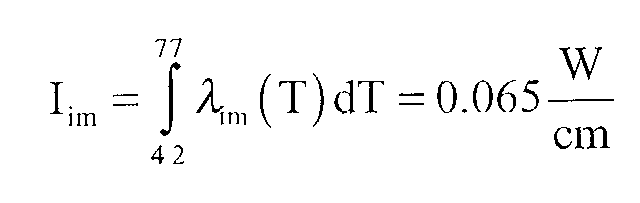
-
-
- a) Current supply of prior art consisting of two rods
The rods used had a cross section Asc = 0.24 cm2.The total heat input PT was calculated as followed:
- b) Current supply according to the invention in form of a double filament coil
without electrical shunt:
- A coil was used having the following dimensions:
- outer diameter of the coil = 35 mm
- thickness of the wall = 4 mm
- length of the coil = 30 cm
- resulting in a cross section Acoil = 3.90 cm2
- width of the windings = 6 mm
- width of the cuts = 3 mm
- length of each spiral Ls = 162 cm.
- Heat input (axial):
- xim = Lim/L = 0.33 relative length of insulating material (im)
- xsc = Lsc/L = 0.67 relative length of superconductor (sc)
- Heat input (azimuthal):
- Total heat input:
-
- As is clear from the above calculation by using the current supply of the present invention in form of a double filament coil the heat input was reduced by 48 %.
- The same cryogenic system and current supplies were used as in example 1 with the exception that the current supply of the present invention in form of a double filament coil and the rod-like current supply of the prior art were provided with a shunt made of metal being normal conducting.
- The shunt was made of an alloy CuNi30 with Asc = AM, (AM = cross section shunt).
- Integral of the heat input of the normal conducting shunt (M)

- a) Current supply of prior art:
- Total heat input:
- b) Current Supply of present invention:
- Heat input (axial):

- Heat input (azimuthal):
- Total heat input:
-
- By the current supply of the present invention the heat input into the cryogenic system at LHe was reduced by 55 %.
- It should be noted that the above calculations do not consider the effects involved with the reduction of the magnetic self field due to the opposite running current in the multi-filament coil of the present invention resulting in an increase of the current carrying capacity of about 20 %.
- Since the current carrying capacity is increased in the present htsc current supply in form of a mulit-filament coil, for a predetermined value for the current carrying capacity it is possible to reduce the cross section of the superconductor by the same amount.
Furthermore according to the present invention it is possible to readily optimize the dimensions of the coil by varying the width of the filaments and /or the width of the incisions in dependence on the critical current density being dependent on the temperature (also not considered in the calculation). - When including these effects into the calculation in view of the above, still better results can be expected in using the current supply of the present invention in form of a multi-filament coil, such as a double filament coil.
Claims (10)
- High temperature superconducting current supply in form of a multi filament coil having at least two spiral filaments, said filaments being composed of a high temperature superconducting material or a material which becomes superconducting on thermal treatment and being insulated from each other by a material of small heat conductivity which is filled at least partially in the gaps between the spiral filaments, wherein the lead for carrying current to and for carrying current away from the high temperature superconducting device are integrated in one component.
- Current supply according to claim 1,
characterized in that the coil is a double filament coil. - Current supply according to claim 1 or 2,
characterized in that the coil is made of an oxide superconductor material of the bismuth-type (BSCCO) or such material which becomes superconducting on thermal treatment. - Current supply according to any of the preceding claims,
characterized in that the current supply is provided at least partially with a shunt of normal conducting material. - Current supply according to any of the preceding claims,
characterized in that the cross section of one or more of the filaments is less at the cold end than at the warm end of the current supply. - Current supply according to any of the preceding claims,
characterized in that the width of the incisions separating the filaments from each other is within a range of 0.5 mm to 10 mm. - Process for preparing a current supply according to any of the preceding claims,
characterized in that from a tube-like hollow body a multi filament coil is made comprising at least two spiral filaments,
filling the gaps between the filaments at least partially with a material of small heat conductivity and providing electrical contacts at each end of the filaments, optionally prior to cutting the spiral filaments into the external surface of the tube-like hollow body. - Process according to claim 7,
characterized in that incisions are made between the spiral filaments having a width within the range of 0.5 mm to 10 mm. - Multifilament coil having at least two spiral filaments, said filaments being composed of a high temperature superconducting material or a material which becomes superconducting on thermal treatment, and being insulated from each other by a material of small heat conductivity which is filled at least partially in the gaps between the spiral filaments.
- Use of a multi-filament coil made of an oxide superconducting material as current supply for a high temperature superconducting device wherein the multifilament coil is comprised of at least one filament for carrying current to, and at least one filament for carrying current away from the high temperature superconducting device.
Priority Applications (4)
| Application Number | Priority Date | Filing Date | Title |
|---|---|---|---|
| EP20020292449 EP1406272A1 (en) | 2002-10-04 | 2002-10-04 | Current supply for superconducting devices |
| EP03292461A EP1408519B1 (en) | 2002-10-04 | 2003-10-06 | Current supply for high temperature superconducting devices |
| AT03292461T ATE380387T1 (en) | 2002-10-04 | 2003-10-06 | POWER SUPPLY FOR SUPERCONDUCTING DEVICES |
| DE60317866T DE60317866T2 (en) | 2002-10-04 | 2003-10-06 | Power supply for superconducting devices |
Applications Claiming Priority (1)
| Application Number | Priority Date | Filing Date | Title |
|---|---|---|---|
| EP20020292449 EP1406272A1 (en) | 2002-10-04 | 2002-10-04 | Current supply for superconducting devices |
Publications (1)
| Publication Number | Publication Date |
|---|---|
| EP1406272A1 true EP1406272A1 (en) | 2004-04-07 |
Family
ID=31985150
Family Applications (1)
| Application Number | Title | Priority Date | Filing Date |
|---|---|---|---|
| EP20020292449 Withdrawn EP1406272A1 (en) | 2002-10-04 | 2002-10-04 | Current supply for superconducting devices |
Country Status (3)
| Country | Link |
|---|---|
| EP (1) | EP1406272A1 (en) |
| AT (1) | ATE380387T1 (en) |
| DE (1) | DE60317866T2 (en) |
Cited By (4)
| Publication number | Priority date | Publication date | Assignee | Title |
|---|---|---|---|---|
| EP1622210A1 (en) * | 2004-07-30 | 2006-02-01 | NEXANS France | Superconducting resistive current limiter with a shunt |
| EP1622208A1 (en) * | 2004-07-30 | 2006-02-01 | Nexans | Superconducting resistive current limiter with a shunt |
| WO2015193163A1 (en) * | 2014-06-17 | 2015-12-23 | Siemens Aktiengesellschaft | Power supply for a superconducting coil device |
| DE102018213598A1 (en) * | 2018-08-13 | 2020-02-13 | Siemens Aktiengesellschaft | Superconducting power supply |
Families Citing this family (1)
| Publication number | Priority date | Publication date | Assignee | Title |
|---|---|---|---|---|
| CN118888207B (en) * | 2024-06-25 | 2025-04-29 | 西南交通大学 | Method for preparing high-performance REBCO high-temperature superconductive block based on layered precursor embryo |
Citations (4)
| Publication number | Priority date | Publication date | Assignee | Title |
|---|---|---|---|---|
| EP0350268A2 (en) * | 1988-07-05 | 1990-01-10 | General Electric Company | Two stage cryocooler with superconductive current lead |
| JPH0439908A (en) * | 1990-06-06 | 1992-02-10 | Toshiba Corp | Electric-current lead |
| JPH10247532A (en) * | 1997-03-04 | 1998-09-14 | Fuji Electric Co Ltd | Current leads for superconducting devices |
| WO1999022386A2 (en) * | 1997-10-13 | 1999-05-06 | Aventis Research & Technologies Gmbh & Co. Kg | Method for producing a coil from a high temperature superconductive material, and a high temperature superconductive coil with low alternating current loss |
-
2002
- 2002-10-04 EP EP20020292449 patent/EP1406272A1/en not_active Withdrawn
-
2003
- 2003-10-06 AT AT03292461T patent/ATE380387T1/en not_active IP Right Cessation
- 2003-10-06 DE DE60317866T patent/DE60317866T2/en not_active Expired - Lifetime
Patent Citations (4)
| Publication number | Priority date | Publication date | Assignee | Title |
|---|---|---|---|---|
| EP0350268A2 (en) * | 1988-07-05 | 1990-01-10 | General Electric Company | Two stage cryocooler with superconductive current lead |
| JPH0439908A (en) * | 1990-06-06 | 1992-02-10 | Toshiba Corp | Electric-current lead |
| JPH10247532A (en) * | 1997-03-04 | 1998-09-14 | Fuji Electric Co Ltd | Current leads for superconducting devices |
| WO1999022386A2 (en) * | 1997-10-13 | 1999-05-06 | Aventis Research & Technologies Gmbh & Co. Kg | Method for producing a coil from a high temperature superconductive material, and a high temperature superconductive coil with low alternating current loss |
Non-Patent Citations (2)
| Title |
|---|
| PATENT ABSTRACTS OF JAPAN vol. 016, no. 224 (E - 1206) 25 May 1992 (1992-05-25) * |
| PATENT ABSTRACTS OF JAPAN vol. 1998, no. 14 31 December 1998 (1998-12-31) * |
Cited By (5)
| Publication number | Priority date | Publication date | Assignee | Title |
|---|---|---|---|---|
| EP1622210A1 (en) * | 2004-07-30 | 2006-02-01 | NEXANS France | Superconducting resistive current limiter with a shunt |
| EP1622208A1 (en) * | 2004-07-30 | 2006-02-01 | Nexans | Superconducting resistive current limiter with a shunt |
| WO2015193163A1 (en) * | 2014-06-17 | 2015-12-23 | Siemens Aktiengesellschaft | Power supply for a superconducting coil device |
| DE102018213598A1 (en) * | 2018-08-13 | 2020-02-13 | Siemens Aktiengesellschaft | Superconducting power supply |
| WO2020035309A1 (en) * | 2018-08-13 | 2020-02-20 | Siemens Aktiengesellschaft | Superconducting current lead |
Also Published As
| Publication number | Publication date |
|---|---|
| DE60317866D1 (en) | 2008-01-17 |
| ATE380387T1 (en) | 2007-12-15 |
| DE60317866T2 (en) | 2008-11-27 |
Similar Documents
| Publication | Publication Date | Title |
|---|---|---|
| JP3215697B2 (en) | Superconducting coil that limits fault current | |
| JP5431932B2 (en) | High current small flexible conductor containing high temperature superconducting tape | |
| US10241168B2 (en) | Magnet coil assembly, comprising an HTS strip conductor and an LTS wire, which form a joint | |
| US20030051901A1 (en) | Superconductor connection structure | |
| KR20150065694A (en) | Superconductive coil device and production method | |
| JP4207223B2 (en) | Superconducting cable and superconducting cable line using this superconducting cable | |
| US4688132A (en) | Superconducting magnet system for operation at 13k | |
| US5298679A (en) | Current lead for cryostat using composite high temperature superconductors | |
| WO2015011491A1 (en) | Conductor for superconducting magnets | |
| US5604473A (en) | Shaped superconducting magnetic coil | |
| EP2806430B1 (en) | Superconducting current lead, superconducting current lead device, and superconducting magnet device | |
| US6869916B2 (en) | Protected superconductor component and process for its production | |
| US7589941B2 (en) | Fault current limiter having superconducting bypass reactor for simultaneous quenching | |
| JP2011508968A (en) | Fault current limiter incorporating superconducting articles | |
| EP1408519B1 (en) | Current supply for high temperature superconducting devices | |
| JP5604213B2 (en) | Superconducting equipment | |
| DE60317866T2 (en) | Power supply for superconducting devices | |
| JP2012064323A (en) | Superconductive current lead | |
| EP3511953B1 (en) | Low-temperature superconducting wire rod having low stabilizing matrix ratio, and superconducting coil having same | |
| Whetstone et al. | Nucleate cooling stability for superconductor-normal metal composite conductors in liquid helium | |
| JPH08321416A (en) | Current lead for superconducting device | |
| US4038492A (en) | Current feeding device for electrical apparatus with conductors cooled to a low temperature | |
| JP2734171B2 (en) | Current lead of superconducting magnet device | |
| JPH0955545A (en) | Current leads for superconducting devices | |
| JP2000067663A (en) | Superconducting conductor |
Legal Events
| Date | Code | Title | Description |
|---|---|---|---|
| PUAI | Public reference made under article 153(3) epc to a published international application that has entered the european phase |
Free format text: ORIGINAL CODE: 0009012 |
|
| AK | Designated contracting states |
Kind code of ref document: A1 Designated state(s): AT BE BG CH CY CZ DE DK EE ES FI FR GB GR IE IT LI LU MC NL PT SE SK TR |
|
| AX | Request for extension of the european patent |
Extension state: AL LT LV MK RO SI |
|
| 17P | Request for examination filed |
Effective date: 20041007 |
|
| AKX | Designation fees paid |
Designated state(s): AT BE BG CH CY CZ DE DK EE ES FI FR GB GR IE IT LI LU MC NL PT SE SK TR |
|
| AXX | Extension fees paid |
Extension state: SI Payment date: 20041007 Extension state: RO Payment date: 20041007 Extension state: MK Payment date: 20041007 Extension state: LV Payment date: 20041007 Extension state: LT Payment date: 20041007 Extension state: AL Payment date: 20041007 |
|
| STAA | Information on the status of an ep patent application or granted ep patent |
Free format text: STATUS: THE APPLICATION HAS BEEN WITHDRAWN |
|
| 17Q | First examination report despatched |
Effective date: 20050310 |
|
| 18W | Application withdrawn |
Effective date: 20050401 |