EP1406247A1 - Vertical recording type magnetic recording medilim and magnetic memory device using the medium - Google Patents
Vertical recording type magnetic recording medilim and magnetic memory device using the medium Download PDFInfo
- Publication number
- EP1406247A1 EP1406247A1 EP01932224A EP01932224A EP1406247A1 EP 1406247 A1 EP1406247 A1 EP 1406247A1 EP 01932224 A EP01932224 A EP 01932224A EP 01932224 A EP01932224 A EP 01932224A EP 1406247 A1 EP1406247 A1 EP 1406247A1
- Authority
- EP
- European Patent Office
- Prior art keywords
- magnetic
- layer
- magnetic recording
- recording
- backing layer
- Prior art date
- Legal status (The legal status is an assumption and is not a legal conclusion. Google has not performed a legal analysis and makes no representation as to the accuracy of the status listed.)
- Granted
Links
Images




Classifications
-
- G—PHYSICS
- G11—INFORMATION STORAGE
- G11B—INFORMATION STORAGE BASED ON RELATIVE MOVEMENT BETWEEN RECORD CARRIER AND TRANSDUCER
- G11B5/00—Recording by magnetisation or demagnetisation of a record carrier; Reproducing by magnetic means; Record carriers therefor
- G11B5/62—Record carriers characterised by the selection of the material
-
- G—PHYSICS
- G11—INFORMATION STORAGE
- G11B—INFORMATION STORAGE BASED ON RELATIVE MOVEMENT BETWEEN RECORD CARRIER AND TRANSDUCER
- G11B5/00—Recording by magnetisation or demagnetisation of a record carrier; Reproducing by magnetic means; Record carriers therefor
-
- G—PHYSICS
- G11—INFORMATION STORAGE
- G11B—INFORMATION STORAGE BASED ON RELATIVE MOVEMENT BETWEEN RECORD CARRIER AND TRANSDUCER
- G11B5/00—Recording by magnetisation or demagnetisation of a record carrier; Reproducing by magnetic means; Record carriers therefor
- G11B5/012—Recording on, or reproducing or erasing from, magnetic disks
-
- G—PHYSICS
- G11—INFORMATION STORAGE
- G11B—INFORMATION STORAGE BASED ON RELATIVE MOVEMENT BETWEEN RECORD CARRIER AND TRANSDUCER
- G11B5/00—Recording by magnetisation or demagnetisation of a record carrier; Reproducing by magnetic means; Record carriers therefor
- G11B5/02—Recording, reproducing, or erasing methods; Read, write or erase circuits therefor
-
- G—PHYSICS
- G11—INFORMATION STORAGE
- G11B—INFORMATION STORAGE BASED ON RELATIVE MOVEMENT BETWEEN RECORD CARRIER AND TRANSDUCER
- G11B5/00—Recording by magnetisation or demagnetisation of a record carrier; Reproducing by magnetic means; Record carriers therefor
- G11B5/62—Record carriers characterised by the selection of the material
- G11B5/64—Record carriers characterised by the selection of the material comprising only the magnetic material without bonding agent
-
- G—PHYSICS
- G11—INFORMATION STORAGE
- G11B—INFORMATION STORAGE BASED ON RELATIVE MOVEMENT BETWEEN RECORD CARRIER AND TRANSDUCER
- G11B5/00—Recording by magnetisation or demagnetisation of a record carrier; Reproducing by magnetic means; Record carriers therefor
- G11B5/62—Record carriers characterised by the selection of the material
- G11B5/64—Record carriers characterised by the selection of the material comprising only the magnetic material without bonding agent
- G11B5/66—Record carriers characterised by the selection of the material comprising only the magnetic material without bonding agent the record carriers consisting of several layers
- G11B5/676—Record carriers characterised by the selection of the material comprising only the magnetic material without bonding agent the record carriers consisting of several layers having magnetic layers separated by a nonmagnetic layer, e.g. antiferromagnetic layer, Cu layer or coupling layer
- G11B5/678—Record carriers characterised by the selection of the material comprising only the magnetic material without bonding agent the record carriers consisting of several layers having magnetic layers separated by a nonmagnetic layer, e.g. antiferromagnetic layer, Cu layer or coupling layer having three or more magnetic layers
-
- G—PHYSICS
- G11—INFORMATION STORAGE
- G11B—INFORMATION STORAGE BASED ON RELATIVE MOVEMENT BETWEEN RECORD CARRIER AND TRANSDUCER
- G11B5/00—Recording by magnetisation or demagnetisation of a record carrier; Reproducing by magnetic means; Record carriers therefor
- G11B5/62—Record carriers characterised by the selection of the material
- G11B5/73—Base layers, i.e. all non-magnetic layers lying under a lowermost magnetic recording layer, e.g. including any non-magnetic layer in between a first magnetic recording layer and either an underlying substrate or a soft magnetic underlayer
- G11B5/7368—Non-polymeric layer under the lowermost magnetic recording layer
-
- G—PHYSICS
- G11—INFORMATION STORAGE
- G11B—INFORMATION STORAGE BASED ON RELATIVE MOVEMENT BETWEEN RECORD CARRIER AND TRANSDUCER
- G11B5/00—Recording by magnetisation or demagnetisation of a record carrier; Reproducing by magnetic means; Record carriers therefor
- G11B5/62—Record carriers characterised by the selection of the material
- G11B5/73—Base layers, i.e. all non-magnetic layers lying under a lowermost magnetic recording layer, e.g. including any non-magnetic layer in between a first magnetic recording layer and either an underlying substrate or a soft magnetic underlayer
- G11B5/7368—Non-polymeric layer under the lowermost magnetic recording layer
- G11B5/7369—Two or more non-magnetic underlayers, e.g. seed layers or barrier layers
-
- G—PHYSICS
- G11—INFORMATION STORAGE
- G11B—INFORMATION STORAGE BASED ON RELATIVE MOVEMENT BETWEEN RECORD CARRIER AND TRANSDUCER
- G11B5/00—Recording by magnetisation or demagnetisation of a record carrier; Reproducing by magnetic means; Record carriers therefor
- G11B5/62—Record carriers characterised by the selection of the material
- G11B5/73—Base layers, i.e. all non-magnetic layers lying under a lowermost magnetic recording layer, e.g. including any non-magnetic layer in between a first magnetic recording layer and either an underlying substrate or a soft magnetic underlayer
- G11B5/7368—Non-polymeric layer under the lowermost magnetic recording layer
- G11B5/7373—Non-magnetic single underlayer comprising chromium
-
- G—PHYSICS
- G11—INFORMATION STORAGE
- G11B—INFORMATION STORAGE BASED ON RELATIVE MOVEMENT BETWEEN RECORD CARRIER AND TRANSDUCER
- G11B5/00—Recording by magnetisation or demagnetisation of a record carrier; Reproducing by magnetic means; Record carriers therefor
- G11B5/74—Record carriers characterised by the form, e.g. sheet shaped to wrap around a drum
- G11B5/82—Disk carriers
-
- G—PHYSICS
- G11—INFORMATION STORAGE
- G11B—INFORMATION STORAGE BASED ON RELATIVE MOVEMENT BETWEEN RECORD CARRIER AND TRANSDUCER
- G11B5/00—Recording by magnetisation or demagnetisation of a record carrier; Reproducing by magnetic means; Record carriers therefor
- G11B2005/0002—Special dispositions or recording techniques
-
- G—PHYSICS
- G11—INFORMATION STORAGE
- G11B—INFORMATION STORAGE BASED ON RELATIVE MOVEMENT BETWEEN RECORD CARRIER AND TRANSDUCER
- G11B5/00—Recording by magnetisation or demagnetisation of a record carrier; Reproducing by magnetic means; Record carriers therefor
- G11B2005/0002—Special dispositions or recording techniques
- G11B2005/0005—Arrangements, methods or circuits
- G11B2005/0021—Thermally assisted recording using an auxiliary energy source for heating the recording layer locally to assist the magnetization reversal
-
- G—PHYSICS
- G11—INFORMATION STORAGE
- G11B—INFORMATION STORAGE BASED ON RELATIVE MOVEMENT BETWEEN RECORD CARRIER AND TRANSDUCER
- G11B5/00—Recording by magnetisation or demagnetisation of a record carrier; Reproducing by magnetic means; Record carriers therefor
- G11B2005/0002—Special dispositions or recording techniques
- G11B2005/0026—Pulse recording
- G11B2005/0029—Pulse recording using magnetisation components of the recording layer disposed mainly perpendicularly to the record carrier surface
Definitions
- the present invention relates to magnetic recording medium such as hard disk, and the like, and further to a magnetic storage apparatus that performs recording and reproducing of magnetic information by using such a magnetic recording medium.
- magnetic recording media such as hard disk, and the like
- magnetic storage apparatus that performs recording and reproducing of magnetic information by using such a magnetic recording medium.
- most of the magnetic recording media used in practice are the type called in-plane recording type, in which magnetic information is recorded in the magnetic recording layer in the form of in-plane magnetization.
- the recording density has been increased with a rate of double per year.
- the magnetic recording medium of perpendicular recording type is rated as the most promising high density magnetic recording technology of the next generation.
- intensive research and development have been carried out actively in recent years with regard to such a magnetic recording medium of perpendicular recording type.
- the magnetic recording medium of perpendicular recording type can be classified into two types, the one being a magnetic recording medium of single-layer type having a single magnetic layer for the magnetic recording layer, another being a magnetic recording medium of two-layer type having a backing layer in addition to the magnetic recording layer.
- the backing layer works as an assist layer at the time of writing information.
- the backing layer is disposed so as to back the magnetic recording layer from below. Because of the predetermined magnetization of the backing layer, the recording magnetic field in the perpendicular direction is increased at the time of recording, and ideal perpendicular recording becomes possible. For this reason, special attention has been paid to the two-layer type magnetic recording medium as the magnetic recording medium suited for the high density recording.
- the backing layer of the foregoing two-layer type magnetic recording medium is generally formed with a ferromagnetic material such as FeTaC, NiFe, and the like.
- ferromagnetic material such as FeTaC, NiFe, and the like.
- a backing layer is required to have a predetermined magnetization in order that the backing layer performs its function. As long as the backing layer has its own magnetization like this, it is difficult to completely remove the noise originating from the backing layer. Further, there has been no satisfactory proposal so far for reducing the noise securely.
- the original role of the backing layer provided underneath the magnetic recording layer in the two-layer type magnetic recording medium is to assist the recording (writing) of the magnetic information, and for this purpose, it is necessary that the backing layer has a predetermined magnetization.
- the backing layer has a predetermined magnetization.
- noise spike noise, and the like
- the backing layer provided to assist the magnetic recording layer is required to satisfy conflicting requirements imposed at the time of recording and imposed at the time of reproducing.
- the main object of the present invention is to provide a magnetic recording medium of two-layer type comprising a magnetic recording layer and a backing layer assisting recording into the magnetic recording layer, wherein it is possible to suppress the noise originating from the backing layer at the time of reproducing. Further, the present invention has an object of providing a magnetic storage apparatus enabling recording of large-capacity magnetic information by using such a magnetic recording medium.
- the backing layer it becomes possible to control the backing layer such that the backing layer has a magnetization when magnetic information is recorded into the perpendicular magnetic recording layer and such that the backing layer does not have magnetization when magnetic information is read out from the perpendicular magnetic recording layer. With this, it becomes possible to suppress the noise originating from the backing layer, and a magnetic recording medium suitable for high density magnetic recording is obtained.
- the recording/reproducing temperature may be chosen from the range of 0 - 100°C, for example, in consideration of the environment in which the magnetic recording medium is used. Further, the foregoing compensation temperature may be set to a temperature in the vicinity of the recording/reproducing temperature specified above.
- ferrimagnetic material it is possible to use a GdFe alloy, a DyFe alloy or garnet ferrite. Thereby, it becomes possible to adjust the compensation temperature by changing the composition of the ferrimagnetic material.
- the perpendicular magnetic recording layer it is possible to use a single-layer perpendicular magnetization film or a multilayer perpendicular magnetization film.
- the present invention includes also a magnetic storage apparatus that causes the foregoing magnetic recording medium of the perpendicular recording type to function with certainty.
- the present invention achieves its object also by a magnetic storage apparatus for recording and reproducing magnetism information, provided with a magnetic recording medium of perpendicular recording type, said magnetic recording medium comprising at least a perpendicular magnetic recording layer and a backing layer backing said perpendicular magnetic recording layer, said backing layer having a magnetization in an in-plane direction, said backing layer being formed of a ferrimagnetic material having a compensation temperature in the vicinity of a recording/reproducing temperature, said magnetic storage apparatus being further provided with a temperature control unit, said temperature control unit increasing or decreasing a temperature of said backing layer so as to depart from said compensation temperature when recording magnetic information into said perpendicular magnetic recording layer.
- said temperature control means may be formed of an optical heating mechanism heating said backing layer with an optical beam when recording magnetic information into said perpendicular magnetic recording layer.
- a reproducing head such as the one using a magneto-resistive sensor such as GMR, TMR, MR etc. is provided adjacent to the foregoing recording head for reproducing the magnetic information from the perpendicular magnetic recording layer.
- Figures 1A and 1B are diagrams showing examples of the magnetic recording medium according to the present invention, wherein Figure 1A shows a magnetic recording medium 10 not provided with a non-magnetic layer, while Figure 1B shows a magnetic recording medium 20 provided with such a non-magnetic layer.
- the magnetic recording medium 10 has a structure in which a backing layer 12, a magnetic recording layer 13, a protection layer 14 and a lubrication layer 15 are stacked consecutively on a glass substrate 11.
- the magnetic recording medium 10 may be formed by consecutively stacking each of the layers with respective, predetermined thickness by using a thin film formation technology such as sputtering process, evaporation deposition process, plating process, and the like used for semiconductor fabrication process.
- the foregoing recording layer 13 is formed of a perpendicular magnetization recording film having a magnetization in a perpendicular direction to the surface of substrate 11.
- Such a magnetic recording layer 13 is formed on the backing layer 12 by conducting a deposition process while supplying a perpendicular magnetic field to the substrate 11 surface.
- This magnetic recording layer 13 may be formed of a single perpendicular magnetization film as shown in Figure 1A or by a multilayer perpendicular magnetization film.
- the magnetic recording layer 13 may be formed by using an alloy of the CoCr system or an amorphous material such as TbFeCo.
- a stacked perpendicular magnetization film such as Co/Pd, Co/Pt, Fe/Pt, and the like. perpendicular magnetization film that stacked.
- the above-mentioned backing layer 12 is disposed so as to assist the recording of magnetic information to the magnetic recording layer 13.
- the backing layer 12 is formed also with a magnetic material
- the magnetization direction is set to the in-plane direction parallel to the substrate 11 surface in the backing layer 12, contrary to the magnetic recording layer 13 formed thereon.
- the recording magnetic field from the record head is applied to magnetic recording layer 13 perpendicularly, and exact record magnetic recording is achieved.
- the backing layer 12 receives the recording magnetic field, and recording of the magnetic information to magnetic recording layer 13 is conducted with reliability: About the recording of the magnetic information to the magnetic recording layer 13, explanation will be made later with reference to Figure 3.
- the backing layer 12 becomes the state having a predetermined magnetization when recording of magnetic information is to be made into the magnetic recording layer 13.
- the magnetization should become zero or to the state in which the magnetization is sufficiently attenuated such that the magnetization does not became the cause of noise when the magnetic information recorded in the magnetic recording layer 13 is to be reproduced.
- the backing layer 12 that changes the magnetic properties like this can be provided by a ferrimagnetic material.
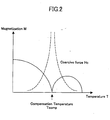
- Figure 2 is a diagram showing the temperature characteristics of a ferrimagnetic material called N type.
- perpendicular axis represents the temperature T, while the horizontal axis represents the magnetisation M.
- the ferrimagnetic material of N type has a temperature dependence such that the magnetization M (magnetic property) changes with the temperature.
- T comp The temperature in which the magnetization M becomes zero.
- Magnetization M appears once again when the temperature goes up further than this compensation temperature T comp .
- a magnetic recording medium capable of suppressing noise can be obtained by designing the ferrimagnetic material such that the compensating temperature T comp of the ferrimagnetic material exists in the vicinity of the recording/reproducing temperature of the magnetic recording medium, which recording/reproducing temperature being the temperature of the magnetic recording medium at the time of reproducing the magnetic information from the magnetic recording layer 13, and by using the ferrimagnetic material for the backing layer 12.
- the recording/reproducing temperature may be chosen from the range of -20 -100°C, by taking into consideration the room temperature in which the magnetic recording apparatus is provided and the temperature rise occurring inside the magnetic storage apparatus.
- the backing layer 12 has a predetermined magnetization as noted before.
- the temperature of the backing layer 12 is changed away from the compensation temperature T comp by heating or cooling the backing layer. This may be cased by providing heating means or cooling means heating or cooling the backing layer in the magnetic storage apparatus. As can be seen clearing in Figure 2, the backing layer 12 starts to have magnetization M when the temperature of the backing layer 12 is offset from the foregoing compensating temperature T comp . Thus, any of cooling and heating may be used.
- the backing layer 12 can be heated easily by providing a heating mechanism, which may be the one that uses an optical beam, and the like, and disposed in the vicinity of the magnetic recording medium.
- a heating mechanism which may be the one that uses an optical beam, and the like, and disposed in the vicinity of the magnetic recording medium.
- magnetization is induced in the backing layer 12 when recording magnetic information on the magnetic recording layer 13 by heating the magnetic recording medium by the optical beam used as an optical assist.
- the backing layer 12 can function its original role.
- Figure 1A shows the example in which the backing layer 12 is formed of a single ferrimagnetic layer, while the present invention is not limited to such a construction and it is also possible to use a multilayer film having ferrimagnetic coupling. In this case, it is sufficient to adjust such that the multilayer film as a whole does not show magnetization at the temperature in the vicinity of the recording/reproducing temperature.
- a material of carbon system is formed on the magnetic recording layer 13 as a protection film 14, and a lubrication layer 15 is formed thereon by applying perfluoroether, and the like, followed by natural drying process. With this, the magnetic recording medium 10 shown in Figure 1A is obtained.
- the backing layer 12 is formed by forming a film of GdFeCo on the glass substrate 11 with a thickness of 400nm
- the magnetic recording layer 13 is formed by depositing a film of CoCrPt on the backing layer 12 with a thickness of 40nm.
- a DLC (diamond-like carbon) film is formed on the magnetic layer 13 as the protection film 14 with the thickness of 5nm.
- the magnetic recording medium 20 shown in Figure 1B is different from the magnetic recording medium 10 of Figure 1A in the point that a non-magnetic layer 18 is provided between the backing layer 12 and the magnetic recording layer 13. Otherwise, the magnetic recording medium 20 has a construction similar to that of the magnetic recording medium 10 shown in Figure 1A.
- This non-magnetic layer 18 can be formed by using a non-magnetic material of the system of Ti, Cr or TiCr and may be formed in the form of single layer film or also in the form of multilayer film.
- the construction of the magnetic recording medium 20 of Figure 1B is similar to that of the magnetic recording medium 10 shown in Figure 1A, except that a non-magnetic layer of TiCr is provided between backing layer 12 and the magnetic recording layer 13 with the thickness of 20nm.
- Figures 3A and 3B show the state in which the magnetic recording medium 10 is disposed inside the magnetic storage apparatus for recording and reproducing of magnetic information by the magnetism head, wherein Figure 3A shows the state in which the magnetic information is recorded on magnetic recording layer 13 by a recording head 30 while Figure 3B shows the state in which the magnetic information recorded in the magnetic recording layer 13 is reproduced by a reproducing head 40.
- Figure 3A and also Figure 3B only show the primary part. Therefore, only the backing layer 12 and the magnetic recording layer 13 are shown for the magnetic recording medium 10.
- FIG 3A there is shown a situation in which a predetermined magnetic information is recorded on to the magnetic recording layer 13 by a single magnetic pole head 30 and a return yoke 32 moving relatively in the direction of an arrow HMD.
- the Backing layer 12 is heated by an optical beam 35 to the temperature higher than the compensation temperature T comp .
- the backing layer 12 has a predetermined magnetization 33 in the in-plane direction and performs the original function of the backing layer of receiving the recording magnetic field 31 from the single magnetic pole head 30. With this, it becomes possible to record exact magnetic information 34 on the magnetic recording layer 13.
- the backing layer of the magnetic recording medium of the present invention is heated (or cooled) such that there appears a predetermined magnetization only when recording of magnetic information is made on to the magnetic recording layer.
- Figure 3B shows the case for reproducing magnetic information recorded in the magnetic recording layer 13.
- the backing layer 12 is not heated and has the temperature close to the compensation temperature T comp . Therefore, the magnetization of the backing layer 12 is more or less zero, and the backing layer 12 does not become the cause of noise at the time of reproducing.
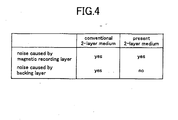
- Figure 4 compares the magnetic recording media of the two-layer type having a conventional backing layer and the magnetic recording medium of the present invention with regard to noise.
- the magnetic recording medium of the present invention possesses superior characteristics of capable of suppressing the noise originating from the backing layer.
- Figure 5 compares the reproduced output waveform (A) after the DC demagnitization for the case of using a conventional two-layer type magnetic recording medium and a reproduced output waveform (B) after the DC demagnitization for the case of using the magnetic recording medium of the present invention.
- A for the conventional backing layer (NiFe) shown in the upper row
- B for the backing layer of the present invention using a ferrimagnetic material (GdFeCo) shown in the lower.row, on the other hand, it is confirmed that the formation of the spike noise SPN is effectively suppressed.
- Figure 6A is a cross-sectional diagram showing a main part of the magnetic storage apparatus 100 of the embodiment while Figure 6B is a plane view showing the main part of the same apparatus 100.
- Figure 6B is a plane view showing the main part of the same apparatus 100.
- the magnetic storage apparatus 100 is generally formed of a housing 113 accommodating therein a motor 114, a hub 115, a plurality of magnetic recording media 116, a plurality of record/reproducing.heads 117, a plurality of suspensions 118, a plurality of arms 119 and further an actuator unit 112.
- the magnetic recording media 116 are mounted on the hub 115 rotated by the motor 114.
- the record/reproducing head 117 is a magnetic head of composite type capable of performing recording and reproducing and is formed of a reproducing head of a high sensitivity resistance sensor that utilizes a magneto-resistance effect such as GMR, TMR, MR, and the like and a recording head of the single magnetic pole magnetic head, and the like.
- Each of the record/reproducing heads 117 is mounted at a tip end of a corresponding arm 119 via a suspension 118, and the arm 119 is driven by the actuator unit 112.
- FIG. 6 While not shown in Figure 6, three is provided a heating means similar to the one shown in Figure 3A inside the magnetic storage apparatus 100 for heating the magnetic recording medium by way of the optical beam.
- the magnetic recording medium 10 or 20 of the perpendicular recording type having the construction explained with reference to Figure 1, for the magnetic recording medium 116, noise caused by the backing layer is eliminated and it becomes possible to perform high density recording in the magnetic storage apparatus.
- the number of the magnetic recording media 116 may is not limited to three, but any of one, two, four or more magnetic recording media may be provided.
- the fundamental construction of the magnetic storage apparatus 100 is not limited to the one shown in Figures 6A and 6B. Further, the magnetism storage medium used in the present invention is not limited to a magnetic disk.
- the magnetic storage apparatus 100 includes therein a cooling means cooling the magnetic recording medium such that the magnetic recording medium is cooled only at the time of recording such that there appears a magnetization in the backing layer only at the time of recording.
Landscapes
- Magnetic Record Carriers (AREA)
- Recording Or Reproducing By Magnetic Means (AREA)
Abstract
Description
said backing layer being formed of a ferrimagnetic material having a compensation temperature in the vicinity of a recording/reproducing temperature,
said magnetic storage apparatus being further provided with a temperature control unit, said temperature control unit increasing or decreasing a temperature of said backing layer so as to depart from said compensation temperature when recording magnetic information into said perpendicular magnetic recording layer.
Of course, the number of the
Claims (9)
- A perpendicular magnetic recording medium comprising at least a perpendicular magnetic recording layer and a backing layer backing said perpendicular magnetic recording layer, said backing layer having an in-plane magnetization,
characterized in that said backing layer is formed of a ferrimagnetic material having a compensation temperature in the vicinity of a recording/reproducing temperature in which reproducing of magnetic information is made from said perpendicular magnetic recording layer. - The perpendicular magnetic recording medium as claimed in claim 1, characterized in that said recording/reproducing temperature is -20 - 100°C.
- The perpendicular magnetic recording medium as claimed in claim 1 or 2, characterized in that said ferrimagnetic material is any of an alloy of GdFe system, an alloy of DyFe system and a garnet ferrite.
- The perpendicular magnetic recording medium as claimed in claim 3, characterized in that said perpendicular magnetic recording layer is any of a single layer perpendicular magnetic film or a multilayer perpendicular magnetic film.
- A magnetic storage apparatus for recording and reproducing magnetic information having a perpendicular magnetic recording medium, said perpendicular magnetic recording medium comprising at least a perpendicular magnetic recording layer and a backing layer backing said perpendicular magnetic recording layer, said backing layer having an in-plane magnetization,
characterized in that said backing layer is formed of a ferrimagnetic material having a compensation temperature in the vicinity of a recording/reproducing temperature,
said magnetic storage apparatus further comprises temperature changing means for heating or cooling said backing layer at the time of recording magnetic information to said perpendicular magnetic recording layer such that a temperature of said backing layer is moved away from said compensation temperature. - The magnetic storage apparatus as claimed in claim 5, characterized in that said temperature changing means of said backing layer comprises an optical heating mechanism heating said backing layer with an optical beam at the time of recording said magnetic information to said perpendicular magnetic recording layer.
- The magnetic storage apparatus as claimed in claim 5 or 6, characterized in that a single magnetic pole magnetic head is used for a recording head for recording said magnetic information to said perpendicular magnetic recording layer.
- The magnetic storage apparatus as claimed in claim 7, characterized by further comprising a return yoke for receiving said magnetic field of said recording head via said backing layer.
- The magnetic storage apparatus as claimed in claim 8 or 9, characterized in that a reproducing head is provided adjacent to said recording head for reproducing said magnetic information recorded in said perpendicular magnetic recording layer, said reproducing head uses a magneto-resistive sensor such as GMR, TMR, MR, and the like.
Applications Claiming Priority (1)
| Application Number | Priority Date | Filing Date | Title |
|---|---|---|---|
| PCT/JP2001/004317 WO2002095739A1 (en) | 2001-05-23 | 2001-05-23 | Vertical recording type magnetic recording medilim and magnetic memory device using the medium |
Publications (3)
| Publication Number | Publication Date |
|---|---|
| EP1406247A1 true EP1406247A1 (en) | 2004-04-07 |
| EP1406247A4 EP1406247A4 (en) | 2007-08-29 |
| EP1406247B1 EP1406247B1 (en) | 2009-03-25 |
Family
ID=11737339
Family Applications (1)
| Application Number | Title | Priority Date | Filing Date |
|---|---|---|---|
| EP01932224A Expired - Lifetime EP1406247B1 (en) | 2001-05-23 | 2001-05-23 | Vertical recording type magnetic recording medilim and magnetic memory device using the medium |
Country Status (6)
| Country | Link |
|---|---|
| US (2) | US7525762B2 (en) |
| EP (1) | EP1406247B1 (en) |
| JP (1) | JPWO2002095739A1 (en) |
| KR (1) | KR100757816B1 (en) |
| DE (1) | DE60138143D1 (en) |
| WO (1) | WO2002095739A1 (en) |
Families Citing this family (1)
| Publication number | Priority date | Publication date | Assignee | Title |
|---|---|---|---|---|
| KR100757816B1 (en) * | 2001-05-23 | 2007-09-11 | 후지쯔 가부시끼가이샤 | Vertical recording type magnetic recording medium and magnetic memory device using the same |
Family Cites Families (22)
| Publication number | Priority date | Publication date | Assignee | Title |
|---|---|---|---|---|
| US4277809A (en) * | 1979-09-26 | 1981-07-07 | Memorex Corporation | Apparatus for recording magnetic impulses perpendicular to the surface of a recording medium |
| JPH02227814A (en) * | 1989-02-28 | 1990-09-11 | Mitsubishi Electric Corp | Perpendicular magnetic recording medium and production thereof |
| US5168482A (en) | 1989-08-31 | 1992-12-01 | Sony Corporation | Magnetooptical recording and playback method employing multi-layer recording medium with record holding layer and playback layer |
| JP2563711B2 (en) * | 1991-01-24 | 1996-12-18 | 松下電器産業株式会社 | Magnetic tape |
| JPH05109047A (en) * | 1991-03-12 | 1993-04-30 | Hitachi Ltd | Magnetic recording medium and manufacturing method thereof |
| US5815342A (en) * | 1992-07-13 | 1998-09-29 | Kabushiki Kaisha Toshiba | Perpendicular magnetic recording/reproducing apparatus |
| US5792564A (en) * | 1993-03-10 | 1998-08-11 | Kabushiki Kaisha Toshiba | Perpendicular recording medium and magnetic recording apparatus |
| US5663935A (en) * | 1995-02-08 | 1997-09-02 | Canon Kabushiki Kaisha | Magneto-optical recording medium having two magnetic layers of exchange-coupled at ferromagnetic phase |
| US5585986A (en) * | 1995-05-15 | 1996-12-17 | International Business Machines Corporation | Digital magnetoresistive sensor based on the giant magnetoresistance effect |
| JPH10289434A (en) | 1997-04-16 | 1998-10-27 | Hitachi Ltd | Magnetic disk and magnetic recording device using the same |
| US6403203B2 (en) * | 1997-05-29 | 2002-06-11 | Hitachi, Ltd. | Magnetic recording medium and magnetic recording apparatus using the same |
| US6327227B1 (en) * | 1997-08-08 | 2001-12-04 | Sharp Kabushiki Kaisha | Magnetic recorder/reproduction apparatus including a selective temperature controller and magnetic recording reproduction method including selective temperature control |
| US6387483B1 (en) * | 1997-12-18 | 2002-05-14 | Nec Corporation | Perpendicular magnetic recording medium and manufacturing process therefor |
| JP2001101644A (en) * | 1999-09-29 | 2001-04-13 | Toshiba Corp | Perpendicular magnetic recording medium and magnetic recording device |
| US6667848B1 (en) * | 2000-01-10 | 2003-12-23 | Seagate Technology Llc | Perpendicular magnetic recording head with means for suppressing noise from soft magnetic underlayer of recording media |
| US6383668B1 (en) * | 2000-03-27 | 2002-05-07 | International Business Machines Corporation | Magnetic recording media with antiferromagnetically coupled host layer for the magnetic recording layer |
| CN1210692C (en) | 2000-03-28 | 2005-07-13 | 皇家菲利浦电子有限公司 | Storage media for heat-assisted magnetic recording |
| US6541131B1 (en) * | 2000-05-25 | 2003-04-01 | Seagate Technology Llc | Perpendicular recording media with enhanced coercivity |
| US6709773B1 (en) * | 2000-09-05 | 2004-03-23 | Seagate Technology, Inc. | Magnetic anisotrophy of soft-underlayer induced by seedlayer |
| US6671117B2 (en) * | 2000-12-20 | 2003-12-30 | Seagate Technology Llc | Magnetic writer for noise suppression in perpendicular recording media |
| KR100757816B1 (en) * | 2001-05-23 | 2007-09-11 | 후지쯔 가부시끼가이샤 | Vertical recording type magnetic recording medium and magnetic memory device using the same |
| JP3947001B2 (en) * | 2001-12-27 | 2007-07-18 | 富士通株式会社 | Information recording medium and information storage device |
-
2001
- 2001-05-23 KR KR1020037014170A patent/KR100757816B1/en not_active Expired - Fee Related
- 2001-05-23 JP JP2002592116A patent/JPWO2002095739A1/en active Pending
- 2001-05-23 EP EP01932224A patent/EP1406247B1/en not_active Expired - Lifetime
- 2001-05-23 DE DE60138143T patent/DE60138143D1/en not_active Expired - Fee Related
- 2001-05-23 WO PCT/JP2001/004317 patent/WO2002095739A1/en not_active Ceased
-
2003
- 2003-11-20 US US10/718,202 patent/US7525762B2/en not_active Expired - Fee Related
-
2007
- 2007-01-30 US US11/699,707 patent/US7295404B2/en not_active Expired - Fee Related
Also Published As
| Publication number | Publication date |
|---|---|
| US7295404B2 (en) | 2007-11-13 |
| WO2002095739A1 (en) | 2002-11-28 |
| US20070124749A1 (en) | 2007-05-31 |
| EP1406247B1 (en) | 2009-03-25 |
| US20040101714A1 (en) | 2004-05-27 |
| EP1406247A4 (en) | 2007-08-29 |
| US7525762B2 (en) | 2009-04-28 |
| KR20040008167A (en) | 2004-01-28 |
| DE60138143D1 (en) | 2009-05-07 |
| KR100757816B1 (en) | 2007-09-11 |
| JPWO2002095739A1 (en) | 2004-09-09 |
Similar Documents
| Publication | Publication Date | Title |
|---|---|---|
| US7955723B2 (en) | Magnetic recording medium substrate and perpendicular magnetic recording medium | |
| US6818330B2 (en) | Perpendicular recording medium with antiferromagnetic exchange coupling in soft magnetic underlayers | |
| CN101393750B (en) | Magnetic recording medium | |
| US8081542B1 (en) | Thermally-assisted recording (TAR) disk drive with patterned multilevel media and laser with power modulation | |
| US20070231609A1 (en) | Perpendicular magnetic recording medium and magnetic memory apparatus | |
| US6020060A (en) | Magnetic recording medium, process for producing the same and magnetic disk device | |
| US20040071923A1 (en) | Method for thermally-assisted recording on a magnetic recording disk | |
| JP2007200548A (en) | Perpendicular magnetic recording disk | |
| US8541116B2 (en) | Patterned perpendicular magnetic recording disk drive and medium with patterned exchange bridge layer below the data islands | |
| CN100527228C (en) | Perpendicular magnetic recording medium and magnetic storage device | |
| US20040233565A1 (en) | Perpendicular magnetic recording medium and magnetic recording/reproducing apparatus | |
| US9280996B2 (en) | All-optical magnetic recording system using FeMnPt media | |
| JP3886011B2 (en) | Magnetic recording medium, recording method therefor, and magnetic recording apparatus | |
| US7295404B2 (en) | Magnetic recording medium for perpendicular recording and magnetic storage apparatus using the same | |
| US20090201607A1 (en) | Patterned perpendicular magnetic recording medium and magnetic recording and reproducing apparatus | |
| US7092209B2 (en) | Longitudinal magnetic recording using magnetic media with a soft underlayer | |
| CN104054128A (en) | Recording medium with thin stabilization layer having high magnetic saturation and anisotropic field characteristics | |
| JP3811880B2 (en) | Magnetic recording medium | |
| US6868048B1 (en) | Data storage system having thermally activated readout | |
| US7095589B2 (en) | Magnetic recording medium and magnetic recording and reproducing system | |
| JP4035819B2 (en) | Perpendicular magnetic recording medium and recording method on the recording medium | |
| JP4391360B2 (en) | Magnetic recording medium and magnetic recording method thereof | |
| JP2002008219A (en) | Magnetic recording medium and magnetic recording apparatus including the same | |
| JP2004355729A (en) | Magnetic recording medium and magnetic recording device | |
| JP2002092840A (en) | Magnetic recording medium and magnetic recording device including the same |
Legal Events
| Date | Code | Title | Description |
|---|---|---|---|
| PUAI | Public reference made under article 153(3) epc to a published international application that has entered the european phase |
Free format text: ORIGINAL CODE: 0009012 |
|
| 17P | Request for examination filed |
Effective date: 20031124 |
|
| AK | Designated contracting states |
Kind code of ref document: A1 Designated state(s): AT BE CH CY DE DK ES FI FR GB GR IE IT LI LU MC NL PT SE TR |
|
| A4 | Supplementary search report drawn up and despatched |
Effective date: 20070801 |
|
| 17Q | First examination report despatched |
Effective date: 20071116 |
|
| GRAJ | Information related to disapproval of communication of intention to grant by the applicant or resumption of examination proceedings by the epo deleted |
Free format text: ORIGINAL CODE: EPIDOSDIGR1 |
|
| GRAP | Despatch of communication of intention to grant a patent |
Free format text: ORIGINAL CODE: EPIDOSNIGR1 |
|
| GRAP | Despatch of communication of intention to grant a patent |
Free format text: ORIGINAL CODE: EPIDOSNIGR1 |
|
| GRAS | Grant fee paid |
Free format text: ORIGINAL CODE: EPIDOSNIGR3 |
|
| GRAA | (expected) grant |
Free format text: ORIGINAL CODE: 0009210 |
|
| AK | Designated contracting states |
Kind code of ref document: B1 Designated state(s): DE FR GB |
|
| REG | Reference to a national code |
Ref country code: GB Ref legal event code: FG4D |
|
| REF | Corresponds to: |
Ref document number: 60138143 Country of ref document: DE Date of ref document: 20090507 Kind code of ref document: P |
|
| PGFP | Annual fee paid to national office [announced via postgrant information from national office to epo] |
Ref country code: DE Payment date: 20090615 Year of fee payment: 9 |
|
| PGFP | Annual fee paid to national office [announced via postgrant information from national office to epo] |
Ref country code: GB Payment date: 20090625 Year of fee payment: 9 |
|
| PLBE | No opposition filed within time limit |
Free format text: ORIGINAL CODE: 0009261 |
|
| STAA | Information on the status of an ep patent application or granted ep patent |
Free format text: STATUS: NO OPPOSITION FILED WITHIN TIME LIMIT |
|
| REG | Reference to a national code |
Ref country code: FR Ref legal event code: ST Effective date: 20100129 |
|
| 26N | No opposition filed |
Effective date: 20091229 |
|
| PG25 | Lapsed in a contracting state [announced via postgrant information from national office to epo] |
Ref country code: FR Free format text: LAPSE BECAUSE OF NON-PAYMENT OF DUE FEES Effective date: 20090602 |
|
| GBPC | Gb: european patent ceased through non-payment of renewal fee |
Effective date: 20100523 |
|
| PG25 | Lapsed in a contracting state [announced via postgrant information from national office to epo] |
Ref country code: DE Free format text: LAPSE BECAUSE OF NON-PAYMENT OF DUE FEES Effective date: 20101201 |
|
| PG25 | Lapsed in a contracting state [announced via postgrant information from national office to epo] |
Ref country code: GB Free format text: LAPSE BECAUSE OF NON-PAYMENT OF DUE FEES Effective date: 20100523 |