EP1406125A1 - Method for manufacturing photosensitive resin printing plate, and developer treatment device - Google Patents
Method for manufacturing photosensitive resin printing plate, and developer treatment device Download PDFInfo
- Publication number
- EP1406125A1 EP1406125A1 EP02741397A EP02741397A EP1406125A1 EP 1406125 A1 EP1406125 A1 EP 1406125A1 EP 02741397 A EP02741397 A EP 02741397A EP 02741397 A EP02741397 A EP 02741397A EP 1406125 A1 EP1406125 A1 EP 1406125A1
- Authority
- EP
- European Patent Office
- Prior art keywords
- developer
- photosensitive resin
- printing plate
- resin layer
- plate material
- Prior art date
- Legal status (The legal status is an assumption and is not a legal conclusion. Google has not performed a legal analysis and makes no representation as to the accuracy of the status listed.)
- Withdrawn
Links
Images

Classifications
-
- B—PERFORMING OPERATIONS; TRANSPORTING
- B01—PHYSICAL OR CHEMICAL PROCESSES OR APPARATUS IN GENERAL
- B01D—SEPARATION
- B01D3/00—Distillation or related exchange processes in which liquids are contacted with gaseous media, e.g. stripping
- B01D3/10—Vacuum distillation
-
- C—CHEMISTRY; METALLURGY
- C02—TREATMENT OF WATER, WASTE WATER, SEWAGE, OR SLUDGE
- C02F—TREATMENT OF WATER, WASTE WATER, SEWAGE, OR SLUDGE
- C02F1/00—Treatment of water, waste water, or sewage
- C02F1/02—Treatment of water, waste water, or sewage by heating
- C02F1/04—Treatment of water, waste water, or sewage by heating by distillation or evaporation
- C02F1/048—Purification of waste water by evaporation
-
- G—PHYSICS
- G03—PHOTOGRAPHY; CINEMATOGRAPHY; ANALOGOUS TECHNIQUES USING WAVES OTHER THAN OPTICAL WAVES; ELECTROGRAPHY; HOLOGRAPHY
- G03F—PHOTOMECHANICAL PRODUCTION OF TEXTURED OR PATTERNED SURFACES, e.g. FOR PRINTING, FOR PROCESSING OF SEMICONDUCTOR DEVICES; MATERIALS THEREFOR; ORIGINALS THEREFOR; APPARATUS SPECIALLY ADAPTED THEREFOR
- G03F7/00—Photomechanical, e.g. photolithographic, production of textured or patterned surfaces, e.g. printing surfaces; Materials therefor, e.g. comprising photoresists; Apparatus specially adapted therefor
- G03F7/20—Exposure; Apparatus therefor
- G03F7/24—Curved surfaces
-
- G—PHYSICS
- G03—PHOTOGRAPHY; CINEMATOGRAPHY; ANALOGOUS TECHNIQUES USING WAVES OTHER THAN OPTICAL WAVES; ELECTROGRAPHY; HOLOGRAPHY
- G03F—PHOTOMECHANICAL PRODUCTION OF TEXTURED OR PATTERNED SURFACES, e.g. FOR PRINTING, FOR PROCESSING OF SEMICONDUCTOR DEVICES; MATERIALS THEREFOR; ORIGINALS THEREFOR; APPARATUS SPECIALLY ADAPTED THEREFOR
- G03F7/00—Photomechanical, e.g. photolithographic, production of textured or patterned surfaces, e.g. printing surfaces; Materials therefor, e.g. comprising photoresists; Apparatus specially adapted therefor
- G03F7/26—Processing photosensitive materials; Apparatus therefor
- G03F7/30—Imagewise removal using liquid means
- G03F7/3092—Recovery of material; Waste processing
Definitions
- the present invention relates to a method for making a photosensitive resin printing plate and, more particularly, to a method for making photosensitive resin printing plate in which a developer is extracted for reuse from a photosensitive resin layer component-dissolved or dispersed developer produced during a development step, by removing a photosensitive resin layer component therefrom. More specifically, the invention relates to a method for making photosensitive resin printing plate material in which a developer is recovered from a developer mixture in which a photosensitive resin layer component-dissolved or dispersed developer produced during a development step is distilled under reduced pressure, and is therefore reused as a developer, so that the operation of developing photosensitive resin printing plate materials can be conducted stably for a long time without disposal of the developer.
- a photosensitive resin printing plate is used as follows. That is, a negative or positive original image film is placed in close contact with the photosensitive layer of the printing plate, and a ray of active light is applied thereto through the original image film so as to form in the photosensitive layer a latent image made up of solvent-soluble portions and solvent-insoluble portions, or hardened portions and non-hardened portions. By developing the latent image, a relief image is formed, so that the plate can be used as a printing plate.
- Development methods employed for photosensitive resin printing plate materials include a method in which unexposed portions are blown off by using compressed air or the like, a method in which unexposed portions are removed by jetting a developer at a fixed pressure in a spray fashion, and a method in which unexposed portions are rubbed off by using a brush or the like while immersing the plate in a developer or jetting a developer in a shower fashion.
- photosensitive resin layer components from the rubbed-off unexposed portions exist in a dissolved or dispersed state in the developer. If such a developer liquid is reused repeatedly to develop photosensitive resin printing plate materials, the concentration of photosensitive resin layer components in the developer increases, resulting in the problems of reduced developing speed, deposition of photosensitive resin layer components aggregated from the dispersed state on a printing plate or the brush of the developing machine, etc.
- the method suffers high costs of waste liquid disposal. Furthermore, due to large production of waste, the method also has problems in terms of environment protection.
- the closed-cycle methods proposed include, for example, a method in which dispersed photosensitive resin layer components are removed from a developer containing photosensitive resin layer components, a method in which aggregates are removed from a developer, for example, through the use of a filter or the like (Japanese Patent Application Laid-Open Publication No. 7-333861), a method in which photosensitive resin layer components in a developer are aggregated by adding a flocculating agent to the developer (Japanese Patent Application Laid-Open Publication No. 2001-47060), etc.
- the method in which photosensitive resin layer components are removed via a filter is not practical since the filter is soon clogged with photosensitive resin layer components.
- the flocculating agent is contained in the developer to be reused, thus resulting in the following problems. That is, the developing speed decreases, and photosensitive resin layer components produced during the development aggregate and deposit on a printing plate or the brush of the developing machine.
- the invention provides a method for making a photosensitive resin printing plate which comprises at least (1) the exposure step of forming a latent image in an aqueous-developable photosensitive resin layer of a printing plate material by irradiating the printing plate material with a ray of active light, (2) the development step of forming a relief image from the latent image by dissolving or dispersing the photosensitive resin layer that forms the latent image into a developer that contains water as a main component, and (3) the drying step of removing the developer from the printing plate having the relief image, the method being characterized in that a photosensitive resin layer component-dissolved or dispersed developer produced in the development step is subjected to a reduced pressure distillation, and is therefore reused as a developer, and that a residue produced by the reduced pressure distillation is solidified.
- the invention provides a photosensitive resin printing plate material developer processing apparatus for processing a photosensitive resin layer component-containing developer produced in a step of developing an aqueous-developable photosensitive resin printing plate material, the developer processing apparatus being characterized by comprising an evaporator that reduces a pressure of the developer, a cooler that recovers a developer by condensing a developer vapor, and a detachable inner container provided within the evaporator.
- FIG. 1 is a diagram illustrating an example of the developer processing apparatus of the invention.
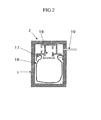
- FIG. 2 is a longitudinal sectional view of an example of an evaporator in the invention.
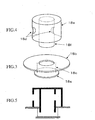
- FIGS. 3 to 5 are diagrams illustrating an example of a fly preventive device in the invention.
- FIG. 3 is a perspective view of a fly preventive device (1)
- FIG. 4 is a perspective view of a fly preventive device (2)
- FIG. 5 is a longitudinal sectional view of the fly preventive devices (1) and (2) in a combined state.
- a negative or positive original image film is placed in close contact with a photosensitive resin layer from which a cover film has been peeled off, and the photosensitive resin layer is irradiated with ultraviolet light from a high-pressure mercury-vapor lamp, an ultra-high pressure mercury lamp, a metal hydride lamp, a xenon lamp, a carbon arc lamp, a chemical lamp, etc. which are capable of normally emitting light having a wavelength of 300 to 400 nm, so as to cause the hardening of photosensitive resin through photopolymerization and therefore form a latent image.
- a process of exposing a printing plate to light from the support side may be conducted prior to the formation of a latent image.
- a relief image is formed on a substrate by a brush-type developing apparatus that removes unexposed portions of the photosensitive resin printing plate material by rubbing with a brush while immersing the photosensitive resin printing plate material in a developer whose main component is water, or while jetting such a developer to the photosensitive resin printing plate material in a shower fashion.
- the developer used in this process include water, aqueous solutions of surfactants, and aqueous solutions of other water-soluble compounds, etc.
- Photosensitive resin layer components from the rubbed-off unexposed portions mix into the developer, and exist in a dissolved or dispersed state.
- a preferable temperature of the developer during development ranges from 10°C to 60°C.
- the printing plate carrying a relief image formed as described above is dried so as to remove the developer.
- a preferable drying temperature in this process ranges from 20°C to 80°C. After that, an active light ray process is performed in the atmosphere or vacuum to obtain a printing plate.
- a developer having water as a main component in which the photosensitive resin layer components released during the development of the photosensitive resin printing plate in the above-described fashion are dissolved or dispersed is subjected to heating or pressure reduction, or both heating and pressure reduction, so as to vaporize the developer components.
- the produced vapor is condensed for recovery through the cooling accomplished by a cooling means, for example, a cooler through which cooling water or the like flows, or the like.
- the thus-recovered liquid is reused as a developer.
- the temperature of the developer during this process is preferably at least 30°C in view of distillation efficiency.
- a pressure equal to or less than the vapor pressure is appropriate.
- a preferable pressure is at most 48 kPa, and a more preferable pressure is at most 13 kPa, in view of distillation efficiency.
- Solidification of post-distillation residue by a below-described solidification means eliminates the need for a subsequent process, such as filtration or the like, and thus facilitates the handling, and is therefore preferable.
- the developer having water as a main component and also having photosensitive resin layer components in a dissolved or dispersed state contains a foaming component, for example, a surfactant or the like, it is appropriate to add an ordinary antifoam agent, and it is particularly effective to use a silicon-liquid antifoam agent.
- a developer processing apparatus that is at least equipped with an evaporator that heats and depressurizes the developer, a cooler that has a means for cooling vapor from the developer, and a recovery unit that recovers a distilled developer. If a photosensitive resin layer component-containing developer is not directly placed in the evaporator but is placed in a container provided inside the evaporator (inner container), the photosensitive resin layer components concentrate within the inner container as the distillation progresses.
- the inner container is configured for easy detachment, and is made of a material that is allowed to be disposed of, for example, a disposable resin, a disposable resin film or the like, the inner container can be disposed of together with the residue that contains concentrated photosensitive resin layer components, and therefore workability improves.
- a resin-made bag as an inner container is preferable due to good workability, for example, easy disposal, etc.
- a heat-resistant bag for example, a polyamide resin bag, a polypropylene resin bag, a high-density polyethylene resin bag, an aluminum foil-laminated bag of any one of the aforementioned resins, etc.
- the water-absorbing compound examples include super absorbent resins, such as hydrocarbon polymers modified to be hydrophilic, vinyl alcohol/vinyl acetate copolymers, poly (meth) acrylic acid, polypeptides, polyacrylic acid salts, copolymers obtained from acrylic acid and maleic acid, itaconic acid, acryl amide, 2-hydroxyethyl methacrylate, etc.
- super absorbent resins such as hydrocarbon polymers modified to be hydrophilic, vinyl alcohol/vinyl acetate copolymers, poly (meth) acrylic acid, polypeptides, polyacrylic acid salts, copolymers obtained from acrylic acid and maleic acid, itaconic acid, acryl amide, 2-hydroxyethyl methacrylate, etc.
- the amount of such a super absorbent resin varies depending on the kind of resin, the amount of residue, and the concentration rate of the residue. If the residue is about 5 to 15 kg, a practically preferable amount of the super absorbent resin is within the range of 10 g to 400
- a fly preventive device such as an inner lid or the like, in the evaporator will prevent a photosensitive resin layer component from flying from the developer liquid and clogging a cooling pipeline, and is therefore effective.
- the configuration of the fly preventive device is not particularly restricted as long as the device is able to prevent a photosensitive resin layer component from flying to the cooling pipeline and allows condensation and recovery of evaporated developer.
- a structure that prevents the flow of vapor from moving straight to the cooler will curb the flying of photosensitive resin layer components to the cooling pipeline.
- the fly preventive device examples include (1) a fly preventive device in which a plurality of small pieces are arranged so as to cover the developer liquid surface and at least one of the small pieces has a height that is different from the height of other small pieces, (2) a fly preventive device which is formed by a plurality of closed-bottom cylindrical members that have a common upper bottom and in which a side surface of each closed-bottom cylindrical member has at least one hole, a fly preventive device having a combination of a device (1) and a device (2) provided above the device (1), etc.
- Evaporated developer is cooled and condensed for recovery by the cooler.
- the cooler is not particularly restricted, but a known cooler may be used.
- a type of cooler in which cooling water flows is preferable for its simplicity.
- the thus-condensed-and-recovered developer is substantially free of photosensitive resin layer components, and therefore can be repeatedly used as a developer.
- the developing machine employed at the time of reuse of the developer is not particularly restricted, but known photosensitive resin printing plate developing machines may be used. If a liquid-delivering pump for delivering a used developer that contains photosensitive resin layer components to the evaporator is provided, workability will improve.
- FIGS. 1 to 5 A method for making photosensitive resin printing plate and a developer processing apparatus in accordance with the invention will be specifically described with reference to FIGS. 1 to 5.
- FIG. 1 illustrates a specific example of the developer processing apparatus of the invention.
- a photosensitive resin layer component-containing developer produced from a developing machine 12 is placed into an evaporator 1.
- a flow 15 of the photosensitive resin layer component-containing developer is indicated by an arrow in FIG. 1.
- Workability will improve if a delivery pump 13 for delivering the distilled liquid from the developing machine 12 to the evaporator 1 is provided.
- the evaporator 1 has a heater for heating the spent developer.
- the pressure in the evaporator 1 is reduced by a vacuum unit 5.
- a vacuum gage 3 and a pressure release valve 4 are connected to the evaporator 1 for adjustment of the degree of vacuum (pressure) in the evaporator.
- the produced vapor is condensed by a cooling tower 6 that employs cooling water (that enters the cooling tower 6 via a cooling water inlet 7 and flows toward a cooling water outlet 8).
- the condensate is stored in a distilled liquid tank 9.
- Unattended operation becomes possible if the distilled liquid tank 9 is provided with a liquid level monitoring means, such as a float switch 11 or the like, and a design is made such that the processing of a necessary amount is automatically followed by an end of the process.
- a distilled liquid delivery pump 10 for delivering the distilled liquid to the developing machine 12 will improve workability.
- a flow 14 of the distilled liquid is indicated by an arrow in FIG. 1.
- the distilled liquid is delivered to the developing machine 12, and can be used as a developer again. It is also possible to add fresh developer if the amount of distilled liquid does not reach the developer capacity of the developing machine. Subsequently, after development, the photosensitive resin layer component-containing developer produced during the developing step is put into the evaporator 1 for processing again. In this manner, the developer can be repeatedly used via the processing apparatus in accordance with the invention.
- the photosensitive resin layer component-containing developer be subjected to the distillation process before the resin layer components have adverse effect on the development or the apparatus.
- the specific timing for the distillation process varies depending on the kinds of original printing plates.
- the photosensitive resin layer components do not have adverse effect of the development or the apparatus, it is not necessary to perform the distillation process. Therefore, it is possible to neglect the amount of photosensitive resin layer components contained in the developer, and to simply perform development only during the daytime, and recover the developer through distillation during the nighttime, during which development is not performed, and reuse the developer on the following day.
- the distillation process is performed until the photosensitive resin layer components become dry and solid, the addition of a water-absorbing compound for disposal becomes unnecessary while other advantages are also achieved.
- a water-absorbing compound for disposal in order to dry and solidify the photosensitive resin layer components, there occur needs for long-hour distillation and the like. Therefore, in some cases, it is more advantageous in terms of cost to limit the distillation concentration of photosensitive resin layer components to a certain degree and add a water-absorbing compound for disposal.
- FIG. 2 is a longitudinal sectional view of a specific example of the evaporator 1 shown in FIG. 1.
- the heating means such as a heater or the like, and a pressure reduction pipeline are omitted from the illustration of FIG. 2.
- the concentrated resin can be disposed of together with the resin bag 16 after process, and therefore workability will improve.
- addition of a super absorbent polymer into the resin bag 16 solidifies the residue within the resin bag 16, and therefore particularly improves workability.
- the fly preventive device 18 is constructed as follows.
- a fly preventive device (1) in which a circular plate and a doughnut-like plate whose central hole has a slightly smaller diameter than the circular plate are arranged at different levels is disposed above the developer liquid surface.
- a fly preventive device (2) having a double-cylinder structure in which the two cylinders have a common upper bottom and each cylinder has a hole in its peripheral side surface.
- This fly preventive device 18 prevents a photosensitive resin layer component from flying out from the developer in the resin bag 16 and clogging the vapor recovery opening 19.
- FIGS. 3 to 5 Specific examples of the fly preventive device 18 are shown in FIGS. 3 to 5.
- the fly preventive devices shown in FIGS. 3 to 5 are suitable for an evaporator that has a circular cross-sectional shape.
- FIG. 3 shows a fly preventive device (1) employed in the example shown in FIG. 2.
- a circular plate 18a and a doughnut-like plate 18b whose central hole has a slightly smaller diameter than the circular plate are arranged at different height levels with support rod 18c.
- FIG. 4 shows a fly preventive device (2) employed in the example shown in FIG. 2.
- the fly preventive device (2) has a double-cylinder configuration formed by two cylinders that have a common upper bottom and each cylinder has a hole 18d in its peripheral side surface.
- a plurality of holes may also be formed in the peripheral side surface of each cylinder. It is preferable that the holes in the outer and inner cylinder peripherals be not coaxial with each other. In FIG. 3(B), the holes are 180°-opposite to each other. It is preferable that the length of an outer cylinder 18e of the fly preventive device (2) be equal to the height difference between the doughnut-like plate of the fly preventive device (1) and a lid 2 of the evaporator. It is preferable that the length of an inner cylinder 18f of the fly preventive device (2) be greater than that of the outer cylinder 18e, and be such a length that the inner cylinder 18f is within a space between the circular plate of the fly preventive device (1) and the lid 2 of the evaporator.
- a combination of the fly preventive device (2) and the fly preventive device (1) is shown in a longitudinal sectional view in FIG. 5.
- the material of the fly preventive device 18 is not particularly limited, but is preferably stainless steel, a plated stainless steel, or a fluorine-coated stainless steel.
- a particularly preferable photosensitive resin printing plate material in the invention is a photosensitive resin printing plate material having an aqueous development property in view of working atmosphere and local environment.
- the photosensitive resin printing plate material having an aqueous development property include a letterpress-purpose plate material, a flexographic printing-purpose plate material, etc.
- An aqueous-developable photosensitive resin printing plate material suitable for use as a photosensitive resin printing plate material in the invention will be presented below.
- polymer component of a letterpress printing plate material suitable for use in the invention examples include water-soluble or water-swelling polyamides obtained by introducing a hydrophilic component into polyamide, partially saponified polyvinyl acetates, derivatives thereof, etc.
- the water-soluble or water-swelling polyamide refers to a polyamide that completely dissolves or completely disperses in water by immersion in water at 25°C for 24 hours.
- Specific examples of the component (A) include polyoxyethylenediamine and polyoxyethylene dicarboxylic acid.
- the number average molecular weight of a polyether segment portion in (A) be 150 to 1500.
- the component (B) include mixed polyamides that contains, as a main constitution unit, a unit derived from aliphatic dicarboxylic acids, such as oxalic acid, succinic acid, glutaric acid, adipic acid, pimelic acid, suberic acid, azelaic acid, sebacic acid, undecanedionic acid, dodecanedionic acid, diglycolic acid, etc.
- the amount of the constitution unit formed by the components (A) and (B) contained in the mixed polyamide be within the range of 30 to 70% by weight.
- An amido group-forming copolymerization component to be copolymerized with the constitution unit formed by the components (A) and (B) is not particularly limited, but may be a known component, for example, a component selected from salts and the like derived from ⁇ -caprolactam, ⁇ -laurolactam, lactams of 6-aminocaproic acid, 11-aminoundecanoic acid, 12-amiododecanoic acid, etc., and amino acids as well as combinations of the aforementioned aliphatic, alicyclic and aromatic diamines and dicarboxylic acids.
- a preferable degree of saponification is 60 to 99 mol%, and a more preferable degree of saponification is 70 to 90 mol%.
- the average degree of polymerization is preferably 300 to 200 and, more preferably, 500 to 1700. This range of degree of polymerization will achieve both good development property and good relief toughness of the photosensitive resin composition.
- a polymer obtained from a partially saponified polyvinyl acetate by introducing -O-CH 2 -CH 2 - bonds to side chains thereof a polymer obtained by copolymerizing a partially saponified polyvinyl acetate with at most 20 mol% of allylsulfonic acid or the like, or a partially saponified polyvinyl acetate obtained by introducing unsaturated bonds to side chains or terminals of the polymer through reaction of the polymer with unsaturated carboxylic acid, unsaturated aldehyde, N-methylolacrylamide, unsaturated epoxy or the like, it is preferable that the degree of saponification calculated from the number of hydroxyl groups remaining in the polymer be within the range of 60 to 99 mol%.
- the aforementioned polymers may be mixed for use. Furthermore, the aforementioned polymers may be mixed with other kinds of polymers for use. Examples of the polymers to be mixed include polymers that are normally used in photosensitive resin compositions, such as general-purpose rubbers, including butadiene rubber, nitrile rubber, urethane rubber, isoprene rubber, styrene-butadiene rubber, styrene-isoprene rubber, etc., as well as elastomer, cellulose derivatives, polyester resin, silicone rubber, acrylic resin, polyurethane rein, epoxy resin, polystyrene, polypropylene, polyethylene, chlorinated polyethylene, polyvinyl chloride, etc.
- general-purpose rubbers including butadiene rubber, nitrile rubber, urethane rubber, isoprene rubber, styrene-butadiene rubber, styrene-isoprene rubber, etc.
- elastomer cellulose derivatives
- ethylene-based unsaturated compound generally known compounds may be used. Specific examples thereof include, but are not limited to, the following compounds.
- examples thereof include compounds that have only one ethylene-based unsaturated bond, including (meth)acrylates having hydroxyl groups, such as 2-hydroxyethyl (meth)acrylate, 2-hydroxypropyl (meth)acrylate, 2-hydroxybutyl (meth)acrylate, 3-chloro-2-hydroxypropyl (meth)acrylate, ⁇ -hydroxy- ⁇ '-(meth)acryloyl oxyethylphthalate, etc., alkyl (meth)acrylates, such as methyl (meth)acrylate, ethyl (meth)acrylate, propyl (meth)acrylate, butyl (meth)acrylate, isoamyl (meth)acrylate, 2-etylhexyl (meth)acrylate, lauryl (meth)acrylate, stearyl (meth)acrylate, etc., cycloalkylaryl (meth)acrylates, such as cyclohexyl (meth)acrylate, etc.,
- a photopolymerization initiator is added to the photosensitive resin composition.
- Any photopolymerization initiator may be used as long as it is able to polymerize polymerizable carbon-carbon unsaturated groups upon light irradiation.
- the photopolymerization initiators include benzoin alkyl ethers, benzophenones, anthraquinones, benzyls, acetophenones, diacetyls, etc.
- a polyhydric alcohol such as ethylene glycol, diethylene glycol, triethylene glycol, glycerin, trimethylol propane, trimethylol ethane, etc.
- a liquid rubber such as liquid polybutadiene, liquid polyisoprene, etc.
- a known polymerization inhibitor may be added.
- preferable polymerization inhibitors include phenols, hydroquinones, catechols, etc.
- Dye pigment, surfactant, ultraviolet absorber, aromatic, etc., may be added as other components.
- Examples of the flexographic printing-purpose printing material preferably used in the invention include a flexographic printing-purpose printing material having a photosensitive layer in which synthetic rubbers such as a carboxylated nitrile rubber, a non-carboxylated nitrile rubber, butadiene rubber, etc., water-dispersed latex, and hydrophilic monomers form sea and island structure described in Japanese Patent Application Laid-Open Publication No. 2000-155417.
- the photosensitive resin printing plate containing a photosensitive resin composition that includes the aforementioned components in a photosensitive layer is produced in the following manner. After a polymer component is dissolved in a water/alcohol mixture solvent by heating, an ethylene-based unsaturated compound, a photopolymerization initiator, a photosensitizer, a heat polymerization inhibitor, etc., are added thereto, and are thoroughly mixed by stirring. Thus, a photosensitive resin composition solution is obtained. After the solvent is removed from the solution by distillation, a photosensitive layer is formed on a substrate with an adhesive applied thereon, by melt extrusion.
- a photosensitive layer may also be formed by flow-casting and drying a melt mixture of a polymer, an ethylene-based unsaturated compound, a photopolymerization initiator, a photosensitizer, a heat polymerization inhibitor, etc., and water or alcohol or a water/alcohol mixture solvent, on a substrate with an adhesive applied thereon.
- a cover film with an anti-tack agent applied thereon is closely attached to the photosensitive layer, so that a photosensitive resin plate material for a printing plate is obtained.
- a photosensitive resin plate material for a printing plate may also be formed by forming a photosensitive resin sheet by a dry film forming process, and sandwiching the photosensitive resin sheet between the substrate and the cover film.
- the substrate sheets of metal, such as steel, stainless steel, aluminum, etc., sheets of plastic, such as polyester or the like, sheets of synthetic rubber, such as styrene-dibutadiene rubber or the like, may be used.
- b) non-carboxylated nitrile rubber (“Nipol” DN407 by Nippon Zeon Corporation) 11 parts by weight
- carboxylated nitrile rubber (“Nipol” 1072 by Nippon Zeon Corporation) 4 parts by weight
- butadiene rubber (“Nipol” 1220L by Nippon Zeon Corporation) 18 parts by weight
- rubber processing aid (“Plastrozin” J by Fujisawa Pharmaceutical Co., Ltd.) 2 parts by weight
- f) copolymer of ethylene glycol and propylene glycol "Pronon” 204 by NOF Corporation)
- the thus-obtained photosensitive resin composition is sandwiched between a substrate prepared by applying adhesive to a polyethylene terephthalate film of 125 ⁇ m and a cover film having an anti-tack layer. Then, pressing was performed by a press machine heated at 110°C, in such a manner that the thickness of the photosensitive resin layer became 1.5 mm. Thus, a photosensitive flexographic printing-purpose plate material was obtained.
- a sensitivity measuring gray scale negative film and an image reproducibility evaluating negative film (3% half tone of 133 LPI (lines per inch), isolated dots of 200 ⁇ m) were vacuum-attached to a photosensitive resin printing plate material "Torelief” WF95DII (by Toray Industries, Inc.). Then, exposure was carried out for 2 minutes by an ultra-high pressure mercury lamp exposure machine. Then, using a 50-liter-capacity brush-type developing machine "FTP460II" (by Fuji Photo Film Co., Ltd.), 25 plates of A3 size were subjected to development in a neutral water having a temperature of 25°C, that is, a developer, drying and post-exposure. Thus, photosensitive resin printing plates were obtained. A spent developer with the resin layer component concentration being about 5 % by weight was obtained from the brush-type developing machine "FTP460II".
- the developer was put into a polypropylene resin bag within an evaporator shown in FIG. 2, and a fly preventive device (fly preventive devices (1) and (2) shown in FIGS. 3 and 4) was set. Then, using the processing apparatus shown in FIG. 1, distillation was performed in the conditions of 85°C in the developer temperature and 4 kPa in the vacuum pressure. Tap water was caused to flow through the condenser as cooling water at a rate of 10 liter per minute. As a result, 45 liter of developer was recovered in 10 hours.
- the liquid recovered through condensation was reused as a developer, with 5 liter of neutral water added, to develop 25 plates of A3 size in the above-described manner.
- the reused developer in the developing machine was visually observed. It was found that the developer was a whitish liquid, and that there was no deposit or the like on the developing machine or the developing brush. Evaluation of the obtained relief images revealed that the gray scale had 17 steps, and the 200 ⁇ m isolated dots and the 3% half tone in the image portion were reproduced.
- a photosensitive flexographic printing-purpose plate material was exposed from the support side for 2 minutes by using "FTW350LII” (by Fuji Photo Film Co., Ltd.) with six of "TL” K40W/10R (chemical lamps by Phillips) installed. After the cover film was peeled off, an image reproducibility evaluating negative film (having 3% half tone of 133 LPI, and 200 ⁇ m isolated dots) was vacuum-attached onto the photosensitive resin layer. Exposure was then performed for 10 minutes. Edge portions of each plate material were covered with light-blocking film, thereby preventing irradiation of the edge portions.
- the liquid recovered through condensation was reused as a developer, with 5 liter of neutral water and 0.5% by weight of Nissan Powder Soap added, to develop 20 plates of A3 size in the above-described manner. After that, it was ascertained that the developing machine and the developing brush were free of deposit or the like.
- Example 2 Using the developer with the resin composition concentration being about 5% by weight which was obtained as in Example 1, 50 plates of A3 size were subjected to development in substantially the same manner as described above. Subsequent observation revealed that the developer had aggregation of photosensitive resin layer components, and that the developing brush had deposition of a large amount of tacky aggregate. Evaluation of the obtained relief images revealed that plate surfaces had deposition of aggregates of photosensitive resin layer components.
- the developer with the resin composition concentration being about 5% by weight which was obtained as in Example 1 was heated at 40°C for 2 hours via a developer processing machine "FTR80II” (by Fuji Photo Film Co., Ltd.) to aggregate photosensitive resin layer components. After that, the developer was filtered via a nonwoven fabric "Axter” G5075 (by Toray Industries, Inc.) having a weight of 75 g/m 2 , an air permeation of 145 cm 3 /cm 2 /sec., and a fiber diameter of 24 ⁇ m. At the time of recovery of 10 liter of developer, the filtration discontinued due to the clogging of the nonwoven fabric.
- the present invention provides a method for making a photosensitive resin printing plate in which a developer produced as a result of the step of developing a photosensitive resin printing plate material, more particularly, a developer produced as a result of the development of an aqueous-developable photosensitive resin printing plate material, is reused without a reduction in the developing speed nor aggregation of a photosensitive resin layer component, and also provides an apparatus for processing a developer produced as a result of the step of developing a photosensitive resin printing plate material.
- the developer in relation to the development of a photosensitive resin printing plate material, the developer is recovered through heating, or pressure reduction, or both heating and pressure reduction, and subsequent condensation, whereby photosensitive resin composition is removed from the developer.
- the developer can be reused.
Landscapes
- Engineering & Computer Science (AREA)
- Environmental & Geological Engineering (AREA)
- Chemical & Material Sciences (AREA)
- Physics & Mathematics (AREA)
- General Physics & Mathematics (AREA)
- Life Sciences & Earth Sciences (AREA)
- Hydrology & Water Resources (AREA)
- Water Supply & Treatment (AREA)
- Organic Chemistry (AREA)
- Chemical Kinetics & Catalysis (AREA)
- Photosensitive Polymer And Photoresist Processing (AREA)
Abstract
A method for making a photosensitive resin printing plate which
comprises at least (1) the exposure step of forming a latent image
in an aqueous-developable photosensitive resin layer of a printing
plate material by irradiating the printing plate material with a
ray of active light, (2) the development step of forming a relief
image from the latent image by dissolving or dispersing the
photosensitive resin layer that forms the latent image into a
developer that contains water as a main component, and (3) the drying
step of removing the developer from the printing plate having the
relief image, the method being characterized in that a photosensitive
resin layer component-dissolved or dispersed developer produced
in the development step is subjected to a reduced pressure
distillation, and is therefore reused as a developer, and a residue
produced by the reduced pressure distillation is solidified.
Furthermore, a photosensitive resin printing plate material
developer processing apparatus forprocessing a photosensitive resin
layer component-containing developer characterized by comprising
an evaporator that reduces a pressure of the developer, a cooler
that recovers a developer by condensing a developer vapor, and a
detachable inner container provided within the evaporator.
A developer produced as a result of the development of a
photosensitive resin printing plate material and, more particularly,
an aqueous-developable photosensitive resin printing plate material,
can be reused without a reduction in the developing speed nor
aggregation of a photosensitive resin layer component.
Description
The present invention relates to a method for making a
photosensitive resin printing plate and, more particularly, to a
method for making photosensitive resin printing plate in which a
developer is extracted for reuse from a photosensitive resin layer
component-dissolved or dispersed developer produced during a
development step, by removing a photosensitive resin layer component
therefrom. More specifically, the invention relates to a method
for making photosensitive resin printing plate material in which
a developer is recovered from a developer mixture in which a
photosensitive resin layer component-dissolved or dispersed
developer produced during a development step is distilled under
reduced pressure, and is therefore reused as a developer, so that
the operation of developing photosensitive resin printing plate
materials can be conducted stably for a long time without disposal
of the developer.
The use of a photosensitive resin composition as a printing
plate has been a common practice, and has become mainstream in various
fields, such as letterpress printing, lithography printing, intaglio
printing, etc.
A photosensitive resin printing plate is used as follows. That
is, a negative or positive original image film is placed in close
contact with the photosensitive layer of the printing plate, and
a ray of active light is applied thereto through the original image
film so as to form in the photosensitive layer a latent image made
up of solvent-soluble portions and solvent-insoluble portions, or
hardened portions and non-hardened portions. By developing the
latent image, a relief image is formed, so that the plate can be
used as a printing plate. Development methods employed for
photosensitive resin printing plate materials include a method in
which unexposed portions are blown off by using compressed air or
the like, a method in which unexposed portions are removed by jetting
a developer at a fixed pressure in a spray fashion, and a method
in which unexposed portions are rubbed off by using a brush or the
like while immersing the plate in a developer or jetting a developer
in a shower fashion.
According to the developing method for a photosensitive resin
printing plate material in which unexposed portions are rubbed off
by using a brush or the like while immersing the plate in a developer
or jetting a developer in a shower fashion, photosensitive resin
layer components from the rubbed-off unexposed portions exist in
a dissolved or dispersed state in the developer. If such a developer
liquid is reused repeatedly to develop photosensitive resin printing
plate materials, the concentration of photosensitive resin layer
components in the developer increases, resulting in the problems
of reduced developing speed, deposition of photosensitive resin
layer components aggregated from the dispersed state on a printing
plate or the brush of the developing machine, etc. Therefore, it
is required that the developer be frequently replaced and the
developer containing at least a certain level of photosensitive
resin layer components be discarded as a waste liquid. Hence, the
method suffers high costs of waste liquid disposal. Furthermore,
due to large production of waste, the method also has problems in
terms of environment protection.
Therefore, as a technique for reducing the environmental load,
a closed-cycle method of reusing a developer used in the developing
step is demanded. The closed-cycle methods proposed include, for
example, a method in which dispersed photosensitive resin layer
components are removed from a developer containing photosensitive
resin layer components, a method in which aggregates are removed
from a developer, for example, through the use of a filter or the
like (Japanese Patent Application Laid-Open Publication No.
7-333861), a method in which photosensitive resin layer components
in a developer are aggregated by adding a flocculating agent to
the developer (Japanese Patent Application Laid-Open Publication
No. 2001-47060), etc. However, the method in which photosensitive
resin layer components are removed via a filter is not practical
since the filter is soon clogged with photosensitive resin layer
components. According to the method in which a flocculating agent
is added, the flocculating agent is contained in the developer to
be reused, thus resulting in the following problems. That is, the
developing speed decreases, and photosensitive resin layer
components produced during the development aggregate and deposit
on a printing plate or the brush of the developing machine.
It is an object of the present invention to propose a method
for making a photosensitive resin printing plate in which a developer
produced as a result of the step of developing a photosensitive
resin printing plate material, more particularly, a developer
produced as a result of the development of an aqueous-developable
photosensitive resin printing plate material, is reused without
a reduction in the developing speed nor aggregation of a
photosensitive resin layer component, and also to propose an
apparatus for processing a developer produced as a result of the
step of developing a photosensitive resin printing plate material.
In order to solve the aforementioned problems, the invention
has the following construction. That is, the invention provides
a method for making a photosensitive resin printing plate which
comprises at least (1) the exposure step of forming a latent image
in an aqueous-developable photosensitive resin layer of a printing
plate material by irradiating the printing plate material with a
ray of active light, (2) the development step of forming a relief
image from the latent image by dissolving or dispersing the
photosensitive resin layer that forms the latent image into a
developer that contains water as a main component, and (3) the drying
step of removing the developer from the printing plate having the
relief image, the method being characterized in that a photosensitive
resin layer component-dissolved or dispersed developer produced
in the development step is subjected to a reduced pressure
distillation, and is therefore reused as a developer, and that a
residue produced by the reduced pressure distillation is solidified.
Furthermore, the invention provides a photosensitive resin
printing plate material developer processing apparatus for
processing a photosensitive resin layer component-containing
developer produced in a step of developing an aqueous-developable
photosensitive resin printing plate material, the developer
processing apparatus being characterized by comprising an evaporator
that reduces a pressure of the developer, a cooler that recovers
a developer by condensing a developer vapor, and a detachable inner
container provided within the evaporator.
FIG. 1 is a diagram illustrating an example of the developer
processing apparatus of the invention. FIG. 2 is a longitudinal
sectional view of an example of an evaporator in the invention.
FIGS. 3 to 5 are diagrams illustrating an example of a fly preventive
device in the invention. FIG. 3 is a perspective view of a fly
preventive device (1), and FIG. 4 is a perspective view of a fly
preventive device (2), and FIG. 5 is a longitudinal sectional view
of the fly preventive devices (1) and (2) in a combined state.
Reference characters used in FIGS. 1 to 5 denote as follows.
First, a method for making a photosensitive resin printing
plate in accordance with invention will be described.
In order to form a relief image for printing through the use
of a photosensitive resin printing plate, a negative or positive
original image film is placed in close contact with a photosensitive
resin layer from which a cover film has been peeled off, and the
photosensitive resin layer is irradiated with ultraviolet light
from a high-pressure mercury-vapor lamp, an ultra-high pressure
mercury lamp, a metal hydride lamp, a xenon lamp, a carbon arc lamp,
a chemical lamp, etc. which are capable of normally emitting light
having a wavelength of 300 to 400 nm, so as to cause the hardening
of photosensitive resin through photopolymerization and therefore
form a latent image. Depending on the kinds of printing plates,
a process of exposing a printing plate to light from the support
side may be conducted prior to the formation of a latent image.
Next, a relief image is formed on a substrate by a brush-type
developing apparatus that removes unexposed portions of the
photosensitive resin printing plate material by rubbing with a brush
while immersing the photosensitive resin printing plate material
in a developer whose main component is water, or while jetting such
a developer to the photosensitive resin printing plate material
in a shower fashion. Examples of the developer used in this process
include water, aqueous solutions of surfactants, and aqueous
solutions of other water-soluble compounds, etc. Photosensitive
resin layer components from the rubbed-off unexposed portions mix
into the developer, and exist in a dissolved or dispersed state.
A preferable temperature of the developer during development ranges
from 10°C to 60°C. The printing plate carrying a relief image formed
as described above is dried so as to remove the developer. A
preferable drying temperature in this process ranges from 20°C to
80°C. After that, an active light ray process is performed in the
atmosphere or vacuum to obtain a printing plate.
In the invention, a developer having water as a main component
in which the photosensitive resin layer components released during
the development of the photosensitive resin printing plate in the
above-described fashion are dissolved or dispersed is subjected
to heating or pressure reduction, or both heating and pressure
reduction, so as to vaporize the developer components. The produced
vapor is condensed for recovery through the cooling accomplished
by a cooling means, for example, a cooler through which cooling
water or the like flows, or the like. The thus-recovered liquid
is reused as a developer. The temperature of the developer during
this process is preferably at least 30°C in view of distillation
efficiency. As for the pressure during this process, a pressure
equal to or less than the vapor pressure is appropriate. A preferable
pressure is at most 48 kPa, and a more preferable pressure is at
most 13 kPa, in view of distillation efficiency. Solidification
of post-distillation residue by a below-described solidification
means eliminates the need for a subsequent process, such as filtration
or the like, and thus facilitates the handling, and is therefore
preferable. If the developer having water as a main component and
also having photosensitive resin layer components in a dissolved
or dispersed state contains a foaming component, for example, a
surfactant or the like, it is appropriate to add an ordinary antifoam
agent, and it is particularly effective to use a silicon-liquid
antifoam agent.
In the case of reduced-pressure distillation of a developer
containing photosensitive resin layer components, it is preferable
to use a developer processing apparatus that is at least equipped
with an evaporator that heats and depressurizes the developer, a
cooler that has a means for cooling vapor from the developer, and
a recovery unit that recovers a distilled developer. If a
photosensitive resin layer component-containing developer is not
directly placed in the evaporator but is placed in a container provided
inside the evaporator (inner container), the photosensitive resin
layer components concentrate within the inner container as the
distillation progresses. If the inner container is configured for
easy detachment, and is made of a material that is allowed to be
disposed of, for example, a disposable resin, a disposable resin
film or the like, the inner container can be disposed of together
with the residue that contains concentrated photosensitive resin
layer components, and therefore workability improves. Particularly,
the use of a resin-made bag as an inner container is preferable
due to good workability, for example, easy disposal, etc. If the
developer is heated, it is appropriate to use, as an inner container,
a heat-resistant bag, for example, a polyamide resin bag, a
polypropylene resin bag, a high-density polyethylene resin bag,
an aluminum foil-laminated bag of any one of the aforementioned
resins, etc. If a small amount of the developer remains in the residue
in the inner container, solidification of the developer together
with the residue through the use of a water-absorbing compound or
the like will improve workability. Examples of the water-absorbing
compound include super absorbent resins, such as hydrocarbon
polymers modified to be hydrophilic, vinyl alcohol/vinyl acetate
copolymers, poly (meth) acrylic acid, polypeptides, polyacrylic acid
salts, copolymers obtained from acrylic acid and maleic acid,
itaconic acid, acryl amide, 2-hydroxyethyl methacrylate, etc. The
amount of such a super absorbent resin varies depending on the kind
of resin, the amount of residue, and the concentration rate of the
residue. If the residue is about 5 to 15 kg, a practically preferable
amount of the super absorbent resin is within the range of 10 g
to 400 g.
Furthermore, the provision of a fly preventive device, such
as an inner lid or the like, in the evaporator will prevent a
photosensitive resin layer component from flying from the developer
liquid and clogging a cooling pipeline, and is therefore effective.
The configuration of the fly preventive device is not particularly
restricted as long as the device is able to prevent a photosensitive
resin layer component from flying to the cooling pipeline and allows
condensation and recovery of evaporated developer. A structure that
prevents the flow of vapor from moving straight to the cooler will
curb the flying of photosensitive resin layer components to the
cooling pipeline. Examples of the fly preventive device include
(1) a fly preventive device in which a plurality of small pieces
are arranged so as to cover the developer liquid surface and at
least one of the small pieces has a height that is different from
the height of other small pieces, (2) a fly preventive device which
is formed by a plurality of closed-bottom cylindrical members that
have a common upper bottom and in which a side surface of each
closed-bottom cylindrical member has at least one hole, a fly
preventive device having a combination of a device (1) and a device
(2) provided above the device (1), etc.
Evaporated developer is cooled and condensed for recovery by
the cooler. The cooler is not particularly restricted, but a known
cooler may be used. Among the known coolers, a type of cooler in
which cooling water flows is preferable for its simplicity.
The thus-condensed-and-recovered developer is substantially
free of photosensitive resin layer components, and therefore can
be repeatedly used as a developer. The developing machine employed
at the time of reuse of the developer is not particularly restricted,
but known photosensitive resin printing plate developing machines
may be used. If a liquid-delivering pump for delivering a used
developer that contains photosensitive resin layer components to
the evaporator is provided, workability will improve.
A method for making photosensitive resin printing plate and
a developer processing apparatus in accordance with the invention
will be specifically described with reference to FIGS. 1 to 5.
FIG. 1 illustrates a specific example of the developer
processing apparatus of the invention. A photosensitive resin layer
component-containing developer produced from a developing machine
12 is placed into an evaporator 1. A flow 15 of the photosensitive
resin layer component-containing developer is indicated by an arrow
in FIG. 1. Workability will improve if a delivery pump 13 for
delivering the distilled liquid from the developing machine 12 to
the evaporator 1 is provided. The evaporator 1 has a heater for
heating the spent developer. The pressure in the evaporator 1 is
reduced by a vacuum unit 5. A vacuum gage 3 and a pressure release
valve 4 are connected to the evaporator 1 for adjustment of the
degree of vacuum (pressure) in the evaporator. The produced vapor
is condensed by a cooling tower 6 that employs cooling water (that
enters the cooling tower 6 via a cooling water inlet 7 and flows
toward a cooling water outlet 8). The condensate is stored in a
distilled liquid tank 9. Unattended operation becomes possible if
the distilled liquid tank 9 is provided with a liquid level monitoring
means, such as a float switch 11 or the like, and a design is made
such that the processing of a necessary amount is automatically
followed by an end of the process. If the distilled liquid is reused
as a developer, provision of a distilled liquid delivery pump 10
for delivering the distilled liquid to the developing machine 12
will improve workability. A flow 14 of the distilled liquid is
indicated by an arrow in FIG. 1. The distilled liquid is delivered
to the developing machine 12, and can be used as a developer again.
It is also possible to add fresh developer if the amount of distilled
liquid does not reach the developer capacity of the developing machine.
Subsequently, after development, the photosensitive resin layer
component-containing developer produced during the developing step
is put into the evaporator 1 for processing again. In this manner,
the developer can be repeatedly used via the processing apparatus
in accordance with the invention.
It is preferable that the photosensitive resin layer
component-containing developer be subjected to the distillation
process before the resin layer components have adverse effect on
the development or the apparatus. The specific timing for the
distillation process varies depending on the kinds of original
printing plates. However, it is preferable to perform the
distillation process if the amount of photosensitive resin layer
components becomes 10% by weight or greater, more preferably, 5%
by weight or greater. However, while the photosensitive resin layer
components do not have adverse effect of the development or the
apparatus, it is not necessary to perform the distillation process.
Therefore, it is possible to neglect the amount of photosensitive
resin layer components contained in the developer, and to simply
perform development only during the daytime, and recover the
developer through distillation during the nighttime, during which
development is not performed, and reuse the developer on the following
day.
If the distillation process is performed until the
photosensitive resin layer components become dry and solid, the
addition of a water-absorbing compound for disposal becomes
unnecessary while other advantages are also achieved. However, in
order to dry and solidify the photosensitive resin layer components,
there occur needs for long-hour distillation and the like. Therefore,
in some cases, it is more advantageous in terms of cost to limit
the distillation concentration of photosensitive resin layer
components to a certain degree and add a water-absorbing compound
for disposal. Specifically, it is preferable to concentrate the
resin layer component (residue) to the range of 20 to 80% by weight
through the distillation process, and add a water-absorbing compound
for solidification and subsequent disposal.
FIG. 2 is a longitudinal sectional view of a specific example
of the evaporator 1 shown in FIG. 1. The heating means, such as
a heater or the like, and a pressure reduction pipeline are omitted
from the illustration of FIG. 2. If the photosensitive resin layer
component-containing developer is put into a resin bag (inner
container) 16 that is fixed in the evaporator 1 via a set ring 17,
the concentrated resin (residue) can be disposed of together with
the resin bag 16 after process, and therefore workability will improve.
In a case where the residue contains a small amount of a developer
component, addition of a super absorbent polymer into the resin
bag 16 solidifies the residue within the resin bag 16, and therefore
particularly improves workability.
Furthermore, if a fly preventive device 18 is disposed above
the set ring 17, resin flying during the distillation process can
be prevented from clogging the vacuum pipeline via a vapor recovery
opening 19. In FIG. 2, the fly preventive device 18 is constructed
as follows. A fly preventive device (1) in which a circular plate
and a doughnut-like plate whose central hole has a slightly smaller
diameter than the circular plate are arranged at different levels
is disposed above the developer liquid surface. Provided above the
fly preventive device (1) is a fly preventive device (2) having
a double-cylinder structure in which the two cylinders have a common
upper bottom and each cylinder has a hole in its peripheral side
surface. This fly preventive device 18 prevents a photosensitive
resin layer component from flying out from the developer in the
resin bag 16 and clogging the vapor recovery opening 19.
Specific examples of the fly preventive device 18 are shown
in FIGS. 3 to 5. The fly preventive devices shown in FIGS. 3 to
5 are suitable for an evaporator that has a circular cross-sectional
shape. FIG. 3 shows a fly preventive device (1) employed in the
example shown in FIG. 2. In the fly preventive device (1), a circular
plate 18a and a doughnut-like plate 18b whose central hole has a
slightly smaller diameter than the circular plate are arranged at
different height levels with support rod 18c. FIG. 4 shows a fly
preventive device (2) employed in the example shown in FIG. 2. The
fly preventive device (2) has a double-cylinder configuration formed
by two cylinders that have a common upper bottom and each cylinder
has a hole 18d in its peripheral side surface. A plurality of holes
may also be formed in the peripheral side surface of each cylinder.
It is preferable that the holes in the outer and inner cylinder
peripherals be not coaxial with each other. In FIG. 3(B), the holes
are 180°-opposite to each other. It is preferable that the length
of an outer cylinder 18e of the fly preventive device (2) be equal
to the height difference between the doughnut-like plate of the
fly preventive device (1) and a lid 2 of the evaporator. It is
preferable that the length of an inner cylinder 18f of the fly
preventive device (2) be greater than that of the outer cylinder
18e, and be such a length that the inner cylinder 18f is within
a space between the circular plate of the fly preventive device
(1) and the lid 2 of the evaporator. A combination of the fly
preventive device (2) and the fly preventive device (1) is shown
in a longitudinal sectional view in FIG. 5. The material of the
fly preventive device 18 is not particularly limited, but is
preferably stainless steel, a plated stainless steel, or a
fluorine-coated stainless steel.
A particularly preferable photosensitive resin printing plate
material in the invention, among known photosensitive resin printing
plate materials that form a latent image when irradiated with rays
of active light, is a photosensitive resin printing plate material
having an aqueous development property in view of working atmosphere
and local environment. Examples of the photosensitive resin
printing plate material having an aqueous development property
include a letterpress-purpose plate material, a flexographic
printing-purpose plate material, etc. An aqueous-developable
photosensitive resin printing plate material suitable for use as
a photosensitive resin printing plate material in the invention
will be presented below.
Examples of the polymer component of a letterpress printing
plate material suitable for use in the invention include
water-soluble or water-swelling polyamides obtained by introducing
a hydrophilic component into polyamide, partially saponified
polyvinyl acetates, derivatives thereof, etc.
The water-soluble or water-swelling polyamide refers to a
polyamide that completely dissolves or completely disperses in water
by immersion in water at 25°C for 24 hours. Among such polyamides,
a mixed polyamide containing 30 to 70% by weight of a constitution
unit formed by: (A) polyoxyethylene in which an amino group or a
carboxyl group is present at a terminal and the number average
molecular weight of a polyether segment portion is 150 to 1500,
and (B) aliphatic dicarboxylic acid or diamine is preferable because
the use thereof brings advantages of the invention to the fore.
Specific examples of the component (A) include
polyoxyethylenediamine and polyoxyethylene dicarboxylic acid. It
is preferable that the number average molecular weight of a polyether
segment portion in (A) be 150 to 1500. Examples of the component
(B) include mixed polyamides that contains, as a main constitution
unit, a unit derived from aliphatic dicarboxylic acids, such as
oxalic acid, succinic acid, glutaric acid, adipic acid, pimelic
acid, suberic acid, azelaic acid, sebacic acid, undecanedionic acid,
dodecanedionic acid, diglycolic acid, etc. , or aliphatic diamines,
such as ethylenediamine, trimethylenediamine,
tetramethylenediamine, hexamethylenediamine,
undecamethylenediamine, dodecamethylenediamine, 2,2,4- and
2,4,4-trimethylhexamethylenediamine, etc. It is preferable that
the amount of the constitution unit formed by the components (A)
and (B) contained in the mixed polyamide be within the range of
30 to 70% by weight.
An amido group-forming copolymerization component to be
copolymerized with the constitution unit formed by the components
(A) and (B) is not particularly limited, but may be a known component,
for example, a component selected from salts and the like derived
from ε-caprolactam, ω-laurolactam, lactams of 6-aminocaproic acid,
11-aminoundecanoic acid, 12-amiododecanoic acid, etc., and amino
acids as well as combinations of the aforementioned aliphatic,
alicyclic and aromatic diamines and dicarboxylic acids.
As for the partially saponified polyvinyl acetate for use,
a preferable degree of saponification is 60 to 99 mol%, and a more
preferable degree of saponification is 70 to 90 mol%. With regard
to the degree of polymerization thereof, the average degree of
polymerization is preferably 300 to 200 and, more preferably, 500
to 1700. This range of degree of polymerization will achieve both
good development property and good relief toughness of the
photosensitive resin composition.
In the case of a polymer obtained from a partially saponified
polyvinyl acetate by introducing -O-CH2-CH2- bonds to side chains
thereof, a polymer obtained by copolymerizing a partially saponified
polyvinyl acetate with at most 20 mol% of allylsulfonic acid or
the like, or a partially saponified polyvinyl acetate obtained by
introducing unsaturated bonds to side chains or terminals of the
polymer through reaction of the polymer with unsaturated carboxylic
acid, unsaturated aldehyde,
N-methylolacrylamide, unsaturated epoxy or the like, it is
preferable that the degree of saponification calculated from the
number of hydroxyl groups remaining in the polymer be within the
range of 60 to 99 mol%.
The aforementioned polymers may be mixed for use. Furthermore,
the aforementioned polymers may be mixed with other kinds of polymers
for use. Examples of the polymers to be mixed include polymers that
are normally used in photosensitive resin compositions, such as
general-purpose rubbers, including butadiene rubber, nitrile rubber,
urethane rubber, isoprene rubber, styrene-butadiene rubber,
styrene-isoprene rubber, etc., as well as elastomer, cellulose
derivatives, polyester resin, silicone rubber, acrylic resin,
polyurethane rein, epoxy resin, polystyrene, polypropylene,
polyethylene, chlorinated polyethylene, polyvinyl chloride, etc.
As for the ethylene-based unsaturated compound, generally
known compounds may be used. Specific examples thereof include,
but are not limited to, the following compounds.
That is, examples thereof include compounds that have only
one ethylene-based unsaturated bond, including (meth)acrylates
having hydroxyl groups, such as 2-hydroxyethyl (meth)acrylate,
2-hydroxypropyl (meth)acrylate, 2-hydroxybutyl (meth)acrylate,
3-chloro-2-hydroxypropyl (meth)acrylate,
β-hydroxy-β'-(meth)acryloyl oxyethylphthalate, etc., alkyl
(meth)acrylates, such as methyl (meth)acrylate, ethyl
(meth)acrylate, propyl (meth)acrylate, butyl (meth)acrylate,
isoamyl (meth)acrylate, 2-etylhexyl (meth)acrylate, lauryl
(meth)acrylate, stearyl (meth)acrylate, etc., cycloalkylaryl
(meth)acrylates, such as cyclohexyl (meth)acrylate, etc.,
halogenated alkyl (meth)acrylates, such as chloroethyl
(meth)acrylate, chloropropyl (meth)acrylate, etc., alkoxyalkyl
(meth)acrylates, such as methoxyethyl (meth)acrylate, ethoxyethyl
(meth)acrylate, butoxyethyl (meth)acrylate, etc., phenoxyalkyl
(meth)acrylates, such as phenoxyehtyl acrylate, nonylphenoxyethyl
(meth)acrylate, etc., alkoxyalkylene glycol (meth)acrylates, such
as ethoxydiethylene glycol (meth)acrylate, methoxytriethylene
glycol (meth)acrylate, methoxydiprppylene glycol (meth)acrylate,
etc., (meth)acrylamides, such as (meth)acrylamide, diacetone
(meth)acrylamide, N,N'-methylenebis(meth)acrylamide, as well as
2,2-dimethylaminoethyl (meth)acrylate, 2,2-diehtylaminoethyl
(meth)acrylate, N,N-dimethylaminoethyl (meth)acrylamide,
N,N-dimethylaminopropyl (meth)acrylamide, 2-hydoxyethyl
(meth)acrylate, 3-chrolo-2-hydroxypropyl (meth)acrylate, etc.,
and compounds having two or more ethylene-based unsaturated bonds,
including di(meth)acrylates of polyethylene glycols, such as
dietylene glycol di(meth)acrylate, etc., polypropylene glycol
di(meth)acrylates, such as dipropylene glycol di(meth)acrylate,
etc., as well as trimethylolpropane tri(meth)acrylate,
pentaerythritol tri(meth)acrylate, pentaerythritol
tetra(meth)acrylate, glycerol tri(meth)acrylate,
multi(meth)acrylate obtained via addition reaction of ethylene
glycol diglycidyl ether with a compound having an active hydrogen
and an ethylene-based unsaturated bond, such as unsaturated
carboxylic acid, unsaturated alcohol, etc., multi(meth)acrylate
obtained via addition reaction of an unsaturated epoxy compound,
such as glycidyl (meth)acrylate or the like, and a compound having
an active hydrogen, such as carboxylic acid, amine or the like,
multi(meth)acrylamides, such as methylenebis(meth)acrylamide,
etc., multi-vinyl compounds, such as divinylbenzene, etc.
Generally, a photopolymerization initiator is added to the
photosensitive resin composition. Any photopolymerization
initiator may be used as long as it is able to polymerize polymerizable
carbon-carbon unsaturated groups upon light irradiation. Among the
photopolymerization initiators, initiators that perform the
function of generating radicals due to self-decomposition or
hydrogen extraction upon absorbing light are preferably used.
Examples thereof include benzoin alkyl ethers, benzophenones,
anthraquinones, benzyls, acetophenones, diacetyls, etc.
It is also possible to add, to the photosensitive resin
composition, a polyhydric alcohol, such as ethylene glycol,
diethylene glycol, triethylene glycol, glycerin, trimethylol
propane, trimethylol ethane, etc. , or a liquid rubber, such as liquid
polybutadiene, liquid polyisoprene, etc., as auxiliary
compatibilizer for increasing the compatibility and flexibility.
In order to increase the thermal stability of the
photosensitive resin composition, a known polymerization inhibitor
may be added. Examples of preferable polymerization inhibitors
include phenols, hydroquinones, catechols, etc.
Dye, pigment, surfactant, ultraviolet absorber, aromatic,
etc., may be added as other components.
Examples of the flexographic printing-purpose printing
material preferably used in the invention include a flexographic
printing-purpose printing material having a photosensitive layer
in which synthetic rubbers such as a carboxylated nitrile rubber,
a non-carboxylated nitrile rubber, butadiene rubber, etc.,
water-dispersed latex, and hydrophilic monomers form sea and island
structure described in Japanese Patent Application Laid-Open
Publication No. 2000-155417.
The photosensitive resin printing plate containing a
photosensitive resin composition that includes the aforementioned
components in a photosensitive layer is produced in the following
manner. After a polymer component is dissolved in a water/alcohol
mixture solvent by heating, an ethylene-based unsaturated compound,
a photopolymerization initiator, a photosensitizer, a heat
polymerization inhibitor, etc., are added thereto, and are
thoroughly mixed by stirring. Thus, a photosensitive resin
composition solution is obtained. After the solvent is removed from
the solution by distillation, a photosensitive layer is formed on
a substrate with an adhesive applied thereon, by melt extrusion.
A photosensitive layer may also be formed by flow-casting and drying
a melt mixture of a polymer, an ethylene-based unsaturated compound,
a photopolymerization initiator, a photosensitizer, a heat
polymerization inhibitor, etc., and water or alcohol or a
water/alcohol mixture solvent, on a substrate with an adhesive
applied thereon. A cover film with an anti-tack agent applied thereon
is closely attached to the photosensitive layer, so that a
photosensitive resin plate material for a printing plate is obtained.
A photosensitive resin plate material for a printing plate may also
be formed by forming a photosensitive resin sheet by a dry film
forming process, and sandwiching the photosensitive resin sheet
between the substrate and the cover film. As the substrate, sheets
of metal, such as steel, stainless steel, aluminum, etc., sheets
of plastic, such as polyester or the like, sheets of synthetic rubber,
such as styrene-dibutadiene rubber or the like, may be used.
The invention will be described below with reference to
examples, but is not restricted by the examples.
43.6 parts by weight (22 parts by weight in solid) of "Laxter"
DM811 (by Dainippon Ink and Chemicals, Incorporated, carboxy
modified butadiene latex, 50.5% in solid concentration), 14.5 parts
by weight (8 parts by weigh) of "Nipol" LX111NF (by Nippon Zeon
Corporation, butadiene latex, 55% in solid concentration), 9 parts
by weight "Light Acrylate" P400A (by Kyoeisha Chemical Co., Ltd.,
phenoxy polyethylene glycol acrylate), and 11 parts by weight of
"Epoxy Ester" 80MFSA (by Kyoeisha Chemical Co. , Ltd., a condensation
polymer of glycerin polyether polyol, succinic anhydride and
2-hydroxyethyl acrylate) were mixed, and were dried for six hours
by a dryer heated at 120°C to vaporize water content. Thus, a
water-dispersed latex/hydrophilic monomer mixture-1 was obtained.
Next, after components (a) to (d) presented below were kneaded
for 5 minutes by a Labo Kneader Mill (by Toshin) heated at 150°C,
components (e) to (i) were put in, and the mixture was further kneaded
for 10 minutes at 120°C. After that, components (j) to (1) were
added, and the mixture was kneaded for 5 minutes. Thus, a
photosensitive resin composition was obtained.
| (a) polyamide resin (polyamide copolymer of ε-caprolactam/equimolar salt of hexamethylenediamine and adipic acid/equimolar salt of α-diaminopropyl polyoxyehtylene (1000 in number average molecular weight) and adipic acid=20/20/60 (weight ratio)): | 2 parts by weight |
| (b) non-carboxylated nitrile rubber ("Nipol" DN407 by Nippon Zeon Corporation) | 11 parts by weight |
| (c) carboxylated nitrile rubber ("Nipol" 1072 by Nippon Zeon Corporation) | 4 parts by weight |
| (d) butadiene rubber ("Nipol" 1220L by Nippon Zeon Corporation) | 18 parts by weight |
| (e) rubber processing aid ("Plastrozin" J by Fujisawa Pharmaceutical Co., Ltd.) | 2 parts by weight |
| ( f) copolymer of ethylene glycol and propylene glycol ( "Pronon" 204 by NOF Corporation) | 0.5 part by weight |
| (g) stearyl acrylate | 2 parts by weight |
| (h) water-dispersed latex/hydrophilic monomer mixture-1 | 50 parts by weight |
| (i) diesterification product of bisphenol and triethylene glycol methacrylate ("Light Ester" BP-6EM by Kyoeisha Chemical Co., Ltd.) | 8 parts by weight |
| (j) dimethylbenzyl ketal | 0.8 part by weight |
| (k) ultraviolet absorber ("Tinuvin" 327 by Ciba Specialty Chemicals K.K.) | 0.2 part by weight |
| (l) hydroquinone monomethyl ether | 0.1 part by weight |
The thus-obtained photosensitive resin composition is
sandwiched between a substrate prepared by applying adhesive to
a polyethylene terephthalate film of 125 µm and a cover film having
an anti-tack layer. Then, pressing was performed by a press machine
heated at 110°C, in such a manner that the thickness of the
photosensitive resin layer became 1.5 mm. Thus, a photosensitive
flexographic printing-purpose plate material was obtained.
A sensitivity measuring gray scale negative film and an image
reproducibility evaluating negative film (3% half tone of 133 LPI
(lines per inch), isolated dots of 200 µm) were vacuum-attached to
a photosensitive resin printing plate material "Torelief" WF95DII
(by Toray Industries, Inc.). Then, exposure was carried out for
2 minutes by an ultra-high pressure mercury lamp exposure machine.
Then, using a 50-liter-capacity brush-type developing machine
"FTP460II" (by Fuji Photo Film Co., Ltd.), 25 plates of A3 size
were subjected to development in a neutral water having a temperature
of 25°C, that is, a developer, drying and post-exposure. Thus,
photosensitive resin printing plates were obtained. A spent
developer with the resin layer component concentration being about
5 % by weight was obtained from the brush-type developing machine
"FTP460II".
The developer was put into a polypropylene resin bag within
an evaporator shown in FIG. 2, and a fly preventive device (fly
preventive devices (1) and (2) shown in FIGS. 3 and 4) was set.
Then, using the processing apparatus shown in FIG. 1, distillation
was performed in the conditions of 85°C in the developer temperature
and 4 kPa in the vacuum pressure. Tap water was caused to flow through
the condenser as cooling water at a rate of 10 liter per minute.
As a result, 45 liter of developer was recovered in 10 hours. After
the process, 5 kg of residue containing a small amount of developer
which remained in the resin bag was solidified by adding thereto
150 g of super absorbent polymer "Aqua Keep" 10SH-P (by Sumitomo
Seika Chemicals Co., Ltd.), and the solidified residue, together
with the resin bag, was discarded as a plastic waste.
The liquid recovered through condensation was reused as a
developer, with 5 liter of neutral water added, to develop 25 plates
of A3 size in the above-described manner. The reused developer in
the developing machine was visually observed. It was found that
the developer was a whitish liquid, and that there was no deposit
or the like on the developing machine or the developing brush.
Evaluation of the obtained relief images revealed that the gray
scale had 17 steps, and the 200 µm isolated dots and the 3% half
tone in the image portion were reproduced.
After 40 cycles of similar development (25 plates of A3 size)
and distillation (45 liter recovered, and 5 liter added), the reused
developer resent in the developing machine was visually observed.
It was ascertained that the developer was a whitish liquid, and
that there was no deposit or the like on the developing machine
or the developing brush. Evaluation of the obtained relief images
revealed that the gray scale had 17 steps, and the 200 µm isolated
dots and the 3% half tone in the image portion were reproduced.
A photosensitive flexographic printing-purpose plate
material was exposed from the support side for 2 minutes by using
"FTW350LII" (by Fuji Photo Film Co., Ltd.) with six of "TL" K40W/10R
(chemical lamps by Phillips) installed. After the cover film was
peeled off, an image reproducibility evaluating negative film
(having 3% half tone of 133 LPI, and 200 µm isolated dots) was
vacuum-attached onto the photosensitive resin layer. Exposure was
then performed for 10 minutes. Edge portions of each plate material
were covered with light-blocking film, thereby preventing
irradiation of the edge portions.
Then, using a flexographic developing machine "JemFlex"
JOW-A2-WFD (by Nippon Denshi Seiki K.K.), 20 plates of A3 size were
subjected to development, non-crosslinked portions of the
photosensitive resin layer were rubbed off, for 6 minutes by using,
as a developer, a neutral water containing 0.5% by weight of Nissan
Powder Soap (by Nissan Sekken K.K. ) and having a temperature of 60°C.
So a photosensitive flexographic printing plate had a relief image.
50 liter of developer with the photosensitive resin layer component
concentration being about 5% by weight was obtained from the
brush-type developing machine.
After "AF" (by Fuji Photo Film Co., Ltd.) was added as an
anti-foam agent, a reduced-pressure distillation process was
conducted as in Example 1. As a result, 45 liter of developer was
recovered in 10 hours. After the process, residue containing .small
amount of developer which remained in the resin bag was solidified
by adding thereto 150 g of super absorbent polymer "Aqua Keep" 10SH-P
(by Sumitomo Seika Chemicals Co. , Ltd. ), and the solidified residue,
together with the resin bag, was discarded as a plastic waste.
The liquid recovered through condensation was reused as a
developer, with 5 liter of neutral water and 0.5% by weight of Nissan
Powder Soap added, to develop 20 plates of A3 size in the
above-described manner. After that, it was ascertained that the
developing machine and the developing brush were free of deposit
or the like.
Using the developer with the resin composition concentration
being about 5% by weight which was obtained as in Example 1, 50
plates of A3 size were subjected to development in substantially
the same manner as described above. Subsequent observation revealed
that the developer had aggregation of photosensitive resin layer
components, and that the developing brush had deposition of a large
amount of tacky aggregate. Evaluation of the obtained relief images
revealed that plate surfaces had deposition of aggregates of
photosensitive resin layer components.
The developer with the resin composition concentration being
about 5% by weight which was obtained as in Example 1 was heated
at 40°C for 2 hours via a developer processing machine "FTR80II"
(by Fuji Photo Film Co., Ltd.) to aggregate photosensitive resin
layer components. After that, the developer was filtered via a
nonwoven fabric "Axter" G5075 (by Toray Industries, Inc.) having
a weight of 75 g/m2, an air permeation of 145 cm3/cm2/sec., and a
fiber diameter of 24 µm. At the time of recovery of 10 liter of
developer, the filtration discontinued due to the clogging of the
nonwoven fabric.
The present invention provides a method for making a
photosensitive resin printing plate in which a developer produced
as a result of the step of developing a photosensitive resin printing
plate material, more particularly, a developer produced as a result
of the development of an aqueous-developable photosensitive resin
printing plate material, is reused without a reduction in the
developing speed nor aggregation of a photosensitive resin layer
component, and also provides an apparatus for processing a developer
produced as a result of the step of developing a photosensitive
resin printing plate material.
According to the invention, in relation to the development
of a photosensitive resin printing plate material, the developer
is recovered through heating, or pressure reduction, or both heating
and pressure reduction, and subsequent condensation, whereby
photosensitive resin composition is removed from the developer.
Thus, the developer can be reused.
Claims (8)
- A method for making a photosensitive resin printing plate which comprises at least (1) the exposure step of forming a latent image in an aqueous-developable photosensitive resin layer of a printing plate material by irradiating the printing plate material with a ray of active light, (2) the development step of forming a relief image from the latent image by dissolving or dispersing the photosensitive resin layer that forms the latent image into a developer that contains water as a main component, and (3) the drying step of removing the developer from the printing plate having the relief image, the method being characterized in that a photosensitive resin layer component-dissolved or dispersed developer produced in the development step is subjected to a reduced pressure distillation, and is therefore reused as a developer, and that a residue produced by the reduced pressure distillation is solidified.
- A method for making a photosensitive resin printing plate which comprises at least (1) the exposure step of forming a latent image in an aqueous-developable photosensitive resin layer of a printing plate material by irradiating the printing plate material with a ray of active light, (2) the development step of forming a relief image from the latent image by dissolving or dispersing the photosensitive resin layer that forms the latent image into a developer that contains water as a main component, and (3) the drying step of removing the developer from the printing plate having the relief image, the method being characterized in that a photosensitive resin layer component-dissolved or dispersed developer produced in the development step is subjected to a reduced pressure distillation via a developer processing apparatus having at least a detachable inner container and a developer fly preventive device, and is therefore reused as a developer.
- The method for making a photosensitive resin printing plate according to claim 1 or 2, characterized in that the printing plate material having the aqueous-developable photosensitive resin layer is a letterpress-purpose plate material or a flexographic printing-purpose plate material.
- The method for making a photosensitive resin printing plate according to claim 1 or 2, characterized in that in the reduced pressure distillation, an air pressure is set equal to or lower than 13 kPa and a developer temperature is set equal to or higher than 30°C.
- The method for making a photosensitive resin printing plate according to claim 1 or 2, characterized in that a residue produced by the reduced pressure distillation is solidified within a detachable inner container by using a water-absorbing compound.
- A photosensitive resin printing plate material developer processing apparatus for processing a photosensitive resin layer component-containing developer produced in a step of developing an aqueous-developable photosensitive resin printing plate material, the developer processing apparatus being characterized by comprising an evaporator that reduces a pressure of the developer, a cooler that recovers a developer by condensing a developer vapor, and a detachable inner container provided within the evaporator.
- The photosensitive resin printing plate material developer processing apparatus according to claim 6, characterized in that a vapor recovery opening portion and a fly preventive device are provided above the detachable inner container, within the evaporator.
- The photosensitive resin printing plate material developer processing apparatus according to claim 6 or 7, characterized in that the detachable inner container is a resin bag.
Applications Claiming Priority (3)
| Application Number | Priority Date | Filing Date | Title |
|---|---|---|---|
| JP2001206508 | 2001-07-06 | ||
| JP2001206508 | 2001-07-06 | ||
| PCT/JP2002/006695 WO2003005129A1 (en) | 2001-07-06 | 2002-07-02 | Method for manufacturing photosensitive resin printing plate, and developer treatment device |
Publications (2)
| Publication Number | Publication Date |
|---|---|
| EP1406125A1 true EP1406125A1 (en) | 2004-04-07 |
| EP1406125A4 EP1406125A4 (en) | 2007-11-28 |
Family
ID=19042626
Family Applications (1)
| Application Number | Title | Priority Date | Filing Date |
|---|---|---|---|
| EP02741397A Withdrawn EP1406125A4 (en) | 2001-07-06 | 2002-07-02 | Method for manufacturing photosensitive resin printing plate, and developer treatment device |
Country Status (4)
| Country | Link |
|---|---|
| US (1) | US7208263B2 (en) |
| EP (1) | EP1406125A4 (en) |
| JP (1) | JPWO2003005129A1 (en) |
| WO (1) | WO2003005129A1 (en) |
Cited By (2)
| Publication number | Priority date | Publication date | Assignee | Title |
|---|---|---|---|---|
| EP2818930A4 (en) * | 2012-02-20 | 2015-09-23 | Fujifilm Corp | Method for concentrating plate-making process effluent, and method for recycling plate-making process effluent |
| EP3460576A1 (en) * | 2017-09-22 | 2019-03-27 | Sasu Vianord Engineering | Treatment assembly of the water-based liquid used in a washing station for flexographic plates |
Families Citing this family (11)
| Publication number | Priority date | Publication date | Assignee | Title |
|---|---|---|---|---|
| JP2006286309A (en) * | 2005-03-31 | 2006-10-19 | Toppan Printing Co Ltd | Organic EL display device and manufacturing method thereof |
| EP2423751B1 (en) * | 2009-04-24 | 2013-12-11 | Asahi Kasei E-materials Corporation | Developing apparatus, process for treating developing solution, process for producing printing plate, and filter apparatus |
| US8349185B2 (en) * | 2010-10-20 | 2013-01-08 | E I Du Pont De Nemours And Company | Method for rebalancing a multicomponent solvent solution |
| CN105159039A (en) * | 2015-09-30 | 2015-12-16 | 胡江南 | Safety type flexographic plate developing liquid recycling system |
| JP6842663B2 (en) * | 2017-03-24 | 2021-03-17 | 東洋紡株式会社 | Toppan printing original plate for laser engraving |
| CN109052722B (en) * | 2018-09-05 | 2021-06-01 | 江苏五水环境工程有限公司 | Sewage treatment device |
| CN116848472A (en) | 2021-02-15 | 2023-10-03 | 旭化成株式会社 | Separation and recovery device, separation and recovery method, developing system and developer liquid recycling method |
| WO2023032747A1 (en) * | 2021-08-31 | 2023-03-09 | 富士フイルム株式会社 | Recycling treatment device, washing-out device, and method for manufacturing flexographic printing plate |
| SE545168C2 (en) * | 2022-03-08 | 2023-04-25 | Pharmalundensis Ab | Apparatus and method for treatment of aqueous waste material |
| EP4582173A4 (en) | 2022-09-02 | 2026-01-14 | Asahi Chemical Ind | METHOD AND DEVICE FOR THE TREATMENT OF AQUEOUS DEVELOPER WASTE LIQUID AND DEVELOPER SYSTEM |
| CN116023595B (en) * | 2023-03-03 | 2025-08-05 | 浙江浙创三维科技有限公司 | A 3D printing water-washable SLA photosensitive resin material and its preparation and use method |
Family Cites Families (14)
| Publication number | Priority date | Publication date | Assignee | Title |
|---|---|---|---|---|
| DE1772512A1 (en) * | 1968-05-28 | 1971-12-02 | Ewald Puls | Device for the automatic development of printing plates |
| US5204227A (en) * | 1990-05-10 | 1993-04-20 | 3D Agency, Inc. | Method of developing photopolymerizable printing plates and composition therefor |
| JPH0459098A (en) * | 1990-06-23 | 1992-02-25 | Konica Corp | Treatment of processing waste liquid of photosensitive material free from silver salt and treating device |
| DE4020373A1 (en) * | 1990-06-27 | 1992-01-02 | Basf Ag | METHOD FOR PRODUCING PHOTOPOLYMER FLEXOGRAPHIC RELIEF PRINTING PLATES |
| GB9121317D0 (en) * | 1991-10-09 | 1991-11-20 | Dantex Graphics Ltd | Filter unit |
| JPH05224403A (en) * | 1992-02-10 | 1993-09-03 | Konica Corp | Treatment method of photosensitive lithographic printing plate |
| JPH0611843A (en) * | 1992-06-25 | 1994-01-21 | Konica Corp | Photosensitive lithographic printing plate processing apparatus and processing method |
| EP0747773A4 (en) * | 1994-12-27 | 1997-06-18 | Mitsubishi Chem Corp | METHOD AND APPARATUS FOR PROCESSING A DEVELOPER FOR PHOTOSENSITIVE MATERIAL WITHOUT HALIDE SILVER AND CONTAINING PIGMENTS, AND AUTOMATIC DEVELOPING MACHINE |
| US5828923A (en) * | 1996-09-05 | 1998-10-27 | Nippon Paint Co., Ltd. | Apparatus and method for processing water wash photopolymer solution |
| DK174673B1 (en) * | 1997-04-01 | 2003-08-25 | Glunz & Jensen As | Apparatus and method for processing photographic material |
| US6352618B1 (en) * | 1998-09-10 | 2002-03-05 | Ihs Solvent Solutions, Inc. | Modular solvent recovery device |
| JP3791735B2 (en) * | 1998-12-22 | 2006-06-28 | 富士写真フイルム株式会社 | Method for developing photosensitive lithographic printing plate material |
| JP4431642B2 (en) * | 1999-04-28 | 2010-03-17 | サンノプコ株式会社 | Developer composition for photosensitive resist |
| AU2411702A (en) * | 2000-11-28 | 2002-06-11 | Asahi Chemical Ind | Improved water-developable photosensitive resin for flexography |
-
2002
- 2002-07-02 JP JP2003511038A patent/JPWO2003005129A1/en active Pending
- 2002-07-02 WO PCT/JP2002/006695 patent/WO2003005129A1/en not_active Ceased
- 2002-07-02 US US10/482,512 patent/US7208263B2/en not_active Expired - Fee Related
- 2002-07-02 EP EP02741397A patent/EP1406125A4/en not_active Withdrawn
Cited By (4)
| Publication number | Priority date | Publication date | Assignee | Title |
|---|---|---|---|---|
| EP2818930A4 (en) * | 2012-02-20 | 2015-09-23 | Fujifilm Corp | Method for concentrating plate-making process effluent, and method for recycling plate-making process effluent |
| CN104115069B (en) * | 2012-02-20 | 2018-11-02 | 富士胶片株式会社 | The method for concentration and method for recycling that plate-making disposes waste liquid |
| EP3460576A1 (en) * | 2017-09-22 | 2019-03-27 | Sasu Vianord Engineering | Treatment assembly of the water-based liquid used in a washing station for flexographic plates |
| EP3460575A1 (en) * | 2017-09-22 | 2019-03-27 | Sasu Vianord Engineering | Treatment assembly of the water-based liquid used in a washing station for flexographic plates |
Also Published As
| Publication number | Publication date |
|---|---|
| JPWO2003005129A1 (en) | 2004-10-28 |
| WO2003005129A1 (en) | 2003-01-16 |
| EP1406125A4 (en) | 2007-11-28 |
| US20040182266A1 (en) | 2004-09-23 |
| US7208263B2 (en) | 2007-04-24 |
Similar Documents
| Publication | Publication Date | Title |
|---|---|---|
| US7208263B2 (en) | Method for manufacturing photosensitive resin printing plate, and developer treatment device | |
| CA1334804C (en) | Process for detackifying photopolymer flexographic printing plates | |
| EP0085472B1 (en) | Photosensitive polymer composition | |
| KR100218900B1 (en) | Process and apparatus for developing photopolymer plates | |
| CN102272680B (en) | Developing apparatus, method for processing developer liquid, method for producing printing plate, and filtration device | |
| AU765766B2 (en) | Method and apparatus for developing photosensitive resin relief printing plate | |
| JP3900633B2 (en) | Relief manufacturing method using laser | |
| US4961859A (en) | Method of treating an aqueous processing waste solution of a non-silver halide light-sensitive material and a device therefor | |
| WO1996020434A1 (en) | Method and apparatus for treating developer for pigment-containing nonsilver photosensitive material, and automatic developing machine | |
| CN114207528B (en) | Developer recovery device and recovery method and developer device | |
| WO1994010611A1 (en) | Developer circulating method in flexographic plate making step and apparatus for practicing the same | |
| WO2018061958A1 (en) | Printing plate development method and development device | |
| JP6099487B2 (en) | Processing method of printing plate developer | |
| JP2004070031A (en) | Processing method of photosensitive resin plate developer | |
| JPH02157084A (en) | Treatment of non-silver salt photosensitive material improving in workability of waste liquid treatment and the like, and device therefor | |
| JP5079015B2 (en) | Method for producing recycled sheet-like porous body | |
| JP2005331811A (en) | Photosensitive resin composition, printing plate precursor and printing plate using the same | |
| JP3185218B2 (en) | Method and apparatus for developing photosensitive resin plate | |
| JP2008080229A (en) | Method for treating waste developing solution of water-developable photosensitive resin developer | |
| WO2019188899A1 (en) | Printing plate development method and development device | |
| CN119895335A (en) | Method for producing regenerated developer and photosensitive resin composition suitable for the method | |
| JPH07281451A (en) | Method and apparatus for processing photosensitive lithographic printing plate | |
| JPS6163837A (en) | Photosensitve resin composition | |
| JPH0363739B2 (en) | ||
| JP2004148272A (en) | Method and apparatus for evaporating and concentrating waste liquid |
Legal Events
| Date | Code | Title | Description |
|---|---|---|---|
| PUAI | Public reference made under article 153(3) epc to a published international application that has entered the european phase |
Free format text: ORIGINAL CODE: 0009012 |
|
| 17P | Request for examination filed |
Effective date: 20040113 |
|
| AK | Designated contracting states |
Kind code of ref document: A1 Designated state(s): AT BE BG CH CY CZ DE DK EE ES FI FR GB GR IE IT LI LU MC NL PT SE SK TR |
|
| A4 | Supplementary search report drawn up and despatched |
Effective date: 20071031 |
|
| STAA | Information on the status of an ep patent application or granted ep patent |
Free format text: STATUS: THE APPLICATION IS DEEMED TO BE WITHDRAWN |
|
| 18D | Application deemed to be withdrawn |
Effective date: 20080130 |