EP1405669A2 - Production process for glycidyl ether adduct and catalyst used for the process - Google Patents
Production process for glycidyl ether adduct and catalyst used for the process Download PDFInfo
- Publication number
- EP1405669A2 EP1405669A2 EP03019511A EP03019511A EP1405669A2 EP 1405669 A2 EP1405669 A2 EP 1405669A2 EP 03019511 A EP03019511 A EP 03019511A EP 03019511 A EP03019511 A EP 03019511A EP 1405669 A2 EP1405669 A2 EP 1405669A2
- Authority
- EP
- European Patent Office
- Prior art keywords
- glycidyl ether
- magnesium
- catalyst
- organic compound
- active hydrogen
- Prior art date
- Legal status (The legal status is an assumption and is not a legal conclusion. Google has not performed a legal analysis and makes no representation as to the accuracy of the status listed.)
- Granted
Links
Classifications
-
- C—CHEMISTRY; METALLURGY
- C11—ANIMAL OR VEGETABLE OILS, FATS, FATTY SUBSTANCES OR WAXES; FATTY ACIDS THEREFROM; DETERGENTS; CANDLES
- C11D—DETERGENT COMPOSITIONS; USE OF SINGLE SUBSTANCES AS DETERGENTS; SOAP OR SOAP-MAKING; RESIN SOAPS; RECOVERY OF GLYCEROL
- C11D1/00—Detergent compositions based essentially on surface-active compounds; Use of these compounds as a detergent
- C11D1/66—Non-ionic compounds
- C11D1/72—Ethers of polyoxyalkylene glycols
-
- B—PERFORMING OPERATIONS; TRANSPORTING
- B01—PHYSICAL OR CHEMICAL PROCESSES OR APPARATUS IN GENERAL
- B01J—CHEMICAL OR PHYSICAL PROCESSES, e.g. CATALYSIS OR COLLOID CHEMISTRY; THEIR RELEVANT APPARATUS
- B01J21/00—Catalysts comprising the elements, oxides, or hydroxides of magnesium, boron, aluminium, carbon, silicon, titanium, zirconium, or hafnium
- B01J21/10—Magnesium; Oxides or hydroxides thereof
-
- B—PERFORMING OPERATIONS; TRANSPORTING
- B01—PHYSICAL OR CHEMICAL PROCESSES OR APPARATUS IN GENERAL
- B01J—CHEMICAL OR PHYSICAL PROCESSES, e.g. CATALYSIS OR COLLOID CHEMISTRY; THEIR RELEVANT APPARATUS
- B01J23/00—Catalysts comprising metals or metal oxides or hydroxides, not provided for in group B01J21/00
- B01J23/002—Mixed oxides other than spinels, e.g. perovskite
-
- B—PERFORMING OPERATIONS; TRANSPORTING
- B01—PHYSICAL OR CHEMICAL PROCESSES OR APPARATUS IN GENERAL
- B01J—CHEMICAL OR PHYSICAL PROCESSES, e.g. CATALYSIS OR COLLOID CHEMISTRY; THEIR RELEVANT APPARATUS
- B01J23/00—Catalysts comprising metals or metal oxides or hydroxides, not provided for in group B01J21/00
- B01J23/06—Catalysts comprising metals or metal oxides or hydroxides, not provided for in group B01J21/00 of zinc, cadmium or mercury
-
- B—PERFORMING OPERATIONS; TRANSPORTING
- B01—PHYSICAL OR CHEMICAL PROCESSES OR APPARATUS IN GENERAL
- B01J—CHEMICAL OR PHYSICAL PROCESSES, e.g. CATALYSIS OR COLLOID CHEMISTRY; THEIR RELEVANT APPARATUS
- B01J2523/00—Constitutive chemical elements of heterogeneous catalysts
Definitions
- the present invention relates to a process for producing a glycidyl ether adduct which is useful as a surfactant to be incorporated in formulations such as detergents and cosmetics, and to a catalyst used for such process.
- an addition reaction between a glycidyl ether and an organic compound having active hydrogen atoms is carried out in the presence of a basic catalyst.
- Active hydrogen atoms originating in a glycidyl ether are newly produced in the reaction product, and therefore a problem is created in which the excess glycidyl ether is further reacted with the newly produced reaction product having active hydrogen atoms.
- a reaction between glycerin and a glycidyl ether is described in Japanese Patent Application Laid-Open (through PCT) No.
- glycerin is used in an amount of five times the moles based on the amount of the glycidyl ether in order to inhibit the excess addition reaction described above.
- excess use of glycerin results in, as a matter of course, a reduction in the productivity and an increase in the cost required for recovery, and therefore is not preferred from an industrial viewpoint.
- the present invention provides a catalyst for an addition reaction between an active hydrogen-containing organic compound and a glycidyl ether, which comprises a complex oxide of magnesium and at least one element other than magnesium selected from the group consisting of the elements in the third period and the fourth period in the periodic table.
- the present invention provides a process for producing a glycidyl ether adduct, which comprises subjecting an active hydrogen-containing organic compound and a glycidyl ether to an addition reaction in the presence of a catalyst comprising a complex oxide of magnesium and at least one element other than magnesium selected from the group consisting of the elements in the third period and the fourth period in the periodic table.
- the present inventors have found that, by using a specific complex metal oxide as a catalyst, it is possible to efficiently provide a desired glycidyl ether adduct through an addition reaction between a glycidyl ether and an organic compound having active hydrogen atoms even if the organic compound is used in a small excess amount. Further, the present inventors have found that a product in which one glycidyl ether is added or a product in which two glycidyl ethers are added can be synthesized by changing the mole ratio of the organic compound to the glycidyl ether.
- the elements in the third period and the fourth period in the periodic table excluding magnesium include Na, Al, Si, K, Cu, Ca, Zn, Ga, Sc, Ti, V, Ge, Se, Cr, Mn, Fe, Co and Ni.
- Al, Zn, Cr, Fe, Co and Ni are preferred, and Al and Zn are more preferred.
- the complex oxide of Mg (magnesium) and at least one of the elements described above is preferably an oxide which comprises Mg as a principal component and to which at least one of the elements described above excluding Mg is added.
- a blending proportion of the magnesium to the element(s) other than magnesium in the third period and/or the fourth period in the periodic table which are contained in the catalyst of the present invention is such a proportion that the amount of the element(s) other than magnesium in the third period and/or the fourth period in the periodic table is preferably from about 0.005 to 0.4 atom, particularly preferably from about 0.01 to 0.3 atom per atom of magnesium which is a principal component.
- a trace amount of a third component may be added to the catalyst as long as such addition does not adversely affect the catalyst of the present invention.
- the catalyst of the present invention may consist essentially of the complex oxide described above or may comprise a carrier on which the complex oxide is supported.
- the carrier usable in the invention includes diatomaceous earth, zeolite, mordenite, montmorillonite, tin oxide, titanium oxide and activated carbon.
- the amount of the complex oxide supported on the carrier is preferably from about 10 to 80 % by weight, more preferably from about 20 to 60 % by weight of the carrier.
- a process for producing the catalyst of the present invention is not particularly restricted, and it is produced by a publicly known process.
- it is produced by a co-precipitation process in which a precipitating agent is added to a mixed aqueous solution or an aqueous dispersion containing compounds such as chlorides, hydroxides, oxides, nitrates, sulfates or carbonates of the respective elements, or a precipitating agent is added to a mixed aqueous solution or an aqueous dispersion containing compounds capable of changing to catalyst components other than a carrier component in the presence of a fine powdery carrier to obtain a precipitate and then the precipitate is washed with water, dried and calcined.
- the catalyst is produced by an impregnation process in which a fine powdery carrier is impregnated with an aqueous solution or an aqueous dispersion of compounds capable of changing to catalyst components other than a carrier component and the resulting carrier is then dried and calcined.
- a fine powdery carrier is impregnated with an aqueous solution or an aqueous dispersion of compounds capable of changing to catalyst components other than a carrier component and the resulting carrier is then dried and calcined.
- any compounds can be used for the above-mentioned compounds as long as they are water-soluble or water-dispersible.
- a specific example of the co-precipitation process used for preparing the catalyst of the present invention includes, for example, a process in which, to a mixed aqueous solution or aqueous dispersion containing a magnesium compound selected from chloride, hydroxide, oxide, nitrate, sulfate and carbonate of magnesium and a compound selected from chlorides, hydroxides, oxides, nitrates, sulfates and carbonates of at least one element other than magnesium selected from the elements in the third period and the fourth period in the periodic table, preferably a mixed aqueous solution or aqueous dispersion containing magnesium nitrate, magnesium chloride, magnesium sulfate or magnesium hydroxide and carbonates, hydroxides or oxides of at least one element other than magnesium selected from the elements in the third period and the fourth period in the periodic table, more preferably a mixed aqueous solution or aqueous dispersion containing magnesium nitrate, magnesium chloride, magnesium sulfate or magnesium hydrox
- a specific example of the impregnation process used for preparing the catalyst of the present invention includes a process in which a carrier, carbonate, hydroxide or oxide of magnesium and a carbonate, hydroxide or oxide of at least one element other than magnesium selected from the elements in the third period and the fourth period in the periodic table are mixed in an aqueous medium, dried and then calcined at a temperature in a range of from about 400 to 900°C, preferably from about 450 to 700°C.
- These oxides may be separately prepared and mixed in a required proportion for use.
- the co-precipitation process is particularly preferred.
- the active hydrogen-containing organic compound used for the process for producing a glycidyl ether adduct according to the present invention is not particularly restricted as long as it contains active hydrogen atoms and produces a glycidyl ether adduct by the reaction with a glycidyl ether. Specifically, it includes hydroxyl compounds, thiols, carboxylic acids, amines, amides and mixtures thereof.
- the hydroxyl compounds include preferably linear or branched monohydric alcohols having 1 to 30 carbon atoms, polyols having 2 to 18 carbon atoms and 2 to 18 hydroxyl groups and ketals thereof, and polyoxyalkylene alkyl ethers, more preferably polyols having 2 to 12 carbon atoms and 2 to 12 hydroxyl groups and ketals thereof, and still more preferably ethylene glycol, propanediol, glycerin, pentaerythritol, diglycerin, polyglycerin, sorbitol, glucose, sucrose and glycerin ketal. Mixtures thereof are also preferred.
- the polyoxyalkylene alkyl ethers have preferably the following formula: R'-O-(AO)n-H wherein R' represents a linear or branched alkyl group having 1 to 30 carbon atoms; A represents an alkylene group having 2 or 3 carbon atoms; n represents an integer of from 1 to 50, and plural A's may be the same or different.
- R' represents a linear or branched alkyl group having 2 to 18, particularly 2 to 12 carbon atoms; A represents an alkylene group having 2 carbon atoms; and n represents an integer of from 1 to 20, particularly 1 to 10.
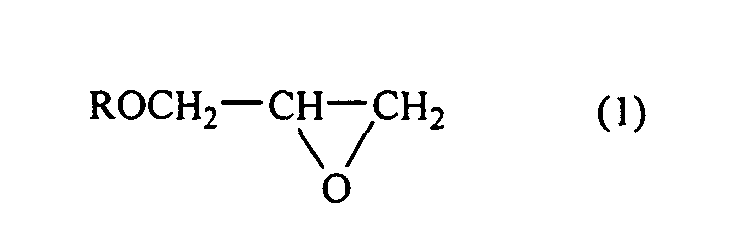
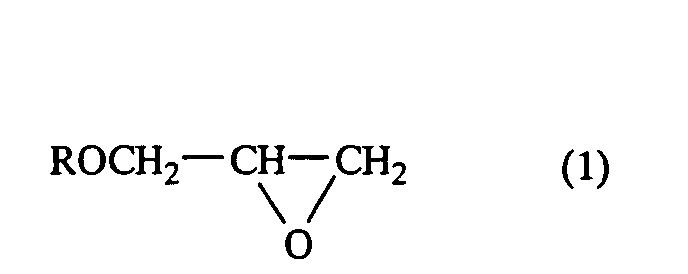
- the glycidyl ether used in the present invention includes a compound represented by Formula (1): wherein R represents a linear or branched alkyl or alkenyl group having 1 to 36 carbon atoms or a phenyl group.
- R is an alkyl or alkenyl group having preferably 1 to 20, more preferably 4 to 18 carbon atoms, and is particularly preferably an alkyl group having 4 to 18 carbon atoms.
- Specific examples of preferred R include butyl, pentyl, 2-methylbutyl, hexyl, octyl, 2-ethylhexyl, decyl, dodecyl, hexadecyl and methylheptadecyl (isostearyl).
- the glycidyl ether adduct obtained in the present invention is preferably a monoalkyl (or alkenyl or phenyl) ether product in which one glycidyl ether is added or a dialkyl (or alkenyl or phenyl) product in which two glycidyl ethers are added.
- the addition reaction of the glycidyl ether using the catalyst of the present invention can readily be carried out according to a conventional operating procedure under conventional reaction conditions.
- the reaction temperature is preferably from about 80 to 230°C, more preferably from about 120 to 200°C.
- the amount of the catalyst varies depending on the mole ratio of the starting materials and is usually such an amount that the complex oxide described above amounts to preferably from about 0.05 to 20 % by weight, more preferably from about 1 to 10 % by weight based on the amount of the glycidyl ether.
- a feeding proportion of the glycidyl ether to the organic compound having active hydrogen atoms falls preferably in a range of from about 1 : 0.9 to 1 : 3, particularly from about 1 : 0.9 to 1 : 1.5 in terms of a mole ratio from the viewpoint of a rise in the productivity.
- a feeding proportion of the glycidyl ether to the organic compound having active hydrogen atoms falls preferably in a range of from about 1.8 : 1 to 3 : 1, particularly from about 1.8 : 1 to 2.5 : 1 in terms of a mole ratio from the viewpoint of a rise in the productivity.
- the reaction is preferably carried out under an atmosphere of an inert gas such as, for example, nitrogen gas.
- the reaction pressure is preferably from about 0.1 to 20 atm, more preferably from about 0.9 to 10 atm.
- a reactor is charged with the raw material of the active hydrogen-containing organic compound and the catalyst, and after substituting with nitrogen, a glycidyl ether is introduced thereinto at a predetermined temperature to effect a reaction between them.
- a method for separating the catalyst is not specifically restricted, and considered is a method in which the reaction product obtained after the reaction is cooled and water for reducing the viscosity and a filtering aid (diatomaceous earth, a cellulose aid, activated clay or the like) are added to filter the catalyst.
- the preferred product obtained by the process of the present invention is substantially neutral and therefore need not be neutralized by adding an acid or an alkali.
- a complex oxide having a chemical composition of Mg 6 Al 2 (OH) 16 CO 3 4H 2 O (Kyoward 500 manufactured by Kyowa Chemical Co., Ltd.) (15g) was activated by calcining at 450°C for 2 hours to obtain 8.9g of a catalyst powder.
- a complex oxide having a chemical composition of Mg 0.7 Al 0.3 O 1.15 (Kyoward 2000 manufactured by Kyowa Chemical Co., Ltd.) was used as a catalyst as it is.
- Aluminum hydroxide-magnesium having a chemical composition of 5MgO ⁇ Al 2 O 3 ⁇ mH 2 O (15g) was activated by calcining at 550°C for 2 hours to obtain 8.6 g of a catalyst powder.
- the reactor was charged in advance with 500g of water and stirred at 250 rpm by means of a constant speed stirrer.
- the temperature of the reaction liquid was maintained at 15 ⁇ 2°C, and the amount of the NaOH aqueous solution to be added was controlled to maintain the pH at 9.7 to 10.3 to carry out a precipitation reaction for 2 hours. Then, feeding of the respective aqueous solutions was stopped, and the suspension was aged for one hour with stirring. This suspension was filtered, and the resulting white solid matter was sufficiently washed with ion-exchange water. After washing, the solid matter was dried for 12 hours in a dryer at 110°C to obtain a white solid catalyst precursor represented by the following formula: [(Zn 0.25 Mg 0.75 ) 5/7 Al 2/7 (OH) 2 ] (CO 3 ) 1/7 cH 2 O. Then, the catalyst precursor after drying was calcined at 550°C for 2 hours to obtain a catalyst.
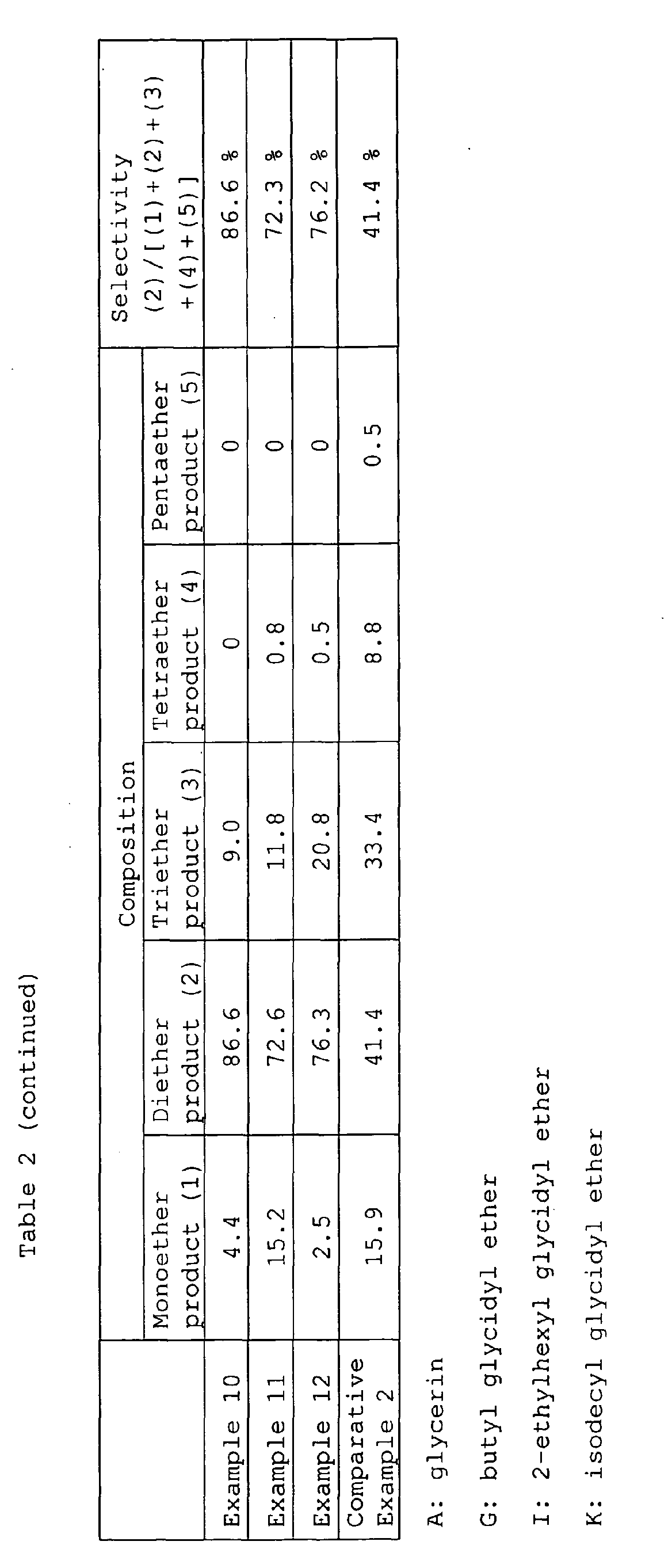
- NaOH (6.42g) was used as a catalyst, and a glycidyl ether and an active hydrogen-containing organic compound each in an amount shown in Table 2 were reacted in the same manner as in Example 1 at the temperature and for the time shown in Table 2.
- the composition and the selectivity of the product obtained by analyzing it by means of gas chromatography are shown in Table 2.
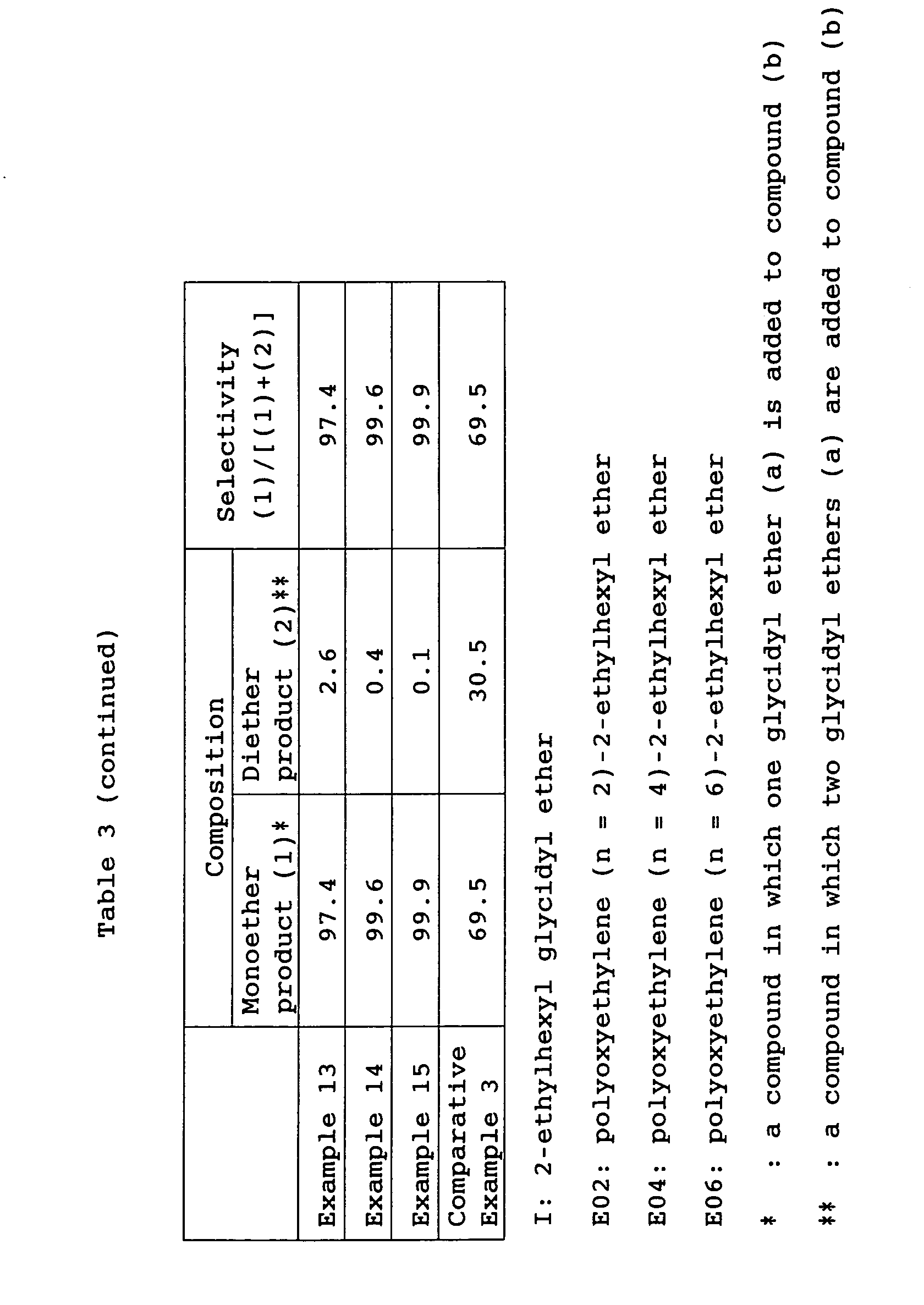
- Example 3 Using 0.3g of NaOH as a catalyst, a glycidyl ether and an active hydrogen-containing organic compound each in an amount shown in Table 3 were reacted similarly to Example 1 at the temperature and for the time shown in Table 3. The composition and the selectivity of the product obtained by analyzing it by means of gas chromatography are shown in Table 3.
- use of the preferred catalyst of the present invention enables inhibition of an excess addition reaction of glycidyl ether which is a successive reaction, and a mono- or di(alkyl, alkenyl or phenyl) ether product in which one or two glycidyl ethers are added is selectively obtained by adjusting the mole ratio of the active hydrogen-containing organic compound to the glycidyl ether to fall in a specific range. That is, a mono- or di-(alkyl, alkenyl or phenyl) ether product can be obtained at a high productivity with a high purity.
Landscapes
- Chemical & Material Sciences (AREA)
- Engineering & Computer Science (AREA)
- Chemical Kinetics & Catalysis (AREA)
- Organic Chemistry (AREA)
- Materials Engineering (AREA)
- Life Sciences & Earth Sciences (AREA)
- Oil, Petroleum & Natural Gas (AREA)
- Wood Science & Technology (AREA)
- Organic Low-Molecular-Weight Compounds And Preparation Thereof (AREA)
- Catalysts (AREA)
- Low-Molecular Organic Synthesis Reactions Using Catalysts (AREA)
Abstract
Description



Claims (11)
- A catalyst for an addition reaction between an active hydrogen-containing organic compound and a glycidyl ether, comprising a complex oxide of magnesium and at least one element other than magnesium selected from the group consisting of the elements in the third period and the fourth period in the periodic table.
- The catalyst according to claim 1, comprising a complex oxide of magnesium and at least one element selected from aluminum and zinc.
- A process for producing a glycidyl ether adduct, which comprises subjecting an active hydrogen-containing organic compound and a glycidyl ether to an addition reaction in the presence of a catalyst comprising a complex oxide of magnesium and at least one element other than magnesium selected from the group consisting of the elements in the third period and the fourth period in the periodic table.
- The process according to claim 3, wherein the active hydrogen-containing organic compound and the glycidyl ether are subjected to the addition reaction in the presence of a catalyst comprising a complex oxide of magnesium and at least one element selected from aluminum and zinc.
- The process according to claim 3 or 4, wherein the active hydrogen-containing organic compound is a hydroxyl group-containing compound.
- The process according to claim 5, wherein the hydroxyl group-containing compound is at least one selected from the group consisting of linear or branched monohydric alcohols having 1 to 30 carbon atoms, polyols having 2 to 18 carbon atoms and 2 to 18 hydroxyl groups and ketals thereof, polyoxyalkylene alkyl ethers, and mixtures thereof.
- The process according to any of claims 3 to 6, wherein the active hydrogen-containing organic compound is at least one selected from the group consisting of ethylene glycol, 1,2-propanediol, 1,3-propanediol, glycerin, pentaerythritol, diglycerin, polyglycerin, sorbitol, glucose, sucrose, glycerin ketal, and mixtures thereof.
- The process according to any of claims 3 to 7, wherein the glycidyl ether is represented by Formula (1):wherein R represents a linear or branched alkyl or alkenyl group having 1 to 36 carbon atoms or a phenyl group.
- The process according to any of claims 3 to 8, wherein the glycidyl ether adduct is a product in which one glycidyl ether is added.
- A process for producing a product in which one glycidyl ether is added, which comprises subjecting a glycidyl ether and an active hydrogen-containing organic compound to an addition reaction in a mole ratio of the glycidyl ether to the organic compound in a range of from 1 : 0.9 to 1 : 3 in the presence of a catalyst comprising a complex oxide of magnesium and at least one element other than magnesium selected from the group consisting of the elements in the third period and the fourth period in the periodic table.
- A process for producing a product in which two glycidyl ethers are added, which comprises subjecting a glycidyl ether and an active hydrogen-containing organic compound to an addition reaction in a mole ratio of the glycidyl ether to the organic compound in a range of from 1.8 : 1 to 3 : 1 in the presence of a catalyst comprising a complex oxide of magnesium and at least one element other than magnesium selected from the group consisting of the elements in the third period and the fourth period in the periodic table.
Applications Claiming Priority (2)
| Application Number | Priority Date | Filing Date | Title |
|---|---|---|---|
| JP2002251377 | 2002-08-29 | ||
| JP2002251377 | 2002-08-29 |
Publications (3)
| Publication Number | Publication Date |
|---|---|
| EP1405669A2 true EP1405669A2 (en) | 2004-04-07 |
| EP1405669A3 EP1405669A3 (en) | 2004-11-24 |
| EP1405669B1 EP1405669B1 (en) | 2007-11-28 |
Family
ID=31986267
Family Applications (1)
| Application Number | Title | Priority Date | Filing Date |
|---|---|---|---|
| EP03019511A Expired - Lifetime EP1405669B1 (en) | 2002-08-29 | 2003-08-28 | Production process for glycidyl ether adduct and catalyst used for the process |
Country Status (3)
| Country | Link |
|---|---|
| US (2) | US20040077904A1 (en) |
| EP (1) | EP1405669B1 (en) |
| DE (1) | DE60317747T2 (en) |
Cited By (6)
| Publication number | Priority date | Publication date | Assignee | Title |
|---|---|---|---|---|
| EP1466960A1 (en) * | 2003-04-08 | 2004-10-13 | Kao Corporation | Liquid detergent composition |
| WO2005058488A3 (en) * | 2003-12-09 | 2005-08-25 | Akzo Nobel Nv | Process for the preparation of an oxidic catalyst composition comprising a divalent and a trivalent metal |
| EP1705172A1 (en) * | 2005-03-24 | 2006-09-27 | Goldschmidt GmbH | Hydroxylgroups containing detergents with low surface tension and use thereof |
| WO2006099932A1 (en) * | 2005-03-24 | 2006-09-28 | Goldschmidt Gesellschaft Mit Beschränkter Haftung | Ether alcohol-based surfactants having a reduced surface tension and use thereof |
| US9663432B2 (en) | 2012-12-28 | 2017-05-30 | Dow Corning Toray Co., Ltd. | High-purity monoalkenyl-containing glycerin derivative and method of manufacturing same |
| EP2013261B1 (en) * | 2006-04-19 | 2018-10-24 | Hercules LLC | Stabilizers for improved open time of aqueous coatings |
Families Citing this family (2)
| Publication number | Priority date | Publication date | Assignee | Title |
|---|---|---|---|---|
| US8026378B2 (en) | 2005-11-22 | 2011-09-27 | Segetis, Inc. | Glyceryl ether compounds and their use |
| CN102153450B (en) * | 2011-01-31 | 2014-01-01 | 浙江赞宇科技股份有限公司 | Method for continuously preparing polyether triol |
Family Cites Families (8)
| Publication number | Priority date | Publication date | Assignee | Title |
|---|---|---|---|---|
| JPS5838119B2 (en) * | 1979-11-06 | 1983-08-20 | 富士写真フイルム株式会社 | Desensitization method |
| JPS57197235A (en) * | 1981-05-28 | 1982-12-03 | Kao Corp | Preparation of 2-hydroxy-3-alkoxypropyl glyceryl ether |
| JPS61291549A (en) * | 1985-06-20 | 1986-12-22 | Nippon Nohyaku Co Ltd | Production of aromatic secondary amino compound |
| DE3833076A1 (en) * | 1987-09-29 | 1989-04-06 | Lion Corp | ALCOXYLATION CATALYST |
| US4970191A (en) * | 1989-04-18 | 1990-11-13 | Aristech Chemical Corporation | Basic mixed oxide |
| JPH0344354A (en) * | 1989-07-11 | 1991-02-26 | Daicel Chem Ind Ltd | Production of dialkyl carbonate |
| GB9123734D0 (en) * | 1991-11-08 | 1992-01-02 | Procter & Gamble | Detergent composition |
| US5686379A (en) * | 1993-12-22 | 1997-11-11 | Kao Corporation | Alkoxylation catalyst, process for the preparation of the catalyst and process for preparing alkoxylate with the use of the catalyst |
-
2003
- 2003-08-28 US US10/649,701 patent/US20040077904A1/en not_active Abandoned
- 2003-08-28 EP EP03019511A patent/EP1405669B1/en not_active Expired - Lifetime
- 2003-08-28 DE DE60317747T patent/DE60317747T2/en not_active Expired - Lifetime
-
2006
- 2006-07-10 US US11/482,749 patent/US20060252946A1/en not_active Abandoned
Cited By (7)
| Publication number | Priority date | Publication date | Assignee | Title |
|---|---|---|---|---|
| EP1466960A1 (en) * | 2003-04-08 | 2004-10-13 | Kao Corporation | Liquid detergent composition |
| US7141538B2 (en) | 2003-04-08 | 2006-11-28 | Kao Corporation | Liquid detergent composition |
| WO2005058488A3 (en) * | 2003-12-09 | 2005-08-25 | Akzo Nobel Nv | Process for the preparation of an oxidic catalyst composition comprising a divalent and a trivalent metal |
| EP1705172A1 (en) * | 2005-03-24 | 2006-09-27 | Goldschmidt GmbH | Hydroxylgroups containing detergents with low surface tension and use thereof |
| WO2006099932A1 (en) * | 2005-03-24 | 2006-09-28 | Goldschmidt Gesellschaft Mit Beschränkter Haftung | Ether alcohol-based surfactants having a reduced surface tension and use thereof |
| EP2013261B1 (en) * | 2006-04-19 | 2018-10-24 | Hercules LLC | Stabilizers for improved open time of aqueous coatings |
| US9663432B2 (en) | 2012-12-28 | 2017-05-30 | Dow Corning Toray Co., Ltd. | High-purity monoalkenyl-containing glycerin derivative and method of manufacturing same |
Also Published As
| Publication number | Publication date |
|---|---|
| US20060252946A1 (en) | 2006-11-09 |
| DE60317747T2 (en) | 2008-10-30 |
| EP1405669A3 (en) | 2004-11-24 |
| DE60317747D1 (en) | 2008-01-10 |
| US20040077904A1 (en) | 2004-04-22 |
| EP1405669B1 (en) | 2007-11-28 |
Similar Documents
| Publication | Publication Date | Title |
|---|---|---|
| US6806393B2 (en) | Multimetal cyanide compounds, their preparation and their use | |
| US5686379A (en) | Alkoxylation catalyst, process for the preparation of the catalyst and process for preparing alkoxylate with the use of the catalyst | |
| AU716394B2 (en) | Highly active double metal cyanide catalysts | |
| DE60100807T2 (en) | DMC COMPLEX CATALYST AND METHOD FOR THE PRODUCTION THEREOF | |
| EP1112243B1 (en) | Method for the preparation of fatty alcohol alkoxylates | |
| HUP0300001A2 (en) | Method for producing multimetal cyanide compounds | |
| ES2230882T3 (en) | BIMETHALIAN CYANIDE CATALYSTS FOR THE PREPARATION OF POLYOLETERS. | |
| US20090057608A1 (en) | Alkoxylate composition and a process for preparing the same | |
| CA2051487A1 (en) | Alkoxylation of active hydrogen-containing compounds | |
| HUP0103774A2 (en) | Bimetallic cyanide catalysts for producing polyether polyols | |
| DE3833076A1 (en) | ALCOXYLATION CATALYST | |
| US20050014979A1 (en) | Preparation of an alkoxylate composition using a double metal cyanide catalyst | |
| US20040077904A1 (en) | Production process for glycidyl ether adduct and catalyst used for the process | |
| JPH0615038B2 (en) | Alkoxylation catalyst | |
| US6800583B2 (en) | Suspension of multimetal cyanide compounds, their preparation and their use | |
| JP4346382B2 (en) | Method for producing glycidyl ether adduct and catalyst used in the method | |
| DE60123467T2 (en) | METHOD FOR PRODUCING A LIQUID, RARE EARTH-CONTAINING ALKOXYDING CATALYST | |
| DE4439086C2 (en) | Process for the preparation of end-capped nonionic surfactants | |
| AU2002224932A1 (en) | Process of preparing a fluid rare earth alkoxylation catalyst | |
| JP2000061304A (en) | Catalyst for alkoxylation, method for producing the same, and method for producing alkylene oxide adduct using the catalyst | |
| EP0802895B1 (en) | Process for producing end-group-locked non-ionic tensides | |
| KR100636810B1 (en) | Nano-scaled Mixed Metal Oxide Catalyst and Method for Preparing the Same | |
| AU662980B2 (en) | Alkoxylation process | |
| JPH11319556A (en) | Alkylene oxide addition catalyst | |
| JPH03229644A (en) | Alkoxylation using modified group iii b metal-containing bimetal or polymer catalyst |
Legal Events
| Date | Code | Title | Description |
|---|---|---|---|
| PUAI | Public reference made under article 153(3) epc to a published international application that has entered the european phase |
Free format text: ORIGINAL CODE: 0009012 |
|
| AK | Designated contracting states |
Kind code of ref document: A2 Designated state(s): AT BE BG CH CY CZ DE DK EE ES FI FR GB GR HU IE IT LI LU MC NL PT RO SE SI SK TR |
|
| AX | Request for extension of the european patent |
Extension state: AL LT LV MK |
|
| PUAL | Search report despatched |
Free format text: ORIGINAL CODE: 0009013 |
|
| AK | Designated contracting states |
Kind code of ref document: A3 Designated state(s): AT BE BG CH CY CZ DE DK EE ES FI FR GB GR HU IE IT LI LU MC NL PT RO SE SI SK TR |
|
| AX | Request for extension of the european patent |
Extension state: AL LT LV MK |
|
| 17P | Request for examination filed |
Effective date: 20050420 |
|
| AKX | Designation fees paid |
Designated state(s): DE GB |
|
| GRAP | Despatch of communication of intention to grant a patent |
Free format text: ORIGINAL CODE: EPIDOSNIGR1 |
|
| GRAS | Grant fee paid |
Free format text: ORIGINAL CODE: EPIDOSNIGR3 |
|
| GRAA | (expected) grant |
Free format text: ORIGINAL CODE: 0009210 |
|
| AK | Designated contracting states |
Kind code of ref document: B1 Designated state(s): DE GB |
|
| REG | Reference to a national code |
Ref country code: GB Ref legal event code: FG4D |
|
| REF | Corresponds to: |
Ref document number: 60317747 Country of ref document: DE Date of ref document: 20080110 Kind code of ref document: P |
|
| PLBE | No opposition filed within time limit |
Free format text: ORIGINAL CODE: 0009261 |
|
| STAA | Information on the status of an ep patent application or granted ep patent |
Free format text: STATUS: NO OPPOSITION FILED WITHIN TIME LIMIT |
|
| 26N | No opposition filed |
Effective date: 20080829 |
|
| PGFP | Annual fee paid to national office [announced via postgrant information from national office to epo] |
Ref country code: GB Payment date: 20170823 Year of fee payment: 15 |
|
| GBPC | Gb: european patent ceased through non-payment of renewal fee |
Effective date: 20180828 |
|
| PG25 | Lapsed in a contracting state [announced via postgrant information from national office to epo] |
Ref country code: GB Free format text: LAPSE BECAUSE OF NON-PAYMENT OF DUE FEES Effective date: 20180828 |
|
| PGFP | Annual fee paid to national office [announced via postgrant information from national office to epo] |
Ref country code: DE Payment date: 20190813 Year of fee payment: 17 |
|
| REG | Reference to a national code |
Ref country code: DE Ref legal event code: R119 Ref document number: 60317747 Country of ref document: DE |
|
| PG25 | Lapsed in a contracting state [announced via postgrant information from national office to epo] |
Ref country code: DE Free format text: LAPSE BECAUSE OF NON-PAYMENT OF DUE FEES Effective date: 20210302 |