EP1403704A1 - Dye-forming coupler and silver halide color photographic light-sensitive material - Google Patents
Dye-forming coupler and silver halide color photographic light-sensitive material Download PDFInfo
- Publication number
- EP1403704A1 EP1403704A1 EP20030021632 EP03021632A EP1403704A1 EP 1403704 A1 EP1403704 A1 EP 1403704A1 EP 20030021632 EP20030021632 EP 20030021632 EP 03021632 A EP03021632 A EP 03021632A EP 1403704 A1 EP1403704 A1 EP 1403704A1
- Authority
- EP
- European Patent Office
- Prior art keywords
- group
- color
- layer
- emulsion
- silver halide
- Prior art date
- Legal status (The legal status is an assumption and is not a legal conclusion. Google has not performed a legal analysis and makes no representation as to the accuracy of the status listed.)
- Withdrawn
Links
- -1 silver halide Chemical class 0.000 title claims abstract description 257
- 229910052709 silver Inorganic materials 0.000 title claims abstract description 185
- 239000004332 silver Substances 0.000 title claims abstract description 185
- 239000000463 material Substances 0.000 title claims abstract description 113
- 125000001424 substituent group Chemical group 0.000 claims abstract description 68
- 125000000217 alkyl group Chemical group 0.000 claims abstract description 50
- 239000003795 chemical substances by application Substances 0.000 claims abstract description 40
- 125000004435 hydrogen atom Chemical group [H]* 0.000 claims abstract description 28
- 125000004429 atom Chemical group 0.000 claims abstract description 23
- 125000004432 carbon atom Chemical group C* 0.000 claims abstract description 22
- 238000005859 coupling reaction Methods 0.000 claims abstract description 21
- 125000000999 tert-butyl group Chemical group [H]C([H])([H])C(*)(C([H])([H])[H])C([H])([H])[H] 0.000 claims description 6
- 239000010410 layer Substances 0.000 description 270
- 239000000839 emulsion Substances 0.000 description 238
- XEKOWRVHYACXOJ-UHFFFAOYSA-N Ethyl acetate Chemical compound CCOC(C)=O XEKOWRVHYACXOJ-UHFFFAOYSA-N 0.000 description 144
- 150000001875 compounds Chemical class 0.000 description 143
- 239000000243 solution Substances 0.000 description 127
- XLYOFNOQVPJJNP-UHFFFAOYSA-N water Substances O XLYOFNOQVPJJNP-UHFFFAOYSA-N 0.000 description 108
- 239000002904 solvent Substances 0.000 description 98
- 239000003381 stabilizer Substances 0.000 description 98
- 229910001868 water Inorganic materials 0.000 description 91
- SQGYOTSLMSWVJD-UHFFFAOYSA-N silver(1+) nitrate Chemical compound [Ag+].[O-]N(=O)=O SQGYOTSLMSWVJD-UHFFFAOYSA-N 0.000 description 88
- 238000012545 processing Methods 0.000 description 75
- 239000000203 mixture Substances 0.000 description 64
- 239000003960 organic solvent Substances 0.000 description 61
- CSNNHWWHGAXBCP-UHFFFAOYSA-L magnesium sulphate Substances [Mg+2].[O-][S+2]([O-])([O-])[O-] CSNNHWWHGAXBCP-UHFFFAOYSA-L 0.000 description 53
- 239000000975 dye Substances 0.000 description 52
- 238000000034 method Methods 0.000 description 49
- BQCADISMDOOEFD-UHFFFAOYSA-N Silver Chemical compound [Ag] BQCADISMDOOEFD-UHFFFAOYSA-N 0.000 description 45
- 229910052943 magnesium sulfate Inorganic materials 0.000 description 44
- 235000019341 magnesium sulphate Nutrition 0.000 description 44
- 229910001961 silver nitrate Inorganic materials 0.000 description 44
- 238000003756 stirring Methods 0.000 description 43
- 108010010803 Gelatin Proteins 0.000 description 39
- OKKJLVBELUTLKV-UHFFFAOYSA-N Methanol Chemical compound OC OKKJLVBELUTLKV-UHFFFAOYSA-N 0.000 description 39
- 238000000605 extraction Methods 0.000 description 39
- 239000008273 gelatin Substances 0.000 description 39
- 229920000159 gelatin Polymers 0.000 description 39
- 235000019322 gelatine Nutrition 0.000 description 39
- 235000011852 gelatine desserts Nutrition 0.000 description 39
- 238000000926 separation method Methods 0.000 description 39
- 239000011248 coating agent Substances 0.000 description 36
- 238000000576 coating method Methods 0.000 description 36
- 239000000047 product Substances 0.000 description 34
- HPALAKNZSZLMCH-UHFFFAOYSA-M sodium;chloride;hydrate Chemical class O.[Na+].[Cl-] HPALAKNZSZLMCH-UHFFFAOYSA-M 0.000 description 34
- ZMANZCXQSJIPKH-UHFFFAOYSA-N Triethylamine Chemical compound CCN(CC)CC ZMANZCXQSJIPKH-UHFFFAOYSA-N 0.000 description 33
- 238000002360 preparation method Methods 0.000 description 32
- 238000005292 vacuum distillation Methods 0.000 description 32
- FAPWRFPIFSIZLT-UHFFFAOYSA-M Sodium chloride Chemical compound [Na+].[Cl-] FAPWRFPIFSIZLT-UHFFFAOYSA-M 0.000 description 30
- YXFVVABEGXRONW-UHFFFAOYSA-N Toluene Chemical compound CC1=CC=CC=C1 YXFVVABEGXRONW-UHFFFAOYSA-N 0.000 description 30
- 206010070834 Sensitisation Diseases 0.000 description 29
- 125000000623 heterocyclic group Chemical group 0.000 description 29
- 230000008313 sensitization Effects 0.000 description 29
- 230000003595 spectral effect Effects 0.000 description 28
- KWYUFKZDYYNOTN-UHFFFAOYSA-M Potassium hydroxide Chemical compound [OH-].[K+] KWYUFKZDYYNOTN-UHFFFAOYSA-M 0.000 description 27
- 230000001235 sensitizing effect Effects 0.000 description 25
- 238000010992 reflux Methods 0.000 description 24
- 238000006243 chemical reaction Methods 0.000 description 23
- 238000001816 cooling Methods 0.000 description 23
- PCHJSUWPFVWCPO-UHFFFAOYSA-N gold Chemical compound [Au] PCHJSUWPFVWCPO-UHFFFAOYSA-N 0.000 description 23
- VEXZGXHMUGYJMC-UHFFFAOYSA-N Hydrochloric acid Chemical compound Cl VEXZGXHMUGYJMC-UHFFFAOYSA-N 0.000 description 22
- VLKZOEOYAKHREP-UHFFFAOYSA-N n-Hexane Chemical compound CCCCCC VLKZOEOYAKHREP-UHFFFAOYSA-N 0.000 description 22
- IOLCXVTUBQKXJR-UHFFFAOYSA-M potassium bromide Chemical compound [K+].[Br-] IOLCXVTUBQKXJR-UHFFFAOYSA-M 0.000 description 22
- 229910052717 sulfur Inorganic materials 0.000 description 22
- WEVYAHXRMPXWCK-UHFFFAOYSA-N Acetonitrile Chemical compound CC#N WEVYAHXRMPXWCK-UHFFFAOYSA-N 0.000 description 21
- 239000012043 crude product Substances 0.000 description 21
- 238000011156 evaluation Methods 0.000 description 21
- 238000010438 heat treatment Methods 0.000 description 21
- KFZMGEQAYNKOFK-UHFFFAOYSA-N Isopropanol Chemical compound CC(C)O KFZMGEQAYNKOFK-UHFFFAOYSA-N 0.000 description 20
- 238000011161 development Methods 0.000 description 20
- 229910052737 gold Inorganic materials 0.000 description 20
- 239000010931 gold Substances 0.000 description 20
- 239000011541 reaction mixture Substances 0.000 description 20
- XEEYBQQBJWHFJM-UHFFFAOYSA-N Iron Chemical compound [Fe] XEEYBQQBJWHFJM-UHFFFAOYSA-N 0.000 description 19
- 238000002156 mixing Methods 0.000 description 19
- LFQSCWFLJHTTHZ-UHFFFAOYSA-N Ethanol Chemical compound CCO LFQSCWFLJHTTHZ-UHFFFAOYSA-N 0.000 description 18
- 239000006185 dispersion Substances 0.000 description 18
- NLKNQRATVPKPDG-UHFFFAOYSA-M potassium iodide Chemical compound [K+].[I-] NLKNQRATVPKPDG-UHFFFAOYSA-M 0.000 description 18
- 239000000126 substance Substances 0.000 description 18
- 229910021607 Silver chloride Inorganic materials 0.000 description 17
- NINIDFKCEFEMDL-UHFFFAOYSA-N Sulfur Chemical compound [S] NINIDFKCEFEMDL-UHFFFAOYSA-N 0.000 description 17
- 230000015572 biosynthetic process Effects 0.000 description 17
- HKZLPVFGJNLROG-UHFFFAOYSA-M silver monochloride Chemical compound [Cl-].[Ag+] HKZLPVFGJNLROG-UHFFFAOYSA-M 0.000 description 17
- 239000011593 sulfur Substances 0.000 description 17
- NLXLAEXVIDQMFP-UHFFFAOYSA-N Ammonia chloride Chemical compound [NH4+].[Cl-] NLXLAEXVIDQMFP-UHFFFAOYSA-N 0.000 description 16
- BWHMMNNQKKPAPP-UHFFFAOYSA-L potassium carbonate Chemical compound [K+].[K+].[O-]C([O-])=O BWHMMNNQKKPAPP-UHFFFAOYSA-L 0.000 description 16
- 230000002829 reductive effect Effects 0.000 description 16
- 0 CC(C)(CC(C)(C)Sc(cccc1)c1NC(C(C(N1CCC*)=Nc(cccc2)c2S1(=O)=O)N(C(C(C)(C)O1)=O)C1=O)=O)CN(C)C Chemical compound CC(C)(CC(C)(C)Sc(cccc1)c1NC(C(C(N1CCC*)=Nc(cccc2)c2S1(=O)=O)N(C(C(C)(C)O1)=O)C1=O)=O)CN(C)C 0.000 description 15
- ZMXDDKWLCZADIW-UHFFFAOYSA-N N,N-Dimethylformamide Chemical compound CN(C)C=O ZMXDDKWLCZADIW-UHFFFAOYSA-N 0.000 description 15
- 239000003446 ligand Substances 0.000 description 15
- 229910052757 nitrogen Inorganic materials 0.000 description 15
- 239000011780 sodium chloride Substances 0.000 description 15
- 125000001931 aliphatic group Chemical group 0.000 description 14
- XMBWDFGMSWQBCA-UHFFFAOYSA-M iodide Chemical compound [I-] XMBWDFGMSWQBCA-UHFFFAOYSA-M 0.000 description 14
- ADZWSOLPGZMUMY-UHFFFAOYSA-M silver bromide Chemical compound [Ag]Br ADZWSOLPGZMUMY-UHFFFAOYSA-M 0.000 description 14
- 239000000706 filtrate Substances 0.000 description 13
- IJGRMHOSHXDMSA-UHFFFAOYSA-N Atomic nitrogen Chemical compound N#N IJGRMHOSHXDMSA-UHFFFAOYSA-N 0.000 description 12
- JRNVZBWKYDBUCA-UHFFFAOYSA-N N-chlorosuccinimide Chemical compound ClN1C(=O)CCC1=O JRNVZBWKYDBUCA-UHFFFAOYSA-N 0.000 description 12
- 125000003118 aryl group Chemical group 0.000 description 12
- 238000002425 crystallisation Methods 0.000 description 12
- 230000008025 crystallization Effects 0.000 description 12
- RAXXELZNTBOGNW-UHFFFAOYSA-N imidazole Natural products C1=CNC=N1 RAXXELZNTBOGNW-UHFFFAOYSA-N 0.000 description 12
- 239000004065 semiconductor Substances 0.000 description 12
- 238000003860 storage Methods 0.000 description 12
- 239000004094 surface-active agent Substances 0.000 description 12
- FXHOOIRPVKKKFG-UHFFFAOYSA-N N,N-Dimethylacetamide Chemical compound CN(C)C(C)=O FXHOOIRPVKKKFG-UHFFFAOYSA-N 0.000 description 11
- 239000007864 aqueous solution Substances 0.000 description 11
- 239000000084 colloidal system Substances 0.000 description 11
- 238000004821 distillation Methods 0.000 description 11
- 239000005457 ice water Substances 0.000 description 11
- 229910052751 metal Inorganic materials 0.000 description 11
- 239000002184 metal Substances 0.000 description 11
- 229920000098 polyolefin Polymers 0.000 description 11
- 239000012266 salt solution Substances 0.000 description 11
- 229940086542 triethylamine Drugs 0.000 description 11
- VYPSYNLAJGMNEJ-UHFFFAOYSA-N Silicium dioxide Chemical compound O=[Si]=O VYPSYNLAJGMNEJ-UHFFFAOYSA-N 0.000 description 10
- 239000000460 chlorine Substances 0.000 description 10
- 238000001914 filtration Methods 0.000 description 10
- 239000012535 impurity Substances 0.000 description 10
- 239000003112 inhibitor Substances 0.000 description 10
- 125000004433 nitrogen atom Chemical group N* 0.000 description 10
- LYCAIKOWRPUZTN-UHFFFAOYSA-N Ethylene glycol Chemical compound OCCO LYCAIKOWRPUZTN-UHFFFAOYSA-N 0.000 description 9
- 239000012190 activator Substances 0.000 description 9
- 230000035945 sensitivity Effects 0.000 description 9
- 239000000758 substrate Substances 0.000 description 9
- 101100221809 Neurospora crassa (strain ATCC 24698 / 74-OR23-1A / CBS 708.71 / DSM 1257 / FGSC 987) cpd-7 gene Proteins 0.000 description 8
- CTQNGGLPUBDAKN-UHFFFAOYSA-N O-Xylene Chemical compound CC1=CC=CC=C1C CTQNGGLPUBDAKN-UHFFFAOYSA-N 0.000 description 8
- 235000019270 ammonium chloride Nutrition 0.000 description 8
- 125000004104 aryloxy group Chemical group 0.000 description 8
- 229910052799 carbon Inorganic materials 0.000 description 8
- 230000003028 elevating effect Effects 0.000 description 8
- 235000019441 ethanol Nutrition 0.000 description 8
- 229910000027 potassium carbonate Inorganic materials 0.000 description 8
- 125000004434 sulfur atom Chemical group 0.000 description 8
- 238000003786 synthesis reaction Methods 0.000 description 8
- 239000008096 xylene Substances 0.000 description 8
- JYJFNDQBESEHJQ-UHFFFAOYSA-N 5,5-dimethyloxazolidine-2,4-dione Chemical compound CC1(C)OC(=O)NC1=O JYJFNDQBESEHJQ-UHFFFAOYSA-N 0.000 description 7
- 239000006096 absorbing agent Substances 0.000 description 7
- 125000003277 amino group Chemical group 0.000 description 7
- 238000011033 desalting Methods 0.000 description 7
- 230000000694 effects Effects 0.000 description 7
- 239000006081 fluorescent whitening agent Substances 0.000 description 7
- 229910052741 iridium Inorganic materials 0.000 description 7
- 229910021645 metal ion Inorganic materials 0.000 description 7
- 230000003287 optical effect Effects 0.000 description 7
- 229920000642 polymer Polymers 0.000 description 7
- 238000003672 processing method Methods 0.000 description 7
- 238000005406 washing Methods 0.000 description 7
- ALAVMPYROHSFFR-UHFFFAOYSA-N 1-methyl-3-[3-(5-sulfanylidene-2h-tetrazol-1-yl)phenyl]urea Chemical compound CNC(=O)NC1=CC=CC(N2C(=NN=N2)S)=C1 ALAVMPYROHSFFR-UHFFFAOYSA-N 0.000 description 6
- OKTJSMMVPCPJKN-UHFFFAOYSA-N Carbon Chemical compound [C] OKTJSMMVPCPJKN-UHFFFAOYSA-N 0.000 description 6
- URLKBWYHVLBVBO-UHFFFAOYSA-N Para-Xylene Chemical group CC1=CC=C(C)C=C1 URLKBWYHVLBVBO-UHFFFAOYSA-N 0.000 description 6
- HEMHJVSKTPXQMS-UHFFFAOYSA-M Sodium hydroxide Chemical compound [OH-].[Na+] HEMHJVSKTPXQMS-UHFFFAOYSA-M 0.000 description 6
- 235000010724 Wisteria floribunda Nutrition 0.000 description 6
- 125000004423 acyloxy group Chemical group 0.000 description 6
- 125000003545 alkoxy group Chemical group 0.000 description 6
- 238000009835 boiling Methods 0.000 description 6
- 238000005282 brightening Methods 0.000 description 6
- 150000002344 gold compounds Chemical class 0.000 description 6
- ZBKIUFWVEIBQRT-UHFFFAOYSA-N gold(1+) Chemical class [Au+] ZBKIUFWVEIBQRT-UHFFFAOYSA-N 0.000 description 6
- KJIFKLIQANRMOU-UHFFFAOYSA-N oxidanium;4-methylbenzenesulfonate Chemical compound O.CC1=CC=C(S(O)(=O)=O)C=C1 KJIFKLIQANRMOU-UHFFFAOYSA-N 0.000 description 6
- 230000009467 reduction Effects 0.000 description 6
- 238000010898 silica gel chromatography Methods 0.000 description 6
- 239000007787 solid Substances 0.000 description 6
- 125000005420 sulfonamido group Chemical group S(=O)(=O)(N*)* 0.000 description 6
- 238000005011 time of flight secondary ion mass spectroscopy Methods 0.000 description 6
- 238000002042 time-of-flight secondary ion mass spectrometry Methods 0.000 description 6
- JKFYKCYQEWQPTM-UHFFFAOYSA-N 2-azaniumyl-2-(4-fluorophenyl)acetate Chemical compound OC(=O)C(N)C1=CC=C(F)C=C1 JKFYKCYQEWQPTM-UHFFFAOYSA-N 0.000 description 5
- WPHUUIODWRNJLO-UHFFFAOYSA-N 2-nitrobenzenesulfonyl chloride Chemical compound [O-][N+](=O)C1=CC=CC=C1S(Cl)(=O)=O WPHUUIODWRNJLO-UHFFFAOYSA-N 0.000 description 5
- RLYUNPNLXMSXAX-UHFFFAOYSA-N 5-methylthiazole Chemical compound CC1=CN=CS1 RLYUNPNLXMSXAX-UHFFFAOYSA-N 0.000 description 5
- XFXPMWWXUTWYJX-UHFFFAOYSA-N Cyanide Chemical compound N#[C-] XFXPMWWXUTWYJX-UHFFFAOYSA-N 0.000 description 5
- YCKRFDGAMUMZLT-UHFFFAOYSA-N Fluorine atom Chemical compound [F] YCKRFDGAMUMZLT-UHFFFAOYSA-N 0.000 description 5
- MHAJPDPJQMAIIY-UHFFFAOYSA-N Hydrogen peroxide Chemical compound OO MHAJPDPJQMAIIY-UHFFFAOYSA-N 0.000 description 5
- 229910021639 Iridium tetrachloride Inorganic materials 0.000 description 5
- KJTLSVCANCCWHF-UHFFFAOYSA-N Ruthenium Chemical compound [Ru] KJTLSVCANCCWHF-UHFFFAOYSA-N 0.000 description 5
- 229910021612 Silver iodide Inorganic materials 0.000 description 5
- 239000002253 acid Substances 0.000 description 5
- 125000002252 acyl group Chemical group 0.000 description 5
- 238000013019 agitation Methods 0.000 description 5
- 125000004391 aryl sulfonyl group Chemical group 0.000 description 5
- 125000005110 aryl thio group Chemical group 0.000 description 5
- 125000003917 carbamoyl group Chemical group [H]N([H])C(*)=O 0.000 description 5
- 239000003086 colorant Substances 0.000 description 5
- 238000004040 coloring Methods 0.000 description 5
- 239000013078 crystal Substances 0.000 description 5
- 239000011737 fluorine Substances 0.000 description 5
- 229910052731 fluorine Inorganic materials 0.000 description 5
- 125000005843 halogen group Chemical group 0.000 description 5
- 230000002401 inhibitory effect Effects 0.000 description 5
- 150000002500 ions Chemical class 0.000 description 5
- 229910052742 iron Inorganic materials 0.000 description 5
- 238000002844 melting Methods 0.000 description 5
- 230000008018 melting Effects 0.000 description 5
- 238000012986 modification Methods 0.000 description 5
- 230000004048 modification Effects 0.000 description 5
- 239000012299 nitrogen atmosphere Substances 0.000 description 5
- 150000002894 organic compounds Chemical class 0.000 description 5
- 239000013110 organic ligand Substances 0.000 description 5
- 125000001820 oxy group Chemical group [*:1]O[*:2] 0.000 description 5
- 230000008569 process Effects 0.000 description 5
- GZTPJDLYPMPRDF-UHFFFAOYSA-N pyrrolo[3,2-c]pyrazole Chemical compound N1=NC2=CC=NC2=C1 GZTPJDLYPMPRDF-UHFFFAOYSA-N 0.000 description 5
- 239000011347 resin Substances 0.000 description 5
- 229920005989 resin Polymers 0.000 description 5
- 229940045105 silver iodide Drugs 0.000 description 5
- 230000000087 stabilizing effect Effects 0.000 description 5
- QAOWNCQODCNURD-UHFFFAOYSA-N sulfuric acid Substances OS(O)(=O)=O QAOWNCQODCNURD-UHFFFAOYSA-N 0.000 description 5
- 125000004149 thio group Chemical group *S* 0.000 description 5
- QGZKDVFQNNGYKY-UHFFFAOYSA-N Ammonia Chemical compound N QGZKDVFQNNGYKY-UHFFFAOYSA-N 0.000 description 4
- VEXZGXHMUGYJMC-UHFFFAOYSA-M Chloride anion Chemical compound [Cl-] VEXZGXHMUGYJMC-UHFFFAOYSA-M 0.000 description 4
- ZAMOUSCENKQFHK-UHFFFAOYSA-N Chlorine atom Chemical compound [Cl] ZAMOUSCENKQFHK-UHFFFAOYSA-N 0.000 description 4
- KCXVZYZYPLLWCC-UHFFFAOYSA-N EDTA Chemical compound OC(=O)CN(CC(O)=O)CCN(CC(O)=O)CC(O)=O KCXVZYZYPLLWCC-UHFFFAOYSA-N 0.000 description 4
- YLQBMQCUIZJEEH-UHFFFAOYSA-N Furan Chemical compound C=1C=COC=1 YLQBMQCUIZJEEH-UHFFFAOYSA-N 0.000 description 4
- GRYLNZFGIOXLOG-UHFFFAOYSA-N Nitric acid Chemical compound O[N+]([O-])=O GRYLNZFGIOXLOG-UHFFFAOYSA-N 0.000 description 4
- 239000004698 Polyethylene Substances 0.000 description 4
- 239000004743 Polypropylene Substances 0.000 description 4
- WCUXLLCKKVVCTQ-UHFFFAOYSA-M Potassium chloride Chemical compound [Cl-].[K+] WCUXLLCKKVVCTQ-UHFFFAOYSA-M 0.000 description 4
- KYQCOXFCLRTKLS-UHFFFAOYSA-N Pyrazine Chemical compound C1=CN=CC=N1 KYQCOXFCLRTKLS-UHFFFAOYSA-N 0.000 description 4
- JUJWROOIHBZHMG-UHFFFAOYSA-N Pyridine Chemical compound C1=CC=NC=C1 JUJWROOIHBZHMG-UHFFFAOYSA-N 0.000 description 4
- YTPLMLYBLZKORZ-UHFFFAOYSA-N Thiophene Chemical compound C=1C=CSC=1 YTPLMLYBLZKORZ-UHFFFAOYSA-N 0.000 description 4
- HOLVRJRSWZOAJU-UHFFFAOYSA-N [Ag].ICl Chemical compound [Ag].ICl HOLVRJRSWZOAJU-UHFFFAOYSA-N 0.000 description 4
- 238000010521 absorption reaction Methods 0.000 description 4
- 125000004442 acylamino group Chemical group 0.000 description 4
- 239000000654 additive Substances 0.000 description 4
- 239000003513 alkali Substances 0.000 description 4
- 125000004390 alkyl sulfonyl group Chemical group 0.000 description 4
- 125000004397 aminosulfonyl group Chemical group NS(=O)(=O)* 0.000 description 4
- 125000005161 aryl oxy carbonyl group Chemical group 0.000 description 4
- 125000003178 carboxy group Chemical group [H]OC(*)=O 0.000 description 4
- 229910052801 chlorine Inorganic materials 0.000 description 4
- 230000008878 coupling Effects 0.000 description 4
- 238000010168 coupling process Methods 0.000 description 4
- 125000004093 cyano group Chemical group *C#N 0.000 description 4
- 125000004122 cyclic group Chemical group 0.000 description 4
- 238000007598 dipping method Methods 0.000 description 4
- 238000002845 discoloration Methods 0.000 description 4
- 238000009826 distribution Methods 0.000 description 4
- 239000003480 eluent Substances 0.000 description 4
- 238000005562 fading Methods 0.000 description 4
- 239000010419 fine particle Substances 0.000 description 4
- 125000002887 hydroxy group Chemical group [H]O* 0.000 description 4
- 229940006461 iodide ion Drugs 0.000 description 4
- 125000002950 monocyclic group Chemical group 0.000 description 4
- 229910052760 oxygen Inorganic materials 0.000 description 4
- 239000001301 oxygen Substances 0.000 description 4
- 125000004430 oxygen atom Chemical group O* 0.000 description 4
- 229920000573 polyethylene Polymers 0.000 description 4
- 229920001155 polypropylene Polymers 0.000 description 4
- 238000001223 reverse osmosis Methods 0.000 description 4
- 229910052707 ruthenium Inorganic materials 0.000 description 4
- 150000003839 salts Chemical class 0.000 description 4
- 229920006395 saturated elastomer Polymers 0.000 description 4
- 238000004062 sedimentation Methods 0.000 description 4
- GEHJYWRUCIMESM-UHFFFAOYSA-L sodium sulfite Chemical compound [Na+].[Na+].[O-]S([O-])=O GEHJYWRUCIMESM-UHFFFAOYSA-L 0.000 description 4
- PODWXQQNRWNDGD-UHFFFAOYSA-L sodium thiosulfate pentahydrate Chemical compound O.O.O.O.O.[Na+].[Na+].[O-]S([S-])(=O)=O PODWXQQNRWNDGD-UHFFFAOYSA-L 0.000 description 4
- 125000000020 sulfo group Chemical group O=S(=O)([*])O[H] 0.000 description 4
- 239000001043 yellow dye Substances 0.000 description 4
- GGZHVNZHFYCSEV-UHFFFAOYSA-N 1-Phenyl-5-mercaptotetrazole Chemical compound SC1=NN=NN1C1=CC=CC=C1 GGZHVNZHFYCSEV-UHFFFAOYSA-N 0.000 description 3
- ZWEHNKRNPOVVGH-UHFFFAOYSA-N 2-Butanone Chemical compound CCC(C)=O ZWEHNKRNPOVVGH-UHFFFAOYSA-N 0.000 description 3
- LPUBRQWGZPPVBS-UHFFFAOYSA-N 3-butoxypropan-1-amine Chemical compound CCCCOCCCN LPUBRQWGZPPVBS-UHFFFAOYSA-N 0.000 description 3
- QTBSBXVTEAMEQO-UHFFFAOYSA-N Acetic acid Chemical compound CC(O)=O QTBSBXVTEAMEQO-UHFFFAOYSA-N 0.000 description 3
- UHOVQNZJYSORNB-UHFFFAOYSA-N Benzene Chemical compound C1=CC=CC=C1 UHOVQNZJYSORNB-UHFFFAOYSA-N 0.000 description 3
- WKBOTKDWSSQWDR-UHFFFAOYSA-N Bromine atom Chemical compound [Br] WKBOTKDWSSQWDR-UHFFFAOYSA-N 0.000 description 3
- DGAQECJNVWCQMB-PUAWFVPOSA-M Ilexoside XXIX Chemical compound C[C@@H]1CC[C@@]2(CC[C@@]3(C(=CC[C@H]4[C@]3(CC[C@@H]5[C@@]4(CC[C@@H](C5(C)C)OS(=O)(=O)[O-])C)C)[C@@H]2[C@]1(C)O)C)C(=O)O[C@H]6[C@@H]([C@H]([C@@H]([C@H](O6)CO)O)O)O.[Na+] DGAQECJNVWCQMB-PUAWFVPOSA-M 0.000 description 3
- FZRKAZHKEDOPNN-UHFFFAOYSA-N Nitric oxide anion Chemical compound O=[N-] FZRKAZHKEDOPNN-UHFFFAOYSA-N 0.000 description 3
- GWEVSGVZZGPLCZ-UHFFFAOYSA-N Titan oxide Chemical compound O=[Ti]=O GWEVSGVZZGPLCZ-UHFFFAOYSA-N 0.000 description 3
- SJOOOZPMQAWAOP-UHFFFAOYSA-N [Ag].BrCl Chemical compound [Ag].BrCl SJOOOZPMQAWAOP-UHFFFAOYSA-N 0.000 description 3
- COTCLZIUSPWWJJ-UHFFFAOYSA-M [Na+].[O-]S(=O)=S Chemical compound [Na+].[O-]S(=O)=S COTCLZIUSPWWJJ-UHFFFAOYSA-M 0.000 description 3
- 125000004453 alkoxycarbonyl group Chemical group 0.000 description 3
- 125000004414 alkyl thio group Chemical group 0.000 description 3
- 125000000129 anionic group Chemical group 0.000 description 3
- 125000005135 aryl sulfinyl group Chemical group 0.000 description 3
- 230000008033 biological extinction Effects 0.000 description 3
- GDTBXPJZTBHREO-UHFFFAOYSA-N bromine Substances BrBr GDTBXPJZTBHREO-UHFFFAOYSA-N 0.000 description 3
- 229910052794 bromium Inorganic materials 0.000 description 3
- 229940125904 compound 1 Drugs 0.000 description 3
- 229940125782 compound 2 Drugs 0.000 description 3
- 238000007796 conventional method Methods 0.000 description 3
- 239000012153 distilled water Substances 0.000 description 3
- 238000001035 drying Methods 0.000 description 3
- 238000005530 etching Methods 0.000 description 3
- 230000006870 function Effects 0.000 description 3
- 230000006872 improvement Effects 0.000 description 3
- GKOZUEZYRPOHIO-UHFFFAOYSA-N iridium atom Chemical compound [Ir] GKOZUEZYRPOHIO-UHFFFAOYSA-N 0.000 description 3
- JXDYKVIHCLTXOP-UHFFFAOYSA-N isatin Chemical compound C1=CC=C2C(=O)C(=O)NC2=C1 JXDYKVIHCLTXOP-UHFFFAOYSA-N 0.000 description 3
- 125000001449 isopropyl group Chemical group [H]C([H])([H])C([H])(*)C([H])([H])[H] 0.000 description 3
- 239000012046 mixed solvent Substances 0.000 description 3
- ODUCDPQEXGNKDN-UHFFFAOYSA-N nitroxyl Chemical compound O=N ODUCDPQEXGNKDN-UHFFFAOYSA-N 0.000 description 3
- 229910000510 noble metal Inorganic materials 0.000 description 3
- 239000012044 organic layer Substances 0.000 description 3
- 229910052762 osmium Inorganic materials 0.000 description 3
- SYQBFIAQOQZEGI-UHFFFAOYSA-N osmium atom Chemical compound [Os] SYQBFIAQOQZEGI-UHFFFAOYSA-N 0.000 description 3
- 239000002245 particle Substances 0.000 description 3
- 125000003170 phenylsulfonyl group Chemical group C1(=CC=CC=C1)S(=O)(=O)* 0.000 description 3
- 229920000728 polyester Polymers 0.000 description 3
- 229920013716 polyethylene resin Polymers 0.000 description 3
- 229920000139 polyethylene terephthalate Polymers 0.000 description 3
- 239000005020 polyethylene terephthalate Substances 0.000 description 3
- 239000002243 precursor Substances 0.000 description 3
- 239000011241 protective layer Substances 0.000 description 3
- 238000001953 recrystallisation Methods 0.000 description 3
- 239000011734 sodium Substances 0.000 description 3
- 229910052708 sodium Inorganic materials 0.000 description 3
- 238000012360 testing method Methods 0.000 description 3
- 229910052725 zinc Inorganic materials 0.000 description 3
- 239000011701 zinc Substances 0.000 description 3
- HXMRAWVFMYZQMG-UHFFFAOYSA-N 1,1,3-triethylthiourea Chemical compound CCNC(=S)N(CC)CC HXMRAWVFMYZQMG-UHFFFAOYSA-N 0.000 description 2
- WNWHHMBRJJOGFJ-UHFFFAOYSA-N 16-methylheptadecan-1-ol Chemical compound CC(C)CCCCCCCCCCCCCCCO WNWHHMBRJJOGFJ-UHFFFAOYSA-N 0.000 description 2
- QZLAEIZEPJAELS-UHFFFAOYSA-N 2,4,4-trimethylpentane-2-thiol Chemical compound CC(C)(C)CC(C)(C)S QZLAEIZEPJAELS-UHFFFAOYSA-N 0.000 description 2
- UCJMHYXRQZYNNL-UHFFFAOYSA-N 2-Ethyl-1-hexanethiol Chemical compound CCCCC(CC)CS UCJMHYXRQZYNNL-UHFFFAOYSA-N 0.000 description 2
- VRVRGVPWCUEOGV-UHFFFAOYSA-N 2-aminothiophenol Chemical compound NC1=CC=CC=C1S VRVRGVPWCUEOGV-UHFFFAOYSA-N 0.000 description 2
- XLLIQLLCWZCATF-UHFFFAOYSA-N 2-methoxyethyl acetate Chemical compound COCCOC(C)=O XLLIQLLCWZCATF-UHFFFAOYSA-N 0.000 description 2
- AGZGOTUKAZSIIO-UHFFFAOYSA-N 4-tert-butyl-1-chloro-2-nitrobenzene Chemical compound CC(C)(C)C1=CC=C(Cl)C([N+]([O-])=O)=C1 AGZGOTUKAZSIIO-UHFFFAOYSA-N 0.000 description 2
- VHUUQVKOLVNVRT-UHFFFAOYSA-N Ammonium hydroxide Chemical compound [NH4+].[OH-] VHUUQVKOLVNVRT-UHFFFAOYSA-N 0.000 description 2
- CPELXLSAUQHCOX-UHFFFAOYSA-M Bromide Chemical compound [Br-] CPELXLSAUQHCOX-UHFFFAOYSA-M 0.000 description 2
- 101100501963 Caenorhabditis elegans exc-4 gene Proteins 0.000 description 2
- XXAXVMUWHZHZMJ-UHFFFAOYSA-N Chymopapain Chemical compound OC1=CC(S(O)(=O)=O)=CC(S(O)(=O)=O)=C1O XXAXVMUWHZHZMJ-UHFFFAOYSA-N 0.000 description 2
- RGSFGYAAUTVSQA-UHFFFAOYSA-N Cyclopentane Chemical compound C1CCCC1 RGSFGYAAUTVSQA-UHFFFAOYSA-N 0.000 description 2
- PQUCIEFHOVEZAU-UHFFFAOYSA-N Diammonium sulfite Chemical compound [NH4+].[NH4+].[O-]S([O-])=O PQUCIEFHOVEZAU-UHFFFAOYSA-N 0.000 description 2
- IAZDPXIOMUYVGZ-UHFFFAOYSA-N Dimethylsulphoxide Chemical compound CS(C)=O IAZDPXIOMUYVGZ-UHFFFAOYSA-N 0.000 description 2
- MYMOFIZGZYHOMD-UHFFFAOYSA-N Dioxygen Chemical compound O=O MYMOFIZGZYHOMD-UHFFFAOYSA-N 0.000 description 2
- UFHFLCQGNIYNRP-UHFFFAOYSA-N Hydrogen Chemical compound [H][H] UFHFLCQGNIYNRP-UHFFFAOYSA-N 0.000 description 2
- QIGBRXMKCJKVMJ-UHFFFAOYSA-N Hydroquinone Chemical compound OC1=CC=C(O)C=C1 QIGBRXMKCJKVMJ-UHFFFAOYSA-N 0.000 description 2
- SIKJAQJRHWYJAI-UHFFFAOYSA-N Indole Chemical compound C1=CC=C2NC=CC2=C1 SIKJAQJRHWYJAI-UHFFFAOYSA-N 0.000 description 2
- 229910021638 Iridium(III) chloride Inorganic materials 0.000 description 2
- PXHVJJICTQNCMI-UHFFFAOYSA-N Nickel Chemical compound [Ni] PXHVJJICTQNCMI-UHFFFAOYSA-N 0.000 description 2
- PCNDJXKNXGMECE-UHFFFAOYSA-N Phenazine Natural products C1=CC=CC2=NC3=CC=CC=C3N=C21 PCNDJXKNXGMECE-UHFFFAOYSA-N 0.000 description 2
- ISWSIDIOOBJBQZ-UHFFFAOYSA-N Phenol Chemical compound OC1=CC=CC=C1 ISWSIDIOOBJBQZ-UHFFFAOYSA-N 0.000 description 2
- NBIIXXVUZAFLBC-UHFFFAOYSA-N Phosphoric acid Chemical compound OP(O)(O)=O NBIIXXVUZAFLBC-UHFFFAOYSA-N 0.000 description 2
- ZLMJMSJWJFRBEC-UHFFFAOYSA-N Potassium Chemical compound [K] ZLMJMSJWJFRBEC-UHFFFAOYSA-N 0.000 description 2
- WTKZEGDFNFYCGP-UHFFFAOYSA-N Pyrazole Chemical compound C=1C=NNC=1 WTKZEGDFNFYCGP-UHFFFAOYSA-N 0.000 description 2
- UIIMBOGNXHQVGW-UHFFFAOYSA-M Sodium bicarbonate Chemical compound [Na+].OC([O-])=O UIIMBOGNXHQVGW-UHFFFAOYSA-M 0.000 description 2
- QAOWNCQODCNURD-UHFFFAOYSA-L Sulfate Chemical compound [O-]S([O-])(=O)=O QAOWNCQODCNURD-UHFFFAOYSA-L 0.000 description 2
- KKEYFWRCBNTPAC-UHFFFAOYSA-N Terephthalic acid Chemical compound OC(=O)C1=CC=C(C(O)=O)C=C1 KKEYFWRCBNTPAC-UHFFFAOYSA-N 0.000 description 2
- DKGAVHZHDRPRBM-UHFFFAOYSA-N Tert-Butanol Chemical compound CC(C)(C)O DKGAVHZHDRPRBM-UHFFFAOYSA-N 0.000 description 2
- FZWLAAWBMGSTSO-UHFFFAOYSA-N Thiazole Chemical compound C1=CSC=N1 FZWLAAWBMGSTSO-UHFFFAOYSA-N 0.000 description 2
- 206010043458 Thirst Diseases 0.000 description 2
- ZFOZVQLOBQUTQQ-UHFFFAOYSA-N Tributyl citrate Chemical compound CCCCOC(=O)CC(O)(C(=O)OCCCC)CC(=O)OCCCC ZFOZVQLOBQUTQQ-UHFFFAOYSA-N 0.000 description 2
- SLINHMUFWFWBMU-UHFFFAOYSA-N Triisopropanolamine Chemical compound CC(O)CN(CC(C)O)CC(C)O SLINHMUFWFWBMU-UHFFFAOYSA-N 0.000 description 2
- HCHKCACWOHOZIP-UHFFFAOYSA-N Zinc Chemical compound [Zn] HCHKCACWOHOZIP-UHFFFAOYSA-N 0.000 description 2
- 230000001133 acceleration Effects 0.000 description 2
- 125000000738 acetamido group Chemical group [H]C([H])([H])C(=O)N([H])[*] 0.000 description 2
- 125000003668 acetyloxy group Chemical group [H]C([H])([H])C(=O)O[*] 0.000 description 2
- 230000000996 additive effect Effects 0.000 description 2
- 125000003342 alkenyl group Chemical group 0.000 description 2
- 125000005194 alkoxycarbonyloxy group Chemical group 0.000 description 2
- 125000004644 alkyl sulfinyl group Chemical group 0.000 description 2
- 150000001408 amides Chemical class 0.000 description 2
- 229910021529 ammonia Inorganic materials 0.000 description 2
- 235000011114 ammonium hydroxide Nutrition 0.000 description 2
- XYXNTHIYBIDHGM-UHFFFAOYSA-N ammonium thiosulfate Chemical compound [NH4+].[NH4+].[O-]S([O-])(=O)=S XYXNTHIYBIDHGM-UHFFFAOYSA-N 0.000 description 2
- 230000003321 amplification Effects 0.000 description 2
- 238000004458 analytical method Methods 0.000 description 2
- 230000002421 anti-septic effect Effects 0.000 description 2
- 229940064004 antiseptic throat preparations Drugs 0.000 description 2
- 125000005162 aryl oxy carbonyl amino group Chemical group 0.000 description 2
- 125000005279 aryl sulfonyloxy group Chemical group 0.000 description 2
- 125000005200 aryloxy carbonyloxy group Chemical group 0.000 description 2
- QVGXLLKOCUKJST-UHFFFAOYSA-N atomic oxygen Chemical compound [O] QVGXLLKOCUKJST-UHFFFAOYSA-N 0.000 description 2
- XNSQZBOCSSMHSZ-UHFFFAOYSA-K azane;2-[2-[bis(carboxylatomethyl)amino]ethyl-(carboxymethyl)amino]acetate;iron(3+) Chemical compound [NH4+].[Fe+3].[O-]C(=O)CN(CC([O-])=O)CCN(CC([O-])=O)CC([O-])=O XNSQZBOCSSMHSZ-UHFFFAOYSA-K 0.000 description 2
- BJQHLKABXJIVAM-UHFFFAOYSA-N bis(2-ethylhexyl) phthalate Chemical compound CCCCC(CC)COC(=O)C1=CC=CC=C1C(=O)OCC(CC)CCCC BJQHLKABXJIVAM-UHFFFAOYSA-N 0.000 description 2
- 229910052793 cadmium Inorganic materials 0.000 description 2
- BDOSMKKIYDKNTQ-UHFFFAOYSA-N cadmium atom Chemical compound [Cd] BDOSMKKIYDKNTQ-UHFFFAOYSA-N 0.000 description 2
- ZCCIPPOKBCJFDN-UHFFFAOYSA-N calcium nitrate Chemical compound [Ca+2].[O-][N+]([O-])=O.[O-][N+]([O-])=O ZCCIPPOKBCJFDN-UHFFFAOYSA-N 0.000 description 2
- 125000001951 carbamoylamino group Chemical group C(N)(=O)N* 0.000 description 2
- 150000001721 carbon Chemical group 0.000 description 2
- 125000002915 carbonyl group Chemical group [*:2]C([*:1])=O 0.000 description 2
- 229920006317 cationic polymer Polymers 0.000 description 2
- 239000003638 chemical reducing agent Substances 0.000 description 2
- 150000003841 chloride salts Chemical class 0.000 description 2
- 238000004140 cleaning Methods 0.000 description 2
- 229920001577 copolymer Polymers 0.000 description 2
- 238000007766 curtain coating Methods 0.000 description 2
- 125000000392 cycloalkenyl group Chemical group 0.000 description 2
- 125000000753 cycloalkyl group Chemical group 0.000 description 2
- JHIVVAPYMSGYDF-UHFFFAOYSA-N cyclohexanone Chemical compound O=C1CCCCC1 JHIVVAPYMSGYDF-UHFFFAOYSA-N 0.000 description 2
- 239000008367 deionised water Substances 0.000 description 2
- 229910021641 deionized water Inorganic materials 0.000 description 2
- 238000000326 densiometry Methods 0.000 description 2
- DOIRQSBPFJWKBE-UHFFFAOYSA-N dibutyl phthalate Chemical compound CCCCOC(=O)C1=CC=CC=C1C(=O)OCCCC DOIRQSBPFJWKBE-UHFFFAOYSA-N 0.000 description 2
- JIJSGQYJSRWCLG-UHFFFAOYSA-L disodium;2-[hydroxy(2-sulfonatoethyl)amino]ethanesulfonate Chemical compound [Na+].[Na+].[O-]S(=O)(=O)CCN(O)CCS([O-])(=O)=O JIJSGQYJSRWCLG-UHFFFAOYSA-L 0.000 description 2
- POJGRKZMYVJCST-UHFFFAOYSA-N ethyl 3,3-diethoxyprop-2-enoate Chemical compound CCOC(=O)C=C(OCC)OCC POJGRKZMYVJCST-UHFFFAOYSA-N 0.000 description 2
- 230000005284 excitation Effects 0.000 description 2
- 230000014509 gene expression Effects 0.000 description 2
- 150000004820 halides Chemical class 0.000 description 2
- 125000005842 heteroatom Chemical group 0.000 description 2
- 150000002391 heterocyclic compounds Chemical class 0.000 description 2
- 230000001965 increasing effect Effects 0.000 description 2
- 150000002503 iridium Chemical class 0.000 description 2
- 239000004816 latex Substances 0.000 description 2
- 229920000126 latex Polymers 0.000 description 2
- 229940057995 liquid paraffin Drugs 0.000 description 2
- 239000012528 membrane Substances 0.000 description 2
- 125000001160 methoxycarbonyl group Chemical group [H]C([H])([H])OC(*)=O 0.000 description 2
- 125000002496 methyl group Chemical group [H]C([H])([H])* 0.000 description 2
- 125000004170 methylsulfonyl group Chemical group [H]C([H])([H])S(*)(=O)=O 0.000 description 2
- 150000004682 monohydrates Chemical class 0.000 description 2
- AJDUTMFFZHIJEM-UHFFFAOYSA-N n-(9,10-dioxoanthracen-1-yl)-4-[4-[[4-[4-[(9,10-dioxoanthracen-1-yl)carbamoyl]phenyl]phenyl]diazenyl]phenyl]benzamide Chemical compound O=C1C2=CC=CC=C2C(=O)C2=C1C=CC=C2NC(=O)C(C=C1)=CC=C1C(C=C1)=CC=C1N=NC(C=C1)=CC=C1C(C=C1)=CC=C1C(=O)NC1=CC=CC2=C1C(=O)C1=CC=CC=C1C2=O AJDUTMFFZHIJEM-UHFFFAOYSA-N 0.000 description 2
- NPKFETRYYSUTEC-UHFFFAOYSA-N n-[2-(4-amino-n-ethyl-3-methylanilino)ethyl]methanesulfonamide Chemical compound CS(=O)(=O)NCCN(CC)C1=CC=C(N)C(C)=C1 NPKFETRYYSUTEC-UHFFFAOYSA-N 0.000 description 2
- SCWKACOBHZIKDI-UHFFFAOYSA-N n-[3-(5-sulfanylidene-2h-tetrazol-1-yl)phenyl]acetamide Chemical compound CC(=O)NC1=CC=CC(N2C(N=NN2)=S)=C1 SCWKACOBHZIKDI-UHFFFAOYSA-N 0.000 description 2
- 125000001624 naphthyl group Chemical group 0.000 description 2
- 229910017604 nitric acid Inorganic materials 0.000 description 2
- 238000003199 nucleic acid amplification method Methods 0.000 description 2
- 125000005740 oxycarbonyl group Chemical group [*:1]OC([*:2])=O 0.000 description 2
- 125000000951 phenoxy group Chemical group [H]C1=C([H])C([H])=C(O*)C([H])=C1[H] 0.000 description 2
- 125000006678 phenoxycarbonyl group Chemical group 0.000 description 2
- 125000001997 phenyl group Chemical group [H]C1=C([H])C([H])=C(*)C([H])=C1[H] 0.000 description 2
- 239000011148 porous material Substances 0.000 description 2
- 239000011591 potassium Substances 0.000 description 2
- 229910052700 potassium Inorganic materials 0.000 description 2
- 239000001103 potassium chloride Substances 0.000 description 2
- 235000011164 potassium chloride Nutrition 0.000 description 2
- RWPGFSMJFRPDDP-UHFFFAOYSA-L potassium metabisulfite Chemical compound [K+].[K+].[O-]S(=O)S([O-])(=O)=O RWPGFSMJFRPDDP-UHFFFAOYSA-L 0.000 description 2
- 229940043349 potassium metabisulfite Drugs 0.000 description 2
- 235000010263 potassium metabisulphite Nutrition 0.000 description 2
- 230000002265 prevention Effects 0.000 description 2
- 230000002035 prolonged effect Effects 0.000 description 2
- 238000000746 purification Methods 0.000 description 2
- MCSKRVKAXABJLX-UHFFFAOYSA-N pyrazolo[3,4-d]triazole Chemical compound N1=NN=C2N=NC=C21 MCSKRVKAXABJLX-UHFFFAOYSA-N 0.000 description 2
- UMJSCPRVCHMLSP-UHFFFAOYSA-N pyridine Natural products COC1=CC=CN=C1 UMJSCPRVCHMLSP-UHFFFAOYSA-N 0.000 description 2
- 230000001105 regulatory effect Effects 0.000 description 2
- 238000011160 research Methods 0.000 description 2
- 239000010944 silver (metal) Substances 0.000 description 2
- ZUNKMNLKJXRCDM-UHFFFAOYSA-N silver bromoiodide Chemical compound [Ag].IBr ZUNKMNLKJXRCDM-UHFFFAOYSA-N 0.000 description 2
- 235000010265 sodium sulphite Nutrition 0.000 description 2
- 230000006641 stabilisation Effects 0.000 description 2
- 238000011105 stabilization Methods 0.000 description 2
- KDYFGRWQOYBRFD-UHFFFAOYSA-N succinic acid Chemical compound OC(=O)CCC(O)=O KDYFGRWQOYBRFD-UHFFFAOYSA-N 0.000 description 2
- 125000000472 sulfonyl group Chemical group *S(*)(=O)=O 0.000 description 2
- 239000002344 surface layer Substances 0.000 description 2
- 125000003396 thiol group Chemical group [H]S* 0.000 description 2
- 229930192474 thiophene Natural products 0.000 description 2
- 229910052723 transition metal Inorganic materials 0.000 description 2
- 150000003624 transition metals Chemical class 0.000 description 2
- DANYXEHCMQHDNX-UHFFFAOYSA-K trichloroiridium Chemical compound Cl[Ir](Cl)Cl DANYXEHCMQHDNX-UHFFFAOYSA-K 0.000 description 2
- 239000012463 white pigment Substances 0.000 description 2
- NWZSZGALRFJKBT-KNIFDHDWSA-N (2s)-2,6-diaminohexanoic acid;(2s)-2-hydroxybutanedioic acid Chemical compound OC(=O)[C@@H](O)CC(O)=O.NCCCC[C@H](N)C(O)=O NWZSZGALRFJKBT-KNIFDHDWSA-N 0.000 description 1
- GAXDEROCNMZYCS-QXMHVHEDSA-N (z)-n,n-dimethyloctadec-9-enamide Chemical compound CCCCCCCC\C=C/CCCCCCCC(=O)N(C)C GAXDEROCNMZYCS-QXMHVHEDSA-N 0.000 description 1
- JYEUMXHLPRZUAT-UHFFFAOYSA-N 1,2,3-triazine Chemical group C1=CN=NN=C1 JYEUMXHLPRZUAT-UHFFFAOYSA-N 0.000 description 1
- UDATXMIGEVPXTR-UHFFFAOYSA-N 1,2,4-triazolidine-3,5-dione Chemical compound O=C1NNC(=O)N1 UDATXMIGEVPXTR-UHFFFAOYSA-N 0.000 description 1
- IAUKWGFWINVWKS-UHFFFAOYSA-N 1,2-di(propan-2-yl)naphthalene Chemical compound C1=CC=CC2=C(C(C)C)C(C(C)C)=CC=C21 IAUKWGFWINVWKS-UHFFFAOYSA-N 0.000 description 1
- SILNNFMWIMZVEQ-UHFFFAOYSA-N 1,3-dihydrobenzimidazol-2-one Chemical compound C1=CC=C2NC(O)=NC2=C1 SILNNFMWIMZVEQ-UHFFFAOYSA-N 0.000 description 1
- VIESAWGOYVNHLV-UHFFFAOYSA-N 1,3-dihydropyrrol-2-one Chemical compound O=C1CC=CN1 VIESAWGOYVNHLV-UHFFFAOYSA-N 0.000 description 1
- SLYRGJDSFOCAAI-UHFFFAOYSA-N 1,3-thiazolidin-2-one Chemical compound O=C1NCCS1 SLYRGJDSFOCAAI-UHFFFAOYSA-N 0.000 description 1
- PGXOMORTLJMALN-UHFFFAOYSA-N 1,4,5-trimethyl-1,2,4-triazol-4-ium-3-thiolate Chemical compound CC=1N(C)C([S-])=N[N+]=1C PGXOMORTLJMALN-UHFFFAOYSA-N 0.000 description 1
- 150000005208 1,4-dihydroxybenzenes Chemical class 0.000 description 1
- XACFLGSMDUITKB-UHFFFAOYSA-N 1-bromo-4-tert-butyl-2-nitrobenzene Chemical compound CC(C)(C)C1=CC=C(Br)C([N+]([O-])=O)=C1 XACFLGSMDUITKB-UHFFFAOYSA-N 0.000 description 1
- NWESJZZPAJGHRZ-UHFFFAOYSA-N 1-chloro-4-methyl-2-nitrobenzene Chemical compound CC1=CC=C(Cl)C([N+]([O-])=O)=C1 NWESJZZPAJGHRZ-UHFFFAOYSA-N 0.000 description 1
- PWKNBLFSJAVFAB-UHFFFAOYSA-N 1-fluoro-2-nitrobenzene Chemical compound [O-][N+](=O)C1=CC=CC=C1F PWKNBLFSJAVFAB-UHFFFAOYSA-N 0.000 description 1
- MRHCHKRKUVXUGE-UHFFFAOYSA-N 1-methyl-3-[2-(5-sulfanylidene-2h-tetrazol-1-yl)phenyl]urea Chemical compound CNC(=O)NC1=CC=CC=C1N1C(=S)N=NN1 MRHCHKRKUVXUGE-UHFFFAOYSA-N 0.000 description 1
- HYZJCKYKOHLVJF-UHFFFAOYSA-N 1H-benzimidazole Chemical compound C1=CC=C2NC=NC2=C1 HYZJCKYKOHLVJF-UHFFFAOYSA-N 0.000 description 1
- BAXOFTOLAUCFNW-UHFFFAOYSA-N 1H-indazole Chemical compound C1=CC=C2C=NNC2=C1 BAXOFTOLAUCFNW-UHFFFAOYSA-N 0.000 description 1
- AAILEWXSEQLMNI-UHFFFAOYSA-N 1h-pyridazin-6-one Chemical compound OC1=CC=CN=N1 AAILEWXSEQLMNI-UHFFFAOYSA-N 0.000 description 1
- VZYDKJOUEPFKMW-UHFFFAOYSA-N 2,3-dihydroxybenzenesulfonic acid Chemical compound OC1=CC=CC(S(O)(=O)=O)=C1O VZYDKJOUEPFKMW-UHFFFAOYSA-N 0.000 description 1
- WMVJWKURWRGJCI-UHFFFAOYSA-N 2,4-bis(2-methylbutan-2-yl)phenol Chemical compound CCC(C)(C)C1=CC=C(O)C(C(C)(C)CC)=C1 WMVJWKURWRGJCI-UHFFFAOYSA-N 0.000 description 1
- VSAZFRKEFQPOIS-UHFFFAOYSA-N 2,5-dihydroxybenzene-1,4-disulfonic acid Chemical compound OC1=CC(S(O)(=O)=O)=C(O)C=C1S(O)(=O)=O VSAZFRKEFQPOIS-UHFFFAOYSA-N 0.000 description 1
- IKQCSJBQLWJEPU-UHFFFAOYSA-N 2,5-dihydroxybenzenesulfonic acid Chemical compound OC1=CC=C(O)C(S(O)(=O)=O)=C1 IKQCSJBQLWJEPU-UHFFFAOYSA-N 0.000 description 1
- ZMWRRFHBXARRRT-UHFFFAOYSA-N 2-(benzotriazol-2-yl)-4,6-bis(2-methylbutan-2-yl)phenol Chemical compound CCC(C)(C)C1=CC(C(C)(C)CC)=CC(N2N=C3C=CC=CC3=N2)=C1O ZMWRRFHBXARRRT-UHFFFAOYSA-N 0.000 description 1
- PHCYXPLSQNMCRY-UHFFFAOYSA-N 2-[2,4-bis(2-methylbutan-2-yl)phenoxy]butanoic acid Chemical compound CCC(C(O)=O)OC1=CC=C(C(C)(C)CC)C=C1C(C)(C)CC PHCYXPLSQNMCRY-UHFFFAOYSA-N 0.000 description 1
- ASSKVPFEZFQQNQ-UHFFFAOYSA-N 2-benzoxazolinone Chemical compound C1=CC=C2OC(O)=NC2=C1 ASSKVPFEZFQQNQ-UHFFFAOYSA-N 0.000 description 1
- BJCIHMAOTRVTJI-UHFFFAOYSA-N 2-butoxy-n,n-dibutyl-5-(2,4,4-trimethylpentan-2-yl)aniline Chemical compound CCCCOC1=CC=C(C(C)(C)CC(C)(C)C)C=C1N(CCCC)CCCC BJCIHMAOTRVTJI-UHFFFAOYSA-N 0.000 description 1
- UADWUILHKRXHMM-UHFFFAOYSA-N 2-ethylhexyl benzoate Chemical compound CCCCC(CC)COC(=O)C1=CC=CC=C1 UADWUILHKRXHMM-UHFFFAOYSA-N 0.000 description 1
- 229940106004 2-ethylhexyl benzoate Drugs 0.000 description 1
- NEAQRZUHTPSBBM-UHFFFAOYSA-N 2-hydroxy-3,3-dimethyl-7-nitro-4h-isoquinolin-1-one Chemical compound C1=C([N+]([O-])=O)C=C2C(=O)N(O)C(C)(C)CC2=C1 NEAQRZUHTPSBBM-UHFFFAOYSA-N 0.000 description 1
- YEDUAINPPJYDJZ-UHFFFAOYSA-N 2-hydroxybenzothiazole Chemical compound C1=CC=C2SC(O)=NC2=C1 YEDUAINPPJYDJZ-UHFFFAOYSA-N 0.000 description 1
- MGADZUXDNSDTHW-UHFFFAOYSA-N 2H-pyran Chemical compound C1OC=CC=C1 MGADZUXDNSDTHW-UHFFFAOYSA-N 0.000 description 1
- VCNCOKVOWKMRGJ-UHFFFAOYSA-N 3,4,5-trihydroxybenzenesulfonic acid Chemical compound OC1=CC(S(O)(=O)=O)=CC(O)=C1O VCNCOKVOWKMRGJ-UHFFFAOYSA-N 0.000 description 1
- LTPDITOEDOAWRU-UHFFFAOYSA-N 3,4-dihydroxybenzenesulfonic acid Chemical compound OC1=CC=C(S(O)(=O)=O)C=C1O LTPDITOEDOAWRU-UHFFFAOYSA-N 0.000 description 1
- CAAMSDWKXXPUJR-UHFFFAOYSA-N 3,5-dihydro-4H-imidazol-4-one Chemical compound O=C1CNC=N1 CAAMSDWKXXPUJR-UHFFFAOYSA-N 0.000 description 1
- NZWIYPLSXWYKLH-UHFFFAOYSA-N 3-(bromomethyl)heptane Chemical compound CCCCC(CC)CBr NZWIYPLSXWYKLH-UHFFFAOYSA-N 0.000 description 1
- ZRJOUVOXPWNFOF-UHFFFAOYSA-N 3-dodecoxypropan-1-amine Chemical compound CCCCCCCCCCCCOCCCN ZRJOUVOXPWNFOF-UHFFFAOYSA-N 0.000 description 1
- NWGJTXNNXLHFSE-UHFFFAOYSA-N 3-hexoxypropan-1-amine Chemical compound CCCCCCOCCCN NWGJTXNNXLHFSE-UHFFFAOYSA-N 0.000 description 1
- UZEGQEQFRRYLRK-UHFFFAOYSA-N 3-sulfinobenzoic acid Chemical compound OC(=O)C1=CC=CC(S(O)=O)=C1 UZEGQEQFRRYLRK-UHFFFAOYSA-N 0.000 description 1
- MWVTWFVJZLCBMC-UHFFFAOYSA-N 4,4'-bipyridine Chemical compound C1=NC=CC(C=2C=CN=CC=2)=C1 MWVTWFVJZLCBMC-UHFFFAOYSA-N 0.000 description 1
- MGESCPCMWDHCCC-UHFFFAOYSA-N 4-[3-(1,3-dioxoisoindol-2-yl)-5-(2,5-dioxopyrrolidin-1-yl)-4-(2,5-dioxopyrrol-1-yl)-1H-pyrrol-2-yl]morpholine-3,5-dione Chemical compound C1(CCC(N1C1=C(C(=C(N1)N1C(COCC1=O)=O)N1C(C=2C(C1=O)=CC=CC2)=O)N2C(C=CC2=O)=O)=O)=O MGESCPCMWDHCCC-UHFFFAOYSA-N 0.000 description 1
- GCNTZFIIOFTKIY-UHFFFAOYSA-N 4-hydroxypyridine Chemical compound OC1=CC=NC=C1 GCNTZFIIOFTKIY-UHFFFAOYSA-N 0.000 description 1
- NSPMIYGKQJPBQR-UHFFFAOYSA-N 4H-1,2,4-triazole Chemical compound C=1N=CNN=1 NSPMIYGKQJPBQR-UHFFFAOYSA-N 0.000 description 1
- BBNGVMNBBLPZIR-UHFFFAOYSA-N 4h-1$l^{6},2,4-benzothiadiazine 1,1-dioxide Chemical compound C1=CC=C2S(=O)(=O)N=CNC2=C1 BBNGVMNBBLPZIR-UHFFFAOYSA-N 0.000 description 1
- 125000002373 5 membered heterocyclic group Chemical group 0.000 description 1
- OKEZAUMKBWTTCR-UHFFFAOYSA-N 5-methyl-2-[4-[2-[4-(5-methyl-1,3-benzoxazol-2-yl)phenyl]ethenyl]phenyl]-1,3-benzoxazole Chemical compound CC1=CC=C2OC(C3=CC=C(C=C3)C=CC3=CC=C(C=C3)C=3OC4=CC=C(C=C4N=3)C)=NC2=C1 OKEZAUMKBWTTCR-UHFFFAOYSA-N 0.000 description 1
- 125000004070 6 membered heterocyclic group Chemical group 0.000 description 1
- LRFVTYWOQMYALW-UHFFFAOYSA-N 9H-xanthine Chemical compound O=C1NC(=O)NC2=C1NC=N2 LRFVTYWOQMYALW-UHFFFAOYSA-N 0.000 description 1
- QTBSBXVTEAMEQO-UHFFFAOYSA-M Acetate Chemical compound CC([O-])=O QTBSBXVTEAMEQO-UHFFFAOYSA-M 0.000 description 1
- IVRMZWNICZWHMI-UHFFFAOYSA-N Azide Chemical compound [N-]=[N+]=[N-] IVRMZWNICZWHMI-UHFFFAOYSA-N 0.000 description 1
- 241000894006 Bacteria Species 0.000 description 1
- KWIUHFFTVRNATP-UHFFFAOYSA-N Betaine Natural products C[N+](C)(C)CC([O-])=O KWIUHFFTVRNATP-UHFFFAOYSA-N 0.000 description 1
- DKPFZGUDAPQIHT-UHFFFAOYSA-N Butyl acetate Natural products CCCCOC(C)=O DKPFZGUDAPQIHT-UHFFFAOYSA-N 0.000 description 1
- QFOHBWFCKVYLES-UHFFFAOYSA-N Butylparaben Chemical compound CCCCOC(=O)C1=CC=C(O)C=C1 QFOHBWFCKVYLES-UHFFFAOYSA-N 0.000 description 1
- YYMQZXMSPLVJJN-UHFFFAOYSA-N CC(CC1)C1N Chemical compound CC(CC1)C1N YYMQZXMSPLVJJN-UHFFFAOYSA-N 0.000 description 1
- UAEPNZWRGJTJPN-UHFFFAOYSA-N CC1CCCCC1 Chemical compound CC1CCCCC1 UAEPNZWRGJTJPN-UHFFFAOYSA-N 0.000 description 1
- HGDCQMGSNUZOOK-UHFFFAOYSA-N CCCCC(C(C)C(C)=O)NC Chemical compound CCCCC(C(C)C(C)=O)NC HGDCQMGSNUZOOK-UHFFFAOYSA-N 0.000 description 1
- OYPRJOBELJOOCE-UHFFFAOYSA-N Calcium Chemical compound [Ca] OYPRJOBELJOOCE-UHFFFAOYSA-N 0.000 description 1
- GPASWZHHWPVSRG-UHFFFAOYSA-N Cc1cc(O)c(C)cc1O Chemical compound Cc1cc(O)c(C)cc1O GPASWZHHWPVSRG-UHFFFAOYSA-N 0.000 description 1
- 239000005493 Chloridazon (aka pyrazone) Substances 0.000 description 1
- 239000004803 Di-2ethylhexylphthalate Substances 0.000 description 1
- MQIUGAXCHLFZKX-UHFFFAOYSA-N Di-n-octyl phthalate Natural products CCCCCCCCOC(=O)C1=CC=CC=C1C(=O)OCCCCCCCC MQIUGAXCHLFZKX-UHFFFAOYSA-N 0.000 description 1
- QXNVGIXVLWOKEQ-UHFFFAOYSA-N Disodium Chemical compound [Na][Na] QXNVGIXVLWOKEQ-UHFFFAOYSA-N 0.000 description 1
- 239000004129 EU approved improving agent Substances 0.000 description 1
- KRHYYFGTRYWZRS-UHFFFAOYSA-M Fluoride anion Chemical compound [F-] KRHYYFGTRYWZRS-UHFFFAOYSA-M 0.000 description 1
- HCMVSLMENOCDCK-UHFFFAOYSA-N N#C[Fe](C#N)(C#N)(C#N)(C#N)C#N Chemical compound N#C[Fe](C#N)(C#N)(C#N)(C#N)C#N HCMVSLMENOCDCK-UHFFFAOYSA-N 0.000 description 1
- PRXDZLWELBVSMX-UHFFFAOYSA-N N#C[Ru](C#N)(C#N)(C#N)(C#N)C#N Chemical compound N#C[Ru](C#N)(C#N)(C#N)(C#N)C#N PRXDZLWELBVSMX-UHFFFAOYSA-N 0.000 description 1
- KWIUHFFTVRNATP-UHFFFAOYSA-O N,N,N-trimethylglycinium Chemical compound C[N+](C)(C)CC(O)=O KWIUHFFTVRNATP-UHFFFAOYSA-O 0.000 description 1
- IOVCWXUNBOPUCH-UHFFFAOYSA-M Nitrite anion Chemical compound [O-]N=O IOVCWXUNBOPUCH-UHFFFAOYSA-M 0.000 description 1
- 239000000020 Nitrocellulose Substances 0.000 description 1
- ZCQWOFVYLHDMMC-UHFFFAOYSA-N Oxazole Chemical compound C1=COC=N1 ZCQWOFVYLHDMMC-UHFFFAOYSA-N 0.000 description 1
- KDLHZDBZIXYQEI-UHFFFAOYSA-N Palladium on carbon Substances [Pd] KDLHZDBZIXYQEI-UHFFFAOYSA-N 0.000 description 1
- ABLZXFCXXLZCGV-UHFFFAOYSA-N Phosphorous acid Chemical compound OP(O)=O ABLZXFCXXLZCGV-UHFFFAOYSA-N 0.000 description 1
- OAICVXFJPJFONN-UHFFFAOYSA-N Phosphorus Chemical compound [P] OAICVXFJPJFONN-UHFFFAOYSA-N 0.000 description 1
- 206010034972 Photosensitivity reaction Diseases 0.000 description 1
- 239000004372 Polyvinyl alcohol Substances 0.000 description 1
- CZPWVGJYEJSRLH-UHFFFAOYSA-N Pyrimidine Chemical compound C1=CN=CN=C1 CZPWVGJYEJSRLH-UHFFFAOYSA-N 0.000 description 1
- 239000012327 Ruthenium complex Substances 0.000 description 1
- BUGBHKTXTAQXES-UHFFFAOYSA-N Selenium Chemical compound [Se] BUGBHKTXTAQXES-UHFFFAOYSA-N 0.000 description 1
- YSMRWXYRXBRSND-UHFFFAOYSA-N TOTP Chemical compound CC1=CC=CC=C1OP(=O)(OC=1C(=CC=CC=1)C)OC1=CC=CC=C1C YSMRWXYRXBRSND-UHFFFAOYSA-N 0.000 description 1
- FJWGYAHXMCUOOM-QHOUIDNNSA-N [(2s,3r,4s,5r,6r)-2-[(2r,3r,4s,5r,6s)-4,5-dinitrooxy-2-(nitrooxymethyl)-6-[(2r,3r,4s,5r,6s)-4,5,6-trinitrooxy-2-(nitrooxymethyl)oxan-3-yl]oxyoxan-3-yl]oxy-3,5-dinitrooxy-6-(nitrooxymethyl)oxan-4-yl] nitrate Chemical compound O([C@@H]1O[C@@H]([C@H]([C@H](O[N+]([O-])=O)[C@H]1O[N+]([O-])=O)O[C@H]1[C@@H]([C@@H](O[N+]([O-])=O)[C@H](O[N+]([O-])=O)[C@@H](CO[N+]([O-])=O)O1)O[N+]([O-])=O)CO[N+](=O)[O-])[C@@H]1[C@@H](CO[N+]([O-])=O)O[C@@H](O[N+]([O-])=O)[C@H](O[N+]([O-])=O)[C@H]1O[N+]([O-])=O FJWGYAHXMCUOOM-QHOUIDNNSA-N 0.000 description 1
- XCFIVNQHHFZRNR-UHFFFAOYSA-N [Ag].Cl[IH]Br Chemical compound [Ag].Cl[IH]Br XCFIVNQHHFZRNR-UHFFFAOYSA-N 0.000 description 1
- 150000007513 acids Chemical class 0.000 description 1
- 150000001298 alcohols Chemical class 0.000 description 1
- 125000002723 alicyclic group Chemical group 0.000 description 1
- 239000012670 alkaline solution Substances 0.000 description 1
- 125000004466 alkoxycarbonylamino group Chemical group 0.000 description 1
- 125000003282 alkyl amino group Chemical group 0.000 description 1
- 125000004656 alkyl sulfonylamino group Chemical group 0.000 description 1
- 125000005278 alkyl sulfonyloxy group Chemical group 0.000 description 1
- 125000000304 alkynyl group Chemical group 0.000 description 1
- 229910000147 aluminium phosphate Inorganic materials 0.000 description 1
- 125000006598 aminocarbonylamino group Chemical group 0.000 description 1
- 150000003931 anilides Chemical class 0.000 description 1
- 150000001448 anilines Chemical class 0.000 description 1
- 125000002490 anilino group Chemical group [H]N(*)C1=C([H])C([H])=C([H])C([H])=C1[H] 0.000 description 1
- 230000000844 anti-bacterial effect Effects 0.000 description 1
- 125000006615 aromatic heterocyclic group Chemical group 0.000 description 1
- 125000001769 aryl amino group Chemical group 0.000 description 1
- 125000005421 aryl sulfonamido group Chemical group 0.000 description 1
- 125000004657 aryl sulfonyl amino group Chemical group 0.000 description 1
- 125000000751 azo group Chemical group [*]N=N[*] 0.000 description 1
- IRERQBUNZFJFGC-UHFFFAOYSA-L azure blue Chemical compound [Na+].[Na+].[Na+].[Na+].[Na+].[Na+].[Na+].[Na+].[Al+3].[Al+3].[Al+3].[Al+3].[Al+3].[Al+3].[S-]S[S-].[O-][Si]([O-])([O-])[O-].[O-][Si]([O-])([O-])[O-].[O-][Si]([O-])([O-])[O-].[O-][Si]([O-])([O-])[O-].[O-][Si]([O-])([O-])[O-].[O-][Si]([O-])([O-])[O-] IRERQBUNZFJFGC-UHFFFAOYSA-L 0.000 description 1
- 239000002585 base Substances 0.000 description 1
- UADWUILHKRXHMM-ZDUSSCGKSA-N benzoflex 181 Natural products CCCC[C@H](CC)COC(=O)C1=CC=CC=C1 UADWUILHKRXHMM-ZDUSSCGKSA-N 0.000 description 1
- 150000001558 benzoic acid derivatives Chemical class 0.000 description 1
- QRUDEWIWKLJBPS-UHFFFAOYSA-N benzotriazole Chemical compound C1=CC=C2N[N][N]C2=C1 QRUDEWIWKLJBPS-UHFFFAOYSA-N 0.000 description 1
- 239000012964 benzotriazole Substances 0.000 description 1
- 229960003237 betaine Drugs 0.000 description 1
- 150000001602 bicycloalkyls Chemical group 0.000 description 1
- 239000011230 binding agent Substances 0.000 description 1
- WMNULTDOANGXRT-UHFFFAOYSA-N bis(2-ethylhexyl) butanedioate Chemical compound CCCCC(CC)COC(=O)CCC(=O)OCC(CC)CCCC WMNULTDOANGXRT-UHFFFAOYSA-N 0.000 description 1
- LGBAGUMSAPUZPU-UHFFFAOYSA-N bis(9-methyldecyl) benzene-1,2-dicarboxylate Chemical compound CC(C)CCCCCCCCOC(=O)C1=CC=CC=C1C(=O)OCCCCCCCCC(C)C LGBAGUMSAPUZPU-UHFFFAOYSA-N 0.000 description 1
- 239000007844 bleaching agent Substances 0.000 description 1
- CQEYYJKEWSMYFG-UHFFFAOYSA-N butyl acrylate Chemical compound CCCCOC(=O)C=C CQEYYJKEWSMYFG-UHFFFAOYSA-N 0.000 description 1
- 239000011575 calcium Substances 0.000 description 1
- 229910052791 calcium Inorganic materials 0.000 description 1
- RLDQYSHDFVSAPL-UHFFFAOYSA-L calcium;dithiocyanate Chemical compound [Ca+2].[S-]C#N.[S-]C#N RLDQYSHDFVSAPL-UHFFFAOYSA-L 0.000 description 1
- 150000001735 carboxylic acids Chemical class 0.000 description 1
- 239000003054 catalyst Substances 0.000 description 1
- 125000002091 cationic group Chemical group 0.000 description 1
- UOCJDOLVGGIYIQ-PBFPGSCMSA-N cefatrizine Chemical group S([C@@H]1[C@@H](C(N1C=1C(O)=O)=O)NC(=O)[C@H](N)C=2C=CC(O)=CC=2)CC=1CSC=1C=NNN=1 UOCJDOLVGGIYIQ-PBFPGSCMSA-N 0.000 description 1
- 230000008859 change Effects 0.000 description 1
- ZUIVNYGZFPOXFW-UHFFFAOYSA-N chembl1717603 Chemical compound N1=C(C)C=C(O)N2N=CN=C21 ZUIVNYGZFPOXFW-UHFFFAOYSA-N 0.000 description 1
- 239000007795 chemical reaction product Substances 0.000 description 1
- 239000008199 coating composition Substances 0.000 description 1
- 230000000052 comparative effect Effects 0.000 description 1
- 229940126214 compound 3 Drugs 0.000 description 1
- 229910052802 copper Inorganic materials 0.000 description 1
- 239000010949 copper Substances 0.000 description 1
- 238000005520 cutting process Methods 0.000 description 1
- 150000003997 cyclic ketones Chemical class 0.000 description 1
- 125000000113 cyclohexyl group Chemical group [H]C1([H])C([H])([H])C([H])([H])C([H])(*)C([H])([H])C1([H])[H] 0.000 description 1
- VRLDVERQJMEPIF-UHFFFAOYSA-N dbdmh Chemical compound CC1(C)N(Br)C(=O)N(Br)C1=O VRLDVERQJMEPIF-UHFFFAOYSA-N 0.000 description 1
- 230000007423 decrease Effects 0.000 description 1
- 238000013461 design Methods 0.000 description 1
- 230000002542 deteriorative effect Effects 0.000 description 1
- 235000014113 dietary fatty acids Nutrition 0.000 description 1
- 238000009792 diffusion process Methods 0.000 description 1
- MIMDHDXOBDPUQW-UHFFFAOYSA-N dioctyl decanedioate Chemical compound CCCCCCCCOC(=O)CCCCCCCCC(=O)OCCCCCCCC MIMDHDXOBDPUQW-UHFFFAOYSA-N 0.000 description 1
- 125000000532 dioxanyl group Chemical group 0.000 description 1
- PVFDVLKBIBSDEN-UHFFFAOYSA-L disodium;benzene;dioxido-oxo-sulfanylidene-$l^{6}-sulfane Chemical compound [Na+].[Na+].[O-]S([O-])(=O)=S.C1=CC=CC=C1 PVFDVLKBIBSDEN-UHFFFAOYSA-L 0.000 description 1
- GVGUFUZHNYFZLC-UHFFFAOYSA-N dodecyl benzenesulfonate;sodium Chemical compound [Na].CCCCCCCCCCCCOS(=O)(=O)C1=CC=CC=C1 GVGUFUZHNYFZLC-UHFFFAOYSA-N 0.000 description 1
- DLAHAXOYRFRPFQ-UHFFFAOYSA-N dodecyl benzoate Chemical compound CCCCCCCCCCCCOC(=O)C1=CC=CC=C1 DLAHAXOYRFRPFQ-UHFFFAOYSA-N 0.000 description 1
- 229940106055 dodecyl benzoate Drugs 0.000 description 1
- KWKXNDCHNDYVRT-UHFFFAOYSA-N dodecylbenzene Chemical compound CCCCCCCCCCCCC1=CC=CC=C1 KWKXNDCHNDYVRT-UHFFFAOYSA-N 0.000 description 1
- 230000005611 electricity Effects 0.000 description 1
- 125000006575 electron-withdrawing group Chemical group 0.000 description 1
- 239000003995 emulsifying agent Substances 0.000 description 1
- 230000001804 emulsifying effect Effects 0.000 description 1
- 230000002708 enhancing effect Effects 0.000 description 1
- 230000007613 environmental effect Effects 0.000 description 1
- 150000002148 esters Chemical class 0.000 description 1
- 239000000194 fatty acid Substances 0.000 description 1
- 229930195729 fatty acid Natural products 0.000 description 1
- 239000010946 fine silver Substances 0.000 description 1
- 238000009472 formulation Methods 0.000 description 1
- 150000002244 furazanes Chemical class 0.000 description 1
- 239000007789 gas Substances 0.000 description 1
- GUBFFVNGXJWSKI-UHFFFAOYSA-M gold(1+);sulfanide Chemical class [Au]S GUBFFVNGXJWSKI-UHFFFAOYSA-M 0.000 description 1
- 229910052736 halogen Inorganic materials 0.000 description 1
- 150000002367 halogens Chemical class 0.000 description 1
- 229910001385 heavy metal Inorganic materials 0.000 description 1
- DMEGYFMYUHOHGS-UHFFFAOYSA-N heptamethylene Natural products C1CCCCCC1 DMEGYFMYUHOHGS-UHFFFAOYSA-N 0.000 description 1
- FUZZWVXGSFPDMH-UHFFFAOYSA-N hexanoic acid Chemical compound CCCCCC(O)=O FUZZWVXGSFPDMH-UHFFFAOYSA-N 0.000 description 1
- ZJTCHWNYUAHHDJ-UHFFFAOYSA-N hexyl 5-[4-(6-hexoxy-2-methyl-6-oxohexan-2-yl)-2,5-dihydroxyphenyl]-5-methylhexanoate Chemical compound CCCCCCOC(=O)CCCC(C)(C)C1=CC(O)=C(C(C)(C)CCCC(=O)OCCCCCC)C=C1O ZJTCHWNYUAHHDJ-UHFFFAOYSA-N 0.000 description 1
- WJRBRSLFGCUECM-UHFFFAOYSA-N hydantoin Chemical compound O=C1CNC(=O)N1 WJRBRSLFGCUECM-UHFFFAOYSA-N 0.000 description 1
- IKDUDTNKRLTJSI-UHFFFAOYSA-N hydrazine monohydrate Substances O.NN IKDUDTNKRLTJSI-UHFFFAOYSA-N 0.000 description 1
- 229930195733 hydrocarbon Natural products 0.000 description 1
- 150000002430 hydrocarbons Chemical class 0.000 description 1
- 229910052739 hydrogen Inorganic materials 0.000 description 1
- 239000001257 hydrogen Substances 0.000 description 1
- XMBWDFGMSWQBCA-UHFFFAOYSA-N hydrogen iodide Chemical class I XMBWDFGMSWQBCA-UHFFFAOYSA-N 0.000 description 1
- ZCZCOXLLICTZAH-UHFFFAOYSA-N hypothiocyanous acid Chemical compound OSC#N ZCZCOXLLICTZAH-UHFFFAOYSA-N 0.000 description 1
- 238000005286 illumination Methods 0.000 description 1
- 230000036039 immunity Effects 0.000 description 1
- PZOUSPYUWWUPPK-UHFFFAOYSA-N indole Natural products CC1=CC=CC2=C1C=CN2 PZOUSPYUWWUPPK-UHFFFAOYSA-N 0.000 description 1
- RKJUIXBNRJVNHR-UHFFFAOYSA-N indolenine Natural products C1=CC=C2CC=NC2=C1 RKJUIXBNRJVNHR-UHFFFAOYSA-N 0.000 description 1
- 125000003387 indolinyl group Chemical group N1(CCC2=CC=CC=C12)* 0.000 description 1
- 150000002484 inorganic compounds Chemical class 0.000 description 1
- 229910010272 inorganic material Inorganic materials 0.000 description 1
- 239000011229 interlayer Substances 0.000 description 1
- 238000011835 investigation Methods 0.000 description 1
- ZLTPDFXIESTBQG-UHFFFAOYSA-N isothiazole Chemical compound C=1C=NSC=1 ZLTPDFXIESTBQG-UHFFFAOYSA-N 0.000 description 1
- CTAPFRYPJLPFDF-UHFFFAOYSA-N isoxazole Chemical compound C=1C=NOC=1 CTAPFRYPJLPFDF-UHFFFAOYSA-N 0.000 description 1
- 229910052748 manganese Inorganic materials 0.000 description 1
- 239000011572 manganese Substances 0.000 description 1
- 238000004519 manufacturing process Methods 0.000 description 1
- 238000005259 measurement Methods 0.000 description 1
- 150000002736 metal compounds Chemical class 0.000 description 1
- 229920003145 methacrylic acid copolymer Polymers 0.000 description 1
- VNWKTOKETHGBQD-UHFFFAOYSA-N methane Natural products C VNWKTOKETHGBQD-UHFFFAOYSA-N 0.000 description 1
- 125000005948 methanesulfonyloxy group Chemical group 0.000 description 1
- GBMDVOWEEQVZKZ-UHFFFAOYSA-N methanol;hydrate Chemical compound O.OC GBMDVOWEEQVZKZ-UHFFFAOYSA-N 0.000 description 1
- 239000011259 mixed solution Substances 0.000 description 1
- 125000004108 n-butyl group Chemical group [H]C([H])([H])C([H])([H])C([H])([H])C([H])([H])* 0.000 description 1
- RXOHFPCZGPKIRD-UHFFFAOYSA-N naphthalene-2,6-dicarboxylic acid Chemical compound C1=C(C(O)=O)C=CC2=CC(C(=O)O)=CC=C21 RXOHFPCZGPKIRD-UHFFFAOYSA-N 0.000 description 1
- 238000006386 neutralization reaction Methods 0.000 description 1
- 229910052759 nickel Inorganic materials 0.000 description 1
- 229940005654 nitrite ion Drugs 0.000 description 1
- 125000000449 nitro group Chemical group [O-][N+](*)=O 0.000 description 1
- 229920001220 nitrocellulos Polymers 0.000 description 1
- 229910017464 nitrogen compound Inorganic materials 0.000 description 1
- 239000002736 nonionic surfactant Substances 0.000 description 1
- 235000012149 noodles Nutrition 0.000 description 1
- KZCOBXFFBQJQHH-UHFFFAOYSA-N octane-1-thiol Chemical compound CCCCCCCCS KZCOBXFFBQJQHH-UHFFFAOYSA-N 0.000 description 1
- 239000004533 oil dispersion Substances 0.000 description 1
- 230000010355 oscillation Effects 0.000 description 1
- COWNFYYYZFRNOY-UHFFFAOYSA-N oxazolidinedione Chemical compound O=C1COC(=O)N1 COWNFYYYZFRNOY-UHFFFAOYSA-N 0.000 description 1
- ZFLIKDUSUDBGCD-UHFFFAOYSA-N parabanic acid Chemical compound O=C1NC(=O)C(=O)N1 ZFLIKDUSUDBGCD-UHFFFAOYSA-N 0.000 description 1
- 150000004686 pentahydrates Chemical class 0.000 description 1
- 150000002989 phenols Chemical class 0.000 description 1
- 125000005328 phosphinyl group Chemical group [PH2](=O)* 0.000 description 1
- 229910052698 phosphorus Inorganic materials 0.000 description 1
- 239000011574 phosphorus Substances 0.000 description 1
- 230000036211 photosensitivity Effects 0.000 description 1
- 150000003021 phthalic acid derivatives Chemical class 0.000 description 1
- 239000000049 pigment Substances 0.000 description 1
- 239000004848 polyfunctional curative Substances 0.000 description 1
- 229920002451 polyvinyl alcohol Polymers 0.000 description 1
- LPNYRYFBWFDTMA-UHFFFAOYSA-N potassium tert-butoxide Chemical compound [K+].CC(C)(C)[O-] LPNYRYFBWFDTMA-UHFFFAOYSA-N 0.000 description 1
- DFLADUPOOVUFCC-UHFFFAOYSA-M potassium;2-[[3-(5-sulfanylidene-2h-tetrazol-1-yl)phenyl]carbamoyl]benzenesulfonate Chemical compound [K+].[O-]S(=O)(=O)C1=CC=CC=C1C(=O)NC1=CC=CC(N2C(=NN=N2)S)=C1 DFLADUPOOVUFCC-UHFFFAOYSA-M 0.000 description 1
- 239000000843 powder Substances 0.000 description 1
- 238000004321 preservation Methods 0.000 description 1
- 239000003755 preservative agent Substances 0.000 description 1
- 238000007639 printing Methods 0.000 description 1
- 230000001681 protective effect Effects 0.000 description 1
- PBMFSQRYOILNGV-UHFFFAOYSA-N pyridazine Chemical compound C1=CC=NN=C1 PBMFSQRYOILNGV-UHFFFAOYSA-N 0.000 description 1
- UBQKCCHYAOITMY-UHFFFAOYSA-N pyridin-2-ol Chemical compound OC1=CC=CC=N1 UBQKCCHYAOITMY-UHFFFAOYSA-N 0.000 description 1
- 125000005554 pyridyloxy group Chemical group 0.000 description 1
- VTGOHKSTWXHQJK-UHFFFAOYSA-N pyrimidin-2-ol Chemical compound OC1=NC=CC=N1 VTGOHKSTWXHQJK-UHFFFAOYSA-N 0.000 description 1
- 230000005855 radiation Effects 0.000 description 1
- 238000007634 remodeling Methods 0.000 description 1
- 238000004171 remote diagnosis Methods 0.000 description 1
- 230000005070 ripening Effects 0.000 description 1
- 125000002914 sec-butyl group Chemical group [H]C([H])([H])C([H])([H])C([H])(*)C([H])([H])[H] 0.000 description 1
- 229910052711 selenium Inorganic materials 0.000 description 1
- 239000011669 selenium Substances 0.000 description 1
- 125000004469 siloxy group Chemical group [SiH3]O* 0.000 description 1
- 125000003808 silyl group Chemical group [H][Si]([H])([H])[*] 0.000 description 1
- 235000017557 sodium bicarbonate Nutrition 0.000 description 1
- 229910000030 sodium bicarbonate Inorganic materials 0.000 description 1
- 229940080264 sodium dodecylbenzenesulfonate Drugs 0.000 description 1
- QDRKDTQENPPHOJ-UHFFFAOYSA-N sodium ethoxide Chemical compound [Na+].CC[O-] QDRKDTQENPPHOJ-UHFFFAOYSA-N 0.000 description 1
- AKHNMLFCWUSKQB-UHFFFAOYSA-L sodium thiosulfate Chemical compound [Na+].[Na+].[O-]S([O-])(=O)=S AKHNMLFCWUSKQB-UHFFFAOYSA-L 0.000 description 1
- 235000019345 sodium thiosulphate Nutrition 0.000 description 1
- KVCGISUBCHHTDD-UHFFFAOYSA-M sodium;4-methylbenzenesulfonate Chemical compound [Na+].CC1=CC=C(S([O-])(=O)=O)C=C1 KVCGISUBCHHTDD-UHFFFAOYSA-M 0.000 description 1
- GGCZERPQGJTIQP-UHFFFAOYSA-N sodium;9,10-dioxoanthracene-2-sulfonic acid Chemical compound [Na+].C1=CC=C2C(=O)C3=CC(S(=O)(=O)O)=CC=C3C(=O)C2=C1 GGCZERPQGJTIQP-UHFFFAOYSA-N 0.000 description 1
- QBIHEHITTANFEO-UHFFFAOYSA-N sodium;tetrahydrate Chemical compound O.O.O.O.[Na] QBIHEHITTANFEO-UHFFFAOYSA-N 0.000 description 1
- 238000001179 sorption measurement Methods 0.000 description 1
- 230000003068 static effect Effects 0.000 description 1
- 125000000547 substituted alkyl group Chemical group 0.000 description 1
- 239000001384 succinic acid Substances 0.000 description 1
- 238000000967 suction filtration Methods 0.000 description 1
- 125000000475 sulfinyl group Chemical group [*:2]S([*:1])=O 0.000 description 1
- 150000003464 sulfur compounds Chemical class 0.000 description 1
- 238000005211 surface analysis Methods 0.000 description 1
- 229910052714 tellurium Inorganic materials 0.000 description 1
- PORWMNRCUJJQNO-UHFFFAOYSA-N tellurium atom Chemical compound [Te] PORWMNRCUJJQNO-UHFFFAOYSA-N 0.000 description 1
- DZLFLBLQUQXARW-UHFFFAOYSA-N tetrabutylammonium Chemical compound CCCC[N+](CCCC)(CCCC)CCCC DZLFLBLQUQXARW-UHFFFAOYSA-N 0.000 description 1
- 150000003536 tetrazoles Chemical class 0.000 description 1
- ANRHNWWPFJCPAZ-UHFFFAOYSA-M thionine Chemical compound [Cl-].C1=CC(N)=CC2=[S+]C3=CC(N)=CC=C3N=C21 ANRHNWWPFJCPAZ-UHFFFAOYSA-M 0.000 description 1
- OGIDPMRJRNCKJF-UHFFFAOYSA-N titanium oxide Inorganic materials [Ti]=O OGIDPMRJRNCKJF-UHFFFAOYSA-N 0.000 description 1
- 229910001428 transition metal ion Inorganic materials 0.000 description 1
- 150000003852 triazoles Chemical class 0.000 description 1
- XZZNDPSIHUTMOC-UHFFFAOYSA-N triphenyl phosphate Chemical compound C=1C=CC=CC=1OP(OC=1C=CC=CC=1)(=O)OC1=CC=CC=C1 XZZNDPSIHUTMOC-UHFFFAOYSA-N 0.000 description 1
- SOBHUZYZLFQYFK-UHFFFAOYSA-K trisodium;hydroxy-[[phosphonatomethyl(phosphonomethyl)amino]methyl]phosphinate Chemical compound [Na+].[Na+].[Na+].OP(O)(=O)CN(CP(O)([O-])=O)CP([O-])([O-])=O SOBHUZYZLFQYFK-UHFFFAOYSA-K 0.000 description 1
- 238000000108 ultra-filtration Methods 0.000 description 1
- 239000012801 ultraviolet ray absorbent Substances 0.000 description 1
- 239000002699 waste material Substances 0.000 description 1
Classifications
-
- C—CHEMISTRY; METALLURGY
- C07—ORGANIC CHEMISTRY
- C07D—HETEROCYCLIC COMPOUNDS
- C07D417/00—Heterocyclic compounds containing two or more hetero rings, at least one ring having nitrogen and sulfur atoms as the only ring hetero atoms, not provided for by group C07D415/00
- C07D417/02—Heterocyclic compounds containing two or more hetero rings, at least one ring having nitrogen and sulfur atoms as the only ring hetero atoms, not provided for by group C07D415/00 containing two hetero rings
- C07D417/06—Heterocyclic compounds containing two or more hetero rings, at least one ring having nitrogen and sulfur atoms as the only ring hetero atoms, not provided for by group C07D415/00 containing two hetero rings linked by a carbon chain containing only aliphatic carbon atoms
-
- C—CHEMISTRY; METALLURGY
- C07—ORGANIC CHEMISTRY
- C07D—HETEROCYCLIC COMPOUNDS
- C07D285/00—Heterocyclic compounds containing rings having nitrogen and sulfur atoms as the only ring hetero atoms, not provided for by groups C07D275/00 - C07D283/00
- C07D285/15—Six-membered rings
- C07D285/16—Thiadiazines; Hydrogenated thiadiazines
- C07D285/18—1,2,4-Thiadiazines; Hydrogenated 1,2,4-thiadiazines
- C07D285/20—1,2,4-Thiadiazines; Hydrogenated 1,2,4-thiadiazines condensed with carbocyclic rings or ring systems
- C07D285/22—1,2,4-Thiadiazines; Hydrogenated 1,2,4-thiadiazines condensed with carbocyclic rings or ring systems condensed with one six-membered ring
- C07D285/24—1,2,4-Thiadiazines; Hydrogenated 1,2,4-thiadiazines condensed with carbocyclic rings or ring systems condensed with one six-membered ring with oxygen atoms directly attached to the ring sulfur atom
-
- C—CHEMISTRY; METALLURGY
- C07—ORGANIC CHEMISTRY
- C07D—HETEROCYCLIC COMPOUNDS
- C07D417/00—Heterocyclic compounds containing two or more hetero rings, at least one ring having nitrogen and sulfur atoms as the only ring hetero atoms, not provided for by group C07D415/00
- C07D417/02—Heterocyclic compounds containing two or more hetero rings, at least one ring having nitrogen and sulfur atoms as the only ring hetero atoms, not provided for by group C07D415/00 containing two hetero rings
- C07D417/12—Heterocyclic compounds containing two or more hetero rings, at least one ring having nitrogen and sulfur atoms as the only ring hetero atoms, not provided for by group C07D415/00 containing two hetero rings linked by a chain containing hetero atoms as chain links
-
- C—CHEMISTRY; METALLURGY
- C07—ORGANIC CHEMISTRY
- C07D—HETEROCYCLIC COMPOUNDS
- C07D417/00—Heterocyclic compounds containing two or more hetero rings, at least one ring having nitrogen and sulfur atoms as the only ring hetero atoms, not provided for by group C07D415/00
- C07D417/14—Heterocyclic compounds containing two or more hetero rings, at least one ring having nitrogen and sulfur atoms as the only ring hetero atoms, not provided for by group C07D415/00 containing three or more hetero rings
-
- G—PHYSICS
- G03—PHOTOGRAPHY; CINEMATOGRAPHY; ANALOGOUS TECHNIQUES USING WAVES OTHER THAN OPTICAL WAVES; ELECTROGRAPHY; HOLOGRAPHY
- G03C—PHOTOSENSITIVE MATERIALS FOR PHOTOGRAPHIC PURPOSES; PHOTOGRAPHIC PROCESSES, e.g. CINE, X-RAY, COLOUR, STEREO-PHOTOGRAPHIC PROCESSES; AUXILIARY PROCESSES IN PHOTOGRAPHY
- G03C7/00—Multicolour photographic processes or agents therefor; Regeneration of such processing agents; Photosensitive materials for multicolour processes
- G03C7/30—Colour processes using colour-coupling substances; Materials therefor; Preparing or processing such materials
- G03C7/32—Colour coupling substances
- G03C7/36—Couplers containing compounds with active methylene groups
-
- G—PHYSICS
- G03—PHOTOGRAPHY; CINEMATOGRAPHY; ANALOGOUS TECHNIQUES USING WAVES OTHER THAN OPTICAL WAVES; ELECTROGRAPHY; HOLOGRAPHY
- G03C—PHOTOSENSITIVE MATERIALS FOR PHOTOGRAPHIC PURPOSES; PHOTOGRAPHIC PROCESSES, e.g. CINE, X-RAY, COLOUR, STEREO-PHOTOGRAPHIC PROCESSES; AUXILIARY PROCESSES IN PHOTOGRAPHY
- G03C2200/00—Details
- G03C2200/33—Heterocyclic
Definitions
- the present invention relates to a silver halide photographic light-sensitive material.
- the present invention relates to a silver halide color photographic light-sensitive material that is excellent in color reproducibility and image storability (preservability).
- a color image is formed by dyes of three primary colors of yellow, magenta, and cyan.
- acylacetoanilide-series compounds are used as yellow couplers.
- the hue of the yellow dyes obtained from these yellow couplers is reddish, due to an inferior sharpness of a peak of the absorption curve at the longer wavelength side (that is, on the absorption curve, the peak in interest has subsidiary absorption at its foot portion at the longer wavelength side), which renders it difficult to obtain a yellow hue with high purity.
- the molecular extinction coefficient of the yellow dyes is low, it is necessary, to attain a desired color density, to use larger amounts of both the coupler and the silver halide.
- the use of such larger amounts of these components has a problem that the resulting increase in thickness of a light-sensitive material sometimes lowers the sharpness of the obtained color image.
- the above-mentioned dyes are apt to decompose under conditions of high temperature and high humidity, or of irradiation by radiation, and have a weakness of image storability after development processing. Accordingly, it has been desired to improve these weak points.
- acyl groups and anilido groups were proposed on the couplers.
- couplers of the conventional acylacetoanilide-series couplers there were proposed, for example, 1-alkylcyclopropanecarbonyl acetoanilide-series compounds, (for example, JP-A-4-218042 ("JP-A" means unexamined published Japanese patent application)); cyclomalonic acid diamide-type couplers (for example, JP-A-5-11416); pyrrole-2- or 3-yl- or indole-2- or 3-yl- carbonylacetoanilide-series couplers (for example, European Patent Publication Nos.
- formula (I) shown below; wherein Q represents a group of nonmetallic atoms that form a 5- to 7-member
- the present invention is a silver halide color photographic light-sensitive material having at least one yellow dye-forming coupler represented by formula (I) in at least one layer provided on a support.
- the present invention means to include both the first embodiment and the second embodiment, unless otherwise specified.
- aliphatic group used in the present specification means such groups, in which the aliphatic portion may be a saturated or unsaturated, straight chain, branched chain, or a cycle, and the aliphatic portion embraces, for example, an alkyl group, an alkenyl group, a cycloalkyl group, and a cycloalkenyl group; and these can be unsubstituted or substituted.
- aryl group used herein means a substituted or unsubstituted, monocyclic or condensed ring.
- heterocyclic group used herein means such groups, in which the heterocycle portion contains a hetero atom(s) (such as nitrogen, sulfur and oxygen atoms) in the ring skeleton, and the heterocycle embraces a substituted or unsubstituted, saturated or unsaturated, and monocyclic or condensed ring.
- substituted used in the present specification means any groups or atoms that are able to substitute for other groups or atoms; and embraces, for example, an aliphatic group, an aryl group, a heterocyclic group, an acyl group, an acyloxy group, an acylamino group, an aliphatic oxy group, an aryloxy group, a heterocyclic oxy group, an aliphatic oxycarbonyl group, an aryloxycarbonyl group, a heterocyclic oxycarbonyl group, a carbamoyl group, an aliphatic sulfonyl group, an arylsulfonyl group, a heterocyclic sulfonyl group, an aliphatic sulfonyloxy group, an arylsulfonyloxy group, a heterocyclic sulfonyloxy group, a sulfamoyl group, an aliphatic sulf
- the dye-forming coupler of the present invention will be explained below, referring to the formulae (IA) and (IB), and these explanations, as they are, can also be applied to the formula (I) that includes said formulae (IA) and (IB).
- the compound is also referred to as a yellow dye-forming coupler.
- R 1 represents a substituent other than a hydrogen atom.
- substituents include a halogen atom, an alkyl group, a cycloalkyl group (including a bicycloalkyl group), an alkenyl group, a cycloalkenyl group (including a bicycloalkenyl group), an alkynyl group, an aryl group, a heterocyclic group, a cyano group, a hydroxyl group, a nitro group, a carboxyl group, an alkoxy group, an aryloxy group, a silyloxy group, a heterocyclic oxy group, an acyloxy group, a carbamoyloxy group, an alkoxycarbonyloxy group, an aryloxycarbonyloxy group, an amino group (including an alkylamino group and an anilino group), an acylamino group, an aminocarbonylamino group, an alkoxycarbonylamino group, an alkoxy
- the above-mentioned substituent may be further substituted with another substituent.
- Examples of this another substituent are the same to the above-mentioned examples of the substituent.
- R 1 is preferably a substituted or unsubstituted alkyl group.
- the total number of carbon atoms of R 1 is preferably in the range of 1 to 60, more preferably in the range of 4 to 50, and still more preferably in the range of 7 to 40.
- R 1 is a substituted alkyl group
- examples of the substituent on the alkyl group include those atoms and groups exemplified as the substituent of the above-mentioned R 1 .
- the 5- to 7-membered ring thus formed is a substituted or unsubstituted, and monocyclic or condensed heterocycle. More preferably, the ring is one whose ring-forming atoms are selected from carbon, nitrogen and sulfur atoms.
- the 5- to 7-membered ring thus formed may be saturated or unsaturated, and the ring may be an alicyclic, aromatic or heterocyclic ring.
- Examples of the 5- to 7-membered ring include benzene, furan, thiophene, cyclopentane, and cyclohexane rings. These rings may further have a substituent. Examples of the substituent are the same as described as the examples of the above-mentioned substituent of R 1 .
- R 2 represents a substituent other than a hydrogen atom.
- substituent include those exemplified as the substituent of the above-mentioned R 1 .
- R 2 is preferably a halogen atom (e.g., fluorine, chlorine, bromine), an alkyl group (e.g., methyl, isopropyl, t-butyl), an aryl group (e.g., phenyl, naphthyl), an alkoxy group (e.g., methoxy, isopropyloxy), an aryloxy group (e.g., phenoxy), an alkylthio group (e.g., methylthio, octylthio), an arylthio group (e.g., phenylthio, 2-methoxyphenylthio), an acyloxy group (e.g., acetyloxy), an amino group (e.g., dimethylamino,
- the total number of carbon atoms of R 2 is preferably in the range of 0 to 60, more preferably in the range of 0 to 50, and further more preferably in the range of 0 to 40.
- m represents an integer of 0 or more and 4 or less.
- R 2 s may be the same or different, and they may bond together to form a ring.
- m is preferably 0 or 1.
- R 41 represents a secondary or tertiary alkyl group, and it may have a substituent.
- substituent are the same as those of the substituent of R 1 described above.
- i-propyl, s-butyl, t-butyl, t-amyl, t-hexyl, t-octyl, and t-dodecyl groups are exemplified.
- the carbon atoms of the alkyl group are preferably in the range of 3 to 30, and more preferably in the range of 3 to 20.
- a tertiary alkyl group is more preferable than a secondary alkyl group.
- X represents a hydrogen atom, or a group capable of being split-off upon a coupling reaction with an oxidized product of a developing agent.
- the group capable of being split-off upon a coupling reaction with an oxidized product of a developing agent include a group that splits off with a nitrogen, oxygen, or sulfur atom (a splitting-off atom); a halogen atom (e.g., chlorine, bromine), and the like.
- Examples of the group that splits off with a nitrogen atom include a heterocyclic group (preferably a 5- to 7-membered substituted or unsubstituted, saturated or unsaturated aromatic (herein the term "aromatic” is used to embrace a substance that has (4n+2) cyclic conjugated electrons) or non-aromatic, monocyclic or condensed heterocyclic group; more preferably a 5- or 6-membered heterocyclic group having ring-forming atoms selected from carbon, nitrogen, oxygen and sulfur atoms and having at least one hetero atom selected from nitrogen, oxygen and sulfur atoms; specific examples of the heterocyclic group include succinimido, maleinimido, phthalimido, diglycolimido, pyrrole, pyrazole, imidazole, 1,2,4-triazole, tetrazole, indole, benzopyrazole, benzimidazole, benzotriazole, imidazoline-2,4-dione, oxa
- L is a moiety that forms a 5-membered nitrogen-containing heterocycle.
- Examples of the group that splits off with an oxygen atom include an aryloxy group (e.g., phenoxy, 1-naphthoxy), a heterocyclic oxy group (e.g., pyridyloxy, pyrazolyloxy), an acyloxy group (e.g., acetoxy, benzoyloxy), an alkoxy group (e.g., methoxy, dodecyloxy), a carbamoyloxy group (e.g., N,N-diethylcarbamoyloxy, morpholinocarbamoyloxy), an aryloxycarbonyloxy group (e.g., phenoxycarbonyloxy), an alkoxycarbonyloxy group (e.g., methoxycarbonyloxy, ethoxycarbonyloxy), an alkylsulfonyloxy group (e.g., methanesulfonyloxy), and an aryl sulfonyloxy group (
- Preferred of the group that splits off with an oxygen atom are an aryloxy group, an acyloxy group and a heterocyclic oxy group.
- Examples of the group that splits off with a sulfur atom include an arylthio group (e.g., phenylthio, naphthylthio), a heterocyclic thio group (e.g., tetrazolylthio, 1,3,4-thiadiazolylthio, 1,3,4-oxazolylthio, benzimidazolyl thio), an alkylthio group (e.g., methylthio, octylthio, hexadecylthio), an alkylsulfinyl group (e.g., methane sulfinyl), an arylsulfinyl group (e.g., benzenesulfinyl), an arylsulfonyl group (e.g., benzenesulfonyl), and an alkylsulfonyl group (e.g., methansulfonyl).
- Preferred of the group that splits off with a sulfur atom are an arylthio group and a heterocyclic thio group.
- a heterocyclic thio group is more preferred.
- X may be substituted with a substituent.
- substituent substituting on X include those exemplified as the above-mentioned substituent of R 1 .
- X is preferably a group that splits off with a nitrogen atom, group that splits off with an oxygen atom, or group that splits off with a sulfur atom. More preferably X is a group that splits off with a nitrogen atom, and further preferably X is one of the above-mentioned preferable examples of the group that splits off with a nitrogen atom, and they are preferable in the described order.
- X may be a photographically useful group.
- the photographically useful group include a development inhibitor, a desilvering accelerator, a redox compound, a dye, a coupler, and precursors of these compounds.
- At least one of Q, R 1 , X, and R 2 has preferably 8 to 60 carbon atoms, more preferably 8 to 50 carbon atoms in total respectively, including carbon atoms of substituent(s) thereon.
- the compound represented by formula (IA) is a compound represented by formula (IIA).
- the compound represented by formula (IIA) is also referred to as a yellow dye-forming coupler in the present specification.
- the compound represented by formula (IIA) is explained in detail below.
- R 1 , R 2 , R 41 , m, and X each have the same meanings as described in formula (IA). Preferable ranges thereof are also the same.
- R 3 represents a substituent.
- the substituent include those groups and atoms exemplified as the above-mentioned substituent of R 1 .
- R 3 is a halogen atom (e.g., fluorine, chlorine, bromine), an alkyl group (e.g., methyl, isopropyl), an aryl group (e.g., phenyl, naphthyl), an alkoxy group (e.g., methoxy, isopropyloxy), an aryloxy group (e.g., phenoxy), an acyloxy group (e.g., acetyloxy), an amino group (e.g., dimethylamino, morpholino), an acylamino group (e.g., acetamido), a sulfonamido group (e.g., methanesulfonamido, benzenesulfonamido), an halogen atom (e
- n represents an integer of 0 or more but 4 or less.
- the multiple R 3 s may be the same or different, and the R 3 s may bond each other to form a ring.
- the coupler (4) was synthesized according to the following route:
- a mixture of Compound (A-3) (20 g) and Compound (A-5) (13.7 g) were heated and stirred at a temperature of 145 to 150 °c for 6 hours, to obtain a crude product of compound (A-6).
- 100 ml of ethyl acetate was added, and then, to the solution under stirring and ice-cooling, 7.1 g of N-chlorosuccinimide was added over 5 minutes.
- the solution was stirred for 30 minutes under ice cooling, and thereafter water was added for separation and extraction.
- the organic solvent layer was washed with saturated brine and dried with magnesium sulfate anhydride. Thereafter, the solvent was removed by vacuum distillation, to obtain a crude product of Compound (A-7).
- the coupler (8) was synthesized according to the following route:
- the reaction mixture was poured into 1000 ml of an aqueous solution containing 150 g of sodium hydroxide dissolved therein, at the temperature of 40 °C or lower, for neutralization, and then separation and extraction was carried out with 500 ml of ethyl acetate.
- the organic solvent layer was washed with saturated brine twice, and dried with magnesium sulfate anhydride. Magnesium sulfate was separated by filtration and then the solvent was eliminated by vacuum distillation. Purification of thus-obtained oily product by a silica gel chromatography using ethyl acetate and n-hexane as eluants gave 40.8 g of Compound (B-4) as an oily product.
- the coupler (22) was synthesized according to the following route:
- R 101 represents a substituted or unsubstituted alkyl group having 4 to 8 carbon atoms.
- substituents that R 101 may have include those atoms and groups exemplified as the substituent of the above-mentioned R 1 in formula (IA).
- the above substituent may be further substituted with another substituent.
- this another substituent include those atoms and groups mentioned as the substituent of the above-mentioned R 101 .
- R 101 is preferably an unsubstituted alkyl group having 4 to 6 carbon atoms, and it is more preferably n-butyl group.
- Q 1 has substantially the same meaning as Q in formula (IA), though the literal explanation of Q 1 is different from that of Q in formula (IA).
- Preferred examples of Q 1 include those rings and groups exemplified for Q in formula (IA). Further, all descriptions on features made for Q in formula (IA) apply to Q 1 .
- R 2 has the same meaning as defined in formula (IA), and its specific examples and preferable range are also the same.
- R 2 is more preferably a t-alkyl group, and furthermore preferably a t-butyl group, and most preferably a t-butyl group in the para-position to -SR 42 .
- m has the same meaning as defined in the formula (IA), and its preferable range is also the same.
- R 42 represents a primary alkyl group, and this alkyl group may have a substituent.
- substituents examples of the substituent that R 42 may have are the same as those of the substituent on the aforementioned R 101 .
- a preferable carbon numbers of R 42 including its substituent(s) is in the range of 3 to 30, more preferably in the range of 3 to 20, and furthermore preferably in the range of 6 to 12.
- R 42 is most preferably a 2-ethylhexyl group.
- primary alkyl group in this specification is used to indicate a carbon skeleton of an alkyl group in which, assuming that the carbon bonding to S in formula (IB) is designated as a central carbon, the central carbon has at least two hydrogen atoms.
- X has the same meaning as defined in formula (IA), and its specific examples and preferable range are also the same. However, in the second embodiment of the present invention, X is most preferably 5,5-dimethyloxazolidine-2,4-dione-3-yl group.
- At least one of Q 1 , R 101 , X, and R 2 has preferably 8 to 60 carbon atoms, more preferably 8 to 50 carbon atoms in total respectively, including carbon atoms of substituent(s) thereon.
- the compound represented by formula (IB) is a compound represented by formula (IIB).
- the compound represented by formula (IIB) is also referred to as a yellow dye-forming coupler in the present specification.
- the compound represented by formula (IIB) is explained in detail below.
- R 101 , R 2 , R 42 , m, and X each have the same meanings as in formula (IB), and preferable ranges thereof are also the same.
- R 3 has the same meaning as in formula (IIA), and preferable ranges thereof are also the same.
- n has the same meaning as in formula (IIA), and preferable ranges thereof are also the same.
- the coupler (102) was synthesized according to the following route:
- the coupler (108) was synthesized according to the following route:
- Coupler (108) was obtained as an oily product.
- the coupler (122) was synthesized according to the following route:
- Coupler (102) was synthesized according to the following route.
- the organic solvent layer was washed with 500 ml of water twice, and the reaction solution of Compound (D-2) was obtained. After the reaction solution was subjected to vacuum concentration to remove 800 ml of the solvent, 400 ml of toluene, 305.7 g of 3,3-diethoxyacrylic acid ethyl, and 2.6 g of p-toluene sulfonic acid monohydrate were added, and stirred for 30 minutes at 85 °C. Further, 13.8 g of 90% sodium ethoxide was added, and the solution was heated and stirred for 4 hours at 120 °C. After cooling the solution, 25 ml of hydrochloric acid and 500 ml of water were added for separation and extraction.
- a mixture of 110 g of Compound (D-3), 84.5 g of Compound (D-5) and 200 ml of xylene was heated and stirred at 145 to 150 °C for 6 hours, with intermittent removal of the solvent under reduced pressure, to obtain a crude product of Compound (D-6).
- To the crude reaction product 300 ml of toluene was added, and then 43.6 g of 1,3-dibromo-5,5-dimethylhydantoin was added over 15 minutes to the solution under stirring and ice cooling. After stirring for further 1 hour at room temperature, water was added to the solution for separation and extraction. The organic solvent layer was washed with water, to obtain a reaction solution of Compound (D-8).
- a silver halide color photographic light-sensitive material (hereinafter, sometimes referred to simply as "light-sensitive material") which has, on a support, at least one silver halide emulsion layer containing a yellow dye-forming coupler, at least one silver halide emulsion layer containing a magenta dye-forming coupler, and at least one silver halide emulsion layer containing a cyan dye-forming coupler, is preferably used.
- the silver halide emulsion layer containing a yellow dye-forming coupler functions as a yellow color developing layer
- the silver halide emulsion layer containing a magenta dye-forming coupler functions as a magenta color developing layer
- the silver halide emulsion layer containing a cyan dye-forming coupler functions as a cyan color developing layer.
- the silver halide emulsions contained in the yellow color developing layer, the magenta color developing layer, and the cyan color developing layer may have photosensitivities to mutually different wavelength regions (for example, light in a blue region, light in a green region and light in a red region).
- the light-sensitive material of the present invention may have a hydrophilic colloid layer, an antihalation layer, an intermediate layer and coloring layer, as desired.
- the yellow dye-forming coupler of the present invention is added in an amount preferably 1 x 10 -3 mole to 1 mole, and more preferably 2 x 10 -3 to 3 x 10 -1 mole, per mol of silver halide.
- the silver halide photographic light-sensitive material of the present invention contains at least one of the above-described yellow dye-forming couplers, in at least one layer on a support.
- the silver halide light-sensitive material preferably used in the present invention is explained below in detail.
- the silver halide color photographic light-sensitive material preferably used in the present invention is suitable for a light-sensitive material of the type that uses a coupler.
- the light-sensitive material is suitable for various color light-sensitive materials, such as color negative films for general purposes or movies, color reversal films for slides or television, color papers, color positive films for general purposes or movies, light-sensitive materials for display, color reversal papers, and color proofs for scanning exposure or area exposure; and black-and-white light-sensitive materials using a coupler.
- color negative films are suitable for film unites with a lens, as described in JP-B-2-32615 ("JP-B” means examined Japanese patent publication) and JU-B-3-39784 ("JU-B” means examined Japanese Utility-model Registration Publication).
- silver halide color photographic light-sensitive materials with which observers directly observe, such as a color reversal film for slide or television, a color paper (a color photographic paper), a color positive film for general purposes or movies, a light-sensitive material for display, a color reversal paper and color proof for scanning exposure or area exposure are preferable. Further, a color paper (a color photographic paper), a color positive film for general purposes or movies, a light-sensitive material for display, a color reversal paper and a color proof for scanning exposure or area exposure are more preferable. Particularly a color paper (a color photographic paper), a light-sensitive material for display, and a color proof for scanning exposure are most preferable.
- Silver halide grains in the silver halide emulsion for use in the present invention are preferably cubic or tetradecahedral crystal grains substantially having ⁇ 100 ⁇ planes (these grains may be rounded at the apexes thereof and further may have planes of higher order), or octahedral crystal grains.
- a silver halide emulsion in which the proportion of tabular grains having an aspect ratio of 2 or more and composed of ⁇ 100 ⁇ or ⁇ 111 ⁇ planes account for 50% or more in terms of the total projected area can also be preferably used.
- the term "aspect ratio" refers to the value obtained by dividing the diameter of the circle having an area equivalent to the projected area of an individual grain by the thickness of the grain.
- cubic grains, or tabular grains having ⁇ 100 ⁇ planes as major faces, or tabular grains having ⁇ 111 ⁇ planes as major faces are preferably used.
- silver chloride, silver bromide, silver iodobromide, or silver chloro(iodo)bromide emulsions may be used. It is preferable for a rapid processing to use a silver chloride, silver chlorobromide, silver chloroiodide, or silver chlorobromoiodide emulsion having a silver chloride content of 90 mol% or greater, and more preferably a silver chloride, silver chlorobromide, silver chloroiodide, or silver chlorobromoiodide emulsion having a silver chloride content of 98 mol% or greater.
- these silver halide emulsions are those having in the shell parts of silver halide grains a silver iodochloride phase with a silver iodide content of 0.01 to 0.50 mol%, more preferably 0.05 to 0.40 mol%, per mol of the total silver, in view of high sensitivity and excellent high illumination intensity exposure suitability.
- especially preferred of these silver halide emulsions are those containing silver halide grains having on the surface thereof a silver bromide localized phase with a silver bromide content of 0.2 to 5 mol%, more preferably 0.5 to 3 mol%, per mol of the total silver, since both high sensitivity and stabilization of photographic properties are attained.
- the silver halide emulsion for use in the present invention preferably contains silver iodide.
- an iodide salt solution may be added alone, or such an iodide salt solution may be added in combination with both a silver salt solution and a high chloride salt solution.
- the iodide salt solution and the high chloride salt solution may be added separately or as a mixed solution of these salts of iodide and high chloride.
- the iodide salt is generally added in the form of a soluble salt, such as alkali or alkali earth iodide salt.
- iodide ions may be introduced by cleaving iodide ions from an organic molecule, as described in U.S. Patent No. 5,389,508. Further, as another source of iodide ions, fine silver iodide grains may be used.
- the addition of such an iodide salt solution may be concentrated at one time of grain formation process, or it may be performed over a certain period of time.
- the position of the introduction of an iodide ion to a high silver chloride emulsion grain is restricted.
- an iodide salt solution is preferably finished at 98% or inner Side of the volume of a grain, more preferably 96% or inner side.
- An emulsion having higher sensitivity and lower fog can be obtained, by finishing the addition of an iodide salt solution at a little inner side from the grain surface.
- the distribution of an iodide ion concentration in the depth direction inside a grain can be measured according to an etching/TOF-SIMS (Time of Flight-Secondary Ion Mass Spectrometry) method by means of, for example, a TRIFT II Model TOF-SIMS apparatus (trade name, manufactured by Phi Evans Co.).
- a TOF-SIMS method is specifically described in Nippon Hyomen Kagakukai edited, Hyomen Bunseki Gijutsu Sensho Niji Ion Shitsuryo Bunsekiho (Surface Analysis Technique Selection - Secondary Ion Mass Analytical Method) , Maruzen Co., Ltd. (1999).
- iodide ions ooze toward the surface of the grain, even if the addition of an iodide salt solution is finished at an inner side of the grain. It is preferred that, when an emulsion for use in the present invention contains silver iodide, grains of the emulsion have the maximum concentration of iodide ions at the surface of grain, and the iodide ion concentration decreases inwardly in grain, in the analysis by etching/TOF-SIMS.
- the silver halide grains of the silver halide emulsion in the light-sensitive material of the present invention preferably have a silver bromide localized phase.
- the silver bromide localized phase is preferably formed by epitaxial growth of the localized phase having a silver bromide content of at least 10 mol% on the grain surface.
- the emulsion grains preferably have the outermost shell portion having a silver bromide content of 1 mol% or more in the vicinity of the surface of the grains.
- the silver bromide content of the silver bromide localized phase is preferably in the range of 1 to 80 mol%, and most preferably in the range of 5 to 70 mol%.
- the silver bromide localized phase is preferably composed of silver having population of 0.1 to 30 mol%, more preferably 0.3 to 20 mol%, to the molar amount of the entire silver which constitutes silver halide grains for use in the present invention.
- the silver bromide localized phase is preferably doped with complex ions of a metal of the Group VIII, such as iridium ion. The amount of these compounds to be added can be varied in a wide range depending on the purposes, and it is preferably in the range of 10 -9 to 10 -2 mol per mol of silver halide.
- a metal ion is preferably added in the course of grain formation and/or growth of the silver halide grains, to include the metal ion in the inside and/or on the surface of the silver halide grains.
- the metal ion to be used is preferably a transition metal ion.
- the transition metal are iron, ruthenium, iridium, osmium, lead, cadmium or zinc. It is more preferable that these metal ions are used, together with ligands, in the form of a six-coordination complex of octahedron-type.
- cyanide ion, halide ion, thiocyanato, hydroxide ion, peroxide ion, azide ion, nitrite ion, water, ammonia, nitrosyl ion, or thionitrosyl ion is preferably used.
- a ligand is preferably coordinated to any metal ion selected from a group consisting of the above-mentioned iron, ruthenium, iridium, osmium, lead, cadmium and zinc. Two or more kinds of these ligands are also preferably used in one complex molecule.
- the silver halide grains of the silver halide emulsion for use in the present invention particularly preferably contain an iridium ion having at least one organic ligand, for the purpose of improving high intensity reciprocity law failure.
- organic compound when used as a ligand, preferable examples of the organic compound include chain compounds having a main chain of 5 or less carbon atoms and/or heterocyclic compounds of 5- or 6-membered ring; and this is also applicable to the transition metals other than iridium. More preferable examples of the organic compound are those having a nitrogen, phosphorus, oxygen, or sulfur atom in their molecule as an atom which is capable of coordinating to a metal.
- organic compounds are furan, thiophene, oxazole, isooxazole, thiazole, isothiazole, imidazole, pyrazole, triazole, furazane, pyran, pyridine, pyridazine, pyrimidine and pyrazine. Further, organic compounds which have a substituent introduced into a basic skeleton of the above-mentioned compounds are also preferred.
- 5-methylthiazole among thiazole ligands is particularly preferably used as the ligand preferable for iridium ion.
- Preferable combinations of a metal ion and a ligand are those of iron or ruthenium ion and cyanide ion. Preferred of these compounds are those in which the number of cyanide ions accounts for the majority of the coordination number intrinsic to the iron or ruthenium, the central metal.
- the remaining coordination site(s) are preferably occupied by thiocyan, ammonia, water, nitrosyl ion, dimethylsulfoxide, pyridine, pyrazine, or 4,4'-bipyridine.
- Most preferably each of 6 coordination sites of the central metal is occupied by a cyanide ion, to form a hexacyano iron complex or a hexacyano ruthenium complex.
- These metal complexes having cyanide ion ligands are preferably added, during grain formation, in an amount of 1 ⁇ 10 -8 mol to 1 ⁇ 10 -2 mol, most preferably 1 ⁇ 10 -6 mol to 5 ⁇ 10 -4 mol, per mol of silver.
- preferable ligands are fluoride, chloride, bromide and iodide ions, not only the organic ligands.
- chloride and bromide ions are more preferably used.
- iridium complexes are preferably added during grain formation in an amount of 1 ⁇ 10 -10 mol to 1 ⁇ 10 -3 mol, most preferably 1 ⁇ 10 -8 mol to 1 ⁇ 10 -5 mol, per mol of silver.
- nitrosyl ion, thionitrosyl ion, water molecule and chloride ion are preferably used as ligands, singly or in combination. More preferably these ligands form a pentachloronitrosyl complex, a pentachlorothionitrosyl complex, or a pentachloroaquo complex. To form a hexachloro complex is also preferred. These complexes are preferably added during grain formation in an amount of 1 ⁇ 10 -10 mol to 1 ⁇ 10 -6 mol, more preferably 1 ⁇ 10 -9 mol to 1 ⁇ 10 -6 mol, per mol of silver.
- the above-mentioned complexes are preferably added directly to the reaction solution at the time of silver halide grain formation, or indirectly to the grain-forming reaction solution via addition to an aqueous halide solution for forming silver halide grains or other solutions, so that they are doped to the inside of the silver halide grains. Further, these methods are preferably combined to incorporate the complex into the inside of the silver halide grains.
- these complexes are doped to the inside of the silver halide grains, they are preferably uniformly distributed in the inside of the grains.
- they are also preferably distributed only in the grain surface layer.
- they are also preferably distributed only in the inside of the grain while the grain surface is covered with a layer free from the complex.
- the silver halide grains are subjected to physical ripening to modify the grain surface layer, in the presence of fine grains having such complexes incorporated therein. Further, these methods may be used in combination.
- Two or more kinds of complexes may be incorporated in the inside of an individual silver halide grain.
- the halogen composition at the position (portion) where the complexes are incorporated is not particularly limited, but they are preferably incorporated in any of a silver chloride layer, a silver chlorobromide layer, a silver bromide layer, a silver iodochloride layer and a silver iodobromide layer.
- the silver halide grains contained in the silver halide emulsion for use in the present invention have an average grain size (the term "grain size” herein refers to the diameter of the circle equivalent to the projected area of the grain, and the number average thereof is taken as the average grain size) of preferably from 0.01 ⁇ m to 2 ⁇ m.
- so called monodisperse emulsion having a variation coefficient (the value obtained by dividing the standard deviation of the grain size distribution by the average grain size) of 20% or less, more preferably 15% or less, and further preferably 10% or less, is preferred.
- a variation coefficient the value obtained by dividing the standard deviation of the grain size distribution by the average grain size
- Various compounds or precursors thereof can be included in the silver halide emulsion for use in the present invention, to stabilize photographic performance or to prevent fogging from occurring, during manufacture, storage or photographic processing of the light-sensitive material.
- Specific examples of compounds useful for the above purposes are disclosed in JP-A-62-215272, pages 39 to 72, and they can be preferably used.
- 5-arylamino-1,2,3,4-thiatriazole compounds (the aryl residual group has at least one electron-attractive group) disclosed in EP No. 0 447 647 are also preferably used.
- hydroxamic acid derivatives described in JP-A-11-109576 it is also preferred in the present invention to use hydroxamic acid derivatives described in JP-A-11-109576; cyclic ketones having a double bond adjacent to a carbonyl group, both ends of said double bond being substituted with an amino group or a hydroxyl group, as described in JP-A-11-327094 (particularly compounds represented by formula (S1); the description at paragraph Nos.
- JP-A-11-327094 0036 to 0071 of JP-A-11-327094 is incorporated herein by reference; sulfo-substituted catecols and hydroquinones described in JP-A-11-143011 (for example, 4,5-dihydroxy-1,3-benzenedisulfonic acid, 2,5-dihydroxy-1,4-benzenedisulfonic acid, 3,4-dihydroxybenzenesulfonic acid, 2,3-dihydroxybenzenesulfonic acid, 2,5-dihydroxybenzenesulfonic acid, 3,4,5-trihydroxybenzenesulfonic acid and salts of these acids); water-soluble reducing agents represented by formula (I), (II), or (III) of JP-A-11-102045.
- sulfo-substituted catecols and hydroquinones described in JP-A-11-143011 for example, 4,5-dihydroxy-1,3-benzenedisulfonic acid, 2,5-dihydroxy-1,
- Spectral sensitization can be carried out for the purpose of imparting spectral sensitivity in a desired light wavelength region to the light-sensitive emulsion in each layer of the light-sensitive material for use in the present invention.
- spectral sensitizing dyes which can be used in the light-sensitive material of the present invention, for spectral sensitization of blue, green and red light regions
- examples of spectral sensitizing dyes include, for example, those disclosed by F. M. Harmer, in Heterocyclic compounds - Cyanine dyes and related compounds, John Wiley & Sons, New York, London (1964).
- Specific examples of such compounds and spectral sensitization processes that are preferably used in the present invention include those described in JP-A-62-215272, from page 22, right upper column to page 38.
- the spectral sensitizing dyes described in JP-A-3-123340 are very preferred as red-sensitive spectral sensitizing dyes for silver halide emulsion grains having a high silver chloride content, from the viewpoint of stability, adsorption strength and temperature dependence of exposure, and the like.
- the amount of these spectral sensitizing dyes to be added can be varied in a wide range depending on the occasion, and it is preferably in the range of 0.5 ⁇ 10 -6 mole to 1.0 ⁇ 10 -2 mole, more preferably in the range of 1.0 ⁇ 10 -6 mole to 5.0 ⁇ 10 -3 mole, per mole of silver halide.
- the silver halide emulsions for use in the present invention are generally chemically sensitized. Chemical sensitization can be performed by utilizing a sulfur sensitization, represented by the addition of an unstable sulfur compound, noble metal sensitization represented by gold sensitization, and reduction sensitization, each singly or in combination thereof.
- Compounds that are preferably used for chemical sensitization include those described in JP-A-62-215272, from page 18, right lower column to page 22, right upper column. Of these, gold-sensitized silver halide emulsions are particularly preferred, since a change in photographic properties which occurs when scanning exposure with laser beams or the like is conducted, can be further reduced by gold sensitization.
- inorganic gold compounds such as chloroauric acid or salts thereof; and gold (I) complexes having an inorganic ligand, such as dithiocyanato gold compounds (e.g., potassium dithiocyanatoaurate (I)), and dithiosulfato gold compounds (e.g., trisodium dithiosulfatoaurate (I)), are preferably used.
- dithiocyanato gold compounds e.g., potassium dithiocyanatoaurate (I)
- dithiosulfato gold compounds e.g., trisodium dithiosulfatoaurate (I)
- the bis gold (I) mesoionic heterocycles described in JP-A-4-267249 for example, gold (I) tetrafluoroborate bis(1,4,5-trimethyl-1,2,4-triazolium-3-thiolate), the organic mercapto gold (I) complexes described in JP-A-11-218870, for example, potassium bis(1-[3-(2-sulfonatobenzamido)phenyl]-5-mercaptotetrazole potassium salt) aurate (I) pentahydrate
- the gold (I) compound with a nitrogen compound anion coordinated therewith described in JP-A-4-268550 for example, gold (I) bis(1-methylhydantoinate) sodium salt tetrahydrate may be used.
- the gold (I) thiolate compound described in US Patent No. 3,503,749 the gold compounds described in JP-A-8-69074, JP-A-8-69075 and JP-A-9-269554, and the compounds described in US Patent No. 5,620,841, US Patent No. 5,912,112, US Patent No. 5,620,841, US Patent NO. 5,939,245, and US Patent No. 5,912,111 may be used.
- the amount of these compounds to be added can be varied in a wide range depending on the occasion, and it is generally in the range of 5 ⁇ 10 -7 mole to 5 ⁇ 10 -3 mole, preferably in the range of 5 ⁇ 10 -6 mole to 5 ⁇ 10 -4 mole, per mole of silver halide.
- the silver halide emulsion for use in the present invention is preferably subjected to gold sensitization using a colloidal gold sulfide.
- a method of producing the colloidal gold sulfide is described in, for example, Research Disclosure, No. 37154, Solid State Ionics, Vol. 79, pp. 60 to 66 (1995), and Compt. Rend Hebt. Seances Acad. Sci. Sect. B, Vol. 263, p. 1328 (1966).
- Colloidal gold sulfides of various grain sizes can be used, and even those having a grain diameter of 50 nm or less are also usable.
- the amount of these compounds to be added can be varied in a wide range depending on the occasion, and it is generally in the range of 5 ⁇ 10 -7 mol to 5 ⁇ 10 -3 mol, preferably in the range of 5 ⁇ 10 -6 mol to 5 ⁇ 10 -4 mol, per mol of silver halide.
- gold sensitization may be used in combination with other sensitizing method(s), for example, sulfur sensitization, selenium sensitization, tellurium sensitization, reduction sensitization, and noble metal sensitization using a noble metal compound other than gold compounds.
- the light-sensitive material of the present invention preferably contains, in their hydrophilic colloid layers, dyes (particularly oxonole dyes and cyanine dyes) capable of being discolored by processing, as described in European Patent No. 0337490 A2, pages 27 to 76, in order to prevent irradiation or halation or to enhance safelight safety (immunity) or the like. Further, dyes described in European Patent No. 0819977 are also preferably used in the present invention. Among these water-soluble dyes, some deteriorate color separation or safelight safety when used in an increased amount. Preferable examples of the dye that can be used without deteriorating color separation, include water-soluble dyes described in JP-A-5-127324, JP-A-5-127325 and JP-A-5-216185.
- a colored layer capable of being discolored during processing in place of the water-soluble dye, or in combination with the water-soluble dye.
- the colored layer capable of being discolored by a processing, to be used may be arranged so as to contact with a light-sensitive emulsion layer directly, or indirectly through an interlayer containing an agent for preventing color-mixing during processing, such as gelatin and hydroquinone.
- the colored layer is preferably provided as a lower layer (closer to the support) with respect to an emulsion layer which develops the same primary color as the color of the colored layer. It is possible to provide colored layers corresponding to respective primary colors, independently. Alternatively, any one or more layers selected from the above colored layers may be provided.
- the optical density at a wavelength which provides the highest optical density is within the range of 0.2 to 3.0, more preferably 0.5 to 2.5, and particularly preferably 0.8 to 2.0.
- the colored layer described above may be formed by a known method.
- a method of incorporating a dye in a state of a dispersion of solid fine particles into a hydrophilic colloid layer as described in JP-A-2-282244, from page 3, upper right column to page 8, and JP-A-3-7931, from page 3, upper right column to page 11, left under column; a method of mordanting an anionic dye in a cationic polymer, a method of allowing a dye to be adsorbed onto fine grains of silver halide or the like and fixed in the layer, and a method of using a colloidal silver as described in JP-A-1-239544.
- JP-A-2-308244 pages 4 to 13 describes a method of incorporating fine particles of a dye which is substantially water-insoluble at least at the pH of 6 or less, but is substantially water-soluble at least at the pH of 8 or more.
- the method of mordanting anionic dyes in a cationic polymer is described, for example, in JP-A-2-84637, pages 18 to 26.
- U.S. Patent Nos. 2,688,601 and 3,459,563 disclose a method of preparing a colloidal silver to be used as a light absorber. Among these methods, preferred are the methods of incorporating fine particles of dye and the methods of using a colloidal silver.
- the material has at least one yellow color-forming silver halide emulsion layer, at least one magenta color-forming silver halide emulsion layer, and at least one cyan color-forming silver halide emulsion layer.
- these silver halide emulsion layers are in the order, from the support, of the yellow color-forming silver halide emulsion layer, the magenta color-forming silver halide emulsion layer and the cyan color-forming silver halide emulsion layer.
- a yellow coupler-containing silver halide emulsion layer may be disposed at any position on a support.
- the yellow coupler-containing layer be positioned more apart from the support than at least one of a magenta coupler-containing silver halide emulsion layer and a cyan coupler-containing silver halide emulsion layer.
- the yellow coupler-containing silver halide emulsion layer be positioned most apart from the support than other silver halide emulsion layers, from the viewpoint of color-development acceleration, desilvering acceleration, and reduction of residual color due to a sensitizing dye. Further, it is preferable that the cyan coupler-containing silver halide emulsion layer be disposed in the middle of other silver halide emulsion layers, from the viewpoint of reducing blix fading. It is preferable that the cyan coupler-containing silver halide emulsion layer be the lowest layer, from the viewpoint of reducing light fading.
- each of the yellow-color-forming layer, the magenta-color-forming layer and the cyan-color-forming layer may be composed of two or three layers. It is also preferable that a color forming layer be formed by disposing a silver halide emulsion-free layer containing a coupler in adjacent to a silver halide emulsion layer, as described in, for example, JP-A-4-75055, JP-A-9-114035, JP-A-10-246940, and US Patent No. 5,576,159.
- hydrophilic colloid layers are generally provided between respective color-forming silver halide emulsion layers; and over a color-forming silver halide emulsion layer remotest from the support, on the side opposite to the support side.
- These layers are preferably coated simultaneously by the method described, for example, in U.S. Patent No. 5,393,571 (more preferably by curtain coating method).
- storage stabilizers or antifogging agents of silver halide emulsions methods of chemical sensitization (sensitizers), methods of spectral sensitization (spectral sensitizers), cyan, magenta, and yellow couplers and emulsifying and dispersing methods thereof, image stability-improving agents (stain inhibitors and discoloration inhibitors), dyes (coloring layers), kinds of gelatin, layer structures of light-sensitive materials, and film pH of light-sensitive materials, those described in the patent publications as shown in the following tables are particularly preferably used in the present invention.
- cyan, magenta and yellow couplers which can be used in the present invention, besides the above mentioned ones, those disclosed in JP-A-62-215272, page 91, right upper column, line 4 to page 121, left upper column, line 6, JP-A-2-33144, page 3, right upper column, line 14 to page 18, left upper column, bottom line, and page 30, right upper column, line 6 to page 35, right under column, line 11, European Patent No. 0355,660 (A2), page 4, lines 15 to 27, page 5, line 30 to page 28, bottom line, page 45, lines 29 to 31, page 47, line 23 to page 63, line 50, are also advantageously used.
- cyan dye-forming coupler (hereinafter also referred to as "cyan coupler") which can be used in the present invention
- pyrrolotriazole-series couplers are preferably used, and more specifically, couplers represented by any of formulae (I) and (II) in JP-A-5-313324 and couplers represented by formula (I) in JP-A-6-347960 are preferred. Exemplified couplers described in these publications are particularly preferred. Further, phenol-series or naphthol-series cyan couplers are also preferred. For example, cyan couplers represented by formula (ADF) described in JP-A-10-333297 are preferred.
- cyan couplers other than the foregoing cyan couplers there are pyrroloazole-type cyan couplers described in European Patent Nos. 0 488 248 and 0 491 197 (A1), 2,5-diacylamino phenol couplers described in U.S. Patent No. 5,888,716, and pyrazoloazole-type cyan couplers having an electron-withdrawing group or a group bonding via hydrogen bond at the 6-position, as described in U.S. Patent Nos.
- 4,873,183 and 4,916,051 are pyrazoloazole-type cyan couplers having a carbamoyl group at the 6-position, as described in JP-A-8-171185, JP-A-8-311360 and JP-A-8-339060.
- the cyan dye-forming coupler for use in the present invention can also be a diphenylimidazole-series cyan coupler described in JP-A-2-33144; as well as a 3-hydroxypyridine-series cyan coupler (particularly a 2-equivalent coupler formed by allowing a 4-equivalent coupler of coupler (42) to have a chlorine split-off group, and couplers (6) and (9), enumerated as specific examples are particularly preferable) described in EP 0333185 A2; a cyclic active methylene-series cyan coupler (particularly couplers 3, 8, and 34 enumerated as specific examples are particularly preferable) described in JP-A-64-32260; a pyrrolopyrozole-type cyan coupler described in European Patent No. 0456226 A1; and a pyrroloimidazole-type cyan coupler described in European Patent No. 0484909.
- cyan couplers pyrroloazole-series cyan couplers represented by formula (I) described in JP-A-11-282138 are particularly preferred.
- the descriptions of the paragraph Nos. 0012 to 0059 including exemplified cyan couplers (1) to (47) of the above JP-A-11-282138 can be entirely applied to the present invention, and therefore they are preferably incorporated in the present specification by reference.
- magenta dye-forming couplers (which may be referred to simply as a "magenta coupler” hereinafter) that can be used in the present invention are 5-pyrazolone-series magenta couplers and pyrazoloazole-series magenta couplers, as described in the above-mentioned patent publications in the above tables.
- pyrazolotriazole couplers in which a secondary or tertiary alkyl group is directly bonded to the 2-, 3- or 6-position of the pyrazolotriazole ring, as described in JP-A-61-65245; pyrazoloazole couplers having a sulfonamido group in their molecules, as described in JP-A-61-65246; pyrazoloazole couplers having an alkoxyphenylsulfonamido ballasting group, as described in JP-A-61-147254; and pyrazoloazole couplers having an alkoxy or aryloxy group at the 6-position, as described in European Patent Nos.
- pyrazoloazole couplers represented by formula (M-I) described in JP-A-8-122984 are preferred.
- M-I magenta coupler
- yellow dye-forming couplers of the present invention can be used singly or in combination with other yellow dye-forming coupler(s).
- yellow dye-forming coupler which may be referred to simply as a "yellow coupler” hereinafter
- examples of the yellow dye-forming coupler include acylacetamide-type yellow couplers in which the acyl group has a 3- to 5-membered cyclic structure, as described in European Patent No. 0447969 A1; malondianilide-type yellow couplers having a cyclic structure, as described in European Patent No.
- acylacetamide-type yellow couplers in which the acyl group is a 1-alkylcyclopropane-1-carbonyl group, and malondianilide-type yellow couplers in which one anilide constitutes an indoline ring are especially preferably used.
- couplers for use in the present invention including the yellow dye-forming couplers of the present invention, are pregnated into a loadable latex polymer (as described, for example, in U.S. Patent No. 4,203,716) in the presence (or absence) of a high-boiling organic solvent, which will be explained later, or they are dissolved in the presence (or absence) of the foregoing high-boiling organic solvent with a polymer insoluble in water but soluble in an organic solvent, and then emulsified and dispersed into an aqueous hydrophilic colloid solution.
- a loadable latex polymer as described, for example, in U.S. Patent No. 4,203,716
- a high-boiling organic solvent which will be explained later
- water-insoluble but organic solvent-soluble polymer examples include the homo-polymers and co-polymers as disclosed in U.S. Patent No. 4,857,449, from column 7 to column 15 and WO 88/00723, from page 12 to page 30.
- Use of methacrylate-series or acrylamide-series polymers, especially acrylamide-series polymers are more preferable in view of color-image stability and the like.
- Examples of a high-boiling organic solvent that can be used in a water-in-oil dispersion method include phthalic acid esters (e.g., dibutyl phthalate, dioctyl phthalate, di-2-ethylhexyl phthalate), esters of phosphoric acid or phosphonic acid (e.g., triphenyl phosphate, tricresyl phosphate, tri-2-ethylhexyl phosphate), fatty acid esters (e.g., di-2-ethylhexyl succinate, tributyl citrate), benzoic acid esters (e.g., 2-ethylhexyl benzoate, dodecyl benzoate), amides (e.g., N,N-diethyldodecane amide, N,N-dimethylolein amide), alcohols or phenols (e.g., iso-stearyl alcohol, 2,4-
- the high-boiling organic solvent may be used in combination with, as an auxiliary solvent, an organic solvent having a boiling point of 30 °C or more and 160 °c or less, such as ethyl acetate, butyl acetate, methyl ethyl ketone, cyclohexanone, methylcellosolve acetate, or dimethylformamide.
- the high-boiling organic solvent is preferably used in an amount of 0 to 10 times (more preferably 0 to 4 times) that of a coupler, in terms of mass ratio.
- All or a part of the auxiliary solvent may be removed from an emulsified dispersion by means of a vacuum distillation, a noodle washing, an ultrafiltration, or the like, as occasion demands, for the purpose of improving storage stability with the lapse of time in the state of an emulsified dispersion, or inhibiting fluctuation in photographic properties or improving stability with the lapse of time of the final coating composition in which the emulsified dispersion is mixed with a silver halide emulsion.
- the average particle size of the oleophilic fine particle dispersion thus obtained is preferably in the range of 0.04 to 0.50 ⁇ m, more preferably in the range of 0.05 to 0.30 ⁇ m, and most preferably in the range of 0.08 to 0.20 ⁇ m.
- the average particle size can be determined with a measuring device such as Coulter submicron particle analyzer model N4 (trade name, manufactured by Coulter Electronics Co., Ltd.).
- redox compounds described in JP-A-5-333501 phenidone- or hydrazine-series compounds as described in, for example, WO 98/33760 and U.S. Patent No. 4,923,787; and white couplers as described in, for example, JP-A-5-249637, JP-A-10-282615 and German Patent No. 19629142 A1
- redox compounds described in, for example, German Patent No. 19618786 A1, European Patent Nos. 839623 A1 and 842975 A1, German Patent No. 19806846 A1 and French Patent No. 2760460 A1 are also preferably used.
- an ultraviolet ray absorbent it is preferred to use a compound having a high molar extinction coefficient and a triazine skeleton.
- a compound having a high molar extinction coefficient and a triazine skeleton For example, those described in the following patent publications can be used. These compounds are preferably added to light-sensitive layers or/and light-nonsensitive layers.
- JP-A-46-333 use can be made of compounds described, in JP-A-46-3335, JP-A-55-152776, JP-A-5-197074, JP-A-5-232630, JP-A-5-307232, JP-A-6-211813, JP-A-8-53427, JP-A-8-234364, JP-A-8-239368, JP-A-9-31067, JP-A-10-115898, JP-A-10-147577, JP-A-10-182621, German Patent No. 19,739,797A, European Patent No. 0,711,804 A and JP-T-8-501291 ("JP-T" means searched and published International patent application), and the like.
- gelatin is used advantageously, but another hydrophilic colloid can be used singly or in combination with gelatin. It is preferable for the gelatin that the content of heavy metals, such as Fe, Cu, Zn and Mn, included as impurities, be reduced to 5 ppm or below, more preferably 3 ppm or below. Further, the amount of calcium contained in the light-sensitive material is preferably 20 mg/m or less, more preferably 10 mg/m 2 or less, and most preferably 5 mg/m 2 or less.
- the pH of the film of the light-sensitive material is preferably in the range of 4.0 to 7.0, more preferably in the range of 4.0 to 6.5.
- a surface-active agent may be added to the light-sensitive material, in view of improvement in coating-stability, prevention of static electricity from being generated, and adjustment of charge amount.
- the surface-active agent there are anionic, cationic, betaine and nonionic surfactants. Examples thereof include those described in JP-A-5-333492.
- a fluorine-containing surface-active agent is particularly preferred.
- the fluorine-containing surface-active agent may be used singly or in combination with known another surface-active agent.
- the fluorine-containing surfactant is preferably used in combination with known another surface-active agent.
- the amount of surface-active agent to be added to the light-sensitive material is not particularly limited, but generally in the range of 1 ⁇ 10 -5 to 1 g/m 2 , preferably in the range of 1 ⁇ 10 -4 to 1 ⁇ 10 -1 g/m 2 , and more preferably in the range of 1 ⁇ 10 -3 to 1 ⁇ 10 -2 g/m 2 .
- a transmissive type support or a reflective type support can be used as a photographic support (base).
- a transmissive type support it is preferred to use a transparent film, such as a cellulose nitrate film or polyethylene terephthalate, as well as a polyester of 2,6-naphthalenedicarboxylic acid (NDCA) and ethylene glycol (EG), or a polyester of NDCA, terephthalic acid, and EG, provided thereon with an information-recording layer such as a magnetic layer.
- NDCA 2,6-naphthalenedicarboxylic acid
- EG ethylene glycol
- an information-recording layer such as a magnetic layer.
- the reflective type support it is especially preferable to use a reflective support having a substrate laminated thereon with a plurality of polyethylene or polyester layers, and at least one of these waterproof resin layers (i.e. laminate layers) contains a white pigment such as titanium oxide.
- a fluorescent brightening agent may be dispersed in a hydrophilic colloid layer of the light-sensitive material.
- the fluorescent brightening agent preferred are bezoxazole-series agents, coumarine-series agents and pyrazoline-series agents, and more preferred are bezoxazolyl naphthalene-series agents and bezoxazolyl stilbene-series agents.
- the amount of the fluorescent brightening agent to be used is not particularly limited, and it is preferably in the range of 1 to 100 mg/m 2 .
- a mixing ratio of the fluorescent brightening agent to the waterproof resin is preferably in the range of 0.0005 to 3 mass%, more preferably in the range of 0.001 to 0.5 mass%, based on the resin.
- a support prepared by coating a hydrophilic colloid layer containing a white pigment on a transmissive type support or the foregoing reflective type support may be used as a reflective type support.
- a reflective type support having a mirror plate reflective metal surface or a secondary diffusion reflective metal surface may be employed as the reflective type support.
- a more preferable reflective support for use in the present invention is a support having a paper substrate provided with a polyolefin layer having fine holes, on the side to which silver halide emulsion layers are to be provided.
- the polyolefin layer may be composed of multilayers.
- a polyolefin (e.g. polypropylene, polyethylene) layer adjacent to a gelatin layer on the silver halide emulsion layer side is free from microscopic pores, whereas a polyolefin (e.g. polypropylene, polyethylene) layer carrying microscopic pores is arranged on the side close to the paper substrate.
- the density of the multi or single polyolefin layer(s) arranged between the paper substrate and photographic constituting layers is preferably in the range of 0.40 to 1.0 g/ml, and more preferably in the range of 0.50 to 0.70 g/ml.
- the thickness of the multi or single polyolefin layer(s) arranged between the paper substrate and photographic constituting layers is preferably in the range of 10 to 100 ⁇ m, and more preferably in the range of 15 to 70 ⁇ m.
- the ratio of thickness of the polyolefin layer(s) to the paper substrate is preferably in the range of 0.05 to 0.5, and more preferably in the range 0.1 to 0.2.
- the polyolefin layer on the back surface be polyethylene or polypropylene, the surface of which is matted, with the polypropylene being more preferable.
- the thickness of the polyolefin layer on the back surface is preferably in the range of 5 to 50 ⁇ m, and more preferably in the range of 10 to 30 ⁇ m, and further the density thereof is preferably in the range of 0.7 to 1.1 g/ml.
- preferable embodiments of the polyolefin layer to be provided on the paper substrate include those described in JP-A-10-333277, JP-A-10-333278, JP-A-11-52513, JP-A-11-65024, European Patent Nos. 0880065 and 0880066.
- the light-sensitive material of the present invention can form an image via an exposure step in which the light-sensitive material is irradiated with light according to image information, and a development step in which the light-sensitive material irradiated with light is developed.
- the light-sensitive material of the present invention can preferably be used, in addition to the printing system using a general negative printer, in a scanning exposure system using a cathode ray tube (CRT).
- CRT cathode ray tube
- the cathode ray tube exposure apparatus is simpler and more compact, and therefore less expensive than a laser-emitting apparatus. Further, optical axis and color (hue) can easily be adjusted.
- the spectral regions are not limited to the above red, green and blue, and fluorescent substances which can emit a light in a region of yellow, orange, purple or infrared can be used. Particularly, a cathode ray tube that emits a white light by mixing these light-emitting substances is often used.
- the light-sensitive material has a plurality of light-sensitive layers each having different spectral sensitivity distribution
- a cathode ray tube has fluorescent substances emitting lights in a plurality of spectral regions
- image signals of a plurality of colors may be inputted to the cathode ray tube and emitted from the tube surface.
- an exposure method comprising inputting an image signal of each color successively, and emitting light of each color in order through a filter cutting other colors than the emitted color (i.e., area sequential exposure) may be adopted.
- area sequential exposure is preferred for obtaining a high quality image because a cathode ray tube having high resolution power can be used.
- the light-sensitive material of the present invention can preferably be used in the digital scanning exposure system using monochromatic high density light, such as a gas laser, a light-emitting diode, a semiconductor laser, a second harmonic generation light source (SHG) comprising a combination of nonlinear optical crystal with a semiconductor or a solid state laser using a semiconductor laser as an excitation light source.
- monochromatic high density light such as a gas laser, a light-emitting diode, a semiconductor laser, a second harmonic generation light source (SHG) comprising a combination of nonlinear optical crystal with a semiconductor or a solid state laser using a semiconductor laser as an excitation light source.
- a semiconductor laser, or a second harmonic generation light source (SHG) comprising a combination of nonlinear optical crystal with a solid state laser or a semiconductor laser, to make a system more compact and inexpensive.
- a semiconductor laser is preferable; and it is preferred that at least one of exposure light sources should be a semiconductor laser.
- the maximum spectral sensitivity wavelength of the light-sensitive material of the present invention can be arbitrarily set up in accordance with the wavelength of a scanning exposure light source to be used. Since oscillation wavelength of a laser can be made half, using a SHG light source obtainable by a combination of a nonlinear optical crystal with a semiconductor laser or a solid state laser using a semiconductor as an excitation light source, blue light and green light can be obtained. Accordingly, it is possible to have the spectral sensitivity maximum of a light-sensitive material in normal three wavelength regions of blue, green and red.
- the exposure time in such a scanning exposure is defined as the time necessary to expose the size of the picture element (pixel) with the density of the picture element being 400 dpi, and preferred exposure time is 10 -4 sec or less and more preferably 10 -6 sec or less.
- the silver halide color photographic light-sensitive material of the present invention is preferably used in combination with the exposure and development systems described in the following known materials.
- Example of the development system include the automatic print and development system described in JP-A-10-333253, the light-sensitive material transporting apparatus described in JP-A-2000-10206, the recording system including an image reading apparatus, described in JP-A-11-215312, the exposure systems with a color image recording method described in JP-A-11-88619 and JP-A-10-202950, the digital photo print system including a remote diagnosis method described in JP-A-10-210206, and the photo print system including an image recording apparatus, described in Japanese patent application No. 10-159187.
- a yellow microdot pattern may be previously formed by pre-exposure before giving an image information, to thereby perform a copy restraint, as described in European Patent Nos. 0789270 A1 and 0789480 A1.
- processing materials and processing methods as disclosed in JP-A-2-207250, from page 26, right under column, line 1 to page 34, right upper column, line 9, and JP-A-4-97355, from page 5, left upper column, line 17 to page 18, right under column, line 20, can be preferably applied.
- preservatives which can be used in the developing solution compounds described in the patent publications shown in the above tables can be preferably used.
- the present invention is preferably applied to a light-sensitive material having rapid processing suitability.
- the color-developing time is preferably 60 sec or less, more preferably from 50 sec to 6 sec, and further preferably from 30 sec to 6 sec.
- the blix time is preferably 60 sec or less, more preferably from 50 sec to 6 sec, and further preferably from 30 sec to 6 sec.
- the washing or stabilizing time is preferably 150 sec or less, and more preferably from 130 sec to 6 sec.
- the term "color-developing time” as used herein means a period of time required from the beginning of dipping a light-sensitive material into a color developing solution until the light-sensitive material is dipped into a blix solution in the subsequent processing step.
- the color developing time is the sum total of a time in which a light-sensitive material has been dipped in a color developing solution (so-called “time in the solution”) and a time in which the light-sensitive material has left the solution and been conveyed in air toward a bleach-fixing bath in the step subsequent to color development (so-called "time in the air”).
- blix time means a period of time required from the beginning of dipping a light-sensitive material into a blix solution until the light-sensitive material is dipped into a washing bath or a stabilizing bath in the subsequent processing step.
- washing or stabilizing time means a period of time required from the beginning of dipping a light-sensitive material into a washing solution or a stabilizing solution until the end of the dipping toward a drying step (so-called “time in the solution”).
- Examples of a development method applicable to the light-sensitive material of the present invention after exposure include a conventional wet system, such as a development method using a developing solution containing an alkali agent and a developing agent, and a development method wherein a developing agent is incorporated in the light-sensitive material, and an activator solution, e.g., a developing agent-free alkaline solution, is employed for the development, as well as a heat development system using no processing solution.
- the activator method is preferred over the other methods, because the processing solutions contain no developing agent, thereby it enables easy management and handling of the processing solutions and reduction in waste disposal load to make for environmental preservation.
- Examples of the preferable developing agents or their precursors incorporated in the light-sensitive materials in the case of adopting the activator method include the hydrazine-type compounds described in, for example, JP-A-8-234388, JP-A-9-152686, JP-A-9-152693, JP-A-9-211814 and JP-A-9-160193.
- a processing method in which a light-sensitive material reduced in a coating amount of silver is subjected to an image amplification processing using hydrogen peroxide (intensification processing).
- this processing method it is preferable to apply this processing method to the activator method.
- the image-forming methods utilizing an activator solution containing hydrogen peroxide as disclosed in JP-A-8-297354 and JP-A-9-152695 can be preferably used.
- the processing with an activator solution is generally followed by a desilvering step.
- the desilvering step can be omitted in the case of applying the image amplification processing method to photographic materials having a reduced silver amount.
- washing or stabilization processing can follow the processing with an activator solution, to result in simplification of the processing process.
- the processing mode requiring no desilvering step can be employed, even if use is made of light-sensitive materials having a high silver amount, such as photographic materials for shooting.
- desilvering solution (bleach/fixing solution), washing solution and stabilizing solution
- known ones can be used.
- those described in Research Disclosure, Item 36544, pp. 536-541 (September 1994), and JP-A-8-234388 can be used in the present invention.
- the dye-forming coupler of the present invention overcomes conventionally known problems, and it is high in coloring property and forms a dye that is excellent in hue and storage stability. Further the silver halide photographic light-sensitive material of the present invention uses the above dye-forming coupler, and is capable of forming images that have high density and high storage stability without causing both discoloration and fading of a white background and a dye image over a long period of time. The silver halide photographic light-sensitive material of the present invention is capable of forming images that are excellent in hue and density, and low in fog and color mixing, and that further have durability of color images for a long time, and that moreover are low in reduction of density even for long storage after coating. Further the silver halide color photographic light-sensitive material of the present invention is excellent in hue and density, and low in fog and color mixing, and that further have durability of color images for a long time, and that moreover are low in reduction of density even for long storage after coating. Further the silver halide color photographic light-sensitive material of the present invention is excellent in hue
- the present invention it is possible to provide, at a low cost, a silver halide color photographic light-sensitive material that is excellent in hue, density (coloring property), and that further has high storage stability without both discoloration and fading of a white background and a dye image, over a long period of time.
- the silver halide photographic light-sensitive material of the present invention is low in fog and less in color mixing, and moreover low in reduction of density, even for long storage after coating, and in addition it is excellent in development processing stability.
- Silver halide cubic grains having a halide composition of 98.9 mol% of silver chloride, 1 mol% of silver bromide, and 0.1 mol% of silver iodide, and having the average side length of 0.65 ⁇ m with the variation coefficient of side length of 8%, were prepared.
- Spectral sensitizing dyes-1 and -2 were added thereto in an amount of 2.5 x 10 -4 mole/Ag mole and 2.0 x 10 -4 mole/Ag mole, respectively.
- K 3 IrCl 5 (H 2 O), K 4 Ru(CN) 6 , K 4 Fe(CN) 6 , thiosulfonic acid compound-1, sodium thiosulfate, gold sensitizer-1, and mercapto compounds-1 and -2 were used in an optimal amount respectively.
- a low-sensitive emulsion A-2 was prepared.
- a high-sensitive green-sensitive emulsion C-1 and a low-sensitive green-sensitive emulsion C-2 were prepared in the same manner as Emulsion A-1 and Emulsion A-2 respectively, except that the temperature at the grain formation was lowered and kinds of the sensitizing dyes were changed as shown below.
- the grain size of the high-sensitive emulsion and the low-sensitive emulsion were 0.40 ⁇ m and 0.30 ⁇ m in terms of average side length respectively.
- the variation coefficient of the side length in the emulsions was each 8%.
- Sensitizing dye D was added to the large grain size emulsion in an amount of 3.0 x 10 -4 mole, and to the small grain size emulsion in an amount of 3.6 x 10 -4 mole, per mole of silver halide respectively. Further, sensitizing dye E was added to the large grain size emulsion in an amount of 4.0 x 10 -5 mole, and to the small grain size emulsion in an amount of 7.0 x 10 -5 mole, per mole of silver halide respectively.
- a high-sensitive red-sensitive emulsion E-1 and a low-sensitive red-sensitive emulsion E-2 were prepared in the same manner as Emulsion A-1 and Emulsion A-2 respectively, except that the temperature at the grain formation was lowered and kinds of the sensitizing dyes were changed as shown below.
- the grain size of the high-sensitive emulsion and the low-sensitive emulsion were 0.38 ⁇ m and 0.32 ⁇ m in terms of average side length, respectively.
- the variation coefficient of the side length in the emulsions was 9% and 10%, respectively.
- Sensitizing dyes G and H were each added to the large grain size emulsion in an amount of 8.0 x 10 -5 mole, and to the small grain size emulsion in an amount of 10.7 x 10 -5 mole, per mole of silver halide respectively.
- the following compound I was added to the red-sensitive emulsion layer, in an amount of 3.0 x 10 -3 mole, per mole of silver halide.
- This solution was emulsified and dispersed with a high velocity stirring emulsifier (dissolver) in 220 g of 23.5 mass% gelatin aqueous solution containing 4 g of sodium dodecylbenzene sulfonate, and water was added thereto to obtain 900 g of Emulsified Dispersion A.
- a high velocity stirring emulsifier dissolver
- Emulsified Dispersion A and the above-described Emulsion A-1 and Emulsion A-2 were mixed and dissolved, to prepare a coating solution for the first layer having the composition shown below.
- the coating amount of the emulsion is indicated in terms of silver.
- the coating solutions for the second to seventh layers were prepared in the same manner as the coating solution for the first layer.
- 1-Oxy-3,5-dichloro-s-triazine sodium salt (H-1), and (H-2) and (H-3) were used as gelatin hardening agents in each layer.
- (Ab-1), (Ab-2), (Ab-3), and (Ab-4) were added to each layer such that their total amounts became 15.0 mg/m 2 , 60.0 mg/m 2 , 5.0 mg/m 2 and 10.0 mg/m 2 , respectively.
- 1-(3-methylureidophenyl)-5-mercaptotetrazole was added to the second layer, the fourth layer, the sixth layer, and the seventh layer, in an amount of 0.2 mg/m 2 , 0.2 mg/m 2 , 0.6 mg/m 2 , 0.1 mg/m 2 , respectively.
- 4-hydroxy-6-methyl-1,3,3a,7-tetrazaindene was added to the blue-sensitive emulsion layer and the green-sensitive emulsion layer, in respective amounts of 1 x 10 -4 mole and 2 x 10 -4 mole, per mole of silver halide.
- red-sensitive emulsion layer added was a latex of a copolymer of methacrylic acid and butyl acrylate (mass ratio 1:1, average molecular mass 200,000 to 400,000) in an amount of 0.05 g/m 2 .
- disodium catechol-3,5-disulfonate was added to the second layer, the fourth layer, and the sixth layer, in respective amounts of 6 mg/m 2 , 6 mg/m 2 , and 18 mg/m 2 .
- each layer is shown below.
- the numbers show coating amounts (g/m 2 ). In the case of a silver halide emulsion, the coating amount is in terms of silver.
- Polyethylene resin laminated paper The polyethylene resin on the first layer side contained white pigments (TiO 2 , content of 16 mass%; ZnO, content of 4 mass%), a fluorescent whitening agent (4,4'-bis(5-methylbenzoxazolyl)stilbene, content of 0.03 mass%) and a bluish dye (ultramarine, content of 0.33 mass%); the amount of polyethylene resin was 29.2 g/m 2 ⁇ First Layer (Blue-Sensitive Emulsion Layer) A silver chlorobromoiodide emulsion A (gold and sulfur sensitized, cubic, a 3:7 mixture of the large-size emulsion A-1 and the small-size emulsion A-2 (in terms of mol of silver)) 0.24 Gelatin 1.25 Yellow coupler (ExY) 0.57 Color-image stabilizer (Cpd-1) 0.07 Color-image stabilizer (Cpd-2) 0.04 Color-image stabilizer (Cpd-3) 0.07 Color-image stabilizer (Cpd-8)
- Coupler for comparison Y1 (The same compound as the above Yellow coupler (ExY)
- Samples 101 to 115 were prepared in the same manner as the thus-prepared Sample 001, except that the composition of the first layer was changed as shown below.
- a silver chlorobromoiodide emulsion A gold and sulfur sensitized, cubic, a 3:7 mixture of the large-size emulsion A-1 and the small-size emulsion A-2 (in terms of mol of silver)) 0.24 Gelatin 1.20 Yellow coupler (Coupler for comparison Y1) 0.53 Color-image stabilizer (Cpd-2) 0.05 Color-image stabilizer (Cpd-8) 0.05 Color-image stabilizer (Cpd-19) 0.04 Color-image stabilizer (UV-3) 0.01 Solvent (Solv-4) 0.17 Solvent (Solv-9) 0.17 Solvent (Solv-6) 0.02
- Sample 102 was prepared in the same manner as Sample 101, except that the yellow coupler in Sample 101 was replaced by an equimolar amount of Coupler for comparison Y2. The amounts of solvents were adjusted so that the sum total of the yellow coupler, the color-image stabilizers, and the solvents would be a fixed amount. However, the composition of the three kind solvents was not changed.
- a silver chlorobromoiodide emulsion A gold and sulfur sensitized, cubic, a 3:7 mixture of the large-size emulsion A-1 and the small-size emulsion A-2 (in terms of mol of silver)) 0.18 Gelatin 1.20 Yellow coupler (Exemplified compound (1)) 0.33 Color-image stabilizer (Cpd-2) 0.05 Color-image stabilizer (Cpd-8) 0.05 Color-image stabilizer (Cpd-19) 0.04 Color-image stabilizer (UV-3) 0.01 Solvent (Solv-4) 0.26 Solvent (Solv-9) 0.26 Solvent (Solv-6) 0.04
- the coating amounts of the silver halide emulsion and the yellow coupler were reduced to 75% and 67% respectively to those of Sample 101; and the amounts of solvents were regulated so that the total amount of the yellow coupler, the color-image stabilizers, and the solvents would be a fixed amount.
- Samples 104 to 115 were prepared in the same manner as sample 103, except that the yellow coupler in Sample 103 was replaced by an equimolar amount of a yellow coupler of the present invention.
- the amounts of solvents were adjusted so that the sum total of the yellow coupler, the color image stabilizers and the solvents would be a fixed amount. However, in doing so, the composition of the three kind solvents was not changed.
- Each of the aforementioned light-sensitive materials was made into a roll with a width of 127 mm; the resultant samples were exposed to light with a standard photographic image, using Digital Minilab Frontier 330 (trade name, manufactured by Fuji Photo Film Co., Ltd.); and then, the exposed samples were continuously processed (running test) in the following processing steps, respectively, until an accumulated replenisher amount of the color developing solution reached to be equal to twice the color developer tank volume.
- processing A Temperature Time Replenisher amount* Color development 38.5 °C 45 sec 45 ml Bleach-fixing 38.0 °C 45 sec 35 ml Rinse (1)** 38.0 °C 20 sec - Rinse (2)** 38.0 °C 20 sec - Rinse (3)** 38.0 °C 20 sec - Rinse (4)** 38.0 °C 20 sec 121 ml Drying 80 °C (Note) * Replenisher amount per m 2 of the light-sensitive material to be processed.
- a rinse cleaning system RC50D (trade name), manufactured by Fuji Photo Film Co., Ltd., was installed in the rinse (3), and the rinse solution was taken out from the rinse (3) and sent to a reverse osmosis membrane module (RC50D) by using a pump.
- the permeated water obtained in that tank was supplied to the rinse (4), and the concentrated water was returned to the rinse (3).
- Pump pressure was controlled such that the water to be permeated in the reverse osmosis module would be maintained in an amount of 50 to 300 ml/min, and the rinse solution was circulated under controlled temperature for 10 hours a day.
- the rinse was made in a four-tank counter-current system from Rinse (1) to Rinse (4).
- each processing solution was as follows. (Color developer) (Tank solution) (Replenisher) Water 800 ml 800 ml Fluorescent whitening agent (FL-1) 2.2 g 5.1 g Fluorescent whitening agent (FL-2) 0.35 g 1.75 g Triisopropanolamine 8.8 g 8.8 g Polyethylenegrycol (average molecular mass: 300) 10.0 g 10.0 g Ethylenediamine tetraacetic acid 4.0 g 4.0 g Sodium sulfite 0.10 g 0.20 g Potassium chloride 10.0 g - Sodium 4,5-dihydroxybenzene - 1,3-disulfonate 0.50 g 0.50 g Disodium-N,N-bis(sulfonatoethyl) hydroxylamine 8.5 g 14.0 g 4-amino-3-methyl-N-ethyl-N - ( ⁇ -methanesulfonamidoethyl)
- Each of the samples was processed into a 127-mm width roll form. They were image-wise exposed to light through a negative film having an average density, with a test processor made by remodeling a mini-lab printer processor PP350 (trade name), manufactured by Fuji Photo Film Co., Ltd., so that a processing time and temperature could be changed.
- a continuous processing (running test) was performed until an accumulated replenisher amount of color developer in the processing steps presented below reached two times the tank volume of color developer.
- the processing with the resulting running processing solution was named processing B.
- a rinse cleaning system RC50D (trade name), manufactured by Fuji Photo Film Co., Ltd., was installed in the rinse (3), and the rinse solution was taken out from the rinse (3) and sent to a reverse osmosis membrane module (RC50D) by using a pump.
- the permeated water obtained in that tank was supplied to the rinse (4), and the concentrated water was returned to the rinse (3).
- Pump pressure was controlled such that the water to be permeated in the reverse osmosis module would be maintained in an amount of 50 to 300 ml/min, and the rinse solution was circulated under controlled temperature for 10 hours a day.
- the rinse was made in a four-tank counter-current system from Rinse (1) to (4).
- composition of each processing solution was as follows. (Color developer) (Tank solution) (Replenisher) Water 800 ml 800 ml (Replenisher) Fluorescent whitening agent (FL-3) 4.0 g 8.0 g Residual color reducing agent (SR-1) 3.0 g 5.5 g Triisopropanolamine 8.8 g 8.8 g Sodium p-toluenesulfonate 10.0 g 10.0 g Ethylenediamine tetraacetic acid 4.0 g 4.0 g Sodium sulfite 0.10 g 0.10 g Potassium chloride 10.0 g - Sodium 4,5-dihydroxybenzene - 1,3-disulfonate 0.50 g 0.50 g Disodium-N,N-bis(sulfonatoethyl) hydroxylamine 8.5 g 14.0 g 4-Amino-3-methyl-N-ethyl-N -( ⁇ -methane
- Each sample was subjected to exposure of three-color separation, and then color development processing was performed according to the above-described processing A, to obtain monochromatic yellow-, magenta-, and cyan- colored samples respectively.
- a light source of 688 nm (R light) taken out by using a laser semiconductor, a light source of 532 nm (G light) and a light source of 473 nm (B light) each taken out by combining a semiconductor laser with SHG, respectively, were used.
- the quantity of R light was modulated by an external modulator, and the laser beams were scan-exposed to a sample moving in the direction vertical to the scanning direction by causing the beams be reflected on a rotating polyhedron.
- the scanning pitch was 400 dpi and the average exposure time per pixel was 8 X 10 -8 sec.
- the temperature of the semiconductor laser was kept constant by using a Peltier device to prevent the quantity of light from being changed by temperature.
- a density at a yellow-colored portion of the processed sample was measured.
- a cyan density at the portion providing 1.6 of yellow density was measured to evaluate color impurity. Measurement was carried out using X-rite 310 (trade name, manufactured by X-rite Company) according to Status A.
- a densitometry of the samples prepared in the foregoing Evaluation 1 was carried out before and after exposure to Xe light of 100,000 Lux for 14 days.
- a relative residual rate was calculated based on a density after storage at a yellow-colored portion provided an initial density of 0.5.
- a densitometry of the samples prepared in the foregoing Evaluation 1 was carried out before and after storage under the conditions of 80 °C and 70%R.H. for 21 days.
- a relative residual rate was calculated based on a density after storage at a yellow-colored portion provided an initial density of 1.5.
- Processing stability (deviation of density)/(initial density of 2.0) x 100.
- Samples 201 to 215 were prepared in the same manner as samples 101 to 115 in Example 1, except that the arrangement of the first layer and the fifth layer was reversed. Evaluations according to Example 1 were carried out, and it was recognized that especially yellow and magenta densities of a gray image were improved compared to the samples in Example 1. Further, it was seen that light-sensitive materials that were low in color impurity and excellent in fastness to light, in fastness to heat and humidity, and in processing stability were obtained by the use of the yellow coupler of the present invention.
- Samples were prepared in the same manner as in Examples 1 and 2, except that the composition of the respective red-sensitive emulsion layers was changed as follows. Then, evaluations according to Examples 1 and 2 were carried out, and it was confirmed that samples having the constitution according to the present invention reproduced excellent rapid processing suitability, color reproduction and image fastness.
- Composition for Red-Sensitive Emulsion Layer A silver chlorobromoiodide emulsion E (gold and sulfur sensitized, cubic, a 5:5 mixture of the large-size emulsion E-1 and the small-size emulsion E-2 (in terms of mol of silver)) 0.10 Gelatin 1.11 Cyan coupler (ExC-1) 0.06 Cyan coupler (ExC-3) 0.02 Cyan coupler (ExC-4) 0.01 Cyan coupler (ExC-5) 0.06 Color-image stabilizer (Cpd-1) 0.01 Color-image stabilizer (Cpd-6) 0.05 Color-image stabilizer (Cpd-7) 0.02 Color-image stabilizer (Cpd-9) 0.04 Color-image stabilizer (Cpd-10) 0.01 color-image stabilizer (Cpd-14) 0.01 Color-image stabilizer (Cpd-15) 0.10 Color-image stabilizer (Cpd-16) 0.01 Color-image stabilizer (Cpd-17) 0.01 Color-image stabilizer (Cpd-18)
- K 2 [Ir(5-methylthiazole)Cl 5 ] and K 2 [Ir(H 2 O)Cl 5 ] were added at the step of from 92% to 98% addition of the entire silver nitrate amount. After subjecting to a desalting treatment, the resulting emulsion was added with gelatin and re-dispersed.
- Emulsion B-L An emulsion of cubic high silver chloride having an equivalent-sphere diameter of 0.45 ⁇ m and a variation coefficient of 10% was prepared in the same manner as Emulsion B-H, except that addition rates of silver nitrate and sodium chloride were changed. The thus-obtained emulsion was referred to as Emulsion B-L.
- an emulsion of cubic high silver chloride having an equivalent-sphere diameter of 0.35 ⁇ m and a variation coefficient of 10% was prepared.
- K 4 [Ru(CN) 6 ] was added at the step of from 80% to 90% addition of the entire silver nitrate amount.
- potassium bromide 4 mole% per mole of the finished silver halide
- Potassium iodide (0.2 mole% per mole of the finished silver halide) was added at the step of completion of 90% addition of the entire silver nitrate amount.
- K 2 [Ir(5-methylthiazole)Cl 5 ] was added at the step of from 92% to 95% addition of the entire silver nitrate amount. Further, K 2 [Ir(H 2 O)Cl 5 ] was added at the step of from 92% to 98% addition of the entire silver nitrate amount.
- the resulting emulsion was subjected to a desalting treatment, and thereafter added with gelatin and re-dispersed.
- Emulsion G-H To the emulsion, sodium thiosulfonate was added, and the resulting emulsion was optimally ripened with sodium thiosulfate pentahydrate as a sulfur sensitizer and bis(1,4,5-trimethyl-1,2,4-triazolium-3-thiolatoyaurate (I) ⁇ tetrafluoroborate as a gold sensitizer. Further, the below shown Sensitizing dye D and 1-phenyl-5-mercaptotetrazole, 1-(5-methyl ureidophenyl)-5-mercaptotetrazole and potassium bromide were added. The thus-obtained emulsion was referred to as Emulsion G-H.
- Emulsion G-L An emulsion of cubic high silver chloride having an equivalent-sphere diameter of 0.28 ⁇ m and a variation coefficient of 10% was prepared in the same manner as Emulsion G-H, except that addition rates of silver nitrate and sodium chloride were changed. The thus-obtained emulsion was referred to as Emulsion G-L.
- an emulsion of cubic high silver chloride having an equivalent-sphere diameter of 0.35 ⁇ m and a variation coefficient of 10% was prepared.
- K 4 [Ru(CN) 6 ] was added at the step of from 80% to 90% addition of the entire silver nitrate amount.
- potassium bromide 4.3 mole% per mole of the finished silver halide
- Potassium iodide 0.15 mole% per mole of the finished silver halide
- K 2 [Ir(5-methylthiazole)Cl 5 ] was added at the step of from 92% to 95% addition of the entire silver nitrate amount. Further, K 2 [Ir(H 2 O)Cl 5 ] was added at the step of from 92% to 98% addition of the entire silver nitrate amount.
- the resulting emulsion was subjected to a desalting treatment, and was added with gelatin and re-dispersed.
- Emulsion R-H To the emulsion, sodium thiosulfonate was added, and the resulting emulsion was optimally ripened with sodium thiosulfate pentahydrate as a sulfur sensitizer and bis(1,4,5-trimethyl-1,2,4-triazolium-3-thiolato)aurate (I) ⁇ tetrafluoroborate as a gold sensitizer. Further, Sensitizing dye H shown below, 1-phenyl-5-mercaptotetrazole, 1-(5-methylureidophenyl)-5-mercaptotetrazole, Compound I shown below, and potassium bromide were added. The thus-obtained emulsion was referred to as Emulsion R-H.
- Emulsion R-L An emulsion of cubic high silver chloride having an equivalent-sphere diameter of 0.28 ⁇ m and a variation coefficient of 10% was prepared in the same manner as Emulsion R-H, except that addition rates of silver nitrate and sodium chloride were changed. The thus-obtained emulsion was referred to as Emulsion R-L.
- Digital mini-lab FRONTIER 330 (trade name, manufactured by Fuji Photo Film Co., Ltd.), Lambda 130 (trade name, manufactured by Durst Company), LIGHTJET 5000 (trade name, manufactured by Gretag Company)
- samples 1101 to 1116 were prepared in the same manner as Sample 001 prepared in Example 1, except that the constitution of the first layer was changed as shown below.
- a silver chlorobromoiodide emulsion A gold and sulfur sensitized, cubic, a 3:7 mixture of the large-size emulsion A-1 and the small-size emulsion A-2 (in terms of mol of silver)) 0.24 Gelatin 1.20 Yellow coupler (Coupler for comparison Y1) 0.53 Color-image stabilizer (Cpd-2) 0.05 Color-image stabilizer (Cpd-8) 0.05 Color-image stabilizer (Cpd-19) 0.04 Color-image stabilizer (UV-3) 0.01 Solvent (Solv-4) 0.17 Solvent (Solv-9) 0.17 Solvent (Solv-6) 0.02
- Sample 1102 was prepared in the same manner as Sample 1101, except that the yellow coupler in Sample 1101 was replaced by an equimolar amount of Coupler for comparison Y2.
- Sample 1116 was prepared in the same manner as Sample 1101, except that the yellow coupler in Sample 1101 was replaced by an equimolar amount of Coupler for comparison Y3.
- the amount of the respective solvents was adjusted so that the sum total of the yellow coupler, the dye image stabilizers, and the solvents would be a fixed amount. However, the composition of the three kind solvents was not changed.
- a silver chlorobromoiodide emulsion A gold and sulfur sensitized, cubic, a 3:7 mixture of the large-size emulsion A-1 and the small-size emulsion A-2 (in terms of mol of silver)) 0.18 Gelatin 1.20 Yellow coupler (101) 0.33 Color-image stabilizer (Cpd-2) 0.05 color-image stabilizer (Cpd-8) 0.05 color-image stabilizer (Cpd-19) 0.04 color-image stabilizer (UV-3) 0.01 solvent (Solv-4) 0.26 Solvent (Solv-9) 0.26 Solvent (Solv-6) 0.04
- the coating amounts of the silver halide emulsion and the yellow coupler were reduced to 75% and 67% respectively to those of Sample 1101; and the amounts of solvents were regulated so that the total amount of the yellow coupler, the color-image stabilizers, and the solvents became a fixed amount.
- Samples 1104 to 1115 were prepared in the same manner as sample 1103, except that the yellow coupler in Sample 1103 was replaced by an equimolar amount of respective yellow couplers of the present invention.
- an amount (i.e. coating amount in terms of g/m 2 ) of yellow coupler changed because of its molecular mass, the amounts of solvents were adjusted so that the sum total of the yellow coupler, the color image stabilizers and the solvents became a fixed amount. However, in doing so, the composition of the three kind solvents was not changed.
- Each of the light-sensitive materials thus prepared was stored in the conditions of 25 °C and 55% R.H. for 10 days and evaluated in the same manner as in Example 1.
- Samples 1201 to 1216 were prepared in the same manner as samples 1101 to 1116 in Example 7, except that the arrangement of the first layer and the fifth layer was reversed.
- Example 7 Evaluations according to Example 7 were carried out, and it was recognized that especially yellow and magenta densities of a gray image were improved compared to the samples in Example 7. Further, it was seen that light-sensitive materials that were low in color impurity and excellent in fastness to light, fastness to heat and humidity, and processing stability were obtained by the use of the yellow coupler of the present invention.
- Samples were prepared in the same manner as in Examples 7 and 8, except that the composition of the red-sensitive emulsion layer was changed with the red-sensitive emulsion layer composition prepared in Example 3. Then, evaluations according to Examples 7 and 8 were carried out, and it was also confirmed that samples having the constitution according to the present invention reproduced excellent rapid processing suitability, color reproduction and image fastness.
- Digital mini-lab FRONTIER 330 (trade name, manufactured by Fuji Photo Film Co., Ltd.), Lambda 130 (trade name, manufactured by Durst Company), LIGHTJET 5000 (trade name, manufactured by Gretag Company)
- Sample 1701 having the following layer constitution was prepared by applying the layers on the support used in Example 7.
- Example 7 As gelatin hardeners, antiseptics, antifoggants, stabilizers, polymer latexes, and irradiation dyes in the second to seventh layers, the respective compounds used in Example 7 were used in the same amounts and were contained in the same layers as in Example 7.
- UV-6 is 2-(2-hydroxy-3,5-di-t-amylphenyl)benzotriazole.
- K 2 [IrCl 5 (H 2 O)] and K[IrCl 4 (H 2 O) 2 ] were added at the step Of from 92% to 98% addition of the entire silver nitrate amount.
- Potassium iodide (0.27 mole% per mole of the finished silver halide) was added, with vigorous stirring, at the step of completion of 94% addition of the entire silver nitrate amount.
- the thus-obtained emulsion grains were monodisperse cubic silver iodobromochloride grains having a side length of 0.54 ⁇ m and a variation coefficient of 8.5%.
- the re-dispersed emulsion was dissolved at 40 °C, and spectral sensitizing dye I, spectral sensitizing dye J, and Spectral sensitizing dye-1 were added for optimal spectral sensitization. Then, the resulting emulsion was ripened by adding sodium benzene thiosulfate, triethylthiourea as a sulfur sensitizer and Compound-1 as a gold sensitizer for optimal chemical sensitization.
- Emulsion grains were prepared in the same manner as in the preparation of Emulsion BH-1, except that the temperature and the addition rate at the step of mixing silver nitrate and sodium chloride by simultaneous addition were changed, and the amounts of respective metal complexes that were to be added during the addition of silver nitrate and sodium chloride were changed.
- the thus-obtained emulsion grains were monodisperse cubic silver iodobromochloride grains having a side length of 0.44 ⁇ m and a variation coefficient of 9.5%.
- Emulsion BL-1 was prepared in the same manner as Emulsion BH-1, except that the amounts of compounds in the preparation of BH-1 were changed.
- Potassium iodide (0.1 mole% per mole of the finished silver halide) was added with a vigorous stirring, at the step of completion of 90% addition of the entire silver nitrate amount.
- the thus-obtained emulsion grains were monodisperse cubic silver iodobromochloride grains having a side length of 0.42 ⁇ m and a variation coefficient of 8.0%.
- the resulting emulsion was subjected to a sedimentation desalting treatment and re-dispersing treatment in the same manner as described in the above.
- the re-dispersed emulsion was dissolved at 40 °C, and sodium benzenethiosulfate, p-glutaramidophenyldisulfide, sodium thiosulfate pentahydrate as a sulfur sensitizer, and (bis(1,4,5-trimethyl-1,2,4-triazolium-3-thiolate)aurate (I) ⁇ tetrafluoroborate) as a gold sensitizer were added, and the emulsion was ripened for optimal chemical sensitization.
- Emulsion grains were prepared in the same manner as in the preparation of Emulsion GH-1, except that the temperature and the addition rate at the step of mixing silver nitrate and sodium chloride by simultaneous addition were changed, and the amounts of respective metal complexes that were to be added during the addition of silver nitrate and sodium chloride were changed.
- the thus-obtained emulsion grains were monodisperse cubic silver iodobromochloride grains having a side length of 0.35 ⁇ m and a variation coefficient of 9.8%.
- Emulsion GL-1 was prepared in the same manner as Emulsion GH-1, except that the amounts of compounds in the preparation of GH-1 were changed.
- K 2 [IrCl 5 (5-methylthiazole)] was added at the step of from 83% to 88% addition of the entire silver nitrate amount.
- Potassium iodide (0.05 mole% per mole of the finished silver halide) was added, with vigorous stirring, at the step of completion of 88% addition of the entire silver nitrate amount.
- K 2 [IrCl 5 (H 2 O)] and K[IrCl 4 (H 2 O) 2 ] were added at the step of from 92% to 98% addition of the entire silver nitrate amount.
- the thus-obtained emulsion grains were monodisperse cubic silver iodobromochloride grains having a side length of 0.39 ⁇ m and a variation coefficient of 10%.
- the resulting emulsion was subjected to a sedimentation desalting treatment and re-dispersing treatment in the same manner as described in the above.
- Emulsion RH-1 The re-dispersed emulsion was dissolved at 40 °C, and Spectral sensitizing dye H, Compound I, triethylthiourea as a sulfur sensitizer, Compound-1 as a gold sensitizer were added, and the emulsion was ripened for optimal chemical sensitization. Thereafter, 1-(3-acetamidophenyl)-5-mercaptotetrazole, 1-(5-methylureidophenyl)-5-mercaptotetrazole, Compound-2, Compound-4, and potassium bromide were added. The thus-obtained emulsion was referred to as Emulsion RH-1.
- Emulsion grains were prepared in the same manner as in the preparation of Emulsion RH-1, except that the temperature and the addition rate at the step of mixing silver nitrate and sodium chloride by simultaneous addition were changed, and the amounts of respective metal complexes that were to be added during the addition of silver nitrate and sodium chloride were changed.
- the thus-obtained emulsion grains were monodisperse cubic silver iodobromochloride grains having a side length of 0.29 ⁇ m and a variation coefficient of 9.9%.
- Emulsion RL-1 was prepared in the same manner as Emulsion RH-1, except that the amounts of compounds in the preparation of RH-1 were changed.
- Emulsion RL-1 was referred to as Emulsion RL-1.
- Samples 1702 to 1713 were prepared in the same manner as Sample 1701, except that Exemplified coupler (101) in Sample 1701 was changed to Exemplified coupler (102), (103), (104), (106), (108), (109), (111), (117), (121), (131), (133), or (139), in an equimolar amount, respectively.
- Exemplified coupler (101) in Sample 1701 was changed to Exemplified coupler (102), (103), (104), (106), (108), (109), (111), (117), (121), (131), (133), or (139), in an equimolar amount, respectively.
- These samples were subjected to exposure to light and development processing in the same manner as in Example 7, followed by evaluation in the same manner as in Example 7. It was confirmed that these samples were excellent in prevention of color impurity, in fastness to light at the low-density portion, and in fastness to humidity and heat. Further, it was confirmed that these samples were excellent in density stability in rapid processing.
- Samples corresponding to the samples in Examples 7 to 13 were prepared in the same manner as in Examples 7 to 13, except for the following modifications: In preparing samples in Examples 7 to 13, an additional layer was formed, by applying a coating solution having a formulation as described below, at the position nearest to the support (i.e. the position between the support and the first layer), by the following method; and the viscosity of the respective coating solutions of the additional layer, and the rest of layers to be formed thereon, was changed as shown below. In the above, in the case of samples corresponding to Example 8, which had the reversed layer constitutions to those corresponding to Example 7, the respective fifth layers in Example 7 were the first layers. These samples corresponding to Examples 7 to 13 were exposed to light and subjected to development processing, followed by evaluation in the same manner as in Examples 7 to 13. It was confirmed that the couplers of the present invention exhibited superior effects as in Examples 7 to 13.
- the coating solution of the additional layer was prepared by allowing an aqueous solution of 5 mass% alkali-treated gelatin to contain Surfactant (Cpd-13) and a viscosity-enhancing agent, as used in working examples of U.S. Patent No. 5,393,571, in an amount of about 0.1 mass%, respectively, and by adjusting the viscosity of the solution to be 140 mPa ⁇ s.
- the thus-prepared coating solution and the coating solutions of the rest of the layers to be applied thereon, were simultaneously coated according to a curtain coating method described in U.S. Patent No. 5,393,571.
- the viscosity of the respective coating solutions was adjusted to 140 mPa ⁇ s (the additional layer), 350 mPa ⁇ s (the first layer in the layer constitution before the modifications), about 120 mPa ⁇ s (each of the second to seventh layers in the layer constitution before the modifications), and about 40 mPa ⁇ s (the sixth layer of ultraviolet absorbing layer, and the seventh layer of protective layer, each in the layer constitution before the modifications), and these coating solutions were coated at a rate of 350 to 450 m/minute.
Landscapes
- Chemical & Material Sciences (AREA)
- Organic Chemistry (AREA)
- Physics & Mathematics (AREA)
- General Physics & Mathematics (AREA)
- Silver Salt Photography Or Processing Solution Therefor (AREA)
- Nitrogen Condensed Heterocyclic Rings (AREA)
Abstract
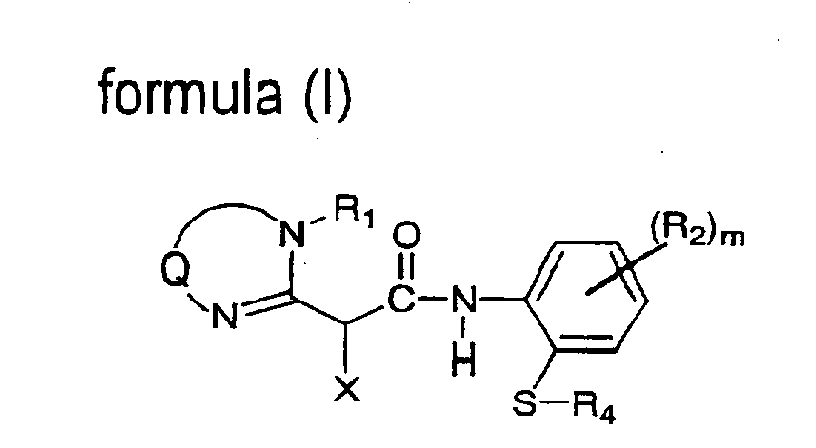
Description
- The present invention relates to a silver halide photographic light-sensitive material. Particularly, the present invention relates to a silver halide color photographic light-sensitive material that is excellent in color reproducibility and image storability (preservability).
- In a silver halide photographic light-sensitive material (hereinafter, also referred to simply as "a light-sensitive material") for subtractive color photography, a color image is formed by dyes of three primary colors of yellow, magenta, and cyan. In the color photography that uses current p-phenylenediamine-series color-developing agents, acylacetoanilide-series compounds are used as yellow couplers. However, the hue of the yellow dyes obtained from these yellow couplers is reddish, due to an inferior sharpness of a peak of the absorption curve at the longer wavelength side (that is, on the absorption curve, the peak in interest has subsidiary absorption at its foot portion at the longer wavelength side), which renders it difficult to obtain a yellow hue with high purity. Further, because the molecular extinction coefficient of the yellow dyes is low, it is necessary, to attain a desired color density, to use larger amounts of both the coupler and the silver halide. The use of such larger amounts of these components has a problem that the resulting increase in thickness of a light-sensitive material sometimes lowers the sharpness of the obtained color image. Further, the above-mentioned dyes are apt to decompose under conditions of high temperature and high humidity, or of irradiation by radiation, and have a weakness of image storability after development processing. Accordingly, it has been desired to improve these weak points.
- In order to solve these problems, improvement of acyl groups and anilido groups were proposed on the couplers. Recently, as improved couplers of the conventional acylacetoanilide-series couplers, there were proposed, for example, 1-alkylcyclopropanecarbonyl acetoanilide-series compounds, (for example, JP-A-4-218042 ("JP-A" means unexamined published Japanese patent application)); cyclomalonic acid diamide-type couplers (for example, JP-A-5-11416); pyrrole-2- or 3-yl- or indole-2- or 3-yl- carbonylacetoanilide-series couplers (for example, European Patent Publication Nos. 953870A1, and 953871A1). The dyes formed from these couplers were improved in terms of both hue and molecular extinction coefficient of dyes formed, compared with the conventional ones. However, they were not satisfactory in image storability still. Further, owing to their complicated chemical structure, the synthesis route was longer, and consequently cost of the couplers was higher, causing a practical problem. In addition, there were proposed acetate ester-series and acetoanilide-series couplers to which 1,2,4-benzothiadiazine-1,1-dioxide is bonded (for example, U.S. Patent No. 3,841,880, JP-A-52-82423 and JP-A-2-28645). However, these couplers were low in color-forming property, and they were inferior in sharpness of a peak of the absorption curve owing to the foot portion on the longer wavelength side. Therefore, improvement of these properties has been desired.
- The present invention is a yellow dye-forming coupler represented by formula (I) shown below;

- Further, the present invention is a silver halide color photographic light-sensitive material having at least one yellow dye-forming coupler represented by formula (I) in at least one layer provided on a support.
- Other and further features and advantages of the invention will appear more fully from the following description.
- The inventors, having made investigations to solve the above-mentioned problems, have found out that, these problems can be solved by using a yellow dye-forming coupler represented by formula (I). Thus, the present invention has been made based on this finding.
- According to the present invention, there is provided the following means:
- (1) A yellow dye-forming coupler represented by formula (I) shown below;

- (2) A silver halide color photographic light-sensitive material comprising at least one yellow dye-forming coupler represented by formula (I) described in the above item (1) in at least one layer provided on a support.
- (3) A yellow dye-forming coupler represented by formula (IA) shown below;

- (4) A silver halide color photographic light-sensitive material comprising at least one yellow dye-forming coupler represented by formula (IA) according to the above item (3), in at least one layer provided on a support.
- (5) The silver halide color photographic light-sensitive material according to the above item (4), wherein Q in the above-mentioned formula (IA) is a group represented by -C(-R11)=C(-R12)-SO2- or -C(-R11)=C(-R12)-CO-, in which R11 and R12 are groups that bond with each other to form a 5- to 7-membered ring together with -C=C-, or they each independently represents a hydrogen atom or a substituent.
- (6) The silver halide color photographic light-sensitive material according to the above item (4) or (5), wherein the yellow dye-forming coupler represented by formula (IA) is a yellow dye-forming coupler represented by formula (IIA):

(Herein, the yellow dye-forming coupler and silver halide color photographic light-sensitive material described in the above items (3) to (6) may be collectively referred to as a first embodiment of the present invention.) - (7) A yellow dye-forming coupler represented by formula (IB) shown below;

- (8) A silver halide color photographic light-sensitive material comprising at least one yellow dye-forming coupler represented by formula (IB) according to the above item (7), in at least one layer provided on a support.
- (9) The silver halide color photographic light-sensitive material according to the above item (8), wherein Q1 in the above-mentioned formula (IB) is a group represented by -C(-R11)=C(-R12)-SO2- or -C(-R11)=C(-R12)-CO-, in which R11 and R12 are groups that bond with each other to form a 5- to 7-membered ring together with -C=C-, or they each independently represent a hydrogen atom or a substituent.
- (10) The silver halide color photographic light-sensitive material according to the above item (8) or (9), wherein the yellow dye-forming coupler represented by formula (IB) is a yellow dye-forming coupler represented by formula (IIB):

- (11) The silver halide color photographic light-sensitive material according to one of the above items (8) to (10), wherein R2 in formula (IB) or formula (IIB) represents a t-butyl group.
(Herein, the yellow dye-forming coupler and silver halide color photographic light-sensitive material described in the above items (7) to (11) may be collectively referred to as a second embodiment of the present invention.) - Herein, the present invention means to include both the first embodiment and the second embodiment, unless otherwise specified.
- The present invention is explained below in detail.
- The term "aliphatic group" used in the present specification means such groups, in which the aliphatic portion may be a saturated or unsaturated, straight chain, branched chain, or a cycle, and the aliphatic portion embraces, for example, an alkyl group, an alkenyl group, a cycloalkyl group, and a cycloalkenyl group; and these can be unsubstituted or substituted. Further, the term "aryl group" used herein means a substituted or unsubstituted, monocyclic or condensed ring. The term "heterocyclic group" used herein means such groups, in which the heterocycle portion contains a hetero atom(s) (such as nitrogen, sulfur and oxygen atoms) in the ring skeleton, and the heterocycle embraces a substituted or unsubstituted, saturated or unsaturated, and monocyclic or condensed ring.
- The term "substituent" used in the present specification means any groups or atoms that are able to substitute for other groups or atoms; and embraces, for example, an aliphatic group, an aryl group, a heterocyclic group, an acyl group, an acyloxy group, an acylamino group, an aliphatic oxy group, an aryloxy group, a heterocyclic oxy group, an aliphatic oxycarbonyl group, an aryloxycarbonyl group, a heterocyclic oxycarbonyl group, a carbamoyl group, an aliphatic sulfonyl group, an arylsulfonyl group, a heterocyclic sulfonyl group, an aliphatic sulfonyloxy group, an arylsulfonyloxy group, a heterocyclic sulfonyloxy group, a sulfamoyl group, an aliphatic sulfonamido group, an aryl sulfonamido group, a heterocyclic sulfonamido group, an amino group, an aliphatic amino group, an arylamino group, a heterocyclic amino group, an aliphatic oxycarbonylamino group, an aryloxycarbonylamino group, a heterocyclic oxycarbonylamino group, an aliphatic sulfinyl group, an aryl sulfinyl group, an aliphatic thio group, an arylthio group, a hydroxy group, a cyano group, a sulfo group, a carboxyl group, an aliphatic oxyamino group, an aryloxyamino group, a carbamoylamino group, a sulfamoylamino group, a halogen atom, a sulfamoylcarbamoyl group, a carbamoylsulfamoyl group, a dialiphatic oxyphosphinyl group, and a diaryloxyphosphinyl group.
- The dye-forming coupler of the present invention will be explained below, referring to the formulae (IA) and (IB), and these explanations, as they are, can also be applied to the formula (I) that includes said formulae (IA) and (IB).
- First, the compound represented by formula (IA), which is the first embodiment of the compound represented by formula (I) of the present invention, is explained in detail. In the present specification, the compound is also referred to as a yellow dye-forming coupler.

- In formula (IA), R1 represents a substituent other than a hydrogen atom. Examples of the substituent include a halogen atom, an alkyl group, a cycloalkyl group (including a bicycloalkyl group), an alkenyl group, a cycloalkenyl group (including a bicycloalkenyl group), an alkynyl group, an aryl group, a heterocyclic group, a cyano group, a hydroxyl group, a nitro group, a carboxyl group, an alkoxy group, an aryloxy group, a silyloxy group, a heterocyclic oxy group, an acyloxy group, a carbamoyloxy group, an alkoxycarbonyloxy group, an aryloxycarbonyloxy group, an amino group (including an alkylamino group and an anilino group), an acylamino group, an aminocarbonylamino group, an alkoxycarbonylamino group, an aryloxycarbonylamino group, a sulfamoylamino group, an alkyl- or aryl-sulfonylamino group, a mercapto group, an alkylthio group, an arylthio group, a heterocyclic thio group, a sulfamoyl group, a sulfo group, an alkyl- or aryl-sulfinyl group, an alkyl- or aryl-sulfonyl group, an acyl group, an aryloxycarbonyl group, an alkoxycarbonyl group, a carbamoyl group, an arylazo group, a heterocyclic azo group, an imido group, a phosphino group, a phosphinyl group, a phosphinyloxy group, a phosphinylamino group, and a silyl group.
- The above-mentioned substituent may be further substituted with another substituent. Examples of this another substituent are the same to the above-mentioned examples of the substituent.
- R1 is preferably a substituted or unsubstituted alkyl group. The total number of carbon atoms of R1 is preferably in the range of 1 to 60, more preferably in the range of 4 to 50, and still more preferably in the range of 7 to 40. In the case that R1 is a substituted alkyl group, examples of the substituent on the alkyl group include those atoms and groups exemplified as the substituent of the above-mentioned R1.
- In formula (IA), Q represents a group of nonmetallic atoms that forms a 5- to 7-membered ring in combination with the -N=C-N(R1)-. Preferably, the 5- to 7-membered ring thus formed is a substituted or unsubstituted, and monocyclic or condensed heterocycle. More preferably, the ring is one whose ring-forming atoms are selected from carbon, nitrogen and sulfur atoms. Still more preferably, Q represents a group represented by -C(-R11)=C(-R12)-SO2- or -C(-R11)=C(-R12)-CO- (in the present specification, these expressions of the foregoing groups do not limit the bonding orientation of the groups in formula (IA), to the ones shown by these expressions). R11 and R12 are groups that bond each other to form a 5- to 7-membered ring together with the -C=C- moiety, or R11 and R12 each independently represents a hydrogen atom or a substituent. The 5- to 7-membered ring thus formed may be saturated or unsaturated, and the ring may be an alicyclic, aromatic or heterocyclic ring. Examples of the 5- to 7-membered ring include benzene, furan, thiophene, cyclopentane, and cyclohexane rings. These rings may further have a substituent. Examples of the substituent are the same as described as the examples of the above-mentioned substituent of R1.
- These substituents and the rings formed through bonding of multiple substituents may be further substituted with another substituent. Examples of this another substituent are the same as described as the examples of the above-mentioned substituent of R1.
- In formula (IA), R2 represents a substituent other than a hydrogen atom. Examples of the substituent include those exemplified as the substituent of the above-mentioned R1. R2 is preferably a halogen atom (e.g., fluorine, chlorine, bromine), an alkyl group (e.g., methyl, isopropyl, t-butyl), an aryl group (e.g., phenyl, naphthyl), an alkoxy group (e.g., methoxy, isopropyloxy), an aryloxy group (e.g., phenoxy), an alkylthio group (e.g., methylthio, octylthio), an arylthio group (e.g., phenylthio, 2-methoxyphenylthio), an acyloxy group (e.g., acetyloxy), an amino group (e.g., dimethylamino, morpholino), an acylamino group (e.g., acetamido), a sulfonamido group (e.g., methanesulfonamido, benzenesulfonamido), an alkoxycarbonyl group (e.g., methoxycarbonyl), an aryloxycarbonyl group (e.g., phenoxycarbonyl), a carbamoyl group (e.g., N-methylcarbamoyl, N,N-diethylcarbamoyl), a sulfamoyl group (e.g., N-methylsulfamoyl, N,N-diethylsulfamoyl), an alkylsulfonyl group (e.g., methane sulfonyl), an arylsulfonyl group (e.g., benzene sulfonyl), a cyano group, a carboxyl group, or a sulfo group. More preferable examples of the substituent include an alkyl group, an aryl group, an alkoxy group, and an aryloxy group.
- The total number of carbon atoms of R2 is preferably in the range of 0 to 60, more preferably in the range of 0 to 50, and further more preferably in the range of 0 to 40.
- In formula (IA), m represents an integer of 0 or more and 4 or less. When m is 2 or more, R2s may be the same or different, and they may bond together to form a ring. In view of the effects of the present invention, m is preferably 0 or 1.
- In formula (IA), R41 represents a secondary or tertiary alkyl group, and it may have a substituent. Examples of the substituent are the same as those of the substituent of R1 described above. For example, i-propyl, s-butyl, t-butyl, t-amyl, t-hexyl, t-octyl, and t-dodecyl groups are exemplified. The carbon atoms of the alkyl group are preferably in the range of 3 to 30, and more preferably in the range of 3 to 20. In view of effects of the present invention, a tertiary alkyl group is more preferable than a secondary alkyl group.
- In formula (IA), X represents a hydrogen atom, or a group capable of being split-off upon a coupling reaction with an oxidized product of a developing agent. Examples of the group capable of being split-off upon a coupling reaction with an oxidized product of a developing agent include a group that splits off with a nitrogen, oxygen, or sulfur atom (a splitting-off atom); a halogen atom (e.g., chlorine, bromine), and the like.
- Examples of the group that splits off with a nitrogen atom include a heterocyclic group (preferably a 5- to 7-membered substituted or unsubstituted, saturated or unsaturated aromatic (herein the term "aromatic" is used to embrace a substance that has (4n+2) cyclic conjugated electrons) or non-aromatic, monocyclic or condensed heterocyclic group; more preferably a 5- or 6-membered heterocyclic group having ring-forming atoms selected from carbon, nitrogen, oxygen and sulfur atoms and having at least one hetero atom selected from nitrogen, oxygen and sulfur atoms; specific examples of the heterocyclic group include succinimido, maleinimido, phthalimido, diglycolimido, pyrrole, pyrazole, imidazole, 1,2,4-triazole, tetrazole, indole, benzopyrazole, benzimidazole, benzotriazole, imidazoline-2,4-dione, oxazolidine-2,4-dione, thiazolidine-2-one, benzimidazoline-2-one, benzoxazoline-2-one, benzothiazoline-2-one, 2-pyrroline-5-one, 2-imidazoline-5-one, indoline-2,3-dione, 2,6-dioxypurine parabanic acid, 1,2,4-triazolidine-3,5-dione, 2-pyridone, 4-pyridone, 2-pyrimidone, 6-pyridazone, 2-pyrazone, 2-amino-1,3,4-thiazolidine-4-one), a carbonamido group (e.g., acetamido, trifluoroacetamido), a sulfonamido group (e.g., methanesulfonamido, benzenesulfonamido), an arylazo group (e.g., phenylazo, naphthylazo), and a carbamoylamino group (e.g., N-methyl carbamoylamino).
- Preferred of the group that splits off with a nitrogen atom is a heterocyclic group, and more preferably it is an aromatic heterocyclic group having 1, 2, 3 or 4 ring-forming nitrogen atoms, or a heterocyclic group represented by the following formula (L):

- Examples of the moiety are enumerated in the explanation of the above-mentioned heterocyclic group, and such moieties as enumerated above are more preferred.
- Particularly preferably L is a moiety that forms a 5-membered nitrogen-containing heterocycle.
- Examples of the group that splits off with an oxygen atom include an aryloxy group (e.g., phenoxy, 1-naphthoxy), a heterocyclic oxy group (e.g., pyridyloxy, pyrazolyloxy), an acyloxy group (e.g., acetoxy, benzoyloxy), an alkoxy group (e.g., methoxy, dodecyloxy), a carbamoyloxy group (e.g., N,N-diethylcarbamoyloxy, morpholinocarbamoyloxy), an aryloxycarbonyloxy group (e.g., phenoxycarbonyloxy), an alkoxycarbonyloxy group (e.g., methoxycarbonyloxy, ethoxycarbonyloxy), an alkylsulfonyloxy group (e.g., methanesulfonyloxy), and an aryl sulfonyloxy group (e.g., benzenesulfonyloxy, toluenesulfonyloxy).
- Preferred of the group that splits off with an oxygen atom are an aryloxy group, an acyloxy group and a heterocyclic oxy group.
- Examples of the group that splits off with a sulfur atom include an arylthio group (e.g., phenylthio, naphthylthio), a heterocyclic thio group (e.g., tetrazolylthio, 1,3,4-thiadiazolylthio, 1,3,4-oxazolylthio, benzimidazolyl thio), an alkylthio group (e.g., methylthio, octylthio, hexadecylthio), an alkylsulfinyl group (e.g., methane sulfinyl), an arylsulfinyl group (e.g., benzenesulfinyl), an arylsulfonyl group (e.g., benzenesulfonyl), and an alkylsulfonyl group (e.g., methansulfonyl).
- Preferred of the group that splits off with a sulfur atom are an arylthio group and a heterocyclic thio group. A heterocyclic thio group is more preferred.
- X may be substituted with a substituent. Examples of the substituent substituting on X include those exemplified as the above-mentioned substituent of R1.
- X is preferably a group that splits off with a nitrogen atom, group that splits off with an oxygen atom, or group that splits off with a sulfur atom. More preferably X is a group that splits off with a nitrogen atom, and further preferably X is one of the above-mentioned preferable examples of the group that splits off with a nitrogen atom, and they are preferable in the described order.
- X may be a photographically useful group. Examples of the photographically useful group include a development inhibitor, a desilvering accelerator, a redox compound, a dye, a coupler, and precursors of these compounds.
- In order to render the coupler immobile in the light-sensitive material, at least one of Q, R1, X, and R2 has preferably 8 to 60 carbon atoms, more preferably 8 to 50 carbon atoms in total respectively, including carbon atoms of substituent(s) thereon.
- It is preferable, from the point of the effects of the present invention, that the compound represented by formula (IA) is a compound represented by formula (IIA). Here, the compound represented by formula (IIA) is also referred to as a yellow dye-forming coupler in the present specification. The compound represented by formula (IIA) is explained in detail below.

- In formula (IIA), R1, R2, R41, m, and X each have the same meanings as described in formula (IA). Preferable ranges thereof are also the same.
- In formula (IIA), R3 represents a substituent. Examples of the substituent include those groups and atoms exemplified as the above-mentioned substituent of R1. Preferably R3 is a halogen atom (e.g., fluorine, chlorine, bromine), an alkyl group (e.g., methyl, isopropyl), an aryl group (e.g., phenyl, naphthyl), an alkoxy group (e.g., methoxy, isopropyloxy), an aryloxy group (e.g., phenoxy), an acyloxy group (e.g., acetyloxy), an amino group (e.g., dimethylamino, morpholino), an acylamino group (e.g., acetamido), a sulfonamido group (e.g., methanesulfonamido, benzenesulfonamido), an alkoxycarbonyl group (e.g., methoxycarbonyl), an aryloxycarbonyl group (e.g., phenoxycarbonyl), a carbamoyl group (e.g., N-methylcarbamoyl, N,N-diethylcarbamoyl), a sulfamoyl group (e.g., N-methylsulfamoyl, N,N-diethylsulfamoyl), an alkylsulfonyl group (e.g., methane sulfonyl), an arylsulfonyl group (e.g., benzene sulfonyl), a cyano group, a carboxyl group, and a sulfo group.
- n represents an integer of 0 or more but 4 or less. When n is 2 or more, the multiple R3s may be the same or different, and the R3s may bond each other to form a ring.
- Preferable specific examples of the couplers represented by formula (IA) or (IIA) of the present invention are shown below. However, the present invention is not limited to these compounds. Herein, the present invention also embraces tautomers, in which the hydrogen atom at the coupling site (the hydrogen atom on the carbon atom to which X is substituting) is transferred on the nitrogen atom in the C=N portion bonding to the coupling site (the ring-constituting nitrogen atom that is not bonded with R1).


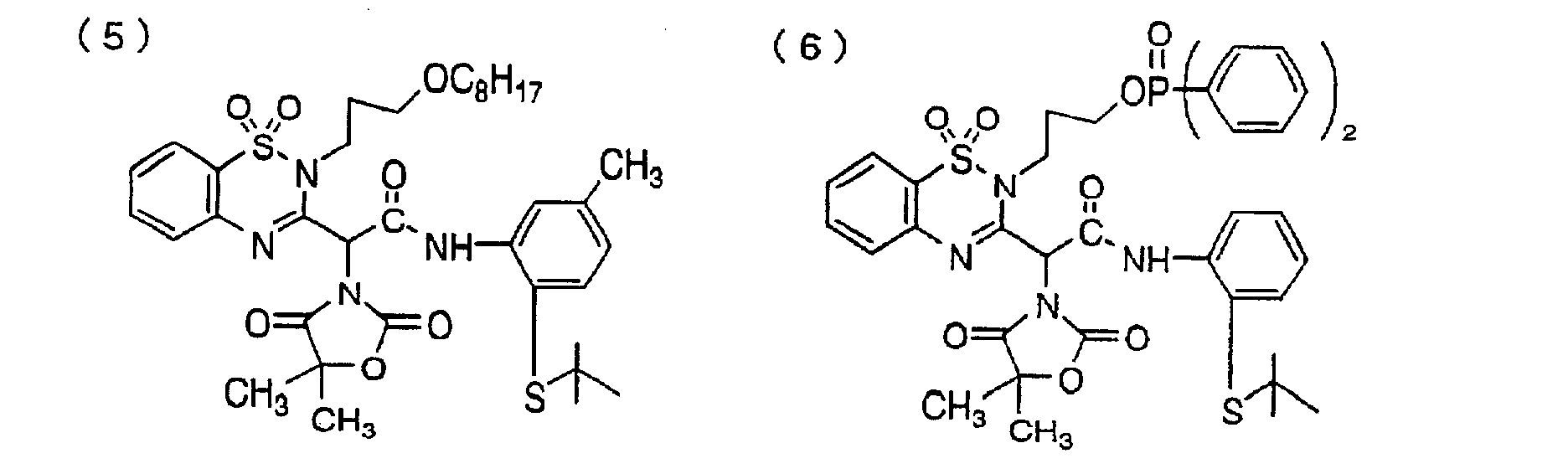


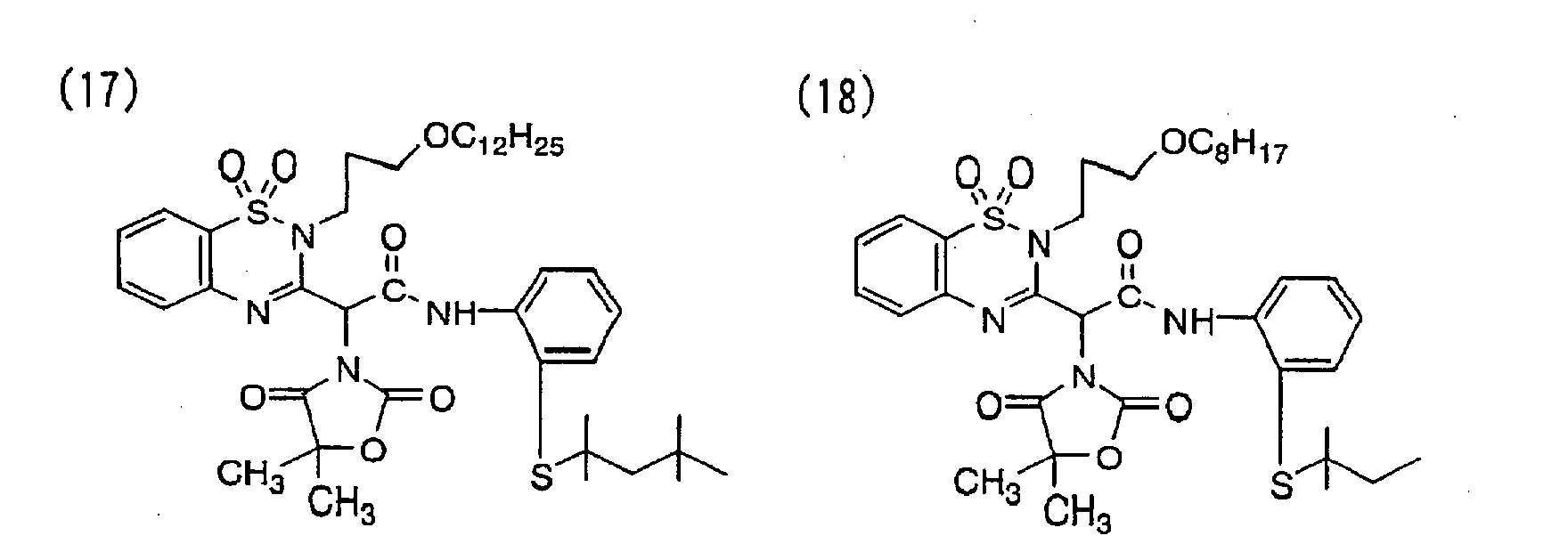


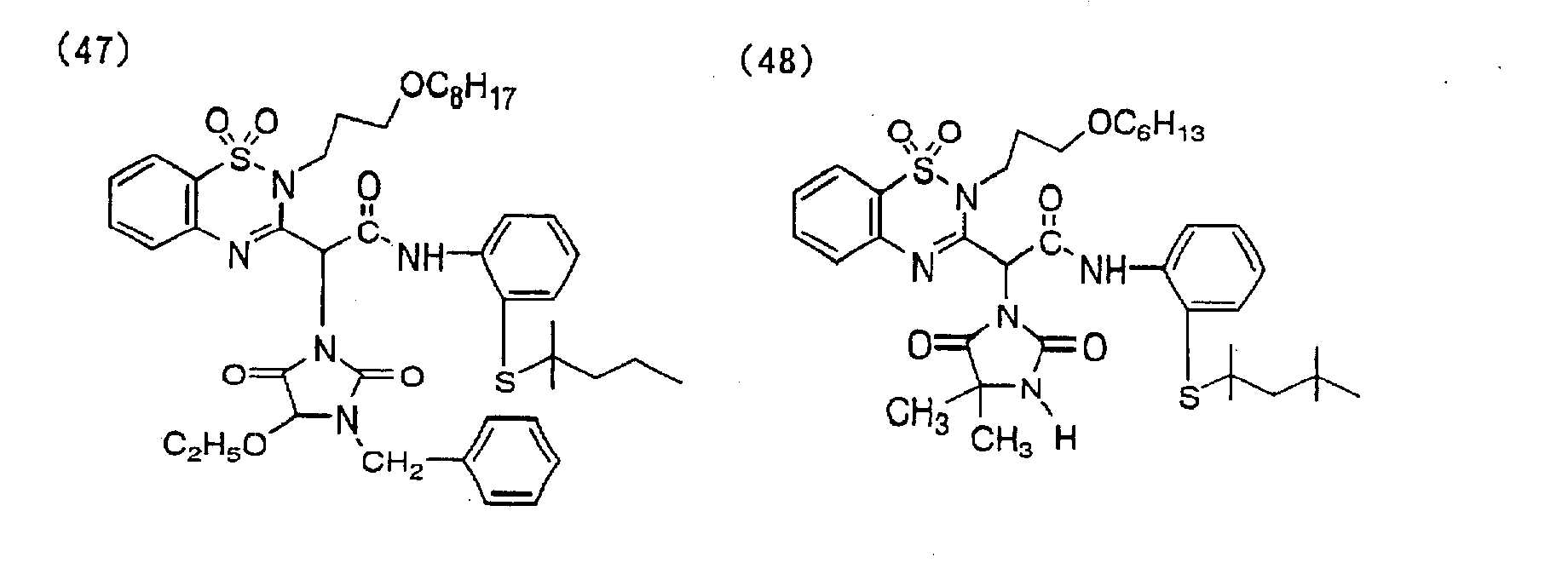


- In the following explanation, when the exemplified compounds shown above are referred to, they are expressed as "coupler (x)" or "exemplified compound (x)", with using the number x labeled to each of the exemplified compounds in the parenthesis.
- Specific synthetic examples of the compounds represented by the foregoing formula (IA) or (IIA) are described below.
- The coupler (4) was synthesized according to the following route:

- To a solution of 3-butoxypropylamine (150 g), triethylamine (192 ml) and acetonitrile (600 ml) under stirring and ice-cooling, 253 g of orthonitrobenzene sulfonyl chloride was gradually added. After elevating the temperature of the reaction system to room temperature, further agitation was continued for another 1 hour. Ethyl acetate and water were added for separation and extraction. The organic solvent layer was washed with dilute hydrochloric acid and saturated brine. After the organic solvent layer was dried with magnesium sulfate anhydride, the solvent was removed by vacuum distillation, to obtain 362 g of Compound (A-1) as a viscous oily product.
- 300.0 g of reduced iron and 30.0 g of ammonium chloride were dispersed in a mixture of isopropanol (1540 ml) and water (240 ml), and then stirred for 1 hour with heating under reflux. To the dispersion, 119 g of Compound (A-1) was gradually added. After stirring for another 2 hours with heating under reflux, the reaction mixture was suction-filtered through celite. Ethyl acetate and water were added to the filtrate for separation and extraction. The organic solvent layer was washed with saturated brine. After the organic solvent layer was dried with magnesium sulfate anhydride, the solvent was removed by vacuum distillation to obtain 327 g of Compound (A-2) as an oily product.
- A solution of Compound (A-2) (327 g), hydrochloride (268.4 g) of iminoether (A-0), and ethyl alcohol (450 ml) was stirred for 1 hour with heating under reflux. After cooling, the mixture was suction-filtered. To the filtrate, 500 ml of p-xylene was added, and the solution was heated under reflux for 4 hours, with eliminating .ethanol by distillation. The reaction solution was poured into 1000 ml of ice water, and then 500 ml of ethyl acetate was added for extraction. The organic solvent layer was washed with saturated brine twice, and then dried with magnesium sulfate anhydride. Magnesium sulfate was separated by filtration, and ethyl acetate and xylene were eliminated by distillation under reduced pressure. Crystallization of the obtained oily product from 1000 ml of n-hexane gave 370.1 g of Compound (A-3).
- To t-octanethiol (146 g) were added dimethylformamide (500 ml) and potassium carbonate (138 g), and then ortho-fluoronitrobenzene (141 g) was added drop-wise over 30 minutes while stirring the solution at 80 °C under a nitrogen atmosphere. After heating and stirring at 80 °C for an additional 1 hour, the reaction solution was poured into 1000 ml of ice water, and then extraction was carried out with 700 ml of ethyl acetate. The organic solvent layer was washed with saturated brine twice, and then dried with magnesium sulfate anhydride. Magnesium sulfate was separated by filtration and the solvent was eliminated by vacuum distillation. Thus, 267 g of Compound (A-4) was obtained as an oily product.
- 300.0 g of reduced iron and 30.0 g of ammonium chloride were dispersed in a mixture of isopropanol (1540 ml) and water (240 ml), and then stirred for 1 hour with heating under reflux. To the dispersion, 267 g of Compound (A-4) was gradually added. After stirring for 2 hours with heating under reflux, the reaction mixture was suction-filtered through celite. Ethyl acetate and water were added to the filtrate for separation and extraction. The organic solvent layer was washed with saturated brine. After the organic solvent layer was dried with magnesium sulfate anhydride, the solvent was removed by vacuum distillation. Crystallization of the residue from a mixed solvent of methanol and water gave 198 g of Compound (A-5).
- A mixture of Compound (A-3) (20 g) and Compound (A-5) (13.7 g) were heated and stirred at a temperature of 145 to 150 °c for 6 hours, to obtain a crude product of compound (A-6). To the resultant crude product, 100 ml of ethyl acetate was added, and then, to the solution under stirring and ice-cooling, 7.1 g of N-chlorosuccinimide was added over 5 minutes. The solution was stirred for 30 minutes under ice cooling, and thereafter water was added for separation and extraction. The organic solvent layer was washed with saturated brine and dried with magnesium sulfate anhydride. Thereafter, the solvent was removed by vacuum distillation, to obtain a crude product of Compound (A-7).
- 5,5-dimethyloxazolidine-2,4-dione (15.5 g) and triethylamine (16.8 ml) were dissolved in N,N-dimethylacetamide (100 ml). To the solution under stirring at room temperature, a solution containing a whole amount of the previously synthesized crude product of Compound (A-7) dissolved in acetonitrile (30 ml) was added drop-wise over 10 minutes. Thereafter the temperature was elevated up to 80 °C, and the reaction mixture was stirred for 3 hours. Ethyl acetate and ice water were added for separation and extraction. The organic solvent layer was washed with 0.1 N potassium hydroxide aqueous solution, diluted hydrochloric acid, and saturated brine. The organic solvent layer was dried with magnesium sulfate anhydride, and then the solvent was eliminated by vacuum distillation. Crystallization of the residue from 60 ml of methanol and recrystallization from 80 ml of methanol gave 23.4 g of Coupler (4). (Melting point, 127 °C.)
- The coupler (8) was synthesized according to the following route:

- To a solution of 3-dodecyloxypropylamine (139 g), triethylamine (96 ml) and acetonitrile (500 ml), under stirring and ice-cooling, 126 g of ortho-nitrobenzene sulfonyl chloride was gradually added. After elevating the temperature of the reaction system to room temperature, further agitation was continued for 1 hour. Ethyl acetate and water were added to the solution for separation and extraction. The organic solvent layer was washed with dilute hydrochloric acid and saturated brine. After the organic solvent layer was dried with magnesium sulfate anhydride, the solvent was removed by vacuum distillation, to obtain 244 g of Compound (B-1) as a viscous oily product.
- 150.0 g of reduced iron and 15.0 g of ammonium chloride were dispersed in a mixture of isopropanol (1000 ml) and water (120 ml), and then the dispersion was stirred for 1 hour with heating under reflux. To the dispersion, 244 g of Compound (B-1) was gradually added. After stirring for an additional 2 hours with heating under reflux, the reaction mixture was suction-filtered through celite. Ethyl acetate and water were added to the filtrate for separation and extraction. The organic solvent layer was washed with saturated brine. After the organic solvent layer was dried with magnesium sulfate anhydride, the solvent was removed by vacuum distillation, to obtain 227 g of Compound (B-2) as an oily product.
- A solution of Compound (B-2) (227 g), hydrochloride (134.2 g) of iminoether (A-0), and ethyl alcohol (300 ml) was stirred for 1 hour with heating under reflux. After cooling, the mixture was suction-filtered. To the filtrate, 300 ml of p-xylene was added, and heated under reflux for 4 hours, with eliminating ethanol by distillation. The reaction solution was poured into 800 ml of ice water, and then 300 ml of ethyl acetate was added for separation and extraction. The organic solvent layer was washed with saturated brine twice, and dried with magnesium sulfate anhydride. Magnesium sulfate was separated by filtration, and ethyl acetate and xylene were eliminated by vacuum distillation. Crystallization of the obtained oily product from ethyl acetate and methanol gave 181.9 g of Compound (B-3).
- 102 ml of concentrated sulfuric acid was added to 80 ml of ice water, and then 25.8 g of t-butanol was added drop-wise over 30 minutes under stirring at a temperature of 0 to 2 °C. Thereafter, 30 g of 2-aminothiophenol was added drop-wise over 30 minutes at a temperature of 0 to 5 °C. After the temperature was elevated up to the range of 20 to 25 °C, the reaction mixture was stirred for 8 hours. The reaction mixture was poured into 1000 ml of an aqueous solution containing 150 g of sodium hydroxide dissolved therein, at the temperature of 40 °C or lower, for neutralization, and then separation and extraction was carried out with 500 ml of ethyl acetate. The organic solvent layer was washed with saturated brine twice, and dried with magnesium sulfate anhydride. Magnesium sulfate was separated by filtration and then the solvent was eliminated by vacuum distillation. Purification of thus-obtained oily product by a silica gel chromatography using ethyl acetate and n-hexane as eluants gave 40.8 g of Compound (B-4) as an oily product.
- 25 g of Compound (B-3) and 11.0 g of Compound (B-4) were heated and stirred at a temperature of 145 to 150 °C for 6 hours, to obtain a crude product of Compound (B-5). To the reaction crude product, 100 ml of ethyl acetate was added, and then 6.8 g of N-chlorosuccinimide was added over 5 minutes under stirring and ice cooling. After stirring the solution for 30 minutes with ice cooling, water was added for separation and extraction. The organic solvent layer was washed with saturated brine, and dried with magnesium sulfate anhydride. The solvent was eliminated by vacuum distillation, to obtain a crude product of Compound (B-6).
- 5,5-dimethyloxazolidine-2,4-dione (15.5 g) and triethylamine (16.8 ml) were dissolved in N,N-dimethylacetamide (100 ml). To the solution, a solution containing a whole amount of the previously synthesized crude product of Compound (B-6) dissolved in acetonitrile (30 ml), was added drop-wise over 10 minutes, at room temperature. After elevating the temperature up to 80 °C, the reaction mixture was stirred for 3 hours. Ethyl acetate and water were added for separation and extraction. The organic solvent layer was washed with 0.1 N potassium hydroxide aqueous solution, diluted hydrochloric acid, and saturated brine. The organic solvent layer was dried with magnesium sulfate anhydride, and thereafter the solvents were eliminated by vacuum distillation. Crystallization of the residue from 50 ml of methanol, and recrystallization from 60 ml of methanol gave 25.3 g of coupler (8). (Melting point, 87 to 88 °C.)
- The coupler (22) was synthesized according to the following route:

- Dimethylformamide (120 ml) and potassium carbonate (38 g) were added to t-octanethiol (41.2 g). Then, while stirring the solution at 80 °C under a nitrogen atmosphere, 4-chloro-3-nitrotoluene (50 g) was added drop-wise over 30 minutes. After heating and stirring at 80 °C for an additional 1 hour, the reaction mixture was poured into 400 ml of ice water, and then separation and extraction was carried out with 300 ml of ethyl acetate. The organic solvent layer was washed with saturated brine twice, and dried with magnesium sulfate anhydride. After the magnesium sulfate was separated by filtration, the solvent was eliminated by vacuum distillation, to obtain 79.3 g of Compound (C-1) as an oily product.
- 100.0 g of reduced iron and 10.0 g of ammonium chloride were dispersed in a mixture of isopropanol (540 ml) and water (80 ml), and then stirred for 1 hour with heating under reflux. To the dispersion, 79.3 g of Compound (C-1) was gradually added. After stirring for an additional 2 hours with heating under reflux, the reaction mixture was suction-filtered through celite. Ethyl acetate and water were added to the filtrate for separation and extraction. The organic solvent layer was washed with saturated brine. After the organic solvent layer was dried with magnesium sulfate anhydride, the solvent was removed by vacuum distillation. Purification of the residue by a silica gel chromatography using ethyl acetate and n-hexane as eluants gave 67.5 g of Compound (C-2) as an oily product.
- Compound (A-3)(61 g) and Compound (C-2)(40 g) were heated and stirred at a temperature of 145 to 150 °C for 6 hours, to obtain a crude product of Compound (C-3). To the resultant crude product, 200 ml of ethyl acetate was added, and then 21.7 g of N-chlorosuccinimide was added over 25 minutes to the solution under stirring and ice cooling. The solution was stirred for 30 minutes under ice cooling, and thereafter water was added for separation and extraction. The organic solvent layer was washed with saturated brine and dried with magnesium sulfate anhydride. Thereafter, the solvent was removed by vacuum distillation, to obtain a crude product of Compound (C-4).
- 5,5-dimethyloxazolidine-2,4-dione (38 g) and triethyl amine (41.2 ml) were dissolved in N,N-dimethylacetamide (100 ml). To this solution, a solution containing a whole amount of the previously synthesized crude product of Compound (C-4) dissolved in acetonitrile (30 ml) was added drop-wise over 10 minutes, at room temperature. Thereafter the temperature was elevated up to 80 °c, and the reaction mixture was stirred for 3 hours. Ethyl acetate and water were added for separation and extraction. The organic solvent layer was washed with 0.1 N potassium hydroxide aqueous solution, diluted hydrochloric acid, and saturated brine. The organic layer was dried with magnesium sulfate anhydride, and then the solvent was eliminated by vacuum distillation. Crystallization of the residue from 100 ml of methanol and recrystallization from 150 ml of methanol gave 71.4 g of Coupler (22). (Melting point, 148 to 150 °C.)
- Next, the compound represented by formula (IB), which is the second embodiment of the compound represented by formula (I) of the present invention, is explained in detail. In the present specification, the compound is also referred to as a yellow dye-forming coupler.

- In formula (IB), R101 represents a substituted or unsubstituted alkyl group having 4 to 8 carbon atoms. Examples of the substituent that R101 may have include those atoms and groups exemplified as the substituent of the above-mentioned R1 in formula (IA).
- The above substituent may be further substituted with another substituent. Examples of this another substituent include those atoms and groups mentioned as the substituent of the above-mentioned R101.
- R101 is preferably an unsubstituted alkyl group having 4 to 6 carbon atoms, and it is more preferably n-butyl group.
- In formula (IB), Q1 represents a group of nonmetallic atoms that forms a 5- to 7-membered ring in combination with the -N=C-N((CH2)3O-R101)-. (Q1 has substantially the same meaning as Q in formula (IA), though the literal explanation of Q1 is different from that of Q in formula (IA).) Preferred examples of Q1 include those rings and groups exemplified for Q in formula (IA). Further, all descriptions on features made for Q in formula (IA) apply to Q1.
- In formula (IB), R2 has the same meaning as defined in formula (IA), and its specific examples and preferable range are also the same. However, in the second embodiment of the present invention, R2 is more preferably a t-alkyl group, and furthermore preferably a t-butyl group, and most preferably a t-butyl group in the para-position to -SR42.
- In formula (IB), m has the same meaning as defined in the formula (IA), and its preferable range is also the same.
- In formula (IB), R42 represents a primary alkyl group, and this alkyl group may have a substituent. Examples of the substituent that R42 may have are the same as those of the substituent on the aforementioned R101. A preferable carbon numbers of R42 including its substituent(s) is in the range of 3 to 30, more preferably in the range of 3 to 20, and furthermore preferably in the range of 6 to 12. As preferable examples of the substituent, an alkyl group and an aryl group can be exemplified, and an alkyl group is more preferable; and R42 is most preferably a 2-ethylhexyl group.
- The term "primary alkyl group" in this specification is used to indicate a carbon skeleton of an alkyl group in which, assuming that the carbon bonding to S in formula (IB) is designated as a central carbon, the central carbon has at least two hydrogen atoms.
- In formula (IB), X has the same meaning as defined in formula (IA), and its specific examples and preferable range are also the same. However, in the second embodiment of the present invention, X is most preferably 5,5-dimethyloxazolidine-2,4-dione-3-yl group.
- In order to render the coupler immobile in the light-sensitive material, at least one of Q1, R101, X, and R2 has preferably 8 to 60 carbon atoms, more preferably 8 to 50 carbon atoms in total respectively, including carbon atoms of substituent(s) thereon.
- It is preferable, from the point of the effects of the present invention, that the compound represented by formula (IB) is a compound represented by formula (IIB). Here, the compound represented by formula (IIB) is also referred to as a yellow dye-forming coupler in the present specification. The compound represented by formula (IIB) is explained in detail below.
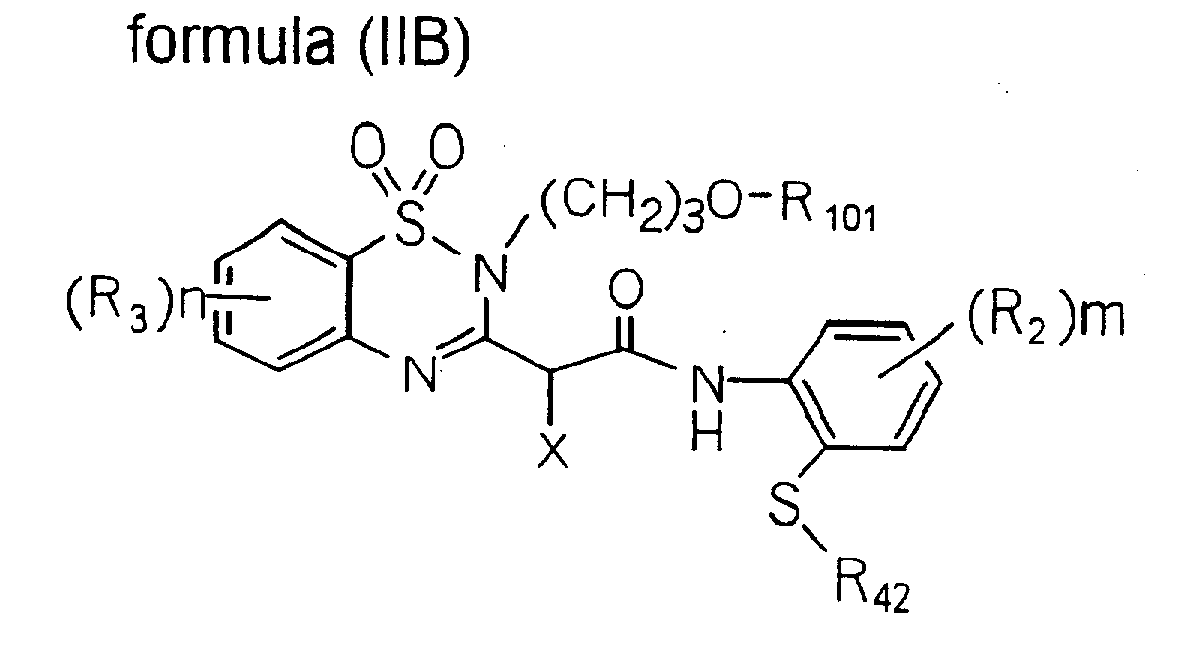
- In formula (IIB), R101, R2, R42, m, and X each have the same meanings as in formula (IB), and preferable ranges thereof are also the same.
- In formula (IIB), R3 has the same meaning as in formula (IIA), and preferable ranges thereof are also the same.
- n has the same meaning as in formula (IIA), and preferable ranges thereof are also the same.
- Preferable specific examples of the couplers represented by formula (IB) or (IIB) of the present invention are shown below. However, the present invention is not limited to these compounds. Herein, the present invention also embraces tautomers, in which the hydrogen atom at the coupling site (the hydrogen atom on the carbon atom to which X is substituting) is transferred on the nitrogen atom in the C=N portion bonding to the coupling site (the ring-constituting nitrogen atom that is not bonded with (CH2)3O-R101).


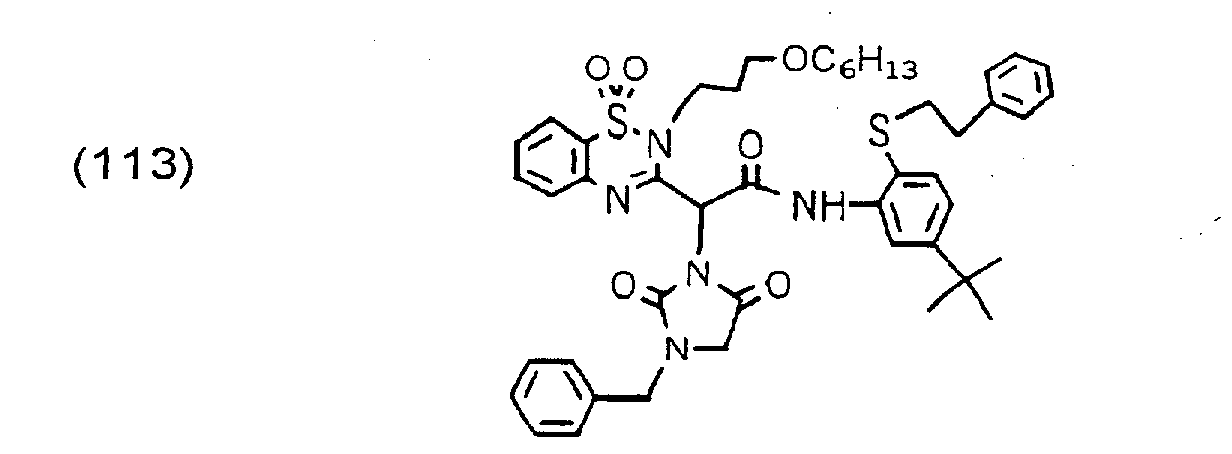
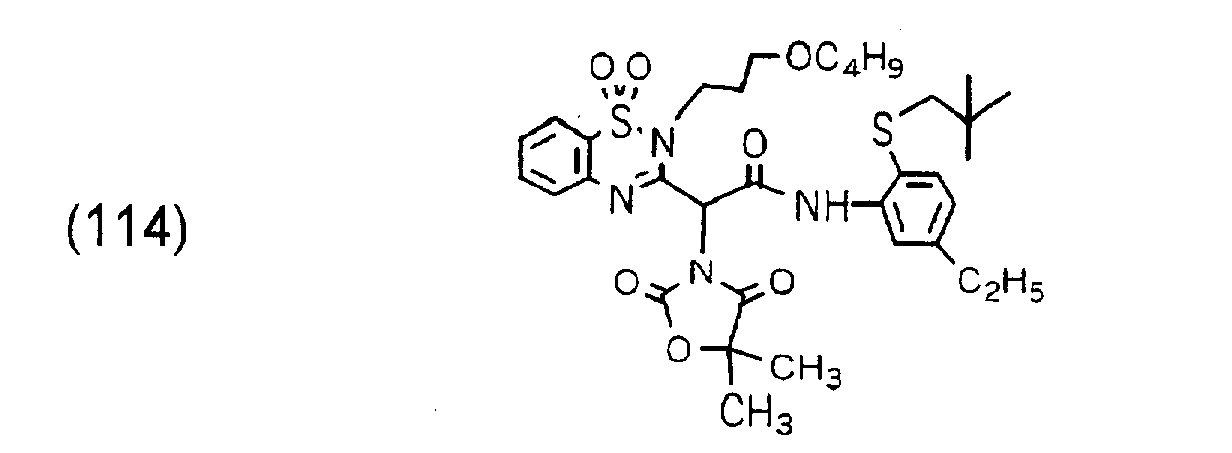


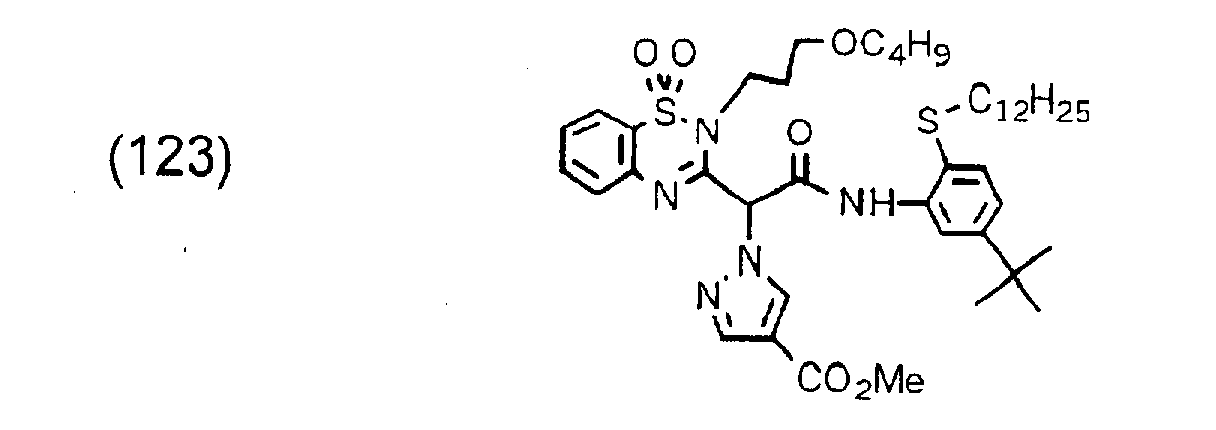


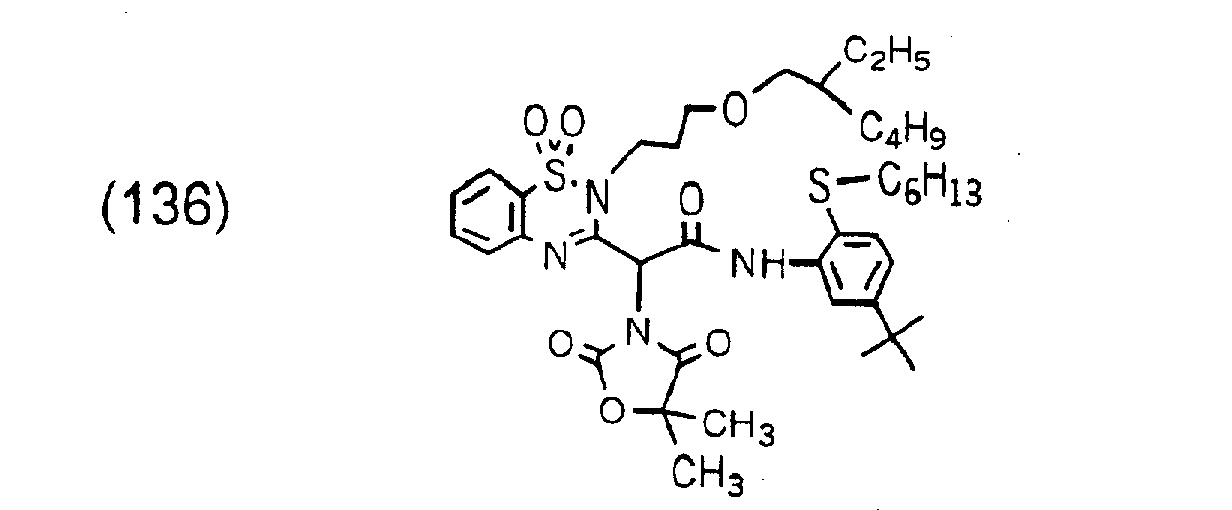


- In the following explanation, when the exemplified compounds shown above are referred to, they are expressed as "coupler (x)" or "exemplified compound (x)", with using the number x labeled to each of the exemplified compounds in the parenthesis.
- Specific synthetic examples of the compounds represented by the foregoing formula (IB) or (IIB) are described below.
- The coupler (102) was synthesized according to the following route:

- To a solution of 3-butoxypropylamine (150 g), triethylamine (192 ml) and acetonitrile (600 ml) under stirring and ice-cooling, 253 g of ortho-nitrobenzene sulfonyl chloride was gradually added. After the temperature of the reaction system was elevated to room temperature, agitation was continued for another 1 hour. Ethyl acetate and water were added for separation and extraction. The organic solvent layer was washed with dilute hydrochloric acid and saturated brine. After the organic solvent layer was dried with magnesium sulfate anhydride, the solvent was removed by vacuum distillation, to obtain 362 g of Compound (D-1) as a viscous oily product.
- 300.0 g of reduced iron and 30.0 g of ammonium chloride were dispersed in a mixture of isopropanol (1540 ml) and water (240 ml), and then heated under reflux and stirred for 1 hour. To the dispersion, 119 g of Compound (D-1) was gradually added. After heating under reflux with stirring for 2 hours, the reaction mixture was suction-filtered through celite. Ethyl acetate and water were added to the filtrate for separation and extraction. The organic solvent layer was washed with saturated brine. After the organic solvent layer was dried with magnesium sulfate anhydride, the solvent was removed by vacuum distillation, to obtain 327 g of Compound (D-2) as an oily product.
- A solution of Compound (D-2) (327 g), hydrochloride (268.4 g) of iminoether (D-0), and ethyl alcohol (450 ml) was stirred for 1 hour with heating under reflux. After cooling, the mixture was suction-filtered. To the filtrate, 500 ml of p-xylene was added, and the solution was heated under reflux for 4 hours, with eliminating ethanol by distillation. The reaction solution was poured into 1000 ml of ice water, and then 500 ml of ethyl acetate was added for extraction. The organic solvent layer was washed with saturated brine twice, and then dried with magnesium sulfate anhydride. Magnesium sulfate was separated by filtration, and ethyl acetate and xylene were removed by distillation under reduced pressure. Crystallization of the obtained oily product from 1000 ml of n-hexane gave 370.1 g of Compound (D-3).
- To a mixture of 2-ethylhexanethiol (343 g), N,N-dimethylacetamide (800 ml) and potassium carbonate (364 g), 4-t-butyl-2-nitrochlorobenzene (470 g) was added under a nitrogen atmosphere and heated and stirred at 90 °C for 2 hours. Thereafter, the reaction mixture was poured into 1000 ml of ice water, and then extraction was carried out with 1000 ml of ethyl acetate. The organic solvent layer was washed with saturated brine twice, and dried with magnesium sulfate anhydride. Magnesium sulfate was separated by filtration, and the solvents were removed by distillation under reduced pressure. Thus, 806 g of Compound (D-4) was obtained as an oily product.
- 740 g of reduced iron and 74.0 g of ammonium chloride were dispersed in a mixture of isopropanol (2200 ml) and water (370 ml), and then stirred for 1 hour with heating under reflux. To the dispersion, 806 g of Compound (D-4) was gradually added. After stirring for 2 hours with heating under reflux, the reaction mixture was suction-filtered through celite. Ethyl acetate and water were added to the filtrate for separation and extraction. The organic solvent layer was washed with saturated brine. After the organic solvent layer was dried with magnesium sulfate anhydride, the solvent was removed by vacuum distillation, to obtain 671 g of Compound (D-5) as an oily product.
- A mixture of Compound (D-3) (110 g) and Compound (D-5) (96.2 g) were heated and stirred at a temperature of 145 to 150 °C for 6 hours, to obtain a crude product of (D-6). To the reaction crude product, 300 ml of ethyl acetate was added, and then 31.2 g of N-chlorosuccinimide was added over 5 minutes to the solution under stirring and ice cooling. After the solution was stirred for 30 minutes under ice cooling, water was added for separation and extraction. The organic solvent layer was washed with saturated brine and dried with magnesium sulfate anhydride. Thereafter, the solvent was removed by vacuum distillation, to obtain a crude product of Compound (D-7).
- 5,5-dimethyloxazolidine-2,4-dione (112 g) and triethylamine (120 ml) were dissolved in N,N-dimethylacetamide (100 ml). To this solution under stirring at room temperature, a solution containing a whole amount of the previously synthesized crude product of Compound (D-7) dissolved in N,N-dimethylacetamide (150 ml) was added drop-wise over 10 minutes. Thereafter the temperature of the solution was elevated up to 80 °C, and the reaction mixture was stirred for 3 hours. Ethyl acetate and ice water were added for separation and extraction. The organic solvent layer was washed with 0.1 N potassium hydroxide aqueous solution, diluted hydrochloric acid, and saturated brine, and dried with magnesium sulfate anhydride. The solvent was eliminated by vacuum distillation. Crystallization of the residue from a mixed solvent of ethyl acetate/hexane gave 88.3 g of Coupler (102). (Melting point, 124 to 125 °C.)
- The coupler (108) was synthesized according to the following route:

- To a solution of 3-hexyloxypropylamine (120 g), triethylamine (105 ml) and acetonitrile (500 ml) under stirring and ice-cooling, 166 g of ortho-nitrobenzene sulfonyl chloride was gradually added. After elevating the temperature of the reaction system to room temperature, agitation was continued for further 3 hours. Ethyl acetate and water were added for separation and extraction. The organic solvent layer was washed with dilute hydrochloric acid and saturated brine. After the organic solvent layer was dried with magnesium sulfate anhydride, the solvent was removed by vacuum distillation, to obtain 252 g of Compound (E-1) as a viscous oily product.
- 396 g of reduced iron and 40.0 g of ammonium chloride were dispersed in a mixture of isopropanol (2600 ml) and water (300 ml), and then stirred for 1 hour with heating under reflux. To the dispersion, 487 g of Compound (E-1) was gradually added. After stirring for an another 2 hours with heating under reflux, the reaction mixture was suction-filtered through celite. Ethyl acetate and water were added to the filtrate for separation and extraction. The organic solvent layer was washed with saturated brine. After the organic solvent layer was dried with magnesium sulfate anhydride, the solvent was removed by vacuum distillation, to obtain 418 g of Compound (E-2) as an oily product.
- A solution of Compound (E-2) (418 g), ethyl diethoxyacrylate (E-0) (300 g), p-toluene sulfonic acid monohydrate (2.5 g) and toluene (980 ml) was stirred for 1 hour with heating under reflux. Further 14.9 g of potassium t-butoxide was added, and the solution was heated under reflux for 5 hours, with eliminating ethanol by distillation. The reaction solution was poured into 800 ml of ice water, and then 800 ml of ethyl acetate and 20 ml of hydrochloric acid were added for separation and extraction. The organic solvent layer was washed with saturated brine twice, and dried with magnesium sulfate anhydride. Magnesium sulfate was separated by filtration, and ethyl acetate and toluene were eliminated by distillation under reduced pressure. Crystallization of the obtained oily product from methanol and water gave 323 g of Compound (E-3).
- To a mixture comprising 2-ethylhexyl bromide (77.2 g), potassium carbonate (82.8 g) and N,N-dimethylformamide (200 ml), under a stream of N2, 50.1 g of 2-aminothiophenol was added drop-wise over 30 minutes under ice cooling. After elevating the temperature to 40 °C, the mixture was stirred for 2 hours. The reaction solution was poured to 500 ml of water, and 500 ml of ethyl acetate was used for separation and extraction. The organic solvent layer was washed with dilute hydrochloric acid and saturated brine, and dried with magnesium sulfate anhydride. After magnesium sulfate was separated by filtration, the solvent was removed by vacuum distillation, to obtain 94.1 g of Compound (E-4) as an oily product.
- A mixture of Compound (E-3) (28.7 g), Compound (E-4) (16.6 g) and xylene (20 ml) was heated and stirred for 6 hours at a temperature of 145 to 150 °C. After xylene was eliminated by distillation, the residue was purified by a silica gel column chromatography using ethyl acetate and n-hexane as eluents. 29.8 g of Compound (E-5) was obtained as an oily product.
- To 100 ml of an ethyl acetate solution containing 28.9 g of Compound (E-5) under stirring and ice-cooling, 6.4 g of N-chlorosuccinimide was added over 5 minutes. After stirring for 30 minutes under ice cooling, water was added for separation and extraction. The organic layer was washed with saturated brine, and dried with magnesium sulfate anhydride. The solvent was eliminated by vacuum distillation, to obtain a crude product of Compound (E-6).
- 5,5-dimethyloxazolidine-2,4-dione (18.6 g) and triethylamine (20 ml) were dissolved in N,N-dimethylacetamide (100 ml). To this solution, a solution containing a whole amount of the previously synthesized crude product of Compound (E-6) dissolved in N,N-dimethylacetamide (30 ml) was added drop-wise over 10 minutes at room temperature. After elevating the temperature up to 70 °C, the reaction mixture was stirred for 3 hours. Ethyl acetate and water were added for separation and extraction. The organic solvent layer was washed with 0.1 N potassium hydroxide aqueous solution, diluted hydrochloric acid, and saturated brine, and dried with magnesium sulfate anhydride. After these solvents were eliminated by vacuum distillation, the residue was purified by a silica gel column chromatography using ethyl acetate and n-hexane as eluents. 18.1 g of Coupler (108) was obtained as an oily product.
- The coupler (122) was synthesized according to the following route:

- To a mixture of n-octanethiol (26.9 g), N,N-dimethylformamide (120 ml) and potassium carbonate (38 g), under a nitrogen atmosphere, 47.5 g of 4-t-butyl-2-nitrobromobenzene was added, and then heated and stirred at 80 °C for 1 hour. Thereafter, the reaction mixture was poured into 400 ml of ice water, and 300 ml of ethyl acetate was used for separation and extraction. The organic solvent layer was washed with saturated brine twice, and dried with magnesium sulfate anhydride. After magnesium sulfate anhydride was separated by filtration, the solvent was removed by distillation under reduced pressure, to obtain 58.0 g of Compound (F-1) as an oily product.
- 84.0 g of reduced iron and 8.4 g of ammonium chloride were dispersed in a mixture of isopropanol (480 ml) and water (80 ml), and then stirred for 1 hour with heating under reflux. To this dispersion, 58.0 g of Compound (F-1) was gradually added. After further addition of 2 ml of acetic acid and stirring for 2 hours under heating and reflux, the reaction mixture was suction-filtered through celite. Ethyl acetate and water were added to the filtrate for separation and extraction. The organic solvent layer was washed with saturated brine. After the organic solvent layer was dried with magnesium sulfate anhydride, the solvent was removed by vacuum distillation. The residue was purified by a silica gel column chromatography using ethyl acetate and n-hexane as eluents. 43.3 g of Compound (F-2) was obtained as an oily product.
- A mixture of Compound (D-3) (53.6 g), Compound (F-2) (43.0 g) and xylene (100 ml) was heated and stirred for 6 hours at a temperature of 145 to 150 °C. After xylene was eliminated by distillation, the residue was purified by a silica gel column chromatography using ethyl acetate and n-hexane as eluents. 59.5 g of Compound (F-3) was obtained as an oily product.
- To 200 ml of an ethyl acetate solution containing 59.2 g of Compound (F-3), 12.5 g of N-chlorosuccinimide was added over 25 minutes under stirring and ice cooling. After stirring for 30 minutes under ice cooling, water was added for separation. The organic solvent layer was washed with saturated brine, and dried with magnesium sulfate anhydride. The solvent was eliminated by vacuum distillation, to obtain a crude product of Compound (F-4).
- 5,5-dimethyloxazolidine-2,4-dione (36.4 g) and triethylamine (39 ml) were dissolved in N,N-dimethylacetamide (170 ml). To this solution, a solution containing a whole amount of the previously synthesized crude product of Compound (F-4) in N,N-dimethylacetamide (30 ml) was added drop-wise over 10 minutes with stirring at room temperature. After elevating the temperature up to 70 °C, the reaction mixture was stirred for 3 hours. Ethyl acetate and water were added for separation and extraction. The organic solvent layer was washed with 0.1 N potassium hydroxide aqueous solution, diluted hydrochloric acid, and saturated brine, and dried with magnesium sulfate anhydride. After the solvents were eliminated by vacuum distillation, crystallization of the residue from a mixed solvent of isopropanol and hexane gave 59.8 g of Coupler (122). (Melting point, 104 to 106 °C.)
- In addition to the above Synthetic example 4, the Coupler (102) was synthesized according to the following route.

- To a solution of 3-butoxypropylamine (181.2 g), triethylamine (198.2 ml) and toluene (840 ml) under stirring and ice-cooling, 300.0 g of ortho-nitrobenzene sulfonyl chloride was gradually added. After elevating the temperature of the reaction system to 40 °C, further agitation was continued for 1 hour. 50 ml of hydrochloric acid and 750 ml of water were added for separation and extraction. The organic solvent layer was washed with 750 ml of sodium bicarbonate aqueous solution, to obtain a reaction solution of Compound (D-1).
- To a mixture of 8.5 g 10% Pd/C and 50 ml of water, the reaction solution of Compound (D-1) and 100 ml of toluene were added, and then 165 g of 80% hydrazine hydrate and 50 ml of water were added drop-wise, at 40 °C, over 1 hour. Then the mixture was stirred for another 1 hour at 45 °C. The reaction mixture was filtered through celite, the filtrate was washed with 350 ml of toluene, 500 ml of isopropanol, and 1.5 liter of water, and then it was subjected to separation and extraction. The organic solvent layer was washed with 500 ml of water twice, and the reaction solution of Compound (D-2) was obtained. After the reaction solution was subjected to vacuum concentration to remove 800 ml of the solvent, 400 ml of toluene, 305.7 g of 3,3-diethoxyacrylic acid ethyl, and 2.6 g of p-toluene sulfonic acid monohydrate were added, and stirred for 30 minutes at 85 °C. Further, 13.8 g of 90% sodium ethoxide was added, and the solution was heated and stirred for 4 hours at 120 °C. After cooling the solution, 25 ml of hydrochloric acid and 500 ml of water were added for separation and extraction. Further, 50 g of p-toluene sulfonic acid monohydrate and 500 ml of water were added to wash the organic layer. The solvent was removed by vacuum concentration. Crystallization was conducted by adding 600 ml of methanol and 30 ml of water, and then 100 ml of methanol and 110 ml of water were added drop-wise, and the system was cooled to 0 °C. Suction-filtration was conducted, and the resultant was washed with methanol-water, to obtain 440.1 g of Compound (D-3).
- To a solution of 470 g of 4-t-butyl-2-nitrochlorobenzene and 14 g of tetrabutyl ammonium dissolved in 450 ml of toluene, a solution of 132 g of sodium hydroxide dissolved in 450 ml of water was added under nitrogen atmosphere. To this solution, 330 g of 2-ethylhexanethiol was added drop-wise at 70 °C over 1 hour and 30 minutes. Further, the solution was heated and stirred for 1 hour at 70 °C, and then 400 ml of toluene was added for separation and extraction. The organic solvent layer was washed with water twice, to obtain a reaction solution of Compound (D-4).
- In an autoclave were placed the entire amount of the reaction solution of Compound (D-4) and 10 g of Ranye Nickel, and 1500 ml of methanol, and hydrogen gas was filled therein, to pressurize. The mixture was stirred at 90 °C for 6 hours with hydrogen gas replenished. The solution was suction-filtered through celite, to remove the catalyst. To the filtrate, toluene and water were added for separation and extraction. The organic solvent layer was washed with water. The solvent was removed by vacuum distillation, to obtain 620 g of an oily product of Compound (D-5).
- A mixture of 110 g of Compound (D-3), 84.5 g of Compound (D-5) and 200 ml of xylene was heated and stirred at 145 to 150 °C for 6 hours, with intermittent removal of the solvent under reduced pressure, to obtain a crude product of Compound (D-6). To the crude reaction product, 300 ml of toluene was added, and then 43.6 g of 1,3-dibromo-5,5-dimethylhydantoin was added over 15 minutes to the solution under stirring and ice cooling. After stirring for further 1 hour at room temperature, water was added to the solution for separation and extraction. The organic solvent layer was washed with water, to obtain a reaction solution of Compound (D-8).
- To a mixture of 39.0 g of 5,5-dimethyloxazolidine-2,4-dione, 41.8 g of potassium carbonate and 150 ml of N,N-dimethylacetamide, under stirring at room temperature, the entire amount of the above prepared reaction solution of Compound (D-8) was added drop-wise, over 30 minutes. Thereafter, the temperature was elevated up to 50 °C, and the solution was stirred for 2 hours. The organic solvent layer was separated, and the organic solvent layer was washed with 0.1 N potassium hydroxide aqueous solution, diluted hydrochloric acid, and water. The solvent was removed by vacuum distillation. Crystallization from methanol solvent gave 172.0 g of Coupler (102).
- In the present invention, a silver halide color photographic light-sensitive material (hereinafter, sometimes referred to simply as "light-sensitive material") which has, on a support, at least one silver halide emulsion layer containing a yellow dye-forming coupler, at least one silver halide emulsion layer containing a magenta dye-forming coupler, and at least one silver halide emulsion layer containing a cyan dye-forming coupler, is preferably used.
- In the present invention, the silver halide emulsion layer containing a yellow dye-forming coupler functions as a yellow color developing layer, the silver halide emulsion layer containing a magenta dye-forming coupler functions as a magenta color developing layer, and the silver halide emulsion layer containing a cyan dye-forming coupler functions as a cyan color developing layer. Preferably, the silver halide emulsions contained in the yellow color developing layer, the magenta color developing layer, and the cyan color developing layer may have photosensitivities to mutually different wavelength regions (for example, light in a blue region, light in a green region and light in a red region).
- In addition to the yellow color developing layer, the magenta color developing layer, and the cyan color developing layer, the light-sensitive material of the present invention may have a hydrophilic colloid layer, an antihalation layer, an intermediate layer and coloring layer, as desired.
- In the silver halide photographic light-sensitive material of the present invention, the yellow dye-forming coupler of the present invention is added in an amount preferably 1 x 10⁻³ mole to 1 mole, and more preferably 2 x 10⁻³ to 3 x 10⁻¹ mole, per mol of silver halide.
- It is preferable that the silver halide photographic light-sensitive material of the present invention contains at least one of the above-described yellow dye-forming couplers, in at least one layer on a support.
- The silver halide light-sensitive material preferably used in the present invention is explained below in detail.
- The silver halide color photographic light-sensitive material preferably used in the present invention is suitable for a light-sensitive material of the type that uses a coupler. Particularly the light-sensitive material is suitable for various color light-sensitive materials, such as color negative films for general purposes or movies, color reversal films for slides or television, color papers, color positive films for general purposes or movies, light-sensitive materials for display, color reversal papers, and color proofs for scanning exposure or area exposure; and black-and-white light-sensitive materials using a coupler. Further, such color negative films are suitable for film unites with a lens, as described in JP-B-2-32615 ("JP-B" means examined Japanese patent publication) and JU-B-3-39784 ("JU-B" means examined Japanese Utility-model Registration Publication).
- Among these light-sensitive materials, silver halide color photographic light-sensitive materials with which observers directly observe, such as a color reversal film for slide or television, a color paper (a color photographic paper), a color positive film for general purposes or movies, a light-sensitive material for display, a color reversal paper and color proof for scanning exposure or area exposure are preferable. Further, a color paper (a color photographic paper), a color positive film for general purposes or movies, a light-sensitive material for display, a color reversal paper and a color proof for scanning exposure or area exposure are more preferable. Particularly a color paper (a color photographic paper), a light-sensitive material for display, and a color proof for scanning exposure are most preferable.
- Silver halide grains in the silver halide emulsion for use in the present invention, are preferably cubic or tetradecahedral crystal grains substantially having {100} planes (these grains may be rounded at the apexes thereof and further may have planes of higher order), or octahedral crystal grains. Alternatively, a silver halide emulsion in which the proportion of tabular grains having an aspect ratio of 2 or more and composed of {100} or {111} planes account for 50% or more in terms of the total projected area, can also be preferably used. The term "aspect ratio" refers to the value obtained by dividing the diameter of the circle having an area equivalent to the projected area of an individual grain by the thickness of the grain. In the present invention, cubic grains, or tabular grains having {100} planes as major faces, or tabular grains having {111} planes as major faces are preferably used.
- As a silver halide emulsion for use in the present invention, for example, silver chloride, silver bromide, silver iodobromide, or silver chloro(iodo)bromide emulsions may be used. It is preferable for a rapid processing to use a silver chloride, silver chlorobromide, silver chloroiodide, or silver chlorobromoiodide emulsion having a silver chloride content of 90 mol% or greater, and more preferably a silver chloride, silver chlorobromide, silver chloroiodide, or silver chlorobromoiodide emulsion having a silver chloride content of 98 mol% or greater. Preferred of these silver halide emulsions are those having in the shell parts of silver halide grains a silver iodochloride phase with a silver iodide content of 0.01 to 0.50 mol%, more preferably 0.05 to 0.40 mol%, per mol of the total silver, in view of high sensitivity and excellent high illumination intensity exposure suitability. Further, especially preferred of these silver halide emulsions are those containing silver halide grains having on the surface thereof a silver bromide localized phase with a silver bromide content of 0.2 to 5 mol%, more preferably 0.5 to 3 mol%, per mol of the total silver, since both high sensitivity and stabilization of photographic properties are attained.
- The silver halide emulsion for use in the present invention preferably contains silver iodide. In order to introduce iodide ions, an iodide salt solution may be added alone, or such an iodide salt solution may be added in combination with both a silver salt solution and a high chloride salt solution. In the latter case, the iodide salt solution and the high chloride salt solution may be added separately or as a mixed solution of these salts of iodide and high chloride. The iodide salt is generally added in the form of a soluble salt, such as alkali or alkali earth iodide salt. Alternatively, iodide ions may be introduced by cleaving iodide ions from an organic molecule, as described in U.S. Patent No. 5,389,508. Further, as another source of iodide ions, fine silver iodide grains may be used.
- The addition of such an iodide salt solution may be concentrated at one time of grain formation process, or it may be performed over a certain period of time. For obtaining an emulsion with high sensitivity and low fog, the position of the introduction of an iodide ion to a high silver chloride emulsion grain is restricted. The deeper in the emulsion grain the iodide ion is introduced, the smaller is the increment of sensitivity. Therefore, the addition of an iodide salt solution is preferably started at 50% or outer side of the volume of a grain, more preferably 70% or outer side, and most preferably 80% or outer side. Moreover, the addition of an iodide salt solution is preferably finished at 98% or inner Side of the volume of a grain, more preferably 96% or inner side. An emulsion having higher sensitivity and lower fog can be obtained, by finishing the addition of an iodide salt solution at a little inner side from the grain surface.
- The distribution of an iodide ion concentration in the depth direction inside a grain can be measured according to an etching/TOF-SIMS (Time of Flight-Secondary Ion Mass Spectrometry) method by means of, for example, a TRIFT II Model TOF-SIMS apparatus (trade name, manufactured by Phi Evans Co.). A TOF-SIMS method is specifically described in Nippon Hyomen Kagakukai edited, Hyomen Bunseki Gijutsu Sensho Niji Ion Shitsuryo Bunsekiho (Surface Analysis Technique Selection - Secondary Ion Mass Analytical Method), Maruzen Co., Ltd. (1999). When an emulsion grain is analyzed by the etching/TOF-SIMS method, it is confirmed that iodide ions ooze toward the surface of the grain, even if the addition of an iodide salt solution is finished at an inner side of the grain. It is preferred that, when an emulsion for use in the present invention contains silver iodide, grains of the emulsion have the maximum concentration of iodide ions at the surface of grain, and the iodide ion concentration decreases inwardly in grain, in the analysis by etching/TOF-SIMS.
- The silver halide grains of the silver halide emulsion in the light-sensitive material of the present invention preferably have a silver bromide localized phase.
- When the silver halide grains for use in the present invention contain a silver bromide localized phase, the silver bromide localized phase is preferably formed by epitaxial growth of the localized phase having a silver bromide content of at least 10 mol% on the grain surface. In addition, the emulsion grains preferably have the outermost shell portion having a silver bromide content of 1 mol% or more in the vicinity of the surface of the grains.
- The silver bromide content of the silver bromide localized phase is preferably in the range of 1 to 80 mol%, and most preferably in the range of 5 to 70 mol%. The silver bromide localized phase is preferably composed of silver having population of 0.1 to 30 mol%, more preferably 0.3 to 20 mol%, to the molar amount of the entire silver which constitutes silver halide grains for use in the present invention. The silver bromide localized phase is preferably doped with complex ions of a metal of the Group VIII, such as iridium ion. The amount of these compounds to be added can be varied in a wide range depending on the purposes, and it is preferably in the range of 10-9 to 10-2 mol per mol of silver halide.
- In the present invention, a metal ion is preferably added in the course of grain formation and/or growth of the silver halide grains, to include the metal ion in the inside and/or on the surface of the silver halide grains. The metal ion to be used is preferably a transition metal ion. Preferable examples of the transition metal are iron, ruthenium, iridium, osmium, lead, cadmium or zinc. It is more preferable that these metal ions are used, together with ligands, in the form of a six-coordination complex of octahedron-type. When an inorganic compound is employed as a ligand, cyanide ion, halide ion, thiocyanato, hydroxide ion, peroxide ion, azide ion, nitrite ion, water, ammonia, nitrosyl ion, or thionitrosyl ion is preferably used. Such a ligand is preferably coordinated to any metal ion selected from a group consisting of the above-mentioned iron, ruthenium, iridium, osmium, lead, cadmium and zinc. Two or more kinds of these ligands are also preferably used in one complex molecule.
- Among them, the silver halide grains of the silver halide emulsion for use in the present invention particularly preferably contain an iridium ion having at least one organic ligand, for the purpose of improving high intensity reciprocity law failure.
- When an organic compound is used as a ligand, preferable examples of the organic compound include chain compounds having a main chain of 5 or less carbon atoms and/or heterocyclic compounds of 5- or 6-membered ring; and this is also applicable to the transition metals other than iridium. More preferable examples of the organic compound are those having a nitrogen, phosphorus, oxygen, or sulfur atom in their molecule as an atom which is capable of coordinating to a metal. Most preferred organic compounds are furan, thiophene, oxazole, isooxazole, thiazole, isothiazole, imidazole, pyrazole, triazole, furazane, pyran, pyridine, pyridazine, pyrimidine and pyrazine. Further, organic compounds which have a substituent introduced into a basic skeleton of the above-mentioned compounds are also preferred.
- Among these compounds, 5-methylthiazole among thiazole ligands is particularly preferably used as the ligand preferable for iridium ion.
- Preferable combinations of a metal ion and a ligand are those of iron or ruthenium ion and cyanide ion. Preferred of these compounds are those in which the number of cyanide ions accounts for the majority of the coordination number intrinsic to the iron or ruthenium, the central metal. The remaining coordination site(s) are preferably occupied by thiocyan, ammonia, water, nitrosyl ion, dimethylsulfoxide, pyridine, pyrazine, or 4,4'-bipyridine. Most preferably each of 6 coordination sites of the central metal is occupied by a cyanide ion, to form a hexacyano iron complex or a hexacyano ruthenium complex. These metal complexes having cyanide ion ligands are preferably added, during grain formation, in an amount of 1 × 10⁻⁸ mol to 1 × 10⁻² mol, most preferably 1 × 10⁻⁶ mol to 5 × 10⁻⁴ mol, per mol of silver.
- In the case of the iridium ion, preferable ligands are fluoride, chloride, bromide and iodide ions, not only the organic ligands. Among these ligands, chloride and bromide ions are more preferably used. The following specific compounds can be used as iridium complexes, in addition to the above mentioned complexes having organic ligand(s): [IrCl6]3-, [IrCl6]2-, [IrCl5(H2O)]2-, [IrCl5(H2O)]-, [IrCl4(H2O)2]-, [IrCl4(H2O)2]0, [IrCl3(H2O)3]0, [IrCl3(H2O)3]+, [IrBr6]3-, [IrBr6]2-, [IrBr5(H2O)]2-, [IrBr5(H2O)]-, [IrBr4(H2O)2]-, [IrBr4(H2O)2]0, [IrBr3(H2O)3]0, and [IrBr3(H2O)3]+. These iridium complexes are preferably added during grain formation in an amount of 1 × 10⁻¹⁰ mol to 1 × 10⁻³ mol, most preferably 1 × 10⁻⁸ mol to 1 × 10⁻⁵ mol, per mol of silver.
- In the case of employing ruthenium or osmium as a central metal, nitrosyl ion, thionitrosyl ion, water molecule and chloride ion are preferably used as ligands, singly or in combination. More preferably these ligands form a pentachloronitrosyl complex, a pentachlorothionitrosyl complex, or a pentachloroaquo complex. To form a hexachloro complex is also preferred. These complexes are preferably added during grain formation in an amount of 1 × 10⁻¹⁰ mol to 1 × 10⁻⁶ mol, more preferably 1 × 10⁻⁹ mol to 1 × 10⁻⁶ mol, per mol of silver.
- In the present invention, the above-mentioned complexes are preferably added directly to the reaction solution at the time of silver halide grain formation, or indirectly to the grain-forming reaction solution via addition to an aqueous halide solution for forming silver halide grains or other solutions, so that they are doped to the inside of the silver halide grains. Further, these methods are preferably combined to incorporate the complex into the inside of the silver halide grains.
- In the case where these complexes are doped to the inside of the silver halide grains, they are preferably uniformly distributed in the inside of the grains. Alternatively, as disclosed in JP-A-4-208936, JP-A-2-125245 and JP-A-3-188437, they are also preferably distributed only in the grain surface layer. Further, they are also preferably distributed only in the inside of the grain while the grain surface is covered with a layer free from the complex. Further, as disclosed in U.S. Patent Nos. 5,252,451 and 5,256,530, it is also preferred that the silver halide grains are subjected to physical ripening to modify the grain surface layer, in the presence of fine grains having such complexes incorporated therein. Further, these methods may be used in combination. Two or more kinds of complexes may be incorporated in the inside of an individual silver halide grain. The halogen composition at the position (portion) where the complexes are incorporated, is not particularly limited, but they are preferably incorporated in any of a silver chloride layer, a silver chlorobromide layer, a silver bromide layer, a silver iodochloride layer and a silver iodobromide layer.
- The silver halide grains contained in the silver halide emulsion for use in the present invention have an average grain size (the term "grain size" herein refers to the diameter of the circle equivalent to the projected area of the grain, and the number average thereof is taken as the average grain size) of preferably from 0.01 µm to 2 µm.
- With respect to the distribution of sizes of these grains, so called monodisperse emulsion having a variation coefficient (the value obtained by dividing the standard deviation of the grain size distribution by the average grain size) of 20% or less, more preferably 15% or less, and further preferably 10% or less, is preferred. For obtaining a wide latitude, it is also preferred to blend the above-described monodisperse emulsions in the same layer or to form a multilayer structure by multilayer-coating of the monodisperse emulsions.
- Various compounds or precursors thereof can be included in the silver halide emulsion for use in the present invention, to stabilize photographic performance or to prevent fogging from occurring, during manufacture, storage or photographic processing of the light-sensitive material. Specific examples of compounds useful for the above purposes are disclosed in JP-A-62-215272, pages 39 to 72, and they can be preferably used. In addition, 5-arylamino-1,2,3,4-thiatriazole compounds (the aryl residual group has at least one electron-attractive group) disclosed in EP No. 0 447 647 are also preferably used.
- Further, in order to enhance storage stability of the silver halide emulsion for use in the present invention, it is also preferred in the present invention to use hydroxamic acid derivatives described in JP-A-11-109576; cyclic ketones having a double bond adjacent to a carbonyl group, both ends of said double bond being substituted with an amino group or a hydroxyl group, as described in JP-A-11-327094 (particularly compounds represented by formula (S1); the description at paragraph Nos. 0036 to 0071 of JP-A-11-327094 is incorporated herein by reference); sulfo-substituted catecols and hydroquinones described in JP-A-11-143011 (for example, 4,5-dihydroxy-1,3-benzenedisulfonic acid, 2,5-dihydroxy-1,4-benzenedisulfonic acid, 3,4-dihydroxybenzenesulfonic acid, 2,3-dihydroxybenzenesulfonic acid, 2,5-dihydroxybenzenesulfonic acid, 3,4,5-trihydroxybenzenesulfonic acid and salts of these acids); water-soluble reducing agents represented by formula (I), (II), or (III) of JP-A-11-102045.
- Spectral sensitization can be carried out for the purpose of imparting spectral sensitivity in a desired light wavelength region to the light-sensitive emulsion in each layer of the light-sensitive material for use in the present invention.
- Examples of spectral sensitizing dyes, which can be used in the light-sensitive material of the present invention, for spectral sensitization of blue, green and red light regions include, for example, those disclosed by F. M. Harmer, in Heterocyclic compounds - Cyanine dyes and related compounds, John Wiley & Sons, New York, London (1964). Specific examples of such compounds and spectral sensitization processes that are preferably used in the present invention include those described in JP-A-62-215272, from page 22, right upper column to page 38. In addition, the spectral sensitizing dyes described in JP-A-3-123340 are very preferred as red-sensitive spectral sensitizing dyes for silver halide emulsion grains having a high silver chloride content, from the viewpoint of stability, adsorption strength and temperature dependence of exposure, and the like.
- The amount of these spectral sensitizing dyes to be added can be varied in a wide range depending on the occasion, and it is preferably in the range of 0.5 × 10⁻⁶ mole to 1.0 × 10⁻² mole, more preferably in the range of 1.0 × 10⁻⁶ mole to 5.0 × 10⁻³ mole, per mole of silver halide.
- The silver halide emulsions for use in the present invention are generally chemically sensitized. Chemical sensitization can be performed by utilizing a sulfur sensitization, represented by the addition of an unstable sulfur compound, noble metal sensitization represented by gold sensitization, and reduction sensitization, each singly or in combination thereof. Compounds that are preferably used for chemical sensitization include those described in JP-A-62-215272, from page 18, right lower column to page 22, right upper column. Of these, gold-sensitized silver halide emulsions are particularly preferred, since a change in photographic properties which occurs when scanning exposure with laser beams or the like is conducted, can be further reduced by gold sensitization.
- In order to conduct gold sensitization to the silver halide emulsion for use in the present invention, various inorganic gold compounds, gold (I) complexes having an inorganic ligand, and gold (I) compounds having an organic ligand may be used. Inorganic gold compounds, such as chloroauric acid or salts thereof; and gold (I) complexes having an inorganic ligand, such as dithiocyanato gold compounds (e.g., potassium dithiocyanatoaurate (I)), and dithiosulfato gold compounds (e.g., trisodium dithiosulfatoaurate (I)), are preferably used.
- As the gold (I) compounds having an organic ligand, the bis gold (I) mesoionic heterocycles described in JP-A-4-267249, for example, gold (I) tetrafluoroborate bis(1,4,5-trimethyl-1,2,4-triazolium-3-thiolate), the organic mercapto gold (I) complexes described in JP-A-11-218870, for example, potassium bis(1-[3-(2-sulfonatobenzamido)phenyl]-5-mercaptotetrazole potassium salt) aurate (I) pentahydrate, and the gold (I) compound with a nitrogen compound anion coordinated therewith described in JP-A-4-268550, for example, gold (I) bis(1-methylhydantoinate) sodium salt tetrahydrate may be used. Also, the gold (I) thiolate compound described in US Patent No. 3,503,749, the gold compounds described in JP-A-8-69074, JP-A-8-69075 and JP-A-9-269554, and the compounds described in US Patent No. 5,620,841, US Patent No. 5,912,112, US Patent No. 5,620,841, US Patent NO. 5,939,245, and US Patent No. 5,912,111 may be used.
- The amount of these compounds to be added can be varied in a wide range depending on the occasion, and it is generally in the range of 5 × 10⁻⁷ mole to 5 × 10⁻³ mole, preferably in the range of 5 × 10⁻⁶ mole to 5 × 10⁻⁴ mole, per mole of silver halide.
- The silver halide emulsion for use in the present invention is preferably subjected to gold sensitization using a colloidal gold sulfide. A method of producing the colloidal gold sulfide is described in, for example, Research Disclosure, No. 37154, Solid State Ionics, Vol. 79, pp. 60 to 66 (1995), and Compt. Rend Hebt. Seances Acad. Sci. Sect. B, Vol. 263, p. 1328 (1966). Colloidal gold sulfides of various grain sizes can be used, and even those having a grain diameter of 50 nm or less are also usable. The amount of these compounds to be added can be varied in a wide range depending on the occasion, and it is generally in the range of 5 × 10⁻⁷ mol to 5 × 10⁻³ mol, preferably in the range of 5 × 10⁻⁶ mol to 5 × 10⁻⁴ mol, per mol of silver halide.
- In the present invention, gold sensitization may be used in combination with other sensitizing method(s), for example, sulfur sensitization, selenium sensitization, tellurium sensitization, reduction sensitization, and noble metal sensitization using a noble metal compound other than gold compounds.
- The light-sensitive material of the present invention preferably contains, in their hydrophilic colloid layers, dyes (particularly oxonole dyes and cyanine dyes) capable of being discolored by processing, as described in European Patent No. 0337490 A2, pages 27 to 76, in order to prevent irradiation or halation or to enhance safelight safety (immunity) or the like. Further, dyes described in European Patent No. 0819977 are also preferably used in the present invention. Among these water-soluble dyes, some deteriorate color separation or safelight safety when used in an increased amount. Preferable examples of the dye that can be used without deteriorating color separation, include water-soluble dyes described in JP-A-5-127324, JP-A-5-127325 and JP-A-5-216185.
- In the present invention, use can be made of a colored layer capable of being discolored during processing, in place of the water-soluble dye, or in combination with the water-soluble dye. The colored layer capable of being discolored by a processing, to be used, may be arranged so as to contact with a light-sensitive emulsion layer directly, or indirectly through an interlayer containing an agent for preventing color-mixing during processing, such as gelatin and hydroquinone. The colored layer is preferably provided as a lower layer (closer to the support) with respect to an emulsion layer which develops the same primary color as the color of the colored layer. It is possible to provide colored layers corresponding to respective primary colors, independently. Alternatively, any one or more layers selected from the above colored layers may be provided. In addition, it is possible to provide a colored layer subjected to coloring so as to match a plurality of primary-color regions. About the optical reflection density of the colored layer, it is preferred that, in a range of wavelengths used for exposure (a visible light region from 400 nm to 700 nm for an ordinary printer exposure, and wavelengths in accordance to wavelengths of the light source to be used in the case of scanning exposure), the optical density at a wavelength which provides the highest optical density is within the range of 0.2 to 3.0, more preferably 0.5 to 2.5, and particularly preferably 0.8 to 2.0.
- The colored layer described above may be formed by a known method. For example, there are a method of incorporating a dye in a state of a dispersion of solid fine particles into a hydrophilic colloid layer, as described in JP-A-2-282244, from page 3, upper right column to page 8, and JP-A-3-7931, from page 3, upper right column to page 11, left under column; a method of mordanting an anionic dye in a cationic polymer, a method of allowing a dye to be adsorbed onto fine grains of silver halide or the like and fixed in the layer, and a method of using a colloidal silver as described in JP-A-1-239544. As to a method of dispersing fine-powder of a dye in solid state, for example, JP-A-2-308244, pages 4 to 13 describes a method of incorporating fine particles of a dye which is substantially water-insoluble at least at the pH of 6 or less, but is substantially water-soluble at least at the pH of 8 or more. The method of mordanting anionic dyes in a cationic polymer is described, for example, in JP-A-2-84637, pages 18 to 26. U.S. Patent Nos. 2,688,601 and 3,459,563 disclose a method of preparing a colloidal silver to be used as a light absorber. Among these methods, preferred are the methods of incorporating fine particles of dye and the methods of using a colloidal silver.
- When the present invention is applied to a color photographic paper, it is preferable that the material has at least one yellow color-forming silver halide emulsion layer, at least one magenta color-forming silver halide emulsion layer, and at least one cyan color-forming silver halide emulsion layer. Generally, these silver halide emulsion layers are in the order, from the support, of the yellow color-forming silver halide emulsion layer, the magenta color-forming silver halide emulsion layer and the cyan color-forming silver halide emulsion layer.
- However, other layer arrangements which are different from the above, may be adopted.
- In the light-sensitive material of the present invention, a yellow coupler-containing silver halide emulsion layer may be disposed at any position on a support. However, in the case where silver halide tabular grains are contained in the yellow coupler-containing layer, it is preferable that the yellow coupler-containing layer be positioned more apart from the support than at least one of a magenta coupler-containing silver halide emulsion layer and a cyan coupler-containing silver halide emulsion layer. Further, it is preferable that the yellow coupler-containing silver halide emulsion layer be positioned most apart from the support than other silver halide emulsion layers, from the viewpoint of color-development acceleration, desilvering acceleration, and reduction of residual color due to a sensitizing dye. Further, it is preferable that the cyan coupler-containing silver halide emulsion layer be disposed in the middle of other silver halide emulsion layers, from the viewpoint of reducing blix fading. It is preferable that the cyan coupler-containing silver halide emulsion layer be the lowest layer, from the viewpoint of reducing light fading. Further, each of the yellow-color-forming layer, the magenta-color-forming layer and the cyan-color-forming layer may be composed of two or three layers. It is also preferable that a color forming layer be formed by disposing a silver halide emulsion-free layer containing a coupler in adjacent to a silver halide emulsion layer, as described in, for example, JP-A-4-75055, JP-A-9-114035, JP-A-10-246940, and US Patent No. 5,576,159.
- In this connection, hydrophilic colloid layers are generally provided between respective color-forming silver halide emulsion layers; and over a color-forming silver halide emulsion layer remotest from the support, on the side opposite to the support side. Besides, it is also a preferable embodiment of the present invention to provide a-hydrophilic colloid layer between the support and a color-forming silver halide emulsion layer nearest to the support. These layers are preferably coated simultaneously by the method described, for example, in U.S. Patent No. 5,393,571 (more preferably by curtain coating method).
- Preferred examples of silver halide emulsions, other materials (additives and the like), and photographic constitutional layers (arrangement of the layers and the like) for use in the present invention, and processing methods for processing the light-sensitive materials and additives for processing are disclosed in JP-A-62-215272, JP-A-2-33144 and European Patent No. 0355660 A2. Particularly, those disclosed in European Patent No. 0355660 A2 are preferably used. Further, it is also preferred to use silver halide color photographic light-sensitive materials and processing methods thereof disclosed in, for example, JP-A-5-34889, JP-A-4-359249, JP-A-4-313753, JP-A-4-270344, JP-A-5-66527, JP-A-4-34548, JP-A-4-145433, JP-A-2-854, JP-A-1-158431, JP-A-2-90145, JP-A-3-194539, JP-A-2-93641 and European Patent Publication No. 0520457 A2.
- In particular, as reflective supports and silver halide emulsions, as well as different kinds of metal ions to be doped in silver halide grains, storage stabilizers or antifogging agents of silver halide emulsions, methods of chemical sensitization (sensitizers), methods of spectral sensitization (spectral sensitizers), cyan, magenta, and yellow couplers and emulsifying and dispersing methods thereof, image stability-improving agents (stain inhibitors and discoloration inhibitors), dyes (coloring layers), kinds of gelatin, layer structures of light-sensitive materials, and film pH of light-sensitive materials, those described in the patent publications as shown in the following tables are particularly preferably used in the present invention.


- As cyan, magenta and yellow couplers which can be used in the present invention, besides the above mentioned ones, those disclosed in JP-A-62-215272, page 91, right upper column, line 4 to page 121, left upper column, line 6, JP-A-2-33144, page 3, right upper column, line 14 to page 18, left upper column, bottom line, and page 30, right upper column, line 6 to page 35, right under column, line 11, European Patent No. 0355,660 (A2), page 4, lines 15 to 27, page 5, line 30 to page 28, bottom line, page 45, lines 29 to 31, page 47, line 23 to page 63, line 50, are also advantageously used.
- Further, it is also preferred for the present invention to add compounds represented by formula (II) or (III) in WO 98/33760 and compounds represented by formula (D) described in JP-A-10-221825.
- As the cyan dye-forming coupler (hereinafter also referred to as "cyan coupler") which can be used in the present invention, pyrrolotriazole-series couplers are preferably used, and more specifically, couplers represented by any of formulae (I) and (II) in JP-A-5-313324 and couplers represented by formula (I) in JP-A-6-347960 are preferred. Exemplified couplers described in these publications are particularly preferred. Further, phenol-series or naphthol-series cyan couplers are also preferred. For example, cyan couplers represented by formula (ADF) described in JP-A-10-333297 are preferred. As cyan couplers other than the foregoing cyan couplers, there are pyrroloazole-type cyan couplers described in European Patent Nos. 0 488 248 and 0 491 197 (A1), 2,5-diacylamino phenol couplers described in U.S. Patent No. 5,888,716, and pyrazoloazole-type cyan couplers having an electron-withdrawing group or a group bonding via hydrogen bond at the 6-position, as described in U.S. Patent Nos. 4,873,183 and 4,916,051, and particularly preferred are pyrazoloazole-type cyan couplers having a carbamoyl group at the 6-position, as described in JP-A-8-171185, JP-A-8-311360 and JP-A-8-339060.
- In addition, the cyan dye-forming coupler for use in the present invention can also be a diphenylimidazole-series cyan coupler described in JP-A-2-33144; as well as a 3-hydroxypyridine-series cyan coupler (particularly a 2-equivalent coupler formed by allowing a 4-equivalent coupler of coupler (42) to have a chlorine split-off group, and couplers (6) and (9), enumerated as specific examples are particularly preferable) described in EP 0333185 A2; a cyclic active methylene-series cyan coupler (particularly couplers 3, 8, and 34 enumerated as specific examples are particularly preferable) described in JP-A-64-32260; a pyrrolopyrozole-type cyan coupler described in European Patent No. 0456226 A1; and a pyrroloimidazole-type cyan coupler described in European Patent No. 0484909.
- Among these cyan couplers, pyrroloazole-series cyan couplers represented by formula (I) described in JP-A-11-282138 are particularly preferred. The descriptions of the paragraph Nos. 0012 to 0059 including exemplified cyan couplers (1) to (47) of the above JP-A-11-282138 can be entirely applied to the present invention, and therefore they are preferably incorporated in the present specification by reference.
- The magenta dye-forming couplers (which may be referred to simply as a "magenta coupler" hereinafter) that can be used in the present invention are 5-pyrazolone-series magenta couplers and pyrazoloazole-series magenta couplers, as described in the above-mentioned patent publications in the above tables. Among these, preferred are pyrazolotriazole couplers in which a secondary or tertiary alkyl group is directly bonded to the 2-, 3- or 6-position of the pyrazolotriazole ring, as described in JP-A-61-65245; pyrazoloazole couplers having a sulfonamido group in their molecules, as described in JP-A-61-65246; pyrazoloazole couplers having an alkoxyphenylsulfonamido ballasting group, as described in JP-A-61-147254; and pyrazoloazole couplers having an alkoxy or aryloxy group at the 6-position, as described in European Patent Nos. 226,849 A and 294,785 A, in view of hue and stability of image to be formed therefrom and color-forming property of the couplers. Particularly as the magenta coupler, pyrazoloazole couplers represented by formula (M-I) described in JP-A-8-122984 are preferred. The descriptions of paragraph Nos. 0009 to 0026 of the patent publication JP-A-8-122984 are entirely applied to the present invention and therefore are incorporated in the present specification as a part thereof by reference. In addition, pyrazoloazole couplers having a steric hindrance group at both the 3- and 6-positions, as described in European Patent Nos. 854384 and 884640, can also be preferably used.
- Further, the yellow dye-forming couplers of the present invention can be used singly or in combination with other yellow dye-forming coupler(s). Examples of the yellow dye-forming coupler (which may be referred to simply as a "yellow coupler" hereinafter) that can be used in combination with the yellow dye-forming coupler of the present invention, include acylacetamide-type yellow couplers in which the acyl group has a 3- to 5-membered cyclic structure, as described in European Patent No. 0447969 A1; malondianilide-type yellow couplers having a cyclic structure, as described in European Patent No. 0482552 A1; pyrrol-2 or 3-yl or indol-2 or 3-yl carbonyl acetic anilide-series couplers, as described in European Patent (laid open to public) Nos. 953870 A1, 953871 A1, 953872 A1, 953873 A1, 953874 A1 and 953875 A1; acylacetamide-type yellow couplers having a dioxane structure, as described in U.S. Patent No. 5,118,599, in addition to the compounds described in the above-mentioned tables. Above all, acylacetamide-type yellow couplers in which the acyl group is a 1-alkylcyclopropane-1-carbonyl group, and malondianilide-type yellow couplers in which one anilide constitutes an indoline ring are especially preferably used.
- It is preferred that couplers for use in the present invention, including the yellow dye-forming couplers of the present invention, are pregnated into a loadable latex polymer (as described, for example, in U.S. Patent No. 4,203,716) in the presence (or absence) of a high-boiling organic solvent, which will be explained later, or they are dissolved in the presence (or absence) of the foregoing high-boiling organic solvent with a polymer insoluble in water but soluble in an organic solvent, and then emulsified and dispersed into an aqueous hydrophilic colloid solution. Examples of the water-insoluble but organic solvent-soluble polymer which can be preferably used, include the homo-polymers and co-polymers as disclosed in U.S. Patent No. 4,857,449, from column 7 to column 15 and WO 88/00723, from page 12 to page 30. Use of methacrylate-series or acrylamide-series polymers, especially acrylamide-series polymers are more preferable in view of color-image stability and the like.
- Examples of a high-boiling organic solvent that can be used in a water-in-oil dispersion method include phthalic acid esters (e.g., dibutyl phthalate, dioctyl phthalate, di-2-ethylhexyl phthalate), esters of phosphoric acid or phosphonic acid (e.g., triphenyl phosphate, tricresyl phosphate, tri-2-ethylhexyl phosphate), fatty acid esters (e.g., di-2-ethylhexyl succinate, tributyl citrate), benzoic acid esters (e.g., 2-ethylhexyl benzoate, dodecyl benzoate), amides (e.g., N,N-diethyldodecane amide, N,N-dimethylolein amide), alcohols or phenols (e.g., iso-stearyl alcohol, 2,4-di-tert-amyl phenol), anilines (e.g., N,N-dibutyl-2-butoxy-5-tert-octylaniline), chlorinated paraffins, hydrocarbons (e.g., dodecyl benzene, diisopropyl naphthalene), and carboxylic acids (e.g., 2-(2,4-di-tert-amyl phenoxy)butyrate). Further, the high-boiling organic solvent may be used in combination with, as an auxiliary solvent, an organic solvent having a boiling point of 30 °C or more and 160 °c or less, such as ethyl acetate, butyl acetate, methyl ethyl ketone, cyclohexanone, methylcellosolve acetate, or dimethylformamide. The high-boiling organic solvent is preferably used in an amount of 0 to 10 times (more preferably 0 to 4 times) that of a coupler, in terms of mass ratio.
- All or a part of the auxiliary solvent may be removed from an emulsified dispersion by means of a vacuum distillation, a noodle washing, an ultrafiltration, or the like, as occasion demands, for the purpose of improving storage stability with the lapse of time in the state of an emulsified dispersion, or inhibiting fluctuation in photographic properties or improving stability with the lapse of time of the final coating composition in which the emulsified dispersion is mixed with a silver halide emulsion.
- The average particle size of the oleophilic fine particle dispersion thus obtained is preferably in the range of 0.04 to 0.50 µm, more preferably in the range of 0.05 to 0.30 µm, and most preferably in the range of 0.08 to 0.20 µm. The average particle size can be determined with a measuring device such as Coulter submicron particle analyzer model N4 (trade name, manufactured by Coulter Electronics Co., Ltd.).
- In the present invention, arbitrary color mixing-inhibitors can be used. Among these, those described in the following patent publications are preferred.
- For example, high molecular mass redox compounds described in JP-A-5-333501; phenidone- or hydrazine-series compounds as described in, for example, WO 98/33760 and U.S. Patent No. 4,923,787; and white couplers as described in, for example, JP-A-5-249637, JP-A-10-282615 and German Patent No. 19629142 A1, may be used. Particularly, in order to accelerate developing speed by increasing the pH of a developing solution, redox compounds described in, for example, German Patent No. 19618786 A1, European Patent Nos. 839623 A1 and 842975 A1, German Patent No. 19806846 A1 and French Patent No. 2760460 A1, are also preferably used.
- In the present invention, as an ultraviolet ray absorbent, it is preferred to use a compound having a high molar extinction coefficient and a triazine skeleton. For example, those described in the following patent publications can be used. These compounds are preferably added to light-sensitive layers or/and light-nonsensitive layers. For example, use can be made of compounds described, in JP-A-46-3335, JP-A-55-152776, JP-A-5-197074, JP-A-5-232630, JP-A-5-307232, JP-A-6-211813, JP-A-8-53427, JP-A-8-234364, JP-A-8-239368, JP-A-9-31067, JP-A-10-115898, JP-A-10-147577, JP-A-10-182621, German Patent No. 19,739,797A, European Patent No. 0,711,804 A and JP-T-8-501291 ("JP-T" means searched and published International patent application), and the like.
- As a binder or protective colloid for use in the light-sensitive material according to the present invention, gelatin is used advantageously, but another hydrophilic colloid can be used singly or in combination with gelatin. It is preferable for the gelatin that the content of heavy metals, such as Fe, Cu, Zn and Mn, included as impurities, be reduced to 5 ppm or below, more preferably 3 ppm or below. Further, the amount of calcium contained in the light-sensitive material is preferably 20 mg/m or less, more preferably 10 mg/m2 or less, and most preferably 5 mg/m2 or less.
- In the present invention, it is preferred to add an antibacterial (fungi-preventing) agent and antimold agent, as described in JP-A-63-271247, in order to destroy various kinds of molds and bacteria which propagate in hydrophilic colloid layers and deteriorate the image. Further, the pH of the film of the light-sensitive material is preferably in the range of 4.0 to 7.0, more preferably in the range of 4.0 to 6.5.
- In the present invention, a surface-active agent may be added to the light-sensitive material, in view of improvement in coating-stability, prevention of static electricity from being generated, and adjustment of charge amount. As the surface-active agent, there are anionic, cationic, betaine and nonionic surfactants. Examples thereof include those described in JP-A-5-333492. As the surface-active agent for use in the present invention, a fluorine-containing surface-active agent is particularly preferred. The fluorine-containing surface-active agent may be used singly or in combination with known another surface-active agent. The fluorine-containing surfactant is preferably used in combination with known another surface-active agent. The amount of surface-active agent to be added to the light-sensitive material is not particularly limited, but generally in the range of 1 × 10⁻⁵ to 1 g/m2, preferably in the range of 1 × 10⁻⁴ to 1 × 10⁻¹ g/m2, and more preferably in the range of 1 × 10⁻³ to 1 × 10⁻² g/m2.
- In the present invention, as a photographic support (base), a transmissive type support or a reflective type support can be used. As the transmissive type support, it is preferred to use a transparent film, such as a cellulose nitrate film or polyethylene terephthalate, as well as a polyester of 2,6-naphthalenedicarboxylic acid (NDCA) and ethylene glycol (EG), or a polyester of NDCA, terephthalic acid, and EG, provided thereon with an information-recording layer such as a magnetic layer. As the reflective type support, it is especially preferable to use a reflective support having a substrate laminated thereon with a plurality of polyethylene or polyester layers, and at least one of these waterproof resin layers (i.e. laminate layers) contains a white pigment such as titanium oxide.
- It is preferred for the above-mentioned waterproof resin layer to contain a fluorescent brightening agent. A fluorescent brightening agent may be dispersed in a hydrophilic colloid layer of the light-sensitive material. As the fluorescent brightening agent, preferred are bezoxazole-series agents, coumarine-series agents and pyrazoline-series agents, and more preferred are bezoxazolyl naphthalene-series agents and bezoxazolyl stilbene-series agents. The amount of the fluorescent brightening agent to be used is not particularly limited, and it is preferably in the range of 1 to 100 mg/m2. When the fluorescent brightening agent is mixed with the waterproof resin, a mixing ratio of the fluorescent brightening agent to the waterproof resin is preferably in the range of 0.0005 to 3 mass%, more preferably in the range of 0.001 to 0.5 mass%, based on the resin.
- Further, a support prepared by coating a hydrophilic colloid layer containing a white pigment on a transmissive type support or the foregoing reflective type support, may be used as a reflective type support.
- Furthermore, a reflective type support having a mirror plate reflective metal surface or a secondary diffusion reflective metal surface may be employed as the reflective type support.
- A more preferable reflective support for use in the present invention is a support having a paper substrate provided with a polyolefin layer having fine holes, on the side to which silver halide emulsion layers are to be provided. The polyolefin layer may be composed of multilayers. In this case, it is preferred that a polyolefin (e.g. polypropylene, polyethylene) layer adjacent to a gelatin layer on the silver halide emulsion layer side is free from microscopic pores, whereas a polyolefin (e.g. polypropylene, polyethylene) layer carrying microscopic pores is arranged on the side close to the paper substrate. The density of the multi or single polyolefin layer(s) arranged between the paper substrate and photographic constituting layers is preferably in the range of 0.40 to 1.0 g/ml, and more preferably in the range of 0.50 to 0.70 g/ml. Further, the thickness of the multi or single polyolefin layer(s) arranged between the paper substrate and photographic constituting layers is preferably in the range of 10 to 100 µm, and more preferably in the range of 15 to 70 µm. Further, the ratio of thickness of the polyolefin layer(s) to the paper substrate is preferably in the range of 0.05 to 0.5, and more preferably in the range 0.1 to 0.2. Further, it is also preferable to provide a polyolefin layer on the side of the foregoing paper substrate opposite to the side of the photographic constituting layers, i.e., on the back surface of the paper substrate, for enhancing rigidity (mechanical strength) of the reflective support. In this case, it is preferable that the polyolefin layer on the back surface be polyethylene or polypropylene, the surface of which is matted, with the polypropylene being more preferable. The thickness of the polyolefin layer on the back surface is preferably in the range of 5 to 50 µm, and more preferably in the range of 10 to 30 µm, and further the density thereof is preferably in the range of 0.7 to 1.1 g/ml. As to the reflective support for use in the present invention, preferable embodiments of the polyolefin layer to be provided on the paper substrate include those described in JP-A-10-333277, JP-A-10-333278, JP-A-11-52513, JP-A-11-65024, European Patent Nos. 0880065 and 0880066.
- The light-sensitive material of the present invention can form an image via an exposure step in which the light-sensitive material is irradiated with light according to image information, and a development step in which the light-sensitive material irradiated with light is developed.
- The light-sensitive material of the present invention can preferably be used, in addition to the printing system using a general negative printer, in a scanning exposure system using a cathode ray tube (CRT). The cathode ray tube exposure apparatus is simpler and more compact, and therefore less expensive than a laser-emitting apparatus. Further, optical axis and color (hue) can easily be adjusted. In the cathode ray tube for image exposure, use is made of various light-emitting substances that emit a light in spectral regions as required. For example, any one of red-light-emitting substances, green-light-emitting substances, blue-light-emitting substances, or a mixture of two or more of these light-emitting substances may be used. The spectral regions are not limited to the above red, green and blue, and fluorescent substances which can emit a light in a region of yellow, orange, purple or infrared can be used. Particularly, a cathode ray tube that emits a white light by mixing these light-emitting substances is often used.
- When the light-sensitive material has a plurality of light-sensitive layers each having different spectral sensitivity distribution, and when a cathode ray tube has fluorescent substances emitting lights in a plurality of spectral regions, a plurality of colors may be exposed at the same time, i.e., image signals of a plurality of colors may be inputted to the cathode ray tube and emitted from the tube surface. Alternatively, an exposure method comprising inputting an image signal of each color successively, and emitting light of each color in order through a filter cutting other colors than the emitted color (i.e., area sequential exposure) may be adopted. In general, such an area sequential exposure is preferred for obtaining a high quality image because a cathode ray tube having high resolution power can be used.
- The light-sensitive material of the present invention can preferably be used in the digital scanning exposure system using monochromatic high density light, such as a gas laser, a light-emitting diode, a semiconductor laser, a second harmonic generation light source (SHG) comprising a combination of nonlinear optical crystal with a semiconductor or a solid state laser using a semiconductor laser as an excitation light source. It is preferred to use a semiconductor laser, or a second harmonic generation light source (SHG) comprising a combination of nonlinear optical crystal with a solid state laser or a semiconductor laser, to make a system more compact and inexpensive. In particular, to design a compact and inexpensive apparatus having a longer duration of life and high stability, use of a semiconductor laser is preferable; and it is preferred that at least one of exposure light sources should be a semiconductor laser.
- When such a scanning exposure light source is used, the maximum spectral sensitivity wavelength of the light-sensitive material of the present invention can be arbitrarily set up in accordance with the wavelength of a scanning exposure light source to be used. Since oscillation wavelength of a laser can be made half, using a SHG light source obtainable by a combination of a nonlinear optical crystal with a semiconductor laser or a solid state laser using a semiconductor as an excitation light source, blue light and green light can be obtained. Accordingly, it is possible to have the spectral sensitivity maximum of a light-sensitive material in normal three wavelength regions of blue, green and red. The exposure time in such a scanning exposure is defined as the time necessary to expose the size of the picture element (pixel) with the density of the picture element being 400 dpi, and preferred exposure time is 10-4 sec or less and more preferably 10-6 sec or less.
- The silver halide color photographic light-sensitive material of the present invention is preferably used in combination with the exposure and development systems described in the following known materials. Example of the development system include the automatic print and development system described in JP-A-10-333253, the light-sensitive material transporting apparatus described in JP-A-2000-10206, the recording system including an image reading apparatus, described in JP-A-11-215312, the exposure systems with a color image recording method described in JP-A-11-88619 and JP-A-10-202950, the digital photo print system including a remote diagnosis method described in JP-A-10-210206, and the photo print system including an image recording apparatus, described in Japanese patent application No. 10-159187.
- The preferred scanning exposure methods that can be applied to the present invention are described in detail in the publications in the tables shown above.
- It is preferred to use a band stop filter, as described in U.S. Patent No. 4,880,726, when the light-sensitive material of the present invention is subjected to exposure with a printer. Color mixing of light can be excluded and color reproducibility is remarkably improved by the above means.
- In the present invention, a yellow microdot pattern may be previously formed by pre-exposure before giving an image information, to thereby perform a copy restraint, as described in European Patent Nos. 0789270 A1 and 0789480 A1.
- With respect to the processing of the light-sensitive material of the present invention, processing materials and processing methods, as disclosed in JP-A-2-207250, from page 26, right under column, line 1 to page 34, right upper column, line 9, and JP-A-4-97355, from page 5, left upper column, line 17 to page 18, right under column, line 20, can be preferably applied. Further, as preservatives which can be used in the developing solution, compounds described in the patent publications shown in the above tables can be preferably used.
- The present invention is preferably applied to a light-sensitive material having rapid processing suitability. In the case of conducting rapid processing, the color-developing time is preferably 60 sec or less, more preferably from 50 sec to 6 sec, and further preferably from 30 sec to 6 sec. Likewise, the blix time is preferably 60 sec or less, more preferably from 50 sec to 6 sec, and further preferably from 30 sec to 6 sec. Further, the washing or stabilizing time is preferably 150 sec or less, and more preferably from 130 sec to 6 sec.
- Herein, the term "color-developing time" as used herein means a period of time required from the beginning of dipping a light-sensitive material into a color developing solution until the light-sensitive material is dipped into a blix solution in the subsequent processing step. In the case where a processing is carried out using, for example, an autoprocessor, the color developing time is the sum total of a time in which a light-sensitive material has been dipped in a color developing solution (so-called "time in the solution") and a time in which the light-sensitive material has left the solution and been conveyed in air toward a bleach-fixing bath in the step subsequent to color development (so-called "time in the air"). Likewise, the term "blix time" as used herein means a period of time required from the beginning of dipping a light-sensitive material into a blix solution until the light-sensitive material is dipped into a washing bath or a stabilizing bath in the subsequent processing step. Further, the term "washing or stabilizing time" as used herein means a period of time required from the beginning of dipping a light-sensitive material into a washing solution or a stabilizing solution until the end of the dipping toward a drying step (so-called "time in the solution").
- Examples of a development method applicable to the light-sensitive material of the present invention after exposure, include a conventional wet system, such as a development method using a developing solution containing an alkali agent and a developing agent, and a development method wherein a developing agent is incorporated in the light-sensitive material, and an activator solution, e.g., a developing agent-free alkaline solution, is employed for the development, as well as a heat development system using no processing solution. In particular, the activator method is preferred over the other methods, because the processing solutions contain no developing agent, thereby it enables easy management and handling of the processing solutions and reduction in waste disposal load to make for environmental preservation.
- Examples of the preferable developing agents or their precursors incorporated in the light-sensitive materials in the case of adopting the activator method, include the hydrazine-type compounds described in, for example, JP-A-8-234388, JP-A-9-152686, JP-A-9-152693, JP-A-9-211814 and JP-A-9-160193.
- Further, it is also preferable to employ a processing method in which a light-sensitive material reduced in a coating amount of silver is subjected to an image amplification processing using hydrogen peroxide (intensification processing). In particular, it is preferable to apply this processing method to the activator method. Specifically, the image-forming methods utilizing an activator solution containing hydrogen peroxide, as disclosed in JP-A-8-297354 and JP-A-9-152695 can be preferably used. In the above activator method, the processing with an activator solution is generally followed by a desilvering step. However, the desilvering step can be omitted in the case of applying the image amplification processing method to photographic materials having a reduced silver amount. In this case, washing or stabilization processing can follow the processing with an activator solution, to result in simplification of the processing process. On the other hand, when a system of reading image information from light-sensitive materials by means of a scanner or the like is employed, the processing mode requiring no desilvering step can be employed, even if use is made of light-sensitive materials having a high silver amount, such as photographic materials for shooting.
- As the processing materials and processing methods of the activator solution, desilvering solution (bleach/fixing solution), washing solution and stabilizing solution, which can be used in the present invention, known ones can be used. Preferably, those described in Research Disclosure, Item 36544, pp. 536-541 (September 1994), and JP-A-8-234388 can be used in the present invention.
- In the case where the embodiment of the present invention is applied to a color reversal film, the descriptions (contents) described in JP-A-2001-142181 can be preferably applied thereto, and therefore the descriptions are incorporated herein by reference.
- The dye-forming coupler of the present invention overcomes conventionally known problems, and it is high in coloring property and forms a dye that is excellent in hue and storage stability. Further the silver halide photographic light-sensitive material of the present invention uses the above dye-forming coupler, and is capable of forming images that have high density and high storage stability without causing both discoloration and fading of a white background and a dye image over a long period of time. The silver halide photographic light-sensitive material of the present invention is capable of forming images that are excellent in hue and density, and low in fog and color mixing, and that further have durability of color images for a long time, and that moreover are low in reduction of density even for long storage after coating. Further the silver halide color photographic light-sensitive material of the present invention is excellent in hue and density, and has no discoloration of color images for a long time, moreover is excellent in development processing stability.
- According to the present invention, it is possible to provide, at a low cost, a silver halide color photographic light-sensitive material that is excellent in hue, density (coloring property), and that further has high storage stability without both discoloration and fading of a white background and a dye image, over a long period of time. The silver halide photographic light-sensitive material of the present invention is low in fog and less in color mixing, and moreover low in reduction of density, even for long storage after coating, and in addition it is excellent in development processing stability.
- Hereinafter, the present invention will be described in more detail based on the following examples, but the present invention should not be limited thereto.
- Silver halide cubic grains having a halide composition of 98.9 mol% of silver chloride, 1 mol% of silver bromide, and 0.1 mol% of silver iodide, and having the average side length of 0.65 µm with the variation coefficient of side length of 8%, were prepared. Spectral sensitizing dyes-1 and -2 were added thereto in an amount of 2.5 x 10⁻⁴ mole/Ag mole and 2.0 x 10⁻⁴ mole/Ag mole, respectively.
- At the step of grain formation, K3IrCl5(H2O), K4Ru(CN)6, K4Fe(CN)6, thiosulfonic acid compound-1, sodium thiosulfate, gold sensitizer-1, and mercapto compounds-1 and -2 were used in an optimal amount respectively.
- Thus, a high-sensitive emulsion A-1 was prepared.
- Similarly, cubic grains having an average side length of 0.50 µm, and the variation coefficient of the side length of 9%, were prepared.
- Spectral sensitization and chemical sensitization were carried out in the same manner as the above, except for correcting the sensitization amounts so as to adjust the specific surface area (according to side length ratio 0.65/0.50=1.3 times). Thus, a low-sensitive emulsion A-2 was prepared.
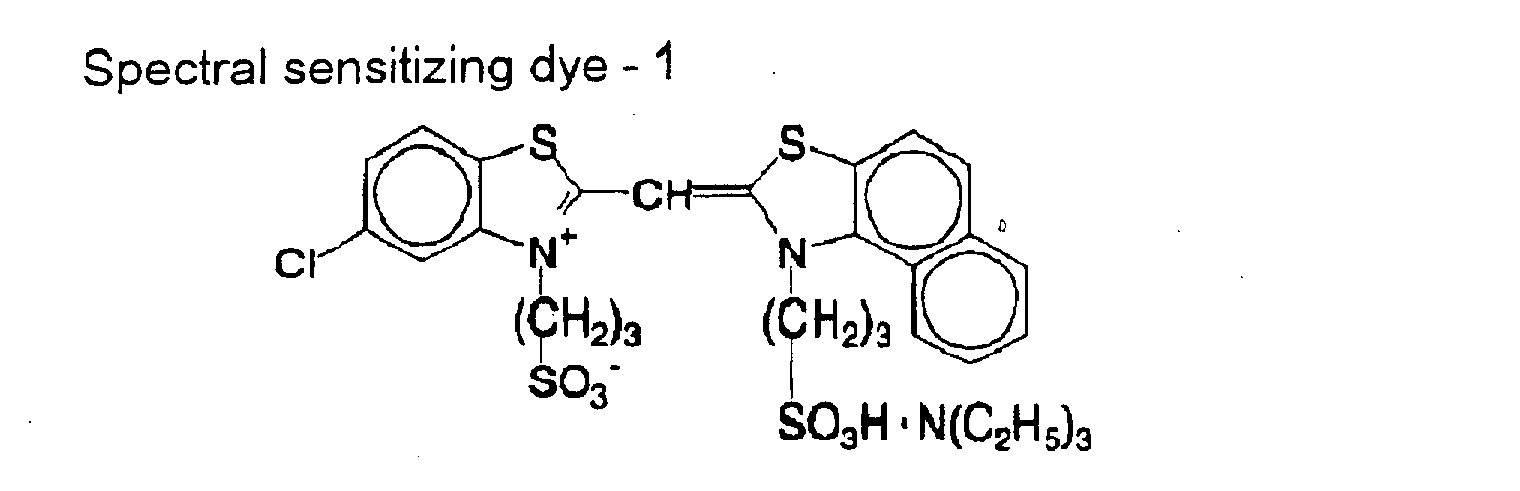


- A high-sensitive green-sensitive emulsion C-1 and a low-sensitive green-sensitive emulsion C-2 were prepared in the same manner as Emulsion A-1 and Emulsion A-2 respectively, except that the temperature at the grain formation was lowered and kinds of the sensitizing dyes were changed as shown below.
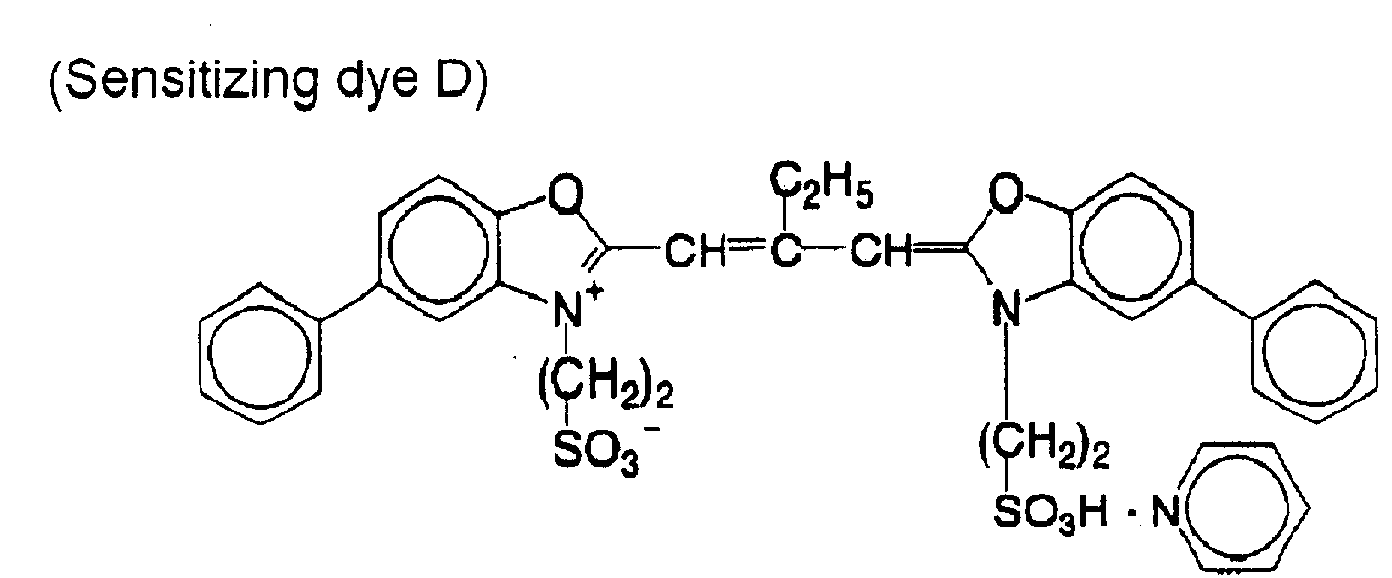
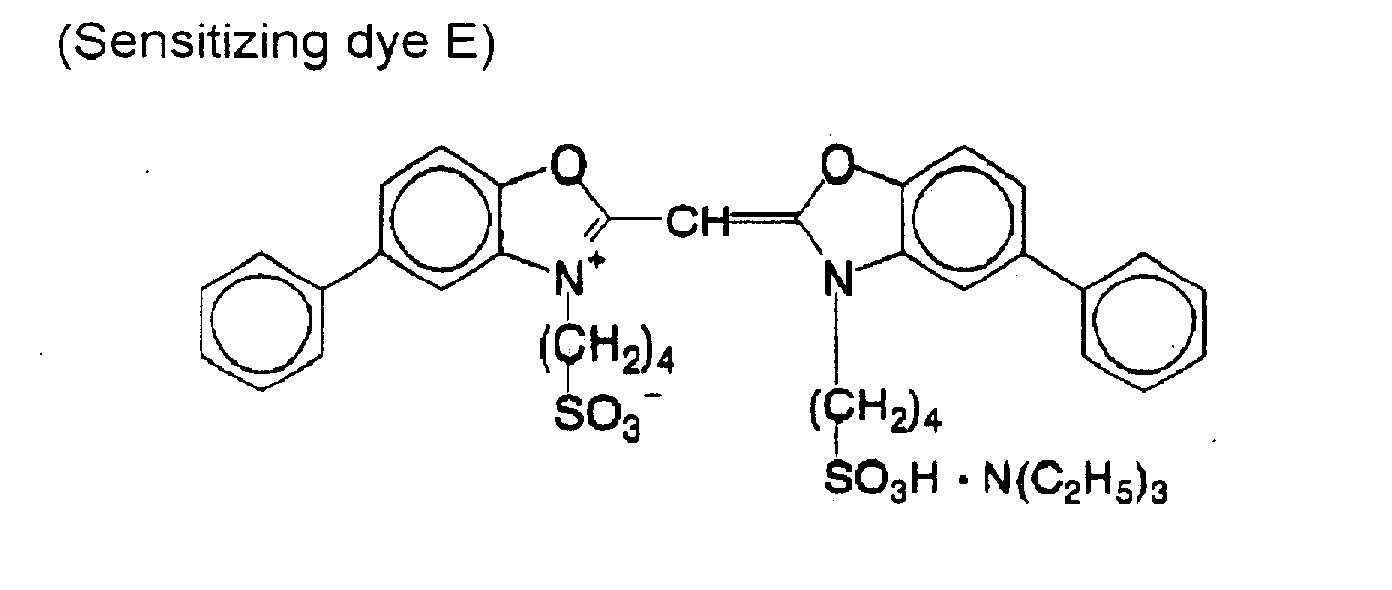
- The grain size of the high-sensitive emulsion and the low-sensitive emulsion were 0.40 µm and 0.30 µm in terms of average side length respectively. The variation coefficient of the side length in the emulsions was each 8%.
- Sensitizing dye D was added to the large grain size emulsion in an amount of 3.0 x 10⁻⁴ mole, and to the small grain size emulsion in an amount of 3.6 x 10⁻⁴ mole, per mole of silver halide respectively. Further, sensitizing dye E was added to the large grain size emulsion in an amount of 4.0 x 10⁻⁵ mole, and to the small grain size emulsion in an amount of 7.0 x 10⁻⁵ mole, per mole of silver halide respectively.
- A high-sensitive red-sensitive emulsion E-1 and a low-sensitive red-sensitive emulsion E-2 were prepared in the same manner as Emulsion A-1 and Emulsion A-2 respectively, except that the temperature at the grain formation was lowered and kinds of the sensitizing dyes were changed as shown below.


- The grain size of the high-sensitive emulsion and the low-sensitive emulsion were 0.38 µm and 0.32 µm in terms of average side length, respectively. The variation coefficient of the side length in the emulsions was 9% and 10%, respectively.
- Sensitizing dyes G and H were each added to the large grain size emulsion in an amount of 8.0 x 10⁻⁵ mole, and to the small grain size emulsion in an amount of 10.7 x 10⁻⁵ mole, per mole of silver halide respectively.
- Further, the following compound I was added to the red-sensitive emulsion layer, in an amount of 3.0 x 10⁻³ mole, per mole of silver halide.
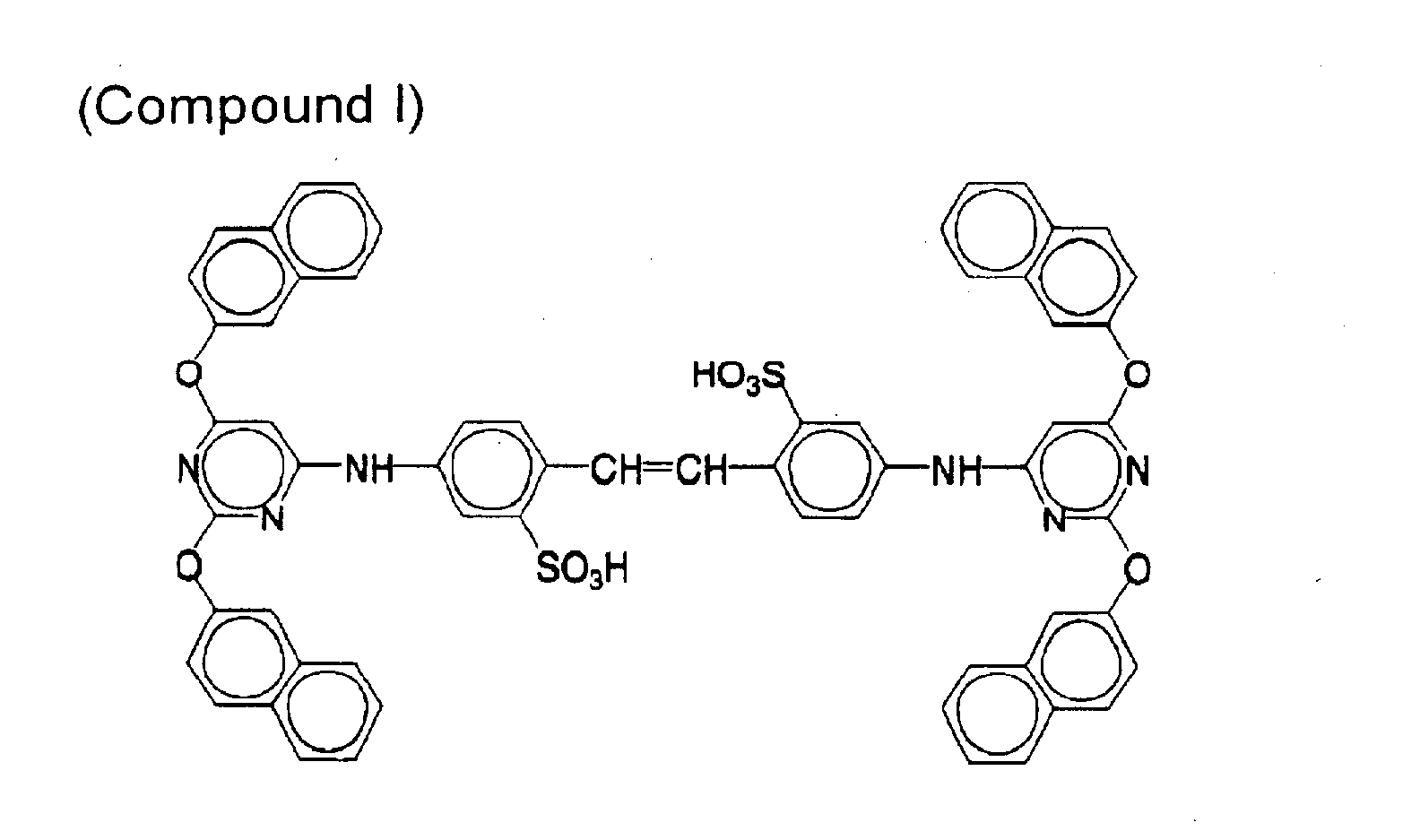
- 57 g of a yellow coupler (ExY), 7 g of Color-image stabilizer (Cpd-1), 4 g of Color-image stabilizer (Cpd-2), 7 g of Color-image stabilizer (Cpd-3), and 2 g of Color-image stabilizer (Cpd-8) were dissolved in 21 g of a solvent (Solv-1) and 80 ml of ethyl acetate. This solution was emulsified and dispersed with a high velocity stirring emulsifier (dissolver) in 220 g of 23.5 mass% gelatin aqueous solution containing 4 g of sodium dodecylbenzene sulfonate, and water was added thereto to obtain 900 g of Emulsified Dispersion A.
- On the other hand, the above-described Emulsified Dispersion A and the above-described Emulsion A-1 and Emulsion A-2 were mixed and dissolved, to prepare a coating solution for the first layer having the composition shown below. The coating amount of the emulsion is indicated in terms of silver.
- The coating solutions for the second to seventh layers were prepared in the same manner as the coating solution for the first layer. 1-Oxy-3,5-dichloro-s-triazine sodium salt (H-1), and (H-2) and (H-3) were used as gelatin hardening agents in each layer. Further, (Ab-1), (Ab-2), (Ab-3), and (Ab-4) were added to each layer such that their total amounts became 15.0 mg/m2, 60.0 mg/m2, 5.0 mg/m2 and 10.0 mg/m2, respectively.


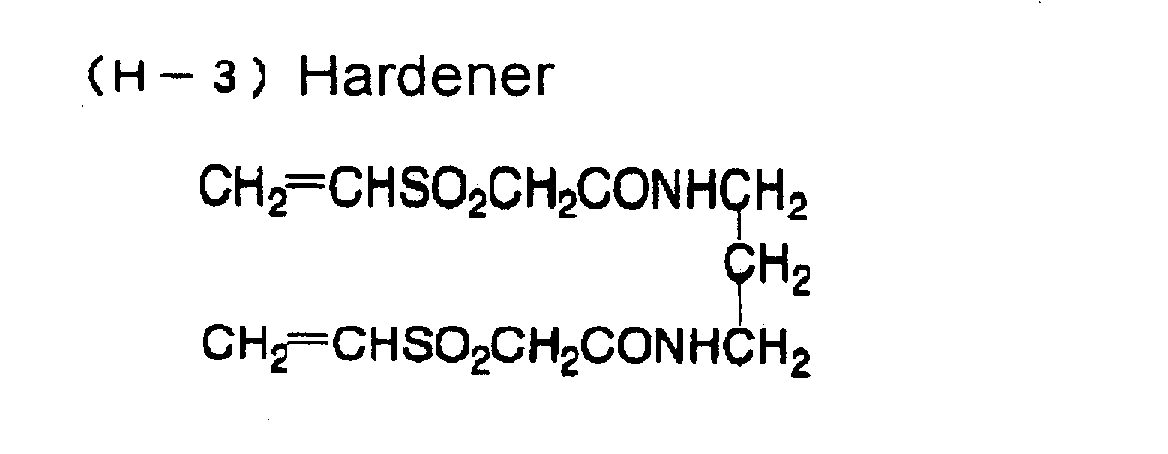


- Further, 1-(3-methylureidophenyl)-5-mercaptotetrazole was added to the second layer, the fourth layer, the sixth layer, and the seventh layer, in an amount of 0.2 mg/m2, 0.2 mg/m2, 0.6 mg/m2, 0.1 mg/m2, respectively.
- Further, 4-hydroxy-6-methyl-1,3,3a,7-tetrazaindene was added to the blue-sensitive emulsion layer and the green-sensitive emulsion layer, in respective amounts of 1 x 10⁻⁴ mole and 2 x 10⁻⁴ mole, per mole of silver halide.
- Further, to the red-sensitive emulsion layer, added was a latex of a copolymer of methacrylic acid and butyl acrylate (mass ratio 1:1, average molecular mass 200,000 to 400,000) in an amount of 0.05 g/m2.
- Further, disodium catechol-3,5-disulfonate was added to the second layer, the fourth layer, and the sixth layer, in respective amounts of 6 mg/m2, 6 mg/m2, and 18 mg/m2.
- Further, in order to prevent irradiation, the following dyes were added. The numerals in the parentheses indicate respective coating amounts.


- The composition of each layer is shown below. The numbers show coating amounts (g/m2). In the case of a silver halide emulsion, the coating amount is in terms of silver.
- Polyethylene resin laminated paper {The polyethylene resin on the first layer side contained white pigments (TiO2, content of 16 mass%; ZnO, content of 4 mass%), a fluorescent whitening agent (4,4'-bis(5-methylbenzoxazolyl)stilbene, content of 0.03 mass%) and a bluish dye (ultramarine, content of 0.33 mass%); the amount of polyethylene resin was 29.2 g/m2}
First Layer (Blue-Sensitive Emulsion Layer) A silver chlorobromoiodide emulsion A (gold and sulfur sensitized, cubic, a 3:7 mixture of the large-size emulsion A-1 and the small-size emulsion A-2 (in terms of mol of silver)) 0.24 Gelatin 1.25 Yellow coupler (ExY) 0.57 Color-image stabilizer (Cpd-1) 0.07 Color-image stabilizer (Cpd-2) 0.04 Color-image stabilizer (Cpd-3) 0.07 Color-image stabilizer (Cpd-8) 0.02 Solvent (Solv-1) 0.21 Second Layer (Color-Mixing Inhibiting Layer) Gelatin 1.15 Color-mixing inhibitor (Cpd-4) 0.10 Color-image stabilizer (Cpd-5) 0.018 Color-image stabilizer (Cpd-6) 0.13 Color-image stabilizer (Cpd-7) 0.07 Solvent (Solv-1) 0.04 Solvent (Solv-2) 0.12 Solvent (Solv-5) 0.11 Third Layer (Green-Sensitive Emulsion Layer) A silver chlorobromoiodide emulsion C (gold and sulfur sensitized, cubic, a 1:3 mixture of the large-size emulsion C-1 and the small-size emulsion C-2 (in terms of mol of silver)) 0.14 Gelatin 1.21 Magenta coupler (ExM) 0.15 Ultraviolet absorbing agent (UV-A) 0.14 Color-image stabilizer (Cpd-2) 0.003 Color-image stabilizer (Cpd-4) 0.002 Color-image stabilizer (Cpd-6) 0.09 Color-image stabilizer (Cpd-8) 0.02 Color-image stabilizer (Cpd-9) 0.01 Color-image stabilizer (Cpd-10) 0.01 Color-image stabilizer (Cpd-11) 0.0001 Solvent (Solv-3) 0.09 Solvent (Solv-4) 0.18 Solvent (Solv-6) 0.07 Solvent (Solv-9) 0.10 Fourth Layer (Color-Mixing Inhibiting Layer) Gelatin 0.68 Color-mixing inhibitor (Cpd-4) 0.06 Color-image stabilizer (Cpd-5) 0.011 Color-image stabilizer (Cpd-6) 0.08 Color-image stabilizer (Cpd-7) 0.04 Solvent (Solv-1) 0.02 Solvent (Solv-2) 0.07 Solvent (Solv-5) 0.065 Fifth Layer (Red-Sensitive Emulsion Layer) A silver chlorobromoiodide emulsion E (gold and sulfur sensitized, cubic, a 5:5 mixture of the large-size emulsion E-1 and the small-size emulsion E-2 (in terms of mol of silver)) 0.16 Gelatin 0.95 Cyan coupler (ExC-1) 0.023 Cyan coupler (ExC-2) 0.05 Cyan coupler (ExC-3) 0.17 Ultraviolet absorbing agent (UV-A) 0.055 Color-image stabilizer (Cpd-1) 0.22 Color-image stabilizer (Cpd-7) 0.003 Color-image stabilizer (Cpd-9) 0.01 Color-image stabilizer (Cpd-12) 0.01 Solvent (Solv-8) 0.05 Sixth Layer (Ultraviolet Absorbing Layer) Gelatin 0.46 Ultraviolet absorbing agent (UV-B) 0.35 Compound (S1-4) 0.0015 Solvent (Solv-7) 0.18 Seventh Layer (Protective Layer) Gelatin 1.00 Acryl-modified copolymer of polyvinyl alcohol (modification degree: 17%) 0.4 Liquid paraffin 0.02 Surface-active agent (Cpd-13) 0.02 
- Coupler for comparison Y1
(The same compound as the above Yellow coupler (ExY) - Coupler for comparison Y2

- Coupler for comparison Y3

- A mixture in 40:40:20 (molar ratio) of


- A mixture in 6:2:2 (molar ratio) of


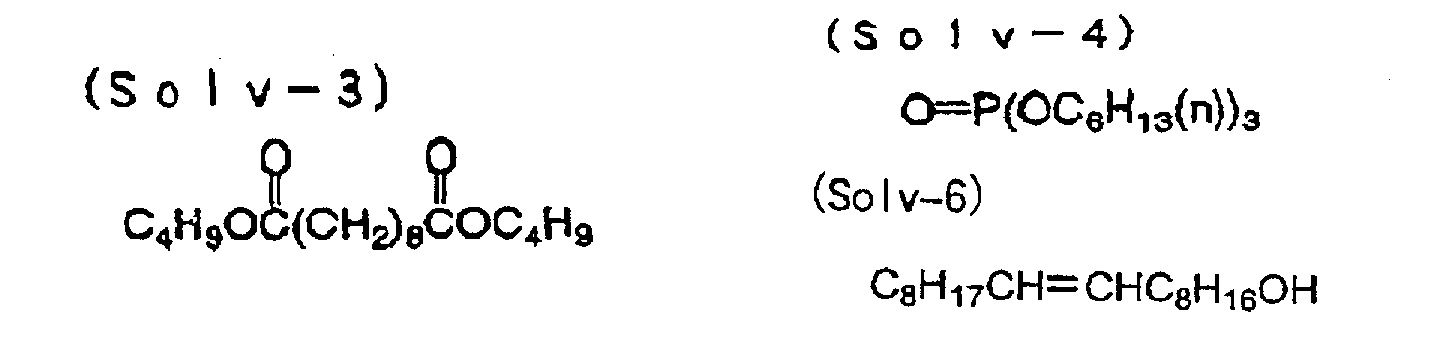

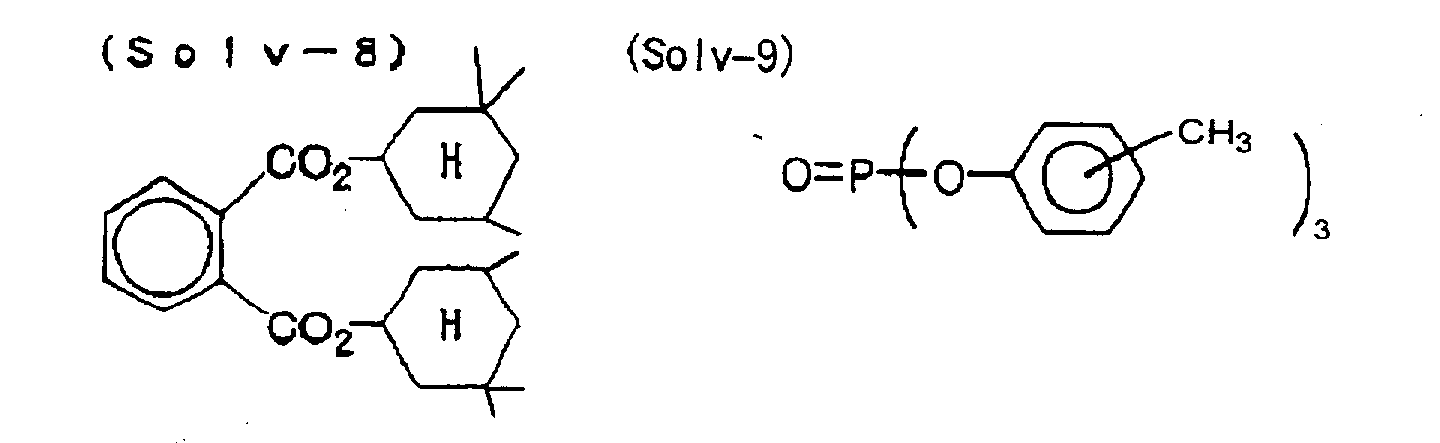


- Samples 101 to 115 were prepared in the same manner as the thus-prepared Sample 001, except that the composition of the first layer was changed as shown below.
-
A silver chlorobromoiodide emulsion A (gold and sulfur sensitized, cubic, a 3:7 mixture of the large-size emulsion A-1 and the small-size emulsion A-2 (in terms of mol of silver)) 0.24 Gelatin 1.20 Yellow coupler (Coupler for comparison Y1) 0.53 Color-image stabilizer (Cpd-2) 0.05 Color-image stabilizer (Cpd-8) 0.05 Color-image stabilizer (Cpd-19) 0.04 Color-image stabilizer (UV-3) 0.01 Solvent (Solv-4) 0.17 Solvent (Solv-9) 0.17 Solvent (Solv-6) 0.02 - Sample 102 was prepared in the same manner as Sample 101, except that the yellow coupler in Sample 101 was replaced by an equimolar amount of Coupler for comparison Y2. The amounts of solvents were adjusted so that the sum total of the yellow coupler, the color-image stabilizers, and the solvents would be a fixed amount. However, the composition of the three kind solvents was not changed.
-
A silver chlorobromoiodide emulsion A (gold and sulfur sensitized, cubic, a 3:7 mixture of the large-size emulsion A-1 and the small-size emulsion A-2 (in terms of mol of silver)) 0.18 Gelatin 1.20 Yellow coupler (Exemplified compound (1)) 0.33 Color-image stabilizer (Cpd-2) 0.05 Color-image stabilizer (Cpd-8) 0.05 Color-image stabilizer (Cpd-19) 0.04 Color-image stabilizer (UV-3) 0.01 Solvent (Solv-4) 0.26 Solvent (Solv-9) 0.26 Solvent (Solv-6) 0.04 - In the above-described sample 103, the coating amounts of the silver halide emulsion and the yellow coupler were reduced to 75% and 67% respectively to those of Sample 101; and the amounts of solvents were regulated so that the total amount of the yellow coupler, the color-image stabilizers, and the solvents would be a fixed amount.
- Samples 104 to 115 were prepared in the same manner as sample 103, except that the yellow coupler in Sample 103 was replaced by an equimolar amount of a yellow coupler of the present invention. When the amount of a yellow coupler changes because of its molecular mass, the amounts of solvents were adjusted so that the sum total of the yellow coupler, the color image stabilizers and the solvents would be a fixed amount. However, in doing so, the composition of the three kind solvents was not changed.
- The following two processings, which were different in the composition of processing solutions and processing time, were carried out, to evaluate the light-sensitive materials.
- Each of the aforementioned light-sensitive materials was made into a roll with a width of 127 mm; the resultant samples were exposed to light with a standard photographic image, using Digital Minilab Frontier 330 (trade name, manufactured by Fuji Photo Film Co., Ltd.); and then, the exposed samples were continuously processed (running test) in the following processing steps, respectively, until an accumulated replenisher amount of the color developing solution reached to be equal to twice the color developer tank volume.
- A processing with the following running processing solutions was named processing A.
Processing step Temperature Time Replenisher amount* Color development 38.5 °C 45 sec 45 ml Bleach-fixing 38.0 °C 45 sec 35 ml Rinse (1)** 38.0 °C 20 sec - Rinse (2)** 38.0 °C 20 sec - Rinse (3)** 38.0 °C 20 sec - Rinse (4)** 38.0 °C 20 sec 121 ml Drying 80 °C (Note)
* Replenisher amount per m2 of the light-sensitive material to be processed.** A rinse cleaning system RC50D (trade name), manufactured by Fuji Photo Film Co., Ltd., was installed in the rinse (3), and the rinse solution was taken out from the rinse (3) and sent to a reverse osmosis membrane module (RC50D) by using a pump. The permeated water obtained in that tank was supplied to the rinse (4), and the concentrated water was returned to the rinse (3). Pump pressure was controlled such that the water to be permeated in the reverse osmosis module would be maintained in an amount of 50 to 300 ml/min, and the rinse solution was circulated under controlled temperature for 10 hours a day. The rinse was made in a four-tank counter-current system from Rinse (1) to Rinse (4). - The composition of each processing solution was as follows.
(Color developer) (Tank solution) (Replenisher) Water 800 ml 800 ml Fluorescent whitening agent (FL-1) 2.2 g 5.1 g Fluorescent whitening agent (FL-2) 0.35 g 1.75 g Triisopropanolamine 8.8 g 8.8 g Polyethylenegrycol (average molecular mass: 300) 10.0 g 10.0 g Ethylenediamine tetraacetic acid 4.0 g 4.0 g Sodium sulfite 0.10 g 0.20 g Potassium chloride 10.0 g - Sodium 4,5-dihydroxybenzene - 1,3-disulfonate 0.50 g 0.50 g Disodium-N,N-bis(sulfonatoethyl) hydroxylamine 8.5 g 14.0 g 4-amino-3-methyl-N-ethyl-N - (β-methanesulfonamidoethyl) aniline · 3/2 sulfate · monohydrate 4.8 g 14.0 g Potassium carbonate 26.3 g 26.3 g Water to make 1000 ml 1000 ml pH (25 °C/adjusted using sulfuric acid and KOH) 10.15 12.5 (Bleach-fixing solution) (Tank solution) (Replenisher) Water 800 ml 600 ml Ammonium thiosulfate (750 g/1) 107 ml 214 ml m-Carboxybenzenesulfinic acid 8.3 g 16.5 g Ammonium iron (III) ethylenediaminetetraacetate 47.0 g 94.0 g Ethylenediamine tetraacetic acid 1.4 g 2.8 g Nitric acid (67%) 16.5 g 33.0 g Imidazole 14.6 g 29.2 g Ammonium sulfite 16.0 g 32.0 g Potassium metabisulfite 23.1 g 46.2 g Water to make 1000 ml 1000 ml pH (25 °C/adjusted using nitric acid and aqua ammonia) 6.5 6.5 (Rinse solution) (Tank solution) (Replenisher) Sodium chlorinated-isocyanurate 0.02 g 0.02 g Deionized water (conductivity: 5 µS/cm or less) 1000 ml 1000 ml PH (25 °C) 6.5 6.5 - Each of the samples was processed into a 127-mm width roll form. They were image-wise exposed to light through a negative film having an average density, with a test processor made by remodeling a mini-lab printer processor PP350 (trade name), manufactured by Fuji Photo Film Co., Ltd., so that a processing time and temperature could be changed. A continuous processing (running test) was performed until an accumulated replenisher amount of color developer in the processing steps presented below reached two times the tank volume of color developer. The processing with the resulting running processing solution was named processing B.
Processing step Temperature Time Replenisher amount* Color development 45.0 °C 17 sec 45 ml Bleach-fixing 40.0 °C 17 sec 35 ml Rinse (1)** 40.0 °C 8 sec - Rinse (2)** 40.0 °C 8 sec - Rinse (3)** 40.0 °C 8 sec - Rinse (4)** 38.0 °C 8 sec 121 ml Drying 80 °C 15 sec (Note)
* Replenisher amount per m2 of the light-sensitive material to be processed.** A rinse cleaning system RC50D (trade name), manufactured by Fuji Photo Film Co., Ltd., was installed in the rinse (3), and the rinse solution was taken out from the rinse (3) and sent to a reverse osmosis membrane module (RC50D) by using a pump. The permeated water obtained in that tank was supplied to the rinse (4), and the concentrated water was returned to the rinse (3). Pump pressure was controlled such that the water to be permeated in the reverse osmosis module would be maintained in an amount of 50 to 300 ml/min, and the rinse solution was circulated under controlled temperature for 10 hours a day. The rinse was made in a four-tank counter-current system from Rinse (1) to (4). - The composition of each processing solution was as follows.
(Color developer) (Tank solution) (Replenisher) Water 800 ml 800 ml (Replenisher) Fluorescent whitening agent (FL-3) 4.0 g 8.0 g Residual color reducing agent (SR-1) 3.0 g 5.5 g Triisopropanolamine 8.8 g 8.8 g Sodium p-toluenesulfonate 10.0 g 10.0 g Ethylenediamine tetraacetic acid 4.0 g 4.0 g Sodium sulfite 0.10 g 0.10 g Potassium chloride 10.0 g - Sodium 4,5-dihydroxybenzene - 1,3-disulfonate 0.50 g 0.50 g Disodium-N,N-bis(sulfonatoethyl) hydroxylamine 8.5 g 14.0 g 4-Amino-3-methyl-N-ethyl-N -(β-methanesulfonamidoethyl) aniline · 3 /2 sulfate · monohydrate 7.0 g 19.0 g Potassium carbonate 26.3 g 26.3 g Water to make 1000 ml 1000 ml pH (25 °c/adjusted using sulfuric acid and KOH) 10.25 12.6 (Bleach-fixing solution) (Tank solution) (Replenisher) Water 800 ml 600 ml Ammonium thiosulfate (750 g/1) 107 ml 214 ml Succinic acid 29.5 g 59.0 g Ammonium iron (III) ethylenediaminetetraacetate 47.0 g 94.0 g Ethylenediamine tetraacetic acid 1.4 g 2.8 g Nitric acid (67%) 17.5 g 35.0 g Imidazole 14.6 g 29.2 g Ammonium sulfite 16.0 g 32.0 g Potassium metabisulfite 23.1 g 46.2 g Water to make 1000 ml 1000 ml pH (25 °C/adjusted using nitric acid and aqua ammonia) 6.00 6.00 (Rinse solution) (Tank solution) (Replenisher) Sodium chlorinated-isocyanurate 0.02 g 0.02 g Deionized water (conductivity: 5 µS/cm or less) 1000 ml 1000 ml PH (25 °C) 6.5 6.5 


- After keeping samples 101 to 115 under conditions of 25 °C and 55%RH for 10 days after coating of the respective photographic constitutional layer coating solutions, the following evaluations were performed.
- Each sample was subjected to exposure of three-color separation, and then color development processing was performed according to the above-described processing A, to obtain monochromatic yellow-, magenta-, and cyan- colored samples respectively.
- As light sources, a light source of 688 nm (R light) taken out by using a laser semiconductor, a light source of 532 nm (G light) and a light source of 473 nm (B light) each taken out by combining a semiconductor laser with SHG, respectively, were used. The quantity of R light was modulated by an external modulator, and the laser beams were scan-exposed to a sample moving in the direction vertical to the scanning direction by causing the beams be reflected on a rotating polyhedron. The scanning pitch was 400 dpi and the average exposure time per pixel was 8 X 10⁻⁸ sec. The temperature of the semiconductor laser was kept constant by using a Peltier device to prevent the quantity of light from being changed by temperature.
- A density at a yellow-colored portion of the processed sample was measured. A cyan density at the portion providing 1.6 of yellow density was measured to evaluate color impurity. Measurement was carried out using X-rite 310 (trade name, manufactured by X-rite Company) according to Status A.
- A densitometry of the samples prepared in the foregoing Evaluation 1 was carried out before and after exposure to Xe light of 100,000 Lux for 14 days. A relative residual rate was calculated based on a density after storage at a yellow-colored portion provided an initial density of 0.5.
- A densitometry of the samples prepared in the foregoing Evaluation 1 was carried out before and after storage under the conditions of 80 °C and 70%R.H. for 21 days. A relative residual rate was calculated based on a density after storage at a yellow-colored portion provided an initial density of 1.5.
- using the exposure apparatus employed in the foregoing Evaluation 1, exposure conditions for each sample were set so that a gray gradation was obtained in the processing B. A processing was carried out with changing a conveying speed of a light-sensitive material up and down by 15% in the processing B. A fluctuation of density was measured, on an exposed portion that provided a density of 2.0 in the processing according to the standard processing time in the processing B. As a measure of evaluating the processing stability, the following value was calculated: Processing stability = (deviation of density)/(initial density of 2.0) x 100.
- Evaluation results are shown in Table 1.

- In Samples 103 to 115 of the present invention, even though the amount of the respective yellow couplers was reduced to 67% by molar ratio, compared to that of sample 101, the resulting color density was equal to those samples employing the coupler for comparison. Further, it was confirmed that when a yellow coupler of the present invention was used, not only color impurity in the yellow color was reduced, but also both fastness to light and fastness to heat and humidity at a low-density portion of a yellow dye image were improved. Further, light-sensitive materials excellent in density stability at a rapid processing were obtained.
- Samples 201 to 215 were prepared in the same manner as samples 101 to 115 in Example 1, except that the arrangement of the first layer and the fifth layer was reversed. Evaluations according to Example 1 were carried out, and it was recognized that especially yellow and magenta densities of a gray image were improved compared to the samples in Example 1. Further, it was seen that light-sensitive materials that were low in color impurity and excellent in fastness to light, in fastness to heat and humidity, and in processing stability were obtained by the use of the yellow coupler of the present invention.
- Samples were prepared in the same manner as in Examples 1 and 2, except that the composition of the respective red-sensitive emulsion layers was changed as follows. Then, evaluations according to Examples 1 and 2 were carried out, and it was confirmed that samples having the constitution according to the present invention reproduced excellent rapid processing suitability, color reproduction and image fastness.
Composition for Red-Sensitive Emulsion Layer A silver chlorobromoiodide emulsion E (gold and sulfur sensitized, cubic, a 5:5 mixture of the large-size emulsion E-1 and the small-size emulsion E-2 (in terms of mol of silver)) 0.10 Gelatin 1.11 Cyan coupler (ExC-1) 0.06 Cyan coupler (ExC-3) 0.02 Cyan coupler (ExC-4) 0.01 Cyan coupler (ExC-5) 0.06 Color-image stabilizer (Cpd-1) 0.01 Color-image stabilizer (Cpd-6) 0.05 Color-image stabilizer (Cpd-7) 0.02 Color-image stabilizer (Cpd-9) 0.04 Color-image stabilizer (Cpd-10) 0.01 color-image stabilizer (Cpd-14) 0.01 Color-image stabilizer (Cpd-15) 0.10 Color-image stabilizer (Cpd-16) 0.01 Color-image stabilizer (Cpd-17) 0.01 Color-image stabilizer (Cpd-18) 0.07 Color-image stabilizer (Cpd-19) 0.01 Ultraviolet absorbing agent (UV-7) 0.04 Solvent (Solv-5) 0.15 - Samples were prepared in the same manner as in Examples 1 to 3, except that the respective silver halide emulsions were changed as set forth below, and evaluations according to Example 1 were performed. As a result, it was confirmed that silver halide color photographic light-sensitive materials excellent in color reproduction and rapid processing suitability were obtained according to the present invention.
- The 1st layer:
- a 4:6 mixture of (Emulsion B-H) and (Emulsion B-L) (silver molar ratio)
- The 3rd layer:
- a 5:5 mixture of (Emulsion G-H) and (Emulsion G-L) (silver molar ratio)
- The 5th layer:
- a 6:4 mixture of (Emulsion R-H) and (Emulsion R-L) (silver molar ratio)
- using a conventional method of simultaneously adding silver nitrate and sodium chloride mixed into an aqueous gelatin solution under stirring, an emulsion of cubic high silver chloride having an equivalent-sphere diameter of 0.55 µm and a variation coefficient of 10% was prepared. In this preparation, at the step of from 80% to 90% addition of the entire silver nitrate amount, potassium bromide (3 mole% per mole of the finished silver halide) and K4[Ru(CN)6] were added. Potassium iodide (0.3 mole% per mole of the finished silver halide) was added at the step of completion of 90% addition of the entire silver nitrate amount. Further, K2[Ir(5-methylthiazole)Cl5] and K2[Ir(H2O)Cl5] were added at the step of from 92% to 98% addition of the entire silver nitrate amount. After subjecting to a desalting treatment, the resulting emulsion was added with gelatin and re-dispersed. To the emulsion, sodium thiosulfonate and the below shown Sensitizing dye A and Sensitizing dye B were added, and the resulting emulsion was optimally ripened with sodium thiosulfate pentahydrate as a sulfur sensitizer and bis(1,4,5-trimethyl-1,2,4-triazolium-3-thiolato)aurate (I) · tetrafluoroborate as a gold sensitizer. Further, 1-phenyl-5-mercaptotetrazole and 1-(5-methylureidophenyl)-5-mercaptotetrazole were added. The thus-obtained emulsion was referred to as Emulsion B-H.
- An emulsion of cubic high silver chloride having an equivalent-sphere diameter of 0.45 µm and a variation coefficient of 10% was prepared in the same manner as Emulsion B-H, except that addition rates of silver nitrate and sodium chloride were changed. The thus-obtained emulsion was referred to as Emulsion B-L.


- Using a conventional method of simultaneously adding silver nitrate and sodium chloride mixed into an aqueous gelatin solution under stirring, an emulsion of cubic high silver chloride having an equivalent-sphere diameter of 0.35 µm and a variation coefficient of 10% was prepared. In this preparation, at the step of from 80% to 90% addition of the entire silver nitrate amount, K4[Ru(CN)6] was added. At the step of from 80% to 100% addition of the entire silver nitrate amount, potassium bromide (4 mole% per mole of the finished silver halide) was added. Potassium iodide (0.2 mole% per mole of the finished silver halide) was added at the step of completion of 90% addition of the entire silver nitrate amount. K2[Ir(5-methylthiazole)Cl5] was added at the step of from 92% to 95% addition of the entire silver nitrate amount. Further, K2[Ir(H2O)Cl5] was added at the step of from 92% to 98% addition of the entire silver nitrate amount. The resulting emulsion was subjected to a desalting treatment, and thereafter added with gelatin and re-dispersed. To the emulsion, sodium thiosulfonate was added, and the resulting emulsion was optimally ripened with sodium thiosulfate pentahydrate as a sulfur sensitizer and bis(1,4,5-trimethyl-1,2,4-triazolium-3-thiolatoyaurate (I) · tetrafluoroborate as a gold sensitizer. Further, the below shown Sensitizing dye D and 1-phenyl-5-mercaptotetrazole, 1-(5-methyl ureidophenyl)-5-mercaptotetrazole and potassium bromide were added. The thus-obtained emulsion was referred to as Emulsion G-H.
- An emulsion of cubic high silver chloride having an equivalent-sphere diameter of 0.28 µm and a variation coefficient of 10% was prepared in the same manner as Emulsion G-H, except that addition rates of silver nitrate and sodium chloride were changed. The thus-obtained emulsion was referred to as Emulsion G-L.

- Using a conventional method of simultaneously adding silver nitrate and sodium chloride mixed into an aqueous gelatin solution under stirring, an emulsion of cubic high silver chloride having an equivalent-sphere diameter of 0.35 µm and a variation coefficient of 10% was prepared. In this preparation, at the step of from 80% to 90% addition of the entire silver nitrate amount, K4[Ru(CN)6] was added. At the step of from 80% to 100% addition of the entire silver nitrate amount, potassium bromide (4.3 mole% per mole of the finished silver halide) was added. Potassium iodide (0.15 mole% per mole of the finished silver halide) was added at the step of completing 90% addition of the entire silver nitrate amount. Further, K2[Ir(5-methylthiazole)Cl5] was added at the step of from 92% to 95% addition of the entire silver nitrate amount. Further, K2[Ir(H2O)Cl5] was added at the step of from 92% to 98% addition of the entire silver nitrate amount. The resulting emulsion was subjected to a desalting treatment, and was added with gelatin and re-dispersed. To the emulsion, sodium thiosulfonate was added, and the resulting emulsion was optimally ripened with sodium thiosulfate pentahydrate as a sulfur sensitizer and bis(1,4,5-trimethyl-1,2,4-triazolium-3-thiolato)aurate (I) ·tetrafluoroborate as a gold sensitizer. Further, Sensitizing dye H shown below, 1-phenyl-5-mercaptotetrazole, 1-(5-methylureidophenyl)-5-mercaptotetrazole, Compound I shown below, and potassium bromide were added. The thus-obtained emulsion was referred to as Emulsion R-H.
- An emulsion of cubic high silver chloride having an equivalent-sphere diameter of 0.28 µm and a variation coefficient of 10% was prepared in the same manner as Emulsion R-H, except that addition rates of silver nitrate and sodium chloride were changed. The thus-obtained emulsion was referred to as Emulsion R-L.


- Samples prepared in Examples 1 to 4 were scan-exposed using the apparatus described below, followed by evaluation according to Examples 1 to 4. As a result, it was seen that effects of the present invention, i.e., excellent color reproduction and rapid processability, were particularly remarkably obtained by the use of samples having the composition according to the present invention.
- Digital mini-lab FRONTIER 330 (trade name, manufactured by Fuji Photo Film Co., Ltd.), Lambda 130 (trade name, manufactured by Durst Company), LIGHTJET 5000 (trade name, manufactured by Gretag Company)
- Samples were prepared in the same manner as the samples in Example 1, except for changing coating amounts (sum total of coating amounts in each layer) as set forth below.
Coating amount of the blue light-sensitive silver halide emulsion layer 240%
Coating amount of the green light-sensitive silver halide emulsion layer 250%
Coating amount of the red light-sensitive silver halide emulsion layer 260%
Support: 180 µm thick transparent support of polyethyleneterephthalate - These samples were processed by Processing B as described in Example 1, except that the processing time in each process was prolonged by 2.7 times. Evaluations were carried out according to Example 1. As a result, it was seen that light-sensitive materials less in color impurity and excellent in image fastness were obtained by the use of yellow couplers of the present invention.
- samples 1101 to 1116 were prepared in the same manner as Sample 001 prepared in Example 1, except that the constitution of the first layer was changed as shown below.
-
A silver chlorobromoiodide emulsion A (gold and sulfur sensitized, cubic, a 3:7 mixture of the large-size emulsion A-1 and the small-size emulsion A-2 (in terms of mol of silver)) 0.24 Gelatin 1.20 Yellow coupler (Coupler for comparison Y1) 0.53 Color-image stabilizer (Cpd-2) 0.05 Color-image stabilizer (Cpd-8) 0.05 Color-image stabilizer (Cpd-19) 0.04 Color-image stabilizer (UV-3) 0.01 Solvent (Solv-4) 0.17 Solvent (Solv-9) 0.17 Solvent (Solv-6) 0.02 - Sample 1102 was prepared in the same manner as Sample 1101, except that the yellow coupler in Sample 1101 was replaced by an equimolar amount of Coupler for comparison Y2. Sample 1116 was prepared in the same manner as Sample 1101, except that the yellow coupler in Sample 1101 was replaced by an equimolar amount of Coupler for comparison Y3. In this connection, when preparing these samples, the amount of the respective solvents was adjusted so that the sum total of the yellow coupler, the dye image stabilizers, and the solvents would be a fixed amount. However, the composition of the three kind solvents was not changed.
-
A silver chlorobromoiodide emulsion A (gold and sulfur sensitized, cubic, a 3:7 mixture of the large-size emulsion A-1 and the small-size emulsion A-2 (in terms of mol of silver)) 0.18 Gelatin 1.20 Yellow coupler (101) 0.33 Color-image stabilizer (Cpd-2) 0.05 color-image stabilizer (Cpd-8) 0.05 color-image stabilizer (Cpd-19) 0.04 color-image stabilizer (UV-3) 0.01 solvent (Solv-4) 0.26 Solvent (Solv-9) 0.26 Solvent (Solv-6) 0.04 - In the above-described sample 1103, the coating amounts of the silver halide emulsion and the yellow coupler were reduced to 75% and 67% respectively to those of Sample 1101; and the amounts of solvents were regulated so that the total amount of the yellow coupler, the color-image stabilizers, and the solvents became a fixed amount.
- Samples 1104 to 1115 were prepared in the same manner as sample 1103, except that the yellow coupler in Sample 1103 was replaced by an equimolar amount of respective yellow couplers of the present invention. When an amount (i.e. coating amount in terms of g/m2) of yellow coupler changed because of its molecular mass, the amounts of solvents were adjusted so that the sum total of the yellow coupler, the color image stabilizers and the solvents became a fixed amount. However, in doing so, the composition of the three kind solvents was not changed.
- Each of the light-sensitive materials thus prepared was stored in the conditions of 25 °C and 55% R.H. for 10 days and evaluated in the same manner as in Example 1.
- The results are shown in Table 2.

- In samples 1103 to 1115 of the present invention, even though the amount of the respective yellow couplers was reduced to 67% by molar ratio, compared to that of samples 1101 and 1102, the resulting color density was equal to those samples employing the respective comparative couplers. Further, it was confirmed that when the yellow couplers of the present invention were used, not only color impurity in the yellow color was reduced, but also both fastness to light and fastness to heat and humidity at a low-density portion of a yellow dye image were improved. Further, light-sensitive materials excellent in density stability at a rapid processing were obtained.
- Samples 1201 to 1216 were prepared in the same manner as samples 1101 to 1116 in Example 7, except that the arrangement of the first layer and the fifth layer was reversed.
- Evaluations according to Example 7 were carried out, and it was recognized that especially yellow and magenta densities of a gray image were improved compared to the samples in Example 7. Further, it was seen that light-sensitive materials that were low in color impurity and excellent in fastness to light, fastness to heat and humidity, and processing stability were obtained by the use of the yellow coupler of the present invention.
- Samples were prepared in the same manner as in Examples 7 and 8, except that the composition of the red-sensitive emulsion layer was changed with the red-sensitive emulsion layer composition prepared in Example 3. Then, evaluations according to Examples 7 and 8 were carried out, and it was also confirmed that samples having the constitution according to the present invention reproduced excellent rapid processing suitability, color reproduction and image fastness.
- Samples were prepared in the same manner as in Examples 7 to 9, except that the silver halide emulsions of the first, third, and fifth layers were changed in the same manner as in Example 4, followed by evaluation according to Example 7. As a result, it was confirmed that silver halide color photographic light-sensitive materials excellent in color reproduction and rapid processing suitability could be obtained according to the present invention.
- Samples prepared in Examples 7 to 10 were scan-exposed using the apparatus described below, followed by evaluation according to Examples 7 to 10. As a result, it was seen that effects of the present invention, i.e., excellent color reproduction and rapid processability, were particularly remarkably obtained by the use of samples having the composition according to the present invention.
- Digital mini-lab FRONTIER 330 (trade name, manufactured by Fuji Photo Film Co., Ltd.), Lambda 130 (trade name, manufactured by Durst Company), LIGHTJET 5000 (trade name, manufactured by Gretag Company)
- samples were prepared in the same manner as the samples in Example 7, except for changing coating amounts (sum total of coating amounts in each layer) as set forth below.
Coating amount of the blue light-sensitive silver halide emulsion layer 240%
Coating amount of the green light-sensitive silver halide emulsion layer 250%
Coating amount of the red light-sensitive silver halide emulsion layer 260%
Support: 180 µm thick transparent support of polyethyleneterephthalate - These samples were processed by Processing B as described in Example 1, except that the processing time in each process was prolonged by 2.7 times. Evaluations were carried out according to Example 7. As a result, it was seen that light-sensitive materials that were low in color impurity and excellent in image fastness were obtained by the use of yellow couplers of the present invention.
- Sample 1701 having the following layer constitution was prepared by applying the layers on the support used in Example 7.
- In this connection, as gelatin hardeners, antiseptics, antifoggants, stabilizers, polymer latexes, and irradiation dyes in the second to seventh layers, the respective compounds used in Example 7 were used in the same amounts and were contained in the same layers as in Example 7.
First Layer (Blue-Sensitive Emulsion Layer) Emulsion (a 5:5 mixture of Emulsion BH-1 and Emulsion BL-1 (in terms of mol of silver)) 0.16 Gelatin 1.32 Exemplified coupler (1) 0.34 Color-image stabilizer (Cpd-1) 0.01 Color-image stabilizer (Cpd-2) 0.01 Color-image stabilizer (Cpd-8) 0.08 Color-image stabilizer (Cpd-18) 0.01 Color-image stabilizer (Cpd-19) 0.02 Color-image stabilizer (Cpd-20) 0.15 Color-image stabilizer (Cpd-21) 0.01 Color-image stabilizer (Cpd-23) 0.15 Additive (ExC-1) 0.001 Color-image stabilizer (UV-4) 0.01 Solvent (Solv-4) 0.23 Solvent (Solv-6) 0.04 Solvent (Solv-9) 0.23 Second Layer (Color-Mixing Inhibiting Layer) Gelatin 0.78 Color-mixing inhibitor (Cpd-4) 0.05 Color-mixing inhibitor (Cpd-24) 0.01 Color-image stabilizer (Cpd-5) 0.006 Color-image stabilizer (Cpd-6) 0.05 Color-image stabilizer (Cpd-7) 0.006 Color-image stabilizer (Cpd-25) 0.006 Color-image stabilizer (UV-C) 0.06 Solvent (Solv-1) 0.06 Solvent (Solv-2) 0.06 Solvent (Solv-5) 0.07 Solvent (Solv-11) 0.07 Third Layer (Green-Sensitive Emulsion Layer) Emulsion (a 1:3 mixture of GH-1 and GL-1 (in terms of mol of silver)) 0.12 Gelatin 0.95 Magenta coupler (ExM) 0.12 Ultraviolet absorbing agent (UV-C) 0.03 Color-image stabilizer (Cpd-2) 0.01 Color-image stabilizer (Cpd-6) 0.08 Color-image stabilizer (Cpd-7) 0.005 Color-image stabilizer (Cpd-8) 0.01 Color-image stabilizer (Cpd-9) 0.01 Color-image stabilizer (Cpd-10) 0.005 color-image stabilizer (Cpd-11) 0.0001 Color-image stabilizer (Cpd-20) 0.01 Solvent (Solv-3) 0.06 Solvent (Solv-4) 0.12 Solvent (Solv-6) 0.05 Solvent (Solv-9) 0.16 Fourth Layer (Color-Mixing Inhibiting Layer) Gelatin 0.65 Color-mixing inhibitor (Cpd-4) 0.04 Color-mixing inhibitor (Cpd-24) 0.01 Color-image stabilizer (Cpd-5) 0.005 Color-image stabilizer (Cpd-6) 0.04 color-image stabilizer (Cpd-7) 0.005 Color-image stabilizer (Cpd-25) 0.005 Color-image stabilizer (UV-C) 0.05 Solvent (Solv-1) 0.05 Solvent (Solv-2) 0.05 Solvent (Solv-5) 0.06 Solvent (Solv-11) 0.06 Fifth Layer (Red-Sensitive Emulsion Layer) Emulsion (a 4:6 mixture of RH-1 and RL-1 (in terms of mol of silver)) 0.10 Gelatin 1.11 Cyan coupler (ExC-5) 0.11 Cyan coupler (ExC-4) 0.01 Cyan coupler (ExC-3) 0.04 Color-image stabilizer (Cpd-1) 0.03 Color-image stabilizer (Cpd-7) 0.01 Color-image stabilizer (Cpd-9) 0.04 Color-image stabilizer (Cpd-10) 0.001 Color-image stabilizer (Cpd-14) 0.001 Color-image stabilizer (Cpd-15) 0.18 Color-image stabilizer (Cpd-16) 0.002 Color-image stabilizer (Cpd-17) 0.001 Color-image stabilizer (Cpd-18) 0.05 Color-image stabilizer (Cpd-19) 0.04 Color-image stabilizer (UV-5) 0.10 Solvent (Solv-5) 0.19 Sixth Layer (ultraviolet Absorbing Layer) Gelatin 0.34 Ultraviolet absorbing agent (UV-D) 0.24 Compound (S1-4) 0.0015 Solvent (Solv-10) 0.11 Seventh Layer (Protective Layer) Gelatin 0.82 Additive (Cpd-22) 0.03 Liquid paraffin 0.02 Surface-active agent (Cpd-13) 0.02 

- KAYARAD DPCA-30
manufactured by Nippon Kayaku Co., Ltd. - 2,5-Bis(1,1-dimethyl-4-hexyloxycarbonylbutyl) hydroquinone
- Butyl p-hydroxybenzoate
- Dioctyl sebacate
- Diisoundecyl phthalate
- A 1/7/2 mixture of UV-1/UV-6/UV-5 (mass ratio)
- A 1/3/5/1 mixture of UV-1/UV-3/UV-6/UV-5 (mass ratio)
- In the above, UV-6 is 2-(2-hydroxy-3,5-di-t-amylphenyl)benzotriazole.
- Each of the above emulsions was prepared as shown below.
- using a method of simultaneously adding silver nitrate and sodium chloride mixed into stirring deionized distilled water containing deionized gelatin, high silver chloride cubic grains were prepared. In this preparation, at the step of from 60% to 80% addition of the entire silver nitrate amount, Cs2[OsCl5(NO)] was added. At the step of from 80% to 90% addition of the entire silver nitrate amount, potassium bromide (1.5 mole% per mole of the finished silver halide) and K4[Fe(CN)6] were added. K2[IrCl6] was added at the step of from 83% to 88% addition of the entire silver nitrate amount. Further, K2[IrCl5(H2O)] and K[IrCl4(H2O)2] were added at the step Of from 92% to 98% addition of the entire silver nitrate amount. Potassium iodide (0.27 mole% per mole of the finished silver halide) was added, with vigorous stirring, at the step of completion of 94% addition of the entire silver nitrate amount. The thus-obtained emulsion grains were monodisperse cubic silver iodobromochloride grains having a side length of 0.54 µm and a variation coefficient of 8.5%. After being subjected to a sedimentation desalting treatment, the following were added to the resulting emulsion: gelatin, antiseptics Ab-1, Ab-2, and Ab-3, and calcium nitrate, and the emulsion was re-dispersed.
- The re-dispersed emulsion was dissolved at 40 °C, and spectral sensitizing dye I, spectral sensitizing dye J, and Spectral sensitizing dye-1 were added for optimal spectral sensitization. Then, the resulting emulsion was ripened by adding sodium benzene thiosulfate, triethylthiourea as a sulfur sensitizer and Compound-1 as a gold sensitizer for optimal chemical sensitization. Further, 1-(5-methyl ureidophenyl)-5-mercaptotetrazole; Compound-2; a mixture whose major components are compounds represented by Compound-3 in which n is 2 or 3 (both ends X1 and X2 are each a hydroxyl group); Compound-4, and potassium bromide were added, to finalize chemical sensitization. The thus-obtained emulsion was referred to as Emulsion BH-1.


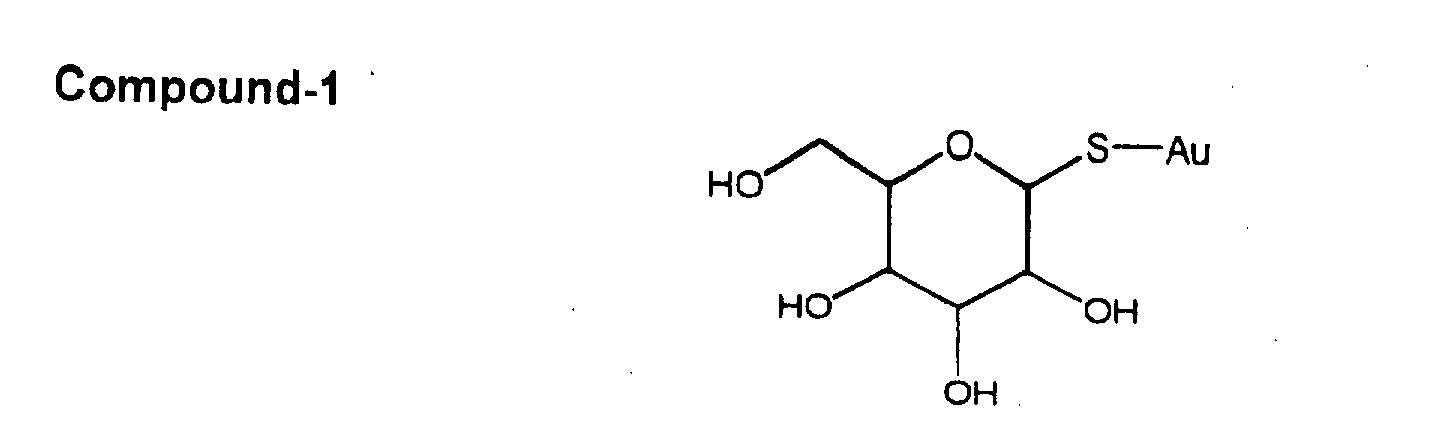


- Emulsion grains were prepared in the same manner as in the preparation of Emulsion BH-1, except that the temperature and the addition rate at the step of mixing silver nitrate and sodium chloride by simultaneous addition were changed, and the amounts of respective metal complexes that were to be added during the addition of silver nitrate and sodium chloride were changed. The thus-obtained emulsion grains were monodisperse cubic silver iodobromochloride grains having a side length of 0.44 µm and a variation coefficient of 9.5%. After redispersion of this emulsion, Emulsion BL-1 was prepared in the same manner as Emulsion BH-1, except that the amounts of compounds in the preparation of BH-1 were changed.
- Using a method of simultaneously adding silver nitrate and sodium chloride mixed into stirring deionized distilled water containing a deionized gelatin, high chloride content cubic grains were prepared. In this preparation, at the step of from 80% to 90% addition of the entire silver nitrate amount, K4[Ru(CN)6] was added. At the step of from 80% to 100% addition of the entire silver nitrate amount, potassium bromide (2 mole% per mole of the finished silver halide) was added. Further, K2[IrCl6] and K2[RhBr5(H2O)] were added at the step of from 83% to 88% addition of the entire silver nitrate amount. Potassium iodide (0.1 mole% per mole of the finished silver halide) was added with a vigorous stirring, at the step of completion of 90% addition of the entire silver nitrate amount. K2[IrCl5(H2O)] and K[IrCl4(H2O)2] were added at the step of from 92% to 98% addition of the entire silver nitrate amount. The thus-obtained emulsion grains were monodisperse cubic silver iodobromochloride grains having a side length of 0.42 µm and a variation coefficient of 8.0%. The resulting emulsion was subjected to a sedimentation desalting treatment and re-dispersing treatment in the same manner as described in the above.
- The re-dispersed emulsion was dissolved at 40 °C, and sodium benzenethiosulfate, p-glutaramidophenyldisulfide, sodium thiosulfate pentahydrate as a sulfur sensitizer, and (bis(1,4,5-trimethyl-1,2,4-triazolium-3-thiolate)aurate (I)· tetrafluoroborate) as a gold sensitizer were added, and the emulsion was ripened for optimal chemical sensitization. Thereafter, 1-(3-acetamidophenyl)-5-mercaptotetrazole, 1-(5-methylureidophenyl)-5-mercaptotetrazole, Compound-2, Compound-4, and potassium bromide were added. Further, in a midway of the emulsion preparation step, Spectral sensitizing dye D, Spectral sensitizing dye K, Spectral sensitizing dye L, and Spectral sensitizing dye M were added as sensitizing dyes, to conduct spectral sensitization. The thus-obtained emulsion was referred to as Emulsion GH-1.


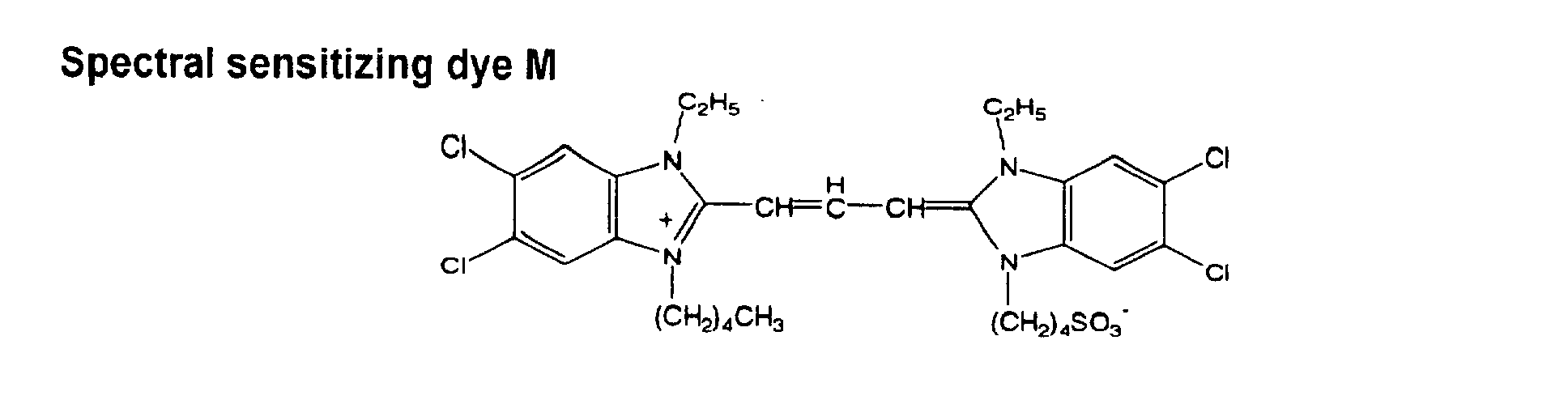
- Emulsion grains were prepared in the same manner as in the preparation of Emulsion GH-1, except that the temperature and the addition rate at the step of mixing silver nitrate and sodium chloride by simultaneous addition were changed, and the amounts of respective metal complexes that were to be added during the addition of silver nitrate and sodium chloride were changed. The thus-obtained emulsion grains were monodisperse cubic silver iodobromochloride grains having a side length of 0.35 µm and a variation coefficient of 9.8%. After this emulsion was subjected to re-dispersion, Emulsion GL-1 was prepared in the same manner as Emulsion GH-1, except that the amounts of compounds in the preparation of GH-1 were changed.
- Using a method of simultaneously adding silver nitrate and sodium chloride mixed into stirring deionized distilled water containing deionized gelatin, high silver chloride cubic grains were prepared. In this preparation, at the step of from 60% to 80% addition of the entire silver nitrate amount, Cs2[OsCl5(NO)] was added. At the step of from 80% to 90% addition of the entire silver nitrate amount, K4[Ru(CN)6] was added. At the step of from 80% to 100% addition of the entire silver nitrate amount, potassium bromide (1.3 mole% per mole of the finished silver halide) was added. Further, K2[IrCl5(5-methylthiazole)] was added at the step of from 83% to 88% addition of the entire silver nitrate amount. Potassium iodide (0.05 mole% per mole of the finished silver halide) was added, with vigorous stirring, at the step of completion of 88% addition of the entire silver nitrate amount. Further, K2[IrCl5(H2O)] and K[IrCl4(H2O)2] were added at the step of from 92% to 98% addition of the entire silver nitrate amount. The thus-obtained emulsion grains were monodisperse cubic silver iodobromochloride grains having a side length of 0.39 µm and a variation coefficient of 10%. The resulting emulsion was subjected to a sedimentation desalting treatment and re-dispersing treatment in the same manner as described in the above.
- The re-dispersed emulsion was dissolved at 40 °C, and Spectral sensitizing dye H, Compound I, triethylthiourea as a sulfur sensitizer, Compound-1 as a gold sensitizer were added, and the emulsion was ripened for optimal chemical sensitization. Thereafter, 1-(3-acetamidophenyl)-5-mercaptotetrazole, 1-(5-methylureidophenyl)-5-mercaptotetrazole, Compound-2, Compound-4, and potassium bromide were added. The thus-obtained emulsion was referred to as Emulsion RH-1.
- Emulsion grains were prepared in the same manner as in the preparation of Emulsion RH-1, except that the temperature and the addition rate at the step of mixing silver nitrate and sodium chloride by simultaneous addition were changed, and the amounts of respective metal complexes that were to be added during the addition of silver nitrate and sodium chloride were changed. The thus-obtained emulsion grains were monodisperse cubic silver iodobromochloride grains having a side length of 0.29 µm and a variation coefficient of 9.9%. After this emulsion was subjected to a sedimentation desalting treatment and re-dispersion, Emulsion RL-1 was prepared in the same manner as Emulsion RH-1, except that the amounts of compounds in the preparation of RH-1 were changed. The thus-obtained emulsion was referred to as Emulsion RL-1.
- Samples 1702 to 1713 were prepared in the same manner as Sample 1701, except that Exemplified coupler (101) in Sample 1701 was changed to Exemplified coupler (102), (103), (104), (106), (108), (109), (111), (117), (121), (131), (133), or (139), in an equimolar amount, respectively. These samples were subjected to exposure to light and development processing in the same manner as in Example 7, followed by evaluation in the same manner as in Example 7. It was confirmed that these samples were excellent in prevention of color impurity, in fastness to light at the low-density portion, and in fastness to humidity and heat. Further, it was confirmed that these samples were excellent in density stability in rapid processing.
- Samples corresponding to the samples in Examples 7 to 13 were prepared in the same manner as in Examples 7 to 13, except for the following modifications: In preparing samples in Examples 7 to 13, an additional layer was formed, by applying a coating solution having a formulation as described below, at the position nearest to the support (i.e. the position between the support and the first layer), by the following method; and the viscosity of the respective coating solutions of the additional layer, and the rest of layers to be formed thereon, was changed as shown below. In the above, in the case of samples corresponding to Example 8, which had the reversed layer constitutions to those corresponding to Example 7, the respective fifth layers in Example 7 were the first layers. These samples corresponding to Examples 7 to 13 were exposed to light and subjected to development processing, followed by evaluation in the same manner as in Examples 7 to 13. It was confirmed that the couplers of the present invention exhibited superior effects as in Examples 7 to 13.
- The coating solution of the additional layer was prepared by allowing an aqueous solution of 5 mass% alkali-treated gelatin to contain Surfactant (Cpd-13) and a viscosity-enhancing agent, as used in working examples of U.S. Patent No. 5,393,571, in an amount of about 0.1 mass%, respectively, and by adjusting the viscosity of the solution to be 140 mPa·s. The thus-prepared coating solution and the coating solutions of the rest of the layers to be applied thereon, were simultaneously coated according to a curtain coating method described in U.S. Patent No. 5,393,571. In the coating, the viscosity of the respective coating solutions was adjusted to 140 mPa·s (the additional layer), 350 mPa·s (the first layer in the layer constitution before the modifications), about 120 mPa·s (each of the second to seventh layers in the layer constitution before the modifications), and about 40 mPa·s (the sixth layer of ultraviolet absorbing layer, and the seventh layer of protective layer, each in the layer constitution before the modifications), and these coating solutions were coated at a rate of 350 to 450 m/minute.
- Having described our invention as related to the present embodiments, it is our intention that the invention not be limited by any of the details of the description, unless otherwise specified, but rather be construed broadly within its spirit and scope as set out in the accompanying claims.
Claims (11)
- A yellow dye-forming coupler represented by formula (I):

- The yellow dye-forming coupler as claimed in claim 1, wherein the yellow dye-forming coupler represented by formula (I) is a yellow dye-forming coupler represented by formula (IA):

- The yellow dye-forming coupler as claimed in claim 1, wherein the yellow dye-forming coupler represented by formula (I) is a yellow dye-forming coupler represented by formula (IB):

- A silver halide color photographic light-sensitive material comprising at least one yellow dye-forming coupler represented by formula (I) in at least one layer provided on a support:

- The silver halide color photographic light-sensitive material as claimed in claim 4, wherein the yellow dye-forming coupler represented by formula (I) is a yellow dye-forming coupler represented by formula (IA):
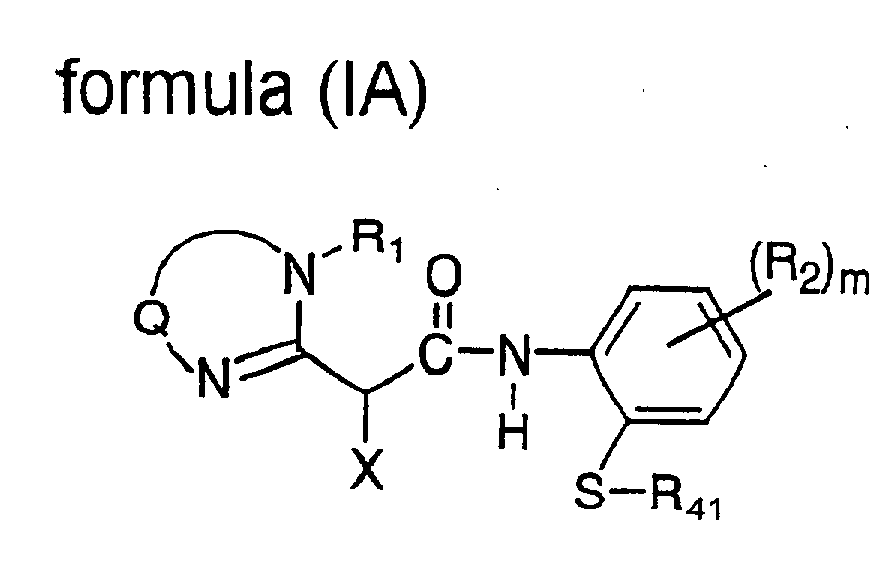
- The silver halide color photographic light-sensitive material as claimed in claim 5, wherein Q in formula (IA) is a group represented by -C(-R11)=C(-R12)-SO2- or -C(-R11)=C(-R12)-CO-, in which R11 and R12 are groups that bond with each other to form a 5- to 7-membered ring together with -C=C-, or they each independently represents a hydrogen atom or a substituent.
- The silver halide color photographic light-sensitive material as claimed in claim 5 or 6, wherein the yellow dye-forming coupler represented by formula (IA) is a yellow dye-forming coupler represented by formula (IIA):

- The silver halide color photographic light-sensitive material as claimed in claim 4, wherein the yellow dye-forming coupler represented by formula (I) is a yellow dye-forming coupler represented by formula (IB):

- The silver halide color photographic light-sensitive material as claimed in claim 8, wherein Q1 in formula (IB) is a group represented by -C(-R11)=C(-R12)-SO2- or -C(-R11)=C(-R12)-CO-, in which R11 and R12 are groups that bond with each other to form a 5- to 7-membered ring together with -C=C-, or they each independently represent a hydrogen atom or a substituent.
- The silver halide color photographic light-sensitive material as claimed in claim 8 or 9, wherein the yellow dye-forming coupler represented by formula (IB) is a yellow dye-forming coupler represented by formula (IIB):

- The silver halide color photographic light-sensitive material as claimed in any one of claims 8 to 10, wherein R2 in formula (IB) represents a t-butyl group.
Applications Claiming Priority (4)
| Application Number | Priority Date | Filing Date | Title |
|---|---|---|---|
| JP2002284156 | 2002-09-27 | ||
| JP2002283780 | 2002-09-27 | ||
| JP2002284156A JP4090832B2 (en) | 2002-09-27 | 2002-09-27 | Dye-forming coupler and silver halide color photographic material |
| JP2002283780 | 2002-09-27 |
Publications (1)
| Publication Number | Publication Date |
|---|---|
| EP1403704A1 true EP1403704A1 (en) | 2004-03-31 |
Family
ID=31980643
Family Applications (1)
| Application Number | Title | Priority Date | Filing Date |
|---|---|---|---|
| EP20030021632 Withdrawn EP1403704A1 (en) | 2002-09-27 | 2003-09-25 | Dye-forming coupler and silver halide color photographic light-sensitive material |
Country Status (2)
| Country | Link |
|---|---|
| US (1) | US7125988B2 (en) |
| EP (1) | EP1403704A1 (en) |
Families Citing this family (1)
| Publication number | Priority date | Publication date | Assignee | Title |
|---|---|---|---|---|
| CN113336745A (en) * | 2021-05-12 | 2021-09-03 | 中国乐凯集团有限公司 | Method for synthesizing benzothiadiazine dioxide acetanilide derivatives by one-pot method |
Citations (7)
| Publication number | Priority date | Publication date | Assignee | Title |
|---|---|---|---|---|
| US3841880A (en) | 1973-04-03 | 1974-10-15 | Eastman Kodak Co | Silver halide emulsion containing ketomethylene photographic color-forming couplers |
| JPS5282423A (en) | 1975-12-29 | 1977-07-09 | Fuji Photo Film Co Ltd | Photographic coupler |
| JPH0228645A (en) | 1988-04-07 | 1990-01-30 | Fuji Photo Film Co Ltd | Silver halide color photographic sensitive material |
| WO1995003871A1 (en) | 1993-07-30 | 1995-02-09 | Donaldson Company, Inc. | Fluid filter cartridge with replaceable filter element |
| US5393571A (en) | 1989-10-31 | 1995-02-28 | Fuji Photo Film Co., Ltd. | Curtain coating method for eliminating sagging at high flow rates |
| US5455149A (en) * | 1993-09-01 | 1995-10-03 | Agfa-Gevaert, Ag | Color photographic material containing novel yellow couplers |
| EP1246006A2 (en) * | 2001-03-29 | 2002-10-02 | Fuji Photo Film Co., Ltd. | Dye-forming coupler, silver halide photographic light-sensitive material and azomethine dye compound |
Family Cites Families (11)
| Publication number | Priority date | Publication date | Assignee | Title |
|---|---|---|---|---|
| JPS58111943A (en) | 1981-12-25 | 1983-07-04 | Konishiroku Photo Ind Co Ltd | Blocked magneta dye-forming coupler |
| JP2797212B2 (en) | 1989-05-18 | 1998-09-17 | コニカ株式会社 | New photographic coupler |
| DE3925438A1 (en) | 1989-08-01 | 1991-02-07 | Agfa Gevaert Ag | COLOR PHOTOGRAPHIC RECORDING MATERIAL WITH A COUPLER RELEASING A PHOTOGRAPHICALLY EFFECTIVE CONNECTION |
| EP0447969B1 (en) | 1990-03-15 | 1997-01-15 | Fuji Photo Film Co., Ltd. | Yellow dye-forming coupler and silver halide color photographic material containing same |
| JPH0478582A (en) | 1990-07-20 | 1992-03-12 | Konica Corp | Thermal transfer recording material and method |
| JP2794503B2 (en) | 1990-10-24 | 1998-09-10 | 富士写真フイルム株式会社 | Silver halide color photographic materials |
| DE19601142A1 (en) | 1995-07-13 | 1997-01-16 | Agfa Gevaert Ag | Colour photographic process and material using masked developer - combining high colour densities with decreased fogging and sensitivity to process variations, also allowing use of developer free baths |
| US5994038A (en) | 1998-04-29 | 1999-11-30 | Eastman Kodak Company | Photographic element containing acetamido DIR coupler |
| DE19829978A1 (en) | 1998-07-04 | 2000-01-05 | Agfa Gevaert Ag | Color photographic silver halide material |
| US20040091825A1 (en) * | 2002-03-01 | 2004-05-13 | Fuji Photo Film Co., Ltd. | Silver halide photographic light-sensitive material |
| US6887657B2 (en) * | 2003-05-12 | 2005-05-03 | Fuji Photo Film Co., Ltd. | Silver halide color photographic photosensitive material and image-forming method |
-
2003
- 2003-09-25 US US10/669,414 patent/US7125988B2/en not_active Expired - Fee Related
- 2003-09-25 EP EP20030021632 patent/EP1403704A1/en not_active Withdrawn
Patent Citations (7)
| Publication number | Priority date | Publication date | Assignee | Title |
|---|---|---|---|---|
| US3841880A (en) | 1973-04-03 | 1974-10-15 | Eastman Kodak Co | Silver halide emulsion containing ketomethylene photographic color-forming couplers |
| JPS5282423A (en) | 1975-12-29 | 1977-07-09 | Fuji Photo Film Co Ltd | Photographic coupler |
| JPH0228645A (en) | 1988-04-07 | 1990-01-30 | Fuji Photo Film Co Ltd | Silver halide color photographic sensitive material |
| US5393571A (en) | 1989-10-31 | 1995-02-28 | Fuji Photo Film Co., Ltd. | Curtain coating method for eliminating sagging at high flow rates |
| WO1995003871A1 (en) | 1993-07-30 | 1995-02-09 | Donaldson Company, Inc. | Fluid filter cartridge with replaceable filter element |
| US5455149A (en) * | 1993-09-01 | 1995-10-03 | Agfa-Gevaert, Ag | Color photographic material containing novel yellow couplers |
| EP1246006A2 (en) * | 2001-03-29 | 2002-10-02 | Fuji Photo Film Co., Ltd. | Dye-forming coupler, silver halide photographic light-sensitive material and azomethine dye compound |
Also Published As
| Publication number | Publication date |
|---|---|
| US7125988B2 (en) | 2006-10-24 |
| US20050079456A1 (en) | 2005-04-14 |
Similar Documents
| Publication | Publication Date | Title |
|---|---|---|
| US20080214810A1 (en) | Dye-forming coupler, silver halide photographic light-sensitive material, and azomethine dye compound | |
| US20030073047A1 (en) | Dye-forming coupler, silver halide photographic light-sensitive material and azomethine dye compound | |
| US6677110B2 (en) | Dye-forming coupler, silver halide photographic light-sensitive material, and azomethine dye compound | |
| US7125988B2 (en) | Dye-forming coupler and silver halide color photographic light-sensitive material | |
| US20040122238A1 (en) | Dye-forming coupler, silver halide photographic light-sensitive material and azomethine dye compound | |
| US20040091825A1 (en) | Silver halide photographic light-sensitive material | |
| JP4267840B2 (en) | Dye-forming coupler, silver halide photographic material and azomethine dye compound | |
| US6649771B2 (en) | Silver halide color photographic light-sensitive material, pyrrolotriazole compound and dye-forming compound | |
| JP4079863B2 (en) | Dye-forming coupler and silver halide color photographic material | |
| JP4153231B2 (en) | Silver halide color photographic light-sensitive material | |
| JP4090832B2 (en) | Dye-forming coupler and silver halide color photographic material | |
| EP1341034B1 (en) | Silver halide color photographic light-sensitive material | |
| JP4022417B2 (en) | Silver halide photographic material | |
| JP2004117997A (en) | Silver halide color photographic sensitive material | |
| JP3974805B2 (en) | Silver halide color photographic light-sensitive material | |
| JP4022418B2 (en) | Silver halide color photographic light-sensitive material | |
| JP4381596B2 (en) | Disulfide compound and method for producing the same, silver halide emulsion, and silver halide photographic light-sensitive material | |
| EP1530080B1 (en) | Silver halide color photographic light-sensitive material | |
| JP2004117987A (en) | Dye forming coupler and silver halide color photographic sensitive material | |
| JP2006091793A (en) | Silver halide color photographic photosensitive material and method of image forming | |
| JP2002296740A (en) | Dye forming coupler, silver halide photographic sensitive material and azomethine dye compound | |
| JP2003233158A (en) | Dye forming coupler and silver halide photographic sensitive material | |
| JP2005092035A (en) | Silver halide color photosensitive material and antifading agent | |
| JP2002296741A (en) | Dye forming coupler, silver halide photographic sensitive material and azomethine dye compound | |
| JP2002318442A (en) | Dye forming coupler, silver halide photographic sensitive material, and azomethine dye compound |
Legal Events
| Date | Code | Title | Description |
|---|---|---|---|
| PUAI | Public reference made under article 153(3) epc to a published international application that has entered the european phase |
Free format text: ORIGINAL CODE: 0009012 |
|
| AK | Designated contracting states |
Kind code of ref document: A1 Designated state(s): AT BE BG CH CY CZ DE DK EE ES FI FR GB GR HU IE IT LI LU MC NL PT RO SE SI SK TR |
|
| AX | Request for extension of the european patent |
Extension state: AL LT LV MK |
|
| 17P | Request for examination filed |
Effective date: 20040916 |
|
| AKX | Designation fees paid |
Designated state(s): AT BE BG CH CY CZ DE DK EE ES FI FR GB GR HU IE IT LI LU MC NL PT RO SE SI SK TR |
|
| RAP1 | Party data changed (applicant data changed or rights of an application transferred) |
Owner name: FUJIFILM CORPORATION |
|
| GRAP | Despatch of communication of intention to grant a patent |
Free format text: ORIGINAL CODE: EPIDOSNIGR1 |
|
| STAA | Information on the status of an ep patent application or granted ep patent |
Free format text: STATUS: THE APPLICATION IS DEEMED TO BE WITHDRAWN |
|
| 18D | Application deemed to be withdrawn |
Effective date: 20110629 |