EP1403482A2 - Swirl chamber used in association with a combustion chamber for diesel engines - Google Patents
Swirl chamber used in association with a combustion chamber for diesel engines Download PDFInfo
- Publication number
- EP1403482A2 EP1403482A2 EP03019967A EP03019967A EP1403482A2 EP 1403482 A2 EP1403482 A2 EP 1403482A2 EP 03019967 A EP03019967 A EP 03019967A EP 03019967 A EP03019967 A EP 03019967A EP 1403482 A2 EP1403482 A2 EP 1403482A2
- Authority
- EP
- European Patent Office
- Prior art keywords
- swirl chamber
- recited
- sub
- main
- nozzle hole
- Prior art date
- Legal status (The legal status is an assumption and is not a legal conclusion. Google has not performed a legal analysis and makes no representation as to the accuracy of the status listed.)
- Granted
Links
Images




Classifications
-
- F—MECHANICAL ENGINEERING; LIGHTING; HEATING; WEAPONS; BLASTING
- F02—COMBUSTION ENGINES; HOT-GAS OR COMBUSTION-PRODUCT ENGINE PLANTS
- F02B—INTERNAL-COMBUSTION PISTON ENGINES; COMBUSTION ENGINES IN GENERAL
- F02B19/00—Engines characterised by precombustion chambers
- F02B19/16—Chamber shapes or constructions not specific to sub-groups F02B19/02 - F02B19/10
- F02B19/18—Transfer passages between chamber and cylinder
-
- F—MECHANICAL ENGINEERING; LIGHTING; HEATING; WEAPONS; BLASTING
- F02—COMBUSTION ENGINES; HOT-GAS OR COMBUSTION-PRODUCT ENGINE PLANTS
- F02B—INTERNAL-COMBUSTION PISTON ENGINES; COMBUSTION ENGINES IN GENERAL
- F02B19/00—Engines characterised by precombustion chambers
- F02B19/08—Engines characterised by precombustion chambers the chamber being of air-swirl type
-
- F—MECHANICAL ENGINEERING; LIGHTING; HEATING; WEAPONS; BLASTING
- F02—COMBUSTION ENGINES; HOT-GAS OR COMBUSTION-PRODUCT ENGINE PLANTS
- F02B—INTERNAL-COMBUSTION PISTON ENGINES; COMBUSTION ENGINES IN GENERAL
- F02B19/00—Engines characterised by precombustion chambers
- F02B19/14—Engines characterised by precombustion chambers with compression ignition
-
- F—MECHANICAL ENGINEERING; LIGHTING; HEATING; WEAPONS; BLASTING
- F02—COMBUSTION ENGINES; HOT-GAS OR COMBUSTION-PRODUCT ENGINE PLANTS
- F02B—INTERNAL-COMBUSTION PISTON ENGINES; COMBUSTION ENGINES IN GENERAL
- F02B3/00—Engines characterised by air compression and subsequent fuel addition
- F02B3/06—Engines characterised by air compression and subsequent fuel addition with compression ignition
-
- Y—GENERAL TAGGING OF NEW TECHNOLOGICAL DEVELOPMENTS; GENERAL TAGGING OF CROSS-SECTIONAL TECHNOLOGIES SPANNING OVER SEVERAL SECTIONS OF THE IPC; TECHNICAL SUBJECTS COVERED BY FORMER USPC CROSS-REFERENCE ART COLLECTIONS [XRACs] AND DIGESTS
- Y02—TECHNOLOGIES OR APPLICATIONS FOR MITIGATION OR ADAPTATION AGAINST CLIMATE CHANGE
- Y02T—CLIMATE CHANGE MITIGATION TECHNOLOGIES RELATED TO TRANSPORTATION
- Y02T10/00—Road transport of goods or passengers
- Y02T10/10—Internal combustion engine [ICE] based vehicles
- Y02T10/12—Improving ICE efficiencies
Definitions
- the present invention relates generally to a combustion chamber for diesel engines, and more particularly, to improvements upon a swirl chamber used in association with a combustion chamber for diesel engines.
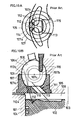
- FIGs. 10A and 10B the right-hand side (toward the central axis 103) is called “rearward”, and the left-hand side (toward the cylinder liner 104) is "forward" each as designation for convenience only.
- the known combustion chamber shown in Fig. 10A is provided with a cylinder 101 having a cylinder head 105, a reciprocating piston 102, and a combustion chamber 109.
- the cylinder head 105 is provided with a recess 106 in which a mouthpiece 107 is fitted.
- the mouthpiece 107 is provided with a top-open recess 107a, and the recess 106 includes a bottom-open recess 106a.
- the top-open recess 107a and the bottom-open recess 106a constitute a space 108 functioning as a swirl chamber, hereinafter the space being referred to as "swirl chamber 108".
- the swirl chamber 108 communicates with the combustion chamber 109 through a main nozzle hole 111 having a center axis 113.
- the main nozzle hole 111 is forwardly inclined toward the swirl chamber 108.
- the mouthpiece 107 is additionally provided with a pair of sub-nozzle holes 102, through which a secondary air is forced into the swirl chamber 108 on the compression stroke.
- the sub-nozzle holes 112 are symmetrically positioned on opposite sides of the central axis 113-114 as shown in Fig. 10A.
- the disadvantages mentioned above is due to the following arrangement of the sub-nozzle holes 112:
- a hypothetical circle (actually, sphere) 115 is supposed about the center of the open end 107b of the top-open recess 107a, and the radius of the open end 107b and that of the circle 115 are respectively supposed to be 100% and 70%.
- the circle 115 having a radius of 70% passes outward, whereas the circle 115 having a radius of 50% passes inward in Figs. 10A and 10B.
- the central axis 112a-112b of each of the sub-nozzle holes 112 passes outside the circle 115.
- the sub-nozzle holes 112 have their center 112c deviated from the center of the swirl chamber 108 so that the central axis 112a-112b of each sub-nozzle hole 112 cannot pass inside the 50% circle 115.
- an object of the present invention is to provide an improved swirl chamber capable of causing effective swirls to help air and fuel being well mixed, and dispersing the fuel well in the swirl chamber.
- Another object of the present invention is to provide an improved swirl chamber capable of reducing the production of both NOx and fumes, not one or the other under the conventional system.
- a swirl chamber used in association with a combustion chamber wherein the combustion chamber is defined by a piston, a cylinder, and a cylinder head, includes a mouthpiece fitted in a hole of the cylinder head, the hole having a bottom-open recess, and the mouthpiece including a top-open recess, the bottom-open recess and the top-open recess constituting a space for the swirl chamber; a main nozzle hole produced through a base wall of the mouthpiece to allow the swirl chamber to effect communication between the combustion chamber and the swirl chamber; and a pair of sub-nozzle holes produced through the base wall of the mouthpiece, the holes being positioned symmetrically on opposite sides of the central axis of the main nozzle hole; wherein each of the sub-nozzle holes is arranged to pass inside a hypothetical first circle having a radius of 70% of that (100%) of a hypothetical second circle depicted around the center of the top-open recess.
- FIG. 1B, 3B, 7B, 8B, 9B, and 2A A first embodiment is shown in Figs. 1 to 6, in which a pair of sub-nozzle holes 12 are provided upright in parallel with the central axis 3 of a cylinder 1. This is the same with a second embodiment shown in Fig. 7, but in the third embodiment shown in Fig. 8 and a fourth embodiment shown in Fig. 9 the sub-nozzle holes 12 are slightly converged and slightly diverged toward their top open ends, respectively.
- the feature common with all the embodiments is that the sub-nozzle holes are spaced from, and positioned symmetrically on opposite sides of, the main nozzle hole. In addition, the sub-nozzle holes are produced on the forward side.
- a reciprocating piston 2 is provided inside a cylinder 1 along whose central axis 3 the piston 2 moves up and down.
- the cylinder 1 has a head 5 having a recess 6 in which a mouthpiece 7 is fitted.
- the recess 6 includes a bottom-open recess 6a, and the mouthpiece 7 includes a top-open recess 7a.
- the bottom-open recess 6a and the top-open recess 7a constitute a space 8 that is utilized as a swirl chamber.
- the cylinder 1 is provided with a combustion chamber 9 having a main nozzle hole 11 passing through the mouthpiece 7.
- the combustion chamber 9 and the swirl chamber 8 communicate with each other through the main nozzle hole 11, which is forwardly inclined toward the swirl chamber 8 from the combustion chamber 8, as shown in Fig. 3B.
- the mouthpiece 7 has an undersurface 7d in a plane perpendicular to the central axis 3 of the cylinder 1.
- a fuel jet nozzle 19 and a heat plug 20 are provided toward the swirl chamber 8.
- the piston 1 is provided with a triangular recess 21 adapted to guide a gas flow, wherein the root portion of the recess 21 is positioned immediately below the main nozzle hole 11, and as best shown in Fig. 3A, the recess 21 expands progressively far from the main nozzle hole 11, thereby having a diminishing depth, as best shown in Fig. 3B.
- the piston 2 rises, thereby introducing compressed air into the swirl chamber 8 to cause swirls therein.
- fuel is ejected through the ejection nozzle 19.
- the fuel is mixed with the air in the swirl chamber 8, and the charge of fuel and air is ignited, and burned in the chamber 8, and as a result, it expands in volume.
- the expanded gases pass into the combustion chamber 9 through the main nozzle hole 11.
- the fresh charge expands and rises as it goes away from the main nozzle hole 11 in the triangular recess 21.
- the fuel-content in the fresh charge mixes with air in the combustion chamber 9, and the mixture is ignited and burned.
- the sub-nozzle holes 12 will be described:
- the sub-nozzle holes 12 are provided in pair through a base wall 10 of the mouthpiece 7.
- Each of the sub-nozzle holes 12 is away from the main nozzle hole 11 such that they are symmetrically positioned about the central axis 13 of the main nozzle hole 11 or about its extension 14, depending upon the shape of the main nozzle hole 11.
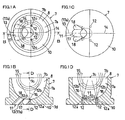
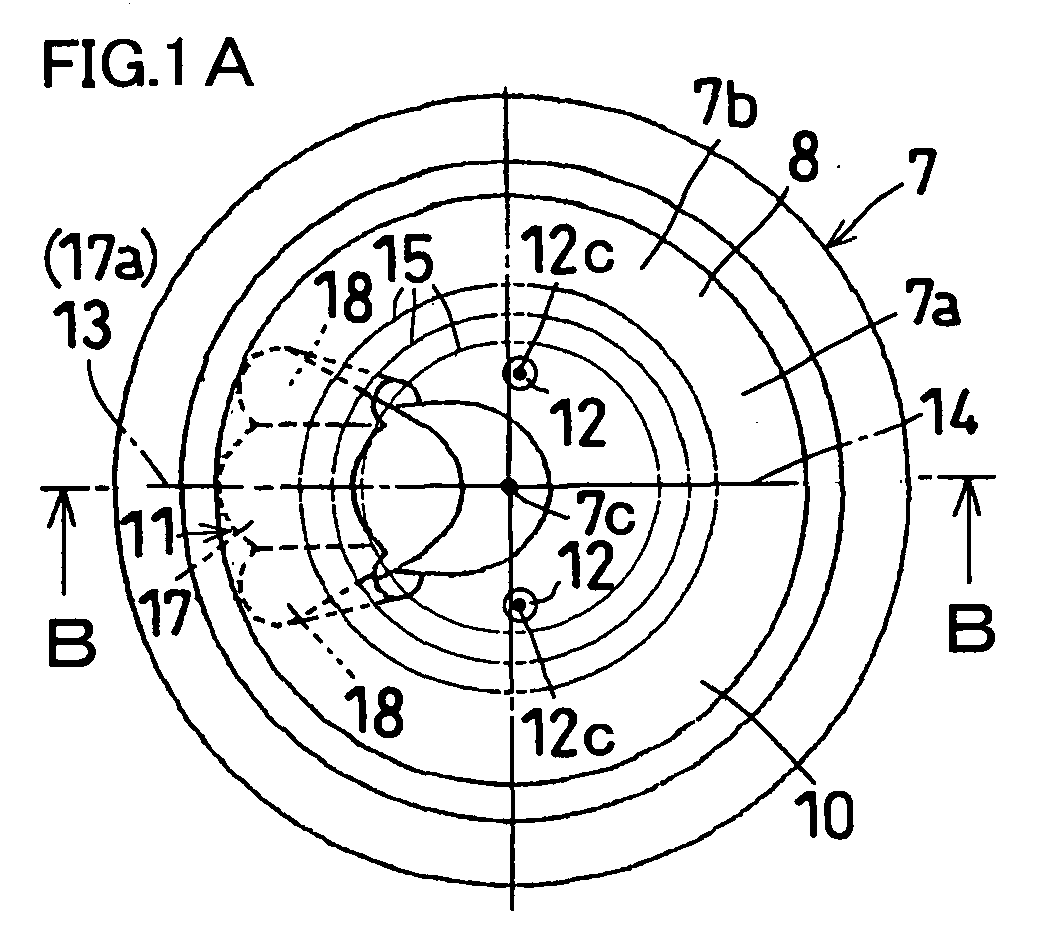
- Figs. 1A, 1B, and 1D show a hypothetical circle 15 (actually, a sphere) about a center 7c which is the center of the open end 7b of the recess 7a.
- the radius of the open end 7b is supposed to be 100%, and that of the circle 15 to be 50%.
- Each of the sub-nozzle holes 12 is positioned such that its central axis 12a-12b passes through the sphere 15, or in the drawing, through the circle 15.
- the radius of the circle 15 is 70%; more preferably, 60%, and most preferably, 50%.
- the innermost, middle, and outermost circles 15 are drawn in correspondence to 50%, 60%, and 70%, respectively. It has been demonstrated that this range of angular positioning of the sub-nozzle holes 12 enables a secondary air to gather at the center of the swirl chamber 8, thereby making the most of the air ejected through the sub-nozzle holes 12 and causing effective swirls in the swirl chamber 8.
- Fig. 1A shows, as a preferred embodiment, that the center 12c of the open end of each sub-nozzle hole 12 coincides with the circle 15 having a radius of 50%, thereby enabling the central axis 12a-12b of each sub-nozzle hole 12 to pass through the center of the swirl chamber 8.
- the radius is preferably 70%, more preferably 60%, and most preferably 50% of that (100%) of the open end of the top-open recess 7b.
- a hypothetical reference line 16 is supposed to extend from the central axis 12a of each sub-nozzle holes 12 by which the position of each hole 12 is determined; that is, each sub-nozzle hole 12 is positioned such that its central axis 12a-12b coincides with the reference line 16 in every direction as viewed in Figs. 1A to 1D.
- the sub-nozzle holes 12 are positioned at various angles for the reference line 16 (Figs. 1B and 1D). If it is positioned at a relatively large angle to the reference line 16, the sub-nozzle hole 12 can be short in length, thereby reducing frictional resistance to the flow of a secondary air passing through the sub-nozzle hole.
- the central axis 12a-12b of the sub-nozzle hole 12 is preferably inclined at 30° or less to the reference line 16, which will be referred to as "first angle".
- first angle In Fig.
- the central axis 12a-12b is preferably inclined at 15° , which will be referred to as "second angle".
- first angle is 15° or less
- second angle is 8° or less; more preferably, 8° or less to 4° or less, and most preferably, 4° or less to 2° or less.
- the first angle is 30° and the second angle is 15° each angular relation being indicated by chain lines.
- each sub-nozzle hole 12 is determined as follows:
- the total area of the open ends of the two sub-nozzle holes should be in the range of 3% to 15%; preferably, 4 to 10%; more preferably, 6 to 10%, and most preferably, 7 to 9%. In short, the range of 3 to 15%, or preferably, of 5 to 15% is effective to reduce the production of NOx and fumes evenly.
- the main nozzle hole 11 is constructed as follows:
- the main nozzle hole 11 includes a main groove 17 and a pair of side grooves 18 communicatively continuous to the main groove 17 through banks (not numbered).
- each side groove 18 is formed such that its central axis 18a is slightly behind the central axis 17a of the main groove 17.
- Each side groove 18 is also arranged that its angle of elevation is smaller than 45° of the axis 17a.
- each of the side grooves 18 gradually but slightly becomes narrower in width toward the depth of the main nozzle hole 11 while the main groove 17 remains the same along its full length.
- the side groove 18 and the sub-nozzle hole 12 on the same side of the central axis 13 of the main nozzle hole 11 are aligned each other.
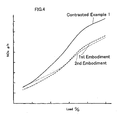
- the major advantage of the first embodiment is that environmental contaminants such as NOx and fumes are reduced in the exhaust gases, which will be demonstrated, on condition that the applied load is the same:
- the first embodiment has less nitrogen oxides (NO x ) than a contrasted example (1) that has neither sub-nozzle holes 12 nor the side grooves 18. It will be appreciated that the sub-nozzle holes 12 and the side grooves 18 are effective to reduce NOx content.
- Fig. 5 shows that the first embodiment has less NOx and less fumes than contrasted examples 1 and 2, wherein the contrasted example 2 has sub-nozzle holes corresponding to the sub-nozzle holes 12 but no grooves corresponding to the side grooves 18.
- the comparison between the contrasted examples 1 and 2 shows that the addition of the secondary air sub-nozzle holes 12 are conducive to the reduction of NOx and fumes.
- the comparison between the first embodiment and the contrasted example 2 shows that the side grooves 18 are conducive to the reduction of NOx and fumes.
- each horizontal co-ordinate is the percentage of the total minimum area of the open ends of the sub-nozzle holes 12 to the area of the open end of the main nozzle hole 11.
- the vertical co-ordinate of Fig. 6A indicates variations in the amount of NOx; in Fig. 6B the vertical co-ordinate indicates variations in the amount of fumes, and in Fig. 6C the vertical co-ordinate indicates variations in the total amount of NOx and fumes.
- Each coefficient of variation is calculated, as a reference value, based upon the amount of NOx and fumes produced in the combustion chamber having no sub-nozzle holes 12. Let the reference value be ⁇ , and the amount of variation be ⁇ . Then, the coefficient of variation will be ( ⁇ ⁇ ⁇ )/ ⁇ .
- the absolute value of the total reduction rate is maximized when the area of the open end of the sub-nozzle holes 12 is 7.7%.
- the absolute value of the reduction rate at this stage be 100%. It has been demonstrated that to increase the rate of reduction of exhaust gases up to 98%, the total area of the open ends of the sub-nozzle hole 12 must be in the range of 7 to 9%, and if it is in the range of 95% to 98%, the total area can be in the range of 6 to 10%. If it is in the range of 60% to 95%, the total area can be in the range of 3 to 15%. Among these ranges, when it exceeds 70%, and both NOx and fumes begin to reduce, the total area is in the range of 4 to 10%. As a result, it will be concluded that the total area of the open ends of the sub-nozzle holes preferably in the range of 3 to 15%; more preferably, 4 to 10%, further preferably, 6 to 10%, and most preferably, 7 to 9%.
- the total area of the open ends of the sub-nozzle holes 12 is 8% of the area (100%) of the open end of the main nozzle hole 11, wherein each sub-nozzle hole has an open end having the same area.
- This embodiment reduces the production of NOx or fumes or both, as clearly demonstrated by comparison with the contrasted examples 1 and 2.
- the total area of the open end of the sub-nozzle holes 12 is 8% of that (100%) of the open end of the main nozzle hole 11, wherein each sub-nozzle hole 12 has an open end having the same area. It has been demonstrated that the second embodiment reduces the production of NOx and fumes, as compared with the contrasted examples 1 and 2 as clearly demonstrated by comparison with the contrasted examples 1 and 2 in Fig. 4.
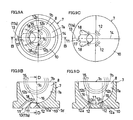
- the pair of sub-nozzle holes 12 are inclined inwardly or, in other words, slightly converged toward the swirl chamber 8 from the combustion chamber 9 in contrast to the first and second embodiments where they extend upright between the combustion chamber 9 and the swirl chamber 8.
- the angle of incline is 30° and in Fig. 8D, the angle of incline is 15° toward each other.
- the pair of sub-nozzle holes 12 are inclined rearward, as best shown in Fig. 9B, and, as shown in Fig. 9D, are inclined outwardly or, in other words, slightly diverged toward the swirl chamber 8 from the combustion chamber 9.
- the angle of incline is 30° and in Fig. 9D, the angle of incline is 15° toward each other.
Landscapes
- Engineering & Computer Science (AREA)
- Chemical & Material Sciences (AREA)
- Combustion & Propulsion (AREA)
- Mechanical Engineering (AREA)
- General Engineering & Computer Science (AREA)
- Combustion Methods Of Internal-Combustion Engines (AREA)
Abstract

Description
- The present invention relates generally to a combustion chamber for diesel engines, and more particularly, to improvements upon a swirl chamber used in association with a combustion chamber for diesel engines.
- In general, diesel engines are notorious as a major source of environmental contaminants such as NOx and fumes. However, no effective measures have been accomplished for solving those problems. It is known that these problems are due to the incomplete combustion in the engine occurring because of inadequate mixing of air and fuel. To solve these problems, swirl-aided combustion systems are commonly used. Here is one example for tackling this problem, which is disclosed in Japanese Patent Laid-open Application No. 07-97924. Referring to Fig. 10, the known combustion chamber fitted with a swirl chamber will be described:
- In Figs. 10A and 10B the right-hand side (toward the central axis 103) is called "rearward", and the left-hand side (toward the cylinder liner 104) is "forward" each as designation for convenience only. The known combustion chamber shown in Fig. 10A is provided with a
cylinder 101 having acylinder head 105, a reciprocatingpiston 102, and acombustion chamber 109. In addition, thecylinder head 105 is provided with arecess 106 in which amouthpiece 107 is fitted. Themouthpiece 107 is provided with a top-open recess 107a, and therecess 106 includes a bottom-open recess 106a. The top-open recess 107a and the bottom-open recess 106a constitute aspace 108 functioning as a swirl chamber, hereinafter the space being referred to as "swirl chamber 108". Theswirl chamber 108 communicates with thecombustion chamber 109 through amain nozzle hole 111 having acenter axis 113. Themain nozzle hole 111 is forwardly inclined toward theswirl chamber 108. Themouthpiece 107 is additionally provided with a pair ofsub-nozzle holes 102, through which a secondary air is forced into theswirl chamber 108 on the compression stroke. Thesub-nozzle holes 112 are symmetrically positioned on opposite sides of the central axis 113-114 as shown in Fig. 10A. - Under the construction mentioned above, however, a major disadvantage is that the second air ejected through the
sub-nozzle holes 112 does not reach the central part of theswirl chamber 108, thereby failing to bring about effective swirls therein. In this way theconventional sub-nozzle holes 112 are not conducive to the full utilization of the secondary air. - The disadvantages mentioned above is due to the following arrangement of the sub-nozzle holes 112: When a hypothetical circle (actually, sphere) 115 is supposed about the center of the
open end 107b of the top-open recess 107a, and the radius of theopen end 107b and that of thecircle 115 are respectively supposed to be 100% and 70%.
Thecircle 115 having a radius of 70% passes outward, whereas thecircle 115 having a radius of 50% passes inward in Figs. 10A and 10B. In this situation, the central axis 112a-112b of each of thesub-nozzle holes 112 passes outside thecircle 115. - In another aspect, the
sub-nozzle holes 112 have their center 112c deviated from the center of theswirl chamber 108 so that the central axis 112a-112b of eachsub-nozzle hole 112 cannot pass inside the 50%circle 115. - Accordingly, an object of the present invention is to provide an improved swirl chamber capable of causing effective swirls to help air and fuel being well mixed, and dispersing the fuel well in the swirl chamber.
- Another object of the present invention is to provide an improved swirl chamber capable of reducing the production of both NOx and fumes, not one or the other under the conventional system.
- According to the present invention, a swirl chamber used in association with a combustion chamber, wherein the combustion chamber is defined by a piston, a cylinder, and a cylinder head, includes a mouthpiece fitted in a hole of the cylinder head, the hole having a bottom-open recess, and the mouthpiece including a top-open recess, the bottom-open recess and the top-open recess constituting a space for the swirl chamber; a main nozzle hole produced through a base wall of the mouthpiece to allow the swirl chamber to effect communication between the combustion chamber and the swirl chamber; and a pair of sub-nozzle holes produced through the base wall of the mouthpiece, the holes being positioned symmetrically on opposite sides of the central axis of the main nozzle hole; wherein each of the sub-nozzle holes is arranged to pass inside a hypothetical first circle having a radius of 70% of that (100%) of a hypothetical second circle depicted around the center of the top-open recess.
-
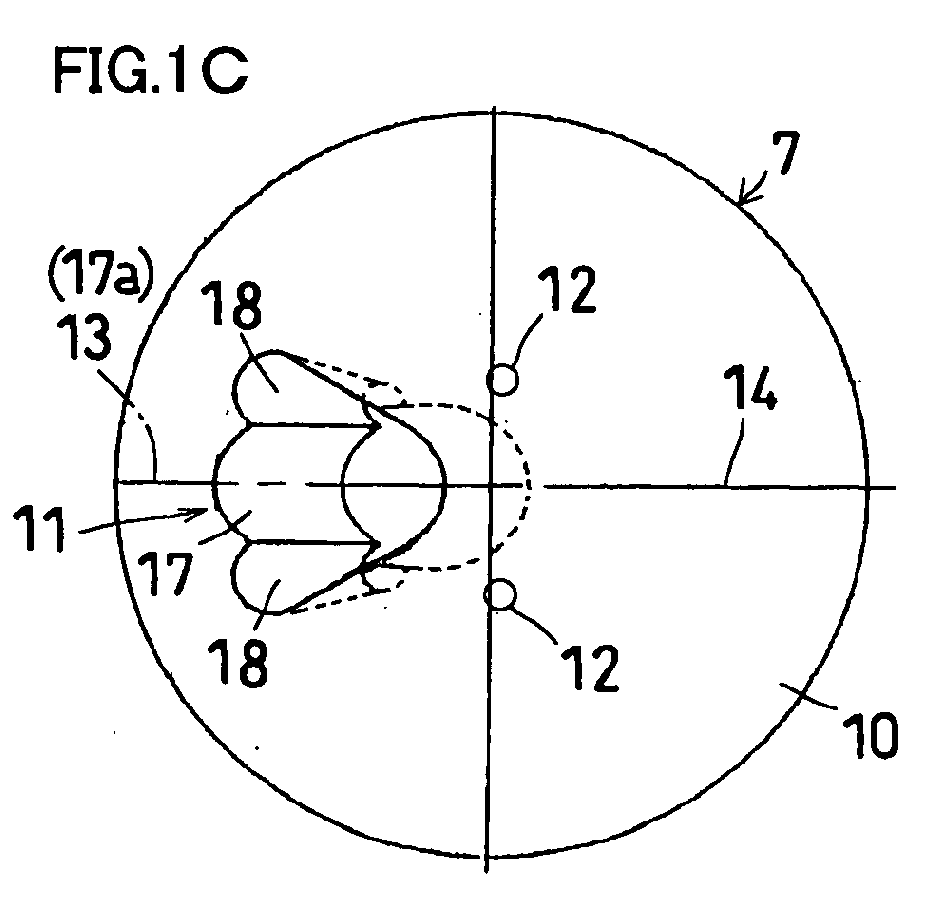
- Fig. 1 is generally a diagrammatic view exemplifying a first embodiment of the present invention; Fig. 1A being a plan view, Fig. 1B being a cross-sectional view taken along the line B-B of Fig. 1A; Fig. 1C being a bottom view, and Fig. 1D being a cross-sectional view taken along the line D-D;
- Fig. 2 is generally a diagrammatic view exemplifying the nozzle hole in the mouthpiece shown in Fig. 1; Fig. 2A being a vertical cross-sectional side view of the mouthpiece, Fig. 2B being a perspective view of the nozzle hole; Fig. 2C being a diagrammatic view of the nozzle hole viewed in the direction indicated by the arrow C in Fig. 2A, and Fig. 2D being a bottom view of the nozzle hole;
- Fig. 3 is generally a diagrammatic view exemplifying the swirl chamber shown in Fig. 1; Fig. 3A being a horizontal cross-sectional plan view of a cylinder incorporating a piston, and Fig. 3B being a cross-sectional side view of the swirl chamber and the surrounding part members;
- Fig. 4 is a graph showing NOx content in the exhaust gases under the first embodiment shown in Fig. 3, in comparison with a contrasted example 1 having no sub-nozzle holes;
- Fig. 5 is a graph showing the amount of NOx and fumes exhausted under the first embodiment shown in Fig. 3, in comparison with contrasted examples 1 and 2;
- Figs. 6 is generally a graph showing the relationship between the cross-sectional area of the sub-nozzle holes and the characteristics of gases exhausted from the swirl chamber of Fig. 3; Fig. 6A showing variations in the amount of NOx in relation to the cross-sectional area; Fig. 6B showing variations in the amount of fumes in relation to the cross-sectional area; and Fig. 6C showing variations in the total amount of NOx and fumes in relation to the cross-sectional area;
- Fig. 7 is generally a diagrammatic view exemplifying the mouthpiece of a second embodiment; Fig. 7A being a plan view, Fig. 7B being a cross-sectional view taken along the line B-B in Fig. 7A; Fig. 7C being a bottom view, and Fig. 7D being a cross-sectional view taken along the line D-D in Fig.7B;
- Fig.8 is generally a diagrammatic view exemplifying the mouthpiece of a third embodiment; Fig. 8A being a plan view, Fig. 8B being a cross-sectional view taken along the line B-B in Fig. 8A; Fig. 8C being a bottom view, and Fig. 8D being a cross-sectional view taken along the line D-D in Fig.8B;
- Fig. 9 is generally a diagrammatic view exemplifying the mouthpiece of a fourth embodiment; Fig. 9A being a plan view, Fig. 9B being a cross-sectional view taken along the line B-B in Fig. 9A; Fig. 9C being a bottom view, and Fig. 9D being a cross-sectional view taken along the line D-D in Fig.9B; and
- Fig. 10 is generally a diagrammatic view exemplifying a known swirl chamber; Fig. 10A being a plan view of the mouthpiece and the piston, and Fig. 10B being a vertical cross-sectional side view of a swirl chamber and surrounding part members.
- Throughout the drawings like numerals are used to designate like components, and in Figs. 1B, 3B, 7B, 8B, 9B, and 2A the right-hand side is "forward", and the left-hand side is "rearward" for convenience of illustration only. A first embodiment is shown in Figs. 1 to 6, in which a pair of
sub-nozzle holes 12 are provided upright in parallel with thecentral axis 3 of acylinder 1. This is the same with a second embodiment shown in Fig. 7, but in the third embodiment shown in Fig. 8 and a fourth embodiment shown in Fig. 9 the sub-nozzle holes 12 are slightly converged and slightly diverged toward their top open ends, respectively. The feature common with all the embodiments is that the sub-nozzle holes are spaced from, and positioned symmetrically on opposite sides of, the main nozzle hole. In addition, the sub-nozzle holes are produced on the forward side. - In Fig. 3B a
reciprocating piston 2 is provided inside acylinder 1 along whosecentral axis 3 thepiston 2 moves up and down. Thecylinder 1 has ahead 5 having arecess 6 in which amouthpiece 7 is fitted. Therecess 6 includes a bottom-open recess 6a, and themouthpiece 7 includes a top-open recess 7a. The bottom-open recess 6a and the top-open recess 7a constitute aspace 8 that is utilized as a swirl chamber. Thecylinder 1 is provided with acombustion chamber 9 having amain nozzle hole 11 passing through themouthpiece 7. Thecombustion chamber 9 and theswirl chamber 8 communicate with each other through themain nozzle hole 11, which is forwardly inclined toward theswirl chamber 8 from thecombustion chamber 8, as shown in Fig. 3B. Themouthpiece 7 has anundersurface 7d in a plane perpendicular to thecentral axis 3 of thecylinder 1. - As best shown in Fig. 3B, a
fuel jet nozzle 19 and aheat plug 20 are provided toward theswirl chamber 8. Thepiston 1 is provided with atriangular recess 21 adapted to guide a gas flow, wherein the root portion of therecess 21 is positioned immediately below themain nozzle hole 11, and as best shown in Fig. 3A, therecess 21 expands progressively far from themain nozzle hole 11, thereby having a diminishing depth, as best shown in Fig. 3B. - The principle underlying the
combustion chamber 9 fixed with theswirl chamber 8 is as follows: - On the compression stroke the
piston 2 rises, thereby introducing compressed air into theswirl chamber 8 to cause swirls therein. When thepiston 2 reaches the top dead point, fuel is ejected through theejection nozzle 19. The fuel is mixed with the air in theswirl chamber 8, and the charge of fuel and air is ignited, and burned in thechamber 8, and as a result, it expands in volume. The expanded gases pass into thecombustion chamber 9 through themain nozzle hole 11. The fresh charge expands and rises as it goes away from themain nozzle hole 11 in thetriangular recess 21. The fuel-content in the fresh charge mixes with air in thecombustion chamber 9, and the mixture is ignited and burned. - The sub-nozzle holes 12 will be described:
- In Figs. 1A to 1D, particularly in Figs. 1B and 1D, the
sub-nozzle holes 12 are provided in pair through abase wall 10 of themouthpiece 7. Each of the sub-nozzle holes 12 is away from themain nozzle hole 11 such that they are symmetrically positioned about thecentral axis 13 of themain nozzle hole 11 or about itsextension 14, depending upon the shape of themain nozzle hole 11. - Figs. 1A, 1B, and 1D show a hypothetical circle 15 (actually, a sphere) about a
center 7c which is the center of theopen end 7b of therecess 7a. The radius of theopen end 7b is supposed to be 100%, and that of thecircle 15 to be 50%. Each of the sub-nozzle holes 12 is positioned such that itscentral axis 12a-12b passes through thesphere 15, or in the drawing, through thecircle 15. - Preferably, the radius of the
circle 15 is 70%; more preferably, 60%, and most preferably, 50%. In Figs. 1A, 1B, and 1D the innermost, middle, andoutermost circles 15 are drawn in correspondence to 50%, 60%, and 70%, respectively. It has been demonstrated that this range of angular positioning of the sub-nozzle holes 12 enables a secondary air to gather at the center of theswirl chamber 8, thereby making the most of the air ejected through thesub-nozzle holes 12 and causing effective swirls in theswirl chamber 8. - Fig. 1A shows, as a preferred embodiment, that the
center 12c of the open end of eachsub-nozzle hole 12 coincides with thecircle 15 having a radius of 50%, thereby enabling thecentral axis 12a-12b of eachsub-nozzle hole 12 to pass through the center of theswirl chamber 8. In this case, the radius is preferably 70%, more preferably 60%, and most preferably 50% of that (100%) of the open end of the top-open recess 7b. - In Figs. 1A and 1D, a
hypothetical reference line 16 is supposed to extend from thecentral axis 12a of eachsub-nozzle holes 12 by which the position of eachhole 12 is determined; that is, eachsub-nozzle hole 12 is positioned such that itscentral axis 12a-12b coincides with thereference line 16 in every direction as viewed in Figs. 1A to 1D. - In this way the
sub-nozzle holes 12 are positioned at various angles for the reference line 16 (Figs. 1B and 1D). If it is positioned at a relatively large angle to thereference line 16, thesub-nozzle hole 12 can be short in length, thereby reducing frictional resistance to the flow of a secondary air passing through the sub-nozzle hole. In Fig. 1B where the cross-section of themouthpiece 7 is viewed from the side, and the twosub-nozzle holes 12 appear to be in alignment, thecentral axis 12a-12b of thesub-nozzle hole 12 is preferably inclined at 30° or less to thereference line 16, which will be referred to as "first angle". In Fig. 1D where the cross-section of themouthpiece 7 is viewed from the back, and thesub-nozzle holes 12 appear to be arranged side by side, thecentral axis 12a-12b is preferably inclined at 15°, which will be referred to as "second angle". In another preferred embodiment the first angle is 15° or less, and the second angle is 8° or less; more preferably, 8° or less to 4° or less, and most preferably, 4° or less to 2° or less. - In the embodiment illustrated in Figs. 1B and 1C the first angle is 30° and the second angle is 15° each angular relation being indicated by chain lines.
- The size of each
sub-nozzle hole 12 is determined as follows: - It has been demonstrated that when the
main nozzle hole 11 has an open end having an effective area is supposed to be 100%, the total area of the open ends of the two sub-nozzle holes should be in the range of 3% to 15%; preferably, 4 to 10%; more preferably, 6 to 10%, and most preferably, 7 to 9%. In short, the range of 3 to 15%, or preferably, of 5 to 15% is effective to reduce the production of NOx and fumes evenly. - The
main nozzle hole 11 is constructed as follows: - Referring to Figs. 2A to 2D, the
main nozzle hole 11 includes amain groove 17 and a pair ofside grooves 18 communicatively continuous to themain groove 17 through banks (not numbered). In Fig. 2A, eachside groove 18 is formed such that itscentral axis 18a is slightly behind thecentral axis 17a of themain groove 17. Eachside groove 18 is also arranged that its angle of elevation is smaller than 45° of theaxis 17a. - As best shown in Fig. 1A, each of the
side grooves 18 gradually but slightly becomes narrower in width toward the depth of themain nozzle hole 11 while themain groove 17 remains the same along its full length. In addition theside groove 18 and thesub-nozzle hole 12 on the same side of thecentral axis 13 of themain nozzle hole 11 are aligned each other. - Referring Figs. 4 and 5, the major advantage of the first embodiment is that environmental contaminants such as NOx and fumes are reduced in the exhaust gases, which will be demonstrated, on condition that the applied load is the same:
- From Fig. 4, it will be understood that the first embodiment has less nitrogen oxides (NOx) than a contrasted example (1) that has neither
sub-nozzle holes 12 nor theside grooves 18. It will be appreciated that thesub-nozzle holes 12 and theside grooves 18 are effective to reduce NOx content. - Fig. 5 shows that the first embodiment has less NOx and less fumes than contrasted examples 1 and 2, wherein the contrasted example 2 has sub-nozzle holes corresponding to the
sub-nozzle holes 12 but no grooves corresponding to theside grooves 18. The comparison between the contrasted examples 1 and 2 shows that the addition of the secondary air sub-nozzle holes 12 are conducive to the reduction of NOx and fumes. Likewise, the comparison between the first embodiment and the contrasted example 2 shows that theside grooves 18 are conducive to the reduction of NOx and fumes. - The efficiency of reducing exhaust gases depends upon the area of the open end of the
sub-nozzle hole 12. Referring to Fig. 6A to 6C, each horizontal co-ordinate is the percentage of the total minimum area of the open ends of thesub-nozzle holes 12 to the area of the open end of themain nozzle hole 11. The vertical co-ordinate of Fig. 6A indicates variations in the amount of NOx; in Fig. 6B the vertical co-ordinate indicates variations in the amount of fumes, and in Fig. 6C the vertical co-ordinate indicates variations in the total amount of NOx and fumes. Each coefficient of variation is calculated, as a reference value, based upon the amount of NOx and fumes produced in the combustion chamber having no sub-nozzle holes 12. Let the reference value be α, and the amount of variation be β. Then, the coefficient of variation will be (β ― α)/ α. - As shown in Fig. 6C, the absolute value of the total reduction rate is maximized when the area of the open end of the sub-nozzle holes 12 is 7.7%. Let the absolute value of the reduction rate at this stage be 100%. It has been demonstrated that to increase the rate of reduction of exhaust gases up to 98%, the total area of the open ends of the
sub-nozzle hole 12 must be in the range of 7 to 9%, and if it is in the range of 95% to 98%, the total area can be in the range of 6 to 10%. If it is in the range of 60% to 95%, the total area can be in the range of 3 to 15%. Among these ranges, when it exceeds 70%, and both NOx and fumes begin to reduce, the total area is in the range of 4 to 10%. As a result, it will be concluded that the total area of the open ends of the sub-nozzle holes preferably in the range of 3 to 15%; more preferably, 4 to 10%, further preferably, 6 to 10%, and most preferably, 7 to 9%. - Referring to Figs. 7, 8 and 9, a second embodiment, a third embodiment and a fourth embodiment will be described, respectively:
- In the second embodiment shown in Fig. 7 the total area of the open ends of the sub-nozzle holes 12 is 8% of the area (100%) of the open end of the
main nozzle hole 11, wherein each sub-nozzle hole has an open end having the same area. This embodiment reduces the production of NOx or fumes or both, as clearly demonstrated by comparison with the contrasted examples 1 and 2. - In the second embodiment the total area of the open end of the sub-nozzle holes 12 is 8% of that (100%) of the open end of the
main nozzle hole 11, wherein eachsub-nozzle hole 12 has an open end having the same area. It has been demonstrated that the second embodiment reduces the production of NOx and fumes, as compared with the contrasted examples 1 and 2 as clearly demonstrated by comparison with the contrasted examples 1 and 2 in Fig. 4. - In the third embodiment shown in Fig. 8 the pair of
sub-nozzle holes 12 are inclined inwardly or, in other words, slightly converged toward theswirl chamber 8 from thecombustion chamber 9 in contrast to the first and second embodiments where they extend upright between thecombustion chamber 9 and theswirl chamber 8. In Fig. 8B the angle of incline is 30° and in Fig. 8D, the angle of incline is 15° toward each other. - In the fourth embodiment shown in Fig. 9A to 9D, the pair of
sub-nozzle holes 12 are inclined rearward, as best shown in Fig. 9B, and, as shown in Fig. 9D, are inclined outwardly or, in other words, slightly diverged toward theswirl chamber 8 from thecombustion chamber 9. In Fig. 9B the angle of incline is 30° and in Fig. 9D, the angle of incline is 15° toward each other.
Claims (26)
- A swirl chamber used in association with a combustion chamber for diesel engines, wherein the combustion chamber is defined by a piston, a cylinder, and a cylinder head, the swirl chamber comprising:a mouthpiece fitted in a hole of the cylinder head, the hole having a bottom-open recess, and the mouthpiece including a top-open recess, the bottom-open recess and the top-open recess constituting a space intended for the swirl chamber;a main nozzle hole produced through a base wall of the mouthpiece to effect communication between the combustion chamber and the swirl chamber; anda pair of sub-nozzle holes produced through the base wall of the mouthpiece, the holes being positioned symmetrically on opposite sides of the central axis of the main nozzle hole;wherein each of the sub-nozzle holes is arranged to pass inside a hypothetical first circle having a radius of 70% of that of a hypothetical second circle depicted around the center of the top-open recess.
- The swirl chamber as recited in claim 1, wherein the first circle has a radius of 60% of that of the second circle.
- The swirl chamber as recited in claim 1, wherein the first circle has a radius of 50% of that of the second circle.
- The swirl chamber as recited in claim 3, wherein each of the sub-nozzle holes is positioned such that its respective center coincides with the first circle having a radius of 50% of that of the second circle.
- The swirl chamber as recited in claim 1, wherein each of the sub-nozzle holes is positioned such that its central axis passes within an angular range of 0° to 30° away from a reference line supposed to pass axially through the sub-nozzle hole.
- The swirl chamber as recited in claim 5, wherein the angular range is 0° to 15°.
- The swirl chamber as recited in claim 1, wherein the total area of the open ends of the sub-nozzle holes is in the range of 3% to 15% of that of the main nozzle hole.
- The swirl chamber as recited in claim 7, wherein the total area is in the range of 4% to 10% of that of the main nozzle hole.
- The swirl chamber as recited in claim 1, wherein the main nozzle hole comprises a main groove and two side grooves each communicatively continuous to the main groove through banks.
- The swirl chamber as recited in claim 9, wherein the side grooves are positioned such that their central axes exist rearward of that of the main groove.
- The swirl chamber as recited in claim 10, wherein each of the side grooves has its central axis inclined at a smaller angle than an angle at which the central axis of the main groove is inclined with respect to the level of the base wall of the mouthpiece.
- The swirl chamber as recited in claim 11, wherein the side grooves are positioned such that the distance between them diminishes toward their forward ends.
- The swirl chamber as recited in claim 9, wherein each of the side grooves has a progressively diminishing cross-sectional area toward its forward end.
- The swirl chamber as recited in claim 9, wherein each of the side grooves is positioned such that its central axis is in parallel to, and rearward of, the central axis of the main groove.
- The swirl chamber as recited in claim 1, wherein each of the sub-nozzle holes is positioned such that its central axis extends within an angular range of 0° to 30° away from a reference line supposed to pass axially through the sub-nozzle hole.
- The swirl chamber as recited in claim 15, wherein the total area of the open ends of the sub-nozzle holes is in the range of 3% to 15% of that of the main nozzle hole.
- The swirl chamber as recited in claim 15, wherein the main nozzle hole comprises a main groove and two side grooves each communicatively continuous to the main groove through banks.
- The swirl chamber as recited in claim 17, wherein each of the side grooves is positioned such that its central axis is in parallel to, and rearward of, the central axis of the main nozzle hole.
- The swirl chamber as recited in claim 1, wherein the sub-nozzle holes are positioned such that their central axes are upright on the base wall of the mouthpiece.
- The swirl chamber as recited in claim 19, wherein the total area of the open ends of the sub-nozzle holes is in the range of 3% to 15% of that of the main nozzle hole.
- The swirl chamber as recited in claim 19, wherein the main nozzle hole comprises a main groove and two side grooves each communicatively continuous to the main groove through banks.
- The swirl chamber as recited in claim 21, wherein each of the side grooves is positioned such that its central axis is in parallel to, and rearward of, the central axis of the main groove.
- The swirl chamber as recited in claim 9, wherein each of the side grooves is forwardly inclined at an angle of elevation from a main combustion chamber to the swirl chamber.
- The swirl chamber as recited in claim 9, wherein each of the side grooves is rearward inclined at an angle of elevation from a main combustion chamber to the swirl chamber.
- The swirl chamber as recited in claim 1 wherein the sub-nozzle holes are positioned such that the distance between them becomes narrower toward their top open ends.
- The swirl chamber as recited in claim 1, wherein the sub-nozzle holes are positioned such that the distance between them becomes wider toward their top open ends.
Applications Claiming Priority (6)
| Application Number | Priority Date | Filing Date | Title |
|---|---|---|---|
| JP2002282390 | 2002-09-27 | ||
| JP2002282390 | 2002-09-27 | ||
| JP2003082996A JP4088545B2 (en) | 2002-09-27 | 2003-03-25 | Diesel engine vortex chamber combustion chamber communication passage |
| JP2003082996 | 2003-03-25 | ||
| JP2003283365A JP4085035B2 (en) | 2003-07-31 | 2003-07-31 | Diesel engine vortex chamber combustion chamber |
| JP2003283365 | 2003-07-31 |
Publications (3)
| Publication Number | Publication Date |
|---|---|
| EP1403482A2 true EP1403482A2 (en) | 2004-03-31 |
| EP1403482A3 EP1403482A3 (en) | 2007-02-14 |
| EP1403482B1 EP1403482B1 (en) | 2010-04-21 |
Family
ID=31982153
Family Applications (1)
| Application Number | Title | Priority Date | Filing Date |
|---|---|---|---|
| EP03019967A Expired - Lifetime EP1403482B1 (en) | 2002-09-27 | 2003-09-03 | Swirl chamber used in association with a combustion chamber for diesel engines |
Country Status (4)
| Country | Link |
|---|---|
| US (2) | US6899076B2 (en) |
| EP (1) | EP1403482B1 (en) |
| CN (1) | CN100356044C (en) |
| DE (1) | DE60332203D1 (en) |
Families Citing this family (37)
| Publication number | Priority date | Publication date | Assignee | Title |
|---|---|---|---|---|
| US8413634B2 (en) | 2008-01-07 | 2013-04-09 | Mcalister Technologies, Llc | Integrated fuel injector igniters with conductive cable assemblies |
| US8365700B2 (en) | 2008-01-07 | 2013-02-05 | Mcalister Technologies, Llc | Shaping a fuel charge in a combustion chamber with multiple drivers and/or ionization control |
| US8387599B2 (en) | 2008-01-07 | 2013-03-05 | Mcalister Technologies, Llc | Methods and systems for reducing the formation of oxides of nitrogen during combustion in engines |
| US8635985B2 (en) | 2008-01-07 | 2014-01-28 | Mcalister Technologies, Llc | Integrated fuel injectors and igniters and associated methods of use and manufacture |
| US8074625B2 (en) | 2008-01-07 | 2011-12-13 | Mcalister Technologies, Llc | Fuel injector actuator assemblies and associated methods of use and manufacture |
| US8561598B2 (en) | 2008-01-07 | 2013-10-22 | Mcalister Technologies, Llc | Method and system of thermochemical regeneration to provide oxygenated fuel, for example, with fuel-cooled fuel injectors |
| US8225768B2 (en) | 2008-01-07 | 2012-07-24 | Mcalister Technologies, Llc | Integrated fuel injector igniters suitable for large engine applications and associated methods of use and manufacture |
| US7628137B1 (en) | 2008-01-07 | 2009-12-08 | Mcalister Roy E | Multifuel storage, metering and ignition system |
| CN102713244A (en) | 2009-08-27 | 2012-10-03 | 麦卡利斯特技术有限责任公司 | Shaped supply fuel in combustors with multiple drivers and/or ionization control |
| EP2470485A4 (en) | 2009-08-27 | 2012-12-26 | Mcalister Technologies Llc | CERAMIC ISOLATOR AND METHODS OF USE AND MANUFACTURE |
| SG181526A1 (en) | 2009-12-07 | 2012-07-30 | Mcalister Technologies Llc | Integrated fuel injector igniters suitable for large engine applications and associated methods of use and manufacture |
| KR20120086375A (en) | 2009-12-07 | 2012-08-02 | 맥알리스터 테크놀로지즈 엘엘씨 | Adaptive control system for fuel injectors and igniters |
| US20110297753A1 (en) | 2010-12-06 | 2011-12-08 | Mcalister Roy E | Integrated fuel injector igniters configured to inject multiple fuels and/or coolants and associated methods of use and manufacture |
| CN102844540A (en) | 2010-02-13 | 2012-12-26 | 麦卡利斯特技术有限责任公司 | Methods and systems for adaptively cooling combustion chambers in engines |
| US8205805B2 (en) | 2010-02-13 | 2012-06-26 | Mcalister Technologies, Llc | Fuel injector assemblies having acoustical force modifiers and associated methods of use and manufacture |
| US8528519B2 (en) | 2010-10-27 | 2013-09-10 | Mcalister Technologies, Llc | Integrated fuel injector igniters suitable for large engine applications and associated methods of use and manufacture |
| US8091528B2 (en) | 2010-12-06 | 2012-01-10 | Mcalister Technologies, Llc | Integrated fuel injector igniters having force generating assemblies for injecting and igniting fuel and associated methods of use and manufacture |
| AT510869B1 (en) * | 2010-12-27 | 2013-04-15 | Ge Jenbacher Gmbh & Co Ohg | Internal combustion engine |
| US8820275B2 (en) | 2011-02-14 | 2014-09-02 | Mcalister Technologies, Llc | Torque multiplier engines |
| US8919377B2 (en) | 2011-08-12 | 2014-12-30 | Mcalister Technologies, Llc | Acoustically actuated flow valve assembly including a plurality of reed valves |
| CN103890343B (en) | 2011-08-12 | 2015-07-15 | 麦卡利斯特技术有限责任公司 | Systems and methods for improved engine cooling and power generation |
| US8851047B2 (en) | 2012-08-13 | 2014-10-07 | Mcallister Technologies, Llc | Injector-igniters with variable gap electrode |
| US8746197B2 (en) | 2012-11-02 | 2014-06-10 | Mcalister Technologies, Llc | Fuel injection systems with enhanced corona burst |
| US9169821B2 (en) | 2012-11-02 | 2015-10-27 | Mcalister Technologies, Llc | Fuel injection systems with enhanced corona burst |
| US9169814B2 (en) | 2012-11-02 | 2015-10-27 | Mcalister Technologies, Llc | Systems, methods, and devices with enhanced lorentz thrust |
| US9309846B2 (en) | 2012-11-12 | 2016-04-12 | Mcalister Technologies, Llc | Motion modifiers for fuel injection systems |
| US9115325B2 (en) | 2012-11-12 | 2015-08-25 | Mcalister Technologies, Llc | Systems and methods for utilizing alcohol fuels |
| US9200561B2 (en) | 2012-11-12 | 2015-12-01 | Mcalister Technologies, Llc | Chemical fuel conditioning and activation |
| US9091238B2 (en) | 2012-11-12 | 2015-07-28 | Advanced Green Technologies, Llc | Systems and methods for providing motion amplification and compensation by fluid displacement |
| US8800527B2 (en) | 2012-11-19 | 2014-08-12 | Mcalister Technologies, Llc | Method and apparatus for providing adaptive swirl injection and ignition |
| US9194337B2 (en) | 2013-03-14 | 2015-11-24 | Advanced Green Innovations, LLC | High pressure direct injected gaseous fuel system and retrofit kit incorporating the same |
| US8820293B1 (en) | 2013-03-15 | 2014-09-02 | Mcalister Technologies, Llc | Injector-igniter with thermochemical regeneration |
| US9562500B2 (en) | 2013-03-15 | 2017-02-07 | Mcalister Technologies, Llc | Injector-igniter with fuel characterization |
| US9334794B2 (en) * | 2013-06-05 | 2016-05-10 | Pratt & Whitney Canada Corp. | Rotary internal combustion engine with pilot subchamber and ignition element |
| JP6286648B2 (en) | 2013-09-25 | 2018-03-07 | アニスン エコテック ピー リミテッド | Self-cooling engine |
| CN104653275A (en) * | 2013-11-20 | 2015-05-27 | 铜陵市大成轧辊有限责任公司 | Separated combustion device for internal combustion engine |
| JP6895243B2 (en) * | 2016-12-08 | 2021-06-30 | 三菱重工エンジン&ターボチャージャ株式会社 | Sub-chamber gas engine |
Family Cites Families (18)
| Publication number | Priority date | Publication date | Assignee | Title |
|---|---|---|---|---|
| US2380615A (en) * | 1941-11-01 | 1945-07-31 | Richard H Sheppard | Combustion chamber |
| JPS5349609A (en) * | 1976-10-19 | 1978-05-06 | Nissan Diesel Motor Co Ltd | Turbulent type combustion chamber |
| JPS5756618A (en) * | 1980-09-17 | 1982-04-05 | Daihatsu Motor Co Ltd | Swirl-chamber diesel engine |
| JPS603236U (en) | 1983-06-22 | 1985-01-11 | 三菱重工業株式会社 | Combustion chamber of pre-chamber diesel engine |
| JPS6095129A (en) | 1983-10-31 | 1985-05-28 | Yanmar Diesel Engine Co Ltd | Convolutional combustion chamber of diesel engine |
| DE3519835A1 (en) * | 1984-06-07 | 1985-12-12 | Nissan Motor Co., Ltd., Yokohama, Kanagawa | COMBUSTION ENGINE |
| JPS61171821A (en) * | 1985-01-25 | 1986-08-02 | Nissan Motor Co Ltd | Diesel engine with swirl chamber |
| JPH0643806B2 (en) * | 1986-05-23 | 1994-06-08 | 株式会社クボタ | Whirlpool combustion chamber of diesel engine |
| JPS6434657A (en) * | 1987-07-29 | 1989-02-06 | Fujitsu Ltd | Gaseous pressure type polishing device |
| JPS6491034A (en) * | 1987-10-02 | 1989-04-10 | Toshiba Corp | Corrosion apparatus for observing metal texture |
| JPH0191034U (en) | 1987-12-09 | 1989-06-15 | ||
| JP3047057B2 (en) * | 1992-05-15 | 2000-05-29 | 株式会社クボタ | Diesel engine swirl chamber |
| JP3355723B2 (en) * | 1993-09-29 | 2002-12-09 | 井関農機株式会社 | Diesel engine combustion chamber |
| JP3406119B2 (en) * | 1995-06-05 | 2003-05-12 | ヤマハ発動機株式会社 | 2-stroke diesel engine with swirl chamber auxiliary combustion chamber |
| JP3332694B2 (en) * | 1995-09-22 | 2002-10-07 | 三菱重工業株式会社 | Combustion chamber of subchamber internal combustion engine |
| JP3191003B2 (en) * | 1996-09-06 | 2001-07-23 | 株式会社クボタ | Diesel engine subchamber combustion chamber |
| JPH11294168A (en) * | 1998-04-15 | 1999-10-26 | Ishikawajima Shibaura Mach Co Ltd | Sub-combustion chamber of diesel engine |
| JP2001271646A (en) * | 2000-03-24 | 2001-10-05 | Kubota Corp | Vortex chamber combustion chamber of a diesel engine |
-
2003
- 2003-09-03 EP EP03019967A patent/EP1403482B1/en not_active Expired - Lifetime
- 2003-09-03 DE DE60332203T patent/DE60332203D1/en not_active Expired - Lifetime
- 2003-09-16 US US10/663,186 patent/US6899076B2/en not_active Ceased
- 2003-09-19 CN CNB031587046A patent/CN100356044C/en not_active Expired - Lifetime
-
2006
- 2006-11-17 US US11/601,616 patent/USRE41344E1/en not_active Expired - Lifetime
Also Published As
| Publication number | Publication date |
|---|---|
| CN1492131A (en) | 2004-04-28 |
| EP1403482B1 (en) | 2010-04-21 |
| USRE41344E1 (en) | 2010-05-25 |
| DE60332203D1 (en) | 2010-06-02 |
| EP1403482A3 (en) | 2007-02-14 |
| US20040060536A1 (en) | 2004-04-01 |
| US6899076B2 (en) | 2005-05-31 |
| CN100356044C (en) | 2007-12-19 |
Similar Documents
| Publication | Publication Date | Title |
|---|---|---|
| EP1403482A2 (en) | Swirl chamber used in association with a combustion chamber for diesel engines | |
| EP2247837B1 (en) | Pre-chamber arrangement | |
| JPS5820369B2 (en) | Combustion chamber structure of internal combustion engine | |
| US6598583B2 (en) | Gasoline direct injection engine | |
| JPH08260970A (en) | Sub-chamber type gas chamber sub-chamber shape | |
| CN109751114B (en) | Combustion chamber structure of internal combustion engine | |
| KR101034072B1 (en) | Swirl chamber used in association with a combustion chamber for diesel engines | |
| EP2428661A2 (en) | Two-stroke engine transfer ports | |
| CN111322170B (en) | Direct injection internal combustion engine piston combustion chamber | |
| JP2816925B2 (en) | Secondary combustion chamber diesel engine | |
| JP4738930B2 (en) | Piston for internal combustion engine | |
| JP4363385B2 (en) | Piston for internal combustion engine | |
| EP4124733B1 (en) | Two-cycle engine | |
| JPS58128417A (en) | Combustion chamber structure of engine | |
| EP0633394A1 (en) | Divided chamber type diesel engine | |
| JPS62258116A (en) | Combustion chamber structure for engine | |
| JPS6319544Y2 (en) | ||
| JPS5924818Y2 (en) | Combustion device for split combustion internal combustion engine | |
| JPS62332B2 (en) | ||
| JPH0143467Y2 (en) | ||
| JPH08260979A (en) | Diesel engine auxiliary chamber combustion chamber | |
| KR19990020031A (en) | Piston for gasoline direct injection engine and its control method | |
| JPS6310293B2 (en) | ||
| JPS62111113A (en) | Combustion chamber for sub-chamber type engine | |
| KR19990003088A (en) | Coupling assembly of nozzle holder with direct coupling to fuel hose |
Legal Events
| Date | Code | Title | Description |
|---|---|---|---|
| PUAI | Public reference made under article 153(3) epc to a published international application that has entered the european phase |
Free format text: ORIGINAL CODE: 0009012 |
|
| AK | Designated contracting states |
Kind code of ref document: A2 Designated state(s): AT BE BG CH CY CZ DE DK EE ES FI FR GB GR HU IE IT LI LU MC NL PT RO SE SI SK TR |
|
| AX | Request for extension of the european patent |
Extension state: AL LT LV MK |
|
| PUAL | Search report despatched |
Free format text: ORIGINAL CODE: 0009013 |
|
| AK | Designated contracting states |
Kind code of ref document: A3 Designated state(s): AT BE BG CH CY CZ DE DK EE ES FI FR GB GR HU IE IT LI LU MC NL PT RO SE SI SK TR |
|
| AX | Request for extension of the european patent |
Extension state: AL LT LV MK |
|
| RIC1 | Information provided on ipc code assigned before grant |
Ipc: F02B 19/08 20060101ALN20070108BHEP Ipc: F02B 19/18 20060101AFI20070108BHEP Ipc: F02B 19/14 20060101ALN20070108BHEP |
|
| 17P | Request for examination filed |
Effective date: 20070806 |
|
| AKX | Designation fees paid |
Designated state(s): DE FR GB IT |
|
| 17Q | First examination report despatched |
Effective date: 20071005 |
|
| GRAP | Despatch of communication of intention to grant a patent |
Free format text: ORIGINAL CODE: EPIDOSNIGR1 |
|
| GRAS | Grant fee paid |
Free format text: ORIGINAL CODE: EPIDOSNIGR3 |
|
| GRAA | (expected) grant |
Free format text: ORIGINAL CODE: 0009210 |
|
| AK | Designated contracting states |
Kind code of ref document: B1 Designated state(s): DE FR GB IT |
|
| REG | Reference to a national code |
Ref country code: GB Ref legal event code: FG4D |
|
| REF | Corresponds to: |
Ref document number: 60332203 Country of ref document: DE Date of ref document: 20100602 Kind code of ref document: P |
|
| PLBE | No opposition filed within time limit |
Free format text: ORIGINAL CODE: 0009261 |
|
| STAA | Information on the status of an ep patent application or granted ep patent |
Free format text: STATUS: NO OPPOSITION FILED WITHIN TIME LIMIT |
|
| 26N | No opposition filed |
Effective date: 20110124 |
|
| REG | Reference to a national code |
Ref country code: FR Ref legal event code: PLFP Year of fee payment: 14 |
|
| REG | Reference to a national code |
Ref country code: FR Ref legal event code: PLFP Year of fee payment: 15 |
|
| REG | Reference to a national code |
Ref country code: FR Ref legal event code: PLFP Year of fee payment: 16 |
|
| PGFP | Annual fee paid to national office [announced via postgrant information from national office to epo] |
Ref country code: IT Payment date: 20220811 Year of fee payment: 20 Ref country code: GB Payment date: 20220728 Year of fee payment: 20 Ref country code: DE Payment date: 20220621 Year of fee payment: 20 |
|
| PGFP | Annual fee paid to national office [announced via postgrant information from national office to epo] |
Ref country code: FR Payment date: 20220808 Year of fee payment: 20 |
|
| REG | Reference to a national code |
Ref country code: DE Ref legal event code: R071 Ref document number: 60332203 Country of ref document: DE |
|
| REG | Reference to a national code |
Ref country code: GB Ref legal event code: PE20 Expiry date: 20230902 |
|
| PG25 | Lapsed in a contracting state [announced via postgrant information from national office to epo] |
Ref country code: GB Free format text: LAPSE BECAUSE OF EXPIRATION OF PROTECTION Effective date: 20230902 |