EP1401061B1 - High-voltage equipment housing and high-voltage connector - Google Patents
High-voltage equipment housing and high-voltage connector Download PDFInfo
- Publication number
- EP1401061B1 EP1401061B1 EP03021024A EP03021024A EP1401061B1 EP 1401061 B1 EP1401061 B1 EP 1401061B1 EP 03021024 A EP03021024 A EP 03021024A EP 03021024 A EP03021024 A EP 03021024A EP 1401061 B1 EP1401061 B1 EP 1401061B1
- Authority
- EP
- European Patent Office
- Prior art keywords
- voltage
- voltage equipment
- interlock
- pcu
- connection
- Prior art date
- Legal status (The legal status is an assumption and is not a legal conclusion. Google has not performed a legal analysis and makes no representation as to the accuracy of the status listed.)
- Expired - Lifetime
Links
- 230000004044 response Effects 0.000 claims description 10
- 230000002265 prevention Effects 0.000 claims description 7
- 238000012423 maintenance Methods 0.000 description 16
- 238000007689 inspection Methods 0.000 description 8
- 239000000446 fuel Substances 0.000 description 7
- 238000000034 method Methods 0.000 description 5
- 230000008569 process Effects 0.000 description 5
- 230000008859 change Effects 0.000 description 4
- 238000010586 diagram Methods 0.000 description 4
- 230000005611 electricity Effects 0.000 description 4
- UFHFLCQGNIYNRP-UHFFFAOYSA-N Hydrogen Chemical compound [H][H] UFHFLCQGNIYNRP-UHFFFAOYSA-N 0.000 description 3
- OKKJLVBELUTLKV-UHFFFAOYSA-N Methanol Chemical compound OC OKKJLVBELUTLKV-UHFFFAOYSA-N 0.000 description 3
- 238000001816 cooling Methods 0.000 description 3
- 239000001257 hydrogen Substances 0.000 description 3
- 229910052739 hydrogen Inorganic materials 0.000 description 3
- QVGXLLKOCUKJST-UHFFFAOYSA-N atomic oxygen Chemical compound [O] QVGXLLKOCUKJST-UHFFFAOYSA-N 0.000 description 2
- 239000001301 oxygen Substances 0.000 description 2
- 229910052760 oxygen Inorganic materials 0.000 description 2
- 230000002159 abnormal effect Effects 0.000 description 1
- 229910045601 alloy Inorganic materials 0.000 description 1
- 239000000956 alloy Substances 0.000 description 1
- 230000001419 dependent effect Effects 0.000 description 1
- 238000001514 detection method Methods 0.000 description 1
- 238000011161 development Methods 0.000 description 1
- 230000018109 developmental process Effects 0.000 description 1
- 230000006870 function Effects 0.000 description 1
- 230000001172 regenerating effect Effects 0.000 description 1
Images




Classifications
-
- B—PERFORMING OPERATIONS; TRANSPORTING
- B60—VEHICLES IN GENERAL
- B60L—PROPULSION OF ELECTRICALLY-PROPELLED VEHICLES; SUPPLYING ELECTRIC POWER FOR AUXILIARY EQUIPMENT OF ELECTRICALLY-PROPELLED VEHICLES; ELECTRODYNAMIC BRAKE SYSTEMS FOR VEHICLES IN GENERAL; MAGNETIC SUSPENSION OR LEVITATION FOR VEHICLES; MONITORING OPERATING VARIABLES OF ELECTRICALLY-PROPELLED VEHICLES; ELECTRIC SAFETY DEVICES FOR ELECTRICALLY-PROPELLED VEHICLES
- B60L1/00—Supplying electric power to auxiliary equipment of vehicles
- B60L1/003—Supplying electric power to auxiliary equipment of vehicles to auxiliary motors, e.g. for pumps, compressors
-
- B—PERFORMING OPERATIONS; TRANSPORTING
- B60—VEHICLES IN GENERAL
- B60L—PROPULSION OF ELECTRICALLY-PROPELLED VEHICLES; SUPPLYING ELECTRIC POWER FOR AUXILIARY EQUIPMENT OF ELECTRICALLY-PROPELLED VEHICLES; ELECTRODYNAMIC BRAKE SYSTEMS FOR VEHICLES IN GENERAL; MAGNETIC SUSPENSION OR LEVITATION FOR VEHICLES; MONITORING OPERATING VARIABLES OF ELECTRICALLY-PROPELLED VEHICLES; ELECTRIC SAFETY DEVICES FOR ELECTRICALLY-PROPELLED VEHICLES
- B60L3/00—Electric devices on electrically-propelled vehicles for safety purposes; Monitoring operating variables, e.g. speed, deceleration or energy consumption
- B60L3/0023—Detecting, eliminating, remedying or compensating for drive train abnormalities, e.g. failures within the drive train
- B60L3/0069—Detecting, eliminating, remedying or compensating for drive train abnormalities, e.g. failures within the drive train relating to the isolation, e.g. ground fault or leak current
-
- B—PERFORMING OPERATIONS; TRANSPORTING
- B60—VEHICLES IN GENERAL
- B60L—PROPULSION OF ELECTRICALLY-PROPELLED VEHICLES; SUPPLYING ELECTRIC POWER FOR AUXILIARY EQUIPMENT OF ELECTRICALLY-PROPELLED VEHICLES; ELECTRODYNAMIC BRAKE SYSTEMS FOR VEHICLES IN GENERAL; MAGNETIC SUSPENSION OR LEVITATION FOR VEHICLES; MONITORING OPERATING VARIABLES OF ELECTRICALLY-PROPELLED VEHICLES; ELECTRIC SAFETY DEVICES FOR ELECTRICALLY-PROPELLED VEHICLES
- B60L3/00—Electric devices on electrically-propelled vehicles for safety purposes; Monitoring operating variables, e.g. speed, deceleration or energy consumption
- B60L3/04—Cutting off the power supply under fault conditions
-
- B—PERFORMING OPERATIONS; TRANSPORTING
- B60—VEHICLES IN GENERAL
- B60L—PROPULSION OF ELECTRICALLY-PROPELLED VEHICLES; SUPPLYING ELECTRIC POWER FOR AUXILIARY EQUIPMENT OF ELECTRICALLY-PROPELLED VEHICLES; ELECTRODYNAMIC BRAKE SYSTEMS FOR VEHICLES IN GENERAL; MAGNETIC SUSPENSION OR LEVITATION FOR VEHICLES; MONITORING OPERATING VARIABLES OF ELECTRICALLY-PROPELLED VEHICLES; ELECTRIC SAFETY DEVICES FOR ELECTRICALLY-PROPELLED VEHICLES
- B60L50/00—Electric propulsion with power supplied within the vehicle
- B60L50/50—Electric propulsion with power supplied within the vehicle using propulsion power supplied by batteries or fuel cells
- B60L50/60—Electric propulsion with power supplied within the vehicle using propulsion power supplied by batteries or fuel cells using power supplied by batteries
- B60L50/61—Electric propulsion with power supplied within the vehicle using propulsion power supplied by batteries or fuel cells using power supplied by batteries by batteries charged by engine-driven generators, e.g. series hybrid electric vehicles
-
- B—PERFORMING OPERATIONS; TRANSPORTING
- B60—VEHICLES IN GENERAL
- B60L—PROPULSION OF ELECTRICALLY-PROPELLED VEHICLES; SUPPLYING ELECTRIC POWER FOR AUXILIARY EQUIPMENT OF ELECTRICALLY-PROPELLED VEHICLES; ELECTRODYNAMIC BRAKE SYSTEMS FOR VEHICLES IN GENERAL; MAGNETIC SUSPENSION OR LEVITATION FOR VEHICLES; MONITORING OPERATING VARIABLES OF ELECTRICALLY-PROPELLED VEHICLES; ELECTRIC SAFETY DEVICES FOR ELECTRICALLY-PROPELLED VEHICLES
- B60L58/00—Methods or circuit arrangements for monitoring or controlling batteries or fuel cells, specially adapted for electric vehicles
- B60L58/40—Methods or circuit arrangements for monitoring or controlling batteries or fuel cells, specially adapted for electric vehicles for controlling a combination of batteries and fuel cells
-
- H—ELECTRICITY
- H01—ELECTRIC ELEMENTS
- H01R—ELECTRICALLY-CONDUCTIVE CONNECTIONS; STRUCTURAL ASSOCIATIONS OF A PLURALITY OF MUTUALLY-INSULATED ELECTRICAL CONNECTING ELEMENTS; COUPLING DEVICES; CURRENT COLLECTORS
- H01R13/00—Details of coupling devices of the kinds covered by groups H01R12/70 or H01R24/00 - H01R33/00
- H01R13/46—Bases; Cases
- H01R13/516—Means for holding or embracing insulating body, e.g. casing, hoods
- H01R13/518—Means for holding or embracing insulating body, e.g. casing, hoods for holding or embracing several coupling parts, e.g. frames
-
- H—ELECTRICITY
- H01—ELECTRIC ELEMENTS
- H01R—ELECTRICALLY-CONDUCTIVE CONNECTIONS; STRUCTURAL ASSOCIATIONS OF A PLURALITY OF MUTUALLY-INSULATED ELECTRICAL CONNECTING ELEMENTS; COUPLING DEVICES; CURRENT COLLECTORS
- H01R13/00—Details of coupling devices of the kinds covered by groups H01R12/70 or H01R24/00 - H01R33/00
- H01R13/64—Means for preventing incorrect coupling
- H01R13/641—Means for preventing incorrect coupling by indicating incorrect coupling; by indicating correct or full engagement
-
- B—PERFORMING OPERATIONS; TRANSPORTING
- B60—VEHICLES IN GENERAL
- B60L—PROPULSION OF ELECTRICALLY-PROPELLED VEHICLES; SUPPLYING ELECTRIC POWER FOR AUXILIARY EQUIPMENT OF ELECTRICALLY-PROPELLED VEHICLES; ELECTRODYNAMIC BRAKE SYSTEMS FOR VEHICLES IN GENERAL; MAGNETIC SUSPENSION OR LEVITATION FOR VEHICLES; MONITORING OPERATING VARIABLES OF ELECTRICALLY-PROPELLED VEHICLES; ELECTRIC SAFETY DEVICES FOR ELECTRICALLY-PROPELLED VEHICLES
- B60L2240/00—Control parameters of input or output; Target parameters
- B60L2240/10—Vehicle control parameters
- B60L2240/34—Cabin temperature
-
- H—ELECTRICITY
- H01—ELECTRIC ELEMENTS
- H01R—ELECTRICALLY-CONDUCTIVE CONNECTIONS; STRUCTURAL ASSOCIATIONS OF A PLURALITY OF MUTUALLY-INSULATED ELECTRICAL CONNECTING ELEMENTS; COUPLING DEVICES; CURRENT COLLECTORS
- H01R13/00—Details of coupling devices of the kinds covered by groups H01R12/70 or H01R24/00 - H01R33/00
- H01R13/66—Structural association with built-in electrical component
- H01R13/70—Structural association with built-in electrical component with built-in switch
- H01R13/713—Structural association with built-in electrical component with built-in switch the switch being a safety switch
-
- H—ELECTRICITY
- H01—ELECTRIC ELEMENTS
- H01R—ELECTRICALLY-CONDUCTIVE CONNECTIONS; STRUCTURAL ASSOCIATIONS OF A PLURALITY OF MUTUALLY-INSULATED ELECTRICAL CONNECTING ELEMENTS; COUPLING DEVICES; CURRENT COLLECTORS
- H01R2201/00—Connectors or connections adapted for particular applications
- H01R2201/26—Connectors or connections adapted for particular applications for vehicles
-
- Y—GENERAL TAGGING OF NEW TECHNOLOGICAL DEVELOPMENTS; GENERAL TAGGING OF CROSS-SECTIONAL TECHNOLOGIES SPANNING OVER SEVERAL SECTIONS OF THE IPC; TECHNICAL SUBJECTS COVERED BY FORMER USPC CROSS-REFERENCE ART COLLECTIONS [XRACs] AND DIGESTS
- Y02—TECHNOLOGIES OR APPLICATIONS FOR MITIGATION OR ADAPTATION AGAINST CLIMATE CHANGE
- Y02T—CLIMATE CHANGE MITIGATION TECHNOLOGIES RELATED TO TRANSPORTATION
- Y02T10/00—Road transport of goods or passengers
- Y02T10/60—Other road transportation technologies with climate change mitigation effect
- Y02T10/62—Hybrid vehicles
-
- Y—GENERAL TAGGING OF NEW TECHNOLOGICAL DEVELOPMENTS; GENERAL TAGGING OF CROSS-SECTIONAL TECHNOLOGIES SPANNING OVER SEVERAL SECTIONS OF THE IPC; TECHNICAL SUBJECTS COVERED BY FORMER USPC CROSS-REFERENCE ART COLLECTIONS [XRACs] AND DIGESTS
- Y02—TECHNOLOGIES OR APPLICATIONS FOR MITIGATION OR ADAPTATION AGAINST CLIMATE CHANGE
- Y02T—CLIMATE CHANGE MITIGATION TECHNOLOGIES RELATED TO TRANSPORTATION
- Y02T10/00—Road transport of goods or passengers
- Y02T10/60—Other road transportation technologies with climate change mitigation effect
- Y02T10/70—Energy storage systems for electromobility, e.g. batteries
-
- Y—GENERAL TAGGING OF NEW TECHNOLOGICAL DEVELOPMENTS; GENERAL TAGGING OF CROSS-SECTIONAL TECHNOLOGIES SPANNING OVER SEVERAL SECTIONS OF THE IPC; TECHNICAL SUBJECTS COVERED BY FORMER USPC CROSS-REFERENCE ART COLLECTIONS [XRACs] AND DIGESTS
- Y02—TECHNOLOGIES OR APPLICATIONS FOR MITIGATION OR ADAPTATION AGAINST CLIMATE CHANGE
- Y02T—CLIMATE CHANGE MITIGATION TECHNOLOGIES RELATED TO TRANSPORTATION
- Y02T10/00—Road transport of goods or passengers
- Y02T10/60—Other road transportation technologies with climate change mitigation effect
- Y02T10/7072—Electromobility specific charging systems or methods for batteries, ultracapacitors, supercapacitors or double-layer capacitors
-
- Y—GENERAL TAGGING OF NEW TECHNOLOGICAL DEVELOPMENTS; GENERAL TAGGING OF CROSS-SECTIONAL TECHNOLOGIES SPANNING OVER SEVERAL SECTIONS OF THE IPC; TECHNICAL SUBJECTS COVERED BY FORMER USPC CROSS-REFERENCE ART COLLECTIONS [XRACs] AND DIGESTS
- Y02—TECHNOLOGIES OR APPLICATIONS FOR MITIGATION OR ADAPTATION AGAINST CLIMATE CHANGE
- Y02T—CLIMATE CHANGE MITIGATION TECHNOLOGIES RELATED TO TRANSPORTATION
- Y02T90/00—Enabling technologies or technologies with a potential or indirect contribution to GHG emissions mitigation
- Y02T90/40—Application of hydrogen technology to transportation, e.g. using fuel cells
Definitions
- the present invention relates to a structure of high-voltage equipment as well as a high-voltage connector for safely conducting maintenance and inspection of the high-voltage equipment mounted on an electric vehicle.
- the present invention relates to a structure of high-voltage equipment and a high-voltage connector with which a high-voltage power supply can mechanically and electrically be shut off to allow maintenance and inspection to be conducted.
- a conventional electric vehicle is structured by placing a circuit-breaker unit and high-voltage equipment in a space isolated from a passenger compartment and a trunk and covering the space with a maintenance lid to hold the circuit-breaker unit and the high-voltage equipment within the closed space.
- a maintenance lid for maintenance and inspection of the high-voltage equipment, sufficient safety measures for ensuring safety are indispensable.
- Japanese Patent Laying-Open No. 7-212903 discloses a structure of an electric vehicle for which maintenance and inspection can safely be conducted even if a maintenance worker forgets to turn off the breaker switch.
- a PCU (Power Control Unit) mounted on the electric vehicle is a unit including such high-voltage equipment as inverter and converter and being held in a housing.
- the high-voltage equipment like the inverter and the converter has a high-voltage connector to which a power cable is connected.
- the high-voltage connector can be detached without opening the maintenance lid which covers the housing. Then, when the high-voltage connector is detached, it could occur that the circuit-breaker unit does not stop the supply of the high-voltage electric power and thus the high-voltage electric power is still being supplied. At this time, the high-voltage connector is detached with the energized state maintained. In such a case, it is necessary that sufficient safety from a high voltage is ensured for an operator conducting maintenance and inspection.
- Document US 5 913 691 discloses an electrical connector comprising power and control circuits within the same connector body.
- this document describes a female connector member comprising a female control circuit recess and a male connector member comprising a male control circuit recess.
- a control circuit is provided which serves to ensure that the power supply switched on only while the power connection are in full physical contact.
- a high-voltage equipment housing holds high-voltage equipment therein.
- the high-voltage equipment housing includes a connection unit (means) for making an electrical connection between external equipment located outside the high-voltage equipment housing and the high-voltage equipment, an attaching unit (means) for attaching the connection unit to prevent a mechanical connection of the connection unit from being released by the connection unit only, and a changing unit (means) for changing a state of the electrical connection between the high-voltage equipment and the external equipment by means of the connection unit to a disconnected state in response to detachment of the attaching unit.
- a connection unit for making an electrical connection between external equipment located outside the high-voltage equipment housing and the high-voltage equipment
- an attaching unit for attaching the connection unit to prevent a mechanical connection of the connection unit from being released by the connection unit only
- a changing unit (means) for changing a state of the electrical connection between the high-voltage equipment and the external equipment by means of the connection unit to a disconnected state in response to detachment
- the interlock circuit is provided to the attaching unit.
- the attaching unit When the attaching unit is detached, the interlock circuit opens.
- the state of electrical connection is changed to the disconnected state. Accordingly, the high-voltage equipment housing sufficiently ensuring safety of an operator working on high-voltage equipment can be provided.
- the state is changed from a state where a high voltage is supplied or a high voltage can be supplied to a state where a high voltage cannot be supplied. Accordingly, the high-voltage equipment housing sufficiently ensuring safety of an operator working on high-voltage equipment can be provided.
- the high-voltage equipment housing may further include a holding unit for mounting the high-voltage equipment housing on a vehicle.
- an air-conditioner compressor 70, a hydrogen-supply pump 80 and an FC cooling pump 90 for cooling fuel cell 10 are connected to PCU 50.
- PCU 50 and air-conditioner compressor 70 are connected by a three-phase power cable 72
- PCU 50 and hydrogen-supply pump 80 are connected by a three-phase power cable 82
- PCU 50 and FC cooling pump 90 are connected by a three-phase power cable 92.
- the PCU box holding PCU 50 has connectors 60 for connecting the three three-phase power cables respectively, in addition to the above-mentioned connectors placed to be close to attachment 40 in the engine room for example. Connectors 60 are detailed hereinlater.
- the power train shown in Fig. 1 is an exemplary power train of the vehicle on which the PCU box holding PCU 50 according to this embodiment is mounted. Any power train except for the above-described one may be used that is a power train for high-voltage equipment of, for example, an electric vehicle or a hybrid electric vehicle.
- attachment bolt 116 for fixing PCU box cabinet 122 and PCU upper cover 120 together is tightened together with a crimp contact 112 connected to an interlock signal line 110. More specifically, as attachment bolts 116 are withdrawn for removing upper cover 120 of PCU box 100 shown in Fig. 2, interlock signal line 110 connected to crimp contact 112 is also detached so that it is detected that PCU upper cover 120 is removed.
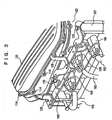
- Fig. 3 shows an enlarged perspective view of the side of PCU box 100 in Fig. 2.
- safety bar 106 is attached to PCU box cabinet 122 by inserting safety bar attachment bolts 130 into safety bar attachment holes and tightening nuts.
- upper cover detachment prevention hook 108 is fixed to safety bar 106 and accordingly, so long as all attachment bolts 130 of safety bar 106 are not removed, PCU upper cover 120 cannot be removed from PCU box cabinet 122 even if all bolts 116 attached to upper cover attachment holes 114 are removed.
- safety bar 106 is shaped in such a way that three connectors 104 will not be touched by an operator, and has a plurality of safety bar attachment holes 132. As described above, safety bar 106 is attached to PCU box cabinet 122 by inserting safety bar attachment bolts 130 into safety bar attachment holes 132 and tightening nuts. Further, as shown in Fig. 4, upper cover detachment prevention hook 108 is fixed in advance to safety bar 106.
- Attachment bolts 116 fit in upper cover attachment hole 114 may be tightened together with interlock signal line 110 as shown in Fig. 2.
- safety bar attachment bolt 130 inserted into safety bar attachment hole 132 shown in Fig. 4 may be tightened together with interlock signal line 110.
- FIG. 5 a description is given below of a control block diagram of a system executing control when interlock signal line 110 of PCU box 100 of this embodiment is detached. This control is executed by an ECU (Electronic Control Unit) 1000 shown in Fig. 5.
- ECU Electronic Control Unit
- ECU 1000 includes a CPU (Central Processing Unit) 1010, a memory 1020 storing a program executed by CPU 1010 as well as various data, an input/output interface 1030, a bus 1040 connecting CPU 1010, memory 1020 and input/output interface 1030, and an interlock circuit 1050.
- Interlock circuit 1050 is connected to an interlock 1400 which is located outside the ECU.
- Interlock circuit 1050 includes two resistors 1054 and 1056 and a comparator 1052.
- interlock 1400 When interlock 1400 is closed (normal state), an interlock signal of Lo level is output from comparator 1052 and a high-voltage power supply signal of Hi level is output to a high-voltage interlock control circuit 1100.
- interlock 1400 is closed, the interlock signal of Lo level is input from interlock circuit 1050 to CPU 1010 via input/output interface 1030.
- CPU 1010 detecting the interlock signal of Lo level then outputs the high-voltage power supply signal of Hi level to high-voltage interlock control circuit 1100 via input/output interface 1030 and accordingly, high-voltage interlock control circuit 1100 exercises control to allow a high-voltage power supply 1300 to supply a high-voltage to a PCU 1200.
- comparator 1052 when interlock 1400 is opened (abnormal state), comparator 1052 outputs an interlock signal of Hi level so that a high-voltage power supply instruction signal of Lo level is output from CPU 1010 to high-voltage interlock control circuit 1100.
- interlock 1400 is opened, the interlock signal of Hi level is input from interlock circuit 1050 to CPU 1010 via input/output interface 1030.
- CPU 1010 detecting the interlock signal of Hi level then outputs the high-voltage power supply instruction signal of Lo level to high-voltage interlock control circuit 1100 via input/output interface 1030 and accordingly, high-voltage interlock control circuit 1100 exercises control to shut off a high-voltage supplied from high-voltage power supply 1300 to PCU 1200.
- Comparator 1052 outputs a signal of Hi level when two input voltages have a large difference therebetween and outputs a signal of Lo level when two input voltages have a small difference therebetween.
- High-voltage interlock control circuit 1100 is connected to ECU 1000 via input/output interface 1030. High-voltage interlock control circuit 1100 is connected to PCU 1200 and high-voltage power supply 1300 via power cable 102.
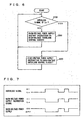
- FIG. 6 a control structure of a program executed by CPU 1010 shown in Fig. 5 is described.
- step (hereinafter abbreviated as S) 100 CPU 1010 determines whether or not an interlock signal is Lo level.
- the interlock signal is input from comparator 1052 of interlock circuit 1050 via input/output interface 1030. If the interlock signal has Lo level (YES in S 100), this process proceeds to S300. If not (NO in S100), the process proceeds to S200.
- CPU 1010 In S200, CPU 1010 outputs a high-voltage power supply shutoff instruction to high-voltage interlock control circuit 1100. The process thereafter returns to S100.
- interlock 1400 is in a closed state. Accordingly, the interlock signal of Lo level is output from comparator 1052.
- CPU 1010 then detects that the interlock signal has Lo level (YES in S100) to output the high-voltage power supply instruction to high-voltage interlock control circuit 1100 (S300) At this time, the high-voltage power supply instruction signal of Hi level is output. Receiving this signal, high-voltage interlock control circuit 1100 electrically connects high-voltage power supply 1300 and PCU 1200 by power cable 102.
- interlock signal line 100 is accordingly detached.
- interlock 1400 is in an opened state.
- the interlock signal of Hi level is thus output from comparator 1052.
- CPU 1010 detects that the interlock signal is not of Lo level (NO in S100) to output the high-voltage power supply shutoff instruction to high-voltage interlock control circuit 1100 (S200). At this time, the high-voltage power supply instruction signal of Lo level is output. Receiving this signal, high-voltage interlock control circuit 1100 disconnects high-voltage power supply 1300 from PCU 1200 that have electrically been connected by power cable 102 so as to eliminate the possibility that a high-voltage power is supplied to PCU 1200.
- interlock signal line 110 when upper cover attachment bolt 116 fit in upper cover attachment hole 114 is removed or safety bar attachment bolt 130 fit in safety bar attachment hole 132 is removed and thereby interlock signal line 110 is detached from PCU box cabinet 122, the interlock signal changes from Lo level to Hi level.
- CPU 1010 changes the high-voltage power supply instruction signal output to high-voltage interlock control circuit 1100 via input/output interface 1030 from Hi level to Lo level.
- high-voltage interlock control circuit 1100 shuts off the high-voltage power supply from high-voltage power supply 1300 to PCU 1200 via power cable 102.
- the interlock circuit when an operator tries to detach the safety bar or the upper cover of the PCU box of this embodiment, the interlock circuit operates to shut off the supply of the high-voltage power to the PCU. Therefore, if the safety bar is removed for detaching the connectors or the PCU upper cover is removed for inspection of the inside of the PCU box, the interlock circuit operates to shut off the power supply from the high-voltage power supply. In this way, the PCU box which sufficiently ensures safety of the operator working on the high-voltage equipment can be provided.
Landscapes
- Engineering & Computer Science (AREA)
- Power Engineering (AREA)
- Transportation (AREA)
- Mechanical Engineering (AREA)
- Life Sciences & Earth Sciences (AREA)
- Sustainable Development (AREA)
- Sustainable Energy (AREA)
- Electric Propulsion And Braking For Vehicles (AREA)
- Details Of Connecting Devices For Male And Female Coupling (AREA)
- Connector Housings Or Holding Contact Members (AREA)
- Connection Or Junction Boxes (AREA)
Description
- The present invention relates to a structure of high-voltage equipment as well as a high-voltage connector for safely conducting maintenance and inspection of the high-voltage equipment mounted on an electric vehicle. In particular, the present invention relates to a structure of high-voltage equipment and a high-voltage connector with which a high-voltage power supply can mechanically and electrically be shut off to allow maintenance and inspection to be conducted.
- A conventional electric vehicle is structured by placing a circuit-breaker unit and high-voltage equipment in a space isolated from a passenger compartment and a trunk and covering the space with a maintenance lid to hold the circuit-breaker unit and the high-voltage equipment within the closed space. For maintenance and inspection of the high-voltage equipment, sufficient safety measures for ensuring safety are indispensable. Japanese Patent Laying-Open No. 7-212903 discloses a structure of an electric vehicle for which maintenance and inspection can safely be conducted even if a maintenance worker forgets to turn off the breaker switch.
- The disclosed vehicle structure includes a housing which holds high-voltage equipment driven by a high-voltage power supply, a maintenance lid covering the housing, an open/close sensor detecting that the maintenance lid is opened/closed, a circuit-breaker unit controlling supply and shutoff of a high-voltage electric power, and a control circuit controlling the circuit-breaker unit in such a way that supply of the high-voltage electric power to the high-voltage equipment is shut off based on a signal indicating a result of the detection by the open/close sensor.
- The above vehicle structure has the open/close sensor detecting opening/closing of the maintenance lid to shut off, when the maintenance lid is removed, the supply of a high-voltage electric power to the high-voltage equipment by means of the circuit-breaker unit based on the sensor signal. Accordingly, when maintenance and inspection of the high-voltage equipment is conducted, the supply of the high-voltage electric power is automatically stopped to allow the maintenance and inspection work to safely be performed.
- The disclosed vehicle structure described above, however, has the following problem. A PCU (Power Control Unit) mounted on the electric vehicle is a unit including such high-voltage equipment as inverter and converter and being held in a housing. The high-voltage equipment like the inverter and the converter has a high-voltage connector to which a power cable is connected. The high-voltage connector can be detached without opening the maintenance lid which covers the housing. Then, when the high-voltage connector is detached, it could occur that the circuit-breaker unit does not stop the supply of the high-voltage electric power and thus the high-voltage electric power is still being supplied. At this time, the high-voltage connector is detached with the energized state maintained. In such a case, it is necessary that sufficient safety from a high voltage is ensured for an operator conducting maintenance and inspection.
- Document US 5 913 691 discloses an electrical connector comprising power and control circuits within the same connector body. In particular, this document describes a female connector member comprising a female control circuit recess and a male connector member comprising a male control circuit recess. Furthermore, a control circuit is provided which serves to ensure that the power supply switched on only while the power connection are in full physical contact.
- Document US-B-6 361 356 discloses a combination of an electrical equipment housing (18,20) holding electrical equipment therein, comprising:
- connection means (10) for making an electrical connection between external equipment located outside said equipment housing and said electrical equipment;
- attaching means (16) for attaching to said connection means (10) and to said electrical equipment housing (18,20) to prevent the release of a mechanical connection of said connection means (10) by said connection means only; and
- changing means (46,56,66) for changing a state of a light (68) in response to detachment of said attachment means from the electrical equipment housing (see column 4, lines 8-32).
-
- It is an object of the present invention to provide a high-voltage equipment housing sufficiently ensuring safety of an operator who works on high-voltage equipment.
- It is another object of the present invention to provide a high-voltage equipment housing sufficiently ensuring safety of an operator in conducting maintenance of high-voltage equipment.
- It is still another object of the present invention to provide a high-voltage connector sufficiently ensuring safety of an operator who works on high-voltage equipment.
- It is a further object of the present invention to provide a high-voltage connector sufficiently ensuring safety of an operator in conducting maintenance of high-voltage equipment.
- This object is solved by a combination of a high-voltage equipment housing holding high-voltage equipment therein, as set out in the independent claim 1.
- Further advantageous developments are set out in the dependent claims.
- In detail, a high-voltage equipment housing according to an aspect of the present invention holds high-voltage equipment therein. The high-voltage equipment housing includes a connection unit (means) for making an electrical connection between external equipment located outside the high-voltage equipment housing and the high-voltage equipment, an attaching unit (means) for attaching the connection unit to prevent a mechanical connection of the connection unit from being released by the connection unit only, and a changing unit (means) for changing a state of the electrical connection between the high-voltage equipment and the external equipment by means of the connection unit to a disconnected state in response to detachment of the attaching unit.
- A high-voltage connector, for example, serving as the connection unit is provided to the high-voltage equipment housing. The connection unit makes an electrical connection between the external equipment located outside the high-voltage equipment housing and the high-voltage equipment. As the connection unit is attached by the attaching unit, the mechanical connection of the connection unit is not released by the connection unit only. In response to detachment of the attaching unit, the changing unit changes the state of the electrical connection between the high-voltage equipment and the external equipment by means of the connection unit to the disconnected state. Thus, when an operator is going to detach the high-voltage connector or the connection unit, the operator detaches, before releasing the mechanical connection by withdrawing the high-voltage connector, the attaching unit which prevents a situation that only the mechanical connection is released. The detachment of the attaching unit causes the changing unit to change the state of the electrical connection to the disconnected state thereby change a state where a high voltage is supplied or a high voltage can be supplied to a state where a high voltage cannot be supplied. Accordingly, the high-voltage equipment housing sufficiently ensuring safety of an operator working on high-voltage equipment can be provided.
- Preferably, the changing unit of the high-voltage equipment housing may include an interlock circuit attached to the attaching unit and a circuit changing the state of the electrical connection to the disconnected state when the interlock circuit opens in response to detachment of the attaching unit.
- The interlock circuit is provided to the attaching unit. When the attaching unit is detached, the interlock circuit opens. As the interlock circuit opens, the state of electrical connection is changed to the disconnected state. Accordingly, the high-voltage equipment housing sufficiently ensuring safety of an operator working on high-voltage equipment can be provided.
- Still preferably, the high-voltage equipment housing may further include an upper lid for preventing the high-voltage equipment from being touched and a prevention unit connected to the attaching unit for preventing the upper lid from being attached/detached by the upper lid only.
- When the upper lid is opened, there is a possibility that an operator touches the high-voltage equipment like an inverter and a converter held in the high-voltage equipment housing. The prevention unit then prevents the upper lid from being attached/detached by the upper lid only. As the prevention unit is connected to the attaching unit, the upper lid is never removed unless the attaching unit is detached. Thus, the attaching unit is detached when the upper lid is to be removed. Accordingly, the changing unit changes, in response to the detachment of the attaching unit, the state of the electrical connection between the high-voltage equipment and the external equipment by means of the connection unit to the disconnected state. In a case where the upper lid of the high-voltage equipment housing is removed as well as the case where the high-voltage connector or the connection unit is detached by the operator, the state is changed from a state where a high voltage is supplied or a high voltage can be supplied to a state where a high voltage cannot be supplied. Accordingly, the high-voltage equipment housing sufficiently ensuring safety of an operator working on high-voltage equipment can be provided.
- Still preferably, the high-voltage equipment housing may further include a holding unit for mounting the high-voltage equipment housing on a vehicle.
- The high-voltage equipment housing is held when the housing is mounted by the holding unit on the vehicle. In this case, the vehicle is any of an electric vehicle having only an electric motor as a power source, a hybrid vehicle having at least two power sources that are an engine and an electric motor for example, and a fuel-cell vehicle having a fuel cell as a drive source, and has a motor generator or the like which is a high-voltage drive source for driving the vehicle. The high-voltage equipment held in the high-voltage equipment housing supplies a high-voltage power to electric equipment which is the drive source.
- The foregoing and other objects, features, aspects and advantages of the present invention will become more apparent from the following detailed description of the present invention when taken in conjunction with the accompanying drawings.
- Fig. 1 shows a power train of a vehicle on which a PCU box is mounted according to a first embodiment of the present invention.
- Fig. 2 is an external view of the PCU box according to the first embodiment of the present invention.
- Fig. 3 is an enlarged view of Fig. 2.
- Fig. 4 shows a safety bar shown in Fig. 2.
- Fig. 5 is a control block diagram including an ECU managing a power supply.
- Fig. 6 is a flowchart of a process followed by the ECU.
- Fig. 7 is a timing chart of a control signal of the ECU.
-
- Embodiments of the present invention are hereinafter described with reference to the drawings. In the following description and drawings, like components are denoted by like reference characters and have the same name and the same function. Accordingly, detailed description thereof is not repeated here.
- Referring to Fig. 1, a vehicle is described that is a vehicle on which a high-voltage equipment housing (hereinafter referred to as PCU box) is mounted according to this embodiment and which drives an electric motor by a fuel cell and a rechargeable battery. The block diagram of Fig. 1 is a schematic diagram of the vehicle as seen from the above. The vehicle includes a fuel cell (FC) 10 generating electricity by a reaction of hydrogen supplied from a hydrogen-storing alloy or hydrogen supplied through reformation of methanol or the like into hydrogen and oxygen contained in the air, a
traction motor 20 for running the vehicle, arechargeable battery 12 which is charged with electricity generated bytraction motor 20 functioning as a generator in a regenerative breaking operation and which discharges electricity in an accelerating operation so as to compensate for a shortage of electricity that cannot be covered by an output fromfuel cell 10, and an air-supply compressor 30 for supplying oxygen tofuel cell 10. In the PCU box of this embodiment, a PCU (Power Control Unit) 50 which is such high-voltage equipment as inverter and converter is held. Thesefuel cell 10,rechargeable battery 12,traction motor 20 and air-supply compressor 30 are connected toPCU 50 by high-voltage cables. The high-voltage cables connected to these units are connected toPCU 50 by connectors. The connectors are placed to be close to anattachment 40 in an engine room for example, so that the connectors cannot be detached unless the PCUbox holding PCU 50 is taken out from the engine room. - To
PCU 50, an air-conditioner compressor 70, a hydrogen-supply pump 80 and anFC cooling pump 90 for coolingfuel cell 10 are connected.PCU 50 and air-conditioner compressor 70 are connected by a three-phase power cable 72,PCU 50 and hydrogen-supply pump 80 are connected by a three-phase power cable 82 andPCU 50 andFC cooling pump 90 are connected by a three-phase power cable 92. Accordingly, the PCUbox holding PCU 50 hasconnectors 60 for connecting the three three-phase power cables respectively, in addition to the above-mentioned connectors placed to be close toattachment 40 in the engine room for example.Connectors 60 are detailed hereinlater. - The power train shown in Fig. 1 is an exemplary power train of the vehicle on which the PCU
box holding PCU 50 according to this embodiment is mounted. Any power train except for the above-described one may be used that is a power train for high-voltage equipment of, for example, an electric vehicle or a hybrid electric vehicle. - Fig. 2 shows an external view of the PCU box according to this embodiment. As shown in Fig. 2, this
PCU box 100 is formed of aPCU box cabinet 122 and a PCUupper cover 120 provided oncabinet 122. To a side ofPCU box 100, aconnector 104 connected to apower cable 102 through which three-phase electric power is passed is connected.Power cable 102 andconnector 104 correspond to three-phase power cables connectors 60 described in connection with Fig. 1. PCUupper cover 120 is attached toPCU box cabinet 122 by insertingattachment bolts 116 into a plurality of upper cover attachment holes 114 thereby tightening nuts. - As shown in Fig. 2,
attachment bolt 116 for fixingPCU box cabinet 122 and PCUupper cover 120 together is tightened together with acrimp contact 112 connected to aninterlock signal line 110. More specifically, asattachment bolts 116 are withdrawn for removingupper cover 120 ofPCU box 100 shown in Fig. 2,interlock signal line 110 connected to crimpcontact 112 is also detached so that it is detected that PCUupper cover 120 is removed. - Further, as shown in Fig. 2, a
safety bar 106 is provided toconnectors 104 ofPCU box 100 in order to prevent an operator from touchingconnectors 104.Safety bar 106 has an upper coverdetachment prevention hook 108. Thus, so long assafety bar 106 is not detached, PCUupper cover 120 cannot be removed even if allbolts 116 attached to upper cover attachment holes 114 are removed. Moreover, as shown in Fig. 2, astay 107 for mountingPCU box 100 on the vehicle is connected tosafety bar 106 with bolts. - Fig. 3 shows an enlarged perspective view of the side of
PCU box 100 in Fig. 2. As shown in Fig. 3,safety bar 106 is attached toPCU box cabinet 122 by inserting safetybar attachment bolts 130 into safety bar attachment holes and tightening nuts. As described above, upper coverdetachment prevention hook 108 is fixed tosafety bar 106 and accordingly, so long as allattachment bolts 130 ofsafety bar 106 are not removed, PCUupper cover 120 cannot be removed fromPCU box cabinet 122 even if allbolts 116 attached to upper cover attachment holes 114 are removed. - Referring to Fig. 4, a description is given below of
safety bar 106. As shown in Fig. 4,safety bar 106 is shaped in such a way that threeconnectors 104 will not be touched by an operator, and has a plurality of safety bar attachment holes 132. As described above,safety bar 106 is attached toPCU box cabinet 122 by inserting safetybar attachment bolts 130 into safety bar attachment holes 132 and tightening nuts. Further, as shown in Fig. 4, upper coverdetachment prevention hook 108 is fixed in advance tosafety bar 106. -
Attachment bolts 116 fit in uppercover attachment hole 114 may be tightened together withinterlock signal line 110 as shown in Fig. 2. Alternatively, safetybar attachment bolt 130 inserted into safetybar attachment hole 132 shown in Fig. 4 may be tightened together withinterlock signal line 110. - Referring to Fig. 5, a description is given below of a control block diagram of a system executing control when
interlock signal line 110 ofPCU box 100 of this embodiment is detached. This control is executed by an ECU (Electronic Control Unit) 1000 shown in Fig. 5. -
ECU 1000 includes a CPU (Central Processing Unit) 1010, amemory 1020 storing a program executed byCPU 1010 as well as various data, an input/output interface 1030, abus 1040 connectingCPU 1010,memory 1020 and input/output interface 1030, and aninterlock circuit 1050.Interlock circuit 1050 is connected to aninterlock 1400 which is located outside the ECU. -
Interlock circuit 1050 includes tworesistors comparator 1052. - When
interlock 1400 is closed (normal state), an interlock signal of Lo level is output fromcomparator 1052 and a high-voltage power supply signal of Hi level is output to a high-voltageinterlock control circuit 1100. - More specifically, as
interlock 1400 is closed, the interlock signal of Lo level is input frominterlock circuit 1050 toCPU 1010 via input/output interface 1030.CPU 1010 detecting the interlock signal of Lo level then outputs the high-voltage power supply signal of Hi level to high-voltageinterlock control circuit 1100 via input/output interface 1030 and accordingly, high-voltageinterlock control circuit 1100 exercises control to allow a high-voltage power supply 1300 to supply a high-voltage to aPCU 1200. - On the contrary, when
interlock 1400 is opened (abnormal state),comparator 1052 outputs an interlock signal of Hi level so that a high-voltage power supply instruction signal of Lo level is output fromCPU 1010 to high-voltageinterlock control circuit 1100. - More specifically, as
interlock 1400 is opened, the interlock signal of Hi level is input frominterlock circuit 1050 toCPU 1010 via input/output interface 1030.CPU 1010 detecting the interlock signal of Hi level then outputs the high-voltage power supply instruction signal of Lo level to high-voltageinterlock control circuit 1100 via input/output interface 1030 and accordingly, high-voltageinterlock control circuit 1100 exercises control to shut off a high-voltage supplied from high-voltage power supply 1300 toPCU 1200. -
Comparator 1052 outputs a signal of Hi level when two input voltages have a large difference therebetween and outputs a signal of Lo level when two input voltages have a small difference therebetween. - High-voltage
interlock control circuit 1100 is connected toECU 1000 via input/output interface 1030. High-voltageinterlock control circuit 1100 is connected toPCU 1200 and high-voltage power supply 1300 viapower cable 102. - Referring to Fig. 6, a control structure of a program executed by
CPU 1010 shown in Fig. 5 is described. - In step (hereinafter abbreviated as S) 100,
CPU 1010 determines whether or not an interlock signal is Lo level. The interlock signal is input fromcomparator 1052 ofinterlock circuit 1050 via input/output interface 1030. If the interlock signal has Lo level (YES in S 100), this process proceeds to S300. If not (NO in S100), the process proceeds to S200. - In S200,
CPU 1010 outputs a high-voltage power supply shutoff instruction to high-voltageinterlock control circuit 1100. The process thereafter returns to S100. - In S300,
CPU 1010 outputs a high-voltage power supply instruction to high-voltageinterlock control circuit 1100. The process then returns to S100. - According to the structure and flowchart described above, an operation of
PCU box 100 andECU 1000 is described. - As shown in Fig. 2, in a case where
interlock signal line 110 ofPCU box 100 is tightened together with the uppercover attachment bolt 116 fit in uppercover attachment hole 114 or tightened together with safetybar attachment bolt 130 fit in safetybar attachment hole 132,interlock 1400 is in a closed state. Accordingly, the interlock signal of Lo level is output fromcomparator 1052. -
CPU 1010 then detects that the interlock signal has Lo level (YES in S100) to output the high-voltage power supply instruction to high-voltage interlock control circuit 1100 (S300) At this time, the high-voltage power supply instruction signal of Hi level is output. Receiving this signal, high-voltageinterlock control circuit 1100 electrically connects high-voltage power supply 1300 andPCU 1200 bypower cable 102. - When an operator removes upper
cover attachment bolt 116 or safetybar attachment bolt 130 ofPCU box 100 mounted on the vehicle,interlock signal line 100 is accordingly detached. At this time,interlock 1400 is in an opened state. The interlock signal of Hi level is thus output fromcomparator 1052. -
CPU 1010 detects that the interlock signal is not of Lo level (NO in S100) to output the high-voltage power supply shutoff instruction to high-voltage interlock control circuit 1100 (S200). At this time, the high-voltage power supply instruction signal of Lo level is output. Receiving this signal, high-voltageinterlock control circuit 1100 disconnects high-voltage power supply 1300 fromPCU 1200 that have electrically been connected bypower cable 102 so as to eliminate the possibility that a high-voltage power is supplied toPCU 1200. - Fig. 7 shows a timing chart of the above-described operation. As shown in Fig. 7, the interlock signal has Lo level in a case where
interlock signal line 110 is connected to uppercover attachment hole 114 or interlocksignal line 110 is connected to safetybar attachment hole 132. In this case, the high-voltage power supply instruction signal of Hi level is output fromCPU 1010 to high-voltageinterlock control circuit 1100 via input/output interface 1030. In response to the fact that the high-voltage power supply instruction signal has Hi level, high-voltageinterlock control circuit 1100 causes the high-voltage power to be supplied and thus the high-voltage power is supplied from high-voltage power supply 1300 toPCU 1200 viapower cable 102. - On the other hand, when upper
cover attachment bolt 116 fit in uppercover attachment hole 114 is removed or safetybar attachment bolt 130 fit in safetybar attachment hole 132 is removed and thereby interlocksignal line 110 is detached fromPCU box cabinet 122, the interlock signal changes from Lo level to Hi level. In response to the change of the interlock signal from Lo level to Hi level,CPU 1010 changes the high-voltage power supply instruction signal output to high-voltageinterlock control circuit 1100 via input/output interface 1030 from Hi level to Lo level. In response to the change from Hi level to Lo level of the high-voltage power supply instruction signal received fromCPU 1010, high-voltageinterlock control circuit 1100 shuts off the high-voltage power supply from high-voltage power supply 1300 toPCU 1200 viapower cable 102. - As heretofore discussed, when an operator tries to detach the safety bar or the upper cover of the PCU box of this embodiment, the interlock circuit operates to shut off the supply of the high-voltage power to the PCU. Therefore, if the safety bar is removed for detaching the connectors or the PCU upper cover is removed for inspection of the inside of the PCU box, the interlock circuit operates to shut off the power supply from the high-voltage power supply. In this way, the PCU box which sufficiently ensures safety of the operator working on the high-voltage equipment can be provided.
- Although the present invention has been described and illustrated in detail, it is clearly understood that the same is by way of illustration and example only and is not to be taken by way of limitation, the present invention being limited only by the terms of the appended claims.
Claims (5)
- Combination of a high-voltage equipment housing (100) holding high-voltage equipment (50) therein, comprising:connection means (104) for making an electrical connection between external equipment located outside said high-voltage equipment housing (100) and said high-voltage equipment (50);attaching means (106) for attaching to said connection means (104) and to said high-voltage equipment housing (100) to prevent the release of a mechanical connection of said connection means (104) by said connection means (104) only; andchanging means (1000) for changing a state of the electrical connection between said high-voltage equipment (50) and said external equipment by means of said connection means (104) to a disconnected state in response to detachment of said attaching means (106) from the high-voltage equipment housing (100).
- The combination according to claim 1, wherein
said changing means (1000) includes an interlock circuit (1050) attached to said attaching means (106) and a circuit changing said state of the electrical connection to said disconnected state when said interlock circuit (1050) opens in response to detachment of said attaching means (106). - The combination according to claim 1 or 2, further comprising:an upper lid (120) for preventing said high-voltage equipment (50) from being touched; andprevention means (108) connected to said attaching means (106) for preventing said upper lid (120) from being attached/detached by said upper lid (120) only.
- The combination according to one of the claims 1 to 3, further comprising holding means (107) for mounting said high-voltage equipment housing on a vehicle.
- The combination according to any of claims 1-4, wherein
said connection means is placed at a position touchable by a hand of a person.
Applications Claiming Priority (2)
| Application Number | Priority Date | Filing Date | Title |
|---|---|---|---|
| JP2002271384 | 2002-09-18 | ||
| JP2002271384A JP3956814B2 (en) | 2002-09-18 | 2002-09-18 | High voltage equipment storage box |
Publications (2)
| Publication Number | Publication Date |
|---|---|
| EP1401061A1 EP1401061A1 (en) | 2004-03-24 |
| EP1401061B1 true EP1401061B1 (en) | 2005-11-16 |
Family
ID=31944548
Family Applications (1)
| Application Number | Title | Priority Date | Filing Date |
|---|---|---|---|
| EP03021024A Expired - Lifetime EP1401061B1 (en) | 2002-09-18 | 2003-09-17 | High-voltage equipment housing and high-voltage connector |
Country Status (4)
| Country | Link |
|---|---|
| US (1) | US7508097B2 (en) |
| EP (1) | EP1401061B1 (en) |
| JP (1) | JP3956814B2 (en) |
| DE (1) | DE60302308T2 (en) |
Families Citing this family (53)
| Publication number | Priority date | Publication date | Assignee | Title |
|---|---|---|---|---|
| JP4507903B2 (en) * | 2004-05-28 | 2010-07-21 | トヨタ自動車株式会社 | Interlock device |
| JP2007113486A (en) * | 2005-10-20 | 2007-05-10 | Toyota Industries Corp | Vehicular accessary including inverter circuit |
| DE102006041925A1 (en) * | 2006-09-07 | 2008-03-27 | Bayerische Motoren Werke Ag | Wiring system of a vehicle prepared for its towing |
| US7419397B2 (en) * | 2006-11-13 | 2008-09-02 | Caterpillar Inc. | High voltage connector assembly |
| US7586722B2 (en) * | 2007-09-18 | 2009-09-08 | Ford Global Technologies, Llc | High voltage interlock system and control strategy |
| EP2195184A4 (en) * | 2007-09-20 | 2011-03-09 | Better Place GmbH | ELECTRIC VEHICLE NETWORK |
| JP2009090685A (en) * | 2007-10-03 | 2009-04-30 | Toyota Industries Corp | Industrial vehicle hood interlock device |
| JP5040800B2 (en) * | 2008-05-14 | 2012-10-03 | 日立電線株式会社 | Connector for electrical connection |
| JP5040821B2 (en) * | 2008-06-09 | 2012-10-03 | 日立電線株式会社 | Connector for electrical connection |
| US7641499B1 (en) * | 2008-08-28 | 2010-01-05 | Delphi Technologies, Inc. | High voltage connector and interlocking loop connector assembly |
| US8006793B2 (en) | 2008-09-19 | 2011-08-30 | Better Place GmbH | Electric vehicle battery system |
| US20100094496A1 (en) * | 2008-09-19 | 2010-04-15 | Barak Hershkovitz | System and Method for Operating an Electric Vehicle |
| US7993155B2 (en) * | 2008-09-19 | 2011-08-09 | Better Place GmbH | System for electrically connecting batteries to electric vehicles |
| US20110223459A1 (en) * | 2008-09-19 | 2011-09-15 | Yoav Heichal | Multi-Motor Latch Assembly |
| US8466586B2 (en) * | 2008-10-03 | 2013-06-18 | GM Global Technology Operations LLC | High-voltage terminal assembly with integral high-voltage interlock |
| US7977814B2 (en) * | 2009-01-26 | 2011-07-12 | Ford Global Technologies, Llc | Centralized HV interlock system |
| US8118147B2 (en) | 2009-09-11 | 2012-02-21 | Better Place GmbH | Cable dispensing system |
| US7972167B2 (en) * | 2009-09-14 | 2011-07-05 | Better Place GmbH | Electrical connector with a flexible blade-shaped housing with a handle with an opening |
| FR2953071B1 (en) * | 2009-11-23 | 2012-04-20 | Tyco Electronics France Sas | ELECTRICAL CONNECTOR HOUSING |
| JP5578927B2 (en) * | 2010-01-12 | 2014-08-27 | 矢崎総業株式会社 | Low insertion force connector |
| US8083533B2 (en) * | 2010-02-11 | 2011-12-27 | Tyco Electronics Corporation | Connector assembly for an interlock circuit |
| JP5421145B2 (en) | 2010-02-12 | 2014-02-19 | トヨタ自動車株式会社 | connector |
| US8035341B2 (en) * | 2010-07-12 | 2011-10-11 | Better Place GmbH | Staged deployment for electrical charge spots |
| US8440337B2 (en) * | 2010-08-31 | 2013-05-14 | Delphi Technologies, Inc. | Battery safety system |
| JP5455887B2 (en) * | 2010-12-27 | 2014-03-26 | 日立オートモティブシステムズ株式会社 | Power converter |
| US8333613B2 (en) | 2011-02-15 | 2012-12-18 | Tyco Electronics Corporation | Header assembly |
| DE102011004625A1 (en) | 2011-02-24 | 2012-08-30 | Zf Friedrichshafen Ag | Device for protecting electrical terminal of low voltage apparatus e.g. inverter for vehicle, has control unit that is connected with detection element which is connected with cover portion |
| US8597043B2 (en) | 2011-03-15 | 2013-12-03 | Tyco Electronics Corporation | High voltage connector assembly |
| DE102011078332A1 (en) * | 2011-06-29 | 2013-01-03 | Robert Bosch Gmbh | safety device |
| JP5751485B2 (en) | 2011-06-30 | 2015-07-22 | トヨタ自動車株式会社 | Vehicle with fuel cell |
| CN103718453B (en) * | 2011-08-03 | 2015-11-25 | 丰田自动车株式会社 | Electric motor drive system |
| FR2981208B1 (en) * | 2011-10-07 | 2014-08-08 | Leoni Wiring Systems France | CONNECTING PIECE OF AN ELECTROMAGNETIC SHIELDING SHIELD |
| DE102011118954B4 (en) * | 2011-11-19 | 2013-07-04 | Volkswagen Aktiengesellschaft | Method and device for monitoring a high-voltage arrangement |
| US9139097B2 (en) | 2012-01-05 | 2015-09-22 | Remy Technologies, Llc | Safety cover with integrated magnet for reed switch |
| KR102016303B1 (en) | 2012-01-12 | 2019-10-21 | 알리손 트랜스미션, 인크. | System and method for high voltage cable detection in hybrid vehicles |
| DE102012200750B4 (en) * | 2012-01-19 | 2013-12-19 | Continental Automotive Gmbh | Functional unit for an electrical energy storage system with a movable protective cover, electric energy storage system and electromobile motor vehicle |
| FR2986666B1 (en) * | 2012-02-03 | 2014-01-17 | Valeo Sys Controle Moteur Sas | SECURE ELECTRONIC CIRCUIT CONNECTOR |
| CN104115016B (en) | 2012-02-17 | 2017-12-05 | 艾里逊变速箱公司 | Use the in-car high voltage cable of rotating machinery detection hybrid power |
| US9533639B2 (en) | 2012-09-06 | 2017-01-03 | Johnson Controls Technology Llc | High voltage connector system and method |
| JP2014113862A (en) * | 2012-12-07 | 2014-06-26 | Nissan Motor Co Ltd | Junction box for vehicle |
| DE102013021606A1 (en) | 2013-10-15 | 2015-04-16 | Liebherr-Components Biberach Gmbh | Work machine with electric drive |
| US10056718B2 (en) | 2016-07-20 | 2018-08-21 | Pic Wire & Cable, Inc. | Electrical connector and modules for high-speed connectivity |
| JP6658626B2 (en) * | 2017-03-09 | 2020-03-04 | トヨタ自動車株式会社 | High voltage parts assembly |
| USD902157S1 (en) * | 2017-07-19 | 2020-11-17 | Pic Wire & Cable, Inc. | Electrical connector |
| WO2019197857A1 (en) * | 2018-04-12 | 2019-10-17 | 日産自動車株式会社 | Vehicle front-arrangement structure and vehicle equipped with vehicle front-arrangement structure |
| FR3084784B1 (en) * | 2018-07-31 | 2023-08-04 | Valeo Siemens Eautomotive France Sas | ELECTRICAL CONNECTION BAR, IN PARTICULAR FOR A VEHICLE INVERTER |
| JP2020068075A (en) * | 2018-10-23 | 2020-04-30 | 本田技研工業株式会社 | Electric device and electric device module |
| DE102018221908A1 (en) * | 2018-12-17 | 2020-06-18 | Robert Bosch Gmbh | High-voltage device for operating a high-voltage application |
| JP7414635B2 (en) * | 2020-05-07 | 2024-01-16 | 日本航空電子工業株式会社 | connector assembly |
| DE112021003695T5 (en) | 2020-07-29 | 2023-06-29 | Eaton Intelligent Power Limited | CONNECTOR SYSTEM INCLUDING A LOCKING SYSTEM |
| DE102020210760A1 (en) * | 2020-08-25 | 2022-03-03 | Te Connectivity Germany Gmbh | Connector with a position securing element with a contact |
| JP7754219B2 (en) * | 2023-06-23 | 2025-10-15 | 株式会社デンソー | Propulsion system, propulsion control device, and propulsion control program |
| EP4733196A1 (en) * | 2023-06-23 | 2026-04-29 | Denso Corporation | Propulsion system, propulsion control device, and propulsion control program |
Family Cites Families (13)
| Publication number | Priority date | Publication date | Assignee | Title |
|---|---|---|---|---|
| JPS55170826U (en) | 1979-05-23 | 1980-12-08 | ||
| JP2516661B2 (en) | 1988-07-25 | 1996-07-24 | 三菱重工業株式会社 | Reheat type exhaust gas boiler |
| JPH031845A (en) | 1989-05-31 | 1991-01-08 | Shimadzu Corp | X-ray image display device |
| JPH03190533A (en) | 1989-12-20 | 1991-08-20 | Hitachi Ltd | Power supply system in automobiles |
| JPH0545535A (en) * | 1991-08-12 | 1993-02-23 | Fujitsu Ltd | Housing structure for plug-in type optical connector |
| JP3062708B2 (en) | 1992-02-14 | 2000-07-12 | スタンレー電気株式会社 | Discharge lamp lighting device |
| US5494459A (en) * | 1992-12-07 | 1996-02-27 | Ford Motor Company | Connector box assembly for traction battery |
| JPH07212903A (en) | 1994-01-14 | 1995-08-11 | Honda Motor Co Ltd | Body structure of electric vehicle |
| US5504655A (en) * | 1994-06-10 | 1996-04-02 | Westinghouse Electric Corp. | Electric vehicle power distribution module |
| US6587909B1 (en) * | 1996-06-05 | 2003-07-01 | Hewlett-Packard Development Company, L.P. | Installation and removal of components of a computer |
| US5913691A (en) * | 1996-08-20 | 1999-06-22 | Chrysler Corporation | Dual power/control connector |
| US6361356B1 (en) * | 2000-10-03 | 2002-03-26 | Delphi Technologies, Inc. | Electrical connector position assurance device |
| JP2002247755A (en) | 2001-02-16 | 2002-08-30 | Nippon Yusoki Co Ltd | Feeder device |
-
2002
- 2002-09-18 JP JP2002271384A patent/JP3956814B2/en not_active Expired - Fee Related
-
2003
- 2003-09-17 DE DE60302308T patent/DE60302308T2/en not_active Expired - Lifetime
- 2003-09-17 EP EP03021024A patent/EP1401061B1/en not_active Expired - Lifetime
- 2003-09-22 US US10/665,159 patent/US7508097B2/en not_active Expired - Lifetime
Also Published As
| Publication number | Publication date |
|---|---|
| EP1401061A1 (en) | 2004-03-24 |
| DE60302308D1 (en) | 2005-12-22 |
| JP3956814B2 (en) | 2007-08-08 |
| JP2004112902A (en) | 2004-04-08 |
| US20050032404A1 (en) | 2005-02-10 |
| DE60302308T2 (en) | 2006-07-13 |
| US7508097B2 (en) | 2009-03-24 |
Similar Documents
| Publication | Publication Date | Title |
|---|---|---|
| EP1401061B1 (en) | High-voltage equipment housing and high-voltage connector | |
| JP3350189B2 (en) | Battery box device for electric vehicles | |
| JP5879436B2 (en) | In-vehicle power storage device | |
| JP4507903B2 (en) | Interlock device | |
| JP5421145B2 (en) | connector | |
| JPH0731002A (en) | Breaker device for electric vehicle | |
| JP5196240B2 (en) | High voltage equipment | |
| JP2012155943A (en) | Connector with built-in fuse | |
| WO2013021256A2 (en) | Automobile having vehicle drive motor | |
| JP2005143200A (en) | High voltage equipment storage box | |
| JP2006327251A (en) | Power supply circuit switchgear | |
| US20240136647A1 (en) | Contactor box and a battery for an energy storage system of an electrical vehicle | |
| JP3859848B2 (en) | Battery management device for electric vehicles | |
| JP2013138570A (en) | High voltage apparatus | |
| EP2500204B1 (en) | Electrically driven vehicle | |
| CN100391759C (en) | Interlocking devices for high voltage installations | |
| JP3147203U (en) | Charging stand | |
| US10780788B2 (en) | High voltage component assembly and power supply system for vehicle | |
| JP2005294215A (en) | Interlock device | |
| US11785728B2 (en) | Electric power device | |
| US20260109243A1 (en) | Charger and method of manufacturing the same | |
| JP5229686B2 (en) | Vehicle power supply | |
| JP3147385U6 (en) | Charging stand | |
| TW202341619A (en) | High-voltage cable connection structure |
Legal Events
| Date | Code | Title | Description |
|---|---|---|---|
| PUAI | Public reference made under article 153(3) epc to a published international application that has entered the european phase |
Free format text: ORIGINAL CODE: 0009012 |
|
| AK | Designated contracting states |
Kind code of ref document: A1 Designated state(s): AT BE BG CH CY CZ DE DK EE ES FI FR GB GR HU IE IT LI LU MC NL PT RO SE SI SK TR |
|
| AX | Request for extension of the european patent |
Extension state: AL LT LV MK |
|
| 17P | Request for examination filed |
Effective date: 20040521 |
|
| 17Q | First examination report despatched |
Effective date: 20040624 |
|
| RAP1 | Party data changed (applicant data changed or rights of an application transferred) |
Owner name: TOYOTA JIDOSHA KABUSHIKI KAISHA Owner name: TOYOTA INDUSTRIES CORPORATION |
|
| AKX | Designation fees paid |
Designated state(s): DE FR IT |
|
| GRAP | Despatch of communication of intention to grant a patent |
Free format text: ORIGINAL CODE: EPIDOSNIGR1 |
|
| GRAS | Grant fee paid |
Free format text: ORIGINAL CODE: EPIDOSNIGR3 |
|
| GRAA | (expected) grant |
Free format text: ORIGINAL CODE: 0009210 |
|
| AK | Designated contracting states |
Kind code of ref document: B1 Designated state(s): DE FR IT |
|
| REF | Corresponds to: |
Ref document number: 60302308 Country of ref document: DE Date of ref document: 20051222 Kind code of ref document: P |
|
| ET | Fr: translation filed | ||
| PLBE | No opposition filed within time limit |
Free format text: ORIGINAL CODE: 0009261 |
|
| STAA | Information on the status of an ep patent application or granted ep patent |
Free format text: STATUS: NO OPPOSITION FILED WITHIN TIME LIMIT |
|
| 26N | No opposition filed |
Effective date: 20060817 |
|
| REG | Reference to a national code |
Ref country code: FR Ref legal event code: TP |
|
| REG | Reference to a national code |
Ref country code: DE Ref legal event code: R084 Ref document number: 60302308 Country of ref document: DE Effective date: 20130614 |
|
| REG | Reference to a national code |
Ref country code: FR Ref legal event code: PLFP Year of fee payment: 14 |
|
| REG | Reference to a national code |
Ref country code: FR Ref legal event code: PLFP Year of fee payment: 15 |
|
| REG | Reference to a national code |
Ref country code: FR Ref legal event code: PLFP Year of fee payment: 16 |
|
| PGFP | Annual fee paid to national office [announced via postgrant information from national office to epo] |
Ref country code: IT Payment date: 20210811 Year of fee payment: 19 Ref country code: FR Payment date: 20210812 Year of fee payment: 19 |
|
| PGFP | Annual fee paid to national office [announced via postgrant information from national office to epo] |
Ref country code: DE Payment date: 20210810 Year of fee payment: 19 |
|
| REG | Reference to a national code |
Ref country code: DE Ref legal event code: R119 Ref document number: 60302308 Country of ref document: DE |
|
| PG25 | Lapsed in a contracting state [announced via postgrant information from national office to epo] |
Ref country code: FR Free format text: LAPSE BECAUSE OF NON-PAYMENT OF DUE FEES Effective date: 20220930 Ref country code: DE Free format text: LAPSE BECAUSE OF NON-PAYMENT OF DUE FEES Effective date: 20230401 |
|
| PG25 | Lapsed in a contracting state [announced via postgrant information from national office to epo] |
Ref country code: IT Free format text: LAPSE BECAUSE OF NON-PAYMENT OF DUE FEES Effective date: 20220917 |