EP1400818A2 - Surveillance de propagation de fractures avec analyse pression-fréquence - Google Patents
Surveillance de propagation de fractures avec analyse pression-fréquence Download PDFInfo
- Publication number
- EP1400818A2 EP1400818A2 EP03255785A EP03255785A EP1400818A2 EP 1400818 A2 EP1400818 A2 EP 1400818A2 EP 03255785 A EP03255785 A EP 03255785A EP 03255785 A EP03255785 A EP 03255785A EP 1400818 A2 EP1400818 A2 EP 1400818A2
- Authority
- EP
- European Patent Office
- Prior art keywords
- frequency
- fracture
- data
- pressure
- monitoring method
- Prior art date
- Legal status (The legal status is an assumption and is not a legal conclusion. Google has not performed a legal analysis and makes no representation as to the accuracy of the status listed.)
- Granted
Links
Images









Classifications
-
- E—FIXED CONSTRUCTIONS
- E21—EARTH OR ROCK DRILLING; MINING
- E21B—EARTH OR ROCK DRILLING; OBTAINING OIL, GAS, WATER, SOLUBLE OR MELTABLE MATERIALS OR A SLURRY OF MINERALS FROM WELLS
- E21B49/00—Testing the nature of borehole walls; Formation testing; Methods or apparatus for obtaining samples of soil or well fluids, specially adapted to earth drilling or wells
-
- E—FIXED CONSTRUCTIONS
- E21—EARTH OR ROCK DRILLING; MINING
- E21B—EARTH OR ROCK DRILLING; OBTAINING OIL, GAS, WATER, SOLUBLE OR MELTABLE MATERIALS OR A SLURRY OF MINERALS FROM WELLS
- E21B43/00—Methods or apparatus for obtaining oil, gas, water, soluble or meltable materials or a slurry of minerals from wells
- E21B43/25—Methods for stimulating production
- E21B43/26—Methods for stimulating production by forming crevices or fractures
-
- G—PHYSICS
- G01—MEASURING; TESTING
- G01V—GEOPHYSICS; GRAVITATIONAL MEASUREMENTS; DETECTING MASSES OR OBJECTS; TAGS
- G01V1/00—Seismology; Seismic or acoustic prospecting or detecting
- G01V1/40—Seismology; Seismic or acoustic prospecting or detecting specially adapted for well-logging
- G01V1/44—Seismology; Seismic or acoustic prospecting or detecting specially adapted for well-logging using generators and receivers in the same well
- G01V1/48—Processing data
- G01V1/50—Analysing data
Definitions
- This invention relates generally to fracturing subterranean formations and to fracture monitoring methods.
- fractures created in subterranean formations There are various uses for fractures created in subterranean formations.
- fractures may be formed in a hydrocarbon-bearing formation to facilitate recovery of oil or gas through a well communicating with the formation.
- Fractures can be formed by pumping a fracturing fluid into a well and against a selected surface of a formation intersected by the well. Pumping occurs such that a sufficient hydraulic pressure is applied against the formation to break or separate the earthen material to initiate a fracture in the formation.
- a fracture typically has a narrow opening that extends laterally from the well.
- the fracturing fluid typically carries a granular or particulate material, referred to as "sand" or “proppant,” into the opening of the fracture. This material remains in the fracture after the fracturing process is finished.
- the proppant in the fracture holds the separated earthen walls of the formation apart to keep the fracture open and provides flow paths through which hydrocarbons from the formation can flow at increased rates relative to flow rates through the unfractured formation.
- acids are used to create uneven surfaces so that the fracture does not completely close, thus still providing effective flow channels through the fracture.
- Such a fracturing process is intended to stimulate (that is, enhance) hydrocarbon production from the fractured formation. Unfortunately, this does not always happen because the fracturing process can damage rather than help the formation (for example, proppant can clog the fracture tip to produce a "screenout" condition).
- Stimulating wells that behave nicely allows service companies and operators to follow standard procedures commonly performed on such wells. No special attention needs to be placed upon specifics, such as how the fracture behaves; decisions and actions are based upon the experience the industry has acquired over many years.
- fracture behavior is an important aspect in fracturing technology.
- Many techniques are available for pre-stimulation simulations and post-stimulation analyses of fracture behavior; however, few techniques address fracture behavior during the stimulation process itself
- Various fracture behaviors such as fracture extension, ballooning, and tip screenout are often not known to the operator until after it is too late or even after the job is completed.
- the invention provides a fracture monitoring method, comprising: creating frequency spectrum data in response to a pressure in a well sensed over time during a fracturing process performed on the well; and determining from the frequency spectrum data at least one characteristic of a fracture formed by the fracturing process.
- a fracture monitoring method comprising: sensing pressure over time during a fracturing process performed on a well such that pressure data is obtained; making a frequency analysis of the pressure data, including making a waterfall plot of frequency data obtained in response to the pressure data; and using the waterfall plot to determine at least one characteristic of a fracture formed by the fracturing process.
- the invention also includes a computer-implemented fracture monitoring method, comprising: receiving in a computer pressure data obtained over time from a well undergoing a fracturing process; performing in the computer a transform on pressure data received in the computer to provide frequency data for selected times of the pressure data; and using the frequency data to determine whether a fracture created by the fracturing process is extending, including determining decreasing and increasing frequency sections within the frequency data.
- the invention further includes a fracturing method, comprising: pumping a fracturing fluid into a well such that a fracture in an adjacent formation forms and pressure signals are generated; sensing the pressure signals; determining frequencies at various times of the sensed pressure signals; creating a plot of the frequencies at the various times; and determining from the plot whether the fracture is extending into the formation.
- Certain changes occurring downhole during a fracturing process such as fracture extension, send different pressure frequency spectra and wave intensities to the surface.
- these signals can be processed to reveal information about one or more aspects of the downhole environment. That is, capturing and evaluating generated and reflected pressure waves during fracturing enables personnel to monitor, in real time or later, what happens downhole during fracturing.
- any time a fracture extends there is a sudden burst of acoustic noise embodied in a pressure wave or signal. Noise coming from other sources also contributes to this signal.
- a Fourier transform for example, one can monitor this acoustic noise.
- this is implemented with a waterfall plot of frequency spectra at successive time slices of the original signal.
- a ridge of decreasing frequencies indicates fracture extension and a ridge of increasing frequencies indicates either closure or sand/proppant backing up in the fracture.
- a fracture monitoring method in accordance with the present invention comprises: creating frequency spectrum data in response to a pressure in a well sensed over time during a fracturing process performed on the well; and determining from the frequency spectrum data at least one characteristic of a fracture formed by the fracturing process.
- This can include one or more of the following, for example: determining, in response to a declining frequency defined in the frequency spectrum data, that the fracture is being extended by the fracturing process; determining, in response to an increasing frequency defined in the frequency spectrum data, that the fracture is effectively not being extended by the fracturing process; and determining, in response to an increasing frequency defined in the frequency spectrum, that proppant is backing up in the fracture.
- creating frequency spectrum data includes applying a frequency transform to data of the sensed pressure.
- frequency transform include a Fourier Transform in general and a Short Time Fourier Transform in particular.
- Creating frequency spectrum data can also include filtering data of the sensed pressure.
- filtering includes wavelet filtering in one embodiment of the present invention.
- a fracture monitoring method of the present invention can also be defined as comprising: sensing pressure over time during a fracturing process performed on a well such that pressure data is obtained; making a frequency analysis of the pressure data, including making a waterfall plot of frequency data obtained in response to the pressure data; and using the waterfall plot to determine at least one characteristic of a fracture formed by the fracturing process.
- Using the waterfall plot in one embodiment of the present invention includes identifying one or both of (1) a declining ridge section for a selected frequency range over a period of time and (2) an increasing ridge section for the selected frequency range.
- the present invention can also be defined as a computer-implemented fracture monitoring method, comprising: receiving in a computer pressure data obtained over time from a well undergoing a fracturing process; performing in the computer a transform on pressure data received in the computer to provide frequency data for selected times of the pressure data; and using the frequency data to determine whether a fracture created by the fracturing process is extending, including determining decreasing and increasing frequency sections within the frequency data.
- a fracturing method of the present invention broadly comprises: pumping a fracturing fluid into a well such that a fracture in an adjacent formation forms and pressure signals are generated; sensing the pressure signals; determining frequencies at various times of the sensed pressure signals; creating a plot of the frequencies at the various times; and determining from the plot whether the fracture is extending into the formation. This can further comprise controlling further pumping of the fracturing fluid in response to determining whether the fracture is extending.
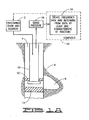
- FIG. 1A A fracturing process using a method of the present invention is represented in FIG. 1A.
- This includes pumping a fracturing fluid 2 into a well 4 such that a fracture 6 in an adjacent formation 8 forms and pressure signals are generated.
- the fracturing fluid 2 can be of any suitable type known in the art, and it is pumped into the well 4 in any suitable manner known in the art.
- FIG. 1A the placement of the fracturing fluid is shown as occurring through a tubing string 10 that extends into a region of the well 4 that is isolated in known manner by suitable known sealing devices 12, 14 (for example, packers).
- This isolated region enables the fracturing fluid 2 to be exerted against the desired portion of the formation 8 and thereby initiate and extend the fracture 6 (only one wing of which fracture is shown in that a fracture typically extends in two (typically opposite) directions from the wellbore).
- the present invention is not limited to any particular fracturing fluid or fracturing fluid placement technique; therefore, other fracturing fluid and delivery can be used.
- One non-limiting example is of the type represented in FIG. 1B; here, fracturing fluid is pumped through tubing string 10 outside an inner tubing string 10a (in the FIG. 1B application, tubing string 10a can be referred to as a "deadstring") disposed within the tubing string 10.
- adstring tubing string 10a
- pressure is sensed through the deadstring.
- hydrajet fracturing technology with which fractures can be placed in cased or open vertical, deviated or horizontal well sections without the use of sealing devices such as packers and bridge plugs. In this process, represented in FIG.
- a dual-flow system in which both outer tubing string 10 and inner tubing string 10a deliver fracturing fluid through a hydrajet tool, which can also function as a perforating tool (when the hole is cased or lined) and as a sealing device using the Bernoulli principle.
- the sealing provided is a dynamic sealing process achieved by fluid velocity. This velocity, which is created through the jetting tool, propels fluid at velocities greater than 650 feet/second. Therefore, according to Bernoulli, pressures around the jet are quite low.
- annular fluid may enter the high-velocity fluid stream into the fracture, or, because the sealing is not absolute, the jet fluid may leak off into the annulus.
- the fracturing method of the present invention further comprises sensing pressure signals that arise during the pumping of the fracturing fluid and resultant fracture creation.
- Sensing of pressure can occur using any suitable technique. For example, sensing can occur downhole with real-time data telemetry to the surface or delayed transfer (for example, by data storage downhole and retrieval of the downhole sensing device or by data storage downhole and later telemetry to the surface).
- Such downhole sensing can be in any suitable location typically selected dependent on the specific fracturing fluid placement technique used (for example, in the tubing string (see, for example, FIG. 1A); in the isolated region (see, for example, FIG.
- the fluid delivery system is typically the largest supplier of sound/pressure waves inside the wellbore. These pressure waves are delivered downhole by high-pressure fluids. In at least the hydrajet fracturing process, high-pressure fluid energy is transformed into high kinetic energy, and a high-frequency pressure wave is mixed into this accumulation of sound energy. In conventional fracturing technologies, these pressure/sound waves are transmitted through the treating string, but in the hydrajet fracturing approach, the annulus may serve as the better transmission conduit. In other jobs, downhole gauge readings may provide the better data to evaluate.
- the pressure signal is provided to the surface, typically in the form of an electrical signal, as indicated by reference numeral 16 in FIG. 1.
- the pressure to be sensed can change over time and that the pressure can include pressure components of various frequencies. Certain of these frequencies might be amplified by certain shape factors and dimensions of the well cavity and the fracture. For example, as the fracture 6 of the FIG. 1 illustrations grows, dominating frequencies within the composite pressure may change during the fracturing process. As a fracture develops, typically certain frequency components are amplified and the complex mixture of pressure/sound waves is transmitted back to the surface.
- the fracturing method being described with reference to the FIG. 1 illustrations also comprises, as indicated at reference numeral 18, determining frequencies at various times of the sensed pressure signals and determining from such data at least one characteristic of the fracture 6 formed by the fracturing process.
- a suitable computer 20 that provides an output signal to be used to control the overall fracturing process, such as controlling the pumping of the fracturing fluid or the formulating of the fracturing fluid, for example.
- An example of such a computer 20 includes types of conventional data acquisition systems used at well sites in the oil and gas industry as known in the art, but programmed (in software or firmware) using known programming techniques to implement the desired functions of the present invention as described herein.
- fracture behavior including positioning of sand or proppants
- the computer 20 receives pressure data obtained over time from the well undergoing the fracturing process (well 4 in the illustrations of FIG. 1). Receiving such pressure data is indicated in FIG. 2 by reference numeral 22. Using the present invention, such data is transformed to frequency data at selected sampling times related to the time aspect of the pressure data; this is indicated in FIG. 2 by the reference numeral 24. From the frequency data, frequency related changes over time are identified as indicated at reference numeral 26 in FIG. 2. In a particular implementation of the present invention, decreasing or increasing ("or" being inclusive as encompassing either or both) frequency sections are identified, which decreasing/increasing is used to determine one or more characteristics of the fracture as indicated by reference numeral 27 in FIG. 2.
- frequency spectrum data is created in response to pressure in the well sensed over time during the fracturing process performed on the well.
- transform methods are known in the mathematical and engineering world, such as Hilbert, Wigner and Radon Transforms, and of course Fourier Transforms.
- Fourier transform methods are popular in the engineering world and are particularly suitable in the present invention.
- this includes performing in the computer 20 (for the FIG. 1 example) a Short Time Fourier Transform (STFT) on the pressure data received in the computer; this provides frequency data for selected times of the pressure data.
- STFT Short Time Fourier Transform
- Wavelet technology can also be used, such as by being performed before doing the transform but in a manner to focus the later applied transform and analysis on a selected frequency range.
- the aforementioned increasing or decreasing sections are identified.
- This identification can be performed within the computer 20, for example, such as using suitable programming to compare respective frequency spectra over the selected time slices used during the transformation from pressure to frequency data.
- Another identification technique includes obtaining a graphical output, such as can be provided from suitably programmed computer 20, for example, that creates a plot of the frequencies of short bursts at the various times using the STFT approach. For example, Fourier transformation is performed on a set of data points from the pressure data at a time n to the pressure data at a time m (P n to P m ), the next one for P n+k to P m+k where k is greater than 1, etc. for the number of pressure "slices" desired.
- One specific type of plot is a waterfall plot, such as of a type described further below. Note that a waterfall plot helps the human mind capture the phenomenon; while computers may not need such methods to do its decision making steps.
- determining at least one characteristic of the fracture from the frequency data includes determining, in response to a declining frequency defined by the frequency spectrum data, that the fracture is being extended by the fracturing process. This can be obtained, for example, from a waterfall plot mentioned above if in such plot there is a section of declining frequency over a period of time.
- determining at least one characteristic of the fracture includes determining, in response to an increasing frequency defined by the frequency spectrum data, that the fracture is not being extended by the fracturing process.
- Such increasing frequency information has been specifically related both to a fracture closing and to proppant backing up in the fracture (such as in a tip screenout event). This can be obtained, for example, from a waterfall plot mentioned above if in such plot there is a section of increasing frequency over a period of time.
- suitable filtering can be used to focus on selected, significant frequency ranges, for example.
- Wavelet technology for example, can be used. Particularly suitable applications, but not limiting ones, include when pressure data is too complex, too noisy, or continually changing with time. Wavelets have been used in geological studies in which sound traveling through complex structures is evaluated differently from the present invention to determine the actual shape, construction, and composition of the formation. Pressure transients from a wellbore have also been evaluated differently from the present invention by using wavelet technology. In the present invention, it is contemplated that wavelets can allow closer investigation into a suspected data set or can validate a supposition created using the aforementioned Fourier analysis of the present invention, for example.
- Well A was a vertical well that was proppant stimulated through the annulus. This well was about 8,408 feet deep (measured depth/true vertical depth).
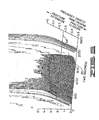
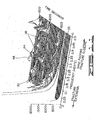
- FIG. 3 shows the waterfall plot of the Fourier transform charts obtained using pressure data for well A sensed through the annulus for an arrangement as in FIG. 1B.
- Each chart section of FIG. 3 was computed with a 16-second interval between each waterfall element. That is, each curve in the drawing represents one STFT chart of a time slot in time.
- the wellbore depth/length (natural) frequency component is shown as a straight dotted line 28 in FIG. 3.
- Fracture extension or growth (increased true cavity depth) on the plot of FIG. 3 (and subsequently illustrated waterfall plots) is defined as frequency reductions, while closure or proppant front progression to the wellbore (decreased true cavity depth) is defined by frequency increase.
- the solid line 30 in FIG. 3 follows these variations and indicates that fracture development occurs after the 500-second point. For example, line segment 30a read against the frequency scale indicates a decrease from above 0.226 Hz to about 0.12 Hz, so there is fracture extension during the corresponding time; and line segment 30b read against the frequency scale indicates an increase back to about 0.226 Hz, so there is fracture closure or proppant buildup during the corresponding time.
- the substantially unchanging frequency segment of line 30 between segments 30a and 30b indicates unchanging boundaries (for example, the fracture is not extending, or it is extending but sand is building up at the same velocity so that the boundary appears to be not extending). Additionally, a few minor closures or minor screenouts occur throughout the job.
- the pressure data used for FIG. 3 was the annulus pressure data.
- FIG. 4 is similar to FIG. 3 with the exception that the data is much cleaner.
- Well B was a vertical well with depth of 6,952 feet and treated using the same manner and same installation as Well A. During this time, the recording equipment was placed in the dead string (tubing) while fracturing was done through the annulus. The stimulation treatment was performed so that a screenout would occur at the end of the job to improve fracture conductivity.
- the STFT stacked chart or waterfall plot obtained as part of the present invention is shown in FIG. 5.
- the natural frequency related to the wellbore depth and a sound speed of 3,800 feet/second as above can be computed as 0.273 Hz, as illustrated with the dotted line 34.
- the sound speed changes from fluid to fluid and also is very dependent upon pressure and compressibility.
- the extending of the fracture is clearly represented by this plot (see frequency front; as frequencies get lower), as is a massive screenout at the end of the job (frequency suddenly gets higher prior to the end of the job, significantly exceeding the 0.273 Hz line 34, as indicated by reference number 35).
- a relatively new fracturing technique known as hydrajet fracturing (for example, one such technique is provided by Halliburton Energy Services under the mark "Surgifrac"), employs two different flow streams, one through the tubing and the other through the annulus as represented in FIG. 1C.
- the inner tubing flow stream is pumped at tremendously high pressures and high flow rates (high horsepower) through jetting equipment; while the annulus flow stream between the inner and outer tubing strings is pumped at lower pressures and lower horsepower.
- Each of these fluid streams contributes to the noise in the system.
- Well C was slightly deviated and had a measured depth of about 10,300 feet. Lease crude was used as the primary treatment fluid.
- the input signal here, the pressure data
- the pressure data is decomposed into two sectors, which decomposition occurs in known manner to effectively filter using a selected wavelet function high/low pass filter.
- Each of these sectors are further decomposed into two sectors. After a few levels of such decompositions, sectors become sufficiently narrow or focused as to their frequency ranges; and for this application, a stacked plot using wavelets that were derived around the 0.2 Hz sector is shown in FIG. 7.
- the wellbore natural frequency is about 0.2.
- noise elements with frequencies around 0.2 are amplified while the others are impeded to essentially zero.
- frequencies away from the wellbore basic frequencies are eliminated or filtered by use of wavelet technology to improve clarity as fractures extend from the wellbore.
- Known wavelet filters include gaussian, mexican hat, morlets, daubechies, and many more forms well known in the art, and the present invention is not limited to any particular wavelet filter. Using this filtering the effects of the high level, lower frequencies, are drastically reduced; and frequencies of interest (such as the frequency front discussed earlier) are now represented by frequency peaks.
- FIG. 8 shows the plot region indicating that the fracture starts to close
- FIG. 9 shows the other side of this plot as screenout is in progress. The high peaks in these plots form an almost straight ridge on the left side of FIG. 8 and on the right side of FIG. 9, which is observed from the other side of FIG. 8.
- the other peak also forms a straight ridge; and this ridge is quite straight, centering and staying stationary at 0.2 (thus probably reflecting from the wellbore fracture entry correlated to our earlier mentioned wellbore function; note that this stationary behavior at 0.2 can be better seen from FIG. 9).
- the ridge formed by the high peaks moves slowly toward the lower frequency.
- an apparent ridge connects to the tall ridge on the left, which probably relates to the fracture extension. This is indicated by arrow 42a.
- the flow rate was reduced by 1.5 barrels per minute (BPM) and suddenly, the ridge stayed stationary if not slightly moving to a higher frequency.
- Well D was a horizontal well stimulated using hydrajet fracturing technology.
- the well's true vertical depth was approximately 6,500 feet with measured depth of about 8,704 feet.
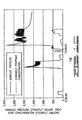
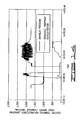
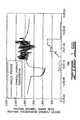
- a first fracturing treatment produced the annulus pressure and the downhole proppant concentration data as shown in FIG. 10.
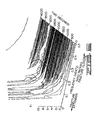
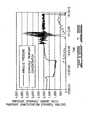
- a stacked Fourier plot created later from this data of FIG. 10 for this stimulation stage is shown in FIG. 11.
- Solid line 44 identifies the fracture tip movement or the proppant front movement.
- Sharp peaks, such as at 48, identify tremendous white noise, which often indicates something major has occurred, such as initial fracture development.
- good fracture growth is shown to have been obtained; however, as a certain fracture length was achieved, leakoff became substantial and the fracture slowly stopped growing as indicated by the graph at reference numeral 50.
- the boost pressure was increased to stagnation pressure, which reopened the fracture (more white nose) as indicated at reference numeral 52 in the plot of FIG. 11.
- FIGS. 14 and 15 A third fracture of well D is shown in FIGS. 14 and 15, and a fourth stage of fracturing in well D is shown in FIGS. 16 and 17.
- the fracture fronts are indicated to grow as planned, as observed by the solid fracture front line 62 (FIG. 15) and 66 (FIG. 17). Note again in the present invention, that fractures are taken to grow if the front line moves to the low frequency side of the wellbore natural frequency line (dotted lines 60, 64 in FIGS. 15, 17, respectively)
- FIGS. 18 and 19 relate to a fifth fracturing in well D, with FIG. 18 representing recorded pressure and proppant concentration data at the time, and FIG. 19 showing a later developed waterfall plot using the earlier data.
- FIG. 18 indicates that something happened during this job because proppant concentrations suddenly jump to about 12.5 pounds per gallon (1b/gal).
- FIG. 19 shows that screenout occurred almost instantaneously after the sudden increase of proppant concentration downhole. This is evident by the curve 68 moving rapidly to the right (no evidence of staying within the left side of the dotted line) and also the tremendous noise activities 70 at high frequencies.
- a particular implementation of the present invention includes using a waterfall plot to identify at least one of a declining ridge section for a selected frequency range over a period of time and an increasing ridge section for the selected frequency range.
- using the waterfall plot includes identifying a section of declining frequency over a first period of time and a section of increasing frequency over a second period of time. This information indicates either fracture growth (declining ridge) or fracture growth stoppage such as, for example, closure or screenout (increasing ridge).
Landscapes
- Life Sciences & Earth Sciences (AREA)
- Engineering & Computer Science (AREA)
- Geology (AREA)
- Physics & Mathematics (AREA)
- Mining & Mineral Resources (AREA)
- Environmental & Geological Engineering (AREA)
- General Life Sciences & Earth Sciences (AREA)
- Fluid Mechanics (AREA)
- Geochemistry & Mineralogy (AREA)
- Remote Sensing (AREA)
- Geophysics (AREA)
- General Physics & Mathematics (AREA)
- Acoustics & Sound (AREA)
- Investigating Or Analyzing Materials By The Use Of Ultrasonic Waves (AREA)
- Investigating Strength Of Materials By Application Of Mechanical Stress (AREA)
Applications Claiming Priority (2)
| Application Number | Priority Date | Filing Date | Title |
|---|---|---|---|
| US251301 | 2002-09-20 | ||
| US10/251,301 US7100688B2 (en) | 2002-09-20 | 2002-09-20 | Fracture monitoring using pressure-frequency analysis |
Publications (3)
| Publication Number | Publication Date |
|---|---|
| EP1400818A2 true EP1400818A2 (fr) | 2004-03-24 |
| EP1400818A3 EP1400818A3 (fr) | 2004-12-01 |
| EP1400818B1 EP1400818B1 (fr) | 2013-03-06 |
Family
ID=29250295
Family Applications (1)
| Application Number | Title | Priority Date | Filing Date |
|---|---|---|---|
| EP03255785A Expired - Lifetime EP1400818B1 (fr) | 2002-09-20 | 2003-09-16 | Surveillance de propagation de fractures avec analyse pression-fréquence |
Country Status (8)
| Country | Link |
|---|---|
| US (1) | US7100688B2 (fr) |
| EP (1) | EP1400818B1 (fr) |
| AR (1) | AR041085A1 (fr) |
| AU (1) | AU2003248434B2 (fr) |
| BR (1) | BR0303292A (fr) |
| CA (1) | CA2440247C (fr) |
| MX (1) | MXPA03008530A (fr) |
| NO (1) | NO334626B1 (fr) |
Cited By (12)
| Publication number | Priority date | Publication date | Assignee | Title |
|---|---|---|---|---|
| WO2005103766A3 (fr) * | 2004-04-23 | 2006-02-09 | Schlumberger Ca Ltd | Procede et systeme de surveillance de domaines remplis de liquide dans un milieu sur la base des ondes d'interface se propageant sur leurs surfaces |
| KR100707389B1 (ko) * | 2004-09-06 | 2007-04-13 | 한국건설기술연구원 | 음향 분석 기법을 이용하여 콘크리트 구조물의 건전도를평가하기 위한 장치 및 방법 |
| US7302849B2 (en) | 2004-04-23 | 2007-12-04 | Schlumberger Technology Corporation | Method and system for monitoring of fluid-filled domains in a medium based on interface waves propagating along their surfaces |
| US7754659B2 (en) | 2007-05-15 | 2010-07-13 | Georgia-Pacific Chemicals Llc | Reducing flow-back in well treating materials |
| US8003214B2 (en) | 2006-07-12 | 2011-08-23 | Georgia-Pacific Chemicals Llc | Well treating materials comprising coated proppants, and methods |
| WO2010136764A3 (fr) * | 2009-05-27 | 2011-09-29 | Qinetiq Limited | Surveillance de fissure |
| US8058213B2 (en) | 2007-05-11 | 2011-11-15 | Georgia-Pacific Chemicals Llc | Increasing buoyancy of well treating materials |
| WO2011145985A1 (fr) * | 2010-05-21 | 2011-11-24 | Schlumberger Canada Limited | Procédé de diagnostic en temps réel d'opérations de fracture avec une combinaison d'ondes de tube et d'un suivi microsismique |
| US8133587B2 (en) | 2006-07-12 | 2012-03-13 | Georgia-Pacific Chemicals Llc | Proppant materials comprising a coating of thermoplastic material, and methods of making and using |
| WO2016162799A1 (fr) * | 2015-04-07 | 2016-10-13 | Eni S.P.A. | Procédé et système permettant l'analyse multimode et multi-échelle de données géophysiques par transformation en attributs musicaux |
| US11313211B2 (en) | 2017-11-13 | 2022-04-26 | Shear Frac Group, Llc | Hydraulic fracturing |
| US11365618B2 (en) | 2020-02-28 | 2022-06-21 | Shear Frac Group, Llc | Hydraulic fracturing |
Families Citing this family (55)
| Publication number | Priority date | Publication date | Assignee | Title |
|---|---|---|---|---|
| US6978211B2 (en) * | 2003-12-08 | 2005-12-20 | Halliburton Energy Services, Inc. | Methods and systems for using wavelet analysis in subterranean applications |
| US7825073B2 (en) * | 2004-07-13 | 2010-11-02 | Halliburton Energy Services, Inc. | Treatment fluids comprising clarified xanthan and associated methods |
| US7237612B2 (en) * | 2004-11-17 | 2007-07-03 | Halliburton Energy Services, Inc. | Methods of initiating a fracture tip screenout |
| US9915131B2 (en) * | 2007-03-02 | 2018-03-13 | Schlumberger Technology Corporation | Methods using fluid stream for selective stimulation of reservoir layers |
| US20090120633A1 (en) * | 2007-11-13 | 2009-05-14 | Earl Webb | Method for Stimulating a Well Using Fluid Pressure Waves |
| US7963325B2 (en) * | 2007-12-05 | 2011-06-21 | Schlumberger Technology Corporation | Method and system for fracturing subsurface formations during the drilling thereof |
| WO2009073803A1 (fr) * | 2007-12-05 | 2009-06-11 | Schlumberger Canada Limited | Procédé et appareil pour traiter hors-sondeuse des données de capteur de sondeuse |
| US8714244B2 (en) * | 2007-12-18 | 2014-05-06 | Schlumberger Technology Corporation | Stimulation through fracturing while drilling |
| US7819188B2 (en) * | 2007-12-21 | 2010-10-26 | Schlumberger Technology Corporation | Monitoring, controlling and enhancing processes while stimulating a fluid-filled borehole |
| EA022413B1 (ru) * | 2008-05-20 | 2015-12-30 | Оксан Материалз, Инк. | Способ использования функционального проппанта для определения геометрии подземной трещины |
| US8069923B2 (en) * | 2008-08-12 | 2011-12-06 | Halliburton Energy Services Inc. | Top suction fluid end |
| US8439116B2 (en) | 2009-07-24 | 2013-05-14 | Halliburton Energy Services, Inc. | Method for inducing fracture complexity in hydraulically fractured horizontal well completions |
| US8960292B2 (en) * | 2008-08-22 | 2015-02-24 | Halliburton Energy Services, Inc. | High rate stimulation method for deep, large bore completions |
| US9796918B2 (en) | 2013-01-30 | 2017-10-24 | Halliburton Energy Services, Inc. | Wellbore servicing fluids and methods of making and using same |
| US8631872B2 (en) * | 2009-09-24 | 2014-01-21 | Halliburton Energy Services, Inc. | Complex fracturing using a straddle packer in a horizontal wellbore |
| US9016376B2 (en) | 2012-08-06 | 2015-04-28 | Halliburton Energy Services, Inc. | Method and wellbore servicing apparatus for production completion of an oil and gas well |
| US8887803B2 (en) | 2012-04-09 | 2014-11-18 | Halliburton Energy Services, Inc. | Multi-interval wellbore treatment method |
| US8146416B2 (en) * | 2009-02-13 | 2012-04-03 | Schlumberger Technology Corporation | Methods and apparatus to perform stress testing of geological formations |
| US20110061869A1 (en) * | 2009-09-14 | 2011-03-17 | Halliburton Energy Services, Inc. | Formation of Fractures Within Horizontal Well |
| US8453764B2 (en) * | 2010-02-01 | 2013-06-04 | Aps Technology, Inc. | System and method for monitoring and controlling underground drilling |
| US8606521B2 (en) | 2010-02-17 | 2013-12-10 | Halliburton Energy Services, Inc. | Determining fluid pressure |
| CA2796237C (fr) | 2010-04-27 | 2016-11-22 | Halliburton Energy Services, Inc. | Analyse de fractures |
| US20120305679A1 (en) * | 2011-06-01 | 2012-12-06 | Halliburton Energy Services, Inc. | Hydrajetting nozzle and method |
| US9227204B2 (en) | 2011-06-01 | 2016-01-05 | Halliburton Energy Services, Inc. | Hydrajetting nozzle and method |
| WO2013050989A1 (fr) | 2011-10-06 | 2013-04-11 | Schlumberger Technology B.V. | Réalisation d'analyses lors d'un forage par fracturation |
| US9695654B2 (en) | 2012-12-03 | 2017-07-04 | Halliburton Energy Services, Inc. | Wellhead flowback control system and method |
| US9127526B2 (en) | 2012-12-03 | 2015-09-08 | Halliburton Energy Services, Inc. | Fast pressure protection system and method |
| AU2013378834B2 (en) * | 2013-02-21 | 2016-07-21 | Halliburton Energy Services, Inc. | Systems and methods for optimized well creation in a shale formation |
| USD843381S1 (en) | 2013-07-15 | 2019-03-19 | Aps Technology, Inc. | Display screen or portion thereof with a graphical user interface for analyzing and presenting drilling data |
| US10472944B2 (en) | 2013-09-25 | 2019-11-12 | Aps Technology, Inc. | Drilling system and associated system and method for monitoring, controlling, and predicting vibration in an underground drilling operation |
| US10385670B2 (en) | 2014-10-28 | 2019-08-20 | Eog Resources, Inc. | Completions index analysis |
| US10385686B2 (en) | 2014-10-28 | 2019-08-20 | Eog Resources, Inc. | Completions index analysis |
| CN104950074B (zh) * | 2015-05-21 | 2016-09-14 | 中国科学院力学研究所 | 水合物分解渗流导致出砂测量的实验方法及实验装置 |
| US10590758B2 (en) | 2015-11-12 | 2020-03-17 | Schlumberger Technology Corporation | Noise reduction for tubewave measurements |
| WO2017223007A1 (fr) | 2016-06-20 | 2017-12-28 | Schlumberger Technology Corporation | Analyse d'ondes de tube de communication de puits |
| WO2018004369A1 (fr) | 2016-07-01 | 2018-01-04 | Шлюмберже Канада Лимитед | Procédé et système destiné à détecter dans le puits de forage des objets réfléchissant un signal hydraulique |
| WO2018034802A1 (fr) * | 2016-08-17 | 2018-02-22 | Well-Smart Technologies Global, Inc. | Optimisation d'onde de pression pour procédés d'extraction de pétrole et de gaz |
| WO2018111231A1 (fr) | 2016-12-13 | 2018-06-21 | Halliburton Energy Services, Inc. | Amélioration de la stimulation et de la production d'une formation souterraine au moyen de formes d'onde de fond de trou cibles |
| US11261721B2 (en) * | 2016-12-30 | 2022-03-01 | Halliburton Energy Services, Inc. | Techniques for evaluating borehole subsurface geologies using Stoneley waves |
| WO2018232198A1 (fr) * | 2017-06-15 | 2018-12-20 | Schlumberger Technology Corporation | Système d'exploitation dynamique de champ |
| CN107368629B (zh) * | 2017-06-22 | 2021-06-01 | 北京理工大学 | 一种减压阀流固耦合振动参数识别方法 |
| US11415716B2 (en) | 2017-11-01 | 2022-08-16 | Colorado School Of Mines | System and method of locating downhole objects in a wellbore |
| WO2019117862A1 (fr) * | 2017-12-12 | 2019-06-20 | Halliburton Energy Services, Inc. | Systèmes d'atténuation de la surpression pour fracturation hydraulique |
| CN110761778B (zh) * | 2018-07-25 | 2022-09-23 | 中国石油化工股份有限公司 | 基于声波的压裂裂缝监测方法及系统 |
| US11162344B2 (en) * | 2019-07-01 | 2021-11-02 | Saudi Arabian Oil Company | Acid fracturing treatments in hydrocarbon-bearing formations in close proximity to wet zones |
| WO2021020986A1 (fr) | 2019-07-31 | 2021-02-04 | Schlumberger Canada Limited | Procédé de détermination de profondeurs de réflecteurs dans un puits de forage |
| CA3163348A1 (fr) | 2019-12-10 | 2021-06-17 | Origin Rose Llc | Analyse spectrale et apprentissage automatique d'une signature acoustique de collage de cable metallique |
| CN111175128B (zh) * | 2020-01-13 | 2022-03-11 | 西南石油大学 | 一种基于频谱分析的致密砂岩抗张强度预测方法 |
| CN113074861B (zh) * | 2021-01-04 | 2022-10-04 | 中国石油天然气股份有限公司 | 地层破裂时间监测方法、装置、设备和存储介质 |
| CN113356823B (zh) * | 2021-06-29 | 2023-06-20 | 中国石油大学(北京) | 裂缝的起裂方法、装置、系统及控制器 |
| CN114063194B (zh) * | 2021-11-18 | 2023-10-03 | 核工业北京地质研究院 | 一种自然电位曲线的基线漂移校正方法及系统 |
| CN118339359A (zh) * | 2022-11-07 | 2024-07-12 | 智能算法有限责任公司 | 利用多级液压压裂法识别裂缝发育区的油气生产方法 |
| WO2024102027A1 (fr) * | 2022-11-07 | 2024-05-16 | Общество С Ограниченной Ответственностью "Смарт Алгоритмс" | Procédé pour déterminer des zones de développement de crevasses lors de la fracturation hydraulique à étapes multiples d'une strate |
| CN116856895B (zh) * | 2023-07-06 | 2024-06-18 | 安徽井上天华科技有限公司 | 一种基于高频压力裂缝监测边缘计算数据处理方法 |
| US12486752B1 (en) * | 2024-05-31 | 2025-12-02 | Halliburton Energy Services, Inc. | Monitoring hydraulic fracturing of a well using pressure waves |
Family Cites Families (12)
| Publication number | Priority date | Publication date | Assignee | Title |
|---|---|---|---|---|
| FR2467414A1 (fr) | 1979-10-11 | 1981-04-17 | Anvar | Procede et dispositif de reconnaissance de sols et de milieux rocheux |
| US4802144A (en) | 1986-03-20 | 1989-01-31 | Applied Geomechanics, Inc. | Hydraulic fracture analysis method |
| US5206836A (en) | 1986-03-20 | 1993-04-27 | Gas Research Institute | Method of determining position and dimensions of a subsurface structure intersecting a wellbore in the earth |
| US4783769A (en) * | 1986-03-20 | 1988-11-08 | Gas Research Institute | Method of determining position and dimensions of a subsurface structure intersecting a wellbore in the earth |
| US4858130A (en) * | 1987-08-10 | 1989-08-15 | The Board Of Trustees Of The Leland Stanford Junior University | Estimation of hydraulic fracture geometry from pumping pressure measurements |
| GB8907522D0 (en) * | 1989-04-04 | 1989-05-17 | British Petroleum Co Plc | Fracture investigation by resonance sweeping technique |
| US5050674A (en) | 1990-05-07 | 1991-09-24 | Halliburton Company | Method for determining fracture closure pressure and fracture volume of a subsurface formation |
| US5105659A (en) | 1990-09-19 | 1992-04-21 | Dowell Schlumberger Incorporated | Detection of fracturing events using derivatives of fracturing pressures |
| US5417103A (en) | 1993-11-10 | 1995-05-23 | Hunter; Roger J. | Method of determining material properties in the earth by measurement of deformations due to subsurface pressure changes |
| US5963508A (en) * | 1994-02-14 | 1999-10-05 | Atlantic Richfield Company | System and method for determining earth fracture propagation |
| US5771170A (en) * | 1994-02-14 | 1998-06-23 | Atlantic Richfield Company | System and program for locating seismic events during earth fracture propagation |
| US6192316B1 (en) | 1999-05-26 | 2001-02-20 | Atlantic Richfield Company | Fracture discrimination using borehole frequency response of stoneley waves |
-
2002
- 2002-09-20 US US10/251,301 patent/US7100688B2/en not_active Expired - Lifetime
-
2003
- 2003-08-28 AR ARP030103126A patent/AR041085A1/es not_active Application Discontinuation
- 2003-08-29 BR BR0303292-2A patent/BR0303292A/pt not_active IP Right Cessation
- 2003-09-01 AU AU2003248434A patent/AU2003248434B2/en not_active Ceased
- 2003-09-09 CA CA2440247A patent/CA2440247C/fr not_active Expired - Fee Related
- 2003-09-15 NO NO20034073A patent/NO334626B1/no not_active IP Right Cessation
- 2003-09-16 EP EP03255785A patent/EP1400818B1/fr not_active Expired - Lifetime
- 2003-09-19 MX MXPA03008530A patent/MXPA03008530A/es active IP Right Grant
Cited By (32)
| Publication number | Priority date | Publication date | Assignee | Title |
|---|---|---|---|---|
| US7302849B2 (en) | 2004-04-23 | 2007-12-04 | Schlumberger Technology Corporation | Method and system for monitoring of fluid-filled domains in a medium based on interface waves propagating along their surfaces |
| WO2005103766A3 (fr) * | 2004-04-23 | 2006-02-09 | Schlumberger Ca Ltd | Procede et systeme de surveillance de domaines remplis de liquide dans un milieu sur la base des ondes d'interface se propageant sur leurs surfaces |
| KR100707389B1 (ko) * | 2004-09-06 | 2007-04-13 | 한국건설기술연구원 | 음향 분석 기법을 이용하여 콘크리트 구조물의 건전도를평가하기 위한 장치 및 방법 |
| US8133587B2 (en) | 2006-07-12 | 2012-03-13 | Georgia-Pacific Chemicals Llc | Proppant materials comprising a coating of thermoplastic material, and methods of making and using |
| US8003214B2 (en) | 2006-07-12 | 2011-08-23 | Georgia-Pacific Chemicals Llc | Well treating materials comprising coated proppants, and methods |
| US8058213B2 (en) | 2007-05-11 | 2011-11-15 | Georgia-Pacific Chemicals Llc | Increasing buoyancy of well treating materials |
| US7754659B2 (en) | 2007-05-15 | 2010-07-13 | Georgia-Pacific Chemicals Llc | Reducing flow-back in well treating materials |
| RU2537419C2 (ru) * | 2009-05-27 | 2015-01-10 | Оптасенс Холдингз Лимитед | Мониторинг гидравлического разрыва пласта |
| CN102597421B (zh) * | 2009-05-27 | 2016-03-30 | 光学感应器控股有限公司 | 压裂监测 |
| NO345867B1 (no) * | 2009-05-27 | 2021-09-20 | Optasense Holdings Ltd | Overvåkning av sprekkdannelser |
| CN102597421A (zh) * | 2009-05-27 | 2012-07-18 | 秦内蒂克有限公司 | 压裂监测 |
| GB2511657A (en) * | 2009-05-27 | 2014-09-10 | Optasense Holdings Ltd | Fracture monitoring |
| GB2511656A (en) * | 2009-05-27 | 2014-09-10 | Optasense Holdings Ltd | Fracture monitoring |
| GB2511656B (en) * | 2009-05-27 | 2014-12-31 | Optasense Holdings Ltd | Fracture monitoring |
| GB2483584B (en) * | 2009-05-27 | 2014-12-31 | Optasense Holdings Ltd | Fracture monitoring |
| GB2511657B (en) * | 2009-05-27 | 2014-12-31 | Optasense Holdings Ltd | Fracture monitoring |
| WO2010136764A3 (fr) * | 2009-05-27 | 2011-09-29 | Qinetiq Limited | Surveillance de fissure |
| CN104295290A (zh) * | 2009-05-27 | 2015-01-21 | 光学感应器控股有限公司 | 压裂监测 |
| US8950482B2 (en) | 2009-05-27 | 2015-02-10 | Optasense Holdings Ltd. | Fracture monitoring |
| AU2010252797B2 (en) * | 2009-05-27 | 2016-03-03 | Optasense Holdings Limited | Fracture monitoring |
| RU2648743C2 (ru) * | 2009-05-27 | 2018-03-28 | Оптасенс Холдингз Лимитед | Мониторинг гидравлического разрыва пласта |
| AU2016203552B2 (en) * | 2009-05-27 | 2017-12-14 | Optasense Holdings Limited | Fracture monitoring |
| CN104295290B (zh) * | 2009-05-27 | 2017-04-12 | 光学感应器控股有限公司 | 压裂监测 |
| AU2016203553B2 (en) * | 2009-05-27 | 2017-12-14 | Optasense Holdings Limited | Fracture monitoring |
| US9689254B2 (en) | 2009-05-27 | 2017-06-27 | Optasense Holdings Limited | Well monitoring by means of distributed sensing means |
| US9658357B2 (en) | 2010-05-21 | 2017-05-23 | Schlumberger Technology Corporation | Method of real time diagnostic of fracture operations with combination of tube waves and microseismic monitoring |
| WO2011145985A1 (fr) * | 2010-05-21 | 2011-11-24 | Schlumberger Canada Limited | Procédé de diagnostic en temps réel d'opérations de fracture avec une combinaison d'ondes de tube et d'un suivi microsismique |
| RU2455665C2 (ru) * | 2010-05-21 | 2012-07-10 | Шлюмбергер Текнолоджи Б.В. | Способ диагностики процессов гидроразрыва пласта в режиме реального времени с использованием комбинирования трубных волн и микросейсмического мониторинга |
| WO2016162799A1 (fr) * | 2015-04-07 | 2016-10-13 | Eni S.P.A. | Procédé et système permettant l'analyse multimode et multi-échelle de données géophysiques par transformation en attributs musicaux |
| US11313211B2 (en) | 2017-11-13 | 2022-04-26 | Shear Frac Group, Llc | Hydraulic fracturing |
| US11365618B2 (en) | 2020-02-28 | 2022-06-21 | Shear Frac Group, Llc | Hydraulic fracturing |
| US11572776B2 (en) | 2020-02-28 | 2023-02-07 | Shea Frac Group, LLC | Hydraulic fracturing |
Also Published As
| Publication number | Publication date |
|---|---|
| AU2003248434A1 (en) | 2004-04-08 |
| MXPA03008530A (es) | 2004-07-23 |
| US7100688B2 (en) | 2006-09-05 |
| NO334626B1 (no) | 2014-04-28 |
| AU2003248434B2 (en) | 2008-03-06 |
| NO20034073L (no) | 2004-03-22 |
| EP1400818B1 (fr) | 2013-03-06 |
| BR0303292A (pt) | 2004-08-24 |
| AR041085A1 (es) | 2005-04-27 |
| US20040206494A1 (en) | 2004-10-21 |
| EP1400818A3 (fr) | 2004-12-01 |
| CA2440247C (fr) | 2013-12-03 |
| NO20034073D0 (no) | 2003-09-15 |
| CA2440247A1 (fr) | 2004-03-20 |
Similar Documents
| Publication | Publication Date | Title |
|---|---|---|
| CA2440247C (fr) | Surveillance de fracturation au moyen d'analyses de frequence de pression | |
| US6724687B1 (en) | Characterizing oil, gasor geothermal wells, including fractures thereof | |
| Cramer et al. | Integrating distributed acoustic sensing, treatment-pressure analysis, and video-based perforation imaging to evaluate limited-entry-treatment effectiveness | |
| US11215049B2 (en) | Detecting downhole events using acoustic frequency domain features | |
| EP3704477B1 (fr) | Surveillance de fracture hydraulique par un das basse fréquence | |
| US6408943B1 (en) | Method and apparatus for placing and interrogating downhole sensors | |
| US20220186605A1 (en) | Detecting operational anomalies for continuous hydraulic fracturing monitoring | |
| US8567496B2 (en) | System and method for managing a subterranean formation | |
| Parkhonyuk et al. | Measurements while fracturing: nonintrusive method of hydraulic fracturing monitoring | |
| US10774635B2 (en) | Restimulation process using coiled tubing and fiber optics | |
| Panjaitan et al. | Qualifying diversion in multi clusters horizontal well hydraulic fracturing in haynesville shale using water hammer analysis, step-down test and microseismic data | |
| CN111771042A (zh) | 使用声学频域特征来检测事件 | |
| US11708759B2 (en) | Instrumented bridge plugs for downhole measurements | |
| US9447669B2 (en) | Pulsed acoustic impact for facilitation of oil and gas extracting | |
| CA3030117C (fr) | Determination de caracteristiques d'une fracture | |
| CN110529087A (zh) | 一种评价地层水力压裂效果的方法及装置 | |
| Mondal et al. | Uncertainties in Step-down Test Interpretation for Evaluating Completions Effectiveness and Near Wellbore Complexities | |
| WO2020122747A1 (fr) | Surveillance de l'efficacité de refracturation | |
| Singh et al. | A comprehensive review of fracture-driven interaction in unconventional oil and gas plays: Characterization, real-time diagnosis, and impact on production | |
| CA2988218C (fr) | Optimisation d'onde de puissance destinee aux procedes d'extraction de petrole et de gaz | |
| US12359559B2 (en) | Method of oil and gas production using identification of fracture development zones in multistage hydraulic fracturing | |
| Clark et al. | Diagnostic applications of borehole hydraulic signal processing | |
| Surjaatmadja et al. | Analysis of generated and reflected pressure waves during fracturing reveals fracture behavior | |
| McFall et al. | Using real-time acoustic friction analysis for completions design evaluation | |
| Reeves et al. | Stimulation technology in the Antrim Shale |
Legal Events
| Date | Code | Title | Description |
|---|---|---|---|
| PUAI | Public reference made under article 153(3) epc to a published international application that has entered the european phase |
Free format text: ORIGINAL CODE: 0009012 |
|
| AK | Designated contracting states |
Kind code of ref document: A2 Designated state(s): AT BE BG CH CY CZ DE DK EE ES FI FR GB GR HU IE IT LI LU MC NL PT RO SE SI SK TR |
|
| AX | Request for extension of the european patent |
Extension state: AL LT LV MK |
|
| PUAL | Search report despatched |
Free format text: ORIGINAL CODE: 0009013 |
|
| AK | Designated contracting states |
Kind code of ref document: A3 Designated state(s): AT BE BG CH CY CZ DE DK EE ES FI FR GB GR HU IE IT LI LU MC NL PT RO SE SI SK TR |
|
| AX | Request for extension of the european patent |
Extension state: AL LT LV MK |
|
| 17P | Request for examination filed |
Effective date: 20050128 |
|
| AKX | Designation fees paid |
Designated state(s): DE DK FR GB IT NL |
|
| 17Q | First examination report despatched |
Effective date: 20101202 |
|
| GRAP | Despatch of communication of intention to grant a patent |
Free format text: ORIGINAL CODE: EPIDOSNIGR1 |
|
| GRAS | Grant fee paid |
Free format text: ORIGINAL CODE: EPIDOSNIGR3 |
|
| GRAA | (expected) grant |
Free format text: ORIGINAL CODE: 0009210 |
|
| AK | Designated contracting states |
Kind code of ref document: B1 Designated state(s): DE DK FR GB IT NL |
|
| REG | Reference to a national code |
Ref country code: GB Ref legal event code: FG4D |
|
| REG | Reference to a national code |
Ref country code: DE Ref legal event code: R096 Ref document number: 60343422 Country of ref document: DE Effective date: 20130502 |
|
| REG | Reference to a national code |
Ref country code: DE Ref legal event code: R082 Ref document number: 60343422 Country of ref document: DE Representative=s name: WEISSE, RENATE, DIPL.-PHYS. DR.-ING., DE |
|
| REG | Reference to a national code |
Ref country code: NL Ref legal event code: VDEP Effective date: 20130306 |
|
| PG25 | Lapsed in a contracting state [announced via postgrant information from national office to epo] |
Ref country code: NL Free format text: LAPSE BECAUSE OF FAILURE TO SUBMIT A TRANSLATION OF THE DESCRIPTION OR TO PAY THE FEE WITHIN THE PRESCRIBED TIME-LIMIT Effective date: 20130306 |
|
| PLBE | No opposition filed within time limit |
Free format text: ORIGINAL CODE: 0009261 |
|
| STAA | Information on the status of an ep patent application or granted ep patent |
Free format text: STATUS: NO OPPOSITION FILED WITHIN TIME LIMIT |
|
| PG25 | Lapsed in a contracting state [announced via postgrant information from national office to epo] |
Ref country code: DK Free format text: LAPSE BECAUSE OF FAILURE TO SUBMIT A TRANSLATION OF THE DESCRIPTION OR TO PAY THE FEE WITHIN THE PRESCRIBED TIME-LIMIT Effective date: 20130306 |
|
| 26N | No opposition filed |
Effective date: 20131209 |
|
| PG25 | Lapsed in a contracting state [announced via postgrant information from national office to epo] |
Ref country code: IT Free format text: LAPSE BECAUSE OF FAILURE TO SUBMIT A TRANSLATION OF THE DESCRIPTION OR TO PAY THE FEE WITHIN THE PRESCRIBED TIME-LIMIT Effective date: 20130306 |
|
| REG | Reference to a national code |
Ref country code: DE Ref legal event code: R097 Ref document number: 60343422 Country of ref document: DE Effective date: 20131209 |
|
| GBPC | Gb: european patent ceased through non-payment of renewal fee |
Effective date: 20130916 |
|
| REG | Reference to a national code |
Ref country code: FR Ref legal event code: ST Effective date: 20140530 |
|
| PG25 | Lapsed in a contracting state [announced via postgrant information from national office to epo] |
Ref country code: GB Free format text: LAPSE BECAUSE OF NON-PAYMENT OF DUE FEES Effective date: 20130916 |
|
| PG25 | Lapsed in a contracting state [announced via postgrant information from national office to epo] |
Ref country code: FR Free format text: LAPSE BECAUSE OF NON-PAYMENT OF DUE FEES Effective date: 20130930 |
|
| PGFP | Annual fee paid to national office [announced via postgrant information from national office to epo] |
Ref country code: DE Payment date: 20150930 Year of fee payment: 13 |
|
| REG | Reference to a national code |
Ref country code: DE Ref legal event code: R119 Ref document number: 60343422 Country of ref document: DE |
|
| PG25 | Lapsed in a contracting state [announced via postgrant information from national office to epo] |
Ref country code: DE Free format text: LAPSE BECAUSE OF NON-PAYMENT OF DUE FEES Effective date: 20170401 |