EP1400594A1 - Process for producing optically active (r)-2-chloro-1-(3'-chlorophenyl)etha nol - Google Patents
Process for producing optically active (r)-2-chloro-1-(3'-chlorophenyl)etha nol Download PDFInfo
- Publication number
- EP1400594A1 EP1400594A1 EP02738795A EP02738795A EP1400594A1 EP 1400594 A1 EP1400594 A1 EP 1400594A1 EP 02738795 A EP02738795 A EP 02738795A EP 02738795 A EP02738795 A EP 02738795A EP 1400594 A1 EP1400594 A1 EP 1400594A1
- Authority
- EP
- European Patent Office
- Prior art keywords
- chlorophenyl
- chloro
- ifo
- microorganism
- ethanol
- Prior art date
- Legal status (The legal status is an assumption and is not a legal conclusion. Google has not performed a legal analysis and makes no representation as to the accuracy of the status listed.)
- Withdrawn
Links
- LBSKQOSGSUKVDG-QMMMGPOBSA-N (1r)-2-chloro-1-(3-chlorophenyl)ethanol Chemical compound ClC[C@H](O)C1=CC=CC(Cl)=C1 LBSKQOSGSUKVDG-QMMMGPOBSA-N 0.000 title claims abstract description 22
- 238000000034 method Methods 0.000 title claims abstract description 15
- 244000005700 microbiome Species 0.000 claims abstract description 38
- AVUVSYIYUADCKE-UHFFFAOYSA-N 2-chloro-1-(3-chlorophenyl)ethanone Chemical compound ClCC(=O)C1=CC=CC(Cl)=C1 AVUVSYIYUADCKE-UHFFFAOYSA-N 0.000 claims abstract description 17
- 239000000463 material Substances 0.000 claims abstract description 9
- 241001123635 Dipodascus Species 0.000 claims description 6
- 241000228143 Penicillium Species 0.000 claims description 6
- 241001085826 Sporotrichum Species 0.000 claims description 6
- 241001626284 Tilachlidium Species 0.000 claims description 6
- 241000588919 Citrobacter freundii Species 0.000 claims description 5
- 241000588724 Escherichia coli Species 0.000 claims description 5
- 241000588747 Klebsiella pneumoniae Species 0.000 claims description 5
- 241000908213 Metarhizium carneum Species 0.000 claims description 5
- 241000293869 Salmonella enterica subsp. enterica serovar Typhimurium Species 0.000 claims description 5
- 241000187653 Nocardia globerula Species 0.000 claims description 4
- 241000589291 Acinetobacter Species 0.000 claims description 3
- 241000588624 Acinetobacter calcoaceticus Species 0.000 claims description 3
- 241001019659 Acremonium <Plectosphaerellaceae> Species 0.000 claims description 3
- 241000607534 Aeromonas Species 0.000 claims description 3
- 241000589158 Agrobacterium Species 0.000 claims description 3
- 241000589155 Agrobacterium tumefaciens Species 0.000 claims description 3
- 241000588986 Alcaligenes Species 0.000 claims description 3
- 241000588813 Alcaligenes faecalis Species 0.000 claims description 3
- 241000187390 Amycolatopsis lactamdurans Species 0.000 claims description 3
- 241000186063 Arthrobacter Species 0.000 claims description 3
- 241000186001 Arthrobacter pascens Species 0.000 claims description 3
- 241000193830 Bacillus <bacterium> Species 0.000 claims description 3
- 244000063299 Bacillus subtilis Species 0.000 claims description 3
- 235000014469 Bacillus subtilis Nutrition 0.000 claims description 3
- 241000193388 Bacillus thuringiensis Species 0.000 claims description 3
- 235000012539 Bacterium linens Nutrition 0.000 claims description 3
- 241000186146 Brevibacterium Species 0.000 claims description 3
- 241000186321 Cellulomonas Species 0.000 claims description 3
- 241000186320 Cellulomonas fimi Species 0.000 claims description 3
- 241001508787 Citeromyces Species 0.000 claims description 3
- 241001508786 Citeromyces matritensis Species 0.000 claims description 3
- 241000588923 Citrobacter Species 0.000 claims description 3
- 241000001928 Cosmospora butyri Species 0.000 claims description 3
- 241001480579 Crinipellis Species 0.000 claims description 3
- 241000583946 Crinipellis scabella Species 0.000 claims description 3
- 241000878745 Cyberlindnera saturnus Species 0.000 claims description 3
- 241000159578 Dipodascus armillariae Species 0.000 claims description 3
- 241000588914 Enterobacter Species 0.000 claims description 3
- 241000588697 Enterobacter cloacae Species 0.000 claims description 3
- 241000588698 Erwinia Species 0.000 claims description 3
- 241000588722 Escherichia Species 0.000 claims description 3
- 241000223682 Exophiala Species 0.000 claims description 3
- 241000308455 Exophiala castellanii Species 0.000 claims description 3
- 241000123332 Gloeophyllum Species 0.000 claims description 3
- 241001492300 Gloeophyllum trabeum Species 0.000 claims description 3
- 241001524175 Glutamicibacter protophormiae Species 0.000 claims description 3
- 241000223198 Humicola Species 0.000 claims description 3
- 241000376403 Hyphopichia Species 0.000 claims description 3
- 241000150860 Hyphopichia burtonii Species 0.000 claims description 3
- 241001248590 Isaria Species 0.000 claims description 3
- 241001248592 Isaria japonica Species 0.000 claims description 3
- 241000987946 Jensenia <liverwort> Species 0.000 claims description 3
- 241000588748 Klebsiella Species 0.000 claims description 3
- 241000588915 Klebsiella aerogenes Species 0.000 claims description 3
- 241000579722 Kocuria Species 0.000 claims description 3
- 241000191948 Kocuria rosea Species 0.000 claims description 3
- 241001304304 Kuraishia Species 0.000 claims description 3
- 241001304302 Kuraishia capsulata Species 0.000 claims description 3
- 241001263406 Lecanicillium psalliotae Species 0.000 claims description 3
- 241000588771 Morganella <proteobacterium> Species 0.000 claims description 3
- 241000186359 Mycobacterium Species 0.000 claims description 3
- 241000187481 Mycobacterium phlei Species 0.000 claims description 3
- 241000187480 Mycobacterium smegmatis Species 0.000 claims description 3
- 241000187654 Nocardia Species 0.000 claims description 3
- 241001021846 Nocardia canicruria Species 0.000 claims description 3
- 241000187580 Nocardioides Species 0.000 claims description 3
- 241001236817 Paecilomyces <Clavicipitaceae> Species 0.000 claims description 3
- 241000985513 Penicillium oxalicum Species 0.000 claims description 3
- 241000203720 Pimelobacter simplex Species 0.000 claims description 3
- 241000588769 Proteus <enterobacteria> Species 0.000 claims description 3
- 241000588770 Proteus mirabilis Species 0.000 claims description 3
- 241000187603 Pseudonocardia Species 0.000 claims description 3
- 241000204087 Pseudonocardia autotrophica Species 0.000 claims description 3
- 241001465752 Purpureocillium lilacinum Species 0.000 claims description 3
- 241001478280 Rahnella Species 0.000 claims description 3
- 241001478271 Rahnella aquatilis Species 0.000 claims description 3
- 241000316848 Rhodococcus <scale insect> Species 0.000 claims description 3
- 241000187561 Rhodococcus erythropolis Species 0.000 claims description 3
- 241000187693 Rhodococcus rhodochrous Species 0.000 claims description 3
- 241001453443 Rothia <bacteria> Species 0.000 claims description 3
- 241000203719 Rothia dentocariosa Species 0.000 claims description 3
- 241001489223 Saccharomycodes Species 0.000 claims description 3
- 241001489222 Saccharomycodes ludwigii Species 0.000 claims description 3
- 241000235003 Saccharomycopsis Species 0.000 claims description 3
- 241001489225 Saccharomycopsis capsularis Species 0.000 claims description 3
- 241000607142 Salmonella Species 0.000 claims description 3
- 241000607720 Serratia Species 0.000 claims description 3
- 241000607715 Serratia marcescens Species 0.000 claims description 3
- 241000228389 Sporidiobolus Species 0.000 claims description 3
- 241000228393 Sporidiobolus salmonicolor Species 0.000 claims description 3
- 241000222068 Sporobolomyces <Sporidiobolaceae> Species 0.000 claims description 3
- 241000228390 Sporobolomyces johnsonii Species 0.000 claims description 3
- 241000123675 Sporobolomyces roseus Species 0.000 claims description 3
- 241000122971 Stenotrophomonas Species 0.000 claims description 3
- 241000122973 Stenotrophomonas maltophilia Species 0.000 claims description 3
- 241000187747 Streptomyces Species 0.000 claims description 3
- 241000187435 Streptomyces griseolus Species 0.000 claims description 3
- 241000187181 Streptomyces scabiei Species 0.000 claims description 3
- 241000203590 Streptosporangium Species 0.000 claims description 3
- 241000203587 Streptosporangium roseum Species 0.000 claims description 3
- 241000791416 Strobilurus <Squamata> Species 0.000 claims description 3
- 241000660424 Strobilurus stephanocystis Species 0.000 claims description 3
- 241001540751 Talaromyces ruber Species 0.000 claims description 3
- 241000082085 Verticillium <Phyllachorales> Species 0.000 claims description 3
- 241001123669 Verticillium albo-atrum Species 0.000 claims description 3
- 241001123668 Verticillium dahliae Species 0.000 claims description 3
- 241000235152 Williopsis Species 0.000 claims description 3
- 241000235017 Zygosaccharomyces Species 0.000 claims description 3
- 241000235033 Zygosaccharomyces rouxii Species 0.000 claims description 3
- 229940005347 alcaligenes faecalis Drugs 0.000 claims description 3
- 229940097012 bacillus thuringiensis Drugs 0.000 claims description 3
- 229940055036 mycobacterium phlei Drugs 0.000 claims description 3
- 241001673062 Achromobacter xylosoxidans Species 0.000 claims 1
- 241000607528 Aeromonas hydrophila Species 0.000 claims 1
- 241000186310 Brevibacterium linens Species 0.000 claims 1
- 241000588772 Morganella morganii Species 0.000 claims 1
- 241001503666 Nocardia carnea Species 0.000 claims 1
- 241000588701 Pectobacterium carotovorum Species 0.000 claims 1
- 229940076266 morganella morganii Drugs 0.000 claims 1
- 230000015572 biosynthetic process Effects 0.000 abstract description 3
- 239000003814 drug Substances 0.000 abstract description 3
- 239000002994 raw material Substances 0.000 abstract description 3
- 238000003786 synthesis reaction Methods 0.000 abstract description 3
- 239000003905 agrochemical Substances 0.000 abstract description 2
- 229940079593 drug Drugs 0.000 abstract description 2
- 238000006243 chemical reaction Methods 0.000 description 26
- XEKOWRVHYACXOJ-UHFFFAOYSA-N Ethyl acetate Chemical compound CCOC(C)=O XEKOWRVHYACXOJ-UHFFFAOYSA-N 0.000 description 18
- 239000011541 reaction mixture Substances 0.000 description 14
- 210000004027 cell Anatomy 0.000 description 13
- LFQSCWFLJHTTHZ-UHFFFAOYSA-N Ethanol Chemical compound CCO LFQSCWFLJHTTHZ-UHFFFAOYSA-N 0.000 description 10
- 239000001963 growth medium Substances 0.000 description 10
- 229930027945 nicotinamide-adenine dinucleotide Natural products 0.000 description 10
- CSCPPACGZOOCGX-UHFFFAOYSA-N Acetone Chemical compound CC(C)=O CSCPPACGZOOCGX-UHFFFAOYSA-N 0.000 description 9
- 108090000790 Enzymes Proteins 0.000 description 8
- 102000004190 Enzymes Human genes 0.000 description 8
- WQZGKKKJIJFFOK-GASJEMHNSA-N Glucose Natural products OC[C@H]1OC(O)[C@H](O)[C@@H](O)[C@@H]1O WQZGKKKJIJFFOK-GASJEMHNSA-N 0.000 description 8
- 239000008103 glucose Substances 0.000 description 8
- 230000003287 optical effect Effects 0.000 description 8
- 239000000284 extract Substances 0.000 description 7
- FAPWRFPIFSIZLT-UHFFFAOYSA-M Sodium chloride Chemical compound [Na+].[Cl-] FAPWRFPIFSIZLT-UHFFFAOYSA-M 0.000 description 6
- 238000005119 centrifugation Methods 0.000 description 6
- 238000006722 reduction reaction Methods 0.000 description 6
- 239000000758 substrate Substances 0.000 description 6
- 239000012138 yeast extract Substances 0.000 description 6
- BAWFJGJZGIEFAR-NNYOXOHSSA-N NAD zwitterion Chemical compound NC(=O)C1=CC=C[N+]([C@H]2[C@@H]([C@H](O)[C@@H](COP([O-])(=O)OP(O)(=O)OC[C@@H]3[C@H]([C@@H](O)[C@@H](O3)N3C4=NC=NC(N)=C4N=C3)O)O2)O)=C1 BAWFJGJZGIEFAR-NNYOXOHSSA-N 0.000 description 5
- 229940041514 candida albicans extract Drugs 0.000 description 5
- VLKZOEOYAKHREP-UHFFFAOYSA-N n-Hexane Chemical compound CCCCCC VLKZOEOYAKHREP-UHFFFAOYSA-N 0.000 description 5
- BOPGDPNILDQYTO-NNYOXOHSSA-N nicotinamide-adenine dinucleotide Chemical compound C1=CCC(C(=O)N)=CN1[C@H]1[C@H](O)[C@H](O)[C@@H](COP(O)(=O)OP(O)(=O)OC[C@@H]2[C@H]([C@@H](O)[C@@H](O2)N2C3=NC=NC(N)=C3N=C2)O)O1 BOPGDPNILDQYTO-NNYOXOHSSA-N 0.000 description 5
- 108010050375 Glucose 1-Dehydrogenase Proteins 0.000 description 4
- DKPFZGUDAPQIHT-UHFFFAOYSA-N butyl acetate Chemical compound CCCCOC(C)=O DKPFZGUDAPQIHT-UHFFFAOYSA-N 0.000 description 4
- 235000013372 meat Nutrition 0.000 description 4
- 239000000243 solution Substances 0.000 description 4
- QTBSBXVTEAMEQO-UHFFFAOYSA-N Acetic acid Chemical compound CC(O)=O QTBSBXVTEAMEQO-UHFFFAOYSA-N 0.000 description 3
- OKKJLVBELUTLKV-UHFFFAOYSA-N Methanol Chemical compound OC OKKJLVBELUTLKV-UHFFFAOYSA-N 0.000 description 3
- XJLXINKUBYWONI-NNYOXOHSSA-O NADP(+) Chemical compound NC(=O)C1=CC=C[N+]([C@H]2[C@@H]([C@H](O)[C@@H](COP(O)(=O)OP(O)(=O)OC[C@@H]3[C@H]([C@@H](OP(O)(O)=O)[C@@H](O3)N3C4=NC=NC(N)=C4N=C3)O)O2)O)=C1 XJLXINKUBYWONI-NNYOXOHSSA-O 0.000 description 3
- HEMHJVSKTPXQMS-UHFFFAOYSA-M Sodium hydroxide Chemical compound [OH-].[Na+] HEMHJVSKTPXQMS-UHFFFAOYSA-M 0.000 description 3
- YXFVVABEGXRONW-UHFFFAOYSA-N Toluene Chemical compound CC1=CC=CC=C1 YXFVVABEGXRONW-UHFFFAOYSA-N 0.000 description 3
- XJLXINKUBYWONI-DQQFMEOOSA-N [[(2r,3r,4r,5r)-5-(6-aminopurin-9-yl)-3-hydroxy-4-phosphonooxyoxolan-2-yl]methoxy-hydroxyphosphoryl] [(2s,3r,4s,5s)-5-(3-carbamoylpyridin-1-ium-1-yl)-3,4-dihydroxyoxolan-2-yl]methyl phosphate Chemical compound NC(=O)C1=CC=C[N+]([C@@H]2[C@H]([C@@H](O)[C@H](COP([O-])(=O)OP(O)(=O)OC[C@@H]3[C@H]([C@@H](OP(O)(O)=O)[C@@H](O3)N3C4=NC=NC(N)=C4N=C3)O)O2)O)=C1 XJLXINKUBYWONI-DQQFMEOOSA-N 0.000 description 3
- KRKNYBCHXYNGOX-UHFFFAOYSA-N citric acid Chemical compound OC(=O)CC(O)(C(O)=O)CC(O)=O KRKNYBCHXYNGOX-UHFFFAOYSA-N 0.000 description 3
- 150000001875 compounds Chemical class 0.000 description 3
- 238000004128 high performance liquid chromatography Methods 0.000 description 3
- 229940101270 nicotinamide adenine dinucleotide (nad) Drugs 0.000 description 3
- 239000008363 phosphate buffer Substances 0.000 description 3
- 239000011780 sodium chloride Substances 0.000 description 3
- 239000002904 solvent Substances 0.000 description 3
- 230000001954 sterilising effect Effects 0.000 description 3
- 238000004659 sterilization and disinfection Methods 0.000 description 3
- 239000000126 substance Substances 0.000 description 3
- 241001453369 Achromobacter denitrificans Species 0.000 description 2
- 241001486715 Aeromonas hydrophila subsp. hydrophila Species 0.000 description 2
- IJGRMHOSHXDMSA-UHFFFAOYSA-N Atomic nitrogen Chemical compound N#N IJGRMHOSHXDMSA-UHFFFAOYSA-N 0.000 description 2
- 244000177578 Bacterium linens Species 0.000 description 2
- CURLTUGMZLYLDI-UHFFFAOYSA-N Carbon dioxide Chemical compound O=C=O CURLTUGMZLYLDI-UHFFFAOYSA-N 0.000 description 2
- 229920000742 Cotton Polymers 0.000 description 2
- IAZDPXIOMUYVGZ-UHFFFAOYSA-N Dimethylsulphoxide Chemical compound CS(C)=O IAZDPXIOMUYVGZ-UHFFFAOYSA-N 0.000 description 2
- PEDCQBHIVMGVHV-UHFFFAOYSA-N Glycerine Chemical compound OCC(O)CO PEDCQBHIVMGVHV-UHFFFAOYSA-N 0.000 description 2
- KFZMGEQAYNKOFK-UHFFFAOYSA-N Isopropanol Chemical compound CC(C)O KFZMGEQAYNKOFK-UHFFFAOYSA-N 0.000 description 2
- 241001052646 Morganella morganii subsp. morganii Species 0.000 description 2
- 241000980073 Nocardia carnea NBRC 14403 Species 0.000 description 2
- 241000588702 Pectobacterium carotovorum subsp. carotovorum Species 0.000 description 2
- 239000001888 Peptone Substances 0.000 description 2
- 108010080698 Peptones Proteins 0.000 description 2
- WYURNTSHIVDZCO-UHFFFAOYSA-N Tetrahydrofuran Chemical compound C1CCOC1 WYURNTSHIVDZCO-UHFFFAOYSA-N 0.000 description 2
- XSQUKJJJFZCRTK-UHFFFAOYSA-N Urea Chemical compound NC(N)=O XSQUKJJJFZCRTK-UHFFFAOYSA-N 0.000 description 2
- WQZGKKKJIJFFOK-VFUOTHLCSA-N beta-D-glucose Chemical compound OC[C@H]1O[C@@H](O)[C@H](O)[C@@H](O)[C@@H]1O WQZGKKKJIJFFOK-VFUOTHLCSA-N 0.000 description 2
- 239000005515 coenzyme Substances 0.000 description 2
- XBDQKXXYIPTUBI-UHFFFAOYSA-N dimethylselenoniopropionate Natural products CCC(O)=O XBDQKXXYIPTUBI-UHFFFAOYSA-N 0.000 description 2
- JVTAAEKCZFNVCJ-UHFFFAOYSA-N lactic acid Chemical compound CC(O)C(O)=O JVTAAEKCZFNVCJ-UHFFFAOYSA-N 0.000 description 2
- BDAGIHXWWSANSR-UHFFFAOYSA-N methanoic acid Natural products OC=O BDAGIHXWWSANSR-UHFFFAOYSA-N 0.000 description 2
- 229950006238 nadide Drugs 0.000 description 2
- 235000016709 nutrition Nutrition 0.000 description 2
- 230000035764 nutrition Effects 0.000 description 2
- 239000003960 organic solvent Substances 0.000 description 2
- 235000019319 peptone Nutrition 0.000 description 2
- 238000000746 purification Methods 0.000 description 2
- 239000004094 surface-active agent Substances 0.000 description 2
- 239000000725 suspension Substances 0.000 description 2
- XLYOFNOQVPJJNP-UHFFFAOYSA-N water Substances O XLYOFNOQVPJJNP-UHFFFAOYSA-N 0.000 description 2
- LBSKQOSGSUKVDG-MRVPVSSYSA-N (1s)-2-chloro-1-(3-chlorophenyl)ethanol Chemical compound ClC[C@@H](O)C1=CC=CC(Cl)=C1 LBSKQOSGSUKVDG-MRVPVSSYSA-N 0.000 description 1
- OWEGMIWEEQEYGQ-UHFFFAOYSA-N 100676-05-9 Natural products OC1C(O)C(O)C(CO)OC1OCC1C(O)C(O)C(O)C(OC2C(OC(O)C(O)C2O)CO)O1 OWEGMIWEEQEYGQ-UHFFFAOYSA-N 0.000 description 1
- LBSKQOSGSUKVDG-UHFFFAOYSA-N 2-chloro-1-(3-chlorophenyl)ethanol Chemical compound ClCC(O)C1=CC=CC(Cl)=C1 LBSKQOSGSUKVDG-UHFFFAOYSA-N 0.000 description 1
- OSWFIVFLDKOXQC-UHFFFAOYSA-N 4-(3-methoxyphenyl)aniline Chemical compound COC1=CC=CC(C=2C=CC(N)=CC=2)=C1 OSWFIVFLDKOXQC-UHFFFAOYSA-N 0.000 description 1
- 239000004254 Ammonium phosphate Substances 0.000 description 1
- 240000002791 Brassica napus Species 0.000 description 1
- 235000006008 Brassica napus var napus Nutrition 0.000 description 1
- OKTJSMMVPCPJKN-UHFFFAOYSA-N Carbon Chemical compound [C] OKTJSMMVPCPJKN-UHFFFAOYSA-N 0.000 description 1
- PHOQVHQSTUBQQK-SQOUGZDYSA-N D-glucono-1,5-lactone Chemical compound OC[C@H]1OC(=O)[C@H](O)[C@@H](O)[C@@H]1O PHOQVHQSTUBQQK-SQOUGZDYSA-N 0.000 description 1
- ZAFNJMIOTHYJRJ-UHFFFAOYSA-N Diisopropyl ether Chemical compound CC(C)OC(C)C ZAFNJMIOTHYJRJ-UHFFFAOYSA-N 0.000 description 1
- 101000925662 Enterobacteria phage PRD1 Endolysin Proteins 0.000 description 1
- 241001465321 Eremothecium Species 0.000 description 1
- 108090000698 Formate Dehydrogenases Proteins 0.000 description 1
- GUBGYTABKSRVRQ-PICCSMPSSA-N Maltose Natural products O[C@@H]1[C@@H](O)[C@H](O)[C@@H](CO)O[C@@H]1O[C@@H]1[C@@H](CO)OC(O)[C@H](O)[C@H]1O GUBGYTABKSRVRQ-PICCSMPSSA-N 0.000 description 1
- ACFIXJIJDZMPPO-NNYOXOHSSA-N NADPH Chemical compound C1=CCC(C(=O)N)=CN1[C@H]1[C@H](O)[C@H](O)[C@@H](COP(O)(=O)OP(O)(=O)OC[C@@H]2[C@H]([C@@H](OP(O)(O)=O)[C@@H](O2)N2C3=NC=NC(N)=C3N=C2)O)O1 ACFIXJIJDZMPPO-NNYOXOHSSA-N 0.000 description 1
- 241001112159 Ogataea Species 0.000 description 1
- CZMRCDWAGMRECN-UGDNZRGBSA-N Sucrose Chemical compound O[C@H]1[C@H](O)[C@@H](CO)O[C@@]1(CO)O[C@@H]1[C@H](O)[C@@H](O)[C@H](O)[C@@H](CO)O1 CZMRCDWAGMRECN-UGDNZRGBSA-N 0.000 description 1
- 229930006000 Sucrose Natural products 0.000 description 1
- 240000008042 Zea mays Species 0.000 description 1
- 235000005824 Zea mays ssp. parviglumis Nutrition 0.000 description 1
- 235000002017 Zea mays subsp mays Nutrition 0.000 description 1
- 235000011054 acetic acid Nutrition 0.000 description 1
- 230000002411 adverse Effects 0.000 description 1
- 238000005273 aeration Methods 0.000 description 1
- 150000001298 alcohols Chemical class 0.000 description 1
- 229910000148 ammonium phosphate Inorganic materials 0.000 description 1
- 235000019289 ammonium phosphates Nutrition 0.000 description 1
- BFNBIHQBYMNNAN-UHFFFAOYSA-N ammonium sulfate Chemical compound N.N.OS(O)(=O)=O BFNBIHQBYMNNAN-UHFFFAOYSA-N 0.000 description 1
- 229910052921 ammonium sulfate Inorganic materials 0.000 description 1
- 235000011130 ammonium sulphate Nutrition 0.000 description 1
- 239000007864 aqueous solution Substances 0.000 description 1
- GUBGYTABKSRVRQ-QUYVBRFLSA-N beta-maltose Chemical compound OC[C@H]1O[C@H](O[C@H]2[C@H](O)[C@@H](O)[C@H](O)O[C@@H]2CO)[C@H](O)[C@@H](O)[C@@H]1O GUBGYTABKSRVRQ-QUYVBRFLSA-N 0.000 description 1
- 238000010170 biological method Methods 0.000 description 1
- 239000004202 carbamide Substances 0.000 description 1
- 235000013877 carbamide Nutrition 0.000 description 1
- 150000001720 carbohydrates Chemical class 0.000 description 1
- 229910052799 carbon Inorganic materials 0.000 description 1
- 239000001569 carbon dioxide Substances 0.000 description 1
- 229910002092 carbon dioxide Inorganic materials 0.000 description 1
- 235000015165 citric acid Nutrition 0.000 description 1
- 235000005822 corn Nutrition 0.000 description 1
- 230000018044 dehydration Effects 0.000 description 1
- 238000006297 dehydration reaction Methods 0.000 description 1
- 238000001514 detection method Methods 0.000 description 1
- MNNHAPBLZZVQHP-UHFFFAOYSA-N diammonium hydrogen phosphate Chemical compound [NH4+].[NH4+].OP([O-])([O-])=O MNNHAPBLZZVQHP-UHFFFAOYSA-N 0.000 description 1
- AIUDWMLXCFRVDR-UHFFFAOYSA-N dimethyl 2-(3-ethyl-3-methylpentyl)propanedioate Chemical class CCC(C)(CC)CCC(C(=O)OC)C(=O)OC AIUDWMLXCFRVDR-UHFFFAOYSA-N 0.000 description 1
- FOBPTJZYDGNHLR-UHFFFAOYSA-N diphosphorus Chemical compound P#P FOBPTJZYDGNHLR-UHFFFAOYSA-N 0.000 description 1
- 238000004821 distillation Methods 0.000 description 1
- 238000001035 drying Methods 0.000 description 1
- 239000003480 eluent Substances 0.000 description 1
- 238000010828 elution Methods 0.000 description 1
- 238000000605 extraction Methods 0.000 description 1
- 239000012530 fluid Substances 0.000 description 1
- 235000019253 formic acid Nutrition 0.000 description 1
- 235000012209 glucono delta-lactone Nutrition 0.000 description 1
- 229960003681 gluconolactone Drugs 0.000 description 1
- 235000011187 glycerol Nutrition 0.000 description 1
- 238000010438 heat treatment Methods 0.000 description 1
- 229930195733 hydrocarbon Natural products 0.000 description 1
- 150000002430 hydrocarbons Chemical class 0.000 description 1
- 210000001822 immobilized cell Anatomy 0.000 description 1
- 239000004310 lactic acid Substances 0.000 description 1
- 235000014655 lactic acid Nutrition 0.000 description 1
- VUZPPFZMUPKLLV-UHFFFAOYSA-N methane;hydrate Chemical compound C.O VUZPPFZMUPKLLV-UHFFFAOYSA-N 0.000 description 1
- 239000000203 mixture Substances 0.000 description 1
- 230000035772 mutation Effects 0.000 description 1
- 229910052757 nitrogen Inorganic materials 0.000 description 1
- 239000003921 oil Substances 0.000 description 1
- 235000019198 oils Nutrition 0.000 description 1
- 235000014593 oils and fats Nutrition 0.000 description 1
- 150000007524 organic acids Chemical class 0.000 description 1
- 235000005985 organic acids Nutrition 0.000 description 1
- 229940066779 peptones Drugs 0.000 description 1
- 229920000136 polysorbate Polymers 0.000 description 1
- 235000019260 propionic acid Nutrition 0.000 description 1
- IUVKMZGDUIUOCP-BTNSXGMBSA-N quinbolone Chemical compound O([C@H]1CC[C@H]2[C@H]3[C@@H]([C@]4(C=CC(=O)C=C4CC3)C)CC[C@@]21C)C1=CCCC1 IUVKMZGDUIUOCP-BTNSXGMBSA-N 0.000 description 1
- 230000035484 reaction time Effects 0.000 description 1
- 150000003839 salts Chemical class 0.000 description 1
- 239000013049 sediment Substances 0.000 description 1
- 238000010898 silica gel chromatography Methods 0.000 description 1
- 235000012424 soybean oil Nutrition 0.000 description 1
- 239000003549 soybean oil Substances 0.000 description 1
- 238000003756 stirring Methods 0.000 description 1
- 239000005720 sucrose Substances 0.000 description 1
- YLQBMQCUIZJEEH-UHFFFAOYSA-N tetrahydrofuran Natural products C=1C=COC=1 YLQBMQCUIZJEEH-UHFFFAOYSA-N 0.000 description 1
- GPRLSGONYQIRFK-MNYXATJNSA-N triton Chemical compound [3H+] GPRLSGONYQIRFK-MNYXATJNSA-N 0.000 description 1
- 239000011782 vitamin Substances 0.000 description 1
- 229940088594 vitamin Drugs 0.000 description 1
- 229930003231 vitamin Natural products 0.000 description 1
- 235000013343 vitamin Nutrition 0.000 description 1
Classifications
-
- C—CHEMISTRY; METALLURGY
- C12—BIOCHEMISTRY; BEER; SPIRITS; WINE; VINEGAR; MICROBIOLOGY; ENZYMOLOGY; MUTATION OR GENETIC ENGINEERING
- C12P—FERMENTATION OR ENZYME-USING PROCESSES TO SYNTHESISE A DESIRED CHEMICAL COMPOUND OR COMPOSITION OR TO SEPARATE OPTICAL ISOMERS FROM A RACEMIC MIXTURE
- C12P7/00—Preparation of oxygen-containing organic compounds
- C12P7/02—Preparation of oxygen-containing organic compounds containing a hydroxy group
- C12P7/22—Preparation of oxygen-containing organic compounds containing a hydroxy group aromatic
Definitions
- the present invention relates to a process for producing optically active (R)-2-chloro-1-(3'-chlorophenyl)ethanol.
- Optically active (R)-2-chloro-1-(3'-chlorophenyl)ethanol is a compound useful as a raw material for the synthesis of medicines, agricultural chemicals, etc.
- the present inventors have conducted intensive research in order to solve the problem described above and have discovered a novel enzyme source which is capable of stereoselectively reducing 2-chloro-1-(3'-chlorophenyl)ethanone to yield optically active (R)-2-chloro-1-(3'-chlorophenyl)ethanol, thus achieving the present invention.
- a process for producing (R)-2-chloro-1-(3'-chlorophenyl)ethanol of the present invention includes allowing a culture broth of a microorganism, cells of the microorganism, or a material prepared by treating the cells of the microorganism to act on 2-chloro-1-(3'-chlorophenyl)ethanone and collecting the resultant (R)-2-chloro-1-(3'-chlorophenyl)ethanol, the microorganism being capable of stereoselectively reducing 2-chloro-1-(3'-chlorophenyl)ethanone to yield (R)-2-chloro-1-(3'-chlorophenyl)ethanol and belonging to any one of the following genera: Escherichia, Aerobacter, Enterobacter, Klebsiella, Citrobacter, Rahnella, Erwinia, Serratia, Proteus, Morganella, Salmonella, Alcaligenes, Kocuria, Arthrobacter, Bre
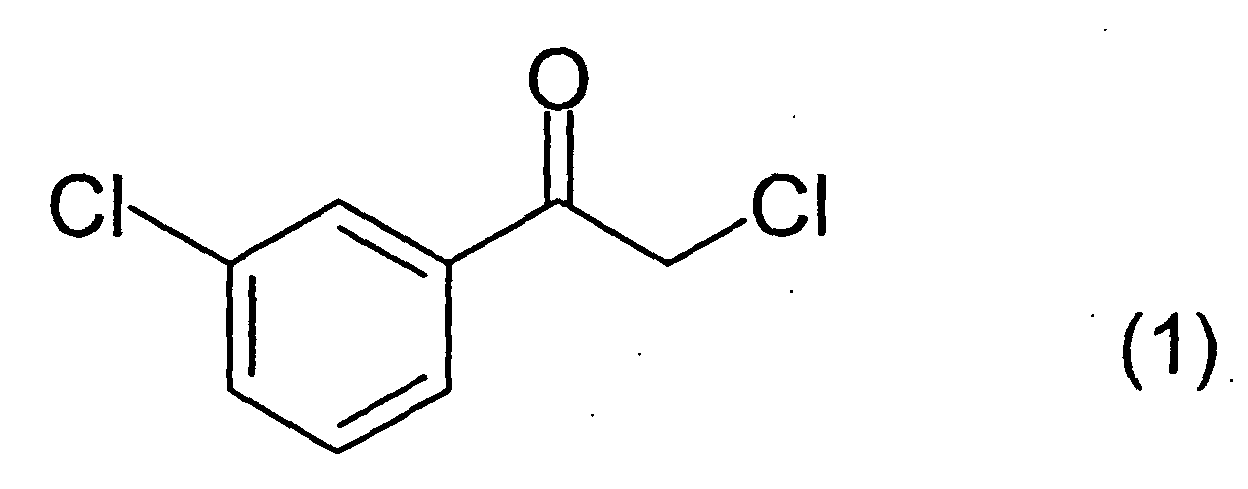
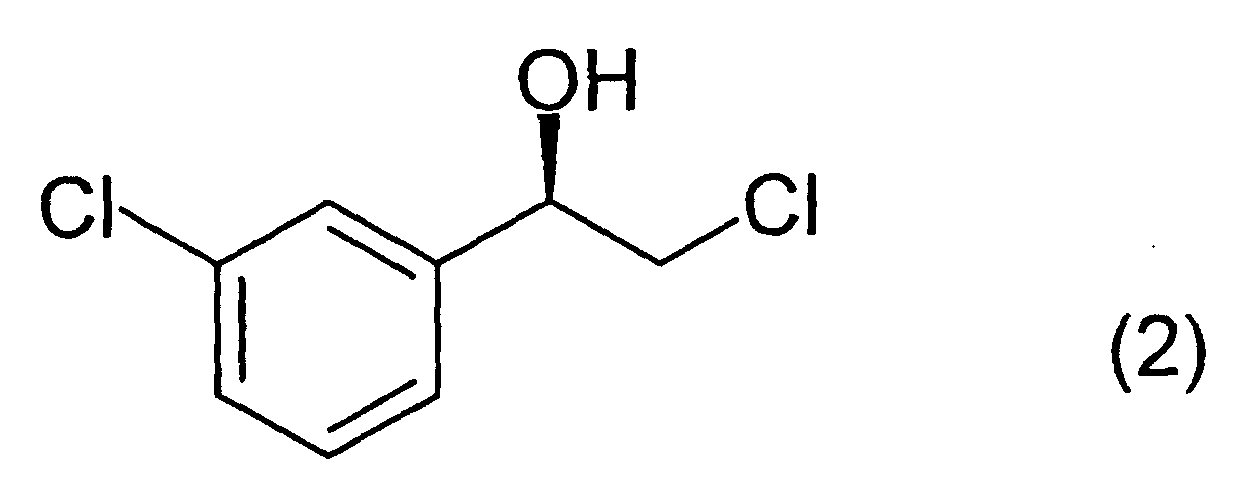
- 2-chloro-1-(3'-chlorophenyl)ethanone and (R)-2-chloro-1-(3'-chlorophenyl)ethanol are compounds represented by formula (1) and formula (2) below, respectively.
- % means %(W/V) unless stated otherwise.
- microorganism capable of stereoselectively reducing 2-chloro-1-(3'-chlorophenyl)ethanone to yield (R)-2-chloro-1-(3'-chlorophenyl)ethanol can be found by the method described below.
- a culture medium comprising 1% of polypeptone, 1% of meat extract, 0.5% of yeast extract, and 0.3% of sodium chloride is placed into a 500-ml Sakaguchi flask, and sterilization is performed.
- the culture medium is inoculated with a microorganism and the flask is shaken at 30°C for 1 to 3 days.
- the grown cells are then collected by centrifugation and suspended in 5 ml of a phosphate buffer (pH 6.5) containing 0.1% to 0.5% of 2-chloro-1-(3'-chlorophenyl)ethanone and 5% of glucose.
- the resultant suspension is shaken in a test tube plugged with cotton for 1 to 3 days at 30°C.
- the cells obtained by centrifugation may be dried in a desiccator or using acetone before use. Furthermore, when the microorganism or a material prepared by treating the microorganism is reacted with 2-chloro-1-(3'-chlorophenyl)ethanone, oxidized nicotinamide adenine dinucleotide (NAD) and/or oxidized nicotinamide adenine dinucleotide phosphate (NADP) and a glucose dehydrogenase may be added thereinto.
- NAD oxidized nicotinamide adenine dinucleotide
- NADP oxidized nicotinamide adenine dinucleotide phosphate
- glucose dehydrogenase oxidized nicotinamide adenine dinucleotide phosphate
- microorganisms usable in the present invention belong to the genera Escherichia, Aerobacter, Enterobacter, Klebsiella, Citrobacter, Rahnella, Erwinia, Serratia, Proteus, Morganella, Salmonella, Alcaligenes, Kocuria, Arthrobacter, Brevibacterium, Cellulomonas, Acinetobacter, Aeromonas, Bacillus, Agrobacterium, Nocardioides, Stenotrophomonas, Jensenia, Mycobacterium, Nocardia, Rhodococcus, Pseudonocardia, Streptomyces, Streptosporangium, Rothia, Williopsis, Kuraishia, Citeromyces, Saccharomycodes, Sporobolomyces, Dipodascus, Saccharomycopsis, Sporidiobolus, Zygosaccharomyces, Hyphopichia, Penicillium, Exophiala, Sporotrichum, Acre
- microorganisms can be generally obtained from stock strains which are easily available or purchasable. They may also be isolated from nature. Additionally, these microorganisms may be subjected to mutation to produce strains which have properties more advantageous to the reaction of the present invention.
- Any source of nutrition may be used to culture these microorganisms as long as it can be assimilated by the microorganisms.
- Examples thereof include saccharides, such as glucose, sucrose, and maltose; organic acids, such as lactic acid, acetic acid, citric acid, and propionic acid; alcohols, such as ethanol and glycerin; hydrocarbons, such as paraffins; and oils and fats, such as soybean oil and colza oil.
- carbon sources such as mixtures of these substances, and nitrogen sources, such as ammonium sulfate, ammonium phosphate, urea, yeast extracts, meat extracts, peptones, and corn steep liquor may be mixed.
- sources of nutrition such as other inorganic salts and vitamins, may be added as appropriate.
- the microorganisms can be cultured under common conditions. For example, culture is performed aerobically at a pH of 4.0 to 9.5, in a temperature range of 20°C to 45°C, for 10 to 96 hours.
- the culture solution of the microorganism may be used for the reaction as it is, or the concentrated culture solution may be used.
- the components in the culture broth adversely affect the reaction, preferably, the cells of the microorganism obtained by centrifugation of the culture broth, or a material prepared by treating the cells of the microorganism are used.
- the material prepared by treating the cells of the microorganism is not particularly limited. Examples thereof include dried cells obtained by dehydration with acetone or diphosphorus pentaoxide or by drying using a desiccator or fan, surfactant-treated materials, lytic enzyme-treated materials, immobilized cells, and cell-free extract samples prepared by cell disruption. These materials may be subjected to heat treatment before use. Furthermore, an enzyme catalyzing asymmetric reduction may be prepared by purification of a culture and used.
- 2-chloro-1-(3'-chlorophenyl)ethanone which is the substrate may be added at one time in the initial stage of the reaction or may be added in portions as the reaction proceeds.
- the reaction temperature is usually 10°C to 60°C, and preferably 20°C to 40°C.
- the pH during the reaction is 2.5 to 9, and preferably 5 to 9.
- the amount of the enzyme source in the reaction mixture may be set appropriately depending on the substrate-reducing ability.
- the substrate concentration in the reaction mixture is preferably 0.01% to 50%, and more preferably 0.1% to 30%.
- the reaction is usually carried out while the reaction mixture is shaken or stirred under aeration.
- the reaction time is set appropriately depending on the substrate concentration, the amount of the enzyme source, and other reaction conditions.
- the individual conditions are set so that the reaction is completed in 2 to 168 hours.
- an energy source such as glucose or ethanol
- glucose or ethanol is added into the reaction mixture in an amount of 1% to 30%. Consequently, excellent results are obtained.
- the reaction may be accelerated by adding a coenzyme which is generally required in the reduction reaction by a biological method, such as a reduced-nicotinamide adenine dinucleotide (NADH) or reduced-nicotinamide adenine dinucleotide phosphate (NADPH).
- NADH reduced-nicotinamide adenine dinucleotide
- NADPH reduced-nicotinamide adenine dinucleotide phosphate
- these may be added directly into the reaction mixture, or a reaction system which generates NADH or NADPH may be added into the reaction mixture together with an oxidized-type coenzyme.
- a reaction system in which a formate dehydrogenase reduces NAD to NADH when it produces carbon dioxide and water from formic acid or a reaction system in which a glucose dehydrogenase reduces NAD or NADP to NADH or NADPH, respectively, when it produces gluconolactone from glucose may be used.
- a surfactant such as Triton (manufactured by Nacalai Tesque, Inc.), Span (manufactured by Kanto Kagaku), or Tween (manufactured by Nacalai Tesque, Inc.), into the reaction mixture.
- Triton manufactured by Nacalai Tesque, Inc.
- Span manufactured by Kanto Kagaku
- Tween manufactured by Nacalai Tesque, Inc.
- a water-insoluble organic solvent such as ethyl acetate, n-butyl acetate, isopropyl ether, or toluene
- a water-soluble organic solvent such as methanol, ethanol, acetone, tetrahydrofuran, or dimethyl sulfoxide, may also be added into the reaction mixture.
- the reaction mixture is directly, or with the cells of the microorganism, etc., being isolated, extracted with a solvent, such as ethyl acetate or n-hexane, and the solvent is removed from the extract.
- a solvent such as ethyl acetate or n-hexane
- the purity of the resultant compound may be increased by distillation or purification by silica gel column chromatography or the like.
- a culture medium comprising 1% of polypeptone, 1% of meat extract, 0.5% of yeast extract, and 0.3% of sodium chloride was placed into a 500-ml Sakaguchi flask, followed by sterilization, and the microorganism was inoculated into the culture medium.
- the microorganism was aerobically incubated in shake culture at 30°C for 2 days.
- the cells were collected from the culture medium by centrifugation and suspended in 5 ml of a 50 mM phosphate buffer (pH 6.5) containing 1% of 2-chloro-1-(3'-chlorophenyl)ethanone, 0.06% of oxidized nicotinamide adenine dinucleotide (NAD), 0.06% of oxidized nicotinamide adenine dinucleotide phosphate (NADP), 5% of glucose, and 14.3 U/ml of a glucose dehydrogenase (Trade name: "Amano 2" manufactured by Amano Enzyme Inc.). The resultant suspension was moved into a test tube.
- a 50 mM phosphate buffer pH 6.5
- 2-chloro-1-(3'-chlorophenyl)ethanone 0.06% of oxidized nicotinamide adenine dinucleotide (NAD), 0.06% of oxidized nicotinamide
- the test tube was plugged with cotton, and shaking was performed at 30°C for 24 hours. After the reaction, the reaction mixture was extracted with ethyl acetate in a volume two times that of the reaction mixture. The ethyl acetate layer was analyzed by high performance liquid chromatography, and the rate of reaction and the optical purity were measured. The results thereof are shown in Table 1.
- Microorganisms Rate of reaction (%) Optical purity (%ee) Configuration Escherichia coli IFO 3301 2.9 73.9 R Escherichia coli IFO 13965 2.4 84.4 R Aerobacter aerogenes IFO 3166 1.3 10.1 R Enterobacter cloacae IFO 3320 7.2 12.3 R Klebsiella pneumoniae IFO 3318 5.1 67.1 R Klebsiella pneumoniae IFO 12059 4.3 53.9 R Citrobacter freundii IFO 13547 2.6 59.2 R Citrobacter freundii IFO 12681 4.0 75.2 R Rahnella aquatilis IFO 13544 2.7 82.5 R Erwinia carotovora subsp.
- Example 2 With respect to each of the microorganisms shown in Table 2, the same process was performed as in Example 1 except that a culture medium (pH 7.2) comprising 0.4% of glucose, 1.0% of malt extract, and 0.4% of yeast extract was used. The rate of reaction and the optical purity were measured. The results thereof are shown in Table 2.
- Example 3 With respect to each of the microorganisms shown in Table 3, the same process was performed as in Example 1 except that a culture medium (pH 6.5) comprising 2% of malt extract, 2% of glucose, 0.3% of peptone, and 0.3% of yeast extract was used. The rate of reaction and the optical purity were measured. The results thereof are shown in Table 3. Microorganisms Rate of reaction (%) Optical purity (%ee) Configuration Williopsis saturnus var.
- a culture medium (pH 7.0) comprising 1% of polypeptone, 1% of meat extract, 0.5% of yeast extract, and 0.3% of sodium chloride was placed into a 500-ml Sakaguchi flask, and sterilization was performed.
- Nocardia globerula IF013510 was inoculated into the culture medium.
- the flask was shaken at 30°C for 2 days aerobically to perform preculture.
- the culture medium (3,600 ml) was divided and poured into nine 2,000-ml Sakaguchi flasks, 400 ml each, and 5 ml of the culture broth was inoculated into each flask. Shake culture was performed aerobically at 30°C for 2 days.
- the cells were collected from the culture broth by centrifugation, suspended in 50 ml of a 100 mM phosphate buffer (pH 6.5), and disrupted with a SONIFIRE 250 ultrasonic homogenizer (manufactured by Branson Corp.). The fluid containing disrupted cell was stirred for 20 minutes in a hot water bath at 65°C, and the sediment was removed by centrifugation to prepare a crude enzyme solution.
- optically active (R)-2-chloro-1-(3'-chlorophenyl)ethanol it becomes possible to produce optically active (R)-2-chloro-1-(3'-chlorophenyl)ethanol efficiently on an industrial scale.
- the resultant optically active (R)-2-chloro-1-(3'-chlorophenyl)ethanol is useful as a raw material for the synthesis of pharmaceuticals, etc.
Landscapes
- Organic Chemistry (AREA)
- Chemical & Material Sciences (AREA)
- Engineering & Computer Science (AREA)
- Zoology (AREA)
- Life Sciences & Earth Sciences (AREA)
- Wood Science & Technology (AREA)
- Chemical Kinetics & Catalysis (AREA)
- Microbiology (AREA)
- General Chemical & Material Sciences (AREA)
- Biotechnology (AREA)
- Health & Medical Sciences (AREA)
- Biochemistry (AREA)
- Bioinformatics & Cheminformatics (AREA)
- General Engineering & Computer Science (AREA)
- General Health & Medical Sciences (AREA)
- Genetics & Genomics (AREA)
- Preparation Of Compounds By Using Micro-Organisms (AREA)
Abstract
Description
- The present invention relates to a process for producing optically active (R)-2-chloro-1-(3'-chlorophenyl)ethanol. Optically active (R)-2-chloro-1-(3'-chlorophenyl)ethanol is a compound useful as a raw material for the synthesis of medicines, agricultural chemicals, etc.
- Processes for producing optically active (R)-2-chloro-1-(3'-chlorophenyl)ethanol are disclosed in JP-A-04-218384 and JP-A-11-215995, in which a microorganism belonging to the genus Ashbya, the genus Ogataea, or the like, or a substance prepared by treating the microorganism is allowed to act on 2-chloro-1-(3'-chlorophenyl)ethanone. However, in these processes, attainable substrate concentration is not sufficiently high in the reaction. Therefore, development of a more efficient process has been desired.
- It is an object of the present invention to provide a process for producing optically active (R)-2-chloro-1-(3'-chlorophenyl)ethanol efficiently on an industrial scale.
- The present inventors have conducted intensive research in order to solve the problem described above and have discovered a novel enzyme source which is capable of stereoselectively reducing 2-chloro-1-(3'-chlorophenyl)ethanone to yield optically active (R)-2-chloro-1-(3'-chlorophenyl)ethanol, thus achieving the present invention.
- That is, a process for producing (R)-2-chloro-1-(3'-chlorophenyl)ethanol of the present invention includes allowing a culture broth of a microorganism, cells of the microorganism, or a material prepared by treating the cells of the microorganism to act on 2-chloro-1-(3'-chlorophenyl)ethanone and collecting the resultant (R)-2-chloro-1-(3'-chlorophenyl)ethanol, the microorganism being capable of stereoselectively reducing 2-chloro-1-(3'-chlorophenyl)ethanone to yield (R)-2-chloro-1-(3'-chlorophenyl)ethanol and belonging to any one of the following genera: Escherichia, Aerobacter, Enterobacter, Klebsiella, Citrobacter, Rahnella, Erwinia, Serratia, Proteus, Morganella, Salmonella, Alcaligenes, Kocuria, Arthrobacter, Brevibacterium, Cellulomonas, Acinetobacter, Aeromonas, Bacillus, Agrobacterium, Nocardioides, Stenotrophomonas, Jensenia, Mycobacterium, Nocardia, Rhodococcus, Pseudonocardia, Streptomyces, Streptosporangium, Rothia, Williopsis, Kuraishia, Citeromyces, Saccharomycodes, Sporobolomyces, Dipodascus, Saccharomycopsis, Sporidiobolus, Zygosaccharomyces, Hyphopichia, Penicillium, Exophiala, Sporotrichum, Acremonium, Paecilomyces, Verticillium, Tilachlidium, Pitomyces, Monosporium, Isaria, Gloeophyllum, Strobilurus, and Crinipellis.
- The present invention will be described in detail below.
- In the present invention, 2-chloro-1-(3'-chlorophenyl)ethanone and (R)-2-chloro-1-(3'-chlorophenyl)ethanol are compounds represented by formula (1) and formula (2) below, respectively.
- Additionally, in the following description, "%" means %(W/V) unless stated otherwise.
- The microorganism, which is used in the present invention, capable of stereoselectively reducing 2-chloro-1-(3'-chlorophenyl)ethanone to yield (R)-2-chloro-1-(3'-chlorophenyl)ethanol can be found by the method described below.
- For example, 50 ml of a culture medium (pH 7.0) comprising 1% of polypeptone, 1% of meat extract, 0.5% of yeast extract, and 0.3% of sodium chloride is placed into a 500-ml Sakaguchi flask, and sterilization is performed. The culture medium is inoculated with a microorganism and the flask is shaken at 30°C for 1 to 3 days. The grown cells are then collected by centrifugation and suspended in 5 ml of a phosphate buffer (pH 6.5) containing 0.1% to 0.5% of 2-chloro-1-(3'-chlorophenyl)ethanone and 5% of glucose. The resultant suspension is shaken in a test tube plugged with cotton for 1 to 3 days at 30°C.
- In the method described above, the cells obtained by centrifugation may be dried in a desiccator or using acetone before use. Furthermore, when the microorganism or a material prepared by treating the microorganism is reacted with 2-chloro-1-(3'-chlorophenyl)ethanone, oxidized nicotinamide adenine dinucleotide (NAD) and/or oxidized nicotinamide adenine dinucleotide phosphate (NADP) and a glucose dehydrogenase may be added thereinto.
- After the reaction is completed, ethyl acetate in the same volume as that of the reaction mixture is added thereinto and extraction is performed. The resultant 2-chloro-1-(3'-chlorophenyl)ethanol is separated and analyzed by high performance liquid chromatography under the following conditions.
- Column: Chiralcel OJ (4.6 x 250 mm) manufactured by Daicel Chemical Industries, Ltd.
- Eluent: hexane/isopropanol = 39/1 (V/V)
- Flow rate: 1 ml/min
- Detection: 210 nm
- Column temperature: room temperature
- Elution time [2-chloro-1-(3'-chlorophenyl)ethanone: 28 min, (R)-2-chloro-1-(3'-chlorophenyl)ethanol: 37 min, (S)-2-chloro-1-(3'-chlorophenyl)ethanol: 45 min]
-
- The microorganisms usable in the present invention belong to the genera Escherichia, Aerobacter, Enterobacter, Klebsiella, Citrobacter, Rahnella, Erwinia, Serratia, Proteus, Morganella, Salmonella, Alcaligenes, Kocuria, Arthrobacter, Brevibacterium, Cellulomonas, Acinetobacter, Aeromonas, Bacillus, Agrobacterium, Nocardioides, Stenotrophomonas, Jensenia, Mycobacterium, Nocardia, Rhodococcus, Pseudonocardia, Streptomyces, Streptosporangium, Rothia, Williopsis, Kuraishia, Citeromyces, Saccharomycodes, Sporobolomyces, Dipodascus, Saccharomycopsis, Sporidiobolus, Zygosaccharomyces, Hyphopichia, Penicillium, Exophiala, Sporotrichum, Acremonium, Paecilomyces, Verticillium, Tilachlidium, Pitomyces, Monosporium, Isaria, Gloeophyllum, Strobilurus, and Crinipellis.
- Specific examples which may be used include Escherichia coli IFO3301, Escherichia coli IFO13965, Aerobacter aerogenes IFO3166, Enterobacter cloacae IFO3320, Klebsiella pneumoniae IFO3318, Klebsiella pneumoniae IFO12059, Citrobacter freundii IFO13547, Citrobacter freundii IFO12681, Rahnella aquatilis IF013544, Erwinia carotovora subsp. carotovora IFO3380, Serratia marcescens IF03054, Proteus mirabilis IFO3849, Morganella morganii subsp. morganii IF03848, Salmonella typhimurium IF012529, Salmonella typhimurium IFO13245, Alcaligenes faecalis IF013111, Alcaligenes xylosoxidans subsp. denitrificans IF012669, Kocuria rosea IFO3764, Arthrobacter pascens IF012139, Arthrobacter protophormiae IFO12128, Brevibacterium linens IF012141, Cellulomonas fimi IAM12107, Acinetobacter calcoaceticus IF012552, Aeromonas hydrophila subsp. hydrophila IF03820, Bacillus subtilis IF03009, Bacillus thuringiensis IF03951, Agrobacterium tumefaciens IFO12667, Nocardioides simplex IFO12679, Stenotrophomonas maltophilia IFO12690, Jensenia canicruria IFO13914, Mycobacterium smegmatis IF03154, Mycobacterium phlei IF03158, Nocardia globerula IFO13510, Nocardia carnea IFO14403, Rhodococcus rhodochrous IFO3338, Rhodococcus erythropolis IFO12320, Pseudonocardia autotrophica IFO12743, Streptomyces griseolus IFO3402, Streptomyces scabies IF03111, Streptomyces lactamdurans IF03305, Streptosporangium roseum IFO3776, Rothia dentocariosa IFO12531, Williopsis saturnus var. saturnus IF00125, Kuraishia capsulata IF00974, Citeromyces matritensis IF00954, Saccharomycodes ludwigii IFO1043, Sporobolomyces salmonicolor IFO1038, Sporobolomyces roseus IFO1106, Dipodascus armillariae IF00102, Dipodascus tetrasuperma CBS765.70, Saccharomycopsis capsularis IFO0672, Sporidiobolus johnsonii IF06903, Zygosaccharomyces rouxii IFO0493, Hyphopichia burtonii IFO0844, Penicillium chrysogenus IF04626, Penicillium oxalicum IFO5748, Penicillium rubrum IF06580, Penicillium lilacinum IFO5752, Exophiala mansonii IFO6880, Sporotrichum aurantiacum IFO9381, Acremonium butyri IFO8580, Paecilomyces carneus IFO8292, Paecilomyces carneus IF08293, Verticillium albo-atrum IFO9470, Verticillium dahliae IF09765, Verticillium psalliotae IF030619, Tilachlidium humicola IFO5696, Pitomyces chartarum ATCC26953, Monosporium bharatensis ATCC18967, Isaria japonica IFO30367, Gloeophyllum trabeum IF06509, Strobilurus stephanocystis IFO30194, and Crinipellis stipitaria IF030259.
- These microorganisms can be generally obtained from stock strains which are easily available or purchasable. They may also be isolated from nature. Additionally, these microorganisms may be subjected to mutation to produce strains which have properties more advantageous to the reaction of the present invention.
- Any source of nutrition may be used to culture these microorganisms as long as it can be assimilated by the microorganisms. Examples thereof include saccharides, such as glucose, sucrose, and maltose; organic acids, such as lactic acid, acetic acid, citric acid, and propionic acid; alcohols, such as ethanol and glycerin; hydrocarbons, such as paraffins; and oils and fats, such as soybean oil and colza oil. Alternatively, carbon sources, such as mixtures of these substances, and nitrogen sources, such as ammonium sulfate, ammonium phosphate, urea, yeast extracts, meat extracts, peptones, and corn steep liquor may be mixed. Furthermore, sources of nutrition, such as other inorganic salts and vitamins, may be added as appropriate.
- The microorganisms can be cultured under common conditions. For example, culture is performed aerobically at a pH of 4.0 to 9.5, in a temperature range of 20°C to 45°C, for 10 to 96 hours.
- When a microorganism is allowed to react with 2-chloro-1-(3'-chlorophenyl)ethanone, the culture solution of the microorganism may be used for the reaction as it is, or the concentrated culture solution may be used. When the components in the culture broth adversely affect the reaction, preferably, the cells of the microorganism obtained by centrifugation of the culture broth, or a material prepared by treating the cells of the microorganism are used.
- The material prepared by treating the cells of the microorganism is not particularly limited. Examples thereof include dried cells obtained by dehydration with acetone or diphosphorus pentaoxide or by drying using a desiccator or fan, surfactant-treated materials, lytic enzyme-treated materials, immobilized cells, and cell-free extract samples prepared by cell disruption. These materials may be subjected to heat treatment before use. Furthermore, an enzyme catalyzing asymmetric reduction may be prepared by purification of a culture and used.
- In the reduction reaction, 2-chloro-1-(3'-chlorophenyl)ethanone which is the substrate may be added at one time in the initial stage of the reaction or may be added in portions as the reaction proceeds.
- The reaction temperature is usually 10°C to 60°C, and preferably 20°C to 40°C. The pH during the reaction is 2.5 to 9, and preferably 5 to 9.
- The amount of the enzyme source in the reaction mixture may be set appropriately depending on the substrate-reducing ability. The substrate concentration in the reaction mixture is preferably 0.01% to 50%, and more preferably 0.1% to 30%.
- The reaction is usually carried out while the reaction mixture is shaken or stirred under aeration. The reaction time is set appropriately depending on the substrate concentration, the amount of the enzyme source, and other reaction conditions. Preferably, the individual conditions are set so that the reaction is completed in 2 to 168 hours.
- In order to accelerate the reduction reaction, preferably, an energy source, such as glucose or ethanol, is added into the reaction mixture in an amount of 1% to 30%. Consequently, excellent results are obtained. Additionally, the reaction may be accelerated by adding a coenzyme which is generally required in the reduction reaction by a biological method, such as a reduced-nicotinamide adenine dinucleotide (NADH) or reduced-nicotinamide adenine dinucleotide phosphate (NADPH). Specifically, these may be added directly into the reaction mixture, or a reaction system which generates NADH or NADPH may be added into the reaction mixture together with an oxidized-type coenzyme. For example, a reaction system in which a formate dehydrogenase reduces NAD to NADH when it produces carbon dioxide and water from formic acid, or a reaction system in which a glucose dehydrogenase reduces NAD or NADP to NADH or NADPH, respectively, when it produces gluconolactone from glucose may be used.
- It is also effective to add a surfactant, such as Triton (manufactured by Nacalai Tesque, Inc.), Span (manufactured by Kanto Kagaku), or Tween (manufactured by Nacalai Tesque, Inc.), into the reaction mixture.
- Furthermore, in order to prevent the reaction from being inhibited by the substrate and/or the alcohol which is the product of the reduction reaction, a water-insoluble organic solvent, such as ethyl acetate, n-butyl acetate, isopropyl ether, or toluene, may be added into the reaction mixture. In order to increase the solubility of the substrate, a water-soluble organic solvent, such as methanol, ethanol, acetone, tetrahydrofuran, or dimethyl sulfoxide, may also be added into the reaction mixture.
- After the reduction reaction, the reaction mixture is directly, or with the cells of the microorganism, etc., being isolated, extracted with a solvent, such as ethyl acetate or n-hexane, and the solvent is removed from the extract. Thereby, (R)-2-chloro-1-(3'-chlorophenyl)ethanol is obtained. Furthermore, the purity of the resultant compound may be increased by distillation or purification by silica gel column chromatography or the like.
- While the present invention will be described in more detail based on the examples below, it is to be understood that the invention is not limited thereto. Additionally, in the following description, "%" means %(W/V) unless stated otherwise.
- With respect to each of the microorganisms shown in Table 1, 50 ml of a culture medium (pH 7.0) comprising 1% of polypeptone, 1% of meat extract, 0.5% of yeast extract, and 0.3% of sodium chloride was placed into a 500-ml Sakaguchi flask, followed by sterilization, and the microorganism was inoculated into the culture medium. The microorganism was aerobically incubated in shake culture at 30°C for 2 days. The cells were collected from the culture medium by centrifugation and suspended in 5 ml of a 50 mM phosphate buffer (pH 6.5) containing 1% of 2-chloro-1-(3'-chlorophenyl)ethanone, 0.06% of oxidized nicotinamide adenine dinucleotide (NAD), 0.06% of oxidized nicotinamide adenine dinucleotide phosphate (NADP), 5% of glucose, and 14.3 U/ml of a glucose dehydrogenase (Trade name: "Amano 2" manufactured by Amano Enzyme Inc.). The resultant suspension was moved into a test tube. The test tube was plugged with cotton, and shaking was performed at 30°C for 24 hours. After the reaction, the reaction mixture was extracted with ethyl acetate in a volume two times that of the reaction mixture. The ethyl acetate layer was analyzed by high performance liquid chromatography, and the rate of reaction and the optical purity were measured. The results thereof are shown in Table 1.
Microorganisms Rate of reaction (%) Optical purity (%ee) Configuration Escherichia coli IFO 3301 2.9 73.9 R Escherichia coli IFO 13965 2.4 84.4 R Aerobacter aerogenes IFO 3166 1.3 10.1 R Enterobacter cloacae IFO 3320 7.2 12.3 R Klebsiella pneumoniae IFO 3318 5.1 67.1 R Klebsiella pneumoniae IFO 12059 4.3 53.9 R Citrobacter freundii IFO 13547 2.6 59.2 R Citrobacter freundii IFO 12681 4.0 75.2 R Rahnella aquatilis IFO 13544 2.7 82.5 R Erwinia carotovora subsp. carotovora IFO 3380 6.9 86.4 R Serratia marcescens IFO 3054 5.4 43.7 R Proteus mirabilis IFO 3849 3.4 12.1 R Morganella morganii subsp. morganii IFO 3848 27.6 36.3 R Salmonella typhimurium IFO 12529 1.7 22.6 R Salmonella typhimurium IFO 13245 2.4 40.8 R Alcaligenes faecalis IFO 13111 32.6 36.9 R Alcaligenes xylosoxidans subsp. denitrificans IFO 12669 9.5 21.4 R Kocuria rosea IFO 3764 30.3 6.7 R Arthrobacter pascens IFO 12139 45.8 90.7 R Arthrobacter protophormiae IFO 12128 29.9 77.3 R Brevibacterium linens IFO 12141 25.3 91.5 R Cellulomonas fimi IAM 12107 33.9 78.4 R Acinetobacter calcoaceticus IFO 12552 23.9 25.8 R Aeromonas hydrophila subsp. hydrophila IFO 3820 13.1 23.3 R Bacillus subtilis IFO 3009 3.8 21.6 R Bacillus thuringiensis IFO 3951 5.3 19.8 R Agrobacterium tumefaciens IFO 12667 2.0 13.2 R Nocardioides simplex IFO 12679 3.5 44.3 R Stenotrophomonas maltophilia IFO 12690 4.7 37.1 R Jensenia canicruria IFO 13914 77.4 42.6 R - With respect to each of the microorganisms shown in Table 2, the same process was performed as in Example 1 except that a culture medium (pH 7.2) comprising 0.4% of glucose, 1.0% of malt extract, and 0.4% of yeast extract was used. The rate of reaction and the optical purity were measured. The results thereof are shown in Table 2.
Microorganisms Rate of reaction (%) Optical purity (%ee) Configuration Mycobacterium smegmatis IFO 3154 33.2 65.3 R Mycobacterium phlei IFO 3158 27.5 35.9 R Nocardia globerula IFO 13510 19.3 21.3 R Nocardia carnea IFO 14403 22.5 59.1 R Rhodococcus rhodochrous IFO 3338 27.3 87.2 R Rhodococcus erythropolis IFO 12320 32.0 91.6 R Pseudonocardia autotrophica IFO 12743 34.4 93.3 R Streptomyces griseolus IFO 3402 18.0 89.0 R Streptomyces scabies IFO 3111 26.7 67.2 R Streptomyces lactamdurans IFO 13305 12.6 45.9 R Streptosporangium roseum IFO 3776 2.7 52.3 R Rothia dentocariosa IFO 12531 3.4 12.5 R - With respect to each of the microorganisms shown in Table 3, the same process was performed as in Example 1 except that a culture medium (pH 6.5) comprising 2% of malt extract, 2% of glucose, 0.3% of peptone, and 0.3% of yeast extract was used. The rate of reaction and the optical purity were measured. The results thereof are shown in Table 3.
Microorganisms Rate of reaction (%) Optical purity (%ee) Configuration Williopsis saturnus var. saturnus IFO 0125 7.8 80.1 R Kuraishia capsulata IFO 0974 20.8 56.6 R Citeromyces matritensis IFO 0954 12.1 67.9 R Saccharomycodes ludwigii IFO 1043 23.8 45.0 R Sporobolomyces salmonicolor IFO 1038 29.1 61.2 R Sporobolomyces roseus IFO 1106 20.5 38.9 R Dipodascus armillariae IFO 0102 4.4 79.3 R Dipodascus tetrasuperma CBS 765.70 4.9 92.4 R Saccharomycopsis capsularis IFO 0672 2.8 60.6 R Sporidiobolus johnsonii IFO 6903 30.7 14.6 R Zygosaccharomyces rouxii IFO 0493 10.5 72.6 R Hyphopichia burtonii IFO 0844 12.5 3.8 R Penicillium chrysogenus IFO 4626 5.7 39.4 R Penicillium oxalicum IFO 5748 4.2 27.0 R Penicillium rubrum IFO 6580 3.7 11.4 R Penicillium lilacinum IFO 5752 15.5 20.5 R Exophiala mansonii IFO 6880 29.7 34.5 R Sporotrichum aurantiacum IFO 9381 7.3 41.0 R Acremonium butyri IFO 8580 14.2 24.9 R Paecilomyces carneus IFO 8292 5.5 34.0 R Paecilomyces carneus IFO 8293 11.1 12.5 R Verticillium albo-atrum IFO 9470 23.8 13.7 R Verticillium dahliae IFO 9765 33.1 23.4 R Verticillium psalliotae IFO 30619 5.3 56.9 R Tilachlidium humicola IFO 5696 5.0 21.0 R Pitomyces chartarum ATCC 26953 2.1 19.1 R Monosporium bharatensis ATCC 18967 1.6 13.5 R Isaria japonica IFO 30367 5.8 45.0 R Gloeophyllum trabeum IFO 6509 11.2 29.5 R Strobilurus stephanocystis IFO 30194 5.4 27.8 R Crinipellis stipitaria IFO 30259 23.2 13.2 R - 50 ml of a culture medium (pH 7.0) comprising 1% of polypeptone, 1% of meat extract, 0.5% of yeast extract, and 0.3% of sodium chloride was placed into a 500-ml Sakaguchi flask, and sterilization was performed. Nocardia globerula IF013510 was inoculated into the culture medium. The flask was shaken at 30°C for 2 days aerobically to perform preculture. The culture medium (3,600 ml) was divided and poured into nine 2,000-ml Sakaguchi flasks, 400 ml each, and 5 ml of the culture broth was inoculated into each flask. Shake culture was performed aerobically at 30°C for 2 days. The cells were collected from the culture broth by centrifugation, suspended in 50 ml of a 100 mM phosphate buffer (pH 6.5), and disrupted with a SONIFIRE 250 ultrasonic homogenizer (manufactured by Branson Corp.). The fluid containing disrupted cell was stirred for 20 minutes in a hot water bath at 65°C, and the sediment was removed by centrifugation to prepare a crude enzyme solution. 1 g of 2-chloro-1-(3'-chlorophenyl)ethanone, 4 mg of oxidized nicotinamide adenine dinucleotide (NAD), 2 g of glucose, 600 U of a glucose dehydrogenase (Trade name: "Amano 2" manufactured by Amano Enzyme Inc.), and 2 ml of n-butyl acetate was added into the crude enzyme solution (18 ml), and stirring was performed at 30°C for 24 hours while maintaining the pH at 6.5 using a 5M sodium hydroxide aqueous solution. After the reaction was completed, the reaction mixture was extracted with ethyl acetate, and the solvent was removed. The extract was analyzed by high performance liquid chromatography, and the rate of reaction and the optical purity were measured. As a result, (R)-2-chloro-1-(3'-chlorophenyl)ethanol with an optical purity of 99.5% ee was produced at a yield of 46.9%.
- According to the present invention, it becomes possible to produce optically active (R)-2-chloro-1-(3'-chlorophenyl)ethanol efficiently on an industrial scale. The resultant optically active (R)-2-chloro-1-(3'-chlorophenyl)ethanol is useful as a raw material for the synthesis of pharmaceuticals, etc.
Claims (2)
- A process for producing (R)-2-chloro-1-(3'-chlorophenyl)ethanol comprising allowing a culture broth of a microorganism, cells of the microorganism, or a material prepared by treating the cells of the microorganism to act on 2-chloro-1-(3'-chlorophenyl)ethanone and collecting the resultant (R)-2-chloro-1-(3'-chlorophenyl)ethanol, the microorganism being capable of stereoselectively reducing 2-chloro-1-(3'-chlorophenyl)ethanone to yield (R)-2-chloro-1-(3'-chlorophenyl)ethanol and belonging to any one of the following genera: Escherichia, Aerobacter, Enterobacter, Klebsiella, Citrobacter, Rahnella, Erwinia, Serratia, Proteus, Morganella, Salmonella, Alcaligenes, Kocuria, Arthrobacter, Brevibacterium, Cellulomonas, Acinetobacter, Aeromonas, Bacillus, Agrobacterium, Nocardioides, Stenotrophomonas, Jensenia, Mycobacterium, Nocardia, Rhodococcus, Pseudonocardia, Streptomyces, Streptosporangium, Rothia, Williopsis, Kuraishia, Citeromyces, Saccharomycodes, Sporobolomyces, Dipodascus, Saccharomycopsis, Sporidiobolus, Zygosaccharomyces, Hyphopichia, Penicillium, Exophiala, Sporotrichum, Acremonium, Paecilomyces, Verticillium, Tilachlidium, Pitomyces, Monosporium, Isaria, Gloeophyllum, Strobilurus, and Crinipellis.
- The process according to Claim 1, wherein the microorganism is any one of Escherichia coli, Aerobacter aerogenes, Enterobacter cloacae, Klebsiella pneumoniae, Citrobacter freundii, Rahnella aquatilis, Erwinia carotovora, Serratia marcescens, Proteus mirabilis, Morganella morganii, Salmonella typhimurium, Alcaligenes faecalis, Alcaligenes xylosoxidans, Kocuria rosea, Arthrobacter pascens, Arthrobacter protophormiae, Brevibacterium linens, Cellulomonas fimi, Acinetobacter calcoaceticus, Aeromonas hydrophila, Bacillus subtilis, Bacillus thuringiensis, Agrobacterium tumefaciens, Nocardioides simplex, Stenotrophomonas maltophilia, Jensenia canicruria, Mycobacterium smegmatis, Mycobacterium phlei, Nocardia globerula, Nocardia carnea, Rhodococcus rhodochrous, Rhodococcus erythropolis, Pseudonocardia autotrophica, Streptomyces griseolus, Streptomyces scabies, Streptomyces lactamdurans, Streptosporangium roseum, Rothia dentocariosa, Williopsis saturnus, Kuraishia capsulata, Citeromyces matritensis, Saccharomycodes ludwigii, Sporobolomyces salmonicolor, Sporobolomyces roseus, Dipodascus armillariae, Dipodascus tetrasuperma, Saccharomycopsis capsularis, Sporidiobolus johnsonii, Zygosaccharomyces rouxii, Hyphopichia burtonii, Penicillium chrysogenus, Penicillium oxalicum, Penicillium rubrum, Penicillium lilacinum, Exophiala mansonii, Sporotrichum aurantiacum, Acremonium butyri, Paecilomyces carneus, Verticillium albo-atrum, Verticillium dahliae, Verticillium psalliotae, Tilachlidium humicola, Pitomyces chartarum, Monosporium bharatensis, Isaria japonica, Gloeophyllum trabeum, Strobilurus stephanocystis, and Crinipellis stipitaria.
Applications Claiming Priority (3)
| Application Number | Priority Date | Filing Date | Title |
|---|---|---|---|
| JP2001191517 | 2001-06-25 | ||
| JP2001191517A JP2003000290A (en) | 2001-06-25 | 2001-06-25 | Method for producing optically active (R) -2-chloro-1- (3'-chlorophenyl) ethanol |
| PCT/JP2002/006343 WO2003000911A1 (en) | 2001-06-25 | 2002-06-25 | Process for producing optically active (r)-2-chloro-1-(3'-chlorophenyl)ethanol |
Publications (2)
| Publication Number | Publication Date |
|---|---|
| EP1400594A1 true EP1400594A1 (en) | 2004-03-24 |
| EP1400594A4 EP1400594A4 (en) | 2004-09-29 |
Family
ID=19030128
Family Applications (1)
| Application Number | Title | Priority Date | Filing Date |
|---|---|---|---|
| EP02738795A Withdrawn EP1400594A4 (en) | 2001-06-25 | 2002-06-25 | Process for producing optically active (r)-2-chloro-1-(3'-chlorophenyl)ethanol |
Country Status (5)
| Country | Link |
|---|---|
| US (1) | US20040219658A1 (en) |
| EP (1) | EP1400594A4 (en) |
| JP (1) | JP2003000290A (en) |
| CZ (1) | CZ2004119A3 (en) |
| WO (1) | WO2003000911A1 (en) |
Cited By (2)
| Publication number | Priority date | Publication date | Assignee | Title |
|---|---|---|---|---|
| CN101302552B (en) * | 2007-05-10 | 2010-12-29 | 重庆博腾制药科技股份有限公司 | Method for preparing (R)-2-chlorin-1-(3-chlorphenyl) ethanol by microorganism catalysis |
| CN101849000B (en) * | 2007-03-22 | 2013-07-03 | 住友化学株式会社 | Reductase, gene thereof and method of using the same |
Families Citing this family (2)
| Publication number | Priority date | Publication date | Assignee | Title |
|---|---|---|---|---|
| KR100854369B1 (en) * | 2006-12-22 | 2008-09-02 | 주식회사 포스코 | Blocking device for coagulation supply line for coagulation of oxidation scale |
| JP5292824B2 (en) * | 2008-01-22 | 2013-09-18 | 住友化学株式会社 | Process for producing optically active ortho-substituted mandelic acid compound |
Family Cites Families (12)
| Publication number | Priority date | Publication date | Assignee | Title |
|---|---|---|---|---|
| JPH0669378B2 (en) * | 1985-06-05 | 1994-09-07 | 住友化学工業株式会社 | Method for converting water-insoluble or almost water-insoluble organic substrate using microorganisms |
| DE69131685T2 (en) * | 1990-07-24 | 2000-04-27 | Kanegafuchi Kagaku Kogyo K.K., Osaka | METHOD FOR PRODUCING OPTICALLY ACTIVE (-) - 2-HALO-1- (SUBSTITUTED PHENYL) ETHANOLS |
| JP3027614B2 (en) * | 1990-12-27 | 2000-04-04 | ダイセル化学工業株式会社 | Method for producing optically active (R) -3-chloro-1-phenyl-1-propanol |
| JP3087419B2 (en) * | 1991-11-14 | 2000-09-11 | 味の素株式会社 | Method for producing (S) -1-phenyl-1,3-propanediol or a derivative thereof |
| JP3146641B2 (en) * | 1992-06-25 | 2001-03-19 | 東レ株式会社 | Method for producing optically active mandelic acid |
| CA2103932A1 (en) * | 1992-11-05 | 1994-05-06 | Ramesh N. Patel | Stereoselective reduction of ketones |
| JP3178128B2 (en) * | 1992-12-15 | 2001-06-18 | 東レ株式会社 | Method for producing optically active 2,2,2-trihalogeno-1-phenylethanol |
| JPH06197791A (en) * | 1992-12-28 | 1994-07-19 | Toray Ind Inc | Production of optically active 2,2-dihalogeno-1-phenylethanol |
| WO1997012053A1 (en) * | 1995-09-27 | 1997-04-03 | Schering Corporation | Stereoselective microbial reduction process |
| US5618707A (en) * | 1996-01-04 | 1997-04-08 | Schering Corporation | Stereoselective microbial reduction of 5-fluorophenyl-5-oxo-pentanoic acid and a phenyloxazolidinone condensation product thereof |
| JP3919918B2 (en) * | 1998-02-02 | 2007-05-30 | 株式会社カネカ | Process for producing optically active 2-halo-1- (substituted phenyl) ethanol |
| AU8069801A (en) * | 2000-08-16 | 2002-02-25 | Bristol Myers Squibb Co | Stereoselective reduction of substituted oxo-butanes |
-
2001
- 2001-06-25 JP JP2001191517A patent/JP2003000290A/en not_active Withdrawn
-
2002
- 2002-06-25 CZ CZ2004119A patent/CZ2004119A3/en unknown
- 2002-06-25 US US10/482,251 patent/US20040219658A1/en not_active Abandoned
- 2002-06-25 EP EP02738795A patent/EP1400594A4/en not_active Withdrawn
- 2002-06-25 WO PCT/JP2002/006343 patent/WO2003000911A1/en not_active Ceased
Non-Patent Citations (2)
| Title |
|---|
| No further relevant documents disclosed * |
| See also references of WO03000911A1 * |
Cited By (2)
| Publication number | Priority date | Publication date | Assignee | Title |
|---|---|---|---|---|
| CN101849000B (en) * | 2007-03-22 | 2013-07-03 | 住友化学株式会社 | Reductase, gene thereof and method of using the same |
| CN101302552B (en) * | 2007-05-10 | 2010-12-29 | 重庆博腾制药科技股份有限公司 | Method for preparing (R)-2-chlorin-1-(3-chlorphenyl) ethanol by microorganism catalysis |
Also Published As
| Publication number | Publication date |
|---|---|
| CZ2004119A3 (en) | 2004-09-15 |
| WO2003000911A1 (en) | 2003-01-03 |
| US20040219658A1 (en) | 2004-11-04 |
| EP1400594A4 (en) | 2004-09-29 |
| JP2003000290A (en) | 2003-01-07 |
Similar Documents
| Publication | Publication Date | Title |
|---|---|---|
| JPH031949B2 (en) | ||
| EP0666320B1 (en) | Process for producing alpha-hydroxy acid or alpha-hydroxyamide by microorganisms | |
| JPH0217159B2 (en) | ||
| US4250259A (en) | Microbiological production of ketones from C3 -C6 secondary alcohols | |
| JP3409353B2 (en) | Method for producing amide compound and microorganism used | |
| TWI287579B (en) | Stereoselective reduction of substituted oxo-butanes | |
| JPH084515B2 (en) | Method for producing organic compound | |
| US20040219658A1 (en) | Process for producing optically active (r)-2-chloro-1-(3'-chlorophenly) ethanol | |
| JP2001503979A (en) | Methods and compositions for preparing D-aspartic acid | |
| JP4372408B2 (en) | Rhodococcus genus bacterial recombinant and method for producing optically active substance using the same | |
| WO1993025702A1 (en) | Process for producing substance lowering cholesterol level | |
| US4268630A (en) | Microbiological production of ketones from C3 -C6 alkanes | |
| JPWO1993025702A1 (en) | Method for producing cholesterol-lowering substances | |
| JP3919918B2 (en) | Process for producing optically active 2-halo-1- (substituted phenyl) ethanol | |
| IE920669A1 (en) | Biotechnological process for the production of S-(+)-2,2-dimethylcyclopropanecarboxamide and R-(-)-2,2-dimethylcyclopropanecarboxylic acid | |
| JP2012080878A (en) | Method for producing vinyl glycine derivative or salt of the same | |
| HUP0000807A2 (en) | Process for the preparation of optically active n-benzyl-3-pyrrolidinol | |
| JP4898129B2 (en) | Process for producing optically active vinyl alcohols | |
| WO2000037666A1 (en) | Process for producing (r)-2-hydroxy-1-phenoxypropane derivative | |
| WO2020034660A1 (en) | Method for preparing (s)-1,2,3,4-tetrahydroisoquinoline-1-formic acid and derivatives thereof | |
| JPS633599B2 (en) | ||
| CA2474780A1 (en) | Enone reductase | |
| EP4092126A1 (en) | A method of enzymatic reduction of the oxidized nicotinamide adenine dinucleotide and carboxylic acids | |
| JP4269416B2 (en) | Process for producing α-halo-α, β-saturated carbonyl compound | |
| JP2002017387A (en) | Method for producing indole derivatives |
Legal Events
| Date | Code | Title | Description |
|---|---|---|---|
| PUAI | Public reference made under article 153(3) epc to a published international application that has entered the european phase |
Free format text: ORIGINAL CODE: 0009012 |
|
| 17P | Request for examination filed |
Effective date: 20040109 |
|
| AK | Designated contracting states |
Kind code of ref document: A1 Designated state(s): AT BE CH CY DE DK ES FI FR GB GR IE IT LI LU MC NL PT SE TR |
|
| RTI1 | Title (correction) |
Free format text: PROCESS FOR PRODUCING OPTICALLY ACTIVE (R)-2-CHLORO-1-(3'-CHLOROPHENYL)ETHANOL |
|
| A4 | Supplementary search report drawn up and despatched |
Effective date: 20040818 |
|
| RIC1 | Information provided on ipc code assigned before grant |
Ipc: 7C 12P 7/22 A |
|
| 17Q | First examination report despatched |
Effective date: 20050330 |
|
| 17Q | First examination report despatched |
Effective date: 20050330 |
|
| GRAP | Despatch of communication of intention to grant a patent |
Free format text: ORIGINAL CODE: EPIDOSNIGR1 |
|
| STAA | Information on the status of an ep patent application or granted ep patent |
Free format text: STATUS: THE APPLICATION IS DEEMED TO BE WITHDRAWN |
|
| 18D | Application deemed to be withdrawn |
Effective date: 20090428 |