EP1399577B1 - Method for producing l-amino acids - Google Patents
Method for producing l-amino acids Download PDFInfo
- Publication number
- EP1399577B1 EP1399577B1 EP02741268A EP02741268A EP1399577B1 EP 1399577 B1 EP1399577 B1 EP 1399577B1 EP 02741268 A EP02741268 A EP 02741268A EP 02741268 A EP02741268 A EP 02741268A EP 1399577 B1 EP1399577 B1 EP 1399577B1
- Authority
- EP
- European Patent Office
- Prior art keywords
- amino acid
- group
- producing
- acid according
- general formula
- Prior art date
- Legal status (The legal status is an assumption and is not a legal conclusion. Google has not performed a legal analysis and makes no representation as to the accuracy of the status listed.)
- Expired - Lifetime
Links
- 150000008575 L-amino acids Chemical class 0.000 title claims description 81
- 238000004519 manufacturing process Methods 0.000 title claims description 76
- 241000196324 Embryophyta Species 0.000 claims description 106
- 108090000790 Enzymes Proteins 0.000 claims description 57
- 102000004190 Enzymes Human genes 0.000 claims description 53
- 125000001424 substituent group Chemical group 0.000 claims description 51
- 244000005700 microbiome Species 0.000 claims description 50
- 108700023158 Phenylalanine ammonia-lyases Proteins 0.000 claims description 48
- 108090000623 proteins and genes Proteins 0.000 claims description 38
- 150000001413 amino acids Chemical group 0.000 claims description 33
- QGZKDVFQNNGYKY-UHFFFAOYSA-N Ammonia Chemical compound N QGZKDVFQNNGYKY-UHFFFAOYSA-N 0.000 claims description 31
- 241001071917 Lithospermum Species 0.000 claims description 27
- 125000000217 alkyl group Chemical group 0.000 claims description 24
- 125000004432 carbon atom Chemical group C* 0.000 claims description 24
- COLNVLDHVKWLRT-QMMMGPOBSA-N L-phenylalanine Chemical compound OC(=O)[C@@H](N)CC1=CC=CC=C1 COLNVLDHVKWLRT-QMMMGPOBSA-N 0.000 claims description 22
- 150000001252 acrylic acid derivatives Chemical class 0.000 claims description 22
- 125000003277 amino group Chemical group 0.000 claims description 19
- 125000003178 carboxy group Chemical group [H]OC(*)=O 0.000 claims description 18
- 210000004748 cultured cell Anatomy 0.000 claims description 18
- 125000004093 cyano group Chemical group *C#N 0.000 claims description 18
- 125000002887 hydroxy group Chemical group [H]O* 0.000 claims description 18
- 125000000449 nitro group Chemical group [O-][N+](*)=O 0.000 claims description 18
- 125000001997 phenyl group Chemical group [H]C1=C([H])C([H])=C(*)C([H])=C1[H] 0.000 claims description 18
- 240000004808 Saccharomyces cerevisiae Species 0.000 claims description 17
- 125000003368 amide group Chemical group 0.000 claims description 16
- 229940024606 amino acid Drugs 0.000 claims description 16
- 125000005842 heteroatom Chemical group 0.000 claims description 16
- 125000004029 hydroxymethyl group Chemical group [H]OC([H])([H])* 0.000 claims description 16
- 241000588724 Escherichia coli Species 0.000 claims description 15
- 125000003118 aryl group Chemical group 0.000 claims description 15
- 229910021529 ammonia Inorganic materials 0.000 claims description 14
- 229960005190 phenylalanine Drugs 0.000 claims description 14
- WKBOTKDWSSQWDR-UHFFFAOYSA-N Bromine atom Chemical group [Br] WKBOTKDWSSQWDR-UHFFFAOYSA-N 0.000 claims description 13
- 125000003545 alkoxy group Chemical group 0.000 claims description 13
- 229910052801 chlorine Inorganic materials 0.000 claims description 13
- 125000001309 chloro group Chemical group Cl* 0.000 claims description 13
- 229910052731 fluorine Inorganic materials 0.000 claims description 13
- 125000001153 fluoro group Chemical group F* 0.000 claims description 13
- 239000000203 mixture Substances 0.000 claims description 11
- 229910052760 oxygen Inorganic materials 0.000 claims description 8
- 229910052717 sulfur Inorganic materials 0.000 claims description 8
- 241000894006 Bacteria Species 0.000 claims description 7
- 239000002773 nucleotide Substances 0.000 claims description 7
- 125000003729 nucleotide group Chemical group 0.000 claims description 7
- 241000233866 Fungi Species 0.000 claims description 3
- 125000005843 halogen group Chemical group 0.000 claims description 3
- 235000018597 common camellia Nutrition 0.000 claims description 2
- 240000001548 Camellia japonica Species 0.000 claims 1
- 238000006243 chemical reaction Methods 0.000 description 86
- 238000000034 method Methods 0.000 description 79
- 239000000047 product Substances 0.000 description 59
- 239000000243 solution Substances 0.000 description 58
- 101150077062 pal gene Proteins 0.000 description 37
- 210000004027 cell Anatomy 0.000 description 28
- 239000000284 extract Substances 0.000 description 27
- 230000000694 effects Effects 0.000 description 25
- 150000001875 compounds Chemical class 0.000 description 23
- 230000003287 optical effect Effects 0.000 description 21
- 239000000758 substrate Substances 0.000 description 21
- 235000014680 Saccharomyces cerevisiae Nutrition 0.000 description 16
- 239000007858 starting material Substances 0.000 description 16
- 239000002299 complementary DNA Substances 0.000 description 15
- 230000014509 gene expression Effects 0.000 description 14
- 239000013612 plasmid Substances 0.000 description 14
- 108020004414 DNA Proteins 0.000 description 13
- 244000269722 Thea sinensis Species 0.000 description 13
- 239000002609 medium Substances 0.000 description 13
- 150000002993 phenylalanine derivatives Chemical class 0.000 description 13
- 239000013598 vector Substances 0.000 description 13
- 238000005119 centrifugation Methods 0.000 description 12
- 240000009164 Petroselinum crispum Species 0.000 description 11
- 235000002770 Petroselinum crispum Nutrition 0.000 description 11
- 150000001851 cinnamic acid derivatives Chemical class 0.000 description 11
- 230000000052 comparative effect Effects 0.000 description 11
- 239000012634 fragment Substances 0.000 description 11
- ATRRKUHOCOJYRX-UHFFFAOYSA-N Ammonium bicarbonate Chemical compound [NH4+].OC([O-])=O ATRRKUHOCOJYRX-UHFFFAOYSA-N 0.000 description 10
- 239000001099 ammonium carbonate Substances 0.000 description 10
- 239000004615 ingredient Substances 0.000 description 10
- 239000000463 material Substances 0.000 description 10
- 240000008067 Cucumis sativus Species 0.000 description 9
- 235000006468 Thea sinensis Nutrition 0.000 description 9
- 239000002253 acid Substances 0.000 description 9
- -1 alkali metal salts Chemical class 0.000 description 9
- 235000012501 ammonium carbonate Nutrition 0.000 description 9
- 235000002637 Nicotiana tabacum Nutrition 0.000 description 8
- 238000012258 culturing Methods 0.000 description 8
- 238000002360 preparation method Methods 0.000 description 8
- 238000003756 stirring Methods 0.000 description 8
- 239000006228 supernatant Substances 0.000 description 8
- BFNBIHQBYMNNAN-UHFFFAOYSA-N ammonium sulfate Chemical compound N.N.OS(O)(=O)=O BFNBIHQBYMNNAN-UHFFFAOYSA-N 0.000 description 7
- 229910052921 ammonium sulfate Inorganic materials 0.000 description 7
- 235000011130 ammonium sulphate Nutrition 0.000 description 7
- 108020004999 messenger RNA Proteins 0.000 description 7
- 239000002244 precipitate Substances 0.000 description 7
- 238000000926 separation method Methods 0.000 description 7
- QTBSBXVTEAMEQO-UHFFFAOYSA-N Acetic acid Chemical compound CC(O)=O QTBSBXVTEAMEQO-UHFFFAOYSA-N 0.000 description 6
- WEVYAHXRMPXWCK-UHFFFAOYSA-N Acetonitrile Chemical compound CC#N WEVYAHXRMPXWCK-UHFFFAOYSA-N 0.000 description 6
- 241000219195 Arabidopsis thaliana Species 0.000 description 6
- IJGRMHOSHXDMSA-UHFFFAOYSA-N Atomic nitrogen Chemical compound N#N IJGRMHOSHXDMSA-UHFFFAOYSA-N 0.000 description 6
- CURLTUGMZLYLDI-UHFFFAOYSA-N Carbon dioxide Chemical compound O=C=O CURLTUGMZLYLDI-UHFFFAOYSA-N 0.000 description 6
- JZKXXXDKRQWDET-QMMMGPOBSA-N L-m-tyrosine Chemical compound OC(=O)[C@@H](N)CC1=CC=CC(O)=C1 JZKXXXDKRQWDET-QMMMGPOBSA-N 0.000 description 6
- 150000008547 L-phenylalanines Chemical class 0.000 description 6
- 235000007688 Lycopersicon esculentum Nutrition 0.000 description 6
- 240000007594 Oryza sativa Species 0.000 description 6
- 235000007164 Oryza sativa Nutrition 0.000 description 6
- 240000003768 Solanum lycopersicum Species 0.000 description 6
- 239000007853 buffer solution Substances 0.000 description 6
- 238000004128 high performance liquid chromatography Methods 0.000 description 6
- SEOVTRFCIGRIMH-UHFFFAOYSA-N indole-3-acetic acid Chemical compound C1=CC=C2C(CC(=O)O)=CNC2=C1 SEOVTRFCIGRIMH-UHFFFAOYSA-N 0.000 description 6
- 239000000126 substance Substances 0.000 description 6
- WBYWAXJHAXSJNI-VOTSOKGWSA-M .beta-Phenylacrylic acid Natural products [O-]C(=O)\C=C\C1=CC=CC=C1 WBYWAXJHAXSJNI-VOTSOKGWSA-M 0.000 description 5
- OKTJSMMVPCPJKN-UHFFFAOYSA-N Carbon Chemical compound [C] OKTJSMMVPCPJKN-UHFFFAOYSA-N 0.000 description 5
- WBYWAXJHAXSJNI-SREVYHEPSA-N Cinnamic acid Chemical compound OC(=O)\C=C/C1=CC=CC=C1 WBYWAXJHAXSJNI-SREVYHEPSA-N 0.000 description 5
- 235000009849 Cucumis sativus Nutrition 0.000 description 5
- VEXZGXHMUGYJMC-UHFFFAOYSA-N Hydrochloric acid Chemical compound Cl VEXZGXHMUGYJMC-UHFFFAOYSA-N 0.000 description 5
- 244000061176 Nicotiana tabacum Species 0.000 description 5
- 108091034117 Oligonucleotide Proteins 0.000 description 5
- 238000004113 cell culture Methods 0.000 description 5
- 229930016911 cinnamic acid Natural products 0.000 description 5
- 235000013985 cinnamic acid Nutrition 0.000 description 5
- 238000000502 dialysis Methods 0.000 description 5
- 230000003100 immobilizing effect Effects 0.000 description 5
- JZKXXXDKRQWDET-UHFFFAOYSA-N meta-tyrosine Natural products OC(=O)C(N)CC1=CC=CC(O)=C1 JZKXXXDKRQWDET-UHFFFAOYSA-N 0.000 description 5
- WBYWAXJHAXSJNI-UHFFFAOYSA-N methyl p-hydroxycinnamate Natural products OC(=O)C=CC1=CC=CC=C1 WBYWAXJHAXSJNI-UHFFFAOYSA-N 0.000 description 5
- 235000002639 sodium chloride Nutrition 0.000 description 5
- 210000001519 tissue Anatomy 0.000 description 5
- NGSWKAQJJWESNS-UHFFFAOYSA-N 4-coumaric acid Chemical compound OC(=O)C=CC1=CC=C(O)C=C1 NGSWKAQJJWESNS-UHFFFAOYSA-N 0.000 description 4
- VHUUQVKOLVNVRT-UHFFFAOYSA-N Ammonium hydroxide Chemical compound [NH4+].[OH-] VHUUQVKOLVNVRT-UHFFFAOYSA-N 0.000 description 4
- 235000010523 Cicer arietinum Nutrition 0.000 description 4
- 244000045195 Cicer arietinum Species 0.000 description 4
- 235000010799 Cucumis sativus var sativus Nutrition 0.000 description 4
- 244000000626 Daucus carota Species 0.000 description 4
- 235000002767 Daucus carota Nutrition 0.000 description 4
- 239000001888 Peptone Substances 0.000 description 4
- 108010080698 Peptones Proteins 0.000 description 4
- 244000062780 Petroselinum sativum Species 0.000 description 4
- 235000008566 Pinus taeda Nutrition 0.000 description 4
- 241000218679 Pinus taeda Species 0.000 description 4
- 102100029989 SHC SH2 domain-binding protein 1 Human genes 0.000 description 4
- 235000002595 Solanum tuberosum Nutrition 0.000 description 4
- 244000061456 Solanum tuberosum Species 0.000 description 4
- 240000006365 Vitis vinifera Species 0.000 description 4
- 235000014787 Vitis vinifera Nutrition 0.000 description 4
- 238000000246 agarose gel electrophoresis Methods 0.000 description 4
- 235000011114 ammonium hydroxide Nutrition 0.000 description 4
- 150000003863 ammonium salts Chemical class 0.000 description 4
- 238000004458 analytical method Methods 0.000 description 4
- 229910052799 carbon Inorganic materials 0.000 description 4
- 239000003814 drug Substances 0.000 description 4
- 238000006911 enzymatic reaction Methods 0.000 description 4
- 235000013372 meat Nutrition 0.000 description 4
- 239000011259 mixed solution Substances 0.000 description 4
- 238000002156 mixing Methods 0.000 description 4
- 239000011368 organic material Substances 0.000 description 4
- 235000019319 peptone Nutrition 0.000 description 4
- 235000011197 perejil Nutrition 0.000 description 4
- COLNVLDHVKWLRT-UHFFFAOYSA-N phenylalanine Natural products OC(=O)C(N)CC1=CC=CC=C1 COLNVLDHVKWLRT-UHFFFAOYSA-N 0.000 description 4
- FGIUAXJPYTZDNR-UHFFFAOYSA-N potassium nitrate Chemical compound [K+].[O-][N+]([O-])=O FGIUAXJPYTZDNR-UHFFFAOYSA-N 0.000 description 4
- 108091008146 restriction endonucleases Proteins 0.000 description 4
- 239000000523 sample Substances 0.000 description 4
- 238000003786 synthesis reaction Methods 0.000 description 4
- XLYOFNOQVPJJNP-UHFFFAOYSA-N water Substances O XLYOFNOQVPJJNP-UHFFFAOYSA-N 0.000 description 4
- WFDIJRYMOXRFFG-UHFFFAOYSA-N Acetic anhydride Chemical compound CC(=O)OC(C)=O WFDIJRYMOXRFFG-UHFFFAOYSA-N 0.000 description 3
- CSCPPACGZOOCGX-UHFFFAOYSA-N Acetone Chemical compound CC(C)=O CSCPPACGZOOCGX-UHFFFAOYSA-N 0.000 description 3
- 229920001817 Agar Polymers 0.000 description 3
- 241000701489 Cauliflower mosaic virus Species 0.000 description 3
- LFQSCWFLJHTTHZ-UHFFFAOYSA-N Ethanol Chemical compound CCO LFQSCWFLJHTTHZ-UHFFFAOYSA-N 0.000 description 3
- FAIXYKHYOGVFKA-UHFFFAOYSA-N Kinetin Natural products N=1C=NC=2N=CNC=2C=1N(C)C1=CC=CO1 FAIXYKHYOGVFKA-UHFFFAOYSA-N 0.000 description 3
- OUYCCCASQSFEME-QMMMGPOBSA-N L-tyrosine Chemical compound OC(=O)[C@@H](N)CC1=CC=C(O)C=C1 OUYCCCASQSFEME-QMMMGPOBSA-N 0.000 description 3
- 235000017824 Medicago lupulina Nutrition 0.000 description 3
- 241000208125 Nicotiana Species 0.000 description 3
- 108091028043 Nucleic acid sequence Proteins 0.000 description 3
- 241000219000 Populus Species 0.000 description 3
- 244000126277 Trifolium campestre Species 0.000 description 3
- 238000010521 absorption reaction Methods 0.000 description 3
- 230000009471 action Effects 0.000 description 3
- 238000005273 aeration Methods 0.000 description 3
- 239000008272 agar Substances 0.000 description 3
- AVKUERGKIZMTKX-NJBDSQKTSA-N ampicillin Chemical compound C1([C@@H](N)C(=O)N[C@H]2[C@H]3SC([C@@H](N3C2=O)C(O)=O)(C)C)=CC=CC=C1 AVKUERGKIZMTKX-NJBDSQKTSA-N 0.000 description 3
- 229960000723 ampicillin Drugs 0.000 description 3
- 230000001580 bacterial effect Effects 0.000 description 3
- 229910021538 borax Inorganic materials 0.000 description 3
- KRKNYBCHXYNGOX-UHFFFAOYSA-N citric acid Chemical compound OC(=O)CC(O)(C(O)=O)CC(O)=O KRKNYBCHXYNGOX-UHFFFAOYSA-N 0.000 description 3
- 238000003776 cleavage reaction Methods 0.000 description 3
- 108091036078 conserved sequence Proteins 0.000 description 3
- 238000007796 conventional method Methods 0.000 description 3
- ARUVKPQLZAKDPS-UHFFFAOYSA-L copper(II) sulfate Chemical compound [Cu+2].[O-][S+2]([O-])([O-])[O-] ARUVKPQLZAKDPS-UHFFFAOYSA-L 0.000 description 3
- 238000001514 detection method Methods 0.000 description 3
- 239000013613 expression plasmid Substances 0.000 description 3
- 238000000605 extraction Methods 0.000 description 3
- 238000010353 genetic engineering Methods 0.000 description 3
- 125000000623 heterocyclic group Chemical group 0.000 description 3
- 239000003617 indole-3-acetic acid Substances 0.000 description 3
- 239000000411 inducer Substances 0.000 description 3
- 229930013032 isoflavonoid Natural products 0.000 description 3
- 150000003817 isoflavonoid derivatives Chemical class 0.000 description 3
- 235000012891 isoflavonoids Nutrition 0.000 description 3
- BPHPUYQFMNQIOC-NXRLNHOXSA-N isopropyl beta-D-thiogalactopyranoside Chemical compound CC(C)S[C@@H]1O[C@H](CO)[C@H](O)[C@H](O)[C@H]1O BPHPUYQFMNQIOC-NXRLNHOXSA-N 0.000 description 3
- QANMHLXAZMSUEX-UHFFFAOYSA-N kinetin Chemical compound N=1C=NC=2N=CNC=2C=1NCC1=CC=CO1 QANMHLXAZMSUEX-UHFFFAOYSA-N 0.000 description 3
- 229960001669 kinetin Drugs 0.000 description 3
- 238000005374 membrane filtration Methods 0.000 description 3
- 229910052757 nitrogen Inorganic materials 0.000 description 3
- 150000002894 organic compounds Chemical class 0.000 description 3
- 229930015704 phenylpropanoid Natural products 0.000 description 3
- 239000013600 plasmid vector Substances 0.000 description 3
- NLKNQRATVPKPDG-UHFFFAOYSA-M potassium iodide Chemical compound [K+].[I-] NLKNQRATVPKPDG-UHFFFAOYSA-M 0.000 description 3
- 102000004169 proteins and genes Human genes 0.000 description 3
- 238000000746 purification Methods 0.000 description 3
- 230000009257 reactivity Effects 0.000 description 3
- 230000000717 retained effect Effects 0.000 description 3
- 235000009566 rice Nutrition 0.000 description 3
- 150000003839 salts Chemical class 0.000 description 3
- 230000007017 scission Effects 0.000 description 3
- 235000010339 sodium tetraborate Nutrition 0.000 description 3
- 239000007787 solid Substances 0.000 description 3
- 238000000638 solvent extraction Methods 0.000 description 3
- 239000000725 suspension Substances 0.000 description 3
- BSVBQGMMJUBVOD-UHFFFAOYSA-N trisodium borate Chemical compound [Na+].[Na+].[Na+].[O-]B([O-])[O-] BSVBQGMMJUBVOD-UHFFFAOYSA-N 0.000 description 3
- LNAZSHAWQACDHT-XIYTZBAFSA-N (2r,3r,4s,5r,6s)-4,5-dimethoxy-2-(methoxymethyl)-3-[(2s,3r,4s,5r,6r)-3,4,5-trimethoxy-6-(methoxymethyl)oxan-2-yl]oxy-6-[(2r,3r,4s,5r,6r)-4,5,6-trimethoxy-2-(methoxymethyl)oxan-3-yl]oxyoxane Chemical compound CO[C@@H]1[C@@H](OC)[C@H](OC)[C@@H](COC)O[C@H]1O[C@H]1[C@H](OC)[C@@H](OC)[C@H](O[C@H]2[C@@H]([C@@H](OC)[C@H](OC)O[C@@H]2COC)OC)O[C@@H]1COC LNAZSHAWQACDHT-XIYTZBAFSA-N 0.000 description 2
- LUEWUZLMQUOBSB-FSKGGBMCSA-N (2s,3s,4s,5s,6r)-2-[(2r,3s,4r,5r,6s)-6-[(2r,3s,4r,5s,6s)-4,5-dihydroxy-2-(hydroxymethyl)-6-[(2r,4r,5s,6r)-4,5,6-trihydroxy-2-(hydroxymethyl)oxan-3-yl]oxyoxan-3-yl]oxy-4,5-dihydroxy-2-(hydroxymethyl)oxan-3-yl]oxy-6-(hydroxymethyl)oxane-3,4,5-triol Chemical compound O[C@H]1[C@@H](O)[C@H](O)[C@@H](CO)O[C@H]1O[C@@H]1[C@@H](CO)O[C@@H](O[C@@H]2[C@H](O[C@@H](OC3[C@H](O[C@@H](O)[C@@H](O)[C@H]3O)CO)[C@@H](O)[C@H]2O)CO)[C@H](O)[C@H]1O LUEWUZLMQUOBSB-FSKGGBMCSA-N 0.000 description 2
- HQVOPXGNHGTKOD-AATRIKPKSA-N (e)-3-(2-cyanophenyl)prop-2-enoic acid Chemical compound OC(=O)\C=C\C1=CC=CC=C1C#N HQVOPXGNHGTKOD-AATRIKPKSA-N 0.000 description 2
- ZCJLOOJRNPHKAV-ONEGZZNKSA-N (e)-3-(furan-2-yl)prop-2-enoic acid Chemical compound OC(=O)\C=C\C1=CC=CO1 ZCJLOOJRNPHKAV-ONEGZZNKSA-N 0.000 description 2
- 239000005631 2,4-Dichlorophenoxyacetic acid Substances 0.000 description 2
- JGNXKTOZHBRZTB-UHFFFAOYSA-N 2-(1h-pyrrol-2-yl)prop-2-enoic acid Chemical compound OC(=O)C(=C)C1=CC=CN1 JGNXKTOZHBRZTB-UHFFFAOYSA-N 0.000 description 2
- QKNYBSVHEMOAJP-UHFFFAOYSA-N 2-amino-2-(hydroxymethyl)propane-1,3-diol;hydron;chloride Chemical compound Cl.OCC(N)(CO)CO QKNYBSVHEMOAJP-UHFFFAOYSA-N 0.000 description 2
- RXZQHZDTHUUJQJ-UHFFFAOYSA-N 2-azaniumyl-3-(furan-2-yl)propanoate Chemical compound OC(=O)C(N)CC1=CC=CO1 RXZQHZDTHUUJQJ-UHFFFAOYSA-N 0.000 description 2
- LWKSZBQHSQBVAE-UHFFFAOYSA-N 2-thiophen-3-ylprop-2-enoic acid Chemical compound OC(=O)C(=C)C=1C=CSC=1 LWKSZBQHSQBVAE-UHFFFAOYSA-N 0.000 description 2
- IMYGTWMJKVNQNY-UHFFFAOYSA-N 3-(1h-pyrrol-2-yl)prop-2-enoic acid Chemical compound OC(=O)C=CC1=CC=CN1 IMYGTWMJKVNQNY-UHFFFAOYSA-N 0.000 description 2
- DAYPQGQLFQVFPV-UHFFFAOYSA-N 3-(2-fluorophenyl)-4,5-dihydro-1,2-oxazole-5-carboxylic acid Chemical compound O1C(C(=O)O)CC(C=2C(=CC=CC=2)F)=N1 DAYPQGQLFQVFPV-UHFFFAOYSA-N 0.000 description 2
- JHAPZUDWRRBZHZ-UHFFFAOYSA-N 3-(furan-3-yl)prop-2-enoic acid Chemical compound OC(=O)C=CC=1C=COC=1 JHAPZUDWRRBZHZ-UHFFFAOYSA-N 0.000 description 2
- KKMZQOIASVGJQE-UHFFFAOYSA-N 3-thiophen-2-ylprop-2-enoic acid Chemical compound OC(=O)C=CC1=CC=CS1 KKMZQOIASVGJQE-UHFFFAOYSA-N 0.000 description 2
- MCGBIXXDQFWVDW-UHFFFAOYSA-N 4,5-dihydro-1h-pyrazole Chemical compound C1CC=NN1 MCGBIXXDQFWVDW-UHFFFAOYSA-N 0.000 description 2
- FHVDTGUDJYJELY-UHFFFAOYSA-N 6-{[2-carboxy-4,5-dihydroxy-6-(phosphanyloxy)oxan-3-yl]oxy}-4,5-dihydroxy-3-phosphanyloxane-2-carboxylic acid Chemical compound O1C(C(O)=O)C(P)C(O)C(O)C1OC1C(C(O)=O)OC(OP)C(O)C1O FHVDTGUDJYJELY-UHFFFAOYSA-N 0.000 description 2
- 241000251468 Actinopterygii Species 0.000 description 2
- 241000589155 Agrobacterium tumefaciens Species 0.000 description 2
- 108090000673 Ammonia-Lyases Proteins 0.000 description 2
- 102000004118 Ammonia-Lyases Human genes 0.000 description 2
- QGZKDVFQNNGYKY-UHFFFAOYSA-O Ammonium Chemical compound [NH4+] QGZKDVFQNNGYKY-UHFFFAOYSA-O 0.000 description 2
- 241000207199 Citrus Species 0.000 description 2
- 235000005979 Citrus limon Nutrition 0.000 description 2
- 244000131522 Citrus pyriformis Species 0.000 description 2
- 230000004544 DNA amplification Effects 0.000 description 2
- 229920002581 Glucomannan Polymers 0.000 description 2
- WQZGKKKJIJFFOK-GASJEMHNSA-N Glucose Natural products OC[C@H]1OC(O)[C@H](O)[C@@H](O)[C@@H]1O WQZGKKKJIJFFOK-GASJEMHNSA-N 0.000 description 2
- 235000010469 Glycine max Nutrition 0.000 description 2
- 244000068988 Glycine max Species 0.000 description 2
- 244000020551 Helianthus annuus Species 0.000 description 2
- 235000003222 Helianthus annuus Nutrition 0.000 description 2
- 102100034343 Integrase Human genes 0.000 description 2
- 244000017020 Ipomoea batatas Species 0.000 description 2
- 235000002678 Ipomoea batatas Nutrition 0.000 description 2
- WTDRDQBEARUVNC-UHFFFAOYSA-N L-Dopa Natural products OC(=O)C(N)CC1=CC=C(O)C(O)=C1 WTDRDQBEARUVNC-UHFFFAOYSA-N 0.000 description 2
- 241001300479 Macroptilium Species 0.000 description 2
- CSNNHWWHGAXBCP-UHFFFAOYSA-L Magnesium sulfate Chemical compound [Mg+2].[O-][S+2]([O-])([O-])[O-] CSNNHWWHGAXBCP-UHFFFAOYSA-L 0.000 description 2
- OFOBLEOULBTSOW-UHFFFAOYSA-N Malonic acid Chemical compound OC(=O)CC(O)=O OFOBLEOULBTSOW-UHFFFAOYSA-N 0.000 description 2
- 240000004658 Medicago sativa Species 0.000 description 2
- 241001465754 Metazoa Species 0.000 description 2
- PVNIIMVLHYAWGP-UHFFFAOYSA-N Niacin Chemical compound OC(=O)C1=CC=CN=C1 PVNIIMVLHYAWGP-UHFFFAOYSA-N 0.000 description 2
- 229910019142 PO4 Inorganic materials 0.000 description 2
- 235000010627 Phaseolus vulgaris Nutrition 0.000 description 2
- 244000046052 Phaseolus vulgaris Species 0.000 description 2
- NBIIXXVUZAFLBC-UHFFFAOYSA-N Phosphoric acid Chemical compound OP(O)(O)=O NBIIXXVUZAFLBC-UHFFFAOYSA-N 0.000 description 2
- NQRYJNQNLNOLGT-UHFFFAOYSA-N Piperidine Chemical compound C1CCNCC1 NQRYJNQNLNOLGT-UHFFFAOYSA-N 0.000 description 2
- 240000004713 Pisum sativum Species 0.000 description 2
- 235000010582 Pisum sativum Nutrition 0.000 description 2
- 229920002845 Poly(methacrylic acid) Polymers 0.000 description 2
- 229920002873 Polyethylenimine Polymers 0.000 description 2
- 239000004372 Polyvinyl alcohol Substances 0.000 description 2
- 241001479460 Populus sieboldii x Populus grandidentata Species 0.000 description 2
- 244000007021 Prunus avium Species 0.000 description 2
- 235000010401 Prunus avium Nutrition 0.000 description 2
- 241001290151 Prunus avium subsp. avium Species 0.000 description 2
- JUJWROOIHBZHMG-UHFFFAOYSA-N Pyridine Chemical compound C1=CC=NC=C1 JUJWROOIHBZHMG-UHFFFAOYSA-N 0.000 description 2
- 108010092799 RNA-directed DNA polymerase Proteins 0.000 description 2
- 108020005091 Replication Origin Proteins 0.000 description 2
- 241001149408 Rhodotorula graminis Species 0.000 description 2
- 235000017848 Rubus fruticosus Nutrition 0.000 description 2
- 244000172730 Rubus fruticosus Species 0.000 description 2
- 235000009122 Rubus idaeus Nutrition 0.000 description 2
- 244000235659 Rubus idaeus Species 0.000 description 2
- FAPWRFPIFSIZLT-UHFFFAOYSA-M Sodium chloride Chemical compound [Na+].[Cl-] FAPWRFPIFSIZLT-UHFFFAOYSA-M 0.000 description 2
- 229920002125 Sokalan® Polymers 0.000 description 2
- 235000002597 Solanum melongena Nutrition 0.000 description 2
- 244000061458 Solanum melongena Species 0.000 description 2
- 235000019764 Soybean Meal Nutrition 0.000 description 2
- 241000895680 Stylosanthes guianensis Species 0.000 description 2
- 240000002726 Stylosanthes sundaica Species 0.000 description 2
- 229930006000 Sucrose Natural products 0.000 description 2
- CZMRCDWAGMRECN-UGDNZRGBSA-N Sucrose Chemical compound O[C@H]1[C@H](O)[C@@H](CO)O[C@@]1(CO)O[C@@H]1[C@H](O)[C@@H](O)[C@H](O)[C@@H](CO)O1 CZMRCDWAGMRECN-UGDNZRGBSA-N 0.000 description 2
- QAOWNCQODCNURD-UHFFFAOYSA-N Sulfuric acid Chemical compound OS(O)(=O)=O QAOWNCQODCNURD-UHFFFAOYSA-N 0.000 description 2
- 241000219793 Trifolium Species 0.000 description 2
- 244000098338 Triticum aestivum Species 0.000 description 2
- XSQUKJJJFZCRTK-UHFFFAOYSA-N Urea Chemical compound NC(N)=O XSQUKJJJFZCRTK-UHFFFAOYSA-N 0.000 description 2
- 235000009754 Vitis X bourquina Nutrition 0.000 description 2
- 235000012333 Vitis X labruscana Nutrition 0.000 description 2
- 235000011054 acetic acid Nutrition 0.000 description 2
- 150000007513 acids Chemical class 0.000 description 2
- 230000002411 adverse Effects 0.000 description 2
- 239000003905 agrochemical Substances 0.000 description 2
- 229940072056 alginate Drugs 0.000 description 2
- 235000010443 alginic acid Nutrition 0.000 description 2
- 229920000615 alginic acid Polymers 0.000 description 2
- 230000003321 amplification Effects 0.000 description 2
- WPYMKLBDIGXBTP-UHFFFAOYSA-N benzoic acid Chemical compound OC(=O)C1=CC=CC=C1 WPYMKLBDIGXBTP-UHFFFAOYSA-N 0.000 description 2
- 230000015572 biosynthetic process Effects 0.000 description 2
- KGBXLFKZBHKPEV-UHFFFAOYSA-N boric acid Chemical compound OB(O)O KGBXLFKZBHKPEV-UHFFFAOYSA-N 0.000 description 2
- 239000004327 boric acid Substances 0.000 description 2
- 229940041514 candida albicans extract Drugs 0.000 description 2
- 239000000679 carrageenan Substances 0.000 description 2
- 235000010418 carrageenan Nutrition 0.000 description 2
- 229920001525 carrageenan Polymers 0.000 description 2
- 229940113118 carrageenan Drugs 0.000 description 2
- 239000007795 chemical reaction product Substances 0.000 description 2
- 235000019693 cherries Nutrition 0.000 description 2
- 210000000349 chromosome Anatomy 0.000 description 2
- QAIPRVGONGVQAS-UHFFFAOYSA-N cis-caffeic acid Natural products OC(=O)C=CC1=CC=C(O)C(O)=C1 QAIPRVGONGVQAS-UHFFFAOYSA-N 0.000 description 2
- 235000020971 citrus fruits Nutrition 0.000 description 2
- 238000010367 cloning Methods 0.000 description 2
- 229920001577 copolymer Polymers 0.000 description 2
- 229910000366 copper(II) sulfate Inorganic materials 0.000 description 2
- 239000000287 crude extract Substances 0.000 description 2
- XBDQKXXYIPTUBI-UHFFFAOYSA-N dimethylselenoniopropionate Natural products CCC(O)=O XBDQKXXYIPTUBI-UHFFFAOYSA-N 0.000 description 2
- 238000004821 distillation Methods 0.000 description 2
- 229940079593 drug Drugs 0.000 description 2
- 238000003379 elimination reaction Methods 0.000 description 2
- 239000003480 eluent Substances 0.000 description 2
- 238000001914 filtration Methods 0.000 description 2
- 239000012847 fine chemical Substances 0.000 description 2
- 239000003365 glass fiber Substances 0.000 description 2
- 229940046240 glucomannan Drugs 0.000 description 2
- 239000008103 glucose Substances 0.000 description 2
- RWSXRVCMGQZWBV-WDSKDSINSA-N glutathione Chemical compound OC(=O)[C@@H](N)CCC(=O)N[C@@H](CS)C(=O)NCC(O)=O RWSXRVCMGQZWBV-WDSKDSINSA-N 0.000 description 2
- 235000002532 grape seed extract Nutrition 0.000 description 2
- 230000012010 growth Effects 0.000 description 2
- 239000001963 growth medium Substances 0.000 description 2
- 238000000265 homogenisation Methods 0.000 description 2
- 238000009396 hybridization Methods 0.000 description 2
- 239000012535 impurity Substances 0.000 description 2
- 239000000543 intermediate Substances 0.000 description 2
- SURQXAFEQWPFPV-UHFFFAOYSA-L iron(2+) sulfate heptahydrate Chemical compound O.O.O.O.O.O.O.[Fe+2].[O-]S([O-])(=O)=O SURQXAFEQWPFPV-UHFFFAOYSA-L 0.000 description 2
- JVTAAEKCZFNVCJ-UHFFFAOYSA-N lactic acid Chemical compound CC(O)C(O)=O JVTAAEKCZFNVCJ-UHFFFAOYSA-N 0.000 description 2
- KKSDGJDHHZEWEP-UHFFFAOYSA-N m-hydroxycinnamic acid Natural products OC(=O)C=CC1=CC=CC(O)=C1 KKSDGJDHHZEWEP-UHFFFAOYSA-N 0.000 description 2
- BDAGIHXWWSANSR-UHFFFAOYSA-N methanoic acid Natural products OC=O BDAGIHXWWSANSR-UHFFFAOYSA-N 0.000 description 2
- 229920000609 methyl cellulose Polymers 0.000 description 2
- 239000001923 methylcellulose Substances 0.000 description 2
- 229960002900 methylcellulose Drugs 0.000 description 2
- 229910000402 monopotassium phosphate Inorganic materials 0.000 description 2
- ZQXSMRAEXCEDJD-UHFFFAOYSA-N n-ethenylformamide Chemical compound C=CNC=O ZQXSMRAEXCEDJD-UHFFFAOYSA-N 0.000 description 2
- 238000003199 nucleic acid amplification method Methods 0.000 description 2
- 108020004707 nucleic acids Proteins 0.000 description 2
- 150000007523 nucleic acids Chemical class 0.000 description 2
- 102000039446 nucleic acids Human genes 0.000 description 2
- 230000036961 partial effect Effects 0.000 description 2
- 239000002245 particle Substances 0.000 description 2
- 239000012450 pharmaceutical intermediate Substances 0.000 description 2
- 150000002995 phenylpropanoid derivatives Chemical class 0.000 description 2
- NBIIXXVUZAFLBC-UHFFFAOYSA-K phosphate Chemical compound [O-]P([O-])([O-])=O NBIIXXVUZAFLBC-UHFFFAOYSA-K 0.000 description 2
- 239000010452 phosphate Substances 0.000 description 2
- 229920000083 poly(allylamine) Polymers 0.000 description 2
- 229920002401 polyacrylamide Polymers 0.000 description 2
- 239000004584 polyacrylic acid Substances 0.000 description 2
- 229920002451 polyvinyl alcohol Polymers 0.000 description 2
- 239000004323 potassium nitrate Substances 0.000 description 2
- 235000010333 potassium nitrate Nutrition 0.000 description 2
- 239000011535 reaction buffer Substances 0.000 description 2
- 230000002829 reductive effect Effects 0.000 description 2
- 238000003757 reverse transcription PCR Methods 0.000 description 2
- 230000002441 reversible effect Effects 0.000 description 2
- 238000007086 side reaction Methods 0.000 description 2
- VWDWKYIASSYTQR-UHFFFAOYSA-N sodium nitrate Chemical compound [Na+].[O-][N+]([O-])=O VWDWKYIASSYTQR-UHFFFAOYSA-N 0.000 description 2
- 239000002904 solvent Substances 0.000 description 2
- 239000004455 soybean meal Substances 0.000 description 2
- 241000894007 species Species 0.000 description 2
- 239000005720 sucrose Substances 0.000 description 2
- KKSDGJDHHZEWEP-SNAWJCMRSA-N trans-3-coumaric acid Chemical compound OC(=O)\C=C\C1=CC=CC(O)=C1 KKSDGJDHHZEWEP-SNAWJCMRSA-N 0.000 description 2
- 238000001291 vacuum drying Methods 0.000 description 2
- 239000012138 yeast extract Substances 0.000 description 2
- UHVMMEOXYDMDKI-JKYCWFKZSA-L zinc;1-(5-cyanopyridin-2-yl)-3-[(1s,2s)-2-(6-fluoro-2-hydroxy-3-propanoylphenyl)cyclopropyl]urea;diacetate Chemical compound [Zn+2].CC([O-])=O.CC([O-])=O.CCC(=O)C1=CC=C(F)C([C@H]2[C@H](C2)NC(=O)NC=2N=CC(=CC=2)C#N)=C1O UHVMMEOXYDMDKI-JKYCWFKZSA-L 0.000 description 2
- YYTDJPUFAVPHQA-VKHMYHEASA-N (2s)-2-amino-3-(2,3,4,5,6-pentafluorophenyl)propanoic acid Chemical compound OC(=O)[C@@H](N)CC1=C(F)C(F)=C(F)C(F)=C1F YYTDJPUFAVPHQA-VKHMYHEASA-N 0.000 description 1
- OCDHPLVCNWBKJN-VIFPVBQESA-N (2s)-2-amino-3-(2-cyanophenyl)propanoic acid Chemical compound OC(=O)[C@@H](N)CC1=CC=CC=C1C#N OCDHPLVCNWBKJN-VIFPVBQESA-N 0.000 description 1
- KWIPUXXIFQQMKN-VIFPVBQESA-N (2s)-2-amino-3-(4-cyanophenyl)propanoic acid Chemical compound OC(=O)[C@@H](N)CC1=CC=C(C#N)C=C1 KWIPUXXIFQQMKN-VIFPVBQESA-N 0.000 description 1
- JEWPACUDYNBTSN-ZETCQYMHSA-N (2s)-2-hydroxyheptanenitrile Chemical compound CCCCC[C@H](O)C#N JEWPACUDYNBTSN-ZETCQYMHSA-N 0.000 description 1
- AFDXODALSZRGIH-QPJJXVBHSA-N (E)-3-(4-methoxyphenyl)prop-2-enoic acid Chemical compound COC1=CC=C(\C=C\C(O)=O)C=C1 AFDXODALSZRGIH-QPJJXVBHSA-N 0.000 description 1
- KMBQKHKEEHEPOE-AATRIKPKSA-N (e)-3-(2-aminophenyl)prop-2-enoic acid Chemical compound NC1=CC=CC=C1\C=C\C(O)=O KMBQKHKEEHEPOE-AATRIKPKSA-N 0.000 description 1
- OMHDOOAFLCMRFX-AATRIKPKSA-N (e)-3-(2-bromophenyl)prop-2-enoic acid Chemical compound OC(=O)\C=C\C1=CC=CC=C1Br OMHDOOAFLCMRFX-AATRIKPKSA-N 0.000 description 1
- KJRRTHHNKJBVBO-AATRIKPKSA-N (e)-3-(2-chlorophenyl)prop-2-enoic acid Chemical compound OC(=O)\C=C\C1=CC=CC=C1Cl KJRRTHHNKJBVBO-AATRIKPKSA-N 0.000 description 1
- IOUDZAFBPDDAMK-AATRIKPKSA-N (e)-3-(2-fluorophenyl)prop-2-enoic acid Chemical compound OC(=O)\C=C\C1=CC=CC=C1F IOUDZAFBPDDAMK-AATRIKPKSA-N 0.000 description 1
- SBCFNNJYIXFMFS-AATRIKPKSA-N (e)-3-(2-iodophenyl)prop-2-enoic acid Chemical compound OC(=O)\C=C\C1=CC=CC=C1I SBCFNNJYIXFMFS-AATRIKPKSA-N 0.000 description 1
- YEMUSDCFQUBPAL-SNAWJCMRSA-N (e)-3-(3-bromophenyl)prop-2-enoic acid Chemical compound OC(=O)\C=C\C1=CC=CC(Br)=C1 YEMUSDCFQUBPAL-SNAWJCMRSA-N 0.000 description 1
- RTSIUKMGSDOSTI-SNAWJCMRSA-N (e)-3-(3-fluorophenyl)prop-2-enoic acid Chemical compound OC(=O)\C=C\C1=CC=CC(F)=C1 RTSIUKMGSDOSTI-SNAWJCMRSA-N 0.000 description 1
- XQOFQTFBKOHMCW-SNAWJCMRSA-N (e)-3-(3-iodophenyl)prop-2-enoic acid Chemical compound OC(=O)\C=C\C1=CC=CC(I)=C1 XQOFQTFBKOHMCW-SNAWJCMRSA-N 0.000 description 1
- JOLPMPPNHIACPD-ZZXKWVIFSA-N (e)-3-(4-aminophenyl)prop-2-enoic acid Chemical compound NC1=CC=C(\C=C\C(O)=O)C=C1 JOLPMPPNHIACPD-ZZXKWVIFSA-N 0.000 description 1
- CPDDDTNAMBSPRN-ZZXKWVIFSA-N (e)-3-(4-bromophenyl)prop-2-enoic acid Chemical compound OC(=O)\C=C\C1=CC=C(Br)C=C1 CPDDDTNAMBSPRN-ZZXKWVIFSA-N 0.000 description 1
- NIDLJAPEZBFHGP-ZZXKWVIFSA-N (e)-3-(4-iodophenyl)prop-2-enoic acid Chemical compound OC(=O)\C=C\C1=CC=C(I)C=C1 NIDLJAPEZBFHGP-ZZXKWVIFSA-N 0.000 description 1
- 108091032973 (ribonucleotides)n+m Proteins 0.000 description 1
- VEEPGIBHWRABJA-UHFFFAOYSA-N 1-benzyl-3,5-dimethylpyrazol-4-amine Chemical compound CC1=C(N)C(C)=NN1CC1=CC=CC=C1 VEEPGIBHWRABJA-UHFFFAOYSA-N 0.000 description 1
- 238000001644 13C nuclear magnetic resonance spectroscopy Methods 0.000 description 1
- 238000005160 1H NMR spectroscopy Methods 0.000 description 1
- HXKWSTRRCHTUEC-UHFFFAOYSA-N 2,4-Dichlorophenoxyaceticacid Chemical compound OC(=O)C(Cl)OC1=CC=C(Cl)C=C1 HXKWSTRRCHTUEC-UHFFFAOYSA-N 0.000 description 1
- RSWBWHPZXKLUEX-VOTSOKGWSA-N 2-Methylcinnamic Acid Chemical compound CC1=CC=CC=C1\C=C\C(O)=O RSWBWHPZXKLUEX-VOTSOKGWSA-N 0.000 description 1
- SCWPNMHQRGNQHH-AATRIKPKSA-N 2-[(e)-2-carboxyethenyl]benzoic acid Chemical compound OC(=O)\C=C\C1=CC=CC=C1C(O)=O SCWPNMHQRGNQHH-AATRIKPKSA-N 0.000 description 1
- BOBATFKNMFWLFG-UHFFFAOYSA-N 2-amino-2-cyano-n-methylacetamide Chemical compound CNC(=O)C(N)C#N BOBATFKNMFWLFG-UHFFFAOYSA-N 0.000 description 1
- ONTACQLSDXBILH-UHFFFAOYSA-N 2-amino-2-thiophen-3-ylpropanoic acid Chemical compound OC(=O)C(N)(C)C=1C=CSC=1 ONTACQLSDXBILH-UHFFFAOYSA-N 0.000 description 1
- REBWUCRWJNKVLL-UHFFFAOYSA-N 2-amino-3-(1h-pyrrol-2-yl)propanoic acid Chemical compound OC(=O)C(N)CC1=CC=CN1 REBWUCRWJNKVLL-UHFFFAOYSA-N 0.000 description 1
- SDMNFUKYUGGKNV-UHFFFAOYSA-N 2-amino-3-(1h-pyrrol-3-yl)propanoic acid Chemical compound OC(=O)C(N)CC=1C=CNC=1 SDMNFUKYUGGKNV-UHFFFAOYSA-N 0.000 description 1
- ZAFNLUPTKPOREL-UHFFFAOYSA-N 2-amino-3-(furan-3-yl)propanoic acid Chemical compound OC(=O)C(N)CC=1C=COC=1 ZAFNLUPTKPOREL-UHFFFAOYSA-N 0.000 description 1
- DJXMNZLSBCANRG-UHFFFAOYSA-N 2-azaniumyl-2-thiophen-2-ylpropanoate Chemical compound OC(=O)C(N)(C)C1=CC=CS1 DJXMNZLSBCANRG-UHFFFAOYSA-N 0.000 description 1
- FEGVSPGUHMGGBO-UHFFFAOYSA-N 2-methoxy cinnamic acid Natural products COC1=CC=CC=C1C=CC(O)=O FEGVSPGUHMGGBO-UHFFFAOYSA-N 0.000 description 1
- BBQDLDVSEDAYAA-AATRIKPKSA-N 2-nitrocinnamic acid Chemical compound OC(=O)\C=C\C1=CC=CC=C1[N+]([O-])=O BBQDLDVSEDAYAA-AATRIKPKSA-N 0.000 description 1
- SCJHPUGWYHCYAZ-UHFFFAOYSA-N 3,5-diethyl-2-propylpyridine Chemical compound CCCC1=NC=C(CC)C=C1CC SCJHPUGWYHCYAZ-UHFFFAOYSA-N 0.000 description 1
- JNXMJSYJCFTLJB-UHFFFAOYSA-N 3-(3-aminophenyl)-2-propenoic acid Chemical compound NC1=CC=CC(C=CC(O)=O)=C1 JNXMJSYJCFTLJB-UHFFFAOYSA-N 0.000 description 1
- FFKGOJWPSXRALK-UHFFFAOYSA-N 3-(3-chlorophenyl)prop-2-enoic acid Chemical compound OC(=O)C=CC1=CC=CC(Cl)=C1 FFKGOJWPSXRALK-UHFFFAOYSA-N 0.000 description 1
- KBEPQVCZYNPZHN-UHFFFAOYSA-N 3-(4-methoxy-3-methylphenyl)prop-2-enoic acid Chemical compound COC1=CC=C(C=CC(O)=O)C=C1C KBEPQVCZYNPZHN-UHFFFAOYSA-N 0.000 description 1
- QFSPZKLJQZSLQU-UHFFFAOYSA-N 3-(4-tert-butylphenyl)prop-2-enoic acid Chemical compound CC(C)(C)C1=CC=C(C=CC(O)=O)C=C1 QFSPZKLJQZSLQU-UHFFFAOYSA-N 0.000 description 1
- VFQOFJQVKVEXIY-UHFFFAOYSA-N 3-(phenylmethoxycarbonylamino)-3-piperidin-3-ylpropanoic acid Chemical compound C1CCNCC1C(CC(=O)O)NC(=O)OCC1=CC=CC=C1 VFQOFJQVKVEXIY-UHFFFAOYSA-N 0.000 description 1
- LZPNXAULYJPXEH-AATRIKPKSA-N 3-Methoxycinnamic acid Chemical compound COC1=CC=CC(\C=C\C(O)=O)=C1 LZPNXAULYJPXEH-AATRIKPKSA-N 0.000 description 1
- KLWPBEWWHJTYDC-SNAWJCMRSA-N 3-[(e)-2-carboxyethenyl]benzoic acid Chemical compound OC(=O)\C=C\C1=CC=CC(C(O)=O)=C1 KLWPBEWWHJTYDC-SNAWJCMRSA-N 0.000 description 1
- JZINNAKNHHQBOS-AATRIKPKSA-N 3-methylcinnamic acid Chemical compound CC1=CC=CC(\C=C\C(O)=O)=C1 JZINNAKNHHQBOS-AATRIKPKSA-N 0.000 description 1
- OSWFIVFLDKOXQC-UHFFFAOYSA-N 4-(3-methoxyphenyl)aniline Chemical compound COC1=CC=CC(C=2C=CC(N)=CC=2)=C1 OSWFIVFLDKOXQC-UHFFFAOYSA-N 0.000 description 1
- RURHILYUWQEGOS-VOTSOKGWSA-N 4-Methylcinnamic acid Chemical compound CC1=CC=C(\C=C\C(O)=O)C=C1 RURHILYUWQEGOS-VOTSOKGWSA-N 0.000 description 1
- HAEJSGLKJYIYTB-ZZXKWVIFSA-N 4-carboxycinnamic acid Chemical compound OC(=O)\C=C\C1=CC=C(C(O)=O)C=C1 HAEJSGLKJYIYTB-ZZXKWVIFSA-N 0.000 description 1
- GXLIFJYFGMHYDY-ZZXKWVIFSA-N 4-chlorocinnamic acid Chemical compound OC(=O)\C=C\C1=CC=C(Cl)C=C1 GXLIFJYFGMHYDY-ZZXKWVIFSA-N 0.000 description 1
- OPIFSICVWOWJMJ-AEOCFKNESA-N 5-bromo-4-chloro-3-indolyl beta-D-galactoside Chemical compound O[C@@H]1[C@@H](O)[C@@H](O)[C@@H](CO)O[C@H]1OC1=CNC2=CC=C(Br)C(Cl)=C12 OPIFSICVWOWJMJ-AEOCFKNESA-N 0.000 description 1
- NEZONWMXZKDMKF-JTQLQIEISA-N Alkannin Chemical compound C1=CC(O)=C2C(=O)C([C@@H](O)CC=C(C)C)=CC(=O)C2=C1O NEZONWMXZKDMKF-JTQLQIEISA-N 0.000 description 1
- 229910000013 Ammonium bicarbonate Inorganic materials 0.000 description 1
- 239000004254 Ammonium phosphate Substances 0.000 description 1
- 241000228212 Aspergillus Species 0.000 description 1
- 241000193830 Bacillus <bacterium> Species 0.000 description 1
- 239000005711 Benzoic acid Substances 0.000 description 1
- 108091003079 Bovine Serum Albumin Proteins 0.000 description 1
- 241000209507 Camellia Species 0.000 description 1
- 101100082137 Camellia sinensis PAL gene Proteins 0.000 description 1
- 108010014303 DNA-directed DNA polymerase Proteins 0.000 description 1
- 102000016928 DNA-directed DNA polymerase Human genes 0.000 description 1
- 208000035240 Disease Resistance Diseases 0.000 description 1
- KCXVZYZYPLLWCC-UHFFFAOYSA-N EDTA Chemical compound OC(=O)CN(CC(O)=O)CCN(CC(O)=O)CC(O)=O KCXVZYZYPLLWCC-UHFFFAOYSA-N 0.000 description 1
- 241000588722 Escherichia Species 0.000 description 1
- 229930091371 Fructose Natural products 0.000 description 1
- 239000005715 Fructose Substances 0.000 description 1
- RFSUNEUAIZKAJO-ARQDHWQXSA-N Fructose Chemical compound OC[C@H]1O[C@](O)(CO)[C@@H](O)[C@@H]1O RFSUNEUAIZKAJO-ARQDHWQXSA-N 0.000 description 1
- 230000005526 G1 to G0 transition Effects 0.000 description 1
- 108010024636 Glutathione Proteins 0.000 description 1
- 239000007836 KH2PO4 Substances 0.000 description 1
- WTDRDQBEARUVNC-LURJTMIESA-N L-DOPA Chemical compound OC(=O)[C@@H](N)CC1=CC=C(O)C(O)=C1 WTDRDQBEARUVNC-LURJTMIESA-N 0.000 description 1
- WHXSMMKQMYFTQS-UHFFFAOYSA-N Lithium Chemical compound [Li] WHXSMMKQMYFTQS-UHFFFAOYSA-N 0.000 description 1
- 229910021380 Manganese Chloride Inorganic materials 0.000 description 1
- GLFNIEUTAYBVOC-UHFFFAOYSA-L Manganese chloride Chemical compound Cl[Mn]Cl GLFNIEUTAYBVOC-UHFFFAOYSA-L 0.000 description 1
- 235000010624 Medicago sativa Nutrition 0.000 description 1
- 235000017587 Medicago sativa ssp. sativa Nutrition 0.000 description 1
- 239000000020 Nitrocellulose Substances 0.000 description 1
- 241000218976 Populus trichocarpa Species 0.000 description 1
- 241000589516 Pseudomonas Species 0.000 description 1
- 241000223252 Rhodotorula Species 0.000 description 1
- 241000223253 Rhodotorula glutinis Species 0.000 description 1
- 241000223254 Rhodotorula mucilaginosa Species 0.000 description 1
- 241000221523 Rhodotorula toruloides Species 0.000 description 1
- 241000235070 Saccharomyces Species 0.000 description 1
- 241000235346 Schizosaccharomyces Species 0.000 description 1
- KDYFGRWQOYBRFD-UHFFFAOYSA-N Succinic acid Natural products OC(=O)CCC(O)=O KDYFGRWQOYBRFD-UHFFFAOYSA-N 0.000 description 1
- 241000219870 Trifolium subterraneum Species 0.000 description 1
- 235000021307 Triticum Nutrition 0.000 description 1
- LEHOTFFKMJEONL-UHFFFAOYSA-N Uric Acid Chemical compound N1C(=O)NC(=O)C2=C1NC(=O)N2 LEHOTFFKMJEONL-UHFFFAOYSA-N 0.000 description 1
- TVWHNULVHGKJHS-UHFFFAOYSA-N Uric acid Natural products N1C(=O)NC(=O)C2NC(=O)NC21 TVWHNULVHGKJHS-UHFFFAOYSA-N 0.000 description 1
- 239000000654 additive Substances 0.000 description 1
- 230000000996 additive effect Effects 0.000 description 1
- 125000003172 aldehyde group Chemical group 0.000 description 1
- 150000001299 aldehydes Chemical class 0.000 description 1
- 150000001338 aliphatic hydrocarbons Chemical class 0.000 description 1
- 229910052783 alkali metal Inorganic materials 0.000 description 1
- UNNKKUDWEASWDN-UHFFFAOYSA-N alkannin Natural products CC(=CCC(O)c1cc(O)c2C(=O)C=CC(=O)c2c1O)C UNNKKUDWEASWDN-UHFFFAOYSA-N 0.000 description 1
- 229910000147 aluminium phosphate Inorganic materials 0.000 description 1
- 238000005576 amination reaction Methods 0.000 description 1
- 235000012538 ammonium bicarbonate Nutrition 0.000 description 1
- 229910000148 ammonium phosphate Inorganic materials 0.000 description 1
- 235000019289 ammonium phosphates Nutrition 0.000 description 1
- 238000012870 ammonium sulfate precipitation Methods 0.000 description 1
- 230000003698 anagen phase Effects 0.000 description 1
- 238000000137 annealing Methods 0.000 description 1
- 238000013459 approach Methods 0.000 description 1
- 239000007864 aqueous solution Substances 0.000 description 1
- 239000002585 base Substances 0.000 description 1
- 230000008901 benefit Effects 0.000 description 1
- 235000010233 benzoic acid Nutrition 0.000 description 1
- WQZGKKKJIJFFOK-VFUOTHLCSA-N beta-D-glucose Chemical compound OC[C@H]1O[C@@H](O)[C@H](O)[C@@H](O)[C@@H]1O WQZGKKKJIJFFOK-VFUOTHLCSA-N 0.000 description 1
- OHJMTUPIZMNBFR-UHFFFAOYSA-N biuret Chemical compound NC(=O)NC(N)=O OHJMTUPIZMNBFR-UHFFFAOYSA-N 0.000 description 1
- 229940098773 bovine serum albumin Drugs 0.000 description 1
- 230000005587 bubbling Effects 0.000 description 1
- 239000000872 buffer Substances 0.000 description 1
- KDYFGRWQOYBRFD-NUQCWPJISA-N butanedioic acid Chemical compound O[14C](=O)CC[14C](O)=O KDYFGRWQOYBRFD-NUQCWPJISA-N 0.000 description 1
- 238000010805 cDNA synthesis kit Methods 0.000 description 1
- VSGNNIFQASZAOI-UHFFFAOYSA-L calcium acetate Chemical compound [Ca+2].CC([O-])=O.CC([O-])=O VSGNNIFQASZAOI-UHFFFAOYSA-L 0.000 description 1
- 235000011092 calcium acetate Nutrition 0.000 description 1
- 239000001639 calcium acetate Substances 0.000 description 1
- 229960005147 calcium acetate Drugs 0.000 description 1
- LLSDKQJKOVVTOJ-UHFFFAOYSA-L calcium chloride dihydrate Chemical compound O.O.[Cl-].[Cl-].[Ca+2] LLSDKQJKOVVTOJ-UHFFFAOYSA-L 0.000 description 1
- 229940052299 calcium chloride dihydrate Drugs 0.000 description 1
- 239000004202 carbamide Substances 0.000 description 1
- 150000001720 carbohydrates Chemical class 0.000 description 1
- 239000001569 carbon dioxide Substances 0.000 description 1
- 229910002092 carbon dioxide Inorganic materials 0.000 description 1
- 125000005586 carbonic acid group Chemical group 0.000 description 1
- 230000003197 catalytic effect Effects 0.000 description 1
- 210000005056 cell body Anatomy 0.000 description 1
- 239000000919 ceramic Substances 0.000 description 1
- 239000007809 chemical reaction catalyst Substances 0.000 description 1
- 238000004587 chromatography analysis Methods 0.000 description 1
- 235000015165 citric acid Nutrition 0.000 description 1
- GFHNAMRJFCEERV-UHFFFAOYSA-L cobalt chloride hexahydrate Chemical compound O.O.O.O.O.O.[Cl-].[Cl-].[Co+2] GFHNAMRJFCEERV-UHFFFAOYSA-L 0.000 description 1
- 229910000361 cobalt sulfate Inorganic materials 0.000 description 1
- 229940044175 cobalt sulfate Drugs 0.000 description 1
- KTVIXTQDYHMGHF-UHFFFAOYSA-L cobalt(2+) sulfate Chemical compound [Co+2].[O-]S([O-])(=O)=O KTVIXTQDYHMGHF-UHFFFAOYSA-L 0.000 description 1
- 229910000365 copper sulfate Inorganic materials 0.000 description 1
- 229960000355 copper sulfate Drugs 0.000 description 1
- 238000006481 deamination reaction Methods 0.000 description 1
- 230000001627 detrimental effect Effects 0.000 description 1
- MNNHAPBLZZVQHP-UHFFFAOYSA-N diammonium hydrogen phosphate Chemical compound [NH4+].[NH4+].OP([O-])([O-])=O MNNHAPBLZZVQHP-UHFFFAOYSA-N 0.000 description 1
- 235000014113 dietary fatty acids Nutrition 0.000 description 1
- MHUWZNTUIIFHAS-CLFAGFIQSA-N dioleoyl phosphatidic acid Chemical compound CCCCCCCC\C=C/CCCCCCCC(=O)OCC(COP(O)(O)=O)OC(=O)CCCCCCC\C=C/CCCCCCCC MHUWZNTUIIFHAS-CLFAGFIQSA-N 0.000 description 1
- BNIILDVGGAEEIG-UHFFFAOYSA-L disodium hydrogen phosphate Chemical compound [Na+].[Na+].OP([O-])([O-])=O BNIILDVGGAEEIG-UHFFFAOYSA-L 0.000 description 1
- 229910000397 disodium phosphate Inorganic materials 0.000 description 1
- 235000019800 disodium phosphate Nutrition 0.000 description 1
- 238000010494 dissociation reaction Methods 0.000 description 1
- 230000005593 dissociations Effects 0.000 description 1
- 238000004520 electroporation Methods 0.000 description 1
- 230000008030 elimination Effects 0.000 description 1
- 239000011982 enantioselective catalyst Substances 0.000 description 1
- 238000005516 engineering process Methods 0.000 description 1
- 150000002148 esters Chemical class 0.000 description 1
- 235000019441 ethanol Nutrition 0.000 description 1
- 238000002474 experimental method Methods 0.000 description 1
- 239000000194 fatty acid Substances 0.000 description 1
- 229930195729 fatty acid Natural products 0.000 description 1
- 150000004665 fatty acids Chemical class 0.000 description 1
- 238000012262 fermentative production Methods 0.000 description 1
- 229960001781 ferrous sulfate Drugs 0.000 description 1
- 239000011790 ferrous sulphate Substances 0.000 description 1
- 235000003891 ferrous sulphate Nutrition 0.000 description 1
- 235000019253 formic acid Nutrition 0.000 description 1
- 125000002541 furyl group Chemical group 0.000 description 1
- 230000035784 germination Effects 0.000 description 1
- 235000001727 glucose Nutrition 0.000 description 1
- 229960003180 glutathione Drugs 0.000 description 1
- 238000003505 heat denaturation Methods 0.000 description 1
- 238000010348 incorporation Methods 0.000 description 1
- 239000012770 industrial material Substances 0.000 description 1
- 230000000977 initiatory effect Effects 0.000 description 1
- 229960000367 inositol Drugs 0.000 description 1
- 238000005342 ion exchange Methods 0.000 description 1
- 229910000359 iron(II) sulfate Inorganic materials 0.000 description 1
- 238000002955 isolation Methods 0.000 description 1
- 229930027917 kanamycin Natural products 0.000 description 1
- 229960000318 kanamycin Drugs 0.000 description 1
- SBUJHOSQTJFQJX-NOAMYHISSA-N kanamycin Chemical compound O[C@@H]1[C@@H](O)[C@H](O)[C@@H](CN)O[C@@H]1O[C@H]1[C@H](O)[C@@H](O[C@@H]2[C@@H]([C@@H](N)[C@H](O)[C@@H](CO)O2)O)[C@H](N)C[C@@H]1N SBUJHOSQTJFQJX-NOAMYHISSA-N 0.000 description 1
- 229930182823 kanamycin A Natural products 0.000 description 1
- 239000004310 lactic acid Substances 0.000 description 1
- 235000014655 lactic acid Nutrition 0.000 description 1
- 229960004502 levodopa Drugs 0.000 description 1
- 229910052744 lithium Inorganic materials 0.000 description 1
- 159000000003 magnesium salts Chemical class 0.000 description 1
- 229910052943 magnesium sulfate Inorganic materials 0.000 description 1
- 229960003390 magnesium sulfate Drugs 0.000 description 1
- WRUGWIBCXHJTDG-UHFFFAOYSA-L magnesium sulfate heptahydrate Chemical compound O.O.O.O.O.O.O.[Mg+2].[O-]S([O-])(=O)=O WRUGWIBCXHJTDG-UHFFFAOYSA-L 0.000 description 1
- 229940061634 magnesium sulfate heptahydrate Drugs 0.000 description 1
- 235000019341 magnesium sulphate Nutrition 0.000 description 1
- 239000011565 manganese chloride Substances 0.000 description 1
- 235000002867 manganese chloride Nutrition 0.000 description 1
- 229940099607 manganese chloride Drugs 0.000 description 1
- ISPYRSDWRDQNSW-UHFFFAOYSA-L manganese(II) sulfate monohydrate Chemical compound O.[Mn+2].[O-]S([O-])(=O)=O ISPYRSDWRDQNSW-UHFFFAOYSA-L 0.000 description 1
- 239000012528 membrane Substances 0.000 description 1
- 229910052751 metal Inorganic materials 0.000 description 1
- 239000002184 metal Substances 0.000 description 1
- DIRZLMLPFWIGLB-UHFFFAOYSA-N methyl 2-benzyl-2-cyano-3-phenylpropanoate Chemical compound C=1C=CC=CC=1CC(C#N)(C(=O)OC)CC1=CC=CC=C1 DIRZLMLPFWIGLB-UHFFFAOYSA-N 0.000 description 1
- 150000007522 mineralic acids Chemical class 0.000 description 1
- 230000004048 modification Effects 0.000 description 1
- 238000012986 modification Methods 0.000 description 1
- 238000006011 modification reaction Methods 0.000 description 1
- 235000013379 molasses Nutrition 0.000 description 1
- 238000010369 molecular cloning Methods 0.000 description 1
- 235000019796 monopotassium phosphate Nutrition 0.000 description 1
- 239000004570 mortar (masonry) Substances 0.000 description 1
- 238000000465 moulding Methods 0.000 description 1
- LGQLOGILCSXPEA-UHFFFAOYSA-L nickel sulfate Chemical compound [Ni+2].[O-]S([O-])(=O)=O LGQLOGILCSXPEA-UHFFFAOYSA-L 0.000 description 1
- 229940053662 nickel sulfate Drugs 0.000 description 1
- 229910000363 nickel(II) sulfate Inorganic materials 0.000 description 1
- 235000001968 nicotinic acid Nutrition 0.000 description 1
- 229960003512 nicotinic acid Drugs 0.000 description 1
- 239000011664 nicotinic acid Substances 0.000 description 1
- 229920001220 nitrocellulos Polymers 0.000 description 1
- 229910017464 nitrogen compound Inorganic materials 0.000 description 1
- 150000002830 nitrogen compounds Chemical class 0.000 description 1
- QJGQUHMNIGDVPM-UHFFFAOYSA-N nitrogen group Chemical group [N] QJGQUHMNIGDVPM-UHFFFAOYSA-N 0.000 description 1
- PMOWTIHVNWZYFI-UHFFFAOYSA-N o-Coumaric acid Natural products OC(=O)C=CC1=CC=CC=C1O PMOWTIHVNWZYFI-UHFFFAOYSA-N 0.000 description 1
- 210000000056 organ Anatomy 0.000 description 1
- 150000007524 organic acids Chemical class 0.000 description 1
- AFDXODALSZRGIH-UHFFFAOYSA-N p-coumaric acid methyl ether Natural products COC1=CC=C(C=CC(O)=O)C=C1 AFDXODALSZRGIH-UHFFFAOYSA-N 0.000 description 1
- 230000020477 pH reduction Effects 0.000 description 1
- 239000012188 paraffin wax Substances 0.000 description 1
- 230000037361 pathway Effects 0.000 description 1
- 125000001474 phenylpropanoid group Chemical group 0.000 description 1
- PJNZPQUBCPKICU-UHFFFAOYSA-N phosphoric acid;potassium Chemical compound [K].OP(O)(O)=O PJNZPQUBCPKICU-UHFFFAOYSA-N 0.000 description 1
- 239000002504 physiological saline solution Substances 0.000 description 1
- 230000003032 phytopathogenic effect Effects 0.000 description 1
- IPOVLZSJBYKHHU-UHFFFAOYSA-N piperidin-3-ylmethanamine Chemical compound NCC1CCCNC1 IPOVLZSJBYKHHU-UHFFFAOYSA-N 0.000 description 1
- 239000000419 plant extract Substances 0.000 description 1
- 239000003375 plant hormone Substances 0.000 description 1
- 229920000642 polymer Polymers 0.000 description 1
- 238000001556 precipitation Methods 0.000 description 1
- 235000019260 propionic acid Nutrition 0.000 description 1
- UMJSCPRVCHMLSP-UHFFFAOYSA-N pyridine Natural products COC1=CC=CN=C1 UMJSCPRVCHMLSP-UHFFFAOYSA-N 0.000 description 1
- ZUFQODAHGAHPFQ-UHFFFAOYSA-N pyridoxine hydrochloride Chemical compound Cl.CC1=NC=C(CO)C(CO)=C1O ZUFQODAHGAHPFQ-UHFFFAOYSA-N 0.000 description 1
- 229960004172 pyridoxine hydrochloride Drugs 0.000 description 1
- 235000019171 pyridoxine hydrochloride Nutrition 0.000 description 1
- 239000011764 pyridoxine hydrochloride Substances 0.000 description 1
- 125000000168 pyrrolyl group Chemical group 0.000 description 1
- IUVKMZGDUIUOCP-BTNSXGMBSA-N quinbolone Chemical compound O([C@H]1CC[C@H]2[C@H]3[C@@H]([C@]4(C=CC(=O)C=C4CC3)C)CC[C@@]21C)C1=CCCC1 IUVKMZGDUIUOCP-BTNSXGMBSA-N 0.000 description 1
- 230000006340 racemization Effects 0.000 description 1
- 238000009790 rate-determining step (RDS) Methods 0.000 description 1
- 239000011541 reaction mixture Substances 0.000 description 1
- 230000009467 reduction Effects 0.000 description 1
- 230000022532 regulation of transcription, DNA-dependent Effects 0.000 description 1
- 230000010076 replication Effects 0.000 description 1
- 238000011160 research Methods 0.000 description 1
- 238000004007 reversed phase HPLC Methods 0.000 description 1
- 229910052701 rubidium Inorganic materials 0.000 description 1
- IGLNJRXAVVLDKE-UHFFFAOYSA-N rubidium atom Chemical compound [Rb] IGLNJRXAVVLDKE-UHFFFAOYSA-N 0.000 description 1
- 244000195895 saibo Species 0.000 description 1
- 239000012266 salt solution Substances 0.000 description 1
- 238000005185 salting out Methods 0.000 description 1
- 230000024053 secondary metabolic process Effects 0.000 description 1
- 239000011780 sodium chloride Substances 0.000 description 1
- 239000004317 sodium nitrate Substances 0.000 description 1
- 235000010344 sodium nitrate Nutrition 0.000 description 1
- 239000001488 sodium phosphate Substances 0.000 description 1
- RWVGQQGBQSJDQV-UHFFFAOYSA-M sodium;3-[[4-[(e)-[4-(4-ethoxyanilino)phenyl]-[4-[ethyl-[(3-sulfonatophenyl)methyl]azaniumylidene]-2-methylcyclohexa-2,5-dien-1-ylidene]methyl]-n-ethyl-3-methylanilino]methyl]benzenesulfonate Chemical compound [Na+].C1=CC(OCC)=CC=C1NC1=CC=C(C(=C2C(=CC(C=C2)=[N+](CC)CC=2C=C(C=CC=2)S([O-])(=O)=O)C)C=2C(=CC(=CC=2)N(CC)CC=2C=C(C=CC=2)S([O-])(=O)=O)C)C=C1 RWVGQQGBQSJDQV-UHFFFAOYSA-M 0.000 description 1
- 238000010561 standard procedure Methods 0.000 description 1
- 239000004094 surface-active agent Substances 0.000 description 1
- 230000009885 systemic effect Effects 0.000 description 1
- DPJRMOMPQZCRJU-UHFFFAOYSA-M thiamine hydrochloride Chemical compound Cl.[Cl-].CC1=C(CCO)SC=[N+]1CC1=CN=C(C)N=C1N DPJRMOMPQZCRJU-UHFFFAOYSA-M 0.000 description 1
- 229960000344 thiamine hydrochloride Drugs 0.000 description 1
- 235000019190 thiamine hydrochloride Nutrition 0.000 description 1
- 239000011747 thiamine hydrochloride Substances 0.000 description 1
- 125000001544 thienyl group Chemical group 0.000 description 1
- 230000009466 transformation Effects 0.000 description 1
- 230000001131 transforming effect Effects 0.000 description 1
- OUYCCCASQSFEME-UHFFFAOYSA-N tyrosine Natural products OC(=O)C(N)CC1=CC=C(O)C=C1 OUYCCCASQSFEME-UHFFFAOYSA-N 0.000 description 1
- 229940116269 uric acid Drugs 0.000 description 1
- 238000003828 vacuum filtration Methods 0.000 description 1
- 229940088594 vitamin Drugs 0.000 description 1
- 239000011782 vitamin Substances 0.000 description 1
- 235000013343 vitamin Nutrition 0.000 description 1
- 229930003231 vitamin Natural products 0.000 description 1
- 235000015099 wheat brans Nutrition 0.000 description 1
- NWONKYPBYAMBJT-UHFFFAOYSA-L zinc sulfate Chemical compound [Zn+2].[O-]S([O-])(=O)=O NWONKYPBYAMBJT-UHFFFAOYSA-L 0.000 description 1
- 229910000368 zinc sulfate Inorganic materials 0.000 description 1
- 229960001763 zinc sulfate Drugs 0.000 description 1
- RZLVQBNCHSJZPX-UHFFFAOYSA-L zinc sulfate heptahydrate Chemical compound O.O.O.O.O.O.O.[Zn+2].[O-]S([O-])(=O)=O RZLVQBNCHSJZPX-UHFFFAOYSA-L 0.000 description 1
Images
Classifications
-
- C—CHEMISTRY; METALLURGY
- C12—BIOCHEMISTRY; BEER; SPIRITS; WINE; VINEGAR; MICROBIOLOGY; ENZYMOLOGY; MUTATION OR GENETIC ENGINEERING
- C12P—FERMENTATION OR ENZYME-USING PROCESSES TO SYNTHESISE A DESIRED CHEMICAL COMPOUND OR COMPOSITION OR TO SEPARATE OPTICAL ISOMERS FROM A RACEMIC MIXTURE
- C12P13/00—Preparation of nitrogen-containing organic compounds
- C12P13/04—Alpha- or beta- amino acids
-
- C—CHEMISTRY; METALLURGY
- C12—BIOCHEMISTRY; BEER; SPIRITS; WINE; VINEGAR; MICROBIOLOGY; ENZYMOLOGY; MUTATION OR GENETIC ENGINEERING
- C12P—FERMENTATION OR ENZYME-USING PROCESSES TO SYNTHESISE A DESIRED CHEMICAL COMPOUND OR COMPOSITION OR TO SEPARATE OPTICAL ISOMERS FROM A RACEMIC MIXTURE
- C12P13/00—Preparation of nitrogen-containing organic compounds
- C12P13/04—Alpha- or beta- amino acids
- C12P13/22—Tryptophan; Tyrosine; Phenylalanine; 3,4-Dihydroxyphenylalanine
- C12P13/222—Phenylalanine
-
- C—CHEMISTRY; METALLURGY
- C12—BIOCHEMISTRY; BEER; SPIRITS; WINE; VINEGAR; MICROBIOLOGY; ENZYMOLOGY; MUTATION OR GENETIC ENGINEERING
- C12P—FERMENTATION OR ENZYME-USING PROCESSES TO SYNTHESISE A DESIRED CHEMICAL COMPOUND OR COMPOSITION OR TO SEPARATE OPTICAL ISOMERS FROM A RACEMIC MIXTURE
- C12P13/00—Preparation of nitrogen-containing organic compounds
- C12P13/04—Alpha- or beta- amino acids
- C12P13/22—Tryptophan; Tyrosine; Phenylalanine; 3,4-Dihydroxyphenylalanine
- C12P13/225—Tyrosine; 3,4-Dihydroxyphenylalanine
-
- C—CHEMISTRY; METALLURGY
- C12—BIOCHEMISTRY; BEER; SPIRITS; WINE; VINEGAR; MICROBIOLOGY; ENZYMOLOGY; MUTATION OR GENETIC ENGINEERING
- C12P—FERMENTATION OR ENZYME-USING PROCESSES TO SYNTHESISE A DESIRED CHEMICAL COMPOUND OR COMPOSITION OR TO SEPARATE OPTICAL ISOMERS FROM A RACEMIC MIXTURE
- C12P13/00—Preparation of nitrogen-containing organic compounds
- C12P13/04—Alpha- or beta- amino acids
- C12P13/22—Tryptophan; Tyrosine; Phenylalanine; 3,4-Dihydroxyphenylalanine
- C12P13/227—Tryptophan
-
- C—CHEMISTRY; METALLURGY
- C12—BIOCHEMISTRY; BEER; SPIRITS; WINE; VINEGAR; MICROBIOLOGY; ENZYMOLOGY; MUTATION OR GENETIC ENGINEERING
- C12P—FERMENTATION OR ENZYME-USING PROCESSES TO SYNTHESISE A DESIRED CHEMICAL COMPOUND OR COMPOSITION OR TO SEPARATE OPTICAL ISOMERS FROM A RACEMIC MIXTURE
- C12P17/00—Preparation of heterocyclic carbon compounds with only O, N, S, Se or Te as ring hetero atoms
Definitions
- the present invention relates to a method for producing an optically active amino acid, which comprises adding ammonia to an acrylic acid derivative by action of a plant enzyme to thereby obtain the corresponding optically active amino acid.
- the optically active amino acid is useful as a synthesis material for pharmaceuticals, agricultural chemicals and other fine chemicals.
- phenylalanine ammonia-lyase is widely distributed in the living world as a whole such as animals, plants and microorganisms.
- microorganisms comprising this enzyme include Rhodotorula rubra (Japanese Patent Laid-Open No. 61-043993 (1986), GB1489468), Rhodosporidium toruloides (Japanese Patent Laid-Open No. 60-227670(1985)), Cladosporidium cladosporioides (Japanese Patent Laid-Open No. 62-111687 (1987)), etc., and apart from these examples, many other microorganisms have been reported.
- Examples of plants comprising phenylalanine ammonia-lyase include thale-cress ( Arabidopsis thaliana ) , tea (Camellia sinensis), chick-pea ( Cicer arietinum ) , lemon (Citrus limonis), cucumber (Cucumis sativus L.), carrot ( Daucus carota ), murasaki ( Lithospermum erythrorhizon ), tomato ( Lycopersicon esculentum ), tobacco ( Nicotiana tabacum) , rice (Oryza sativa ), parsley (Petroselinum crispum, Petroselinum hortense ) , loblolly pine (Pinus taeda ) , poplar ( Populus kitakamiensis, etc.), cherry ( Prunus avium ) , bramble (Rubus idaeus ), eggplant (Solanum tuberosum), stylo (St
- pal gene a structural gene of phenylalanine ammonia-lyase derived from a plant, pal (hereinafter, referred to as "pal gene"). That is, examples of the pal gene determined include those of rice ( Oryza sativa, Biochim. Biophys. Acta (1993), 1171(3), 321-322, Plant Mol. Biol. (1995), 29(3), 535-550), tea (Camellia sinensis, Theor. Appl. Genet. (1994), 89(6), 671-675), thale-cress ( Arabidopsis thaliana, Plant Mol. Biol. (1995), 27, 327-338), murasaki ( Lithospermum erythrorhizon, Biosci.
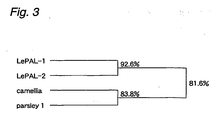
- Phenylalanine ammonia-lyases derived from a plant mutually have many conservative sequences; their amino acid sequences show 50% or more homology at the lowest degree. Hence it can be predicted that there are many commonalties in the functions and properties.
- Phenylalanine ammonia-lyase derived from a plant is known as an initial enzyme of a phenylpropanoid and isoflavonoid synthetic pathway in the secondary metabolism of a plant and also an enzyme catalyzing a reaction in a rate determining step, i.e. a deamination reaction of phenylalanine. Since this enzyme and a gene thereof are considered to be associated with stress resistance of plants, the functions of this enzyme have thoroughly been studied. Moreover, both basic and applied attempts to allow for the pal gene expression in a plant body to produce a disease resistance plant have broadly been made.
- the present inventors have focused attention on the broad substrate specificity of phenylalanine ammonia-lyase derived from a plant and have studied on the activity of the enzyme to generate various amino acids, which are industrially useful.
- ammonia-lyase having high reactivity with a cinnamic acid derivative having a substituent on a phenyl group thereof has been searched throughout the living world as a whole such as animals, plants and microorganisms.
- a phenylalanine ammonia-lyases derived from a plant has a much higher activity to generate a phenylalanine derivative than the same enzymes derived from a microorganism, which have previously been known.
- the step of generating phenylpropanoid, isoflavonoids or the like in a plant body, with which these enzymes are associated has thoroughly been studied, but such studies relate to generation of a cinnamic acid derivative due to an elimination reaction in which phenylalanine leaves an amino group.
- the reverse reaction that is, the possibility of generation of a phenylalanine derivative due to addition of an amino group to a cinnamic acid derivative by the enzymes derived from a plant, has not been studied.
- the present , inventors have focused attention on the broad substrate specificity of phenylalanine ammonia-lyase derived from a plant and have studied on the activity of the enzyme to generate various types of industrially useful amino acids as well as a phenylalanine derivative.
- this enzyme using as a substrate, an acrylic acid derivative which has an aromatic ring structure that may have substituents and may comprise a hetero atom, acts to generate the corresponding L-amino acid.
- an amino acid can be produced with extremely high efficiency by using a microorganism showing high expression of the pal gene derived from a plant, thereby accomplishing the present invention.
- the present invention includes the following aspects [1] to [30]:
- an optically active amino acid can simply be obtained from an acrylic acid derivative, which may have an aromatic ring group that may have various substituents and may comprise a hetero atom, by a single step of enzyme reaction.
- an optically active amino acid can simply be obtained from an acrylic acid derivative, which has a benzene ring group having various substituents, by a single step of enzyme reaction.
- a substituent introduced into a benzene ring in advance e.g. a cyano group, hydroxyl group, carboxyl group, amide group, halogen atom, amino group, nitro group, hydroxymethyl group or alkyl group having 1 to 6 carbon atoms, is retained until completion of a reaction without undergoing any adverse influence under moderate conditions of the reaction, and the corresponding desired L-phenylalanine derivative can be obtained with a good yield at a conversion rate of almost 100%.
- optically active amino acid having a heterocyclic ring structure at a side chain thereof can simply be obtained from an acrylic acid derivative having a heterocyclic ring structure at a side chain thereof, by a single step of enzyme reaction.
- the heterocyclic ring structure such as a furyl group, thienyl group, pyrrole group or the like in the above acrylic acid derivative is retained until completion of a reaction without undergoing any adverse influence under moderate conditions of the reaction, and the corresponding desired L-amino acid can be obtained with a good yield at a conversion rate of almost 100%.
- An acrylic acid derivative having various substituents used as a reaction material in the present invention can easily be prepared by, what is called, a method by Perkin' s reaction which allows an aldehyde group of an aldehyde derivative into which any given substituent is introduced, to react with acetic anhydride (refer to Arch . Pharm. (Weinheim) (1994), 327 (10), 619-625, etc.); a method involving a reaction of malonic acid in the presence of piperidine in a pyridine solvent (refer to J. Chem. Soc. (1939), 357-360, etc.); and various other improved methods (refer to Synth. Commun. (1999), 29(4), 573-581, etc.)
- Plants providing a phenylalanine ammonia-lyase activity are not particularly limited.
- specific examples include thale-cress (Arabidopsis thaliana), tea (Camellia sinensis ), chick-pea ( Cicer arietinum ), lemon ( Citrus limonis ), cucumber (Cucumis sativus L.), carrot ( Daucus carota ), murasaki ( Lithospermum erythrorhizon ), tomato (Lycopersicon esculentum ), tobacco (Nicotiana tabacum), rice ( Oryza sativa ), parsley (Petroselinum crispum, Petroselinum hortense), loblolly pine (Pinus taeda), poplar (Populus kitakamiensis, etc.), cherry (Prunus avium), bramble (Rubus idaeus), eggplant (Solanum tuberos
- phenylalanine ammonia-lyase separated from a plant is used. That is to say, there is provided, as a reaction catalyst, the above enzyme which is separated and purified by known conventional methods of separating and purifying an enzyme from a plant, e.g. application of acetone precipitation, ammonium sulfate precipitation, various separation columns, etc. on an extract from ground plant bodies.
- a specific method of separating and purifying phenylalanine ammonia-lyase from various types of plant bodies there are known a report by J. Koukol et al. (J. Biol. Chem. (1961), 236(10), 2692-2698), and a report by E. A. Havir et al. (Biochemistry (1973), 12, 1583-), etc.
- a treated product of the above described plant bodies is provided for a reaction of interest.
- the treated product of the plant bodies which is used for a reaction include a ground product, a freeze-dried product or an extract from plant bodies; a product obtained by concentrating and extracting an ingredient catalyzing a reaction of interest from the extract; a product obtained by immobili zing the treated product, the extract or the extracted ingredient of the plant bodies on a hardly soluble carrier; etc.
- an immobilizing carrier examples include polyacrylic acid, polymethacrylic acid, polyacrylamide, polyvinyl alcohol, poly-N-vinylformamide, polyallylamine, polyethyleneimine, methylcellulose, glucomannan, alginate, carrageenan, and the (crosslinked) copolymers of these compounds.
- a compound that forms a water-insoluble solid comprising a plant extract ingredient can be used singly or in a mixed form.
- the cultured cell of the above described plant is used. That is, a plant cell is cultured by a common method of obtaining a cultured plant cell.
- a plant cell is cultured in various knownmedia for plant cell culture such as a Murashige & Skoog complete medium, an LS medium, an M9 medium and a Gamborg B-5 medium that are selected depending on the type of plant, in the presence of a plant hormone such as indole acetic acid or kinetin, and the obtained cultured cell is then subjected to a reaction.
- a medium and culture conditions that are improved in order to enhance a phenylalanine ammonia-lyase activity may also be used.
- a ground product, a freeze-dried product or an extract from the thus obtained plant cultured cell; a product obtained by concentrating and extracting an ingredient catalyzing a reaction of interest from the extract; a product obtained by immobilizing the extract or extracted ingredient of the plant cultured cell on a hardly soluble carrier; etc. can also be subjected to a reaction.
- the pal gene derived from a plant is introduced into a microorganism or plant so that the gene is expressible therein, and the resulting transformed microorganism or transformed plant can also be used.
- a host organism used for gene expression is not particularly limited, to the extent that the organism is known as an organism capable of uptaking and expressing an extraneous gene. Examples of such an organism include a bacterium such as Escherichia, Pseudomonas or Bacillus, yeast such as Saccharomyces or Schizosaccharomyces, and filamentous fungi such as Aspergillus.
- the pal gene used in the present invention may be not only a pal gene naturally occurring in the environment, but also genes having the same functions (encoding mutant enzymes with the same activity).
- Examples of such a gene include a pa12 gene derived from Lithospermum erythrorhizon (Database Accession No. D83076); a pal gene encoding an amino acid sequence having 70% or more homology with the amino acid sequence deduced from the nucleotide sequence of the pal2 gene derived from Lithospermum erythrorhizon; or preferably, a pal gene encoding an amino acid sequence having 80% ormore homology with the amino acid sequence deduced from the nucleotide sequence of the pa12 gene derived from Lithospermum erythrorhizon.
- phenylalanine ammonia-lyases derived from a plant have many commonalties in these functions and properties with one another, such as sufficiently high sequence homology of the plant pal genes and the identical functions in a plant body, and thus the equivalent effect can be expected in the present production method.
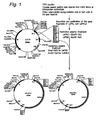
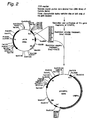
- the pal gene derived from a plant can be obtained from a cDNA library produced by a known method, using a partial fragment corresponding to the conserved sequence of phenylalanine ammonia-lyase as a probe. After isolation and purification of conventional mRNA, necessary cDNA can be obtained with Reverse transcriptase, using the thus obtained mRNA as a template. In recent years, however, a sufficient amount of cDNA can easily be obtained by PCR method with heat-resistant Reverse transcriptase, using total RNA or mRNA as a template. The thus obtained cDNA is ligated to a suitable plasmid vector such as pBR322 or pUC18 to transform Escherichia coli used as a host.
- a suitable plasmid vector such as pBR322 or pUC18 to transform Escherichia coli used as a host.
- oligo DNA encoding the conserved sequence of phenylalanine ammonia-lyase is used as a probe.
- oligo DNA used as a probe can be produced by selecting a position depending on a purpose and can be used.
- a plasmid is prepared from a positive candidate transformant obtained by colony hybridization. Then, the plasmid is subjected to PCR in combination with suitable primers so as to confirm the position and direction of the pal gene which is inserted into the plasmid.
- the primary sequences of many pal genes derived from plants are disclosed in the database such as GenBank or EMBL. Accordingly, as for genes with sequence information, it is also possible to confirm the preparing and direction by preparing a restriction map.
- the pal gene is introduced into a bacterium such as Escherichia coli or a microorganism such as yeast including Saccaromyces cerevisiae and is expressed therein, so that a recombinant having an activity to generate a phenylalanine derivative of interest can be obtained.
- a preferable host is a bacterium such as Escherichia coli.
- the generated phenylalanine derivative can be isolated and purified by a conventional method of separating a reaction product of a microorganism from reaction mixture.
- a method of preparing a plasmid containing an extraneous gene, and a procedure or method of introducing the plasmid into a microorganism such as Escherichia coli and expressing it may be carried out according to a measure or method commonly used in the field of genetic engineering (see e.g. "Vectors for cloning genes", Methods in Enzymology, 216, pp.469-631, 1992, Academic Press, and “Other bacterial systems", Methods in Enzymology, 204, pp.305-636, 1991, Academic Press).
- a vector for Escherichia coli having a lac promoter or the like such as pUC, pBluescript, etc.
- the present inventors inserted a pal gene downstream of the lac promoter and then allowed for the gene expression in Escherichia coli.
- YRp a multi-copy vector for yeast having, as a replication origin, the ARS sequence of the yeast chromosome
- YEp a multi-copy vector for yeast having the replication origin of 2 ⁇ m DNA of the yeast
- YIp a vector for incorporation of a yeast chromosome that does not have any replication origins of the yeast
- Culturing the transformant of the present invention can be carried out according to a common method of culturing a host microorganism.
- a carbon source for culturing a transformed microorganism can be a material that a host microorganism can use as a carbon source, and examples of such a carbon source include saccharides such as glucose, sucrose, fructose and blackstrap molasses; organic materials such as ethanol, acetic acid, citric acid, succinic acid, lactic acid, benzoic acid and fatty acid, or alkali metal salts thereof; aliphatic hydrocarbons such as n-paraffin; and natural organic materials such as peptone, meat extract, fish extract, soybean meal, wheat bran, malt extract and potato extract. These materials can be used singly or in combination at a concentration of usually around 0.01% to 30%, and preferably around 0.1% to 10%. Where Escherichia coli is used as a transformant, glucose, peptone, meat extract, malt extract, etc. can preferably be used.
- a nitrogen source for culturing a transformed microorganism can be a material that a host microorganism can use as a nitrogen source, and examples of such a nitrogen source include inorganic nitrogen compounds such as ammonium sulfate, ammonium phosphate, sodium nitrate and potassium nitrate; nitrogen-containing organic materials such as urea and uric acid; and natural organic materials such as peptone, meat extract, fish extract, soybean meal, malt extract and potato extract. These materials can be used singly or in combination at a concentration of usually around 0.01% to 30%, and preferably around 0.1% to 10%. Where Escherichia coli is used as a transformant, ammonium sulfate, peptone, meat extract, malt extract, etc. can preferably be used.
- phosphate such as potassium dihydrogen phosphate or a metal salt such as magnesium sulfate, ferrous sulfate, calcium acetate, manganese chloride, copper sulfate, zinc sulfate, cobalt sulfate or nickel sulfate is added to promote the growth of bacterial cells.
- concentration depends on culture conditions, but in general, the concentration is about 0.01% to 5% for phosphate, about 10 ppm to 1% for magnesium salt, and about 0.1 ppm to 1,000 ppm for other compounds.
- approximately 1 ppm to 100 ppm of yeast extract, casamino acid, yeast nucleic acid or the like can be added as a source of supplying vitamins, amino acids or nucleic acids to promote the growth of bacterial cells.
- an inducer corresponding to the expression promoter of a vector can be added during culture so as to allow the enzyme gene provided for transformation to highly express itself in a host microorganism.
- a lac promoter about 0.01 mM to 10 mM of IPTG (isopropyl-1-thio- ⁇ -D-galactoside) is added, and where a promoter for resistance to a drug such as ampicillin or kanamycin is used, about 0.1 ppm to 1,000 ppm of the corresponding drug is added.
- pH is maintained at 5 to 9, and preferably 5.5 to 8 for culture.
- procedures in which a microorganism cell cultured in advance in the above described medium is separated and collected from a culture solution by a method such as centrifugation or membrane filtration and subjected to a reaction are useful to reduce impurities taken from the culture solution and to facilitate the subsequent separation and collection of a product.
- the transformed microorganism obtained by culturing can be collected by a known method such as centrifugation or membrane filtration and used for a reaction of interest, otherwise the culture solution can directly be subjected to the reaction of interest. Furthermore, a ground or freeze-dried product of the transformed microorganism; a cell-free extract from the microorganism cell; a product obtained by concentrating and extracting an ingredient catalyzing a reaction of interest from the cell-free extract; a product obtained by immobilizing these transformed microorganism cells, and a treated product, an extract and an extracted ingredient thereof on a hardly soluble carrier; etc. can also be subjected to a reaction of interest.
- an immobilizing carrier used for the above purpose examples include polyacrylic acid, polymethacrylic acid, polyacrylamide, polyvinyl alcohol, poly-N-vinylformamide, polyallylamine, polyethyleneimine, methylcellulose, glucomannan, alginate, carrageenan, etc., and the (crosslinked) copolymers of these compounds.
- a compound that forms a water-insoluble solid comprising a microorganism or an extract ingredient thereof can be used singly or in a mixed form.
- a transformed microorganism, an extract or an extract ingredient thereof can be retained on a solid substance such as an activated carbon, porous ceramics, a glass fiber, a porous polymer molding or a nitrocellulose membrane before the use.
- a plant generating a phenylalanine derivative can be prepared by introduction of a pal gene into the plant cell.
- a plasmid containing the pal gene is prepared, and the plasmid is then introduced into cells of a suitable plant such as Nicotiana tabacum and allowed for expression to obtain a plant generating a phenylalanine derivative of interest.
- a suitable plant such as Nicotiana tabacum
- Examples of a known method of introducing an extraneous gene into a plant cell include a method involving a phytopathogenic bacterium Agrobacterium tumefaciens, the electroporation method, a method involving a particle gun, etc., and a suitable method can be selected from these methods depending on the type of a plant, into which the gene is intended to be introduced.
- a promoter not only the 35S promoter from cauliflower mosaic virus (CaMV), which is a promoter for systemic high expression, but also other promoters specifically expressed in various organs, can be used.
- a binary vector pBI121 containing the 35S promoter from CaMV can be obtained from Clontech, and this vector is broadly used as a vector mediating Agrobacterium tumefaciens. It has already been shown that the pal gene can be introduced into a plant such as Nicotiana tabacum by using a particle gun and then the introduced pal gene is expressed and functions therein ( Shokubutsu Soshiki Baiyo (1995), 12(2), 165-171).
- Examples of a method of preparation of a plasmid containing an extraneous gene, and a procedure or method of introduction and expression of a plasmid in a plant not only include methods shown in the present invention, but also include methods conventionally used in the field of genetic engineering, and thus the preparation, introduction and expression of a plasmid may be carried out according to those techniques or methods (see e.g. Isao Ishida, Norihiko Misawa, Saibo Kogaku Jikken Sosa Nyumon (An Introduction to Experiments of Cell Technology), Kodansha, 1992).
- a recombinant plant prepared as above can be used for plant cell culture according to common methods of plant cell culture stated as above.
- the reaction of generating an L-amino acid in the present invention is carried out by: adding, as a reaction material, 1 ppm to 20%, preferably 10 ppm to 10% acrylic acid derivative, and 2M to 12M at final concentration of ammonia; controlling pH at 8.5 to 11, preferably 9 to 10.5; and performing a reaction for about 1 to 200 hours, in the presence of phenylalanine ammonia-lyase derived from a plant that is prepared by various known methods as described above, a plant treated product or cultured cell having the activity of the enzyme, the same enzyme produced by a microorganism transformed with the enzyme gene isolated from the plant, a transformed microorganism cell and a treated product thereof, the same enzyme produced from a plant transformed with the enzyme gene, or a transformed plant and a treated product thereof.
- Examples of acid used to adjust pH include inorganic acid such as sulfuric acid, hydrochloric acid, phosphoric acid, boric acid or carbonic acid, organic acid such as formic acid, acetic acid or propionic acid, and salts thereof.
- a preferred acid used therefor is carbonic acid.
- Examples of carbonic acid in this case include also carbonic acid that is dissolved in aqueous solution as carbon dioxide by bubbling or the like and is then generated by dissociation. Further, these acids and ammonium salts can also be used as ammonium sources for a reaction solution. For the above stated reasons, it is preferable to use ammonium carbonate or ammonium hydrogen carbonate as a part or all of the ammonium source.
- dissolving the whole amount of an acrylic acid derivative added is not necessarily required but it is also possible to add a solvent, a surfactant or the like that improves solubility or dispersibility of the derivative in a reaction solution.
- a solvent, a surfactant or the like that improves solubility or dispersibility of the derivative in a reaction solution.
- the compound may be added consecutively or intermittently.
- the concentration of the compound in a reaction solution in this case is not always within the range stated above.
- An L-amino acid generated in a reaction solution is separated and collected by a known method such as centrifugation, membrane filtration, vacuum drying, distillation, solvent extraction, salting out, ion exchange or various types of chromatography, depending on the properties of the derivative in the reaction solution.
- An example of simply separating and collecting the L-amino acid therefrom is as follows. An enzyme, an enzyme treated product, a transformed microorganism or a treated product thereof, etc. is removed from a reaction solution by filtration, centrifugation, dialysis or the like, and thereafter solvent extraction is carried out or the reaction solution is acidified so that an unreacted starting material, acrylic acid derivative, is precipitated and the precipitate is removed.
- the pH of the obtained supernatant is again adjusted to around the isoelectric point of an L-amino acid, and the precipitated derivative is collected in the same manner as above.
- a product can efficiently be collected from a reaction solution with high purity.
- it is also useful to remove in advance residual ammonia from a reaction solution by distillation or the like, and to increase the concentration by removal of water to enhance the yield of the product at the isoelectric point.
- control of pH of a reaction solution is carried out with volatile acid.
- the product can be directly isolated as an ammonium salt of an L-phenylalanine derivative after separation of cells from the reaction solution.
- the reaction solution is subjected to acidification before solvent extraction, thereby removing water and acid base and isolating the product as an ammonium salt of an L-amino acid.
- volatile acid suitable for such a method include carbonic acid and an ammonium salt thereof.
- the product In some cases, depending on the properties of a reaction product, the product accumulates in a reaction solution and thereby the reaction rate is reduced. In this case, it is preferable to employ a method of adding aqueous ammonia, ammonia-containing physiological saline and a reaction buffer containing ammonia into a reaction solution, depending on the concentration of a product, to consecutively dilute the reaction solution. Moreover, there is another method of increasing the reaction rate, in which cells are separated and collected when the reaction rate is reduced, the supernatant is collected as a solution containing a product, and the collected cells are replaced into a solution containing reaction materials or suspension. These methods can be performed repeatedly to the extent that the ammonia-lyase activity of a microorganism is maintained.
- a compound used as a starting material in the present invention is an acrylic acid derivative represented by the above described general formula (1) : wherein
- examples of Z include: groups represented by the following general formulas (6) to (10) : groups represented by the following general formulas (11) to (15) : groups represented by the following general formulas (16) to (20) : groups represented by the following general formulas (21) to (25) : groups represented by the following general formulas (26) to (30) : groups represented by the following general formulas (31) to (35) : groups represented by the following general formulas (36) to (40) : groups represented by the following general formulas (41) to (45) : groups represented by the following general formulas (46) to (50) : and, groups represented by the following general formulas (51) to (55) :
- R in the above general formulas include a cyano group, hydroxyl group, carboxyl group, amide group, fluorine atom, chlorine atom, bromine atom, amino group, nitro group, hydroxymethyl group, or alkyl or alkoxy group having 1 to 6 carbon atoms.
- n can be an integer of 0 or greater, which is a number obtained by subtracting 1 from the number of the position where an aromatic ring can be substituted, or smaller.
- n is 2 or greater, each R may be identical or different.
- Rn-Z- is a compound represented by the following general formula (3): wherein
- Rn-Z- is represented by the above described general formula (4), wherein R is a substituent on a benzene ring and represents a cyano group, hydroxyl group, carboxyl group, amide group, fluorine atom, chlorine atom, bromine atom, amino group, nitro group, hydroxymethyl group, or alkyl or alkoxy group having 1 to 6 carbon atoms.
- n represents an integer of 0 to 5, and preferably an integer of 1 to 5. Where n is 2 or greater, each R may be identical or different.
- Such a starting material include 2-cyanocinnamic acid, 3-cyanocinnamic acid, 4-cyanocinnamic acid, 2-hydroxycinnamic acid, 3-hydroxycinnamic acid, 4-hydroxycinnamic acid, 3,4-dihydroxycinnamic acid, 2-nitrocinnamic acid, 3-nitrocinnamic acid, 4-nitrocinnamic acid, 2-carboxycinnamic acid, 3-carboxycinnamic acid, 4-carboxycinnamic acid, 2-aminocinnamic acid, 3-aminocinnamic acid, 4-aminocinnamicacid, 2-chlorocinnamic acid, 3-chlorocinnamic acid, 4-chlorocinnamic acid, 2-fluorocinnamic acid, 3-fluorocinnamic acid, 4-fluorocinnamic acid, 2-bromocinnamic acid, 3-bromocinnamic acid, 4-bromocinn
- preferred starting materials to be used are 2-cyanocinnamic acid, 4-cyanocinnamic acid, 3-hydroxycinnamic acid, 4-hydroxycinnamic acid and 3, 4-dihydroxycinnamic acid.
- these starting materials there can be obtained 2-cyano-L-phenylalanine, 4-cyano-L-phenylalanine, 3-hydroxy-L-phenylalanine (metatyrosine), 4-hydroxy-L-phenylalanine (tyrosine) and 3,4-dihydroxy-L-phenylalanine (DOPA), respectively.
- cinnamic acid derivatives include also cinnamic acid, and accordingly the corresponding phenylalanine derivatives include also phenylalanine.
- the compound used as a starting material in the present invention is a compound, wherein, in the above general formula (1), Rn-Z- is represented by the following general formula (4): wherein
- Rn-Z- is represented by the following general formula (5): wherein
- Such a starting material examples include 2-furanacrylic acid, 3-furanacrylic acid, 2-thienyl acrylic acid, 3-thienyl acrylic acid, 2-pyrrolyl acrylic acid, 3-pyrrolyl acrylic acid, etc.
- preferred starting materials to be used are 2-furanacrylic acid, 3-furanacrylic acid, 2-thienyl acrylic acid, 3-thienyl acrylic acid, 2-pyrrolyl acrylic acid and 3-pyrrolyl acrylic acid. Where these starting materials are used, there can be obtained alpha-amino-2-furanpropionic acid, alpha-amino-3-furanpropionic acid, alpha-amino-2-thienyl propionic acid, alpha-amino-3-thienyl-propionic acid, alpha-amino-2-pyrrole-propionic acid, and alpha-amino-3-pyrrole-propionic acid, respectively.
- an L-amino acid having high optical purity can efficiently be obtained by a single step of reaction, using, as a substrate, an acrylic acid derivative that is conveniently obtained by organic synthesis.
- the thus obtained L-amino acid is useful as a synthesis intermediate in the field of fine chemicals such as pharmaceuticals and agricultural chemicals, which requires high optical purity.
- 1 unit is defined as the amount of enzyme which releases 1 ⁇ mole of cinnamic acid per minute at 30°C in the presence of 0.1M sodium borate buffer (pH 8.5) and 10 mML-phenylalanine as a substrate.
- Enzyme protein amount is determined using a standard such as bovine serum albumin by the biuret method, and a specific activity of the enzyme is expressed in "unit/mg protein". Identification of an acrylic acid derivative and an amino acid was carried out by 1 H-NMR and 13 C-NMR and by subj ecting a reaction solution to HPLC and making comparison on UV absorption intensity with a standard.
- Example 1 Reaction by cultured cell ( Petroselinum hortense)
- the composition of medium A is shown in Table 1.
- Comparative example 1 Reaction by enzyme derived from microorganism
- Example 2 A reaction was carried out under the same conditions as in Example 1, with the only exception that 0.025 mg of commercially available phenylalanine ammonia-lyase derived from Rhodotorula glutinis (Sigma) having a specific activity of 0.44 unit/mg was added instead of the cultured cells in Example 1.
- the obtained products, and concentrations and optical purities thereof are shown in Table 2.
- Example 2 Reaction by treated product of cultured cell ( Petroselinum hortense )
- the Petroselinum hortense cultured cells (1.5 kg) obtained by culturing in the same manner as in Example 1 was suspended in 3 L of a 0.1M sodium borate buffer solution (pH 8.8), and the suspension was subjected to ultrasonic homogenization on ice for 20 minutes. An insoluble fraction was settled out from the obtained treated product by centrifugation at 10,000 rpm for 15 minutes, and the supernatant was collected.
- a 0.1M sodium borate buffer solution pH 8.8
- Comparative example 2 Reaction by enzyme derived from microorganism
- Example 3 A reaction was carried out under the same conditions as in Example 2, with the only exception that 0.175 mg of commercially available phenylalanine ammonia-lyase derived from Rhodotorula graminis (Sigma) having a specific activity of 0.44 unit/mg was added instead of the crude enzyme extract solution of Example 2.
- the obtained products, and concentrations and optical purities thereof are shown in Table 3.
- Example 3 Reaction by treated product of plant tissues ( Cucumis sativus L.; cucumber)
- Cucumber ( Cucumis sativus L.) seeds were cultured in a petri dish, on which a water-wet filter was placed, at 25°C for 72 hours for germination. Then, the light of a fluorescent lamp was applied thereto for 4 hours, and thereafter about 50 g of hypocotyls was collected.
- hypocotyl tissues were homogenized in a mortar on ice, and then the total amount of the homogenized product was suspended in 100 ml of 0.1M sodium borate buffer solution (pH 8.8) containing 1 mM glutathione followed by ultrasonic homogenization for 20 minutes. An insoluble fraction was settled out from the obtained treated product by centrifugation at 10,000 rpm for 15 minutes, and the supernatant was collected.
- 0.1M sodium borate buffer solution pH 8.8
- An insoluble fraction was settled out from the obtained treated product by centrifugation at 10,000 rpm for 15 minutes, and the supernatant was collected.
- Comparative example 3 Reaction by enzyme derived from microorganism
- Example 4 As a comparative example, a reaction was carried out under the same conditions as in Example 3, with the only exception that 0.16 mg of commercially available phenylalanine ammonia-lyase derived from Rhodotorula graminis (Sigma) having a specific activity of 0.44 unit/mg was added instead of the crude enzyme extract solution of Example 3. The obtained products, and concentrations and optical purities thereof are shown in Table 4.
- Cells were cultured for 24 hours on an agar plate that was obtained by mixing 2% agar to an L broth (1% polypeptone, 0.5% NaCl, 0.5% yeast extract, pH 7.0) and flattening the mixture. Thereafter, an inoculating loop amount of the cell was further cultured with 5 ml to 100 ml of L broth at 30°C for 16 hours to obtain a transformant used for a reaction. After culture, the cells were collected and washed with the same volume of physiological salt solution as the culture solution.
- L broth 1% polypeptone, 0.5% NaCl, 0.5% yeast extract, pH 7.0
- the cell bodies were suspended in a reaction solution of a half volume of the culture solution (4M ammonia/ammonium carbonate (pH 10.3)), and thereto a substrate was further addedtobe 0.2% (2,000mg/L) at final concentration followed by a reaction at 30°C while stirring. An aliquot of this reaction solution was taken every certain hours, cells were removed by centrifugation, and the supernatant was subj ected to HPLC analysis to determine the amount of a product.
- a reaction solution of a half volume of the culture solution (4M ammonia/ammonium carbonate (pH 10.3)
- a substrate was further addedtobe 0.2% (2,000mg/L) at final concentration followed by a reaction at 30°C while stirring.
- An aliquot of this reaction solution was taken every certain hours, cells were removed by centrifugation, and the supernatant was subj ected to HPLC analysis to determine the amount of a product.
- LS medium a conventional growth medium containing 10 ⁇ M indoleacetic acid and 0.1 ⁇ M kinetin
- M9 medium a shikonin growth medium containing 10 ⁇ M indoleacetic acid and 0.1 ⁇ M kinetin
- mRNA was prepared from the obtained cultured cells according to a standard method in the kit instructions.
- RT-PCR was carried out with the obtained mRNA as a template.
- a mixture of the generated DNA fragments was provided as a cDNA library used as a template for gene amplification PCR.
- DNA fragments were obtained from frozen young leaves of Camellia sinensis (collected in the afternoon of good sunshine) by RT-PCR in the same manner as for the above Lithospermum erythrorhizon, and a mixture of the obtained DNA fragments was used as a cDNA library used as a template for gene amplification PCR.
- LePAL1 Lithospermum erythrorhizon
- LePAL2 Lithospermum erythrorhizon
- the two types of the genes have already been published by Yazaki et al. in the databases such as GenBank and EMBL as SEQ ID NOS: D83075 and D83076, respectively.
- a pal gene existing in Camellia sinensis (hereinafter, referred to as "CAMPAL”) has already been published by Matsumoto et al. in the above databases as SEQ ID NO: D26596.
- primers specific for the pal genes were prepared.
- primers were designed so as to have suitable restriction sites at both ends, so that the obtained DNA fragment can be ligated to a plasmid vector.
- LePAL1 Since there were found no sites suitable for the 5'-terminal side of LePAL1, an EcoRV site was used at the 5'-terminus, and a blunt end generated after cleavage was designed to ligate to the blunt end of the SmaI site of a vector. As for the 3'-terminal side of LePAL1, a SalI site was used just as with LePAL2.
- the obtained gene fragments were subjected to agarose gel electrophoresis followed by extraction and collection.
- the thus obtained fragments of LePAL1, LePAL2 and CAMPAL with restriction sites were cleaved with restriction enzymes, EcoRV and SalI, EcoRI and SalI, and SmaI and HindIII, respectively.
- operations such as agarose gel electrophoresis, extraction and collection were carried out again.
- These fragments were ligated to pUC18, which had been obtained by cleaving with EcoRV and SalI, EcoRI and SalI, and SmaI and HindIII, and then subjected to agarose gel electrophoresis, extraction and collection (FIGS. 1 and 2) .
- the transformants obtained by transforming Escherichia coli JM109 with these plasmids were applied onto an L agar plate containing 0.1 mM isopropyl- ⁇ -D-thiogalactopyranoside (IPTG) and 0.1% X-Gal followed by culture at 37°C for 24 hours. From the generated colonies, some colonies presenting white color were selected, and the plamids thereof were prepared to examine the restriction enzyme cleavage patterns. As a result, a plurality of transformants having plasmids of interest, pULePAL1, pULePAL2 and pUCAMPAL, were obtained.
- Example 4 Three strains were arbitrarily selected from each type of the obtained transformants. According to the method described in Example 4, duplicates of each strain (2 species x 3 strains x 2 lines) were cultured in 5 ml of L broth. Twelve hours after initiation of the culture, isopropyl- ⁇ -D-thiogalactopyranoside (IPTG) was added to either one of the 2 lines, so that the IPTG concentration became 0.1 mM in the culture solution, followed by culture for 4 more hours. The obtained culture solutions were separately subjected to centrifugation to collect cells, and the obtained cells were subjected to a reaction according to the method described in Example 4. After 10 hours of the reaction, the obtained product was determined by HPLC.
- IPTG isopropyl- ⁇ -D-thiogalactopyranoside
- the obtained culture solution was transferred to a 5 L jar fermenter which contains 2 L of L broth containing 100 ppm ampicillin, and then a stirring culture was carried out at 30°C at 800 rpm under aeration of 1 ml/min for 10 to 12 hours.
- reaction solution was subj ected to vacuum concentration using a rotary evaporator to remove excessive ammonia, and concentrated hydrochloric acid was then added thereto to adjust pH at 1 to precipitate the substrate remained.
- the solution was filtrated with a filter, and then the supernatant was concentrated with a rotary evaporator.
- the product crystallized was collected by filtration and washed with diluted hydrochloric acid (0.1 N) followed by vacuum drying. The purity of this dried sample was 99% or more.
- a detected impurity was a cinnamic acid derivative or an acrylic acid derivative as a substrate in any system.
- a plurality of phenylalanine ammonia-lyases having different amino acid sequences were employed to show that phenylalanine ammonia-lyase derived from a plant is generally effective in the present invention (the amino acid sequence of Cucumis sativus L. is unidentified) .
- the sequence homology in the amino acid sequences is shown in FIG. 3. It was found that any of these enzymes is sufficiently effective in the present invention although these enzymes are mutually 10% to 20% different in the amino acid sequences, that is, these enzymes have a much higher ability of converting substrates to generate a phenylalanine derivative than the same enzyme derived from a microorganism.
- the present invention by using phenylalanine ammonia-lyase derived from a plant, from an acrylic acid derivative as a starting material, the corresponding amino acid can conveniently and efficiently be obtained.
- an L-phenylalanine derivative having various substituents on a phenyl group thereof can simply and efficiently be obtained.
- the L-amino acid obtained by the method for producing an L-amino acid of the present invention is useful as a chiral building block of a biologically active organic compound such as pharmaceutical intermediate or agricultural intermediate in the broad field, and it is useful mainly as pharmaceutical intermediate.
Landscapes
- Organic Chemistry (AREA)
- Chemical & Material Sciences (AREA)
- Engineering & Computer Science (AREA)
- Zoology (AREA)
- Life Sciences & Earth Sciences (AREA)
- Wood Science & Technology (AREA)
- Chemical Kinetics & Catalysis (AREA)
- Microbiology (AREA)
- General Chemical & Material Sciences (AREA)
- Biotechnology (AREA)
- Health & Medical Sciences (AREA)
- Biochemistry (AREA)
- Bioinformatics & Cheminformatics (AREA)
- General Engineering & Computer Science (AREA)
- General Health & Medical Sciences (AREA)
- Genetics & Genomics (AREA)
- Preparation Of Compounds By Using Micro-Organisms (AREA)
- Organic Low-Molecular-Weight Compounds And Preparation Thereof (AREA)
- Enzymes And Modification Thereof (AREA)
Description
- This application is an application filed uner 35 U. S . C. §111(a) claiming benefit pursuant to 35 U.S.C. §119(e) (1) of the filing date of Provisional Applications 60/303, 086 filed on July 6, 2001 and 60/339,389 filed on December 14, 2001 pursuant to 35 U.S.C. §111(b).
- The present invention relates to a method for producing an optically active amino acid, which comprises adding ammonia to an acrylic acid derivative by action of a plant enzyme to thereby obtain the corresponding optically active amino acid. The optically active amino acid is useful as a synthesis material for pharmaceuticals, agricultural chemicals and other fine chemicals.
- There have been studied a large number of methods for obtaining optically active amino acids such as organic synthesis reaction involving the use of an asymmetric catalyst and a fermentative production method involving the use of the specificity of a microorganism.
- There are many publications such as UK Patent No. 1489468 and Japanese Patent Laid-Open No. 53-96388 (1978) reporting a method for producing an optically active phenylalanine by optical selection, in which phenylalanine ammonia-lyase derived from a microorganism or a microorganism itself having the enzyme activity is allowed to act on cinnamic acid. This method uses a reaction of adding an amino group to an α-carbon of cinnamic acid by the action of the enzyme at a high ammonia concentration, and thereby L-phenylalanine can be generated with high optical purity.
- As a method for obtaining an optically active L-phenylalanine derivative having a substituent on a phenyl group thereof, there is considered a method of introducing a substituent onto the phenyl group, applying various types of modification reaction to L-phenylalanine. By this method, however, inevitable is reduction of the yield due to side reaction occurring in parts other than the phenyl group and decrease of optical purity, because of progression of racemization under extremely severe reaction conditions. Moreover, since it is difficult to obtain the position specificity of a substituent to be introduced on a phenyl group, it results in low yield or difficulty of separation and purification. Thus, this method is not practical.
- Here is considered another method of allowing the above described phenylalanine ammonia-lyase to act on a cinnamic acid derivative having a substituted phenyl group, to which a desired substituent has previously been introduced. Since an enzyme reaction proceeds under moderate conditions in this method, it provides no detrimental effects caused by a side reaction to a phenyl group and a substituent on the group, and hence it is expected that an optically active L-phenylalanine derivative with high purity is provided by this method.
- However, since the substrate specificity of phenylalanine ammonia-lyase derived from a microorganism is generally strict, in most cases this enzyme has a significantly low or almost no reactivity to a substituted phenyl group, in comparison with the original reactivity from cinnamic acid to L-phenylalanine. There are only a few disclosed cases such as a method of obtaining optically active fluorinated phenylalanine by action of the above enzyme, using, as a starting material, a cinnamic acid derivative having a fluorinated phenyl group (Japanese Patent Laid-Open No. 63-148992 (1988) or a method of obtaining a phenylalanine derivative by using a specific microorganism of Rhodotorula (US Patent No. 5981239). Applicable compounds are limited and the productivity is not industrially sufficient.
- Generally, it is known that phenylalanine ammonia-lyase is widely distributed in the living world as a whole such as animals, plants and microorganisms. That is to say, examples of microorganisms comprising this enzyme include Rhodotorula rubra (Japanese Patent Laid-Open No. 61-043993 (1986), GB1489468), Rhodosporidium toruloides (Japanese Patent Laid-Open No. 60-227670(1985)), Cladosporidium cladosporioides (Japanese Patent Laid-Open No. 62-111687 (1987)), etc., and apart from these examples, many other microorganisms have been reported.
- Examples of plants comprising phenylalanine ammonia-lyase include thale-cress (Arabidopsis thaliana), tea (Camellia sinensis), chick-pea (Cicer arietinum), lemon (Citrus limonis), cucumber (Cucumis sativus L.), carrot (Daucus carota), murasaki (Lithospermum erythrorhizon), tomato (Lycopersicon esculentum), tobacco (Nicotiana tabacum), rice (Oryza sativa), parsley (Petroselinum crispum, Petroselinum hortense), loblolly pine (Pinus taeda), poplar (Populus kitakamiensis, etc.), cherry (Prunus avium), bramble (Rubus idaeus), eggplant (Solanum tuberosum), stylo (Stylosanthes humilis), hop clover (Trifolium subterrane), grape (Vitis vinifera), bush bean (Phaseolus vulgaris), etc.
- There are many reports regarding a structural gene of phenylalanine ammonia-lyase derived from a plant, pal (hereinafter, referred to as "pal gene"). That is, examples of the pal gene determined include those of rice (Oryza sativa, Biochim. Biophys. Acta (1993), 1171(3), 321-322, Plant Mol. Biol. (1995), 29(3), 535-550), tea (Camellia sinensis, Theor. Appl. Genet. (1994), 89(6), 671-675), thale-cress (Arabidopsis thaliana, Plant Mol. Biol. (1995), 27, 327-338), murasaki (Lithospermum erythrorhizon, Biosci. Biotech. Biochem. (1997), 61(12), 1995-2003), tomato (Lycopersicon esculentum, J. Biol. Chem. (1992), 267, 11824-11830), hop clover (Trifolium subterraneum, Gene (1994), 138 (1-2), 87-92), pea (Pisum sativum, Plant Mol. Biol. (1992), 20(1), 167-170, Japanese Patent Application Laid-Open (Kokai) No. 5-153978 (1993)), poplar (Populus trichocarpa, Plant Physiol. (1993), 102, 71-83), tobacco (Nicotiana tabacum, Plant Mol. Biol. (1996), 30, 711-722), soybean (Glycinemax, DNA Sequence (1991), 1(5), 335-346), sweet potato (Ipomoea batatas, Plant Physiol. (1989), 90(4), 1403-1407), wheat (Triticum aestivum), parsley (Petroselinum crispum), sunflower (Helianthus annuus), alfalfa (Medicago sativa), etc., and the number of the known pal gene reaches more than 40 kinds including those of the isomers in the same species or the partial sequences.
- Phenylalanine ammonia-lyases derived from a plant mutually have many conservative sequences; their amino acid sequences show 50% or more homology at the lowest degree. Hence it can be predicted that there are many commonalties in the functions and properties.
- Phenylalanine ammonia-lyase derived from a plant is known as an initial enzyme of a phenylpropanoid and isoflavonoid synthetic pathway in the secondary metabolism of a plant and also an enzyme catalyzing a reaction in a rate determining step, i.e. a deamination reaction of phenylalanine. Since this enzyme and a gene thereof are considered to be associated with stress resistance of plants, the functions of this enzyme have thoroughly been studied. Moreover, both basic and applied attempts to allow for the pal gene expression in a plant body to produce a disease resistance plant have broadly been made.
- Although many research reports exist as stated above, differently from the same enzyme derived from a microorganism, regarding studies from the viewpoint of production of a substance, attempts to produce an organic compound that can be used as a common industrial material have not been made, except for an attempt to increase the content of some useful substances of phenylpropanoids or isoflavonoids (Planta. (1979), 14(6), 369-376, Biochim. Biophys. Acta. (1979), 563, 278-292). Needless to say, there have never been reported attempts to produce a substance by use of a reverse reaction, i.e. amination reaction. In the first place, not only the present enzyme but also other enzymes derived from a plant have seldom been used for production of a substance, because there is a generally accepted notion that the practicability of these enzymes, in view of low stability, high substrate specificity, etc., is lower than that of enzymes derived from a microorganism. Accordingly, when those skilled in the art conceived a method for producing an L-phenylalanine derivative, one of an organic compound that was similar to the present invention, an enzyme derived from a plant was one of the least noticeable materials for them, to the extent that an enzyme having the same catalytic function was present in other sources.
- It is one of the objects of the present invention to provide a new method for conveniently and efficiently obtaining an L-amino acid with high optical purity. That is, one of the objects of the present invention is to provide a new method for simply and efficiently obtaining an L-amino acid with high optical purity, using, as a starting material, an acrylic acid derivative such as a cinnamic acid derivative having a substituent on a phenyl group.
- The present inventors have focused attention on the broad substrate specificity of phenylalanine ammonia-lyase derived from a plant and have studied on the activity of the enzyme to generate various amino acids, which are industrially useful.
- First, ammonia-lyase having high reactivity with a cinnamic acid derivative having a substituent on a phenyl group thereof, has been searched throughout the living world as a whole such as animals, plants and microorganisms.
- As a result, the present inventors have found that a phenylalanine ammonia-lyases derived from a plant has a much higher activity to generate a phenylalanine derivative than the same enzymes derived from a microorganism, which have previously been known. As stated above, the step of generating phenylpropanoid, isoflavonoids or the like in a plant body, with which these enzymes are associated, has thoroughly been studied, but such studies relate to generation of a cinnamic acid derivative due to an elimination reaction in which phenylalanine leaves an amino group. The reverse reaction, that is, the possibility of generation of a phenylalanine derivative due to addition of an amino group to a cinnamic acid derivative by the enzymes derived from a plant, has not been studied.
- Moreover, the present , inventors have focused attention on the broad substrate specificity of phenylalanine ammonia-lyase derived from a plant and have studied on the activity of the enzyme to generate various types of industrially useful amino acids as well as a phenylalanine derivative. As a result, the present inventors have found that, this enzyme, using as a substrate, an acrylic acid derivative which has an aromatic ring structure that may have substituents and may comprise a hetero atom, acts to generate the corresponding L-amino acid.
- As a result of further intensive studies, the present inventors have found that an amino acid can be produced with extremely high efficiency by using a microorganism showing high expression of the pal gene derived from a plant, thereby accomplishing the present invention.
- The ability of phenylalanine ammonia-lyase derived from a plant to catalyze the reaction that yields an amino acid, using as a substrate, an acrylic acid derivative having a structure represented by the above general formula (1), has not ever been known, and this is a new finding obtained by the present inventors.
- Moreover, the ability of phenylalanine ammonia-lyase derived from a plant to catalyze the reaction that produces a phenylalanine derivative, using as a substrate, a cinnamic acid derivative having various substituents on a phenyl group thereof represented by the above general formula (3), has not ever been known, and this is a new finding obtained by the present inventors.
- Furthermore, the ability of phenylalanine ammonia-lyase derived from a plant to catalyze the reaction that yields an L-amino acid, using as a substrate, an acrylic acid derivative having a heterocyclic substituent represented by the above general formula (4) or (5), has not ever been known, and this is a new finding obtained by the present inventors.
- That is to say, the present invention includes the following aspects [1] to [30]:
- [1] A method for producing an L-amino acid, which comprises, in the presence of ammonia, allowing phenylalanine ammonia-lyase derived from a plant to act on an acrylic acid derivative represented by the following general formula (1):

- Z represents an aromatic ring group that may comprise a hetero atom,
- R represents a substituent on the aromatic ring, and
- n represents an integer of 0 or greater, and where n is 2 or greater, each R may be identical or different;

- Z represents an aromatic ring group that may comprise a hetero atom,
- R represents a substituent on the aromatic ring,
- n represents an integer of 0 or greater, and where n is 2 or greater, each R may be identical or different.
- [2] The method for producing an L-amino acid according to [1] above, wherein Rn-Z- is represented by the following general formula (3) :

- R is a substituent on a benzene ring and represents a cyano group, hydroxyl group, carboxyl group, amide group, fluorine atom, chlorine atom, bromine atom, amino group, nitro group, hydroxymethyl group, or alkyl or alkoxy group having 1 to 6 carbon atoms, and
- n represents an integer of 0 to 5, and preferably an integer of 1 to 5. Where n is 2 or greater, each R may be identical or different.
- [3] The method for producing an L-amino acid according to [1] above, wherein Rn-Z- is represented by the following general formula (4):

- X represents S, O, NH or NR1,
- R1 represents an alkyl group having 1 to 6 carbon atoms,
- R is a substituent on a hetero ring and represents a cyano group, hydroxyl group, carboxyl group, amide group, fluorine atom, chlorine atom, bromine atom, amino group, nitro group, hydroxymethyl group, or alkyl or alkoxy group having 1 to 6 carbon atoms, and
- n represents an integer of 0 to 3, and where n is 2 or greater, each R may be identical or different.
- [4] The method for producing an L-amino acid according to [1] above, wherein Rn-Z- is represented by the following general formula (5):

- X represents S, O, NH or NR1,
- R1 represents an alkyl group having 1 to 6 carbon atoms,
- R is a substituent on a hetero ring and represents a cyano group, hydroxyl group, carboxyl group, amide group, fluorine atom, chlorine atom, bromine atom, amino group, nitro group, hydroxymethyl group, or alkyl or alkoxy group having 1 to 6 carbon atoms, and
- n represents an integer of 0 to 3, and where n is 2 or greater, each R may be identical or different.
- [5] The method for producing an L-amino acid according to any one of [1] to [4] above, which comprises using a composition obtained by treating plant tissues containing phenylalanine ammonia-lyase.
- [6] The method for producing an L-amino acid according to any one of [1] to [4] above, which comprises using a plant cultured cell containing a phenylalanine ammonia-lyase and/or a treated composition thereof.
- [7] The method for producing an L-amino acid according to any one of [1] to [4] above, which comprises allowing a phenylalanine ammonia-lyase gene derived from a plant to be expressible in a plant and using transformed plant cultures or a treated product of the plant cultures.
- [8] The method for producing an L-amino acid according to any one of [1] to [4] above, which comprises allowing a phenylalanine ammonia-lyase gene derived from a plant to be expressible in a microorganism and using a transformed microorganism culture, a treated product thereof, or an enzyme obtained from the culture.
- [9] The method for producing an L-amino acid according to [7] or [8] above, wherein the phenylalanine ammonia-lyase gene derived from a plant is a gene encoding an amino acid sequence having 70% or more homology with the amino acid sequence deduced from the nucleotide sequence of pa12 gene derived from Lithospermum erythrorhizon.
- [10] The method for producing an L-amino acid according to [7] or [8] above, wherein the phenylalanine ammonia-lyase gene derived from a plant is a gene encoding an amino acid sequence having 80% or more homology with the amino acid sequence deduced from the nucleotide sequence of pal2 gene derived from Lithospermum erythrorhizon.
- [11] The method for producing an L-amino acid according to any one of [1] to [8] above, wherein the plant from which the phenylalanine ammonia-lyase gene is derived is Lithospermum and/or Camellia.
- [12] The method for producing an L-amino acid according to any one of [8] to [11] above, wherein the microorganism is a bacterium, yeast and/or filamentous fungi.
- [13] The method for producing an L-amino acid according to [12] above, wherein the bacterium is Escherichia coli.
- [14] The method for producing an L-amino acid according to any one of [2] and [5] to [13] above, wherein, in the above general formula (3), at least one of substituents R is a hydroxyl group.
- [15] The method for producing an L-amino acid according to any one of [2] and [5] to [13] above, wherein, in the above general formula (3), at least one of substituents R is a cyano group.
- [16] The method for producing an L-amino acid according to any one of [2] and [5] to [13] above, wherein, in the above general formula (3), at least one of substituents R is a carboxyl group.
- [17] The method for producing an L-amino acid according to any one of [2] and [5] to [13] above, wherein, in the above general formula (3), at least one of substituents R is an amide group.
- [18] The method for producing an L-amino acid according to any one of [2] and [5] to [13] above, wherein, in the above general formula (3), at least one of substituents R is a halogen group.
- [19] The method for producing an L-amino acid according to any one of [2] and [5] to [13] above, wherein, in the above general formula (3), at least one of substituents R is an amino group.
- [20] The method for producing an L-amino acid according to any one of [2] and [5] to [13] above, wherein, in the above general formula (3), at least one of substituents R is a nitro group.
- [21] The method for producing an L-amino acid according to any one of [2] and [5] to [13] above; wherein, in the above general formula (3), at least one of substituents R is a hydroxymethyl group.
- [22] The method for producing an L-amino acid according to any one of [2] and [5] to [13] above, wherein, in the above general formula (3), at least one of substituents R is an alkyl group having 1 to 6 carbon atoms.
- [23] The method for producing an L-amino acid according to any one of [1] to [13] above, wherein R is any one of a cyano group, a hydroxyl group, a nitro group and a carboxyl group, and n is 1.
- [24] The method for producing an L-amino acid according to anyone of [2] and [5] to [13] above, wherein the L-amino acid is L-phenylalanine.
- [25] The method for producing an L-amino acid according to any one of [3] and [5] to [13] above, wherein, in the above general formula (4), X is O.
- [26] The method for producing an L-amino acid according to any one of [3] and [5] to [13] above, wherein, in the above general formula (4), X is S.
- [27] The method for producing an L-amino acid according to any one of [3] and [5] to [13] above, wherein, in the above general formula (4), X is NH.
- [28] The method for producing an L-amino acid according to any one of [4] to [13] above, wherein, in the above general formula (5), X is O.
- [29] The method for producing an L-amino acid according to any one of [4] to [13] above, wherein, in the above general formula (5), X is S.
- [30] The method for producing an L-amino acid according to any one of [4] to [13] above, wherein, in the above general formula (5), X is NH.
-
- FIG. 1 shows the construct of a Lithospermum erythrorhizon PAL expression plasmid showing LePAL1 and LePAL2;
- FIG. 2 shows the construct of a Camellia sinensis PAL expression plasmid showing CAMPAL; and
- FIG. 3 shows an example of homology in PAL amino acid sequences.
- The present invention will be described in detail below.
- By the method for producing an L-amino acid of the present invention, an optically active amino acid can simply be obtained from an acrylic acid derivative, which may have an aromatic ring group that may have various substituents and may comprise a hetero atom, by a single step of enzyme reaction.
- Moreover, by the method for producing an L-amino acid of the present invention, an optically active amino acid can simply be obtained from an acrylic acid derivative, which has a benzene ring group having various substituents, by a single step of enzyme reaction.
- A substituent introduced into a benzene ring in advance, e.g. a cyano group, hydroxyl group, carboxyl group, amide group, halogen atom, amino group, nitro group, hydroxymethyl group or alkyl group having 1 to 6 carbon atoms, is retained until completion of a reaction without undergoing any adverse influence under moderate conditions of the reaction, and the corresponding desired L-phenylalanine derivative can be obtained with a good yield at a conversion rate of almost 100%.
- Furthermore, by the method for producing an L-amino acid of the present invention, optically active amino acid having a heterocyclic ring structure at a side chain thereof can simply be obtained from an acrylic acid derivative having a heterocyclic ring structure at a side chain thereof, by a single step of enzyme reaction.
- The heterocyclic ring structure such as a furyl group, thienyl group, pyrrole group or the like in the above acrylic acid derivative is retained until completion of a reaction without undergoing any adverse influence under moderate conditions of the reaction, and the corresponding desired L-amino acid can be obtained with a good yield at a conversion rate of almost 100%.
- An acrylic acid derivative having various substituents used as a reaction material in the present invention can easily be prepared by, what is called, a method by Perkin' s reaction which allows an aldehyde group of an aldehyde derivative into which any given substituent is introduced, to react with acetic anhydride (refer to Arch . Pharm. (Weinheim) (1994), 327 (10), 619-625, etc.); a method involving a reaction of malonic acid in the presence of piperidine in a pyridine solvent (refer to J. Chem. Soc. (1939), 357-360, etc.); and various other improved methods (refer to Synth. Commun. (1999), 29(4), 573-581, etc.)
- Plants providing a phenylalanine ammonia-lyase activity, which are applied in the present invention, are not particularly limited. As before mentioned, specific examples include thale-cress (Arabidopsis thaliana), tea (Camellia sinensis), chick-pea (Cicer arietinum), lemon (Citrus limonis), cucumber (Cucumis sativus L.), carrot (Daucus carota), murasaki (Lithospermum erythrorhizon), tomato (Lycopersicon esculentum), tobacco (Nicotiana tabacum), rice (Oryza sativa), parsley (Petroselinum crispum, Petroselinum hortense), loblolly pine (Pinus taeda), poplar (Populus kitakamiensis, etc.), cherry (Prunus avium), bramble (Rubus idaeus), eggplant (Solanum tuberosum), stylo (Stylosanthes humilis), hop clover (Trifolium subterrane), grape (Vitis vinifera), bush bean (Phaseolus vulgaris), etc., but this enzyme is almost universally present in plants.
- In one embodiment of the present invention, phenylalanine ammonia-lyase separated from a plant is used. That is to say, there is provided, as a reaction catalyst, the above enzyme which is separated and purified by known conventional methods of separating and purifying an enzyme from a plant, e.g. application of acetone precipitation, ammonium sulfate precipitation, various separation columns, etc. on an extract from ground plant bodies. As for a specific method of separating and purifying phenylalanine ammonia-lyase from various types of plant bodies, there are known a report by J. Koukol et al. (J. Biol. Chem. (1961), 236(10), 2692-2698), and a report by E. A. Havir et al. (Biochemistry (1973), 12, 1583-), etc.
- In another embodiment of the present invention, a treated product of the above described plant bodies is provided for a reaction of interest. Examples of the treated product of the plant bodies which is used for a reaction include a ground product, a freeze-dried product or an extract from plant bodies; a product obtained by concentrating and extracting an ingredient catalyzing a reaction of interest from the extract; a product obtained by immobili zing the treated product, the extract or the extracted ingredient of the plant bodies on a hardly soluble carrier; etc.
- Examples of such an immobilizing carrier include polyacrylic acid, polymethacrylic acid, polyacrylamide, polyvinyl alcohol, poly-N-vinylformamide, polyallylamine, polyethyleneimine, methylcellulose, glucomannan, alginate, carrageenan, and the (crosslinked) copolymers of these compounds. In other words, a compound that forms a water-insoluble solid comprising a plant extract ingredient can be used singly or in a mixed form.
- In another embodiment of the present invention, the cultured cell of the above described plant is used. That is, a plant cell is cultured by a common method of obtaining a cultured plant cell. For example, a plant cell is cultured in various knownmedia for plant cell culture such as a Murashige & Skoog complete medium, an LS medium, an M9 medium and a Gamborg B-5 medium that are selected depending on the type of plant, in the presence of a plant hormone such as indole acetic acid or kinetin, and the obtained cultured cell is then subjected to a reaction. At this time, a medium and culture conditions that are improved in order to enhance a phenylalanine ammonia-lyase activity may also be used.
- For example, there are known some reports such as a report by Yazaki et al. regarding culture conditions for obtaining a cultured cell, into which the enzyme activity of Lithospermum erythrorhizon is induced (Biosci. Biotech. Biochem. (1997), 61(12), 1995-2003); a report by Klaus et al. regarding the relationship between the above enzyme activity and culture conditions in the cultured cell of Petroselinum hortense (Archiv. Biochem. Biophis. (1975), 66, 54-62); etc. Moreover, a ground product, a freeze-dried product or an extract from the thus obtained plant cultured cell; a product obtained by concentrating and extracting an ingredient catalyzing a reaction of interest from the extract; a product obtained by immobilizing the extract or extracted ingredient of the plant cultured cell on a hardly soluble carrier; etc., can also be subjected to a reaction.
- In another embodiment of the present invention, the pal gene derived from a plant is introduced into a microorganism or plant so that the gene is expressible therein, and the resulting transformed microorganism or transformed plant can also be used. A host organism used for gene expression is not particularly limited, to the extent that the organism is known as an organism capable of uptaking and expressing an extraneous gene. Examples of such an organism include a bacterium such as Escherichia, Pseudomonas or Bacillus, yeast such as Saccharomyces or Schizosaccharomyces, and filamentous fungi such as Aspergillus.
- The pal gene used in the present invention may be not only a pal gene naturally occurring in the environment, but also genes having the same functions (encoding mutant enzymes with the same activity). Examples of such a gene include a pa12 gene derived from Lithospermum erythrorhizon (Database Accession No. D83076); a pal gene encoding an amino acid sequence having 70% or more homology with the amino acid sequence deduced from the nucleotide sequence of the pal2 gene derived from Lithospermum erythrorhizon; or preferably, a pal gene encoding an amino acid sequence having 80% ormore homology with the amino acid sequence deduced from the nucleotide sequence of the pa12 gene derived from Lithospermum erythrorhizon. As stated above, phenylalanine ammonia-lyases derived from a plant have many commonalties in these functions and properties with one another, such as sufficiently high sequence homology of the plant pal genes and the identical functions in a plant body, and thus the equivalent effect can be expected in the present production method.
- As for a method of isolating the cDNA of the enzyme gene from a plant and preparing a transformed microorganism by use of the gene, or a method of separating and collecting the enzyme from the transformed microorganism, there are known many reports such as a report by Yazaki et al. regarding a case of the use of Lithospermum erythrorhizon (Biosci. Biotech. Biochem. (1997), 61(12), 1995-2003), a report by W. Schulz et al. regarding a case of the use of Petroselinum crispum (FEBS Letter (1989), 258(2), 335-338), etc.
- Next, a method of obtaining a pal gene, a method of preparing expressible plasmids, and a method of introducing these plasmids into various types of organisms and expressing them therein will be further specifically described.
- The pal gene derived from a plant can be obtained from a cDNA library produced by a known method, using a partial fragment corresponding to the conserved sequence of phenylalanine ammonia-lyase as a probe. After isolation and purification of conventional mRNA, necessary cDNA can be obtained with Reverse transcriptase, using the thus obtained mRNA as a template. In recent years, however, a sufficient amount of cDNA can easily be obtained by PCR method with heat-resistant Reverse transcriptase, using total RNA or mRNA as a template. The thus obtained cDNA is ligated to a suitable plasmid vector such as pBR322 or pUC18 to transform Escherichia coli used as a host.
- To obtain the pal gene of interest from the cDNA library produced as above, there can be used a colony hybridization method wherein oligo DNA encoding the conserved sequence of phenylalanine ammonia-lyase is used as a probe. As stated above, since phenylalanine ammonia-lyase derived from a plant, over the entire sequence, has highly homologous sequences that are presumed as conserved sequences, oligo DNA used as a probe can be produced by selecting a position depending on a purpose and can be used.
- A plasmid is prepared from a positive candidate transformant obtained by colony hybridization. Then, the plasmid is subjected to PCR in combination with suitable primers so as to confirm the position and direction of the pal gene which is inserted into the plasmid. The primary sequences of many pal genes derived from plants are disclosed in the database such as GenBank or EMBL. Accordingly, as for genes with sequence information, it is also possible to confirm the preparing and direction by preparing a restriction map.
- With a suitable vector (specific examples thereof will be described later), the pal gene is introduced into a bacterium such as Escherichia coli or a microorganism such as yeast including Saccaromyces cerevisiae and is expressed therein, so that a recombinant having an activity to generate a phenylalanine derivative of interest can be obtained. Herein, a preferable host is a bacterium such as Escherichia coli. As described later, the generated phenylalanine derivative can be isolated and purified by a conventional method of separating a reaction product of a microorganism from reaction mixture.
- A method of preparing a plasmid containing an extraneous gene, and a procedure or method of introducing the plasmid into a microorganism such as Escherichia coli and expressing it, may be carried out according to a measure or method commonly used in the field of genetic engineering (see e.g. "Vectors for cloning genes", Methods in Enzymology, 216, pp.469-631, 1992, Academic Press, and "Other bacterial systems", Methods in Enzymology, 204, pp.305-636, 1991, Academic Press).
- As a method of introducing extraneous genes (a group of pal genes) into Escherichia coli, there have already been established several efficient methods such as the Hanahan method or the rubidium method, and thus these method may be used for introduction of the genes (see e.g. Sambrook, J., Fritsch, E. F., Maniatis, T., "Molecular cloning-A laboratory manual." Cold Spring Harbor Laboratory Press, 1989). Expression of an extraneous gene in Escherichia coli may be carried out by a conventional method (see e.g. the above mentioned "Molecular cloning - A laboratory manual."), and a vector for Escherichia coli having a lac promoter or the like such as pUC, pBluescript, etc., can be used. Using a vector for Escherichia coli, pBluescript II SK- having a lac promoter, the present inventors inserted a pal gene downstream of the lac promoter and then allowed for the gene expression in Escherichia coli.
- As a method of introducing a pal gene into yeast, Saccharomyces cerevisiae, there have already been established methods such as the lithium method, and introduction of the gene may be carried out using such a method (see e.g. "New Biotechnology of Yeast" under the editorship of Yuichi Akiyama, edited by Bioindustry Association, published by Igaku Syuppan Center). Using a promoter such as PGK or GPD (GAP) and a terminator, expression of an extraneous gene in yeast can be carried out by: constructing an expression cassette into which an extraneous gene is inserted between the promoter and the terminator to undergo transcription control; and inserting this expression cassette into a vector of S. cerevisiae, e.g. YRp (a multi-copy vector for yeast having, as a replication origin, the ARS sequence of the yeast chromosome), YEp (a multi-copy vector for yeast having the replication origin of 2 µm DNA of the yeast), YIp (a vector for incorporation of a yeast chromosome that does not have any replication origins of the yeast), etc. (see the above mentioned "New Biotechnology of Yeast" Igaku Syuppan Center, and "Genetic Engineering for Production of Substances", Japan Society for Bioscience, Biotechnology and Agrochemistry, ABC Series, published by Asakura Shoten).
- Culturing the transformant of the present invention can be carried out according to a common method of culturing a host microorganism.
- A carbon source for culturing a transformed microorganism can be a material that a host microorganism can use as a carbon source, and examples of such a carbon source include saccharides such as glucose, sucrose, fructose and blackstrap molasses; organic materials such as ethanol, acetic acid, citric acid, succinic acid, lactic acid, benzoic acid and fatty acid, or alkali metal salts thereof; aliphatic hydrocarbons such as n-paraffin; and natural organic materials such as peptone, meat extract, fish extract, soybean meal, wheat bran, malt extract and potato extract. These materials can be used singly or in combination at a concentration of usually around 0.01% to 30%, and preferably around 0.1% to 10%. Where Escherichia coli is used as a transformant, glucose, peptone, meat extract, malt extract, etc. can preferably be used.
- A nitrogen source for culturing a transformed microorganism can be a material that a host microorganism can use as a nitrogen source, and examples of such a nitrogen source include inorganic nitrogen compounds such as ammonium sulfate, ammonium phosphate, sodium nitrate and potassium nitrate; nitrogen-containing organic materials such as urea and uric acid; and natural organic materials such as peptone, meat extract, fish extract, soybean meal, malt extract and potato extract. These materials can be used singly or in combination at a concentration of usually around 0.01% to 30%, and preferably around 0.1% to 10%. Where Escherichia coli is used as a transformant, ammonium sulfate, peptone, meat extract, malt extract, etc. can preferably be used.
- Further, as necessary, phosphate such as potassium dihydrogen phosphate or a metal salt such as magnesium sulfate, ferrous sulfate, calcium acetate, manganese chloride, copper sulfate, zinc sulfate, cobalt sulfate or nickel sulfate is added to promote the growth of bacterial cells. The additive concentration depends on culture conditions, but in general, the concentration is about 0.01% to 5% for phosphate, about 10 ppm to 1% for magnesium salt, and about 0.1 ppm to 1,000 ppm for other compounds. Furthermore, depending on a medium to be selected, approximately 1 ppm to 100 ppm of yeast extract, casamino acid, yeast nucleic acid or the like can be added as a source of supplying vitamins, amino acids or nucleic acids to promote the growth of bacterial cells.
- Still further, as necessary, an inducer corresponding to the expression promoter of a vector can be added during culture so as to allow the enzyme gene provided for transformation to highly express itself in a host microorganism. Where a lac promoter is used, about 0.01 mM to 10 mM of IPTG (isopropyl-1-thio-β-D-galactoside) is added, and where a promoter for resistance to a drug such as ampicillin or kanamycin is used, about 0.1 ppm to 1,000 ppm of the corresponding drug is added.
- In all cases where any composition is used, pH is maintained at 5 to 9, and preferably 5.5 to 8 for culture. Moreover, the procedures in which a microorganism cell cultured in advance in the above described medium is separated and collected from a culture solution by a method such as centrifugation or membrane filtration and subjected to a reaction are useful to reduce impurities taken from the culture solution and to facilitate the subsequent separation and collection of a product.
- The transformed microorganism obtained by culturing can be collected by a known method such as centrifugation or membrane filtration and used for a reaction of interest, otherwise the culture solution can directly be subjected to the reaction of interest. Furthermore, a ground or freeze-dried product of the transformed microorganism; a cell-free extract from the microorganism cell; a product obtained by concentrating and extracting an ingredient catalyzing a reaction of interest from the cell-free extract; a product obtained by immobilizing these transformed microorganism cells, and a treated product, an extract and an extracted ingredient thereof on a hardly soluble carrier; etc. can also be subjected to a reaction of interest.
- Examples of an immobilizing carrier used for the above purpose include polyacrylic acid, polymethacrylic acid, polyacrylamide, polyvinyl alcohol, poly-N-vinylformamide, polyallylamine, polyethyleneimine, methylcellulose, glucomannan, alginate, carrageenan, etc., and the (crosslinked) copolymers of these compounds. In other words, a compound that forms a water-insoluble solid comprising a microorganism or an extract ingredient thereof can be used singly or in a mixed form. Moreover, a transformed microorganism, an extract or an extract ingredient thereof can be retained on a solid substance such as an activated carbon, porous ceramics, a glass fiber, a porous polymer molding or a nitrocellulose membrane before the use.
- As stated above, a plant generating a phenylalanine derivative can be prepared by introduction of a pal gene into the plant cell. As a preferred example, a plasmid containing the pal gene is prepared, and the plasmid is then introduced into cells of a suitable plant such as Nicotiana tabacum and allowed for expression to obtain a plant generating a phenylalanine derivative of interest. There have been published a lot of studies regarding techniques for introduction and expression of various types of genes in a plant, and a plant having an enhanced activity of interest can be obtained by these known methods (PlantMol. Biol. (1999), 39(4), 683-693, Plant Biotechnol. (Tokyo) (1998), 15(4), 189-193, Plant Physiol. (1996), 112(4), 1617-1624).
- Examples of a known method of introducing an extraneous gene into a plant cell include a method involving a phytopathogenic bacterium Agrobacterium tumefaciens, the electroporation method, a method involving a particle gun, etc., and a suitable method can be selected from these methods depending on the type of a plant, into which the gene is intended to be introduced. As a promoter, not only the 35S promoter from cauliflower mosaic virus (CaMV), which is a promoter for systemic high expression, but also other promoters specifically expressed in various organs, can be used. A binary vector pBI121 containing the 35S promoter from CaMV, can be obtained from Clontech, and this vector is broadly used as a vector mediating Agrobacterium tumefaciens. It has already been shown that the pal gene can be introduced into a plant such as Nicotiana tabacum by using a particle gun and then the introduced pal gene is expressed and functions therein (Shokubutsu Soshiki Baiyo (1995), 12(2), 165-171).
- Examples of a method of preparation of a plasmid containing an extraneous gene, and a procedure or method of introduction and expression of a plasmid in a plant (the cell of a leaf, a stem, a root, etc.) not only include methods shown in the present invention, but also include methods conventionally used in the field of genetic engineering, and thus the preparation, introduction and expression of a plasmid may be carried out according to those techniques or methods (see e.g. Isao Ishida, Norihiko Misawa, Saibo Kogaku Jikken Sosa Nyumon (An Introduction to Experiments of Cell Technology), Kodansha, 1992). A recombinant plant prepared as above can be used for plant cell culture according to common methods of plant cell culture stated as above.
- The reaction of generating an L-amino acid in the present invention is carried out by: adding, as a reaction material, 1 ppm to 20%, preferably 10 ppm to 10% acrylic acid derivative, and 2M to 12M at final concentration of ammonia; controlling pH at 8.5 to 11, preferably 9 to 10.5; and performing a reaction for about 1 to 200 hours, in the presence of phenylalanine ammonia-lyase derived from a plant that is prepared by various known methods as described above, a plant treated product or cultured cell having the activity of the enzyme, the same enzyme produced by a microorganism transformed with the enzyme gene isolated from the plant, a transformed microorganism cell and a treated product thereof, the same enzyme produced from a plant transformed with the enzyme gene, or a transformed plant and a treated product thereof.
- Examples of acid used to adjust pH include inorganic acid such as sulfuric acid, hydrochloric acid, phosphoric acid, boric acid or carbonic acid, organic acid such as formic acid, acetic acid or propionic acid, and salts thereof. The use of a volatile acid herein resultingly requires only separation and elimination of cells from a reaction solution, and it makes possible to omit a desalinization step and to easily separate and collect a product. A preferred acid used therefor is carbonic acid. Examples of carbonic acid in this case include also carbonic acid that is dissolved in aqueous solution as carbon dioxide by bubbling or the like and is then generated by dissociation. Further, these acids and ammonium salts can also be used as ammonium sources for a reaction solution. For the above stated reasons, it is preferable to use ammonium carbonate or ammonium hydrogen carbonate as a part or all of the ammonium source.
- It is noted that dissolving the whole amount of an acrylic acid derivative added is not necessarily required but it is also possible to add a solvent, a surfactant or the like that improves solubility or dispersibility of the derivative in a reaction solution. Depending on consumption of a compound due to progression of the reaction, the compound may be added consecutively or intermittently. The concentration of the compound in a reaction solution in this case is not always within the range stated above.
- An L-amino acid generated in a reaction solution is separated and collected by a known method such as centrifugation, membrane filtration, vacuum drying, distillation, solvent extraction, salting out, ion exchange or various types of chromatography, depending on the properties of the derivative in the reaction solution. An example of simply separating and collecting the L-amino acid therefrom is as follows. An enzyme, an enzyme treated product, a transformed microorganism or a treated product thereof, etc. is removed from a reaction solution by filtration, centrifugation, dialysis or the like, and thereafter solvent extraction is carried out or the reaction solution is acidified so that an unreacted starting material, acrylic acid derivative, is precipitated and the precipitate is removed.
- The pH of the obtained supernatant is again adjusted to around the isoelectric point of an L-amino acid, and the precipitated derivative is collected in the same manner as above. Thus, a product can efficiently be collected from a reaction solution with high purity. In addition, it is also useful to remove in advance residual ammonia from a reaction solution by distillation or the like, and to increase the concentration by removal of water to enhance the yield of the product at the isoelectric point.
- More conveniently, control of pH of a reaction solution is carried out with volatile acid. Where the conversion rate is relatively high, the product can be directly isolated as an ammonium salt of an L-phenylalanine derivative after separation of cells from the reaction solution. Where a large amount of starting material still remains, after separation of microorganisms, the reaction solution is subjected to acidification before solvent extraction, thereby removing water and acid base and isolating the product as an ammonium salt of an L-amino acid. Preferred examples of volatile acid suitable for such a method include carbonic acid and an ammonium salt thereof.
- In some cases, depending on the properties of a reaction product, the product accumulates in a reaction solution and thereby the reaction rate is reduced. In this case, it is preferable to employ a method of adding aqueous ammonia, ammonia-containing physiological saline and a reaction buffer containing ammonia into a reaction solution, depending on the concentration of a product, to consecutively dilute the reaction solution. Moreover, there is another method of increasing the reaction rate, in which cells are separated and collected when the reaction rate is reduced, the supernatant is collected as a solution containing a product, and the collected cells are replaced into a solution containing reaction materials or suspension. These methods can be performed repeatedly to the extent that the ammonia-lyase activity of a microorganism is maintained.
- A compound used as a starting material in the present invention is an acrylic acid derivative represented by the above described general formula (1) :

- Z represents an aromatic ring group that may comprise a hetero atom,
- R represents a substituent on the aromatic ring, and
- n represents an integer of 0 or greater, and where n is 2 or greater, each R may be identical or different.
- The obtained compound is a compound represented by the general formula (2) mentioned above:

- Z represents an aromatic ring group that may comprise a hetero atom,
- R represents a substituent on the aromatic ring,
- n represents an integer of 0 or greater, and where n is 2 or greater, each R may be identical or different.
- In the above general formulas, examples of Z include: groups represented by the following general formulas (6) to (10) :


- Examples of R in the above general formulas include a cyano group, hydroxyl group, carboxyl group, amide group, fluorine atom, chlorine atom, bromine atom, amino group, nitro group, hydroxymethyl group, or alkyl or alkoxy group having 1 to 6 carbon atoms.
- In the above general formulas, n can be an integer of 0 or greater, which is a number obtained by subtracting 1 from the number of the position where an aromatic ring can be substituted, or smaller. Where n is 2 or greater, each R may be identical or different.
- In the compound used as a starting material in the present invention represented by the above general formula (1), Rn-Z-is a compound represented by the following general formula (3):

- R is a substituent on a benzene ring and represents a cyano group, hydroxyl group, carboxyl group, amide group, fluorine atom, chlorine atom, bromine atom, amino group, nitro group, hydroxymethyl group, or alkyl or alkoxy group having 1 to 6 carbon atoms. n represents an integer of 0 to 5, and preferably an integer of 1 to 5. Where n is 2 or greater, each R may be identical or different.
- The obtained compound is a compound, wherein, in the above general formula (2), Rn-Z- is represented by the above described general formula (4),
wherein R is a substituent on a benzene ring and represents a cyano group, hydroxyl group, carboxyl group, amide group, fluorine atom, chlorine atom, bromine atom, amino group, nitro group, hydroxymethyl group, or alkyl or alkoxy group having 1 to 6 carbon atoms. n represents an integer of 0 to 5, and preferably an integer of 1 to 5. Where n is 2 or greater, each R may be identical or different. - Specific examples of such a starting material include 2-cyanocinnamic acid, 3-cyanocinnamic acid, 4-cyanocinnamic acid, 2-hydroxycinnamic acid, 3-hydroxycinnamic acid, 4-hydroxycinnamic acid, 3,4-dihydroxycinnamic acid, 2-nitrocinnamic acid, 3-nitrocinnamic acid, 4-nitrocinnamic acid, 2-carboxycinnamic acid, 3-carboxycinnamic acid, 4-carboxycinnamic acid, 2-aminocinnamic acid, 3-aminocinnamic acid, 4-aminocinnamicacid, 2-chlorocinnamic acid, 3-chlorocinnamic acid, 4-chlorocinnamic acid, 2-fluorocinnamic acid, 3-fluorocinnamic acid, 4-fluorocinnamic acid, 2-bromocinnamic acid, 3-bromocinnamic acid, 4-bromocinnamic acid, 2-iodocinnamic acid, 3-iodocinnamic acid, 4-iodocinnamic acid, 2-methylcinnamic acid, 3-methylcinnamic acid, 4-methylcinnamic acid, 2-methoxycinnamic acid, 3-methoxycinnamic acid, 4-methoxycinnamic acid, 4-isopropylcinnamic acid, 4-t-butyl cinnamic acid, 4-methoxy-3-methylcinnamic acid, etc.
- Where an enzyme derived from Lithospermum erythrorhizon is used, preferred starting materials to be used are 2-cyanocinnamic acid, 4-cyanocinnamic acid, 3-hydroxycinnamic acid, 4-hydroxycinnamic acid and 3, 4-dihydroxycinnamic acid. Where these starting materials are used, there can be obtained 2-cyano-L-phenylalanine, 4-cyano-L-phenylalanine, 3-hydroxy-L-phenylalanine (metatyrosine),
4-hydroxy-L-phenylalanine (tyrosine) and 3,4-dihydroxy-L-phenylalanine (DOPA), respectively. In the present invention, cinnamic acid derivatives include also cinnamic acid, and accordingly the corresponding phenylalanine derivatives include also phenylalanine. - Particularly, the compound used as a starting material in the present invention is a compound, wherein, in the above general formula (1), Rn-Z- is represented by the following general formula (4):

- X represents S, O, NH or NR1,
- R1 represents an alkyl group having 1 to 6 carbon atoms,
- R is a substituent on a hetero ring and represents a cyano group, hydroxyl group, carboxyl group, amide group, fluorine atom, chlorine atom, bromine atom, amino group, nitro group, hydroxymethyl group, or alkyl or alkoxy group having 1 to 6 carbon atoms, and
- n represents an integer of 0 to 3, and where n is 2 or greater, each R may be identical or different.
- The obtained compound is a compound, wherein, in the above general formula (2), Rn-Z- is represented by the above general formula (4),
wherein - X represents S, O, NH or NR1,
- R1 represents an alkyl group having 1 to 6 carbon atoms,
- R is a substituent on a hetero ring and represents a cyano group, hydroxyl group, carboxyl group, amide group, fluorine atom, chlorine atom, bromine atom, amino group, nitro group, hydroxymethyl group, or alkyl or alkoxy group having 1 to 6 carbon atoms, and
- n represents an integer of 0 to 3, and where n is 2 or greater, each R may be identical or different.
- In the compound used as a starting material in the present invention represented by the above general formula (1), Rn-Z-is represented by the following general formula (5):

- X represents S, O, NH or NR1,
- R1 represents an alkyl group having 1 to 6 carbon atoms,
- R is a substituent on a hetero ring and represents a cyano group, hydroxyl group, carboxyl group, amide group, fluorine atom, chlorine atom, bromine atom, amino group, nitro group, hydroxymethyl group, or alkyl or alkoxy group having 1 to 6 carbon atoms, and
- n represents an integer of 0 to 3, and where n is 2 or greater, each R may be identical or different, and the obtained compound is a compound, wherein, in the above general formula (2), Rn-Z-is represented by the above general formula (5),
- X represents S, O, NH or NR1,
- R1 represents an alkyl group having 1 to 6 carbon atoms,
- R is a substituent on a hetero ring and represents a cyano group, hydroxyl group, carboxyl group, amide group, fluorine atom, chlorine atom, bromine atom, amino group, nitro group, hydroxymethyl group, or alkyl or alkoxy group having 1 to 6 carbon atoms, and
- n represents an integer of 0 to 3, and where n is 2 or greater, each R may be identical or different.
- Specific examples of such a starting material include 2-furanacrylic acid, 3-furanacrylic acid, 2-thienyl acrylic acid, 3-thienyl acrylic acid, 2-pyrrolyl acrylic acid, 3-pyrrolyl acrylic acid, etc.
- Where an enzyme derived from Lithospermum erythrorhizon is used, preferred starting materials to be used are 2-furanacrylic acid, 3-furanacrylic acid, 2-thienyl acrylic acid, 3-thienyl acrylic acid, 2-pyrrolyl acrylic acid and 3-pyrrolyl acrylic acid. Where these starting materials are used, there can be obtained alpha-amino-2-furanpropionic acid, alpha-amino-3-furanpropionic acid, alpha-amino-2-thienyl propionic acid, alpha-amino-3-thienyl-propionic acid, alpha-amino-2-pyrrole-propionic acid, and alpha-amino-3-pyrrole-propionic acid, respectively.
- According to the method of the present invention, an L-amino acid having high optical purity can efficiently be obtained by a single step of reaction, using, as a substrate, an acrylic acid derivative that is conveniently obtained by organic synthesis. The thus obtained L-amino acid is useful as a synthesis intermediate in the field of fine chemicals such as pharmaceuticals and agricultural chemicals, which requires high optical purity.
- The present invention will be further specifically described in the following examples. The examples are provided for illustrative purposes only, and are not intended to limit the scope of the invention.
- It should be noted that, in the following examples and comparative examples, instead of free acids, their salts or esters may be used as starting materials. And also "1 unit" is defined as the amount of enzyme which releases 1 µmole of cinnamic acid per minute at 30°C in the presence of 0.1M sodium borate buffer (pH 8.5) and 10 mML-phenylalanine as a substrate.
- Enzyme protein amount is determined using a standard such as bovine serum albumin by the biuret method, and a specific activity of the enzyme is expressed in "unit/mg protein". Identification of an acrylic acid derivative and an amino acid was carried out by 1H-NMR and 13C-NMR and by subj ecting a reaction solution to HPLC and making comparison on UV absorption intensity with a standard.
- Separation and determination of the obtained acrylic acid derivative was carried out under the following analysis conditions.
-
- Column: Shodex (Trade mark registered by Showa Denko K.K.), RSpak NN-614 (produced by Showa Denko K.K.)
- Column temperature: 40°C
- Eluent: acetonitrile/water/a 50 mM H3PO4-KH2PO4 solution (pH 3) = 20/70/10
- Flow rate: 1.0 ml/min
- Detection: by absorption of UV at 210 nm
- Analysis of the optical purity of the obtained amino acid was carried out by optical resolution HPLC under the following conditions.
-
- Column: Shodex (Trade mark registered by Showa Denko K.K.), ORpak CRX-853 (produced by Showa Denko K.K.)
- Column temperature: room temperature (22°C)
- Eluent: acetonitrile/water = 15/85 2.5 mM CuSO4
- Flow rate: 1.0 ml/min
- Detection: by absorption of UV at 256 nm
- The composition of medium A is shown in Table 1.
[Table 1] Ingredients mg/L Disodium phosphate 150 Potassium nitrate 3000 Ammonium sulfate 134 Magnesium sulfate heptahydrate 500 Calcium chloride dihydrate 150 Ferrous sulfate heptahydrate 15 Ethylenediaminetetraacetic acid 15 Nicotinic acid 1 Thiamine hydrochloride 10 Pyridoxine hydrochloride 1 m-inositol 100 Manganese sulfate hydrate 10 Boric acid 3 Zinc sulfate heptahydrate 2 Sodium molybdate dihydrate 0.25 Cupric sulfate 0.025 Cobalt chloride hexahydrate 0.025 Potassium iodide 0.75 Sucrose 20000 2,4-dichlorophenoxyacetic acid (2,4-D) 2 pH = 5.5 - Ten L of medium A having the above described composition was dividedly poured into Erlenmeyer flasks, and then a parsley (Petroselinum hortense) cell culture suspension which had previously been subcultured in the same medium at 27°C in the dark under aeration (the 5th generation of subculture) was inoculated into each medium followed by shaking culture at 27°C in the dark under aeration at 200 rpm for 10 days. Then, the culture was further continued for 24 hours while the light of a fluorescent lamp was applied thereto. The obtained culture solution was subjected to vacuum filtration with a glass fiber filter to obtain about 1.6 kg of cultured cells containing phenylalanine ammonia-lyase. The activity was 0.0051 u/g per fresh cell weight.
- Two g of the obtained cultured cells was suspended in 10 mL of a 2M ammonia/ammonium carbonate solution (pH 10) (which was obtained by adjusting pH by mixing a 2M ammonia water and a 2M ammonium carbonate solution) containing 0.1% of various acrylic acid derivatives, and a reaction was carried out by stirring at 30°C for 24 hours. Table 2 shows products, and concentrations and optical purities thereof, which were obtained by each reaction.
- A reaction was carried out under the same conditions as in Example 1, with the only exception that 0.025 mg of commercially available phenylalanine ammonia-lyase derived from Rhodotorula glutinis (Sigma) having a specific activity of 0.44 unit/mg was added instead of the cultured cells in Example 1. The obtained products, and concentrations and optical purities thereof are shown in Table 2.
[Table 2] Substrates Cinnamic acid 3-hydroxycinnamic acid 3,4-dihydroxycinnamic acid 2-cyanocinnamic acid 4-cyanocinnamic acid Products L-phenylalanine Metatyrosine L-DOPA L-2-cyanophenylalanine L-4-cyanophenylalanine Product concentration (mg/L) Example 1 210 180 170 240 250 Comparative example 1 190 50 30 5 Non-detected Product optical purity (%) Example 1 >99.9 >99.9 >99.9 >99.9 >99.9 Comparative example 1 >99.9 >99.9 >99.9 >99.9 - - The Petroselinum hortense cultured cells (1.5 kg) obtained by culturing in the same manner as in Example 1 was suspended in 3 L of a 0.1M sodium borate buffer solution (pH 8.8), and the suspension was subjected to ultrasonic homogenization on ice for 20 minutes. An insoluble fraction was settled out from the obtained treated product by centrifugation at 10,000 rpm for 15 minutes, and the supernatant was collected.
- Crushed ammonium sulfate was gradually added to the obtained extract on ice over 30 minutes, while stirring, so that the concentration became 40% saturation, and then the solution was subjected to centrifugation at 10,000 rpm for 15 minutes to remove the precipitate. Likewise, ammonium sulfate was added to the obtained supernatant, so that the concentration became 55% saturation, and then the solution was subjected to centrifugation at 10, 000 rpm for 15 minutes to collect the precipitate. The obtained precipitate was dissolved in 150 ml of 0.05M Tris-HCl buffer solution, and then dialysis was carried out at 4°C for 24 hours against 100 times volume of the same buffer solution. After dialysis, 170 ml of the solution was obtained as a crude enzyme extract solution of phenylalanine ammonia-lyase. The total amount of protein was 620 mg, and the specific activity was 0.0205 U/mg.
- To a mixed solution of 1 ml of the obtained crude extract solution and 9 ml of 2M ammonia/ammonium carbonate solution (pH 10) (which was obtained by adjusting pH by mixing a 2M aqueous ammonia and a 2M ammonium carbonate solution), various cinnamic acid derivatives were added, so that the mixed solution contained 0.5% of the derivatives, and a reaction was then carried out by stirring at 30°C for 24 hours. Table 3 shows products, and concentrations and optical purities thereof, which were obtained by each reaction.
- A reaction was carried out under the same conditions as in Example 2, with the only exception that 0.175 mg of commercially available phenylalanine ammonia-lyase derived from Rhodotorula graminis (Sigma) having a specific activity of 0.44 unit/mg was added instead of the crude enzyme extract solution of Example 2. The obtained products, and concentrations and optical purities thereof are shown in Table 3.
[Table 3] Substrates Cinnamic acid 3-hydroxycinnamic acid 3,4-dihydroxycinnamic acid 2-cyanocinnamic acid 4-cyanocinnamic acid Products L-phenylalanine Metatyrosine L-DOPA L-2-cyanophenylalanine L-4-cyanophenylalanine Product concentration (mg/L) Example 2 1920 1600 1500 2010 2040 Comparative example 2 1680 470 200 40 Non-detected Product optical purity (%) Example 2 >99.9 >99.9 >99.9 >99.9 >99.9 Comparative example 2 >99.9 >99.9 >99.9 >99.9 - - Cucumber (Cucumis sativus L.) seeds were cultured in a petri dish, on which a water-wet filter was placed, at 25°C for 72 hours for germination. Then, the light of a fluorescent lamp was applied thereto for 4 hours, and thereafter about 50 g of hypocotyls was collected.
- The obtained hypocotyl tissues were homogenized in a mortar on ice, and then the total amount of the homogenized product was suspended in 100 ml of 0.1M sodium borate buffer solution (pH 8.8) containing 1 mM glutathione followed by ultrasonic homogenization for 20 minutes. An insoluble fraction was settled out from the obtained treated product by centrifugation at 10,000 rpm for 15 minutes, and the supernatant was collected.
- Crushed ammonium sulfate was gradually added to the obtained extract on ice over 30 minutes, while stirring, so that the concentration became 30% saturation, and then the solution was subjected to centrifugation at 10,000 rpm for 15 minutes to remove the precipitate. Likewise, ammonium sulfate was added to the obtained supernatant, so that the concentration became 70% saturation, and then the solution was subjected to centrifugation at 10, 000 rpm for 15 minutes to collect the precipitate. The obtained precipitate was dissolved in 20 ml of 0.05M Tris-HCl buffer solution, and then dialysis was carried out at 4°C for 24 hours against 100 times volume of the same buffer solution. After dialysis, 2.2 ml of the solution was obtained as a crude enzyme extract solution. The total amount of protein was 50.7 mg, and the specific activity was 0.0307 U/mg.
- To a mixed solution of 0.1 ml of the obtained crude extract solution and 9. 9 ml of 2M ammonia/ammonium carbonate solution (pH 10) (which was obtained by adjusting pH by mixing a 2M aqueous ammonia and a 2M ammonium carbonate solution), various cinnamic acid derivatives were added so that the mixed solution contained 0.5% of the derivatives, and a reaction was then carried out by stirring at 30°C for 24 hours. Table 4 shows products, and concentrations and optical purities thereof, which were obtained by each reaction.
- As a comparative example, a reaction was carried out under the same conditions as in Example 3, with the only exception that 0.16 mg of commercially available phenylalanine ammonia-lyase derived from Rhodotorula graminis (Sigma) having a specific activity of 0.44 unit/mg was added instead of the crude enzyme extract solution of Example 3. The obtained products, and concentrations and optical purities thereof are shown in Table 4.
[Table 4] Substrates Cinnamic acid 3-hydroxycinnamic acid 3,4-dihydroxycinnamic acid 2-cyanocinnamic acid 4-cyanocinnamic acid Products L-phenylalanine Metatyrosine L-DOPA L-2-cyanophenylalanine L-4-cyanophenylalanine Product concentration (mg/L) Example 3 1480 1300 1280 1940 2040 Comparative example 3 1500 400 180 40 Non-detected Product optical purity (%) Example 3 >99.9 >99.9 >99.9 >99.9 >99.9 Comparative example 3 >99.9 >99.9 >99.9 >99.9 - - Cells were cultured for 24 hours on an agar plate that was obtained by mixing 2% agar to an L broth (1% polypeptone, 0.5% NaCl, 0.5% yeast extract, pH 7.0) and flattening the mixture. Thereafter, an inoculating loop amount of the cell was further cultured with 5 ml to 100 ml of L broth at 30°C for 16 hours to obtain a transformant used for a reaction. After culture, the cells were collected and washed with the same volume of physiological salt solution as the culture solution. Then, the cell bodies were suspended in a reaction solution of a half volume of the culture solution (4M ammonia/ammonium carbonate (pH 10.3)), and thereto a substrate was further addedtobe 0.2% (2,000mg/L) at final concentration followed by a reaction at 30°C while stirring. An aliquot of this reaction solution was taken every certain hours, cells were removed by centrifugation, and the supernatant was subj ected to HPLC analysis to determine the amount of a product.
- Cell culture of murasaki (Lithospermum erythrorhizon), preparation of the cDNA library and acquisition of the pal gene are described in detail in the report by Yazaki et al. (Plant Cell Physiol. (1995), 36, 1319-1329; Biosci. Biotech. Biochem. (1997), 61(12), 1995-2003), and preparation of the cDNA library of tea (Camellia sinensis) and acquisition of the pal gene are described in detail in the report by Matsumoto et al. (Theor. Appl. Genet. (1994), 89(6), 671-675). With reference to the existing information, the present inventors have added some modification thereto and obtained the pal gene from each plant. A series of approaches are applicable to the pal genes from all plants, the nucleotide sequence of which has been clarified. In addition to cultured cells, plant tissues under conditions where the pal gene is expressed are also available as materials for obtaining mRNA.
- Cells prepared from the tissues of Lithospermum erythrorhizon were cultured in an LS medium (a conventional growth medium containing 10 µM indoleacetic acid and 0.1 µM kinetin) at 25°C for 1 week. The obtained cultured cells were then transferred to an M9 medium (a shikonin growth medium containing 10 µM indoleacetic acid and 0.1 µM kinetin) and further cultured for 2 days. Using a QuickPrep Micro mRNA Purification Kit (Amersham Pharmacia Biotech), mRNA was prepared from the obtained cultured cells according to a standard method in the kit instructions. Subsequently, using a First-Strand cDNA Synthesis Kit (Amersham Pharmacia Biotech) and Oligo (dT) 12-18 primers, RT-PCR was carried out with the obtained mRNA as a template. A mixture of the generated DNA fragments was provided as a cDNA library used as a template for gene amplification PCR.
- DNA fragments were obtained from frozen young leaves of Camellia sinensis (collected in the afternoon of good sunshine) by RT-PCR in the same manner as for the above Lithospermum erythrorhizon, and a mixture of the obtained DNA fragments was used as a cDNA library used as a template for gene amplification PCR.
- There exist two types of pal genes in Lithospermum erythrorhizon (hereinafter, referred to as "LePAL1" and "LePAL2"). The two types of the genes have already been published by Yazaki et al. in the databases such as GenBank and EMBL as SEQ ID NOS: D83075 and D83076, respectively. A pal gene existing in Camellia sinensis (hereinafter, referred to as "CAMPAL") has already been published by Matsumoto et al. in the above databases as SEQ ID NO: D26596. Using the sequences of 5'-terminus and 3'-terminus thereof, primers specific for the pal genes were prepared. Herein, primers were designed so as to have suitable restriction sites at both ends, so that the obtained DNA fragment can be ligated to a plasmid vector.
- As a result of searching suitable restriction enzymes (which had no cleavage sites in the sequence of the pal gene) from among restriction enzymes that were often used for the multi-cloning sites of various types of plasmid vectors, it was determined that, as for LePAL2, an EcoRI site was used at a 5'-terminal side thereof and a SalI site was used at a 3'-terminal side thereof, and as for CAMPAL, a SmaI site was used at a 5' -terminal side thereof and a HindIII site was used at a 3'-terminal side thereof. Since there were found no sites suitable for the 5'-terminal side of LePAL1, an EcoRV site was used at the 5'-terminus, and a blunt end generated after cleavage was designed to ligate to the blunt end of the SmaI site of a vector. As for the 3'-terminal side of LePAL1, a SalI site was used just as with LePAL2.
- (LePAL1)
- 5'-terminus (with an EcoRV site) : A23meroligonucleotide which has a sequence shown in
Sequence Listing 1 - 3' -terminus (with a SalI site) : A 23mer oligonucleotide which has a sequence shown in
Sequence Listing 2 - (LePAL2)
- 5'-terminus (with an EcoRI site) : A 25mer oligonucleotide which has a sequence shown in Sequence Listing 3
- 3'-terminus (with a SalI site) : A 23mer oligonucleotide which has a sequence shown in Sequence Listing 4
- (CAMPAL)
- 5' -terminus (with a SmaI site) : A 23mer oligonucleotide which has a sequence shown in Sequence Listing 5
- 3'-terminus (with a HindIII site): A 23mer oligonucleotide which has a sequence shown in Sequence Listing 6
-
Template cDNA 0.5 to 2 µg Primers 100 pmol each dNTPs solution 1 mM each 10 x reaction buffer 10 µl ExTaq DNA polymerase (TaKaRa Shuzo Co., Ltd.) 2.5 U Total: 50 µl -
Heat denaturation 94°C, 30 seconds Annealing 55°C, 60 seconds Elongation 72°C, 120 seconds Number of cycles 24 cycles - When amplification of gene fragments was attempted under the above conditions, while varying the amount of a template cDNA several times, a fragment having a length of about 2.1 kb of each of LePAL1, LePAL2 and CAMPAL, which was theoretically calculated, was almost specifically amplified. The thus amplified fragment of each of LePAL1, LePAL2 and CAMPAL was subj ected to agarose gel electrophoresis, and then extracted, collected and purified. Subsequently, when analysis of the nucleotide sequences was carried out with primers used for amplification, it was confirmed that the obtained information of the nucleotide sequences was matched with that of the sequences of LePAL1, LePAL2 and CAMPAL.
- The obtained gene fragments were subjected to agarose gel electrophoresis followed by extraction and collection. The thus obtained fragments of LePAL1, LePAL2 and CAMPAL with restriction sites, were cleaved with restriction enzymes, EcoRV and SalI, EcoRI and SalI, and SmaI and HindIII, respectively. After that, operations such as agarose gel electrophoresis, extraction and collection were carried out again. These fragments were ligated to pUC18, which had been obtained by cleaving with EcoRV and SalI, EcoRI and SalI, and SmaI and HindIII, and then subjected to agarose gel electrophoresis, extraction and collection (FIGS. 1 and 2) .
- The transformants obtained by transforming Escherichia coli JM109 with these plasmids were applied onto an L agar plate containing 0.1 mM isopropyl-β-D-thiogalactopyranoside (IPTG) and 0.1% X-Gal followed by culture at 37°C for 24 hours. From the generated colonies, some colonies presenting white color were selected, and the plamids thereof were prepared to examine the restriction enzyme cleavage patterns. As a result, a plurality of transformants having plasmids of interest, pULePAL1, pULePAL2 and pUCAMPAL, were obtained.
- Three strains were arbitrarily selected from each type of the obtained transformants. According to the method described in Example 4, duplicates of each strain (2 species x 3 strains x 2 lines) were cultured in 5 ml of L broth. Twelve hours after initiation of the culture, isopropyl-β-D-thiogalactopyranoside (IPTG) was added to either one of the 2 lines, so that the IPTG concentration became 0.1 mM in the culture solution, followed by culture for 4 more hours. The obtained culture solutions were separately subjected to centrifugation to collect cells, and the obtained cells were subjected to a reaction according to the method described in Example 4. After 10 hours of the reaction, the obtained product was determined by HPLC. As shown in Table 5, regardless of the presence or absence of isopropyl-β-D-thiogalactopyranoside (IPTG), each transformant showed a phenylalanine ammonia-lyase activity.
[Table 5] Activity in the absence of inducer, IPTG (mg/L) Activity in the presence of inducer, IPTG (mg/L) Escherichia coli JM109 - - pULePAL1 transformant 1960 1470 pULePAL2 transformant 1990 1830 pUCAMPAL transformant 1860 1520 - One strain from each type of transformants having pULePAL1, pULePAL2 and pUCAMPAL obtained in Example 6, was cultured in 100 ml of L broth containing 100 ppm ampicillin according to the method described in Example 4. The obtained culture solution was transferred to a 5 L jar fermenter which contains 2 L of L broth containing 100 ppm ampicillin, and then a stirring culture was carried out at 30°C at 800 rpm under aeration of 1 ml/min for 10 to 12 hours.
- Cells obtained by centrifuging the culture solution from late logarithmic growth phase to early stationary phase were resuspended in 1 L of 4M ammonia/ammonium carbonate solution (pH 10.3), and 20 g of substrate (see Table 6) was added thereto followed by a reaction at 30°C while stirring at 800 rpm. An aliquot of the reaction solution was collected every one hour, and the product generated in the reaction solution (see Table 6) was determined by HPLC. While a substrate was successively added so that the concentration of the substrate was kept at about 2%, the reaction was continued. After about 10 hours, the product was accumulated at a concentration of 1% to 3% in the reaction solution (Table 6).
- After completion of the reaction, the reaction solution was subj ected to vacuum concentration using a rotary evaporator to remove excessive ammonia, and concentrated hydrochloric acid was then added thereto to adjust pH at 1 to precipitate the substrate remained. The solution was filtrated with a filter, and then the supernatant was concentrated with a rotary evaporator. The product crystallized was collected by filtration and washed with diluted hydrochloric acid (0.1 N) followed by vacuum drying. The purity of this dried sample was 99% or more. A detected impurity was a cinnamic acid derivative or an acrylic acid derivative as a substrate in any system. When the optical purity of these derivatives was determined by the above described method, only the L form was detected in both derivatives and the D form was below the detection limit.
[Table 6] Substrates Cinnamic acid 3-hydroxycinnamic acid 3,4-dihydroxycinnamic acid 2-cyanocinnamic acid 4-cyanocinnamic acid 2-furanacrylic acid Products L-phenylalanine Metatyrosine L-DOPA L-2-cyanophenylalanine L-4-cyanophenylalanine α-amino-2-furanpropionic acid Product concentration (mg/L) pULePAL1 transformant 19200 12100 12000 20100 20400 11300 pULePAL2 transformant 16800 13000 9800 21700 24900 11000 pUCAMPAL transformant 15800 14700 10500 18600 22600 12500 Product optical purity (%) pULePAL1 transformant >99.9 >99.9 >99.9 >99.9 >99.9 >99.9 pULePAL2 transformant >99.9 >99.9 >99.9 >99.9 >99.9 >99.9 pUCAMPAL transformant >99.9 >99.9 >99.9 >99.9 >99.9 >99.9 - In the present examples, a plurality of phenylalanine ammonia-lyases having different amino acid sequences were employed to show that phenylalanine ammonia-lyase derived from a plant is generally effective in the present invention (the amino acid sequence of Cucumis sativus L. is unidentified) . The sequence homology in the amino acid sequences is shown in FIG. 3. It was found that any of these enzymes is sufficiently effective in the present invention although these enzymes are mutually 10% to 20% different in the amino acid sequences, that is, these enzymes have a much higher ability of converting substrates to generate a phenylalanine derivative than the same enzyme derived from a microorganism.
- According to the present invention, by using phenylalanine ammonia-lyase derived from a plant, from an acrylic acid derivative as a starting material, the corresponding amino acid can conveniently and efficiently be obtained. In particular, an L-phenylalanine derivative having various substituents on a phenyl group thereof can simply and efficiently be obtained.
- The L-amino acid obtained by the method for producing an L-amino acid of the present invention is useful as a chiral building block of a biologically active organic compound such as pharmaceutical intermediate or agricultural intermediate in the broad field, and it is useful mainly as pharmaceutical intermediate.
-
- <110> SHOWA DENKO K.K.
<120> Biologycal Production of Phenylalanine Derivatives
<130> Primers for PAL - <140>
<141>
<160> 6
<170> PatentIn Ver. 2.1
<210> 1
<211> 23
<212> DNA
<213> Lithospermum erythrorhizon
<400> 1
aagatatcat ggaaaccata gtg 23
<210> 2
<211> 23
<212> DNA
<213> Lithospermum erythrorhizon
<400> 2
ttgtcgactt aacagattgg aag 23
<210> 3
<211> 25
<212> DNA
<213> Lithospermum erythrorhizon
<400> 3
aagaattcat ggaaaatgga aatgg 25
<210> 4
<211> 23
<212> DNA
<213> Lithospermum erythrorhizon
<400> 4
ttgtcgacta acatattgga aga 23
<210> 5
<211> 23
<212> DNA
<213> Camellia sinensis
<400> 5
aacccgggat ggatagtacc ace 23
<210> 6
<211> 23
<212> DNA
<213> Camellia sinensis
<400> 6
ttaagcttct aacagatagg aag 23
Claims (30)
- A method for producing an L-amino acid, which comprises, in the presence of ammonia, allowing phenylalanine ammonia-lyase derived from a plant to act on an acrylic acid derivative represented by the following general formula (1) :
 Z represents an aromatic ring group that may comprise a hetero atom,R represents a substituent on said aromatic ring, andn represents an integer of 0 or greater, and where n is 2 or greater, each R may be identical or different;said L-amino acid being represented by the following general formula (2):
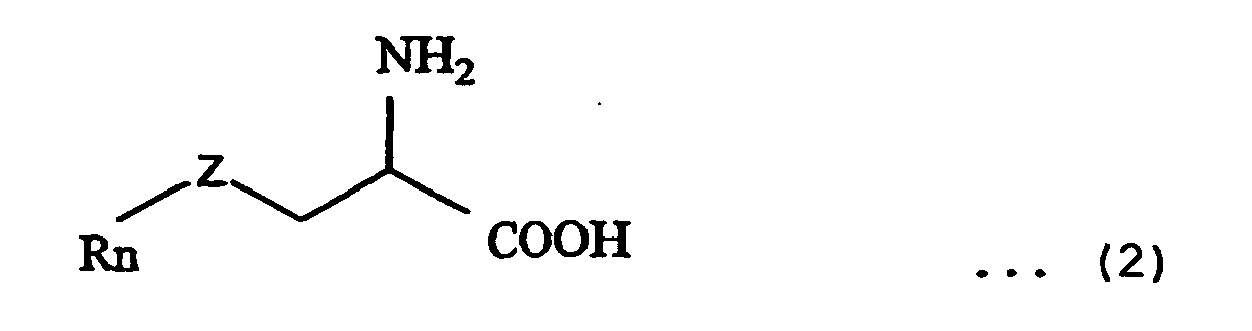 Z represents an aromatic ring group that may comprise a hetero atom,R represents a substituent on said aromatic ring,n represents an integer of 0 or greater, and where n is 2 or greater, each R may be identical or different.
 - The method for producing an L-amino acid according to claim 1, wherein Rn-Z- is represented by the following general formula (3):
 R is a substituent on a benzene ring and represents a cyano group, hydroxyl group, carboxyl group, amide group, fluorine atom, chlorine atom, bromine atom, amino group, nitro group, hydroxymethyl group, or alkyl or alkoxy group having 1 to 6 carbon atoms, andn represents an integer of 0 to 5, and where n is 2 or greater, each R may be identical or different.
 - The method for producing an Z-amino acid according to claim 1, wherein Rn-Z- is represented by the following general formula (4):
 X represents S, O, NH or NR1,R1 represents an alkyl group having 1 to 6 carbon atoms,R is a substituent on a hetero ring and represents a cyano group, hydroxyl group, carboxyl group, amide group, fluorine atom, chlorine atom, bromine atom, amino group, nitro group, hydroxymethyl group, or alkyl or alkoxy group having 1 to 6 carbon atoms, andn represents an integer of 0 to 3, and where n is 2 or greater, each R may be identical or different.
 - The method for producing an L-amino acid according to claim 1, wherein Rn-Z- is represented by the following general formula (5):
 X represents S, O, NH or NR1,R1 represents an alkyl group having 1 to 6 carbon atoms,R is a substituent on a hetero ring and represents a cyano group, hydroxyl group, carboxyl group, amide group, fluorine atom, chlorine atom, bromine atom, amino group, nitro group, hydroxymethyl group, or alkyl or alkoxy group having 1 to 6 carbon atoms, andn represents an integer of 0 to 3, and where n is 2 or greater, each R may be identical or different.
 - The method for producing an L-amino acid according to any one of claims 1 to 4, which comprises using a composition obtained by treating plant tissues containing a phenylalanine ammonia-lyase.
- The method for producing an L-amino acid according to any one of claims 1 to 4, which comprises using a plant cultured cell containing a phenylalanine ammonia-lyase and/or a treated composition thereof.
- The method for producing an L-amino acid according to any one of claims 1 to 4, which comprises allowing a phenylalanine ammonia-lyase gene derived from a plant to be expressible in a plant and using transformed plant cultures or a treated product of the plant cultures.
- The method for producing an L-amino acid according to any one of claims 1 to 4, which comprises allowing a phenylalanine ammonia-lyase gene derived from a plant to be expressible in a microorganism and using a transformed microorganism culture, a treated product thereof, or an enzyme obtained from the culture.
- The method for producing an L-amino acid according to claim 7 or 8, wherein the phenylalanine ammonia-lyase gene derived from a plant is a gene encoding an amino acid sequence having 70% or more homology with the amino acid sequence from deduced the nucleotide sequence of pal2 gene derived from Lithospermum erythrorhizon.
- The method for producing an L-amino acid according to claim 7 or 8, wherein the phenylalanine ammonia-lyase gene derived from a plant is a gene encoding an amino acid sequence having 80% or more homology with the amino acid sequence deduced from the nucleotide sequence of pa12 gene derived from Lithospermum erythrorhizon.
- The method for producing an L-amino acid according to any one of claims 1 to 8, wherein the plant from which the phenylalanine ammonia-lyase gene is derived is Lithospermum and/or Camellia.
- The method for producing an L-amino acid according to any one of claims 8 to 11, wherein the microorganism is a bacterium, yeast and/or filamentous fungi.
- The method for producing an L-amino acid according to claim 12, wherein the bacterium is Escherichia coli.
- The method for producing an L-amino acid according to any one of claims 2 and 5 to 13, wherein, in said general formula (3), at least one of substituents R is a hydroxyl group.
- The method for producing an L-amino acid according to any one of claims 2 and 5 to 13, wherein, in said general formula (3), at least one of substituents R is a cyano group.
- The method for producing an L-amino acid according to any one of claims 2 and 5 to 13, wherein, in said general formula (3), at least one of substituents R is a carboxyl group.
- The method for producing an L-amino acid according to any one of claims 2 and 5 to 13, wherein, in said general formula (3), at least one of substituents R is an amide group.
- The method for producing an L-amino acid according to any one of claims 2 and 5 to 13, wherein, in said general formula (3), at least one of substituents R is a halogen group.
- The method for producing an L-amino acid according to any one of claims 2 and 5 to 13, wherein, in said general formula (3), at least one of substituents R is an amino group.
- The method for producing an L-amino acid according to any one of claims 2 and 5 to 13, wherein, in said general formula (3), at least one of substituents R is a nitro group.
- The method for producing an L-amino acid according to any one of claims 2 and 5 to 13, wherein, in said general formula (3), at least one of substituents R is a hydroxymethyl group.
- The method for producing an L-amino acid according to any one of claims 2 and 5 to 13, wherein, in said general formula (3), at least one of substituents R is an alkyl group having 1 to 6 carbon atoms.
- The method for producing an L-amino acid according to any one of claims 1 to 13, wherein R is any one of a cyano group, a hydroxyl group, a nitro group and a carboxyl group, and n is 1.
- The method for producing an L-amino acid according to any one of claims 2 and 5 to 13, wherein the L-amino acid is L-phenylalanine.
- The method for producing an L-amino acid according to any one of claims 3 and 5 to 13, wherein, in said general formula (4), X is O.
- The method for producing an L-amino acid according to any one of claims 3 and 5 to 13, wherein, in said general formula (4), X is S.
- The method for producing an L-amino acid according to any one of claims 3 and 5 to 13, wherein, in said general formula (4), X is NH.
- The method for producing an L-amino acid according to any one of claims 4 to 13, wherein, in said general formula (5), X is O.
- The method for producing an L-amino acid according to any one of claims 4 to 13, wherein, in said general formula (5), X is S.
- The method for producing an L-amino acid according to any one of claims 4 to 13, wherein, in said general formula (5), X is NH.
Applications Claiming Priority (9)
| Application Number | Priority Date | Filing Date | Title |
|---|---|---|---|
| JP2001190867 | 2001-06-25 | ||
| JP2001190867 | 2001-06-25 | ||
| US30308601P | 2001-07-06 | 2001-07-06 | |
| US303086P | 2001-07-06 | ||
| JP2001367780 | 2001-11-30 | ||
| JP2001367780 | 2001-11-30 | ||
| US33938901P | 2001-12-14 | 2001-12-14 | |
| US339389P | 2001-12-14 | ||
| PCT/JP2002/006287 WO2003000915A1 (en) | 2001-06-25 | 2002-06-24 | Method for producing l-amino acids |
Publications (2)
| Publication Number | Publication Date |
|---|---|
| EP1399577A1 EP1399577A1 (en) | 2004-03-24 |
| EP1399577B1 true EP1399577B1 (en) | 2007-02-07 |
Family
ID=27482368
Family Applications (1)
| Application Number | Title | Priority Date | Filing Date |
|---|---|---|---|
| EP02741268A Expired - Lifetime EP1399577B1 (en) | 2001-06-25 | 2002-06-24 | Method for producing l-amino acids |
Country Status (6)
| Country | Link |
|---|---|
| US (1) | US20040248118A1 (en) |
| EP (1) | EP1399577B1 (en) |
| CA (1) | CA2451860A1 (en) |
| DK (1) | DK1399577T3 (en) |
| RU (1) | RU2287015C2 (en) |
| WO (1) | WO2003000915A1 (en) |
Families Citing this family (4)
| Publication number | Priority date | Publication date | Assignee | Title |
|---|---|---|---|---|
| ATE466929T1 (en) * | 2002-12-12 | 2010-05-15 | Showa Denko Kk | METHOD FOR SELECTING AN ESCHERICHIA COLI STRAIN OVEREXPRESSING A FOREIGN GENE, SO SELECTED ESCHERICHIA COLI MUTANT AND METHOD FOR PRODUCING AN ENZYME AND A COMPOUND USING THEM |
| EP1869174B1 (en) * | 2005-03-10 | 2015-02-18 | BASF Enzymes LLC | Lyase enzymes, nucleic acids encoding them and methods for making and using them |
| EP2029739A4 (en) * | 2006-06-02 | 2009-11-25 | Verenium Corp | Lase enzymes, nucleic acids encoding them and methods for making and using them |
| DE102007052112A1 (en) * | 2007-10-30 | 2009-05-07 | Chiracon Gmbh | Plant biocatalysts for the preparation of optically active hydroxy compounds |
Family Cites Families (5)
| Publication number | Priority date | Publication date | Assignee | Title |
|---|---|---|---|---|
| JPS6143993A (en) * | 1984-08-08 | 1986-03-03 | Kyowa Hakko Kogyo Co Ltd | Production of alpha-amino acid |
| SU1380212A1 (en) * | 1986-06-30 | 1991-12-07 | Всесоюзный научно-исследовательский институт генетики и селекции промышленных микроорганизмов | Method of obtaining l-phenylalanine |
| JPS63148992A (en) * | 1986-12-15 | 1988-06-21 | Asahi Glass Co Ltd | Production of fluorine-containing phenylalanine derivative from fluorine-containing cinnamic acid |
| US5981239A (en) * | 1997-09-24 | 1999-11-09 | Great Lakes Chemical Corp. | Synthesis of optically active phenylalanine analogs using Rhodotorula graminis |
| US6355468B1 (en) * | 2000-07-24 | 2002-03-12 | Pcbu Services, Inc., | Phenylalanine ammonia lyase polypeptide and polynucleotide sequences and methods of obtaining and using same |
-
2002
- 2002-06-24 WO PCT/JP2002/006287 patent/WO2003000915A1/en not_active Ceased
- 2002-06-24 US US10/481,793 patent/US20040248118A1/en not_active Abandoned
- 2002-06-24 RU RU2003137569/13A patent/RU2287015C2/en not_active IP Right Cessation
- 2002-06-24 DK DK02741268T patent/DK1399577T3/en active
- 2002-06-24 EP EP02741268A patent/EP1399577B1/en not_active Expired - Lifetime
- 2002-06-24 CA CA002451860A patent/CA2451860A1/en not_active Abandoned
Also Published As
| Publication number | Publication date |
|---|---|
| CA2451860A1 (en) | 2003-01-03 |
| RU2287015C2 (en) | 2006-11-10 |
| US20040248118A1 (en) | 2004-12-09 |
| EP1399577A1 (en) | 2004-03-24 |
| WO2003000915A1 (en) | 2003-01-03 |
| RU2003137569A (en) | 2005-05-20 |
| DK1399577T3 (en) | 2007-06-04 |
Similar Documents
| Publication | Publication Date | Title |
|---|---|---|
| Barker et al. | Microbial synthesis of p‐hydroxybenzoic acid from glucose | |
| EP1270721B1 (en) | Recombinant DNA sequences encoding feedback inhibition released enzymes, plasmids comprising the recombinant DNA sequences, transformed microorganisms useful in the production of aromatic amino acids, and a process for preparing aromatic amino acids by fermentation | |
| KR101110580B1 (en) | Method of Making Target Material | |
| JP4599726B2 (en) | Method for producing L-glutamic acid | |
| WO1997008333A1 (en) | Process for producing l-amino acids | |
| FR2804971A1 (en) | DNA CODING ACETOHYDROXYACID SYNTHASE, BACTERIUM CONTAINING THE SAME, AND PROCESS FOR PRODUCING L-VALINE BY CULTIVATING THE SAME | |
| JP2003024074A (en) | DNA encoding D-hydantoin hydrolase, DNA encoding N-carbamyl-D-amino acid hydrolase, recombinant DNA containing the gene, cells transformed with the recombinant DNA, production of proteins using the transformed cells Method and method for producing D-amino acid | |
| CN100471958C (en) | Method for producing target fermentation product | |
| JP2023541545A (en) | Engineered biosynthetic pathway for the production of 4-aminophenylethylamine by fermentation | |
| US5447857A (en) | Process for producing L-tryptophan | |
| CA2283376A1 (en) | Synthesis of optically active phenylalanine analogs through microbial transformations | |
| CN105143440A (en) | Microorganism having L-tryptophan productivity and method for production of L-tryptophan using same | |
| US7354746B1 (en) | Method for producing optically active IHOG and monatin | |
| JP5325372B2 (en) | Method for producing L-glutamic acid | |
| US5374542A (en) | Process for producing 4-hydroxy-L-proline | |
| US20040248118A1 (en) | Method for producing l-amino acids | |
| JP2002238591A (en) | Method for producing L-glutamic acid | |
| AU2022211934A9 (en) | Prephenate dehydratase variant and method for producing branched-chain amino acid using the same | |
| KR20230070943A (en) | Polypeptide variant having biotin synthase activity and biotin production method using the same | |
| KR940011838B1 (en) | Preparation of l-phenylalanine by recombinant fermentation | |
| EP4053282A1 (en) | Strain having improved aromatic amino acid production capability due to yeeo gene inactivity | |
| JP2003024073A (en) | DNA encoding D-hydantoin hydrolase, DNA encoding N-carbamyl-D-amino acid hydrolase, recombinant DNA containing the gene, cells transformed with the recombinant DNA, production of proteins using the transformed cells Method and method for producing D-amino acid | |
| KR102727407B1 (en) | Microorganisms for producing l-isoleucine and process for producing l-isoleucine using the same | |
| KR102495918B1 (en) | Phospho-2-dehydro-3-deoxyheptonate aldolase variant and method for producing branched amino acid using the same | |
| JP2003225092A (en) | Method for producing L-amino acid |
Legal Events
| Date | Code | Title | Description |
|---|---|---|---|
| PUAI | Public reference made under article 153(3) epc to a published international application that has entered the european phase |
Free format text: ORIGINAL CODE: 0009012 |
|
| 17P | Request for examination filed |
Effective date: 20031223 |
|
| AK | Designated contracting states |
Kind code of ref document: A1 Designated state(s): AT BE CH CY DE DK ES FI FR GB GR IE IT LI LU MC NL PT SE TR |
|
| AX | Request for extension of the european patent |
Extension state: AL LT LV MK RO SI |
|
| GRAP | Despatch of communication of intention to grant a patent |
Free format text: ORIGINAL CODE: EPIDOSNIGR1 |
|
| GRAS | Grant fee paid |
Free format text: ORIGINAL CODE: EPIDOSNIGR3 |
|
| GRAA | (expected) grant |
Free format text: ORIGINAL CODE: 0009210 |
|
| AK | Designated contracting states |
Kind code of ref document: B1 Designated state(s): AT BE CH CY DE DK ES FI FR GB GR IE IT LI LU MC NL PT SE TR |
|
| PG25 | Lapsed in a contracting state [announced via postgrant information from national office to epo] |
Ref country code: FI Free format text: LAPSE BECAUSE OF FAILURE TO SUBMIT A TRANSLATION OF THE DESCRIPTION OR TO PAY THE FEE WITHIN THE PRESCRIBED TIME-LIMIT Effective date: 20070207 Ref country code: LI Free format text: LAPSE BECAUSE OF FAILURE TO SUBMIT A TRANSLATION OF THE DESCRIPTION OR TO PAY THE FEE WITHIN THE PRESCRIBED TIME-LIMIT Effective date: 20070207 Ref country code: NL Free format text: LAPSE BECAUSE OF FAILURE TO SUBMIT A TRANSLATION OF THE DESCRIPTION OR TO PAY THE FEE WITHIN THE PRESCRIBED TIME-LIMIT Effective date: 20070207 Ref country code: AT Free format text: LAPSE BECAUSE OF FAILURE TO SUBMIT A TRANSLATION OF THE DESCRIPTION OR TO PAY THE FEE WITHIN THE PRESCRIBED TIME-LIMIT Effective date: 20070207 Ref country code: BE Free format text: LAPSE BECAUSE OF FAILURE TO SUBMIT A TRANSLATION OF THE DESCRIPTION OR TO PAY THE FEE WITHIN THE PRESCRIBED TIME-LIMIT Effective date: 20070207 Ref country code: CH Free format text: LAPSE BECAUSE OF FAILURE TO SUBMIT A TRANSLATION OF THE DESCRIPTION OR TO PAY THE FEE WITHIN THE PRESCRIBED TIME-LIMIT Effective date: 20070207 |
|
| REG | Reference to a national code |
Ref country code: GB Ref legal event code: FG4D |
|
| REG | Reference to a national code |
Ref country code: CH Ref legal event code: EP |
|
| REG | Reference to a national code |
Ref country code: IE Ref legal event code: FG4D |
|
| REF | Corresponds to: |
Ref document number: 60218033 Country of ref document: DE Date of ref document: 20070322 Kind code of ref document: P |
|
| PG25 | Lapsed in a contracting state [announced via postgrant information from national office to epo] |
Ref country code: SE Free format text: LAPSE BECAUSE OF FAILURE TO SUBMIT A TRANSLATION OF THE DESCRIPTION OR TO PAY THE FEE WITHIN THE PRESCRIBED TIME-LIMIT Effective date: 20070507 |
|
| PG25 | Lapsed in a contracting state [announced via postgrant information from national office to epo] |
Ref country code: ES Free format text: LAPSE BECAUSE OF FAILURE TO SUBMIT A TRANSLATION OF THE DESCRIPTION OR TO PAY THE FEE WITHIN THE PRESCRIBED TIME-LIMIT Effective date: 20070518 |
|
| PG25 | Lapsed in a contracting state [announced via postgrant information from national office to epo] |
Ref country code: PT Free format text: LAPSE BECAUSE OF FAILURE TO SUBMIT A TRANSLATION OF THE DESCRIPTION OR TO PAY THE FEE WITHIN THE PRESCRIBED TIME-LIMIT Effective date: 20070709 |
|
| NLV1 | Nl: lapsed or annulled due to failure to fulfill the requirements of art. 29p and 29m of the patents act | ||
| ET | Fr: translation filed | ||
| REG | Reference to a national code |
Ref country code: CH Ref legal event code: PL |
|
| PLBE | No opposition filed within time limit |
Free format text: ORIGINAL CODE: 0009261 |
|
| STAA | Information on the status of an ep patent application or granted ep patent |
Free format text: STATUS: NO OPPOSITION FILED WITHIN TIME LIMIT |
|
| 26N | No opposition filed |
Effective date: 20071108 |
|
| PG25 | Lapsed in a contracting state [announced via postgrant information from national office to epo] |
Ref country code: MC Free format text: LAPSE BECAUSE OF NON-PAYMENT OF DUE FEES Effective date: 20070630 |
|
| PG25 | Lapsed in a contracting state [announced via postgrant information from national office to epo] |
Ref country code: IT Free format text: LAPSE BECAUSE OF FAILURE TO SUBMIT A TRANSLATION OF THE DESCRIPTION OR TO PAY THE FEE WITHIN THE PRESCRIBED TIME-LIMIT Effective date: 20070207 Ref country code: GR Free format text: LAPSE BECAUSE OF FAILURE TO SUBMIT A TRANSLATION OF THE DESCRIPTION OR TO PAY THE FEE WITHIN THE PRESCRIBED TIME-LIMIT Effective date: 20070508 |
|
| PGFP | Annual fee paid to national office [announced via postgrant information from national office to epo] |
Ref country code: FR Payment date: 20070608 Year of fee payment: 6 |
|
| PG25 | Lapsed in a contracting state [announced via postgrant information from national office to epo] |
Ref country code: IE Free format text: LAPSE BECAUSE OF NON-PAYMENT OF DUE FEES Effective date: 20070625 |
|
| PGFP | Annual fee paid to national office [announced via postgrant information from national office to epo] |
Ref country code: DK Payment date: 20080612 Year of fee payment: 7 |
|
| PGFP | Annual fee paid to national office [announced via postgrant information from national office to epo] |
Ref country code: DE Payment date: 20080703 Year of fee payment: 7 |
|
| PGFP | Annual fee paid to national office [announced via postgrant information from national office to epo] |
Ref country code: GB Payment date: 20080625 Year of fee payment: 7 |
|
| PG25 | Lapsed in a contracting state [announced via postgrant information from national office to epo] |
Ref country code: CY Free format text: LAPSE BECAUSE OF FAILURE TO SUBMIT A TRANSLATION OF THE DESCRIPTION OR TO PAY THE FEE WITHIN THE PRESCRIBED TIME-LIMIT Effective date: 20070207 |
|
| PG25 | Lapsed in a contracting state [announced via postgrant information from national office to epo] |
Ref country code: LU Free format text: LAPSE BECAUSE OF NON-PAYMENT OF DUE FEES Effective date: 20070624 |
|
| PG25 | Lapsed in a contracting state [announced via postgrant information from national office to epo] |
Ref country code: TR Free format text: LAPSE BECAUSE OF FAILURE TO SUBMIT A TRANSLATION OF THE DESCRIPTION OR TO PAY THE FEE WITHIN THE PRESCRIBED TIME-LIMIT Effective date: 20070207 |
|
| REG | Reference to a national code |
Ref country code: DK Ref legal event code: EBP |
|
| GBPC | Gb: european patent ceased through non-payment of renewal fee |
Effective date: 20090624 |
|
| REG | Reference to a national code |
Ref country code: FR Ref legal event code: ST Effective date: 20100226 |
|
| PG25 | Lapsed in a contracting state [announced via postgrant information from national office to epo] |
Ref country code: FR Free format text: LAPSE BECAUSE OF NON-PAYMENT OF DUE FEES Effective date: 20090630 |
|
| PG25 | Lapsed in a contracting state [announced via postgrant information from national office to epo] |
Ref country code: GB Free format text: LAPSE BECAUSE OF NON-PAYMENT OF DUE FEES Effective date: 20090624 |
|
| PG25 | Lapsed in a contracting state [announced via postgrant information from national office to epo] |
Ref country code: DE Free format text: LAPSE BECAUSE OF NON-PAYMENT OF DUE FEES Effective date: 20100101 |
|
| PG25 | Lapsed in a contracting state [announced via postgrant information from national office to epo] |
Ref country code: DK Free format text: LAPSE BECAUSE OF NON-PAYMENT OF DUE FEES Effective date: 20090630 |