EP1398698B1 - Verfahren und System zur Ereignisverwaltung in einem System mit strengen Echtzeitzwangsbedingungen - Google Patents
Verfahren und System zur Ereignisverwaltung in einem System mit strengen Echtzeitzwangsbedingungen Download PDFInfo
- Publication number
- EP1398698B1 EP1398698B1 EP03292225.4A EP03292225A EP1398698B1 EP 1398698 B1 EP1398698 B1 EP 1398698B1 EP 03292225 A EP03292225 A EP 03292225A EP 1398698 B1 EP1398698 B1 EP 1398698B1
- Authority
- EP
- European Patent Office
- Prior art keywords
- treatment
- event
- supervisor
- events
- processing
- Prior art date
- Legal status (The legal status is an assumption and is not a legal conclusion. Google has not performed a legal analysis and makes no representation as to the accuracy of the status listed.)
- Expired - Lifetime
Links
Images
Classifications
-
- G—PHYSICS
- G06—COMPUTING OR CALCULATING; COUNTING
- G06F—ELECTRIC DIGITAL DATA PROCESSING
- G06F9/00—Arrangements for program control, e.g. control units
- G06F9/06—Arrangements for program control, e.g. control units using stored programs, i.e. using an internal store of processing equipment to receive or retain programs
- G06F9/46—Multiprogramming arrangements
- G06F9/48—Program initiating; Program switching, e.g. by interrupt
- G06F9/4806—Task transfer initiation or dispatching
- G06F9/4812—Task transfer initiation or dispatching by interrupt, e.g. masked
-
- G—PHYSICS
- G06—COMPUTING OR CALCULATING; COUNTING
- G06F—ELECTRIC DIGITAL DATA PROCESSING
- G06F9/00—Arrangements for program control, e.g. control units
- G06F9/06—Arrangements for program control, e.g. control units using stored programs, i.e. using an internal store of processing equipment to receive or retain programs
- G06F9/46—Multiprogramming arrangements
- G06F9/54—Interprogram communication
Definitions
- the present invention relates to an event management method for controlling the behavior of a real-time system subject to high reactivity constraints.
- Such systems are designed according to a software and hardware architecture in particular to react to identified events whose instants of appearance are most often not known, but which generally have causal links between them.
- the hardware part of the system architecture consists of processors, electronic equipment, and communication links between processors and between processors and equipment.
- Software "application” and hardware control run on this architecture.
- the various components of the architecture are used to generate the events, to varying degrees depending on the complexity of the events.
- the software part of complex real-time systems is often broken down into subsystems that each control several physical processes of the same nature.
- the events correspond, for example, to passages by certain values of physical parameters, external or internal to the real-time system. Human interaction is seen as such an event because it results in the generation of an electrical signal.
- the arrival of a date or the lapse of a delay are events in their own right.
- the system undertakes actions that affect its external or internal behavior. Changes in behavior result in transient or lasting changes in external or internal physical parameters.
- An embedded system receives signals or messages from its environment through physical sensors or telecommunication equipment.
- the physical sensors receive signals taken from the equipment inside the system.
- These devices are associated with electronic equipment that, if their physical state allows, deliver discrete or continuous digital information to a processor.
- the information flow reaches an acquisition or reception software that is executed on this processor.
- acquisition software which constitutes a first level of software, is designed to condition the information received and in some cases it can serve as a filter for detecting a simple event from a data profile to be recognized.
- a real-time system modifies the physical parameters of its environment through physical actuators or by sending messages to telecommunications equipment.
- These devices are associated with electronic devices which, if their physical state allows, receive discretely or continuously digital commands from a processor.
- actuators modify the physical parameters of the equipment internal to the system. Actuator controls or communication messages are routed and formatted by equipment control or transmission software.
- the modification of one or more physical parameters is performed in response to an event by the execution by a processor of at least one "application” level software processing.
- This so-called “reaction” processing corresponds to the partial or total implementation of an action specified in a state diagram and automaton transitions and must thus have a limited duration.
- an "application” software process which controls the physical process at a frequency related to the time constant of the process.
- This process control process is presented in its basic form as a sequence that calls up software for acquiring sensor measurements, performs calculations on these inputs, and then calls the actuator control software to deliver the commands.
- This periodic function is assimilated to a background treatment whose duration exceeds the frame of a state. The only cases where this treatment is related to a state transition are those that modify its behavior. Thus events start, interrupt and terminate the occurrences of this processing; others suspend and restart the course of a calculation; finally, others modify the operational content or the temporal conditions of the operations - which corresponds to a change in the operating mode.
- each treatment is periodic of period P or aperiodic.
- the triggering event and the possible start date (delay) are defined at the earliest.
- the end date or deadline is defined at the latest.
- the trip shutdown event is defined.
- the termination event is defined.
- the document US 6317638 also describes a system based on a state machine for processing real-time processes.
- the present invention aims to set up generic software and hardware mechanisms to allow a real-time system to react to the arrival of events and to cause actions accordingly, in accordance with diagrams of states and transitions. This objective is achieved by providing a method according to claim 1.
- the supervisor processing stores the event to be processed in a list of events treat.
- the event to be processed is not associated with other events to be processed that have not yet arrived, and no transition execution condition is satisfied, the event to be processed is lost, and the supervisor processing resumes waiting for a new event.
- the supervisor processing is an aperiodic task which is in the form of a processing loop comprising a call to an event waiting function to be processed from the time management system, the supervisor processing calling the function of event waiting to be processed at the end of the execution of a transition or if no transition can be executed.
- the actions performed by the supervisor processing during the execution of a transition are actions of triggering, interrupting, terminating and / or changing the operating mode of periodic or aperiodic.
- the actions of the transitions specified in the state and transition diagram are associated with temporal constraints defining whether the processes triggered by these actions must be executed in parallel or sequentially, and for each treatment to trigger, a trip phase shift period, a maximum execution time, and an activation period in the case of periodic processing.
- each action commands the time management system to generate an end of treatment event at the end of its at least partial execution, the supervisor processing setting itself waiting for this event before performing the next action.
- the triggering of a treatment by the supervisor processing is carried out by a call from a service of the time management system specifying the processing to be triggered, an operating mode, a phase shift duration of trigger, a maximum execution time, and an activation period in the case of periodic processing.
- the execution of an operation is subordinated to the arrival of at least one other event emitted by an application processing.
- the scheduled event management processing analyzes information relating to a next operation to be executed defined in the plan of operation, to determine the moment of activation of the operation, and control by a call to the time management system a new execution of the scheduled event management processing at the moment of activation of the operation , associated with a mode indicating that the scheduled event management process has been triggered by itself.
- the scheduled event management processing waits for the end of the scheduled operation being executed, indicated by the supervisor processing.
- the invention also relates to a real-time system according to claim 13.
- this system further comprises a scheduler processing for managing a plan of operations in which are planned operations to be performed in the medium or long term operations, and a scheduled event management processing having access to the plan of operations for determining when a next operation specified in the operation plan is to be executed, and controlling the generation of a specific event for the supervisor processing when an operation is to be executed.
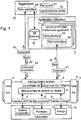
- the system represented on the figure 1 consists of software and hardware components divided into three layers.
- the upper layer contains the real-time application 2 performing the user-defined functions
- the intermediate layer comprises a time management system 1 which offers the user application 2 the services it needs to manage the time, these services being grouped in a user interface 6 and using mechanisms 3 internal to the system 1.
- a time management system is described, for example, in the French patent application no. 01 03334 filed by the Applicant.
- All the low-level hardware and software resources ie the processor, are located in the lower layer which comprises hardware resources 12 comprising in particular a processor 10, an operating system 11 of the processor, for example constituted a real-time kernel or a real-time executive, and a clock service 13 providing absolute times.
- the operating system 11 offers low-level real-time services, and in particular synchronization mechanisms and a mechanism for distributing the material resources between the different processes, commonly called scheduler.
- the time management service 1 is invoked by the application or system processes so that they interact in time in a fast and controlled manner. It does not replace the real-time kernel 11 but uses it to manage the allocation of the processor 10 to the software processes launched in parallel.
- the time management system 1 is preferably performed generically, that is to say in a manner independent of low-level hardware and software resources, used by the application 2. For this purpose, it uses an interface 7 with the real-time kernel 11, gathering all the low-level services called by the time management system 1, in particular to carry out the user services grouped in the interface 6. It is also called an interface 8 with the hardware, this interface including all the services rendered by the processing unit 12, called by the time management system 1, and an interface 9 with the clock 13.
- All the processing of the application 2, whose execution triggers and stops are to be managed, are defined in a table 5 gathering their respective names or identifiers. Each processing therefore has a unique identifier defined by the user statically in the processing table 5 which is shared by the different layers of the system architecture. In this way each treatment can be recognized by both the time management system 1 and the application 2.
- the processing table 5 allows the user to use a proper naming system, instead of the proper identifiers. to the real-time core 11, which avoids confusion.
- this table makes it possible to group the processes or tasks in classes and subclasses according to their properties. For example, the class of users of the time management system can be defined.
- the specification of a real-time system macroscopically describes the functions of the subsystems 31 that compose it and their inputs / outputs as well as the system events that condition the activities of these functions.
- the behavior of this functional architecture can be modeled by an automaton represented in the form of a diagram of states and transitions.
- the present invention aims at exploiting such modeling by a PLC by providing a generic system supervisor designed to execute the automaton. modeling the operation of the application, the description of the PLC being defined in a database 32 gathering state tables and transitions specific to the application.
- Each subsystem 31 groups processing that can be classified as "application” processing and input acquisition processing or output delivery, these processing can be run in parallel or in series.
- the processing of the subsystems must correspond to the functions characterizing the states of the automaton modeling the application. Functions performing similar calculations that are never performed in parallel can be grouped together in a single process. It is then enough to start the treatment by designating a mode of operation to select the desired function.
- the interactions in time of the subsystems 31 are performed by generating events 41 representative of the external or internal behavior of the real-time system by calling on the time management system 1. All the generated events 41 (or only some of them referenced as system events) are then processed by the supervisor 20 which determines using the description of the automaton in the database 32 whether a transition to a Another state must be triggered according to the current state 51 of the controller and the events 52 not yet processed that have just been generated.
- the observation events represent the different significant transitions in the course of treatments. Although the events are user-defined, the time management system 1 ensures that these events occur and their records are recorded in observation records. The role of these events is to trace behaviors dynamic processing, as well as activation requests.
- Some temporal events may characterize the overdue for treatments, others may be a timeout for a step in a treatment.
- the user is free to define as many events as he wishes and thus to have temporal monitoring points in his application.
- the occurrence of an event of this type leads to a record in the observation record of the treatment and may possibly lead to the notification of the event to a supervisor processing, if one exists.
- the user can define events in a manner independent of any temporal considerations. Indeed, it can in a process decide to ask the time management system 1 to lift such an event. In addition to recording the event in the observation record of the request author processing, the event can be notified to a supervisor processing so that the latter can perform the appropriate operations.
- the monitoring of the critical events is managed by the supervisor 20 as soon as they appear during the execution of the treatment. Such monitoring therefore requires speed in taking such events into account.
- any event is represented by a unique identifier, defined by the user in the event table 4.
- the time management system 1 is designed to take into account two categories of processing, namely periodic application processing 33 or aperiodic processing 34, and the aperiodic supervisory processing 50 which is executed by the supervisor 20 taking into account events execution and the triggering of the application processes 33, 34 to execute the automaton.
- Each treatment is associated with the moment it is triggered at one phase and if it is periodic at one time.
- the phase of a processing corresponds to the time separating a reference time and the request for activation of the processing by the time management system to the operating system. It makes it possible to distribute deterministically in time the requests for activations of each of the treatments with respect to this reference time.
- the period of execution of a periodic processing 33 is the time in a unit defined by the time management system, separating two iterations (two activation requests) from the processing.
- a deadline is also defined which corresponds to the maximum time allocated to a processing to execute since its request for activation by the system 1.
- supervisor processing 50 receives an overdue notification.
- the temporal parameters entered during service calls of the time management system 1 must be expressed in a so-called unit "user" unit that is arbitrarily defined by example to the millisecond (ms).
- the absolute time or date information is expressed in the unit of the on-board clock and is therefore dependent on the implementation.
- the unit of time used by the system internally may be different from the user unit and may be close to the unit of time used by the external temporal physical source.
- the order of magnitude of this unit is the microsecond ( ⁇ s).
- processing may have other complementary characteristics, but these are associated either with specific functionalities or with the way in which the time management system 1 is implemented. It is for example related information. monitoring of the course of treatment.
- an application processing is characterized by one and only one of these states.
- the purpose of the time management system 1 is to produce, upon request of the application, the transitions between these different states. These transitions occur following the appearance of time events detected by the system or following the appearance of application events defined and introduced by the user.
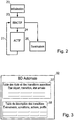
- the periodic processes must each be encapsulated in an infinite loop 21 in which the execution of each iteration is subjected to a wait in the idle state 23, triggered by the time management system 1 ( figure 2 ).
- This processing structure is also preferable in the case of an aperiodic treatment, and in particular in the case of the supervisor processing 50. It is also essential for the time management service 1 to monitor the processing time.
- the purpose of the "Initialize_service” function is to initialize the internal structures and the temporal control mechanisms of the system 1, that is to say, to define a number of operating characteristics of the system 1 and of describing the general context. execution of the system. These characteristics are dependent on the physical and software implementation of the target platform (microprocessor, operating system, etc.) and the application 2. Among these characteristics, there is generally the maximum number of treatments managed by the system, the units of time used, as well as the resolution and temporal accuracy. Other characteristics are more closely related to the implementation context, that is to say, relate to the type of microprocessor of the computer or the operating system for example.
- the specification of the initialization function is standard to all implementations of the system. As a result, the definition of the different characteristics of the system is performed statically during the implementation thereof.
- the "Stop_service” function is used to terminate the activity of the system, provided that all the treatments entrusted to it have been completed. The user is therefore responsible for stopping treatments whose management has been entrusted to system 1, before making the call to this function.
- the "Accept_delay” function performs system support for the activation of periodic or aperiodic processing. Calling this function causes the processing at the origin of the request to be blocked, which then goes to inactive state 23 ( figure 2 ), until the system 1 performs the activation request for it with the real-time kernel. As soon as another treatment has entered the system 1 on its activation parameters: phase, period, ..., the system 1 supports the activation of the processing and frees it from its wait in the corresponding delays.
- This release is accompanied by an event transmitted to the processing indicating its mode of execution: either it normally executes its periodic processing (transition to the active state 24), or it leaves the loop and executes a termination sequence ( transition to the termination state 25) in the case where such a request has been made beforehand by another treatment.
- any periodic processing and most aperiodic processes use the "Accept_Trigger" function to wait for triggering. In the absence of a trigger signal, this function puts the process on hold, allowing the processor to be assigned to another process. This specific synchronization point is used for all trigger types.
- application processing 33, 34 retrieves a mode parameter that it must use to change its execution program.
- An aperiodic task 34 is triggered following a request addressed to the time management service by the supervisor 20 or by any application task.
- a periodic task 33 is triggered initially on request addressed to the time management service by the supervisor or by any application task. The following triggers are automatically done by time management service 1 at the rate of the period.
- Automatic triggers are interrupted on request addressed to the time management service by the supervisor or by any application task. After an interruption, it is possible on request to trigger the same treatment one by one or periodically: in fact, nothing distinguishes a priori a periodic task from an aperiodic task.
- At least one treatment of the application 2 must define the reference time used by the system to phase the activation requests of the different treatments in time.
- the time management system 1 wakes up on its own when the trigger time is reached and updates its wake-up information. It then makes an activation request to the real-time executive for the processes concerned.
- the effective activation of the periodic processing that is to say the end of its wait on the call of the function "Accept_declenchement” and the continuation of its activity, are dependent on the scheduling policy applied by the executive real time. Accumulation of trigger requests is allowed as long as the implementation accepts it. If the accumulation threshold is crossed, an error is reported to the supervisor.
- the "Trigger_Treatment” function allows the triggering of a treatment, and memorizes new activation parameters of the treatment. This function receives as input a processing identifier, phase values, period (for periodic processing) and expiry, as well as a parameter defining an operating mode of operation. The new activation parameters are then used continuously by the system to update the management of requests for activation of treatments. Any treatment may require system 1 to periodically or periodically trigger another process, using the "Trigger_process" function.
- phase information When the phase information is equal to a particular predefined value, for example -1, this means that the request for activation of the processing is immediate.
- phase information When the phase information is zero, it means that the activation of the processing must be performed with a zero phase with respect to the current reference time, that is to say at the reference time which is later than the current moment. If the period information is zero, it means that the activation of the treatment is aperiodic.
- Expiry information is used to define the maximum time allocated for processing to execute from the activation request by the system.
- a major overdue event is reported to supervisor processing if the processing does not complete within the specified time.
- a particular value for this parameter, for example zero, means that there is no deadline to monitor for the processing considered.
- the management system 1 monitors the execution time of the processing. The time corresponding to the expiry date is recalculated each request for activation of the processing concerned by the system 1 and constitutes a date of wakeup thereof. If the processing has not reached the "Accept_Trigger" function again before the due date, System 1 wakes up by itself at this time and initiates the next processing.
- the system transmits the event associated with this global timeout with a processing supervisor who has been waiting to receive an event by calling the "Accept_Event" function described later in the description. If no processing has made this call, then no message is transferred by the system 1. If such a processing exists and it is not processing a previous event, this new event is immediately processed by the supervisor processing, otherwise it is stored in an event queue. This mechanism applied to an error of expiry has no bearing on the treatment responsible for its occurrence.
- the "Mode" input parameter of this function makes it possible to transmit to the processing concerned a message for changing the operating mode: activation of a treatment according to a procedure, termination of the processing according to a mode of operation, ...
- the mode must be chosen from the symbols reserved for activation in the event table 4. The mode change is made the next time the relevant treatment is activated.
- a triggering authorization replaces the current activation parameters set up during a previous authorization.
- a delayed release permit replaces the current activation parameters set up during a previous delayed release authorization. This constraint is justified for reasons of simplicity of realization of the time management system 1.
- Trigger_treatment_date makes it possible to authorize the triggering of a processing on an absolute date, and to memorize new parameters of activation of the treatment.
- This function is analogous to the “Trigger_Track” function, except that it receives as input an absolute date instead of a phase value.
- the error codes returned by these two functions are the same, except those concerning the phase which are replaced in the function "Trigger_treatment_date” by the error code "Date not in conformity" in the case where the absolute date passed in parameter n is not in compliance with the constraints of the system.
- Trigger_Treatment or “Trigger_Treatment_Date” and “Trigger_Delay” functions are performed as follows. After an initialization sequence, the processing N uses the "Accept_delay” function to wait for activation by another treatment, in this case, the supervisor processing 50.
- the supervisor processing is executed and reaches the call of the function "Trigger_treatment" designating the processing N.
- the call of this function makes it possible to request the system 1 to memorize activation parameters (phase or date of activation). activation, period, mode, ...) for processing N, in the form of an activation event that is inserted into a queue. Calling this function returns a return code.
- the system 1 programs a counter with the difference between the activation date of the treatment N and the current date. When the counter expires, the system 1 sends an event signifying an activation mode or a termination mode as a return parameter of the function "Accept_delay", which unblocks the processing N, the sequence executed by it. depending on this return code. If the return code is an activation mode, the processing N executes the sequence for which it was designed and then resumes on hold by calling the "Accept_delay" function again.
- the function "Differer_traitement” makes it possible to put in sleep the execution of the treatment which calls this function, during a certain duration passed in parameter.
- This function requests the time management system 1 to suspend the execution of the processing performing the request during the time passed in parameter.
- Calling this function returns one of the following error codes informing the completion of the operation: "Ok”, “Service_non_active” and “Delay_non_conform” when the input parameter does not comply with constraints of the system, in this case, that it exceeds the capacity of the temporal resources (clock 13).
- the function "Differer_traitement_date” makes it possible to put in sleep the execution of the processing which calls this function, until an absolute date, passed in parameter.
- This function is analogous to the "Difference Processing” function except that it receives an absolute date as input instead of a duration.
- the processing that invokes the "Difference Processing” function is immediately suspended.
- the system 1 takes into account the wake-up information of this processing and updates a list of alarm clocks.
- the real-time executive activates another treatment according to its scheduling policy. This action also leads to a record in the observation record of the treatment concerned.
- the time management system wakes up on its own when the moment of resume processing is reached, and updates its wake up information.
- the real-time executive is then requested by the system to resume execution of the processing concerned.
- Freeze_treatment allows a treatment to freeze, that is to say to block the execution of another treatment. Calling this function means that the time management system 1 must suspend requests for activation of the treatment specified in parameter, until a next release authorization is made.
- a treatment may request the freezing of another treatment by calling the "Freeze Treatment” function. This call makes it possible to signal the system 1 to inhibit any future triggering of the considered treatment.
- the system 1 updates its trigger information and hands over the processing that made the request.
- the processing concerned invokes the "Accept_delay” function to wait for its next activation, the system 1 carries out the equivalent of the "Report event” function (see below) to warn the supervisor treatment of the effective gel of the treatment.
- the system 1 immediately performs this action before returning the hand to the processing making the request. To resume a process of triggering after a freeze, it is enough that a treatment calls the function "Trigger_treatment".
- a predefined major type event "Treatment gel” is generated from the supervisor processing. This call can be used for the aperiodic treatments to know the end of the execution of the main part of the treatment. Such a method allows the supervisor to synchronize on the completion of a set of treatments, whether their activations are linked or independent.
- the supervisor 20 can thus perform a dynamic change of the mode of operation, synchronized in all the treatments, by calling the function "Freeze-treatment” to stop the activations of the treatments whose operating mode of operation must be changed, then by calling for each of these treatments , the "Trigger_Treatment" function associated with the temporal parameters of the new operating mode of operation and the mode parameter indicating to the processes in which operating mode they must operate.
- the "Trigger_Treatment" function associated with the temporal parameters of the new operating mode of operation and the mode parameter indicating to the processes in which operating mode they must operate.
- the "Finish processing" function is used to indicate to the system 1 that it must terminate the execution of a process whose identifier is passed as a parameter. For this purpose, it sends a termination message to the processing concerned. This function also receives as input parameter a mode identifier which must be chosen from the event identifiers reserved for the termination.
- a process such as supervisor processing 50 may cause the system to terminate execution of another process by calling the "Finish_Treatment" function.
- the system 1 inhibits any future triggering of the concerned processing and sends the stop message provided as a parameter to this processing, which the latter will interpret as soon as it has performed again. call the function "Accept event”. If ever, this processing was already pending in the "Accept_delay" function at moment of the request for termination, he is immediately authorized to perform his final game 25, as soon as the real-time executive has activated it according to the scheduling policy.
- the "Designer_supervisor_major” function allows the processing that calls it to declare itself responsible for the management of major events. The call of this function is performed by the supervisor processing 50 when it is launched.
- the "Accept_Event” function also receives as a call parameter a "delay before next waiting" which makes it possible to define the maximum delay separating the delivery of an event by the system 1 and the next call of this function by the supervisor.
- the objective is to detect an anomaly at the level of the supervisor, as it would take too long to process a previous event.
- a null value for this parameter imposes no checks on the delay between the next event wait.
- the special value of -1 defined by default for this parameter, means that the delay remains unchanged from its current value.
- the "Accept_Event" function call returns the event identifier and the processing identifier that caused the event.
- the supervisor processing 50 it is therefore possible to signify to the system 1 a deadline for the processing of the events.
- This monitoring is enabled by providing System 1 with the value of this deadline when calling the "Accept_Event" function.
- the system 1 updates its wake-up list by calculating the date corresponding to the processing deadline of the event, and requests the operating system 11 to activate the supervisor processing 50, providing the event to this one. If the supervisor processing again reaches the "Accept event” function call to wait for the next event, before the system has been woken up for the due date, this alarm is deactivated.
- the "Report_Event” and "Report_Event_Date” functions allow a process to schedule, through the time management system 1, the occurrence of an exceptional event.
- An absolute delay or date, passed as an argument, makes it possible to specify the time at which the event will be signaled by the system 1.
- a characteristic value established by default for this parameter indicates that the signaling of the event must be immediate.
- the nature of the events is not necessarily related to time and can affect several treatments. The occurrence of such an event results in the constitution of an observation record and a signaling to the supervisory treatment managing the event.
- any new deferred signaling replaces the previous one.
- the supervisor processing 50 has been waiting for an event by calling the "Accept_Event” function.
- the system activates the supervisor processing 50.
- the supervisory processing executes the corresponding action end of processing of the action i or i + 2 and calls the function "Accept_events" again to wait for a new event.
- the supervisor processing is waiting for an event, then it is processed immediately by this one. Conversely, if this process is processing a previous event, this new event is stored in the event queue associated with the supervisor processing.
- the "Delete_Event” function allows you to delete the last deferred request sent by any processing to notify an evolution or report a major event.
- the choice between a signaling request or a notification request is made using an event class call parameter.
- any new deferred signaling replaces the previous one.
- Notifier evolution makes it possible to check the respect of an intermediate deadline in a treatment. This is done by specifying in one parameter, the maximum delay until the next notification.
- a sequence of instructions can thus be monitored by a call to this function at the beginning and at the end of this sequence.
- This function enters a date in the system wake-up list 1. If the concerned process invokes the "Notifier evolution" function before the system wakes up, the instant of this alarm is deactivated.
- a null value for this delay inhibits any intermediate maturity check.
- the event notification first leads to the registration of the event in an observation record. The date of occurrence of the event is not transmitted to the supervisor processing 50.
- the passage of the same treatment by a new notification before the expiry of this period stops its counting or replaces it with a new value, depending on whether the new notification includes a maximum null delay or significant value.
- the time management system 1 proposes, through its interface 6, functions to control the execution of periodic or aperiodic processing and time monitoring tools and event management.
- these functions must be used within certain constraints that are introduced by the system architecture and the resource occupancy rate of the system.
- the condition for triggering a transition is a combination of logical events 41, each of these events being attached to a subsystem 31 which is responsible for generating it.
- a treatment existing if possible, is sought in this subsystem to produce this event: the generation of an event can be conditioned by the choice of a procedure 42 of the treatment of the treatment so that it is possible for any moment to inhibit it by acting through the time management service. Otherwise you have to create a treatment dedicated to the production of the event.
- periodic or aperiodic processing 34 is running, it relies on its acquisitions or calculation results to decide whether the event has happened. Assuming that a sensor uses an electronic signal in the presence of a physical event, it is still necessary to associate a software process that is responsible for producing a logical event.
- the processing which ensures its detection calls the function "Report_events” provided by the interface 6 of the time management service and then continues its execution. If, on the other hand, it is an event prediction that is realistic enough to be credible or that it is necessary to anticipate its arrival, the processing calls the function "Report_Event_Date" of the time management service, which is equivalent to deferring the reporting of the event on the date indicated.
- Systematic events and fortuitous events are generated in the same way. What distinguishes them is their detection modality. Indeed, a systematic event is expected to arrive in particular states of the system, while a fortuitous event arrives in any state. For the former, we use the ease of change of mode of a treatment for allow their generation.
- time management service 1 Some anomalies are detected automatically by the time management service 1. These are the anomalies in the processing time. These anomalies require to frame the operations concerned by calls to the "Notifier evolution" functions provided by the interface 6 of the time management service.
- the time management service 1 stores all the events addressed to it and delivers them according to their priority to a consumer treatment. Only can read the processing 50 which has declared as supervisor by call to the function of the service "Designersuperviseur major”.
- the processing 50 of the supervisor 20 is an aperiodic task and is in the form of a processing loop as described above with reference to the figure 2 .
- This loop begins with a call to the function "Accept_Event" provided by the interface 6 of the time management service. In the absence of an event, this function puts the supervisor on hold which makes it possible to assign the processor 12 to another processing. If a non-deferred event is received by the service, the supervisor 20 immediately resumes execution because of its high priority and retrieves the event to process it.
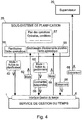
- the supervisor 20 accesses the database 32 at a table 37 ( figure 3 ) representing all the transitions of the system state diagram.
- the database 32 comprises two tables defining the automaton of the application 2, namely the state and transition table 37 and the description table of the transitions 38.
- the state and transition table 37 comprises, each transition of the automaton a transition identifier, an identifier of the starting state and an identifier of the arrival state.
- the transitions description table 38 comprises for each transition identifier referenced in the table 37 a list of events to be included in the list of pending current events 52 to execute the transition, possibly a list of conditions relating to the events of the transition.
- the associated list or state variables of the real-time system to be performed to execute the transition, a list of actions to be executed to effect the transition to the arrival state, and a temporal profile of the actions.
- the precise processing to be performed is defined by the mode 42 provided as a call parameter of the Trigger_Treatment "or" Trigger_Treatment_Date “and” Finish Trimming "functions.
- the time profile defines whether the triggers are parallel or sequential, and whether they are with phase shifts. It also indicates the periods of periodic treatments. For mode changes, it gives the new phase shift and possibly the new period. Finally, it is possible to set deadlines for periodic or aperiodic treatments.
- the supervisor stores in memory the current state 51 of the automaton.
- the supervisor goes through the possible transitions, that is to say associated with the current state 51. From table 38 describing the transitions, he looks for the presence of the event in the possible transitions found. If the event has no transition found, the event is lost and the supervisor waits for a new event. In the opposite case, for each transition found, associated with the event, it determines if all the conditions associated with the transition are satisfied. If the event is found in a transition and all conditions of the transition are satisfied, the supervisor clears the list 52 of the events to be processed and proceeds to implement the transition by updating the current state of the transition. Controller using table 37, executing the actions corresponding to the transition, specified in table 38.
- the event is associated with other events that have not arrived, it is stored in the list of incoming events 52 to be analyzed when another event is transmitted to the supervisor by the time management system.
- the supervisor is expected to wait for completion events indicating that processing is complete before triggering the next process. If events other than end of processing events occur during the execution of the actions of a transition, they are stored by the supervisor in a list of events not taken into account. At the processing of the last event of completion of the transition, this list of events not taken into account is traveled to successively process all the events in the order of their arrival during the execution of the transition.
- the supervisor 20 initializes all the treatments of the system and ensures their complete control thanks to the actions it has. In the presence of particular events, he may decide to leave the initiative to operators provided that they follow procedures.
- the supervisor is informed of any anomaly that requires actions at the system level; such an anomaly is detected by processing a subsystem and then reported to the supervisor as a specific event.
- the controller specified in the database 32 preferably includes anomaly transitions associated with diagnostic and corrective actions to handle prohibited events or abnormal reporting.
- the time management service keeps a history of not only system events, but also the latest events relating to the real-time behavior of the tasks and the service itself.
- a failure of the supervisor thus paralyzes the entire system; however, in order to attempt a reconfiguration, the time management service 1 is able to monitor the overflow by the supervisor's processing. This deadline is set when the supervisor calls the function of the time management service "Accept_Event". If the overshoot is detected, the time management service invokes an emergency software procedure "Process_Fatal_error" that is freely programmed.
- the present invention is based on the observation that the scheduled events are generated differently because they are programmed or deprogrammed at any time to be performed in the future.
- the present invention further provides as shown on the figure 4 a planning subsystem 35.
- the scheduling subsystem 35 includes scheduled event management processing 56 and scheduling processing 55.
- the scheduling subsystem 35 is responsible for managing and scheduling operative requests, i.e. queries issued by an operator or the system environment controlled by the real-time application. More precisely, it defines the operation to be performed and its conditions of implementation. The conditions for implementing an operation implicitly or explicitly gather the events that activate the operation and eventually terminate it.
- the scheduling subsystem 35 includes an operations planner 55 and a scheduled events handler 56.
- the scheduler whose role is to classify the operations in chronological order, is an aperiodic task triggered based on the queries arriving at the scheduler. system.
- the scheduler creates or updates an operation plan 57 associating with each operation triggering conditions.
- the scheduled event manager 56 is a generic aperiodic process whose role is to initiate and control the execution of operations. As long as there is no scheduled operation, the scheduled event manager 56 is on hold like any other task of a trigger signal issued by the time management service 1. Any new operation assumes a triggering of the planner 55. At the end of its execution, the scheduler triggers the scheduled event manager.
- scheduler 55 calls the "Trigger_Treatment” function of the time management service by designating the scheduled event handler and choosing a particular mode 62 indicating that the trigger has been performed by the scheduler.
- the scheduled event manager 56 recognizes in the received mode 62 that it is an action of the planner 55. It then analyzes the planning information of the operation and in particular the nature of the planned event, for deduce a prediction of the arrival time of the event.
- the scheduled event handler schedules its next trigger on the calculated date. For this, it calls the function "Trigger_treatment_date" of the time management service by designating itself as recipient and in a mode 65 distinct from the previous 62, specifying that it has itself triggered.
- the time management service wakes up the scheduled event manager 56 which recognizes in the received mode 65 that it has triggered itself and therefore that it is the moment at which the operation must be started, or from the instant from which the system is allowed to detect the arrival of one or more events required to trigger the operation.
- the scheduled event manager calls the time management service to ask him to send to the supervisor 20 a system event 68 representative of the achievement of the expected trigger conditions of the operation.
- This system event 68 received by the supervisor 20 must be provided in the state and transition diagram, specified in the database 32, and the operation to be performed must correspond to the actions of the transition.
- the relevant subsystems must be requested to allow the generation of events until when the execution of the operation is triggered.
- the method consists in delegating this request to the supervisor 20 in the form of an authorization event 68.
- This authorization event 68 received by the supervisor must be provided in the state and transitions diagram specified in the database. Data 32. The corresponding transition does not change the current state 51 of the system, but simply modifies the procedures of the treatments so that they are allowed to produce the expected events.
- the operation will be triggered when all the expected events will be transmitted to the supervisor by the time management service in accordance with the actions provided in the state and transition diagram, specified in the database 32.
- the scheduled event handler may wait for a supervisor acknowledgment signal indicating that execution of the current operation is complete before taking into account a new operation.
- the event handler can monitor the duration of the processing execution of the operation by scheduling a deadline using the "Notifier evolution" function at the beginning of the loop 21.
- a dynamic planner must be able to change the next scheduled event without a committed operation. It is sufficient for the first time to cancel the time event that the scheduled event handler has programmed. For this, the scheduler 55 invokes the "Freeze” function of the time management service by designating the processing of the scheduled event manager 56. This has the effect of destroying the event in the time management service. Then, the scheduler calls the function "Trigger_treatment" of the service time management by designating the scheduled event handler and choosing the particular mode 65 identifying a new operation.
Landscapes
- Engineering & Computer Science (AREA)
- Software Systems (AREA)
- Theoretical Computer Science (AREA)
- Physics & Mathematics (AREA)
- General Engineering & Computer Science (AREA)
- General Physics & Mathematics (AREA)
- Debugging And Monitoring (AREA)
Claims (14)
- Verfahren zur Verwaltung und zur Verarbeitung von Ereignissen, die in einem Echtzeitsystem auftreten, in welchem Anwendungsverarbeitungen (31) periodisch oder aperiodisch durchgeführt werden und mit Hilfe von an ein Zeitverwaltungssystem (1) übertragenen Funktionen miteinander kommunizieren, wobei jede Anwendungsverarbeitung mindestens eine Anforderung an eine Aktivierungsrückstellungsfunktion umfasst, die die Verarbeitung in einen Rückstellungszustand einer von dem Zeitverwaltungssystem übertragenen Aktivierungsfunktion versetzt, wobei die von den Anwendungsverarbeitungen an das Zeitverwaltungssystem übertragenen Funktionen Ereignisgenerationsfunktionen umfassen,- wobei das Zeitverwaltungssystem alle Ereignisse speichert, die an es adressiert sind und sie gemäß ihrer Priorität einer Supervisorverarbeitung (50) durch Übertragen des zu verarbeitenden Ereignisses an diese übergibt, wobei die Supervisorverarbeitung Zugriff auf ein Zustands- und Übergangsdiagramm (32) hat, das den Betrieb des Echtzeitsystems modelliert, und- die Supervisorverarbeitung in dem Zustands- und Übergangsdiagramm die möglichen Übergänge ab einem aktuellen Zustand (51) des Echtzeitsystems sucht und sie für jeden möglichen Übergang bestimmt, ob in dem Zustands- und Übergangsdiagramm spezifizierte Ausführungsbedingungen des Übergangs aufgrund der Anwesenheit des zu verarbeitenden Ereignisses erfüllt sind, und, wenn die Ausführungsbedingungen des Übergangs erfüllt sind, sie den aktuellen Zustand des Echtzeitsystems aktualisiert und über das Zeitverwaltungssystem in dem Zustands- und Übergangsdiagramm spezifizierte Aktionen durchführt, die dem Übergang entsprechen, wobei sich diese Aktionen auf die Verwaltung des Ablaufs der Durchführung der Anwendungsverarbeitungen (31) beziehen.
- Verfahren nach Anspruch 1,
derart, dass, wenn unter den gefundenen Übergängen das zu verarbeitende Ereignis anderen zu verarbeitenden Ereignissen zugeordnet ist, die noch nicht angekommen sind, die Supervisorverarbeitung (50) das zu verarbeitende Ereignis in einer Liste zu verarbeitender Ereignisse (52) speichert. - Verfahren nach Anspruch 1 oder 2,
derart, dass, wenn unter allen gefundenen Übergängen das zu verarbeitende Ereignis keinen anderen zu verarbeitenden Ereignissen zugeordnet ist, die noch nicht angekommen sind, und keine Übergangsausführungsbedingung erfüllt ist, das zu verarbeitende Ereignis verloren ist und sich die Supervisorverarbeitung (50) in Erwartung eines neuen Ereignisses zurückstellt. - Verfahren nach einem der Ansprüche 1 bis 3,
derart, dass die Supervisorverarbeitung (50) eine aperiodische Aufgabe ist, die sich in Form einer Verarbeitungsschleife (21) darstellt, aufweisend eine Anforderung an eine Rückstellungsfunktion eines zu verarbeitenden Ereignisses des Zeitverwaltungssystems (1), wobei die Supervisorverarbeitung die Rückstellungsfunktion eines zu verarbeitenden Ereignisses am Ende der Ausführung eines Übergangs oder wenn kein Übergang ausführbar ist, anfordert. - Verfahren nach einem der Ansprüche 1 bis 4,
derart, dass die von der Supervisorverarbeitung (50) bei der Ausführung eines Übergangs ausgeführten Aktionen Aktionen des Auslösens, der Unterbrechung, der Beendigung und/oder der Änderung des Betriebsmodus (42) von periodischen (33) oder aperiodischen (34) Verarbeitungen sind. - Verfahren nach Anspruch 5,
derart, dass die Aktionen der in dem Zustands- und Übergangsdiagramm (32) spezifizierten Übergänge zeitlichen Zwängen zugeordnet sind, die festlegen, ob die durch diese Aktionen ausgelösten Verarbeitungen parallel oder sequentiell ausgeführt werden müssen, und für jede auszulösende Verarbeitung eine Phasenverschiebungsdauer der Auslösung, eine maximale Ausführungsdauer und eine Aktivierungsperiode im Fall von periodischen Verarbeitungen. - Verfahren nach Anspruch 6,
derart, dass in dem Fall, in dem Aktionen eines Übergangs sequentiell ausgeführt werden müssen, jede Aktion dem Zeitverwaltungssystem (1) befiehlt, ein Verarbeitungsendereignis am Ende seiner mindestens teilweisen Ausführung zu generieren, wobei sich die Supervisorverarbeitung (50) vor Ausführung der nächsten Aktion in Erwartung dieses Ereignisses versetzt. - Verfahren nach Anspruch 6 oder 7,
derart, dass das Auslösen einer Verarbeitung (33, 34) durch die Supervisorverarbeitung (50) durch eine Anforderung eines Services des Zeitverwaltungssystems (1) durchgeführt wird, der die auszulösende Verarbeitung, einen Betriebsmodus, eine Phasenverschiebungsdauer der Auslösung, eine maximale Ausführungsdauer und eine Aktivierungsperiode im Fall einer periodischen Verarbeitung spezifiziert. - Verfahren nach einem der Ansprüche 1 bis 8,
derart, dass es ferner umfasst:- eine Planungsphase einer mittel- oder langfristigen Operation, bei der eine Planungsverarbeitung (55) eine Operation in einen Operationsplan (57) einfügt und eine Verwaltungsverarbeitung geplanter Ereignisse (56) durch eine Anforderung beim Zeitverwaltungssystem (1) auslöst, die einem Ausführungsmodus (62) zugeordnet ist, der anzeigt, dass die Verwaltungsverarbeitung geplanter Ereignisse durch die Planungsverarbeitung ausgelöst ist,- eine Programmierphase der Ausführung einer nächsten, im Operationsplan (57) spezifizierten Operation, bei der das Zeitverwaltungssystem die Verwaltungsverarbeitung geplanter Ereignisse auslöst, die durch den Ausführungsmodus (62) ermittelt, das sie durch die Planungsverarbeitung aktiviert wurde, Informationen relativ zur nächsten auszuführenden Operation analysiert, um den Zeitpunkt der Aktivierung der nächsten Operation zu bestimmen, und durch eine Anforderung beim Zeitverwaltungssystem eine neue Ausführung der Verwaltungsverarbeitung geplanter Ereignisse zum Zeitpunkt der Aktivierung der Operation befiehlt, die einem Ausführungsmodus (65) zugeordnet ist, der anzeigt, dass die Verwaltungsverarbeitung geplanter Ereignisse von ihm selbst ausgelöst wurde,- eine Auslösungsphase der Ausführung einer Operation, bei der das Zeitverwaltungssystem die Verwaltungsverarbeitung geplanter Ereignisse auslöst, die durch den Ausführungsmodus (65) ermittelt, dass sie von ihm selbst aktiviert wurde, und dem Zeitverwaltungssystem befiehlt, ein Auslöseereignis (68) der Operation in Richtung der Supervisorverarbeitung (50) zu generieren, und- eine Ausführungsphase der Operation, bei der die Supervisorverarbeitung das Auslöseereignis (68) der Operation empfängt und die Operation gemäß einem im Zustands- und Übergangsdiagramm (32) vorgesehenen Übergang ausführt. - Verfahren nach Anspruch 9,
derart, dass die Ausführung der nächsten Operation der Ankunft mindestens eines anderen, von einer Anwendungsverarbeitung (31) gesendeten Ereignisses untergeordnet ist. - Verfahren nach Anspruch 10,
derart, dass infolge des Generationsbefehls eines Operationsauslöseereignisses (68) die Verwaltungsverarbeitung geplanter Ereignisse (56) Informationen relativ zu einer nächsten auszuführenden Operation, die im Operationsplan (57) festgelegt ist, analysiert, um den Zeitpunkt der Aktivierung der Operation zu bestimmen, und durch eine Anforderung an das Zeitverwaltungssystem (1) eine neue Ausführung der Verwaltungsverarbeitung geplanter Ereignisse zum Zeitpunkt der Aktivierung der Operation befiehlt, die einem Modus (65) zugeordnet ist, der angibt, dass die Verwaltungsverarbeitung geplanter Ereignisse von ihm selbst ausgelöst wurde. - Verfahren nach Anspruch 11,
derart, dass vor Berücksichtigung einer neuen Operation die Verwaltungsverarbeitung geplanter Ereignisse (56) das Ende der geplanten, in Ausführung begriffenen Operation abwartet, das von der Supervisorverarbeitung (50) mitgeteilt wird. - Echtzeitsystem, umfassend Anwendungsverarbeitungen (2), die periodisch oder aperiodisch ausgeführt werden, eine Verarbeitungseinheit (12), ein Echtzeit-Ausführungssystem (11), eine Echtzeituhr (13), ein Zeitverwaltungssystem (1), das Mechanismen (3) vereint, um die Anwendungsverarbeitungen (2) zu bestimmten Zeitpunkten zu aktivieren und deaktivieren und die Ausführung derselben zu überwachen, wobei jede Anwendungsverarbeitung konzipiert ist, um einen inaktiven Zustand (23) aufzuweisen, in welchem sie in Aktivierungserwartung durch das Zeitverwaltungssystem (1) ist, mindestens einen aktiven Zustand (24), in welchen sie normale Operationen durchführt und einen Beendigungszustand (25), in welchem sie Beendigungsoperationen durchführt, bevor sie sich beendet, wobei das Zeitverwaltungssystem alle Ereignisse speichert, die an es adressiert sind und sie gemäß ihrer Priorität einer Verarbeitung übergibt, wobei das System ferner eine Supervisorverarbeitung (50) umfasst, um alle von dem Zeitverwaltungssystem (1) generierten Ereignisse zu empfangen und zu verarbeiten, wobei die Supervisorverarbeitung Zugriff auf ein Zustands- und Übergangsdiagramm (32) hat, das den Betrieb des Echtzeitsystems modelliert, und auf eine Speicherzone, die einen aktuellen Zustand (51) und eine Liste zu verarbeitender Ereignisse (52) speichert, wobei die Supervisorverarbeitung Mittel umfasst, um zu bestimmen, ob ein Übergang in Abhängigkeit vom aktuellen Zustand und von den in der Liste der zu verarbeitenden Ereignisse gespeicherten Ereignissen auszulösen ist, Mittel, um Aktionen über das Zeitverwaltungssystem auszuführen, die einem ausgelösten Übergang entsprechen, und Mittel, um den aktuellen Zustand infolge der Auslösung eines Übergangs zu aktualisieren.
- System nach Anspruch 13,
umfassend ferner eine Planungsverarbeitung (55), um einen Operationsplan (57) zu verwalten, in dem mittel- oder langfristig auszuführende Operationen der Operationen geplant sind, und eine Verwaltungsverarbeitung geplanter Ereignisse (56), die auf den Operationsplan Zugriff hat, um den Zeitpunkt zu bestimmen, zu dem eine nächste, im Operationsplan spezifizierte Operation auszuführen ist, und um die Generierung eines spezifischen Ereignisses (68) in Richtung der Supervisorverarbeitung (50) zu befehlen, wenn eine Operation ausgeführt werden muss.
Applications Claiming Priority (2)
| Application Number | Priority Date | Filing Date | Title |
|---|---|---|---|
| FR0211321 | 2002-09-12 | ||
| FR0211321A FR2844611B1 (fr) | 2002-09-12 | 2002-09-12 | Procede et systeme de gestion d'evenements dans un systeme embarque a contraintes temps reel severes |
Publications (2)
| Publication Number | Publication Date |
|---|---|
| EP1398698A1 EP1398698A1 (de) | 2004-03-17 |
| EP1398698B1 true EP1398698B1 (de) | 2019-03-13 |
Family
ID=31726041
Family Applications (1)
| Application Number | Title | Priority Date | Filing Date |
|---|---|---|---|
| EP03292225.4A Expired - Lifetime EP1398698B1 (de) | 2002-09-12 | 2003-09-10 | Verfahren und System zur Ereignisverwaltung in einem System mit strengen Echtzeitzwangsbedingungen |
Country Status (2)
| Country | Link |
|---|---|
| EP (1) | EP1398698B1 (de) |
| FR (1) | FR2844611B1 (de) |
Families Citing this family (4)
| Publication number | Priority date | Publication date | Assignee | Title |
|---|---|---|---|---|
| EP1868051A1 (de) * | 2006-06-15 | 2007-12-19 | Société Nationale des Chemins de Fer Français | Verfahren zur Validation eines Steuerungssystems und mit diesem Verfahren validierbares Steuerungssystem |
| FR2954847B1 (fr) | 2009-12-30 | 2012-10-26 | Thales Sa | Systeme et procede de gestion centralisee d'informations de navigation |
| FR3118501B1 (fr) * | 2020-12-28 | 2022-12-30 | Commissariat Energie Atomique | Système et procédé de commande de modes de fonctionnement d’un système |
| FR3129496B1 (fr) * | 2021-11-25 | 2024-06-21 | St Microelectronics Grenoble 2 | Procédé de gestion d’événements et circuit intégré correspondant. |
Citations (1)
| Publication number | Priority date | Publication date | Assignee | Title |
|---|---|---|---|---|
| US5902352A (en) * | 1995-03-06 | 1999-05-11 | Intel Corporation | Method and apparatus for task scheduling across multiple execution sessions |
Family Cites Families (2)
| Publication number | Priority date | Publication date | Assignee | Title |
|---|---|---|---|---|
| US5499364A (en) * | 1993-10-14 | 1996-03-12 | Digital Equipment Corporation | System and method for optimizing message flows between agents in distributed computations |
| US6317638B1 (en) * | 1997-08-22 | 2001-11-13 | Honeywell Inc. | Multi-layer state machine for a hybrid real-time control system and method of operation thereof |
-
2002
- 2002-09-12 FR FR0211321A patent/FR2844611B1/fr not_active Expired - Fee Related
-
2003
- 2003-09-10 EP EP03292225.4A patent/EP1398698B1/de not_active Expired - Lifetime
Patent Citations (1)
| Publication number | Priority date | Publication date | Assignee | Title |
|---|---|---|---|---|
| US5902352A (en) * | 1995-03-06 | 1999-05-11 | Intel Corporation | Method and apparatus for task scheduling across multiple execution sessions |
Non-Patent Citations (2)
| Title |
|---|
| CHIEN S ET AL: "Integrated planning and execution for autonomous spacecraft", AEROSPACE CONFERENCE, 1999. PROCEEDINGS. 1999 IEEE SNOWMASS AT ASPEN, CO, USA 6-13 MARCH 1999, PISCATAWAY, NJ, USA,IEEE, US, vol. 1, 6 March 1999 (1999-03-06), pages 263 - 271, XP010350379, ISBN: 978-0-7803-5425-8 * |
| PATRICK A. STADTER: "Discrete Event Command and Control for Formation Flying of Distributed Small Spacecraft Systems", PROCEEDINGS OF THE 13TH ANNUAL AIAA/USU CONFERENCE ON SMALL SATELLITES, SC99-VI-4, 24-26 AUGUST 1999, LOGAN, UT, 1 August 1999 (1999-08-01), pages 1 - 12, XP055000974, Retrieved from the Internet <URL:http://www.smallsat.org/proceedings/13/tech-vi/ts-vi-4.pdf> [retrieved on 20110620] * |
Also Published As
| Publication number | Publication date |
|---|---|
| EP1398698A1 (de) | 2004-03-17 |
| FR2844611A1 (fr) | 2004-03-19 |
| FR2844611B1 (fr) | 2004-12-03 |
Similar Documents
| Publication | Publication Date | Title |
|---|---|---|
| TWI514133B (zh) | 基於使用者活動之行動裝置之動態調整 | |
| EP1337919B1 (de) | Sicherheitsverfahren mit deterministischer echtzeit-ausführung von multitask-anwendungen des steuer- und befehlstyps mit fehlereingrenzung | |
| US10397046B1 (en) | Contextual state-based user interface notification triggering | |
| CN109684069A (zh) | 资源管理的方法及终端设备 | |
| FR2950714A1 (fr) | Systeme et procede de gestion de l'execution entrelacee de fils d'instructions | |
| WO2010043706A2 (fr) | Procede d'execution deterministe et de synchronisation d'un systeme de traitement de l'information comportant plusieurs coeurs de traitement executant des taches systemes | |
| FR3010212A1 (fr) | Systeme de supervision de maintenance d'un ensemble d'engin(s), procede et programme d'ordinateur associes | |
| CN114207590A (zh) | 服务质量标准决定的自动化操作数据管理 | |
| CA2908951A1 (fr) | Procede d'allocation temporelle de taches permettant une recuperation d'erreur deterministe en temps reel | |
| CN112445583B (zh) | 任务管理方法、任务管理系统、电子设备、存储介质 | |
| FR2677474A1 (fr) | Dispositif permettant d'accroitre les performances d'un noyau d'executif temps reel associe a une structure multiprocesseur pouvant comprendre un nombre eleve de processeurs. | |
| EP1398698B1 (de) | Verfahren und System zur Ereignisverwaltung in einem System mit strengen Echtzeitzwangsbedingungen | |
| US20110246223A1 (en) | Active complex event processing or infection control and hygiene monitoring | |
| WO2015144488A1 (fr) | Procede de transfert de donnees entre taches temps reel utilisant un controleur memoire dma | |
| WO2016066364A1 (fr) | Architecture logicielle pour systeme expert | |
| WO2013171227A1 (fr) | Procede de gestion d'une execution de taches dans un systeme informatique | |
| EP1410178B1 (de) | Verfahren und system zur zeitverwaltung in einem echtzeitsystem | |
| EP2656171B1 (de) | Verfahren zur verwaltung des energieverbrauchs einer ausführbaren anwendung in verschiedenen umgebungen und softwarearchitektur zur durchführung dieses verfahrens | |
| EP0264317B1 (de) | Vorrichtung zur Optimierung des Leistungsvermögens von Echtzeit-Primitivoperationen eines Echtzeitsteuerprogrammkerns auf Multiprozessorarchitekturen | |
| WO2005001758A2 (fr) | Systeme de conception et d’utilisation de modeles decisionnels | |
| EP2770438B1 (de) | Überwachung von Leistungtests, die in einem Computersystem ausgeführt sind | |
| FR2956226A1 (fr) | Procede, programme d'ordinateur et dispositif de supervision d'un ordonnanceur pour la gestion du partage de temps de traitement dans un systeme informatique multitache | |
| FR2944617A1 (fr) | Procede de chargement d'une base de donnees a bord d'un aeronef. | |
| EP3881515A1 (de) | System zur formalen überwachung von kommunikation | |
| US12481517B1 (en) | Artificial intelligence (AI) agents orchestration |
Legal Events
| Date | Code | Title | Description |
|---|---|---|---|
| PUAI | Public reference made under article 153(3) epc to a published international application that has entered the european phase |
Free format text: ORIGINAL CODE: 0009012 |
|
| AK | Designated contracting states |
Kind code of ref document: A1 Designated state(s): AT BE BG CH CY CZ DE DK EE ES FI FR GB GR HU IE IT LI LU MC NL PT RO SE SI SK TR |
|
| AX | Request for extension of the european patent |
Extension state: AL LT LV MK |
|
| 17P | Request for examination filed |
Effective date: 20040514 |
|
| AKX | Designation fees paid |
Designated state(s): AT BE BG CH CY CZ DE DK EE ES FI FR GB GR HU IE IT LI LU MC NL PT RO SE SI SK TR |
|
| 17Q | First examination report despatched |
Effective date: 20110630 |
|
| STAA | Information on the status of an ep patent application or granted ep patent |
Free format text: STATUS: EXAMINATION IS IN PROGRESS |
|
| REG | Reference to a national code |
Ref country code: DE Ref legal event code: R079 Ref document number: 60351865 Country of ref document: DE Free format text: PREVIOUS MAIN CLASS: G06F0009460000 Ipc: G06F0009480000 |
|
| GRAP | Despatch of communication of intention to grant a patent |
Free format text: ORIGINAL CODE: EPIDOSNIGR1 |
|
| STAA | Information on the status of an ep patent application or granted ep patent |
Free format text: STATUS: GRANT OF PATENT IS INTENDED |
|
| RIC1 | Information provided on ipc code assigned before grant |
Ipc: G06F 9/48 20000101AFI20180625BHEP Ipc: G06F 9/54 20000101ALI20180625BHEP |
|
| INTG | Intention to grant announced |
Effective date: 20180718 |
|
| RAP1 | Party data changed (applicant data changed or rights of an application transferred) |
Owner name: CENTRE NATIONAL D'ETUDES SPATIALES |
|
| GRAJ | Information related to disapproval of communication of intention to grant by the applicant or resumption of examination proceedings by the epo deleted |
Free format text: ORIGINAL CODE: EPIDOSDIGR1 |
|
| STAA | Information on the status of an ep patent application or granted ep patent |
Free format text: STATUS: EXAMINATION IS IN PROGRESS |
|
| GRAP | Despatch of communication of intention to grant a patent |
Free format text: ORIGINAL CODE: EPIDOSNIGR1 |
|
| STAA | Information on the status of an ep patent application or granted ep patent |
Free format text: STATUS: GRANT OF PATENT IS INTENDED |
|
| INTC | Intention to grant announced (deleted) | ||
| INTG | Intention to grant announced |
Effective date: 20181022 |
|
| GRAS | Grant fee paid |
Free format text: ORIGINAL CODE: EPIDOSNIGR3 |
|
| GRAA | (expected) grant |
Free format text: ORIGINAL CODE: 0009210 |
|
| STAA | Information on the status of an ep patent application or granted ep patent |
Free format text: STATUS: THE PATENT HAS BEEN GRANTED |
|
| AK | Designated contracting states |
Kind code of ref document: B1 Designated state(s): AT BE BG CH CY CZ DE DK EE ES FI FR GB GR HU IE IT LI LU MC NL PT RO SE SI SK TR |
|
| REG | Reference to a national code |
Ref country code: GB Ref legal event code: FG4D Free format text: NOT ENGLISH |
|
| REG | Reference to a national code |
Ref country code: CH Ref legal event code: EP Ref country code: AT Ref legal event code: REF Ref document number: 1108632 Country of ref document: AT Kind code of ref document: T Effective date: 20190315 |
|
| REG | Reference to a national code |
Ref country code: DE Ref legal event code: R096 Ref document number: 60351865 Country of ref document: DE |
|
| REG | Reference to a national code |
Ref country code: IE Ref legal event code: FG4D Free format text: LANGUAGE OF EP DOCUMENT: FRENCH |
|
| REG | Reference to a national code |
Ref country code: NL Ref legal event code: MP Effective date: 20190313 |
|
| PG25 | Lapsed in a contracting state [announced via postgrant information from national office to epo] |
Ref country code: SE Free format text: LAPSE BECAUSE OF FAILURE TO SUBMIT A TRANSLATION OF THE DESCRIPTION OR TO PAY THE FEE WITHIN THE PRESCRIBED TIME-LIMIT Effective date: 20190313 Ref country code: FI Free format text: LAPSE BECAUSE OF FAILURE TO SUBMIT A TRANSLATION OF THE DESCRIPTION OR TO PAY THE FEE WITHIN THE PRESCRIBED TIME-LIMIT Effective date: 20190313 |
|
| PG25 | Lapsed in a contracting state [announced via postgrant information from national office to epo] |
Ref country code: GR Free format text: LAPSE BECAUSE OF FAILURE TO SUBMIT A TRANSLATION OF THE DESCRIPTION OR TO PAY THE FEE WITHIN THE PRESCRIBED TIME-LIMIT Effective date: 20190614 Ref country code: NL Free format text: LAPSE BECAUSE OF FAILURE TO SUBMIT A TRANSLATION OF THE DESCRIPTION OR TO PAY THE FEE WITHIN THE PRESCRIBED TIME-LIMIT Effective date: 20190313 Ref country code: BG Free format text: LAPSE BECAUSE OF FAILURE TO SUBMIT A TRANSLATION OF THE DESCRIPTION OR TO PAY THE FEE WITHIN THE PRESCRIBED TIME-LIMIT Effective date: 20190613 |
|
| REG | Reference to a national code |
Ref country code: AT Ref legal event code: MK05 Ref document number: 1108632 Country of ref document: AT Kind code of ref document: T Effective date: 20190313 |
|
| PG25 | Lapsed in a contracting state [announced via postgrant information from national office to epo] |
Ref country code: CZ Free format text: LAPSE BECAUSE OF FAILURE TO SUBMIT A TRANSLATION OF THE DESCRIPTION OR TO PAY THE FEE WITHIN THE PRESCRIBED TIME-LIMIT Effective date: 20190313 Ref country code: IT Free format text: LAPSE BECAUSE OF FAILURE TO SUBMIT A TRANSLATION OF THE DESCRIPTION OR TO PAY THE FEE WITHIN THE PRESCRIBED TIME-LIMIT Effective date: 20190313 Ref country code: ES Free format text: LAPSE BECAUSE OF FAILURE TO SUBMIT A TRANSLATION OF THE DESCRIPTION OR TO PAY THE FEE WITHIN THE PRESCRIBED TIME-LIMIT Effective date: 20190313 Ref country code: EE Free format text: LAPSE BECAUSE OF FAILURE TO SUBMIT A TRANSLATION OF THE DESCRIPTION OR TO PAY THE FEE WITHIN THE PRESCRIBED TIME-LIMIT Effective date: 20190313 Ref country code: RO Free format text: LAPSE BECAUSE OF FAILURE TO SUBMIT A TRANSLATION OF THE DESCRIPTION OR TO PAY THE FEE WITHIN THE PRESCRIBED TIME-LIMIT Effective date: 20190313 Ref country code: PT Free format text: LAPSE BECAUSE OF FAILURE TO SUBMIT A TRANSLATION OF THE DESCRIPTION OR TO PAY THE FEE WITHIN THE PRESCRIBED TIME-LIMIT Effective date: 20190713 Ref country code: SK Free format text: LAPSE BECAUSE OF FAILURE TO SUBMIT A TRANSLATION OF THE DESCRIPTION OR TO PAY THE FEE WITHIN THE PRESCRIBED TIME-LIMIT Effective date: 20190313 |
|
| REG | Reference to a national code |
Ref country code: DE Ref legal event code: R097 Ref document number: 60351865 Country of ref document: DE |
|
| PG25 | Lapsed in a contracting state [announced via postgrant information from national office to epo] |
Ref country code: AT Free format text: LAPSE BECAUSE OF FAILURE TO SUBMIT A TRANSLATION OF THE DESCRIPTION OR TO PAY THE FEE WITHIN THE PRESCRIBED TIME-LIMIT Effective date: 20190313 |
|
| PLBE | No opposition filed within time limit |
Free format text: ORIGINAL CODE: 0009261 |
|
| STAA | Information on the status of an ep patent application or granted ep patent |
Free format text: STATUS: NO OPPOSITION FILED WITHIN TIME LIMIT |
|
| PG25 | Lapsed in a contracting state [announced via postgrant information from national office to epo] |
Ref country code: DK Free format text: LAPSE BECAUSE OF FAILURE TO SUBMIT A TRANSLATION OF THE DESCRIPTION OR TO PAY THE FEE WITHIN THE PRESCRIBED TIME-LIMIT Effective date: 20190313 |
|
| 26N | No opposition filed |
Effective date: 20191216 |
|
| PG25 | Lapsed in a contracting state [announced via postgrant information from national office to epo] |
Ref country code: SI Free format text: LAPSE BECAUSE OF FAILURE TO SUBMIT A TRANSLATION OF THE DESCRIPTION OR TO PAY THE FEE WITHIN THE PRESCRIBED TIME-LIMIT Effective date: 20190313 |
|
| PG25 | Lapsed in a contracting state [announced via postgrant information from national office to epo] |
Ref country code: TR Free format text: LAPSE BECAUSE OF FAILURE TO SUBMIT A TRANSLATION OF THE DESCRIPTION OR TO PAY THE FEE WITHIN THE PRESCRIBED TIME-LIMIT Effective date: 20190313 |
|
| REG | Reference to a national code |
Ref country code: DE Ref legal event code: R119 Ref document number: 60351865 Country of ref document: DE |
|
| PG25 | Lapsed in a contracting state [announced via postgrant information from national office to epo] |
Ref country code: MC Free format text: LAPSE BECAUSE OF FAILURE TO SUBMIT A TRANSLATION OF THE DESCRIPTION OR TO PAY THE FEE WITHIN THE PRESCRIBED TIME-LIMIT Effective date: 20190313 |
|
| REG | Reference to a national code |
Ref country code: CH Ref legal event code: PL |
|
| PG25 | Lapsed in a contracting state [announced via postgrant information from national office to epo] |
Ref country code: LU Free format text: LAPSE BECAUSE OF NON-PAYMENT OF DUE FEES Effective date: 20190910 Ref country code: IE Free format text: LAPSE BECAUSE OF NON-PAYMENT OF DUE FEES Effective date: 20190910 Ref country code: DE Free format text: LAPSE BECAUSE OF NON-PAYMENT OF DUE FEES Effective date: 20200401 Ref country code: CH Free format text: LAPSE BECAUSE OF NON-PAYMENT OF DUE FEES Effective date: 20190930 Ref country code: LI Free format text: LAPSE BECAUSE OF NON-PAYMENT OF DUE FEES Effective date: 20190930 |
|
| REG | Reference to a national code |
Ref country code: BE Ref legal event code: MM Effective date: 20190930 |
|
| PG25 | Lapsed in a contracting state [announced via postgrant information from national office to epo] |
Ref country code: BE Free format text: LAPSE BECAUSE OF NON-PAYMENT OF DUE FEES Effective date: 20190930 |
|
| GBPC | Gb: european patent ceased through non-payment of renewal fee |
Effective date: 20190910 |
|
| PG25 | Lapsed in a contracting state [announced via postgrant information from national office to epo] |
Ref country code: GB Free format text: LAPSE BECAUSE OF NON-PAYMENT OF DUE FEES Effective date: 20190910 |
|
| PG25 | Lapsed in a contracting state [announced via postgrant information from national office to epo] |
Ref country code: CY Free format text: LAPSE BECAUSE OF FAILURE TO SUBMIT A TRANSLATION OF THE DESCRIPTION OR TO PAY THE FEE WITHIN THE PRESCRIBED TIME-LIMIT Effective date: 20190313 |
|
| PG25 | Lapsed in a contracting state [announced via postgrant information from national office to epo] |
Ref country code: HU Free format text: LAPSE BECAUSE OF FAILURE TO SUBMIT A TRANSLATION OF THE DESCRIPTION OR TO PAY THE FEE WITHIN THE PRESCRIBED TIME-LIMIT; INVALID AB INITIO Effective date: 20030910 |
|
| PGFP | Annual fee paid to national office [announced via postgrant information from national office to epo] |
Ref country code: FR Payment date: 20220816 Year of fee payment: 20 |