EP1398309A1 - Novel adamantane derivative - Google Patents
Novel adamantane derivative Download PDFInfo
- Publication number
- EP1398309A1 EP1398309A1 EP02733474A EP02733474A EP1398309A1 EP 1398309 A1 EP1398309 A1 EP 1398309A1 EP 02733474 A EP02733474 A EP 02733474A EP 02733474 A EP02733474 A EP 02733474A EP 1398309 A1 EP1398309 A1 EP 1398309A1
- Authority
- EP
- European Patent Office
- Prior art keywords
- group
- methyl
- adamantyl
- bis
- ester
- Prior art date
- Legal status (The legal status is an assumption and is not a legal conclusion. Google has not performed a legal analysis and makes no representation as to the accuracy of the status listed.)
- Granted
Links
- 0 CC(CC1CC2CCC1)C2(*)O Chemical compound CC(CC1CC2CCC1)C2(*)O 0.000 description 1
Classifications
-
- C—CHEMISTRY; METALLURGY
- C07—ORGANIC CHEMISTRY
- C07C—ACYCLIC OR CARBOCYCLIC COMPOUNDS
- C07C69/00—Esters of carboxylic acids; Esters of carbonic or haloformic acids
- C07C69/74—Esters of carboxylic acids having an esterified carboxyl group bound to a carbon atom of a ring other than a six-membered aromatic ring
- C07C69/753—Esters of carboxylic acids having an esterified carboxyl group bound to a carbon atom of a ring other than a six-membered aromatic ring of polycyclic acids
-
- C—CHEMISTRY; METALLURGY
- C08—ORGANIC MACROMOLECULAR COMPOUNDS; THEIR PREPARATION OR CHEMICAL WORKING-UP; COMPOSITIONS BASED THEREON
- C08K—Use of inorganic or non-macromolecular organic substances as compounding ingredients
- C08K5/00—Use of organic ingredients
- C08K5/04—Oxygen-containing compounds
- C08K5/10—Esters; Ether-esters
- C08K5/12—Esters; Ether-esters of cyclic polycarboxylic acids
-
- G—PHYSICS
- G03—PHOTOGRAPHY; CINEMATOGRAPHY; ANALOGOUS TECHNIQUES USING WAVES OTHER THAN OPTICAL WAVES; ELECTROGRAPHY; HOLOGRAPHY
- G03F—PHOTOMECHANICAL PRODUCTION OF TEXTURED OR PATTERNED SURFACES, e.g. FOR PRINTING, FOR PROCESSING OF SEMICONDUCTOR DEVICES; MATERIALS THEREFOR; ORIGINALS THEREFOR; APPARATUS SPECIALLY ADAPTED THEREFOR
- G03F7/00—Photomechanical, e.g. photolithographic, production of textured or patterned surfaces, e.g. printing surfaces; Materials therefor, e.g. comprising photoresists; Apparatus specially adapted therefor
- G03F7/004—Photosensitive materials
- G03F7/0045—Photosensitive materials with organic non-macromolecular light-sensitive compounds not otherwise provided for, e.g. dissolution inhibitors
-
- C—CHEMISTRY; METALLURGY
- C07—ORGANIC CHEMISTRY
- C07C—ACYCLIC OR CARBOCYCLIC COMPOUNDS
- C07C2603/00—Systems containing at least three condensed rings
- C07C2603/56—Ring systems containing bridged rings
- C07C2603/58—Ring systems containing bridged rings containing three rings
- C07C2603/70—Ring systems containing bridged rings containing three rings containing only six-membered rings
- C07C2603/74—Adamantanes
-
- G—PHYSICS
- G03—PHOTOGRAPHY; CINEMATOGRAPHY; ANALOGOUS TECHNIQUES USING WAVES OTHER THAN OPTICAL WAVES; ELECTROGRAPHY; HOLOGRAPHY
- G03F—PHOTOMECHANICAL PRODUCTION OF TEXTURED OR PATTERNED SURFACES, e.g. FOR PRINTING, FOR PROCESSING OF SEMICONDUCTOR DEVICES; MATERIALS THEREFOR; ORIGINALS THEREFOR; APPARATUS SPECIALLY ADAPTED THEREFOR
- G03F7/00—Photomechanical, e.g. photolithographic, production of textured or patterned surfaces, e.g. printing surfaces; Materials therefor, e.g. comprising photoresists; Apparatus specially adapted therefor
- G03F7/004—Photosensitive materials
- G03F7/039—Macromolecular compounds which are photodegradable, e.g. positive electron resists
- G03F7/0392—Macromolecular compounds which are photodegradable, e.g. positive electron resists the macromolecular compound being present in a chemically amplified positive photoresist composition
Definitions
- the present invention relates to a novel adamantane derivative, and more particularly, to a 1,3-adamantanedicarboxylic acid-bis(2'-alkyl-2'-adamantyl) ester compound which is useful not only as a photoresist additive but also as pharmaceuticals, an agrochemical intermediate, a resin additive (heat resistance improver) and the like.
- Adamantane and analogues which are imparted with extremely stable carbon skeleton and besides, exhibit peculiar functions, have hitherto been employed for a variety of purposes, particularly for an optical disc base, optical fiber, lens and the like from the aspect of their optical characteristics and heat resistance ⁇ refer to Japanese Patent Laid-Open Application Nos. 302077 /1997 (Heisei 9) ⁇ and 305044 / 1994 (Heisei 6) ⁇ .
- an adamantane ester and analogues is utilized as a photoresist additive by taking advantage of their responsiveness to an acid and transparency for ultraviolet ray.
- All of the above-cited compounds is a compound in which two adamantane skeletons are bonded to each other directly or through several carbon bonds or several ester bonds, but nothing is known yet about a trisadamantane based compound in which adamantane skeletons are linked with two ester bonds.
- An object of the present invention is to provide a trisadamantane based compound which is expected to expand its usage and application typified by a photoresist additive by taking advantage of not only extremely stable carbon skeleton but also responsiveness to an acid and transparency for ultraviolet ray.
- the above-mentioned trisadamantane based compound is expected to have a profound effect on responsiveness to an acid per unit weight by virtue of its having two ester groups in comparison with a monoester adamantane compound.
- a 1,3-adamantanedicarboxylic acid-bis(2'-alkyl-2'-adamantyl) ester compound as a trisadamantane based compound, which is a novel compound that has never been disclosed in any literature, is adaptable to the above-mentioned object.
- the present invention is concerned with a 1,3-adamantanedicarboxylic acid-bis(2'-alkyl-2'-adamantyl) ester compound represented by the general formula (I) wherein R 1 and R 2 are each an alkyl group having 1 to 8 carbon atoms; X 1 and X 2 are each hydrogen atom, a halogen atom, an alkyl group having 1 to 8 carbon atoms, hydroxyl group, an alkoxy group having 1 to 8 carbon atoms, carboxyl group or COOR 3 in which R 3 is an alkyl group having 1 to 8 carbon atoms.
- R 1 and R 2 are each an alkyl group having 1 to 8 carbon atoms;
- X 1 and X 2 are each hydrogen atom, a halogen atom, an alkyl group having 1 to 8 carbon atoms, hydroxyl group, an alkoxy group having 1 to 8 carbon atoms, carboxyl group or COOR 3 in which R 3 is an alkyl group having 1
- the alkyl group (straight chain or branched chain) having 1 to 8 carbon atoms represented by any of R 1 , R 2 , R 3 , X 1 and X 2 is specifically exemplified by methyl group, ethyl group, n-propyl group, isopropyl group, n-butyl group, isobutyl group, sec-butyl group, tert-butyl group, n-amyl group, isoamyl group, n-hexyl group, isohexyl group, n-heptyl group, isoheptyl group, n-octyl group, isooctyl group, 2-ethyl-hexyl group and the like.
- halogen atom represented by any of X 1 and X 2 is specifically exemplified by chlorine atom, bromine atom and iodine atom.
- alkoxy group having 1 to 8 carbon atoms represented by any of X 1 and X 2 is specifically exemplified by methoxyl group, ethoxy group, n-propoxy group, isopropoxy group, n-butoxy group, isobutoxy group, sec-butoxy group, tert-butoxy group, n-pentoxy group, isopentoxy group, n-hexoxy group, isohexoxy group, n-heptoxyl group, isoheptoxy group, n-octoxy group, isooctoxyl group, 2-ethyl-hexoxy group and the like.
- COOR 3 in which R 3 is an alkyl group (straight chain or branched chain) having 1 to 8 carbon atoms and which is represented by any of X 1 and X 2 is specifically exemplified by COOCH 3 , COOC 2 H 5 , COOn-C 3 H 7 , COOi- C 3 H 7 , COOn-C 4 H 9 , COOi- C 4 H 9 , COOsec- C 4 H 9 , COOtert- C 4 H 9 , COOn-C 5 H 11 , COOi- C 5 H 11 , COOn-C 6 H 13 , COOi- C 6 H 13 , COOn- C 7 H 15 , COOi- C 7 H 15 , COOn- C 8 H 17 , COOi- C 8 H 17 and the like.
- the 1,3-adamantanedicarboxylic acid-bis(2'-alkyl-2'-adamantyl) ester compound represented by the general formula (I) according to the present invention is specifically exemplified by 1,3-adamantanedicarboxylic acid-bis(2'-methyl-2'-adamantyl) ester, 1,3-adamantanedicarboxylic acid-bis(2'-ethyl-2'-adamantyl) ester, 1,3-adamantanedicarboxylic acid-bis(2'-n-propyl-2'-adamantyl) ester, 1,3-adamantanedicarboxylic acid-bis(2'-n-pentyl-2'-adamantyl) ester, 1,3-adamantanedicarboxylic acid-bis(2'-n-hexyl-2'-adamantyl) ester, 1,3-adamantanedicarboxylic acid-
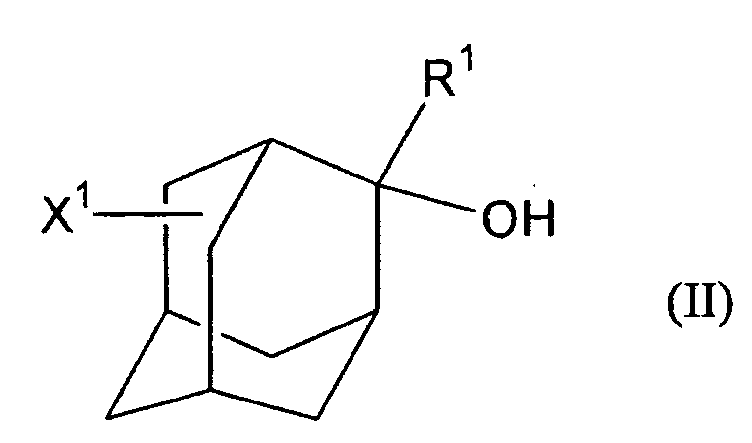
- the compound can be produced, for instance, by the reaction between a derivative of a 2-alkyl-2-adamantanol and 1,3-adamantanedicarboxylic acid, said derivative being represented by the general formula (II) wherein R 1 is an alkyl group having 1 to 8 carbon atoms; X 1 is hydrogen atom, a halogen atom, an alkyl group having 1 to 8 carbon atoms, hydroxyl group, an alkoxy group having 1 to 8 carbon atoms, carboxyl group or COOR 3 in which R 3 is an alkyl group having 1 to 8 carbon atoms, or by the reaction between a lithio-modified derivative of a 2-alkyl-2-adamantanol and halogenated 1,3-adam
- R 1 and X 1 in the aforesaid general formula (II) include those same as in the general formula (I).
- Examples of the above-mentioned derivative of 2-alkyl-2-adamantanol represented by general formula (II) according to the present invention include 2-methyl-2-adamantanol, 2-ethyl-2-adamantanol, 2-n-propyl-2-adamantanol, 2-n-pentyl-2-adamantanol, 2-n-heptyl-2-adamantanol, 2-n-octyl-2-adamantanol, 1-fluoro-2-methyl-2-adamantanol, 1-chloro-2-methyl-2-adamantanol, 1-bromo-2-methyl-2-adamantanol, 1-hydroxy-2-methyl-2-adamantanol, 1-methoxy-2-methyl-2-adamantanol, 1-ethoxy-2-methyl-2-adamantanol, 1-n-propoxy-2-methyl-2-adamantanol, 1-isopropoxy-2-methyl-2-adamantanol,
- the 1,3-adamantanedicarboxylic acid can be produced in general by Koch-Haaf reaction. Specifically, it can be produced by reacting 1,3-adamantanediol or 1,3-dihalogenated adamantane with a carbonylation agent such as carbon monoxide or formic acid at a reaction temperature in the range of minus 78 to 100°C, preferably minus 20°C to room temperature at a reaction pressure in the range of 0.1 to 10 MPa (G) for a reaction time in the range of 1 to 24 hours, preferably 3 to 6 hours.
- a carbonylation agent such as carbon monoxide or formic acid
- a solvent is not necessary in particular in the above-mentioned reaction, it is preferably used, and is exemplified by an aliphatic hydrocarbon such as hexane, heptane and octane, and an aromatic hydrocarbon such as benzene, toluene and xylene.
- the concentration of the starting raw material can be selected as high as saturated solubility without specific limitation, but is preferably in the range of 0.5 to 1.0 mol / liter.
- 1,3-Adamantanedicarboxylic acid dichloride can be produced by reacting 1,3-adamantanedicarboxylic acid with a chloridization agent such as phosphorus pentachloride, phosphorus trichloride or the like at a reaction temperature in the range of 0 to 200°C, preferably room temperature to 100°C, at a reaction pressure in the range of 0.1 to 10 MPa (G) for a reaction time in the range of 1 to 24 hours, preferably 3 to 6 hours.
- a chloridization agent such as phosphorus pentachloride, phosphorus trichloride or the like
- a solvent is not necessary in particular in the above-mentioned reaction, it is preferably used, and is exemplified by an aliphatic hydrocarbon such as hexane, heptane and octane, an aromatic hydrocarbon such as benzene, toluene and xylene and a halogenated hydrocarbon such as dichloromethane, chloroform, carbon tetrachloride and 1,2-dichloroethane.
- an aliphatic hydrocarbon such as hexane, heptane and octane
- aromatic hydrocarbon such as benzene, toluene and xylene
- a halogenated hydrocarbon such as dichloromethane, chloroform, carbon tetrachloride and 1,2-dichloroethane.
- the concentration of the starting raw material can be selected as high as saturated solubility without specific limitation, but is preferably in the range of 0.5 to 1.0 mol / liter.
- a catalyst which is not necessary in particular in the above-mentioned reaction, is exemplified by N,N-dimethylformamide, hexamethylphosphoric amide and the like.
- reaction accelerator which is not necessary in particular therein is exemplified by benzylammonium chloride.
- the reaction between the aforesaid derivative of 2-alkyl-2-adamantanol and 1,3-adamantanedicarboxylic acid, said derivative being represented by general formula (II) can be carried out in the presence of a base such as trimethylamine, triethylamine, pyridine, N,N-dimethylaniline or the like at a reaction temperature in the range of minus 78 to 100°C, preferably 0°C to room temperature, at a reaction pressure in the range of 0.1 to 10 MPa (G) for a reaction time in the range of 1 to 24 hours, preferably 1 to 3 hours.
- a base such as trimethylamine, triethylamine, pyridine, N,N-dimethylaniline or the like
- G reaction pressure in the range of 0.1 to 10 MPa
- a solvent is not necessary in particular in the above-mentioned reaction, it is preferably used, and is exemplified by an aliphatic hydrocarbon such as hexane, heptane and octane, an aromatic hydrocarbon such as benzene, toluene and xylene, a halogenated hydrocarbon such as dichloromethane, chloroform, carbon tetrachloride and 1,2-dichloroethane and an etheric compound such as diethyl ether, tetrahydrofuran and dioxane.
- an aliphatic hydrocarbon such as hexane, heptane and octane
- an aromatic hydrocarbon such as benzene, toluene and xylene
- a halogenated hydrocarbon such as dichloromethane, chloroform, carbon tetrachloride and 1,2-dichloroethane
- an etheric compound such as diethy
- the concentration of the starting raw material can be selected as high as saturated solubility without specific limitation, but is preferably in the range of 0.5 to 1.0 mol / liter.
- the derivative of 2-alkyl-2-adamantanol represented by the general formula (II) is firstly lithio-modified, and then reacted with the halogenated 1,3-adamantanedicarboxylic acid.
- the conditions of the above-mentioned reaction include a reaction temperature in the range of minus 78 to 100°C, preferably minus 78°C to room temperature, a reaction pressure in the range of 0.1 to 10 MPa (G) and a reaction time in the range of 1 to 24 hours, preferably 1 to 3 hours.
- a solvent used therein is exemplified by an aliphatic hydrocarbon such as hexane, heptane and octane, and an aromatic hydrocarbon such as benzene, toluene and xylene.
- the concentration of the starting raw material can be selected as high as saturated solubility without specific limitation, but is preferably in the range of 0.5 to 1.0 mol / liter.
- the white crystal was dissolved in 50 mL of 30% by mass of aqueous solution of sodium hydroxide, and was filtered with a glass filter. To the resultant filtrate was added 100 mL of 95% by mass of sulfuric acid, so that white crystal was precipitated.
- reaction liquid thus obtained was heated in an oil bath at 50°C to proceed with reaction for approximately 6 hours. At the point of this time, the reaction liquid was flowable non-sticky white solution.
- reaction liquid thus obtained was heated in an oil bath at 95°C to distill away excessive thionyl chloride.
- the reaction liquid turned to transparent solution after approximately 25 mL of the thionyl chloride was distilled away, and finally approximately 35 mL thereof was distilled away. Further the residual thionyl chloride was distilled away at 50°C under 133.3 Pa.
- reaction liquid thus obtained was used as such for the next synthesis.
- the resultant solution was added dropwise to the above-obtained solution of 2-methyl-2-adamantyl alkoxy lithium at room temperature by the use of a cannula over a period of about 1 to 2 minutes. Further, the 1,3-adamantanedicarboxylic acid dichloride which remained in the flask was dissolved in 5 mL of tetrahydrofuran, and the resultant solution was added dropwise thereto to proceed with reaction.
- the reaction was completed by adding 10 mL of water to the reaction solution after 12 hours period from the start thereof.
- the reaction solution thus obtained was washed with water three times, and dried with sodium sulfate anhidride to concentrate the same.
- the content in the flask was cooled with a cooling medium to 0°C, and 6.25 mL (10.0 millimol, 1.6 M) of solution of n-butyllithium in hexane was added dropwise thereto over a period of approximately 1 to 2 minutes with a result that the solution turned to yellow transparent solution.
- the resultant solution was added dropwise to the above-obtained solution of 2-ethyl-2-adamantyl alkoxy lithium at room temperature by the use of a cannula over a period of about 1 to 2 minutes. Further, the 1,3-adamantanedicarboxylic acid dichloride which remained in the flask was dissolved in 5 mL of tetrahydrofuran, and the resultant solution was added dropwise thereto to proceed with reaction.
- the reaction was completed by adding 10 mL of water to the reaction solution after 20 hours period from the start thereof.
- the reaction solution thus obtained was washed with water three times, and dried with sodium sulfate anhidride to concentrate the same.
- the 1,3-adamantanedicarboxylic acid-bis(2'-alkyl-2'-adamantyl) ester compound according to the present invention is expected to expand its usage and application typified by a photoresist additive by taking advantage of not only extremely stable carbon skeleton but also responsiveness to an acid and transparency for ultraviolet ray.
- the compound according to the present invention has a profound effect on responsiveness to an acid per unit weight by virtue of its having two ester groups in comparison with a conventional monoester adamantane compound.
Landscapes
- Chemical & Material Sciences (AREA)
- Organic Chemistry (AREA)
- Physics & Mathematics (AREA)
- Health & Medical Sciences (AREA)
- Chemical Kinetics & Catalysis (AREA)
- Medicinal Chemistry (AREA)
- Polymers & Plastics (AREA)
- Spectroscopy & Molecular Physics (AREA)
- General Physics & Mathematics (AREA)
- Organic Low-Molecular-Weight Compounds And Preparation Thereof (AREA)
Abstract
Description

yield amount: 24.365 g (108.65 millimol), yield rate: 85.0%, purity: 92.8%
yield amount: 7.757 g (29.7 millimol), yield rate: 93.0%
yield amount: 1.95 g (3.7 millimol), yield rate: 74.7%, purity: 96.1%
- 1H-NMR (270 MHz):
- 1.53 (br, 2H), 1.57 (s, 6H), 1.62 (br, 1H), 1.70 (br, 8H),1.74 (br, 3H), 1.80 (br, 4H), 1.86 (d, 12H), 1.99 (br, 2H), 2.05 (br, 4H), 2.15 (br, 2H), 2.30 (br 4H)
- 13C-NMR (68 MHz):
- 22.32, 26.82, 27.44, 28.16, 33.12, 34.57, 35.61, 36.27, 38.23, 38.30, 40.43, 41.93, 86.20, 175.59
- Infrared absorption spectra (cm-1):
- 1714.6 (C = O)
- Mass spectrometric analysis (DI - MS):
- [m / e]: 520 (M+, 0.5%), 440(1.2%), 224 (9.2%), 148 (100%)
- Melting point (mp):
- (°C); 91.3 to 97.4 (DSC measurement)
| Elemental analysis (% by weight) : C34H48O4 | |||
| C | H | O | |
| Calculated value | 78.42 | 9.29 | 12.29 |
| Analyzed value | 78.53 | 9.31 | 12.26 |
yield amount: 4.020 g (7.3 millimol), yield rate: 73.5%, purity: 98.3%
- 1H-NMR (270 MHz):
- 0.75 (t, J=7, 4Hz, 6H), 1.53 (br, 2H), 1.58 (br, 2H), 1.68 (br, 2H), 1.71 (br, 8H), 1.80 to 1.82 (m, 6H), 1.89 (d, 10H), 1.96 (br, 2H), 2.01 (br, 2H), 2.11 (br, 4H), 2.16 (q, J=7,4Hz, 4H), 2.37 (br 4H)
- 13C-NMR (68 MHz):
- 6.77, 24.57, 27.22, 27.24, 28.22, 33.21, 33.72, 34.24, 35.60, 38.34, 38.45, 41.00, 42.12, 86.27, 175.33
- Infrared absorption spectra (cm-1):
- 1717.7 (C = O)
- Mass spectrometric analysis (DI - MS):
- [m / e]: 548 (M+, 0.3%), 448(0.4%), 224(11.9%), 162 (100%)
- Melting point (mp):
- (°C); 127.3 to 129.2 (DSC measurement)
| Elemental analysis (% by weight) : C34H48O4 | |||
| C | H | O | |
| Calculated value | 78.79 | 9.55 | 11.66 |
| Analyzed value | 78.74 | 9.37 | 11.49 |
Claims (2)
- A 1,3-adamantanedicarboxylic acid-bis(2'-alkyl-2'-adamantyl) ester compound represented by the general formula (I)wherein R1 and R2 are each an alkyl group having 1 to 8 carbon atoms; X1 and X2 are each hydrogen atom, a halogen atom, an alkyl group having 1 to 8 carbon atoms, hydroxyl group, an alkoxy group having 1 to 8 carbon atoms, carboxyl group or COOR3 in which R3 is an alkyl group having 1 to 8 carbon atoms.

- The 1,3-adamantanedicarboxylic acid-bis(2'-alkyl-2'-adamantyl) ester compound according to Claim 1 wherein R1 and R2 are each selected from among methyl group, ethyl group, n-propyl group, isopropyl group, n-butyl group, isobutyl group, sec-butyl group, tert-butyl group, n-amyl group and isoamyl group; and X1 and X2 are each hydrogen atom.
Applications Claiming Priority (3)
| Application Number | Priority Date | Filing Date | Title |
|---|---|---|---|
| JP2001182767 | 2001-06-18 | ||
| JP2001182767 | 2001-06-18 | ||
| PCT/JP2002/005801 WO2002102759A1 (en) | 2001-06-18 | 2002-06-11 | Novel adamantane derivative |
Publications (3)
| Publication Number | Publication Date |
|---|---|
| EP1398309A1 true EP1398309A1 (en) | 2004-03-17 |
| EP1398309A4 EP1398309A4 (en) | 2006-01-25 |
| EP1398309B1 EP1398309B1 (en) | 2008-02-20 |
Family
ID=19022798
Family Applications (1)
| Application Number | Title | Priority Date | Filing Date |
|---|---|---|---|
| EP02733474A Expired - Lifetime EP1398309B1 (en) | 2001-06-18 | 2002-06-11 | Novel adamantane derivative |
Country Status (5)
| Country | Link |
|---|---|
| US (1) | US6833388B2 (en) |
| EP (1) | EP1398309B1 (en) |
| KR (1) | KR100908962B1 (en) |
| DE (1) | DE60225136T2 (en) |
| WO (1) | WO2002102759A1 (en) |
Cited By (1)
| Publication number | Priority date | Publication date | Assignee | Title |
|---|---|---|---|---|
| EP1837706A1 (en) * | 2006-03-24 | 2007-09-26 | Fujitsu Limited | Resist composition, method for forming resist pattern, and semiconductor device and method for manufacturing the same |
Family Cites Families (2)
| Publication number | Priority date | Publication date | Assignee | Title |
|---|---|---|---|---|
| JP2001072645A (en) * | 1999-09-06 | 2001-03-21 | Idemitsu Petrochem Co Ltd | Diadamantyl dicarboxylate compound |
| US6670499B1 (en) * | 1999-11-08 | 2003-12-30 | Daicel Chemical Industries, Ltd. | Adamantane derivatives and processes for the preparation thereof |
-
2002
- 2002-06-11 EP EP02733474A patent/EP1398309B1/en not_active Expired - Lifetime
- 2002-06-11 KR KR1020037016508A patent/KR100908962B1/en not_active Expired - Fee Related
- 2002-06-11 DE DE60225136T patent/DE60225136T2/en not_active Expired - Fee Related
- 2002-06-11 WO PCT/JP2002/005801 patent/WO2002102759A1/en not_active Ceased
- 2002-06-11 US US10/480,255 patent/US6833388B2/en not_active Expired - Fee Related
Non-Patent Citations (2)
| Title |
|---|
| No further relevant documents disclosed * |
| See also references of WO02102759A1 * |
Cited By (2)
| Publication number | Priority date | Publication date | Assignee | Title |
|---|---|---|---|---|
| EP1837706A1 (en) * | 2006-03-24 | 2007-09-26 | Fujitsu Limited | Resist composition, method for forming resist pattern, and semiconductor device and method for manufacturing the same |
| US7611819B2 (en) | 2006-03-24 | 2009-11-03 | Fujitsu Limited | Resist composition, method for forming resist pattern, and semiconductor device and method for manufacturing the same |
Also Published As
| Publication number | Publication date |
|---|---|
| DE60225136D1 (en) | 2008-04-03 |
| KR20040010728A (en) | 2004-01-31 |
| US20040157923A1 (en) | 2004-08-12 |
| EP1398309B1 (en) | 2008-02-20 |
| DE60225136T2 (en) | 2008-05-29 |
| US6833388B2 (en) | 2004-12-21 |
| WO2002102759A1 (en) | 2002-12-27 |
| EP1398309A4 (en) | 2006-01-25 |
| KR100908962B1 (en) | 2009-07-22 |
Similar Documents
| Publication | Publication Date | Title |
|---|---|---|
| CN112358427B (en) | A kind of synthetic method of trifluoromethyl thioester compound | |
| JP4015192B2 (en) | Calixarene and its use for metal sequestration | |
| US6342634B2 (en) | Calixarenes and their use for sequestration of metals | |
| US6833388B2 (en) | Adamantane derivative | |
| US5780670A (en) | DTPA derivatives modified with non-ester bond and a process for synthesizing them | |
| JP3999027B2 (en) | Novel adamantane carboxylic acid ester compounds | |
| US5151535A (en) | Fluorine-containing α,β-bifunctional compounds and process for their production | |
| JP2003073339A (en) | New adamantane derivative | |
| JP4271461B2 (en) | Halogenoacetoxyadamantane derivative and process for producing the same | |
| KR101031383B1 (en) | Halogenoacetoxyadamantane derivatives and preparation methods thereof | |
| JPWO2005108343A1 (en) | Adamantane derivative, method for producing the same, and photosensitive material for photoresist | |
| JP2001253853A (en) | New biadamantane derivative | |
| JP4275456B2 (en) | Adamantane derivative and method for producing the same | |
| EP1148043A1 (en) | PROCESS FOR PRODUCING t-BUTYL ESTERS OF BRIDGED-RING POLYCARBOXYLIC ACIDS | |
| JP2018154592A (en) | Method for producing α-haloacrylic acid ester | |
| JPH0920721A (en) | 2,4,6-triiodophenyl acrylate and its production | |
| JP4204397B2 (en) | Adamantane derivatives | |
| JPH04164085A (en) | Production of spiroorthocarbonate compound | |
| JP2920212B1 (en) | Method for producing 1,3-dioxolan-4-one compound | |
| Boag | The Synthesis of Three Chelating Reagents Derived from Chloric Acid | |
| JP2004026700A (en) | Novel adamantanecarboxylic acid ester and its production method | |
| Shibuya et al. | ROH+ CS | |
| JPH0656736A (en) | Bis (2-halogeno-4,5-difluoro) benzophenone and a novel method for producing 2-halogeno-4,5-difluorobenzoic acid therethrough | |
| JPH11240851A (en) | Alicyclic hydroxycarboxylic acid, its ester and their production | |
| JPH09110799A (en) | Process for producing hydroxybenzoic acid esters |
Legal Events
| Date | Code | Title | Description |
|---|---|---|---|
| PUAI | Public reference made under article 153(3) epc to a published international application that has entered the european phase |
Free format text: ORIGINAL CODE: 0009012 |
|
| 17P | Request for examination filed |
Effective date: 20031128 |
|
| AK | Designated contracting states |
Kind code of ref document: A1 Designated state(s): AT BE CH CY DE DK ES FI FR GB GR IE IT LI LU MC NL PT SE TR |
|
| RAP1 | Party data changed (applicant data changed or rights of an application transferred) |
Owner name: IDEMITSU KOSAN CO., LTD. |
|
| A4 | Supplementary search report drawn up and despatched |
Effective date: 20051208 |
|
| 17Q | First examination report despatched |
Effective date: 20061206 |
|
| GRAP | Despatch of communication of intention to grant a patent |
Free format text: ORIGINAL CODE: EPIDOSNIGR1 |
|
| GRAS | Grant fee paid |
Free format text: ORIGINAL CODE: EPIDOSNIGR3 |
|
| GRAA | (expected) grant |
Free format text: ORIGINAL CODE: 0009210 |
|
| AK | Designated contracting states |
Kind code of ref document: B1 Designated state(s): BE DE FR GB |
|
| REG | Reference to a national code |
Ref country code: GB Ref legal event code: FG4D |
|
| REF | Corresponds to: |
Ref document number: 60225136 Country of ref document: DE Date of ref document: 20080403 Kind code of ref document: P |
|
| ET | Fr: translation filed | ||
| PLBE | No opposition filed within time limit |
Free format text: ORIGINAL CODE: 0009261 |
|
| STAA | Information on the status of an ep patent application or granted ep patent |
Free format text: STATUS: NO OPPOSITION FILED WITHIN TIME LIMIT |
|
| 26N | No opposition filed |
Effective date: 20081121 |
|
| PGFP | Annual fee paid to national office [announced via postgrant information from national office to epo] |
Ref country code: FR Payment date: 20090616 Year of fee payment: 8 |
|
| PGFP | Annual fee paid to national office [announced via postgrant information from national office to epo] |
Ref country code: BE Payment date: 20090520 Year of fee payment: 8 |
|
| PGFP | Annual fee paid to national office [announced via postgrant information from national office to epo] |
Ref country code: DE Payment date: 20090730 Year of fee payment: 8 Ref country code: GB Payment date: 20090624 Year of fee payment: 8 |
|
| BERE | Be: lapsed |
Owner name: IDEMITSU KOSAN CO., LTD. Effective date: 20100630 |
|
| GBPC | Gb: european patent ceased through non-payment of renewal fee |
Effective date: 20100611 |
|
| REG | Reference to a national code |
Ref country code: FR Ref legal event code: ST Effective date: 20110228 |
|
| PG25 | Lapsed in a contracting state [announced via postgrant information from national office to epo] |
Ref country code: DE Free format text: LAPSE BECAUSE OF NON-PAYMENT OF DUE FEES Effective date: 20110101 |
|
| PG25 | Lapsed in a contracting state [announced via postgrant information from national office to epo] |
Ref country code: FR Free format text: LAPSE BECAUSE OF NON-PAYMENT OF DUE FEES Effective date: 20100630 |
|
| PG25 | Lapsed in a contracting state [announced via postgrant information from national office to epo] |
Ref country code: BE Free format text: LAPSE BECAUSE OF NON-PAYMENT OF DUE FEES Effective date: 20100630 |
|
| PG25 | Lapsed in a contracting state [announced via postgrant information from national office to epo] |
Ref country code: GB Free format text: LAPSE BECAUSE OF NON-PAYMENT OF DUE FEES Effective date: 20100611 |