EP1396938A1 - Sub-band adaptive differential pulse code modulation/encoding apparatus, sub-band adaptive differential pulse code modulation/encoding method, wireless transmission system, sub-band adaptive differential pulse code modulation/decoding apparatus, sub-band adaptive differential pulse code modulation/d - Google Patents
Sub-band adaptive differential pulse code modulation/encoding apparatus, sub-band adaptive differential pulse code modulation/encoding method, wireless transmission system, sub-band adaptive differential pulse code modulation/decoding apparatus, sub-band adaptive differential pulse code modulation/d Download PDFInfo
- Publication number
- EP1396938A1 EP1396938A1 EP02724674A EP02724674A EP1396938A1 EP 1396938 A1 EP1396938 A1 EP 1396938A1 EP 02724674 A EP02724674 A EP 02724674A EP 02724674 A EP02724674 A EP 02724674A EP 1396938 A1 EP1396938 A1 EP 1396938A1
- Authority
- EP
- European Patent Office
- Prior art keywords
- sub
- band
- plural
- audio signals
- vector
- Prior art date
- Legal status (The legal status is an assumption and is not a legal conclusion. Google has not performed a legal analysis and makes no representation as to the accuracy of the status listed.)
- Withdrawn
Links
Images








Classifications
-
- H—ELECTRICITY
- H03—ELECTRONIC CIRCUITRY
- H03M—CODING; DECODING; CODE CONVERSION IN GENERAL
- H03M7/00—Conversion of a code where information is represented by a given sequence or number of digits to a code where the same, similar or subset of information is represented by a different sequence or number of digits
- H03M7/30—Compression; Expansion; Suppression of unnecessary data, e.g. redundancy reduction
- H03M7/3082—Vector coding
-
- G—PHYSICS
- G10—MUSICAL INSTRUMENTS; ACOUSTICS
- G10L—SPEECH ANALYSIS TECHNIQUES OR SPEECH SYNTHESIS; SPEECH RECOGNITION; SPEECH OR VOICE PROCESSING TECHNIQUES; SPEECH OR AUDIO CODING OR DECODING
- G10L19/00—Speech or audio signals analysis-synthesis techniques for redundancy reduction, e.g. in vocoders; Coding or decoding of speech or audio signals, using source filter models or psychoacoustic analysis
- G10L19/02—Speech or audio signals analysis-synthesis techniques for redundancy reduction, e.g. in vocoders; Coding or decoding of speech or audio signals, using source filter models or psychoacoustic analysis using spectral analysis, e.g. transform vocoders or subband vocoders
- G10L19/0204—Speech or audio signals analysis-synthesis techniques for redundancy reduction, e.g. in vocoders; Coding or decoding of speech or audio signals, using source filter models or psychoacoustic analysis using spectral analysis, e.g. transform vocoders or subband vocoders using subband decomposition
-
- G—PHYSICS
- G10—MUSICAL INSTRUMENTS; ACOUSTICS
- G10L—SPEECH ANALYSIS TECHNIQUES OR SPEECH SYNTHESIS; SPEECH RECOGNITION; SPEECH OR VOICE PROCESSING TECHNIQUES; SPEECH OR AUDIO CODING OR DECODING
- G10L19/00—Speech or audio signals analysis-synthesis techniques for redundancy reduction, e.g. in vocoders; Coding or decoding of speech or audio signals, using source filter models or psychoacoustic analysis
- G10L19/02—Speech or audio signals analysis-synthesis techniques for redundancy reduction, e.g. in vocoders; Coding or decoding of speech or audio signals, using source filter models or psychoacoustic analysis using spectral analysis, e.g. transform vocoders or subband vocoders
- G10L19/032—Quantisation or dequantisation of spectral components
-
- H—ELECTRICITY
- H03—ELECTRONIC CIRCUITRY
- H03M—CODING; DECODING; CODE CONVERSION IN GENERAL
- H03M7/00—Conversion of a code where information is represented by a given sequence or number of digits to a code where the same, similar or subset of information is represented by a different sequence or number of digits
- H03M7/30—Compression; Expansion; Suppression of unnecessary data, e.g. redundancy reduction
- H03M7/3002—Conversion to or from differential modulation
- H03M7/3044—Conversion to or from differential modulation with several bits only, i.e. the difference between successive samples being coded by more than one bit, e.g. differential pulse code modulation [DPCM]
- H03M7/3046—Conversion to or from differential modulation with several bits only, i.e. the difference between successive samples being coded by more than one bit, e.g. differential pulse code modulation [DPCM] adaptive, e.g. adaptive differential pulse code modulation [ADPCM]
-
- H—ELECTRICITY
- H04—ELECTRIC COMMUNICATION TECHNIQUE
- H04B—TRANSMISSION
- H04B1/00—Details of transmission systems, not covered by a single one of groups H04B3/00 - H04B13/00; Details of transmission systems not characterised by the medium used for transmission
- H04B1/66—Details of transmission systems, not covered by a single one of groups H04B3/00 - H04B13/00; Details of transmission systems not characterised by the medium used for transmission for reducing bandwidth of signals; for improving efficiency of transmission
- H04B1/667—Details of transmission systems, not covered by a single one of groups H04B3/00 - H04B13/00; Details of transmission systems not characterised by the medium used for transmission for reducing bandwidth of signals; for improving efficiency of transmission using a division in frequency subbands
-
- H—ELECTRICITY
- H04—ELECTRIC COMMUNICATION TECHNIQUE
- H04B—TRANSMISSION
- H04B14/00—Transmission systems not characterised by the medium used for transmission
- H04B14/02—Transmission systems not characterised by the medium used for transmission characterised by the use of pulse modulation
- H04B14/04—Transmission systems not characterised by the medium used for transmission characterised by the use of pulse modulation using pulse code modulation
-
- H—ELECTRICITY
- H04—ELECTRIC COMMUNICATION TECHNIQUE
- H04B—TRANSMISSION
- H04B14/00—Transmission systems not characterised by the medium used for transmission
- H04B14/02—Transmission systems not characterised by the medium used for transmission characterised by the use of pulse modulation
- H04B14/06—Transmission systems not characterised by the medium used for transmission characterised by the use of pulse modulation using differential modulation, e.g. delta modulation
-
- G—PHYSICS
- G10—MUSICAL INSTRUMENTS; ACOUSTICS
- G10L—SPEECH ANALYSIS TECHNIQUES OR SPEECH SYNTHESIS; SPEECH RECOGNITION; SPEECH OR VOICE PROCESSING TECHNIQUES; SPEECH OR AUDIO CODING OR DECODING
- G10L25/00—Speech or voice analysis techniques not restricted to a single one of groups G10L15/00 - G10L21/00
- G10L25/03—Speech or voice analysis techniques not restricted to a single one of groups G10L15/00 - G10L21/00 characterised by the type of extracted parameters
- G10L25/12—Speech or voice analysis techniques not restricted to a single one of groups G10L15/00 - G10L21/00 characterised by the type of extracted parameters the extracted parameters being prediction coefficients
Definitions
- This invention is related to a sub-band adaptive differential pulse code modulation/encoding apparatus, hereinafter as simply referred to as "a sub-band ADPCM encoding apparatus", a sub-band adaptive differential pulse code modulation/encoding method, hereinafter as simply referred to as “a sub-band ADPCM encoding method”, a wireless transmission system, a sub-band adaptive differential pulse code modulation/decoding apparatus, hereinafter as simply referred to as "a sub-band ADPCM decoding apparatus”, a sub-band adaptive differential pulse code modulation/decoding method, hereinafter as simply referred to as "a sub-band ADPCM decoding method”, and a wireless receiving system.
- the conventional sub-band ADPCM encoding apparatus 600 comprises: a division filter bank 602 having a tree structure of 64 taps; an ADPCM quantizer 603; an ADPCM quantizer 604; an ADPCM quantizer 605; an ADPCM quantizer 606; a multiplexer 607; a de-multiplexer 608; an ADPCM de-quantizer 609; an ADPCM de-quantizer 610; an ADPCM de-quantizer 611; an ADPCM de-quantizer 612; and a synthesis filter bank 613 having a tree structure of 64 taps.
- the conventional sub-band ADPCM encoding apparatus further comprises an adaptive bit allocator 614 and an adaptive bit allocator 615, both of which are designed to operate the adaptive bit allocation in case of necessity.
- the above described conventional sub-band ADPCM encoding method and sub-band ADPCM encoding method has a problem in that its structure becomes complex, due to the use of the sub-band filter band having a tree structure, as the number of divided sub-bands increases, thereby increasing the band division calculations, and delay.
- It is a first object of the present invention to provide a sub-band adaptive differential pulse code modulation/encoding apparatus comprising: sub-band audio signal obtaining means having a predetermined asymmetric impulse response for receiving an audio signal and band-dividing the received audio signal into a predetermined number of sub-bands, so as to obtain a plurality of band-divided sub-band audio signals; a plurality of quantization means for quantizing said band-divided sub-band audio signals with the predetermined number of sub-bands; and encoding means for performing adaptive differential pulse code modulation/encoding the quantized sub-band audio signals.
- the sub-band adaptive differential pulse code modulation/encoding apparatus comprises a band division filter having a predetermined asymmetric impulse response, thereby making it possible to reduce a group delay due to the band filtering in comparison with that of the conventional band division filter having a symmetric impulse response. Even when the number of divided sub-bands increases, the sub-band adaptive differential pulse code modulation/encoding apparatus can further reduce the scale of its hardware and a group delay due to the band filtering in comparison with those of the conventional band division filter having a tree structure.
- the sub-band adaptive differential pulse code modulation/encoding apparatus comprises a band division filter having a predetermined asymmetric impulse response, thereby making it possible to reduce a group delay due to the band filtering in comparison with that of the conventional band division filter having a symmetric impulse response, and prevent a quality degradation of the audio signal decoded from the coded audio signal at a low bit rate.
- the sub-band adaptive differential pulse code modulation/encoding apparatus comprises a band division filter having a predetermined asymmetric impulse response, thereby making it possible to reduce a group delay due to the band filtering in comparison with that of the conventional band division filter having a symmetric impulse response.
- the sub-band adaptive differential pulse code modulation/encoding apparatus is further operated to judge which should be performed the scalar quantization or the vector quantization for the sub-bands, to then perform the selected quantization, thereby making it possible to process real timely even when the apparatus is insufficient in the throughput capacity for the vector quantization.
- the sub-band adaptive differential pulse code modulation/encoding apparatus comprises a band division filter having a predetermined asymmetric impulse response, thereby making it possible to reduce a group delay due to the band filtering in comparison with that of the conventional band division filter having a symmetric impulse response.
- the sub-band adaptive differential pulse code modulation/encoding apparatus is further operated: to learn a vector pattern adaptable to the vector pattern of the audio signal when the vector quantization is performed; to update the vector pattern stored in the vector quantization table; and to then transmit, to the destination, the vector quantization table in which the updated vector pattern is stored, thereby rising a ratio of signal to noise.
- the sub-band adaptive differential pulse code modulation/encoding apparatus comprises a band division filter having a predetermined asymmetric impulse response, thereby making it possible to reduce a group delay due to the band filtering in comparison with that of the conventional band division filter having a symmetric impulse response. Even when the number of divided sub-bands increases, the sub-band adaptive differential pulse code modulation/encoding apparatus can further reduce the scale of its hardware and a group delay due to the band filtering in comparison with those of the conventional band division filter having a tree structure.
- said band division filters respectively include: a filter coefficient determining unit for determining a plurality of filter coefficients; and a filtering unit for filtering a predetermined sub-band audio signal from said audio signal on the basis of said determined filter coefficients, and said filter coefficient determining unit being operated to perform a cosine-modulation with a predetermined phase difference with respect to an axis of symmetry of the symmetric finite impulse response, and to determine said plural filter coefficients, so that each of the band division filters has a predetermined asymmetric impulse response.
- the sub-band adaptive differential pulse code modulation/encoding apparatus comprises a band division filter having a predetermined asymmetric impulse response, thereby making it possible to reduce a group delay due to the band filtering in comparison with that of the conventional band division filter having a symmetric impulse response. Even when the number of divided sub-bands increases, the sub-band adaptive differential pulse code modulation/encoding apparatus can further reduce the scale of its hardware and a group delay due to the band filtering in comparison with those of the conventional band division filter having a tree structure.
- It is a seventh object of the present invention to provide a sub-band adaptive differential pulse code modulation/encoding apparatus comprising: a microphone for inputting an audio and converting the inputted audio into an audio signal; discrete audio signal obtaining means for sampling said converted audio signal at predetermined intervals, so as to obtain a discrete audio signal; sub-band audio signal obtaining means having a predetermined asymmetric impulse response for receiving an audio signal and band division the received audio signal into a predetermined number of sub-bands, so as to obtain a plurality of band-divided sub-band discrete audio signals; a plurality of down-samplers for down-sampling said band-divided sub-band discrete audio signals for a predetermined sampling frequencies of said plural sub-bands to thin down said divided sub-band discrete audio signals a plurality of quantization means for vector-quantizing said down-sampled sub-band discrete audio signals with the predetermined number of sub-bands; and encoding means for performing adaptive differential pulse code modulation/encoding the
- the sub-band adaptive differential pulse code modulation/encoding apparatus comprises a band division filter having a predetermined asymmetric impulse response, thereby making it possible to reduce a group delay due to the band filtering in comparison with that of the conventional band division filter having a symmetric impulse response. Even when the number of divided sub-bands increases, the sub-band adaptive differential pulse code modulation/encoding apparatus can further reduce the scale of its hardware and a group delay due to the band filtering in comparison with those of the conventional band division filter having a tree structure.
- the sub-band adaptive differential pulse code modulation/encoding apparatus comprises a band division filter having a predetermined asymmetric impulse response, thereby making it possible to reduce a group delay due to the band filtering in comparison with that of the conventional band division filter having a symmetric impulse response. Even when the number of divided sub-bands increases, the sub-band adaptive differential pulse code modulation/encoding apparatus can further reduce the scale of its hardware and a group delay due to the band filtering in comparison with those of the conventional band division filter having a tree structure.
- the sub-band adaptive differential pulse code modulation/encoding apparatus comprises a band division filter having a predetermined asymmetric impulse response, thereby making it possible to reduce a group delay due to the band filtering in comparison with that of the conventional band division filter having a symmetric impulse response, and prevent a quality degradation of the audio signal decoded from the coded audio signal at a low bit rate.
- the sub-band adaptive differential pulse code modulation/encoding apparatus comprises a band division filter having a predetermined asymmetric impulse response, thereby making it possible to reduce a group delay due to the band filtering in comparison with that of the conventional band division filter having a symmetric impulse response, and prevent a quality degradation of the audio signal decoded from the coded audio signal at a low bit rate.
- It is an 11th object of the present invention to provide a sub-band adaptive differential pulse code modulation/encoding method comprising: a preparing process of preparing a plurality of sub-band audio signal obtaining means having a predetermined asymmetric impulse response for receiving an audio signal and band-dividing the received audio signal into a predetermined number of sub-bands, so as to obtain a plurality of band-divided sub-band audio signals, a plurality of quantization means for quantizing said band-divided sub-band audio signals with the predetermined number of sub-bands, and encoding means for performing adaptive differential pulse code modulation/encoding said quantized sub-band audio signals; a plurality of sub-bands audio signal obtaining processes of making said band division filter band-divide said received audio signal into said predetermined number of sub-bands, so as to obtain said plural band-divided sub-band audio signals, respectively; a plurality of quantizing processes of making said plural quantization means respectively quantize said band-divided sub-band audio signals with the pre
- the sub-band adaptive differential pulse code modulation/encoding method comprises the preparing process of preparing a band division filter having a predetermined asymmetric impulse response, thereby making it possible to reduce a group delay due to the band filtering in comparison with that of the conventional band division filter having a symmetric impulse response. Even when the number of divided sub-bands increases, the sub-band adaptive differential pulse code modulation/encoding method can further reduce the scale of its hardware and a group delay due to the band filtering in comparison with those of the conventional band division filter having a tree structure.
- the sub-band adaptive differential pulse code modulation/encoding method comprises the preparing process of preparing a band division filter having a predetermined asymmetric impulse response, thereby making it possible to reduce a group delay due to the band filtering in comparison with that of the conventional band division filter having a symmetric impulse response, and prevent a quality degradation of the audio signal decoded from the coded audio signal at a low bit rate.
- the sub-band adaptive differential pulse code modulation/encoding method comprises the preparing process of preparing a band division filter having a predetermined asymmetric impulse response, thereby making it possible to reduce a group delay due to the band filtering in comparison with that of the conventional band division filter having a symmetric impulse response.
- each of the quantization processes includes the steps of: judging which should be performed the scalar quantization or the vector quantization for the sub-bands; and performing the selected quantization, thereby making it possible to process real timely even when the throughput capacity for the vector quantization is insufficient.
- the sub-band adaptive differential pulse code modulation/encoding method comprises the preparing process of preparing a band division filter having a predetermined asymmetric impulse response, thereby making it possible to reduce a group delay due to the band filtering in comparison with that of the conventional band division filter having a symmetric impulse response.
- each of the plural quantizing processes includes the steps of: learning a vector pattern adaptable to the vector pattern of the audio signal when the vector quantization is performed; updating the vector pattern stored in the vector quantization table; and transmitting, to the destination, the vector quantization table in which the updated vector pattern is stored, thereby rising a ratio of signal to noise.
- It is a 15th object of the present invention to provide a wireless transmission system comprising: sub-band audio signal obtaining means having a predetermined asymmetric impulse response for receiving an audio signal and band-dividing the received audio signal into a predetermined number of sub-bands, so as to obtain a plurality of band-divided sub-band audio signals; a plurality of quantization means for quantizing said band-divided sub-band audio signals with the predetermined number of sub-bands; and encoding means for performing adaptive differential pulse code modulation/encoding the quantized sub-band audio signals.
- the wireless transmission system comprises a band division filter having a predetermined asymmetric impulse response, thereby making it possible to reduce a group delay due to the band filtering in comparison with that of the conventional band division filter having a symmetric impulse response. Even when the number of divided sub-bands increases, the wireless transmission system can further reduce the scale of its hardware and a group delay due to the band filtering in comparison with those of the conventional band division filter having a tree structure.
- the wireless transmission system comprises a band division filter having a predetermined asymmetric impulse response, thereby making it possible to reduce a group delay due to the band filtering in comparison with that of the conventional band division filter having a symmetric impulse response, and prevent a quality degradation of the audio signal decoded from the coded audio signal at a low bit rate.
- the wireless transmission system comprises a band division filter having a predetermined asymmetric impulse response, thereby making it possible to reduce a group delay due to the band filtering in comparison with that of the conventional band division filter having a symmetric impulse response.
- the wireless transmission system is further operated to judge which should be performed the scalar quantization or the vector quantization for the sub-bands, to then perform the selected quantization, thereby making it possible to process real timely even when the wireless transmission system is insufficient in the throughput capacity for the vector quantization.
- wireless transmission system comprises a band division filter having a predetermined asymmetric impulse response, thereby making it possible to reduce a group delay due to the band filtering in comparison with that of the conventional band division filter having a symmetric impulse response.
- the wireless transmission system is further operated: to learn a vector pattern adaptable to the vector pattern of the audio signal when the vector quantization is performed; to update the vector pattern stored in the vector quantization table; and to then transmit, to the destination, the vector quantization table in which the updated vector pattern is stored, thereby rising a ratio of signal to noise.
- It is a 19th object of the present invention to provide a sub-band adaptive differential pulse code modulation/decoding apparatus comprising: sub-band separating means for receiving a coded audio signal encoded from a plurality of sub-band audio signals including a plurality of sub-bands, and separating said plural sub-band coded audio signals from said coded audio signal; a plurality of de-quantization means for de-quantizing said plural sub-band coded audio signals with a predetermined number of sub-bands; and a plurality of band synthesizing means for band-synthesizing an audio signal from said de-quantized plural sub-band audio signals.
- the sub-band adaptive differential pulse code modulation/decoding apparatus comprises a band division filter having a predetermined asymmetric impulse response, thereby making it possible to reduce a group delay due to the band filtering in comparison with that of the conventional band division filter having a symmetric impulse response. Even when the number of divided sub-bands increases, the sub-band adaptive differential pulse code modulation/decoding apparatus can further reduce the scale of its hardware and a group delay due to the band filtering in comparison with those of the conventional band division filter having a tree structure.
- the sub-band adaptive differential pulse code modulation/decoding apparatus comprises a band division filter having a predetermined asymmetric impulse response, thereby making it possible to reduce a group delay due to the band filtering in comparison with that of the conventional band division filter having a symmetric impulse response, and prevent a quality degradation of the audio signal decoded from the coded audio signal at a low bit rate.
- the sub-band adaptive differential pulse code modulation/decoding apparatus comprises a band division filter having a predetermined asymmetric impulse response, thereby making it possible to reduce a group delay due to the band filtering in comparison with that of the conventional band division filter having a symmetric impulse response.
- the sub-band adaptive differential pulse code modulation/decoding apparatus is further operated to judge which should be performed the scalar quantization or the vector quantization for the sub-bands, to then perform the selected quantization, thereby making it possible, to process real timely even when the apparatus is insufficient in the throughput capacity for the vector quantization.
- the sub-band adaptive differential pulse code modulation/decoding apparatus comprises a band division filter having a predetermined asymmetric impulse response, thereby making it possible to reduce a group delay due to the band filtering in comparison with that of the conventional band division filter having a symmetric impulse response.
- the sub-band adaptive differential pulse code modulation/decoding apparatus is further operated: to learn a vector pattern adaptable to the vector pattern of the audio signal when the vector quantization is performed; to update the vector pattern stored in the vector quantization table; and to then transmit, to the destination, the vector quantization table in which the updated vector pattern is stored, thereby rising a ratio of signal to noise.
- said band synthesizing means includes: a band synthesis unit having a predetermined asymmetric finite impulse response; and a filter coefficient determining unit for determining a plurality of filter coefficients, said filter coefficient determining unit being operated to perform a cosine-modulation with a predetermined phase difference with respect to an axis of symmetry of the symmetric finite impulse response, and to determine said plural filter coefficients, so that each of the band synthesis means has a predetermined asymmetric impulse response.
- the sub-band adaptive differential pulse code modulation/decoding apparatus comprises a band division filter having a predetermined asymmetric impulse response, thereby making it possible to reduce a group delay due to the band filtering in comparison with that of the conventional band division filter having a symmetric impulse response. Even when the number of divided sub-bands increases, the sub-band adaptive differential pulse code modulation/decoding apparatus can further reduce the scale of its hardware and a group delay due to the band filtering in comparison with those of the conventional band division filter having a tree structure.
- It is a 24th object of the present invention to provide a sub-band adaptive differential pulse code modulation/decoding apparatus comprising: a sub-band separating means for receiving a plurality of sub-band audio signals, for a plurality of sub-bands, encoded from a plurality of audio signals of said plural sub-bands, and separating a plurality of index numbers respectively corresponding to a plurality of code vectors which is used to vector-quantize said plural sub-band coded audio signals to obtain said plural sub-band audio signals; a plurality of de-quantization means for vector-de-quantizing to obtain said plural sub-band audio signals on the basis of the separated index numbers; an up-sampler for up-sampling for up-sampling said predetermined plural sub-band audio signals so as to interpolate the thinned down sampled values into the plural sub-band audio signals down-sampled for thinning down; and a band synthesizing means for band-synthesizing said audio signal from said sub-band audio components
- the sub-band adaptive differential pulse code modulation/decoding apparatus comprises a band division filter having a predetermined asymmetric impulse response, thereby making it possible to reduce a group delay due to the band filtering in comparison with that of the conventional band division filter having a symmetric impulse response. Even when the number of divided sub-bands increases, the sub-band adaptive differential pulse code modulation/decoding apparatus can further reduce the scale of its hardware and a group delay due to the band filtering in comparison with those of the conventional band division filter having a tree structure.
- the sub-band adaptive differential pulse code modulation/decoding apparatus comprises a band division filter having a predetermined asymmetric impulse response, thereby making it possible to reduce a group delay due to the band filtering in comparison with that of the conventional band division filter having a symmetric impulse response. Even when the number of divided sub-bands increases, the sub-band adaptive differential pulse code modulation/decoding apparatus can further reduce the scale of its hardware and a group delay due to the band filtering in comparison with those of the conventional band division filter having a tree structure.
- It is a 26th object of the present invention to provide a sub-band adaptive differential pulse code modulation/decoding method comprising: a preparing process of preparing sub-band separating means for receiving a coded audio signal encoded from a plurality of sub-band audio signals including a plurality of sub-bands, and separating said plural sub-band coded audio signals from said coded audio signal, a plurality of de-quantization means for de-quantizing said plural sub-band coded audio signals with a predetermined number of sub-bands, and band synthesizing means for band-synthesizing an audio signal from said de-quantized plural sub-band audio signals; a sub-band separating process of receiving a coded audio signal encoded from a plurality of sub-band audio signals including a plurality of sub-bands, and making said sub-band separating means separate said plural sub-band coded audio signals from said coded audio signal, a plurality of de-quantizing processes of making said plural de-quantization means respectively de-quantize
- the sub-band adaptive differential pulse code modulation/decoding method comprises the preparing process of preparing a band division filter having a predetermined asymmetric impulse response, thereby making it possible to reduce a group delay due to the band filtering in comparison with that of the conventional band division filter having a symmetric impulse response. Even when the number of divided sub-bands increases, the sub-band adaptive differential pulse code modulation/decoding method can further reduce the scale of its hardware and a group delay due to the band filtering in comparison with those of the conventional band division filter having a tree structure.
- the sub-band adaptive differential pulse code modulation/decoding method comprises the preparing process of preparing a band division filter having a predetermined asymmetric impulse response, thereby making it possible to reduce a group delay due to the band filtering in comparison with that of the conventional band division filter having a symmetric impulse response, and prevent a quality degradation of the audio signal decoded from the coded audio signal at a low bit rate.
- the sub-band adaptive differential pulse code modulation/decoding method comprises the preparing process of preparing a band division filter having a predetermined asymmetric impulse response, thereby making it possible to reduce a group delay due to the band filtering in comparison with that of the conventional band division filter having a symmetric impulse response.
- each of the quantization processes includes the steps of: judging which should be performed the scalar quantization or the vector quantization for the sub-bands; and performing the selected quantization, thereby making it possible to process real timely even when the throughput capacity for the vector quantization is insufficient.
- the sub-band adaptive differential pulse code modulation/decoding method comprises the preparing process of preparing a band division filter having a predetermined asymmetric impulse response, thereby making it possible to reduce a group delay due to the band filtering in comparison with that of the conventional band division filter having a symmetric impulse response.
- each of the plural quantizing processes includes the steps of: learning a vector pattern adaptable to the vector pattern of the audio signal when the vector quantization is performed; updating the vector pattern stored in the vector quantization table; and transmitting, to the destination, the vector quantization table in which the updated vector pattern is stored, thereby rising a ratio of signal to noise.
- the sub-band adaptive differential pulse code modulation/decoding method comprises the preparing process of preparing a band division filter having a predetermined asymmetric impulse response, thereby making it possible to reduce a group delay due to the band filtering in comparison with that of the conventional band division filter having a symmetric impulse response. Even when the number of divided sub-bands increases, the sub-band adaptive differential pulse code modulation/decoding method can further reduce the scale of its hardware and a group delay due to the band filtering in comparison with those of the conventional band division filter having a tree structure.
- It is a 30th object of the present invention to provide a wireless receiving system comprising: sub-band separating means for receiving a coded audio signal encoded from a plurality of sub-band audio signals including a plurality of sub-bands, and separating said plural sub-band coded audio signals from said coded audio signal; a plurality of de-quantization means for de-quantizing said plural sub-band coded audio signals with a predetermined number of sub-bands; and a plurality of band synthesizing means for band-synthesizing an audio signal from said de-quantized plural sub-band audio signals.
- the wireless receiving system comprises a band division filter having a predetermined asymmetric impulse response, thereby making it possible to reduce a group delay due to the band filtering in comparison with that of the conventional band division filter having a symmetric impulse response. Even when the number of divided sub-bands increases, the wireless receiving system can further reduce the scale of its hardware and a group delay due to the band filtering in comparison with those of the conventional band division filter having a tree structure.
- the wireless receiving system comprises a band division filter having a predetermined asymmetric impulse response, thereby making it possible to reduce a group delay due to the band filtering in comparison with that of the conventional band division filter having a symmetric impulse response, and prevent a quality degradation of the audio signal decoded from the coded audio signal at a low bit rate.
- the wireless receiving system comprises a band division filter having a predetermined asymmetric impulse response, thereby making it possible to reduce a group delay due to the band filtering in comparison with that of the conventional band division filter having a symmetric impulse response.
- the wireless receiving system is further operated to judge which should be performed the scalar quantization or the vector quantization for the sub-bands, to then perform the selected quantization, thereby making it possible to process real timely even when the wireless receiving system is insufficient in the throughput capacity for the vector quantization.
- the wireless receiving system comprises a band division filter having a predetermined asymmetric impulse response, thereby making it possible to reduce a group delay due to the band filtering in comparison with that of the conventional band division filter having a symmetric impulse response.
- the wireless receiving system is further operated: to learn a vector pattern adaptable to the vector pattern of the audio signal when the vector quantization is performed; to update the vector pattern stored in the vector quantization table; and to then transmit, to the destination, the vector quantization table in which the updated vector pattern is stored, thereby rising a ratio of signal to noise.
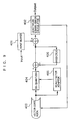
- FIG. 1 is a block diagram showing a sub-band ADPCM encoding apparatus 100, as an example of the first embodiment of the sub-band ADPCM encoding apparatus according to the present invention, for dividing a predetermined frequency band into four sub-bands and encoding for the divided sub-bands.
- band division finite impulse response filters as referred to as simply "band division FIR filters” hereinlater, (H 0 (z)102, H 1 (z)103, H 2 (z)104, and H 3 (z)105), each having a predetermined asymmetric impulse response characteristic, for receiving an audio signal having a predetermined sampling frequency, and band-dividing the received audio signal into the predetermined four sub-bands;
- four down-samplers (106, 107, 108, and 109) for down-sampling the four sub-band audio signals for four predetermined sampling frequencies of the sub-bands to thin down the four sub-band audio signals, respectively;
- quantizing means 110, 111, 112, and 113 for quantizing the down-sampled four sub-band audio signals, respectively, with a predetermined number of sub-bands; and encoding means (115) for performing adaptive differential pulse code modulation/encoding, referred to as simply "ADPCM encoding” hereinlater, the quantized four sub-band audio signals.
- band division FIR filters H 0 (z)102, H 1 (z)103, H 2 (z)104, and H 3 (z)105
- the sub-band division filter bank 101 further constitutes sub-band audio signal obtaining means.
- each of the band division FIR filters (H 0 (z)102, H 1 (z)103, H 2 (z)104, and H 3 (z)105) comprises: a filter coefficient determining unit for determining a plurality of filter coefficients; and a filtering unit for filtering the predetermined sub-band audio signals from the audio signal on the basis of the determined filter coefficients, the filter coefficient determining unit being operated to perform a cosine-modulation with a predetermined phase difference with respect to an axis of symmetry of the symmetric finite impulse response, so that each of the band division FIR filters has a predetermined asymmetric impulse response.
- the sub-band division filter bank 101 will be described hereinafter in further detail with reference to the drawings of FIGS. 3 through 7.
- FIG. 3 is a graph showing the impulse response when the predetermined impulse signal is inputted to the band division FIR filters (H 0 (z)102, H 1 (z)103, H 2 (z)104, and H 3 (z)105).
- H 0 (z)102, H 1 (z)103, H 2 (z)104, and H 3 (z)105 There is shown in FIG. 3 two waveforms of the impulse response.
- One of waveforms of the impulse response drawn by a one dot broken line is indicative of outputs of a symmetric impulse response with respect to a center of 64 samples obtained from predetermined plurality of filter coefficient signals.
- Another one of waveforms of the impulse response drawn by a solid line is indicative of outputs of an asymmetric impulse response obtained by modulating a plurality of predetermined filter coefficient signals inputted to a reference filter having a symmetric impulse response.
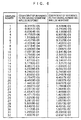
- FIG. 6 and FIG. 7 lists indicative of an example for a plurality of predetermined filter coefficient signals inputted to the reference filter in the symmetric impulse response and
- an asymmetric impulse response cosine-modulated with a predetermined phase difference with respect to an axis of symmetry of the symmetric impulse response is referred to as "a predetermined asymmetric impulse response" herein.
- the filter coefficients of the band division FIR filters H 0 (z)102, H 1 (z)103, H 2 (z)104, and H 3 (z)105) are determined, so as to have a predetermined asymmetric impulse response.
- k is the number of the sub-bands (0 to M -1)
- p L ( n ) is the impulse response of the reference filter
- M is the number of the sub-bands
- k d is a delay due to the division.
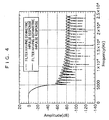
- the frequency-amplitude characteristics shown in FIG. 4 are indicated that the amplitude of the filter having the asymmetric impulse response is further reduced in comparison with that of the filter having the symmetric impulse response.
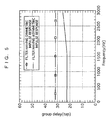
- the group delay characteristics shown in FIG. 5 are indicated that the group delay of the filter having the asymmetric impulse response is further reduced in comparison with that of the filter having the symmetric impulse response.
- the filter having the symmetric impulse response has N-1 delays of the sub-band audio signals divided into the sub-bands; on the other hand, the filter having the predetermined asymmetric impulse response has the delays that are reduced to no more than N-1 .
- N is the number of taps of the reference filter.
- the ADPCM quantizers (110, 111, 112, and 113) for performing the vector quantization will be described as the vector-quantization means hereinlater.
- FIG. 9 shows the ADPCM quantizers (110, 111, 112, and 113) for vector-quantizing the audio signals.
- the vector quantization is performed by selecting one vector having the least mean square error, which is obtained from a plurality of previously stored vectors used to quantize a predetermined number of samples as one vector, as a representative vector, and quantizing collectively a predetermined number of samples with the selected representative vector.
- the selected representative vector is referred to as a code vector.
- the plural representative vectors are previously collected and then stored on a table, which is referred to as a vector code book.
- the ADPCM quantizers (110, 111, 112, and 113) is designed to selectively operated to: vector-quantize the sub-band audio signals in the sub-bands in which the sub-band audio signals are previously designated to be vector-quantized; and scalar-quantize the sub-band audio signals in the sub-bands in which the sub-band audio signals are previously designated to be scalar-quantized.
- the sufficient throughput capacity for the vector quantization causes all of the sub-bands can be vector-quantized, regardless of the designation of the vector quantization; besides the insufficient throughput capacity for the vector quantization causes the sub-bands, only which are designated for the vector quantization, are vector-quantized.
- the ADPCM quantizers (110, 111, 112, and 113) include: a quantization table storing unit 403 capable of previously storing, into a quantization table, a plurality of code vectors used to vector-quantize the plural sub-band audio signals, and a plurality of index numbers corresponding to the respective code vectors; a de-quantizer 404 for de-quantizing the code vectors stored in the quantization table storing unit; and a scale factor adaptor 405 for adapting a scale factor to the de-quantized code vector in accordance with the tendency of the variation of a plurality of previous code vectors.
- the scale factor adaptor 405 is operated to increase the scale factor when the variation of the previous code vectors shows a strong tendency; besides the scale factor adaptor 405 is operated to decrease the scale factor when the variation of the previous code vectors shows a weak tendency.
- the ADPCM quantizers (110, 111, 112, and 113) further includes: a predictor 406 for calculating a predictive value on the basis of a plurality of previous de-quantized values; an input buffer 401 for storing therein a plurality of sampled data on the sub-band audio signals for the next calculation; and a least mean square error calculator 402 for adding the de-quantized value de-quantized by the de-quantizer 404 and the predictive value calculated by the predictor 406 to obtain a predictive value of a plurality of sampled data on the next obtained sub-band audio signals, subtracting the predictive value of the plural sampled data on the next obtained sub-band audio signals from the sub-band audio signals stored in the input buffer 401, and calculating a least mean square error, so
- the ADPCM quantizers (110, 111, 112, and 113) further comprises: quantization table updating unit for updating a vector quantization table by learning, by a predetermined learning method, the code vector capable of further reducing the error on the basis of the subtract result obtained by subtracting the predictive value of the plural sampled data on the next obtained sub-band audio signal from the plural sampled data on the sub-band audio signals stored in the input buffer 401; a state judging unit for judging whether the level of the inputted audio signal is no more than a predetermined minimum signal level or not, and judging whether the inputted audio signal is kept the predetermined minimum signal level or below over a predetermined duration or not; a quantization table transmitting unit for transmitting the updated quantization table to a predetermined destination.
- the quantization table transmitting unit is operated to transmit the updated quantization table to the predetermined destination when the state judging unit is operated to judge that the level of the inputted audio signal is no more than the predetermined minimum signal level, and judge that the inputted audio signal is kept the predetermined minimum signal level or below over the predetermined duration.
- the quantization table transmitting unit is operated to interrupt the transmission of the updated quantization table when the state judging unit is operated to judge that the level of the inputted audio signals exceeds the predetermined minimum signal level during the transmission of the updated quantization table for the destination.
- the quantization table transmitting unit is further operated to continuously transmit the updated quantization table when the state judging unit is operated to judge that the level of the inputted audio signal is no more than the predetermined minimum signal level, and judge that the inputted audio signal is kept the predetermined minimum signal level or below over the predetermined duration during the transmission of the updated quantization table for the destination.
- the ADPCM quantizers (110, 111, 112, and 113) are designed to perform the vector quantization on the basis of the updated quantization table when the transmission of the updated quantization table is completed.
- the ADPCM quantizers may further comprise a plurality of energy calculating units for each calculating an energy of the sub-band audio signal obtained by the de-quantization of the representative vector; a ratio calculating unit for calculating a ratio of the calculated energy of the plural sub-band audio signals; and an adaptive bit allocating unit for adaptively allocating the number of bits for the sub-bands on the basis of the ratio of the calculated energy of the plural sub-band audio signals, and be designed to allocate the number of bits for the sub-bands on the basis of the ratio of the energy of the de-quantized plural sub-band audio signals.
- the adaptive bit allocator 114 is designed to adaptively allocate the bits for the sub-bands.
- the adaptive bit allocator 114 may be designed to allocate fixed bits instead of adaptive bit allocation for the sub-bands.
- the multiplexer 115 is designed to produce bit streams from the quantized audio signals for the sub-bands.
- the plural filter coefficient signals are previously designated to the band division FIR filters (H 0 (z)102, H 1 (z)103, H 2 (z)104, and H 3 (z)105), so that the plural band division FIR filters can have a predetermined asymmetric impulse response characteristic.
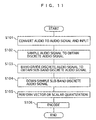
- the audio is inputted and then converted to an audio signal (S101).
- the audio signal is then sampled at intervals of a predetermined frequency (S102).
- the inputted audio signal is divided into predetermined plural sub-bands by the sub-band audio signal obtaining means (S103).
- the sub-band audio signals are then down-sampled by the down-samplers (106, 107, 108, and 109) (S104).
- the band-divided plural sub-band audio signals are quantized with a predetermined number of sub-bands (S105).
- the quantized plural sub-band audio signals are then adaptive differential pulse code modulation/encoded (S106).
- a plurality of sampled data on a plurality of sub-band audio signals for the next calculation are stored in the input buffer 401 (S201).
- the mean square error with the predictive value of the next plural sub-band audio signals are calculated by the least mean square error calculator 402.
- the judgment is made whether the error is the least or not.
- the following code vector is selected (S204).
- the selected code vector is then de-quantized by the de-quantizer 404 (S205).
- the scale factor is then adapted to the de-quantized code vector by the scale factor adaptor 405 (S206).
- the code vector adapted by the scale factor and the output of the predictor 406 are added.
- the mean square error with the sampled data of the next obtained sub-band audio signals are then calculated.
- the audio signal is vector-quantized on the basis of the code vector.
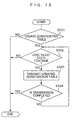
- the quantization table is updated by the learning, and then the judgment is made whether the updated quantization table is transmitted or not (S301). Next, the judgment is made, by the state judging unit, whether the signal level is no more than a predetermined minimum signal level or not, and then the judgment is made whether the signal is kept the predetermined minimum signal level or below over a predetermined duration or not (S302).
- the updated quantization table is then transmitted to a predetermined destination by the quantization table transmitting unit (S303).
- the quantization table transmitting unit is operated to interrupt the transmission of the updated vector quantization table (S304).
- the quantization table transmitting unit is operated to continuously transmit the updated vector quantization table.
- the completion of the transmission of the updated quantization table causes: the transmitting end to perform the vector quantization on the basis of the updated vector quantization table; but the receiving end to perform the vector de-quantization on the basis of the updated vector quantization table.
- the above sub-band ADPCM encoding apparatus is thus described as one example that the audio signal is divided into, but not limited to, four bands.
- the preferred embodiment according to the present invention can provide the sub-band ADPCM encoding apparatus comprising band-divided filters each having an asymmetric impulse response characteristic, thereby causing a little group delay.
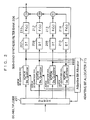
- FIG. 2 is a block diagram showing a sub-band ADPCM decoding apparatus 200, as an example of the second preferred embodiment of the sub-band ADPCM decoding apparatus according to the present invention, for decoding an audio signal from the coded audio signal obtained by dividing a predetermined frequency into four sub-bands and encoding.
- de-multiplexer 201 for separating four sub-band coded audio signals for a predetermined number of bits from a coded audio signal having four sub-band coded audio signals which are obtained by encoding the audio signals and dividing the coded audio signals into four sub-bands; four de-quantizing means (202, 203, 204, and 205) for de-quantizing the separated four sub-band coded audio signals with a predetermined number of sub-bands; the quantized four sub-band audio signals having sampling frequencies of the sub-bands down-sampled so as to thin down the sampled values on the sub-band audio signals, respectively, four up-samplers (207, 208, 209, and 210) for up-sampling the sub-band audio signals so as to interpolate the thinned down sampled values on the sub-band audio signals, the up-sampled four sub-band audio signals having the sub-band audio components of the audio, respectively; four band synthesis filters (F 0 (z)211, F 1 (z)
- the band synthesis FIR filters (F 0 (z)211, F 1 (z)212, F 2 (z)213, and F 3 (z)214) further comprise: a filter coefficient determining unit for determining a plurality of filter coefficients; and a filtering unit for synthesizing a predetermined sub-band audio signals from the audio signal on the basis of the determined filter coefficients, and are operated to perform a cosine-modulation with a predetermined phase difference with respect to an axis of symmetry of the symmetric finite impulse response, so that each of the band synthesis filters has a predetermined asymmetric impulse response.
- the plurality of predetermined filter coefficients are designated so as to modulate an impulse response with a predetermined cosine signal.
- k is the number of the sub-bands (0 to M -1)
- p L ( n ) is the impulse response of the reference filter
- M is the number of the sub-bands
- k d is a delay due to the division.
- FIG. 8 shows the delay of the filter bank having the asymmetric impulse response characteristic of the preferred embodiment according to the present invention in comparison with that of the conventional filter band having a tree structure. It is apparent from FIG. 8 that the sub-band encoding-decoding method of the preferred embodiment according to the present invention has achieved a beautiful effect of the reduction in delay.
- FIG. 10 shows the ADPCM de-quantizers (202, 203, 204, and 205) for vector-quantizing for one of the sub-bands.
- the ADPCM de-quantizers (202, 203, 204, and 205) comprises: a vector code book 501 for calculating a code vector on the basis of the received index number; de-quantizer 502 for de-quantizing the code vector; a scale factor adaptor 503 for calculating a scale factor for the de-quantization; and a predictor 504.
- the insufficient throughput capacity for the vector quantization in real time operation may cause the ADPCM to perform a general scalar quantization for some sub-bands.
- the sufficient throughput capacity in real time operation allows that the code vector to be learned to update the vector code book.
- the index number of the code vector is received and the code vector corresponding to the received index number is selected from among the vector code book 501 (S401).
- the selected code vector is then de-quantized for the sub-bands by the ADPCM de-quantizers (202, 203, 204, and 205), respectively, to obtain the audio signal (S402).
- the de-quantized audio signal is up-sampled for the sub-bands by the up-samplers (207, 208, 209, and 210) (S403).
- the up-sampled audio signal is then synthesized into the audio signal by way of the band synthesis filter (211, 212, 213, and 214) (S404).
- ADPCM de-quantizers (202, 203, 204, and 205) will be described hereinlater with reference to the drawings of FIG. 15.
- the index number of the code vector is received (S501).
- the code vector corresponding to the index number is then selected (S502).
- the selected code vector is then de-quantized by the de-quantizer 502, the scale factor is adapted by the scale factor adaptor 503 (S504).
- the output of the predictor 504 is added and then outputted from the ADPCM de-quantizers (S505).
- a normally unallocated index number is prepared. Just before the updated vector code book is transmitted to the decoder, this index number is transmitted for a predetermined duration. After that, the updated vector code book is transmitted. There is any input signal in the middle of the transmission; the normal encoding index is transmitted after the transmission of the normally unallocated index number is completed so that the transmission of the updated vector code book is immediately interrupted. When the encoder becomes no input state again, the normally unallocated index number is transmitted for a predetermined duration. After that, the transmission of the updated vector code book is resumed from the position interrupted. After the transmission of a predetermined vector code books is completed, the normal encoding process and decoding process are resumed.
- the above sub-band ADPCM decoding apparatus is thus described as one example that the audio signal is divided into, but not limited to, four bands.
- the present invention can provide the sub-band ADPCM encoding apparatus, the sub-band ADPCM encoding method, and the wireless transmission system which includes a coefficient determining means for determining a plurality of filter coefficients to make the band division filter and the band synthesis filter have asymmetric impulse response characteristics, thereby reducing a group delay in comparison with that of the conventional band division filter and the band synthesis filter having a symmetric impulse response.
- the present invention can further provide the sub-band ADPCM decoding apparatus, the sub-band decoding method, and the wireless receiving system which comprises: a separating unit for receiving a coded audio signal, and separating a plurality of sub-bands each having a predetermined number of bits for frames; a de-quantizing unit for de-quantizing the separated signals, respectively, with a predetermined number of sub-bands; and a synthesis filter bank for synthesizing the respective de-quantized signals, thereby making it possible to reduce the group delay due to the filtering in comparison with that of the conventional reference filter which has a symmetric impulse response.
- the present invention can further provide the sub-band ADPCM decoding apparatus, the sub-band decoding method, and the wireless receiving system, which can have an effect in the reduction in the scale of its hardware and the group delay in comparison with those having a tree structure.
Landscapes
- Engineering & Computer Science (AREA)
- Signal Processing (AREA)
- Physics & Mathematics (AREA)
- Computer Networks & Wireless Communication (AREA)
- Spectroscopy & Molecular Physics (AREA)
- Health & Medical Sciences (AREA)
- Computational Linguistics (AREA)
- Audiology, Speech & Language Pathology (AREA)
- Human Computer Interaction (AREA)
- Acoustics & Sound (AREA)
- Multimedia (AREA)
- Theoretical Computer Science (AREA)
- Compression, Expansion, Code Conversion, And Decoders (AREA)
- Transmission Systems Not Characterized By The Medium Used For Transmission (AREA)
Abstract
A sub-band adaptive differential pulse code modulation/encoding apparatus
includes means (102, 103, 104, 105) having a predetermined asymmetric impulse
response for receiving an audio signal and band-dividing the received audio signal into
a predetermined number of sub-bands, so as to obtain a plurality of band-divided sub-band
audio signals, a plurality of quantization means (110, 111, 112, 113) for quantizing
the band-divided sub-band audio signals with the predetermined number of sub-bands,
and encoding means (115) for performing adaptive differential pulse code
modulation/encoding of the quantized sub-band audio signals.
Description
This invention is related to a sub-band adaptive differential pulse code
modulation/encoding apparatus, hereinafter as simply referred to as "a sub-band
ADPCM encoding apparatus", a sub-band adaptive differential pulse code
modulation/encoding method, hereinafter as simply referred to as "a sub-band ADPCM
encoding method", a wireless transmission system, a sub-band adaptive differential
pulse code modulation/decoding apparatus, hereinafter as simply referred to as "a sub-band
ADPCM decoding apparatus", a sub-band adaptive differential pulse code
modulation/decoding method, hereinafter as simply referred to as "a sub-band ADPCM
decoding method", and a wireless receiving system.
In conventional, this kind of methods of sub-band ADPCM encoding and sub-band
ADPCM decoding is well known as disclosed in Kohyo (Japan Unexamined
Patent Publication) No. H03-504787.
As shown in Figure 16, the conventional sub-band ADPCM encoding
apparatus 600 comprises: a division filter bank 602 having a tree structure of 64 taps; an
ADPCM quantizer 603; an ADPCM quantizer 604; an ADPCM quantizer 605; an
ADPCM quantizer 606; a multiplexer 607; a de-multiplexer 608; an ADPCM de-quantizer
609; an ADPCM de-quantizer 610; an ADPCM de-quantizer 611; an ADPCM
de-quantizer 612; and a synthesis filter bank 613 having a tree structure of 64 taps.
The conventional sub-band ADPCM encoding apparatus further comprises an adaptive
bit allocator 614 and an adaptive bit allocator 615, both of which are designed to operate
the adaptive bit allocation in case of necessity.
The above described conventional sub-band ADPCM encoding method and
sub-band ADPCM encoding method, however, has a problem in that its structure
becomes complex, due to the use of the sub-band filter band having a tree structure, as
the number of divided sub-bands increases, thereby increasing the band division
calculations, and delay.
In order to solve the foregoing conventional problem, it is therefore an object
of the present invention to provide a sub-band ADPCM encoding method, a sub-band
ADPCM decoding method, a sub-band ADPCM encoding apparatus, a sub-band
ADPCM decoding apparatus, a wireless transmission system, and a wireless receiving
system, that can reduce delay and have little calculation.
It is a first object of the present invention to provide a sub-band adaptive
differential pulse code modulation/encoding apparatus comprising: sub-band audio
signal obtaining means having a predetermined asymmetric impulse response for
receiving an audio signal and band-dividing the received audio signal into a
predetermined number of sub-bands, so as to obtain a plurality of band-divided sub-band
audio signals; a plurality of quantization means for quantizing said band-divided
sub-band audio signals with the predetermined number of sub-bands; and encoding
means for performing adaptive differential pulse code modulation/encoding the
quantized sub-band audio signals. According to the present invention, the sub-band
adaptive differential pulse code modulation/encoding apparatus comprises a band
division filter having a predetermined asymmetric impulse response, thereby making it
possible to reduce a group delay due to the band filtering in comparison with that of the
conventional band division filter having a symmetric impulse response. Even when
the number of divided sub-bands increases, the sub-band adaptive differential pulse
code modulation/encoding apparatus can further reduce the scale of its hardware and a
group delay due to the band filtering in comparison with those of the conventional band
division filter having a tree structure.
It is a second object of the present invention to provide the sub-band adaptive
differential pulse code modulation/encoding apparatus, wherein said plural quantization
means are operated to vector-quantize said plural sub-band audio signals, respectively.
According to the present invention, the sub-band adaptive differential pulse code
modulation/encoding apparatus comprises a band division filter having a predetermined
asymmetric impulse response, thereby making it possible to reduce a group delay due to
the band filtering in comparison with that of the conventional band division filter having
a symmetric impulse response, and prevent a quality degradation of the audio signal
decoded from the coded audio signal at a low bit rate.
It is a third object of the present invention to provide the sub-band adaptive
differential pulse code modulation/encoding apparatus, wherein said plural quantization
means are selectively operated to: vector-quantize the sub-band audio signals in the sub-bands
in which the sub-band audio signals are previously designated to be vector-quantized;
and scalar-quantize the sub-band audio signals in the sub-bands in which the
sub-band audio signals are previously designated to be scalar-quantized. According to
the present invention, the sub-band adaptive differential pulse code
modulation/encoding apparatus comprises a band division filter having a predetermined
asymmetric impulse response, thereby making it possible to reduce a group delay due to
the band filtering in comparison with that of the conventional band division filter having
a symmetric impulse response. The sub-band adaptive differential pulse code
modulation/encoding apparatus is further operated to judge which should be performed
the scalar quantization or the vector quantization for the sub-bands, to then perform the
selected quantization, thereby making it possible to process real timely even when the
apparatus is insufficient in the throughput capacity for the vector quantization.
It is a fourth object of the present invention to provide the sub-band adaptive
differential pulse code modulation/encoding apparatus, wherein said plural quantization
means have: a quantization table storing unit for previously storing, into a quantization
table, a plurality of code vectors used to vector-quantize said plural sub-band audio
signals; a quantization table updation unit for updating said previously stored plural
code vectors on the basis of a signal pattern of said plural sub-band audio signals; and a
quantization table transmitting unit for judging whether a silent state, in which the level
of said received audio signal is less than a predetermined minimum signal level, is kept
over a predetermine duration or not, and transmitting said updated quantization table on
the basis of the judgment result, said plural quantization means being operated to
vector-quantize said plural sub-band audio signals, respectively, on the basis of said
updated quantization table when the transmission of said updated quantization table is
completed. According to the present invention, the sub-band adaptive differential
pulse code modulation/encoding apparatus comprises a band division filter having a
predetermined asymmetric impulse response, thereby making it possible to reduce a
group delay due to the band filtering in comparison with that of the conventional band
division filter having a symmetric impulse response. The sub-band adaptive
differential pulse code modulation/encoding apparatus is further operated: to learn a
vector pattern adaptable to the vector pattern of the audio signal when the vector
quantization is performed; to update the vector pattern stored in the vector quantization
table; and to then transmit, to the destination, the vector quantization table in which the
updated vector pattern is stored, thereby rising a ratio of signal to noise.
It is a fifth object of the present invention to provide the sub-band adaptive
differential pulse code modulation/encoding apparatus, wherein said sub-band audio
signal obtaining means includes a plurality of band division filters each having an
asymmetric finite impulse response, and said plural band division filters being operated
to band-divide said audio signal into said plural predetermined sub-bands. According
to the present invention, the sub-band adaptive differential pulse code
modulation/encoding apparatus comprises a band division filter having a predetermined
asymmetric impulse response, thereby making it possible to reduce a group delay due to
the band filtering in comparison with that of the conventional band division filter having
a symmetric impulse response. Even when the number of divided sub-bands increases,
the sub-band adaptive differential pulse code modulation/encoding apparatus can further
reduce the scale of its hardware and a group delay due to the band filtering in
comparison with those of the conventional band division filter having a tree structure.
It is a sixth object of the present invention to provide the sub-band adaptive
differential pulse code modulation/encoding apparatus, said band division filters
respectively include: a filter coefficient determining unit for determining a plurality of
filter coefficients; and a filtering unit for filtering a predetermined sub-band audio signal
from said audio signal on the basis of said determined filter coefficients, and said filter
coefficient determining unit being operated to perform a cosine-modulation with a
predetermined phase difference with respect to an axis of symmetry of the symmetric
finite impulse response, and to determine said plural filter coefficients, so that each of
the band division filters has a predetermined asymmetric impulse response. According
to the present invention, the sub-band adaptive differential pulse code
modulation/encoding apparatus comprises a band division filter having a predetermined
asymmetric impulse response, thereby making it possible to reduce a group delay due to
the band filtering in comparison with that of the conventional band division filter having
a symmetric impulse response. Even when the number of divided sub-bands increases,
the sub-band adaptive differential pulse code modulation/encoding apparatus can further
reduce the scale of its hardware and a group delay due to the band filtering in
comparison with those of the conventional band division filter having a tree structure.
It is a seventh object of the present invention to provide a sub-band adaptive
differential pulse code modulation/encoding apparatus comprising: a microphone for
inputting an audio and converting the inputted audio into an audio signal; discrete audio
signal obtaining means for sampling said converted audio signal at predetermined
intervals, so as to obtain a discrete audio signal; sub-band audio signal obtaining means
having a predetermined asymmetric impulse response for receiving an audio signal and
band division the received audio signal into a predetermined number of sub-bands, so as
to obtain a plurality of band-divided sub-band discrete audio signals; a plurality of
down-samplers for down-sampling said band-divided sub-band discrete audio signals
for a predetermined sampling frequencies of said plural sub-bands to thin down said
divided sub-band discrete audio signals a plurality of quantization means for vector-quantizing
said down-sampled sub-band discrete audio signals with the predetermined
number of sub-bands; and encoding means for performing adaptive differential pulse
code modulation/encoding the quantized sub-band audio signals. According to the
present invention, the sub-band adaptive differential pulse code modulation/encoding
apparatus comprises a band division filter having a predetermined asymmetric impulse
response, thereby making it possible to reduce a group delay due to the band filtering in
comparison with that of the conventional band division filter having a symmetric
impulse response. Even when the number of divided sub-bands increases, the sub-band
adaptive differential pulse code modulation/encoding apparatus can further reduce
the scale of its hardware and a group delay due to the band filtering in comparison with
those of the conventional band division filter having a tree structure.
It is an eighth object of the present invention to provide the sub-band adaptive
differential pulse code modulation/encoding apparatus, wherein said plural quantization
means include: a quantization table storing unit for previously storing, into a
quantization table, a plurality of code vectors used to vector-quantize said respective
plural sub-band audio signals, and a plurality of index numbers corresponding to said
respective code vectors; a de-quantizer for de-quantizing the code vectors stored in said
quantization table storing unit; a scale factor adaptor for adapting a scale factor to the
de-quantized code vector in accordance with the tendency of the variation of a plurality
of previous code vectors, said scale factor adaptor being operated to increase the scale
factor when the variation of the previous code vectors shows a strong tendency, said
scale factor adaptor being operated to decrease the scale factor when the variation of the
previous code vectors shows a weak tendency; a predictor for calculating a predictive
value on the basis of a plurality of previous de-quantized values; an input buffer for
storing therein a plurality of sampled data on the sub-band audio signals for the next
calculation; and a least mean square error calculator for adding the de-quantized value
de-quantized by said de-quantizer and the predictive value calculated by said predictor
to obtain a predictive value of a plurality of sampled data on the next obtained sub-band
audio signals, subtracting said predictive value of a plurality of sampled data on the next
obtained sub-band audio signals from said sub-band audio signals stored in said input
buffer, and calculating a least mean square error, so as to select one having the least
error from the code vectors on the basis of the subtracted result, said least mean square
error calculator being operated to select one code vector from among said plural code
vectors stored in said quantization table storing unit, so as to have the calculated least
mean square error, and said plural quantization means performing a vector-quantize on
the basis of said selected one code vector. According to the present invention, the sub-band
adaptive differential pulse code modulation/encoding apparatus comprises a band
division filter having a predetermined asymmetric impulse response, thereby making it
possible to reduce a group delay due to the band filtering in comparison with that of the
conventional band division filter having a symmetric impulse response. Even when
the number of divided sub-bands increases, the sub-band adaptive differential pulse
code modulation/encoding apparatus can further reduce the scale of its hardware and a
group delay due to the band filtering in comparison with those of the conventional band
division filter having a tree structure.
It is a ninth object of the present invention to provide the sub-band adaptive
differential pulse code modulation/encoding apparatus, wherein said plural quantization
means include: a quantization table updating unit for updating a vector quantization
table by learning, by a predetermined learning method, the code vector capable of
further reducing the error on the basis of the subtracted result obtained by subtracting
the predictive value of the plural sampled data on the next obtained sub-band audio
signal from said sub-band audio signals stored in said input buffer; a state judging unit
for judging whether the level of said received audio signal is no more than a
predetermined minimum signal level or not, and further judging whether the received
audio signal is kept said predetermined minimum signal level or below over a
predetermined duration or not; and a quantization table transmitting unit for transmitting
said updated quantization table to a predetermined destination, said quantization table
transmitting unit being operated to transmit said updated quantization table to the
predetermined destination when said state judging unit is operated to judge that the level
of said received audio signal is no more than the predetermined minimum signal level,
and judge that said received audio signal is kept said predetermined minimum signal
level or below over the predetermined duration, said quantization table transmitting unit
being operated to interrupt the transmission of said updated quantization table when
said state judging unit is operated to judge that the level of said received audio signals
exceeds the predetermined minimum signal level during the transmission of said
updated quantization table for the destination, said quantization table transmitting unit
being further operated to resume transmitting said updated quantization table when said
state judging unit is operated to judge that the level of said received audio signal is no
more than the predetermined minimum signal level, and judge that the inputted audio
signal is kept said predetermined minimum signal level or below over the
predetermined duration during the transmission of the updated quantization table for the
destination, said plural quantizers being operated to perform the vector quantization on
the basis of said updated quantization table when the transmission of said updated
quantization table is completed. According to the present invention, the sub-band
adaptive differential pulse code modulation/encoding apparatus comprises a band
division filter having a predetermined asymmetric impulse response, thereby making it
possible to reduce a group delay due to the band filtering in comparison with that of the
conventional band division filter having a symmetric impulse response, and prevent a
quality degradation of the audio signal decoded from the coded audio signal at a low bit
rate.
It is a 10th object of the present invention to provide the sub-band adaptive
differential pulse code modulation/encoding apparatus, wherein said vector quantization
means is operated to calculate an energy of said plural sub-band audio signals de-quantized
by said de-quantizer, and to adaptively allocate the number of bits on the
basis of the ratio of the energy of said calculated plural sub-band audio signals.
According to the present invention, the sub-band adaptive differential pulse code
modulation/encoding apparatus comprises a band division filter having a predetermined
asymmetric impulse response, thereby making it possible to reduce a group delay due to
the band filtering in comparison with that of the conventional band division filter having
a symmetric impulse response, and prevent a quality degradation of the audio signal
decoded from the coded audio signal at a low bit rate.
It is an 11th object of the present invention to provide a sub-band adaptive
differential pulse code modulation/encoding method comprising: a preparing process of
preparing a plurality of sub-band audio signal obtaining means having a predetermined
asymmetric impulse response for receiving an audio signal and band-dividing the
received audio signal into a predetermined number of sub-bands, so as to obtain a
plurality of band-divided sub-band audio signals, a plurality of quantization means for
quantizing said band-divided sub-band audio signals with the predetermined number of
sub-bands, and encoding means for performing adaptive differential pulse code
modulation/encoding said quantized sub-band audio signals; a plurality of sub-bands
audio signal obtaining processes of making said band division filter band-divide said
received audio signal into said predetermined number of sub-bands, so as to obtain said
plural band-divided sub-band audio signals, respectively; a plurality of quantizing
processes of making said plural quantization means respectively quantize said band-divided
sub-band audio signals with the predetermined number of sub-bands; and an
encoding process of performing adaptive differential pulse code modulation/encoding
said quantized plural sub-band audio signals by said plurality of quantization means.
According to the present invention, the sub-band adaptive differential pulse code
modulation/encoding method comprises the preparing process of preparing a band
division filter having a predetermined asymmetric impulse response, thereby making it
possible to reduce a group delay due to the band filtering in comparison with that of the
conventional band division filter having a symmetric impulse response. Even when
the number of divided sub-bands increases, the sub-band adaptive differential pulse
code modulation/encoding method can further reduce the scale of its hardware and a
group delay due to the band filtering in comparison with those of the conventional band
division filter having a tree structure.
It is a 12th object of the present invention to provide the sub-band adaptive
differential pulse code modulation/encoding method, wherein said plurality of
quantization processes of respectively making said plural quantization means vector-quantize
said plural sub-band audio signals. According to the present invention, the
sub-band adaptive differential pulse code modulation/encoding method comprises the
preparing process of preparing a band division filter having a predetermined asymmetric
impulse response, thereby making it possible to reduce a group delay due to the band
filtering in comparison with that of the conventional band division filter having a
symmetric impulse response, and prevent a quality degradation of the audio signal
decoded from the coded audio signal at a low bit rate.
It is a 13th object of the present invention to provide the sub-band adaptive
differential pulse code modulation/encoding method, wherein said plurality of
quantization processes of: selectively performing the vector-quantization of the sub-band
audio signals in the sub-bands in which the sub-band audio signals are previously
designated to be vector-quantized; and performing scalar-quantization of the sub-band
audio signals in the sub-bands in which the sub-band audio signals are previously
designated to be scalar-quantized. According to the present invention, the sub-band
adaptive differential pulse code modulation/encoding method comprises the preparing
process of preparing a band division filter having a predetermined asymmetric impulse
response, thereby making it possible to reduce a group delay due to the band filtering in
comparison with that of the conventional band division filter having a symmetric
impulse response. In the sub-band adaptive differential pulse code
modulation/encoding method, each of the quantization processes includes the steps of:
judging which should be performed the scalar quantization or the vector quantization for
the sub-bands; and performing the selected quantization, thereby making it possible to
process real timely even when the throughput capacity for the vector quantization is
insufficient.
It is a 14th object of the present invention to provide the sub-band adaptive
differential pulse code modulation/encoding method, wherein said preparing process of
preparing said plural quantization means having: a quantization table storing unit for
previously storing, into a quantization table, a plurality of code vectors used to vector-quantize
said plural sub-band audio signals; a quantization table updation unit for
updating said previously stored plural code vectors on the basis of a signal pattern of
said plural sub-band audio signals; and a quantization table transmitting unit for judging
whether a silent state, in which the level of said received audio signal is less than a
predetermined minimum signal level, is kept over a predetermine duration or not, and
transmitting said updated quantization table on the basis of the judgment result, said
plural quantizing processes further including: a quantization table storing process of
previously storing, into a quantization table, a plurality of code vectors used to vector-quantize
said plural sub-band audio signals; a quantization table updation process of
updating said previously stored plural code vectors on the basis of a signal pattern of
said plural sub-band audio signals; and a quantization table transmitting process of
judging whether a silent state, in which the level of said received audio signal is less
than a predetermined minimum signal level, is kept over a predetermine duration or not,
and transmitting said updated quantization table on the basis of the judgment result, in
said plural quantizing processes, said plural sub-band audio signals, respectively, are
vector-quantized on the basis of said updated quantization table when the transmission
of said updated quantization table is completed. According to the present invention,
the sub-band adaptive differential pulse code modulation/encoding method comprises
the preparing process of preparing a band division filter having a predetermined
asymmetric impulse response, thereby making it possible to reduce a group delay due to
the band filtering in comparison with that of the conventional band division filter having
a symmetric impulse response. In the sub-band adaptive differential pulse code
modulation/encoding method, each of the plural quantizing processes includes the steps
of: learning a vector pattern adaptable to the vector pattern of the audio signal when the
vector quantization is performed; updating the vector pattern stored in the vector
quantization table; and transmitting, to the destination, the vector quantization table in
which the updated vector pattern is stored, thereby rising a ratio of signal to noise.
It is a 15th object of the present invention to provide a wireless transmission
system comprising: sub-band audio signal obtaining means having a predetermined
asymmetric impulse response for receiving an audio signal and band-dividing the
received audio signal into a predetermined number of sub-bands, so as to obtain a
plurality of band-divided sub-band audio signals; a plurality of quantization means for
quantizing said band-divided sub-band audio signals with the predetermined number of
sub-bands; and encoding means for performing adaptive differential pulse code
modulation/encoding the quantized sub-band audio signals. According to the present
invention, the wireless transmission system comprises a band division filter having a
predetermined asymmetric impulse response, thereby making it possible to reduce a
group delay due to the band filtering in comparison with that of the conventional band
division filter having a symmetric impulse response. Even when the number of
divided sub-bands increases, the wireless transmission system can further reduce the
scale of its hardware and a group delay due to the band filtering in comparison with
those of the conventional band division filter having a tree structure.
It is a 16th object of the present invention to provide the wireless transmission
system, wherein said plural quantization means are operated to vector-quantize said
plural sub-band audio signals, respectively. According to the present invention, the
wireless transmission system comprises a band division filter having a predetermined
asymmetric impulse response, thereby making it possible to reduce a group delay due to
the band filtering in comparison with that of the conventional band division filter having
a symmetric impulse response, and prevent a quality degradation of the audio signal
decoded from the coded audio signal at a low bit rate.
It is a 17th object of the present invention to provide the wireless transmission
system, wherein said plural quantization means are selectively operated to: vector-quantize
the sub-band audio signals in the sub-bands in which the sub-band audio
signals are previously designated to be vector-quantized; and scalar-quantize the sub-band
audio signals in the sub-bands in which the sub-band audio signals are previously
designated to be scalar-quantized. According to the present invention, the wireless
transmission system comprises a band division filter having a predetermined
asymmetric impulse response, thereby making it possible to reduce a group delay due to
the band filtering in comparison with that of the conventional band division filter having
a symmetric impulse response. The wireless transmission system is further operated to
judge which should be performed the scalar quantization or the vector quantization for
the sub-bands, to then perform the selected quantization, thereby making it possible to
process real timely even when the wireless transmission system is insufficient in the
throughput capacity for the vector quantization.
It is an 18th object of the present invention to provide the wireless transmission
system, wherein said plural quantization means have: a quantization table storing unit
for previously storing, into a quantization table, a plurality of code vectors used to
vector-quantize said plural sub-band audio signals; a quantization table updation unit for
updating said previously stored plural code vectors on the basis of a signal pattern of
said plural sub-band audio signals; and a quantization table transmitting unit for judging
whether a silent state, in which the level of said received audio signal is less than a
predetermined minimum signal level, is kept over a predetermine duration or not, and
transmitting said updated quantization table on the basis of the judgment result, said
plural quantization means being operated to vector-quantize said plural sub-band audio
signals, respectively, on the basis of said updated quantization table when the
transmission of said updated quantization table is completed. According to the present
invention, wireless transmission system comprises a band division filter having a
predetermined asymmetric impulse response, thereby making it possible to reduce a
group delay due to the band filtering in comparison with that of the conventional band
division filter having a symmetric impulse response. The wireless transmission system
is further operated: to learn a vector pattern adaptable to the vector pattern of the audio
signal when the vector quantization is performed; to update the vector pattern stored in
the vector quantization table; and to then transmit, to the destination, the vector
quantization table in which the updated vector pattern is stored, thereby rising a ratio of
signal to noise.
It is a 19th object of the present invention to provide a sub-band adaptive
differential pulse code modulation/decoding apparatus comprising: sub-band separating
means for receiving a coded audio signal encoded from a plurality of sub-band audio
signals including a plurality of sub-bands, and separating said plural sub-band coded
audio signals from said coded audio signal; a plurality of de-quantization means for de-quantizing
said plural sub-band coded audio signals with a predetermined number of
sub-bands; and a plurality of band synthesizing means for band-synthesizing an audio
signal from said de-quantized plural sub-band audio signals. According to the present
invention, the sub-band adaptive differential pulse code modulation/decoding apparatus
comprises a band division filter having a predetermined asymmetric impulse response,
thereby making it possible to reduce a group delay due to the band filtering in
comparison with that of the conventional band division filter having a symmetric
impulse response. Even when the number of divided sub-bands increases, the sub-band
adaptive differential pulse code modulation/decoding apparatus can further reduce
the scale of its hardware and a group delay due to the band filtering in comparison with
those of the conventional band division filter having a tree structure.
It is a 20th object of the present invention to provide the sub-band adaptive
differential pulse code modulation/decoding apparatus, wherein said plural de-quantization
means are operated to vector-quantize said plural sub-band audio signals,
respectively. According to the present invention, the sub-band adaptive differential
pulse code modulation/decoding apparatus comprises a band division filter having a
predetermined asymmetric impulse response, thereby making it possible to reduce a
group delay due to the band filtering in comparison with that of the conventional band
division filter having a symmetric impulse response, and prevent a quality degradation
of the audio signal decoded from the coded audio signal at a low bit rate.
It is a 21st object of the present invention to provide the sub-band adaptive
differential pulse code modulation/decoding apparatus, wherein said plural de-quantization
means selectively operated to: vector-de-quantize the sub-band audio
signals in the sub-bands in which the sub-band audio signals are previously designated
to be vector-de-quantized; and scalar-de-quantize the sub-band audio signals in the sub-bands
in which the sub-band audio signals are previously designated to be scalar-de-quantized.
According to the present invention, the sub-band adaptive differential pulse
code modulation/decoding apparatus comprises a band division filter having a
predetermined asymmetric impulse response, thereby making it possible to reduce a
group delay due to the band filtering in comparison with that of the conventional band
division filter having a symmetric impulse response. The sub-band adaptive
differential pulse code modulation/decoding apparatus is further operated to judge
which should be performed the scalar quantization or the vector quantization for the
sub-bands, to then perform the selected quantization, thereby making it possible, to
process real timely even when the apparatus is insufficient in the throughput capacity
for the vector quantization.
It is a 22nd object of the present invention to provide the sub-band adaptive
differential pulse code modulation/decoding apparatus, wherein said plural de-quantization
means have: a quantization table storing unit for previously storing therein
a vector quantization table that is used to vector-quantize said plural sub-band audio
signals; a quantization table receiving unit for receiving the updated vector quantization
table in response to the reception of a predetermined recognition signal which is
indicative of the transmission of said vector quantization table; and decoding process
return means for immediately returning to a decoding process of decoding said coded
audio signal in response to the reception of a predetermined recognition signal which is
indicative of the transmission of said coded audio signal when the transmission of said
updated vector quantization table is interrupted, said plural de-quantization means being
operated to vector-de-quantize said plural sub-band audio signals, respectively, on the
basis of said updated quantization table when the transmission of said quantization table
is completed. According to the present invention, the sub-band adaptive differential
pulse code modulation/decoding apparatus comprises a band division filter having a
predetermined asymmetric impulse response, thereby making it possible to reduce a
group delay due to the band filtering in comparison with that of the conventional band
division filter having a symmetric impulse response. The sub-band adaptive
differential pulse code modulation/decoding apparatus is further operated: to learn a
vector pattern adaptable to the vector pattern of the audio signal when the vector
quantization is performed; to update the vector pattern stored in the vector quantization
table; and to then transmit, to the destination, the vector quantization table in which the
updated vector pattern is stored, thereby rising a ratio of signal to noise.
It is a 23rd object of the present invention to provide the sub-band adaptive
differential pulse code modulation/decoding apparatus, wherein said band synthesizing
means includes: a band synthesis unit having a predetermined asymmetric finite impulse
response; and a filter coefficient determining unit for determining a plurality of filter
coefficients, said filter coefficient determining unit being operated to perform a cosine-modulation
with a predetermined phase difference with respect to an axis of symmetry
of the symmetric finite impulse response, and to determine said plural filter coefficients,
so that each of the band synthesis means has a predetermined asymmetric impulse
response. According to the present invention, the sub-band adaptive differential pulse
code modulation/decoding apparatus comprises a band division filter having a
predetermined asymmetric impulse response, thereby making it possible to reduce a
group delay due to the band filtering in comparison with that of the conventional band
division filter having a symmetric impulse response. Even when the number of
divided sub-bands increases, the sub-band adaptive differential pulse code
modulation/decoding apparatus can further reduce the scale of its hardware and a group
delay due to the band filtering in comparison with those of the conventional band
division filter having a tree structure.
It is a 24th object of the present invention to provide a sub-band adaptive
differential pulse code modulation/decoding apparatus comprising: a sub-band
separating means for receiving a plurality of sub-band audio signals, for a plurality of
sub-bands, encoded from a plurality of audio signals of said plural sub-bands, and
separating a plurality of index numbers respectively corresponding to a plurality of code
vectors which is used to vector-quantize said plural sub-band coded audio signals to
obtain said plural sub-band audio signals; a plurality of de-quantization means for
vector-de-quantizing to obtain said plural sub-band audio signals on the basis of the
separated index numbers; an up-sampler for up-sampling for up-sampling said
predetermined plural sub-band audio signals so as to interpolate the thinned down
sampled values into the plural sub-band audio signals down-sampled for thinning down;
and a band synthesizing means for band-synthesizing said audio signal from said sub-band
audio components having said plural sub-band audio signals. According to the
present invention, the sub-band adaptive differential pulse code modulation/decoding
apparatus comprises a band division filter having a predetermined asymmetric impulse
response, thereby making it possible to reduce a group delay due to the band filtering in
comparison with that of the conventional band division filter having a symmetric
impulse response. Even when the number of divided sub-bands increases, the sub-band
adaptive differential pulse code modulation/decoding apparatus can further reduce
the scale of its hardware and a group delay due to the band filtering in comparison with
those of the conventional band division filter having a tree structure.
It is a 25th object of the present invention to provide the sub-band adaptive
differential pulse code modulation/decoding apparatus, wherein said plural de-quantization
means have: a quantization table storing unit for previously storing therein
a vector quantization table that is the same vector quantization table that is obtained by
vector-quantizing said plural sub-band audio signals; a plurality of de-quantization
means for retrieving a plurality of code vectors from said quantization table storing unit
on the basis of said separated index numbers and de-quantizing said retrieved plural
code vector, respectively; a scale factor adaptor for adapting a scale factor to the de-quantized
code vector in accordance with the tendency of the variation of a plurality of
previous code vectors, said scale factor adaptor being operated to increase the scale
factor when the variation of the previous code vectors shows a strong tendency, said
scale factor adaptor being operated to decrease the scale factor when the variation of the
previous code vectors shows a weak tendency; a predictor for calculating a predictive
value on the basis of a plurality of previous de-quantized values; and said plural de-quantization
means being operated to retrieve said stored plural code vectors from said
quantization table on the basis of said plural index numbers, and to de-quantize on the
basis of said plural code vectors, respectively. According to the present invention, the
sub-band adaptive differential pulse code modulation/decoding apparatus comprises a
band division filter having a predetermined asymmetric impulse response, thereby
making it possible to reduce a group delay due to the band filtering in comparison with
that of the conventional band division filter having a symmetric impulse response.
Even when the number of divided sub-bands increases, the sub-band adaptive
differential pulse code modulation/decoding apparatus can further reduce the scale of its
hardware and a group delay due to the band filtering in comparison with those of the
conventional band division filter having a tree structure.
It is a 26th object of the present invention to provide a sub-band adaptive
differential pulse code modulation/decoding method comprising: a preparing process of
preparing sub-band separating means for receiving a coded audio signal encoded from a
plurality of sub-band audio signals including a plurality of sub-bands, and separating
said plural sub-band coded audio signals from said coded audio signal, a plurality of de-quantization
means for de-quantizing said plural sub-band coded audio signals with a
predetermined number of sub-bands, and band synthesizing means for band-synthesizing
an audio signal from said de-quantized plural sub-band audio signals; a
sub-band separating process of receiving a coded audio signal encoded from a plurality
of sub-band audio signals including a plurality of sub-bands, and making said sub-band
separating means separate said plural sub-band coded audio signals from said coded
audio signal, a plurality of de-quantizing processes of making said plural de-quantization
means respectively de-quantize said plural sub-band coded audio signals
with the predetermined number of sub-bands; and band synthesizing process of making
said synthesizing means band-synthesize said audio signals from said de-quantized
plural sub-band audio signals. According to the present invention, the sub-band
adaptive differential pulse code modulation/decoding method comprises the preparing
process of preparing a band division filter having a predetermined asymmetric impulse
response, thereby making it possible to reduce a group delay due to the band filtering in
comparison with that of the conventional band division filter having a symmetric
impulse response. Even when the number of divided sub-bands increases, the sub-band
adaptive differential pulse code modulation/decoding method can further reduce
the scale of its hardware and a group delay due to the band filtering in comparison with
those of the conventional band division filter having a tree structure.
It is a 27th object of the present invention to provide the sub-band adaptive
differential pulse code modulation/decoding method, wherein said plural de-quantizing
processes of respectively making said plural de-quantization means vector-quantize said
separated plural sub-band audio signals. According to the present invention, the sub-band
adaptive differential pulse code modulation/decoding method comprises the
preparing process of preparing a band division filter having a predetermined asymmetric
impulse response, thereby making it possible to reduce a group delay due to the band
filtering in comparison with that of the conventional band division filter having a
symmetric impulse response, and prevent a quality degradation of the audio signal
decoded from the coded audio signal at a low bit rate.
It is a 28th object of the present invention to provide the sub-band adaptive
differential pulse code modulation/decoding method, wherein said plural de-quantizing
processes of: selectively making said de-quantization means vector-quantize the sub-band
audio signals in the sub-bands in which the sub-band audio signals are previously
designated to be vector-de-quantized; and making said de-quantization means scalar-quantize
the sub-band audio signals in the sub-bands in which the sub-band audio
signals are previously designated to be scalar-de-quantized. According to the present
invention, the sub-band adaptive differential pulse code modulation/decoding method
comprises the preparing process of preparing a band division filter having a
predetermined asymmetric impulse response, thereby making it possible to reduce a
group delay due to the band filtering in comparison with that of the conventional band
division filter having a symmetric impulse response. In the sub-band adaptive
differential pulse code modulation/decoding method, each of the quantization processes
includes the steps of: judging which should be performed the scalar quantization or the
vector quantization for the sub-bands; and performing the selected quantization, thereby
making it possible to process real timely even when the throughput capacity for the
vector quantization is insufficient.
It is a 29th object of the present invention to provide the sub-band adaptive
differential pulse code modulation/decoding method, wherein said preparing process of
preparing said plural de-quantization means having: a quantization table storing unit for
previously storing therein a vector quantization table that is used to vector-quantize said
plural sub-band audio signals; a quantization table receiving unit for receiving the
updated vector quantization table in response to the reception of a predetermined
recognition signal which is indicative of the transmission of said vector quantization
table; and decoding process return means for immediately returning to a decoding
process of decoding said coded audio signal in response to the reception of a
predetermined recognition signal which is indicative of the transmission of said coded
audio signal when the transmission of said updated vector quantization table is
interrupted, said plural de-quantizing processes further including: a quantization table
storing process of making said quantization table storing unit store therein the vector
quantization table that is used to vector-quantize said plural sub-band audio signals; a
quantization table receiving process of making said quantization table receiving unit
receive the updated vector quantization table in response to the reception of the
predetermined recognition signal which is indicative of the transmission of said vector
quantization table; and a decoding process return process of making said decoding
process return means immediately return to the decoding process of decoding said
coded audio signal in response to the reception of the predetermined recognition signal
which is indicative of the transmission of said coded audio signal when the transmission
of said updated vector quantization table is interrupted, and in said plural de-quantizing
processes, said plural sub-band audio signals, respectively, are vector-de-quantized on
the basis of said updated quantization table when the transmission of said updated
quantization table is completed. According to the present invention, the sub-band
adaptive differential pulse code modulation/decoding method comprises the preparing
process of preparing a band division filter having a predetermined asymmetric impulse
response, thereby making it possible to reduce a group delay due to the band filtering in
comparison with that of the conventional band division filter having a symmetric
impulse response. In the sub-band adaptive differential pulse code
modulation/decoding method, each of the plural quantizing processes includes the steps
of: learning a vector pattern adaptable to the vector pattern of the audio signal when the
vector quantization is performed; updating the vector pattern stored in the vector
quantization table; and transmitting, to the destination, the vector quantization table in
which the updated vector pattern is stored, thereby rising a ratio of signal to noise.
It is a 29th object of the present invention to provide the sub-band adaptive
differential pulse code modulation/decoding method, wherein said preparing process of
preparing said plural de-quantization means having: a quantization table storing unit for
previously storing therein a vector quantization table that is used to vector-quantize said
plural sub-band audio signals; a quantization table receiving unit for receiving the
updated vector quantization table in response to the reception of a predetermined
recognition signal which is indicative of the transmission of said vector quantization
table; and decoding process return means for immediately returning to a decoding
process of decoding said coded audio signal in response to the reception of a
predetermined recognition signal which is indicative of the transmission of said coded
audio signal when the transmission of said updated vector quantization table is
interrupted, said plural de-quantizing processes further including: a quantization table
storing process of making said quantization table storing unit store therein the vector
quantization table that is used to vector-quantize said plural sub-band audio signals; a
quantization table receiving process of making said quantization table receiving unit
receive the updated vector quantization table in response to the reception of the
predetermined recognition signal which is indicative of the transmission of said vector
quantization table; and a decoding process return process of making said decoding
process return means immediately return to the decoding process of decoding said
coded audio signal in response to the reception of the predetermined recognition signal
which is indicative of the transmission of said coded audio signal when the transmission
of said updated vector quantization table is interrupted, and in said plural de-quantizing
processes, said plural sub-band audio signals, respectively, are vector-de-quantized on
the basis of said updated quantization table when the transmission of said updated
quantization table is completed. According to the present invention, the sub-band
adaptive differential pulse code modulation/decoding method comprises the preparing
process of preparing a band division filter having a predetermined asymmetric impulse
response, thereby making it possible to reduce a group delay due to the band filtering in
comparison with that of the conventional band division filter having a symmetric
impulse response. Even when the number of divided sub-bands increases, the sub-band
adaptive differential pulse code modulation/decoding method can further reduce
the scale of its hardware and a group delay due to the band filtering in comparison with
those of the conventional band division filter having a tree structure.
It is a 30th object of the present invention to provide a wireless receiving
system comprising: sub-band separating means for receiving a coded audio signal
encoded from a plurality of sub-band audio signals including a plurality of sub-bands,
and separating said plural sub-band coded audio signals from said coded audio signal; a
plurality of de-quantization means for de-quantizing said plural sub-band coded audio
signals with a predetermined number of sub-bands; and a plurality of band synthesizing
means for band-synthesizing an audio signal from said de-quantized plural sub-band
audio signals. According to the present invention, the wireless receiving system
comprises a band division filter having a predetermined asymmetric impulse response,
thereby making it possible to reduce a group delay due to the band filtering in
comparison with that of the conventional band division filter having a symmetric
impulse response. Even when the number of divided sub-bands increases, the wireless
receiving system can further reduce the scale of its hardware and a group delay due to
the band filtering in comparison with those of the conventional band division filter
having a tree structure.
It is a 31st object of the present invention to provide the wireless receiving
system, wherein said plural de-quantization means are operated to vector-quantize said
plural sub-band audio signals, respectively. According to the present invention, the
wireless receiving system comprises a band division filter having a predetermined
asymmetric impulse response, thereby making it possible to reduce a group delay due to
the band filtering in comparison with that of the conventional band division filter having
a symmetric impulse response, and prevent a quality degradation of the audio signal
decoded from the coded audio signal at a low bit rate.
It is a 32nd object of the present invention to provide the wireless receiving
system, wherein said plural de-quantization means selectively operated to: vector-de-quantize
the sub-band audio signals in the sub-bands in which the sub-band audio
signals are previously designated to be vector-de-quantized; and scalar-de-quantize the
sub-band audio signals in the sub-bands in which the sub-band audio signals are
previously designated to be scalar-de-quantized. According to the present invention,
the wireless receiving system comprises a band division filter having a predetermined
asymmetric impulse response, thereby making it possible to reduce a group delay due to
the band filtering in comparison with that of the conventional band division filter having
a symmetric impulse response. The wireless receiving system is further operated to
judge which should be performed the scalar quantization or the vector quantization for
the sub-bands, to then perform the selected quantization, thereby making it possible to
process real timely even when the wireless receiving system is insufficient in the
throughput capacity for the vector quantization.
It is a 33rd object of the present invention to provide the wireless receiving
system, wherein said plural de-quantization means have: a quantization table storing
unit for previously storing therein a vector quantization table used to vector-quantize
said plural sub-band audio signals; a quantization table receiving unit for receiving the
updated vector quantization table in response to the reception of a predetermined
recognition signal which is indicative of the transmission of said vector quantization
table; and decoding process return means for immediately returning to a decoding
process of decoding said coded audio signal in response to the reception of a
predetermined recognition signal which is indicative of the transmission of said coded
audio signal when the transmission of said updated vector quantization table is
interrupted, said plural de-quantization means being operated to vector-de-quantize said
plural sub-band audio signals, respectively, on the basis of said updated quantization
table when the transmission of said quantization table is completed. According to the
present invention, the wireless receiving system comprises a band division filter having
a predetermined asymmetric impulse response, thereby making it possible to reduce a
group delay due to the band filtering in comparison with that of the conventional band
division filter having a symmetric impulse response. The wireless receiving system is
further operated: to learn a vector pattern adaptable to the vector pattern of the audio
signal when the vector quantization is performed; to update the vector pattern stored in
the vector quantization table; and to then transmit, to the destination, the vector
quantization table in which the updated vector pattern is stored, thereby rising a ratio of
signal to noise.
The above feature and advantages of the sub-band ADPCM encoding apparatus,
the sub-band ADPCM encoding method, the wireless transmission system, the sub-band
ADPCM decoding apparatus, the sub-band ADPCM decoding method, and the wireless
receiving system according to the present invention will be apparent from the following
detailed description in conjunction with the accompanying drawings, in which:
The preferred embodiments of the present invention will be described
hereinafter with reference to the drawings.
FIG. 1 is a block diagram showing a sub-band ADPCM encoding apparatus
100, as an example of the first embodiment of the sub-band ADPCM encoding
apparatus according to the present invention, for dividing a predetermined frequency
band into four sub-bands and encoding for the divided sub-bands. The sub-band
ADPCM encoding apparatus 100 shown in FIG. 1 comprises: four band division finite
impulse response filters, as referred to as simply "band division FIR filters" hereinlater,
(H0(z)102, H1(z)103, H2(z)104, and H3(z)105), each having a predetermined
asymmetric impulse response characteristic, for receiving an audio signal having a
predetermined sampling frequency, and band-dividing the received audio signal into the
predetermined four sub-bands; four down-samplers (106, 107, 108, and 109) for down-sampling
the four sub-band audio signals for four predetermined sampling frequencies
of the sub-bands to thin down the four sub-band audio signals, respectively; four
quantizing means (110, 111, 112, and 113) for quantizing the down-sampled four sub-band
audio signals, respectively, with a predetermined number of sub-bands; and
encoding means (115) for performing adaptive differential pulse code
modulation/encoding, referred to as simply "ADPCM encoding" hereinlater, the
quantized four sub-band audio signals.
Furthermore, the band division FIR filters (H0(z)102, H1(z)103, H2(z)104, and
H3(z)105) and four down-samplers (106, 107, 108, and 109) constitute a sub-band
division filter bank 101. The sub-band division filter bank 101 further constitutes sub-band
audio signal obtaining means. More specifically, each of the band division FIR
filters (H0(z)102, H1(z)103, H2(z)104, and H3(z)105) comprises: a filter coefficient
determining unit for determining a plurality of filter coefficients; and a filtering unit for
filtering the predetermined sub-band audio signals from the audio signal on the basis of
the determined filter coefficients, the filter coefficient determining unit being operated
to perform a cosine-modulation with a predetermined phase difference with respect to
an axis of symmetry of the symmetric finite impulse response, so that each of the band
division FIR filters has a predetermined asymmetric impulse response.
The sub-band division filter bank 101 will be described hereinafter in further
detail with reference to the drawings of FIGS. 3 through 7.
FIG. 3 is a graph showing the impulse response when the predetermined
impulse signal is inputted to the band division FIR filters (H0(z)102, H1(z)103, H2(z)104,
and H3(z)105). There is shown in FIG. 3 two waveforms of the impulse response.
One of waveforms of the impulse response drawn by a one dot broken line is indicative
of outputs of a symmetric impulse response with respect to a center of 64 samples
obtained from predetermined plurality of filter coefficient signals. Another one of
waveforms of the impulse response drawn by a solid line is indicative of outputs of an
asymmetric impulse response obtained by modulating a plurality of predetermined filter
coefficient signals inputted to a reference filter having a symmetric impulse response.
There are shown in FIG. 6 and FIG. 7 lists indicative of an example for a plurality of
predetermined filter coefficient signals inputted to the reference filter in the symmetric
impulse response and the predetermined asymmetric impulse response.
As indicated by the following equation (1), an asymmetric impulse response
cosine-modulated with a predetermined phase difference with respect to an axis of
symmetry of the symmetric impulse response is referred to as "a predetermined
asymmetric impulse response" herein. Furthermore, the filter coefficients of the band
division FIR filters (H0(z)102, H1(z)103, H2(z)104, and H3(z)105) are determined, so as
to have a predetermined asymmetric impulse response.
 where, k is the number of the sub-bands (0 to M -1), pL (n) is the impulse
response of the reference filter, M is the number of the sub-bands, kd is a delay due to
the division.
where, k is the number of the sub-bands (0 to M -1), pL (n) is the impulse
response of the reference filter, M is the number of the sub-bands, kd is a delay due to
the division.
The frequency-amplitude characteristics shown in FIG. 4 are indicated that the
amplitude of the filter having the asymmetric impulse response is further reduced in
comparison with that of the filter having the symmetric impulse response. Moreover,
the group delay characteristics shown in FIG. 5 are indicated that the group delay of the
filter having the asymmetric impulse response is further reduced in comparison with
that of the filter having the symmetric impulse response.
On one hand, the filter having the symmetric impulse response has N-1 delays
of the sub-band audio signals divided into the sub-bands; on the other hand, the filter
having the predetermined asymmetric impulse response has the delays that are reduced
to no more than N-1. Here, N is the number of taps of the reference filter.
The ADPCM quantizers (110, 111, 112, and 113) for performing the vector
quantization will be described as the vector-quantization means hereinlater.
FIG. 9 shows the ADPCM quantizers (110, 111, 112, and 113) for vector-quantizing
the audio signals.
The vector quantization is performed by selecting one vector having the least
mean square error, which is obtained from a plurality of previously stored vectors used
to quantize a predetermined number of samples as one vector, as a representative vector,
and quantizing collectively a predetermined number of samples with the selected
representative vector. The selected representative vector is referred to as a code vector.
The plural representative vectors are previously collected and then stored on a table,
which is referred to as a vector code book.
Moreover, the ADPCM quantizers (110, 111, 112, and 113) is designed to
selectively operated to: vector-quantize the sub-band audio signals in the sub-bands in
which the sub-band audio signals are previously designated to be vector-quantized; and
scalar-quantize the sub-band audio signals in the sub-bands in which the sub-band audio
signals are previously designated to be scalar-quantized. The sufficient throughput
capacity for the vector quantization causes all of the sub-bands can be vector-quantized,
regardless of the designation of the vector quantization; besides the insufficient
throughput capacity for the vector quantization causes the sub-bands, only which are
designated for the vector quantization, are vector-quantized.
The ADPCM quantizers (110, 111, 112, and 113) include: a quantization table
storing unit 403 capable of previously storing, into a quantization table, a plurality of
code vectors used to vector-quantize the plural sub-band audio signals, and a plurality
of index numbers corresponding to the respective code vectors; a de-quantizer 404 for
de-quantizing the code vectors stored in the quantization table storing unit; and a scale
factor adaptor 405 for adapting a scale factor to the de-quantized code vector in
accordance with the tendency of the variation of a plurality of previous code vectors.
For instance, the scale factor adaptor 405 is operated to increase the scale factor when
the variation of the previous code vectors shows a strong tendency; besides the scale
factor adaptor 405 is operated to decrease the scale factor when the variation of the
previous code vectors shows a weak tendency. The ADPCM quantizers (110, 111,
112, and 113) further includes: a predictor 406 for calculating a predictive value on the
basis of a plurality of previous de-quantized values; an input buffer 401 for storing
therein a plurality of sampled data on the sub-band audio signals for the next
calculation; and a least mean square error calculator 402 for adding the de-quantized
value de-quantized by the de-quantizer 404 and the predictive value calculated by the
predictor 406 to obtain a predictive value of a plurality of sampled data on the next
obtained sub-band audio signals, subtracting the predictive value of the plural sampled
data on the next obtained sub-band audio signals from the sub-band audio signals stored
in the input buffer 401, and calculating a least mean square error, so as to select one
having the least error from the code vectors on the basis of the subtracted result.
The ADPCM quantizers (110, 111, 112, and 113) further comprises:
quantization table updating unit for updating a vector quantization table by learning, by
a predetermined learning method, the code vector capable of further reducing the error
on the basis of the subtract result obtained by subtracting the predictive value of the
plural sampled data on the next obtained sub-band audio signal from the plural sampled
data on the sub-band audio signals stored in the input buffer 401; a state judging unit for
judging whether the level of the inputted audio signal is no more than a predetermined
minimum signal level or not, and judging whether the inputted audio signal is kept the
predetermined minimum signal level or below over a predetermined duration or not; a
quantization table transmitting unit for transmitting the updated quantization table to a
predetermined destination. The quantization table transmitting unit is operated to
transmit the updated quantization table to the predetermined destination when the state
judging unit is operated to judge that the level of the inputted audio signal is no more
than the predetermined minimum signal level, and judge that the inputted audio signal is
kept the predetermined minimum signal level or below over the predetermined duration.
The quantization table transmitting unit is operated to interrupt the transmission of the
updated quantization table when the state judging unit is operated to judge that the level
of the inputted audio signals exceeds the predetermined minimum signal level during
the transmission of the updated quantization table for the destination. The quantization
table transmitting unit is further operated to continuously transmit the updated
quantization table when the state judging unit is operated to judge that the level of the
inputted audio signal is no more than the predetermined minimum signal level, and
judge that the inputted audio signal is kept the predetermined minimum signal level or
below over the predetermined duration during the transmission of the updated
quantization table for the destination. The ADPCM quantizers (110, 111, 112, and
113) are designed to perform the vector quantization on the basis of the updated
quantization table when the transmission of the updated quantization table is completed.
The ADPCM quantizers (110, 111, 112, and 113) may further comprise a
plurality of energy calculating units for each calculating an energy of the sub-band
audio signal obtained by the de-quantization of the representative vector; a ratio
calculating unit for calculating a ratio of the calculated energy of the plural sub-band
audio signals; and an adaptive bit allocating unit for adaptively allocating the number of
bits for the sub-bands on the basis of the ratio of the calculated energy of the plural sub-band
audio signals, and be designed to allocate the number of bits for the sub-bands on
the basis of the ratio of the energy of the de-quantized plural sub-band audio signals.
The adaptive bit allocator 114 is designed to adaptively allocate the bits for the
sub-bands. The adaptive bit allocator 114 may be designed to allocate fixed bits
instead of adaptive bit allocation for the sub-bands. The multiplexer 115 is designed to
produce bit streams from the quantized audio signals for the sub-bands.
The operation of the sub-band ADPCM encoding apparatus 100 will be
described hereinlater with reference to the drawings of FIG. 11.
The plural filter coefficient signals are previously designated to the band
division FIR filters (H0(z)102, H1(z)103, H2(z)104, and H3(z)105), so that the plural
band division FIR filters can have a predetermined asymmetric impulse response
characteristic. Next, the audio is inputted and then converted to an audio signal (S101).
The audio signal is then sampled at intervals of a predetermined frequency (S102).
Next, in the band-dividing process, the inputted audio signal is divided into
predetermined plural sub-bands by the sub-band audio signal obtaining means (S103).
The sub-band audio signals are then down-sampled by the down-samplers (106, 107,
108, and 109) (S104). Next, in the quantization process, the band-divided plural sub-band
audio signals are quantized with a predetermined number of sub-bands (S105).
In the encoding process, the quantized plural sub-band audio signals are then adaptive
differential pulse code modulation/encoded (S106).
The operation of the ADPCM quantizaters (110, 111, 112, and 113) will be
described hereinafter with reference to the drawings in FIG. 12
Firstly, a plurality of sampled data on a plurality of sub-band audio signals for
the next calculation are stored in the input buffer 401 (S201). The mean square error
with the predictive value of the next plural sub-band audio signals are calculated by the
least mean square error calculator 402. Then, the judgment is made whether the error
is the least or not. When the judgment is made that the error is not the least, the
following code vector is selected (S204). The selected code vector is then de-quantized
by the de-quantizer 404 (S205). The scale factor is then adapted to the de-quantized
code vector by the scale factor adaptor 405 (S206). The code vector adapted
by the scale factor and the output of the predictor 406 are added. The mean square
error with the sampled data of the next obtained sub-band audio signals are then
calculated. The judgment is then made whether the mean square error is the least or
not. When the judgment is made that the error is the least, the audio signal is vector-quantized
on the basis of the code vector.
The operation of the updation of the quantization table will be described
hereinlater with reference to the drawings in FIG. 13.
The quantization table is updated by the learning, and then the judgment is
made whether the updated quantization table is transmitted or not (S301). Next, the
judgment is made, by the state judging unit, whether the signal level is no more than a
predetermined minimum signal level or not, and then the judgment is made whether the
signal is kept the predetermined minimum signal level or below over a predetermined
duration or not (S302). The updated quantization table is then transmitted to a
predetermined destination by the quantization table transmitting unit (S303). When
the judgment is made, by the state judging unit, that the signal level of the inputted
audio signal exceeds the predetermined minimum signal level, in the middle of the
transmission of the updated vector quantization table for the destination, the
quantization table transmitting unit is operated to interrupt the transmission of the
updated vector quantization table (S304). When the judgment is made, by the state
judging unit, that the signal level is no more than the predetermined minimum signal
level, and that the signal is kept the predetermined minimum signal level or below for
the predetermined duration, the quantization table transmitting unit is operated to
continuously transmit the updated vector quantization table. The completion of the
transmission of the updated quantization table causes: the transmitting end to perform
the vector quantization on the basis of the updated vector quantization table; but the
receiving end to perform the vector de-quantization on the basis of the updated vector
quantization table.
The above sub-band ADPCM encoding apparatus is thus described as one
example that the audio signal is divided into, but not limited to, four bands.
As described above, the preferred embodiment according to the present
invention can provide the sub-band ADPCM encoding apparatus comprising band-divided
filters each having an asymmetric impulse response characteristic, thereby
causing a little group delay.
FIG. 2 is a block diagram showing a sub-band ADPCM decoding apparatus
200, as an example of the second preferred embodiment of the sub-band ADPCM
decoding apparatus according to the present invention, for decoding an audio signal
from the coded audio signal obtained by dividing a predetermined frequency into four
sub-bands and encoding. The sub-band ADPCM decoding apparatus 200 shown in
FIG. 2 comprises: de-multiplexer 201 for separating four sub-band coded audio signals
for a predetermined number of bits from a coded audio signal having four sub-band
coded audio signals which are obtained by encoding the audio signals and dividing the
coded audio signals into four sub-bands; four de-quantizing means (202, 203, 204, and
205) for de-quantizing the separated four sub-band coded audio signals with a
predetermined number of sub-bands; the quantized four sub-band audio signals having
sampling frequencies of the sub-bands down-sampled so as to thin down the sampled
values on the sub-band audio signals, respectively, four up-samplers (207, 208, 209, and
210) for up-sampling the sub-band audio signals so as to interpolate the thinned down
sampled values on the sub-band audio signals, the up-sampled four sub-band audio
signals having the sub-band audio components of the audio, respectively; four band
synthesis filters (F0(z)211, F1(z)212, F2(z)213, and F3(z)214) for receiving the four sub-band
audio signals and a plurality of predetermined filter coefficients, and synthesizing
the audio signal from the received four sub-band audio signals; and four filter
coefficient determining means for determining a plurality of predetermined filter
coefficients used to be inputted to the four band synthesis filters (F0(z)211, F1(z)212,
F2(z)213, and F3(z)214), respectively, so that each of the four band synthesis filters has
a predetermined asymmetric impulse response characteristic.
The band synthesis FIR filters (F0(z)211, F1(z)212, F2(z)213, and F3(z)214)
further comprise: a filter coefficient determining unit for determining a plurality of filter
coefficients; and a filtering unit for synthesizing a predetermined sub-band audio signals
from the audio signal on the basis of the determined filter coefficients, and are operated
to perform a cosine-modulation with a predetermined phase difference with respect to
an axis of symmetry of the symmetric finite impulse response, so that each of the band
synthesis filters has a predetermined asymmetric impulse response.
As indicated by the following equation (2), the plurality of predetermined filter
coefficients are designated so as to modulate an impulse response with a predetermined
cosine signal.
 where, k is the number of the sub-bands (0 to M -1), pL (n) is the impulse
response of the reference filter, M is the number of the sub-bands, kd is a delay due to
the division.
where, k is the number of the sub-bands (0 to M -1), pL (n) is the impulse
response of the reference filter, M is the number of the sub-bands, kd is a delay due to
the division.
FIG. 8 shows the delay of the filter bank having the asymmetric impulse
response characteristic of the preferred embodiment according to the present invention
in comparison with that of the conventional filter band having a tree structure. It is
apparent from FIG. 8 that the sub-band encoding-decoding method of the preferred
embodiment according to the present invention has achieved a magnificent effect of the
reduction in delay.
FIG. 10 shows the ADPCM de-quantizers (202, 203, 204, and 205) for vector-quantizing
for one of the sub-bands. As shown in FIG. 10, the ADPCM de-quantizers
(202, 203, 204, and 205) comprises: a vector code book 501 for calculating a code
vector on the basis of the received index number; de-quantizer 502 for de-quantizing the
code vector; a scale factor adaptor 503 for calculating a scale factor for the de-quantization;
and a predictor 504.
The insufficient throughput capacity for the vector quantization in real time
operation may cause the ADPCM to perform a general scalar quantization for some sub-bands.
At the side of the encoding unit, the sufficient throughput capacity in real time
operation allows that the code vector to be learned to update the vector code book.
The operation of the sub-band ADPCM decoding apparatus 200 will be
described hereinlater with reference to the drawings of FIG. 14.
The index number of the code vector is received and the code vector
corresponding to the received index number is selected from among the vector code
book 501 (S401). The selected code vector is then de-quantized for the sub-bands by
the ADPCM de-quantizers (202, 203, 204, and 205), respectively, to obtain the audio
signal (S402). The de-quantized audio signal is up-sampled for the sub-bands by the
up-samplers (207, 208, 209, and 210) (S403). The up-sampled audio signal is then
synthesized into the audio signal by way of the band synthesis filter (211, 212, 213, and
214) (S404).
The operation of the ADPCM de-quantizers (202, 203, 204, and 205) will be
described hereinlater with reference to the drawings of FIG. 15.
Firstly, the index number of the code vector is received (S501). The code
vector corresponding to the index number is then selected (S502). The selected code
vector is then de-quantized by the de-quantizer 502, the scale factor is adapted by the
scale factor adaptor 503 (S504). The output of the predictor 504 is added and then
outputted from the ADPCM de-quantizers (S505).
The operation of the reception of the updated quantization table will be
described herein.
When the judgment is made that no signal is inputted to the side of the encoder,
a normally unallocated index number is prepared. Just before the updated vector code
book is transmitted to the decoder, this index number is transmitted for a predetermined
duration. After that, the updated vector code book is transmitted. There is any input
signal in the middle of the transmission; the normal encoding index is transmitted after
the transmission of the normally unallocated index number is completed so that the
transmission of the updated vector code book is immediately interrupted. When the
encoder becomes no input state again, the normally unallocated index number is
transmitted for a predetermined duration. After that, the transmission of the updated
vector code book is resumed from the position interrupted. After the transmission of a
predetermined vector code books is completed, the normal encoding process and
decoding process are resumed.
The above sub-band ADPCM decoding apparatus is thus described as one
example that the audio signal is divided into, but not limited to, four bands.
As described above, the present invention can provide the sub-band ADPCM
encoding apparatus, the sub-band ADPCM encoding method, and the wireless
transmission system which includes a coefficient determining means for determining a
plurality of filter coefficients to make the band division filter and the band synthesis
filter have asymmetric impulse response characteristics, thereby reducing a group delay
in comparison with that of the conventional band division filter and the band synthesis
filter having a symmetric impulse response.
The present invention can further provide the sub-band ADPCM decoding
apparatus, the sub-band decoding method, and the wireless receiving system which
comprises: a separating unit for receiving a coded audio signal, and separating a
plurality of sub-bands each having a predetermined number of bits for frames; a de-quantizing
unit for de-quantizing the separated signals, respectively, with a
predetermined number of sub-bands; and a synthesis filter bank for synthesizing the
respective de-quantized signals, thereby making it possible to reduce the group delay
due to the filtering in comparison with that of the conventional reference filter which
has a symmetric impulse response. When the number of divided sub-bands increases,
the present invention can further provide the sub-band ADPCM decoding apparatus, the
sub-band decoding method, and the wireless receiving system, which can have an effect
in the reduction in the scale of its hardware and the group delay in comparison with
those having a tree structure.
Claims (33)
- A sub-band adaptive differential pulse code modulation/encoding apparatus comprising:sub-band audio signal obtaining means having a predetermined asymmetric impulse response for receiving an audio signal and band-dividing the received audio signal into a predetermined number of sub-bands, so as to obtain a plurality of band-divided sub-band audio signals;a plurality of quantization means for quantizing said band-divided sub-band audio signals with the predetermined number of sub-bands; andencoding means for performing adaptive differential pulse code modulation/encoding the quantized sub-band audio signals.
- The sub-band adaptive differential pulse code modulation/encoding apparatus as set forth in claim 1, wherein said plural quantization means are operated to vector-quantize said plural sub-band audio signals, respectively.
- The sub-band adaptive differential pulse code modulation/encoding apparatus as set forth in claim 1, wherein said plural quantization means are selectively operated to: vector-quantize the sub-band audio signals in the sub-bands in which the sub-band audio signals are previously designated to be vector-quantized; and scalar-quantize the sub-band audio signals in the sub-bands in which the sub-band audio signals are previously designated to be scalar-quantized.
- The sub-band adaptive differential pulse code modulation/encoding apparatus as set forth in claim 2 or 3, wherein said plural quantization means have:a quantization table storing unit for previously storing, into a quantization table, a plurality of code vectors used to vector-quantize said plural sub-band audio signals;a quantization table updation unit for updating said previously stored plural code vectors on the basis of a signal pattern of said plural sub-band audio signals; anda quantization table transmitting unit for judging whether a silent state, in which the level of said received audio signal is less than a predetermined minimum signal level, is kept over a predetermine duration or not, and transmitting said updated quantization table on the basis of the judgment result,said plural quantization means being operated to vector-quantize said plural sub-band audio signals, respectively, on the basis of said updated quantization table when the transmission of said updated quantization table is completed.
- The sub-band adaptive differential pulse code modulation/encoding apparatus as set forth in claim 1, wherein said sub-band audio signal obtaining means includes a plurality of band division filters each having an asymmetric finite impulse response, and said plural band division filters being operated to band-divide said audio signal into said plural predetermined sub-bands.
- The sub-band adaptive differential pulse code modulation/encoding apparatus as set forth in claim 5, said band division filters respectively include: a filter coefficient determining unit for determining a plurality of filter coefficients; and a filtering unit for filtering a predetermined sub-band audio signal from said audio signal on the basis of said determined filter coefficients, and said filter coefficient determining unit being operated to perform a cosine-modulation with a predetermined phase difference with respect to an axis of symmetry of the symmetric finite impulse response, and to determine said plural filter coefficients, so that each of the band division filters has a predetermined asymmetric impulse response.
- A sub-band adaptive differential pulse code modulation/encoding apparatus comprising:a microphone for inputting an audio and converting the inputted audio into an audio signal;discrete audio signal obtaining means for sampling said converted audio signal at predetermined intervals, so as to obtain a discrete audio signal;sub-band audio signal obtaining means having a predetermined asymmetric impulse response for receiving an audio signal and band division the received audio signal into a predetermined number of sub-bands, so as to obtain a plurality of band-divided sub-band discrete audio signals;a plurality of down-samplers for down-sampling said band-divided sub-band discrete audio signals for a predetermined sampling frequencies of said plural sub-bands to thin down said divided sub-band discrete audio signalsa plurality of quantization means for vector-quantizing said down-sampled sub-band discrete audio signals with the predetermined of sub-bands; andencoding means for performing adaptive differential pulse code modulation/encoding the quantized sub-band audio signals.
- The sub-band adaptive differential pulse code modulation/encoding apparatus as set forth in claim 7, wherein said plural quantization means include:a quantization table storing unit for previously storing, into a quantization table, a plurality of code vectors used to vector-quantize said respective plural sub-band audio signals, and a plurality of index numbers corresponding to said respective code vectors;a de-quantizer for de-quantizing the code vectors stored in said quantization table storing unit;a scale factor adaptor for adapting a scale factor to the de-quantized code vector in accordance with the tendency of the variation of a plurality of previous code vectors, said scale factor adaptor being operated to increase the scale factor when the variation of the previous code vectors shows a strong tendency, said scale factor adaptor being operated to decrease the scale factor when the variation of the previous code vectors shows a weak tendency;a predictor for calculating a predictive value on the basis of a plurality of previous de-quantized values;an input buffer for storing therein a plurality of sampled data on the sub-band audio signals for the next calculation; anda least mean square error calculator for adding the de-quantized value de-quantized by said de-quantizer and the predictive value calculated by said predictor to obtain a predictive value of the next obtained sub-band audio signals, subtracting said predictive value of the next obtained sub-band audio signals from said sub-band audio signals stored in said input buffer, and calculating a least mean square error, so as to select one having the least error from the code vectors on the basis of the subtracted result,said least mean square error calculator being operated to select one code vector from among said plural code vectors stored in said quantization table storing unit, andsaid plural quantization means performing a vector-quantize on the basis of said selected one code vector.
- The sub-band adaptive differential pulse code modulation/encoding apparatus as set forth in claim 7, wherein said plural quantization means include:a quantization table updating unit for updating a vector quantization table by learning, by a predetermined learning method, the code vector capable of further reducing the error on the basis of the subtracted result obtained by subtracting the predictive value of the plural sampled data on the next obtained sub-band audio signal from the plural sampled data on said sub-band audio signals stored in said input buffer;a state judging unit for judging whether the level of said received audio signal is no more than a predetermined minimum signal level or not, and further judging whether the received audio signal is kept said predetermined minimum signal level or below over a predetermined duration or not; anda quantization table transmitting unit for transmitting said updated quantization table to a predetermined destination,said quantization table transmitting unit being operated to transmit said updated quantization table to the predetermined destination when said state judging unit is operated to judge that the level of said received audio signal is no more than the predetermined minimum signal level, and judge that said received audio signal is kept said predetermined minimum signal level or below over the predetermined duration,said quantization table transmitting unit being operated to interrupt the transmission of said updated quantization table when said state judging unit is operated to judge that the level of said received audio signals exceeds the predetermined minimum signal level during the transmission of said updated quantization table for the destination,said quantization table transmitting unit being further operated to resume transmitting said updated quantization table when said state judging unit is operated to judge that the level of said received audio signal is no more than the predetermined minimum signal level, and judge that the inputted audio signal is kept said predetermined minimum signal level or below over the predetermined duration during the transmission of the updated quantization table for the destination,said plural quantizers being operated to perform the vector quantization on the basis of said updated quantization table when the transmission of said updated quantization table is completed.
- The sub-band adaptive differential pulse code modulation/encoding apparatus as set forth in claim 7, wherein said vector quantization means is operated to calculate an energy of said plural sub-band audio signals de-quantized by said de-quantizer, and to adaptively allocate the number of bits on the basis of the ratio of the energy of said calculated plural sub-band audio signals.
- A sub-band adaptive differential pulse code modulation/encoding method comprising:a preparing process of preparing a plurality of sub-band audio signal obtaining means having a predetermined asymmetric impulse response for receiving an audio signal and band-dividing the received audio signal into a predetermined number of sub-bands, so as to obtain a plurality of band-divided sub-band audio signals, a plurality of quantization means for quantizing said band-divided sub-band audio signals with the predetermined number of sub-bands, and encoding means for performing adaptive differential pulse code modulation/encoding said quantized sub-band audio signals;a plurality of sub-bands audio signal obtaining processes of making said band division filter band-divide said received audio signal into said predetermined number of sub-bands, so as to obtain said plural band-divided sub-band audio signals, respectively;a plurality of quantizing processes of making said plural quantization means respectively quantize said band-divided sub-band audio signals with the predetermined number of sub-bands; andan encoding process of performing adaptive differential pulse code modulation/encoding said quantized plural sub-band audio signals by said plurality of quantization means.
- The sub-band adaptive differential pulse code modulation/encoding method as set forth in claim 11, wherein said plurality of quantization processes of respectively making said plural quantization means vector-quantize said plural sub-band audio signals.
- The sub-band adaptive differential pulse code modulation/encoding method as set forth in claim 11, wherein said plurality of quantization processes of: selectively performing the vector-quantization of the sub-band audio signals in the sub-bands in which the sub-band audio signals are previously designated to be vector-quantized; and performing scalar-quantization of the sub-band audio signals in the sub-bands in which the sub-band audio signals are previously designated to be scalar-quantized.
- The sub-band adaptive differential pulse code modulation/encoding method as set forth in claim 12 or 13, wherein said preparing process of preparing said plural quantization means having:a quantization table storing unit for previously storing, into a quantization table, a plurality of code vectors used to vector-quantize said plural sub-band audio signals;a quantization table updation unit for updating said previously stored plural code vectors on the basis of a signal pattern of said plural sub-band audio signals; anda quantization table transmitting unit for judging whether a silent state, in which the level of said received audio signal is less than a predetermined minimum signal level, is kept over a predetermine duration or not, and transmitting said updated quantization table on the basis of the judgment result,said plural quantizing processes further including:a quantization table storing process of previously storing, into a quantization table, a plurality of code vectors used to vector-quantize said plural sub-band audio signals;a quantization table updation process of updating said previously stored plural code vectors on the basis of a signal pattern of said plural sub-band audio signals; anda quantization table transmitting process of judging whether a silent state, in which the level of said received audio signal is less than a predetermined minimum signal level, is kept over a predetermine duration or not, and transmitting said updated quantization table on the basis of the judgment result,in said plural quantizing processes, said plural sub-band audio signals, respectively, are vector-quantized on the basis of said updated quantization table when the transmission of said updated quantization table is completed.
- A wireless transmission system comprising:sub-band audio signal obtaining means having a predetermined asymmetric impulse response for receiving an audio signal and band-dividing the received audio signal into a predetermined number of sub-bands, so as to obtain a plurality of band-divided sub-band audio signals;a plurality of quantization means for quantizing said band-divided sub-band audio signals with the predetermined number of sub-bands; andencoding means for performing adaptive differential pulse code modulation/encoding the quantized sub-band audio signals.
- The wireless transmission system as set forth in claim 15, wherein said plural quantization means are operated to vector-quantize said plural sub-band audio signals, respectively.
- The wireless transmission system as set forth in claim 15, wherein said plural quantization means are selectively operated to: vector-quantize the sub-band audio signals in the sub-bands in which the sub-band audio signals are previously designated to be vector-quantized; and scalar-quantize the sub-band audio signals in the sub-bands in which the sub-band audio signals are previously designated to be scalar-quantized.
- The wireless transmission system as set forth in claim 16 or 17, wherein said plural quantization means have:a quantization table storing unit for previously storing, into a quantization table, a plurality of code vectors used to vector-quantize said plural sub-band audio signals;a quantization table updation unit for updating said previously stored plural code vectors on the basis of a signal pattern of said plural sub-band audio signals; anda quantization table transmitting unit for judging whether a silent state, in which the level of said received audio signal is less than a predetermined minimum signal level, is kept over a predetermine duration or not, and transmitting said updated quantization table on the basis of the judgment result,said plural quantization means being operated to vector-quantize said plural sub-band audio signals, respectively, on the basis of said updated quantization table when the transmission of said updated quantization table is completed.
- A sub-band adaptive differential pulse code modulation/decoding apparatus comprising:sub-band separating means for receiving a coded audio signal encoded from a plurality of sub-band audio signals including a plurality of sub-bands, and separating said plural sub-band coded audio signals from said coded audio signal;a plurality of de-quantization means for de-quantizing said plural sub-band coded audio signals with a predetermined number of sub-bands; anda plurality of band synthesizing means for band-synthesizing an audio signal from said de-quantized plural sub-band audio signals.
- The sub-band adaptive differential pulse code modulation/decoding apparatus as set forth in claim 19, wherein said plural de-quantization means are operated to vector-de-quantize said plural sub-band audio signals, respectively.
- The sub-band adaptive differential pulse code modulation/decoding apparatus as set forth in claim 19, wherein said plural de-quantization means selectively operated to: vector-de-quantize the sub-band audio signals in the sub-bands in which the sub-band audio signals are previously designated to be vector-de-quantized; and scalar-de-quantize the sub-band audio signals in the sub-bands in which the sub-band audio signals are previously designated to be scalar-de-quantized.
- The sub-band adaptive differential pulse code modulation/decoding apparatus as set forth in claim 20 or 21, wherein said plural de-quantization means have:a quantization table storing unit for previously storing therein a vector quantization table that is the same vector quantization table that is obtained by vector-quantizing said plural sub-band audio signals;a quantization table receiving unit for receiving the updated vector quantization table in response to the reception of a predetermined recognition signal which is indicative of the transmission of said vector quantization table; anddecoding process return means for immediately returning to a decoding process of decoding said coded audio signal in response to the reception of a predetermined recognition signal which is indicative of the transmission of said coded audio signal when the transmission of said updated vector quantization table is interrupted,said plural de-quantization means being operated to vector-de-quantize said plural sub-band audio signals, respectively, on the basis of said updated quantization table when the transmission of said quantization table is completed.
- The sub-band adaptive differential pulse code modulation/decoding apparatus as set forth in claim 19, wherein said band synthesizing means includes: a band synthesis unit having a predetermined asymmetric finite impulse response; and a filter coefficient determining unit for determining a plurality of filter coefficients,
said filter coefficient determining unit being operated to perform a cosine-modulation with a predetermined phase difference with respect to an axis of symmetry of the symmetric finite impulse response, and to determine said plural filter coefficients, so that each of the band synthesis means has a predetermined asymmetric impulse response. - A sub-band adaptive differential pulse code modulation/decoding apparatus comprising:a sub-band separating means for receiving a plurality of sub-band audio signals, for a plurality of sub-bands, encoded from a plurality of audio signals of said plural sub-bands, and separating a plurality of index numbers respectively corresponding to a plurality of code vectors which is used to vector-quantize said plural sub-band coded audio signals to obtain said plural sub-band audio signals;a plurality of de-quantization means for vector-de-quantizing to obtain said plural sub-band audio signals on the basis of the separated index numbers;an up-sampler for up-sampling for up-sampling said predetermined plural sub-band audio signals so as to interpolate the thinned down sampled values into the plural sub-band audio signals down-sampled for thinning down; anda band synthesizing means for band-synthesizing said audio signal from said sub-band audio components having said plural sub-band audio signals.
- The sub-band adaptive differential pulse code modulation/decoding apparatus as set forth in claim 24, wherein said plural de-quantization means have:a quantization table storing unit for previously storing therein a vector quantization table that is the same vector quantization table that is obtained by vector-quantizing said plural sub-band audio signals;a plurality of de-quantization means for retrieving a plurality of code vectors from said quantization table storing unit on the basis of said separated index numbers and de-quantizing said retrieved plural code vector, respectively;a scale factor adaptor for adapting a scale factor to the de-quantized code vector in accordance with the tendency of the variation of a plurality of previous code vectors, said scale factor adaptor being operated to increase the scale factor when the variation of the previous code vectors shows a strong tendency, said scale factor adaptor being operated to decrease the scale factor when the variation of the previous code vectors shows a weak tendency;a predictor for calculating a predictive value on the basis of a plurality of previous de-quantized values; andsaid plural de-quantization means being operated to retrieve said stored plural code vectors from said quantization table on the basis of said plural index numbers, and to de-quantize on the basis of said plural code vectors, respectively.
- A sub-band adaptive differential pulse code modulation/decoding method comprising:a preparing process of preparing sub-band separating means for receiving a coded audio signal encoded from a plurality of sub-band audio signals including a plurality of sub-bands, and separating said plural sub-band coded audio signals from said coded audio signal,a plurality of de-quantization means for de-quantizing said plural sub-band coded audio signals with a predetermined number of sub-bands, andband synthesizing means for band-synthesizing an audio signal from said de-quantized plural sub-band audio signals;a sub-band separating process of receiving a coded audio signal encoded from a plurality of sub-band audio signals including a plurality of sub-bands, and making said sub-band separating means separate said plural sub-band coded audio signals from said coded audio signal,a plurality of de-quantizing processes of making said plural de-quantization means respectively de-quantize said plural sub-band coded audio signals with the predetermined number of sub-bands; andband synthesizing process of making said synthesizing means band-synthesize said audio signals from said de-quantized plural sub-band audio signals.
- The sub-band adaptive differential pulse code modulation/decoding method as set forth in claim 26, wherein said plural de-quantizing processes of respectively making said plural de-quantization means vector-quantize said separated plural sub-band audio signals.
- The sub-band adaptive differential pulse code modulation/decoding method as set forth in claim 26, wherein said plural de-quantizing processes of: selectively making said de-quantization means vector-quantize the sub-band audio signals in the sub-bands in which the sub-band audio signals are previously designated to be vector-de-quantized; and making said de-quantization means scalar-quantize the sub-band audio signals in the sub-bands in which the sub-band audio signals are previously designated to be scalar-de-quantized.
- The sub-band adaptive differential pulse code modulation/decoding method as set forth in claim 27 or 28, wherein said preparing process of preparing said plural de-quantization means having:a quantization table storing unit for previously storing therein a vector quantization table that is used to vector-quantize said plural sub-band audio signals;a quantization table receiving unit for receiving the updated vector quantization table in response to the reception of a predetermined recognition signal which is indicative of the transmission of said vector quantization table; anddecoding process return means for immediately returning to a decoding process of decoding said coded audio signal in response to the reception of a predetermined recognition signal which is indicative of the transmission of said coded audio signal when the transmission of said updated vector quantization table is interrupted,said plural de-quantizing processes further including:a quantization table storing process of making said quantization table storing unit store therein the vector quantization table that is used to vector-quantize said plural sub-band audio signals;a quantization table receiving process of making said quantization table receiving unit receive the updated vector quantization table in response to the reception of the predetermined recognition signal which is indicative of the transmission of said vector quantization table; anda decoding process return process of making said decoding process return means immediately return to the decoding process of decoding said coded audio signal in response to the reception of the predetermined recognition signal which is indicative of the transmission of said coded audio signal when the transmission of said updated vector quantization table is interrupted, andin said plural de-quantizing processes, said plural sub-band audio signals, respectively, are vector-de-quantized on the basis of said updated quantization table when the transmission of said updated quantization table is completed.
- A wireless receiving system comprising:sub-band separating means for receiving a coded audio signal encoded from a plurality of sub-band audio signals including a plurality of sub-bands, and separating said plural sub-band coded audio signals from said coded audio signal;a plurality of de-quantization means for de-quantizing said plural sub-band coded audio signals with a predetermined number of sub-bands; anda plurality of band synthesizing means for band-synthesizing an audio signal from said de-quantized plural sub-band audio signals.
- The wireless receiving system as set forth in claim 30, wherein said plural de-quantization means are operated to vector-de-quantize said plural sub-band audio signals, respectively.
- The wireless receiving system as set forth in claim 30, wherein said plural de-quantization means selectively operated to: vector-de-quantize the sub-band audio signals in the sub-bands in which the sub-band audio signals are previously designated to be vector-de-quantized; and scalar-de-quantize the sub-band audio signals in the sub-bands in which the sub-band audio signals are previously designated to be scalar-de-quantized.
- The wireless receiving system as set forth in claim 31 or 32, wherein said plural de-quantization means have:a quantization table storing unit for previously storing therein a vector quantization table used to vector-quantize said plural sub-band audio signals;a quantization table receiving unit for receiving the updated vector quantization table in response to the reception of a predetermined recognition signal which is indicative of the transmission of said vector quantization table; anddecoding process return means for immediately returning to a decoding process of decoding said coded audio signal in response to the reception of a predetermined recognition signal which is indicative of the transmission of said coded audio signal when the transmission of said updated vector quantization table is interrupted,said plural de-quantization means being operated to vector-de-quantize said plural sub-band audio signals, respectively, on the basis of said updated quantization table when the transmission of said quantization table is completed.
Applications Claiming Priority (3)
| Application Number | Priority Date | Filing Date | Title |
|---|---|---|---|
| JP2001136265A JP2002330075A (en) | 2001-05-07 | 2001-05-07 | Subband ADPCM encoding method, decoding method, subband ADPCM encoding device, decoding device, wireless microphone transmission system, reception system |
| JP2001136265 | 2001-05-07 | ||
| PCT/JP2002/004384 WO2002091588A1 (en) | 2001-05-07 | 2002-05-02 | Sub-band adaptive differential pulse code modulation/encoding apparatus, sub-band adaptive differential pulse code modulation/encoding method, wireless transmission system, sub-band adaptive differential pulse code modulation/decoding apparatus, sub-band adaptive differential pulse code modulation/decoding method, and wirel |
Publications (2)
| Publication Number | Publication Date |
|---|---|
| EP1396938A1 true EP1396938A1 (en) | 2004-03-10 |
| EP1396938A4 EP1396938A4 (en) | 2007-08-08 |
Family
ID=18983576
Family Applications (1)
| Application Number | Title | Priority Date | Filing Date |
|---|---|---|---|
| EP02724674A Withdrawn EP1396938A4 (en) | 2001-05-07 | 2002-05-02 | METHOD AND DEVICE FOR DIFFERENTIAL ENCODING / DIFFERENTIAL MODULATION BY ADAPTIVE PULSES AND CODING IN SUB-BANDS, WIRELESS TRANSMISSION SYSTEM, METHOD AND DEVICE FOR DIFFERENTIAL DECODING / DIFFERENTIAL MODULATION BY ADAPTIVE PULSES AND CODING IN SUB-BANDS AND WIRELESS RECEIVING SYSTEM |
Country Status (5)
| Country | Link |
|---|---|
| US (1) | US20040064310A1 (en) |
| EP (1) | EP1396938A4 (en) |
| JP (1) | JP2002330075A (en) |
| CN (1) | CN1287530C (en) |
| WO (1) | WO2002091588A1 (en) |
Cited By (1)
| Publication number | Priority date | Publication date | Assignee | Title |
|---|---|---|---|---|
| EP1748423A4 (en) * | 2004-01-19 | 2010-03-17 | Panasonic Corp | AUDIO SIGNAL ENCODING METHOD, AUDIO SIGNAL DECODING METHOD, TRANSMITTER, RECEIVER AND WIRELESS MICROPHONE SYSTEM |
Families Citing this family (18)
| Publication number | Priority date | Publication date | Assignee | Title |
|---|---|---|---|---|
| US7623826B2 (en) * | 2004-07-22 | 2009-11-24 | Frank Pergal | Wireless repeater with arbitrary programmable selectivity |
| JP2006084754A (en) * | 2004-09-16 | 2006-03-30 | Oki Electric Ind Co Ltd | Voice recording and reproducing apparatus |
| US7630902B2 (en) * | 2004-09-17 | 2009-12-08 | Digital Rise Technology Co., Ltd. | Apparatus and methods for digital audio coding using codebook application ranges |
| JP4899359B2 (en) * | 2005-07-11 | 2012-03-21 | ソニー株式会社 | Signal encoding apparatus and method, signal decoding apparatus and method, program, and recording medium |
| US8831139B2 (en) | 2006-12-01 | 2014-09-09 | Broadcom Corporation | Method and system for delay matching in a rake receiver |
| EP2827327B1 (en) | 2007-04-29 | 2020-07-29 | Huawei Technologies Co., Ltd. | Method for Excitation Pulse Coding |
| CN101931414B (en) * | 2009-06-19 | 2013-04-24 | 华为技术有限公司 | Pulse coding method and device, and pulse decoding method and device |
| KR101668093B1 (en) * | 2010-06-17 | 2016-10-21 | 삼성전자주식회사 | Method and Apparatus for encoding and decoding data |
| CN102299760B (en) | 2010-06-24 | 2014-03-12 | 华为技术有限公司 | Pulse codec method and pulse codec |
| US8781023B2 (en) * | 2011-11-01 | 2014-07-15 | At&T Intellectual Property I, L.P. | Method and apparatus for improving transmission of data on a bandwidth expanded channel |
| US8774308B2 (en) * | 2011-11-01 | 2014-07-08 | At&T Intellectual Property I, L.P. | Method and apparatus for improving transmission of data on a bandwidth mismatched channel |
| WO2014030928A1 (en) * | 2012-08-21 | 2014-02-27 | 엘지전자 주식회사 | Audio signal encoding method, audio signal decoding method, and apparatus using same |
| CN104934034B (en) | 2014-03-19 | 2016-11-16 | 华为技术有限公司 | Method and apparatus for signal processing |
| PL3155617T3 (en) * | 2014-06-10 | 2022-04-19 | Mqa Limited | Digital encapsulation of audio signals |
| US9336788B2 (en) * | 2014-08-15 | 2016-05-10 | Google Technology Holdings LLC | Method for coding pulse vectors using statistical properties |
| WO2016160403A1 (en) * | 2015-03-27 | 2016-10-06 | Dolby Laboratories Licensing Corporation | Adaptive audio filtering |
| US10354668B2 (en) * | 2017-03-22 | 2019-07-16 | Immersion Networks, Inc. | System and method for processing audio data |
| CN116631418B (en) * | 2022-02-14 | 2025-11-25 | 腾讯科技(深圳)有限公司 | Voice encoding, decoding methods, devices, computer equipment and storage media |
Family Cites Families (17)
| Publication number | Priority date | Publication date | Assignee | Title |
|---|---|---|---|---|
| JPS59127440A (en) * | 1983-01-10 | 1984-07-23 | Nippon Telegr & Teleph Corp <Ntt> | Predictive encoding system by band-division adaptive bit allocation |
| GB8330885D0 (en) * | 1983-11-18 | 1983-12-29 | British Telecomm | Data transmission |
| GB8421498D0 (en) * | 1984-08-24 | 1984-09-26 | British Telecomm | Frequency domain speech coding |
| US4622680A (en) * | 1984-10-17 | 1986-11-11 | General Electric Company | Hybrid subband coder/decoder method and apparatus |
| JPS62248327A (en) * | 1986-04-22 | 1987-10-29 | Matsushita Electric Ind Co Ltd | ADPCM device |
| GB8803390D0 (en) * | 1988-02-13 | 1988-03-16 | Univ Belfast | Method and apparatus for electrical signal coding |
| US4979188A (en) * | 1988-04-29 | 1990-12-18 | Motorola, Inc. | Spectrally efficient method for communicating an information signal |
| US4956871A (en) * | 1988-09-30 | 1990-09-11 | At&T Bell Laboratories | Improving sub-band coding of speech at low bit rates by adding residual speech energy signals to sub-bands |
| JPH03181232A (en) * | 1989-12-11 | 1991-08-07 | Toshiba Corp | Variable rate encoding system |
| US5063444A (en) * | 1990-03-19 | 1991-11-05 | At&T Bell Laboratories | High definition television arrangement with signal selections adapted to the available transmission capacity |
| CA2088082C (en) * | 1992-02-07 | 1999-01-19 | John Hartung | Dynamic bit allocation for three-dimensional subband video coding |
| US5623577A (en) * | 1993-07-16 | 1997-04-22 | Dolby Laboratories Licensing Corporation | Computationally efficient adaptive bit allocation for encoding method and apparatus with allowance for decoder spectral distortions |
| US5508949A (en) * | 1993-12-29 | 1996-04-16 | Hewlett-Packard Company | Fast subband filtering in digital signal coding |
| US5799065A (en) * | 1996-05-06 | 1998-08-25 | Matsushita Electric Industrial Co., Ltd. | Call routing device employing continuous speech |
| DE19716452A1 (en) * | 1997-04-21 | 1998-10-22 | Bosch Gmbh Robert | Reduced data coding of time-varying signals with filter banks |
| US6496795B1 (en) * | 1999-05-05 | 2002-12-17 | Microsoft Corporation | Modulated complex lapped transform for integrated signal enhancement and coding |
| EP1104101A3 (en) * | 1999-11-26 | 2005-02-02 | Matsushita Electric Industrial Co., Ltd. | Digital signal sub-band separating / combining apparatus achieving band-separation and band-combining filtering processing with reduced amount of group delay |
-
2001
- 2001-05-07 JP JP2001136265A patent/JP2002330075A/en active Pending
-
2002
- 2002-05-02 CN CNB028021665A patent/CN1287530C/en not_active Expired - Fee Related
- 2002-05-02 US US10/250,494 patent/US20040064310A1/en not_active Abandoned
- 2002-05-02 WO PCT/JP2002/004384 patent/WO2002091588A1/en not_active Ceased
- 2002-05-02 EP EP02724674A patent/EP1396938A4/en not_active Withdrawn
Cited By (1)
| Publication number | Priority date | Publication date | Assignee | Title |
|---|---|---|---|---|
| EP1748423A4 (en) * | 2004-01-19 | 2010-03-17 | Panasonic Corp | AUDIO SIGNAL ENCODING METHOD, AUDIO SIGNAL DECODING METHOD, TRANSMITTER, RECEIVER AND WIRELESS MICROPHONE SYSTEM |
Also Published As
| Publication number | Publication date |
|---|---|
| CN1287530C (en) | 2006-11-29 |
| WO2002091588A1 (en) | 2002-11-14 |
| US20040064310A1 (en) | 2004-04-01 |
| EP1396938A4 (en) | 2007-08-08 |
| JP2002330075A (en) | 2002-11-15 |
| CN1463496A (en) | 2003-12-24 |
Similar Documents
| Publication | Publication Date | Title |
|---|---|---|
| EP1396938A1 (en) | Sub-band adaptive differential pulse code modulation/encoding apparatus, sub-band adaptive differential pulse code modulation/encoding method, wireless transmission system, sub-band adaptive differential pulse code modulation/decoding apparatus, sub-band adaptive differential pulse code modulation/d | |
| EP1203370B1 (en) | Method for improving the coding efficiency of an audio signal | |
| KR101019398B1 (en) | Excitation Processing in Audio Coding and Decoding | |
| EP1852851A1 (en) | An enhanced audio encoding/decoding device and method | |
| KR101061404B1 (en) | How to encode and decode audio at variable rates | |
| JPH0243382B2 (en) | ||
| JP2007504503A (en) | Low bit rate audio encoding | |
| US20070078646A1 (en) | Method and apparatus to encode/decode audio signal | |
| EP1873753A1 (en) | Enhanced audio encoding/decoding device and method | |
| US7162419B2 (en) | Method in the decompression of an audio signal | |
| EP1498874B1 (en) | Wide-band speech signal compression and decompression apparatus, and method thereof | |
| EP1336175A1 (en) | Wideband extension of telephone speech for higher perceptual quality | |
| JP2000132194A (en) | Signal encoding device and method therefor, and signal decoding device and method therefor | |
| JP2842276B2 (en) | Wideband signal encoding device | |
| JPH0833746B2 (en) | Band division coding device for voice and musical sound | |
| EP0658873A1 (en) | Robust vector quantization of line spectral frequencies | |
| JP2587591B2 (en) | Audio / musical sound band division encoding / decoding device | |
| JP3060229B2 (en) | Signal processing device and signal processing method | |
| JP2638209B2 (en) | Method and apparatus for adaptive transform coding | |
| JP2778128B2 (en) | Method and apparatus for adaptive transform coding | |
| JP2890523B2 (en) | Method and apparatus for adaptive transform coding | |
| JPH03107219A (en) | Method and apparatus for adaptive conversion coding | |
| WO2009068083A1 (en) | An encoder | |
| JPH03184099A (en) | Method and device for adaptive conversion encoding | |
| JPH0334735A (en) | Method and device for adaptive transformation coding/ decoding |
Legal Events
| Date | Code | Title | Description |
|---|---|---|---|
| PUAI | Public reference made under article 153(3) epc to a published international application that has entered the european phase |
Free format text: ORIGINAL CODE: 0009012 |
|
| 17P | Request for examination filed |
Effective date: 20030925 |
|
| AK | Designated contracting states |
Kind code of ref document: A1 Designated state(s): AT BE CH CY DE DK ES FI FR GB GR IE IT LI LU MC NL PT SE TR |
|
| A4 | Supplementary search report drawn up and despatched |
Effective date: 20070709 |
|
| 17Q | First examination report despatched |
Effective date: 20071008 |
|
| RAP1 | Party data changed (applicant data changed or rights of an application transferred) |
Owner name: PANASONIC CORPORATION |
|
| STAA | Information on the status of an ep patent application or granted ep patent |
Free format text: STATUS: THE APPLICATION IS DEEMED TO BE WITHDRAWN |
|
| 18D | Application deemed to be withdrawn |
Effective date: 20101201 |