EP1396726A1 - Pretreatment kit for saliva and pretreatment method for saliva for determination of Mutans streptococci via immnunochromatography - Google Patents
Pretreatment kit for saliva and pretreatment method for saliva for determination of Mutans streptococci via immnunochromatography Download PDFInfo
- Publication number
- EP1396726A1 EP1396726A1 EP03018719A EP03018719A EP1396726A1 EP 1396726 A1 EP1396726 A1 EP 1396726A1 EP 03018719 A EP03018719 A EP 03018719A EP 03018719 A EP03018719 A EP 03018719A EP 1396726 A1 EP1396726 A1 EP 1396726A1
- Authority
- EP
- European Patent Office
- Prior art keywords
- saliva
- component
- mol
- active agent
- surface active
- Prior art date
- Legal status (The legal status is an assumption and is not a legal conclusion. Google has not performed a legal analysis and makes no representation as to the accuracy of the status listed.)
- Granted
Links
- 210000003296 saliva Anatomy 0.000 title claims abstract description 90
- 238000002203 pretreatment Methods 0.000 title claims abstract description 26
- HEMHJVSKTPXQMS-UHFFFAOYSA-M Sodium hydroxide Chemical compound [OH-].[Na+] HEMHJVSKTPXQMS-UHFFFAOYSA-M 0.000 claims abstract description 105
- KRKNYBCHXYNGOX-UHFFFAOYSA-N citric acid Chemical compound OC(=O)CC(O)(C(O)=O)CC(O)=O KRKNYBCHXYNGOX-UHFFFAOYSA-N 0.000 claims abstract description 99
- 239000007864 aqueous solution Substances 0.000 claims abstract description 62
- 239000004094 surface-active agent Substances 0.000 claims abstract description 62
- FEWJPZIEWOKRBE-UHFFFAOYSA-N Tartaric acid Natural products [H+].[H+].[O-]C(=O)C(O)C(O)C([O-])=O FEWJPZIEWOKRBE-UHFFFAOYSA-N 0.000 claims abstract description 30
- 239000011975 tartaric acid Substances 0.000 claims abstract description 30
- 235000002906 tartaric acid Nutrition 0.000 claims abstract description 30
- 239000000126 substance Substances 0.000 claims abstract description 25
- 238000003317 immunochromatography Methods 0.000 claims abstract description 21
- FAPWRFPIFSIZLT-UHFFFAOYSA-M Sodium chloride Chemical compound [Na+].[Cl-] FAPWRFPIFSIZLT-UHFFFAOYSA-M 0.000 claims description 56
- TWRXJAOTZQYOKJ-UHFFFAOYSA-L Magnesium chloride Chemical compound [Mg+2].[Cl-].[Cl-] TWRXJAOTZQYOKJ-UHFFFAOYSA-L 0.000 claims description 32
- CSNNHWWHGAXBCP-UHFFFAOYSA-L Magnesium sulfate Chemical compound [Mg+2].[O-][S+2]([O-])([O-])[O-] CSNNHWWHGAXBCP-UHFFFAOYSA-L 0.000 claims description 32
- WCUXLLCKKVVCTQ-UHFFFAOYSA-M Potassium chloride Chemical compound [Cl-].[K+] WCUXLLCKKVVCTQ-UHFFFAOYSA-M 0.000 claims description 32
- 235000002639 sodium chloride Nutrition 0.000 claims description 28
- 239000011780 sodium chloride Substances 0.000 claims description 27
- LENZDBCJOHFCAS-UHFFFAOYSA-N tris Chemical compound OCC(N)(CO)CO LENZDBCJOHFCAS-UHFFFAOYSA-N 0.000 claims description 24
- UXVMQQNJUSDDNG-UHFFFAOYSA-L Calcium chloride Chemical compound [Cl-].[Cl-].[Ca+2] UXVMQQNJUSDDNG-UHFFFAOYSA-L 0.000 claims description 16
- 239000001110 calcium chloride Substances 0.000 claims description 16
- 235000011148 calcium chloride Nutrition 0.000 claims description 16
- 229910001628 calcium chloride Inorganic materials 0.000 claims description 16
- 229910001629 magnesium chloride Inorganic materials 0.000 claims description 16
- 235000011147 magnesium chloride Nutrition 0.000 claims description 16
- 229910052943 magnesium sulfate Inorganic materials 0.000 claims description 16
- 235000019341 magnesium sulphate Nutrition 0.000 claims description 16
- 229940099596 manganese sulfate Drugs 0.000 claims description 16
- 235000007079 manganese sulphate Nutrition 0.000 claims description 16
- 239000011702 manganese sulphate Substances 0.000 claims description 16
- SQQMAOCOWKFBNP-UHFFFAOYSA-L manganese(II) sulfate Chemical compound [Mn+2].[O-]S([O-])(=O)=O SQQMAOCOWKFBNP-UHFFFAOYSA-L 0.000 claims description 16
- 235000011164 potassium chloride Nutrition 0.000 claims description 16
- 239000001103 potassium chloride Substances 0.000 claims description 16
- 238000002156 mixing Methods 0.000 claims description 15
- PIIRYSWVJSPXMW-UHFFFAOYSA-N 1-octyl-4-(4-octylphenoxy)benzene Chemical compound C1=CC(CCCCCCCC)=CC=C1OC1=CC=C(CCCCCCCC)C=C1 PIIRYSWVJSPXMW-UHFFFAOYSA-N 0.000 claims description 10
- 239000002202 Polyethylene glycol Substances 0.000 claims description 10
- 229920001223 polyethylene glycol Polymers 0.000 claims description 10
- 239000000203 mixture Substances 0.000 claims description 7
- UMCMPZBLKLEWAF-BCTGSCMUSA-N 3-[(3-cholamidopropyl)dimethylammonio]propane-1-sulfonate Chemical compound C([C@H]1C[C@H]2O)[C@H](O)CC[C@]1(C)[C@@H]1[C@@H]2[C@@H]2CC[C@H]([C@@H](CCC(=O)NCCC[N+](C)(C)CCCS([O-])(=O)=O)C)[C@@]2(C)[C@@H](O)C1 UMCMPZBLKLEWAF-BCTGSCMUSA-N 0.000 claims description 3
- GUQQBLRVXOUDTN-XOHPMCGNSA-N 3-[dimethyl-[3-[[(4r)-4-[(3r,5s,7r,8r,9s,10s,12s,13r,14s,17r)-3,7,12-trihydroxy-10,13-dimethyl-2,3,4,5,6,7,8,9,11,12,14,15,16,17-tetradecahydro-1h-cyclopenta[a]phenanthren-17-yl]pentanoyl]amino]propyl]azaniumyl]-2-hydroxypropane-1-sulfonate Chemical compound C([C@H]1C[C@H]2O)[C@H](O)CC[C@]1(C)[C@@H]1[C@@H]2[C@@H]2CC[C@H]([C@@H](CCC(=O)NCCC[N+](C)(C)CC(O)CS([O-])(=O)=O)C)[C@@]2(C)[C@@H](O)C1 GUQQBLRVXOUDTN-XOHPMCGNSA-N 0.000 claims description 3
- CGVLVOOFCGWBCS-RGDJUOJXSA-N n-octyl β-d-thioglucopyranoside Chemical compound CCCCCCCCS[C@@H]1O[C@H](CO)[C@@H](O)[C@H](O)[C@H]1O CGVLVOOFCGWBCS-RGDJUOJXSA-N 0.000 claims description 3
- HEGSGKPQLMEBJL-RKQHYHRCSA-N octyl beta-D-glucopyranoside Chemical compound CCCCCCCCO[C@@H]1O[C@H](CO)[C@@H](O)[C@H](O)[C@H]1O HEGSGKPQLMEBJL-RKQHYHRCSA-N 0.000 claims description 3
- 239000000244 polyoxyethylene sorbitan monooleate Substances 0.000 claims description 2
- 235000010482 polyoxyethylene sorbitan monooleate Nutrition 0.000 claims description 2
- 229920000053 polysorbate 80 Polymers 0.000 claims description 2
- FBWNMEQMRUMQSO-UHFFFAOYSA-N tergitol NP-9 Chemical compound CCCCCCCCCC1=CC=C(OCCOCCOCCOCCOCCOCCOCCOCCOCCO)C=C1 FBWNMEQMRUMQSO-UHFFFAOYSA-N 0.000 claims description 2
- 239000012528 membrane Substances 0.000 abstract description 34
- 238000006243 chemical reaction Methods 0.000 abstract description 21
- 238000004220 aggregation Methods 0.000 abstract description 7
- 230000002776 aggregation Effects 0.000 abstract description 7
- 230000015572 biosynthetic process Effects 0.000 abstract description 6
- 150000003839 salts Chemical class 0.000 abstract description 2
- 239000000243 solution Substances 0.000 description 87
- 210000004379 membrane Anatomy 0.000 description 31
- 238000000034 method Methods 0.000 description 27
- 229960002668 sodium chloride Drugs 0.000 description 22
- 230000014759 maintenance of location Effects 0.000 description 20
- 238000003756 stirring Methods 0.000 description 20
- 239000000427 antigen Substances 0.000 description 13
- 102000036639 antigens Human genes 0.000 description 13
- 108091007433 antigens Proteins 0.000 description 13
- 241000894006 Bacteria Species 0.000 description 12
- 229960002713 calcium chloride Drugs 0.000 description 11
- 229960002337 magnesium chloride Drugs 0.000 description 11
- 229960003390 magnesium sulfate Drugs 0.000 description 11
- 229960002816 potassium chloride Drugs 0.000 description 11
- 238000001514 detection method Methods 0.000 description 8
- 238000011156 evaluation Methods 0.000 description 8
- 239000000523 sample Substances 0.000 description 8
- 239000002253 acid Substances 0.000 description 6
- 230000000694 effects Effects 0.000 description 6
- 210000004027 cell Anatomy 0.000 description 5
- PCHJSUWPFVWCPO-UHFFFAOYSA-N gold Chemical compound [Au] PCHJSUWPFVWCPO-UHFFFAOYSA-N 0.000 description 5
- 239000001963 growth medium Substances 0.000 description 5
- 238000005259 measurement Methods 0.000 description 5
- 108090000623 proteins and genes Proteins 0.000 description 5
- 238000011282 treatment Methods 0.000 description 5
- CDBYLPFSWZWCQE-UHFFFAOYSA-L Sodium Carbonate Chemical compound [Na+].[Na+].[O-]C([O-])=O CDBYLPFSWZWCQE-UHFFFAOYSA-L 0.000 description 4
- 150000007513 acids Chemical class 0.000 description 4
- 239000003513 alkali Substances 0.000 description 4
- 239000000872 buffer Substances 0.000 description 4
- 230000003139 buffering effect Effects 0.000 description 4
- 239000003795 chemical substances by application Substances 0.000 description 4
- 238000013508 migration Methods 0.000 description 4
- 230000005012 migration Effects 0.000 description 4
- 230000003472 neutralizing effect Effects 0.000 description 4
- 239000002953 phosphate buffered saline Substances 0.000 description 4
- 238000003752 polymerase chain reaction Methods 0.000 description 4
- 230000035945 sensitivity Effects 0.000 description 4
- QTBSBXVTEAMEQO-UHFFFAOYSA-N Acetic acid Chemical compound CC(O)=O QTBSBXVTEAMEQO-UHFFFAOYSA-N 0.000 description 3
- 229920001503 Glucan Polymers 0.000 description 3
- 230000001013 cariogenic effect Effects 0.000 description 3
- 239000002245 particle Substances 0.000 description 3
- 102000004169 proteins and genes Human genes 0.000 description 3
- 108091003079 Bovine Serum Albumin Proteins 0.000 description 2
- 108020001019 DNA Primers Proteins 0.000 description 2
- 239000003155 DNA primer Substances 0.000 description 2
- VEXZGXHMUGYJMC-UHFFFAOYSA-N Hydrochloric acid Chemical compound Cl VEXZGXHMUGYJMC-UHFFFAOYSA-N 0.000 description 2
- 239000000020 Nitrocellulose Substances 0.000 description 2
- 241000276498 Pollachius virens Species 0.000 description 2
- UIIMBOGNXHQVGW-UHFFFAOYSA-M Sodium bicarbonate Chemical compound [Na+].OC([O-])=O UIIMBOGNXHQVGW-UHFFFAOYSA-M 0.000 description 2
- QAOWNCQODCNURD-UHFFFAOYSA-N Sulfuric acid Chemical compound OS(O)(=O)=O QAOWNCQODCNURD-UHFFFAOYSA-N 0.000 description 2
- 239000011543 agarose gel Substances 0.000 description 2
- 229940098773 bovine serum albumin Drugs 0.000 description 2
- 230000007910 cell fusion Effects 0.000 description 2
- 239000003153 chemical reaction reagent Substances 0.000 description 2
- 230000000052 comparative effect Effects 0.000 description 2
- 239000002131 composite material Substances 0.000 description 2
- 210000002808 connective tissue Anatomy 0.000 description 2
- 238000007796 conventional method Methods 0.000 description 2
- 238000001962 electrophoresis Methods 0.000 description 2
- 239000012634 fragment Substances 0.000 description 2
- 210000004408 hybridoma Anatomy 0.000 description 2
- JVTAAEKCZFNVCJ-UHFFFAOYSA-N lactic acid Chemical compound CC(O)C(O)=O JVTAAEKCZFNVCJ-UHFFFAOYSA-N 0.000 description 2
- 238000004519 manufacturing process Methods 0.000 description 2
- 229920001220 nitrocellulos Polymers 0.000 description 2
- 239000011148 porous material Substances 0.000 description 2
- 230000009257 reactivity Effects 0.000 description 2
- 229910000029 sodium carbonate Inorganic materials 0.000 description 2
- 238000012360 testing method Methods 0.000 description 2
- XLYOFNOQVPJJNP-UHFFFAOYSA-N water Substances O XLYOFNOQVPJJNP-UHFFFAOYSA-N 0.000 description 2
- FEWJPZIEWOKRBE-JCYAYHJZSA-N Dextrotartaric acid Chemical compound OC(=O)[C@H](O)[C@@H](O)C(O)=O FEWJPZIEWOKRBE-JCYAYHJZSA-N 0.000 description 1
- 102000004190 Enzymes Human genes 0.000 description 1
- 108090000790 Enzymes Proteins 0.000 description 1
- 108010052285 Membrane Proteins Proteins 0.000 description 1
- 102000018697 Membrane Proteins Human genes 0.000 description 1
- 241001465754 Metazoa Species 0.000 description 1
- 241000699670 Mus sp. Species 0.000 description 1
- GRYLNZFGIOXLOG-UHFFFAOYSA-N Nitric acid Chemical compound O[N+]([O-])=O GRYLNZFGIOXLOG-UHFFFAOYSA-N 0.000 description 1
- 239000004743 Polypropylene Substances 0.000 description 1
- 229920001213 Polysorbate 20 Polymers 0.000 description 1
- OFOBLEOULBTSOW-UHFFFAOYSA-N Propanedioic acid Natural products OC(=O)CC(O)=O OFOBLEOULBTSOW-UHFFFAOYSA-N 0.000 description 1
- DBMJMQXJHONAFJ-UHFFFAOYSA-M Sodium laurylsulphate Chemical compound [Na+].CCCCCCCCCCCCOS([O-])(=O)=O DBMJMQXJHONAFJ-UHFFFAOYSA-M 0.000 description 1
- 229930006000 Sucrose Natural products 0.000 description 1
- CZMRCDWAGMRECN-UGDNZRGBSA-N Sucrose Chemical compound O[C@H]1[C@H](O)[C@@H](CO)O[C@@]1(CO)O[C@@H]1[C@H](O)[C@@H](O)[C@H](O)[C@@H](CO)O1 CZMRCDWAGMRECN-UGDNZRGBSA-N 0.000 description 1
- 239000007983 Tris buffer Substances 0.000 description 1
- 230000009471 action Effects 0.000 description 1
- 125000000129 anionic group Chemical group 0.000 description 1
- 238000003556 assay Methods 0.000 description 1
- 230000005540 biological transmission Effects 0.000 description 1
- 210000001124 body fluid Anatomy 0.000 description 1
- 239000010839 body fluid Substances 0.000 description 1
- 210000004556 brain Anatomy 0.000 description 1
- 239000007853 buffer solution Substances 0.000 description 1
- 238000005119 centrifugation Methods 0.000 description 1
- 238000004587 chromatography analysis Methods 0.000 description 1
- 238000004040 coloring Methods 0.000 description 1
- 238000012258 culturing Methods 0.000 description 1
- 238000000354 decomposition reaction Methods 0.000 description 1
- 208000002925 dental caries Diseases 0.000 description 1
- 238000011161 development Methods 0.000 description 1
- LOKCTEFSRHRXRJ-UHFFFAOYSA-I dipotassium trisodium dihydrogen phosphate hydrogen phosphate dichloride Chemical compound P(=O)(O)(O)[O-].[K+].P(=O)(O)([O-])[O-].[Na+].[Na+].[Cl-].[K+].[Cl-].[Na+] LOKCTEFSRHRXRJ-UHFFFAOYSA-I 0.000 description 1
- BNIILDVGGAEEIG-UHFFFAOYSA-L disodium hydrogen phosphate Chemical compound [Na+].[Na+].OP([O-])([O-])=O BNIILDVGGAEEIG-UHFFFAOYSA-L 0.000 description 1
- 239000006185 dispersion Substances 0.000 description 1
- GVGUFUZHNYFZLC-UHFFFAOYSA-N dodecyl benzenesulfonate;sodium Chemical compound [Na].CCCCCCCCCCCCOS(=O)(=O)C1=CC=CC=C1 GVGUFUZHNYFZLC-UHFFFAOYSA-N 0.000 description 1
- 238000006911 enzymatic reaction Methods 0.000 description 1
- 210000002256 epithelial attachment Anatomy 0.000 description 1
- 239000007850 fluorescent dye Substances 0.000 description 1
- 235000013305 food Nutrition 0.000 description 1
- 239000003365 glass fiber Substances 0.000 description 1
- 238000001802 infusion Methods 0.000 description 1
- 230000002401 inhibitory effect Effects 0.000 description 1
- 238000011835 investigation Methods 0.000 description 1
- 238000002372 labelling Methods 0.000 description 1
- 239000004310 lactic acid Substances 0.000 description 1
- 235000014655 lactic acid Nutrition 0.000 description 1
- 239000004816 latex Substances 0.000 description 1
- 229920000126 latex Polymers 0.000 description 1
- VZCYOOQTPOCHFL-UPHRSURJSA-N maleic acid Chemical compound OC(=O)\C=C/C(O)=O VZCYOOQTPOCHFL-UPHRSURJSA-N 0.000 description 1
- 239000011976 maleic acid Substances 0.000 description 1
- 239000011159 matrix material Substances 0.000 description 1
- 238000000691 measurement method Methods 0.000 description 1
- 210000002200 mouth mucosa Anatomy 0.000 description 1
- 238000006386 neutralization reaction Methods 0.000 description 1
- 229910017604 nitric acid Inorganic materials 0.000 description 1
- 239000008055 phosphate buffer solution Substances 0.000 description 1
- 239000002985 plastic film Substances 0.000 description 1
- 229920006255 plastic film Polymers 0.000 description 1
- 239000000256 polyoxyethylene sorbitan monolaurate Substances 0.000 description 1
- 235000010486 polyoxyethylene sorbitan monolaurate Nutrition 0.000 description 1
- -1 polypropylene Polymers 0.000 description 1
- 229920001155 polypropylene Polymers 0.000 description 1
- 238000001556 precipitation Methods 0.000 description 1
- 238000002360 preparation method Methods 0.000 description 1
- 230000000717 retained effect Effects 0.000 description 1
- 238000005185 salting out Methods 0.000 description 1
- 239000012488 sample solution Substances 0.000 description 1
- 230000003248 secreting effect Effects 0.000 description 1
- 210000002966 serum Anatomy 0.000 description 1
- 235000017557 sodium bicarbonate Nutrition 0.000 description 1
- 229910000030 sodium bicarbonate Inorganic materials 0.000 description 1
- 239000001509 sodium citrate Substances 0.000 description 1
- NLJMYIDDQXHKNR-UHFFFAOYSA-K sodium citrate Chemical compound O.O.[Na+].[Na+].[Na+].[O-]C(=O)CC(O)(CC([O-])=O)C([O-])=O NLJMYIDDQXHKNR-UHFFFAOYSA-K 0.000 description 1
- 229940080264 sodium dodecylbenzenesulfonate Drugs 0.000 description 1
- 235000019333 sodium laurylsulphate Nutrition 0.000 description 1
- 239000002904 solvent Substances 0.000 description 1
- 241000894007 species Species 0.000 description 1
- 238000010186 staining Methods 0.000 description 1
- 239000005720 sucrose Substances 0.000 description 1
- 239000012085 test solution Substances 0.000 description 1
- VZCYOOQTPOCHFL-UHFFFAOYSA-N trans-butenedioic acid Natural products OC(=O)C=CC(O)=O VZCYOOQTPOCHFL-UHFFFAOYSA-N 0.000 description 1
- 238000005406 washing Methods 0.000 description 1
Classifications
-
- G—PHYSICS
- G01—MEASURING; TESTING
- G01N—INVESTIGATING OR ANALYSING MATERIALS BY DETERMINING THEIR CHEMICAL OR PHYSICAL PROPERTIES
- G01N33/00—Investigating or analysing materials by specific methods not covered by groups G01N1/00 - G01N31/00
- G01N33/48—Biological material, e.g. blood, urine; Haemocytometers
- G01N33/50—Chemical analysis of biological material, e.g. blood, urine; Testing involving biospecific ligand binding methods; Immunological testing
- G01N33/53—Immunoassay; Biospecific binding assay; Materials therefor
- G01N33/569—Immunoassay; Biospecific binding assay; Materials therefor for microorganisms, e.g. protozoa, bacteria, viruses
- G01N33/56911—Bacteria
- G01N33/56944—Streptococcus
-
- Y—GENERAL TAGGING OF NEW TECHNOLOGICAL DEVELOPMENTS; GENERAL TAGGING OF CROSS-SECTIONAL TECHNOLOGIES SPANNING OVER SEVERAL SECTIONS OF THE IPC; TECHNICAL SUBJECTS COVERED BY FORMER USPC CROSS-REFERENCE ART COLLECTIONS [XRACs] AND DIGESTS
- Y10—TECHNICAL SUBJECTS COVERED BY FORMER USPC
- Y10T—TECHNICAL SUBJECTS COVERED BY FORMER US CLASSIFICATION
- Y10T436/00—Chemistry: analytical and immunological testing
- Y10T436/10—Composition for standardization, calibration, simulation, stabilization, preparation or preservation; processes of use in preparation for chemical testing
-
- Y—GENERAL TAGGING OF NEW TECHNOLOGICAL DEVELOPMENTS; GENERAL TAGGING OF CROSS-SECTIONAL TECHNOLOGIES SPANNING OVER SEVERAL SECTIONS OF THE IPC; TECHNICAL SUBJECTS COVERED BY FORMER USPC CROSS-REFERENCE ART COLLECTIONS [XRACs] AND DIGESTS
- Y10—TECHNICAL SUBJECTS COVERED BY FORMER USPC
- Y10T—TECHNICAL SUBJECTS COVERED BY FORMER US CLASSIFICATION
- Y10T436/00—Chemistry: analytical and immunological testing
- Y10T436/10—Composition for standardization, calibration, simulation, stabilization, preparation or preservation; processes of use in preparation for chemical testing
- Y10T436/107497—Preparation composition [e.g., lysing or precipitation, etc.]
-
- Y—GENERAL TAGGING OF NEW TECHNOLOGICAL DEVELOPMENTS; GENERAL TAGGING OF CROSS-SECTIONAL TECHNOLOGIES SPANNING OVER SEVERAL SECTIONS OF THE IPC; TECHNICAL SUBJECTS COVERED BY FORMER USPC CROSS-REFERENCE ART COLLECTIONS [XRACs] AND DIGESTS
- Y10—TECHNICAL SUBJECTS COVERED BY FORMER USPC
- Y10T—TECHNICAL SUBJECTS COVERED BY FORMER US CLASSIFICATION
- Y10T436/00—Chemistry: analytical and immunological testing
- Y10T436/25—Chemistry: analytical and immunological testing including sample preparation
Definitions
- the present invention relates to a pretreatment kit for saliva for identification and quantitatively determining mutans streptococci, as one of cariogenic bacteria in human saliva, by immunochromatography utilizing an antigen-antibody reaction, and a pretreatment method for saliva using the pretreatment kit for saliva.
- an examination technique utilizing an antigen-antibody reaction in examining has been conventionally carried out.
- the immunoenzymatic technique which is a method of identification and quantitatively determining with coloring density using an enzyme, requires a special washing device and complicated and accurate operations for handling an antibody and a sample, and also requires an incubator for carrying out an enzyme reaction.
- the fluorescent antibody technique which is a method of specifically staining an antigen that is reacted with an antibody labeled with a fluorescent dye, is not commonly employed since a fluorescent microscope is necessary as a measurement device.
- the technique is generally referred to as an immunochromatography technique, and the principles of identification and quantitative determination have been disclosed in detail (as shown, for example, in Se-Hwan Peak, Seung-Hwa Lee, Joung-Hawan Cho and Young-Sang Kim, "Development of rapid One-Step immunochromatographic assay, Methods", vol. 22, p. 53 to 60 (2000)).
- the mutans streptococci to be measured is a bacterium having a diameter of about 1 ⁇ m solely but often forms a chain with 10 to 20 or more bacteria owing to the nature of streptococci, which may be a factor of inhibiting migration in the porous membrane. Furthermore, the mutans streptococci forms glucan having adherence from sucrose in foods and is often severely aggregated.
- the chain formation and aggregation of mutans streptococci cause clogging in the porous membrane and also reduce the surface area of the streptococci to affect quantitative determination of the number of antigens present on the surface of the mutans streptococci, which reduces accuracy of the measurement.
- detection of an analytic object is generally carried out by using two antibodies.
- the first antibody is retained in a porous membrane formed with glass fibers or the like on the side where a sample is dropped, and the antibody is generally labeled with latex particles, gold colloid particles or the like (hereinafter, sometimes referred to as a labeled antibody).
- the labeled antibody recognizes the analytic object to be measured and is bonded thereto.
- the composite of the analytic obj ect and the labeled antibody is flowed by capillary phenomenon toward another porous membrane having the second antibody (hereinafter, sometimes referred to as a trap antibody) immobilized thereon, for example, in the form of strips, and the complex of the analytic object and the labeled antibody is recognized, trapped and detected as a visible signal (in the form of strips in this case).
- a trap antibody the second antibody
- the composite of a labeled antibody and mutans streptococci is trapped in the membrane retaining the labeled antibody but does not efficiently flow by capillary phenomenon toward the porous membrane having the trap antibody immobilized therein to cause such a problem that the accuracy of the measurement is reduced.
- An object of the invention is to solve the problems associated with the conventional technique for identification and quantitative determination of mutans streptococci, as one of cariogenic bacteria in human saliva, by immunochromatography utilizing an antigen-antibody reaction, and to provide a pretreatment kit for saliva and a pretreatment method for saliva in that aggregation caused by mucin and chain formation of mutans streptococci in saliva can be removed in a simple operation, and a complex of a labeled antibody and mutans streptococci effectively flows out from a porous membrane retaining the labeled antibody.
- the present invention relates to, as one aspect, a pretreatment kit for saliva containing
- the present invention also relates to, as another aspect, a pretreatment kit for saliva containing
- the nonionic surface active agent as the component (C) is one kind or a mixture of two or more kinds selected from the group consisting of polyethylene glycol monooctylphenyl ether, n-octyl- ⁇ -D-glucoside, n-heptyl- ⁇ -D-thioglucoside, n-octyl- ⁇ -D-thioglucoside, nonylphenoxy polyethoxyethanol and polyoxyethylene sorbitan monooleate, and the amphoteric surface active agent as the component (C) is one kind or a mixture of two or more kinds selected from the group consisting of CHAPS (3-((3-cholamide-propyl)-dimethylammonio)-1-propanesulfonate)and CHAPSO (3-((3-cholamidepropyl)-dimethylammonio)-1-hydroxypropanesulfonate ).
- a pretreatment method for saliva in identification and quantitative determination of mutans streptococci by immunochromatography using the pretreatment kit for saliva of the present invention contains, as one aspect, steps of mixing at least one substance selected from the group consisting of sodium chloride, potassium chloride, calcium chloride, magnesium chloride, magnesium sulfate and manganese sulfate with at least one of (A) an aqueous solution of sodium hydroxide having a concentration of 0.01 to 10 mol/L, (B) an aqueous solution of tartaric acid and/or citric acid having a concentration of 0.01 to 3 mol/L, and (C) a nonionic surface active agent and/or an amphoteric surface active agent, in an amount of 5 to 25% by weight; and mixing the components (A), (B) and (C) by dropping in an arbitrary order (hereinafter, referred to as a first method).
- the pretreatment method for saliva in identification and quantitative determination of mutans streptococci by immunochromatography also contains, as another aspect, steps of mixing at least one substance selected from the group consisting of sodiumchloride,potassiumchloride,calciumchloride, magnesium chloride, magnesium sulfate and manganese sulfate with at least one of (A) an aqueous solution of sodium hydroxide having a concentration of 0.01 to 10 mol/L and (B) an aqueous solution of tartaric acid and/or citric acid having a concentration of 0.01 to 3 mol/L, in an amount of 5 to 25% by weight; mixing (C) a nonionic surface active agent and/or an amphoteric surface active agent in at least one of the components (A) and (B); and mixing the components (A) and (B) by dropping in an arbitrary order (hereinafter, referred to as a second method).
- a second method mixing at least one substance selected from the group consisting of sodiumchloride,potassium
- the pretreatment method for saliva in identification and quantitative determination of mutans streptococci by immunochromatography also contains, as another aspect, steps of mixing at least one substance selected from the group consisting of sodiumchloride,potassiumchloride,calciumchloride, magnesium chloride, magnesium sulfate and manganese sulfate with at least one of (A) an aqueous solution of sodium hydroxide having a concentration of 0.01 to 10 mol/L, (B) an aqueous solution of tartaric acid and/or citric acid having a concentration of 0.01 to 3 mol/L, (C) a nonionic surface active agent and/or an amphoteric surface active agent, and (D) tris(hydroxymethyl)aminomethane, in an amount of 5 to 25% by weight; and mixing the components (A), (B), (C) and (D) by dropping in such an order that the component (A) is in contact with the component (B) in the presence of the component (D) (hereinafter, referred to as
- (D) tris(hydroxymethyl)aminomethane is mixed in at least one of the components (A), (B) and (C), and the components (A), (B) and (C) are mixed by dropping in such an order that the component (A) is in contact with the component (B) in the presence of the component (D) .
- (D) tris(hydroxymethyl)aminomethane is mixed in at least one of the components (A) and (B), and the components (A) and (B) are mixed by dropping in an arbitrary order.
- the component (A), (B) and (D), at least one of which is mixed with the component (C), are mixed by dropping in such an order that the component (A) is in contact with the component (B) in the presence of the component (D).
- the aqueous solution of sodium hydroxide having a concentration of 0.01 to 10 mol/L as the component (A) used in the pretreatment kit for saliva and the pretreatment method for saliva according to the present invention exerts a function to act on mucin in saliva and glucan present on an adventitia of mutans streptococci to suppress aggregation of mutans streptococci, so as to facilitate migration of the mutans streptococci as an antigen in the porous membrane.
- the use of sodium hydroxide as an alkali solution is essential, but sodium carbonate, disodium hydrogen phosphate and the like are not suitable, and the examination of mutans streptococci cannot be carried out with other alkali solutions than sodium hydroxide.
- the concentration of sodium hydroxide in the aqueous solution is necessarily 0.01 to 10 mol/L, and a concentration less than 0.01 mol/L cannot provide sufficient effect, whereas that exceeding 10 mol/L breaks the antigen of the mutans streptococci to deteriorate the detection accuracy.
- the aqueous solution of tartaric acid and/or citric acid having a concentration of 0.01 to 3 mol/L as the component (B) used in the pretreatment kit for saliva and the pretreatment method for saliva according to the present invention exerts a function to suppress the chain formation of the mutans streptococci, so as to facilitate migration of the mutans streptococci as an antigen in the porous membrane.
- the use of tartaric acid and/or citric acid as an acid is essential, but other acids, such as hydrochloric acid, sulfuric acid, nitric acid, acetic acid, lactic acid and maleic acid, are not suitable, and the objective accuracy in examination cannot be obtained even when the other acids are used in combination with sodium hydroxide.
- the concentration of tartaric acid and/or citric acid in the aqueous solution is necessarily 0.01 to 3 mol/L, and a concentration less than 0. 01 mol/L cannot provide sufficient effect, whereas that exceeding 3 mol/L is not suitable because the solubility of tartaric acid and/or citric acid comes to the limit to form precipitation.
- the nonionic surface active agent and/or the amphoteric surface active agent as the component (C) used in the pretreatment kit for saliva and the pretreatment method for saliva according to the present invention exerts a function to solubilize a protein present on the surface of mutans streptococci, so as to facilitate efficient flow of the mutans streptococci through the porous membrane.
- An ionic surface active agent has been often used in immunochromatography for facilitating smooth migration of a sample solution or an antigen solution withinanexaminationapparatus.
- the surface active agent used in the pretreatment kit for saliva and the pretreatment method for saliva used for identification and quantitative determination of mutansstreptococci according to the present invention is necessarily a nonionic surface active agent and/or an amphoteric surface active agent as a result of experimentation, but detection of an antigen with an antibody cannot be attained with an anionic surface active agent, such as sodium lauryl sulfate and sodium dodecylbenzenesulfonate.
- the surface active agent used the present invention may be any nonionic surface active agent and/or amphoteric surface active agent without particular limitation, and any of those that are generally used as a solubilizing agent for a membrane protein can be used.
- the detection sensitivity of mutans streptococci varies depending on the species of the nonionic surface active agent and/or the amphoteric surface active agent used, and it is preferred to use one kind or a mixture of two or more kinds selected from the group consisting of polyethylene glycol monooctylphenyl ether, n-octyl- ⁇ -D-glucoside, n-heptyl- ⁇ -D-thioglucoside and n-octyl- ⁇ -D-thioglucoside as the nonionic surface active agent, and one kind or a mixture of two or more kinds selected from the group consisting of CHAPS (3-((3-cholamide-propyl)-dimethylammonio)-1-propan esulfonate)
- the nonionic surface active agent and/or the amphoteric surface active agent (C) is preferably used to provide a concentration after treatment saliva of 0.05 to 90% by weight.
- concentration is less than 0.05% by weight, it is not preferred since there is such a tendency that the detection sensitivity by the antigen-antibody reaction is lowered, and in the case where it exceeds 90% by weight, it is also not preferred since the detection sensitivity by the antigen-antibody reaction is liable to be lowered.
- the nonionic surface active agent and/or the amphoteric surface active agent (C) may be provided separately from the aqueous solution of sodium hydroxide having a concentration of 0.01 to 10 mol/L (A) and the aqueous solution of tartaric acid and/or citric acid having a concentration of 0.01 to 3 mol/L (B), and in this case, it may be in the form of an aqueous solution.
- It may also be provided as a mixture with one or both of the aqueous solution of sodium hydroxide having a concentration of 0.01 to 10 mol/L (A) and the aqueous solution of tartaric acid and/or citric acid having a concentration of 0.01 to 3 mol/L (B) , and in this case, attentions are necessarily paid on decomposition property due to acids and alkalis.
- At least one substance selected from the group consisting of sodium chloride, potassium chloride, calcium chloride, magnesium chloride, magnesium sulfate and manganese sulfate is contained in at least one of the aqueous solution of sodium hydroxide having a concentration of 0.01 to 10 mol/L (A) , the aqueous solution of tartaric acid and/or citric acid having a concentration of 0.01 to 3 mol/L (B) and the nonionic surface active agent and/or the amphoteric surface active agent (C), in an amount of 5 to 25% by weight in order to have the complex of the labeled antibody and mutans streptococci flown out from the membrane retaining the labeled antibody efficiently.
- the at least one substance selected from the group consisting of sodium chloride, potassium chloride, calcium chloride, magnesium chloride, magnesium sulfate and manganese sulfate exerts a function to aggregate various kinds of proteins present in saliva by salting out and counteract the mutual action between the labeled antibody and the membrane retaining the same, so as to provide by the function an effect of facilitating efficient flow of the complex of the labeled antibody and the mutans streptococci from the membrane retaining the labeled antibody.
- the at least one substance selected from the group consisting of sodium chloride, potassium chloride, calcium chloride, magnesium chloride, magnesium sulfate and manganese sulfate is necessarily contained in at least one of the aqueous solution of sodium hydroxide having a concentration of 0.01 to 10 mol/L (A) , the aqueous solution of tartaric acid and/or citric acid having a concentration of 0.01 to 3 mol/L (B) and the nonionic surface active agent and/or the amphoteric surface active agent (C), in an amount of 5 to 25% by weight.
- the amount is less than 5% by weight, the effect cannot be sufficiently obtained, and the complex of the labeled antibody and the mutans streptococci cannot be efficiently flowed out from the membrane retaining the labeled antibody. In the case where it exceeds 25% by weight, on the other hand, the detection accuracy is rather deteriorated.
- a buffer agent is preferably used since a neutralizing reaction occurs between the aqueous solution of sodium hydroxide having a concentration of 0.01 to 10 mol/L (A) and the aqueous solution of tartaric acid and/or citric acid having a concentration of 0.01 to 3 mol/L (B) , and in order to obtain a buffering action efficiently in the neutralizing reaction, tris(hydroxymethyl)aminomethaneispreferablyusedas the buffer agent.
- other buffer agents such as a combination of sodium hydrogencarbonate and sodium carbonate, and a combination of citric acid and sodium citrate.
- the tris (hydroxymethyl) aminomethane may be mixed with one of the components (A) , (B) and (C), or in alternative, it may be provided separately from them, preferably in the form of an aqueous solution.
- the aqueous solution of sodium hydroxide having a concentration of 0.01 to 10 mol/L (A) and the aqueous solution of tartaric acid and/or citric acid having a concentration of 0.01 to 3 mol/L (B) are provided separately from each other because they cause neutralization.
- At least one substance selected from the group consisting of sodium chloride, potassium chloride, calcium chloride, magnesium chloride, magnesium sulfate and manganese sulfate is mixed with at least one of the components (A), (B) and (C), in an amount of 5 to 25% by weight, and then the aqueous solution of sodium hydroxide having a concentration of 0.01 to 10 mol/L (A) , the aqueous solution of tartaric acid and/or citric acid having a concentration of 0.01 to 3 mol/L (B) and the nonionic surface active agent and/or the amphoteric surface active agent (C) are mixed by dropping in an arbitrary order.
- the nonionic surface active agent and/or the amphoteric surface active agent (C) is mixed with at least one of the aqueous solution of sodium hydroxide having a concentration of 0.01 to 10 mol/L (A) and the aqueous solution of tartaric acid and/or citric acid having a concentration of 0. 01 to 3 mol/L (B) , and then the aqueous solution of sodium hydroxide having a concentration of 0.01 to 10 mol/L (A) and the aqueous solution of tartaric acid and/or citric acid having a concentration of 0.01 to 3 mol/L (B) are mixed by dropping in an arbitrary order.
- a buffer agent is preferably used since a neutralizing reaction occurs between the aqueous solution of sodium hydroxide having a concentration of 0.01 to 10 mol/L (A) and the aqueous solution of tartaric acid and/or citric acid having a concentration of 0.01 to 3 mol/L (B), and in order to obtain a buffering action efficiently in the neutralizing reaction, tris(hydroxymethyl)aminomethane (D) is preferably used.
- the third method upon identification and quantitative determination of mutans streptococci by immunochromatography, at least one substance selected from the group consisting of sodium chloride, potassium chloride, calcium chloride, magnesium chloride, magnesium sulfate and manganese sulfate is mixed with at least one of the aqueous solution of sodium hydroxide having a concentration of 0.01 to 10 mol/L (A), the aqueous solution of tartaric acid and/or citric acid having a concentration of 0.01 to 3 mol/L (B), the nonionic surface active agent and/or an amphoteric surface active agent (C), and the tris(hydroxymethyl)aminomethane (D), in an amount of 5 to 25% by weight, and then the components (A), (B), (C) and (D) are mixed by dropping in such an order that the component (A) is in contact with the component (B) in the presence of the component (D).
- the components (A), (B), (C) and (D) are mixed by dropping in such an order that the
- the component (A), (B) and (D), at least one of which is mixed with the component (C), are mixed by dropping in such an order that the component (A) is in contact with the component (B) in the presence of the component (D).
- the treatment is preferably carried out in such a manner that the pH value of saliva after the treatment is in a range of 5 to 9 since the antigen-antibody reaction is carried out within the pH range. While the range varies depending on the antibody used, there is such a tendency that the reliability of the measurement result is lowered when the pH is outside the range since the antibody and the antigen are released from each other, and they exert nonspecific affinity.
- the sample of saliva having been treated by the pretreatment kit for saliva and the pretreatment method for saliva according to the present invention can be subjected to identification and quantitative determination of mutans streptococci by an antigen-antibody reaction using the conventional immunochromatography technique.
- the antibody can be obtained by an ordinarily employed way. For example, it may be obtained by the establishment of hybridoma by cell fusion according to Kohler and Milstein (Kohler G, C. Milstein, Continuous cultures of fused cells secreting antibody of predefined specificity, Nature , vol. 256, p. 495-497 (1975)), or may be those simply purified from a serum of an animal having been immunized with the antigen.
- Streptococci mutans ATCC 25175 strain
- Streptococci sobrinus ATCC 33478 strain
- BHI culture medium Brain Heart Infusion culture medium, produced by Difco Laboratories
- SM1 antibody Antibody against Streptococci mutans
- SM2 antibody Antibody against Streptococci mutans
- SS1 antibody Antibody against Streptococci sobrinus
- SS2 antibody Antibody against Streptococci sobrinus
- the SM2 antibody and the SS2 antibody were labelled with a gold colloid having a particle diameter of 40 nm.
- a commercially available gold colloid (produced by British Biocell International) was used, and diluted with PBS having 1% of bovine serum albumin (BSA, a trade name, produced by Sigma-Aldrich Corp.) and 1% of a nonionic surface active agent (Tween 20, a trade name, produced by Sigma-Aldrich Corp.) added thereto to an antibody concentration of 0.1 ⁇ g/mL.
- BSA bovine serum albumin
- Tween 20 a trade name, produced by Sigma-Aldrich Corp.
- a nitrocellulose membrane lined with a plastic film (SXHF, a trade name, produced by Millipore Corp. Japan) was used as a porous film.
- the membrane was cut into a rectangle of 5 mm x 40 mm.
- the SM1 antibody or the SS1 antibody was diluted with a 50 mmol phosphate buffer solution containing 1% of bovine serum albumin to a concentration of 1 mg/mL, and the diluted solution of the antibody was applied on a central part of the nitrocellulose membrane thus cut in the direction perpendicular to the longitudinal direction of the membrane with a micropipet in an amount of about 1 ⁇ L/cm.
- the immobilized antibodies are sometimes referred to as SM1 trap antibody and SS1 trap antibody.
- Filter paper of 15 mm square as a water absorbing body was fixed on one end of the membrane with a clip to contact closely with each other.
- a polypropylene matrix (Quick Release Conjugate Pad, a trade name, produced by Millipore Corp. Japan) of 5 mm by 20 mm as a porus membrane retaining the labelled antibody (hereinafter, referred to as a labelled antibody retention) was fixed on the other end of the membrane opposite to the water absorbing body with a clip, on which 30 ⁇ L of the SM2 labelled antibody solution or the SS2 labelled antibody solution was dropped.
- the device was dried at 37°C for 2 hours and stored in a desiccator until the time of use.
- the reactivity between the mutans streptococci and the antibody immobilized on the antibody-immobilized porous membrane was detected by the following principle. Upon passing saliva through the labelled antibody retention of the antibody-immobilized porous membrane strip, the labelled antibody was bonded to the mutans streptococci in saliva to color in red. The complex of the mutans streptococci and the labelled antibody migrated in the antibody-immobilized porous membrane strip, and it was then trapped by the antibody (trap antibody) immobilized, for example, in the form of strips, in the antibody-immobilized porous membrane strip and thus confirmed as a strip-shape mark.
- Streptococci mutans, Streptococci sobrinus and foreign bacteria formed colonies on an MSB culture medium.
- a part of the colonies was collected and crushed, and the PCR (polymerase chain reaction) is carried out with a synthetic DNA primer having a sequence that is specific in Streptococci mutans or Streptococci sobrinus.
- the thus amplified gene fragments were subjected to electrophoresis with agarose gel to confirm the strain.
- Such an antibody-immobilized porous film strip was used that has SM1 antibody immobilized at the central part thereof and SM2 labelled antibody contained in a labelled antibody retention at one end thereof.
- the examination was carried out in the following manner.
- An examination subject was made manducate gum for collecting saliva for 5 minutes to collect saliva in a test tube.
- a part of the saliva thus collected was diluted with PBS and applied on an MSB culture medium. After anaerobically culturing at 37°C for 2 or 3 days, the number of colonies was measured. After the measurement, a part of the colonies was collected.
- a PCR polymerase chain reaction
- a synthetic DNA primer having a sequence that is specific in Streptococci mutans or Streptococci sobrinus
- the amplified gene fragments were subjected to electrophoresis with agarose gel to discriminate the strains.
- the number of bacteria cells (CFU/mL) was calculated from the number of colonies that were confirmed to be those of Streptococci mutans as a result of the discrimination.
- a solution (AD solution) was prepared by adding 23.3% by weight of sodium chloride to a solution containing 1.0 mol/L of tris(hydroxymethyl)aminomethane (component (D)) containing 1.0 mol/L of sodium hydroxide (component (A)).
- a solution (BCD solution) was prepared by adding 5% by weight of polyethylene glycol monooctylphenyl ether (produced by Wako Pure Chemical Industries, Ltd.) as a nonionic surface active agent (component (C)) to a solution containing 1.0 mol/L of tris(hydroxymethyl)aminomethane (component (D)) containing 0.5 mol/L of citric acid (component (B)).
- the AD solution 50 ⁇ L of the AD solution was added to 250 ⁇ L of the saliva, followed by stirring, and then 100 ⁇ L of the BCD solutionwas added thereto, followedby stirring. 100 ⁇ L out of the saliva thus treated was dropped on the strip on the side of the labelled antibody retention.
- the solution thus treated had pH of 7.2.
- the concentration of the component (C) in the solution was 1.25% by weight. After 15 minutes from the dropping, the reaction with the trap antibody was confirmed, and the amount of the complex of the SM2 labelled antibody and Streptococci mutans remaining in the labelled antibody retention was visually observed.
- the amount of the complex of the SM2 labelled antibody and Streptococci mutans remaining in the labelled antibody retention (hereinafter, simply referred to as a remaining antibody amount) was visually observed and evaluated for the three grades, i.e., a large amount of the remaining antibody could be confirmed as red color in the labelled antibody retention (+), the remaining antibody could be slightly confirmed ( ⁇ ), and none of them was confirmed (-).
- the unit, CFU/mL, used in the table means the number of colonies of the bacterium per 1 mL of the saliva.
- the examination was carried out in the following manner by using an antibody-immobilized porous film strip that was the same as in Example 1 except that SS1 trap antibody was used instead of the SM1 trap antibody, and SS2 labelled antibody was used instead of the SM2 labelled antibody.
- a solution (A solution) was prepared by adding 25.0% by weight of sodium chloride to a solution containing 1.0 mol/L of sodium hydroxide (component (A)).
- a solution (BD solution) was prepared by adding 0.5 mol/L of citric acid (component (B)) to a solution containing 1.0 mol/L of tris(hydroxymethyl)aminomethane (component (D)).
- An aqueous solution (C solution) containing 5% by weight of polyethylene glycol monooctylphenyl ether (produced by Wako Pure Chemical Industries, Ltd.) as a nonionic surface active agent (component (C)) was prepared.
- the BD solution 80 ⁇ L of the BD solution was added to 250 ⁇ L of the saliva, followed by stirring, 50 ⁇ L of the C solution was then added thereto, followed by stirring, and 40 ⁇ L of the A solution was finally added thereto, followed by stirring. 100 ⁇ L out of the saliva thus treated was dropped on the strip on the side of the labelled antibody retention.
- the solution thus treated had pH of 6.6.
- the concentration of the component (C) in the solution was 0.60% by weight. After 15 minutes from the dropping, the reaction with the trap antibody was confirmed, and the amount of the complex of the SS2 labelled antibody and Streptococci sobrinus remaining in the labelled antibody retention was visually observed.
- the examination was carried out in the following manner by using an antibody-immobilized porous film strip using the SM1 trap antibody and the SM2 labelled antibody that was the same as in Example 1.
- a solution (AC solution) was prepared by adding 1.0 mol/L of sodium hydroxide (component (A)) to an aqueous solution containing 5% by weight of polyethylene glycol monooctylphenyl ether (produced by Wako Pure Chemical Industries, Ltd.) as a nonionic surface active agent (component (C)).
- a solution (BD solution) was prepared by adding 12.0% by weight of sodium chloride to a solution containing 1.0 mol/L of tris(hydroxymethyl)aminomethane (component (D)) containing 0.5 mol/L of citric acid (component (B)).
- the examination was carried out in the following manner by using an antibody-immobilized porous film strip using the SS1 trap antibody and the SS2 labelled antibody that was the same as in Example 2.
- An aqueous solution (C solution) containing 5% by weight of polyethylene glycol monooctylphenyl ether (produced by Wako Pure Chemical Industries, Ltd.) as a nonionic surface active agent (component (C)) was prepared.
- a solution (D solution) was prepared by adding 12.0% by weight of sodium chloride to a solution containing 1.0 mol/L of tris(hydroxymethyl)aminomethane (component (D)).
- the examination was carried out in the following manner by using an antibody-immobilized porous film strip using the SM1 trap antibody and the SM2 labelled antibody that was the same as in Example 1.
- a solution (AC solution) was prepared by adding 12.0% by weight of sodium chloride to an aqueous solution containing 5% by weight of polyethylene glycol monooctylphenyl ether (produced by Wako Pure Chemical Industries, Ltd.) as a nonionic surface active agent (component (C)) containing 1.0 mol/L of sodium hydroxide (component (A)).
- An aqueous solution (B solution) containing 0.5 mol/L of tartaric acid (component (B)) was prepared.
- a solution (D solution) was prepared by adding 12.0% by weight of sodium chloride to a solution containing 1.0 mol/L of tris(hydroxymethyl)aminomethane (component (D)).
- the examination was carried out in the following manner by using an antibody-immobilized porous film strip using the SM1 trap antibody and the SM2 labelled antibody that was the same as in Example 1.
- a solution (AD solution) was prepared by adding 12.0% by weight of sodium chloride to a solution containing 1.0 mol/L of tris(hydroxymethyl)aminomethane (component (D)) containing 3.0 mol/L of sodium hydroxide (component (A)).
- a solution (BD solution) was prepared by adding 1.0 mol/L of tartaric acid and 0.5 mol/L of citric acid (component (B)) to a solution containing 1.0 mol/L of tris(hydroxymethyl)aminomethane (component (D)).
- a solution (C solution) was prepared by adding 2 mol/L of sodium chloride to an aqueous solution containing 5% by weight of polyethylene glycol monooctylphenyl ether (produced by Wako Pure Chemical Industries, Ltd.) as a nonionic surface active agent (component (C)).
- the examination was carried out in the following manner by using an antibody-immobilized porous film strip using the SM1 trap antibody and the SM2 labelled antibody that was the same as in Example 1.
- a solution (A solution) was prepared by adding 25.0% by weight of sodium chloride to an aqueous solution containing 1.0 mol/L of sodium hydroxide (component (A)).
- a solution (BC solution) was prepared by adding 5% by weight of polyethylene glycol monooctylphenyl ether (produced by Wako Pure Chemical Industries, Ltd.) as a nonionic surface active agent (component (C)) to an aqueous solution containing 0.5 mol/L of citric acid (component (B)).
- a buffer solution (D solution) containing2mol/Lof tris(hydroxymethyl)aminomethane (component (D)) was prepared.
- Example 8 The same examination as in Example 1 was carried out for five subjects a to e except that the AD solution containing no sodium chloride was used, and evaluations were carried out in the same manner as in Example 1. The results thus obtained are shown in Table 8 below.
- Example 9 The same examination as in Example 4 was carried out for three subjects a to c except that the D solution containing no sodium chloride was used, and evaluations were carried out in the same manner as in Example 1. The results thus obtained are shown in Table 9 below.
- the pretreatment method for saliva by using the pretreatment kit for saliva according to the present invention could remove aggregation caused by mucin and chain formation of mutans streptococci in saliva, and since the amount of the complex of the labelled antibody and the mutans streptococci remaining in the labelled antibody retention was small, the effect of preventing such a phenomenon that the complex of the labelled antibody and the mutans streptococci remained in the membrane retaining the labelled antibody was confirmed.
- the pretreatment kit for saliva and the pretreatment method for saliva according to the present invention can remove aggregation caused by mucin and chain formation of mutans streptococci in saliva in a simple operation, and can efficiently flow a complex of a labeled antibody and mutans streptococci from a porous membrane retainingthelabeledantibody,wherebyidentification and quantitative determination can be carried out with high accuracy. Therefore, it provides significant value by contributing to the field of dentistry.
Landscapes
- Health & Medical Sciences (AREA)
- Life Sciences & Earth Sciences (AREA)
- Immunology (AREA)
- Engineering & Computer Science (AREA)
- Urology & Nephrology (AREA)
- Hematology (AREA)
- Biomedical Technology (AREA)
- Chemical & Material Sciences (AREA)
- Molecular Biology (AREA)
- Medicinal Chemistry (AREA)
- Physics & Mathematics (AREA)
- Cell Biology (AREA)
- Tropical Medicine & Parasitology (AREA)
- Biotechnology (AREA)
- Food Science & Technology (AREA)
- Virology (AREA)
- Microbiology (AREA)
- Analytical Chemistry (AREA)
- Biochemistry (AREA)
- General Health & Medical Sciences (AREA)
- General Physics & Mathematics (AREA)
- Pathology (AREA)
- Investigating Or Analysing Biological Materials (AREA)
- Measuring Or Testing Involving Enzymes Or Micro-Organisms (AREA)
- Sampling And Sample Adjustment (AREA)
Abstract
Description
- The present invention relates to a pretreatment kit for saliva for identification and quantitatively determining mutans streptococci, as one of cariogenic bacteria in human saliva, by immunochromatography utilizing an antigen-antibody reaction, and a pretreatment method for saliva using the pretreatment kit for saliva.
- It has been known that there is close relation between the presence of mutans streptococci and the generation of dental caries in a human mouth, and therefore, the morbidity risk and the current condition of morbidity can be comprehended to provide benefits to quite a number of people if the presence or absence and the amount of mutans streptococci in a human mouth can be conveniently examined.
- An examination technique utilizing an antigen-antibody reaction in examining has been conventionally carried out. For example, the immunoenzymatic technique, which is a method of identification and quantitatively determining with coloring density using an enzyme, requires a special washing device and complicated and accurate operations for handling an antibody and a sample, and also requires an incubator for carrying out an enzyme reaction. The fluorescent antibody technique, which is a method of specifically staining an antigen that is reacted with an antibody labeled with a fluorescent dye, is not commonly employed since a fluorescent microscope is necessary as a measurement device.
- Accordingly, various techniques have been proposed for conveniently utilizing an antigen-antibody reaction. Examples thereof include a measurement technique utilizing chromatography (as shown, for example, in U.S. Patent Nos. 5,591,645, 4,855,240, 4,435,504 and 4,980,298, and Japanese Patent Application Publication Nos. JP-A-61-145459 and JP-A-6-160388). The technique is excellent in simpleness because the presence or absence and the amount of an antigen can be measured only by mixing a body fluid thus collected in a test solution containing an antigen to be identified and quantitatively determined, and then instilling in an examination device. The technique is generally referred to as an immunochromatography technique, and the principles of identification and quantitative determination have been disclosed in detail (as shown, for example, in Se-Hwan Peak, Seung-Hwa Lee, Joung-Hawan Cho and Young-Sang Kim, "Development of rapid One-Step immunochromatographic assay, Methods", vol. 22, p. 53 to 60 (2000)).
- It seems that identification and quantitative determination of mutans streptococci in the human mouth can be carried out by applying the technique, but it has not been put into practical use because of the following problems. That is, it is necessary that a sample used for the immunochromatography technique pass through a porous membrane by the capillary phenomenon. However, because the major sample applied to the examination of bacteria in the mouth, such as mutans streptococci, is saliva, a high viscosity substance present in saliva, which is referred to as mucin, clogs the pores of the porous membrane. Furthermore, because mucin has such a function that aggregates epithelial attachment cells stripped off from oral mucosa, the pores of the porous membrane are clogged with these substances to inhibit transmission of mutans streptococci.
- In addition to mucin, there is another problem complicating identification and quantitative determination of mutans streptococci by the immunochromatography technique. That is, the mutans streptococci to be measured is a bacterium having a diameter of about 1 µm solely but often forms a chain with 10 to 20 or more bacteria owing to the nature of streptococci, which may be a factor of inhibiting migration in the porous membrane. Furthermore, the mutans streptococci forms glucan having adherence from sucrose in foods and is often severely aggregated. The chain formation and aggregation of mutans streptococci cause clogging in the porous membrane and also reduce the surface area of the streptococci to affect quantitative determination of the number of antigens present on the surface of the mutans streptococci, which reduces accuracy of the measurement.
- In the immunochromatography technique, detection of an analytic object is generally carried out by using two antibodies. The first antibody is retained in a porous membrane formed with glass fibers or the like on the side where a sample is dropped, and the antibody is generally labeled with latex particles, gold colloid particles or the like (hereinafter, sometimes referred to as a labeled antibody). In the case where the analytic object to be measured is present in the sample, when passing the sample through the porous membrane, the labeled antibody recognizes the analytic object to be measured and is bonded thereto. The composite of the analytic obj ect and the labeled antibody is flowed by capillary phenomenon toward another porous membrane having the second antibody (hereinafter, sometimes referred to as a trap antibody) immobilized thereon, for example, in the form of strips, and the complex of the analytic object and the labeled antibody is recognized, trapped and detected as a visible signal (in the form of strips in this case). In the case where the immunochromatography technique is applied to saliva as a sample, however, the composite of a labeled antibody and mutans streptococci is trapped in the membrane retaining the labeled antibody but does not efficiently flow by capillary phenomenon toward the porous membrane having the trap antibody immobilized therein to cause such a problem that the accuracy of the measurement is reduced.
- An object of the invention is to solve the problems associated with the conventional technique for identification and quantitative determination of mutans streptococci, as one of cariogenic bacteria in human saliva, by immunochromatography utilizing an antigen-antibody reaction, and to provide a pretreatment kit for saliva and a pretreatment method for saliva in that aggregation caused by mucin and chain formation of mutans streptococci in saliva can be removed in a simple operation, and a complex of a labeled antibody and mutans streptococci effectively flows out from a porous membrane retaining the labeled antibody.
- As a result of earnest investigations made by the inventors for solving the problems, it has been found that the following effects can be obtained by treating with particular acid and alkali solutions to complete the present invention.
- (1) Mucin and glucan in saliva are dissolved to act on an adventitia of mutans streptococci to suppress aggregation.
- (2) Upon using a particular surface active agent in addition thereto, a protein in mutans streptococci is solubilized, whereby the mutans streptococci is efficiently flowed through the porous membrane.
- (3) Upon using a particular metallic salt, i . e. , sodiumchloride,potassiumchloride,calciumchloride, magnesium chloride, magnesium sulfate or manganese sulfate, in addition thereto, the complex of a labeled antibody and mutans streptococci can be efficiently flowed out from the membrane retaining the labeled antibody.
-
- The present invention relates to, as one aspect, a pretreatment kit for saliva containing
- (A) an aqueous solution of sodium hydroxide having a concentration of 0.01 to 10 mol/L,
- (B) an aqueous solution of tartaric acid and/or citric acid having a concentration of 0.01 to 3 mol/L, and
- (C) a nonionic surface active agent and/or an amphoteric surface active agent, the component (C) being mixed with at least one of the components (A) and (B), or being provided separately from the components (A) and (B), and
-
- The present invention also relates to, as another aspect, a pretreatment kit for saliva containing
- (A) an aqueous solution of sodium hydroxide having a concentration of 0.01 to 10 mol/L,
- (B) an aqueous solution of tartaric acid and/or citric acid having a concentration of 0.01 to 3 mol/L,
- (C) a nonionic surface active agent and/or an amphoteric surface active agent, and
- (D) an aqueous solution containing tris(hydroxymethyl)aminomethane, the component (C) being mixed with at least one of the components (A), (B) and (D), or being provided separately from the components (A), (B) and (D), and
-
- It is preferred in the pretreatment kit for saliva of the present invention that the nonionic surface active agent as the component (C) is one kind or a mixture of two or more kinds selected from the group consisting of polyethylene glycol monooctylphenyl ether, n-octyl-β-D-glucoside, n-heptyl-β-D-thioglucoside, n-octyl-β-D-thioglucoside, nonylphenoxy polyethoxyethanol and polyoxyethylene sorbitan monooleate, and the amphoteric surface active agent as the component (C) is one kind or a mixture of two or more kinds selected from the group consisting of CHAPS (3-((3-cholamide-propyl)-dimethylammonio)-1-propanesulfonate)and CHAPSO (3-((3-cholamidepropyl)-dimethylammonio)-1-hydroxypropanesulfonate ).
- A pretreatment method for saliva in identification and quantitative determination of mutans streptococci by immunochromatography using the pretreatment kit for saliva of the present invention contains, as one aspect, steps of mixing at least one substance selected from the group consisting of sodium chloride, potassium chloride, calcium chloride, magnesium chloride, magnesium sulfate and manganese sulfate with at least one of (A) an aqueous solution of sodium hydroxide having a concentration of 0.01 to 10 mol/L, (B) an aqueous solution of tartaric acid and/or citric acid having a concentration of 0.01 to 3 mol/L, and (C) a nonionic surface active agent and/or an amphoteric surface active agent, in an amount of 5 to 25% by weight; and mixing the components (A), (B) and (C) by dropping in an arbitrary order (hereinafter, referred to as a first method).
- The pretreatment method for saliva in identification and quantitative determination of mutans streptococci by immunochromatography also contains, as another aspect, steps of mixing at least one substance selected from the group consisting of sodiumchloride,potassiumchloride,calciumchloride, magnesium chloride, magnesium sulfate and manganese sulfate with at least one of (A) an aqueous solution of sodium hydroxide having a concentration of 0.01 to 10 mol/L and (B) an aqueous solution of tartaric acid and/or citric acid having a concentration of 0.01 to 3 mol/L, in an amount of 5 to 25% by weight; mixing (C) a nonionic surface active agent and/or an amphoteric surface active agent in at least one of the components (A) and (B); and mixing the components (A) and (B) by dropping in an arbitrary order (hereinafter, referred to as a second method).
- The pretreatment method for saliva in identification and quantitative determination of mutans streptococci by immunochromatography also contains, as another aspect, steps of mixing at least one substance selected from the group consisting of sodiumchloride,potassiumchloride,calciumchloride, magnesium chloride, magnesium sulfate and manganese sulfate with at least one of (A) an aqueous solution of sodium hydroxide having a concentration of 0.01 to 10 mol/L, (B) an aqueous solution of tartaric acid and/or citric acid having a concentration of 0.01 to 3 mol/L, (C) a nonionic surface active agent and/or an amphoteric surface active agent, and (D) tris(hydroxymethyl)aminomethane, in an amount of 5 to 25% by weight; and mixing the components (A), (B), (C) and (D) by dropping in such an order that the component (A) is in contact with the component (B) in the presence of the component (D) (hereinafter, referred to as a third method).
- It is preferred in the first method that (D) tris(hydroxymethyl)aminomethane is mixed in at least one of the components (A), (B) and (C), and the components (A), (B) and (C) are mixed by dropping in such an order that the component (A) is in contact with the component (B) in the presence of the component (D) . It is preferred in the second method that (D) tris(hydroxymethyl)aminomethane is mixed in at least one of the components (A) and (B), and the components (A) and (B) are mixed by dropping in an arbitrary order. It is preferred in the third method that the component (A), (B) and (D), at least one of which is mixed with the component (C), are mixed by dropping in such an order that the component (A) is in contact with the component (B) in the presence of the component (D).
- The aqueous solution of sodium hydroxide having a concentration of 0.01 to 10 mol/L as the component (A) used in the pretreatment kit for saliva and the pretreatment method for saliva according to the present invention exerts a function to act on mucin in saliva and glucan present on an adventitia of mutans streptococci to suppress aggregation of mutans streptococci, so as to facilitate migration of the mutans streptococci as an antigen in the porous membrane. The use of sodium hydroxide as an alkali solution is essential, but sodium carbonate, disodium hydrogen phosphate and the like are not suitable, and the examination of mutans streptococci cannot be carried out with other alkali solutions than sodium hydroxide. It is supposed that this is because an alkali treatment other than sodium hydroxide may impair the structure of the antigen of the mutans streptococci. The concentration of sodium hydroxide in the aqueous solution is necessarily 0.01 to 10 mol/L, and a concentration less than 0.01 mol/L cannot provide sufficient effect, whereas that exceeding 10 mol/L breaks the antigen of the mutans streptococci to deteriorate the detection accuracy.
- The aqueous solution of tartaric acid and/or citric acid having a concentration of 0.01 to 3 mol/L as the component (B) used in the pretreatment kit for saliva and the pretreatment method for saliva according to the present invention exerts a function to suppress the chain formation of the mutans streptococci, so as to facilitate migration of the mutans streptococci as an antigen in the porous membrane. The use of tartaric acid and/or citric acid as an acid is essential, but other acids, such as hydrochloric acid, sulfuric acid, nitric acid, acetic acid, lactic acid and maleic acid, are not suitable, and the objective accuracy in examination cannot be obtained even when the other acids are used in combination with sodium hydroxide. It is supposed that this is because the other acids than tartaric acid and citric acid may impair the structure of the antigen of the mutans streptococci. The concentration of tartaric acid and/or citric acid in the aqueous solution is necessarily 0.01 to 3 mol/L, and a concentration less than 0. 01 mol/L cannot provide sufficient effect, whereas that exceeding 3 mol/L is not suitable because the solubility of tartaric acid and/or citric acid comes to the limit to form precipitation.
- The nonionic surface active agent and/or the amphoteric surface active agent as the component (C) used in the pretreatment kit for saliva and the pretreatment method for saliva according to the present invention exerts a function to solubilize a protein present on the surface of mutans streptococci, so as to facilitate efficient flow of the mutans streptococci through the porous membrane. An ionic surface active agent has been often used in immunochromatography for facilitating smooth migration of a sample solution or an antigen solution withinanexaminationapparatus. However, the surface active agent used in the pretreatment kit for saliva and the pretreatment method for saliva used for identification and quantitative determination of mutansstreptococci according to the present invention is necessarily a nonionic surface active agent and/or an amphoteric surface active agent as a result of experimentation, but detection of an antigen with an antibody cannot be attained with an anionic surface active agent, such as sodium lauryl sulfate and sodium dodecylbenzenesulfonate.
- The surface active agent used the present invention may be any nonionic surface active agent and/or amphoteric surface active agent without particular limitation, and any of those that are generally used as a solubilizing agent for a membrane protein can be used. The detection sensitivity of mutans streptococci varies depending on the species of the nonionic surface active agent and/or the amphoteric surface active agent used, and it is preferred to use one kind or a mixture of two or more kinds selected from the group consisting of polyethylene glycol monooctylphenyl ether, n-octyl-β-D-glucoside, n-heptyl-β-D-thioglucoside and n-octyl-β-D-thioglucoside as the nonionic surface active agent, and one kind or a mixture of two or more kinds selected from the group consisting of CHAPS (3-((3-cholamide-propyl)-dimethylammonio)-1-propan esulfonate) and CHAPSO (3-((3-cholamide-propyl)-dimethylammonio)-1-hydrox ypropanesulfonate) asamphotericsurfaceactiveagent, from the standpoint of detection sensitivity.
- In the pretreatment kit for saliva and the pretreatment method for saliva according to the present invention, the nonionic surface active agent and/or the amphoteric surface active agent (C) is preferably used to provide a concentration after treatment saliva of 0.05 to 90% by weight. In the case where the concentration is less than 0.05% by weight, it is not preferred since there is such a tendency that the detection sensitivity by the antigen-antibody reaction is lowered, and in the case where it exceeds 90% by weight, it is also not preferred since the detection sensitivity by the antigen-antibody reaction is liable to be lowered.
- In the pretreatment kit for saliva and the pretreatment method for saliva according to the present invention, the nonionic surface active agent and/or the amphoteric surface active agent (C) may be provided separately from the aqueous solution of sodium hydroxide having a concentration of 0.01 to 10 mol/L (A) and the aqueous solution of tartaric acid and/or citric acid having a concentration of 0.01 to 3 mol/L (B), and in this case, it may be in the form of an aqueous solution. It may also be provided as a mixture with one or both of the aqueous solution of sodium hydroxide having a concentration of 0.01 to 10 mol/L (A) and the aqueous solution of tartaric acid and/or citric acid having a concentration of 0.01 to 3 mol/L (B) , and in this case, attentions are necessarily paid on decomposition property due to acids and alkalis.
- In the pretreatment kit for saliva and the pretreatment method for saliva according to the present invention, at least one substance selected from the group consisting of sodium chloride, potassium chloride, calcium chloride, magnesium chloride, magnesium sulfate and manganese sulfate is contained in at least one of the aqueous solution of sodium hydroxide having a concentration of 0.01 to 10 mol/L (A) , the aqueous solution of tartaric acid and/or citric acid having a concentration of 0.01 to 3 mol/L (B) and the nonionic surface active agent and/or the amphoteric surface active agent (C), in an amount of 5 to 25% by weight in order to have the complex of the labeled antibody and mutans streptococci flown out from the membrane retaining the labeled antibody efficiently. The at least one substance selected from the group consisting of sodium chloride, potassium chloride, calcium chloride, magnesium chloride, magnesium sulfate and manganese sulfate exerts a function to aggregate various kinds of proteins present in saliva by salting out and counteract the mutual action between the labeled antibody and the membrane retaining the same, so as to provide by the function an effect of facilitating efficient flow of the complex of the labeled antibody and the mutans streptococci from the membrane retaining the labeled antibody.
- The at least one substance selected from the group consisting of sodium chloride, potassium chloride, calcium chloride, magnesium chloride, magnesium sulfate and manganese sulfate is necessarily contained in at least one of the aqueous solution of sodium hydroxide having a concentration of 0.01 to 10 mol/L (A) , the aqueous solution of tartaric acid and/or citric acid having a concentration of 0.01 to 3 mol/L (B) and the nonionic surface active agent and/or the amphoteric surface active agent (C), in an amount of 5 to 25% by weight. In the case where the amount is less than 5% by weight, the effect cannot be sufficiently obtained, and the complex of the labeled antibody and the mutans streptococci cannot be efficiently flowed out from the membrane retaining the labeled antibody. In the case where it exceeds 25% by weight, on the other hand, the detection accuracy is rather deteriorated.
- In the pretreatment kit for saliva and the pretreatment method for saliva according to the present invention, a buffer agent is preferably used since a neutralizing reaction occurs between the aqueous solution of sodium hydroxide having a concentration of 0.01 to 10 mol/L (A) and the aqueous solution of tartaric acid and/or citric acid having a concentration of 0.01 to 3 mol/L (B) , and in order to obtain a buffering action efficiently in the neutralizing reaction, tris(hydroxymethyl)aminomethaneispreferablyusedas the buffer agent. At this time, however, it has been confirmed that no sufficient buffering action can be obtained with other buffer agents, such as a combination of sodium hydrogencarbonate and sodium carbonate, and a combination of citric acid and sodium citrate. The tris (hydroxymethyl) aminomethane may be mixed with one of the components (A) , (B) and (C), or in alternative, it may be provided separately from them, preferably in the form of an aqueous solution. In the pretreatment kit for saliva according to the present invention, it is necessary that the aqueous solution of sodium hydroxide having a concentration of 0.01 to 10 mol/L (A) and the aqueous solution of tartaric acid and/or citric acid having a concentration of 0.01 to 3 mol/L (B) are provided separately from each other because they cause neutralization.
- In the first method according to the present invention, upon identification and quantitative determination of mutans streptococci by immunochromatography, at least one substance selected from the group consisting of sodium chloride, potassium chloride, calcium chloride, magnesium chloride, magnesium sulfate and manganese sulfate is mixed with at least one of the components (A), (B) and (C), in an amount of 5 to 25% by weight, and then the aqueous solution of sodium hydroxide having a concentration of 0.01 to 10 mol/L (A) , the aqueous solution of tartaric acid and/or citric acid having a concentration of 0.01 to 3 mol/L (B) and the nonionic surface active agent and/or the amphoteric surface active agent (C) are mixed by dropping in an arbitrary order. In order to simplify the operation in the second method according to the present invention, the nonionic surface active agent and/or the amphoteric surface active agent (C) is mixed with at least one of the aqueous solution of sodium hydroxide having a concentration of 0.01 to 10 mol/L (A) and the aqueous solution of tartaric acid and/or citric acid having a concentration of 0. 01 to 3 mol/L (B) , and then the aqueous solution of sodium hydroxide having a concentration of 0.01 to 10 mol/L (A) and the aqueous solution of tartaric acid and/or citric acid having a concentration of 0.01 to 3 mol/L (B) are mixed by dropping in an arbitrary order.
- In the pretreatment method for saliva according to the present invention, a buffer agent is preferably used since a neutralizing reaction occurs between the aqueous solution of sodium hydroxide having a concentration of 0.01 to 10 mol/L (A) and the aqueous solution of tartaric acid and/or citric acid having a concentration of 0.01 to 3 mol/L (B), and in order to obtain a buffering action efficiently in the neutralizing reaction, tris(hydroxymethyl)aminomethane (D) is preferably used. While the treatments with the components (A), (B) and (C) may be carried out in an arbitrary order since they function independently from each other, it is necessary in the case where the tris(hydroxymethyl)aminomethane (D) is contained in the pretreatment kit for saliva that the components (A) and (B) are in contact with each other in the presence of the tris(hydroxymethyl)aminomethane (D) to obtain a buffering action.
- In addition to the first and second methods, in the third method according to the present invention, upon identification and quantitative determination of mutans streptococci by immunochromatography, at least one substance selected from the group consisting of sodium chloride, potassium chloride, calcium chloride, magnesium chloride, magnesium sulfate and manganese sulfate is mixed with at least one of the aqueous solution of sodium hydroxide having a concentration of 0.01 to 10 mol/L (A), the aqueous solution of tartaric acid and/or citric acid having a concentration of 0.01 to 3 mol/L (B), the nonionic surface active agent and/or an amphoteric surface active agent (C), and the tris(hydroxymethyl)aminomethane (D), in an amount of 5 to 25% by weight, and then the components (A), (B), (C) and (D) are mixed by dropping in such an order that the component (A) is in contact with the component (B) in the presence of the component (D). It is preferred in this case that the component (A), (B) and (D), at least one of which is mixed with the component (C), are mixed by dropping in such an order that the component (A) is in contact with the component (B) in the presence of the component (D).
- In the pretreatment method for saliva according to the present invention, the treatment is preferably carried out in such a manner that the pH value of saliva after the treatment is in a range of 5 to 9 since the antigen-antibody reaction is carried out within the pH range. While the range varies depending on the antibody used, there is such a tendency that the reliability of the measurement result is lowered when the pH is outside the range since the antibody and the antigen are released from each other, and they exert nonspecific affinity.
- The sample of saliva having been treated by the pretreatment kit for saliva and the pretreatment method for saliva according to the present invention can be subjected to identification and quantitative determination of mutans streptococci by an antigen-antibody reaction using the conventional immunochromatography technique. The antibody can be obtained by an ordinarily employed way. For example, it may be obtained by the establishment of hybridoma by cell fusion according to Kohler and Milstein (Kohler G, C. Milstein, Continuous cultures of fused cells secreting antibody of predefined specificity, Nature, vol. 256, p. 495-497 (1975)), or may be those simply purified from a serum of an animal having been immunized with the antigen.
- The present invention will be described in detail below with reference to examples, but the present invention is not construed as being limited thereto. Unless otherwise specified, the operations were carried out at room temperature, and the pH values are those at a temperature at 20 to 25°C.
- Streptococci mutans (ATCC 25175 strain) and Streptococci sobrinus (ATCC 33478 strain) were cultured by using a BHI culture medium (Brain Heart Infusion culture medium, produced by Difco Laboratories) at 37°C over night, respectively. After collecting bacteria cells from the culture solution by centrifugation, they were washed twice with PBS (10 mmol phosphate buffered saline), and the growth was terminated withaformaldehydeaqueoussolution. Mice were directly immunized with the dispersion of the bacteria, and the following two kinds each of purified antibodies were obtained by the establishment of hybridoma using cell fusion by Kohler and Milstein. SM1 antibody: Antibody against Streptococci mutans SM2 antibody: Antibody against Streptococci mutans SS1 antibody: Antibody against Streptococci sobrinus SS2 antibody: Antibody against Streptococci sobrinus
- The SM2 antibody and the SS2 antibody were labelled with a gold colloid having a particle diameter of 40 nm. A commercially available gold colloid (produced by British Biocell International) was used, and diluted with PBS having 1% of bovine serum albumin (BSA, a trade name, produced by Sigma-Aldrich Corp.) and 1% of a nonionic surface active agent (Tween 20, a trade name, produced by Sigma-Aldrich Corp.) added thereto to an antibody concentration of 0.1 µg/mL. The antibody solutions labelled with the gold colloid are referred to as SM2 labelled antibody and SS2 labelled antibody, respectively.
- A nitrocellulose membrane lined with a plastic film (SXHF, a trade name, produced by Millipore Corp. Japan) was used as a porous film. The membrane was cut into a rectangle of 5 mm x 40 mm. The SM1 antibody or the SS1 antibody was diluted with a 50 mmol phosphate buffer solution containing 1% of bovine serum albumin to a concentration of 1 mg/mL, and the diluted solution of the antibody was applied on a central part of the nitrocellulose membrane thus cut in the direction perpendicular to the longitudinal direction of the membrane with a micropipet in an amount of about 1 µL/cm. The immobilized antibodies are sometimes referred to as SM1 trap antibody and SS1 trap antibody. Filter paper of 15 mm square as a water absorbing body was fixed on one end of the membrane with a clip to contact closely with each other. A polypropylene matrix (Quick Release Conjugate Pad, a trade name, produced by Millipore Corp. Japan) of 5 mm by 20 mm as a porus membrane retaining the labelled antibody (hereinafter, referred to as a labelled antibody retention) was fixed on the other end of the membrane opposite to the water absorbing body with a clip, on which 30 µL of the SM2 labelled antibody solution or the SS2 labelled antibody solution was dropped. The device was dried at 37°C for 2 hours and stored in a desiccator until the time of use.
- The results of quantitative determination of mutans streptococci in saliva by the immunochromatography using the foregoing reagents and device was compared with the number of mutans streptococci in saliva by the conventional method of calculation from the number of colonies.
- The reactivity between the mutans streptococci and the antibody immobilized on the antibody-immobilized porous membrane was detected by the following principle. Upon passing saliva through the labelled antibody retention of the antibody-immobilized porous membrane strip, the labelled antibody was bonded to the mutans streptococci in saliva to color in red. The complex of the mutans streptococci and the labelled antibody migrated in the antibody-immobilized porous membrane strip, and it was then trapped by the antibody (trap antibody) immobilized, for example, in the form of strips, in the antibody-immobilized porous membrane strip and thus confirmed as a strip-shape mark.
- Streptococci mutans, Streptococci sobrinus and foreign bacteria formed colonies on an MSB culture medium. In order that the number of colonies of them were accurately measured, after measuring the number of colonies formed on the MSB culture medium, a part of the colonies was collected and crushed, and the PCR (polymerase chain reaction) is carried out with a synthetic DNA primer having a sequence that is specific in Streptococci mutans or Streptococci sobrinus. The thus amplified gene fragments were subjected to electrophoresis with agarose gel to confirm the strain.
- Such an antibody-immobilized porous film strip was used that has SM1 antibody immobilized at the central part thereof and SM2 labelled antibody contained in a labelled antibody retention at one end thereof. The examination was carried out in the following manner.
- An examination subject was made manducate gum for collecting saliva for 5 minutes to collect saliva in a test tube. A part of the saliva thus collected was diluted with PBS and applied on an MSB culture medium. After anaerobically culturing at 37°C for 2 or 3 days, the number of colonies was measured. After the measurement, a part of the colonies was collected. After crushing the bacteria cells, a PCR (polymerase chain reaction) was carried out with a synthetic DNA primer having a sequence that is specific in Streptococci mutans or Streptococci sobrinus, and the amplified gene fragments were subjected to electrophoresis with agarose gel to discriminate the strains. The number of bacteria cells (CFU/mL) was calculated from the number of colonies that were confirmed to be those of Streptococci mutans as a result of the discrimination.
- A solution (AD solution) was prepared by adding 23.3% by weight of sodium chloride to a solution containing 1.0 mol/L of tris(hydroxymethyl)aminomethane (component (D)) containing 1.0 mol/L of sodium hydroxide (component (A)). A solution (BCD solution) was prepared by adding 5% by weight of polyethylene glycol monooctylphenyl ether (produced by Wako Pure Chemical Industries, Ltd.) as a nonionic surface active agent (component (C)) to a solution containing 1.0 mol/L of tris(hydroxymethyl)aminomethane (component (D)) containing 0.5 mol/L of citric acid (component (B)).
- 50 µL of the AD solution was added to 250 µL of the saliva, followed by stirring, and then 100 µL of the BCD solutionwas added thereto, followedby stirring. 100 µL out of the saliva thus treated was dropped on the strip on the side of the labelled antibody retention. The solution thus treated had pH of 7.2. The concentration of the component (C) in the solution was 1.25% by weight. After 15 minutes from the dropping, the reaction with the trap antibody was confirmed, and the amount of the complex of the SM2 labelled antibody and Streptococci mutans remaining in the labelled antibody retention was visually observed.
- The examination described in the foregoing was carried out for five subjects a to e. The results thus obtained are shown in Table 1 below. The reactivity with the antibody was evaluated for the four grades, i.e., a red strip could be clearly recognized (++), a red strip could be recognized (+) , a red strip could be slightly recognized (±), and no strip was recognized (-). The amount of the complex of the SM2 labelled antibody and Streptococci mutans remaining in the labelled antibody retention (hereinafter, simply referred to as a remaining antibody amount) was visually observed and evaluated for the three grades, i.e., a large amount of the remaining antibody could be confirmed as red color in the labelled antibody retention (+), the remaining antibody could be slightly confirmed (±), and none of them was confirmed (-). The unit, CFU/mL, used in the table means the number of colonies of the bacterium per 1 mL of the saliva.
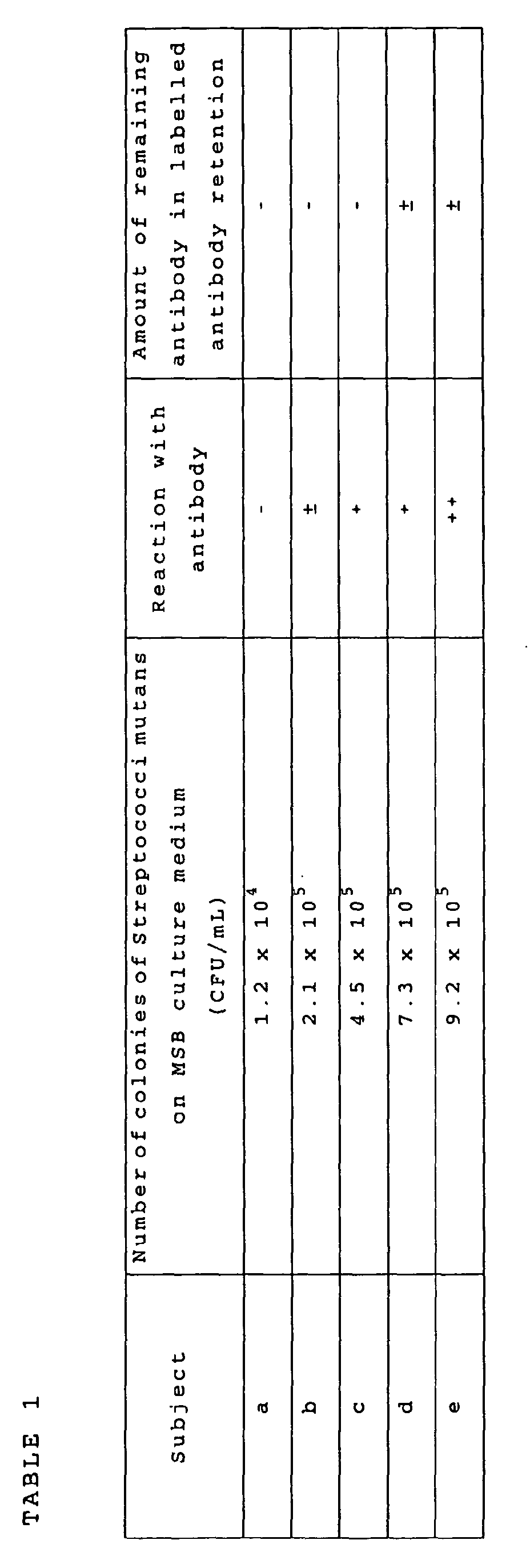
- The examination was carried out in the following manner by using an antibody-immobilized porous film strip that was the same as in Example 1 except that SS1 trap antibody was used instead of the SM1 trap antibody, and SS2 labelled antibody was used instead of the SM2 labelled antibody.
- A solution (A solution) was prepared by adding 25.0% by weight of sodium chloride to a solution containing 1.0 mol/L of sodium hydroxide (component (A)). A solution (BD solution) was prepared by adding 0.5 mol/L of citric acid (component (B)) to a solution containing 1.0 mol/L of tris(hydroxymethyl)aminomethane (component (D)). An aqueous solution (C solution) containing 5% by weight of polyethylene glycol monooctylphenyl ether (produced by Wako Pure Chemical Industries, Ltd.) as a nonionic surface active agent (component (C)) was prepared.
- 80 µL of the BD solution was added to 250 µL of the saliva, followed by stirring, 50 µL of the C solution was then added thereto, followed by stirring, and 40 µL of the A solution was finally added thereto, followed by stirring. 100 µL out of the saliva thus treated was dropped on the strip on the side of the labelled antibody retention. The solution thus treated had pH of 6.6. The concentration of the component (C) in the solution was 0.60% by weight. After 15 minutes from the dropping, the reaction with the trap antibody was confirmed, and the amount of the complex of the SS2 labelled antibody and Streptococci sobrinus remaining in the labelled antibody retention was visually observed.
- The examination described in the foregoing was carried out for five subjects a to e, and evaluations were carried out in the same manner as in Example 1. The results thus obtained are shown in Table 2 below.

- The examination was carried out in the following manner by using an antibody-immobilized porous film strip using the SM1 trap antibody and the SM2 labelled antibody that was the same as in Example 1.
- A solution (AC solution) was prepared by adding 1.0 mol/L of sodium hydroxide (component (A)) to an aqueous solution containing 5% by weight of polyethylene glycol monooctylphenyl ether (produced by Wako Pure Chemical Industries, Ltd.) as a nonionic surface active agent (component (C)). A solution (BD solution) was prepared by adding 12.0% by weight of sodium chloride to a solution containing 1.0 mol/L of tris(hydroxymethyl)aminomethane (component (D)) containing 0.5 mol/L of citric acid (component (B)).
- 75 µL of the AC solution was added to 250 µL of the saliva, followed by stirring, and 75 µL of the BD solution was then added thereto, followed by stirring. 100 µL out of the saliva thus treated was dropped on the strip on the side of the labelled antibody retention. The solution thus treated had pH of 7.5. The concentration of the component (C) in the solution was 0.94% by weight. After 15 minutes from the dropping, the reaction with the trap antibody was confirmed, and the amount of the complex of the SM2 labelled antibody and Streptococci mutans remaining in the labelled antibody retention was visually observed.
- The examination described in the foregoing was carried out for three subjects a to c, and evaluations were carried out in the same manner as in Example 1. The results thus obtained are shown in Table 3 below.

- The examination was carried out in the following manner by using an antibody-immobilized porous film strip using the SS1 trap antibody and the SS2 labelled antibody that was the same as in Example 2.
- An aqueous solution (A solution) containing 4.0 mol/L of sodium hydroxide (component (A)) was prepared. An aqueous solution (B solution) containing 1.0 mol/L of tartaric acid (component (B)) was prepared. An aqueous solution (C solution) containing 5% by weight of polyethylene glycol monooctylphenyl ether (produced by Wako Pure Chemical Industries, Ltd.) as a nonionic surface active agent (component (C)) was prepared. A solution (D solution) was prepared by adding 12.0% by weight of sodium chloride to a solution containing 1.0 mol/L of tris(hydroxymethyl)aminomethane (component (D)).
- 40 µL of the C solution was added to 250 µL of the saliva, followed by stirring, 40 µL of the B solution was then added thereto, followed by stirring, 40 µL of the D solution was further added thereto, followed by stirring, and 40 µL of the A solution was finally added thereto, followed by stirring. 100 µL out of the saliva thus treated was dropped on the strip on the side of the labelled antibody retention. The solution thus treated had pH of 8.0. The concentration of the component (C) in the solution was 0.49% by weight. After 15 minutes from the dropping, the reaction with the trap antibody was confirmed, and the amount of the complex of the SS2 labelled antibody and Streptococci sobrinus remaining in the labelled antibody retention was visually observed.
- The examination described in the foregoing was carried out for three subjects a to c, and evaluations were carried out in the same manner as in Example 1. The results thus obtained are shown in Table 4 below.

- The examination was carried out in the following manner by using an antibody-immobilized porous film strip using the SM1 trap antibody and the SM2 labelled antibody that was the same as in Example 1.
- A solution (AC solution) was prepared by adding 12.0% by weight of sodium chloride to an aqueous solution containing 5% by weight of polyethylene glycol monooctylphenyl ether (produced by Wako Pure Chemical Industries, Ltd.) as a nonionic surface active agent (component (C)) containing 1.0 mol/L of sodium hydroxide (component (A)). An aqueous solution (B solution) containing 0.5 mol/L of tartaric acid (component (B)) was prepared. A solution (D solution) was prepared by adding 12.0% by weight of sodium chloride to a solution containing 1.0 mol/L of tris(hydroxymethyl)aminomethane (component (D)).
- 75 µL of the AC solution was added to 250 µL of the saliva, followed by stirring, 75 µL of the B solution was then added thereto, followed by stirring, and 50 µL of the D solution was finally added thereto, followed by stirring. 100 µL out of the saliva thus treated was dropped on the strip on the side of the labelled antibody retention. The solution thus treated had pH of 7.2. The concentration of the component (C) in the solution was 0.83% by weight. After 15 minutes from the dropping, the reaction with the trap antibody was confirmed, and the amount of the complex of the SM2 labelled antibody and Streptococci mutans remaining in the labelled antibody retention was visually observed.
- The examination described in the foregoing was carried out for three subjects a to c, and evaluations were carried out in the same manner as in Example 1. The results thus obtained are shown in Table 5 below.

- The examination was carried out in the following manner by using an antibody-immobilized porous film strip using the SM1 trap antibody and the SM2 labelled antibody that was the same as in Example 1.
- A solution (AD solution) was prepared by adding 12.0% by weight of sodium chloride to a solution containing 1.0 mol/L of tris(hydroxymethyl)aminomethane (component (D)) containing 3.0 mol/L of sodium hydroxide (component (A)). A solution (BD solution) was prepared by adding 1.0 mol/L of tartaric acid and 0.5 mol/L of citric acid (component (B)) to a solution containing 1.0 mol/L of tris(hydroxymethyl)aminomethane (component (D)). A solution (C solution) was prepared by adding 2 mol/L of sodium chloride to an aqueous solution containing 5% by weight of polyethylene glycol monooctylphenyl ether (produced by Wako Pure Chemical Industries, Ltd.) as a nonionic surface active agent (component (C)).
- 40 µL of the BD solution was added to 250 µL of the saliva, followed by stirring, 40 µL of the A solution was then added thereto, followed by stirring, and 40 µL of the C solution was finally added thereto, followed by stirring. 100 µL out of the saliva thus treated was dropped on the strip on the side of the labelled antibody retention. The solution thus treated had pH of 6.9. The concentration of the component (C) in the solution was 0.54% by weight. After 15 minutes from the dropping, the reaction with the trap antibody was confirmed, and the amount of the complex of the SM2 labelled antibody and Streptococci mutans remaining in the labelled antibody retention was visually observed.
- The examination described in the foregoing was carried out for three subjects a to c, and evaluations were carried out in the same manner as in Example 1. The results thus obtained are shown in Table 6 below.

- The examination was carried out in the following manner by using an antibody-immobilized porous film strip using the SM1 trap antibody and the SM2 labelled antibody that was the same as in Example 1.
- A solution (A solution) was prepared by adding 25.0% by weight of sodium chloride to an aqueous solution containing 1.0 mol/L of sodium hydroxide (component (A)). A solution (BC solution) was prepared by adding 5% by weight of polyethylene glycol monooctylphenyl ether (produced by Wako Pure Chemical Industries, Ltd.) as a nonionic surface active agent (component (C)) to an aqueous solution containing 0.5 mol/L of citric acid (component (B)). A buffer solution (D solution) containing2mol/Lof tris(hydroxymethyl)aminomethane (component (D)) was prepared.
- 40 µL of the D solution was added to 250 µL of the saliva, followedby stirring, 40 µL of the A solution was then added thereto, followed by stirring, and 70 µL of the BC solution was finally added thereto, followed by stirring. 100 µL out of the saliva thus treated was dropped on the strip on the side of the labelled antibody retention. The solution thus treated had pH of 6.9. The concentration of the component (C) in the solution was 0.88% by weight. After 15 minutes from the dropping, the reaction with the trap antibody was confirmed, and the amount of the complex of the SM2 labelled antibody and Streptococci mutans remaining in the labelled antibody retention was visually observed.
- The examination described in the foregoing was carried out for five subjects a to e, and evaluations were carried out in the same manner as in Example 1. The results thus obtained are shown in Table 7 below.

- The same examination as in Example 1 was carried out for five subjects a to e except that the AD solution containing no sodium chloride was used, and evaluations were carried out in the same manner as in Example 1. The results thus obtained are shown in Table 8 below.
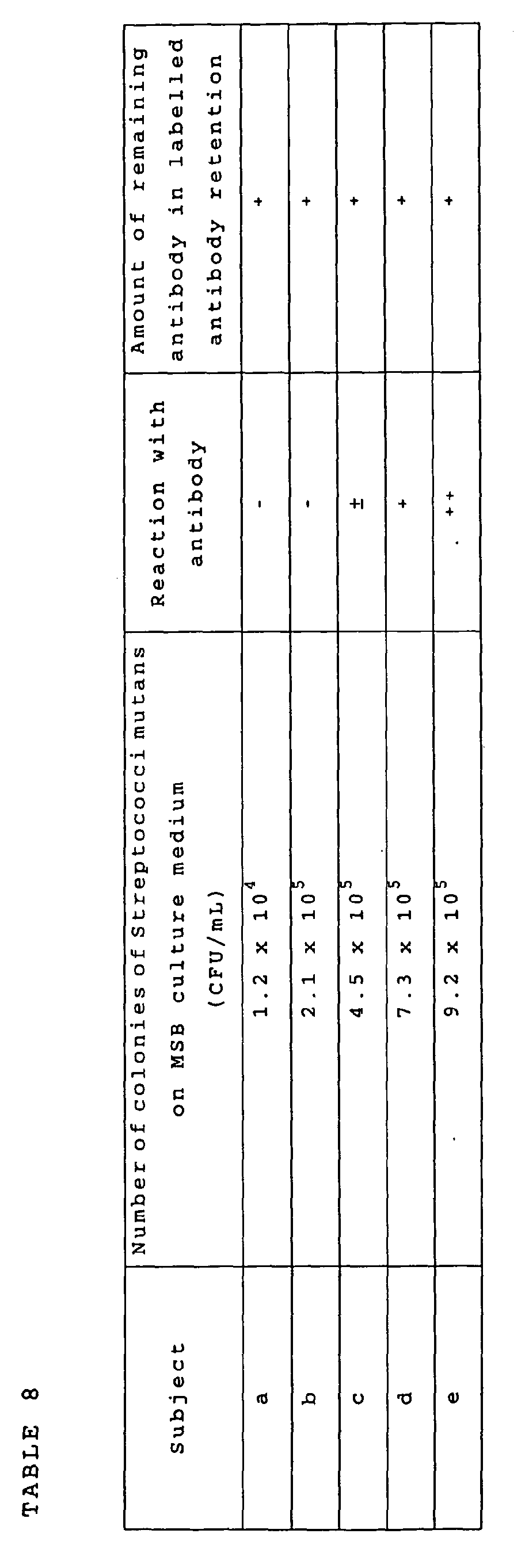
- The same examination as in Example 4 was carried out for three subjects a to c except that the D solution containing no sodium chloride was used, and evaluations were carried out in the same manner as in Example 1. The results thus obtained are shown in Table 9 below.

- It was confirmed from the foregoing results that the pretreatment method for saliva by using the pretreatment kit for saliva according to the present invention could remove aggregation caused by mucin and chain formation of mutans streptococci in saliva, and since the amount of the complex of the labelled antibody and the mutans streptococci remaining in the labelled antibody retention was small, the effect of preventing such a phenomenon that the complex of the labelled antibody and the mutans streptococci remained in the membrane retaining the labelled antibody was confirmed.
- As having been described in detail, upon identification and quantitative determination of mutans streptococci, which is a type of cariogenic bacteria in human saliva, by immunochromatography utilizing an antigen-antibody reaction, the pretreatment kit for saliva and the pretreatment method for saliva according to the present invention can remove aggregation caused by mucin and chain formation of mutans streptococci in saliva in a simple operation, and can efficiently flow a complex of a labeled antibody and mutans streptococci from a porous membrane retainingthelabeledantibody,wherebyidentification and quantitative determination can be carried out with high accuracy. Therefore, it provides significant value by contributing to the field of dentistry.
at least one substance selected from the group consisting of sodium chloride, potassium chloride, calcium chloride, magnesium chloride, magnesium sulfate and manganese sulfate being contained in at least one of the components (A) , (B) and (C) in an amount of 5 to 25% by weight. It is preferred in this aspect that (D) tris (hydroxymethyl) aminomethane is mixed with at least one of the components (A), (B) and (C).
at least one substance selected from the group consisting of sodium chloride, potassium chloride, calcium chloride, magnesium chloride, magnesium sulfate and manganese sulfate being contained in at least one of the components (A), (B), (C) and (D) in an amount of 5 to 25% by weight.
Claims (11)
- A pretreatment kit for saliva comprisingthe component (C) being mixed with at least one of the components (A) and (B), or being provided separately from the components (A) and (B), and(A) an aqueous solution of sodium hydroxide having a concentration of 0.01 to 10 mol/L,(B) an aqueous solution of tartaric acid and/or citric acid having a concentration of 0.01 to 3 mol/L, and(C) a nonionic surface active agent and/or an amphoteric surface active agent,
at least one substance selected from the group consisting of sodium chloride, potassium chloride, calcium chloride, magnesium chloride, magnesium sulfate and manganese sulfate being contained in at least one of the components (A) , (B) and (C) in an amount of 5 to 25% by weight. - A pretreatment kit for saliva as claimed in claim 1, wherein (D) tris(hydroxymethyl)aminomethane is mixed with at least one of the components (A), (B) and (C).
- A pretreatment kit for saliva comprisingthe component (C) being mixed with at least one of the components (A), (B) and (D), or being provided separately from the components (A), (B) and (D), and(A) an aqueous solution of sodium hydroxide having a concentration of 0.01 to 10 mol/L,(B) an aqueous solution of tartaric acid and/or citric acid having a concentration of 0.01 to 3 mol/L,(C) a nonionic surface active agent and/or an amphoteric surface active agent, and(D) an aqueous solution containing tris(hydroxymethyl)aminomethane,
at least one substance selected from the group consisting of sodium chloride, potassium chloride, calcium chloride, magnesium chloride, magnesium sulfate and manganese sulfate being contained in at least one of the components (A), (B), (C) and (D) in an amount of 5 to 25% by weight. - A pretreatment kit for saliva as claimed in any one of claims 1 to 3 , wherein the nonionic surface active agent as the component (C) is one kind or a mixture of two or more kinds selected from the group consisting of polyethylene glycol monooctylphenyl ether, n-octyl-β-D-glucoside, n-heptyl-β-D-thioglucoside, n-octyl-β-D-thioglucoside, nonylphenoxy polyethoxyethanol and polyoxyethylene sorbitan monooleate.
- A pretreatment kit for saliva as claimed in any one of claims 1 to 4, wherein the amphoteric surface active agent as the component (C) is one kind or a mixture of two or more kinds selected from the group consisting of CHAPS (3-(3-cholamide-propyl)-dimethylammonio)-1-propane sulfonate) and CHAPSO (3-(3-cholamide-propyl)-dimethylammonio)-1-hydroxy propanesulfonate).
- A pretreatment method for saliva in identification and quantitative determination of mutans streptococci by immunochromatography comprising steps of
mixing at least one substance selected from the group consisting of sodium chloride, potassium chloride, calcium chloride, magnesium chloride, magnesium sulfate and manganese sulfate with at least one of (A) an aqueous solution of sodium hydroxide having a concentration of 0.01 to 10 mol/L, (B) an aqueous solution of tartaric acid and/or citric acid having a concentration of 0.01 to 3 mol/L, and (C) a nonionic surface active agent and/or an amphoteric surface active agent, in an amount of 5 to 25% by weight; and
mixing the components (A) , (B) and (C) by dropping in an arbitrary order. - A pretreatment method for saliva as claimed in claim 6, wherein (D) tris (hydroxymethyl) aminomethane is mixed in at least one of the components (A), (B) and (C), and the components (A), (B) and (C) are mixed by dropping in such an order that the component (A) is in contact with the component (B) in the presence of the component (D) .
- A pretreatment method for saliva in identification and quantitative determination of mutans streptococci by immunochromatography comprising steps of
mixing at least one substance selected from the group consisting of sodium chloride, potassium chloride, calcium chloride, magnesium chloride, magnesium sulfate and manganese sulfate with at least one of (A) an aqueous solution of sodium hydroxide having a concentration of 0.01 to 10 mol/L and (B) an aqueous solution of tartaric acid and/or citric acid having a concentration of 0.01 to 3 mol/L, in an amount of 5 to 25% by weight;
mixing (C) a nonionic surface active agent and/or an amphoteric surface active agent in at least one of the components (A) and (B); and
mixing the components (A) and (B) by dropping in an arbitrary order. - A pretreatment method for saliva as claimed in claim 8, wherein (D) tris(hydroxymethyl)aminomethane is mixed in at least one of the components (A) and (B), and the components (A) and (B) are mixed by dropping in an arbitrary order.
- A pretreatment method for saliva in identification and quantitative determination of mutans streptococci by immunochromatography comprising steps of
mixing at least one substance selected from the group consisting of sodium chloride, potassium chloride, calcium chloride, magnesium chloride, magnesium sulfate and manganese sulfate with at least one of (A) an aqueous solution of sodium hydroxide having a concentration of 0.01 to 10 mol/L, (B) an aqueous solution of tartaric acid and/or citric acid having a concentration of 0.01 to 3 mol/L, (C) a nonionic surface active agent and/or an amphoteric surface active agent, and (D) tris(hydroxymethyl)aminomethane, in an amount of 5 to 25% by weight; and
mixing the components (A), (B), (C) and (D) by dropping in such an order that the component (A) is in contact with the component (B) in the presence of the component (D). - A pretreatment method for saliva as claimed in claim 10, wherein the component (A), (B) and (D), at least one of which is mixed with the component (C), are mixed by dropping in such an order that the component (A) is in contact with the component (B) in the presence of the component (D).
Applications Claiming Priority (2)
| Application Number | Priority Date | Filing Date | Title |
|---|---|---|---|
| JP2002262838A JP4025153B2 (en) | 2002-09-09 | 2002-09-09 | Saliva pretreatment kit and saliva pretreatment method |
| JP2002262838 | 2002-09-09 |
Publications (2)
| Publication Number | Publication Date |
|---|---|
| EP1396726A1 true EP1396726A1 (en) | 2004-03-10 |
| EP1396726B1 EP1396726B1 (en) | 2006-05-24 |
Family
ID=31712358
Family Applications (1)
| Application Number | Title | Priority Date | Filing Date |
|---|---|---|---|
| EP03018719A Expired - Lifetime EP1396726B1 (en) | 2002-09-09 | 2003-08-25 | Pretreatment kit for saliva and pretreatment method for saliva for determination of Mutans streptococci via immunochromatography |
Country Status (8)
| Country | Link |
|---|---|
| US (2) | US7063980B2 (en) |
| EP (1) | EP1396726B1 (en) |
| JP (1) | JP4025153B2 (en) |
| CN (1) | CN1327226C (en) |
| AT (1) | ATE327513T1 (en) |
| AU (1) | AU2003244594C1 (en) |
| DE (1) | DE60305397T2 (en) |
| NZ (1) | NZ528008A (en) |
Cited By (3)
| Publication number | Priority date | Publication date | Assignee | Title |
|---|---|---|---|---|
| EP1972938A1 (en) * | 2007-03-19 | 2008-09-24 | Ivoclar Vivadent | Method for detecting a microorganism in a liquid sample |
| WO2009142743A1 (en) * | 2008-05-20 | 2009-11-26 | Cantimer, Inc. | Methods, systems and devices for analyzing a surfactant-treated biological fluid sample |
| WO2009142742A1 (en) * | 2008-05-20 | 2009-11-26 | Cantimer, Inc. | Methods, systems and devices for analyzing a biological fluid sample following ion exchange |
Families Citing this family (13)
| Publication number | Priority date | Publication date | Assignee | Title |
|---|---|---|---|---|
| EP2128617A1 (en) * | 2008-05-27 | 2009-12-02 | Koninklijke Philips Electronics N.V. | Device and methods for detecting analytes in saliva |
| AU2010355614B2 (en) | 2010-06-13 | 2015-07-02 | Institute Of Biophysics, Chinese Academy Of Sciences | Methods and compositions for preparing cardiomyocytes from stem cells and uses thereof |
| CN102440234B (en) * | 2010-09-30 | 2013-11-13 | 上海泛亚生命科技有限公司 | Stationary liquid for preserving human saliva, preparation and application |
| KR101467372B1 (en) * | 2010-12-14 | 2014-12-01 | 주식회사 피코팜 | A Method of Diagnosing a Menstrual Activation using Saliva |
| WO2012081911A2 (en) * | 2010-12-14 | 2012-06-21 | 퍼팩트코리아(주) | Saliva purifying method |
| EP2891712B1 (en) | 2012-07-23 | 2026-01-28 | Institute Of Biophysics, Chinese Academy Of Sciences | Method for inducing pluripotent stem cells to differentiate into ventricular myocytes in vitro |
| JP6132592B2 (en) * | 2013-02-28 | 2017-05-24 | 株式会社ジーシー | Saliva pretreatment liquid |
| CN103575911A (en) * | 2013-11-15 | 2014-02-12 | 常州和方环保科技有限公司 | Saliva stabilizing liquid |
| CN105039306A (en) * | 2015-05-29 | 2015-11-11 | 上海美吉生物医药科技有限公司 | Saliva protection agent |
| KR101849698B1 (en) | 2017-08-24 | 2018-04-18 | 한국화학연구원 | Composition for controling a biotissue size and method for controling the biotissue size using the same |
| WO2019078545A1 (en) * | 2017-10-16 | 2019-04-25 | 헨리기술 주식회사 | Breast cancer detection kit using saliva and breast cancer detection method using same, and fertile window detection kit using saliva and fertile window detection method using same |
| CN115200954B (en) * | 2022-06-28 | 2025-05-06 | 珠海大略科技有限公司 | A method for reducing saliva viscosity and its application |
| CN117030996A (en) * | 2023-07-31 | 2023-11-10 | 谱天(天津)生物科技有限公司 | A sample processing solution for immunoassay and its application |
Citations (4)
| Publication number | Priority date | Publication date | Assignee | Title |
|---|---|---|---|---|
| US4435504A (en) * | 1982-07-15 | 1984-03-06 | Syva Company | Immunochromatographic assay with support having bound "MIP" and second enzyme |
| EP0660113A2 (en) * | 1993-12-22 | 1995-06-28 | Toa Medical Electronics Co., Ltd. | A reagent for analyzing leucocytes |
| EP1248106A1 (en) * | 2001-03-28 | 2002-10-09 | GC Corporation | Pre-treatment kit for saliva and pre-treatment method for saliva using the same |
| EP1271124A1 (en) * | 2001-06-21 | 2003-01-02 | GC Corporation | Pretreatment instrument of saliva and pretreatment method of saliva |
Family Cites Families (8)
| Publication number | Priority date | Publication date | Assignee | Title |
|---|---|---|---|---|
| SE8500102L (en) * | 1985-01-10 | 1986-07-11 | Chemical Dynamics Sweden Ab | MICROFLORA DELIVERY PROCEDURE |
| US5147632A (en) * | 1990-10-31 | 1992-09-15 | Warner-Lambert Company | Anti-plaque compositions comprising a combination of morpholinoamino alcohol and chelating agent |
| CN1142611A (en) * | 1995-08-04 | 1997-02-12 | 衡阳医学院 | Testing agent for sialic acid |
| JPH09178752A (en) * | 1995-12-26 | 1997-07-11 | Lion Corp | Microbial detection method and detection test set |
| JPH1036400A (en) * | 1996-07-18 | 1998-02-10 | Lion Corp | Monoclonal antibody, oral composition and diagnostic / research base |
| US5910420A (en) * | 1996-08-16 | 1999-06-08 | Orion-Yhtyma Oy Orion Diagnostica | Method and test kit for pretreatment of object surfaces |
| MY114945A (en) * | 1997-04-24 | 2003-02-28 | Sunstar Inc | Oral composition |
| JP2002035799A (en) * | 2000-07-27 | 2002-02-05 | Kurita Water Ind Ltd | Sludge dewatering equipment |
-
2002
- 2002-09-09 JP JP2002262838A patent/JP4025153B2/en not_active Expired - Lifetime
-
2003
- 2003-08-22 US US10/645,540 patent/US7063980B2/en not_active Expired - Lifetime
- 2003-08-25 EP EP03018719A patent/EP1396726B1/en not_active Expired - Lifetime
- 2003-08-25 DE DE60305397T patent/DE60305397T2/en not_active Expired - Lifetime
- 2003-08-25 AT AT03018719T patent/ATE327513T1/en not_active IP Right Cessation
- 2003-09-03 NZ NZ528008A patent/NZ528008A/en not_active IP Right Cessation
- 2003-09-08 AU AU2003244594A patent/AU2003244594C1/en not_active Ceased
- 2003-09-09 CN CNB031591442A patent/CN1327226C/en not_active Expired - Fee Related
-
2006
- 2006-04-13 US US11/402,890 patent/US7687278B2/en not_active Expired - Lifetime
Patent Citations (4)
| Publication number | Priority date | Publication date | Assignee | Title |
|---|---|---|---|---|
| US4435504A (en) * | 1982-07-15 | 1984-03-06 | Syva Company | Immunochromatographic assay with support having bound "MIP" and second enzyme |
| EP0660113A2 (en) * | 1993-12-22 | 1995-06-28 | Toa Medical Electronics Co., Ltd. | A reagent for analyzing leucocytes |
| EP1248106A1 (en) * | 2001-03-28 | 2002-10-09 | GC Corporation | Pre-treatment kit for saliva and pre-treatment method for saliva using the same |
| EP1271124A1 (en) * | 2001-06-21 | 2003-01-02 | GC Corporation | Pretreatment instrument of saliva and pretreatment method of saliva |
Cited By (5)
| Publication number | Priority date | Publication date | Assignee | Title |
|---|---|---|---|---|
| EP1972938A1 (en) * | 2007-03-19 | 2008-09-24 | Ivoclar Vivadent | Method for detecting a microorganism in a liquid sample |
| WO2009142743A1 (en) * | 2008-05-20 | 2009-11-26 | Cantimer, Inc. | Methods, systems and devices for analyzing a surfactant-treated biological fluid sample |
| WO2009142742A1 (en) * | 2008-05-20 | 2009-11-26 | Cantimer, Inc. | Methods, systems and devices for analyzing a biological fluid sample following ion exchange |
| US8349610B2 (en) | 2008-05-20 | 2013-01-08 | Cantimer, Inc. | Methods, systems and devices for analyzing a surfactant-treated biological fluid sample |
| US8426207B2 (en) | 2008-05-20 | 2013-04-23 | Cantimer, Inc. | Methods, systems and devices for analyzing a biological fluid sample following ion exchange |
Also Published As
| Publication number | Publication date |
|---|---|
| CN1492230A (en) | 2004-04-28 |
| US7687278B2 (en) | 2010-03-30 |
| EP1396726B1 (en) | 2006-05-24 |
| US20040106096A1 (en) | 2004-06-03 |
| ATE327513T1 (en) | 2006-06-15 |
| AU2003244594B2 (en) | 2007-04-26 |
| JP4025153B2 (en) | 2007-12-19 |
| DE60305397T2 (en) | 2007-02-15 |
| US7063980B2 (en) | 2006-06-20 |
| JP2004101345A (en) | 2004-04-02 |
| NZ528008A (en) | 2005-03-24 |
| DE60305397D1 (en) | 2006-06-29 |
| US20060183170A1 (en) | 2006-08-17 |
| AU2003244594A1 (en) | 2004-03-25 |
| AU2003244594C1 (en) | 2008-03-13 |
| CN1327226C (en) | 2007-07-18 |
Similar Documents
| Publication | Publication Date | Title |
|---|---|---|
| EP1396726B1 (en) | Pretreatment kit for saliva and pretreatment method for saliva for determination of Mutans streptococci via immunochromatography | |
| EP1972938B1 (en) | Test strip for determining the risk of caries | |
| CN103123354B (en) | Immunodetection assay for mycobacterium tuberculosis complex | |
| DK174032B1 (en) | Kit as well as immunometric dosing method that can be applied to whole cells | |
| JP2010515030A (en) | Method and apparatus for determining small cell populations in heterogeneous cell populations | |
| JP4651868B2 (en) | Saliva pretreatment kit and saliva pretreatment method using the same | |
| JP2003215126A (en) | Method for extracting microbe antigen | |
| CN102590508A (en) | Immunochromatographic strip for detecting viscerotropic leishmania infection and diagnosing kala-azar | |
| JP4268358B2 (en) | Antibody and immunological assay | |
| CA2076592A1 (en) | Method, test device and kit for assay of specific binding ligand using controlled flow through filtration membrane | |
| JPS63159762A (en) | Method of evaluating mouth microbe | |
| CN105181964A (en) | Mink Aleutian disease virus antibody colloidal gold test strip and manufacturing method thereof | |
| CN101900727A (en) | A test strip for identification and detection of bovine tuberculosis antibody prepared by using Rv3872 novel fusion protein | |
| JP4406656B2 (en) | Mycobacterium tuberculosis detection method | |
| JPH07800B2 (en) | Cleaning composition and kit and method for measurement of microorganisms associated with periodontal disease | |
| JP4269006B2 (en) | Mycobacterium tuberculosis detection method | |
| WO1992021952A1 (en) | Instrument for sampling minute quantity of specimen | |
| JPH11108931A5 (en) | ||
| JP4478658B2 (en) | Mycobacterium tuberculosis detection kit | |
| JP4022005B2 (en) | Simple antibody test method and test kit | |
| Joshi et al. | Coagglutination test: a simple and rapid diagnostic technique for goat pox | |
| JP2005106570A (en) | Measuring method of intraoral number of mutans streptococcus | |
| JPH02107970A (en) | Reagent for detection of bacteroides-gingivalis mycelium and kit and method therefor | |
| JP2004154073A (en) | Analysis method of Porphyromonas gingivalis | |
| JP2004347491A (en) | Streptococcus sobulinus examination kit |
Legal Events
| Date | Code | Title | Description |
|---|---|---|---|
| PUAI | Public reference made under article 153(3) epc to a published international application that has entered the european phase |
Free format text: ORIGINAL CODE: 0009012 |
|
| AK | Designated contracting states |
Kind code of ref document: A1 Designated state(s): AT BE BG CH CY CZ DE DK EE ES FI FR GB GR HU IE IT LI LU MC NL PT RO SE SI SK TR |
|
| AX | Request for extension of the european patent |
Extension state: AL LT LV MK |
|
| 17P | Request for examination filed |
Effective date: 20040603 |
|
| AKX | Designation fees paid |
Designated state(s): AT BE BG CH CY CZ DE DK EE ES FI FR GB GR HU IE IT LI LU MC NL PT RO SE SI SK TR |
|
| GRAP | Despatch of communication of intention to grant a patent |
Free format text: ORIGINAL CODE: EPIDOSNIGR1 |
|
| RTI1 | Title (correction) |
Free format text: PRETREATMENT KIT FOR SALIVA AND PRETREATMENT METHOD FOR SALIVA FOR DETERMINATION OF MUTANS STREPTOCOCCI VIA IMMUNOCHROMATOGRAPHY |
|
| GRAS | Grant fee paid |
Free format text: ORIGINAL CODE: EPIDOSNIGR3 |
|
| GRAA | (expected) grant |
Free format text: ORIGINAL CODE: 0009210 |
|
| AK | Designated contracting states |
Kind code of ref document: B1 Designated state(s): AT BE BG CH CY CZ DE DK EE ES FI FR GB GR HU IE IT LI LU MC NL PT RO SE SI SK TR |
|
| PG25 | Lapsed in a contracting state [announced via postgrant information from national office to epo] |
Ref country code: CZ Free format text: LAPSE BECAUSE OF FAILURE TO SUBMIT A TRANSLATION OF THE DESCRIPTION OR TO PAY THE FEE WITHIN THE PRESCRIBED TIME-LIMIT Effective date: 20060524 Ref country code: FI Free format text: LAPSE BECAUSE OF FAILURE TO SUBMIT A TRANSLATION OF THE DESCRIPTION OR TO PAY THE FEE WITHIN THE PRESCRIBED TIME-LIMIT Effective date: 20060524 Ref country code: SI Free format text: LAPSE BECAUSE OF FAILURE TO SUBMIT A TRANSLATION OF THE DESCRIPTION OR TO PAY THE FEE WITHIN THE PRESCRIBED TIME-LIMIT Effective date: 20060524 Ref country code: NL Free format text: LAPSE BECAUSE OF FAILURE TO SUBMIT A TRANSLATION OF THE DESCRIPTION OR TO PAY THE FEE WITHIN THE PRESCRIBED TIME-LIMIT Effective date: 20060524 Ref country code: LI Free format text: LAPSE BECAUSE OF FAILURE TO SUBMIT A TRANSLATION OF THE DESCRIPTION OR TO PAY THE FEE WITHIN THE PRESCRIBED TIME-LIMIT Effective date: 20060524 Ref country code: IT Free format text: LAPSE BECAUSE OF FAILURE TO SUBMIT A TRANSLATION OF THE DESCRIPTION OR TO PAY THE FEE WITHIN THE PRESCRIBED TIME-LIMIT;WARNING: LAPSES OF ITALIAN PATENTS WITH EFFECTIVE DATE BEFORE 2007 MAY HAVE OCCURRED AT ANY TIME BEFORE 2007. THE CORRECT EFFECTIVE DATE MAY BE DIFFERENT FROM THE ONE RECORDED. Effective date: 20060524 Ref country code: SK Free format text: LAPSE BECAUSE OF FAILURE TO SUBMIT A TRANSLATION OF THE DESCRIPTION OR TO PAY THE FEE WITHIN THE PRESCRIBED TIME-LIMIT Effective date: 20060524 Ref country code: RO Free format text: LAPSE BECAUSE OF FAILURE TO SUBMIT A TRANSLATION OF THE DESCRIPTION OR TO PAY THE FEE WITHIN THE PRESCRIBED TIME-LIMIT Effective date: 20060524 Ref country code: CH Free format text: LAPSE BECAUSE OF FAILURE TO SUBMIT A TRANSLATION OF THE DESCRIPTION OR TO PAY THE FEE WITHIN THE PRESCRIBED TIME-LIMIT Effective date: 20060524 Ref country code: AT Free format text: LAPSE BECAUSE OF FAILURE TO SUBMIT A TRANSLATION OF THE DESCRIPTION OR TO PAY THE FEE WITHIN THE PRESCRIBED TIME-LIMIT Effective date: 20060524 |
|
| REG | Reference to a national code |
Ref country code: GB Ref legal event code: FG4D |
|
| REG | Reference to a national code |
Ref country code: CH Ref legal event code: EP |
|
| REG | Reference to a national code |
Ref country code: IE Ref legal event code: FG4D |
|
| REF | Corresponds to: |
Ref document number: 60305397 Country of ref document: DE Date of ref document: 20060629 Kind code of ref document: P |
|
| PG25 | Lapsed in a contracting state [announced via postgrant information from national office to epo] |
Ref country code: DK Free format text: LAPSE BECAUSE OF FAILURE TO SUBMIT A TRANSLATION OF THE DESCRIPTION OR TO PAY THE FEE WITHIN THE PRESCRIBED TIME-LIMIT Effective date: 20060824 |
|
| PG25 | Lapsed in a contracting state [announced via postgrant information from national office to epo] |
Ref country code: IE Free format text: LAPSE BECAUSE OF NON-PAYMENT OF DUE FEES Effective date: 20060825 |
|
| PG25 | Lapsed in a contracting state [announced via postgrant information from national office to epo] |
Ref country code: MC Free format text: LAPSE BECAUSE OF NON-PAYMENT OF DUE FEES Effective date: 20060831 |
|
| PG25 | Lapsed in a contracting state [announced via postgrant information from national office to epo] |
Ref country code: ES Free format text: LAPSE BECAUSE OF FAILURE TO SUBMIT A TRANSLATION OF THE DESCRIPTION OR TO PAY THE FEE WITHIN THE PRESCRIBED TIME-LIMIT Effective date: 20060904 |
|
| REG | Reference to a national code |
Ref country code: SE Ref legal event code: TRGR |
|
| PG25 | Lapsed in a contracting state [announced via postgrant information from national office to epo] |
Ref country code: PT Free format text: LAPSE BECAUSE OF FAILURE TO SUBMIT A TRANSLATION OF THE DESCRIPTION OR TO PAY THE FEE WITHIN THE PRESCRIBED TIME-LIMIT Effective date: 20061024 |
|
| NLV1 | Nl: lapsed or annulled due to failure to fulfill the requirements of art. 29p and 29m of the patents act | ||
| REG | Reference to a national code |
Ref country code: CH Ref legal event code: PL |
|
| PLBE | No opposition filed within time limit |
Free format text: ORIGINAL CODE: 0009261 |
|
| STAA | Information on the status of an ep patent application or granted ep patent |
Free format text: STATUS: NO OPPOSITION FILED WITHIN TIME LIMIT |
|
| 26N | No opposition filed |
Effective date: 20070227 |
|
| EN | Fr: translation not filed | ||
| PG25 | Lapsed in a contracting state [announced via postgrant information from national office to epo] |
Ref country code: GR Free format text: LAPSE BECAUSE OF FAILURE TO SUBMIT A TRANSLATION OF THE DESCRIPTION OR TO PAY THE FEE WITHIN THE PRESCRIBED TIME-LIMIT Effective date: 20060825 Ref country code: FR Free format text: LAPSE BECAUSE OF FAILURE TO SUBMIT A TRANSLATION OF THE DESCRIPTION OR TO PAY THE FEE WITHIN THE PRESCRIBED TIME-LIMIT Effective date: 20070309 |
|
| PG25 | Lapsed in a contracting state [announced via postgrant information from national office to epo] |
Ref country code: EE Free format text: LAPSE BECAUSE OF FAILURE TO SUBMIT A TRANSLATION OF THE DESCRIPTION OR TO PAY THE FEE WITHIN THE PRESCRIBED TIME-LIMIT Effective date: 20060524 Ref country code: BG Free format text: LAPSE BECAUSE OF FAILURE TO SUBMIT A TRANSLATION OF THE DESCRIPTION OR TO PAY THE FEE WITHIN THE PRESCRIBED TIME-LIMIT Effective date: 20060824 |
|
| PG25 | Lapsed in a contracting state [announced via postgrant information from national office to epo] |
Ref country code: HU Free format text: LAPSE BECAUSE OF FAILURE TO SUBMIT A TRANSLATION OF THE DESCRIPTION OR TO PAY THE FEE WITHIN THE PRESCRIBED TIME-LIMIT Effective date: 20061125 Ref country code: LU Free format text: LAPSE BECAUSE OF NON-PAYMENT OF DUE FEES Effective date: 20060825 Ref country code: TR Free format text: LAPSE BECAUSE OF FAILURE TO SUBMIT A TRANSLATION OF THE DESCRIPTION OR TO PAY THE FEE WITHIN THE PRESCRIBED TIME-LIMIT Effective date: 20060524 |
|
| PG25 | Lapsed in a contracting state [announced via postgrant information from national office to epo] |
Ref country code: FR Free format text: LAPSE BECAUSE OF FAILURE TO SUBMIT A TRANSLATION OF THE DESCRIPTION OR TO PAY THE FEE WITHIN THE PRESCRIBED TIME-LIMIT Effective date: 20060524 Ref country code: CY Free format text: LAPSE BECAUSE OF FAILURE TO SUBMIT A TRANSLATION OF THE DESCRIPTION OR TO PAY THE FEE WITHIN THE PRESCRIBED TIME-LIMIT Effective date: 20060524 |
|
| PGFP | Annual fee paid to national office [announced via postgrant information from national office to epo] |
Ref country code: SE Payment date: 20210818 Year of fee payment: 19 Ref country code: DE Payment date: 20210831 Year of fee payment: 19 Ref country code: BE Payment date: 20210812 Year of fee payment: 19 Ref country code: GB Payment date: 20210804 Year of fee payment: 19 |
|
| REG | Reference to a national code |
Ref country code: DE Ref legal event code: R119 Ref document number: 60305397 Country of ref document: DE |
|
| REG | Reference to a national code |
Ref country code: SE Ref legal event code: EUG |
|
| GBPC | Gb: european patent ceased through non-payment of renewal fee |
Effective date: 20220825 |
|
| PG25 | Lapsed in a contracting state [announced via postgrant information from national office to epo] |
Ref country code: SE Free format text: LAPSE BECAUSE OF NON-PAYMENT OF DUE FEES Effective date: 20220826 |
|
| REG | Reference to a national code |
Ref country code: BE Ref legal event code: MM Effective date: 20220831 |
|
| PG25 | Lapsed in a contracting state [announced via postgrant information from national office to epo] |
Ref country code: DE Free format text: LAPSE BECAUSE OF NON-PAYMENT OF DUE FEES Effective date: 20230301 |
|
| PG25 | Lapsed in a contracting state [announced via postgrant information from national office to epo] |
Ref country code: BE Free format text: LAPSE BECAUSE OF NON-PAYMENT OF DUE FEES Effective date: 20220831 |
|
| PG25 | Lapsed in a contracting state [announced via postgrant information from national office to epo] |
Ref country code: GB Free format text: LAPSE BECAUSE OF NON-PAYMENT OF DUE FEES Effective date: 20220825 |