EP1395126B1 - Fat-containing milk substitute for young stock, method for preparing the fat-containing milk substitute and device to be used therewith - Google Patents
Fat-containing milk substitute for young stock, method for preparing the fat-containing milk substitute and device to be used therewith Download PDFInfo
- Publication number
- EP1395126B1 EP1395126B1 EP02741529A EP02741529A EP1395126B1 EP 1395126 B1 EP1395126 B1 EP 1395126B1 EP 02741529 A EP02741529 A EP 02741529A EP 02741529 A EP02741529 A EP 02741529A EP 1395126 B1 EP1395126 B1 EP 1395126B1
- Authority
- EP
- European Patent Office
- Prior art keywords
- fat
- basic component
- powder
- particles
- milk substitute
- Prior art date
- Legal status (The legal status is an assumption and is not a legal conclusion. Google has not performed a legal analysis and makes no representation as to the accuracy of the status listed.)
- Expired - Lifetime
Links
Images

Classifications
-
- A—HUMAN NECESSITIES
- A23—FOODS OR FOODSTUFFS; TREATMENT THEREOF, NOT COVERED BY OTHER CLASSES
- A23C—DAIRY PRODUCTS, e.g. MILK, BUTTER OR CHEESE; MILK OR CHEESE SUBSTITUTES; PREPARATION THEREOF
- A23C11/00—Milk substitutes, e.g. coffee whitener compositions
- A23C11/02—Milk substitutes, e.g. coffee whitener compositions containing at least one non-milk component as source of fats or proteins
- A23C11/04—Milk substitutes, e.g. coffee whitener compositions containing at least one non-milk component as source of fats or proteins containing non-milk fats but no non-milk proteins
- A23C11/045—Milk substitutes, e.g. coffee whitener compositions containing at least one non-milk component as source of fats or proteins containing non-milk fats but no non-milk proteins obtained by mixing the non-fat components in powdered form with the fats or by dry mixing of the components
-
- A—HUMAN NECESSITIES
- A23—FOODS OR FOODSTUFFS; TREATMENT THEREOF, NOT COVERED BY OTHER CLASSES
- A23K—FODDER
- A23K10/00—Animal feeding-stuffs
- A23K10/20—Animal feeding-stuffs from material of animal origin
- A23K10/26—Animal feeding-stuffs from material of animal origin from waste material, e.g. feathers, bones or skin
- A23K10/28—Animal feeding-stuffs from material of animal origin from waste material, e.g. feathers, bones or skin from waste dairy products
-
- A—HUMAN NECESSITIES
- A23—FOODS OR FOODSTUFFS; TREATMENT THEREOF, NOT COVERED BY OTHER CLASSES
- A23K—FODDER
- A23K20/00—Accessory food factors for animal feeding-stuffs
- A23K20/10—Organic substances
- A23K20/158—Fatty acids; Fats; Products containing oils or fats
-
- A—HUMAN NECESSITIES
- A23—FOODS OR FOODSTUFFS; TREATMENT THEREOF, NOT COVERED BY OTHER CLASSES
- A23K—FODDER
- A23K40/00—Shaping or working-up of animal feeding-stuffs
- A23K40/30—Shaping or working-up of animal feeding-stuffs by encapsulating; by coating
-
- A—HUMAN NECESSITIES
- A23—FOODS OR FOODSTUFFS; TREATMENT THEREOF, NOT COVERED BY OTHER CLASSES
- A23K—FODDER
- A23K50/00—Feeding-stuffs specially adapted for particular animals
- A23K50/60—Feeding-stuffs specially adapted for particular animals for weanlings
-
- A—HUMAN NECESSITIES
- A23—FOODS OR FOODSTUFFS; TREATMENT THEREOF, NOT COVERED BY OTHER CLASSES
- A23K—FODDER
- A23K50/00—Feeding-stuffs specially adapted for particular animals
- A23K50/70—Feeding-stuffs specially adapted for particular animals for birds
- A23K50/75—Feeding-stuffs specially adapted for particular animals for birds for poultry
-
- Y—GENERAL TAGGING OF NEW TECHNOLOGICAL DEVELOPMENTS; GENERAL TAGGING OF CROSS-SECTIONAL TECHNOLOGIES SPANNING OVER SEVERAL SECTIONS OF THE IPC; TECHNICAL SUBJECTS COVERED BY FORMER USPC CROSS-REFERENCE ART COLLECTIONS [XRACs] AND DIGESTS
- Y02—TECHNOLOGIES OR APPLICATIONS FOR MITIGATION OR ADAPTATION AGAINST CLIMATE CHANGE
- Y02P—CLIMATE CHANGE MITIGATION TECHNOLOGIES IN THE PRODUCTION OR PROCESSING OF GOODS
- Y02P60/00—Technologies relating to agriculture, livestock or agroalimentary industries
- Y02P60/80—Food processing, e.g. use of renewable energies or variable speed drives in handling, conveying or stacking
- Y02P60/87—Re-use of by-products of food processing for fodder production
Definitions
- the invention relates to a fat-containing milk substitute consisting of a particulate basic component which contains fat.
- the invention furthermore relates to a method for preparing a fat-containing milk substitute for young stock by mixing fat with the particles of the basic component of the milk substitute. More in particular, the invention relates to a method for preparing granulated milk substitutes, which milk substitute contains fat. Furthermore, the invention relates to a device for carrying out the method according to the invention.
- Young stock, such as (feeding) calves, lambs and piglets, and poultry, such as (feeding) ducks, geese and laying hens are fed on high-energy and high-protein feedstuffs, in particular milk or milk substitutes.
- milk substitutes have a base of a powdery component which is mixed with water.
- the basic component comprises, among other substances, dairy produce and/or other vegetable or animal raw substances in powder form.
- the basic component may also contain other auxiliary substances, such as minerals and vitamin supplements.
- fats of vegetable and/or animal origin and/or fish are added to the milk substitute. Fats may in turn contain certain auxiliary substances.
- the aim in developing a milk substitute is to increase the fat content of the particulate basic component such as milk powder, dried whey, and vegetable substances from 15% to 50%.
- the aim in developing new milk substitutes is to increase the fat content of the particulate basic component, such as milk powder, in particular to a fat content of more than 20 wt. %.
- the particulate basic component such as milk powder
- the term young stock when used hereinafter, is understood to include poultry as well.
- the present method for applying fat under reduced pressure to particles of a basic component of a milk substitute while mixing comprising combining in a mixer a predetermined quantity of said particles with a predetermined quantity of a fat, is characterized in that said reduced pressure is applied to said particles prior to combining said particles with said fat.
- the fat-containing milk substitute according to the invention is characterized in that more than 90 wt. % of the fat has been introduced into the capillaries of the basic component, with less than 10 wt. % of the fat being present at the surface of the particles of the basic component.
- milk powder is used as the basic component.
- dried whey and starches can be used, and the basic component/fat weight ratio is higher than 1:1 and lower than 100:1. More in particular, the powder/fat weight ratio ranges between 1:0.5 and 1:0.1.
- more than 90 wt. % of the fat is introduced into the capillaries of the powder particle.
- the fat is mixed with the powder under a reduced pressure and at an elevated temperature.
- the reduced pressure is 0.2-0.7 bar and the elevated temperature is 25-60 °C.
- the obtained fat-containing powder particles In order to enable proper processing of the obtained fat-containing powder particles into a milk substitute at a later stage, it is preferred to obtain particles having a grain size of about 1.5-4 mm. To that end, the obtained particles are screened after the addition of the fat and subsequently stored at a reduced temperature, in particular a temperature of less than 8 °C. Prior to cooling, the screened particles are mixed with solid carbon dioxide, which will evaporate when air is blown in, thus cooling down the obtained grains to said reduced temperature.
- the device according to the invention is characterized in that the outlet (11) of the mixer opens onto a screen (13), after which screen a milling cutter (15) is disposed for crushing the large chunks fine, after which milling cutter a flat screen/fluidising bed (18) provided with a cooling element for obtaining a cooled final product is disposed and will be described in more detail hereinafter with reference to Figure 1 of the appended drawing.
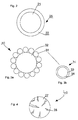
- the drawing also shows the known product in Figures 2, 3a and 3b; the product according to the invention is shown in Figure 4.
- a known fat-containing powder particle is shown at 25 in Figure 2, in which the powder particle 21 is surrounded by a fat envelope 22. This product has been obtained by means of using cooling rolls.
- Figure 3 shows in Figure 3a the agglomerate 30, which in turn consists of fat particles 32 surrounded by powder particles 31. Said powder particles 31 are shown separately in Figure 3b, in which the powder particle 33 is surrounded by a thin skin 34 of fat.
- the product according to the invention is shown at 40, in which the powder particle 27 comprises capillaries 28 which will be filled with fat once the method according to the invention has been carried out.
- the powder particle that is shown in Figures 2 and 3 also comprises capillaries, but said capillaries do not comprise fat, or only on the outside, whereas according to the invention the powder particle 27 comprises fat-filled capillaries 28.
- the milk substitute according to the invention that has thus been obtained is more easily digested by young stock and larger quantities of fat can be administered via powder without this leading to problems with the young stock as regards the ingestion of the substances to be administered in the fat and the fat itself.
- the product according to the invention makes it possible to obtain a milk substitute for young stock by means of which in addition to milk powder, amongst other substances, also fat and auxiliary substances can be administered to the young cattle without this leading to digestive problems when relatively high percentages of fat (above 20 wt. %) are used.
- sacks 4 filled with a powder are emptied into a screw conveyor 1.
- the powder has a loose, dusty structure and an ambient temperature, viz. about 15 °C. In this way, 100 kg of powder are added to the mixer 3 via the screw conveyor 1.
- the mixer 3 is closed and a sub-atmospheric pressure of about 0.5 bar is generated in the mixer via the vacuum pump 5.
- the mixer is closed by means of the valve 6 and the operation of the vacuum pump 5 is stopped.
- the screw blades in the mixer 3 are rotated and fat from the storage container 2 is supplied to the powder, via the nozzles 8, by means of the pump 7.
- the temperature of the fat in the storage container 2 is 45 °C.
- 40 l of fat are added to the rotating powder, so that the final product will contain about 25% fat.
- the nozzles 8 are blown through and the sub-atmospheric pressure is released and the mixer is stopped. Then the hatch 10 of the mixer is opened and the powder, to which fat has been added, runs into the lower bunker 9. Following that, the bottom valve 11 of the bunker is opened and the fat-containing powder falls into a receiving bin above the conveyor belt 12.
- the temperature of the product placed onto the conveyor belt 12 is about 26 °C.
- the granular product is transferred to a (Locker) screen 13 via the conveyor belt 12.
- Said screen comprises a screen frame with an upper cloth having a screen mesh of 8 mm. A small part (less than 10%) of the grains falls through the screen onto a discharge conveyor 14.
- the main part of the grains runs over the screening cloth, forming balls having a size of 2-3 cm. Said balls fall into a milling cutter 15, in which they are crushed fine.
- the substances being discharged from the screen 13 and from the milling cutter 15 are transferred to the flow-through mixer 16 via the discharge conveyor 14, in which mixer the substances are mixed with solid flakes of carbon dioxide.
- liquid carbon dioxide from container 17 is converted into a spray, from which solid flakes are formed, which flakes are spread between chunks or balls of product.
- the product in the form of a mixture of flakes and balls lands on the flat screen 18.
- the final product consists of chunks of powder having a size of maximally 1 cm 3 and containing about 25% fat. More than half of said fat has been introduced into the core of the chunk-shaped product, with less than half of the fat being present at the surface.
- This product makes it possible to obtain a milk substitute for young stock, by means of which not only powder but also fat and auxiliary substances can be administered to the young stock without this leading to digestive problems when large quantities of fat (about 45 wt. %) are used.
- the device according to the invention consists of a mixer comprising a supply inlet for the basic component on the one hand and fat on the other hand, from which mixer the fat-containing basic component can be discharged.
- Said device is characterized in that the material supplied as the basic component is a milk substitute and in that the mixer comprises a vacuum pump.
- the device according to the invention comprises a supply inlet for carbon dioxide in connection with said cooling.
Landscapes
- Life Sciences & Earth Sciences (AREA)
- Chemical & Material Sciences (AREA)
- Polymers & Plastics (AREA)
- Engineering & Computer Science (AREA)
- Food Science & Technology (AREA)
- Zoology (AREA)
- Animal Husbandry (AREA)
- Birds (AREA)
- Health & Medical Sciences (AREA)
- Biomedical Technology (AREA)
- Biotechnology (AREA)
- Molecular Biology (AREA)
- Physiology (AREA)
- Feed For Specific Animals (AREA)
- Fodder In General (AREA)
- Dairy Products (AREA)
- Edible Oils And Fats (AREA)
- Bakery Products And Manufacturing Methods Therefor (AREA)
Abstract
Description
Claims (19)
- A method for applying fat under reduced pressure to particles of a basic component of a milk substitute while mixing, comprising combining in a mixer a predetermined quantity of said particles with a predetermined quantity of a fat, characterized in that said reduced pressure is applied to said particles prior to combining said particles with said fat.
- A method according to claim 1, characterized in that during mixing said fat is added to the rotating particles.
- A method according to any of the preceding claims, characterized in that said basic component is a powder.
- A method according to claim 3, characterized in that said powder is selected from milk powder, dried whey, and vegetable substances.
- A method according to any of the preceding claims, characterized in that the basic component/fat weight ratio ranges between 1:0.5 and 1:0.1.
- A method according to any of the preceding claims, characterized in that the fat is mixed with the powder under a reduced pressure and at an elevated temperature.
- A method according to claim 5, characterized in that the powder/fat weight ratio ranges between 1:0.5 and 1:0.1.
- A method according to claim 6, characterized in that the reduced pressure is 0.2-0.7 bar.
- A method according to claim 6, characterized in that the the elevated temperature is 25-60 °C.
- A method according to any of the preceding claims, characterized in that the fat-containing particles are screened to a particle size of 0.5-4 mm.
- A method according to claim 10, characterized in that the granulated particles are stored at a temperature of less than 8 °C.
- A method according to claim 11, characterized in that said cooling takes place by mixing the fat-containing product with solid carbon dioxide and causing the carbon dioxide to evaporate by ventilating air passing said solid carbon dioxide.
- A fat-containing milk substitute for young stock, such as calves, lambs, and piglets, and for poultry, consisting of a particulate basic component which contains fat, characterized in that more than 90 wt. % of the fat has been introduced into the capillaries of the basic component, with less than 10 wt. % of the fat being present at the surface of the particles of the basic component.
- A fat-containing milk substitute according to claim 13, characterized in that said basic component is a powder.
- A fat-containing milk substitute according to claim 14, characterized in that said powder is selected from milk powder, dried whey, and vegetable substances.
- A device for carrying out the method according to claim 1-12, which device consists of a mixer comprising a supply inlet for basic component and fat and an outlet for the mixture of basic component and fat, wherein the basic component has been selected so that a milk substitute can be obtained therewith and wherein the mixer (3) comprises a vacuum pump (5), characterized in that the outlet (11) of the mixer opens onto a screen (13), after which screen a milling cutter (15) is disposed for crushing the large chunks fine, after which milling cutter a flat screen/fluidising bed (18) provided with a cooking element for obtaining a cooled final product is disposed.
- A device according to claim 16, characterized in that a supply inlet for carbon dioxide is present between the screen (13) and the flat screen (18) so as to obtain a coolant.
- A fat-containing milk substitute according to claims 13-15 for young stock, such as calves, lambs and piglets, and for poultry, obtained according to the methods according to any of claims 1-12.
- Use of a fat-containing milk substitute according to any of claims 13-15, or claim 18, for young stock, such as calves, lambs and piglets, and for poultry.
Applications Claiming Priority (3)
| Application Number | Priority Date | Filing Date | Title |
|---|---|---|---|
| NL1018308A NL1018308C2 (en) | 2001-06-15 | 2001-06-15 | Fat-containing milk substitute for young cattle, method for the preparation of the fat-containing milk substitute and the device to be used thereby. |
| NL1018308 | 2001-06-15 | ||
| PCT/NL2002/000387 WO2002102171A1 (en) | 2001-06-15 | 2002-06-13 | Fat-containing milk substitute for young stock, method for preparing the fat-containing milk substitute and device to be used therewith |
Publications (2)
| Publication Number | Publication Date |
|---|---|
| EP1395126A1 EP1395126A1 (en) | 2004-03-10 |
| EP1395126B1 true EP1395126B1 (en) | 2005-04-13 |
Family
ID=19773563
Family Applications (1)
| Application Number | Title | Priority Date | Filing Date |
|---|---|---|---|
| EP02741529A Expired - Lifetime EP1395126B1 (en) | 2001-06-15 | 2002-06-13 | Fat-containing milk substitute for young stock, method for preparing the fat-containing milk substitute and device to be used therewith |
Country Status (6)
| Country | Link |
|---|---|
| EP (1) | EP1395126B1 (en) |
| AT (1) | ATE292896T1 (en) |
| DE (1) | DE60203709D1 (en) |
| NL (1) | NL1018308C2 (en) |
| PL (1) | PL366832A1 (en) |
| WO (1) | WO2002102171A1 (en) |
Cited By (1)
| Publication number | Priority date | Publication date | Assignee | Title |
|---|---|---|---|---|
| WO2016058913A1 (en) | 2014-10-13 | 2016-04-21 | Unilever N.V. | Process for preparing a fat slurry and for preparing a spread with said slurry |
Family Cites Families (5)
| Publication number | Priority date | Publication date | Assignee | Title |
|---|---|---|---|---|
| GB1095823A (en) * | 1964-06-17 | 1967-12-20 | Cornelius Jacobus Van Ginneken | Method and apparatus for preparing a powdered, mixed product |
| FR2302049A1 (en) * | 1975-02-25 | 1976-09-24 | Jacob Sa Guy | Mfr. of fat enriched powder for animal feed - esp. skimmed milk powder enriched for feeding calves |
| US4971820A (en) * | 1989-06-02 | 1990-11-20 | Canada Packers Inc. | Animal feeds and processes for their manufacture |
| US6136353A (en) * | 1996-07-23 | 2000-10-24 | Buhler Ag | Method of incorporating fatty matter into granulated products |
| US6440477B2 (en) * | 1996-09-05 | 2002-08-27 | Nisshin Flour Milling Co., Ltd. | Method of adding fats and oils to porous fodder |
-
2001
- 2001-06-15 NL NL1018308A patent/NL1018308C2/en not_active IP Right Cessation
-
2002
- 2002-06-13 WO PCT/NL2002/000387 patent/WO2002102171A1/en not_active Ceased
- 2002-06-13 PL PL02366832A patent/PL366832A1/en not_active Application Discontinuation
- 2002-06-13 DE DE60203709T patent/DE60203709D1/en not_active Expired - Lifetime
- 2002-06-13 AT AT02741529T patent/ATE292896T1/en not_active IP Right Cessation
- 2002-06-13 EP EP02741529A patent/EP1395126B1/en not_active Expired - Lifetime
Cited By (1)
| Publication number | Priority date | Publication date | Assignee | Title |
|---|---|---|---|---|
| WO2016058913A1 (en) | 2014-10-13 | 2016-04-21 | Unilever N.V. | Process for preparing a fat slurry and for preparing a spread with said slurry |
Also Published As
| Publication number | Publication date |
|---|---|
| NL1018308C2 (en) | 2002-12-17 |
| ATE292896T1 (en) | 2005-04-15 |
| DE60203709D1 (en) | 2005-05-19 |
| EP1395126A1 (en) | 2004-03-10 |
| PL366832A1 (en) | 2005-02-07 |
| WO2002102171A1 (en) | 2002-12-27 |
Similar Documents
| Publication | Publication Date | Title |
|---|---|---|
| CN100361596C (en) | Method and equipment for preparing animal feed raw material by using sunflower seed cake | |
| US4698225A (en) | Granular binding agent for pellets | |
| US4212890A (en) | Manufacture of pellets from feed meals | |
| GB2102268A (en) | Animal feedstuff and processes for the production thereof | |
| CN105934160A (en) | Feed pellets and related systems and methods | |
| US4012535A (en) | Molasses impregnated bagasse pith animal feed | |
| US4820532A (en) | Preparation of a low-dust free-flowing choline chloride powder | |
| KR101144827B1 (en) | Method for making granule feed and apparatus thereof | |
| JP2915432B2 (en) | Compositions and methods for increasing milk fat production in ruminants | |
| US4323584A (en) | Method of preparing animal feeds | |
| US3464824A (en) | Process of producing a granular feed | |
| US6322845B1 (en) | Method for producing pelletized fuzzy cottonseed | |
| US2774670A (en) | Cereal food and method | |
| US3130054A (en) | Method of producing a food supplement | |
| EP1395126B1 (en) | Fat-containing milk substitute for young stock, method for preparing the fat-containing milk substitute and device to be used therewith | |
| US20040096546A1 (en) | Fat-containing milk substitute for young stock, method for preparing the fat-containing milk substitute and device to be used therewith | |
| CA2236130A1 (en) | Pelletized urea containing feed supplements and a process for making same | |
| Yegorov et al. | Application of granulation technology in various industries | |
| Hanrahan | Effect of pellet size and pellet quality on pig performance | |
| US20060083834A1 (en) | Process for granulation of wet processed foods and use thereof | |
| EP1154704A1 (en) | Process for the production of a nutritional composition | |
| JPS596845A (en) | Production of pellets of roughage from hull | |
| RU2070814C1 (en) | Feed mixing method and device | |
| US2841496A (en) | Dustless meal and method of preparing the same | |
| Yegorov et al. | Scientific and practical basis of using protein plant concentrates for the production of compound feeds |
Legal Events
| Date | Code | Title | Description |
|---|---|---|---|
| PUAI | Public reference made under article 153(3) epc to a published international application that has entered the european phase |
Free format text: ORIGINAL CODE: 0009012 |
|
| 17P | Request for examination filed |
Effective date: 20031202 |
|
| AK | Designated contracting states |
Kind code of ref document: A1 Designated state(s): AT BE CH CY DE DK ES FI FR GB GR IE IT LI LU MC NL PT SE TR |
|
| AX | Request for extension of the european patent |
Extension state: AL LT LV MK RO SI |
|
| GRAP | Despatch of communication of intention to grant a patent |
Free format text: ORIGINAL CODE: EPIDOSNIGR1 |
|
| GRAS | Grant fee paid |
Free format text: ORIGINAL CODE: EPIDOSNIGR3 |
|
| GRAA | (expected) grant |
Free format text: ORIGINAL CODE: 0009210 |
|
| AK | Designated contracting states |
Kind code of ref document: B1 Designated state(s): AT BE CH CY DE DK ES FI FR GB GR IE IT LI LU MC NL PT SE TR |
|
| AX | Request for extension of the european patent |
Extension state: LT LV SI |
|
| PG25 | Lapsed in a contracting state [announced via postgrant information from national office to epo] |
Ref country code: IT Free format text: LAPSE BECAUSE OF FAILURE TO SUBMIT A TRANSLATION OF THE DESCRIPTION OR TO PAY THE FEE WITHIN THE PRESCRIBED TIME-LIMIT;WARNING: LAPSES OF ITALIAN PATENTS WITH EFFECTIVE DATE BEFORE 2007 MAY HAVE OCCURRED AT ANY TIME BEFORE 2007. THE CORRECT EFFECTIVE DATE MAY BE DIFFERENT FROM THE ONE RECORDED. Effective date: 20050413 Ref country code: AT Free format text: LAPSE BECAUSE OF FAILURE TO SUBMIT A TRANSLATION OF THE DESCRIPTION OR TO PAY THE FEE WITHIN THE PRESCRIBED TIME-LIMIT Effective date: 20050413 Ref country code: TR Free format text: LAPSE BECAUSE OF FAILURE TO SUBMIT A TRANSLATION OF THE DESCRIPTION OR TO PAY THE FEE WITHIN THE PRESCRIBED TIME-LIMIT Effective date: 20050413 Ref country code: FI Free format text: LAPSE BECAUSE OF FAILURE TO SUBMIT A TRANSLATION OF THE DESCRIPTION OR TO PAY THE FEE WITHIN THE PRESCRIBED TIME-LIMIT Effective date: 20050413 Ref country code: CH Free format text: LAPSE BECAUSE OF FAILURE TO SUBMIT A TRANSLATION OF THE DESCRIPTION OR TO PAY THE FEE WITHIN THE PRESCRIBED TIME-LIMIT Effective date: 20050413 Ref country code: LI Free format text: LAPSE BECAUSE OF FAILURE TO SUBMIT A TRANSLATION OF THE DESCRIPTION OR TO PAY THE FEE WITHIN THE PRESCRIBED TIME-LIMIT Effective date: 20050413 |
|
| REG | Reference to a national code |
Ref country code: GB Ref legal event code: FG4D |
|
| REG | Reference to a national code |
Ref country code: CH Ref legal event code: EP |
|
| REG | Reference to a national code |
Ref country code: IE Ref legal event code: FG4D |
|
| REF | Corresponds to: |
Ref document number: 60203709 Country of ref document: DE Date of ref document: 20050519 Kind code of ref document: P |
|
| RAP2 | Party data changed (patent owner data changed or rights of a patent transferred) |
Owner name: SCHILS HOLDING B.V. |
|
| PG25 | Lapsed in a contracting state [announced via postgrant information from national office to epo] |
Ref country code: IE Free format text: LAPSE BECAUSE OF NON-PAYMENT OF DUE FEES Effective date: 20050613 Ref country code: CY Free format text: LAPSE BECAUSE OF FAILURE TO SUBMIT A TRANSLATION OF THE DESCRIPTION OR TO PAY THE FEE WITHIN THE PRESCRIBED TIME-LIMIT Effective date: 20050613 |
|
| PG25 | Lapsed in a contracting state [announced via postgrant information from national office to epo] |
Ref country code: MC Free format text: LAPSE BECAUSE OF NON-PAYMENT OF DUE FEES Effective date: 20050630 |
|
| PG25 | Lapsed in a contracting state [announced via postgrant information from national office to epo] |
Ref country code: GR Free format text: LAPSE BECAUSE OF FAILURE TO SUBMIT A TRANSLATION OF THE DESCRIPTION OR TO PAY THE FEE WITHIN THE PRESCRIBED TIME-LIMIT Effective date: 20050713 Ref country code: SE Free format text: LAPSE BECAUSE OF FAILURE TO SUBMIT A TRANSLATION OF THE DESCRIPTION OR TO PAY THE FEE WITHIN THE PRESCRIBED TIME-LIMIT Effective date: 20050713 Ref country code: DK Free format text: LAPSE BECAUSE OF FAILURE TO SUBMIT A TRANSLATION OF THE DESCRIPTION OR TO PAY THE FEE WITHIN THE PRESCRIBED TIME-LIMIT Effective date: 20050713 |
|
| PG25 | Lapsed in a contracting state [announced via postgrant information from national office to epo] |
Ref country code: DE Free format text: LAPSE BECAUSE OF FAILURE TO SUBMIT A TRANSLATION OF THE DESCRIPTION OR TO PAY THE FEE WITHIN THE PRESCRIBED TIME-LIMIT Effective date: 20050714 |
|
| PG25 | Lapsed in a contracting state [announced via postgrant information from national office to epo] |
Ref country code: ES Free format text: LAPSE BECAUSE OF FAILURE TO SUBMIT A TRANSLATION OF THE DESCRIPTION OR TO PAY THE FEE WITHIN THE PRESCRIBED TIME-LIMIT Effective date: 20050724 |
|
| NLT2 | Nl: modifications (of names), taken from the european patent patent bulletin |
Owner name: SCHILS HOLDING B.V. |
|
| PG25 | Lapsed in a contracting state [announced via postgrant information from national office to epo] |
Ref country code: PT Free format text: LAPSE BECAUSE OF FAILURE TO SUBMIT A TRANSLATION OF THE DESCRIPTION OR TO PAY THE FEE WITHIN THE PRESCRIBED TIME-LIMIT Effective date: 20050913 |
|
| LTIE | Lt: invalidation of european patent or patent extension |
Effective date: 20050413 |
|
| REG | Reference to a national code |
Ref country code: CH Ref legal event code: PL |
|
| PLBE | No opposition filed within time limit |
Free format text: ORIGINAL CODE: 0009261 |
|
| STAA | Information on the status of an ep patent application or granted ep patent |
Free format text: STATUS: NO OPPOSITION FILED WITHIN TIME LIMIT |
|
| REG | Reference to a national code |
Ref country code: IE Ref legal event code: MM4A |
|
| ET | Fr: translation filed | ||
| 26N | No opposition filed |
Effective date: 20060116 |
|
| PGFP | Annual fee paid to national office [announced via postgrant information from national office to epo] |
Ref country code: FR Payment date: 20060531 Year of fee payment: 5 |
|
| PGFP | Annual fee paid to national office [announced via postgrant information from national office to epo] |
Ref country code: BE Payment date: 20060601 Year of fee payment: 5 |
|
| PG25 | Lapsed in a contracting state [announced via postgrant information from national office to epo] |
Ref country code: GB Free format text: LAPSE BECAUSE OF NON-PAYMENT OF DUE FEES Effective date: 20060613 |
|
| PGFP | Annual fee paid to national office [announced via postgrant information from national office to epo] |
Ref country code: LU Payment date: 20060615 Year of fee payment: 5 |
|
| PGFP | Annual fee paid to national office [announced via postgrant information from national office to epo] |
Ref country code: NL Payment date: 20060627 Year of fee payment: 5 |
|
| GBPC | Gb: european patent ceased through non-payment of renewal fee |
Effective date: 20060613 |
|
| BERE | Be: lapsed |
Owner name: *SCHILS HOLDING B.V. Effective date: 20070630 |
|
| NLV4 | Nl: lapsed or anulled due to non-payment of the annual fee |
Effective date: 20080101 |
|
| PG25 | Lapsed in a contracting state [announced via postgrant information from national office to epo] |
Ref country code: BE Free format text: LAPSE BECAUSE OF NON-PAYMENT OF DUE FEES Effective date: 20070630 |
|
| REG | Reference to a national code |
Ref country code: FR Ref legal event code: ST Effective date: 20080229 |
|
| PG25 | Lapsed in a contracting state [announced via postgrant information from national office to epo] |
Ref country code: NL Free format text: LAPSE BECAUSE OF NON-PAYMENT OF DUE FEES Effective date: 20080101 |
|
| PG25 | Lapsed in a contracting state [announced via postgrant information from national office to epo] |
Ref country code: FR Free format text: LAPSE BECAUSE OF NON-PAYMENT OF DUE FEES Effective date: 20070702 |
|
| PG25 | Lapsed in a contracting state [announced via postgrant information from national office to epo] |
Ref country code: LU Free format text: LAPSE BECAUSE OF NON-PAYMENT OF DUE FEES Effective date: 20070613 |