EP1394608A1 - Washing method and apparatus - Google Patents
Washing method and apparatus Download PDFInfo
- Publication number
- EP1394608A1 EP1394608A1 EP03018819A EP03018819A EP1394608A1 EP 1394608 A1 EP1394608 A1 EP 1394608A1 EP 03018819 A EP03018819 A EP 03018819A EP 03018819 A EP03018819 A EP 03018819A EP 1394608 A1 EP1394608 A1 EP 1394608A1
- Authority
- EP
- European Patent Office
- Prior art keywords
- paper
- planar surface
- wash solution
- applying means
- pressure applying
- Prior art date
- Legal status (The legal status is an assumption and is not a legal conclusion. Google has not performed a legal analysis and makes no representation as to the accuracy of the status listed.)
- Withdrawn
Links
Images

Classifications
-
- G—PHYSICS
- G03—PHOTOGRAPHY; CINEMATOGRAPHY; ANALOGOUS TECHNIQUES USING WAVES OTHER THAN OPTICAL WAVES; ELECTROGRAPHY; HOLOGRAPHY
- G03D—APPARATUS FOR PROCESSING EXPOSED PHOTOGRAPHIC MATERIALS; ACCESSORIES THEREFOR
- G03D5/00—Liquid processing apparatus in which no immersion is effected; Washing apparatus in which no immersion is effected
Definitions
- This invention relates to the washing of sheets of material which contain substances requiring washing for their removal
- the invention relates in particular to the washing or stabilisation stage of the photographic processing of colour film and paper.
- the invention will be described with reference to a system for washing photographic paper.
- the paper must be held against the planar surface over its whole area and must be transported up the plane, preferably by simple mechanical means.
- the paper is often provided in the form of sections of a continuous web of material which is usually manufactured in roll form.
- the sheets or webs of paper therefore do not naturally lie flat and are subject to strains introduced while in roll form. There is a tendency for the paper to curl and this tends to lift the paper from the planar surface at all four edges.
- a rigid support may be applied to the back of the paper in order to apply a force pressing the paper against the plane.
- a smooth surface, particularly when wet, provides excessive drag.
- the problem to be solved is the application of pressure to the back of the paper in such a way as to ensure contact of the coated surface of the paper with the washing surface over the entire area of the paper whilst allowing the frictional resistance to paper transport to remain sufficiently low as to allow transport to be achieved with the minimal use of paper drive mechanisms, such as rollers or belts. Additionally, the back of the paper and the means of applying pressure must be cleaned in a way which prevents the washing surface being contaminated by waste material transferred from the means of applying pressure when paper is no longer present.
- an apparatus for washing substances from a coated surface of a material comprising at least one inclined substantially planar surface up which the material is passed, an inlet for the introduction of wash solution being provided at the upper part thereof, and pressure applying means for holding the material in full contact with the planar surface.
- the pressure applying means comprises a flexible member lying on top of the material being washed.
- This flexible member preferably has a textured surface.
- the invention further provides a method of washing substances from the coated surface of a material, the material being transported up at least one inclined substantially planar surface and wash solution being introduced at the upper part of the inclined planar surface between the planar surface and the material, the material being held in full contact with the planar surface by the application of pressure to the back thereof.
- wash solution is also introduced between the material and the pressure applying means.
- the invention provides efficient and rapid washing.
- the present invention ensures that the entire surface of the processed material is efficiently washed.
- the present invention further provides that the washing surface of the planar surface is not contaminated by the substances carried into the wash stage on the back of the material.
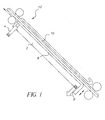
- FIG. 1 is a schematic view of an embodiment of the invention.
- a substantially planar inclined surface 2 An inlet 4 for the introduction of fresh wash solution is located at the upper end of the inclined surface 2.
- An outlet 6 for the dirty wash solution is located at the lower end of the surface 2.
- the surface is covered with a material such as fabric.
- This fabric cover 8 provides resistance to flow in the plane of the fabric by soaking up the wash solution within the fibres.
- the fabric cover is a preferred feature and is not essential to the present invention.
- a flexible member 12 is provided above the material to be washed, hereinafter referred to as paper 10, such that it lies on the back thereof. The member 12 is fixed across its width at the lower end of the surface 2.
- This end of the member may be curved to facilitate the feeding of paper between the member and the surface 2.
- the member may also be fixed at the upper end of the surface but this is not essential.
- the flexible member 12 is of sufficient weight to rest on the paper and make the paper conform to the surface of the inclined plane but not to prevent transportation of the paper up the planar surface. The whole width of the paper is held against the planar surface by the weight of the member 12.
- the member could, for example, be made of a PVC based material or of silicone rubber material
- rollers or other transportation means convey the paper to be washed up the inclined surface.
- the paper may be in sheet form or be a continuous web of coated material.
- the surface of the flexible member 12 in contact with the paper is textured. Such a surface reduces resistance to movement of the paper.
- the textured surface is such that the highest points of the surface are in a continuous plane, i.e. the surface consists of a plurality of indentations below a planar surface rather than protrusions above a planar surface.
- the degree of pressure applied and the resistance to paper transport can be controlled by reducing the area of the flexible member. This could be done, for example, by cutting out circular holes. Other ways of reducing the area will be apparent to those skilled in the art.
- the stiffness of the flexible member will also be affected by cutting out holes. Additional weight and stiffness can be provided by attaching more rigid material to the back of the flexible member. This could, for example, be effected by placing rigid strips of material across the member 12 transverse to the direction of travel of the paper.
- the paper 10 is transported up the inclined planar surface 2, beneath the flexible member 12.
- the paper is fed up the surface with the coated surface thereof in contact with the surface 2.
- the wash solution is fed through the inlet 4 and flows downwards under gravity towards the outlet 6 under the paper 10.
- the contaminated wash solution passes through outlet 6.
- the paper 10 is held against the inclined surface 2 by the weight of the flexible member 12. As the whole area of the paper is thus in contact with the planar surface more efficient washing is enabled.
- wash solution is also introduced at the upper part of the inclined plane 2 between the paper 10 and the member 12. This effectively washes contaminants off the back of the paper and thus off the surface of the flexible member in contact with the back of the paper. This ensures that when the paper has passed from the washing area there are substantially no contaminants left on the surface of the flexible member. Thus the inclined surface doe not become contaminated by contact with the flexible member.
- the wash solution is removed further down the plane, not illustrated.
- FIG. 1 An experimental 8-inch wide unit was constructed and evaluated. The unit is illustrated in Figure 1.
- the fabric chosen for the cover 8 was velvet supplied by the specialist US fabric manufacturer Milliken and is the same as that used in 35mm film cassettes.
- the plane 2 was inclined at an angle of 27 degrees to the horizontal
- the flexible member used to hold the paper against the surface of the felt is made from a PVC conveyor belt material produced by Ammeraal Process and Conveyor Belting (Flexam 1T3240). It has pyramidal dimples embossed into the surface in contact with the back of the paper. These help to reduce friction.
- the belt material had 30 mm holes punched through it, to improve the flexibility further and to reduce the drag on the back surface of the paper.
- Ektacolor Edge8 paper was passed through a standard deep tank Ektacolor Prime developer and Bleach-fix (22s in each tank) before progressing up the ramp.
- the developer and bleach-fix were heated to 35 °C, whilst the wash was at room temperature (22 °C).
- a simple wash solution of 2g/l Kodak Photoflo solution was applied to the inclined plane at a rate of 18 ml/min. As the paper is transported up the plane at a rate of 3 linear feet a minute, this equates to a solution usage rate of 9 ml/ft 2 .
- the incline takes about five minutes to prime. Therefore it holds approximately 90 ml of liquid, in a film about 0.75 mm thick, within the velvet.
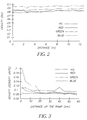
- the incline was run continuously for fifteen minutes and thus experienced at least three tank turnovers of solution. Samples were taken from the paper at intervals and the paper minimum density was measured. These results are shown in Figure 2.
Landscapes
- Physics & Mathematics (AREA)
- General Physics & Mathematics (AREA)
- Paper (AREA)
- Cleaning By Liquid Or Steam (AREA)
- Cleaning In General (AREA)
Abstract
An apparatus for washing contaminants from a coated surface of a material
comprises an inclined substantially planar surface up which the material is passed,
an inlet for the introduction of wash solution at the upper part of the planar surface
and pressure applying means for holding the material in full contact with the
surface.
Description
- This invention relates to the washing of sheets of material which contain substances requiring washing for their removal The invention relates in particular to the washing or stabilisation stage of the photographic processing of colour film and paper. The invention will be described with reference to a system for washing photographic paper.
- There is a need in the photographic industry to remove substances from processed material to ensure image stability. In deep-tank replenished processing systems material passes from one tank to the next. For example, with respect to processing of colour paper, the material passes through a first tank for development, a second tank for bleach/fix and then into a series of wash or stabiliser tanks. The wash tanks are usually inter-connected so that clean washing solution is added to the last of the tank series and the over-flow from the last tank is transferred to the previous tank and so on. In this way the flow of solution is in a direction which is counter to the direction of transport of the paper. This so-called counter-current flow technique enables efficient washing since when the material has the highest content of substances to be removed, the wash solution also has the highest concentration of removed substances and clean solution is only used in the last step when the processed material contains little removable contaminants.
- The table below is derived from a mathematical model which predicts the fraction of contaminants remaining in colour paper after a four-tank counter-current wash stage in which 194 ml/m2 of solution is added to the last tank. High agitation is assumed which allows equilibrium between substances in the solution and processed material to be rapidly established.
Counter-Current Multiple Wash Number of tanks 4 4 Fraction of material left 0.00067 0.00062 Total Volume (ml per m2) 194 776 Total time @ 22.5 sec per tank 90 90 - The technique of counter-current washing is widely if not universally adopted with small, so-called Minilab or Microlab equipment and is often also used in large-scale wholesale equipment. More efficient washing can be achieved if more tanks are used in a counter-current series. However, the tanks are bulky and require pumps to provide adequate re-circulation and agitation. Each additional tank incurs additional cost and maintenance.
- Shorter washing times can be achieved if the time in each tank is reduced below that required for the material in the coating to be in equilibrium with the material in solution. This can be achieved without undue loss of washing efficiency. For example US 6106169 describes a multi-tank unit in which all but the last tank is insufficiently long to provide an immersion time sufficient to reach equilibrium. This unit was found to produce good results with a seven tank configuration giving a total wash-stage time of 20 seconds using as little as 9 ml/m2 of solution.
- By reducing the tank volumes, shaping them appropriately and allowing the paper to be transported with the coated side against the curved surface of the interior of the tanks, the agitation / re-circulation pumps could be avoided. However this arrangement required the provision of seven tanks with six cross-over devices to pass the paper from one tank to the next. Such cross-over devices, usually a set of at least two rollers, are expensive and require cleaning and maintenance.
- An alternative approach to using curved surfaces in the above multi-stage unit is to use substantially planar, inclined surfaces. The so-called "Inclined Ramp" washing system, see EP M908767, provided a single plane at a 45° angle, to guide the paper in an upward direction with the coated side of the paper against the plane surface. Cleaning/washing solution was added to the top of the inclined plane and ran under gravity under the paper. This surface was not smooth but was textured to provide some agitation. Theoretically this provides a very large number of tanks in a way which is analogous with the theoretical plates of a distillation column. Although each "tank" provides inefficient washing due to the short residence time, the opportunity for material exchange between the paper and increasingly clean water is continuously available. In practice, the efficiency of this device was not high. This was possibly due to the ability of the wash solution to find pathways under the paper surface which allowed rapid descent of a substantial part of the solution. Also in this type of arrangement, it is possible for the paper to drag water from the lower end of the ramp where the solution contains high concentrations of extracted substances to the upper parts, thus contaminating the relatively clean solution flowing down the surface.
- A number of these problems have been solved, see co-pending application ref 84588, having the same filing date as this applicaion. The problems were solved by providing a planar surface which differs from a truly smooth continuous planar surface in a way which provides a means of controlling the descent of wash solution down the inclined plane so that the descent time of the wash solution is substantially longer than the descent time of the same solution on a smooth planar surface. The preferred rate of descent of the solution is between 0.05 and 10 times the rate of ascent of the paper.
- An apparatus based on this principle provides excellent washing which is both rapid and which makes efficient use of wash solution. However some difficulties were encountered.
- The paper must be held against the planar surface over its whole area and must be transported up the plane, preferably by simple mechanical means. The paper is often provided in the form of sections of a continuous web of material which is usually manufactured in roll form. The sheets or webs of paper therefore do not naturally lie flat and are subject to strains introduced while in roll form. There is a tendency for the paper to curl and this tends to lift the paper from the planar surface at all four edges.
- A rigid support may be applied to the back of the paper in order to apply a force pressing the paper against the plane. However, it is difficult to ensure even pressure without either precise engineering or complicated adjustable locating means whilst also ensuring that the paper can be transported against the resistance provided by the frictional forces produced by the applied pressure. Also, a smooth surface, particularly when wet, provides excessive drag.
- It is also important to clean the back of the paper. Contaminants from the processing baths before the wash stage will be present in a film of liquid on the back of the paper. These need to be removed. In addition, contaminants will be transferred to the surface of the means of applying pressure to the back of the paper. The motion of the paper up the plane tends to drag the dirty liquid up the plane. When a length of paper has passed through the wash stage, the surface of the means of applying pressure will tend to contact the washing surface of the inclined plane and contamination of the clean areas of the plane occurs.
- The problem to be solved is the application of pressure to the back of the paper in such a way as to ensure contact of the coated surface of the paper with the washing surface over the entire area of the paper whilst allowing the frictional resistance to paper transport to remain sufficiently low as to allow transport to be achieved with the minimal use of paper drive mechanisms, such as rollers or belts. Additionally, the back of the paper and the means of applying pressure must be cleaned in a way which prevents the washing surface being contaminated by waste material transferred from the means of applying pressure when paper is no longer present.
- According to the present invention there is provided an apparatus for washing substances from a coated surface of a material, the apparatus comprising at least one inclined substantially planar surface up which the material is passed, an inlet for the introduction of wash solution being provided at the upper part thereof, and pressure applying means for holding the material in full contact with the planar surface.
- Preferably the pressure applying means comprises a flexible member lying on top of the material being washed. This flexible member preferably has a textured surface.
- The invention further provides a method of washing substances from the coated surface of a material, the material being transported up at least one inclined substantially planar surface and wash solution being introduced at the upper part of the inclined planar surface between the planar surface and the material, the material being held in full contact with the planar surface by the application of pressure to the back thereof.
- Preferably wash solution is also introduced between the material and the pressure applying means. Advantageous Effect of the Invention
- The invention provides efficient and rapid washing. The present invention ensures that the entire surface of the processed material is efficiently washed. The present invention further provides that the washing surface of the planar surface is not contaminated by the substances carried into the wash stage on the back of the material.
- The invention will now be described, by way of example, with reference to the accompanying drawings, in which:
- Figure 1 is a schematic view of an embodiment of the invention;
- Figure 2 is a graph showing density of the washed paper against distance along the planar surface;
- Figure 3 is a graph showing the concentration profile of retained substances along the planar surface; and
- Figure 4 is a graph comparing the densities of a sample of paper washed by the present invention and a sample of paper washed in a continuous flow of water.
-
- Figure 1 is a schematic view of an embodiment of the invention. Referring to figure 1 there is provided a substantially planar
inclined surface 2. Aninlet 4 for the introduction of fresh wash solution is located at the upper end of theinclined surface 2. Anoutlet 6 for the dirty wash solution is located at the lower end of thesurface 2. In the embodiment illustrated the surface is covered with a material such as fabric. Thisfabric cover 8 provides resistance to flow in the plane of the fabric by soaking up the wash solution within the fibres. The fabric cover is a preferred feature and is not essential to the present invention. Aflexible member 12 is provided above the material to be washed, hereinafter referred to aspaper 10, such that it lies on the back thereof. Themember 12 is fixed across its width at the lower end of thesurface 2. This end of the member may be curved to facilitate the feeding of paper between the member and thesurface 2. The member may also be fixed at the upper end of the surface but this is not essential. Theflexible member 12 is of sufficient weight to rest on the paper and make the paper conform to the surface of the inclined plane but not to prevent transportation of the paper up the planar surface. The whole width of the paper is held against the planar surface by the weight of themember 12. The member could, for example, be made of a PVC based material or of silicone rubber material - Rollers or other transportation means, not shown, convey the paper to be washed up the inclined surface. The paper may be in sheet form or be a continuous web of coated material. It is preferable for the surface of the
flexible member 12 in contact with the paper to be textured. Such a surface reduces resistance to movement of the paper. It is also preferable that the textured surface is such that the highest points of the surface are in a continuous plane, i.e. the surface consists of a plurality of indentations below a planar surface rather than protrusions above a planar surface. - The degree of pressure applied and the resistance to paper transport can be controlled by reducing the area of the flexible member. This could be done, for example, by cutting out circular holes. Other ways of reducing the area will be apparent to those skilled in the art. The stiffness of the flexible member will also be affected by cutting out holes. Additional weight and stiffness can be provided by attaching more rigid material to the back of the flexible member. This could, for example, be effected by placing rigid strips of material across the
member 12 transverse to the direction of travel of the paper. - In operation the
paper 10 is transported up the inclinedplanar surface 2, beneath theflexible member 12. The paper is fed up the surface with the coated surface thereof in contact with thesurface 2. The wash solution is fed through theinlet 4 and flows downwards under gravity towards theoutlet 6 under thepaper 10. As the wash solution passes down the inclined surface the contaminants leave the paper and are transferred to the wash solution. The contaminated wash solution passes throughoutlet 6. During this process thepaper 10 is held against theinclined surface 2 by the weight of theflexible member 12. As the whole area of the paper is thus in contact with the planar surface more efficient washing is enabled. - In a preferred embodiment of the invention wash solution is also introduced at the upper part of the
inclined plane 2 between thepaper 10 and themember 12. This effectively washes contaminants off the back of the paper and thus off the surface of the flexible member in contact with the back of the paper. This ensures that when the paper has passed from the washing area there are substantially no contaminants left on the surface of the flexible member. Thus the inclined surface doe not become contaminated by contact with the flexible member. The wash solution is removed further down the plane, not illustrated. - The experiment described below illustrates the results found on using a preferred embodiment of the invention.
- An experimental 8-inch wide unit was constructed and evaluated. The unit is illustrated in Figure 1. The fabric chosen for the
cover 8 was velvet supplied by the specialist US fabric manufacturer Milliken and is the same as that used in 35mm film cassettes. Theplane 2 was inclined at an angle of 27 degrees to the horizontal The flexible member used to hold the paper against the surface of the felt is made from a PVC conveyor belt material produced by Ammeraal Process and Conveyor Belting (Flexam 1T3240). It has pyramidal dimples embossed into the surface in contact with the back of the paper. These help to reduce friction. The belt material had 30 mm holes punched through it, to improve the flexibility further and to reduce the drag on the back surface of the paper. - Ektacolor Edge8 paper was passed through a standard deep tank Ektacolor Prime developer and Bleach-fix (22s in each tank) before progressing up the ramp. The developer and bleach-fix were heated to 35 °C, whilst the wash was at room temperature (22 °C). A simple wash solution of 2g/l Kodak Photoflo solution was applied to the inclined plane at a rate of 18 ml/min. As the paper is transported up the plane at a rate of 3 linear feet a minute, this equates to a solution usage rate of 9 ml/ft2. The incline takes about five minutes to prime. Therefore it holds approximately 90 ml of liquid, in a film about 0.75 mm thick, within the velvet. The incline was run continuously for fifteen minutes and thus experienced at least three tank turnovers of solution. Samples were taken from the paper at intervals and the paper minimum density was measured. These results are shown in Figure 2.
- At the end of the fifteen minute run the final piece of paper on the incline was removed and dried. By measuring the density of this piece of paper a simplified assessment of the concentration profile of retained products on the ramp could be obtained. This density profile is given in Figure 3. This data shows most material has been removed by the time the paper has climbed 25 cm up the incline.
- Finally, a sample of paper washed in the inclined plane was compared with a sample washed in a continuous flow of tap water for five minutes. The samples were placed in dark wet fade incubation ovens at 75C/50%RH to check for any effects caused by retained CD3. The results can be seen in Figure 4.
- Both samples showed a similar increase in minimum density values. No significantly greater increase in density was seen for the inclined plane washed sample therefore no CD3 was present in this sample. This was also confirmed using a basic reducing agent.
- The invention has been described in detail with reference to preferred embodiments thereof. It will be understood by those skilled in the art that variations and modifications can be effected within the scope of the invention.
Claims (15)
- Apparatus for washing substances from a coated surface of a material, the apparatus comprising at least one inclined substantially planar surface up which the material is passed, an inlet for the introduction of wash solution being provided at the upper part thereof, and pressure applying means for holding the material in full contact with the planar surface.
- Apparatus as claimed in claim 1 wherein the pressure applying means comprises a flexible member lying on top of the material.
- Apparatus as claimed in claim 1 or 2 wherein the pressure applying means has a textured surface.
- Apparatus as claimed in claim 1, 2 or 3 wherein the pressure applying means is more flexible in one direction than in the other.
- Apparatus as claimed in any preceding claim wherein the weight of the pressure applying means is non uniform over the area thereof.
- Apparatus as claimed in any preceding claim wherein the planar surface incorporates substantially non smooth resistance means providing a resistance to downward flow of the wash solution and having a capacity to hold wash solution in excess of that of a substantially smooth surface.
- Apparatus as claimed in any preceding claim wherein the width of the pressure applying means is greater than the width of the material to be washed.
- Apparatus as claimed in any preceding claim wherein the member is made of a PVC based material.
- Apparatus as claimed in any of claims 1 to 7 wherein the member is made of a silicone rubber material.
- Apparatus as claimed in any preceding claim for use with photographic materials.
- A method of washing substances from the coated surface of a material, the material being transported up at least one inclined substantially planar surface and wash solution being introduced at the upper part of the inclined planar surface between the planar surface and the material, the material being held in full contact with the planar surface by the application of pressure to the back thereof.
- A method as claimed in claim 11 wherein wash solution is further introduced between the material and the means applying pressure to the back thereof.
- A method as claimed in claim 11 or 12 wherein a flexible member provides the pressure applying means.
- A method as claimed in claim 11, 12 or 13 wherein the planar surface incorporates substantially non smooth resistance means providing a resistance to downward flow of the wash solution and having a capacity to hold wash solution in excess of that of a substantially smooth surface.
- A method as claimed in any of claims 11 to 14 wherein photographic material is being washed.
Applications Claiming Priority (2)
| Application Number | Priority Date | Filing Date | Title |
|---|---|---|---|
| GB0220261 | 2002-08-31 | ||
| GBGB0220261.2A GB0220261D0 (en) | 2002-08-31 | 2002-08-31 | Washing method and apparatus |
Publications (1)
| Publication Number | Publication Date |
|---|---|
| EP1394608A1 true EP1394608A1 (en) | 2004-03-03 |
Family
ID=9943278
Family Applications (1)
| Application Number | Title | Priority Date | Filing Date |
|---|---|---|---|
| EP03018819A Withdrawn EP1394608A1 (en) | 2002-08-31 | 2003-08-19 | Washing method and apparatus |
Country Status (5)
| Country | Link |
|---|---|
| US (1) | US7018115B2 (en) |
| EP (1) | EP1394608A1 (en) |
| JP (1) | JP2004089994A (en) |
| CN (1) | CN1493920A (en) |
| GB (1) | GB0220261D0 (en) |
Citations (3)
| Publication number | Priority date | Publication date | Assignee | Title |
|---|---|---|---|---|
| US2203382A (en) * | 1938-08-19 | 1940-06-04 | Lincoln K Davis | Washing device for photographs and the like |
| JPH0279841A (en) * | 1988-09-16 | 1990-03-20 | Konica Corp | Method and device for processing photographic sensitive material |
| EP0908774A2 (en) * | 1997-10-09 | 1999-04-14 | Eastman Kodak Company | A processing assembly having a processing apparatus with an inclined processing path |
Family Cites Families (4)
| Publication number | Priority date | Publication date | Assignee | Title |
|---|---|---|---|---|
| US4977422A (en) * | 1986-06-06 | 1990-12-11 | Visicon, Inc. | Apparatus for transporting flat sheets, especially photosensitive sheet materials |
| US5357305A (en) * | 1991-08-26 | 1994-10-18 | Eastman Kodak Company | Apparatus for processing photosensitive materials |
| GB9721462D0 (en) | 1997-10-09 | 1997-12-10 | Eastman Kodak Co | Processing photographic material |
| GB9721464D0 (en) | 1997-10-09 | 1997-12-10 | Eastman Kodak Co | Processing photographic material |
-
2002
- 2002-08-31 GB GBGB0220261.2A patent/GB0220261D0/en not_active Ceased
-
2003
- 2003-08-19 EP EP03018819A patent/EP1394608A1/en not_active Withdrawn
- 2003-08-26 US US10/649,487 patent/US7018115B2/en not_active Expired - Fee Related
- 2003-08-28 JP JP2003209291A patent/JP2004089994A/en active Pending
- 2003-09-01 CN CNA031579507A patent/CN1493920A/en active Pending
Patent Citations (3)
| Publication number | Priority date | Publication date | Assignee | Title |
|---|---|---|---|---|
| US2203382A (en) * | 1938-08-19 | 1940-06-04 | Lincoln K Davis | Washing device for photographs and the like |
| JPH0279841A (en) * | 1988-09-16 | 1990-03-20 | Konica Corp | Method and device for processing photographic sensitive material |
| EP0908774A2 (en) * | 1997-10-09 | 1999-04-14 | Eastman Kodak Company | A processing assembly having a processing apparatus with an inclined processing path |
Non-Patent Citations (1)
| Title |
|---|
| PATENT ABSTRACTS OF JAPAN * |
Also Published As
| Publication number | Publication date |
|---|---|
| US7018115B2 (en) | 2006-03-28 |
| CN1493920A (en) | 2004-05-05 |
| GB0220261D0 (en) | 2002-10-09 |
| US20040042788A1 (en) | 2004-03-04 |
| JP2004089994A (en) | 2004-03-25 |
Similar Documents
| Publication | Publication Date | Title |
|---|---|---|
| KR100237072B1 (en) | Slot Dense Structure for Photo Processing Equipment | |
| JP2981113B2 (en) | Photosensitive material processing equipment | |
| WO1991008518A1 (en) | Perforated processing apparatus and method | |
| JP2726235B2 (en) | Photosensitive material processing apparatus having fabric surface channel | |
| KR910008483A (en) | Method and apparatus for treating photosensitive material. | |
| US7018115B2 (en) | Washing method and apparatus | |
| US5365299A (en) | System and apparatus for the processing of a photosensitive sheet material and an associated method | |
| EP1394609A1 (en) | Washing method and apparatus | |
| JP2868486B2 (en) | Rollers used in photographic sheet material processing equipment | |
| US5455651A (en) | Apparatus for developing a printing plate | |
| US3072037A (en) | Continuous film processing apparatus | |
| US5426480A (en) | Photographic film processing apparatus | |
| EP0915378A2 (en) | Processing photographic material | |
| US6086270A (en) | Processing photographic material | |
| US2924163A (en) | Photographic development apparatus | |
| EP0908767A2 (en) | Processing photographic material | |
| US6176628B1 (en) | Processing photographic material | |
| NL8102949A (en) | METHOD FOR CLEANING ROLLS IN AN AUTOMATIC FILM DEVELOPMENT DEVICE AND CLEANING SHEET FOR THOSE. | |
| EP0534938A4 (en) | Apparatus and method for processing photosensitive sheets. | |
| JP4359405B2 (en) | Photosensitive material processing equipment | |
| EP0859279B1 (en) | A rack | |
| JP2514249Y2 (en) | Transition roller cleaning device in automatic processor | |
| JPH02204742A (en) | Device for processing photosensitive material | |
| JPH0730379Y2 (en) | Photosensitive lithographic printing plate processing liquid application device | |
| JP2931489B2 (en) | Photosensitive material processing method and photosensitive material processing apparatus |
Legal Events
| Date | Code | Title | Description |
|---|---|---|---|
| PUAI | Public reference made under article 153(3) epc to a published international application that has entered the european phase |
Free format text: ORIGINAL CODE: 0009012 |
|
| AK | Designated contracting states |
Kind code of ref document: A1 Designated state(s): AT BE BG CH CY CZ DE DK EE ES FI FR GB GR HU IE IT LI LU MC NL PT RO SE SI SK TR |
|
| AX | Request for extension of the european patent |
Extension state: AL LT LV MK |
|
| AKX | Designation fees paid | ||
| REG | Reference to a national code |
Ref country code: DE Ref legal event code: 8566 |
|
| STAA | Information on the status of an ep patent application or granted ep patent |
Free format text: STATUS: THE APPLICATION IS DEEMED TO BE WITHDRAWN |
|
| 18D | Application deemed to be withdrawn |
Effective date: 20040904 |